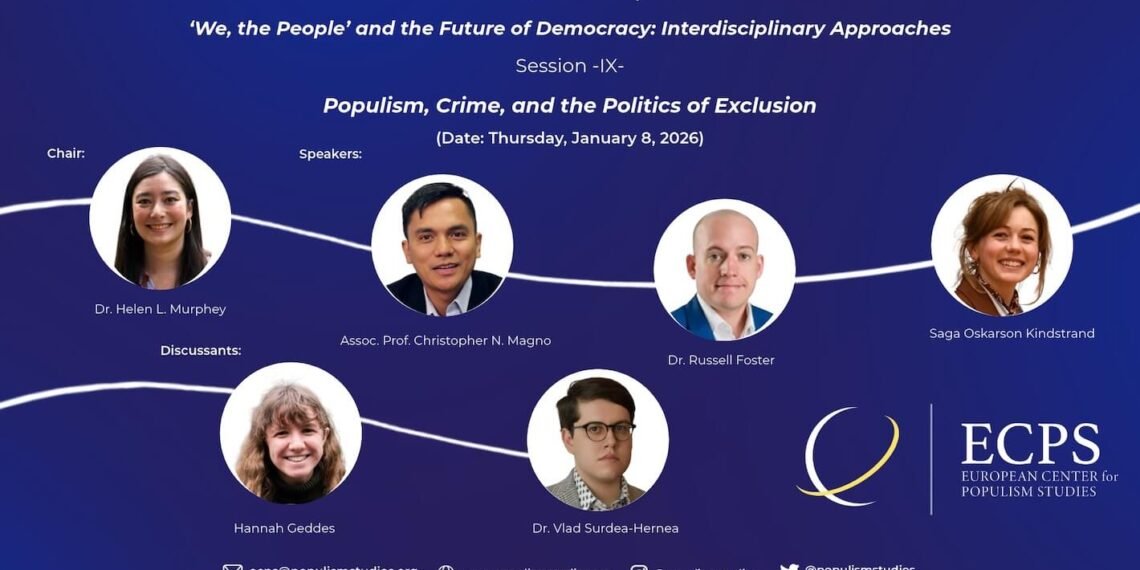
On January 8, 2026, ECPS convened Session 9 of its Virtual Workshop Series, titled “Populism, Crime, and the Politics of Exclusion.” The session was chaired and moderated by Dr. Helen L. Murphey, who framed exclusionary populism as a dual process that claims to empower an “authentic people” while simultaneously criminalizing stigmatized “others.” Assoc. Prof. Christopher N. Magno introduced the concept of criminal populism, showing how legal scandal and criminality can be transformed into political capital in the United States and the Philippines. Dr. Russell Foster examined how Austria’s FPÖ and France’s Rassemblement National legitimate anti-migration agendas through securitization and Gramscian metapolitics. Saga Oskarson Kindstrand drew on ethnographic research on the Sweden Democrats to challenge assumptions that populism undermines party organization. Discussants Hannah Geddes and Vlad Surdea-Hernea provided incisive reflections on theory, methodology, and democratic implications.
Reported by ECPS Staff
On Thursday, January 8, 2026, the European Center for Populism Studies (ECPS) convened Session 9 of its Virtual Workshop Series, titled “We, the People” and the Future of Democracy: Interdisciplinary Approaches. Held under the session theme“Populism, Crime, and the Politics of Exclusion,” the session brought together an interdisciplinary group of scholars to explore how populist actors mobilize crime, security, and moral threat to redefine political belonging—deciding who counts as “the people,” who is constructed as a dangerous “other,” and how these distinctions increasingly enter mainstream politics.
The workshop opened with welcoming and technical remarks by ECPS intern Stella Schade, who introduced the session’s structure, speakers, and discussants on behalf of ECPS, situating the event within the Center’s broader commitment to comparative and theoretically grounded research on populism.
The session was chaired and moderated by Dr. Helen L. Murphey (Postdoctoral Scholar, Mershon Center for International Security Studies, The Ohio State University), whose introduction provided the session’s conceptual frame. Dr. Murphey emphasized that exclusionary populism operates through a dual logic: empowering an “authentic people” while simultaneously stigmatizing “others” as criminal, threatening, or disorderly. She highlighted how populists present themselves as reluctant political actors pushed into action by crisis and elite failure, while claiming exclusive authority over law and order. Importantly, she noted that these narratives are no longer confined to populist outsiders but increasingly circulate within mainstream party competition. Her framing raised core questions about the evolution of exclusionary discourse, its entanglement with crime and popular culture, and its implications for democratic norms and party organization.
Dr. Christopher N. Magno, who is an Associate Professor in the Department of Justice Studies and Human Services at Gannon University, presented “From Crime Shows to Power: The Rise of Criminal Populism,” introducing criminal populism as a framework for understanding how leaders transform criminality into political capital. Moving beyond penal populism, Dr. Magno showed how indictments and scandals are reframed as proof of authenticity and persecution, strengthening affective ties with supporters while eroding accountability. Drawing on cases from the United States and the Philippines, he demonstrated how criminal identity becomes a political asset.
Dr. Russell Foster, Senior Lecturer in British and International Politics at King’s College London, School of Politics & Economics, Department of European & International Studies, delivered “The Legitimization Process of the FPÖ’s and the NR’s Migration Policies,” examining how radical right parties in Austria and France mainstream anti-immigration positions through securitization and cultural adaptation. Using a Gramscian lens, he argued that migration is increasingly criminalized by being linked to anxieties over housing, welfare, and identity, while stressing that radical right trajectories vary across national contexts.
Saga Oskarson Kindstrand, PhD candidate at Centre for European Studies and Comparative Politics, Sciences Po, presented “Anti-Party to Mass Party? Lessons from the Radical Right’s Party Building Model,” challenging the assumption that populism rejects mediation. Based on ethnographic research on the Sweden Democrats, she argued that populist discourse can sustain dense party organization by moralizing membership, valorizing “ordinary people,” and cultivating urgency—re-legitimating the party as a representative vehicle.
The presentations were followed by engaged interventions from Hannah Geddes (PhD Candidate, University of St. Andrews) and Dr. Vlad Surdea-Hernea (Postdoctoral researcher at the University of Natural Resources and Life Sciences in Vienna). Their critiques highlighted shared strengths in challenging established assumptions while probing issues of novelty, case selection, class, and internal party power. Together, the session offered a cohesive examination of how populism reshapes crime, exclusion, and democratic representation.