
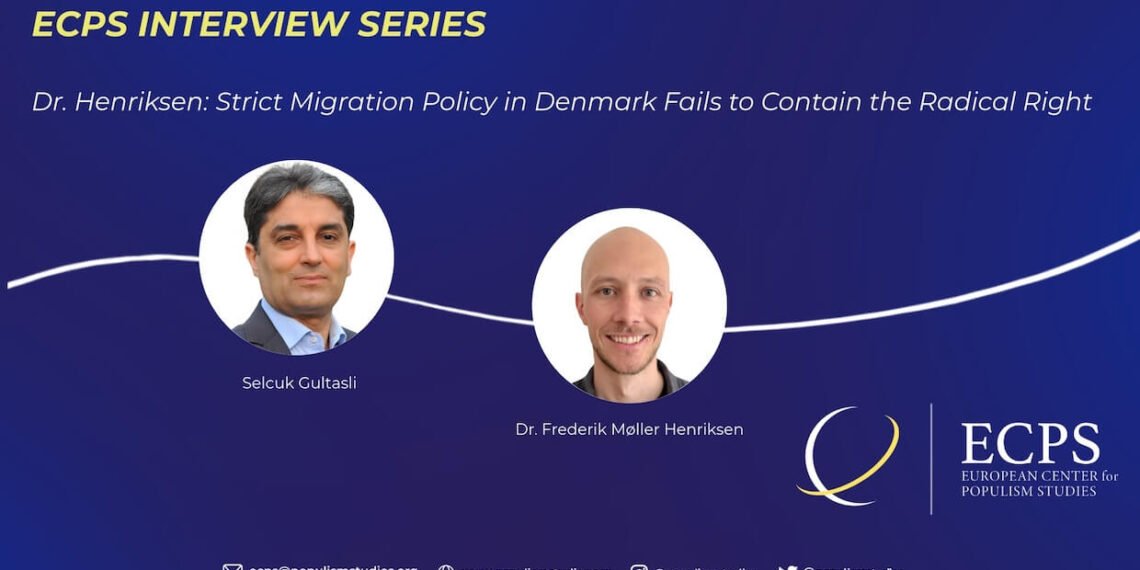
In this ECPS interview, Dr. Frederik Møller Henriksen offers an in-depth assessment of Denmark’s 2026 general election, highlighting both continuity and change in one of Europe’s most stable democracies. He characterizes the outcome as “a very poor election for the traditional governing parties,” underscoring the historic decline of established actors alongside the emergence of “a highly fragmented parliament.” While domestic concerns dominated the campaign, Dr. Henriksen emphasizes that strict migration policies have not contained the populist radical right, as evidenced by the resurgence of the Danish People’s Party. At the same time, he cautions against overstating democratic crisis, noting Denmark’s enduring institutional trust. Instead, he points to media fragmentation and digital communication as key forces reshaping political competition and voter alignment.
Interview by Selcuk Gultasli
In the aftermath of Denmark’s closely contested 2026 general election on March 24, the country stands at a critical political juncture—marked by fragmented blocs, the resurgence of the populist radical right, and renewed geopolitical tensions over Greenland. While domestic issues such as the cost-of-living crisis and migration shaped the campaign, deeper transformations in political communication and democratic contestation are also unfolding. Giving an in-depth interview to the European Center for Populism Studies (ECPS), Dr. Frederik Møller Henriksen, a postdoctoral researcher at Roskilde University working at the intersection of politics, media, and digital society, whose research on digital counter-publics, alternative media ecosystems, and anti-systemic populism, offers important insights into these developments.
Reflecting on the election outcome, Dr. Henriksen underscores that “this was a very poor election for the traditional governing parties,” pointing to the historically weak performance of both the Social Democrats and the center-right Venstre. He further highlights that “we now have a highly fragmented parliament,” a development that is likely to render coalition-building both complex and protracted. Indeed, the emergence of multiple competitive actors across the political spectrum has produced what some observers describe as “Dutch conditions” of party fragmentation and even “Belgian conditions” of prolonged government formation.
At the same time, Dr. Henriksen draws attention to the resurgence of the populist radical right, particularly the Danish People’s Party, emphasizing that restrictive policy convergence has not neutralized such forces. As he notes, the Danish case illustrates that strict migration policies do not necessarily diminish the electoral appeal of the radical right, but may instead coincide with renewed voter mobilization around issues of identity, economic anxiety, and national direction.
Beyond electoral dynamics, the interview also engages with the transformation of political communication in digitally mediated environments. While cautious about attributing direct causal effects to alternative media, Dr. Henriksen observes that “it has been very difficult to define” the election in terms of a coherent overarching narrative, suggesting that media fragmentation and hybrid communication systems are reshaping how political competition is structured and understood.
Importantly, despite these shifts, Dr. Henriksen does not interpret recent developments as signaling a systemic crisis of democracy. Denmark, he argues, remains a high-trust society with robust institutional foundations. Yet, it is increasingly “no longer isolated from trends we see elsewhere in Europe,” including fragmentation, anti-incumbent voting, and the growing salience of populist communication.
Taken together, Dr. Henriksen’s reflections situate the Danish election within a broader European trajectory, where established party systems are under pressure, populist actors continue to adapt, and democratic politics is being reshaped by both structural and communicative transformations.