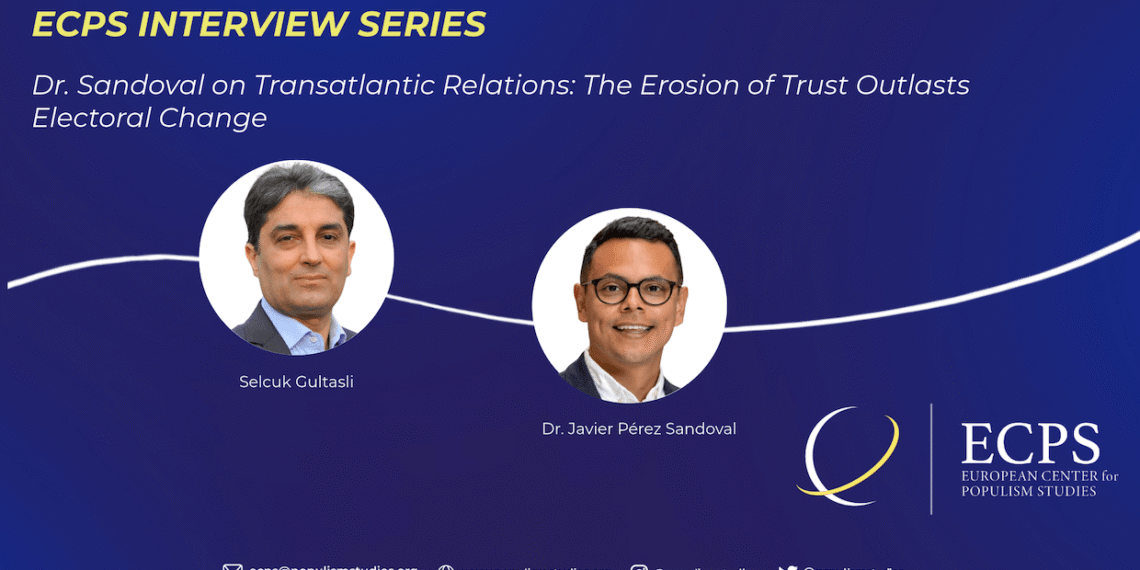
In this ECPS interview, Dr. Javier Pérez Sandoval examines how democratic erosion is increasingly shaped by forces operating beyond conventional accounts of executive aggrandizement and electoral backsliding. Drawing on his research on global illiberalism, state erosion, populism, political violence, and subnational authoritarianism, Dr. Sandoval argues that the international democratic environment has become less supportive of opposition forces and more permissive of illiberal practices. He warns that while populist leaders may be defeated electorally, the institutional damage they leave behind is far harder to reverse. The interview also explores Mexico’s “ballots, bots, and bullets” dynamic, where digital manipulation and criminal violence reshape democratic competition from below, while declining trust undermines democratic recovery at both domestic and international levels.
Interview by Selcuk Gultasli
The accelerating crisis of liberal democracy is no longer confined to domestic arenas of polarization, institutional decay, or electoral contestation. Increasingly, democratic erosion unfolds within an international environment that has itself become more permissive of authoritarianism, more tolerant of illiberal governance, and less capable of sustaining democratic norms across borders. In this context, the European Center for Populism Studies (ECPS) spoke with Dr. Javier Pérez Sandoval, Postdoctoral Research Associate in Democracy at the Kellogg Institute for International Studies at the University of Notre Dame, whose research explores the intersections of global illiberalism, populism, state capacity, political violence, democratic resilience, and subnational authoritarianism. Across a wide-ranging conversation, Dr. Pérez Sandoval offers a rich analysis of how contemporary democracies are being reshaped not only from above by executive aggrandizement, but also from below through institutional hollowing, criminal governance, digital manipulation, and declining public trust.
At the center of the interview is Dr. Sandoval’s argument that the international democratic order itself has undergone a profound transformation. Drawing on his recent Journal of Democracy article, he argues that the post-Cold War assumption that “linkages to the West” would provide a reliable democratic impetus has weakened considerably. As democratic turbulence intensifies within the United States and Europe themselves, “it is no longer certain that these linkages to the international arena, and specifically to Western democracies, provide robust support for democratic forces around the globe.” In their place, long-established autocracies have become “increasingly organized and much more sophisticated in how they operate internationally,” contributing to what he repeatedly describes as the “normalization of illiberal practices” both domestically and internationally.
This transformation, Dr. Sandoval argues, has profound consequences for democratic oppositions operating in hybrid regimes and eroding democracies alike. Global illiberalism raises the costs of resistance, fragments opposition coalitions, and produces what he terms a “credibility gap,” in which democratic actors may sacrifice long-term democratic commitments for short-term electoral viability. The result is an increasingly zero-sum international environment in which “policy preferences and regime preferences are becoming increasingly aligned.”
The interview also explores Dr. Sandoval’s influential work on state erosion and populist governance. In his collaborative research with Andrés Mejía Costa, he distinguishes democratic backsliding from the “hollowing out” of state institutions through mechanisms such as the dismantling of bureaucracies, the rearrangement of state agencies, fiscal centralization, and judicial reconfiguration. While populist leaders may be removed electorally, the institutional damage they leave behind is far more enduring. As he warns, “state erosion and state damage are much harder to undo.”
Particularly striking is Dr. Sandoval’s discussion of democratic trust in both domestic and international contexts. Reflecting on transatlantic relations, he observes that “a partner that was once regarded as reliable may suddenly appear far less trustworthy,” adding that “even when a government leaves office or is voted out, the damage to trust may already have been done.” This erosion of institutional confidence, he argues, extends from citizens’ relationships with the state to alliances such as those between the United States, NATO, and Europe. Hence the interview’s central warning: the erosion of trust often outlasts electoral change itself.
The conversation further examines Mexico as a paradigmatic case of democratic vulnerability under conditions of criminal governance, digital misinformation, and political violence. Discussing the country’s 2024 elections—described through the now familiar formula of “ballots, bots, and bullets”—Dr. Sandoval analyzes how criminal organizations increasingly shape electoral competition and democratic participation. He warns that when political elites are effectively “vetted by criminal organizations,” the minimal democratic principles of electoral contestation and elite rotation become fundamentally distorted.
Yet despite the gravity of these developments, Dr. Sandoval does not embrace fatalism. Instead, he repeatedly returns to the importance of democratic diagnosis, documentation, institutional rebuilding, and civic cooperation. Democratic resilience, he argues, begins with the ability “to diagnose and call things what they are,” and with the willingness of democratic actors to unite around minimal democratic thresholds rather than maximalist ideological positions. In sum, this interview presents a sobering but deeply illuminating reflection on the contemporary condition of democracy—and on the difficult but necessary work required to defend it.