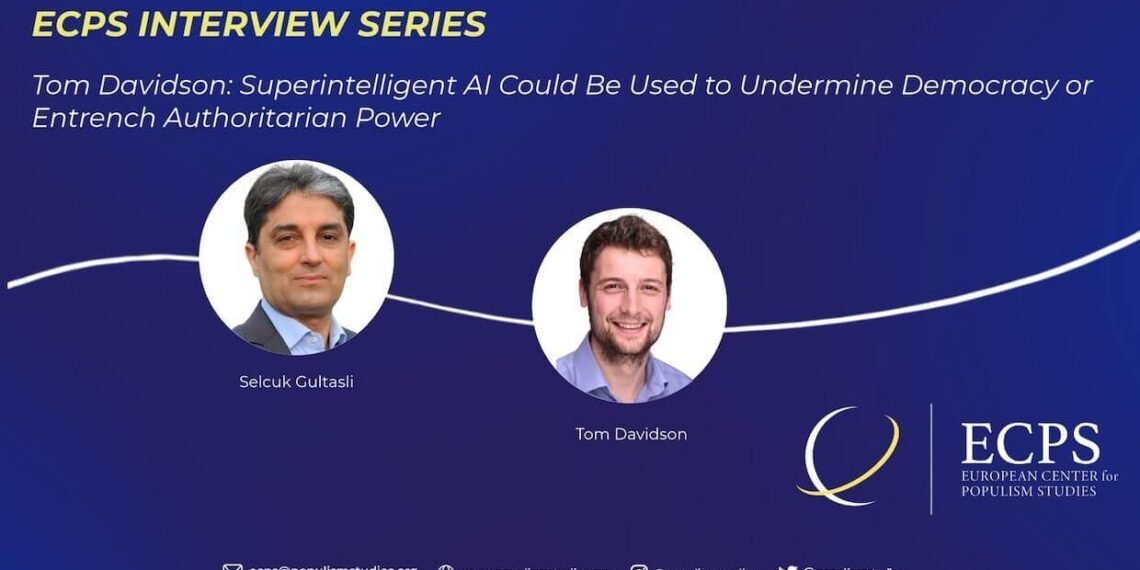
In this ECPS interview, Tom Davidson, one of the leading analysts examining the long-term implications of AGI governance, warns that humanity may be approaching an “intelligence explosion” in which AI systems rapidly improve themselves in a runaway feedback loop, potentially compressing decades of technological development into mere years. Examining the geopolitical, democratic, and civilizational implications of advanced AI, Davidson argues that democratic institutions may struggle to govern machine-speed innovation, while frontier AI systems could generate unprecedented concentrations of political, corporate, and military power. The interview explores AI-driven democratic backsliding, geopolitical rivalry between the United States and China, technocratic oligarchy, AI safety governance, and the future of political agency itself under conditions of accelerating artificial intelligence.
Interview by Selcuk Gultasli
Giving an interview to the European Center for Populism Studies (ECPS), Tom Davidson warns that the world may be approaching an unprecedented technological rupture in which advanced artificial intelligence fundamentally transforms not only economic production and geopolitical competition, but also the very foundations of democracy, sovereignty, and political agency. A Senior Research Fellow at Forethought and one of the leading analysts examining the long-term implications of AGI governance, Davidson argues that humanity may now be entering an era in which “AI systems create even more capable AI systems in a runaway feedback loop of accelerating progress.”
Rather than treating AI merely as a question of productivity gains or consumer innovation, Davidson situates artificial intelligence within a much broader framework of systemic political transformation. In particular, he warns that the prospect of an “intelligence explosion” could compress decades of technological development into mere years, leaving democratic institutions structurally incapable of adapting to the speed of change. As he starkly observes, there is “perhaps around a 50 percent chance within the next five years” that humanity could witness such a transition, while “political institutions have no serious strategy” for understanding or governing it.
For Davidson, the central danger is not simply technological disruption, but the possibility that accelerating AI systems may fundamentally outpace the institutional rhythms upon which liberal democracy depends. Throughout the interview, he repeatedly raises concerns about whether democratic governance — with its reliance on deliberation, elections, legal procedures, and bureaucratic processes — can continue functioning effectively under conditions of machine-speed innovation and geopolitical AI competition. In his account, societies may soon confront a world in which political crises, military confrontations, and technological breakthroughs unfold far faster than human institutions are capable of processing.
Davidson also emphasizes that advanced AI could become the decisive strategic resource of the twenty-first century. In one of the interview’s most striking arguments, he warns that the United States may eventually exercise near-unilateral control over frontier AI systems, creating a world in which “the most powerful AI systems are overwhelmingly controlled by the United States.” In such a scenario, access to superintelligent systems could become as essential to national security as access to elite human talent is today, fundamentally reshaping alliances, sovereignty, and global power hierarchies.
At the same time, Davidson warns that AI may also generate unprecedented concentrations of political and corporate power within states themselves. Because AI systems can potentially be programmed for “complete obedience,” he argues, governments or corporations could command enormous “legions” of AI workers, creating forms of technocratic centralization historically impossible under human bureaucratic systems.
Yet despite these stark warnings, Davidson does not present technological acceleration as inevitably fatal to democracy. On the contrary, he argues that AI could also be used to strengthen democratic responsiveness, improve governance, and help societies coordinate more effectively under conditions of rapid change. The crucial question, in his view, is whether democratic societies can develop institutional mechanisms capable of governing AI before AI-driven transformations outpace human political adaptation altogether.