
For years, Hungary stood as the defining case of democratic backsliding within the European Union. Yet the 2026 election has transformed it into an equally important case of democratic recovery. In this timely interview, Dr. Hanna Folsz discusses why Hungary’s political transformation challenges prevailing assumptions about the durability of competitive authoritarianism. Drawing on her recent Journal of Democracy article, she argues that authoritarian institutional engineering ultimately remains vulnerable when broad civic mobilization, credible political leadership, and innovative opposition strategies converge. The conversation explores the underestimated role of civil society, the limits of media capture and economic coercion, the challenges of rebuilding democratic institutions, and the broader lessons Hungary offers for scholars and practitioners seeking to understand democratic resilience and authoritarian reversal in the twenty-first century.
Interview by Selcuk Gultasli
For more than a decade, Hungary occupied a unique place in the comparative study of democratic backsliding. Under Viktor Orbán and Fidesz, it became widely regarded as the paradigmatic example of competitive authoritarianism within the European Union—a political system in which elections continued to exist but were increasingly distorted by constitutional engineering, media capture, economic coercion, and the systematic weakening of institutional checks and balances. Consequently, Hungary became not merely a national case but an international reference point for understanding how democracies erode from within.
Yet Hungary’s 2026 election has fundamentally altered that conversation. The defeat of Fidesz after sixteen years in power has transformed the country into one of the most consequential contemporary cases of democratic recovery. In her recent Journal of Democracy article, How Civil Society Defeated Orbán, Dr. Hanna Folsz —an Academy Scholar at Harvard University’s Weatherhead Center for International Affairs, where she will begin her appointment in August 2026 before joining IE University in Madrid as Assistant Professor of Political Science in 2027— argues that this democratic breakthrough cannot be explained solely by leadership change or electoral dynamics. Instead, she offers a broader theoretical argument about the hidden vulnerabilities of competitive authoritarian regimes and the underestimated capacity of civil society to reverse authoritarian consolidation.
As Dr. Folsz observes, “Even deeply entrenched competitive authoritarian regimes have vulnerabilities.” While Hungary experienced what she describes as “one of the most extensive and severe episodes of de-democratization or authoritarian consolidation in recent decades,” the very institutions and strategies that sustained Fidesz ultimately proved insufficient to guarantee permanent rule. Institutional engineering, media dominance, financial asymmetries, and intimidation undoubtedly raised the costs of political competition, yet they could not indefinitely substitute for declining public legitimacy. As she argues, “these authoritarian strategies do not guarantee lasting—everlasting—popularity or staying in office.”
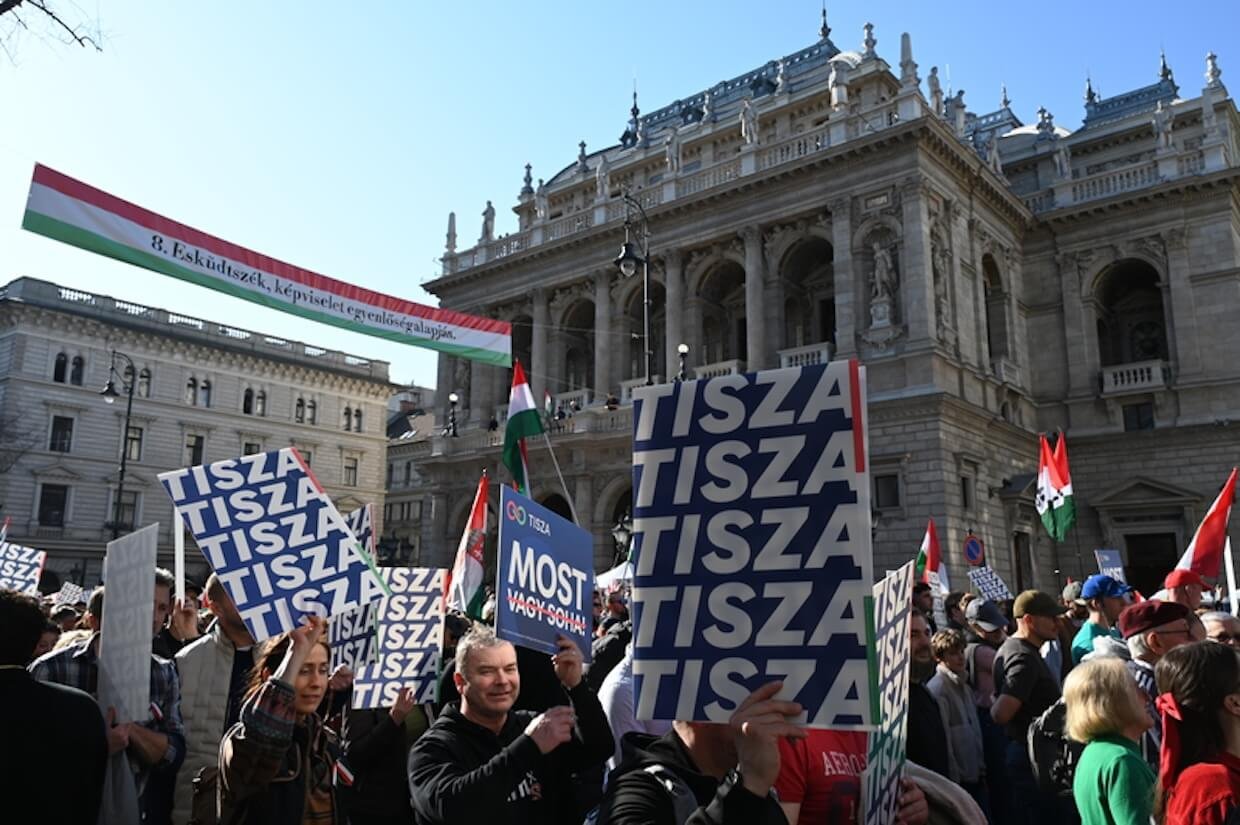
A central contribution of Dr. Folsz’s research is her reassessment of the role of civil society. Rather than attributing the opposition’s victory primarily to the emergence of the Tisza Party or the leadership of Péter Magyar, she demonstrates how more than 2,500 decentralized “Tisza Islands” transformed latent civic capacity into effective political organization. In her words, “The role of civil society… is absolutely underestimated,” while “broad civic mobilization, new and fresh opposition challengers… and a credible alternative to voters are definitely a path to democratic reversal.”
In this interview, Dr. Folsz examines the mechanisms that enabled Hungary’s democratic breakthrough and explores their broader implications for comparative politics. She discusses the hidden effects of economic coercion, the limits of media capture, the importance of credible political leadership, and the challenges of democratic restoration after authoritarian rule. She also reflects on the responsibilities facing Hungary’s new government, emphasizing that electoral victory is only the beginning: “Changing governments is definitely only a precondition for democratic recovery.” Together, these insights offer an important contribution to ongoing debates on populism, democratic resilience, competitive authoritarianism, and the conditions under which entrenched illiberal regimes can ultimately be defeated.
Here is the revised version of our interview with Dr. Hanna Folsz, edited lightly to enhance clarity, readability, and overall flow for publication.
Authoritarian Strategies Do Not Guarantee Permanent Rule

Dr. Folsz, welcome! Let me begin with our first question. For more than a decade, Hungary was widely regarded as the paradigmatic case of democratic backsliding and competitive authoritarianism. Yet your recent Journal of Democracy article argues that the 2026 election also represents one of the most significant democratic reversals of authoritarian consolidation in recent years. How should we interpret the Hungarian election in comparative perspective? Does it represent an exceptional case, or does it reveal broader vulnerabilities inherent in contemporary competitive authoritarian regimes?
Dr. Hanna Folsz: The Hungarian case represents a combination of factors that disadvantage opposition parties or make opposition electoral victory exceedingly difficult. It is definitely an example of—maybe one of the most extensive and severe episodes of de-democratization or authoritarian consolidation in recent decades. Nevertheless, the Hungarian case also represents many of the common factors, or common difficulties, that oppositions experience and the strategies that aspiring authoritarians employ to entrench their rule.
No wonder Hungary serves as a preliminary case, an example for aspiring autocrats worldwide. Fidesz’s dominance in the media, the extensive financial advantage that it enjoyed—or made sure it enjoyed—compared to opposition parties and independent civil society, the severe disadvantages faced by the opposition in the electoral system, as well as the fear of opposition participation due to the repercussions, are all factors that are present in other cases as well.
It was the length of Fidesz rule that made these impediments especially significant, but it also showed that these authoritarian strategies do not guarantee lasting—everlasting—popularity or staying in office. And the lessons it offers are a set of lessons for other cases. Of course, these have to be adapted to context, but the Hungarian case shows that there are vulnerabilities to be exploited, that broad civic mobilization, new and fresh opposition challengers who understand the regime and its vulnerabilities and exploit them, and who present a credible alternative to voters, are definitely a path to democratic reversal. But I’m excited to delve more into the details of this throughout this interview.
The Role of Civil Society in Democratic Change Has Been Profoundly Underestimated
One of your central arguments is that the decisive innovation was not simply the emergence of the Tisza Party, but the rapid development of the decentralized network of Tisza Islands. Why were these semi-autonomous civic organizations able to succeed where traditional opposition parties repeatedly failed? More broadly, does this suggest that democratic resistance in authoritarian settings increasingly depends on civil society rather than party organizations?
Dr. Hanna Folsz: In my article, I make the argument that existing commentary and interpretations of the opposition’s recent electoral victory in Hungary pay a lot of attention to the emergence of the Tisza Party and its novelty, the charisma and skills of its leader, as well as the broader discontent with Fidesz rule after many years of economic stagnation that, in part, could be accounted for by the suspension of EU funds, as well as by extreme corruption and authoritarian overreach by Fidesz.
I argue that this is not the full story. To understand the opposition’s victory, we must take into account the extensive and unprecedented civic mobilization that occurred in Hungary around this election. In my article, I show that Tisza Islands—these semi-autonomous civic groups, small civic groups of at most 50 participants each—emerged across the country. Over 2,500 of these existed by the election. Within a span of a year and a half, they came to dominate civic and public life in Hungary.
They played an essential role in structuring political life, providing political information in their communities, and demonstrating the credibility of the party and the opposition as an alternative through highly visible activities, including extensive volunteering and local charity work that showed the opposition movement cared about the experiences and difficulties of everyday Hungarians. They also provided, basically, the campaign infrastructure for the Tisza Party throughout the election.
The party had very little money, very limited financial resources, in large part due to Fidesz’s actions and changes to party funding, as well as simply being a very new party. This meant that it did not have the resources for the kind of classic electoral campaign that we expect from political parties in democracies most of the time—one funded by donations or state funds, especially in Europe, and relying on an extensive party infrastructure, local offices, and so on. Instead, these Islands stepped up. They basically provided the campaign activists and even the financial resources for the campaign. That played an absolutely crucial role in Tisza’s eventual victory.
What this shows is that there are specific vulnerabilities, difficulties, and challenges for opposition parties in autocratizing and competitive authoritarian contexts. These include financial disadvantage, an absolute information disadvantage under an incumbent-controlled media infrastructure, and the total—or almost total—de-mobilization of the activist base and opposition voters who have become disillusioned with politics and opposition parties. This was definitely the situation Hungary found itself in in 2026, and it showed that the usual avenues for political change were no longer possible.
This is when we saw the very innovative collaboration between the Tisza Party and civil society through the Tisza Islands—these semi-autonomous groups that were only loosely connected to the party. This points to the fact that the role of civil society, the role we expect civil society to play, is absolutely underestimated. Parties will still be crucial, but we need to think about these innovative solutions and about how the strengths of civil society, the often-latent strengths of civil society, can be channeled into electoral competition.
Changing Governments Is Only a Precondition for Democratic Recovery

For sixteen years, Viktor Orbán systematically weakened constitutional constraints, reshaped electoral institutions, captured much of the media, and subordinated state institutions to partisan control. Which of these legacies do you regard as the most difficult to reverse? Is democratic recovery primarily about changing governments, or about rebuilding institutions that have been deliberately hollowed out?
Dr. Hanna Folsz: Changing governments is definitely only a precondition for democratic recovery. Democratic recovery cannot be achieved without rebuilding resilient democratic institutions and norms. And this is where the main challenge in Hungary lies today.
In Hungarian case, Fidesz was voted out of office. The electoral threat that Fidesz currently represents to the Tisza Party is very low. So, it seems that we do not have to be extensively afraid of Fidesz returning to power in four years. The bigger challenge, rather, is for the Tisza Party to effectively restore democratic institutions and norms while exercising self-restraint in the process.
We have seen them begin to address this challenge very early on with a great deal of energy, which has been very encouraging for many commentators and observers. Their first constitutional amendment was recently passed. They are taking steps to remove the previous president and are also beginning to hold Fidesz-affiliated elites accountable through judicial proceedings and investigations into corruption and other authoritarian transgressions.
We also know that they will begin the constitutional process of writing a new constitution. There is also a new head of the state media who has already been appointed to oversee the transition to a more pluralistic and more independent media environment.
The biggest challenge is to make sure that there are professional and lastingly independent checks and balances across all of these spheres. Tisza has an unprecedented mandate because it achieved a two-thirds parliamentary majority in the election. That means it can amend the constitution. There are basically very few, if any, institutional restraints on how it exercises its power.
So, what we want to see is that, across all these spheres—the judiciary, the media, and state institutions—they install not necessarily party loyalists but rather truly independent actors, and that they respect their independence and decisions, even when those decisions go counter to Tisza’s goals or electoral preferences in terms of ensuring its electoral support.
Hungary Shows That Pro-Democracy Civic Energy Is Easier to Mobilize Than We Assumed
Your research highlights the importance of latent civic capacity that survives even under prolonged authoritarian pressure. What does Hungary teach us about democratic resilience? Can civil society preserve democratic norms even when formal institutions have been substantially weakened?
Dr. Hanna Folsz: The Hungarian case definitely shows me, in a striking way, that civic capacity is latent rather than absent in cases such as Hungary. This is something I highlight in my article as well, because we have a very strong assumption in political science research and in public debates about democratic resilience and resistance to authoritarian pressure.
The assumption is that if we have an institutionally weak civil society, then effective democratic resistance is very difficult. It’s sort of a precondition for democratic resistance that there are existing civil society actors that can serve as a check, hold the government accountable, organize resistance, organize protests, and restructure public opinion around resistance. When this is missing, we assume that democratic reversals are much more difficult.
They are indeed more difficult. But the Hungarian case absolutely shows that it is much easier to bring pro-democracy civic capacity to the surface than we assumed. In Hungary, the Tisza Islands provided a loose organizational frame, and the Tisza Party provided the Tisza Islands with a purpose and a potential for democratic change that mobilized the population across the country, in localities and municipalities both big and small.
This points to a case for some positivity, some optimism, as well as a call for innovative approaches and a better understanding of citizens’ motivations, because political scientists, as well as pundits, assumed that such mobilization would not be possible and were taken by surprise by its scale and effectiveness.
If we take the opportunity and make the effort to talk to citizens more, understand their relationship with this regime, and recognize that there is this latent discontent that may not be expressed for fear of repercussions, but also because of a lack of hope that things could change, and if we can understand how citizens react to the provision of a credible alternative, to hope embodied in an opposition movement, then this might not take us by surprise. We might instead focus a little more on developing these innovative civic approaches in our attempts to achieve democratic reversals.
Economic Coercion Is One of the Most Overlooked Tools of Authoritarian Control

In your broader research, you argue that economic retaliation constitutes one of the most overlooked mechanisms through which aspiring autocrats weaken political competition by deterring talented opposition candidates. How central was economic coercion to Orbán’s durability, and how much did overcoming fear of retaliation contribute to the opposition’s eventual breakthrough?
Dr. Hanna Folsz: One of the focuses of my research is the authoritarian strategy that I term economic coercion. I argue in one of my papers that this is a core strategy of authoritarian consolidation and control that we tend to overlook because we focus on the physical acts of repression that these regimes carry out, be it arresting opposition politicians and activists or banning opposition parties, et cetera.
But economic coercion is another crucial strategy. I define it as a credible threat of economic retaliation for opposition political activity. This means that not just opposition candidates, but activists or those who express public support for the opposition, they themselves or their family members, might face economic difficulties as a result.
Its employment-oriented form—one of its forms—carries the potential for employment loss, dismissals from jobs in the public sector, the state sector, or in regime-adjacent businesses. Its enterprise-oriented form focuses on retaliation against business owners and firms. If you participate in opposition politics, for instance as a candidate, or if you participated in Hungary during the Orbán period, you could very well expect that your firm would be subject to targeted tax audits, targeted tax penalties, or other forms of retaliation—basically, the denial of state contracts and grants that your firm might have previously received, as well as the turning away of suppliers and other businesses that were themselves afraid of retaliation for their association with the opposition.
This was an absolutely pervasive, indeed a defining, characteristic of the Hungarian regime and a major impediment for opposition parties. My interviews with opposition politicians, together with a survey that I conducted among opposition local politicians, pointed to this pervasive fear of retaliation and Fidesz’s media dominance as the two central reasons opposition politicians identified for their parties’—or their political side’s—weakness.
There are many examples of this. I talked to a number of opposition politicians who themselves were fired from their jobs. Or, for instance, if they had a partner who was a teacher, that partner was fired, and their businesses suffered extensive retaliation. But I also heard many stories of opposition activists being too afraid to put their face, appear in photos—for fear that they would face retaliation, to register as an activist for the party, or even to become a party member.
There are countless examples that opposition politicians would tell me. They would set up stalls for campaigns or for collecting signatures for different causes, and even acquaintances whom they knew very well in their private lives would be too afraid to look at them while they were out on the streets, for fear that their employer or their neighbor might see them, and that word would then spread through their social circle that they supported the opposition.
This presented a huge difficulty for parties, both in mobilizing activists for strong campaigns and in finding good candidates for electoral office. The Tisza Party actually faced many of these same challenges.
Conversations with lawyers at the Hungarian Helsinki Committee, one of the main civil liberties protection organizations in Hungary, revealed that the number of cases of retaliatory firings, or proprietary retaliatory actions, that they encountered and were approached with actually increased significantly in the years following the emergence of the Tisza Party. My conversations and interviews with Tisza politicians themselves also revealed a staggering rate of such retaliation among their activist bases.
The way they overcame this is very remarkable and offers many important lessons. One of the most important strategies they employed was the Tisza Islands themselves, which provided a very low-visibility form of activism. Many activists I talked to in these Tisza Islands told me that they and their fellow activists could choose the level and form of activism they were comfortable with, depending on the degree of visibility. The lack of overt—or direct—association with the party also allowed them to evade some of the strongest retaliatory actions that we had previously come across.
Another important way in which the Tisza Islands contributed to mitigating the effects of retaliation was simply by affording the opposition greater visibility. This provided examples of courage and also evidence of the scale of retaliation, because fear of it often outstrips its actual occurrence.
Finally, Tisza started polling above Fidesz roughly a year and a half before the election, which was also very important because fear of economic retaliation operates on an assumption of future enforcement. If the opposition begins polling ahead of the governing party for such an extended period of time, there is at least some expectation that the governing party may lose the election, in which case retaliation will not proceed, or that any retaliation opposition activists or politicians experience will be undone once the new party comes to power.
This was crucial in progressively encouraging participation and lending confidence to the opposition. But it remained a formidable impediment, and it required a great deal of courage from all of the opposition activists I spoke to, as well as from the politicians of the Tisza Party, to stand publicly with the opposition in the way that they did. That is absolutely one of the most commendable actions one could undertake in such a political environment.
When Propaganda Collides with Lived Experience, Its Credibility Begins to Collapse

Hungary has often been cited as perhaps Europe’s most advanced example of media capture. Yet despite overwhelming informational asymmetries, the opposition ultimately managed to reach voters. Does this suggest that grassroots civic networks can compensate for authoritarian control of traditional media, or were there broader structural changes—including digital communication—that weakened the effectiveness of media capture?
Dr. Hanna Folsz: These grassroots civic networks played a very important role. There was an almost total lack of access to independent news in many parts of the country, predominantly outside of the larger cities. Almost all news sources were controlled by Fidesz by 2024, around the time of the emergence of the Tisza Party. One of the especially important early functions of the Tisza Islands was simply to provide public spaces for these new, alternative information environments where politics could be discussed.
During their first few months, many of these Tisza Islands focused primarily on inviting outside speakers or holding public discussions, talks with experts, and conversations among activists about the political situation. They identified the most important local issues and explored how Fidesz’s wrongdoing, corruption, authoritarian actions, and mismanagement of the economy and public resources contributed crucially to the local problems and difficulties Hungarians were facing. Through these speaker series, the Tisza Islands allowed people to connect the dots between their local experiences and the broader authoritarian encroachment and entrenchment of Fidesz in the country.
Having these communities in which to discuss politics was also something very new. Many of the activists I interviewed noted that this was the first time they could speak openly about politics without fear and simply discuss political developments among themselves. It created a much better shared understanding of the political situation in the country.
Nevertheless, there were three other factors that were also crucial. Beyond the emergence of these Islands and these local information spaces, the growing importance of the digital sphere was absolutely significant, as was the increasing conflict between people’s personal experiences, their economic hardships, and Fidesz’s narrative of its own successes.
In terms of the digital sphere and social media, we could see by the early 2020s, especially after the COVID pandemic, a very important shift in the way online and non-traditional news sources gained ground. YouTube, podcasts, and other social media platforms became very important sources of news in Hungary. Partizán is one of these networks—the largest podcast and YouTube network for independent news in Hungary. Its videos routinely achieved hundreds of thousands of views in a country of fewer than 10 million people. That’s very significant.
Another important way in which the rise of the digital sphere mattered was how Péter Magyar, current prime minister and the leader of the Tisza Party, exploited and leveraged it masterfully to gain popularity. His campaigns and political activities were always online. We heard from many commentators throughout the election how important it was that Péter Magyar travelled across the country, visiting Hungarian towns and villages, both large and small, after entering Hungarian politics. For two years, he was almost constantly on the ground talking to Hungarian voters.
One of the most important aspects of this, however, was that every single one of his appearances was livestreamed on his social media platforms. This created an almost constant connection with Hungarian voters, made possible by the rise of social media in politics. It further enhanced his credibility by demonstrating how hard he was working and strengthened his direct connection with voters.
Finally, another important reason why Fidesz’s media dominance—and its effectiveness—began to weaken was the increasingly apparent conflict between Hungarians’ lived experiences and Fidesz’s official narrative. Beginning in the early 2020s, and especially after 2022, Hungary experienced significant economic stagnation and record inflation. Inflation averaged around 20 percent in 2022 and remained at a similarly high, though somewhat lower, level in 2023. Food price inflation was particularly severe.
When Hungarians experienced firsthand that they could afford much less than in previous years, while Fidesz continued to emphasize its achievements and the support it was providing through its distributive programmes, this sharply contradicted people’s lived experiences. As a result, the credibility of Fidesz’s propagandistic narrative in the media outlets it controlled declined substantially, and Hungarians increasingly began seeking out alternative sources of news.
Opposition Strategy Matters Just as Much as Authoritarian Strategy
Orbán’s governments demonstrated remarkable sophistication in redesigning electoral rules, constitutional institutions, and oversight bodies without formally abandoning electoral competition. Does Hungary demonstrate that authoritarian institutional engineering eventually reaches diminishing returns, particularly when legitimacy begins to erode?
Dr. Hanna Folsz: Definitely. What the Hungarian case points to with respect to this question is simply that competitive authoritarian regimes still rely on popularity to persist. So, however much electoral rules are redesigned, institutions are amended, and oversight bodies are captured, if unpopularity starts to emerge, if the regime loses its credibility and legitimacy—especially its performance legitimacy—then these institutional changes cannot guarantee that it stays in power.
Nevertheless, there are important caveats. First, the Fidesz regime employed limited physical repression and party bans. That is something we are starting to see in cases such as Turkey, which does not have the constraints of the EU and has shown a willingness to use these tools against the opposition. This can represent much more significant constraints and make it much more difficult for the regime’s unpopularity to translate into electoral change and opposition victory.
The other important caveat is that opposition strategy does matter. Having a broad-appeal electoral strategy and offering a credible alternative that promises competent governance in the interests of the Hungarian people—and can credibly deliver on that promise—is crucial if these governing parties are to start losing elections or even come close to losing them.
Looking, for instance, at the 2022 election in Hungary, where Fidesz actually achieved its strongest performance under its rule, even though the election took place amid record inflation, economic stagnation, extreme corruption, and authoritarian overreach, shows that voters rejected the opposition alternative. There were plenty of reasons to dislike the regime, plenty of reasons to want change, but that change simply did not materialize through the opposition.
Performance Legitimacy Mattered Even More Than Ethno-populist Appeals
Orbán has frequently been analyzed as one of the architects of contemporary right-wing populism, combining majoritarian rhetoric with illiberal constitutionalism. Looking back, to what extent was Fidesz’s success primarily rooted in populism, and to what extent did it evolve into a more conventional authoritarian patronage regime whose survival depended increasingly on state control rather than popular mobilization?
Dr. Hanna Folsz: Fidesz’s populism was important to its staying in power and its ability to consolidate its rule, but it was by far not the only factor that mattered. If anything, performance legitimacy in voters’ eyes was even more important than the populist, ethno-populist appeals that we saw, especially in the second half of Fidesz’s rule.
In terms of Fidesz’s populism, we could definitely see that these radical-right nationalist ethno-populist appeals became very prevalent, especially in the second half of the 2010s. We saw this when immigration became the cornerstone issue for Fidesz, and when this sort of anti-immigration rhetoric became a very powerful tool that allowed it to win the 2018 election with resounding popularity.
But even then, Fidesz’s distributive programs were crucial. A very important element was this kind of regime-to-voter patronage—not just giving resources to a small elite but also providing financial benefits directly to voters so that they saw a financial benefit in their own pockets from supporting the regime. This was very important, and Fidesz very consciously leveraged these strategies.
We saw that when these strategies failed, when the economic gains that people felt they had experienced under Fidesz rule disappeared, Fidesz became less popular. Its deployment of nationalism, its use of this outside-threat narrative, this classic populist narrative, was not enough to ensure that it stayed in power and continued to mobilize its base.
In sum, the transformation of the economy to ensure Fidesz’s continuity in power was very important. These distributive programs directed at voters were crucial. Of course, part of that also involved establishing a political elite, an economic elite that gave Fidesz its economic base—this sort of oligarchic network that supported its control over the media and made sure that economically independent opposition actors had a very difficult time gaining ground.
Those factors were important as well. But populism is just not enough of an explanation.
Hope for Change Required a Credible Political Entrepreneur

Your article emphasizes that civic mobilization required not only existing social networks but also what might be called a credible political entrepreneur in Péter Magyar. How important is leadership in activating dormant democratic capacities? Could similar civic energy have emerged without a figure capable of coordinating and legitimizing it?
Dr. Hanna Folsz: Coordination and the hope of change were absolutely essential to the civic energy that we saw in Hungary, and they had to come from a credible source. They had to come from a credible political entrepreneur or group that promised this. It did not necessarily have to be Péter Magyar, but he is a highly politically skilled politician. He was able to recognize these opportunities, as well as the vulnerabilities of the regime. This was very important in activating the civic energy in the country.
One of the preconditions is simply that there has to be a vision for political change. I think what Péter Magyar did right, why he was important, and why he was able to do this was the energy that voters saw in him as he travelled around the country on his nationwide tours, day after day, rally after rally, meeting after meeting, demonstrating that he took this seriously and that he was able to connect with people. Hearing him speak, hearing him identify the problems with the regime, and also hearing him present some possible solutions was also important.
A strong performance in the 2024 European Parliament election also gave him and his party the ability to have voters’ expectations, or hopes for change, coalesce around them. That was crucial. He emerged at the right time, when there was very strong dissatisfaction with Fidesz but no opposition alternative or opposition option that voters really saw, and he had the skills to fill that role.
But it could have been someone else. It’s obviously very hard to know. What is crucial, however, is the coordinating and legitimizing role that a political entrepreneur provides.
Innovative Civic Mobilization May Be More Transferable Than Hungary’s Institutions
Many scholars have viewed Hungary as the model that inspired democratic erosion elsewhere, from Central Europe to Latin America and even the United States. Do you believe Hungary’s democratic recovery offers transferable lessons for opposition movements confronting competitive authoritarian governments elsewhere, or are Hungary’s political and institutional conditions too distinctive for meaningful comparison?
Dr. Hanna Folsz: I absolutely think that it offers lessons. Of course, if you look at a different case, you will always have to adapt the strategies and adapt the insights to the challenges that the opposition side faces against aspiring autocrats or competitive authoritarian rulers elsewhere. That is natural.
What we need is a very good understanding of the Hungarian case and of what features of the Hungarian case made this possible, and then a good understanding of the other local context to see how this could be adapted. Some notable traits of the Hungarian experience are sometimes potentially underestimated in commentary that uses the Hungarian case as a promise of hope for democratic change elsewhere.
It’s absolutely crucial that Fidesz was in power for 16 years, a very significant amount of time. In a lot of previous cases of reversal, we have seen less consolidated regimes. And there was very strong dissatisfaction with Fidesz by the time the Tisza Party came around, but that could not previously be channeled into electoral politics.
There was also very limited physical repression, so there were no arrests. There were also no party bans, et cetera, as I already mentioned. This is something that means these lessons, especially the lessons around civic mobilization, could be very different and harder to adapt in cases where such repression is very significant.
It is also important to recognize that the level of disadvantage for the opposition was actually more severe in Hungary than in a lot of other cases. This gives us hope for other cases—that if a reversal could happen here, then that can translate elsewhere. But it also might give too much comfort to opposition actors elsewhere, because it might have taken this level of disadvantage for the opposition to use innovations in civic mobilization, and for this new challenger, the Tisza Party, to emerge, and for voters to recognize that the existing opposition parties could not promise the kind of change they hoped for.
The model of this innovative civic mobilization, the model of a new credible challenger emerging that promises meaningful, positive change in Hungarian living conditions, and then promises good governance as well as the rooting out of corruption and democratic restoration, is very important.
We probably cannot get too comfortable. This level of disadvantage that the opposition had in Hungary is actually something that, maybe, shows that we do not need to reach that stage for other countries, for political entrepreneurs and political actors to take on these lessons in other cases. Maybe this avenue, this broad-based appeal that Tisza had, rather than just chipping away at Fidesz supporters or convincing only a few demobilized voters to turn out, is something that can work in other cases. Instead, creating a broad-based movement is something that can work in other cases and can promise much better opportunities for democratic restoration with a strong mandate afterward.
The Greatest Challenge Is Ensuring That the New Government Constrains Itself
A central feature of democratic backsliding in Hungary involved the gradual weakening of judicial independence and constitutional oversight. Following the recent constitutional reforms initiated by the new government, what principles should guide efforts to restore judicial autonomy without creating the perception that one form of politicization is simply replacing another?
Dr. Hanna Folsz: This is a very important challenge in Hungary right now. As I already mentioned, the Tisza Party entered office with an unprecedented mandate. It holds a two-thirds majority in parliament, which in Hungary permits constitutional amendments and essentially allows the party to unilaterally amend the constitution. There is no need for the support of the new opposition parties in parliament, and this gives Tisza extensive control over institutional reform.
They have already used this power, and they have promised to use it further in relation to the judicial system. A constitutional amendment was just approved on July 13 by the Hungarian parliament that restored a mandatory retirement age of 70 for Constitutional Court judges. This involves four of the 15 judges losing their mandates, including the president of the Constitutional Court, who was a very important Orbán appointee.
They have also promised to implement changes to the selection rules for the presidents of various judicial bodies. For instance, these changes would involve judges choosing or proposing candidates instead of the president independently selecting a nominee. But ultimately, all of these changes would still rest on ratification by a two-thirds majority in parliament. So they would still give Tisza the opportunity to make the final choice.
We see many positive changes that could introduce more independent rules and restore a more independent judicial sector in Hungary. But it is very important that the party exercises self-restraint and is potentially even braver and more resolute in making changes that constrain the Tisza Party itself.
Because even some of these proposed rules—for instance, leaving the appointment of the presidents of various judicial bodies to a two-thirds parliamentary majority—would still give the party essentially full discretion, or at least a very high degree of discretion, over who these officeholders are going to be. The biggest challenge is making sure that Tisza actually constrains itself and establishes a genuine separation of the judiciary from the executive branch and, to some degree, from the legislative branch through these reforms, thereby binding both itself and its successors. Whether Tisza ultimately carries out these changes that may also be politically uncomfortable for itself absolutely remains to be seen.
Democratic Restoration Must Never Become Political Retribution
The new government has promised to dismantle what it describes as the “Orbán system” while introducing sweeping constitutional reforms and anti-corruption measures. How can democratic governments dismantle authoritarian legacies without themselves appearing to engage in victor’s justice or constitutional overreach? Where should democratic restoration end and political retribution begin?
Dr. Hanna Folsz: This is a key challenge of democratic restoration and democratic restoration efforts. Ensuring that these efforts proceed in a rule-of-law-abiding manner is often very difficult, as we have seen, for instance, in Poland, and it is something that inevitably draws a great deal of public attention.
In Hungary, this challenge is also present. There is an exceptionally high degree of public legitimacy for dismantling the Fidesz system and holding Fidesz politicians and its oligarchic elite accountable for their wrongdoing and their actions against the national interest. Fidesz currently enjoys at most 20 percent support in the polls in Hungary, which is exceedingly low. We have also seen an absolute exodus of voters from the Fidesz camp, even after the party lost the election.
There is a clear public mandate. But this process of accountability should be pursued in a very careful manner. The most important thing, so far, is that Tisza is at least promising to pursue it through judicial channels. They have also emphasized that this will likely be a lengthy process.
That said, I do see two dangers. The first is that abandoning the judicial route could become a temptation, and that would absolutely undermine the legitimacy of dismantling the Orbán system in the eyes of many. I think it should, because democratic self-restraint is something this party has to practice and demonstrate if it wants to reintroduce it into Hungarian politics.
I also see another danger. To me, it is the possibility that Tisza may not allow Fidesz to be evaluated again by Hungarian voters as a political alternative in the full sense that we should expect in a democratic system.
For instance, Tisza’s recent proposal for a constitutional amendment introduced a 12-year term limit for MPs in Hungary that would apply retroactively. This follows the adoption of an eight-year limit for prime ministers, also applied retroactively, which many interpreted partly as satisfying voters’ demands that Orbán should not be able to return to power, while also serving as an act of self-restraint by Tisza.
That measure has enjoyed broad public support in Hungary, at least for now. But the proposed 12-year limit for MPs has generated much more public debate. Its retroactive application means that most of the high-profile Fidesz leaders we have seen in recent years would likely be unable to run for office again if this rule actually enters the Constitution.
To me, this does not give voters the opportunity to reject Fidesz themselves, which, in all likelihood, we think they would actually do at the polls in the next election. Instead, it appears more like a measure of retribution than one that serves the restoration of healthy democratic competition.
Lasting Democratic Trust Depends on Meaningful Citizen Participation
Years of polarization, clientelism, and institutional capture often leave citizens deeply distrustful of politics itself. Beyond constitutional reforms, what strategies are necessary for rebuilding citizens’ confidence that democratic institutions can once again operate impartially and effectively?
Dr. Hanna Folsz: What is very interesting about the Hungarian case, and what is very closely related to the civic mobilization that we saw ahead of the election, is that there is an unprecedentedly broad interest in, and enthusiasm for, politics and following politics in Hungary, even after the election. That is very promising. The disaffection that we saw over more than a decade of Fidesz rule appears to have been reversed during this election and seems to persist even afterward.
But in many ways, there is still distrust of Tisza among many voters. Of course, the country’s experience over the past decade and a half has been one of politicians abusing public authority and public office for authoritarian entrenchment and private gain through corruption. There is, understandably, concern among Hungarian voters that any party—especially one with such a large mandate—could eventually fall victim to the same dynamics.
The more immediate concern is whether these participatory channels, this broad-based participation represented by the Tisza Islands and these activist groups, will continue to feed into politics itself or instead be discarded. Because maintaining them could build trust and strengthen the connection between citizens and politics.
Tisza has promised to institutionalize such participatory mechanisms. They are currently setting up the Institution for Functioning in Humane Hungary, which they describe as an institution for strengthening popular participation in politics through consultation with professionals, former civil society actors, as well as voters on proposed constitutional amendments, new public policies, and broader forms of public and civic involvement.
This is very promising, but it has not happened yet. We do not yet know exactly what it will look like. The party has asked voters and its activists for patience while it develops ways to channel this civic energy into politics and effective public policymaking in Hungary.
This is one of the most important questions that remains to be answered. The party can reasonably be granted some patience, especially as it is working very hard to meet the conditionalities required for EU funds to be restored to Hungary by the end of the summer. But after that, if this vision of popular participation in governance does not begin to materialize, some degree of public pressure would be very beneficial.
The EU Should Have Acted Earlier and More Decisively

The European Union has frequently been criticized both for responding too slowly to Hungary’s democratic backsliding and for possessing limited enforcement tools. Looking retrospectively, what lessons should European institutions draw from the Hungarian experience regarding the defense of liberal democracy among member and candidate countries?
Dr. Hanna Folsz: There’s been a great deal of excellent research, including by R. Daniel Kelemen, on the role that the EU played through its lack of action against Hungary, and at times even its support for Hungary and Viktor Orbán, in failing to become an effective obstacle to authoritarian entrenchment. Kelemen’s research shows that European party politics in the European Parliament plays a very important role. There were incentives within the European People’s Party (EPP) to support Orbán despite his authoritarian transgressions, in order to advance the EPP’s broader political objectives within the EU. That points to an important lesson: party politics within the European Union cannot be allowed to impede efforts to stop authoritarian entrenchment in an EU member state.
There have to be clear red lines. There have to be cordons sanitaires around far-right parties within the EU. We have already seen some steps in this direction. But the other important lesson—and perhaps the more important one—is that the EU should act more quickly and be more willing to invoke the conditionality of EU funding.
A large share of EU funding to Hungary was suspended in 2022, and that was one of the key reasons for the weakening of Fidesz’s support. It contributed significantly to the lack of infrastructure investment, the slowdown in economic dynamism, and the broader economic stagnation and difficulties that Hungary experienced over the past four years, all of which substantially increased public dissatisfaction.
Conditionality is a very powerful tool, and it is a legitimate one. Invoking conditionality in determining access to EU funding is entirely legitimate, and it should be used in cases such as this.
Where Violent Repression Is Limited, Peaceful Democratic Change Remains Possible
Some scholars have argued that competitive authoritarian regimes are inherently unstable because they continue to rely on elections for legitimacy, while others view them as remarkably durable hybrid systems. Has the Hungarian case altered your own understanding of the long-term resilience—or fragility—of competitive authoritarian regimes?
Dr. Hanna Folsz: For one, 16 years of Fidesz rule in Hungary is a remarkably long time. Even if the regime ultimately proved vulnerable to an electoral challenge, it still represented an unprecedented period of authoritarian rule within the European Union that we must take seriously. The fact that an authoritarian regime could emerge under the conditions that it did in Hungary is, in itself, an absolute testament to the power of these authoritarian movements.
Nevertheless, the main lesson is that these regimes, and their continuity, ultimately rest on popularity. It requires a much greater shift of voters away from the regime than in democracies for that to translate into an opposition electoral victory. But there is hope. There is real potential for that to happen. Civic mobilization and the electoral mobilization of voters behind the opposition are what can ultimately bring these regimes to an end. As long as there is limited capacity and infrastructure for violent repression, there remains the possibility of a peaceful transfer of power.
The Hungarian case shows that this middle ground of competitive authoritarian regimes—those that resort only limitedly to physical repression, banning opposition parties, and the kinds of tools that we see in some other contexts—is ultimately fragile. These regimes are vulnerable to a sustained loss of electoral popularity.
Defeating Authoritarianism Requires Strategies Beyond Those of Ordinary Democracies
Finally, Hungary has demonstrated both how democracies can gradually erode and how authoritarian incumbents can eventually be defeated electorally. Yet democratic recovery is often considerably more difficult than democratic decline. Looking ahead, what will determine whether Hungary becomes a lasting example of democratic renewal rather than merely another episode of political alternation? And what broader lessons should scholars of populism, democratic resilience, and authoritarianism take from Hungary’s extraordinary political trajectory?
Dr. Hanna Folsz: In terms of what Hungary will ultimately become an example of, I certainly hope that it will be a lasting example of democratic renewal. But that depends on several conditions. For one, it is important that we see self-restraint from the Tisza Party. Somewhat unfortunately, this is a situation in which we have to rely on self-restraint by the governing party because of its extraordinary political mandate.
But I also think it is crucial that we see the emergence of political alternatives to the Tisza Party in the coming years in Hungary. Entering the 2030 election with the Tisza Party facing only a very weakened Fidesz as its main opposition would be very disadvantageous for Hungarian politics if Fidesz continues to weaken in the way it has over the past couple of months.
It’s very hard to see that providing an incentive for voters to evaluate the Tisza Party against the strong benchmark that we would like to see in a democracy. There is also, for now, no real political alternative to Tisza on the left or liberal side in Hungary. We effectively have a political system with three right-wing parties. Tisza is currently very much a moderate party, but nevertheless its two challengers are on the right. Mi Hazánk, the third party in parliament, is a far-right party.
If this situation persists, it is difficult to see how voters could exercise meaningful democratic choice in the 2030 election. To me, that is very important for a successful democratic recovery. It would also place healthy pressure on Tisza, so that we do not have to rely solely on self-restraint by the party and on extra-parliamentary, extra-electoral mobilization to encourage Tisza to help Hungary achieve a strong democratic renewal.
In terms of the broader lessons from the Hungarian case and Hungary’s extraordinary political trajectory, I see a couple of important lessons that focus on the opposition and on opposition to authoritarian incumbents.
Very often, when we think about these regimes and the reasons for their popularity, we focus on the authoritarian strategies that governing parties employ. We examine institutional manipulation, authoritarian entrenchment, media capture, the capture of civil society, economic coercion, as well as ethnopopulist and distributive appeals to voters, together with voters’ willingness to tolerate these transgressions. But we also need to think seriously about the role that the availability of opposition and credible alternatives plays in allowing such regimes to survive and preventing a democratic alternative from emerging. Hungary shows that the combination of a new political party and a broad-based civic movement built around semi-autonomous civic organizations and civic groups can become a powerful vehicle for democratic change.
The Hungarian experience also offers two further lessons. First, it demonstrates that broad-based civic mobilization is possible. We should therefore think much more seriously about these possibilities and about what kinds of innovations enable opposition movements to overcome the distinctive challenges they face under authoritarian incumbents. We may simply need to be much more inventive.
Second, we cannot continue to operate under assumptions about democratic competition that are derived from established democracies when we are dealing with authoritarian contexts. The rules of the game are fundamentally different. Accordingly, the strategies that opposition movements must employ in these settings are also likely to be fundamentally different from those that work in democracies.