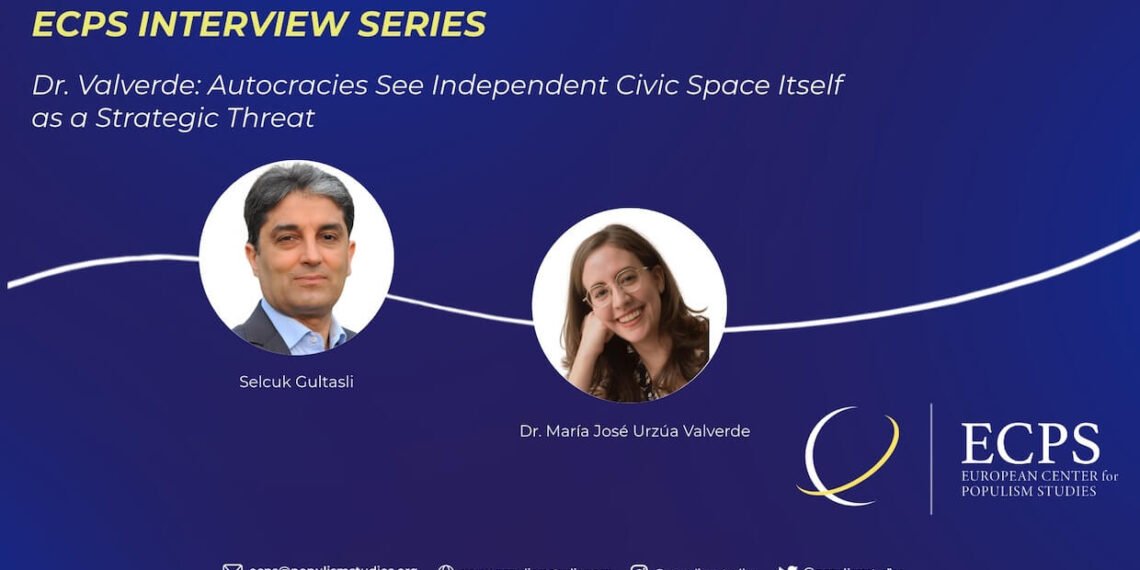
In this interview with ECPS, Dr. María José Urzúa Valverde examines how authoritarianism, populism, and democratic backsliding increasingly intersect with struggles over civil society and international norms. She argues that autocracies view independent civic mobilization as a strategic threat because rights-based movements can generate broader networks of resistance. The conversation also explores how conservative and populist actors use transnational networks to contest LGBTQ+ rights, human rights norms, and the role of international organizations. Dr. Valverde highlights the growing polarization of international civil society, the strategic use of migration as interstate leverage, and the resurgence of sovereignty-based challenges to the liberal international order. Together, these developments reveal how democratic erosion increasingly unfolds across both domestic and international arenas.
Interview by Selcuk Gultasli
In an era marked by democratic backsliding, transnational populism, and growing contestation over international norms, the struggle over civic space has become increasingly central to the future of liberal democracy. In this wide-ranging interview with the European Center for Populism Studies (ECPS), Dr. María José Urzúa Valverde, Assistant Professor in the Department of International Studies at ITAM in Mexico, argues that authoritarian governments do not merely resist particular rights claims; they are deeply concerned with the broader political capacity that autonomous civil society can generate. As she puts it, “Any rights-based mobilization becomes a focal point around which other regime opponents can build networks to resist the regime’s power.”
This insight lies at the heart of Dr. Valverde’s analysis of authoritarian opposition to LGBTQ+ rights. Drawing on her Journal of Democracy research with Gino Pauselli, she emphasizes that conservative ideology alone cannot explain authoritarian behavior. Their argument instead identifies a threefold logic: “repression of civil society, opposition to the liberal international order, and the instrumental use of conservative ideology.” For Dr. Valverde, the civil-society mechanism is especially revealing because rights-based mobilization can create organizational capacities that extend well beyond a single policy issue. Hence her conclusion that “both liberal and illiberal networks and governments understand civic space access itself as a strategic asset.”
The interview also broadens this argument beyond domestic authoritarianism. International organizations themselves, Dr. Valverde argues, have become arenas of normative competition. Conservative NGOs and governments increasingly use the same institutional channels once associated primarily with progressive advocacy, while seeking to influence judges, commissioners, and policy agendas. What is at stake, she stresses, is “not only outcomes, but also the IO’s function itself.” This process can produce what she calls “neutralization”: weakening an international organization’s capacity to advance norms without formally reversing its previous commitments.
These dynamics are closely connected to populism. Dr. Valverde rejects the idea that populists simply learn from autocracies; she instead points to “shared transnational infrastructure” linking conservative and populist actors across borders. She also warns against reducing democracy to electoral legitimacy. Populist leaders, she notes, often reason that “If I won the election, then I represent the people, and if I represent the people, I can do no wrong.” Such logic, she argues, can rapidly undermine checks and balances and weaken non-elected institutions essential to democracy.
Taken together, the conversation presents civic space not as a secondary democratic concern, but as a core arena in which authoritarianism, populism, human rights, and international order increasingly intersect.