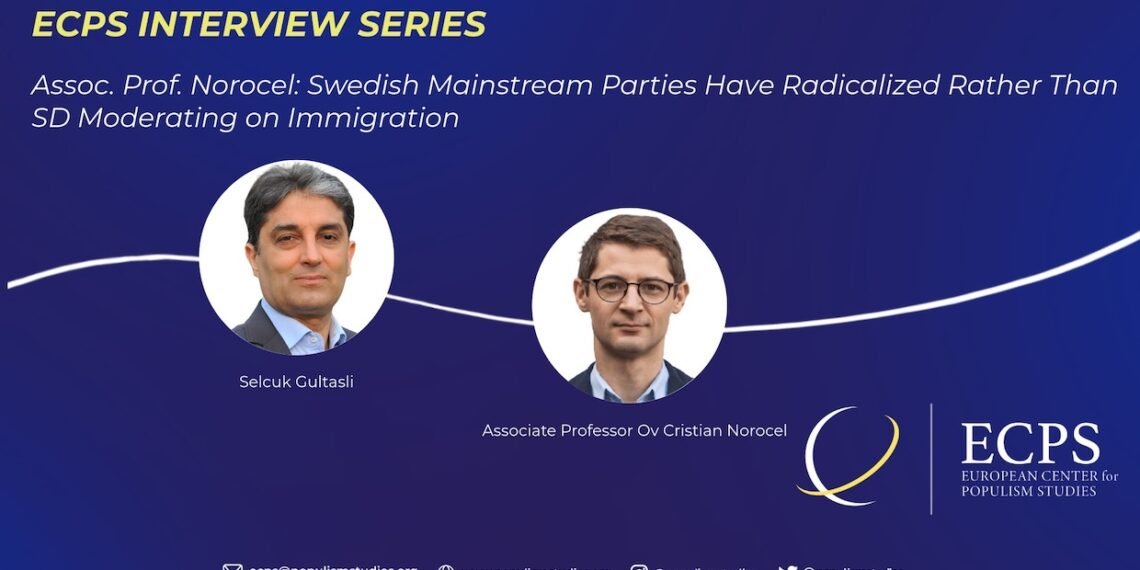
In this ECPS interview, Associate Professor Ov Cristian Norocel of Lund University examines how the Sweden Democrats’ electoral decline can coexist with the continued normalization of their political agenda. He argues that Sweden’s mainstream right has itself shifted, noting that on immigration “the other parties [are] radicalizing themselves, rather than the Sweden Democrats normalizing their political messaging.” Norocel discusses the emergence of a Swedish “right-wing continuum,” welfare chauvinism, differential grievability, the racialized reinterpretation of the folkhem, gender equality, masculinities of crisis, and youth radicalization. His central argument is that SD’s influence cannot be measured by vote share alone: even as the party loses electoral ground, ideas it helped mainstream remain politically powerful and continue to shape debates over migration, welfare, belonging, and Swedish identity.
Interview by Selcuk Gultasli
Giving an interview to the European Center for Populism Studies (ECPS), Associate Professor Ov Cristian Norocel of the Department of Sociology at Lund University argues that the Sweden Democrats’ (SD) electoral decline in Sweden’s 2026 election should not be mistaken for a retreat of the political ideas the party has helped normalize. Rather, he emphasizes that the more consequential development may be the transformation of Sweden’s mainstream right itself. As he puts it, on immigration “we see the other parties radicalizing themselves, rather than the Sweden Democrats normalizing their political messaging.”
At the center of Norocel’s analysis is what he calls the crystallization of a Swedish “right-wing continuum” bringing together SD, the Moderates (M), the Christian Democrats (KD) and, to a certain extent, the Liberals (L). While the SD have moderated elements of their presentation in pursuit of governmental legitimacy, Norocel stresses that this has occurred alongside movement in the opposite direction by established center-right parties: “the M, KD, and L, to a certain extent, have radicalized their political messaging.” The result, he argues, is a convergence in which parties that once occupied more distinct ideological positions “have been drawn to one another.”
This convergence is particularly pronounced on migration. Norocel notes that SD has remained “very persistent and consistent” on the issue, while other parties have moved increasingly closer to it. He therefore rejects a simple interpretation of the 2026 result as evidence that the radical right’s influence is waning. Indeed, he argues that “the party had already achieved part of its policy agenda,” as ideas associated with welfare chauvinism and restrictive migration policy have been “appropriated and transformed into policies by the parties in power.”
The interview also broadens the discussion beyond immigration alone. Drawing on his work on “differential grievability,” Norocel explains how political discourse ranks some lives as “more deserving of the state’s concern than others,” linking migration politics to welfare, ethnicity, race and national belonging. He similarly traces how SD’s reinterpretation of the folkhem has become increasingly “narrow and nationalistic,” turning the welfare-state ideal of “the people’s home” into “a home only for the Swedish people.”
Taken together, Norocel’s analysis points to a central paradox of contemporary Swedish politics: SD may be losing votes while the ideological terrain it helped reshape remains firmly in place. The crucial question, therefore, is no longer only how many voters support the SD, but whether mainstream conservative parties will “continue along the path of further radicalization and closer alignment with the SD” in the post-Tidö period.