
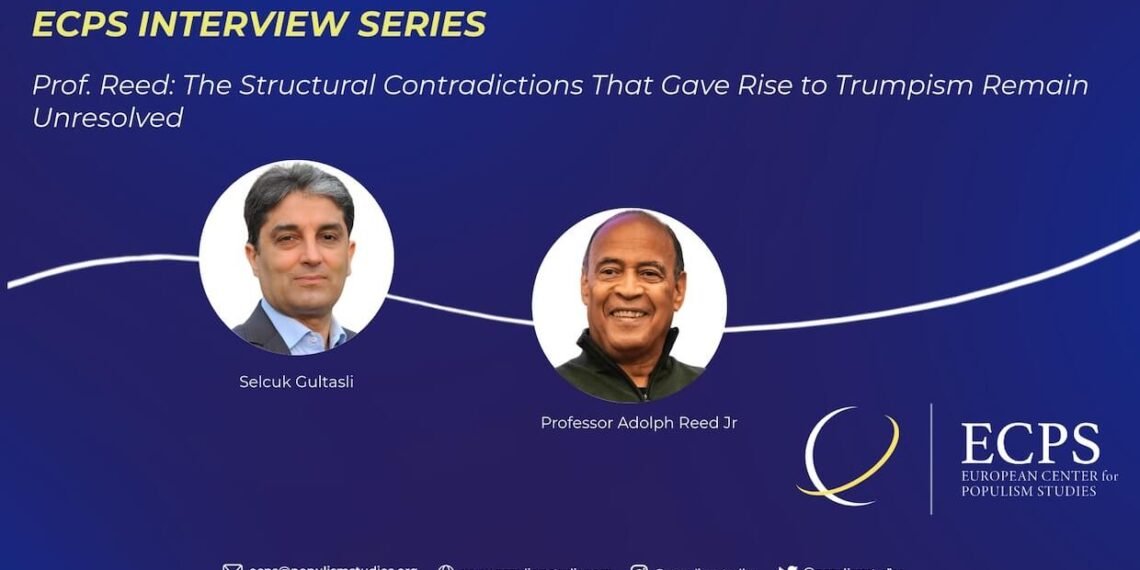
As the United States approaches the 2026 midterm elections, Professor Adolph Reed Jr. offers a critical political-economic interpretation of Trumpism, arguing that the structural contradictions underlying authoritarian nationalism remain fundamentally unresolved. In this wide-ranging interview with the ECPS, Professor Reed examines the tensions between capitalist accumulation and democratic legitimacy, challenges race-reductionist explanations of inequality, and critiques neoliberalism’s displacement of class-based politics. Warning that “the threat of another version of Trumpism will continue to be there,” he emphasizes the limitations of electoral mobilization without durable working-class organization. Drawing on his experience with the Bernie Sanders campaigns, Professor Reed advocates rebuilding solidaristic, universalist politics capable of confronting both economic inequality and authoritarianism through sustained political organization and democratic-socialist transformation.
Interview by Selcuk Gultasli
As the United States approaches the November 3, 2026, midterm elections, fundamental questions persist about the political-economic foundations of Trumpism, the durability of authoritarian nationalism, and the declining capacity of the American left to articulate a transformative alternative. In this wide-ranging interview with the European Center for Populism Studies (ECPS), Professor Adolph Reed Jr., Professor Emeritus of Political Science at the University of Pennsylvania and Distinguished Visiting Professor of Politics at Mount Holyoke College, offers a historically grounded critique of Trumpism, neoliberalism, racial politics, and the erosion of working-class political organization.
One of the most distinctive voices in American political thought, Professor Reed challenges interpretations that privilege political personalities, demographic identities, or ideological labels over the structural contradictions of capitalist democracy. Rather than becoming preoccupied with whether Trumpism should be classified as populism or fascism, he emphasizes its political consequences and underlying material conditions. “Trumpism is clearly a form of authoritarianism,” he argues, while observing that it remains loosely aligned with authoritarian tendencies emerging across Europe and Latin America.
Crucially, Professor Reed cautions against assuming that Trump’s departure would eliminate the political forces associated with his presidency. “The structural contradictions aren’t going anywhere,” he insists, identifying the increasingly fraught relationship between capitalist accumulation and political legitimation as a defining tension within neoliberal democracies. Unless these contradictions are addressed through an alternative political vision capable of providing security and well-being, Professor Reed warns, “the threat of another version of Trumpism will continue to be there.”
The interview also explores Professor Reed’s longstanding critique of race-reductionist explanations of political behavior and inequality. Questioning the treatment of racial categories as coherent political constituencies, he argues that contemporary social science has been “more or less willfully making class and political economy disappear from our understanding of American politics.” His historically specific approach to racism and white supremacy challenges explanations that detach racial ideologies from material interests, institutional structures, and political mobilization.
Turning to democratic socialism, Professor Reed reflects on his involvement in both Bernie Sanders presidential campaigns and the organizational limitations that constrained their transformative potential. “You can’t elect your way to social transformation, at least not without an organizational base,” he observes. Despite these setbacks, he identifies growing skepticism toward capitalism among working people as evidence of changing political possibilities.
Ultimately, Professor Reed argues that confronting authoritarianism and neoliberalism requires sustained organizing beyond electoral cycles. His central message emphasizes the patient reconstruction of working-class solidarity, institutional capacity, and universalist politics. As he concludes, “You’ve got to be able to focus both on what needs to be done to stop the bleeding right now, to keep things from getting worse, and on where we’re trying to go in the long run.”
