In this commentary, Professor Ibrahim Ozturk examines Turkey’s 2026 investment-fund crisis as a manifestation of the political economy of populist authoritarian rule under President Recep Tayyip Erdogan. He argues that the scandal reflects not merely financial misconduct but the cumulative consequences of personalized power, weakened regulatory independence, and politically mediated economic privileges. Drawing on institutional indicators, monetary-policy developments, and the networks connecting political elites, financial regulators, and market actors, Professor Ozturk demonstrates how populist appeals to sovereignty legitimize selective economic protection while ordinary investors bear disproportionate losses. He contends that lasting recovery requires more than financial stabilization or individual prosecutions: it demands institutional reconstruction, independent oversight, transparency, and effective constitutional constraints on presidential authority.
By Ibrahim Ozturk
Turkey’s 2026 investment-fund crisis is a structurally generated, unavoidable outcome of the autocratic regime Erdogan has constructed. The presidential system introduced in 2018 consolidated personalized authority, weakened institutional checks, and subordinated professional judgment to political dependence. Discretionary monetary policy and compromised financial oversight share an allocation logic: access and protection are selective, while losses fall on households and public balance sheets. Populist claims of sovereignty legitimize this arrangement; restrictions on journalism, opposition, and independent scrutiny obstruct its correction. The crisis therefore belongs to a cumulative history of weakened accountability and opportunities for rent extraction. Lasting recovery requires changing the institutions that reproduce these outcomes, which is unlikely under Erdogan’s preferred architecture for regime overhaul.
Populism, Selective State Capacity, and Regime Reproduction
Turkey’s September 2026 fund crisis should be understood as a manifestation of Erdogan’s political-economic order. Its significance extends beyond market participants’ misconduct to the deliberate weakening of institutions that can constrain them. Building on my earlier ECPS work, this commentary argues that recurrent financial crises are endogenous to a regime that concentrates appointment powers, distributes protection selectively and restricts independent challenge. The exact timing of a collapse is contingent; the repeated production of risk and unequal loss is a foreseeable consequence of these institutional choices.
Mudde’s account defines populism through a moral opposition between a virtuous people and a corrupt elite. In office, those who claim to embody the popular will can delegitimize courts, regulators, and professional dissent as obstacles to the national mandate. Under Erdogan, this justificatory language accompanies a governing structure in which loyalty increasingly substitutes for independent judgment. Populism supplies the legitimacy claim; authoritarian institutional reorganization supplies the means of overriding constraints.
Dornbusch and Edwards identify a macroeconomic cycle in which expansionary promises discount inflation and external financing constraints, eventually imposing adjustment costs on intended beneficiaries. Turkey adds a distributional dimension: politically mediated credit, asset ownership and access to protection favour already advantaged groups. Rodrik’s distinction between political and economic populism helps separate legitimate challenges to entrenched privilege from the removal of safeguards against executive predation.
The causal mechanism operates through appointments, incentives and information. Political dependence weakens oversight; privileged access enables selective gains; public intervention can displace losses onto less-protected groups. Restricting scrutiny then lowers the likelihood of correction and permits repetition. Cross-country evidence links populist leadership to institutional erosion and lower long-run income; the Turkish case identifies the channels through which that broader association becomes a governing practice.
This situation reflects a selective state capacity rather than a uniformly weak state: substantial power to mobilize credit, reorganize institutions, and discipline critics coexists with weakened independent capacity to restrain connected interests. My 2022 ECPS analysis traced Turkey’s economic deterioration to the reversal of reforms and the subordination of expertise. The fund scandal extends that diagnosis from macroeconomic management to financial-market governance.
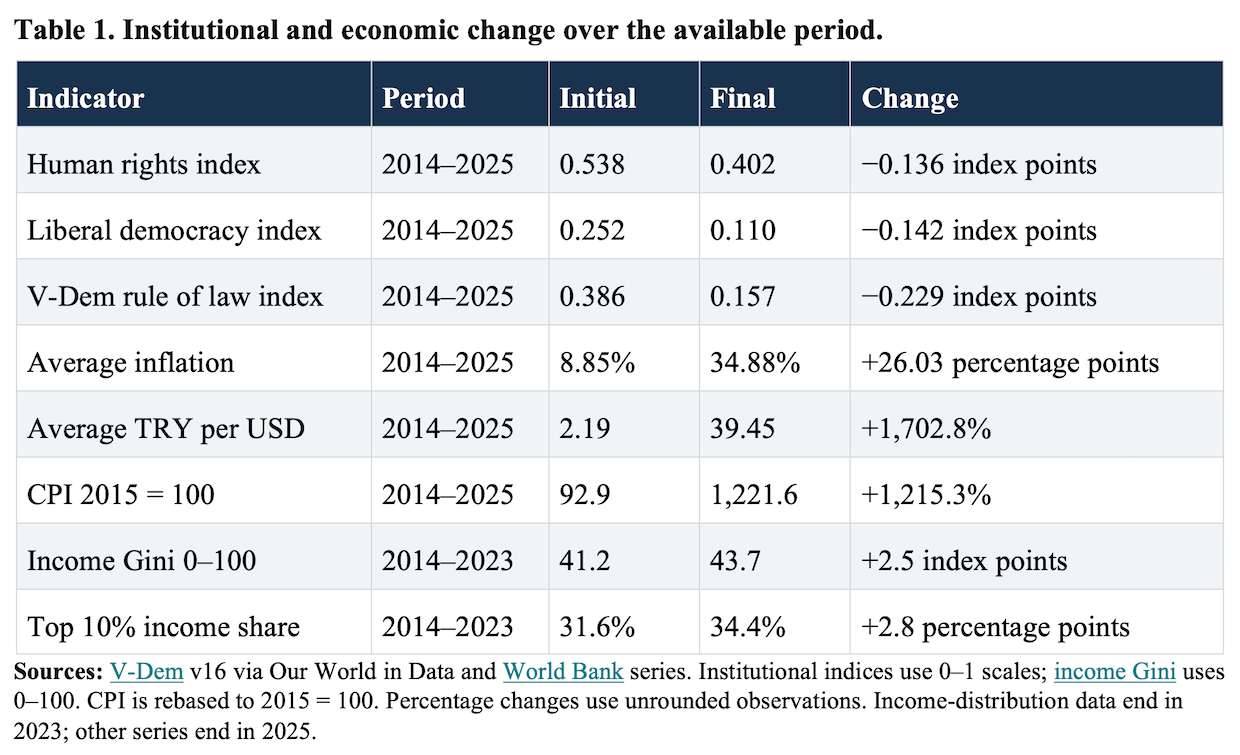
For instance, the broader institutional trajectory, central to the current crisis conundrum, predates the ongoing monetary experiments and the financial sector more broadly. Between 2014 and 2025, V-Dem’s central estimates fell from 0.538 to 0.402 for human rights, from 0.252 to 0.110 for liberal democracy, and from 0.386 to 0.157 for the rule of law. The sharpest declines occurred in 2016–2017; when the highly controversial coup attempt took place, later improvements did not restore earlier levels. Table 1 juxtaposes this deterioration with currency depreciation, accumulated inflation and increased income concentration. The indices describe institutional conditions rather than individual culpability.
From Institutional Reform to the Erosion of Accountability
The 2000–2001 crisis provides an institutional baseline for comparison. Fiscal fragility, public-bank losses and weak banking discipline exposed vulnerabilities that political confrontation triggered. Banking restructuring, stronger supervision and a floating exchange rate subsequently supported recovery under an IMF, World Bank and EU membership-reform framework. The AKP, the current government party, initially benefited from this inherited trajectory. Its later dismantling matters precisely because institutional credibility and international engagement had demonstrated their economic value.
The December 2013 deep successive corruption scandals and investigations, which brought allegations of extensive bribery, illicit gold trading and abuse of public office involving high-profile ministers in Erdogan’s inner circle into public view, also raised broader questions about ruling-party parliamentarians and businessmen allegedly awarded tailor-made public contracts in exchange for financial and political favors sought by Erdogan himself. The subsequent response marked a critical rupture in accountability: despite the gravity of the allegations, Parliament declined to refer four former ministers for trial, closing the route to judicial examination that referral would have opened. The US conviction of Mehmet Hakan Atilla, who served as deputy general manager of the state-owned Halkbank, and the guilty plea of Reza Zarrab, who was a gold trader central to the December 2013 allegations, subsequently established sanctions-evasion offenses in a separate jurisdiction. Although legally distinct, these cases illuminate a connected political-economic mechanism: shielding politically connected actors from independent scrutiny weakens deterrence and entrenches expectations of protection. Impunity becomes cumulative when accountability failures incentivize subsequent abuses.
The 2018 confrontation with Donald Trump’s administration exposed the limits of performed sovereignty to be used as a decisive element in domestic populist politics. In August 2018, US sanctions over the detention of Andrew Brunson, an American pastor held in Turkey on terrorism-related charges that Washington rejected as unfounded, escalated the diplomatic confrontation. Trump’s subsequent 50 percent tariff on Turkish steel, which doubled the existing 25 percent duty and sharply increased the barriers facing Turkish exporters in the US market, added trade pressure to the dispute. These measures aggravated an economy already vulnerable to dependence on external financing and currency mismatches, as the IMF’s assessment documented. The confrontation thus exposed the material limits of sovereignty rhetoric in an economy dependent on international capital and export markets. As a result, depreciation increased import costs and foreign-currency debt burdens.
The CBRT responded by raising its policy rate from 17.75 to 24 percent. The problem was the durability of stabilization when presidential authority could subsequently displace its institutional basis. Reserve depletion followed a separate policy choice. Reuters reported approximately US$128 billion in dollar sales by state banks over the preceding two years in May 2021; the IMF identified inadequate buffers and negative net reserves after swaps. Obviously, dollar sales against lira do not prove the entire sum was stolen, but they highlight limited public capacity and insufficient transparency about transactions and beneficiaries. Defending a politically preferred exchange-rate path consumed resources while postponing acknowledgment of underlying constraints.
Discretionary Easing, Selective protection, and Costly Stabilization
Political intervention weakened institutional capacity by subordinating professional judgment to presidential preferences. Figure 1 connects successive monetary-policy reversals to the executive’s appointment and removal powers. Following Murat Cetinkaya’s dismissal in July 2019, the policy rate fell from 24 to 8.25 percent under Murat Uysal. Naci Agbal later reversed course, raising it to 19 percent in March 2021, but was dismissed two days after his final increase. His removal showed how vulnerable professional tenure is when monetary decisions conflict with presidential preferences.
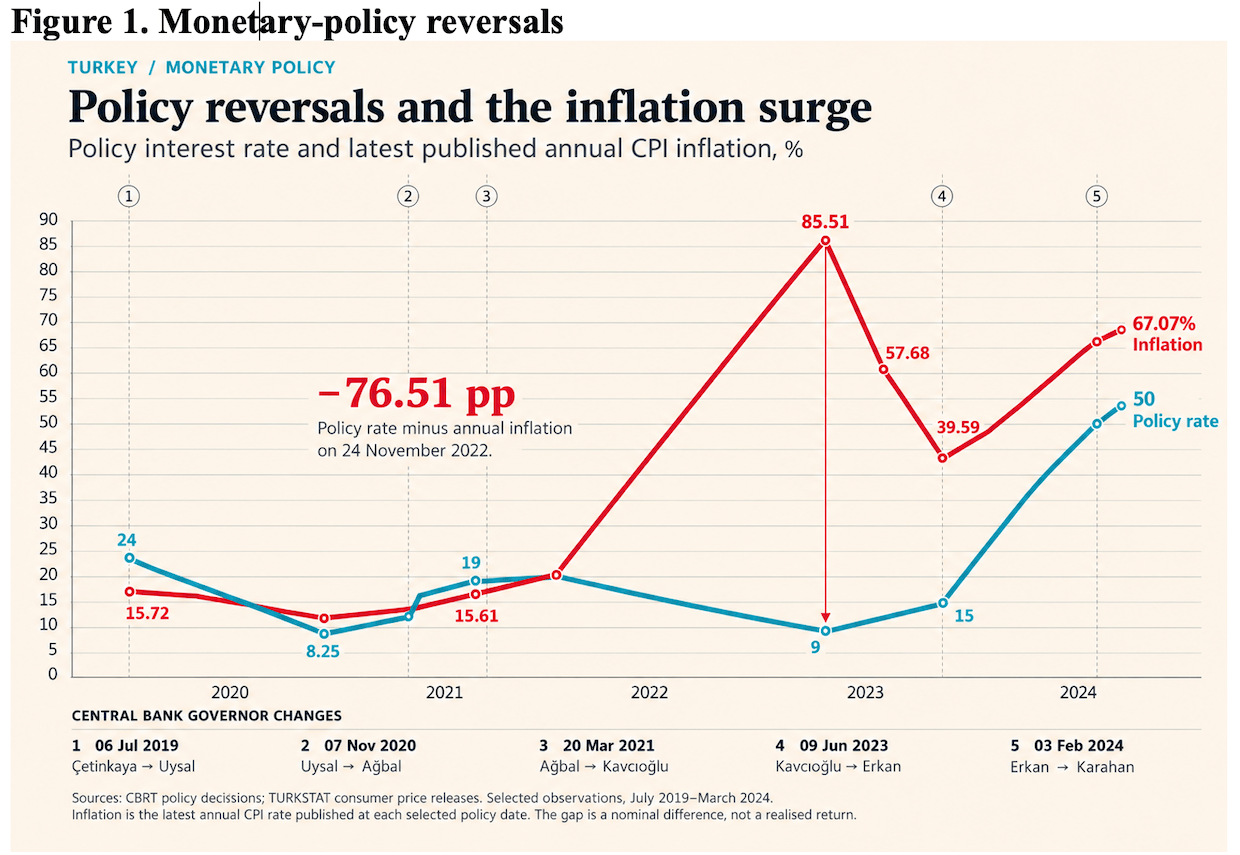
Under Sahap Kavcioglu, politically imposed easing reduced the policy rate from 19 percent in September 2021 to 8.5 percent by February 2023. At the November 2022 decision, the rate stood 76.51 percentage points below the latest published annual inflation rate. This nominal gap, rather than a realized return, captures the divergence between monetary policy and prevailing inflation. Cheap lira financing encouraged foreign-currency and asset purchases, contributing to depreciation while offering asset-owning borrowers protections unavailable to wage earners and unhedged savers.
Erdogan legitimized easing by shifting appeals from rhetoric about “sovereignty” and “external enemies” to religious authority. Invoking nas—a binding Islamic injunction—against usury (riba), he framed lower interest rates not only as a religious obligation, but also asserted that interest causes inflation, not vice versa. This shift between nationalist and religious justifications illustrates populism’s adaptability: both appeals shield discretionary authority from scrutiny while society absorbs the costs.
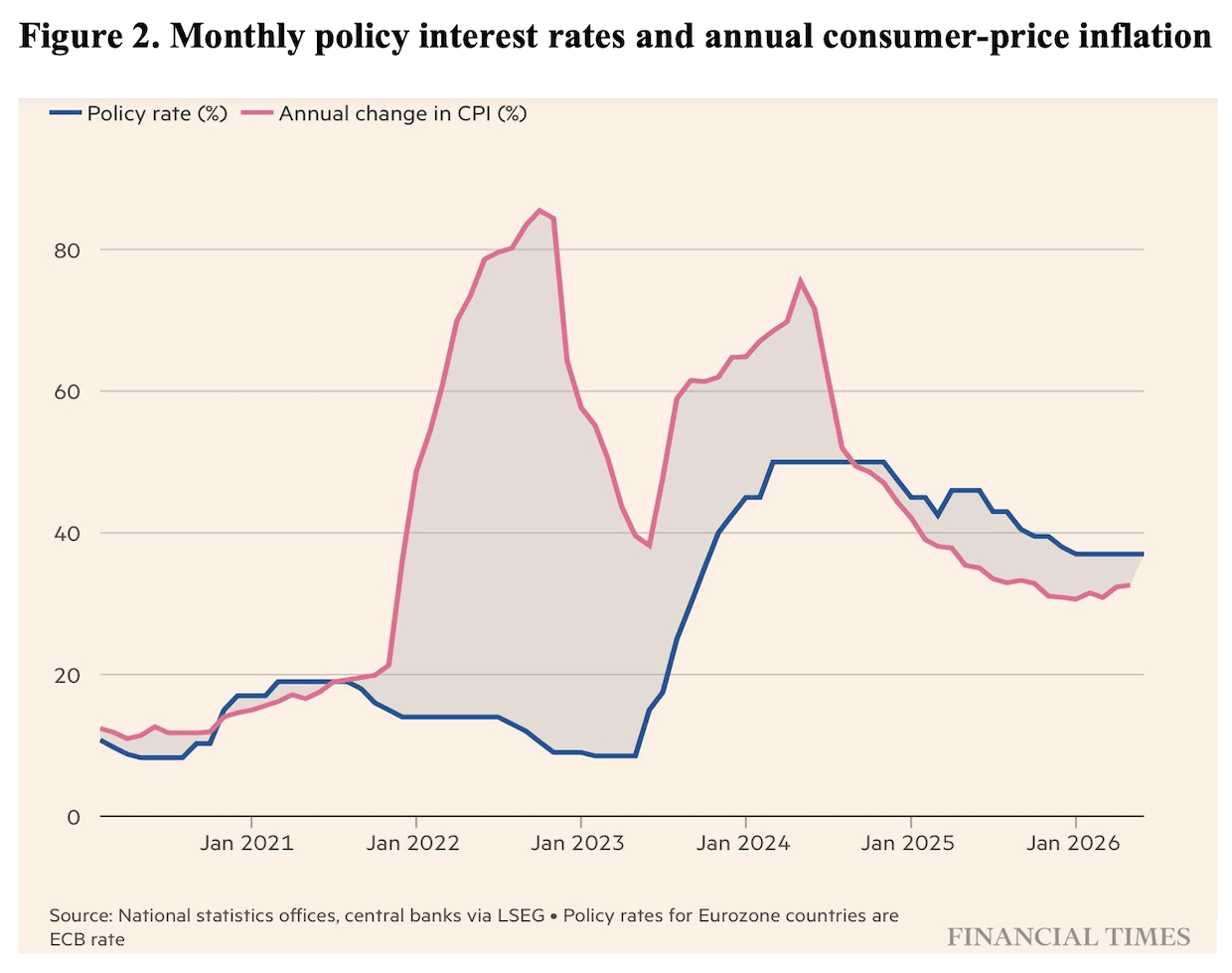
After the 2023 elections, tightening under Hafize Gaye Erkan and Fatih Karahan raised the rate to 50 percent by March 2024; by year-end, it exceeded annual CPI inflation. Figure 2 shows the successive burdens of inflationary erosion and costly stabilization. Inflation initially accelerated despite tightening as depreciation, tax and administered-price increases, wage adjustments and expectations interacted with delayed monetary transmission. This coexistence does not establish that higher rates caused the preceding crisis. More fundamentally, technocratic correction restored a conventional instrument without constraining the executive powers that had enabled its subordination.
Exchange-rate-protected deposits (known as Kur Korumalı Mevduat-KKM) introduced in December 2021 shifted some depreciation risk onto the Treasury and Central Bank balance sheets. Participating savers received publicly underwritten protection unavailable to households without qualifying deposits. Successive policy shifts thus created different opportunities for protection through cheap credit, asset appreciation, KKM guarantees and later high nominal deposit returns. Credit-constrained households and firms instead faced purchasing-power losses, expensive working capital and weaker demand. Establishing that the same connected actors benefited throughout requires linked transaction records; the structural mechanism is the repeated redistribution of gains and losses through discretionary policy.
Distributional indicators reveal unequal capacities to absorb these shocks. The World Bank income Gini rose from 41.2 in 2014 to 43.7 in 2023, while UBS reports a separate wealth Gini of 0.73 for 2025, placing Turkey tenth among covered markets. The OECD Employment Outlook 2026 reports approximately 79 percent growth in CPI-deflated business-sector hourly wages between early 2021 and early 2026, alongside a falling minimum-to-median wage ratio and declining real minimum wages by April 2026. Average wage recovery therefore coexisted with uneven gains; it neither measures median household income nor resolves concerns about the official inflation deflator.
TURK-IS’s November 2025 estimates make this insecurity concrete: the net minimum wage covered only 74.1 percent of a four-person household’s food budget and 57 percent of a single worker’s estimated living costs. These adequacy benchmarks, rather than official poverty rates, demonstrate low-paid workers’ exposure to essential expenses. Limited public provision compounds that exposure. Turkey ranks near the bottom of the OECD’s social-spending comparison, while health expenditure amounted to 4.7 percent of GDP against an OECD average of 9.3 percent. These overlapping measures highlight the opportunity costs of financial guarantees when public services remain comparatively underfunded.
Although the IMF acknowledged that post-2023 tightening reduced crisis risks, changing the monetary instrument leaves politically mediated allocation intact. Recovery must therefore be assessed through investment, distribution and public capacity alongside disinflation.
Persistent price increases also undermine planning. Compounding official inflation rates shows that prices increased approximately 432 percent between end-2020 and end-2024; subsequent disinflation did not reverse that accumulation. Over the longer period, annual-average inflation rose from 8.85 percent in 2014 to 34.88 percent in 2025, while the exchange rate moved from TRY2.19 to TRY39.45 per dollar. The annual-average CPI implies that a fixed nominal lira amount retained only approximately 7.6 percent of its 2014 purchasing power.
Statistical credibility is integral to this institutional problem. TUIK’s repeated leadership changes and its June 2022 replacement of published average item prices with item indices intensified concerns about independence and scrutiny. Because inflation data govern wage bargaining, indexation and policy evaluation, credible measurement requires transparent methods, accessible information and independent review.
Supply and demand continue to operate, but unstable money obscures relative prices and sustainable margins. Firms may postpone productive investment while households seek exceptional nominal returns to recover earlier losses. The resulting demand for financial protection becomes an opportunity for extraction where independent oversight, reliable information, and enforceable investor rights are weak.
The Fund Fraud: Distorted Price Discovery, the Demand for Financial Protection
The fund crisis follows from the interaction of these conditions. Monetary instability creates demand for protection; concentrated portfolios amplify valuation risk; politically dependent oversight weakens correction. The scandal is therefore part of the regime’s cumulative political economy, not an isolated accident outside it. Institutional responsibility rests on the deliberate construction and maintenance of this incentive structure; individual criminal responsibility still depends on evidence of particular acts.
The crisis emerged after explicit warnings, not in the absence of information. On 4 November 2025, Finance Minister Mehmet Simsek publicly acknowledged manipulation through certain investment funds and promised stronger regulation. MSCI’s June 2026 review subsequently flagged possible coordinated trading and artificially inflated free-float estimates. S&P Dow Jones Indices warned in July about transparency and market-classification risks, while FTSE Russell also raised concerns over transparency and market accessibility. This accumulation of domestic acknowledgment and external warnings shifts the accountability question from whether authorities knew to why their response failed to contain the risks. Early evidence points to political protection or interference obstructing effective intervention, requiring an independent examination of supervisory correspondence and decision records.
After mounting external pressure that, unless decisive corrective measures are taken, Turkey could be isolated from emerging market status, the Capital Markets Board (SPK) placed in September 131 funds associated with seven portfolio-management companies into liquidation, with 455,758 unique investors subsequently identified. Reuters reported affected assets exceeding US$18 billion and a weekly equity-index decline of more than 8 percent. These figures show the scale of exposure and disruption, not the amount stolen or final investor losses.
Other indicators show how stress spread beyond the affected funds. A press compilation of Central Securities Depository data recorded a fall in listed-equity capitalization from TRY22.91 trillion at end-August to TRY19.08 trillion in late September, approximately 16.7 percent. Reporting based on TEFAS data identified net fund outflows exceeding TRY210 billion after August 28. Meanwhile, net purchases through Ziraat Yatirim reportedly reached TRY22.3 billion on September 21, while gross central-bank reserves fell by US$13.8 billion between August 28 and September 18. Valuation changes, withdrawals, brokerage transactions and reserve movements measure different phenomena. They cannot be added into a single damage estimate or attributed entirely to the crisis. Purchases through a publicly owned intermediary also do not establish public expenditure without identifying the underlying accounts.
Valuation Feedback, Liquidity Risk, and Delayed Intervention
In the emerging Ponzi-like scheme, the financial mechanism combines valuation feedback with liquidity risk. Concentrated purchases of thinly traded low-free-float shares can raise quoted prices and reported fund values. Strong apparent performance attracts subscriptions that finance further purchases; higher collateral valuations may also support additional borrowing. Where related parties control funds and portfolio companies, investors’ interests may conflict with the wider group’s financing objectives.
This cycle can widen the gap between quoted prices and realizable portfolio value. Redemption pressure exposes the discrepancy, while sales of liquid holdings transmit stress to other securities. The Financial Stability Board recognizes liquidity mismatch as a general vulnerability of open-ended funds. Turkey’s distinctive problem is whether its institutions could identify and constrain the accumulation of these risks independently of commercial and political pressures.
However, the principal–agent problem in Turkey extends beyond fund management, underlining a broader systemic characteristic. Investors entrust managers with assets; citizens entrust regulators with protection. When the political executive controls supervisory appointments, agents may be incentivized to satisfy influential networks rather than their public mandate. Preferential access and weak sanctions then lower the expected cost of risk-taking and extraction. The formal existence of a regulator is insufficient when its effective independence has been subordinated.
The SPK’s September 18 statement acknowledged abnormal fund-driven movements in low-free-float shares during the final quarter of 2025. The Financial Stability Committee considered the issue on December 2; a working group followed on December 3; the qualified-investor threshold increased on December 18. Comprehensive guide changes came on August 28, 2026. The interval makes supervisory responsibility unavoidable: administrative activity cannot establish that known exposures were adequately constrained or that continuing investors were protected.
The Principal–Agent Problem: Information Asymmetry, Conflicts of Interest and Institutional Protection
The fund crisis exposes a chain of delegated authority: investors entrust assets to managers, citizens entrust protection to regulators, and the executive appoints supervisors. Managers know more than investors; officials control records unavailable to citizens. Under Erdogan’s personalized appointment system, these information asymmetries intersect with political dependence. As a result, the resulting vulnerability is endogenous to the governing architecture: institutions expected to constrain accumulation can instead protect its beneficiaries.
Figure 3 connects ownership, management and inspection within a shared appointment network. Erdogan’s Turkey Wealth Fund chairmanship, Erisah Arican’s overlapping leadership, Mahmut Kayacik’s TVF–Takasbank responsibilities and Yunus Arinci’s move from the State Supervisory Council to Takasbank weaken institutional separation. Salih Tanrikulu’s former Borsa Istanbul role adds retrospective self-review risk. The principal–agent problem becomes acute when citizens’ monitors answer to the political network whose decisions require investigation.
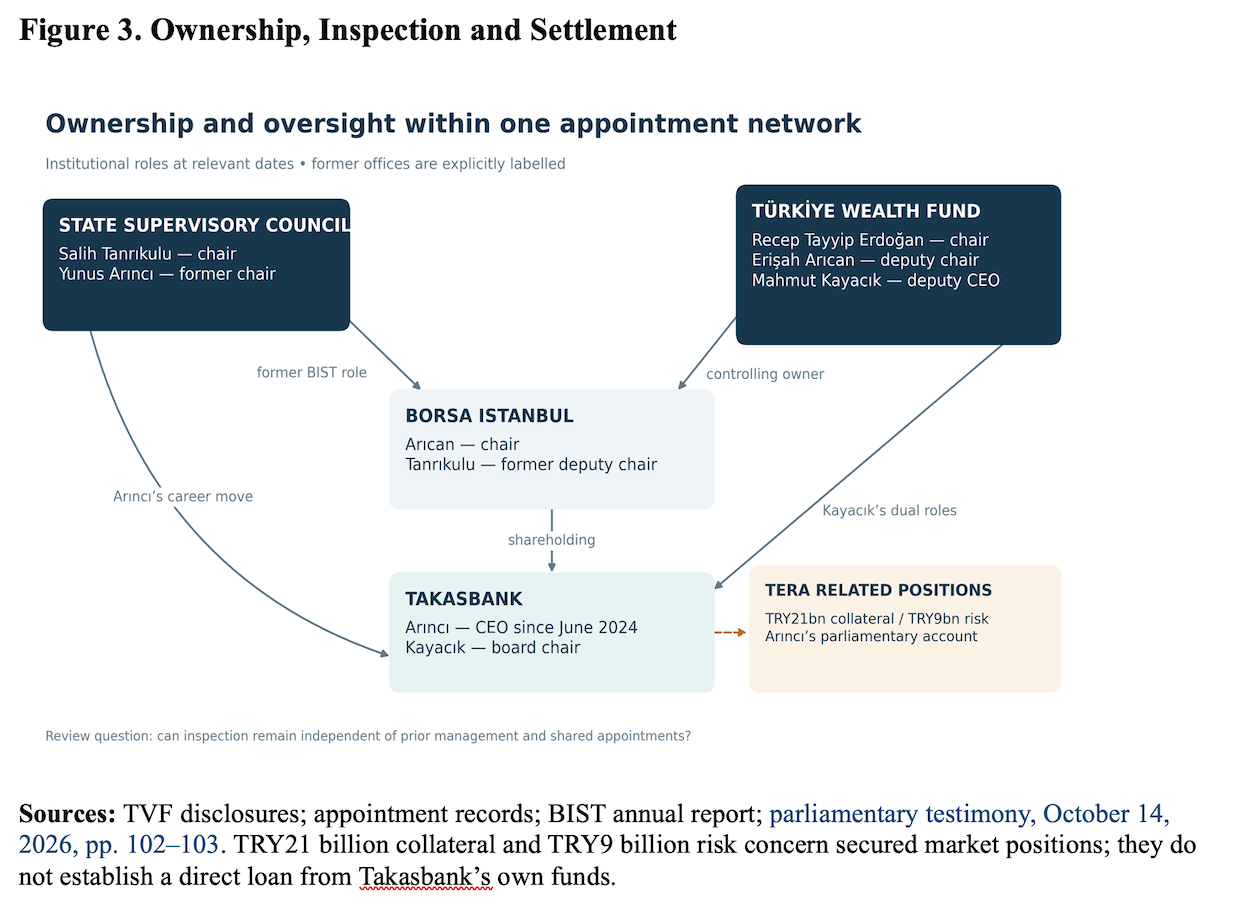
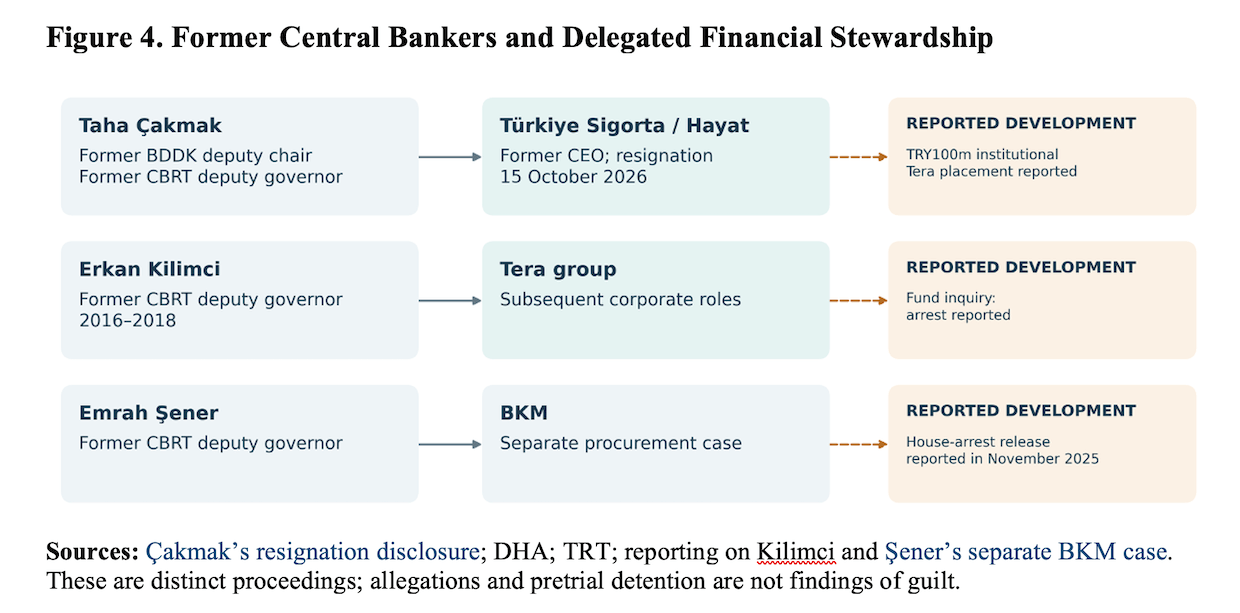
Figure 4 examines delegated stewardship through Kilimci’s Tera roles, Çakmak’s management of insurance and pension assets, and Şener’s separate Interbank Card Center procurement (BKM) proceedings. The latest developments sharpen Çakmak’s conflict-of-interest dimension: after resigning on 15 October, he was remanded in custody on 24 October. Reported allegations include receiving US$1 million in cash for directing institutional resources into Tera funds; further reporting describes personal share transactions tied to institutional placements. His reported repayment of investment-related proceeds neither establishes the amount misappropriated nor resolves responsibility.
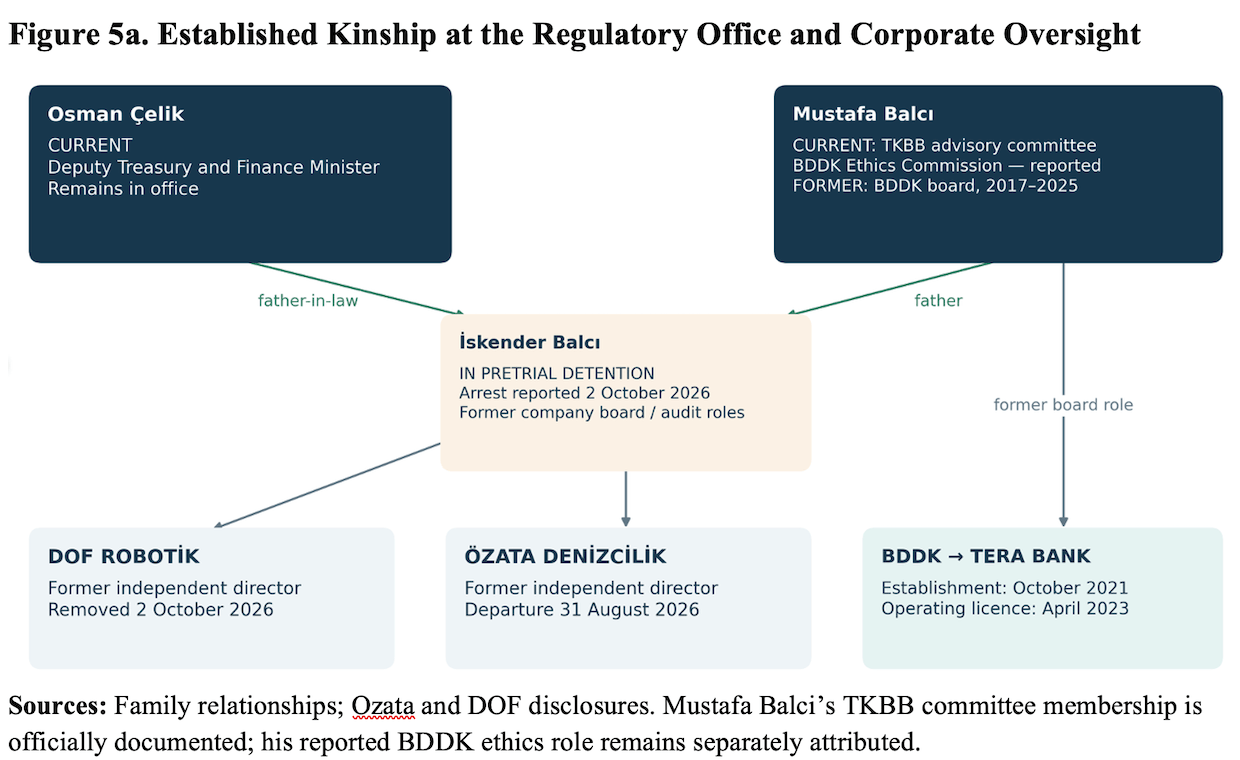
Iskender Balci, son of former banking regulator Mustafa Balci and son-in-law of Deputy Finance Minister Osman Celik, held company oversight roles at Ozata Denizcilik and DOF Robotik before his detention. Celik submitted his retirement request on October 19. Administrative departure leaves the central question unresolved: whether licensing, appointments and supervision were insulated from family interests through disclosure and recusal.
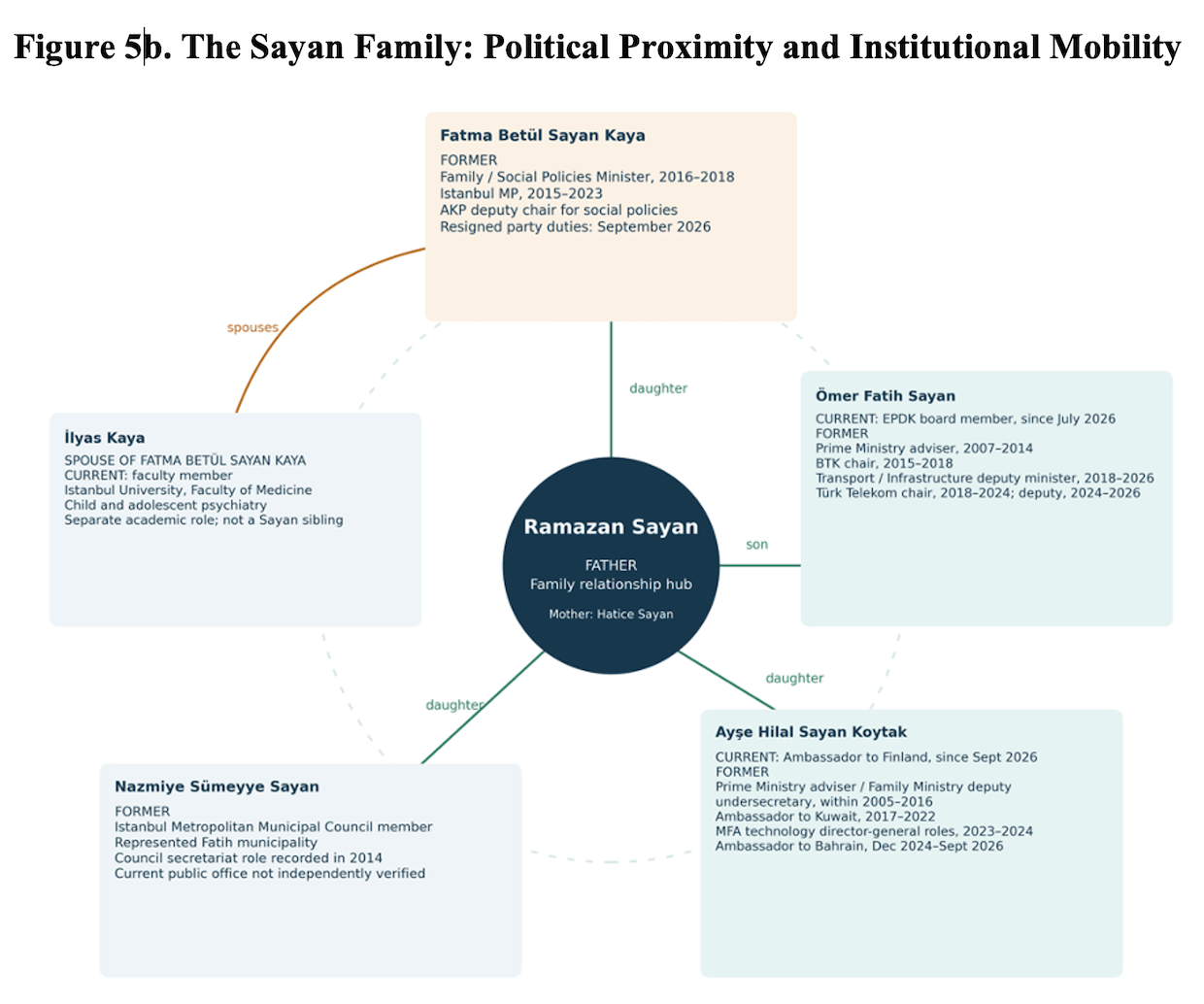
The Sayan family illustrates institutional mobility across politics, regulation and diplomacy. Ramazan Sayan, described in contemporary reporting as Erdogan’s longstanding associate, is the father of four siblings. Fatma Betul Sayan Kaya progressed through advisory work, Parliament, cabinet and party leadership. Omer Fatih Sayan moved through Prime Ministry advisory posts, BTK leadership, a deputy ministership and Turk Telekom board leadership before joining EPDK. Ayse Hilal Sayan Koytak advanced through ministerial and diplomatic appointments, including ambassadorships in Kuwait, Bahrain and Finland; Nazmiye Sumeyye Sayan served on Istanbul’s metropolitan council. Together, these trajectories warrant scrutiny of merit, access and appointment criteria.
The financial question is more specific. Reuters reported allegations concerning approximately TRY2.17 billion in combined share-sale proceeds received by Sayan Kaya and her husband before the turmoil. Whether Takasbank-supported liquidity facilitated their exits requires transaction-level evidence. Sale proceeds cannot be treated as profits, and institutional liquidity support alone does not establish preferential treatment.
Mustafa Yazici, son of senior AKP official and former minister Hayati Yazici, introduces distressed-debt collection into this network. The imposition and subsequent lifting of asset restrictions require transparent explanation. His company, Adil Varlik Yönetim, purchases non-performing receivables. Corporate records document a TRY450 million conversion of shareholder receivables into capital, but not their ultimate funding source. A TRY500 million financing bill arranged by Tera Yatirim subsequently generated an MKK non-payment notice. The intersection of connected financing and debt collection merits investigation; borrower complaints alone do not establish unlawful interest charges.
BTK belongs within the accountability analysis because restrictions on online reporting deepen information asymmetry. Reported blocking concerning Batuhan Mumcu and his wife requires examination of judicial orders, requests and implementation. Mumcu joined BTK’s board in August 2026; his wife, Neslihan Mumcu, appears in corporate disclosures concerning Bulls Yatırım Holding. Some reported restrictions predated his appointment; attributing them to his personal intervention would require additional evidence.
Figure 6 places SPK at the center. Ibrahim Omer Gonul, son of former Defense Minister Vecdi Gonul, moved from SPK chairmanship to KGK before being removed on October 20 alongside SPK chair Mahmut Sutcu. Sutcu had submitted his resignation the previous day. Tezmen’s former MKK role and Murat Onuk’s overlapping portfolio-management and Takasbank responsibilities further complicate independent oversight. Personnel changes leave earlier decisions and the executive’s appointment powers requiring scrutiny.
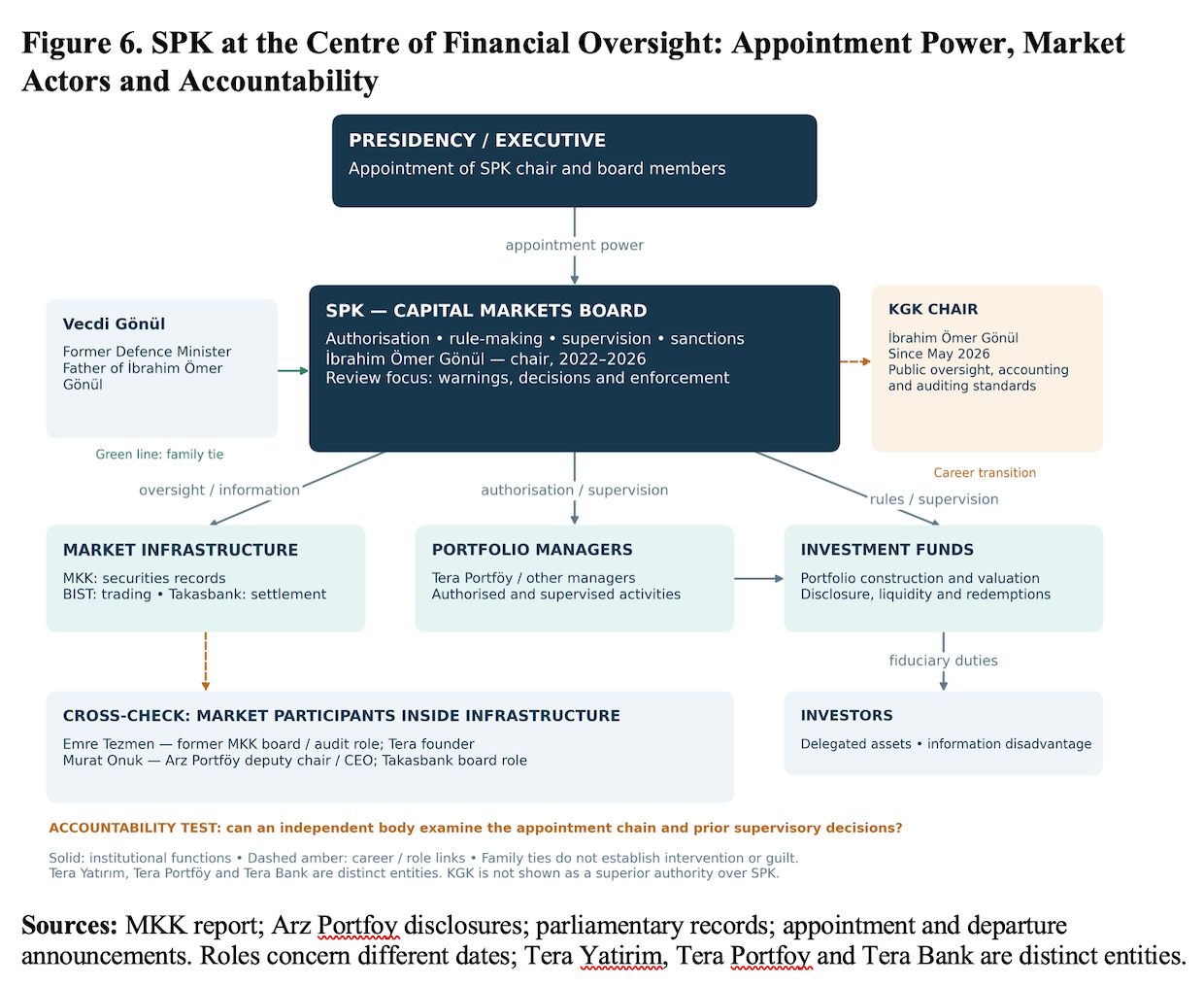
Reports that two SPK officials opposed Tera Yatirim’s flotation, were subsequently replaced, and that the reconstituted board approved the IPO two months later reveal how presidential appointment power can override institutional resistance. In Erdogan’s centralized system, replacing officials changes more than personnel: it reshapes the boundaries of permissible professional judgment. The sequence illustrates a principal–agent inversion in which regulators become accountable upwards to the appointing authority rather than outwards to investors and the public. Repeated failures to investigate politically protected conduct reinforce expectations of impunity, weaken deterrence, and make compliance with political preferences less costly than resistance. Subsequent dismissals cannot resolve this institutional responsibility: accountability must reach the authority that selected supervisors, enabled contested approvals and sustained the system of protection.
An inquiry must follow beneficial ownership and funding at entry; concentration, related-party transactions and valuation during investment; and information, financing and redemption terms at exit. Early withdrawal alone proves no insider dealing, but withdrawals above realizable asset values can shift shortfalls to remaining investors. Appointment records, supervisory correspondence, access logs and transaction trails are therefore indispensable.
In terms of an ex-post solution, the October 1 SPK announcement provided interim payments of up to TRY1 million per investor per fund for funds founded by four managers. Another announcement addressed liquidation and possible reopening for the other three, while voluntary-return accounts were established for excessive gains. Relief can reduce immediate hardship; it does not demonstrate that the institutional causes have been corrected or establish final recoveries and immunity from prosecution.
On October 6, the SPK disputed the claim of 130 ignored warnings and cited 96 criminal referrals concerning fund transactions in 2026. On October 4, it rejected claims that protection of the Investor Compensation Center’s assets originated in July 2026, citing earlier provisions. Independent review must test these defenses against dated records: aggregate enforcement activity cannot answer whether particular warnings were handled adequately.
The political feedback mechanism is crucial here: economic deterioration threatens consent; legal and administrative pressure limits the conversion of grievance into organized opposition; weaker scrutiny protects the allocation system that generated the damage. Widespread arrests and dismissals, and media censorship, show that intervention under pressure narrows scrutiny precisely when it is most necessary. An inquiry controlled by the same appointment network cannot resolve this problem without independent experts, parliamentary authority and enforceable access to records.
Conclusion
Turkey’s fund crisis is an endogenous outcome of the governing order Erdogan has constructed. Discretionary economic policy creates vulnerabilities; politically dependent institutions suppress corrective scrutiny; privileged access enables selective enrichment while losses reach ordinary investors and public balance sheets. Repeated scandals reflect the cumulative consequences of institutional choices that subordinate professional judgement to presidential authority and weaken deterrence through expectations of protection. Populist appeals to sovereignty, national distinctiveness and religious obligation legitimize this discretion, while restrictions on journalism and opposition obstruct scrutiny of its consequences.
Financial repair must therefore accompany a redistribution of institutional authority. Immediate priorities include independently verified valuations, disclosure of related-party exposures, preservation of supervisory and transaction records, and recovery from those responsible. Any public support must identify its beneficiaries, legal basis and recovery strategy. Protecting vulnerable investors requires preventing further transfers of private losses to society.
Durable recovery, however, requires constraints on the executive itself. Independent courts, effective parliamentary oversight, merit-based appointments and protection for professional disagreement must replace supervision organized around political loyalty. Regulators, auditors and market infrastructure need genuinely independent cross-checks, supported by investigative journalism, academic freedom and competitive opposition. Accountability must follow appointment and decision chains wherever they lead, including into the presidency.
The fund crisis ultimately exposes how Erdogan’s governing order converts public authority into selective private advantage while shielding its beneficiaries from independent scrutiny. Gains sustain politically connected networks; losses fall on investors, wider society and future generations. Breaking this pattern requires restoring the rule of law and subjecting presidential authority to effective institutional checks. Otherwise, replacing officials and prosecuting selected actors leaves intact the structure that enables extraction, protects privilege and reproduces impunity.
Erdogan’s responses to successive crises suggest that meaningful reform from within this governing order is increasingly implausible. The recurrent protection of connected interests supports a political-economic interpretation of corruption as a means of financing and consolidating his regime-building project. As implicated networks expand, independent accountability threatens both their accumulated advantages and the political authority that sustains them, deepening resistance to reform. Expecting Erdogan to dismantle these arrangements therefore overlooks their role in his political survival. Institutional reconstruction requires a democratic reconfiguration of power that can investigate the presidency itself.

Long Read: Turkey’s Fund Crisis and the Political Economy of Authoritarian Rule
In this commentary, Professor Ibrahim Ozturk examines Turkey’s 2026 investment-fund crisis as a manifestation of the political economy of populist authoritarian rule under President Recep Tayyip Erdogan. He argues that the scandal reflects not merely financial misconduct but the cumulative consequences of personalized power, weakened regulatory independence, and politically mediated economic privileges. Drawing on institutional indicators, monetary-policy developments, and the networks connecting political elites, financial regulators, and market actors, Professor Ozturk demonstrates how populist appeals to sovereignty legitimize selective economic protection while ordinary investors bear disproportionate losses. He contends that lasting recovery requires more than financial stabilization or individual prosecutions: it demands institutional reconstruction, independent oversight, transparency, and effective constitutional constraints on presidential authority.
By Ibrahim Ozturk
Turkey’s 2026 investment-fund crisis is a structurally generated, unavoidable outcome of the autocratic regime Erdogan has constructed. The presidential system introduced in 2018 consolidated personalized authority, weakened institutional checks, and subordinated professional judgment to political dependence. Discretionary monetary policy and compromised financial oversight share an allocation logic: access and protection are selective, while losses fall on households and public balance sheets. Populist claims of sovereignty legitimize this arrangement; restrictions on journalism, opposition, and independent scrutiny obstruct its correction. The crisis therefore belongs to a cumulative history of weakened accountability and opportunities for rent extraction. Lasting recovery requires changing the institutions that reproduce these outcomes, which is unlikely under Erdogan’s preferred architecture for regime overhaul.
Populism, Selective State Capacity, and Regime Reproduction
Turkey’s September 2026 fund crisis should be understood as a manifestation of Erdogan’s political-economic order. Its significance extends beyond market participants’ misconduct to the deliberate weakening of institutions that can constrain them. Building on my earlier ECPS work, this commentary argues that recurrent financial crises are endogenous to a regime that concentrates appointment powers, distributes protection selectively and restricts independent challenge. The exact timing of a collapse is contingent; the repeated production of risk and unequal loss is a foreseeable consequence of these institutional choices.
Mudde’s account defines populism through a moral opposition between a virtuous people and a corrupt elite. In office, those who claim to embody the popular will can delegitimize courts, regulators, and professional dissent as obstacles to the national mandate. Under Erdogan, this justificatory language accompanies a governing structure in which loyalty increasingly substitutes for independent judgment. Populism supplies the legitimacy claim; authoritarian institutional reorganization supplies the means of overriding constraints.
Dornbusch and Edwards identify a macroeconomic cycle in which expansionary promises discount inflation and external financing constraints, eventually imposing adjustment costs on intended beneficiaries. Turkey adds a distributional dimension: politically mediated credit, asset ownership and access to protection favour already advantaged groups. Rodrik’s distinction between political and economic populism helps separate legitimate challenges to entrenched privilege from the removal of safeguards against executive predation.
The causal mechanism operates through appointments, incentives and information. Political dependence weakens oversight; privileged access enables selective gains; public intervention can displace losses onto less-protected groups. Restricting scrutiny then lowers the likelihood of correction and permits repetition. Cross-country evidence links populist leadership to institutional erosion and lower long-run income; the Turkish case identifies the channels through which that broader association becomes a governing practice.
This situation reflects a selective state capacity rather than a uniformly weak state: substantial power to mobilize credit, reorganize institutions, and discipline critics coexists with weakened independent capacity to restrain connected interests. My 2022 ECPS analysis traced Turkey’s economic deterioration to the reversal of reforms and the subordination of expertise. The fund scandal extends that diagnosis from macroeconomic management to financial-market governance.
For instance, the broader institutional trajectory, central to the current crisis conundrum, predates the ongoing monetary experiments and the financial sector more broadly. Between 2014 and 2025, V-Dem’s central estimates fell from 0.538 to 0.402 for human rights, from 0.252 to 0.110 for liberal democracy, and from 0.386 to 0.157 for the rule of law. The sharpest declines occurred in 2016–2017; when the highly controversial coup attempt took place, later improvements did not restore earlier levels. Table 1 juxtaposes this deterioration with currency depreciation, accumulated inflation and increased income concentration. The indices describe institutional conditions rather than individual culpability.
From Institutional Reform to the Erosion of Accountability
The 2000–2001 crisis provides an institutional baseline for comparison. Fiscal fragility, public-bank losses and weak banking discipline exposed vulnerabilities that political confrontation triggered. Banking restructuring, stronger supervision and a floating exchange rate subsequently supported recovery under an IMF, World Bank and EU membership-reform framework. The AKP, the current government party, initially benefited from this inherited trajectory. Its later dismantling matters precisely because institutional credibility and international engagement had demonstrated their economic value.
The December 2013 deep successive corruption scandals and investigations, which brought allegations of extensive bribery, illicit gold trading and abuse of public office involving high-profile ministers in Erdogan’s inner circle into public view, also raised broader questions about ruling-party parliamentarians and businessmen allegedly awarded tailor-made public contracts in exchange for financial and political favors sought by Erdogan himself. The subsequent response marked a critical rupture in accountability: despite the gravity of the allegations, Parliament declined to refer four former ministers for trial, closing the route to judicial examination that referral would have opened. The US conviction of Mehmet Hakan Atilla, who served as deputy general manager of the state-owned Halkbank, and the guilty plea of Reza Zarrab, who was a gold trader central to the December 2013 allegations, subsequently established sanctions-evasion offenses in a separate jurisdiction. Although legally distinct, these cases illuminate a connected political-economic mechanism: shielding politically connected actors from independent scrutiny weakens deterrence and entrenches expectations of protection. Impunity becomes cumulative when accountability failures incentivize subsequent abuses.
The 2018 confrontation with Donald Trump’s administration exposed the limits of performed sovereignty to be used as a decisive element in domestic populist politics. In August 2018, US sanctions over the detention of Andrew Brunson, an American pastor held in Turkey on terrorism-related charges that Washington rejected as unfounded, escalated the diplomatic confrontation. Trump’s subsequent 50 percent tariff on Turkish steel, which doubled the existing 25 percent duty and sharply increased the barriers facing Turkish exporters in the US market, added trade pressure to the dispute. These measures aggravated an economy already vulnerable to dependence on external financing and currency mismatches, as the IMF’s assessment documented. The confrontation thus exposed the material limits of sovereignty rhetoric in an economy dependent on international capital and export markets. As a result, depreciation increased import costs and foreign-currency debt burdens.
The CBRT responded by raising its policy rate from 17.75 to 24 percent. The problem was the durability of stabilization when presidential authority could subsequently displace its institutional basis. Reserve depletion followed a separate policy choice. Reuters reported approximately US$128 billion in dollar sales by state banks over the preceding two years in May 2021; the IMF identified inadequate buffers and negative net reserves after swaps. Obviously, dollar sales against lira do not prove the entire sum was stolen, but they highlight limited public capacity and insufficient transparency about transactions and beneficiaries. Defending a politically preferred exchange-rate path consumed resources while postponing acknowledgment of underlying constraints.
Discretionary Easing, Selective protection, and Costly Stabilization
Political intervention weakened institutional capacity by subordinating professional judgment to presidential preferences. Figure 1 connects successive monetary-policy reversals to the executive’s appointment and removal powers. Following Murat Cetinkaya’s dismissal in July 2019, the policy rate fell from 24 to 8.25 percent under Murat Uysal. Naci Agbal later reversed course, raising it to 19 percent in March 2021, but was dismissed two days after his final increase. His removal showed how vulnerable professional tenure is when monetary decisions conflict with presidential preferences.
Under Sahap Kavcioglu, politically imposed easing reduced the policy rate from 19 percent in September 2021 to 8.5 percent by February 2023. At the November 2022 decision, the rate stood 76.51 percentage points below the latest published annual inflation rate. This nominal gap, rather than a realized return, captures the divergence between monetary policy and prevailing inflation. Cheap lira financing encouraged foreign-currency and asset purchases, contributing to depreciation while offering asset-owning borrowers protections unavailable to wage earners and unhedged savers.
Erdogan legitimized easing by shifting appeals from rhetoric about “sovereignty” and “external enemies” to religious authority. Invoking nas—a binding Islamic injunction—against usury (riba), he framed lower interest rates not only as a religious obligation, but also asserted that interest causes inflation, not vice versa. This shift between nationalist and religious justifications illustrates populism’s adaptability: both appeals shield discretionary authority from scrutiny while society absorbs the costs.
After the 2023 elections, tightening under Hafize Gaye Erkan and Fatih Karahan raised the rate to 50 percent by March 2024; by year-end, it exceeded annual CPI inflation. Figure 2 shows the successive burdens of inflationary erosion and costly stabilization. Inflation initially accelerated despite tightening as depreciation, tax and administered-price increases, wage adjustments and expectations interacted with delayed monetary transmission. This coexistence does not establish that higher rates caused the preceding crisis. More fundamentally, technocratic correction restored a conventional instrument without constraining the executive powers that had enabled its subordination.
Exchange-rate-protected deposits (known as Kur Korumalı Mevduat-KKM) introduced in December 2021 shifted some depreciation risk onto the Treasury and Central Bank balance sheets. Participating savers received publicly underwritten protection unavailable to households without qualifying deposits. Successive policy shifts thus created different opportunities for protection through cheap credit, asset appreciation, KKM guarantees and later high nominal deposit returns. Credit-constrained households and firms instead faced purchasing-power losses, expensive working capital and weaker demand. Establishing that the same connected actors benefited throughout requires linked transaction records; the structural mechanism is the repeated redistribution of gains and losses through discretionary policy.
Distributional indicators reveal unequal capacities to absorb these shocks. The World Bank income Gini rose from 41.2 in 2014 to 43.7 in 2023, while UBS reports a separate wealth Gini of 0.73 for 2025, placing Turkey tenth among covered markets. The OECD Employment Outlook 2026 reports approximately 79 percent growth in CPI-deflated business-sector hourly wages between early 2021 and early 2026, alongside a falling minimum-to-median wage ratio and declining real minimum wages by April 2026. Average wage recovery therefore coexisted with uneven gains; it neither measures median household income nor resolves concerns about the official inflation deflator.
TURK-IS’s November 2025 estimates make this insecurity concrete: the net minimum wage covered only 74.1 percent of a four-person household’s food budget and 57 percent of a single worker’s estimated living costs. These adequacy benchmarks, rather than official poverty rates, demonstrate low-paid workers’ exposure to essential expenses. Limited public provision compounds that exposure. Turkey ranks near the bottom of the OECD’s social-spending comparison, while health expenditure amounted to 4.7 percent of GDP against an OECD average of 9.3 percent. These overlapping measures highlight the opportunity costs of financial guarantees when public services remain comparatively underfunded.
Although the IMF acknowledged that post-2023 tightening reduced crisis risks, changing the monetary instrument leaves politically mediated allocation intact. Recovery must therefore be assessed through investment, distribution and public capacity alongside disinflation.
Persistent price increases also undermine planning. Compounding official inflation rates shows that prices increased approximately 432 percent between end-2020 and end-2024; subsequent disinflation did not reverse that accumulation. Over the longer period, annual-average inflation rose from 8.85 percent in 2014 to 34.88 percent in 2025, while the exchange rate moved from TRY2.19 to TRY39.45 per dollar. The annual-average CPI implies that a fixed nominal lira amount retained only approximately 7.6 percent of its 2014 purchasing power.
Statistical credibility is integral to this institutional problem. TUIK’s repeated leadership changes and its June 2022 replacement of published average item prices with item indices intensified concerns about independence and scrutiny. Because inflation data govern wage bargaining, indexation and policy evaluation, credible measurement requires transparent methods, accessible information and independent review.
Supply and demand continue to operate, but unstable money obscures relative prices and sustainable margins. Firms may postpone productive investment while households seek exceptional nominal returns to recover earlier losses. The resulting demand for financial protection becomes an opportunity for extraction where independent oversight, reliable information, and enforceable investor rights are weak.
The Fund Fraud: Distorted Price Discovery, the Demand for Financial Protection
The fund crisis follows from the interaction of these conditions. Monetary instability creates demand for protection; concentrated portfolios amplify valuation risk; politically dependent oversight weakens correction. The scandal is therefore part of the regime’s cumulative political economy, not an isolated accident outside it. Institutional responsibility rests on the deliberate construction and maintenance of this incentive structure; individual criminal responsibility still depends on evidence of particular acts.
The crisis emerged after explicit warnings, not in the absence of information. On 4 November 2025, Finance Minister Mehmet Simsek publicly acknowledged manipulation through certain investment funds and promised stronger regulation. MSCI’s June 2026 review subsequently flagged possible coordinated trading and artificially inflated free-float estimates. S&P Dow Jones Indices warned in July about transparency and market-classification risks, while FTSE Russell also raised concerns over transparency and market accessibility. This accumulation of domestic acknowledgment and external warnings shifts the accountability question from whether authorities knew to why their response failed to contain the risks. Early evidence points to political protection or interference obstructing effective intervention, requiring an independent examination of supervisory correspondence and decision records.
After mounting external pressure that, unless decisive corrective measures are taken, Turkey could be isolated from emerging market status, the Capital Markets Board (SPK) placed in September 131 funds associated with seven portfolio-management companies into liquidation, with 455,758 unique investors subsequently identified. Reuters reported affected assets exceeding US$18 billion and a weekly equity-index decline of more than 8 percent. These figures show the scale of exposure and disruption, not the amount stolen or final investor losses.
Other indicators show how stress spread beyond the affected funds. A press compilation of Central Securities Depository data recorded a fall in listed-equity capitalization from TRY22.91 trillion at end-August to TRY19.08 trillion in late September, approximately 16.7 percent. Reporting based on TEFAS data identified net fund outflows exceeding TRY210 billion after August 28. Meanwhile, net purchases through Ziraat Yatirim reportedly reached TRY22.3 billion on September 21, while gross central-bank reserves fell by US$13.8 billion between August 28 and September 18. Valuation changes, withdrawals, brokerage transactions and reserve movements measure different phenomena. They cannot be added into a single damage estimate or attributed entirely to the crisis. Purchases through a publicly owned intermediary also do not establish public expenditure without identifying the underlying accounts.
Valuation Feedback, Liquidity Risk, and Delayed Intervention
In the emerging Ponzi-like scheme, the financial mechanism combines valuation feedback with liquidity risk. Concentrated purchases of thinly traded low-free-float shares can raise quoted prices and reported fund values. Strong apparent performance attracts subscriptions that finance further purchases; higher collateral valuations may also support additional borrowing. Where related parties control funds and portfolio companies, investors’ interests may conflict with the wider group’s financing objectives.
This cycle can widen the gap between quoted prices and realizable portfolio value. Redemption pressure exposes the discrepancy, while sales of liquid holdings transmit stress to other securities. The Financial Stability Board recognizes liquidity mismatch as a general vulnerability of open-ended funds. Turkey’s distinctive problem is whether its institutions could identify and constrain the accumulation of these risks independently of commercial and political pressures.
However, the principal–agent problem in Turkey extends beyond fund management, underlining a broader systemic characteristic. Investors entrust managers with assets; citizens entrust regulators with protection. When the political executive controls supervisory appointments, agents may be incentivized to satisfy influential networks rather than their public mandate. Preferential access and weak sanctions then lower the expected cost of risk-taking and extraction. The formal existence of a regulator is insufficient when its effective independence has been subordinated.
The SPK’s September 18 statement acknowledged abnormal fund-driven movements in low-free-float shares during the final quarter of 2025. The Financial Stability Committee considered the issue on December 2; a working group followed on December 3; the qualified-investor threshold increased on December 18. Comprehensive guide changes came on August 28, 2026. The interval makes supervisory responsibility unavoidable: administrative activity cannot establish that known exposures were adequately constrained or that continuing investors were protected.
The Principal–Agent Problem: Information Asymmetry, Conflicts of Interest and Institutional Protection
The fund crisis exposes a chain of delegated authority: investors entrust assets to managers, citizens entrust protection to regulators, and the executive appoints supervisors. Managers know more than investors; officials control records unavailable to citizens. Under Erdogan’s personalized appointment system, these information asymmetries intersect with political dependence. As a result, the resulting vulnerability is endogenous to the governing architecture: institutions expected to constrain accumulation can instead protect its beneficiaries.
Figure 3 connects ownership, management and inspection within a shared appointment network. Erdogan’s Turkey Wealth Fund chairmanship, Erisah Arican’s overlapping leadership, Mahmut Kayacik’s TVF–Takasbank responsibilities and Yunus Arinci’s move from the State Supervisory Council to Takasbank weaken institutional separation. Salih Tanrikulu’s former Borsa Istanbul role adds retrospective self-review risk. The principal–agent problem becomes acute when citizens’ monitors answer to the political network whose decisions require investigation.
Figure 4 examines delegated stewardship through Kilimci’s Tera roles, Çakmak’s management of insurance and pension assets, and Şener’s separate Interbank Card Center procurement (BKM) proceedings. The latest developments sharpen Çakmak’s conflict-of-interest dimension: after resigning on 15 October, he was remanded in custody on 24 October. Reported allegations include receiving US$1 million in cash for directing institutional resources into Tera funds; further reporting describes personal share transactions tied to institutional placements. His reported repayment of investment-related proceeds neither establishes the amount misappropriated nor resolves responsibility.
Iskender Balci, son of former banking regulator Mustafa Balci and son-in-law of Deputy Finance Minister Osman Celik, held company oversight roles at Ozata Denizcilik and DOF Robotik before his detention. Celik submitted his retirement request on October 19. Administrative departure leaves the central question unresolved: whether licensing, appointments and supervision were insulated from family interests through disclosure and recusal.
The Sayan family illustrates institutional mobility across politics, regulation and diplomacy. Ramazan Sayan, described in contemporary reporting as Erdogan’s longstanding associate, is the father of four siblings. Fatma Betul Sayan Kaya progressed through advisory work, Parliament, cabinet and party leadership. Omer Fatih Sayan moved through Prime Ministry advisory posts, BTK leadership, a deputy ministership and Turk Telekom board leadership before joining EPDK. Ayse Hilal Sayan Koytak advanced through ministerial and diplomatic appointments, including ambassadorships in Kuwait, Bahrain and Finland; Nazmiye Sumeyye Sayan served on Istanbul’s metropolitan council. Together, these trajectories warrant scrutiny of merit, access and appointment criteria.
The financial question is more specific. Reuters reported allegations concerning approximately TRY2.17 billion in combined share-sale proceeds received by Sayan Kaya and her husband before the turmoil. Whether Takasbank-supported liquidity facilitated their exits requires transaction-level evidence. Sale proceeds cannot be treated as profits, and institutional liquidity support alone does not establish preferential treatment.
Mustafa Yazici, son of senior AKP official and former minister Hayati Yazici, introduces distressed-debt collection into this network. The imposition and subsequent lifting of asset restrictions require transparent explanation. His company, Adil Varlik Yönetim, purchases non-performing receivables. Corporate records document a TRY450 million conversion of shareholder receivables into capital, but not their ultimate funding source. A TRY500 million financing bill arranged by Tera Yatirim subsequently generated an MKK non-payment notice. The intersection of connected financing and debt collection merits investigation; borrower complaints alone do not establish unlawful interest charges.
BTK belongs within the accountability analysis because restrictions on online reporting deepen information asymmetry. Reported blocking concerning Batuhan Mumcu and his wife requires examination of judicial orders, requests and implementation. Mumcu joined BTK’s board in August 2026; his wife, Neslihan Mumcu, appears in corporate disclosures concerning Bulls Yatırım Holding. Some reported restrictions predated his appointment; attributing them to his personal intervention would require additional evidence.
Figure 6 places SPK at the center. Ibrahim Omer Gonul, son of former Defense Minister Vecdi Gonul, moved from SPK chairmanship to KGK before being removed on October 20 alongside SPK chair Mahmut Sutcu. Sutcu had submitted his resignation the previous day. Tezmen’s former MKK role and Murat Onuk’s overlapping portfolio-management and Takasbank responsibilities further complicate independent oversight. Personnel changes leave earlier decisions and the executive’s appointment powers requiring scrutiny.
Reports that two SPK officials opposed Tera Yatirim’s flotation, were subsequently replaced, and that the reconstituted board approved the IPO two months later reveal how presidential appointment power can override institutional resistance. In Erdogan’s centralized system, replacing officials changes more than personnel: it reshapes the boundaries of permissible professional judgment. The sequence illustrates a principal–agent inversion in which regulators become accountable upwards to the appointing authority rather than outwards to investors and the public. Repeated failures to investigate politically protected conduct reinforce expectations of impunity, weaken deterrence, and make compliance with political preferences less costly than resistance. Subsequent dismissals cannot resolve this institutional responsibility: accountability must reach the authority that selected supervisors, enabled contested approvals and sustained the system of protection.
An inquiry must follow beneficial ownership and funding at entry; concentration, related-party transactions and valuation during investment; and information, financing and redemption terms at exit. Early withdrawal alone proves no insider dealing, but withdrawals above realizable asset values can shift shortfalls to remaining investors. Appointment records, supervisory correspondence, access logs and transaction trails are therefore indispensable.
In terms of an ex-post solution, the October 1 SPK announcement provided interim payments of up to TRY1 million per investor per fund for funds founded by four managers. Another announcement addressed liquidation and possible reopening for the other three, while voluntary-return accounts were established for excessive gains. Relief can reduce immediate hardship; it does not demonstrate that the institutional causes have been corrected or establish final recoveries and immunity from prosecution.
On October 6, the SPK disputed the claim of 130 ignored warnings and cited 96 criminal referrals concerning fund transactions in 2026. On October 4, it rejected claims that protection of the Investor Compensation Center’s assets originated in July 2026, citing earlier provisions. Independent review must test these defenses against dated records: aggregate enforcement activity cannot answer whether particular warnings were handled adequately.
The political feedback mechanism is crucial here: economic deterioration threatens consent; legal and administrative pressure limits the conversion of grievance into organized opposition; weaker scrutiny protects the allocation system that generated the damage. Widespread arrests and dismissals, and media censorship, show that intervention under pressure narrows scrutiny precisely when it is most necessary. An inquiry controlled by the same appointment network cannot resolve this problem without independent experts, parliamentary authority and enforceable access to records.
Conclusion
Turkey’s fund crisis is an endogenous outcome of the governing order Erdogan has constructed. Discretionary economic policy creates vulnerabilities; politically dependent institutions suppress corrective scrutiny; privileged access enables selective enrichment while losses reach ordinary investors and public balance sheets. Repeated scandals reflect the cumulative consequences of institutional choices that subordinate professional judgement to presidential authority and weaken deterrence through expectations of protection. Populist appeals to sovereignty, national distinctiveness and religious obligation legitimize this discretion, while restrictions on journalism and opposition obstruct scrutiny of its consequences.
Financial repair must therefore accompany a redistribution of institutional authority. Immediate priorities include independently verified valuations, disclosure of related-party exposures, preservation of supervisory and transaction records, and recovery from those responsible. Any public support must identify its beneficiaries, legal basis and recovery strategy. Protecting vulnerable investors requires preventing further transfers of private losses to society.
Durable recovery, however, requires constraints on the executive itself. Independent courts, effective parliamentary oversight, merit-based appointments and protection for professional disagreement must replace supervision organized around political loyalty. Regulators, auditors and market infrastructure need genuinely independent cross-checks, supported by investigative journalism, academic freedom and competitive opposition. Accountability must follow appointment and decision chains wherever they lead, including into the presidency.
The fund crisis ultimately exposes how Erdogan’s governing order converts public authority into selective private advantage while shielding its beneficiaries from independent scrutiny. Gains sustain politically connected networks; losses fall on investors, wider society and future generations. Breaking this pattern requires restoring the rule of law and subjecting presidential authority to effective institutional checks. Otherwise, replacing officials and prosecuting selected actors leaves intact the structure that enables extraction, protects privilege and reproduces impunity.
Erdogan’s responses to successive crises suggest that meaningful reform from within this governing order is increasingly implausible. The recurrent protection of connected interests supports a political-economic interpretation of corruption as a means of financing and consolidating his regime-building project. As implicated networks expand, independent accountability threatens both their accumulated advantages and the political authority that sustains them, deepening resistance to reform. Expecting Erdogan to dismantle these arrangements therefore overlooks their role in his political survival. Institutional reconstruction requires a democratic reconfiguration of power that can investigate the presidency itself.
Latest News
Long Read: Turkey’s Fund Crisis and the Political Economy of Authoritarian Rule
Prof. Mchangama: Liberal Institutions Are Becoming Increasingly Illiberal in Their Attempts to Fight Populism
Prof. Roznai: Israel Would Not Survive Another Coalition Like Netanyahu’s
Prof. Rahat: Netanyahu’s Departure Could Pave the Way for Democratic Renewal in Israel
Prof. Mchangama: Liberal Institutions Are Becoming Increasingly Illiberal in Their Attempts to Fight Populism
Long Read: Turkey’s Fund Crisis and the Political Economy of Authoritarian Rule
Prof. Mchangama: Liberal Institutions Are Becoming Increasingly Illiberal in Their Attempts to Fight Populism
Prof. Roznai: Israel Would Not Survive Another Coalition Like Netanyahu’s
Category
Long Read: Turkey’s Fund Crisis and the Political Economy of Authoritarian Rule
Prof. Mchangama: Liberal Institutions Are Becoming Increasingly Illiberal in Their Attempts to Fight Populism
Prof. Roznai: Israel Would Not Survive Another Coalition Like Netanyahu’s
Prof. Rahat: Netanyahu’s Departure Could Pave the Way for Democratic Renewal in Israel
Prof. Mchangama: Liberal Institutions Are Becoming Increasingly Illiberal in Their Attempts to Fight Populism
Prof. Roznai: Israel Would Not Survive Another Coalition Like Netanyahu’s