
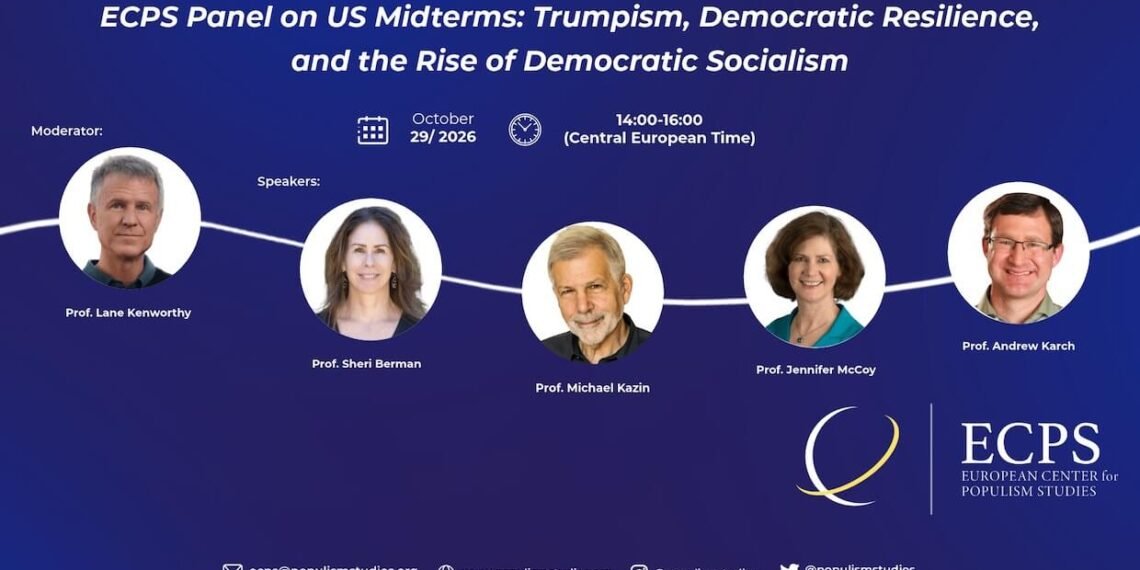
Ahead of the November 3, 2026, US midterm elections, the ECPS convened a scholarly panel on October 29 titled “Trumpism, Democratic Resilience, and the Rise of Democratic Socialism.” Moderated by Professor Lane Kenworthy, the discussion brought together Professors Michael Kazin, Sheri Berman, Jennifer McCoy, and Andrew Karch to examine the political, institutional, and socioeconomic forces reshaping American democracy. Addressing the revival of democratic socialism, declining support for Trumpism, pernicious polarization, democratic backsliding, and the constitutional significance of federalism, the panelists explored whether anticipated electoral shifts could produce meaningful democratic renewal. Their analyses converged on a central warning: defeating populist incumbents does not necessarily resolve the grievances sustaining populism. Durable democratic resilience requires credible economic alternatives, institutional accountability, political inclusion, and renewed public trust.
Reported by ECPS Staff
As the United States approaches the November 3, 2026, midterm elections, fundamental questions concerning democratic resilience, right-wing populism, political polarization, and the future of progressive politics have assumed renewed urgency. Against this backdrop, the European Center for Populism Studies (ECPS) convened an international academic panel titled “Trumpism, Democratic Resilience, and the Rise of Democratic Socialism” on Thursday, October 29, 2026. Bringing together distinguished scholars of American politics, comparative democracy, political history, and federalism, the panel examined whether the elections would merely reflect conventional dissatisfaction with incumbent governance or reveal deeper transformations in American democratic institutions, ideological identities, and political-economic arrangements.
The panel was moderated by Professor Lane Kenworthy, Distinguished Professor of Sociology and Yankelovich Chair in Social Thought at the University of California, San Diego. In his opening assessment, Professor Kenworthy situated the American midterms within broader international patterns of right-wing populist mobilization, democratic institutional contestation, and electoral backlash. Drawing comparisons with developments in Hungary, Poland, and Brazil, he examined the relationship between populist governance and democratic resilience while highlighting the growing ideological appeal, but still-limited electoral representation, of democratic socialism in the United States.
Professor Michael Kazin, Professor of History at Georgetown University, delivered a presentation titled “Explaining the Socialist Revival in the US.” Tracing the contemporary resurgence of socialism to the Great Recession, Occupy Wall Street, and the presidential campaigns of Bernie Sanders, Professor Kazin examined how economic inequality and dissatisfaction with neoliberal capitalism had reshaped progressive political mobilization. He emphasized the distinction between revolutionary socialism and the social-democratic policy orientations of prominent American democratic socialists.
Professor Sheri Berman, Professor of Political Science at Barnard College, Columbia University, presented “The 2026 Midterms in Comparative Perspective: Shifting Support for Trumpism and the Issues Reshaping the Electoral Landscape.” Drawing on comparative experiences in Europe, particularly Hungary and Germany, Professor Berman examined declining support for Trumpism through the interconnected dynamics of economic dissatisfaction, immigration enforcement, and corruption. She warned that electoral defeats of populist governments would not necessarily resolve the structural grievances sustaining anti-establishment politics.
Professor Jennifer McCoy, Regent’s Professor Emerita of Political Science at Georgia State University, addressed “Democratic Resilience Amid Pernicious Political Polarization.” Her presentation explored the democratic consequences of antagonistic partisan identities, institutional erosion, economic inequality, and declining political trust. Advocating structural democratic reforms, participatory mechanisms, and a renewed social contract, Professor McCoy emphasized the limitations of electoral alternation as a solution to recurring populist mobilization.
Finally, Professor Andrew Karch, Professor in the Department of Political Science at the University of Minnesota, presented “Beyond Washington, DC: American Federalism and the Midterms.” His analysis highlighted the frequently overlooked significance of state legislative and gubernatorial elections, decentralized electoral administration, redistricting, and partisan federalism in shaping democratic accountability.
Together, the presentations and subsequent discussions offered a multidimensional assessment of the approaching elections, examining whether American democracy could move beyond recurring electoral polarization toward more durable institutional legitimacy, responsive governance, and political representation.