This panel offered a concise yet conceptually rich account of how contemporary populism transforms diffuse grievances into structured political radicalization. Bridging discourse analysis, religious studies, international political economy, and historical sociology, the discussion illuminated the multi-layered processes through which democratic erosion unfolds. Rather than locating the problem solely within institutional decline, the panel foregrounded the interplay of rhetoric, identity, and emotional mobilization—particularly the roles of humiliation, status anxiety, and perceived loss of recognition. Contributions by Professors Ruth Wodak, Julie Ingersoll, Stephan Klingebiel, and Benjamin Carter Hett collectively demonstrated that populist dynamics are sustained by both narrative construction and structural change. The session thus advanced a nuanced analytical framework for understanding how anti-pluralist politics emerge, normalize, and gain legitimacy across diverse contexts.
Reported by ECPS Staff
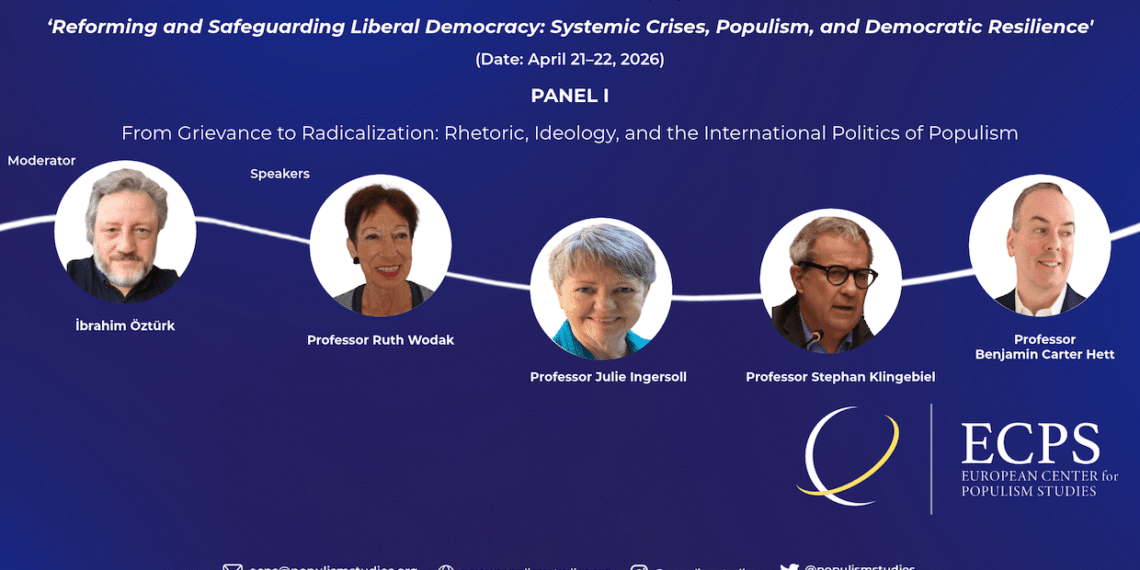
Panel 1 of the ECPS Fifth Annual International Symposium, titled “From Grievance to Radicalization: Rhetoric, Ideology, and the International Politics of Populism,” offered a rich and interdisciplinary examination of how discontent is translated into exclusionary politics, institutional erosion, and authoritarian opportunity. Bringing together perspectives from discourse studies, religious studies, development policy, and modern history, the panel explored the pathways through which grievance is narrated, organized, and mobilized across national and transnational contexts. Although the presentations addressed distinct empirical terrains—from far-right rhetoric in Europe and Christian nationalism in the United States to multilateral institutions and the lessons of Weimar Germany—they converged around a shared concern: democratic decline rarely emerges suddenly, but is prepared through the cumulative interaction of ideas, identities, institutions, and political strategies.
Moderated by Professor Ibrahim Ozturk, the session unfolded as a tightly connected conversation on the mechanisms through which populist and far-right forces gain traction in moments of social unease and political dislocation. A central strength of the panel lay in its refusal to treat populism as a singular or self-explanatory phenomenon. Instead, the speakers unpacked the rhetorical, ideological, emotional, and institutional infrastructures that enable anti-pluralist politics to flourish.
Professor Ruth Wodak showed how democratic norms are eroded through discourse, provocation, and the normalization of exclusionary language. Professor Julie Ingersoll demonstrated how theocratic and anti-democratic religious movements, though internally diverse, have strategically converged to influence contemporary American politics. Professor Stephan Klingebiel widened the frame to the international level, showing how populist governance affects not only domestic politics but also the normative foundations of multilateral cooperation. Professor Benjamin Carter Hett, drawing on the history of late Weimar Germany, highlighted humiliation and status anxiety as powerful emotional drivers of anti-system politics, offering a historically grounded lens for understanding present-day grievance mobilization.
Taken together, the panel made clear that contemporary democratic crises cannot be understood through institutional analysis alone. What emerged instead was a layered account in which fear, humiliation, identity, ideology, and strategic communication are inseparable from formal political change. The subsequent discussion deepened these insights further, linking personal experience, comparative reflection, and normative concerns in ways that reinforced the panel’s interdisciplinary value.
In this sense, Panel 1 did more than diagnose the current moment. It established an intellectual framework for thinking about how democratic erosion is prepared, legitimized, and accelerated across multiple arenas. By tracing the movement from grievance to radicalization, the session illuminated not only the fragility of democratic norms, but also the urgency of confronting the political, cultural, and institutional conditions that allow authoritarian and exclusionary projects to take root.
Read the Full Report of Panel 1 from the ECPS Symposium 2026