Panel 5 of the ECPS Fifth Annual International Symposium, moderated by Professor Jocelyne Cesari, offered a comprehensive examination of democratic resistance amid intensifying global pressures. Bringing together perspectives from political sociology, democratic theory, criminology, and international political economy, the panel illuminated how structural inequality, cultural backlash, institutional erosion, and coercive economic practices converge to sustain contemporary strongman politics. Contributions by Professor Jack A. Goldstone, Professor Steven Friedman, Professor John Pratt, and Professor Kent Jones underscored that democratic backsliding is not reducible to leadership alone but reflects deeper transformations in governance, legitimacy, and global order. The panel ultimately highlighted the urgent need to rethink democratic resilience beyond institutional safeguards toward structural and societal renewal.
Reported by ECPS Staff
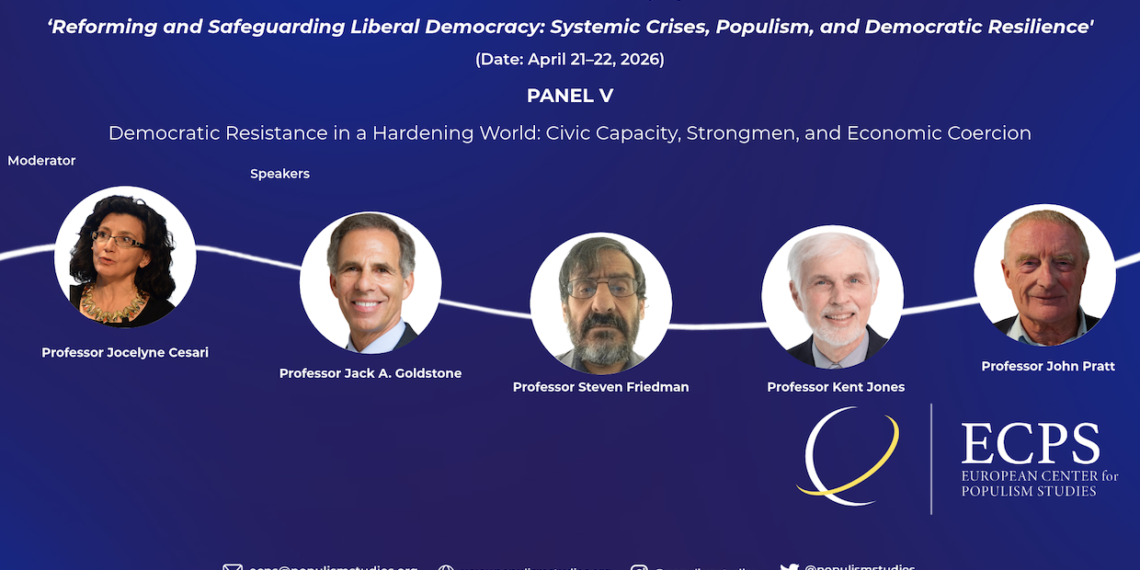
Panel 5, titled “Democratic Resistance in a Hardening World: Civic Capacity, Strongmen, and Economic Coercion,”concluded on April 22, 2026, the second day of the ECPS Fifth Annual International Symposium, “Reforming and Safeguarding Liberal Democracy: Systemic Crises, Populism, and Democratic Resilience.” Moderated by Professor Jocelyne Cesari, Professor and Chair of Religion and Politics at the University of Birmingham and Senior Fellow at Georgetown University’s Berkley Center, the panel examined the structural, ideological, institutional, and economic forces driving contemporary democratic erosion and the resurgence of strongman politics.
Professor Cesari’s moderation situated the panel within the symposium’s broader concern with democratic resilience under conditions of systemic crisis. The session brought together four distinguished scholars whose presentations approached the hardening global political environment from complementary disciplinary perspectives: historical sociology, political theory, criminology, and international political economy. Together, they explored how economic insecurity, democratic disillusionment, punitive politics, cultural backlash, and coercive trade policy have reshaped the terrain on which liberal democracy must now defend itself.
Professor Jack A. Goldstone, Virginia E. and John T. Hazel, Jr. Professor of Public Policy at George Mason University and Senior Fellow of the Mercatus Center, opened the panel with “Structural Pressures Behind Strongman Politics.”Professor Goldstone argued that the rise of authoritarian-populist leaders cannot be explained simply by demagoguery or declining democratic values. Rather, it reflects long-term structural pressures, including globalization, technological displacement, regional inequality, immigration surges, cultural diversification, fiscal stress, and declining confidence in mainstream institutions.
Professor Steven Friedman, Research Professor of Politics at the University of Johannesburg and former Director of the Centre for the Study of Democracy, followed with “Changing Democracy’s Address.” Professor Friedman challenged the assumption that contemporary democratic crises reflect a popular rejection of democracy itself. Instead, he argued that the dominant post-Cold War model of democracy has failed by neglecting private power and by presenting democracy as inherently Western, thereby weakening its legitimacy both in established democracies and across the Global South.
Professor John Pratt, Emeritus Professor of Criminology at Victoria University of Wellington, then presented “The Return of the Strong Men.” Professor Pratt traced the contemporary rise of populist strongmen to the neoliberal restructuring of the 1980s, the resulting legitimacy deficit, and the emergence of penal populism, anti-expert politics, enemy construction, and strongman promises of protection.
Professor Kent Jones, Professor Emeritus of International Economics at Babson College, concluded the presentations with “Weaponized Trade Policy: Tariffs, Industrial Policy, and the Future of Global Economic Governance.” Professor Jones analyzed how Trump’s populist trade agenda undermined the rules-based global trading system, transforming tariffs into instruments of executive power, coercion, and institutional destabilization.
Thıs, Panel 5 offered a wide-ranging account of democratic resistance in an era marked by structural insecurity, institutional erosion, and globalized authoritarian repertoires.