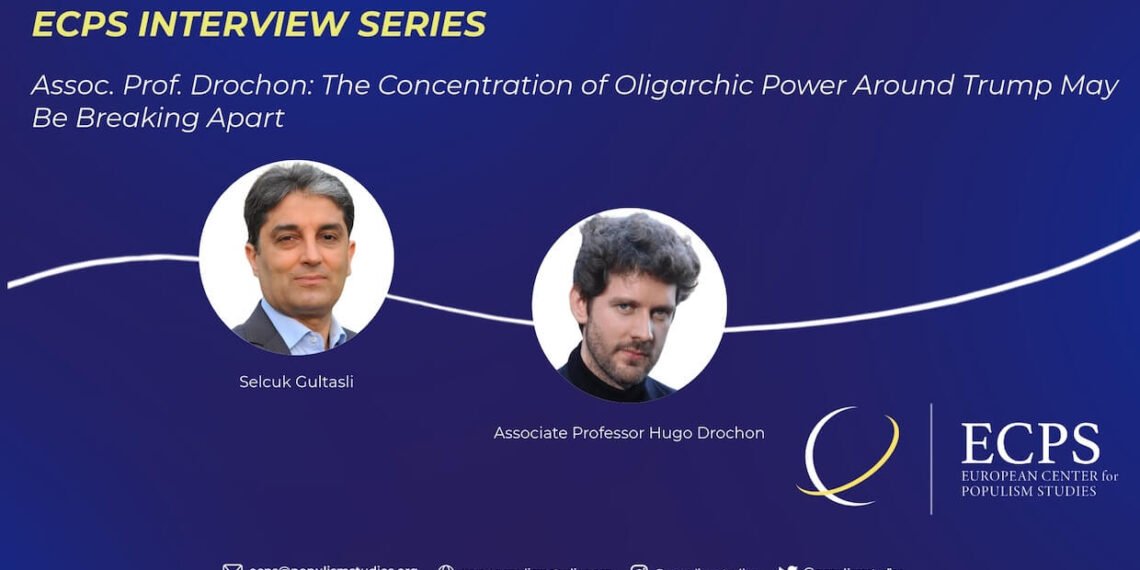
In an interview with the ECPS, Associate Professor Hugo Drochon, a political theorist at the University of Nottingham and author of Elites and Democracy, examines the relationship between populism, elite circulation, and democratic renewal. Reflecting on Trump’s second presidency and the November 3 midterms, Assoc. Prof. Drochon argues that established American institutions retain significant resilience despite efforts to transform governance. He also explores the concentration of oligarchic power surrounding Trump and Silicon Valley, suggesting that emerging fractures may restore competition among elites. Examining Europe’s radical-right resurgence, Assoc. Prof. Drochon emphasizes that democracy depends on continuous political contestation. Crucially, he warns that populism becomes anti-democratic when it restricts future challenges, undermining the pluralism necessary for democratic renewal.
Interview by Selcuk Gultasli*
As Trumpism reshapes American governance and radical-right populism challenges established elites across Europe, the relationship between popular sovereignty and elite power has become increasingly contested. Can anti-establishment movements genuinely democratize political power, or do they merely replace one ruling minority with another? And when does populist insurgency become a threat to the very political competition that makes democratic renewal possible?
In an interview with the European Center for Populism Studies (ECPS), Associate Professor Hugo Drochon, a political theorist at the University of Nottingham and historian of modern political thought, addresses these questions through his research on democratic theory, liberalism, and conspiracy theories. In his recent book, Elites and Democracy, Assoc. Prof. Drochon revisits classical elite theory to develop a conception of dynamic democracy, emphasizing elite circulation, political contestation, and social mobilization.
Central to Assoc. Prof. Drochon’s argument is that democracy cannot eliminate elites but can institutionalize competition between them. As he explains, “even in modern democracies, the people as such don’t rule.” The democratic question, therefore, concerns which elites govern, how they relate to citizens, and whether political challenges generate greater participation, redistribution, and equality.
Reflecting on Trump’s second presidency and the November 3 midterm elections, Assoc. Prof. Drochon questions whether the administration has fundamentally transformed American governance. Despite Trump’s recruitment of political outsiders and efforts to strengthen executive authority, he observes that “the midterms suggest that the older American institutions still have some strength left in them.” This institutional resilience complicates narratives of irreversible political transformation.
Assoc. Prof. Drochon also examines the convergence of Silicon Valley wealth and executive power, particularly Elon Musk’s alignment with Trump. Acknowledging an element of “oligarchic financial consolidation,” he suggests that this alliance may now be weakening. More fundamentally, he maintains that political, economic, and social elites must remain competitive: “it’s through that contestation that democracy remains possible.”
Extending his analysis to Europe, Assoc. Prof. Drochon explores the National Rally’s alliances with established economic elites, Germany’s political firewall against the AfD, and the increasingly prominent struggle between the center and the extremes. He argues that defending the political center requires substantive alternatives rather than institutional resistance alone: “A purely defensive position is not enough.”
Perhaps most importantly, Assoc. Prof. Drochon identifies the democratic limits of populism’s anti-pluralist tendencies. While populist challenges may expand participation and facilitate elite renewal, they become anti-democratic when they restrict subsequent political competition. The decisive question is whether emerging elites make future challenges easier or harder.
Drawing on cases ranging from MAGA and progressive movements to Serbia and Hungary, the interview ultimately advances a conception of democracy as an unfinished process. For Assoc. Prof. Drochon, meaningful democratic renewal requires not simply electoral turnover but institutions that preserve contestation, enable elite circulation, and continually expand opportunities for political participation.