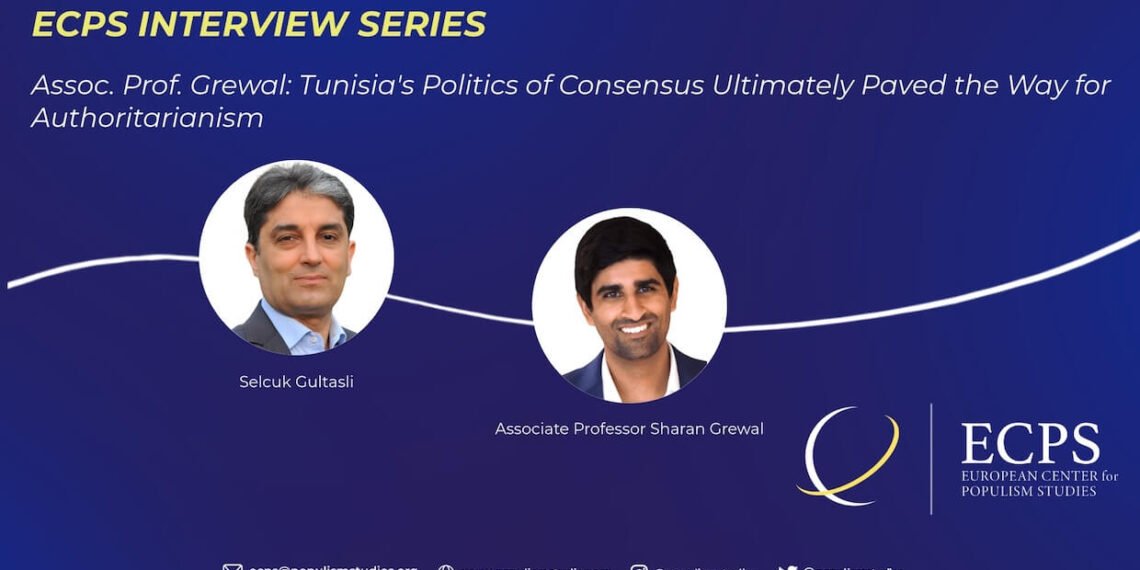
In an in-depth interview with the ECPS, Associate Professor Sharan Grewal of American University and Nonresident Senior Fellow at the Brookings Institution examines the paradox of Tunisia’s democratic collapse. Drawing on his new book, The Rise and Fall of Tunisian Democracy, Assoc. Prof. Grewal argues that prolonged grand coalitions, initially designed to safeguard democratic transition, instead fueled populism, intensified polarization, and facilitated Kais Saied’s authoritarian takeover. His comparative research suggests that democracies governed through such coalitions are approximately three times more likely to collapse. Challenging conventional assumptions, Assoc. Prof. Grewal warns that too little polarization can be as dangerous as too much. He also discusses military complicity, international support for authoritarianism, emerging opposition, and the constitutional reforms necessary for democratic restoration.
Interview by Selcuk Gultasli*
Tunisia’s democratic collapse presents one of the most consequential paradoxes of the Arab Spring: How could the region’s most celebrated democratic transition, built upon elite compromise and inclusive power-sharing, ultimately facilitate an authoritarian takeover supported by much of the population? Fifteen years after Tunisia’s revolution, President Kais Saied has consolidated executive power, weakened judicial independence, and restricted political opposition. Yet renewed protests amid economic hardship suggest persistent demands for political change.
In this wide-ranging interview with the European Center for Populism Studies (ECPS), Associate Professor Sharan Grewal of American University and Nonresident Senior Fellow at the Brookings Institution examines how Tunisia’s celebrated consensus politics inadvertently undermined democratic consolidation. His award-winning Soldiers of Democracy? explores military legacies and democratic transitions following the Arab Spring, while his latest book, The Rise and Fall of Tunisian Democracy, challenges conventional assumptions about the stabilizing effects of political compromise.
Assoc. Prof. Grewal argues that Tunisia’s prolonged grand coalitions between secular and Islamist parties eroded mainstream political identities, weakened electoral representation, and fueled populist resentment. As he explains, “If you continue pursuing grand coalitions, your democracy can begin to unravel. That’s what happened in Tunisia.” His comparative analysis further reveals that democracies governed through prolonged grand coalitions are “about three times more likely to die,” particularly during the critical years between democratic transition and consolidation.
Central to Assoc. Prof. Grewal’s interpretation is the paradox that consensus intended to prevent polarization instead intensified it. By bringing competing political forces into the same governing establishment, grand coalitions created opportunities for anti-system mobilization. This dynamic helped Kais Saied portray himself as an outsider confronting corrupt political elites. Assoc. Prof. Grewal identifies frustration with political parties and hostility toward the Islamist Ennahda as the strongest predictors of popular support for Saied’s 2021 power grab.
Challenging conventional democratic theory, Assoc. Prof. Grewal maintains that “while too much polarization is dangerous for democracy, too little polarization is also dangerous.” His proposed alternative is the “Goldilocks level of polarization”: consensus over constitutional rules combined with meaningful competition over government policy.
The interview also explores the military’s paradoxical complicity in authoritarian consolidation, European migration cooperation, Saied’s expanding international partnerships, and the potential resurgence of democratic opposition. Assoc. Prof. Grewal observes that “the sands are finally shifting,” although he warns that another revolution would face greater obstacles than Tunisia’s 2011 uprising.
Looking toward democratic restoration, Assoc. Prof. Grewal advocates constitutional reform, an independent constitutional court, economic recovery, accountability, and transitional justice. Above all, he cautions against repeating the elite bargains that undermined Tunisia’s first transition. As he concludes, “you want consensus initially on the rules of the game, but then you need to move toward competition.”
His analysis offers important lessons extending beyond Tunisia: democratic survival requires not merely political compromise, but accountable governance, meaningful representation, and institutionalized competition.