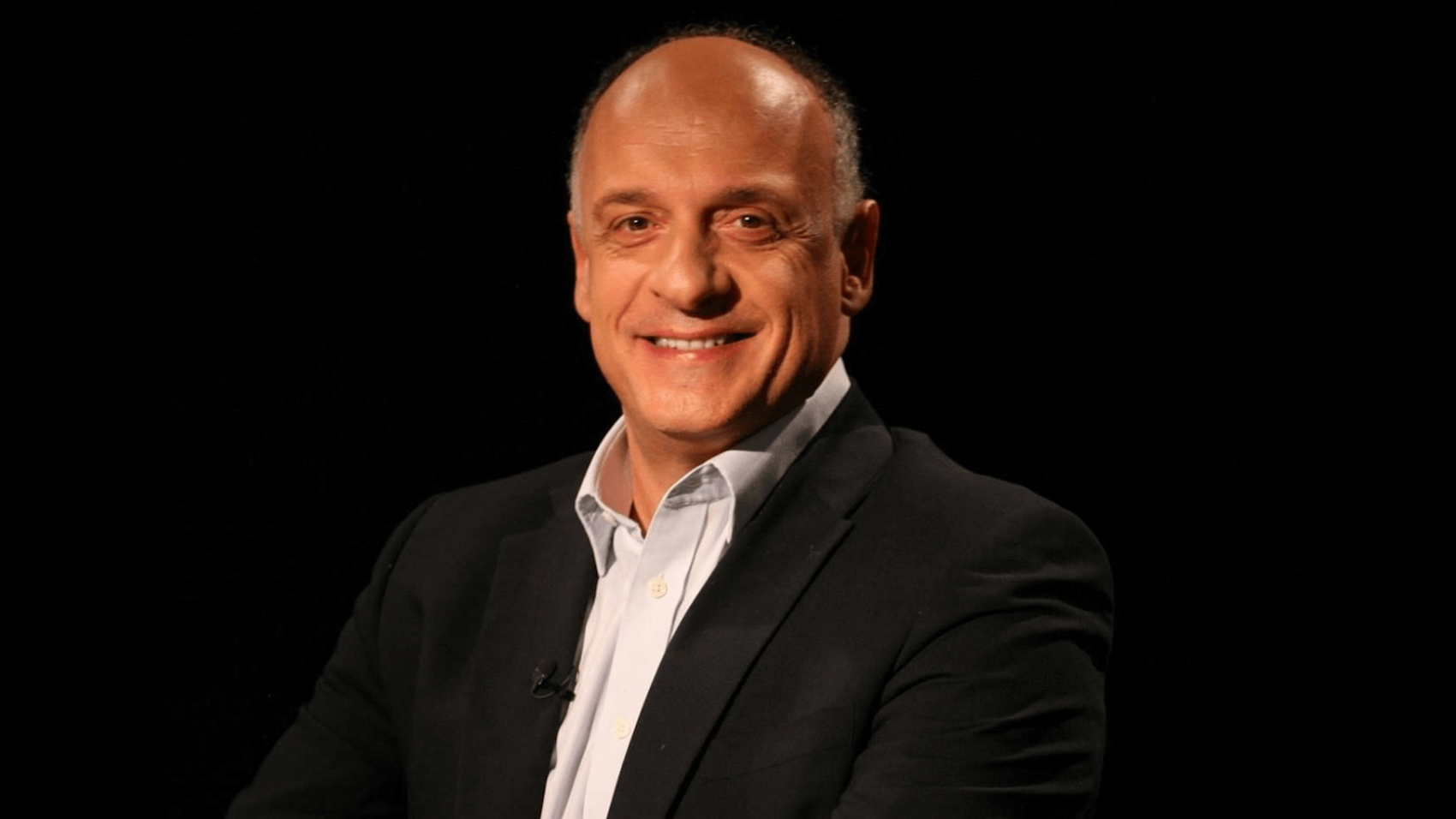
Dr. Valentina Ausserladscheider, Assistant Professor at the Department of Economic Sociology, University of Vienna.

Professor Ausserladscheider: Austria Is an Exceptional Case Where Neoliberalism Was a Project of Far-Right Politics

Underscoring that Austria represents a unique case where neoliberalism has been driven by far-right politics—a phenomenon not commonly seen in other European contexts—Professor Valentina Ausserladscheider reflects on the FPÖ’s historical trajectory. She explains how the party, initially founded by former National Socialists, positioned itself as a pro-business, liberal alternative to the dominant Socialist and Conservative parties. This liberal economic stance was integrated into government policies when the FPÖ gained power, particularly during its coalition government in the early 2000s, introducing neoliberal measures such as deregulation and market liberalization. “What we’ve seen in Austria,” Professor Ausserladscheider notes, “is an unprecedented case of a far-right populist party significantly influencing economic policymaking.”

Interview by Selcuk Gultasli

In an engaging interview with the European Center for Populism Studies (ECPS), Dr. Valentina Ausserladscheider, Assistant Professor at the Department of Economic Sociology, University of Vienna, delves into the complex dynamics of far-right populism and neoliberalism in Austria. She underscores that Austria represents a unique case where neoliberalism has been driven by far-right politics, a phenomenon not commonly seen in other European contexts.

Reflecting on the historical trajectory of the Austrian Freedom Party (FPÖ), Professor Ausserladscheider explains how the party, initially founded by former National Socialists, positioned itself as a pro-business, liberal alternative to the dominant Socialist and Conservative parties. This liberal economic stance was carried into government policies when the FPÖ entered power, especially during its coalition government in the early 2000s, introducing neoliberal policies such as deregulation and market liberalization. “What we’ve seen in Austria,” she notes, “is an unprecedented case of a far-right populist party significantly influencing economic policymaking.”

The professor also addresses the normalization of far-right parties across Europe, emphasizing the shift in the political spectrum, where far-right positions have become increasingly mainstream. She points to recent electoral successes of the FPÖ, mirroring trends seen in Italy, France, and the Netherlands, which indicate a broader European shift that raises concerns about the effectiveness of measures like the cordon sanitaire. “The FPÖ has long been a role model for other far-right populist movements, influencing the political landscape far beyond Austria,” Professor Ausserladscheider states.

Professor Ausserladscheider also highlights the strategic use of economic nationalism and socioeconomic insecurities by far-right parties, which integrates cultural and economic factors to mobilize support effectively. She warns of the dangers of these developments, noting that while far-right populism often challenges liberal democratic values, it simultaneously adopts neoliberal policies, creating what she terms “exclusionary neoliberalism.” This duality, as she explains, is both a tool for political mobilization and a mechanism for reshaping the economic landscape.

Here is the transcription of the interview with Professor Valentina Ausserladscheider with some edits.

Rise in FPÖ Votes Most Evident in ‘Left-Behind’ Areas

Professor Valentina Ausserladscheider, thank you so much for joining our interview series. Let me start right away with the first question: What role do economic inequality and social marginalization play in the appeal of populist and far-right movements in Austria, and how have these factors been exploited by political parties like the FPÖ?

Professor Valentina Ausserladscheider: I think socioeconomic insecurities and inequalities play a huge role in any kind of party competition and electoral turnout. And, of course, this is also the case for the FPÖ in Austria. Rather than calling it economic inequality and social marginalization, I would frame it under the term socioeconomic insecurities because, very often, it’s a complex set of intertwining factors. Some of these factors might be related to a generally unstable economic situation, which leads to increased perceived insecurities among voters. This means they might be more easily targeted by the FPÖ’s mobilization efforts.

Geography is actually a very good indicator for this. In the recent Austrian elections, we observed a significant gap between people who voted in rural areas versus those who voted in urban places. As some new political science studies suggest, there are “left-behind” places that experience various issues, such as inequality, marginalization, or infrastructural poverty. It’s precisely in these areas that you see a rise in FPÖ votes.

What the FPÖ does is target these specific areas strategically. For example, you’ll see significantly more campaign posters in these areas than in some districts in Vienna because they see a greater chance of mobilizing these electorates. This strategy works well in their favor, and they often suggest that all of these insecurities and economic dissatisfactions are the fault of the centrist parties, political elites, and, very often, migrants. In the FPÖ’s case, this is their key mobilization strategy. The targeting and strategic mobilization are very effective for them, unfortunately.

Connections Between Populism and Business Elites
Signboard of “Bank Austria” in Vienna, January 29, 2024. Photo: Shutterstock.

What is the relationship between populism and business elites in the context of the global rise of populist parties and actors? How do you perceive the relationship between populism and business elites in Austria? Has the rise of populist parties influenced the strategies and behaviors of Austrian businesses?

Professor Valentina Ausserladscheider: The link between populism and business is an important one, and I think we see this particularly well in the US, especially with the way Trump is supported by various business elites. The most recent example is Elon Musk’s very open support for the Trump campaign. We see this kind of support across the board, but I don’t think it’s a straightforward phenomenon. It’s not simply that all businesses are pro-populism. In fact, it’s much more complicated. Some businesses are actively opposed to the far-right and explicitly express that stance.

Here, we observe a clear rift, particularly among businesses interested in international and transnational trade. They are concerned that if far-right populist leaders like Donald Trump come into power and implement trade tariffs, it could create significant problems for their businesses.

In the specific case of Austria, we have seen in the past that there are links between business and the FPÖ. However, as I mentioned, it’s not as pronounced or tangible as in the American context, which is a representative example. But these links do exist. One of the best examples is the recent announcement that Barbara Kolm will be in Parliament for the FPÖ. Barbara Kolm is the leader of the Hayek Institute in Vienna and was previously the president of several important economic organizations in Austria. As such, she is an important figure within the business network. So yes, there are connections.

In your analysis, you mention that right-wing populism can lead to policy decisions that both challenge and benefit business interests. Could you elaborate on how this duality has manifested in Austrian politics, particularly in relation to the FPÖ?

Professor Valentina Ausserladscheider: I think we can go back roughly 20 years, to the second time the FPÖ was in power, from 2000 until 2006. Within that coalition with the Conservatives, the FPÖ implemented many business-friendly regulations and also deregulated some sectors, which were beneficial for businesses. This instance shows a significant internationalization of some market sectors within Austria, partially due to Austria’s entry into the European Union in the late nineties, becoming a member of the common market. However, the FPÖ also pushed for business-friendly policies during this period.

At the same time, when the FPÖ entered the government, it was still a novelty to have far-right populists in power, which is, unfortunately, no longer the case today. This novelty led many European member states to impose barriers on trade cooperation with Austria because they found it unacceptable to engage in bilateral or multilateral agreements with a country led by a far-right populist government.

So, the impact can go both ways. However, times have changed, and we have seen a significant mainstreaming and normalization of far-right actors in power. Therefore, I no longer expect this duality to be as pronounced as it was at the beginning of the 2000s.

Neoliberalism as a Far-Right Project in Austria

How and to what extent does far-right populism impact the nation-specific implementation of neoliberal policymaking? What role do far-right populists play in economic policy change? On this topic what does Austrian experience (FPÖ) tell us?

Professor Valentina Ausserladscheider: I think there are several facets to this, making it quite a complex phenomenon. In economic sociology and political economy, we discuss institutional change—how institutions change, and specifically, how institutions like the state change. The state is a key institution in any political economy. As soon as new governing parties implement different economic policies, you will ultimately see economic policy change. This is not specific to any particular party; it’s inherent to the structure of our liberal democracy.

However, what we have not quite understood until recently, or what has been overlooked, is the power of parties and political forces perceived to be at the margins of the political spectrum—those at the edges. This is no longer entirely true, as we are now witnessing a significant mainstreaming and shift in the political spectrum’s center, which I am happy to discuss further later on.

When the FPÖ came to power in Austria, we saw an unprecedented case of a far-right populist party significantly influencing economic policymaking in a European country. I describe this as neoliberalization. In the early 2000s, partly due to Austria’s entry into the European Union but also because of the FPÖ’s leadership in government, particularly in the Finance Ministry, we saw immense deregulation and the neoliberalization of markets driven by the FPÖ. Until that point, we only understood neoliberalization as a force coming from the center-right rather than the far-right. Austria presents an exceptional case where neoliberalism was a project of far-right politics.

Given your focus on the supply-side of political strategies, how do you see far-right parties in Austria using economic nationalist discourse to frame their policies and mobilize voter support differently than other European countries?

Professor Valentina Ausserladscheider: The way I describe economic nationalism is as a combination of cultural and economic factors that are often tied to economic policies presented as being in the national interest or aligned with national identities. Since nationalism is nation-specific, I would expect that economic nationalism in Italy, for example, would look different from economic nationalism in Austria. It doesn’t necessarily have to be different; similar policies can be described as being in the national interest of any country. 

However, because of the national specificity within economic nationalism, it differs in the sense that Austria’s economic nationalism will have its unique characteristics. This is related to what we call methodological nationalism. Of course, we also observe similarities across different cases, such as the resurgence of policy instruments like trade tariffs—long thought to be obsolete in our globalized economy—that are now being implemented again. So, while economic nationalism doesn’t have to differ drastically between nations, discursively, it is distinct as it appeals to the unique national characteristics of each country.

How do you analyze the link between the rise of far-right parties and economic nationalism beyond economic insecurity and cultural backlash? 

Professor Valentina Ausserladscheider: One key development, particularly after the great financial crisis of 2008, is that many political economies, especially in cases like Austria, have used economic nationalism as a means to, in a way, rescue neoliberalism. Shortly after the crisis, many countries implemented Keynesian-style demand-side economics, indicating a strong return to demand-side strategies to support economic recovery.

In far-right populist terms, these strategies have often been framed as, or have taken the form of, economic nationalism. Thus, economic nationalism can also be seen as a tool for neoliberal policymaking to maintain stability and persist, even in times of crisis.

Links Between Socioeconomic Insecurities and Cultural Backlash
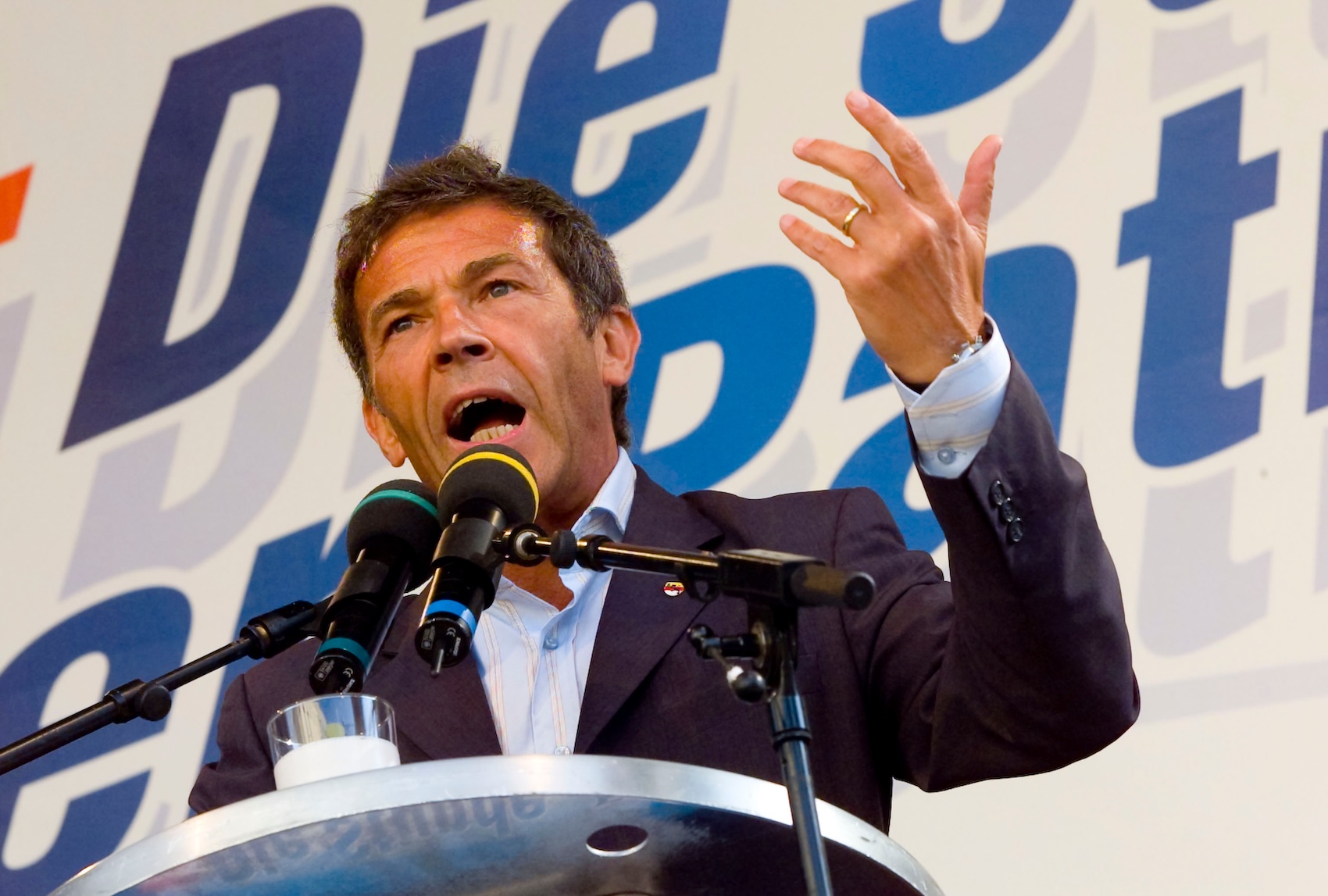
Jörg Haider, ex-leader of the FPÖ, delivering a speech at Viktor Adler Markt in Vienna, Austria, on June 11, 2004. Photo: Shutterstock.

You argue that the existing literature often separates cultural and economic explanations for far-right support. What methodological approaches would you recommend to better capture the interconnectedness of these factors in studying far-right populism?

Professor Valentina Ausserladscheider: I think one approach is to examine the supply side of political strategies. If you listen to far-right populists and read their programs, you can clearly see that their cultural backlash arguments—such as claims of losing national identity, displacing traditional norms and values, or losing the Austrian way of life—are often tied to economic visions. For example, anti-immigration slogans are frequently justified through economic concerns like resource scarcity or the potential loss of jobs for Austrians. These discursive and rhetorical constructs effectively integrate cultural and economic values as part of their mobilization discourse.

On the other hand, examining the demand side through public opinion studies, such as surveys and electoral polls, can also be insightful. Researchers in this area have shown links between socioeconomic insecurities and sentiments that may relate to cultural backlash. For instance, Noam Gidron and Peter Hall´s study on the politics of social status highlight the economic-cultural linkages in voters’ opinions. These connections become clearer when viewed in relation to one another. However, many supply-side studies still tend to separate these factors. I believe that demonstrating their interconnection can reveal these concurrent effects more effectively.

In your newly published book ‘Far right populism and the making of exclusionary neoliberal state,’ you basically argue that neoliberalism appeared first as a project of the far right. We study populism as the embodiment of illiberal values which at the first glance seems to be contradictory with your assessment. Can you explain how neoliberalism has been a product of far-right populism?

Professor Valentina Ausserladscheider: Neoliberalism has indeed been a product of far-right populism, at least in the case of Austria, although this may not be true across the board. In Austria, you can see quite clearly that after the Second World War, the FPÖ was founded by former National Socialists, who mobilized as a liberal counterweight to the two other core parties at the time: the Conservatives, who were focused on conserving the status quo, and the Socialists, who represented the workers’ interests. The FPÖ sought to provide this liberal counterweight and promoted pro-business policies that the Conservatives were not advocating for. They also supported European integration, which was a novel position in the Austrian political spectrum at that time.

When neoliberalism began to rise in the 1980s, particularly in the US and the UK, it was actually the FPÖ in Austria that adopted these ideas and brought them into government in 1983. For a brief period in that year, they were the junior coalition partner to the Socialists, who had lost their majority after 12 years in power due to the economic impact of the oil crisis. This opened the door for the FPÖ to introduce neoliberal ideas into Austrian politics.

In contrast, in the UK, it was Margaret Thatcher, a Conservative, who championed neoliberalism, and in the US, it was Ronald Reagan, a Republican. So, while these classic conservative forces brought neoliberalism to power in other countries, in Austria, it was the FPÖ.

I think this is the story of Austria that they have adopted these ideas. Yes, it might seem contradictory in the sense that we describe far-right populists as illiberal when they actually promote neoliberal policies. However, when we refer to these forces as illiberal, we mean that they pose a threat to liberal democracy, which is, of course, true. There is evidence of them implementing policies that clearly contradict the foundations of liberal democracies.

What I think we’ve overlooked, though, is that this also includes an economic ideology, and that ideology can indeed be neoliberal. Some authors describe this as “authoritarian neoliberalism,” while I use the term “exclusionary neoliberalism.” You see this specific strain of exclusion when neoliberalism is promoted by far-right populists.

What is the significance of FPÖ’s victory in the parliamentary elections in terms of far-right parties both in Austria and Europe? Do you think ‘cordonne sanitaire’ still holds?

Professor Valentina Ausserladscheider: I think it’s a very important development. For a long time, especially since the 1980s and 1990s, the FPÖ has been a role model for far-right parties across Europe. The leader of the Austrian Freedom Party at the time, Jörg Haider, who took leadership in 1986 and led the FPÖ to significant electoral success in the 1990s, was instrumental in this. We even talked about the “Haiderization” of Europe—a concept referring to this new brand of populism that was adopted by other populist parties beyond Austria.

In many ways, the Austrian Freedom Party has been, and continues to be, a model for far-right populism across Europe. Austria’s recent electoral success mirrors what we’ve seen in Italy, the Netherlands, France, and increasingly in regional elections in Germany. This indicates a broader shift occurring in Europe, which is particularly concerning, especially considering efforts to block these parties have not been very effective.

The Far-Right Becoming Normalized and Mainstream

European Union’s reaction to FPÖ’s victory in 1999 and 2024 are quite different. This time around EU has not reacted to the victory of FPÖ in alarmist terms. Do you think far-right parties have been mainstreamed in Europe in the last couple of years?

Professor Valentina Ausserladscheider: Yes, massively. We’ve seen several things happening simultaneously. To talk about the socioeconomic context, ever since the great financial crisis of 2008, there has been a lot of economic instability across various countries. That instability was further exacerbated by several events, particularly in 2014-2015 when there was a significant influx of migrants, which far-right parties used as a mobilizing tool. Then we had the pandemic, inflation, and now a slight recession. This context has created fertile ground for far-right populists to mobilize.

At the same time, there has been a shift in party competition, with more and more conservative politicians seeking to attract far-right voters. They tried to win votes on far-right issues, but the problem with that strategy is that people tend to choose the original. If voters want a nationalist, exclusionary party, they are likely to go for the FPÖ, AfD, Marine Le Pen, and others like them. This shift in party competition has effectively moved the entire political spectrum to the right, even leading centrist parties to try and mobilize on similar issues, such as immigration, though often unsuccessfully.

This rightward shift in the entire political spectrum has made the far-right appear less extreme. We have seen a huge normalization of far-right powers in government, starting with Austria as a role model, as I mentioned earlier, and then spreading to other countries. We saw Brexit, influenced heavily by Nigel Farage and UKIP; Trump’s presidency in the US; Giorgia Meloni governing in Italy; and three separate instances of the FPÖ governing in Austria.

As a result, the far-right now seems more normalized and mainstream, particularly as countries like Austria are still considered liberal democracies. If we can conceive of a far-right populist government operating within a liberal democracy, it contributes to the perception that these movements are more normal and mainstream.
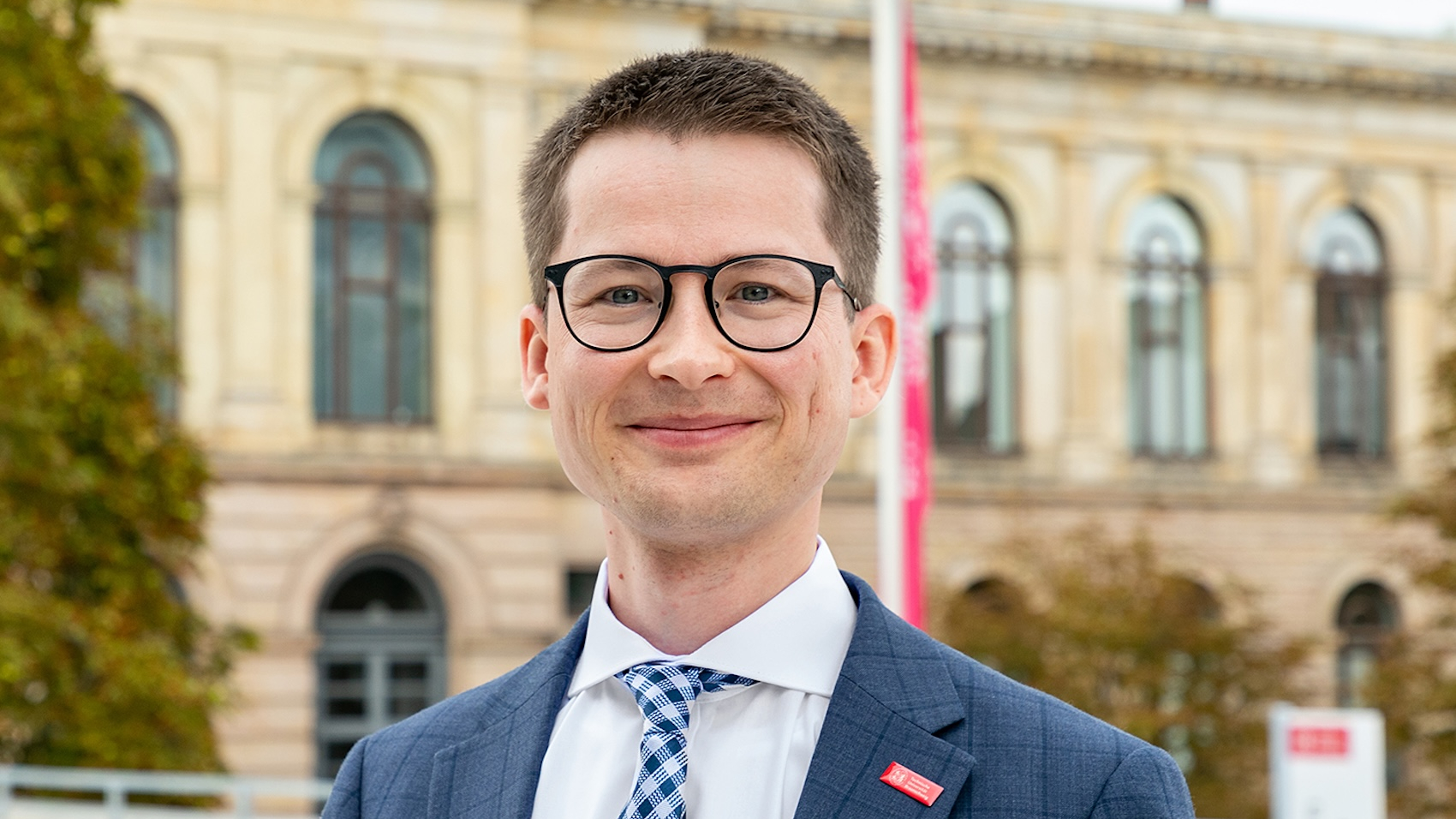
Dr. Felix Roesel, a Professor of Economics, especially Urban and Regional Economics at Technische Universität Braunschweig in Germany.

Professor Roesel: FPÖ Will Remain a Permanent and Strong Force in Austrian Politics

Highlighting that the success of the Freedom Party of Austria (FPÖ) is rooted in Austria’s long history of far-right politics, with origins tracing back to the post-World War I period, Professor Felix Roesel argues that the FPÖ’s presence as a dominant force in Austrian politics is unlikely to diminish, as historical, social, and political factors continue to bolster the party’s influence. He explains that Austria’s far-right movement is unique compared to other European countries, given its established presence both before and after World War II. According to Professor Roesel, the continuity of this tradition, marked by personal and ideological ties to the Nazi era, sets the FPÖ apart from other modern far-right parties in Europe.

Interview by Selcuk Gultasli

In an interview with the European Center for Populism Studies (ECPS), Dr. Felix Roesel, a Professor of Economics, especially Urban and Regional Economics at Technische Universität Braunschweig in Germany, provides an in-depth analysis of the political landscape in Austria, specifically focusing on the rise and entrenchment of the Freedom Party of Austria (FPÖ). Professors Roesel argues that the FPÖ’s presence as a dominant force in Austrian politics is unlikely to diminish, as historical, social, and political factors continue to bolster the party’s influence. He discusses how the FPÖ has effectively capitalized on Austria’s distinct historical context, conservative traditions, and societal anxieties to secure its place in the Austrian parliament for decades.

Professor Roesel highlights that the FPÖ’s success is rooted in Austria’s long history of far-right politics, with its origins tracing back to the post-World War I period. He explains that Austria’s far-right movement is unique compared to other European countries, given its established presence before and after World War II. The continuity of this tradition, marked by personal and ideological ties to the Nazi era, sets the FPÖ apart from other modern far-right parties in Europe.

Moreover, Professor Roesel emphasizes the FPÖ’s anti-establishment and anti-immigration rhetoric as key factors in its continued success. During the 1980s, under the leadership of Jörg Haider, the FPÖ transformed from a minor political party into a significant force, gaining widespread support through its anti-establishment stance. This approach resonated with Austrians who felt disillusioned by the two dominant parties—the Social Democrats (SPÖ) and the Conservatives (ÖVP)—which had controlled Austrian politics since the post-1945 period. Haider’s populist strategy of appealing to those excluded by the political mainstream, combined with anti-immigration narratives, positioned the FPÖ as a viable alternative for disaffected voters.

Professor Roesel also sheds light on Austria’s unique political system, known as ‘Proporz,’ which historically ensured that both major parties were represented in various aspects of everyday life, creating the perception that there was little difference between them. This lack of differentiation provided the FPÖ an opportunity to position itself as an outsider and criticize the system, further appealing to voters dissatisfied with the status quo.

Looking ahead, Professor Roesel foresees that the FPÖ will remain a significant and permanent force in Austrian politics, as its deep-rooted historical connections, strategic adaptations, and appeal to nationalist sentiments continue to resonate with a substantial portion of the Austrian electorate.

Here is the transcription of the interview with Professor Felix Roesel with some edits.

Many Post-War Parties in Austria Had Direct Links to the Nazi Party

You argue that right-wing populism in Austria has deep historical roots. What historical factors have contributed to the enduring appeal of far-right populism in Austria, and how do these differ from populist movements in other European countries? Could you also elaborate on these historical roots and how they have shaped the modern-day FPÖ?

Professor Felix Roesel: That’s a very good question. Austria is quite distinct compared to other European countries. While many countries have seen a rise in far-right parties, what sets Austria apart is its long-standing tradition of far-right politics. Even during Austria’s first democratic period, following World War I, there was a significant far-right camp. At that time, there was a Conservative camp mainly aligned with the Catholic Church and the Workers’ Party on the left, but also a very strong far-right camp that advocated for Austria’s annexation into Germany, envisioning a larger pan-German state.

This far-right tradition was already well-established before World War II, with the Nazi Party being part of this camp. After World War II, many of those who established the new party structure in Austria had direct links to the Nazi Party. For instance, the first leader of the FPÖ (Freedom Party of Austria) after the war was a former SS member. This continuity from the pre-war period is significant and distinguishes Austria from other countries, such as France’s Rassemblement National or Italy’s Lega, which are more modern parties without predecessors in the pre-war era.

If we compare voting results before and after World War II, we see strong connections and a continuity of far-right influence. In Austria, there has consistently been a far-right party in Parliament in every election since World War II, which is quite different from other countries where far-right parties have only surged recently.

How has the rise of populism in Austrian politics over the past few decades impacted the country’s political landscape, particularly with regard to the success of far-right parties like the Freedom Party of Austria (FPÖ)? 

Professor Felix Roesel: The FPÖ has successfully dominated the political agenda for several years, particularly with its focus on immigration, which has been its most significant topic since the 1980s. A unique aspect of Austria is that, in the 1970s and 1980s, the two major parties—the Conservative Party (ÖVP) and the Social Democratic Party (SPÖ)—were incredibly dominant. They were influential in all aspects of society, even down to sports clubs, which were often aligned with either party. You had to take a stand, either supporting the center-right or the center-left, and those unwilling to identify with either were left behind. There was a growing perception that the country was ruled by these two parties, creating a sense of exclusion among those who didn’t align with them.

The FPÖ capitalized on this sentiment by effectively introducing an anti-establishment narrative. They positioned themselves as the alternative to the two main parties, and this anti-mainstream, populist rhetoric resonated with many people. The two main components of the FPÖ’s success are its strong stance on anti-immigration and its anti-establishment messaging—classic populist elements.

This approach proved effective, influencing even the moderate right-wing party, the ÖVP, under Sebastian Kurz, who shifted their policies further to the right, especially on immigration. The FPÖ has had a significant impact on the political debate in Austria, pushing the entire political spectrum to address these populist themes.

The ‘Proporz’ System May Have Contributed to the Rise of the Far-Right

Could you please explain what ‘Proporz’ stand for and how do you think it evolved in the past several decades?

Professor Felix Roesel: ‘Proporz’ is a specific Austrian system where both major parties were historically represented across all aspects of everyday life. This ranged from sports clubs to institutions like workers’ associations. Essentially, there was always a “red” (Social Democrat) and a “black” (Conservative) representation. Moreover, Austria had all-party governments at the state and local levels, though not at the federal level. In these cases, council elections determined the composition of the government, with all parties represented rather than forming classic coalitions. This ensured that both major parties had a share—if you will—of influence and positions in local and state governments.

This system created the impression that it didn’t matter who people voted for because, in the end, both major parties were guaranteed representation in the government. This lack of differentiation between the two parties may have contributed to the rise of the far-right, as parties like the FPÖ could criticize the ‘Proporz’ system and position themselves as the true alternative to the established order.

You argue that Austria’s main far-right party FPÖ is one of the most successful and prominent cases worldwide. Could you elaborate on the peculiar reasons why FPÖ has been so successful?

Professor Felix Roesel: There are several reasons but let me highlight a few. First, there are the historical roots. Austria had a strong far-right camp even before World War II, and it was easy for the FPÖ to connect with this legacy after the war. Secondly, Austria is a very traditional and conservative country, making it easier for a far-right party to resonate by promoting traditional values such as family.

Additionally, Austria has a long history of immigration, including workers from Germany and other countries, long before Germany itself experienced such immigration waves. This made immigration a significant issue in Austrian politics early on, and the FPÖ has consistently leveraged this topic to gain support.

Lastly, Jörg Haider played a pivotal role in the FPÖ’s success. He was instrumental in popularizing populist ideas in the 1980s by combining an anti-establishment stance with anti-minority rhetoric. While the specific minority groups targeted have changed over time, the anti-establishment narrative remained a constant. Haider was a political entrepreneur who identified and filled a gap left by other parties, which explains why this development happened in Austria earlier than in many other countries.

Jörg Haider’s Focus on Immigration Built a Broader Voter Base

Jörg Haider, ex-leader of the FPÖ, delivering a speech at Viktor Adler Markt in Vienna, Austria, on June 11, 2004. Photo: Shutterstock.

You underline that the two main and dominant Austrian parties in the post-1945 period are the Social Democrats (SPÖ) and the Conservatives (ÖVP). Both parties accounted for up to 95% of all votes until the early 1980s, but their vote shares have declined significantly since then. What happened in 1980s that led to the rise of FPÖ? 

Professor Felix Roesel: I would really emphasize the role of Jörg Haider. He understood how to effectively use populist slogans, transforming the FPÖ from a small party with around 4-6% of the vote into one that gained 20-25% from election to election. It was Haider who made the FPÖ a major political force.

In the late 1970s and 1980s, immigration began increasing, or at least reached levels where it became visible to the general public, making it an accessible topic for political mobilization. However, in the very beginning, Haider didn’t focus much on immigration. Instead, he concentrated on an anti-establishment message: if you didn’t want to align with one of the two big parties, the FPÖ was the alternative, positioning itself as outside the system. This message was very attractive at the time.

It’s also important to note that, before this period, there were hardly any other coalitions other than grand coalitions between the two dominant parties at the federal level. This created a perception among many people that there was no way to avoid the dominance of these two big parties in government. The FPÖ’s anti-establishment stance appealed to those who felt disillusioned with this arrangement.

Later, Haider incorporated anti-immigration rhetoric, which became a central theme. Interestingly, early on, there were some connections or references to the Nazi era, but Haider quickly realized this did not gain widespread support. He found that focusing on immigration was much more effective in building a broader voter base.

In what ways have populist and far-right parties in Austria influenced the mainstream political parties like SPÖ and ÖVP? Have these influences led to shifts in policy or political discourse?

Professor Felix Roesel: Yes, certainly. In particular, the immigration issue has seen a significant shift. The Conservative party, especially under the leadership of former party leader Sebastian Kurz, heavily changed its stance in response to the success of the FPÖ. Kurz adopted policies similar to those promoted by the FPÖ, making it clear that the far-right party had a substantial impact in this area.

As for the government, the FPÖ has been part of the coalition several times. However, when it comes to actual policy impact during their time in government, we do not see major policy shifts. While their involvement led to political consequences, such as scandals—many of which are still unresolved—their influence on concrete policy changes was limited, primarily because they served as a junior partner in these coalitions. The real question now is what will happen in Austria moving forward.

FPÖ’s Nazi History Occasionally Resurfaces, Highlighting Its Roots

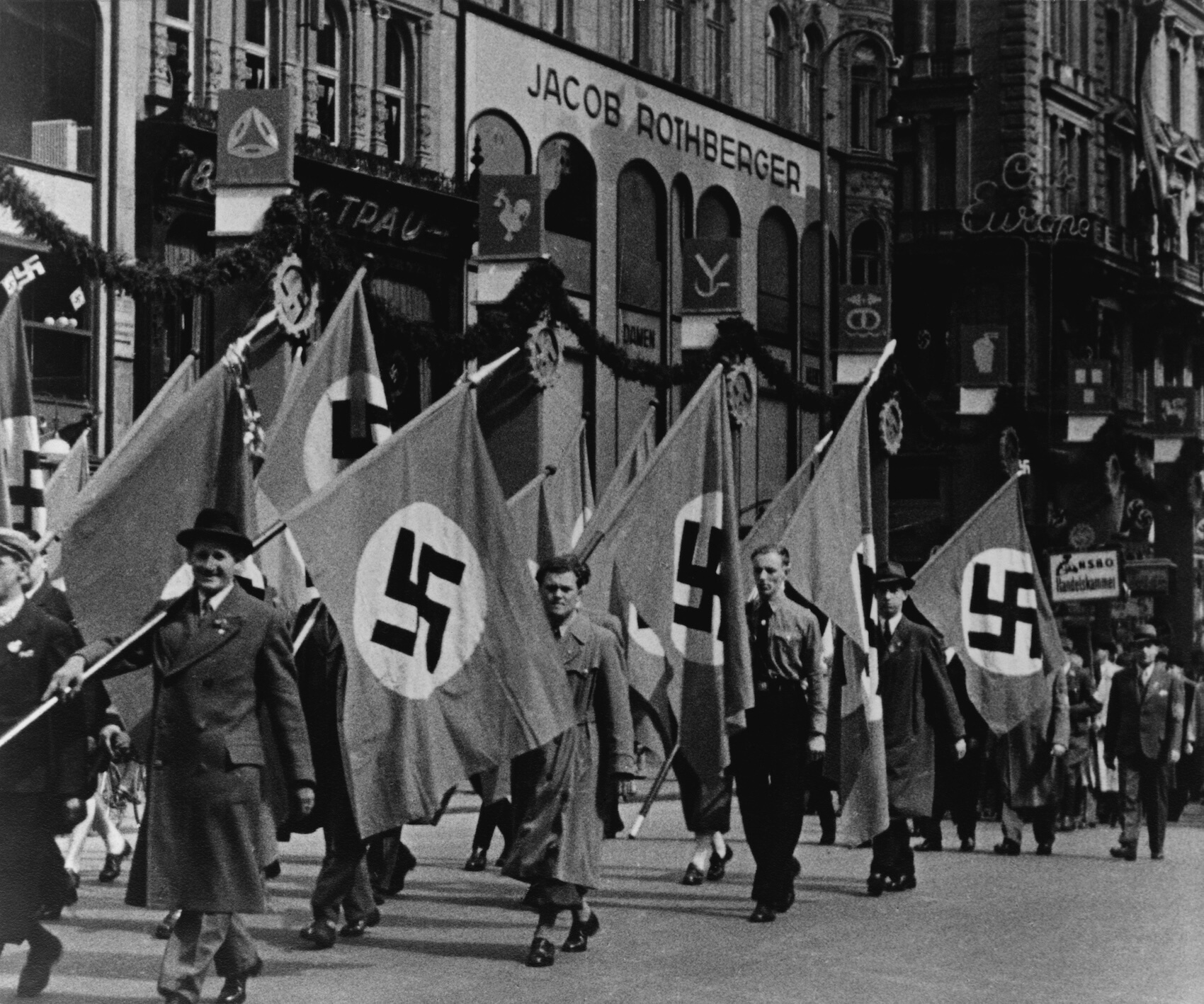
Nazis parade in Vienna, Austria, on May Day, 1938. Photo: Shutterstock.

How do you assess the link between the Nazi ideology and FPÖ? How much has FPÖ been influenced by Nazism?

Professor Felix Roesel: The FPÖ was founded in the mid-1950s, and its predecessor, the VdU, was also a right-wing movement with strong personal connections to the Nazi era. As I mentioned, the first FPÖ party leader was a former SS leader. So, there were clear ties in terms of personnel, as well as ideology.

Initially, if you were confirmed as a Nazi, you were ineligible to vote in the very first post-war election. However, by the second election, those restrictions were lifted, and many former Nazis turned to support the FPÖ. This shows the strong connections from the voter base as well.

In terms of ideology, Jörg Haider, for example, would sometimes use phrasing that was reminiscent of Nazi slogans—close enough to evoke the connection but vague enough to avoid direct accountability. The party has often played with these boundaries.

Even today, local FPÖ politicians occasionally become embroiled in scandals involving connections to Nazi symbolism, such as singing Wehrmacht songs. These are things you don’t see with other parties, which indicates a lingering influence. 

However, it’s important to note that the FPÖ has now evolved into a more modern populist party, focusing primarily on anti-immigration and anti-Islam rhetoric rather than Nazi ideology. Despite this shift, the party’s history occasionally resurfaces, reminding us of its roots.

FPÖ Links Sieges of Vienna by Ottoman Turks to Contemporary Issues

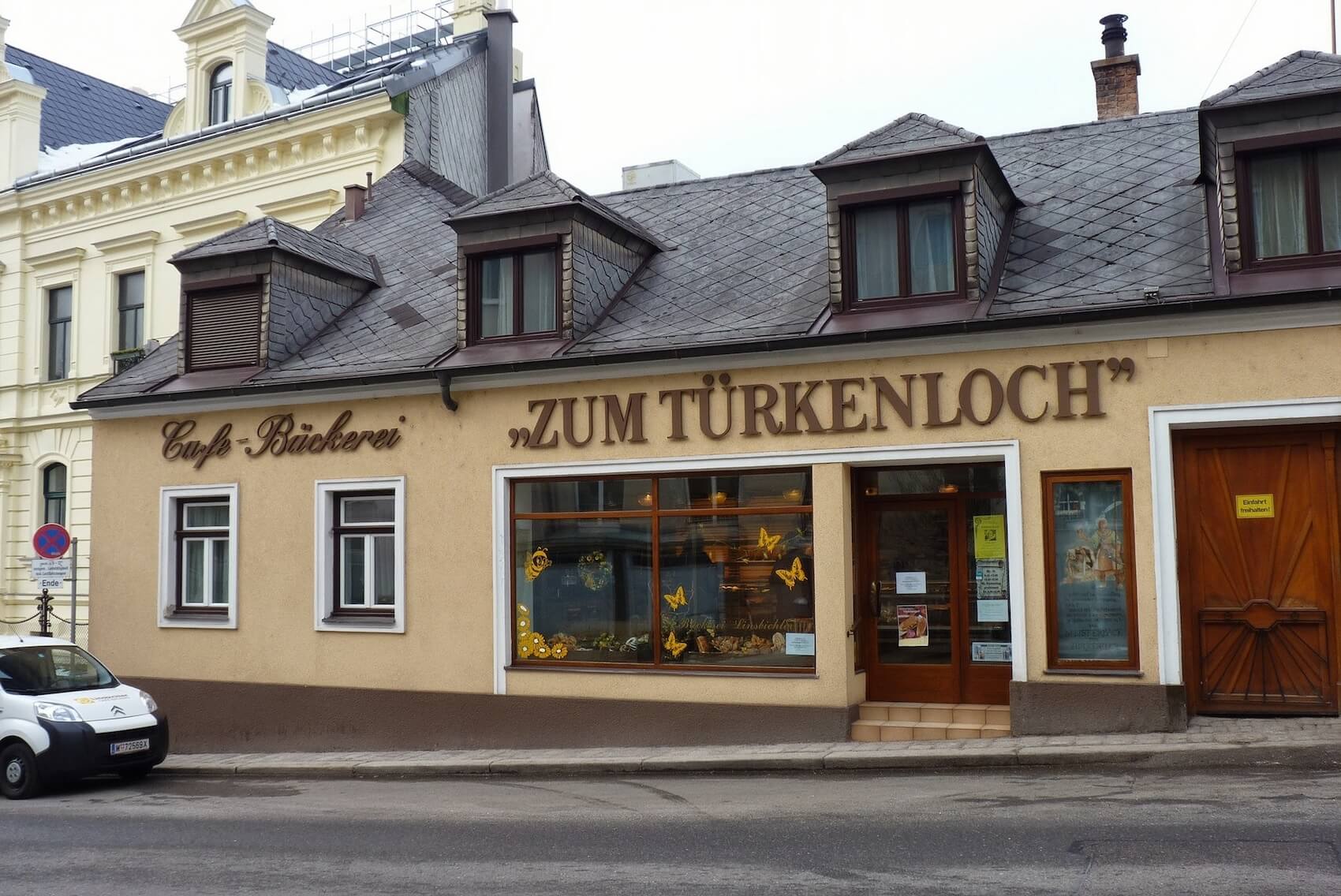
A pastry shop in Vienna displays a picture of Ottoman soldiers and tents on the wall to commemorate the Ottoman siege of Vienna (German: Cafe Bäckerei, Zum Türkenloch) on April 5, 2013. Photo: Fatih Yavuz.

How have the two sieges of Vienna by Ottoman Turks resonated with the Austrian public and how have collective memories and historical narratives played a role in the ideology of FPÖ? How did FPÖ instrumentalize these historical tools against the Turkish and Muslim population in Austria?

Professor Felix Roesel: My co-author and I have a paper on this topic. We observed that some villages around Vienna, which were besieged by Ottoman forces in the 16th and 17th centuries, still carry traces of that history. You can find street names like “Türkenschanz” or “Türkenstraße,” which are reminders of those times when these villages suffered; houses were burned down, and there were significant losses. These events are embedded in the local memory.

For centuries, however, these memories remained dormant. As we demonstrated in our paper, it wasn’t until the FPÖ began campaigning against Muslims that this historical context became politically effective. We found that in those areas that had experienced the Turkish invasions 300 years ago, support for the far-right FPÖ increased significantly compared to areas that had not been affected by the sieges. This suggests that the FPÖ was able to reawaken and instrumentalize these collective memories for political gain.

This is a common strategy among populists—they often invoke the past, whether glorious or traumatic, to mobilize support. In Austria, the FPÖ has connected these historical events to contemporary issues. One former FPÖ leader even referred to the need to prevent a “third siege of Vienna” in response to the growing Turkish and Muslim population, playing on these historical fears and sentiments to gain political advantage.

How have the immigration crisis and other recent socio-economic challenges contributed to the rise of far-right populism in Austria, and what parallels can be drawn with similar movements in other parts of Europe?

Professor Felix Roesel: Let me refer to two studies on this topic. One study has shown a robust correlation between immigration and increased votes for the far-right in Austria. The data indicates that as immigration levels rise, support for far-right parties also increases.

A second study specifically examined the large influx of migrants in 2015. It found that areas along the Austrian-German border, which were most affected by this wave of migration, also saw a significant rise in far-right votes. Interestingly, the study noted that in areas where residents had direct, personal contact with refugees in 2015, there was actually a decrease in support for the FPÖ. This suggests that direct interaction with migrants can reduce anti-immigrant sentiment and far-right support.

In comparison, similar patterns have been observed in other countries, such as Germany, where studies show a clear link between increased immigration and a backlash among native populations, leading to a rise in votes for anti-immigration parties. However, findings differ across Europe, and the picture is not entirely uniform.

Overall, at least in Austria and Germany, there is consistent evidence that higher levels of immigration are associated with increased support for far-right populist parties.

Whether FPÖ Can Form a Coalition Remains the Pressing Question

What is the significance of FPÖ’s victory in the parliamentary elections, that were held last week, in terms of far-right parties both in Austria and Europe?

Professor Felix Roesel: The significance of the FPÖ’s victory really depends on the ultimate outcome of the election, particularly on the formation of the next Austrian government. While the far-right FPÖ won the election by a narrow margin—just one or two percentage points—making it the largest party with around 30% of the vote, it’s important to remember that 70% of voters did not choose the far right. Being the largest party does not guarantee leadership of the next government.

The FPÖ’s status as the number one party certainly can’t be ignored, but the real test lies in whether they can successfully form a coalition. There are significant challenges ahead: other parties, including the Conservatives, have already ruled out any coalition with the far right. Additionally, the Conservative Party, traditionally accustomed to having Chancellors for many years, may be reluctant to join as a junior partner in a coalition led by the FPÖ.

The possibility of a grand coalition between the two former main parties remains, but such arrangements have lost favor in Austria, as they are perceived as ineffective in solving problems. If the FPÖ manages to form a coalition, it would signal to other far-right parties across Europe that it is possible to reach government status even without an absolute majority.

Another challenge is the role of Austria’s President, who has considerable influence. The current President is from the Green Party, which is ideologically opposed to the far-right FPÖ. In fact, the Green Party has even refused to support a parliamentary president from the FPÖ. It remains to be seen whether a Green Party President would appoint a far-right Chancellor. The President’s stance will be crucial as coalition discussions unfold. It’s unclear which direction this will take—whether it’s truly possible to form a coalition with the far right or seek an alternative beyond it. This remains the pressing question at the moment.

Criticizing a Third of the Voters Isn’t a Productive Approach

European Union’s reaction to FPÖ’s victory in 1999 and 2024 are quite different. This time around EU has not reacted to the victory of FPÖ in alarmist terms. Do you think far-right parties have been mainstreamed in Europe in the last couple of years?

Professor Felix Roesel: Yes, that’s certainly one point. Another is that we’ve become somewhat accustomed to these kinds of election results. We’ve learned that criticizing a third of the voters, as is the case in Austria, isn’t a productive approach. Moreover, it’s still possible to form a coalition without the FPÖ.

Additionally, there have been previous elections in Austria where the FPÖ was even more successful. For instance, in the last presidential election, there was a head-to-head race between the Green candidate and the far-right candidate, with the latter gaining almost 50% of the vote. We’ve also seen similar outcomes in other countries, such as France, where far-right candidates have garnered a significant share of votes beyond the traditional far-right base.

These factors might explain the EU’s more restrained response. We’ve also learned that outside intervention isn’t particularly effective, especially in a complex political landscape like Austria’s.

There are experts who believe that Herbert Kickl, the leader of FPÖ, would inevitably moderate, à la Giorgia Meloni, the leader of the far-right Brothers of Italy, who has taken a more pragmatic course than most expected since becoming Italy’s prime minister two years ago. Do you think we can witness a ‘Melonization of Kickle’ as FPÖ has now won the elections?

Professor Felix Roesel: That’s an interesting question. The difference is that Meloni had the advantage of a clear alliance and a majority in Parliament, which is not yet certain for Herbert Kickl. However, I wouldn’t underestimate him. Kickl has been the mastermind of the FPÖ for the past 20 years, designing many of its campaigns and having significant influence, even when he wasn’t the frontman.

Since stepping into the spotlight after the major scandals of 2019, when the coalition in Austria collapsed, he has shown his strategic acumen. He is very smart and will undoubtedly do everything in his power to form a coalition under his leadership.

As for whether his leadership would look different, it’s uncertain. He has already served as Minister of the Interior and, during that time, implemented tough, anti-immigration policies, though much of it was rhetoric. The real question is whether things would change if the FPÖ were to lead a coalition. But again, I wouldn’t underestimate him; he will certainly do everything possible to secure his place in the next coalition.

FPÖ Remains a Permanent and Strong Force in Austrian Politics

And lastly, looking ahead, what trends do you see in the future of Austrian populism and far-right movements? Do you expect these movements to gain further traction, or are they likely to diminish in influence?

Professor Felix Roesel: Typically, when the FPÖ enters government, there is a significant drop in their support, as people often become disillusioned soon after they join coalitions. However, after a short period, they tend to recover and often come back stronger. While I can’t say if this is a consistent pattern, it’s worth noting that nearly 50% of the population has, at some point, voted for the far right in Austria, as seen in the recent presidential elections. So, there is certainly a solid base of support to build upon.

There’s also the incumbency advantage to consider. Once a party leads as the Chancellor, they may gain additional votes from those who rally around the flag. It makes strategic sense for the FPÖ to aim for the Chancellor position and lead a coalition to solidify their role as an established part of the Austrian parliamentary system.

Whether this will require the FPÖ to change its policies, I’m skeptical. Herbert Kickl himself has expressed that one of the mistakes made by Jörg Haider, after his significant successes, was not taking on a leadership role within the government. Kickl seems well aware of past errors and will likely try to avoid them. Thus, it’s very probable that we will see the FPÖ remain a permanent and strong force in Austrian politics, at least for the next few years.

Professor Dr. Reinhard Heinisch, a leading expert on Austrian politics from the University of Salzburg.

Professor Heinisch: If You Don’t Want the FPÖ in Government, Hope They Come in First in Austria Polls

As Austrians head to the polls on Sunday, Professor Reinhard Heinisch contends that “If you don’t want the Freedom Party (FPÖ) in government, you might actually hope they come in first.” He explains this paradoxical statement by noting, “If the FPÖ comes in first, there’s a much greater probability that no other party would want to join a government led by someone as radical as Herbert Kickl. The Conservative Party (ÖVP) would have several options available—they could form a coalition with either the Social Democrats (SPÖ) and a smaller party, or with the FPÖ. But why would the ÖVP want to be the junior partner in a coalition under Kickl when they could be the senior partner in a coalition with the SPÖ?”

Interview by Selcuk Gultasli

As Austrians head to the parliamentary elections on Sunday, September 29, 2024, the political landscape is tense, with the far-right, anti-immigration Freedom Party (FPÖ) potentially poised to achieve an unprecedented success. Although the FPÖ is unlikely to secure an outright majority in the 183-seat Nationalrat (National Council), the implications of their potential rise to power have sparked widespread debate and concern. 

In a timely interview with the European Center for Populism Studies (ECPS), Professor Dr. Reinhard Heinisch, a leading expert on Austrian politics from the University of Salzburg, provides critical insights into the possible outcomes of this election. Professor Heinisch offers a paradoxical yet intriguing perspective: “If you don’t want the Freedom Party (FPÖ) in government, you might actually hope that they come in first.” He elaborates on this by explaining that if the FPÖ wins, there is a greater chance that other parties, particularly the Conservative Party (ÖVP), will refuse to join a coalition led by such a radical figure as FPÖ lider Herbert Kickl. “The ÖVP could form a coalition with the Social Democrats (SPÖ) instead, avoiding the complications of being a junior partner under Kickl,” Professor Heinisch notes.

However, Professor Heinisch also highlights the risks if the ÖVP comes in first and the FPÖ follows closely behind. In this scenario, the likelihood of an ÖVP-FPÖ coalition increases, with potentially significant implications for Austria and the European Union (EU). Professor Heinisch warns that Kickl, unlike some other far-right leaders who moderate once in power, has a clear agenda to fundamentally alter Austria and its position within the EU. “I take him seriously when he speaks about his goals,” Professor Heinisch asserts, pointing to Kickl’s past actions and statements that suggest a deep commitment to his radical agenda.

The interview with Professor Heinisch delves into the historical factors that have shaped the FPÖ, the party’s impact on Austria’s political dynamics and the broader European implications of its rise. Heinisch’s analysis provides a comprehensive understanding of the potential consequences of the upcoming election, making it essential reading for anyone interested in the future of Austrian and European politics.

Here is the transcription of the interview with Professor Reinhard Heinisch with some edits.

FPÖ Poised to Emerge as Leading Party in Sunday’s Elections

Professor Heinisch, thank you very much for joining our interview series. Let me start right away with the first question: Can you elaborate on the historical factors that have contributed to the rise of populist radical right movements in Austria? How far back can we trace these influences?

Professor Reinhard Heinisch: That’s a very good question. The Austrian Freedom Party (FPÖ) is a populist radical right party, formed after World War II. However, it inherited a tradition that dates back to the Austrian Empire and the monarchy. Because Austria was not part of the German Empire during the reunification process in the 19th century, some people in Austria became German nationalists who wanted the German-speaking regions of Austria to join Germany. This sentiment laid the groundwork for what would later become the Freedom Party.

The FPÖ was founded after World War II and represented the aspirations of Austrians who identified themselves as Germans, including a significant number of former Nazis. Many of these former Nazi party members, once allowed to vote, did not align with the dominant conservative (Catholic) or socialist/social democratic parties. This led to the creation of a new party—the FPÖ—which was a German nationalist party that initially never exceeded more than 5% of the vote. It was a minor player in a political system dominated by two major parties: the Austrian People’s Party (ÖVP), a Christian Democratic party and the Social Democratic Party (SPÖ), which together controlled 95% of the electorate.

Over two generations, as the impact of the war receded, the FPÖ underwent a period of liberalization, attracting new members. In the early 1980s, it even partnered with the Social Democrats in government. However, the party was internally divided and during this time, a charismatic young leader from one of Austria’s provinces, Jörg Haider, recognized that future success depended on transforming the FPÖ from a nationalist, radical right party into a populist party.

A populist party, as Haider understood, positions itself against the elites, claiming that they have robbed ordinary people of their sovereignty. Under Haider’s leadership, the FPÖ rapidly grew, moving from 5-6% of the vote to 27%, largely on the strength of its populist appeal. Populist parties, even those on the right, are often less dogmatic than other radical right parties. For example, the FPÖ was initially pro-European integration, then turned against it; it was initially anti-Catholic, but later defended Europe against Islam. The party was highly flexible, adapting its platform to address societal grievances and attract voters.

Austria’s integration into Europe and the accompanying issues of borders, identity, immigration, globalization and European integration became increasingly important to the FPÖ. This focus allowed the party to capitalize on voter discontent with the dominant parties, particularly during times of political change, uncertainty and insecurity. Events such as the collapse of the Iron Curtain and the war in Yugoslavia—during which Austria, as a border country, experienced significant immigration—further fueled the FPÖ’s rise.

By 2000, the FPÖ had gained 27% of the vote and joined a conservative-led government, which caused a stir in Brussels and led to sanctions against the Austrian government. This was the first time a radical right populist party had become a junior partner in government. However, the FPÖ, as an opposition party, was ill-equipped to govern and its voters quickly became disillusioned. The party split, imploded and the government ended prematurely. After another round of elections, the coalition continued briefly before imploding again. The party split into a more moderate faction and a fundamentalist faction led by Haider. However, after Haider’s death in a car accident, his faction essentially disappeared.

The FPÖ reemerged and moderated itself when seeking office, but radicalized when rebuilding in opposition. In 2017, the FPÖ, once again seeking office, formed a government with the conservatives under the leadership of Sebastian Kurz, a young leader from the People’s Party. However, this government also ended prematurely due to the infamous Ibiza video, in which the FPÖ leader was seen offering influence to someone posing as a Russian oligarch. This scandal led to the collapse of the government and the FPÖ returned to opposition, where it had to reinvent itself once more.

Thanks to issues like the pandemic and problems within the government, the FPÖ rebuilt itself impressively and is now in a position where it is likely—or at least highly probable—that it will emerge as a leading party in the upcoming elections on Sunday, September 29 or at least finish as a close second. That, in a nutshell, is the situation.

FPÖ Takes Inspiration from Viktor Orbán’s Hungary

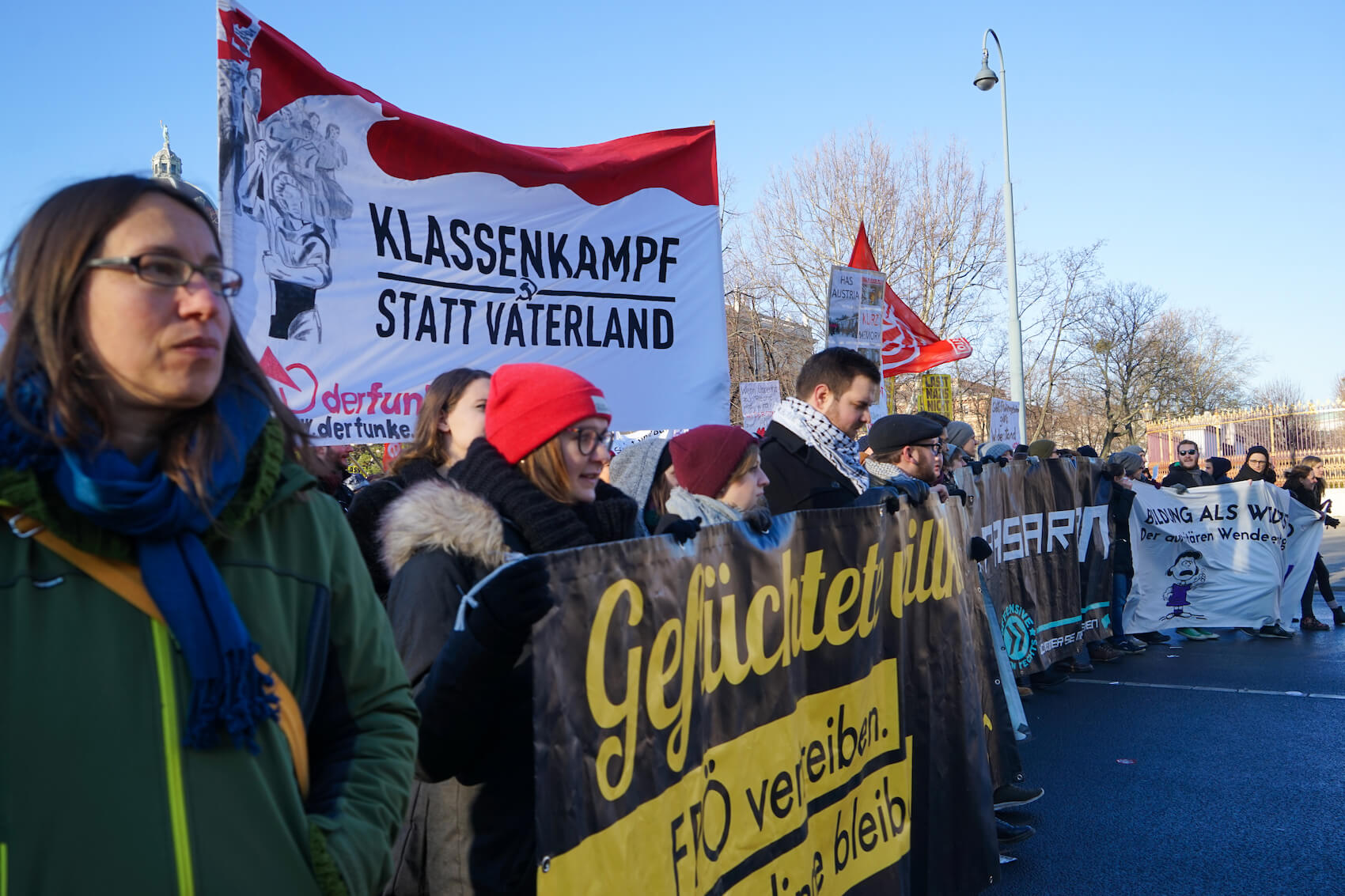
Protesters gather outside as the far-right Freedom Party (FPÖ) joins the coalition government in Vienna, Austria, on December 18, 2017. Photo: Shutterstock.

To what extent do socioeconomic issues like unemployment, immigration, economic inequality and globalization contribute to the appeal of the populist radical right in Austria? How do populist attitudes and attitudes based on populist radical right and left host ideologies affect citizens’ conceptions of democratic decision-making?

Professor Reinhard Heinisch: The Freedom Party (FPÖ), if we imagine political contestation along two axes—the socioeconomic and the sociopolitical—traditionally aligns more to the center-left on socioeconomic issues. This alignment has enabled them to form coalitions with the Social Democrats on economic matters. However, on sociocultural issues, they are quite far to the right, which currently gives them a unique selling position.

Both factors, socioeconomic and sociocultural, are important, but Freedom Party voters are probably more concerned with cultural issues, particularly questions of identity and immigration. You cannot completely separate these concerns from socioeconomic factors because the Freedom Party engages in welfare chauvinism. They often mobilize against immigrants or asylum seekers using socioeconomic arguments, such as advocating for cuts to subsidies and benefits for non-citizens, while emphasizing support for native Austrians. This approach is sometimes echoed by the Conservatives, making it a broader discourse that encompasses both socioeconomic and sociocultural issues.

Structurally, the overarching concern among Freedom Party voters is a fear of change and a sense of decline in their future prospects. This anxiety is encapsulated in the party’s election slogan, “Fortress Austria,” which speaks directly to these fears. What makes Austria unique is its historical difficulty in defining national identity, particularly in relation to Germany. In the past, German-speaking Austrians often considered themselves as Germans living in Austria-Hungary, where “Austria” referred to the Habsburg Empire’s territory, not to an ethnicity. It wasn’t until after World War II that Austrians began to see themselves as distinct from Germans.

Given this complex identity, Austrians often define themselves through lifestyle, traditions and customs. In the context of globalization and immigration, these customs and traditions feel particularly under siege. For example, in Vienna, the Freedom Party has mobilized support by highlighting issues such as schools no longer serving pork schnitzel due to the dietary restrictions of Muslims and Jews. While this might seem trivial, these identity issues resonate strongly with those who view their way of life as an authentic expression of Austrian culture. This divides the population, with elites and educated people defining themselves differently from those who see lifestyle as central to their identity.

This debate is not particularly intellectual, but it significantly affects Austria. The Freedom Party, however, is not as radical as the Alterantive for Germany (AfD) in Germany. Unlike in the past, the Freedom Party today does not philosophize about the “Germanness” of Austria. Instead, it is more pragmatic, drawing inspiration from Viktor Orbán’s Hungary and aiming to create an Austrian version of that model, rather than engaging in debates about national identity.

The Freedom Party Poses a Particular Challenge to the Conservatives

You argue that radical right fringe parties often act as agenda setters, with main parties responding by accommodating and adopting their most salient issues. How do you think radical right fringe parties affect the main parties in Central and Eastern Europe (CEE)?

Professor Reinhard Heinisch: Well, I think it’s important to distinguish between Central Europe—those countries that were under communism—and those that were not. The main issue in Eastern European countries that were once communist is the contestation over cultural issues. There is very little debate over economic policy because the only consensus is on European Union (EU) integration and foreign investment. There’s not a significant difference in what center-left and center-right parties can offer their voters in economic terms, which is why center-left parties in Eastern Europe are often weak and underdeveloped. Where we do see substantial debate is around identity issues. Many unresolved identity issues exist and centrist conservative parties in these countries must constantly guard their right flank. Fringe parties often mobilize people on identity issues, positioning themselves to the right of mainstream parties. This is why we see so much identity-based populism in Eastern Europe and the Balkans.

In contrast, Austria has a more developed party system that spans economic and social fault lines. However, identity issues still play a significant role and the discourse around identity is particularly intense. On the right, we have the Freedom Party (FPÖ) in Austria and while there are smaller parties trying to establish themselves, they may not make it into Parliament this time. On the other end of the spectrum, we have the Greens and a small liberal party occupying the left.

The contestation on the identity axis often influences the socioeconomic debate. Traditional parties like the Social Democrats would prefer to focus on social issues, but they are constrained by internal divisions. They must appeal to both progressive urban voters and more traditional constituencies, which often splits the party. The Conservatives face a similar problem, having experienced a split that led to the formation of the small The New Austria and Liberal Forum (NEOS) party.

The radical right poses a particular challenge to the Conservatives, pulling them further to the right. The future of democracy in Europe may well depend on how Conservatives handle this challenge. In Austria, the typical response has been co-option—embracing the radical right and bringing them into the fold. This strategy has led to the Freedom Party’s implosion on three occasions, but it has also validated the Freedom Party’s agenda. When the Freedom Party makes a comeback, they can point to the Conservatives and say, “We’re not saying anything different from what they said five years ago.”

So the question is: What are the risks of validating these parties versus trying to neutralize them through co-option? The verdict is still out, at least in the Austrian context.

As a Hard Eurosceptic Party, the FPÖ Would Advocate for Leaving the EU

How did the radical-right populist Austrian Freedom Party (FPÖ) construct its sovereignty claims, and how did the mainstream right Austrian People’s Party (ÖVP) adopt these claims? In doing so, how did the ÖVP significantly narrow the gap with the far-right FPÖ on the national and economic dimensions of sovereignty and largely renounce its previously pro-European and anti-sovereigntist positions?

Professor Reinhard Heinisch: The Freedom Party (FPÖ) is a hard Eurosceptic party. We distinguish between hard and soft Euroscepticism. Hard Euroscepticism refers to a stance where a party, if it had the opportunity, would advocate for leaving the European Union. However, the FPÖ knows this is a difficult and still a minority position, as two-thirds of Austrians want to remain in the EU, even if Austria is not a particularly enthusiastic member state.

To navigate this, the FPÖ hedges its bets, a strategy we described as “equivocal Euroscepticism” in an article in the Journal of Common Market Studies. They push their critique of the EU to the brink but stop short of calling for an outright exit. Instead, they vaguely advocate for major reforms and restoring sovereignty to nation-states. The FPÖ aligns itself with European groups like the “Patriots for Europe,” which includes parties like the Rassemblement National (RN) in France, the Party for Freedom in the Netherlands and figures like Viktor Orbán. They are comfortable in this coalition and aim to weaken the EU as much as possible.

For the FPÖ, sovereignty means that decisions should be made within Austria. They advocate for weakening international judicial bodies like the European Court of Human Rights and the EU Courts, arguing that any international involvement should be strictly voluntary and based on national decision-making. This understanding of sovereignty is almost exclusivist and they push it as far as they can. For example, regarding the Sky Shield initiative—a missile defense system being developed by Austria, Switzerland, Germany and others—the FPÖ claims it’s a backdoor attempt to join NATO, illustrating their strict interpretation of sovereignty.

In contrast, the Conservatives (ÖVP) are fundamentally pro-European. While they might exhibit what we call “soft Euroscepticism,” this typically involves negotiating hard on behalf of national interests, as seen with the “frugal” alliance of countries. The Conservatives are far from the FPÖ’s stance, although they have shifted from their earlier, more enthusiastic pro-European position.

Historically, the ÖVP was the driving force behind Austria’s accession to the EU, even branding themselves as the “Europe party” in Austria. They were the main architects of Austria’s EU membership. However, over time, the ÖVP has moved away from this position. While they are still where most Austrian parties are in terms of EU support, they have significantly distanced themselves from their early 1990s stance. Today, the most pro-European party in Austria is NEOS, a small liberal party that consistently defends the EU. Meanwhile, the ÖVP often adopts a stance of blaming Brussels when things go wrong, while taking credit for EU successes.

Austria: From Islam-Friendly to Islamophobic

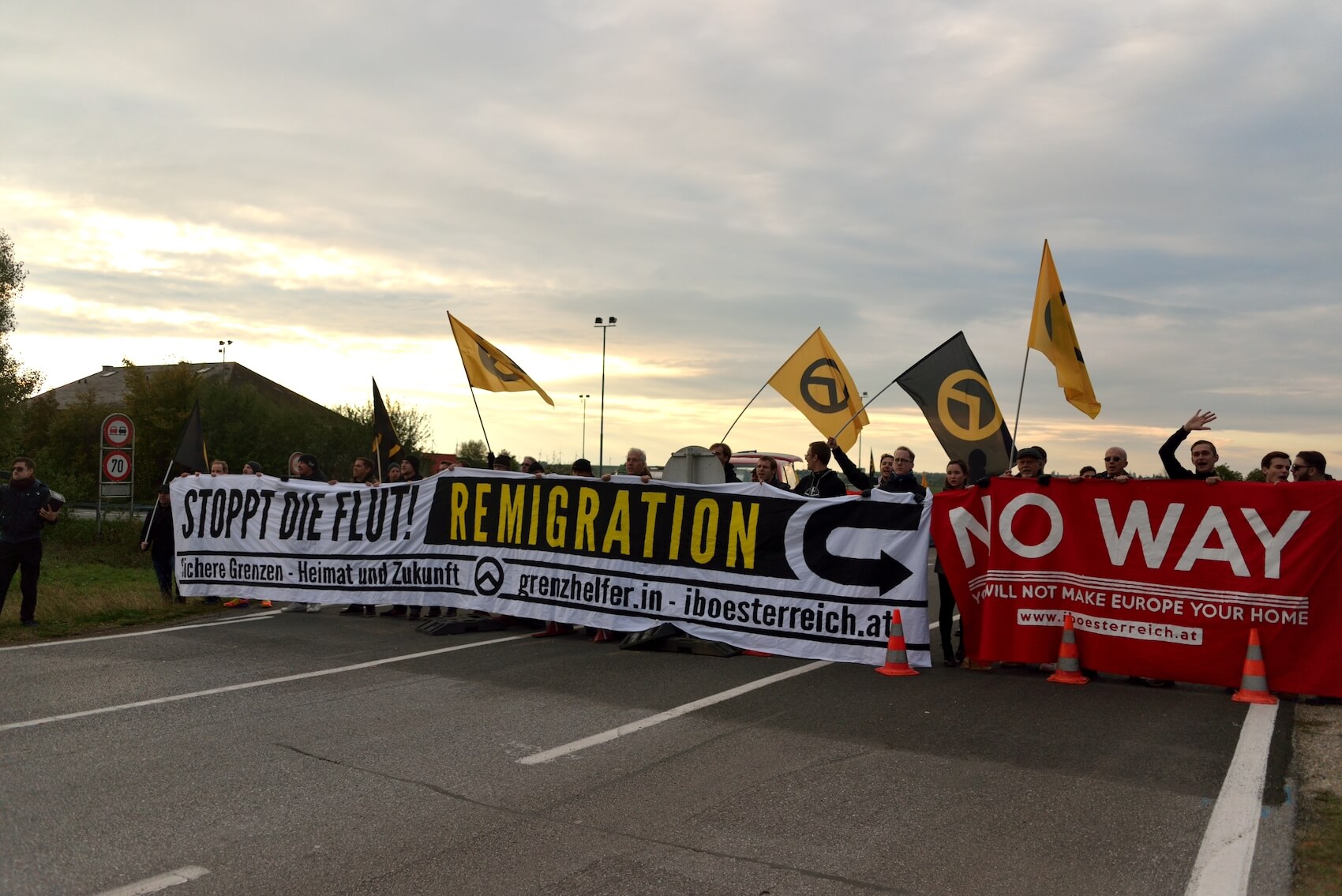
Activists from the Identitarian Movement Austria block the access road to the Hungary-Austria border at Nickelsdorf on October 17, 2015. Photo: Johanna Poetsch.

Austria was one of the first European states to officially recognize Islam in 1912. How has the rise of right-wing populism and party competition changed Austria’s policies toward Islam? What role did FPÖ play in this change of policy toward Islam?

Professor Reinhard Heinisch: Yes, that’s a very interesting question. Austria has historically had a progressive relationship with Islam, dating back to the monarchy. Islam has been a fully recognized and equal religion, sanctioned by the courts and rooted in the inclusion of Bosnian Muslims in the Austro-Hungarian Empire. Traditionally, the Austrian military even had imams, rabbis and Catholic priests. These protections have been carried over and reinforced by the Islam Law of 1912, making it difficult for anyone to weaken the role of Islam in Austria.

Interestingly, Austrian Conservatives and other political parties historically defended the role of Islam and the autonomy of religious institutions. Austria has a tradition of autonomous interest associations, where the state allows these groups to self-govern within their areas of jurisdiction. This applies to labor markets as well as to religious institutions. For instance, religious communities in Austria have the autonomy to organize their own school curricula, appoint teachers, imams and other religious leaders, all within the framework of their contract with the government.

Initially, religion wasn’t a major issue for the FPÖ. Their focus was more on immigration rather than religion. For quite some time, the FPÖ even maintained strong, positive relationships with several Arab countries, such as the ties between Jörg Haider, the FPÖ leader and figures like Saddam Hussein and Muammar Gaddafi. Even after 9/11, Austrians, including the FPÖ, differentiated between Islam and terrorism, seeing them as two separate issues.

However, as the FPÖ began competing with a splinter party led by Haider, they sought new ways to differentiate themselves. This led to an increasing focus on Islam and Islamophobia began to take root. The existing Islam Law became a focal point of controversy, and identity issues were increasingly linked to it.

At some point, these issues were picked up by the Conservative Party (ÖVP), which was locked in competition with the radical right, particularly in areas with larger concentrations of immigrants. Gradually, these ideas went mainstream. Meanwhile, the Greens and Social Democrats distanced themselves from the issue of religion, leaving it to the Conservatives, who were more traditionally aligned with religious matters.

While in a coalition government with the Social Democrats, the Conservatives began rewriting the Islam Law, largely under pressure from the radical right. Around this time, several Islamist terrorist attacks occurred in different European countries, heightening the sense of insecurity and driving a securitization of the new law. The focus shifted toward “Austrianizing” Islam, which included requirements for official translations of the Quran, preaching in German and school curricula reflecting these changes. The Islamic community was pressured to be more proactive in cooperating with government authorities, as outlined in the new version of the Islam Law.

By the 2016 election campaign, when Sebastian Kurz emerged as the strongman of the ÖVP, the question of Islam and “political Islam” became a central campaign issue for both the Conservatives and the FPÖ. Ironically, the Conservatives amplified this issue so much that the FPÖ had to remind voters that they were the first to raise these concerns. Since then, the ÖVP has continued to use the issue of Islam, even establishing a committee and a website to investigate “political Islam,” though the exact nature of this remains unclear. It became a political tool for them, although recently they seem to have stepped back from this focus, possibly realizing it benefits the radical right more than themselves. However, there remains a faction within the Conservative Party that continues to see Islam as a key issue and uses it opportunistically when they believe it can garner votes.

President’s Potential Actions Remain a Significant Unknown That Could Influence the Outcome

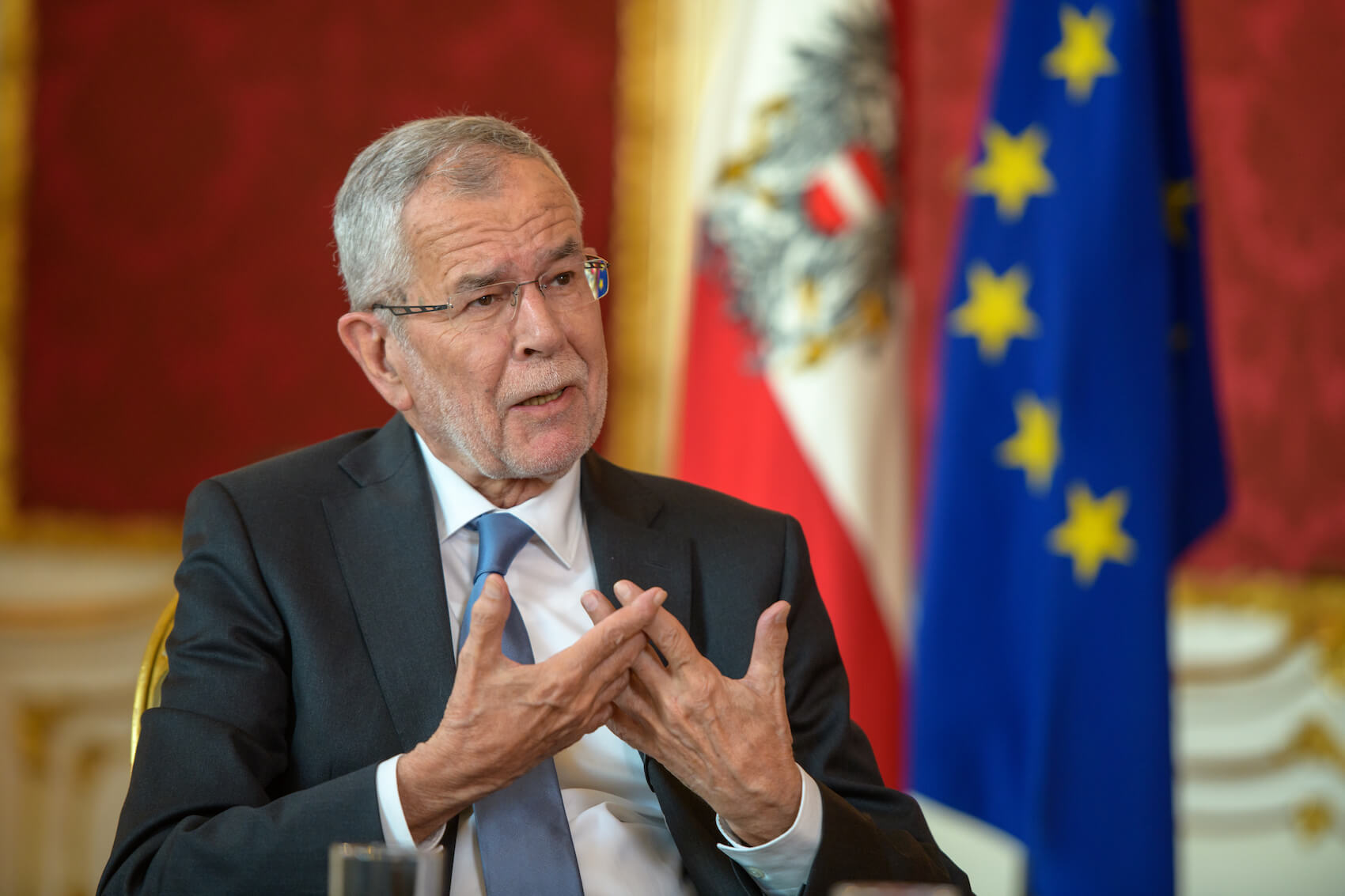
Austrian President Alexander Van der Bellen during an interview with Russian television in Vienna on April 26, 2019. Photo: Shutterstock.

How do you assess the significance of the September 29 elections for the populist radical right in Austria? What are the key factors that could influence their performance this time? Most pundits in the media argue that FPÖ could make a comeback and can win elections on Sunday? What is your take on the elections in terms of the potential success of populist parties?

Professor Reinhard Heinisch: I want to start with a paradoxical statement: If you don’t want the Freedom Party (FPÖ) in government, you might actually hope that they come in first. Let me explain this.

If the FPÖ comes in first, there’s a much greater probability that no other party would want to join a government led by someone as radical as Herbert Kickl. The Conservative Party (ÖVP) would have several options available, as they could form a coalition with either the Social Democrats (SPÖ) and a smaller party or with the FPÖ, but why would the ÖVP want to be the junior partner in a coalition under Kickl when they could be the senior partner in a coalition with the SPÖ?

Kickl has very far-reaching ideas about transforming the state, heavily influenced by the Hungarian model, which are not aligned with the interests of the ÖVP. This would likely result in constant conflict, with the ÖVP being forced to explain the radical actions of the FPÖ, as they have had to do in the past. ÖVP leader Karl Nehammer has ruled out such a coalition so many times that it seems almost impossible for him to go back on that promise—unless he is forced out, which I don’t see happening.

If the ÖVP comes in first and the FPÖ is a close second, the likelihood of a coalition between the ÖVP and the FPÖ increases. In that scenario, Kickl might not insist on becoming Chancellor since his party didn’t win, and he could remain the head of the faction in Parliament while playing both an opposition and government role. The FPÖ is not monolithic; there are members who could be appointed to government positions. In fact, in two Austrian states, including Salzburg, the FPÖ is already in coalition with the Conservatives, so there are experienced individuals who could step up at the national level.

Regardless of what happens, the FPÖ would need to enter a coalition, which would likely dilute its agenda. However, if the FPÖ were to secure the Chancellorship and the Foreign Ministry, it would have significant implications for the European Union. Although Austria is not a major power, a government led by the FPÖ, alongside other like-minded governments such as those of Viktor Orbán in Hungary or Robert Fico in Slovakia, could complicate EU policymaking, particularly on issues like sanctions against Russia, which the FPÖ opposes, or the Green Deal. The more governments embrace FPÖ-like positions, the more difficult it becomes to achieve consensus on critical European policies.

At this stage, I see the radical right as spoilers rather than as architects or agenda setters, at least not on the European level. They can disrupt important initiatives and use certain issues as bargaining chips to extract concessions. The FPÖ could potentially leverage Austria’s role in the EU, although I don’t see that as a likely scenario.

One unknown factor that could play a significant role is the Austrian President. The President has powers comparable to those of the French President, although he typically does not exercise them. However, President Alexander Van der Bellen, who is in his second term and has a popular mandate, has already announced that he would not appoint Kickl as Chancellor and that he would insist on a pro-European government. These declarations could factor heavily into the calculations of the different parties. Since Van der Bellen is from the Green Party and not aligned with the parties likely to emerge on top in the elections, his potential actions remain a significant unknown that could greatly influence the outcome.

FPÖ’s Success Would Be Seen as a Positive Signal by Putin

Media outlet Politico argues that ‘most worryingly, an FPÖ win would establish a populist, Russia-friendly Central European bloc stretching from Ukraine’s border with Slovakia and Hungary to Austria’s frontier with Switzerland, making it easier for President Vladimir Putin to sow discontent at the heart of Europe.’ Do you think a win by FPÖ will create for Putin to make more inroads to EU?

Professor Reinhard Heinisch: I would say yes, but with some qualifications. For this scenario to fully materialize, the FPÖ would need to gain 50% of the vote, which I don’t see happening. Additionally, I don’t see any coalition partner the FPÖ could align with that would fully support a pro-Russia stance. Even the Conservatives have defended Ukraine and criticized Russia, so the FPÖ wouldn’t be able to push this agenda on its own.

However, the election or success of a pro-Russian party, or a party friendly to Russia, would certainly be seen as a positive signal by Putin. It would be another piece in the puzzle for Russia, absolutely. If this trend continues, it could indeed lead to closer alignment with Putin.

That said, the upcoming US election is likely to be a much bigger issue on the global stage and will likely overshadow whatever happens in Austria. Given the lengthy negotiations that typically follow Austrian elections, it’s possible that the US election will be over before a new Austrian government is even formed. While the potential for increased Russian influence is there, the FPÖ would need to become much stronger to significantly impact EU-Russia relations. There would also be considerable pushback within Austria against such a shift.

FPÖ Leader Kickl: The Law Must Follow Politics

Some in Austria’s establishment believe that Herbert Kickl, the leader of FPÖ, would inevitably moderate should the FPÖ gain power, à la Giorgia Meloni, the leader of the far-right Brothers of Italy, who has taken a more pragmatic course than most expected since becoming Italy’s prime minister two years ago. Do you think we can witness a ‘Melonization of Kickle’ should FPÖ win the elections?

Professor Reinhard Heinisch: Generally, I’m not an alarmist, and I’ve always viewed the radical right as a more heterogeneous group. I should also disclose that one of the radical right leadership figures was a student of mine and I’ve known her for a long time. I’m not suggesting that we’re dealing with pure evil here. However, I do think we should take people at their word. I’m very much persuaded that when people make certain announcements, they mean what they say. When it comes to Kickl, we don’t know much about him, which is surprising for a political figure with his longevity and standing. He has no close allies within the party and we can’t look into his soul.

That said, he is one of the best communicators in Austrian politics. He’s extremely clever and was once known as the brain behind the previous party leader, the architect of many of the hard-right slogans. He skillfully peddles conspiracy theories and uses them to his advantage, but he’s also extremely disciplined. Kickl can tailor his message and say tough, often troubling things with a calm and reflective demeanor.

I believe he has an overarching agenda, one that involves fundamentally changing Austria and the European Union, if given the chance. I don’t think he’s simply interested in power for its own sake. Unlike other leaders who are content with a bit of glory and power, Kickl seems to have a mission. I take him seriously when he speaks about his goals.

If given the opportunity, I think he would go as far as he could to implement his agenda. If not, he might easily shift his stance and claim that his intentions were misunderstood. His brief tenure as Minister of the Interior was quite chilling; for instance, he once stated that “the law must follow politics,” rather than politics adhering to the Constitution. This gives us some insight into his mindset.

So, I believe it’s legitimate to be concerned about the extent of power Kickl might attain. He has surrounded himself with ideologically driven individuals who have become quite dogmatic. He has also used Nazi-era terminology, such as describing himself as a “Volkskanzler” (People’s Chancellor) and claims to represent a silent majority of Austrians. Despite the FPÖ garnering only around 27% of the vote, and survey after survey showing that the majority of Austrians are opposed to the Freedom Party being in government— with Kickl consistently ranking at the bottom of public trust indices—his discourse creates a distinctly different impression.

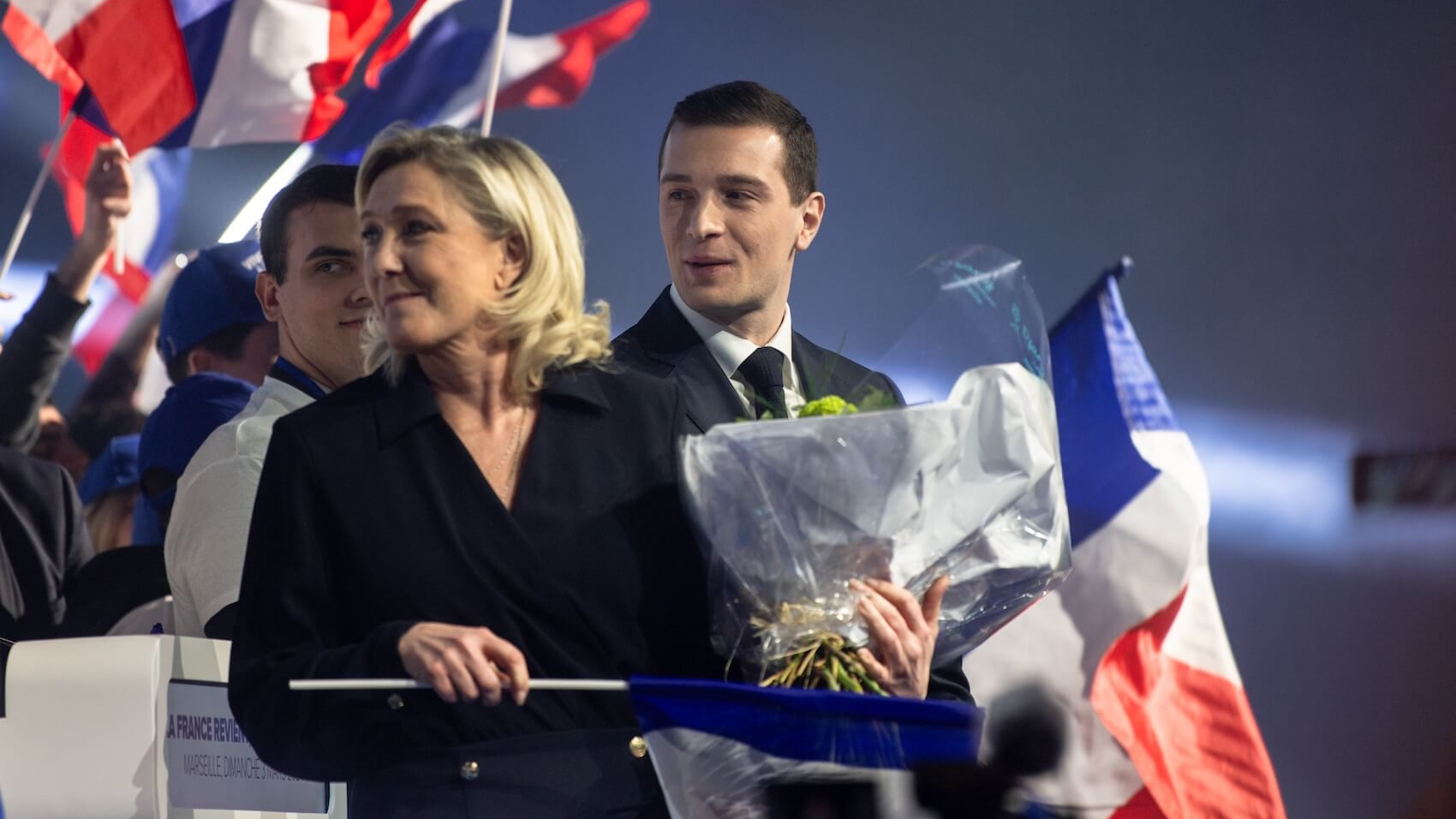
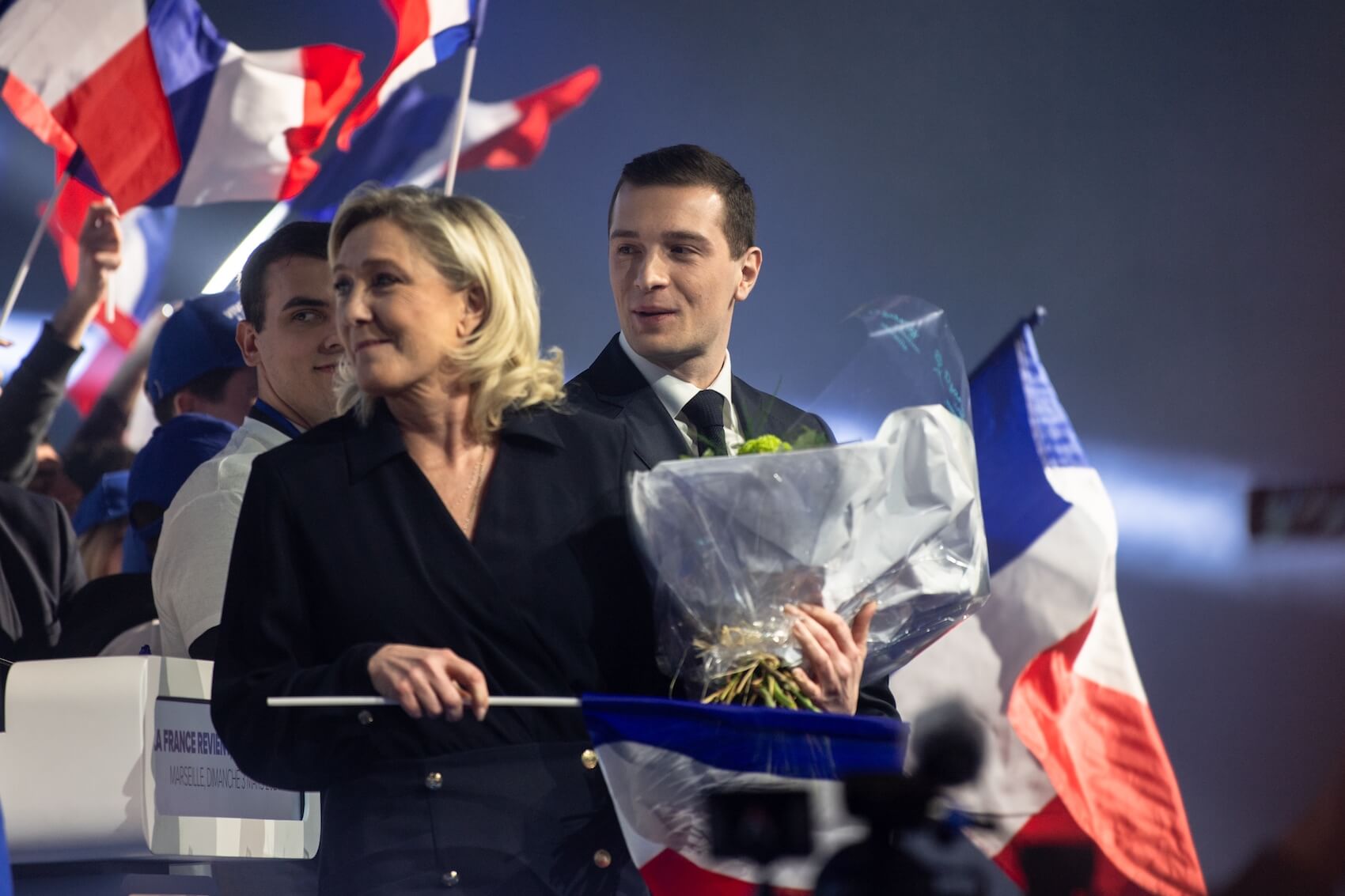
Marine Le Pen and Jordan Bardella are seen at the end of a polical meeting in Marseille for Rassemblement National party on March 3, 2024. Photo: Obatala-photography.

Professor Camus: National Rally’s Electoral Success Goes Beyond Protest Votes

Professor Jean-Yves Camus emphasizes that the social and economic policies of President Emmanuel Macron have driven many voters to the National Rally (NR). However, he cautions against viewing this merely as a protest vote. “When a party remains strong for over 50 years, it cannot be solely due to protest,” he notes. According to Camus, NR’s support base reflects a society grappling with increasing inequalities, where many citizens feel deprived of fair opportunities. This sentiment is compounded by a growing resentment towards foreigners, particularly those from North African, West African and Middle Eastern backgrounds.

Interview by Selcuk Gultasli

In an era marked by the rising influence of far-right movements across the globe, the unprecedented success of France’s National Rally (NR) in both the European Parliament elections in early June and the first round of national elections on June 30, 2024, has captured widespread attention. Scholars, politicians and citizens are keenly observing this seismic shift in French politics. To delve deeper into this phenomenon, we are joined by Professor Jean-Yves Camus, a political analyst and Associate Research Fellow at The French Institute for International and Strategic Affairs (IRIS), who is also a distinguished expert on far-right movements.

Reflecting on NR’s recent successes, Professor Camus emphasizes that the social and economic policies of President Emmanuel Macron have driven many voters to the National Rally. However, he cautions against viewing this merely as a protest vote. “When a party remains strong for over 50 years, it cannot be solely due to protest,” he notes. According to Camus, NR’s support base reflects a society grappling with increasing inequalities, where many citizens feel deprived of fair opportunities. This sentiment is compounded by a growing resentment towards foreigners, particularly those from North African, West African and Middle Eastern backgrounds. NR voters often believe in a clash of civilizations, perceiving a lack of proper assimilation into French society, especially among Muslim immigrants.

In this interview, Professor Camus provides historical context, current dynamics and future projections for the National Rally. He discusses how the NR’s appeal transcends mere protest, touching on deep-seated issues within French society, such as economic disparities, social mobility and national identity. Camus also explores how the NR’s messaging resonates across various demographics, indicating widespread discontent with traditional political parties. He examines the party’s evolution under Marine Le Pen’s leadership, particularly its ‘normalization’ process, which has made it more palatable to a broader segment of voters.

Additionally, Camus sheds light on the influence of cultural and historical factors, including the legacy of France’s colonial past and the Gaullist tradition of national sovereignty, in shaping contemporary far-right and populist movements. He addresses the complexities of European nationalist parties forming cohesive alliances within the European Parliament and the role of external influences, notably from the US and Russia, on the NR and similar movements.

As France stands on the brink of potentially significant political change, this interview offers a thorough analysis of the forces driving NR’s rise and what its continued success could mean for the future of French politics. Professor Camus’s insights are invaluable for understanding the broader implications of this shift and the underlying currents shaping the political landscape.

Professor Jean-Yves Camus, a political analyst and Associate Research Fellow at The French Institute for International and Strategic Affairs (IRIS).

Here is the transcription of the interview with Professor Jean-Yves Camus with some edits.

NR Has Been “Normalized” with Marine Le Pen

Professor Camus, thank you very much for joining our interview series. Let me start right away with the first question. What is the significance of National Rally’s success in the history of the 5th French Republic? What awaits France if NR wins the second round of elections which will, probably, lead to ‘co-habitation’?

Professor Jean-Yves Camus: The significance of this situation, where the Nationally Rally (NR) was voted more than 30% on the first of an election to the lower House of Parliament, is huge. It’s the first time in the history of the Fifth Republic that the extreme right has achieved such success. Back in the 1980s, we used to say in political science that the extreme right was dead. It was believed to have ended in 1945 with the victory against fascism and Nazi Germany and most political scientists considered that it would not be able to resuscitate because there was so much anger from citizens at what fascism stood for.

In spite of this, what we have seen, especially during the time of Jean-Marie Le Pen, between 1972 and 2011, is the re-emergence of the extreme right with some very extreme people and statements. It slowly transitioned from a small fringe movement to parties that initially polled 10%, then 15% and eventually 20%. The National Front even made it to the second round of the Presidential election in 2002 and more or less normalized with Marine Le Pen. Today, it is seen as a far-right party, especially on immigration issues and law and order.

However, the legacy of fascism and the historical extreme right is no more. The generation of people who experienced the Second World War is now deceased. The current members of the party are very young, with figures like Jordan Bardella, who is only 28 years old. For most French people, this is simply a far-right party with a law and order and anti-immigration agenda.

It Would Be a Mistake to Think This Is Only a Protest Vote

How do you explain the enormous success of National Rally both in the European Parliament elections on June 9 and in the first round of French parliamentary elections held on June 30?

Professor Jean-Yves Camus: What is particularly striking is that the National Rally came out ahead among all segments of the population, from people aged 18 to 25 to elderly pensioners and from the upper-middle class to the working class. This indicates that the party has support across almost all segments of French society.

The success of the National Rally can be partly explained by the disaffection of voters with mainstream parties. Whether it be the Socialist Social Democrat left, Macron’s party—which was clearly sanctioned by the voters—or the mainstream conservative right party, Les Républicains, which garnered only 10% of the votes. You have to realize that the party of Jacques Chirac, Nicolas Sarkozy and François Fillon, which used to be a major conservative force, is now practically dead.

The social and economic policies of Macron have driven many voters to the National Rally. However, it would be a mistake to think this is only a protest vote. When a party remains strong for over 50 years, it cannot be solely due to protest.

First of all, the vote reflects the reality that our society is becoming less and less egalitarian. In France, we have a passion for equality, which doesn’t mean everyone should earn the same wage or have the same education. Instead, it means the Republic should enable anyone from any walk of life to climb the social ladder. For example, someone from the working class should be able to see their children rise to the middle class and then to the upper class and so on. However, this social mobility is becoming less and less possible. Inequalities in terms of income and education are now greater than they were in the 1980s.

The second point is that many citizens feel they do not have fair access to opportunities. They perceive that there is an elite—a political elite, a media elite and an economic elite. On the other side, there are the common people and the gap between these two groups is widening.

To National Rally voters, it seems that democracy is not truly democratic because power is concentrated in the hands of a small group of people. That’s their perspective. While I am not claiming this is the absolute truth, it is the way most National Rally voters see French society.

There is also a wider resentment against foreigners, particularly those from North African, West African and Middle Eastern backgrounds. National Rally voters often believe in a kind of clash of civilizations. They think that assimilation into French society, especially of Muslim immigrants, is not happening as it should.

It is true that France has suffered many terror attacks from radical Islamic groups, which has played a very significant role in shifting many conservative voters, who used to vote for the Republicans, towards more hardline stances on immigration and national identity issues. Many of these voters initially moved to Eric Zemmour’s Reconquête party, but since that party received only 0.7% of the vote in the parliamentary elections, many of those votes have shifted to the National Rally. These voters believe that the country is overwhelmed by immigration and advocate for halting it altogether.

French People Are Longing for the Past

The crowd and supporters with French flags during the campaign meeting (rally) of French presidential candidate Eric Zemmour, on the Trocadero square in Paris, France on March 27, 2022. Photo: Victor Velter.

In what ways has the Gaullist tradition and its emphasis on national sovereignty shaped the contemporary far right and populist radical right movements in France?

Professor Jean-Yves Camus: Sovereignty is a key word here. You might remember that during the era of Charles de Gaulle, sovereignty was a central aspect of his policy. At that time, we had the Common Market, not the EU, which was essentially a loose association of nation-states cooperating on selected issues and projects. This arrangement preserved each country’s sovereignty over foreign policy and the economy and there was no common currency. French legislation was not superseded by EU regulations.

Today, however, around 80% of what is voted in our Parliament must align with standards set by the EU. Consequently, our sovereignty is somewhat limited. While we retain the freedom to send or withhold our troops as we see fit, many citizens feel that the EU imposes constraints on our sovereignty. We now have a common currency and we must often agree with our European partners on important issues, relying on EU funding for various projects. The EU project, to some extent, aims at superseding the sovereignty of member states.

This passion for sovereignty, rooted in the Gaullist era, resonates with the far right and populist radical right movements in France. It also ties into the historical perception of France as a global superpower with colonies around the world. France once saw itself as one of the most important countries globally in terms of budget, military forces and influence.

Nowadays, our influence is less. This doesn’t mean that France cannot send a message to the world in terms of values or that we account for nothing on the international scene. We are now a medium-sized power and this status can bring many positive aspects. However, if you speak to National Front voters, they lament that we used to be one of the biggest countries in the world and have lost our colonial empire. They have a sense of decadency, longing for the past, which I personally do not share.

Given the current political landscape and the shift towards illiberalism, how do you assess the role of cultural and historical factors in shaping the political agendas of far-right movements in France today?

Professor Jean-Yves Camus: The National Rally is a good example of what an illiberal democracy would be like if it were in power.

Cultural factors are significant. The first cultural factor is the notion that in France, becoming French means assimilating to a set of values. Unlike Canada, the United States, or the United Kingdom, where individuals can retain part of their cultural or religious background and still identify as Italian American, Afro-American, Arab American or Jewish American, in France, we do not think that way. We have a set of values that require assimilation, which essentially means forgetting about your past identity and embracing the French way of life. This includes the principle of laïcité or the separation of church and state, which is very important in our secular state. When populations from non-European countries with different sets of values arrived, many French people resented this as an attack on our cultural model.

Then comes history. In France, history inevitably involves reflecting on our colonial past. Our relationships with Algeria and, to a lesser extent, Morocco are rooted in this colonial history. Algeria, for instance, gained independence in 1962 after a war that began in 1954. This conflict, which was a civil war both in Algeria and in mainland France, included an attempted coup in 1961 and resulted in many casualties on both sides. The French army was sent to Algeria to combat the pro-independence movement. How can we have a constructive relationship with Algeria when we have not yet overcome the burden of this past? This remains a significant issue. So, this is the challenge we face.

Of course, we also have issues with other countries from our former colonial empire. The burden of the past may be less pronounced with West African countries, but it still exists. These nations were colonized, and some of them are now asking for apologies for the colonization. For instance, if you look at the National Rally’s voter base, about 99% are nostalgic for the France of the colonial era. They do not support the idea of apologizing or paying reparations. Thus, we are still a country that needs to do a lot of introspection and work regarding our colonial past.

Less Than 50% of the French Think the National Rally Is a Threat

How do you assess the evolution of the National Rally (formerly National Front) under Marine Le Pen’s leadership, particularly in terms of its ‘normalization’ process and its success in attracting voters from Les Républicains? Can you provide us a historical perspective? Has the ‘normalization’ or ‘mainstreaming’ of National Rally been successful in attracting the votes of French middle class?

Professor Jean-Yves Camus: The so-called normalization of the National Rally can be seen in the fact that today, opinion surveys show less than 50% of the French think the National Rally is a threat to democracy. In the past, under Jean-Marie Le Pen’s leadership, more than 70% of the French viewed the party as a threat to the democracy.

Why has this perception changed? First of all, when Marine Le Pen became chairperson in 2011, it was clear she did not share her father’s ideology. She is not anti-Semitic, does not believe in racial inequality, and does not deny the harms that Nazi Germany did to France. Compared to her father, Marine Le Pen is more moderate.

However, she remains the only political leader who wants to stop immigration and make France a fortress closed to any kind of immigration. While she is still radical, she is less so than her father was. This normalization process grew gradually as new generations joined the National Rally, generations that had no political activity during Jean-Marie Le Pen’s era. They are not as obsessed with the party’s past and are drawn to it out of disillusionment with the mainstream political spectrum and resentment towards immigration, albeit in a different way than Jean-Marie Le Pen’s followers.

As a result, the party has slowly become more mainstream. Le Pen is perceived by many French citizens as a relatable political leader, someone who resonates deeply with the everyday struggles of the average person. This perception contrasts sharply with the widespread criticism of politicians who are seen as too detached and distant from the daily concerns of ordinary people. 

Marine Le Pen’s appeal lies in her focus on issues such as the spending power of citizens, job losses and factory closures. She is seen as empathetic towards the struggles of the working and middle classes, who are often overlooked by the political elite. This perception makes her particularly attractive to the middle class, a demographic that feels the brunt of economic stagnation. This group, responsible for paying a substantial portion of taxes, sees their income either stagnating or growing very slowly. They are also the ones unable to assure their children of a better future than their own.

The middle class finds itself in a difficult position. On the one hand, a segment of the French population benefits greatly from globalization and financial markets. On the other hand, the working class receives social benefits and often pays minimal taxes due to lower incomes. Those in the middle, however, feel the weight of heavy taxation and perceive a lack of representation and support.

Main Challenge Far Right Parties Face in the EP Is Their Division

The transnational connections of illiberal movements have been in the spotlight for a considerable amount of time. Do you think trans-European strategies have been successful so far for European illiberal groups and their leaders? In your opinion, what challenges do they face in maintaining a cohesive front within the European Parliament?

Professor Jean-Yves Camus: The main challenge they face in the European Parliament is their division into two political factions: the Identity and Democracy Group (ID Group), led by Marine Le Pen, and the European Conservatives and Reformers (ECR Group), led by Giorgia Meloni. Other figures, such as Viktor Orbán, do not currently belong to any particular group but may join one in the future.

These nationalist parties often do not prioritize establishing strong links with foreign groups due to potential clashes over national interests. For example, putting Hungarian and Romanian nationalists in the same room could lead to disagreements over the Hungarian minority in Romania. Similarly, Italian and Austrian nationalists might clash over territorial issues like South Tyrol.

So, the truth is that in every Parliament around the world, you have to belong to a group. This affiliation provides you with significant benefits: funding, jobs, the ability to convene meetings at the headquarters of the European Parliament and opportunities to travel and meet with fellow nationalists. Without group membership, you are essentially isolated in Parliament. Even when it comes to speaking time, those not affiliated with a group receive very limited opportunities to speak. In contrast, groups are allocated speaking time proportional to the number of seats they hold, enhancing their visibility and influence.

Therefore, it is crucial for members to put aside ideological and national differences to sit in the same room. By doing so, they gain the capacity to speak on the floor, increase their visibility and enhance their overall influence within the Parliament.

There is ongoing discussion about the potential merging of the ECR and ID groups into a supergroup of illiberal nationalist parties. However, personal ambitions and ideological differences make this challenging. For instance, deciding the leading figure among Marine Le Pen, Giorgia Meloni or Orban could be contentious.

So, I think in the next legislature at the European Parliament, we will have at least the two existing groups, ID and ECR, and probably a third one. The German AfD can no longer sit with Marine Le Pen’s French National Rally, as Le Pen does not want her party associated with the AfD. Consequently, the AfD is working on building another, more far-right group with the Hungarians from the Mi Hazánk Mozgalom party and some parties from Eastern Europe, which may include the Forum for Democracy in the Netherlands.

The difficulty in forming a group in the European Parliament lies in meeting the required criteria: having at least 25 members and representing at least one-third of the member countries. While gathering 25 members might be straightforward, assembling members from diverse countries can be challenging.

NR and Putin Regime Stands for the Same Values

An activist of the NLM Katasonova Maria holds a poster with the image of Vladimir Putin, Marine Le Pen, and Donald Trump at the press conference in Moscow, Russia on December 23, 2016. Photo: Shutterstock.

Given the historical context of foreign influences on European politics, how do you view the role of US and Russian influences on the National Rally and other far-right movements in France today? Can you elaborate especially on the role of Putin regime in consolidating the role of far-right parties and illiberal movements? 

Professor Jean-Yves Camus: When it comes to the National Rally, one very important piece of their agenda is the desire for France to withdraw from the military command of NATO. This is significant because, despite French troops being sent abroad, we saw in Sahel in West Africa, under French command, they often have to rely on intelligence gathered by the United States and sometimes the UK. This reliance illustrates the complexities of their stance.

The second point is: What does the National Rally want regarding the Ukraine-Russia war? Marine Le Pen has stated that Russia is a multidimensional enemy. She made this claim a week ago during a TV debate. However, shortly after, she clarified her stance, saying, “Russia is an enemy, but I will not send French troops to train and help Ukrainian soldiers. I shall not allow France to sell missiles to Ukraine because those missiles might kill Russian civilians in Russian cities.”

In terms of strategy, usually when a country is labeled as an enemy, there is an implicit expectation to support the opposing side. In this context, if Russia is deemed the enemy, support should go to Ukraine. However, if Le Pen asserts that Russia is the enemy but simultaneously refuses to send troops or provide essential weapons to Ukraine, she indicates a reluctance to fully back Ukraine. This position effectively means turning her back on Ukraine and showing a preference for Russia over Ukraine.

It’s not only a matter of National Rally having relied on Russian money in the past to run the party. Of course, they did borrow money from a Russian bank, but money does not dictate their relationship with Russia. They are supportive of Russia because they believe the Russian regime stands for the same values. These values include authoritarian democracy, a very strong leader and a firm, vertical way of ruling the country. They claim that Russia stands for traditional family values, a multipolar world and law and order. Russia also fights Islamism, even within its borders. In their view, Russia represents a country where traditional European values are still upheld by the government. In other words, they believe the West is too liberal and that Russia is the most traditional country on our continent.

In an article you wrote for Le Monde Diplomatique back in 2014 with the title ‘Not your father’s far right,’ you argue that extensive research into far-right populism over the last 30 years has yet to find a precise, workable definition for this catch-all term, and we need more information on the political category it covers. Revisiting the debate in 2024, do you think we now have a workable definition for populism?

Professor Jean-Yves Camus: We are still in a similar position as we were back in 2002. There is no consensus on a common definition of populism. Broadly speaking, populism can be divided into two different strands: left-wing populism and right-wing populism. In France, for example, left-wing populism is embodied by figures like Jean-Luc Mélenchon and La France Insoumise, while right-wing populism includes parties like the National Rally.

The only similarity between them is their desire to bypass representative democracy in favor of direct democracy, advocating for referenda on major issues. However, what is specific to the far right is their xenophobic agenda. They scapegoat foreigners, immigrants and refugees for everything that goes wrong in the country. In contrast, the far left does not advocate for different rights for native citizens versus documented immigrants or naturalized citizens. For the far right, this xenophobia is the cornerstone of their agenda, which is the fundamental difference between the two.

Italian Prime Minister Giorgia Meloni and EU Commission President Ursula von der Leyen meet in Brussels, Belgium on November 03, 2022. Photo: Alexandros Michailidis.

Professor Wiesner: Von Der Leyen and EPP Are Playing a Dangerous Game by Preferring Far-right to Greens

Professor Claudia Wiesner voices her concerns regarding the troubling trend of the European People’s Party (EPP) and Ursula von der Leyen, showing a preference for collaborating with populist far-right groups over the Greens. Professor Wiesner argues that this strategy is fraught with risks for the European Union. She questions the strategic interest behind such alliances, emphasizing, “These parties would not support strong European integration. They favor a weaker Europe, whereas the Greens support a stronger Europe. It would be in the interest of a strong European Commission to align with parties favoring a stronger European Union.” Wiesner further highlights the potential legitimacy crisis the EU might face if it continues down this path.

Interview by Selcuk Gultasli

In an intriguing interview with the European Center for Populism Studies (ECPS), Dr. Claudia Wiesner, Jean Monnet Chair and Professor for Political Science at Fulda University of Applied Sciences, discussed the concerning trend of the European People’s Party (EPP) and its leader, Ursula von der Leyen, showing a preference for collaborating with far-right groups such as Giorgia Meloni’s Fratelli d’Italia over the Greens. Professor Wiesner argued that this strategy is fraught with risks for the European Union. She questioned the strategic interest behind such alliances, emphasizing, “These parties would not support strong European integration. They favor a weaker Europe, whereas the Greens support a stronger Europe. It would be in the interest of a strong European Commission to align with parties favoring a stronger European Union.”

Wiesner further highlighted the potential legitimacy crisis the EU might face if it continues down this path. “If the major faction in the European Parliament collaborates with groups that have previously acted against these principles and the rule of law, it will create a legitimacy problem for the EU,” she warned. She raised critical concerns about how citizens could trust von der Leyen’s commitment to defending democracy when she collaborates with leaders like Meloni, who has been accused of undermining media liberty in Italy, or the Polish Law and Justice Party (PiS), known for driving democratic backsliding in Poland.

The issue of coalition-building in the European Parliament is another significant challenge. According to Wiesner, the volatility of majorities necessitates a coalition of at least four political groups, including Conservatives, Social Democrats, Liberals, and Greens, to achieve consensus. However, current debates suggest the possibility of excluding the Greens in favor of the European Conservatives and Reformists (ECR), which could further complicate efforts to foster a unified and strong European Union.

Professor Wiesner’s insights underscore the complexities and potential pitfalls of current political maneuvers within the EU. Her critique serves as a stark reminder of the importance of adhering to the EU’s foundational values and the risks involved in straying from these principles for short-term political gains. “If the European Union wants to be credible in defending its values, it needs to defend these values internally as well,” she concluded, highlighting the need for consistency and integrity in EU governance and policymaking.

Dr. Claudia Wiesner, Jean Monnet Chair and Professor for Political Science at Fulda University of Applied Sciences.

Here is the transcription of the interview with Professor Claudia Wiesner with some edits.

Rising Populist Parties Seek to Redefine European Identity or Values

How do you define European identity? Is there a European identity? What are the problems and contradictions when we try to define a European identity? Has the EU been successful in constructing a European identity?

Professor Claudia Wiesner: This is a difficult question to answer briefly. So, let me start with a yes or no. The answer isn’t strictly no, but it does resemble the “glass half full or half empty” perspective. 

There are elements of European identity. For instance, people identify with the European Union (EU) as a polity, participate in European elections, and the relatively high turnout in the last European Parliament (EP) elections shows that people find the EU politically relevant. Additionally, events like the current football competition in Germany, with participants from all over Europe and coverage by the German tabloid Bild calling Europe a great country, indicate elements and dimensions of European identity. Eurobarometer data shows that EU citizens feel European and believe that membership in the EU is beneficial. These indicators suggest there is something to this concept of European identity.

Early research on European identity often compared it to national identity, a comparison I believe is unattainable. The question isn’t whether people would die for the European Union, as they might for a nation-state. We must recognize that identification with the EU differs from identification with a nation-state. European identity is a dual identity; people might say, “I’m a German and a European,” or even, “I’m from Frankfurt, I’m German, and I’m European.”

In conclusion, the answer is complex. Despite this complexity, there is a certain degree of European identity.

How does the rise of populist movements within the EU challenge the formation of a cohesive European identity, and what strategies can be employed to mitigate these challenges while promoting democratic values?

Row of EU Flags in front of the European Union Commission building in Brussels. Photo: VanderWolf Images.

Professor Claudia Wiesner: You mentioned three key points here: the rise of populism, European identity and the defense of democratic values. The rise of populism has multiple causes and is a significant field of research, with contributions from many colleagues. There are various triggers for the rise of populism, including social inequality, dissatisfaction with the government, a surge of nationalism and an anti-migration stance.

The success of populist parties and actors generally mobilizes a feeling of “us versus them,” often articulated in nationalist terms. I am currently leading a work package in a Horizon project on resilient social contracts and we recently finished data collection on the European elections. We collected TikTok videos, revealing how populist arguments work. In Germany, a strong right-wing extremist/populist party uses mobilization to emphasize this “us versus them” narrative. In their rhetoric, “us” represents the hardworking German citizens, the taxpayers, and the average citizen, while “them” includes governmental allies portrayed as incompetent or corrupt, and sometimes the European Union.

Interestingly, the “others” are no longer other nations, like the French, the Greeks, or the Belgians, but everyone who doesn’t fit into a right-wing populist worldview. This conflict is not necessarily against European identity but is about defining a different European identity. This is where values come into play. The European Union’s values, outlined in Article 2 of the Treaty on European Union, include liberal representative democracy, freedom, the rule of law, human rights and equality between men and women.

Right-wing extremists or populists criticize these values to some extent but mainly attempt to reformulate them. They might say, for instance, that they support democracy, but it should be democracy as they define it. Or they might claim to support equality between men and women but insist on traditional gender roles, arguing that women staying at home to care for children is natural and doesn’t mean inequality.

Therefore, rising populist parties do not necessarily oppose European identity or values but seek to redefine them, arguing that current practices are not in favor of the good citizens or hardworking people and need reformation.

They would add that this perspective doesn’t mean treating women and men unequally but recognizing their differences. So, rising populist parties wouldn’t explicitly state that they are against European identity or values. Instead, they would seek to redefine these values, arguing that their current enactment is not beneficial for good citizens or hardworking people and thus needs reformation.

Viktor Orban Engages in Conceptual Politics

Ursula von der Leyen, President of the European Commission arrives for a EU Summit, at the EU headquarters in Brussels, on June 30, 2023. Photo: Alexandros Michailidis.

In the light of your article titled “Actors, concepts, controversies: the conceptual politics of European integration,” how do the conceptual politics of European integration influence the formation of a European identity, especially in the context of increasing populism across member states?

Professor Claudia Wiesner: Conceptual politics is a well-established concept and a significant research focus. It provides a way of looking at and analyzing phenomena in the political realm. Conceptual politics involves being sensitive to how people frame, use, describe and contest political concepts.

For example, the reinterpretation of European values, such as democracy within the European Union, is a case of conceptual politics. It involves the EU claiming certain meanings for concepts like democracy, while others, such as Victor Orban, argue that these concepts should mean something else.

Orban is a case in point. The European Court of Justice has numerous rule of law cases and infringement procedures against Hungary based on the values outlined in Article 2 of the EU Treaty. The Court has ruled against Hungary in many of these cases, questioning Hungary’s adherence to these values.

Orban engages in conceptual politics by claiming he is not against democracy but upholds it more robustly than the EU bureaucrats. He redefines democracy, coining the term “illiberal democracy,” suggesting this is the true form of democracy. Whether he personally believes this or not, his actions exemplify conceptual politics by presenting an alternative idea of democracy. This contestation around the concept of democracy is a common feature in current populism.

In what ways do populist movements challenge the existing conceptual frameworks of EU integration, and how does this affect the EU’s ability to foster a cohesive European identity? Could you please elaborate on the role historical narratives and past conceptual controversies play in shaping current debates on identity and populism within the EU?

Professor Claudia Wiesner: I think it’s okay if we leave out the historical context for a moment and start with a concrete example. I just read about the debate regarding the alignments and collaborations in the next European Parliament. Specifically, there is a discussion on whether the European People’s Party (EPP), the classical Conservatives, will collaborate with the right-wing populists or the very conservative fringe of the Conservatives, such as the European Conservatives and Reformists (ECR), which includes the Polish Law and Justice Party (PiS) and Giorgia Meloni’s Fratelli d’Italia. Broadly speaking, they can be classified somewhere between very conservative and right-wing populist.

The European Conservatives and Reformists, along with the even more right-wing Identity and Democracy (ID) group, have voted jointly with the European People’s Party on issues like the NextGenerationEU and REPowerEU, the two main policy packages currently in focus. This suggests the emergence of a de facto coalition between the classical conservatives and right-wing populists when it comes to energy policy. They have voted against harsh climate conditions and measures for energy transformation.

There is also a debate on whether all these measures against climate change are necessary. Right-wing populists often argue against climate change measures, pointing out the economic challenges of restructuring industries. These arguments are evident in the ongoing debates.

The challenge for the European Union is clear: the Commission, led prominently by Ursula von der Leyen, has put forward the idea that the EU needs to become the leading world region in climate protection. To achieve this, the EU must change the way its economy is organized, promoting more green industries. This approach faces opposition, especially from the German car industry, which will need to undergo significant changes. Interestingly, this opposition comes from within von der Leyen’s own camp. The European People’s Party wants to dilute this goal, mixing classical populist arguments against climate protection.

I would say it’s a very new cleavage around climate change and climate protection that we see at work here. This cleavage and the debates around it obviously impact the EU and its policies because the EU has promoted this goal and it has been concluded. However, when it comes to the nitty-gritty details, the laws that follow from it, we see a watering down in the European Parliament.

No Tension between National and European Identities

How do the conceptual politics of EU integration address the issues raised by populist rhetoric, especially regarding sovereignty and national identity and what role do these politics play in either exacerbating or alleviating the tensions between national and European identities?

Professor Claudia Wiesner: The interesting thing is that I don’t see many tensions between national and European identities at the moment. Interestingly, not even Marine Le Pen or Giorgia Meloni want to leave the European Union. Viktor Orbán doesn’t want to leave the European Union either, as it is too beneficial.

What we see is that political actors like these tend to say “Hungary first,” “France first,” or “Italy first.” It’s not exactly placing national identity against European identity but rather establishing a priority, saying “Italy first” and then the European Union or “Italy first” meaning Italy needs to lead the European Union.

For instance, Giorgia Meloni would make strong claims for a restrictive migration policy, advocating that the European Union should adopt a policy modeled after Italy’s approach. This is essentially an Italian model, driven by Meloni as the current leader of Italy, suggesting the EU should adopt policies reflecting Italy’s stance.

So, the conceptual politics here don’t create an opposition but rather establish priorities, implying that national identity and interests come first, followed by European interests.

Regarding historical parallels, this prioritization of national identity over European interests is not new. It has been a recurring theme ever since European integration began.

If the EU Wants to Be Credible, It Should Defend Its Values Internally as Well

How would you assess the recent European Parliament elections compared to former elections of EP? Do the results of the EP elections point to a serious crisis of the EU in terms of legitimation?

Professor Claudia Wiesner: Yes and no.

On one hand, we have a very high turnout with many people genuinely interested in European Parliament elections. There isn’t a majority of anti-EU voices in the European Parliament. The estimates regarding the outcome of the European Parliament election were initially much more critical for the Democratic camp. For instance, prognoses predicted a higher percentage for Identity and Democracy than what they actually achieved. So, we have a pro-European majority in the European Parliament, composed of a multi-party coalition.

Given the volatility of majorities in the European Parliament, it is necessary to have four political groups in this majority, which raises difficulties in finding consensus. This coalition would need to bring together Conservatives, Social Democrats, Liberals, and Greens under one common roof. Alternatively, the current debate suggests excluding the Greens in favor of the European Conservatives and Reformists.

This brings me to the challenges these parliamentary elections present. It’s a dangerous game, seemingly still pursued by von der Leyen and the European People’s Party, which shows strong sympathies for collaborating with Meloni’s Fratelli d’Italia rather than with the Greens. I struggle to understand the strategic interest behind this, as these parties would not support strong European integration. They favor a weaker Europe, whereas the Greens support a stronger Europe. It would be in the interest of a strong European Commission to align with parties favoring a stronger European Union.

Additionally, the European Union is based on the principles outlined in Article 2 and there are existing rule of law conflicts. If the major faction in the European Parliament collaborates with groups that have previously acted against these principles and the rule of law, it will create a legitimacy problem for the EU. How can citizens trust von der Leyen’s commitment to defending democracy when she collaborates with Giorgia Meloni, who is undermining media liberty in Italy or with Polish PiS, which has driven democratic backsliding in Poland?

Obviously, this idea of defending the rule of law might even appear as a lie. People recognize this issue. I have been in many public discussions and it’s something that even average citizens—not just EU scholars—realize: there is a problem. My point is that if the European Union wants to be credible in defending its values, it needs to defend these values internally as well.

In your book “Politicisation, Democratization and the European Identity,” you argue that the EU appears as a kind of defective democracy. Where do these deficiencies stem from and how can they be fixed? What can be done to reduce democratic deficiency of the EU?

Professor Claudia Wiesner: This is a crucial question. The concept of a “defective democracy” doesn’t originate from EU research but from political science research on the quality of democracy. It refers to a system that falls between fully fledged representative democracies and autocracies. A defective democracy lacks some of the criteria of a fully functioning liberal representative democracy.

An EU politician famously stated that if the EU were to apply for membership, it would have to decline because it doesn’t meet its own rule of law standards. There’s a long-standing debate on the democratic deficit in the European Union, with many criticisms still valid.

My main point at the moment is the lack of transparency and accountability within the European Union (EU). The EU is too complicated and complex, which is a recurring issue. Citizens often don’t understand what’s going on, leading to a legitimacy problem. How can a political system be considered legitimate if people don’t understand how it works? Additionally, this complexity creates an accountability problem because it’s unclear who is responsible for decisions. To support this, I need several research projects that examine citizen views on the European Union.

Brussels, as a political hub, houses many actors, making it challenging to identify who exactly makes decisions. There’s also a transparency deficit, with many political decisions made behind closed doors during negotiations. This lack of visibility makes it difficult for citizens to oversee EU decisions.

One main point is the need to increase transparency and accountability in the EU. This isn’t just about formal accountability but about visible transparency that citizens can perceive. People feel that if they wanted to hold someone accountable, they wouldn’t know where to start.

The remedy would be treaty reform, which is an optimistic perspective at present and fostering more public reasoning and debates within EU institutions.

Critics: “EU Does Not Adhere to Its Own Ideals”

In your article, “The War Against Ukraine, the Changing World Order and the Conflict Between Democracy and Autocracy,” you argue that a world structured around a maximum of two hegemonic great powers has been successively replaced by a world order in which several poles of larger and smaller states confront and compete with each other—politically, territorially, economically, militarily and ideologically. For the EU, this means that its previous global political strategy, which focused strongly on ‘change through trade’ and its role as a ‘normative power Europe,’ no longer looks promising. In this multi-order world, what should EU do to regain its clout and stay relevant?

Professor Claudia Wiesner: In the lecture series that I conduct every winter term, I invite politicians and academics to discuss various topics with my students. About a year ago, we had a Green MEP from Germany who remarked that the European Union must decide whether it wants to “sit at the table or be on the menu.” While this is a harsh way of putting it, the point is significant.

The EU has lost importance, economic power and ideological influence in the world and there isn’t an easy solution to regain it. This challenge encompasses ideological, economic and geopolitical battles. If the EU wants to regain influence, it needs to be attractive and convincing across all these policy fields.

I think this is quite a challenge without an easy answer. A key issue is credibility. Many students from the Global South at my university are strongly critical of the EU. Interestingly, even my German and other European students share this critical view, believing the EU lacks credibility in its defense of democracy and human rights.

When discussing the EU’s role in non-EU countries, former developing countries and the Global South, there is significant criticism and dissatisfaction with the EU’s actions. They argue that the EU does not adhere to its own ideals and is unconvincing in its efforts.

To regain confidence, the EU needs to address this issue. They must work diligently to appear convincing and uphold their promises.

In the same article, you argue that there are several signs that liberal democracy is under threat, not only from outside the EU, but from within the EU itself. What does the recent EP elections tell us about the internal challenges of EU against the liberal democratic order?

Professor Claudia Wiesner: I believe I made my point quite strongly. One internal challenge is the democratic backsliding in several EU member states. Today, I read about a new law passed in Slovakia that restricts media freedom. They dissolved the public TV station and created a new one to replace journalists who did not report favorably on the government. This is similar to what we’ve seen in Hungary and Poland. Interestingly, the government in Slovakia is of a different political color than those in Poland or Hungary.

The European Commission addresses these issues through rule of law reports and, if necessary, infringement procedures, with the Court of Justice of the European Union stepping in. This highlights why the EU and any incoming European Commission and Commission President need to be highly attentive in this area.

In Germany, there is currently a debate about maintaining a “firewall” against right-wing extremists, emphasizing that conservative parties should not collaborate with them. This principle is crucial for the European Union. Right-wing populists, such as Giorgia Meloni in Italy, often limit media freedom and pose significant internal challenges to democracy in the EU.

If centrist politicians, including the European People’s Party (EPP), disregard this firewall and collaborate with right-wing extremists, it becomes more than a matter of political color. It supports democratic backsliding and strengthens the internal threats to democracy in the EU, which is very dangerous for anyone who supports liberal democracy.

Possible Implications of a Probable Le Pen Victory

Marine Le Pen and Jordan Bardella are seen at the end of a polical meeting in Marseille for Rassemblement National party on March 3, 2024. Photo: Obatala-photography.

How do you think a likely victory of Le Pen in France would change the EU and EP in particular?

Professor Claudia Wiesner: A likely victory of Le Pen in France would not change the European Parliament immediately because it has just been elected, and its composition is set. Le Pen’s potential victory wouldn’t affect this.

I’m not certain about a likely victory for Le Pen except for the next Presidential elections in France, which are in three years. The next parliamentary elections in France are more uncertain.

I, along with many French commentators, don’t understand why Emmanuel Macron called for snap elections. It seemed like a bad moment for his party, which performed poorly in the EP elections, especially when right-wing extremists in France are strong.

Interestingly, the left in France united very quickly, within four days, forming joint lists and joint candidacies. This sets up an intriguing opposition between Le Pen, Jordan Bardella and the “Nouvelle Union Populaire.” We might see a victory for the left or the extreme right, but it’s unlikely we’ll see a strong showing from Macron’s camp.

If we look at the election results in France, they are not very strong in the French Parliament because the French Parliament is elected through a majority voting system based on constituencies. This means that to win a seat in the National Assembly, you need to win a constituency. Even in this scenario, it’s going to be difficult for Rassemblement National (RN) to win a majority of the constituencies because they are alone. They don’t have many experienced partners with them, except probably the party of Éric Zemmour. So, really, we’ll have to see because there is a right-wing extremist potential of between 35 and 50% in France. Yes, but you need to realize it in every constituency. And I’m not 100% sure this will be the case, so I wouldn’t set my thoughts entirely on a victory of the right-wing extremists.

But, if they win, there would be a Prime Minister from Rassemblement National. I think it wouldn’t be Le Pen, it would be Jordan Bardella, so, the young president of Rassemblement National. It would mean that there would be another right-wing populist government in Europe, in a big founding member state along with Italy. So, probably they would work very well together.

Interestingly, what we see is that collaboration in the European Union has a kind of moderating influence even on those right-wing populists. So, as long as there is no right-wing populist majority in the Council, there wouldn’t be such a massive effect. There would be some effect, but it would be moderated, especially because there is no right-wing majority in the European Parliament.

Dr. Othon Anastasakis is the Director of the European Studies Centre and South East European Studies at Oxford (SEESOX) at St Antony’s College, Oxford University.

Dr. Anastasakis: Biggest Risk in the EU is Far-right Parties Deciding to Unite in the EP

From a historical perspective, Dr. Othon Anastasakis acknowledged that the rise of far-right parties in the European elections does not represent a significant rupture from the past. The mainstream political context still dominates European politics, which he finds reassuring. However, he sees two main risks for the future: the unification of far-right parties within the European Parliament and the potential alliance of center-right parties with far-right elements, which could normalize extremist rhetoric.

Interview by Selcuk Gultasli

Following the European Parliament elections, Dr. Othon Anastasakis gave an interview to ECPS, discussing the risks confronting the European Union and European liberal democracies. Dr. Anastasakis, the Director of the European Studies Centre and South East European Studies at Oxford (SEESOX) at St Antony’s College, Oxford University, stated, “What I see in Europe today is a process of securitization and the geopoliticization of the European Union. This shift is largely a response to the wars in neighboring regions, especially Russia’s full-scale invasion of Ukraine. In the face of these realities and a multipolar global environment, there is a turn towards a defense-oriented agenda.” He emphasized that this process of geopoliticization is shaping the EU’s future direction.

Dr. Anastasakis underscored the significant risk to the EU’s normative agenda, noting that the EU, as a democratic club, shares specific values, rules, and procedures. He expressed concern that as the EU faces increased geopolitical and security challenges, it may struggle to maintain its commitment to these normative values, particularly in external relations, trade, and foreign policy decisions. He highlighted the risk that the EU might compromise its democratic credentials to bring in countries that may not yet be ready for membership.

Another risk Dr. Anastasakis highlighted is the potential for far-right parties in Europe to unite within the European Parliament to create obstacles on issues such as migration and climate change. He also pointed out the risk that center-right parties, particularly those in the Christian Democrat bloc, might be tempted to ally with far-right parties on certain issues or adopt parts of their discourse, leading to the mainstreaming of far-right rhetoric. He noted that this has already been observed in the field of migration, where mainstream parties are often influenced by far-right narratives.

However, from a historical perspective, Dr. Anastasakis acknowledged that the rise of far-right parties in the European elections does not represent a significant rupture from the past. The mainstream political context still dominates European politics, which he finds reassuring.  Overall, Dr. Anastasakis cautioned that while the current situation does not mirror the catastrophic rise of far-right movements in the early 20th century, it poses significant challenges that require vigilant attention to safeguard the EU’s democratic values and stability.

Here is the transcription of the interview with Dr. Othon Anastasakis with some edits.

Populism and the Far-Right Are Broad Umbrella Concepts

How do you see the historical evolution of populism and far-right movements in Europe influencing current political landscapes, particularly in the context of the recent European Parliament elections?

Dr. Othon Anastasakis: Populism and the far right are two broad umbrella concepts that encompass a wide variety of parties and formations. Due to their broad nature, they are understood in different ways and include many different far-right parties and movements. This makes it very challenging to group them together or understand them as a single entity.

Far-right parties themselves are not united as a whole. Their intrinsic nationalism means they have very specific goals related to their own nation-states. When observed collectively, especially in contemporary Western and European politics, they can be highly disruptive and reactionary to mainstream democratic politics, which has been the norm in Europe for the past eight decades or so.

Far-right politics are also evolving, often softening their positions when they are close to power. As long as nationalism and the nation-state remain central in international politics, far-right parties will continue to advocate their extreme nationalistic, racist and populist discourse. They are particularly influential during times of low economic growth and increasing economic inequality, as they find audiences receptive to their messages.

Finally, when democratic leadership is weak or lacks determination, it creates an environment where far-right parties can infiltrate, penetrate and promote their ideas.

What happened in the European Parliament elections regarding populism and the far-right? Is this a watershed moment in European history?

Dr. Othon Anastasakis: I wouldn’t call it a watershed moment. Yes, there was an expectation and a lot of publicity about the rise of far-right politics during these European elections. However, the outcomes showed no massive change overall. While there was some rise of far-right parties in various national European settings, the Christian Democrats managed to increase their position in the Parliament, the Liberals lost somewhat, and the Social Democrats remained more or less the same. Mainstream parties maintained their numbers and power within the European Parliament.

That said, what we did see was significant: the rise of the far right in two particularly influential countries in Europe. In France, the far right gained ground, impacting national politics and leading to immediate elections under Macron. Similarly, in Germany, the AfD’s rise weakened the Social Democratic Party. These developments in France and Germany, which are often pivotal in shaping European politics, are more indicative of the rise of the far right than the overall European Parliament spectrum.

One Lesson from History Is the Danger of Appeasement

Poster of Vladimir Putin looking like Hitler in a demonstration against the invasion of Ukraine by Russia in Valencia, Spain on February 27, 2022. Photo: Shutterstock.

Considering the rise of far-right parties across Europe as proved once again by EP elections, can we draw parallels with similar movements in the early 20th century? What historical lessons should we keep in mind to understand and address these modern developments?

Dr. Othon Anastasakis: First, let me say that history never repeats itself in exactly the same way, which is important to keep in mind. We never encounter identical circumstances that produce the same outcomes repeatedly. However, understanding what happened in the past helps us comprehend why the present has unfolded as it has.

Given that history doesn’t repeat itself precisely, we can still draw valuable lessons from it. One common question we face today is whether we are seeing a repeat of the 1930s with the rise of the far right, and to what extent. The 1930s were unique in European history due to the circumstances that led to the rise of many fascist parties, especially the Nazi party in Germany.

One lesson from history is the danger of appeasement during moments of aggressive behavior. The 1938 appeasement of Hitler serves as a lesson not to follow a similar path with someone like Putin, who has invaded Ukraine. Negotiating with aggressive behavior can lead to further territorial ambitions.

Another lesson is that persistent economic inequality, especially during times of economic crisis, can bolster the strength of far-right parties. This was evident in the 1930s following the 1929 economic crisis. These historical insights remind us to address economic disparities and avoid appeasement to prevent similar political outcomes today.

In your 2001 article “Post-communist extremism in Eastern Europe: The nature of the phenomenon,” you discussed the emergence of far-right parties in Eastern Europe, particularly in Poland and Hungary, years before the governments of Kaczynski and Victor Orbán. Do you think the dynamics that led to the rise of far-right parties have changed in Eastern Europe? What patterns can you identify?

Dr. Othon Anastasakis: First, let me say that while far-right politics is a wider European phenomenon, it is not exclusively a Central European issue. In my reading of the European continent, three main factors may create divergences between Western Europe and Eastern Europe.

First, there is the Communist legacy. This long and totalitarian history has created circumstances that can sometimes lend themselves to a lingering appeal of authoritarianism. The Communist legacy remains a significant point of reference in these regions.

Second, we must consider the legacy of empires versus those who were colonized. When discussing post-Empire Europe, we often assume all countries were colonizers, which is not the case. Western European countries like Britain, France, Italy, Spain, and the Netherlands had overseas empires. In contrast, many Eastern European countries, from Poland down to Greece, were part of empires. This division affects the development of politics, particularly nationalistic politics.

Third, connected to the second point, is the division between civic and ethnic nationalism. The understanding of national development and the way citizens are embedded within this context vary significantly. In Western Europe, there is often a more civic understanding of nationalism, whereas, in Eastern Europe, there is a longer historical experience of ethnic nationalism. This influences how far-right nationalism behaves and forms its ideology in these regions.

How has the narrative and strategy of far-right parties evolved from the post-communist era in Eastern Europe to the present day? Are there historical factors that continue to play a significant role in their resurgence?

Dr. Othon Anastasakis: Even in Eastern Europe, where we can roughly divide nationalism into civic versus ethnic types, history plays a very important role in the development of far-right parties and politics in general. The national experiences of these countries significantly impact how their politics evolve.

For example, Hungary, part of the Austro-Hungarian Empire, became a nation-state after World War I, leaving many ethnic Hungarians outside its borders. This created a unique brand of Hungarian nationalism. In contrast, Poland, which also faces issues with the rule of law similar to Hungary, has a different historical background. Poland, often caught between Russia and Germany, has experienced its territory being divided and annexed by these powers. This historical context results in a far-right experience that can be either anti-German or very much anti-Russian.

Thus, the historical experiences of these countries influence how far-right parties develop and form their own versions of nationalism.

Meloni Is Not Mussolini, the AfD Is Not Comparable to Hitler’s Germany

Giorgia Meloni, Italy’s prime minister, speaks at the Atreju convention in Rome, Italy on December 16, 2023. Photo: Alessia Pierdomenico.

In the same article, you discuss four theses about the rise of far-right extremism, one of which is the revival of the fascist era. With the rise of Giorgia Meloni in Italy and her party, Brothers of Italy, and the rise of the AfD in Germany, do you see a revival of the fascist era?

Dr. Othon Anastasakis: Not in the way that it happened in the 1930s. As I mentioned earlier, history doesn’t repeat itself exactly. There are lessons to be learned, but the context is always different. In the 1930s, the aftermath of World War I played a significant role. The experience of being winners or losers, especially in Germany’s case, where it was a clear loser, defined how the country developed during the turbulent interwar period. This era saw the testing and eventual failure of liberal politics, leading to the authoritarian regimes of the 1930s.

Today, the background is very different. We have the European Union, which provides a unique context of political and economic integration among its member countries. Any attempt by far-right parties or anti-European, protectionist forces to gain power would first have to involve dismantling the EU, which is not an easy task.

In this sense, we are in a different historical moment. Meloni is not Mussolini, and the AfD is not comparable to Hitler’s Germany. However, these parties do contain elements that make them susceptible to fascist ideas, language, and rhetoric.

One important and common issue that enables these parties to develop their discourses is migration. Unlike in the 1930s, today’s migration context has been developing for a few decades, but under conditions of crisis, it becomes a significant scapegoat. Migration is an issue that many far-right parties across Europe use to their advantage.

In your article “Europeanization of the Balkans,” you underline how the EU membership process has transformed Balkan countries in terms of consolidating democracy and the rule of law. When you consider the surge of far-right populism in Western Europe, can we talk about the Balkanization of Europe?

Dr. Othon Anastasakis: Overall, I don’t use the term “Balkanization” because I think it’s a stereotypical and simplistic way of understanding a region. It doesn’t accurately reflect the true complexity of the area. My thesis back then was that the conditionality imposed by the European Union, particularly in the political context, was crucial. This conditionality made the countries accept and adopt certain norms required for EU membership. In this sense, Europeanization—a much broader concept—was able to take root in those countries.

What I see in Europe today is not Balkanization, but a process of securitization and the geopoliticization of the European Union. This shift is largely a response to the wars in neighboring regions, especially Russia’s full-scale invasion of Ukraine. In the face of these realities and a multipolar global environment, there is a turn towards a defense-oriented agenda. This shift could change the nature and spirit of the EU, moving it beyond its historical focus on economic integration and soft power.

One significant risk I see is the potential impact on the EU’s normative agenda. The EU is a democratic club, a group of countries that share specific values, rules and procedures. As the EU faces increased geopolitical and security challenges, it may struggle to maintain its commitment to these normative values. This concern is particularly relevant in its external relations, trade and foreign policy decisions. Even with the enlargement agenda, there is a risk that the EU may compromise some of its democratic credentials to bring in countries that may not yet be ready for membership.

So, while I do not fear Balkanization, I do see a process of geopoliticization that is shaping the future direction of the European Union.

In your doctoral thesis “Authoritarianism in 20th Century Greece,” you examine the authoritarian ideology and educational policy of two dictatorial regimes in 20th century Greece: the Metaxas dictatorship of 1936-1941 (the 4th of August regime) and the military junta of 1967-1974 (the 21st of April regime). What interactions do you observe between these two periods and the rise of Golden Dawn in the 2010s and the Greek Solution party now?

Dr. Othon Anastasakis: Dictatorships, particularly in the Greek context, belong to the past and do not present themselves as viable alternatives for political power and governance after the transition from dictatorship to democracy in 1974. The periods of the 1930s and 1960s were different as the military was a significant force in Greek politics. During political or party crises, the military often positioned itself as an alternative, intervening in politics multiple times. For instance, Metaxas, a military man, managed to influence politics in the interwar years, and the colonels in 1967 abruptly halted the democratic process.

The rise of far-right parties like Golden Dawn in Greece is not reminiscent of those military interventions. Golden Dawn, which gained prominence during the severe economic crisis in Greece, is also a criminal organization and most of its members are now imprisoned, rendering it unable to operate as a political party. Other nationalistic and far-right parties, such as the Greek Solution, exist but are often not sustainable. Over the past three decades, we have seen how some far-right parties have managed to raise their percentages. For instance, the Orthodox Popular Rally led by Georgios Karatzaferis in the 1990s and early 2000s, and the Independent Greeks, who cooperated with Syriza during the mid-2010s crisis. These far-right parties experienced a rise but eventually descended, demonstrating a pattern of emergence and decline.

These parties tend to be disruptive, reactionary and extremely nationalistic. They often gain support during times of political crisis or when mainstream parties struggle to address issues. This pattern of rise and fall is evident in the Greek Solution and two other extreme nationalist parties that secured seats in recent elections. The fact that these three far-right parties collectively garnered around 18-19% of the vote is concerning, indicating a particular situation in the Greek political context.

Populism and Populist Leaders Will Continue to Exist

In your research on authoritarian regimes in Greece, what historical patterns do you see re-emerging in contemporary European politics? What impact do you think, as an historian, the resurgence of far-right populism will have on the future of European integration and the EU’s democratic values? Are we witnessing a cyclical pattern of populist surges similar to previous historical periods?

Dr. Othon Anastasakis: Populism and populist leaders will continue to exist, whether they are on the far-right, far-left or somewhere in between. Populism, as a broad umbrella term, encompasses various parties and movements, making it an enduring feature of the political landscape. A specific example of this is Brexit, which was a significant populist moment in Europe. Brexit challenged the European edifice as the UK, driven by populist sentiments, decided to leave the EU. This move was representative of both Euroscepticism and Europhobia.

Brexit demonstrates both the potential and the drawbacks of populism. On one hand, it successfully led a country out of the EU, showcasing populism’s power. On the other hand, it highlighted the immense challenges and turbulence associated with such a move. This experience serves as a lesson to other Eurosceptic parties that exiting the EU is not a straightforward endeavor.

Today’s far-right parties, which are often very Eurosceptic and reactionary, face a dual challenge. They must navigate their national political landscapes, creating an environment of opposition to their own elites while also dealing with the supranational context of Europe. They are limited in how reactionary they can be because pushing too hard against the EU could lead to their countries leaving the union, something that most populations do not desire. This tension makes it difficult for far-right parties to fully adopt their reactionary, nationalistic and racist rhetoric.

From a historical perspective, how concerned are you about the rise of far-right parties in the European elections? Many pundits argue that the center-right and center-left have held strong, and there is not much to worry about. Do you agree with these pundits?

Dr. Othon Anastasakis: I agree that this is not a significant rupture from the past. We haven’t seen a massive surge that could radically change the landscape. The mainstream context still dominates European politics, which is reassuring. However, I see two risks for the future.

The first risk is whether far-right parties in Europe will decide to unite within the European Parliament to create obstacles on issues such as migration or climate change. While it’s challenging for them to achieve unity, it is not entirely out of the question.

The second risk involves the extent to which center-right parties, particularly those in the Christian Democrat bloc, might be tempted to ally with far-right parties on certain issues or adopt parts of their discourse. This could lead to the mainstreaming of far-right rhetoric. We have already seen this in the field of migration, where mainstream parties are often influenced by far-right narratives.

A notable example is the European People’s Party (EPP), which for many years included Hungary’s Fidesz party. Although they eventually decided to expel Viktor Orbán’s party, they tolerated his presence for some time to maintain their numbers and votes. This indicates a potential risk where center-right parties might seek alliances with far-right parties to further their own interests.

Slovak Prime Minister Robert Fico and EU Commission President Jean-Claude Juncker hold a press conference after their meeting at the EU Commission headquarters in Brussels, Belgium on July 27, 2017. Photo: Alexandros Michailidis.

Professor Haughton on Fico Assassination Attempt: Polarization Boosts Charged Political Climate in Slovakia

In an illuminating interview Professor Tim Haughton assessed the recent assassination attempt targeting Slovakian Prime Minister Robert Fico and underlined that the camp around Fico has pushed numerous polarizing narratives that could be categorized under the populism label. “This polarization has contributed to the charged political atmosphere in Slovakia,” he noted, highlighting the environment that led to the assassination.

Interview by Selcuk Gultasli

Dr. Tim Haughton, Professor of Comparative and European Politics and Deputy Director of the Centre for Elections, Democracy, Accountability, and Representation (CEDAR) at the University of Birmingham, stated that the camp around Robert Fico has pushed numerous narratives that could be categorized under the populism label. “This polarization has contributed to the charged political atmosphere in Slovakia,” he noted, highlighting the environment that led to the assassination attempt targeting Fico.

In an illuminating interview he gave, on Friday, to the European Center for Populism Studies (ECPS), sheds light on the complex and evolving political landscape of Slovakia. With a deep understanding of Central and Eastern European politics, Professor Haughton provides insightful analysis on the rise of radical right and far-right movements, the influence of populism, and the role of national identity and immigration in shaping political rhetoric. He discusses the significant impact of Robert Fico’s leadership, the challenges facing Slovak democracy, and the broader implications for European politics.

Professor Haughton begins by addressing the characteristics of radical right parties in Slovakia, noting the historical roots of the Slovak National Party and the more recent emergence of neo-fascist parties like those led by Marian Kotleba and Republika. He emphasizes the shift in focus from ethnic Hungarians to non-European elements, particularly in response to the migration crisis, aligning these parties with broader European trends.

Regarding Robert Fico, Professor Haughton highlights the nuanced nature of his political stance, combining leftist economic policies with nationalist rhetoric. According to him, this complexity makes it difficult to categorize Fico simply as a far-right populist. Professor Haughton also delves into the polarization of Slovak politics, exacerbated by populist narratives and the divisive rhetoric surrounding the war in Ukraine.

The assassination attempt on Fico and its aftermath underscore the fragility of democracy and the deep-seated tensions within Slovak society. Professor Haughton discusses the influence of Russian disinformation, the significance of journalist Jan Kuciak’s murder, and the broader discontent with liberal democracy. Through his thoughtful analysis, Professor Haughton paints a comprehensive picture of the challenges and dynamics at play in Slovakia, offering valuable perspectives on the region’s political future.

Here is the transcription of the interview with Professor Tim Haughton with minor edits.

A Strong Stance Against Muslim Immigration Creates a Common Cause

Hungarian government’s anti-immigration billboard says “STOP the refugees” in Budapest, Hungary on April 4, 2018.

Professor Haughton, thank you so very much for joining our interview series. Let me start with the first question. What are the main characteristics of the radical right and far-right movements in Slovakia, and how do they compare to similar movements in other European countries?

Tim Haughton: It’s worth emphasizing that Slovakia has a number of radical right parties and movements. For example, the Slovak National Party, which has been a significant political force in Slovakia for the past 30 years, actually traces its roots back to the 19th century. This party has consistently maintained a radical right agenda.

In more recent times, particularly in the past decade, we have seen the emergence of parties that could be labeled as neo-fascist. These include the party led by Marian Kotleba and the party that split off to form Republika. These parties have a much sharper and stronger nationalist message and a more discriminatory stance towards specific minorities.

When comparing these Slovak parties to other radical right parties across Europe, there are notable similarities. Many radical right parties, especially in Central and Eastern Europe, have historically focused their criticism on neighboring countries or ethnic groups. For instance, the Slovak National Party has been very critical of ethnic Hungarians in the past. However, this focus has shifted more towards a common criticism of non-European elements, particularly in response to the migration crisis. This has included a strong stance against Muslim immigration into Slovakia, or even the perceived threat of it. This shift aligns these Slovak parties with many other radical right parties in Europe, creating a common cause among them.

How has Robert Fico’s leadership influenced the rise of populism and far-right politics in Slovakia? Additionally, how significant a role, do you think, populism played in the assassination attempt on the Slovak Prime Minister Robert Fico?

Tim Haughton: I should probably stress at the outset that, while I appreciate speaking to the European Center for Populism Studies, I am not the biggest fan of the term “populism” as a label. I prefer examining populist appeals rather than labeling particular politicians or parties as populist.

When considering broad populist appeals, such as the notion of a pure nation versus a corrupt elite, these have been utilized by Robert Fico over time. It’s also important to note that there have been increasing links between Robert Fico and parties or politicians known for using populist appeals. Fico has certainly played a role in promoting these messages in Slovakia.

Regarding the shooting involving Fico and the role of populist appeals, two key points are worth emphasizing. First, we can distinguish between the individual who was arrested and his motivations, which appeared to center on criticism of Robert Fico’s domestic policies, particularly changes to the state broadcaster. This was highlighted in the video he shared on social media.

Second, it’s essential to understand the broader context of Slovak politics, which has become highly polarized in recent times. The camp around Robert Fico has pushed numerous narratives that could be categorized under the populism label. This polarization has contributed to the charged political atmosphere in Slovakia.

PM Fico and His Party Can Not Be Classified As Far-Right

Protesters hold signs during an anti-government demonstration demanding a change in government in Bratislava, Slovakia on March 16, 2018. Photo: Ventura.

What is the role of immigration and national identity in the political rhetoric of Slovakia’s far-right parties? How do they use these issues to gain support, and what strategies have populist and far-right parties in Slovakia used to gain and maintain political power? How effective have these strategies been?

Tim Haughton: Firstly, I want to emphasize that I wouldn’t classify Robert Fico’s party as far-right. When discussing other parties that fit that description, the theme of immigration is very important. For these radical right parties, it’s not just about actual immigration but often a perceived threat or worry about its cultural and political impact on Slovakia.

This fear of the outside, or fear of the other, is something that far-right parties and politicians have exploited. However, it’s also crucial to note that their appeal hinges significantly on domestic issues. They rally support by focusing on what they perceive as the negative impacts of liberals and progressives on Slovak politics. This opposition to liberal and progressive agendas has been a significant rallying point for the far-right in Slovakia.

In your article ‘The Return of Robert Fico,’ you argued that the fate of democracy was at risk with the ‘Orbanization’ of Slovakia. Can you please elaborate on the future of Slovakian democracy after the assassination attempt?

Tim Haughton: In that particular article, my remarks referred to observations about Orbanization and the situation in Slovakia. Since the election, specifically, we have seen the creation of a government that has implemented measures which conflict with our understanding of liberal democracy. For example, there have been changes to the criminal code, efforts to alter the state broadcaster, and measures that have impacted funding for the NGO sector. This indicates a movement in a concerning direction.

I want to emphasize both the immediate and longer-term reactions to these developments. Initially, I was very concerned because several key politicians close to Fico blamed liberals and progressives, exacerbating the polarization of Slovak society. Efforts by leaders like incoming President Peter Pellegrini and current President Zuzana Čaputová to encourage unity among political party leaders were snubbed by several politicians, which was worrying.

In the last few days, however, the situation appears to have calmed somewhat, which is slightly reassuring. Nevertheless, Slovak politics is at a critical juncture, heavily influenced by Robert Fico himself. He has been the dominant figure in Slovak politics for the past 20 years and controls his political party. Currently, there are differing voices within his party on how to respond to recent events. Some, like the de facto Prime Minister Robert Kaliňák, advocate for a pragmatic approach, while others, like politician Ľuboš Blaha, push a more pro-Russian stance.

Slovakia’s future direction depends significantly on the language and rhetoric used by politicians around Fico. Although the rhetoric has recently toned down, making me feel a bit more optimistic, it’s challenging to judge the situation so soon after these events.

Slovakia Can Not Be Described As a “Black Hole” in Central Europe

Former US Secretary of State Madeleine Albright called Slovakia a ‘black hole in the center of Europe’ back in 1997. What do you think of this characterization? Does Slovakia still deserve to be labeled as the black hole in the center of Europe?

Tim Haughton: It’s worth emphasizing that Albright came up with that label during the time when Vladimir Mečiar and his government were in power. At that time, Slovakia wasn’t invited to begin accession negotiations to join the European Union in 1997, unlike the Czech Republic, Hungary, and Poland. It seemed as if Slovakia was diverging in a different direction, so the label may have been reasonably apt then.

However, it’s important to note that Slovakia has been a member of the European Union for 20 years now. It is more integrated into European structures than some of its Visegrád-4 Group partners. For instance, Slovakia is part of the eurozone, which is not true for all neighboring states. Thus, Slovakia is very much part of the European mainstream.
There have been some recent question marks since Fico took power, particularly regarding Slovakia’s stance on the war in Ukraine. The country has shifted from being a strong advocate and supporter of Ukraine to becoming critical of military involvement under Fico. While this indicates that Slovakia may be currently less aligned with the ideological core of the EU, I certainly wouldn’t describe it as a “black hole” in Central Europe.

Strong Polarization of Politics in Slovakia

From Left: Hungary PM Viktor Orban, Poland PM Beata Szydlo, Czech PM Bohuslav Sobotka and Slovakia PM Robert Fico pose prior their meeting in Prague on February 15, 2016. Photo: Shutterstock.

What does the assassination attempt on Slovak Prime Minister Robert Fico tell us about the political culture, the level of polarization, and populism in Slovakia?

Tim Haughton: So again, I would distinguish between the actual event itself and the reaction to it, which is important. Regarding the event itself, according to what we know about the individual who was arrested and charged for the assassination attempt, he seems to have been motivated by a strong political disagreement with Fico. However, various images and narratives about this individual have circulated on social media, making it difficult to say definitively.

More broadly, the reaction to these events highlights the strong polarization of politics in Slovakia. The country is quite divided. I was reading an article today that examined polling data on a range of political questions and policies introduced by the Fico government. It is very clear that there are significant numbers of people who strongly support the government’s agenda and those who strongly oppose it. What’s striking about this polarization is the strong overlap between the groups in favor of particular measures. This division underscores the significant polarization in Slovak society.

Interior Minister Matus Estok stated that the country was ‘on the doorstep of a civil war’ right after the shooting, suggesting that the assassination attempt on the prime minister confirmed this. Do you believe Slovakia, a member of the European Union and NATO, is truly on the brink of a civil war, or do you find this assertion a bit far-fetched?

Tim Haughton: I don’t think that particular characterization is accurate. Slovakia is a country where there are tensions and strong differences of opinion, but it’s much too strong to suggest that the country is on the verge of civil war. That phrase was uttered in the immediate aftermath of the shooting and was likely driven more by emotional reaction than by careful judgment. While Slovak society is divided, I don’t believe it is accurate to depict it as on the brink of civil war.

Senior officials in Fico’s governing Smer party have accused liberal journalists and opposition politicians of motivating the shooter to open fire. Rudolf Huliak, an ally of the government from the far-right Slovak National Party, claimed progressives and journalists “have Robert Fico’s blood on their hands.” Is there any truth in these accusations?

Tim Haughton: Obviously, that’s a very emotive phrasing, and I certainly wouldn’t want to use such language. If we step back and look at it in a more scholarly way, we can see that polarization in Slovak society has stemmed from the rhetoric and language used by both sides of the political spectrum. The liberal progressive media is very critical of the steps taken by Robert Fico, arguing that it is their right as journalists to call out what they see as wrong and to highlight the harmful actions taken by the Fico government.

However, there are critical voices and certain politicians who assert that we need to stop Robert Fico. We must be careful with this rhetoric, as it can be interpreted as providing some justification for what happened. I don’t think that’s true. This heightened rhetoric creates a context in which the stakes of politics seem much higher, contributing to the polarization of Slovak society and politics.

It Is Challenging to Categorize Fico Definitively

Mr. Fico is pushing a strongly contested overhaul of the judiciary to limit the scope of corruption investigations, reshape the national broadcasting system to purge what the government calls liberal bias, and crack down on foreign-funded non-governmental organizations. He opposes military aid to Ukraine, LGBTQ rights, and the power of the European Union, while favoring friendly relations with Vladimir Putin’s Russia. Do you agree that all these points indicate that Fico is a far-right populist leader par excellence or not?

Tim Haughton: I would not classify Robert Fico as a far-right populist politician. Reflecting on his political career and policies, it is challenging to categorize him definitively. At the core of Fico and his party, Smer, are leftist economic policies focused on the welfare state and supporting the poorer segments of society. Many of his socioeconomic measures, such as free travel for pensioners and increased pensions, have populist characteristics but are fundamentally left-leaning.

In recent years, particularly since the migration crisis in 2015, Fico has adopted more nationalist rhetoric. This shift is also reflected in the evolution of his party’s name. Originally called just Smer (meaning “Direction”), it briefly adopted the name Smer – Tretia Cesta (Direction – Third Way), echoing the era of Tony Blair and Gerhard Schröder. In the mid-2000s, it became Smer – Sociálna Demokracia (Direction – Social Democracy), emphasizing its social democratic roots. Recently, it has been rebranded as Smer – Slovenská Sociálna Demokracia (Direction – Slovak Social Democracy), which conveys both a Slovak version of social democracy and a stronger national emphasis.

This combination of leftist economics, nationalist appeal, and Fico’s leadership makes it difficult to classify his policies neatly. While my explanation may be lengthy, it underscores the complexity of Fico’s political stance. It is essential to recognize this nuance and understand that Robert Fico is not a far-right politician.

Russia Plays Substantial Role in Shaping Debate in Slovakia

An elderly lady is looking at the advertising newspaper of the presidential candidate Peter Pellegrini ahead of elections in Bratislava, Slovakia on April 2, 2024. Photo: Shutterstock.

How have pro-Russian media and the issue of Ukraine shaped Slovakian politics?

Tim Haughton: Regarding the war in Ukraine, it became a significant theme in domestic Slovak politics leading up to the elections. Robert Fico’s criticism of Western military involvement in the war played an important role in his re-election in 2023. While domestic factors were primarily at play in his 2023 campaign, the Ukraine war did have some influence.

Since taking power, Fico has implemented policies such as halting Slovakia’s military contributions to the war in Ukraine, stating that not another bullet would be sent. However, he has emphasized his support for Ukraine’s reconstruction and economic recovery. For instance, there was a meeting about a month ago in Michalovce, in the far east of Slovakia, where ministers from both the Slovak and Ukrainian governments agreed on deals regarding infrastructure, energy, and other areas.

Opponents of Robert Fico, particularly from the progressive side, have criticized his stance as moving Slovakia away from the European mainstream. They advocate for a stronger pro-Ukrainian position. This division was evident during the Presidential elections in Slovakia earlier this year, highlighting the differing views on military involvement in Ukraine.
Regarding Russia and Russian disinformation, numerous studies suggest that disinformation from Russian sources is influential in Slovakia. A significant number of Slovaks get their news from alternative media sources, many of which are believed to be influenced by Russian interests and funding. This impact on the media sphere translates into people’s views and attitudes, affecting actual politics. While it is challenging to provide concrete scholarly evidence for these influences, there seems to be a substantial role played by Russia in shaping debate and discussion in certain sections of the media. Additionally, Russian influence on social media platforms is also believed to be significant.

In 2018, Fico had to resign as prime minister in the face of enormous street protests following the murder of investigative journalist Jan Kuciak, who was investigating government corruption, and his fiancée, Martina Kusnirova. What has been the significance of Kuciak’s murder in Slovakian politics?

Tim Haughton: It was a very significant event with major consequences. It led directly to Robert Fico resigning as Prime Minister in 2018, although he remained the leader of his party. This event also played a crucial role in the defeat of Smer in the 2020 parliamentary elections. Broadly speaking, it has been a pivotal moment often used by anti-Fico forces to mobilize and rally support.

In the immediate aftermath of the murder, there were major demonstrations on the streets of Slovakia. The campaign “For a Decent Slovakia” became significant in mobilizing anti-Fico sentiment. This event was also instrumental in bringing together opposition forces after the 2020 election to form a government. It remains a key event in Slovak history, frequently invoked to rally anti-Fico forces. Even six years later, it still has significant resonance.

The Sense of Disappointment with Democracy Is Quite Widespread

Lastly, according to The New York Times, Slovakia has the highest proportion of citizens who view liberal democracy as a threat to their identity and values among all the countries in Central and Eastern Europe that shook off communist rule in 1989. Additionally, 27 percent of Slovaks see Russia as a key strategic partner, the highest level in the region. What does this tell us about the political culture of Slovakia compared to other Central and Eastern European countries?

Tim Haughton: This situation highlights some important factors. A significant proportion of the population in Slovakia feels that the system hasn’t delivered or hasn’t delivered well enough for them. This indicates that we need to be aware of the threats and dangers to democracy, as it is fragile in many respects—not just in Slovakia, but in many other countries across the region and even across Europe as a whole.

Concerns about the state of democracy are widespread. The data from Slovakia illustrates underlying tensions, problems, and challenges that many European countries face. The sense of disappointment with democracy is quite widespread. However, I don’t want to exaggerate or suggest that all democracies in Europe are on the verge of collapsing. Rather, it’s important to recognize that a significant portion of the population is dissatisfied with what democracies are delivering.

In Slovakia, this dissatisfaction is particularly evident. When large segments of the electorate are unhappy with the current political system, they may be more open to the appeals of politicians advocating for changes, whether minor or more extensive.

Sir Graham Watson is a liberal European politician and Advisory Board member of ECPS.

Sir Graham Watson: We Must Persuade Younger People to Go to the EP Polls

As opinion polls indicate a potential surge in support for far-right parties in the European Parliament elections scheduled for June 6-9, Sir Graham Watson emphasizes the critical need to persuade younger people to vote. “In recent years, we have seen significant abstention among younger voters. This was a major factor in Brexit,” Watson explains. “We desperately need everyone eligible to vote, especially those over 18 across the European Union, to exercise their democratic rights. Perhaps the younger generation does not fully grasp that freedom must be actively used, or it can be lost. If they do not use their freedom to vote and participate in democratic society, they risk losing that freedom in the future,” he warns.

Interview by Selcuk Gultasli

In an exclusive interview with the European Center for Populism Studies (ECPS), Sir Graham Watson, a liberal politician and Advisory Board member of ECPS, emphasizes the urgent need for mainstream parties to intensify their efforts in the upcoming European Parliament elections. “It is particularly important to persuade younger people to go to the polls,” Sir Watson asserts, highlighting a critical factor that influenced the Brexit vote. “In recent years, we have seen significant abstention among younger voters. This was a major factor in Brexit, where older voters, who largely supported leaving the EU, turned out in high numbers, while younger people, who favored remaining, did not vote in large numbers.”

As opinion polls indicate a potential surge in support for far-right parties in the elections scheduled for June 6-9, Sir Watson shares his concerns about the implications for the European Union’s future. He acknowledges the far-right’s growing presence in countries like Germany and Italy, where parties such as Fratelli d’Italia and Lega Nord are gaining traction. “Clearly, the next Parliament will include a larger far-right group,” Sir Watson notes. However, he believes that mainstream democratic forces will still hold a majority, provided they collaborate effectively to counteract the far-right’s influence.

Sir Watson, a former leader of the Liberal Group in the European Parliament, also addresses the broader threat posed by the far-right and populist radical right parties, arguing that their potential success does not signal the end of liberal democracy but represents a significant danger. “A lot of people think ‘Oh, well, it’s only the European Parliament. It’s not national parliaments.’ They underestimate the European Parliament’s role in shaping public policy in every Member State,” he explains. Watson warns that the presence of nationalistic and anti-democratic forces could lead to the fragmentation of the EU and a rollback of social progress.

Highlighting the external threats to the EU, Watson points to Russia’s aggression in Ukraine and its financial support for far-right politicians like Salvini in Italy and Marine Le Pen in France. “The Russians are trying to destabilize the European Union to reestablish their hegemony on the continent,” he warns. Sir Watson underscores the necessity for EU member states to recognize and respond to this threat.

Addressing strategies to boost voter mobilization, particularly among the youth, Sir Watson stresses the importance of leveraging technology and social media algorithms to counter the far-right’s influence. “We need to use this technology ourselves to get our message across,” he says, emphasizing that mainstream parties must defend the principles of liberal tolerance and democracy more effectively.

As Sir Watson prepares to stand in Italy for the European Parliament elections, his commitment to combating the rise of the far-right and promoting European unity is clear. “We must persuade younger people to go to the polls,” he reiterates, underscoring the critical role of voter participation in safeguarding the future of the European Union.

Here is the transcription of the interview with Sir Graham Watson with minor edits.

Mainstream Democratic Forces Need to Collaborate Much More Effectively 

European Union flags against European Parliament in Brussels, Belgium.

Many polls and pundits argue that there is a significant possibility of a far-right surge in the upcoming European Parliament elections scheduled for June 6-9. Given the current political climate and recent events in Europe, how likely do you think a far-right victory is, and what would be its implications for the future of the EU?

Sir Graham Watson: I think the far-right will certainly perform better than they have in the past. Opinion polls suggest their growth in several countries, particularly in Germany and Italy, where I’m a candidate. In Italy, we see strong support for Fratelli d’Italia and Lega Nord, both of which can be considered far-right parties. There’s also Vox in Spain and the far-right in the Netherlands. Clearly, the next Parliament will include a larger far-right group. The question is whether they will have a majority and if they can organize themselves well enough to influence policy. Currently, the far-right is divided among two or three different political groups, making them less effective. I believe mainstream democratic forces will still hold a majority in the European Parliament, but they will need to collaborate much more effectively to minimize the far-right’s impact.

If the far-right and populist radical right parties win in the upcoming elections, do you think this will signal the end of liberal democracy as we know it?

Sir Graham Watson: I don’t think it will signal the end of liberal democracy as we know it, but it does represent a far greater threat than most people realize. A lot of people think “Oh, well, it’s only the European Parliament. It’s not national parliaments.” Many dismiss the significance of the European Parliament, thinking it doesn’t impact national parliaments. They underestimate the European Parliament’s role in shaping public policy in every Member State and the influence a strong performance in European Parliament elections can have on national elections. I am very worried about the immediate future of the European Union because of the presence of forces that are not only nationalistic, which can lead to the fragmentation of the EU, but are also fundamentally anti-democratic and aim to reverse social progress achieved in many areas.

People Have Not Yet Fully Grasped How Dangerous The Situation Is

Marine Le Pen, from the Front National, a national-conservative political party in France in meeting for the presidential election of 2017 at the Zenith of Paris on April 17, 2017. Photo: Frederic Legrand.

In an interview with The Guardian, you argued that the rise of the far-right and the threat Russia posed to the EU compelled you to accept the invitation to stand in Italy. How serious do you think the Russian threat to the EU is, and how do you assess the strong relations between Russia and far-right parties in Europe?

Sir Graham Watson: We see the military threat every day on our television screens in Ukraine. Although Ukraine is not a member state of the European Union, it is a candidate country, and Russia’s attack on Ukraine and attempts to seize more territory demonstrate that no European country is safe from expansionist policies. Alongside this, we see Russian money supporting figures like Salvini in Italy and Marine Le Pen in France, and previously Nigel Farage in the United Kingdom. The Russians are trying to destabilize the European Union to reestablish their hegemony on the continent. People have not yet fully grasped how dangerous this situation is.

There are stories in the European media that far-right voters are very well mobilized for the upcoming elections compared to the voters of mainstream parties. What strategies do you believe pro-European parties should adopt to increase voter mobilization, particularly among the youth?

Sir Graham Watson: Clearly, we, the mainstream parties, need to put much more effort into the campaign. It is particularly important to persuade younger people to go to the polls. In recent years, we have seen significant abstention among younger voters. This was a major factor in Brexit, where older voters, who largely supported leaving the EU, turned out in high numbers, while younger people, who favored remaining, did not vote in large numbers. We desperately need everyone eligible to vote, especially those over 18 across the European Union, to exercise their democratic rights. Perhaps the younger generation does not fully grasp that freedom must be actively used, or it can be lost. If they do not use their freedom to vote and participate in democratic society, they risk losing that freedom in the future.

European Council on Foreign Relations (ECFR)’s research in March argued that the agenda of the European Union will not be defined by far-right parties as they are divided on their aims and ambitions. Do you agree with this finding?

Sir Graham Watson: I’m not sure I agree with it, but I understand where they’re coming from. Their arguments suggest that the far-right is not sufficiently unified at the European level, and that the parties comprising the far-right groups in the European Parliament are not well-coordinated. These parties may not recognize the same priorities, whereas the democratic forces in the European Parliament tend to be well-organized, accustomed to working together, developing common agendas, and reaching agreements even when compromises are needed on policies such as energy and transport. In contrast, the far-right tends to be more splintered and less effective. However, we should not let studies indicating the far-right’s lack of effectiveness make us any less concerned about the potential consequences of a far-right victory.

President of the European Commission Should Be Elected Directly

Viktor Orban, Hungary’s prime minister arrives for a meeting with European Union leaders in Brussels, Belgium on Dec. 13, 2019. Photo: Alexandros Michailidis.

As a former leader of the liberals and a candidate running in the EP elections, what are the basic promises you present to the electorate? What are your plans to combat the surge of far-right parties?

Sir Graham Watson: I think the most important thing is to make the European Union work properly. Currently, we have a Confederal Europe, where any country can veto important policies. For example, Viktor Orban can veto crucial developments in European defense policy needed to defend against Russia in Ukraine. We need majority voting by qualified majority in the Council of Ministers, rather than allowing individual states to have a veto. Additionally, we should see the President of the European Commission elected directly by the people, similar to how the President of the United States is elected. This would ensure a proper ideological debate during European elections and a President elected on a clear program for government. This is more understandable for most voters than the current situation, where individual parties present their programs, which are not always well understood.

It has been announced that the far-right Dutch politician Geert Wilders will be forming the next coalition in the Netherlands. Do you think this is a milestone in terms of far-right parties’ ability to form governments?

Sir Graham Watson: I believe they will not be forming a government on their own, as they don’t have the numbers to do so. We already have an example in Europe with a far-right party, the so-called Sweden Democrats, who are part of the governing coalition but have no ministers. They are part of the governing majority, but without ministerial positions. I hope we see a similar outcome in the Netherlands. I don’t think anyone is seriously considering Geert Wilders as Prime Minister, and I hope his party will not have any ministers. However, I believe parties should avoid participating in governments with the far-right if it is at all possible.

How concerned are you that mainstream parties might imitate far-right rhetoric to garner more votes? In other words, are you concerned that the values of far-right parties will be mainstreamed by center-right parties?

Sir Graham Watson: I’m very worried about what is happening within the European People’s Party (EPP), where member parties in some countries are shifting to the right on policy issues like immigration, abortion, and LGBTQ+ rights. They are doing this to try to protect their vote share, essentially saying, “We don’t want to lose votes to the far-right, so we’ll adopt their policies.” This approach is absolutely wrong. These parties need to defend the society built on principles of liberal tolerance against the far-right’s attacks. In other words, they need to advocate for their positions much more effectively rather than fearing voters on the far-right.

Democracy Is Now Being Undermined by Far-right Forces

From Left: Hungary PM Viktor Orban, Poland PM Beata Szydlo, Czech PM Bohuslav Sobotka and Slovakia PM Robert Fico pose prior their meeting in Prague on February 15, 2016. Photo: Shutterstock.

The recent assassination attempt on Slovakian PM Robert Fico has raised concerns about political stability and violence in Europe. How do you think the EU should respond to such incidents to ensure the safety and security of its political leaders, including the populist radical right or far-right ones, and maintain democratic integrity?

Sir Graham Watson: I think this is a big challenge. As we saw in the 1930s—although few people remember that time directly—politics can become very nasty. During that decade, we witnessed the assassination of numerous mainstream politicians as the far-right gained power. I’m very concerned about the current situation, not only with the attempt on the life of Robert Fico but also with attacks on candidates in Germany and other countries. Through the European Union, we have established something rare and incredible in European politics: a peaceful, secure, stable, liberal democracy. This democracy is now being undermined by far-right forces, often financed by the Russians, and it’s something we must defend. That’s why I’m a candidate. It was not in my life plan to run again at my age, having already served 20 years in the European Parliament. But I’m so worried about what’s happening and the failure of young people to stand up against it that I’ve decided to confront people like Matteo Salvini directly.

Considering the potential long-term challenges that the EU faces, including the rise of soft and hard Euroscepticism, anti-European sentiments, and anti-EU political parties, what strategies do you recommend for maintaining the EU’s resilience, strengthening European unity, to protect democratic values and institutions across member states?

Sir Graham Watson: First, we need to communicate all the remarkable achievements of the European Union, many of which people take for granted. It’s not just about programs like Horizon for scientific cooperation or Erasmus for student exchanges. It’s also about having Airbus, a leading aircraft manufacturer that competes with Boeing, and world-leading pharmaceutical companies thriving due to Europe’s single market freedoms. In emergencies, such as a major terrorist attack, we can seamlessly move human blood supplies across borders. These are all results of laws adopted at the European level.

When I was in the European Parliament, I helped pass the European Arrest Warrant, allowing police and judicial services from different countries to collaborate in arresting criminals and tackling international organized crime. However, very few people understand these achievements. We must first help them recognize what Europe is capable of and what it has already accomplished, especially as we seek to grant Europe more powers to achieve even more.

Additionally, we need to be smarter and acknowledge that the far-right has succeeded by effectively using social media algorithms, an inexpensive but powerful way to influence people against the European Union. When you lose a battle, it’s often because your enemy has better technology. We need to leverage this technology ourselves to get our message across.

Dr. Kai Arzhemier, Professor of Political Science at the University of Mainz, Germany.

Professor Kai Arzheimer: Exposed AfD Meeting Echoes Ideologies of 1930s-1940s, Reminiscent of Plans to Exterminate Jews 

In an exclusive interview, Professor Kai Arzhemier assessed the recent exposure of a meeting involving right-wing extremist AfD politicians and neo-Nazis, where discussions about deporting millions of people with a non-German ethnic background, including citizens, took place. Professor Arzheimer characterize this meeting as echoing the ideologies of the 1930s-1940s, reminiscent of the Nazis’ plans to exterminate Jews. Arzheimer underscores that the meeting adds to the concerns about the AfD’s trajectory over the past few years, aligning with right-wing extremism.

Interview by Selcuk Gultasli

In an exclusive interview with the European Center for Populism Studies (ECPS), Dr. Kai Arzhemier, a Professor of Political Science at the University of Mainz, discussed the evolving landscape of populist radical right movements in Europe, with a specific focus on the rise of the Alternative for Germany (AfD). The interview delves into various aspects, including the historical context of Germany’s resistance to right-wing populism, the ideological transformation of the AfD, and its impact on German and European politics.

One of the key highlights is the recent exposure of a meeting involving AfD politicians and neo-Nazis, where discussions about deporting millions of people with a non-German ethnic background, including citizens, took place. Professor Arzheimer framed this meeting as echoing the ideologies of the 1930s-1940s, reminiscent of the Nazis’ plans to exterminate Jews. According to Arzheimer, the meeting adds to the concerns about the AfD’s trajectory over the past few years, aligning with right-wing extremism.

The discussion also touches on the upcoming European Parliament elections and the potential performance of the AfD. Dr. Arzhemier suggests that, based on current polling trends and the historical pattern of European elections with lower turnout, the AfD could replicate the success of Geert Wilders’ party in the Netherlands, securing a robust performance ranging between 20-30 percent of the vote.

There are calls from the Social Democratic Party (SPD) to ban the AfD due to the presence of individuals within the party who openly talk about remigrating people based on ethnic criteria. Dr. Arzhemier discusses the arguments both in favor of and against banning the AfD, emphasizing the high legal hurdles involved and the potential risks of the party exploiting such actions to portray themselves as victims of political suppression.

The interview explores Dr. Arzhemier’s research on the impact of ‘place’ on populist radical right sentiment in Germany. He discusses how regional disparities, especially in the former German Democratic Republic (GDR), still influence political sentiments. Factors such as authoritarian remnants, low immigration rates and a sense of “place resentment” contribute to increased support for the radical right in these regions.

Dr. Arzhemier reflects on his prediction from five years ago, stating that the rise of a right-wing populist party in Germany has made the country less flexible and more inward-looking. While acknowledging Germany’s increased flexibility in response to external factors like the war in Ukraine and Brexit, he suggests that debates about the AfD have absorbed significant political energy that could have been directed elsewhere.

Here is the transcription of the interview with Professor Kai Arzheimer with some edits.

Radical Right’s Influence in Europe Is on the Rise

Your research focuses especially on the populist radical right in Europe. How have you observed the evolution of far-right parties across different European countries in recent years? How do you see the impact of economic factors on the rise of these movements, and to what extent do cultural and identity issues play a role?

Kai Arzheimer: First and foremost, I think the radical right’s influence in Europe is on the rise. Across various countries, we observe an increase in the vote share of these parties, marking a shift from the political margins to the mainstream. This evolution is evident not only in their electoral significance but also in their impact on other parties and in the shaping of public discourse. The discourse, influenced by the radical right, centers around the concept of crisis. Consequently, the transformations in different European countries, both in terms of societal composition and economic structures, are portrayed as crises. The radical right positions itself as the defender of ordinary people against these perceived threats, contributing to its growing prominence.
Regarding the second part of your question, the two aspects of this perceived crisis are closely intertwined. It is not solely about concerns over immigrants potentially taking away jobs or jobs relocating to regions like China or Central Eastern Europe. Additionally, it involves the perception that immigration and other transformative economic processes, such as the decline of traditional industries like mining and the phase-out of internal combustion engines, are altering our way of life in a manner framed as a threat to the native population. Analyzing public opinion data makes it empirically challenging to separate the effects of economic anxieties from cultural threat perceptions. While they are not identical, these factors are intricately linked in the minds of voters.

Germany was considered an exception to the success of populist radical right and far-right parties until the rise of the Alternative for Germany (AfD). What factors contributed to Germany’s resistance to right-wing populism for an extended period, and how did the AfD manage to break this trend? In other words, how do you explain the success of ‘cordon sanitaire’ until very recently and what factors could contribute to its demise?

Kai ArzheimerYou are right. The AfD, established just a decade ago, represents the first successful national radical right party in Germany since at least the 1960s. The establishment and maintenance of a ‘cordon sanitaire’ against the radical right in Germany can be attributed to several factors. Firstly, right-wing and far-right actors in Germany have often adopted extreme approaches. Unlike the most successful radical right parties in Western Europe, such as those in Scandinavia, the PVV in the Netherlands, and even the National Rally (formerly the National Front) in France, which have moderated their stances over time to appeal to a broader electorate, far-right actors in Germany have tended to adhere closely to the roots of German right-wing extremism from the 1930s and 1940s. This historical connection, understandably, has been repugnant to most Germans, limiting the success of such parties.

Another contributing factor has been the historical division within the far-right in Germany. Numerous relatively small parties competed with each other, preventing any single one from surpassing the 5 percent threshold. Additionally, the mainstream right party, the Christian Democrats, has traditionally embraced a broad spectrum of ideologies, ranging from center-left to robust conservatism. Over the decades, they successfully appealed to a wide array of voters, some of whom later shifted to the far-right AfD once it emerged as a viable alternative.

One crucial aspect to consider is how the AfD successfully broke through the ‘cordon sanitaire,’ especially given that they did not initially identify as a radical right party. When they emerged in 2013, their platform primarily centered around soft Euroscepticism. The most notable member and co-founder, a former Christian Democratic Union of Germany (CDU) member, contended that the CDU had left him due to a perceived leftward shift under Merkel’s leadership. This initial positioning made them acceptable to voters who had previously supported mainstream right parties like the Free Democratic Party (FDP), CDU, and Christian Social Union (CSU).

It was only over the first three years of their existence that it became evident that the AfD was transforming into a fully-fledged radical right party. By that point, they had already secured a presence in Parliament, become a significant political force, and garnered considerable media coverage. Through this evolution, they managed to establish themselves despite the long-standing ‘cordon sanitaire.’

Political Landscape Underwent Significant Changes with Influx of Refugees from Syria

Co-chairpersons of the populist right-wing Alternative for Germany (AfD) Alice Weidel and Tino Chrupalla at a meeting in Berlin, Germany on July 4, 2023. Photo: Shutterstock.


Your research discusses the transformation of the AfD from its moderately Eurosceptic beginnings to a more radical right-wing stance. Can you elaborate on the key factors and events that led to this ideological shift within the AfD?

Kai Arzheimer: First and foremost, it’s crucial to acknowledge that right from its inception, the party encompassed various right-wingers with diverse perspectives. While the individuals I mentioned in my earlier response, those with previous ties to the CDU or FDP, were more prominently featured, they represented just a segment of the broader ideological spectrum within the party. These individuals took center stage as front-row politicians for the fledgling party.

As early as 2014, a power struggle emerged within the AfD, pitting the more moderate proponents against the growing influence of radical elements within the party. By 2015, this internal conflict had escalated to the point where one of the co-founders and arguably the party’s most prominent figure decided to leave, taking approximately 10 percent of the membership with him. Notably, this group comprised a disproportionately high number of individuals from the middle management level of the party, contributing significantly to a division between the more moderate faction and the increasingly influential radical forces within the party.

Moreover, the political landscape underwent significant shifts with the arrival of numerous refugees from Syria and the broader Middle East in 2015 and 2016. This influx propelled the issue of immigration to the forefront of public discourse, providing an opportunity for the AfD to strategically capitalize on this altered agenda. Concentrating on immigration and multiculturalism emerged as a key strategy for success. This emphasis not only resonated with a segment of the electorate but also bolstered the influence of more radical voices within the party.

Finally, the party had solidified its position to such an extent that even more radical elements within its ranks, openly connected to traditional right-wing extremism both outside and inside the party, prominently rose to the forefront. This was exemplified by the regional leader in one of the Eastern States, who has become the face of the ultra-radicals within the party. Despite numerous attempts to expel him, none have succeeded, solidifying his status as a significant figure within the party. It is now challenging to envision any significant developments within the party occurring without his approval.

AfD Pushes Other Parties to Adopt a Tougher Stance on Immigration

Apparently, the AfD has emerged as a formidable force in German politics. How has the party altered the political landscape, and what repercussions does its presence carry for German politics? What impact is the AfD likely to have on the political trajectory of the CDU and CSU? Considering the broader context, what implications does the AfD’s prominence hold for the European Union?

Kai Arzheimer: Firstly, the AfD wields significant influence in several State Parliaments in Germany, particularly in the Eastern States, where it currently stands as the predominant party, commanding around 35 percent of the vote. This success has compelled the CDU to engage in unconventional coalitions with the Greens, SPD, and FDP at the state level, forming heterogeneous and oversized coalitions to avoid collaborating with the AfD. This impact is enduring, with three upcoming state elections, and the possibility that the AfD might even contend for State Premiership, potentially becoming the leading force in one of the Eastern States.

Secondly, the AfD has exerted substantial pressure on the CDU, as many politicians within the party feel a loss of both support and a portion of their conservative identity to the AfD. A discourse has emerged within the CDU asserting that Chancellor Angela Merkel’s leadership of the party and the country was detrimental. Some argue that she shifted the party too much towards the center or even the left during her 16-year tenure as chancellor. Despite her prolonged majority control, this is perceived as a problem by a faction within the party, prompting a desire to adopt a tougher stance on immigration and cultural issues, aiming to realign the CDU with positions now advocated by the AfD. On the other hand, opposing voices within the CDU contend that societal changes have been significant, and Merkel’s success lies in her recognition of these shifts, allowing her to strategically reposition the CDU to maintain its political dominance for one and a half decades. This presents a second impact of the AfD’s success.

I believe the third impact is even more significant. In response to the AfD’s successes, there is now a discussion within the SPD and the FDP about the necessity for these parties to reposition themselves. The prevailing sentiment is that they must adopt a tougher stance on immigration and reconnect with their traditional constituencies. For the SPD, this involves appealing more to industrial workers and working-class individuals, while downplaying emphasis on issues such as gender equality or climate protection. This signifies a notable shift in the overall discourse towards a more right-leaning perspective.

The implications for Europe pose a distinct question. Personally, I don’t foresee the AfD entering into any form of coalition at the national level. There remains a broad consensus within the German political landscape that European integration, if not unification, is generally beneficial. While there is a push for fiscal prudence in Germany’s European relationships, it doesn’t undermine the fact that both major German political parties and the population, broadly speaking, are pro-European. Even the AfD, despite their criticisms of the European Union, doesn’t attribute a significant part of their current success to this issue. Strangely enough, the impact on the matter of European integration seems rather minimal at the moment.

A potential consequence could be that successful German governments may lean towards supporting more restrictive European policies on integration. Historically, the German government has maintained a relatively liberal stance within the European Union. However, there is a shift occurring, as a minority of European governments still support this more liberal approach. Domestically, there is pressure on the German government to adjust its position, and to some degree, this adjustment has already taken place.

Anti-Immigration Sentiment: A Fundamental Driver of AfD Support

EU elections campaign of Alternative for Germany (AfD) in Munich, Germany in May 2019. German nationalist, right-wing populist and Eurosceptic AFD is the largest opposition party in Bundestag. Photo: Shutterstock.

Could you explain how the AfD’s current support aligns with the typical image of European radical right voters? What fundamental motivations drive support for the AfD among its voters? How significant is the role of anti-immigration sentiment in the AfD’s ascension?

Kai Arzheimer: It is absolutely essential for the support of the AfD, just as it is for other European radical right parties. Concerns about immigration, particularly from non-European countries, play a pivotal role in driving support for these parties. While not every individual skeptical about immigration aligns with radical right policies, a close examination of the AfD’s electorate in Germany, as well as that of comparable parties like the PVV in the Netherlands and others across Europe, reveals a notable correlation: it is challenging to find a supporter of these parties who views immigration as a positive development.

There are other motives as well. A range of secondary issues, including climate change denial, concerns about gender equality, and opposition to same-sex marriages, among others, align closely with support for the radical right. While Euroscepticism is present, it is essentially a secondary motive. Stripping away these secondary concerns reveals that the primary and most significant factor for the AfD, and many similar parties, is resistance to immigration and the apprehension towards European societies becoming more diverse and multicultural.

One of your studies explores the impact of ‘place’ on populist radical right sentiment in Germany. Regarding the impact of ‘place’ on populist radical right attitudes, how do regional disparities, such as those in the former GDR (German Democratic Republic), still influence political sentiments, and what policy implications does this have? 

Kai Arzheimer: That’s a very interesting question. What we observe across Europe is a concentration of support for these parties in specific regions, often in rural areas or smaller, economically challenged towns. In our study, we sought to quantify the impact of objective indicators of deprivation, such as demographic changes, declining public infrastructure, high unemployment, and significant immigration rates, among other factors. Even after accounting for the demographic composition of the local population—for example, recognizing that younger, more educated individuals are less likely to support the radical right, while older men with lower levels of formal education tend to support it disproportionately—we discovered a persistent effect related to places being in the former GDR 30 years after reunification. There seems to be something enduring about this part of Germany that contributes to increased support for the radical right, and there are various possible explanations for this phenomenon.

One possible explanation is the lingering influence of the authoritarian regime in the former GDR, which might have left behind an authoritarian mindset. Additionally, the low levels of immigration into the GDR, even up to the present day, could contribute to the phenomenon. Rural parts of the former GDR, in particular, have relatively few immigrants, leading residents to be less accustomed to exposure to individuals who look different or have a different culture. There’s also the argument that individuals in the former GDR, having been ridiculed, treated as second-class citizens, may harbor a backlash against perceived Western superiority.

While all these potential explanations seem to align in a similar direction, disentangling them from each other proves challenging. However, a noteworthy factor that stands out is what we term “place resentment”—the sentiment that the area, town, or region where one lives lacks sufficient recognition and resources. This sense of being overlooked, especially in terms of recognition, appears to be a significant contributing factor to the peculiar and enduring GDR effect observed to the present day.

Hurdles for Banning AfD are Exceptionally High

Photo: Shutterstock.

Given the growing strength of the AfD, there are calls from the SPD to ban the party. How do you evaluate the arguments and considerations behind these calls for banning the AfD?

Kai Arzheimer: The hurdles for banning a party in Germany are exceptionally high, with only three institutions—the Federal Council, Federal Government, and Federal Parliament—having the authority to initiate such a process. However, they lack the power to enact a ban; they can only request the highest court, the Federal Constitutional Court, to consider it. Convincing the court requires demonstrating that the targeted party poses a threat to the existence of democracy in Germany, and even if this argument is made, a supermajority of the court, two-thirds of the sitting judges is needed for approval. The last successful attempt to ban a party was in 1956 when the Communist Party was prohibited, and even then, it was a controversial decision. There have been two subsequent attempts to ban the National Democratic Party of Germany (NPD), another far-right party, which is now relatively small. Despite being labeled a real neo-Nazi party openly aligned with Nazi ideology, the Federal Constitutional Court concluded that, while they may espouse neo-Nazi views, they are essentially a tiny political sect and not a significant threat to the constitutional order of Germany, preventing their ban.

The potential for failure in this process is substantial, and many politicians are concerned that it could be perceived as restricting political competition. Such an attempt would likely align with the AfD’s narrative of victimization and marginalization in German politics. The party could exploit the situation to portray themselves as suppressed, with the establishment resorting to legal means to limit competition and disenfranchise their supporters. The risk of this narrative gaining traction is significant, and even if the process were initiated, it might turn out to be a protracted endeavor. Furthermore, there’s no guarantee of success, as the Federal Constitutional Court could ultimately decide against banning the party, which would, in essence, be seen as a tacit endorsement. Given these concerns, many German politicians and the government are highly reluctant to pursue this course of action.

The argument in favor of a ban stems from the presence of individuals within the AfD who pose genuine threats to the constitutional order. They quite openly talk about remigrating people, suggesting that individuals with a German passport, those who have legally resided in the country, or even their parents, should be expelled because their skin color is the “wrong tone,” or their surname is of the “wrong kind.” This sparked considerable controversy in German politics last week, although such sentiments are not new. These voices have persisted for an extended period, with concrete evidence such as a book authored by Björn Höcke in 2020 where these individuals actively campaigned for reprehensible ideas. The potential elevation of figures like Björn Höcke to significant positions, such as Minister, President, or State premier of a German State, is particularly concerning. Additionally, if the AfD emerges as the dominant political force in various parts of the German East, it raises legitimate concerns about the threat to liberal democracy.

This is why some politicians, journalists, professors, and others argue that we should, at the very least, contemplate the possibility of banning the AfD before it reaches a point of irreversibility. These are the key arguments both in favor of and against such actions. Despite the substantial political risks and the lengthy process involved, proponents argue that it might be a necessary step due to concerns that some individuals within the AfD are actively attempting to undermine the democratic principles that define Germany.

The last sentence of your article titled “Don’t Mention the War! How Populist Right-Wing Radicalism Became (Almost) Normal in Germany” reads: “Therefore, my prediction is that as in other countries, the rise of a right-wing populist party will make Germany less flexible and more inward-looking than it already is. This does not bode well for German and for European Politics.” It is an article written in 2019. Five years later, do you believe your prediction has been vindicated, or has Germany, in fact, become more flexible and outward-looking?

Kai Arzheimer: In a sense, my perspective has been vindicated, as Germany has indeed devoted significant energy to discussions about the rise of the AfD. The debates on accommodating voters, considering more restrictions, and emphasizing national interests have absorbed the attention of German elites and political energy that could have been directed elsewhere. In a sense, yes, Germany is even more inward-looking than it was five years ago. However, it’s crucial to acknowledge that the geopolitical landscape has undergone radical changes, marked by the war in Ukraine, Brexit, and the need to contemplate European security in light of a possible second Trump presidency. In response to these external factors, Germany has shown increased flexibility in its approach to using military power, providing military support to Ukraine, collaborating with European neighbors, and welcoming Ukrainian refugees. However, Germany was compelled to take these actions due to external factors. While I may not have been entirely accurate in my predictions, there is a sense of vindication in understanding the context behind Germany’s decisions.

AfD Poised to Secure 20-30 Percent of the Vote in EP Elections

How do you assess the recently exposed meeting involving AfD politicians and neo-Nazis, where discussions about deporting millions of people with a non-German ethnic background, including citizens, took place?

Kai Arzheimer: Well, I’ve already touched upon that. It sparked public outcry, and rightly so, given its disturbing resemblance to the ideologies of the 1930s and 1940s, particularly the Nazis’ plan to exterminate Jews. This development is significant, aligning with the trajectory of the AfD over the past 5 to 6 years. Martin Sellner, a prominent figure in right-wing extremism from Austria and former leader of the Identitarian movement, attended the meeting, adding weight to the concerns.

Officially, the AfD asserts an incompatibility between membership in the Identitarian movement and the AfD. However, in reality, numerous members, especially within the youth wing of the AfD, are affiliated with the Identitarian movement. Furthermore, individuals from the Identitarian Movement have been hired as staffers for AfD members of Parliament. During the recent party conference for the upcoming European Parliament election, when the list of candidates was drawn up, many expressing similar ideas were present. The party leadership was in attendance, and no one seemed oblivious to the implications. While not entirely surprising news, it does contribute to a growing public awareness of these concerning tendencies within the AfD.

And lastly, what is your prediction regarding the AfD’s potential performance in the upcoming European Parliament elections? Do you believe the AfD could replicate the success of Geert Wilders’ party in the Netherlands?

Kai Arzheimer: I think that’s quite possible. Currently, the AfD stands at approximately 20-21 percent in national polls. However, European elections typically witness lower turnout, as some individuals may not view them with the same seriousness as national elections. The lower threshold becomes relevant for the AfD in this context. Consequently, people might be more inclined to experiment with their votes and support outsider parties. As a result, I anticipate a robust performance by the AfD in the European election, ranging between 20-30 percent of the vote.