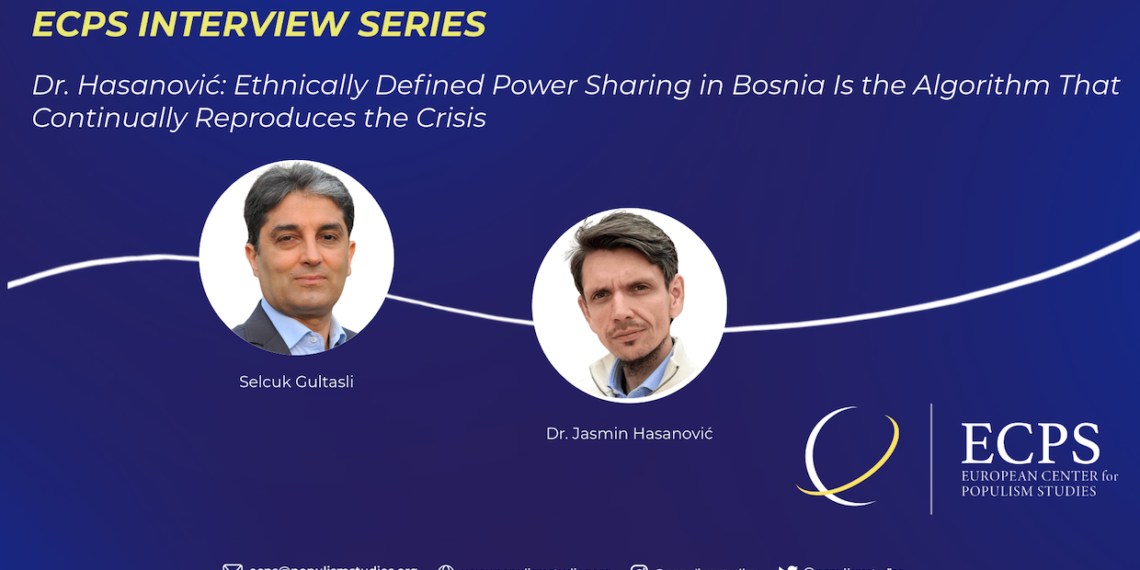
In this ECPS interview, Dr. Jasmin Hasanović analyzes Bosnia and Herzegovina’s October 4 elections through the lens of inter-, intra-, and cross-ethnic populism. He argues that the post-Dayton order continues to structure political competition around ethnically segmented constituencies, allowing parties to present themselves not merely as representatives but as protectors of threatened communities. This dynamic, he contends, helps explain why political change often fails to produce systemic transformation: institutional safeguards become “political currency,” while blockades and recurring crises reproduce the same underlying logic. As Dr. Hasanović puts it, “the algorithm that continually reproduces the crisis” is ethnically defined power sharing. The interview also explores the limits of civic alternatives, the weakness of cross-ethnic mobilization, and the prospects for a credible democratic left.
Interview by Selcuk Gultasli
Bosnia and Herzegovina’s October 4 elections combined an important procedural innovation with striking political continuity. Biometric voter identification strengthened the integrity of the electoral process, yet turnout fell to around 42 percent, while the country’s major ethnonational parties remained dominant within their respective constituencies. SNSD consolidated its position in Republika Srpska, SDA retained substantial strength among Bosniak voters despite Bakir Izetbegović’s defeat in the presidency contest, and HDZ BiH secured the Croat seat in the state presidency. These outcomes provide the immediate backdrop to our conversation with Dr. Jasmin Hasanović, Assistant Professor of Political Science at the University of Sarajevo, about populism, ethnopolitics, democratic representation, and the structural legacies of the Dayton order.
At the center of Dr. Hasanović’s analysis is the argument that Bosnia’s political crises cannot be understood simply as the product of particular leaders or parties. Rather, they are embedded in a system in which ethnicity has become “a central organizing principle, not only in politics, but also in public and social life.” Electoral competition, he argues, operates largely through ethnically segmented party systems, while the populist construction of “the people” takes place between, within, and across ethnic communities. The October 4 elections, in his view, therefore illustrate “a continued dominance of inter-ethnic politics,” even as significant intra-ethnic competition persists, and cross-ethnic alternatives remain comparatively weak.
The interview’s central argument is captured most sharply in Dr. Hasanović’s assessment of the Dayton system itself. The power-sharing architecture, he argues, has tied access to power to ethnic representation in ways that make it politically rewarding for leaders to present themselves as “protectors, not only representatives, of their communities.” Institutional safeguards can consequently become “political currency,” while blockades and crises are repeatedly reproduced. As he puts it, replacing a governing party or overcoming a single institutional blockade does not alter “the algorithm that continually reproduces the crisis.” That algorithm, he concludes, “is ethnically defined power sharing.”
This structural perspective also helps explain why political change so often fails to become systemic change. In Republika Srpska, opposition to SNSD may challenge corruption or personalized rule without challenging the underlying ethnonational framework. Among Bosniaks, party pluralism can itself be portrayed as weakness when Serb and Croat political blocs appear more consolidated. And even when citizens share grievances over corruption, unemployment, inequality, public services, or institutional failure, Dr. Hasanović warns that “having the same problems does not produce a shared political identity.”
The interview therefore moves beyond the question of who won or lost on October 4. It asks whether Bosnia can generate a political subjectivity capable of transcending ethnic exclusivity—and whether democratic, socioeconomic, and civic demands can eventually reshape a system whose institutional logic continues to reproduce the very divisions it was designed to manage.