Panel 4 of ECPS Fifth Annual International Symposium examined democratic backsliding as a globally connected yet regionally differentiated phenomenon. Moderated by Professor Reinhard Heinisch, the session brought together comparative insights from Turkey, the United States, South Korea, East Asia, and Latin America. Professor Henri J. Barkey analyzed how personalistic leadership, institutional capture, and politicized law enable authoritarian consolidation in the cases of Trump and Erdoğan. Professor Hannes Mosler challenged the routine application of “populism” to East Asia, arguing that South Korea’s democratic erosion is better understood through far-right mobilization, historical revisionism, anti-feminism, and transnational networks. Professor María Esperanza-Casullo explored Latin American right-wing populism through narratives of grievance, hyper-masculinity, cultural antagonism, and elite collaboration, highlighting the need for conceptually precise and regionally sensitive democratic responses.
Reported by ECPS Staff
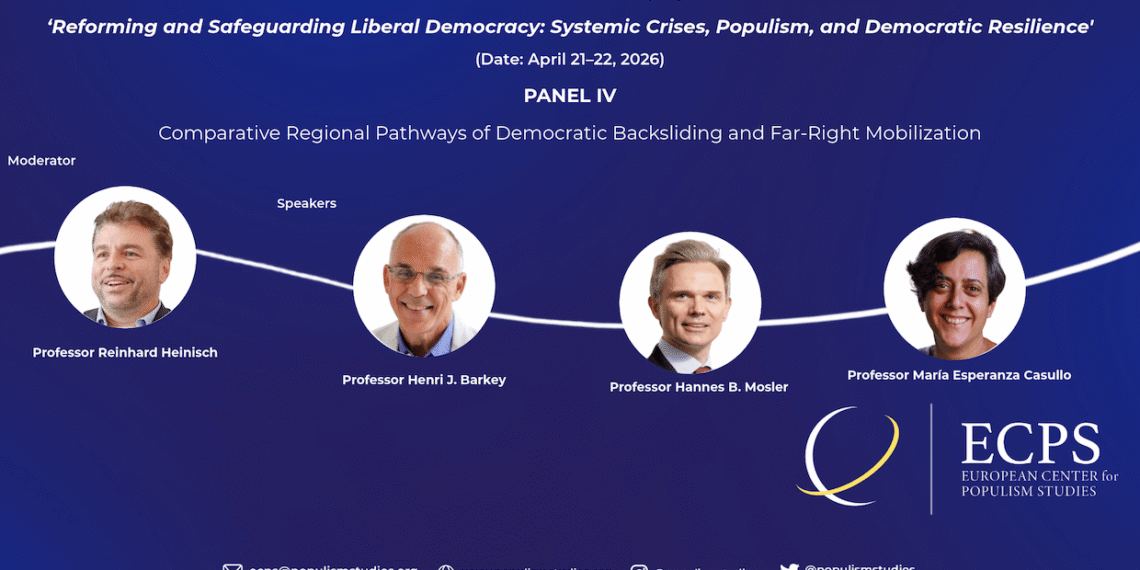
Panel 4 of the ECPS Fifth Annual International Symposium, “Reforming and Safeguarding Liberal Democracy: Systemic Crises, Populism, and Democratic Resilience,” convened on April 22, 2026, under the title “Comparative Regional Pathways of Democratic Backsliding and Far-Right Mobilization.” Moderated by Professor Reinhard Heinisch, Professor of Comparative Austrian Politics at the University of Salzburg, the panel examined how democratic backsliding and far-right mobilization unfold across distinct regional contexts, while also interrogating the conceptual vocabularies through which these phenomena are analyzed.
Professor Heinisch framed the panel around a central comparative premise: while democratic backsliding appears as a broadly shared global trend, its manifestations differ significantly across regions. He emphasized that regional variation concerns not only what is empirically observed, but also how scholars conceptualize and interpret developments such as populism, far-right politics, authoritarianism, and democratic erosion. His moderation therefore situated the panel as both an empirical and conceptual inquiry into the regional pathways through which democratic systems come under pressure.
The panel brought together distinguished scholars working on different geographical and theoretical terrains. Professor Henri J. Barkey, Cohen Professor of International Relations Emeritus at Lehigh University, opened with “Building an Authoritarian Edifice Step-By-Step,” offering a comparative analysis of Donald Trump and Recep Tayyip Erdoğan. Professor Barkey explored how personalistic leadership, institutional capture, attacks on expertise, and the politicization of law contribute to the gradual construction of authoritarian power.
Professor Hannes B. Mosler, Professor at Universität Duisburg-Essen’s Institute of Political Science and affiliated with the Institute of East Asian Studies (IN-EAST), shifted the focus to East Asia in “Populism and Transnational Ties of the Far Right in East Asia: Recent Developments in South Korea.” Professor Mosler questioned the applicability of populism as an analytical category in East Asia and argued that South Korea’s democratic challenges are better understood through the lens of far-right mobilization, historical revisionism, anti-feminism, and transnational ideological circulation.
Professor María Esperanza Casullo, Professor at the Institute of Political Science, Faculty of History, Geography and Political Science, Pontifical Catholic University of Chile, concluded with “Populist Narratives and Democratic Backsliding: Perspectives from Latin America.” Professor Esperanza-Casullo examined contemporary Latin American right-wing populism through the concept of the populist myth, highlighting narratives of grievance, cultural antagonism, hyper-masculinity, and elite collaboration.
Together, the panel offered a comparative account of democratic erosion as a globally connected but regionally differentiated phenomenon, underscoring the need for precise concepts, contextual analysis, and transnational democratic responses.