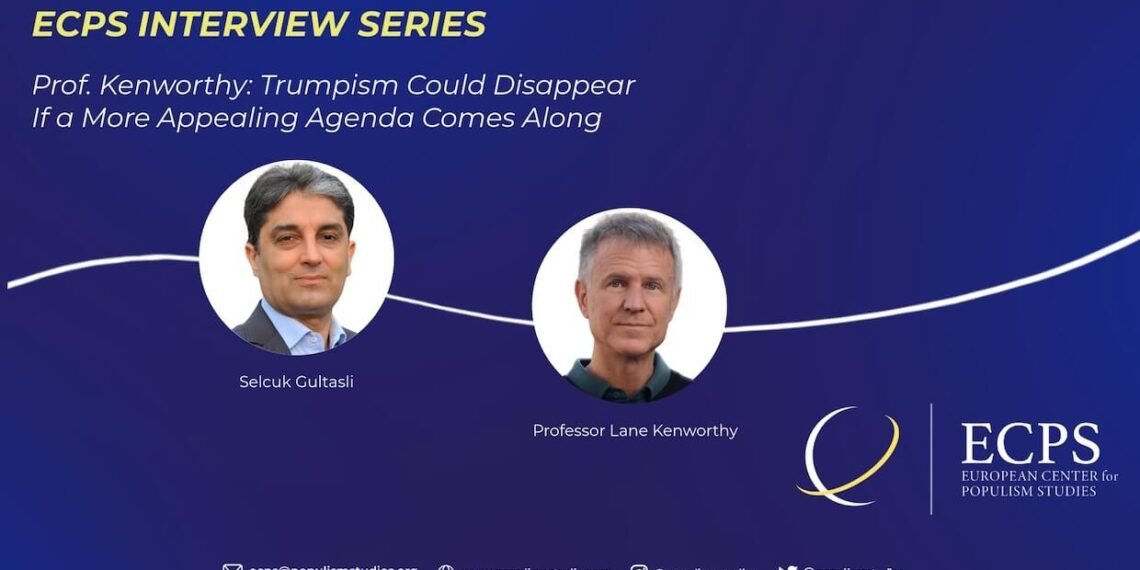
Ahead of the 2026 US midterms, Professor Lane Kenworthy argues that Trumpism’s apparent dominance should not be mistaken for permanence. Although the Republican Party has acquired “an entirely new identity,” he stresses that this “could easily change after Trump,” especially if a more appealing political agenda emerges. Professor Kenworthy places MAGA within a longer cycle of ideological realignment, cultural backlash, and generational change, while cautioning against reading election outcomes as durable historical trends. He is equally skeptical that rising billionaire influence necessarily amounts to a new plutocratic order. Instead, he points toward Nordic-style social democratic capitalism—combining markets, public provision, economic security, and liberal democracy—as a more promising long-term model. Politically, however, he reduces the path forward to a simple proposition: “Democrats need to win elections.”
Interview by Selcuk Gultasli
Ahead of the 2026 US midterm elections, the durability of Trumpism—and the political future of the Republican Party after Donald Trump—has become one of the central questions confronting American democracy. In an interview with the European Center for Populism Studies (ECPS), Professor Lane Kenworthy, Distinguished Professor of Sociology and Yankelovich Chair in Social Thought at the University of California, San Diego, argues that the institutionalization of Trumpism should not be taken for granted. His scholarship on inequality, social policy, political economy, and shared prosperity provides the broader framework for a conversation that ranges from MAGA and executive power to plutocratic influence, democratic socialism, and the prospects for social democratic capitalism in the United States.
Professor Kenworthy cautions against interpreting the current Republican transformation as necessarily permanent. Reflecting on the rapid succession from George W. Bush’s “compassionate conservatism” to the Tea Party and then to Trumpism, he stresses how unusually vulnerable the two major American parties are to sudden ideological takeover. “The two major American political parties are so weak, so hollow,” he observes, adding that they are “unusually susceptible to takeover in unpredictable ways.” Although the Republican Party has acquired “an entirely new identity” after a decade of Trump’s dominance, Professor Kenworthy emphasizes that “that could easily change after Trump.”
This uncertainty is even more pronounced when considering whether MAGA can survive its founder. Professor Kenworthy notes the “extraordinary passion” Trump supporters display toward him, but remains skeptical that this necessarily translates into a deeply rooted and durable ideological project. Historical precedents suggest caution: political agendas that once appeared dominant—Bush-era conservatism or the Tea Party—evaporated far more quickly than expected. J.D. Vance and others may attempt to preserve Trumpism, he argues, but its future will depend on whether the movement’s ideological commitments are genuinely deep or merely contingent. “It’s quite possible that it could disappear very easily,” Professor Kenworthy says, “if somebody with a more appealing agenda and a more appealing election campaign comes along.”
Professor Kenworthy also situates Trumpism within a longer cultural transformation. Drawing on the Inglehart-Norris thesis, he suggests that MAGA relies heavily on cultural traditionalists whose relative weight may decline through generational replacement. If that argument is correct, Trumpism “maybe survives another couple of election cycles, but after that, it could simply disappear.”
The interview ultimately places the 2026 midterms within a wider debate over American political economy. Professor Kenworthy questions both alarmist assumptions about an inevitable plutocracy and claims that democratic socialism offers a fundamentally different policy model. Instead, he repeatedly returns to the Nordic-inspired social democratic capitalism he has long advocated: combining markets with strong public provision, economic security, and liberal-democratic institutions. For Professor Kenworthy, the most plausible path toward that model remains politically straightforward, even if institutionally difficult: “Democrats need to win elections.”