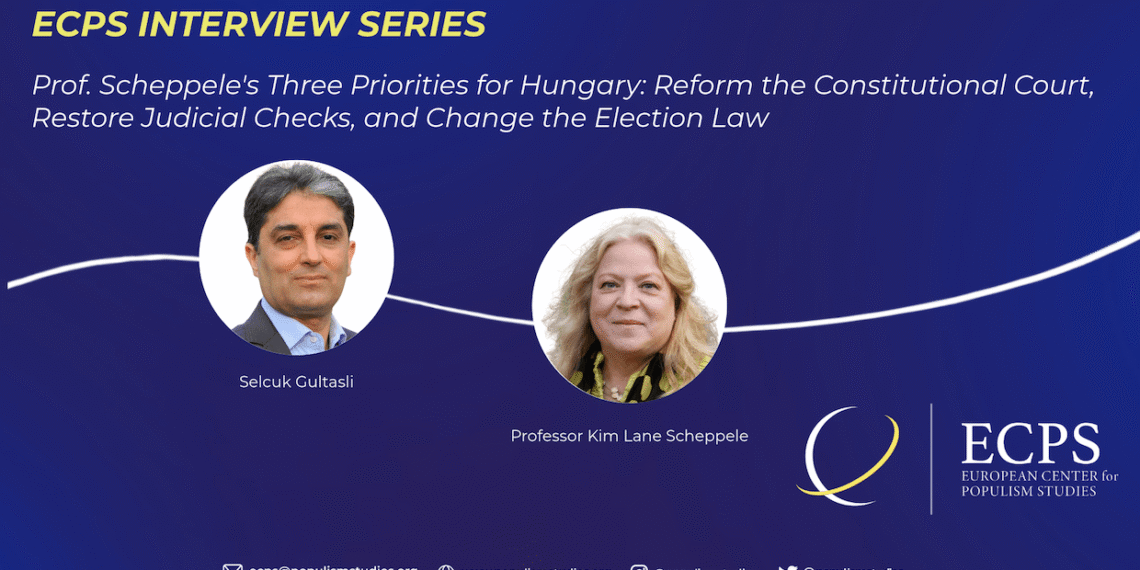
Hungary’s democratic transition has entered a decisive new phase following Péter Magyar’s electoral victory, but, as Professor Kim Lane Scheppele argues, defeating an autocrat is only the beginning of democratic restoration. In this timely interview, Professor Scheppele examines the constitutional dilemmas confronting Hungary’s new leadership: dismantling autocratic legalism without reproducing it, restoring judicial independence, ensuring accountability without political revenge, and rebuilding institutions capable of sustaining genuine democratic competition. Drawing broader lessons for democracies facing executive aggrandizement, she contends that successful democratic recovery requires more than electoral change. Hungary’s experience, she argues, may become a comparative model for constitutional reconstruction—provided that democratic reformers succeed in limiting their own power while rebuilding the institutional foundations of liberal constitutional democracy.
Interview by Selcuk Gultasli
For more than a decade, Hungary has occupied a central place in comparative debates on democratic backsliding, constitutional capture, and the rise of legalistic authoritarianism. Under Viktor Orbán, the country became the paradigmatic example of how elected leaders could gradually dismantle liberal democracy not by suspending constitutional order but by systematically reshaping it from within. Through constitutional amendments, judicial restructuring, electoral engineering, and the concentration of executive authority, Hungary demonstrated that democratic erosion in the twenty-first century increasingly proceeds through law rather than outside it. Yet the electoral defeat of Orbán has fundamentally transformed the scholarly conversation. The central question is no longer how democracies decay, but whether they can be successfully rebuilt once authoritarian legal structures have become deeply institutionalized.
In this wide-ranging interview with the European Center for Populism Studies (ECPS), Professor Kim Lane Scheppele, the Laurance S. Rockefeller Professor of Sociology and International Affairs at Princeton University, examines one of the most consequential constitutional experiments currently unfolding in Europe: Hungary’s attempt to move from autocratic rule toward democratic restoration. Drawing upon decades of research on constitutionalism, judicial independence, autocratic legalism, and democratic resilience, Professor Scheppele argues that Hungary may now become not only the world’s foremost laboratory of democratic backsliding but also an unprecedented laboratory of democratic recovery.
Throughout the interview, Professor Scheppele repeatedly distinguishes democratic restoration from ordinary democratic transition. Electoral victory, she insists, represents only the first step. As she memorably observes, "The real test of democracy is not the first election—but the next one." The ultimate challenge is whether a new democratic government can dismantle institutions deliberately designed to prevent future political alternation while simultaneously avoiding the temptation to reproduce concentrated executive power.
One of the interview’s central contributions concerns what Professor Scheppele describes as the paradox of autocratic legality. Because Orbán entrenched political domination through constitutional and legal mechanisms, democratic reformers may confront situations in which "when law entrenches autocracy, following it may preserve the regime." This raises profound constitutional dilemmas concerning judicial reform, constitutional replacement, accountability, and the relationship between legality and democratic legitimacy.
Professor Scheppele also explores the practical architecture of democratic reconstruction. She argues that "power must be limited even during democratic restoration," advocates a constitutional process in which "the rules of the game" are democratically rewritten, and proposes a broader understanding of the rule of law rooted in European constitutional standards rather than exclusively in national legal continuity. Her discussion of judicial reconstruction, constitutional redesign, and transnational legal constraints offers an important comparative framework extending well beyond Hungary.
Perhaps most significantly, Professor Scheppele identifies the political conditions that made democratic change possible. Hungary’s experience demonstrates, she argues, that successful democratic opposition must "fight corruption, build a big tent, and take people out of fear."
Looking ahead, she concludes that the durability of democratic recovery will depend upon three immediate institutional priorities: reforming the Constitutional Court, restoring meaningful judicial checks, and redesigning the electoral system. Whether Hungary succeeds or fails, she suggests, will shape how democracies around the world think about rebuilding constitutional government after authoritarian capture.