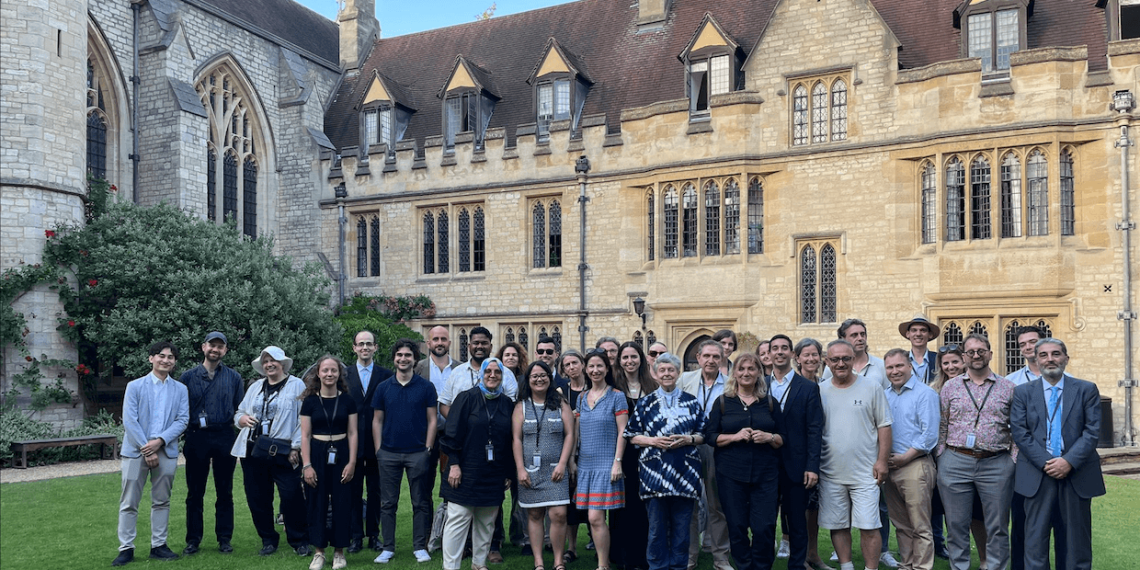
This collection assembles the reports and full video recordings of the 28-session ECPS Workshop Series, integrating the Oxford in-person programme (July 1–3, 2025) with its extended virtual continuation (September 2025–April 2026). Together, these sessions offer a sustained interdisciplinary inquiry into the political and normative complexities of invoking “the people” in contemporary democratic life, with populism as a central analytical lens. Across diverse cases and theoretical perspectives, the series examines how populism both reflects democratic grievances and actively reshapes institutional and symbolic orders. By tracing themes such as representation, identity, legitimacy, and technological transformation, the collection provides a comparative and analytically rigorous account of democracy under strain, while highlighting the conditions under which democratic resilience may still emerge.
Compiled by ECPS Staff
This collection brings together the reports and full video recordings of the sixteen-session ECPS Virtual Workshop Series, “We, the People” and the Future of Democracy: Interdisciplinary Approaches, convened between September 4, 2025 and April 16, 2026. The series constitutes a direct continuation and intellectual expansion of the three-day, eight-session in-person programme held at St. Cross College, University of Oxford, on July 1–3, 2025. Together, these interconnected formats form a sustained scholarly intervention into one of the defining political questions of our time: the meaning, mobilization, and consequences of invoking “the people” in contemporary democratic life.
The Oxford gathering established the conceptual and normative foundations of this inquiry. Set against the sobering reality that between 2012 and 2024 one-fifth of the world’s democracies disappeared, participants explored how populist discourse—often structured through stark “us versus them” binaries—has reshaped political competition, eroded institutional trust, and strained the pluralistic fabric of liberal democracies. At the same time, the discussions underscored that democracy’s trajectory is neither uniformly declining nor predetermined. Across contexts, democratic resilience continues to emerge, often through the same contested language of “the people” that fuels its erosion.
The subsequent virtual programme extended this dialogue across sixteen bi-weekly sessions, enabling a broader, more sustained, and globally inclusive exchange. Bringing together scholars from political science, law, sociology, history, philosophy, and the arts, the series examined how “the people” is constructed, institutionalized, and contested across diverse political and cultural settings. From populist authoritarianism and crises of representation to religion, identity, digital transformation, and decolonial perspectives, the sessions traced the multiple trajectories through which populism operates—as both a symptom of democratic strain and a force capable of reshaping democratic norms and institutions.
A central thread running throughout the series is the dual character of “the people” as both a normative ideal and a political instrument. While it can serve as a basis for democratic inclusion, participation, and renewal, it can equally function as a mechanism of exclusion, homogenization, and majoritarian domination. Understanding the conditions under which these divergent outcomes unfold requires precisely the kind of interdisciplinary and comparative engagement that this programme has sought to cultivate.
By presenting the reports alongside the full recordings, this collection invites readers and viewers to revisit, engage with, and critically reflect upon the rich discussions that unfolded over the course of both the Oxford conference and its virtual continuation. In doing so, it offers not closure, but an ongoing invitation to interrogate the evolving relationship between populism, representation, and the future of democracy in the twenty-first century.
Click Here to Explore the Reports and Video Recordings of the 12-Session In-Person Workshop at Oxford University
Reports and Video Recordings of the 16-Session Virtual Workshop Series
Session 1: The Rise of Populist Authoritarianism around the World
The ECPS, in collaboration with Oxford University, launched its Virtual Workshop Series on “The Rise of Populist Authoritarianism around the World” on September 4, 2025. Spanning 16 sessions through April 2026, the series examines how populist strategies reshape democracy across diverse contexts. Chaired by Professor Oscar Mazzoleni, the opening session featured Professor David Sanders’ keynote on six structural drivers fueling populism and its growing threats to liberal democracy. Case studies explored populist dynamics in the US, India, Greece, Thailand, and Argentina, highlighting intersections of dynasties, corporate power, elite cues, and economic crises. Discussant Dr. João Ferreira Dias emphasized three takeaways: populism as performance, polarization over persuasion, and the enduring impact of national political cultures.
Session 2: The ‘Nation’ or Just an ‘Accidental Society’: Identity, Polarization, Rule of Law and Human Rights in 1989–2025 Poland
On September 18, 2025, ECPS held the second session of the Virtual Workshop Series — “We, the People” and the Future of Democracy. Chaired by Professor Mavis Maclean (Oxford), the panel examined Poland’s democratic trajectory through themes of patriotism, constitutional conflict, human rights, and representation. Highlights included Professor Joanna Kurczewska’s call to recover Solidarity’s inclusive legacy, Dr. Kamil Joński’s analysis of Poland’s constitutional “quagmire,” Professor Małgorzata Fuszara’s exploration of contested women’s and minority rights, and Professor Jacek Kurczewski’s reframing of judicial representation. Discussants added comparative and moral-philosophical perspectives. The session concluded that Poland’s experience reflects global struggles: reclaiming inclusive traditions, defending institutions, and embedding rights remain vital for democratic renewal.
Session 3: Populism, Freedom of Religion and Illiberal Regimes
On October 2, 2025, the ECPS, in collaboration with Oxford University, held the third session of its Virtual Workshop Series, “We, the People” and the Future of Democracy: Interdisciplinary Approaches. Chaired by Dr. Marietta D.C. van der Tol, the session examined how populist and illiberal actors across Hungary, Slovakia, and the United States instrumentalize the language of religious freedom to consolidate power and reshape national identity. Presentations by Dr. Marc Loustau, Dr. Juraj Buzalka, and Rev. Dr. Colin Bossen, followed by reflections from Dr. Simon P. Watmough and Dr. Erkan Toguslu, revealed how religion, once central to pluralism, is increasingly politicized as a weapon in culture wars and transnational illiberal strategies.
Session 4: Performing the People — Populism, Nativism, and the Politics of Belonging
On October 16, 2025, the ECPS held the fourth session of its Virtual Workshop Series “We, the People” and the Future of Democracy: Interdisciplinary Approaches.” The session examined how political actors construct and mobilize “the people” to legitimize both inclusive and exclusionary political projects. Chaired by Professor Oscar Mazzoleni, the session featured presentations by Samuel Ngozi Agu, Shiveshwar Kundu, and Mouli Bentman & Michael Dahan, each exploring different regional and theoretical perspectives. Abdelaaziz El Bakkali and Azize Sargın provided incisive discussant feedback, followed by a lively Q&A. Concluding reflections by Prof. Mazzoleni emphasized populism’s dual nature as both a political strategy and a symptom of structural democratic crises, setting the stage for future interdisciplinary debate.
Session 5: Constructing the People — Populist Narratives, National Identity, and Democratic Tensions
Session 5 of the ECPS–Oxford Virtual Workshop Series examined how populist movements across different regions construct “the people” as both an inclusive democratic ideal and an exclusionary political weapon. Moderated by Dr. Heidi Hart, the session featured presentations by Dr. Amir Ali, Dr. Yazdan Keikhosrou Doulatyari, and Andrei Gheorghe, who analyzed populism’s intersections with austerity politics, linguistic identity, and post-communist nationalism. Their comparative insights revealed that populism redefines belonging through economic moralization, linguistic appropriation, and historical myth-making, transforming pluralist notions of democracy into performative narratives of unity and control. The ensuing discussion emphasized populism’s adaptive power to manipulate emotion, memory, and discourse across diverse democratic contexts.
Session 6: Populism and the Crisis of Representation –Reimagining Democracy in Theory and Practice
On November 13, 2025, the ECPS, in collaboration with Oxford University, held the sixth session of its Virtual Workshop Series, “We, the People” and the Future of Democracy: Interdisciplinary Approaches. Under the skillful moderation of Professor Ilhan Kaya (Wilfrid Laurier University, Canada), the session featured Dr. Jonathan Madison, Dr. João Mauro Gomes Vieira de Carvalho, and Associate Professor Andreea Zamfira, who examined how populism both mirrors and magnifies democracy’s crisis of representation. Their analyses, complemented by insightful discussant interventions from Dr. Amir Ali and Dr. Amedeo Varriale, generated a vibrant dialogue on institutional resilience, digital disruption, and the reconfiguration of democratic legitimacy in an age of populist contention.
Session 7: Rethinking Representation in an Age of Populism
Session 7 of the ECPS Virtual Workshop Series offered a compelling interdisciplinary examination of how contemporary populism unsettles the foundations of democratic representation. Bringing together insights from digital politics, the history of political thought, and critical social theory, the session illuminated the multiple arenas—affective, constitutional, and epistemic—through which representation is being reconfigured. Dr. Gabriel Bayarri Toscano revealed how memetic communication and generative AI reshape political identities and moral boundaries within far-right movements. Maria Giorgia Caraceni traced these dynamics to enduring tensions within the conceptual history of popular sovereignty, while Elif Başak Ürdem demonstrated how neoliberal meritocracy generates misrecognition and drives grievances toward populist articulation. Collectively, the session highlighted the necessity of integrated, cross-disciplinary approaches for understanding the evolving crisis of democratic representation.
Session 8: Fractured Democracies — Rhetoric, Repression, and the Populist Turn
On December 11, 2025, the ECPS convened Session 8 of its Virtual Workshop Series under the theme “Fractured Democracies: Rhetoric, Repression, and the Populist Turn.” Chaired by Dr. Azize Sargin, the session examined how contemporary populism reshapes democratic politics through affect, moral narratives, and strategic communication. Assoc. Prof. Paul Joosse explored charismatic populism, focusing on suffering, moral inversion, and ritualized transgression in Trumpism, while Artem Turenko analyzed the evolving rhetoric of AfD across the 2019 and 2024 European Parliament elections. Discussants Dr. Helena Rovamo and Dr. Jonathan Madison offered critical reflections on theory, methodology, and causality. A lively Q&A further addressed economic grievance, cultural representation, and the politics of knowledge production, underscoring the session’s interdisciplinary depth and relevance.
Session 9: Populism, Crime, and the Politics of Exclusion
On January 8, 2026, ECPS convened Session 9 of its Virtual Workshop Series, titled “Populism, Crime, and the Politics of Exclusion.” The session was chaired and moderated by Dr. Helen L. Murphey, who framed exclusionary populism as a dual process that claims to empower an “authentic people” while simultaneously criminalizing stigmatized “others.” Assoc. Prof. Christopher N. Magno introduced the concept of criminal populism, showing how legal scandal and criminality can be transformed into political capital in the United States and the Philippines. Dr. Russell Foster examined how Austria’s FPÖ and France’s Rassemblement National legitimate anti-migration agendas through securitization and Gramscian metapolitics. Saga Oskarson Kindstrand drew on ethnographic research on the Sweden Democrats to challenge assumptions that populism undermines party organization. Discussants Hannah Geddes and Vlad Surdea-Hernea provided incisive reflections on theory, methodology, and democratic implications.
Session 10 — Resisting the Decline: Democratic Resilience in Authoritarian Times
ECPS convened Session 10 of its Virtual Workshop Series on January 22, 2026, bringing together scholars to examine how democracies endure, adapt, and contest authoritarian pressures amid the normalization of populist discourse and the weakening of liberal-constitutional safeguards. Chaired by Dr. Amedeo Varriale, the session framed resilience as an active democratic project—defending rule of law, pluralism, and civic participation against gradual forms of authoritarian hollowing-out. Presentations by Dr. Peter Rogers, Dr. Pierre Camus, Dr. Soheila Shahriari, and Ecem Nazlı Üçok explored resilience across market democracies, local governance, feminist self-administration in Rojava, and diaspora activism confronting anti-gender politics. Discussants Dr. Gwenaëlle Bauvois and Dr. Gabriel Bayarri Toscano connected these contributions through probing questions on the ambivalence, burdens, and transformative potential of resilience.
Session 11: Inclusion or Illusion? Narratives of Belonging, Trust, and Democracy in a Polarized Era
Session 11 of the ECPS Virtual Workshop Series, convened On Thursday, February 5, 2026, examined the tension between democratic inclusion as a normative promise and inclusion as an everyday institutional practice. Bringing together interdisciplinary perspectives, the panel explored how belonging is constructed, experienced, and contested across administrative, participatory, historical, and theoretical domains. Contributions highlighted how exclusion often operates through subtle mechanisms—bureaucratic encounters, identity-based narratives, digital mobilization, and post-revolutionary boundary drawing—rather than overt denial. Across cases from the United States, Sub-Saharan Africa, Iran, and liberal democracies more broadly, the session underscored that democratic legitimacy today depends on both representation and effective, fair governance. Collectively, the discussions illuminated why gaps between democratic ideals and lived experiences continue to fuel distrust, polarization, and populist mobilization.
Session 12: Decolonizing Democracy — Governance, Identity, and Resistance in the Global South
Session 12 of the ECPS Virtual Workshop Series explored on On Thursday, February 19, 2026, how “decolonizing democracy” requires attention to the material and symbolic structures shaping participation, legitimacy, and representation. The presentations framed democracy not as a settled institutional model but as a contested field shaped by colonial legacies, extractive political economies, and identity-based struggles over inclusion and authority. Dr. Oludele Mayowa Solaja’s comparative study of Nigeria and the United Kingdom showed how environmental governance can produce “participation without power,” where formal inclusion coexists with persistent injustice. Dr. Salomon Essaga Eteme’s analysis of Cameroon highlighted how pluralism has intensified communal claims to state ownership, complicating political alternation. Supported by Dr. Gabriel Cyril Nguijoi’s feedback, the session underscored the value of concepts such as biocultural sovereignty and communocratic populism and emphasized the need for context-sensitive, interdisciplinary approaches to democratic renewal in the Global South.
Session 13: Constructing and Deconstructing the People in Theory and Praxis
Convened on On Thursday, March 5, 2026, Session 13 of the ECPS Virtual Workshop Series examined how “the people” are constructed, contested, and institutionalized across diverse political arenas. Chaired by Dr. Leila Alieva (Oxford School for Global and Area Studies), the panel brought together interdisciplinary perspectives on populism, democratic participation, and representation. Assistant Professor Jasmin Hasanović analyzed the ethnic dynamics of populist subject formation in Bosnia and Herzegovina’s post-Dayton political order. Dr. Sixtine Van Outryve explored how participants in France’s Yellow Vests movement sought to institutionalize grassroots assembly-based democracy. Nieves Fernanda Cancela Sánchez examined the exclusion of stateless and marginalized communities from international diplomacy, arguing for a “right to diplomacy.” Together, the contributions illuminated the evolving and contested meaning of “the people” in contemporary democratic politics.
Session 14: From Bots to Ballots — AI, Populism, and the Future of Democratic Participation
On March 19, 2026, session 14 of the ECPS Virtual Workshop Series examined, how artificial intelligence, algorithmic infrastructures, and digital platforms are reshaping democratic participation in the contemporary era. Bringing together perspectives from political science, communication, cultural heritage, and democratic theory, the panel explored the implications of AI for political legitimacy, collective identity, and the future of “the people” in an increasingly post-digital world. Contributions ranged from public attitudes toward algorithmic governance and the role of ChatGPT in shaping cultural memory to Big Tech’s influence on class consciousness and the fragmentation of digital publics. Together, the presentations and discussions showed that AI is no longer external to democracy, but increasingly constitutive of its communicative, institutional, and symbolic foundations—raising urgent questions about power, accountability, and democratic contestation.
Session 15 — From Populism to Global Power Plays: Leadership, Crisis, and Democracy
On Thursday, April 2, 2026, Session 15 of the ECPS Virtual Workshop Series offered a timely and theoretically rich interrogation of how populism, personalized leadership, and systemic crisis are reshaping the horizons of democratic politics. Bringing cybernetics, political sociology, and democratic theory into productive dialogue, the session illuminated the deep entanglement between emotional mobilization, institutional fragility, and global governance under conditions of accelerating complexity. Dr. Robert R. Traill’s systems-theoretical analysis of “populist panic” and Professor Lorenzo Viviani’s political-sociological account of “manipulated resonance” together revealed populism not as a peripheral disruption, but as a central mode through which legitimacy, leadership, and “the people” are being redefined today. Enriched by incisive discussant interventions and a conceptually fertile Q&A, the session underscored the need for new democratic vocabularies capable of confronting both exclusionary affect and global instability.
Session 16: Voices of Democracy — Art, Law, and Leadership in the Era of Polarization
The final session of the ECPS Virtual Workshop Series offered on April 16, 2026, a rich interdisciplinary reflection on democracy under conditions of deepening polarization. Bringing together legal, historical, and political perspectives, the panel illuminated how “the people” is constructed, contested, and mobilized across different contexts—from defamation law in the United States to institutional legitimacy in Israel, classical rhetoric in Athens, and emotional narratives in contemporary European populism. A central insight concerned the interplay of law, emotion, and symbolic representation in shaping democratic resilience and vulnerability. By foregrounding the cultural and affective dimensions of politics, the session underscored that democracy is not only institutional but deeply interpretive—sustained, challenged, and reimagined through competing narratives of identity, legitimacy, and belonging.