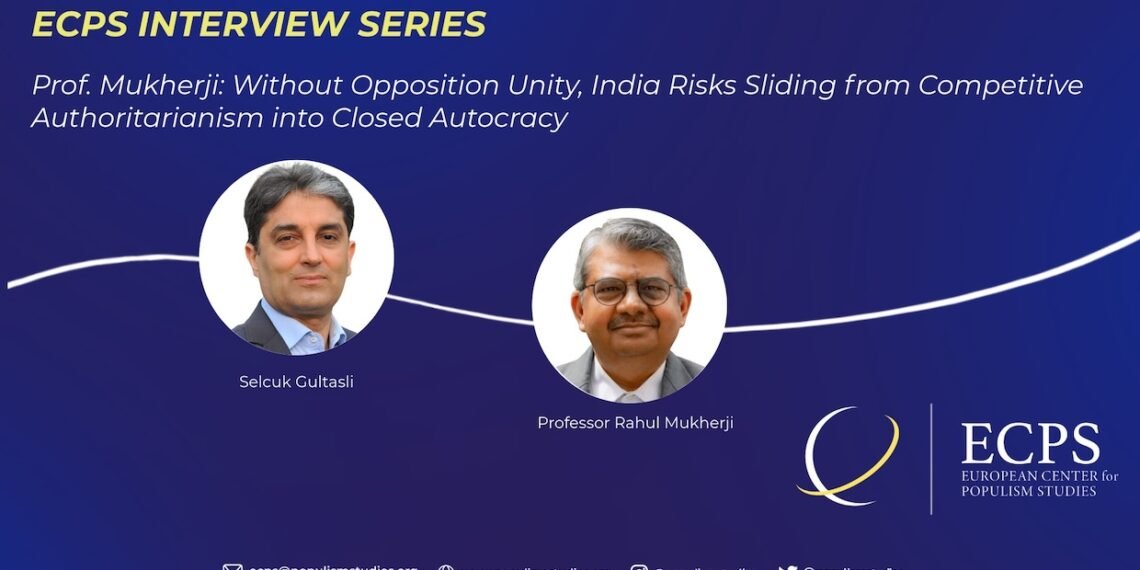
In an interview with the ECPS, Professor Rahul Mukherji, Chair of Modern Politics of South Asia at Heidelberg University, warns that India risks sliding from competitive authoritarianism into closed autocracy unless opposition forces achieve meaningful unity. Examining Narendra Modi’s Hindu majoritarian project, institutional erosion, electoral manipulation, and restrictions on civil society, Professor Mukherji argues that democratic resilience remains possible despite intensifying authoritarian tendencies. Drawing on Karnataka’s electoral experience and emerging youth-led protests, he identifies four priorities for democratic recovery: ideological differentiation from Hindu nationalism, effective factional management, electoral coalition-building, and sustained cooperation between political parties and grassroots movements. Without such coordination, he cautions, India’s transition toward closed autocracy could make democratic restoration considerably more difficult.
Interview by Selcuk Gultasli*
India is confronting intensifying tensions between Prime Minister Narendra Modi’s majoritarian political project and growing demands for democratic accountability. Hindutva-driven polarization, executive centralization, and restrictions on civil society continue to raise concerns about authoritarian consolidation. Meanwhile, youth-led Cockroach Janta Party (CJP) protests over examination irregularities, unemployment, and controversial electoral-roll revisions have brought institutional legitimacy and political exclusion into sharper focus. These developments raise fundamental questions about the resilience of Indian democracy and the possibilities for organized resistance.
In this wide-ranging interview with the European Center for Populism Studies (ECPS), Professor Rahul Mukherji, Chair of Modern Politics of South Asia at Heidelberg University and former Managing Director of its South Asia Institute, examines India’s democratic trajectory under Modi, highlighting both the institutional mechanisms of authoritarian consolidation and the political conditions necessary for democratic recovery.
Professor Mukherji characterizes India as a competitive authoritarian regime whose defining feature is its “Janus-faced nature,” in which “Competitive characteristics of liberal democracy coexist with autocratizing tendencies.” Although the Bharatiya Janata Party’s (BJP) failure to secure an outright parliamentary majority in 2024 demonstrated the continuing possibility of democratic resistance, he warns that authoritarian tendencies have subsequently intensified, particularly through controversial electoral-roll revisions and growing political influence over electoral administration.
Beyond institutional erosion, Professor Mukherji identifies a deeper ideological transformation underway. Modi’s political project, he argues, represents “an effort to institutionalize Hindu majoritarian dominance,” potentially paving the way for a fundamental redefinition of India’s secular constitutional identity. Religious polarization, restrictions on minority rights, and the disciplining of independent civil society organizations illustrate how majoritarian politics increasingly penetrates state institutions and society.
Yet democratic resilience remains possible. Drawing on Karnataka’s electoral experience and emerging youth-led mobilization, Professor Mukherji emphasizes the importance of cooperation between opposition parties and autonomous social movements. He identifies four indispensable priorities: ideological differentiation from Hindu nationalism, effective factional management, strategic electoral coalition-building, and the integration of progressive political parties with grassroots civic mobilization.
The fourth priority is particularly significant: “How effectively can powerful, progressive political parties—parties that are counter-majoritarian—become embedded in social movements on the ground?” For Professor Mukherji, opposition coordination must extend beyond electoral arithmetic to sustained societal engagement.
His concluding warning captures the stakes of India’s democratic struggle: “The alternative is that India moves from being a competitive authoritarian regime to becoming a closed autocracy.” Once that threshold is crossed, he cautions, “bouncing back becomes far more difficult.”
In sum, the interview presents India’s democratic future as an open but increasingly consequential contest between authoritarian institutionalization and the capacity of opposition forces to construct a credible, coordinated, and socially rooted democratic alternative.