In this wide-ranging interview with ECPS, Professor Tariq Modood calls for the creation of a “multiculturalist international” to counter the rise of far-right transnational networks and exclusionary nationalisms. Highlighting the dangers posed by xenophobia, Islamophobia, and authoritarian populism across Europe and beyond, Professor Modood argues that multiculturalism is “not simply a reaction to populism… it is a positive vision” that affirms shared citizenship while respecting diversity. He contrasts his model of “moderate secularism” with French laïcité and Hindu nationalist secularism, emphasizing inclusivity and equality. Brexit, he notes, weakened the EU’s capacity for multicultural integration: “We need to create a multiculturalist alliance across countries, in the way that the far right is creating its own transnational network.”
In an era marked by the transnational rise of far-right populism, exclusionary nationalism, and algorithmically amplified xenophobia, Professor Tariq Modood, the founding Director of the Bristol University Research Centre for the Study of Ethnicity and Citizenship, offers a deeply considered and nuanced account of how multiculturalism can serve as both a critique of and alternative to these reactionary forces. As one of Europe’s leading theorists of multicultural citizenship, Professor Modood’s work insists on reconciling respect for ethno-religious group identities with an inclusive and reconstituted national identity—a project he characterizes as “multicultural nationalism.”
In this interview with the European Center for Populism Studies (ECPS), Professor Modood explains that his vision of multiculturalism is “not simply a reaction to populism, nor a political strategy against it; it is a positive vision.” For Professor Modood, multiculturalism affirms that “we are not just individuals” but also members of groups whose identities have historically been marginalized or excluded from full membership in national life. Yet this project is integrative, not separatist: “We must not become anti-national. We must oppose the exploitation of national identity to exclude, racialize, or degrade others,” he emphasizes, rejecting both monocultural nationalism and cosmopolitan detachment.
A key element of Professor Modood’s thought is his advocacy for “moderate secularism,” which contrasts sharply with both French laïcité and authoritarian appropriations of secularism in places like India. Unlike the rigid secularism that seeks to privatize or marginalize religion, moderate secularism recognizes the public role of religious identities while embedding them in democratic equality and inclusion: “Moderate secularism can be inclusionary and potentially develop in a multiculturalist direction,” he explains.
In response to the global diffusion of far-right discourse—whether through social media networks or coordinated political strategies—Professor Modood argues for an explicitly internationalist response rooted in multicultural values. “I would like to say that one way of resisting that is trying to create a multiculturalism international—not just a far-right international, but a multiculturalism international,” he asserts. Brexit, in this regard, represented a significant setback: “When we left the European Union, much against my wishes, the European Union became weaker in relation to multiculturalism and anti-racism.”
Throughout this wide-ranging conversation, Professor Modood emphasizes that multicultural nationalism requires a “rethinking of our national identity and national story so that minority identities can become part of the national identity,” offering examples from Britain’s imperial history and inclusive popular culture, such as the 2012 London Olympics. His vision ultimately calls for a democratic, pluralistic, and solidaristic reimagining of national belonging—an urgent project in a time of resurgent authoritarianism.
In an exclusive interview with ECPS, MEP Chloé Ridel, rapporteur for the European Parliament’s forthcoming report on transnational repression, underscores the urgent need for the EU to confront transnational repression—state-organized efforts by authoritarian regimes such as Russia, China, Turkey, and Iran to silence critics abroad. Ridel calls for expanding the EU’s Global Human Rights Sanctions Regime to explicitly include transnational repression and highlights the procedural challenge posed by unanimity voting: “The only people we manage to sanction are mostly Russian… we will have difficulties applying the values we believe in.” She stresses that this is a human rights, security, and democratic issue requiring coordination, oversight of enablers, and stronger protection for vulnerable groups.
In a context of intensifying authoritarian encroachment beyond national borders, transnational repression has emerged as a growing threat to Europe’s democratic integrity, sovereignty, and human rights commitments. Authoritarian regimes—including Russia, China, Turkey, and Iran—have refined techniques of intimidation and control targeting exiles, dissidents, and diaspora communities residing in democratic states, employing legal tools such as Interpol Red Notices, coercion-by-proxy against relatives, and increasingly sophisticated forms of digital harassment. In her capacity as rapporteur for the European Parliament’s forthcoming report on transnational repression, MEP Chloé Ridel of the Socialists and Democrats Group has foregrounded the urgency of a robust, coordinated European response.
In this interview with the European Center for Populism Studies (ECPS), MEP Ridel makes a compelling case for expanding the EU’s Global Human Rights Sanctions Regime to address transnational repression explicitly. She explains that “there is already an EU sanctions regime that exists, and we want this regime to also apply to states that commit transnational repression.” MEP Ridel’s recommendation is clear: the EU must recognize transnational repression as a distinct pattern of authoritarian interference, codify it in sanctions policy, and ensure it can be enforced consistently across Member States.
MEP Ridel is also critical of the procedural obstacles that blunt the effectiveness of EU sanctions, pointing to the unanimity requirement that has resulted in skewed enforcement patterns: “The only people we manage to sanction are mostly Russian; 70% of those sanctioned under the EU sanctions regime are from Russia.” Without reforms enabling qualified majority voting for sanctions decisions, she warns, “we will have difficulties applying the values we believe in on human rights.”
This approach, MEP Ridel emphasizes, is inseparable from broader efforts to coordinate intelligence, protect vulnerable groups such as women, human rights defenders, and hold enablers—particularly social media platforms—accountable. “States rely on enablers such as social media platforms and spyware businesses, and these enablers must also be held accountable,” she argues. In advocating for expert focal points on transnational repression in both EU delegations and national administrations, Ridel calls for the EU to develop institutional expertise to “help victims of transnational repression” who often “don’t even know they are victims” until attacked.
This interview provides an incisive analysis of the tools and frameworks required to confront transnational repression effectively. EP rapporteur Ridel’s proposals offer a principled roadmap for embedding human rights and democratic sovereignty at the heart of EU foreign and security policy.
In this wide-ranging interview with ECPS, Professor Tariq Modood calls for the creation of a “multiculturalist international” to counter the rise of far-right transnational networks and exclusionary nationalisms. Highlighting the dangers posed by xenophobia, Islamophobia, and authoritarian populism across Europe and beyond, Professor Modood argues that multiculturalism is “not simply a reaction to populism… it is a positive vision” that affirms shared citizenship while respecting diversity. He contrasts his model of “moderate secularism” with French laïcité and Hindu nationalist secularism, emphasizing inclusivity and equality. Brexit, he notes, weakened the EU’s capacity for multicultural integration: “We need to create a multiculturalist alliance across countries, in the way that the far right is creating its own transnational network.”
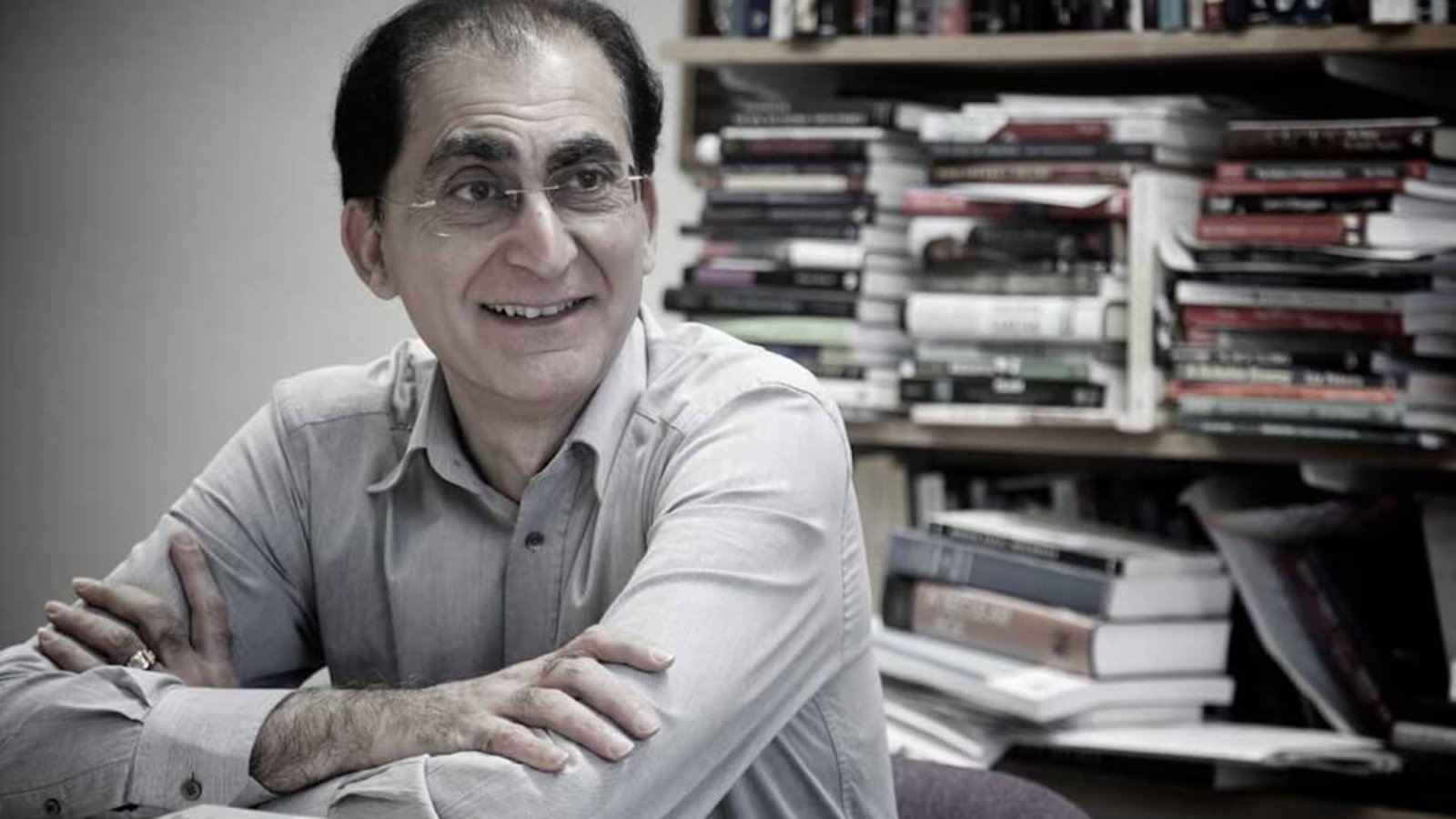
In an era marked by the transnational rise of far-right populism, exclusionary nationalism, and algorithmically amplified xenophobia, Professor Tariq Modood, the founding Director of the Bristol University Research Centre for the Study of Ethnicity and Citizenship, offers a deeply considered and nuanced account of how multiculturalism can serve as both a critique of and alternative to these reactionary forces. As one of Europe’s leading theorists of multicultural citizenship, Professor Modood’s work insists on reconciling respect for ethno-religious group identities with an inclusive and reconstituted national identity—a project he characterizes as “multicultural nationalism.”
In this interview with the European Center for Populism Studies (ECPS), Professor Modood, who is also one of the signatories of the “International Declaration Against Fascism,” published on June 13, 2025, alongside Nobel laureates, public intellectuals, and leading scholars of democracy and authoritarianism, explains that his vision of multiculturalism is “not simply a reaction to populism, nor a political strategy against it; it is a positive vision.” For Professor Modood, multiculturalism affirms that “we are not just individuals” but also members of groups whose identities have historically been marginalized or excluded from full membership in national life. Yet this project is integrative, not separatist: “We must not become anti-national. We must oppose the exploitation of national identity to exclude, racialize, or degrade others,” he emphasizes, rejecting both monocultural nationalism and cosmopolitan detachment.
A key element of Professor Modood’s thought is his advocacy for “moderate secularism,” which contrasts sharply with both French laïcité and authoritarian appropriations of secularism in places like India. Unlike the rigid secularism that seeks to privatize or marginalize religion, moderate secularism recognizes the public role of religious identities while embedding them in democratic equality and inclusion: “Moderate secularism can be inclusionary and potentially develop in a multiculturalist direction,” he explains.
In response to the global diffusion of far-right discourse—whether through social media networks or coordinated political strategies—Professor Modood argues for an explicitly internationalist response rooted in multicultural values. “I would like to say that one way of resisting that is trying to create a multiculturalism international—not just a far-right international, but a multiculturalism international,” he asserts. Brexit, in this regard, represented a significant setback: “When we left the European Union, much against my wishes, the European Union became weaker in relation to multiculturalism and anti-racism.”
Throughout this wide-ranging conversation, Professor Modood emphasizes that multicultural nationalism requires a “rethinking of our national identity and national story so that minority identities can become part of the national identity,” offering examples from Britain’s imperial history and inclusive popular culture, such as the 2012 London Olympics. His vision ultimately calls for a democratic, pluralistic, and solidaristic reimagining of national belonging—an urgent project in a time of resurgent authoritarianism.
Here is the transcript of our interview with Professor Tariq Modood, edited lightly for readability.
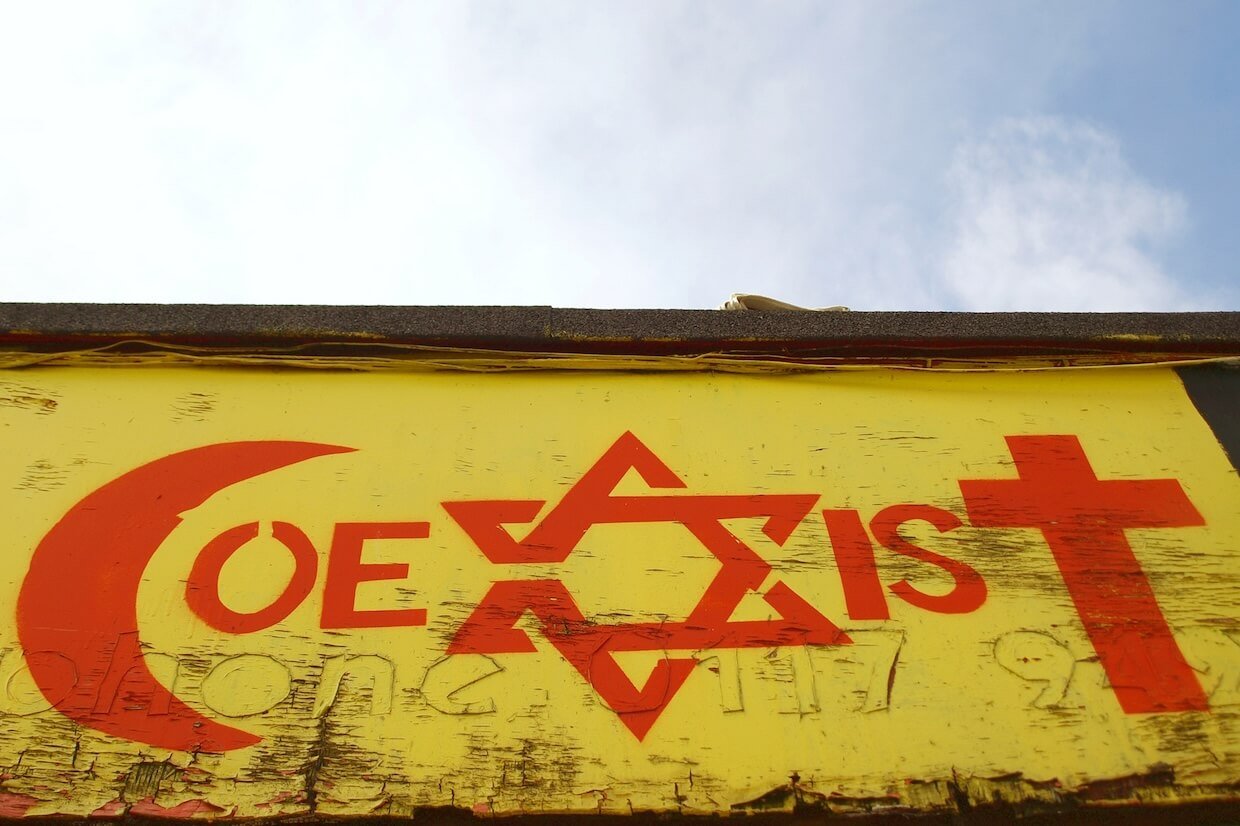
Religious tolerance-themed graffiti in Bristol, UK. August 31, 2009. Photo: Dreamstime.
Multiculturalism Is a Positive Vision, Not Just a Strategy Against Populism
Professor Tariq Modood, thank you very much for joining our interview series. Let me start right away with the first question: As a signatory of the June 13, 2025 anti-fascism declaration, how would you theorize the contemporary far-right populist phenomenon as an incipient form of fascism—particularly in the light of Viktor Orbán’s “illiberal democracy” in Hungary and Donald Trump’s authoritarian revival in the US—and what normative resources does your conception of multicultural nationalism offer for resisting this resurgence while preserving democratic pluralism?
Professor Tariq Modood: Thank you very much for inviting me onto your site. I should explain that while I was a signatory to that letter—which I thought was important and was glad to sign—it is not, as such, an example of my own research or thinking.
You asked how I see multicultural nationalism relating to the fight against fascism and populism. The first thing to say is that I see them as connected, but not directly or immediately; they are connected through several layers of unpacking. For me, multiculturalism—the central theoretical and political idea I work with—is a positive idea and a value in itself. It is not simply a reaction to populism or a political strategy against it; it is a positive vision.
And what is this positive vision? It is the idea that we are not just individuals. We have various group identities that are important to us, and some of these identities have been the basis for exclusion from rights, opportunities, participation, and full membership in citizenship and national identity.
Multiculturalism asserts that if these identities are important and valuable to their bearers, then not only must they not be a basis for exclusion or discrimination, but they should also be valued within our common citizenship. These group memberships and identities are part of who we are—not merely abstract individuals as understood by law.
Another important identity for multiculturalism is national identity. Why? Because multiculturalism, in order to get people to respect group identities, has to work with a strong concept of citizenship. Citizenship requires respect for group identities as a basis of inclusion because citizenship is egalitarian and inclusive. But this is not just liberal citizenship focused on equality before the law and individual rights; rather, it is a stronger concept of citizenship as a collectivity with shared identity and significance for its members. Citizenship and national identity are tied together. When we appeal for multicultural equality, we appeal to citizenship, but we need a strong sense of citizenship—identifying with and insisting on our right to belong to that national identity.
That is why multiculturalism works with two identities: respect for group identities (e.g., British Pakistani, Jewish, Hindu, Black) and respect for national identity, which should bring us all together. Multiculturalism must also resist exclusion when it occurs. Once we understand this, we see that multiculturalism is diametrically opposed to monocultural nationalism, which is exclusionary and creates two tiers of citizenship: “real” nationals and second-class citizens who do not really belong. Multiculturalism is totally against that idea and, therefore, against nationalist populism—but it opposes it because of its own value commitments. It is not simply a political strategy for opposing fascism.
Multiculturalism as an Alternative Nation-Building Project
What do you take to be the normative and institutional obligations of democratic polities in mediating the tension between protecting minorities from processes of “othering” and responding to legitimate concerns of cultural majorities—particularly in contexts where populist narratives exploit these tensions?
Professor Tariq Modood: Some people who are anti-right-wing and anti-populism misunderstand the situation. You referred to those who exploit national identity and tensions within our national community—the key word being exploit. We must not become anti-national; we must oppose the exploitation of national identity to exclude, racialize, or degrade others. The national itself is not the problem. That’s why I say some anti-populists misunderstand this issue: they declare themselves anti-nationalism.
Well, I am certainly not anti-nationalism, because I support multicultural nationalism. I believe in an alternative conception of national belonging and identity that contrasts with populist, divisive, monocultural nationalism. I’m not anti-national or anti-nationalist.
The key is to reclaim the idea of the national. We mustn’t allow right-wing figures like Nigel Farage in Britain, Marine Le Pen in France, and others to define themselves as the “true nationalists” while casting people like me—and perhaps you—as anti-nationalists. No, I want to assert that I am a nationalist too, but with a better understanding of who we are today and who we can become in the future—how we can unite our nation rather than divide it, not to transcend our nation but to transform it.
In this sense, multiculturalism is an alternative nation-building project, and that’s how we counter those who exploit tensions within our national community.
Moderate Secularism as an Inclusive Alternative to Authoritarian Models
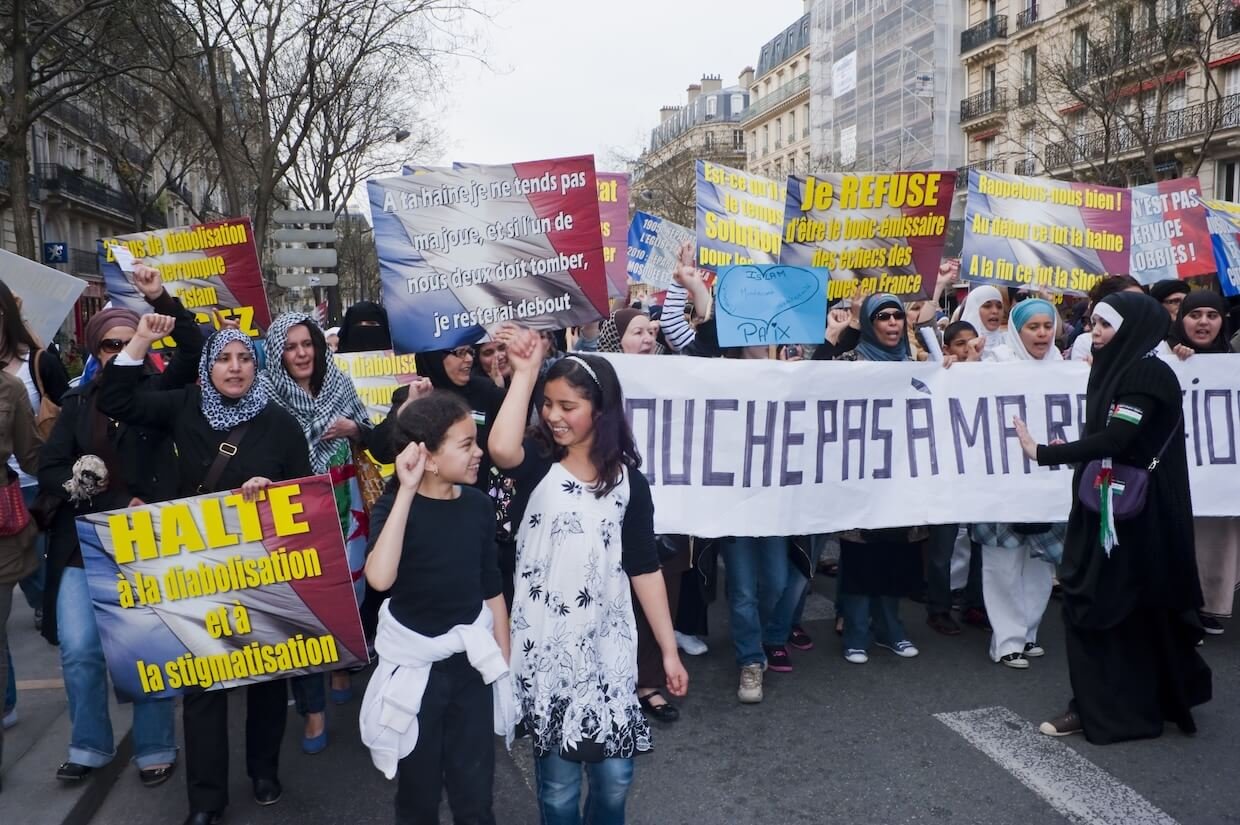
Muslims demonstrating against Islamophobia outside the Grande Mosquée de Paris, France. Photo: Tom Craig.
In what ways does your model of “moderate secularism” serve as a corrective to both French laïcité and Hindu nationalist instrumentalizations of secularism in India, and how can it safeguard against appropriation by exclusionary or authoritarian iterations of secularism emerging from the populist right?
Professor Tariq Modood: This is quite a complicated question you’ve asked me because it brings in something new—namely, the idea of moderate secularism. So, I first need to explain that idea before I can answer the rest of the question.A lot of people—liberals and progressives—say that we live in secular societies and therefore shouldn’t have religion in politics or shouldn’t have the state recognizing religious groups, Christians or Muslims or Hindus. But that’s not the reality of the societies we live in.
France is somewhat different, but Britain, the Netherlands, Germany, Sweden, Norway—these are all secular societies. No one can say they’re not secular polities, but they accommodate religion or some religions within the public sphere. They often fund various aspects of organized religious activity, whether it’s education, maintaining cathedrals and church heritage, or expecting religious organizations to provide welfare work. Germany, for instance, has an enormous welfare budget that it hands over to churches as well as collecting taxes to give to the churches.
So, I say we need a concept to describe this relationship. We are clearly secular polities—we are not run by religious organizations. Britain is not governed by the Church of England, and the Church of England is not a powerful institution. So, we are secular countries—but what kind of secularism is this? It’s not like the laïcité of France; it’s not like the secularism of the Soviet Union or the People’s Republic of China. Those are forms of radical secularism.
By contrast, this is a form of moderate secularism. One of the things moderate secularism can do is serve as a platform for recognizing excluded or newly settled religious minorities, like Muslims, for instance. Therefore, moderate secularism can be inclusionary and potentially develop in a multiculturalist direction, so that it doesn’t have to be exclusionary, as it is in France. Laïcité is hardening—it’s not being moderated; it’s being hardened in order to discipline or exclude Muslims, to confront them in the name of so-called secular values, national culture, or national identity.
We have to oppose those kinds of authoritarian secularisms. Sometimes these secularisms are not quite like France in that they are not anti-religious, but rather in alliance with the majority religion. This fits the example you gave of India, where the majority religion is being reconceptualized as a national ideology: everyone has to belong, in some way or another, to this Hindu nation; otherwise, they’re not a true Indian. So that’s a kind of secularism, because otherwise India has a very pluralistic tradition—a pluralistic secularism—which is now being defeated, pushed aside by the current Modi government; they’ve been doing this for about 15 years.
That’s how moderate secularism can be inclusive—unlike the radical secularism of France or China, and unlike the majoritarian religious nationalism of countries like India or, for that matter, Turkey. Quite a few Sunni Muslim countries also move in that direction. India has taken it even further, but this kind of authoritarian religious majoritarianism is, at present, all too common in Muslim countries around the world.
Rethinking National History as a Shared Story of Inclusion
To what extent does multicultural nationalism necessitate a historiographical reconstitution of national narratives, and how can such reconstructions avoid exacerbating cultural polarization or being dismissed as an elite project of historical revisionism?
Professor Tariq Modood: That’s a good question, and I don’t really have a fully satisfactory answer, because we really do need to rethink our history. Take Britain: British Empire, British glory, conquered the world, and so on. Well, we can’t tell that story in a simplistic way, as if the British were simply on top, a superior race, doing all this to the rest of the world. We need to tell a story that is about domination and conquest, but also about mixing—how India became part of Britain because the British went out there and ruled India but did so by connecting with Indians in various ways. They certainly modified India in major ways, but there was influence coming back as well. Just think about the number of Urdu and Hindi words in the English language—it’s enough to fill a big dictionary, and these dictionaries exist.
In any case, we need to tell that history to explain how we came to be the current population of Great Britain. There’s an old political slogan: “I’m over here because you were over there.” So yes, we need to tell this story of how the British made Indians British, because my story of being a Briton does not begin when I came to Britain as a child; it’s older than that. It belongs to the British making India British—that includes my dad, my grandparents, my ancestors, and so on. I became part of the British story through a historical formation of domination and conquest—but not only so.
In any case, we have to tell that story. I can see there are difficulties in how we tell it because it can be conflictual, and that’s something we want to avoid because multicultural nationalism is about bringing people together, respecting each other, and treating each other as equal members. So, there will be some revision and tension—I don’t think we can avoid it—but we need to try, bite the bullet, and think our way through. But there can be positive presentations; it doesn’t have to be just an elite project.
One of the best examples of a non-elite presentation of this project is the opening ceremony of the London Olympics of 2012. Have you seen it? You really should, and your readers really should. It’s not very long—about 45 minutes or so—and it told, in a dramatic, playful, and friendly way, to British people and the rest of the world, “this is the country we are.” It was a very inclusive Britain, which included people from the West Indies, Africa, Pakistan, India, Bangladesh, and so on—and the youth culture they have created today. So, I think there are non-elitist ways of telling this story. Probably sport is actually the main vehicle at the moment through which this story is being told—or if it’s not a story, these emotions and sensibilities are being formed. We have lots of Black players in our football teams, followed all over the world, and in our national team as well. We have multi-ethnic cricket teams and other sports. Entertainment is a real melting pot or mixing place for people of different heritages and colors, who then put on an England shirt or a British badge and are cheered and recognized as such by all the fans. So that’s another way of doing it in a non-elitist way.
Respect for Group Identities Must Go Hand in Hand with Shared National Belonging
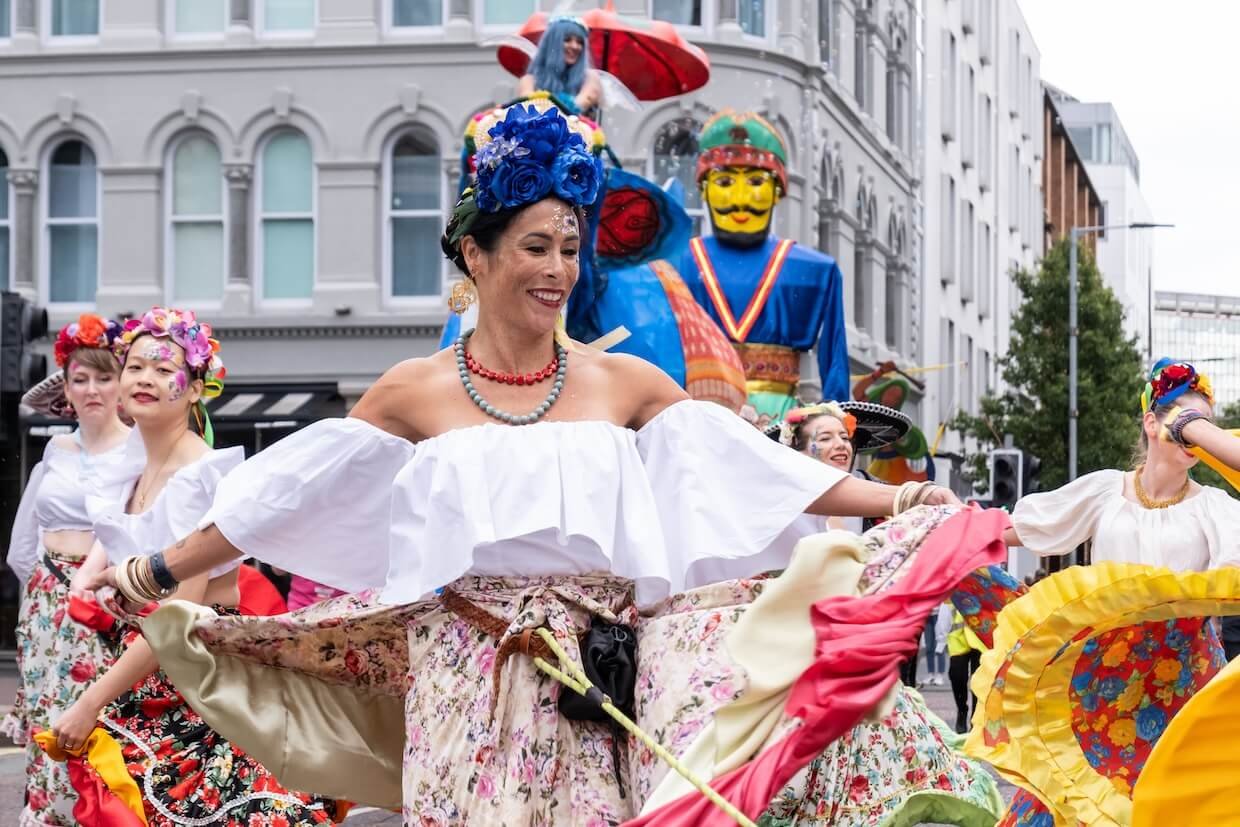
Women in festive costumes with decorative flowers in their hair dance through the streets during the annual Belfast Mela Carnival Parade, celebrating multiculturalism and diversity in Belfast, UK, on August 17, 2024. Photo: Dreamstime.
How do you address critiques that your emphasis on the public recognition of ethno-religious identities risks entrenching communitarian enclaves, as critics argue may be occurring in parts of Belgium or Germany, potentially impeding the development of integrative civic identities?
Professor Tariq Modood: Yes, I can see that sometimes ethnic community identities, based on flows of migrations over 50 years or so, can sometimes become segregated parts of cities and can be quite inward-looking. There are a number of aspects to this. One is that when people come to a city or country, they obviously need to meet people who speak their language and who can guide them, assist them, advise them about housing, work, schools for their children, where to shop for food they want, and about places of worship—they may want to live near a temple or mosque. So, all these things lead to a certain amount of clustering, and that’s very understandable.
But they may also feel unsafe because they fear racist abuse against themselves, the elderly, or their children. So again, they may huddle together for safety. We also have the phenomenon of white flight: when significant numbers of ethnic minorities move into a neighborhood or street, white residents begin to leave. That, of course, makes it more of a ghetto, more segregated. So, we do have to avoid segregated communities—it is an issue. We have to encourage people to mix more. Certainly, we have to protect them from racist abuse in the street and in workplaces, and from violence against themselves, their property, cultural centers, mosques, and so on. All those things need to be done to enable people to more freely spread out and not be so concentrated together.
Moreover, there are issues to do with identity. Going back to the beginning helps me round this off. I said it is important for multiculturalists to respect group identities that their bearers value, but at the same time, to allow everyone to join in, share in, and take pride in our national identity and citizenship. Similarly, when it comes to what are called divisive identities or communitarianism, we need to encourage these dual identities—they are not just dual, really, they are multiple. But the key point is that we need to encourage identities that matter to individuals as members of a group, while also encouraging identities that matter to them as members of their country.
For multiculturalism in particular, the important thing is that these aren’t just two things we do in parallel, but that we bring them together and do them together. One way of doing this is by rethinking our national identity and national story so that minority identities can become part of the national identity. I gave you examples of how the British coming to India made my ancestors and my family part of Britain—and so we need to recognize that. I also gave you the example of the London Olympic opening ceremony, which celebrated an idea of what it is to be British that was not tied to being white, Christian, or secular. It was tied to other identities important to people as well, not forgetting national identities such as Scottish, Welsh, and Northern Irish. These are ways we can avoid narrow identities, because we want to respect identities—but within a national framework of equality, inclusion, recognition, and valuing ourselves as members of a national community.
Multiculturalist International vs. Far-Right International
Given the anti-fascist imperative to “defy authoritarianism globally,” how might multicultural frameworks respond to transnational threats such as algorithmic disinformation networks amplifying xenophobia, global Islamophobia intensified by networks stretching from India to Europe, and exclusionary imaginaries promoted by far-right parties like Alternative für Deutschland or Italy’s Fratelli d’Italia?
Professor Tariq Modood: Your question brings together a number of things. Firstly, some fascist and racist messages become transnational. I understand that, of course, because the social media we are using is global and things go viral on it—it’s a real problem. But of course, the opposite—positive messages—can also become global and viral. For example, Black Lives Matter wasn’t simply a local Minnesota thing or even just a US movement; it became very important in Britain, parts of Europe, and other parts of the world. So clearly, social media has both positive and very negative, divisive aspects.
Another part of your question was about the power of certain projections like Alternative für Deutschland, because AfD is really quite a national project—they’re not trying to be transnational—but various kinds of far-right groups are connecting in a transnational way. That is obvious, often led by the American far right or by Hungarian-sponsored conferences and networks because of Orbán. So yes, they want to group together, and it’s quite paradoxical that they do, because they all want to say their country is the most important—make America great again, make Germany great again, leave the EU, make Britain great again, etc.—and yet they see they can best cooperate because they have a similar message in their own countries.
I would like to say that one way of resisting that is trying to create a multiculturalism international—not just a far-right international, but a multiculturalism international. In this regard, Brexit was really very disappointing for people like me, because I think that Britain is the most multiculturalist country in Europe. So, when we left the European Union, much against my wishes and for other reasons as well, the European Union became weaker in relation to multiculturalism and anti-racism. So, I do think we need to create a multiculturalist alliance across countries, in the way that the far right is creating its own kind of exclusionary nationalism within a transnational network.
In an exclusive interview with ECPS, MEP Chloé Ridel, rapporteur for the European Parliament’s forthcoming report on transnational repression, underscores the urgent need for the EU to confront transnational repression—state-organized efforts by authoritarian regimes such as Russia, China, Turkey, and Iran to silence critics abroad. Ridel calls for expanding the EU’s Global Human Rights Sanctions Regime to explicitly include transnational repression and highlights the procedural challenge posed by unanimity voting: “The only people we manage to sanction are mostly Russian… we will have difficulties applying the values we believe in.” She stresses that this is a human rights, security, and democratic issue requiring coordination, oversight of enablers, and stronger protection for vulnerable groups.
In a context of intensifying authoritarian encroachment beyond national borders, transnational repression has emerged as a growing threat to Europe’s democratic integrity, sovereignty, and human rights commitments. Authoritarian regimes—including Russia, China, Turkey, and Iran—have refined techniques of intimidation and control targeting exiles, dissidents, and diaspora communities residing in democratic states, employing legal tools such as Interpol Red Notices, coercion-by-proxy against relatives, and increasingly sophisticated forms of digital harassment. In her capacity as rapporteur for the European Parliament’s forthcoming report on transnational repression, MEP Chloé Ridel of the Socialists and Democrats Group has foregrounded the urgency of a robust, coordinated European response.
In this interview with the European Center for Populism Studies (ECPS), MEP Ridel makes a compelling case for expanding the EU’s Global Human Rights Sanctions Regime to address transnational repression explicitly. She explains that “there is already an EU sanctions regime that exists, and we want this regime to also apply to states that commit transnational repression.” MEP Ridel’s recommendation is clear: the EU must recognize transnational repression as a distinct pattern of authoritarian interference, codify it in sanctions policy, and ensure it can be enforced consistently across Member States.
MEP Ridel is also critical of the procedural obstacles that blunt the effectiveness of EU sanctions, pointing to the unanimity requirement that has resulted in skewed enforcement patterns: “The only people we manage to sanction are mostly Russian; 70% of those sanctioned under the EU sanctions regime are from Russia.” Without reforms enabling qualified majority voting for sanctions decisions, she warns, “we will have difficulties applying the values we believe in on human rights.”
This approach, MEP Ridel emphasizes, is inseparable from broader efforts to coordinate intelligence, protect vulnerable groups such as women, human rights defenders, and hold enablers—particularly social media platforms—accountable. “States rely on enablers such as social media platforms and spyware businesses, and these enablers must also be held accountable,” she argues. In advocating for expert focal points on transnational repression in both EU delegations and national administrations, Ridel calls for the EU to develop institutional expertise to “help victims of transnational repression” who often “don’t even know they are victims” until attacked.
This interview provides an incisive analysis of the tools and frameworks required to confront transnational repression effectively. EP rapporteur Ridel’s proposals offer a principled roadmap for embedding human rights and democratic sovereignty at the heart of EU foreign and security policy.
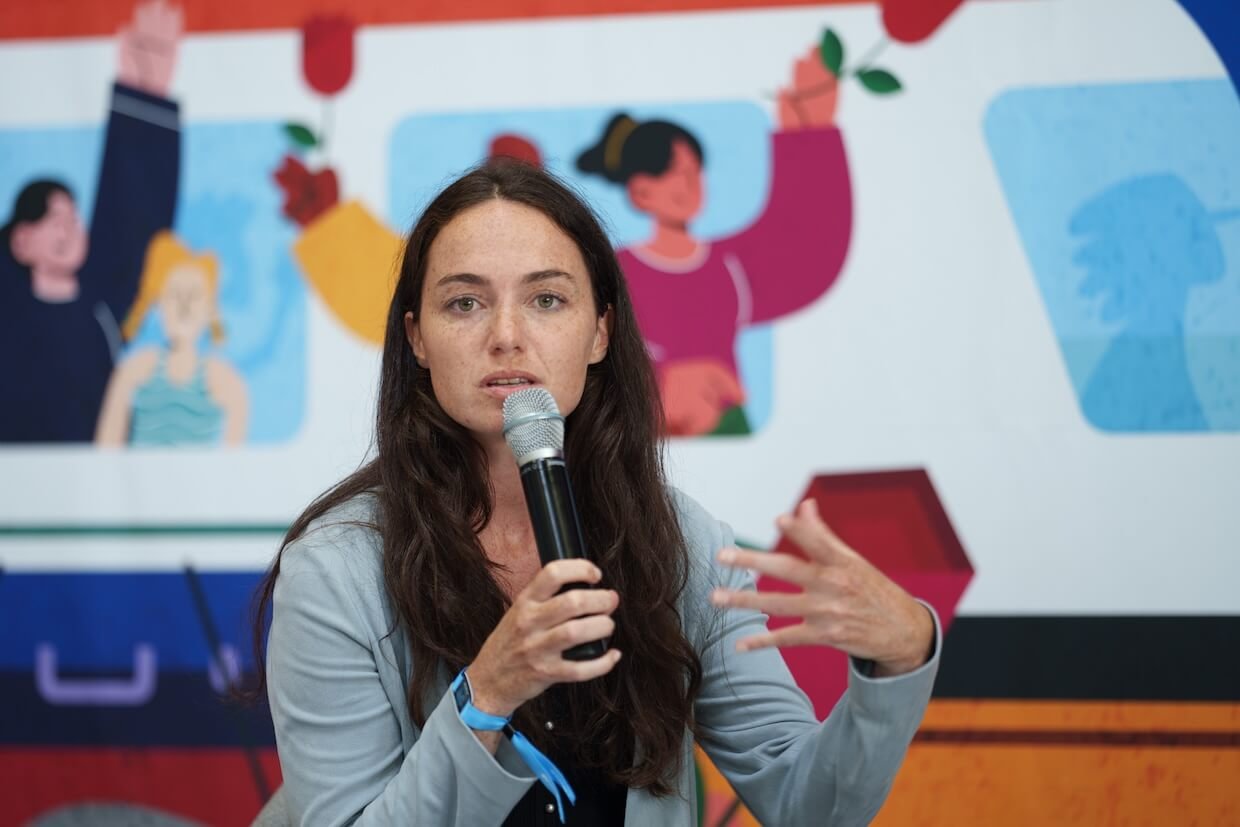
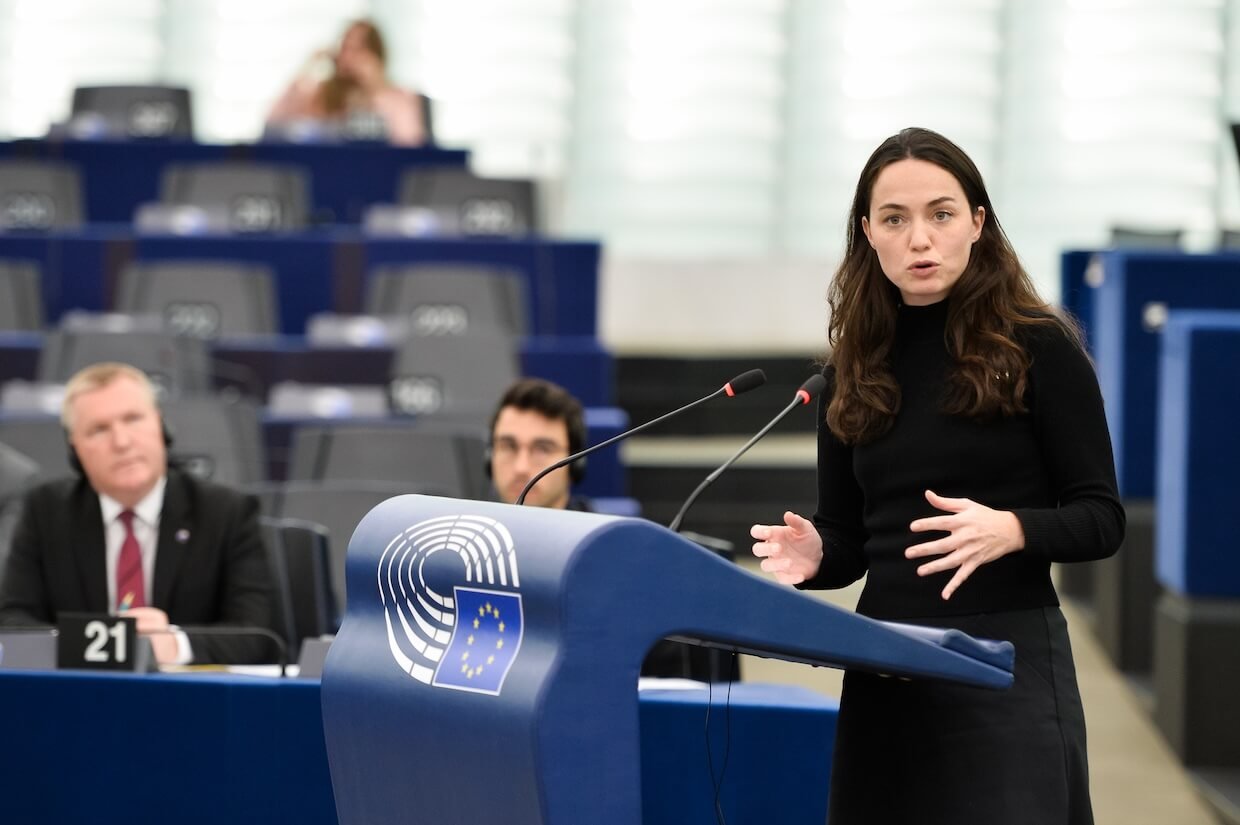
Chloé Ridel, Member of the European Parliament from the Socialist Group and EP Rapporteur for transnational repression.
Here is the transcript of our interview with MEP Chloé Ridel, edited lightly for readability.
Transnational Repression Must Be Defined Properly
Chloé Ridel, thank you very much for joining our interview series. First of all, can you please tell us about the fate of the report? You submitted it to the subcommittee on human rights. What will happen next?
MEP Chloé Ridel: I submitted my draft report in June to the Committee on Human Rights, which is a subcommittee of the Foreign Affairs Committee here in the European Parliament. Time was then allowed for other political groups to table amendments, which will be discussed throughout September. We will have a vote in the Foreign Affairs Committee in October, followed by the final vote in the plenary session of the European Parliament at the end of November.
Your draft report acknowledges the lack of a universally accepted definition of transnational repression. How should the EU conceptualize this phenomenon in legal and policy terms, especially considering the practices of regimes like Turkey, Iran, China, and Russia, to ensure both legal precision and operational flexibility?
MEP Chloé Ridel: Yes, you’re absolutely right. There is no definition of transnational repression in EU law or international law. Recently, the UN adopted a definition for transnational repression because it’s a growing phenomenon, as I tried to describe in my report. So, I suggest an EU definition for transnational repression because if we don’t know what it is, we cannot fight it properly. We define transnational repression as “state-organized actions that cross borders to coerce, control, or silence individuals through physical, legal, or digital means.”
This is a growing and quite concentrated phenomenon: 80% of all transnational repression actions are committed by just 10 states. Among these states are China, Turkey, Iran, Tajikistan, Uzbekistan, Belarus, and Russia. It is committed by authoritarian regimes that seek to silence members of their diaspora, political opponents, or journalists. For the EU, it’s a significant challenge because it constitutes foreign interference, is a security matter, and targets human rights defenders whom we have an interest in protecting — and we are not doing enough to protect them.
Transnational Repression Is a Security Issue, a Human Rights Issue, and a Democratic Issue
Given that transnational repression by authoritarian and repressive regimes blurs the lines between external authoritarian influence and internal security threats, should the EU frame this challenge primarily as a human rights issue, a security concern, or a hybrid phenomenon demanding an integrated policy response?
MEP Chloé Ridel: I think this is all of it at once. It is a human rights issue, of course, because it targets human rights defenders, and I will return to that. It is also a security and sovereignty issue because we cannot accept that foreign authoritarian regimes come to our streets to threaten people who are legal residents and under our protection. It becomes a threat to us as well. Unfortunately, transnational repression continues to occur in Europe. It includes physical threats, poisoning, and digital surveillance. Take the example of the Russian diaspora: after the invasion of Ukraine in 2022, more than 90 Russian journalist agencies came to Europe to continue their work freely. It is in our interest to protect these journalists because they are the last free Russian journalists in the world, and they still speak to the Russian people. We know that Putin expands his power by controlling people’s minds, and if we want to fight this kind of war with Putin, we need free journalism that can still speak to the Russian people back home. So yes, it is a security issue, a human rights issue, and also a democratic issue.
EU’s Digital Services Act Must Hold Platforms Accountable
Authoritarian regimes including China, Russia, Turkey and Iran have weaponized digital platforms to target exiles. How can the EU ensure that the Digital Services Act is effectively enforced to mitigate these risks, particularly protecting vulnerable groups like women human rights defenders from online harassment orchestrated by authoritarian actors?
MEP Chloé Ridel: As you pointed out very well, digital transnational repression is growing and authoritarian regimes use social media to harass opponents, often targeting women, sometimes through the circulation of sexualized content. This is a specific and growing form of violence, and social media platforms are enabling it. They are not doing enough to prevent transnational repression online, and they should. By companies, I mean the platforms themselves, because they now constitute major public spaces where public debate happens.
We need rules because we cannot have such impactful public spaces controlled by private companies without oversight. In Europe, we voted for a strong legislative framework, the Digital Services Act (DSA), but we are still waiting for it to be effectively enforced. For example, an investigation was opened against X (formerly Twitter) two years ago, but there are still no conclusions or sanctions, despite clear violations of the DSA—there is no content moderation, widespread disinformation, and manipulation of algorithms to boost certain types of content. We need effective enforcement of the DSA to hold these big companies accountable. While transnational repression is state-organized, states rely on enablers, such as social media platforms and spyware businesses, and these enablers must also be held accountable for that repression.
Iran, Egypt, Turkey and Tajikistan are notorious for coercion-by-proxy, targeting relatives of exiles to silence dissent abroad. What practical measures can the EU adopt to recognize, document, and respond to this diffuse and intimate form of repression?
MEP Chloé Ridel: You are right, transnational repression can occur when authoritarian regimes target family members who remain in the home country while someone goes abroad to seek exile or refuge. And it’s very difficult. Currently, the EU does not protect family members who may be threatened by authoritarian regimes simply because they are related to a prominent human rights defender or similar figure. So, I think we should enable the EU program called ProtectDefenders.eu to also protect family members of a defender, not just the defender themselves, because we know that authoritarian regimes use threats against family to repress human rights defenders.
A Coordinated EU Response Needed to Stop Abuse of Red Notices
Given that Turkey, Russia, and China systematically abuse Interpol Red Notices and extradition treaties to pursue political exiles, what reforms should the EU promote within its judicial cooperation frameworks and at Interpol to prevent instrumentalization while safeguarding legitimate law enforcement cooperation?
MEP Chloé Ridel: The abuse of Interpol Red Notices is a very important matter for me, and it’s a key part of my report because, as you mentioned, even though Interpol is aware of abuses, the problem persists. Authoritarian regimes continue to send or request Red Notices against human rights defenders, even though these notices are supposedly intended to target terrorists or very serious criminals. For example, there are currently more than 200 Red Notices from Tajikistan targeting human rights defenders living in the EU. So, we need to raise awareness among member states not to arrest or execute these notices and to develop a coordinated EU response on this issue.
In my report, I suggest that transnational repression be included in Europol’s mandate, so that Europol can assess the relevance of Red Notices when they target human rights defenders and provide assessments to member states, exerting pressure on national governments not to execute abusive Red Notices.
For example, there was the case of an Iranian activist in Italy in 2017 who was arrested based on a Red Notice from Iran and later freed. There was also the case of Paul Watson, an environmental activist defending whales, who was targeted by a Red Notice from Japan. He could live freely in France and Germany but was ultimately arrested by Denmark based on this Red Notice. What kind of coordination is this? He was eventually freed, but only after months in jail, and clearly the Red Notice against him was abusive.
We need to stop this abuse, and one way to do so is to involve the EU—not by giving the EU the power to execute Red Notices, which remains a national competence—but by enabling it to assess and declare when a Red Notice is abusive and should not be executed.
“We Must Coordinate at EU Level to Tackle Transnational Repression”
Chloé Ridel, Member of the European Parliament from the Socialist Group and EP Rapporteur for transnational repression.
How can the EU promote harmonization of national legal frameworks to ensure that no Member State becomes a permissive jurisdiction or “safe haven” for authoritarian actors from regimes such as Belarus or Egypt, while respecting national sovereignty and legal diversity?
MEP Chloé Ridel: We need more coordination at the EU level to tackle transnational repression. Transnational repression should be more widely discussed among ministers of internal affairs, security, foreign affairs, and heads of state as well. It was discussed recently at the G7 forum, and it is a matter for all democracies because we can see a kind of authoritarian internationalism building itself, notably through transnational repression, where authoritarian regimes help each other control, coerce, and silence their political opposition. We have an interest in protecting this political opposition because they are sometimes the last free voices of civil society in some countries.
We need to do more to coordinate at the European level and to raise awareness at the European level. Sometimes I have noticed during my work on this report that security services have difficulty assessing and recognizing transnational repression. So, I suggested in my report having an expert on transnational repression in each security administration in each member state—a contact point or something like that. For instance, this exists in Canada, Australia, and the US, where they have teams specifically responsible for transnational repression involving many different ministries. It is important that we build expertise within each nation on transnational repression and that all of this be coordinated at the European level.
Oppressive states like Turkey and China often use religious, cultural, and educational institutions abroad as instruments of covert surveillance and influence. How should EU policy distinguish and regulate these activities to protect democratic norms without stigmatizing legitimate diaspora engagement?
MEP Chloé Ridel: Sure. I think this is indeed a problem, and we need to control funds that go to religious institutions, for instance. We cannot allow authoritarian or adverse regimes to fund NGOs or religious institutions on European soil without oversight of how those funds are used. This is something we must address because it’s a growing and concerning phenomenon.
Prevent Discrimination and Promote Integration to Counter Radicalization
Given that authoritarian regimes actively manipulate divisions within diasporas—for example, Turkey’s polarization of Turkish communities in Europe—how should EU integration and anti-radicalization strategies respond to these fractures to avoid inadvertently amplifying authoritarian influence?
MEPChloé Ridel: This is another topic—it’s not transnational repression per se, but rather manipulation of diasporas to harm a country or create conflict. We can see it in my country, France, where there is a Turkish association called the Grey Wolves, a very dangerous group that was ultimately banned and dissolved. It’s an example because there were violent demonstrations by members of this group, and they exerted a kind of control over the Turkish diaspora in France, dictating how they should behave, which also prevented good integration into French society for Turkish immigrants.
We need to fight back and have state solutions against such extremist associations. We must also ensure that public services and integration services—through work, language learning, and civic values—are available so that we can prevent radicalization. Radicalization happens when there is discrimination; extremists target marginalized people and say, “France is discriminating against you, it doesn’t want you here, so you should abide by this ideology instead.” To prevent that, we must prevent discrimination and ensure that these individuals feel part of the national community in Europe. It’s a matter of integration to fight radicalization, and also a security matter: to be able to identify and prohibit such associations and groups when they form, if they are dangerous.
Coordinated EU Action Key to Protecting Rights Defenders
Your report recommends focal points on human rights defenders within EU delegations. What skills, mandates, and resources will these officers need to respond effectively to transnational repression, particularly from aggressive regimes like Russia and China, in high-risk environments?
MEP Chloé Ridel: It’s important that we have contact points in every EU delegation throughout the world that can gather information on how authoritarian regimes exert transnational repression. Coordination is key to fighting this growing phenomenon. We need contact points both in EU delegations and in each national administration, and through the exchange of information we can tackle it. We are stronger together in Europe; if we gather information and experts across different countries and Europe plays a coordinating role, we can collect valuable intelligence and help victims of transnational repression. Sometimes they don’t even know they are victims—there are people being followed or surveilled until the day they are attacked; people who have spyware on their phones and don’t know it because they are not trained in cybersecurity.
In my report, I want to incentivize and raise awareness about spyware, to emphasize that, first, the EU should ban the export of spyware technologies produced in Europe to authoritarian regimes, because we know this will be used against us and against human rights defenders on our soil. We should also, when we know that a human rights defender is at risk of transnational repression, say: come to our office, we will explain a few security rules to you as a matter of prevention so you can regularly check your phones or computers to ensure there is no spyware, because nowadays it’s very easy to hide spyware on a phone or computer.
And lastly, do you see a role for the EU in spearheading an international legal instrument specifically addressing transnational repression, modeled on Magnitsky-style sanctions, to confront regimes such as Belarus, Saudi Arabia, China and Turkey? How might this enhance global accountability and norm-setting?
Chloé Ridel: Actually, there is already an EU sanctions regime that exists and we want this regime to also apply to states that commit transnational repression. So, I call in my report to enlarge the EU sanctions regime so that it effectively targets transnational repression. There is also a longstanding demand from our group, the Socialists and Democrats group, that EU sanctions be decided by qualified majority and not unanimity, because with unanimity, often you go nowhere. The only people we manage to sanction are mostly Russian; 70% of those sanctioned under the EU sanctions regime are from Russia. I’m sure many more countries I’ve described to you could be sanctioned in the name of human rights and under the EU sanctions regime. So, if we don’t move toward qualified majority, we will have difficulties applying the values we believe in on human rights.
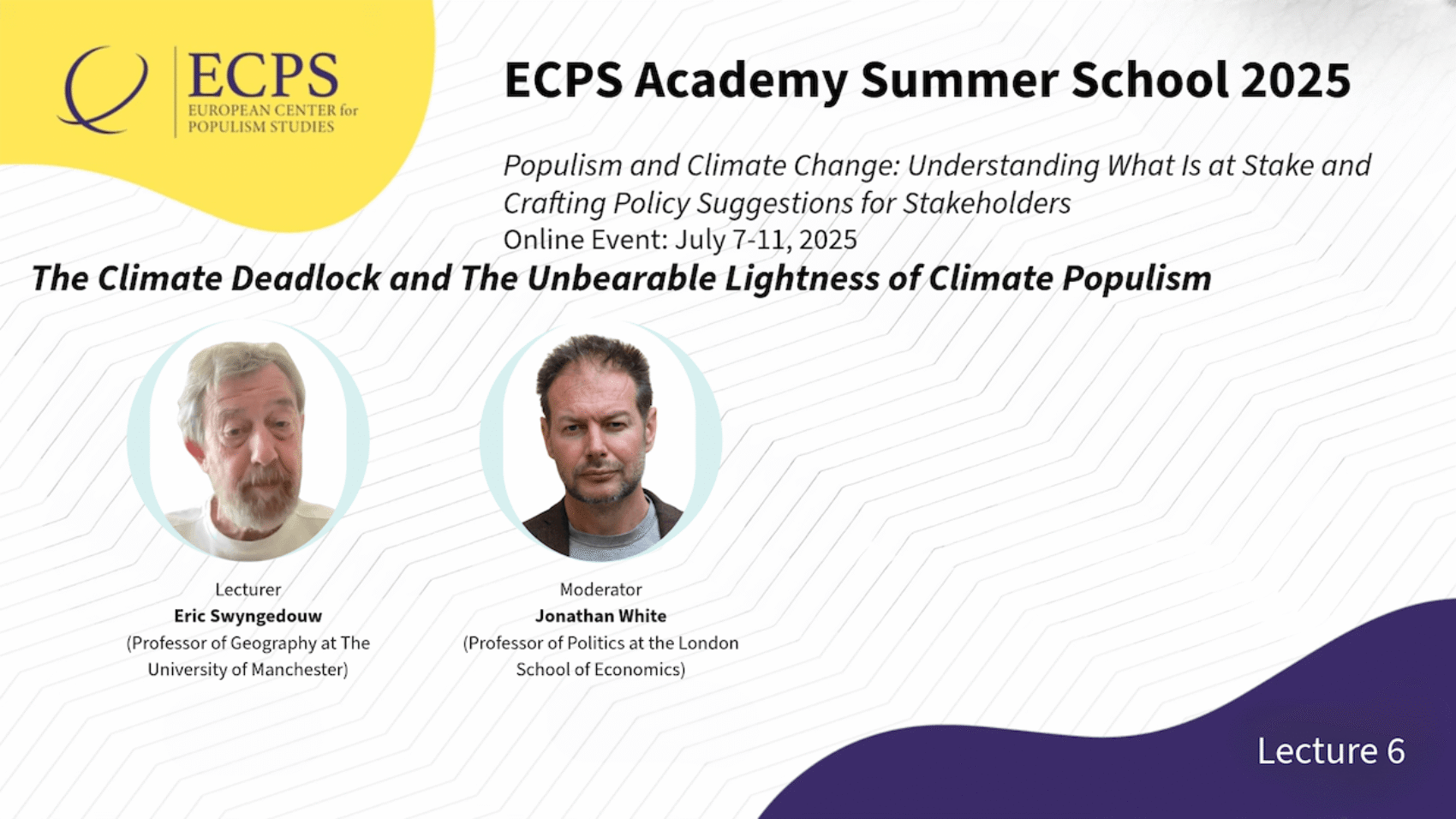
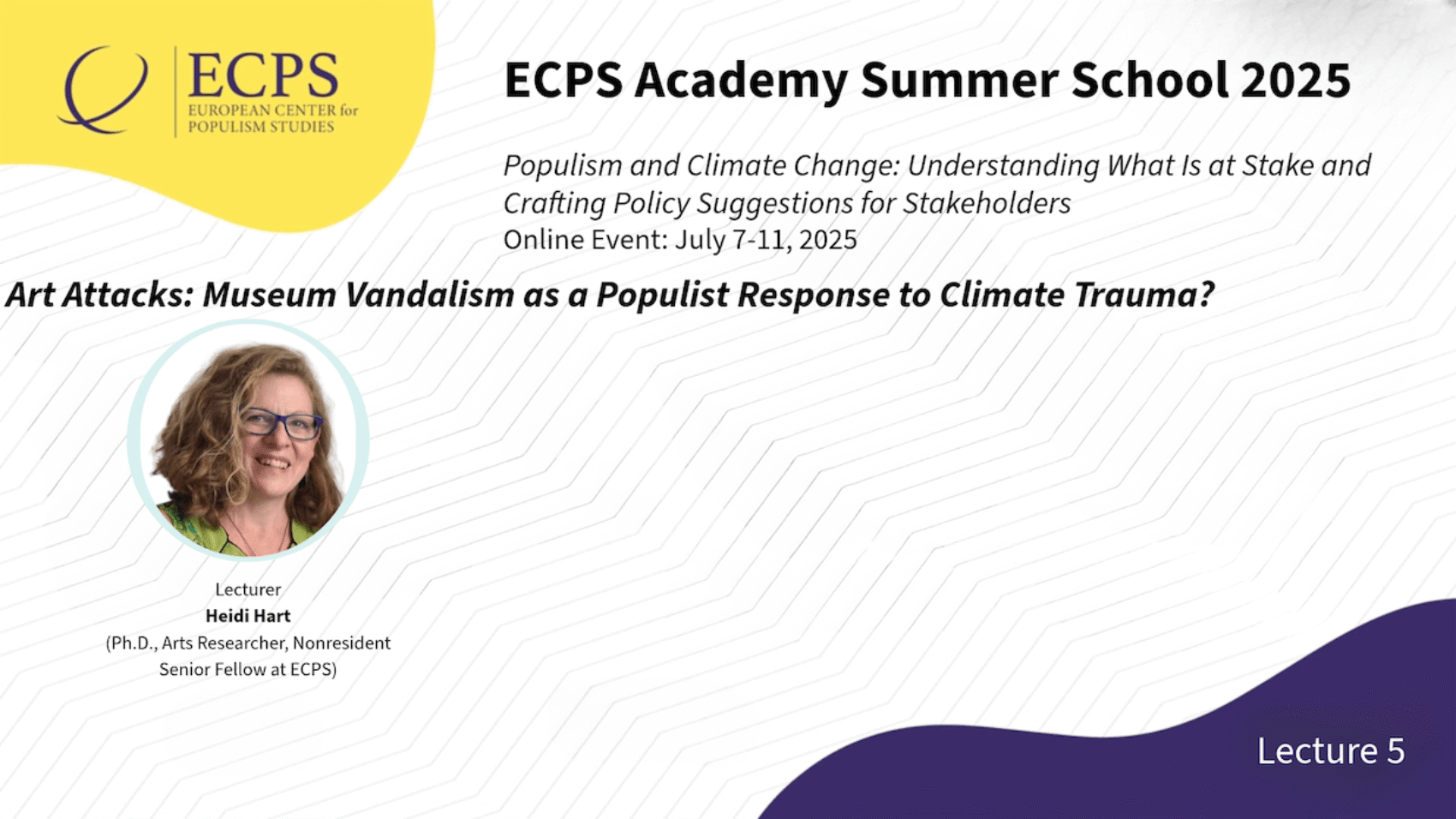
The ECPS Academy Summer School 2025 brought together leading scholars to examine how populism and climate change intersect—a dynamic that now shapes global governance, political polarization, and environmental policy. Across nine lectures, participants critically explored how populist movements exploit climate debates, from outright denialism to attacks on climate elites and institutions. These sessions highlighted profound tensions: how can we promote equitable, science-based climate action in an era of rising populism, misinformation, and distrust of expertise? The collection of reports and video recordings now available captures these rich interdisciplinary discussions, offering essential resources for researchers, policymakers, and citizens alike. Engage with this unique body of work to better understand the challenges—and possibilities—for climate governance and democracy in the 21st century.
Reported by ECPS Staff
The ECPS Summer School 2025 offered a rigorous, interdisciplinary examination of how populism intersects with the climate crisis—a nexus increasingly shaping politics globally. Climate change is no longer a purely environmental issue; it is deeply entwined with economic, social, cultural, and political dynamics that populist movements actively exploit. Whether through denialism, deregulation, appeals to “the people” against “globalist elites,” or opportunistic co-optation of environmental grievances, populist narratives have reshaped climate debates in ways that complicate international cooperation and local policymaking.
Across nine lectures by leading scholars—including experts in environmental politics, disinformation, conflict studies, political psychology, and critical theory—the program investigated both the challenges and opportunities posed by populist interventions in climate governance. Participants explored key questions: How do populists construct climate skepticism? When can populism mobilize for climate justice rather than obstruct it? What is the role of disinformation infrastructures in shaping climate discourse? And how do structural inequalities, colonial legacies, and class power inflect contemporary climate conflicts?
The summer school addressed the profound tension between the urgent need for global climate action and the populist turn toward polarization, distrust of expertise, and nationalist retrenchment. From analyses of right-wing anti-environmentalism in the Trump era to debates over “eco-populism,” climate-related rural protests, and the technopolitics of AI and climate governance, the lectures illuminated how climate action itself is a contested terrain.
Readers and audiences are invited to access comprehensive reports and video recordings of all lectures—a vital resource for scholars, practitioners, policymakers and citizens seeking to understand the fraught intersection of populism and climate change. The collection not only documents the state of scholarly thinking on these urgent issues but also provides conceptual and practical insights for crafting equitable, democratic, and resilient climate policies in an age of populist challenge.
Watch, read, and engage with these materials to critically examine the pathways forward in one of the defining crises of our time.
In his lecture at the ECPS Summer School 2025, Professor John M. Meyer offered a compelling exploration of the relationship between populism and climate politics. He critiqued authoritarian populism as a threat to equitable climate action while also questioning mainstream climate governance’s elitist, technocratic tendencies. Rather than viewing populism solely as an obstacle, Professor Meyer argued that climate justice movements themselves embody a form of inclusive, democratic populism—centered on equity, participation, and solidarity. Drawing on examples from grassroots activism and Naomi Klein’s concept of “eco-populism,” Professor Meyer proposed that climate action must address material injustices and engage people where they are. His lecture encouraged participants to rethink populism as a political form that, when inclusive and justice-oriented, can help build legitimate, durable, and democratic climate solutions.
Professor Sandra Ricart delivered a timely and insightful lecture on the intersection of climate change, agriculture, and populism in Europe. She explored how structural and demographic challenges, including a declining farming population and economic precarity, have fueled widespread farmer protests across the continent. Prof. Ricart emphasized how these grievances, while rooted in genuine hardship, have increasingly been exploited by far-right populist movements eager to position themselves as defenders of rural interests against European institutions. Her analysis highlighted the pressures created by climate change, policy reforms, and global market dynamics, and she called for more inclusive, responsive, and sustainable agricultural policies. Prof. Ricart’s lecture provided participants with a critical understanding of rural Europe’s evolving political and environmental landscape.
The fourth lecture of the ECPS Academy Summer School 2025 featured Professor Daniel Fiorino, a leading expert on environmental policy at American University. Professor Fiorino examined how right-wing populism—characterized by distrust of expertise, nationalism, and hostility to multilateralism—combined with entrenched fossil fuel interests to undermine climate mitigation efforts in the United States during the Trump administration. He highlighted the geographic and partisan divides that shape US climate politics and explained how Republican dominance in fossil fuel-dependent states reinforces skepticism toward climate action. Professor Fiorino’s lecture underscored the vulnerability of US climate policy to political polarization and partisan shifts, warning that right-wing populism poses an enduring challenge not only to American climate governance but to global efforts to address the climate crisis.
Dr. Heidi Hart’s lecture illuminated the provocative intersection of art, activism, and climate trauma. Through an interdisciplinary lens, she explored why climate activists increasingly target iconic artworks in museums as sites of performative protest, interpreting these acts not as mere vandalism but as symbolic disruptions challenging elitist cultural values amid ecological crises. Drawing on frameworks from populism studies, art history, and affect theory, Dr. Hart examined how these interventions reflect a passionate response to climate grief and injustice. Her analysis underscored the importance of understanding such protests within broader debates on decolonization, posthumanism, and collective responsibility, encouraging participants to view artistic destruction as both a critique of cultural complacency and a call for ecological transformation.
In his compelling lecture, Professor Erik Swyngedouw offered a radical critique of contemporary climate discourse, describing it as trapped in a “climate deadlock” where knowledge and activism coexist with deepening ecological crisis. He argued that mainstream and radical climate narratives mirror the structure of populism, constructing simplistic binaries while displacing attention from capitalism’s core role in driving environmental destruction. Professor Swyngedouw challenged participants to recognize that the environmental apocalypse is not an imminent future but an unevenly distributed present reality for much of the world. His provocative call to dismantle the comforting fantasy of a unified humanity urged a re-politicization of the climate crisis, demanding systemic transformation and solidarity grounded in confronting global inequalities.
Professor Philippe Le Billon’s lecture critically examined how climate-related conflicts emerge from three sources: the impacts of climate change itself, contestation over climate inaction, and backlash against climate action. He argued that climate change operates as a “threat multiplier,” intensifying pre-existing inequalities and vulnerabilities rather than acting as an isolated trigger of violence. He explored how climate activism—while driven by moral urgency—can be framed as elitist and provoke populist opposition, and how the implementation of climate policy can generate new conflicts when perceived as unjust or technocratic. Professor Le Billon warned that “green capitalism” risks reproducing extractive logics, creating new “green sacrifice zones,” and underscored that climate justice requires confronting colonial legacies, class inequality, and structural power relations.
The eighth lecture of the ECPS Academy Summer School 2025 was delivered online by Professor Stephan Lewandowsky, a globally recognized expert on misinformation and political psychology. His presentation offered a penetrating analysis of how climate disinformation is fueled by an organized infrastructure of vested interests and amplified by populist politics, which undermine trust in science. Professor Lewandowsky highlighted that ideological commitments—particularly free-market conservatism—strongly shape public acceptance of climate science. He emphasized that communicating the overwhelming scientific consensus on climate change can be a powerful corrective but cautioned that disinformation thrives in an environment where politics and identity outweigh facts. His lecture underscored the urgent need to confront these structural and ideological barriers to effective climate action.
In his lecture at the ECPS Academy Summer School 2025, Professor Robert Huber examined how populist parties across Europe construct climate skepticism, emphasizing that populism’s “thin-centered ideology” (as defined by Cas Mudde) pits “the pure people” against “corrupt elites.” This framing makes climate science and policy institutions prime targets for populist critique. Professor Huber’s expert survey of 31 European countries showed a clear trend: the more populist a party, the more skeptical it is of climate policy and climate science, regardless of its left- or right-wing orientation. He cautioned participants to disentangle populism from related ideologies like nationalism or authoritarianism, underscoring that populism’s challenge to climate politics is complex, context-dependent, and shaped by deeper struggles over legitimacy, authority, and representation.
In this wide-ranging interview with the ECPS, Professor Steven Friedman critiques dominant liberal democratic paradigms that prioritize constraining state power while ignoring the dangers of unregulated private power. “Private power exists and poses significant challenges,” he argues. Professor Friedman warns against the myth that today’s authoritarian surge simply threatens well-functioning democracies, pointing instead to the alienation of citizens by systems failing to meet their needs. He also critiques the hypocrisy of the so-called “rules-based international order,” emphasizing that “if we do not have international law that applies equally to everyone, then we do not have international law at all.” For Friedman, democratic renewal must address inequality and defend universal principles of participation and inclusion.
In this interview conducted for the European Center for Populism Studies (ECPS), Professor Steven Friedman, Research Professor in Politics at the University of Johannesburg, offers a rigorous critique of prevailing liberal democratic paradigms and their limitations in addressing structural inequalities, especially in postcolonial contexts such as South Africa. While affirming his commitment to democracy, Professor Friedman challenges the tendency among many scholars and policymakers to frame the current authoritarian surge as a simple rupture in otherwise well-functioning democracies. As he puts it: “We need to recognize that statements like the one we signed have become necessary precisely because that older model of democracy is being rejected—not primarily by converts to authoritarianism, but by citizens alienated by a democratic system that failed to respond to their needs.”
A central theme in Professor Friedman’s analysis is the narrow theoretical focus of dominant democratic models, which historically have prioritized constraining state power while neglecting the role of concentrated private economic power in undermining democracy. “Private power exists and poses significant challenges,” he observes. “If we fail to regulate private power, we end up with today’s reality: vast concentrations of economic power in the hands of a few individuals.”This critique resonates powerfully in South Africa, where democracy has unfolded in conditions of stark inequality deeply rooted in racialized histories of dispossession.
Professor Friedman also reflects critically on South Africa’s place in global debates about authoritarian populism, noting that local authoritarian trends often imitate those in the global North—particularly xenophobic politics centered on immigration—even though they arise from different historical trajectories. He emphasizes that this mimicry, combined with a homegrown narrative that dismisses constitutional democracy as a Western imposition, has created fertile ground for anti-democratic forces. Professor Friedman warns against this false equivalence: “Democracy is for everyone. It is not just for white Western people.”
In addition, Professor Friedman interrogates the concept of the “rules-based international order,” a central theme in liberal internationalism. While acknowledging that breaches of international law—such as Russia’s invasion of Ukraine—are serious, he argues that the real problem is the hypocrisy of this order’s application: “In Africa, as elsewhere in the global South, the suspicion is not that we do not need a rules-based order, but that the rules only apply to some.” He draws on personal experience of apartheid South Africa to highlight the corrosive effects of legal double standards, concluding that “if we do not have international law that applies equally to everyone, then we do not have international law at all.”
Throughout the conversation, Professor Friedman underscores the responsibilities of intellectuals in confronting both authoritarian populism and the failures of democratic systems themselves. He insists that defending democracy today requires scholars and public intellectuals not only to protect constitutional principles but also to advocate for a more inclusive, participatory model that recognizes and addresses entrenched inequalities—particularly those shaped by private economic power.
By foregrounding these themes, this ECPS interview invites a broader rethinking of how we understand authoritarian threats globally and how democratic renewal must involve far more than defending electoral institutions: it must include grappling with the material inequalities that undermine democratic legitimacy.
Explore the key debates from “We, the People and the Future of Democracy: Interdisciplinary Approaches,” held at Oxford University in July 2025. The conference brought together leading scholars to examine how “the people” are invoked to both erode and renew democracy worldwide. Now, readers and audiences can access detailed reports and full video recordings of all panels and roundtables—an essential resource for anyone engaged with questions of democratic resilience, populism, identity, and governance. Revisit these rich interdisciplinary discussions and reflect on a central challenge of our time: under what conditions can appeals to “the people” revitalize democracy rather than undermine it? Engage now with the ideas shaping the global conversation on democracy’s future.
Reported by ECPS Staff
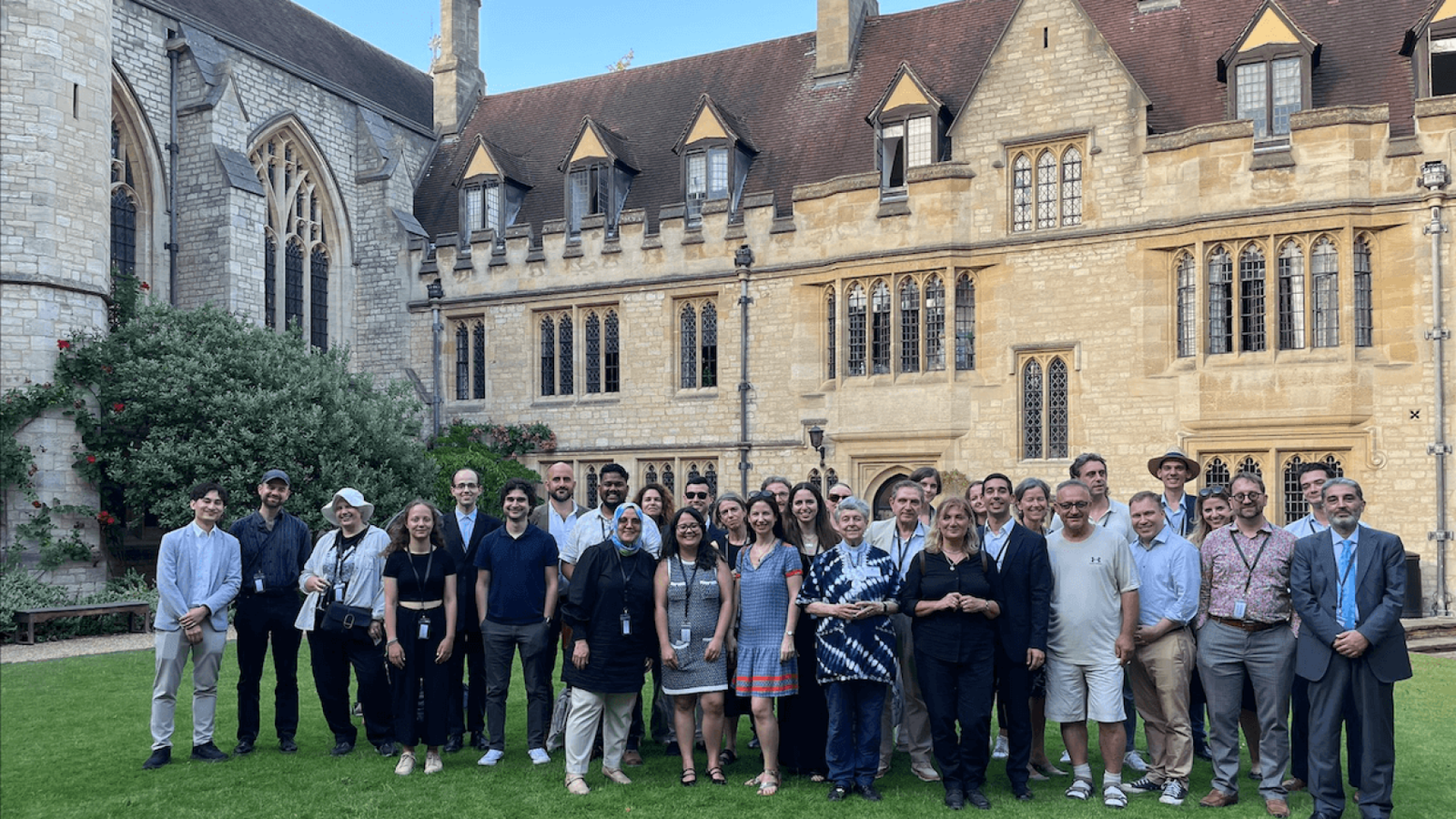
Between July 1–3, 2025, scholars, practitioners, and students gathered at St. Cross College, Oxford University, for We, the People and the Future of Democracy: Interdisciplinary Approaches—an intensive programme examining how invocations of “the people” shape democratic resilience and backsliding globally. The ECPS event unfolded against a sobering backdrop: between 2012 and 2024, one-fifth of the world’s democracies disappeared, while rising populist discourse—framing politics through stark “us vs. them” binaries—has undermined social cohesion across many societies.
Throughout the programme, participants explored how the concept of “the people” can both erode and renew democratic life. Panel and roundtables interrogated when this notion acts as a democratizing force and when it becomes a tool for exclusionary majoritarianism. The interdisciplinary and comparative nature of the discussions was key: scholars from history, philosophy, political theory, sociology, law, and the arts examined the interplay between populism, identity, legitimacy, and governance across transatlantic and global European contexts.
Major themes included the conceptual ambiguity of “the people” as a political category; its mobilization in both progressive and authoritarian populisms; the impact of identity politics on liberal democratic institutions; the entanglement of religion, nationalism, and populism; the challenges posed by algorithmic governance and AI; and the resilience or vulnerability of constitutional structures under populist pressure. Sessions addressed populist assaults on democratic checks and balances, the politicization of referenda, the erosion of judicial independence, and contested narratives around belonging, migration, and climate policy.
The event also served as the launch of an extended virtual programme (September 2025–April 2026), designed to continue this dialogue through bi-weekly online workshops, encouraging sustained scholarly exchange on the crisis and promise of democracy.
The programme underscored a central question: under what conditions can appeals to “the people” revitalize democratic politics rather than undermine its pluralistic foundations? By fostering dialogue across disciplines and global perspectives, We, the People and the Future of Democracy offered a critical intervention into one of today’s defining global challenges, illuminating both the fragility and resilience of democracy in the 21st century.
Taking this occasion as an opportunity, ECPS expresses its profound gratitude to St. Cross College for hosting this conference; to our valued partners—the Oxford Network of Peace Studies (OxPeace), Rothermere American Institute, Humanities Division, European Studies Centre at St Antony’s College, and Oxford Democracy Network—for their vital collaboration; and to all our sponsors, whose support made this timely and urgent gathering not only possible but truly impactful.
Readers and audiences can access comprehensive reports and full video recordings of all sessions from the three-day conference below, providing an opportunity to revisit and engage with the rich, interdisciplinary discussions that unfolded throughout the event.
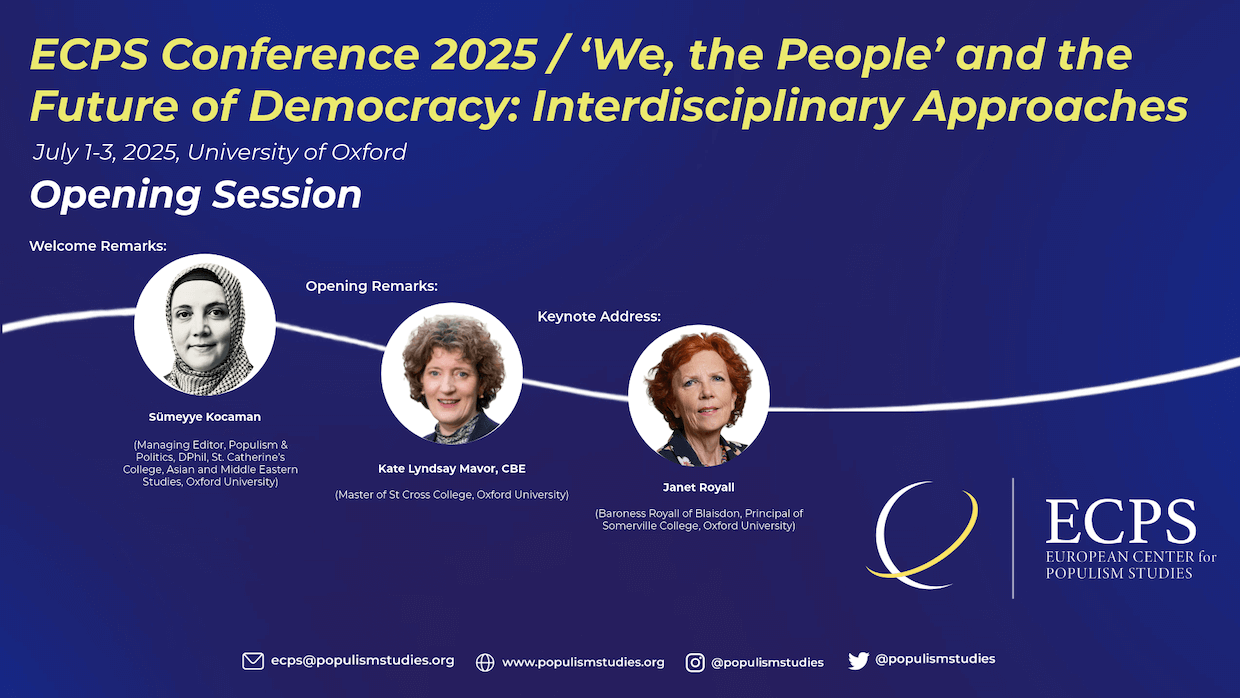
The ECPS Conference 2025 at the University of Oxford began with a timely and thought-provoking opening session that explored the evolving meaning and political utility of “the people” in democratic discourse. Sümeyye Kocaman offered a nuanced welcome, highlighting how the term has been used across history to empower, exclude, and politicize identity. Kate Mavor, Master of St Cross College, underscored the value of interdisciplinary exchange in addressing democratic challenges, noting how the College’s diverse academic environment aligned naturally with the conference’s aims. Baroness Janet Royall then delivered a compelling keynote, warning of the double-edged nature of “the people” as both democratic ideal and populist tool. Her address emphasized the need for inclusion, institutional integrity, civic renewal, and interdisciplinary cooperation in the face of democratic erosion. The session set the stage for critical and globally relevant dialogue across disciplines.
Panel I brought together diverse approaches to examine how democratic legitimacy, resistance, and pluralism are evolving in the face of global democratic backsliding. Chaired by Dr. Lior Erez (Oxford University), the panel featured Professor Robert Johns and collaborators presenting experimental research on public support for human rights under repression; Nathan Tsang (USC) explored how Hong Kong diaspora communities engage in covert resistance through cultural expression; and Simon Clemens (Humboldt University) introduced Isabelle Stengers’ cosmopolitical philosophy, proposing a radical politics of coexistence over consensus. Together, the presentations reflected on how the idea of “the people” is being contested, reimagined, and mobilized across social, empirical, and philosophical registers.
Chaired by Professor Jonathan Wolff, the session explored how “the people” is constructed, contested, and deployed in contemporary European and global politics. Presentations by Professors Martin Conway, Aurelien Mondon, and Luke Bretherton examined the historical resurgence of popular politics, the elite-driven narrative of the “reactionary people,” and the theological dimensions of populism. Together, the contributions offered a nuanced, interdisciplinary account of how populism’s democratic and anti-democratic potentials shape the political imagination and institutional realities of the 21st century.
Panel II explored how digital technologies and algorithmic infrastructures are reshaping democratic life. Co-chaired by Dr. Alina Utrata and Professor Murat Aktaş, the session tackled questions of power, exclusion, and political agency in the digital age. Together, their framing set the stage for two timely papers examining how algorithmic filtering, platform capitalism, and gendered data practices increasingly mediate who is counted—and who is excluded—from “the people.” With insight and urgency, the session called for renewed civic, academic, and regulatory engagement with the democratic challenges posed by artificial intelligence and transnational tech governance.
Panel III gathered five scholars from the Jean Monnet Chair in European Constitutional Democracy (EUCODEM) at the University of Barcelona to explore how populist forces are challenging liberal-democratic norms—and what institutional remedies might resist them. Chaired by Dr. Bruno Godefroy, the session addressed threats to judicial independence, the populist appropriation of secessionist demands, and the theoretical underpinnings of populism as a political strategy. It also examined the role of parliaments and second chambers in preserving constitutional order. Drawing from both comparative and case-specific perspectives—ranging from Spain and Scotland to Canada and the United States—the panel provided a timely and interdisciplinary diagnosis of populism’s constitutional impact and offered potential avenues for democratic resilience in increasingly polarized societies.
Panel IV explored the theme “Politics of Belonging: Voices and Silencing.” Chaired by Dr. Azize Sargın (ECPS), the panel investigated how belonging is constructed and contested through populist discourse and historical memory. Dr. Maarja Merivoo-Parro (University of Jyväskylä) examined olfactory memory and grassroots aid in Estonia’s democratic awakening. Maria Jerzyk (Masaryk University) analyzed how the figure of the child is symbolically instrumentalized in Polish populism, revealing deep continuities with communist-era narratives. Together, the papers offered rich insights into how identity, exclusion, and affect shape democratic participation in post-authoritarian and populist contexts.
Roundtable II offered a wide-ranging philosophical and political interrogation of how “the people” is theorized, invoked, and contested in contemporary democratic thought. Chaired by Dr. Aviezer Tucker (University of Ostrava), the session featured presentations by Naomi Waltham-Smith (Oxford), Bruno Godefroy (Tours), Karen Horn (Erfurt), and Julian F. Müller (Graz). Together, the panel explored the rhetorical, constitutional, and epistemic instabilities surrounding the concept of “the people,” challenging static or essentialist understandings and calling for renewed attention to pluralism, temporality, and audibility within liberal democratic frameworks.
Panel V explored how contested constructions of “the people” are shaped by populist discourse across national, religious, and ideological contexts. Co-chaired by Dr. Leila Alieva and Professor Karen Horn, the session featured presentations by Natalie Schwabl (Sorbonne University), Dr. Sarah Riccardi-Swartz (Northeastern University), and Petar S. Ćurčić (Institute of European Studies, Belgrade). The panel examined Catholic nationalism in Croatia, American Christian ethno-populism, and the evolving German left, offering sharp insights into the manipulation of collective identity and memory in populist projects. Bridging multiple regions and disciplines, the panel revealed populism’s capacity to reframe belonging in deeply exclusionary and globally resonant ways.
Panel VI brought urgent focus to the evolving meaning of democratic agency. Chaired by Dr. Max Steuer (Comenius University, Bratislava), the session opened with a reflection on whether democracy and “the people” can be conceptually disentangled. Rashad Seedeen examined how Gramsci’s war of position and Wright’s real utopias intersect in Indigenous civil society initiatives. Jana Ruwayha analyzed how prolonged emergencies blur legal norms, threatening democratic accountability. Özge Derman showcased how the “we” is performatively constructed in Occupy Wall Street and the Gezi movement. Together, the panel offered sharp insights into the plural and contested meanings of “the people” in contemporary democratic struggles.
In 2025, democracy occupies a state of superposition—at once vibrant and eroding, plural and polarized, legal and lawless. Panel 7 exposed this paradox with precision: democracy is not a fixed ideal but a shifting terrain, where power is contested through law, ritual, narrative, and strategy. Whether it survives or collapses depends on how it is interpreted, performed, and defended. The Schrödinger’s box is cracked open, but its contents are not predetermined. As Robert Person warned, authoritarian actors exploit democratic vulnerabilities; as Max Steuer and Justin Attard showed, those vulnerabilities also reveal possibilities for renewal. We are not neutral observers—we are agents within the experiment. Democracy’s future hinges on our will to intervene.
Panel 8 offered a rich exploration of populism, elite transformation, and democratic erosion. Co-chaired by Ashley Wright (Oxford) and Azize Sargın (ECPS), the session featured cutting-edge scholarship from Aviezer Tucker, Pınar Dokumacı, Attila Antal, and Murat Aktaş. Presentations spanned elite populism, feminist spatial resistance, transatlantic authoritarianism, and the metapolitics of the French New Right. Discussant Karen Horn (University of Erfurt) offered incisive critiques on intellectual transmission, rationalism, and democratic thresholds. Together, the panel underscored populism’s global diffusion and its capacity to reshape both elites and “the people,” demanding renewed theoretical and civic engagement. Democracy, the panel emphasized, remains a contested space—never static, always in motion.
Roundtable 3 explored how broken social contracts have fueled populism and democratic disillusionment. The session featured Selçuk Gültaşlı’s summary of Eric Beinhocker’s fairness-based model of democratic collapse, Dr. Aviezer Tucker’s critique of elite entrenchment, Lord Alderdice’s focus on emotional wounds like humiliation and disillusionment, and Professor Julian F. Müller’s call for conceptual clarity around populism. Concluding the session, Irina von Wiese grounded abstract theory in lived inequality and called for renewed trust, dignity, and participation. The panel made clear: rebuilding democracy requires more than policy—it demands empathy, fairness, and respect for those left behind.
Professor Philippe Le Billon’s lecture critically examined how climate-related conflicts emerge from three sources: the impacts of climate change itself, contestation over climate inaction, and backlash against climate action. He argued that climate change operates as a “threat multiplier,” intensifying pre-existing inequalities and vulnerabilities rather than acting as an isolated trigger of violence. He explored how climate activism—while driven by moral urgency—can be framed as elitist and provoke populist opposition, and how the implementation of climate policy can generate new conflicts when perceived as unjust or technocratic. Professor Le Billon warned that “green capitalism” risks reproducing extractive logics, creating new “green sacrifice zones,” and underscored that climate justice requires confronting colonial legacies, class inequality, and structural power relations.
Reported by ECPS Staff
The seventh lecture of the ECPS Academy Summer School 2025—titled “Populism and Climate Change: Understanding What Is at Stake and Crafting Policy Suggestions for Stakeholders”—took place online on July 10, 2025. The day’s featured lecturer was Professor Philippe Le Billon, an esteemed scholar of political geography and political ecology at the University of British Columbia (UBC). Prior to joining UBC, Professor Le Billon worked with prominent institutions including the Overseas Development Institute (ODI) and the International Institute for Strategic Studies (IISS), as well as with environmental and human rights organizations. His research has long focused on the political economy of natural resources, extractivism, and the connections between environment, development, and security—especially in conflict settings. His current work engages closely with environmental defenders, small-scale fisheries, and the socio-political dimensions of the so-called “green transition.”
Though Professor Le Billon modestly framed himself as “not a major expert on climate change,” his extensive scholarship on the political economy of resource sectors, conflict, and environmental governance provided a compelling framework for analyzing climate-related conflicts in relation to populism. His lecture, titled “Climate Change, Natural Resources and Conflicts,” examined how climate-related conflicts increasingly shape and are shaped by populist mobilizations globally.
Professor Le Billon invited participants to think critically about climate conflict through a tripartite analytical lens: conflicts driven by the impacts of climate change; conflicts driven by perceived climate inaction; and conflicts triggered by the implementation of climate action itself. Framing his talk within what he described as the current era of “polycrisis”—marked by intertwined crises of climate, inequality, and governance—Professor Le Billon emphasized that climate change must be understood as a political issue embedded in structures of power, inequality, and historical injustice.
By drawing on case studies from around the world, his lecture challenged participants to reflect on the multifaceted relationship between populism and climate politics, showing how climate change is at once a driver of conflict and a contested arena where competing visions of justice, sovereignty, and socio-ecological futures play out.
In his compelling lecture, Professor Erik Swyngedouw offered a radical critique of contemporary climate discourse, describing it as trapped in a “climate deadlock” where knowledge and activism coexist with deepening ecological crisis. He argued that mainstream and radical climate narratives mirror the structure of populism, constructing simplistic binaries while displacing attention from capitalism’s core role in driving environmental destruction. Professor Swyngedouw challenged participants to recognize that the environmental apocalypse is not an imminent future but an unevenly distributed present reality for much of the world. His provocative call to dismantle the comforting fantasy of a unified humanity urged a re-politicization of the climate crisis, demanding systemic transformation and solidarity grounded in confronting global inequalities.
Reported by ECPS Staff
The sixth lecture of the ECPS Academy Summer School 2025, titled “The Climate Deadlock and The Unbearable Lightness of Climate Populism,” was delivered as part of the broader program, “Populism and Climate Change: Understanding What Is at Stake and Crafting Policy Suggestions for Stakeholders,” held online from July 7 to 11, 2025.
The lecture was presented by ProfessorErik Swyngedouw, a globally respected scholar in the fields of political ecology and critical social theory. He is Professor of Geography at the University of Manchester and Senior Research Associate at the University of Johannesburg’s Centre for Social Change. His work interrogates the political dimensions of environmental crises, urbanization, and social power. Among his major publications are Promises of the Political: Insurgent Cities in a Post-Democratic Environment (MIT Press), Liquid Power: Contested Hydro-Modernities in 20th Century Spain (MIT Press), and Social Power and the Urbanisation of Nature (Oxford University Press). His forthcoming book Enjoying Climate Change (Verso), co-authored with Lucas Pohl, extends his critical inquiry into the paradoxes of contemporary climate discourse.
Moderating the session wasJonathan White,Professor of Politics at the London School of Economics. Professor White is a prominent scholar of democracy, political temporality, and European politics. His books include In the Long Run: The Future as a Political Idea (2024), Politics of Last Resort: Governing by Emergency in the European Union(2019), and The Meaning of Partisanship (2016, with Lea Ypi). As moderator, Professor White introduced the speaker, contextualized the discussion within contemporary debates on populism and climate change, and facilitated a lively and thoughtful discussion by drawing connections between climate discourse, democratic politics, and visions of the future.
In his lecture, ProfessorSwyngedouw advanced a provocative and unsettling critique of contemporary climate discourse. He argued that despite widespread scientific consensus, institutional action, and activist mobilization, the condition of the planet continues to deteriorate—a paradox he termed the “climate deadlock.” Drawing on a psychoanalytically informed, Marxist perspective, Professor Swyngedouw contended that mainstream climate discourse functions in ways structurally parallel to populism, constructing binary narratives of virtuous “people” versus villainous “elites” or “external threats” (such as CO₂), while masking the real systemic drivers of ecological catastrophe: capitalism’s relentless imperative for accumulation and growth.
Professor Swyngedouw’s central claim—that both liberal and radical climate discourses reproduce depoliticization by focusing obsessively on carbon emissions as a fetish object—challenged participants to rethink familiar narratives. He argued that the obsessive focus on CO₂ reduction displaces attention from the deep class antagonisms and material inequalities at the root of the climate crisis, allowing societies to “act as if” they are responding to climate change while leaving intact the socio-economic structures that cause environmental destruction. This displacement, he explained, generates what he termed the “unbearable lightness of climate populism”—an empty consensus that obscures the political transformations truly required.
This lecture, rich in theoretical rigor and critical insight, provided a powerful contribution to the Summer School’s objective of fostering critical debate about populism and climate change. It invited participants to reflect on how even well-intentioned environmental discourses can perpetuate depoliticization and obstruct radical action, urging a re-politicization that directly confronts the systemic drivers of ecological crisis.
Dr. Heidi Hart’s lecture illuminated the provocative intersection of art, activism, and climate trauma. Through an interdisciplinary lens, she explored why climate activists increasingly target iconic artworks in museums as sites of performative protest, interpreting these acts not as mere vandalism but as symbolic disruptions challenging elitist cultural values amid ecological crisis. Drawing on frameworks from populism studies, art history, and affect theory, Dr. Hart examined how these interventions reflect a passionate response to climate grief and injustice. Her analysis underscored the importance of understanding such protests within broader debates on decolonization, posthumanism, and collective responsibility, encouraging participants to view artistic destruction as both a critique of cultural complacency and a call for ecological transformation.
Reported by ECPS Staff
On the third day of the ECPS Academy Summer School 2025—titled “Populism and Climate Change: Understanding What Is at Stake and Crafting Policy Suggestions for Stakeholders”—took place online from July 7–11, 2025, participants were treated to a rich and thought-provoking lecture by Dr. Heidi Hart, who offered an interdisciplinary perspective on a particularly provocative theme: the intersection of art vandalism, populist performance, and climate trauma.
Dr. Hart is an arts scholar, curator, and practitioner with a deep commitment to exploring the affective dimensions of ecological crisis through cultural forms. She is based between Copenhagen and North Carolina and holds a Ph.D. in German Studies from Duke University (2016). Her scholarly trajectory spans environmental humanities, climate grief, sound and music in ecological narratives, and the artistic aesthetics of destruction. Among her major works is the recently published monograph Climate Thanatology, which examines artistic engagements with death, loss, and creative transformation in the shadow of climate collapse. Her current research project, Instruments of Repair—supported by the Craftford Foundation—extends this inquiry into the ecological afterlives of musical instruments, analyzing how materials and sound objects decay, renew, and reenter cycles of natural transformation.