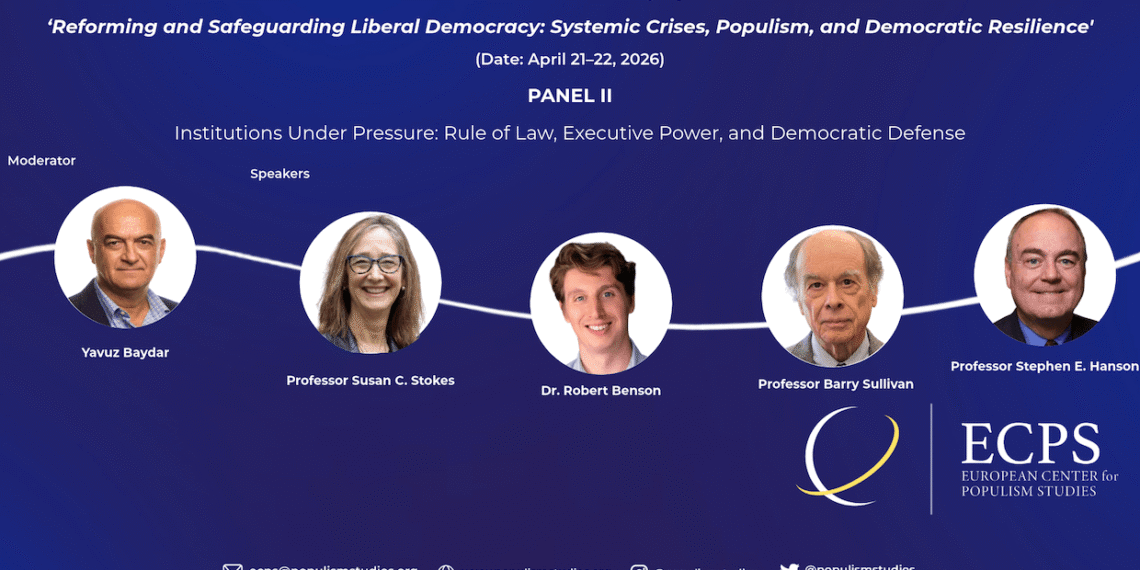
Second panel of ECPS Fifth Annual International Symposium examined how democracies confront coordinated pressures on courts, bureaucracies, electoral systems, and constitutional safeguards. Moderated by Yavuz Baydar, the session brought together Professor Susan C. Stokes, Dr. Robert Benson, Professor Barry Sullivan, and Professor Stephen E. Hanson to analyze both democratic erosion and possibilities for recovery. The panel moved from comparative evidence on how backsliding leaders leave office, to the transnational coordination of illiberal actors, the expansion of executive power under Trump’s second administration, and the patrimonial assault on rational-legal state institutions. Together, the speakers underscored that democratic defense requires coordinated resilience, institutional renewal, civic mobilization, and a renewed commitment to rule-bound governance.
Reported by ECPS Staff
Panel 2 of the ECPS Fifth Annual International Symposium, “Reforming and Safeguarding Liberal Democracy: Systemic Crises, Populism, and Democratic Resilience,” convened under the title “Institutions Under Pressure: Rule of Law, Executive Power, and Democratic Defense.” Moderated by Yavuz Baydar, blogger with Mediapart and columnist with Svenska Dagbladet, the panel examined how liberal democratic institutions respond when the rule of law, bureaucratic autonomy, constitutional safeguards, and electoral accountability come under sustained pressure.
Baydar framed the discussion around the urgent question of whether democratic systems possess the institutional and civic resources necessary to resist coordinated attacks from within. His moderation emphasized that contemporary democratic backsliding rarely takes the form of a single rupture. Rather, it unfolds through cumulative pressure on courts, civil services, electoral institutions, media systems, and oversight mechanisms. This framing gave the panel a coherent analytical direction: to understand not only how democracies erode, but also how they may recover, defend themselves, and rebuild resilience.
The first speaker, Professor Susan C. Stokes, Tiffany and Margaret Blake Distinguished Service Professor and Director of the Chicago Center on Democracy at the University of Chicago, shifted attention from the causes of democratic erosion to the question of how backsliding leaders leave power. Drawing on comparative evidence, she explored elections, term limits, party dynamics, protests, and impeachment as mechanisms of accountability and democratic recovery.
The second speaker, Dr. Robert Benson, Associate Director for National Security and International Policy at the Center for American Progress (CAP), widened the discussion to the transnational level. His presentation argued that attacks on liberal democracy are increasingly coordinated across borders through far-right networks, ideological circulation, institutional repurposing, and strategic inversion, requiring an equally coordinated democratic defense.
The third speaker, Professor Barry Sullivan, Raymond and Mary Simon Chair in Constitutional Law and George Anastaplo Professor of Constitutional Law and History at Loyola University, examined executive power in the United States under Trump’s second administration. His analysis focused principally on the erosion of separation of powers, the weakening of institutional guardrails, and the expansion of presidential authority through legal, political, and judicial developments during the first year of the second Trump administration.
The final speaker, Professor Stephen E. Hanson, Lettie Pate Evans Professor of Government at William & Mary, offered a broader theoretical reflection on democracy, state power, and regime change. Moving beyond the concept of populism, he argued that patrimonialism and the assault on rational-legal state institutions provide a more precise lens for understanding contemporary authoritarian drift.
Together, the panel offered a rich interdisciplinary account of institutional vulnerability and democratic defense. It showed that safeguarding liberal democracy requires not only electoral resistance, but also coordinated institutional renewal, civic mobilization, and a renewed commitment to the rule-bound democratic state.