
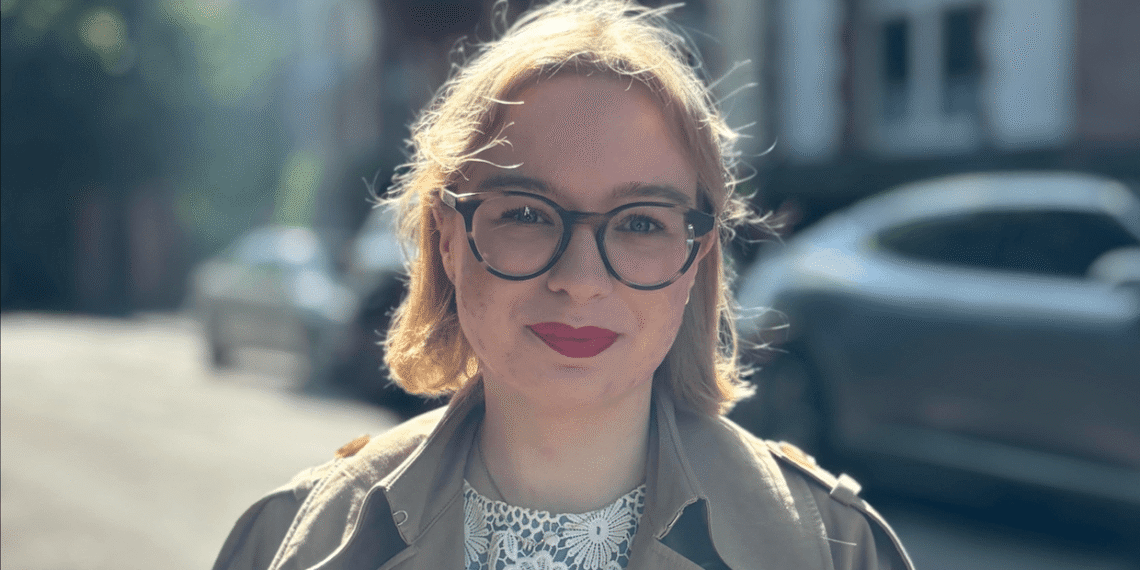
In this ECPS Voice of Youth interview, Fabiola Ermer, doctoral researcher at the Heidelberg University for Jewish Studies, discusses her comparative research on right-wing conservative think tanks in Israel and Hungary, the role of education in shaping ethno-national belonging, and the importance of looking beyond political leaders to understand how illiberal ideas become embedded in society. Examining educational programmes, transnational ideological networks, and the societal infrastructures of illiberalism, Ermer highlights the less visible mechanisms through which political narratives acquire legitimacy and become normalized. She also distinguishes illiberalism from democratic backsliding, reflects on the methodological challenges of comparative research, and emphasizes scholarly independence, international collaboration, and critical engagement with education’s role in reproducing political identities and sustaining ideological influence beyond electoral change.
Interview by Natalia Crane
In an era of democratic backsliding and increasingly interconnected illiberal movements, understanding how political ideas become embedded in society requires looking beyond electoral competition, political leaders, and formal institutions. Education, ideological networks, and the construction of national belonging constitute less visible but consequential dimensions of contemporary populism.
Fabiola Ermer is a doctoral researcher at the Ben-Gurion Chair for Israel and Middle Eastern Studies at the Heidelberg University of Jewish Studies and a doctoral fellow of the Ernst Ludwig Ehrlich Scholarship Foundation (ELES). Her doctoral research examines right-wing conservative think tanks in Israel and Hungary, focusing on how their educational programmes for young adults contribute to the construction of ethno-national conceptions of belonging and form part of broader infrastructures of illiberalism.
In this ECPS Voice of Youth interview, Ermer reflects on the development of her academic interests, the relationship between populism and democracy, and the methodological challenges of comparative research. She also discusses international academic collaboration, education’s role in reproducing political ideas, and the mechanisms through which political narratives become socially embedded.
Drawing on comparative research in Israel and Hungary, Ermer emphasizes the importance of studying the ideological infrastructures operating between governments and society. “We need to look more beyond parties, campaigns, and individual leaders,” she argues, calling for closer examination of how political ideas acquire institutional durability and social legitimacy.
Central to her research is the recognition that education is not inherently democratic or emancipatory. As Ermer explains, “education can also reproduce particular worldviews and ideas of belonging.” She therefore encourages researchers to examine who provides education, which values are communicated, and how educational programmes relate to broader political structures.
Ermer also challenges the tendency to equate illiberalism with democratic backsliding, emphasizing the analytical distinction between rejecting liberal values and the deterioration of democratic institutions. Her comparative approach highlights how think tanks, transnational networks, and educational initiatives contribute to constructing the boundaries of political belonging.
Regarding scholarly responsibility, she advocates methodological transparency, analytical independence, and greater public engagement. Researchers, she argues, should “make complex developments understandable, challenge misleading assumptions, and provide the necessary context.”
Ermer hopes her research will illuminate “the less visible mechanisms through which political ideas become socially embedded and politically normalized, without the need for coercion,” offering a perspective on the societal foundations of illiberalism and the challenges facing contemporary democracies.
Interview with Fabiola Ermer lightly edited for clarity and flow.
From Israel’s Judicial Reform to Comparative Research on Hungary
To begin, could you introduce yourself, outline your academic journey, and explain how your research interests developed? What initially drew you to your studies, and why do you believe these areas of research are particularly significant in today’s global political environment?
Fabiola Ermer: Thanks for the invitation again. I’m currently a PhD student at the Ben-Gurion Chair for Israel and Middle Eastern Studies at Heidelberg University for Jewish Studies, and also at Heidelberg University. I’m supervised by two professors: Professor Dr. Hans Dekel, who is based at Heidelberg University for Jewish Studies, and Professor Dani Filc, who is a professor at Ben-Gurion University of the Negev in Israel.
I studied Jewish Studies, Political Science, and Semitic Languages, mostly in Germany, in Düsseldorf and Heidelberg. My interest in this particular topic, and in Israel and Hungary, actually started with an internship in Israel in 2023, before October 7. At that time, judicial reform dominated public and political debates in Israel. There were constant comparisons with Orbán’s judicial changes in Hungary. I became increasingly intrigued by this, and I was looking for a topic for my master’s thesis. I thought it was a perfect opportunity because it was such a current issue. So, I asked whether Hungary could serve as a role model for an illiberal transformation in Israel.
To make it very short, Orbán’s mechanisms would have been quite difficult to replicate in Israel for several reasons. One important difference is that Israel has no constitution, whereas Hungary’s constitutional changes in 2012 played a major role in its transformation.
What I realized while researching was how closely connected many actors, especially those on the right-wing spectrum, were between Hungary and Israel. They were working together, sharing interests, and organizing conferences together. I became very interested in the topic and decided that I wanted to pursue a PhD in this field, maintaining the comparison between Hungary and Israel.
Now I’m researching how right-wing conservative think tanks in Israel and Hungary use educational programmes, mostly for young adults, to construct ethno-national conceptions of belonging. I’m also asking how and why these programmes may become part of a broader infrastructure of illiberalism. I’m not saying that they are the reason illiberalism is happening, but they are one element within a much broader process.
Populism, Illiberalism, and the Construction of Belonging
Your doctoral research examines think tanks in Israel and Hungary, particularly their role in shaping political and civic understandings of the people. How does your work intersect with broader debates in populism studies? How do you define populism in your own research, and why have you adopted that particular approach? Has your understanding of populism evolved since you began your academic career?
Fabiola Ermer: I’m working mostly with a broad approach to populism, particularly the definition by Cas Mudde and Cristóbal Rovira Kaltwasser. They define populism as a thin-centered ideology that sees society as divided into two homogeneous and antagonistic groups: the pure people” and the corrupt elite. It holds that politics should express the general will of the people. This approach is useful for me because it focuses on the content, which is exactly what I’m researching: how actors construct the idea of “the pure people” and, in this case, who belongs and who is excluded.
However, I’m not actually looking at leaders or campaigns. I’m looking more at the structures behind them, such as think tanks and educational programmes. In my framework, populism is therefore one element rather than the whole story. I’m working with four connected dimensions. The first is illiberalism and democratic backsliding as a broader process. The second is ethno-national and national-populist construction. The third is content and hegemony, particularly in a Gramscian sense. And the fourth is education as the medium through which these ideas are transmitted.
I would say that my understanding has changed. Before, I was more focused on how populism is articulated through governments and at the governmental level. Now I’m looking at it from different perspectives. I remember reading about the idea that populism works along a vertical axis, with the people positioned against the elite, while nationalism works along a horizontal axis. I’m essentially combining these two axes. I’ve realized that it isn’t always easy to define them strictly as two separate groups. They are much more interconnected. I think that’s where my understanding has changed most over the last year. I’ve just finished my first year of PhD research, so everything is still developing, but that is probably the biggest shift in my thinking about populism.
The Relationship Between Populism and Democracy
Populism remains one of the most contested concepts in political science. Given your research, which theoretical debates would you consider most consequential for the future of the field? What misconceptions about populism, illiberalism, and democratic backsliding do you encounter most frequently?
Fabiola Ermer: One of the most important debates we are still facing, both in academia and in public discussions, concerns the relationship between populism and democracy. We need to ask how we deal with populism and to what extent it can even nurture democracy by raising questions that might otherwise not be asked. However, especially now, with increasing polarization, illiberal actors are managing more and more to present themselves as the true defenders of democracy, mostly understood through elections and majority rule. Courts, liberal elites, and supranational institutions, such as the European Union, are increasingly framed as obstacles imposed from above.
To connect this, I think of Adam Przeworski, whose work I really admire. He discusses one of the key questions we face when defending democracy: Are we defending democracy itself, or the values we personally attach to it? And what happens when different people attach different values to democracy? This is where the tension between minimalist and maximalist conceptions of democracy becomes much more decisive. From a minimalist perspective, the erosion of liberal safeguards may become visible much later, when democratic backsliding is already happening. Hungary was quite a good example of this. There may now be a change, but it is still far too early to say whether there will be a shift from minimalist to maximalist ideas of democracy.
As for misconceptions, I think one of the most common ones, especially in public debate rather than academia, is that illiberalism and democratic backsliding are treated as synonymous. But technically, they are not the same. Democratic backsliding refers to the deterioration of democratic qualities, such as less competitive elections or restricted participation. We have seen this in Hungary and Serbia, for example. Illiberalism itself refers to the rejection of liberal values. From a minimalist understanding of democracy, an illiberal system may still be considered a valid form of democracy, even if it is not necessarily the form of democracy we personally want. This also raises the question of whether liberal democracy is the only form of democracy we should defend, or whether it is a more Western idea that we sometimes try to impose on systems that may work differently.
Another misconception is that we focus too much on governmental levels and not enough on the population or the actors behind governments. These actors still receive comparatively little attention.
Methodological Challenges in Comparing Israel and Hungary
How do you operationalize populism in your research? What challenges arise when comparing different national contexts, such as Hungary and Israel? And how do you balance qualitative and quantitative approaches?
Fabiola Ermer: I’m still working on my methodology, so there are some things that are changing. At the moment, I have a qualitative and comparative research design, with the individual organization as the unit of comparison. Instead of measuring populism quantitatively, I’m combining two procedures with separate tasks. One is a structured qualitative content analysis, which captures what the programmes actually communicate.
I have four main categories: the construction of the people, identity and belonging, concepts of democracy, and enemies and demarcations. These are closely connected to the populist narrative of “us versus them.” Another important category is the relationship between the diaspora and the homeland, which is relevant to both Israel and Hungary, although in different ways.
The subcategories I will use are likely to be developed from the material itself. In addition, I’m using discourse-analytical reading to capture how meaning is produced, particularly through language, metaphors, and implicit assumptions that make belonging appear natural and apolitical.
One of the main challenges is that both political systems are changing. Another is that the two cases are neither a most-similar nor a most-different design, so I had to look more closely at what makes them comparable in a qualitative analysis. I think I’ve now figured out how to frame this well enough for my PhD. I’m using the distinction between ethnic belonging and formal citizenship, which is anchored in the legal frameworks of both countries. Israel does not have a constitution, but it has a Basic Law with a somewhat ambiguous constitutional character. The distinction is also anchored in the Hungarian constitution. That is where the two cases are most similar.
They differ, however, in how they draw their boundaries. Following other political scientists, Israel can be classified as an ethnic democracy. We also see this in other countries, such as Slovakia and Estonia. Hungary, on the other hand, is not generally considered an ethnic democracy. It is one of the most homogeneous countries in the European Union. Its inclusive boundary extends to ethnic Hungarians in neighboring countries, such as Slovakia and Romania, while its exclusive boundary is drawn against more constructed threats. That is one of the limitations I have to deal with when comparing the two systems.
Do you plan to conduct fieldwork in these countries, particularly by speaking with people about ethnic belonging and related issues?
Fabiola Ermer: I do. The question now is whether I might shift more towards interviews. The difficulty with my research is that I won’t be able to make claims about the effects of these programmes. It would be too broad, and I don’t think it would be academically rigorous to say that someone attended classes at a think tank for a year, for example, and consequently developed more illiberal ideas. I can’t really speak about that effect.
Instead, I’m looking more at why people, such as the heads of organizations, construct these courses in particular ways. Why are certain topics included? Even the names of subjects and the literature used to frame them can already provide hints. For example, in the Hungarian case, when organizations offer classes about Hungarian minorities, they may use Hungarian terminology for countries that have not been part of Hungary for more than a hundred years. That already communicates a particular idea before the lecture even begins. So, I will conduct fieldwork in the sense that I will speak with people and try to gather as much material as possible.
Digital Research and the Importance of Archiving
The study of populism and contemporary political movements increasingly relies on digital data, social media, and computational methods. Given the importance of political communication and transnational networks in your area of research, what role have these tools played in your own work? How might they help scholars better understand political ideas and the development of movements?
Fabiola Ermer: Computational methods are not necessarily at the center of my methodology, but digital work matters in a different way. I actually didn’t expect this before, but with the changes in Hungary, I’ve become quite experienced in archiving websites. Websites and programmes are often digitalized, and they are among the most important sources for my research. When I want to understand how a class is framed beforehand, for example, and an organization has a Moodle course, I would really like to know how that course is presented. However, with the political changes, some materials are disappearing, particularly when organizations come under political pressure. So, I’ve started archiving relevant websites at regular intervals and working with earlier versions through web archives.
In general, digital methods have expanded considerably. They make it possible to analyze communication across large datasets and trace how messages travel across networks and platforms, sometimes even across countries and continents. But I think we need to be careful not to treat digital visibility directly as political influence. There are many more factors involved. Social media data tell us a lot about communication and mobilization, and they help us identify certain trends. But they do not necessarily tell us how ideas become embedded in institutions or in everyday understandings of society.
There is also the danger of being in certain bubbles all the time. Ideas can suddenly seem more natural, or it can seem as though everybody is saying something, when in reality, you’re only seeing a small bubble that appears much bigger than it is. Nevertheless, I don’t think any academic research field can ignore digital methods completely. They are important sources of data, but we should approach them carefully and make sure to bring other perspectives into the analysis.
Unexpected Discoveries and Changing Research Assumptions
What has been the most surprising finding in your work so far? Have you encountered any evidence that fundamentally challenged your original assumptions or shifted your thinking?
Fabiola Ermer: When I started my PhD, Hungary was still under Orbán’s government, while the Israeli political system was relatively stable, despite the elections and other developments. There was nothing fundamentally changing in the way we have now seen in Hungary. Orbán still had a two-thirds majority and was firmly in power. I think even many political scientists in Hungary would not have expected Magyar to win with such a strong majority in April.
One of my hypotheses was that institutions, once established, could endure even through political changes, particularly if they had been in place for a long time. But I hadn’t really considered what would happen if one two-thirds-majority system shifted into another two-thirds-majority system. With new legislation, defunding, and the creation of new foundations in Hungary, everything became very chaotic. That was one of my main surprises. Perhaps I should have considered it beforehand, but it was so hypothetical that even in April, many people thought such a fundamental change was unlikely.
Another interesting discovery came from comparing the organizations themselves. I’m currently looking at two or three Israeli think tanks, mostly on the right-wing spectrum, that are structured somewhat similarly to the Mathias Corvinus Collegium in Hungary. They offer classes for young adults, mostly between 18 and 26, with the aim of building a new intellectual elite.
What I found particularly interesting was how differently these organizations are structured. Hungary has, in a way, perfected the model of putting everything under one roof: a think tank, an educational sector, and other activities within one institution. In Israel, these activities are more divided between different think tanks, but the organizations are still closely connected. They may have the same lecturers or receive funding from the same organizations.
At first, I wasn’t sure whether this asymmetry would be a problem for comparing the cases. But after discussing it with my supervisor, I decided to approach it as two distinct modes of hegemonic articulation: direct pedagogical formation on one side and mediated ideological dissemination on the other.
I was also surprised by how little political foundations, and their non-governmental activities have been researched. We know quite a lot about institutions such as the Mathias Corvinus Collegium and their role within the Orbán regime, but there is still much less research on what they actually do at the non-governmental level. This is important because democratic backsliding and illiberalism do not necessarily happen only at the highest political level. They can also develop at an intermediary level, between the population and the government.
Researching Politically Sensitive Topics
Populism often operates in politically polarized environments characterized by disinformation campaigns and contested narratives. Do you foresee these dynamics affecting your ability to collect data, access reliable resources, and conduct research? How do you navigate politically sensitive topics while maintaining scholarly rigor and analytical distance?
Fabiola Ermer: These dynamics have mainly affected the actors I’m researching. Internal teaching materials are particularly difficult to obtain, especially when they belong to organizations operating in a system that is undergoing political change. The situation in the Hungarian parliament is still quite heated and polarized, and access requests are currently being declined, often without any explanation.
Some of the materials in the Israeli cases are also difficult to obtain. Think tanks are generally not very willing to share their materials, and the broader polarization of the Israeli political system, as well as the international context, makes this even more complicated. Everything seems to be becoming more exclusive, and organizations are less willing to include outsiders.
Another substantive challenge is that the organizations I’m studying sometimes describe their work in ideological terms. Some openly state what they want to achieve, which can make certain questions easier to answer. But when programmes are presented as civic education, leadership training, or academic excellence, it becomes more difficult to understand their underlying purpose. I also don’t think it is academically sound to assume that because an organization describes its work in a certain way, that is necessarily what happens in practice. That’s why I’m trying to look more closely at why these programmes are constructed, not only how they are constructed.
With polarization more generally, I think it will become increasingly difficult for scholars to access materials. People are also becoming less willing to talk to those who may not share their ideas or worldviews, and this affects journalists and researchers alike.
The Responsibility of Scholars in Public Debate
When controversial topics such as populism generate intense public debate, do you believe scholars have a responsibility not only to produce research but also to intervene in these discussions? How can academics communicate complex findings to policymakers, journalists, civil society, and broader audiences?
Fabiola Ermer: Scholars have a responsibility to take part in public debate, especially when political concepts are used in simplified or highly polarized ways. However, I wouldn’t say our task is necessarily to provide political solutions. We are more the people who provide the facts and the analytical perspective.
The most important thing is that we are able to make complex developments understandable, challenge misleading assumptions, and provide the necessary context. I feel that this is actually a problem in political science. We talk so much about theory that people outside the field, or even people who work in a different academic discipline, sometimes ask themselves: What is actually happening? We need to adapt more to different settings and accept that each format requires something different. Policy advice is fundamentally different from writing about elections for a political journal or having a discussion within a political party and explaining what is happening in a particular country. Each format requires something different. In general, an audience needs a clear argument and a concrete example, so we should make our work as accessible as possible.
I think this is also one reason why populist narratives can be so effective. They are often very simple: they do this, everything else is bad, and we are here. There is no room for anything in between. But there are people in between, and we need to explain why things are not as simple as they may appear. This is where academia should intervene more. At the same time, academia should remain a place where fundamental disagreements can be discussed openly and where discussions are based on evidence and argument.
The debates surrounding Israel, in particular, show how polarization can reach into academic agenda-setting. It can affect which questions are considered legitimate and which perspectives are heard. We should not allow political positions to determine in advance which questions can even be asked. People sometimes misunderstand academia as a place where researchers are necessarily political activists. That can be true for some individuals, but academia should remain grounded in facts, evidence, and arguments rather than feelings.
The Broader Impact of Research on Democracy and Education
Beyond academic publications and your doctoral thesis, what kind of impact would you ideally like your research to have? How would you like scholarly work to contribute to our understanding of democratic challenges while avoiding becoming politicized itself?
Fabiola Ermer: Ideally, I would like my research to help explain how illiberal ideas become established beyond formal institutions. Democratic backsliding is still usually studied through constitutional reforms, judicial independence, or electoral cycles. All of these things matter, of course, but we also need to understand the societal infrastructures that make such challenges possible or acceptable. That’s where I would really like to contribute. With the Hungarian case, my research is also shifting towards a new question: How durable are these infrastructures once they have become well established? And how durable are they when there is an actual change in government or a fundamental political transformation?
The topic of education is also very personal to me. I would like to encourage a more critical perspective on education because, especially in Western democracies, education is often assumed to be democratic or emancipatory by nature. But we tend to forget that education can also reproduce particular worldviews and ideas of belonging. I don’t want to say that every politically oriented programme is inherently problematic. That’s not what I’m trying to argue. It is important, however, to pay attention to who provides education, which values it communicates, and how it relates to wider political structures. We should also ask why people feel the need to seek out alternative educational infrastructures rather than considering the existing government structures sufficient.
Regarding politicization, it is quite difficult to avoid it completely with my topic. But, in the end, I’m conducting academic research, and I distinguish between political advocacy and academic intervention. Research can contribute to democratic debate by making the mechanisms in both countries visible and hopefully providing evidence. But I’m not telling people what they should think. I’m stating what I have found, and then it is up to them to process that information.
The best protection I know is to be transparent about your methods, your materials, and the limitations of your research. It is also important to take seriously evidence that contradicts your expectations or even your results. In science, it is entirely possible that in ten years everything will have changed so fundamentally that our current findings no longer hold. But they are relevant to the period we are studying now.
International Collaboration and Academic Exchange
How has cooperation with other scholars, academic networks, and transnational initiatives such as the ECPS Early Career Researchers Network influenced your research, professional development, and intellectual outlook? How important are international dimensions to your work?
Fabiola Ermer: As you said, my whole project is international by design. It is co-supervised in Israel, and my co-supervisor primarily researches right-wing populism in Israel. He has already become a very important reference for me. This has shaped certain narratives, questions, and programmes that I’m looking at, particularly in the Israeli context. But it also means constantly moving between two academic environments, with different debates and assumptions.
What I learned quite quickly is that scholars are generally very open to helping if you ask them. Although I’m based in Germany, I speak with professors in Hungary and researchers in Israel. Even when you spend only a few weeks in a country and engage with people there, you can gain new insights, challenge assumptions, make connections, and meet people. Everybody knows someone who might be able to help, and that’s a great benefit of academia.
I also attended the ECPS Summer School, and it was a good example of this. We worked on a policy paper or policy advice in an interdisciplinary group, with people whose backgrounds were very different from my own. It encouraged communication across disciplines and helped us think in policy terms. I found it very enriching, and the connections we made continued even after the course finished. These international connections and regular opportunities to discuss ongoing work help prevent projects from becoming too narrow or one-sided.
To return to populism, it is generally a transnational phenomenon. The actors themselves work across borders, particularly when we look at right-wing networks. Studying populism therefore also requires transnational exchange.
Challenges Facing Early-Career Researchers
Are there any personal or professional challenges you have faced while pursuing your research, particularly as an early-career scholar? What has enabled you to overcome these challenges? Has working on politically sensitive subjects presented any additional difficulties?
Fabiola Ermer: In general, one of the biggest challenges when starting a PhD or becoming an early-career researcher is the financial aspect. I’m very lucky to have a scholarship now, but in the beginning, there is a period when you don’t know whether your research will actually be financed or whether the funding will be sufficient.
For me, the first six months were particularly challenging because I was trying to obtain a scholarship and applying for different opportunities. Applications are very time-consuming, especially because every foundation wants something different. You write and rewrite applications, and sometimes you suddenly need another recommendation letter when you thought two would be enough.
Another challenge is balancing theoretical ambition with empirical feasibility. My project touches on so many theoretical dimensions: populism, illiberalism, democratic backsliding, nationalism, and education. At some point, it becomes tempting to cover everything, but that’s simply not possible. You sometimes have to overcome your own perfectionism and accept that you need to focus on a particular subject, even if there are many other interesting things you would like to explore. Otherwise, you could easily end up with enough material for several PhDs.
In the beginning, I wanted to compare three countries. Austria was one of the cases I considered because it offered a different ethno-national conception from Israel and Hungary. I thought it would be interesting to include a third case to show the contrast. But I realized quite quickly that the differences would make the comparison very difficult. Focusing on Israel and Hungary would actually make the project stronger.
I think that not losing focus is one of the most challenging things, at least based on my first year of experience. There are so many interesting things happening that it is easy to get lost in the details and become overwhelmed.
The Most Rewarding Aspects of Academic Research
What has been the most rewarding aspect of your work so far during your first year? Is there anything you would approach differently?
Fabiola Ermer: One of the most rewarding things has been starting to feel that people are actually interested in what I’m doing. I’ve been invited to talk about my research, present my ideas, and exchange views with other researchers.
Over the last year, I was invited to speak about the Hungarian system and the changes taking place there. Previously, I had been looking more at right-wing networks in Hungary and how they cooperate with other networks globally. It was really great to be invited and to have people interested in hearing me talk about it. I felt very honored.
I’m also grateful that I can work on something I’m genuinely interested in. I have to admit that when I first started studying Political Science, I hated it. I really didn’t like it. Perhaps I was too young when I started, but many things didn’t make sense to me, particularly political theory and democratic theory. That changed during my master’s degree. Now I’m doing my PhD in this field, and I genuinely look forward to reading and working on these topics. I think being able to work in a field that interests me so much is one of the best things I could have.
If I could start again, I would try to work more systematically with my materials from the beginning. I’m still at an early stage, so I have time to improve things, but the Hungarian case has become particularly challenging because of all the political changes. I suddenly have to archive as much material as possible, as quickly as possible.
I would also have liked to understand earlier that a dissertation does not need to address an enormous number of questions. It needs to address two or three fundamental questions that are important for the research and that ultimately help develop a clear and convincing argument.
Scholars and Ideas That Have Influenced Her Research
Are there any particular scholars, theoretical traditions, books, or experiences that have fundamentally shaped your thinking about populism, ethno-nationalism, democratic backsliding, or the relationship between education and politics?
Fabiola Ermer: So far, the most important experience was probably the internship I had in Israel in 2023. That’s where everything started to develop, and I’m pretty sure I wouldn’t have chosen this topic if I hadn’t been there at that particular time.
My supervisors have also been very influential, especially my first supervisor. He brought me back into the political science part of my research when I presented my first draft for what would become my master’s thesis. He later encouraged me to pursue a PhD and supported me throughout the process.
On a theoretical level, Adam Przeworski has been particularly important. He’s a Polish political scientist who has lived in the United States for decades. His distinction between minimalist and maximalist conceptions of democracy is quite simple and logical when you first read it. But it changed a lot for me, especially in terms of the question of what we do with people who attach different values to democracy. It changed not only how I approached my own research topic but also how I engage with political debates when presenting my research and encountering different ideas.
It’s such a fundamental question: how do we deal with people who attach different values to democracy? Perhaps this is also one reason why we are becoming more polarized. We have started to neglect the question of how to deal with different values, and we sometimes assume that the values we attach to democracy are the only ones that matter. Przeworski essentially framed much of the theoretical framework of my PhD.
Other influential scholars include Fareed Zakaria, who helped popularize the distinction between democracy and constitutional liberalism, as well as Wolfgang Merkel and Aurel Croissant, particularly their work on formal and informal institutions.
For the Israeli context, the concept of ethnic democracy has also been important, particularly how it is understood in different countries and compared with European contexts. My second supervisor’s work on how Jewish populism has changed over the centuries has also influenced how I developed my own thinking.
Skills and Advice for the Next Generation of Scholars
As universities become increasingly internationalized and research more competitive, what skills do you believe young political scientists need most in order to thrive? What advice would you offer to the next generation of scholars entering populism studies?
Fabiola Ermer: There are quite a few things, although I’m still figuring them out myself. First, it’s important to be very precise about the definitions you use at the beginning of your research. You need to clearly explain what a concept captures and what it doesn’t. Rather than adopting a new term on every page, you should be clear about the concepts you’re working with.
I also think language skills are extremely important. We live in a world that is so globally connected, and even with AI and translation tools, linguistic skills remain essential. You can understand so many more nuances when you know the language and understand why a particular word is being used instead of another. This is particularly important in populism studies because different forms of populism can be quite subtle. When you’re not researching in your native language, having at least some basic language skills can be extremely helpful.
If there is an opportunity to receive a scholarship or participate in an academic exchange, I would also encourage researchers to spend time in the country they are studying and immerse themselves in its context. That’s one of the best skills we can develop.
Finally, being able to ask for help is an important skill. During bachelor’s and master’s programmes, you’re often expected to work independently, and it may not feel natural to approach your professors with questions all the time. But during a PhD, the expectations change. People ask why you didn’t seek help earlier. It’s important to develop the habit of asking questions and seeking guidance early, rather than continuing in one direction without knowing whether it is the right one.
The Future of Populism Studies
Looking ahead, where do you see populism studies evolving over the next decade? Which research questions or neglected areas deserve greater scholarly attention than they currently receive?
Fabiola Ermer: From an academic perspective, I’m quite optimistic that the topic won’t disappear. We need to look more beyond parties, campaigns, and individual leaders. We should ask more systematically how these ideas become embedded, rather than simply describing that they are becoming embedded.
Transnational networks are another important area. There are increasingly more mapping studies, and this kind of research will continue to develop. Social media also helps connect people globally and can facilitate the spread of populist narratives.
Another question that deserves more attention is what happens when populist governments lose power. Why do people become dissatisfied with the ideas these governments promote? Are they dissatisfied because those governments were populist, or are there other reasons why they decide to vote them out? We should also ask what happens to the infrastructures built during those years. Do they disappear, adapt, move somewhere else, or remain in the background? I think we will have more case studies to explore these questions, and they will become increasingly important.
We are also seeing populism become a much more prominent part of political debates in Western European countries. It will be interesting to compare countries where populist governments are losing power with those where populist movements are gaining influence.
The times are changing very quickly, and developments can be quite surprising. But these are some of the directions in which populism studies could develop.
Looking Beyond Israel and Hungary
If resources, time, and institutional constraints were no obstacle, what research project would you most like to pursue? Would you be interested in expanding your comparative research beyond Israel and Hungary or exploring other dimensions of transnational national-conservative networks? More broadly, what do you hope will ultimately be the lasting contribution of your work to scholarship and public understanding?
Fabiola Ermer: I would actually like to continue working on both countries, perhaps not necessarily as a direct comparison, but within a broader comparative project on how ideas of national belonging are transmitted across borders.
I would also like to focus more on diaspora programmes, transnational political networks, and how these different elements work together. This is particularly interesting in the Israeli case, but perhaps even more significant in Hungary, where these ideas are much more deeply embedded. For example, the whole idea of mystifying or romanticizing Hungarian history, and how that has become embedded in Hungarian society, is something I find very interesting. This is one of the lasting effects of the Orbán regime. The idea of Treaty of Trianon has become much more visible over the last fourteen years. You can see it in monuments standing in small villages, including those near Hungary’s former borders. It is very visible, and it also plays a role in how the idea of the people is constructed.
There is a similar phenomenon in Israel, although it operates in a different and less pronounced way.
I would really like to research the broader idea of romanticizing history and how it is narrated through political contexts. There are so many connected dimensions that could also be explored, such as how schoolbooks are designed and which vocabulary is used. These things are closely connected to my current topic, but there are so many nuances that I cannot examine all of them at the moment without making the project far too broad.
Ultimately, my hope is that my work can contribute to understanding the less visible mechanisms through which political ideas become socially embedded and politically normalized, without the need for coercion, and how these mechanisms shape the transformations taking place in our democracies today.