As Sweden approaches a razor-thin 2026 election, Professor Andreas Jahrehorn Önnerfors argues that the Sweden Democrats’ significance lies not only in whether they enter government, but in how far they have already reshaped mainstream politics. He describes the Tidö Agreement as giving SD “a huge magnet” that has pulled governing parties to the right, while the collapse of the cordon sanitaire has blurred distinctions between SD and the Moderates. The interview also explores Folkhemmet nostalgia, “white melancholy,” migration, alternative media, conspiratorial narratives, enemy images, and information disorder. Looking beyond election day, Professor Önnerfors warns that Sweden may face prolonged coalition uncertainty and a deeper political realignment, concluding that “we are going to face a very hot autumn.”
Interview by Selcuk Gultasli
Sweden’s 2026 election on September 13 may mark a decisive stage in the normalization of the radical right. With the Sweden Democrats (SD) polling ahead of the Moderates in several surveys and the survival of the Liberals remaining uncertain, the central question is no longer whether SD has entered the political mainstream, but how far its influence has already transformed the structure, language, and ideological center of Swedish politics. In this interview with the European Center for Populism Studies (ECPS, Professor Andreas J. Önnerfors, Full Professor in Intellectual History at Linnaeus University and researcher and project leader at the Fojo Media Institute in Sweden, argues that a formal entry of SD into government would represent a qualitatively new phase—but also that the party has already achieved substantial success in reshaping mainstream political discourse.
Professor Önnerfors traces this transformation to the collapse of the traditional cordon sanitaire. Once the Moderates chose sustained cooperation with SD, he argues, voters were confronted with a simple logic: “Why choose the copy when I can vote for the original?” The result, in his view, has been an increasing convergence between the Sweden Democrats and parts of the traditional center-right, to the point where “in some cases it is indistinguishable whether a minister acts on behalf of the Moderate Party or on behalf of the Sweden Democrats.”
The Tidö Agreement is central to this process. Professor Önnerfors describes SD’s influence through the metaphor of “a huge magnet” that has pulled the governing parties “clearly to the right” on migration, integration, deportation, and criminal policy. This power has allowed SD to remain formally outside government while retaining its anti-establishment posture, even as it exercises substantial influence over policy. Yet this arrangement may be reaching its limits. Professor Önnerfors notes that SD has already declared its ambition to secure ministerial positions if the Tidö bloc wins, a development that would force the party to confront the contradictions between insurgent populism and the responsibilities of government.
The stakes are equally high for the Moderates and the Social Democrats. Professor Önnerfors argues that the former may face a profound identity crisis after drifting toward positions formulated by SD, while the latter must confront the failure of years of triangulation toward both neoliberal and increasingly punitive right-wing positions. In his formulation, “SD has already been successful in transforming mainstream Swedish politics.”
What follows, then, is not simply an interview about whether SD will enter government. It is a diagnosis of a deeper political realignment in which radical-right frames have moved from the margins into the core of Swedish political competition. With only a few percentage points separating the two blocs, Professor Önnerfors concludes that “we really don’t know in which direction it will go.” Whatever the result, he warns, “we are going to face a very hot autumn.”
Here is our interview with Professor Andreas Jahrehorn Önnerfors, edited lightly to enhance clarity, readability, and overall flow for publication.
Why Choose the Copy When You Can Vote for the Original?
Professor Önnerfors, welcome! Four days before the election, the polls disagree substantially about the survival of the Liberals but agree on something potentially more consequential: the Sweden Democrats are polling ahead of the Moderates. How should we interpret this transformation of the Swedish right? Are we still looking at a mainstream center-right bloc dependent on a radical-right partner, or has the gravitational center of Swedish conservatism itself shifted toward SD?
Professor Andreas J. Önnerfors: The situation in Sweden is, of course, similar to other situations around Europe. And the simplest explanation is that when the center-right party, Moderaterna (M), decided to enter into more or less a coalition with the Sweden Democrats (SD), voters came to an understanding: Why choose the copy when I can vote for the original? So, that is one reaction that we definitely can see. When Sweden decided against the cordon sanitaire, the cordon that supposedly would keep far-right politics out of the mainstream, that was a dangerous development, because then the two parties with most of the electoral support, the Sweden Democrats and the Moderates, were kind of joining positions, so much so that in some cases it is indistinguishable whether a minister acts on behalf of the Moderate Party or on behalf of the Sweden Democrats.
SD Successfully Appropriated the Social Democratic Ideal of Folkhemmet
SD’s support appears remarkably resilient at around 19–20 percent even amid considerable late-campaign volatility and a sharp decline in Social Democratic support. Does this suggest that SD has moved beyond the classic “protest party” phase and consolidated a durable political subculture and social constituency? If so, what are the deepest drivers of that consolidation—immigration, cultural insecurity, distrust of institutions, welfare concerns, status loss, or something more fundamental about Swedish identity?
Professor Andreas J. Önnerfors: I think it is all of that. The Sweden Democrats have also capitalized on a triangulation pursued by the Social Democrats in relation to the previous Moderate-led governments, which focused much more on new public management, neoliberal solutions, and the economy. Meanwhile, classical Social Democratic themes of societal security—in Swedish, the concept of trygghet—disappeared from the political vocabulary, leaving space for the Sweden Democrats to capture them and connect them to the old Social Democratic ideal of Folkhemmet, the people’s home, which for decades represented the vision of creating a stable society.
This concept was then successfully appropriated by the Sweden Democrats, with all that this implies: policy proposals intended to improve people’s daily lives, but also the broader package of Folkhemmet nostalgia—the idea of a people’s home that supposedly reached its peak in the 1950s and 60s, before the arrival of mass migration. This is something the Sweden Democrats have been able to tap into psychologically and culturally, and we continue to see that to this day.
The Far Right Exploits Imagined Grievances
Your writings engage with the idea of “white melancholy” and with nostalgia for the Folkhemmet, suggesting that radical-right success may be rooted as much in culture and collective self-perception as in material economics. You have discussed nostalgia, melancholy, and “retrotopia” as powerful mobilizing forces, particularly when combined with existential fear and perceived loss. How much of SD’s contemporary strength should therefore be understood as a politics of material grievance, and how much as a politics of imagined loss?
Professor Andreas J. Önnerfors: That ties into the same complex of ideas, doesn’t it? On an objective level, Swedish society is not characterized by huge economic gaps. People are generally well off. It is a prosperous society with good infrastructure and so on. So I would say that, in contrast to other countries—or, for instance, if you were to compare it with Eastern Germany—the grievances people talk about are more imagined than material.
These imagined grievances can then be exploited by the rhetoric of the far right. The immigrant population is portrayed as an internal enemy of the people, as draining resources from society, while the white majority population is depicted as being at risk of replacement in the future by immigrants who are presented as parasiting the Swedish economy. That is the image being sold, and it is successful with parts of the electorate.
The Sweden Democrats Have Won the Agenda-Setting Battle on Migration
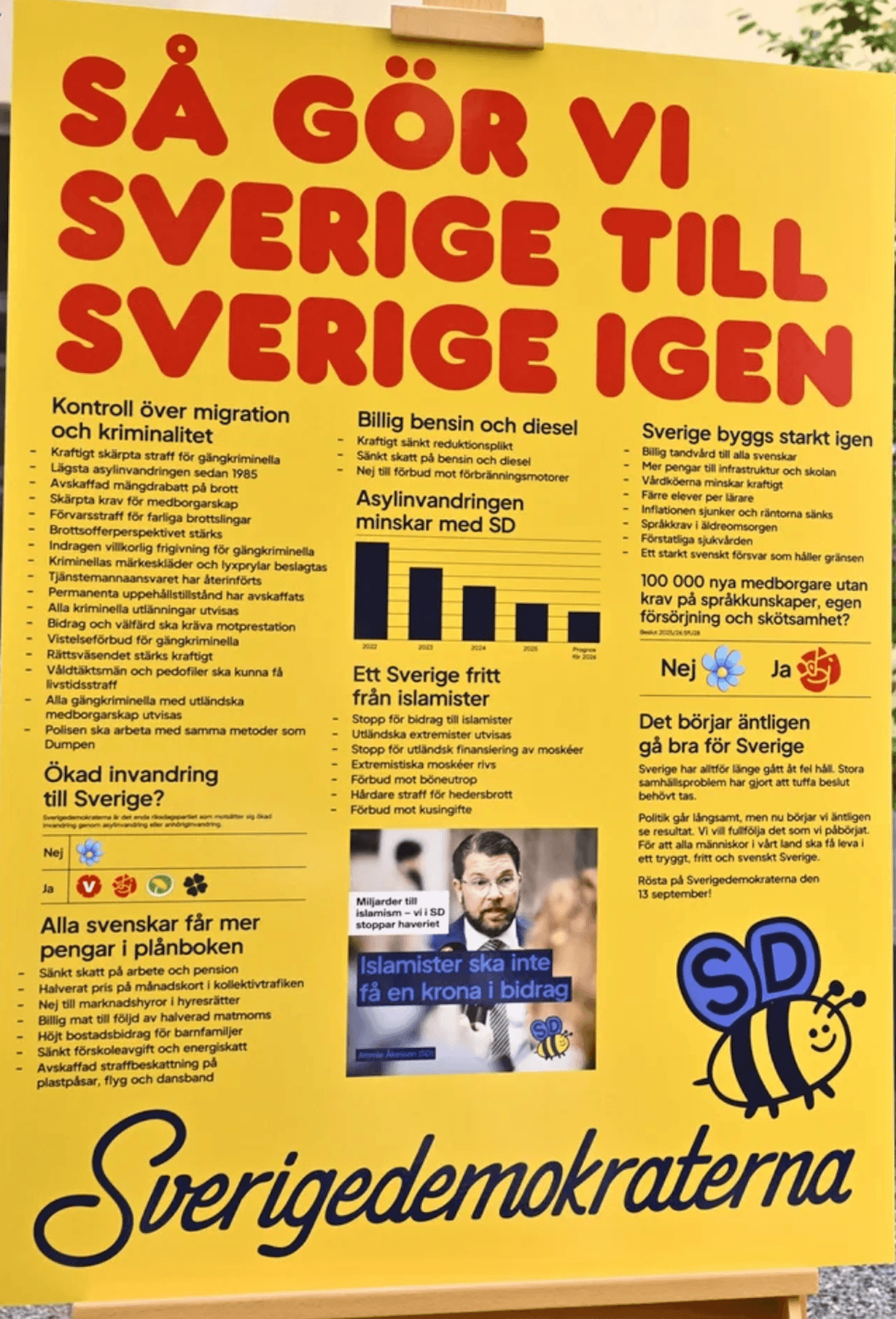
Relatedly, you have argued that immigration can become much more than one policy field because the immigrant “other” provides a screen onto which wider anxieties about social transformation can be projected. Sweden has now adopted substantially more restrictive migration policies across much of the political spectrum. Does this weaken SD by depriving it of issue ownership, or does it demonstrate that SD has already won the deeper ideological struggle by successfully redefining how mainstream Swedish politics understands migration, integration and national belonging?
Professor Andreas J. Önnerfors: I would say the latter. It is absolutely clear that the agenda setting has gone into that field and that SD has been incredibly successful in launching the idea that you can boil down basically any societal problem to immigration, migration, or integration.
You can take the recent PISA results as an example. They came in just the other day and also confirmed a trend that you can see across educated nations globally: that pupils’ reading capacities are decreasing and so on. But the Sweden Democrat framing of the problem is that it is down to the fact that we have an immigrated population that drags down the Swedish picture. So, anything from education to fuel prices to climate change, or whatever, can be boiled down to this entire issue of migration, immigration, and integration.
And with that agenda-setting the Sweden Democrats have really succeeded, which also makes it impossible to discuss big problems, both within the country, such as criminality and its deeper roots, or foreign policy issues, for instance, the war in Gaza and so on. Because if you park these issues on the parking lot of “it has all to do with immigration,” you don’t need to go back and ask your own values what is actually happening here, but you always have a scapegoat upon which you can project the perceived downfall of Sweden and the Swedish people.
The Tidö Agreement Has Given the Sweden Democrats Magnetic Power
The Tidö arrangement represents a remarkable transition from cordon sanitaire to institutionalized cooperation with SD. From the perspective of radical-right normalization, is the most important development of the past four years what SD itself has done, or what the Moderates, Christian Democrats and Liberals have become willing to say and do? In other words, does mainstream accommodation moderate radical-right parties—or does it instead normalize radical-right frames throughout the party system?
Professor Andreas J. Önnerfors: One could use an analogy here and say that, since the Sweden Democrats are not officially part of the government, what they are amassing through the Tidö Agreement is some kind of magnetic power. So, imagine that the Sweden Democrats, with this agreement, have created a huge magnet through which the issues of Swedish politics are framed. And this magnet has dragged the other parties that are part of the Tidö Agreement clearly to the right—in the area of, for instance, critique against immigration and integration, deportation, and things like that; a tough stance against criminality, and so on. That is the power that the Tidö Agreement has shaped. It has given this magnet an incredibly large power that has also made some of the government ministers more or less move over to the other side.
The Tidö Agreement Has Allowed SD to Retain Its Anti-Establishment Role
There is also a paradox here. SD can simultaneously present itself as an anti-establishment insurgent and exercise substantial influence over government policy. How sustainable is populist anti-elitism once a party becomes deeply embedded in policymaking? Can SD continue to depict “the establishment,” bureaucracies, journalists and cultural elites as hostile forces while increasingly becoming part of the governing establishment itself?
Professor Andreas J. Önnerfors: That’s a very good question, and there are, of course, different answers to it. The Tidö Agreement has allowed SD to continue playing that role because they remain formally outside the government, in the sense that they do not appoint their own ministers. Now they have raised the stakes and said that they want to have ministers if the Tidö party family wins the elections. And that will ultimately provide an answer to this question.
At the same time, SD itself has become so powerful that it has been able to expel party members who have behaved well beyond the limits of any reasonable democratic discourse—people with Nazi or far-right sympathies who have been prosecuted and sentenced in court, and so on. Yet they have had so much electoral support that these scandals have had little effect.
The Tidö Agreement has allowed them to retain their role as an anti-establishment party. But we see time and again that SD-appointed politicians, at the local, regional, and national levels, collide with the realities of sound governance. So, if the Tidö party family succeeds in the elections, we will see this trend deepen: the incompetence of populist politicians will become even more visible, and this anti-establishment flair will begin to disappear.
This is, by the way, something that parties even further to the right than the Sweden Democrats have also capitalized on. We have a number of small micro-parties that style themselves as being outside the eight parties currently represented in the Swedish parliament. And they are already framing SD as an establishment party, which you can see in the political propaganda leading up to the elections right now.
The Sweden Democrats’ Politics of Gender Is Deeply Ambivalent
Your work on “white melancholy” also discusses the perceived loss of white masculinity and the capacity of radical-right politics to mobilize across older class divisions. How important is gender to understanding SD’s electorate today? Should the persistent gender gap in radical-right support be interpreted mainly through attitudes toward immigration and crime, or does it reflect a broader politics of masculinity, authority, family, social hierarchy and resistance to changing gender norms?
Professor Andreas J. Önnerfors: It’s an ambivalent thing because, on the one hand, it’s absolutely clear that the Sweden Democrats belong to the party families in Europe that kind of resist the idea that there would be something like toxic masculinity and so on. When we’re talking about the gender gap, we see a clear gender gap in Sweden between the parts of the electorate that are voting for SD or other parties, where we have a clear gender divide. So, male voters in all age groups are flocking to SD, and female voters are more flocking to the green and red parties.
That is a true gender gap, but beyond the true gender gap, SD also frames itself as LGBTQ+ friendly. Not because they really are, because, on the other hand, they hate Pride and drag queens and things like that, but because it’s a way of framing anti-Muslim positions. They’re highlighting their support for LGBTQI or women’s issues because of the fact that they believe that it’s so provocative for the immigrants. Of course, the projection is that the very moment they would get to power, they would get rid of these positions. They’ve just adopted them to make typical racist arguments against the perceived other.
But it’s really a little bit ambivalent because, on the one hand, they are rejecting the entire idea that there would be something that you could call toxic masculinity, and they are adopting, ambivalently, both feminist and LGBTQI positions, but for the purpose of basically using them in Islamophobic rhetoric. That makes it very difficult to untangle things. Then it’s a party where very many people have been sentenced for domestic violence, which also runs completely contrary to this image that we are the supporters of women’s rights.
The Sweden Democrats Have Captured the Frame of ‘Telling the Truth’
In your work with Emma Ricknell, you examine how Swedish right-wing alternative media contest the authority of legacy journalism by presenting mainstream media as disconnected from ordinary people while constructing their own claims to authenticity and truth. Has this alternative-media ecosystem become an independent driver of radical-right support, rather than merely an amplifier of pre-existing preferences? And does it increasingly allow SD-adjacent voters to inhabit an alternative epistemic environment in which distrust of mainstream institutions continually reproduces itself?
Professor Andreas J. Önnerfors: Yes, an absolutely crucial element of the right-wing surge in Sweden has been the conquest of alternative and social media spaces. This is one area where the established parties have largely failed. The anti-establishment component has been strengthened by the fact that the Sweden Democrats have been very effective at using the affordances and logics of the alternative media sphere. They operate across the full spectrum—from social media, influencers, and YouTube videos to formats that imitate mainstream media, such as morning shows, as well as their own news channel, and the encouragement of so-called citizen journalism. Across this entire spectrum, the media ecosystem has been part and parcel of the right-wing surge in Sweden over the last 10 years.
Moreover, quality journalism has not been able to withstand this development. Even when scandals have been exposed—for instance, a troll factory run more or less by the party headquarters, or behavior that would never be accepted from an independent journalist—such revelations have still largely been accepted by the electorate, because the Sweden Democrats have managed to capture the frame of “telling the truth.” In that sense, the broader media environment has enabled frame capture in Swedish politics and has become an integrated part of the far-right surge.
It is very smart because it works across platforms and media forms. We can even see the Sweden Democrats engaging in popular culture, such as Schlager music in Sweden, with songs that are popular among the population and produced by or involving SD politicians. This has been an important force behind the right-wing surge.
Dog Whistle Allows Conspiratorial Ideas to Enter Mainstream Politics
Your research treats conspiracy theories not simply as bizarre false beliefs but as powerful “meaning-making narratives.” You emphasize their recurring architecture: events are not accidental, everything is connected, hidden actors are malevolent, evidence is supposedly concealed, and society faces existential danger. To what extent has this conspiratorial grammar migrated from Sweden’s political margins into more conventional discussions of immigration, crime, elites, media, EU power and national decline? Where should scholars draw the boundary between radical-right populist rhetoric and explicitly conspiratorial politics?
Professor Andreas J. Önnerfors: The salience of conspiratorial meaning-making in Sweden accelerated during the pandemic, which allowed people to use conspiratorial meaning-making as a frame to conceptualize politics. And this has been used in different ways. The Sweden Democrats have not allowed outright conspiracy theories in the sense of allowing politicians who say that climate change is a hoax, or who promote anti-Semitic or Islamophobic conspiracy theories in an outright manner. They try to separate these things and adopt a language that is much more of a dog whistle language, which implicitly rests on conspiratorial ideas. On the other hand, they have also played with certain terms that are around. For instance, instead of demographic change, they talk about an exchange of the population, which we internationally would call the Great Replacement Theory, this conspiracy theory purporting that some elites are trying to replace the natural national populations of European countries with mainly Muslim immigrants.
The establishment of far-right populism has tried to tone down the outright use of conspiracy theories, but has still been using those frames. They don’t believe in climate science. They don’t believe that immigration is caused by international conflicts, and so on. But they don’t say it openly, and the people within their party who say these things openly are also excluded from the party. But, in the wider far-right ecosystem and among party members, and particularly in social media posts, you can see these conspiracy theories expressed outright time after time, and even more so among the more radical offshoots of the far-right parties. You can see that you have explicit conspiracy theories.
Now, I’m leading a project ahead of the Swedish elections, and what we can see, for instance, on social media is the idea that the Social Democrats are associated with gang criminals, that gang criminals have been admitted to Sweden through Social Democratic policies, and that the Social Democrats have allowed mass migration as a way to create voting cattle and preserve their own power. That is a very strong conspiratorial narrative that is circulating.
Within that same sphere, a much more outlandish conspiracy theory holds that Sweden’s economic powerhouse family, the Wallenbergs, are the wire-pullers behind politics. This is far more conspiratorial and ties into QAnon and deep-state conspiracy theories that remain more on the fringes. I hope that gives you an answer to that question.
A Polarized Information Environment Is a Perfect Target for Manipulation

You have also shown how conspiratorial narratives can function as vectors of Foreign Information Manipulation and Interference, precisely because they exploit pre-existing grievances and provide emotionally compelling causal explanations. As Sweden approaches an exceptionally close election, how should we distinguish between authentic domestic radical-right mobilization and the external amplification of the same divisions by foreign actors? Is the principal vulnerability disinformation itself, or the pre-existing distrust and polarization that make particular narratives persuasive?
Professor Andreas J. Önnerfors: It goes both ways. In order for conspiratorial narratives to function as vectors of foreign information manipulation, you have to have either existing or imagined grievances that you can exploit among your target audiences. That can be used by a foreign actor in many different ways.
Now, ahead of the elections, we haven’t seen that actually happening straight away, for many different reasons, but we have had a campaign before that targeted Sweden while we were in our NATO accession talks: a legend that Swedish social services are stealing Muslim children and giving them to sexually deviant foster parents. That was a campaign that grew very big in different parts of the world and was amplified through foreign information manipulation and interference, as well as domestic amplification.
Then you can argue that, in certain policy fields, the potential objectives of foreign actors—foreign threat actors—might already be fulfilled, in the sense that there is considerable doubt about the consensus around climate science in Sweden. We recently had a report about wind energy in Europe that shows that Sweden is a hotbed of anti-wind-power disinformation. So, if you were a foreign threat actor that you don’t need to construct a campaign against Sweden, because opinion is so divided on this issue that it already reaches government levels.
So, it’s a tricky one. Then, of course, as you say, we are moving into the absolutely hottest phase of the election now. We are looking at things right now in the information environment where we don’t exactly know who the sender is. Like I was talking previously about this conspiracy theory that the Social Democrats are supported by gang criminals who have been imported to Sweden. They are siding up with the Muslim Brotherhood. They have imported voting cattle from the MENA region to Sweden to stay in power and stuff like that. Who is planting these narratives? Is this really some kind of independent distribution of political opinions ahead of the elections, or is this coordinated? It’s premature; we can’t tell that right now. But of course, if you imagined yourself as a threat actor sitting on this kind of red toolbox of campaigning, then this would be a perfect thing to throw into this very polarized information environment ahead of an election, trying to manipulate the results.
We should also talk about the fact that Sweden, over the last two elections, has had very narrow results that have resulted in very prolonged periods in which we had to find a viable government, and most projections right now point in the same direction for this year. It would be extremely narrow. We are living in a kind of 50% democracy right now, where we don’t know exactly which side will win, and in any case, the formation of a government will be very tricky.
Very Different Political Positions Can Unite in a General Attack on the System
The Swedish LVU (Swedish Care of Young Persons Act) controversy demonstrated that distrust of institutions can also emerge within migrant communities, while your collaborative work has examined emotional mobilization around Swedish social services and the construction of “us” and “them.” Does this complicate the common assumption that conspiratorial distrust belongs primarily to the radical right? Can very different constituencies—anti-immigration movements, marginalized migrant communities and foreign influence actors—converge around a shared narrative of an untrustworthy Swedish state, even when their ideological starting points are completely different?
Professor Andreas J. Önnerfors: Exactly. That gets to the heart of the issue. The LVU campaign, which concerns decisions by Swedish social services to place children in foster care, was framed as something that unfairly targeted migrant communities. The campaign lasted for more than two years. But from our research, we know that an almost identical narrative had already been directed against the Norwegian social services, Barnevernet, this time by Russian actors and amplified in the Russian information space. So the basic storyline remains the same, while the groups portrayed as victims of this supposedly dictatorial welfare state—or, more broadly, the system—can be exchanged.
In the aftermath of the LVU campaign, which primarily targeted Muslim minorities in Sweden, we have also seen the same narrative of a dictatorial welfare state taken up by Catholic extremist groups and, more recently, by American Christian nationalists supporting a Romanian family that wanted to raise its children according to Christian values. So the point of convergence is that very different political positions can be united through a general attack on the system. We are increasingly talking about a form of anti-system, anti-government extremism that questions the very existence of institutions and the expertise of the state.
That said, of course, no system is without failures. Many decisions leading to the foster care of children in Sweden can be questioned on very good grounds. That is not what I am saying. But we have procedures in place for doing so. Many journalists are also working on these cases, and some of them are absolutely preposterous. The distinction, however, is between legitimate criticism of the exercise of governmental authority and the conspiratorial accusation that the system itself is corrupt and that a deep state exists with the sole purpose of manipulating the entire population. In the end, that kind of belief may discourage people from exercising their voting rights or from identifying with society at large.
Enemy Images Have the Potential to Radicalize into Lethal Violence

In your work on “enemy images,” the out-group becomes an existential threat and politics is organized around an increasingly unbridgeable distinction between “us” and “them.” How useful is this framework for understanding contemporary Swedish debates about migrants, Muslims, criminal gangs and allegedly disloyal elites? At what point does legitimate political debate about migration, integration or crime cross into the construction of an enemy image that begins to undermine equal citizenship and democratic pluralism?
Professor Andreas J. Önnerfors: We are already seeing this, and, as with most enemy images, they are fueled in particular by conspiratorial imagination. Internal and external enemies are identified, and the figure of the immigrant captures both, because it is a figure that comes from the outside in and asserts itself. Mostly, it is the idea of male immigrants that is perceived as threatening—entering the body politic of Sweden and being seen as a danger. This fantasy can grow so deep and so wide that it leads to lethal violence.
We had two school attacks in Sweden recently. They have not officially been called acts of right-wing terrorism, but if you dig deeper, you see clear connections to the people who were targeted, particularly in the attack in Örebro, where those targeted were almost exclusively of immigrant origin. So, to my mind, that is an absolutely clear example of how these enemy images have the potential to radicalize into lethal violence.
When it comes to internal enemies, it is the same thing. We were talking before about anti-system, anti-government extremism. A couple of years ago, during a Swedish political getaway week, one of the most hated party leaders of the Center Party—which is basically the only Liberal Party left in Sweden—was the target of a planned attack. The attacker could not carry out the attack and instead killed a government health official. Behind that person’s radicalization process was an entire ecosystem of people spreading hatred against “these internal enemies who were destroying Swedish society from inside.” Because the target was an ethnic Swedish government official, that person was accused of colluding with these external enemies and was therefore, in the language of extremist radicalization, cleared to be killed. There you can see that this has real potential, because if you frame people living in your society as enemies, this can have real-life consequences. The construction of the enemy can go so deep that people are also accused of collusion.
Of course, extremist violence is the most radical expression of this, but we also have many everyday expressions of these kinds of enemy images. They frame and reduce the entire problem to one of immigration, which then leads to calls for tougher measures on criminality and deportations, and even to very absurd deportations in Sweden right now, where people who pay their taxes and work are being deported, and post-Brexit British citizens are being expelled from the country because we have to be tough on migration. This means that the enemy image has been adopted to such a degree that it leads to a bureaucratic logic that, at least in my mind, evokes the 1930s in Germany.
High Trust and Deep Suspicion Can Coexist at the Same Time
An intriguing feature of the Swedish case is that high institutional and media trust has historically coexisted with increasingly powerful counter-publics characterized by skepticism toward journalists, experts and political institutions. Your pedagogical work identifies “hot-button issues,” science denial, distrust in democracy and social identity as four domains of conspiratorial imagination. Which of these is most politically consequential in Sweden today, and has the country’s celebrated high-trust model obscured the depth of alienation among certain sections of the electorate?
Professor Andreas J. Önnerfors: That’s a very good question, because it points to one of the inconsistencies. Sweden is frequently placed in the upper-right corner of the World Values Survey, where high levels of self-realization and trust are among the factors that push a country into that very extreme position, even compared with many other countries. Sweden scores very highly on trust, happiness, wealth, and so on. But at the same time, there is also a strand of deep skepticism and a counter-public in the country. That is a strange equation, isn’t it? Sweden had some of the least restrictive anti-COVID public health policies, yet tens of thousands of people still marched through the streets of Stockholm against vaccine mandates that the government was about to introduce.
This is very difficult to explain, but in my book on conspiracy theories, I explore a thesis borrowed from a political psychologist that can be formulated like this: “Don’t control me, but protect me.” That captures the crisis of the modern self in relation to governmental power. It helps explain why people can react with both an authoritarian impulse and a libertarian one. In other words: “I don’t want to be controlled, but if something goes wrong, I want to be protected.” And who is the power that protects me? Somehow, it has to be a strong state.
At the same time, however, you want to be as free as possible in your own choices—driving your car without thinking about the climate, going on holiday without thinking about the climate, or building houses without thinking about the environment. You want to be free to realize yourself. But on the other hand, you also have the authoritarian impulse: you want to be rescued if something goes wrong.
From a psychological point of view, that is a very complicated position for a modern liberal state to accommodate. But it may help explain the popularity of more authoritarian-style politics, because they present themselves as protecting the liberty of the people, which seems like a contradictory element in political psychology. As I said, it is very difficult to pinpoint, but I think this tension in political psychology helps explain how high trust and suspicion can coexist at the same time.
I wish I could have an entire interview about that topic on another occasion, because I think it explains quite a lot. And this applies more broadly to Nordic-style countries. You could go to the Netherlands and ask yourself: why is the right-wing population so large there? You could go to Denmark, Norway, or even Finland and ask: how is it possible that countries with high levels of trust, wealth, happiness, GDP, and infrastructure also contain such extreme political positions? Why do these positions coexist in societies that we perceive as so stable?
Not All Expressions in Democratic Discourse Are Equally Valid
You have been deeply involved in factchecking, verification and efforts to strengthen Sweden’s resilience against information disorder. Yet populists frequently portray fact-checkers, public broadcasters, academics and psychological-defense institutions themselves as components of an elite information-control apparatus. How can liberal democracy defend the integrity of the information environment without inadvertently reinforcing the populist claim that a self-protecting establishment decides what citizens are permitted to regard as true?
Professor Andreas J. Önnerfors: That is yet another of these very deep questions. I frequently make the joke that democracy cannot live with fact-checking, because Socrates was killed by Athenian democracy and forced to drink poison. And if you take Plato’s dialogues at face value, what Socrates did was constantly correct and fact-check people, trying to bring citizens in Greek democracy to a better understanding of concepts by defining things and so on. That made them so upset that, in the end, they said: we cannot tolerate this behavior in a democracy. Because democracy must live on the persuasion of people, not on whether concepts are true or not.
But then, of course, that is also a very uncanny idea of democracy, isn’t it? So, I think the problem here is to strike a balance between allowing democratic discourse that is fair and open and ensuring that it is not poisoned by foreign manipulation, interference, or deceptive actors. What we must allow is a fair and open democratic discourse, while at the same time maintaining this kind of Socratic position: not all expressions in an open and fair democratic discourse are equally valid from the point of view of truthfulness and trustworthiness. And for that, we have methods such as fact-checking and verification.
So, what I want to say is that if a politician honestly, with honest motives, enters a political debate and talks about a vision of society that is not based in reality, he or she might be free to do that, provided it is honest rather than deceptive, disinformation, or conspiracy theory. But, on the other hand, this same open society and its open debate must allow other people to say that what this person claims is actually not true, and that it is also not trustworthy because it has not been tested before. That is a delicate balance that we must uphold. And we have to make clear that many of the people who accuse fact-checking and verification of representing some outgrowth of the censorship-industrial complex are also claiming to represent Western values.
I would say that those of us who argue for fact-checking and verification are actually much more dedicated to Western values, because the ability to separate truth from fiction, and to determine what kind of information is more trustworthy than other information, has always been part of Western thought over the last 2,000 years. That is what many major intellectual movements were about. Not only Socrates; you could go to the Reformation or the Enlightenment and say that these were core issues in the development of Western thought.
Of course, it is also a very naive conception of democracy to think that democracy is a place where everything can be said and is equally valid. That is not true. People who claim that have a mistaken conception of democracy, and we have to make that case. Historically, of course, this has led to different political systems and forms of government. But if you have the super-populist idea that only the will of the people at this very moment is the most valid basis for framing and solving problems, we will end up in very horrible, dire political conditions.
That is the political-philosophical explanation. Of course, if you dig deeper and say that we do not want deceptive behavior in our public discourse, we do not want disinformation, and we do not want conspiracy theories, then verification and fact-checking are absolute virtues for every citizen to have in the digital information environment.
The Narrative Is Transnational, but Its Content Is National
You have described the radical right as increasingly transnational, with political narratives, symbols, conspiracies and strategies circulating across national boundaries. To what extent should SD therefore still be understood as a specifically Swedish phenomenon rooted in the Folkhemmet, the migration crisis and Sweden’s own political history? Or is it now better understood as the Swedish expression of a broader transnational radical-right ecosystem connecting debates over migration, demographic replacement, gender, climate, sovereignty and hostility toward liberal institutions across Europe and beyond?
Professor Andreas J. Önnerfors: I think it is both. We have seen that the broader transnational radical-right ecosystem you are describing, which connects these different debates, always has to be translated into national contexts. What is true in Saxony-Anhalt, the German state where the AfD received 44% of the vote, is not true for Sweden, so the same narrative has to be framed differently depending on the context.
In that sense, the narrative is transnational, but its content is national. The grievances in Sweden are not the same as those in Saxony-Anhalt, France, or Italy. The same elements are present—elite critique, migration, post-industrial society, and nostalgia—but they manifest themselves differently and to different degrees.
For instance, in Saxony-Anhalt, you can connect to grievances rooted in a sense of loss after the German Democratic Republic. That is not something you can exploit in Sweden. In Sweden, however, you can exploit the concept of Folkhemmet, which serves as a parallel form of nostalgic mobilization to that found in other radical-right movements.
So I would say that the frames are shared, but the content of those frames has remained very national.
Whatever Happens, Sweden Is Going to Face a Very Hot Autumn
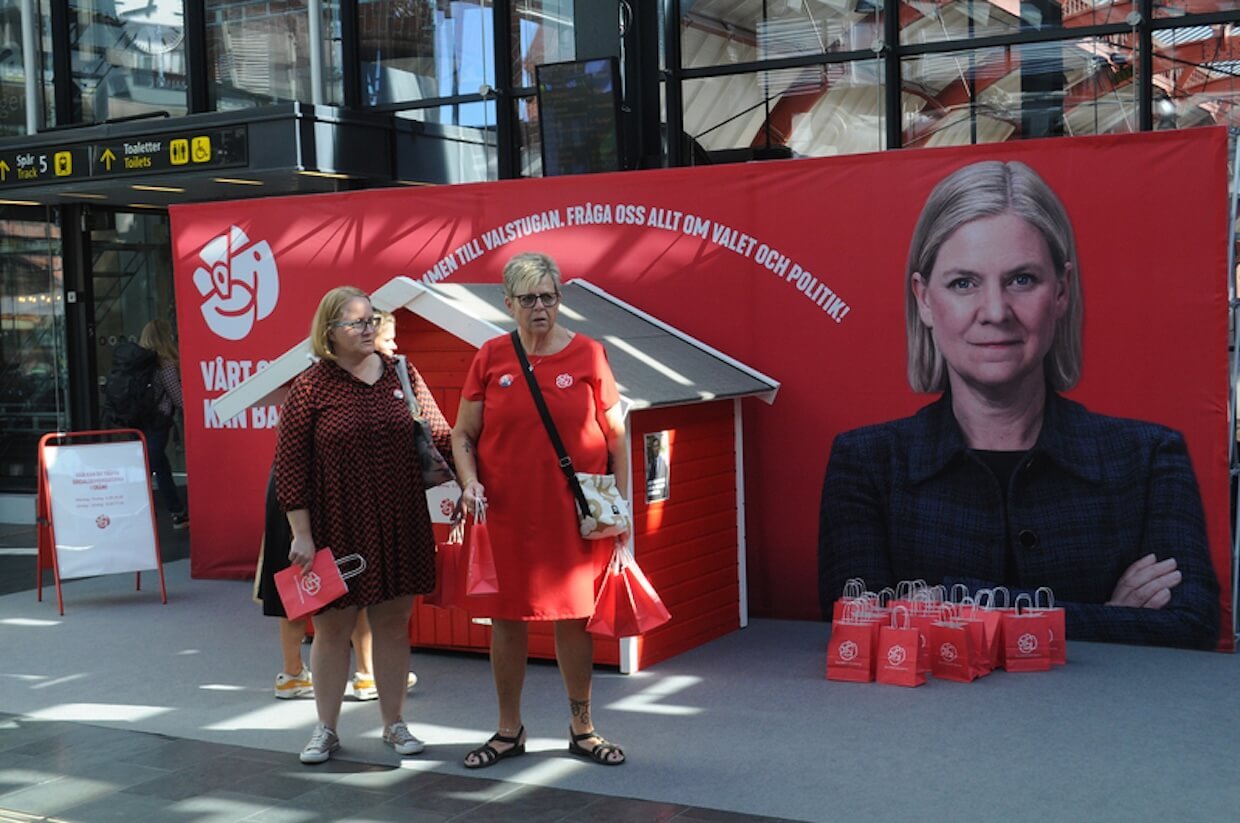
Finally, the 2026 election may represent a decisive moment in the normalization of Sweden’s radical right. SD is currently polling above the Moderates across several major surveys, while the Liberals’ survival—and therefore the parliamentary arithmetic—remains exceptionally uncertain. If the election confirms SD as the largest force on the right, what would constitute the more historically significant outcome: SD formally entering government, SD remaining outside government but exercising even greater policy leverage, or the broader transformation of mainstream Swedish politics around themes and diagnoses that originated on the radical right? And looking beyond September 13, are we witnessing the culmination of SD’s normalization—or the beginning of a more fundamental realignment of Swedish democracy?
Professor Andreas J. Önnerfors: These are three very different scenarios. If SD enters government, it would be a very hard blow, almost on the scale of when SD entered the Swedish Parliament for the first time. If SD remains outside government, they are already talking about an election victory in 2030. They will certainly strengthen their image as an anti-establishment party even further, and they will go all in on winning the elections in 2030.
On the other hand, if the Tidö party family does not survive, the Moderate Party will almost certainly face a wipeout on the scale of the CDU in Germany—or in Eastern Germany, at least—in the sense that they will have to seriously redefine themselves. So many of their ministers and party officials have drifted toward positions formulated by this magnet, the Sweden Democrats, that they have become almost indistinguishable from them. That means they will have to go back and do some soul-searching: “If we, as the Moderate Party, want to come back, how are we going to come back? Or will we always be the fifth wheel on the wagon that SD rolls through Swedish politics?” So, in that sense, SD has already been successful in transforming mainstream Swedish politics.
When it comes to the Social Democrats, who over the last few weeks have experienced quite a radical loss of electoral support—several percentage points—they also need to do similar soul-searching. Over the last 10 years, they have been triangulating their own positions toward the neoliberal politics of the Moderate Party and the increasingly right-wing, punitive, authoritarian positions of the new radical right in Sweden, and that has certainly not paid off. So we have seen some gains in the center of Swedish politics right now, particularly for the Center Party, but also for other parties.
And what that means is that, equally, if SD were to enter government, the Social Democrats themselves would have to go back and do some serious thinking about how to reconnect what they stand for with the electorate. I can only think of an analogy with Great Britain, where you can see that movement happening right now, and the contrast between Keir Starmer and Andy Burnham, where the rhetoric of the new Prime Minister is much more geared toward typical social democratic Labour positions. The Social Democrats in Sweden will have to realize that they do not win by jumping on the bandwagon of the mainstreaming of SD positions.
If SD enters government, we may also see a similar wipeout on the side of the Social Democrats as would be the case with the Moderates. That could lead to a collapse. Perhaps they (The Social Democrats) would have to redefine themselves, and my prognosis would be that what emerges from that would be a party much more aligned with Labour under Andy Burnham.
But we don’t know. It is razor-thin right now. Only a couple of percentage points divide the two power blocs in Sweden, so we really don’t know in which direction it will go. Even if the Social Democrats were to win the election, I think Sweden will, as in 2018 and 2022, be trapped in months of debate and negotiation over how a government will be formed. Maybe there will even be a new election that clears the way. So, we are going to face a very hot autumn.