DOWNLOAD ARTICLE
Please cite as:
Ali, Karrar & Urooj, Aamina. (2026). “Beyond Islamo-Populism: Religious Framing and Sectarian Mobilization among the Far-Right Islamist Parties in Pakistan.” Populism & Politics (P&P). European Center for Populism Studies (ECPS). July 07, 2026. https://doi.org/10.55271/pp0055
Abstract
Pakistan’s far-right Islamist political parties hold a significant space in the electoral and mobilizational base, yet their scholarly examination is quite limited in the existing literature. Although these parties have different doctrinal positions and unique political agendas, the existing literature treat them all under broad umbrella terms assuming that they share a common narrative and have homogeneous logic. This paper challenges this assumption by conducting a first systematic comparative framing analysis of three far-right Islamist parties that represent three different sectarian constituencies namely the Tahreek-e-Labbaik Pakistan (TLP), Jamiat Ulema-e-Islam Fazlur Rahman Group (JUI-F), and Majlis Wahdate-e-Muslimeen (MWM) representing Barelvi, Deobandi, and Shia sects respectively. The study applies Benford and Snow’s (2000) framing theory that constitute three core framing tasks and four frame alignment processes. For data sources, the study relies on party manifestos, campaign slogans, party leadership statements, and documented public discourse spanning from the period of 2015 till 2024. The chosen time period starts from the point when TLP was formed, till 2024 that marks the latest elections in the country. The findings of the study reveal that although all three parties conduct their activities within the same political environment and invoke Islamic symbols, but they manifest different political logics and mobilization strategies. TLP’s positioning is built upon religious populism that centers on Khatm-e-Nabuwwat (the finality of prophethood), constructing a moral antagonism between the pious people and corrupt elites. JUI-F operates through Islamist conservatism, pursuing the state to institutionalize Sharia in the country, and MWM mobilizes through sectarian minority identity politics, constructing their political narrative around Karbala symbolism to frame Shia Muslims as a persecuted community demanding protection and recognition. These distinct logics of each party are shaped by sectarian identity and historical grievances which demonstrate that religious political mobilization in Pakistan is internally differentiated in ways that umbrella categorization does not reveal. The findings of this study contribute to how scholars theorize religious populism in Muslim-majority states and help understanding the structural sources of political polarization and sectarian tension in Pakistan.
Keywords: Pakistan, Far-right Islamist parties, Sectarian mobilization, framing analysis, religious populism, Islamist conservatism, minority politics.
By Karrar Ali & Aamina Urooj[1]
Introduction
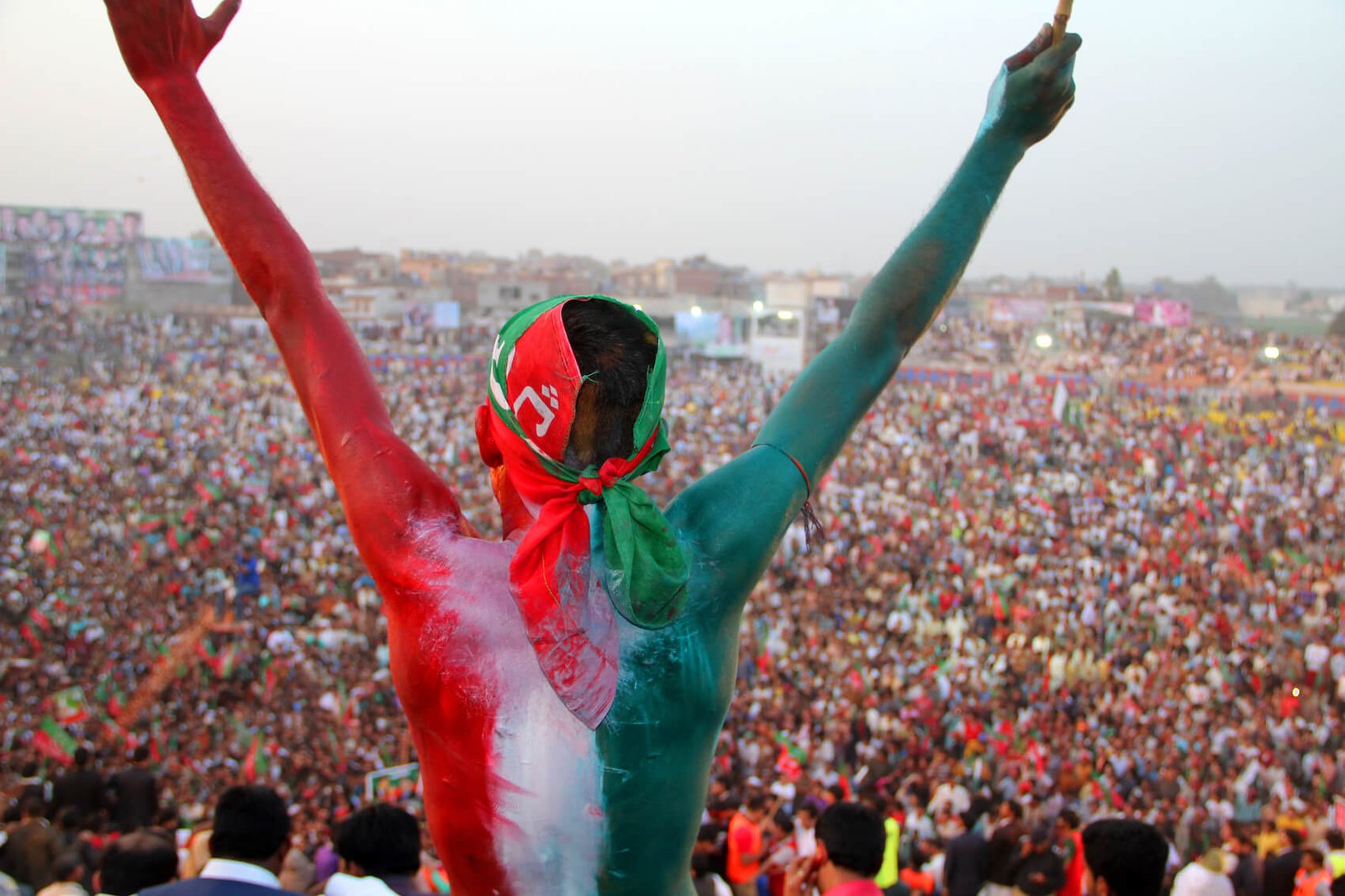
The far-right Islamist landscape in Pakistan presents an analytical puzzle, manifested by three political parties: Tehreek-e-Labbaik Pakistan (TLP), Jamiat Ulema-e-Islam Fazlur Rahman Group (JUI-F), and Majlis Wahdat-e-Muslimeen (MWM), which operate within the same religious-political field, draw on the same Islamic tradition, and all deploy religious symbols to construct political narratives and mobilize public support. Yet, they do through strikingly different strategies, targeting different constituencies, invoking different symbols, and constructing different political logic. TLP shows their support from the Barelvi sectarian tradition, JUI-F from the Deobandi tradition, and MWM from the Shia community. This paper argues that these differences are not incidental but are analytically significant. Through a systematic comparative framing analysis grounded in Benford and Snow’s (2000) framework, this study examines how each party strategically constructs its political narrative through religious symbols and what those differences reveal about the internal differentiation of far-right Islamist mobilization in Pakistan.
The involvement of far-right Islamist parties in the political sphere in Pakistan has remained significant since its inception. They have played an important part in Islamization of the state and society especially since late 1970s under the military regime of General Zia-ul-Haq. To legitimize his military rule, he reorganized governance around “Islamic” norms, most notably through the Hudood Ordinances (1979) and the creation of the Federal Shariat Court (1980). These strategies soon became an enforceable state policy that strengthen the role of religious parties and clerical networks extending their leverage into the public life, law, and political bargaining (Kennedy, 1990: 65). The Islamic provisions in the constitution of 1956, 1962, and 1973 are one such manifestation of their involvement (Roy, 1994: 23). This Process did not redefine constitutional language, but it normalized the use of Islamic symbolism in political discourse and opened institutional space for religious parties to claim moral authority in the public sphere.
The Islamist political parties under focus of this study have emerged in different times having different objectives to come into politics, but they all share common popular strategies to remain in power and have significant voter base. JUI-F, Pakistan’s largest Islamist political party currently holds fourth-most seats in the Senate and fifth-most in the National Assembly and has proven street power, largely drawn from the students of madrassas (Rahimullah, 2021). TLP became 4th largest party in Pakistan following the 2024 general election, securing nearly 2.89 million votes (Gallup Pakistan, 2024). Although still struggling to make significant presence in the political space, MWM has also secured seats in both national assembly and senate in 2024 general election (Hussain, 2024).
An initial step toward an understanding of these parties is the scholarship on religious populism, which is helpful but insufficient. The scholars of religious populism such as Mudde (2004), Yilmaz, Batool and Shakil (2023), and Hadiz (2014) have demonstrated how Islamist movements use the same rhetoric by replacing the term "the people" with "ummah" and the term "political opposition" with "moral and theological opposition.’ TLP fits this description quite well; it builds a moral dichotomy between the righteous and the corrupt, it defines blasphemy as an existential threat to the civilizational values of Islam and it sees itself as the true voice of the Barelvi Muslim community against what it considers to be the secular, corrupt, and morally bankrupt government.
The situation becomes much more complicated, however, if JUI-F and MWM are viewed the same way. JUI-F’s politics are not directed against the political system but toward its completion on Islamic lines, it doesn’t involve protesting against the corrupt elite but the creation of Sharia institutions in the current political system. The dominant discourse on the other hand, which MWM is best known for, is one of sectarian community protection, in which Shia Muslims are portrayed as a persecuted minority that deserves recognition, security and representation from a government “ignoring their plight.” These are different political logics, and it is important to consider them as different, otherwise the comparative analysis will lose the value of comparing the differences that make it possible.
Though the use of populism and religious symbolism has been researched in other contexts, such as Hindu populism in India (Jaffrelot, 2021: 85) and Christian populism in Europe (Brubaker, 2017: 1191–1226), few in-depth scholarly studies have explored how far-right Islamist parties in Pakistan use framing strategies to mobilize popular support. This research seeks to address that gap. To the best of our knowledge, there is still no systematic comparative study of far-right Islamist parties in Pakistan. Much of the existing scholarship has explored these actors separately, mainly as a religious populist movement (e.g., Sabat et al., 2020; Zahid et al., 2022; Yilmaz & Shakil, 2022), and has not considered the possibility of their doing the same political work with other symbols, or of them representing truly different styles of religious political mobilization. This paper goes to the heart of the issue.
At the outset, it should be noted that framing analysis, though analytically useful, is not a full account of the political career of these parties. But the framing is not the only key to success or failure; structural conditions are, as well. In addition to framing strategies, outcomes are influenced by resource access, organizational capacity, political opportunity structures and institutional patronage. In TLP, Javid (2021) has shown that although the party was able to mobilize its supporters on street, its clientelist nature and competition among the religious right limited its electoral success. This paper does not assert that the only forces behind these parties’ political paths are framing. Instead, it uses framing analysis as a fruitful tool for examining how they shape political meaning, build their constituencies and position themselves in relation to each other; something that structural approaches are unable to do.
The key research question of this paper is: How do far-right Islamist political parties in Pakistan strategically use religious symbolization and framing to construct political narratives and mobilize public support, and what do differences in their framing strategies reveal about the differentiation of religiously inflected political mobilization within Pakistan? A related sub-question follows: Why do these groups, despite operating within the same political context and drawing on the same Islamic tradition, construct different political logics, and to what extent do sectarian identities explain these differences?
The paper is organized as follows. The theoretical framework presents Benford and Snow’s (2000) framework, including the three core framing tasks (diagnostic, prognostic, and motivational) and the four framing processes (bridging, amplification, extension, and transformation). It also defines the type of discourse employed in this study. The methodology explains the case selection, data sources, time period, and analytical process. The discussion is organized thematically, with an emphasis on comparative analysis rather than a party-by-party examination. Finally, the conclusion summarizes the main findings, discusses the study’s theoretical implications for understanding religious populism in Muslim-majority states, and outlines its limitations.
Theoretical Framework
Framing theory, conceptualized by Benford and Snow (2000: 611–639), has emerged to be one of the foundational frameworks for understanding the dynamics of social and political movements. It focuses on how movements construct, articulate, and disseminate meanings in efforts towards mobilization. Movements do this by addressing three primary framing tasks: diagnostic framing, prognostic framing, and motivational framing. These empower a movement to create resonance with its target audience and to translate grievances into actionable agendas.
Diagnostic framing involves the identification of social problems, attributing specific actors or structures with blame. While the specific targets of diagnostic framing vary across movements, secular elites, minority communities, foreign powers, or rival sects there are an underlying logic remains consistent: identifying a threat, assigning blame, and constructing a moral boundary between those who belong and those who do not.
Prognostic framing offers solutions to the grievances thus identified. In most cases, these solutions may be found within the ideological or cultural ethos of the movement. For instance, in the case of the JUI-F, the framing of Shariagovernance as the missing panacea for corruption and inequality is rooted in religious ideology. The credibility of prognostic framing depends on its alignment with the movement’s broader ideological identity; the proposed solution must appear morally necessary within the movement’s own normative universe.
Moreover, motivational framing inspires action by appealing to moral obligations and evoking emotional resonance. This framing task often contains religious, historical, and cultural symbols to galvanize collective action. In religiously inflected movements, motivational framing shows particularly on sacred history, martyrdom narratives, and divine obligation, transforming political participation into an act of faith and collective moral duty.
In addition to core framing task, Benford and Snow (2000) underlines frame alignment processes as key devices by which movements link their frames with wider societal discourses. It is through processes of frame bridging, frame amplification, frame extension, and frame transformation that movements reveal strategic responsiveness to shifting political and social terrains.
While frame bridging refers to the linking of disconnected but congruent grievances or stories, it allows movements to expand their scope by linking their goals to interests in society (Van Dijk, 2023: 153–178). Frame bridging itself is particularly consequential in fragmented political contexts, where each movement must stitch together disparate constituencies by demonstrating that their specific demands serve broader shared interest.
Frame amplification involves heightening the salience of specific values or issues to enhance their relevance and urgency. Through amplification, movements can elevate particular grievances above others, constructing a hierarchy or urgency that channels collective energy toward specific symbolic and political objectives.
Frame extension broadens the scope of a movement’s narrative by incorporating additional issues to appeal to a wider audience. Frame extension reflects a movement’s strategic awareness of its own limits, by reaching beyond its core constituency which trades ideological purity for broader coalition appeal.
Frame transformation redefines existing narratives, creating new meanings that resonate with changing sociopolitical contexts. Frame transformation is the most ambitious of the alignment process, because it requires movements to reinterpret the established meanings.
There is a need for a theoretical clarification before moving on. The definition of populism by Mudde (2004) is a thin-centered ideology, namely a rather coherent body of ideas about society organized around the moral polarity between the pure people and the corrupt elite. This is an ideological conception that is not the discursive approach followed in this paper. This study views framing as a strategic communicative action whereby political actors are actively shaping meaning, defining problems, solving them, and calling them to action, following the example of Benford and Snow (2000) and Entman (1993). The distinction is significant: in this paper, the idea of party is not understood as an ideology merely in advance of the evidence but is rather analyzed as the kind of story each party tells, who they’re going to fight, what they’re going to offer as a solution, and the people they’re going to rally behind. This is how the empirical differences between the three parties come out of the analysis and not assumed as a prerequisite, which is the reason the comparative results are possible.
In this study, Benford and Snow (2000) model is used to examine political communication by TLP, JUI-F, and MWM.Importantly, the discussion section is not party by party, but rather thematically. All three parties are compared to one another in each framing task so that the framework can shed light on the similarities and differences in the way they make sense of the political position. It is this comparative thematic structure that enables the paper to go beyond description to an explanatory argument as to why these parties frame their political positions in such different ways, despite the fact that they operate within the same political reality. The methodological decisions that provide the basis for this analysis are described below.
Research Methodology
This study used a qualitative research design, with framing analysis as the primary analytical technique. In line with Benford and Snow (2000), framing analysis is understood as the systematic investigation of how political actors, through public communication, create meaning by defining a problem, identifying those responsible, proposing a solution, and calling for collective action. The study is situated within the broader field of political discourse but does not adopt discourse analysis as a method per se, such as Critical Discourse Analysis (Fairclough, 1995) or Discourse-Historical Analysis (Wodak, 2001). Instead, framing theory is employed as the specific analytical tool through which the discourse of the three selected parties is examined. This distinction highlights two important differences: first, framing analysis focuses on the strategic and purposeful dimensions of political communication; second, it is particularly useful for studying parties that consciously employ religious symbols to construct political narratives and mobilize constituencies (Snow et al., 1986: 464).
Case Selection
The three groups selected for this study—Tehreek-e-Labbaik Pakistan (TLP), Jamiat Ulema-e-Islam Fazlur Rahman Group (JUI-F), and Majlis Wahdat-e-Muslimeen (MWM)—were chosen based on two explicit selection criteria. First, they each represent different sectarian constituencies within Pakistan’s far-right Islamist landscape: TLP mobilizes the Barelvi-Sunni community, JUI-F mobilizes the Deobandi-Sunni community, and MWM mobilizes the Shia community in Pakistan. This sectarian variation constitutes the key variable for explaining differences in the framing strategies employed by the three parties, and it is this variation that the paper seeks to explain. Second, during the study period, all three groups were actively engaged in political mobilization and maintained a public presence across all three modes of participation—electoral politics, street mobilization, and public communication—thereby providing a sufficient basis for the systematic analysis of their discourses.
The most important omitted case requiring explanation is Jamaat-e-Islami (JI). On theoretical grounds, JI is excluded because, unlike the three selected parties, it does not mobilize a specific sectarian constituency but instead represents a pan-Islamist ideological platform that transcends sectarian boundaries. Its organizational model and discursive logic are therefore fundamentally different from the sectarian community-based mobilization that constitutes the analytical focus of this study. Including JI would introduce a different type of case that could not be analyzed using the same analytical dimensions as the three selected cases. Likewise, smaller organizations such as Jamiat Ulema-e-Pakistan were not included because they lacked sufficient publicly documented discourse during the study period to permit systematic analysis.
The inclusion of MWM warrants particular comment because its electoral presence is relatively limited. However, electoral size is not the key consideration here; rather, it is its discursive distinctiveness. MWM is the only organized Shia political party within Pakistan’s far-right political landscape and mobilizes a Shia community that has received far less scholarly attention than Sunni Islamist parties (Rajani, 2013). Its inclusion is therefore both theoretically justified and empirically meaningful, as it allows us to examine whether Shia political mobilization follows the same framing logic as Sunni Islamist parties or instead reflects a distinct form of religious political mobilization.
Data Sources and Time Period
This analysis is based on publicly available political communications produced by the three political parties and their leaders between 2015 and 2024. The starting point, 2015, was chosen because it marks the founding of TLP, which laid the foundation for the contemporary far-right Islamist contest in Pakistan. The end point, 2024, represents the most recent general election cycle and encompasses a complete period of contemporary political mobilization for each of the three parties.
The data corpus consists of four types of sources. First, it includes official party documents, such as Tehreek-e-Labbaik Pakistan’s Election Manifesto 2024 (2024), and documented party materials, such as Tehreek-e-Labbaik Pakistan’s Official Anthem 2018 (Allama Khadim Hussain Rizvi Official, 2018). Second, it draws on the verbatim speeches of party leaders as reported in Pakistan’s leading national newspapers—Dawn, The Express Tribune, The News International, and Business Recorder—which serve as the principal public archive of political communication in Pakistan. Third, it incorporates party social media content, including verified hashtag campaigns and documented social media slogans used by all three parties on platforms such as X (formerly Twitter) and Facebook. Fourth, it draws on academic studies that directly cite and analyze party discourse, particularly the works of Sabat et al. (2020), Zahid et al. (2022), Yilmaz and Shakil (2022), and Javid (2021).
This corpus has certain limitations. The analysis relies heavily on reported statements rather than on a comprehensive collection of primary texts. However, full transcripts of leaders’ speeches are not always available in digital or searchable formats, nor are many Urdu-language primary sources, such as party newspapers like Sada-e-Wahdat published by the MWM. Consequently, the findings are based on credible journalistic and academic sources that document the parties’ public political communication rather than on an exhaustive corpus of primary source materials.
Analytical Procedure
The analysis is conducted at two levels. First, the publicly documented discourse of each party is analyzed according to the three fundamental framing tasks identified by Benford and Snow (2000): diagnostic framing, in which each party defines the problem and assigns blame; prognostic framing, in which each party proposes solutions; and motivational framing, in which each party constructs moral and emotional appeals for collective action. Second, the four frame alignment processes—bridging, amplification, extension, and transformation—are employed to examine how each party connects its core frames with broader societal concerns and adapts its framing practices to changing political environments (Snow et al., 1986).
The study adopts a thematic comparative analysis rather than a party-by-party analysis. In other words, the discussion does not examine all three framing tasks for each party individually; instead, it compares how the three parties approach each framing task. This design is intentional, as it highlights the comparative logic of the analysis and allows convergences and divergences among the parties to become clearly visible at each analytical stage, rather than being merely inferred from three separate case descriptions.
The coding of party discourse was carried out deductively, with the framing tasks and frame alignment processes serving as the principal analytical categories for coding the data. Recurring religious symbols—such as Khatm-e-Nabuwwat for TLP, Sharia governance for JUI-F, and Karbala for MWM—were identified as the symbolic anchors around which each party organizes its diagnostic, prognostic, and motivational framing in its public communication.
Discussion: Comparative Framing Analysis of Far-Right Islamist Parties in Pakistan
The following analysis applies Benford and Snow’s (2000) framing framework comparatively to the three parties examined in this study: TLP, JUI-F, and MWM. The discussion is organized thematically around the three core framing tasks. The following subsections examine each party’s approach to the issues it emphasizes. The analysis focuses on the problems each party identifies, the solutions it proposes, and the motivational appeals it employs to mobilize collective action. It also examines how these frames align with broader societal discourses. This structure makes it possible to identify both the convergences and divergences that distinguish these parties on analytical grounds. The preliminary study of all parties suggests that even though all three parties deploy Islamist symbols strategically, they do so from a different political logic that dictate their behavior shaped by their distinct sectarian identities and historical grievances.
Diagnostic Framing: Identifying the Problem and Assigning Blame
Diagnostic framing refers to the identification of social problems and the attribution of blame. It is the fundamental process through which political actors derive their political identity and demarcate the boundary that separates them from their opponents, thereby constructing the distinction between "us" and "them" (Benford & Snow, 2000: 615). Examining each party through the lens of diagnostic framing reveals that they identify strikingly different problems, assign blame to different actors, and construct distinct categories of enemies. These differences are not arbitrary; rather, they reflect the sectarian identities of each party and the specific grievances of the constituencies they seek to mobilize.
Tahreek-e-Labbaik Pakistan (TLP)

TLP emerged in 2015 as a major political force in Pakistan. It was established by Khadim Hussain Rizvi. TLP claims that it is the true herald of the deep-rooted Barelvi school of thought and is one of the proudest fighters of the Khatm-e-Nabuwat, which is also the ideology that underpins the very existence of TLP. The party became popular quite quickly because it raised a monumental rally against principles threatening its existence by the Ahmadi community, calling them Ahmadis alongside all such incidents of alleged blasphemy (UK Visas and Immigration, 2025). It employs a combination of street protests, social media campaigns, and religio-symbolic imagery to mobilize conservative Muslim constituencies under the banner of saving Islamic values from the secular political machinations of Pakistan’s sociopolitical scene.
In this regard, TLP has claimed that they have diagnosed the real problems of society, such as the failure of true spirit of Islam and undue lenience towards acts of blasphemy. In this way, these factors have been indicated as the causes of societal disintegration and moral decay in Pakistan. These narratives are strongly propagated through their party anthem, which is filled with religious fervor, designating the party as the sole savior of Pakistan, bringing Sharia into the political system, and categorically alienating the previous governments and political parties as looters, and corrupt, and label them as one and the same group who are dividing Pakistan. The anthem is filled with rhetorical lines such as “Pakistan banaya tha, Pakistan bachana hai (We created Pakistan, and we have to save it),” “deen ko takhat par lana hy (we have to bring religion to govern),” “watan ko katne wale sabhi ye aik chakoo hain (those dividing the country are all one group),”alluding that we are going to come and be the sole savior of the country by bringing religious rule (Allama Khadim Hussain Rizvi Official, 2018).
The party particularly identifies the Ahmadi community as its primary target, declaring Ahmadis to be non-Muslims (IHRC, 2024). The central basis for this allegation is the sanctity of Khatm-e-Nabuwwat, as Ahmadis believe in a prophet after Muhammad. This is not merely a theological disagreement but is presented as an attack on the very political identity that TLP has built around defending the doctrine of the Finality of Prophethood.
Ahmadis have been affected by TLP campaigns directed against them, with cases such as Mubarak Sani, who was lynched on suspicion of blasphemy in 2014, cited by TLP as exemplary cases against Ahmadis (Mahmood, 2024; Persecution of the Ahmadiyya Muslim Community, 2022). This incident was similarly framed by TLP as a successful expression of public piety against heresy, reinforcing its claim that social grievances stem from the ineffective implementation of blasphemy laws (Jalil, 2024).
TLP thus diagnoses the fundamental ills of society—namely, the erosion of the true spirit of Islam and undue leniency toward acts of blasphemy—as the causes of social disintegration and moral decay in Pakistan. The outrage expressed by TLP leaders following the acquittal of Asia Bibi, a Christian woman convicted on blasphemy charges, was particularly intense. At a protest in Lahore, TLP leader Afzal Qadri declared: “The judges who have ordered the release of the accursed Asia are all liable to be killed under religious edict” (Al Jazeera, 2018; Khan, 2018).
For diagnostic framing through social media, TLP employed hashtags such as #Tajdar_Khatam_e_Nabuwat and #Labbaik_Ya_Rasoolallah. These slogans were instrumental in constructing a narrative of moral urgency that resonated strongly with its support base. This emphasis further reinforced an "us versus them" dichotomy, portraying the party’s supporters as the pious defenders of Islam in opposition to secular elites, Ahmadis, and Western influences (Mahmood, 2024).
During protests demanding the expulsion of the French ambassador, TLP demonstrators were confronted by law enforcement agencies. In response, Khadim Rizvi questioned the ideological foundations of the Pakistani state, stating: “We cannot forgive the enemies of the Prophet (PBUH). While traveling to Islamabad, I wondered whether we could send back the French Ambassador. [Alas] the Muslims living in France can protest, but in the state, which was achieved in the name of Islam, the nation is not allowed to protest for the honor of the Prophet. Now, we have to ask a question about the type of leadership we have been led by for the last 72 years. Had Labbaik (TLP) been ruling the country, it would have executed them [blasphemers],” (Zahid et al., 2022).
Jamiat Ulema-e-Islam Fazlur Rahman Group (JUI-F)
JUI-F has its roots in the Deobandi movement, which sticks to some rigid fundamentals of the Sharia and Sharia legalism over literalism and puritanical reforms. JUI-F has possessed both a religious and an organizational face in Pakistan ever since its inception as a party. The party entered the political limelight by taking advantage of its communication network of religious institutions, called madrassas, and aligning itself with the conservative Muslim culture and belief system of the voting population (Karamat et al., 2019: 29–36). Throughout the years, JUI-F has sustained its political relevance by masquerading as a protector of Islamic values amidst perceived threats posed by secular and liberal ideologies. In the political context, JUI-F uses its political symbol, the book, referring to the Quran, the holy book of Muslims, and its candidates refer to their audiences by saying that not stamping its symbol is equivalent to rejecting the holy book (Nazar, 2013).
In this broader context, JUI-F traces the root of the crises affecting society to the inability of others to properly implement Islamic law. The party continuously criticizes secular models of governance for promoting corruption, inequality, and moral decline (Khan, 2019). At a 2016 press conference, Fazlur Rahman stated that he would “not let Pakistan become secular,” asserting that secular legislation was “in conflict with the Holy Quran, the life of Prophet Muhammad, the Constitution of Pakistan, and the values of our country” (Express Tribune, 2016). This framing was reiterated during the 2024 election campaign, with the party urging voters to support JUI-F as the party committed to Islamic values and governance (Express Tribune, 2024b).
In 2019, during the Azadi March, Fazlur Rahman argued that the policies adopted by the ruling Pakistan Tehreek-e-Insaf (PTI) government had undermined the country’s Islamic traditions. He framed the actions of the ruling government as being entirely contrary to the injunctions of the Sharia (Batool, 2019). During the march, he portrayed the PTI government as an existential threat to both the constitutional order and Islamic governance, declaring that the march aimed to “protect the Constitution, democracy and Pakistan” from a government that had made “the Constitution a joke” and put “the survival of the country at risk” (Shaikh & Hussain, 2019). This narrative resonates with JUI-F’s core constituency, which views the party as a representative of conservative Muslims.
Majlis Wahdat-e-Muslimeen (MWM)
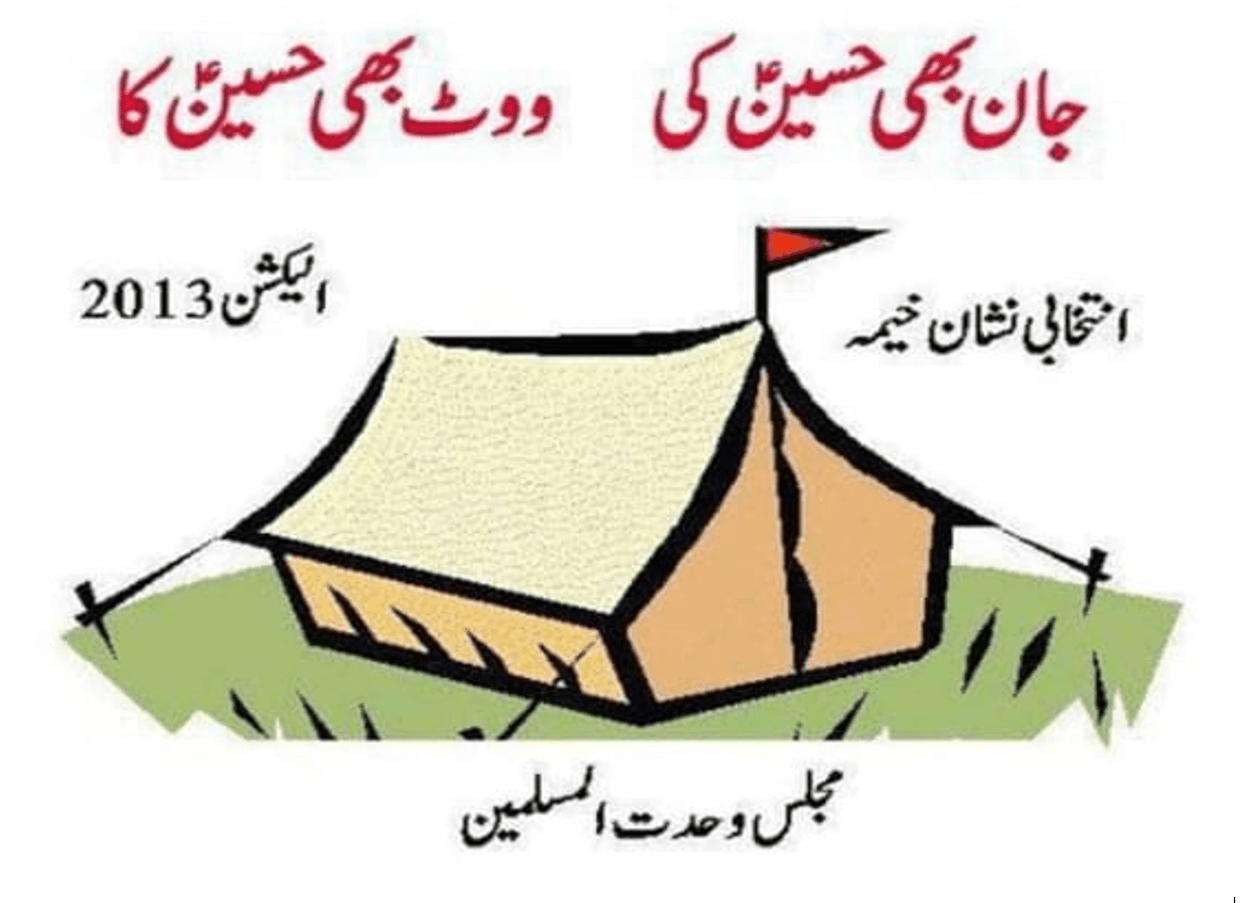
MWM came into being in 2009 to fight against the systematic persecution and escalating violence targeting Shia Muslims in Pakistan (Shah, 2019). Guided by the tenets of Shia Islam, especially those rooted in the history of Imam Hussain and his martyrdom at Karbala, MWM serves both as a force for the protection of Shia rights and as a force for unity among Pakistan’s Muslim communities. The ideological foundation of the party is thus deeply embedded in notions of justice, sacrifice, and resistance, which are represented by its electoral emblem, the Khama (the tent)—the tent of Imam Hussain (Naqvi, 2025). This reinforces MWM’s claim to follow in the footsteps of Imam Hussain and his struggle for truth and justice. Additionally, in recent elections, Pakistan Tehreek-e-Insaf (PTI) has been a political ally of Majlis-e-Wahdat-ul-Muslimeen (MWM) (BR Web Desk, 2024). Allama Raja Nasir Abbas, the Chairman of MWM, was elected to the Senate in the 2024 elections and was nominated as the Leader of the Opposition in the Senate with the support of PTI at a time when PTI Chairman Imran Khan was incarcerated (Sadozai & News Desk, 2026).
Within this frame of reference, MWM identifies sectarian violence, institutionalized discrimination, and foreign interference as the causes of social unrest in Pakistan. The party often refers to the Quetta Hazara killings (Baloch, 2021) and the Parachinar bombings (Mehdi, 2024) as examples of the state’s failure to provide security for Shia Muslims. Through slogans such as "Pakistan Banya Tha – Pakistan Bachyanga ("Pakistan was made, and Pakistan will be saved"),” MWM underlines its role as a guardian of the country’s ideological and territorial integrity.
It further draws on the legacy of Muhammad Ali Jinnah, the founder of Pakistan, who was claimed to be a Shia Muslim, to give legitimacy to its position as the protector of Pakistan’s Islamic identity. This becomes a narrative not only within the Shia community but also in broader nationalist sentiments, presenting this as a collective responsibility toward the ideals on which Pakistan was founded.
Although all three parties possess a clear religious narrative, the diagnostic framing reveals a fundamental divergence in how they construct political antagonism. TLP’s diagnostic frame clearly alludes to Mudde’s (2004) definition of populism: it constructs a moral antagonism between the pious Muslim people and a corrupt secular elite that is complicit in blasphemy and moral decay. JUI-F’s diagnostic framing stands in contrast to that of TLP, targeting secularism as an ideological failure of statecraft rather than political elite corruption. It identifies the absence of divine governance as the enemy, rather than the political elite per se, which reflects a conservative rather than a populist logic. MWM’s diagnostic framing is categorically different from that of its counterparts. It identifies the Shia community as a persecuted minority within a hostile majority environment and views sectarian enemies and state negligence as blameworthy, rather than a generalized corrupt elite, as TLP does. This framing reveals that the convergent factor among all three parties is the use of Islamist referents to frame grievance, while they differ in the structure of the antagonism they construct and the identity of the enemy they identify.
Prognostic Framing: Proposing Solutions
Prognostic framing concerns how actors advance solutions to the problems they have diagnosed (Benford & Snow, 2000: 616). The analysis of each party highlights that the proposed solutions are closely tethered to their diagnostic frames, showing the logical connection between the defined problems and the solutions proposed. Examining these solutions comparatively not only reveals what each party wants but also sets out its vision for the political project it seeks to implement.
Tahreek-e-Labaik Pakistan (TLP)
TLP believes the remedy for the real moral and social crises in the fine land of Pakistan is the lawful, strict, and complete application of blasphemy laws and the exclusion of Ahmadis from the public domain. It has demanded the full implementation of laws concerning crimes against the Holy Prophet Muhammad. For instance, during one of the sit-ins at Faizabad in 2017, TLP demanded the resignation of the lawmakers responsible for amending the electoral oath relating to Khatm-e-Nabuwwat (Dawn, 2017). The government’s surrender to TLP’s demands at Faizabad, including the resignation of the minister responsible for the oath amendment, was framed by the party as strong proof that street pressure grounded in religious obligation could force the state to comply with Islamic imperatives. Its ritualized symbolic practices at public gatherings, including collective prayers and recitations, further reinforced its prognostic framing by embedding its political demands within a register of religious observance and constructing compliance with the party’s agenda as an act of devotion rather than a simple act of political choice (Sabat et al., 2020).
Designating the government and opposing state institutions as mere stooges of the West, the TLP leadership proposes a solution by expressing its intention that “once we are in power, we will treat them (the West) with an iron fist” (Zahid et al., 2022). Its solutions are mostly emotive rather than based on rational or practical grounds. For instance, at a public gathering, the firebrand Rizvi proposed launching a missile attack against the USA and the IMF if they asked Pakistan to repay its loans, stating, “Lo ji fer aaya je Ghauri (here comes the Ghauri missile to hit you)” (Zahid et al., 2022).
Designating the government and opposing state institutions as a mere stooge of the West, TLP leadership proposes a solution by expressing their intentions as “once we are in power, we will treat them (West) with an iron fist,” (Zahid et al., 2022). Their solutions are mostly emotive rather than based on rational or practical grounds. For instance, in a public gathering, firebrand Rizvi proposed to launch a missile attack against the USA and IMF if they ask Pakistan to pay back its loan stating “Lo ji fer aaya je Ghauri (here comes the Ghauri missile to hit you) (Zahid et al., 2022)
Jamiat Ulema-e-Islam Fazlur Rahman Group (JUI-F)
JUI-F prefers the implementation of Sharia law as the ultimate solution to the governance issues in Pakistan. The party’s rhetoric has consistently emphasized that only an Islamic model of governance can overcome the deeply ingrained problems of corruption, inequality, and societal discord. Additionally, it presents itself as the protector of democracy and the guardian of the sanctity of the Constitution, while portraying others as diminishing its value (Dawn, 2024a).
Election campaigns are often marked by calls to establish an "Islamic state" as a moral imperative (Dawn, 2024b; Karamat et al., 2019). Symbolic actions, such as leading prayers at political gatherings, further reinforce this vision and create a sense of urgency among supporters to rally behind the party’s agenda.
Majlis Wahdat-e-Muslimeen (MWM)
The prognostic framing by MWM can be reduced to three main postulates that it propagates: the unification of all sects, the strict application of the law in dealing with extremist groups and increased political representation for Shia Muslims. The electoral campaigns frequently feature the slogan “Life for Hussain—Vote for Hussain,” which alludes to tying political action to religious devotion. This framing helps MWM present its political platform as a continuation of Imam Hussain’s struggle for justice, playing a catalytic role in mobilizing its followers to view voting as a religious and moral obligation.
The party advocates for an independent foreign policy, free from Western influence, as can be witnessed eloquently in its slogans, such as “Down Down America” and “Down Down Israel” (Hasan, 2012). These slogans demonstrate MWM’s resistance to liberal, Western-appeasing policies, which, according to the party, are against the Islamic identity of Pakistan. The emphasis on self-reliance and resistance to foreign dominance reinforces the party’s populist appeal among the ranks of nationalist and religiously conservative voters.
The prognostic frames are different for each party, further illuminating their distinct political logics as their proposed solutions correspond to the problems identified earlier. TLP emphasizes the implementation of strict blasphemy laws, the expulsion of Ahmadis from public life, and taking strict action against the perceived enemies of the Prophet. These reflect a rupture logic in its prognostic framing that alludes to the existing order being morally compromised and, hence, needing to be purged.
JUI-F’s proposed solutions are different. They reflect a completion logic by calling for the institutionalization of Sharia within the existing state. It points to a political order that, in its view, should not be dismantled but rather fulfilled along Islamic lines, which puts forward a fundamentally conservative rather than populist orientation.
Meanwhile, MWM’s proposed solutions, including sectarian unity, legal accountability for anti-Shia violence, and increased Shia political representation, reflect a recognition logic, in which the party is not seeking to transform the political order outright but instead wants to secure a legitimate place within it for a marginalized community.
These three qualitatively different political projects reflect distinct political logics advanced by different actors, all expressed in the shared language of Islamic governance.
Motivational Framing: Mobilizing Collective Action
Motivational framing revolves around how actors push for action based on the narrative they have been creating. It concerns how movements translate diagnostic and prognostic frames into calls for collective action by constructing moral obligations and emotional imperatives that drive participation (Benford & Snow, 2000: 617). All three parties demonstrate the use of religious symbols in constructing motivational framing. It is here that the specific symbolic repertoires of each sectarian tradition are most directly deployed to generate emotional zeal and a sense of duty among those who support their cause.
Tahreek-e-Labaik Pakistan (TLP)
Their solutions are often filled with emotive zeal, pushing their followers to take to the streets, incite violence, and, at worst, lynch people on accusations of blasphemy. Their aggressive fervor motivates their supporters to champion the cause of defending the blasphemy laws in Pakistan and the finality of the Prophet.
TLP’s motivational framing for mass protests is centered on calling upon religious zeal and defining a common identity. Thus, the party relies on slogans such as #Member_o_Mahrab_Se_Siyasat (Politics from the Pulpit) as evidence of how the authority of religious leaders shapes the boundaries of political discourse. The tradition of Prophet Muhammad, together with that of other Islamic martyrs, is extensively used to build emotional and spiritual commitment among TLP supporters.
Social media is at the center of all motivational action by TLP. Through public campaigns using hashtags such as#Labbaik_Ya_Rasoolallah, the party encourages its followers to mobilize for protests and political rallies, presenting participation as a communal duty. Digital platforms further expand the party’s community, drawing more people to the message it espouses through these calls to action.
The "us versus them" framing presents the secular elite, liberal policies, and Ahmadis as existential threats to Islamic unity, as reflected in TLP’s political rhetoric. The sentence handed down to Mubarak Sani provided a significant opportunity to highlight what TLP portrayed as a moral victory over the Ahmadis by drawing attention to their alleged heretical status (Mahmood, 2024a). Such narratives not only carry the potential for grassroots mobilization but also marginalize minorities by portraying them as enemies of Islam.
Their criticism extends beyond the influence of Western cultural traits, which they perceive as corrupting values and eroding the Islamic identity of Pakistan. Their focus relies more on the dichotomy of "pious defenders" and "corrupt elites," through which they legitimize their populist claims and strengthen their support among conservative constituencies. In practice, symbolic mobilization means that TLP makes effective use of religious congregations, media, and Madaris (madrassas) to spread its narrative. Mass protest events, such as the 2017 Faizabad sit-in, have demonstrated how the party is able to transform symbolic mobilization into concrete political power. Madaris serve as sites of ideological dissemination, providing a steady supply of activists committed to the mission of TLP.
Symbolic mobilization of TLP through social media has therefore turned out to be completely essential. Tweets carrying the hashtag #Tajdar_Khatame_Nabuwat and numerous widely shared posts across social media platforms have allowed the party to promote its agenda broadly. Through both conventional and new media, TLP sustains its populist appeal and defines itself as the defender of Islamic Shariah (Zahid et al., 2022: 276–295).
Jamiat Ulema-e-Islam Fazlur Rahman Group (JUI-F)
Motivational framing serves as a primer for the conditions that enhance the potential for large-scale mobilization, and JUI-F demonstrates considerable capacity in this respect. The "book" as the electoral symbol is portrayed as the Holy Quran, and thus, for any religious Muslim, voting for anyone other than JUI-F would be sinful to their faith. In another instance, JUI-F takes time to remind people of various episodes in Islam and, at times, of the great sacrifices of leaders who fought for Islam in order to evoke a particular emotional response that influences their political choices. Such framing rebrands election campaigns as a religious mission and cultivates, with great vigor, a powerful sense of identity and purpose among its supporters (Dawn, 2025).
Additionally, JUI-F uses the "us vs. them" dichotomy as a tool for maintaining its hard core and demarcating its territory and identity. It portrays secular forces as the enemies of unity among Islamic states, while presenting the liberal elite and other sects as enemies of the correct Islamic values, and portrays itself as the defender of the correct Islamic values (Ashfaq, 2024). This not only mobilizes its supporters but also dismisses opposition groups as enemies of Islam. For instance, JUI-F has blamed secular elites for their penchant for embracing Western culture and easily portrays such groups as symbols of corruption and moral decadence. This type of narrative increases polarization and simplifies the binary between the sacred and the profane.
Symbolic mobilization is at its best in JUI-F’s religious meetings, madrassah network, and media presence, all of which speak to the organization’s commitment to symbolic action. Party structures enable the diffusion of party narratives as well as the reinforcement of its identity as the defender of Islam. Like all political parties, madrassas are an integral part of JUI-F’s organizational setup and a strategically important component in terms of ideological indoctrination and network mobilization. The framing strategies are further developed and disseminated through media appearances and speeches. These practices not only facilitate JUI-F’s political mobilization but also solidify the party’s ties with its religious voter base.
Majlis Wahdat-e-Muslimeen (MWM)
MWM is able to marshal its base through effective motivational framing, coupling religious symbolism with nationalist rhetoric. Its "Khama" electoral symbol turns out to be a very potent reminder of the sacrifice of Imam Hussain and evokes the feeling among its followers that political participation is part of their religious duty. Slogans such as "Life for Hussain – Vote for Hussain," displayed on campaign materials, reinforce this message by framing political choice as a matter of faith.
MWM also resorts to emotive slogans such as "Pakistan Ka Matlab Kya? La Ilaha Illallah" (What is the meaning of Pakistan? There is no God but Allah) to mobilize the people (Iqbal, 2014). These slogans link national identity with Islamic principles, thereby constructing a shared identity among Pakistan’s Muslim population while excluding those perceived as "others": the liberal elite, foreign influences, and extremist groups threatening Shia Muslims.
MWM has engaged in several symbolic practices to mobilize its base. Religious gatherings during the months of Muharram and Ashura, considered the most prominent, are crucial for the party in reaching out to the Shia community and propagating its narratives. These events provide ample opportunity for MWM leaders to underline issues of resistance and justice, drawing parallels between the sacrifices of Imam Hussain at Karbala and present-day struggles (Rajani, 2013).
The motivational frames of the three parties draw on distinct sectarian symbolic traditions that help construct different modes of political duty among their targeted constituencies. TLP mobilizes through what can be characterized as sacred outrage, invoking narratives of blasphemy as an existential civilizational threat that demands an immediate, emotionally charged response (Sabat et al., 2020; Zahid et al., 2022).
JUI-F places religious incumbency at the center of its motivational framing, presenting electoral participation as a religious obligation and positioning its candidates as stewards of Islamic governance, while bringing the Quran as a reference book that equates voting for the party with affirming one’s faith (Nazar, 2013).
MWM’s mobilizing strategy revolves around martyrdom solidarity, drawing on the Karbala narrative. It helps construct political participation as a continuation of Imam Hussain’s struggle against injustice, transforming the act of voting into an act of religious remembrance and communal resistance that supporters perceive as a religious duty (Rajani, 2013).
Each mode of motivational framing is thus culturally specific and sectarianly grounded, appealing to the particular audience of its targeted constituency. This is why the symbols are not used interchangeably across parties, as Karbala cannot motivate Barelvi constituencies in the way Khatm-e-Nabuwwat can, and vice versa.
Frame Alignment Processes: Strategic Adaptation and Broadening

Beyond the three core framing tasks identified by Benford and Snow (2000), their framework also stipulates four frame alignment processes. These refer to the ways in which movements link their frames to wider societal discourses and adapt strategically to shifting political contexts. The four frame alignment processes include frame bridging, frame amplification, frame extension, and frame transformation (Snow et al., 1986). Examining these processes across the three parties reveals the ways in which each expands its reach beyond its core sectarian constituency and responds to changing political opportunities.
Frame Bridging
Frame bridging refers to grievances that are otherwise disconnected from religious appeals but affect the parties’ voter base. All three parties employ frame bridging differently, while commonly attaching it to their proposed solutions to the identified problems.
JUI-F, for instance, bridges economic grievances such as poverty, unemployment, and IMF-imposed austerity with its demand for Sharia governance, arguing that material deprivation exists because of the absence of divine law (Khan, 2019; Express Tribune, 2025). Through this bridging, JUI-F becomes able to appeal to economically marginalized populations who might not be primarily motivated by theological concerns.
TLP, on the other hand, bridges blasphemy politics with broader nationalist sentiment, arguing that a state that loses the ability to honor the Prophet has forfeited its Islamic legitimacy. By doing this, it connects a specific religious grievance to a wider crisis of national identity (Zahid et al., 2022).
MWM bridges Shia-specific sectarian grievances with broader Pakistani nationalist narratives by invoking Jinnah’s claimed Shia identity. By doing so, it argues that a state persecuting Shia Muslims is actually demonstrating a betrayal of Pakistan’s founding vision, connecting minority rights claims with majoritarian national sentiment (Iqbal, 2014).
Frame Amplification
Frame amplification refers to the heightening of the salience and urgency of specific issues. It is highlighted in each party’s treatment of its central symbol.
TLP amplifies Khatm-e-Nabuwwat from a theological doctrine into an existential civilizational crisis requiring an emergency response, arguing that any perceived compromise on the finality of prophethood would pose a catastrophic threat (Shakil & Yilmaz, 2021). The deployment of hashtags such as #Tajdar_Khatame_Nabuwat and the 2017 Faizabad sit-in are instances of this amplification, elevating a specific doctrinal issue to the level of a national emergency.
JUI-F amplifies the moral authority of its clerical leadership by conflating electoral choice with religious observance, placing them side by side to amplify a political act into a matter of faith and sin.
MWM amplifies incidents of anti-Shia violence into clear evidence of a systematic existential threat to the Shia community by citing the Quetta Hazara killings and the Parachinar bombings. By doing so, it constructs a sense of urgency around a situation that might otherwise be understood as a localized security failure (Baloch, 2021; Mehdi, 2024).
Frame Extension
Frame extension helps broaden a movement’s narrative to incorporate additional issues and appeal to wider audiences. In the case of these three parties, it reflects each party’s attempt to transcend its sectarian base.
TLP extends its blasphemy-centered frame to encompass anti-Western foreign policy positions, linking the sanctity of the Prophet to resistance against Dutch politicians, French cartoonists, and Western cultural imperialism more broadly (Zahid et al., 2022). This extension takes TLP beyond its Barelvi base to constituencies of Muslims who perceive Western secularism as a threat to Islamic identity.
JUI-F extends its Sharia governance frame to encompass constitutional democracy. By doing so, it paradoxically positions itself as both the defender of Islamic law and the protector of the democratic process against military interference. This places the party in a strategic position that broadens its appeal to anti-establishment voters as well (Dawn, 2024a).
MWM’s frame extends beyond its Shia-centric grievances to encompass inter-sectarian unity. This extension positions the party within a broader Muslim solidarity base, framing its struggle not merely as a Shia cause but as a defense of justice and pluralism within the Pakistani state (Rajani, 2013).
Frame Transformation
Frame transformation occurs when a movement tries to redefine an existing narrative to create new meaning that resonates with changing contexts. All parties use frame transformation from time to time, but it is most visible in MWM’s treatment of the Karbala narrative. The Battle of Karbala is specifically associated with a Shia historical event commemorating the martyrdom of Imam Hussain in 680 CE. MWM transforms this sectarian religious event into a universal symbol of resistance in the face of injustice. It does not limit Karbala merely to Shia heritage; rather, it constitutes a moral framework applicable to all communities facing persecution (Naqvi, 2025). This transformation not only speaks to the Shia audience but also potentially expands to communities beyond it.
TLP has also engaged in frame transformation over time. Its earlier framing was centered narrowly on blasphemy enforcement, but it has progressively transformed into a broader civilizational discourse about the moral corruption of the Pakistani state and its subservience to Western powers, as is evident from a comparison of its 2018 and 2024 electoral manifestos (Allama Khadim Hussain Rizvi Official, 2018; Tahreek-e-Labbaik Pakistan, 2024).
Comparative Synthesis: Convergence, Divergence, and What it Means
The comparative analysis of all three parties presents a picture of Pakistan’s far-right Islamist landscape that is more internally differentiated than the umbrella categories in the literature suggest. At the level of surface convergence, all three parties deploy religious symbols, construct "us vs. them" narratives, and invoke religious duty to motivate their supporters toward political participation. These strikingly similar strategies explain why they are often treated as variants of the same phenomenon. However, a deeper analysis through the framing framework shows that, beneath these surface similarities, lie three structurally distinct political logics.
TLP employs a logic of religious populism by constructing a moral antagonism between the pious Muslim people and a corrupt secular establishment, calling for a rupture with the existing moral order, and mobilizing through sacred outrage. This positioning places TLP within the analytical category of religious populism as defined by Mudde (2004) and Yilmaz et al. (2023): a movement that channels popular anger simultaneously against internal elites and external civilizational enemies, with the ummah serving as the populist people.
JUI-F operates through a logic of Islamist conservatism that does not seek to dismantle the current political order but to complete it under the guidance of divine law. It does not portray the corrupt elite, in the populist sense, as its enemy but rather an ideologically misguided system of governance that has failed to implement God’s law in the land. JUI-F does not remain isolated from the current system; rather, it works within democratic institutions, forms coalitions across the political spectrum, and frames its demands as those that, in its view, will fulfill Pakistan’s constitutional identity. This positioning is closer to what scholars of political Islam describe as institutional Islamism (Roy, 1994), reflecting a conservative rather than a populist logic.
MWM occupies a very different place on this spectrum. Rather than posing a people-vs.-elite antagonism, its primary frame revolves around communal persecution, recognition, and protection, providing a picture that is closer to a logic of sectarian minority identity politics than a populist one. The Karbala narrative does not construct a populist people; rather, it speaks directly to a suffering community that experiences political persecution and injustice. This positioning is closer to the minoritarian political logic identified in the comparative literature on identity-based movements (Brubaker, 2017).
The explanatory variable for these differences is the sectarian identity. It suggests that framing strategies cannot be interchangeably used for these parties, as they are anchored in specific theological tradition, communal grievances, and historical memory that is attached to the sectarian constituency it mobilizes. Barelvi theology emphasizes the personal sanctity of the Prophet, which perpetuates TLP’s blasphemy-centered outrage politics. Deobandi theology promotes jurisprudential governance, which underpins JUI-F’s Sharia institutionalism. The foundational martyrdom narrative of Shia Islam informs MWM’s Karbala-centered solidarity politics. This backdrop demonstrates that sectarian identity does not merely provide background information; rather, it structurally embeds these parties’ framing strategies and determines their content, logic, and tone.
Conclusion
This paper examines the space and scope of far-right Islamist parties in Pakistan that use religious symbols and framing strategies to construct political narratives and mobilize public support. The comparative analysis of these parties’ framing strategies reveals that, although they are often referred to as uniform religious groups under the generalized term Islamo-populism, far-right religious parties exhibit significant internal differentiation that shapes their political mobilization.
This study applies Benford and Snow’s (2000) framework to TLP, JUI-F, and MWM, which represent the Barelvi, Deobandi, and Shia sectarian constituencies, respectively. The framing analysis of these parties reveals that, despite operating within the same political environment and drawing on a shared Islamic tradition, they construct fundamentally different political logics. TLP’s framing contours suggest a religious populist positioning, mobilizing Barelvi constituencies through sacred outrage centered on Khatm-e-Nabuwwat and constructing a moral antagonism between the pious Muslim people and a corrupt secular establishment. JUI-F’s positioning resonates more with Islamist conservatism, seeking the institutionalization of Sharia within the existing state structure rather than mobilizing outright against the corrupt elite. MWM operates through sectarian minority identity politics, calling for the protection of minority rights within a majority environment. It derives its political stance from the Karbala narrative to frame the Shia community as a persecuted minority demanding recognition, security, and political representation from a state that is not paying heed to its suffering. Their divergent political logics demonstrate that these are three structurally distinct political projects expressed in the shared language of Islamic governance.
The findings of this study extend substantive implications for the study of religious populism in Muslim-majority states. The existing literature on religious populism treats all religious groups from a monolithic viewpoint by arguing that Islamist movements adapt the populist logic of people-vs.-elite antagonism, where the ummah represents the people, framing political conflict in moral and theological terms (Mudde, 2004; Yilmaz et al., 2023; Hadiz, 2014). This paper’s comparative findings suggest that, although this framework provides a useful analytical lens for cases such as TLP, it does not offer a general account of far-right Islamist mobilization. Not all religious parties that deploy Islamic symbols, invoke religious duty, and construct a general us-vs.-them narrative engage in populism; rather, some are engaged in advancing conservatism, while others pursue identity politics, and these differences are important for making analytical distinctions. Applying the term "Islamo-populism" indiscriminately to religious parties risks obscuring the internal variation that provides a comparative logic for understanding these parties. Given this context, this paper proposes that sectarian identity is not merely background information but plays the role of a structural variable that shapes not only the symbols these parties use but also the political logic they carry. This finding calls for a more rigorous analysis of the sectarian foundations of Islamist mobilization rather than treating religious framing as analytically equivalent across cases.
Applying this framing model to Pakistan’s case demonstrates a diverse political landscape that the existing literature has not sufficiently addressed. The far-right Islamist space that scholars often view as a shared entity does not constitute a monolithic bloc united by a common Islamo-populist project; rather, it is a fragmented and internally competitive field in which parties mobilizing different sectarian communities pursue different political objectives by employing different framing strategies. This context makes understanding internal differentiation important and helps explain the political polarization and sectarian tension in Pakistan. Diagnostic framing not only highlights existing sectarian divisions but also reveals an active and systematic political structure that assigns blame to different entities, identifies different enemies, and builds political identity around different symbolic repertoires. The four frame alignment strategies, especially frame extension and frame transformation, further reveal that these parties make deliberate attempts to transcend their sectarian space and appeal to larger constituencies. This suggests that the boundaries between sectarian communities are not static but are porous and susceptible to expansion. For civil society actors and policymakers working to understand and address religious mobilization, these findings underscore the importance of disaggregating the far-right Islamist landscape rather than treating all its actors under unified labels.
This study has several limitations that invite further research to address them. First, the analysis largely relies on leadership statements as documented in reputable journalistic sources and existing academic studies rather than on a fully systematic corpus of primary texts. While this approach is defensible given the scattered and largely non-digitalized nature of primary party documentation, it creates the possibility of selection bias, as the statements receiving journalistic coverage may not fully represent the broader discursive stance of the party. Future research could construct a systematic primary corpus using empirical evidence from Urdu-language party publications, archived social media content, and direct speech transcripts. Second, this study is confined to a single case study, which limits the possibility of establishing the generalizability of its findings. The relationship between sectarian identity and framing logic observed in this study may take different forms in other Muslim-majority states with different sectarian configurations and political opportunity structures. Third, this study treats framing as a discursive practice and does not examine the organizational, institutional, or financial factors that affect each party’s ability to disseminate its frames. This dimension can be further explored by applying structural approaches to social movements (Javid, 2021). These limitations do not undermine the paper’s core findings; rather, they mark the boundaries of what can be claimed on the basis of the evidence presented here.
These findings open several directions for future research on this issue. The most immediate is a systematic primary source study of all parties’ Urdu-language communications, including party newspapers, manifestos, madrassa curriculum materials, and social media archives, which will allow the framing analysis conducted here to be rigorously tested against a comprehensive empirical corpus. A second important direction would be extending comparative research across Muslim-majority states with similarly fragmented sectarian landscapes, including Indonesia, Lebanon, and Iraq. This will reveal whether sectarian identity functions as an explanatory variable shaping Islamist framing strategies in other national contexts, as it appears to do in Pakistan. Finally, the relationship between the parties’ framing strategies and their constituencies deserves empirical attention: how do the recipients of these parties’ framing strategies internalize and interpret the frames constructed by the party leadership? Survey-based and ethnographic approaches will provide pertinent answers to these questions, which framing analysis of public discourse alone cannot address.
References
Aikins, M. (2015, March 23). “United we sit.” Herald Magazine. https://herald.dawn.com/news/1152861/united-we-sit
Al Jazeera. (2018, October 31). “Pakistan clears Christian woman in landmark blasphemy case.” https://www.aljazeera.com/news/2018/12/1/pakistan-party-leaders-in-blasphemy-case-charged-with-terrorism
Ali, K. (2012, April 23). “New Shia party emerging.” Dawn. https://www.dawn.com/news/712899/new-shia-party-emerging
Ali, K. (2017, December 3). “Who is Khadim Hussain Rizvi?” Dawn. https://www.dawn.com/news/1374182
Ali, K. (2024, January 7). “TLP’s manifesto has much more to offer.” Dawn. https://www.dawn.com/news/1803745
Allama Khadim Hussain Rizvi Official. (2018, July 16). New tarana | Deen ko takht pe lana hai | Allama Khadim Hussain Rizvi 2018 [Video]. YouTube. https://www.youtube.com/watch?v=LnjU8SJLEjE
Ashfaq, M. (2024, December 9). “Fazl says he won’t accept govt’s interference in seminaries.” Dawn.https://www.dawn.com/news/1877584
Azam, M. (2022). “Political activism and religiosity: An appraisal on Tehrik-e-Labbaik Pakistan (TLP) and Pakistan Awami Tehreek (PAT) in Pakistan.” South Asian Studies, 37(2), 399–408.
Baloch, S. M. (2021, April 5). “’Every year we dig mass graves’: The slaughter of Pakistan’s Hazara.” The Guardian.https://www.theguardian.com/global-development/2021/apr/05/mass-graves-pakistan-shia-minority-hazara-slaughter-imran-khan
Batool, F. (2019, November 8). “The Azadi march in Pakistan: Testing the PTI’s prudence.” South Asian Voices.https://southasianvoices.org/the-azadi-march-in-pakistan-testing-the-ptis-prudence/
Behuria, A. K. (2025). The unending conflict: Dilemmas of dealing with sectarianism in Kurram. Manohar Parrikar Institute for Defence Studies and Analyses. https://idsa.in/publisher/monograph/the-unending-conflict-dilemmas-of-dealing-with-sectarianism-in-kurram
Benford, R. D. & Snow, D. A. (2000). “Framing processes and social movements: An overview and assessment.” Annual Review of Sociology, 26, 611–639. https://doi.org/10.1146/annurev.soc.26.1.611
BR Web Desk. (2024, February 13). “PTI announces alliance with Majlis Wahdat-e-Muslimeen in centre, Punjab.” Business Recorder. https://www.brecorder.com/news/40288635
Brubaker, R. (2017). “Between nationalism and civilizationism: The European populist moment in comparative perspective.” Ethnic and Racial Studies, 40(8), 1191–1226. https://doi.org/10.1080/01419870.2017.1294700
Butt, I. Z., & Malik, A. (2024). “The role of right-wing political parties in politics of Pakistan: An exploratory study.” Annals of Human and Social Sciences, 5(4), 264–276.
Dawn. (2017, November 25). “How the Islamabad protests happened.” https://www.dawn.com/news/1372800
Dawn. (2024a, February 23). “JUI-F to hold nationwide protests against ‘rigging’.” https://www.dawn.com/news/1816447
Dawn. (2024b, February 7). “How religious does your party have to be to win an election in Pakistan?” https://www.dawn.com/news/1811894
Dawn. (2025, June). “JUI-F to launch agitation after Eid.” https://www.dawn.com/news/1914568
Entman, R. M. (1993). “Framing: Toward clarification of a fractured paradigm.” Journal of Communication, 43(4), 51–58. https://doi.org/10.1111/j.1460-2466.1993.tb01304.x
Express Tribune. (2016, March 1). “Will not let Pakistan become secular, says Fazlur Rehman.” The Express Tribune.https://tribune.com.pk/story/1057133/will-not-let-pakistan-become-secular-says-fazlur-rehman
Express Tribune. (2024b, February 3). “PTI ruined country economically: Fazl.” The Express Tribune.https://tribune.com.pk/story/2455323/pti-ruined-country-economically-fazl
Express Tribune. (2025, August 26). “JUI-F leader wants Sharia law implemented in merged districts.” The Express Tribune. https://tribune.com.pk/story/2563408/jui-f-leader-wants-sharia-law-implemented-in-merged-districts
Fairclough, N. (1995). Critical discourse analysis: The critical study of language. Longman.
Gallup Pakistan. (2024, March 12). Gallup Pakistan — Pakistan’s foremost research lab.https://gallup.com.pk/post/36181
Hadiz, V. R. (2014). “A new Islamic populism and the contradictions of development.” Journal of Contemporary Asia, 44(1), 125–143. https://doi.org/10.1080/00472336.2013.832790
Hasan, S. (2012, September 16). “Movie backlash: Anti-US protesters get more than they had bargained for.” The Express Tribune. https://tribune.com.pk/story/437784/movie-backlash-anti-us-protesters-get-more-than-they-had-bargained-for
Hussain, A. (2024, February 10). “MWM enters mainstream politics with a crucial win from Kurram.” Business Recorder.https://www.brecorder.com/news/40288146
Iqbal, A. (2014, July 26). Pakistan ka matlab kya – II. Dawn. https://www.dawn.com/news/1121773
Jaffrelot, C. (2021). Modi’s India: Hindu nationalism and the rise of ethnic democracy. Princeton University Press.
Jalal, A. (2009). Democracy and authoritarianism in South Asia. Cambridge University Press.
Jalil, X. (2024, June 2). “TLP threats to Ahmadi community creates new wave of panic.” Voicepk.net.https://voicepk.net/2024/06/tlp-threats-to-ahmadi-community-creates-new-wave-of-panic/
Javid, H. (2021). “The limits and possibilities of religious politics: The case of the Tehreek-i-Labbaik in Pakistani Punjab.” Sociological Bulletin, 70(4), 502–521. https://doi.org/10.1177/0038022921103827
Karamat, S.; Shah, A. S. & Liaqat, B. B. (2019). “Jamiat Ulema-e-Islam (F) Pakistan: From political conservatism to modernity 2002–2018.” Global Regional Review, 4, 29–36.
Kennedy, C. H. (1990). “Islamization and legal reform in Pakistan, 1979–1989.” Pacific Affairs, 63, 62–77.
Khalid, Z. & Hussain, M. (2017). “Politics of symbols & slogans: Its impact on elections of 1970.” Journal of Historical Studies, 3(2).
Khan, O. F. (2018, November 1). “Pakistani Islamists are on the boil over acquittal of Asia Bibi.” The Times of India.https://timesofindia.indiatimes.com/world/pakistan/pakistani-islamists-are-on-the-boil-over-acquittal-of-asia-bibi/articleshow/66463406.cms
Khan, R. (2019, June). “Understanding the JUI-F movement.” Weekly Cutting Edge.https://weeklycuttingedge.com/understanding-the-jui-f-movement/
Library of Congress. (2018). Majlis Wahdat-e-Muslimin — Shia political party in Pakistan.https://www.loc.gov/item/lcwaN0008428/
Mahmood, A. (2024a, July 29). “Govt condemns attempt to incite violence against top functionary.” Dawn.https://www.dawn.com/news/1848673
Mahmood, A. (2024b, August 15). “Analysis: The tide of intolerance.” Dawn. https://www.dawn.com/news/1852361
Mehdi, S. E. (2024). “Understanding attacks on the Shias in Parachinar.” International Centre for Peace Studies.https://www.icpsnet.org/comments/Understanding-on-the-Shias-in-Parachinar-141224
Mudde, C. (2004). “The populist zeitgeist.” Government and Opposition, 39(4), 541–563. https://doi.org/10.1111/j.1477-7053.2004.00135.x
Mudde, C. & Kaltwasser, C. R. (2017). Populism: A very short introduction. Oxford University Press.
Murtaza, H. (2024). “Influence of religio-political parties on Pakistan’s foreign policy.” Journal of Politics and International Studies, 10(2), 57–68.
Naqvi, S. (2025, August 2). “Tents of Muharram.” The India Observer. https://theindiaobserver.com/tents-of-muharram/
Nazar, S. (2013, February 6). “New, people-friendly election symbols.” Dawn.https://www.dawn.com/news/784063/people-friendly-new-election-symbols
Persecution of the Ahmadiyya Muslim Community. (2022, October). TLP’s modus operandi concerning Ahmadis.https://persecutionofahmadis.org/briefs/incitement-to-hatred-how-are-ahmadis-persecuted/2023/09/26/tlps-modus-operandi-concerning-ahmadis/
Rahimullah, R. (2021). “A revolt within JUI-F.” The News International. https://www.thenews.com.pk/tns/detail/771177-a-revolt-within-jui-f
Rajani, L. (2013, January). “Heart of darkness: Shia resistance and revival in Pakistan.” Dawn Herald.https://herald.dawn.com/news/1153276
Roy, O. (1994). The failure of political Islam. Harvard University Press.
Sabat, A.; Shoaib, M. & Qadar, A. (2020). “Religious populism in Pakistani Punjab: How Khadim Rizvi’s Tehreek-e-Labbaik Pakistan emerged.” International Area Studies Review, 23(4), 365–381. https://doi.org/10.1177/2233865920962667
Sadozai, I. & News Desk. (2026, January 20). “PTI-nominated MWM chief Raja Nasir Abbas appointed Senate opposition leader after months-long delay.” Dawn. https://www.dawn.com/news/1968027
Shakil, K. & Yilmaz, I. (2021). “Religion and populism in the global South: Islamist civilisationism of Pakistan’s Imran Khan.” Religions, 12(9), 777. https://doi.org/10.3390/rel12090777
Snow, D. A.; Rochford, E. B. Jr.; Worden, S. K. & Benford, R. D. (1986). “Frame alignment processes, micromobilization, and movement participation.” American Sociological Review, 51(4), 464–481. https://doi.org/10.2307/2095581
Solahudin, D. & Fakhruroji, M. (2019). “Internet and Islamic learning practices in Indonesia: Social media, religious populism, and religious authority.” Religions, 11(1), 19. https://doi.org/10.3390/rel11010019
Tanveer, R. (2012, July). “Thousands demand end to sectarian violence.” The Express Tribune.https://tribune.com.pk/story/402210/thousands-demand-end-to-sectarian-violence
Tehreek-e-Labbaik Pakistan. (2024). Manifesto. https://tlyp.org.pk/downloads/manifesto_tlp_en_2024.pdf
Ubaidullah Shaikh and Javed Hussain. (2019, October 29). “’No retreating now,’ says Fazl as JUI-F’s Azadi March enters Punjab.” https://www.dawn.com/news/1513413
UK Visas and Immigration. (2025, March). Country policy and information note: Ahmadis, Pakistan. GOV.UK. https://www.gov.uk/government/publications/pakistan-country-policy-and-information-notes/country-policy-and-information-note-ahmadis-pakistan-march-2025-accessible
Van Dijk, T. A. (2023). “Analyzing frame analysis: A critical review of framing studies in social movement research.” Discourse Studies, 25(2), 153–178.
Wodak, R. (2001). “The discourse-historical approach.” In: R. Wodak & M. Meyer (Eds.), Methods of critical discourse analysis (pp. 63–94). SAGE.
Yilmaz, I. & Shakil, K. (2022). “Religious populism and vigilantism: The case of the Tehreek-e-Labbaik Pakistan.” Populism & Politics. European Center for Populism Studies. https://doi.org/10.55271/pp0001
Yilmaz, I.; Batool, F. & Shakil, K. (2023). “Pakistan: Islamist civilizational populism.” In: Civilizational populism in democratic nation-states (pp. 137–168). Springer Nature Singapore.
Zahid, M.; Sial, T. A. & Rana, H. A. (2022). “Religious populism in Pakistan: A case study of Tahreek-e-Labbaik Pakistan.” Pakistan Journal of International Affairs, 5(3), 276–295.
[1] Statement of Acknowledgment: The authors would like to express sincere gratitude to the faculty members and mentors at Universitas Islam Internasional Indonesia (UIII) for their academic guidance and intellectual support during the development of this research. The authors also acknowledge the valuable insights gained through scholarly discussions and institutional resources that contributed to the completion of this study. Any errors or omissions remain the sole responsibility of the authors.