

In this ECPS interview, Dr. Gefjon Off examines the Sweden Democrats’ 2026 electoral setback against the backdrop of their continuing political and ideological influence. She argues that declining vote share should not automatically be read as “denormalization,” stressing that electoral strength is only one measure of radical-right success. SD’s “agenda-setting power and policy influence have been very significant,” she notes, extending beyond the Tidö parties as migration-critical positions have spread across the wider party system. Dr. Off also discusses issue salience, youth voting, gender gaps, economic insecurity, tactical voting, coalition fragmentation, and comparisons with Germany’s AfD. Her central insight is that electoral losses can coexist with enduring normalization: “The influence of the Sweden Democrats is clear.”
Interview by Selcuk Gultasli
Giving an interview to the European Center for Populism Studies (ECPS), Dr. Gefjon Off, a postdoctoral research associate in Comparative Politics at the University of Hamburg, argues that the Sweden Democrats’ electoral setback in Sweden’s September 13, 2026 election should not be mistaken for a corresponding decline in the party’s broader political influence. At the center of Dr. Off’s analysis is a distinction between electoral strength and normalization. While acknowledging that electoral growth can be one indicator of normalization, she stresses that it is far from the only one. “There are many other indicators of normalization,” she notes, including how a party is treated by the media, discussed in public debate, and regarded as a legitimate political actor. For this reason, she cautions against reading SD’s losses as evidence of “denormalization”: “Electoral growth can be an indicator of normalization, but there are many other indicators that matter, too.”
This distinction becomes particularly important because, in Dr. Off’s assessment, SD’s agenda-setting and policy influence have extended well beyond its own electoral constituency. She observes that the party has exercised “considerable policy influence and agenda-setting power” and that this influence has not been confined to the Tidö parties. The Social Democrats have also moved toward more immigration-critical positions, leading Dr. Off to conclude that “SD’s agenda-setting power has extended beyond the right-wing bloc and some center parties.”
The interview therefore explores a central paradox of contemporary radical-right politics: a party may lose voters while some of the issues, narratives, and positions it helped elevate become increasingly embedded in mainstream political competition. Dr. Off suggests that once immigration and crime become widely politicized across the party system, the Sweden Democrats may lose part of the credibility advantage they previously enjoyed as the most prominent owners of those issues. “These issues have become mainstream,” she says, adding that SD’s earlier agenda-setting advantage “has become smaller.”
Yet electoral losses remain consequential. Dr. Off emphasizes that votes are ultimately indispensable to sustaining political leverage: “Without votes, a party eventually loses influence.” Still, she insists that the broader picture cannot be captured by vote share alone. “The influence of the Sweden Democrats is clear,” she concludes, and their “agenda-setting power and policy influence have been very significant.”
The interview thus examines SD’s 2026 setback not simply as an electoral story, but as part of a larger process through which radical-right ideas can reshape political agendas, party competition, coalition strategies, and the boundaries of what is considered politically mainstream.
Here is our interview with Dr. Gefjon Off, edited lightly to enhance clarity, readability, and overall flow for publication.
A Party Can Become More Normalized Even Without Continuing to Grow
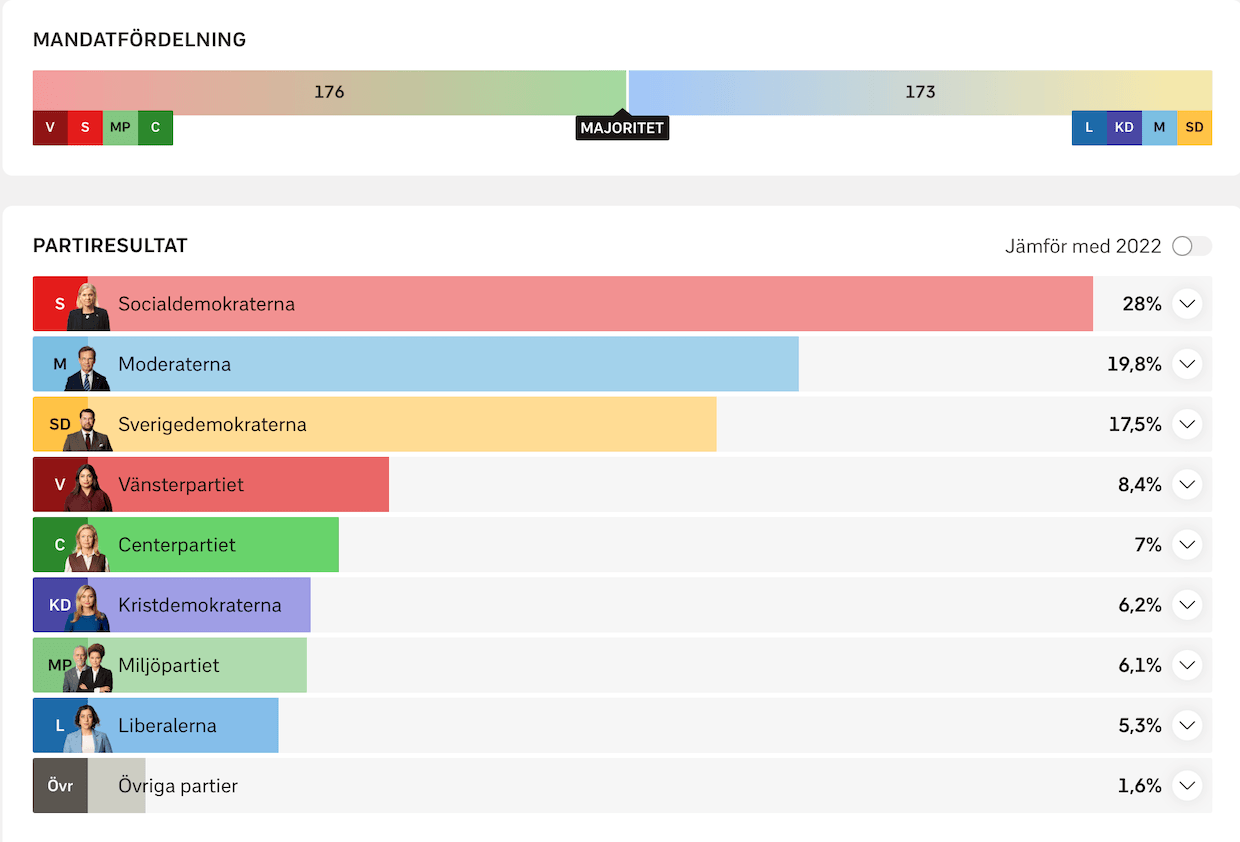
Dr. Off, welcome! Let me begin with your distinction between mainstreaming and normalization. In your work with Anna-Sophie Heinze, you distinguish between mainstream parties adopting far-right positions and the wider normalization of those positions in society. SD fell to around 17.5 percent in the September 13 elections after four years of major influence through the Tidö Agreement. Does this show that normalization does not necessarily lead to continued electoral growth? Can a radical-right party become more normalized even while losing votes?
Dr. Gefjon Off: Electoral growth is one indicator of normalization. As a party grows—especially a party that is new and was originally considered extremist, at least when it was founded, and clearly not normalized at that point—we can consider electoral growth an indicator of normalization.
But there are many other indicators of normalization. How does the media deal with this party? How is it talked about? Is it considered a legitimate political actor in society? So even people who do not vote for the party might consider it a legitimate party and a democratic actor in the political party landscape of the country.
And so, I wouldn’t say that a decline in electoral growth is a sign of denormalization or something like that. I would rather say that electoral growth can be an indicator of normalization, but there are many other indicators that matter, too.
It Is Quite Unusual for Center-Right Parties to Win Voters Back from the Far Right
This raises an important question about who benefits from mainstreaming. SD lost support even though migration, citizenship, integration, and crime remain central issues on the Swedish right. Can a radical-right party shape the agenda so successfully that mainstream conservative parties eventually benefit from positions it helped normalize? And does Germany show that policy mainstreaming can develop even when a party like the AfD remains formally excluded?
Dr. Gefjon Off: Usually, comparative research from other countries shows that center-right parties do not gain electorally by accommodating far-right positions. This pattern has been observed across many European countries, and there is quite a strong consensus on this in the research. So, yes, we would not normally expect center-right parties to win votes by accommodating the far right.
It is therefore quite unusual for center-right parties to win back voters from the far right, as has happened to some extent in Sweden. We usually do not expect this because far-right voters tend to support the party they consider most credible on the issues they care about. If immigration is especially important to them, the far-right party is usually seen as the most credible opponent of immigration because it made the issue its own in the first place. When a center-right party adopts a similar position, it may be seen as less credible because the far-right party was there first.
According to the exit polls, 7% of those who voted for the Sweden Democrats in 2022 voted for the center-right Moderate Party this time, and this is something we have not really seen much elsewhere, so it is quite unusual.
In Germany, regarding your second question—can policy mainstreaming develop even when a party like the AfD remains formally excluded? —yes, that is definitely happening. The center-right CDU still says it will not collaborate with the AfD or form coalitions with it, either at the national or federal-state level. This remains a formal exclusion rule. But, of course, the CDU is still adopting anti-immigration policies, and not only the CDU; we also see other parties doing this. So yes, the influence is still there, even though the AfD remains excluded from formal collaboration.
Can Now Use the Outsider Argument to Re-Establish That Image

SD’s position during the last four years was also unusual. It remained outside government but had major influence through the Tidö Agreement. Could its decline partly reflect the cost of becoming associated with government while losing some of its outsider appeal? And does the AfD’s exclusion in Germany help it preserve that outsider position?
Dr. Gefjon Off: I don’t think SD lost votes because it lost its outsider appeal. This is not a mechanism I would expect to find in other countries either, including cases where far-right parties have entered government. But this morning (Friday), the Sweden Democrats’ party leader, Jimmie Åkesson, made exactly this claim at the press conference. He argued that the party had lost some of its outsider appeal because it had worked with established parties.
I find this unlikely for two reasons. First, since becoming party leader in 2005, Jimmie Åkesson has consistently tried to make the Sweden Democrats appear more established. The party was founded by extremists, including Nazis, and since Åkesson came to power within the party, he has worked to clean up its image. Some people were expelled, the rhetoric was de-radicalized, and for a long time his strategy was precisely to make the party appear more established. So now, to claim that they lost votes because they worked with established parties—which has always been their goal—does not seem entirely convincing to me.
Of course, this is also rhetoric he can now use to re-establish more of an outsider image. The other reason is that, even though Åkesson himself does not usually engage in this kind of behavior—or does so only to a limited extent—there are leading figures within the party who have been around for a long time and who have made very controversial statements and sparked highly provocative public debates. In that sense, they have not always acted in an established way. They use provocative language, make controversial statements, and regularly trigger debates over whether such behavior is appropriate.
So, overall, I don’t think it is straightforward to say that SD lost votes because it worked with established parties.
Regarding the second question about the AfD: does its exclusion in Germany help it preserve its outsider position? Yes, of course. The AfD can use this exclusion to construct an identity around the idea that “we are the ones who are being unfairly excluded.” This strengthens an “us against them” group identity and helps the party build a partisan identity around being unfairly excluded.
The Right-Wing Bloc Remained Strong Despite SD’s Electoral Losses
The movement of voters within the Tidö bloc is also interesting. The Moderates moved ahead of SD, while the Liberals survived with around 5.3 percent, helped partly by tactical voting. Does this suggest that voters can move between parties for strategic reasons without changing their broader ideological views? Can SD lose votes while the wider right remains strong?
Dr. Gefjon Off: The exit polls show that the Liberal Party gained votes mostly from the Moderate Party, but not particularly from the Sweden Democrats. So, in this case, tactical voting was taking place, but not so much among Sweden Democrat voters. The Sweden Democrats’ losses therefore do not appear to have been driven by their voters switching to the Liberal Party.
This is also in line with what SD leader Jimmie Åkesson said. A few weeks before the election, he urged his own voters not to support the Liberal Party or engage in strategic voting. So, strategic voting did occur, but it came mainly from other right-wing parties, not from the Sweden Democrats, at least according to the exit polls.
The reason the rest of the right-wing bloc remained strong is probably, first of all, that the Sweden Democrats lost 3 percentage points, some of which went to the Moderate Party. But the Social Democrats also lost 2.3 percentage points, and some of that support went to the Moderate Party as well. This probably helps explain why the right-wing bloc remained quite strong overall.
In general, there was not much movement apart from the losses of the Social Democrats and the Sweden Democrats, who lost 2 and 3 percentage points, respectively. Otherwise, voter shifts were relatively limited. The election was also very tight. So, overall, we are talking about relatively small voter movements.
Once SD’s Issues Become Mainstream, Its Electoral Advantage Can Become Smaller
Your research also distinguishes between what people believe and which issues they consider most important. Could the 2026 election show that restrictive views on migration or crime remain widespread even if these issues no longer benefit SD as strongly at the ballot box? Can a radical-right party win the battle over the agenda but lose some of the electoral advantage once its issues become mainstream?
Dr. Gefjon Off: Yes, I would say these issues have become mainstream. In that sense, if other parties can act credibly in line with what SD stands for, it seems that other right-wing parties have become credible enough to SD voters on immigration and crime as well. That may mean the credibility advantage the Sweden Democrats gained through their agenda-setting power—by raising these issues, or at least by raising them most prominently in the first place—has become smaller. That could be one interpretation of the results.
Compared with 2022, however, immigration and crime were also somewhat less important to voters in 2026. They were still among the top-ranked issues, but we can see some movement. Healthcare, for example, has become even more important than before, and that is also a rather left-wing issue.
So perhaps part of the shift reflects the fact that immigration and crime have become less important in voters’ eyes. The question, then, is why. I can think of at least two possible explanations. One is that immigration and crime rates have gone down, so these issues may simply feel less urgent to many voters.
The other is that some of the immigration and crime policies proposed by the Tidö government were perceived by parts of the public as very harsh and therefore generated considerable public criticism. For example, debates about deporting children and teenagers, as well as incarcerating teenagers, sparked strong reactions. It may be that some voters reacted against the way these policies were ultimately implemented in practice.
So, these are two possible explanations for why immigration and crime may no longer have been as important as before. And that, in turn, could also have affected why SD was not as successful as it had been previously.
Values Tend to Remain Stable, but the Salience of Issues Can Change
This brings us to the importance of issue salience. Your earlier research showed that when gender equality becomes politically prominent, conservative gender attitudes can become more closely connected to SD support. Should we focus less on whether voters changed their values in 2026 and more on which issues parties successfully made important? Is radical-right support often about activating existing attitudes rather than creating entirely new ones?
Dr. Gefjon Off: Usually, research assumes that values are relatively stable. Attitudes may change somewhat more, but values are the deeper underlying beliefs people hold. Views on immigration or gender equality are often closely connected to values developed at an early age. People are generally socialized into these values while growing up, particularly during their teenage years and early adulthood, which we consider the formative years. After that, values tend to remain relatively stable. So, we would not expect people to completely change their minds between elections.
What can change are other factors: whom people trust, how they view political leaders, whether scandals occur, how the government performs, and so on. Another important factor is how salient a particular issue becomes. For instance, after 2015, when immigration increased in many countries, immigration became a more important political issue. It was discussed extensively by politicians, the media, and, of course, the far right. The same applies to other developments, such as the economic crisis or, later, worldwide feminist movements. When events like these occur, certain issues become more salient.
When an issue becomes more salient, the attitude people already hold toward it becomes more important in their vote choice. So, it is less about changing attitudes than about how important those attitudes become politically. This happens through major events, but also through the way political parties politicize particular issues.
Far-right parties across Europe—although the Sweden Democrats somewhat less so—have increasingly politicized anti-gender and anti-feminist views, as well as women’s rights and LGBTQI+ rights, by positioning themselves against these issues. Of course, if I am, say, a far-right voter who sympathizes with such a party and consumes its rhetoric and positions, this can also influence me. By politicizing an issue, the party therefore also increases its salience.
SD Lost 7%Points Among First-Time Voters, but the Broader Youth Picture Is More Stable
The youth vote is especially interesting in this respect. SD lost support among younger voters, while the gender gap between young men and young women remains substantial. Does this suggest a weakening of SD specifically rather than a reversal of the wider rightward movement among young men?
Dr. Gefjon Off: It’s interesting. According to the exit polls, the Sweden Democrats lost 7 percentage points among first-time voters. That is quite substantial, considering that they lost 3 percentage points in the electorate overall. Among 18- to 21-year-olds—a very small group—they lost 7 percentage points.
I don’t think this is easy to explain, except by noting that first-time voters are a very volatile group. They are not yet fully socialized into the political system, do not really have a partisan identity, and have not yet developed strong partisan attachments. So perhaps it is not too surprising that voting patterns among first-time voters can change considerably from one election to another.
Still, it is quite striking that the Sweden Democrats lost 7 percentage points in this group. But if you look at slightly older voters, the picture is more stable. Among 22- to 30-year-olds, they actually gained 1 percentage point, according to the exit polls. So, what is happening among young voters depends a great deal on how you define “young.”
I prefer to include voters up to the age of 29 or 30, because if you focus only on first-time voters, the group becomes very small, making it difficult to draw substantive conclusions. Among somewhat older young voters, the Sweden Democrats still gained a little. So, the overall picture really depends on which age group you examine.
We Do Not Yet Fully Understand Why Youth Gender Gaps Are Widening
Your comparative research also warns against assuming that all young men are moving toward the far right in the same way. What conditions determine whether culturally conservative young men support a radical-right party rather than a mainstream conservative party? How important are economic conditions, party strategies, and political institutions?
Dr. Gefjon Off: We see that in some countries, young men have been moving toward the far right, and Sweden was one of these countries until this election. For this election, however, we still need to see the numbers to know whether this trend is continuing.
Sweden has been one such case. But in many other countries, the youth gender gap is driven more by young women becoming more progressive. So, the explanatory factors shaping these patterns remain somewhat unclear. We do not really know why young women become more progressive in some places while young men become more conservative in others. What we do see is a widening gender gap in many countries.
The patterns differ, however, and we do not yet fully understand why. Some research suggests—although this still needs to be tested more rigorously—that in countries where gender equality is more advanced, more young men may move toward the far right. But this remains tentative.
As for economic conditions and party strategies, these certainly matter. They matter for many far-right voters, not just young men. A great deal has to do with economic grievances related to housing, prices, inflation, and perhaps job conditions. But it is also very much about perceived grievances. People’s own economic situation may not always be objectively bad, but they may feel that it is worsening or could worsen in the future. So it is often more about perceptions than about objective conditions. The two can, of course, go hand in hand, but they do not always have to.
This does not necessarily affect men and women differently, however. Everybody experiences economic insecurity when it occurs. Party strategies, on the other hand, do matter. Far-right parties are very effective at mobilizing on social media. And because of gender differences in social media algorithms, far-right content is more often shown to young men than to young women. So, we do think that these party strategies, especially in social media communication, matter.
Political institutions probably matter as well, perhaps in terms of the level of gender equality in a country, but this remains very tentative, as I said.
Voters Can Change Parties Without Changing Their Broader Cultural Values
Your concept of “protective masculinity” helps connect these developments to wider cultural attitudes. It brings together views about immigration, gender equality, sexuality, crime, hierarchy, and national identity. Could these attitudes remain stable even when party support changes? Can voters move between SD and mainstream right-wing parties without changing their broader cultural outlook?
Dr. Gefjon Off: “Protective masculinity” is a concept coined by Katashina Voynitska; it’s not my concept. But I think it is much more about underlying cultural values concerning both immigrants and women, as well as the relationship between men and women, than about specific attitudes that might change from one election to another. That is why I expect these values to remain relatively stable. It is largely about how people view societal relationships between different groups. So, I do think these values remain stable, and they probably do not change even if, in this example, a person decides to vote for a party other than SD.
A More Diverse Electorate Is More a Sign of Far-Right Success Than a Hindrance

Your work also shows that radical-right voters are far from a single, uniform group. SD has drawn support from anti-immigration voters, economically insecure groups, former Social Democrats, and younger right-wing voters. Does its 2026 decline suggest that this coalition has become harder to hold together?
Dr. Gefjon Off: The growth of far-right parties necessarily means that their electorates become more diverse. As a party grows, more and more people vote for it, which naturally brings a wider range of voters into its electorate. This is more a sign of success than a hindrance. Being able to attract different population groups shows that these parties have become more successful, so I would not consider this a disadvantage for them. It is probably a good thing.
What is more interesting is that, at least in this case, some SD voters did not identify strongly enough with the party to remain loyal to it. This suggests that the partisan identity far-right parties often create very successfully may not have been as strong among some parts of the electorate. That is quite interesting. It suggests that in Sweden, perhaps this year at least, it was somewhat easier to win back voters from the far right than, for instance, what we have been seeing in Germany.
Far-Right Rhetoric Draws Heavily on a Sense of Unfair Treatment
Threat perceptions are another important part of your research. You show that cultural concerns can become stronger when combined with economic insecurity, distrust, and feelings of unfair competition. How useful is this framework for understanding Sweden today? Could these grievances remain strong while increasingly being expressed through parties other than SD?
Dr. Gefjon Off: As I said before, perceptions of economic insecurity, as well as the feeling of being unfairly disadvantaged in one’s own economic situation, can help fuel far-right support across Europe, not just in Sweden. But again, much of this is about perceptions and a sense of unfair treatment. This is something the far right often draws on in its rhetoric. They may tell people that they are being treated unfairly and that immigrants, for example, are being advantaged at their expense.
We have also seen some of this discourse directed toward men, especially young men, although less so in Sweden. They are told that they are being discriminated against, treated unfairly in society, and deprived of opportunities. This is part of the rhetoric, and it draws heavily on these kinds of perceived grievances.
At the same time, we see that many workers also vote for the far right. Workers traditionally voted for the Social Democrats, and they still do to a large extent, but many voters have also shifted from the Social Democrats to the far right. This has happened in both Sweden and Germany.
This year, 25% of workers voted for the Sweden Democrats, compared with 17.5% of the electorate overall. So, a substantial proportion of workers, who often live in more precarious economic circumstances, supported the party. Economic insecurity, therefore, definitely plays a role.
SD’s Agenda-Setting Power Has Extended Beyond the Right-Wing Bloc
The election also shows why different forms of political influence need to be separated. SD remains a major party, but electoral strength, policy influence, agenda-setting power, coalition leverage, and government participation are not the same thing. How useful is it to distinguish these different forms of normalization when assessing SD’s position?
Dr. Gefjon Off: I think this is important. As I said, electoral strength is one indicator of a party’s normalization, but there are many other ways to assess how successful it is. Over the past few years, SD has had considerable policy influence and agenda-setting power.
This influence has not been limited to the Tidö parties; it has gone beyond the coalition leverage SD exercised as a support party. The Social Democratic Party has also adopted more immigration-critical positions. So, SD’s agenda-setting power has extended beyond the right-wing bloc and some center parties.
There is therefore a great deal of influence, and it is useful to look at different indicators when assessing it.
The Rise of the Far Right Has Made Coalition Building More Complicated
Government formation shows how SD has affected the wider party system as well. The Center Party rejects dependence on SD, while also resisting Left Party participation in government, and the Left Party is demanding influence if its support is needed. Does this show that the rise of the radical right reshapes coalition choices even among parties that oppose it?
Dr. Gefjon Off: Yes. Since the rise of the far right across different European countries, party systems have become more fragmented, making coalition formation more difficult. Different countries have responded to this challenge in different ways.
For instance, in Germany, we have seen more grand coalitions over the past 20 years, with the center-left and center-right forming governments together to secure a majority. In Sweden, by contrast, we have not seen such grand coalitions in the past decade. Instead, governments have relied on minority arrangements supported by other parties. The Tidö government, for example, was a minority government that depended on the support of the Sweden Democrats.
A similar arrangement may now emerge with a new, more left-wing or center-left government, which could also be a minority government relying on support from another party. So, there are different ways of dealing with this challenge, but the broader pattern is that the rise of the far right has contributed to greater fragmentation in the party landscape, making coalition building more complicated.
The Liberals Survived with Help from Tactical Voting by Other Tidö Voters
The Liberals are particularly interesting here. Their survival strengthened the Tidö bloc, but the party has also struggled internally over cooperation with SD. Does this reveal a tension between electoral survival, ideological identity, and coalition strategy? Can the same tactics that help a party survive also make governing alliances more difficult?
Dr. Gefjon Off: The Liberals are a very interesting case because, traditionally, they were in favor of welcoming refugees. When they joined the Tidö government, which relied on the support of the Sweden Democrats, many prominent members left the party. There was also considerable internal disagreement, which significantly weakened the party. For a long time, it remained below the 4% threshold required to enter Parliament.
Now they have made it. But Simona Mohamsson, their party leader, has only been in the role for about a year. There were also strong disagreements between her and Sweden Democrats leader Jimmie Åkesson over what it means to be Swedish and who can be considered a Swede, especially given Mohamsson’s own background as the daughter of immigrants.
So, the situation has been very unstable. In this case, what probably helped the Liberals survive was tactical voting by supporters of the other parties in the Tidö government—not so much by Sweden Democrat voters, but by voters of the other parties.
Swedish Opposition to SD Is Directed More at Its Policies Than at Its Legitimacy

Your experimental work with Amy Alexander and Nicholas Charron suggests that polarization can grow through both conservative backlash and liberal countermobilization. Could the September 13 elections reflect this two-sided process? Might years of SD influence have mobilized not only its supporters but also voters who are specifically concerned about its growing normalization?
Dr. Gefjon Off: I think there were definitely people reacting against some of the policies of the Sweden Democrats and the Tidö government. We see left-wing counterreactions to some of these policies, but I do not think we see a broader questioning of SD’s legitimacy as a political party. So, I would say that people are reacting more against particular policies than against the normalization of the party itself.
I am therefore not sure that there is such a strong concern in Swedish society about the normalization of the Sweden Democrats. In my impression, the question of whether SD is a legitimate democratic actor is not especially prominent in public debate. The opposition is directed more toward the party’s positions than toward its existence as a political actor.
In Germany, by contrast, there are major public debates about whether the AfD is a legitimate political actor, whether the party should be banned, or whether certain branches of it might be banned. Some branches have been labeled right-wing extremist and unconstitutional, the youth organization was dissolved, and a new organization was founded last year. So there is much more public debate, including formal statements by government authorities about whether the party can be considered a legitimate democratic actor and how it should be dealt with if it is not.
There have also been waves of demonstrations in which hundreds of thousands of people across different German cities have taken to the streets. These protests occur relatively regularly and are directed against the AfD as a political party and political actor.
So, I think the way people have reacted to normalization is quite different in the two cases. The counterreactions to particular policies may be similar, but the reaction to the normalization of the party itself is different.
Electoral Support Matters, but It Tells Only Part of the Story of SD’s Influence
And finally, Dr. Off, let me return to the broader meaning of radical-right success. Should we measure it mainly through vote share and government participation, or also through policy influence, agenda-setting power, mainstream adoption of its positions, and the weakening of stigma around them? If a party loses votes while many of its ideas become more accepted, does that suggest that electoral results alone tell us only part of the story?
Dr. Gefjon Off: Yes, I agree with this. SD lost votes, and it was also the party that lost the most votes in this election, which is probably an indication of the significance of that loss. But the party has gained considerable influence, and that influence remains.
It will be very interesting to see how the Social Democrats, having also lost votes, formulate migration policy in their coalition agreements. Will they continue along the rather conservative path they have been moving toward, or will they try to appeal to their more left-wing coalition partners and step back somewhat from these anti-immigration positions?
So, the situation is quite interesting, but the influence of the Sweden Democrats is clear. I am not sure they themselves would consider this a success, given that they lost votes. Of course, electoral support may still be the most important indicator because, without votes, a party eventually loses influence.
Still, their agenda-setting power and policy influence have been very significant, and that is certainly part of their success.