In this commentary, Professor Ibrahim Ozturk examines whether recent electoral defeats of authoritarian populists in the United States, Hungary, Brazil, and Serbia signal an emerging democratic counterwave or merely temporary setbacks for populism. Arguing that Trumpism’s electoral defeat does not eliminate the structural conditions that produced it, Professor Ozturk explores how economic inequality, institutional capture, globalization, and technological concentration continue to undermine democratic legitimacy. Drawing on comparative political economy and Daron Acemoglu’s scholarship, he emphasizes the urgency of rebuilding political representation, shared prosperity, and democratic control over technological change. Moreover, he warns that electoral victories alone cannot secure democratic renewal: without credible economic alternatives, institutional reconstruction, and effective governance, authoritarian populism may return in more resilient forms.
By Ibrahim Ozturk
Can electoral defeats in the United States, Hungary, Brazil and Serbia become a genuine democratic counterwave—or will populism return unless its structural causes are addressed? Donald Trump’s resounding defeat in the November 2026 midterm elections, following electoral breakthroughs against authoritarian populists in Hungary, Brazil and Serbia, and partly in Israel, though with significant uncertainties, may mark the beginning of a democratic counterwave. Yet elections can remove or constrain leaders without eliminating the structural conditions that produced them. Unless democratic governments rebuild political representation, state capacity and shared prosperity, today’s victories may pave the way for tomorrow’s populist return.
The Democratic victory was much more than an ordinary shift in the congressional balance of power. By taking control of both the House of Representatives and the Senate—including victories in states and constituencies Trump had carried comfortably only two years earlier—Democrats delivered the most consequential institutional rebuke to Trump since his return to the White House.
According to Reuters’ detailed account of the results, Democrats secured at least 54 Senate seats and gained at least 30 seats in the House. The electoral shift extended well beyond established Democratic territory, reaching deeply Republican states such as Texas, Kansas and South Carolina.
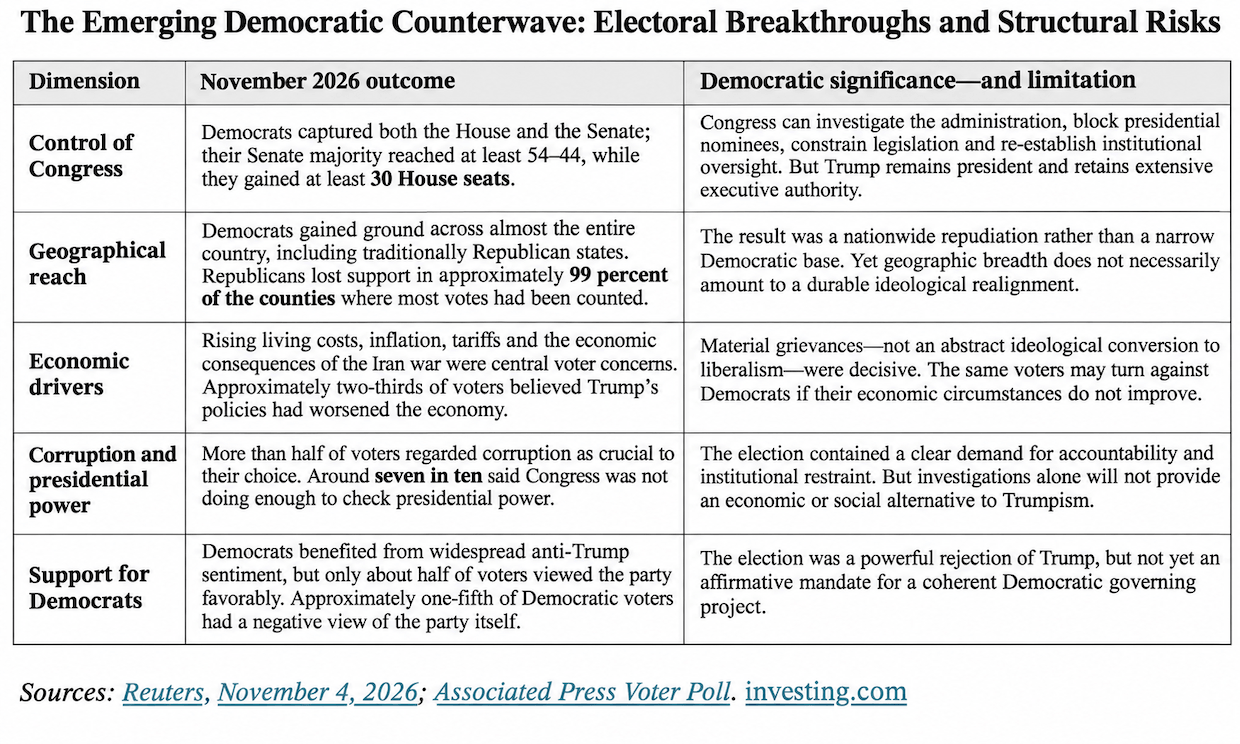
The table reveals the election’s two-sided character. On the one hand, the scale and geographical spread of the Democratic victory make it impossible to dismiss the result as a routine midterm correction. Trump-backed Republicans lost support almost everywhere, including in regions that had recently seemed beyond the Democrats’ reach. The outcome has restored Congress’s capacity to investigate abuses, resist presidential appointments and prevent the legislature from functioning as an extension of the executive branch.
This institutional dimension is especially important given the severity of America’s democratic deterioration. The V-Dem Democracy Report 2026 recorded a 24 percent decline in the United States’ Liberal Democracy Index during the first year of Trump’s second term, with the country falling from twentieth to fifty-first place globally. V-Dem identified legislative constraints as the most severely damaged component of American democracy and described the speed of executive aggrandizement as unprecedented in modern American history.
Against this background, restoring an independently controlled Congress is not merely a partisan change. It reactivates one of the principal constitutional mechanisms capable of constraining executive power. It may block further democratic erosion and create institutional space for recovery. But this is still a lifeline, not a democratic restoration—and certainly not the end of Trumpism. Trump remains in the White House. The institutional damage inflicted on the civil service, judiciary, regulatory agencies, universities, media and wider public sphere has not been reversed. Nor have the economic and cultural grievances that returned him to power in 2024 disappeared. Congressional control may constrain Trump’s room to maneuver, but it cannot by itself rebuild public trust, reverse inequality, or restore the social foundations of liberal democracy.
The second half of the table is therefore as important as the first. The Democrats’ victory was broad, but support for the Democratic Party remains relatively shallow. The Associated Press Voter Poll found that many voters who supported Democratic congressional candidates remained dissatisfied with the party itself. Roughly one-fifth of Democratic voters held an unfavorable view of the party they had just voted for. Many were not endorsing a clear Democratic program; they were looking for an instrument to restrain Trump and punish the incumbent government.
The crucial fact, therefore, is that many of the citizens who punished Trump in 2026 were the same economically and culturally frustrated voters who had punished Joe Biden and the Democrats in 2024. Their movement between the parties reflects neither ideological conversion nor a stable embrace of liberal democracy. It reflects a volatile electorate that repeatedly votes against governments perceived to have failed on prices, employment, security, public services, and political integrity.
The election’s economic geography reinforces this interpretation. Voters who reported serious hardship from inflation and everyday costs moved decisively toward Democratic candidates—even in Republican strongholds. They blamed Trump’s tariffs, the Iran war and the failure to fulfill his promise to reduce prices. Corruption also mattered, particularly the perception that the presidency was being used to advance Trump’s personal, family and corporate interests. The outcome was consequently an accountability vote with two connected elements: a demand to restrain presidential power and a demand for economic delivery. Concentrating only on the first would be a serious mistake.
Congressional investigations into corruption, conflicts of interest and executive abuses are indispensable. But if Democrats define their victory primarily as an authorization to investigate Trump, they may constrain one president without weakening Trumpism. Investigations can expose abuses; they cannot make housing affordable, create career-building employment, rebuild declining regions or give working people greater influence over technological and economic change. The midterms should therefore be interpreted neither as a final defeat for American populism nor merely as a temporary anti-incumbent swing. They represent a narrow but historic window in which democratic forces can move from anti-Trump resistance to democratic reconstruction.
Whether this opening becomes a lasting realignment will depend on what Democrats do with their new institutional power. If they combine constitutional accountability with a credible programme addressing affordability, inequality, good jobs, regional decline and technological disruption, the election may become the starting point of a more durable democratic counterwave. If they return to technocratic incrementalism or assume that Trump’s personal unpopularity has solved the problem, the same electorate may swing back in 2028.
The central lesson is therefore not that American populism has been defeated. It is that Trump has become electorally vulnerable because he failed to deliver on the grievances that originally brought him back to power. Those grievances remain politically available. The question is now whether democratic government can finally address them before another authoritarian populist does.
Daron Acemoglu is right to warn that the most difficult work begins after the electoral victory. As he argues in What Happened to Liberal Democracy?, liberal democracy prospered when it was associated with shared prosperity, political voice, social mobility and the broad distribution of opportunity. It entered crisis when liberalism detached from these social foundations and became increasingly associated with technocracy, globalization, and the priorities of highly educated metropolitan elites.
If Democrats cannot respond to extreme inequality, the affordability crisis and the disappearance of secure, career-building employment—especially for workers without university degrees—the political pendulum may swing back in 2028. Neither an exclusive reliance on taxes and transfers, nor centrist attachment to the pre-Trump status quo, nor the fashionable expectation that AI-driven “abundance” will automatically resolve distributive conflict offers an adequate response.
This is precisely why the American midterm result deserves greater attention than a conventional anti-incumbent election. It creates an institutional barrier against Trump’s authoritarian ambitions, but it also places Democrats under an obligation to demonstrate that pluralist democracy can govern and deliver. If they use their congressional majority mainly to investigate Trump while failing to articulate a credible economic and social program, they may constrain him temporarily while inadvertently preparing the next Trump—or a younger, more capable successor.
In my ECPS commentary “Trump and the New Capitalism: Old Wine in New Bottle,” I argued that Trumpism 2.0 represents more than nationalist rhetoric or protectionist trade policy. It combines economic nationalism, corporate oligarchy, technological concentration and elements of digital feudalism. State power is not withdrawn from the economy; it is reorganized to serve politically connected corporations, dominant technology platforms and favored economic interests. The 2026 vote has interrupted this project, but it has not dismantled the political economy that sustains it.
The American result forms part of a wider sequence of authoritarian-populist reversals. In Hungary, the Tisza Party ended Viktor Orbán’s sixteen-year rule and secured a constitutional supermajority. According to the detailed 2026 Hungarian election analysis published by the Institut für Europäische Politik, Tisza won 53.29 percent of party-list votes and 138 of the National Assembly’s 199 seats.
In Serbia, the student-backed opposition movement that emerged from protests following the Novi Sad railway-station disaster defeated Aleksandar Vučić’s ruling alliance. Reuters reported that the movement received 52.7 percent of the vote and secured 139 of the 250 parliamentary seats.
In Brazil, Luiz Inácio Lula da Silva defeated Flávio Bolsonaro, although the narrow margin confirmed that Bolsonarismo remains deeply embedded in Brazilian political and social life. As Professor James N. Green warned in an ECPS interview conducted after the election, the Brazilian far right has lost a battle, not the wider political struggle. It retains conservative congressional support, religious networks, digital mobilization capacity and a substantial electorate.
Israel provides a more qualified case. Benjamin Netanyahu’s nationalist-religious bloc won only 53 of the Knesset’s 120 seats, but the process of forming a government remains unresolved. Netanyahu’s parliamentary position has been severely weakened, but it would be premature to describe this as a completed transfer of power.
Taken together, these developments justify speaking cautiously of a democratic counterwave. They show that elections, civic mobilization, coordinated opposition and institutional resistance can still constrain leaders who appeared politically invincible. But they do not demonstrate that authoritarian populism has been ideologically defeated.
Populist Reverse-convergence vis-à-vis Structural Failure
In “Populist Attacks on Institutions as a Reaction to Hyper-globalization,” I argued that populist attacks on independent institutions cannot be understood separately from the economic and social dislocations produced by unmanaged globalization. Financial crises, regional decline, inequality, declining social mobility, and the perception that national governments have lost control over economic outcomes generate both demand for populism and the political opportunities populist entrepreneurs exploit.
This argument is consistent with Dani Rodrik’s research on the relationship between globalization and right-wing populism, and with Sergei Guriev and Elias Papaioannou’s extensive study of the political economy of populism. Economic shocks do not translate mechanically into populist politics. They operate through perceptions of status, cultural displacement, political exclusion, and the failure of representative institutions. In “Capitalist Disruptions and the Democratic Retreat: A US–EU–China Comparison,” I developed this argument further by describing a process of authoritarian convergence. Liberal democracies and explicitly authoritarian systems remain different, but widening inequality, technological surveillance, corporate concentration, regulatory capture, and weakened public institutions are narrowing parts of the practical distance between them. The result is a political paradox. Governments remain formally democratic, but citizens increasingly experience economic decisions as matters over which they exercise little meaningful influence. Elections continue, but changing the government does not necessarily alter the underlying distribution of economic power.
The political damage was compounded by the way globalization was governed. Trade integration generated large aggregate gains, but governments too often treated the workers, firms and regions bearing the adjustment costs as if they would automatically move into new and better employment. Autor, Dorn and Hanson’s research on the China shock found that import-exposed local labor markets experienced persistent falls in employment, wages and labor-force participation, while their later work linked greater trade exposure to political polarization. The OECD Employment Outlook 2026 reaches a similar conclusion across advanced economies: the benefits of openness were real, but the losses were geographically concentrated and often endured for years. The resulting backlash was therefore not simply an irrational rejection of trade. It was also a reaction to governments that liberalized markets without constructing adequate mechanisms for regional renewal, worker adjustment, social insurance and political voice.
China’s current growth model has intensified this distributive problem. China is neither the sole cause of Western deindustrialization nor merely an economic threat; its growth has enlarged world trade and accelerated the diffusion of affordable green technologies. Yet weak domestic consumption, state-directed credit, large industrial subsidies, and manufacturing overinvestment now create asymmetric competitive pressure that open market economies cannot ignore. The IMF’s 2025 Article IV consultation warns that export-led adjustment and unwarranted industrial-policy support are producing excess supply and adverse spillovers for trading partners, while the European Commission has documented extensive state-induced distortions and unfair subsidization in strategic sectors. The democratic answer cannot be indiscriminate protectionism, which would raise prices and deepen fragmentation. But passivity would accelerate industrial erosion and feed populist claims that elected governments have surrendered control. A credible response requires rules-based trade defense, reciprocity in market access, coordinated industrial and competition policy, place-based investment and pressure for China to rebalance towards domestic consumption rather than exporting its internal imbalances.
Yet such pressure will be ineffective if exercised through a fragmented, transactional multipolar order in which major powers rely on unilateral tariffs and competing economic blocs. Bringing China closer to fair play requires rebuilding an open, inclusive and enforceable multilateral order, supported by reformed WTO rules on industrial subsidies, state-owned enterprises, excess capacity and reciprocal market access. Trump’s electoral defeat should therefore be understood not only as a setback for authoritarian populism, but also as a strategic opportunity to move beyond unilateral protectionism and toward renewed multilateral order and cooperation. If democratic governments use this opening to construct a fairer international system that reconciles openness with social protection, industrial resilience and democratic accountability, they may simultaneously address China’s distortive practices and the domestic grievances on which Trumpism and related populist movements thrive.
Under these conditions, authoritarian populism becomes a distorted form of democratic protest. Citizens support leaders who promise to recover sovereignty and political control, even when those leaders subsequently use that mandate to dismantle the institutions that make democratic correction possible.
Why Some Populists Lose—and Others Survive Failure
The emerging counterwave supports a first proposition: where electoral competition remains meaningful, authoritarian populists who govern badly may eventually be punished. Populists promise that concentrating authority will enable them to break institutional deadlock and deliver rapid results. Once in office, however, many generate corruption, patronage, inflation, declining services, administrative incompetence, and international isolation. When the discrepancy between rhetoric and performance becomes sufficiently visible, even formerly loyal voters may abandon them.
But this mechanism operates only where opposition forces can organize, voters can obtain independent information, and electoral authorities, courts, and security institutions have not been completely subordinated. My comparative study “Confronting Populist Authoritarians: The Dynamics of Lula’s Success in Brazil and Erdogan’s Survival in Turkey” demonstrated why similar economic and political failures can produce different outcomes. Lula’s broad democratic coalition defeated Bolsonaro, though it could not eliminate Bolsonarismo. In Turkey, Erdogan’s institutional capture, control over resources and capacity to fragment the opposition insulated him from the consequences of economic failure.
This leads to a second and more troubling proposition: where a populist leader has captured the state, failure may produce intensified authoritarianism rather than electoral defeat. In “A Lesson from Turkey: Economic Crises as Steppingstones, but Not Exit Routes for Authoritarian Populists,” I argued that economic crises may help populists enter power without subsequently providing an exit route from populist rule. Once leaders have captured the judiciary, media, bureaucracy, security apparatus, and mechanisms for distributing state resources, poor economic performance ceases to be sufficient to remove them.
Leaders who fear prosecution, loss of wealth or exposure of wrongdoing acquire powerful personal incentives to prevent alternation in power. The more offenses committed in consolidating the regime, the more dangerous surrendering office becomes. The regime’s failures therefore deepen its dependence on repression. Turkey illustrates this danger. Freedom House’s 2026 assessment documents the consolidation of power through constitutional engineering, institutional capture and the imprisonment of opponents, journalists and civil-society representatives.
My more recent analysis, “Stealing from the Future,” shows how such a regime may use fiscal transfers, public procurement, credit and inflation to purchase present political support by transferring the costs to future taxpayers. Economic policy becomes a technology of political survival rather than an instrument of long-term development. Consequently, no mechanical sequence in which the defeats of Trump, Orbán, Bolsonaro or Vučić necessarily predict the fall of Erdogan or Narendra Modi. Democratic openings can spread confidence, but national outcomes depend on the depth of institutional capture, the credibility of opposition forces and whether electoral punishment remains possible.
The Acemoglu Challenge: Redirecting Technological Change
The struggle over artificial intelligence will be critical to whether the American midterm victory develops into a durable democratic realignment. An ECPS long read, “The Economist versus Acemoglu: Who Will Govern the Next World Order?”, argues that the controversy surrounding Acemoglu is not simply a dispute over AI productivity. It concerns who directs technological change, who captures its gains, and whether democracy can discipline concentrations of corporate power that markets have themselves created. Acemoglu, David Autor and Simon Johnson’s proposal for “Building Pro-Worker AI” distinguishes technologies that complement workers and create new human tasks from technologies principally designed to replace labor. Acemoglu’s related intervention in Nature warns against organizing the entire technological agenda around artificial general intelligence and the automation of human capabilities.
If AI intensifies workplace surveillance, displaces labor and concentrates income among a few technology companies, it will aggravate precisely the inequalities and insecurities that nourish authoritarian populism. A democratic strategy must instead use public procurement, research funding, competition policy, worker participation and taxation to redirect innovation toward augmenting human capabilities and creating socially valuable employment. This is where the political meaning of Trump’s midterm defeat will ultimately be determined.
Congressional investigations and institutional checks are necessary, but they cannot substitute for a new governing philosophy centered on productive employment, affordable housing and healthcare, regional regeneration, technological democracy and the reconstruction of worker power.
After Victory Comes Democratic Delivery
Democratic successors must restore legality without producing institutional paralysis. They must dismantle state capture without replacing it with partisan revenge. They must defend pluralism while demonstrating that pluralist democracy can govern, coordinate and deliver. The current electoral reversals are therefore openings rather than conclusions. The V-Dem Democracy Report 2026 finds that nearly three-quarters of the world’s population lives under autocratic rule and that democracy, for the average global citizen, has returned approximately to its 1978 level. Only eighteen countries are currently democratizing, while nearly a quarter of the world’s states are undergoing autocratization.
The American midterm victory is therefore historic, but its meaning remains unsettled. It may mark the beginning of democratic reconstruction. Equally, it may be another swing of the electoral pendulum, driven by an electorate that remains economically insecure, politically unrepresented, and willing to experiment repeatedly with anti-establishment alternatives.
If democratic governments cannot address these structural grievances, authoritarian populism will return—perhaps under younger, more disciplined and more competent leaders who have learned from the failures of Trump, Orbán and Bolsonaro. Winning an election can remove or constrain an authoritarian government. Only democratic delivery can weaken the economic, institutional and cultural conditions that continually reproduce authoritarian populism.

Trump Lost, but the Conditions That Produced Populism Persist
In this commentary, Professor Ibrahim Ozturk examines whether recent electoral defeats of authoritarian populists in the United States, Hungary, Brazil, and Serbia signal an emerging democratic counterwave or merely temporary setbacks for populism. Arguing that Trumpism’s electoral defeat does not eliminate the structural conditions that produced it, Professor Ozturk explores how economic inequality, institutional capture, globalization, and technological concentration continue to undermine democratic legitimacy. Drawing on comparative political economy and Daron Acemoglu’s scholarship, he emphasizes the urgency of rebuilding political representation, shared prosperity, and democratic control over technological change. Moreover, he warns that electoral victories alone cannot secure democratic renewal: without credible economic alternatives, institutional reconstruction, and effective governance, authoritarian populism may return in more resilient forms.
By Ibrahim Ozturk
Can electoral defeats in the United States, Hungary, Brazil and Serbia become a genuine democratic counterwave—or will populism return unless its structural causes are addressed? Donald Trump’s resounding defeat in the November 2026 midterm elections, following electoral breakthroughs against authoritarian populists in Hungary, Brazil and Serbia, and partly in Israel, though with significant uncertainties, may mark the beginning of a democratic counterwave. Yet elections can remove or constrain leaders without eliminating the structural conditions that produced them. Unless democratic governments rebuild political representation, state capacity and shared prosperity, today’s victories may pave the way for tomorrow’s populist return.
The Democratic victory was much more than an ordinary shift in the congressional balance of power. By taking control of both the House of Representatives and the Senate—including victories in states and constituencies Trump had carried comfortably only two years earlier—Democrats delivered the most consequential institutional rebuke to Trump since his return to the White House.
According to Reuters’ detailed account of the results, Democrats secured at least 54 Senate seats and gained at least 30 seats in the House. The electoral shift extended well beyond established Democratic territory, reaching deeply Republican states such as Texas, Kansas and South Carolina.
The table reveals the election’s two-sided character. On the one hand, the scale and geographical spread of the Democratic victory make it impossible to dismiss the result as a routine midterm correction. Trump-backed Republicans lost support almost everywhere, including in regions that had recently seemed beyond the Democrats’ reach. The outcome has restored Congress’s capacity to investigate abuses, resist presidential appointments and prevent the legislature from functioning as an extension of the executive branch.
This institutional dimension is especially important given the severity of America’s democratic deterioration. The V-Dem Democracy Report 2026 recorded a 24 percent decline in the United States’ Liberal Democracy Index during the first year of Trump’s second term, with the country falling from twentieth to fifty-first place globally. V-Dem identified legislative constraints as the most severely damaged component of American democracy and described the speed of executive aggrandizement as unprecedented in modern American history.
Against this background, restoring an independently controlled Congress is not merely a partisan change. It reactivates one of the principal constitutional mechanisms capable of constraining executive power. It may block further democratic erosion and create institutional space for recovery. But this is still a lifeline, not a democratic restoration—and certainly not the end of Trumpism. Trump remains in the White House. The institutional damage inflicted on the civil service, judiciary, regulatory agencies, universities, media and wider public sphere has not been reversed. Nor have the economic and cultural grievances that returned him to power in 2024 disappeared. Congressional control may constrain Trump’s room to maneuver, but it cannot by itself rebuild public trust, reverse inequality, or restore the social foundations of liberal democracy.
The second half of the table is therefore as important as the first. The Democrats’ victory was broad, but support for the Democratic Party remains relatively shallow. The Associated Press Voter Poll found that many voters who supported Democratic congressional candidates remained dissatisfied with the party itself. Roughly one-fifth of Democratic voters held an unfavorable view of the party they had just voted for. Many were not endorsing a clear Democratic program; they were looking for an instrument to restrain Trump and punish the incumbent government.
The crucial fact, therefore, is that many of the citizens who punished Trump in 2026 were the same economically and culturally frustrated voters who had punished Joe Biden and the Democrats in 2024. Their movement between the parties reflects neither ideological conversion nor a stable embrace of liberal democracy. It reflects a volatile electorate that repeatedly votes against governments perceived to have failed on prices, employment, security, public services, and political integrity.
The election’s economic geography reinforces this interpretation. Voters who reported serious hardship from inflation and everyday costs moved decisively toward Democratic candidates—even in Republican strongholds. They blamed Trump’s tariffs, the Iran war and the failure to fulfill his promise to reduce prices. Corruption also mattered, particularly the perception that the presidency was being used to advance Trump’s personal, family and corporate interests. The outcome was consequently an accountability vote with two connected elements: a demand to restrain presidential power and a demand for economic delivery. Concentrating only on the first would be a serious mistake.
Congressional investigations into corruption, conflicts of interest and executive abuses are indispensable. But if Democrats define their victory primarily as an authorization to investigate Trump, they may constrain one president without weakening Trumpism. Investigations can expose abuses; they cannot make housing affordable, create career-building employment, rebuild declining regions or give working people greater influence over technological and economic change. The midterms should therefore be interpreted neither as a final defeat for American populism nor merely as a temporary anti-incumbent swing. They represent a narrow but historic window in which democratic forces can move from anti-Trump resistance to democratic reconstruction.
Whether this opening becomes a lasting realignment will depend on what Democrats do with their new institutional power. If they combine constitutional accountability with a credible programme addressing affordability, inequality, good jobs, regional decline and technological disruption, the election may become the starting point of a more durable democratic counterwave. If they return to technocratic incrementalism or assume that Trump’s personal unpopularity has solved the problem, the same electorate may swing back in 2028.
The central lesson is therefore not that American populism has been defeated. It is that Trump has become electorally vulnerable because he failed to deliver on the grievances that originally brought him back to power. Those grievances remain politically available. The question is now whether democratic government can finally address them before another authoritarian populist does.
Daron Acemoglu is right to warn that the most difficult work begins after the electoral victory. As he argues in What Happened to Liberal Democracy?, liberal democracy prospered when it was associated with shared prosperity, political voice, social mobility and the broad distribution of opportunity. It entered crisis when liberalism detached from these social foundations and became increasingly associated with technocracy, globalization, and the priorities of highly educated metropolitan elites.
If Democrats cannot respond to extreme inequality, the affordability crisis and the disappearance of secure, career-building employment—especially for workers without university degrees—the political pendulum may swing back in 2028. Neither an exclusive reliance on taxes and transfers, nor centrist attachment to the pre-Trump status quo, nor the fashionable expectation that AI-driven “abundance” will automatically resolve distributive conflict offers an adequate response.
This is precisely why the American midterm result deserves greater attention than a conventional anti-incumbent election. It creates an institutional barrier against Trump’s authoritarian ambitions, but it also places Democrats under an obligation to demonstrate that pluralist democracy can govern and deliver. If they use their congressional majority mainly to investigate Trump while failing to articulate a credible economic and social program, they may constrain him temporarily while inadvertently preparing the next Trump—or a younger, more capable successor.
In my ECPS commentary “Trump and the New Capitalism: Old Wine in New Bottle,” I argued that Trumpism 2.0 represents more than nationalist rhetoric or protectionist trade policy. It combines economic nationalism, corporate oligarchy, technological concentration and elements of digital feudalism. State power is not withdrawn from the economy; it is reorganized to serve politically connected corporations, dominant technology platforms and favored economic interests. The 2026 vote has interrupted this project, but it has not dismantled the political economy that sustains it.
The American result forms part of a wider sequence of authoritarian-populist reversals. In Hungary, the Tisza Party ended Viktor Orbán’s sixteen-year rule and secured a constitutional supermajority. According to the detailed 2026 Hungarian election analysis published by the Institut für Europäische Politik, Tisza won 53.29 percent of party-list votes and 138 of the National Assembly’s 199 seats.
In Serbia, the student-backed opposition movement that emerged from protests following the Novi Sad railway-station disaster defeated Aleksandar Vučić’s ruling alliance. Reuters reported that the movement received 52.7 percent of the vote and secured 139 of the 250 parliamentary seats.
In Brazil, Luiz Inácio Lula da Silva defeated Flávio Bolsonaro, although the narrow margin confirmed that Bolsonarismo remains deeply embedded in Brazilian political and social life. As Professor James N. Green warned in an ECPS interview conducted after the election, the Brazilian far right has lost a battle, not the wider political struggle. It retains conservative congressional support, religious networks, digital mobilization capacity and a substantial electorate.
Israel provides a more qualified case. Benjamin Netanyahu’s nationalist-religious bloc won only 53 of the Knesset’s 120 seats, but the process of forming a government remains unresolved. Netanyahu’s parliamentary position has been severely weakened, but it would be premature to describe this as a completed transfer of power.
Taken together, these developments justify speaking cautiously of a democratic counterwave. They show that elections, civic mobilization, coordinated opposition and institutional resistance can still constrain leaders who appeared politically invincible. But they do not demonstrate that authoritarian populism has been ideologically defeated.
Populist Reverse-convergence vis-à-vis Structural Failure
In “Populist Attacks on Institutions as a Reaction to Hyper-globalization,” I argued that populist attacks on independent institutions cannot be understood separately from the economic and social dislocations produced by unmanaged globalization. Financial crises, regional decline, inequality, declining social mobility, and the perception that national governments have lost control over economic outcomes generate both demand for populism and the political opportunities populist entrepreneurs exploit.
This argument is consistent with Dani Rodrik’s research on the relationship between globalization and right-wing populism, and with Sergei Guriev and Elias Papaioannou’s extensive study of the political economy of populism. Economic shocks do not translate mechanically into populist politics. They operate through perceptions of status, cultural displacement, political exclusion, and the failure of representative institutions. In “Capitalist Disruptions and the Democratic Retreat: A US–EU–China Comparison,” I developed this argument further by describing a process of authoritarian convergence. Liberal democracies and explicitly authoritarian systems remain different, but widening inequality, technological surveillance, corporate concentration, regulatory capture, and weakened public institutions are narrowing parts of the practical distance between them. The result is a political paradox. Governments remain formally democratic, but citizens increasingly experience economic decisions as matters over which they exercise little meaningful influence. Elections continue, but changing the government does not necessarily alter the underlying distribution of economic power.
The political damage was compounded by the way globalization was governed. Trade integration generated large aggregate gains, but governments too often treated the workers, firms and regions bearing the adjustment costs as if they would automatically move into new and better employment. Autor, Dorn and Hanson’s research on the China shock found that import-exposed local labor markets experienced persistent falls in employment, wages and labor-force participation, while their later work linked greater trade exposure to political polarization. The OECD Employment Outlook 2026 reaches a similar conclusion across advanced economies: the benefits of openness were real, but the losses were geographically concentrated and often endured for years. The resulting backlash was therefore not simply an irrational rejection of trade. It was also a reaction to governments that liberalized markets without constructing adequate mechanisms for regional renewal, worker adjustment, social insurance and political voice.
China’s current growth model has intensified this distributive problem. China is neither the sole cause of Western deindustrialization nor merely an economic threat; its growth has enlarged world trade and accelerated the diffusion of affordable green technologies. Yet weak domestic consumption, state-directed credit, large industrial subsidies, and manufacturing overinvestment now create asymmetric competitive pressure that open market economies cannot ignore. The IMF’s 2025 Article IV consultation warns that export-led adjustment and unwarranted industrial-policy support are producing excess supply and adverse spillovers for trading partners, while the European Commission has documented extensive state-induced distortions and unfair subsidization in strategic sectors. The democratic answer cannot be indiscriminate protectionism, which would raise prices and deepen fragmentation. But passivity would accelerate industrial erosion and feed populist claims that elected governments have surrendered control. A credible response requires rules-based trade defense, reciprocity in market access, coordinated industrial and competition policy, place-based investment and pressure for China to rebalance towards domestic consumption rather than exporting its internal imbalances.
Yet such pressure will be ineffective if exercised through a fragmented, transactional multipolar order in which major powers rely on unilateral tariffs and competing economic blocs. Bringing China closer to fair play requires rebuilding an open, inclusive and enforceable multilateral order, supported by reformed WTO rules on industrial subsidies, state-owned enterprises, excess capacity and reciprocal market access. Trump’s electoral defeat should therefore be understood not only as a setback for authoritarian populism, but also as a strategic opportunity to move beyond unilateral protectionism and toward renewed multilateral order and cooperation. If democratic governments use this opening to construct a fairer international system that reconciles openness with social protection, industrial resilience and democratic accountability, they may simultaneously address China’s distortive practices and the domestic grievances on which Trumpism and related populist movements thrive.
Under these conditions, authoritarian populism becomes a distorted form of democratic protest. Citizens support leaders who promise to recover sovereignty and political control, even when those leaders subsequently use that mandate to dismantle the institutions that make democratic correction possible.
Why Some Populists Lose—and Others Survive Failure
The emerging counterwave supports a first proposition: where electoral competition remains meaningful, authoritarian populists who govern badly may eventually be punished. Populists promise that concentrating authority will enable them to break institutional deadlock and deliver rapid results. Once in office, however, many generate corruption, patronage, inflation, declining services, administrative incompetence, and international isolation. When the discrepancy between rhetoric and performance becomes sufficiently visible, even formerly loyal voters may abandon them.
But this mechanism operates only where opposition forces can organize, voters can obtain independent information, and electoral authorities, courts, and security institutions have not been completely subordinated. My comparative study “Confronting Populist Authoritarians: The Dynamics of Lula’s Success in Brazil and Erdogan’s Survival in Turkey” demonstrated why similar economic and political failures can produce different outcomes. Lula’s broad democratic coalition defeated Bolsonaro, though it could not eliminate Bolsonarismo. In Turkey, Erdogan’s institutional capture, control over resources and capacity to fragment the opposition insulated him from the consequences of economic failure.
This leads to a second and more troubling proposition: where a populist leader has captured the state, failure may produce intensified authoritarianism rather than electoral defeat. In “A Lesson from Turkey: Economic Crises as Steppingstones, but Not Exit Routes for Authoritarian Populists,” I argued that economic crises may help populists enter power without subsequently providing an exit route from populist rule. Once leaders have captured the judiciary, media, bureaucracy, security apparatus, and mechanisms for distributing state resources, poor economic performance ceases to be sufficient to remove them.
Leaders who fear prosecution, loss of wealth or exposure of wrongdoing acquire powerful personal incentives to prevent alternation in power. The more offenses committed in consolidating the regime, the more dangerous surrendering office becomes. The regime’s failures therefore deepen its dependence on repression. Turkey illustrates this danger. Freedom House’s 2026 assessment documents the consolidation of power through constitutional engineering, institutional capture and the imprisonment of opponents, journalists and civil-society representatives.
My more recent analysis, “Stealing from the Future,” shows how such a regime may use fiscal transfers, public procurement, credit and inflation to purchase present political support by transferring the costs to future taxpayers. Economic policy becomes a technology of political survival rather than an instrument of long-term development. Consequently, no mechanical sequence in which the defeats of Trump, Orbán, Bolsonaro or Vučić necessarily predict the fall of Erdogan or Narendra Modi. Democratic openings can spread confidence, but national outcomes depend on the depth of institutional capture, the credibility of opposition forces and whether electoral punishment remains possible.
The Acemoglu Challenge: Redirecting Technological Change
The struggle over artificial intelligence will be critical to whether the American midterm victory develops into a durable democratic realignment. An ECPS long read, “The Economist versus Acemoglu: Who Will Govern the Next World Order?”, argues that the controversy surrounding Acemoglu is not simply a dispute over AI productivity. It concerns who directs technological change, who captures its gains, and whether democracy can discipline concentrations of corporate power that markets have themselves created. Acemoglu, David Autor and Simon Johnson’s proposal for “Building Pro-Worker AI” distinguishes technologies that complement workers and create new human tasks from technologies principally designed to replace labor. Acemoglu’s related intervention in Nature warns against organizing the entire technological agenda around artificial general intelligence and the automation of human capabilities.
If AI intensifies workplace surveillance, displaces labor and concentrates income among a few technology companies, it will aggravate precisely the inequalities and insecurities that nourish authoritarian populism. A democratic strategy must instead use public procurement, research funding, competition policy, worker participation and taxation to redirect innovation toward augmenting human capabilities and creating socially valuable employment. This is where the political meaning of Trump’s midterm defeat will ultimately be determined.
Congressional investigations and institutional checks are necessary, but they cannot substitute for a new governing philosophy centered on productive employment, affordable housing and healthcare, regional regeneration, technological democracy and the reconstruction of worker power.
After Victory Comes Democratic Delivery
Democratic successors must restore legality without producing institutional paralysis. They must dismantle state capture without replacing it with partisan revenge. They must defend pluralism while demonstrating that pluralist democracy can govern, coordinate and deliver. The current electoral reversals are therefore openings rather than conclusions. The V-Dem Democracy Report 2026 finds that nearly three-quarters of the world’s population lives under autocratic rule and that democracy, for the average global citizen, has returned approximately to its 1978 level. Only eighteen countries are currently democratizing, while nearly a quarter of the world’s states are undergoing autocratization.
The American midterm victory is therefore historic, but its meaning remains unsettled. It may mark the beginning of democratic reconstruction. Equally, it may be another swing of the electoral pendulum, driven by an electorate that remains economically insecure, politically unrepresented, and willing to experiment repeatedly with anti-establishment alternatives.
If democratic governments cannot address these structural grievances, authoritarian populism will return—perhaps under younger, more disciplined and more competent leaders who have learned from the failures of Trump, Orbán and Bolsonaro. Winning an election can remove or constrain an authoritarian government. Only democratic delivery can weaken the economic, institutional and cultural conditions that continually reproduce authoritarian populism.
Latest News
Trump Lost, but the Conditions That Produced Populism Persist
The US Midterm Verdict: What’s at Stake?
Assoc. Prof. Lončar: Citizens Confronting Authoritarianism Can Learn Valuable Lessons from Serbia’s Student Movement
Dr. Balunović: The Idea of a New Society Has Won in Serbia
Talarico, Hamilton and the Contest for American Christianity
Trump Lost, but the Conditions That Produced Populism Persist
The US Midterm Verdict: What’s at Stake?
Assoc. Prof. Lončar: Citizens Confronting Authoritarianism Can Learn Valuable Lessons from Serbia’s Student Movement
Category
Trump Lost, but the Conditions That Produced Populism Persist
The US Midterm Verdict: What’s at Stake?
Assoc. Prof. Lončar: Citizens Confronting Authoritarianism Can Learn Valuable Lessons from Serbia’s Student Movement
Dr. Balunović: The Idea of a New Society Has Won in Serbia
Talarico, Hamilton and the Contest for American Christianity
Assoc. Prof. Lončar: Citizens Confronting Authoritarianism Can Learn Valuable Lessons from Serbia’s Student Movement