

In an in-depth interview with the ECPS, Professor Sead Turčalo, Dean of the Faculty of Political Sciences at the University of Sarajevo, examines the contrasting implications of Serbia’s student-led democratic breakthrough and Bosnia and Herzegovina’s October 2026 elections. While Serbia’s Students’ List victory challenges entrenched authoritarianism, Bosnia’s results reveal the enduring resilience of ethnonational power-sharing. Professor Turčalo analyzes how Dayton’s institutional architecture reproduces ethnic divisions, how external patronage sustains Dodikism, and why democratic change in Belgrade could reshape regional politics. Emphasizing that Western Balkan societies are not condemned to tyranny and ethnonationalism, he advocates constitutional reform reconciling civic equality with collective cultural protections, offering a pathway from Dayton’s negative peace toward genuine constitutional democracy.
Interview by Selcuk Gultasli
Serbia’s October 25, 2026, parliamentary elections marked a historic political turning point in the Western Balkans. Emerging from nearly two years of protests following the November 2024 Novi Sad railway station tragedy, the student-led movement secured approximately 53% of the vote and 140 of 250 parliamentary seats, defeating Aleksandar Vučić’s political bloc. In contrast, Bosnia and Herzegovina’s October 4 elections revealed the enduring resilience of ethnonational politics: Denis Bećirović secured reelection to the Presidency, HDZ BiH consolidated its dominance among Croat voters, and Milorad Dodik’s SNSD maintained its hegemonic position in Republika Srpska.
While Serbia’s electoral breakthrough signaled the potential of civic mobilization to challenge entrenched political structures, Bosnia’s results demonstrated how electoral competition can reproduce rather than overcome ethnonational divisions. Together, these contrasting outcomes raise fundamental questions about whether civic mobilization, institutional accountability, and democratic pluralism can challenge authoritarianism and entrenched ethnonational power-sharing across the region.
In an in-depth interview with the European Center for Populism Studies (ECPS), Professor Sead Turčalo, Dean of the Faculty of Political Sciences at the University of Sarajevo, examines the implications of Serbia’s democratic breakthrough for Bosnia and Herzegovina’s post-Dayton political order. His research encompasses ethnonationalism, the far right, radicalization, historical revisionism, genocide denial, and the geopolitical pressures shaping the Western Balkans.
For Professor Turčalo, Serbia’s electoral transformation carries significance beyond its borders. “What it achieved in this election reminded the entire region that citizens in the Western Balkans are not culturally condemned to tyranny and ethnic nationalism,” he argues. “They want institutions that answer to the law rather than to a party boss.” He characterizes the Students’ List victory as a historic civic rupture, emphasizing its rejection of identity polarization in favor of the rule of law and institutional accountability.
Yet Professor Turčalo cautions against assuming that democratic change in Belgrade will automatically transform Bosnia’s political institutions. The October 4 elections exposed the enduring tension between electoral competition and deeply institutionalized ethnic politics. According to Professor Turčalo, Dayton’s consociational architecture continues to reproduce the very divisions it was designed to manage: “The system therefore does not merely reflect ethnic divisions; it actively reproduces them as a precondition for exercising state power in Bosnia.”
Serbia’s transition nevertheless offers an opportunity to reconsider the regional foundations of Dodikism. Professor Turčalo argues that ending Belgrade’s political, financial, and symbolic support for Milorad Dodik could fundamentally alter the balance between external patronage and domestic obstruction. However, entrenched nationalist networks and constitutional veto structures remain formidable obstacles.
Looking beyond immediate electoral developments, Professor Turčalo advocates “a sequenced, functionalist transition toward a hybrid model that reconciles individual civic equality with strictly bounded collective cultural protections.” His proposals include implementing European Court of Human Rights rulings, eliminating discriminatory electoral restrictions, narrowing ethnic veto powers, and strengthening judicial independence and EU conditionality.
In sum, Professor Turčalo sees Serbia’s democratic opening and Bosnia’s growing exhaustion with ethnonational partitocracy as potentially complementary forces for transformation—creating an opportunity to move “from Dayton’s negative peace toward a genuine constitutional democracy in our country.”
Here is our interview with Professor Sead Turčalo, edited lightly to enhance clarity, readability, and overall flow for publication.
Bosnia’s Elections Stabilized Rather Than Weakened Ethnonationalism
Professor Turčalo, welcome, and thank you for joining us. Let me begin with the overall picture: The October 4 elections returned Denis Bećirović, strengthened HDZ BiH, and preserved SNSD’s dominance in Republika Srpska. Do these outcomes represent political change within ethnic blocs rather than a weakening of ethnonationalism? Does Dayton’s consociational architecture continue to prevent domination while reproducing the ethnic divisions that obstruct democratic consolidation?
Professor Sead Turčalo: Thank you once again, Selçuk, for inviting me. It’s really a pleasure to be with you. To interpret the October 4 results accurately, we have to start by distinguishing rotation within a segment from fragmentation of Bosnia and Herzegovina’s political system as a whole.
What we witnessed on October 4 was an asymmetrically distributed pluralization across three ethnic areas: fragmentation and competition primarily within the so-called Bosniak-majority electoral space, alongside the near-monopolistic consolidation of power within the Croat space under HDZ Bosnia and Herzegovina, and the preservation of SNSD’s hegemonic control in Republika Srpska.
That’s not a weakening of ethnonationalism. Rather, it’s the stabilization of a cartelized ethnoconsociational order that has existed in Bosnia and Herzegovina for almost 30 years, or at least 20 of those 30 years.
As we all know, Dayton was designed in 1995 as an instrument of conflict termination, not really as a democratic constitution. Its architecture rests on a permanent security dilemma and was intended to prevent any one constituent people from dominating the others. It sought to achieve this by institutionalizing veto points, entity voting, and parity mechanisms.
The real paradox is that the very mechanisms designed to prevent domination make ethnic insecurity the most profitable resource in politics. A party that wins in this system does so not by building cross-cutting civic coalitions, but by convincing its own ethnic electorate that rival blocs are preparing to strip it of its institutional safeguards and that only the most disciplined guardian of the ethnic veto can prevent that outcome.
The system therefore does not merely reflect ethnic divisions; it actively reproduces them as a precondition for exercising state power in Bosnia.
Institutions Shape Political Actors More Than Actors Reshape Institutions
Does Bećirović’s defeat of Bakir Izetbegović indicate a meaningful opening for civic politics, or does Bosnia’s institutional structure continue to force even nominally civic actors to operate within an ethnically defined electoral field?
Professor Sead Turčalo: The fact that Denis Bećirović was reelected, securing roughly 38% of the vote against Bakir Izetbegović’s 34%, with Samir Efendić receiving 25%, confirms that no single party owns the Bosniak presidential mandate by hereditary or historical right. That matters politically. Voters have demonstrated twice in a row, in 2022 and again in 2026, that they are willing to punish leadership fatigue and patronage at the top of the ballot.
But we should not confuse the defeat of an Izetbegović with a triumph of civic constitutionalism. Under the electoral rules, Bećirović ran, by constitutional definition, for the Bosniak seat on the Presidency, elected exclusively by voters in the Federation.
To prevail against both Izetbegović and a surging sovereigntist challenger like Efendić, a candidate from a social democratic party cannot campaign on a post-ethnic platform. He has to occupy the center of state patriotism, emphasize the territorial integrity of Bosnia and Herzegovina, match the rhetoric of national dignity, and reassure conservative and centrist voters that supporting the Social Democratic Party candidate will not weaken the Bosnian position vis-à-vis other political actors.
In other words, Bosnia’s electoral geography forces nominally civic actors to nationalize their discourse to remain competitive, while ethnonational parties appropriate state-building language to defend their own blocs. The institution shapes the actor far more than the actor reshapes the institution.
We have seen this over the past four years in the case of Denis Bećirović and the way he conducted his campaign. In this respect, his campaign no longer differed meaningfully from those of Izetbegović and Efendić.
Party Patronage Remains More Resilient Than Individual Political Leadership

Despite Izetbegović’s presidential defeat, the SDA performed strongly in the parliamentary elections. How do you explain this divergence between the electoral fortunes of individual political leaders and the continuing organizational resilience of ethnonational parties?
Professor Sead Turčalo: This divergence is one of the most revealing empirical facts of the 2026 election cycle. As you already pointed out, the SDA suffered a significant defeat in the presidential race but surged back to over 30% in the parliamentary elections.
The explanation lies in the difference between majoritarian presidential voting and the structural strength of party machinery. A presidential election is a personalized contest in which anti-incumbent sentiment or personal unpopularity can unite a broad, heterogeneous coalition of voters around a single challenger.
Parliamentary and cantonal elections operate according to an entirely different logic. What determines the outcome is party infrastructure on the ground: local municipal boards, veterans’ associations, various networks, public-sector employment ecosystems, and disciplined turnout operations across the ten cantons.
For the past four years, the Troika, formed around the SDP, NiP, and Naša stranka—three very different parties: one social democratic, another closer to the center-right of the political spectrum, and Naša stranka, a more liberal party—has governed the Federation under intense external pressure and internal constraints, often making concessions to HDZ Bosnia and Herzegovina and SNSD at the state level.
Their voters interpreted these concessions as institutional retreats that failed to deliver the tangible socioeconomic and European integration benefits the Troika was seeking to achieve. The SDA used its time in opposition not to reform its leadership, which remained heavily personalized around Bakir Izetbegović, but to allow the governing coalition to absorb the costs of compromise while preserving its own grassroots base and ideological infrastructure.
Voters split their tickets—or, rather, the electorate fractured. A broader coalition rejected Izetbegović personally, while the SDA’s organizational machinery on the ground easily outmobilized a fragmented Troika in the proportional parliamentary elections.
That is precisely why we see this divergence between Izetbegović’s performance in the presidential race, and the SDA’s results in parliamentary elections at the cantonal and state levels.
When Ethnic Homogeneity Defines Legitimacy, Internal Pluralism Becomes Treason
Darijana Filipović’s victory for the Croat seat on the Presidency appears to strengthen HDZ BiH’s claim to “legitimate representation.” Does this outcome help resolve the longstanding dispute over Croat political representation, or further institutionalize the principle that democratic legitimacy must be ethnically authenticated?
Professor Sead Turčalo: First, we have to state clearly why Darijana Filipović won roughly 47% of the vote. Željko Komšić, the previous incumbent, was constitutionally barred from running after two consecutive terms. Once we remove the personal factor that determined the outcomes of the 2006, 2010, 2018, and 2022 races, the strong asymmetry between HDZ’s disciplined voter mobilization and the wider civic-left field becomes decisive.
Slaven Kovačević simply could not replicate Komšić’s personal voter base, and the Democratic Front lost half its parliamentary strength in the process.
Does this resolve the dispute over Croat representation? Tactically, it reduces tensions surrounding one specific grievance that HDZ BiH and Zagreb have internationalized for nearly 20 years. Strategically, however, it does not resolve the dispute; rather, it shifts the bargaining baseline.
For Dragan Čović and HDZ Bosnia and Herzegovina, winning the Presidency seat under the existing rules does not mean those rules are now acceptable. It means they now control all the institutional levers: the Presidency, the veto mechanisms in the Federation of Bosnia and Herzegovina and the State House of Peoples, and the critical financial ministries.
More importantly, the narrative surrounding Filipović’s victory reinforces a dangerous normative shift: the idea that democratic legitimacy in Bosnia is derived not from the individuals in power but from ethnic authentication certified by the dominant party of a constituent people.
When representation is considered legitimate only if it reflects pre-political ethnic homogeneity, pluralism within each group is treated as treason. That’s quite a dangerous normative shift.
Citizens who do not belong to the constituent peoples—the very citizens whose exclusion was addressed in the Sejdić–Finci case and subsequent European Court of Human Rights rulings—are erased from the constitutional conversation altogether. That is an additional consequence of the narrative surrounding Darijana Filipović’s victory.
Low Voter Turnout Strengthens the Clientelist Parties
With voter turnout at approximately 42%, should electoral abstention itself be interpreted as evidence of a deeper crisis of representation, reflecting citizens’ disillusionment not merely with political parties but with an institutional order that continues to structure political competition along ethnic lines?
Professor Sead Turčalo: Yes, and we need to consider two figures together: record-low official turnout, hovering around 40–43%, with turnout in the Federation’s parliamentary elections falling below 40%, and an invalid ballot rate of approximately 8%, if I remember correctly, in the parliamentary races.
When we combine these figures with an inflated voter register of 3.44 million people in a country whose resident population is substantially smaller due to sustained emigration, what emerges is a silent secession of the citizenry from the political process. Abstention on this scale is not political apathy in the classical sense. It is a rational judgment about the futility of the entire electoral process.
Consider what citizens in Bosnia and Herzegovina have experienced over the last electoral cycle. Even when voters choose change, as many believed they did when the Troika replaced the SDA in executive power after 2022, or when new biometric technologies are introduced to prevent electoral fraud, as they were during this election cycle, the structural outcomes of the system barely change.
Because of the House of Peoples, vetoes, and entity voting, coalition formation after every election comes down to the same mathematical calculation: who will sit across the table from HDZ Bosnia and Herzegovina and SNSD? When citizens realize that elections can change the faces representing the Bosniak or civic quota without changing the extractive logic of the system, they respond in one of two ways: they abstain from voting, or they vote with their feet by leaving for the European Union.
Low turnout is the lifeblood of clientelist parties because, as the number of independent voters decreases, the relative weight of dependent, patronage-bound voters increases. We have seen this again in the overwhelming victories of HDZ and SNSD, as well as in what happened to the Troika. As I already pointed out, the Bosniak-dominated political arena remains the only one in Bosnia and Herzegovina where voters are willing to replace the familiar political figures they have seen year after year.
Dodikism Has Become an Institutionalized System of Patronage and Control

Željka Cvijanović’s reelection and SNSD’s continued dominance suggest that Dodikism retains considerable institutional strength. Has SNSD evolved beyond Milorad Dodik’s personalized leadership, or does it remain dependent on him? Could a future opposition victory in Republika Srpska produce genuine democratization if the new leadership remained committed to essentially the same Serb-nationalist project?
Professor Sead Turčalo: It remains personalized, with Dodik as its ultimate arbiter. Dodik still monopolizes strategic decision-making and external patronage links, but Dodikism has also become deeply institutionalized as a regime of resource distribution, media control, and administrative control across Republika Srpska. SNSD is not merely a charismatic movement. It is a deeply entrenched entity-level party apparatus that mediates access to public employment, municipal budgets, and public procurement.
As for the opposition in Republika Srpska, even when new coalitions, such as the Za pravdu i red movement, or SDS figures challenge SNSD over corruption and economic decline, we have to assess them in a particular way. In Bosnian Serb politics, opposition parties have consistently tried to outflank or match Dodik on questions of national sovereignty, historicism, and resistance to state-level institutions in Sarajevo to protect themselves against accusations of treason.
If an opposition coalition were to defeat SNSD solely by promising a cleaner, less corrupt defense of Republika Srpska’s autonomy, it might reduce patrimonial kleptocracy. That would be a step forward, but it would not produce genuine democratization in Bosnia and Herzegovina.
Democratization requires accepting the constitutional authority of state institutions and the rule of law across the entire territory, rather than merely managing an ethno-territorial system with better accounting, as the opposition in Republika Srpska promises. They cannot really win an election by competing solely on Milorad Dodik’s terrain and employing the same rhetoric he uses.
Three Forms of Ethno-Populism in Bosnia and Herzegovina
At what point does ethnonationalism in Bosnia and Herzegovina become populism? Is the defining mechanism the construction of an ethnically homogeneous “people” against corrupt elites, rival communities, Sarajevo’s institutions, or international actors, and how does this logic differ across Bosniak, Serb, and Croat political mobilizations?
Professor Sead Turčalo: Ethnonationalism in Bosnia and Herzegovina definitely crosses into ethno-populism. What makes Bosnia and Herzegovina fascinating is how this mechanism operates through three distinct grammars of grievance across the three ethnic communities.
In Serb ethno-populism, particularly under SNSD, the authentic people are the Serbs of Republika Srpska, while the corrupt, illegitimate elite is identified with political Sarajevo, the Constitutional Court, the Office of the High Representative, and Western liberal interventionism, alongside domestic opposition parties portrayed as Western proxies. It’s a form of sovereigntist, anti-institutional populism designed to justify autonomy and secession.
When it comes to Croat ethno-populism, articulated by HDZ, the discourse is legalistic and defensive against majoritarianism. The people are the constituent Croat community, while the enemy is Bosniak majoritarianism and unitarianism, personified by civic parties and Sarajevo institutions that allegedly subvert the spirit of Dayton. By framing internal pluralism among Croats as a demographic threat, this discourse turns HDZ’s party monopoly into an existential shield.
On the Bosniak side, populism operates through a moral narrative of statehood. Among Bosniaks, the people are framed as the state-preserving majority and the primary victims of aggression and betrayal. They are pitted against both secessionist enemies and domestic traitors who trade away state sovereignty for ministerial seats, while selective international interventions are portrayed as double standards directed against the Muslim-majority Bosniak population.
In all three cases, the populist move performs the same function: it depoliticizes socioeconomic issues and state capture by turning every policy dispute into an existential question concerning the collective survival of one of the ethnic groups.
Radicalization Begins in Parliamentary Institutions, Not Only among Fringe Groups
Your research demonstrates how Bosnia’s fragmented institutions and competing political priorities undermine coherent responses to radicalization. Can the same institutional fragmentation normalize more routine forms of ethnonational polarization, gradually shifting the boundaries of acceptable political discourse before explicitly extremist positions emerge?
Professor Sead Turčalo: Absolutely. In security studies, we make the mistake of examining radicalization only at the tail end of the continuum, when an individual or a fringe group crosses into violent extremism. But radicalization does not happen in a vacuum. It occurs in an ecosystem where the baseline temperature of the political system is constantly elevated by institutional fragmentation.
In Bosnia and Herzegovina, we have fragmented security agencies and 14 ministries of education across the cantons and entities that teach mutually exclusive historical narratives. We also have the phenomenon of two schools under one roof, which is the most visible physical manifestation of this separation of pupils.
We also have a fragmented media market. When the institutional architecture rewards politicians for portraying neighboring communities as ontological threats, what would be considered radical or extremist hate speech in a consolidated democracy becomes ordinary parliamentary rhetoric here.
The mechanism is cumulative. Each unpunished rhetorical breach or institutional provocation tests the system’s threshold for reaction. When there are no sanctions—and we haven’t witnessed any sanctions for this kind of political speech here because the prosecutor’s office is politically constrained or veto mechanisms block institutional responses—the exception becomes the norm.
Mainstream parties do the ideological heavy lifting of polarizing society, demonizing the other, as we witness daily with Milorad Dodik, and delegitimizing shared state institutions. Fringe extremist groups do not need to invent a worldview. They simply take the premises already validated by mainstream ministers, mayors, public figures, and public broadcasters and draw their literal, physical conclusions.
What we really have to focus on when discussing radicalization is the radicalization that occurs within parliamentary institutions and during political leaders’ press conferences, rather than looking only at fringe groups, as we have done in the past.
Parliamentary Ethnonational Parties Provide Institutional Shelter for the Far Right
In your research with Hikmet Karčić, you emphasize the relationship between far-right politics, historical revisionism, and genocide denial. Following the October elections, where should the analytical boundary be drawn between mainstream ethnonationalism and the far right, particularly when exclusionary narratives become embedded in established political parties?
Professor Sead Turčalo: To draw a comparison with Western Europe, for example, we used to track how cordon sanitaire arrangements broke down as center-right parties adopted far-right talking points on migration and identity. In Bosnia and Herzegovina, as well as in the wider Western Balkans region, the trajectory was reversed. Narratives of ethnic cleansing, historical revisionism, and biological-territorial purity emerged at the center of state-building projects in the 1990s and never left the mainstream.
When an established governing party systematically denies the established facts of the Srebrenica genocide, as we have witnessed among parties in Republika Srpska, funds revisionists through, for example, independent commissions established to rewrite the history of the 1992–1995 war, or rejects the liberal democratic principle that all citizens have equal rights regardless of ethnic origin, we cannot call that moderate conservatism simply because the party sits in Parliament and is received in Brussels.
The boundary is no longer organizational, separating street movements such as Srpska akcija or the Chetnik Ravna Gora movement on one side from parliamentary parties in Republika Srpska, primarily SNSD, on the other.
Rather, the boundary is functional. Parliamentary ethnonational parties provide institutional shelter or a megaphone for the far right, while extra-parliamentary far-right groups serve as their street-level auxiliaries or transnational networking arms. That is how this relationship has operated in Bosnia and Herzegovina throughout the years.
Mainstream Glorification of War Criminals Threatens Democratic Stability
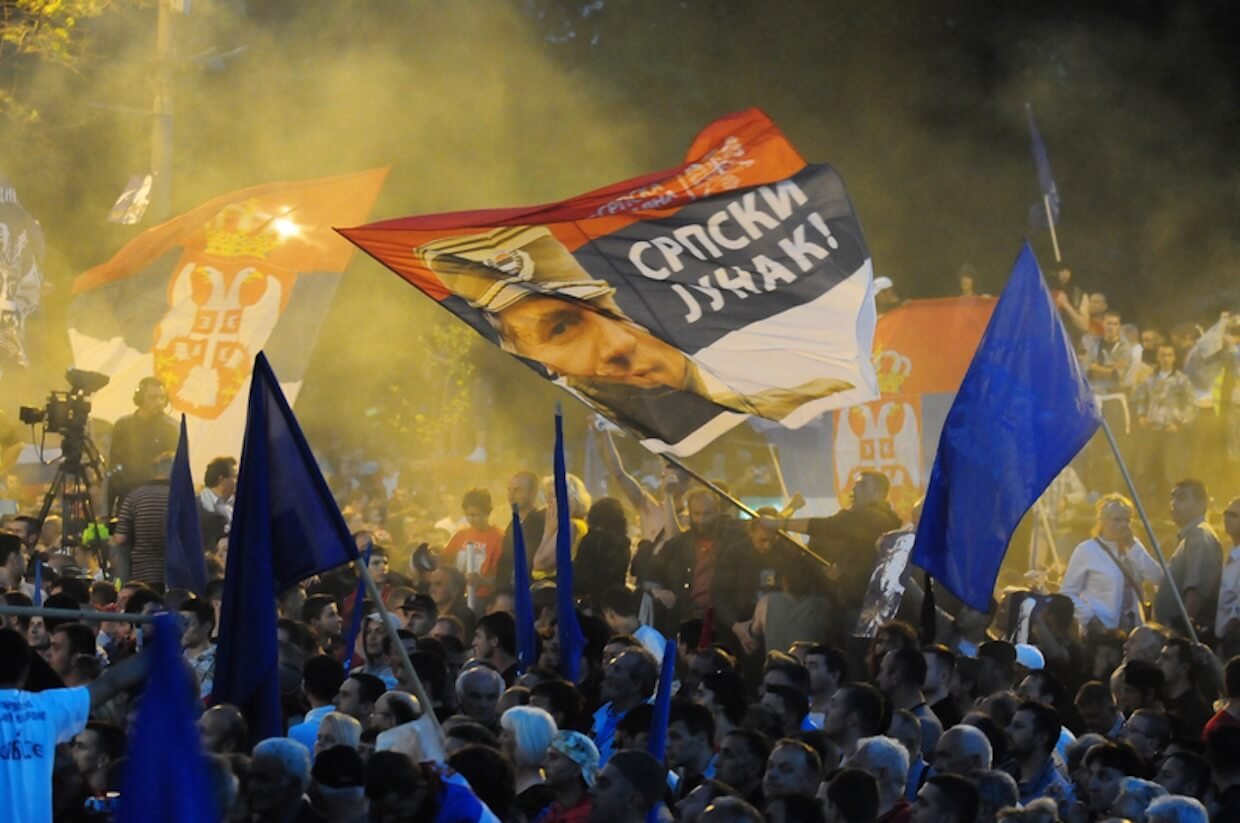
The commemoration of convicted war criminal Ratko Mladić by political actors across the Bosnian Serb spectrum illustrates how historical revisionism and the glorification of war criminals extend beyond explicitly extremist organizations. Does the normalization of such narratives within mainstream politics make them more consequential for democratic stability than openly extremist movements?
Professor Sead Turčalo: Without question, mainstream normalization is far more dangerous to democratic stability than the activities of marginal extremist groups. An openly neo-fascist or fringe parliamentary group can be monitored by intelligence services, sanctioned, or socially isolated. But when the glorification of convicted war criminals, such as Ratko Mladić or Radovan Karadžić—and Ratko Mladić is a particularly relevant case, since we witnessed this just a month ago when he passed away—is practiced by mayors, members of parliament, university professors, and opposition leaders across the Bosnian Serb political spectrum, it ceases to be a subculture. It becomes a form of official civic pedagogy.
In our research, we call this the eleventh stage of genocide: not denial, which involves the defensive claim that a crime did not happen or was exaggerated, but triumphalism—the active celebration of perpetrators and the moral inversion through which genocide is recast as a heroic act of national liberation or preventive self-defense.
And what are the consequences for democracy?
When you socialize a new generation—children born 15 or 20 years after 1995—into believing that mass atrocity was a legitimate and necessary instrument for creating the political entity of Republika Srpska, where they live today, you destroy the normative foundation of democratic coexistence.
You create a moral framework in which any future violence against the out-group, against Bosniaks, is pre-justified as a defense of their ancestors’ legacy, while legal accountability, even after the 2021 Criminal Code amendments prohibiting genocide denial, is itself defined as an attack on national identity.
Anti-Bosniak Nationalism Has Become an Export Product for the Global Far Right
When anti-Bosniak discourse portrays Muslims as demographic, civilizational, or security threats, should it be understood primarily through the frameworks of ethnonationalism, Islamophobia, racism, or a distinctively Balkan form of far-right politics? What are the implications of these competing conceptualizations for understanding radicalization?
Professor Sead Turčalo: We should not treat those frameworks as mutually exclusive categories. What makes contemporary anti-Bosniak discourse so potent is precisely its synthesis of local nationalism, transnational Islamophobia, and cultural racism into a strategic export product.
Historically, anti-Bosniak ideology was rooted in 19th- and 20th-century ethnonationalist mythology that racialized Slavic Muslims as Ottoman remnants or renegades from Christian Europe. Over the last decade, we have seen this again, including in September of this year, when Milorad Dodik traveled to Jerusalem and invoked alleged terrorist threats. Similarly, years earlier, Dragan Čović and Zagreb portrayed a civic Bosnia as an Islamic state. Local ethnonationalist actors realized that purely parochial Balkan arguments no longer resonated in Western capitals.
They therefore repackaged their constitutional and territorial ambitions in the language of global counterterrorism, demographic replacement, and civilizational securitization. By portraying Bosniaks not as a European constituent people demanding equal citizenship but as a latent Islamist security threat on Europe’s borders, they connect directly with the ideological networks of the European and American radical right, from Viktor Orbán to conservative think tanks in Washington that support the MAGA movement, such as the Heritage Foundation.
And remember, this ideological exchange operates in both directions. Figures associated with the global far right, as we have seen with Anders Breivik and Brenton Tarrant, the Christchurch terrorist in New Zealand, explicitly drew inspiration from Bosnian Serb wartime mythology as a template for defending Christian Europe.
When local elites here in Bosnia securitize Bosnian Muslims to gain diplomatic access abroad, they simultaneously feed global white supremacist radicalization and generate real grievances and narratives at home. This approach became particularly intense in the two years following the global surge of the radical right and Donald Trump’s electoral victory in the United States.
Democratic Change in Belgrade Could Fundamentally Weaken Dodikism
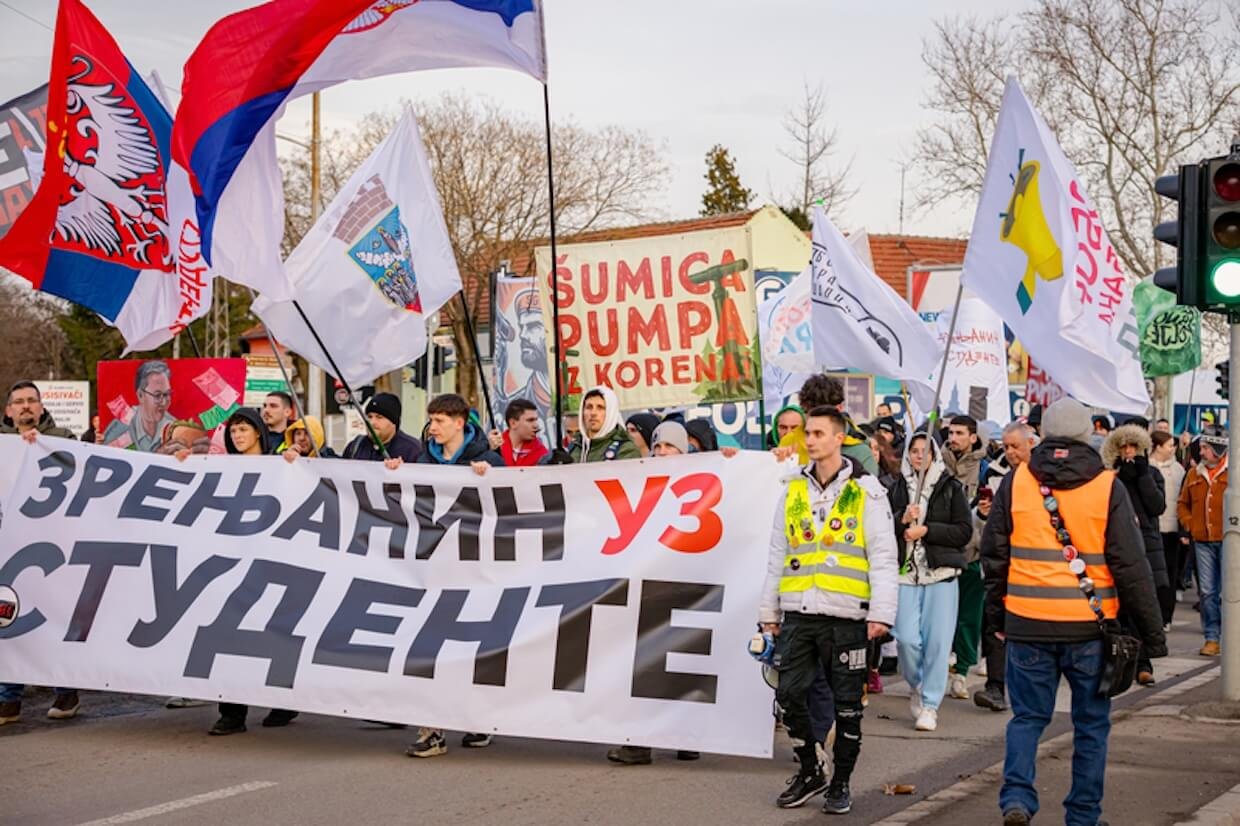
You have characterized Bosnia and the Western Balkans as arenas of competing European, Russian, Chinese, and Turkish influence. To what extent has SNSD’s political resilience depended on external support, particularly from Russia and Serbia, and could democratic political change in Belgrade alter the regional balance between external influence and domestic institutional constraints?
Professor Sead Turčalo: The external actors you mentioned do not create Bosnia’s internal fractures, but they dramatically alter the expected costs of exploiting them. My argument has long been that Bosnia’s borders are better protected than the state’s ability to enforce decisions within them. Geopolitical competition matters most when it lowers the cost of domestic obstruction.
SNSD’s resilience has relied on a multivector external shield. Russia plays the role of a low-cost spoiler. Moscow lacks the geographic reach to offer Banja Luka a credible military guarantee, but at minimal financial cost, it provides diplomatic cover at the UN Security Council, energy leverage, and geopolitical validation.
Hungary, under Orbán, added a crucial new layer within the EU and NATO. Now, fortunately, Orbán has lost power. Hungary had even stepped in with financial lifelines and threatened to veto European sanctions. The opposition’s victory in Hungary has been a positive development in this particular case.
Meanwhile, in October 2025, we saw Dodik, some of his family members, and his political party associates removed from the OFAC sanctions list in Washington following intensive lobbying. We also witnessed divisions within the Peace Implementation Council after Christian Schmidt’s resignation in May 2026. This inconsistent Western conditionality taught domestic challengers that crisis bargaining and transactional access could secure relief without structural compliance.
Serbia, however, has always been the indispensable material, logistical, and symbolic anchor for Banja Luka because of geographic proximity, economic interdependence, and the doctrine of the Serbian World, codified in the June 2024 All-Serb Assembly Declaration. Belgrade has served as Dodik’s strategic backer.
Therefore, a genuine democratic transition following Vučić’s electoral defeat in Belgrade would represent the single most consequential shift in the regional balance of power—not because it would automatically rewrite Dayton, but because it would deprive SNSD’s strategy of autonomy without secession of its primary regional guarantor and its financial and political hinterland in Serbia.
The student protests in Serbia might therefore have an effect on Bosnian politics that we could even describe as tectonic, provided the new government decides to stop supporting Dodik and no longer serves as his strategic backer, as Vučić has done over the past 14 years.
Serbia’s Students Rejected Identity Polarization in Favor of the Rule of Law
Following the Students’ List victory in Serbia’s October 25 elections, could the movement’s emphasis on civic inclusion and political pluralism fundamentally reshape relations between the Serbian majority and Bosniak and Albanian minorities, particularly in Sandžak and the Preševo Valley? What institutional reforms would be necessary to translate this democratic opening into meaningful minority representation and protection?
Professor Sead Turčalo: Once again, I have to emphasize that the victory of the Students’ List represents a historic civic rupture in Serbia, the biggest since October 5, 2000, when a movement removed Slobodan Milošević from power. The Students’ List emerged from the moral and institutional outrage following the November 2024 Novi Sad railway station canopy collapse. The movement succeeded precisely because it refused to engage in identity polarization, centering its campaign instead on the rule of law, institutional accountability, and the principle that the state belongs to its citizens rather than a ruling party.
We witnessed powerful moments during the student marches and blockades, particularly when students from Novi Pazar, their Bosniak fellow students, came together under the slogan “Our Serbia.”
However, translating the moral solidarity of a protest movement into structural minority inclusion in Sandžak and the Preševo Valley requires moving beyond an anti-corruption consensus toward substantive institutional reform.
Under Vučić’s party, the SNS regime, minority politics was managed through the clientelist co-optation of favored local brokers, alongside structural neglect and the administrative passivization of voter registrations and residential addresses, particularly affecting Albanians in the Preševo Valley.
For the new government in Belgrade to fundamentally reshape majority-minority relations in Serbia, several essential reforms would be required. First, it needs to immediately end and reverse the administrative passivization of residential addresses in the Preševo Valley, which has functioned as a form of bureaucratic disenfranchisement of ethnic Albanians.
It also needs to decentralize public investment and depoliticize minority councils so that infrastructure, healthcare, and, for example, universities in Sandžak and southern Serbia are guaranteed through transparent fiscal formulas rather than through transactional loyalty to Belgrade’s ruling coalition, as was the case over the past 14 years.
I would also argue that breaking with security-oriented policies and judicial double standards, while ensuring proportional representation of Bosniaks and Albanians in the local judiciary, police, and state administration, is an essential step toward transforming majority-minority relations in Serbia.
If the Students’ List is able to achieve this, it will certainly create a Serbia that is more inclusive of its minorities and is perceived more positively by its neighbors than Serbia under Aleksandar Vučić.
The Real Test for Serbia’s New Government Is Its Relationship with Sarajevo
Vučić’s political alliance with Milorad Dodik reinforced a broader pattern of cross-border Serb ethnonationalism. Could Serbia’s student-led democratic transition weaken the political and ideological foundations of Dodikism in Republika Srpska, encouraging greater cooperation with Bosnia and Herzegovina’s state institutions? Or might entrenched nationalist networks and competing claims of Serb sovereignty limit the regional consequences of political change in Belgrade?
Professor Sead Turčalo: I expect we will see both effects simultaneously: an immediate disruption of the personal patronage links between Belgrade and Banja Luka, alongside continued structural resistance from entrenched nationalist networks. On the one hand, the Students’ List will disrupt the relationship Vučić built on a personal level. On the other hand, in attempting to do so, it will certainly face structural resistance from nationalist networks on both sides of the Drina River. Remember that, during the Serbian election campaign in October, the regimes in Banja Luka and Belgrade had already spent years reinforcing each other’s media propaganda and bringing voters by bus from Republika Srpska to Serbia to vote for Vučić’s party.
For the Students’ List parliamentary majority in Belgrade, Dodik is not a national guardian. Much of Serbia’s civic movement perceives him as a symbol of the very corrupt, authoritarian party-state system they fought for two years to overthrow. This means that the automatic political, media, and financial support Belgrade provided to SNSD has been disrupted.
At the same time, we must be realistic about the limits of the Students’ List’s ideological consensus. To win almost 54% of the vote against Vučić’s party, the students deliberately set aside divisive geopolitical and regional questions, including Kosovo, sanctions on Russia, and the status of Republika Srpska.
Serbia’s deep state—its intelligence services, the Serbian Orthodox Church, nationalist circles, and parts of the security apparatus—did not disappear on the night of October 25 or in the two weeks that followed. In the short term, these networks may even attempt to position Banja Luka as the last bastion of authentic Serbian nationalism against a civic-liberal Belgrade, leaning more heavily on Moscow.
But the real test for the new government in Belgrade will be whether it conducts relations with Bosnia and Herzegovina strictly through institutional channels in Sarajevo, ending the practice of quasi-state summits that treated Republika Srpska as a sovereign extension of Serbia. That will be the first decisive step for the Students’ List: how it approaches institutional, state-to-state relations between Belgrade and Sarajevo.
Serbia’s Democratic Transition Opens a Window for Change in Bosnia
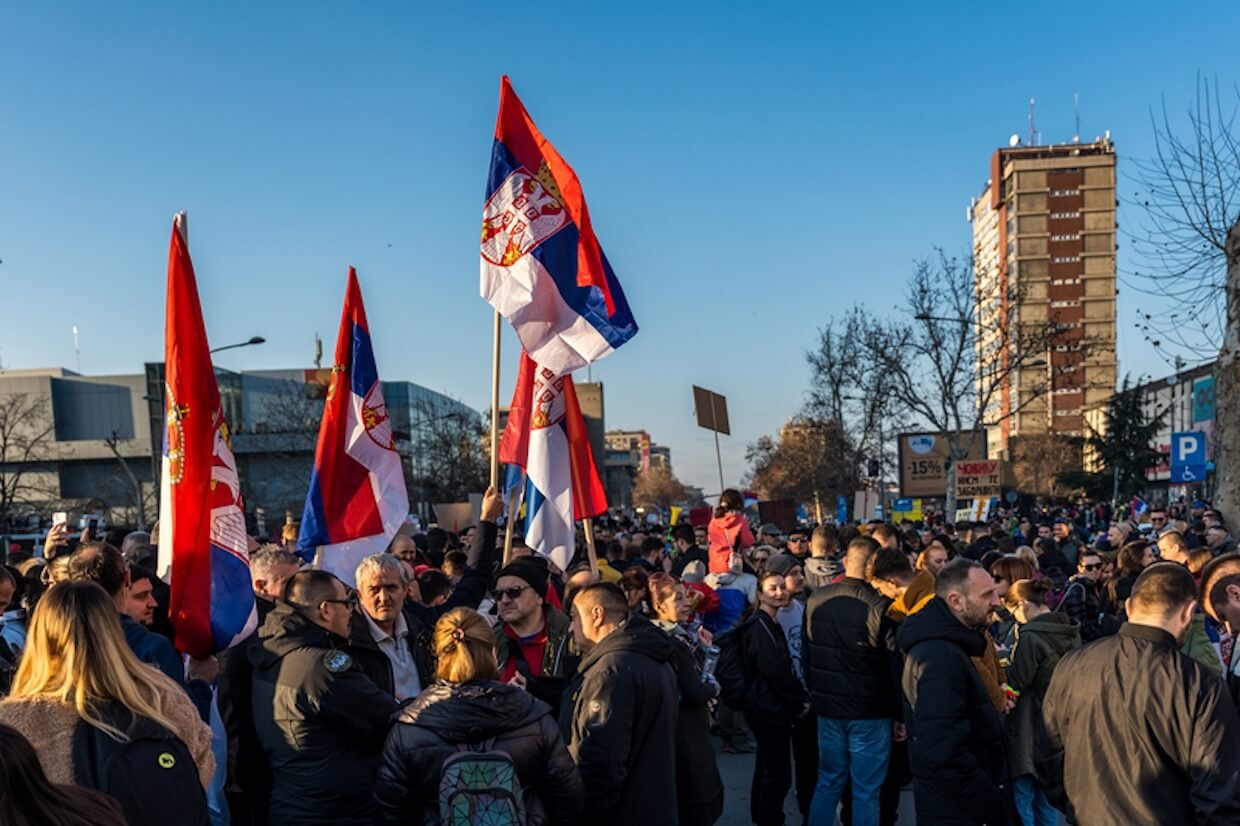
Could Serbia’s democratic breakthrough alter the relationship between Republika Srpska, the Federation of Bosnia and Herzegovina, and the central state by reducing external support for ethnonational confrontation? Might this create opportunities for constitutional reform and cross-ethnic cooperation, or will Dayton’s entrenched veto structures, competing conceptions of sovereignty, and persistent nationalist polarization continue to constrain democratic integration?
Professor Sead Turčalo: Certainly, a democratic, rule-of-law-oriented Belgrade changes the regional climate, and in conflict management, climate matters. When Belgrade stops acting as an amplifier of secessionist threats, the artificially manufactured atmosphere of crisis that fuels reciprocal ethnonationalism within Bosnia and Herzegovina loses one of its main drivers. This deprives SNSD of the credible threat of regional escalation while simultaneously depriving other ethnonationalists of the permanent emergency narrative they use to discipline their own voters.
Yet a favorable regional climate does not automatically dismantle domestic institutional vetoes. As we discussed at the beginning of this interview, the October 4 vote produced a parliamentary balance in Bosnia and Herzegovina in which SNSD and HDZ still hold decisive levers in the House of Peoples and can exercise control over the political system. These veto structures are self-reinforcing because they protect the material interests and legal immunity of domestic political cartels. That is not something that changes simply because of a political transition in Belgrade.
Even without Belgrade’s encouragement, political elites in Banja Luka and Mostar have powerful domestic incentives to engage in ethnically driven obstruction because a functional, independent state judiciary and transparent, EU-aligned public procurement threaten their economic survival. Belgrade’s transition therefore opens a window of opportunity by reducing external geopolitical pressure. But taking advantage of that opportunity still requires breaking the domestic impunity of Bosnia’s veto players.
The Western Balkans Are Not Condemned to Tyranny and Ethnonationalism
And finally, Professor Sead Turčalo, thirty-one years after Dayton, do Bosnia’s election results and Serbia’s emerging democratic transition suggest that the region has an opportunity to move beyond entrenched ethnonational power-sharing? Should Bosnia pursue further refinement of its consociational institutions, a gradual transition toward a more civic constitutional order, or an alternative framework reconciling individual citizenship with collective national protections?
Professor Sead Turčalo: Good question. Thirty-one years after Dayton, the central lesson is that we cannot transform a rigid ethnic consociation into a functional democracy simply by adding more ethnic locks to the door. Every attempt over the past three decades to refine constitutionalism through further territorialization or legitimate representation, as demanded by HDZ, has only enabled state capture and disenfranchised citizens who refuse to be herded into three ethnic camps.
Equally, we have to be realistic as political scientists. A sudden, maximalist leap toward a purely civic model cannot be imposed without triggering severe conflict dynamics, because 30 years of institutional socialization have entrenched deep collective fears that cannot easily be removed. These collective fears provide parties with an easy way to mobilize their ethnic groups. But the path forward has to involve a sequenced, functionalist transition toward a hybrid model that reconciles individual civic equality with strictly bounded collective cultural protections.
When we consider what that would look like in practice, the first step must be to implement the rulings of the European Court of Human Rights. There are many of them: Sejdić–Finci, Zornić, Pilav, Šlaku, and so on. Implementing these rulings would allow us to remove ethnic and residency-based restrictions on eligibility for the state Presidency and the House of Peoples, so that every citizen of Bosnia and Herzegovina can run for and vote for any office, regardless of ethnicity or place of residence.
To achieve this goal of a functional state, we also have to narrow and clearly define the scope of the vital national interest, which is currently invoked in almost any imaginable situation. Everything is defined as a vital national interest.
Collective protections should exist in such a system, but they must be restricted to genuine questions of identity, such as language, culture, religion, and heritage. They should also be subject to strict constitutional review rather than serving as a general-purpose blockade on budgets, energy interconnectors, European integration laws, and judicial appointments. As we are a candidate for membership in the European Union, we should anchor domestic reform in credible external conditionality.
Just take the example of Serbia’s student movement. What it achieved in this election reminded the entire region that citizens in the Western Balkans are not culturally condemned to tyranny and ethnic nationalism. They want institutions that answer to the law rather than to a party boss.
And the European Union, first and foremost, alongside other actors such as the United States—I hope that after Trump leaves the White House, transatlantic relations will change for the better—should align their instruments to target the financial channels of obstructionist political actors rather than rewarding them with transactional compromises.
Then the combination of Serbia’s democratic opening and Bosnia’s own civic exhaustion with partitocracy can finally become the starting point for moving from Dayton’s negative peace toward a genuine constitutional democracy in our country.