In “From Farce to Tragedy,” the author traces the first year of Donald Trump’s second term as a turning point in American political life. What once carried elements of chaos and dark comedy has hardened into something more deliberate and consequential. Trump’s return to power, framed by him as total vindication, has brought an unprecedented expansion of executive authority, the systematic weakening of institutions, and the normalization of personal loyalty over law. Drawing on sharp observations from leading journalists and scholars, the piece shows how emergency powers, executive orders, and transactional politics have reshaped governance at home and abroad. The result is not renewed greatness, but a spectacle of democratic erosion—an American tragedy unfolding without the comfort of a happy ending.
By Cemal Tunçdemir*
“What the American public always wants is a tragedy with a happy ending,” the American critic William Dean Howells, who was a central figure in Gilded Age American literature, once said. The second coming of Donald J. Trump to the US Presidency was not an accident of fate, nor even absurdity of democracy. It was a sequel demanded by majority of American voters that having once liked the “first season” and asked upon longer run. The real tragedy was not that Trump was Trump, that was obvious from the start, but that so many Americans mistook his loudness for conviction and saw his challenge to the rules as bravery.
“The first time around, there was something almost thrilling about Donald Trump as president,”explains American historian and journalist Thomas Frank, “The respectable world came together against him with a gratifying unanimity: the legacy media, the nonprofits, the universities, the think tanks, the tech sector, the intelligence community. Insulting this imbecile became the most rewarding pastime on earth.” By contrast, according to Frank, for much of 2025, the feeling was darker. “Absolute despair” if you will.
The difference in the second term wasn’t just the lack of the thrilling or accidental comedic elements of the first term. Donald Trump viewed his return to the White House as a profound vindication. In his telling, his four years of exile had proven that he was right about everything. About economy, about “stolen” election, about press, about elites, about universities, about institutions. This absolute conviction liberated him from all doubt, and all rules.
Trump’s unrestrained mind is on full display in a recent letter he sent to the Prime Minister of Norway as he wrote, “Considering your Country decided not to give me the Nobel Peace Prize for having stopped 8 Wars PLUS, I no longer feel an obligation to think purely of Peace.”
“Donald Trump now genuinely lives in a different reality,”observes Anne Applebaum, “one in which neither grammar nor history nor the normal rules of human interaction now affect him.”
“Trump 2.0 is Trump 1.0 in some ways but on steroids,”compares Peter Baker, New York Times’s chief White House correspondent who have covered six US presidents, including Trump in his first term, “A lot of the things that he talked about doing or exploring in the first term -or tried but failed to do or was dissuaded from doing-he’s now doing and in spades.”
Unlike the first term, in the beginning of his second term, there was less confusion, more intent. And more so preparation. Trump has rolled out many of the Project 2025, 900-page Heritage Foundation-led blueprint, he once claimed he has nothing to do with. Many of Trump’s executive orders reshaping the government were outlined in this right-wing policy plan. From the early days of his tenure, Donald Trump began advancing Project 2025’s primary objective: the “deconstruction of the administrative state,” a term coined by his former chief strategist, Steve Bannon. He has expanded the scope of executive power in ways unparalleled in modern history.
By the end of 2025, some 317,000 federal employees were out of the government, according to the Office of Personnel Management. This was the largest reduction of the federal workforce in American history. He even fired members and officials from various independent and bipartisan boards, agencies, and commissions, including dozens of inspectors general, key watchdogs for waste, fraud, and abuse across all government.
One of the things Trump learned was that it matters who is around him, Peter Baker observes, “Many of the people he surrounded himself with in his first term viewed their jobs as keeping him from going off the rails, from doing things they thought were reckless -or illegal even. This term, he’s surrounded by people who not only agree with him but are enabling him and empowering him and want to serve his desires.”
One of the Trump’s most daring test the limits of his presidential power was claiming powers that have typically resides with Congress. In his first year, executive orders have eclipsed actual legislation. Trump has signed 147 executive orders, setting a record for the most signed in any president’s first 100 days of office. By contrast, he has signed only five bills into law, a record low for the first 100 days.
What is truly worrying is that his blatant misuse of emergency powers, which are meant to temporarily increase executive authority only during urgent and rapidly developing situations. The Brennan Center has identified 123 different laws could be triggered by a presidential emergency declaration. Because these powers are extensive, strong safeguards are needed to prevent misuse. Since The National Emergencies Act lacks safeguards, a president can declare an emergency by executive order and renew it every year indefinitely. Congress may vote to terminate an emergency, but only with a veto-proof majority. This flaw was exposed when Trump declared a fake emergency to fund a border wall Congress had rejected.
As a striking example, instead of traditional tariff statutes (such as Section 301 or Section 232) he invoked the International Emergency Economic Powers Act (IEEPA), which is not a general trade statute, to impose sweeping import taxes. To justify invoking the IEEPA, Trump Administration declared “trade deficits” a national emergency. And this audacity has led to a legal drama that has now reached the Supreme Court.
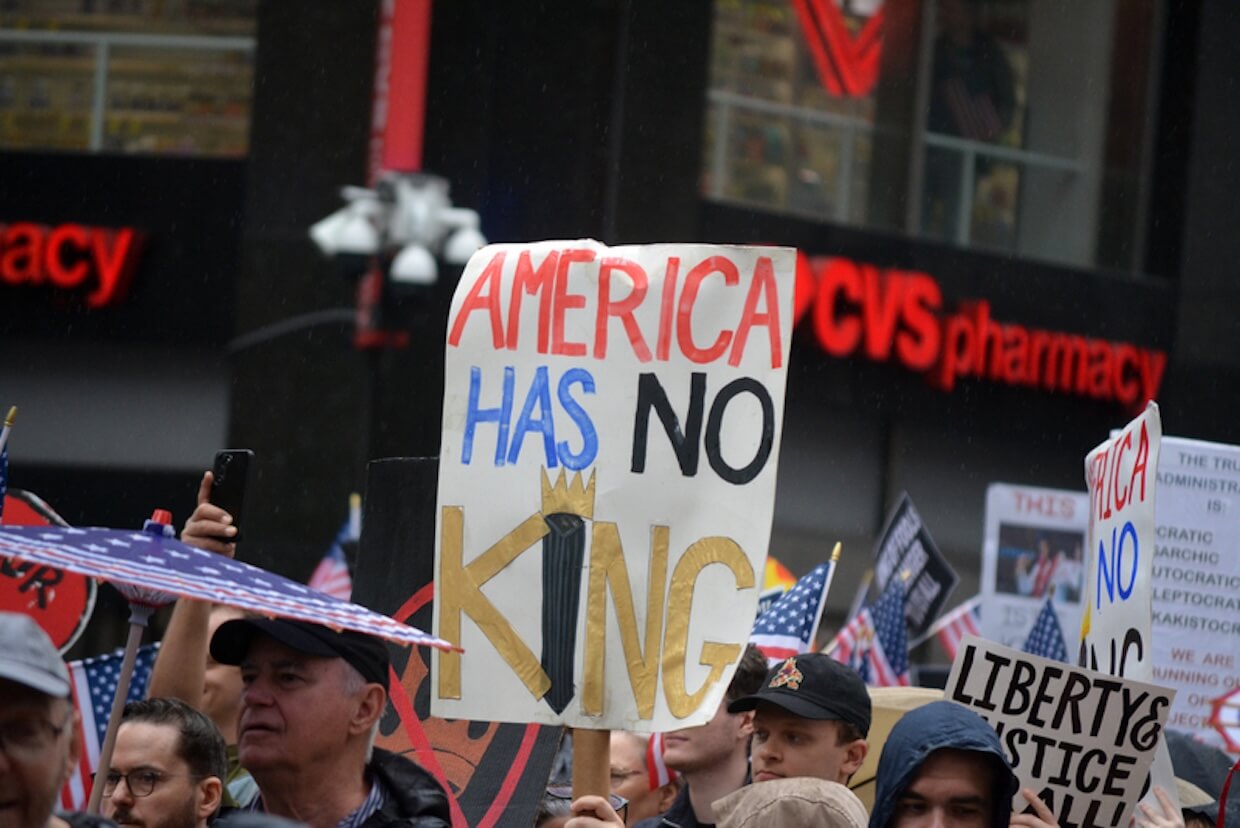
The question is why the White House team ever invoked IEEPA at all, instead of traditional trade laws? The answer is not only that IEEPA provides the President broad authority to respond to a declaration of national emergency. The real answer probably lies in “political anthropology rather than jurisprudence,”writes Gillian Tett, “Trump’s team has a power structure more akin to a royal court than anything that adheres to 21st-century norms.” He always wants to have king-like powers, and his team is looking for loopholes that would allow him to acquire those powers.
This is the posture of a man who has looked at the institutions meant to restrain him -the courts, the lawmakers, the prosecutors- have done nothing and he concluded they are toothless. After the surviving of the fallout of January 6, five years ago, he now moves with the confidence of someone who believes he is beyond the reach of the old rules. He wants a power that is feared and given whatever it wants. For this reason, some critics are no longer debating policy; they are discussing a change in the American regime. But a change to what?
“There is an answer, and it is not classic authoritarianism—nor is it autocracy, oligarchy, or monarchy. Trump is installing what scholars call patrimonialism.” Jonathan Rauch answered the question in his now famous article. “Patrimonialism is less a form of government than a style of governing,” he wrote, “It is not defined by institutions or rules; rather, it can infect all forms of government by replacing impersonal, formal lines of authority with personalized, informal ones.”
The Art of the Deal-Making Presidency
“Nice woman but she does not listen.”
After a reportedly tense phone call in early August, President Trump publicly criticized Swiss President Karin Keller-Sutter with this condescending remark and quickly raised tariffs on Swiss imports to a punishing 39 percent. Couple of days later when two Swiss federal ministers and several government executives flew over to DC, but they got nowhere near Trump. Following months all the effort of traditional statecraft couldn’t resolved months of standoff. What ultimately break the deadlock was not diplomacy or policy talks. It was something shinier.
In early November, small delegation of Swiss titans -all male and, all billionaires- sidestepped the usual diplomatic channels, arriving at the Oval Office with a gold-plated Rolex desk clock and a 1-kilogram engraved gold bar. Before the guests had even leaved the White House, Trump shared a social media post announcing progress. Within the days, the previously urgent “national emergency” posed by Swiss trade deficit seemed to lose its urgency, and tariffs were trimmed to a comparatively modest 15 percent.
As that meeting so strikingly demonstrated, access to the American leader is no longer earned through shared values or sound policy. It is now won through the language of the deal and, above all, the weight of gold.
Trump received gold coated replica of a royal crown from the Silla Kingdom from South Korea President, a golden pager from Israeli Prime Minister Benjamin Netanyahu, a gold-plated golf club from Japan, a golden boxing belt from Ukraine. Even Apple CEO Tim Cook presented Trump with a special glass disc on a 24-karat gold base in August 2025 and secured an exemption from 100% tariff on imported semiconductors. Apple gift was a favorite for Trump in the Oval Office until the Swiss came to town. “It was tough to beat Apple, but the Swiss did it,” one administration official told Axios.
Trump even kept original 24-karat gold Club World Cup Trophy for himself so FIFA had to give the winner team, Chelsea, a replica. Not only did he receive the trophy, but he was also awarded a gold medal, which FIFA presents to the players of the winning team.
“The golden age” that Trump promised in his second inaguration speech, has never seemed more literal. He wasn’t only for his trademark “Midas touch” flow, he seeks profit in every policy decision he makes. As Jonathan Rauch explained, in patrimonialism, every policy the president values is considered his own personal property. Some experts call it ‘pay-to-play,’ where foreign governments, businesses, and wealthy donors gaining political and financial advantages such as relaxed regulations and federal contracts by investing in the Trump Organization, supporting MAGA causes or by engaging in excessive flattery.
Trump Towers have been proposed from Damascus to Belgrade. Trump hotels or Trump Resorts are being built in many major cities around the world, primarily in Asia and Africa. As Amy Sorkin puts it Trump has made it clear that no gift is too much for him -even, and maybe especially, someone else’s Nobel Peace Prize medal.
Even presidential pardon power has become big business. In his first-year Trump has pardoned an unusually high numberof wealthy people accused of financial crimes, including money laundering, bank fraud and wire fraud. Wealthy individuals pay millions to lobbying and consulting firms to bring their cases to Trump’s attention.
Trump pardoned cryptocurrency mogul Changpeng Zhao, months after Zhao’s company has struck a $2 billions deal with World Liberty Financial, the Trump family’s new crypto venture. In another revealing example, executives of Wells Fargo Bank, instead of paying the $8.5 million fine imposed for fraudulent transactions, donated $1 million to Trump’s inauguration ceremony in January, and two months later, their fine was reduced to a mere $150,000.
In Trump’s World, Europe Is the Villain
“The foreign policy of President Donald Trump combines the worst of isolationism with the worst of interventionism in a uniquely disastrous way,”says Thomas Reese. He began his presidency as a firm isolationist, but “America First” quickly turned into a wrecking ball -a license to upend America’s role in the world, discarding rules and norms with little restraint.
“I never thought I’d feel nostalgia for the Iraq War,” said Nesrine Malik in The Guardian, but it turns out that the runup to that war, when American Administration did at least strive to convince the Congress and the world of the righteousness of its cause, was the “good old days.” The US removed Venezuela leader Nicolas Maduro based solely on national interest, bypassing all domestic, international authorization or public consent. Trump didn’t just break the rules it showed there aren’t any.
“No autocrat likes to see one of their own seized, shackled and renditioned,” wrote Adrian Blomfield in The Daily Telegraph. However, China and Russia are unlikely to be troubled by Maduro’s removal. They may see it as evidence of the US stepping back globally and focusing on regional dominance. A world divided into spheres of influence, where powerful states act freely, could benefit Moscow and Beijing, as noted by Gideon Rachman in the FT.
Even Trump administration’s new National Security Strategy (NSS) plan within its 33-page framework argues that Russia and China are US peers or potential friends. Instead, it points the finger at a surprising villain: Europe. NSS argues that the real danger isn’t Russian tanks or Chinese factories, but rather the “erasure” of European culture caused by mass immigration and the power of the European Union bureaucracy. The liberal international order, already fragile, found itself mocked not only by adversaries but by its former custodian.
New Civil War and End of Forth Republic?
“Trump isn’t interested in fighting a new Cold War. He wants a new civilizational war,” wrote Thomas Friedman. Trump’s National Security Strategy language unlike any previous surveys, he observes, “It reveals a deep truth about this second Trump administration: how much it came to Washington to fight America’s third civil war, not to fight the West’s new cold war.” According to Friedman, after the Civil War of the 1860s and the second major civil struggle of the 1960s civil rights movement, America is now experiencing its third civil war. “This one, like the first two, is over the question ‘Whose country is this anyway?’ This civil war has been less violent than the first two—but it is early.”
Although the United States has operated under a single constitution, each civil war has produced a new political order, a new republic in all but name. For that reason, a “third civil war” would not just be another crisis; it would signal the end of what some analysts call the “Fourth American Republic.”
As Jamelle Bouie pointed, the Civil War and its aftermath constituted the Second Republic. The Third Republic came into this world through the overwhelming victory of the Democrats in the election of early 1930’s. The legacies of the Third Republic had lived on when the fourth republic began with the achievements of the 1960’s Civil Rights Movement, which included a newly open door to the world. “This was an American republic built on multiracial pluralism. A nation of natives and of immigrants from around the world. Of political parties that strove to represent a diverse cross-section of society,” wrote Bouie, “It’s this America that they’re fighting to destroy with their attacks on immigration, civil rights laws, higher education and the very notion of a pluralistic society of equals.”
A Year of Revelation
The first year of Trump’s second term offered Americans not greatness, but clarity. It showed what happens when empty and noisy demagogic rhetoric substitutes for vision and when power outruns principles. His return to power did not resolve the contradictions of Trumpism; it intensified them. Nationalism that depended on global markets. Capitalism claims to be self-regulating, yet in reality it is owned by the state. Law invoked as rhetoric and rejected as restraint. Freedom of speech demanded abroad and denied at home. Declared himself ‘Peace President’ and change the Department of the Defense name to Department of War.
His supporters too—with their enduring appetite for loud certainty over quiet competence, find themselves caught in a season of paradox. Cheering the dismantling of the very institutions that once established the order they now claim to want again. They back tariffs, immigration, and social spending policies that heavily impact rural America, the backbone of their movement. And most ironically, this coalition of white Christians is led by one of the least religious presidents ever.
And yet, for all the noise he and his administration generate, the first year of his second term also revealed limits. Courts still blocked some actions. States resisted others. Markets reacted unpredictably. Bureaucracies slowed what they could not stop. Polls indicate declining support for him as the Congressional elections approach. Trump raged against these constraints, calling them sabotage, yet their persistence revealed an uncomfortable truth: even an “unbound president” cannot easily escape the structure of a constitutional federal system.
Even in the face of repeated failures to “make America great again,” Trump succeeded at making one thing undeniably great again. It was not the greatness of law, restraint, economy, international leadership or wisdom, but the greatness of spectacle. A spectacle of American tragedy, one that may not have a happy ending this time.
(*) Cemal Tunçdemir is a New York–based veteran journalist with extensive experience covering US politics and international affairs.
In this ECPS interview, Professor Daniel Treisman examines how Trump’s political style intersects with the logic of informational autocracy and democratic backsliding. Drawing on “Informational Autocracy,” he argues that contemporary authoritarianism often relies less on mass repression than on “controlling narratives, selective coercion, and performance legitimacy.” Trump’s pressure on comedians, broadcasters, universities, and law firms, Professor Treisman suggests, reflects a familiar “inclination” toward intimidation—yet “the outcome was different,” because democratic institutions can still generate pushback. The core issue, he stresses, is whether US checks and civil society can withstand “executive aggrandizement”—the drive to “go beyond the formal or traditional powers of the office and consolidate control.”
In an era marked by democratic backsliding, populist leadership, and the reconfiguration of informational power, the resilience of liberal democracy has become a central concern for scholars and policymakers alike. In this wide-ranging interview with the European Center for Populism Studies (ECPS), Professor Daniel Treisman—Professor of Political Science at the University of California, Los Angeles, and Research Associate at the National Bureau of Economic Research—offers a nuanced and empirically grounded assessment of how Donald Trump’s political strategy intersects with the logic of informational autocracy, executive aggrandizement, and democratic fragility.
Drawing on his influential work Informational Autocracy (co-authored with Sergei Guriev), Professor Treisman situates Trump’s threats against comedians, journalists, universities, and other institutional actors within a broader global pattern in which contemporary autocrats rely less on mass repression than on “controlling narratives, selective coercion, and performance legitimacy.” While Trump’s behavior often resembles that of informational autocrats, Professor Treisman emphasizes a crucial distinction: “So, while the inclination is similar, the outcome was different.” Episodes such as the pressure placed on late-night comedian Jimmy Kimmel reveal Trump’s “tendency to expand his power and to overstep traditional limits,” but also the continued—if uneven—capacity of democratic institutions and civil society to push back.
At the core of the interview lies a central analytical question: whether Trump’s conduct represents a failed or incomplete attempt to translate informational autocracy into a still-competitive democratic system. As Professor Treisman puts it, “The real question… is how resilient democratic societies and civil societies in democratic settings can prove to be in response to a leader who seeks what is often called executive aggrandizement.” This concern animates Professor Treisman’s discussion of selective intimidation, signaling repression, and the targeting of elite institutions—strategies designed to “score some visible victories” and deter broader resistance without resorting to outright censorship.
The interview also explores how new media ecosystems and the rise of a tech “broligarchy” complicate classical models of informational control. Professor Treisman highlights the hybrid arrangements created by platform ownership, algorithmic amplification, and strategic alignment between populist leaders and tech elites, noting that these dynamics allow political actors to undermine epistemic authority “without overt censorship.” While Trump has aggressively pressured legacy media through litigation and regulatory threats, his relationship with major technology firms remains more transactional and indirect—distinct from the tightly coordinated media control characteristic of full informational autocracies.
Beyond the US case, Professor Treisman offers comparative insights into charismatic populism in Latin America, bureaucratized authoritarianism in Russia and Hungary, and the structural uncertainties surrounding democratic decline. Reflecting on Democracy by Mistake, he cautions against deterministic readings of democratic erosion, stressing that “mistakes can be forces for good” as well as for authoritarian empowerment. In closing, Professor Treisman urges analytical humility: distinguishing between cyclical stress and durable authoritarian transformation, he argues, remains inherently uncertain, as history “does not come with labels that are easy to read.”
Taken together, this interview provides a sober, theoretically informed reflection on Trumpism, informational power, and the fragile boundaries between democratic contestation and authoritarian drift.
Here is the edited transcript of our interview with Professor Daniel Treisman, slightly revised for clarity and flow.
Trump Has Shown Every Inclination of Informational Autocrats
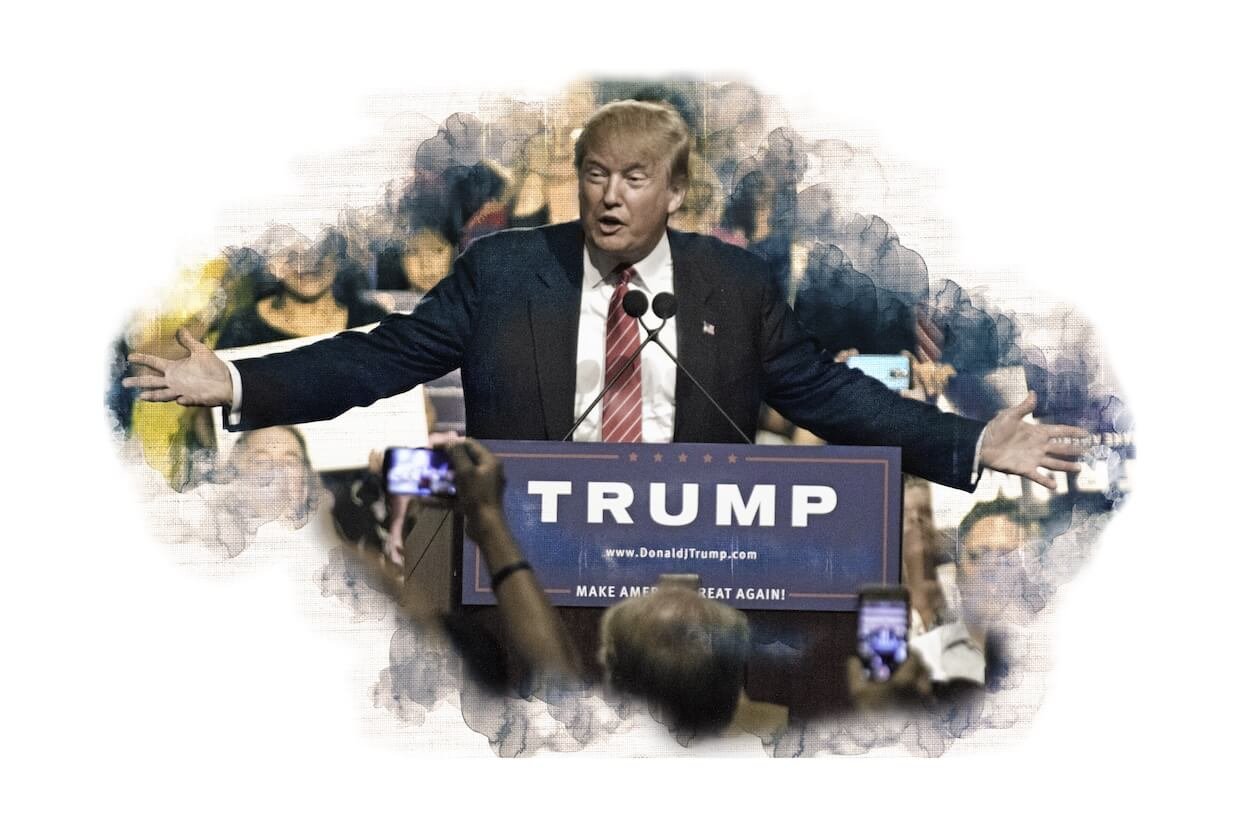
US President Donald Trump held a campaign rally at PPG Paints Arena in Pittsburgh, Pennsylvania, on November 4, 2024. Photo: Chip Somodevilla.[/caption]
Professor Daniel Treisman, thank you so much for joining our interview series. Let me start right away with the first question: In “Informational Autocracy,” you argue that contemporary autocrats rely less on overt repression and more on controlling narratives, selective coercion, and performance legitimacy. How should we analytically situate Trump’s recent threats against broadcasters and comedians within this framework—are we observing an attempted translation of informational autocracy into a still-competitive democratic setting?
Professor Daniel Treisman: It’s very interesting to think about the various tactics and approaches that Trump has used and to compare them with the kinds of practices we see in informational autocracies. Clearly, there are many parallels, and a great deal looks very familiar.
For instance, in the early 2000s in Russia, President Putin was offended by a comedy show that portrayed him in an unflattering light. It was a satirical program called Kukly. He made it apparent to the authorities at that station that the show had to be canceled, and it was indeed canceled.
You mentioned Trump and comedy in the US, and we know about the recent Jimmy Kimmel case. What is interesting is that, on the surface, the situation looks very similar. Trump was offended by jokes Kimmel had been telling on his show, and he made it clear to the owners of the station that he thought Kimmel should be canceled. The head of the FCC (Federal Communications Commission) then put pressure on the channel.
The outcome, however, was different. Kimmel was taken off the air for a few days—about a week—and then reinstated. He returned very forcefully, speaking about freedom and the need for separation between government and television.
So, while the inclination is similar, the outcome was different. We often see in Trump a tendency to expand his power and to overstep traditional limits. The real question, for me, is how resilient democratic societies and civil societies in democratic settings can prove to be in response to a leader who seeks what is often called executive aggrandizement—going beyond the formal or traditional powers of the office and consolidating control in his own hands. This is precisely the process that characterizes democratic backsliding toward informational autocracy.
In that sense, this episode illustrates how Trump has shown every inclination to do the sorts of things that informational autocrats do, and if he were free to do so, I am sure he would move toward a more authoritarian or informationally autocratic setup. So far, however, we have seen a considerable degree of pushback and resilience on the part of American societal and democratic structures—through checks and balances and other mechanisms.
That said, it has been disappointing that we have not seen more resistance. The docility of Congress under Republican leadership and the questionable judgments of some courts have been troubling for those who view the White House’s attacks on the media, universities, and subnational governments as real threats to democracy. Those developments are certainly discouraging.
Nevertheless, across the board, we continue to see significant resistance, and that is what truly distinguishes full-fledged informational autocracies from developed democracies that manage to survive as democracies. It is not that democracies never produce populist politicians who want to push in an authoritarian direction—they do. These are politicians with authoritarian impulses, sometimes driven by narcissism or by a highly cynical political strategy. What ultimately varies is how far they are able to go.
Trump Is a Populist Proud of Defying Democratic Norms
Much of your work emphasizes that informational autocrats avoid crossing visible “red lines” that would trigger mass backlash. Does Trump’s increasingly explicit intimidation of the media suggest either miscalculation or a belief that democratic norms of speech protection have already eroded enough to absorb such shocks?
Professor Daniel Treisman: That’s a very good question, and it’s difficult to give a simple answer. I think there is sometimes an element of miscalculation. But let me step back for a moment—it’s not entirely clear that this is miscalculation, because we don’t fully understand what Trump’s strategy is.
In some ways, as I’ve said, he looks quite similar to various informational autocrats in authoritarian societies. But in other ways, he is quite different. As you noted, informational autocrats typically try not to appear overtly to be transgressing the rules of democracy. They present themselves as genuine, loyal democrats. They claim to follow constitutional procedures, often using legalistic language, and they frame their power grabs as legitimate exercises of authority for ostensibly valid purposes, such as protecting the public from pornography, terrorism, or similar threats.
The goal of genuine informational autocrats is not to challenge the system openly, but to create the impression that they are operating fully within democratic rules, while accusing their opponents of being undemocratic. They seek to project an image of competence, benevolence, and modernity, and to portray critics as those who threaten democracy.
There is an element of this in Trump’s behavior. He certainly accuses Democrats of being undemocratic. But there is also a distinct bravado—a deliberate defiance of democratic rules and norms. He openly states that when he pushes the Justice Department to investigate his critics and rivals, he is motivated by a desire for retribution. He rejects the idea of impartial justice and openly embraces the politicization of the justice system. In doing so, he often deliberately says things that are meant to provoke outrage and that are clearly undemocratic.
In this sense, he is not an authoritarian pretending to be a democrat. He is a populist politician who is, in some respects, openly proud of being undemocratic. He might argue that this is still democratic because his base supports him—and indeed, he does say that. But he also claims that there are no checks and balances, that the only constraint on him is his own morality, which amounts to a direct denial of the democratic system rather than a pretense of adherence to it.
So, it is difficult to determine whether this behavior reflects miscalculation or is simply part of his strategy, and whether he differs in this respect from informational autocrats. He appears to recognize that he is operating within a democratic system with a powerful civil society and has chosen to confront it directly and test its limits, rather than behaving like informational autocrats such as Orbán or early Putin, who presented themselves as ordinary democratic leaders supported by the majority while depicting their opponents as extremists seeking to undermine or overthrow democracy.
The Strategy Is to Score Visible Victories That Intimidate Others
Donald Trump delivers a victory speech after his big win in the Nevada caucus at Treasure Island Hotel & Casino, flanked by his sons Eric (right) and Donald Jr. (left) in Las Vegas, NV. Photo: oe Sohm.
Informational autocracies often rely on signaling repression—making examples rather than governing through mass coercion. How should we interpret Trump’s selective targeting of journalists, broadcasters, and universities in this light?
Professor Daniel Treisman: Well, it’s not just Trump, of course. This time he came in with a team that had thought carefully about how to attack various institutions in American society that they deeply opposed, including universities, law firms, some courts, and various subnational governments. The goal was quite directly to weaken those parts of what they viewed as a dominant political and cultural elite.
In part, yes, the strategy was to score some visible victories that would intimidate other members of a particular sector. So, you go after one university—like Columbia—very hard, essentially intimidating it into doing a deal, and then all the other universities would cave and negotiate individually with the Department of Education or the White House. There is an element here of signaling toughness, of attempting intimidation on a kind of wholesale scale.
That is quite similar to informational autocracies. There is less, as I mentioned earlier, of a concern with constraining actions to fit the appearance of democracy and normal democratic politics. Instead, there is a deliberate challenge—within the US context—to many of the legal underpinnings and long-standing understandings of the relationship between the presidency and other institutions, some of which have prevailed for decades or even centuries.
That said, this behavior is not entirely distinctive to authoritarian politics. All politicians try to signal their intentions by demonstrating, through particular cases, what their approach will be. What is distinctive here is that the goals of the Trump administration regarding universities and law firms have been very extreme. Essentially, they want greater control and a particular ideological orientation within universities, and they want to exclude intellectual approaches and philosophies they oppose.
With law firms, the aim is to discourage large, professional firms from opposing them or taking cases against them. That message was sent deliberately, through a barrage of attacks on different fronts very quickly during the first weeks and months of the administration, precisely in order to signal resolve and warn others.
So, in some respects, this does resemble informational autocracy. But it is also part of a broader phenomenon. Revolutionary politicians—or politicians seeking to implement fundamental changes—often come into office with a program and strike very hard at the outset to test how far they can go before resistance organizes and pushes back. Sometimes this is an effective strategy: if the initial blow is strong enough, opposition may fail to organize in time, allowing a new status quo to take hold.
Tech Billionaires Are Treated as Leverage Points
How does the rise of a tech “broligarchy”—with key digital venues controlled by figures such as Elon Musk, Mark Zuckerberg, and Jeff Bezos—complicate the classic logic of informational control? How do platform ownership, algorithmic governance, and strategic collaboration with populist leaders such as Donald Trump reshape the dynamics of informational autocracy? To what extent do these hybrid arrangements—combining formal pluralism with asymmetric visibility and amplification—enable populist actors to undermine epistemic authority and institutional trust without resorting to overt censorship?
Professor Daniel Treisman: That’s a great—and complicated—question. I think both informational autocracy and populism are closely tied to information and media. They tend to thrive in periods of technological change, when new media forms emerge.
In the early days of mass newspapers, for instance, that medium created new opportunities for populists to appeal to broader constituencies than had previously been mobilized in politics. We see something similar with the internet. As it became more developed and central to everyday life, it opened up new avenues for outsiders to engage in a different kind of politics. In democracies, this has been a major foundation of the recent populist wave.
In authoritarian contexts, similar opportunities have allowed authoritarian leaders to use the internet to communicate in new ways and to present themselves as democratic and competent through manipulation—much more effectively than old-style propaganda, which relied heavily on intimidation but was less successful in creating a convincing, all-encompassing political image. In this sense, new information technologies have reshaped not only perceptions of individual politicians but also broader understandings of the political system itself.
New information technology is therefore a central driver of the changes we are seeing in both democratic and authoritarian systems. In the American case, more specifically, the relationship between Trump and major technology firms—led by tech billionaires such as Elon Musk, Mark Zuckerberg, and others—is complex.
Going into Trump’s second term, there was something of a meeting of the minds between Silicon Valley and the Trump team. Many in the tech sector felt that the industry—and tech billionaires personally—had been mistreated by the Biden administration, citing what they perceived as hostility, attempts to censor right-wing or libertarian views, overregulation, and even the debanking of entrepreneurs involved in new areas such as cryptocurrency. This generated real antagonism toward the Democrats among parts of Silicon Valley, aligning well with the attitudes and plans of the Trump camp.
This was particularly evident in the case of Elon Musk, who was effectively given carte blanche to move aggressively against the federal bureaucracy and dismantle large parts of the government in a short period of time. At the same time, there have also been tensions—if not open confrontations—between the Trump administration and some tech leaders. Still, many of them appear to perceive shared opportunities.
Although Musk is no longer in the administration and clearly disagrees with Trump on certain issues, such as fiscal policy, he—and many other tech billionaires—continue to see opportunities in the current political environment. Not all, of course; some remain aligned with the Democrats. But many hold libertarian views and see Trump as more receptive to their ideas about technological development, the treatment of billionaires, and the balance between regulation and freedom.
The Trump administration has also actively sought to influence the media environment, particularly legacy media, by pressuring the owners of major networks. In ways reminiscent of informational autocracies, Trump has relied on defamation suits, libel actions, and other legal tools to intimidate and pressure media organizations.
With social media, however, the approach has been more indirect. Trump created his own social network and has shown little interest in directly regulating platforms such as X or Facebook. Instead, he treats tech billionaires much like other wealthy actors—as leverage points. If he wants something, he applies pressure, and as long as his demands are not too costly, they tend to comply. There is little incentive for them to engage in open confrontation.
That said, this does not amount to the kind of comprehensive, day-to-day control characteristic of full informational autocracies, where authorities maintain close, behind-the-scenes relationships with most media outlets and allow only marginal opposition voices without real influence or mass reach.
In short, the parallel between Trump and informational autocrats in this domain—much like in others—is imperfect. Some features are strikingly reminiscent of informational autocracy, while others differ substantially. These differences reflect both contextual factors—such as the scale and global reach of US-based technology companies compared to media in smaller authoritarian states—and Trump’s own distinctive political style.
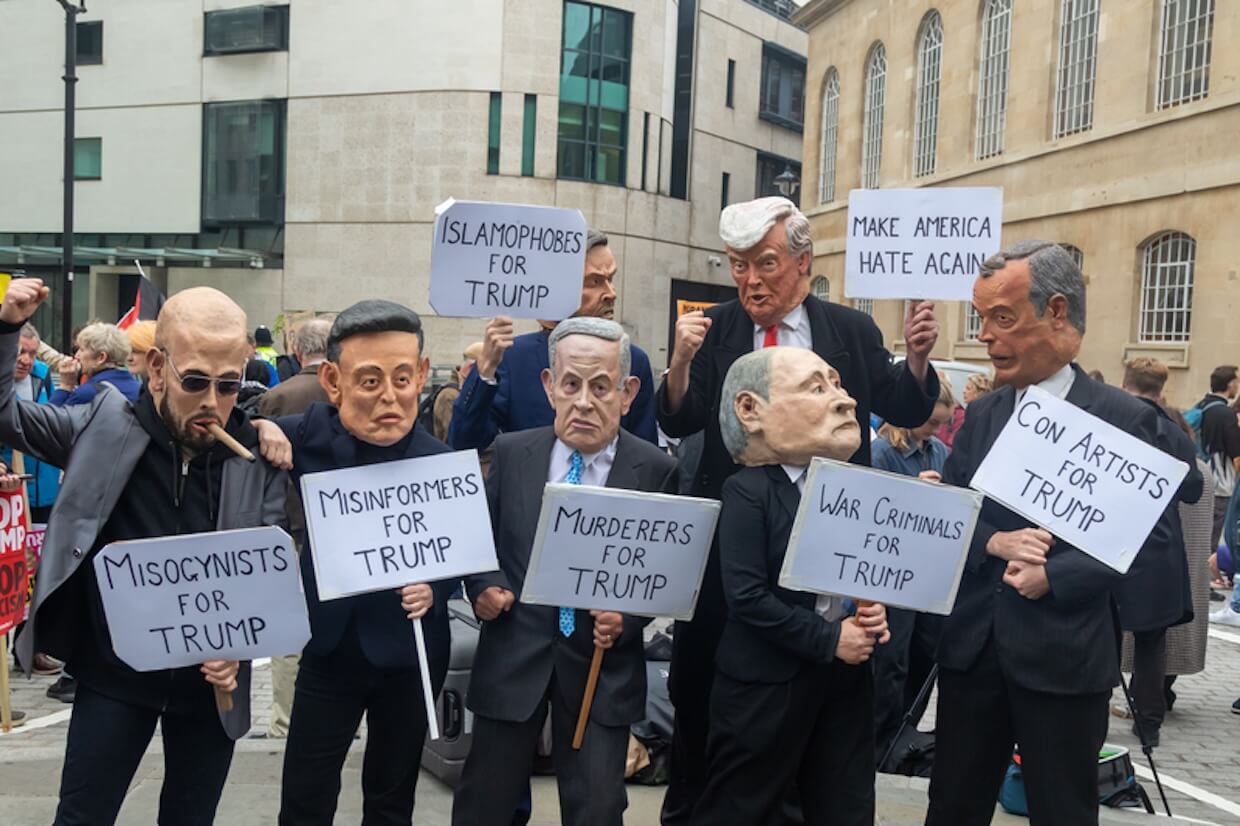
Caricature: Shutterstock.
Pluralism Survives, but the Playing Field Is Tilted
You and Sergei Guriev stress that modern autocrats seek to preserve the appearance of pluralism while hollowing it out. To what extent do Trump’s regulatory threats and litigation strategies resemble this logic of simulated legality rather than outright censorship?
Professor Daniel Treisman: I don’t think there is outright censorship. I don’t see outright censorship. It is much more a matter of trying to persuade—trying to send signals to the media to tone down criticism—or, as I mentioned, of confronting them with defamation suits or costly regulatory interference.
So, I think pluralism does exist; we do see pluralism in the United States. At the same time, there are constant efforts to tilt the playing field. Many of these efforts are not new. Republicans in the US political system have been doing this for a very long time—and not just Republicans; Democrats often use similar tools—to gain small, localized advantages, or sometimes larger ones, through practices such as gerrymandering or by refining voting laws in ways they believe will favor them.
All of that is, sadly, part of the American political tradition. Trump has often turbocharged this kind of behavior, as in the Texas mid-decade gerrymandering of congressional constituencies, but it is not radically new.
So, pluralism survives. There are efforts to win within a pluralist context, and there are also efforts to intimidate the opposition in this Trumpian, rather anarchic and blatant way. But I do not see real censorship or the kind of cohesive system we find in fully developed informational autocracies.
It is much more anarchic. Who knows how things will develop? Nobody can predict the future, but at present, it looks rather different to me.
Mistakes Are Easier to See in Retrospect
In“Democracy by Mistake,” you highlight how democracy often emerges—and collapses—not through design but through elite error. Looking at the US today, which elite misjudgments (judicial restraint, partisan polarization, media fragmentation) most plausibly explain the vulnerability of democratic guardrails?
Professor Daniel Treisman: In the US, we don’t really know. We don’t yet know whether what we are witnessing is an intense challenge to the democratic system—one that the forces of democracy will ultimately defeat—or whether we are observing a more gradual, long-term erosion in the quality of American democracy. For now, we have to reserve judgment.
Mistakes are much easier to identify in retrospect than as they are happening. One could argue that Trump has made many mistakes, and one could equally argue that leaders of democratic forces in the US have made many mistakes as well. Mistakes are universal and ubiquitous. Not all mistakes lead to the collapse of a regime—far from it.
For that reason, it is difficult to look at the US system and identify a single fateful mistake whose consequences we will clearly see five years from now. The main message of that article, for the current situation is this: we should not assume that everything is rational or part of a carefully crafted plan. Mistakes can be forces for good when they contribute to the failure of anti-democratic politicians and regimes. But mistakes can also be forces for harm when they enable or empower authoritarian actors.
Trump Fits the Family of Charismatic Populists
This editorial image, captured in Belgrade, Serbia, showcases an array of novelty socks featuring the likenesses of Vladimir Putin, Aleksandr Lukashenko, Viktor Orban, and Donald Trump in Belgrade, Serbia on December 12, 2024. Photo: Jerome Cid.
Comparatively, how should we distinguish Trump’s personalization of power from Latin American charismatic populism (e.g., Chávez) and from the more bureaucratized authoritarianism of leaders like Putin or Orbán?
Professor Daniel Treisman: Clearly, Trump isn’t very good at bureaucracy. There are some people in his administration who do bureaucracy well—Russell Vought, head of the Office of Management and Budget, for example—and that is why they have had a greater impact on the federal bureaucracy than in Trump’s first term. But as an individual, Trump is clearly not a very systematic bureaucratic operator.
In that respect, he is more like charismatic populists. Putin does not have this kind of anarchic character, and Orbán is also much more systematic and skilled in statecraft and bureaucratic politics—although, of course, Orbán is also an effective populist and could be described by some as charismatic.
With regard to Chávez and other Latin American populists, Trump is obviously not quite like the left-wing populists of Latin America. Chávez had a revolutionary, Bolivarian discourse and a semi-Marxist worldview, and he maintained close emotional and political ties with other left-wing administrations across Latin America and Central America. That is quite different from Trump. Trump, after all, arrested the leader of the regime that evolved out of Chávez’s rule.
That said, there are right-wing populists in Latin America as well—Bolsonaro, for example—who are much more similar to Trump. Although Bolsonaro has more of a military background, in terms of personality and political approach Trump is closer to that type. Even when compared with left-wing populists like Chávez, Trump shares the fact that he is a populist who appeals—at least rhetorically, if not always through policy—to the masses of ordinary people whom he claims have been neglected and disrespected. That was also a central part of Chávez’s appeal.
So, I would say that Trump is distinctive in many ways, but he also clearly fits within the broader family of charismatic populists.
History Does Not Come with Labels
Finally, drawing on your work on predictability and early warning, which indicators should scholars prioritize to distinguish between episodic democratic stress and the onset of durable authoritarian transformation?
Professor Daniel Treisman: I should say at the outset that my work on predictability and prediction is quite limited, but I have been thinking about what is a philosophically deep question: the difference between trends and cycles. And I think the basic answer is that there is no definitive answer. You cannot know whether what appears to be changing at a particular moment represents a shift in the underlying trend—a breakpoint toward a new trajectory—or merely a cyclical fluctuation.
We see this across many spheres. If we look at the spread of democracy over the past 200 to 250 years—focusing here on the West, on Europe and the Americas—we observe both a very strong upward trajectory, from almost no democracies (depending, of course, on how one defines democracy) to a much larger number of countries that can be considered at least electoral democracies.
At the same time, we have seen waves: periods in which the share of democracies increases, followed by periods in which it declines or at least plateaus. In each of these moments of cyclical slowdown or reversal, people have proclaimed, “This is the end of democracy.” In every reverse wave, there has been fear that what we were witnessing was not just a cycle but a permanent shift away from democracy as a long-term reality. So far, those fears have been proven wrong in each case.
That said, I do not think there is any particular indicator or observational technique that can reliably tell us whether a change will be permanent or temporary. This reflects a deep feature of the world we live in and of our ability to understand history from within, rather than in retrospect. Looking backward, it is easy to apply statistical tests or analytical frameworks to determine whether a change was cyclical or represented a trend shift—it is almost trivial. But as history unfolds, I do not think there is any way to know for sure whether we are seeing something genuinely new or something that is repeating in a familiar pattern.
Different scholars have developed different mental models of the world, emphasizing one perspective or the other. Some believe in progress; others emphasize stagnation or endless repetition. This tension has run through Western philosophy and social science from the very beginning. My own position is to emphasize the high degree of uncertainty involved, and to push back against claims that we can clearly identify a change in the trend when it may well be a change in the cycle.
This is why I have written critically about responses to what some describe as a democratic recession, or even a reverse wave of democracy, in recent years. I think the evidence has not—or at least has not yet—fully supported such claims. There is growing evidence of a slowdown in the rate of democratic advance, and probably some degree of average backsliding. But there is an important distinction between backsliding and the long-term collapse of democracy.
So, we all need to remain attentive to this distinction and recognize that events, as they unfold, do not come with easily readable labels. We should have some respect for long-term trends, without assuming that they will automatically continue. There does seem to be a certain structural logic at work in many domains. The same is true of the stock market: there are both trends and cycles, and it is impossible to know on any given day whether a sharp drop is cyclical or part of a new trend. As we know, people have made—and lost—trillions of dollars betting on precisely that distinction.
In this ECPS interview, Professor Stephan Klingebiel argues that Trump-era populism signals a durable shift in global governance rather than a passing disruption. He stresses that the “rise of populism, nationalism, and right-wing populism predates Trump,” and warns that Washington is now “actively fighting all forms of multilateralism” through withdrawal, defunding, and the systematic contestation of UN language on issues such as “climate change,” “gender,” and “diversity.” Professor Klingebiel links this normative erosion to the weaponization of trade, tariffs, and development finance, which turns rules-based cooperation into coercive bargaining. He also highlights how geoeconomic competition is reshaping North–South relations by expanding bargaining space for resource-holding states. Looking ahead, he proposes a “global order minus one” as a pragmatic pathway to sustain multilateralism amid fragmentation.
In an era marked by intensified geopolitical rivalry, the resurgence of right-wing populism, and the erosion of long-standing international norms, the future of multilateral governance has become a central question for scholars and policymakers alike. In this wide-ranging interview with the European Center for Populism Studies (ECPS), Professor Stephan Klingebiel—Head of the Department of Inter- and Transnational Cooperation at the German Institute of Development and Sustainability (IDOS)—offers a sober and incisive assessment of how Trump-era populism is reshaping global governance and what realistic alternatives may still be available.
At the heart of Professor Klingebiel’s analysis is a rejection of the notion that Trump-era populism represents a temporary aberration. Instead, he situates it within a broader and more durable constellation of political, ideological, and technological shifts. As he emphasizes, “the rise of populism, nationalism, and right-wing populism predates Trump,” extending across parts of Europe and the Global South. Trump, in this sense, is not an anomaly but a catalyst—“a prominent role” within a system that is unlikely to disappear in the near future.
A central theme of the interview is the normative and material hollowing-out of multilateralism. Professor Klingebiel argues that populism does not merely weaken international cooperation through withdrawals and defunding; it reframes cooperation itself as a zero-sum loss. In Trump’s discourse, he notes, the United States is consistently portrayed as a victim: “Canada, Europe—[they] have long lived at the expense of the United States.” This logic underpins what Klingebiel bluntly describes as an administration that is “actively fighting all forms of multilateralism.”
The interview traces how this antagonism manifests across institutions and issue areas—from the US withdrawal from dozens of international organizations to the systematic erosion of consensus-based norms within the United Nations. Particularly alarming, Klingebiel warns, is Washington’s effort to excise concepts such as “climate change, gender, gender-based violence, and diversity” from multilateral language, producing a chilling effect that leaves international organizations “no longer in a position to be explicit about real global challenges.”
Beyond institutions, Professor Klingebiel examines the weaponization of trade, tariffs, supply chains, and development finance, describing a shift from rules-based governance to coercive bargaining. This marks, in his view, a decisive break with past practices, where even hegemonic power was at least nominally constrained by international law. Recent cases—such as US actions in Venezuela—signal a world in which legal justification is no longer even rhetorically necessary.
Yet the interview is not purely diagnostic. Looking ahead, Klingebiel introduces one of his most provocative ideas: the possibility of sustaining multilateralism through a “global order minus one.” If a broad coalition of states remains committed to multilateral norms, he argues, such an order could both isolate unilateral obstruction and create incentives for eventual re-engagement. While acknowledging that “we are most likely not going back to the situation we had five or ten years ago,” Klingebiel insists that political choices made now—particularly by Europe and like-minded partners—will decisively shape whether the future belongs to cooperative governance or competitive fragmentation.
Together, the interview offers a penetrating reflection on populism, power, and the fragile future of the international order.
Here is the edited transcript of our interview with Professor Stephan Klingebiel, slightly revised for clarity and flow.
Trump-Era Populism and Global Governance
Donald J. Trump, the 47th President of the United States, at his inauguration celebration in Washington, D.C., on January 20, 2025. Photo: Muhammad Abdullah.
Professor Stephan Klingebiel, thank you so much for joining our interview series. Let me start right away with the first question: Is Trump-era populism best understood as a temporary disruption to global governance, or does it mark a structural shift toward a new “normal” defined by transactionalism and power asymmetries? What makes such a shift durable—or reversible?
Professor Stephan Klingebiel: Thank you very much for this question. It is, of course, not an easy one, as it touches on many different dimensions. To begin with, I do not think that what we are currently witnessing is something that will simply disappear in the near future. The rise of populism, nationalism, and right-wing populism predates Trump. We saw these developments earlier in parts of Europe, such as Hungary, and also in several regions of the Global South.
What we are dealing with, then, is a broader system or constellation in which Trump plays a prominent role, but he is by no means the only actor. There are numerous other political figures, institutions, and ideological currents that are unlikely to vanish any time soon. As a result, this is a reality we will probably have to contend with for the foreseeable future.
These dynamics are also connected to wider structural trends. In some parts of the world, for instance, we see growing frustration among younger generations—this is particularly evident on the African continent. At the same time, the influence of traditional media is declining, while social media is gaining prominence. Social media, in turn, has the capacity to mobilize emotions in ways that differ significantly from earlier forms of political communication. From this perspective, it is important to recognize that the impact of social media is not a temporary phenomenon, but one that is likely to remain with us for some time.
The United States Is Actively Fighting All Forms of Multilateralism
How does populism erode multilateral cooperation not only materially (through withdrawal or underfunding) but also normatively, by reframing cooperation as loss rather than collective gain?
Professor Stephan Klingebiel: I think we need to emphasize that, typically—and this is true for almost all populist leaders and movements—multilateral approaches are not really part of populist political identity or thinking. It is very much the opposite. As a populist leader, you emphasize national interest and present yourself as a victim. Just listening to many speeches by President Trump, including his most recent one in Davos, we see this clearly: he portrays the United States as a victim, arguing that the rest of the world—Canada, Europe—has long lived at the expense of the United States. The conclusion, of course, is that a populist leader then seeks to turn this around and make the rest of the world pay. In this narrative, the international system is framed as fundamentally unfair to the hegemon, to the United States. In that sense, the United States is actively fighting all forms of multilateralism.
We see this in many ways. The most visible manifestations are defunding and withdrawal from international organizations. At the beginning of January this year, President Trump announced that the US would withdraw from a total of 66 international organizations. We have also already seen the defunding of a number of other international institutions to which the United States was a part.
However, what I would stress is that there are many additional ways in which the US has, over the past months, weakened—and to some extent even undermined—multilateralism. One example is the International Conference on Development Finance held last summer in Sevilla, Spain. The United States remained involved in the preparatory process until the very last moment, largely in order to slow down and weaken the negotiations and to ensure that the final outcome document would be as weak as possible. At the very end, the United States announced that it would not participate in the conference at all. In that sense, it did not show up in Sevilla. What is particularly striking, however, is that the US had already been spoiling the process before the conference and then, immediately afterward, resumed efforts to weaken the outcome document, build alliances, and contest the results of the conference.
More broadly, we can see that the United States is pursuing a range of strategies. One additional point is that, from the very beginning of the second Trump administration—in February and March 2025—the US administration has been working with a list of key terms and concepts it actively seeks to oppose. These include concepts such as climate change, gender, gender-based violence, and diversity. As soon as an international organization publishes a report or document addressing climate change or any of these other issues, the United States attempts to eliminate this kind of language and thinking.
This is particularly dangerous because, in institutions such as the United Nations—where many decisions are consensus-based—we now face a situation in which, across executive boards and institutional bodies, the United States consistently intervenes to block or dilute agreed language. For example, it seeks to replace “climate change” with terms like “extreme weather.” This practice is already shaping the internal thinking and behavior of international organizations. Increasingly, they are no longer in a position to speak openly about major global challenges. Instead, they try to avoid explicit language in order to escape constant confrontation with the United States. At the same time, the United States is actively seeking allies to challenge what was previously a broad global consensus, further eroding the normative foundations of multilateral cooperation.
We Are Entering an Era of Competing Organizations and Conflicting Norms
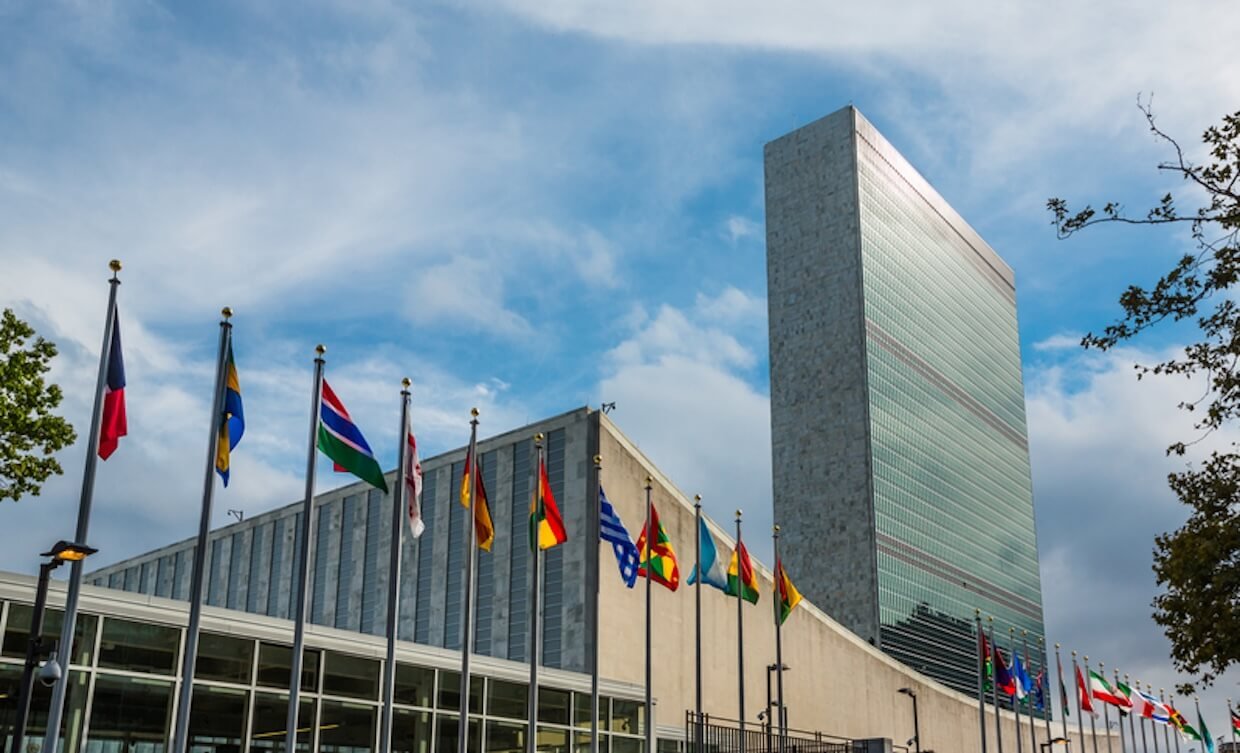
The headquarters of the United Nations in New York City. Photo: Dreamstime.
Are we witnessing the end of universal multilateralism, or its mutation into selective, interest-based cooperation? How does your concept of like-minded internationalism fit into this transition?
Professor Stephan Klingebiel: It is probably too early to draw definitive conclusions about what kind of new era, we are entering. Much of this is still evolving. What is clear, however, is that there are very powerful forces actively trying to undermine the existing international order, most notably the United Nations. Even in the past, we saw situations in which certain actors—Russia, for example—did not accept international law in many respects, and similar patterns could be observed with other governments as well.
The key difference today, however, is that we previously had a very strong group of countries, including the United States, committed to ensuring that this international order functioned effectively. What we see now is that the United States itself is aligning with forces that are seeking to undermine—and in some cases even dismantle—this system.
Just a few days ago, President Trump publicly described the United Nations as an enemy. From this perspective, it is not difficult to understand that any international order in which the United States does not occupy a clearly dominant position is framed as contrary to American interests. The proposal of a so-called “peace council” by President Trump represents an open challenge to the United Nations. My assumption is that even if this initiative ultimately fails, and even if Trump is no longer president, the broader trend toward competing international organizations, rival groupings, and conflicting norms about the rules of the game will persist.
This brings us to the question of like-minded internationalism. On the one hand, a populist leader can seek out like-minded countries, as President Trump is doing. On the other hand, states that remain committed to multilateralism can also pursue cooperation among like-minded partners. This is something we can already observe. If you look at recent speeches in Davos—by leaders from Canada, France, and several other countries—you can see attempts to articulate collective action against the advance of right-wing populism.
At the same time, such efforts require substantial power backing to be effective. While we can see early signs of countries trying to organize this kind of counterpower, it remains a very difficult and uncertain undertaking.
We Are Seeing the Construction of a System Based on Coercive Power
Trump’s use of tariffs and trade threats as coercive tools, or as a “trade bazooka,” reflects a shift from rules-based trade to punitive bargaining. What are the long-term systemic risks of normalizing trade as a geopolitical weapon?
Professor Stephan Klingebiel: We can now observe this dynamic across many policy areas. It relates to trade and tariffs, but also to foreign investment, access to critical minerals, and other domains. What is particularly new is the extent to which Trump is explicitly weaponizing all of these tools—imposing, or threatening to impose, tariffs whenever a country is deemed, from his perspective, not to be behaving in a desirable way.
One positive feature of the past was that, to a large extent, different policy areas were kept separate. If there was a conflict related to trade, it was addressed through trade instruments and negotiation. Today, this separation has largely disappeared. From a European perspective, we increasingly see that almost everything can be linked to questions about US support and positioning—for example, in relation to Russia’s aggression against Ukraine—even when the issues at stake are, in principle, unrelated.
We have seen statements suggesting that if the European Union seeks to regulate US technology companies, this could have consequences for NATO. In reality, these issues are not directly connected, but this administration is deliberately trying to weaponize all the tools at its disposal. Tariffs, in particular, appear to be one of the most immediate and effective instruments Trump can use to respond to a situation. This is deeply concerning. It signals the construction of a system based on coercive power, rather than leadership through partnership. It is no longer about win-win outcomes or cooperation, but about imposing outcomes that align with what the US leadership wants to see.
As a brief aside—and this applies to many of the points I have made—this situation strongly reflects what European countries are currently experiencing, and it is highly relevant for them. At the same time, it is important to recognize that, from the perspective of many countries and actors in the Global South, such coercion and dominance—whether by the United States or by the West more broadly—is not new. These practices have long been part of their political reality.
From a European standpoint, the liberal international order now appears to be at serious risk, and this concern is entirely justified. Yet for many countries in Latin America, the Caribbean, or Africa, experiences such as military intervention are not unprecedented. In conversations I have had over recent weeks and months, academics, political leaders, and policymakers from these regions often say: this is our normal experience as relatively small and powerless countries. US-led military interventions, particularly in Latin America over past decades, are a familiar reference point. This perspective deserves to be taken seriously.
There is also an important additional dimension. In many respects, there is truth in the argument that the international system has never been fair to large parts of the world. What is new today is that Europe and other Western countries are now feeling the impact directly, because these same coercive tools are increasingly being used against them. Yet there remains a crucial difference compared to the past. Historically, the US government—and Western governments more broadly—at least operated with a set of double standards. There were formal commitments to principles such as territorial integrity and sovereignty, and when military interventions occurred, they were typically accompanied by some form of justification grounded in international law.
If we look at events such as what happened in Venezuela in early January 2026, it was clear from the outset that there was no attempt by the US administration to justify its actions on the basis of international law. This marks a significant departure from earlier practices. In the past, Western actors were at least under pressure to frame their actions within legal justifications. Today, the United States no longer appears interested in invoking international law even as a reference point. In this sense as well, we are confronting a new situation.
Geoeconomics Has Become a Very Crucial Dimension
How does the weaponization of trade, supply chains, and development finance reshape North–South relations, particularly for countries dependent on access to Western markets and institutions?
Professor Stephan Klingebiel: I think what we have already seen over the last couple of years—and this is only partly related to the second administration of President Trump, as we observed it especially during the COVID period and even before—is that we are now in a situation where supply chains, access to critical minerals, and energy security have become much more important. Geoeconomics has therefore become a very crucial dimension.
In many ways, this increasingly gives even poorer, or very poor, countries a relatively powerful bargaining instrument. Just look, for example, at the situation of a number of Sahel countries, which are now in a position to offer what they have—whether in terms of international support in United Nations General Assembly decisions or access to minerals such as uranium and other resources—to different actors: European countries, the United States, but also China and Russia, particularly when it comes to uranium.
This gives many relatively small or economically less important countries much more power at their own disposal. And this kind of multi-alignment is something that, from this perspective, is seen by many actors in the Global South—on the African continent and beyond—as a positive trend.
Greenland — Seeing Territorial Integrity Questioned Is Deeply Troubling
Colorful houses in Greenland. Photo: Dreamstime.
How should we interpret Trump’s renewed rhetoric and pressure around Greenland—symbolically and strategically? Does this signal a revival of territorial or quasi-imperial logics under populist leadership?
Professor Stephan Klingebiel: This is really—especially from a European perspective—a game changer. I think what we constantly see with the Trump administration is the need to make sense of what is actually going on. There is so much happening at the same time. Some of these activities may be relevant, while others appear to be mere rhetoric or deliberate distractions. At the beginning of his second term, or even before, Trump was already using narratives about Canada, the Panama Canal, and Greenland.
Many observers initially had the impression that this was little more than window dressing—aimed at domestic audiences rather than reflecting serious intentions. However, seeing these intentions articulated so explicitly—we want to take over Greenland—and accompanied by statements that the United States would be willing to use force or military power, including reiterations of this position in Davos and elsewhere, marks a clear escalation. Announcing, over a prolonged period, that the use of military power is not excluded represents a direct challenge to international law.
This is a genuinely new dimension, and it brings us back to an era when imperial ambitions were an accepted part of international politics. From the perspective of European countries, many countries in the Global South, and the normative framework of international law, there has long been a shared hope that the territorial integrity of states would remain a foundational principle of global order. Seeing this principle openly questioned by the world’s most powerful military actor is deeply troubling.
We are therefore at a turning point, and we are still grappling with what effective responses to this new situation might look like. At the same time, this rhetoric constitutes a real threat emanating from the administration. Over the past few weeks, we have seen at least some renewed movement toward European unity. It is also important to recognize that Europe—the European Union (EU) together with the UK, and other partners—as well as countries in the Global South, are not merely in a position to wait and observe. They also have the capacity to respond.
The United States itself depends heavily on the rest of the world—for trade, access to critical minerals, and political support, among other things. In this sense, the debate around Greenland is indeed a game changer. It is likely to shape strategic concepts and political priorities for years to come.
We Can Oppose Attempts to Establish a System of Hemispheres
In a fragmented, multipolar order, are spheres-of-influence politics becoming inevitable again? For smaller and middle powers, does this create new room for maneuver—or deepen structural dependency?
Professor Stephan Klingebiel: I think this is very much a concept associated with President Putin in Russia, and it seems to have been taken up by President Trump as well. If you look at the National Security Strategy from early December 2025, it reflects, more or less, exactly this kind of thinking—how the world should be organized by large powers such as the United States. In this view, regions are defined in which major powers exercise special influence, with the United States claiming its own hemisphere, understood as the Western Hemisphere.
Whether this will ultimately become the dominant way in which the world is organized remains to be seen. At the very least, however, we can observe a real risk that this kind of concept may become attractive to a number of countries.
At the same time, we need to recognize that the imperial era—when colonial powers simply ruled over other countries and territories—is quite different from today’s reality, characterized by a very different global economy. In many parts of the world, there is now an alternative understanding of how the international order should be organized. We also see significant economic and military potential in Europe and elsewhere.
So, in a sense, this intention—we want to rule our own hemisphere—is clearly present. But whether it will actually define the future organization of the international system is still uncertain. Importantly, this is also a moment in which many actors and countries are trying to push back against such ideas. European actors, for example—the European Union and the UK—have the potential to link up with partners in the Global South who are not in a weak position in many respects. So we can oppose those intentions and approaches that seek to establish a system of hemispheres.
Europe Needs the Capacity to React Within Days or Even Hour
European Commission headquarters with waving EU flags in Brussels. Photo: Viorel Dudau.
What realistic policy alternatives exist to prevent a spiral of authoritarianism, protectionism, and institutional decay? If you had to prioritize three concrete steps for Europe, what would they be?
Professor Stephan Klingebiel: I think one main challenge we need to overcome is organizing collective action. Collective action, as we know, is often difficult to organize because, within one group, there are different views and different interests. Just look at the tariff threats from the US over the past weeks and months. We saw a situation in which, for example, the interests of France, Germany, and other EU countries diverged, making it difficult to arrive at a clear, unified position.
But this is not impossible. With the Greenland escalation over the last few weeks, we saw that collective action can indeed be achieved. So, organizing collective action is crucial. A second point is that collective action among a like-minded group is a requirement—a precondition—for success. At the same time, we also need to recognize that, in certain moments, a smaller group of actors may need to provide leadership, particularly in shaping concepts and strategies.
It is also useful to consider one advantage President Trump has: as the leader in power, he can decide overnight what he wants to do. For the European Union, it is far more difficult to speak with one voice within a very limited timeframe. What this means is that Europe needs to develop the capacity to react within short periods—within days or even hours.
This kind of leadership by some European countries—without neglecting the views and interests of smaller EU members or other actors—should ensure that there is a capable, small group in a position to respond quickly. Like-mindedness is one requirement, but it must also translate into an approach that is agile in many ways: agile in terms of speed, and agile in terms of producing solutions that are ready to confront new challenges, such as political leaders openly stating their intention to take over another country.
In this regard, I think it requires a strong willingness to mobilize political, economic, and military resources, and the capacity to make decisions swiftly. These are some of my responses to your question.
A Global Order Minus One Could Become a Powerful Incentive
And finally, Professor Klingebiel, looking ahead, do you foresee a reconstitution of multilateralism, a stable equilibrium of fragmented governance, or a drift toward competitive blocs—and what political choices today will be decisive in shaping that outcome?
Professor Stephan Klingebiel: It is difficult to make any serious forecast at this point about how the world might look. However, what we have seen over the last couple of weeks is a growing discussion suggesting that we should consider—perhaps even actively push for—a global order that could be described as a “global order minus one.” This would mean that if there is a broad consensus among countries that want to uphold a multilateral approach, that want to keep the United Nations relevant—or even make it more relevant—while the United States takes a different position, it might still be possible to sustain a strong and effective form of multilateralism.
In such a scenario, we would be in a position to isolate, in many ways, what the United States is doing. Even from a conceptual perspective, this kind of global order minus one could become a powerful tool to incentivize the United States to rejoin the international consensus. If the United States were the only major player outside such an order, this would entail significant political and economic costs, as well as increased military risks for the United States itself.
What I want to emphasize is that we are most likely not returning to the situation we had five or ten years ago. Instead, we may be moving toward a different configuration in which global governance needs to be reformed in many ways—not least to incorporate rising actors from the Global South and to make the system fairer overall—but where this new arrangement could also generate substantial pressure on the United States to re-engage.
This perspective is also relevant when considering other actors that are not particularly committed to multilateralism, such as Russia. When it comes to China, the picture is somewhat different, but in all these cases, alignment remains necessary in various ways. A global order minus one may thus represent one possible pathway for navigating and potentially overcoming the difficult situation we currently face.
Giving an interview to the ECPS, Professor Francisco Rodríguez argues that today “Venezuela is no longer about Venezuela; it is about demonstrating power.” He reassesses Chavismo’s constitutional refoundation, noting that “not even the most hardline opponents of Chavismo question the Constitution today,” while stressing that redistribution collapsed when oil rents vanished: “The model of oil-rent redistribution simply does not work if there are no rents to distribute.” Professor Rodríguez highlights the durability of moral antagonism—“us versus them”—and shows how social policy can operate as rule: “We bring you food; we take care of your family’s needs.” Crucially, he links the post-Maduro landscape to Delcy Rodríguez’s room for maneuver, arguing that if she can claim Washington is no longer backing the opposition, she can frame Maduro’s seizure as “a strategic victory.” Yet he warns that US demands for “power-sharing with the opposition” would be “deeply problematic for Chavismo.” He concludes that Trump’s approach is transactional: “not demanding political reform… [but] asking Venezuela to sell oil.”
Giving an interview to the European Center for Populism Studies (ECPS), Professor Francisco Rodríguez—Senior Research Fellow at the Center for Economic and Policy Research and Faculty Affiliate at the University of Denver’s Josef Korbel School of International Studies—offers a comprehensive analysis of Venezuela’s post-Maduro political trajectory. Situating the case at the intersection of populist state resilience, authoritarian adaptation, and shifting US power strategies, Professor Rodríguez advances a stark diagnosis: “Venezuela is no longer about Venezuela; it is about demonstrating power.” In his account, the country has become a geopolitical signal—a site through which coercive capacity, transactional hegemony, and the limits of democratic opposition are being tested.
Professor Rodríguez begins by reassessing the foundational pillars of the Chávez-era project—constitutional refoundation, oil-rent redistribution, and the moralization of politics—arguing that these were not merely leader-centered strategies but elements of a durable populist state architecture capable of surviving leadership decapitation. While personally critical of the 1999 Constitution, he notes that “not even the most hardline opponents of Chavismo question the Constitution today,” underscoring how deeply constitutional refoundation has been absorbed into Venezuela’s political ethos. Even critics, he observes, now invoke the Constitution “as a model that the Maduro government is failing to uphold.”
On political economy, Professor Rodríguez emphasizes that populist redistribution depends on material abundance. “The model of oil-rent redistribution simply does not work if there are no rents to distribute,” he argues, pointing to a 93 percent collapse in oil revenues between 2012 and 2020. This collapse, compounded by US sanctions, forced the regime toward pragmatic—and even neoliberal—adjustments, not as a matter of ideological conversion but constraint. As Professor Rodríguez puts it, the economy remained closed “not because the government didn’t want it open, but because the United States government didn’t allow it.”
A central theme throughout the interview is the durability of moralized politics. Chavismo’s framing of politics as an existential struggle between “the people” and apátridas (stateless persons in Spanish/Portuguese, S.C) continues to structure both regime and opposition behavior. Professor Rodríguez cautions that this antagonistic grammar cannot be easily abandoned, particularly because “the opposition has also embraced a moralized framework, albeit from the opposite angle.” This mutual entrenchment helps explain why moments that might have enabled institutional cohabitation—most notably the opposition’s 2015 parliamentary victory—instead produced escalation and breakdown.
Within this transformed landscape, Professor Rodríguez devotes particular attention to Delcy Rodríguez’s room for maneuver. He argues that her political viability now hinges on whether she can credibly claim that Washington is no longer backing the opposition. Under those conditions, Maduro’s seizure can be reframed as “a strategic victory,” preserving Chavismo’s narrative of confrontation. At the same time, Professor Rodríguez warns that any US demand for “power-sharing with the opposition” would be “deeply problematic for Chavismo,” requiring a fundamental rewriting of its moral and institutional grammar.
The interview culminates in Professor Rodríguez’s assessment of US intervention under Donald Trump. Contrary to expectations, Trump did not demand democratization or power transfer, but oil. “What Trump is effectively doing now is not demanding political reform,” Professor Rodríguez explains; “he is asking Venezuela to sell oil to the United States.” This approach reflects a broader logic of informal empire: “It is more efficient to rule through domestic elites who follow US directives than to administer the country directly.” In this sense, Venezuela becomes less a national case than a global message—one that signals the new rules of transactional power, and the risks they pose for democratic oppositions worldwide.
Here is the edited transcript of our interview with Professor Francisco Rodríguez, slightly revised for clarity and flow.
Between ‘Us Versus Them’ and External Power: Chavismo After Maduro
Iconic sites in central Caracas, where buildings are decorated with murals promoted by the Chávez and Maduro governments. Photo: Dreamstime.
Professor Francisco Rodríguez, thank you very much for joining our interview series. Let me start with the first question: With Nicolás Maduro removed yet the Chavista state apparatus largely intact, how should we reinterpret the foundational choices of the Chávez era—constitutional refoundation, oil-rent redistribution, and the moralization of politics—as elements of a populist state project capable of surviving leadership decapitation?
Professor Francisco Rodríguez: First of all, thank you very much for having me, and thank you for the opportunity to have a conversation about Venezuela and its populist model and evolution. Let me start by addressing the three aspects you mention. One of them is the Constitution. To a certain extent, constitutional refoundation is something Chavismo achieved quite remarkably, and it has become deeply ingrained in the Venezuelan ethos. The evidence for this is that there is very little, if any, discussion among Venezuela’s political actors about the need to change the Constitution. This is not to say that I think the current Constitution is good. On the contrary, I am quite critical of the way it expands executive power, and I believe that reform in this area will be necessary. But the reality is that not even the most hardline opponents of Chavismo question the Constitution today. In fact, they often invoke it as a model that the Maduro government is failing to uphold.
Turning to the other two points you raised—moralization of politics and oil rents—I think what we have seen over the past few years, roughly over the past decade, is that the model of oil-rent redistribution simply does not work if there are no rents to distribute. In Venezuela, those rents effectively disappeared. Oil revenues declined by 93 percent between 2012 and 2020. They have recovered somewhat since then, but they remain around 75 percent lower than their peak in 2012. As a result, the government has far fewer resources to redistribute, and, to some extent, it has already been forced to move toward a neoliberal policy paradigm. The main reason it has not gone further in that direction is that the economy has been under sanctions, which has prevented the implementation of some basic elements of the neoliberal model, such as opening the economy to foreign investment. This closure was not due to a lack of willingness on the government’s part, but rather because the United States government did not allow it.
Moralized Politics, External Pressure, and Strategic Uncertainty
This brings us to the third point: the demoralization of politics. This is something Chavismo will have to grapple with and much depends on how the current intervention evolves. Chavismo’s narrative has long been one of moralization—of us versus them—casting its opponents as apátridas, people without a sense of the fatherland. This narrative was effective over the past decade, during a period of open confrontation with the United States. But what has happened now is that the US has prevailed, in the sense that it has imposed its power on Venezuela and compelled Venezuelan authorities to react according to its dictates. Venezuelan authorities are therefore no longer acting autonomously. How do they sustain this narrative under these conditions? In the two weeks since Maduro’s seizure, they have been playing a dual game: complying with US demands while simultaneously maintaining the narrative that Maduro has been kidnapped and must be returned. In this way, they can still preserve the idea of confrontation.
The problem—and we will probably return to this later—is that this confrontation has its own dynamics. It is not something Chavismo can easily abandon, because the opposition has also embraced a moralized framework, albeit from the opposite angle: an “us versus them” discourse that pits the good against the bad, or decent society against a corrupt criminal mafia. This is not a narrative that can be changed at will. Yet if, for example, as a White House spokesperson suggested —and as President Trump has hinted—a White House visit by Delcy Rodríguez is being contemplated, it will become very difficult to sustain that confrontational narrative.
This leads to the final question: is there a way for Chavismo to continue evolving, and what will its core narrative be? Is this a strategic retreat—a case of “we have to do this to defend the project”? Or does it mean abandoning some of the project’s foundational tenets altogether?
It Is Too Early to Tell Whether Adaptation Will Become Strategy
Late Venezuelan President Hugo Chávez attended the ceremony marking the laying of the foundation stone for a monument to Simón Bolívar in Moscow, Russia on October 15, 2010. Photo: Dreamstime.[/caption]
In your work, you highlight how Chavismo constructed politics as a moral antagonism between “the people” and existential enemies. After Maduro’s seizure, does this moralized populist logic appear less as a contingent discursive strategy and more as a durable institutional grammar that shaped courts, security forces, and rent allocation?
Professor Francisco Rodríguez: I am tempted to respond as Zhou Enlai is said to have responded to a question about the French Revolution: it is too early to tell. It later emerged that the question was lost in translation and was actually about the May ’68 revolts, but the answer certainly applies here as well. What we are seeing now is very short-term adaptation to external circumstances, which, depending on how events unfold, may later be interpreted as strategic. Let me illustrate this with the example of Chávez after the 2002 coup.
After returning to power following the 2002 coup, Chávez adopted a very conciliatory tone. He even asked for forgiveness for his previous attitude, acknowledging that he should not have fired the PDVSA (Venezuela’s state oil company) managers in the manner he did—an episode widely perceived as humiliating, or at least framed that way by Chávez himself. Crucially, at that moment he also acceded to the main demand of economic elites: changing the economic cabinet. He brought in a group of pragmatists to run the economy, and they remained in place for about a year. One year later, however, Jorge Giordani—Chávez’s chief architect and ideologue—was back in charge of economic policy.
Some interpret this episode as Chávez merely playing along, and there is certainly some truth to that. But there is also another dimension, linked to the enduring dynamics of confrontation. That economic cabinet survived through the general strike and the oil strike against Chávez and was only replaced once Chávez concluded that he was back in confrontation mode—that the opposition was again trying to overthrow him—and that he therefore needed a command economy capable of asserting control over oil resources. This entailed abandoning efforts to accommodate the private sector. If we look back at that moment, Chávez imposed exchange controls in January 2003 during the oil strike, but crucially, he did not lift them once the strike ended. In effect, he shifted from a strategy of trying to bring the private sector into a governing coalition and broadening his base of support to one centered on confrontation: controlling oil rents and disciplining the private sector through control of those rents and access to foreign exchange.
Trump Is Not Demanding Reform—He Is Asking for Oil
One of the key uncertainties today is how the United States will proceed. US policy will shape many of the constraints facing Venezuela. If the US were to station warships off Venezuela’s coast and dictate terms, Venezuela would have little room to maneuver. But this is a somewhat unusual version of coercion coming from the Trump administration. President Trump’s first administration was the one that stopped buying oil from Venezuela. What Trump is effectively doing now is not demanding political reform, elections, or the transfer of power to María Corina Machado. Instead, he is asking Venezuela to sell oil to the United States—something Venezuelan authorities had long been asking Trump to permit. This is not a demand that makes the Delcy Rodríguez regime uncomfortable.
To the extent that Venezuelan authorities can establish a working relationship with the Trump administration, and as long as Washington maintains this stance, the moral and institutional grammar you describe is likely to persist. This episode can easily be framed as yet another chapter in the “us versus them” struggle. It is important to recall that Chavismo’s confrontation has never primarily been with the United States, but rather with the domestic opposition and economic elites. If Delcy Rodríguez can credibly claim that Venezuela has won US support and that Washington is no longer backing the opposition, she can present this as a strategic victory. She does not need to deny that Maduro’s capture was problematic; she only needs to frame it as having defeated the opposition on that front.
Under those conditions, the discourse of confrontation would be preserved and would continue to be embedded in Venezuelan institutions. The real difficulty would arise if the US were to change course and demand power-sharing with the opposition. That scenario would be deeply problematic for Chavismo. While it might still be manageable, it would be extraordinarily difficult to justify to supporters. It would be just as challenging for Delcy Rodríguez as for María Corina Machado to explain why they should cooperate, why they should sit at the same table. Such a shift would require a profound rewriting of the moral narrative and the institutional grammar that accompanies it, because any genuine power-sharing arrangement would have to extend into the institutions themselves. That would represent a fundamentally different political game from the one Chavismo has played over the past quarter century.
Venezuelan opposition leader and ousted lawmaker María Corina Machado during a street protest movement of civil insurrection against the government of Nicolás Maduro in Caracas, Venezuela, 2017. Photo: Edgloris Marys.
The Difference Between Chávez and Maduro Is Abundance, Not Personality
From a populism studies perspective; to what extent did Chavismo succeed in transforming a charismatic, plebiscitary project into a post-charismatic regime—one in which moral legitimacy, clientelism, and coercion became routinized within the state itself?
Professor Francisco Rodríguez: That’s a great question. It is tempting to focus on the contrasting personalities of Chávez and Maduro, but I would place much greater emphasis on material and economic constraints. Chávez governed during an era of abundance. When he came to power, Venezuelan oil was selling for about $9 a barrel; by the time he died, it was selling for more than $100.
Those rents later collapsed for two main reasons. The first was the sharp decline in oil prices between 2014 and 2016. The second was the political crisis triggered by that collapse, which led, among other things, to US economic sanctions. This raises an unavoidable counterfactual question—one that is necessarily subjective: how would Chávez have reacted to the complete erosion of rents? Would he have behaved differently from Maduro? My view is that he probably would not have.
Had Chávez found himself unable to win elections and facing both a hostile domestic opposition and a US government effectively seeking his removal, I believe he would have become just as repressive as Maduro. There is little in Chávez’s governing style to suggest otherwise. We need only recall the period leading up to the 2004 recall referendum, when Chávez used the Maisanta list to regulate access to public employment in a highly clientelist manner—shoring up support before the vote and intimidating not so much committed opposition voters as potentially neutral citizens and public employees who might have contemplated opposing him. In that sense, similar dynamics would likely have prevailed under Chávez.
That said, as an economist, I am not best equipped—nor is my discipline particularly well suited—to analyze questions of popular or leader charisma. What I can say is that Chávez’s association with a period of prosperity, driven by oil rents and reflected in improvements in living conditions and social indicators through expansive social spending, would likely have made the ensuing crisis resemble Cuba’s “Special Period.” The enduring memory of better times, and of restored dignity and living standards for many of the poor, might have been sufficient to sustain Chávez’s support—something Maduro has been unable to claim.
Chavismo Was Surprised by the Scale of Its Own Electoral Defeat
This contrast is still evident in public opinion today: Chávez remains widely popular, while Maduro does not. As a result, Maduro has relied far more heavily on coercion and institutional control, a tendency that reached an extreme in the 2024 elections, when the government concluded that it had no option but to brazenly steal the vote. Ironically, the fact that Maduro resorted to fraud suggests that he believed victory was still possible. This episode marked a moment when Chavismo was genuinely surprised by the depth of its loss of popular support.
It is important to stress, however, that this surprise did not stem from ignorance of opinion polls or a failure to monitor public sentiment. Careful readings of polling data suggested the election would be relatively close. Nor was it due to an inability to track electoral performance in real time; the government possesses a fairly robust system for doing so, which led it to believe it had mobilized roughly five million votes—enough to make the contest tight even under the opposition’s most favorable assumptions.
What Chavismo was not prepared for was the possibility that, of those five million mobilized voters, around one million would ultimately vote not for Maduro but for Edmundo González. In that moment, the very structures the regime had built revealed their limits. Returning to your question, this suggests that mechanisms of coercion were not fully routinized. They had been routinized for a long period during which they functioned effectively, as evidenced in 2021, when the opposition participated in elections, European Union observers were present, and the government swept the regional contests. At that time, the clientelist model worked.
By 2024, however, something had shifted. That structural break is precisely what the model—one that had kept Maduro in power for twelve years—is now struggling to confront.
CLAPs, Causality, and the Mechanics of Populist Rule
Given that Chávez-era distributive systems continue to function after Maduro’s removal, how should we reassess social policy not merely as welfare provision but as a populist technology of rule—and what does your work on targeted benefits tell us about how redistribution becomes a mechanism of political loyalty under authoritarian populism?
Professor Francisco Rodríguez: I think it is important for me to explain briefly what my work does and what it does not do. This relates, in part, to the broader conversation between economics and the social sciences and to what economists typically try to accomplish. We generally aim to identify causal effects. In my World Development paper on how clientelism works, I use a natural experiment—the repetition of elections in the Venezuelan state of Barinas—to evaluate how social transfers respond to elections. More specifically, I examine the effect of electoral competitiveness on social transfers.
To do so, I use the government’s food package distribution system—the Local Committees for Supply and Production (CLAPs). What I find is quite interesting. When this natural experiment is used to identify causal effects, the results show that, as a consequence of the election, social benefits were targeted more toward median voters—those located in the middle of the political spectrum. This has important implications for the standard narrative on populism. Much of the literature assumes that government supporters are more likely to receive social benefits. That is true as a correlation, as a descriptive statistic, and that point is undeniable. But descriptive statistics are not the same as causal effects. This pattern may exist because the government is actively targeting its followers, but it may also exist because supporters are more likely to self-select into these programs.
It is easy to find anecdotal evidence of opposition supporters saying, “I’m not going to take a food package from the government; I’m not going to give them my information, because that allows them to control me. I don’t like that food; I think it’s poor-quality or even dangerous.” This behavior must be disentangled from other causal factors, such as income differences. Pro-opposition supporters tend to have higher incomes and can therefore more easily opt out of these programs. That disentangling is precisely what the causal experiment helps to achieve.
Between Welfare and Control
So, it is one thing to say that the government uses these programs electorally to target median voters, which is what my paper demonstrates. But it is also important to recognize that, descriptively, government supporters still tend to be the main beneficiaries of these programs. Another key finding in the data is that when people are asked, “Why are you getting CLAP boxes?” or “Why are you not getting CLAP boxes?”, the overwhelming majority respond, “I’m getting them because I registered,” or “I’m not getting them because I didn’t register.” Very few respondents—less than 10 percent—say, “I’m getting them because I support the government,” or “because I have friends in the government,” or “I’m not getting them because I’m not on the government’s side.”
This means that the system is politically targeted, but not necessarily in the way it is often assumed. As a result, voters’ reactions to it are also quite different from what is commonly presumed. In many respects, it appears as the state doing what it is expected to do: delivering food to people and to families. In another paper that I am about to publish in a collection with the Inter-American Development Bank, we estimate the calorie effect of the CLAP program and find it to be substantial—around 500 calories per person. In the context of a massive economic collapse, that can make the difference between famine and the avoidance of famine.
What we are seeing, then, diverges in important ways from standard assumptions. There are, of course, other mechanisms of control. The Carnet de la Patria, for example, operates much more in the classic quid pro quo clientelist manner: if you support me, you receive a monetary transfer. The government uses cash in this way, and it is often considered legitimate for it to do so. As Maduro once explicitly stated during a campaign speech, “This is dando y dando—you give, I give.” He was referring not to CLAP boxes, but to cash transfer programs.
How Everyday Welfare Became a Source of Regime Resilience
At the same time, there is another set of programs that is essentially universalistic. Even if these programs can be politically targeted for strategic reasons, they are universalistic in the sense that everyone is presumed to have access to them, and in practice, those who want access can obtain it. This closely resembles how the Misiones functioned under Chávez, or programs such as Misión Mercal. No one was asked for a government ID card or a Socialist Party card to buy subsidized food at Mercal supermarkets. You simply went in. Yet when you entered the store, saw the staff, and examined the packaging, it was clear that there was political messaging. The implicit message was that the government was doing good things for you. In this sense, it is comparable to Donald Trump signing COVID relief checks and sending them out as personal checks.
My view, then, is that when we try to understand why Chavismo’s popularity—and even Maduro’s support—has remained at around 30 percent, which appears to be roughly what he obtained in the election, we need to ask why, in the context of such a severe economic crisis, it did not fall to 10 percent. In Peru, for example, presidents often have single-digit approval ratings. Why did this not happen in Venezuela? Why was the revolution, in that sense, so resilient? The answer lies in its continued ability to build sources of legitimation, largely by conveying the idea that the state is being administered for you and on your behalf. Even amid economic crisis, the message remains: we are doing our job; we bring you food; we take care of your family’s needs.
When the Model Didn’t Change—but the Conditions Did
The persistence of Chavista governance raises questions about personalism. In retrospect, where do you see the key discontinuities between Chávez and Maduro—particularly regarding elite cohesion, coercive capacity, and the role of elections as rituals of legitimation rather than mechanisms of accountability?
Professor Francisco Rodríguez: Here again, I would return to the counterfactual I mentioned earlier: how different is what we are seeing now from what we might have seen under Chávez had he faced an economic crisis similar to the one Maduro confronted? My view is that the differences are not as pronounced as they are often assumed to be. I do not see major discontinuities in the political model itself, or even in the modes of governance. Many of the apparent discontinuities are better explained by external factors—most notably the collapse of oil revenues and the imposition of economic sanctions, both of which emerged from a particular evolution of the political conflict. That evolution did not stem from the imposition of a fundamentally different governing model, but rather from a deeper issue: the absence of compromise as a viable option within the political culture.
If there is a moment that can be identified as truly decisive—and again, this is not because Maduro is fundamentally different from Chávez—it is the opposition’s victory of a supermajority in the 2015 parliamentary elections, a result that Chavismo initially accepted. The government did not annul or steal the elections and formally recognized the outcome. It did, however, challenge the election of several legislators from the state of Amazonas, a move that ultimately deprived the opposition of its supermajority. That supermajority would have enabled the opposition to initiate proceedings against the Supreme Court or convene a constituent assembly. In that sense, it was a kind of nuclear option, and Chavismo neutralized it by invalidating those legislative seats, while still allowing the opposition to retain a simple majority.
In almost any political system, one would then expect negotiations over cohabitation to follow. Typically, a government in that position would approach the legislature and say, “Let’s work this out. Let’s find a way to govern together. What do you want, and what do we want?” But no such effort was made—by either side. There are, after all, different ways of operating within a political system. One is through negotiation; another is through economic incentives or coercion, which governments routinely employ. Minority parties are bought off; opposition blocs are peeled apart. The government controls the state apparatus and oil rents and can easily approach opposition legislators individually or target small centrist parties, offering ministerial posts or control over specific policy areas—housing, the environment, minority rights. These are standard political tools.
Moral Antagonism and the Breakdown of Political Compromise
In this case, the government had two basic options. It could have sat down with the opposition coalition to negotiate a coexistence arrangement that would allow governance and the passage of legislation. Alternatively, it could have pursued a piecemeal strategy, fragmenting the opposition to construct a working majority. Maduro did neither, and the opposition likewise refused to engage in such processes.
This is where I would locate the core problem. I would hesitate to call it a discontinuity in the political model itself, but it was certainly a discontinuity in outcomes. The system was simply not designed to operate under a constitutional arrangement that required cohabitation. And this is not unique to Chavismo. It reflects a deeper feature of Venezuelan political history. During the democratic period that began in 1958, parliamentary and presidential elections were held simultaneously, ensuring that presidents almost always governed with a compliant Congress. The lone exception was in 1993, when Rafael Caldera won the presidency with only a plurality, leaving his party without congressional control and forcing some form of accommodation.
The belief that governments do not need to negotiate with the opposition is deeply ingrained in Venezuelan political culture. That is where the system—on both sides—ultimately breaks down. And it breaks down, once again, because of the politics of moral antagonism we discussed earlier. How can you justify governing alongside an actor you have portrayed as an existential enemy, as the embodiment of unpatriotic or immoral behavior? You cannot. Neither side could.
This dynamic was evident on the opposition side as well. When Henry Ramos Allup assumed the presidency of the National Assembly, he announced that the opposition would seek a constitutional route to remove Maduro from office within six months. In effect, he was openly advocating regime change. Both sides were locked into this confrontational mode, and their inability to move beyond it precipitated the escalation of the political conflict—ultimately leading to the adoption of scorched-earth strategies that inflicted severe damage on the economy.
From Democratic Opposition to Zero-Sum Politics
And finally, Professor Rodríguez, drawing on your New York Times analysis of Machado’s hardliner identity—including the symbolic handing over of her Nobel Peace Prize medal to President Trump—what does this episode reveal about the risks of moral absolutism, charismatic personalization, and alignment with coercive external power in populist contexts? More broadly, what does the Venezuelan case tell us about Trump’s transactional approach to authoritarian regimes and the dangers it poses for democratic oppositions elsewhere?
Professor Francisco Rodríguez: It is a very revealing episode because it encapsulates a central dilemma in opposition politics. Moderates within the opposition struggle to mobilize voters around their projects and are highly vulnerable to being denounced as collaborationists or as having been co-opted by the government. As a result, moderate opposition figures tend to reach a political dead end. Once they attempt to articulate an alternative based on compromise, they quickly lose momentum.
Returning to my earlier point about confrontation as part of the modus vivendi, the issue is not that no one has questioned this logic. Rather, within the opposition, those who have challenged it have not been electorally successful. This is evident in the case of Henri Falcón, who failed as a candidate in 2018 despite Maduro being as unpopular then as he was in 2024, according to opinion surveys. The same dynamic is visible with Henrique Capriles, who was once a highly popular opposition leader but lost significant support after adopting a more moderate stance. It is also evident in the case of Manuel Rosales, the governor of Zulia, who emerged as a plausible replacement after Machado was disqualified. Rosales had credibility as someone who had reclaimed Zulia from Chavismo and governed from the opposition without framing politics as a zero-sum struggle. Yet he was ultimately sidelined, largely because Machado’s supporters undermined him on the grounds that they reject any form of collaboration.
It is also important to recall that Machado herself was a vocal critic of Juan Guaidó, whom she regarded as too conciliatory toward Maduro. Her main criticism was that, as president of the 2015 National Assembly and interim president, he failed to invoke constitutional powers to formally call for foreign military intervention—effectively inviting external troops into the country. She criticized him forcefully for this. Looking further back, Machado was present at the swearing-in of Pedro Carmona as de facto president following the 2002 coup against Chávez. This is not mentioned simply to question her democratic credentials—though it is often raised in that context—but to underscore the narrative that underpins her political stance: the belief that Chavismo was never democratically legitimate. In her view, Venezuela was already a dictatorship in 2002, and a coup against that dictatorship was therefore justified.
Crisis, Charisma, and the Appeal of No Compromise
Venezuela’s controversial President Nicolas Maduro speaks during a rally on the 22nd anniversary of the coup against Hugo Chavez in Caracas, Venezuela, on April 13, 2024. Photo: StringerAL.
This narrative resonates strongly in a country that has experienced the largest economic contraction ever recorded in peacetime, where roughly a quarter of the population has emigrated, poverty rates have exceeded 90 percent, malnutrition—virtually nonexistent in the mid-2010s—has risen to more than 25 percent, and the government has grown increasingly authoritarian. In such conditions, it is understandable that voters are drawn to a leader who argues that Maduro remains in power because previous challengers were not forceful or resolute enough. This is how Machado constructs her political persona: as the uncompromising figure, the leader unwilling to strike a deal with Chavismo, the one who promises not coexistence but defeat. Her slogan, hasta el final—“to the end”—signals a final confrontation in which victory is assured.
This narrative mobilized voters on two levels. Traditional opposition supporters embraced it enthusiastically, given their deep hostility toward Chavismo. At the same time, more centrist voters—some of whom had previously supported Chavismo—were also drawn to her. In many respects, Machado embodied characteristics associated with Chávez himself: a young, decisive, energetic leader offering a dramatic rupture. The promise she made closely resembled the promise Chávez made in 1999. This helps explain why roughly a third of the Venezuelan electorate reports supporting María Corina Machado while simultaneously viewing Chávez as a good president.
That support, however, did not entail a transformation of her underlying narrative or that of her core constituency. Instead, it reinforced a political posture fundamentally incompatible with governing alongside Chavismo. This is where the Trump administration’s intervention becomes especially revealing. The decision was to remove Maduro—to decapitate the regime—without fully dismantling it. Comprehensive regime change would have required military occupation, significant loss of US personnel, and a long-term commitment unlikely to be sustained by public opinion. As Iraq and Afghanistan demonstrated, the costs of occupation often exceed those of initial military victory.
Instead, the United States adopted an approach reminiscent of earlier interventions, such as in Cuba and the Philippines after the Spanish-American War or in the Dominican Republic, Haiti, and Nicaragua in the early twentieth century. The logic is straightforward: military leverage and conditionality remain in place, while local actors govern. It is more efficient to rule through domestic elites who follow US directives than to administer the country directly.
Why Machado Didn’t Fit the New Power Strategy
This framework also helps explain how Trump has framed his relationship with Machado. The implicit message is that she is admirable—even symbolic, as evidenced by the Nobel Peace Prize medal—but politically impractical. Incorporating her into governance would disrupt the broader strategy. After Maduro’s removal, Venezuela ceased to be primarily about Venezuela; it became a demonstration of power. The operation showcased the US capacity to remove a foreign leader with extraordinary efficiency, without the loss of American lives, and to detain him in the United States. Many observers, myself included, believe this likely involved internal collaboration, making it resemble a palace coup under the cover of military intervention. For Trump, however, the narrative is unambiguous: this is what American power looks like.
This is where Trump’s arrangement with Delcy Rodríguez acquires broader significance. The message is simple: compliance is rewarded. Speaking recently in Davos, Trump claimed—characteristically exaggerating—that Venezuela would earn more in the next six months than it had in the previous twenty years. That assertion is plainly false, given that those twenty years include the Chávez-era oil boom. But the rhetoric is less important than the underlying signal: the new Venezuelan authorities are doing what Washington demands, and they are being rewarded for it.
Trump delivered this message before an audience of European leaders, implicitly asking them which path they wished to follow—whether in relation to Venezuela, Greenland, or other geopolitical issues. Cooperation would bring benefits; resistance would invite hostility. This logic extends beyond Europe to the Middle East, including Gaza, and to Latin America more broadly. It reflects an effort to reassert US dominance in what Trump conceives as the Western Hemisphere, consistent with a revived Monroe Doctrine logic.
What emerges from this approach is an attempt to construct a functional protectorate—economically, and perhaps politically. Yet a protectorate, by definition, lacks full sovereignty. Under such conditions, the meaning of democracy becomes ambiguous. The likely outcome is an authoritarian system, potentially evolving into a form of competitive authoritarianism. Even if Venezuelan oil revenues were to increase by only a fraction of Trump’s exaggerated claims, the resulting economic growth—on the order of 20 to 25 percent annually for several years—would make such a regime politically viable.
Just as Maduro’s popularity collapsed with the economy, Delcy Rodríguez could gain substantial legitimacy if she presided over sustained economic expansion. That is the bargain Trump is offering—not out of benevolence, but because he wants Venezuela to serve as a showcase: a revitalized economy demonstrating the rewards of alignment with US hegemony. Ultimately, that is the message Trump seeks to send to democratic oppositions and authoritarian regimes alike: these are the new rules, and this is what you get when you play along.
Iran is entering a critical juncture as renewed protests expose both the fragility and the resilience of the Islamic Republic. In this in-depth interview with the ECPS, Dr. Kamran Matin argues that since the 2009 Green Movement, the Iranian regime has ruled “primarily through coercion rather than consent,” relying on repression while retaining the support of only a small social base. Yet violence alone does not explain regime survival. As Matin emphasizes, the Islamic Republic endures “not only through violence, but through a fragmented opposition” that lacks organizational depth, ideological coherence, and a credible alternative vision. Drawing on political economy, Gramscian theory, and regional geopolitics, Dr. Matin analyzes why economic shocks quickly become systemic political crises in Iran—and why, despite widespread de-legitimation, the unresolved question of “what comes next” continues to constrain revolutionary outcomes.
Iran has entered one of the most volatile phases of its post-1979 history. The protest wave that erupted after the sharp currency shock of late December 2025 quickly escalated into explicitly anti-regime mobilization, revealing not only the depth of socio-economic dislocation but also the political vulnerabilities of the Islamic Republic. In this interview with the European Center for Populism Studies, Dr. Kamran Matin—Reader in International Relations at the University of Sussex—offers a theoretically informed analysis of the current conjuncture, foregrounding two interlinked claims that capture the central stakes of the moment: “Since 2009, [the] Iran regime has ruled by coercion, not consent,” and “[the] Iran regime survives not only through violence, but through a fragmented opposition.”
For Dr. Matin, the disputed 2009 election and the Green Movement mark a critical turning point in the regime’s mode of rule. As he emphasizes, “almost all of these signals are present in some form, but at least since 2009—going back to that critical moment—the Iranian state, the Islamic Republic, has ruled primarily through coercion rather than consent.” In his account, the erosion of consent is not merely ideological but institutional: the narrowing of factional pluralism and the weakening of reformist mediation diminished the regime’s capacity to manage dissent through electoral incorporation. The result, he argues, is a system that “retains the support of a small segment of Iranian society—perhaps 10 to 15 percent at most, and maybe closer to 10 percent,” while relying on “brute force: repression, torture, imprisonment, surveillance, and so on” to govern the remainder.
Yet Dr. Matin’s analysis also resists purely repression-centered explanations of authoritarian durability. Alongside state violence, he argues, regime survival is sustained by the organizational weakness and strategic incoherence of its opponents. “I would argue that, in addition to massive levels of violence, what sustains the regime is precisely the fractured nature of the opposition, its disorganization, and the absence of a political discourse that appeals equally to the main segments of society.” Even as protests broaden to include bazaar networks, students, workers, women, and peripheral provinces, the opposition—he contends—lacks the institutional capacity to translate mobilization into a viable transition project. “Apart from state violence,” he continues, “this lack of an organized alternative—ideologically, discursively, and organizationally—is a key factor keeping the regime in power.” The enduring strategic dilemma is therefore not simply the de-legitimation of the regime, but the absence of a credible successor: “Many people ask themselves, ‘What comes next?’”
Across the interview, Dr. Matin situates these dynamics within wider debates on revolutionary crises, hegemonic contestation, and regional geopolitics. He examines how economic shocks in a rentier political economy can rapidly become systemic political conflict; how coercion is deployed through targeted and exemplary violence; and how opposition plurality can both energize revolt and inhibit the formation of a unifying, “national-popular” project. Taken together, Dr. Matin’s intervention offers a stark but analytically precise assessment of Iran’s predicament: a regime increasingly dependent on coercion, confronting a society in revolt—yet facing an opposition still struggling to answer the question that shadows every revolutionary moment: what comes next?
Here is the edited transcript of our interview with Dr. Kamran Matin, slightly revised for clarity and flow.
In Iran, There Is No Sharp Distinction Between the Economic and the Political
Ruhollah Khomeini and Ayatollah Ali Hamaney on billboard in Tabriz, Iran on August 11, 2019.
Dr. Kamran Matin, thank you so much for joining our interview series. Let me start right away with the first question: Protests in Iran reportedly originated in a sharp currency shock on 28 December 2025 and rapidly escalated into explicitly anti-regime mobilization. Through what causal pathways do socio-economic dislocations in Iran—currency collapse, inflationary spirals, and distributive breakdown—translate into systemic political contestation rather than reformist grievance, and how does Iran’s specific configuration of state–market–religious authority condition this radicalization?
Dr. Kamran Matin: First of all, I would like to thank you for giving me this opportunity to discuss the protests in Iran. Your question is obviously very dense and contains multiple sub-questions. I will try to address them one by one, to the extent that I remember them.
In terms of economic grievances translating into political contestation, I think we have to bear in mind that Iran is still largely a rentier state. Therefore, like many rentier states—but also developmental states in general—there is hardly anything that is not political in essence. There is no sharp distinction between the economic and the political, because the economic accumulation of capitalists, or the work that the working class does for capitalists, in a country like Iran is ultimately not based—if I use the language of Marxist political economy—on surplus value in the sense we understand it in theory. Rather, profit is ultimately a redistribution of external rent by the state to various sections of society. As a result, the distribution of profit and wealth is politically determined, although not directly; it is mediated through multiple institutions and mechanisms.
In that sense, it is very easy in Iran for economic problems to become political issues. This has always been the case, even before the revolution, during the Shah period. Currently, however, this dynamic has intensified, because the combination of sanctions, the illicit economy, and the informal economy means that control over currency, in particular, is very tightly exercised. The government allocates foreign currency at different rates to different actors. There are cheaper rates from which large industrialists or merchants can benefit, but access to these requires proximity to the state or the government. So even economic competitiveness becomes a fundamentally political process. It is not economic in the straightforward sense that greater efficiency or lower production costs automatically generate higher profits. That logic has very limited purchase in a place like Iran.
Against this backdrop, it is not surprising that the protests began in the so-called bazaar and then very quickly turned into a popular, widespread political movement. However, we should also bear in mind that the bazaar, in the context of Iran—and to some extent perhaps even in Turkey—has somewhat different meanings and characteristics. Historically, the term bazaar referred to the large mercantile bourgeoisie involved in trade. But in recent decades, and probably even earlier, the bazaar has come to include different layers. For example, the current protests were not initiated by traditional, ideologically religious merchants as such, but by shopkeepers selling electronic goods. These goods are imported, especially from Asia—South Korea, Taiwan, Japan and elsewhere—and these traders were unable either to buy or to sell because the currency was in free fall. As a result, they initiated the protests. Because society as a whole was already suffering from high inflation, unemployment, and general economic insecurity, the wider population could easily identify with their grievances.
As for the second part of your question—about Iran’s specific configuration of state–market–religious authority and how it conditions this situation. The bazaar, particularly its traditional merchant class, has historically been very close to the ulama, or clerical class, through intermarriage and shared religious conservatism. At the same time, the security forces—the Revolutionary Guards (IRGC) and the Basij militia—have largely been recruited from the petty bourgeoisie, as well as from these social strata in different parts of Iran. There is therefore a close linkage among these elements. The government itself may be internally diverse, with competing factions, but in moments of crisis such as the current one, these factions tend to close ranks in order to weather the storm. The Supreme Leader plays a key role in maintaining a certain level of coherence within this system, though that is something we might discuss later.
Finally, there is, of course, the question of minorities, nationalities, and women—the gender dimension. In the last major wave of protests, the “Zan, Zendegi, Azadi,” or “Women, Life, Freedom” movement, women and subaltern nations were at the forefront, while large cities—especially in majority Persian-speaking regions—were comparatively quiet. This time, however, the pattern has been somewhat different. The protests began in Tehran and other major cities, while significant sections of Kurdistan remained relatively quiet, although some areas were highly active and bore the brunt of repression in the early days—places such as Ilam or Kermanshah. This difference also calls for explanation and is related to the way the previous protest wave was suppressed, as well as to the fragility and temporary nature of solidarity between the center—Persian speakers or Iranian nationalists more generally—and groups such as the Kurds, the Baluch, and the Arabs.
I hope I have addressed your question, but I am sure that we will return to many of these issues again in subsequent questions.
Wider, More Popular, Yet Unorganized: The Limits of Expanding Protest Coalition
“Woman, life, freedom”: London protest draws thousands following the death of Mahsa Amini in police custody on January 10, 2022. Photo: Vehbi Koca.
If the current protest wave incorporates bazaar and merchant networks alongside students, workers, women, and peripheral provinces, how does this re-composition of class alliances alter the movement’s structural power, organizational density, and leverage vis-à-vis the state when compared to 2009, 2017–19, and 2022? In particular, does bazaar participation reintroduce a historically decisive—but long dormant—node of revolutionary capacity?
Dr. Kamran Matin: The fact that the bazaar was involved is significant, because in the previous protests you mentioned there was always this notion that the so-called gray area of the Iranian population was not participating. By this gray area, people meant those who were unhappy or dissatisfied but not willing to go to the streets, protest, and risk their lives. This time around, that changed, because we saw participation not only in big cities but also in small ones. There were a large number of casualties in places whose names I had never even heard before—very small towns in distant provinces like Khorasan in the northeast, near Afghanistan—where historically we have seen very little in the way of radical protest against the regime.
So, I think this time the protests were wider and more popular, with the partial exception of Kurdistan, which again has to do with the way Iranian nationalism operates. Opposition forces often fail to acknowledge Kurdish grievances as such, and not only that: by accusing Kurds of separatism and of being foreign agents, they actually—albeit indirectly—help the Iranian state repress them even more brutally. As a result, people were very afraid of much harsher repression in Kurdish areas, and some parts remained quiet, although, there were many protests in other regions.
Another important point is the significance of the Green Movement in 2009. Just to clarify, in case readers do not remember, it was triggered by a disputed election in which Ahmadinejad was declared the winner, even though Mousavi, the other candidate, contested the result, leading to large protests. That episode effectively resulted in the strategic marginalization of the so-called reformist faction within the Islamic Republic from the state apparatus and state power. This had incredibly important consequences for subsequent protests, because before 2009 the Islamic Republic was often able to remain flexible vis-à-vis popular mobilization. The reformist faction could articulate some of the grievances, allowing people to continue expressing their dissatisfaction through the electoral system by voting for reformist candidates. In this way, the Islamic Republic was able to absorb a great deal of social and political energy and was therefore not as fragile or brittle politically as it later became.
With the sidelining of the reformists, the state became more or less monolithic, dominated by what Western commentators often describe as hardliners or conservatives. Reformists did not disappear entirely, but they no longer wielded any significant power. At the same time, people lost faith in the reformist route to change. From that point onward, every new protest became more radical. Electoral participation dropped dramatically, even according to the state’s own statistics, which are themselves highly engineered and manipulated. Around 2017 or 2018, a famous slogan emerged: “Neither reformists nor conservatives—this is the end of the story.” In effect, people were saying that they no longer trusted either faction, which meant that they were now seeking radical change in the state itself. In their view, the Islamic Republic had to go.
In the most recent protests, we can also see that there was no reference to any possible alternatives within the establishment or the regime, and the slogans were overtly radical. Many of these slogans had appeared in previous protest waves as well, but from the limited footage I have seen, the key difference was the level of determination shown by protesters in confronting the security forces. They fought them in the streets and, in some cases, even chased them away. This is why, on the 8th or 9th of January, the regime deployed the IRGC. There are also many reports suggesting that the regime brought in militias from Iraq—the Shi‘a militias of the PMU, or Hashd al-Shaabi—as well as other foreign elements of the so-called axis of resistance that it could mobilize. The idea was that, because they were foreigners, they would have no relatives or social ties that might restrain their actions.
So, the density was there, and the scale was there, but organization was not necessarily present—and that is something we may want to discuss further.
Why Repression, Not Legitimacy, Remains the Regime’s Decisive Pillar
Free Iran Protest in Toronto, Ontario: A large group of demonstrators marches south along Bay Street. Photo: Cameron Ballantyne Smith.
In assessing whether the Mullah regime is approaching a decisive rupture, which indicators matter most analytically: elite fissures within the clerical–security nexus, defections or hesitation within coercive institutions, breakdowns in fiscal extraction and strike coordination, or erosion of regime legitimacy withinreligious networks? How should these signals be weighted relative to one another?
Dr. Kamran Matin: Almost all of these signals are present in some form, but at least since 2009—going back to that critical moment—the Iranian state, the Islamic Republic, has ruled primarily through coercion rather than consent. It still retains the support of a small segment of Iranian society—perhaps 10 to 15 percent at most, and maybe closer to 10 percent. For the rest, it relies on brute force: repression, torture, imprisonment, surveillance, and so on.
If I use Gramscian language, there were periods when a form of hegemonic governance existed, combining coercion with consent. Consent was generated through elections—however engineered they may have been—but also through internal plurality and factional diversity. Reformists and hardliners coexisted, and people could choose one over the other. At the time, many Iranians used to say that they were choosing the “bad” over the “worse.” That option, however, was removed after 2009. From then on, there was effectively only the “very bad” to vote for.
All the other indicators you mention are also present: dire economic conditions, a deep crisis of regime legitimacy, a lack of future prospects, international isolation, and geopolitical weakening—especially since October 7 and developments affecting the so-called proxy forces in the region, the fall of Assad, and related events. Without sheer violence, the Islamic Republic would not be standing. We can see this clearly in the current round of protests as well. Millions of people took to the streets across Iran, in both small towns and large cities, and yet within two nights the regime killed so many people that it managed to force the population back into their homes.
I would say—and this is not just my view, but one shared by scholars of revolution—that it is not enough for a population simply to reject the way it is ruled for a revolution to succeed. For a revolution to succeed, the state must also be unable to repress in the way it has. As long as the repressive and security organs of the state are both willing and capable of suppressing protests, the regime is likely to survive. This is precisely what we have seen over at least the past ten years. So, I think this is the most important indicator.
An indirect confirmation of this can be seen in the way the 12-day war last summer paved the way for the current protests. Militarily, people saw that the Islamic Republic was unable to defend itself. A large number of the most senior commanders of the IRGC were killed on the first day, and the so-called axis of resistance forces disappeared from the political scene, at least temporarily. This created the impression that the state was far more fragile than before, which encouraged people—or gave them the courage—to act as they did this time.
On top of that, there was a statement by Trump, which initially emboldened the protesters. But we know what happened afterward: he changed his position, and the threat of intervention, at least for now, disappeared. This again demonstrates how vital the physical, coercive power of the state remains for keeping it intact and for sustaining the current elite in power. The moment it changes, the Islamic Republic will fall.
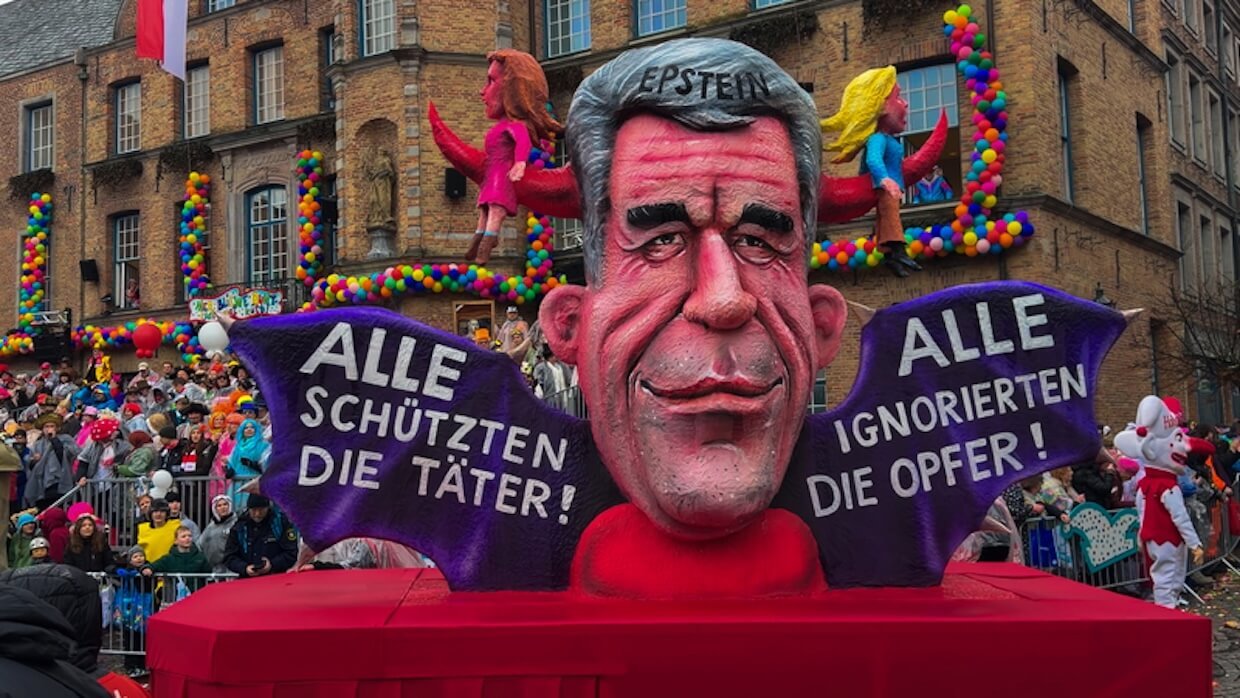
So, everything now really depends on whether the coherence of the security apparatus and the repressive organs of the state can be maintained in the period ahead.
Many Symbols, No Common Project
Building on your work on societal multiplicity and the nation’s Janus-like form, how should we interpret the coexistence of competing symbolic projects in the streets—monarchist iconography, republican imaginaries, feminist slogans, and multi-ethnic frames? Under conditions of uneven and combined development, does this plurality enable a Gramscian “national-popular” articulation, or does it risk fragmenting sovereignty claims in ways that invite external instrumentalization?
Dr. Kamran Matin: I cannot remember the exact words, but Lenin has this famous line that says revolution brings together the most extreme, diverse, and different forces into some sort of unplanned alliance against the status quo. So, it is not surprising that we see very different forces—ideologically, politically, and socially—on the streets. Like most revolutions, these protests in Iran are defined more by opposition to what exists than by a shared vision of the alternative that each actor seeks to establish.
Historically, it is in such contexts that an organized political party or movement can harness this massive social energy toward a particular political objective. This role was played in 1979 by Ayatollah Khomeini, a charismatic leader who was able, in some ways, to direct the revolutionary movement. He was vague enough to appeal to all sections of society, while at the same time being very clear in his opposition to the monarchy. This was central to how he built a hegemonic force, as he managed to present the particular interests of Islamists as the general interest of society as a whole. This, of course, ended once the revolution succeeded, when we saw how even Khomeini had to rely on massive violence to consolidate the post-revolutionary state.
At present, we have a great diversity of social and political forces and classes, but the opposition lacks two crucial things. First, it lacks organization on the ground—again, with the partial exception of Kurdistan, where Kurdish parties have a long history of organized politics. I am sure there are clandestine networks in Kurdish cities and elsewhere, but nothing comparable exists in the rest of Iran, for a variety of reasons. One key reason is that since the 1980s the Islamic Republic has invested almost everything in the physical destruction of the left: mass executions, imprisonment, forced exile, and, even in exile, hundreds of assassinations of dissidents and political leaders. Anyone who could potentially have played a leading role was eliminated.
As a result, we lack organization, we lack charismatic figures, and neither the left nor the liberals possess organic intellectuals in the Gramscian sense. A national-popular front or bloc, in Gramsci’s formulation, also requires organic intellectuals who can articulate a hegemonic project capable of uniting otherwise disparate sectors of the opposition. We do not have this, and in some respects we see the opposite dynamic at work.
Among monarchist forces gathered around the son of the former king, Reza Pahlavi, there is a strong unwillingness to engage in collaboration on an equal footing with other opposition forces. They seek dominance rather than partnership and claim a form of quasi-divine legitimacy. It is almost treated as the birthright of Reza Pahlavi to become the next monarch of Iran, or at least to lead a transitional period. As a result, meaningful cooperation with other parties or opposition groups becomes impossible. The so-called Georgetown alliance during the “Women, Life, Freedom” movement collapsed very quickly precisely for this reason, as he withdrew rather than accept equality with others.
Another major source of fragmentation within the opposition is the deployment of an exclusionary Iranian nationalism—by monarchists, by liberals in the opposition, and by the Islamic Republic itself. After the 12-day war, there was a sudden surge in nationalist symbolism: the promotion of Cyrus the Great, the erection of his statue in Tehran, and the revival of symbols of ancient Iran by the regime. The Islamic Republic understood that Islamist discourse could no longer mobilize society, but that nationalist appeals still might. At the same time, this further alienated the non-Persian peripheries of Iran, which in fact constitute more than half of the population: Azeri Turks, who make up roughly 20 to 25 percent; Kurds, around 10 to 15 percent; as well as Arabs, Baluch, Turkmens, Gilaks, and others.
Most of these groups are unwilling to contribute to the rise to power of forces that already seek to subordinate them politically and culturally. This denial of Iran’s internal diversity by large sections of the opposition creates a major barrier to forming a genuinely powerful nationwide opposition bloc. Each opposition group on its own is too small or too weak to overthrow the regime, yet the discourses they deploy and the strategies they pursue also prevent them from agreeing even on a minimal common program to confront the Islamic Republic.
I would argue that, in addition to massive levels of violence, what sustains the regime is precisely the fractured nature of the opposition, its disorganization, and the absence of a political discourse that appeals equally to the main segments of society. The Women, Life, Freedom slogan did manage to do this briefly. However, as I noted earlier, it was quickly undermined both by internal divisions within the opposition and by the regime itself. Within weeks, an alternative slogan emerged—“Man, Motherland, Development”—which is strikingly reminiscent of fascist slogans from Mussolini’s Italy. Woman, Life, Freedom versus Man, Motherland, Development. Until recently, Reza Pahlavi even displayed this slogan on his profile on X. I think the brief hegemonic role played by the Women, Life, Freedom slogan was significant, but it was actively undermined by substantial sections of the Iranian opposition.
Necro-politics in Practice: How the Regime Governs Through Maiming, Fear, and Exemplary Violence
Pro-government demonstrators march in support of the regime after the weekly Friday Prayers on January 05, 2018 in Tehran.
Reports describe systematic maiming, mass casualties, and targeted injuries amid an intensifying crackdown under communication blackouts. How should we conceptualize this repertoire of violence—deterrence, exemplary punishment, strategic mutilation, or biopolitical terror—and what does comparative evidence suggest about its medium-term political effects on mobilization, radicalization, and regime cohesion?
Dr. Kamran Matin: The Islamic Republic has a very complex necro-politics. Even the treatment of the dead has a particular political economy. In addition to what you mentioned in the question, many people have been shot in the eyes. This is very deliberate, because the aim is for those who are injured to remain alive and visible, walking around in public, so that others see this as the fate of anyone who opposes the regime.
This is particularly striking because, in the past, the Islamic Republic sought to conceal its violence. Even now, it is only in recent years that there has been some acknowledgement that in 1988 around 3,000 to 5,000 political prisoners were executed. At the time, almost nobody knew; most Iranians were unaware because it was carried out entirely in secrecy. By contrast, today state media actually show the protests and even display bodies in morgues and other locations.
What is also remarkable is that when families of those who have been killed go to collect the bodies of their loved ones, they are required to pay for the bullets that were fired at them. For each bullet, they are reportedly asked to pay around seven million Iranian tomans, which at the current exchange rate is roughly $80 or so—I cannot recall the exact figure. In other words, families are literally required to pay for the bullet that killed their loved one in order to retrieve the body.
On top of that, there are reports that families are offered the option of signing a document stating that the person who was killed was a member of the Basij, the pro-government militia—thus turning them, quote-unquote, into a “martyr.” This allows the government to claim that large numbers of security forces were killed by terrorists allegedly backed by Israel, the US, and others. If families refuse, the bodies may be buried in unmarked graves, and the family may never know where their loved one is buried. In some cases, families are confronted with this choice in addition to the financial demand.
I should add, however, that demanding money for bullets or for the return of bodies is not new. This practice was widespread in the 1980s, especially in Kurdistan, but also in cases involving political prisoners who were executed or hanged in prisons. The Islamic Republic therefore deploys violence in a highly complex and sophisticated manner. It uses exemplary punishment to deter others from protesting and to instill fear across society. When people see injured individuals everywhere, or witness bodies being withheld, mishandled, buried anonymously, or simply disappearing, the psychological impact is deeply traumatizing.
In the short term, this strategy may work for the regime by frightening people into submission. In the longer term, however, it produces enormous anger and even hatred within society—among individuals, families, and communities. This accumulated resentment is likely to erupt again in future protest waves. Yet the Islamic Republic is almost built on periodic crises; in a sense, it thrives on them. Just before we began, I saw a pro-regime journalist or activist claiming that, thanks to God, these recent events have extended the life of the Islamic Republic by fifty years.
They feel that they have not only repressed the protests, but that the very fact of having done so successfully has given them a sense—not of legitimacy, but of unassailability. This, in turn, makes people think twice before participating in the next round of protests.
Why Iran’s Opposition Is Unprepared for Transition
During revolutionary moments, the question of political succession becomes decisive. How would you characterize the current opposition landscape in terms of organizational depth, ideological coherence, and governing capacity, and what risks emerge when maximalist anti-regime unity is not matched by institutional preparedness for transition?
Dr. Kamran Matin: The opposition has none of these: neither organizational depth, nor a clear plan, nor the human capacity to run post-regime governance in any meaningful way at the moment. The material elements are there, but they are not organized in any coherent way. Again, I would distinguish between the situation in Kurdistan and the rest of Iran, because there are important differences.
I could talk for hours about this, but briefly, there are organized Kurdish parties with bases very close to the border, and there is an organic connection with society. As we remember from 1979, the moment the Shah fell, the Kurdish regions became autonomous and self-governing because this organizational infrastructure was already in place. We see similar patterns in Rojava after 2011, or in Iraq after the 1991 Kuwait War. But in the rest of Iran, we do not have this, and I think this absence is absolutely crucial.
Apart from state violence, this lack of an organized alternative—ideologically, discursively, and organizationally—is a key factor keeping the regime in power. Many people ask themselves, “What comes next?” And this is precisely why many were reluctant to take to the streets in the past. One reason Reza Pahlavi’s name was chanted in some protests is that people believed he had a workable plan, although we later saw that he really did not. He called on people to go to the streets and suggested that help was on the way, echoing Trump’s rhetoric, and obviously nothing materialized. In fact, many people now blame him for a significant portion of the casualties in Iran. So, overall, the opposition is rather weak.
Trump’s Iran Rhetoric Aims at Behavioral Change, Not Regime Change
US Presidential candidate Donald Trump held a campaign rally at PPG Paints Arena in Pittsburgh, Pennsylvania, on November 4, 2024. Photo: Chip Somodevilla.
US President Trump’s call for Iranians to “keep protesting” and his claim that “help is on its way” mark an unusually explicit rhetorical intervention. How do such statements reshape internal protest dynamics, regime threat perceptions, and escalation logics—and where do they sit on the spectrum between moral encouragement, strategic signaling, and coercive diplomacy?
Dr. Kamran Matin: I think for Trump all three are objectives—strategic signaling, coercive diplomacy, and moral encouragement. But ultimately, he is pursuing his own interests. And his primary interest is not regime change, but a change in the regime’s behavior. That is crucial, because it means that Trump may seek to instrumentalize the protests in order to extract a deal from the regime.
The problem is that Khamenei, the Supreme Leader, cannot make such a deal, because it would be perceived as a form of submission. Any agreement—at least one based on US conditions—would be seen as a defeat of the regime. And those conditions are unacceptable: no nuclear enrichment, no long-range missiles, and no proxy forces. These are core pillars of the Islamic Republic, so they simply cannot concede them. This means that even though US preference is for behavioral change rather than regime change as such—and this is clearly articulated in the US National Security Strategy released a few weeks ago, as well as reflected in recent US interventions, such as in Venezuela—this strategy has inherent limits.
Trump was hoping that internal pressure within Iran, combined with the threat of intervention, could be leveraged to secure a deal that would advance US objectives in the Middle East, open Iranian markets, and distance Iran from China, among other goals. This has not happened. And the United States does not appear to have a clear plan for what to do if a deal proves impossible. This is where US and Israeli positions diverge to some extent. For Israel, any attack would need to lead to a radical outcome; otherwise, it would incur the costs of Iranian retaliation without achieving a clear political objective. This helps explain the confusion over recent developments, including why Trump has not followed through on what he initially appeared to signal.
That said, revolutions have historically been aided—often indirectly and unintentionally—by foreign powers. The October Revolution succeeded in part because of World War I and the weakening of the Tsarist regime. The French Revolution was linked to a severe fiscal crisis driven by geopolitical rivalry with England. More broadly, many classical revolutions have occurred in the context of war and wider geopolitical crises. In this respect, Iran is not exceptional.
The key issue, however, is whether there is sufficient organization on the ground to take advantage of these geopolitical and inter-imperialist rivalries. Unfortunately, to a large extent, there is not.
Why Rojava’s Future Lies Beyond Counterterrorism
Turning to Syria, with Kurdish-held areas under renewed assault and the future of Rojava/AANES increasingly uncertain, what are the plausible political trajectories—forced integration, negotiated autonomy, territorial rollback, or renewed international guarantees—and which are structurally most likely given current regional alignments?
Dr. Kamran Matin: The current so-called transitional government is clearly no different in terms of what it wants to do with the Kurdish parts of the region in Syria, or with other minorities. We have seen what it has done to the Druze and the Alawites. The fact that it is not doing more, or has not been able to do so, is because there has been resistance against it. So, I would say the long-term aim of this government is to control the entirety of Rojava, while making some sort of symbolic concessions—such as the decree announced yesterday (January 16, 2026) recognizing the Kurdish language to some extent—but without any constitutional guarantee of self-governance of the kind the Autonomous Administration of North and East Syria (AANES) demands.
From what happened in Aleppo in recent weeks, we know that this followed very quickly after a meeting in Paris between Israel, the Syrian transitional government, and the United States; I believe Turkey was present as well. It seems there has been an agreement that areas under SDF or Rojava control should be limited to east of the Euphrates. At the moment, the SDF is being evacuated from other regions. Leaders of the Autonomous Administration might think this will become the natural border between their autonomous region and the rest of Syria, and that may be the case in the short term, but I am confident that pressure will continue and that the government will push for more.
The Syrian government is prepared to make every concession possible to Israel in order to prevent intervention and then, with the help of Turkey, to deal with the Autonomous Administration in a gradual manner. Initially, it was thought that the so-called resolution process in Turkey—including PKK disarmament and dissolution—was the price the Kurdish movement was paying to keep Rojava safe. But I think this assessment has changed. At first, the Turkish state was clearly worried about Israel attempting to recruit allies in the region, as well as about Iran and the possibility of Iran fragmenting. Over time, however, Turkey regained its momentum. Now it is using the so-called resolution process precisely to keep the PKK, or whatever it is now called, out of the Rojava scene, and in fact to use the absence of conflict with the PKK in order to concentrate its efforts on Rojava.
I have written about this in recent weeks and days, and I do not know how much the Rojava leadership reads or listens to external advice, but I think they should be very concerned. This process is not going to end. Pressure will advance step by step, and attempts will be made to retake territory incrementally. The Autonomous Administration must ensure that its relationship with the United States is not based solely on counterterrorism and ISIS. It needs to push for some form of political recognition and for a decentralized or federal system. Otherwise, renewed conflict between the two sides is inevitable.
Regional Powers Prefer a Weakened Iran to a Collapsing One
How do regional power calculations—the Erdogan regime’s anti-Kurdish security doctrine, Damascus’s centralization drive, Russia’s brokerage role, and US/Gulf/Israeli threat perceptions—intersect with Iran’s internal crisis, and what implications does each Iranian outcome (hardening, fragmentation, or transition) carry for the fate of Rojava?
Dr. Kamran Matin: This is a very complex question. In terms of existing states—not just Turkey, but also the transitional government in Syria—they are ultimately driven by a vision of a centralized, unified, and homogeneous state. In societies characterized by a multiplicity of peoples, this model clearly does not work except through violence. And violence begets violence, which is precisely what we have witnessed over the past hundred years.
In that sense, any event or process that leads to de facto decentralization of power in these states—for example, what happened in Iraq in 2003—is viewed as a major threat. Turkey still regrets having allowed the KRG to emerge in the first place, and it now harbors similar concerns regarding Iran. As a result, Turkey—which is ostensibly a regional competitor of Iran—is now openly assisting the Islamic Republic. It opposes US intervention and provides intelligence against Kurdish armed forces, because it believes that the moment the Iranian state weakens, another Kurdish entity could emerge. Such a development would have direct implications for the Kurdish question within Turkey itself.
In this sense, the Kurdish question is a challenge for all these states, but at the same time it also constitutes the basis for their tactical cooperation—and even strategic alignment—at critical moments. If Iran were to weaken significantly, or if a situation similar to Syria in 2011–12 were to unfold there, this would pose a serious challenge for Turkey. At the same time, it is important to note that Iran has a large Azeri Turkish population. Some observers are concerned that Turkey might seek to instrumentalize this segment of Iranian society through Turkish nationalist sentiments in order to establish a foothold in northwestern Iran. There is also the question of Azerbaijan and whether the two might coordinate in such a scenario.
That said, from the perspective of regional states, the overall calculus appears to be that a weakened Islamic Republic is preferable to one that collapses entirely. This helps explain why Arab states, too, have urged the United States not to attack Iran. A breakdown of central authority and a deeply unstable Iran are outcomes that alarm everyone. At the same time, while many regional actors are hostile to the Islamic Republic, they also do not want to see an unmanaged, uncontrolled, and unplanned collapse of the Iranian state. As a result, they are actively seeking to prevent such an outcome.
In this Voice of Youth (VoY) article, Emmanouela Papapavlou delivers a powerful reflection on state violence, immigration enforcement, and the fragile boundaries of democratic accountability. The article critically examines the fatal shooting of a civilian woman by US Immigration and Customs Enforcement (ICE) agents in Minneapolis on January 7, 2026. Moving beyond official narratives of “self-defense,” Papapavlou situates the incident within broader patterns of institutional violence, racialized enforcement, and the erosion of human rights under the banner of security. By drawing historical parallels to the killing of George Floyd and interrogating the politics of “law and order,” the piece challenges readers to reconsider whose lives are protected—and whose are rendered expendable—in contemporary democracies.
By Emmanouela Papapavlou*
In a world where the concept of “security” weighs increasingly heavily on public policy, the use of state violence remains one of the most contentious and polarizing issues. In recent days, news that an agent of the US Immigration and Customs Enforcement (ICE) shot and killed a 37 year-old woman in Minneapolis has reignited the debate over the limits of state power, institutional impunity, and human rights in one of the world’s most developed democracies.
The incident took place on January 7, 2026, during a large-scale operation aimed at enforcing immigration law in the city. Official statements from government authorities described the shooting as an act of self-defense, claiming that the woman attempted to “strike officers” with her vehicle. At the same time, however, video footage and eyewitness accounts contradict this version of events, suggesting that the gunshot was fired as the driver was attempting to leave the scene, without an evident and immediate threat to the officers’ lives.
The government’s effort to justify the action, even employing language such as “domestic terrorism operation,” has sparked outrage and skepticism among local officials, human rights organizations, and ordinary citizens. The mayor of Minneapolis openly stated that the self-defense arguments were “false” and called for ICE to withdraw from the city altogether. Many have described the killing as a clear example of excessive use of force by state authorities, particularly within the context of a large enforcement mission that disproportionately targets vulnerable communities.
But can this case truly be treated as an isolated incident? Or does it represent yet another link in a growing chain of violent encounters that follow a disturbingly familiar pattern? The Minneapolis killing is already being described as at least the fifth fatal outcome of similar federal operations over the past two years, suggesting that law enforcement strategy has evolved into an aggressive and dangerous form of violence, often exercised without meaningful accountability or transparency.
Social scientists and activists point out that the use of force by state authorities, whether in immigration enforcement or neighborhood policing, frequently activates deeper structures of social inequality. When the rhetoric of “law and order” is prioritized over human safety, trust between state institutions and the communities they serve erodes rapidly. And this raises a fundamental question: is the principle of “legality” applied equally to everyone, or is it selectively deployed as a tool of control and discipline over specific social groups?
This case cannot be examined outside its broader historical context. In 2020, in the same city of Minneapolis, George Floyd was killed as a police officer pressed a knee into his neck, turning a routine arrest into a public execution witnessed by the world. That moment became a global symbol of systemic police violence and racial injustice, igniting mass protests and exposing how deeply embedded power, race, and state violence are within modern societies.
And yet, how much has truly changed since then? Even today, the way state violence is addressed, whether through policing or immigration enforcement, continues to be shaped by the same logic that transforms people into threats and human lives into acceptable risks. The stories of those killed become symbols not only of injustice, but of a persistent institutional indifference toward the protection of life and dignity.
The Minneapolis case therefore serves as a reminder that violence exercised by institutions is not merely a “tragic mistake” or an “unfortunate exception.” It is part of a broader relationship between power and vulnerability that tests the very foundations of democracy and human rights. And just as in the aftermath of George Floyd’s killing, a new generation is once again refusing to accept narratives that normalize violence in the name of security. A generation that insists on asking the same uncomfortable question: what does security really mean, when preserving it requires the loss of human life?
(*)Emmanouela Papapavlou is a high school student from Thessaloniki, Greece, deeply passionate about social and political issues. She has actively participated in Model United Nations and other youth forums, serving as a chairperson in multiple conferences and winning awards in Greek debate competitions. Writing is her greatest passion, and she loves using it to explore democracy, civic engagement, and human rights. Her dream is to share her ideas, inspire action, and amplify the voices of young people who want to make a difference. Email: emmanpapapavlou@gmail.com
This commentary interrogates the rising popularity of “dopamine detox” as a moralized response to digital overload and burnout, situating it within contemporary populist logics. Rather than challenging the political economy of platform capitalism, the discourse reframes structural problems of attention extraction, inequality, and exhaustion as failures of individual self-discipline. Drawing on political economy and cultural sociology, the piece argues that dopamine detox resonates with a depoliticized form of populism that governs through moral binaries—disciplined versus undisciplined—rather than through explicit elite–people antagonism. By transforming self-control into a civic and economic virtue, the trend normalizes inequality and obscures corporate and regulatory responsibility. Ultimately, the commentary shows how neoliberal self-help cultures intersect with populist moralization to shift blame downward while leaving platform power largely unchallenged.
By Zeynep Temel*
The term “dopamine detox” has emerged as a popular self-regulation trend across digital platforms, wellness cultures, and productivity discourses in the past few years. It is being promoted as a remedy for distraction, burnout, and declining focus; through practices such as abstaining from social media, minimizing pleasurable stimuli, reducing digital consumption such as screen time, and deliberately embracing “boring” routines. The concept promises mental clarity and renewed productivity through individual restraint on various different platform ranging from TikTok videos to self-help books and corporate wellness advice.
However, this trend goes beyond dopamine detox’s popular neuroscientific framing, as it effectively reflects a broader political and moral shift. This shift is visible in how attention, self-control, and responsibility are actively governed under contemporary capitalism. This commentary therefore argues that dopamine detox should be understood not merely as a lifestyle trend or productivity technique, but as a neoliberal moral project that resonates with contemporary populist narratives. The reason behind this is that dopamine detox, instead of challenging the structural conditions that produce distraction and exhaustion, places the responsibility onto individuals. This relocation transforms self-discipline into moral virtue while also depoliticizing systemic inequalities embedded in the digital attention economy.
From Neuroscience to Moral Narrative
The scientific language surrounding dopamine detox is often misleading. In essence, the neuroscientific definition of dopamine is more complex than it simply being a “pleasure chemical.” It is a neurotransmitter that is involved in motivation, learning, and reward prediction. In fact, work by Berridge & Robinson (1998) demonstrates that dopamine is more closely associated with “wanting” and incentive salience than with pleasure itself. Clinical interventions related to dopamine regulation are also typically reserved for neurological or psychiatric conditions, bearing little resemblance to the lifestyle practices promoted online as “dopamine detox.”
Several scholars and clinicians further emphasize that dopamine detox lacks empirical grounding as a medical or neuroscientific intervention. Psychiatrist Anna Lembke notes that while excessive stimulation can indeed shape habits and compulsive behaviors, the idea of “resetting” dopamine through short-term abstinence is mainly metaphorical than clinical (Lembke, 2021).
However, the concept has gained remarkable cultural traction, and for a reason. As Eva Illouz (2007) argues, therapeutic language often migrates into everyday life not for being scientifically precise, but because it provides moral narratives of self-improvement and personal responsibility. In the case of “dopamine detox” therapeutic language functions to frame distraction as personal weakness, and to frame restraint as a signal of maturity, rationality, and self-mastery.
The Attention Economy and Individualized Responsibility
Political economy of digital platforms is also a crucial component of the rise of dopamine detox. Systemic extraction and monetization of attention are building blocks of contemporary platform capitalism. Similarly, social media platforms rely on algorithmic personalization, feedback loops, and continuous stimulation to maximize engagement and advertising revenue (Zuboff & Schwandt, 2019).
The way in which social media infrastructures shape user behavior is demonstrated in various empirical research. One of them is Zulli & Zulli’s (2020) work saying TikTok fosters “imitation publics” by encouraging users to replicate trends, sounds, and formats through algorithmic visibility incentives. Another one is Schellewald’s ethnographic research demonstrating how TikTok’s “For You” page structures everyday interaction by curating content flows that blur the boundary between personal expression platform-driven circulation (Schellewald, 2024).
While these structural dynamics exist, dopamine detox discourse rarely questions platform design, corporate incentives or regulatory responsibility, and instead reframes overstimulation as a problem of individual excess (too much scrolling, too much pleasure, too little discipline). This shift echoes Michel Foucault’s description of neoliberal governmentality, in which individuals are encouraged to govern themselves according to market rationalities rather than asking for collective or institutional intervention (Foucault et al., 2010). The result is a paradoxical form of resistance that leaves the underlying economic model of attention extraction intact.
Moralized Productivity and Populist Resonance
Dopamine detox resonates with contemporary forms of populism not through electoral rhetoric or charismatic leadership, but through moralization. Because cultural and neoliberal variants of populism often operate by translating structural and economic problems into questions of individual virtue and responsibility, dopamine detox mirrors populist logics that divide subjects into “disciplined” and “undisciplined,” or the self-controlled and the irresponsible. In this sense, dopamine detox does not mobilize populism through the language of “the people” versus “the elite,” but through a moral distinction between the disciplined and the undisciplined. This type of populism governs through self-blame; thus dopamine detox discourse exemplifies a depoliticized, affective form of populist reasoning.
This framework transforms self-control into an economic and moral virtue, and productivity into a character trait instead of output. As observed by Jonathan Crary, even rest and withdrawal are increasingly instrumentalized as strategies to enhance future productivity rather than as forms of genuine refusal (Crary, 2014).
Dopamine detox fits neatly into this moral economy. High-dopamine activities such as social media usage, gaming, and entertainment are viewed as threats to cognitive capital and economic self-worth. By contrast, abstention is celebrated as common sense and self-discipline. This logic mirrors Weberian asceticism in a digital age-updated way, where self-denial signals moral legitimacy and economic rationality (Weber, 1930).
Crucially, this moralization obscures inequality as the capacity to disengage from platforms, curate “low dopamine” lifestyles or embrace minimalist routines assumes material security. For precarious workers, freelancers, and gig-economy participants, constant connectivity is more of a condition of survival than that of choice.
Affective Governance and the Politics of “Calm”
“Affective governance,” a term coined by Sara Ahmed (2024) signifying the circulation of emotions that attach moral value to certain ways of being is an important component of dopamine detox narrative. This affective hierarchy favors calm, controlled subjects whose lives fit white-collar work and middle-class wellness norms.
Crucially, this hierarchy is not sustained only through discourse, but also through aesthetics. It is reproduced through carefully curated visual and lifestyle cues involving neutral color palettes, quiet mornings, and minimalist routines, thereby connecting dopamine detox to broader cultural trends such as “clean girl” aesthetics, soft productivity, and wellness minimalism.
Depoliticization Through Self-Blame
What makes dopamine detox particularly significant is its depoliticizing effect. It normalizes exhaustion as a personal management issue rather than a political one by turning structural problems of attention extraction into individualized moral responsibility. This shift mirrors broader neoliberal-populist dynamics in which systemic failures ranging from labor precarity to digital surveillance are reframed as matters of individual choice and discipline.
In this regard, dopamine detox illustrates a subtle but powerful form of contemporary populist reasoning: one that governs through affect, morality, and self-blame; rather than focusing on regulating platforms, addressing corporate power or rethinking digital labor.
Conclusion: Detox Without Transformation?
This commentary argues that dopamine detox should be understood not as a scientifically grounded intervention, but as a neoliberal and moralized response to platform-induced overstimulation. It claims to resist distraction and burnout by framing them as failures of individual discipline which ends up in reinforcing the very economic logics causing them.
The political question then, is not about whether individuals need to reduce screen time, but why attention economies remain largely unregulated while self-discipline is constantly promoted as the solution. Another question that arises is if dopamine detox risks becoming yet another form of self-blame -rather than transformation- in an economy designed to exhaust, unless the political economy of platforms is addressed.
(*) Zeynep Temel is a PhD candidate in International Political Economy at Marmara University, Istanbul, but currently based in Shanghai. Her research interests span inequality, platform capitalism, popular culture, and gender, with a regional focus on East Asia. She works on how economic and political structures shape everyday practices, identities, and moral expectations, particularly through attention, consumption, and labor under contemporary capitalism.
References
Ahmed, S. (2014). The cultural politics of emotion (2nd ed.). Edinburgh University Press.
Berridge, K. C. & Robinson, T. E. (1998). “What is the role of dopamine in reward? Hedonic impact, reward learning, or incentive salience?” Brain Research Reviews, 28(3), 309–369. https://doi.org/10.1016/S0165-0173(98)00019-8
Crary, J. (2014). 24/7: Late capitalism and the ends of sleep. Verso.
Foucault, M.; Senellart, M.; Ewald, F.; Fontana, A.; Davidson, A.I. & Burchell, G.D. (2010). The birth of biopolitics. Lectures at the Collège de France, 1978-79.
Illouz, E. (2007). Cold intimacies: The making of emotional capitalism. Polity Press.
Lembke, A. (2021). Dopamine nation: Finding balance in the age of indulgence. Unabridged. Penguin Audio.
Müller, J. (2016). What Is Populism? Philadelphia: University of Pennsylvania Press. https://doi.org/10.9783/9780812293784
Schellewald, A. (2024). “Discussing the role of TikTok sharing practices in everyday social life.” International Journal of Communication, 18, 909–926.
Weber, M. (1930). The Protestant ethic and the spirit of capitalism. Scribner/Simon & Schuster.
Zuboff, S. & Schwandt, K. (2019). The age of surveillance capitalism: The fight for a human future at the new frontier of power. PublicAffairs.
Zulli, D. & Zulli, D. J. (2020). “Extending the Internet meme: Conceptualizing technological mimesis and imitation publics on the TikTok platform.” New Media & Society, 24(8), 1872-1890. https://doi.org/10.1177/1461444820983603 (Original work published 2022)
In this analytically rich commentary, ECPS Youth Group member Saurabh Raj examines how direct welfare delivery is transforming electoral politics in India. Focusing on the recent Bihar assembly election, Raj shows how visible and targeted benefits—especially cash transfers to women—have become a powerful political language shaping voter participation and choice. Conceptualising this shift as “freebie populism,” the article argues that welfare now operates not only as a developmental tool but as a mode of political mobilisation, mediated through digital infrastructures and personalised state–citizen encounters. While caste, religion, and ideology remain influential, Raj highlights the growing importance of the individual beneficiary as a new axis of political belonging. Situating Bihar within broader interstate patterns, the article raises critical questions about democratic accountability, political reasoning, and the future trajectory of Indian democracy.
The recent Bihar state[1] assembly election provides a useful lens to examine how welfare-centred mobilisation is reshaping contemporary electoral politics in India. Bihar recorded its highest ever voter turnout at 66.9 percent. The gender pattern was even more striking. Women voted at 71.6 percent while men voted at 62.8 percent. In 130 of the 243 constituencies, more women than men participated. These are not small variations or one time anomalies. They represent a structural shift in who participates and who determines electoral outcomes (Basu 2021).
The pattern of results closely mirrors this shift. The incumbent governing coalition won 114 of the 130 seats where women led the turnout which is close to 88 percent of all such constituencies. This alignment coincided with the scale and timing of welfare measures that reached women directly, warranting closer analytical attention. A direct cash transfer equivalent to approximately USD 120 to over twelve million women shortly before the election was only one part of a wider package that included pension increases, electricity bill relief and higher payments for frontline workers. The opposition responded with guarantee booklets, registration drives and promises of future support, as well as cards distributed by Jan Suraj[2] that signalled an alternative welfare imagination. Welfare was not an accessory to the campaign. It was the central axis around which political mobilisation occurred.
This election therefore makes visible a broader phenomenon that has been unfolding across India. Welfare centred electoral strategies are transforming political communication, voter reasoning and the emotional structure of democratic belonging. The rise of freebie populism, a term used here to describe the combination of populist rhetoric with highly visible and personalised welfare delivery, marks a distinct shift in how the state is imagined and how voters evaluate political actors. The term “freebie populism” is used here as an analytic category rather than a normative judgement. It refers not to the undesirability of welfare provision but to a specific political logic in which competitive electoral incentives privilege immediacy, visibility, and personalisation of benefits. This logic differs from rights-based or institutionalised welfare regimes, where entitlements are routinised and less directly tied to electoral cycles. The distinction is important, as the argument advanced here concerns the mode of political mobilisation rather than the legitimacy of welfare itself.
Methods Note
This commentary draws on publicly available data from the Election Commission of India (Election Commission of India, 2024), state budget documents, press releases, field reporting in Hindi and English media and academic literature on populism, welfare delivery and voting behaviour. Interpretive arguments build on comparative work on populism (Mudde, 2004; Mudde & Kaltwasser, 2017) and on scholarship that links welfare delivery to political participation (Khemani, 2022; Kruks Wisner, 2018). Additional reference is made to studies on gendered political engagement, digital welfare architecture and direct benefit transfer systems. The purpose of this article is analytical rather than predictive. It aims to situate the Bihar experience within a wider conceptual and empirical framework that illuminates the changing nature of electoral politics in India.
Classic Understandings of Populism
Cas Mudde defines populism as a thin centred ideology that imagines society as divided between “the pure people” and “the corrupt elite” and insists that politics must directly express the general will (Mudde, 2004). Because it is thin centred, it can attach itself to a range of ideological projects including right wing, left wing or regionally specific imaginations of welfare, nationalism and identity. Mudde and Kaltwasser note that populism becomes powerful when leaders present themselves as direct protectors of ordinary citizens and construct emotional and symbolic shortcuts that bypass institutions and complex policy debates (Mudde & Kaltwasser, 2017).
Comparative research from Latin America demonstrates how populist leaders frequently combine emotive rhetoric with selective welfare delivery to cultivate direct affiliation with the masses (Hawkins, 2010; Roberts, 2015). These transfers are not incidental. They are political instruments through which belonging is reinforced and legitimacy is sustained. In India, populism has historically relied on religious mobilisation, symbolic gestures, charismatic leadership or caste-based appeals. Material transfers existed but did not shape political identity in the pronounced way witnessed today.
The current moment therefore extends rather than replaces classic understandings of populism. It adds a strong material and bureaucratically mediated dimension that is deeply embedded in the digital public infrastructure of the state. This dimension is responsible for the heightened immediacy with which political commitment is experienced.
Conceptualising Freebie Populism
Freebie populism represents a contemporary variant of populist mobilisation in which the primary bridge between leaders and citizens is constructed through direct material transfers rather than symbolic or rhetorical appeals alone. It does not replace classic definitions of populism but operationalises the promise of protection and recognition by making it tangible through targeted benefits. Cash transfers, subsidised electricity, expanded pensions, and free travel serve as visible proof of political commitment. These benefits act as recurring reminders that the state, often personified through political leadership, acknowledges the immediate material needs of citizens. Three features distinguish freebie populism from broader welfare politics.
Immediacy is central, as transfers are often timed close to elections and their effects are felt within household budgets almost immediately. Voters therefore perceive the state not as a distant bureaucracy but as a source of immediate relief.
Visibility is another critical feature. Digital transfers generate SMS alerts and bank notifications, and these alerts themselves function as instruments of political communication, turning a routine bureaucratic act into a concrete political moment.
Personalised recognition is a third characteristic. Scholars note that direct transfers create a strong sense of being acknowledged by the state, particularly among women who manage household finances (Khemani, 2022). This personalisation transforms welfare from a bureaucratic entitlement into a more intimate political relationship between the individual and the state.
Freebie populism does not erase caste or religious identities, which remain significant in shaping expectations and voting behaviour (Jaffrelot, 2021). However, welfare delivered directly to individual bank accounts establishes a new axis of political belonging. A woman from the Yadav or Paswan community may continue to retain group-based preferences, but her voting choices are also influenced by whether the state has reached her personally. The digital architecture of Aadhaar-linked transfers deepens this individualisation, making the relationship between the voter and the state more immediate, measurable, and experientially reliable.
Bihar and the Emergence of the Individual Beneficiary
The Bihar election demonstrates the mechanics of freebie populism with unusual clarity because the scale of targeted transfers was unprecedented. The distribution of ten thousand rupees to more than one crore twenty lakh women created a widespread perception that the state was acknowledging their economic vulnerability. This was part of a larger environment that included electricity bill relief, increased pensions and higher remuneration for frontline workers. These measures were repeatedly communicated through public meetings, local level messaging and digital outreach, ensuring that beneficiaries associated them with the ruling leadership.
The opposition attempted to counter this by centring women in its own campaign. Guarantee booklets, self-registration drives and targeted promises sought to build an alternative welfare narrative. Jan Suraj’s cards, for instance, attempted to construct a future oriented welfare claim. Yet the immediacy of actual deposits seemed to carry greater weight than future promises. Voters were able to verify receipt of benefits in the most tangible sense.
Turnout and voting patterns align closely with this political strategy. Women led the turnout in 130 constituencies, and the incumbent governing coalition won 114 of these. The fact that this alignment occurred during a period of intense welfare messaging suggests the strong influence of direct benefits on electoral behaviour. The political message materialised not as an abstract claim but as a verified deposit received through a mobile phone alert. Politics was increasingly experienced through the position of the individual beneficiary.
This alignment does not imply that welfare purchases votes. Rather it indicates that welfare is functioning as a channel through which political recognition, credibility and responsiveness are evaluated. Voters appear to be rewarding the government for delivering measurable relief and penalising actors whose promises remain untested.
Shifting Political Behaviour
The Bihar data indicates that freebie populism is reshaping political behaviour in ways that build on and extend earlier research. Scholars have noted that low-income voters are highly strategic and responsive to welfare delivery, often making reasoned decisions based on evidence of state performance (Khemani, 2022; Kruks Wisner, 2018). The Bihar experience reinforces this insight and highlights three important dimensions of change.
First, welfare is increasingly becoming the primary language of political recognition. Women voters demonstrated exceptionally high turnout and a strong preference alignment in constituencies where welfare delivery was both visible and recent, suggesting that direct transfers and other targeted benefits have emerged as key instruments through which citizens assess the state’s commitment.
Second, citizenship itself is being experienced through the household economy. This does not reduce political engagement to a transactional exchange but instead reflects a new democratic imagination in which the state operates as a direct economic actor within the household. For many women, welfare programmes provide relief from domestic pressures, enhance financial independence, and support caregiving responsibilities, thereby strengthening political agency. At the same time, political reasoning is increasingly grounded in immediacy.
Third, freebie populism shifts the focus from abstract or long term developmental claims toward the voter’s immediate lived experience. Citizens evaluate political actors on the credibility, timing, and scale of benefit delivery and the responsiveness they witness in practice. This approach does not indicate passivity; rather, it reflects active and informed political calculation based on tangible outcomes and personal experience (Chauchard, 2017).
Taken together, these patterns suggest that political loyalty is increasingly shaped by repeated and recognisable acts of recognition rather than broad ideological or identity-based appeals, signalling a profound shift in how democratic engagement is conceptualised and practiced.
These patterns resonate with findings from other democracies where targeted welfare provision has become central to electoral competition, including parts of Latin America and Southeast Asia. In such contexts, welfare delivery increasingly functions as both policy and political communication, blurring the boundary between governance and mobilisation. The Indian case therefore contributes to a growing comparative literature on how material distribution reshapes democratic participation under conditions of economic precarity.
Patterns Beyond Bihar
The pattern observed in Bihar is not an isolated development but part of a broader transformation in electoral politics across multiple Indian states. Welfare centred strategies have become essential elements of political competition, and their design increasingly reflects the logic of freebie populism, where visible and immediate benefits shape political belonging and voter behaviour. Each state offers a slightly different model, yet all demonstrate the growing centrality of targeted welfare in shaping electoral outcomes.
Jharkhand provides a clear example of this shift. The state expanded support for low-income women through age linked educational transfers and targeted assistance schemes that reached households directly. These interventions were not presented merely as development initiatives but became central to political communication, especially in rural districts where economic insecurity remains acute. The emphasis on young women and first-generation learners created a perception that the state was intervening meaningfully in the life chances of vulnerable households. Political actors highlighted these measures during election campaigns, illustrating how welfare has become a key electoral asset.
Maharashtra further demonstrates the consolidation of welfare centred politics. The Ladki Bahin Scheme placed women at the centre of the electoral narrative by offering regular financial assistance and presenting the state as an active participant in household welfare. The scheme was supported by recognisable branding, sustained outreach and continuous communication that associated the ruling leadership with direct support for women. This combination of financial transfers and symbolic visibility strengthened the perception that welfare was both a right and a political commitment, reinforcing the link between beneficiaries and the state.
Telangana presents another version of this emerging trend. Successive governments have relied heavily on targeted welfare, particularly through agricultural support schemes, marriage assistance programmes and community specific initiatives. These policies created strong emotional and material incentives for distinct social groups and demonstrated that welfare could be used strategically to cultivate enduring political alliances. Welfare delivery in Telangana has become an essential component of electoral mobilisation rather than a supplementary tool and continues to play a decisive role in shaping partisan loyalty.
Tamil Nadu offers one of the longest running traditions of welfare linked mobilisation in India. The contemporary phase builds on earlier frameworks but introduces new elements such as free bus travel for women, expanded meal schemes, higher pensions and targeted relief for vulnerable households. Welfare delivery is deeply integrated into political identity and party narratives. Campaigns consistently highlight the immediacy and continuity of state support, reinforcing the idea that welfare programmes are expressions of political care rather than bureaucratic entitlements.
Across these states, welfare is framed not merely as development but as a direct political relationship. This relationship is mediated through digital systems that enable individual bank transfers, local mobilisation networks that translate policy into political communication, frontline workers who act as intermediaries between the state and beneficiaries and the emotional resonance generated when citizens experience state recognition in concrete and material form. Together, these elements show how freebie populism has become a national phenomenon shaping political participation and redefining the meaning of electoral competition.
However, important differences remain across states. In Tamil Nadu and other states, welfare programmes are embedded within long-standing party institutions and ideological narratives, reducing their electoral immediacy. In contrast, states such as Bihar and Jharkhand exhibit a more episodic and election-timed deployment of benefits, intensifying their political salience. These variations suggest that freebie populism operates most strongly where welfare delivery is newly individualised and weakly institutionalised.
Limits of Attribution and Scope of Argument
This article advances an interpretive rather than causal argument between welfare transfers and electoral outcomes. Voting behaviour is shaped by multiple overlapping factors, including caste alignments, candidate credibility, party organisation, and broader political narratives. The observed alignment between women-led turnout and electoral outcomes in Bihar should therefore be read as indicative rather than deterministic.
The argument advanced here is that welfare delivery has acquired heightened political salience under conditions of digital transfer, electoral competition, and economic precarity. Direct benefits function as signals of state responsiveness that voters incorporate into broader political reasoning. This does not imply political passivity or vote-buying; rather, it reflects strategic and experiential evaluation by citizens based on verifiable state action. Future research using booth-level data or longitudinal beneficiary tracking would allow for more precise estimation of causal effects.
Conclusion
Welfare centred mobilisation has become a central feature of contemporary electoral competition in India. The Bihar assembly election provides a useful illustration of how direct and visible welfare delivery is reshaping patterns of political participation by foregrounding the individual beneficiary as a significant site of democratic engagement. High female turnout and the alignment of women dominated constituencies with electoral outcomes underline the growing importance of welfare as a medium through which citizens experience and evaluate state responsiveness.
This shift does not indicate a decline in political reasoning or a reduction of citizenship to transactional exchange. Instead, it reflects a reorientation of democratic judgement in which voters increasingly rely on observable and verifiable state action to assess political credibility. Welfare delivery, mediated through digital and bureaucratic systems, functions not only as policy intervention but also as a communicative practice that signals recognition, reliability, and proximity between the state and citizens.
At the same time, the increasing centrality of welfare in electoral mobilisation raises important questions for democratic accountability. An emphasis on immediacy and visibility may encourage short term distributive competition at the expense of institutional consolidation and sustained policy debate. As electoral legitimacy becomes more closely tied to the timing and scale of benefits, political contestation risks narrowing to questions of delivery rather than deliberation.
The broader challenge for Indian democracy therefore lies not in the expansion of welfare itself but in the political logic through which welfare is mobilised. Understanding how welfare delivery reshapes political participation, voter reasoning, and experiences of citizenship is essential to assessing the evolving character of democratic practice in India. The Bihar case suggests that future electoral outcomes will increasingly be shaped by how convincingly the state makes itself present in the everyday lives of citizens, alongside enduring influences of identity, ideology, and organisation. Beyond India, the analysis highlights how welfare delivery can reconfigure democratic engagement in contexts where citizens encounter the state most directly through material transfers.
(*) Saurabh Raj is a core team member at the Indian School of Democracy and is associated with the European Center for Populism Studies (ECPS). He has a decade of experience in Indian politics and elections.
References
Aiyar, Y., and Walton, M. (2015). “Rights, accountability and citizenship: Examining India’s social welfare architecture.” Accountability Initiative.
Basu, P. (2021). “Women and electoral participation in India: Changing patterns of turnout and political engagement.” Economic and Political Weekly, 56(12), 34 to 42.
Chauchard, S. (2017). Why representation matters: The meaning of ethnic quotas in rural India. Cambridge University Press.
Election Commission of India. (2024). State Assembly Election Data: Bihar.
Hawkins, K. A. (2010). Venezuela’s Chavismo and populism in comparative perspective. Cambridge University Press.
Jaffrelot, C. (2021). Modi’s India: Hindu nationalism and the rise of ethnic democracy. Princeton University Press.
Khemani, S. (2022). “Political economy of welfare delivery in India.” World Bank Research Observer, 37(2), 245 to 270.
Kruks Wisner, G. (2018). Claiming the state: Active citizenship and social welfare in rural India. Cambridge University Press.
Mudde, C. (2004). “The populist zeitgeist.” Government and Opposition, 39(4), 541 to 563.
Mudde, C., and Kaltwasser, C. R. (2017). Populism: A very short introduction. Oxford University Press.
Roberts, K. M. (2015). Changing course in Latin America: Party systems in the neoliberal era. Cambridge University Press.
Footnotes
[1] Bihar, one of India’s most populous and economically disadvantaged states, has historically exhibited lower levels of state capacity and social welfare penetration, making recent shifts in voter participation particularly significant.
[2] A recently formed political party in Bihar positioning itself around governance and welfare reform.
In this wide-ranging interview with the ECPS, Dr. Matías Bianchi offers a powerful diagnosis of contemporary illiberalism. Moving beyond regime-centric explanations, Dr. Bianchi argues that today’s defining shift is normative: “illiberal actors no longer need to pretend they are liberal.” He shows how illiberalism now operates through transnational networks embedded within liberal democracies, sustained by funding, coordination, and discourse originating largely in the Global North. Highlighting the erosion of liberal legitimacy, the normalization of illiberal language, and the structural weakening of the nation-state, Dr. Bianchi underscores why democratic institutions struggle to respond—and what is at stake if they fail to adapt.
In an era marked by democratic backsliding, geopolitical fragmentation, and the global diffusion of illiberal norms, understanding the evolving nature of authoritarian and illiberal politics has become an urgent scholarly and policy task. In this in-depth interview with the European Center for Populism Studies (ECPS), Dr. Matías Bianchi, Director of Asuntos del Sur in Buenos Aires and co-author of “The Illiberal International,” offers a compelling diagnosis of contemporary illiberalism—one that departs decisively from regime-centric and state-centric explanations.
At the heart of Dr. Bianchi’s analysis lies a striking observation captured in the interview’s headline: “Illiberal actors no longer need to pretend they are liberal.” For Dr. Bianchi, the defining feature of the current moment is not the novelty of illiberal ideas themselves, but rather a profound normative and cultural shift that has lifted the constraints once requiring authoritarian or illiberal actors to cloak their agendas in liberal rhetoric. As he explains, “What we aim to show is that there is a set of actors working together and collaborating at different levels—geopolitical, institutional, and interpersonal—for whom liberal practices and ideas are no longer the goal.”
This “shedding of pretense,” as Dr. Bianchi describes it, represents a critical marker of the contemporary illiberal turn. Practices that were once “forbidden, punished, or had to be concealed are now openly articulated.” The symbolic need to maintain democratic façades—what Dr. Bianchi recalls through Fidel Castro’s claim that “we are a real democracy”—has eroded. “That veil is no longer necessary,” he argues, signaling a transformation not only in political behavior but also in the boundaries of legitimacy and civility within democratic publics.
Crucially, Dr. Bianchi situates illiberalism not as a discrete regime type but as a networked, relational political formation that increasingly operates within liberal democracies themselves. He emphasizes that many illiberal actors are embedded in ostensibly democratic systems—“in the European Union, the United States, or other contexts”—and that a major novelty of the past decade is that “much of the financing, support, and networking now originates from the US and Europe,” regions once seen as the pillars of the liberal international order.
Throughout the interview, Dr. Bianchi traces how cross-border coordination, transnational funding, and shared discursive strategies—exemplified by platforms such as The Conservative Political Action Conference (CPAC) or slogans like “Make Europe Great Again”—have accelerated the normalization of illiberalism. These networks thrive amid what he identifies as a deeper crisis of liberalism itself: declining legitimacy, shrinking human rights cooperation, and the inability of liberal institutions to deliver material security, social inclusion, and credible governance in an increasingly unequal and digitally mediated global order.
Here is the edited transcript of our interview with Dr. Matías Bianchi, slightly revised for clarity and flow.
Illiberal Actors Now Operate Openly Within Liberal Regimes
A banner depicts democracy as a leaf eaten by “caterpillars” named Putin, Kaczynski, Orban, Babis, Trump, and Fico on Labour Day, May 1, 2017 in Old Town Square, Prague. Photo: Jolanta Wojcicka.
Dr. Matías Bianchi, thank you very much for joining our interview series. Let me start right away with the first question: How do you conceptualize illiberalism in distinction from classical authoritarianism and competitive autocracy? In“The Illiberal International,”illiberalism appears neither reducible to established authoritarian rule nor fully captured by frameworks of competitive authoritarianism or democratic erosion. What core institutional and normative markers define this “illiberal international,” particularly in terms of its relationship to legality, electoralism, and claims to popular sovereignty?
Dr. Matías Bianchi: In our article, we do not engage in a fine-tuned conceptualization of each of the concepts you mentioned. Rather, what we aim to show is that there is a set of actors working together and collaborating at different levels—geopolitical, institutional, and interpersonal—for whom liberal practices and ideas are no longer the goal. Our liberal order, already weakened, is being challenged, and we are not entirely certain about the motivations behind this challenge. Some actors may be seeking greater financial resources, others may wish to control their political space, while others pursue more ideological objectives, such as creating a new order, as in the case of Javier Milei in Argentina. They may have different aims, but what they share is that liberal practices—such as the Woodrow Wilson–style liberal global order—are no longer central.
Traditionally, autocratic or authoritarian frameworks focus primarily on regimes. What we show, however, is that many of these illiberal actors are often operating within liberal regimes—such as those in the European Union, the United States, or other contexts. That is precisely what we seek to demonstrate. A key feature of the current situation is that much of the financing, support, and networking now originates from the US and Europe, which were once the primary sustainers of the liberal global order. This represents a major novelty of the past decade.
As for the practices or markers we observe, one of the most significant is a cultural shift that enables ideas and practices that existed before but are now expressed more openly. In a sense, there has been a shedding of pretense surrounding liberal ideas, allowing actors to operate more freely. This is an important marker. Practices that were once forbidden, punished, or had to be concealed are now openly articulated. Even in Cuba, Fidel Castro used to say, “We are a real democracy.” There was always a veil that needed to be maintained. I believe that this veil is no longer necessary, and that in itself is a telling marker.
Illiberalism Has Gone Transnational
What explains the shift from predominantly domestic processes of democratic backsliding to increasingly coordinated, cross-border illiberal networks? In your article, illiberalism appears less as a discrete regime type than as a relational, networked political formation. How does this reconceptualization challenge state-centric and regime-centric approaches in comparative politics and international relations?
Dr. Matías Bianchi: Many of the things I am going to say are not directly related to the article and are more my own ideas, and not necessarily shared with my co-authors. What we are witnessing is a contested situation. The world order we are living in still includes a liberal order, but it is lacking both legitimacy and power. At the same time, other actors are gaining momentum; they have more financial resources and greater cooperation across many areas, including technology and the military.
This operates at different levels, which is a crucial point. The key dimension here is the network—that these actors are collaborating more than ever before. If you look back a decade or two, these networks were far more limited. The Conservative Political Action Conference (CPAC), for instance, was something quite restricted. “Make Europe Great Again” was either very limited or did not exist at all. Now, however, these spaces are becoming global. You have CPAC in Latin America, CPAC in Europe, and these platforms are expanding and increasingly sharing resources.
I think this development is related to the loss of pretense—that these ideas no longer need to be hidden. This, in turn, changes the game. There is more funding, while at the same time the liberal camp is lacking resources, lacking investment, and experiencing less cooperation. So, while this dynamic operates at different levels, the networks functioning simultaneously are particularly important.
For example, Tucker Carlson making Milei a global phenomenon, with hundreds of millions of viewers for his interviews, allows people across the United States to become familiar with this phenomenon. All of this network-based collaboration, to me, is absolutely crucial.
Illiberal Power Reveals Itself Through Discourse Before It Acts
Drawing on V-Dem data, the Authoritarian Collaboration Index, and your own empirical research, which indicators most effectively capture the qualitative transformation—not merely the quantitative expansion—of authoritarian cooperation in recent years? Which measures best reveal the growing organizational capacity, coordination, and strategic coherence of illiberal actors at the global level?
Dr. Matías Bianchi: Again, this goes beyond our analysis. I would say, once more, that the key element is the normative shift. There has been a change in what can be said at the level of language. Insults and the demonization of adversaries or other political actors have become more acceptable; at the level of discourse, the line of civility has shifted. This normative change is crucial, and it is followed by action. Language comes first.
When you start making statements such as “women are this,” or when Muslims or immigrants are targeted, you begin naming things, and then actions follow—ICE raids and other measures come afterward. So, the normative shift, in terms of what is allowed without penalties, is essential. In the past, if actions like those taken by Jair Bolsonaro in Brazil or by others had occurred, there would have been phone calls from the White House or Brussels. There would have been at least threats involving investments, financial support, or other consequences.
I am not sure those calls exist anymore. All of these shifts occur, again, at the level of language, which has penetrated civic discourse within societies, but also at the global level, where the normative environment itself has changed. There is a fundamental normative shift at work.
When No One Enforces the Rules, Illiberal Networks Move Faster
This editorial image, captured in Belgrade, Serbia, showcases an array of novelty socks featuring the likenesses of Vladimir Putin, Aleksandr Lukashenko, Viktor Orban, and Donald Trump in Belgrade, Serbia on December 12, 2024. Photo: Jerome Cid.
Why have authoritarian and illiberal networks become more agile and effective than democratic alliances, despite the latter’s historical institutional advantages? To what extent do procedural neutrality, consensus-based decision-making, and legal formalism within liberal institutions create structural vulnerabilities that illiberal actors exploit?
Dr. Matías Bianchi: That is a very good question. I see liberal practices as a kind of social contract and a global contract. However, they need to be sustained by power. At some point, someone imposed those rules and others complied. I am not sure there is still sufficient power sustaining that liberal order at the international level, or in many cases at the national level. As a result, there is little punishment for violating it. So I am not sure this is primarily a question of institutional design; rather, it is a question of legitimacy. It is also about the fact that these regimes have not been delivering—both within countries and at the level of the global order.
International cooperation on human rights is shrinking. By 2026, it is estimated to be 50 percent lower than it was three years ago. Support for independent journalists, NGOs engaged in strategic human rights litigation, and networks of young leaders seeking to promote democratic practices have declined dramatically. At the same time, other arenas have gained resources and visibility, with social media playing a major role in amplifying influence and reach. That is part of a different discussion, but the bottom line is that there is no longer sufficient power sustaining that contract. So, again, I am not sure this is a question of design; it is more fundamentally about power.
Illiberal Networks Exploit 21st-Century Tools While Democracy Speaks in 20th-Century Language
Your analysis highlights how liberal institutions’ commitment to proceduralism and neutrality can be exploited from within. Is this best understood as an institutional design flaw, a crisis of political will, or a deeper contradiction within liberal constitutionalism itself?
Dr. Matías Bianchi: This partially relates to what I just said: the lack of legitimacy and the lack of power. At the same time, I want to emphasize that the global arena is contested. There is no clear winner. It has always been contested, but there was once a clear predominance of liberal, pro-democracy, and human-rights–oriented international regimes, while alternative models were weaker.
Today, the illiberal camp is growing, and illiberal networks and actors are increasingly effective in using 21st-century tools—misinformation, the manipulation and circulation of information, and the construction of conspiracy theories that support their worldview and preferred version of facts. A particularly important turning point was the pandemic, which exposed how nation-states and the international order lacked sufficient capacity to respond effectively. This moment acted as a major trigger; for instance, it coincides with the period when Milei entered politics.
These actors have been highly effective in exploiting digital communication, narratives, and misinformation, which have proven especially appealing. In particular, they have successfully mobilized people’s disappointment and anger. When populations became frustrated by real-life experiences—lockdowns, unemployment, children being forced into online learning, and the collapse of healthcare systems—these grievances were skillfully leveraged to generate resentment toward democracy and politics more broadly.
They have also been effective in promoting narratives such as “we are outsiders,” “we are going to drain the swamp,” or, as Milei puts it, attacking la casta, the political elite portrayed as the worst. Meanwhile, the democratic camp continues to rely on 20th-century tools—narratives that resonated in the 1950s, 1960s, and 1970s but are no longer persuasive today.
Why should I pay my taxes if education continues to deteriorate? Why should I contribute to my pension fund if I will receive very little when I retire? We continue to invoke narratives of the social contract, welfare, and liberal rights when lived realities no longer fully align with them, or at least do so far less than before. Illiberal actors have been very effective at exploiting this anger and loss of legitimacy. As we all know, when people are angry, those who manage to tap into that emotion can manipulate their will.
Illiberalism Grows Where the Nation-State Loses the Power to Set Boundaries
To what extent should the rise of the illiberal international be understood as the product of structural transformations in the global political economy—such as shifts in GDP distribution, energy interdependence, and technological capacity—rather than ideological convergence alone?
Dr. Matías Bianchi: This is part of my own research, so I will not bring my co-authors into this. My work is precisely about this issue. I am fully convinced that the crucial challenge lies in the weakening power of the nation-state. As we know, democracy flourished only when there was a strong nation-state—institutions capable of placing boundaries on de facto powers, whether capitalist entrepreneurs seeking to maximize profits, illegal actors, large media conglomerates, or other forms of concentrated power. Democracy functioned more effectively when the state was able to exert some control over these forces.
What we have witnessed is a long-term erosion of this capacity since the 1970s, driven by the deregulation of the financial sector and neoliberal policies that diminished the role of the state. This was followed by a series of crises—from the collapse of Lehman Brothers and the household debt crises of 2008 and 2013 to, most significantly, the COVID-19 pandemic, which marked a profound transformation. Today, inequality is no longer defined by the top 1 percent; rather, it is the top 0.01 percent, whose wealth has grown by a thousand percent over the past decade, while the bottom 50 percent of the world’s population has seen living standards stagnate or even decline.
This also raises the issue of sovereignty—the ability to regulate transnational commerce and transnational information flows. With the rise of social networks, we now face an unprecedented situation: privately owned platforms such as Twitter or X, YouTube, Facebook, and Instagram function as their own media ecosystems, reaching billions of people worldwide. The lack of effective regulation means that these actors determine what is acceptable in public discourse, which voices are amplified, and which are marginalized.
All of these developments point to structural factors affecting sovereignty, the provision of public goods, and civic discourse—three key arenas of stateness. The problem is that nation-state institutions were designed for national boundaries, analog societies, and national markets, whereas today we inhabit digital, globalized societies. The central challenge, then, is how to rebuild political capacity—to recreate forms of stateness capable of regulating de facto powers in the current context.
Illicit Networks Spread as States Lose the Power to Enforce Rules
Ursula von der Leyen, President of the European Commission arrives for a EU Summit, at the EU headquarters in Brussels, on June 30, 2023. Photo: Alexandros Michailidis.
How central are illicit financial flows, money laundering, and transnational corruption networks to the reproduction of illiberal politics within formally democratic systems? To what extent should these networks be understood not merely as enabling mechanisms but as constitutive pillars of contemporary illiberalism, shaping political competition, institutional capture, and democratic hollowing from within?
Dr. Matías Bianchi: This is part of the same answer. These dynamics have always been present in liberal systems. Money laundering, drug trafficking, and weapons trafficking have long existed. What has changed is our capacity to control them. There is now less power to set and enforce rules.
As a result, these practices have, in a sense, spread. This is something we show in our article. There is no longer a clear “axis of evil” overseeing what were once perceived as isolated authoritarian or illiberal practices. Instead, these dynamics have become far more widespread. We now see even middle powers, such as Turkey or Hungary, exercising influence—for example, Hungary funding the Vox political party in Spain, or Vox supporting Kast in Chile.
This points to a broader diffusion of such practices and, at the same time, to fewer constraints, fewer penalties, and weaker deterrents against this kind of behavior.
When Norms Shift, Language Turns into Action
Events such as The Conservative Political Action Conference (CPAC) and “Make Europe Great Again” blur boundaries between conventional conservatism and authoritarian narratives. How does this discursive hybridization accelerate the normalization of illiberalism within democratic publics?
Dr. Matías Bianchi: There is a widespread diffusion of these practices that, again, were present before. Many of these ideas existed previously, but now they operate without constraints. The change—the normative shift in these cases—is crucial. It is crucial for redefining the boundaries of civic space and for determining what is considered acceptable or unacceptable in public debate.
These dynamics generate cultural change, and that cultural change is central in these arenas. It allows actions to follow that have meaningful impact. Although we might initially see this as merely a matter of language or narratives—about women, about feminists being labeled as fascists, and similar claims—there are people who act upon these narratives.
One striking example from a couple of months ago in Argentina involved a political activist of Milei who killed all the women in his family and was constantly mobilized by anti-feminist narratives. A similar dynamic can be observed in the United States with ICE and immigration, where many volunteers actively work for ICE.
That is what is changing. These networks, again, existed before, or at least similar networks existed, but they were marginal and could not operate so openly. Now they are visible, awarding prizes and running their own news outlets, and that represents a major change.
The Global Order No Longer Polices Illiberal Behavior
How do authoritarian or illiberal middle powers—such as Turkey, the UAE, Hungary, and Saudi Arabia—operate as brokers or hubs within transnational illiberal networks, and how does their intermediary role complicate binary distinctions between “core” and “peripheral” autocracies in the global authoritarian ecosystem?
Dr. Matías Bianchi: I have already touched on this, but I want to return to the issue of the erosion of the global order. In the past, at least, a middle power selling weapons had to ask for permission. Today, there is a much freer flow of such activities. For example, the Emirates selling weapons to rogue regimes, or Hungary funding Vox, as I mentioned earlier. There is far less control over these actions. As a result, it is no longer just the “axis of evil” that we used to think about 20 years ago. These dynamics are now widespread at different levels, and this reflects a broader shift in the balance of the global order.
Russia Disrupts, China Builds—and Democracy Must Respond Differently
The Indian Prime Minister, Shri Narendra Modi, is pictured with the President of the Russian Federation, Vladimir Putin, and the President of the People’s Republic of China, Xi Jinping, in Goa, India on May 25, 2019. Photo: Shutterstock.
How do Russia and China differ in their modalities of illiberal influence—financial, ideological, technological, and diplomatic—and where do their strategies converge? How should we analytically distinguish Russia’s coercive and disruptive practices from China’s more institutionalized, developmental, and techno-governance–oriented approaches, and what do these differences imply for the design of effective democratic counter-strategies?
Dr. Matías Bianchi: That is a very good question. Russia has less soft power and relies more heavily on hard power, particularly through cyberattacks and arms sales. This calls for a specific set of responses, including stronger cybersecurity measures, better control over weapons distribution, and more effective countermeasures against disinformation.
China, by contrast, is more complex. It is the second-largest economy in the world and the largest foreign investor in roughly half of the world’s countries. Its influence operates largely through development investments, as you noted—building bridges, infrastructure, highways, and nuclear plants. This requires a different kind of response. The problem is that the United States and the European Union have been retracting from development investment. This is not only about recent USAID cuts; it has been happening for a long time. Meanwhile, China has been expanding the Maritime Silk Road through investment and trade, even in countries that are not particularly sympathetic to China’s political ideas, such as Chile under its new government, which nevertheless maintains very strong commercial ties with China.
This form of influence demands a different response—one based on greater investment and more credible policies. During the Pax Americana, the United States and Europe, in their hegemonic roles, often acted “under the table.” We should recall that the US funded many military coups in Latin America in the second half of the twentieth century, and that Europe has had deeply problematic practices in Africa for decades. This duality has always existed; it is not a simple story of good and bad actors. However, as Western actors retract and offer less, these contradictions become more visible and more damaging.
In this context, the risk is that some regimes are openly calling out what they perceive as the hypocrisy of Europe and the United States: “You are not offering as much as they are. They are building schools and infrastructure, and you are not.”As a result, democratic strategies must be different and more complex. It is not only about money; it is also about credibility—being credible in contracts and in international agreements. Credibility itself is central.
Democracy Must Be Made Attractive Again—Across All Levels
Are existing global and regional institutions reformable enough to confront the illiberal international, or do we need entirely new organizational forms?
Dr. Matías Bianchi: Political scientists are trained more to analyze past events than to forecast the future. But I would say that we need to look at the larger picture and think strategically. If we want to restore the strength of a liberal order based on human rights, respect for people, economic development, and a sense of equality and inclusion, we need to rethink how we build the political muscle to sustain it.
As I said before, in my opinion, the major crisis is that the institutional framework we have—the nation-state—lacks power. And it is not simply about going back to the nation-state. We need to restore ideas of stateness, sovereignty, the provision of public goods, and the creation of a civic community. The question is: what institutional frameworks, powers, and financial resources can sustain that? I feel that the nation-state alone is no longer sufficient. So the broader strategic challenge—the forest, not just the trees—is how we rebuild democratic power.
At the same time, we need to think about tactics. We need to make democracy more attractive, not by relying on the narratives of the 1950s and 1960s, but by speaking the language of our time and developing more appealing communication strategies. We need to strengthen networks of people who want to live in democracy, who still believe in it, and who want to defend it.
We need also to work at the geopolitical level, at the level of institutional networks, but also at the community and even individual levels. For example, in schools, we see emerging practices in different countries focused on critical thinking—teaching people to recognize when they are being exposed to misinformation or manipulation strategies, and to take a step back. At the same time, we need to think carefully about how we treat our neighbors, how we speak to our peers, and how we engage with our political opponents. I feel that, tactically, we need to think across these different levels where we can act, while at the same time conceptualizing and building new political power to sustain a rules-based, rights-based society.
Without a More Honest Global Order, Polarization and Conflict Will Deepen
UN Security Council meeting on the United Nations Interim Administration Mission in Kosovo, New York, August 25, 2016. Photo: Ognjen Stevanovic.
And lastly, Dr. Bianchi, under what conditions could democratic coordination regain momentum, and what do you see as the most plausible best- and worst-case scenarios for liberal democracy over the next decade?
Dr. Matías Bianchi: I think the next decade will be highly contested. I feel that things could go very wrong. We currently have several wars underway, any of which could escalate at any moment. We also face irresponsible global leadership. In Washington, for example, the language toward China shifted four or five years ago; policymakers no longer speak of an adversary but of an enemy. With that mindset, things can indeed go very wrong.
We could face a severe scenario marked by war and increasing societal polarization—developments we have experienced before and that we do not want to return to. At the same time, the desire for order has not disappeared. Clearly, we need to build a better one: a more honest order, one in which the Global South has greater influence and in which power and resources are more equitably distributed.
The United States and Europe still have an opportunity to help shape the rules of this order. However, they need to understand that these rules can no longer be based on hegemonic dominance, or on the United States acting as a hegemon in particular. Instead, the focus must be on designing rules that meaningfully include emerging powers, especially China.
If this does not happen, current trends will continue: China will further distance itself from liberal institutions and expand its own alternatives—such as the BRICS and other trade and financial frameworks. This will only deepen a bifurcated global order. There is much that could be done with greater generosity and a stronger commitment to inclusion, particularly toward the Global South and Asia.
In this commentary, Dr. Hafza Girdap offers a compelling comparative analysis of populism, law, gender, and freedom across two authoritarian contexts. Bringing Shirin Ebadi’s “The Golden Cage” into dialogue with transnational feminist theory, Dr. Girdap examines how populist regimes in Iran and Turkey moralize “the people,” narrow citizenship, and weaponize law to discipline dissent—particularly women’s dissent. Drawing on her original framework of contextual gendered racialization, she shows how gender governance operates through both patriarchy and racialized belonging. The article foregrounds women’s resistance as a form of epistemic, legal, and care-centered praxis, redefining freedom not as order or security, but as memory, accountability, and collective struggle beyond the confines of the “golden cage.”
This piece offers a condensed commentary drawn from a broader, ongoing project of mine that seeks to trace a coherent trajectory bridging sociology, feminist theory, and human rights practice. Centering the experiences of racialized and marginalized women, my project examines how women actively reclaim voice, produce knowledge, and build solidarities across borders. By integrating scholarship with activism, it aims not only to interpret structures of oppression but also to intervene in them—amplifying marginalized women’s voices, reshaping public discourse, and contributing to justice-oriented social change at both local and global levels.
Within this framework, the article examines populism, gendered repression, and resistance in Iran and Turkey by bringing Shirin Ebadi’s The Golden Cage into dialogue with transnational feminist theory and my conceptual framework of contextual gendered racialization.
Across both cases, populism constructs a moralized vision of “the people,” narrows plural citizenship, and weaponizes law to discipline dissent, particularly women’s dissent. Read together, Iran and Turkey reveal a shared trajectory from revolutionary or reformist promise to authoritarian consolidation, where legality becomes an instrument of domination, intimacy is reorganized by fear, and women’s resistance redefines freedom not as comfort or order, but as accountability, memory, and collective care (Shabnam, 2016).
Populism and the Moral Community
In post-1979 Iran, Islamist populism intertwined anti-imperialism with religious moralism, deifying state power as the authentic voice of the ummah and framing dissent as moral deviance or foreign betrayal. Hardship, repression, and top-down governance are justified as ethical sacrifice, while sovereignty is equated with the regime itself (Qaderi et al., 2023; V for Human, 2025; Bottura, 2024).
In Turkey, the populism of ruling Justice and Development Party (AKP) of President Recep Tayyip Erdogan evolved from counter-Kemalist majoritarianism into a religio-nationalist project that performs unity through slogans such as “one nation, one flag, one religion,” increasingly centralizing authority in the figure of the leader. While initially framed as democratizing, this project narrowed citizenship through moral conformity, loyalty, and cultural homogeneity (Yalvaç & Joseph, 2019; Yabancı, 2022).
Ebadi’s metaphor of the “golden cage” captures the populist bargain in both contexts: material security, national pride, and moral certainty are offered in exchange for silence. Belonging becomes conditional, and pluralism is redefined as threat. Populism thus does not merely mobilize “the people”; it redraws their boundaries.
From Rule of Law to Rule-by-Law
Ebadi’s central assertion, “law without justice is violence,” resonates powerfully across both cases. In Iran, juridical language legitimates repression through moralized penalties, surveillance, and gender policing. Courts, decrees, and security forces recode dissent, especially women’s défiance, as disorder, immorality, or national betrayal. Following the Woman, Life, Freedom uprising, intensified surveillance technologies and punitive legislation targeted women’s everyday presence in public space (V for Human, 2025, Makooi, 2025).
In Turkey, a shift from institutional reform to rule-by-law recalibrated the judiciary, media, and religious institutions to executive power. Gender governance became a central showcase of this transformation. The withdrawal from the Istanbul Convention via presidential decree exemplified how formal legality can be used to hollow out rights while projecting a moralized policy turn. In both contexts, legality masks authoritarian consolidation, transforming law into a technology of control rather than protection (Girdap, 2021; Sarac et al., 2023).
Family, Fear, and Everyday Life
The Golden Cage demonstrates how authoritarianism penetrates the most intimate spaces of life. Ebadi’s family narrative traces siblings forced into divergent ethical trajectories; revolutionary idealism punished by imprisonment or execution, loyalist complicity pursued for survival, exile chosen at the cost of belonging. Love and loyalty become calculations of risk under surveillance.
Ebadi’s family members function as ethical projections under coercion: the revolutionary idealist destroyed by the system, the loyalist navigating compromise at psychological cost, and the exile living with safety and loss. Ebadi herself stands as the ethical center, a jurist-witness insisting that memory is a civic duty and that law must be reclaimed for justice. Her feminism is not abstract; it is anchored in accountability, testimony, and refusal to forget.
Contemporary Turkey echoes this intimate violence. Employment bans, travel restrictions, stigmatization of dissidents, and criminalization of speech ripple through households. Families become sites of risk management; ordinary communication is shaped by caution. The political becomes domestic, and repression is lived not only through spectacular events but through everyday self-censorship and fractured trust.
Gender as the Authoritarian and Democratic Measure
Gender emerges as both the primary target of authoritarian control and the most sensitive measure of democratic erosion. In Iran, women led the Woman, Life, Freedom movement following the death of Mahsa (Jina) Amini. Despite lethal repression, mass arrests, and intensified surveillance, women’s everyday practices, particularly in urban spaces, signal irreversible shifts in presence, visibility, and refusal (European Parliament, 2022; Blout, 2025).
In Turkey, women’s citizenship is increasingly restricted into motherhood, family duty, and moral loyalty. Feminism and LGBTQI+ activism are framed as moral and foreign threats, while patriarchal governance is legitimated through religious and nationalist discourse. The Istanbul Convention withdrawal galvanized resistance, making gender a central site through which democratic backsliding and civic resilience are simultaneously revealed.
My framework of contextual gendered racialization sharpens this analysis by showing how Sunni Turkishness is privileged through an ethno-religious “Turkishness Contract,” producing double marginalization for Kurdish, Alevi, Armenian, and dissenting women. Gendered governance thus operates through both patriarchy and racialized belonging (Unlu, 2023).
Transnational Racialization and Migration
Racialization travels across borders. In Turkey, difference is marked through proximity to dominant Sunni Turkish identity rather than skin color; minority women are symbolically racialized as deviant or suspect. In the United States, Muslim women become hyper-visible within Islamophobic regimes of surveillance, legally white, socially brown (Aziz, 2020). Hijab, accent, and names trigger institutional scrutiny across immigration, healthcare, education, and labor.
Women respond through strategic identity management: negotiating visibility, silence, and speech; altering dress or disclosure; cultivating selective belonging. These practices constitute feminist praxis rather than mere adaptation, resisting both authoritarian repression and reductive Western feminist frames. Situated feminisms emerge from lived negotiation rather than abstraction (Girdap, 2025).
Law, Memory, and Care as Resistance
Across Iran and Turkey, women deploy diverse resistance strategies that transform opposition from episodic protest into durable institution-building. Ebadi’s ethic of defending rights even within captured institutions finds parallels in feminist lawfare and documentation practices in Turkey. Litigation, femicide databases, survivor testimonies, and non-enforcement audits preserve public memory and sustain accountability even when legal victories are limited. As national protections erode, opposition-led municipalities expand shelters, hotlines, training, and care infrastructures, producing constituent feminism beyond electoral cycles. Campaigns such as #İstanbulSözleşmesiYaşatır(#IstanbulConventionSavesLives) and recurring protests after femicides sustain public scrutiny and agenda pressure. Groups like Mor Dayanışma link gender violence to labor precarity, militarism, ethnic repression, and anti-LGBTQI+ moral panics, expanding coalitions and articulating care-centered, class-conscious feminist praxis (Mor Dayanışma, 2025; Najdi, 2025; Şeker & Sönmezocak, 2021).
Conclusion: Freedom Beyond the Golden Cage
Bringing Ebadi’s ethic of law, memory, and freedom together with a transnational feminist analysis clarifies the stakes of the Iran–Turkey comparison. In both contexts, populism narrows [established] citizenship into a moral community, and gender becomes the key nexus of belonging. Yet women’s epistemic and practical resistance, through legal advocacy, documentation, care spaces, migration, and transnational solidarity, takes a huge step to widen citizenship back into rights, pluralism, and accountability.
Freedom, in this sense, is not comfort or order. It is collective remembering, feminist institution-building, and sustained struggle against normalization. The golden cage is broken not by silence, but by women who insist on memory, justice, and shared political futures across borders.
References
Aziz, Sahar F. (2020). “Legally White, Socially Brown: Racialization of Middle Eastern Americans.” In: Routledge Handbook on Islam and Race (ed. Zain Abdullah), Rutgers Law School Research Paper No. Forthcoming, https://ssrn.com/abstract=3592699 or http://dx.doi.org/10.2139/ssrn.3592699
Bottura, Beatrice. (2024). “Theocracy, Radicalism and Islamist/Secular Populism in Iran, Afghanistan & Tajikistan.”European Center for Populism Studies (ECPS). October 18, 2024. https://doi.org/10.55271/rp0089
European Parliament. (2022). Protests in Iran over the death of Mahsa Amini.https://www.europarl.europa.eu/RegData/etudes/ATAG/2022/733671/EPRS_ATA%282022%29733671_EN.pdf
Girdap, H. (2025). “Racialization and Response Through Embodied Identification.” In: From a Shadow to a Person: A Gender Studies Assessment of Women in the Middle East, edited by Shilan Fuad Hussain, Routledge, manuscript in preparation.
Holliday, Shabnam J. (2016). “The legacy of subalternity and Gramsci’s national–popular: populist discourse in the case of the Islamic Republic of Iran.” Third World Quarterly, 37:5, 917-933, DOI: 10.1080/01436597.2015.1113872
Qaderi, H.; Delavari, A. and Golmohammadi, A. (2023). “Populism and Politics in Iran after the Islamic Revolution: Content Analysis of Presidential Speeches from 1989 to 2017.” Political Strategic Studies, 12(44), 9-58. doi: 10.22054/qpss.2022.66333.3002
Sarac, B. N.; Girdap, H., & Hiemstra, N. (2023). “Gendered state violence and post-coup migration out of Turkey.” Women’s Studies International Forum, 99, 102796. https://doi.org/10.1016/j.wsif.2023.102796
Şeker, Berfu and Sönmezocak, Ezel Buse. (2021, June). “Withdrawal from the Istanbul Convention: War on Gender Equality in Turkey.” Freedom House. https://freedomhouse.org/sites/default/files/2021-06/06292021_Freedom_House_Turkey_Policy_Brief-2-Withdrawal-from-the-Istanbul-Convention.pdf
Unlu, B. (2023). “The Turkishness contract and the formation of Turkishness.” In: F. M. Gocek & A. Alemdaroglu (Eds.), Kurds in Dark Times. Syracuse University Press.
Yalvaç, F. & Joseph, J. (2019). “Understanding populist politics in Turkey: a hegemonic depth approach.” Review of International Studies, 45(5), 786–804. https://www.jstor.org/stable/26843268