Please cite as: Sharma, Dinesh & Streich, Gregory W. (2026). “The Orphan Paradox in India and the USA.” Journal of Populism Studies (JPS). July 06, 2026. https://doi.org/10.55271/JPS000128
Abstract
Why do some societies repeatedly elevate leaders marked by childhood loss, trauma, and adversity during periods of national crisis, while at other times they prefer leaders from established political, economic, and social elites? The Orphan Paradox explores a psychological, cultural, and developmental theory of democratic leadership that integrates developmental science, political history, economics, and personality theory to explain this recurring pattern in the United States and India. Drawing on biographical analyses of presidents and prime ministers from the eighteenth century to the present, the paper distinguishes between traumagenic outsiders—leaders whose identities were shaped by parental loss, family disruption, poverty, or other forms of early adversity—and patrician insiders, who emerged from stable, privileged, and institutionally embedded backgrounds. The central argument is that democratic electorates respond not only to policy preferences and economic conditions but also to symbolic narratives of resilience, authenticity, and continuity. During periods of war, economic inequality, institutional crisis, or social upheaval, voters are more likely to identify with leaders whose life histories embody hardship and recovery. Conversely, during periods of stability and prosperity, electorates tend to favor experienced insiders who represent institutional continuity, expertise, and elite governance. This dynamic produces a recurring epistemic or structural oscillation in democratic leadership between outsider reformers and insider custodians, which is not just a political phenomenon but a deeply psychological process.
Keywords: Orphan Paradox, Democratic Leadership, Political Psychology, Populism, Political Dynasties, Democratic Resilience, India, United States, Leadership
By Dinesh Sharma & Gregory W. Streich
Dynastic Politics in India and the USA
In both India and the United States, political dynasties have played a defining role in shaping democratic leadership, revealing how personal lineage and inherited legitimacy continue to intersect with modern electoral politics (Dal Bó et al., 2009; Hess, 2016).[1] In India, the Nehru–Gandhi family has dominated Congress Party politics for decades, serving as the symbolic and organizational center of the party since independence (Brass, 1994; Guha, 2007). Beyond the Congress, regional parties often mirror this pattern, functioning as quasi-familial enterprises in which leadership succession passes through kinship lines—examples include the Yadavs in Uttar Pradesh, the Thackerays in Maharashtra, and the Karunanidhi family in Tamil Nadu’s Dravida Munnetra Kazhagam (DMK) (Jaffrelot & Verniers, 2016; Wyatt, 2013; Palshikar & Kumar, 2004). These familial structures often blur the boundaries between public service and private inheritance, creating networks of loyalty that reinforce both political continuity and resistance to internal reform (Chandra, 2016).
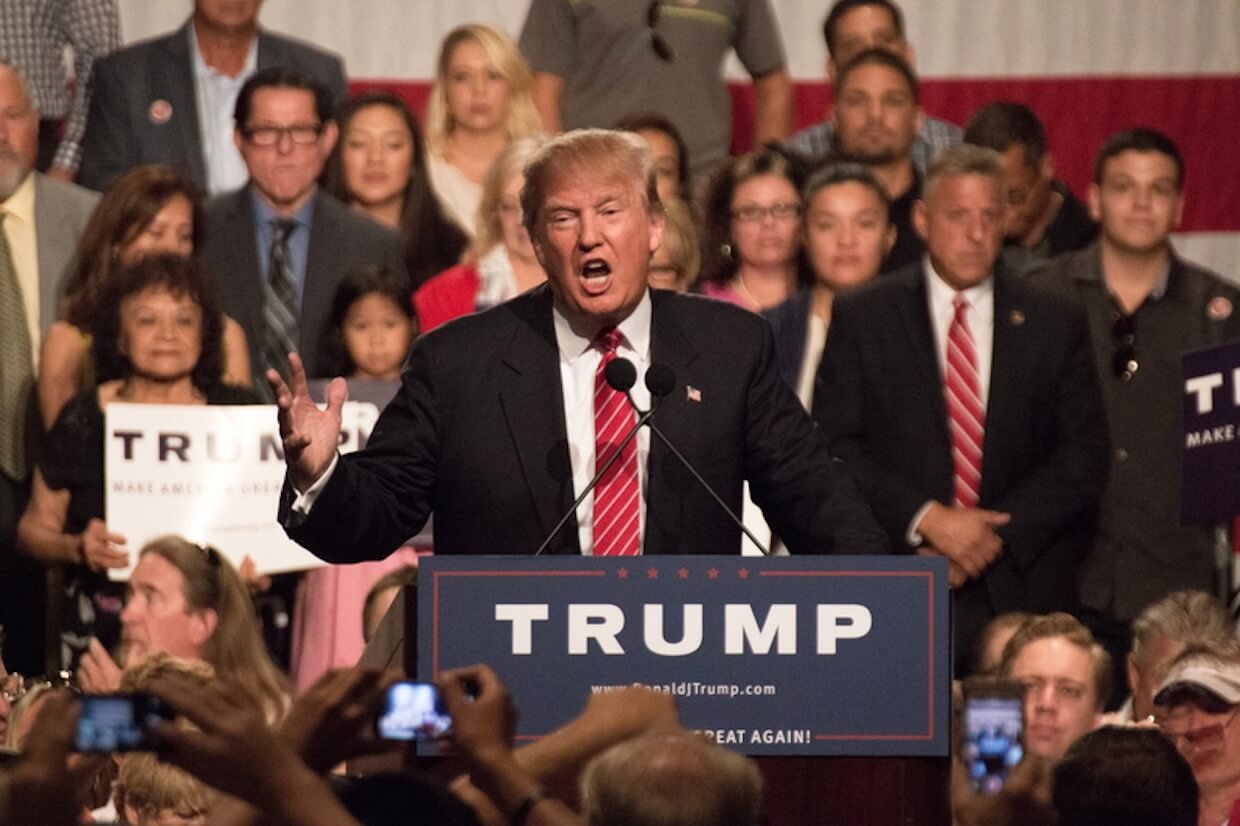
The United States, though formally committed to competitive primaries and elections with open political participation, exhibits its own dynastic patterns. The Kennedys, Bushes, Roosevelts, and Adams–each representing distinct political eras and ideological lineages—have used family name recognition, donor networks, and the symbolic capital of service and sacrifice to sustain their influence across generations (Hess, 2016; Feinstein & Masur, 2020). More recently, the Trump family’s growing presence within Republican politics underscores how populism, too, can potentially become dynastic, converting media visibility and brand identity into a new form of hereditary legitimacy (Saldin & Teles, 2020; D’Antonio, 2015). Trump may be the first modern president to combine outsider populism with explicit aspirations toward patrician and founder-level historical status. He attacks existing dynasties (Bush, Kennedy) yet simultaneously attempts to create a new one and to place himself in the symbolic lineage of Washington, Lincoln, and other nation-defining presidents such as Jackson and McKinley.
Across both democracies, the enduring appeal of dynastic politics reflects a paradox: voters simultaneously profess faith in meritocracy while responding to the familiarity, continuity, and symbolic legitimacy that political families provide (Besley & Reynal-Querol, 2011). Dynasties persist by drawing upon accumulated forms of capital—symbolic, financial, social, and emotional (Bourdieu, 1986)—yet their influence often weakens during periods of public disillusionment, corruption scandals, economic distress, or generational fatigue (Vaishnav, 2017). Dynastic politics thus functions as both a stabilizing and destabilizing force within democracy, embodying the tension between inherited privilege and democratic renewal.
Yet the counterpart to the dynastic heir is the political orphan or the outsider—the individual who possesses neither inherited status nor established networks of privilege. In many democracies, moments of political upheaval create opportunities for leaders whose authority derives not from lineage but from narratives of adversity, resilience, and personal struggle. Among the most striking of these figures are those who experienced significant childhood loss through parental death, family disruption, abandonment, or displacement. The Orphan Paradox proposed here, which constitutes our main thesis, suggests that early experiences of rupture may cultivate psychological characteristics—such as independence, ambition, resilience, and a heightened sensitivity to insecurity—that can later translate into political leadership.[2] Whereas dynastic leaders inherit political capital, orphan leaders are often compelled to construct it. Their biographies resonate with citizens who perceive themselves as marginalized, overlooked, or excluded from established systems of power. It allows outsiders, such as orphans, to speak for the people against the establishment, as is evident in recent years in the populist turn and the rise of amateur politicians. In this sense, the orphan and the heir represent two competing pathways to political legitimacy: one rooted in inheritance and continuity, the other in adversity and self-creation.
The Orphan Paradox describes the condition of loss: the absence of foundational support—whether parental, institutional, cultural, or even genetic—creates a dual trajectory. On one hand, it heightens vulnerability to instability, alienation, and maladaptive coping; on the other, it can spark remarkable resilience, innovation, and self-determined leadership. This paradox applies across multiple domains of human experience, from individual psychology to political systems and technological development (Sharma, 2026, 2025).[3]
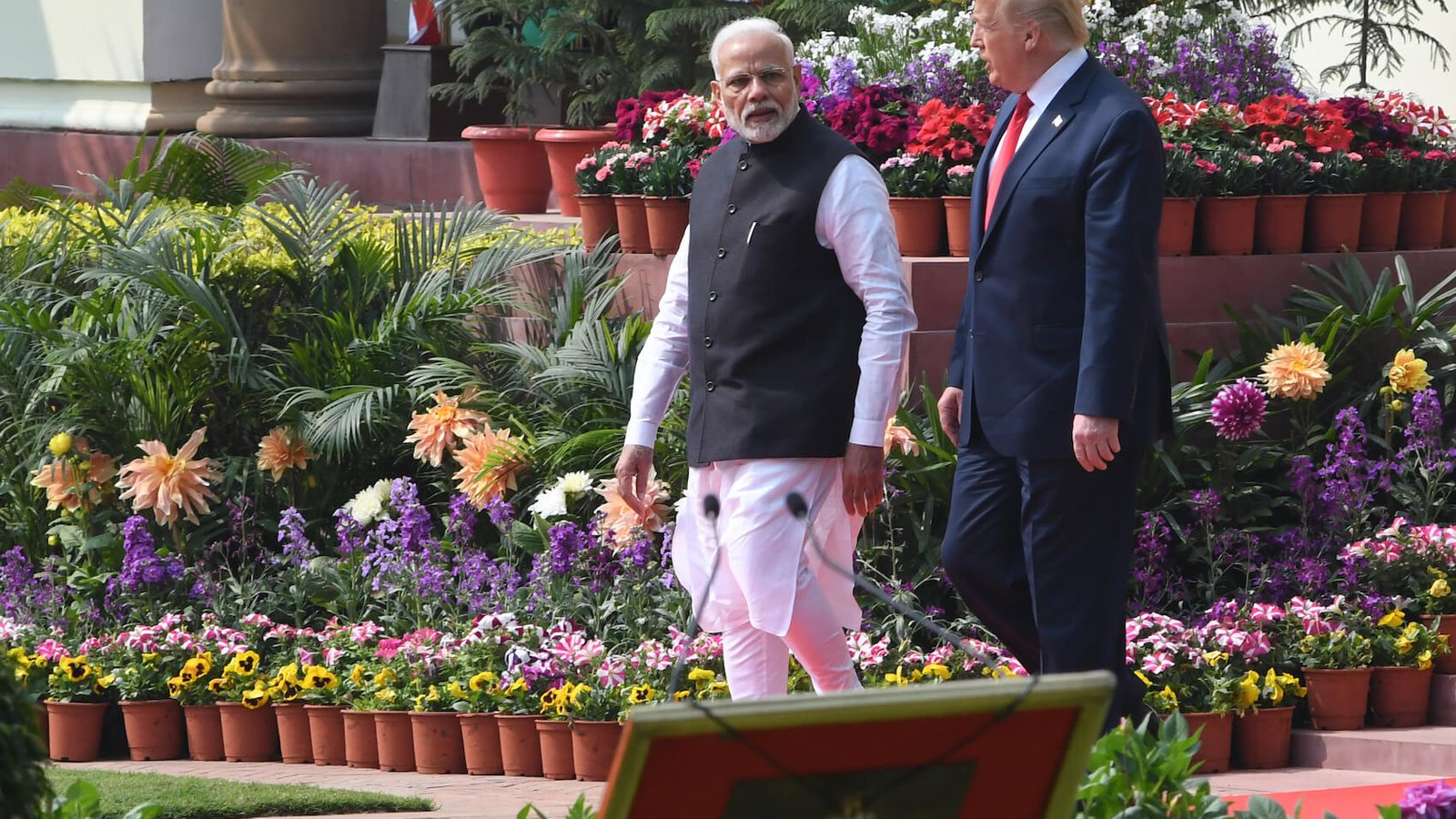
This paper examines these dynamics – the outsider and the heir, the orphan and the patrician – in two of the world’s largest and most populous democracies, India and the United States, both of which emerged from profound historical ruptures and continue to grapple with competing demands for continuity and change (Moffitt, 2016; Jaffrelot & Tillin, 2017). In particular, we connect the rise of Modi in India and Trump in the USA – two political populists, one of whom left home early as a teenager to seek spiritual renunciation and the other who carries the scars of a fraught relationship with his demanding and wealthy parents – with the current trend towards nationalists who take on corrupt elites on behalf of the people (Mudde & Kaltwasser, 2017). Ironically, while in both India and the USA, there is a turn away from the familiar, stable, dynastic family names, both Modi and Trump are examples of how populists position themselves as outsiders seeking to become establishment insiders by creating their own autocracies or dynasties.
[1] This paper in large part is adapted from the forthcoming book, The Orphan Paradox (Sharma, 2026), which presents a detailed psychocultural, historical, and political analysis of leadership cycles in India and the US. An earlier version of this paper was presented at the ECPS workshop on September 4. 2025. We thank Professor Akis Kalaitzidis for his comments on this paper and the book. We are also immensely grateful to Dr. Arturo G. Munoz, senior political scientist at RAND Corporation, Washington DC, for his commentary on this project. This paper was partly inspired by the contemporary rise of nationalism worldwide. An earlier version of the proposal was reviewed by Dr. Munoz, who suggested that the argument would benefit from a stronger engagement with current political developments. In particular, he encouraged a more explicit comparison between Narendra Modi and Donald Trump as contemporary leaders whose rise reflects broader global trends.
Parts of this paper were originally developed for an edited volume on WEIRD psychology, which critiques the overreliance on Western, educated, industrialized, rich, and democratic populations in psychological research (Joseph Henrich et al., 2010); the goal here is to show how democracy takes different forms in different contexts.
[2] For a full treatment of the underpinning of psychological, cultural, and political arguments, see the book, The Orphan Paradox (Sharma, 2026).
[3] The idea of the Orphan Paradox is interdisciplinary. First, developmental perspectives in leadership studies suggest that early experiences of trauma and loss can shape resilience, ambition, and identity formation over the life course. Work in political psychology and leadership analysis (e.g., Jerrold M. Post, 2003) highlights how formative adversity often informs leadership style and worldview. Second, my professional experience in the pharmaceutical sector exposed me to the concept of “orphan drugs” and “orphan markets,” terms institutionalized through policy frameworks such as the Orphan Drug Act. These refer to conditions or markets that lack early institutional support yet later become sites of innovation and intervention.
Please cite as: Sharma, Dinesh; Romagna, Britt; Lowenthal, Zara & Perez-Hosein, Jamilla. (2026). “Daughters of the Dynasties: Father-Daughter Succession in Asia and the United States.” Journal of Populism Studies (JPS). June 30, 2026. https://doi.org/10.55271/JPS000125
Abstract Why do some democracies consistently produce female national leaders from political dynasties while others—with equally prominent political families—do not? This article addresses this puzzle through a comparative analysis of father–daughter succession in South and Southeast Asia and the United States. Although both regions feature competitive electoral democracies, influential political families, and mass media politics, they have produced markedly different patterns of female executive leadership. While South and Southeast Asia has generated numerous female prime ministers and presidents from political dynasties, the United States has produced no comparable case of a daughter of a president ascending to the presidency. Drawing on psychohistory, political psychology, comparative politics, and gender studies, the article argues that populism assumes different institutional forms across democratic contexts. In much of South and Southeast Asia, populist politics frequently operates through dynastic legitimacy, allowing daughters to inherit symbolic authority from charismatic or martyred fathers. By contrast, American populism has historically defined itself against entrenched political dynasties, making hereditary succession a political liability rather than a source of democratic legitimacy. The analysis combines two complementary studies. The first compares patterns of political and corporate father–daughter succession across Asia and the United States, including contemporary comparisons such as Chelsea Clinton and Paetongtarn Shinawatra. The second presents a psychohistorical comparison of Indira Gandhi and Rosemary Kennedy, demonstrating how family socialization, gender norms, disability, political culture, and historical context shaped radically different life trajectories. The article concludes that female dynastic succession is shaped not by democracy alone but by the interaction of political institutions, populist narratives, patriarchal norms, historical memory, and elite family structures. By integrating comparative politics with psychohistory, it offers a novel framework for understanding how democracies construct legitimacy, political inheritance, and pathways to female executive leadership across cultures
Keywords:Populism, Political Leadership, Female Political Leadership, Political Dynasties, Leadership Succession, Gender and Politics, Political Psychology, Chelsea Clinton, Indira Gandhi, Rosemary Kennedy, India, United States, Paetongtarn Shinawatra, Thailand
By Dinesh Sharma, Britt Romagna, Zara Lowenthal & Jamilla Perez-Hosein
Introduction
During the late twentieth and early twenty-first centuries, South and Southeast Asia produced an unusually large number of female national leaders compared with global trends. Many of these women—including Indira Gandhi in India, Benazir Bhutto in Pakistan, Corazon Aquino in the Philippines, and Aung San Suu Kyi in Myanmar—emerged from powerful political dynasties as daughters, widows, or wives of assassinated, persecuted, or charismatic male leaders. Scholars argue that these women inherited symbolic legitimacy through family lineage, particularly in contexts where political parties and nationalist movements were deeply personalized around founding fathers and political martyrs (Richter, 1990; Derichs et al., 2011).
Paradoxically, patriarchal political cultures sometimes facilitated rather than prevented the rise of elite women leaders. Because these women were viewed through traditional gender roles—as mothers, daughters, or widows of the nation—they were often perceived as morally virtuous and less threatening than male rivals (Choi, 2015). This gendered moral capital enabled them to unify fragmented political movements and inherit charismatic authority from deceased or persecuted male relatives. In the case of Aung San Suu Kyi, for example, her identity as the daughter of Burmese independence hero Aung San provided symbolic continuity that strengthened opposition to military rule (Fleschenberg, 2008).
However, scholars also note that the same patriarchal structures that enabled women’s political ascent often constrained their authority once in power. Female dynastic leaders frequently faced military coups, assassination, corruption allegations, or resistance from male political elites who expected them to serve symbolic rather than executive roles. Moreover, many studies conclude that these leaders did relatively little to advance broader women’s rights or challenge patriarchal systems, often relying instead on traditional gender norms and dynastic legitimacy to maintain political authority (Blackburn, 2004; Jalalzai, 2013). Thus, the rise of female dynastic leaders in Asia illustrates the complex relationship between patriarchy, populism, political inheritance, and gendered legitimacy in democratic and postcolonial societies.
Research Question
Why are some democracies able to consistently produce powerful female leaders from political dynasties, while others exhibit a lack, or near absence, of national female leadership? Utilizing a quasi-experimental design and a naturalistic or qualitative methodology that examines the life histories of the daughters of national leaders in different democratic contexts—namely South and Southeast Asia and the United States—reveals important differences in how these political systems construct female power and authority (Mahoney & Thelen, 2010). Both regions contain large electoral democracies with mass political participation, modern media environments, and long traditions of competitive politics (Dahl, 1971). Yet, the trajectories of the daughters of national leaders differ strikingly across these settings, with many prominent female leaders emerging from South and Southeast Asian political systems (Jalalzai, 2013). This paper attempts to address this comparative difference by using a multi-method approach.
By contrast, daughters of US presidents have rarely entered formal political leadership. Figures such as Chelsea Clinton, daughter of Bill Clinton, and Ivanka Trump, daughter of Donald Trump, participated in political campaigns or held advisory roles, yet neither became a nationally elected leader. Despite the prominence of political families in the United States, dynastic succession through daughters has not produced a female president or equivalent national executive leader (Kazin, 1995; Lipset, 1996).
This contrast creates a useful naturally occurring comparative experiment. Both regions share electoral democracy and highly visible political families, yet they produce different outcomes in the political careers of daughters of national leaders. Examining these divergent life histories helps illuminate how political institutions, dynastic networks, gender norms, and populist narratives shape pathways to female national leadership (Mudde & Kaltwasser, 2017).
This commentary advances a critical intervention in debates on political persuasion by foregrounding original pilot research on communication and trust. Based on an online experiment with 322 UK participants, the study isolates the effects of communication style from semantic content by comparing responses to a still image, an untranslated video, and a subtitled populist message. The findings are striking: trust in political leaders is shaped more by audiovisual and paralinguistic cues—such as tone, gesture, and perceived authenticity—than by populist content itself. Notably, participants reported higher trust when exposed to communication they could not understand than when presented with translated political messaging. These results challenge conventional assumptions about persuasion and highlight the central role of communication form in shaping political judgement.
Public debate often assumes persuasion comes from ideology, populist rhetoric, or misinformation. When people worry about political manipulation, propaganda, or foreign interference, they usually focus on what is being said. Is a message false? Is it extremist? Is it conspiratorial? Is it anti-democratic?
Those questions matter. But they do not capture the full problem.
Political influence may depend as much on how messages are communicated as on what they say. In the digital attention economy, communication format, emotional cues, and presentation style shape political judgement. Citizens do not encounter political communication as detached analysts. They encounter it as viewers, listeners, social media users, and members of social groups, responding not only to claims and arguments but also to tone, confidence, visual presence, rhythm, repetition, and emotional force. Research has shown that falsehood spreads rapidly online, that emotional processing can increase belief in misleading information, and that anger can heighten partisan vulnerability to political misperceptions (Vosoughi et al., 2018; Martel et al., 2020; Weeks, 2015).
How Communication Shapes Trust Beyond Content
That matters not only for domestic politics but also for international politics. Strategic narratives research in IR has long argued that actors exercise power by shaping stories about who “we” are, what kind of crisis we face, and what political future is possible (Freedman, 2006; Miskimmon et al., 2013). Sharp power research has shown that authoritarian influence often works not through open persuasion alone but through manipulative, coercive, and opaque forms of projection that distort democratic information environments (Walker, 2018; Nye, 2018; Pinto, 2023). And scholarship on emotions in world politics has demonstrated that fear, resentment, nostalgia, pride, and humiliation are not peripheral to politics. They are part of how power works, both domestically and internationally (Hutchison & Bleiker, 2014; Valentino et al., 2011; Van Rythoven, 2021).
If this is right, then the key issue is not only whether citizens encounter false claims. It is how political messages are delivered, processed, remembered, and made to feel credible. That is where our pilot research becomes important.
Our pilot study, which serves as the basis for this commentary, examines how a political leader’s communication style shapes trust. In an online experiment, participants (322 UK residents) were exposed to three versions of the same political message, varying in communication richness: a still image of a (Romanian) political leader taken from a video (control condition), the video in Romanian without translation, and a subtitled version containing populist content. The aim was to disentangle the effects of visual and paralinguistic cues—such as tone, gestures, facial expressions, and emotional cadence—from those of semantic content. Put simply, the study asks whether people respond more to how a leader communicates than to what the leader actually says. It measures perceptions of the leader’s credibility, trustworthiness, appeal, and emotional impact, alongside relevant moderating variables.
Media Modality, Memory, and the Construction of Trust
The result is striking. Communication condition significantly affects trust in the candidate. Video with content but no meaning produces the highest trust, while the static picture produces the lowest. Trust in the leader is also higher when people are exposed to communication only (foreign language), compared to when they are exposed to the translated message. Just as importantly, perceptions of populism do not mediate trust in the speaker. Instead, trust appears to be shaped more by delivery cues—such as tone, credibility, authenticity, and leader appeal—than by populist framing alone.
This should make us stop and think.
A dynamic audiovisual performance can make a political figure appear stronger, more sincere, more persuasive, or more leader-like even when audiences cannot understand the words being spoken. A still image, by contrast, strips away much of what creates immediacy and emotional connection. This does not mean content is irrelevant. It means content is not the whole story. Political trust may be built through cues that sit alongside semantic meaning and sometimes outrun it.
The significance of this finding becomes even clearer when placed beside Kobayashi’s broader work on modality, memory, and political processing. The basic point is simple but important: people do not process text, still images, and video in the same way. Different media formats shape attention differently. They influence what is encoded, what is remembered, and what lingers as a political impression. Visual and multimedia formats can strengthen memory and recall, even when the content itself is weak, misleading, or only partly understood. This means that persuasion is not only about the literal content of a message. It is also about how the message enters cognition and what remains afterward.
That insight matters in domestic politics because democratic contestation now unfolds across short-form video, reels, clips, speeches, memes, livestreams, and highly personalized feeds. In such settings, communication style is not a surface feature. It becomes part of the mechanism through which trust is built. A leader who appears authentic may be granted credibility beyond the evidence. A speaker who appears forceful may seem persuasive even when the argument is thin. A compelling audiovisual fragment may leave a stronger impression than a detailed correction delivered later as plain text. Recent work also shows that democratic publics can become receptive to illiberal narratives under certain conditions, including aversion to protest and responsiveness to authoritarian framing (Kobayashi, Toriumi & Yoshida 2025; Kobayashi et al. 2025).
Strategic Narratives, Emotion, and the Transnational Politics of Influence
But this also matters for foreign policy and IR. Contemporary influence campaigns do not simply try to convince publics through formal argument. They work through strategic narratives, emotional resonance, symbolic performance, and technologically amplified circulation. States and state-aligned actors increasingly compete not only over territory, institutions, or material resources, but also over meaning, perception, and legitimacy. Public diplomacy, strategic communication, soft power, sharp power, and digital authoritarian influence all operate in this wider environment of mediated political judgement (Miskimmon et al., 2013; Walker, 2018; Nye, 2018; Roberts & Oosterom, 2025; NED, 2024).
The domestic and the international are not separate spheres here. They overlap through digital platforms, diasporas, transnational narratives, and emotionally charged content that travels across borders and is then reinterpreted in local settings. IR scholars have long argued that ideas, norms, and frames do not simply move intact from one place to another. They are localized, contested, adapted, and selectively internalized (Acharya, 2004; Wiener, 2008). That matters enormously today. A communication style that builds trust at home can also be effective abroad. A leader’s visual authenticity, emotional cadence, and symbolic performance can travel transnationally through clips, commentary networks, subtitled fragments, and influencer ecosystems. Narratives that appear domestic can be amplified internationally; narratives projected from abroad can be domesticated by local actors.
This is one reason why the distinction between domestic polarization and foreign influence is often less clear than policymakers assume. Influence is not just broadcast. It is processed through emotion, identity, memory, and media form. That is also why our broader scholarship has focused on how digital politics, civilizational narratives, and sharp-power dynamics travel through both domestic and transnational channels. Yilmaz and Morieson have shown how civilizational narratives are politically mobilized through crisis, victimhood, moral hierarchy, and claims of threatened identity (Yilmaz & Morieson, 2023; Yilmaz & Morieson 2025). Yilmaz and Shakil have shown that soft and sharp power do not circulate as neutral content but are received through affect, identification, and local meaning-making (Yilmaz & Shakil, 2025). Yilmaz, Bliuc, Betts, and Morieson (2025) have argued that foreign interference can remain hidden in plain sight when it works through sharp power rather than obvious coercion.
The same is true of the work by Bliuc and Betts on online communities, identity, cohesion, and polarization. Bliuc and colleagues have shown how online communities intensify collective identity, emotional alignment, and hostility under certain socio-political conditions (Bliuc et al., 2019; Bliuc et al., 2020; Bliuc, Smith, and Moynihan 2020). Betts and Bliuc have shown how influencers can shape polarization dynamics, and later work by Betts, Bliuc, and Courtney extends this to charismatic digital actors (Betts & Bliuc 2022; Betts et al., 2025). Taken together, this body of scholarship suggests that political persuasion operates through social context, emotional cues, memory, and communication form, not simply ideological content.
Rethinking Persuasion: Trust, Media Form, and Democratic Resilience in the Digital Age
That is why the pilot matters for IR as much as for political psychology. It offers a small but important piece of evidence about a much larger problem: how trust is manufactured in mediated politics. If citizens can form more trusting evaluations of a political figure from audiovisual performance even when they do not understand the message itself, then we need to rethink what persuasion means in a digital and internationalized public sphere.
The implications are significant.
First, media literacy needs to move beyond the simple binary of true versus false. Citizens need tools to ask harder questions: Why does this message feel persuasive? Why does this speaker seem credible? What role is tone playing in my judgement? What is the visual format doing to my attention and memory? What impression is being created before I have even evaluated the substance of the claim?
Second, policymakers need to treat communication form as a matter of democratic resilience and national security, not merely as a media issue. If audiovisual style can shape trust independently of content, then strategies to counter misinformation and foreign interference cannot focus only on debunking claims after the fact. They must also address the affective and cognitive mechanisms through which trust is built in the first place. This is particularly relevant in democracies facing sustained information pressure from domestic polarization, transnational propaganda, and digitally enabled authoritarian influence. Democratic resilience is not only about institutional robustness. It is also about how citizens process and evaluate political communication under conditions of emotional and informational strain (Lieberman et al., 2021).
Third, IR needs to take communication psychology more seriously. Strategic narratives are not only elite texts. They are delivered through media systems, performances, visual formats, emotional triggers, and infrastructures of circulation. Sharp power does not only manipulate facts; it manipulates the conditions under which facts are judged, remembered, and trusted. Foreign policy analysis, therefore, needs to pay closer attention to modality, cognition, affect, and platformed attention. A narrative that fails as a written claim may succeed as a clip. A weak argument may become potent when fused with charisma, symbolism, and repetition. In an age of generative AI, synthetic media, and personalized feeds, these questions will only grow more urgent (NED, 2024; Roberts & Oosterom, 2025).
Conclusion: Hidden in Plain Sight
To support democratic resilience, countering disinformation requires more than factchecking. Democracies must address how political messages influence cognition and emotion. Research priorities should include identifying communication formats that increase susceptibility, understanding how trust is shaped by nonverbal and audiovisual cues, and designing interventions that strengthen public resilience without drifting into censorship or paternalism. That is not only a domestic challenge. It is also a foreign policy challenge, because contemporary influence operations work precisely by blurring the line between internal debate and external manipulation.
The key question is no longer simply, “What messages are citizens exposed to?” It is, “How are those messages delivered and processed?”
If we fail to ask that question, we will continue to underestimate how persuasion works in contemporary politics. And if we continue to treat manipulation only as a problem of obvious lies, we will miss the subtler but often more effective techniques that shape trust, memory, and judgement in plain sight.
Funding: This work was supported by the Australian Research Council [ARC] under Discovery Grant [DP220100829], Religious Populism, Emotions and Political Mobilisation and ARC [DP230100257] Civilisationist Mobilisation, Digital Technologies and Social Cohesion.
(*) Professor IhsanYilmaz is Research Professor of Political Science and International Relations, Research Chair in Islamic Studies and Intercultural Dialogue, and Deputy Director at the Deakin Institute for Citizenship and Globalization, Deakin University, Australia. He is a leading scholar of authoritarianism, civilizational populism, digital authoritarianism, political Islam, and transnationalism. His recent research examines the diffusion of authoritarian practices, the weaponization of civilizational narratives, and the emotional and cognitive effects of disinformation in democratic and hybrid regimes.
(**) Dr. Ana-Maria Bliuc is an Associate Professor of Social and Political Psychology in the School of Humanities, Social Sciences and Law at the University of Dundee. She joined Dundee in 2019 after holding academic positions at Western Sydney University, Monash University, and the University of Sydney. Her research examines the role of social identity in shaping behavior across health, environmental, and socio-political contexts, including collective action, social change, and political polarization. More recently, her work has focused on online communities and digital environments, investigating how collective identities and behaviors are formed, sustained, and transformed through online interaction.
(***) Dr. John Betts is a Senior Lecturer in the Faculty of Information Technology at Monash University, Australia. He specializes in computational modelling, optimization, simulation, and data science, with applications across the social sciences, health, and industry. His research focuses on understanding complex systems, variability, and resource allocation, and he has contributed to interdisciplinary work on political polarization, online behavior, and agent-based modelling, alongside projects in areas such as medicine and manufacturing.
(****) Dr. Tetsuro Kobayashi is a Professor in the School of Political Science and Economics at Waseda University, Japan. He holds a PhD in Social Psychology from the University of Tokyo. Before joining Waseda University in 2023, he held academic positions at the National Institute of Informatics and City University of Hong Kong and was also a visiting researcher at Stanford University. His research lies at the intersection of political communication, political psychology, and public opinion, with a particular focus on how media environments shape political attitudes and behavior. His work has been published widely in leading journals across political science, communication, and psychology.
References
Acharya, A. (2004). “How Ideas Spread: Whose Norms Matter? Norm Localization and Institutional Change in Asian Regionalism.” International Organization. 58(2): 239–275.
Betts, B. and A.-M. Bliuc. (2022). “The Effect of Influencers on Societal Polarization.” Proceedings of the Winter Simulation Conference.
Betts, J. M.; A.-M. Bliuc and D. S. Courtney. (2025). “The Effect of Charismatic Influencers on Polarization Online: An Agent-Based Modeling Approach.” Technology in Society.
Bliuc, A.-M.; J. Betts; M. Vergani; M. Iqbal and K. Dunn. (2019). “Collective Identity Changes in Far-Right Online Communities: The Role of Offline Intergroup Conflict.” New Media & Society, 21(8): 1770–1786.
Bliuc, A.-M.; J. M. Betts; N. Faulkner; M. Vergani; R. J. Chow; M. Iqbal and D. Best. (2020). “The Effects of Local Socio-Political Events on Group Cohesion in Online Far-Right Communities.” PLOS ONE, 15(3): e0230302.
Bliuc, A-M.; L. G. E. Smith and T. Moynihan. (2020). “‘You Wouldn’t Celebrate September 11’: Testing Online Polarisation Between Opposing Ideological Camps on YouTube.” Group Processes & Intergroup Relations, 23(6): 827–844.
Freedman, L. (2006). The Transformation of Strategic Affairs. London: Routledge.
Hutchison, E. and R. Bleiker. (2014). “Theorizing Emotions in World Politics.” International Theory, 6(3): 491–514.
Kobayashi, T.; F. Toriumi and M. Yoshida. (2025). “Cross-Ideological Acceptance of the Illiberal Narrative of the 2019 Hong Kong Protests in Japan: Aversion to Protests as a Key Facilitator.” Chinese Journal of Communication.
Kobayashi, T.; Y. Zhou; L. Seki and A. Miura. (2025). “Autocracies Win the Minds of the Democratic Public: How Japanese Citizens Are Persuaded by Illiberal Narratives Propagated by Authoritarian Regimes.” Democratization. 32(6): 1474–1495.
Lieberman, R. C.; S. Mettler and K. M. Roberts, eds. (2021). Democratic Resilience: Can the United States Withstand Rising Polarization? Cambridge: Cambridge University Press.
Martel, C., G. Pennycook and D. G. Rand. (2020). “Reliance on Emotion Promotes Belief in Fake News.” Cognitive Research: Principles and Implications, 5(1): 47.
Miskimmon, A.; B. O’Loughlin and L. Roselle. (2013). Strategic Narratives: Communication Power and the New World Order. New York: Routledge.
National Endowment for Democracy (NED). (2024). Manufacturing Deceit: How Generative AI Supercharges Information Manipulation.
Nye, J. S. Jr. (2018). “How Sharp Power Threatens Soft Power.” Foreign Affairs, January 24.
Pinto, J. F. (2023). “Populist Sharp Power: How the World Entered in a New Cold War.” In: Politics Between Nations.Cham: Springer.
Roberts, T. and M. Oosterom. (2025). “Digital Authoritarianism: A Systematic Literature Review.” Information Technology for Development, 31(4): 860–884.
Valentino, N. A.; T. A. Brader; E. W. Groenendyk; K. Gregorowicz and V. L. Hutchings. (2011). “Election Night’s Alright for Fighting: The Role of Emotions in Political Participation.” Journal of Politics, 73(1): 156–170.
Van Rythoven, E. (2021). “A Feeling of Unease: Diasporas, Emotions, and Security.” International Political Sociology, 15(2): 187–204.
Vosoughi, S.; D. Roy and S. Aral. (2018). “The Spread of True and False News Online.” Science, 359(6380): 1146–1151.
Walker, C. (2018). “What Is ‘Sharp Power’?” Journal of Democracy, 29(3): 9–23.
Weeks, B. E. (2015). “Emotions, Partisanship, and Misperceptions: How Anger and Anxiety Moderate the Effect of Partisan Bias on Susceptibility to Political Misinformation.” Journal of Communication, 65(4): 699–719.
Wiener, A. (2008). The Invisible Constitution of Politics: Contested Norms and International Encounters. Cambridge: Cambridge University Press.
Yilmaz, I.; A.-M. Bliuc; J. Betts and N. Morieson. (2025). “Foreign Interference Can Be Hidden in Plain Sight: Here’s How Countries Use ‘Sharp Power’ in Australia.” The Conversation.
Yilmaz, I. and K. Shakil. (2025). Reception of Soft and Sharp Powers: Turkey’s Civilizational Populist TV Dramas in Pakistan. Singapore: Springer.
Yilmaz, I. and N. Morieson, eds. (2023). Religions and the Global Rise of Civilizational Populism. Singapore: Springer.
Yilmaz, I. and N. Morieson. (2025). Weaponizing Civilizationalism for Authoritarianism: How Turkey, India, Russia, and China Challenge Liberal Democracy. Singapore: Springer.
Please cite as: Al-Sheikh Daoud, Emad Salah & Al-Dahlaki, Khudhair Abbas. (2026). “French Court Ruling Convicting Marine Le Pen: Implications for the Future of the Far Right in France.” Populism & Politics (P&P). European Center for Populism Studies (ECPS). March 26, 2026. https://doi.org/10.55271/pp0052
Abstract This article examines the political and institutional repercussions of the French court ruling convicting Marine Le Pen, leader of the National Rally, of embezzling public funds and barring her from holding public office. Using a case study approach, the study analyzes how the verdict reshapes the trajectory of the French far right, the internal dynamics of the National Rally, and broader debates on judicial independence and democratic legitimacy. It explores competing interpretations of the ruling—as either a manifestation of rule-of-law accountability or an instance of political targeting—while assessing its impact on public opinion and electoral prospects ahead of the 2027 presidential election. Drawing on polling data and political reactions, the article argues that the ruling may paradoxically reinforce populist narratives of victimhood in the short term, even as it introduces strategic uncertainty for the party’s future leadership. Ultimately, the study highlights the tension between legal accountability and symbolic politics, positioning the case as a critical moment in the evolution of contemporary European populism.
Keywords: French judiciary, National Rally, Marine Le Pen, Jordan Bardella, European Parliament, Populism, Far-right politics, Political polarization, Rule of law
Marine Le Pen, leader of the far-right National Rally party in France, has long been a controversial figure in French and European politics. Since succeeding her father, Jean-Marie Le Pen, as party leader, the party has seen its presence grow in the political and media landscape, even making gains in French legislative elections and European Parliament elections. It now holds the largest bloc in the National Assembly (the French lower house), and Marine Le Pen herself reached the second round of the French presidential elections, facing President Emmanuel Macron in both 2017 and 2022.
However, qualification for the second round of the presidential election did not prevent Marine Le Pen and 12 members of her party from being convicted of embezzling public funds by the Paris Criminal Court on March 3, 2025. The total damage was estimated at approximately €2.9 million, relating to funds from the European Parliament that were used to pay individuals who were in fact working for the far-right party. The French judiciary ruled that Le Pen would be barred from running for public office for five years, effectively preventing her from contesting the 2027 presidential election. She was also sentenced to four years in prison, two of which are to be served under electronic monitoring.
The significance of this research lies in its analysis of the repercussions of the French court’s decision to convict Marine Le Pen on France’s social and political landscape. It examines how major judicial rulings shape the trajectory of political parties—particularly the party under study—and how French public opinion responds to such decisions. In doing so, the study adds an important dimension to understanding the relationship between the judiciary and politics in democratic systems.
Research Objective
This research aims to analyze the details of the conviction issued by the French judiciary, its repercussions for the political and personal future of the leader of the National Rally (RN), and to assess the impact of this decision on the party’s popularity and political discourse, particularly in the context of preparations for upcoming elections.
Research Problem
This research seeks to address the central question: “Was the French court’s decision influenced by hidden political pressures, or was it a fully independent judicial ruling based solely on legal evidence?”
To explore this, the study further examines two sub-questions: How independent is the judiciary in cases with clear political dimensions? And how do such decisions shape public trust in judicial institutions?
Research Hypothesis
The main hypothesis of this research is that the popularity of the National Rally will not decline significantly and may even increase among certain groups. This is based on the possibility that the party’s supporters may interpret the decision as part of a “political conspiracy” against them, thereby reinforcing the cohesion of their base and strengthening loyalty to the party and its leadership.
Research Methodology
The topic will be studied using the case study method in dissecting the details of the French court’s decision and its political repercussions.
The Origins and Ideology of the National Rally and Its Political Role
France is the home of the emergence of extreme right-wing movements and parties. One of the repercussions of the French Revolution was the emergence of forces and figures who adopted radical visions, positions and policies accompanied using armed violence and repression against opponents. This led to the division of political forces into a right–left dichotomy, which has persisted and become deeply entrenched in shaping the French political system across all historical periods up to the present.
In this regard, Article (4) of the French Constitution issued on October 4, 1958, specifies the function of political parties: “Political parties and groups participate in the exercise of the right to vote. They are formed and carry out their activities freely. They must respect the principles of national sovereignty and democracy. The laws guarantee the right to express different opinions and the fair participation of political parties and groups in the democratic life of the nation,” (French Constitution, 1958). The freedom of formation and exercise granted to them by the Constitution did not prevent successive governments from banning small local or national extremist parties, whether right-wing or left-wing.
The National Rally, previously known as the National Front, has been—and remains—a controversial and divisive force in the French political scene due to its extreme right-wing ideology, ideas, and programs, as well as the political influence and personal charisma of its founder, the late Jean-Marie Le Pen, and his daughter and successor, party leader Marine Le Pen, along with the political and media discourse they have advanced. Therefore, the party can be regarded as a significant and influential actor in France’s political, social, and cultural landscape.
The National Rally is widely regarded as one of the most successful right-wing populist parties and a source of inspiration for similar movements across Europe, having achieved notable gains both domestically in France and in European Parliament elections. The party has undergone several phases of development and political influence, which can be broadly divided into two main periods. The first is the founding phase, led by its founder Jean-Marie Le Pen, beginning with the party’s establishment in 1972 and lasting until 2011, when leadership passed to his daughter, Marine Le Pen.
This initial period saw significant transformations in the party’s orientation, organizational structure, and political activity, alongside growing electoral success at both national and European levels. Marine Le Pen’s rise to the presidency not only resolved internal leadership questions but also clarified the party’s future direction. Her leadership strengthened the party’s effectiveness, improved its public image, and facilitated its integration into the French political mainstream. Moreover, the party expanded its agenda beyond security and immigration, presenting itself as a credible alternative to governing parties rather than merely a source of political disruption (Ivaldi & Maria Elisabetta, 2016: 138).
Marine Le Pen’s first task after being elected party leader was to implement a “de-demonization” agenda aimed at shedding the party’s far-right image and enhancing its credibility. However, the changes introduced also reflected the continuation of a dynastic model of leadership characterized by strong centralization and hierarchical organization. Marine Le Pen capitalized on this transformation, particularly through media and social media engagement—appearing frequently on television and radio—to reshape the party’s ideological discourse and adopt a more “populist,” or at least “neo-populist,” orientation.
The party increasingly positioned itself as a defender of “the people” against globalization, outsourcing, and mainstream parties such as the Union for a Popular Movement and the Socialist Party, which it accuses of betraying the public (François, 2014: 52–53). At the same time, it has been argued that Marine Le Pen’s populism also reflects resistance to sharing welfare benefits, perceived by supporters as hard-won entitlements (Marcus, 1995: 105).
The ideology, policies, and programs of the National Rally are based on several key principles, most notably:
Emphasis on national identity: The party highlights the perceived existential threat to French identity posed by foreigners and immigrants. This threat is framed as coming from two directions: historically from the east, associated with communist ideology in the former Soviet model, and from the south, associated with what is described as an Islamic threat (Marcus, 1995: 103).
National preference: A fundamental element of its economic doctrine, “national preference” prioritizes French citizens in access to limited state resources such as healthcare, housing, and social welfare benefits (Marcus, 1995: 103).
Foreign and security policy vision: The party’s outlook is grounded in the idea that France has a unique global mission. It advocates restoring national independence and prioritizing French national interests, arguing that relations with European Union should not come at the expense of sovereignty and that ties with the United States should remain balanced.
Rejection of globalization and market liberalization: The party views the ideology of globalization as an embodiment of the hegemony of a global superpower, particularly the United States. At the same time, despite elements of neoliberal rhetoric and some criticism of the welfare state, “the party adopts a pro-market liberal economy and combines traditional left-wing themes of social and economic protectionism and anti-globalization with strong working-class appeal” (Ivaldi & Elisabetta, 2016: 17).
Regarding the electoral performance of the National Rally, since its founding, the party has participated in all elections for the National Assembly (Parliament/Lower House) and the European Parliament, aiming to consolidate its presence on the political scene. However, it was unable to surpass the 5% threshold required for entry into the National Assembly during the 1970s and until the mid-1980s, as it remained in a formative stage, seeking to attract and persuade different segments of French society of its political project and socio-economic program.
At the same time, the French party system was characterized by strong polarization and competition between two major blocs—the right and the moderate left—which by the mid-1980s had shifted toward the ideological center, limiting the party’s electoral gains. The number of seats the party won in the 2017 elections was insufficient to form a parliamentary group, as the rules of the National Assembly require at least fifteen deputies, with groups playing a central role in parliamentary organization and committee formation.
In the 2022 legislative elections, however, the National Rally achieved a major breakthrough, securing 17.30% of the vote and forming, for the first time, a significant parliamentary bloc with 89 seats (Al-Dahlaki, 2024: 250).
In French presidential elections, and in the context of demonstrating the strength and popularity of the party and his ambitions as the party’s leader, Jean-Marie Le Pen participated in several electoral cycles and achieved notable gains. Most prominently, in the 2002 election, he secured an unprecedented result with 16.9% of the vote, advancing to the second round against Jacques Chirac, which he ultimately lost, receiving 17.8% of the total vote. This outcome was described as a political earthquake and a wake-up call for moderate French political forces, underscoring the need to unite against the far right. At the time, many voters resorted to “punitive voting,” supporting Chirac despite reservations (Shields, 2007: 196).
In the 2012 presidential election, opinion polls indicated that Marine Le Pen was a serious contender, though she did not advance to the runoff. She ran again in 2017, reaching the second round, where she faced Emmanuel Macron, who won with 65.82% of the vote compared to her 34.18% (Nordstrom, 2017). In the 2022 presidential election, she once again reached the second round but was defeated by Macron, despite achieving the highest result for a far-right candidate under the Fifth Republic, established in 1958. Macron received 58.5% of the vote, compared to 41.5% for Le Pen (Al-Dahlaki, 2022).
In this regard, we refer to the accusation leveled by President Emmanuel Macron against Marine Le Pen during the televised debate ahead of the 2017 presidential elections, when he accused her of “financial subservience and dependence on Putin’s broader project, and submission to values that are not our own.” This allegation stemmed from a loan Le Pen obtained from the First Czech-Russian Bank, which she denied (Vie Publique, 2017). The National Rally party also reportedly received a loan of eight million euros from Laurent Foucher, a French businessman with investments in the Republic of Congo. These funds were channeled through the UAE-based financial company Noor Capital and deposited into the party’s accounts at the end of June 2017, shortly before being transferred to Le Pen’s presidential campaign account (Laske & Turchi, 2019).
It is also worth noting that French prosecutors questioned billionaire Pierre-Édouard Stérin in June 2024 as part of an ongoing investigation into campaign finance violations linked to the National Rally. According to the Marseille prosecutor’s office, the inquiry concerns loans totaling 1.8 million euros granted to several party candidates for the 2020 municipal and 2021 regional elections, including in major cities such as Lyon and Nice. In parallel, the European Public Prosecutor’s Office has opened an investigation into alleged misuse of funds by the now-defunct Identity and Democracy group in the European Parliament, of which the National Rally was a member (Goury-Laffont & Solletty, 2025).
It is also worth noting that French prosecutors questioned a French billionaire in June 2024 who was allegedly seeking to use his wealth to promote a radical liberal and anti-immigrant agenda, as part of an ongoing investigation into campaign finance violations involving the National Rally party. The Marseille prosecutor’s office stated that it had questioned Pierre-Edouard Sterin, a media mogul who made his first millions with the gift card company Smartbox.
The questioning formed part of an investigation into loans totaling 1.8 million euros granted to several National Rally candidates to finance campaigns in the 2020 municipal and 2021 regional elections, including in major cities such as Lyon and Nice. In parallel, the European Public Prosecutor’s Office has launched an investigation into alleged misuse of funds by the now-defunct Identity and Democracy group in the European Parliament, of which the National Rally was a member (Goury-Laffont & Solletty, 2025).
Details of the European Funds Embezzlement Case
In a French court ruling considered by political and media circles to be a political earthquake with far-reaching repercussions on the French political scene, and potentially even at the European Union level, the French judiciary issued a verdict convicting Marine Le Pen of embezzling public funds. The court also ruled to disqualify her from running for office, with the sentence to be carried out immediately. Alongside Le Pen, the Paris court convicted eight other members of the European Parliament from her party in connection with the same case. As a result, Le Pen will, most probably, be unable to run in the upcoming presidential elections. The court estimated the total damage at €2.9 million, as the European Parliament was charged with the costs of individuals who were effectively working for the far-right party. Although her seat in the French parliament will not be threatened, Marine Le Pen may be barred from running in the 2027 presidential election. This follows the confirmation of her political disqualification, which will be enforced immediately (Le Monde, 2025).
Le Pen’s National Rally received money from the European Parliament for parliamentary assistants who were working either partially or wholly in favor of the party. These allegations, relating to the years 2004 to 2016, have haunted Marine Le Pen and her party for years. The total number of defendants in the case is 28. The amount of money involved is approximately €7 million ($7.3 million). Le Pen repaid €330,000 to the European Parliament in 2023; however, her party insisted that this was not an admission of wrongdoing.
A conviction for Le Pen would have serious consequences. The prosecutor requested a five-year ban from holding public office if she were found guilty, which would effectively end her hopes of running again in the 2027 presidential election. The prosecution also called for the sentence to be applied immediately, not only after a legally binding ruling from a higher court. The investigation into the case began in 2015, involving the National Rally’s head of personnel along with 24 other members, and extended to contracts for political aides between 2004 and 2016. It also included figures such as an assistant and a secretary of Marine Le Pen who received their salaries from recruitment bonuses under false and fabricated pretexts (Eremnews, 2025).
As part of the campaign targeting the National Rally, on July 9, 2025, French authorities raided the headquarters of the National Rally as part of a major investigation into whether the party violated campaign finance laws during the last election. Prosecutors said the investigation, which began the previous year, is examining whether the party partially financed its campaigns through illegal loans between January 1, 2020, and July 12, 2024.
Party leader Jordan Bardella confirmed this on platform X, stating that the National Rally headquarters, “including the offices of its leaders,” had been searched. Bardella described the raids as “unprecedented” and “a serious attack on pluralism,” although several other party headquarters in France have been raided in recent years, including those of the center-right Republicans and the far-left France Unbowed. He added that “emails, documents, and accounting records belonging to the party” were confiscated, and later claimed in a subsequent post on X that the investigations were based on “a vague, undefined criminal offense” and were politically motivated (Jory-Lafont, 2025).
Echoes and Reactions to the Court’s Decision
Reactions to the French court’s decision varied and were marked by a clear division between those who supported and endorsed the ruling and those who condemned and rejected it, describing it as political targeting aimed at preventing Marine Le Pen from running in the 2027 presidential elections. This division was not confined to the French political and media scene but extended to differing positions among far-right leaders in Europe and the United States, as well as the Russian stance on the matter. We will review these positions as follows:
The Positions of Marine Le Pen and the National Rally
Marine Le Pen appeared in a television interview hours after the verdict, during which she commented on the ruling. Speaking on TF1, she demanded a swift appeal hearing and affirmed that she would not retire from politics, describing the verdict against her as a “political decision.” “I will not allow myself to be eliminated in this way,” she declared, referring to practices she believed were “the preserve of authoritarian regimes.” In a hearing before the National Assembly the following day, she asserted that the judiciary had used a “nuclear bomb” to prevent her from winning the 2027 presidential election.
Jordan Bardella, the leader of the National Rally and a potential replacement for Le Pen in the 2027 presidential election, said the court had “sentenced French democracy to death.” Bardella called for popular protests, stating, “Through our peaceful mobilization, let us show them that the will of the people is stronger.”
The Positions of French Political Actors
Regarding political actors’ positions on the ruling, they were varied and divided between those who considered it a purely judicial decision and others who viewed it as an unprecedented political targeting of a political figure. Sources close to the right-wing French Prime Minister Francois Bayrou reported that he expressed his “displeasure” with the ruling, although his entourage added that he does not intend to comment publicly on the court’s decision. Bayrou had previously been tried for defrauding European Parliament assistants, who were suspected of actually working for the MoDem party, and was acquitted in February 2024.
Former French President Francois Hollande stated that the “only response” to the condemnation of Marine Le Pen was “to respect the independence of the judiciary,” adding that “it is unacceptable in a democratic system to attack judges and the court.” Following Le Pen’s conviction, the Socialist Party issued a press release calling for “respect for the independence of the judiciary and the rule of law” (Henley, 2025).
Jean-Luc Melenchon, leader of the far-left France Unbowed party, stated in a television interview following Marine Le Pen’s conviction: “The decision to dismiss an elected official should be in the hands of the people” (Le Monde, 2025).
External Reactions and Positions
Several leaders and heads of far-right parties in the European Union and the United States have expressed anger and condemnation over the French court’s decision, describing the ruling as politically motivated and personally targeting Marine Le Pen. In any case, the sympathetic and supportive reactions toward Le Pen are likely to remain limited to media appearances, social media posts, and press conferences. Among these reactions are:
Leaders of far-right European parties have declared their support for Marine Le Pen, including Hungarian Prime Minister Viktor Orban, who expressed his solidarity by writing “Je suis Marine!” on platform X. Geert Wilders, leader of the Dutch far-right Party for Freedom (PVV), also expressed his shock at what he described as an extremely harsh sentence (Le Point, 2025). Meanwhile, Matteo Salvini, leader of the far-right League party and Italy’s deputy prime minister, considered the ruling a declaration of war from Brussels and a conspiracy by leaders of EU institutions, stating that “the exclusion of individuals from the political process is particularly troubling in light of the aggressive and corrupt legal battle being waged against President Donald Trump.”
In the United States, billionaire Elon Musk said that the decision to prevent Marine Le Pen from running “will backfire,”adding: “When the radical left cannot win through democratic voting, it uses the judicial system to imprison its opponents. This is how it operates all over the world.”
As for the Russian position, it was reflected in a statement expressing regret over what was described as a violation of democratic standards. Kremlin spokesman Dmitry Peskov stated that a growing number of European capitals are moving toward “a violation of democratic standards,” while also describing the ruling as a French internal matter (Mediapart, 2025).
Strategic Options for Marine Le Pen and the National Rally
Marine Le Pen announced that she would not give up and would appeal the decision, while working to garner support from her followers and political forces opposed to the ruling. Simultaneously, she planned a media campaign and public mobilization to pressure the judiciary to reverse its decision. Le Pen reiterated this in her address to the French National Assembly, stating that the French people would not accept the verdict. Indeed, her party organized demonstrations in several French cities.
A potential appeal to the Court of Cassation could be decided within six months. With the presidential elections approaching in mid-April 2027, approximately five to six months would remain. However, the chances of overturning the verdict before the presidential elections are slim. Le Pen’s problem lies in the fact that there is no real guarantee that the Court of Appeal will reach a different conclusion than the lower court. However, theoretically, there are three possible outcomes:
The first option is acquittal on appeal. However, given the well-documented nature of the system in question, achieving this outcome would be difficult. The second, and more plausible, option is that the appeals court reduces the period of ineligibility to one and a half or two years. Since this period would run from the date of the lower court’s decision, it could expire in time for her to meet the eligibility requirements for candidacy. The third option is that the lower court’s ruling is upheld—the likelihood of the appeals judges refraining from imposing ineligibility is low, as, under existing jurisprudence, disqualification from holding office is typically imposed in similar cases (Schmitt-Leonard, 2025).
The Paris Court of Appeal confirmed that it had received three appeals against the decision issued by the Paris Court of Justice and stated that it would examine the case “within a timeframe that allows for a decision in the summer of 2026.” If these deadlines are met, the decision will therefore be issued several months before the 2027 presidential election. The party’s lawyer also announced that he had filed an appeal on behalf of the party and its former treasurer (Wallerand de Saint-Just, 2025).
The Impact of the Decision on Le Pen’s Popularity and Presidential Prospects
Following the French court ruling, there is a possibility of increased public support for the party in the short term. This is because what occurred aligns closely with the National Rally’s narrative that the populist right is a victim of “the system.” It is likely that many of those who voted for the party do not seriously blame Marine Le Pen for the illegal funding of her party with money from the European Parliament, for which she was convicted. It is widely perceived that many French political parties have, at times, resorted to similar practices.
Similarly, her “harsh” punishment—the ban on running for president—may be interpreted as a badge of honor, reinforcing the idea that she is the only one standing up to the establishment. In the long run, however, this level of support may diminish, especially if Marine Le Pen fails to prove her innocence (Schofield, 2025).
The results of polls conducted by various media outlets and polling centers regarding Marine Le Pen’s popularity and chances of running for president varied as follows:
Marine Le Pen tops the list of political figures with whom the French feel the most sympathy, with an approval rating of 37%, according to an Odoxa poll conducted by the Mascaret Institute for the Senate and the regional press. A majority of the French do not believe she received special legal treatment: 53% felt she was treated “like any other person subject to the law,” according to the same poll.
Around 24% of the French (and 25% of National Rally supporters) even view the situation as an opportunity for the party, as it could allow it to turn the page on Le Pen. In this context, Jordan Bardella has entered the race for the Élysée Palace. The young MEP also surpasses Le Pen in popularity: 31% of the French prefer him to Marine Le Pen, a figure that rises to 60% among National Rally supporters.
Nearly one in two French people (49%), a 7-point increase in one month, want Marine Le Pen to be a candidate in the next presidential election, according to a poll conducted by Ifop-Fiducial for Sud Radio. On the other hand, 51% of French people said they do not want the National Rally leader to be able to run for the Élysée Palace, a result that has dropped by 7 points compared to a previous survey conducted at the end of February 2025.
However, according to the same poll, only 37% of French people believe that Marine Le Pen will ultimately be a candidate, a figure that has fallen by approximately 37 points in one month. Only supporters of the Republicans (69%) believe their candidate will be competitive. An overwhelming majority of respondents (79%) consider Marine Le Pen to be far-right, including 76% of supporters of the Republican Party. The poll was conducted via an online self-administered questionnaire among a sample of 1,000 people representative of the French population aged 18 and over (quota sampling method), with a margin of error between 2.8 and 3.1 points (RTBF, 2025).
A poll conducted by the Ifop-Opinion polling institute in early April 2025 predicted that Marine Le Pen, the long-time leader of the French far right, would garner up to 37% of the vote in the 2027 presidential election—more than 22 points higher than in 2022 and 10 points ahead of any other candidate. Frédéric Dabi, the institute’s president, stated that “the page has certainly been turned.” The poll was widely interpreted as confirmation of Le Pen’s successful rebranding strategy in her effort to normalize the far right (Al Jazeera, 2025).
Conclusion
The French court’s decision against Marine Le Pen was a legal and political blow. However, it did not weaken her influence or undermine the credibility of her party. Instead, the trial became a platform for Le Pen to reaffirm her political narrative. Despite the legal condemnation and moral tarnishing, the National Rally maintained its political relevance by framing the verdict as an act of political persecution, and Marine Le Pen proved resilient in the face of public opinion. This resilience is rooted in a post-truth populist strategy that prioritizes narrative over norms and emotional appeal over factual reality. It has been particularly evident among her supporters, who view the ruling as a symbol of political oppression and an attempt to preempt the 2027 election.
If the French judiciary fails to overturn the appeal and instead upholds the verdict against Marine Le Pen, the options available to the National Rally—and its margin for maneuver to remain politically competitive and enhance its candidate’s prospects in the presidential elections—will, in our estimation, be reduced to one of two:
The first option is to nominate Jordan Bardella, the current party leader. Being young, he could help attract younger voters, and the party may present him as a model of youth leadership. He has already played a significant role in increasing support among younger voters in France; within two years, the percentage of 18- to 24-year-olds who voted for the National Rally in parliamentary elections doubled. However, this option may carry risks for the party, given Bardella’s limited political experience and relatively less developed debating and public speaking skills. He may require time and effort to reach the level of Marine Le Pen. At the same time, he holds somewhat different positions on key issues, such as immigration, where he is more hardline, while in economic policy he appears more liberal and supportive of a laissez-faire approach.
The second option is to nominate Marion Marechal, Marine Le Pen’s niece. She left the party a few years ago to join the far-right party led by Eric Zemmour, from which she has recently separated, and she enjoys considerable acceptance and popularity among the party’s voters.
The case of Marine Le Pen and her party members is not merely a corruption case being examined by the judiciary; it is a test of the ability of European institutions and judicial authorities to confront populist rhetoric that thrives on mobilizing the public and fostering an atmosphere of distrust. It is not simply a matter of reframing a single political figure’s conviction as a form of persecution; rather, it is a case study of how the legal process can be transformed into an arena of competing realities shaped by partisan political struggles.
At its core, this case reveals a deeper tension between practical accountability and symbolic politics, and represents a new chapter in the struggle between moderate and more radical forms of populism.
(*) Dr. Emad Salah Al-Sheikh Daoud is a Professor of Public Policy and Sustainable Development, College of Political Science, Al-Nahrain University.
References
Al-Dahlaki, Khudhair. (2022). Analysis of the speeches of the French presidential candidates after the announcement of the results. https://www.bayancenter.org/2022/04/8397 /
Al-Dahlaki, Khudhair. (2024). The European Populist Right: Vision, Role and Influence. Dar Al-Shamel for Publishing and Distribution, Ramallah, 1st Edition.
François, Stephane. (2014). “Recent developments in the French far right, The Far Right in Europe.” European Summer University for Social Movements, Rosa Luxburg Stiftung Brussels Office.
Ivaldi, Gilles & Maria Elisabetta. (2016). The French National Front: Organizational Change and Understanding Populist Party Organization the Radical Right in Western Europe, Adaptation from Jean-Marie to Marine Le Pen,Macmillan Publishers Ltd. London.
Schmitt-Leonard, Charlotte. (2025). “Dictatorship of the Court vs. Will of the people? Marine Le Pen’s Embezzlement Conviction.” Verfassungsblog. April 7, 2025. https://verfassungsblog.de/marine-len-pen-verdict/
Schofield, Hugh. (2025). “Comment l’extrême droite française se présente-t-elle après la condamnation de Marine Le Pen (et qui peut la remplacer en tant que candidate à l’élection présidentielle)?” BBC News Afrique. April 2, 2025. https://www.bbc.com/afrique/articles/cvgq3rrgjzvo
Shields, JG. (2007). The Extreme Right in French from Petian to Le Pen, Routledge, London and New York.
In this compelling Voice of Youth (VoY) contribution, Emmanouela Papapavlou revisits the enduring moral and political legacy of Martin Luther King Jr. in an age of populist authoritarianism, reflecting on the contemporary erosion of empathy, solidarity, and human dignity. Blending personal reflection with normative critique, the piece interrogates how exclusionary attitudes and everyday discrimination have become normalized across societies. It calls for renewed civic courage, emphasizing the role of individuals—especially youth—in resisting injustice and sustaining democratic values. Framed as both a reflection and a call to action, the article underscores that transformative change often begins with principled minorities who refuse to accept injustice as the status quo.
By Emmanouela Papapavlou*
Decades ago, a man stood behind a podium and spoke to a world that was not ready to hear him. He spoke about justice in a time when injustice was normal. He spoke about love in a time when hatred had become routine. He spoke about equality in a society that had learned to live with division. And yet, he spoke anyway. He spoke with a vision that was bigger than the world in front of him.
“I have a dream. I have a dream today. A dream of freedom, a dream of peace, a dream of people walking together, without fear, without hate, without walls in between them. I have a dream that one day, no one will be judged by the color of their skin, but by the kindness in their heart. I have a dream that every child, black or white, rich or poor, will have the same chance to grow, to learn, to dream. I have a dream that love will speak louder than anger, that truth will shine brighter than lies, that hope will be stronger than fear. This dream is not mine. It belongs to everyone who still believes that tomorrow can be better than today. I know the road is long, I know the fight is hard, but I also know that justice always rises, even after the darkest night. So I will keep walking, I will keep believing, I will keep dreaming. These dreams are the beginning of change, and change is the proof that hope is alive. I have a dream, and I will not stop until that dream becomes real.”
Martin Luther King stood on that podium delivering a speech to a world that had grown comfortable with cruelty, a world that had learned to live with hate instead of love.
He knew all those things.
And yet he stood there anyway, standing up for what he believed every person is entitled to: freedom, equality, acceptance, and love, no matter the circumstances.
If you feel something when reading those words, you belong to a community of humans who have risen above the noise of propaganda, power, and profit. You belong to the quiet but powerful group of people who still believe that human rights are not negotiable.
You belong to a community that believes that color, sexuality, ethnicity, or religion do not determine whether a person deserves to be heard, to be accepted, or to be treated as equal.
And let me tell you something, as someone who belongs to that community: it has become incredibly rare.
Today, it is rare to openly stand up for every human being, even the ones you do not know, even when there is nothing to gain from doing so. It is rare to refuse to laugh at the joke made about a woman. Rare to speak up when someone mocks a person of color. Rare to challenge the comment made about someone’s religion, their sexuality, or where they come from.
Somehow, it has become normal to mock people for the very things that make them human. The way they look. The place they were born. The language they speak. The beliefs they hold. And because this behavior has become normal, the people who refuse to participate suddenly appear unusual.
So if you are reading this, and you are someone who stands up for people, even when it is uncomfortable, even when it makes you stand out, then yes, I am talking to you.
You who refuse to shrink your values just to fit in with your age group. You who speak up even when it would be easier to stay quiet. You who defend someone even when it brings you no reward.
You are not naive. You are not unrealistic. You are necessary.
You are part of the reason the world is still capable of changing. Because change has never started with the majority. It has always started with the few people who were willing to look at injustice and say: this is not normal.
People will call you idealistic. They will call you naive. They will call you unrealistic.
But those words are often used by people who have simply grown comfortable with a world that should never have been acceptable in the first place.
Believing in human dignity should not make someone stand out. Defending someone’s humanity should not be controversial. Speaking up for fairness should not be considered radical.
And yet, here we are. So maybe my dream is not just about equality or justice. Maybe my dream is about reaching a world where basic decency is no longer extraordinary. A world where standing up for another human being is not brave, it is simply the standard.
Until that day arrives, the dream still belongs to all of us. And as long as there are people willing to believe in it, to speak for it, and to live by it, hope is still alive.
(*) Emmanouela Papapavlou is a high school student from Thessaloniki, Greece, deeply passionate about social and political issues. She has actively participated in Model United Nations and other youth forums, serving as a chairperson in multiple conferences and winning awards in Greek debate competitions. Writing is her greatest passion, and she loves using it to explore democracy, civic engagement, and human rights. Her dream is to share her ideas, inspire action, and amplify the voices of young people who want to make a difference. Email: emmanpapapavlou@gmail.com
This research note introduces high frequency “real-time” Google Trends data as a novel tool for studying public engagement with major political speeches. Unlike traditional dial-testing, which captures emotional reactions, “googling” patterns reveal cognitive engagement—moments when audiences actively seek information about claims, people, or policies mentioned by the speaker. Analyzing the 2026 State of the Union Address by President Donald J. Trump, the study shows that search activity spiked around issues such as TrumpRX, “Trump Accounts,” and D.E.I., as well as narratives tied to culture-war themes like the story of Sage Blair. The findings suggest that policy proposals addressing material needs—combined with culture-war framing—can mobilize significant public attention, echoing strategies seen in contemporary populist politics.
This research note introduces high frequency “real time” Google Trends data as a tool for research on the general public’s engagement with high-profile political speeches. Contrary to the well-known dial-testing – providing data on emotional engagement – “googling” patterns offer glimpse into the cognitive engagement – actual efforts to obtain additional information on the issues introduced in the speech.
The 2026 State of the Union (SOTU) Address by President Donald J. Trump offered promising testing ground for such tool, due to its prominence, extraordinary length, diverse content and involvement of extraordinary invitees personifying the key narratives. The results indicate that TrumpRX and “Trump Accounts” – generated substantial interest among audience – as well as D.E.I. (Diversity, Equity, and Inclusion). Moreover, search data revealed noticeable interest in the history of Sage Blair – an example of engaging framing of the culture war issues. These narratives could be applied in forthcoming campaigns to construct the mix of policies addressing material needs of anti-elitist voters and the culture war narrative – the sort of “bread and circuses” already deployed by Central European illiberals.
Introduction
On 24 February 2026 President Donald J. Trump delivered the first State of the Union (SOTU) address of his second term. The one hour and 47 minutes performance – breaking President Clinton’s 2000 record by over 20 percent (Peters, 2026) – provided unique communication opportunity for president facing tensions among his MAGA fandom as midterm elections approaches.
Staged in the most “presidential” setting imaginable – a joint session of the United States Congress in a year marking 250 years of US independence – President Trump’s spectacle involved proclamation of “the golden age of America,” litany of 47th President’s achievements and bashing on the “craziness” of his opponents. It also featured appearance of extraordinary invitees, personifying President’s narratives on the past, present and future of the United States. Indeed, as noticed by The Economist, the speech was “light on policy and heavy on theatre” as “more than 60% of it made no reference to specific proposals, far more than any other address in the past 50 year.”[1]
According to the Nielsen data, SOTU attracted 32.6 million TV viewers.[2] In a 24 February survey, conducted for CNN via text message using the SSRS Text Message Panel among 482 respondents who watched the speech,[3] 64% reacted positively (of them 38% very positively) and 36% negatively (of them 20% very negatively). Noteworthy, the sample was noticeably skewed towards the right – only 18% of respondents described themselves as Democrats, 41% as Republicans, and 41% as independents or others.
As put by W. Mead, “Trump does not speak in order to convey information to his hearers” but rather say things and then see how they react.[4] Undoubtedly SOTU spectacle offered extraordinary occasion for that, with President spending nearly two hours probing wide array of themes and narratives. In that sense the event can be considered an experiment, and the vast amount of collected data will likely be meticulously crunched in order to develop communication strategies for approaching midterm elections.
On top of surveys, such data can be collected using so called dial-testing – technique developed in 1984 to record real-time reactions of the focus group participants (Kirk & Schill, 2011). For example, Fox News enriched its covering of 2026 SOTU address with dial-testing results from panel made up of 29 Democrats, 30 independents and 41 Republicans.[5]
The goal of this research note is to introduce another data source, that can be applied to elicit real-time reactions audience of such political event – the “real time”[6] high-frequency Google Trends data.
Contrary to the dial-testing, aimed at recording feelings and attitudes (emotional reaction), Google Trends reflects actual behaviour of millions of people engaging in the effort to obtain additional information on the issues introduced by the speaker. That could involve attempts to fact-check or learn more about the piece of information mentioned as a part of the bigger narrative.
The rest of the note is structured as follows. Section II briefly introduces Google Trends as a data source, Section IIIapplies them to the President Trump’s 2026 SOTU address, focusing on people explicitly mentioned by the President, as well as keywords relevant for his key topics. Section IV concludes.
2) “Real Time” Google Trends data
Presented research design is based upon assumption that as of 24 February 2026, “googling” remained sufficiently popular tool for searching factual information in the USA (as compared to alternative search engines or conversations with AI chatbots), that Google Trends data can provide meaningful depiction of this process.
As explained in FAQ about Google Trends data,[7] its aim is to “display interest in a particular topic from around the globe or down to city-level geography.” Search data is normalized “to the time and location of a query … each data point is divided by the total searches of the geography and time range it represents to compare relative popularity … the resulting numbers are then scaled on a range of 0 to 100 based on a topic’s proportion to all searches on all topics.”
Some categories of searches are filtered out, including: (i) searches made by very few people; (ii) repeated searches from the same person over a short period of time; (iii) queries with apostrophes and other special characters as well as (iv) searches made by Google products and services. However, it is admitted that data “can also reflect irregular search activity, such as automated searches or queries that may be associated with attempts to spam our search results.”[8]
Technically, public Google Trends tool produces data using “largely unfiltered sample[9] of actual search requests made to Google.” The “real time” data relies on sample spanning seven days only, however it can be accessed in intervals up to one minute – frequency sufficiently high to trace reactions to the political speech. Unfortunately, reliance on sampling and the “rolling” character of the data diminishes replicability of the results.
Summing up, the search data provided by public Google Trends tool have serious limitations from the scientific point of view. Indeed, users are directly reminded that it is “not scientific and might not be a perfect mirror of search activity.”
However, it offers too many opportunities to be simply ignored, as indicated by application to the topics ranging from macroeconomics (Varian & Choi, 2012), electoral politics (Prado-Román et al. 2021) and pandemic dynamics (Saegner & Austys, 2022).
3) The Results
To gain in-depth insight into the search patterns of US general public during the SOTU address, “real time” Google Trends data for the territory of the United States had been collected with highest available frequency – i.e. with one-minute intervals. The data spanned window from 9:00 PM to 11:00 PM Eastern Time, with SOTU address scheduled at 9:00 PM ET (actually started at 9:11 PM ET).
By design, the values of the search volume index ranged from 0 to 100 – which, in this particular sample, denoted the search volume for “Trump” at 9:42 PM, after President discussed “Trump Accounts”.
3.1. Searches related to the individuals mentioned during the 2026 SOTU address
To demonstrate analytical potential of “real time” Google Trends data for analysis high-profile political speeches, search volume for each of the 30 individuals explicitly referred to by the President Trump during 2026 SOTU address (see table 1 for list) had been plotted on figure 1.
Table 1. Summary of individuals mentioned by President Donald J. Trump during 2026 SOTU address
Name
Description based on the President Trump’s address and open sources
Joe Biden
46th US President
Connor Hellebuyck
Ice-hockey goaltender, gold medalist of Team U.S.A.
Buddy Taggart
World War II veteran
Milly Cate McClymond
Survivor of Texas flood of 4 July 2025
Scott Ruskan
Coast Guard rescue swimmer during Texas flood of 4 July 2025
Megan Hemhauser
Beneficiary of President Trump’s tax cuts
M. and S. Dell
Donors of the $6,250,000,000 to fund the “Trump accounts”
Brad Gerstner
Another donor for “Trump accounts”
Catherine Rayner
Beneficiary of President Trump’s drug discounts, undergoing IVF
Raysall Wiggins
Placed bids on 20 homes but lost to gigantic investment firms
Nancy Pelosi
Member of the U.S. House of Representatives
Dalilah Coleman
Victim of a car crash caused by “illegal alien”
Lizbeth Medina
Victim of a murder committed by “illegal alien”
Sage Blair
In 2021 socially transitioned to a new gender
Melania Trump
The First Lady
Charlie Kirk
Assassinated MAGA activist
Anya Zarutska
Ukrainian war refugee, victim of a murder
Sarah Beckstrom
National Guard Specialist killed in the terrorist attack in Washington, DC
Andrew Wolfe
National Guard Staff Sgt., survivor of the terrorist attack in Washington, DC
Steve Witkoff
Special Envoy
Jared Kushner
Special Envoy, Ivanka Trump’s husband
Marco Rubio
U.S. Secretary of State
Suleimani
Iranian Islamic Revolutionary Guard Corps general killed in U.S. attack
Nicolás Maduro
President of Venezuela raided by US forces in 2026
Delcy Rodríguez
Acting president of Venezuela
E. and A. Gonzalez
Venezuelan opposition leader freed from prison and his niece
Eric Slover
U.S. Army Chief Warrant Officer 5, helicopter pilot during Maduro raid
Royce Williams
World War II, Korean war and Vietnam war veteran
Thomas Jefferson
Founder of the USA, Third US President
Source: Own compilation based on transcript by The New York Times[10]
As one could expect, celebrity status of C. Hellebuyck and Melania Trump was reflected in the volume of related searches. Other individuals mentioned by President Trump, who attracted highest search volumes involved: (i) Michael and Susan Dell and (ii) Brad Gerstner – “Trump Accounts” donors, (iii) Nancy Pelosi, (iv) Sage Blair – personifying narrative on risks associated with gender transition, (v) Charlie Kirk – assassinated MAGA activist, (vi) Andrew Wolfe – Washington D.C. terrorist attack survivor , (vii) Marco Rubio – US Secretary of State and (viii) Royce Williams – war veteran awarded with Congressional Medal of Honor.
Undoubtedly the exact reasons for “googling” specific individuals in a given time can differ. To use example of Nancy Pelosi, first peak involved President’s quip on Stop Insider Trading Act, and the second coincided with her appearance in Fox broadcast[11] wearing “Release the Files” button.[12] Despite that, the search volume for “Epstein” remained unaffected (see fig. 2). One can imagine that peak for Thomas Jefferson reflected the attempts to fact-check date of his death provided by the President.
3..2. Search words related to key issues raised by President Trump during 2026 SOTU address
Figure 2 plots second group of keywords examined in this note – those related to the topics raised by the President Trump, selected on the basis of the transcript of the speech.
The top panel illustrates the most-searched keywords, starting with the President himself, D.E.I. and two Trump-named programs – “Trump accounts” (saving vehicle for American children[13]) and TrumpRX (website providing access to large discounts on high-priced medicines[14]). Also, the recent decision of the Supreme Court on tariffs and President’s quip on the renaming of Fort Bragg had been reflected in “googling” data.
The middle panel illustrates primarily keywords referring to the economy and costs of living. Despite President Trump’s references to the inflation data or the remarks on the price of eggs and beef, there is no doubt that “$1.85 a gallon for gasoline” inspired the most factchecking.
Finally, the searches on crime and murder peaked as President Trump urged Congress to pass “tough legislation to make sure violent and dangerous repeat offenders are put behind bars, and importantly, that they stay there” (search volume for murder previously peaked when President proclaimed that the “murder rate saw its single largest decline in recorded history”). Also, President’s references to the insider trading and voter ID legislation – as well as quips on “Somali pirates who ransacked Minnesota” – had been reflected in the respective keywords search volumes.
In a survey conducted for the CNN,[15] 45% of respondents claimed that the President focused too little on the economy and costs of living (according to 53% it was the right amount) and 38% claimed that he focused too much on immigration (according to 56% it was the right amount) – assessment that seems consistent with patterns observed in web searches. As of foreign policy 62% claimed the President devoted the right amount.
Given substantial search volumes for D.E.I. and two Trump-named programs, it is interesting to explore their state-level differences. The data indicates that in some states D.E.I. was “googled” much more intensely than both Trump-named programs (like Rhode Island and Vermont). TrumpRX attracted considerably more attention than D.E.I. in several Republican states, as well as District of Columbia and Virginia. “Trump Accounts” did so in Alaska, Montana and D.C., but not in South Dakota.
4) Conclusions
The goal of this note was to introduce high frequency “real time” Google Trends data as a tool for examining the general public’s reactions to the high-profile political speeches. Contrary to the well-known dial-testing – providing data on emotional reactions – “googling” patterns offers glimpse into the cognitive reactions – actual efforts to obtain additional information on the issues introduced in the speech. The 2026 SOTU address by President Trump offered promising testing ground for such tool, due to its prominence, length, range of topics and extraordinary invitees personifying the key narratives.
To illustrate its analytic potential, one can compare obtained results with the conventional wisdom on 2026 SOTU. In particular, relatively scant attention is paid to the issue of TrumpRX or “Trump Accounts” – that actually inspired a lot of information searching.
That could indicate, that as of 2026, programmes directed at the material needs of voters – although with distinct, US characteristics, like reliance on market mechanisms and billionaire donations – could resonate among President Trump’s bases. Thereby, their importance in his political strategy could increase.
Moreover, as judged by “googling” patterns, topics like D.E.I., political correctness (like renaming Fort Bragg) still attract attention of US public. The interest in the history of Sage Blair confirmed that her story offered engaging example of framing culture war issues.
If indeed deployed, the mix of policies addressing material needs of anti-elitist voters coupled with the culture war narrative could provide MAGA with the sort of “bread and circuses” already deployed by Central European illiberals, ending what Timothy Snyder called “sado-populism.”
(*) Kamil Joński, Ph.D. is an assistant in the Department of Tax Law at the Warsaw School of Economics (SGH) and an economist by training. He holds a degree from SGH and is currently employed as part of a research project at the institution. Dr. Joński has participated in several research projects funded by the National Science Centre and conducted at the Warsaw School of Economics, the University of Economics in Kraków, and Adam Mickiewicz University in Poznań. His research focuses on the functioning of public institutions—particularly common and administrative courts—as well as public policy formulation and implementation, tax policy, and legislative processes.
References
Peters, G. (2026). “Length of State of the Union Addresses in Minutes (from 1966).” The American Presidency Project. Ed. John T. Woolley and Gerhard Peters. Santa Barbara, CA: University of California. 1999-2026. Available at: https://www.presidency.ucsb.edu/node/324136/ (accessed on February 26, 2026).
Prado-Román, C.; Gómez-Martínez, R.; Orden-Cruz, C. (2021). “Google Trends as a Predictor of Presidential Elections: The United States Versus Canada.” American Behavioral Scientist. 2021;65(4):666-680. doi:10.1177/0002764220975067
Saegner, T; Austys, D. (2022). “Forecasting and Surveillance of COVID-19 Spread Using Google Trends: Literature Review.” International Journal of Environmental Research and Public Health, 2022, Sep 29;19(19):12394. doi: 10.3390/ijerph191912394.
Kirk R.; D. Schill. (2011). “CNN’s Dial Testing of the Presidential Debates. Parameters of Discussion in Tech Driven Politics.” In: Hendricks, J.A., & Kaid, L.L. (Eds.), Techno Politics in Presidential Campaigning: New Voices, New Technologies, and New Voters, Routledge. https://doi.org/10.4324/9780203851265
Footnotes
[1] https://www.economist.com/graphic-detail/2026/02/25/our-language-analysis-of-donald-trumps-state-of-the-union-address (Accessed 2 March 2026).
[2] https://www.nielsen.com/news-center/2026/32-6-million-watch-2026-state-of-the-union-address/ (Accessed 2 March 2026).
[3] https://www.documentcloud.org/documents/27411442-cnn-poll-conducted-by-ssrs-state-of-the-union-reaction/ (Accessed 2 March 2026).
[4] LSE public event “American foreign policy in the age of Trump”, 19 February 2026, available at: https://youtu.be/5OhbCXoJ-kM?list=PLK4elntcUEy3kR3B4Ws8PcKndb1g5a68Y&t=779 11584551 (Accessed 2 March 2026).
[5] https://www.foxnews.com/politics/voters-react-trump-touts-signature-tariff-plan-state-union (Accessed 2 March 2026).
[6] https://medium.com/google-news-lab/what-is-google-trends-data-and-what-does-it-mean-b48f07342ee8 (Accessed 2 March 2026).
[7] https://support.google.com/trends/answer/4365533 (Accessed 2 March 2026).
[8] It is explained that “these searches may be retained in Google Trends as a security measure: filtering them from Google Trends would help those issuing such queries to understand we’ve identified them”.
[9] As explained later: “Providing access to the entire data set would be too large to process quickly. By sampling data, we can look at a dataset representative of all Google searches, while finding insights that can be processed within minutes of an event happening in the real world”.
[10] https://www.nytimes.com/2026/02/25/us/politics/state-of-the-union-transcript-trump.html (Accessed 2 March 2026). See also text and video available at: https://www.presidency.ucsb.edu/node/386357 (Accessed 2 March 2026).
[11] Video recording by LiveNOW from FOX, available at: https://www.youtube.com/watch?v=zF7Vve53z4k (Accessed 2 March 2026).
[12] https://nypost.com/2026/02/24/us-news/democratic-womens-caucus-reps-wear-all-white-attire-epstein-related-pins-to-state-of-the-union-2026-address/ (Accessed 2 March 2026).
[13] https://www.whitehouse.gov/research/2025/08/trump-accounts-give-the-next-generation-a-jump-start-on-saving/ (Accessed 2 March 2026).
[14] https://www.whitehouse.gov/fact-sheets/2026/02/fact-sheet-president-donald-j-trump-launches-trumprx-gov-to-bring-lower-drug-prices-to-american-patients/ (Accessed 2 March 2026).
[15] https://www.documentcloud.org/documents/27411442-cnn-poll-conducted-by-ssrs-state-of-the-union-reaction/ (Accessed 2 March 2026).
Professor Jeffrey Kopstein argues that Trumpism is best analyzed not primarily as populism, but as patrimonial rule—where “the state itself becomes an extension of the ruler’s household” and governance turns into “a family business.” In this ECPS interview, Professor Kopstein distinguishes patrimonialism from classic competitive authoritarianism: rather than merely “tilting the playing field,” patrimonial leaders seek to “own the entire field.” He traces how loyalty tests, selective legality, and the “monetization of office” reshape elite incentives and accelerate institutional hollowing. Drawing on Weberian theory, Professor Kopstein warns that irreversibility arrives when career survival depends on pleasing a patron rather than serving an office—and when the line between public and private interests starts to seem “quaint.” The interview also examines selective impunity, conditional judicial autonomy, personalized coercion, and why democratic resistance must target structural vulnerabilities rather than “waiting for collapse.”
Giving an interview to the European Center for Populism Studies (ECPS), Jeffrey Kopstein, Professor of Political Science at the University of California, Irvine, offers a conceptually rigorous reinterpretation of Trumpism that moves beyond the familiar vocabulary of populism and competitive authoritarianism. Anchored in Weberian state theory and comparative authoritarianism, Professor Kopstein argues that the most analytically precise framework for understanding the contemporary transformation of American governance is patrimonialism—a form of rule in which the state is treated as the personal domain of the leader. As he memorably puts it, under patrimonial logic “the state itself becomes an extension of the ruler’s household,” collapsing the boundary between public authority and private interest and turning governance into what he repeatedly calls “a family business.”
Professor Kopstein’s intervention challenges dominant scholarly narratives that focus primarily on rhetoric, electoral manipulation, or ideological polarization. While competitive authoritarianism “rigs the game,” he contends, patrimonialism seeks something more radical: ownership of the system itself. In his words, the logic is “not simply to tilt the playing field, but to own the entire field.” This shift, he suggests, captures a deeper transformation from constitutional republicanism toward personalized rule structured by loyalty, selective legality, and the monetization of office. Trumpism, he argues, is best understood through this lens because its defining features—“loyalty tests, public humiliation of subordinates, monetization of office, and the personalization of coercive authority”—are not incidental pathologies but the governing principle of the system.
A central theme of the interview is institutional hollowing. Drawing on Max Weber’s theory of modern bureaucracy, Professor Kopstein explains how privileging personal loyalty over professional expertise erodes state capacity from within. When career advancement depends on pleasing the patron rather than serving impersonal offices, information deteriorates, policy becomes erratic, and public goods provision declines. The critical threshold, he warns, is reached when citizens and elites alike lose the ability to distinguish between public and private interests—when that distinction begins to seem “quaint.” At that point, patrimonial consolidation is effectively complete.
Equally significant is Professor Kopstein’s analysis of elite incentives. When public office becomes a revenue stream, neutrality becomes costly and adaptation becomes rational. Economic success increasingly depends not on market entrepreneurship but on proximity to power, reversing the conventional liberal assumption that wealth generates political influence. In patrimonial systems, he notes, the causal arrow often runs in the opposite direction: political power produces wealth. This dynamic helps explain why scandals, legal controversies, or reputational crises frequently fail to weaken such regimes. Surviving scandal without consequences signals immunity and reinforces an aura of invincibility among supporters.
By reframing Trumpism as a patrimonial project rather than merely a populist movement, Professor Kopstein invites scholars to redirect analytical attention from mass ideology to elite control over institutions, resources, and coercive capacity. The interview thus situates contemporary American politics within a broader comparative perspective on personalist rule, offering a sobering account of how democratic systems can be gradually transformed without the overt dismantling of formal institutions.
Here is the edited version of our interview with Professor Jeffrey Kopstein, revised slightly to improve clarity and flow.
Not Tilting the Field but Owning It: Trumpism as Patrimonial Rule
US President Donald Trump delivers a speech to voters at an event in Phoenix, Arizona. Photo: Danny Raustadt.
Professor Jeffrey Kopstein, thank you so much for joining our interview series. Let me start right away with the first question: In yourPersuasionarticle, you argue that Trumpism represents a shift from constitutional republicanism toward patrimonial rule. Conceptually, how does this transformation differ from classic competitive authoritarianism, and why does patrimonialism better capture the logic of power under Trump?
Professor Jeffrey Kopstein: First of all, thanks so much for having me. Competitive authoritarianism—I’m not a specialist on exactly that concept, but I’ve read it, and I know Lucan Way very well—refers to regimes that manipulate electoral competition while preserving institutional arenas as sites of contestation. Elections still matter, courts still operate, and opposition exists, albeit under constraints.
By contrast, patrimonialism treats the state itself as an extension of the ruler’s household. It becomes a family business. Offices turn into instruments of personal loyalty, law is applied selectively, and the boundaries—most importantly—between public power and private benefit collapse. The logic here is not simply, to use their language, to tilt the playing field, but to own the entire field. In this view, the state is a family business.
Stephen Hanson and I argue that Trumpism is better understood in patrimonial terms because its defining features are loyalty tests, public humiliation of subordinates, monetization of office, and the personalization of coercive authority. These are not incidental excesses; they are the governing principle. If I could leave you with a sound bite, competitive authoritarianism rigs the game, whereas patrimonialism claims ownership of the stadium.
When Pleasing the Patron Overrides Serving the Office
Drawing on Weberian theory and your work on modern statehood, how does the systematic privileging of personal loyalty over bureaucratic expertise in the US reshape state capacity—and at what point does institutional hollowing become politically irreversible?
Professor Jeffrey Kopstein: Let’s go back to Weber. It’s always the right thing to do. Weber argued that modern statehood depends on impersonal offices and expertise. When loyalty replaces competence, three things happen: information degrades, exits increase, and compliance becomes politicized. Policies become erratic, feedback loops collapse, and public goods deteriorate.
Irreversibility sets in not in a single legal moment, but when expectations shift—when career incentives depend on pleasing the patron rather than serving the office. At that point, even restoration-minded elites begin to hesitate to act.
So, there is no single point of no return, but it arrives when survival in government depends on loyalty rather than competence. We are not in a perfect patrimonial world yet in the United States. The way I would put it is this: our notion of the state depends on a clear separation between the public interest and the private interest. When we are no longer able to understand that difference, when it seems quaint, then we will know that the patrimonial regime has fully consolidated.
From Market Entrepreneurship to Proximity to Power
Caricature: Shutterstock.
You describe the Trump presidency as collapsing the boundary between public authority and private enrichment. How does this blurring alter elite incentives, especially among business, judicial, and security elites who must decide whether to resist, adapt, or profit?
Professor Jeffrey Kopstein: It’s a really important question. Clearly, Trump has been very busy turning the state into a family business, and as we say in the article, business is booming. When public office becomes monetizable, elites shift incentives toward adaptation and profit rather than resistance. And we see that already. We see that with chip makers; rather than economic entrepreneurship, it’s proximity to power that determines whether you are a rich elite. We just saw that this last week with Anthropic and AI.
If you’re out of favor with the government, they can, sort of, crush you. Even in that dust-up between Elon Musk and Trump, it’s super interesting. Here you have the richest man in the world versus the most powerful man in the world, and in that fight, my judgment is Trump crushed him like a bug. It was not close. We’re used to thinking in the United States—and basic political science says—that if you’re rich, that gives you power, that economics determines political power. But in many parts of the world, and at many times in history, it’s actually the reverse: great power yields great wealth. And I think we’re starting to see that in the United States. So, the bottom line is that when office becomes a revenue stream, neutrality becomes a liability.
In Patrimonial Systems, Scandals Create an Aura of Invincibility
How should scholars interpret the political effects of the Epstein files and Trump’s alleged proximity to that scandal—not in moral terms, but as a demonstration of selective impunity within a patrimonial system? Under what conditions do scandals cease to delegitimize power and instead reinforce it?
Professor Jeffrey Kopstein: In patrimonial systems, surviving scandal often reinforces power. Scandals cease to delegitimize authority when media ecosystems are polarized, selective enforcement is normalized, and elites expect law to be wielded strategically rather than neutrally.
So, under these conditions, I think proximity to scandal that produces no consequences signals immunity—that they can’t be punished. And everybody understands this. So, people stop thinking in terms of enforcing the law, or in terms of, is Trump competent? Is he crazy? Is he a pervert? I mean, all of those things become sort of uninteresting. It’s not that people won’t continue to try; it’s that each one of those he survives within a patrimonial regime doesn’t weaken him—it actually strengthens him, because it creates this aura of invincibility.
So, the bottom line is that, in a rule-of-law system, the kinds of things that would have disqualified Trump long ago—in a patrimonial system—succeed, at least for his most ardent followers, in creating, to put it in Weberian terms, for the leader and his staff, a kind of image of strength.
Patrimonial Stability Rests on Ambition, Fear, and Beneficiaries
Comparatively speaking, how does Trump’s apparent insulation from reputational or legal consequences resemble patterns observed in other patrimonial regimes, such as Russia, Turkey, or Hungary? Is this best understood as elite coordination failure or as successful authoritarian learning?
Professor Jeffrey Kopstein: Does it have to be either? It could be both. Insulation from consequences reflects both coordination failure and successful authoritarian learning. The fragmentation of opposition enables consolidation, and we see that with the Democratic Party in the United States right now. It’s somewhat of a mess, although they are trying to find their footing.
In Hungary, we’re going to see what happens. Orban has succeeded, in a sense, in playing the opposition like a fiddle. He appears to be threatened right now, and we will see whether he moves toward a full authoritarian route, as opposed to the competitive authoritarian route, though he may. The same dynamic applies to Turkey as well—though you would know much better than I do. My understanding is that it is also in a similar situation. Over time, rulers manage elites through selective reward and punishment, especially through court-politics dynamics. People at the top, if they begin opposing, either leave—or, if the regime is fully consolidated, as in Russia, they may face physical liquidation.
Now, in most patrimonial regimes, it is not like Russia. You can have patrimonialism in both a democracy and a dictatorship; the line runs orthogonal to the distinction between the two. It is not coterminous with it. Patrimonial stability does not require universal support. It relies on individualized ambition and fear. There are large numbers of distributional beneficiaries of Erdogan, of Orban, of Netanyahu in Israel, and now increasingly of Trump in the United States. So, yes.
Courts Persist Under Patrimonialism but Align in Political Cases
The US Supreme Court building at dusk, Washington, DC. Photo: Gary Blakeley.
You note that courts rarely disappear under patrimonialism but instead become conditionally autonomous. How does the high rate of judicial alignment with Trump administration interests reshape expectations about the judiciary as a democratic backstop?
Professor Jeffrey Kopstein: I think you raise a really important point. Even in a patrimonial regime, even in an authoritarian regime, for the most part courts continue to exist. They handle normal matters—inheritance, ordinary criminal behavior, standard criminal law—but here we are really talking about political cases, cases that deal especially with the power of the executive.
Under those circumstances, the courts begin to align with the patron. You see that somewhat in the United States. There are already things that people on the Court want. Those who, for example, are interested in libertarian ideas hope Trump will deliver them, although Trump is not a pure libertarian. Those interested in Christian nationalism in the United States hope he will give them what they want as well. Those interested in enhanced executive authority—there are some on the Court in that camp too—are also aligned with the Federalist Society and want that outcome. They, of course, expect Trump to deliver it.
That said, there are certain issues on which the Court will resist. We saw that in the case of tariffs, where the Court ruled against Trump. They may still allow him to pursue similar goals by other means. Over time, the Court figures out how far it can contradict the great father figure—which is what patrimonialism actually implies—and where it cannot.
From a patrimonial perspective, how does the use of agencies such as ICE—operating with diminished oversight and heightened personal loyalty—alter the relationship between citizens and the state? Does this represent bureaucratic drift or deliberate personalization of coercion?
Professor Jeffrey Kopstein: It could be both, but patrimonialism really highlights the personalization of coercion. If you look at the US budget right now, Trump has, on purpose, cut a huge number of regular bureaucratic jobs, which appears to align exactly with what one would expect Republicans to do. However, the budget has not gone down.
They have actually created this huge new bureaucracy that is personally dependent on Trump, and that’s ICE. And it’s becoming not just a personal empire; it’s becoming something like a real estate empire. They’re acquiring a lot of territory, which, of course, Trump likes—real estate. So this personalization of coercive agencies is deliberate. It takes away not only from legal oversight, but also removes or disempowers people who are not personally dependent on Trump.
Thus, the legal forms remain while the zones of exceptional enforcement expand. When oversight weakens and loyalty is rewarded, enforcement becomes personalized. It becomes somewhat theatrical. The objective is not efficient enforcement, but loyal enforcement. Those two things can overlap, but they can also be very different.
Episodic Force and Symbolic Threat as Tools of Control
Border Patrol agents monitor an anti-ICE protest in downtown Los Angeles, June 8, 2025. Demonstrators rallied against expanded ICE operations and in support of immigrant rights. Photo: Dreamstime.
Unlike 20th-century dictatorships, Trumpism relies less on mass repression and more on episodic coercion and symbolic threat. How much actual violence is necessary for patrimonial consolidation in a mature media democracy?
Professor Jeffrey Kopstein: I’ve written pretty extensively on this. Consolidation does not require mass repression. There has been a lot of discussion of fascism and totalitarianism and all that kind of stuff, Hanson and I worry about it a great deal. But what is probably also true is that selective, visible coercion effectively reshapes expectations. A few exemplary punishments communicate risk pretty broadly. It’s not to say that there won’t continue to be resistance to ICE. We saw that in Minnesota; we’ve seen it in other places. I’m here in California, where we have a pretty active resistance, and our state government—California has 40 million people; it’s a country—has continued to resist. But ICE is still around; it’s in my neighborhood. It doesn’t need to terrorize everyone; it only needs to make everyone calculate as if it could. And that’s the case. It changes expectations.
Succession Anxiety Is the Structural Weakness of Personalist Rule
You argue that succession is the Achilles’ heel of patrimonial regimes. How does Trump’s discourse around a third term function strategically to freeze elite expectations and delay post-Trump realignments?
Professor Jeffrey Kopstein: It’s absolutely crucial. As you said, succession is the Achilles’ heel of a patrimonial regime. Under most circumstances, patrimonialism is the oldest form of government in the world. Under most circumstances, patrimonialism is related to kingship or queenship. It passes on through the royal family. Of course, remaking the state as a family business in the modern world—we don’t have kings or queens anymore—so you would think it would pass through his family. It doesn’t seem all that likely in Trump’s case that the sons are going to be the successors. Interestingly, the daughter Ivanka is probably the most cognitively fit to be the successor. But patrimonial women don’t do very well either.
But the key here is that personalist regimes destabilize when elites anticipate an endpoint. So, signaling negotiable terms that that endpoint may not come freezes expectations and discourages hedging. As the end comes closer, the staff start scrambling like rats on the deck of a sinking ship. And the whole point of this third-term discussion—which he may very well want, and I don’t think he could easily get, but he will try, and it is to be taken extremely seriously as a pressure point against the consolidation of a patrimonial regime—is that it is extremely important that it be opposed, because it’s all about maintaining the leader and his staff. And if the staff see that endpoint, the regime itself becomes destabilized. So, yes, succession anxiety is the Achilles’ heel of a patrimonial regime. All experience shows that.
To what extent does labeling Trumpism as “populist” obscure its deeper patrimonial logic? What analytical errors follow if scholars focus too heavily on mass ideology rather than elite control of resources and institutions?
Professor Jeffrey Kopstein: I think it’s really important. On the one hand, populism—most of political science, most scholars, most social science are very interested in this, and populism is part of it—focuses on how people come to power, the rhetoric, the appeal, and how they stay in power. What patrimonialism looks at is something different: it examines what they do when they come to power, how they actually govern. Governance is extremely important, and populism, we think, obscures patrimonial control. It highlights rhetoric.
Patrimonialism highlights elite control over appointments, enforcement, resources—things that populism doesn’t talk about at all. The two aren’t completely contradictory, but they address really different dimensions. So, populism, or dictatorship versus democracy, is part of a discourse concerned with how leaders come to power and stay in power. Patrimonialism is interested in what they do to the state once they come to power. And that’s just something very different.
Foreign Policy as Regime Maintenance by Other Means
US Army advances during a demonstration at MCAS Miramar, October 5, 2008. Photo: Anton Hlushchenko / Dreamstime.
How does Trump’s coercive, transactional foreign policy—toward NATO allies, territorial revisionism (as in Greenland), and extraterritorial enforcement—serve domestic patrimonial consolidation rather than traditional strategic goals?
Professor Jeffrey Kopstein: As we’re talking about this, of course, the world’s foreign policies are in great flux and turmoil with what’s going on in the Middle East. One of the things about patrimonialism is that patrimonial leaders, because they have a very traditionalist view, no longer see borders as legal; they view them as historical and traditional—fuzzy, if you will—and that really works at odds with the modern world.
Even more important than that, they view their relations with other countries, as you said, as transactional. Transactional diplomacy dramatizes sovereignty and creates distributable rents for loyalists. So, who’s going to control Greenland? Will it be Donald Trump Jr. creating mines for strategic minerals that university professors will be forced to work in like a gulag? I don’t think so, but that’s the idea.
So, foreign policy becomes a sort of regime maintenance by other means. It’s an extension. Traditional international relations tends to ignore the makeup, the regime type, of domestic politics, but we think that foreign policy—and Trump’s foreign policy in particular—is especially driven by this domestic makeup, by domestic politics.
Patrimonial Stability Depends on Cohesion Between Leader and Staff
From a comparative international perspective, how likely is it that sustained allied resistance and strategic balancing against the United States could feed back into domestic regime instability—or do patrimonial rulers generally externalize such costs successfully?
Professor Jeffrey Kopstein: They can. It’s an excellent question, and we don’t have a great answer to that, to be honest. But, on the one hand, foreign wars—and we’re in one right now—can produce a sort of rally-around-the-flag phenomenon, although in the United States right now my understanding is that the war, the bombing of Iran, is not very popular.
But here’s the point: external resistance destabilizes only if it fractures key domestic elites. That’s the point. Again, Weber and patrimonialism tells us, that you need to look at the relationship between the leader and his staff.
And so it only works—it only destabilizes—if it fractures the elites underneath the leader. And why? Because balancing imposes costs. Destabilization occurs when those costs split the coalition. So, that’s how I would answer that, although our emphasis is really not on foreign policy. But it’s an important question.
When the State Becomes a Family Business, Public Goods Deteriorate
You emphasize that patrimonial regimes are structurally bad at providing public goods. What kinds of policy failures—climate disasters, pandemics, financial crises—are most likely to puncture the aura of inevitability surrounding Trumpism?
Professor Jeffrey Kopstein: What you would expect from a patrimonial regime, as you said quite correctly, is that as a bureaucracy based on merit recruitment is degraded and becomes a plaything of the family business, you would see a systematic under-provision of public goods, or only those public goods that serve the interests of the extended household of the leader being provided. So, you’d expect two things to happen. One—and the one you pointed to—is that when we need the state to respond to disasters, and we saw this with COVID, but you can also see it with financial crises and other kinds of public health breakdowns, there is an institutional halt. When we need the state, what the state represents under those circumstances is a hedge against disaster. And so we need the state, and we may not have it.
I’m living here in California. We get earthquakes. If we need the state after a really bad earthquake, if it has been degraded enough, we won’t have it. But there’s a second type of deterioration that is slower moving, and that is the under-provision of public goods for things like roads, bridges, and airports. Over time, what you should see is public infrastructure decaying, and we already have that in the United States, and it’s going to get worse. I live next to the second-largest city in the United States, Los Angeles, and the airport here is like a third-world airport. It’s not really being built up or maintained. That’s called LAX (Los Angeles International Airport). You should expect to see much of the public infrastructure in the United States start to look more and more like LAX.
Effective Opposition Raises the Costs of Loyalty and Lowers the Costs of Exit
“No Kings” protest against the Trump administration, New York City, USA — June 14, 2025. Demonstrators march down Fifth Avenue as part of the nationwide “No Kings” movement opposing President Donald Trump and his administration. Photo: Dreamstime.
And finally, Professor Kopstein, given your critique of “waiting for collapse,” what forms of democratic resistance are most effective against patrimonial rule? Specifically, how can opposition forces exploit structural weaknesses—succession anxiety, declining popularity, and governance failure—without reinforcing siege narratives?
Professor Jeffrey Kopstein: That’s the hardest question you’ve asked yet, but I want to reinforce the assumption we make, and as we wrote in this article, that we should not expect scandal, incompetence, the Supreme Court, nor foreign policy failures to save us. None of those things will probably work. Patrimonial leaders are pretty good at dealing with all of them. The weaknesses of patrimonialism, as we’ve been discussing, are much more structural, as you said quite explicitly. They’re slow-moving. They’re unspectacular. So, we’ve talked about splits, succession failures, institutional hollowing—things that are slow-moving and fly under the radar. That is why it is so difficult for us to deal with this type of regime, to understand it, and to expose it.
So, I think focusing on succession and undermining inevitability is key. That is why each congressional House race matters: if you can show that the Democrats won by more than expected, or that Trump did not win by as much as he expected in a particular district, that punctures the aura of inevitability. Most important is to connect governance failures to institutional hollowing. That is the key weak point here—to connect those two—and to avoid rhetoric that is easily reframed as elite disdain. The bottom line is: don’t wait for collapse. Raise the costs of loyalty, fracture the elite, and lower the costs of exit.
Professor Benjamin Carter Hett, a leading historian of Nazi Germany at Hunter College and the Graduate Center, CUNY, joins ECPS to reflect on the promises—and pitfalls—of historical analogy in an age of democratic stress. Grounded in his research on Weimar collapse and authoritarian mobilization, Professor Hett argues that humiliation remains a key driver of populist politics, pointing to Trump’s insistence, “I am your retribution,” as a revealing signal of grievance politics. He also draws sharp structural parallels between Nazi attacks on “the system” and contemporary slogans such as “the swamp,” which work to delegitimize democracy from within. Yet Professor Hett resists false equivalence: Trump, he emphasizes, is “vastly less astute and vastly less ruthless than Hitler,” and lacks “any compelling ideological vision,” remaining “totally improvisatory.” The interview probes elite accommodation, “reality deficits,” and backlash dynamics.
In an era increasingly shaped by populist insurgencies, democratic erosion, and polarized historical analogies, few scholars are better positioned to assess the uses—and abuses—of the past than Professor Benjamin Carter Hett. A leading historian of Nazi Germany at Hunter College and the Graduate Center, CUNY, Professor Hett has devoted his career to analyzing how democratic systems collapse from within. In this wide-ranging interview with the European Center for Populism Studies (ECPS), he reflects on the dynamics of authoritarian mobilization, the politics of grievance, and the limits of historical comparison—culminating in his striking assessment that “Trump is, of course, vastly less astute and vastly less ruthless than Hitler.”
Professor Hett’s analysis begins not with institutions but with emotions. Drawing on his research into the Nazi rise to power, he argues that humiliation—rather than ideology alone—often supplies the combustible fuel of authoritarian movements. A “core explanation” for Nazism’s ascent, he explains, was a widespread perception among supporters that they had been “humiliated by domestic elites” and by the settlement of World War I. He sees echoes of this dynamic today: “Substantial segments of the electorate in the United States and in European countries appear to be experiencing a sense of humiliation reminiscent of that felt by many Germans in the interwar period.” Trump’s campaign rhetoric, especially the promise “I am your retribution,” exemplifies how perceived loss of status can be politically weaponized.
Yet the interview’s central theme—highlighted by its title—is not crude equivalence but analytical differentiation. Professor Hett repeatedly underscores that, despite structural parallels, Trump lacks the strategic capacity and ideological coherence that made Hitler historically transformative. Whereas Nazism fused charismatic authority with a totalizing worldview—what Nazis called “the Idea”—Trumpism appears improvisational, transactional, and deeply personalist. This distinction, Professor Hett suggests, limits its authoritarian potential. Trump, he argues, possesses “no compelling ideological vision behind him” and is “totally improvisatory,” driven more by a desire for adulation and material reward than by a programmatic project of domination.
The interview also revisits Professor Hett’s influential argument that democratic breakdown can stem from “hollow victory” as well as defeat. Despite America’s triumph in the Cold War, many citizens experienced globalization, automation, and rising inequality as loss rather than success, producing resentment analogous to the disillusionment that followed World War I. Such grievances, once reframed as cultural humiliation rather than economic hardship, become fertile ground for populist mobilization.
Equally significant is Professor Hett’s discussion of elite miscalculation. Just as conservative elites in Weimar believed they could harness Hitler’s popularity, many contemporary political and economic actors initially treated Trump as a manageable aberration. History, he warns, shows how such bargains can backfire—even when the leader in question is less capable than his predecessors.
Ultimately, Professor Hett’s cautiously optimistic conclusion is that the very differences highlighted in the title—Trump’s relative lack of ruthlessness, ideological depth, and strategic discipline—may also constitute democracy’s resilience. Historical patterns may rhyme, he suggests, but they do not mechanically repeat.
Here is the edited version of our interview with Professor Benjamin Carter Hett, revised slightly to improve clarity and flow.
Humiliation as the Hidden Engine of Authoritarian Politics
A copy of Adolf Hitler’s Mein Kampf (My Struggle), displayed alongside a portrait of the author at the Technology, Aviation and Military Museum in Sinsheim, Germany. Photo: Gepapix | Dreamstime.
Professor Benjamin Carter Hett, thank you so much for joining our interview series. Let me start right away with the first question: In “The Power of Grievance,” you frame humiliation as the animating force behind authoritarian mobilization. How does this concept refine—or challenge—more institutional explanations of democratic breakdown in The Death of Democracy, particularly in the US case where institutions remain formally intact?
Professor Benjamin C. Hett: Let me begin by saying that I am primarily a historian and a scholar of 20th-century Germany, particularly of the rise of the Nazis. From extensive research on the Nazis’ ascent in Germany during the 1920s and 1930s—I’ve written three books on the subject, among other works—I came to the conclusion that a core explanation for their rise was a widespread sense of humiliation among their constituency: humiliation at the hands of domestic elites, humiliation imposed by the victorious Allies of World War I, and so on.
Given what I do for a living, and the times we are living in, I am often asked about parallels between that historical episode and contemporary developments. The more I examined current events and read widely on American and European politics today, the more I felt that the explanation for much of what is happening now is broadly similar. Substantial segments of the electorate in the United States and in European countries appear to be experiencing a sense of humiliation reminiscent of that felt by many Germans in the interwar period.
As for how this perspective modifies the outlook: there are, of course, countless possible explanations for the rise of authoritarianism. Some are economic-structural, others political, social-psychological, or cultural—suggesting that certain societies may be predisposed to particular forms of authoritarian politics. Nothing in scholarship is ever absolute, and elements of all these factors are likely present in any given case where authoritarianism gains electoral traction.
But, for what it is worth, I am persuaded that if you return to what politicians are actually saying to people—and examine the resulting voting behavior in context—you repeatedly encounter the theme of humiliation. There are many examples we could discuss, but one is particularly telling: the fact that Trump campaigned so heavily on the claim, “I am your retribution.” What do his voters need retribution for? It suggests that they feel they have experienced a significant degree of humiliation in recent years or decades. I think there are many other such examples, but that one captures the point quite clearly.
From ‘The System’ to ‘The Swamp’: Recycling Anti-Democratic Rhetoric
Donald Trump’s first presidential campaign rally at the Phoenix Convention Center, where thousands gathered to hear him speak as protesters demonstrated outside. Photo: Danny Raustadt.
You show how Nazi contempt for “the system” delegitimized Weimar democracy from within. To what extent do contemporary slogans such as “the swamp” or “deep state” perform a structurally similar function in Trumpism, even without an explicitly revolutionary ideology?
Professor Benjamin C. Hett: That’s a great point, and you’re quite right, too, about the lack of an explicitly revolutionary ideology. But when Trump talks about draining the swamp and campaigns on that, it is doing exactly—indeed 100% of what Nazi rhetoric in Germany in the 1920s and 1930s did.
Just to give you an example, the Nazis always talked about “the system,” a kind of capital-S System. “The System” was their code word for Weimar democracy, which they worked very hard to paint as corrupt and weak, in very much the sort of Trump-like “swamp” rhetoric they used. Nazi propaganda would, for instance, always highlight what they saw as corruption by the democratic parties, especially by the Social Democrats, the dominant democratic party at that time. They would emphasize corruption, weakness, dysfunction, and the incompetence of democracy, always using corruption as a wedge to say: look how this system is paying off fat cats and criminals; look how this system stands behind war profiteers and gangsters. This is a fundamentally illegitimate system; therefore, you should turn to us, because we represent, in their words, cleanliness and decency.
And Trump makes exactly the same argument. Despite the—to put it mildly—rather glaring corruption of his administration, which probably even outdoes the Nazis in corruption (and the Nazis were plenty corrupt), the rhetoric is just that: rhetoric that conceals, in both cases, a much more profound kind of corruption.
Why Cold War Triumph Did Not Prevent Democratic Discontent
You emphasize that authoritarian grievance can emerge not only from defeat but also from “hollow victory.” How analytically useful is this idea for understanding American populism, given that the US emerged as the undisputed Cold War victor?
Professor Benjamin C. Hett: One thing I think is a bit of a puzzle is why the United States could have achieved, in a sense, a kind of unmitigated triumph at the end of the Cold War, and yet have pretty quickly, in historical time after the end of the Cold War, fallen prey to a movement like Trump’s—a demagogic campaign of resentment that seems to speak to people who feel they are losing from the system. So, for a historian like me, the question arises: this actually looks rather like the 1920s, an increasingly dark time that followed a seemingly spectacular democratic triumph. So, what is it about that?
If you look a little more closely, you find that, for many Americans, the end of the Cold War did not deliver anything that looked like a victory. This is largely due to economic orthodoxy and, to some extent, technological change, which have taken hold since the end of the Cold War. The two things combined—the move to greater globalization, which for many Americans meant offshoring jobs and/or losing domestic jobs in competition with foreign manufacturers—and, coupled with that, technological change, including increasing automation of the workplace. God only knows what AI is going to do to all of us, but there has been a narrative of technological change replacing jobs for some decades now.
What this has done is essentially deprive the vast majority of Americans of real economic gains over a period of the last 50 years. I think it has become acute since the 1990s, but it has been going on since the 1970s. There is quite clear data on this, and it is breathtaking that, for 99% of Americans, there has been no real gain in income or net worth since the 1970s, whereas the top 1% has achieved spectacular gains in income over the same period. And this is a result of politics. It is not anything inevitable in the economic order; it is a result of political decisions that have been made. Although many people who vote for Trump do not really know or understand this, they experience its effects, and that creates a kind of justifiable anger.
But the subtle point—and this is one of the arguments of my piece—is that it then becomes, politically, not exactly a literal economic grievance, because it gets transmuted into something else. What people receive is the message: my country, my society, does not care about me. My society does not pay attention to me; it neglects my interests. There is an elite interest that is taking precedence. That mood has increasingly taken hold in America since the 1990s, at a time when we should have been basking in democratic triumph, but it has not worked that way.
Much as—and here there is a very close parallel again—at the end of World War I, similar things happened. Following a democratic victory, various kinds of economic crises beset the Western democracies. To give an illustrative quote, I remember reading something a British veteran of World War I said, I think sometime in the 1920s: “We were promised homes for heroes at the end of World War I.” This was an election promise by British Prime Minister David Lloyd George in 1918, when he proposed a massive housing program for returning veterans. “So, we were promised homes for heroes. Well, actually, it took a hero to live in it. I would never fight for my country again.” That speaks exactly to the kind of anger—what I call a hollow victory—that Americans have experienced in large numbers since the end of the Cold War.
Hostility to Globalization, Alliance with Wealth
Protesters demonstrate against Elon Musk and DOGE over cuts to government funding outside a Tesla showroom in New York City, March 1, 2025. Photo: Dreamstime.
Your work highlights how fascist movements selectively appropriated anti-capitalist and socialist rhetoric. How should scholars interpret Trumpism’s simultaneous hostility to globalization and embrace of oligarchic capitalism without collapsing the analogy into false equivalence?
Professor Benjamin C. Hett: In the historical case of fascism in the 1920s and 1930s, the scholar who has put this most clearly and effectively is the great Robert Paxton, who has a terrific book called The Anatomy of Fascism. What Professor Paxton says, quite astutely, is that fascist movements historically moved into the political space where there was room for them, making whatever alliances worked to move them forward at that moment. In the earlier days—you see this with Mussolini in the very early phase of Italian fascism, and with Hitler a few years later—the available space was one of resentment, especially among working- or lower-middle-class people, about the nature of the economic order, with many feeling they were being shafted by a certain kind of capitalism.
So, the Nazis rhetorically moved into that space and positioned themselves as anti-capitalists, some more sincerely than others. There were, weirdly enough—you may have heard the term—we sometimes speak of “left-wing Nazis,” those who took anti-capitalism and anti-elitism more seriously. Hitler was not one of those people; he was what we call a right-wing Nazi. But he was willing to let the left-wing Nazis rhetorically have some leash, as it was politically useful. And then, of course, famously later, he had them all murdered in 1934, which shows what he really thought of that.
Trump is doing something similar without quite realizing it. What is interesting about Trump is that he is so extraordinarily stupid and tactically inept that he does these things on a very obvious level. He is tactically astute enough, usually, to figure out what he can say that will be electorally successful, but he is in no way a strategic thinker capable of putting it into any coherent package. So, with Trump you get, day by day, whatever has just passed through his mind. Especially when he was campaigning, particularly in 2016, you heard not only anti-globalization but quite directly anti-capitalist rhetoric from him.
But, of course Trump is also extremely corrupt, so once in power he wants to find ways for people to give him money. In practice, he cozies up to tech moguls and others; for example, Jeff Bezos giving $40 million for that awful movie about Melania, or Trump receiving a $400 million jet from Qatar. It is sort of mind-blowing.
Trump is both so corrupt and so devoid of tactical sense—and, I guess, of any sense of tact or taste—that he simply does all these things out in the open. So, you see it extremely clearly with Trump. You can see similar patterns with Hitler and Mussolini, though they were astute enough to slightly conceal the extent of their hypocrisy about anti-capitalism. With Trump, what you see is what you get, and what you get is what you see. It is all out there. But the basic tactical and rhetorical pattern is very much the same.
The Illusion of Control: When Elites Enable Authoritarianism
In Weimar Germany, conservative elites believed they could control Hitler. Do you see comparable patterns among US political, judicial, or economic elites who initially treated Trump as a manageable aberration rather than a systemic threat?
Professor Benjamin C. Hett: Yes, very much. Perhaps a bit less now than some years ago. This was particularly an issue in Trump’s first term in office. Back then, I wrote a book called The Death of Democracy, which is actually an account of the Nazis’ rise to power. One of the main themes in that book is that there was a sort of Faustian bargain between what you might call the establishment elites in Weimar Germany—particularly business elites and military elites—who did not like Hitler, did not like his party, and did not respect it, but couldn’t help noticing that Hitler got votes. Especially by 1932, he was getting about a third of the votes, and his party was by far the biggest in terms of electoral support. So, these elites were astute enough to think this was maybe something they could use.
They could make a deal with him, arrange for his electoral constituency to come in behind them, and that would advance their agenda—an agenda of deregulation and anti-union approaches for business, and an agenda of an arms buildup for the armed forces. Notoriously—probably no one needs me to tell them this—that deal didn’t work out very well, because many of these elite gentlemen profoundly underestimated Hitler. They underestimated his cunning and his ruthlessness. It took arguably not much more than about four weeks for them to be captured by him in power and then pushed aside from all influence.
When I wrote my book—it came out in 2018—although I never mention Trump or current politics anywhere in it, there is meant to be a rather loud subtext, and I’m pretty sure no one who has read the book has missed it. It is about parallels, and the parallel I thought was strongest and most telling was exactly this kind of elite accommodation of a dangerous and potentially authoritarian political movement that they believed would advance their own agenda and that they could control. I had a feeling the same thing would happen—that Trump would overwhelm them. Trump is, of course, vastly less astute and vastly less ruthless than Hitler. But much of the same thing has, in fact, happened. He has basically destroyed the Republican Party as an actual conservative party. There are virtually no moderate Republicans left anymore, certainly at the congressional level.
It has become very much his party, because those elites, in fact, failed to control him. They have failed to control him even more, certainly in his second term. He has done things that most elites don’t want, like tariffs and many other policies. No one is happy about his threats to Greenland; no conventional conservative is happy about his downgrading of America’s alliances or trade interests, but they simply can’t control him anymore.
I do think at least they are starting to become aware of it. There is less self-delusion among American elites now about what Trump is. It’s kind of too late. If we are going to stop this guy from doing more damage, it is not going to be the business elites who do it. We’ve seen in Minneapolis who is going to do it, but that is another question.
From the Big Lie to Algorithmic Disinformation
You describe the Weimar Republic as suffering from a fatal “reality deficit.” How does this concept translate into an era of algorithmic misinformation, partisan epistemologies, and the collapse of shared factual baselines?
Professor Benjamin C. Hett: It’s a great question. One of the things that I say a lot—and I don’t know if anyone ever agrees with me, and it’s fine if no one does—but as a historian, I tend to think there is actually never anything really new. The environment we live in of social media– and internet-driven disinformation is not incredibly new. You don’t need the internet for that. As Exhibit A for my contention, I would point to the Weimar Republic, which had a very vigorous media environment.
You see different figures, and it depends how you count them, but there were something like 40 or 50 daily papers in Berlin in the 1920s, covering the whole political spectrum—from communist to Nazi and everything in between. There was also pioneering radio, films—there were many ways for information to circulate. Posters were a very big deal. In my book The Death of Democracy, I discuss how the Nazi propagandist Joseph Goebbels placed enormous emphasis on posters, saying, “Our election campaign is going to be all about posters.” So, there were all these ways to disseminate information.
And just because something appears in a newspaper does not mean it is not disinformation, and there was plenty of that in Weimar. A prime example is what was called, even then, the Big Lie: the idea that Germany did not really lose World War I—that Germany was on the verge of victory when cowardly, treasonous politicians, liberals, and socialists betrayed the country by surrendering to the Allies. This narrative originated with military leaders such as Field Marshal Hindenburg and General Ludendorff and was then eagerly adopted by figures like Hitler.
There are striking parallels here to Trump’s narrative about the 2020 election, claiming he did not really lose but was betrayed by a democratic establishment. That narrative has been widely circulated, and many Republicans and people on the American right believe it. It has effectively become a loyalty test: if you are to play any role in Trump’s party or administration, you must affirm that he actually won the 2020 election.
Similarly, perhaps half of Germans in the 1920s and 1930s believed that Germany had been on the verge of winning World War I—which is nonsense to exactly the same extent that it is nonsense to claim Trump won the 2020 election. Germany was, in fact, being militarily crushed when the armistice was signed in 1918.
So that Big Lie spread extremely effectively using the media technologies of the time. If the internet had existed then, it is hard to imagine it being more effective than what already existed in propagating that narrative. There is obviously an advantage today in the speed with which electronic communication spreads, but I do not think it represents a profound, fundamental difference from the past.
I do think America today is also a country suffering from a massive reality deficit, much as Weimar did in the 1920s, and for many of the same reasons: dishonest politicians exploiting the media available to them. In that sense, it is very much the same.
Personalist Power Without a Guiding Doctrine
Hitler combined charismatic authority with a coherent—if grotesque—ideological worldview. Trumpism appears far more improvisational and transactional. Does this weaken the authoritarian analogy, or does it suggest a more flexible and therefore resilient form of personalist rule?
Professor Benjamin C. Hett: Probably both, but I’m one of those people who, on these issues, is more of a glass-half-full than a glass-half-empty type. I am, for a number of reasons, fairly optimistic about the longer-term prospects of American democracy. I think we will get through Trump and continue operating as a democracy. One reason for that is exactly your point: It weakens Trump’s ability to be an effective authoritarian that he has no compelling ideological vision behind him. He is, as you put it, exactly right—totally improvisatory.
Part of what made Hitler successful—certainly with his base, his core followers who became the spine of his regime—was his ability to convince them that he was the spokesperson for a powerful idea. The Nazis talked about “the Idea” all the time, a kind of capital-I, the Idea. They internalized it deeply, and that motivated a great deal of their conduct. There is nothing remotely comparable with Trump.
As a matter of fact, the distinguished historian Timothy Snyder wrote a piece sometime last fall that I thought was spot on. He made this point, noting that one of the differences between Trump and Hitler is that Hitler had a sweeping, deeply embedded, fairly all-encompassing ideological worldview. That, in a sense, not only attracted followers but also gave a blueprint for his actions and pushed him toward what he ultimately did.
Trump has nothing remotely like that. Trump basically—among his many attributes is a shockingly profound inferiority complex—just wants to be flattered all the time. He wants to ride around in Air Force One, and he wants people to give him money. It does not go much farther than that. Honestly, for Trump, that is it. Hitler—though I do not think anyone would suggest I am advocating for him—did have a sweeping ideological vision that he worked very hard to fulfill. Trump does not. As I said, Trump wants to ride around on Air Force One, be told he is wonderful, and be given money. Ultimately, that is not something you can really package as a compelling ideology for which people would be willing to die.
The US Supreme Court building at dusk, Washington, DC. Photo: Gary Blakeley.
Drawing on your research into emergency decrees and legal normalization under Nazism, how should we interpret contemporary efforts to weaponize prosecutions, executive orders, or “law-and-order” rhetoric in ostensibly constitutional systems?
Professor Benjamin C. Hett: That has definitely been a feature of Trump’s second term. This kind of comes back to what he said about how he would be retribution for his followers. I think what he really means is that he will be retribution for himself. So, we have obviously seen targeted prosecutions of people that Trump feels have insulted him or hurt him in some way.
There is a weak parallel here to Hitler, in the sense that in the famous event of the Night of the Long Knives in 1934, when, as I mentioned earlier, Hitler had a number of people who could be seen as left-wing Nazis murdered, he also, on the same occasion, had murdered a number of people against whom he had some particular kind of grudge, going back in some cases a decade or more. He had been holding these grudges for a while. Trump is like that, except here is where we get to the difference, which is really important.
We still, basically, in America, have a democracy. We still basically have a legal system, although Trump is trying to erode it and is eroding it to an extent, but it is still basically functioning. So, he has to try to prosecute these people through the legal system, and we have seen that it does not work very well, because the legal system basically takes his efforts to corrupt it and spits them out. There have been any number of such cases. He keeps bringing, or getting his Justice Department to bring, charges against people like the former FBI Director Comey or the New York State Attorney General Letitia James. Grand juries that need to approve an indictment will not approve them, or judges will throw them out. Just yesterday, a judge threw out a case against Senator Mark Kelly, who is in a legal battle with the Defense Secretary, Hegseth, for things that he said in a video. Again, the justice system is basically rejecting these efforts. If Trump were more Hitlerian, if he were more ruthless, he would find ways to get these people anyway, but he is not doing that.
The system is, in a sense, holding against his efforts to abuse it. So, I think, so far, so good on that. I mean, what he is doing is horrific. His Attorney General, Pam Bondi, is the most corrupt and probably most incompetent Attorney General the United States has ever had, and she just does whatever he wants her to do. But it is failing. Something we need to keep in mind about Trump is that he does any number of awful things, but most of the awful things he does fail, and they fail because they run up against something in American society that resists them, as in this case with the justice system.
Public Resistance and the Constraints on Authoritarian Consolidation
Weimar politics were marked by overt paramilitary violence, whereas contemporary American politics often operates through a mix of performative menace and state-sanctioned coercion, including the expanded mobilization of US Immigration and Customs Enforcement (ICE) and the deployment of the National Guard in ways critics describe as intimidating or terrorizing civilian populations. In your view, how much actual violence—or credible threat of violence exercised through formal state institutions—is necessary for authoritarian consolidation in a mature media democracy?
Professor Benjamin C. Hett: The answer is lots. And here again, I’m sort of a glass-half-full guy. Let me say that there is no one in this country who is more angry than I am about ICE, the Immigration and Customs Enforcement agency, basically a police agency, or the somewhat similar organization Customs and Border Patrol, which also has police officers of a sort that have been on the ground, notably in the last month or so in Minneapolis. There is no one who abhors that more than I do or is more angry about the violence, including the murders they have perpetrated, or the myriad abuses of the Constitution—breaking into homes without a warrant, breaking into cars without a warrant. ICE is basically a criminal organization. That said, I am actually working on writing something right now about this.
The parallel to the violence of the historical fascist era basically fails simply on scale alone. The numbers would go something like this—I have just been looking this up. There are right now about 22,000 ICE agents in the United States. We could compare ICE and the kind of violence it creates and its style—being in military-style uniforms, patrolling the streets, marauding, conducting violence rather randomly against people. That all looks quite a bit like what the Nazi stormtroopers, the famous Brownshirts, were doing in 1933 and 1934.
Except that in 1933 and 1934 there were between 3 and 4 million young men in the Brownshirts in a country that at that time had about 66 million people. If you multiplied that out to be proportional to the American population now, you would have somewhere between 16 to 21 million uniformed paramilitary people roaming the streets of the United States. What we have is 22,000. So, we need to keep in mind the actually quite mind-blowing scale of the violence that the Nazi regime in 1933 and 1934 was meting out to its own people through these stormtroopers and through agencies like the secret police, the Gestapo. In comparison to what we have in the United States now, as terrible as the violence in, for instance, Minneapolis and the murders there have been, the scale is minuscule compared to what the Nazis did. I think we need to keep that in mind.
It would probably take Nazi-scale mobilization and violence for the Trump administration to get itself into the league of being a real dictatorship, and that is just not going to happen. The other thing I want to say quickly is that, as a very close student of what happened in Germany in 1933 and 1934, I can say there was nothing remotely like the mobilization of ordinary people in Minneapolis to create networks to push back against ICE. It has been remarkable how we have been reading and seeing about this in the last month or two—the way these spontaneous networks have gotten organized, where people communicate via cell phones or whatever, and as soon as ICE agents go anywhere, people notify that neighborhood, follow and track them, film them, and put videos on social media.
All of this has hindered ICE in doing what it wants to do, but it has also shredded its public reputation. Americans now are overwhelmingly—polls show roughly two-thirds—against what ICE is doing, and as that has happened, it has also shredded Trump’s approval rating, which is now at pretty much record lows for any president. The only competition Trump has right now for a low approval rating among other presidents is himself in his first term. So, the spectacle of what ICE is doing is really not selling with Americans, and they are pushing back commendably, in ways that one did not see in Germany in 1933 and 1934. All of those differences are quite important.
Can Democratic Pushback Contain Authoritarian Populism?
Protesters demonstrate outside a Donald Trump presidential campaign rally, many criticizing his immigration stance; some hold signs depicting Adolf Hitler alongside other messages and an American flag. Photo: Dreamstime.
Drawing on your work on Weimar Germany and the dynamics of authoritarian mobilization, how resilient do you judge Trumpism and a Trump-led administration to be in the face of potential democratizing backlash—whether through electoral defeat, judicial resistance, elite defection, or mass civic mobilization? More specifically, do historical analogies suggest that such backlash tends to constrain authoritarian projects, or can it paradoxically strengthen them by reinforcing grievance narratives and siege mentalities?
Professor Benjamin C. Hett: That’s an interesting question. As I said before, I am fairly optimistic that we’re going to get through Trump. And in 2028, we’ll have a better president, and we’ll be more or less okay as a country. I don’t want to minimize the people who are really suffering the brunt of this, especially people in immigrant communities or communities of color. There is damage being done to people that is not fixable, but American democracy is going to get through this.
I have also said, pretty much since the beginning of this second Trump term, that although I cannot quite foresee the shape it will take, I do not think we’re going to get through this without a crisis of some kind. The crisis would take the form of Trump doing something—whether it is ordering soldiers onto the streets of American cities, resulting in large-scale violence (this has already happened to an extent), or trying to interfere with a free election. There is, of course, a lot of talk now about ways in which Trump is working to steal the 2026 midterms that we should be having in November. There may well be some crisis around those elections.
My hunch is that when that crisis comes, Trump’s side will lose. If, for instance, he tried to do something to subvert the elections, there would be riots in the streets to such an extent that he would have to back down—which, by the way, he usually does. Notice that on many of the worst things Trump does, he often ends up backing down. This has been true of the Greenland situation. Just yesterday, they announced they are pulling ICE out of Minneapolis. We’ll see if they actually do, but they have announced that. They have quietly pulled National Guard soldiers out of cities they had deployed them to, like Los Angeles and Chicago. They do not really admit they are doing that, but they have, in fact, done it.
Trump is a classic bully who is also weak, and when he meets pushback, he tends to retreat. So, if he tried, or when he tries, to do something questionable about the midterms this November, there will be pushback, and he will be forced off what he is trying to do.
To the other part of your question, Trumpism was not invented yesterday. This is a long current in American history. The ingredients that go into Trump and his constituency have manifested throughout American history. They appeared in the form of the Klan in the 1870s and again revived in the 1920s. They showed up in the form of Jim Crow in the South. They appeared in the form of McCarthyism in the early 1950s. This complex of nativism, racism, hostility to individual rights, and, to some extent, hostility to democracy has always been there in America. It is always going to be there. There will be a core of Trump supporters who will never abandon what they see him standing for. They may reach a point where they abandon him personally, perhaps—especially if there are further revelations from Epstein—but they will not abandon that package of ideas.
There will always be, whatever it may be, 20% or 30% of the American electorate attached to these ideas. My hope is that we can move toward a politics that contains it, so that we can still function as a liberal democracy where rights are protected, minorities feel safe, and we work with our allies. My hope is that we can contain it. I am somewhat optimistic that we can.
Telling Difficult Truths in a Polarized Age
And finally, Professor Hett, given your dual role as historian and public intellectual, how do you navigate the tension between scholarly restraint and moral urgency when historical patterns begin to rhyme in politically dangerous ways?
Professor Benjamin C. Hett: That’s a great question. I do wrestle with that a lot, to be quite honest. Sometimes I feel there are things I could say as a public-facing activist that I don’t really believe as a scholar, so I always feel that tension. I have been quite active in the last year or two. I was active in the election campaign last year with a group called Democracy First, which recruited a bunch of people like me—basically historians, political scientists, journalists, and so on—to speak about some of these issues and parallels at meetings and rallies, especially in swing states. So, I’ve been quite out there saying this stuff.
In a certain sense, to achieve the political effect I want—to rally people to democracy—I might be tempted to play up the threat more. I mean, I could say, oh, Trump’s super scary, he’s winning and so on, which I actually don’t believe. So, I try to be honest about that. I’ll give you another example of a tricky issue I navigate. I was actually just talking to some of my students about this the other day.
There are people on the right in America—Dinesh D’Souza is a prominent one—who argue that Nazism was a movement of the political left, not the right. People like D’Souza do this because they want to use that claim to discredit the political left in the present. They basically say, you liberals call Trump a Nazi, but actually you are the Nazis, and the Nazis were liberals and socialists like you, so you are the ones who bear this bad legacy.
Saying the Nazis were on the left is, in some basic way, wrong. In their time, the Nazis were seen as being on the far right by everyone in the political community. That’s why they found coalition partners on the right, why business and military elites were interested in working with them, and why the German Reich president, von Hindenburg, was willing to bring Hitler into government. They were seen as being on the right. However, it is also not entirely untrue that they drew some elements from the left. If you read the Nazis’ 25-point political program from 1920, there are many ideas that are quite congruent with a kind of social-welfare liberalism, if not something further left—profit sharing in big corporations, better health insurance programs, better educational opportunities for children from poorer backgrounds, old-age pensions, and so forth. There is a social-welfare element there.
And if you look at the name of the party—the full name was the National Socialist German Workers’ Party—if you took the “national” off and had a party called the Socialist German Workers’ Party, you would conclude that it was clearly a party of the left, probably a Marxist party. Once you add “national,” it becomes more complicated—complicated rather than coherently a party of the right. So, I feel, as a historian, that I need to acknowledge that complexity, even though I regret that this may give some oxygen to bad-faith actors like Dinesh D’Souza, who will say, “See? Even Hett says the Nazis were on the left.” That is the kind of thing I feel I am always navigating.
In this in-depth ECPS interview, Professor António Costa Pinto—one of Europe’s leading scholars of authoritarianism—offers a historically grounded analysis of Chega’s meteoric rise and André Ventura’s advance to the second round of Portugal’s 2026 presidential election. Far from an electoral accident, Professor Costa Pinto situates Chega’s breakthrough within long-standing structural conditions, recurrent political crises, and the fragmentation of the center-right. He traces how Ventura mobilizes authoritarian legacies of “law and order,” welfare chauvinism, and anti-elite resentment without openly rehabilitating Salazarism. Immigration, demographic change, and plebiscitary populism emerge as key drivers of Chega’s success. Crucially, Professor Costa Pinto argues that Orbán’s Hungary—not Trump or Bolsonaro—serves as Ventura’s primary model, raising urgent questions about democratic resilience in Portugal as uncertainty on the right deepens.
In this in-depth interview with the European Center for Populism Studies (ECPS), Professor António Costa Pinto—Research Professor (ret.) at the Institute of Social Sciences, University of Lisbon, and a leading authority on authoritarianism and the radical right—offers a historically grounded analysis of the unprecedented rise of Chega and its leader, André Ventura. The discussion is anchored in a critical political moment: Ventura’s advance to the second round of the 2026 presidential election, which Professor Costa Pinto describes as neither a mere accident nor a sudden rupture, but the product of deeper transformations within Portuguese democracy.
As Professor Costa Pinto explains, Chega’s breakthrough cannot be understood as an isolated electoral shock. “The Chega Party and André Ventura have, in a way, a short history in Portuguese democracy,” he notes, “but over the last four years, the party has gone from one MP and 1.5 percent to 23 percent.” This rapid ascent, he argues, reflects the convergence of long-standing structural conditions—most notably the persistence of conservative authoritarian values in Portuguese society—with a series of destabilizing political crises that created what he calls “populist junctures.”
A central theme of the interview is the fragmentation of the center-right, which Professor Costa Pinto identifies as a key enabling factor. Portugal now has “three parties representing the right in Parliament,” and Chega’s strategy is explicitly hegemonic: to replace the traditional center-right as the dominant force. Ventura, Professor Costa Pinto observes, has succeeded because “he was able to mobilize his electorate,” even as his capacity to expand it in a runoff remains uncertain.
The interview also situates Chega within Portugal’s authoritarian legacies without reducing it to a simple revival of Salazarism. While Chega does not openly rehabilitate the Estado Novo (the corporatist Portuguese state installed in 1933), Professor Costa Pinto notes that it selectively draws on the past, particularly through “law and order” and moral authority. “Salazar is presented as the example of a non-corrupt dictator,” Professor Costa Pinto explains, adding that Chega appropriates “the idea of a conservative regime in which law and order prevailed,”while avoiding deeper identification with an unpopular dictatorship.
Immigration emerges as the party’s most powerful mobilizing issue. According to Professor Costa Pinto, “the central card that Chega has been playing over the last four years—and one that is closely associated with its electoral success—is immigration.” He links this to recent demographic shifts, especially increased migration from South Asia, and to growing anxieties among working-class voters. These dynamics underpin Chega’s welfare chauvinism, which combines statist social policies with exclusionary nationalism.
Crucially, Professor Costa Pinto frames Ventura within a transnational authoritarian constellation. “In a way, Orbán is the model for Ventura,” he states plainly. “The type of regime that Ventura would seek to consolidate in Portugal… is precisely the kind of competitive authoritarian regime that Orbán has managed to establish in Hungary.” While Trumpist styles and Bolsonaro’s experience in Brazil matter symbolically, Professor Costa Pinto stresses that Ventura adapts these influences pragmatically to Portuguese political culture.
Ultimately, the interview raises pressing questions about democratic resilience. While Professor Costa Pinto believes that Ventura is unlikely to win the presidency, he cautions that “the game is not over” on the right. Portugal, he concludes, faces a period of sustained uncertainty—one in which democratic institutions remain intact, but increasingly contested.
Here is the edited version of our interview with Professor António Costa Pinto, revised slightly to improve clarity and flow.
A Historic Runoff and a Fractured Right
André Ventura of the Chega party speaking during the plenary session of the Portuguese Parliament debating the government’s motion of confidence, March 11, 2025.
Professor António Costa Pinto, thank you so much for joining our interview series. Let me start right away with the first question: André Ventura’s advance to the second round of the 2026 presidential election marks a historic breakthrough for the Portuguese far right. From alongue duréeperspective, how should we interpret this moment: as an electoral shock, or as the culmination of structural shifts long underway within Portuguese democracy?
Professor António Costa Pinto: Let me tell you two things. First, the Chega Party and André Ventura have, in a way, a short history in Portuguese democracy. Over the last four years, the party has gone from one MP and 1.5 percent in legislative elections to 23 percent. The reason why André Ventura will be present in the second round of the presidential elections is therefore more complicated. The Portuguese center-right and right are going through a rather curious period of party fragmentation. We now have three parties representing the right in Parliament: the center-right that is in power, a liberal right with 7.5 percent, and the Chega Party with 23 percent.
The question surrounding this presidential election is, in a way, simple. There was an independent candidate who was expected to be the winner a year ago. Admiral Henrique Gouveia e Melo was a sort of hero of the response to the pandemic a couple of years ago. In this sense, the presidential election is unusual in terms of the number of candidates, with four candidates competing on the right-wing side of the political spectrum.
The reason why Ventura is in the second round is straightforward. The main reason is that he was able to mobilize his electorate. The more difficult challenge for Ventura lies in the second round: whether he will be able to expand his electorate, because, in theory, he is going to lose.
Why the Far Right Arrived Late in Portugal
Portugal was long considered an outlier in Southern Europe for its resistance to far-right populism. In your view, what factors delayed the emergence of a party like Chega, and what has changed—politically, socially, or culturally—to make its rise now possible?
Professor António Costa Pinto: There are structural factors and conjunctural factors. The structural factor is, first of all, that since the 1980s we have known already quite clearly from surveys that around 80 percent of Portuguese society has expressed conservative authoritarian values. That was very clear. The main problem, of course, was the opportunity to express these values in electoral and political terms. Until very recently, the two main parties, especially on the right-wing side of the political spectrum—and particularly the main center-right party—had the capacity, in a way, to frame and absorb this electorate to their right.
What happened in the meantime? There were two general elements. The first was what we could call a populist juncture. A couple of years ago, a Socialist prime minister, António Costa—who now holds a position in the European Union institutions—faced, while in office, an accusation from the court system. Not exactly for corruption but associated with corruption. His response was basically to resign. The president then decided to call early elections. This was the first populist juncture responsible for the initial breakthrough of the Portuguese radical right in Parliament. Over the last four years, there have been three early elections, all associated with this kind of populist juncture.
The most recent one, seven months ago, was also the result of a problem involving a conflict of interests, in which a center-right prime minister was accused in Parliament of maintaining a small family business that was incompatible with the role of prime minister. So, Portugal has experienced several electoral populist junctures over the past four years, and these conjunctural elements have driven the growth of the Chega Party during this period.
We therefore have structural dimensions, of course, but above all, we have conjunctural dynamics that explain this development. There is also a central element in this process: the leader of the Chega Party. He is a very charismatic figure, extremely well known in the media. He began as a football commentator in the press, closely connected to popular segments of Portuguese public opinion. He then emerged as a party leader, and we must admit that, for the first time in Portugal, a right-wing political entrepreneur managed to establish direct contact with potential voters of a radical right party—and he succeeded in doing so.
Old Repertoires, New Populism?
Sign of the right-wing conservative political party Chega, led by André Ventura, in Faro, Portugal, March 16, 2023. Photo: Dreamstime.
Drawing on your work on the “Estado Novo,” to what extent does Chega represent a reactivation of authoritarian political repertoires—such as moralism, punitive order, and anti-pluralism—rather than a novel populist phenomenon detached from Salazarist legacies?
Professor António Costa Pinto: When we look at populist radical right-wing parties in Europe, discussing their origins can become a political trap. Why? Because the trajectories are highly diverse. We know, for instance, that the Swedish populist party emerged from a very small neo-Nazi group; Fratelli d’Italia in Italy also originated in a marginal neo-fascist party; while in Spain, Vox comes from the center-right.
In the Portuguese case, the Chega Party has a very small core of leaders—essentially one figure—who comes from the political culture of the Portuguese extreme right of the past. However, the majority of its leadership, including André Ventura, comes from the main center-right party, as is also the case in Spain. Ventura himself ran for a municipal position many years ago through the Social Democratic Party, Portugal’s main center-right party, mobilizing a Roma-chauvinistic discourse. He contested a former communist municipality and played on anti-Roma sentiment in very populous suburbs of Lisbon, and this strategy proved effective. That was the starting point of his political career.
When it comes to the past, two elements are particularly important in the radical right’s mobilization of authoritarian legacies. These are not directly tied to Salazarism, but rather to a more homogeneous conception of the nation-state: the glorification of Portugal’s past, the narrative of the “Discoveries,” the Portuguese Empire, and, in many cases, the mobilization of veterans of the colonial wars. Portugal experienced a deeply traumatic decolonization, and this remains the central historical reference in how Chega engages with the past—especially the colonial wars in Africa, in Mozambique, Angola, and Guinea-Bissau.
At the same time, and this is especially interesting, Chega represents a break with the political culture of the conservative right. Traditionally, the conservative right promoted a loose or “tropical” notion of empire, arguing that the Portuguese Empire was not racist and was, overall, a positive historical experience. Chega breaks with this tradition. Its chauvinistic, anti-immigration discourse—targeting African, Brazilian, and Asian immigration—marks a clear rupture with the conservative right’s legacy in Portugal.
What emerges, then, is a new-old conception of national identity. Chega occasionally invokes Salazar, but above all it mobilizes the past through the theme of corruption: fifty years of corruption, fifty years of an oligarchic political class—coinciding, symbolically, with the fifty years of democracy Portugal celebrated last year. Salazar himself poses a problem as a reference, as he is associated with repression and with a period that remains unpopular in Portugal, except in one key dimension: law and order.
These, ultimately, are the two elements Chega draws most clearly from the authoritarian past: the myth of a glorious colonial empire and, above all, the appeal to law and order.
Presidentialization and the Rise of Plebiscitary Populism
Parliament building in Lisbon, Portugal. Photo: Dreamstime.
While Chega does not explicitly rehabilitate Salazar, do you see elements of what you have described as Salazarism’s “politics of order” and depoliticization resurfacing in Ventura’s discourse, particularly his emphasis on discipline, punishment, and national moral renewal?
Professor António Costa Pinto: As I mentioned earlier, Chega draws on Salazar primarily through two elements. First, Salazar is portrayed as an example of a non-corrupt dictator. Second, Salazarism is evoked as a conservative regime in which law and order prevailed. These are essentially the two aspects Chega appropriates from the Salazarist past. However, as I also noted, most of the references to authoritarian legacies are linked less to Salazar himself than to the former greatness of the Portuguese colonial empire in Africa.
In your comparative work on charisma and authoritarian leadership, you note that charisma need not be revolutionary or mass-mobilizing. How would you characterize Ventura’s leadership style: as plebiscitary populism, mediated celebrity politics, or a new post-charismatic form of personalization?
Professor António Costa Pinto: Ventura clearly belongs to the plebiscitary, authoritarian populist parties in Europe. By this I mean that the main elements of political mobilization of the Portuguese radical right revolve around law and order, the idea of corruption associated with the oligarchic political class that has dominated Portuguese democracy since its transition, and a set of conservative values typically linked to this form of plebiscitary authoritarian democracy—such as proposals for the sterilization of pedophiles, or even the reintroduction of the death penalty in Portugal.
These are dimensions tied to this broader political vision, and a significant segment of Portuguese society does support such ideas. As a result, this is not primarily about the functioning of parliamentary institutions, but rather about a plebiscitary, referendum-style conception of political power.
This is also how Ventura behaves in the current presidential elections. He seeks, in a sense, to use the powers of the presidency to advance many of these political proposals, through a form of presidentialization within Portugal’s semi-presidential system.
Electoral Strategies of Chega Is Cannibalizing the Right
Salazarism relied on corporatist and technocratic governance rather than mass populist mobilization. Does Chega’s rise suggest a transition from elite-managed authoritarianism to popular authoritarianism, or are we witnessing a hybrid form adapted to democratic institutions?
Professor António Costa Pinto: As with many other radical right-wing parties in Europe, Chega operates within democratic institutions. It is primarily an electoral party. There are very small segments—one could describe them as a residual effect—of neo-fascist and extreme right-wing groups, but these remain marginal. For the most part, Chega plays the electoral card.
In fact, in the current presidential election and campaign, an important dynamic concerns the right-wing side of the political spectrum in Portugal. Ventura and Chega are present, but Ventura is the only right-wing candidate to advance to the second round. His strategy is to combine two approaches: on the one hand, mobilizing the radical right and, at times, even the extreme right; on the other, presenting more conservative and moderate political proposals. The objective is straightforward: to become the main party representing the right-wing side of the political spectrum in Portugal and to cannibalize the conservative right-wing electorate.
The cards have been played, but the outcome remains highly uncertain. We will see what happens in these presidential elections, even if Ventura does not ultimately win.
Selective Moralism in Portugal’s Populist Right
Your research highlights the role of political Catholicism in shaping authoritarian moral frameworks. To what extent does Chega’s moralized discourse on family, crime, and social order echo these traditions, even in a formally secular and pluralist society?
Professor António Costa Pinto: Chega has clear, or very conservative, values associated with religion—not only with the Roman Catholic Church. We should also not underestimate the role of small evangelical groups, particularly among certain popular segments of Portuguese society. Undoubtedly, Chega has adopted pro-life positions, anti-abortion values, and other conservative stances. At the same time, however, Chega is a populist party. For that reason, it does not consistently play the anti-abortion card. Why? Because its leaders look at opinion surveys and recognize that the majority of Portuguese society supports the legalization of abortion, as is currently the case in Portugal.
What we see, then, is a core of conservative values, but above all a strong emphasis on anti-corruption rhetoric, hostility toward the political class, and the idea that Portuguese society is being held back by centrist, non-reformist center-right and center-left governments. So yes, conservative values matter for Chega, but the party does not emphasize all of them when it realizes that they do not translate into electoral gains.
There is, however, one aspect I would like to stress: As in many other European democracies, Chega is a typical social welfare–chauvinistic party. It does not embrace ultra-liberalism, unlike some other right-wing populist figures outside Europe, such as Jair Bolsonaro in Brazil or Javier Milei in Latin America. Instead, Chega clearly plays the card of a welfare state “for the Portuguese,” combined with anti-immigrant narratives that accuse immigrants of exploiting the welfare state and the national health system. At the same time, it advances a vision of social policy that is explicitly not anti-statist.
From Emigration Country to Immigration Backlash
Ventura’s campaign placed immigration at the center of political conflict, despite Portugal’s relatively recent experience as a destination country. How do you explain the salience of immigration in a context historically defined by emigration rather than immigration?
Professor António Costa Pinto: The central card that Chega has been playing over the last four years—and one that is closely associated with its electoral success—is immigration. Portugal was long accustomed to immigration from Portuguese-speaking African countries and to some extent from Brazil. However, over the past five years—a very recent development—there has been a sharp increase in immigration from Asia, which is new in the Portuguese context. Migrants from Nepal, Bangladesh, and Pakistan are now highly visible across different segments of Portuguese society and the economy, from delivery services and other forms of urban transport in major cities to the agro-export sector in the south of the country. In that sector alone, around 70 percent of the labor force now comes from Asian countries such as Pakistan, Nepal, and Bangladesh. Similar patterns are visible in tourism as well.
This shift is driven, of course, by economic needs. Portugal is one of the most rapidly aging societies in Europe, and demographic aging is a central structural feature of the Portuguese economy and society. Immigrants already play a crucial role in sustaining pensions, social benefits, and key sectors of the labor market.
However, the social reaction to this new wave of immigration—particularly among lower-middle-class and working-class segments of Portuguese society—is perhaps the most important explanation for Chega’s electoral success. At the same time, as Chega has come to dominate the political agenda on immigration, the center-right government, feeling electorally threatened, has responded by negotiating with the radical right and adopting new restrictive policies on immigration, access to Portuguese nationality, and related issues.
The Crisis of the Traditional Right in Portugal
The PSD’s historically weak performance and its refusal to endorse a runoff candidate point to a crisis of the traditional right. How important is center-right fragmentation in enabling Chega’s claim to leadership of the “non-socialist space”?
Professor António Costa Pinto: Undoubtedly, Chega is cannibalizing segments of the center-right, much more so than voters on the left or the radical left. At the same time, Chega is now present in many areas of Portuguese society—particularly in the South—that were electorally communist in the past. However, this is less significant today, given that the Portuguese Communist Party now represents around 2 percent of the vote.
What is more important is that Chega has increased its vote share in many areas, especially in the south and in the outskirts of Lisbon, which previously voted for the Communists and the Socialist Party. Today, however, Chega has become a national party with a very homogeneous electorate. As a result, it is primarily cannibalizing votes from the right.
The only real challenge to Chega, aside from the center-right, comes from a small right-wing liberal party that appeals mainly to younger and more educated voters. Chega, by contrast, is clearly dominant on the right-wing side of the political spectrum among segments of Portuguese society with less than secondary education. For this reason, any further electoral growth for Chega can only come from right-wing voters.
In the last legislative elections, the Social Democratic Party (PSD), the main center-right party, did increase its vote share. It is now in power with a minority government that is forced to negotiate much of its legislation with the radical right. Labor reform is a clear example: the only viable negotiating partner is the radical right, since the center-left has already decided to vote against it.
So yes, the challenge posed by the radical right is very significant, and the game is far from over. While the cards have been played, there remains considerable fluidity and uncertainty on the right-wing side of the political spectrum. On the left, by contrast, the Socialist Party lost the election and many voters, but it has nonetheless survived as the main force of the center-left.
From Trump to Orbán: How Transnational Models Shape Portugal’s Radical Right
Viktor Orban, Hungary’s prime minister arrives to attend in an informal meeting of Heads of State or Government in Prague, Czechia on October 7, 2022. Photo: Alexandros Michailidis.
Observers have described Ventura’s rise as part of the “Trumpification” of the right. To what extent do transnational populist styles, media strategies, and narratives of cultural grievance matter more today than domestic historical legacies?
Professor António Costa Pinto: Domestic legacies are important, but undoubtedly Chega and Ventura are, first of all, integrated into the radical right political family in the European Parliament. There is a strong sense of identification with Giorgio Meloni, and also with Vox in Spain.
Above all—and this is very important—even when it is not openly emphasized, there is a strong sense of identification with Orbán. In a way, Orbán is the model for Ventura. The type of regime that Ventura would seek to consolidate in Portugal, if he were to win elections and gain access to power, is precisely the kind of competitive authoritarian regime that Orbán has managed to establish in Hungary.
In the Portuguese case, and in Portuguese political culture more broadly, we should not forget Portugal’s strong links with Brazil. Chega was a strong supporter of the Bolsonaro experience in Brazil, firmly anti-Lula and anti-left, and this reflects deeper cultural and political connections between Portugal and Brazil.
More recently, however, Trump’s challenge to NATO and episodes such as the “Greenland affair” have made Ventura more cautious. He is aware that, within Portuguese public opinion, Trump’s positions on NATO and the European Union are problematic. This matters because the Portuguese electorate is generally optimistic about the European Union and not receptive to such positions, so Ventura avoids adopting them openly.
So, as in many other radical right-wing populist experiences in Europe, there is a core of values associated with right-wing authoritarianism, but there is also a popular strategy that plays the cards that are popular and avoids those that are unpopular.
Uncertainty on the Right and the Future of Portuguese Democracy
And finally, Professor Pinto, from the perspective of democratic theory and historical comparison, does the 2026 election represent a critical juncture for Portuguese democracy—or does Portugal still possess institutional and cultural buffers capable of containing far-right populism in the long run?
Professor António Costa Pinto: That is a very interesting question, and it is not easy to answer. For the first time, this presidential election has prompted a clear stance among many figures on the right, including several politicians from the center-right, in support of the moderate candidate of the left. This is the first time such a development has occurred in Portugal. Why? Because in the last legislative elections, seven months ago, the Social Democratic Party completely abandoned any strategy of maintaining red lines against the radical right and entered into negotiations with it.
For the second round of the presidential election, both the prime minister and the main leader of the conservative party supporting the government chose not to take public positions. However, they gave instructions to most local leaders—mayors and other municipal figures—to support the center-left candidate. This was also a very pragmatic decision.
They know that, as president, the center-left candidate would respect democratic norms and the formal and informal rules governing relations between the president and the government. We should not forget that Portugal is a semi-presidential democracy. They also know very clearly that if, by any chance, the radical right was to win the election and Ventura became president—which is not going to happen—it could lead to a presidentialization of the system and favor his party in terms of cabinet influence.
In that sense, Portuguese democracy could be subverted not only through legislative elections but also through presidential ones, if Ventura were to gain presidential power—and that is not going to happen.
Overall, Portuguese democracy will continue to face a degree of uncertainty, particularly on the right-wing side of the political spectrum, where the game is not over. At this stage, we do not know which party will ultimately become the dominant force on the center-right. Will Portugal move toward an Italian-style scenario, in which the radical right dominates and the center-right becomes a junior partner? Or will it continue, as it does today, with a minority center-right government supported by a liberal democratic party such as Iniciativa Liberal? With Chega holding 23 percent of the vote, the future of the right-wing political landscape in Portugal remains highly uncertain.
In “From Farce to Tragedy,” the author traces the first year of Donald Trump’s second term as a turning point in American political life. What once carried elements of chaos and dark comedy has hardened into something more deliberate and consequential. Trump’s return to power, framed by him as total vindication, has brought an unprecedented expansion of executive authority, the systematic weakening of institutions, and the normalization of personal loyalty over law. Drawing on sharp observations from leading journalists and scholars, the piece shows how emergency powers, executive orders, and transactional politics have reshaped governance at home and abroad. The result is not renewed greatness, but a spectacle of democratic erosion—an American tragedy unfolding without the comfort of a happy ending.
By Cemal Tunçdemir*
“What the American public always wants is a tragedy with a happy ending,” the American critic William Dean Howells, who was a central figure in Gilded Age American literature, once said. The second coming of Donald J. Trump to the US Presidency was not an accident of fate, nor even absurdity of democracy. It was a sequel demanded by majority of American voters that having once liked the “first season” and asked upon longer run. The real tragedy was not that Trump was Trump, that was obvious from the start, but that so many Americans mistook his loudness for conviction and saw his challenge to the rules as bravery.
“The first time around, there was something almost thrilling about Donald Trump as president,”explains American historian and journalist Thomas Frank, “The respectable world came together against him with a gratifying unanimity: the legacy media, the nonprofits, the universities, the think tanks, the tech sector, the intelligence community. Insulting this imbecile became the most rewarding pastime on earth.” By contrast, according to Frank, for much of 2025, the feeling was darker. “Absolute despair” if you will.
The difference in the second term wasn’t just the lack of the thrilling or accidental comedic elements of the first term. Donald Trump viewed his return to the White House as a profound vindication. In his telling, his four years of exile had proven that he was right about everything. About economy, about “stolen” election, about press, about elites, about universities, about institutions. This absolute conviction liberated him from all doubt, and all rules.
Trump’s unrestrained mind is on full display in a recent letter he sent to the Prime Minister of Norway as he wrote, “Considering your Country decided not to give me the Nobel Peace Prize for having stopped 8 Wars PLUS, I no longer feel an obligation to think purely of Peace.”
“Donald Trump now genuinely lives in a different reality,”observes Anne Applebaum, “one in which neither grammar nor history nor the normal rules of human interaction now affect him.”
“Trump 2.0 is Trump 1.0 in some ways but on steroids,”compares Peter Baker, New York Times’s chief White House correspondent who have covered six US presidents, including Trump in his first term, “A lot of the things that he talked about doing or exploring in the first term -or tried but failed to do or was dissuaded from doing-he’s now doing and in spades.”
Unlike the first term, in the beginning of his second term, there was less confusion, more intent. And more so preparation. Trump has rolled out many of the Project 2025, 900-page Heritage Foundation-led blueprint, he once claimed he has nothing to do with. Many of Trump’s executive orders reshaping the government were outlined in this right-wing policy plan. From the early days of his tenure, Donald Trump began advancing Project 2025’s primary objective: the “deconstruction of the administrative state,” a term coined by his former chief strategist, Steve Bannon. He has expanded the scope of executive power in ways unparalleled in modern history.
By the end of 2025, some 317,000 federal employees were out of the government, according to the Office of Personnel Management. This was the largest reduction of the federal workforce in American history. He even fired members and officials from various independent and bipartisan boards, agencies, and commissions, including dozens of inspectors general, key watchdogs for waste, fraud, and abuse across all government.
One of the things Trump learned was that it matters who is around him, Peter Baker observes, “Many of the people he surrounded himself with in his first term viewed their jobs as keeping him from going off the rails, from doing things they thought were reckless -or illegal even. This term, he’s surrounded by people who not only agree with him but are enabling him and empowering him and want to serve his desires.”
One of the Trump’s most daring test the limits of his presidential power was claiming powers that have typically resides with Congress. In his first year, executive orders have eclipsed actual legislation. Trump has signed 147 executive orders, setting a record for the most signed in any president’s first 100 days of office. By contrast, he has signed only five bills into law, a record low for the first 100 days.
What is truly worrying is that his blatant misuse of emergency powers, which are meant to temporarily increase executive authority only during urgent and rapidly developing situations. The Brennan Center has identified 123 different laws could be triggered by a presidential emergency declaration. Because these powers are extensive, strong safeguards are needed to prevent misuse. Since The National Emergencies Act lacks safeguards, a president can declare an emergency by executive order and renew it every year indefinitely. Congress may vote to terminate an emergency, but only with a veto-proof majority. This flaw was exposed when Trump declared a fake emergency to fund a border wall Congress had rejected.
As a striking example, instead of traditional tariff statutes (such as Section 301 or Section 232) he invoked the International Emergency Economic Powers Act (IEEPA), which is not a general trade statute, to impose sweeping import taxes. To justify invoking the IEEPA, Trump Administration declared “trade deficits” a national emergency. And this audacity has led to a legal drama that has now reached the Supreme Court.
The question is why the White House team ever invoked IEEPA at all, instead of traditional trade laws? The answer is not only that IEEPA provides the President broad authority to respond to a declaration of national emergency. The real answer probably lies in “political anthropology rather than jurisprudence,”writes Gillian Tett, “Trump’s team has a power structure more akin to a royal court than anything that adheres to 21st-century norms.” He always wants to have king-like powers, and his team is looking for loopholes that would allow him to acquire those powers.
This is the posture of a man who has looked at the institutions meant to restrain him -the courts, the lawmakers, the prosecutors- have done nothing and he concluded they are toothless. After the surviving of the fallout of January 6, five years ago, he now moves with the confidence of someone who believes he is beyond the reach of the old rules. He wants a power that is feared and given whatever it wants. For this reason, some critics are no longer debating policy; they are discussing a change in the American regime. But a change to what?
“There is an answer, and it is not classic authoritarianism—nor is it autocracy, oligarchy, or monarchy. Trump is installing what scholars call patrimonialism.” Jonathan Rauch answered the question in his now famous article. “Patrimonialism is less a form of government than a style of governing,” he wrote, “It is not defined by institutions or rules; rather, it can infect all forms of government by replacing impersonal, formal lines of authority with personalized, informal ones.”
The Art of the Deal-Making Presidency
“Nice woman but she does not listen.”
After a reportedly tense phone call in early August, President Trump publicly criticized Swiss President Karin Keller-Sutter with this condescending remark and quickly raised tariffs on Swiss imports to a punishing 39 percent. Couple of days later when two Swiss federal ministers and several government executives flew over to DC, but they got nowhere near Trump. Following months all the effort of traditional statecraft couldn’t resolved months of standoff. What ultimately break the deadlock was not diplomacy or policy talks. It was something shinier.
In early November, small delegation of Swiss titans -all male and, all billionaires- sidestepped the usual diplomatic channels, arriving at the Oval Office with a gold-plated Rolex desk clock and a 1-kilogram engraved gold bar. Before the guests had even leaved the White House, Trump shared a social media post announcing progress. Within the days, the previously urgent “national emergency” posed by Swiss trade deficit seemed to lose its urgency, and tariffs were trimmed to a comparatively modest 15 percent.
As that meeting so strikingly demonstrated, access to the American leader is no longer earned through shared values or sound policy. It is now won through the language of the deal and, above all, the weight of gold.
Trump received gold coated replica of a royal crown from the Silla Kingdom from South Korea President, a golden pager from Israeli Prime Minister Benjamin Netanyahu, a gold-plated golf club from Japan, a golden boxing belt from Ukraine. Even Apple CEO Tim Cook presented Trump with a special glass disc on a 24-karat gold base in August 2025 and secured an exemption from 100% tariff on imported semiconductors. Apple gift was a favorite for Trump in the Oval Office until the Swiss came to town. “It was tough to beat Apple, but the Swiss did it,” one administration official told Axios.
Trump even kept original 24-karat gold Club World Cup Trophy for himself so FIFA had to give the winner team, Chelsea, a replica. Not only did he receive the trophy, but he was also awarded a gold medal, which FIFA presents to the players of the winning team.
“The golden age” that Trump promised in his second inaguration speech, has never seemed more literal. He wasn’t only for his trademark “Midas touch” flow, he seeks profit in every policy decision he makes. As Jonathan Rauch explained, in patrimonialism, every policy the president values is considered his own personal property. Some experts call it ‘pay-to-play,’ where foreign governments, businesses, and wealthy donors gaining political and financial advantages such as relaxed regulations and federal contracts by investing in the Trump Organization, supporting MAGA causes or by engaging in excessive flattery.
Trump Towers have been proposed from Damascus to Belgrade. Trump hotels or Trump Resorts are being built in many major cities around the world, primarily in Asia and Africa. As Amy Sorkin puts it Trump has made it clear that no gift is too much for him -even, and maybe especially, someone else’s Nobel Peace Prize medal.
Even presidential pardon power has become big business. In his first-year Trump has pardoned an unusually high numberof wealthy people accused of financial crimes, including money laundering, bank fraud and wire fraud. Wealthy individuals pay millions to lobbying and consulting firms to bring their cases to Trump’s attention.
Trump pardoned cryptocurrency mogul Changpeng Zhao, months after Zhao’s company has struck a $2 billions deal with World Liberty Financial, the Trump family’s new crypto venture. In another revealing example, executives of Wells Fargo Bank, instead of paying the $8.5 million fine imposed for fraudulent transactions, donated $1 million to Trump’s inauguration ceremony in January, and two months later, their fine was reduced to a mere $150,000.
In Trump’s World, Europe Is the Villain
“The foreign policy of President Donald Trump combines the worst of isolationism with the worst of interventionism in a uniquely disastrous way,”says Thomas Reese. He began his presidency as a firm isolationist, but “America First” quickly turned into a wrecking ball -a license to upend America’s role in the world, discarding rules and norms with little restraint.
“I never thought I’d feel nostalgia for the Iraq War,” said Nesrine Malik in The Guardian, but it turns out that the runup to that war, when American Administration did at least strive to convince the Congress and the world of the righteousness of its cause, was the “good old days.” The US removed Venezuela leader Nicolas Maduro based solely on national interest, bypassing all domestic, international authorization or public consent. Trump didn’t just break the rules it showed there aren’t any.
“No autocrat likes to see one of their own seized, shackled and renditioned,” wrote Adrian Blomfield in The Daily Telegraph. However, China and Russia are unlikely to be troubled by Maduro’s removal. They may see it as evidence of the US stepping back globally and focusing on regional dominance. A world divided into spheres of influence, where powerful states act freely, could benefit Moscow and Beijing, as noted by Gideon Rachman in the FT.
Even Trump administration’s new National Security Strategy (NSS) plan within its 33-page framework argues that Russia and China are US peers or potential friends. Instead, it points the finger at a surprising villain: Europe. NSS argues that the real danger isn’t Russian tanks or Chinese factories, but rather the “erasure” of European culture caused by mass immigration and the power of the European Union bureaucracy. The liberal international order, already fragile, found itself mocked not only by adversaries but by its former custodian.
New Civil War and End of Forth Republic?
“Trump isn’t interested in fighting a new Cold War. He wants a new civilizational war,” wrote Thomas Friedman. Trump’s National Security Strategy language unlike any previous surveys, he observes, “It reveals a deep truth about this second Trump administration: how much it came to Washington to fight America’s third civil war, not to fight the West’s new cold war.” According to Friedman, after the Civil War of the 1860s and the second major civil struggle of the 1960s civil rights movement, America is now experiencing its third civil war. “This one, like the first two, is over the question ‘Whose country is this anyway?’ This civil war has been less violent than the first two—but it is early.”
Although the United States has operated under a single constitution, each civil war has produced a new political order, a new republic in all but name. For that reason, a “third civil war” would not just be another crisis; it would signal the end of what some analysts call the “Fourth American Republic.”
As Jamelle Bouie pointed, the Civil War and its aftermath constituted the Second Republic. The Third Republic came into this world through the overwhelming victory of the Democrats in the election of early 1930’s. The legacies of the Third Republic had lived on when the fourth republic began with the achievements of the 1960’s Civil Rights Movement, which included a newly open door to the world. “This was an American republic built on multiracial pluralism. A nation of natives and of immigrants from around the world. Of political parties that strove to represent a diverse cross-section of society,” wrote Bouie, “It’s this America that they’re fighting to destroy with their attacks on immigration, civil rights laws, higher education and the very notion of a pluralistic society of equals.”
A Year of Revelation
The first year of Trump’s second term offered Americans not greatness, but clarity. It showed what happens when empty and noisy demagogic rhetoric substitutes for vision and when power outruns principles. His return to power did not resolve the contradictions of Trumpism; it intensified them. Nationalism that depended on global markets. Capitalism claims to be self-regulating, yet in reality it is owned by the state. Law invoked as rhetoric and rejected as restraint. Freedom of speech demanded abroad and denied at home. Declared himself ‘Peace President’ and change the Department of the Defense name to Department of War.
His supporters too—with their enduring appetite for loud certainty over quiet competence, find themselves caught in a season of paradox. Cheering the dismantling of the very institutions that once established the order they now claim to want again. They back tariffs, immigration, and social spending policies that heavily impact rural America, the backbone of their movement. And most ironically, this coalition of white Christians is led by one of the least religious presidents ever.
And yet, for all the noise he and his administration generate, the first year of his second term also revealed limits. Courts still blocked some actions. States resisted others. Markets reacted unpredictably. Bureaucracies slowed what they could not stop. Polls indicate declining support for him as the Congressional elections approach. Trump raged against these constraints, calling them sabotage, yet their persistence revealed an uncomfortable truth: even an “unbound president” cannot easily escape the structure of a constitutional federal system.
Even in the face of repeated failures to “make America great again,” Trump succeeded at making one thing undeniably great again. It was not the greatness of law, restraint, economy, international leadership or wisdom, but the greatness of spectacle. A spectacle of American tragedy, one that may not have a happy ending this time.
(*) Cemal Tunçdemir is a New York–based veteran journalist with extensive experience covering US politics and international affairs.