Photo: David Burke / Dreamstime.

Opening the Political Pipeline: Transparency and Civic Access to Party Lists as an Antidote to Populist Distrust

Please cite as:
Ferreira Dias, João. (2026). “Opening the Political Pipeline: Transparency and Civic Access to Party Lists as an Antidote to Populist Distrust.” Policy Papers. European Center for Populism Studies (ECPS). January 15, 2026. https://doi.org/10.55271/pop0006


Abstract

The erosion of trust in liberal democracy – and the dynamic, described by Yascha Mounk, of a growing separation between democracy and liberalism – should be understood in a context of hyper-surveillance, that is, hyper-vigilance and intensified scrutiny. The massification of education and the acceleration and fragmentation of the media environment (online news and social media) have made a persistent social and experiential gap between voters and elected officials increasingly difficult to sustain politically—one that previously drew much of its legitimacy from the formal act of voting and from longer electoral cycles. In this setting, the demand for illiberal solutions emerges plausibly from disenchantment with politics, driven by three factors: (i) civic participation reduced to electoral moments; (ii) thin representative linkages that weaken proximity and blur accountability; and (iii) the perception that political parties function as closed recruitment machines, with internal circuits of elite reproduction and low permeability to merit and to extra-partisan social experience. When integrity failures and scandals compound these conditions, a narrative of moralization and “purification” intensifies and broadens populist repertoires, both in bottom-up variants on the radical left and in broad-based variants on the radical right—directed upward against elites and, at times, downward against minorities and immigrants. The paper’s point of departure is that citizens tolerate delegation when liberal democracy is perceived as functional and fair, particularly in the delivery of the welfare state and in the integrity of fiscal governance. Within a European framework, the paper proposes measures to increase transparency in list formation and open political recruitment (including regulated civic pathways into party lists) as a way to reduce the credibility of populist antagonism and strengthen democratic resilience.


By João Ferreira Dias

Introduction

Politics and policy – as two sides of the same coin – have become, in the last few decades, increasingly under hyper-surveillance, due to the growth of traditional media and the proliferation of social media. Historically, the media have functioned as the “fourth estate” (after government, parliament, and courts), a long-standing and pervasive concept that translates the social, political, and economic impact of media in modern societies, and that is widely associated with social democratization and political accountability (Schultz, 1998). 

But while “citizen journalism” was a foundational idea that dwells in the concept of expanding the role of the citizen as a “watchdog” (Bennett & Serrin, 2005), weblogs and social media became a structural reconfiguration of the information ecosystem. Early blogging ecosystems were often framed as expanding voice and scrutiny beyond traditional gatekeepers, sometimes complementing or contesting mainstream agendas and lowering barriers to agenda-setting (Sánchez-Villar, 2019). However, social media further accelerated the cycle of attention and reward structures around fast, affective engagement, transforming complex ideas into memes, as argued by Yascha Mounk (2023) concerning post-modern theories and their translation into an “identity synthesis.” 

The shift from broadcast to participatory media means surveillance is no longer top-down (state over citizens) but multi-directional: citizens monitor elites, and elites monitor public sentiment via data analytics. The hyper-visibility of political life redefines legitimacy and accountability. But social media proved the limits of this participatory media to work as watchdogs as a functional substitute for deliberative scrutiny, promoting slacktivism, a low-cost and symbolic participation (Christensen, 2011), and producing a set of high-cost externalities, including echo chambers, bubbles, misinformation, and hate speech. Importantly, the empirical literature is mixed on whether low-cost online actions crowd out offline engagement; the stronger claim is that platform dynamics can reconfigure incentives, attention, and affect in ways that strain deliberation.

As argued by Cass Sunstein (2017), democracy’s sustainability is at stake due to digital dynamics that undermine the basis of a healthy public sphere. Inspired by Habermas, Sunstein argues that the republic requires different types of citizens to interact and debate, with exposure to diverse arguments, while also prevailing on a common ground. However, the algorithm favors echo chambers and epistemic bubbles that reinforce preconceptions and beliefs, thereby undermining democratic dialogue. 

This sketch of the informational ecosystem matters because continuous scrutiny changes how citizens interpret political distance. When everyday monitoring highlights missteps, style, and personal conduct—often detached from policy substance—trust can erode and politics can be read through a moral register. In such settings, accountability is simultaneously intensified (everything is visible) and blurred (responsibility is hard to attribute), creating a demand for clarity that representative institutions rarely satisfy.

This political purity has a strong link to theological backgrounds, since the tension between purity and danger is foundational in Judeo-Christian cultures (Douglas, 1966). Applied to political contexts, the grammar of purity is related to political messianism (Ferreira Dias, 2022) and populist-demagogic leaders (Levitsky & Ziblatt, 2018) who claim to represent the true voice of ‘the pure people’ (v.g., Ziller & Schübel, 2015; Mudde & Kaltwasser, 2017). In practical terms, “purification” narratives convert institutional distrust into a moral diagnosis (“the system is rotten”) and a moral remedy (“clean it up”), which expands the repertoire of anti-establishment mobilisation.

All this context of “algorithmcracy” (Amado, 2024) puts stress on the democratic system, vulnerable to a range of factors such as economic crisis, political radicalization, and international affairs. Yet the key point for this paper is not that digital dynamics “cause” democratic erosion on their own, but that they magnify the political costs of long-standing representational frictions, especially the gap between who elects and who is elected.

Additionally, democracy is experiencing a singular crisis due to the emergence of illiberal responses, producing a split between democracy and liberalism, as argued by Yascha Mounk (2018). According to the author, since the 2008 economic crisis, native-born citizens have been experiencing a combination of emotional reactions to political, social, and demographic changes. First, a lack of hope among youth generations when comparing their welfare to that of their parents at the same age. Second, intense  demographic changes – due to migration and refugee inflows and politicised migration debates – are producing emotional responses both in the US and Europe, with a return to nativist claims (Marchi & Zúquete, 2024; Betz, 2017; Marchi & Bruno, 2016; Guia, 2016) and racial working-class ressentiment (Begum et al., 2021; Carnes & Lupu, 2021; Mondon & Winter, 2020a, 2020b; Morgan & Lee, 2018). Third, a rapid progressive consensus in western societies – the so-called “woke culture,” i.e., and “identity-centred progressive agenda” – placed significant challenges, including strong claims about normative change, in terms of language, literature, and art revision based on (i) personal character of the artist/author versus the creation itself, (ii) current morality seen as the ultimate and correct moral. This led to the re-awakening of immaterial culture wars, with a tension between a cultural left and the cultural backlash of the radical right (Ferreira Dias, 2025; Fukuyama, 2018; Hunter, 1991, 1996).

These pressures converge on a structural vulnerability of representative democracy: the gap between who elects and who is elected. Under hyper-surveillance, that gap becomes easier to see and harder to legitimate—especially when (i) civic participation is largely episodic and confined to elections, (ii) representative linkages remain thin, and accountability is perceived as diffuse, and (iii) party recruitment is experienced as opaque or endogamous, privileging internal pipelines over merit and extra-partisan social experience. When integrity failures and scandals are added to this mix, the resulting moral register (“clean-up” and “purification”) increases the plausibility of populist antagonism and demand for illiberal shortcuts. The remainder of the paper, therefore, develops the political recruitment loop as a mechanism linking hyper-surveillance to democratic disenchantment, and proposes a phased, auditable policy toolbox: minimum transparency standards and civic access pathways into party lists, within a European framework, using Portugal as an illustrative case.

The Problem in Europe: Hyper-Surveillance Meets a Representation Gap

Representative democracy has always rested on a tension: citizens govern themselves only indirectly, by selecting others to make decisions in their name (Pitkin, 1967; Urbinati, 2006). This is a consequence of a long-term political process, related to the transition from absolutist monarchy to democracy (Manin, 1997). While the idea that power lies with the people was essential to desacralize the right to rule, the notion that representation seems to be the most effective way to fulfil the will of the majority leads to discomfort, since the will of the people is only indirectly and highly mediated (Manin, 1997; Przeworski, 2018). In stable periods, that tension is often politically manageable because the legitimacy of delegation is anchored in a simple ritual – elections – and in an expectation that institutions will remain broadly functional and fair between electoral moments (Manin, 1997). In other terms, we may say that people accept the rules of democracy – i.e., being set apart from decisions – if they are gaining from it. It is the economy of political satisfaction (Easton, 1965; Scharpf, 1999).

On the other hand, it leads to a recent, however intense, debate: how representation is limiting representativeness, and how representativeness is a political limitation to parties’ independence (Pitkin, 1967; Urbinati, 2006). In more practical terms, demographic changes are demanding affirmative and corrective actions – like quotas – for Parliament to reflect social diversity (Dahlerup, 2006; Krook, 2009; Phillips, 1995). However, while those affirmative actions are producing results, many social movements are claiming that political actors should act like the citizens rather than being independent (Dovi, 2007; Mansbridge, 2003). For instance, it means that it is not enough to have black people in the parliament, government, and other places, but they should act like activist movements expect them to do (Mansbridge, 1999; Phillips, 1995). This is also applied to other visible traits of politicians, despite the racial aspect making this more evident (Young, 2000).

What Changed: Mass Education and the Acceleration of the Information Ecosystem

First, the massification of education increases the baseline capacity to evaluate political claims and the expectation that power must justify itself continuously. Even when information is imperfect, higher educational attainment broadens the social demand for reasons, transparency, and competence. In practical terms, citizens are more likely to notice inconsistency (between rhetoric and action), opportunism (between promises and constraints), and privilege (between ordinary life and elite trajectories).

Second, a more educated public is also very critical of politicians’ abilities, often being cynical towards what seems to be political careers, especially when they start from a young age and involve limited experience of the real world (Bovens & Wille, 2017; Mair, 2013; Przeworski, 2018). In countries where political parties maintain organized youth wings, it is more likely for citizens to see them as “factories of politicians”, i.e., early entry points that socialize and recruit future candidates, producing greater resentment about the gap between electors and the elected (Jalali et al., 2024; Norris & Lovenduski, 1995).

Third, the media environment shifted from periodic broadcast scrutiny to continuous participatory visibility. Traditional media long operated as a “fourth estate,” associated with accountability and the monitoring of power (Schultz, 1998). But the contemporary cycle is faster and more affective: social media ecosystems reward speed, novelty, and emotional resonance, often compressing complex issues into symbolic conflict. In Mounk’s account of contemporary identity politics, the public arena becomes particularly prone to moralized framings and simplified oppositions, an environment in which political legitimacy is judged not only by outcomes but by conduct, language, and symbolic alignment (Mounk, 2023). 

European Symptoms: Low Trust, Party Dislike, and Perceptions of Closure

The European symptom profile is consistent: political parties attract among the lowest levels of trust, and citizens frequently describe politics in terms of closed careers and self-serving elites (Mair, 2013; Przeworski, 2018). In the EU-wide Standard Eurobarometer 101 (Spring 2024), only 22% of respondents “tend to trust” political parties (EU27), while large majorities report distrust (European Commission, Directorate-General for Communication, 2024). Even where trust in other institutions fluctuates, parties remain a focal point for scepticism because they control access to representation: they filter who appears on ballots, how political careers progress, and how internal accountability operates (Hazan & Rahat, 2010; Norris & Lovenduski, 1995).

Perceptions of closure are reinforced where party careers are seen as starting early and progressing through organized youth wings and internal staff roles. While parties tend to see it as a symptom of democracy, citizenship, and generational renovation, public opinion goes on the opposite side, being suspicious of a “jobs for the boys” factory.

Evidence from Portugal suggests an “iceberg-shaped” recruitment ladder: youth wings may be visible as entry points, yet their representation compresses sharply at the decisive stages of candidate selection and electable list placement, with informal bargaining between youth organizations and party leadership shaping outcomes (Jalali et al., 2024). In this sense, anti-establishment narratives are not only moral reactions to individual politicians but institutional reactions to party-controlled filters, what Przeworski (2018) summarizes as the perception that elections reproduce “establishment,” “elites,” or even a political “caste.”

This feeds perceptions aligned with the “cartelization” diagnosis in party scholarship: parties may remain indispensable to democratic coordination while becoming less socially rooted and less permeable to external talent, particularly where public funding and state-linked resources reduce reliance on membership and local embeddedness (Katz & Mair, 1995, 2009; Mair, 2013). Whether or not one adopts the cartel thesis in full, it captures a critical policy-relevant intuition: if citizens experience parties as closed recruitment machines, distrust becomes a rational inference rather than mere cynicism (Hazan & Rahat, 2010; Norris & Lovenduski, 1995).

Finally, the moral register of politics – particularly intense in digital environments –amplifies how integrity failures are interpreted. Scandals do not merely signal individual misconduct; they can erode institutional trust and confirm a broader narrative of closure (“they protect their own”), especially where gatekeeping is opaque (Bowler & Karp, 2004). In that sense, hyper-surveillance often functions less as a neutral accountability tool and more as a lens that magnifies the reputational costs of distance, opacity, and perceived self-reproduction.

A useful contrast is provided by single-member constituency systems such as the United Kingdom. Comparative work on electoral incentives suggests that systems encouraging personal vote-seeking strengthen incentives for constituency-oriented behaviour (Carey & Shugart, 1995), and UK evidence indicates that MPs’ constituency communication and service respond to re-election incentives (Auel & Umit, 2018; Cain et al., 1984; Norton & Wood, 1993). However, stronger constituency linkage does not remove party gatekeeping: candidate selection remains an intra-party process, and perceptions of closure can persist when recruitment is opaque or centrally controlled (Hazan & Rahat, 2010; Norris & Lovenduski, 1995). The implication for European reform debates is therefore precise: improving accountability “at the front end” (representative–constituent linkage) helps, but tackling disenchantment requires reforming the “back end” of democracy: how parties recruit, select, and promote candidates. 

Bridge Conclusion

This paper conceptualises the gap between electors and elected as a recruitment loop rather than merely a communication failure. Citizens watch politics continuously but can intervene meaningfully only episodically; they observe parties as gatekeepers but cannot see inside the gatekeeping process. Under these conditions, accountability becomes diffuse and trust costly. Portugal illustrates this dynamic in microcosm: party youth wings function as visible entry points but are seldom translated into real candidate diversity (Jalali et al., 2024). The challenge is therefore to open recruitment without undermining parties’ capacity to coordinate democracy, to make delegation intelligible again. The following section proposes a pragmatic policy toolbox for doing so, balancing transparency, civic access, and organizational integrity (Hazan & Rahat, 2010; Katz & Mair, 1995; Mair, 2013).

Policy Toolbox: Opening without Breaking Parties 

The central policy challenge is to widen civic access to representation without undermining parties’ coordinating functions. Parties are not merely electoral vehicles; they aggregate preferences, recruit candidates, structure parliamentary majorities, and make responsibility legible in government (Mair, 2013). Yet when parties are experienced as closed recruitment machines, distrust becomes a rational inference rather than a purely moral reaction, especially under hyper-surveillance, where citizens can observe political life continuously but cannot observe how candidacies are actually made (Hazan & Rahat, 2010; Norris & Lovenduski, 1995). The toolbox proposed here follows a simple logic: make recruitment intelligible (transparency), make entry plausible (civic pathways), and make integrity credible (anti-capture safeguards). These reforms are designed to be phased, auditable, and compatible with freedom of association and party autonomy, principles emphasized in European standards on party regulation (OSCE/ODIHR & Venice Commission, 2020).

First Tool

A first tool is a minimum transparency standard for candidate selection. The aim is not to impose a single “best method” of selection, but to require that parties publish the basic architecture of their recruitment decisions in advance: who decides, by what criteria, on what calendar, and with what right of appeal or review. The OSCE/ODIHR and Venice Commission guidelines underline that party regulation should protect pluralism while encouraging democratic internal functioning and clarity of rules (OSCE/ODIHR & Venice Commission, 2020). Translating this into a practical standard means requiring parties to publish written procedures for list formation (including eligibility, stages, and decision bodies) and to report aggregated outcomes after selection (e.g., number of applicants, share coming from outside internal party roles, and basic diversity indicators, reported in non-identifying form). This aligns with the OECD’s emphasis on openness and inclusiveness as trust-relevant “values” drivers: citizens judge not only outcomes, but also whether processes are fair, transparent, and intelligible (OECD, 2017). Crucially, transparency here is not punitive; it is a low-cost infrastructural reform that reduces the informational asymmetry that makes gatekeeping look arbitrary.

Second Tool

A second tool is to create civic access pathways into party lists, designed to reduce the perception that politics is an insiders’ career ladder. Research on recruitment repeatedly shows that who reaches office depends on filters that operate well before election day, such as party selectors, eligibility rules, and informal networks (Norris & Lovenduski, 1995). The policy aim, therefore, is to add a structured “external entry” channel alongside internal recruitment, without delegitimizing internal party work. 

One workable design is a phased system of “civic slots” on party lists, limited in share, clearly defined in eligibility, and tied to an open call. Selection can combine a rule-based screening stage (including blind review where feasible for qualifications and experience), and a plural evaluation panel that includes party representatives plus external members with credibility (e.g., retired judges, academics, civil society leaders). This design reflects the core insight of candidate selection studies: openness alone does not guarantee fairness; the rules of selection and the identity of selectors shape capture risks and public legitimacy (Hazan & Rahat, 2010). To address the predictable objection that “amateurs cannot govern,” parties can attach a standardized training and mentoring track for civic entrants, which preserves competence while changing the optics and reality of permeability.

Third Tool

A third tool is a set of anti-endogamy and integrity safeguards that reduce the probability that openness becomes performative or captured. Here, European integrity standards provide a clear anchor: GRECO’s Fourth Evaluation Round explicitly focuses on corruption prevention for members of parliament, including ethical principles, conflicts of interest, restrictions on certain activities, asset and interest declarations, and enforcement mechanisms (Council of Europe, GRECO, n.d.). 

Yet, the toolbox does not require reinventing ethics regulation; it requires connecting recruitment openness to integrity credibility. Practically, parties adopting civic pathways should commit to (i) basic conflict-of-interest declarations for candidates, (ii) simple anti-nepotism rules and disclosure obligations for close family ties in politically relevant appointments, and (iii) clear restrictions on incompatible roles where these create perceptions of insider privilege. 

Because parties differ legally across European systems, the policy point is not uniform legal transplantation but a minimum package of auditable commitments that makes “purification” rhetoric less plausible by making integrity rules visible and enforceable.

Fourth Tool

A fourth tool is incentives and certification. One reason reforms fail is that voluntary openness is individually costly for a party, especially if competitors remain closed. A practical solution is a transparency certification: an independent audit against a checklist aligned with the minimum transparency standard, civic access design, and integrity safeguards. This can begin as voluntary and reputational, then become scalable if legislatures choose to connect it to permissible incentives (for example, earmarked public funding for training civic entrants, or additional reporting support), always within the constraints recommended in European party-regulation guidance (OSCE/ODIHR & Venice Commission, 2020). The OECD’s trust framework is relevant here: where citizens perceive institutions as open and aligned with public-interest values, trust becomes easier to rebuild; where processes remain opaque, even good outcomes are discounted (OECD, 2017).

Fifth Tool

A fifth, optional tool is participatory selection mechanisms that do not substitute for parties but complement them. Partial primaries or citizen panels (mini-publics) can be used not to choose entire lists, but to evaluate candidates’ competence and integrity claims in a structured, evidence-based setting. The point is to convert hyper-surveillance into functional accountability: create moments where citizens engage substantively with candidate profiles rather than through algorithmic fragments. Because participatory selection can intensify factionalism or media spectacle, it should be deployed cautiously and only with anti-capture rules and clear scope limits (Hazan & Rahat, 2010).

In sum, taken together, these tools aim to change the political economy of distrust by shifting recruitment from an opaque internal practice to a partially visible civic interface. This is particularly relevant in contexts where youth wings function as visible pipelines, yet the decisive stages of list placement remain compressed and informally negotiated, reinforcing the perception that internal circuits dominate political mobility (Jalali et al., 2024). The toolbox is therefore designed to “open without breaking”: to preserve party coordination while lowering the symbolic and practical distance between electors and elected.

Policy Recommendations, Implementation Roadmap, and Metrics 

Recommendations

Recommendation 1 — Adopt a European minimum transparency standard for candidate selection. Parties should publish, ex ante, a written procedure for list formation (eligibility criteria; stages and calendar; decision body; complaint/review channel) and, ex post, an aggregated report on the selection process (e.g., number of applicants; number shortlisted; basic non-identifying diversity indicators; and the share of candidates coming from outside internal party roles). This does not impose a single selection model; it makes gatekeeping legible and therefore contestable on procedural grounds (Hazan & Rahat, 2010; OSCE/ODIHR & Venice Commission, 2020). The expected impact is to reduce informational asymmetry and weaken the plausibility of “closed casta” narratives under hyper-surveillance (European Commission, Directorate-General for Communication, 2024; Mair, 2013).

Recommendation 2 — Implement phased civic access pathways (“civic slots”) into party lists. Parties should reserve a limited and gradually expandable share of list positions for candidates recruited through an open call, with eligibility rules that allow genuine external entry (Norris & Lovenduski, 1995). Selection should be rule-based and staged: a first screening phase can be partly blinded where feasible (qualifications, experience), followed by a plural evaluation panel combining party and external members with high credibility. This targets the core driver of disenchantment identified in recruitment research: citizens can vote, but they cannot realistically enter the pipeline (Hazan & Rahat, 2010; Norris & Lovenduski, 1995).

Recommendation 3 — Add anti-endogamy and integrity safeguards that make openness credible. Where recruitment opens, the system must also signal credible integrity boundaries: baseline conflict-of-interest declarations for candidates; simple anti-nepotism disclosure rules; and enforceable incompatibility rules where accumulation of roles creates perceptions of insider privilege. These measures align with European anti-corruption frameworks that emphasize conflicts of interest, codes of conduct, and enforceability for MPs (Council of Europe, GRECO, n.d.). The expected impact is to prevent openness from being dismissed as symbolic and to reduce “purification” dynamics that thrive on scandal amplification.

Recommendation 4 — Create a transparency certification (voluntary first, scalable later). An independent audit against a short checklist (procedural transparency; civic pathway design; basic integrity disclosures) can generate reputational incentives while limiting the collective-action problem where no party wants to “disarm” unilaterally. This is a policy instrument, not a European legal requirement; it is justified by the governance literature on rebuilding trust through competence and values (OECD, 2017).

Recommendation 5 — Publish annual aggregated metrics to track whether pipelines are actually opening. Parties (or an independent public body) should report a small set of comparable indicators annually (see below). This shifts debate from moral accusation to measurable change and allows phased reforms to be evaluated and adjusted (OSCE/ODIHR & Venice Commission, 2020).

Implementation Roadmap (0–48 months)

In months 0–12, implement the minimum transparency standard (Recommendation 1) and launch a pilot civic pathway with a small number of civic slots (Recommendation 2), accompanied by a basic integrity package (Recommendation 3). In parallel, start the voluntary certification scheme (Recommendation 4) and define the common reporting template (Recommendation 5). 

In months 12–24, expand civic slots modestly (conditional on applicant volume and audit results), institutionalize the plural panel model, and introduce routine disclosure checks (lightweight, standardized, and auditable). 

In months 24–48, consolidate reforms: embed transparency and reporting as stable practice, commission an independent evaluation, and recalibrate thresholds (slot share, screening rules, disclosure scope) based on observed capture risks and legitimacy gains.

Portugal can remain an illustrative benchmark rather than a dedicated section: recent evidence on the translation from youth recruitment to electable list placement shows why “pipeline visibility” does not automatically equal “pipeline openness,” and why reforms must target the decisive stages of selection (Jalali et al., 2024).

Metrics & Evaluation (minimal set)

A compact metrics package should track: (1) the share of elected officials with substantial professional experience outside party/political roles (aggregated); (2) average tenure and rotation rates in elected office; (3) number of applicants per civic slot and selection rates; (4) compliance scores on the transparency checklist (party-level, annually); and (5) time-series trends in trust in parties (national and EU benchmarks, including Eurobarometer) (European Commission, Directorate-General for Communication, 2024).

Conclusion

Hyper-surveillance did not create Europe’s representation gap, but it has raised the political cost of long-standing features of representative government: mediated will-formation, professionalized political careers, and party gatekeeping. When citizens can monitor politics continuously yet cannot observe – or access – the recruitment process, accountability becomes diffuse and trust becomes costly. The policy aim is therefore not moral “purification,” but infrastructural repair: opening the political pipeline while preserving parties’ coordinating capacity. A minimum transparency standard, civic access pathways, and credible integrity safeguards together can transform hyper-vigilance into functional accountability, reducing the plausibility of populist antagonism and strengthening democratic resilience (Hazan & Rahat, 2010; Mair, 2013; OSCE/ODIHR & Venice Commission, 2020).


References

Amado, M. A. N. (2024). Algoritmocracia: Utopia, Distopia e Ucronia. Editora Dialética.

Auel, K., & Umit, R. (2018). Explaining MPs’ communication to their constituents: Evidence from the UK House of Commons. The British Journal of Politics and International Relations, 20(3), 731–752. https://doi.org/10.1177/1369148118762280

Begum, N., Mondon, A., & Winter, A. (2021). Between the ‘left behind’and ‘the people’: Racism, populism and the construction of the ‘white working class’ in the context of Brexit. In Routledge handbook of critical studies in whiteness (pp. 220-231). Routledge.

Bennett, W. L., & Serrin, W. (2005). The watchdog role. In G. Overholser & K. H. Jamieson (Eds.), The institutions of American democracy: The press (pp. 169–188). Oxford University Press.  

Betz, H. G. (2017). Nativism across time and space. Swiss Political Science Review23(4), 335-353.

Bovens, M. A. P., & Wille, A. (2017). Diploma democracy: The rise of political meritocracy. Oxford University Press.

Bowler, S., & Karp, J. A. (2004). Politicians, scandals, and trust in government. Political Behavior, 26(3), 271–287. https://doi.org/10.1023/B:POBE.0000043456.87303.3a

Cain, B. E., Ferejohn, J. A., & Fiorina, M. P. (1984). The constituency service basis of the personal vote for U.S. representatives and British members of parliament. American Political Science Review, 78(1), 110–125. https://doi.org/10.2307/1961252

Carey, J. M., & Shugart, M. S. (1995). Incentives to cultivate a personal vote: A rank ordering of electoral formulas. Electoral Studies, 14(4), 417–439. https://doi.org/10.1016/0261-3794(94)00035-2

Carnes, N., & Lupu, N. (2021). The white working class and the 2016 election. Perspectives on Politics19(1), 55-72.

Christensen, H. S. (2011, February 7). Political activities on the Internet: Slacktivism or political participation by other means? First Monday, 16(2). https://firstmonday.org/ojs/index.php/fm/article/view/3336 

Council of Europe, Group of States against Corruption (GRECO). (n.d.). Fourth Evaluation Round: Corruption prevention in respect of members of parliament, judges and prosecutors. https://www.coe.int/en/web/greco/evaluations/round-4  

Dahlerup, D. (Ed.). (2006). Women, quotas and politics. Routledge.

Douglas, M. (1966). Purity and danger: An analysis of concepts of pollution and taboo. Routledge.

Dovi, S. (2007). The good representative. Blackwell Publishing.

Easton, D. (1965). A systems analysis of political life. John Wiley & Sons.

European Commission, Directorate-General for Communication. (2024, May 23). Standard Eurobarometer 101 – Spring 2024

Ferreira Dias, J. (2022). Political messianism in Portugal, the case of andré ventura. Slovenská politologická revue22(1), 79-107.

Ferreira Dias, J. (2025) Guerras Culturais: os ódios que nos incendiam e como vencê-los. Lisboa: Guerra e Paz. 

Fukuyama, F. (2018). Identity: Contemporary identity politics and the struggle for recognition. Profile Books.

GUIA, Aitana, The concept of nativism and anti-immigrant sentiments in Europe, EUI MWP, 2016/20 – https://hdl.handle.net/1814/43429

Hazan, R. Y., & Rahat, G. (2010). Democracy within parties: Candidate selection methods and their political consequences. Oxford University Press. 

Hunter, J. D. (1991). Culture wars: The struggle to control the family, art, education, law, and politics in America. New York: Basic Books.

Hunter, J. D. (1996). Reflections on the culture wars hypothesis. In J. L. Nolan Jr. (Ed.), The American culture wars (pp. 37-58). University Press of Virginia.

Jalali, C., Silva, P., & Costa, E. (2024). Youth with clipped wings: Bridging the gap from youth recruitment to representation in candidate lists. Electoral Studies, 88, 102767. https://doi.org/10.1016/j.electstud.2024.102767

Katz, R. S., & Mair, P. (1995). Changing models of party organization and party democracy: The emergence of the cartel party. Party Politics, 1(1), 5–28. https://doi.org/10.1177/1354068895001001001

Katz, R. S., & Mair, P. (2009). The cartel party thesis: A restatement. Perspectives on Politics, 7(4), 753–766. https://doi.org/10.1017/S1537592709991782

Krook, M. L. (2009). Quotas for women in politics: Gender and candidate selection reform worldwide. Oxford University Press.

Levitsky, S., & Ziblatt, D. (2018). How democracies die: What history tells us about our future. Crown.

Mair, P. (2013). Ruling the void: The hollowing of Western democracy. Verso.

Manin, B. (1997). The principles of representative government. Cambridge University Press.

Mansbridge, J. (1999). Should Blacks represent Blacks and women represent women? A contingent “yes”. The Journal of Politics, 61(3), 628–657.

Mansbridge, J. (2003). Rethinking representation. American Political Science Review, 97(4), 515–528.

Marchi, R., & Bruno, G. (2016). A extrema-direita europeia perante a crise dos refugiados. Relações Internacionais, (50), 39-56.

Marchi, R., & Zúquete, J. P. (2024). Far right populism in Portugal. Análise Social59(2 (251), 2-19.

Mondon, A., & Winter, A. (2020a). Whiteness, populism and the racialisation of the working class in the United Kingdom and the United States. In Whiteness and nationalism (pp. 10-28). Routledge.

Mondon, A., & Winter, A. (2020b). Reactionary democracy: How racism and the populist far right became mainstream. Verso Books.

Morgan, S. L., & Lee, J. (2018). Trump voters and the white working class. Sociological Science5, 234-245.

Mounk, Y. (2018). The people vs. democracy: Why our freedom is in danger and how to save it. Harvard University Press.

Mounk, Y. (2023). The identity trap: A story of ideas and power in our time. Penguin Group.

Mudde, C., & Kaltwasser, C. R. (2017). Populism: A very short introduction. Oxford University Press.

Norris, P., & Lovenduski, J. (1995). Political recruitment: Gender, race and class in the British Parliament. Cambridge University Press.

Norton, P., & Wood, D. M. (1993). Back from Westminster: British members of parliament and their constituents. University Press of Kentucky. 

OECD. (2017). Trust and public policy: How better governance can help rebuild public trust. OECD Publishing.  

OSCE Office for Democratic Institutions and Human Rights (ODIHR), & European Commission for Democracy through Law (Venice Commission). (2020). Guidelines on political party regulation (2nd ed.). Council of Europe. https://www.venice.coe.int/webforms/documents/default.aspx?pdffile=CDL-AD(2020)032-e

Phillips, A. (1995). The politics of presence. Clarendon Press.

Pitkin, H. F. (1967). The concept of representation. University of California Press.

Przeworski, A. (2018). Why bother with elections? Polity Press.

Scharpf, F. W. (1999). Governing in Europe: Effective and democratic? Oxford University Press.

Schultz, J. (1998). Reviving the fourth estate: Democracy, accountability and the media. Cambridge University Press. 

Sunstein, C. R. (2017). #Republic: Divided Democracy in the Age of Social Media. Princeton University Press.

Urbinati, N. (2006). Representative democracy: Principles and genealogy. University of Chicago Press.

Young, I. M. (2000). Inclusion and democracy. Oxford University Press.

Ziller, C., & Schübel, T. (2015). “The pure people” versus “the corrupt elite”? Political corruption, political trust and the success of radical right parties in Europe. Journal of Elections, Public Opinion and Parties25(3), 368-386.
Professor Tim Bale is a renowned scholar from the School of Politics and International Relations at Queen Mary University of London.

Prof. Bale: Nigel Farage Is a Marmite Politician — Loved by His Base, Toxic to Many Others

In this in-depth interview for ECPS, Professor Tim Bale offers a sharp assessment of Reform UK’s rise and Nigel Farage’s polarizing leadership. Farage, he argues, is “a Marmite politician — people either love or hate him,” making him both Reform’s engine and its constraint. Professor Bale suggests that Farage exemplifies “a classic populist radical-right leader” who channels anti-elite sentiment, yet risks alienating voters beyond his base. He links Reform’s surge less to ideological realignment than to Conservative decay, marked by Brexit fragmentation, leadership churn, and “over-promis[ing] and under-deliver[ing] on migration.” While Reform may reshape the political terrain, Professor Bale warns its ceiling remains visible—especially if questions of competence, Russia, and generational change intensify. Reform’s future, he concludes, is possible, but far from inevitable.

Interview by Selcuk Gultasli

Giving an interview to the European Center for Populism Studies (ECPS), Professor Tim Bale—Professor of Politics in the Department of Politics and International Relations at Queen Mary University of London—offers a wide-ranging analysis of Nigel Farage, Reform UK, and the structural realignments reshaping British party politics. His insights are grounded in decades of scholarship on party evolution, populist rhetoric, and leadership psychology, making his perspective essential for understanding the United Kingdom’s shifting electoral landscape.

Throughout the interview, Professor Bale situates Nigel Farage as both emblem and engine of Britain’s contemporary radical right. As he puts it, “Nigel Farage is, in many ways, a classic example of a populist radical-right leader,” one who mobilizes support through a moralized confrontation between “the people” and supposed elite betrayal. Yet Farage’s strength is also his constraint. Professor Bale memorably describes him as “a Marmite politician,” a figure voters “either love or hate,” noting that this polarization “probably places a limit on Reform’s appeal.” Farage, therefore, embodies both populist vitality and electoral risk—“the ideal leader” in the eyes of his base, yet “a figure of suspicion” for many beyond it.

This duality frames Professor Bale’s central contention: that Reform UK’s rise must be understood not only in ideological terms but as an artefact of Conservative decay. Years of intra-party conflict, Brexit-driven fragmentation, and “over-promis[ing] and under-deliver[ing] on migration” have opened political space for Farage’s insurgency. Yet Professor Bale cautions against assuming an irreversible realignment. The Conservative Party remains “rooted in the middle-class political culture of the UK,” with institutional depth and internal veto points that make any “reverse takeover” more difficult than populist narratives imply.

Focusing on the structural and sociological conditions that shape political possibility, Professor Bale further highlights a widening generational divide. While education and age have become stronger electoral predictors than class, cultural conflict alone cannot explain support for Reform. If public priorities shift back from national issues to personal ones—from immigration to “the cost of living, [and] the state of public services”—Reform’s momentum may plateau. Moreover, its perceived softness on Russia remains “an Achilles’ heel,” one that stalled its surge when public attention sharpened in 2024.

Across this interview, Professor Bale neither exaggerates inevitability nor discounts volatility. Instead, he offers a sober framework for evaluating whether Reform represents a durable transformation or a protest cycle with a ceiling. Britain, he suggests, now faces a future where polarization, demographic turnover, institutional vulnerability, and charismatic leadership converge—precariously. This conversation, therefore, is not only timely, but analytically consequential.

Here is the edited transcript of our interview with Professor Tim Bale, slightly revised for clarity and flow.

Farage Is a Classic Populist Radical Right Leader

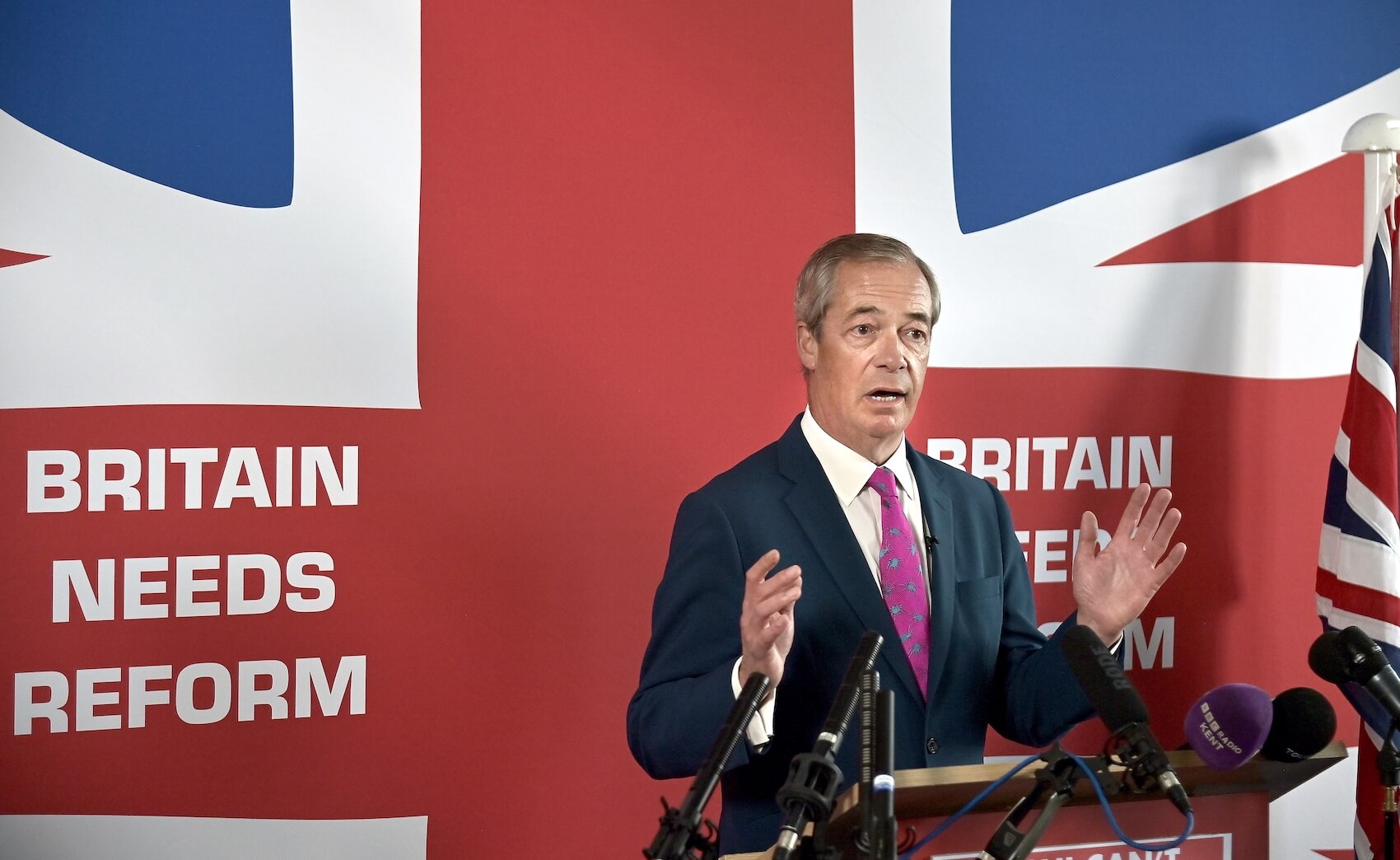
Nigel Farage speaking in Dover, Kent, UK, on May 28, 2024, in support of the Reform Party, of which he is President. Photo: Sean Aidan Calderbank.

Professor Tim Bale, thank you very much for joining our interview series. Let me start right away with the first question: In your work with Cristóbal Rovira Kaltwasser on the mainstream right’s strategic squeeze between Inglehart’s “silent revolution” and Ignazi’s “silent counter-revolution,” how should we interpret the rise of Reform UK? To what extent does Nigel Farage embody a classic mobiliser of counter-revolutionary sentiment, and to what extent do the Conservative Party’s specific organizational, ideological, and reputational vulnerabilities make the UK an outlier in the broader pattern of West European party-system transformation?

Professor Tim Bale: I think you would have to say that Nigel Farage is, in many ways, a classic example of a populist radical-right leader. He constantly draws a distinction between the wisdom of “the people” and their alleged betrayal and condescension by elites. As for the Conservative Party, there has always been a strain of populism and nationalism—indeed, some would say jingoism—within its tradition. In recent years, particularly under Boris Johnson and during the Brexit campaign, this tendency has come to the surface. In that sense, the party has reached back into its more populist and nationalist heritage as a way of competing with Farage and the political space he has claimed.

The Tories Are Hard to Capture — But Not Impossible

Farage’s rhetoric about a prospective “reverse takeover” foregrounds questions of party permeability and factional capture. Drawing on your analyses of Conservative factionalism and recurrent leadership crises, what structural, ideological, and organizational conditions render the Conservative Party susceptible to colonization by a radical-right challenger? Conversely, what features of party culture, elite networks, or institutional veto points might inhibit such a takeover?

Professor Tim Bale: When you look at the Conservative Party, there are features that, while not necessarily inoculating it from the challenge Farage poses, do make such a takeover more difficult than some people imagine, in the sense that it is a party rooted in the middle-class political culture of the UK. It is a party that has existed for 200 years, and it has a strong sense of entitlement, as it were, and a strong belief that it is the natural party of government, and therefore will be able to resist, in some ways, any challenge from a newcomer. 

Having said that, however, one feature of the Conservative Party that always has to be borne in mind is that it is very strongly a leadership-driven party, and that should a leader take over who is more receptive to the kinds of overtures that Nigel Farage and others are making, then it would be quite easy for that person to convert the party to taking a much more hospitable attitude to that development. So, on the one hand, the fact that the Conservative Party is old, has a brand, and has an infrastructure makes it quite difficult for somebody to take it over. On the other hand, it can be taken over quite easily from within, because it is so reliant on the leader to show it the way in terms of policy and organization.

Farage Is Reform’s Greatest Asset and Its Weakest Link

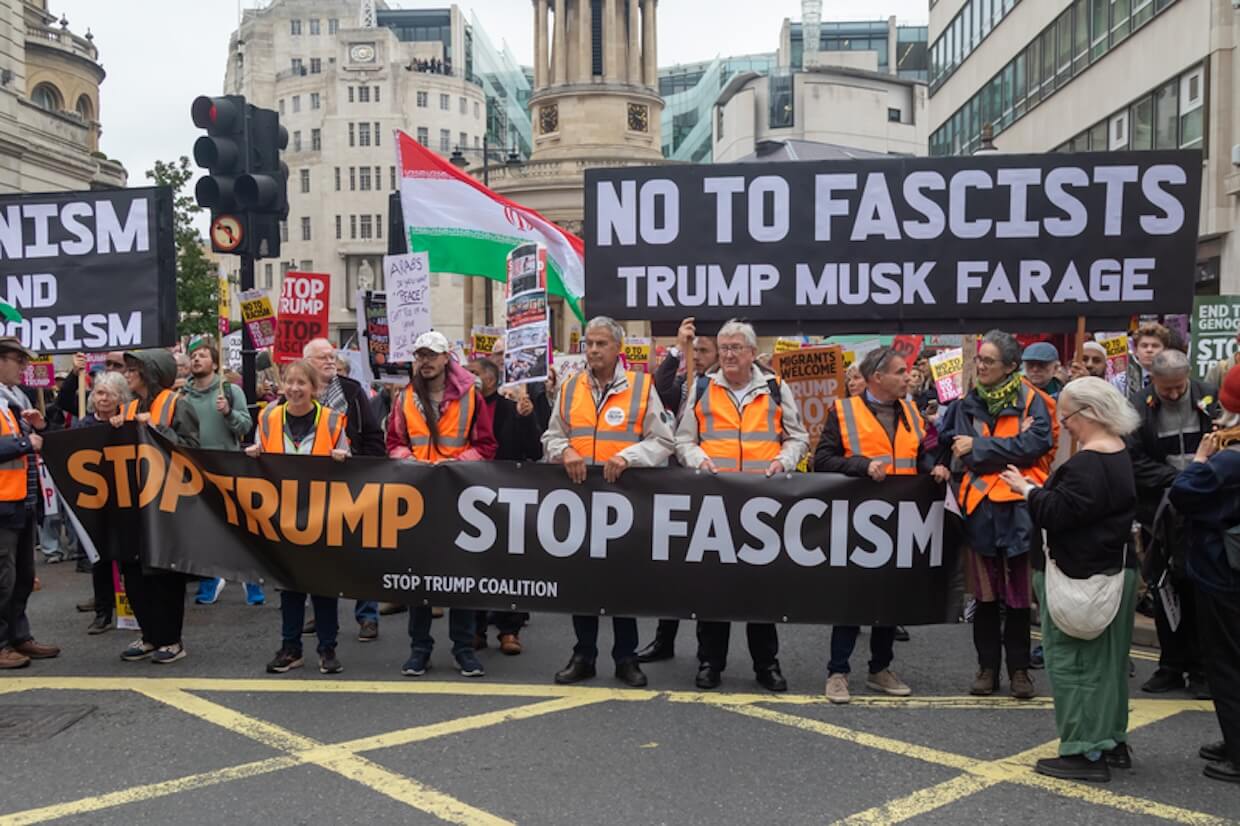
Stop Trump Coalition march, Central London, United Kingdom, September 17, 2025. A protester holds a sign reading “No to fascists — Trump, Musk, Farage.” Photo: Ben Gingell.

Your recent interview on Reform UK emphasizes Farage’s dual status as both the party’s central mobilizing force and its principal liability. How does this tension map onto broader theories of charismatic leadership, affective polarization, and “anti-system” appeal? In an increasingly fragmented multi-party context, does Farage’s polarizing image constrain the party’s governability narrative to the point of limiting its credible path to No. 10?

Professor Tim Bale: Nigel Farage is what we call, in England, a Marmite politician, which refers to a yeast-based spread that people put on their toast in the morning. People either love or hate that particular spread, and that’s very true of people’s attitudes to Nigel Farage. I think the fact that he is such a polarizing figure probably places a limit on Reform’s appeal. At the moment, it seems to be polling around 30% in the opinion polls, and I think that reflects the fact that he finds it difficult to appeal to voters who hate him, obviously, but also that ambivalent voters may be wary of the polarization he represents. So, I do think that is something of an obstacle to Farage’s progress. The anti-system appeal you mention is clearly attractive to some voters — people fed up with the two mainstream parties who want to smash the system. Anyone like Nigel Farage, who seems to offer a more radical alternative, is an appealing option for them. However, there is still a strong streak of small-c conservatism in the British electorate that would regard that as too radical, and that would like change — but not at the cost of dismantling a parliamentary, liberal, representative democracy that, in many ways, has served Britain well over the last couple of hundred years.

Reform’s Rise Is Built on Tory Collapse as Much as Ideology

Your research on Conservative leadership instability highlights the compounding effects of leader unpopularity, policy incoherence, and internal disunity on electoral performance. How much of Reform UK’s current momentum should be understood through the lens of “opportunity structures” created by Conservative decay, rather than any substantive ideological realignment toward radical-right policy demand?

Professor Tim Bale: As always, what we’re seeing is a combination of both. I mean, there is some genuine appeal of Reform UK’s policies and pitch to the electorate. But obviously, what has gone wrong with the Conservative Party has opened up avenues for Reform in a way that we haven’t seen before. In particular, the fact that the Conservative Party has really, since 2010, over-promised and under-delivered on migration has made it much easier for Farage to suggest that somehow it has failed voters and that it has not been able to, as it were, live up to their expectations. 

Also, you would have to say that the way the Conservative Party has lost its organizational coherence, the way Brexit, for example, tore the party apart and made parliamentary discipline something of a fiction, hasn’t helped—nor has the party’s tendency to cycle through leaders so quickly. That has led to a feeling that the Conservative Party, oncea sort of solid, respectable governing party, has to some extent lost its way, even lost its mind, according to some voters. And I don’t think that has helped the Conservative Party, but I do think that’s helped Nigel Farage and Reform UK.

Many Tory MPs Would Be Comfortable in a PRR Party

In “Populism as an intra-party phenomenon,” you analyzed how Corbynism reconfigured Labour’s organizational dynamics and membership incentives. Do you observe analogous intra-party populist dynamics emerging within the Conservatives today—particularly in the struggle between traditional conservatives, post-liberal cultural conservatives, and those advocating rapprochement or fusion with Reform UK?

Professor Tim Bale: There are definitely, if not factions, then certainly groups within the Conservative Party who are battling it out for the party’s soul. You can see that there is very clearly a bunch of MPs who, if not wanting a merger with Reform UK, would actually be quite open to the idea of some kind of electoral pact with Farage’s party. I think that partly is instrumental opportunism on their part, in the sense that they think the Conservative Party is in trouble, and it needs an alliance of some kind with Reform UK to recover its fortunes. 

But, there are MPs within the Conservative Party who, to be honest, would be quite comfortable belonging to a populist radical right party. They believe that Britain needs shaking up economically, and that the only way for that to happen is actually to get a greater level of support from the electorate, based on cultural concerns—concerns around immigration, woke issues, and green policies. That’s the only way of getting the kind of government that they want to actually dismantle some of the welfare state and some of the regulation that they think is holding Britain back. So, you have a strange situation in the Conservative Party where there are many advocates of a much more neoliberal conservatism who are prepared to adopt a more authoritarian stance on cultural concerns in order to get into government and implement the kinds of economic policies that they think are absolutely vital.

The Tories Are Now Moving on Migration in Farage’s Direction

Photo: Dreamstime.

Your comparative work on UKIP/Brexit Party and Australia’s One Nation highlights how radical-right “outsiders” can generate policy payoffs without executive power by reshaping the strategic environment of mainstream parties. How is Reform UK already influencing Conservative rhetoric, agenda-setting, and internal factional alignments—especially on immigration, welfare, and ECHR withdrawal?

Professor Tim Bale: You put your finger on a phenomenon that occurs throughout the world, and we’ve seen it all over Western Europe, when parties with little hope of actually governing—and certainly of joining a coalition—are capable of, as it were, moving the center of gravity in a system towards the populist radical right. When you look at the Conservative Party’s policy-making since 2024, and even actually before that, in response to the threat that Nigel Farage’s various parties—be it UKIP, be it the Brexit Party, be it Reform UK—you can clearly see that the Conservative Party has moved very much in his direction.

So, on migration, we now have a Conservative Party that has suggested—though there is some debate over whether it was intended seriously—withdraw­ing the indefinite right to remain granted to some non-citizens, and even opening up the possibility of them eventually being encouraged or indeed deported. That kind of mass-deportation approach is something previous Conservative governments would never have considered, and it reflects a direct response to some of Nigel Farage’s arguments.

Welfare is more complex. Farage is very aware that many of his supporters rely on the welfare state, and certainly on the National Health Service, so the Conservative Party must be cautious not to move too far toward his ambivalence on those issues. Instead, it tends to fall back on its more familiar low-tax, low-spend reputation.

On migration, that is the obvious one, where we’ve seen the Conservative Party move, just as we’ve seen parties, whether they be Christian Democrat or Conservatives across the continent, move very much towards a rather more kind of radical policy. You’d also have to look at environmental politics here, and it’s very clear that over the last few years, a Conservative Party that actually pioneered the move towards net zero—when Theresa May was Conservative Party Premier—is now really talking about winding back that commitment. I think, again, that is in response to Nigel Farage and Reform, and their promotion of the fossil fuel industry and its arguments.

Local Failures Might Not Dent Reform as Much as Opponents Hope

Reports of dysfunction in Reform-run local authorities raise questions about statecraft and institutional capacity. Given your longstanding argument that perceived competence ultimately constrains populist breakthroughs in Britain, do you anticipate that these governance shortcomings will erode Reform’s credibility? Or, alternatively, might anti-establishment narratives inoculate the party from such accountability?

Professor Tim Bale: That is a great question. We have seen Reform take over local authorities since spring of this year, and many of those councils have made rather a mess of things. They’ve fallen out with each other, they’ve found it much harder to make savings than they originally suggested, and in fact, they’re going to have to raise taxes rather than reduce them for local people. While the problems in those local authorities actually gain quite a lot of amused coverage in the media, I’m not sure how much the electorate in general pay attention to them if they’re not happening in their particular part of the country.

You raise a very good question here about the extent to which, if you criticize Reform UK, you actually strengthen, in some ways, the support for it among its die-hard advocates and voters. So, one would like to think that the example of local councils actually gives people pause for thought about whether it would be a good idea to elect Reform to the government of the country as a whole. But I rather doubt that it will have as big an impact as some of Reform’s opponents hope.

Hardline Accommodation Risks Alienating Supporters While Boosting the Radical Right

Your scholarship has shown that center-right parties often pre-empt or accommodate radical-right positions under competitive pressure. Should we expect Labour or the Conservatives to adapt their stances on immigration, welfare conditionality, or international legal obligations in response to Reform’s pressure? What do cross-national patterns suggest about the risks and limits of such accommodation?

Professor Tim Bale: We are already seeing in the UK the Labour government take a much harder line on migration than many of its supporters would like. It’s clear that that is a response by the government to losing votes to Reform. Current polling suggests that around 10% of people who voted for Labour in 2024 are now intending to vote for Reform, and Labour is desperate to get some of those people back, and by pursuing a more authoritarian stance on migration, they hope to do that.

You also point, however, to the fact that this has gone on all over the European continent. We’ve seen center-left parties as well as center-right parties pursuing a harder line on migration, and Denmark is often the country pointed to in this respect, perhaps as a successful example. But when we look across the continent as a whole, we don’t find that it is a particularly useful response for center-left parties to take. It ends up doing two things: first, alienating many of their more obvious supporters—in other words, people who have more liberal or left-wing values; and second, it tends to prove counterproductive or futile, in the sense that all it does is raise the salience of issues like migration in the minds of most voters, causing elections to be fought and debate to be conducted on terrain that actually favors populist radical right parties.

So, I personally wouldn’t advocate that as a response by the center-left, but it’s one that is still often mooted and taken by center-left parties, unfortunately.

Farage’s Sympathy for Putin Is an Achilles’ Heel

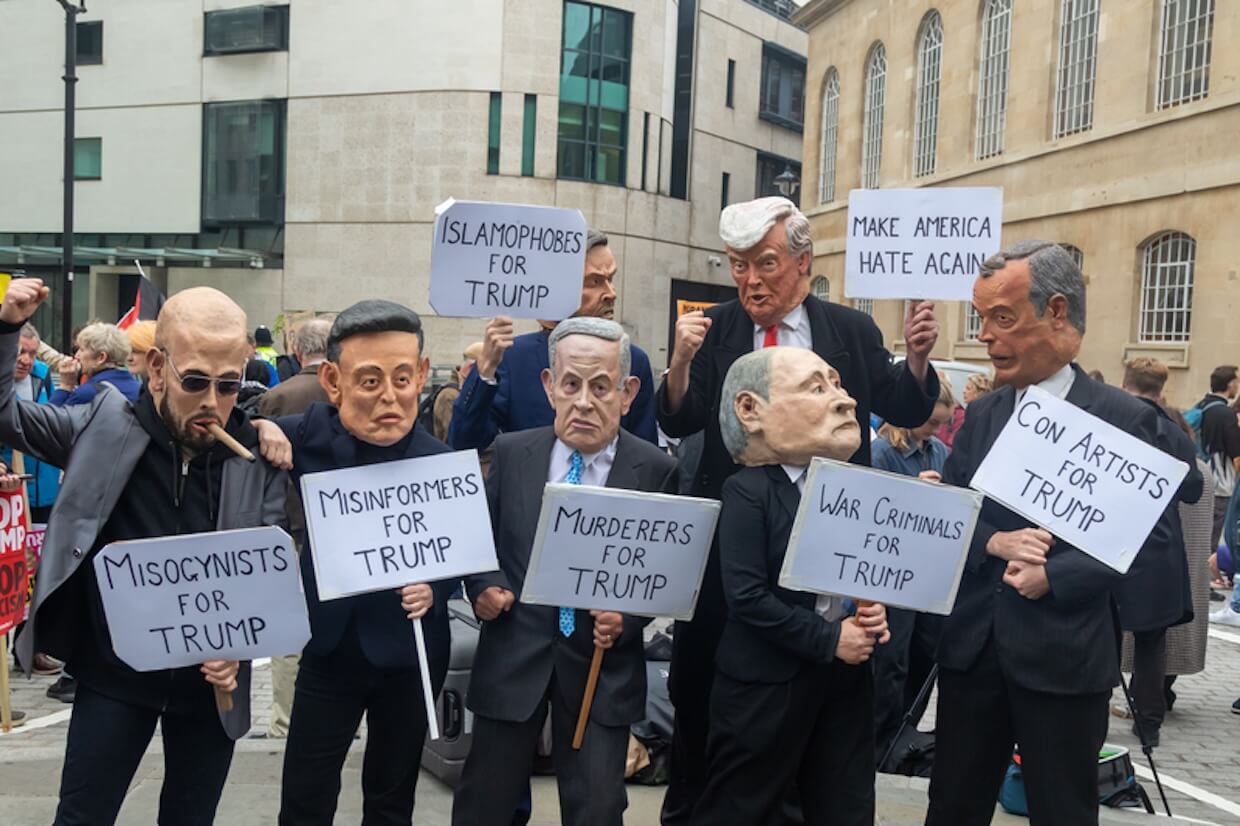
Stop Trump Coalition march, Central London, United Kingdom, September 17, 2025. Protesters dressed as Musk, Farage, Vance, Putin, Trump, and Netanyahu. Photo: Ben Gingell.

Your work on leadership perception underscores how trait attributions shape political choice. How electorally damaging is the perception that Reform UK is “soft on Russia,” particularly given polling indicating its unusually high association with pro-Russia sentiment? Does this reputational liability limit its potential to broaden its coalition beyond anti-establishment voters?

Professor Tim Bale: Reform’s support, Reform’s support, and certainly Farage’s apparent sympathy for Putin’s justification of the invasion of Ukraine, is something of an Achilles’ heel for him. To be clear, Farage has been careful not to appear as a superfan of Vladimir Putin, but he has repeatedly suggested that Russia’s invasion has been influenced by NATO “poking the Russian bear” and extending its influence into Ukraine in ways that allegedly threatened Moscow. 

Polling from the 2024 election shows that the moment public attention focused on Farage’s more accommodating stance toward Putin and Russia, Reform’s upward trajectory stalled. This position is deeply unpopular in Britain, and it is something Farage will have to address seriously, especially ahead of the next election. After all, the country will be choosing a government and prime minister in a highly unstable geopolitical moment, and Russia is viewed by the overwhelming majority of Britons as the aggressor.

So, I think it is a limit to his appeal unless he begins to resile from it. At the moment, however, it doesn’t look as if he wants to do that. I should add a caveat here: when we look at other populist radical-right parties, and indeed more extreme variants of the radical right in Europe, there does not appear to be anything like the same level of enthusiasm for Russia and for Putin within Reform as we see in some of their continental counterparts.

Reform Voters Favor Leaders with ‘Dark Triad’ Traits

Your “What Britons Want in a Political Leader” study reveals stark divergences between the traits valued by Reform/Conservative members and those preferred by the broader electorate. What does this asymmetry imply about Reform’s sociological and psychological ceiling of support, and what does it reveal about the electorate segments most susceptible to Farage’s appeal?

Professor Tim Bale: What we find in our research is that supporters—and certainly members of Reform—have much more positive views about leaders who exhibit what psychologists would call dark triad qualities. In other words, those are Machiavellianism, for example, psychopathy, for example. That is a marked contrast with the supporters of other parties, although slightly less so with supporters of the Conservative Party, who are rather more like Reform.

I think this comes down, once again, to Nigel Farage’s appeal. For his supporters, he is, in some ways, the ideal leader: he exhibits the kind of ruthless and sometimes manipulative, clever qualities that they so admire. But those very same qualities are actually quite off-putting to a large segment of the British electorate. So once again, if we’re talking about limits to Nigel Farage’s appeal, the kind of leadership qualities that he has—the leadership that he demonstrates—make him intensely popular with his own supporters, because they are psychologically predisposed to like that kind of leadership. Whereas for many in the electorate, they make him a figure of suspicion rather than someone they would like to see leading the country.

The Greens, Not Corbyn, Pose the Greater Danger to Labour

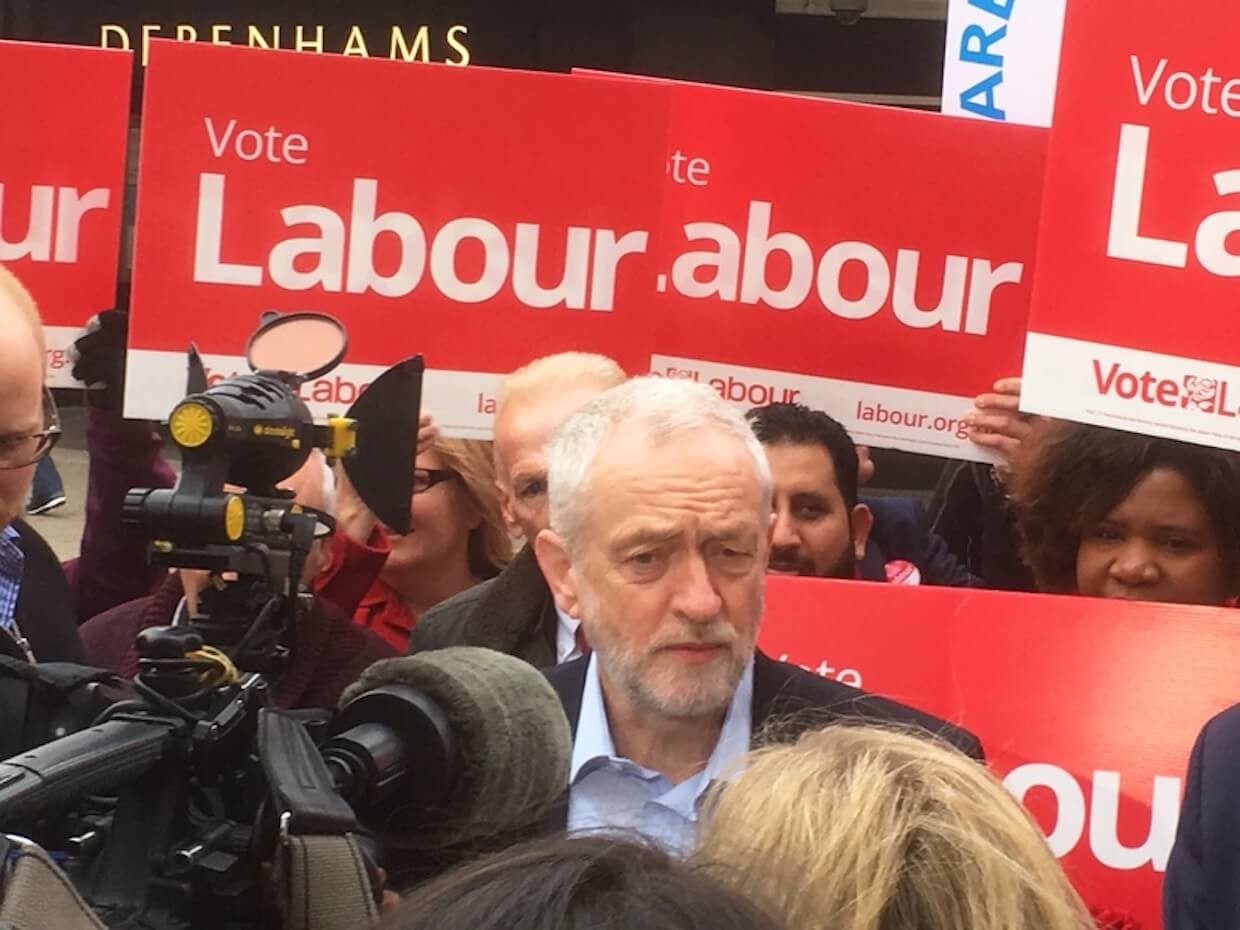
Jeremy Corbyn, former Labour leader, during a visit to Bedford, United Kingdom, May 3, 2017. Photo: Dreamstime.

Reform appears to be peeling off older, culturally conservative, economically insecure voters, while recently founded socialist Your Party seems poised to attract younger, urban, progressive activists disillusioned with Labour. How vulnerable is Labour to a “two-front erosion,” and do Starmer’s strategic concessions on immigration and public order risk replicating the center-left dilemmas seen elsewhere in Europe?

Professor Tim Bale: You’ve seen recently Your Party try to get its act together. This is the party being set up by, among others, Jeremy Corbyn, who used to be the very left-wing leader of the Labour Party, and Zara Sultana, an ex-Labour MP. There is an extent to which this does threaten Labour’s hegemony on the left. There are many left-wing voters who are very disappointed with the Labour government, not least on its attitude to migration, but also on its attitude to tax and spend.

What I would say, however, is that I’m not sure Your Party is actually the biggest threat to Labour on that front. I think what we’ve seen recently is that the difficulties that Your Party have had in actually getting its act together, as I said before, mean that the Green Party has seized the moment. It’s elected a new so-called eco-populist leader, Zach Polanski, who appears to be saying and doing the kinds of things that people disillusioned with Labour would actually like—so, for example, wealth taxes, and a much more aggressive attitude to Nigel Farage and Reform UK.

So, if there is a kind of two-front war being fought by Labour—Reform on the one hand, and then a left-wing party on the other—it’s probably not Your Party; it’s probably the Greens that are the biggest threat on its left flank.

First-Past-the-Post May Save Labour

Drawing on your prior analyses of organizational dysfunction within left-of-center parties, how serious a threat is Your Party’s emergence—given its early factional disputes and resource constraints—to Labour’s ability to consolidate progressive voters? Might it institutionalize a structural cleavage on the British left akin to Podemos–PSOE or Mélenchon–Socialist Party dynamics?

Professor Tim Bale: There is a risk. There We talked about some of the problems that Your Party have had. There is a risk that if they can actually surmount some of the early difficulties that they have, then we do see a party on the left—whether it be Your Party or the Greens—actually draining support from Labour. Current opinion polling does suggest that around 10–15% of former Labour voters have drifted off and might drift off in that direction.

However, there’s always the constraining factor of our electoral system. It is always going to be possible for Labour, successfully or unsuccessfully, to argue that under a first-past-the-post system a vote for either the Greens or Your Party is a wasted vote, particularly if they are able to conjure up the possibility of a Reform government under Nigel Farage, which may frighten sufficient numbers of people who might otherwise be tempted to use their vote expressively and to vote for Your Party or the Greens. They may wonder whether that is a good idea and, actually, in the end, come back home to the Labour Party. Probably that is the Labour Party’s strategy at the moment.

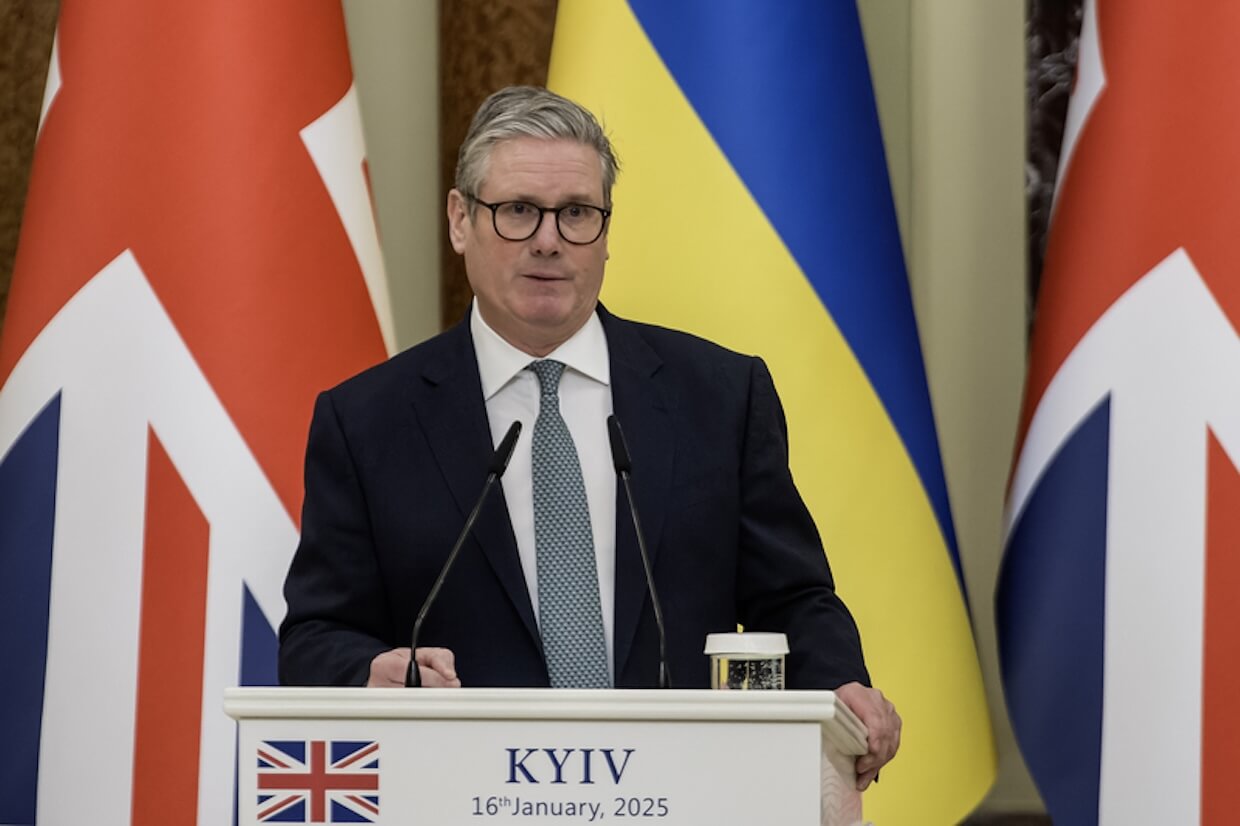
Keir Starmer, Prime Minister of the United Kingdom, attends a joint press conference with Ukraine’s President Volodymyr Zelenskiy in Kyiv, Ukraine, on January 16, 2025. Photo: Vladyslav Musiienko.

Conservatives Misread 2019 as Permanent Shift, Ignoring Voters’ Economic Priorities

In Hopes Will Be Dashed,” you argued that Brexit negotiating strategies were deeply shaped by a pervasive “Merkel myth.” Do you see contemporary Conservative or Reform elites relying on analogous political myths—such as a presumed majority demand for “uniting the right,” a belief in the inevitability of populist realignment, or a misreading of public appetite for hard-liner sovereignty politics?

Professor Tim Bale: That is a great question. I think one of the problems that the Conservative Party in particular had was a misreading of the 2019 election result as proof of what they called the realignment. In other words, the sense that working-class voters in this country had moved very much to the right on social questions, on cultural questions, and therefore there was some kind of permanent change of which the Conservative Party would be the beneficiary—when in fact that election was, in some ways, a rather more contingent affair, influenced very much by Brexit, influenced very much by the personality of Jeremy Corbyn, and indeed, Boris Johnson.

That myth—the idea that somehow there has been this incredibly profound change, and that cultural politics is now the dominant factor in elections—is still something that the Conservative Party holds onto, much to its detriment. It’s very interesting when you look at the leadership election in the Conservative Party following the 2024 general election. All the talk was about the Conservatives’ failure on migration, rather than the Conservatives’ failure to provide the country with adequate economic growth and adequate public services.

So, there is a kind of fixation on cultural politics and on this so-called realignment that the Conservative Party still has, which makes it actually quite difficult for it to realize that there is more to life than migration and woke, and indeed net-zero—that, in fact, the British public are not that different in the sense that they still want a government that hopefully provides them with peace, prosperity, and public services that actually work.

Britain Is Slowly Becoming More Liberal

You have frequently noted the role of media ecosystems in amplifying or constraining radical-right actors. To what extent is Reform’s surge a product of media-driven agenda-setting, and to what extent does it reflect deeper structural and sociological realignments within British politics? How should we disentangle these forces analytically?

Professor Tim Bale: That is a great question, but it’s also a very complicated one. Having shed doubt on this idea of a realignment, it is definitely the case that class features much less as a driver of people’s voting in this country, and that, in fact, education and age, to some extent, now seem to be the best predictors of which way people are going to vote. I do think cultural questions have come up in the mix, but I would want to say that the economy—while it’s not the only thing, the only game in town—is still actually very important as a driver of the way that people vote.

If you step back and look at cultural change in this country, clearly there are many voters who are uncomfortable with that, but they tend to be in older generations and, of course, will eventually disappear from the electorate. Now, that’s not to say that the center-left will somehow come into a kind of inevitable inheritance, because younger voters are rather more liberal and more tolerant in their attitudes. But it is to say that the center-right has to be very careful that it doesn’t end up on the wrong side of history, to coin a cliché, and fails to recognize that, for all the turmoil going on in British politics, underneath that, voters are becoming rather more liberal, more tolerant, and—despite media-driven polarization—more comfortable with a multicultural, multi-ethnic Britain.

So how long politics and political parties can thrive by exploiting differences, concerns, and anxieties is an open question.

If Living Costs Top Immigration, Reform Could Stall

UK economic crisis concept illustrated with the Union Jack and forex market data trends (AI-generated). Photo: Yuliya Rudzko.

And finally, you have cautioned that a Reform-led government is “not inevitable.” What empirical indicators—electoral, organizational, reputational, or demographic—would persuade you that (a) Reform UK is on a trajectory toward executive power, or (b) its rise represents a cyclical protest mobilization likely to dissipate before the next general election?

Professor Tim Bale: You have to look at support for Nigel Farage in particular, and the extent to which people think he will or won’t make a good Prime Minister. In the end, people know that they are voting not just in protest against something but are actually having to elect a government that’s going to make some very important decisions, and Nigel Farage is so central to Reform’s appeal that what people think of him is extremely important.

You also have to look at the extent—and obviously this, to some extent, involves prediction as to which issues are going to be most important for people at the next election. At the moment, immigration seems to be top of the list, but it’s only top of the list when you ask people what is the most important problem facing the country. When you ask people what’s the most important problem facing you and your family, immigration drops down the list, and the cost of living, the state of public services, comes right up.

So, I would probably look at the extent to which that is changing. If people think that migration is making a difference to them and their family, then perhaps that bodes well for Reform. But if the current disjunction between what people think is important to the country and what people think is important to them and their families continues, Reform is less likely to gain in strength.

Then, you’d have to take account of the kind of geopolitical situation, given we’ve already talked about Russia being something of an Achilles’ heel for Reform UK. If you were to see any extension of Russia’s aggression in Europe, then that would make it very difficult for Reform UK to make a convincing case for government.

I’d also look at what’s happening to the Conservative Party to bring it full circle. If the Conservative Party continues to stay in the doldrums—in other words, if it can’t recover itself and it can’t get anywhere near 25–30% of the vote—then there are many people who would normally vote Conservative who might be prepared to vote Reform, and that would give Reform a chance of government.

One final thing to throw into the mix is that our electoral system is not really very well suited to the party system that we now have. We now have a five-party—maybe six, seven, eight-party—system in this country, operating alongside an electoral system that is suited only to two parties, which means that it could be possible that a party on just under 30% of the vote could get a majority in Parliament next time around, and that would be a very unstable situation for the UK.

Dr. Ulrike M. Vieten is a Senior Lecturer (Associate Professor) in Sociology of Gender, Migration and Racisms at Queen’s University Belfast.

Dr. Vieten: Dutch Progressive Liberalism Is Rather Cosmetic as Fractured Far Right Gains

In an interview for the ECPS, Dr. Ulrike M. Vieten offers a sharp sociological reading of the 2025 Dutch elections, arguing that “progressive liberalism appears rather cosmetic, and the Dutch elections reveal a significant win for fractured far-right populist parties.” Despite Geert Wilders’ setback, Dr. Vieten stresses that the far right remains structurally resilient, with PVV, JA21, and FvD together securing 42 seats. She highlights the normalization of anti-immigration rhetoric, the co-optation of far-right frames by centrist actors, and the deepening tensions between state-centered citizenship and post-migrant identities. From femonationalism to coalition politics, Dr. Vieten situates the Dutch results within broader European trajectories of nativism, militarization, and socio-economic neglect—warning that liberal democracy risks privileging cultural cohesion over social justice.

Interview by Selcuk Gultasli

In a political landscape marked by shifting coalitions, fragmented party systems, and the normalization of far-right discourse, Dr. Ulrike M. Vieten—Senior Lecturer (Associate Professor) in Sociology of Gender, Migration and Racisms at Queen’s University Belfast—offers, in an interview with the European Center for Populism Studies’ (ECPS), a trenchant sociological analysis of what the recent Dutch election reveals about the deeper transformations reshaping Dutch and European politics. As she succinctly observes, “progressive liberalism appears rather cosmetic, and the Dutch elections reveal a significant win for fractured far-right populist parties.”

While Geert Wilders suffered an electoral and institutional setback, Dr. Vieten underscores that far-right forces have neither receded nor lost structural relevance. She notes that Wilders’ PVV secured “a similar outcome to D66 in terms of parliamentary seats—26,” and that new actors such as JA21 and FvD collectively pushed the far right to 42 seats, signaling the entrenched resilience of nativist politics. This development, she argues, stems from longer-term shifts accelerated by the pandemic—an evolution she previously theorized as “pandemic populism.”

Yet the interview also probes the paradoxical dynamics of the 2025 contest: a weakened Wilders paired with the persistent mainstreaming of anti-immigration rhetoric. Dr. Vieten stresses that the far right’s discursive power continues to shape “cultural belonging and national identity,” even when its institutional credibility falters. Simultaneously, she warns that centrist and center-left parties have often co-opted far-right frames, thereby reproducing segregationist logics while claiming to oppose extremism.

A major theme running through the conversation is the shifting terrain of citizenship, identity, and post-migrant belonging. Drawing on her earlier work on “new European citizens,” Dr. Vieten observes that the pandemic’s border closures and re-territorialization of state authority profoundly disrupted the transnational lives of minority citizens. She also highlights how post-migrant elites—such as VVD leader Dilek Yeşilgöz-Zegerius—may themselves align with exclusionary agendas, complicating assumptions about progressive identifications among minority communities.

The interview further explores the gendered politics of far-right rhetoric. Here Dr. Vieten draws attention to how appeals to women’s rights have been tactically mobilized to justify anti-Muslim policies, echoing Sara Farris’s concept of femonationalism. Liberal narratives of emancipation, she warns, can themselves reinforce racialized boundaries of belonging.

Looking ahead, Dr. Vieten situates the Dutch outcome within broader European trajectories marked by the rise of far-right parties, centrist recalibrations, and an EU increasingly driven by anti-migration and militarization agendas. Liberal democracy, she suggests, risks becoming a project “selling cultural cohesion instead of social cohesion,” unless it confronts underlying socio-economic inequalities.

This interview thus contributes a critical and timely perspective to ECPS’s ongoing effort to interpret the Dutch elections within a wider European and global context.

Here is the edited transcript of our interview with Dr. Ulrike M. Vieten, slightly revised for clarity and flow.

A Splintered Far Right Still Sets the Tone in Dutch Politics

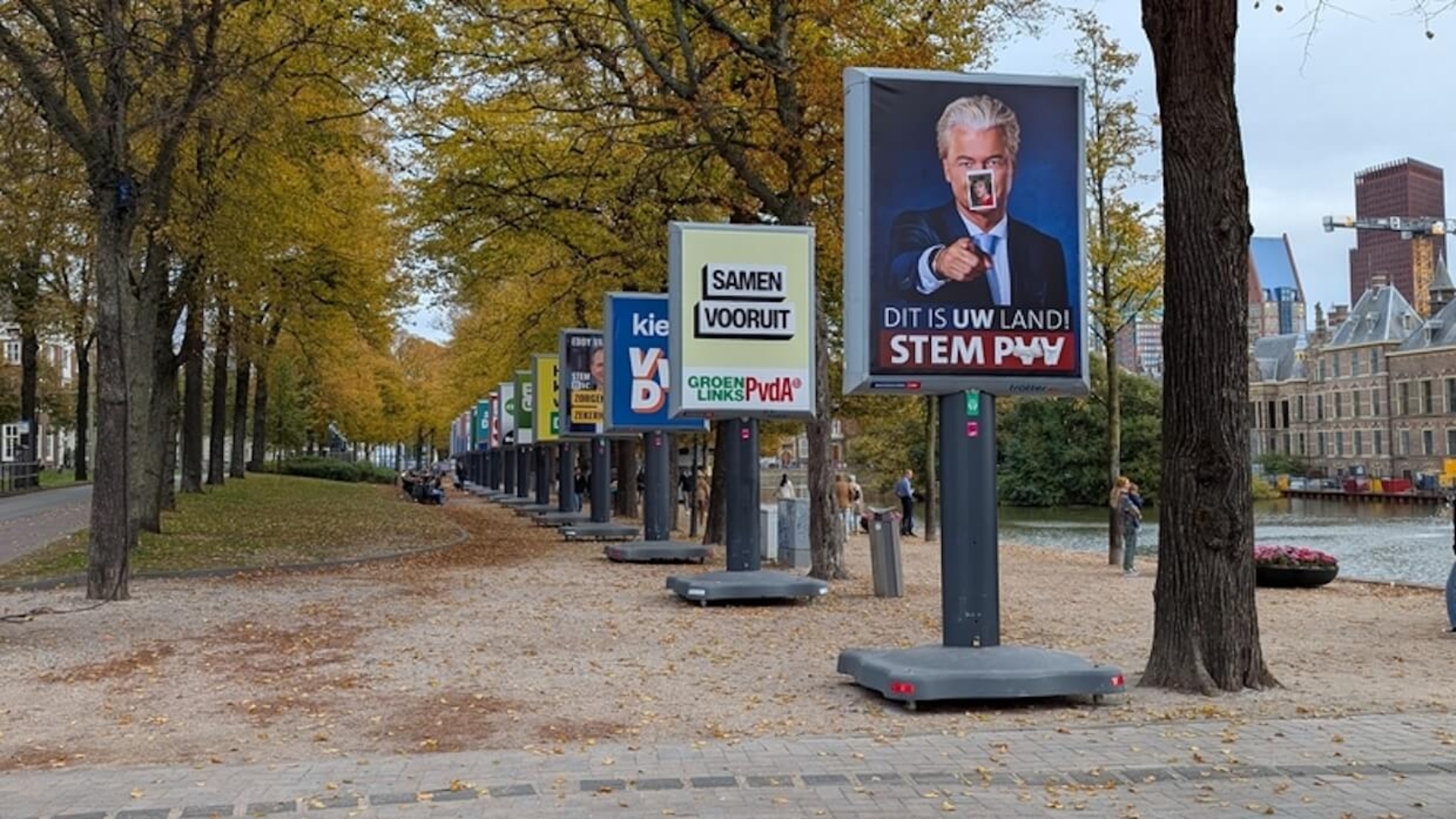
Election posters near the Binnenhof featuring Geert Wilders of the PVV in the foreground, The Hague, the Netherlands, October 12, 2025. Photo: Dreamstime.

Despite the electoral setback for Geert Wilders, far-right parties collectively gained ground. How should we interpret this outcome in terms of the structural endurance of nativist, populist politics in the Netherlands?

Dr. Ulrike M. Vieten: The official setback to Wilders leading the strongest party this year (2025) doesn’t change the fact that (a) he achieved a similar outcome to D66 in terms of parliamentary seats—26, and (b) other far-right “kids on the block,” such as JA21 and FvD, also saw a rise in their share of populist votes. This clearly illustrates that the far right (populist) parties have splintered yet continue to pose a serious threat to liberal, socially diverse, and inclusive societies. All three parties (PVV, JA21, and FvD) can claim 42 seats out of 150 (compared to 41 they won in the last election in 2023). This means nativist (autochthon-oriented) ideology has gained and consolidated political ground over the years, particularly after the pandemic—a development I warned about when writing on “pandemic populism” (Vieten, 2022).

To what extent do the recent results illustrate a reconfiguration of far-right populism—from an electoral takeover strategy toward indirect agenda-setting power that continues to shape public discourse on immigration, cultural belonging, and national identity?

Dr. Ulrike M. Vieten: Though I have not followed the election campaign closely, as I do not currently live in the Netherlands, what was striking about the success of D66 and Rob Jetten—and several national and international media outlets have emphasized this—is that Jetten sold his politics with an overall positive message of “we can do it.” Dutch voters were not impressed with the performance of Geert Wilders and the last government on central issues such as housing provision and health services. In the end, the Dutch are often viewed as very pragmatic (similar to the English, as they say), and it might be the case that Wilders’ loss is an outcome of his lack of reliability in terms of policy delivery, and only to a lesser degree driven by the ideological content his far-right populist party conveys. Anti-migration policy—let’s not forget, Wilders’ coalition government resigned because he walked out on that issue—remains a sticking point. Rob Jetten’s overarching approach to what you call “cultural belonging and national identity” was to give the Dutch national flag a more positive (prideful) meaning, not always as a defense against others, but filling it with a form of socially cohesive meaning.

Post-Migrant Elites Don’t Always Align with Progressive Politics

Billboard featuring the main candidates in the Dutch elections on June 9, 2010, in Amstelveen, the Netherlands. Photo: Dreamstime.

Given your work on “new European citizens,” what do the 2025 elections reveal about ongoing tensions between state-centered citizenship regimes and the transnational identifications of post-migrant communities?

Dr. Ulrike M. Vieten: My research and publications on European minority citizens (2016; 2018) now feel like “light years away” (Lichtjahre entfernt). It was a comparative study of three EU countries (pre-Brexit England included) that examined how hyphenated Dutch, German, and British citizens identified as European and related to the European Union. Though I interviewed Moroccan-Dutch citizens—some of them very visible in the public sphere—the general argument may also apply to Turkish or Kurdish-Dutch citizens. However, all of this was carried out pre-pandemic, and as international lockdowns and travel bans taught us, the mundanity of transnational community life was largely suspended. One of my interview partners in Germany explicitly told me that her life as a transnational—maintaining friendships and family ties in Turkey, for example—was shattered and ignored during the pandemic. Nation-states restored their authority and sovereignty over citizens’ movement and territorial borders. Between 2020 and 2022, we witnessed a strict re-territorialization of governance—perhaps a prelude to what has come since and what we see today.

When we speak about “new Europeans,” and you bring up the concept of post-migration, it seems that some minority European/national citizens have made it into the ranks of national (and even international) elites, similar to “old established Europeans.” Ideological or value orientations do not necessarily differ simply because one has a post-migration background. An interesting and perplexing example is Dilek Yeşilgöz-Zegerius, the leader of the VVD (People’s Party for Freedom and Democracy), the conservative Dutch party, who explicitly stated she would not join a coalition with the merged GroenLinks/PvdA party. This means she would rather accept a coalition with far-right parties such as JA21. Yeşilgöz served as a minister in Rutte’s government and is a very experienced politician. But this tells a story of socially classed divisions within ex-immigrant and transnational communities, who do not automatically occupy a liberal-progressive or anti-authoritarian space.

Institutional Failure, Discursive Success

Wilders’ collapsed coalition appears to have weakened his institutional credibility, yet anti-immigration rhetoric remained central in campaign debate. How do you interpret this paradox of reduced governing legitimacy but persistent discursive power?

Dr. Ulrike M. Vieten: As I mentioned before, the collapse of Wilders’ coalition discredited him in terms of reliability and triggered the recent election. Coalition building is at the heart of most Continental European countries, including the Netherlands, and—as far as I remember—it took Wilders nearly a year to form a government anyway. So, the record of being in government and in power for just a year looks quite poor. The mainstreaming (or normalization; see Vieten & Poynting, 2022) is a discursive project that has been unfolding for years—post-2008 economic crisis and with a further push post-pandemic—accelerating at a pace that makes it difficult to challenge, as the underlying socio-economic problems are not going away.

To what extent do the Dutch results reflect a broader European pattern in which centrist parties co-opt right-wing discourses—thereby reproducing segregationist and anti-immigrant logics even while formally opposing the far right?

Dr. Ulrike M. Vieten: Well, unfortunately, it is not only conservative or center-right parties that have jumped on the anti-immigrant—e.g., anti-refugee—scapegoating wagon; center-left parties such as the Labour Party in the UK and the Social Democrats in Denmark have similarly placed anti-migration policy at the top of their agendas. That said, I would go beyond Europe here, as this reflects a broader zeitgeist and a global phenomenon. Though Brazil shifted leftward after the far right damaged the country, mainstream media worldwide continue to give center stage to far-right politicians such as Trump and follow closely the agendas they set. At some point, people may have forgotten that 15 years ago (or earlier, in the early 2000s) there was a very different spirit—embracing cosmopolitanism (albeit Eurocentric), diversity, and openness toward difference.

Returning to what I said earlier about the need to build coalitions, we will now see how Jetten bridges ideological divides, as he needs to form a coalition with three other parties, while the leader of the Dutch conservatives (VVD) has expressed her dislike for including the GreenLeft/Social Democrats in the government. Jetten might end up asking one of the smaller far-right parties, e.g., the FvD, to join. And then we will see how realistic and reliable such a coalition arrangement will be. It is not all out of the woods, and formal opposition is more of a strategy than a reflection of political will and capacity post-election.

Cosmetic Liberalism Cannot Counter Deepening Inequalities

Billboard of D66 featuring Rob Jetten with the slogan Het Kan Wel in Amsterdam, the Netherlands on October 28, 2025. Photo: Robert van ’t Hoenderdaal.

Does D66’s civic-progressive liberalism meaningfully challenge racialized boundaries of European belonging, or does it risk perpetuating a “thin cosmopolitanism” that leaves structural inequalities untouched?

Dr. Ulrike M. Vieten: Your question speaks directly to what I mentioned earlier. The appealing persona of D66’s leader, Rob Jetten, may resonate with urban populations and those identifying as liberal-progressive in middle-class neighborhoods. Even the fact that he is openly gay (his partner originally from Argentina) is not, in itself, an indicator of anti–far-right trajectories. For years, Wilders politicized homosexuality in his rhetoric against Muslim communities, and Alice Weidel, the AfD leader, is a lesbian living with her partner in Switzerland. Therefore, an image of liberal pro-gayness does not say anything about how social cohesion will work in the Netherlands after the 2025 election.

A conservative agenda that is deemed not to tackle socially unfair living conditions in a post-migration society—such as access to housing, rising property prices, and the gap between living standards and affordability for young people—can easily slip into adopting far-right agendas of cultural cohesion. In that sense, a “thin cosmopolitanism” is not enough, as it fails to engage with the socio-economic concerns of a large segment of the population. Progressive liberalism appears rather cosmetic, and as we noted earlier, the election outcome shows a significant win for fractured far-right populist parties.

Fragmentation Masks the Growing Influence of Nativist Politics

With the rise of multiple smaller far-right parties (e.g., JA21, FvD), what does the diversification of the nativist field reveal about ideological differentiation, constituency segmentation, and the long-term resilience of the Dutch radical right?

Dr. Ulrike M. Vieten: I think we covered some of this before. The fragmentation of the Dutch far right—and the way center and liberal parties have adopted racist far-right political agendas, e.g., anti-migration/anti-refugee rhetoric—confirms that we are facing a normalization of far-right, nativist ideologies. The fragmentation reflects nuances as well as socially and culturally classed differences, but this does not diminish the broader presence of far-right actors. We might even see a smaller far-right party joining the government, which poses serious questions for the rule of law and for how the center-right continues to adopt policy agendas set by far-right politicians. The cordon sanitaire has already been abandoned elsewhere. An important piece of EU legislation, the Supply Chain Due Diligence Act, was just modified and diluted in scope and reach—and waved through with the votes of far-right parties/politicians, just this week.

Building on your research into gendered culturalism, to what extent has the strategic mobilization of women’s rights within far-right rhetoric served to legitimize exclusionary policies toward Muslim communities—thus normalizing racialized boundaries of national belonging?

Dr. Ulrike M. Vieten: I would go beyond this argument by questioning how liberal notions of female emancipation have also played into anti-Muslim rhetoric and have not prevented the passage of generically racist legislation. The latter refers to laws banning the veil and sustaining narratives of white European supremacy. My colleague Sara Farris (2017) argues that “neoliberalism [is] a political-economic formation that institutionalizes the femo-nationalist ideology as part of the functioning of the state apparatus in order to (re)organize the productive and particularly the socially reproductive sphere” (2017: 14).

Following closely the national civic integration strategies, not only addressing Muslims, but generally migrants, Farris scrutinized data in three EU countries spelling out that Muslim women (and female migrants) are incorporated into the concrete European ‘femo-nationalist economies’ as domestic space keepers. While Muslim men (and migrants, predominantly Muslims) are constructed as outsider-threats, Muslim women are displaced into the social reproduction sphere of the different nation-state. Her argument is intriguing because it interrogates the mainstream liberal narrative that only the far right (or extremists) threatens “our way of life.” But certainly, this kind of post-Marxist analysis is not very fashionable, insisting that normal gendered belonging is already the problem as it is keeping hierarchies of exploitation untouched.

Liberal Democracy Risks Prioritizing Cultural Unity Over Social Justice

People on the street near the National Monument in Amsterdam, the Netherlands, on April 14, 2018. Undocumented migrants selling shoes. Photo: Elena Rostunova.

Finally, what do the 2025 Dutch election results suggest about broader European political trajectories—especially the concurrent resilience of far-right nativism and the tactical recalibration of centrist actors seeking to contain it—and how might this interplay shape the future of liberal-democratic politics on the continent?

Dr. Ulrike M. Vieten: Like what happened in Austria and Germany where far-right parties were either coming into first place (Austria) or second (Germany) these countries managed to build coalitions, excluding the far-right for now. As I mentioned above, it now depends on how Jetten and crucial parties such as the VVD can hold their ground and compromise on a trustworthy and stable coalition. We already have far-right parties in government in Western Europe, such as in Italy, and long established in Eastern Europe, such as in Hungary. And if we think of the European Union more broadly, its anti-migration policy (e.g., anti-asylum stance) has shifted toward far-right, anti-foreigner hysteria—for example, outsourcing asylum processes—and is dominated by Angst (both in terms of real and imagined politics) of the Russian.

Accordingly, the second major theme is militarization (and its multi-billion-euro funding), which—let me guess—is undermining spending for social and cultural policies and cohesion across the EU and within European countries. The potential new Dutch government will fit this trajectory very well, as left (or socialist) visions have been rejected across the board. The problem with liberal democracy is that it continues to promote a narrative that ignores socio-economic questions of redistribution, selling cultural cohesion instead of social cohesion.

Election posters near the Binnenhof featuring Geert Wilders of the PVV in the foreground, The Hague, the Netherlands, October 12, 2025. Photo: Dreamstime.

Dr. Vossen: The Anti-Islam Core Is the Most Important Part of Wilders’s PVV

In an in-depth interview with the ECPS, Dr. Koen Vossen, political historian and lecturer at Radboud University, analyzes the ideological evolution and endurance of Geert Wilders’s Party for Freedom (PVV). He stresses that “The anti-Islam core is absolutely the most important part of this party,” noting that despite tactical moderation, its fundamental worldview remains unchanged. According to Dr. Vossen, the PVV’s “one-man structure” and lack of internal democracy make it both flexible and fragile. Wilders’s “clash of civilizations” narrative, rooted in his early attachment to Israel, continues to shape his politics. As Dr. Vossen observes, media normalization, cultural anxieties, and declining institutional barriers have allowed the PVV to become a lasting—though polarizing—force in Dutch politics.

Interview by Selcuk Gultasli

In a wide-ranging interview with the European Center for Populism Studies (ECPS) following the Dutch general elections of October 29, 2025, Dr. Koen Vossen, a political historian and lecturer in political science at Radboud University, offers a nuanced analysis of the ideological evolution, strategic positioning, and organizational structure of Geert Wilders’s Party for Freedom (PVV). Dr. Vossen, a leading scholar on Dutch populism and right-wing movements, situates the PVV within a broader European radical-right context while emphasizing its distinctly Dutch trajectory.

As Dr. Vossen underscores, “The anti-Islam core is absolutely the most important part of this party.” While the PVV has, over time, expanded its platform to include positions on welfare, housing, and law and order, these remain secondary to its central ideological fixation. The PVV, he explains, “is really basically one man… It is purely a matter of what Wilders wants, what he does, and what he likes.” This personalization of power, combined with the party’s lack of internal democracy, explains both its tactical flexibility and its chronic difficulty in governance.

Dr. Vossen traces Wilders’s ideological consistency to what he calls a “clash of civilizations” worldview, deeply informed by his “special connection with Israel.” Having worked on a kibbutz as a young man, Wilders came to see Israel as “the main buffer against Islamization.” This perspective not only anchors the PVV’s foreign policy but also shapes its domestic narrative of cultural defense. According to Dr. Vossen, Wilders’s “absolute core ideology is this anti-Islam ideology,” while his steadfast pro-Israel stance serves as both a symbolic and programmatic pillar in PVV discourse.

On the domestic front, Dr. Vossen attributes the PVV’s durability to a combination of structural and contingent factors: the decline of pillarized institutions, the fragmentation of the Dutch party system, and the normalization of far-right rhetoric through media amplification. “Over the last ten years,” he notes, “we’ve seen the clear emergence of a very right-wing media… strongly conservative and very much anti-left. ‘Left’ as a word, as a concept, has almost become an insult in the Netherlands.” The weakening of social intermediaries and the culturalization of political conflict, he argues, have made space for a stable radical-right electorate of roughly 30%.

Despite periodic moderation—what Wilders once called putting his ideas “in the freezer”—Dr. Vossen believes the PVV’s ideological substance remains intact. Even temporary participation in government, he argues, only suspends rather than transforms its radicalism. The 2025 elections, he concludes, show both the limits and persistence of Dutch populism: a movement still revolving around one man, one message, and one enduring enemy.

Dr. Koen Vossen is a political historian and lecturer in political science at Radboud University.

Here is the edited transcript of our interview with Dr. Koen Vossen, slightly revised for clarity and flow.

Dutch Voters Long for Stability After Polarization Fatigue

Professor Koen Vossen, thank you very much for joining our interview series. Let me start right away with the first question: The recent Dutch election produced a dramatic reversal for the PVV, whose brief coalition participation ended in collapse, while D66 surged to the top of the polls. To what extent should we interpret this outcome as evidence of a structural electoral realignment favoring centrist, pro-EU forces—or as a temporary recalibration following the PVV’s troubled spell in government? In other words, are we witnessing a durable shift in voter preferences or merely the electoral consequences of perceived misgovernance?

Dr. Koen Vossen: I think both. Interpreting Dutch election results is always tricky because we are a country of minorities, so there are always more stories than one story in an election result.

What you saw in the last election was a longing for more stability—for a more stable coalition among a part of the electorate. People were fed up with the old polarization and longed for more centrist politics. That was absolutely there.

At the same time, you have also seen in the Netherlands that the border between the radical right and the center-right has somehow been blurred, especially in the conservative-liberal VVD, the party once led by Mark Rutte and now by Dilan Yeşilgöz. It has moved very much to the right and wanted an exclusively center-right coalition without Wilders’s party.

So, one could also interpret the result as support for this center-right coalition or as support for a more centrist coalition. At the same time, Wilders’s party still had about 17 or 18 percent of the vote. He lost some votes but remains the second-largest party in the Netherlands, so there are different stories here.

The Radical Right’s 30% Support Shows Structural Stability

Despite near-parity in seat totals, Geert Wilders appears politically isolated, as most mainstream parties again refuse coalition cooperation. Does this effective ‘cordon sanitaire’ signal the enduring resilience of Dutch party-system norms against radical-right institutionalization? Or does the continued aggregate strength of far-right parties (including FvD and JA21) indicate a deeper, longer-term transformation in the ideological landscape that may eventually erode such exclusionary practices?

Dr. Koen Vossen: The radical right maintained its position with about 30% of the vote. So, it’s still there—this 30%. They did not really lose in the last elections, but their support was divided among different parties, maybe even 35% in total. Previously, Wilders had the largest share of this radical-right vote—around 25%. The rest went to smaller radical-right parties, but now these smaller parties have grown, and most of the voters that Wilders lost went to them. So, there’s been more of a transfer of votes within this bloc than an overall loss. A small portion, maybe, went to the VVD—the conservative liberals who also tried to attract votes in the radical-right sphere. But in the end, there remains a fairly stable 30% of the Dutch electorate that supports these parties.

The PVV’s Core Is Anti-Islam

An elderly man holds a protest sign during a PEGIDA demonstration against the perceived Islamization of Europe in Enschede, the Netherlands on September 17, 2017. Photo: Dreamstime.

You argue that Wilders cannot be understood solely within the populist frame. How has the PVV’s ideological trajectory shifted from anti-establishment protest toward a more coherent political project, and what classifications better capture this evolution?

Dr. Koen Vossen: Populism has always been a thin ideology, so it needs other ideologies. In the case of the PVV, that has always been a strong nationalism and nativism, anti-immigration, and an anti-Islamic stance based on a “clash of civilizations” type of ideology, combined with a conservative law-and-order orientation. Since around 2010, you can see some tactical changes, but overall, the ideology has become quite clear and crystallized. Its main pillars are populism—with a very strong anti-elite sentiment—anti-immigration, welfare-state chauvinism, anti-Islam, and conservatism on law and order.

It should also be noted that the party is relatively progressive on some immaterial issues, such as gay marriage, abortion, and euthanasia policy—more so than many other parties. But on most other issues, it is quite conservative, particularly anti–climate policy. In that sense, the PVV is a fairly classic radical-right populist party, comparable to Rassemblement National (RN), Farage’s movement, Alternative für Deutschland (AfD), or the Swedish Democrats (SD). Some of them even sit together in the European Parliament.

What distinguishes the PVV, however, is its very strong focus on Islam—this is quite specific to the party—and Wilders has been a pioneer in this regard. The party is also pro-Israel and relatively progressive when it comes to issues such as gay marriage, women’s emancipation, and abortion. These are the main ideological characteristics of the PVV.

Right-Wing Media Have Made the Radical Right the Only Alternative

You have written that the PVV has become increasingly normalized in Dutch politics. Which institutional mechanisms—parliamentary collaboration, media treatment, coalition signaling—have most contributed to this mainstreaming?

Dr. Koen Vossen: Media treatment is very important. Over the last ten years, we’ve seen the clear emergence of a very right-wing media. One could even compare it to Fox News–type outlets—strongly conservative and very much anti-left. The left wing has become the main enemy. “Left” as a word, as a concept, has almost become an insult in the Netherlands. “Leftist people” and similar terms are not neutral—they never were, of course, but this tendency has grown stronger.

The media treatment means that if the right-wing parties did not deliver in coalitions, the left was not seen as an alternative. Then the radical right became the alternative. If the radical right proved not to be the alternative, people looked to other right-wing parties—never to the left. The left has been out of the race, especially in these media. So, the radical right has become the alternative.

This also has to do with the fact that, in 2023, after eleven years of cordon sanitaire, the VVD decided to open the door again for collaboration with Wilders’s party, the PVV—purely strategically. They thought, we always have to go into coalitions, we always have to look to left-wing parties; now they wanted to look to a right-wing party, even an extreme right-wing party, to have more options. This proved to be a strategic blunder because now, for many parties, Wilders became an option. Before, they could always say, “Well, that’s a wasted vote because he will never govern.” But now it was not a wasted vote anymore—it became an option, and for a lot of these voters, even a better one.

So, helped by the media and by the end of the cordon sanitaire, one could say that the PVV emerged as the winner in 2023.

A newspaper rack displaying several Dutch newspapers, including De Telegraaf, Trouw, AD, and regional papers. Photo: Dreamstime.

Anti-Islam Is the Core; Everything Else Is Secondary

Anti-Islam alarmism remains central to the PVV. Do recent policy expansions toward welfare and housing reflect ideological maturation, tactical vote-seeking, or merely cosmetic adjustment that leaves the anti-Islam core intact?

Dr. Koen Vossen: The anti-Islam core is absolutely the most important part of this party. I say party, but the thing is, with the PVV, it’s really basically one man. Although he has more than 2.5 million votes, talking about the PVV—especially on a national level—is talking about one man: his considerations, his thinking, and his decisions. The rest is not really relevant. So, one has to look into his head to find out what he thinks, as there are no public discussions or debates in this party. There’s no party organization, no conferences, no party manifesto, or party newspaper. It is purely a matter of what Wilders wants, what he does, and what he likes. Wilders’s absolute core ideology is this anti-Islam ideology. The rest of it—maybe calling it purely tactical is a little too cynical—but it is certainly not the main issue for him.

PVV Support Is Driven by Cultural Fear, Not Economic Anxiety

To what degree has the erosion of pillarized structures and intermediary institutions created the social fragmentation necessary for PVV success? Do cultural anxieties outweigh economic grievances in explaining the party’s appeal?

Dr. Koen Vossen: I think it’s mainly a cultural matter—it’s all about immigration. These voters’ main concern is immigration, absolutely. Housing is second, but it’s connected to immigration. If you look at the socioeconomic profile of the PVV voter, one cannot say that these are the less fortunate ones economically. Of course, you also see them in the lower-income classes, but also in the middle- and higher-income classes, where people do not really experience economic anxiety. Economically, the Netherlands is doing quite well.

So, it is mainly a cultural thing—a fear of immigration, fear especially of asylum seekers, which has become a very big issue in the Netherlands. Incidents involving asylum seekers have attracted a lot of attention in the media, and as a result, these issues became the most salient in the election campaign. Immigration was the issue people talked about, and Wilders benefited from this. So, if you see immigration more as a cultural issue, then I would say it was more on a cultural level than on an economic one.

Wilders’s ‘People’ Are Defined Against the Leftist Elite

How does the PVV’s construction of ‘de volk’ differ from earlier Dutch nationalist discourses? Is the imagined community increasingly defined through civilizational frames—especially Judeo-Christian identity—rather than ethnic or civic nationalism?

Dr. Koen Vossen: That’s an interesting one. The main difference is that, first of all, until the 1960s or 1970s, the Netherlands was a pillarized country. You had these different minorities—the Catholics, the Protestants, the Socialists, the Liberals. These pillars have disappeared, and in a way, we have now become one big population, without this idea anymore of four different groups.

There is actually a majority culture—secular, quite progressive in many ways, but also liberal in an economic sense. So, there has been a kind of majority culture. What has now become the new cleavage for many people is between the elite, which is often associated with the left, and the people—and that is what Wilders capitalizes on.

This imagined community of Wilders is very much an anti-elite community, especially anti–cultural elites. In the Netherlands, we call this the Amsterdam Canal District—that’s the center of Amsterdam—and that’s where, in this imagined community, live the elites who disparage the common people. A little bit like the Rive Gauche in Paris, or similar places elsewhere—these left-wing people who, in his narrative, look down on ordinary citizens. That has mainly become his imagined community: a “good people” who have been betrayed by a leftist elite. So, it’s an anti-elitist conception of the people. That is the main difference between now and the past.

In Dutch Elections, Two or Three Percent Can Decide Everything

Billboard featuring the main candidates in the Dutch elections on June 9, 2010, in Amstelveen, the Netherlands. Photo: Dreamstime.

Was the PVV’s 2023 electoral breakthrough driven primarily by long-term ideological convergence between party and electorate, or did short-term crises—housing, asylum pressure, inflation—create an episodic opportunity?

Dr. Koen Vossen: What happens in the Netherlands is that election campaigns matter a lot. We are a country with many parties—very fragmented, without any single dominant one. So, you usually have three or four major contenders—it’s almost like a cycling tour. In the end, a few escape the peloton, race toward the finish, and then there’s a sprint where two or three percent makes the difference. Sometimes, a small push at the end—some luck, a sudden event, or a strong debate performance—can deliver those few extra percentage points.

So, the PVV this time, because of what I already mentioned—the end of the cordon sanitaire, the VVD signaling that the PVV was now an option, immigration becoming a hot topic, and Wilders presenting himself as a bit more moderate—these factors, combined with a few strong debate performances, especially one widely watched debate where he clearly came out as the winner, gave him that final two, three, or four percent that made him the victor in these elections.

Had this not happened, it might just as well have been the centrist liberals who caught that last bit of momentum—with a good campaign and a little luck—and made the final sprint to become the largest party.

It’s a One-Man Party—And That’s Its Greatest Weakness

The PVV’s unique one-member structure creates tactical agility yet hinders institutionalization. How does this model shape accountability, policy competence, and the party’s ability to govern?

Dr. Koen Vossen: The main problem for the PVV is absolutely the fact that they lack personnel. They lack good people. And that should not have been a problem, except that Wilders is a very distrustful man. He does not trust anyone outside his very small circle of people. So, if he needs ministers, junior ministers, or people he can send to do a job, he has to rely on this small circle of people who have been around him for 10 to 15 years. These are people without any experience in governing. Their only experience is helping Wilders in his opposition work. So, they are not people who can govern a whole ministry.

This is the main problem—and he does not want to recruit people from outside because he does not trust them. He’s also afraid that other people could become more popular than he is, and all these kinds of things. So, that’s really the main problem of the PVV, and that’s why he basically failed in government—because he lacks both people and quality within his party.

Wilders’s Longevity Is Partly a Matter of Luck

Compared with LPF and FvD, the PVV has exhibited remarkable longevity. Does this durability reflect ideological clarity, organizational discipline—even if minimal—or simply an absence of credible far-right competition?

Dr. Koen Vossen: I think there’s even a fourth option—and that’s luck. For instance, the FvD seemed to be a really good competitor, but then the coronavirus hit suddenly. At the moment when the FvD made its breakthrough and was really campaigning across the whole country, the pandemic broke out. Everybody had to go into lockdown. For Wilders, this was nothing new, because he’s basically been in lockdown for the last 20 years, living under strong security measures. But for Thierry Baudet, for Forum voor Democratie, this proved to be a real disaster, because he got tangled up in all kinds of conspiracy theories about the coronavirus and vaccination. So, Wilders was just lucky that Baudet made a mess of things in his own party and made himself impossible.

Having said that, the story of the FvD isn’t over. They won again with a new leader—a young female leader, 28 years old—and became more attractive again for some voters. But for Wilders, what also matters is that he’s a political professional. He knows how to play the game. He’s very experienced in debates and in how to attract media attention—not too much and not too little. He knows exactly how to do these things. So, it’s also a skill that plays a role here.

Wilders Has Returned to His Old Anti-Islam Routine

The collapse of the most recent governing arrangement highlighted constitutional constraints on Wilders’ maximalist proposals. Has the forced “freezing” of radical positions substantively moderated the movement, or merely deferred ideological confrontation?

Dr. Koen Vossen: I think they lost. Since they are out of government, he’s kind of back to his old anti-Islam routine. He moderated his viewpoints for a while—he always said, “I put them in the refrigerator for a while, in the freezer.” But now the refrigerator is open again, and all the old viewpoints are back. One could even say that, in a way, he contaminated the conservative liberals and the Farmers Party, his partners in the coalition. He influenced them with his ideology because they also became more anti-Islam and very much pro-Israel. There’s, maybe, not a clear answer here, either.

Wilders Is the Ultimate Insider Who Plays the Outsider

Geert Wilders (PVV) in House of Representatives during a debating at the Tweede Kamer on April 5, 2023 in Den Haag, Netherlands. Photo: Jeroen Meuwsen.

You note that Wilders seems most effective in opposition. If the PVV returns to government, might governance responsibilities erode its anti-system identity, or does the “Schrödinger’s populism” phenomenon enable Wilders to frame himself as both insider and outsider simultaneously?

Dr. Koen Vossen: I didn’t know the Schrödinger’s paradox, so I’ll have to look it up. Wilders has been an insider from the very beginning. He’s been in politics since 1990—first working for the conservative-liberal parliamentary group as an assistant, then becoming a member of the parliamentary group in 1998. He started his own party in 2004. So, he’s always been there. He’s an insider as much as one can be an insider in politics in The Hague, in the Netherlands. He has the longest tenure of all parliamentarians in the Netherlands, absolutely. But he has always managed to give himself an outsider profile by provoking and making these harsh statements. So, in that sense, he can really play with these elements. I don’t know the exact article about this Schrödinger’s populism, so I’m hesitant to go deeper into it, but at first glance, I would say yes—he plays this insider–outsider role very well.

Wilders’s Anti-Islam Discourse Grew from His Pro-Israel Stance

PVV foreign policy is heavily filtered through a clash-of-civilizations narrative. How does this framing shape its positions on Israel-Palestine, NATO, Russia, and Ukraine, and does it distort pragmatic assessment of national interests?

Dr. Koen Vossen: He’s very much pro-Israel, pro-Netanyahu. He doesn’t allow any criticism of Israel, and all the victims there—that’s just part of a war. So, in that sense, he’s very much pro-Netanyahu. When he was 19 years old and had just left school, he went to work on a kibbutz. He’s not Jewish himself, but he went there to spend a gap year. Before starting his studies, he wanted to do something different, so he did this. And since then—this was 1980 or 1981—he has had a special connection with Israel. One could even say that this special connection with Israel shaped his worldview early on. Already in the 1990s, he really saw the enemies of Israel as Islamic enemies. So, his whole anti-Islamic discourse partly comes from this pro-Israel stance, and he still sees Israel as the main buffer against Islamization. This whole story is still very much there.

With regard to Ukraine and Russia, the story is more complicated. Around 2017–2018, for a while, he made some remarks that were more pro-Russia. He even went to Moscow, but never as much as the Front National, Salvini, or Orbán. When Russia invaded Ukraine, he really distanced himself from Russia. But at the same time, he was not a very enthusiastic supporter of Zelensky or of Ukraine either. So, he tries to keep a little bit of distance there.

It’s the same with NATO. On the one hand, he’s very pro-Trump. On the other hand, Trump demands the 5% expenditure on defense, and that’s also something that for Wilders is problematic—that’s quite a lot, in his opinion. So, in foreign policy, does it sometimes hurt national interests? Yes, sometimes it does. In trade with Arab countries, with Islamic countries, Wilders can really be a problem for the Netherlands with all his remarks. For him, it’s not a reason to say, “Okay, I’ll tone down my voice a little bit.” No, he just says, “We should not deliver any weapons to Islamic countries,”for example, and things like that. So, he’s quite principled on these matters.

Israel Is Seen as the Vanguard Against Islamization

You have argued that the PVV positions Israel as the civilizational vanguard of the West. Is this symbolic architecture primarily a theological-civilizational justification for its anti-Islam platform, or does it carry genuine programmatic implications for Dutch foreign policy?

Dr. Koen Vossen: It did. The last government, which is still there now as a caretaker government, was also quite pro-Israel—one of the most pro-Israel governments in the European Union for a long time. So, there was not much criticism of Netanyahu for a long time. They were very much against sanctions. For example, when there was the question of some sick children going to the Netherlands for treatment, the PVV was very much against it, and this government was also against it. So, in that sense, it really had programmatic implications, absolutely.

But does it have theological roots? That’s difficult to say. It’s this whole idea of “Israel first” as well—there are different reasons for supporting Israel. There is this historical feeling of guilt toward the Jewish population in the Netherlands. The Netherlands was one of the countries with the highest percentage of Jews deported during the war, so there’s this lingering feeling of guilt. Then there’s the idea of Israel as the vanguard against Islamization, as part of this clash-of-civilizations narrative. There’s also a specific Christian motive in supporting Israel—you see this among Orthodox Christians. There’s a whole Christian theory behind that, similar to what you see in the United States. So, these are the three main reasons to support Israel in the Netherlands, and you see this reflected in the programmatic policy toward Israel.

Wilders Learned That Nexit Was an Unwinnable Battle

Concept illustration with road sign reading “Nexit.” Photo: Dreamstime.

And lastly, Professor Vossen, the PVV has oscillated between advocating Nexit and merely proposing a referendum. Does this reflect strategic ambiguity intended to broaden its electorate, internal ideological uncertainty, or recognition that Euroscepticism is increasingly cultural rather than institutional?

Dr. Koen Vossen: Here you can really see a tactical motive. Nexit is not really popular in the Netherlands. It has never, in any poll, come even close to a majority. At most, 20–25% of the Dutch electorate favors some kind of Nexit. Because it’s such a trading country, it would be economically very stupid to have a Nexit. We are completely dependent on Germany economically. And people saw what happened in the UK with Brexit. So, Wilders thought, “Maybe with Nexit, I will never win this battle.” Like Le Pen did in France, he said, “I’ll drop the whole Nexit idea.” He mentioned something about a referendum, but in his last program for the European Parliament elections, he was quite vague and moderate about the European Union. He’s not a fan—he will never be a fan of the European Union—but Nexit is also a bridge too far for him.

Dr. Monika de Silva is a political scientist at the University of Gothenburg.

Dr. de Silva: Anti-Gender Narratives Are Highly Interlinked and Interconnected Across Borders

“Anti-gender discourses are very interlinked and interconnected; we see these floating narratives repeated across countries like Latvia, Poland, and Russia,” says Dr. Monika de Silva. She explains that populist actors strategically exploit linguistic ambiguity around concepts such as gender, transforming technical legal terms into polarizing political symbols. “Language is never neutral… this linguistic openness is used to argue that because gender replaces the word sex, we can no longer talk about men and women,” she notes. The Istanbul Convention—intended to prevent violence against women—has thus been reframed as an LGBTQ+ threat or “radical feminist project.” Yet Dr. de Silva stresses the importance of civic resistance: Latvia’s mass protests “undoubtedly shaped” the president’s decision to return the withdrawal bill to parliament.

Interview by Selcuk Gultasli

In recent weeks, Latvia has become a focal point in Europe’s ongoing struggle over gender equality, human rights, and democratic resilience. On October 31, 2025, the Saeima (Latvian Parliament) voted 56–32 to withdraw from the Council of Europe’s Istanbul Convention—only a year after ratifying the treaty designed to prevent and combat violence against women. The move relied heavily on claims that the Convention promotes “radical feminism” and “gender ideology,” echoing narratives with well-documented transnational origins. President Edgars Rinkēvičs soon returned the bill to parliament for reconsideration, warning that overturning ratification within a single legislative term would send “a contradictory message… to Latvian society and Latvia’s allies internationally.” He urged postponement until after upcoming elections, noting that Latvia risked becoming the first EU member state to renounce a human-rights treaty.

The backlash triggered the country’s largest civic protests since the 1990s. On November 6, 2025, more than 10,000 demonstrators gathered in Riga under the slogan “Let’s Protect Mother Latvia,” signaling a groundswell of civic resistance. At stake is not only the institutional integrity of gender-equality policy but also the credibility of Latvia’s constitutional and international commitments, especially given that the EU itself acceded to the Convention in 2023, making certain provisions binding regardless of national withdrawal.

It is against this turbulent backdrop that the European Center for the Study of Populism (ECPS) spoke with Dr. Monika de Silva, a political scientist at the University of Gothenburg. Her research, situated at the intersection of international relations and EU studies, examines how contested normative frameworks travel across borders. Her 2025 doctoral dissertation, “‘Gender Wars’ in Europe: Diplomatic Practice under Polarized Conditions,” traces how bilateral diplomacy and Council of the EU negotiations have been reshaped by conflicts over gender equality and LGBTQ+ rights. She is also affiliated with the Gender and Diplomacy project (GenDip) and the Centre for European Research (CERGU).

In the interview, Dr. de Silva argues that anti-gender discourse is best understood as a transnationally circulating narrative rather than merely a domestic reaction: “Anti-gender discourses are very interlinked and interconnected… we see manifestations of that as floating narratives that are very similar, whether we look at Latvia, Poland or Russia, etc.”

She identifies both supply and demand factors driving the spread of “gender ideology” rhetoric across Europe, noting that populist radical right actors strategically translate technical legal language into ideologically charged frames, exploiting linguistic ambiguity: “Language is never neutral… this linguistic openness is definitely used to advance such narratives.”

Dr. de Silva further highlights how withdrawal debates are reframing the Istanbul Convention away from its core purpose—preventing violence against women—toward narratives that depict it as an LGBTQ+ threat or “radical feminist project.” These interpretations, she warns, are not new; similar tropes have circulated across Europe for nearly a decade.

Yet her analysis also highlights agents of democratic resilience. Civil society mobilization, she observes, has already influenced decision-making: “The president… decided to return the  law to parliament, and I am sure that seeing the largest protests in Latvia helped shape this decision.”

Finally, she issues a clear warning about governance consequences. Withdrawal would remove Latvia from GREVIO’s monitoring regime, generating critical transparency and implementation gaps: “A state not part of the Convention would not report to GREVIO… whatever it does is therefore less transparent, especially internationally.”

This interview thus offers rich insight into how legal, discursive, and geopolitical forces converge to shape contemporary anti-gender mobilization—and how democratic institutions and civil society may yet respond.

Here is the edited transcript of our interview with Dr. Monika de Silva, slightly revised for clarity and flow.

Latvia’s Withdrawal from the Istanbul Convention Signals Deep Democratic Trouble

Demonstrators in Riga on April 25, 2023, demand accountability after a woman’s murder, calling for political responsibility over Latvia’s years-long failure to ratify the Istanbul Convention. Photo: Gints Ivuskans.

Dr. Monica de Silva, thank you very much for joining our interview series. Let me start right away with the first question: Latvia became the first EU state to vote to withdraw from the Istanbul Convention—just a year after ratifying it. The move, driven by the right-wing Latvia First party and backed by a governing coalition partner, relied on claims that the treaty promotes “gender ideology,” echoing Kremlin-style narratives. It triggered Latvia’s largest civic protests since the 1990s, despite the country having the highest femicide rate in Europe; President Edgars Rinkēvičs has since sent the bill back to parliament for review. How do you interpret this backlash—primarily as a cyclical conservative reaction, a structural anti-gender countermovement, or a strategic tool of PRR mobilization?

Dr. Monika de Silva: Of course, the fact that populist radical right parties like Latvia First mobilized around the Istanbul Convention and now seek to withdraw from it is not surprising; it is a continued strategy of populist radical right parties. What is different—and concerning—in this case is that a conservative party, the Union of Farmers and Greens, has joined these radical right actors in pursuing withdrawal from the Convention.

The Union has always had reservations about the Convention, which is typical not only of radical or far-right parties but also of more mainstream conservative parties. However, what distinguishes this situation is that the Union is part of the government, and, as such, agreed to a coalition deal in which the Latvian government committed to ratifying the Istanbul Convention. Now they are backing away from a commitment they made to the Latvian public and to their coalition partners, which is deeply troubling for the state of our democracy.

It has been a very long process from Latvia’s signing of the Istanbul Convention to its ratification just last year. During this period, we saw extensive democratic debate in parliament, as well as a case before the Constitutional Court, which confirmed that the Convention complies with the Latvian Constitution. Upon ratification, Latvia also adopted an interpretive declaration affirming that it would not replace the word “sex” with “gender” in national legislation, and so on. Many voices participated in this process, and concerns—for example, about the legal implications of the Convention—were duly assessed.

It is therefore very worrying that, at this stage, we still face efforts to retract this commitment. This raises questions not only about Latvia’s commitment to its own citizens—particularly women—but also to other states that are parties to the Convention.

The Supply and Demand of Anti-Gender Politics in Europe

In your view, what explains the political salience of “gender ideology” narratives in opposition to the Istanbul Convention across such varied contexts as Latvia, Bulgaria, Turkey, and Hungary?

Dr. Monika de Silva: I like to think about the gender ideology narrative as having a supply side and a demand side. On the supply side, we have in all of these countries very strong populist radical right parties, but also other political movements that are very effective at mobilizing against the Convention and transnationalizing this issue. So this is the supply side of the narrative.

But what is even more interesting is the demand side. This strategy would not work without the resonance of this argument among a certain part of the population. What is similar in all of these countries—you mentioned Latvia, Bulgaria, Turkey, Hungary—is that they all participate in European integration but are not at the core of this project. They are not Western European countries; they are Central and Eastern European countries, or even countries on the boundary between Europe and other continents.

There are also many interlinkages between European identity and gender equality norms. We see that adopting certain norms or laws gives states a certain status within European integration. The case of Turkey is illustrative. The Istanbul Convention is named the Istanbul Convention for a reason. It was adopted in Turkey, and Turkey gained a lot of status points by hosting the conference; it was able to brand itself as European, liberal, etc.

But let’s remember that this was over 10-15 years ago, and now we live in a different moment. Today, Turkey’s accession to the European Union is much less likely. We also live in a moment where the European Union does not have as much power as it used to. So, this linkage between Europeanness and gender equality does not work as well as it once did, and it creates backlash. 

Gender equality norms are very dear to people; they are part of people’s social identity, whether on the left or on the right. So, it is not something that can be easily changed. People also do not want to feel that something is being imposed on them, so it is very easy to mobilize against this narrative in these countries—arguing that this is Western Europe, or the EU, or the Council of Europe, etc., or the elites forcing them to change their core norms.

Women and LGBTQ+ activists in İzmir, Turkey, rally for the International Day for the Elimination of Violence Against Women, highlighting femicide and the withdrawal from the Istanbul Convention. Photo: Idil Toffolo.

Populism, Geopolitics, and the Cross-Border Spread of Gender Backlash

To what extent is anti-gender discourse a domestic phenomenon, and to what extent is it borrowing transnational scripts, including Kremlin-linked rhetoric that frames the Convention as destroying “traditional family values”?

Dr. Monika de Silva: Of course, anti-gender discourses are very interlinked and interconnected, and we see manifestations of that as floating narratives that are very similar, whether we look at Latvia, Poland or Russia.

In the Latvian case, for example, I have not seen any new tropes in the anti-gender discourse, even though we have had this conversation since 2015–2016. So now, almost ten years on, there is nothing new. The Istanbul Convention is presented as a threat to the family, sneaking in certain gender-equality or feminist or LGBT norms that states did not initially think were in the Convention, or that it will make states allow for non-binarity in their legal systems, or make more lenient laws regarding transgender rights.

We see this over and over again, across time and space. What is the reason for that? To some extent, it is coordinated. We have coalitions of states that cooperate with each other in venues like the United Nations—traditional-values coalitions and so on—and they exchange and build their discourses together. We also have non-state, transnational organizations like the World Congress of Families that do this.

Regarding the link between these narratives and Russia or the Kremlin: we definitely see why there would be an incentive for Russia to stir up the conversation around the Istanbul Convention in Latvia and other Baltic states. This creates a lot of mistrust between countries like Latvia and other Western European countries and the EU, especially in a situation where we have this aggression on the eastern border of Europe. This is a problem that can steer the fate of this country one way or another.

We have elections in Latvia next year, and the Istanbul Convention will surely be a significant part of the campaigns. Hopefully, it will not steer the political scene in this country toward a pro-Russian direction. I hope we will see well-informed, democratic debate on the Istanbul Convention. But of course, since this is such a polarizing topic, there are certain risks involved.

Populist Actors Exploit Linguistic Ambiguity in EU Gender Debates

How do PRR actors transform technical legal language into ideologically charged rhetoric, especially around contested terms like “gender,” which your work has shown can be strategically mistranslated or emptied of meaning in EU negotiation spaces?

Dr. Monika de Silva: The discussion around the term “gender” shows us that language is never neutral. It is always politically charged, whether it is adopted as technical or legal. In the case I studied, several EU member states at some point decided that they did not want to use the word “gender” in EU-adopted documents. This, of course, stirred a lot of contestations around what gender even means for the EU, and so on. The fact is that what gender means, or what gender equality means for the EU, has never been a settled issue.

As you know, all EU languages have equal legal value. In different languages, gender equality is translated basically as equality between men and women. This had not been an issue for a long time because it did not spark as much discussion as it does now, with many states being very attached to the idea that gender should include more than men and women, and some countries being attached to the idea that it should not.

So, there is this discursive openness in what gender means for the EU. It existed before the so-called gender-language crisis. Populist parties, populist governments, are very skilled at using this discursive openness. Because if we do not know what the exact boundaries of a certain word are—and this is not atypical in political discourse—it is very easy to argue that this word means something essentially ridiculous. For example, because gender replaces the word sex, we can no longer talk about men and women. This is, of course, not what the word “gender” means, but this linguistic openness is definitely used to advance such narratives.

Why Some States Avoid Ratification: The Limits of EU Influence

European Union flags against European Parliament in Brussels, Belgium.

In your research, you explore “language bargaining” and diplomatic-legal talk. How have these dynamics influenced EU-level negotiations on the Istanbul Convention, and how did they enable states such as Hungary or Slovakia to avoid ratification?

Dr. Monika de Silva: Definitions and decisions in the EU are always outcomes of negotiations. There are diplomacy and negotiation involved in reaching a jointly acceptable outcome. That, of course, is a good, healthy thing if we have parties that are not always expecting to arrive at their maximalist outcome. This is not possible in an organization with 27 member states.

The ability to make these compromises and negotiate was something that enabled the European Union to accede to the Istanbul Convention, even though several member states decided that they themselves would not accede to the Convention. But they accepted the fact that, within a legitimate process and based on the rule of law—with also a case in the Court of Justice of the EU confirming that the EU can accede to the Istanbul Convention—yes, sometimes you win, sometimes you lose.

So, there is very little that the EU can do to make other member states ratify the Convention. This is their sovereign decision; they are not obliged to ratify the Convention under EU law. Even given the narratives that we talked about—the imposition from the EU and so on—this may actually have a reverse effect, a backlash against this sort of narrative of imposition.

So, I think the way to go is to maintain a culture of compromise, which assures these governments and their populations that this is the way we work in the EU, including in cases like the Istanbul Convention.

How a Women’s Protection Treaty Became a Culture-War Symbol

Could you reflect on how the Istanbul Convention became symbolically detached from its core purpose—preventing violence against women—and reframed instead as an LGBTQ+ threat or “radical feminist” project?

Dr. Monika de Silva: Of course, this is very unfortunate—what we see is that a convention intended to protect women from violence, gender-based violence, and protect domestic-violence victims, not only women, suddenly becomes a token in political discussions.

Even if some political movements would like the Istanbul Convention to stand for LGBT rights and feminist projects to a larger extent, it does not do so, as populist parties would like us to believe. That is why it is very important to counter misinformation around the Istanbul Convention and always go back to what it actually stands for and what it actually says. This is how movements across Europe will succeed in ensuring that the Convention is a successful tool—by returning to its true purpose, which is largely consensual. If we look at public opinion across Europe, most people agree that violence against women is not something they want to see in their societies.

We may have different ideas about the scope of the problem and how to tackle it, but returning to this core purpose is something that can mobilize support for the Convention. Bringing the Convention back to its purpose and localizing that purpose—not as something imposed or defined by other countries on Latvia, for example, but as something important within Latvian society itself—is very important.

We see civil society learning to do that—to focus on these two things. When we look at the protests in Latvia, I have seen a lot of Latvian flags; the protest itself has this motto of protecting Mother Latvia. So, it gives you the idea that this is about the citizens and population of Latvia. It is not about the EU; it is not about how we look in the eyes of EU bureaucrats. This is a local issue.

People Power Matters: Protest as a Deterrent to Anti-Gender Politics

Women protest in Warsaw, Poland, against the abortion ban and new laws restricting the right to contest fines or penalties. Photo: Eryk Losik.

What role does civil society mobilization play against gender backlash? Latvia has seen some of its largest protests since independence—can such mobilization create durable political resistance?

Dr. Monika de Silva: Of course it matters, and we have seen this in the case of Latvia. The president of Latvia decided to return the decision about the Istanbul Convention to parliament, and I am sure that seeing the mobilization of people and witnessing the largest protests in Latvia helped shape this decision.

We have other cases as well. Poland is a very good example of how civil society mobilization really works. Think about the Women’s Strike in Poland, and the fact that even though Poland had a populist government for over eight years, very much threatening gender equality, Poland has not withdrawn from the Istanbul Convention. This was, to a large extent, the success of civil society mobilization, acting as a deterrent to incumbents—showing that if you take a decision that is against our core values and beliefs, we will not continue supporting you.

At the end of the day, people want to stay in power, and civil society mobilization shows them that they can only do so if they take into account what civil society wants. This mobilization has to continue until the elections in Latvia next year, and hopefully in a way that mobilizes a large part of society rather than polarizing it.

Can EU-Level Binding Offset National Withdrawal?

How has EU legal accession to the Istanbul Convention (2023) shaped the political field? Does EU-level binding partially compensate for national withdrawals or refusals to ratify?

Dr. Monika de Silva: This is a complex legal issue—really an issue for legal nerds—but it is important for the public to understand it, too. Some parts of the Istanbul Convention are ratified by the EU, and the majority of the Convention can be ratified by EU member states, depending on who has competence in a given issue.

So, the EU—regardless of whether member states ratified the Convention or not—will have a certain part of the Convention apply, for example in the case of Latvia, just because the EU ratified it. But this is a very limited scope: it includes transnational cooperation between national court systems on violence against women and domestic violence.

A second area is asylum and refugee policy, because the EU has competence over this policy. And third, the EU has to implement the Convention within its own institutions.

So, this is a limited scope—this is one thing. Another issue is that although in theory it may sound all well and good, a division of competences, in practice this is a bit of a mess. Even though the EU is legally responsible for asylum policy, it is actually member states that implement it. It is states that run asylum-seeking centers, states that receive asylum requests, and so on. So, in practice, it may be difficult to differentiate who is responsible for what, and we have yet to see how this will work in practice.

The Real-World Costs of Leaving the Istanbul Convention

Women and LGBTQ+ activists in İzmir, Turkey, rally on November 25 for the International Day for the Elimination of Violence Against Women, highlighting femicide and the withdrawal from the Istanbul Convention. Photo: Idil Toffolo.

And lastly, Dr. de Silva, from a governance-effects perspective, what are the tangible consequences of withdrawal or non-ratification for women’s lives, particularly in terms of monitoring gaps and legal reform trajectories?

Dr. Monika de Silva: In the case of Latvia specifically, the Istanbul Convention is still in force and will be so until the parliament votes otherwise. But this will likely not happen until the next parliamentary elections in Latvia next year. So, in the case of Latvia, we are so far safe.

But what would happen if Latvia withdrew from the Convention? Let’s think about this. Many provisions of the Convention are already implemented in this case, and then we would have to focus on keeping these provisions in place. This is also a strategy in countries where it is very clear that they will not ratify the Convention in any foreseeable future. Think about Hungary. This is where civil society should focus on national law on domestic violence and violence against women being as strong as possible and perhaps reflecting the provisions of the Convention to the largest extent possible.

Latvia has already reported to GREVIO, the expert body of the Convention that monitors its implementation, and from this report we know that there are still gaps. The government itself says, for example, that it does not yet have assistance centers for rape victims. Now the government is legally obliged to establish them in the foreseeable future. If Latvia were not a member of the Convention, it would not have a legal obligation to do so.

There are situations like that. But the biggest and most immediate difference we would see is that a state not part of the Convention would not report to GREVIO. Whatever it does is therefore less transparent, especially internationally. There is less scrutiny, because once a state reports to GREVIO, it is evaluated by this body of experts—experts on violence against women and domestic violence who know what the Convention requires and how it should be implemented. States outside the Convention would also not face scrutiny from other member states or from international civil society.

So, this would be the biggest difference.

Geert Wilders (PVV) in House of Representatives during a debating at the Tweede Kamer on April 5, 2023 in Den Haag, Netherlands. Photo: Jeroen Meuwsen.

Professor de Lange: D66’s Victory in Dutch Elections Cannot Be Presented as a Victory over Populism

In an in-depth interview with the ECPS, Professor Sarah de Lange of Leiden University cautions that “D66’s victory in Dutch elections cannot be presented as a victory over populism.” While the liberal centrist D66 led by Rob Jetten revitalized the political center, Professor de Lange stresses that “the total size of the radical right-wing bloc has not diminished—it’s just more fragmented.” She argues that Dutch politics is shaped less by populism than by nativism, which has “seeped so much into the mainstream.” Despite the PVV’s exclusion from government, Professor de Lange warns that illiberalism remains a significant threat, while the defense of liberal democracy has only recently become “more salient for mainstream parties and more visible to citizens.”

Interview by Selcuk Gultasli

In a wide-ranging interview with the European Center for Populism Studies (ECPS), Sarah de Lange, Professor of Dutch Politics at Leiden University’s Institute for Political Science, offers a sharp and nuanced interpretation of the 2024 Dutch elections, warning that “D66’s victory in Dutch elections cannot be presented as a victory over populism.” While the liberal centrist D66 emerged as the largest party, Professor de Lange argues that this outcome reflects both a revival of the political center and the continuing normalization of populist discourse within Dutch democracy.

According to Professor de Lange, the election results underscore a complex duality: “We can conclude that both things are happening at the same time.” Although centrist and Christian Democratic parties gained ground, the radical right bloc remains as strong as before—only more fragmented. This persistence, she notes, illustrates not the decline of populism but its adaptation: “The total size of the radical right-wing bloc has not diminished; it’s as strong as it was in the 2023 elections—it’s just more fragmented.”

Professor de Lange cautions against the view that the PVV’s losses signal a populist retreat. Instead, she interprets them through “traditional political science theories about governing and negative incumbency effects.” Geert Wilders’ participation in government, she explains, produced electoral backlash, but his influence on mainstream parties remains unmistakable—particularly regarding migration and national identity, now central themes even for the conservative-liberal VVD. “The VVD moved so close to the PVV in the campaign that it even supported some proposals by the radical right that had anti-constitutional implications,” she observes, underlining how populist narratives have reshaped the Dutch mainstream.

What truly defines this political transformation, Professor de Lange insists, is not merely populism but nativism. “It is this nativism that has seeped so much into the mainstream, rather than the populism,” she explains, pointing to the xenophobic nationalism that has become a structural feature of Dutch political discourse.

Reflecting on the broader European context, Professor de Lange rejects the notion that populism has been “domesticated.” Despite Wilders’ exclusion from coalition talks, she warns that illiberalism remains deeply entrenched. “There is still clearly a threat of illiberalism,” she notes, citing violent demonstrations and political intimidation during the campaign. Yet, she also detects a countermovement: “Defending liberal democracy and the rule of law has become more salient for mainstream parties… making citizens more aware of how vulnerable liberal democracy actually is.”

Ultimately, Professor de Lange’s analysis situates the Dutch case within the wider European struggle between liberal resilience and populist endurance, emphasizing that the current equilibrium represents neither populism’s decline nor liberalism’s triumph—but rather, a tense coexistence shaping the future of democratic politics in Europe.

Sarah de Lange is a Professor of Dutch Politics at Leiden University’s Institute for Political Science.

Here is the edited transcript of our interview with Professor Sarah de Lange, slightly revised for clarity and flow.

The Radical Right-Wing Bloc Has Not Diminished—Only Fragmented

Professor Sarah de Lange, thank you very much for joining our interview series. Let me start right away with the first question: The October 29 Dutch elections resulted in a striking balance between D66’s liberal centrism and Wilders’ populist radical right. From a comparative perspective, how should we interpret this outcome—does it mark a recalibration of Dutch democracy or the normalization of populism within it?

Professor Sarah de Lange: I think we can conclude that both things are happening at the same time. On the one hand, we’ve seen in the Dutch elections a revival of the center. Not only has the social-liberal D66 gained a lot of seats, but so have the Christian Democrats, and the two parties will be needed for any coalition government that will be formed. At the same time, we also see that Geert Wilders’ PVV has lost seats due to its government participation, but it has lost those seats to other radical right-wing populist competitors, namely JA21 and Thierry Baudet’s Forum for Democracy. So, the total size of the radical right-wing bloc has not diminished; it’s as strong as it was in the 2023 elections—just more fragmented.

Do you view the PVV’s losses as evidence of a populist retreat, or rather as a transformation of its discourse into the mainstream—particularly given the centrist parties’ increasing emphasis on migration and national identity?

Professor Sarah de Lange: The loss of the PVV should really be seen from the perspective of traditional political science theories about governing and negative incumbency effects. Geert Wilders’ PVV governed together with three other parties in the cabinet, and all four parties have lost to some extent in these elections. The loss of the PVV was significant, but perhaps not as large as one would expect for a party that participated in government. There’s a saying in politics that “the breaker pays,” and in this case, Geert Wilders did indeed pay—he did lose voters—but most of those he lost were voters who had joined his party only in 2023, when the VVD opened the door to the PVV.

Many previous non-voters turned out to support the PVV, given that there was finally a chance that the party would govern. So, it’s the newest voters of the PVV who have left again. But interestingly, although some of them came from the mainstream in 2023, few have returned to the mainstream in these elections. Some have—for example, to the conservative-liberal VVD—but in relatively small numbers, which explains why the radical right populist bloc is as strong as it was in 2023.

There’s also a second way in which Geert Wilders’ PVV has had a significant impact on these elections. All mainstream parties, and especially the conservative-liberal VVD, have taken up migration as the core theme of their campaigns and have advocated for a clear reduction in immigration, meaning stricter immigration regulations. 

That has especially been the case for the conservative-liberal VVD of former Prime Minister Mark Rutte, now NATO Secretary General. The party moved so close to the PVV during the campaign that it even supported some proposals by the radical right with anti-constitutional implications. For example, Forum for Democracy, a smaller radical right-wing populist party, proposed during the campaign in Parliament that there should be a motion to designate Antifa as a terrorist organization—very much inspired, of course, by Donald Trump’s proposal to do the same. Even though Dutch legislation is very clear on this point—namely that it is up to the judiciary to designate organizations as terrorist organizations and not to Parliament—the conservative-liberal VVD nevertheless supported this proposal.

So, in that way too, the influence of radical right-wing populist parties in the Netherlands remains significant. What I’ve seen in much of the international press is that the victory of D66 has been presented as a victory over populism, but I certainly do not think it should be interpreted that way.

Nativism, Not Populism, Defines the Radical Right in the Netherlands

Photo: Dreamstime.

To what extent does the Dutch experience illustrate the idea of a “stabilized populism,” where populist rhetoric persists even as its organizational strength fluctuates?

Professor Sarah de Lange: It’s a clear case where we see a potential for the populist radical right that cannot be easily accommodated by the mainstream parties, in the sense that it’s very difficult for mainstream parties to win back voters who, at some point, have turned to the radical right. But I would also highlight that we tend to discuss this very much in terms of populism, while what has really been key to the transformation of Dutch politics—more than populism—is nativism.

What truly defines Geert Wilders’ political platform, as well as those of other radical right parties in the Netherlands, is their nativism, their xenophobic nationalism, and their othering of groups perceived as non-native—which, in the Dutch context, for the PVV, refers mostly to Muslims but more broadly includes anyone with a migration background, even extending to the third generation now living in the Netherlands.

It is this nativism that has seeped so deeply into the mainstream, rather than the populism. In fact, in this particular campaign, populism was not as pronounced in some of the radical right parties. Take, for example, JA21, which picked up a significant number of former PVV voters and could be involved in the coalition negotiations. The party remained clearly nativist in the campaign but was far less outspokenly populist, as a way to be more acceptable as a coalition partner—a serious partner—to mainstream parties.

Populism in Europe Has Not Been Domesticated or Contained

Looking beyond the Netherlands, what do these results reveal about the broader European and global trajectory of populism? Are we witnessing its institutional domestication or the emergence of a new post-populist equilibrium?

Professor Sarah de Lange: What we’re seeing is not its domestication. What was also very clear, already from the start of the campaign, was that Geert Wilders would not be acceptable as a coalition partner to mainstream parties for the next government. Some Dutch mainstream parties have said they don’t want to work with him on principle, because his program contains proposals that are not in line with freedom of religion and that conflict with the rule of law.

Other parties don’t want to work with him again because they don’t find him a trustworthy coalition partner, as he has now toppled two Dutch governments—the last one from which he withdrew, as well as the minority government that ruled the Netherlands from 2010 to 2012 with PVV support. It was therefore very clear to him that he would not be included in the government coalition again, and he immediately reverted to his strong populist and nativist rhetoric. Any moderation that existed during the coalition government—and there was very little of it—disappeared as soon as the coalition collapsed. So, certainly no domestication.

I also don’t necessarily think that we’re in a post-populist age. As I indicated, the radical right in the Netherlands remains as strong as ever, and what was particularly notable in the first survey data from the election is that the group of voters considering support for one of the radical right parties in the Netherlands has actually grown. The potential for the radical right to expand even further in future elections is therefore certainly there.

Wilders’ Personal Control Over the PVV Is Both His Strength and His Weakness

Election posters near the Binnenhof featuring Geert Wilders of the PVV in the foreground, The Hague, the Netherlands, October 12, 2025. Photo: Dreamstime.

Building on your research on party agency and leadership, how do you assess the contrasting political performances of Rob Jetten and Geert Wilders—one mobilizing optimism and inclusivity, the other polarization and grievance?

Professor Sarah de Lange: These are two very different parties, of course, in terms of ideology but also in terms of party organization, and this is a very important part of the story for the Netherlands—one that sets it apart from other countries in Western Europe when it comes to the radical right.

Geert Wilders’ PVV joined the government in 2024, having had no significant experience with governing at the local or regional level. Why is that the case? For two reasons. First of all, Geert Wilders’ party does not have a traditional membership base. It is organized exclusively around the figure of Geert Wilders, who runs the party himself. It doesn’t have a membership base or a cadre. Even the representatives in the national parliament are not members of the party.

This means, first, that it is very difficult for him to participate in many municipal elections. He only participates in a select number of municipal elections, so there is very little opportunity for him to gain experience there. Secondly, it also means that people within the party have no executive experience—no experience with heavy management functions, etc.—and that there is no support staff within the party to assist those who need to take up government responsibility.

It was very evident in the cabinet that the PVV ministers, in particular, performed quite poorly on average. They didn’t know what their role was as ministers or junior ministers, how to deal with the bureaucracy, or how to bring legislation to a successful conclusion—meaning legislation that would be accepted by parliamentary parties and would actually be feasible, without including any anti-constitutional elements. So overall, quite poor performance.

That contributed to the early collapse of the government, because Geert Wilders saw that voters noticed this, and it is plausible that he withdrew from the government to avoid further electoral losses that might occur if voters became even more aware of how weak his pool of ministers was.

This really sets the Netherlands apart from other countries where the radical right can actually govern quite successfully because they have a trained cadre and local or regional experience. In that respect, if we compare the Netherlands to Italy, it is a completely different case.

Jetten’s Positive Campaign Reclaimed Hope and Unity

Rob Jetten attends the New Year’s Reception hosted by the King of the Netherlands in Amsterdam on January 3, 2025. Photo: Robert van T. Hoenderdaal.

Jetten’s campaign drew on emotionally resonant, populist-style messaging—“het kan wél” (“yes, we can”)—without embracing populist antagonism. Does this signal that centrist liberalism is learning to compete in the emotional arena that populists once dominated?

Professor Sarah de Lange: Yes, this is a very interesting development that we’ve seen. D66 ran a campaign that was very positive in tone, speaking of hope and unity, and even went so far as to reclaim the Dutch flag as a symbol—quite surprising for a party that, in its stances, is extremely cosmopolitan and progressive, very pro-European Union, for example.
It seems that this approach worked, as it drew voters from other left-wing, progressive, and centrist parties. One explanation for this is that research shows having a genuinely positive atmosphere around a party can be beneficial in electoral campaigns.

Has Wilders’ long-standing personalistic leadership become both a strategic advantage and a constraint—particularly in terms of coalition-building and sustaining voter trust?

Professor Sarah de Lange: Yes, as I already explained, it’s certainly a disadvantage in one sense, as it makes it very difficult for the party to be ready for government—to have qualified and experienced people who can take up ministerial and junior ministerial positions. However, at the same time, it also offers him an advantage, in that he has full control over his members of parliament. So even though his parliamentary group grew significantly, since he controls which parliamentarians can speak to the media and on what topics, and in which debates they participate and in which they don’t, his parliamentary group didn’t experience any major scandals despite this massive growth in its size. Of course, one important element made this possible: Geert Wilders was not an acceptable prime minister to the parties with which his PVV governed, and he was therefore forced to stay in parliament as leader of the parliamentary group. Had that not been the case, it would have been much more difficult for him to control his members of parliament.

Current Exclusion of Wilders Is Pragmatic, not a Principled Cordon Sanitaire

In New Alliances,” you analyze why mainstream parties sometimes collaborate with the populist radical right. Given the refusal of other parties to govern with Wilders, do current coalition negotiations represent a reinvigorated ‘cordon sanitaire’ or a temporary tactical alignment?

Professor Sarah de Lange: This is a very good question, because my research in the past showed that once radical right parties are large enough to help mainstream right parties achieve a majority, those mainstream parties are often inclined to govern with them, even if they might have said in advance that they were not interested or thought the radical right was too extreme to govern with.

What we’re seeing now in some countries—and that’s not only in the Netherlands but also, for example, in Austria—is that, on the basis of previous coalition experiences with the radical right, the picture has become more complex. There are a number of mainstream right parties that have had such bad experiences governing with the radical right that they are no longer willing to do so.

However, I think this is very different from a cordon sanitaire, because a cordon sanitaire is motivated by a principled rejection of the radical right on the basis of its stances—because the manifestos of the radical right contain nativism and proposals that are anti-constitutional or in conflict with the rule of law. What we see here, in both the Austrian and Dutch cases, is that the reluctance is based more on the fact that previous experiences have shown that radical right parties are unreliable partners. And of course, that is a more pragmatic argument, which can also be abandoned—for example, if the radical right gets a new leader who is believed to be more trustworthy, or if the mainstream right changes leadership and feels differently about cooperating with the radical right.

So, in that sense, we should really keep these pragmatic reasons separate from the more principled exclusion represented by a cordon sanitaire.

Exclusion Strengthens Wilders’ Anti-Elite Narrative Among Supporters

Election posters of all Dutch political parties displayed at the Binnenhof in The Hague, the Netherlands, in March 2017. Photo: Dreamstime.

What are the long-term risks and benefits of excluding the PVV from coalition governance? Could such exclusion paradoxically reinforce its anti-establishment narrative, as observed in other European contexts?

Professor Sarah de Lange: This is a very valid question. Of course, the advantage is that there will be no negotiations about plans that are anti-constitutional. If we look at the previous cabinet, of which the PVV was part, that cabinet tried to declare an asylum crisis in order to introduce emergency legislation that would partially circumvent Parliament. That would have been a clear sign of democratic backsliding if it had happened. Luckily, some of the government parties changed their minds at the last minute, and it never came to fruition—but the idea was clearly on the table. Without the radical right in government, there is, of course, far less likelihood of these kinds of plans being implemented.

The downside, however, is equally clear. Excluding the PVV makes the rhetoric of the radical right more believable—namely, the idea that there is an elite governing the country that is out of touch with what citizens want because it excludes the radical right, which also represents a part of the population. In the Netherlands, this risk is particularly real, because the only four-party coalition capable of securing a majority would be a very broad ideological alliance, ranging from the Green Labour Party to the social-liberal D66, the Christian Democratic CDA, and the conservative-liberal VVD. Such a coalition, both on socio-economic issues and on matters like immigration, would have very different positions and would need to compromise extensively—only reinforcing the PVV’s narrative that it alone stands outside an isolated political elite.

The Netherlands Could Learn from Scandinavia’s Clear Left–Right Blocs

How might a centrist, multi-party coalition led by D66 influence the structure of competition in Dutch politics? Could it serve as a model for containing populist disruption in fragmented systems elsewhere?

Professor Sarah de Lange: I don’t think it’s a model to be emulated; it’s a model that exists only because the Dutch parliament is so fragmented. The largest parties are very small— even D66, which became the largest party in the elections, holds less than 20% of the votes and seats. The same applies to the other parties likely to join the coalition, each of which has around 15% of the vote. This makes the structure of the Dutch party system highly untenable in the long term, as it requires four- or five-party coalitions, which would have been necessary even if the PVV had not been excluded. Such coalitions are very likely to be unstable, leading to short-lived governments and limited policy output.

So, I think it’s actually the other way around. Looking across Western Europe, the Netherlands could benefit greatly from having a structure more like a Scandinavian party system, with a clear left-wing and right-wing bloc, rather than the highly fragmented system it currently has to manage.

Weak Party–Society Links Drive Extreme Electoral Volatility

Your work on party–civil society linkages shows that strong organizational ties stabilize voter support. Does D66’s success suggest that centrist parties can rebuild civic connections that were eroded by decades of depoliticization? Conversely, how does the PVV sustain long-term voter loyalty despite its limited organizational infrastructure and weak civic embedding?

Professor Sarah de Lange: Let’s start by observing that in the Netherlands, political parties generally have weak linkages to civil society organizations, and this partly explains why Dutch elections are so extremely volatile—they are among the most volatile in Europe.
What’s interesting is that the two largest parties in the elections, D66 and the PVV, are both known for lacking many of these traditional ties. This indicates that while they may be very successful in a given election, they could just as easily lose that support again. This applies especially to D66, which has always been a party marked by very high highs but also very deep lows. It has an extremely volatile electorate that also considers many other left- and right-wing progressive parties at election time.

The PVV is slightly different. It has no ties to civil society organizations at all, yet it has a remarkably loyal electorate that remains faithful to the party for several reasons. First, PVV voters genuinely believe that Wilders is the only person who can change immigration policy in the way they want. Election surveys show that 90% of PVV voters view immigration as the biggest social challenge the Netherlands faces, and they see Geert Wilders as the most competent and trustworthy politician to act on that issue. Second, these voters tend to have relatively high levels of political distrust, which makes them unlikely to return from the PVV to mainstream parties.

PVV Support Is Strongest Outside the Cosmopolitan Randstad Region

Women cycle through the historic Kerkebuurt (Church District) in Soest, Netherlands, known for its old farms and streets such as Eemstraat. Photo: Inge Hogenbijl.

How much of the PVV’s enduring appeal still stems from regional and class-based resentment, and how much from broader cultural anxieties related to immigration and demographic change?

Professor Sarah de Lange: I think both are connected. We see that Geert Wilders’ PVV is more successful outside the big cosmopolitan cities in the Randstad—the central area enclosed by major cities such as Amsterdam, Rotterdam, and Utrecht. The PVV performs better beyond that region. This is partly due to a sense of regional resentment—the perception that people in areas where the PVV is strong are not being taken seriously by the political, economic, and cultural center of the Netherlands; that they are not adequately represented; and that there is little respect for their norms, values, and traditions.

These feelings are also partly rooted in real developments in these regions, such as economic decline, the out-migration of young citizens, and the erosion of public and private services. So, even though there may not be many migrants in these areas, these socio-economic developments feed into anti-immigrant sentiment—not least because Wilders consistently draws links between immigration and other social problems.

Jetten to Become the Netherlands’ First Openly Gay Prime Minister

In your co-edited volume Gender and Populist Radical-Right Politics,” you highlight the gendered dimensions of populist leadership. How do you interpret the symbolic contrast between Wilders’ assertive, masculine populism and Jetten’s inclusive liberal masculinity?

Professor Sarah de Lange: That’s a very interesting question, because the Netherlands will, with Rob Jetten, have its first openly gay prime minister, who is about to marry his male partner. He has always been very open about this, and it was an important element in the campaign, where he frequently spoke about his upcoming wedding. This stands in stark contrast to the traditional masculinity promoted by Wilders, and even more so by Forum for Democracy’s Thierry Baudet.

Interestingly, in terms of voter base, we see that the PVV—now that it has become such a large party—is actually quite representative of the Dutch population as a whole, including in terms of gender. We don’t see a strong gender gap among its voters, unlike with the more extreme Forum for Democracy led by Baudet. It therefore seems that female voters are not put off by Wilders’ masculine leadership style, nor by a party program that is not particularly outspoken on gender issues.

LGBTQ Acceptance Is Central to the Dutch National Self-Image

Does the normalization of openly gay political leadership in the Netherlands challenge the gendered and heteronormative foundations of populist radical-right discourse, or does it reflect a uniquely Dutch liberal exceptionalism?

Professor Sarah de Lange: This is quite an interesting question. During the campaign, it was clear that Geert Wilders could not realistically attack Jetten on the basis of his sexuality or the fact that he is marrying his male partner. This is because a core part of the Dutch national self-image is its perceived tolerance toward the LGBTQ community.

That does not mean, however, that PVV supporters share this perspective. They have very mixed attitudes when it comes to LGBTQ issues. Of course, since same-sex marriage has been legal for a long time, there is little resistance to it. But when questions turn to more contemporary sexuality issues—such as trans rights or stances on non-binarity—you can see that these voters tend to hold a very heteronormative outlook.

Radical Right Strength Shows Illiberalism Remains a Persistent Threat

Anti-Islam demonstration in Rotterdam, the Netherlands, on January 20, 2017. Protesters carry signs opposing “Islamization.” Photo: Jan Kranendonk.

And finally, Professor de Lange, does the Dutch election signal that liberal democracies are learning to integrate populist affect without embracing its illiberal impulses—or are we entering a phase of hybrid politics where the emotional grammar of populism becomes a permanent feature of democratic life?

Professor Sarah de Lange: The elections show that, because the radical right remains so strong, illiberalism is still present—and it was very visible in the campaign as well. There were incidents involving extreme-right demonstrations that turned violent, and numerous cases where politicians were threatened by political opponents or ordinary citizens with different political opinions. So, in that sense, there is still clearly a threat of illiberalism.

At the same time, this particular campaign also demonstrated that defending liberalism—or liberal democracy, and the rule of law has become more salient for mainstream parties, especially among more progressive forces. The issue is now more openly discussed, making citizens more aware of how vulnerable liberal democracy actually is, and that it is something that must be safeguarded rather than taken for granted.

Dr. Simon Otjes, Assistant Professor of Dutch Politics at Leiden University.

Dr. Otjes: The 2025 Dutch Elections Marked Not Populism’s Decline, but Its Reconfiguration

In an in-depth interview with the ECPS, Dr. Simon P. Otjes, Assistant Professor of Dutch Politics at Leiden University, argues that the 2025 Dutch elections signaled not the decline but the reconfiguration of populism. “What was previously very strongly concentrated on the PVV has now dissipated into three different parties, representing three different ways of doing politics,” he notes. While JA21 seeks governmental influence and FvD appeals to conspiratorial electorates, the overall radical-right bloc remains stable. Dr. Otjes warns that a broad centrist coalition could “reproduce the very disaffection it seeks to contain,” fueling further populist resurgence. Far from a post-populist era, he concludes, “we’re still very much inside this populist moment.”

Interview by Selcuk Gultasli

In a wide-ranging interview with the European Center for Populism Studies (ECPS)Dr. Simon Otjes, Assistant Professor of Dutch Politics at Leiden University, offers a penetrating analysis of the evolving dynamics of populism, centrism, and democratic governance in the Netherlands and Europe. His reflections, delivered in the aftermath of the 2025 Dutch elections on October 29, illuminate the cyclical nature of populist mobilization and the institutional resilience of liberal democracy in an era of fragmentation and recalibration.

For Dr. Otjes, the Dutch political landscape exemplifies a persistent alternation between “almost technocratic, centrist governments… being interrupted by brief periods of radical right-wing governments,” a pattern visible over the past three decades. He observes that while populist radical-right parties such as PVV, JA21, and FvD have become structurally entrenched, their participation in government remains precarious and short-lived. “Populists enter government, those governments prove to be unstable, and then there’s a response from the center,” he notes, emphasizing that this oscillation does not represent a post-populist phase but rather “an enduring populist moment.”

The 2025 elections, in Dr. Otjes’s view, marked not the decline but the reconfiguration of populism. “What was previously very strongly concentrated on the PVV has now dissipated into three different parties, representing three different ways of doing politics,” he explains. While JA21 seeks policy influence within coalition frameworks, FvD appeals to conspiratorial electorates “in news environments very different from the mainstream media.” This diversification, Dr. Otjes warns, “is the key explanation of why [the radical right] remains so stable—their ability to attract very different electorates by diversifying their offerings.

At the same time, Dr. Otjes cautions that a centrist grand coalition—combining GroenLinks–PvdA, D66, VVD, and CDA—could inadvertently deepen democratic alienation. Such an arrangement, he argues, would lead to “quite centrist compromises that lack the change these parties promised,” thereby driving dissatisfied voters back to the populist right. While this centrist stability may project pragmatism, it risks “reproducing the very disaffection it seeks to contain.”

On the European front, Dr. Otjes underscores that despite D66’s pro-European rhetoric under Rob Jetten, Dutch European policy is unlikely to shift dramatically. “The Netherlands won’t necessarily be a particularly progressive government on this issue,” he remarks, given the enduring influence of conservative fiscal and migration stances within the coalition.

Ultimately, Dr. Otjes’s analysis situates the Netherlands within a broader European pattern: an ongoing alternation between pragmatic centrism and reactive populism, rather than a linear progression beyond it. In his words, “We’re still very much inside this populist moment.”

Here is the edited transcript of our interview with Dr. Simon P. Otjes, slightly revised for clarity and flow.

Dutch Populism Has Stabilized, Not Declined

Geert Wilders (PVV) during an interview at the Plenary Debate in the Tweede Kamer on June 4, 2024, in The Hague, Netherlands. Photo: Orange Pictures.

Professor Simon Otjes, thank you very much for joining our interview series. Let me start right away with the first question: The October 29 elections produced a near tie between D66 and the PVV—symbolizing not a populist collapse, but a recalibration of its appeal. From your perspective, does this outcome signify a stabilization of populism within an institutionalized party system, or rather its transformation into a normalized mode of political contestation across Europe?

Dr. Simon Otjes: What I think is very important to note about the election results is that although the PVV lost more than 10 seats, the other populist parties that we have in the Netherlands—we have two other populist radical right-wing parties in the Dutch parliament—both won. So, if you look at the combined share of seats for the populist parties, they have really stabilized. In the previous elections, the votes were heavily concentrated on one party, the PVV, but now they are more evenly spread among the PVV, the radical right-wing populist JA21—which in some respects is more right-wing on economic issues but more moderate in its use of anti-Islamic and anti-elite rhetoric—and Forum for Democracy, a party that, according to specialists, is an extreme-right party bordering on anti-democratic. Some of its members have been sanctioned for inciting violence within parliament, and others have recently been found to be involved in plots to assassinate politicians. In that sense, we can see overall stabilization, but with movements both toward more moderate versions of the radical right and toward more extreme ones.

You have described the Dutch system as one of “fragmented pluralism.” How does this structural fragmentation affect both the endurance and the moderation of populist actors such as the PVV and JA21? Could the Dutch case exemplify how fragmentation simultaneously limits and sustains populist influence?

Dr. Simon Otjes: In the Netherlands, we had a government with populist parties between 2024 and 2025, which fell because of internal instability. But that doesn’t mean populism won’t play a role in the new government formation. There are two possible coalitions that people are discussing. One would be a coalition of all the parties in the center, from the Green Left Labour Party on the center-left to the VVD on the center-right. The other alternative would be what the Liberal Party calls a center-right government, which would involve Jason Sester, a center-left party, the CDA, a center-right party, the VVD, also a center-right party, and then JA21, the more moderate radical right-wing populist party in the Netherlands.

That option is a serious contender—it’s a question of whether they can secure 75 or 76 seats. It’s the first preference of the Liberal Party, their favored option. And that means that even though Rob Jetten proudly declared on election night that he had beaten Geert Wilders and that this was the end of the Wilders era, in reality, there is a strong chance that another radical right-wing populist party will enter government, even governing alongside the social liberals who so proudly claimed to have defeated the populists on election night.

Jetten’s Success Was Built on Progressive Patriotism, Not Populism

Rob Jetten attends the New Year’s Reception hosted by the King of the Netherlands in Amsterdam on January 3, 2025. Photo: Robert van’t Hoenderdaal.

As mainstream parties increasingly adopt affective, emotionally resonant campaign styles—such as Rob Jetten’s “positive populism”—do we witness the diffusion of populist communication logics into liberal centrism, and what might this imply for the future boundaries of populism as a concept?

Dr. Simon Otjes: I would note that I don’t think Jetten is a populist, nor did he really operate with populist rhetoric. What was striking was that he adopted a “yes-we-can” kind of orientation from the Obama campaign, which still resonates deeply with a segment of Dutch voters. But what he did do was position his party much more conservatively on the division between cosmopolitans and nationalists, taking a far more centrist stance compared to his party previously—a change that was more rhetorical than policy-based.

You could see him speaking out against asylum seekers who break the law, while also positioning himself in debates between the far left and the far right on this issue. On election night, the room celebrating his success was filled with little Dutch flags. So, you can see that the system felt the need to adopt a more nativist tone—a less extremely cosmopolitan tone—in its positioning. It’s not necessarily nativist, but more akin to a kind of progressive patriotism.

That was instrumental in how they won, because they were able to appeal to center-right voters by no longer positioning Jetten’s party as a very extreme representative of the cosmopolitan side, but rather as a party that’s centrist on this dimension. This shows that the discussion about immigration and the importance of cultural dimensions in the Netherlands have not been swept away by the defeat of the populists. In fact, the only way the social liberals were really able to win the elections was by co-opting part of the flag-waving and the more anti-immigration rhetoric, particularly when it comes to asylum seekers.

Excluding the PVV Risks Deepening Democratic Dissatisfaction

In your work on government alternation and satisfaction with democracy, you argue that meaningful alternation underpins democratic legitimacy. Given the repeated exclusion of the PVV and its allies from governing coalitions, could this exclusionary dynamic paradoxically reinforce perceptions of elite closure and deepen democratic alienation?

Dr. Simon Otjes: When it comes to the voters of the PVV, they’ve been able to access government only twice in the last 20 years—that is, between 2010 and 2012, when the PVV tolerated a center-right government, and between 2024 and 2025, when they were part of a radical government. In that sense, these voters are largely excluded from government participation, and we know that this is not good for their satisfaction with democracy.

We also know that this means the PVV increasingly attracts people who are dissatisfied with how democracy functions, which, from the perspective of the future of democracy, is seen by political scientists as a very important variable in sustaining legitimacy.

On the other hand, we saw that when they governed, they didn’t necessarily undermine institutions like the courts, but they did undermine coalition cooperation. So, in that sense, it is a very difficult bargain. On one side, co-optation of the radical right into government is a way to signal to their voters that their choice matters, but on the other, their involvement in government also risks undermining democratic principles.

A Grand Centrist Coalition Could Drive Frustrated Voters Back to the Radical Right

Relatedly, your research on coalition governance and “frustrated majorities” suggests that complex multiparty arrangements can generate their own legitimacy deficits. Might a centrist, D66-led coalition risk reproducing the very disaffection it seeks to contain, despite its pluralist intentions?

Dr. Simon Otjes: A centrist government—a government that would include GroenLinks–PvdA, D66, the VVD, and the CDA—although on substance they might be able to negotiate very well, because these are all parties with government experience, carries a danger in terms of what it would mean in the long term for where dissatisfied voters can go.

These parties will need to make compromises, and because they’re so broad, those will end up being quite centrist compromises that lack the change these parties promised in their coalition manifestos. In turn, that would mean that voters will grow frustrated, and in the Netherlands, given that the largest opposition party will be the PVV, frustrated voters will likely flock to the PVV.

So, in many ways, a large government of the center might seem promising now—and it’s certainly what D66 wants, because they want both left-wing and right-wing parties in government—but it’s very unattractive in the long term, because dissatisfied voters can only flock toward the radical right under those conditions. Rather, you would want a situation where at least one of the traditional parties of government is in opposition, because that can attract some of the voters dissatisfied with the government.

An Endless Cycle of Centrist Compromise and Populist Backlash

Dick Schoof attends the New Year’s Reception hosted by the King of the Netherlands in Amsterdam on January 3, 2025. Photo: Robert van ’t Hoenderdaal.

Drawing on your findings on anti-elitism and local political space, do the 2025 elections reveal a contest between technocratic centrism—embodied by D66—and localized anti-elitism, expressed through populist and regionalist currents? How do such competing modes of representation reshape the Dutch democratic fabric?

Dr. Simon Otjes: It’s important to note that in the study about localism and populism, we didn’t find—at least at the party manifesto level—that those two were necessarily strongly related. I didn’t find that. So, I want to stay away from a picture where anti-elitism is concentrated in some regions. Rather, what we find is that there is political dissatisfaction both in major cities and in more rural areas. While we do find evidence for specific forms of regionalized dissatisfaction, what seems much more likely now is that general political dissatisfaction played a major role in why voters supported the PVV.

In that sense, I would want to avoid an image where one is more local and one is more national. However, I do agree with the idea that we are seeing two different modes of governance in the Netherlands. One is the centrist governments that end up being quite technocratic, making compromises—quite gray compromises—where all the different colors are mixed together, leaving no clear political expression or policy choices made by the government. These are then alternated by brief periods of radical right-wing populist government.

That would be a good way to describe the Netherlands over the last 30 years: a centrist coalition between 1994 and 2002, followed by a populist moment in 2002 with the LPF (Pim Fortuyn List), which couldn’t govern and fell apart. Then we had different centrist governments until 2010, when the VVD was willing to govern with the PVV in the 2010–2012 minority government, which also collapsed. It was followed by the centrist Liberal–Labour coalition, and then more centrist governments until 2024, when we had the Dick Schoof government.

So, basically, what we have are periods of rather gray, technocratic, centrist government, alternated by radical right participation in 2002, 2010–2012, and 2024–2025—very short periods, because they have so far proven to be unreliable partners. This seems to be the pattern the Netherlands is caught in: an alternation between uninspiring centrist governments and brief bursts of radical right-wing dissatisfaction, which fail to make lasting changes because of their inherent instability.

Voters Shift from PVV to JA21 for Real Policy Impact on Migration

Your research with Green-Pedersen shows how party competition drives issue salience. Have the 2025 elections further diffused the immigration debate across the party spectrum, eroding the PVV’s ownership of the issue? If so, what new issues might sustain populist mobilization going forward?

Dr. Simon Otjes: Although I don’t really have the numbers right now, because students are only going to start coding manifestos for 2025, I don’t think the PVV has lost its issue ownership on migration. Rather, if you asked voters, a large share of them would still say that the PVV has the most credible and promising positions on migration.

Instead, voters shifted to different parties mainly because the PVV was excluded from government, and therefore, voters who wanted to influence government policy could no longer vote for the PVV—it became more of an expressive vote on immigration. That meant that, in particular, JA21, which is much more likely to enter a government coalition than the PVV, was a good alternative for voters who, on one hand, wanted a change in migration policy, and on the other, wanted to have a chance to influence government policy.

So, that is essentially why that party gained support—because of its ability to attract voters dissatisfied with migration policy but still eager to have a real impact on government decisions, something the PVV currently seems unlikely to achieve.

Populism Persists by Adapting to Different Electorates

Election posters near the Binnenhof featuring Geert Wilders of the PVV in the foreground, The Hague, the Netherlands, October 12, 2025. Photo: Dreamstime.

You have observed that populism adapts rather than disappears. Does the simultaneous decline of the PVV and rise of smaller radical-right parties like JA21 and FvD represent ideological splintering, or a strategic diversification ensuring the persistence of the populist bloc?

Dr. Simon Otjes: It would be difficult to really assign a strategy to it, but what we can see is that what was previously very strongly concentrated on the PVV has now dissipated into three different parties, representing three different ways of doing politics. There is JA21, which still has radical right-wing positions, but we can really debate to what extent this party is populist. Does it really use the logic of populism? Does it really appeal to this idea of a united, virtuous population versus a corrupt elite? Rather, these groups want to be part of the government, so they don’t really use this kind of anti-elite rhetoric, but they have very clear anti-immigration stances.

So, that is a party that at least appeals to voters who want to influence government policy. That’s still a large segment. It’s still the second party of the Netherlands, despite their inability to govern. In many ways, that party performed well among voters who were dissatisfied with migration and politics, mobilizing a very traditional radical-right electorate.

And then the third party is FvD, which is much more extreme, as I pointed out at the beginning, and also appeals to a different segment of the electorate—one that has ended up in news environments very different from the mainstream media, where conspiracy theories are much more common. It’s particularly notable and worrying from a democratic perspective that FvD grew this much. They were shunned by traditional media under their previous leader, Thierry Baudet, and then they changed their leadership without changing their manifesto or distancing themselves from, for instance, the MP who was sanctioned for inciting violence. When they changed their leader to a more acceptable face, suddenly the media cordon that Baudet had faced disappeared. That is really worrying. This party has now more than doubled its seat total, despite taking very extreme positions and harboring a membership that seeks to undermine democracy.

So, in that sense, I wouldn’t necessarily talk about strategy here, but I would emphasize that there are different parties on the radical right that appeal to different groups, and that is the key explanation of why they remain so stable—their ability to attract very different electorates by diversifying their offerings.

Religious and Cultural Attitudes No Longer Align in Dutch Politics

In light of your work on religious parties and immigration attitudes, how do you interpret the enduring moral and cultural anxieties that underpin populist narratives in an increasingly secular and urbanized Netherlands?

Dr. Simon Otjes: So, the question is, what is the relationship between religion and these cultural attitudes? And there, I have to be a little bit skeptical, in the sense that in the Netherlands, religious attitudes and cultural attitudes aren’t strongly coherent, and we can also see that in the party landscape. There are three Christian democratic parties currently in Parliament—that is, the SGP, which is a very conservative Protestant party; the CDA, the mainstream Christian democratic party that did quite well in the elections; and the ChristenUnie, a more center-left Christian party, particularly when it comes to environmental and economic issues.

On migration, the SGP isn’t really differentiable from the radical right. They take very clear radical-right positions without being populist—very strongly anti-immigration, anti-Islam, and believing that Christianity is superior to Islam. Then the CDA takes much more centrist positions. They favor measures against migration, particularly citing that the Netherlands can’t really handle that many migrants, without veering into nativist territory, but they are quite conservative when it comes to migration. They, for instance, supported the principles of the far-reaching migration bill that was introduced by the previous government. They voted against it for a few amendments, but not because they disagreed with the principles in it.

And then there’s the ChristenUnie, which is much more progressive on migration. It really is a party of the kind of churches that want to help refugees in this country. So, this diversity shows that in the Netherlands, there isn’t necessarily a strong relationship between migration attitudes and voting for different Christian democratic parties. Rather, Christian democracy shows different shades.

The Netherlands Won’t Necessarily Be a Particularly Progressive Government on EU Issues

In “From Eurorealism to Europhilia,” you trace D66’s evolution toward a more assertive pro-Europeanism. Does Rob Jetten’s victory reflect a genuine societal re-legitimization of the EU in Dutch political discourse, or is it a contingent reaction to populist overreach?

Dr. Simon Otjes: We have to really note here that Jetten didn’t win the election because the population in the Netherlands changed its opinion. Public opinions about migration or about the European Union in the Netherlands are surprisingly stable, and rather, if anything, we can see that Jetten appealed to voters by becoming more centrist on this issue. This traditionally very pro-European party decided to have a big Dutch flag during their party conference, signaling that they wanted to move away from the cosmopolitanism that was associated with them. So, I wouldn’t necessarily see his victory as a change in opinion about the European Union or even about migration. Rather, it’s about a party strategically positioning itself on these issues to appeal to a larger segment of voters.

That doesn’t necessarily mean that Dutch policy on the EU won’t change. We’ve had a very Eurosceptic government—also a government that was really unable to influence European policy because the Prime Minister wasn’t tied to one of the major party families and was an unknown in Brussels. And so, the Netherlands will play a more active role in the European Union.

Depending on how the government formation turns out, it could also play a more positive role, particularly on issues where the Netherlands has been quite conservative, such as budgetary expansion. At the same time, despite D66’s entry into government, it seems very likely that the VVD will also be in government. And a government with the VVD will mean a government that inevitably moves against too large an increase in European budgets or too expansionary policies. They are fighting a rearguard battle against an increasing role for the EU in these matters. So, in that sense, the Netherlands won’t necessarily be a particularly progressive government on this issue.

Your study of Volt highlighted the rise of transnational “Europhile populism.” Could D66’s success, with its emotionally charged yet pro-European message, indicate a broader continental trend toward the hybridization of populism and cosmopolitanism?

Dr. Simon Otjes: I really want to emphasize that both in the study about Volt and in the study about D66, I did not claim that these parties are populist. I wouldn’t necessarily call them populist. They don’t make this differentiation between “the people” and “the elite.” D66 is rather a traditional party of government that was able to mobilize dissatisfaction with the current government, but not necessarily by appealing to broader dissatisfaction with democracy. So, no, I don’t think there’s any basis for calling these parties populist. These parties are—I mean, D66 was quite good at running its campaign and adopted a more patriotic, progressive patriotic message—but there’s nothing about them that makes them populist. The same is true for Volt.

D66’s Appeal Is Governmental, Not Populist

Billboard of D66 featuring Rob Jetten with the slogan Het Kan Wel in Amsterdam, the Netherlands on October 28, 2025. Photo: Robert van ’t Hoenderdaal.

How might the Dutch election reshape the EU’s political equilibrium—particularly in debates over migration, democratic reform, and responses to illiberalism? Is the Netherlands now positioned to play a normative role in defending liberal democratic values within the Union?

Dr. Simon Otjes: We really have to differentiate migration from the debate about liberalism. When it comes to migration, all the parties in Parliament, perhaps with the exception of very small ones, support the European Migration Pact, and that is even seen by the parties of the left, such as D66 and PvdA, as a solution to their migration problem. They really make it a European problem. So, there’s broad support for those kinds of measures, including dealing with refugees in third countries and making deals with third countries—although legal scholars seriously doubt whether those measures comply with refugee conventions. But that’s what they see as a solution to the migration problem.

When it comes to the discussion about illiberalism, the Netherlands doesn’t really play any major role, because the issue is largely shaped by the fact that several countries, particularly in Eastern Europe, are willing to tolerate each other’s illiberalism, and moves against illiberalism within the EU require unanimity. So, in that sense, the change of government in the Netherlands hasn’t really changed anything.

I think the Schoof government might perhaps be a little more accepting of illiberalism than previous governments, but it’s important to note that both NSC and VVD, which are in that government, are parties that favor maintaining the rule of law and supporting actions against illiberalism. So, in that sense, I don’t think a change in government will mean much for these discussions—particularly because this debate really centers on Hungary, Slovakia, and soon also Czechia, and increasingly Poland, which continue to allow an area of illiberalism within the European Union. So, in that sense, I don’t think the change in government will necessarily affect this issue at the EU level.

No Major Democratic Changes Expected

Building on your research with Bedock et al. (2022) on the populist challenge to democracy reform, how do you interpret the PVV’s brief period in power? Has it intensified mainstream reflection on the tension between majoritarian responsiveness and liberal constraint in Dutch democracy?

Dr. Simon Otjes: No, I don’t think that the PVV’s participation in government has really changed views about democracy. What we can see is that the NSC, which was one of the government parties, pushed an agenda of government reform, including changes to the electoral system. The previous government was quite open to the introduction of a referendum in the Netherlands.

The interesting question now is what will happen with those portfolios, particularly because the PVV and the VVD are quite skeptical—especially about freezing the introduction of a referendum. There was quite an ambitious reform agenda that was stalled because the government lasted such a short time, and it really is uncertain what kind of reform agenda they will adopt.

What you can see in the centrist part of Dutch politics is an understanding that democracy needs reform, but there isn’t a clear or united agenda around how to do it. What is notable, particularly about the participation of NSC in the previous government, is that they had a very clear reform agenda, but it is now closely associated with them. So, I don’t expect that the next government will do anything in terms of major changes like electoral reform.

I have sincere doubts about whether the referendum bill that had already progressed to Parliament will move forward—it’s likely to be stalled even longer. So, I don’t think this will lead to any major changes in the way democracy functions in the Netherlands.

Centrist Governments and Radical Right Experiments Will Keep Alternating

Billboard featuring the main candidates in the Dutch elections on June 9, 2010, in Amstelveen, the Netherlands. Photo: Dreamstime.

Across Europe, we observe a convergence between adaptive liberal centrists and fragmented populist right formations. Do you see this dynamic producing a long-term hybridization of democratic politics—where populist affect and centrist rationality coexist as dual pillars of contemporary representation?

Dr. Simon Otjes: This description, where you have an alternation between almost technocratic centrist governments—often including parties from the center-left and the center-right—having to govern together, leading to compromises where you can’t really see the course of the party anymore, being interrupted by brief periods of radical right-wing governments because the radical right has become governable, is quite accurate. That is a pattern we can now see, at least for the last 30 years. And that seems—I can see no basis for another path than that. You would continually have these centrist governments that try to deal with the issues, but because of their breadth inside the coalition, aren’t really able to deliver very clear either left- or right-wing policy solutions, and then being interrupted by different forms of government with the radical right. We saw the government with the LPF in 2002, the tolerated government in 2010, and now this whole experiment, and we’ll just continue to have this alternation between these two options.

The Netherlands Remains in an Enduring Populist Cycle

And finally, Professor Otjes, when viewed globally—from Trump’s America to Milei’s Argentina and Meloni’s Italy—do the Dutch elections signify the emergence of a post-populist phase characterized by ideological diffusion and strategic normalization, or do they mark merely another turn in populism’s enduring cycle of reinvention?

Dr. Simon Otjes: I don’t think we can talk about a post-populist phase. What we see here fits a pattern that we’ve observed before: populists enter government, those governments prove to be unstable, and then there’s a response from the center, which seeks to govern together again. They do that for a while until, once more, the populists become so large that they can’t be ignored. That’s the pattern I’m seeing, so I wouldn’t call this a post-populist phase—we’re still very much inside this populist moment.

When it comes to diffusion, I really don’t think that populism has spread very strongly among mainstream parties. You could argue that mainstream parties have moved to the center, or sometimes to more conservative positions—as with the VVD on migration. So, we can clearly see that populism, and particularly the radicalizing influence of populist parties, is shaping how other parties make policy.

But that doesn’t mean we’re now in a post-populist phase. Rather, we’ll continue to see this alternation—radical right-supported governments briefly interrupting a more general pattern in which the parties at the center have to govern together.

Photo: Dreamstime.

What Is the Ideology That Has Attained Social Hegemony? Let Us Call It Simply “Nativism”

In this thought-provoking commentary, Dr. João Ferreira Dias argues that the dominant ideology underpinning contemporary right-wing movements is not populism or illiberalism, but nativism—a worldview centered on defending the “native” population against perceived external and internal threats. Drawing on theorists such as Cas Mudde, Ernesto Laclau, and Fareed Zakaria, Dr. Dias shows that while populism offers the form of political antagonism (“the people” versus “the elites”), nativism provides its substance: the protection of cultural and demographic identity against globalization and multiculturalism. Dr. Dias concludes that nativism’s emotional and existential appeal—rooted in fear of the “other” and longing for cultural homogeneity—has achieved social hegemony across much of the West.

By João Ferreira Dias

We often speak of populism, the radical right, or illiberalism. Yet, to truly understand the rise and entrenchment of the contemporary right, we may need to shift our analytical lens toward nativism. What unites right-wing populist leaders with individuals such as Mr. Armando, the bakery owner; Ms. Aurora, a civil servant; Uncle Venâncio, a retiree; or José Maria, a private school student, is not a coherent philosophical conception of the state. It is something more elemental and psychological: the belief that globalization and multiculturalism—especially in the form of immigration—are dismantling national identities.

When radical right-wing populism first emerged, it proved difficult to classify. While it drew from the Nouvelle Droite (Taguieff, 1993), it also contained a performative, mobilizing dimension, and a radicalism based on the division of society into “us” and “them.”

Cas Mudde (2007), a leading scholar in the field, defined this populism as a “thin-centered ideology,” rooted in the binary logic of “the pure people” versus “the corrupt elites.” Ernesto Laclau (2005), in contrast, identified populism as a political logic—a way of constructing the political—rather than a specific ideological content.

Generally, the radical right populism of recent decades rests on a threefold structure: (i) the moral division between the “pure people” and the “corrupt elites”; (ii) the defense of national identity against multiculturalism; and (iii) the combat against the political left, viewed as conspiring against Western values and the traditional family.

From a governmentality perspective, Fareed Zakaria (1997) introduced the concept of “illiberal democracy” to describe regimes that maintain electoral institutions while eroding liberal principles: consolidating power in a charismatic executive, weakening checks and balances, politicizing the judiciary, and overriding constitutional limits in the name of majority will.

However, illiberalism, in my view, is either inextricably tied to the radical right, or it remains conceptually ambiguous. In fact, the radical left also exhibits illiberal tendencies—engaging in practices such as censorship or moral cancellation—but in favor of minorities and a coercive form of progressive social purification, rather than a majoritarian ethos. This suggests that illiberalism is not exclusive to the right, nor is it sufficient to describe its ideological nucleus.

The term nativism, although first used in 19th-century America to describe anti-immigration movements such as the Know Nothings or the Ku Klux Klan, reemerged in modern academic discourse in the 1950s, particularly through John Higham’s Strangers in the Land (1955). In that work, Higham captures the sense of alienation experienced by native populations facing rapid demographic and cultural transformation.

In the 1990s, as scholarly attention to populism intensified, Paul Taggart and Hans-Georg Betz argued that modern right-wing populism was characterized by a fusion of three elements: populism, nativism, and authoritarianism (Betz, 1994; Taggart, 2000). In the following decade, Cas Mudde (2007) identified nativism as the core ideology of these parties, and populism as their political form. Later refinements clarified this conceptual division: populism provides the structure—the antagonism between “the people” and “the elites”—while nativism offers the content, namely the opposition between natives and foreigners (Mudde & Rovira Kaltwasser, 2017).

This clarification substantiates the central argument of this essay: that nativism should be analyzed as an ideology. Let us consider why.

First, the populist discourse of “us” versus “them” is not exclusive to the radical right. It is equally present on the radical left, which often constructs a similar dichotomy between “the people” and “the elites,” or between the “majority” and “minorities.” The difference lies in the subject being defended and the identity politics at play, rather than in the structure of the discourse.

Second, the radical right is not uniformly illiberal. It exhibits significant internal variation. Many such parties and movements are illiberal with respect to morality—advocating traditionalist or exclusionary cultural values—while remaining economically liberal. Others, though equally illiberal in terms of cultural values (a sine qua non), adopt statist economic models, defending welfare policies but restricting their benefits to the native population. Thus, illiberalism is not a constant across the radical right, but nativism is. It constitutes the shared ideological foundation that allows for otherwise divergent policy positions.

This is why it may be more accurate and analytically fruitful to define these movements simply as nativist, and their ideology as nativism. This classification applies to both political elites and voters alike.

At its core, the ideology’s resonance lies in the perceived demographic threat, most radically articulated in Renaud Camus’ “Great Replacement” theory. This idea has circulated widely, in varying intensities and local adaptations, across Western societies. As native populations decline demographically—due to lower birth rates—and immigration brings culturally distinct newcomers, a so-called “perfect demographic storm” is formed: the “demographic winter” of the native population collides with the “demographic summer” of incoming groups.

The result is a growing sense of existential threat, particularly toward Muslim immigrants, who are seen as both culturally incompatible and demographically ascendant. This sense of threat fuels resentment toward multiculturalism and the progressive left, which is often held responsible for promoting it. What emerges is a feeling of estrangement in one’s own homeland—a central affective dimension of modern nativism.

In sum, the ideology that has achieved social hegemony in many Western societies today is best understood not as populism or illiberalism, but as nativism: a worldview centered on the defense of the native population’s perceived interests, identity, and territorial integrity. Those who support nativist movements are not primarily mobilized by economic platforms, but by a profound distrust of the “other.” This “other” is not necessarily blamed for stealing jobs, but for competing for scarce welfare resources—access to schools, healthcare, housing—or even for altering the cultural landscape of spaces that once symbolized familiarity and social cohesion.

Biology reminds us that the presence of the “other” is often the most basic trigger in the formation of the “we.” Thus, what we are witnessing is not merely populism or illiberalism, but nativism at its core—an instinctive social reaction which, when politicized, seeks to defend what is perceived as the homeland (the nation) and protect those considered its rightful heirs.


References

Betz, H.-G. (1994). Radical Right-Wing Populism in Western Europe. Palgrave Macmillan.

Higham, J. (1955). Strangers in the Land: Patterns of American Nativism, 1860–1925. Rutgers University Press.

Laclau, E. (2005). On Populist Reason. Verso.

Mudde, C. (2007). Populist Radical Right Parties in Europe. Cambridge University Press.

Mudde, C., & Rovira Kaltwasser, C. (2017). Populism: A Very Short Introduction. Oxford University Press.

Taggart, P. (2000). Populism. Open University Press.

Taguieff, P. A. (1993). Origines et métamorphoses de la nouvelle droite. Vingtieme siecle. Revue d’histoire, 3-22.

Zakaria, F. (1997). The Rise of Illiberal Democracy. Foreign Affairs, 76(6), 22–43.

Professor Gijs Schumacher is a Professor of Political Psychology in the Department of Political Science at the University of Amsterdam and founding co-director of the Hot Politics Lab.

Professor Schumacher: The Netherlands Is Moving into a Post-Populist Era 

In an interview with the ECPS, Professor Gijs Schumacher of the University of Amsterdam argues that Dutch politics may be entering a “post-populist era.” As the Netherlands approaches yet another general election, Professor Schumacher highlights growing fragmentation across left, right, and radical-right blocs, noting that “many voters no longer perceive meaningful differences between centrist parties.” While populism’s anti-establishment appeal remains psychologically powerful, he observes that this sentiment is now spreading “more evenly across the political spectrum.” According to Professor Schumacher, the Netherlands’ long tradition of elite cooperation could allow a shift toward “pragmatic governance,” provided that “the mainstream left and right tone down their toxic rhetoric.” The post-populist phase, he suggests, reflects not decline but recalibration.

Interview by Selcuk Gultasli

As the Netherlands heads toward its third general election in just five years, the country’s political landscape appears more fragmented and volatile than ever. To understand the deeper psychological and structural undercurrents behind this instability, the European Center for Populism Studies (ECPS) spoke with Professor Gijs Schumacher, Professor of Political Psychology in the Department of Political Science at the University of Amsterdam and founding co-director of the Hot Politics Lab. In this wide-ranging conversation, Professor Schumacher reflects on the fragmentation of Dutch politics, the endurance of populist discourse, and what he calls the emergence of a “post-populist era.”

According to Professor Schumacher, the defining feature of contemporary Dutch politics is fragmentation across three major blocs — the left, the right, and the radical right. Yet despite the proliferation of parties, he notes that “people don’t travel much between blocs … the only real possibility for governments is through the middle.” This narrowing of viable coalitional options, he argues, leaves voters disillusioned and searching for alternatives: “Many voters no longer perceive meaningful differences between these centrist parties … and they often end up supporting either other parties within the same bloc or more radical alternatives.”

Populism, Professor Schumacher emphasizes, remains central to understanding this dynamic — particularly its anti-establishment appeal. He observes that this instinct is deeply rooted in human psychology: “It’s a powerful psychological tendency to be skeptical of leadership — to doubt whether those in power are there for your good or their own fortune.” However, Professor Schumacher points out that the Dutch left has largely abandoned its own anti-establishment roots, creating a political vacuum that figures like Geert Wilders have exploited: “Historically, the left had a strong anti-establishment agenda … but in opposing the populist radical right, they’ve completely muted that stance.”

Despite this, Professor Schumacher does not foresee a permanent populist capture of Dutch democracy. Instead, he suggests the country may be entering what he calls a “post-populist era” — a phase in which anti-establishment politics no longer belongs exclusively to the radical right but becomes “more evenly distributed across the political spectrum.” In his words: “The Netherlands has a long history of deep affective polarization — even though we didn’t use that term at the time — but it was never a major problem because, at the elite level, there was greater cooperation. The mainstream left and right don’t need to fight each other; there’s little to gain from it. If their rhetoric were less toxic, there would be no real barrier to a return to pragmatic governance.”

For Professor Schumacher, this shift signals neither a triumph of populism nor its total eclipse but rather a recalibration — a search for equilibrium in a political system that remains both fragmented and remarkably resilient.

Here is the edited transcript of our interview with Professor Gijs Schumacher, revised for clarity and flow.

Non-Policy Issues Now Matter Much More

Geert Wilders (PVV) in House of Representatives during a debating at the Tweede Kamer on April 5, 2023 in Den Haag, Netherlands. Photo: Jeroen Meuwsen.

Professor Gijs Schumacherthank you very much for joining our interview series. Let me start right away with the first question: As the Netherlands approaches its third general election in just five years, how would you characterize the current political landscape? What structural and psychological factors — fragmentation, voter volatility, or declining partisan loyalty — best explain this ongoing electoral instability?

Professor Gijs Schumacher: The best characterization is indeed fragmentation. If you look at the party system, there are, roughly speaking, three different blocs of parties: the left bloc, the right bloc, and the radical right bloc. The last bloc has grown the most over the past 10 to 20 years, but there’s also a great deal of fluctuation within it.

In fact, there’s a lot of fluctuation across all the blocs. However, on average, people don’t move much between them. In that sense, voters tend to shift from one right-wing party to another, or from one left-wing party to another. Ultimately, the only real possibility for forming governments lies in the middle — between the left and the right.

The problem with that is that many voters no longer perceive meaningful differences between these centrist parties. This frustrates them, and they often end up supporting either other parties within the same bloc or more radical alternatives. Of course, the last government was an exception to this, as it was a right–radical right coalition, but it was so short-lived that, in a sense, it only demonstrated how difficult such a government would be.

If you ask about the psychological characteristics — that’s a very complex question. One key factor is that voter loyalty is very low. In contrast to the 1980s, people identify far less with a particular party and therefore move more easily between them. Voters today are less loyal, which is not necessarily a bad thing; you could also say they’re more critical.

Because there are multiple parties that are ideologically close to each other within each bloc, and because there is competition within blocs, non-policy issues start to matter much more — things like how a particular leader performs in election debates or in the media. Do we like this party because they were in government, or not? These considerations are becoming increasingly important compared to policy-based reasons.

Overall, this calls for a research agenda focused on political psychology — one that specifically studies these non-policy-related factors. I think the leader of D66 put it quite aptly — although I’m not entirely sure whether he meant it ironically — when he said: “Policy is less important; it’s more about the vibe you’re getting with a party.”  That’s exactly the point. But what is this vibe? How can we study it? How can we analyze it?

The PVV Leads a Parade of Dwarfs

Despite Geert Wilders’ authoritarian leadership style and his role in repeated government collapses, the PVV continues to lead in the polls — how do you interpret this enduring voter support, and what does it reveal about Dutch citizens’ tolerance for personalist populism and their affective attachment to strong, anti-establishment leadership?

Professor Gijs Schumacher: Yes, they are the party leading the polls, but it’s basically leading a parade of dwarfs. All the parties are small now. So, the size that the PVV has in the polls — about 30 seats, or 20% of the vote — is actually a very low number for the largest party. I sometimes like to turn it around. I don’t think the question is why the radical right is so large, but why the middle is so small. Because in the middle, the centrist parts of the left-wing and right-wing blocs — there are parties that are very similar. If you added their votes together, they would be much larger than the Freedom Party. It’s just that they choose not to join hands in these elections, and that’s why they end up as the second, third, or fourth party. Now, there’s one footnote to make: for the second time, they are running with a joint list, and also, formally, these parties are on track to merge with each other. Still, there are many other parties they could potentially merge that are ideologically quite close.

Then, more specifically about Wilders. There’s something about populism that is extremely powerful psychologically, and that’s the anti-establishment aspect. There are other things that are also psychologically very powerful about populism, but I want to focus on this one because I think it’s important. An anti-establishment stance is one of the defining features of populism, and this is very firmly rooted in human psychology — to be critical of leadership, skeptical even, doubtful whether the people in power are actually there for your good or for the general good, as opposed to their own personal fortune. That’s a very powerful human psychological tendency, and it’s actually a very good one. It has been an extremely important feature of the survival of humans as groups.

The Left Has Abandoned Its Own Anti-Establishment Agenda

So, the question I want to raise is this: one of the problems of the left and the right blocs — particularly the left-wing bloc — is why they have dropped their own anti-establishment agenda. They have adopted the position of being the power. In the Netherlands, the media continuously speak of the “left-wing media” or the “left-wing church,” as they call it. This “left-wing church” is supposedly so influential, but it doesn’t make any sense — the left barely has a third of the votes. They don’t get more airtime or anything. And the left adopts this narrative, accepting its role as being elitist. That makes for a very strange political dynamic because they’re not the elite, they’re not in government, and they haven’t been in government for a while. They’re not particularly politically powerful. Historically, the left has always had a very strong anti-establishment agenda — for example, critiques of capitalism — and this now seems so muted. In their opposition to populist radical right parties, they have completely abandoned their own anti-establishment stance, and that’s really a pity because it’s a powerful psychological force that really sways voters. Therefore, part of this group of people is really moved by this anti-establishment approach to politics.

Election sign of the Leefbaar Party and statue of its murdered founder, Pim Fortuyn, in Rotterdam, the Netherlands. Photo: André Muller.

Now, the other reason why they face large support is through another mechanism — that’s the more authoritarian, anti-immigrant type of agenda. There’s always been strong support for anti-immigration policies in the Netherlands. In that sense, there’s been absolutely no change since the 1990s. The difference is that political parties are now doing something with it. This already started in 2001 with the rise of Pim Fortuyn, so it’s not new at all. The only new thing is the degree to which mainstream parties are also adopting anti-immigration stances. By doing so, they legitimize the radical right and make it more normal, which also affects voters. The party becomes less tainted, and people become more likely to vote for it.

So, it’s really this mix — on the one hand, the anti-establishment stance, and on the other, authoritarianism — that makes the party popular. But it’s not necessarily the same type of people. It’s the combination of one group that finds the authoritarian route appealing and another group that is in the anti-establishment camp. If you want to think about how we can systematically change the distribution of votes across these three blocs, then my suggestion would be to look in the anti-establishment direction.

Affective Contagion Works Differently in Politics

We have seen the normalization of populist rhetoric across the political spectrum — from immigration and national identity to housing and cost of living. To what extent do you think populist narratives now define the terms of political competition in the Netherlands? Are mainstream parties engaging in what you’ve described as “affective contagion” from populist discourse?

Professor Gijs Schumacher: That’s a good question. So, starting with how pervasive populist narratives are in politics — I think they’ve always been there, and they’ve been present on both the left and the right. I’m particularly referring to anti-establishment stances. I mean, D66, one of the most centrist parties in the Netherlands, emerged from a populist agenda — a very strong anti-establishment position. Some of that critique is still there, but much of it has been watered down or disappeared from their platform. Populist narratives are always pervasive, and sometimes also very useful, because they can bring about innovation in the party system — which is a good thing. When we talk about representation, sometimes old ideas need to go, and new ideas need to enter. It also means, of course, that sometimes bad ideas enter the political system — that’s also true.

If we talk about anti-immigration policies, as I already mentioned earlier, the party system has shifted toward a much more critical stance than before. People are associating problems with housing and immigration. But that’s really just the radical right; I don’t see other parties making that argument. It’s interesting in this election that the Farmers’ Party, which started a few years ago really trying to represent agricultural interests, has now completely adopted radical-right rhetoric as well. But, they were already in the radical-right camp, so that’s not surprising. For a while, they looked like a more centrist alternative, but they turned out not to be.

To put it differently, I do think a lot of politicians believe it’s necessary to talk about immigration because there’s a strong idea that it’s the most important topic in the elections. The thing is, though, that this idea is not true. If you ask Dutch citizens what the most important issues are in Dutch politics, you get a whole list of issues — and they are all equally important. The problem is that there’s a lot of fragmentation in the answers. Lots of people find different issues important: cost of living, housing, climate change, the international situation, and immigration, of course. In that sense, the populist narrative around immigration has been extremely successful — in the sense that media and politicians believe they need to talk about it so much.

Now, whether there’s affective contagion — it’s funny that you use this term in this context, because the word affective contagion comes more from interpersonal psychology. It’s about whether the emotion of person A is adopted by person B, who is listening to person A. In politics, the model of affective contagion is very complex because whether I take over the emotion that person A has depends very much on what my beliefs are about person A. So, if person A is a politician from a party I like, I will probably listen more carefully. If person A is a politician from an out-party, I will be incensed, angry, or upset. I will actively try to think about arguments for why this person is talking nonsense.

But there’s also another, slightly different, and older use of the word — one that comes from earlier work on political parties in sociology: “contagion from the left.” The idea was that right-wing parties adopted all kinds of ideas from left-wing parties in the early 20th century. For example, the mass organization of left-wing parties was adopted by right-wing parties as a way to counter the electoral threat of the left.

So, if you interpret contagion in this sense, then without a doubt, the Dutch political system has been very much influenced by the success of different radical-right parties in the Netherlands — LPF, PVV, initially also the so-called Leefbaar parties, and, of course, the latest ones like Forum for Democracy and JA21.

The Debate Fixates on Asylum Seekers Instead of Real Solutions

People on the street near the National Monument in Amsterdam, the Netherlands, on April 14, 2018. Undocumented migrants selling shoes. Photo: Elena Rostunova.

Housing shortages, migration management, and rising living costs dominate the campaign. In your view, how do these issues interact with emotional and identity-based appeals in shaping voter preferences? Are material concerns or cultural grievances more decisive in the current moment?

Professor Gijs Schumacher: Yes — that’s the short answer. In the Netherlands, the traditional left–right economic dimension has effectively collapsed into a largely cultural one.

When it comes to housing, the problem with the immigration debate is that there are many different forms of immigration. Typically, the type that is politically sensitive involves asylum seekers — and that’s what all the fuss is about. People don’t want to have a center in their municipality where asylum seekers are housed.

That’s what the PVV rallies behind: reducing asylum seekers. But this group represents a very small share of total immigration — I think only a few percent. So even if we somehow magically got rid of asylum seekers, we would still have massive immigration.

The point is that other forms of immigration — for example, seasonal immigration — make up a large share. There are many seasonal immigrants in the Netherlands; in fact, the entire agricultural sector essentially depends on them. They’re not politically problematic because the right doesn’t want to make an issue out of them — the companies that support these parties need these workers and can’t do without them. How would our apple farms function — how would those apples be picked — if there were no people from Eastern Europe coming here? The same goes for asparagus and other high-value vegetables.

And then there’s, of course, the more “expat” type — high-profile professionals with high salaries coming in, particularly to Amsterdam for well-paid jobs. Nobody’s complaining about them in any cultural sense, although their impact on the labor market is much greater than that of asylum seekers. Here in Amsterdam, housing prices are also extremely high because of people coming from abroad — people who receive relocation allowances from their companies and can therefore outbid Dutch buyers. But that’s not how the discussion is framed. The focus is on asylum seekers. So, it’s a really strange — or rather, a really striking — discussion in the sense that the way it is shaped isn’t meaningfully directed toward the real solution.

Voters Now Choose Parties Like Beers in a Bar

Given the widespread refusal of other parties to enter a coalition with Wilders, yet his continued dominance in the polls, what does this suggest about the representational capacity of the Dutch party system? Are we witnessing a deepening crisis of coalition politics — or an evolution toward a new equilibrium shaped by populist pressure from the margins?

Professor Gijs Schumacher: There are two things. About 20% — or maybe a bit more — goes to Wilders. But also, something like 20% goes to about eight political parties that each have just a few seats. And then you’re left with 60% of large dwarfs, let’s call them that. That’s where the coalition mostly needs to come from. So that makes it super complicated. It basically means the traditional large Dutch political parties — the Christian Democrats, Labour (now merged with the Green Party), and the Liberal Party, VVD — essentially need to cooperate. So, you get these governments that are well known in Germany as “Grand Coalitions.” But we also know from those experiences that these governments are always very unpopular because people don’t really see differences between the parties anymore. Then again, this gives rise to splinters — or not-so-small parties now, actually — on both the left and the right.

But the question is: what is the representational capacity of the Dutch party system? If we define that as the distance between the party you vote for and what that party stands for, then with so many parties, you actually have excellent representational capacity. In terms of government policy, you would just have something in the middle, which would always be relatively close to a large group of people. The problem lies in the manageability of such large coalitions — large both in terms of the number of parties and the range of policy differences between them.

Secondly — coming back to the point about the “vibes” that I mentioned earlier — Jock Robiette, the leader of D66, once said that vibes are the reason people vote for parties. I agree with him. Vibes are very important, but they’re a distraction from representational capacity because they have little to do with policy, to some extent. In the Netherlands, it sometimes feels like voters are in a supermarket or a bar, handed a list of 25 different kinds of beer. They spend a long time thinking about which specific type to choose — a New England IPA or a double IPA? That’s the kind of choice Dutch voters are making now. But, of course, politics isn’t a bar. You need to combine beers to get a majority. That’s where the real problem lies.

The Party Landscape Has Changed Too Much to Compare Over Time

Election posters of all Dutch political parties displayed at the Binnenhof in The Hague, the Netherlands, in March 2017. Photo: Dreamstime.

Based on your work on affective polarization, do you observe rising emotional hostility between Dutch party blocs — or is the Netherlands still characterized by pragmatic, cross-partisan attitudes?

Professor Gijs Schumacher: I’m not sure whether this is increasing or stable over time. It’s actually a pretty tricky research question because the parties themselves change over time. For example, if you go back to 2010, there was no Forum for Democracy, no JA21, and the PVV had basically just started — it was a very minor party. So, if we had asked in 2010 what people felt about different political parties and compared it to now, when we have all these parties that are much more radical, you can’t really compare the two periods.

That makes it difficult to know for sure whether affective polarization is actually increasing. In general, I don’t think the Netherlands is all that dramatic in this regard. Everybody hates the radical right — that’s almost the uniting factor. What has been more problematic is that the right —mainly the Liberal Party — has been polarizing by labeling Labour–Green as a radical extremist party, which, by any standards, it’s not. By introducing this kind of language — and of course, what politicians say has an effect on people — they may cause voters to become more polarized and more hostile toward the left.

The PVV Relies So Heavily on One Person That It Can’t Grow Strong

Wilders’ one-man party structure is unique in Western Europe. How does this extreme centralization of authority affect voter perceptions of accountability, competence, and representation?

Professor Gijs Schumacher: I think the real problem with the PVV is that, since it relies so heavily on a single person, it struggles to become a genuinely strong and influential party. Essentially, its only way to influence politics is by shouting bizarre things — and, in fact, that works quite well for them. But the party lacks the capacity to effectively propose or implement policies that could actually address the issues it highlights.

This weakness stems from the fact that the PVV is structurally too weak. It has no detailed policy proposals beyond slogans like “all foreigners out.” When they are in government, they basically have to rely on civil servants to come up with plans to execute this — which, of course, is complicated and slow. Then they end up blaming the civil servants for blocking their ideas. But a good political party would not only have a slogan but also a set of coherent policies to realize it. The PVV simply doesn’t have this to any meaningful extent.

The second problem is the training of talent. Traditionally, political parties were expected to develop policy ideas through their connections to civil society, but the PVV doesn’t do that either. When they had ministers for the first time, almost none of them had any executive experience — perhaps none at all — and it was evident. The Minister for Immigration, for instance, had real difficulty even hiring a spokesperson. They couldn’t manage the most basic tasks.

That was really problematic. If you look at Wilders’ list, you’d expect his ministers or vice ministers — the most recognizable figures after him — to be ranked high. They’re not. The most prominent one, Ahmed, isn’t even on the list. De Vries is placed somewhat lower, and Madlener is also very low. This was hardly a vote of confidence in them. We’ve seen many times in the PVV that whenever someone begins to stand out, their head immediately comes off — and that person ultimately leaves the party. So, yes, this is a real problem. The PVV does represent a segment of the Dutch population, but if it cannot effectively formulate and implement policy, then the issues its voters care about will never truly be addressed.

If Rhetoric Were Less Toxic, Pragmatic Governance Could Return

And finally, Professor Schumacher, do you see the Netherlands as entering a post-populist phase where affective polarization stabilizes and institutional pragmatism returns, or are we witnessing a longer-term transformation in the emotional foundations of Dutch democracy?

Professor Gijs Schumacher: I think we’re moving into a post-populist era. If anything, we might be entering a phase where anti-establishment politics becomes more evenly distributed across the entire political spectrum, rather than being concentrated mainly on the radical right.

The Netherlands has a long history of deep affective polarization — even though we didn’t use that term at the time — but it was never a major problem because, at the elite level, there was a greater degree of cooperation. And that’s ultimately where the goal should lie.

The mainstream left and right don’t need to fight each other; there’s little to gain from it. They’re not going to win many more votes that way. If their rhetoric were less toxic toward one another, there would be no real barrier to a return to pragmatic governance.

Vlastimil Havlík, Professor of Political Science and leading expert on Czech party politics and populism at Masaryk University, Czech Republic.

Professor Havlík: Babiš’s Government Is Not Good News for the Quality of Czech Democracy

Professor Vlastimil Havlík warns that the incoming Babiš government “is not good news for the quality of Czech democracy.” Although constitutional majorities are “very unlikely,” he predicts “a slower, incremental decrease in the quality of democracy” through politicization of public service media, weakening of liberal civil society, and the conflation of private business and state power. He describes ANO’s victory as “a consolidation of the illiberal space” and emphasizes that probable coalition partners like the Motorists and SPD share “hostile rhetoric toward NGOs” and key democratic institutions. Strategically, ANO now pursues “a soft version of Euroscepticism,” aligning with median voter preferences while maintaining a pragmatic, catch-all profile.

Interview by Selcuk Gultasli

On October 4, 2025, billionaire populist Andrej Babiš’s ANO party won the Czech parliamentary elections with just under 35% of the vote, securing 80 of 200 seats—an increase from the previous election. Although short of a majority, Babiš is expected to lead coalition talks. His most likely allies are two small right-wing, Eurosceptic parties: the anti-Green Deal Motorists for Themselves and Tomio Okamura’s anti-immigrant Freedom and Direct Democracy (SPD). While ANO shares the Motorists’ opposition to EU emissions targets, relations with the SPD may prove more complicated due to internal divisions and radical demands. A new Babiš government would likely shift Czech foreign policy, notably by scrapping the Czech ammunition initiative supporting Ukraine.

In a wide-ranging interview with the European Center for Populism Studies (ECPS), Professor Vlastimil Havlík, a leading expert on Czech party politics and populism at Masaryk University and the SYRI National Institute, analyses the electoral outcome and its implications for Czech democracy. He argues that ANO’s 2025 victory represents “a consolidation of the illiberal space,”with the party securing record electoral support and aligning with far-right forces, but without the constitutional majorities that enabled Hungary’s Fidesz to overhaul the political system. Despite this, Professor Havlík warns that the incoming government “is not good news for the quality of Czech democracy.”

According to Professor Havlík, Babiš’s coalition arithmetic now depends on “Eurosceptic and far-right actors such as the Motorists and SPD,” making stable governance uncertain but also potentially dangerous. He cautions that their shared hostility toward public service media and liberal civil society could translate into concrete measures to weaken democratic institutions: “We may see attempts to limit the role and funding of public service media, or even to take it over,” he says. “There has also been very hostile rhetoric from the three parties toward NGOs… essentially liberal, left-leaning civil society organizations.”

Professor Havlík also highlights structural constraints that differentiate the Czech case from Hungary and Poland. A majoritarian Senate system and the presidency of Petr Pavel make constitutional majorities for populists “very unlikely.” Yet he foresees a “slower, incremental decrease in the quality of democracy” through piecemeal institutional changes, politicization of media oversight, and the blurring of boundaries between Babiš’s private business empire and the state.

Economically, Professor Havlík emphasizes continuity. ANO’s electoral base resembles that of the former Social Democrats, with strong support in peripheral regions suffering from economic stagnation. Strategically, the party has embraced “a soft version of Euroscepticism” and aligned itself with the “Patriots for Europe” group, adapting its discourse to a skeptical public while avoiding the radical Czexit positions of SPD.

In sum, Professor Havlík sees both continuity and transformation: ANO has evolved from centrist populism into a dominant illiberal force, constrained by institutions but poised to erode liberal democratic checks incrementally.

Here is the edited transcript of our interview with Professor Vlastimil Havlík, revised for clarity and flow.

ANO’s Victory Reflects Continuity Within a Changing Political Context

Andrej Babiš, leader of the ANO party and one of the richest businessmen in the Czech Republic, during a press conference in Prague on March 2, 2013. Photo: Dreamstime.

Professor Vlastimil Havlík, thank you very much for joining our interview series. Let me start right away with the first question: Andrej Babiš’s ANO achieved a clear parliamentary plurality in recent parliamentary elections, consolidating its role as the hegemon of the illiberal camp. How do you interpret this outcome in light of your work on the rise of centrist populism and the persistence of cleavage structures in Czech politics? Does this election signify continuity or a critical juncture in party competition?

Professor Vlastimil Havlík: Thank you very much for this excellent question. What is clear is that ANO decisively won the election, as you mentioned. It was a kind of landslide victory, with more than 30% of the votes. In fact, in terms of the number of votes, it was the best result in the history of Czech electoral politics.

You asked me to interpret this outcome in the context of centrist populism. I would say I’m not entirely sure whether the party is still centrist populist in the way it was when it was established 12 or 13 years ago. At that time, the party relied on populism, anti-corruption narratives, and anti-establishment arguments, while simultaneously promoting technocracy and its competence to run the state as the solution, deliberately avoiding clear ideological stances. It declared, “We are not on the left, we are not on the right. That is not important anymore. What is important is to get rid of the current politicians.”

Over time, as a consequence of the party’s participation in government and the immigration crises, ANO had to take positions on many political issues. Today, it still employs populism and technocratic narratives. Babiš remains the central figure, continuing to present himself as a skillful manager capable of running the state effectively. The party, however, is highly pragmatic. It follows public opinion and has adopted relatively clear stances on several issues, combining left-leaning positions—such as targeted social policies for pensioners and protectionist measures—with a culturally conservative, even radical-right orientation.

So, when I return to your question about the persistence of cleavage structures, I would say both yes and no. The shift in the party’s ideology and political discourse reminds me of what we saw in the Social Democratic Party 10 or 15 years ago, when it was a major political force. Electorally, ANO’s base is quite similar to that of past social democratic voters. However, the environment is different now, with the rising salience of cultural issues. So, while it is not really a social democratic party, ANO has adopted a position very similar to what the Social Democratic Party once held. It has also placed a strong emphasis on economic issues, which is another sign of continuity. I don’t view this election as a major rupture; rather, I see clear signs of continuity, albeit within a changing political context.

Czech Party Politics Has Become Two-Dimensional: Culture Now Rivals the Economy

The 2025 elections revealed ANO’s shift toward left-leaning conservatism, especially on socio-economic and cultural issues. How significant is this realignment for reshaping the Czech political space, and how does it affect the interaction between populist actors and traditional party families?

Professor Vlastimil Havlík: Actually, I can follow what I said a couple of seconds ago. What we have seen in the party landscape of the party system over the last decade is a major increase in the salience of cultural and post-materialist issues, such as immigration, as a clear result of the so-called immigration crisis. There is also much more discussion about minority rights, such as the position of LGBTQ+ groups, the position of women, and environmental protection vis-à-vis global warming.

In general, the party system in the Czech Republic is no longer unidimensional as it used to be, when Czech party politics was defined for at least two decades by conflicts over economic issues, redistribution, taxes, and social policies. Now, clearly, it has become two-dimensional. The economic dimension is still there, but the cultural dimension has become similarly important.

When it comes to ANO and its position toward traditional party families, this is to some extent determined by the party’s populist profile. It is highly polarizing and somewhat hostile toward mainstream political parties. So, in addition to the two dimensions I mentioned, I would add a kind of populist sentiment—perhaps not an entirely independent dimension, but a significant factor nonetheless. There is quite a high level of polarization between ANO and other populist political parties on the one hand and the rest of the party space on the other. As a result, there are not many positive interactions between populist actors and traditional party families, which are often depicted by populist sectors as the “enemy of the people.”

Babiš’s Coalition with Far-Right Parties Poses Risks to Czech Democracy

The Statue of Justice by Marius Kotrba, a modern sculpture located at the Supreme Court building in Brno, Czech Republic, on March 10, 2022. Photo: Evgeniy Fesenko.

Babiš’s coalition arithmetic now depends on Euroskeptic and far-right actors such as the Motorists and SPD. Drawing on your research on populism–anti-populism divides, how feasible is stable governance under such a constellation, and what risks might this pose for the quality of Czech democracy?

Professor Vlastimil Havlík: It’s a really good question. I will start with the effects of populist or anti-populist divides. What I meant by that when we wrote about it, it was before the 2021 election, two major electoral coalitions were formed with the aim of defeating ANO, Babiš’s party. They changed their communication strategy and based it on anti-populist arguments. They depicted populism and Babiš, as well as other populist parties and the communists, as a major threat to Czech democracy and as a force that would take the Czech Republic back to the East in foreign policy. This was highly polarizing rhetoric. On the other hand, we saw similarly polarizing rhetoric on the side of populist actors.

Why do I mention that? It seems that there are not many options to form a government after the election as a result of this polarization. So now it really seems that there will be some sort of government collaboration between ANO and Motorists, a far-right or radical-right populist political party.

As for its stability, it’s difficult to predict. There are some shared policy attitudes between ANO and the other parties, but there are also differences, for example, in their attitudes toward the EU and NATO. Economic policies differ as well, and this may be one of the main sources of conflict after the coalition is formed because, on one hand, you have ANO, which is quite good at spending, and on the other, Motorists, who want conservative fiscal policies.

Another issue concerns SPD, which actually involves four political parties, as members of four parties were elected on the SPD list. This creates more space for tensions. Moreover, both SPD and Motorists lack experience in government participation and high politics. They have been in opposition, and Motorists are a new party. So, it’s difficult to say, but there are not many other options, which may push the parties to maintain the coalition and overcome possible conflicts and disagreements.

When it comes to risks for democracy, I can see several. These stem from similar stances of these parties on, for example, public service media. We may see attempts to limit the role and funding of public service media, or even to take it over. There has also been very hostile rhetoric from the three parties toward NGOs, which they call “political NGOs.” This essentially refers to liberal, left-leaning civil society organizations, so we can expect cuts to state funding for them.

Finally, there is Babiš himself. As the owner of large businesses, his main motivation for entering politics is to profit from the state through subsidies. This creates a major threat to democracy: the blurring of lines between Babiš’s private business and the state. Such a conflation of big private business and the state represents a serious risk to the quality of Czech democracy. Therefore, this government is not good news for the quality of Czech democracy.

Illiberal Consolidation Is Clear, But Institutional Limits Remain

The collapse of traditional left-wing parties and SPD’s decline suggest consolidation of the illiberal space rather than its expansion. Do you see this as a Pyrrhic victory—given the fragility of potential coalitions—or as the institutionalisation of ANO’s dominance akin to Hungary’s Fidesz?

Professor Vlastimil Havlík: I would call it more of a consolidation of the illiberal space, although it depends. In a way, the electoral support for illiberal or populist forces remained more or less the same compared to the last election. But there is one difference. In the 2021 election, some illiberal forces did not cross the electoral threshold. Now, Motorists were able to cross it, so we have almost 50% of votes translated into parliamentary seats for illiberal parties. In this sense, we can see an expansion of the illiberal space.

At the same time, some SPD voters shifted, so we may say that more voters opted for a slightly more moderate version of illiberalism. If you compare ANO and SPD, ANO is more moderate.

You asked about a comparison between Fidesz and ANO. One difference is that ANO does not hold a majority in the Chamber of Deputies, so its position is weaker compared to Fidesz. On the other hand, its electoral support is higher—indeed, a record level for ANO. Another difference lies in the institutional structure of the Czech political system. There is also an upper chamber of parliament, where ANO is far weaker, partly because of the electoral system, and it is very far from a majority of populist parties in that chamber. So, the position of illiberal forces is weaker compared to Hungary and Fidesz.

Economic Cleavages Remain Central Despite Populist Surge

A demonstration against the Czech government, high energy prices, the Green Deal, and the EU took place in Prague on September 3, 2022. Protesters demanded a change of government amidst the crises. Photo: Helena Zezulkova.

Your recent co-authored work on “Revolution or Evolution” shows remarkable persistence of socio-economic and cultural cleavages despite electoral volatility. How do the 2025 results reflect the resilience or reconfiguration of these cleavages, and what new issue dimensions (e.g. climate policy, migration) are becoming decisive for party competition?

Professor Vlastimil Havlík: Thank you very much for mentioning the article we wrote with Lubomír Kopeček and Martin Vérteši for Prominence of Post-Communism. We looked at party manifestos and found that the economy still plays a significant role in party competition, at least in party manifestos, even after the rise of populist political parties. This remains true, but I would also add that the economy may now be framed differently. The rise of populism does not mean it is framed in exactly the same way as before; it has been presented more in a populist and less in an establishment-oriented way since Babiš’s party entered the system.

Regarding the 2025 elections, I would highlight two points. First, cultural or post-materialist issues became more important in campaigning and in debates between party leaders. Second, and more importantly in my view, the economy remains the key explanatory factor—particularly economic difficulties in peripheral areas. One of the most important aspects of the recent election was the notably high turnout, driven by increased mobilization in economically disadvantaged peripheral regions that voted mostly for Babiš’s party. So, the economy continues to be a major issue, and I wouldn’t say there has been a reconfiguration of the cleavages.

Populism vs. Anti-Populism Becomes Key Communication Axis

In your studies of the 2021 election, you identified a populism vs. anti-populism cleavage that temporarily overshadowed left–right competition. To what extent has this divide become entrenched as the primary axis of contestation, and how does this shape the prospects for liberal democratic parties?

Professor Vlastimil Havlík: I would be a little bit careful to call the populism–anti-populism divide a cleavage in the sense that it is well structured in society. I would describe it more as a political divide or perhaps a communication strategy. On one hand, you have populist communication or populist actors, and on the other hand, the communication of democratic or pro-liberal democratic parties, which used anti-populist arguments. As I mentioned, they depicted ANO, SPD, and, at that time, in the 2021 election, the communists as a major threat to democracy. They essentially copy-pasted this strategy in the last election, perhaps stressing more the claim that the populist parties in the Czech Republic are clearly pro-Russian forces, turning Czechia back to the East.

You asked whether this was the primary axis of contestation. I would say it was a very important part of the communication of these democratic or pro-liberal democratic parties. On the other hand, ANO’s communication was clearly focused on the economy. They blamed the government for poor economic performance because, if you look at some indicators, the Czech Republic was not doing particularly well during the last four years.

As for the prospects for liberal democratic parties, I see two important points. This anti-populist communication was a highly polarizing strategy, using emotional arguments and depicting populist parties as a real enemy—not just a rival—and a threat to democracy. This limits the space for possible government collaboration across this divide. Not that ANO and Babiš are interested in such cooperation, but the possibilities are limited also because of this type of communication.

As for the future of this divide or communication, it’s not very clear. After the election, there was much discussion about whether the electoral coalitions—I mentioned the coalitions of the pro-democratic camp, in this case, right-wing political parties—would continue, and now it seems that will not be the case. So, we may again see the three parties that formed the coalition together, “Spolu” in Czech, running in the election independently. But this is still uncertain. There will be party congresses and possibly new leadership of the parties, and they will evaluate this strategy.

Babiš’s Model Is Shifting Closer to Radical Right Discourses

In your 2019 article, you argue that ANO’s technocratic populism constitutes a regime alternative by rejecting pluralism and constitutionalism. How do you foresee this model evolving under Babiš’s renewed electoral dominance—toward a more overt illiberalism or continued reliance on managerial, depoliticised discourse?

Professor Vlastimil Havlík: That’s a really good question. I think it’s not very clear. To some extent, it’s difficult to say because the party has changed a bit in its communication. It is now closer to radical right discourses, but what has not changed is Babiš’s view of liberal democracy, checks and balances, separation of powers, public service media, and NGOs. He doesn’t care much about these. He actually sees them as annoying, unnecessary obstacles that limit the ability to govern effectively and slow down the process of government.

If a coalition with other populist or radicalized parties is formed, there will be even more radical elements. What we can expect is a number of attacks on liberal democratic institutions, or institutions that guarantee the liberal part of democracy, such as public service media and some NGOs. We may also see attempts to change parliamentary procedures, although this would be difficult.

You mentioned Fidesz and Hungary several times. I think there is a difference because the government will not have enough votes to change the constitution or the majority needed to change electoral laws, since that requires a majority in both parliamentary chambers. So, I don’t expect major structural changes to the political system, but what we can see is liberal democracy being cut into small pieces. Not because there is a complex plan to do this, but because none of the possibly future government parties cares much about liberal democracy, and the rhetoric we have heard from them, including ANO, is close to Fidesz.

Incremental Democratic Backsliding Likely in Czechia

Unlike Orbán’s Fidesz, ANO operates within a fragmented party system checked by the Senate and President Pavel. Based on your research on illiberal tendencies in Central Europe, what forms of democratic backsliding might occur in a Czech context where constitutional majorities are unlikely?

Professor Vlastimil Havlík: You’re absolutely right. A constitutional majority for populist parties is not very likely in the Czech context. The reason lies in how the Senate, the upper chamber, is elected. It’s based on a majoritarian, two-round electoral system, and only one-third of senators is elected every two years. So it’s not very likely—actually very unlikely—that there will be a constitutional majority for populist parties. This means no major changes when it comes to altering the constitution or electoral laws, as I mentioned.

However, there will be many opportunities for the future government coalition to limit Czech liberal democracy. For example, regarding public service media, they can change the leadership or the board—the council of Czech TV or Czech Radio—to increase control. There’s also significant discussion about the funding of public service media. Currently, it’s funded by everyone paying a small monthly fee, which is the main source of funding. They want to abolish this or replace it with state funding, which would again increase government control.

A similar logic applies to civil society organizations. There will be several elections of different state institutions and their leadership, which the government can influence. And, of course, there is the conflict of interest between Babiš’s economic interests and the state. So, we will not see revolutionary changes but rather a slower, incremental decrease in the quality of democracy.

Populist Elite Cues Could Undermine Trust in Democratic Institutions

Chamber of Deputies of Parliament of Czech Republic during constituent meeting in Prague on November 25, 2013. Photo: Dreamstime.

Your work highlights the role of anti-establishment attitudes, political distrust, and low efficacy in fueling populist support. How might these underlying attitudes evolve under another Babiš government, and what implications does this have for the long-term resilience of liberal democratic institutions?

Professor Vlastimil Havlík: A really good question. It’s a very complex one. There are many sources of public trust in different institutions. I would choose two points to discuss.

The first is the role of the economy. It’s not directly related to the nature of Babiš’s party, or SPD, or Motorists, but what we have seen in the Czech Republic is that when the economy is doing well—and especially when people feel that they are doing better economically—their satisfaction with politics and trust in political institutions is higher. We saw that even during the first Babiš government between 2017 and 2021: satisfaction with politics went up because macroeconomic conditions were much better, inflation was low, unemployment was quite low, and average salaries rose. Dissatisfaction with politics and institutions increased during the COVID crisis, when trust declined because the government mismanaged the situation and insecurity grew.

So, it will first depend on economic performance, which is partly linked to government policies. As I said, Babiš’s victory was fueled by increased turnout in peripheral regions, where people suffered from worsening economic conditions. If I were in Babiš’s place, I would invest in these regions. This would, of course, increase personal support, but it would also, as a side effect, boost satisfaction with politics and political institutions.

The second point is that, as political science and political sociology research shows, elite cues actually work. Over the next few years, we will hear attacks on liberal democracy, checks and balances, and the separation of powers. This can feed people, especially voters of populist parties, with cues that, despite possibly increased satisfaction with politics, can go hand in hand with lower trust in liberal democratic institutions. These are the two points that seem to me important when it comes to Babiš’s government and satisfaction with institutions.

ANO’s Euroscepticism Is Pragmatic, Not Ideological

ANO’s leadership of the “Patriots for Europe” group and its stance on EU climate policy reflect a new Eurosceptic axis. In light of your research on populism and Europeanisation, how should we understand this development? Is ANO’s Euroscepticism primarily strategic—targeting specific policies—or part of a deeper ideological realignment, particularly compared to SPD’s Czexit discourse?

Professor Vlastimil Havlík: It’s definitely strategy. It’s very pragmatic—a calculated approach. ANO has tried to catch as many voters as possible. They use the notion of a catch-all party in a somewhat distorted way, but they actively employ it. They want to be a catch-all party to increase their electoral support. When you look at EU-related public opinion in the Czech Republic, you see quite a lot of skepticism. Many people are not very satisfied with EU membership, and general trust in the EU is not very high. There are also clear indications of skepticism toward joining the Eurozone.

So, ANO has adapted its discourse to align closely with the views of the majority of the population. This is interesting because, when the party was established, it was pro-European and quite positive about the Euro and the Eurozone. Now it represents a soft version of Euroscepticism, using populist anti-elite discourse—for example, criticizing “Brussels elites” and specific EU policies such as migration. Migration has become a salient issue, and most of the population holds negative attitudes toward immigration, so ANO has adopted anti-immigration positions as well. The same can be said about the Green Deal. Essentially, the party tries to position itself close to the median voter on these issues. It’s a very pragmatic strategy.

Czech Populism Shares Traits with Hungary and Poland but Remains Distinct

Lastly, Professor Havlík, when viewed comparatively, how does the Czech populist trajectory under Babiš resemble or diverge from developments in Hungary, Poland, and Slovakia? Are we witnessing a distinct “Czech model” of illiberal populism?

Professor Vlastimil Havlík: Czech model of populism — I don’t know in what sense. I would say that compared to Fidesz, Law and Justice (PiS), and SMER, we can see some discursive differences. In a way, ANO is more moderate and not as clearly pro-Russian compared to Robert Fico. The discourse of Fico, for example, or Orbán is very different from Babiš. He’s quite careful when it comes to commenting on the Russian invasion of Ukraine.

As I mentioned, ANO does not have a constitutional majority, which is different from Hungary. It also differs in the nature of the threats to liberal democracy, which stem largely from Babiš’s private business interests. In this sense, it is similar to Fidesz but in a slightly different way: there’s a much more direct conflation of economic interests and the state, whereas in the case of Fidesz it’s a bit more indirect.

As for similarities, the populist discourses—anti-elitism, moralizing narratives, and anti-liberal rhetoric—are similar. All of the populist parties and discourses strongly resist checks and balances and the separation of powers—those elements that limit their power. So, I don’t know if we can really speak of a distinct “Czech model.” I don’t like to generalize from a single case. But there are both similarities and some differences.