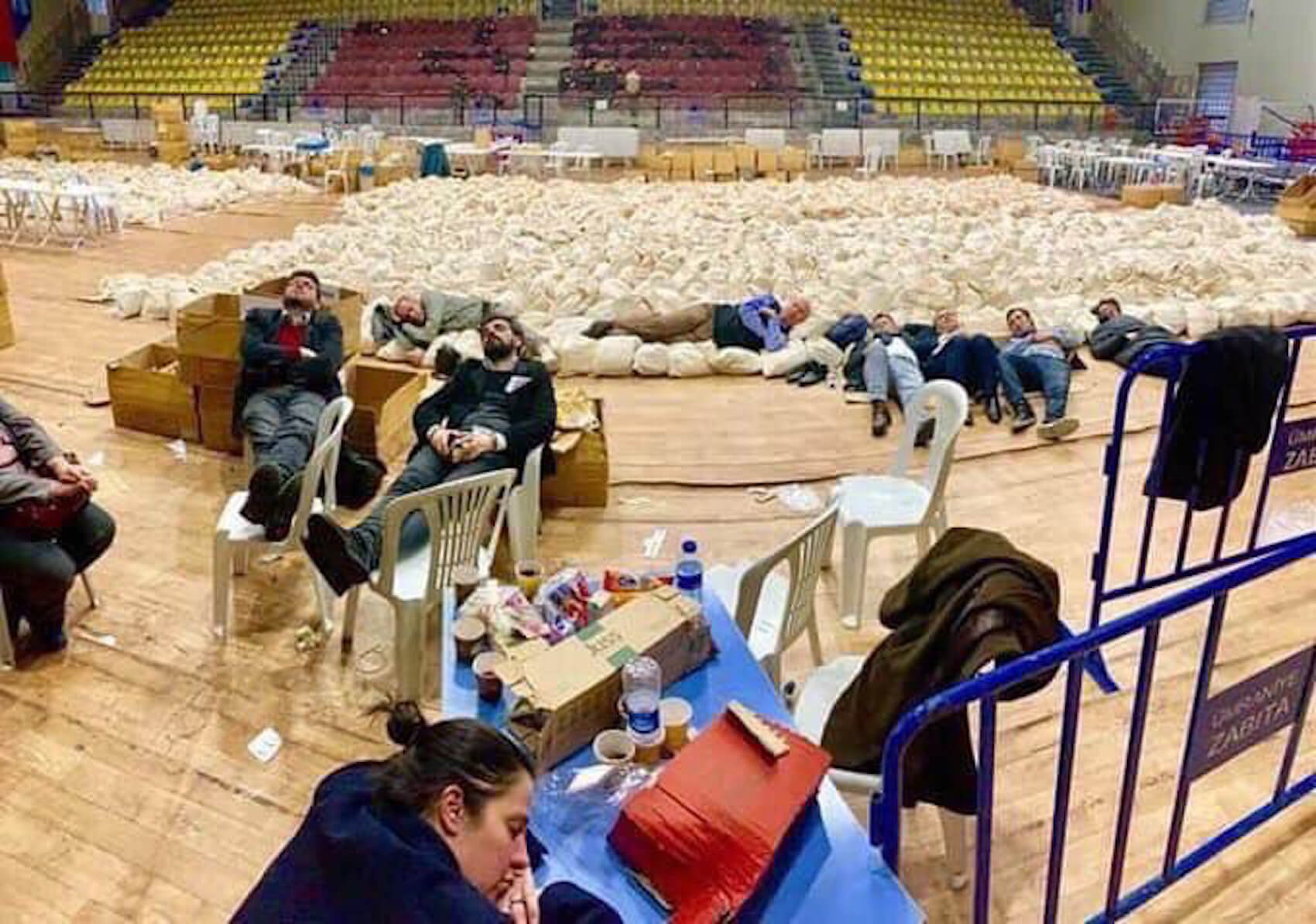
Andrej Babiš, leader of the ANO party and one of the richest businessmen in the Czech Republic, during a press conference in Prague on March 2, 2013. Photo: Dreamstime.

Prof. Bustikova: Babiš’s Victory in Czechia Is a Big Win for Illiberalism in Europe

On October 4, 2025, billionaire populist Andrej Babiš’s ANO party won the Czech parliamentary elections with just under 35% of the vote, setting the stage for coalition talks with two small right-wing, Eurosceptic parties. In this in-depth interview with ECPS, Professor Lenka Bustikova analyzes the implications of this outcome for Czech democracy and the broader Central European political landscape. Warning that “Babiš’s victory is a big win for illiberalism in Europe,” she explains how this election represents both a consolidation of illiberal forces and a strategic shift in Babiš’s populism—from managerialism to paternalism—raising concerns about democratic backsliding and Czechia’s future orientation within the EU.

Interview by Selcuk Gultasli

On October 4, 2025, billionaire populist Andrej Babiš’s ANO party won the Czech parliamentary elections with just under 35% of the vote, securing 80 of 200 seats—an increase from the previous election. Although short of a majority, Babiš is expected to lead coalition talks. His most likely allies are two small right-wing, Eurosceptic parties: the anti-Green Deal Motorists for Themselves and Tomio Okamura’s anti-immigrant Freedom and Direct Democracy (SPD). While ANO shares the Motorists’ opposition to EU emissions targets, relations with the SPD may prove more complicated due to internal divisions and radical demands. A new Babiš government would likely shift Czech foreign policy, notably by scrapping the Czech ammunition initiative supporting Ukraine.

Against this backdrop, Professor Lenka Bustikova, Director of the Center for European Studies and Professor of Political Science at the University of Florida, provides a detailed analysis of the political transformations currently unfolding in Czechia. In an interview with the European Center for Populism Studies (ECPS), she warns: “I’m very concerned. Despite the relatively moderate appeal, I do think that Babiš’s victory is a significant win for illiberals in the region. I do not think this will be a bloodbath for Czech democracy, but I do think there’s going to be a lot of bleeding. The patient will survive, but there will be a strong shift.”

Professor Bustikova situates the election within a broader pattern of democratic contestation in Central Europe, describing it as both a consolidation of the illiberal camp and a reconsolidation of the liberal camp. Drawing on her scholarship on technocratic populism, she explains how Babiš has evolved from presenting himself as a competent manager to positioning himself as a paternal figure promising redistribution and state-led solutions to economic grievances. His emphasis on managerial competence now interacts with sovereigntist and anti-Green Deal rhetoric, reflecting a hybrid populist strategy.

Crucially, Professor Bustikova underlines the significance of the far right’s role in the coalition-building process. “If this coalition emerges, it will be the first time in Czech history that the far right is either in coalition or silently supporting the government. That’s a huge breakthrough, and it’s very concerning,” she notes. This development, she argues, marks a major illiberal breakthrough, with potential implications for Czechia’s position in the EU.

Although Czechia retains strong institutional guardrails—including the presidency, the Senate, the Constitutional Court, and a pluralistic media environment—Professor Bustikova expects democratic quality to decline during Babiš’s tenure. Situating these developments in a regional perspective, she warns that the illiberal camp is “numerically much stronger,” making future liberal victories increasingly difficult.

Here is the edited transcript of our interview with Professor Lenka Bustikova, revised for clarity and flow.

Professor Lenka Bustikova is the Director of the Center for European Studies and Professor of Political Science at the University of Florida.

Czech Elections Mark a Strategic Shift Toward Illiberalism

Professor Lenka Bustikova, thank you very much for joining our interview series. Let me start right away with the first question: In light of Andrej Babiš’s decisive electoral victory, how would you interpret the current realignment of Czech party politics? Does this signify a deeper structural shift toward sovereigntist populism, or is it a contingent backlash against liberal governance?

Professor Lenka Bustikova: Thank you for this wonderful and difficult question. I would say that I am not alarmed by the outcome of the Czech elections, but I’m certainly concerned. What happened in this election—and many others have commented on it as well—is the consolidation of two camps. I would call them liberal and illiberal, because what the previous or outgoing government offered was not a particularly liberal government.

In this election, Andrej Babiš and his party, ANO, very successfully and skillfully consolidated voters who are unhappy, struggling, insecure, and also revengeful—and he did so effectively. The encouraging news about the Czech elections is that, in the previous election, about one million votes were wasted on smaller anti-system parties. This time, it was only 400,000. Babiš managed to unite this “coalition of the unhappy” and those seeking change, and he did it well. That camp has now consolidated, will have a voice, and will act as an accountability mechanism.

The liberal camp actually did quite well; the electoral math just didn’t work in their favor as it did four years ago. They were punished for not delivering on certain issues. They could have implemented progressive policies that wouldn’t have cost them much, but they didn’t—partly due to tensions within the coalition. They could have been more proactive on LGBTQ rights, registered partnerships, and perhaps on women’s rights.

More importantly, voters were facing a country with high inflation and high debt. The government did all it could, but it wasn’t enough. While the macroeconomic statistics in the Czech Republic are quite favorable, the government failed to communicate this effectively and neglected key economic issues, such as the housing crisis, that required greater attention. The outgoing coalition also continued to embody a kind of 1990s economic approach—loyal to an era that many voters now question and want to move beyond.

Overall, this election represents both a consolidation of the illiberal camp and a reconsolidation of the liberal camp. What we are seeing—in the Czech Republic and elsewhere—is that the illiberal camp is much stronger. If these patterns of consolidation continue, it will become increasingly difficult for the liberal camp to win elections. This is a major challenge in many countries today.

From Technocrat to ‘Big Daddy’ Populist

Drawing on your concept of technocratic populism, how does Babiš’s blend of managerialism and anti-elite rhetoric differ from classical populist radical right movements in Central Europe? Has this hybrid model evolved since his first premiership (2017–2021)?

Professor Lenka Bustikova: When we wrote the article with Professor Petra Guasti on technocratic populism, we conceived of it as an ideal type—and, of course, every ideal type, when faced with reality, becomes a bit murky and messy. In the original classification, technocratic populism in its pure form did not involve culture wars, nativism, or sovereigntism. It was about the populist utilization of expertise to win elections.

Babiš, who is a very flexible and savvy politician, has certainly evolved. Especially during the 2023 presidential elections, we saw him significantly amplify his nativist appeal—it was quite remarkable. But then he softened his rhetoric again. In the current election, he and his party, ANO, have toned it down.

We also see a shift away from the original technocratic populist model and its managerial appeal. When he first ran, he presented himself as a competent manager. Now, he positions himself more as a “big daddy” figure who will take care of things and spend generously on his constituents. The party he originally founded was fiscally conservative, advocating for running the state efficiently like a firm. That is no longer the platform. The current platform focuses on redistribution and targeted spending toward core constituencies.

This has little to do with efficiency, even though one of his electoral appeals is that the previous coalition was ineffective at managing economic problems—and there is certainly some truth to that. In many ways, this election has centered on pocketbook concerns, poverty, and voters in economically disadvantaged regions. Babiš and ANO have managed to mobilize these voters very successfully and effectively.

Sovereigntist Rhetoric, Pragmatic Strategy

Given Babiš’s membership in the Patriots for Europe and his critiques of the Green Deal, how do you assess the interplay between sovereigntist populism in Czechia and EU-level constraints? Are we witnessing a gradual erosion of the EU’s leverage over domestic political agendas?

Professor Lenka Bustikova: We certainly see that the European Union either lacks the instruments or is unwilling to use the instruments at hand to deal with autocratic or illiberal leaders, unfortunately. Babiš is a very pragmatic politician. He will criticize the Green Deal, but if, for instance, his agro-federate firm can benefit from it, I’m sure he would be open to discussions. One important aspect of the Green Deal debate is the likely involvement of the Motorists party, which is expected to be part of the future coalition and absolutely opposes the Green Deal. There is even a possibility that this party will get the environment portfolio, which would certainly lead to a strong pushback against the Green Deal from the incoming coalition.

The coalition negotiations have just started and will take some time, but resistance is almost certain. However, Babiš, being highly pragmatic, will likely oppose the Green Deal selectively, in ways that suit his political agenda, while also accommodating his coalition partners. I’m sure he will navigate this very skillfully, as part of the Green Deal is rhetorical, but there are also technical aspects that will not be easy to roll back.

A Volatile Marriage of Convenience

If Babiš succeeds in forming a minority government backed by SPD and Motorists, how might this affect the strategic behavior of far-right actors? Does your research on illiberal alliances suggest a stable coalition or a volatile marriage of convenience?

Professor Lenka Bustikova: The negotiations have just started, and one possibility is a coalition of ANO, led by Andrej Babiš, and Motorists. It’s not clear whether the far-right party—Tomio Okamura’s party—or its 10 plus 5 MPs will be part of the government or whether they will silently support the coalition from parliament. It’s possible that, for the far right, Babiš will ask them to nominate experts.

This is likely to be a volatile coalition, but Babiš has shown in the past that he can handle coalitions very well. In fact, anyone considering entering a coalition with Andrej Babiš should be very cautious. Babiš was once in a coalition with the Social Democrats, and he completely destroyed them, siphoning off all their voters. They are basically gone, especially after this election—a dead party for which Babiš can take much of the credit.

The SPD should really think twice about how to approach this future coalition relationship because the election results have shown that Babiš can very skillfully siphon off far-right voters as well. He is a highly strategic politician who has effectively cannibalized his coalition partners in the past.

With Motorists, there are likely to be some tensions. It’s not a stable party; it’s built around a few personalities. The biggest source of tension in the coalition will probably concern budget balance. The party of Motorists is, in a way, the intellectual child of former President Václav Klaus. They want to keep balanced budgets—an idea that has already been signaled as completely unrealistic. There may be some initial friction, but it’s likely they will get over it quickly.

Babiš is one of the most talented politicians in the Czech Republic today, and I expect he will handle this situation quite effectively, using a combination of arm-twisting and incentives. I suspect he will be very successful.

Okamura Overshoots, Babiš Benefits
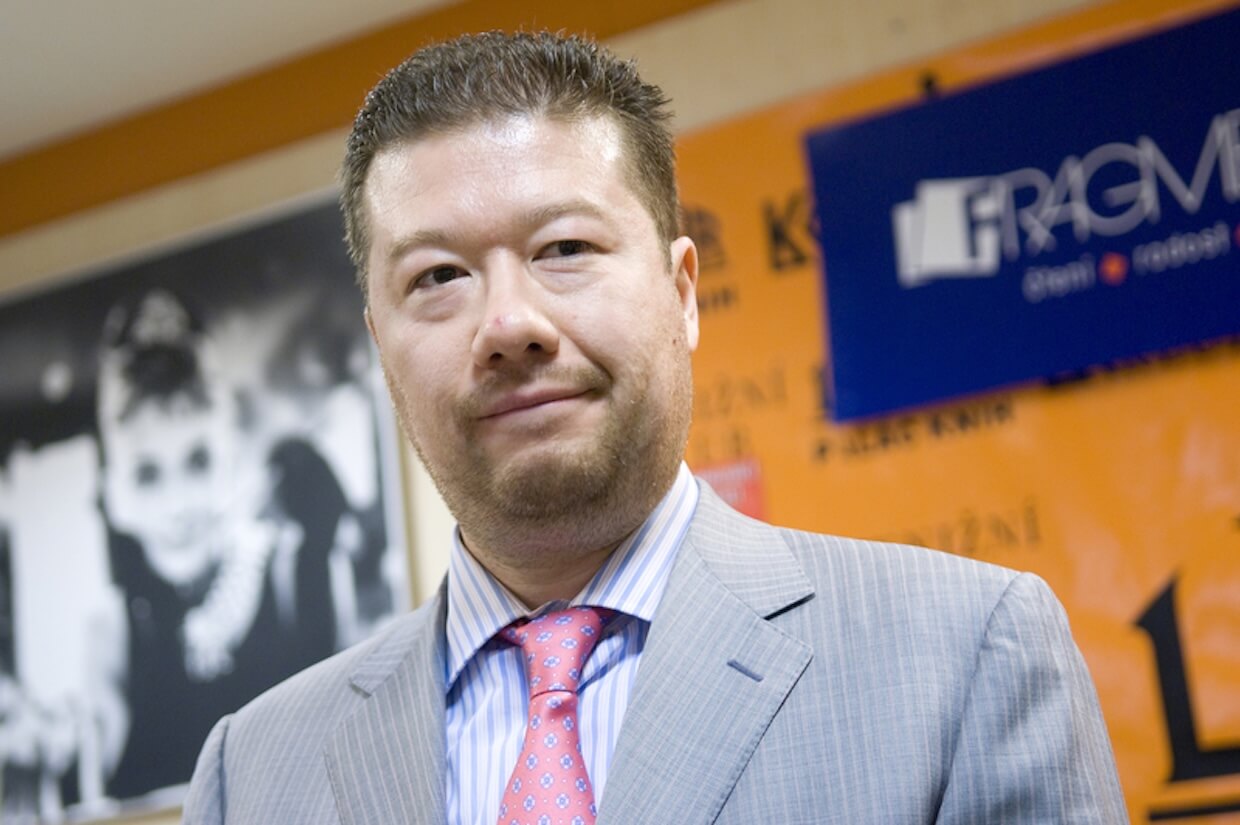
Czech businessman and SPD leader Tomio Okamura in Prague on May 5, 2010. Photo: Dreamstime.

The SPD underperformed compared to expectations. How do you explain the resilience of Babiš’s populist appeal despite the presence of established far-right actors? Does this reflect a mainstreaming of radical right discourse in Czech politics?

Professor Lenka Bustikova: Okamura underperformed—his party underperformed. Moreover, he has a group of very undisciplined MPs because, in fact, he had three other parties in the coalition, so he has five MPs who are more like coalition MPs than SPD members. He is no longer an authentic politician. Many far-right voters, including those from other parties, no longer see him as a credible nativist fighter—that’s one aspect. But also, he is too extreme for the Czech context. He ran a very vitriolic, pro-Russian campaign and openly declared that he would like the Czech Republic to leave NATO and the European Union. Czech voters absolutely do not have the stomach for that, so he overshot. This is simply too extreme.

As Aleš Michal, one Czech political scientist, insightfully observed, the mobilization against the far right led by the pro-democratic parties and the coalition Together—when they warned Czech voters against parties that would steer the country towards Russia—actually worked. Anti-system and far-right or far-left voters moved under the umbrella of ANO. So, in a way, the strategy worked, but it did not help the coalition Together—it helped Babiš.

Another important aspect is that during the presidential elections, which Babiš lost but which were highly polarized, he managed to attract a significant number of far-right voters. In 2023, these voters grew accustomed to the idea of voting for him. So, although he lost the presidential election, it helped him enormously in this election, as he became an acceptable alternative for the far right.

Cultural Issues Trigger Policy Backlash

In your work on the “Revenge of the Radical Right,” you emphasize how minority accommodation can trigger backlash. To what extent are current Czech political dynamics shaped by cultural issues (e.g., LGBTQ+ rights, immigration, Ukrainian refugees) rather than economic grievances?

Professor Lenka Bustikova: I’ve thought about these issues quite a bit because I do think that with a lot of foreign mobilization today, the appeal of ethnic issues is somewhat subdued. I also have one or two articles with Professor Petra Guasti where we speculate about this. The logic of the book is that backlash ensues after the accommodation of minorities—it’s a backlash against elevating groups and putting forward policies that help them. In that sense, the logic of backlash applies here as well. In the Czech Republic, when you consider the status quo and the pursuit of policies that were genuinely beneficial to Ukrainian refugees, you can anticipate an ensuing backlash. Ukrainian refugees are no longer as warmly welcomed as they once were. There have also been many attempts to advance more robust legislation to protect women against rape and sexual assault, as well as attempts to codify the Istanbul Convention. These are all policies that, in a way, shift the balance of power or policy direction, and we have seen backlash as a result. Similarly, the LGBTQ community is hoping to increase their rights. Much of the public is quite open to this possibility, but the process of getting there involves shifting the balance and policies. Once that happens, advocates on the opposing side are naturally activated. So, I do think the policy backlash logic applies here as well.

Recent scholarship highlights the rise of confessional illiberalism across Central Europe. Do you see religiously inflected sovereigntism gaining ground in Czechia, or does the country’s secular legacy limit this trajectory compared to Hungary and Poland?

Professor Lenka Bustikova: This is an excellent question. It refers to a recent article that I’ve written with Lottam Halevi, who is now at the University of Constance. One important thing to keep in mind is that much of the mobilization around religious issues is actually a mobilization of political identity. It is not necessarily the case that more religiously infused countries will experience a higher mobilization of religious identity or religious activity as political identity. Czechia is a very secular country. However, we do see issues around transgender rights or some LGBTQ questions being framed in ways that are very similar to Hungary and Poland. The culture wars are nowhere near as fierce as in neighboring countries, but the country could potentially develop its own mini culture wars. 

Another important point is that in the Czech Republic, the Christian Democratic Party is firmly in a coalition and belongs to the liberal or pro-democratic camp. As long as they remain on the side of parties that respect the rule of law, this creates a kind of firewall against the politicization of some of these issues. Nevertheless, we have seen signs of this dynamic even in a country as secular as the Czech Republic.

Culture Wars Remain Underutilized in Czech Politics
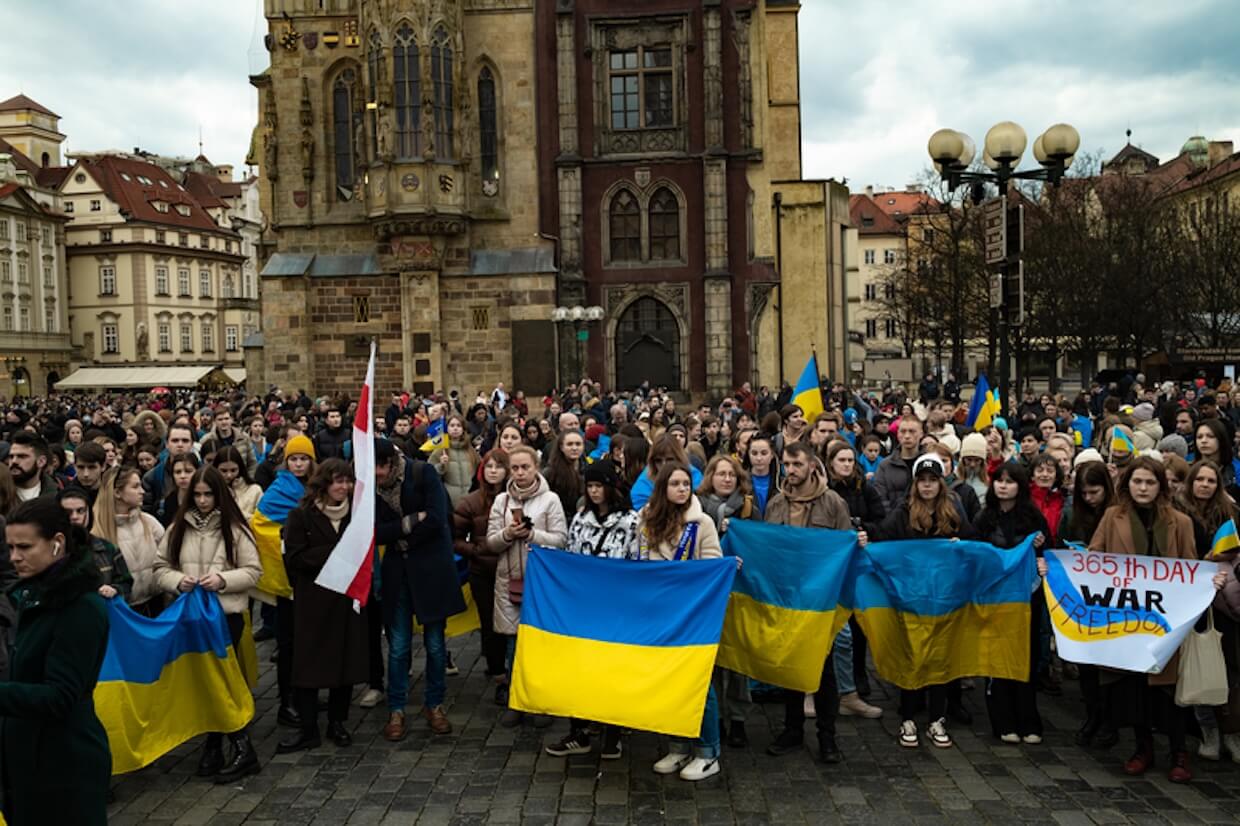
Ukrainian activists protest against the Russian invasion of Ukraine during a peaceful demonstration with flags in support of Ukraine in Prague, Czechia on February 24, 2023. Photo: Dreamstime.

Your article “In Europe’s Closet” discusses how minority rights can catalyze illiberal backlash. Are Czech populist and far-right actors increasingly weaponizing LGBTQ+ issues as part of their sovereigntist narratives? How does this compare to developments in Slovakia or Poland?

Professor Lenka Bustikova: Suddenly, these issues are high on the agenda in Slovakia and Poland, even though in Poland some LGBTQ issues are not as salient as they were a few years ago. However, we do see narratives about protecting children against transgenderism emerging. This rhetoric often appears as part of anti-EU, Euroskeptic discourse—telling people what to do, how to raise their children, promoting a progressive agenda around women, or framing gender rights as a threat to traditional families. The offshoots of these narratives are present, though they are not a particularly dominant strain. Pocketbook issues largely dominated this election. So, the potential is there, but it remains underutilized. Moreover, the Catholic Church in the Czech Republic is quite restrained and does not enter into these debates in the way it does in Slovakia or Poland.

In your co-authored work on “Patronage, Trust, and State Capacity,” you argue that low bureaucratic trust fosters clientelism. How does this dynamic manifest in Babiš’s political strategy, especially considering his corporate background and patronage networks?

Professor Lenka Bustikova: Andrej Babiš cares about one thing only, and that’s his firm, Agrofert, and his political party is his firm. The party is not a regular party; it is a business project and a business offshoot. He has a huge conflict of interest, which nobody knows how he’s going to solve if he’s nominated as prime minister, because the Czech Republic doesn’t have an institute of blind trust. The conflict of interest will always be there because his firm, Agrofert, is a large recipient of state subsidies. That’s not necessarily patronage networks; it’s, in a way, making sure that the state is in a fantastic synergistic position with his firm. That is a particularity of his business background and the setup of the party. It is a vehicle for him to keep political power and be able to use state and EU subsidies, and the conflict of interest is just written all over him.

In terms of ANO as a party strategy, I would not necessarily define it as clientelism. What we saw when Babiš was in power, I would call targeted distribution—targeting pockets of voters, many of whom actually do need this targeting, and it is very beneficial to them. It involves picking out or dissecting groups that will be selected for state help, and again, the budget deficit is going to balloon. I don’t think that’s necessarily patronage, but it’s a targeted exchange that a lot of parties engage in, and it’s bread-and-butter politics. Having said that, aside from the targeted distribution, Babiš will make sure that his agglomerate benefits from him being prime minister again, which is a very likely scenario, as it seems now.

From Fiscal Conservatism to Programmatic Populism

Do you think Babiš’s economic promises—higher pensions, lower taxes, welfare expansion—should be understood as clientelistic appeals rooted in weak state capacity, or as programmatic populism aimed at reshaping public expectations?

Professor Lenka Bustikova: If I were to choose, I would really use more of a frame of programmatic populism or targeted distribution. We saw this between 2017–2021. What’s happening in the region now is that voter expectations have changed—and this applies to Poland and Slovakia as well—so that populist voters now expect redistribution and higher spending. If Babiš stays in power for four years, these expectations will become absolutely entrenched. There is a recent book on Poland by Ben Stanley that talks about this lock-in: basically, the transformation of the Polish party system in such a way that all voters now expect the next party in power to spend, no matter who that might be. If the current governing coalition ever comes back, they will have to do the same thing. They will not be able to promise balanced budgets. If they want to defeat Babiš four years from now, they will also have to promise spending. Good luck with the budgets, but there is a general entrenchment of voters expecting that the state needs to really open up the valves. It will probably have pretty bad long-term consequences, but nobody’s thinking long-term these days.

Given Babiš’s emphasis on managerial competence, how does technocratic rhetoric interact with populist radical right sovereigntist claims in his current coalition-building efforts?

Professor Lenka Bustikova: It’s going to be a big spending spree, and the Motorists will have to hold their noses. The far right really doesn’t care—actually, it supports spending as long as it’s spending on Czechs, or native spending, and not on Ukrainians or migrants. This is going to be a move from manager to, in a way, a paternal figure who is going to take care of everybody, including making appointments for colonoscopy. Part of the big appeal of Babiš was the emphasis on improving the healthcare system. 

Having been quite critical about ANO, I do have to emphasize that it’s quite possible that some of the portfolios the coalition will control can be given to very competent people. In the previous government, ANO had some ministers or portfolios that were run quite well. For example, the Ministry of Education underwent some really good changes. It’s also possible that some of the infrastructure projects that started and need to be completed, or the huge shortage of housing stock—if Babiš can really deliver on these issues, that’s going to be very successful, rewarded, and it would benefit the country quite a bit. If he throws in managerial competence and delivers, that would be fantastic, and it’s possible that there might be some policy changes that can be done well and have long-term benefits. But I suspect a big spending spree and a very short-term horizon, given Babiš’s age. We’ll see.

A Historic Breakthrough for the Far Right

Analysts have warned that Babiš could align Czechia with Hungary and Slovakia, forming a sovereigntist bloc inside the EU. Do you view this as a tactical positioning or a substantive ideological shift toward illiberal governance?

Professor Lenka Bustikova: I’m very concerned. Despite the relatively moderate appeal, I do think that Babiš’s victory is a significant win for illiberals in the region. I do not think this will be a bloodbath for Czech democracy, but I do think there’s going to be a lot of bleeding. The patient will survive, but there will be a strong shift. Babiš is also very strategic. If he and his coalition partners drag him to some extreme positions, the Czech public may become accustomed to that. If this coalition emerges, it will be the first time in Czech history that the far right is either in coalition or silently supporting the government. That’s a huge breakthrough, and it’s very concerning. The Motorists are not an extreme party, but they are certainly not rooting for the European rule of law and liberal democratic values. This is very troubling, and it’s a big win for illiberalism in Europe. Babiš’s victory is undoubtedly a big win for illiberalism.

Guardrails Exist, But Democratic Quality May Decline
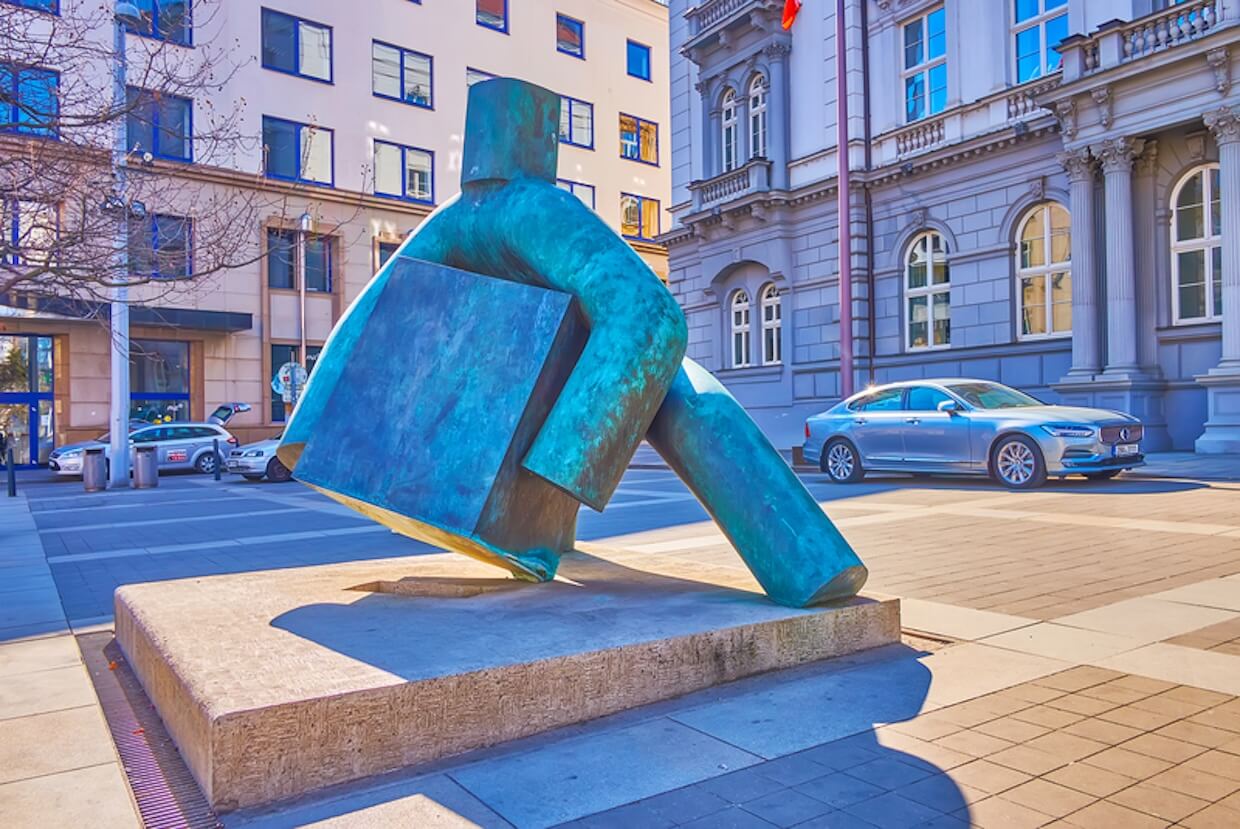
The Statue of Justice by Marius Kotrba, a modern sculpture located at the Supreme Court building in Brno, Czech Republic, on March 10, 2022. Photo: Evgeniy Fesenko.

What are the potential institutional guardrails against democratic backsliding in Czechia, and how do they compare to Hungary and Slovakia during their own illiberal turns?

Professor Lenka Bustikova: There are a lot of guardrails. The most important actor is the current president, Petr Pavel. He can veto, he can play a huge informal role, and he will have to think very carefully about whether the future prime minister is going to violate the law by being in a position of conflict of interest. This is going to be a hard puzzle to solve. The Czech president is a pro-democratic, centrist figure with good temperament and very high levels of popularity.

The second guardrail is the second chamber, which Slovakia does not have. The Czech Senate is still dominated by so-called liberal or pro-democratic parties. There are a lot of roadblocks. Another institution that’s quite important is the Constitutional Court, which has saved Czech democracy many times. That’s also significant.

The media in the Czech Republic have been independent. Babiš is going to go after Czech Television and Czech Radio, but the country has a robust, pluralistic media scene. It might change, but that’s an important characteristic.

Czech civil society is quite active, although one has to be very careful about what mobilization means. For example, work by Petra Guasti and Aleš Michal showed that populists are sometimes much better at mobilizing. This election has shown that people can be mobilized for and against democracy, or for liberal or illiberal causes. This time, the election mobilized the illiberals more, but there were other elections in the past when the pro-democratic camp was mobilized quite well. Civil society is active. It pays attention.

So, there is hope, but I do expect that the quality of Czech democracy will decline during this period because of disrespect for the rule of law. Babiš does not like the rule of law, and his coalition partners are either extremists or at the fringe of the mainstream. Another thing I would like to mention is that one of the leaders of the Motorist Party has accusations of domestic abuse filed against him. In terms of signaling the moral integrity of political leaders, this also doesn’t bode well for appointing people with questionable moral standing to very high positions of power.

Swerve for Now, But the Future Looks Troubling

Finally, situating Czechia within the broader Central European context, do you see the current developments as part of a cyclical populist wave or a deeper structural illiberal swerve, as discussed in “The Illiberal Turn or Swerve in Central Europe?”

Professor Lenka Bustikova: At this moment, I expect that this is going to be four years’ worth, but I don’t know what’s going to happen at the end of these four years, because what we see in other countries is that when the 2.0 comes back—when populists return to power—they are much more effective. They know what to do, they have their playbooks ready, they have done this before, they are much more revengeful, aggressive, and they know how to get things done. So I expect that Babiš will weaken the rule of law and definitely try to weaken some of the guardrails. I do think that the coalition partners will certainly drag the country more towards the East than towards the West. The real question is going to be: after four years, is there anyone who will be able to beat them? It’s going to be very difficult because this consolidation of camps shows that the illiberal camp is simply numerically much stronger. Either they’ll have to make some terrible mistakes—which they will—and the voters may forgive them or may not, or the liberal camp will have to grow, and we see in other countries that it is a very steep hill to climb. So, swerve for now, but I am very concerned about the future.

Dr. Ecaterina Locoman is a Senior Lecturer at the Lauder Institute and in the Department of Political Science at the University of Pennsylvania.

Dr. Locoman: Moldova’s Win Is Real, But Russia Is Not Done Yet

Moldova’s 2025 parliamentary elections mark a pivotal moment in the geopolitical tug-of-war between the European Union and Russia. Despite unprecedented hybrid interference—including disinformation, illicit financing, and the use of new technologies—the pro-European Party of Action and Solidarity (PAS) secured a decisive victory. Dr. Ecaterina Locoman cautions, however, that this success is “more of a temporary setback” for Moscow than a strategic defeat: “Russia will gather its resources again.” In this interview with ECPS, Dr. Locoman analyzes Moldova’s evolving democratic resilience, the adaptive strategies of Russian influence, the role of the diaspora, and the country’s ambitious EU accession goal. She underscores the importance of sustained domestic reform and Western engagement to keep Moldova on its “irreversible European path.”

Interview by Selcuk Gultasli

Moldova’s 2025 parliamentary elections have emerged as a pivotal moment in the geopolitical contest between the European Union and Russia. Against a backdrop of unprecedented hybrid interference—including disinformation campaigns, illicit financing, and the use of new technologies—Moldova’s pro-European Party of Action and Solidarity (PAS) secured a decisive victory. Yet, as Dr. Ecaterina Locoman cautions in this interview with the European Center for Populism Studies (ECPS), this success must be understood as both real and fragile: “I expect that Russia will continue to influence domestic politics. It’s part of their strategic goal to regain control over the post-Soviet region, and I don’t think this should be read as a strategic loss. It’s more of a temporary setback, but they will gather their resources again.”

Dr. Locoman, Senior Lecturer at the Lauder Institute and in the Department of Political Science at the University of Pennsylvania, situates Moldova’s electoral resilience within a hybrid framework of domestic determination and external support. “We can interpret the results of the Moldovan elections as a hybrid outcome. On the one hand, they reflect a strong domestic effort—both from political institutions and voters—who showed remarkable resilience in the face of Russian interference and influence. On the other hand, it is also clear that without the support of Western partners, especially the European Union, this success would not have been possible. So, it’s both a domestic and international story.”

This resilience was manifested not only through institutional preparedness—such as stronger oversight of illicit financing and disinformation—but also through robust diaspora engagement and sustained voter mobilization. “The numbers show that 280,000 Moldovans abroad voted in the elections,” Dr. Locoman notes, highlighting how mail ballots and close transnational ties helped bolster the pro-EU vote. She underscores that “the diaspora is relatively young… they maintain very strong links to Moldovan politics and what is happening at home.”

At the same time, Moscow’s influence tactics are evolving. Russia experimented with “the use of AI and alternative financial methods, like cryptocurrency,” to obscure financial flows and spread propaganda. While these efforts ultimately proved less effective this cycle, Dr. Locoman warns against complacency: “Moscow is one of the best students of the post-Soviet region… they will learn from their own mistakes and improve their strategies in the next elections. This fight needs to continue.”

Looking ahead, Moldova’s ambition to join the European Union by 2030 faces both internal and external hurdles. Domestically, slow reforms, corruption, and economic vulnerabilities remain pressing concerns. Externally, geopolitical vetoes—most notably from Hungary—could obstruct accession negotiations. “I have some doubts—not fear, but doubts—about how quickly the situation can move by 2030,” Dr. Locoman admits. Yet she also maintains a note of cautious optimism: “Up until 2022, Moldova had been knocking on the EU’s doors for more than 30 years… and then, in the end, it happened.”

In this interview, Dr. Locoman offers a nuanced analysis of Moldova’s evolving democratic landscape, the adaptive strategies of Russian influence, and the strategic choices facing both Moldovan and European leaders in the years to come.

Here is the transcript of our interview with Dr. Ecaterina Locoman, lightly edited for clarity and readability.

Resilience at Home, Support Abroad

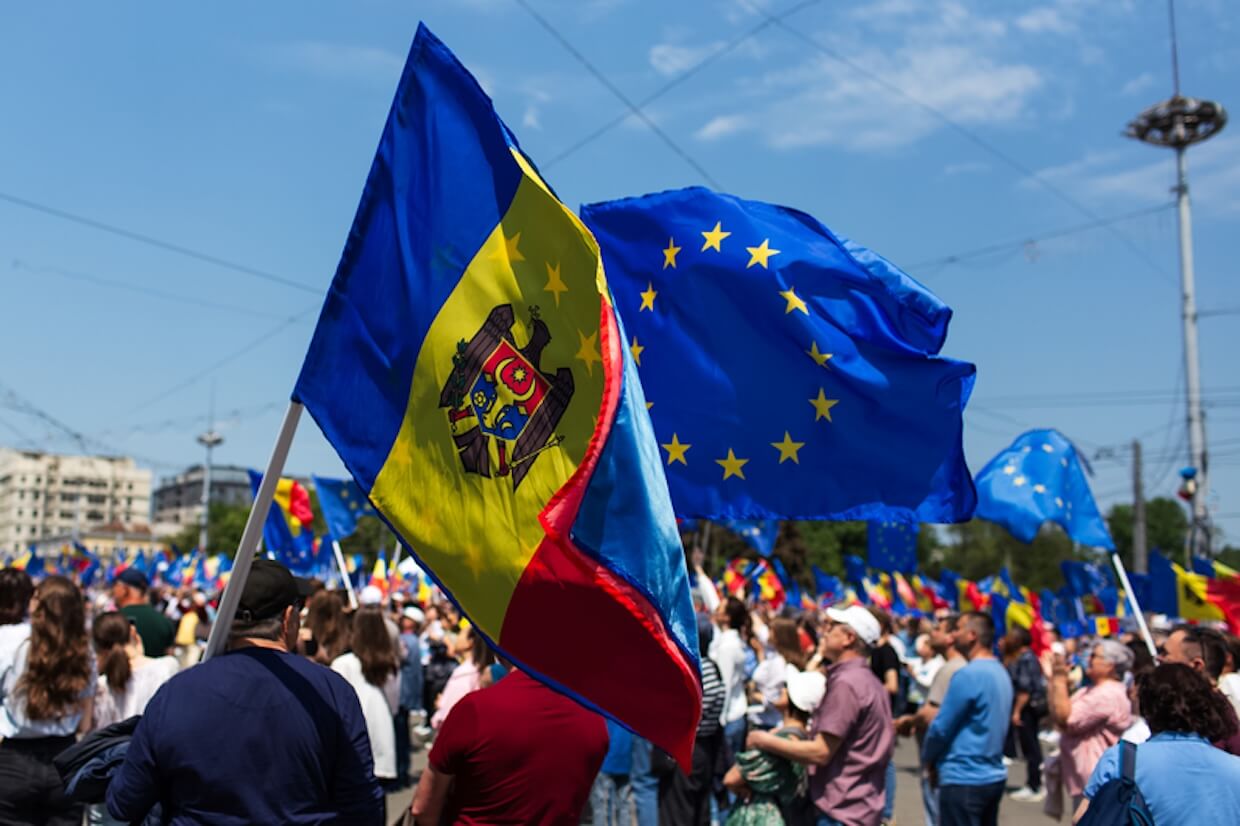
National meeting of the Moldovan people with the flags of the European Union and the Republic of Moldova. Chisinau, Moldova, May 21, 2023. Photo: Andrei F.

Dr. Ecaterina Locoman, thank you very much for joining our interview series. Let me start right away with the first question: Moldova’s parliamentary elections delivered a decisive victory for the ruling pro-European Union PAS despite unprecedented Russian interference. Should we interpret this outcome as a durable consolidation of democratic resilience, or as a contingent success heavily dependent on extraordinary EU and Western support?

Dr. Ecaterina Locoman: Thank you very much for having me. It’s a pleasure to be here. I think we can interpret the results of the Moldovan elections as a hybrid outcome. On the one hand, they reflect a strong domestic effort—both from political institutions and voters—who showed remarkable resilience in the face of Russian interference and influence. On the other hand, it is also clear that without the support of Western partners, especially the European Union, this success would not have been possible. So, it’s both a domestic and international story.

Importantly, if we look back at the 2024 presidential elections and now the 2025 parliamentary elections, voters have chosen a similar direction. This indicates that democracy in Moldova, while perhaps not as strong or stable as one might wish, is nonetheless evolving. Moldovans and their institutions are working every day to strengthen it. We saw a high degree of voter mobilization despite significant Russian efforts, including disinformation campaigns, cyberattacks, and illicit financing. Voter turnout was relatively high at 52%, demonstrating strong civic engagement.

Compared to the 2024 presidential elections, domestic institutions such as the prosecutor’s office and the police clearly learned from past mistakes. They were better prepared to identify and address unlawful use of illicit funding and electoral violations. This helped build voter confidence in the electoral process. As in previous elections, diaspora engagement was also very strong, further contributing to democratic resilience. Overall, these factors point to an increased resilience among Moldovans in defending their democratic process.

Pro-Russian Messages Losing Ground

To what extent do the results reflect a deepening societal commitment to a pro-European orientation, as opposed to a rejection of entrenched pro-Russian elites such as Igor Dodon and his allies, whose populist appeals often fuse anti-elite rhetoric with civilizational tropes about Russia as Moldova’s “natural” ally?

Dr. Ecaterina Locoman:  That’s a very good question. The results show that, again, the recent election, as well as those in 2024 and 2021, reflect a continuing trend that society as a whole is more or less committed to a pro-Western orientation. I travel to Moldova on a yearly basis, and I can see that the country has changed significantly in recent years since Maia Sandu became president. There is a very clear pro-European trend. That said, it’s true that we don’t have precise data on how many Moldovans live abroad. Every summer, many of them return, and perhaps my impression of the country is somewhat skewed because I visit during that period when a lot of diaspora members are back home. Still, the spirit in the country is very much pro-European.

It’s also true that there have been numerous reports on this topic. I have studied how both Russia and the West try to influence domestic politics in post-Soviet states, and my research shows that Russia has long been grooming local political actors in countries such as Ukraine, Moldova, Georgia, and Armenia. The fact that they were able to attract and cultivate specific types of political figures—such as Igor Dodon, for example, a former president of Moldova who now enjoys little popularity among large segments of the electorate—indicates that Moldovans are increasingly able to distinguish between leaders who genuinely seek to build a democratic, secure, and prosperous future for the country and those who do not.

Pro-Russian actors have not been particularly original or creative in how they promote their message. This message is losing ground, especially because of the war in Ukraine. It is no longer easy to “sell” this narrative. Previously, Moldovan politics often involved strategic shifts between Russia and the West, depending on which side best served domestic interests. Today, this approach is much harder to sustain. The war raging in neighboring Ukraine has made people more aware of the stakes, and Moldova has received a significant number of Ukrainian refugees. As a result, it has become much more difficult for pro-Russian parties to sell their message as effectively as before.

A Blessing in Disguise: Russia’s Unintended Push

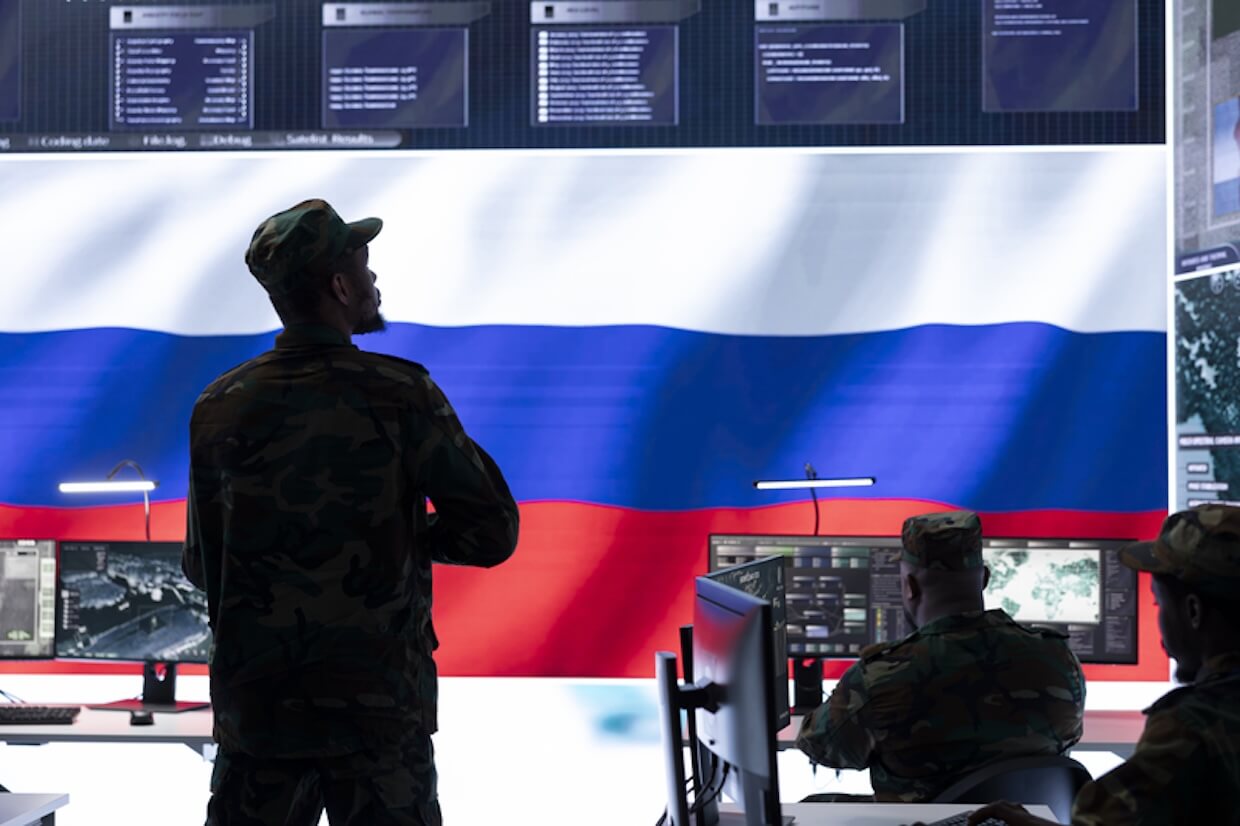
Russian military expert at a government operations base, engaged in cyber activities aimed at spreading disinformation and hybrid warfare propaganda. Photo: Dragos Condrea.

With turnout just above 50%, what does this relative disengagement reveal about the durability of PAS’s mandate, and does persistent electoral apathy risk undermining the legitimacy of Moldova’s democratic consolidation over time?

Dr. Ecaterina Locoman: As I mentioned earlier, yes, the turnout was just over 50%, but this number is not unusually low for Moldova. In fact, compared to some recent elections in the region, 52% is relatively solid. However, you are right that it also signals that a significant portion of the electorate remains disengaged, which has implications for the durability of the ruling party’s mandate to govern over the next four years.

The fact that Maia Sandu’s party won elections for the second time is significant. They secured a clear majority of seats and resisted heavy Russian interference and influence. At the same time, much of their enthusiasm is concentrated during election periods, when the central question is whether the country is moving east or west. This enthusiasm does not always last throughout the full four-year governing period.

Moldovans are frustrated with the slow pace of reforms, the persistence of corruption, and the fact that judicial change has not progressed as quickly as many had hoped. Many voters remain disillusioned with these slow reforms, persistent poverty, and daily economic hardships. For this reason, it is especially important for the governing party to deliver results quickly—both to maintain its stated goal of joining the European Union and to ensure that its policies meet the expectations of the electorate.

In some ways, the Russian presence is acting as a “blessing in disguise.” Without the Russian threat at the border, Moldovan political parties might have been more complacent and less willing to pursue reforms. Because the threat is so close, it creates a greater sense of urgency among both political actors and the population to mobilize and align with the European Union.

What has changed significantly compared to previous elections—particularly over the past decade, since around 2010—is the unprecedented level of symbolic, technical, and financial support the European Union has provided to Maia Sandu and Moldovan political institutions. EU leaders have repeatedly visited Moldova and demonstrated their support, which is unprecedented in the country’s history.

In my own research, I found that since 1991, when Moldova declared independence from the USSR, one of its main foreign policy challenges has been ensuring that the West paid any attention to it at all. For many years, Moldova was on the radar only because of the Transnistrian conflict. As long as things were quiet and stable, there was little engagement. Now, however, Moldovan political elites—especially Maia Sandu—have succeeded in breaking through this indifference and convincing European leaders that Moldova is strategically important to the EU and its security.

Transnationalizing Moldovan Democracy

The diaspora played a decisive role in shaping the outcome. How should we understand this transnationalization of Moldovan democracy, especially given populist narratives at home that cast the diaspora as an illegitimate, “externalized” electorate undermining national sovereignty?

Dr. Ecaterina Locoman: That’s true. I like the expression you used—the transnationalization of Moldovan democracy. The numbers show that 280,000 Moldovans abroad voted in the elections. This is because the governing party recognized that much of their support comes from the diaspora, so they facilitated the voting process abroad. The introduction of mail ballots was a smart and strategic move, because people living in countries like the United States find it much easier to vote by mail than to go in person to Moldovan embassies or consulates. This was an important step, reflecting the fact that domestic political elites understood the crucial role the diaspora plays.

Another important factor is that the diaspora is relatively young. Most of those who have moved abroad are in their 50s, 40s, 30s, and 20s. They maintain very strong links to Moldovan politics and what is happening at home. Many have families in Moldova, so they remain deeply engaged, and I was pleased to see the high level of civic engagement among the diaspora, particularly their efforts to support and promote European integration.

It’s true that the more pro-Russia parties tend to portray the diaspora negatively. I think it was Igor Dodon who, at one point during a previous presidential election, referred to the diaspora as a “parallel electorate,” claiming that they don’t know what’s happening at home, that they live in the West and therefore want the country to join the West. He argued that they are disconnected from domestic realities, which is not true. The links between the diaspora and Moldova remain very strong.

If you visit in the summertime, you can see many young people and young families returning. In the 1990s and early 2000s, before Moldova had a visa-free regime with the EU, many Moldovans tried to work in the EU illegally. They often ended up stuck abroad, unable to return home, and the maximum support they could provide was through remittances.

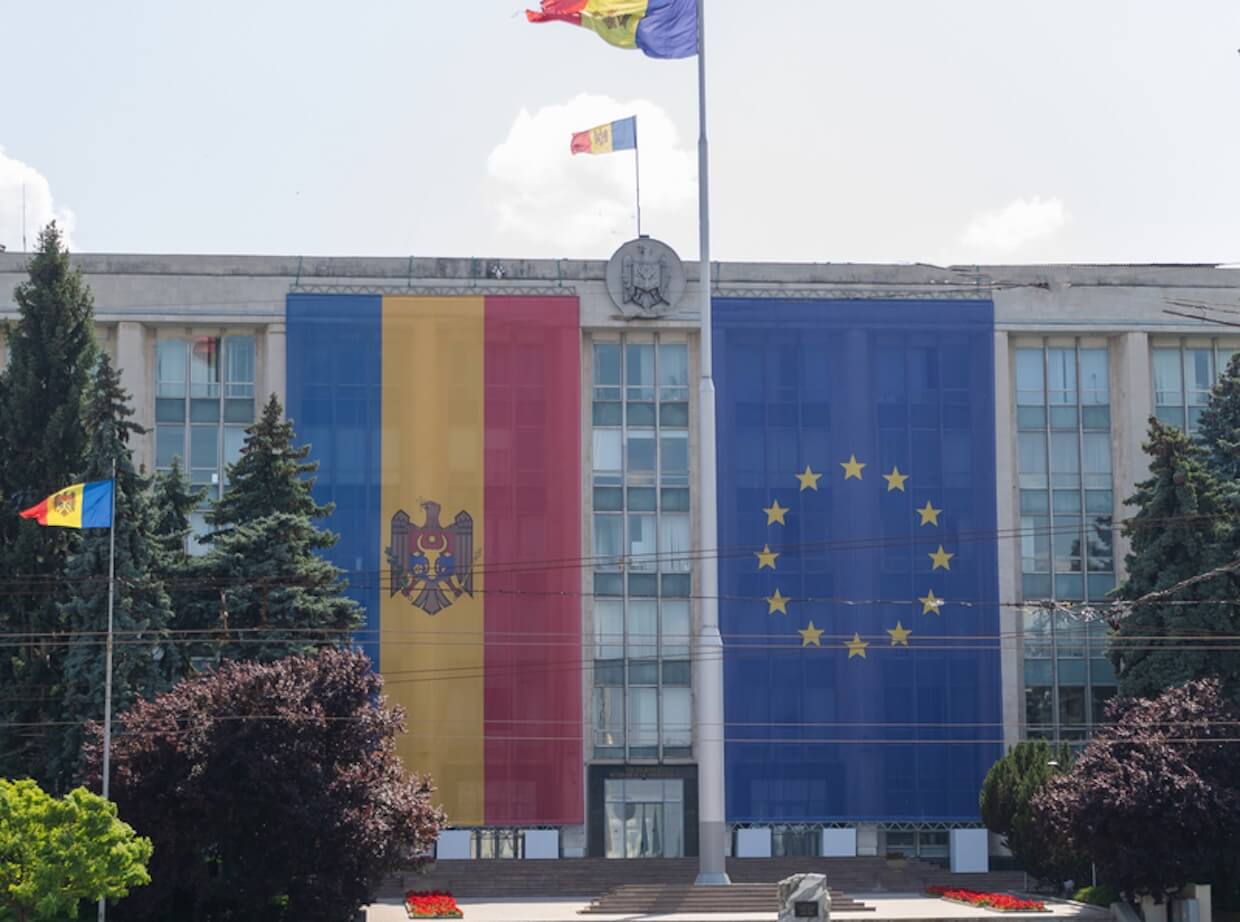
Government building decorated with Moldovan and European Union flags, as well as national and EU symbols, in central Chisinau, Chisinau, Moldova on June 1, 2025. Photo: Gheorghe Mindru.

Now, because the EU has introduced a visa-free regime and many Moldovans have been able to obtain Romanian citizenship—thanks to Romania’s revised citizenship law allowing those who can prove family links from the interwar period when Moldova was part of Greater Romania to apply—many people have Romanian passports. This allows them to live and work legally in the EU.

As a result, many young families now live in European countries such as Germany, Belgium, and Great Britain during the year, but they build homes in Moldova, have parents and siblings there, and remain in close contact. So, it is not accurate to argue that the diaspora is disconnected from events at home. In fact, it is very much a part of what is happening domestically. As long as domestic political actors continue to engage the diaspora and maintain these connections, the pro-European movement will hopefully remain strong.

Hybrid Interference: New Tactics, Old Goals

Observers describe Moldova as a “laboratory” for Russia’s hybrid interference. From disinformation to illicit financing, what does the 2025 electoral cycle reveal about the adaptive limits of Moscow’s toolkit of influence?

Dr. Ecaterina Locoman: Yes, we’ve seen new models of influence that Russia has used in the elections. The use of AI and alternative financial methods, like cryptocurrency, for example, is new. They tried to hide financial links by using cryptocurrency, which, in a way, influenced the process. But, this also revealed the limits of Russian influence. I would add a caveat here: Moscow—indeed the Kremlin—is one of the best students of the post-Soviet region. They know the region very well and have people who have studied it in depth. So, I expect that they will learn from their own mistakes and improve their strategies in the next elections. This means that Moldova’s pro-European victory should not be seen as a sign that we can become complacent or self-sufficient. This fight needs to continue. As I said, Moscow is a very good student of the post-Soviet region. They understand the internal realities of these countries. They know the challenges that people face, the domestic weak points, and they try to exploit these to the advantage of their messages and narratives.

At the same time, many of these tools proved ineffective at this point in time because Moldovan institutions—and civil society as well—were more proactive than in past elections. Moldovan institutions learned important lessons from the last presidential elections. Parties engaged in illicit financing were excluded from the ballot, prosecutions were pursued, and the government was much more transparent in communicating about disinformation campaigns. As a result, people were much more aware of what was going on.

While the Russian toolkit has evolved technologically, its effectiveness is limited when met with resilient institutions, rapid countermeasures, and credible alternatives. If we look at one successful formula that worked in Moldova at this moment, I would still be cautious not to declare this the end of Russian interference. Russian influence will remain strong in the region. But what worked was a credible pro-EU message from domestic political parties, coupled with strong and credible support from the EU, which was very important. Additionally, the pro-Russia parties were not as original in their messaging, and the ongoing war in neighboring Ukraine further strengthened the pro-EU camp.

Exploiting Weak Links: Moscow’s Populist Playbook

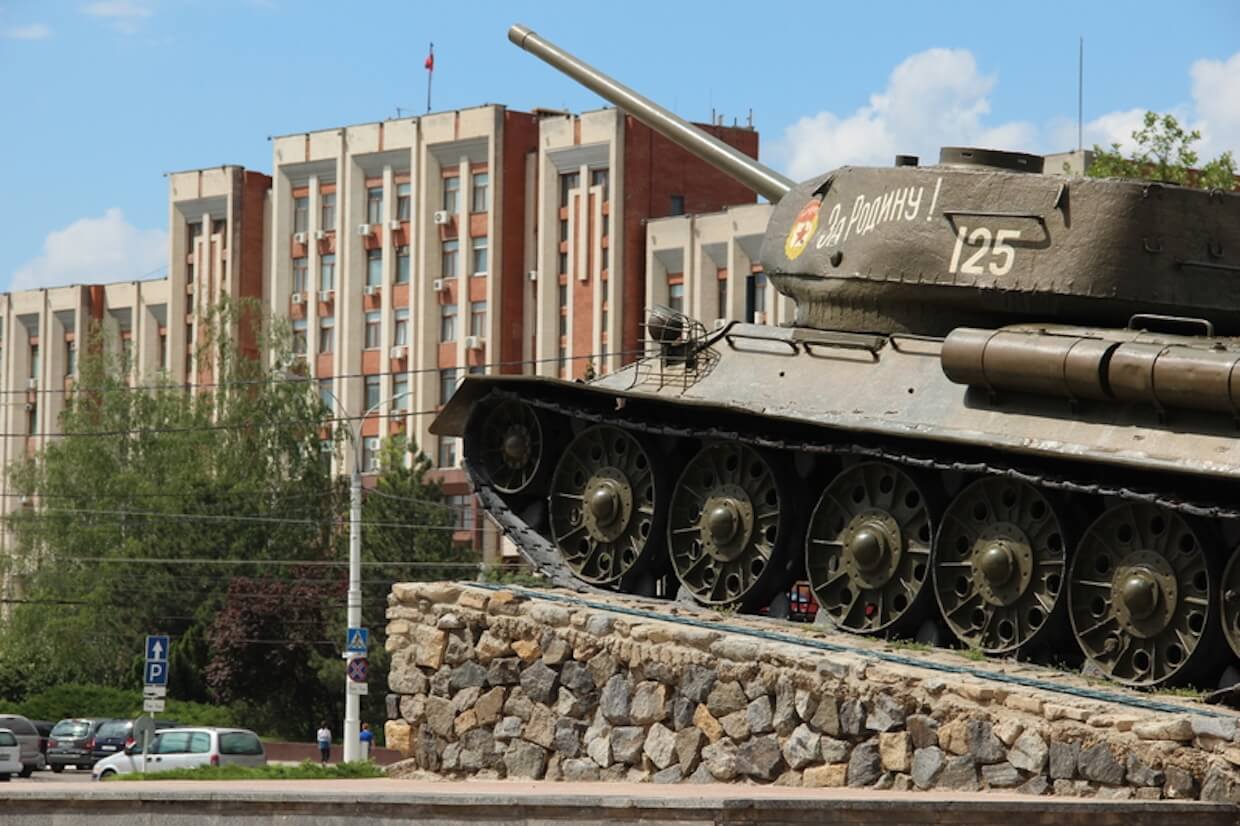
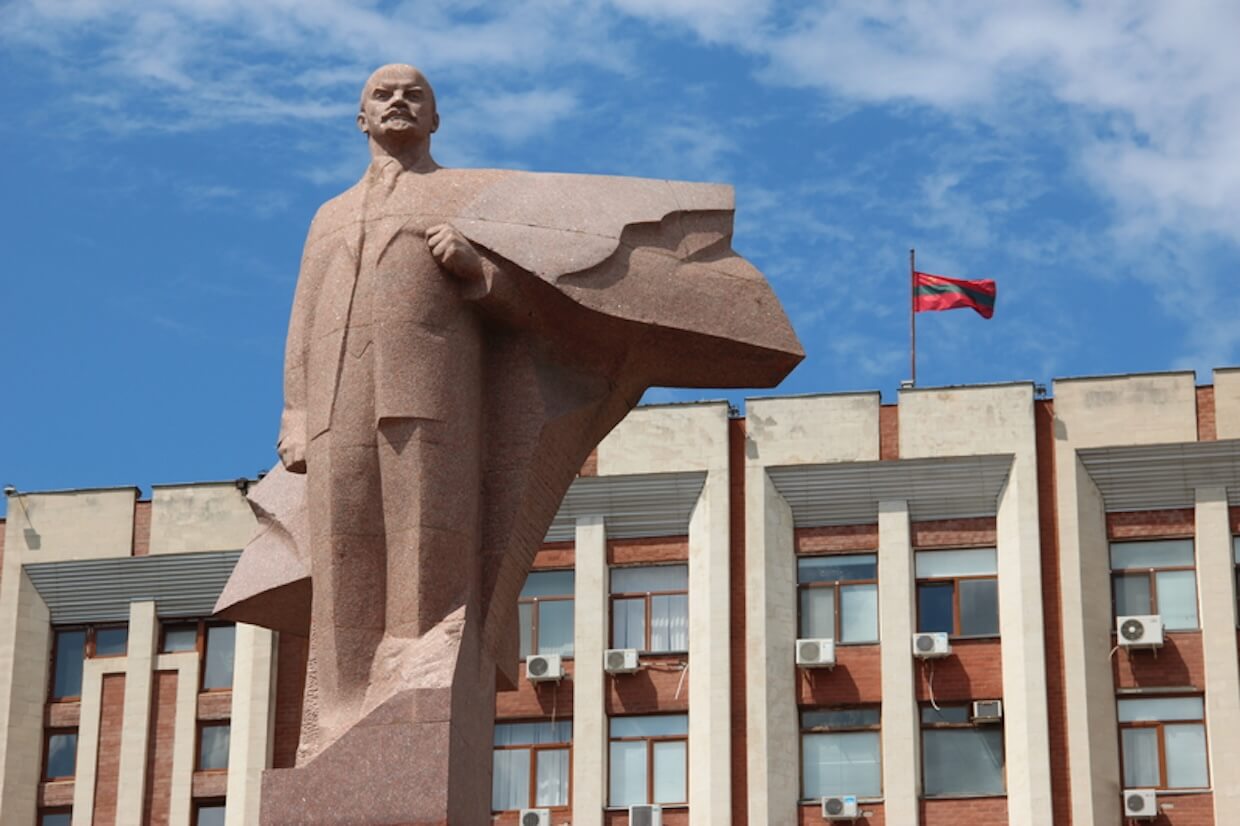
The T-34 tank monument and the Parliament building in Tiraspol, Transnistria, Moldova. The tank is a decommissioned T-34, now part of the Memorial of Glory. Photo: Dreamstime.

In the light of your research on Russian influence strategies, how do you interpret Moscow’s reliance on populist-style appeals—framing EU integration as a betrayal of sovereignty, invoking fears of war, or portraying elites as “foreign agents”? Does the Moldovan case suggest a recalibration of these tactics compared to Ukraine or Georgia?

Dr. Ecaterina Locoman: What is happening in Moldova, again, links to what I was just saying in response to the previous question. When I think about Georgia, the support for a pro-EU orientation was very strong. Public opinion support was extremely high, but it was not enough. When Russia was able to find a credible, strong domestic political actor, it was able to promote its own interests inside Georgia. What is different in Moldova’s case right now is that there was both a credible pro-EU party and strong public opinion support for the European Union. Now, Russia does not necessarily rely only on populist-style appeals. They know the weaknesses in each of these countries—the weak links—and they try to use those for their own interests. One thing I have noticed is that as long as domestic political elites are smart and strategic in how they frame their political messaging, it matters a lot.

I will give an example. Since Moldova declared independence in 1991, one very big question has been whether the language spoken in Moldova is Romanian or Moldovan. Political campaigns and electoral strategies were often built around this division. More pro-EU, pro-Romanian parties argued that the language is Romanian, while more pro-Russia parties insisted it is Moldovan. In every electoral campaign, these pro-Russia political parties used such narratives to distract voters from real issues like economic problems and corruption.

What happened in the years since Maia Sandu came to power is that the Moldovan constitution was amended to enshrine that the language spoken in Moldova is Romanian. So now, there is no debate about it. Nobody is questioning it anymore. The point I want to make is that as long as domestic political elites manage to settle these kinds of debates—which are not central to everyday life—then it becomes much harder for pro-Russia political actors to exploit them. People’s income levels or quality of life do not depend on whether they call the language Romanian or Moldovan.

When the Russians spot these kinds of differences, they manipulate public opinion and can win. But if domestic political elites can agree and establish clear positions on such issues, it becomes much harder for pro-Russia actors to influence the public. For example, pro-Russia parties have strong backing in the Orthodox Church in Moldova, which is very influential. There were reports that some priests were used by the Kremlin to influence public opinion. But as long as there is clear messaging from mainstream political parties in Moldova that they are not anti-religion, that religion is respected and people are free to practice their faith, then it becomes harder for pro-Russian narratives—often based on fake realities—to take hold.

When people hear credible messages from their own political elites, it becomes much easier for them to discern truth from lies. Similarly, the narrative about war has become much harder for Russia to sell right now. Why? Because they are waging a war in neighboring Ukraine. It is much harder to claim that moving toward the EU will bring war when there is already a war caused by Russia next door. This narrative was more effective in earlier elections, but now, as long as the West continues to support Ukraine and Ukraine withstands the Russian attack, it will be much easier for Moldova to remain strong and maintain its pro-European orientation and stance.

Without Reforms, Western Support Won’t Be Enough

How sustainable is Moldova’s reliance on Western partners for countering hybrid threats, given persistent vulnerabilities such as corruption, weak institutions, and economic hardship?

Dr. Ecaterina Locoman: This is a very good question. I think about it very often. As much as Russian influence may be a blessing in disguise—in the sense that it mobilizes people at home to work hard and pushes political parties to deliver on their promises and act quickly—the support from the European Union, and even from the United States, is the best thing that can happen to Moldova. As long as the EU remains invested in Moldova, we will be able to maintain our pro-European path more easily.

One fear I have is that we might become complacent, assuming that the EU or the West will always come to our rescue and that we can simply continue doing whatever we are doing internally. When I go to Moldova, I often hear people—business people, entrepreneurs—complaining that not much has changed compared to 10 or 15 years ago. Corruption is still rampant. In order to obtain permits to build something, for example, you still need to pay someone in the government. This is unfortunate, and people are aware of it.

My conclusion is that domestic political parties must understand that this is a “make it or break it” moment. If they do not deliver on the promises they have made, it will become much easier for political actors in Moldova who promote Russian interests to regain power. And once that happens, it will be much, much harder to get Moldova out of Russia’s embrace. So, I think it depends very much on the willingness of the ruling party right now, and Maia Sandu, to deliver on the reforms they have promised.

A Temporary Setback, Not a Strategic Defeat

Do Moldova’s elections signal a broader decline in Russia’s ability to project influence across the post-Soviet space, or should Moscow’s defeat here be read as tactical rather than strategic?

Dr. Ecaterina Locoman: As I shared earlier, I do not think this is a Russian defeat in the long term. Russia is very adept at adjusting its messaging and tactics, not only with respect to the post-Soviet region but also to the wider EU region. They will learn from their mistakes and continue to influence domestic politics in Moldova, as much as we might not like it. Even if the political actors they supported did not win as many seats in Parliament as they initially hoped, we can look at the first four years of Maia Sandu’s party in government.

Basically, these previous four years were devoted to crisis management. Yes, it’s true, initially it was the COVID pandemic, but then the war in Ukraine, caused by Russia, turned everything upside down in Moldova. So instead of focusing on judicial reforms and economic development, as the party had initially promised and as Maia Sandu stated, they had to adjust. I think they managed—they were successful in delivering some of the promises made during the electoral campaign—but it was ten times harder.

I expect that Russia will continue to influence domestic politics. It’s part of their strategic goal to regain control over the post-Soviet region, and I don’t think this should be read as a strategic loss. It’s more of a temporary setback, but they will gather their resources again. Therefore, both Moldovan and European Union leaders need to stay on their toes, remain alert, and be careful about the next steps so they are prepared to counteract those measures.

EU Accession: Between Optimism and Doubt

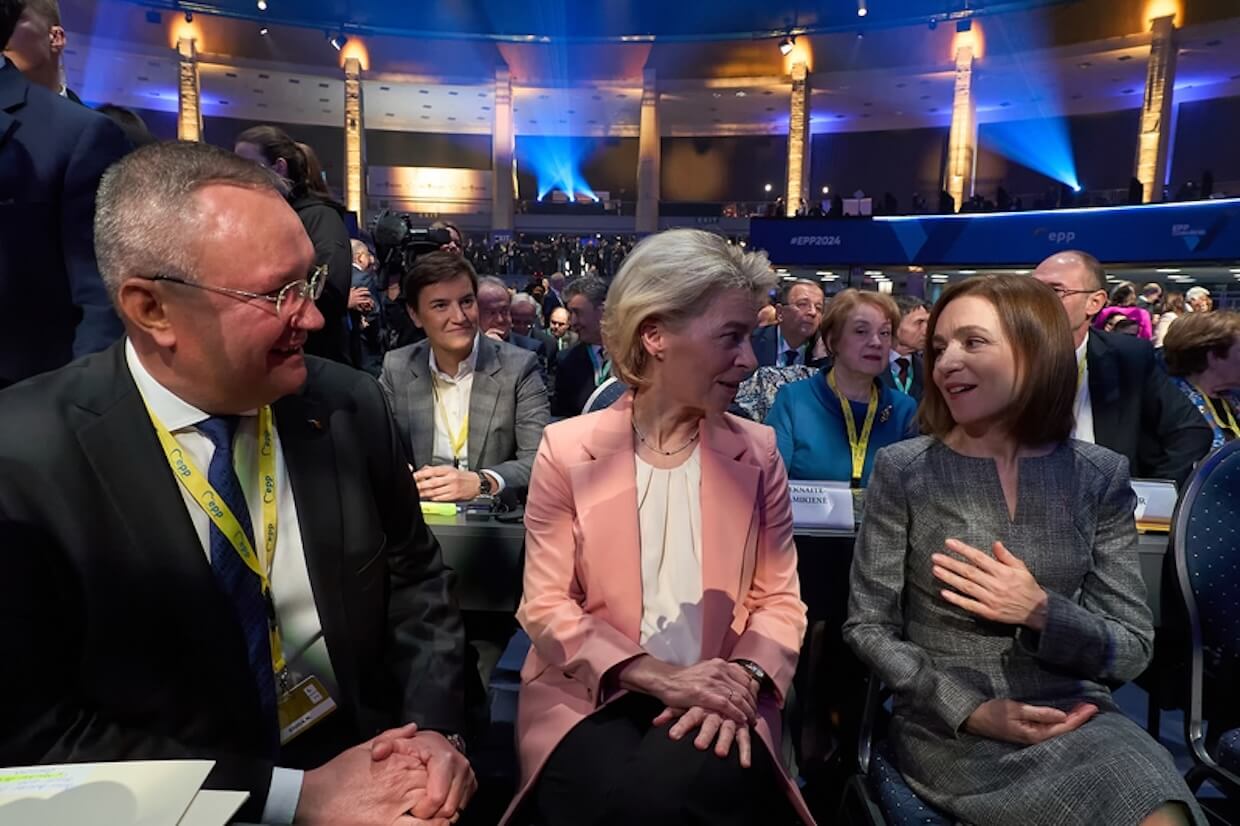
Nicolae Ciucă (L), President of the National Liberal Party, Ursula von der Leyen (C), President of the European Commission, and Maia Sandu (R), President of Moldova, during the plenary session of the 2024 EPP Congress in Bucharest on March 6, 2024. Photo: Dreamstime.

And lastly, Dr. Locoman, President Sandu has tied her mandate to enshrining an “irreversible European path.” How realistic is Moldova’s aim to achieve EU accession by 2030, given the scale of domestic reforms required and potential geopolitical vetoes within the Union?

Dr. Ecaterina Locoman: Recently, Maia Sandu visited Copenhagen. Denmark hosted a major summit with key EU leaders. Ukraine was there, Maia Sandu was there, and there were reports that they were hoping Hungary would be persuaded not to veto the right of Ukraine and Moldova to start accession negotiations. However, Hungary was not persuaded. So the only hope they have right now is that there will be a political change in Budapest, allowing this to move forward.

A lot of the frustration I hear among policymakers in Moldova, when it comes to the EU, is that they are disappointed the European Union decided to put Moldova and Ukraine in the same bucket for European integration. There were hopes that Moldova would be decoupled, that it would go its own way, and Ukraine would go its own way. But the Europeans still seem to favor moving forward together as a group.

A fear I have is that Moldova is much smaller than Ukraine. Yes, domestic reforms need to be done, but as long as there is political will, it is possible to achieve them. I share a bit of the concern raised in the question. I am afraid that if the situation continues as it is now, Moldova might face the same fate as the Western Balkans over the past 20 years. The door was opened for them too, but then they stalled, and no real progress has been made, apart from Croatia joining the EU.

So, I have some doubts—not fear, but doubts—about how quickly the situation can move by 2030. Is this truly realistic? But then again, up until 2022, Moldova had been knocking on the EU’s doors for more than 30 years, asking for candidate status, and the EU kept saying no. And then, in the end, it happened. Yes, it was because of the Russian invasion of Ukraine, and it was unfortunate that this was the trigger, but it happened. So I try to stay optimistic and hope that by 2030, Moldova will be able to join the EU.

Dr. Cristian Cantir is an Associate Professor of Political Science at Oakland University.

Assoc. Prof. Cantir: Moldova’s Election a Victory for EU, Defeat for Kremlin

In an interview with ECPS, Dr. Cristian Cantir (Oakland University) described Moldova’s 2025 parliamentary elections as “a major win for the European Union and a major defeat for the Kremlin.” Despite massive Russian interference—including vote-buying, cryptocurrency transfers, and efforts to incite unrest—Moldovan institutions responded with unprecedented consistency, demonstrating what Dr. Cantir calls a “confirmation of Moldova’s democratic resilience.” Yet, he warns that Moscow remains influential through populist narratives exploiting poverty and weak institutions. The results, he argues, reflect both the enduring popularity of EU integration and the failures of pro-Russian opposition parties. For Dr. Cantir, Moldova offers a striking example of how Russian influence faces diminishing returns when met with institutional strength and sustained Western support.

Interview by Selcuk Gultasli

The outcome of Moldova’s 2025 parliamentary elections has been widely interpreted as a defining moment in the country’s European trajectory and its long struggle to resist Russian influence. In an interview with the European Center for Populism Studies (ECPS), Dr. Cristian Cantir, Associate Professor of Political Science at Oakland University, framed the results in stark geopolitical terms: “At a macro level, I would say this election represents a major win for the European Union and a major defeat for the Kremlin. I think it’s fair to frame it in those terms as a general way of understanding what happened.”

Dr. Cantir’s assessment reflects not only the electoral success of the pro-European Action and Solidarity Party (PAS), but also the broader resilience of Moldova’s democratic institutions in the face of Moscow’s sustained interference campaigns. International observers judged the elections to be generally free and fair, even amid bomb threats, electoral violations, and widespread attempts at corruption. As Dr. Cantir explains, this points to a “confirmation of Moldova’s democratic resilience,” if not yet full consolidation, as state institutions and law enforcement demonstrated an increased capacity to respond to hybrid threats.

Russia’s interference toolkit—long tested in Moldova—appeared less effective in this cycle. The Kremlin poured more resources into the effort, funding political actors, experimenting with cryptocurrency transfers, and attempting to stoke unrest. Yet, Dr. Cantir argues, these strategies delivered “diminishing returns” in a political environment where institutions had grown more proactive. “Moscow has been somewhat taken aback by the extent to which Moldovan institutions have now responded in such a consistent way to Russian interference,” he observes. The shift suggests that the Kremlin’s approach is increasingly constrained by its own reliance on disinformation and narratives fed by loyal pro-Russian politicians, which often fail to reflect the realities of Moldovan society. As Dr. Cantir notes, “some of the claims you see in Russian propaganda are so laughable and rudimentary… you wonder whether they actually believe them, because they don’t even work as propaganda.”

Still, Russia remains a formidable actor in Moldova’s domestic politics. Populist narratives that exploit socioeconomic hardship, corruption, and weak institutions continue to resonate with segments of the population, leaving Moldova’s pro-European course vulnerable to authoritarian retrenchment. Dr. Cantir highlights the need for PAS and other pro-EU forces to demonstrate tangible benefits of integration to disengaged citizens, warning that otherwise they may fall “much more easily to populist messaging” that is Eurosceptic and pro-Russian in nature.

Ultimately, the Moldovan case illustrates both the persistence and limitations of Russia’s hybrid influence operations in the post-Soviet space. Unlike Ukraine or Georgia, where Moscow has resorted to military force, Moldova demonstrates how resilience is possible when domestic institutions respond effectively and Western partners provide consistent support. As Dr. Cantir emphasizes, this election represents more than just a partisan victory—it is a symbolic moment of geopolitical realignment: a triumph for Europe, and a setback for the Kremlin.

Here is the transcript of our interview with Associate Professor Cristian Cantir, lightly edited for clarity and readability.

Moldova’s Elections Confirm Democratic Resilience

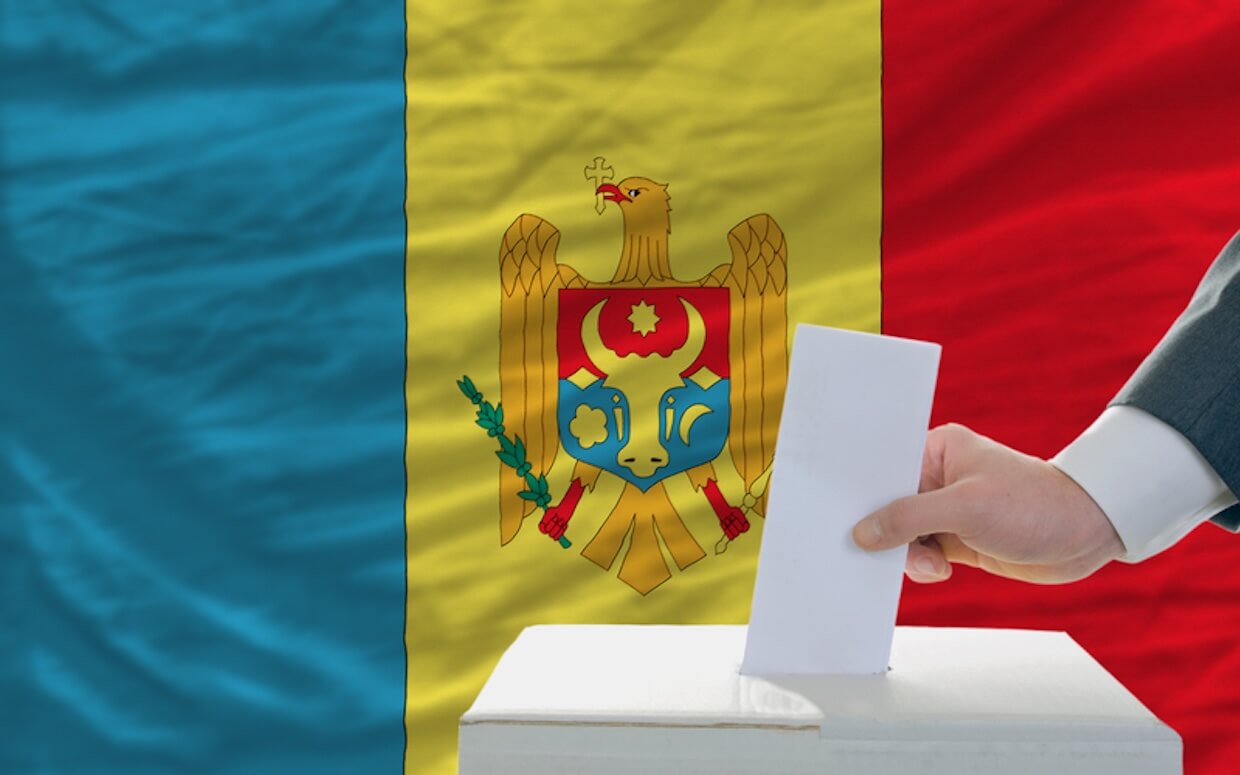
A man casts his ballot during parliamentary elections in Moldova, in front of the national flag. Photo: Dreamstime.

Professor Cristian Cantir, thank you very much for joining our interview series. Let me start right away with the first question: How would you characterize the broader significance of Moldova’s 2025 parliamentary elections, particularly in the light of the pro-European Action and Solidarity Party’s (PAS) ability to withstand unprecedented Russian interference campaigns? To what extent can this outcome be read as a genuine consolidation of Moldova’s democratic resilience, and to what degree is it contingent upon extraordinary external support from the EU and its allies?

Assoc. Prof. Cristian Cantir: Thank you very much for inviting me. It’s a pleasure to be here, and I’m always glad to talk about Moldova—a topic that doesn’t usually get much attention in international affairs. At a macro level, I would say this election represents a major win for the European Union and a major defeat for the Kremlin. I think it’s fair to frame it in those terms as a general way of understanding what happened.

To the extent that it was generally a free and fair election, according to most international observers—even in the face of massive Russian interference—it was consistent with Moldova’s tradition of holding competitive elections since independence. I would take this as a positive sign of the relative health of Moldovan democracy. The process was conducted competently, with electoral authorities and law enforcement responding promptly to challenges, including bomb threats, reported violations, and instances of electoral corruption. From that standpoint, it serves as a solid example—not necessarily a consolidation, but certainly a confirmation—of Moldova’s democratic resilience. Of course, there remain significant challenges to Moldova’s democratic consolidation, but overall the outcome is good news for the country’s democracy.

I do think the election results can be partly attributed to external EU support, but it’s important to refine this point by highlighting one individual in particular—Moldovan President Maia Sandu. Sandu is a unique figure, not only in Moldova’s political history but also in the broader Central and Eastern European context. She has consistently been a popular, anti-corruption, reformist, pro-European leader. Many of the criticisms and attacks directed at her by the pro-Russian opposition have not gained much traction. She has remained highly popular within Moldova, due in part to her strong international reputation, especially among EU politicians. In this sense, when we talk about external influence, it is really a combination of two factors: Sandu’s personal popularity and the EU’s admiration for, and support of, her during this campaign. That said, I would not be so confident in giving the ruling party, PAS, too much credit for the victory. There remain fundamental issues with PAS as a pro-EU force, which we can also discuss further.

Moldovans Voted for Europe, Not PAS

Do the results primarily reflect a deepening consolidation of Moldova’s pro-European trajectory, or are they better understood as a rejection of entrenched pro-Russian elites such as Igor Dodon and his allies? In other words, should we interpret the outcome as an ideological commitment to Europe or as an electoral repudiation of discredited political actors?

Assoc. Prof. Cristian Cantir: We could start by noting that EU integration is genuinely popular with a majority of the Moldovan population. Most polls confirm this, and even the 2024 referendum—though decided by a razor-thin margin—pointed to its broad appeal. That narrow margin can be attributed, at least in part, to vote-buying allegations and to the pro-Russian opposition framing the referendum as a judgment on PAS, the ruling party, rather than on the EU itself. Since PAS has become almost synonymous with the pro-EU position, this image has limited the viability of any other pro-European force. As a result, most pro-EU Moldovans voted for PAS, even if they were frustrated with the party’s slow response to major challenges such as poverty or judicial reform. To some extent, then, the outcome reflects support for EU integration combined with the absence of credible alternatives. Much of the vote was strategic: it did not necessarily indicate satisfaction with PAS as a party or with its performance, but rather the lack of any real choice.

The other parties in the election can also be faulted for failing to develop a narrative that offered a genuine alternative to PAS. Many claimed to support some degree of EU integration—even pro-Russian parties promised to negotiate more with Brussels. They tried to emphasize sovereignty and introduced socially conservative themes aimed at countering what they viewed as the EU’s liberal values. Yet this did not resonate with most Moldovans, as it came across as vague messaging—essentially, “we will slow down EU integration,” without explaining what that would mean or why it was necessary. By contrast, tangible benefits such as visa-free travel or lower roaming fees—everyday concerns tied directly to EU integration—proved far more compelling. As a result, the opposition’s alternative was unclear and largely reduced to a promise of “we are not the current political elites.”

The results, therefore, can be attributed both to the continuing popularity of the EU and to the weakness of the opposition leaders. Their campaigns were driven more by resentment of the ruling party and calls to “purge the system,” or what they called “the regime,” than by any proactive or positive electoral platform.

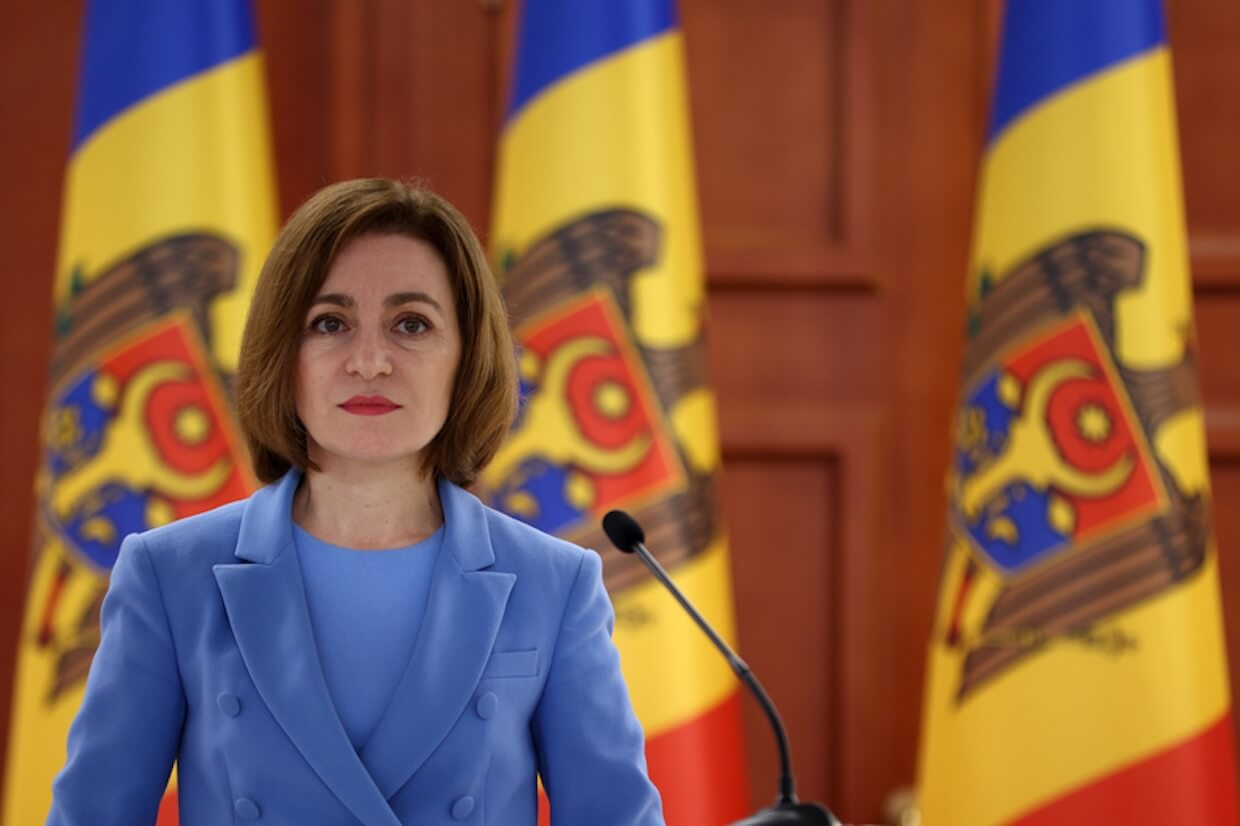
Moldovan President Maia Sandu speaks at a press conference following her meeting with Bulgarian President Rumen Radev in Chișinău, Moldova, on October 27, 2022. Photo: Dreamstime.

Diaspora Has Become the Backbone of Moldova’s Pro-EU Course

The Moldovan diaspora appears to have played a decisive role in shaping the electoral outcome. How should we understand the implications of this phenomenon for the transnationalization of Moldovan democracy, particularly regarding questions of sovereignty, external leverage, and the construction of a political community that extends well beyond national borders?

Assoc. Prof. Cristian Cantir: The question of the Moldovan diaspora is particularly interesting, as it has been essential in consolidating Moldova’s pro-EU course, especially in recent years. Voting has also become much easier for diaspora members, particularly in Western countries, which is where most diaspora ballots are cast. As a result, the Moldovan diaspora is strongly pro-Western in its orientation—overwhelmingly so, judging by the last few elections.

With some exceptions, the Moldovan diaspora is relatively recent, with the first wave beginning in the 1990s. Attachments to the homeland remain very strong, and personal connections are still close. Travel has also become much easier—for example, low-cost airlines have made going back and forth far more accessible. And because most Moldovans abroad now reside legally, there is far less fear than in the 1990s and 2000s, when many migrated illegally or crossed borders without visas and were hesitant to return. For all these reasons, the diaspora’s ties to Moldova remain particularly strong.

The diaspora has not yet developed a separate identity; it remains very much rooted in Moldova. For example, if you visit Moldova in August, it is striking—you hear Moldovan children speaking with Portuguese accents in shops, and it becomes difficult to get a dentist appointment because so many diaspora members return home for treatment. This illustrates how deeply the diaspora remains part of Moldovan society. The ruling PAS, like other parties, has been very friendly and encouraging toward the diaspora. There are events organized exclusively for them, success stories highlighted in the media, and programs inviting them to return and share their experiences. There is also considerable gratitude for remittances, which have helped offset some of the country’s socioeconomic inequalities.

It is also important to remember that Moldovans’ understanding of sovereignty has always carried a transnational dimension. Many have looked to Romania for cultural and ethnic identity markers, while others have looked to Russia. As a result, Moldovans are more accustomed to hybrid and multiple identities. They can remain deeply connected both to the countries where they now live and to Moldovan politics—connections that are further strengthened by technology such as Facebook, online news, and live-streamed broadcasts.

The picture becomes more complicated when we look at the politicization of the diaspora, particularly by pro-Russian forces. Because the diaspora is strongly supportive of pro-Western groups, pro-Russian politicians have advanced a narrative—especially visible in recent years—that Moldovans inside the country oppose PAS, while those abroad support it. The argument is that Moldova’s diaspora is effectively holding those who remain at home hostage to the PAS regime. Pro-Russian groups have been trying to inflame tensions between these two communities. Igor Dodon, Moldova’s most prominent pro-Russian politician, has even described the diaspora as a “parallel electorate.” Another pro-Russian politician, Irina Vlah, has pursued what can only be described as an unusual campaign, promoting narratives such as asking Moldovans to “adopt” a fellow citizen inside the country who is suffering under the pro-EU PAS. I would not be surprised if such narratives continue to spread and further deepen tensions between diaspora communities and Moldovans still at home.

Finally, one more point: Russia’s invasion of Ukraine and its interference in Moldovan politics has highlighted an unresolved issue concerning the Moldovan diaspora in Russia. Estimates of the diaspora there range from about 100,000 to several hundred thousand people. Because of Russian interference, Moldovan authorities have opened only a minimal number of polling stations, most of them in Moscow. Given the vast size of Russia, this makes it much more difficult for Moldovans living there to cast their ballots. Authorities argue that this limitation is necessary to ensure ballot security, but it leaves unresolved the broader problem of how to guarantee equal voting rights for all members of the diaspora, regardless of where they reside. This remains a pressing question that Moldovan politicians will eventually have to address, even though, for now, it has been overshadowed by Russia’s interference.

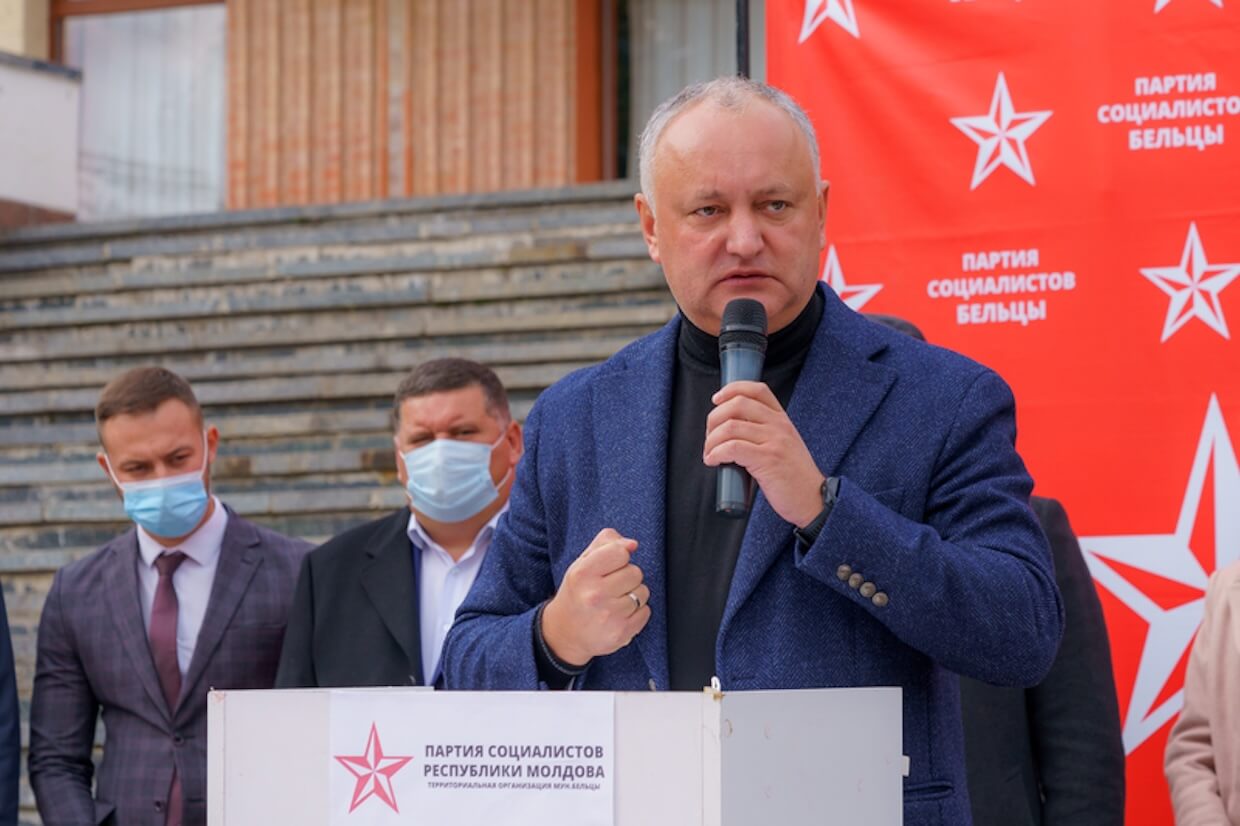
Former Moldovan President Igor Dodon attends a Party of Socialists meeting in Bălți, Moldova, on October 17, 2021. Photo: Iuri Gagarin.

Low Turnout Makes Moldova Vulnerable to Populist Messaging

With voter turnout just above 50%, what does the relative disengagement of a significant portion of the electorate reveal about the legitimacy and durability of PAS’s mandate? To what extent does persistent electoral apathy constrain the prospects for long-term democratic consolidation and weaken the societal foundations of Moldova’s pro-European orientation?

Assoc. Prof. Cristian Cantir: I want to make a quick statistical note first. The 2024 Moldovan Census identified about 2.3 to 2.4 million Moldovans in the country with stable residency. Meanwhile, the electoral rolls from the Central Electoral Commission list close to 300,000 Moldovans abroad, which doesn’t quite capture reality. In fact, there are many more Moldovans who still hold residency but live or work abroad. This makes turnout somewhat harder to assess in Moldova, given the fragmented data we have.

That said, the general premise of the question still holds, because the turnout percentage does indicate a degree of disengagement. This poses a problem for PAS and for Moldova’s pro-European orientation. People who are disengaged—who don’t feel invested in Moldova’s pro-EU path or don’t perceive clear benefits from EU integration—are much more susceptible to populist messaging. In Moldova, such messaging tends to be Eurosceptic and pro-Russian. As a result, these citizens may be more easily mobilized by populist politicians, giving those actors greater institutional power to undermine EU integration.

For this reason, demonstrating the tangible benefits of EU integration to more apathetic groups should be a key part of PAS’s strategy. Otherwise, we may see rising support for populist politicians. A few have already begun to gain visibility—there are two in particular I could highlight—but the broader risk of growing populist appeal is certainly there.

Russia May Be Falling Victim to Its Own Propaganda in Moldova

Observers have described Moldova as a “laboratory” for Russia’s hybrid interference strategies. In your assessment, what does the 2025 electoral cycle reveal about both the adaptive capacities and structural limitations of Moscow’s toolkit of influence? Can we speak of a paradigmatic shift in the Kremlin’s approach, or are we witnessing the persistence of familiar strategies with diminishing returns?

Assoc. Prof. Cristian Cantir: That’s a really good question. The simplest answer is that we don’t know yet, and there’s a reason for that. The 2025 election was marked by greater intensity and a wider range of Kremlin interference efforts. They invested more money, backed more political actors, and became more involved in attempts to stoke violence and protests. Yet none of these efforts proved particularly effective.

There are a couple of points to keep in mind here. First of all, Moldovan law enforcement and the broader institutional response have become more active, dealing more effectively—even compared to 2024—with clear cases of electoral interference. This included vote buying, the use of cryptocurrency to transfer funds, and the use of cash for illegal financing. Another important factor in understanding the Kremlin’s difficulties in Moldova is that, for a long time, Russia had grown accustomed to acting with relative impunity there. Even when pro-European or centrist coalitions were in power, Moldovan institutions and politicians were rarely proactive in curbing Russian influence. At best, they ignored Moscow’s efforts; at worst, pro-Russian politicians openly reinforced them. I think Moscow has been somewhat taken aback by the consistency with which Moldovan institutions have now responded to Russian interference.

So, I don’t know if we are going to see a full shift in the Kremlin’s approach, but I do think there is more re-evaluation and discussion about how it might adjust its strategies. One additional point is that the Kremlin actually knows a great deal about Moldova—more so than many in the West. The problem, however, is that it continues to rely heavily on information fed by pro-Russian politicians, who often promote narratives that are simply inaccurate. For example, the claim by some pro-Russian groups that EU integration is not popular in Moldova is simply not true. It’s difficult to tell whether the Kremlin and its allies are falling victim to their own narratives, which distort their understanding of Moldovan dynamics and render their strategies less effective. That’s something I’ve often thought about, because some of the claims you see in Russian propaganda are so laughable and rudimentary. You start to wonder whether they actually believe them, since they don’t even work effectively as propaganda. That’s how rudimentary they are.

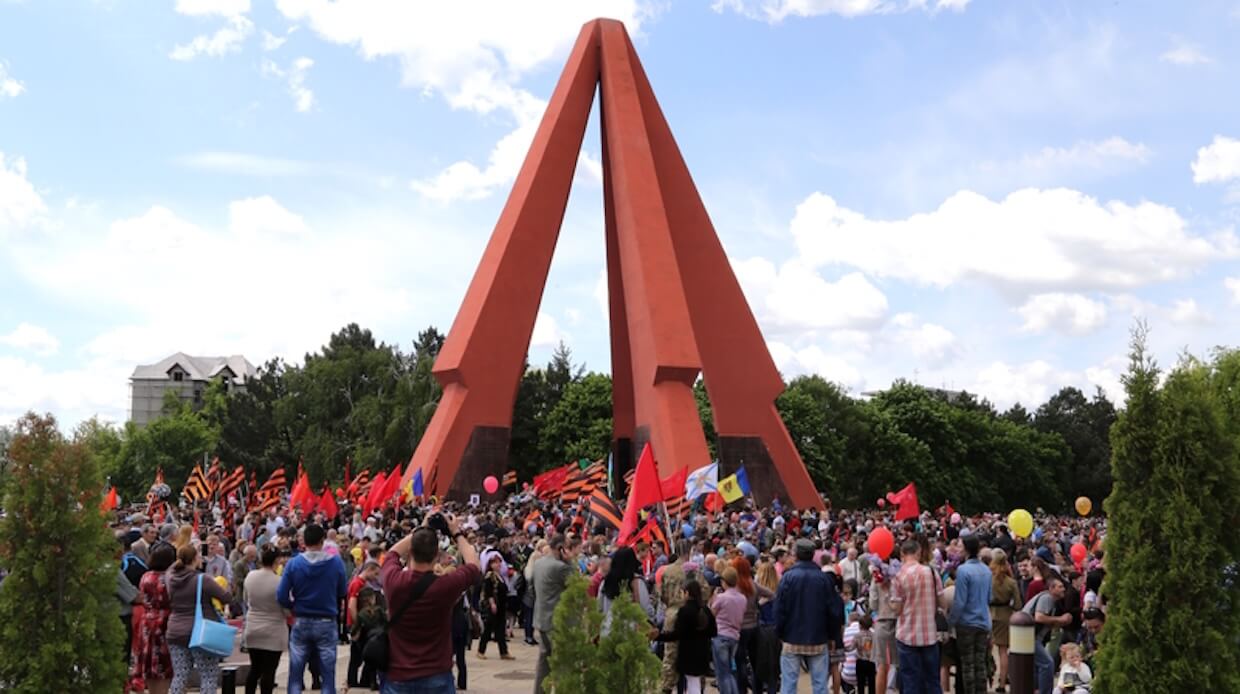
Pro-Russian supporters attend Victory Day celebrations on May 9 in Chișinău, Moldova. Alongside World War II veterans displaying their medals, members of the public dressed in Soviet-era military uniforms highlighted the enduring strength of Russian influence. Photo: Dreamstime.

Moldova Now Frames Itself as Belonging in Europe

In the light of your previous work on Moldova’s foreign policy balancing, how would you assess Chisinau’s current capacity to resist Moscow’s strategies of destabilization, particularly given Russia’s reliance on authoritarian-style tactics such as elite capture, patronage networks, and the exploitation of populist narratives?

Assoc. Prof. Cristian Cantir: When it comes to balancing, we’ve seen a noticeable shift. The perception of the EU as a counterbalance to Russia—once more prominent among pro-Russian or centrist groups—was grounded in the idea that Moldova should extract benefits from all its major geopolitical partners. That view has given way to a more cultural and identity-based argument. The ruling pro-European group now frames Moldova as inherently European, emphasizing that the country “belongs in Europe” and should “go home” to Europe.

As a result, the EU is now articulated less as a strategic tool for Moldova’s foreign policy goals and more as a natural place of belonging for Moldovans. Pro-Russian parties still advance the balancing argument, but it has been severely undermined by Russia’s invasion of Ukraine in 2022. They have not substantially re-evaluated or adjusted their rhetoric since then, but the post-2022 context is fundamentally different. Thus, the balancing argument no longer carries the same weight. While it still registers some support in polling data, it is far less compelling from a political standpoint.

With respect to elite capture, the Kremlin is beginning to understand that Moldovan institutions are responding more coherently to Russian threats. Some of its old patronage networks or elite-capture strategies are not working as effectively because Moldovan law enforcement is pushing back. One example of this would be Russia’s attempts to infiltrate Moldovan politics or encourage spying, which the Moldovan Secret Service has been more proactive in addressing. I’m not sure how the Kremlin will deal with this particular problem.

That said, the Kremlin still retains significant power when it comes to the populist narratives, and the vulnerabilities they exploit. Given Moldova’s socioeconomic issues, including high rates of poverty, these vulnerabilities can be easily leveraged by populist politicians, and consequently by pro-Kremlin groups as well.

Odessa Looms Large in Moldova’s Strategic Calculus

What does the Moldovan case tell us about Russia’s evolving approach to influence operations in the post-Soviet space, especially compared to its tactics in Ukraine or Georgia?

Assoc. Prof. Cristian Cantir: One of the key differences between Ukraine and Georgia is that, where Russia lacks either the ability or the immediate interest to engage in military action—as opposed to what it is doing in Ukraine or what it did in Georgia—its influence operations become less effective when faced with strong institutional responses and consistent support from Moldova’s allies. Because direct military threats are not immediate, Moldova has more space to resist Russian influence.

This dynamic is often reflected in discussions by Moldovan politicians about Odessa. Odessa looms large in Moldovan politics, because if the city were to fall, the strategic calculus would change significantly. If Odessa does not fall, and if Ukraine continues to resist the Russian army in southern Ukraine and around Odessa specifically, it will be considerably easier for Moldova to counter influence operations without the constant pressure of an imminent military threat.

Hybrid Warfare Is a Transnational Problem—It Requires a Transnational Response

Russian military expert at a government operations base, engaged in cyber activities aimed at spreading disinformation and hybrid warfare propaganda. Photo: Dragos Condrea.

How sustainable is Moldova’s reliance on Western partners for countering hybrid threats, given the country’s domestic vulnerabilities such as corruption, weak institutions, and economic hardship?

Assoc. Prof. Cristian Cantir: That’s a good point. Ideally, you would want a sovereign state with strong institutions, fewer socioeconomic problems, and a consistent fight against corruption. That would give it the capacity to resist Russian influence more effectively without significant outside support. The European Union also needs to focus on those factors—tackling corruption, strengthening institutions, and addressing economic hardship.

At the same time, Moldova’s reliance on Western partners to counter Russian hybrid warfare is unavoidable, because this is not only Moldova’s problem. To the extent that it is a transnational challenge, it requires a transnational and coordinated response. Moldova cannot and should not handle this alone. Long-term, institutionalized cooperation with the EU is essential—both because Russian hybrid attacks extend beyond Moldova and because Moldova’s own capacities remain limited. Even if Moldova had strong governance and robust institutions, it would still need to work closely with the European Union to meet this particular threat.

Polarization in Moldova Is Fluid, Not Fixed

How realistic is Moldova’s aim to achieve EU accession by 2030, given both the demanding structural reforms and potential geopolitical vetoes within the Union, and in what ways might deep internal polarization between pro-European and pro-Russian constituencies undermine the legitimacy of this process by opening space for populist mobilization and authoritarian retrenchment?

Assoc. Prof. Cristian Cantir: Internal geopolitical polarization is a serious problem in Moldova, but it is also important to remember that polarization is a fluid phenomenon. Polling, for instance, used to show much stronger support for integration with Russian projects even 10 or 20 years ago, and much less support for NATO membership. This shows that polarization can shift over time.

The strategy of Moldovan authorities has been to make a compelling economic, or quality-of-life, case for EU integration, even in regions where the political dimension of integration is less popular. In places like Gagauzia and parts of northern Moldova, the aim is to erode polarization by demonstrating the tangible economic benefits of closer ties with the EU. If successful, this could help offset some of the effects of geopolitical polarization by easing tensions.

So, the biggest question isn’t really polarization, but whether pro-EU forces can articulate and illustrate the benefits of EU integration clearly to more people, including those in pro-Russian propaganda bubbles. To a large extent, integration by 2030 is driven more by the speed with which Moldovan authorities can enact reforms, by developments in the Russian invasion of Ukraine, and also by the situation in Transnistria—which we can talk about—and what exactly Moldovan authorities are going to do with that separatist region.

The Cyprus Model Is a Real Option for Moldova

Monument to Vladimir Lenin in front of the Parliament building in Tiraspol, Transnistria, Moldova. Photo: Dreamstime.

Given the persistence of Russian troops in Transnistria, how does the unresolved status of the region constrain Moldova’s European ambitions and its sovereignty more broadly?

Assoc. Prof. Cristian Cantir: The number of Russian troops in Transnistria isn’t sufficient to threaten Moldova’s European ambitions or its sovereignty. Greater risks could come from a hypothetical mobilization of a large part of the Transnistrian population during a potential conflict, but that scenario carries its own difficulties. Nor does the Russian military presence pose an immediate threat to sovereignty in the sense that Moldova is able to control most of its territory fairly effectively, aside from Transnistria. In that respect, it is not an urgent danger.

The war in Ukraine has also constrained Transnistria’s potentially aggressive orientation, or even its foreign policy toward Ukraine, Moldova, and the EU more broadly. Within Moldova, there is a growing sense that EU integration must move forward and can happen without Transnistria. Moldovan authorities have explicitly stated that it is possible for Moldova to join the EU first, using the Cyprus model. Cyprus is a common example cited by Moldovan officials and has even been echoed by former EU leaders. José Manuel Barroso, for instance, recently affirmed that the Cyprus model is indeed a possibility for Moldova.

At this stage, Chișinău does not view Transnistria as an obstacle to EU integration. Instead, it argues that pre-integration measures demonstrating the economic benefits of EU membership will gradually draw Transnistria closer. If necessary, Moldova can join the EU without Transnistria and then work toward integrating the region into the Union over the longer term.

Populists Give Moscow Veto Power over Moldova’s EU Path

Lastly, Professor Cantir, what scenarios do you consider most plausible for the future of the Transnistria conflict: gradual reintegration under EU auspices, continued limbo, or renewed escalation tied to Russia’s strategic setbacks in Ukraine? And in any of these scenarios, how might populist or authoritarian actors instrumentalize the issue domestically to challenge Moldova’s European orientation? 

Assoc. Prof. Cristian Cantir: The most important point to note—the elephant in the room—is that everything depends on how Russia’s invasion of Ukraine unfolds. If Ukraine manages to resist in the south and hold Odessa, then what we are most likely to see, at least in the short term, is the maintenance of the status quo. The EU would continue efforts to trade with, develop, and engage local organizations in Transnistria—essentially trying to connect the region more closely to Europe, with the long-term goal of gradual reintegration. That will be the general orientation, or at least the attempt, always contingent on developments in Ukraine and particularly in Odessa.

When it comes to the question of populist or authoritarian actors instrumentalizing the issue, one of the biggest patterns to watch in the next few years in Moldova is how they frame the argument about the Cyprus model. PAS has argued that Moldova can join the EU without Transnistria first. By contrast, many other actors—including pro-Russian politicians in the Patriotic Bloc, the largest opposition group in Parliament, as well as Alternativa, a centrist, self-defined pro-EU bloc—have insisted that Moldova must not enter the EU without Transnistria. In effect, this position grants Transnistria—and, to some extent, Moscow—veto power over Moldova’s EU integration aspirations.

So, populist politicians and authoritarian actors in Moldova will seek to instrumentalize the Transnistria issue by insisting that the country must not—and cannot—join the EU without first resolving the conflict. This, of course, significantly prolongs the timeline and effectively ties Moldova’s European integration to Moscow’s willingness to settle the dispute.

Graffiti artwork promoting religious tolerance, as Bristol City Council consulted the public on whether it should remain or be removed, August 31, 2009, Bristol, UK. Photo: Dreamstime.

European Observatory on Illiberalism and Culture Wars

The Observatory monitors and analyses how illiberal politics and culture wars are reshaping democracies across the globe. Through comparative research, expert collaboration, and accessible insights, it highlights threats to rights, pluralism, and democratic resilience.

About the Observatory

The European Observatory on Illiberalism and Culture Wars is a research initiative dedicated to understanding one of the most pressing global challenges: the rise of illiberal politics and the increasing centrality of cultural conflict in democratic life.

Across the world, political and legal disagreements are increasingly reframed as moral and identity-based struggles — the so-called culture wars. These dynamics, often intertwined with populist narratives, directly affect fundamental rights, pluralism, and institutional legitimacy, while eroding the resilience of democratic systems.

The Observatory provides a systematic, comparative, and interdisciplinary platform to map, monitor, and interpret these developments, offering rigorous yet accessible insights for scholars, journalists, policymakers, and the wider public.

Objectives

The initiative is conceived as a collaborative pilot project relying on voluntary coordination. Its objectives are:

  • Monitoring: Track illiberal discourses, legislative regressions, and polarizing events in diverse democratic contexts;
  • Analysis: Examine how cultural conflict is instrumentalized politically to undermine liberal-democratic norms;
  • Knowledge Transfer: Provide timely, research-based commentary and synthesis for both academic and policy debates;
  • Institutional Development: Build the foundations for a permanent programme capable of attracting competitive funding and gaining global visibility.

Thematic Scope

The Observatory focuses on the intersection between illiberal politics, culture wars, and democratic resilience. Key areas include:

  • Attacks on fundamental rights (e.g., freedom of expression, gender equality, minority protection);
  • Political and legislative pressures on the rule of law and constitutional safeguards;
  • The weaponization of debates on national identity, migration, religion, gender, and historical memory;
  • The convergence of populist movements with illiberal narratives that challenge pluralism and institutional legitimacy.

Although special attention will be given to Europe, the Observatory is explicitly global in scope, fostering comparative perspectives across regions such as the Americas, Africa, and Asia.

Methodology

The pilot phase will operate as a flexible, low-cost platform, combining monitoring, comparative research, and collaborative knowledge-sharing. The approach includes:

  • Media and discourse monitoring in selected countries across Europe and beyond;
  • Narrative and legal framing analysis of key themes (e.g., “gender ideology,” “great replacement,” anti-woke policies, memory politics);
  • Collaboration with academic partners and national experts, producing short analyses and thematic updates;
  • Quarterly briefings and alerts, synthesizing trends and offering comparative insights;
  • Outreach and partnership-building to attract institutional collaboration and prepare applications for competitive funding.

The Observatory will begin as a modular initiative requiring only coordination, content curation, and editorial oversight — all ensured on a voluntary basis during the initial stage.

Call for Volunteers

Join the European Observatory on Illiberalism and Culture Wars

The European Observatory on Illiberalism and Culture Wars, hosted within the European Center for Populism Studies (ECPS), is opening a call for volunteers to join its growing research network.

Why get involved?

By becoming part of the Observatory, you will:

  • Be part of a transnational research initiative mapping and analyzing the rise of illiberalism and culture wars across Europe and beyond;
  • Collaborate with an international network of scholars, experts, and practitioners committed to defending democracy, pluralism, and fundamental rights;
  • Gain visibility and impact through co-authored analyses, thematic briefings, and collaborative outputs published under the Observatory’s platform;
  • Contribute to events, publications, and debates, helping to shape an emerging field of research and influence the public and academic discussion;
  • Strengthen your academic and professional profile by engaging with an institutionally recognized European research center (ECPS).

What we are looking for

We welcome applications from:

  • Early-career researchers, PhD candidates, and postdocs working on democracy, populism, illiberalism, identity politics, or related areas;
  • Established scholars and practitioners who wish to contribute their expertise to a collaborative and policy-relevant research environment;
  • Volunteers with interest in research, content curation, monitoring of national contexts, and transnational comparative analysis.

How we work?

The Observatory operates as a flexible, collaborative platform, initially in pilot phase and with no financial requirements. Volunteers will contribute short analyses, monitoring reports, or thematic updates, coordinated through a common editorial structure. Contributions will be acknowledged and published under the Observatory’s name, ensuring collective visibility and authorship.

Be part of it

If you want to join a pan-European network that bridges academia, media, and policy, and contribute to building a long-term programme within ECPS, we would be delighted to hear from you.

To express interest, please contact us at jfd@populismstudies.org , including a short bio and a note on your research interests.


Turkish President Recep Tayyip Erdogan watching the August 30 Victory Day Parade in Ankara, Turkey on August 30, 2014. Photo by Mustafa Kirazli.

Professor Barkey: Turkey Has Become a Full-Blown Authoritarian System

In an interview with the ECPS, Professor Henri Barkey—born in Turkey and one of the leading US experts on Middle East politics—warns that Turkey has crossed a decisive threshold under President Erdogan. “Turkey has now become a full-blown authoritarian system,” he stated, arguing that Erdogan has removed the “competitive” element from competitive authoritarianism by subordinating the judiciary, jailing rivals, and even deciding opposition party leadership. While repression deepens, Professor Barkey sees a paradox: “The system is becoming more authoritarian, but society may be resisting much more than we realize.” He highlights youth-led mobilization, fears over arrested Istanbul Mayor Ekrem Imamoglu’s popularity, and Europe’s limited leverage, concluding that Erdogan’s overreach may ultimately galvanize opposition forces.

Interview by Selcuk Gultasli

In a wide-ranging interview with the European Center for Populism Studies (ECPS), Professor Henri Barkey, a leading scholar of Middle East politics who was born in Turkey, delivered a stark assessment of the country’s current trajectory under President Recep Tayyip Erdogan. “Turkey has now become a full-blown authoritarian system,” Professor Barkey stated, emphasizing that the transition from “competitive authoritarianism” to outright authoritarian rule marks a dangerous turning point.

Professor Barkey—Adjunct Senior Fellow for Middle East Studies at the Council on Foreign Relations and holder of the Bernard L. and Bertha F. Cohen Chair in International Relations at Lehigh University—has long studied Turkey’s political development. He previously directed the Middle East Center at the Wilson Center and served on the US State Department Policy Planning Staff during the Clinton administration.

Professor Barkey situated Erdogan’s consolidation of power within a broader historical and political context. Turkey’s modern history, he observed, has been marked by cycles of democratic openings and authoritarian retrenchment. Yet, despite repeated interruptions—from military coups to autocratic turns—“the Turkish public, by and large, has adapted and adopted a sense of democratic culture.” The resilience of ordinary citizens, he noted, remains a crucial counterweight to authoritarian encroachment.

At the heart of Professor Barkey’s argument is Erdogan’s dismantling of institutional safeguards. “He is turning Turkey into a complete authoritarian system because he controls the judiciary, and judges and prosecutors essentially do whatever he wants them to do,” Professor Barkey explained. Recent episodes—politically motivated trials, the dismissal of opposition leaders, and the manipulation of party leadership contests—demonstrate, in his view, the collapse of even the minimal competition that previously characterized Turkey’s hybrid regime. “In other words, Erdogan is now deciding who will lead the main opposition party.”

This tightening grip, however, is not without risk. Professor Barkey underscored a paradox: “There’s a kind of dialectic here: the system is becoming more authoritarian, but society may be resisting much more than we realize.” Millions of citizens, particularly the younger generations who have never known a Turkey without Erdogan, have mobilized in protests, demanding change. Professor Barkey noted that such resistance is difficult to gauge because “people are afraid to speak out” and reporting is restricted, but he insisted that “at some point, this is going to break.”

Erdogan’s own fear of rivals, especially Istanbul Mayor Ekrem Imamoglu, reflects this tension. Professor Barkey argued that the regime’s extraordinary measures to sideline Imamoglu—ranging from imprisonment to retroactive annulment of his university degree—offer “the clearest demonstration that he’s terrified.”

Professor Barkey also highlighted the role of external actors in shaping Erdogan’s room for maneuver. In his view, former US President Donald Trump “doesn’t believe in democracy” and effectively gave Erdogan “carte blanche” at home by refusing to criticize his repression. Europe, for its part, remains uneasy with Erdogan’s authoritarian aims and worried about migration pressures, but Professor Barkey noted that Erdogan feels confident he can “withstand European pressure” while focusing on demolishing the opposition. Ultimately, the combination of a permissive US stance under Trump and Europe’s limited leverage has reinforced Erdogan’s sense of impunity.

Ultimately, Professor Barkey’s analysis suggests both danger and opportunity: the danger of entrenched authoritarianism, but also the possibility that Erdogan’s overreach may galvanize opposition forces. As he concluded, “Authoritarian leaders always make mistakes… and I think Erdogan is already making them.”

Professor Henri Barkey is an Adjunct Senior Fellow for Middle East Studies at the Council on Foreign Relations and holder of the Bernard L. and Bertha F. Cohen Chair in International Relations at Lehigh University.

Here is the transcript of our interview with Professor Henri Barkey, lightly edited for clarity and readability.

Erdogan Realizes He’s Weak: People Are Fed Up and Want Change

Professor Henri Barkey, thank you very much for joining our interview series. Let me start right away with the first question: Turkish President Erdogan has long relied on a blend of populist narratives and authoritarian tactics to consolidate power. Given the backlash over Istanbul Mayor Ekrem Imamoglu’s imprisonment, the use of lawfare through corruption investigations, the appointment of trustees to CHP-led administrations, and the wave of nationwide anti-government protests, do you believe this strategy is now undermining rather than sustaining his authority? Could this moment mark a potential inflection point for his populist-authoritarian model?

Professor Henri Barkey: It’s interesting you say that, because I actually had a piece published in Foreign Affairs Online where I basically argued very strongly that Erdogan had made a terrible mistake by imprisoning the mayor of Istanbul, and I thought this was the end of Erdogan. Imamoglu is still in jail, and Erdogan is still the president, and he has gone ahead and imprisoned a lot more people—journalists and other members of the opposition party—and he is also trying to get rid of the leadership of the opposition party. 

But to me, all of these are indicators that he realizes, after 23 years in power, that people don’t want him anymore. He has actually lost public support, and he has to resort to these incredible machinations to stay in power. In other words, he realizes that if there were elections any time now, he would not be re-elected, and his party would lose. In fact, in the last municipal elections in 2024, the main opposition party came in comfortably—comfortably for Turkey—as number one, and his party came in second.

What is going on today in Turkey is that Erdogan realizes he’s weak. He has support—it’s not that he doesn’t have support—but of course, he has the state machine, which he can always mobilize to get anything he wants done. However, for him, it must be very difficult to accept that he, who used to be genuinely popular in Turkey and who won elections genuinely, is now losing support. People are fed up. People want change. And it’s natural. 

Imagine if you are 25, or maybe even 30 years old. All your conscious years have passed under one leader. People want change. So, it’s partially psychological, but partially also, of course, due to his responsibility for what’s going on in Turkey. The economy is not doing well. Inflation is high. He made terrible mistakes. And naturally, people want change.

The System Is Becoming More Authoritarian, but Society May Be Resisting

In your writings, you describe Erdogan’s evolution from a reformist leader promising EU-style democratization to a populist-authoritarian consolidating near-total power. How has this transformation shaped Turkey’s political trajectory and institutional resilience over the past two decades?

Professor Henri Barkey: Turkey—if you look at its modern history from World War II onwards—has experienced many different variations over the past 80 years. There have been democratic governments, military coups, and repeated interruptions in its political system. But what strikes me is that the Turkish public, by and large, has adapted and adopted a sense of democratic culture. Not perfect, not by any stretch of the imagination, but it exists. The Turkish public has a stake in elections and in the freedom to say what they want and to act as they wish.

Of course, there have been authoritarian periods—Turkey is going through one now—but you still see a certain resilience. The fact that 15 million people, after Istanbul Mayor Imamoglu was arrested, signed a petition to have him declared the candidate of the main opposition party is an incredible demonstration of people’s stake in the democratic system.

So, what’s happening is very interesting. On the one hand, underneath, there is this democratic culture. Again, I don’t want to exaggerate—it’s not perfect. But whose democratic system is perfect these days? Everything exists on a scale. What has happened in Turkey, however, is that Erdogan has essentially transformed the country into a, quote-unquote, “competitive authoritarian” system. Elections still take place, outcomes are largely determined, but there remains some element of competition. Certain offices may be won by the opposition, and the opposition can still win seats in Parliament, and so on.

But now he’s actually taking the competitive part out of competitive authoritarianism and eliminating it altogether. He is turning Turkey into a complete authoritarian system because he controls the judiciary, and judges and prosecutors essentially do whatever he wants them to do. We have seen people sent to jail for no reason whatsoever—simply because he doesn’t like them. Authorities have claimed that the main opposition party engaged in questionable practices in its primaries or conventions, and suddenly the justice system decides that leaders who were elected a few years ago should no longer hold their positions, and someone else should replace them. In other words, Erdogan is now deciding who will lead the main opposition party.

This is partly because he is clearly afraid of the current leadership, and especially of the mayor of Istanbul, who is in jail. Turkey has now become a full-blown authoritarian system, and I don’t think this is going to end well. By that, I mean authoritarian leaders always make mistakes, because there is never anyone around them to say, “Mr. President, Mr. Prime Minister, you shouldn’t do this; there may be consequences.” People always agree with them. So of course, mistakes are inevitable.

And I think Erdogan is already making mistakes. He has galvanized the opposition in a way that, if truly free elections were held today, he would be seriously doubted—he would not win. People can see that what he is doing is deeply unjust.

So there’s a kind of dialectic here: the system is becoming more authoritarian, but society may be resisting much more than we realize. It’s hard to see this resistance all the time because of restrictions—even on reporting. People are afraid to speak out. But at some point, this is going to break.

Imamoglu’s Jail Proves Erdogan’s Fear

Ekrem Imamoglu
Istanbul Mayor Ekrem Imamoglu addresses supporters during a protest under the banner “The Nation Stands by Their Will” outside the Istanbul Metropolitan Municipality on December 15, 2022. Photo: Tolga Ildun

The mass protests following Imamoglu’s arrest have been driven largely by younger generations who have never known a Turkey without Erdogan. How significant is this demographic factor in shaping the country’s political future, and do you see parallels with youth-led anti-authoritarian movements elsewhere?

Professor Henri Barkey: As I alluded to earlier, if you are 30 years old, Erdogan became your Prime Minister when you were 7 or 8 years old. I’m picking age 30 as an example, but imagine: all your conscious years you’ve seen one leader. And the other thing, of course, is that in terms of the communication systems—television, radio, newspapers—they are completely dominated by Erdogan in Turkey. So, you wake up to Erdogan, you go to bed with Erdogan.

And I’m not saying there isn’t a youth that actually supports Erdogan—there is. But there is certainly a youth that says, “Look, we would like to see somebody else.” In 2023, during the national elections, the main opposition party presented as a presidential candidate Mr. Kemal Kilicdaroglu, who was unimaginative, did not appeal to the youth, and gave them no reason to galvanize. Now, for the first time in a long time, you have a leader on the opposition side. People criticize him, and that’s fine—he’s not perfect—but he has managed to capture the youth’s imagination. You see a great deal of mobilization, and that’s why they put him in jail.

Erdogan has many different court cases against him to keep him in jail. And in which country do you see a political leader arrested like this? He didn’t commit murder, he hasn’t done anything dangerous. But he has been in jail since March 19th. It’s been almost six months now, and he’ll be in jail for a very long time, because they don’t let you out—as if you were an axe murderer about to kill people. Journalists and others stay in jail for one or two years, and then suddenly maybe they decide to let you go, find you innocent, but you’ve already spent two years in jail.

We’ve seen this, of course, in the cases of the Kurdish political leader Selahattin Demirtas or the civil society leader Osman Kavala—they’ve been in jail for no reason whatsoever. And in the case of the mayor of Istanbul, they even annulled his university degree 30 years after he got it. Imagine if somebody decided to find some technicality and say, “Oh, my university degree is invalid, and therefore everything else I’ve done since then is invalid.” You can’t do that. But they come up with excuses to prevent an opponent from running against Erdogan.

The fact that Erdogan goes to such lengths to stop Imamoglu from running tells you how afraid he is of him. To me, that’s the best proof, the clearest demonstration, that he’s terrified.

Imamoglu’s Jail Time Only Raised His Standing

A photo from the mass CHP rally in Istanbul on March 29, 2025, protesting the unlawful detention of Ekrem Imamoglu, organized by party leader Ozgur Ozel. The event brought AKP and opposition supporters face to face. Photo: Elif Aytar.

Imamoglu’s repeated electoral victories and rising popularity have made him Erdogan’s most formidable rival. By imprisoning him and pursuing politically motivated trials, has Erdogan inadvertently elevated Imamoglu into a symbol of democratic resistance, similar to Erdogan’s own trajectory after his imprisonment in the late 1990s?

Professor Henri Barkey: He is smart enough to have realized that he owes his popularity, at least in part, to the fact that, as mayor of Istanbul, he was kicked out of his job and spent a short time in prison. That actually enhanced his standing. Moreover, if you remember, not in 2024 but in the previous municipal elections, Imamoglu won with a small majority. Then the Erdogan government came up with an excuse, claiming irregularities in the elections, and ordered that they be held again. People saw through it. What happened? Imamoglu won by a much larger margin against the same candidate. Why? Because people were angered by Ankara’s political interference in their choices. Even those who did not vote for Imamoglu the first time decided to vote for him the second, just to punish Erdogan.

Anyone should have learned that lesson. He hasn’t. The alternative, of course, is that he knows the lesson, and this time he intends to prevent Imamoglu from running. He will find him guilty and keep him in jail so that he can go into the next elections unopposed. He is also trying to destroy the opposition party, aiming for it to nominate, or to be led by, the candidate who ran against him in 2023, because he knows he can outmaneuver him and thinks this is the way to secure another term.

So, I think that’s his intention. I believe he’s made up his mind. He knows he can’t beat Imamoglu, but he can beat the new CHP leadership. And unfortunately, we will see a lot more people going to jail.

Erdogan Wants to Take the Competitive Part Out of Politics

Opposition party deputies, members and the members of civil society organisations had to guard the ballots for days to prevent stealing by the people organized by Erdogan regime in Turkey. The photo was shared by opposition deputy Mahmut Tanal’s Twitter account @MTanal during the Turkish local elections on March 31, 2019.

We’ve seen Erdogan’s government dismiss elected CHP mayors, replace them with trustees, and initiate corruption investigations against opposition-led municipalities. To what extent does this strategy reflect a deliberate effort to transform Turkey into a de facto one-party state, and could it ultimately backfire by strengthening opposition solidarity?

Professor Henri Barkey: I think my previous answers essentially say yes, of course. But you’ve noticed he’s now doing something else. He’s putting pressure on individual mayors of localities and forcing them to change parties and join his party. I saw today—though I forget where—that a deputy mayor was resigning from the main opposition party and joining Erdogan’s party. You can imagine the kind of pressure they must be exerting enourmous force her to do that, because it doesn’t make sense, when CHP is running high, to switch parties. But we’ve seen a number of cases like that.

So he’s not going to completely eliminate the main opposition party; he’s going to completely weaken it. He will make it what it was, let’s say, five years ago, before the opposition’s rejuvenation—when it won a few municipalities and a number of seats in Parliament, but had no influence and couldn’t do anything.

What’s very interesting is that all these corruption investigations have been initiated against opposition parties, opposition mayors, and sub-mayors. Not a single AKP mayor—or municipality—has been similarly treated. Can you really tell me there’s no corruption on the AKP side? No, but they’re all part of the system. That’s what I’m saying.

What Erdogan wants is to take the competitive part out of Turkey’s politics, because in his mind it should no longer be competitive. So it’s going to be only authoritarian. He’s turning Turkey into an authoritarian state.

Erdogan Cannot Control the Exiled Opposition Abroad

With the judiciary, media, and much of the bureaucracy subordinated to the presidency, are there any institutional safeguards left to counterbalance Erdogan’s authority? To what extent has the post-2016 purge of alleged Gulen-affiliated judges, prosecutors, academics, media, and civil servants accelerated Turkey’s democratic backsliding and hollowed out state capacity?

Professor Henri Barkey: Today the judiciary is completely under Erdogan’s control. If a judge rules in a way that Erdogan does not appreciate, he gets kicked out and sent somewhere else. The same applies to prosecutors. And there must be an internal state security apparatus that keeps tabs on all of these people, so that whenever pressure is needed, it can be applied.

So what’s left? What is the source of opposition today? I think, to a large extent, it’s the online environment—whether internet newspapers, journalists, or individuals with blogs and podcasts. Whenever Erdogan feels pressured, he tries to throttle the internet, slow it down, or impose bans on opposition networks by preventing them from broadcasting online. And they don’t have any other outlet, since they are not allowed to appear on mainstream television.

But that’s very hard to sustain all the time. It looks bad, and it can actually increase opposition if overused. When you slow down the internet, you slow it down for everyone—including people who simply want to buy things online. So it’s not clear to me that this is a viable long-term strategy. It’s more temporary and occasional. He did it this week with X, or Twitter.

So the online space remains, essentially, the main source of opposition. And you also have in Turkey a large number of journalists, academics, and public figures who are actively opposing him. This is what I meant earlier: there is still an element of democratic culture.

Now, you mentioned the Gulen movement. I know people who were professors at Gulen-owned universities. They were perfectly good academics, with international reputations, publishing internationally. They were not necessarily Gulenists. If you get a job at a university, you get it through established structures and processes. Yet all these people lost their jobs and became unemployable. That was a major blow to Turkish civil society and to the country’s intellectual world.

The Gulen movement was defeated, yes. But parts of it should not have been touched—for example, the universities. And by the way, I don’t know exactly what happened during the coup. To me, the coup remains an enigma. Maybe Gulenists were involved, but I think there were other factors as well. I suspect Erdogan knew ahead of time that a coup was coming, and when it happened, he took advantage of it. In the process, many people were smeared without due process.

This is something Turkish society will one day have to come to terms with. Gulenists who were guilty, yes—but not everyone was necessarily a Gulenist. And many suffered a great deal.

Another source of opposition, by the way, may be Turks who have emigrated to Europe. Yes, there is a large pro-Erdogan community abroad that tries to organize support. But there are also many dissenters now living in Europe, the United States, and elsewhere. They are a major source of opposition—and unlike in Turkey, Erdogan cannot control them, because he cannot throw them into jail.

You Can’t Have Democracy in Diyarbakir and Fascism in Istanbul

A Turkish man in Hyde Park, London, shows support for protesters in Istanbul following the eruption of nationwide demonstrations—Turkey’s largest anti-government unrest —challenging then-Prime Minister Recep Tayyip Erdoğan’s authority in June 2013. Photo credit: Ufuk Uyanik.

The PKK’s recent renunciation of armed struggle and ongoing talks involving Abdullah Ocalan and the DEM party suggest potential openings for renewed negotiations. How do you interpret Erdogan’s ambivalence toward these developments? Could a genuine Kurdish peace process pave the way for democratization, or is it more likely to be instrumentalized for political survival?

Professor Henri Barkey: To me, this is a very interesting situation because, with your question about democratization, how can you have… as a Kurdish leader once said, very correctly: you can’t have democracy in Diyarbakir and fascism in Istanbul. That is to say, what does it mean to democratize? Turkey needs to democratize. Turkey needs to deal with the Kurdish question. Turkey has to recognize that there are people who are not Turks, who have a different language, who would like to live as Turkish citizens but would also like to be able to express themselves in their own language or in any other fashion, and not have to go to jail for that.

The fact that the PKK has decided to renounce armed struggle is a good thing. They should have done it a long time ago, because the armed struggle wasn’t going anywhere. They had been completely defeated. They were just up in the northeast of Iraq, in the Qandil Mountains, stuck there with 158 Turkish bases in northern Iraq that completely dominate the area. One or two attacks a year is not what’s going to make the PKK the PKK. So the PKK was defeated, and they finally came to this realization. It’s good that they abandoned it. But I don’t think there is going to be a peace process. I don’t think this is going to go anywhere.

Because, first of all, Erdogan himself doesn’t believe in democracy. I mean, what did the opposition, the DEM party, say they want? They didn’t ask for anything specific. They would like, of course, prisoners to be released. They want to deal with what to do with the fighters who are abroad, in Iraq, who would like to be able to integrate into society. But basically, what the leadership has said so far is that they want democracy. They want to be able to participate. But this is not something Erdogan wants. Everything Erdogan is doing is, as I said, taking the “competitive” out of competitive authoritarianism and establishing a completely authoritarian state. So this is not going to work.

Now, it turns out that on the Kurdish side, the main leader who’s in jail—Ocalan—doesn’t happen to be a democrat either. So it’s a big question mark. He’s 80 years old now. He must be thinking about his legacy, and that’s why he’s trying to… but he also can’t make a deal that is going to be rejected by the democrats in Turkey. So he’s also stuck. I’m sure Erdogan’s idea was probably to convince the DEM party to vote for either a constitutional change, or more likely for early elections, that Erdogan would make sure he would win. That’s probably still his plan.

Bahceli’s Gamble on Kurdish Talks Faces Dead End

The one interesting question mark here is that, to a large extent, this whole process started with an initiative from Erdogan’s main right-wing coalition partner, the MHP, led by Devlet Bahceli, who used to be the most anti-Kurdish figure in Turkey. He said Ocalan should not be released, but should come to the Turkish Parliament and address Parliament. That was really an amazing statement by him, and he pushed the process.

I wonder if Mr. Bahçeli, who’s at the end of his life and has run the party without much to show for his years in power or as a party leader—what has he done, what has he accomplished?—maybe that was his way of creating an inheritance, if you will, for his followers: that he would bring domestic peace to Turkey. Well, if that’s his incentive, that’s fine. It doesn’t matter how you get there, as long as you do it.

So the big problem Erdogan has is: to what extent is Mr. Bahceli committed to continuing the process? And Mr. Bahceli himself must realize that, the way things are going now, the DEM party is not going to be able to make a deal with Erdogan. There will be talks—we’re going to see a commission has been created, supposedly there will be conversations—but this is not going anywhere. And in the meantime, Erdogan is destroying CHP, and this puts the DEM party in a terrible situation.

Trump Gave Erdogan Carte Blanche

Nested dolls depicting authoritarian and populist leaders Vladimir Putin, Donald Trump, and Recep Tayyip Erdogan displayed among souvenirs in Moscow on July 7, 2018. Photo: Shutterstock.

And lastly, Professor Barkey, given Washington’s strategic interests—from NATO cohesion to cooperation with Syrian Kurdish forces—how should the US and EU respond to Erdogan’s escalating repression of the opposition? Would stronger political and economic pressure risk reinforcing his anti-Western populist narrative, or is greater confrontation inevitable?

Professor Henri Barkey: Let’s be honest here. What Erdogan has done since March would not have happened if you had a different president of the United States. Here you have Trump, who is upset about Bolsonaro getting tried, and he imposes sanctions even on the judge who is judging him. And then he has not said a word about what’s going on in Turkey. Trump doesn’t believe in democracy. Trump is only interested in himself and his own interests. So, he’s decided that he likes Erdogan, and he can do business with Erdogan, and therefore, Erdogan can do whatever he wants. And that’s what Erdogan is doing.

Let’s say Biden or Kamala Harris had been at the White House today. Erdogan would not have done any of these things, because the US government would have really pushed very hard. Whether it was investments or any other type of help that the Turks would need, they would not get.

The Turkish economy is in terrible shape. Inflation is much higher than the official figures indicate, and it’s still at 30% for a modern economy. The Turkish economy may be in better shape structurally, but I think it is still fairly dynamic. You go to Europe, you see Turkish exports everywhere—and I’m not just talking about tomatoes and agricultural products. I’m talking about sophisticated products, industrial products, electronic products. The Turkish economy has a number of advantages that probably would do a lot better with improved economic management from Ankara. But it has still managed to perform not poorly, given the circumstances.

Biden, or a Democratic president, or even a Republican president who cares about this—I mean, George Bush would have been up in arms about it. Trump has given Erdogan essentially carte blanche. And this is why we have not seen any major Turkish incursions into northern Syria.

Now, it’s not that Trump is attached to the Syrian Kurds. He couldn’t care less about them. But Trump would like to take American troops out of Syria, while also realizing that ISIS is on the mend, ISIS is getting stronger, and he doesn’t want a major ISIS insurrection again like what happened back in 2014. So he’s probably still thinking about it and has decided to reduce the number of troops, but not pull them out. As a result, Erdogan hasn’t gone into Syria.

But the truth is, the Syrian Kurds do not threaten Turkey. It’s just something in some Turks’ minds, and it’s a way of galvanizing the population behind you. The Kurdish problem in Turkey is a long-standing one, and there are many people who still don’t trust the Kurds. And Syrian Kurds are Syrians—people forget that. The Turks complain that Syrian Kurds control a large chunk of territory. Yes, they do. They happen to be Syrian Kurds, by the way. Turkey itself controls an enormous chunk of Syrian territory in the northwest—as big as Lebanon. But that’s okay, Turkey can do that. So you have these anomalies.

Erdogan is careful, because with Trump you don’t know from one day to the next how he might turn on you. So Trump is letting him do everything he wants to do in Turkey, but doesn’t want him to go into Syria and mess things up there. Fine—Erdogan can live with that. So Erdogan is quite happy.

Erdogan Thinks He Can Withstand European Pressure

The Europeans are very unhappy with what’s happening in Turkey, because they realize what Erdogan’s aims are. And you’ve had a huge exodus of Turks who’ve gone to Europe, escaping the Erdogan regime. The immigration problem from the rest of the world through Turkey to Europe has always been Erdogan’s carte majeure. But whatever Europeans do or threaten, Erdogan is going to ignore, because he essentially thinks he has maybe 6 to 12 months in which he has to focus on defanging or demolishing the opposition party. Once he is done with that, he won’t do anything else. So he thinks he can withstand European pressure for this long.

The interesting thing about Trump is that there’s a way in which people are also afraid of him because of his unpredictability and his very tough talk. It doesn’t always mean anything—the Chinese have seen it, and the Russians know exactly how to react—but they’re big powers. Everybody else is afraid. I’ll give you an example. It’s a minor one, but the day before yesterday, the Iraqi Shia militia released an American researcher, Elizabeth Tsurkov, whom they had been holding for two years. They kidnapped her. And I think the only reason they released her—and this is why Trump’s craziness pays off—is that he probably threatened the Iraqi government and said, “You don’t get this person out…” And the Iraqi government said, well, they are the Shia militias, we don’t have control over them. And he probably said, “I know you have control over them, I know you can do it, do it now.” Biden and the Kamala Harris government have not tried very hard to get her out.

So Trump’s unpredictability is why Erdogan has to be careful. As long as Trump gives him, as I said, carte blanche at home, Erdogan is very happy, and he can get away with it. What’s more important to him? Winning the election, staying in power for another term. That’s all he cares about.

So the answer to your question is that not much is going to happen. The Europeans are not going to be very successful. Now, if Turkey were to go through a major economic crisis again, with major demonstrations and instability, that could be different. But given how the whole region is at the moment, I don’t think that’s in the cards right now. The Europeans are going to continue doing some business, they’ll put some constraints on Turkish economic exchanges, but there’s only so much they can do. They can criticize the Turks, but the Turks don’t care. Or I should say, the Turkish government doesn’t care. Erdogan has essentially won.

Dr. Lise Bjånesøy

Dr. Bjånesøy: FrP Turns Economic Frustration in Norway into Populist Momentum

In Norway’s September 8, 2025, general election, Prime Minister Jonas Gahr Støre’s Labour Party narrowly held on to power — but the real story was the historic surge of the populist Progress Party (FrP), which doubled its vote share to 24% and became the country’s second-largest party. In an interview with ECPS, Dr. Lise Bjånesøy (University of Bergen) explains how FrP converted economic grievances into populist momentum, capitalizing on anger over wealth taxes, cost-of-living pressures, and distrust of “wasteful elites.” FrP also mobilized younger men through social media, a trend Dr. Bjånesøy calls a key driver of Norway’s new political divides.

Interview by Selcuk Gultasli

In the wake of Norway’s September 8, 2025, general election, the country’s political landscape has been reshaped by growing polarization and the unexpected strength of the populist radical right. While Prime Minister Jonas Gahr Støre’s Labour Party narrowly secured another four years in power with 87 out of 169 seats, the populist right-wing Progress Party (FrP) achieved a historic breakthrough, doubling its vote share to 24% and becoming the second-largest party. This surge signals deep currents of economic dissatisfaction and changing voter dynamics, especially among younger men.

In an exclusive interview with the European Center for Populism Studies (ECPS), Dr. Lise Bjånesøy, Postdoctoral Fellow at the Department of Government, University of Bergen, offers insights into how FrP transformed economic frustration into populist momentum. “Economic issues, such as wealth tax and the cost of living, have been central in this election,” explains Dr. Bjånesøy. “FrP has strongly profiled itself against wasting taxpayers’ money, attracting voters dissatisfied with Labour and consolidating support among those frustrated with rising living costs.”

FrP’s success, however, goes beyond economics. Dr. Bjånesøy highlights the party’s strategic mobilization of young voters, particularly young men, driven largely by social media dynamics. “For young men who get their news from social media, there’s a 28% likelihood of voting FrP, compared to just 14% among those who don’t. Social media plays an important role in mobilizing this demographic.”

Despite this populist surge, Norway remains a centre-left outlier in the Nordic region, diverging from Sweden and Finland, where right-wing governments dominate. Dr. Bjånesøy attributes this partly to narrow electoral thresholds and coalition dynamics, as well as Labor’s recovery under Jens Stoltenberg’s return as finance minister, dubbed the “Stoltenback effect,” which boosted Labor’s popularity by 10 percentage points.

Still, she warns against underestimating FrP’s growing influence: “FrP has benefited from reduced stigma around supporting the party and has mobilized nearly all the voters who don’t dislike them. But their ability to expand further will depend on how effectively Labour manages governing alongside four smaller left-wing parties.”

Looking ahead, Dr. Bjånesøy underscores the urgent need for research on social media’s political impact, calling it a “key driver of generational divides” and shifting populist dynamics.

This interview unpacks the interplay between economic grievances, political polarization, and digital mobilization in shaping Norway’s electoral landscape — and what it reveals about the future of populism in Europe.

Here is the transcript of our interview with Dr. Lise Bjånesøy, lightly edited for clarity and readability.

Economic Grievances Fuel FrP’s Surge

Two elderly men sit on the street in front of a café in Oslo, Norway, asking for alms on August 1, 2013. This image symbolizes the indifference of society and the state toward poverty. Photo: Medvedeva Oxana.

Dr. Lise Bjånesøy, thank you so much for joining our interview series. Let me start right away with the first question: The general elections on Monday (September 8, 2025) saw Labour narrowly retain power while the populist radical right Progress Party (FrP) nearly doubled its vote share to 24%. From your research, what explains FrP’s electoral surge despite being historically the most disliked party in Norway?

Dr. Lise Bjånesøy: It’s a very good question. I think there are quite a few reasons why the Progress Party (FrP) has been doing so well in this election. First of all, it has been the loudest opposition party to the current government, which helps them attract voters dissatisfied with the Labour government as well as generally discontented voters.

Second, economic issues have been a very important part of this election. It’s been a big, salient topic, and the FrP has benefited from that focus. Another significant factor is that they have gained many voters from the Conservative Party. In fact, a lot of people who previously voted Conservative now support the Progress Party. At least that’s what we’ve seen in earlier data. We’ll have to wait, of course, for the post-election data collection, but when we conducted a large survey in June, we found that 50% of those who said they intended to vote for the Progress Party had previously supported the Conservatives.

Another reason is that they attract more young voters, particularly young men, and social media seems to play an important mobilizing role for this group.

Regarding the Progress Party’s reputation as a very disliked party — which it still is within the Norwegian political system — I think this suggests they may now have mobilized almost all the voters they can. In other words, they’ve consolidated support among those who don’t dislike them, but they remain a highly unpopular party overall.

Media analyses describe the rise of FrP as part of the “MAGA-fication” of Norwegian politics, particularly among young male voters. To what extent does FrP’s messaging reflect a broader Americanization of populist rhetoric, and how much is it rooted in domestic Norwegian grievances?

Dr. Lise Bjånesøy: That’s a good question. First of all, I think it’s very interesting how a Norwegian election campaign is perceived in other countries. I’ve not heard the word MAGA-fication in any Norwegian newspapers, and I don’t think we would use that term to describe what is going on in Norway. So, I don’t think we can take it that far as being a MAGA-fication. Although the FrP did very well in this election — historically well, indeed — and they are attracting young men in particular, I still don’t think I would use the word MAGA-fication. I think, as you say, the success of the Progress Party in this election can be explained by domestic Norwegian grievances rather than any Americanization of populist rhetoric.

There has been one incident that perhaps comes a little close to the Americanization of populist rhetoric, and that was just a few days before the election, or very close to election night. There was a televised political debate where the leader of the Progress Party, Sylvi Listhaug, blamed the leader of the AUF, the youth wing of the Labour Party, for being a notorious liar, and she repeated over and over again that he is a liar, ‘you’re lying’. This was based on a relatively normal political statement, and yet she labelled him a liar. The Prime Minister, Jonas Gahr Støre, who was also part of that debate, responded by saying, essentially, “Okay, so you want to become Prime Minister, but you can’t talk like this.” That, he implied, would represent a new turn for Norway.

So, I think that might be one of those rare events that could be described as an Americanization of populist rhetoric. But other than that, we haven’t really seen this pattern; it hasn’t been a major part of the election campaign, at least in my view.

Norwegian farmers protest government agricultural policies outside parliament in Oslo. Banner targets former Agriculture Minister Sylvi Listhaug. Photo: Dreamstime.

FrP Capitalizes on Economic Anger While Labour Leans on Stoltenberg Boost

The campaign was dominated by debates on the cost of living, wealth taxes, the oil fund’s investment in Israel, and relations with Donald Trump. How did FrP successfully own these issues and deploy populist frames contrasting “the people” with “corrupt elites” or “globalist priorities”?

Dr. Lise Bjånesøy: The economic issues you mentioned, such as wealth tax and cost of living, are very important political issues for the Progress Party. They attract voters who are against the wealth tax, for instance. The high salience of this issue can probably help explain some of the gains and some of the success of the Progress Party in this election. Another example is that they have strongly profiled themselves as being against wasting taxpayers’ money. On the cost of living, they argue that the current government spends far too much of the taxpayers’ money and simply wastes it away. These have been two key issues for the Progress Party and their voters.

However, issues such as foreign policy and relations with Donald Trump are among the reasons why Labour did so well in this election. It never became quite clear during the campaign whether Listhaug would be a candidate for Prime Minister. She never explicitly said she wanted to be, but she repeated that it was natural for the party with the highest share of votes to take the Prime Minister position. So, it was never a clear yes or no. This created debate about whether she would do a good job as a potential Prime Minister, especially when it came to foreign policy and representing Norwegian interests in relation to Donald Trump, for example. So, I think some of these issues were very good for the Progress Party, but issues like foreign policy worked in favour of Labour and the current government.

Labour’s rebound has been attributed in part to the “Stoltenback effect,” boosting Labour’s popularity by 10 percentage points following Jens Stoltenberg’s return as finance minister. Do you see this as evidence of leadership personalization countering populist momentum, or does it simply mask deeper structural shifts favouring PRR parties?

Dr. Lise Bjånesøy: There are several reasons that can explain this boosted popularity of the Labour Party. One of the reasons is the one you mentioned — the Stoltenback effect — as we got Jan Stoltenberg back as finance minister. But it’s also important to mention that it was the current Prime Minister, Jonas Gahr Støre, who brought Stoltenberg back. So, it was also a boost in popularity for him, showing good leadership skills by bringing Stoltenberg back.

Another important issue is that the agrarian Centre Party, which had previously been in a coalition with the Labour Party, left the government coalition. So now, the Labour Party holds government power alone. It was a minority government, and I think that was very good for Labour.

A third explanation is foreign policy and Trump, as we just talked about. We want competent and highly experienced politicians to navigate this sort of uncertain political world that we are living in.

Finally, I think it’s quite exceptional how the Labour Party — and the current government — was so unpopular for a long time because the economy was performing poorly, yet they still managed to retain power. It makes this quite an exceptional election. A fourth contributing factor is that while the economy had been doing really badly, it is now performing much better. So, they have managed to turn the economy around to a better situation for people.

Norway Balances Populist Surge with Centre-Left Resilience

Despite FrP’s strong gains, Norway remains a centre-left outlier compared to Sweden and Finland. Based on your work on political tolerance, why has Norway diverged from this broader Nordic trend, and what factors have enabled it to resist a full populist breakthrough despite growing polarization?

Dr. Lise Bjånesøy: It’s important to emphasize that the results of this current election would have looked different if the Green Party, which is part of the left-wing bloc, had not passed the electoral threshold, and if the Liberal Party, which is part of the right-wing bloc, had passed it. In that case, this election could still have been a win for the right-wing bloc. But it ultimately ended up being a win for the left-wing bloc.

One key reason for this outcome is that the Green Party, for the first time, passed the electoral threshold and received what’s called utjevningsmandat — additional seats in the Storting (Norwegian parliament). However, it’s also important to emphasize that the Labour Party, which is now most likely continuing as a minority government, will have to navigate the next four years with four smaller parties. This could prove very challenging and, in fact, represents something of a dream opportunity for the Progress Party, which will likely benefit from Labour having to cooperate with these four much smaller left-wing parties.

Considering how well the Progress Party performed in this election, I don’t think Norway is an outlier, because we see two dynamics unfolding simultaneously. On one hand, there is a clear right-wing wave and a significant boost for the Progress Party; on the other, there is continued support for the current government. These trends coexist, but in the end, the results largely come down to the margins of which parties managed to pass — or failed to pass — the electoral threshold.

In your dissertation, you argue that FrP is both politically tolerated and highly negatively evaluated. How do you reconcile this paradox, particularly in the light of FrP’s breakthrough in the 2025 election?

Dr. Lise Bjånesøy: I think real tolerance is to allow democratic rights and privileges to those you dislike or disagree with. In that sense, it’s perhaps not a paradox; the Progress Party is still disliked, but we still see high tolerance of the party. However, based on these high levels of dislike for the FrP, the Progress Party might have reached its electoral high at this point. Maybe there are no more voters to mobilize. That said, this can change in the next election. We have seen that the levels of dislike for the Progress Party fluctuate. If I remember correctly, the highest levels were above 60%, and now about 55% of voters dislike the party. So, slightly fewer voters now dislike the party than before. A few more also tend to like it, but this can change.

Still, because of these very high levels of dislike towards the Progress Party, it can be hard for them to mobilize even more voters than they already have. Another important point when discussing the dislike of the Progress Party is that they have to collaborate. If the right-wing bloc had won the election, they would have had to work with parties whose voters dislike them. For the Liberal Party, for instance, many of its voters dislike the Progress Party, which makes collaboration difficult, or at least quite challenging, for a potential governing bloc. For some voters, it would be hard to accept cooperation with the Progress Party. Especially if we go back to the example where Listhaug called the youth wing leader of the Labour Party a liar, a notorious liar — that kind of rhetoric is very difficult for the Liberal Party to accept.

Less Stigma, Digital Mobilization, and a Generational Shift

Norwegian Progress Party (FrP) campaign booth. Photo: Dreamstime.

Your findings show that party institutionalization influences public tolerance of the populist radical right. Given FrP’s long-standing presence in Norway’s political system, does this institutional legitimacy insulate it from the broader backlash against far-right parties elsewhere in Europe?

Dr. Lise Bjånesøy: This might actually be another reason why the Progress Party did very well in this election. There has been less stigma connected towards voting FrP in this election compared to elections before. It seems like it’s more acceptable to say that you are a Progress Party voter than it has been before. This is not based on data — this is just my hunch — and we haven’t seen this in the data yet, but my hunch says that there is actually less stigma directed towards being a Progress Party voter than there has been before.

One reason might be that the party has moderated itself, particularly after the past government experience. The government experience that they have had might also contribute to less stigma towards them. However, voters still didn’t want Sylvi Listhaug as Prime Minister. That was part of the political debate in this election — whether she was going to be a Prime Minister or not — and most voters didn’t want her as Prime Minister.

So, I don’t think that any political parties are immune to backlash. But I think that the Progress Party benefits a lot from the current political situation, when the Støre government will have to cooperate with these four smaller parties on the left. I think the next election in four years will be extremely exciting. It will be very interesting to see how well the Progress Party does then. Maybe they will get an even better boost of votes — we’ll have to see.

With FrP performing especially well among younger male voters, do you see signs of a generational realignment in Norwegian politics, or is this a temporary reaction to specific economic and identity-based issues?

Dr. Lise Bjånesøy: In this election, we have seen that young men turn to FrP, while young women turn to the left. That’s a sign of increased polarization among young people — men go one way, and young women go the other. One of the things we’ve seen in our data — we’ve analysed data from the Norwegian Citizen Panel, where we have around 10,000 participants — is that we can look in more detail at how young men and young women vote.

What we’ve found using those data is that both young women and young men actually have an increased likelihood of voting for the Progress Party if they get their news from social media. For young men, there is a 28% likelihood of voting FrP if they get their news from social media. And if you are a young man who does not get your news from social media, there’s only a 14% chance that you will vote for the Progress Party. It’s a huge boost in the likelihood of voting FrP if you are a young man and get your news from social media.

We find the same pattern among young women as well, but it’s a much weaker relationship, so it’s particularly strong among young men. We also find that young men who get their news from social media tend to place themselves further to the right, and they are more dissatisfied with the economy. So, in that case, we can say they’re not being “tricked” into voting for the Progress Party — they genuinely agree with them.

Of course, it might be that those who place themselves further to the right and want to vote for the Progress Party are also those who tend to get their news from social media. But still, I think there’s something going on with social media that is an important explanation for what’s happening among young men.

I also don’t think this is just a temporary shift. But I think we need to learn more about what’s going on, particularly in this case, and also study more closely what’s happening on social media. We’ll just have to wait — we need a lot more research on this particular topic — but there are definitely some very interesting dynamics unfolding among the young.

Positive Views on Immigration Hold

In your 2019 article, you found that public attitudes toward asylum seekers shifted after the 2015 refugee crisis. Has the 2025 campaign, particularly debates on Gaza and Ukraine, triggered similar shifts in threat perceptions and migrant-related framing?

Dr. Lise Bjånesøy: Immigration issues were not a big part of this election campaign. So, in that case, there was no particular reason to expect any shift in public attitudes based on the campaign itself. But I think it’s interesting how we still remain quite positive towards immigration after receiving a large number of refugees from Ukraine, especially. This means that we did not see the same shift in public attitudes as we did during the 2015 refugee crisis when Norway also received a significant number of refugees.

Looking at trends and opinion data collected in the Norwegian Citizen Panel, we see that 51% of respondents think that immigration is an advantage, which is actually exactly the same level as in 2014. Back then, 51% also said that they viewed immigration positively. So, while the trend fluctuates somewhat over time, at this point, it stands at the same level as when we first started measuring it in 2014.

However, on some other questions we examine, more people today say that they think it should be more difficult to get asylum. We also see an increase in people who believe that the conditions for integrating refugees in Norway are bad, or at least not very good. So, there is some movement and some shifts in attitudes towards immigration and asylum seekers, but I haven’t seen anything specific related to this current election.

Social Media’s Role Needs Deeper Investigation

Illustration by Ulker Design.

Your research suggests media framing can normalize exclusionary populist narratives. To what extent did the Norwegian media in 2025 amplify FrP’s populist discourse, and does this signal a shift toward mainstreaming radical right rhetoric?

Dr. Lise Bjånesøy: That’s a whole research question in itself. Based on what I’ve seen, we had quite a fair election campaign, where the various political parties participated in debates and were given the same opportunities on the same media platforms to debate. But we have been very interested, both in research and in the media, in what’s going on with young men in this election. However, I haven’t seen the same level of interest in young women. So, we have some shifts in the media that affect our focus, I guess. Maybe I would like to see more attention paid to what’s going on with young women as well. 

FrP has gained a lot of media attention, particularly because they were doing very well in the polls, so it was natural to be interested in that, but also because they were performing strongly among young men. So, we’ve seen this increase in media attention, but I do think that, if anything, we should pay even more attention to what’s happening on social media. And that would be my hunch, based on your question.

And lastly, looking ahead, what research agenda do you see as most urgent for understanding the evolving relationship between populist radical right parties, public opinion, and democratic resilience in Norway and across Europe?

Dr. Lise Bjånesøy: I’ve probably also given away what I think is one of the most important areas to focus on now. One of the key research agendas going forward is to learn more about what is happening on social media — how we are affected by it, or not affected by it, and how our experiences on these platforms differ. The algorithms give us more of the content that we already like, and we need to understand what effects this has on political participation, both in Norway and across Europe. I believe this is a very important research agenda, as we currently know too little about the effects of social media on politics.

Chloé Ridel, Member of the European Parliament from the Socialist Group and Rapporteur for transnational repression, during her interview with ECPS’s Selcuk Gultasli. Photo: Umit Vurel.

EP Rapporteur Ridel: EU Should Expand Sanctions Regime to Effectively Target Transnational Repression

In an exclusive interview with ECPS, MEP Chloé Ridel, rapporteur for the European Parliament’s forthcoming report on transnational repression, underscores the urgent need for the EU to confront transnational repression—state-organized efforts by authoritarian regimes such as Russia, China, Turkey, and Iran to silence critics abroad. Ridel calls for expanding the EU’s Global Human Rights Sanctions Regime to explicitly include transnational repression and highlights the procedural challenge posed by unanimity voting: “The only people we manage to sanction are mostly Russian… we will have difficulties applying the values we believe in.” She stresses that this is a human rights, security, and democratic issue requiring coordination, oversight of enablers, and stronger protection for vulnerable groups.

Interview by Selcuk Gultasli

In a context of intensifying authoritarian encroachment beyond national borders, transnational repression has emerged as a growing threat to Europe’s democratic integrity, sovereignty, and human rights commitments. Authoritarian regimes—including Russia, China, Turkey, and Iran—have refined techniques of intimidation and control targeting exiles, dissidents, and diaspora communities residing in democratic states, employing legal tools such as Interpol Red Notices, coercion-by-proxy against relatives, and increasingly sophisticated forms of digital harassment. In her capacity as rapporteur for the European Parliament’s forthcoming report on transnational repression, MEP Chloé Ridel of the Socialists and Democrats Group has foregrounded the urgency of a robust, coordinated European response.

In this interview with the European Center for Populism Studies (ECPS), MEP Ridel makes a compelling case for expanding the EU’s Global Human Rights Sanctions Regime to address transnational repression explicitly. She explains that “there is already an EU sanctions regime that exists, and we want this regime to also apply to states that commit transnational repression.” MEP Ridel’s recommendation is clear: the EU must recognize transnational repression as a distinct pattern of authoritarian interference, codify it in sanctions policy, and ensure it can be enforced consistently across Member States.

MEP Ridel is also critical of the procedural obstacles that blunt the effectiveness of EU sanctions, pointing to the unanimity requirement that has resulted in skewed enforcement patterns: “The only people we manage to sanction are mostly Russian; 70% of those sanctioned under the EU sanctions regime are from Russia.” Without reforms enabling qualified majority voting for sanctions decisions, she warns, “we will have difficulties applying the values we believe in on human rights.”

This approach, MEP Ridel emphasizes, is inseparable from broader efforts to coordinate intelligence, protect vulnerable groups such as women, human rights defenders, and hold enablers—particularly social media platforms—accountable. “States rely on enablers such as social media platforms and spyware businesses, and these enablers must also be held accountable,” she argues. In advocating for expert focal points on transnational repression in both EU delegations and national administrations, Ridel calls for the EU to develop institutional expertise to “help victims of transnational repression” who often “don’t even know they are victims” until attacked.

This interview provides an incisive analysis of the tools and frameworks required to confront transnational repression effectively. EP rapporteur Ridel’s proposals offer a principled roadmap for embedding human rights and democratic sovereignty at the heart of EU foreign and security policy.

Chloé Ridel, Member of the European Parliament from the Socialist Group and EP Rapporteur for transnational repression.

Here is the transcript of our interview with MEP Chloé Ridel, edited lightly for readability.

Transnational Repression Must Be Defined Properly

Chloé Ridel, thank you very much for joining our interview series. First of all, can you please tell us about the fate of the report? You submitted it to the subcommittee on human rights. What will happen next?

MEP Chloé Ridel: I submitted my draft report in June to the Committee on Human Rights, which is a subcommittee of the Foreign Affairs Committee here in the European Parliament. Time was then allowed for other political groups to table amendments, which will be discussed throughout September. We will have a vote in the Foreign Affairs Committee in October, followed by the final vote in the plenary session of the European Parliament at the end of November.

Your draft report acknowledges the lack of a universally accepted definition of transnational repression. How should the EU conceptualize this phenomenon in legal and policy terms, especially considering the practices of regimes like Turkey, Iran, China, and Russia, to ensure both legal precision and operational flexibility?

MEP Chloé Ridel: Yes, you’re absolutely right. There is no definition of transnational repression in EU law or international law. Recently, the UN adopted a definition for transnational repression because it’s a growing phenomenon, as I tried to describe in my report. So, I suggest an EU definition for transnational repression because if we don’t know what it is, we cannot fight it properly. We define transnational repression as “state-organized actions that cross borders to coerce, control, or silence individuals through physical, legal, or digital means.”

This is a growing and quite concentrated phenomenon: 80% of all transnational repression actions are committed by just 10 states. Among these states are China, Turkey, Iran, Tajikistan, Uzbekistan, Belarus, and Russia. It is committed by authoritarian regimes that seek to silence members of their diaspora, political opponents, or journalists. For the EU, it’s a significant challenge because it constitutes foreign interference, is a security matter, and targets human rights defenders whom we have an interest in protecting — and we are not doing enough to protect them.

Transnational Repression Is a Security Issue, a Human Rights Issue, and a Democratic Issue

Given that transnational repression by authoritarian and repressive regimes blurs the lines between external authoritarian influence and internal security threats, should the EU frame this challenge primarily as a human rights issue, a security concern, or a hybrid phenomenon demanding an integrated policy response?

MEP Chloé Ridel: I think this is all of it at once. It is a human rights issue, of course, because it targets human rights defenders, and I will return to that. It is also a security and sovereignty issue because we cannot accept that foreign authoritarian regimes come to our streets to threaten people who are legal residents and under our protection. It becomes a threat to us as well. Unfortunately, transnational repression continues to occur in Europe. It includes physical threats, poisoning, and digital surveillance. Take the example of the Russian diaspora: after the invasion of Ukraine in 2022, more than 90 Russian journalist agencies came to Europe to continue their work freely. It is in our interest to protect these journalists because they are the last free Russian journalists in the world, and they still speak to the Russian people. We know that Putin expands his power by controlling people’s minds, and if we want to fight this kind of war with Putin, we need free journalism that can still speak to the Russian people back home. So yes, it is a security issue, a human rights issue, and also a democratic issue.

EU’s Digital Services Act Must Hold Platforms Accountable

Authoritarian regimes including China, Russia, Turkey and Iran have weaponized digital platforms to target exiles. How can the EU ensure that the Digital Services Act is effectively enforced to mitigate these risks, particularly protecting vulnerable groups like women human rights defenders from online harassment orchestrated by authoritarian actors?

MEP Chloé Ridel: As you pointed out very well, digital transnational repression is growing and authoritarian regimes use social media to harass opponents, often targeting women, sometimes through the circulation of sexualized content. This is a specific and growing form of violence, and social media platforms are enabling it. They are not doing enough to prevent transnational repression online, and they should. By companies, I mean the platforms themselves, because they now constitute major public spaces where public debate happens. 

We need rules because we cannot have such impactful public spaces controlled by private companies without oversight. In Europe, we voted for a strong legislative framework, the Digital Services Act (DSA), but we are still waiting for it to be effectively enforced. For example, an investigation was opened against X (formerly Twitter) two years ago, but there are still no conclusions or sanctions, despite clear violations of the DSA—there is no content moderation, widespread disinformation, and manipulation of algorithms to boost certain types of content. We need effective enforcement of the DSA to hold these big companies accountable. While transnational repression is state-organized, states rely on enablers, such as social media platforms and spyware businesses, and these enablers must also be held accountable for that repression.

Iran, Egypt, Turkey and Tajikistan are notorious for coercion-by-proxy, targeting relatives of exiles to silence dissent abroad. What practical measures can the EU adopt to recognize, document, and respond to this diffuse and intimate form of repression?

MEP Chloé Ridel: You are right, transnational repression can occur when authoritarian regimes target family members who remain in the home country while someone goes abroad to seek exile or refuge. And it’s very difficult. Currently, the EU does not protect family members who may be threatened by authoritarian regimes simply because they are related to a prominent human rights defender or similar figure. So, I think we should enable the EU program called ProtectDefenders.eu to also protect family members of a defender, not just the defender themselves, because we know that authoritarian regimes use threats against family to repress human rights defenders.

A Coordinated EU Response Needed to Stop Abuse of Red Notices

Given that Turkey, Russia, and China systematically abuse Interpol Red Notices and extradition treaties to pursue political exiles, what reforms should the EU promote within its judicial cooperation frameworks and at Interpol to prevent instrumentalization while safeguarding legitimate law enforcement cooperation?

MEP Chloé Ridel: The abuse of Interpol Red Notices is a very important matter for me, and it’s a key part of my report because, as you mentioned, even though Interpol is aware of abuses, the problem persists. Authoritarian regimes continue to send or request Red Notices against human rights defenders, even though these notices are supposedly intended to target terrorists or very serious criminals. For example, there are currently more than 200 Red Notices from Tajikistan targeting human rights defenders living in the EU. So, we need to raise awareness among member states not to arrest or execute these notices and to develop a coordinated EU response on this issue.

In my report, I suggest that transnational repression be included in Europol’s mandate, so that Europol can assess the relevance of Red Notices when they target human rights defenders and provide assessments to member states, exerting pressure on national governments not to execute abusive Red Notices. 

For example, there was the case of an Iranian activist in Italy in 2017 who was arrested based on a Red Notice from Iran and later freed. There was also the case of Paul Watson, an environmental activist defending whales, who was targeted by a Red Notice from Japan. He could live freely in France and Germany but was ultimately arrested by Denmark based on this Red Notice. What kind of coordination is this? He was eventually freed, but only after months in jail, and clearly the Red Notice against him was abusive.

We need to stop this abuse, and one way to do so is to involve the EU—not by giving the EU the power to execute Red Notices, which remains a national competence—but by enabling it to assess and declare when a Red Notice is abusive and should not be executed.

“We Must Coordinate at EU Level to Tackle Transnational Repression”

Chloé Ridel, Member of the European Parliament from the Socialist Group and EP Rapporteur  for transnational repression.

How can the EU promote harmonization of national legal frameworks to ensure that no Member State becomes a permissive jurisdiction or “safe haven” for authoritarian actors from regimes such as Belarus or Egypt, while respecting national sovereignty and legal diversity?

MEP Chloé Ridel: We need more coordination at the EU level to tackle transnational repression. Transnational repression should be more widely discussed among ministers of internal affairs, security, foreign affairs, and heads of state as well. It was discussed recently at the G7 forum, and it is a matter for all democracies because we can see a kind of authoritarian internationalism building itself, notably through transnational repression, where authoritarian regimes help each other control, coerce, and silence their political opposition. We have an interest in protecting this political opposition because they are sometimes the last free voices of civil society in some countries.

We need to do more to coordinate at the European level and to raise awareness at the European level. Sometimes I have noticed during my work on this report that security services have difficulty assessing and recognizing transnational repression. So, I suggested in my report having an expert on transnational repression in each security administration in each member state—a contact point or something like that. For instance, this exists in Canada, Australia, and the US, where they have teams specifically responsible for transnational repression involving many different ministries. It is important that we build expertise within each nation on transnational repression and that all of this be coordinated at the European level.

Oppressive states like Turkey and China often use religious, cultural, and educational institutions abroad as instruments of covert surveillance and influence. How should EU policy distinguish and regulate these activities to protect democratic norms without stigmatizing legitimate diaspora engagement?

MEP Chloé Ridel: Sure. I think this is indeed a problem, and we need to control funds that go to religious institutions, for instance. We cannot allow authoritarian or adverse regimes to fund NGOs or religious institutions on European soil without oversight of how those funds are used. This is something we must address because it’s a growing and concerning phenomenon.

Prevent Discrimination and Promote Integration to Counter Radicalization

Given that authoritarian regimes actively manipulate divisions within diasporas—for example, Turkey’s polarization of Turkish communities in Europe—how should EU integration and anti-radicalization strategies respond to these fractures to avoid inadvertently amplifying authoritarian influence?

MEP Chloé Ridel: This is another topic—it’s not transnational repression per se, but rather manipulation of diasporas to harm a country or create conflict. We can see it in my country, France, where there is a Turkish association called the Grey Wolves, a very dangerous group that was ultimately banned and dissolved. It’s an example because there were violent demonstrations by members of this group, and they exerted a kind of control over the Turkish diaspora in France, dictating how they should behave, which also prevented good integration into French society for Turkish immigrants.

We need to fight back and have state solutions against such extremist associations. We must also ensure that public services and integration services—through work, language learning, and civic values—are available so that we can prevent radicalization. Radicalization happens when there is discrimination; extremists target marginalized people and say, “France is discriminating against you, it doesn’t want you here, so you should abide by this ideology instead.” To prevent that, we must prevent discrimination and ensure that these individuals feel part of the national community in Europe. It’s a matter of integration to fight radicalization, and also a security matter: to be able to identify and prohibit such associations and groups when they form, if they are dangerous.

Coordinated EU Action Key to Protecting Rights Defenders

Your report recommends focal points on human rights defenders within EU delegations. What skills, mandates, and resources will these officers need to respond effectively to transnational repression, particularly from aggressive regimes like Russia and China, in high-risk environments?

MEP Chloé Ridel: It’s important that we have contact points in every EU delegation throughout the world that can gather information on how authoritarian regimes exert transnational repression. Coordination is key to fighting this growing phenomenon. We need contact points both in EU delegations and in each national administration, and through the exchange of information we can tackle it. We are stronger together in Europe; if we gather information and experts across different countries and Europe plays a coordinating role, we can collect valuable intelligence and help victims of transnational repression. Sometimes they don’t even know they are victims—there are people being followed or surveilled until the day they are attacked; people who have spyware on their phones and don’t know it because they are not trained in cybersecurity.

In my report, I want to incentivize and raise awareness about spyware, to emphasize that, first, the EU should ban the export of spyware technologies produced in Europe to authoritarian regimes, because we know this will be used against us and against human rights defenders on our soil. We should also, when we know that a human rights defender is at risk of transnational repression, say: come to our office, we will explain a few security rules to you as a matter of prevention so you can regularly check your phones or computers to ensure there is no spyware, because nowadays it’s very easy to hide spyware on a phone or computer.

And lastly, do you see a role for the EU in spearheading an international legal instrument specifically addressing transnational repression, modeled on Magnitsky-style sanctions, to confront regimes such as Belarus, Saudi Arabia, China and Turkey? How might this enhance global accountability and norm-setting?

Chloé Ridel: Actually, there is already an EU sanctions regime that exists and we want this regime to also apply to states that commit transnational repression. So, I call in my report to enlarge the EU sanctions regime so that it effectively targets transnational repression. There is also a longstanding demand from our group, the Socialists and Democrats group, that EU sanctions be decided by qualified majority and not unanimity, because with unanimity, often you go nowhere. The only people we manage to sanction are mostly Russian; 70% of those sanctioned under the EU sanctions regime are from Russia. I’m sure many more countries I’ve described to you could be sanctioned in the name of human rights and under the EU sanctions regime. So, if we don’t move toward qualified majority, we will have difficulties applying the values we believe in on human rights. 

Professor Dominika Kasprowicz, a leading scholar of political communication at the Faculty of Management and Social Communication, Jagiellonian University.

Professor Kasprowicz: Despite Polarization and Populist Gains, Poland’s Democratic Potential Remains Intact

In an in-depth interview with ECPS, Professor Dominika Kasprowicz of Jagiellonian University offers a measured assessment of Poland’s political trajectory following Karol Nawrocki’s narrow presidential victory. While acknowledging the rise of populism and deepening polarization, she maintains that “there is still substantial democratic potential within the system and society.” Professor Kasprowicz highlights the role of affective campaigning, the normalization of populist narratives, and the growing impact of disinformation as structural challenges to liberal democracy. Yet, she points to the resilience of civil society—especially youth and feminist movements—as a critical bulwark against authoritarian drift. “Civic involvement is one of the most important factors behind societal resilience,” she argues, emphasizing the importance of renewed mobilization in the face of rising illiberalism.

Interview by Selcuk Gultasli

In a wide-ranging and analytically rich conversation with the European Center for Populism Studies (ECPS), Professor Dominika Kasprowicz—a leading scholar of political communication at the Faculty of Management and Social Communication, Jagiellonian University—offers a nuanced assessment of Poland’s evolving political terrain in the aftermath of Karol Nawrocki’s narrow presidential victory. While acknowledging the rise of populist narratives and affective polarization, she resists the notion that Poland has definitively succumbed to democratic backsliding. “In spite of the many political turbulences along the way,” she states, “I’m convinced there is still substantial democratic potential within the system and society.”

Professor Kasprowicz contends that although Nawrocki’s victory signals a “U-turn” from recent liberal governance, it must be viewed within a broader cycle of disillusionment with the ruling coalition and not solely as an affirmation of authoritarian consolidation. Rather than reading the outcome as a clear-cut shift toward autocracy, she underscores the resilience of democratic institutions and civil society, pointing to the alternation of power as a key indicator: “We saw it happen after the 2023 parliamentary elections, and the recent presidential election also demonstrated this.”

The interview also engages with the civilizational framing and symbolic politics that increasingly shape Polish electoral behavior. Professor Kasprowicz highlights how Nawrocki’s campaign “aligned—both in tone and policy—with figures like Donald Trump and, at times, Viktor Orbán,” tapping into deep-seated cultural cleavages and reframing electoral appeals through affective channels rather than technocratic reasoning. Against this backdrop, she observes that emotions have overtaken policy in shaping political allegiance: “Mr. Nawrocki’s emotionally driven strategy proved more effective… even moderate voters seemed to seek a more assertive, emotionally resonant message.”

Still, Professor Kasprowicz cautions against overlooking structural forces, particularly foreign information manipulation (FIMI), which she describes as “a third actor” in recent Polish elections. Poland, she argues, has become a “testing ground” for new forms of disinformation that remain understudied and underacknowledged politically.

Yet amid the challenges, Professor Kasprowicz finds hope in civil society—particularly youth movements, feminist organizations, and rights-based NGOs. Despite prior government hostility, she emphasizes their enduring relevance: “Engaged, well-trained, highly capable, and deeply connected to European and global networks,” these actors form the backbone of what she terms Poland’s social resilience. Whether this will suffice to resist authoritarian normalization remains uncertain, but one thing is clear: the democratic story in Poland is far from over.

Here is the transcript of our interview with Professor Dominika Kasprowicz, edited lightly for readability.

This Is Not the End of Polish Democracy

President-elect Karol Nawrocki campaigning ahead of Poland’s 2025 presidential election in Łódź, Poland, on April 27, 2024. Photo: Tomasz Warszewski.

Professor Dominika Kasprowicz, thank you so very much for joining our interview series. Let me start right away with the first question: How do you interpret Karol Nawrocki’s narrow presidential victory within the broader trajectory of democratic backsliding in Poland? Does it reflect a recalibration of populist dominance despite the 2023 parliamentary setback for PiS, or does it suggest the consolidation of a hybrid regime model that blends electoral competitiveness with authoritarian resilience?

Professor Dominika Kasprowicz: That’s a very interesting and complex question that has several underpinnings. To answer it, we should start from the very beginning.

As of mid-2025, Poland as a country—and Poles as a society—are in an unprecedented situation and facing unprecedented global circumstances. I believe that the overarching evaluation of both the society and the political system proves that it’s not as bad as is occasionally suggested in the media, particularly across electronic and online outlets.

Let me begin with a brief reminder that for years, especially in terms of economic growth and political developments, Poland has been seen as a frontrunner among the then-new EU Member States. In spite of the many political turbulences along the way, I’m convinced there is still substantial democratic potential within the system and society.

To support this, I would point out that despite the growing cleavage and deepening political polarization, we still observe alternation of power. We saw it happen after the 2023 parliamentary elections, and the recent presidential election also demonstrated this. The course of events suggests that, while the notion of democratic backsliding is certainly a valid concern, at this moment I would not find enough persuasive arguments to fully agree with that interpretation.

Nevertheless, the result of the presidential election—and the victory of Mr. Karol Nawrocki—is clearly a U-turn, following just a few years of a pro-European, more liberal government in power. It was a narrow but decisive win for opposing narratives.

What we often emphasize when commenting on presidential elections in Poland is that, while it’s certainly about the politicians and candidates, it is mostly about the government in power at that time. What I mean is that, to better understand the wider context of this victory—or the lack of victory—it’s crucial to consider the performance or underperformance of the current government.

This growing sense of disillusionment and the slow but steady loss of public support for the coalition government were clearly reflected in the presidential election. Of course, that’s not the only reason for the 2025 electoral outcome, but without including that variable in the analysis, it’s very difficult to fully understand what actually happened.

Civilizational Realignment and Shifting Cleavages Are Redefining Polish Politics

To what extent did Nawrocki’s ideologically coherent messaging and symbolic alignment with figures such as Donald Trump and Viktor Orbán transcend conventional party cleavages and reconfigure voter alignments along deeper cultural or civilizational lines?

Professor Dominika Kasprowicz: It’s an interesting question, because since the early 2000s, what we see in Poland is shifting cleavages and changing trajectories. Until then, it was quite obvious—there was a post-communist versus pro-European sentiment among the electorate. Since the early 2000s, when the formerly aligned center and right-leaning parties became the two main opponents, these cleavages have been changing. This shift is actually happening, and the direction and dynamic are quite interesting.

Over the past 25 years, we’ve seen quite a lot of empirically driven studies and commentary pointing to changing moods and trends within the Polish electorate. Nevertheless, the cleavage I believe is now most salient is the one between traditional and liberal lifestyles, and between more socially oriented or liberal economic worldviews.

What is somewhat surprising—or at least unexpected—is the combination of pro-social yet traditional lifestyle attitudes found on the right or among the populist radical right. In contrast, what is more centrist and liberal in terms of economic views—and pro-European, pro-progressive—belongs to the parties currently governing, including centrist and what remains of the left in Poland.

You asked about civilizational realignment. During the electoral campaign, these were indeed prominent reference points, particularly emphasized by Mr. Nawrocki, who frequently aligned—both in tone and policy—with figures like Donald Trump and, at times, Viktor Orbán. It’s important, however, to analyze these two associations separately. Regarding the US and Donald Trump: beyond personal sympathies, Mr. Nawrocki was, in fact, the only candidate in the campaign to be received—albeit briefly—at the White House. Nevertheless, the meeting did take place.

We must keep in mind Poland’s geopolitical situation—as a country on the so-called eastern flank of the EU and NATO. Despite recent political turbulence in the US, Poland has very limited room for maneuver when it comes to security policy. Poland has long been a close ally of the US. Our NATO membership and the US military presence in this part of Europe have been critically important. I believe both candidates—whether openly or subtly—aligned themselves with the American ally. So, I don’t think anyone here was particularly surprised by Mr. Nawrocki’s open and positive stance toward the US and its president. This broader global security context played a significant role.

When it comes to the Hungarian case and Viktor Orbán, it’s no secret that the former government—as well as the outgoing President Mr. Duda and the Law and Justice Party—maintained friendly relations with Orbán and his party. However, if you look at the actions taken in the European Parliament or the European Commission, the relationship was not always as smooth or friendly as campaign rhetoric might suggest.

Still, the model of strong, charismatic populist leadership remains a point of reference for Mr. Nawrocki—and likely will continue to be. But again, we should take a step back and view the situation from a distance.

Just to remind you: Prime Minister Donald Tusk, later this year, visited Serbia and was actively involved in shaping the priorities of the Polish EU Presidency—including efforts to sustain momentum in the EU enlargement process.

The complex nature of the region, and the growing threat from the East—particularly from Russia—add many shades of grey to the performance of all political leaders, not just the presidential candidates during the June 2025 Polish election.

Donald Tusk speaks at an election rally after a televised debate on government television at the end of the campaign in Warsaw, Poland on October 9, 2023. Photo: Shutterstock.

Emotional Politics Has Overtaken Technocratic Appeals

What structural and discursive limitations inhibited the effectiveness of the liberal-centrist coalition in this electoral cycle? In particular, how might Trzaskowski’s electoral underperformance reflect a broader crisis of technocratic centrism and the limits of rationalist appeals in an emotionally polarized political landscape?

Professor Dominika Kasprowicz: Of course, emotions play a role. This is not only the case in Poland—I believe we are living in an era of emotional politics.

There is a growing body of academic research showing the short- and long-term impact of political messaging, both offline and online, on social attitudes. An interesting aspect of this phenomenon is that a significant part of this process—the persuasive effects on individual and group behavior—often occurs beneath the surface. It is not necessarily a conscious experience for those receiving the message.

We can say that the recent presidential campaign in Poland clearly tapped into pre-existing emotional undercurrents among the electorate. If you examine the main themes of past electoral campaigns in Poland, you’ll notice that none lacked an emotional appeal—often built on imagined threats, mythical enemies, or existing, highly salient cleavages between centrist-liberal voters and those aligned with the traditionalist/populist/radical right.

There is already a strong emotional charge embedded in the political landscape, and Mr. Nawrocki was definitively more effective at triggering those emotions throughout the campaign. By contrast, Mr. Trzaskowski focused on reconciliation. He promised to be a president for all Poles—a unifying figure capable of bridging the deep divisions shaping contemporary Polish society.

So, if you ask whether emotions played a role in the campaign, the answer is unequivocally yes. Mr. Nawrocki’s emotionally driven strategy proved more effective. In times of crisis, war, and growing polarization, even moderate voters seemed to seek a more assertive, emotionally resonant message—which Mr. Trzaskowski’s campaign failed to deliver.

I would also add that there was a significant imbalance between the two candidates in terms of their online presence and social media strategy. Although both were active on popular platforms, it is clear that Mr. Trzaskowski’s team did not prioritize his social media visibility. As we know, social platforms are not only crucial for reaching younger voters but also for shaping narratives, including the spread of false information, disinformation, or misinformation. I believe this was one of the key strategic missteps in Mr. Rafał Trzaskowski’s campaign.

Systemic Constraints Undermine Technocratic Governance

From a political communication perspective, did the 2025 presidential campaign mark a paradigmatic shift from policy-based deliberation to symbolic and affective personalization? If so, how might this transformation affect democratic accountability and voter agency?

Professor Dominika Kasprowicz: Poland is a parliamentary system, which means that while the recent presidential elections—held under a majoritarian formula—are important for several reasons, I would not consider them the most crucial factor in the processes you are asking about.

Nevertheless, considering the prerogatives of the President of the Republic, and the ongoing situation of cohabitation between two opposing sides, this will not contribute to the stabilization of the Polish political system, which has already undergone significant destabilization over the past eight years. By this, I mean the changes that have occurred within the judiciary and media systems, as well as in less visible yet important areas of social and political life, such as education and culture.

If you were to ask what supports or undermines a technocratic model of policymaking, I would point to the systemic obstacles that have been left behind—constraints embedded within the system itself—which continue to prevent its stabilization. By stabilization, I also refer to the difficulty of reversing some of the reforms introduced by the Law and Justice Party during their two terms in power.

Nawrocki’s Campaign Mobilized Memory, Fear, and Identity to Activate a Populist Base

Pro-Ukrainian demonstrators protest against Russian President Vladimir Putin’s policies during a rally titled “Stop Putin” in Warsaw, Poland on July 27, 2014. Photo: Tomasz Bidermann.

Your work has emphasized the affective potency of populist grievance narratives. How did Nawrocki’s campaign instrumentalize national identity and mnemonic politics to mobilize affective loyalty and consolidate a post-ideological populist base?

Professor Dominika Kasprowicz: Oh, it’s a very interesting question. When you look at the numbers, Poland to this day remains an example of unprecedented success—whether in terms of GDP per capita, quality of life, or the growing quality of infrastructure. Of course, this is a large country with a sizable population, and that doesn’t mean everything is perfect or without problems. Nevertheless, when you consider and compare the situation of the average Polish citizen over the past 20 years—across almost all demographic groups, whether by age, location, or education level—you can observe enormous progress.

Of course, the war in Ukraine, the Russian invasion, and the escalation of conflict have added an additional layer of anxiety, which now influences political attitudes and behaviors. But when you think about the typical populist message and the typical populist voter in Poland today, the external enemy—Russia—is no longer a dividing line. It’s a point of consensus across the political spectrum. Both Nawrocki and Trzaskowski, both Law and Justice and Civic Platform and their coalition partners, agree that Russia poses the greatest threat to Poland. This was also an important element in Nawrocki’s campaign.

Mr. Nawrocki, formerly Director of the Institute of National Remembrance—a public institution responsible for historical archival research and the promotion of Poland’s national narrative—integrated historical memory into his messaging. He strategically appealed to specific resentments and grievances, which, while not shared by the majority of society, still provided fuel for his campaign, depending on the region in which he was speaking. One example is the historical grievance between Poland and Ukraine over the Volhynia massacres during the final years of World War II—mass killings of Polish citizens that remain a sensitive and painful issue. This theme was used to tap into regional resentment. The second element involved anxiety and fear around refugees and illegal migrants—an ongoing and unresolved issue at the Polish-Belarusian border.

As for other grievances, while they may lack strong empirical grounding, they tap into an anti-EU rhetoric aligned with the idea that Poland should maintain as much independence as possible within the EU—prioritizing national interests and resisting pressure, especially from the European Commission.

None of these three elements—historical resentment (e.g., Polish-Ukrainian relations), fear of migrants or refugees, and anti-EU sentiment—are new in Polish politics. They have been present, more or less visibly, for the past 25 years. But they proved effective again, especially when directed at specific segments of Nawrocki’s electorate. I would not say these are overarching or widely shared attitudes across Polish society—on the contrary. Yet they worked for this specific purpose in this specific context.

Disinformation Is Among the Main Actors Shaping Poland’s Political Landscape

Would you argue that the nationalist-populist rhetoric encapsulated in slogans like “Poland First” has become hegemonically embedded in the Polish political imaginary? If so, what counter-hegemonic discursive strategies remain available to liberal-democratic actors?

Professor Dominika Kasprowicz: As I said before, these themes and motifs can be seen as recurring ones. I wouldn’t say that they are of growing importance. What is of growing importance is the changing political environment. And this is an unprecedentedly new framework that we should take into consideration when interpreting the course of political action in Poland.

We haven’t yet touched on a topic that is something of an elephant in the room—disinformation and FIMI (foreign information manipulations), the foreign interference that is present not only in Poland. Nevertheless, Poland should be considered a testing ground for many new strategies of that kind. While we are mostly discussing recent electoral outcomes and the two political figures—Mr. Trzaskowski and Mr. Nawrocki—what is overshadowing not only the Polish elections is, let’s say, a third actor or third agent. And I don’t mean only one country, but rather an important and salient factor behind past and current political developments.

And despite the fact that the long-lasting and very effective impact of disinformation during electoral campaigns has been acknowledged—we have examples and plenty of data coming from Ukraine, but also from other countries such as Georgia, Romania, the Balkan countries, and Slovakia—there is still very little research, and far too little political acknowledgment of the importance of this element.

Civil Society Remains the Backbone of Poland’s Democratic Resilience

March of a Million Hearts. Hundreds of thousands march in anti-government protest to show support for democracy in Warsaw, Poland on October 1, 2023. Photo: Shutterstock.

And lastly, Professor Kasprowicz, in light of the apparent demobilization among progressive constituencies, what role can civil society—particularly youth movements, feminist groups, and rights-based NGOs—play in resisting authoritarian normalization and restoring democratic engagement?

Professor Dominika Kasprowicz: Let me start with a quick reminder that the parliamentary elections which brought pro-European, more liberal political parties back to power were—putting it simply—won by the youngest voters and by women. This happened with important support from social movements and the NGO sector, which in Poland is large, fairly well institutionalized, and has managed to remain operational despite the previous government’s unfavorable attitude.

It’s not that all NGOs were opposed to the government. Of course, we witnessed the mushrooming of NGOs and mirroring institutions—similar to what we saw earlier in Hungary. But in fact, despite two terms in power, the populist radical right government did not succeed in dismantling the pro-European, liberal-oriented NGO sector, which played a significant role. At the moment, the presence of this segment of society—engaged, well-trained, highly capable, and deeply connected to European and global networks—is of great importance.

On the other hand, when thinking about Polish civil society and the largest NGOs on the ground, they are generally not political. Poles involved in the NGO sector, according to available data, tend to engage more in other forms of activism.

Still, whether political or not, civil involvement—or civic engagement—is one of the most important factors behind societal resilience. And I refer to resilience not only in terms of the political struggle between Law and Justice and the Civic Coalition, but more broadly, as the capacity of society to face global challenges—not just the war in Ukraine and the growing threat from the eastern flank, but also the climate crisis, migration, and other challenges faced by societies worldwide. So, this foundation and interconnectivity of citizens—whether engaged in political or non-political NGOs—is crucial, and it remains intact.

If you ask me whether, in mid-2025, this could serve as a kind of remedy against the rise of populist radical right parties—well, it’s hard to say. As you noted, we are witnessing disillusionment with current policies and growing impatience regarding reforms that were promised but have yet to be delivered. So, it may come down to renewed mobilization—or the search for a political alternative.

Professor Baskın Oran, a veteran and venerated Turkish political scientist.

Professor Oran on Turkey’s Erdogan Regime: “Let’s Just Call It a ‘Democratic Administration’—So That No Harm Comes to Anyone”

In an era when even naming an oppressive regime can invite peril, Professor Baskın Oran offers a cuttingly ironic response to a straightforward question: How should we define Turkey’s current political system? His reply—”Let’s just say a ‘democratic administration,’ so that no harm comes to anyone”—encapsulates the climate of fear and repression under Erdogan’s rule. In this wide-ranging interview, the veteran scholar and dissident traces historical fascism’s return through economic crisis, digital dependency, centralism, and xenophobia. With clarity and conviction, Professor Oran explores how Turkey’s authoritarian populism mirrors global patterns while revealing homegrown roots—and why excessive control may ultimately become the regime’s undoing.

Interview by Selcuk Gultasli

Giving an interview to the European Center for Populism Studies (ECPS), Professor Baskın Oran, a veteran and venerated political scientist, offered reflections that resonate deeply with the political climate in Turkey today. In times when truth is often criminalized and words carry the weight of consequences, the choice to speak cautiously is, in itself, a powerful political act. When asked to define the nature of Turkey’s current regime—whether it aligns more with fascism, authoritarian populism, competitive authoritarianism, or autocracy—Professor Oran answered with quiet precision: “Let’s just say ‘a democratic administration,’ so that no harm comes to anyone—shall we?” That one sentence, both ironic and revealing, captures the essence of the repression gripping contemporary Turkey. It also offers a striking entry point into the mind of one of Turkey’s most principled and enduring intellectuals.

As one of the signatories of the International Declaration Against Fascism,” published on June 13, 2025, alongside Nobel laureates, public intellectuals, and leading scholars of democracy and authoritarianism, Professor Baskın Oran stands out as a figure whose life and career have been deeply shaped by Turkey’s political upheavals. Born in İzmir in 1945, Oran was convicted in 1971 while still a student at Ankara University’s Faculty of Political Science (Mülkiye) for participating in a protest march, resulting in his dismissal from his post as a research assistant. After a successful legal battle, he was reinstated by administrative court order. He later earned a PhD in international relations and completed postdoctoral research in Geneva on international minority rights.

Oran’s struggles did not end with student activism. Following the 1980 military coup, he was once again purged from his university post—only to be reinstated and removed again under martial law provisions. For eight years, he survived by working various jobs, including editing for AnaBritannica. In 1990, he was finally reinstated for good and rose to become a full professor by 1997. In 2004, his authorship of the “Minority Rights and Cultural Rights Report” for the Human Rights Advisory Board led to criminal charges under infamous articles 216 and 301 of the Turkish Penal Code. Though ultimately not convicted, the ordeal reinforced Oran’s image as a courageous dissenter within the Turkish academy.

That lifelong defiance permeates this interview with the ECPS, though it is now tempered with the strategic irony born of experience. In this wide-ranging conversation, Professor Oran explores the structural logic of fascism—“the most extreme and harmful form of capitalism,” as he puts it—and traces its return through today’s economic and geopolitical crises. Comparing the present moment to the capitalist collapse of 1929, he warns: “Back then, everyone tried to protect their own economy by closing to imports—and international trade collapsed. We’re witnessing a very similar process today.”

For Professor Oran, the rise of anti-immigration sentiment in the West and the shift from targeting “internal enemies” to “external threats” signals a reconfiguration, not a disappearance, of fascist logics. In Turkey, he argues, this reconfiguration is expressed through intense centralization, erosion of local governance, and state suppression of Kurdish identity and representation. “Fascism is centralism taken to its extreme,” he observes, linking today’s appointment of state trustees (kayyım) to a long tradition of top-down governance.

Yet even as he traces the parallels between historical fascism and present-day authoritarianism, Professor Oran remains grounded in a nuanced reading of political causality. He credits the excesses of past Kemalist policies—including headscarf bans and cultural repression—as having laid the groundwork for the current regime: “Those oppressive measures prepared the conditions for today’s authoritarianism.”

Despite this sobering diagnosis, Professor Oran ends with a dialectical warning rather than despair: “Excessive centralism and intervention in democratic will—dialectically speaking—mark the first step toward a regime’s self-destruction.”

In a political environment where naming power risks invoking its wrath, Professor Oran’s careful yet cutting answer—“a ‘democratic administration,’ so that no harm comes to anyone”—becomes more than evasion. This subtle yet telling response speaks volumes about the repressive nature of the current regime in Turkey. Coming from a scholar whose life has been marked by principled resistance and personal cost, Professor Oran’s cautious phrasing is itself a reflection of the political climate—one in which even naming the regime carries risk.

What follows is the full transcript of our interview with Professor Baskın Oran, originally conducted in Turkish and lightly edited for clarity and readability.

Fascism Is the Most Extreme and Harmful Form of Capitalism

Photo of a woman protester holding an anti-fascism sign during the Women’s March on January 21, 2017, in Washington, D.C. Photo: Richard Gunion.

Professor Oran, thank you very much for participating in our interview. How do you evaluate the historical continuity emphasized in the anti-rising fascism declaration—which you signed—through the statement, “fascism never disappeared; it merely remained on the sidelines for a while”? In your view, in what ways does today’s fascism differ from the classical fascisms of the 20th century, and what structural similarities does it maintain?

Prof. Dr. Baskın Oran: First of all, I would like to point out that while speaking on this subject, I do not wish to appear overly Marxist, but fascism—which is the most extreme and harmful form of capitalism—is a tool that the capitalist system resorts to when it feels threatened. We have witnessed this in the past as well.

The declaration from Italy, which I gladly signed, reminded us that the fascism of the Mussolini era is now resurfacing. This is a very accurate observation. In fact, it is possible to go even further back to the historical crises of capitalism. Today, we are experiencing a digital revolution. Artificial intelligence is also a significant part of this transformation—just like the Industrial Revolution that began in the late 18th century. That era brought major opportunities, but the working class was severely oppressed.

Today, too, many professions are disappearing due to digitalization. For example, I previously had one of my books translated by an American for publication in the US. Now, there’s no need for that—translation programs can complete it within a few days. These developments can be used for good or bad—technology itself is neutral.

We discussed the emergence of capitalism in the late 18th century and drew parallels with the present day, right? Then, about a hundred years later, in the late 19th century, the imperialist extension of capitalism emerged. They seized regions—especially in Africa and Asia—through every means possible, including military occupation.

We know that the crises of capitalism are inherent in its nature—they arise periodically from within the system itself. For instance, the Great Depression of 1929 was the result of such an internal contradiction. Just like today, all states at that time tried to cope by shutting down imports. What does that mean? It means blocking other countries’ exports, which in turn paralyzes international trade. But countries had no choice due to the crisis they were in. The 1929 crisis began with a stock market collapse in New York and soon spread worldwide. In the end, every country tried to protect its own economy, and the global economy essentially collapsed. We are witnessing a very similar process today.

However, this time there is a crucial distinction: today’s developments stem not only from capitalism’s internal contradictions but also from external pressures. A key example is China, which, despite maintaining Communist Party rule, has largely embraced a capitalist economic model. This shift has deeply unsettled Western powers—particularly during Donald Trump’s presidency. In response, economic protectionist measures were introduced, including attempts to impose significant tariffs on Chinese goods, which in turn posed risks to the European economy as well.

The dynamics we are witnessing today echo those of earlier historical moments—namely, the crises at the end of the 18th and 19th centuries, and the Great Depression of 1929. These parallels make the declaration I signed not merely a warning about present dangers, but a timely reminder that the past continues to shape our political and economic future.
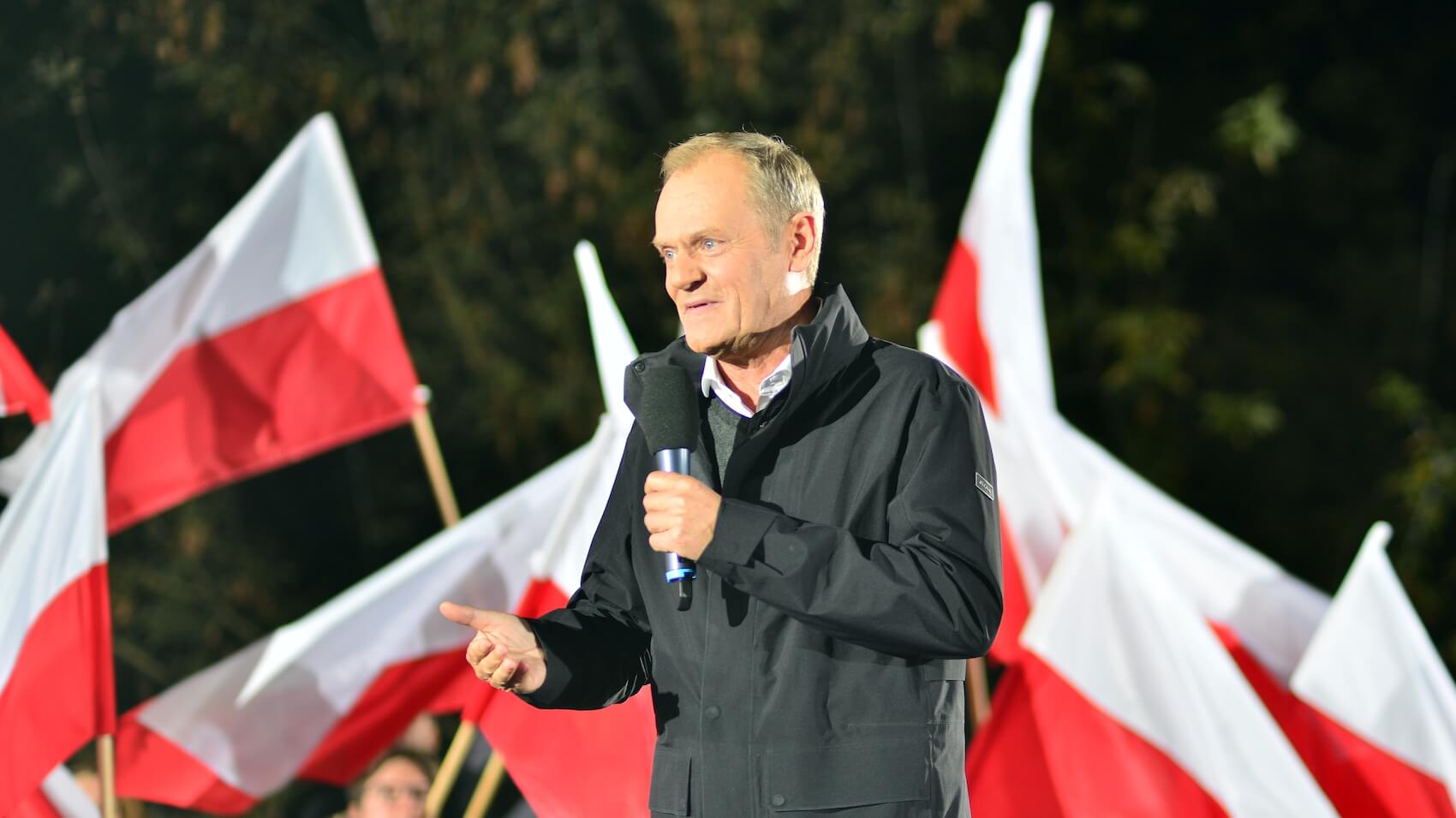
The Real Fear Lies with the Regime Itself

Despite living under the Erdoğan regime, you have once again demonstrated an example of intellectual courage by being among the signatories of the declaration. In your view, how should the responsibility of intellectuals against fascism be defined under today’s conditions? How can the calls in the declaration—such as boycott, strike, and collective action—be concretized for academic and cultural circles?

Professor Baskın Oran: 
Frankly, I don’t think I’ve shown any major intellectual reaction in this matter. I mean, being afraid of something this small is out of the question. After all, as you know, there’s Article 299 of the Turkish Penal Code—insulting the president. But in this case, such a situation does not exist. No matter how much they try to stretch it, they cannot justify or substantiate such a claim. Therefore, it would not be right to see this as a small act of heroism.

As for the second part of your question: To be honest, I don’t always trust the (Turkish main opposition Republican People Party) CHP. However, the current trajectory of the CHP under the leadership of Özgür Özel is quite positive. This should be acknowledged, and he should be congratulated accordingly. Because he is truly expanding the societal movement to broader masses and succeeding in integrating with the people. He’s going beyond mere declarations and embracing a political approach that translates into action.

And precisely because of this, arrest warrants are being issued for those around him, and attempts are being made to ban political opponents—especially Ekrem İmamoğlu—from participating in elections. The system is clearly afraid of this new, young, and rightly governed CHP. That’s why I believe this process should be supported. 

Yes, if one day the CHP reverts to its old ways, then we will resume our criticisms. But for now, I support the CHP under Özgür Özel’s leadership.

A Turkish man in Hyde Park, London, shows support for protesters in Istanbul following the eruption of nationwide demonstrations—Turkey’s largest anti-government unrest —challenging then-Prime Minister Recep Tayyip Erdoğan’s authority in June 2013.
Photo credit: Ufuk Uyanik.

Authoritarianism in the West Is Rooted in a Deep Fear of the Consequences of Its Own Imperial Past

What role have the structural ruptures caused by imperialist expansion—gaining momentum in the late 19th century—in underdeveloped countries, and the waves of migration originating from these regions, played in the rise of fascist and authoritarian tendencies currently observed in the West? In this process, how has the concept of “development” undergone an inversion or distortion?

Professor Baskın Oran: Now, what you are actually asking me—albeit implicitly—is the following: In some developed countries, we are witnessing the hardening and spread of authoritarian regimes; however, at the same time, you are reminding us that similar authoritarian tendencies are also emerging in less developed countries. For example, within the European Union, we observe this trend especially in Poland and Hungary. On the other hand, you are also pointing out the grave actions committed by Israel in Gaza and how they are not being sufficiently condemned by the Western world—particularly by the European Union. You are essentially asking, “Why is this happening?” If I’m understanding your question correctly, I’ll respond right away.

This authoritarian turn and drift away from democracy in developed countries actually stems from a deep fear. And the root of that fear lies in the following reality: The desperate people living in countries oppressed by imperialist forces since the late 19th century no longer know what to do. With hope, they head toward more developed countries, seeking asylum.

Considering that the populations of these developed countries are already limited, that their social security systems are strong, and that these systems are also targeted for use by migrants, a major sense of fear has emerged in these societies. This fear has led to the rise of right-wing politics. Especially through the discourse of anti-immigration and anti-asylum seekers, this fear has provided fertile ground for legitimizing authoritarianism. That’s the heart of the matter.

Trump Globalized the Monroe Doctrine

How do you evaluate the United States’ position—particularly in the Middle East—its Israel-backed aggressive stance, and its anti-Iran strategy in the context of a contemporary reinterpretation of the Monroe Doctrine? What kind of groundwork has the unipolar order that emerged after the collapse of the Soviet Union laid for this process?

Prof. Dr. Baskın Oran: You brought up a very important point by mentioning Trump. Trump is, in fact, a typical contemporary representative of the Monroe Doctrine. People generally understand this doctrine as follows — this is also how it’s taught in schools: “America should not interfere in European affairs.” Because Europe’s affairs are complicated, and since America was newly founded at the time, getting involved could harm it. That is the first proposition of the doctrine. However, the real significance of the Monroe Doctrine lies in its second proposition: Europe, too, shall not interfere in the developments on the American continent. In other words, there is a principle of mutual non-intervention.

Trump, however, has taken this second proposition and interpreted it in an entirely different way. The issue is no longer confined to the American continent; Trump has extended this principle globally and is essentially saying: “I will intervene anywhere in the world, but no one may interfere with me.” With this mindset, he is trying to exert pressure everywhere — from Canada to Denmark, from China to Iran. One of the tools he uses for this pressure is Israel. By supporting Israel’s authoritarian and fascist policies, he is in fact pursuing his own global strategy. Looking at the current situation, we see that Trump has become an extremely radicalized representative of the second and most important proposition of the Monroe Doctrine: “I will interfere with everyone, but no one may interfere with me.”

Civilizations That Merely Consume Technology Do Not Survive

To what extent has the difference between producing and merely consuming technology throughout history determined whether civilizations survived or not? For instance, what kinds of historical parallels can be drawn between the impact of the Industrial Revolution on underdeveloped societies and the impact of today’s digital revolution on those same societies? Does the asymmetry between producers and consumers of digital technology constitute a new regime of dependency?

Professor Baskın Oran: Of course, it creates dependency—because there is a world of difference between producing technology and merely consuming it. In fact, just recently, in 2024, Çağatay Anadolu wrote a very interesting article. In that piece, he went quite far back in history and offered an eye-opening analysis.

He said something along these lines: As you know, we descend from Homo sapiens. But before Homo sapiens, there were Neanderthals. The Neanderthals were not as skilled as the sapiens in things like tool-making or abstract thinking. And while we cannot be sure whether the Neanderthals were wiped out by the Homo sapiens, he argued that it is entirely logical for the Neanderthals—who ended up in the position of technology consumers in contrast to the technology-producing sapiens—to have vanished over time. I found this interpretation quite enlightening.

We’re talking about the Stone Age—actually not even about humans, but about human-like species, hominids. Even back then, the difference between producing and consuming technology determined the fate of entire species. Today, we are facing a similar situation: In the digital age, the disparity between societies that produce technology and those that only consume it creates a new regime of dependency.

Crushed Societies Give Rise to Authoritarianism and War

Mass protests in Russia demanded the release of Alexei Navalny. Police detained protesters in Moscow, Russia, on January 31, 2021. A girl holds a sign saying “Freedom for Putin from office!” Photo: Elena Rostunova.

How do you interpret the structural and political similarities between the rise of economic protectionism, authoritarian regimes, and the atmosphere of pre-world war following the 1929 Depression, and today’s neoliberal crisis moment? Are figures like Trump, Putin, Erdoğan, etc., representative of an updated form of fascism in this process?

Professor Baskın Oran: There is a very serious similarity here. The process that began with the 1929 crash of the New York Stock Exchange needs to be carefully examined. Why did it collapse? Because the market had suddenly and excessively risen. Such sharp increases followed by steep declines can devastate stock exchanges. In that situation, people panicked, withdrew, and the market collapsed.
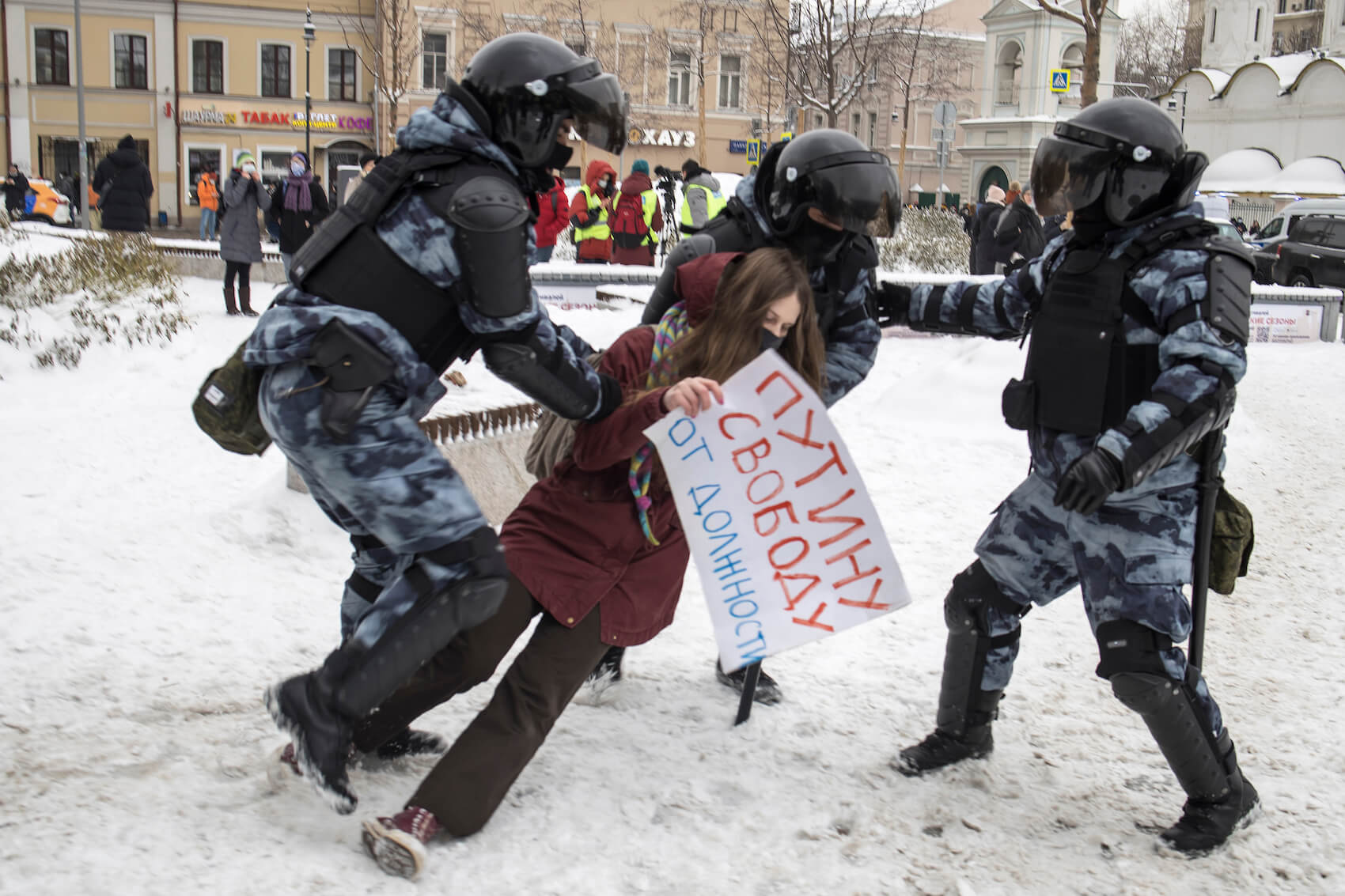
As we just discussed, this collapse triggered the 1929 Depression. Following that, all countries tried to overcome the crisis by restricting imports and increasing exports. But that wasn’t possible—because everyone was trying to do the same thing simultaneously. In an instant, international trade collapsed. And this, ultimately, led to the Second World War.

The Treaty of Versailles, which followed the First World War (1914–1918), imposed such severe conditions on Germany that the people could barely breathe. German women were forced to sell their jewelry. Hitler took advantage of this immense pressure and came to power through a democratic election in 1933. 
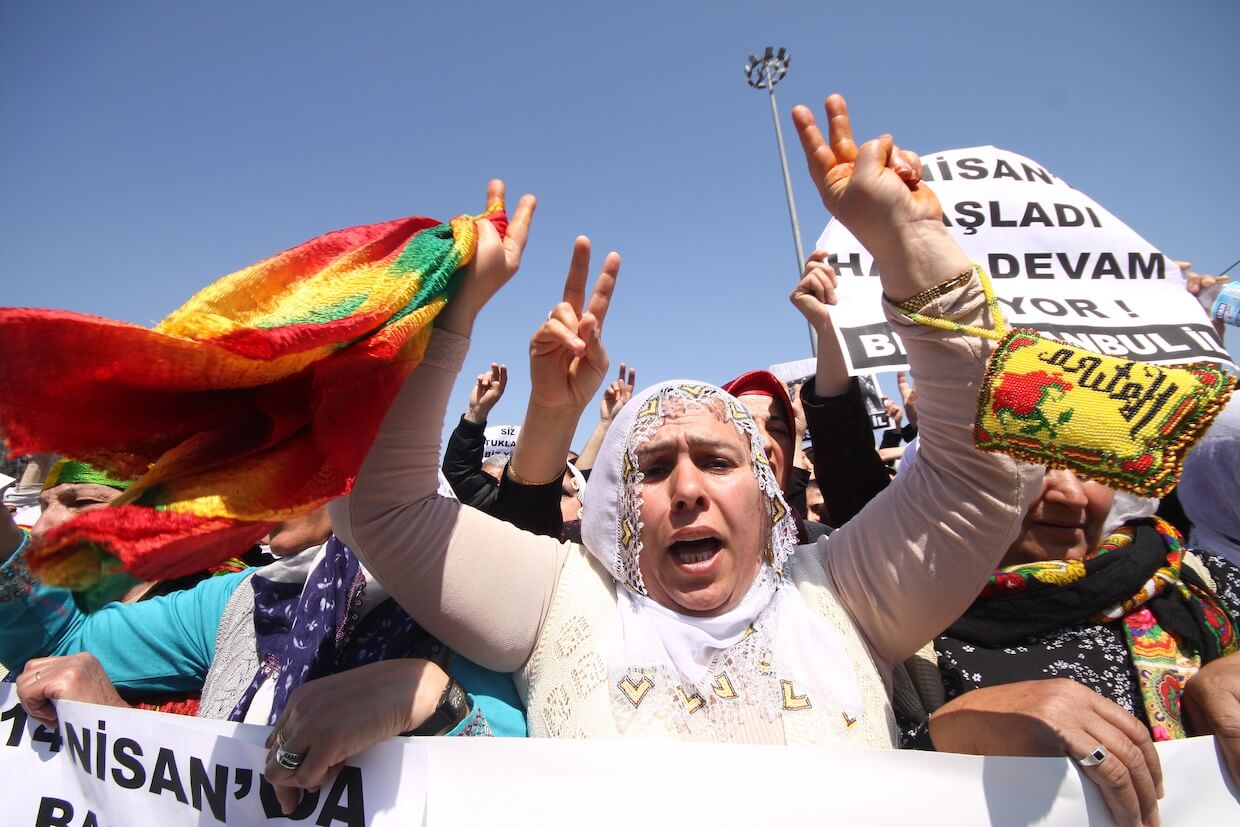

Around the same time, we see a parallel in Turkey: Mustafa Kemal launched the War of Independence in 1919 in response to the unbearable terms imposed by the Treaty of Sèvres on the Ottoman Empire. Just as Versailles had done to Germany, Sèvres imposed unacceptable obligations on the Ottomans.

There is an important lesson here: international treaties cannot be based on crushing one side; if they are, they lead to new crises and wars. Treaties must be mutually acceptable. Lausanne is an example of this. It remains the only World War I peace treaty still in force because it was balanced.

Turning Fear into Power: Populists Redefine the ‘Other’ to Justify Authoritarianism

In your view, does the shift from the rhetoric targeting the ‘internal enemy’ in classical fascism to the perception of an ‘external threat’ through rising anti-immigrant sentiment in developed countries today indicate a transformation in the structural codes of fascism? In this context, what kind of political significance does the redefinition of the ‘other’ carry?

Professor Baskın Oran: Actually, we just talked about this. The main reason why governments in developed countries that push the limits of democracy or verge on fascism come to power through elections is the fear generated by immigrants. The sudden influx of asylum seekers creates a significant perception of threat in these countries. However, the root of this fear is a direct consequence of the imperialist policies initiated in the 19th century.

Populism frequently derives its legitimacy from an artificial conflict constructed between “the people” and “the elite.” How has this form of conflict laid the groundwork for a model of authoritarianism in Turkey? How would you analyze the relationship between the populist rhetoric of the administration under Erdoğan’s leadership and its actual authoritarian practices?

Professor Baskın Oran: Let me begin by saying this: The main factor that brought the Erdoğan regime to power and strengthened it was the excesses of past Kemalist practices. Especially during the military coup periods, the oppressive and denigrating measures laid the groundwork for this process.

One of the most striking examples is the rector and vice-rector of Istanbul University of the time preventing veiled female students from entering the university. Can such a thing be acceptable? A university is a place where a thousand voices echo, a space for thought and freedom of expression. A veiled student should be able to enter the university; both veiled and unveiled should benefit equally from this environment.

So what happens if a veiled student is not admitted? She stays at home, waits to get married, and raises daughters who are veiled just like herself. But if she does enter university, she will take courses like my “Nationalism and Minorities” class and be exposed to new ideas. This is precisely the point: the oppressive excesses of Kemalist policies are what initiated the process that laid the foundations of today’s authoritarian regime in Turkey.

Therefore, we must analyze the emergence of Turkey’s authoritarian regime not solely through the lens of populism, but also within this historical context. Moreover, the Erdoğan regime’s increasingly repressive policies in recent years are actually fueling a process that may bring about its own downfall. Let’s not forget: the logic of dialectics applies to everyone.

Excessive Centralism Marks the First Step Toward a Regime’s Self-Destruction

Do the trustee policy targeting municipalities governed by the DEM Party and the CHP in Turkey, as well as the legislative attempts to transfer municipal powers to provincial governors, align with the classical centralist reflexes of fascism? Could you evaluate these developments in comparison with historical experiences of fascism?

Professor Baskın Oran: Fascism, by definition, is centralism taken to its extreme; in fact, fascism is the most radical form of centralization. After the War of Independence, the implementation of centralist policies in Turkey—specifically Mustafa Kemal Pasha’s, later Atatürk’s, rise to power as a single-man ruler and continuation of that rule—can be understood to a certain extent. Of course, by “understood,” I don’t mean “justified” or “approved.” One of the clearest examples of this excessive centralism was how it was applied to the Kurds. This is a broad topic, but just to give an example: from the Eastern Reform Plan (Şark Islahat Planı) to today, we are talking about a centralism where even speaking Kurdish can still be penalized, albeit indirectly.

As you just mentioned, removing mayors elected by popular vote and replacing them with centrally appointed trustees—either governors or district governors—is a clearly fascist practice. Such actions make the Kurdish issue increasingly intractable and end up strengthening parties like the DEM Party, which advocate against this oppression. Even the CHP, which has long maintained a distant stance on these matters, begins to feel its influence.

In this sense, excessive centralism and intervention in the democratic will—dialectically speaking—mark the first step toward a regime’s self-destruction.

‘Native and National Judiciary’ Is Just a Euphemism for Authoritarian Retreat from Universal Law

Does the frequent emphasis in recent years on a ‘national and native judiciary’ represent a departure from universal legal principles and the instrumentalization of the judiciary? What is the function of such rhetoric in the construction of ideological hegemony by populist-authoritarian regimes?

Professor Baskın Oran: There was a time when there was no ideological framework whatsoever to support people who were under extreme oppression. It was only after World War I that the concept of “minority rights” emerged. In fact, Articles 37 to 45 of the Treaty of Lausanne are titled “Protection of Minorities.” This was the first time such a protection mechanism entered the agenda of international law.

Following the Second World War, this concept evolved further with the emergence of the notion of “human rights.” Especially after the 1950s, efforts to institutionalize human rights gained momentum, leading to the establishment of the Council of Europe and the European Court of Human Rights. Turkey also recognized the jurisdiction of this Court and pledged to comply with its rulings. However, unfortunately, despite this commitment, Turkey largely fails to implement these decisions.

For instance, in cases like those of Selahattin Demirtaş and Osman Kavala, the clear and binding rulings of the European Court of Human Rights are being ignored. The core reason for this is that such decisions are perceived as a threat by the centralized and repressive ideological structure in Turkey. This amounts to an attempt to avoid implementing human rights. But such a stance is not sustainable in the long run.

The frequent emphasis on a so-called “native and national judiciary” must also be understood in this context. This slogan signals a break from universal legal principles and the instrumentalization of the judiciary for political ends. Populist-authoritarian regimes deliberately employ such rhetoric to construct ideological hegemony. In reality, the phrase “native and national” is a euphemism for a regressive, inward-looking, and authoritarian vision that seeks to legitimize distancing from universal values.

Assimilation Backfires Once Identity Forms

Kurdish protesters gather in Taksim Square, Istanbul, on April 13, 2010, following the assault on Kurdish politician Ahmet Türk, who suffered a broken nose. Photo: Sadık Güleç.

Do the pressures on Kurdish citizens in the areas of language, culture, and representation—alongside the appointment of state trustees (kayyım) to municipalities—indicate that Turkey is moving away from a democratic resolution to the Kurdish issue? How do you foresee this approach impacting both national unity and democratization in the long term?

Professor Baskın Oran: Nazism has now reached such a point in the global and Turkish context that I believe Turkey is approaching the end of its centralized structure and its negative effects on Kurdish citizens.

Let me put it this way: you can attempt to assimilate a minority—a group treated as second-class citizens. This is a common historical occurrence. But assimilation has its limits: up until the point when a collective identity emerges within that group. Once that awareness forms, all further efforts at assimilation backfire and only serve to strengthen that group identity.

Turkey reached this point in the late 1950s and early 1960s, but failed to recognize it. Today, with the influence of external dynamics, this collective awareness has become even more visible. In this context, the autonomous Kurdish administration in northeastern Syria must be emphasized. This structure is supported by the most powerful country in the world—the United States—and is also recognized by the Syrian regime.

The current regime in Turkey, out of concern over this development, has initiated a second attempt at reform. The first attempt began in 1993, when Öcalan declared a ceasefire. Now, on July 17, 2025, it is planned that 30-40 PKK members will symbolically lay down their arms in a formal ceremony. This points to a very significant and positive development for Turkey.

“Let’s Just Call It a ‘Democratic Administration’—So That No Harm Comes to Anyone”

The foreign policy of the Erdoğan administration is frequently used as a tool for generating domestic political legitimacy. Does Turkey’s gradual shift away from Western values toward a “Russia-like” model resemble the foreign policy reflexes of fascism?

Professor Baskın Oran: Now, if you pay attention, there are two leaders with whom Erdoğan has very good relations: Trump and Putin. One is the head of the United States, the other of Russia. Although these two countries are fierce rivals and constantly at odds with one another, Erdoğan has managed to establish close ties with both. So, what is the common feature of these two leaders? Both are figures who have established—or are attempting to establish—autocratic regimes. That’s all I have to say.

Lastly, considering current developments, how would you conceptually define the regime in Turkey? Among terms such as fascism, authoritarian populism, competitive authoritarianism, and autocracy, which one do you think best fits today’s Turkey? Why?

Professor Baskın Oran: We’ve actually discussed this before. Let’s just say “a democratic administration,” so that no harm comes to anyone—shall we?

Professor Rafal Soborski, who teaches International Politics at Richmond American University and serves as a Senior Research Fellow at the Global Diversities and Inequalities Research Centre at London Metropolitan University.

Prof. Soborski: The Recent Polish Election Shows That Shifting Right Doesn’t Win Over the Right

In this compelling interview, Professor Rafal Soborski critiques Poland’s liberal democratic actors for mimicking right-wing rhetoric in a failed attempt to broaden appeal. “Shifting right doesn’t win over the right—it alienates the left,” he warns, urging pro-democratic forces to adopt bold, progressive agendas rooted in class justice and social solidarity. Drawing comparisons to political centrists across Europe, Soborski emphasizes that ideological clarity—not cautious managerialism—is key to countering the far right’s emotional narratives and mobilizing mythologies. His insights offer a timely call for a renewed progressive vision amid the turbulent political landscape in Poland and beyond.

Interview by Selcuk Gultasli

In a wide-ranging interview with the European Center for Populism Studies (ECPS), Professor Rafal Soborski offers a trenchant critique of the Polish liberal democratic actors’ strategic missteps in the recent presidential election, arguing that centrist attempts to mimic the right not only fail to capture conservative voters but also alienate the progressive base. “Shifting right doesn’t win over the right—it alienates the left,” he asserts, summarizing what he sees as a recurring failure of liberal parties not only in Poland but across much of Europe.

Professor Soborski, who teaches International Politics at Richmond American University and serves as a Senior Research Fellow at the Global Diversities and Inequalities Research Centre at London Metropolitan University, situates this analysis within a broader critique of what he calls “managerial centrism.” For him, this style of governance—technocratic, uninspiring, and devoid of ideological ambition—has become a default mode for centrist parties. “Even when the center wins elections, it then limits itself in office to this very managerialism… without a compelling vision of its own,” he explains.

This was evident in the performance of Civic Platform’s candidate, Rafał Trzaskowski, who lost narrowly to the nationalist Karol Nawrocki in a deeply polarized race in Poland. Rather than galvanizing progressive voters with bold policies, Trzaskowski, Professor Soborski suggests, hedged his ideological bets and made symbolic missteps that demoralized key constituencies. “I don’t think he convinced anyone by hiding the rainbow flag handed to him by Nawrocki during one of the debates,” Professor Soborski notes. “This alienated many people on the left… while not convincing anyone on the right.”

In his view, such political positioning reflects a deeper failure to recognize the need for ideological clarity and courage. Drawing comparisons to Germany’s Olaf Scholz and Britain’s Keir Starmer, Professor Soborski warns that when liberal parties attempt to neutralize far-right narratives by parroting them, they lose both authenticity and voter trust. “It tends to mimic instead the narratives of the right,” he laments.

For Professor Soborski, the path forward lies not in cautious centrism but in a reinvigoration of progressive values—rooted in social justice, pro-Europeanism, and recognition of class dynamics. “I would like to see pro-democratic forces in Poland challenging the right,” he concludes, “rather than hoping in vain that they can occupy some of the right’s discursive territory.”

This interview reveals not only the ideological contours of Poland’s political battleground but also the urgent need for liberal democratic actors to rethink their strategy before the far right consolidates its recent gains.

Here is the lightly edited transcript of the interview with Professor Rafal Soborski.

Populism Is a Style, Not an Ideology

Posters of 2025 Polish presidential candidates Rafał Trzaskowski (KO) and Karol Nawrocki (PiS) in Kuślin, Poland, on April 6, 2025. Photo: Dreamstime.

Professor Rafal Soborski, thank you very much for joining our interview series. Let me start right away with the first question. You’ve argued that populism lacks ideological coherence. How would you categorize Karol Nawrocki’s brand of politics—Trumpian, nationalist, anti-liberal—within your broader critique of the term ‘populism’?

Professor Rafal Soborski: I don’t think mine is a critique of the term populism as such.
But instead, what I would argue—and I am, of course, far from being original here—is that approaching populism as an ideology, even a thin one, is misguided. Incidentally, the author to whom we owe the concept of thin-centered ideology, Michael Freeden, does not think populism qualifies as one, so it doesn’t qualify as a worldview. According to Freeden, thin-centered ideologies have a restricted conceptual core, a restricted range of concepts, and hence need broader, more mature ideologies, such as liberalism or socialism, to serve as their hosts. But the thin-centered ideologies are still more complex than populism. So think of nationalism, feminism, perhaps ecology.

On the other hand, populism revolves merely around the opposition between the decent people and the corrupted elite, and this is not enough to construct a worldview that any ideology is expected to offer. Of course, you can further distinguish between right-wing populism, left-wing populism, and so on. But such distinctions often reveal that populism does not really make much sense as an ideological category. So both Donald Trump and Bernie Sanders have been described as populists, but their views are dramatically different.

During the pandemic, I analyzed approaches to COVID-19 that others had categorized as populist, and I showed that there was no consistent pattern or any general similarities in terms of the track record—in terms of the success or otherwise—of so-called populist policies, and that, in fact, the major factor was the degree of neoliberalization. So, I think it is better to keep populism as a description of the type of political communication—the style of political communication—and perhaps also the convention-breaking behavior of some politicians, including dressing down, swearing, smoking—in the case of Nawrocki, sniffing snus during TV debates with Trzaskowski.

But the populist manner may carry very different ideological and political messages, and in that sense it may be better to speak of populist nationalism or populist socialism rather than vice versa—rather than socialist populism. Populism then becomes just a description of the style in which a given ideology is conveyed.

As for Nawrocki, I think all of the adjectives that you have mentioned—Trumpian, nationalist, anti-liberal—could potentially apply, for of course they are different categories.
Trumpism seems to have an obvious meaning. It’s a blend of hostile grievances against all kinds of minorities and some pernicious establishment—which is, of course, ironic, considering Trump’s own status—and Trumpism is expressed more as ephemeral sound bites than coherent ideas. We’ve become used to that with Donald Trump. Trump is also associated with political transactionism, bringing his personal monetary interest quite unashamedly into politics, which also affects what he says and how he says it. So it remains to be seen if Nawrocki tries to emulate this.

Is Nawrocki a nationalist? Certainly. And it is a nationalism that thrives on and stirs up collective fears and collective resentment in a volatile world whose complexities this kind of nationalism oversimplifies.

Anti-liberal? Well, absolutely. However, I think we need to be fair and wait and see who Nawrocki turns out to be ideologically when in office.

We need to remember that until he was selected by Jarosław Kaczyński as an ostensibly nonpartisan candidate—but really the candidate of Law and Justice (PiS)—he had been almost a complete unknown to the wider public. So I think we need to wait and see what happens.

Ideological Balkanization and the Far Right’s Mythmaking Machine

You’ve called for taking ideology seriously in times of crisis. What ideological threads—beyond vague populism—do you see underpinning Nawrocki’s support base and discourse?

Professor Rafal Soborski: Thank you for this question. Yes, I think political ideology should be taken seriously, and I discussed this in my work. For years, however, ideology has undergone a radical transformation, becoming increasingly fragmented, fluid, ephemeral,
reacting haphazardly to rapid social and political changes. So, traditional left-right distinctions have blurred. They have given way to hybrid belief systems and situational politics, featuring often contradictory positions depending on the issue at hand, emerging at any moment. Of course, social media have accelerated this shift as well, favoring meme-driven and personality-centered politics over more durable, collectively held ideological commitments. And, comprehensive worldviews are losing ground to issue-based activism, identity politics, and also algorithmically reinforced echo chambers. So, ideology has changed, and far-right politics provides a particularly revealing lens through which to analyze ongoing ideological transformations. 

The far right today combines elements of nationalism, traditionalism, libertarianism, conspiracism, accelerationism—you name it—into an unstable and contradictory but potent political force. The far right also engages in constructing and mobilizing its followers around myths—political myths of civilizational decline, national betrayal, or demographic apocalypse. It offers emotionally charged narratives of victimization and redemption. So, for example, “the Great Replacement” myth frames migration as an existential threat to the West; “the Deep State” conspiracy envisions elites orchestrating some global control or takeover. The far right relies on such narratives, positing a moralized struggle between the people and their perceived enemies, and seems to be capitalizing on the fears that these cause.

Overall, I think what we witness is ideological Balkanization—adherence to tribalism over universalism, feeling over reasoning—and it’s going in that direction. But this does not mean that we should be paying less attention to these fragmented new forms of ideology. Ideology scholars should really be exploring ideology in its different expressions, whether they are sophisticated and structured, or crass and fleeting. For better or worse, this is how we tend to think politically today, and we should be studying this.

However, coming back to Nawrocki, I think it is likely that he will be blending different ideological themes, and it seems certain to me that it will be a narrative mobilizing collective exclusionary emotions over reasoning. But still, as I said earlier, I think we need to wait and see. His political communication thus far has been subject to the pressures of electoral competition much more than it will be when he’s in office, with at least five years of presidency ahead of him. Perhaps he will continue this kind of discourse, or perhaps he will change. We’ll see.

The Far Right Has a Base and a Superstructure—But No Real International

President-elect Karol Nawrocki campaigning ahead of Poland’s 2025 presidential election in Łódź, Poland, on April 27, 2024. Photo: Tomasz Warszewski.

How does Nawrocki’s alignment with Trumpism reflect broader transnational ideological flows between far-right actors across the Atlantic? Are we seeing a global ideological bloc emerging?

Professor Rafal Soborski: That’s a great question. Far-right ideologies take increasingly transnational forms. This includes the emergence of different forms of civilizationism, variously aligning with or transcending nationalism or racism. So, with my colleagues at London Metropolitan University, Professor Michał Garapich and Dr. Anna Jochymek, we’ve been working on a project funded by the UK’s Economic and Social Research Council, studying the emerging transnational Polish-British far right. And we see a significant number of Polish migrants in Britain recruited by British far-right organizations. We also see British far-right leaders and activists visiting Poland, for example, to take part in the Polish Independence March on 11/11, which is probably the world’s largest transnational far-right hub, as well as a symbolic space for the reproduction of political myths.

Far-right cooperation is fast becoming both a matter of ideological synergy and financial benefit. Far-right influencers play an increasingly important role, and there is money around them. So, for example, one Polish-British far-right PR expert has been behind the rightward shift of Elon Musk, and both have promoted the staunchly pro-Israeli, Islamophobic far-right influencer Tommy Robinson.

So, in that sense, I think an ideological bloc has already emerged, and this far right of today does have both its base and its superstructure, using Marxian terminology. But having said all that, far-right nationalism’s logic is not really given to cooperation—to put this mildly—and as we know from history. So, I anticipate all kinds of tensions, potentially conflicts emerging, and I don’t think that a robust, coherent far-right international is likely in that sense.

Populist Nationalism Thrives on Imagined Enemies And PiS Knows This Well

With Nawrocki now positioned to veto progressive reforms by Tusk’s government, are we witnessing a new phase of institutional gridlock engineered by ideological confrontation between liberalism and authoritarian conservatism?

Professor Rafal Soborski: I think this is highly likely. But I don’t think, to be honest, that Tusk’s government would have done much, even with a president from its own side. The coalition is too divided on social issues and has been, I have to say this with regret, highly ineffective. And Tusk’s party itself is really right-wing—I mean, by Western standards. This is a neoliberal/neoconservative party. It resembles the Tories under Cameron before their shift in a far-right direction. So, yes, but I don’t think that it would be a very dramatic change in relation to what we have.

Do you foresee PiS leveraging the presidency to engineer a strategic comeback in 2027, thereby locking in illiberal reforms? If so, how might ideology serve as the vehicle of this restoration?

Professor Rafal Soborski: I think the broad ideological outlook of Law and Justice (PiS) will remain as it is—traditional, conservative on social issues, and protectionist—some would say drifting towards the left—on economic issues. At the same time, the populist nationalism that PiS represents, as I said earlier, thrives on imagining enemies and hostile forces.
So, at one point it was the LGBT community that PiS stigmatized, with some regions and locations under the control of the party declaring themselves to be LGBT-free zones. At other points, it was refugees from the Middle East, whom Kaczyński presented in a language resembling Nazi rhetoric, really—namely, as carriers of dangerous diseases. So, with the rapid growth of the Ukrainian population in Poland following the Russian invasion of Ukraine, PiS will be keen to capitalize on any emerging fears and tensions between the Polish population and the Ukrainian minority in Poland, and that this will be used to engineer this strategic comeback in 2027.

PiS Is Illiberal—But Let’s Not Mistake It for Neoliberal

Chairperson of Law and Justice, Jaroslaw Kaczynski. Photo: Tomasz Kudala.

In your analysis, how does neoliberalism continue to structure Polish politics even amidst this nationalist, anti-liberal wave? Can we speak of an ‘illiberal neoliberalism’ in the Polish context?

Professor Rafal Soborski: This is an interesting question—questions like this color the debate on whether we still live in a neoliberal era. Trump’s tariffs, Brexit, etc., seem to perhaps contradict this. Neoliberalism—and by this I mean a crass version of 19th-century economic liberalism, not the paradigm in the studies of international relations also known as neoliberalism—has been the hegemonic ideology for so long that, even if we are to assume its terminal decline in the near future, it will continue resonating for some time. By the way, the end of neoliberalism was pronounced a few times before, especially during the 2008 economic crisis—the gravest one since 1929—which revealed the serious flaws of neoliberalism, and then during the pandemic, when suddenly the state, which neoliberals tend to blame for all problems, proved indispensable, and neoliberal regimes coped with the pandemic far worse, far less effectively than the more social-democratic, statist ones.

Now, neoliberalism is compatible with authoritarianism—think of Chile under Pinochet’s rule, for instance—but as far as PiS is concerned, I am not sure if the party represents illiberal neoliberalism. Neoliberals preach that markets are always right, they don’t find inequality to be a problem, they promote austerity and the rolling back of the welfare state. And PiS, on the other hand, is actually quite statist in approach, supportive of the welfare state—for whichever reasons, usually just electoral reasons, but still—and big projects like, for instance, the central airport in Poland, which is now in a bit of a limbo. Economic inequalities—we have to keep this in mind—under the PiS government declined in Poland. The Gini coefficient, which measures inequality, fluctuated during PiS years but was never higher than in 2015 and is now significantly below average. So, I wouldn’t describe them as illiberal neoliberals. They are certainly illiberal, but probably not neoliberal.

Is Poland a Nationalist Haven?

Your recent co-authored work shows how Polish migrants in the UK are co-opted into transnational far-right movements. How might Nawrocki’s presidency reinforce or reshape diasporic nationalism and transnational far-right solidarities?

Professor Rafal Soborski: Thank you very much for this question. This is the topic that I’m working on with Professor Garapich and Dr. Jochymek at LMU. 

Poland is often seen by the global far right as a nationalist haven that remains relatively homogeneous ethnically, that remains traditional, conservative, and has also been very economically successful in recent decades, while maintaining a strong identity. And this kind of perception has been articulated and reinforced by all kinds of far-right influencers, but also by Donald Trump. When he visited Warsaw during his first presidency, he chose Warsaw as the location for his main European speech—often described by scholars as the major narrative of Western civilizational populism.

I think this perception of Poland—has been undermined by the 2023 elections and the premiership of the globalist Donald Tusk, as he’s seen by the far right. But if PiS regains power in 2027, then the far-right narrative about Poland as a model country is likely to make a comeback. 

I already mentioned our work on Polish migrants in Britain, one of the largest minorities in the country. At this point, approximately 700,000 Poles live in Britain, and their voting patterns are interesting. They are different from how Poles living in, for example, the United States or Canada vote. So in the first round of the presidential elections, almost 36% of those who voted voted for Trzaskowski. But then he was followed by two far-right candidates—Sławomir Mentzen, over 18%, and Grzegorz Braun, who got over 14%—and Nawrocki was only fourth, with just 13%. So it seems that Polish right-wing migrants in Britain prefer either the more extreme narrative coming from Braun, which is messianic, antisemitic, extremely homophobic, or the more economically libertarian far-right views of Mentzen. And the popularity of the latter may be explicable by the fact that many Poles living in Britain are self-employed and hence averse to big state and high taxation. But in the second round, Trzaskowski got almost 61%. So we should keep in mind that the majority of Poles in Britain are not interested in politics and do not vote. Those who vote ultimately voted for the centrist candidate.

Now, coming back to Nawrocki: only time will tell what his win means for transnational far-right solidarities. What we know is that the PiS government until 2023—so for eight years—supported symbolically and financially various initiatives of the Polish diaspora in Britain that were of a far-right nature, and the British press did register this. More broadly, taking a more global perspective, as the far right assumes an increasingly civilizationist posture, transnational far-right ideologies, activism, and symbolism will become more important, I’m sure—reinforcing these solidarities that you’ve asked about. However, as I already said, we should not forget the lesson from history: that collision courses are inherent in nationalism, and such friendships are likely to be subordinated and perhaps ultimately trumped by jingoistic passions.

Shifting Right Won’t Win the Right

What are the ideological weaknesses of the liberal opposition in Poland, particularly in light of Trzaskowski’s narrow loss? Is managerial centrism enough to challenge the far right’s mobilizing narratives?

Professor Rafal Soborski: It certainly is not enough, and this can be seen not just in Poland, but also in other places, including Germany or Britain, where—even when the center wins elections—it then limits itself in office to this very managerialism you mentioned, without a compelling vision of its own. It tends to mimic instead the narratives of the right. Think of Keir Starmer’s shift to the right in recent months, or Scholz when he was Germany’s Chancellor. There are many other examples. And I think this was also a mistake of the coalition government in Poland—the rightward shift in the rhetoric around migration, for example, and no progress whatsoever on the promises made to the LGBT community. And of course, this was caused by the coalition being divided on the question. But why would voters take into consideration the inner workings of the governing coalition? They generally expect results. 

Many leftists did vote for Trzaskowski, perhaps with a heavy conscience. I would have liked many more of them to vote for him, just to avoid having a nationalist with a shady past as president of the country. But Trzaskowski himself should have shifted in a more progressive direction. For example, I don’t think he convinced anyone by hiding the rainbow flag that was handed to him by Nawrocki during one of the debates, and then it was quickly taken over from Trzaskowski by a left-wing candidate. This alienated many people on the left—members of the LGBT community, I presume, as well—while not convincing anyone on the right, who had seen Trzaskowski before participating in Pride marches in Warsaw. So, this was inconsistent, and shifting to the right will not work.

Don’t Chase the Right—Reclaim Class Politics and Solidarity

A fatigued factory worker.
A fatigued factory worker experiencing exhaustion, weakness, hopelessness, and burnout. Photo: Shutterstock.

How should pro-democratic forces in Poland reframe their political project to contest both the nationalist cultural agenda and the underlying neoliberal consensus you critique?

Professor Rafal Soborski: I think it is evident from what I have said so far that my political views are leftist and progressive. I would like to see pro-democratic forces in Poland challenging the right rather than hoping in vain that they can occupy some of the right’s discursive territory. I would like to see an open, pro-European Poland respecting minorities and celebrating diversity. 

But I would also like to see the importance of social class really appreciated by Polish progressive politicians.The liberal center, and even the liberal left, sometimes appear to believe that class is no longer a significant dimension of identity or social stratification. They see class as a concept that was relevant in the industrial era—in the 19th century, early 20th century—but not in an information- and service-based society of today. But the concept of class describes an economic relationship, and anyone working for wages, not living off rent or interest, belongs to the working class. So to appeal to this huge group, pro-democratic forces should start talking about the four-day working week, more loudly about universal income, universal benefits—especially in the context of AI, which will likely eliminate a wide range of professions, a wide range of jobs, or rather, it will replace humans in those jobs. 

The Razem (Together) party in Poland has started this conversation, and I think this is the way to go, rather than caring mainly for the interests of a small number of wealthy individuals or entrepreneurs, however important they may be for the economy. We should also remember on this point that some of the people who voted for Law and Justice—I suspect a significant share of the party’s electorate—chose it because of the range of social benefits, welfare benefits that the party has introduced or expanded, hence, as I mentioned, reducing inequalities while at the same time sustaining economic growth. So, I think a social democratic, solidary response—protecting the poor while shifting more of the financial burden towards the privileged few—is what I would recommend, and I would recommend this both in principle and also strategically, as a way to weaken, to defeat PiS.

And finally, Professor Soborski, given the gender and education-based electoral cleavages evident in the runoff, how might intersectional ideological analysis help explain—and perhaps overcome—these divisions?

Professor Rafal Soborski: Most of the cleavages were not that surprising—big cities for Trzaskowski, provincial Poland for Nawrocki, Western Poland for Trzaskowski, Eastern Poland for Nawrocki. Education was, of course, a big factor as well. But what I would like to highlight—what came unexpectedly—was the support far-right candidates Mentzen and Braun received from young people, who then, in the second round, voted primarily for Nawrocki. So clearly, this is a group for whom Civic Platform—the coalition government—does not seem to have a convincing offer, and I already explained what I see as the right response.