Ekrem Imamoglu, Kemal Kilicdaroglu, Recep Tayyip Erdogan

Prof. White: Erdogan’s Arrest of Istanbul Mayor a Sign of Insecurity—And That Makes It More Dangerous

In a comprehensive interview with ECPS, Professor Jenny White calls the arrest of Istanbul Mayor Ekrem Imamoglu “absolutely… a sign of insecurity”—not strength. Professor White warns that this preemptive strike ahead of the 2028 elections reflects “regime fragility,” not confidence, adding: “If this stands… voting ceases to have any real meaning.” Drawing on her concept of “spindle autocracy,” she explains how personal loyalty has overtaken institutional merit, creating a brittle, fear-driven system. With Erdogan’s popularity fading and international pressure weakened, Professor White argues, “This is a line that has now been crossed”—one with dangerous consequences for Turkey’s democratic future.

Interview by Selcuk Gultasli

In a wide-ranging and incisive interview with the European Center for Populism Studies (ECPS), Professor Jenny White—renowned anthropologist and scholar of Turkish politics at Stockholm University—explores the deeper implications of Istanbul Mayor Ekrem Imamoglu’s arrest and what it reveals about the current phase of Turkish President Recep Tayyip Erdogan’s authoritarianism. “Oh, absolutely—it’s a sign of insecurity,” Professor White declares. “And that makes it all the more dangerous, because this is a line that has now been crossed.”

This stark assessment lies at the heart of Professor White’s reflections on how Erdogan has evolved from a populist reformer to an embattled strongman. The arrest of Imamoglu—widely seen as the opposition’s most viable presidential contender in 2028—is not an act of confidence, but of regime fragility. “If this stands… and especially if the party itself is taken over, then voting ceases to have any real meaning,” she warns.

Professor White locates this shift within a broader trajectory of democratic erosion in Turkey. Drawing from her concept of spindle autocracy, she describes a system where loyalty to the leader has eclipsed merit and institutional integrity. “You cannot disagree. If you disagree, you are a traitor,” she says, noting that once individuals fall out of favor, they are discarded—spun out like raw wool from a political spindle.

Far from being the first rupture, Imamoglu’s arrest is a culmination of earlier moves: the post-Gezi crackdown, the co-optation of the judiciary, and the mass purges following the 2016 coup attempt. “At this point, there are really no institutions left around Erdogan that have competence, aside from loyalty to him,” Professor White states.

The sense of insecurity extends beyond domestic calculations. Professor White suggests that global shifts, including the return of Donald Trump, have reinforced Erdogan’s sense of impunity. “Erdogan has nothing to fear from US censure… I’m quite sure Trump would support that kind of move,” she notes. The European Union, too, finds itself in a bind—caught between supporting human rights and preserving strategic ties with Turkey.

Despite Erdogan’s waning popularity, the fear of retaliation—and the AKP’s entrenchment in every layer of society—limits open dissent. As Professor White concludes, “You can’t forget that Erdogan still has a lot of people willing to vote for him—not necessarily because they’re passionately in love with him, but because they’re afraid of what happens if he’s gone.”
This interview sheds urgent light on the authoritarian logic of fear—and what happens when that fear governs.

Professor Jenny White, renowned anthropologist and scholar of Turkish politics at Stockholm University.

Here is the transcription of the interview with Professor Jenny White with some edits.

Turkey Is a Roller Coaster—Who’s on Top and Who’s Not Constantly Shifts

Professor White, thank you very much for joining our interview series. Let me start right away with the first question: In your articles, you describe Turkish political life as a “horizontal topography of action” rather than a vertical model of oppression and resistance. How does this framework help us better understand Erdogan’s consolidation of power post-2016 coup attempt?

Professor Jenny White: Well, I think of politics both in micro terms and over the long term. So, if you think of politics as just what’s happening now, you can try to clarify who’s on top and who’s on the bottom. But if you look at it even in just a slightly longer time frame, you see that the constituents of “Up” and the constituents of “Down” don’t stay the same. They, especially in a place like Turkey, are almost like a roller coaster. For a long time in the 20th century, the secular Kemalists were on top, and they were able to, or they tried to, determine how the rest of the population should live according to their standards. A lot of people went along with that because they also agreed with it. Those who didn’t were, you know, the religious, the peasants, the ones who lived in Turkey and tried to do well for themselves but often found that being religious or from the countryside was a drawback when it came to moving ahead. At some point, I think it was in the 1960s, you weren’t allowed to wear a headscarf in a civil service job or even to visit someone in a state hospital. Eventually, you weren’t allowed to wear a headscarf to go to university.

For many people who had been left out of the nation’s vision of progress, that was the ultimate insult. Not only were they kept down because they were peasants or migrants to the city, but they were also not allowed to practice their religion if they wanted to participate in modern society. There was this profound sense of being disenfranchised, being oppressed by the elites who, at the time, were trying to raise everyone up. So, depending on where you’re looking from, it’s determined by the observer. What’s the position of the observer in making the determination of who is oppressed or who is the oppressor? Then, of course, in the 1980s, the Islamist party started winning local elections and then national elections, representing these disenfranchised people. They came to power, and now we have the AKP. The AKP, in turn, decided to impose on the population their view of how one should live. It’s a different part of the population now.

Again, depending on who the observer is, you could either feel oppressed or say that those are the oppressors. It’s a roller coaster, with who’s on top and who’s not. Then, if you take it down another level, you look at people who are otherwise the same, like the followers of Fethullah Gulen and the members of the AKP. Before that, the Refah Party (RP) consisted of lower-middle-class merchants—not really merchants, but more like business people—and later on, they became wealthy. These were the people who had managed to step up in the new 1980s economy. They felt empowered, believing they were now on top. The Fethullah Gulen followers were heavily involved in all of this. They worked together with the government, had their own version of what they were doing, but in many ways, culturally and religiously, in terms of piety, they were indistinguishable from the AKP followers. So, you would think they wouldn’t be differentiated, but they fell afoul of the AKP, became the “bottom,” were hounded out of existence, and declared terrorists.

The scary thing for a lot of people was that you couldn’t actually know who was in and who was out, who was up and who was down. Your neighbor wore a headscarf, and you wore a headscarf. You were culturally identical and had known each other for years. How do you know who is on the up and who is on the down? There was also a culture of snitching. If you didn’t like your mother-in-law, you could snitch and claim she was a Gulenist, and then watch her fall. This is not the usual up-and-down scenario, which stems from a liberal leftist view that the world is divided into people who are oppressed—the poor, the minorities—and then the oppressors. In reality, the oppressed themselves can oppress others. It’s much more complicated than that. 

There Are No Institutions Left—Only Loyalty

In your analysis of “spindle autocracy,” you argue that personal loyalty to a leader has replaced institutional merit. How has this dynamic reshaped Turkey’s political institutions and public trust in them since the executive presidency was introduced?​

Professor Jenny White: Thank you. That’s a good question. But all I can think of right now is the US. This is so applicable. You can see the spindle forming, and just the idea of spindle autocracy, or spindle politics, as I ended up calling it, is that you move from being a country where people look at the politicians, and they may like or dislike the politician, but they look at the policies. “I like the policies of this politician, too. I like this politician.” To “I love this politician because this is an incredible outpouring of emotion, a passionate emotion that’s much more than simply liking your politician.” And I don’t really care what his policies are. I go with them because they are things that he wants us to do.

That’s an enormous difference, and the implications of that are also enormous. Because if you have a political leader who is a spindle autocrat, surrounding himself with people who are loyal as the first criterion, whether or not they are competent shouldn’t be beside the point, but often is. In the Kemalist era, there has always been a kind of big-man authoritarianism in Turkey, starting with Ataturk—the love of the leader. Atatürk is the beloved leader throughout, but whenever individuals like Menderes, Demirel, and Ozal, for example, came along, there was this attachment to particular leaders, including leftist leaders who are now icons.

So, I’m not saying this is something new with the AKP. These are old habits of power, big-man autocracy, and authoritarianism. All of this is wrapped up in a kind of patriarchy: “the devlet baba,” the state as your father, which is now personalized as Erdogan, your father figure. Intolerance of difference—people don’t like things that are different, or people who are different—has always been present in Turkey. But what is different now is the character of this central leader, right?

The styling. Another thing that’s been around for a long time is the styling, where the leader presents himself as both a hero and a victim—the heroic victim who is there to take care of you like a father. Erdogan embodies all of this, as did the leaders before him. But the difference now is that he has sort of forgotten the part where he takes care of the family. It’s almost as if remaining the leader has become a purpose in itself. All the pomp and circumstance surrounding the presidency now just feed resources and attention to the central figure. There are really no institutions left around Erdogan that have competence, aside from loyalty to him.

Obviously, not everyone is incompetent, but Erdogan has removed anyone he deemed disloyal. This started happening in the late 2000s. At one point, the Gulen movement, which had significant influence within the police, went after some of Erdogan’s family members for corruption and they wanted to arrest the government’s emissary who was traveling to Europe to negotiate a peace deal with the PKK. Erdogan didn’t like that, which caused a clash within the government.These individuals were part of government institutions, and the Gulen movement was singled out. Erdogan’s government then targeted the Gulen movement, leading to what became almost a feud—back and forth—culminating in the 2016 failed coup attempt. These were the people who had surrounded Erdogan at the beginning, and they moved down on the roller coaster, while the people who moved in were not necessarily known for their competence.

 One of the major consequences of a system like this is that nobody can disagree with the leader. In a normal political situation, even in an authoritarian context, you have advisors, right? They can discuss things with you and disagree. But in this case, because the relationships are all personal—based on loyalty and passionate devotion to the leader—you cannot disagree. If you disagree, you are a traitor. “Hain,” or traitor, is a term often thrown around in Turkey, and even though it’s used frequently, it’s always taken very seriously. If you are labeled a traitor in the newspapers, you could be arrested. It’s not something said lightly, but traitors emerge every minute, because people will disagree with what the leader is doing, and then they go down on the roller coaster.

So, it’s a very unstable system, even though it looks like it should be stable because of the strongman structure. But if you look closer at the micro level, there are always people moving in and out. If you think of the spindle, for those who don’t know, a spindle is a stick on a string that twirls, and you take raw wool and spin it until it turns into yarn that you can use to knit a sweater. Think of the raw wool coming from the sheep as the recruits who get involved around the leader, and as they do, they network and become obedient. They get “cooked in,” and then, as inevitable breakups happen, they split off. Even though it looks stable—with this leader who is always there—and if you look back in time, you’ll see many spindles, names of leaders, but you don’t see what was happening around the spindle, the people moving in and out.
Today It’s Gulenists, Tomorrow Someone Else

On 20 July 2016, Turkey’s Islamist-populist President Recep Tayyip Erdogan declared a state of emergency, enabling him and the AKP cabinet to bypass parliament and rule by decree. The crackdown on possible coup plotters has since been turned into an all-out witch-hunt not only against alleged Gulen sympathizers but also leftists, Kurds and anyone critical of the government.

You note that Erdogan’s regime revived the “threat paradigm” once used by Kemalists, but with updated targets like the Gulen movement. How do these manufactured inside/outside enemies influence popular support and the regime’s legitimacy?
Professor Jenny White: I think it’s something that is deeply embedded in the Turkish educational system. Children learn from a very early age that there are enemies. In the Kemalist days, that was quite overwhelming, and the enemies—there’s a whole list of them—were foreigners, the inside enemies. These were the non-Muslim minorities who, because they’re not Muslim, can’t possibly be loyal to the Turkish state and are probably working together with non-Muslim or Christian outsiders to undermine Turkey, as they had done in World War I. Some people call it the Sèvres syndrome.
So this is a serious issue that has affected the population, partly through the educational system but also through the media. It’s always present—it’s in everything, you know, even the soap operas. Even the Ottoman-era soap operas contain this underlying distrust of non-Muslim foreigners, especially Christians.

But again, on a micro level, it takes different forms, right? I’m just thinking of an example. One of the biggest threats to Turkish national unity in the 1980s and early 1990s, according to the Turkish military, was missionaries—Christian missionaries. There were almost no missionaries in Turkey. Why would this even be a thing, let alone one of the biggest threats to national unity?

It’s because it’s not really about the missionaries per se, even though some of them were actually killed or attacked by people. They were a symbol of a Christian West that is believed to be out to destroy Turkey. That’s what people believe. And you could be Jewish, you could be gay, you could be any one of the many categories of “other”—and still be lumped in. Or Armenian, right? So those are all kinds of insults when used in this way—as someone who is out to get Turkey. And they’re interchangeable.

So it’s not the particular people or the particular category that’s a threat. It’s the fact that there is this threat—it’s existential—and the category that belongs to the threat is constantly fungible. So you don’t ever hear about missionaries anymore. It’s as if that never happened, even though it was a serious thing for many years.

Now you hear about Syrians or the Gulenists—another new threat category. They’re considered an even greater threat because they are the enemy within: they are also Muslim and look just like you. So it’s a way to polarize the population. And in polarizing the population and the other political parties—because everyone feels like they have to take a stand on these issues—for many years, the CHP, the main opposition party, was in step with everyone else in demonizing both the external and internal enemies.

Well, they’ve moved away from that. Okay. But they still were—then they got on the bandwagon that everyone else was on, saying negative things about the Syrian refugees or the Kurds. Now there’s an attempt by the AKP to reach out to the Kurds in a way that I’m not sure is believable, because nothing has been given to the Kurds in return for Ocalan’s speech—or request—that the PKK lay down its arms.

But what this does is split the CHP. It also splits the Kurdish party, the DEM Party. It’s like—are they going to support the CHP candidate for president, or are they going to sit it out and see whether they can get anything in return from the AKP for what Ocalan said? 

So it’s not really a matter of fearing; it’s a matter of using fear to create division. And division is always useful in politics.

It’s Competitive—Unless There’s No More Competition

How would you characterize the current political regime in Turkey following the arrest of Ekrem Imamoglu? Has the country now fully crossed the threshold into competitive authoritarianism—or something more consolidated?

Professor Jenny White: I think Turkey has been in a state of competitive authoritarianism for a long time now. Competitive authoritarianism means you have elections that are contested—parties like the CHP compete, other parties compete—but it’s not a level playing field.

Ninety percent of the media in Turkey is owned by pro-government businesses. So, if there’s an election, the CHP might—if they’re lucky—get a couple of minutes on TV, whereas the rest is all AKP, all the time. They’re not even allowed to put up posters. So, while technically competitive, the system is heavily skewed.

But it’s still “competitive” in the sense that you could, against all odds—very long odds—still win, as Imamoglu did. And then, of course, we know—was it in 2018? I’m bad with dates—but in the local election Imamoglu won, Erdoğan didn’t like the result, so he had it rerun. And then Imamoglu won again, with an even greater number of votes.

So, it is possible. But if you now arrest Imamoglu—and there’s been talk of appointing a kayyum, or the government effectively taking over the CHP, replacing its leadership with government-appointed trustees—then there’s no more competition.

Right? That’s it. It’s a competitive authoritarian regime—unless there’s no more competition.

Erdogan Will Do Whatever It Takes to Stay in Power

Turkish President Recep Tayyip Erdogan has transitioned from being a model of democratic political Islam to an Islamist populist autocrat. Photo: Mustafa Kirazli.

Erdogan’s authoritarian turn has evolved in phases over the past two decades. What would you say distinguishes this current phase from earlier moments of democratic erosion, such as post-Gezi or post-2016?

Professor Jenny White: You know, I was doing research in Turkey at the time the AKP was elected, and I had already done a lot of work with the previous parties. But when the AKP first came to power, it was a completely different scenario.

There was a lot of talk about what kind of Islam they represented. It was framed as a personalized Islam—practical and pragmatic. The message was: we’re pious Muslims at home, but we make decisions in office based on practical concerns, not Islamic ethics. They emphasized that while their personal ethics might inform their conduct, policy decisions would not be based on religious doctrine.

That was the beginning. And Erdogan also reached out to non-Muslim minorities. There was a sense of progression, a feeling that genuinely heartened people—that finally, we had something different, a new way of doing politics.

It felt like, maybe for once, whoever was at the top wouldn’t force everyone to conform to their lifestyle or their values. That perhaps, finally, there could be some kind of pluralism.

But it didn’t last very long. The first major turning point came with the attempt by the police to arrest people in Erdogan’s close circle on corruption charges. That was a crucial moment—because his response was to essentially co-opt the judicial system. He transferred judges to remote parts of the country where they would be unable to act effectively. He fired prosecutors and lawyers, and replaced them—if I remember correctly, around 5,000 new lawyers were brought in. These were individuals who were, in a sense, in his pocket—closely aligned with him, loyal to the system he was building. They were, as it were, attached to the spindle—being drawn in and reshaped to fit a new judicial order.

So now, you don’t really have a free judicial system, as we see time and again. The same pattern occurred with people accused of being part of “FETO,” the Gulen movement. Once the movement was designated a terrorist organization, many individuals—some with no real connection to Gulen—were swept up in the crackdown.

They went through the process regardless, often without due process. Their passports were confiscated; they became social pariahs. People didn’t want to associate with them—even their own families distanced themselves out of fear of being implicated.

Many lost their businesses, which were taken over by the state. They lost access to social security. They became, in effect, non-people—despite the absence of any fair or reliable judicial process to prove wrongdoing.

Right? So then it just continued down that path. And I think the shift was driven largely by a reaction—a fear on Erdogan’s part that he was going to be overthrown.

If you remember, there was also Tahrir Square and other uprisings happening across the region. So when Gezi Protests happened, he interpreted it as part of the same wave of dissent. And then, of course, in 2016, there was an actual coup attempt.

I think all of this stems from a deep fear of falling—from a fear of being deposed. And so, he’s been willing to do whatever it takes to maintain power. As long as he could keep getting elected—which he did, because he remained quite popular—it wasn’t really a problem.

But now, he’s not so popular—largely because the economy has been in terrible shape for many years, due in part to his own brand of voodoo economics. Of course, some people have become very wealthy under this system, but the majority of Turks—regardless of background—are now at the bottom of the roller coaster.

Even if they haven’t been arrested, many are just barely managing to get by. Right? So I think his popularity has declined to such an extent that he knows if he were to go up against a candidate like Imamoglu, he would lose.

Voting Ceases to Have Any Real Meaning

Istanbul Mayor Ekrem Imamoglu at the Gazi Race award ceremony at Veliefendi Racecourse in Istanbul, Turkey, on June 30, 2024. Photo: Evren Kalinbacak.

Many observers see the arrest of Imamoglu as a ‘preemptive strike’ against opposition in the lead-up to the 2028 elections. Do you see this as a sign of regime insecurity or confidence?

Professor Jenny White: Oh, absolutely—it’s a sign of insecurity. And that makes it all the more dangerous, because this is a line that has now been crossed. If this stands—if Imamoglu, who is the CHP’s candidate (and clearly targeted for that reason), and who would have won or likely will win an election—is arrested and removed from politics, and especially if the party itself is taken over, then voting ceases to have any real meaning.

From the beginning, Erdogan has taken great pride in being the voice of the people. “I am the voice of the people.” He’s long been proud of his popular support—“People love me.”

And again, thinking of the US as a parallel, the size of the crowds matters. The optics of mass support matter. So the fact that he can no longer rely on that is telling. Most importantly, it shows that he knows he can no longer rely on that. There’s no bringing the people back unless something dramatic happens—like an economic miracle.

So the other option is simply not to hold an election. If you can’t win it, don’t have one. But that would be a monumental step for Turkey. It might not seem so dramatic in countries without a strong tradition of democratic elections, but Turkey is different. For years, I’ve observed how proud Turks are of their elections—of having the ability to elect or remove their leaders. It means a great deal to them. It’s not something they could easily give up, and I think that pride is being reflected in the streets right now.

That said, it’s mostly young people who are out there—many others are not. And that’s because young people have nothing to lose. They truly have nothing. They see no future for themselves under this government, under a regime where, unless you know someone in the ruling party, it’s nearly impossible to secure a decent job—even with a good education.

Surveys show that around 50% of young Turks want to leave the country. This was from a couple of years ago, and I remember one survey that even looked at party affiliation—it turned out that many of those young people were AKP-affiliated. So even AKP youth want to leave, because the prospects are so bleak. Put simply: they have nothing to lose.

Their parents, on the other hand, have a lot to lose. Over the past 20 years, the AKP has embedded itself so deeply into the Turkish economy and society that many people’s livelihoods now depend on being affiliated with or supportive of the party.

Whether you’re working as a civil servant or one of the women hired to rake grass—as part of a charity-style initiative distributed by the municipality to earn a bit of money—the AKP is present at every level of interaction between the state and the citizen.

They have also co-opted much of civil society. So the fear people feel is quite realistic—if the AKP falls, if Erdogan loses the election and the CHP comes to power, what will happen to me? Will I still have a job? Will they do what everyone else has done—replace the old people with their own?

For many—especially the poor, who are just barely getting by—it’s an enormous risk. Right? So I think you can’t forget that Erdogan still has a lot of people following him or people willing to vote for him, but not necessarily because they’re passionately in love with him.

The Sense of Impunity Has Emboldened Authoritarians

And lastly, Professor White, how might the return of Donald Trump to the US presidency influence Erdogan’s authoritarian behavior? Would it embolden similar tactics and reduce external democratic pressure on Turkey?

Professor Jenny White: I think it already has. Apparently—though it wasn’t officially confirmed—Erdogan and Trump had a phone call just a few days before the arrest of Imamoglu. I’m almost certain Trump said something like, “Oh yeah, go ahead”—no problem. Why would he object?

This sense of impunity has emboldened authoritarians around the world. Erdogan has nothing to fear from US censure—no expectation that Washington will hold him accountable for his human rights record or for arresting political opponents. In fact, I’m quite sure Trump would support that kind of move.

The European Union is in a different situation. But it’s also connected to Trump—because now that he’s pulling back from the US’s commitments to European defense and traditional economic relations, Europe has to reassess its strategic alliances. It doesn’t have to, but I think it would be smart for Europe to recognize how important Turkey is—not only for European defense and NATO, but perhaps in other ways as well.

If the US is no longer a reliable partner, Europe needs to look elsewhere and build its own strong networks. And Turkey will always be a key player in any such network.

So Europe finds itself in a difficult position. Even though it genuinely cares about human rights, and about Imamoglu—who, for many, represents a liberal democratic future—they’re not in a position to speak out forcefully, because they need Turkey.

And Turkey also holds a very strong position in Syria right now. So, if Erdogan is going to take this kind of action, this is a strategic moment to do it.

Le Pen & Bardella

Professor Marlière: The Far Right Has No Free Pass to Establish a Dictatorship in France

In this timely and incisive interview, Professor Philippe Marlière (UCL) discusses Marine Le Pen’s conviction, the limits of far-right populism, and the resilience of democratic institutions in France. While Le Pen’s narrative frames her disqualification as a “denial of democracy,” Professor Marlière warns against buying into this rhetoric. “Politicians are not above the law,” he asserts, adding, “The far right has no free pass to establish a dictatorship in France.” A must-read on the legal, political, and symbolic stakes of France’s 2027 presidential race.

Interview by Selcuk Gultasli

In a wide-ranging interview with the European Center for Populism Studies (ECPS), Professor Philippe Marlière of University College London offers a trenchant analysis of Marine Le Pen’s conviction, the broader rise of the far right in France and Europe, and the fragile boundaries between democratic politics and authoritarian temptation. Known for his work on French and European politics, Professor Marlière opens the conversation by sharply distinguishing between fascism and the far-right populism embodied by Le Pen’s Rassemblement National (RN). “I would describe Marine Le Pen’s National Rally as a far-right party,” he says, stressing that although it is “reactionary” and “nativist,” it is “not fascist” in the classical sense, since it operates within existing democratic institutions.

The interview takes on greater urgency in the wake of Le Pen’s conviction on corruption charges and her disqualification from running in the 2027 presidential election. According to Professor Marlière, the ruling represents a “major blow” not only to Le Pen personally—who was widely seen as a leading contender—but to the party’s claim of moral superiority over the political establishment. “The conviction is so clear-cut,” he notes, “and her defense so weak,” that overturning the verdict on appeal seems unlikely.

At the heart of the conversation is the far right’s delicate balancing act between anti-establishment rhetoric and the imperative to appear legitimate within democratic norms. Marlière cautions that while Le Pen and her allies may frame the ruling as “a denial of democracy,” they have not dared to attack the judiciary wholesale, because “if she does, she risks being seen as undermining French justice and being pushed back to the political fringe.”

This fragility, he argues, reveals the limits of populist authoritarianism in France. “In a democracy, when you are a politician, you must respect the decisions of the judiciary,” he insists, citing Montesquieu’s separation of powers. And that is why, he concludes, “the far right has no free pass to establish a dictatorship in France.” Voters may be willing to punish the mainstream, but they are not prepared to dismantle liberal democratic institutions in the process.

Dr. Philippe Marlière, Professor of French and European Politics at University College London.

Here is the transcription of the interview with Professor Philippe Marlière with some edits.

RN Is Nativist, Reactionary, Far-Right—But Not Fascist

Professor Marliere, thank you so very much for joining our interview series. Let me start right away with the first question: You’ve distinguished between authoritarianism and fascism in recent analyses. Given Le Pen’s ideological evolution and her party’s increasing parliamentary power, where would you situate her movement today?

Professor Philippe Marlière: Well, I would describe Marine Le Pen’s National Rally (RN) as a far-right party. If you want to place it on the left-right axis, as political scientists typically do, it clearly falls on the far-right. That’s also how many people in France perceive it today. Le Pen herself resists the “far-right” label, as it implies being on the fringe or extreme end of the political spectrum. However, that is how pollsters and the media commonly categorize the party. So yes, it is far-right.

It’s not fascist. I don’t think the National Rally can be described as a fascist party. Fascism is something quite specific. You can find fascism today in some countries and in some parties, but I don’t think the National Rally is fascist. I would call it nativist. The main concern of the National Rally is the support, through policies, of the indigenous population—the French—as they describe it, as opposed to non-French people or migrants. So: nativist.

Probably reactionary. Much of the National Rally’s policy and ideology seems aimed at returning to a past—often an idealized or even mythical version of the past—that France, in reality, never fully experienced. A past, of course, with fewer migrants and fewer foreigners. In that sense, it is reactionary.

The party used to advocate policies that were decidedly illiberal. For a long time, it supported the death penalty, opposed abortion, and stood against LGBTQ rights. It has evolved on these issues, and that’s likely something we’ll discuss further. In sum: reactionary, nativist, far-right—that’s how I would describe it.

Fascism, as I’ve said, is different. It involves the attempt to establish a totalitarian regime. It can promote racial politics and undermine or directly challenge the rule of law. I don’t believe the National Rally is currently inclined to do that—although, of course, once in power, they might attempt to.

That said, within the current political context, the National Rally appears to be a party that, if elected, would operate within the main institutions of France and Europe. It would likely cooperate with European partners within the European Union. For all these reasons, it is a far-right party, but not a fascist one.

A Major Blow to the RN’s Anti-Establishment Credibility

How do you assess the political implications of Marine Le Pen’s conviction and subsequent disqualification from running for office in 2027? Given the National Rally’s efforts to portray itself as a respectable, anti-corruption alternative to the political establishment, to what extent does this judicial outcome represent a decisive rupture in the party’s quest for power—and could it destabilize its electoral momentum ahead of a crucial presidential race?

Professor Philippe Marlière: Le Pen’s conviction—alongside that of up to 20 party members, mostly elected representatives in the European Parliament—is undoubtedly a major blow. It’s especially significant for Le Pen herself. She might not be able to run in 2027. As far as I’m concerned, I don’t think the decision will be overturned on appeal. She likely won’t be a candidate, so someone else will have to step in.

For now, she’s fighting to clear her name, but the conviction is so clear-cut, the corruption charges so substantial, and both her defense and the party’s defense so weak, in my view, that overturning the verdict will be extremely difficult.

This is a serious setback for Le Pen, particularly because she was seen as having a strong chance of winning the 2027 presidential election. It now seems increasingly unlikely that she will be able to run.

But more broadly, it’s also a significant blow for the party. As you mentioned, it has increasingly been seen as a normalized political force—no longer on the extreme fringe, but rather as a party whose ideas, members, and officials have gradually gained a degree of legitimacy. I wouldn’t go so far as to say it fully belongs to the political mainstream—not yet, not entirely—but to some extent, it is certainly no longer the early National Front of Jean-Marie Le Pen, the party that once frightened a large portion of the public.

So it’s a major blow for the party because part of its appeal lay in being increasingly perceived as no longer extreme by a majority of voters—or at least by a solid base of 37 to 40% of the electorate—while simultaneously remaining highly critical of the system; that is, the other mainstream parties, which it portrayed as corrupt and part of a de facto coalition responsible for poor governance in France and for the French people.

So, of course, being convicted and found guilty of corruption is a major blow, especially since much of Le Pen’s rhetoric has focused on attacking other parties—branding them as corrupt, accusing them of collusion, and portraying them as operating within a deeply flawed system. Now, that very charge is being applied to her.

There is evidence, and according to the first opinion polls, many people now view the National Rally as a corrupt party—or at least believe that the initial conviction handed down by the judges last week was justified.

Politicians Are Not Above the Law

Marine Le Pen and Jordan Bardella are seen at the end of a polical meeting in Marseille for Rassemblement National party on March 3, 2024. Photo: Obatala-photography.

In a democracy, how should we balance judicial independence with the political fallout when a leading presidential contender like Marine Le Pen is barred from running due to financial crimes? Do you see this ruling as reinforcing or undermining public trust in French institutions? Moreover, is there a risk that—even if legally justified—it will fuel far-right conspiratorial narratives about ‘elites’ silencing dissent? How should mainstream parties navigate this moment without inadvertently legitimizing those populist frames?

Professor Philippe Marlière: As you would expect, Le Pen’s defense—and the party’s defense—was to claim that this is a denial of democracy, that the conviction was politically motivated, that the judges are politicized, and that the goal is to bar her from running because she would likely win. That’s what she said at a large rally last Sunday at Place Vauban in Paris. She made these claims, and throughout the week, Le Pen and her supporters have continued to repeat them. Of course, that is their narrative. But that doesn’t mean the narrative is true. In my view, it should be taken with a large pinch of salt and critically examined.

Let’s start with the heart of the matter. What is that? It’s the conviction of Le Pen and her supporters. She is guilty—guilty of a serious act of corruption. Several million euros of public funds were diverted to fake jobs. So we begin with that fact: she is guilty.

However, I believe that, with the support of some media outlets in France—not all, but some—the discussion has shifted away from Le Pen’s conviction and guilt toward a debate about politicized judges and an alleged denial of democracy. I remain very skeptical, if not outright critical, of Le Pen’s narrative, because it seems to me that the judges simply did their job: they applied the law.

By the way, who passed the law—the one that led to Le Pen’s conviction and its immediate effect? It was the lawmakers themselves. A bill was passed in Parliament in 2016. So it was people like Le Pen who voted for that law. They wanted to be extremely harsh on individuals convicted of acts of corruption.

That’s why I think it would be useful to bring the debate back to the heart of the matter: Le Pen’s conviction. She was found guilty of a serious act of corruption. And secondly, the judges simply did their job. To claim that they politicized the process is incorrect—they applied the law.

This also demonstrates something important: politicians are not above the law. They are treated like ordinary citizens—and rightly so. Why should a politician—even someone intending to run for the presidency, with a real chance of winning—be exempt from the law if condemned by French justice?

That’s the real issue. That’s what we should all be reflecting on, instead of defaulting to claims like “the judges are politicized,” and so on. In my view, that is the real question.

Undermining Justice Would Push Le Pen Back to the Political Fringe

Marine Le Pen has characterized her conviction and political ban as a ‘denial of democracy,’ echoing a broader far-right populist tactic of depicting institutions as tools of political repression. In the light of your critique of ‘political nudges’ like the ‘Islamo-gauchisme’ narrative, do you see a danger that the far right will now instrumentalize this legal verdict to delegitimize the French judiciary and fuel deeper mistrust in liberal democratic institutions?

Professor Philippe Marlière: I think it will be difficult to do that. They have probably already tried—particularly Le Pen. If you heard her speak last Sunday in Paris, when she addressed a rally of supporters, she was, of course, very harsh in her response to the judgment. She said, “Of course I’m innocent, this is a denial of democracy,” and so on. She also claimed that the judges who made the decision were politicized.

But she didn’t, so to speak, issue a broader criticism of the French judiciary. She didn’t say, for example, that the entire justice system is corrupt. She avoided that, because doing so would amount to directly challenging the French judicial system as a whole—and that would be quite serious.

It would indeed be highly problematic for a leading contender for the highest office in French politics to undermine the judiciary through such criticism. In a democracy, when you are a politician, you must respect the decisions of the judiciary. Failing to do so means interfering with justice—and that is a very serious matter.

The French political philosopher Montesquieu, in the 18th century, wrote about the separation of powers—executive, legislative, and judiciary—and he said that no power, executive or legislative, should be in a position to interfere with or encroach upon the power of the judiciary. If you do that, it’s no longer a democracy; it’s a tyranny. So justice must remain independent.

That’s why Le Pen will be very careful before launching a broader attack on the justice system. So far, she hasn’t done that. Some of her supporters have likely been less cautious, but she herself has been careful not to place blame on the judiciary as a whole. Instead, she has focused on specific individuals—the judges who issued the ruling—claiming, for instance, that the presiding judge was a leftist.

But this is a difficult line for Le Pen to walk. She cannot push too far in that direction. If she does, she risks being seen as undermining French justice and, as a consequence, being pushed back to the political fringe. Her opponents will say, “Look, you’re clearly not part of the mainstream. If you were ever elected, you would interfere with the justice system.” And that, of course, would be very serious.

Le Pen Must Defend Herself Without Undermining the Rule of Law

Given your work on the ‘dédiabolisation’ or “dedemonization” of the Rassemblement National and the normalization of the far right in France, do you think Marine Le Pen’s conviction and political ban will disrupt this process—or could it paradoxically bolster her image as a political martyr and reinforce the RN’s anti-establishment appeal? Does this verdict pose a serious challenge to the RN’s attempt to position itself as a credible party of governance, or might it instead deepen its populist narrative of being targeted by a hostile elite?

Professor Philippe Marlière: Again, this is a difficult situation for Le Pen to handle, because she will, of course, try to defend herself. She has already filed an appeal, and I believe it will proceed very quickly—much faster than it would for ordinary citizens. Normally, an appeal takes two to three years, but in this case, it is scheduled for next year, which is unusually swift.

Why next year? Because it allows time for a decision to be made before the presidential election. This gives Le Pen one last chance to run—if she is cleared on appeal. In that sense, it also serves as further evidence that the judges, or the French justice system more broadly, are not conspiring against her. On the contrary, the legal process is offering her another opportunity to stand as a candidate.

So it’s a very difficult situation, because they have to be extremely moderate in their criticism of the justice system; otherwise, they risk being seen as a party that challenges the rule of law and the independence of the judiciary. They simply can’t afford to do that. Someone like Donald Trump may be doing so in the US and getting away with it for now—but in France, where Trump is, by the way, quite unpopular, that approach would not be well received.

So the room for maneuver for Le Pen and her party is quite limited. She can say, “I’m innocent, I’m going to appeal, the judges who made the decision were unfair,” but they cannot go much further than that. They cannot openly criticize the judicial system as a whole.

That’s why I think, in terms of image—since that’s your question—if we look at the initial opinion polls, of course, these will need to be confirmed over time. But according to the polls, people don’t seem to have changed their minds. The party remains quite high in the rankings, and Jordan Bardella appears to have, roughly speaking, the same level of support as Le Pen.

There are two distinct points here. First, it’s clear that the National Rally is currently the leading party in French politics. That was evident in the last two elections—the 2024 European election and the general election—where the party came out ahead of all others.

That’s one thing. The other is the judicial decision. And I think, overall, the opinion polls show that the French public believes the decision was fair. That’s why Le Pen can’t make too much noise about it. It’s seen as a fair judgment. French voters appear to believe that no one should be above the law—including national politicians. If they’ve done something wrong, they should be punished like anyone else would be in similar circumstances.

A Far-Right International Is Emerging—But It Won’t Help Le Pen

In the light of the vocal support Marine Le Pen has received from international right-wing figures like Donald Trump and Elon Musk, to what extent does this signal the emergence of a transnational populist narrative centered on judicial persecution or ‘lawfare’? Are we witnessing a growing global solidarity among populist leaders who frame legal accountability as political victimization by elite institutions and the consolidation of a transnational illiberal alliance?

Professor Philippe Marlière: Well, very likely. The initial signs suggest that there is a kind of de facto reactionary or far-right international that has rallied in support of Le Pen. I think all the major figures—key leaders of that movement in Europe—came out: Orbán in Hungary, Salvini in Italy, Trump, J.D. Vance, Bolsonaro. Many of them made public statements. Even Trump tweeted.

He probably doesn’t know Le Pen very well—perhaps not at all—but someone likely mentioned the case to him, so he tweeted in her support. Of course, he did so because these kinds of far-right leaders seek to undermine the rule of law in liberal democracies. They challenge judicial decisions whenever those decisions go against them, and that’s precisely what Trump has been doing in the US. So, this was more of an opportunity for them to do just that, rather than a genuine expression of support for Le Pen herself.

But yes, there is a de facto far-right international. And every time a decision appears to deprive far-right politicians of power—or simply goes against them—they tend to rally in support of that politician, as they did in this case.

What does that mean, concretely? I think this kind of reaction doesn’t clearly indicate what the future holds, one way or another. It remains very uncertain. When I refer to a far-right international, it shouldn’t be compared to something like the Socialist International, where organized parties met regularly and committed to shared policies. It’s not that structured. It’s more at the level of national leaders or heads of state issuing statements, especially via social media.

So yes, she received that support. But what does it mean for Le Pen in France? I don’t think it means much. As I mentioned, Trump is deeply unpopular in France—on both the left and the right. Almost no one likes him. So I don’t believe receiving support from those far-right figures will benefit Le Pen. I think she has to be very careful. Le Pen wants to be seen as more mainstream, so if she appears to be in cahoots with, or too close to, highly controversial politicians abroad, I don’t think it will help her.

Far Right Is Rising—But Too Divided to Replace Le Pen Easily

Le Pen & Bardella
Leaflets featuring candidates for the 2024 legislative elections in Versailles, France, on June 28, 2024. Photo: Dreamstime.

From the French perspective, does Le Pen’s downfall create space for a new figure on the European far-right, or is her symbolic centrality too embedded in the populist narrative across Europe to be easily replaced?

Professor Philippe Marlière: This highlights the central challenge facing the far-right in Europe. The far-right has been steadily growing—making electoral gains, winning elections, and even holding power in several countries. To start with Europe: they were in power in Poland; they remain in power in Hungary and Italy—a major EU country—and Le Pen and her party are performing very well in France. The AfD in Germany has also been doing well. So there is a clear, steady rise of the far-right, marked by significant gains in the most recent European elections.

That’s one of the reasons why the far-right is no longer seriously considering leaving the EU if it were to come into power. They’ve realized they can fight from within and attempt to redirect the EU’s political course.

So that’s good news for the far-right. However, does this translate into greater coordination or cohesion among far-right parties and governments in Europe? Not necessarily. For example, there are at least two parliamentary groups in the EU that include far-right parties. They were unable to form a single group, which, of course, weakens their influence because their efforts are divided across multiple blocs.

It’s also well known that far-right leaders do not necessarily get along well; they do not necessarily work together. For instance, Marine Le Pen is close to Salvini and La Lega but doesn’t get along well with the Prime Minister Giorgia Meloni—which is strange, because Giorgia Meloni has a legacy that is more similar to Le Pen’s. They both come from far-right parties initially. Of course, they’ve evolved somewhat and are now a little bit different. But whereas La Lega initially wasn’t a far-right party when it was created in the 1990s, it became a far-right party. So it’s very strange, and I can’t necessarily explain the logic of these de facto alliances between far-right leaders and parties.

I think it often comes down to their positions on policy, but it’s also about whether the leaders get along personally. I believe it’s more the latter. And that, in itself, is telling. Political scientists often say that the left has trouble uniting—and if you look at the French left right now, that’s clearly the case. They can’t come together.

But it seems the far right also struggles to unite, for similar reasons: ideological differences and personal rivalries. So this is where things stand at the moment. The far right has become more successful recently, but it remains divided. It is not a unified movement. Instead, it’s a collection of far-right parties spread across various parliamentary groups in the European Parliament—groups that don’t necessarily cooperate well or work together effectively.

Bardella Isn’t a Le Pen—But He May Be Even More Radical

Jordan Bardella, Le Pen’s protégé, is poised to become her replacement. Based on your analysis of generational shifts within the European far right, do you see Bardella as a mere avatar of Le Penism by remaining dependent on the Le Pen name, or does he represent a potentially more radical or technocratic trajectory?

Professor Philippe Marlière: There are differences between Le Pen and Bardella. First of all, he’s not a Le Pen. If Bardella runs in 2027, it will be the first time since Jean-Marie Le Pen launched the National Front in 1972 that no Le Pen is running for the FN/RN party. That’s the first difference.

There’s also a generational difference. Le Pen is 56, and Bardella’s youth could be appealing—particularly to younger voters—by presenting a new, youthful face of leadership. But of course, there’s a downside: he is politically untested and very inexperienced. He’s not known as a strong debater or a skilled orator. Reaching that level in politics takes time—it requires years of experience. Le Pen has improved over the years, and with Bardella, it would be a very different proposition.

There are also political differences. I think Le Pen has been—and still appears to be—more supportive of the de-demonization strategy. Unlike her father, she hasn’t attempted to shift the party to the center—the National Rally remains firmly on the far right—but she has worked to make some of its flagship policies on immigration, Islam, and the interpretation of French laïcité more acceptable to a broader segment of voters.

To make them more acceptable to other parties as well, because de-demonization works both ways. It involves you, as a far-right party, refraining from using aggressive rhetoric or making racist statements—things that generally do not resonate well with the electorate. But it also involves your opponents shifting to the right and adopting some of your policies, particularly on issues like immigration.

So there are differences, as Bardella appears to be somewhat more radical on those issues. His economic policies also differ; he’s more like Jean-Marie Le Pen of the 1980s and 1990s—more neoliberal, more supportive of laissez-faire economics than Marine Le Pen. So, you might think these are merely cosmetic differences.

And who knows what will happen if we assume that Le Pen won’t run? Bardella seems to be in a good position—he holds a strong position as the party leader. But who knows? Something might change. Other candidates might try to enter the race, and there could even be a primary election within the party.

Think, for instance, of Marion Maréchal, the niece of Marine Le Pen. She left the party a few years ago to join Éric Zemmour, but now she seems to have taken a step back from him as well. She attended the rally on Sunday in Paris in support of Le Pen. Who knows? She’s very popular among party voters. She’s a Le Pen, even though she no longer uses the name—she’s Marion Maréchal-Le Pen—and for that reason, her presence could be significant. She’s also a better orator than Bardella.

So, who knows what might happen? Bardella appears to be the front-runner to replace Le Pen, but we might be in for a surprise.

Marion Maréchal and Éric Zemmour
Portrait of French politician Éric Zemmour with Marion Maréchal (formerly Le Pen), leader of the Reconquête party, seen in Toulon during a protest against the arrival of the migrant rescue ship Ocean Viking. Photo: Laurent Coust.

Le Pen’s Legal Struggles Will Have a Limited Impact on Europe’s Far-Right Strategy

And lastly, Professor Marlière, what ripple effects might Le Pen’s conviction and framing as a martyr have on sister far-right movements in Europe, especially in states like Italy, Hungary, and Germany? Could it embolden them or shift their strategies? Do you think this case and its framing could be used by other European populists to delegitimize legal institutions, especially in countries where the rule of law is already under strain?

Professor Philippe Marlière: I might be a little optimistic on this, but I don’t think it will have a significant impact on the political situations in other countries. Of course, some will use Le Pen’s case to talk about so-called politicized judges, to claim a denial of democracy, to argue that the “true patriots”—as they describe themselves—are being sanctioned by their opponents, that they can’t speak the truth to the people, that they are restricted and constrained. You know, all the usual arguments.

I think they might refer to the Le Pen case in national debates to make those points. But I’m optimistic in the sense that each national context is different. And besides, the pace of politics today is very fast. In a few months, who will still be talking about Le Pen’s conviction?

There will be the appeal, so in a year or so, it may come back onto the agenda. But if the appeal is upheld, I think people will move on—there will be a replacement, another candidate, probably Bardella—and Le Pen will be quickly forgotten.

That’s one thing. The other reason I’m optimistic is that, as I said earlier, Le Pen has to be very careful about criticizing the judges and the justice system—not to be seen as undermining the rule of law—because that would be an extreme move. It would place her in a very radical position, one that most of the electorate, particularly conservative voters who are not far-right, would likely reject.

These are the voters who, in the second round of a presidential election, might be tempted to vote for Le Pen or someone from the National Rally against, for instance, a left-wing candidate—if one were to make it to the runoff. This electorate is conservative, right-wing, but not far-right. The National Rally needs to keep them on board and continue appealing to them. If they can’t—if they lose that electorate—they will never get elected. That’s why they have to be extremely cautious. And I think the situation is the same across most European countries—Italy, probably—with one exception: Hungary.

Hungary has been governed by Orbán for a long time, and many people say that while elections still take place, they are not very fair. It’s a highly authoritarian regime—illiberal. So, probably with the exception of Hungary, where the opposition is now quite weak due to all the laws passed by Orbán’s government, I think in other countries there are still counterpowers—opposition parties, trade unions, the media, and most importantly, the public—the electorate.

It’s not because the electorate is putting the National Rally ahead in France that they want an authoritarian regime. It’s a very complex reality to grasp. I think supporting the far right in France today means, above all, rejecting the other parties—both left and right. People believe those parties were once in power and failed. They tried Macron, and they believe he failed too. So it’s more about the idea: let’s try the only party that has never governed—the National Rally.

But that doesn’t mean voters want an authoritarian regime, or a government that will curb public freedoms or take extreme measures. That’s why Le Pen can’t see herself as the new Trump. I don’t think being a Trump figure would go down well in France. Then again, you might say, in the US, who could have predicted what happened there?

You see, that’s why I’m optimistic. But of course, things can sometimes go wrong very quickly. Still, that’s my view. I think that for Le Pen and the party to be successful and ultimately win an election, they will have to stick to their strategy of de-demonization—which means no longer being seen as an extreme or threatening party—so that enough people will be willing to vote for them.

Of course, they will maintain their policies—against immigration, against Islam, and against a number of other things—but they do so because they believe there is probably a majority of people who could support those positions. Just enough. That’s their strategy. It doesn’t mean they have a free pass to establish a dictatorship in France.

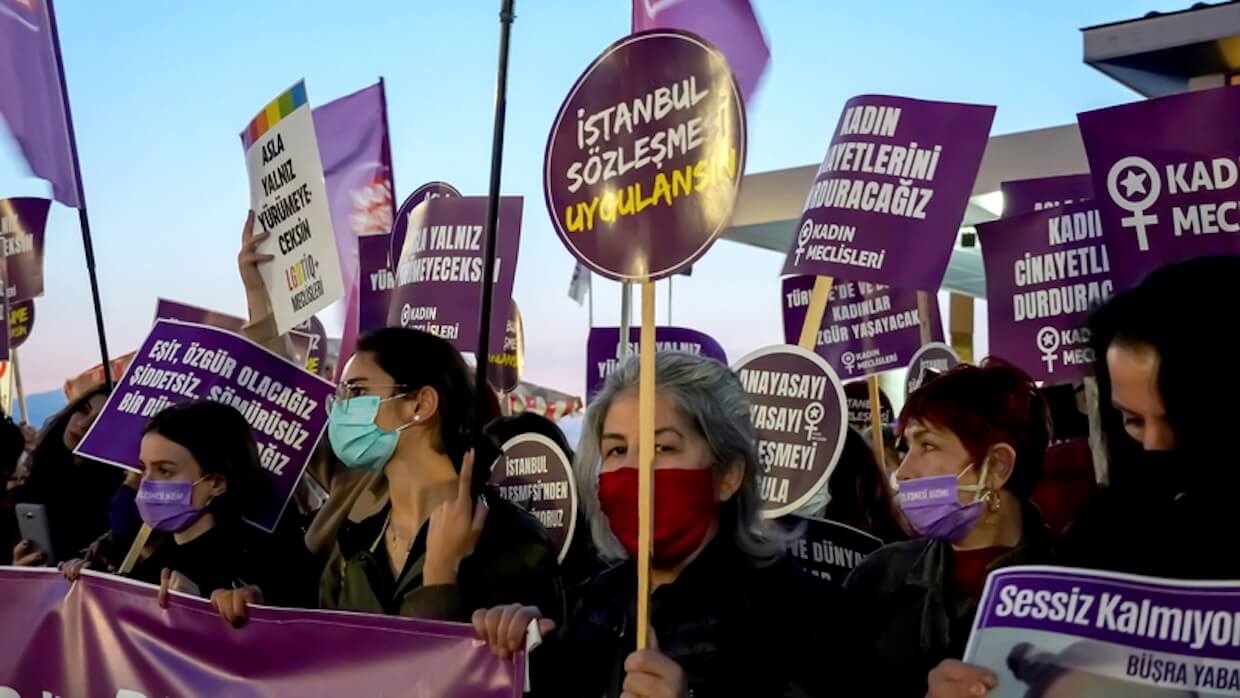
Protests in Turkey.

Dr. Cevik: Turkey Has Crossed the Critical Threshold from Competitive to Full Authoritarianism

In a compelling interview with ECPS, Dr. Salim Cevik argues that Turkey has “crossed the biggest threshold from competitive authoritarianism to full authoritarianism.” Highlighting the arrest of Ekrem Imamoglu, Dr. Cevik sees it as a targeted move to eliminate democratic competition: “He is being arrested because he could potentially defeat Erdogan.” Populism, once central to Erdogan’s rule, is giving way to raw coercion: “Force is the fundamental strategy of Erdogan.” Dr. Cevik also condemns Western silence, especially from Europe and the US, warning that their inaction amounts to complicity. “Erdogan feels very strong… because he has international backing.” Drawing a parallel with past mistakes on Putin, he cautions: “You can’t really trust a personal autocracy for strategic partnership.”

Interview by Selcuk Gultasli

In a wide-ranging and sobering interview with the European Center for Populism Studies (ECPS), Dr. Salim Cevik—Political Scientist and Researcher at the German Institute for International and Security Affairs—offers a critical diagnosis of Turkey’s deepening authoritarian turn under President Recep Tayyip Erdogan. Framing the recent arrest of Istanbul Mayor Ekrem Imamoglu as a pivotal moment in Turkey’s political trajectory, Dr. Cevik asserts that “we’ve crossed the biggest threshold from competitive authoritarianism to full authoritarianism.” While acknowledging that political repression is not new in Turkey, he emphasizes that this particular case marks a critical rupture because it directly targets “the most potent rival of Erdogan” and aims to eliminate any realistic possibility for the opposition to win an election.

Dr. Cevik situates this development within Erdogan’s long-standing strategy of personalizing power and dismantling institutional checks and balances. Over the course of two decades, Erdogan has “sidelined all important political figures,” absorbed the party into his persona, and gradually brought the judiciary, media, business sector, and civil society under his direct control. This personalization of rule has been “formalized” through the switch to a presidential system, which Dr. Cevik sees as a culmination of earlier informal power consolidations.

While Erdogan’s rule was long bolstered by a populist strategy that fused economic provision with religious-nationalist rhetoric, Dr. Cevik argues that this strategy is faltering. Erdogan is now “no longer the popular figure” he once was, as economic decline has eroded his legitimacy among even his core supporters. This, Dr. Cevik suggests, is what pushes the regime to rely increasingly on coercion rather than consent: “Populist mobilization is no longer the key term to understand Turkish authoritarianism… Force is the fundamental strategy of Erdogan.”

Of particular concern is the muted response from Western powers, which Dr. Cevik interprets as tacit approval. He criticizes both the United States and the European Union for enabling Erdogan’s autocratization, noting that “Erdogan feels both very weak because he’s losing popular legitimacy, but he’s also feeling very strong… because he has international backing.” In Europe, especially, strategic interests tied to Turkey’s military capacity and geopolitical location have led to a dangerous silence. “Europe made the same mistake with Putin,” Dr. Cevik warns. “I see no reason why Erdogan should be trusted more than Putin… It’s not only normatively and morally wrong—it’s also strategically blind thinking.”

In this critical conversation, Dr. Cevik calls attention not only to Turkey’s alarming democratic backsliding but also to the global implications of Western complacency in the face of authoritarian consolidation.

Dr. Salim Cevik
Dr. Salim Cevik—Political Scientist and Researcher at the German Institute for International and Security Affairs.

Here is the transcription of the interview with Dr. Salim Cevik with some edits.

Erdogan Regime Is No Longer Competitive—It’s Full Authoritarianism

Dr. Cevik, thank you very much for joining our interview series. Let me start right away with the first question: To what extent does the arrest of Ekrem Imamoglu represent a definitive rupture in Turkey’s transition from competitive authoritarianism to full-fledged autocracy?

Dr. Salim Cevik: Thank you for inviting me, and for the question. I think this marks a major threshold. But to be honest, he is not the first politician to be arrested in Turkey. The country has been on an authoritarian trajectory for more than a decade, which has involved the imprisonment of many politicians—particularly members of the Kurdish political movement, who have been arrested en masse. Some are still behind bars, the most prominent among them being Selahattin Demirtas, who has been in prison for more than eight years. So, in that sense, Imamoglu’s arrest is nothing new in Turkey—but it is new in the sense that it aims to destroy the competitive element of the political regime.

When we talk about competitive authoritarianism, it is an authoritarian system, anyway—but what distinguishes it from full authoritarian regimes is that, in competitive authoritarianism, there is a realistic possibility that the opposition can win an election. Now, why is Imamoglu being arrested and not someone else? I think there is a clear answer to that: he is the most potent rival of Erdogan. He is being arrested because he could potentially defeat Erdogan in the next elections. If you put people who could win elections behind bars, that, by definition, undermines the competitive dimension of competitive authoritarianism. Because if you arrest whoever is going to win, then it’s no longer competitive—it becomes a fully authoritarian system. So, in that sense, I think we’ve crossed the biggest threshold from competitive authoritarianism to full authoritarianism.

Force Is Now Erdogan’s Strategy

Turkey, Protest
University students stage a protest at Beşiktaş Square in Istanbul, declaring a boycott in response to the arrest of Mayor Ekrem İmamoğlu — Istanbul, Turkey, March 24, 2025. Photo: Sedat Gulec.

How has Erdogan’s brand of populism evolved into an instrument of authoritarian consolidation, and how central is the creation of internal “enemies” to this strategy?

Dr. Salim Cevik: Populism and the creation of internal enemies have been central to Erdogan’s authoritarianism. That has been the case over the years—even when he was not yet a fully autocratic leader and when Turkey’s democracy was functioning relatively well. Erdogan has consistently employed a populist strategy for political mobilization, and he has now been in power for more than two decades. The first decade was relatively—or at least acceptably—democratic, and initially even pro-democratic. However, starting with his second term, during his second decade in power, he began to grow increasingly authoritarian.

Over these more than 20 years, he has always created internal enemies, and those enemies have actually changed over time. They have included Kemalists, Gulenists, Kurds, and Turkish nationalists—at different stages of his political career, he has targeted different groups. He managed to establish a minimum winning coalition to defeat each internal enemy. That’s his political style and strategy. In that sense, populism has been integral to the establishment of authoritarianism in Turkey. 

However, when we talk about this recent event—this arrest—and Turkey crossing a threshold from competitive to full authoritarianism, I don’t think populism is the right term here. Populism, by definition, is about being popular. Populist autocrats usually mobilize the majority around themselves, and they create internal enemies in order to build this minimum winning coalition—at least to configure a majority. That tactic—creating internal enemies—has been Erdogan’s strategy for more than 20 years.

But as I said in the previous question, we are now crossing a threshold from competitive to full authoritarianism. Erdogan has been a popular politician—he has always been a very popular politician. He consistently managed to create a winning majority, a coalition of a minimum winning majority. He is now crossing that threshold because he believes, and sees, that he can no longer do that. He is no longer the popular figure. He no longer has 51 percent behind him, and that’s why he is crossing this threshold. So, I think populist mobilization is no longer the key term to understand Turkish authoritarianism.

Of course, the process I’m talking about has just started, and we don’t know where it will lead. But if everything goes according to Erdogan’s expectations—and if Turkey becomes a full authoritarian regime rather than a competitive one—then he no longer needs to be popular. It will not be a majority authoritarian regime; it will be an authoritarian regime ruled by a minority. And that means he will be ruling by force, rather than by creating the consent of the majority through populist means. But, this is just the beginning of the process. Where we are heading is that populism is no longer Erdogan’s fundamental strategy. Now on, force is the fundamental strategy of Erdogan.

Populism Dismantled the Rule of Law—Now Erdogan Rules Alone

Would you characterize the current crisis as the culmination of a long-standing populist logic that inherently undermines liberal democratic norms?

Dr. Salim Cevik: Yes. This populist strategy that Erdogan has pursued so far has enabled him to reach this point. It has allowed him to dismantle the rule of law and undermine political liberties. It has enabled him to inflict suffering on individuals and groups he has designated as internal enemies. But, as I mentioned in the previous question, those internal enemies are no longer the minority. Now, he is creating an internal enemy that will likely, by the end of this process, be the majority—making it a forceful authoritarianism. Ultimately, it was populism—and the systematic dismantling of the rule of law and the liberal protections that accompany it—that brought us to this point and enabled Erdogan to cross the threshold we are now discussing.

In what ways has the personalization of power under Erdoğan blurred institutional lines between the state, party, and judiciary?

Dr. Salim Cevik: Well, in very fundamental ways. I mean, when Erdogan came to power, the AKP was a ‘cadre’ movement. It had a number two—Abdullah Gul—a number three, Bulent Arinc. Some would even call Abdullatif Sener number four, and the list would go on. We had a powerful cabinet with very prominent politicians, etc. So, it was a genuine cadre movement. Now, there is no number two within the AKP—let alone a number three or a cadre—and the ministers no longer carry any real weight. Even in this current crisis, we see that Erdogan is, in a way, defending himself. He no longer has credible political allies to speak on his behalf. So, everything is now personalized in Turkey.

But it has first started with the personalization of power within the party. Erdogan initially hijacked the party. It had been a party of prominent figures—a cadre movement with a political ideology, or at least a claim to conservative democracy. But step by step, he personalized power within the party. He sidelined all the important political figures and stripped the party of its political substance. When we talk about the party’s ideology or political beliefs today, there’s really nothing left—because over the past 20 years, Erdogan has continuously shifted his coalitions, leaving no consistent ideological foundation. So, the party became Erdogan.

After that, he personalized other centers of power. He brought the judiciary under his control. He turned the party’s control over the state into personal control—and since the party is Erdogan, this meant bringing the judiciary, the media, the business community, and civil society under his direct influence. So, at the end of the day—with the switch to the presidential system, which in many ways formalized these already existing informal power configurations—the regime became fully personalized. That transformation, already largely complete by 2013–14, was cemented through institutional change. Now, we are talking about a single individual ruling not only over the executive, but also the judiciary, the parliament, civil society, and all segments of power.

Strong Enough to Suppress, Too Weak to Compete

Ekrem Imamoglu
Istanbul Mayor Ekrem Imamoglu addresses supporters during a protest under the banner “The Nation Stands by Their Will” outside the Istanbul Metropolitan Municipality on December 15, 2022. Photo: Tolga Ildun

Is the recent political crackdown a sign of regime insecurity ahead of elections, or a calculated strategy to establish post-electoral authoritarian permanence?

Dr. Salim Cevik: I think it’s both a symptom of weakness and of strength at the same time. It’s a symptom of weakness because Erdogan is increasingly lacking popular support.

What made him so indispensable to his allies for so long was his ability to bring the majority of the public with him. He kept winning elections—or, to put it another way, we can certainly criticize the tactics he used to maintain his popularity—but ultimately, he succeeded in staying popular.

That’s no longer the case. In recent years, those who don’t want to see him as president now form a larger coalition than those who do. This was already true in the previous election two years ago, but he managed to survive using various tactics: he divided the opposition, ensured they backed a candidate who couldn’t unify them, and relied on judicial tools—there was already a court case against Imamoglu at the time. He used other instruments too. The key was preventing the opposition from uniting behind a single figure.

But that’s no longer working. The local elections showed that the CHP is now the central actor in the opposition and capable of building a majority larger than Erdogan’s. So in that sense, he’s very weak in terms of popular legitimacy—and that’s what’s pushing him to take these extraordinary measures.

At the same time, he remains very powerful. He controls the state apparatus, the judiciary, the media, and the security forces. And the international context—perhaps you’ll ask about this later, but I’ll mention it briefly—has emboldened him even further. He knows the US is on his side, and he knows that, for a variety of reasons, Europe will stay silent. In that sense, he’s very powerful.

So it’s a paradox: he’s powerful because he can take these steps, but weak because he has to. He can’t afford to leave the competitive authoritarian game as it is and risk an election—even a highly unfair one—that he might lose. So, he takes measures to avoid that risk. In short, he’s strong in terms of state control, but weak in terms of popular legitimacy—and that combination is exactly what’s driving these moves.

Erdogan Exploits Islam as Rhetoric, Not as Rule

Has political Islamism in Turkey under the AKP shifted from a reformist ethos to a mechanism of ideological legitimation for autocracy? Do you see the regime’s increasing reliance on religious-nationalist rhetoric as signaling a radicalization, or merely instrumental populist recalibration?

Dr. Salim Cevik: Well, as I mentioned in the previous question, political Islam in the early 2000s had adopted a reformist character. At the time, they denied being Islamists. The famous claim was that they had “changed shirts,” and instead labeled themselves as Conservative Democrats. But that was merely a rebranding—because in order to navigate Turkey’s stringent secularist laws, it was not possible to openly identify as a Muslim democratic party. Unlike in Europe, in Turkey you have to use the label “conservative,” even though the public understands that “conservative” essentially refers to Islam and religion.

So, as a Conservative Democratic party, the AKP was indeed a reformist movement in its early years. I have to say that during that period, religious discourse in society also became more pluralistic and democratic—this was part of the cultural conflict in Turkey between authoritarian secularists and the conservative majority. To defeat—or rather, to undermine—the authoritarian secularist powers, who were a minority, Islamist actors adopted the language of democratization and pushed for reform within the system.

But around 2010 to 2012–13—it’s hard to pinpoint an exact moment—once it became clear that Erdogan was no longer under threat, he no longer needed the reformist agenda. At that point, the logic shifted entirely, and Islam became an instrument of authoritarianism, used to justify his populist, majoritarian, and increasingly autocratic actions.

As for the second half of your question, I don’t believe we are witnessing a radicalization. Radicalization would imply a structural transformation of the regime toward a more overtly religious order. If I understand the question correctly, I don’t see that happening—nor has it happened over the past decade. Erdogan has consolidated power, but he has never actually used that power to turn the system into a more theocratic one—he hasn’t changed the legal framework or granted religion greater authority in the functioning of the state.

The only time he explicitly referenced the Quran in policy terms was when he lowered interest rates—an idea that was ill-advised not just from an economic standpoint, but also because it lacked a sound religious basis. Religion prohibits interest altogether—it doesn’t differentiate between high or low rates.

If he had said, “I want to remove interest entirely from Turkey’s financial system because religion requires it,” then we could talk about a genuine turn toward religious rule—where religious texts begin to dictate policy. That would have been a clear move away from secular governance. But instead, he said something else—and I find this very telling. He said, “I’m lowering the interest rates because Islam doesn’t like interest.”

In that moment, it was clear: religion was being instrumentalized to justify a pre-existing policy agenda. He didn’t abolish interest; he didn’t change the institutional rules. He used religion as a rhetorical tool. Religion, in this case, was merely a pawn. And I see no indication that this dynamic will change anytime soon.

Religious Rhetoric Remains, But the Provider Role Is Crumbling

Turkish Islamist President Recep Tayyip Erdogan speaks in Van province of Turkey as holding a holy Quran on April 14, 2015.

To what degree does the AKP’s Islamic narrative still resonate with its core electorate, particularly in light of economic hardship and rising dissent?

Dr. Salim Cevik: It’s difficult to answer this as a simple yes or no. On the one hand, he clearly still commands a degree of popularity. As I mentioned, he has lost the majority and will probably never recover it, but he continues to enjoy the support of—perhaps—30, 40, or even 45 percent of the electorate. I can’t cite precise numbers, but some of that support undoubtedly stems from religious sentiment. Certain segments of society view him as a devout figure. More importantly, they harbor such deep resentment toward secularists that they rally around Erdogan, whom they see as a protective barrier between themselves and the secular elite. So, part of his enduring popularity is still grounded in religion.

On the other hand, that popularity is clearly in decline, and the driving factor is economic hardship. The economy alone may not be sufficient to build a majority coalition, but it is powerful enough to dismantle one. Or let me put it this way: up to now, Erdogan has played a dual role—both as an economic provider and a religious protector. He positioned himself as the guardian of religious values while delivering material prosperity. That balance was key to sustaining his electoral majority. But if he falters on either front, that majority begins to unravel. He continues to lean on the religious narrative, but he’s steadily losing the economic argument—the “provider” role.

So, yes, his base is eroding. But as I said, it’s a gray area. Religion remains a powerful political tool for him. Yet in times of economic hardship, it alone won’t be enough.

Unlike Gezi, This Time the Protest Began with Repression, Not Resistance

How do the current mass protests compare to the 2013 Gezi Park movement in terms of mobilization dynamics, ideological coherence, and regime response? Could the protests catalyze a broader democratic awakening, or will they be contained through increased repression and securitization?

Dr. Salim Cevik: Let me start with the second half of your question. If the mobilization continues and manages to force Erdogan to back down, it could mark the beginning of a new era of democratization in Turkey. That’s possible, but unlikely. The more probable scenario is that Erdogan will suppress the current mobilization and push the system toward an even more authoritarian model. Still, it’s a process in motion—we simply can’t know for sure yet.

Now, if we compare this to the Gezi Park protests, one major difference stands out. As we discussed in the previous question regarding the economy—when the Gezi protests erupted, they were largely a middle-class reaction. People were frustrated with Erdogan’s growing personalization of power—his attitude of “I am the ruler of this country, and I don’t care what you think; everything goes the way I say.” It was a kind of delegative democracy, as political scientists would call it. “I was elected, therefore I have all the power, and I don’t need to answer to anyone.”

That attitude contributed to the uprisings. And if those protests hadn’t been met with such severe repression, I don’t think they would’ve escalated the way they did. Gezi began as a peaceful demonstration—completely legitimate—and Erdogan could have simply let it happen. Had he done so, we might not have seen the full-scale protests or the resulting political crisis.

I don’t know whether he planned it all from the start, but at some point, Erdogan seemed to decide that Gezi wasn’t a threat but rather an opportunity—a way to boost his popularity. He could frame the protesters as urban, middle-class, secular elites. And that’s classic populist strategy: pitting “the elite” against “the people.” He painted Gezi protesters as privileged, urbanites who were safe and comfortable, yet complaining about trivial matters. That framing resonated with his base.

This current wave of protests, however, is different because it started with repression. It didn’t begin as a small demonstration that spiraled into something larger due to state violence—it began with the arrest of Imamoglu. It was repression from the outset. It was an intentional move to dismantle the competitive element of the regime. So, whereas during Gezi Erdogan’s stance was “I was elected and therefore I rule,” now it’s, “You once elected me, and I’ll make sure you never get the chance to unelect me.” That’s the key difference.

This time, it wasn’t police brutality that brought people to the streets. Rather, people were already in the streets, and Erdogan is trying to stop them with police brutality. It’s a different dynamic.

Also, I don’t think this protest is being led by the middle class. It’s being led by urban youth who feel economically crushed, who don’t see a future for themselves, and who are desperate. That’s why they’re protesting. In that sense, this moment feels more radical than Gezi. Back then, protesters were largely middle-class—they had something to lose. They wanted a more responsive government, but they weren’t acting out of despair.

Today’s youth have little or nothing to lose. That’s why even harsh state repression hasn’t stopped them—at least not yet. I was a young academic during Gezi—I was a university assistant, and by Turkish standards, I had a pretty good life. I honestly don’t think even full professors today enjoy the lifestyle I had back then. The economic decline has been dramatic. And I don’t think today’s university assistants, graduate students, or undergrads see much hope in their futures. That, too, fuels their willingness to take to the streets.

So yes, in that sense, there are some fundamental differences between then and now.

Ballots Aren’t Enough—The Opposition Must Mobilize the Streets

Turkey, Protest
University students protest at Beşiktaş Square in Istanbul on March 24, 2025, declaring a boycott in response to the arrest of Mayor Ekrem Imamoglu. Photo: Sedat Gulec

What does the sidelining of Imamoglu suggest about the regime’s tolerance for political pluralism within the current constitutional framework? What risks do opposition parties face in navigating between electoral participation and resistance within an increasingly autocratic system?

Dr. Salim Cevik: Well, the opposition parties are now in a dilemma. I’ve been talking about how the competitive element is disappearing. It’s becoming a fully authoritarian regime, and I’m sure that at some point people will begin to ask: “Is this just theater? Why are we playing our roles in this performative act that only serves to legitimize Erdoğan’s authoritarianism? Why are we even competing in the elections?” I think that would be a trap—the same trap the Venezuelan opposition fell into at one point.

Whatever happens, there will be pressure on the opposition to boycott the elections or withdraw—but I think that would be the wrong path. No matter what, the opposition must go to the ballot box, participate in the elections, and make it clear to the public that they won. I’m not saying the regime can necessarily be unseated through elections—I think we are passing that threshold. I use “passing” intentionally—I’m not saying we’ve already crossed it. It’s a process. But even if we eventually do pass that threshold, and it becomes impossible to remove the regime through elections alone, the opposition must still participate and demonstrate that they hold the popular majority.

At the same time, they have to acknowledge that it probably won’t be enough. You can no longer unseat Erdogan simply through words or ballots. You need to mobilize the streets—through demonstrations and by raising a broad popular demand for change. The opposition must combine both strategies: win at the ballot box and sustain mobilization on the streets.

Europe Made the Same Mistake with Putin—Why Trust Erdogan?

Turkish President Recep Tayyip Erdogan in Ankara, Turkey on August 30, 2014. Photo: Mustafa Kirazlı.

And lastly, Dr. Cevik, how do you interpret the EU’s and US’s muted response to Imamoglu’s arrest? Can this be read as a form of tacit legitimation or geopolitical pragmatism? To what extent does Western inaction amount to a “green light” for Erdogan’s continued autocratization?

Dr. Salim Cevik: I think this is a very important question, and thank you for asking this. And, as I said in one of the previous questions, Erdogan feels both very weak because he’s losing popular legitimacy, but he’s also feeling very strong because he has control of the coercive apparatus of the state, and he also has international backing. And when we say international backing, he has the backing of both Americans and Europeans.

We have to talk about this very briefly, so let me say a few words about both. I mean, if Trump talks with Erdogan, he would probably ask for advice on how to repeat what Erdogan is doing in Turkey in the United States. So obviously there would be no backlash coming from the American side, and all democracy movements in the world have to adapt to the fact that America is no longer ruled by a democrat. I mean, America’s own record for supporting democracies has always been a critical one. It has sold out democrats when it suited its strategic interests—that’s for sure. But it has now come to a point where America is ruled by a president who actually admires autocrats more than democrats. So we’ve left that era behind.

And for the Europeans, I think it’s clear—they will criticize it, and they do criticize it with weak words and sentences, expressions of concern. But nothing will come out of it, and everybody knows that they don’t mean it, because they actually feel that they need Turkey more than ever. Once Trump made it clear that American security guarantees are no longer reliable, Europe began discussing creating its own strategic autonomy, its own defense capabilities—and Turkey emerged as a very crucial actor here, with its strong military, large population, and growing defense industry, as well as its strategic location. So Turkey is a very important partner, potentially, for European security. And Erdogan knows this and hopes that Europe will ignore his authoritarian moves because they need him—and so far, he has been proven right.

But let me finish by saying that it is not only a normative mistake for Europe to allow Erdogan to make this move—hoping that Turkey is strategically important—but it’s also strategically blind thinking. Because once Erdogan removes all the thresholds between himself and full authoritarianism—once Turkey becomes a Putin-like regime—the question for Europeans should be: can a regime like that be trusted for security cooperation? Can it really be a security partner?

Turkish–European relations have been transactional for the last decade, and an authoritarian figure like Erdogan was quite fine for that. Transactionalism allowed for bargaining, and you could prefer to deal with a single individual rather than a state—and that was fine. But once you move beyond that—if you want to create a strategic partnership between Europe and Turkey, if Turkey is to become an important part of European security—then you can’t really trust a personal autocracy.

Europe made the same mistake with Putin. They hoped that by creating economic interdependencies, Russia would never be a threat to European security—and they were proven wrong. I see no reason why Erdogan should be trusted more than Putin in that sense, and why European security should be entrusted to a political system that is ruled by the whims of a single individual.

As I said, it’s not only normatively and morally wrong—it’s also strategically blind thinking on Europe’s part.

Professor Dogu Ergil

Professor Ergil: Turkey’s Crisis Stems from Eroding Line Between Persuasion and Coercion

In a powerful interview with the ECPS, veteran political scientist Professor Doğu Ergil warns that Turkey has crossed from populist authoritarianism into full autocracy. “Persuasion—which was once the AKP’s greatest success—has evaporated,” he explains. “In its place, coercion has become more prominent, and the instruments of coercion, including the judiciary, have proliferated.” Professor Ergil outlines how Erdoğan’s regime has personalized power, delegitimized the opposition, and dismantled democratic norms. With Istanbul Mayor Ekrem İmamoğlu’s arrest and mass protests unfolding, Turkey, he says, faces a “deadlock” where the state’s legitimacy is crumbling from within. This is a timely and sobering reflection on democracy under siege.

Interview by Selcuk Gultasli

In an exclusive interview with the European Center for Populism Studies (ECPS), veteran political scientist Professor Doğu Ergil delivers a stark assessment of Turkey’s current political trajectory under President Recep Tayyip Erdoğan’s rule. Framing the ongoing turmoil as a crisis of legitimacy and democratic erosion, Professor Ergil argues that the country has moved from a populist-authoritarian hybrid toward a more fully autocratic system. “The ongoing crisis,” he explains, “lies in the growing strength of the opposition and the blurring of the line between persuasion and coercion. Persuasion—which was once the AKP’s greatest success—has largely evaporated. In its place, coercion has become more prominent, and the instruments of coercion, including the judiciary, have proliferated.”

At the heart of Professor Ergil’s analysis is the paradox of populist regimes relying on democratic legitimacy while simultaneously undermining the very institutions that sustain it. “If you demonize, criminalize, and prosecute your opponents, and attack the very institutions that brought you to power,” Professor Ergil warns, “you begin to delegitimize the system—and, in doing so, yourself.” This dynamic, he observes, has led Turkey into a “deadlock,” where democratic procedures are maintained in form but hollowed out in substance.

Professor Ergil traces this degeneration to the AKP’s strategic shift from early reformism to an increasingly nationalist and authoritarian agenda, using political Islam not as a blueprint for governance, but as an ideological tool to legitimize power. He also underscores how the personalization of power around Erdoğan has dissolved the boundaries between state, government, and party—turning the state apparatus into an extension of partisan control.

Professor Ergil’s insights are especially timely in light of the recent arrest of Istanbul Mayor Ekrem İmamoğlu, which he views as emblematic of the broader erosion of the rule of law and the manipulation of the judiciary for political ends. As Turkey experiences historical developments, this interview offers a compelling and sobering diagnosis of a political system teetering on the edge of autocracy.

Here is the transcription of the interview with Professor Doğu Ergil with some edits.

Populism Under Erdogan Becomes Parochial and Authoritarian

Turkish President Recep Tayyip Erdogan watching the August 30 Victory Day Parade in Ankara, Turkey on August 30, 2014. Photo by Mustafa Kirazli.

Professor Ergil, thank you so very much for joining our interview series. Let me start right away with the first question: How would you characterize the evolution of Turkish populism and authoritarianism under AKP’s and Erdogan’s rule, and how has it redefined the boundary between the people and the political elite? In what ways has the ruling AKP’s populist discourse transformed into a vehicle for authoritarian consolidation rather than democratic inclusion?

Professor Doğu Ergil: The nature of the political regime in Turkey has always been populist. The founding party of the Republic is called the Republican People’s Party, and one of the six principles of the regime has been populism. Anyway, I mean, it’s written down as populism rather than being populist. It is populist because the ruling elite wanted to execute a revolution from above, and they found the people not ready for a revolution to join the modern society or the modern world. Hence, to transform a backward society, they took the initiative of a revolution from above—an elitist revolution—and changed the fabric of society accordingly. So, the populist nature of the regime has always been there, ingrained in it. It’s in the DNA of it.

But now, with the incumbent AKP, it has become rather diluted. It’s no longer secular, and it’s less oriented to the world. It’s expressed as localism and nationalism, because in classical populism, there are the good people and the representatives of the good people against an evil, inefficient, and rather alien elite that forcefully wants to change the society—its culture, its identity, and so forth. But this localization and nationalization—rather than westernization and modernization, which were the true assets of the Republican regime at its outset—have made Turkish society and the present regime a rather local, non-elitist, and parochial society. In a virtual sense, more peasant-like, more Eastern, more Middle Eastern if you like, and more religious rather than secular, modern, and world-oriented.

Turkey’s Populism Has Turned Fully Autocratic

Can Turkey’s current political crisis be interpreted as a case study in populism transitioning into autocracy? If so, what distinguishes the Turkish model from its global counterparts?

Professor Doğu Ergil: Of course. The Turkish regime is not only popular but also populist, and increasingly authoritarian. This is largely because the incumbent party has blurred the distinction between the state and society by merging the government with the state apparatus. When this separation erodes, central authority becomes more consolidated and less differentiated, and the division of power weakens as authority becomes more centralized and autocratic.

In the Turkish case, it has become more personalized, and the personification of the government can be identified with the present president Erdoğan. So, all powers accrue in his hands, and he can exercise authority over all aspects of life and all institutions of the government, including the judiciary. The judiciary is now used as an extension of politics and control over society. Thus, Turkish populism has not only become more populist but more authoritarian and autocratic in this sense.

There are similar regimes in the world, but the Turkish one has become overly personalized—concentrating all possible powers—political, judicial, legislative, military, and so forth—in the hands of a single individual. The party that brought this man to power has effectively faded from view; it is no longer visible. What remains is the machinery of state power in the hands of one man—and the rest of society. That society is now split into two: the supporters of the incumbent government and its leader, and those who oppose them.

The ongoing crisis lies in the growing strength of the opposition and the blurring of the line between persuasion and coercion. Persuasion—which was once the AKP’s greatest success—has largely evaporated. In its place, coercion has become more prominent, and the instruments of coercion, including the judiciary, have proliferated.

Islam Became a Tool to Bolster Populist Power

Turkish Islamist President Recep Tayyip Erdogan speaks in Van province of Turkey as holding a holy Quran on April 14, 2015.

How has political Islamism evolved under Erdoğan from a reformist agenda in the early 2000s to a more illiberal and authoritarian governance model today? Is the AKP’s version of political Islamism now functioning primarily as a tool for ideological legitimation, or does it still contain genuine theological, political or societal aims?

Professor Doğu Ergil: The AKP’s political Islamism is one of the contemporary ideologies that found a place in Turkish politics. The political landscape had long been partitioned: there were the socialists, and slightly to further left, the communists—though they were a small minority—followed by the social democrats, liberals, conservatives, and nationalists. Each ideology was represented by a political party with a distinct historical background.

When the AKP emerged and began to take the stage in Turkish politics, it had to anchor itself in something—and it chose religion. Religion served as a supportive mechanism for nationalism and populism. In this context, religion was not used as a foundation for governance per se, but rather as an instrument to bolster a populist, nationalist, and increasingly authoritarian regime.

This strategy was effective for a while. However, it has since lost much of its fervor and effectiveness, as religion is traditionally associated with values such as honesty, integrity, and efficiency.

All these other parties with different ideologies had not made Turkey as great as people expected. So, the Islamic powers’ rhetoric said, “Look, even the name of the party is ‘AK,’ meaning pure white.” They represented themselves as honest, non-corrupt, and also more popular—closer to the people. In that sense, they seemed more empathetic toward the people, more intertwined with their needs, and so forth. But as time passed and the AK Party exposed its weaknesses, it became clear that being religious doesn’t mean being honest. Being in control of everything—ending the tutelary system, at the center of which was the military, as you know—doesn’t mean that democracy would take root or that there would be a more efficient, less corrupt, more responsive society.

As the AKP lost its credibility, the Islamic rhetoric has also become dysfunctional. This is what has happened in Turkey. And because of that, this 23-year rule of the AKP has come to a halt with these apparent street demonstrations and protests, showing that the party and its leadership cannot deliver anymore. It cannot keep its promises. And it cannot do so any further. So, I mean, it has come to a halt.

Islamism in Turkey Has Been a Supportive Value System

To what extent has political Islamism been radicalized under the pressures of regime survival and repression of opposition groups like Kurds, Alawites, Gülen followers, and political figures like Selahattin Demirtas and, most recently, Istanbul Mayor Ekrem İmamoğlu?

Professor Doğu Ergil: Islam could not be radicalized because the entrenched institutions and the majority of believers believe in the general assets of the Republic. Turkey has been—though the founding fathers have been criticized for adopting the Swiss civil code, for example—benefiting from it. People have enjoyed all the advantages it brought, because there is no discrimination in that code. In it, women are much freer, men can act more freely in their daily dealings. Although that code has been criticized as being alien, people have benefited from it for many years, for many decades.

In that sense, people are not opposed to the republican regime, its laws and its values. People expect those to be furthered, to be reinforced, and new advantages and developments to be integrated into society, rather than taking society backward to another century where Islam dominated with its Sharia law. In Turkey, that never happened. Only a minority want Sharia law because they believe the system is not just. But Sharia law does not make a society more just, moral, or egalitarian. People understand that.

In that sense, Islamism in Turkey has been a supportive value system for an insufficient political system that could be improved, rather than bringing an abrupt halt to it and taking society back to another century.

Turkish Politics Has Become Warlike—Not Competitive

Protests sparked by plans to build on the Gezi Park have broadened into nationwide anti government unrest on June 11, 2013 in Istanbul, Turkey. Photo: Thomas Koch.

To what extent has Erdoğan’s populism depended on the construction of internal “enemies”—such as the Kurds, followers of the Gülen movement, and İmamoğlu—to sustain a polarizing narrative and consolidate power?

Professor Doğu Ergil: It didn’t start with Erdoğan. Populism is built on dichotomies and contradictions, as you know—such as the idea of a good society versus a bad elite, or good people rather than bad politicians. These dichotomies help consolidate the supporters of the government, the regime, or even the nation, as envisioned by the founders of the system.

Unfortunately, these contradictions—and the inbuilt conflicts they foster—have been present since the onset of the Republic. The definition of the nation was not an inclusive one embracing all citizens, but rather based on an ethnic identity, mainly Turkishness. This approach has, of course, automatically excluded others—if not legally, then emotionally, and later in practice, including politically.

Erdoğan did not change this, although Erdoğan and his party were non-nationalistic in the beginning, because Islamism transcends nationalism and ethnic boundaries. So, you can have a body of believers coming from different ethnic backgrounds and different nationalities.

But seeing that the bulk of the people are nationalistic, and that the founding ideology of the country is nationalism, the AKP and Erdoğan adopted nationalism and reinforced its Islamic leanings with the rhetoric of religion or Islam—but primarily became nationalistic. And nationalism always needs an enemy—or more than one, always. So, when you define “us” with certain qualities and deny those qualities to others—who are then cast as enemies—you create a conflictual atmosphere in which your supporters are closely knit, while the others become more than opponents; they become enemies. Thus, Turkish politics has become, rather than competitive, warlike.

By Undermining Their Rivals, They’re Undermining the System—and Themselves

What does İmamoğlu’s arrest signify in terms of the erosion of rule of law and judicial independence in Turkey?

Professor Doğu Ergil: 
The rule of law has been lost for a long time. I mean, we cannot find it anywhere—it has been hiding somewhere. It has been kept in chains or hidden somewhere. But it may reemerge if the incumbent government and its leadership see no other way—then they might return to the rule of law and democracy. Today, they still believe that they can win elections. And all this latest ado—imprisonments, crackdowns on the opposition, the incarceration of anyone who criticizes the government and its leadership—is due to the fact that they are losing hope of winning the next elections. 

So, they are clearing the way: first, by removing the supposedly successful competitors, and then by undermining the rules of engagement—that is, democratic rules and norms. But here lies a contradiction—a very substantial, significant contradiction. If you demonize, criminalize, and prosecute your opponents, and attack the very institutions that brought you to power, you begin to delegitimize the system—and, in doing so, yourself. That is, you undermine the very avenue you used to come to power. So, Turkey is now living in this unfortunate deadlock, because the delegitimization of the system through the delegitimization of the opposition is taking place.

The Judiciary Is Now a Tool of Politics

How do you interpret the strategic use of the judiciary to disqualify or imprison political opponents within Turkey’s broader trajectory from competitive authoritarianism toward full autocracy?

Professor Doğu Ergil: 
It’s so obvious. If you move from competitive authoritarianism to brute authoritarianism, of course the judiciary is either dismissed or becomes a tool of politics. That’s inevitable. This occurs everywhere in the world where the government or the regime becomes more authoritarian. So, this is almost inevitable. This is a choice, and this government and its leadership have chosen the path to autocratization and authoritarianism.

Do you see parallels between the Erdoğan regime’s control of institutions and historical patterns of soft coups in Turkish political history, or is this an unprecedented form of civil authoritarianism?

Professor Doğu Ergil: No, it’s not unprecedented. I mean, the same patterns are visible all over the world. We see it in Russia, Belarus, Latin America, Hungary, and so forth. In that sense, there is nothing unusual. The real question is why people tolerate such a deterioration of the regime. That’s important. I believe that where there is corruption, there is also the consent—at least by part of society—effectively becoming a silent partner in that corruption. In that sense, the people also need greater education in democracy. Rather than giving in to an authoritarian regime in return for favors, advantages, or privileges—rather than insisting on rights, freedoms, and equality—society, unfortunately, ends up deserving the poor governance it supports, at least for a time.

Ongoing Protests Have a Leader and a Clearer Purpose

Following the arrest of Istanbul Mayor Ekrem Imamoglu, protests erupted across numerous cities in Turkey. Citizens took to the streets to voice their opposition to the decision and express growing discontent.
Photo: Dreamstime.

How do the ongoing mass protests compare to the Gezi Park movement in terms of scope, motivation, and political potential?

Professor Doğu Ergil: In the Gezi Park demonstrations, it was so colorful, so unexpected, and so detached from any particular political party, social class, or political agenda—it was a wonderful, kaleidoscopic movement, I would say. It had no organization, no leadership, and no ideology. When I say ideology, I mean—if not totally and neatly defined—at least a trajectory for action and its aftermath. What will happen later? How will we proceed, to do what? And what will we do after the moment? That’s a broad definition of ideology. In that sense, Gezi didn’t have this.

But this time, although people erupted into the streets unexpectedly, inadvertently, they found the CHP—the Republican People’s Party—already there protesting and already a victim of oppression and crackdown. So this wave, this popular wave, pushed the Republican Party forward, making it the leader of the movement. And the CHP lived up to that expectation. So far, it has successfully led the opposition. Although we do not know where it will take the movement, to what extent it can lead it, or what the outcome will be, the conditions of leadership and organization have so far been met.

Now, what will happen? How the regime will be transformed—and into what—is still unknown. But it’s clear that corruption must end, oppression must end, democratic institutions must be restored, and Turkey must become more aligned with the world. In that sense, there is no need for a neat ideology or ideological agenda. If these goals can be met, the outcome of these protests can be very productive.

With İmamoğlu sidelined, what implications does this have for the legitimacy of the upcoming local and general elections?

Professor Doğu Ergil: We do not know what will happen—whether the government’s crackdown will continue, and what the response of the people will be. I mean, whether protests will grow and the pressure placed on the government will lead it to change its authoritarian stance, or whether the crackdown will intensify and we will become an absolutely authoritarian regime. And whether the system can endure this much pressure—I mean, the economy, which is on the brink of collapse, may collapse entirely, and conflicts may escalate into outright friction in the streets or elsewhere. So, it’s hard to say. It depends on how events evolve, I think, and on the response of the opposing factions in the process.

Erdogan Regime Is Too Useful to Be Criticized by the West

And lastly, Professor Ergil, how do you think the second Trump administration is affecting Erdoğan and his regime?

Professor Doğu Ergil: Well, it has been rather surprising that the US government—not only Trump and his entourage, but in general the American civil society, and, for that matter, the European Union and European governments—have been rather quiet on the authoritarian ascent of the Turkish government. All these parties—American and European actors—are expecting things from trade. Europe wants to keep all those millions of refugees and migrants in Turkey, so that Turkey would not open the gates of the dam and let the flood into Europe. Europe is very apprehensive on that stance.

Secondly, they don’t want the radicalism that’s simmering in the Middle East to reflect on Europe, and they see Turkey as a barrier to it. And thirdly, now with Russia—after a possible peace deal with Ukraine—being a threat against the security of Europe, and with the US abandoning Europe and making its security rather liable, Europe needs Turkey as a military power—as cheap soldiers—and does not want to antagonize the Turkish government because of this.

As for the US government, as long as Turkey does not threaten the security and interests of Israel—which it doesn’t—Turkey is a good friend of the White House. Secondly, Syria has to be stabilized, and Turkey, as a neighboring country and as a factor that’s present on the Syrian political stage, can contribute to the stabilization of Syria. How? By supporting the transitional government in Damascus and also reconciling the Kurds and others with the incumbent government in Syria.

Thirdly, the US wants Turkey to be in the anti-Iranian axis—to share this with its other allies, at the top of which is Israel. All these combined, the US—meaning the Trump administration—sees Turkey as a rather advantageous ally in this volatile region, and it could serve the purposes of American foreign policy.

Photo: Shutterstock.

Professor Hough: Mainstream Parties Must Address Issues or Risk Strengthening the AfD

In an interview with the ECPS, Professor Dan Hough warns that mainstream parties must engage with voters’ real concerns or risk further legitimizing the far-right Alternative for Germany (AfD). “Ignoring the AfD hasn’t worked, and simply adopting their rhetoric hasn’t either,” Professor Hough explains. Instead, he urges democratic parties to develop credible policies that address the economic and social anxieties fueling AfD support. He highlights how discontent—particularly in Eastern Germany—extends beyond migration, with deeper dissatisfaction driving voters toward populist alternatives. As the AfD continues to shape public debate, Professor Hough argues that mainstream parties must lead with solutions rather than reactionary responses. “The discourse must be smart, and the outcomes must be meaningful.”

Interview by Selcuk Gultasli

In an in-depth interview with the European Center for Populism Studies (ECPS), Professor Dan Hough, a leading expert on corruption and populist politics from the University of Sussex, offers critical insights into the Alternative for Germany (AfD)’s electoral gains and the broader implications for German democracy. As the AfD nearly doubled its vote share in Sunday elections compared to the 2021 elections, mainstream parties now face urgent questions about how to respond to the party’s growing appeal. Professor Hough warns that ignoring the AfD has not weakened it—nor has engagement through policy imitation. Instead, he argues that mainstream parties must confront the real grievances driving voter discontent. “The challenge is to find a language that acknowledges the problems the AfD highlights while offering solutions,” he says. “If they fail to do so, the AfD will continue to benefit, pointing to government inadequacies in dealing with these issues on its own terms.”

While the AfD has thrived on anti-elite and anti-immigration rhetoric, Professor Hough emphasizes that its rise is rooted in broader dissatisfaction with Germany’s political establishment. He points to Eastern Germany, where frustration over decades of economic disparity, social change, and political disillusionment has fueled the party’s success. “Migration is an important issue, but the deeper wells of dissatisfaction run much deeper,” Professor Hough explains. He highlights how, in many cases, AfD voters are not driven purely by far-right ideology but rather by a sense of being ignored by the political mainstream. This is why simply branding AfD supporters as anti-democratic is counterproductive—it alienates them further and pushes them deeper into the party’s ranks.

Professor Hough warns that if mainstream parties continue to avoid these tough discussions—or adopt reactionary rhetoric to compete with the far-right—they risk further legitimizing the AfD. Drawing comparisons to Austria’s Freedom Party (FPÖ), he notes how engaging with populist forces without a clear alternative vision can backfire, as seen in Austria, where the FPÖ has outperformed the AfD. “Ignoring the AfD has not worked. Engaging with them, as Austria has done with the FPÖ, has also not worked. So what do we do?” he asks. Instead of reactive politics, he argues, mainstream parties must lead the debate and provide credible policy responses that resonate with voters before the AfD defines the terms of the discourse.

As the interview unfolds, Hough delves into the role of corruption narratives in populist movements, the paradox of “anti-corruption populism,” and the risks of democratic backsliding if far-right parties continue to reshape public debate. Ultimately, he underscores that Germany’s best defense against the AfD is not exclusion, but better governance and tangible solutions to the concerns that fuel its rise. 

Professor Hough stresses that mainstream parties must acknowledge the grievances the AfD exploits while providing meaningful solutions. “The discourse has to be smart, and the policy outcomes have to be meaningful. If that happens, the AfD’s rise does not have to be unstoppable.” His analysis offers a crucial perspective on the evolving landscape of German and European politics.

Professor Dan Hough, a leading expert on corruption and populist politics from the University of Sussex.

Here is the transcription of the interview with Professor Dan Hough with some edits.

Ignoring the AfD Has Failed—Mainstream Parties Must Find a New Strategy

Professor Hough, thank you so much for joining our interview series. Let me start right away with the first question: How do you assess the far-right AfD’s performance in the German elections, where the party nearly doubled its vote share compared to the 2021 elections? What factors do you think contributed most to this surge?

Professor Dan Hough: I thought their performance was expected. I was predicting around 20%, and that’s what they got. So, in the end, the result was not a surprise. We’ve known for a few years that the AfD was going to do well, and they did. The only question was around the details—would they get more or less than 20% and how would they choose to frame that outcome?

In truth, the more pressing issue for German politics was the performance of the smaller parties because whether they entered Parliament was going to have a much larger impact on the government. And, of course, the German government, like many others around the world, faces significant challenges. So, ensuring that Germany has a functioning government moving forward was crucial, and the AfD has no real role to play in that. For me, the focus was actually not so much on the AfD but rather on the smaller parties and the 5% hurdle.

Do you believe the endorsements of the AfD by Elon Musk and U.S. Vice President J.D. Vance had any measurable impact on the election results? Or were their influences more symbolic than substantive?

Professor Dan Hough: I’m not sure about their influence—we don’t know. We haven’t yet analyzed the data in great detail, but the AfD’s performance was exactly as expected, even before Donald Trump won the election and before Elon Musk took on whatever role he now officially believes he holds in American politics. So, there’s no real evidence that they had any impact. Their endorsements were certainly noted and welcomed by the hardcore AfD supporters, but in terms of influencing the overall results, I would need to see evidence demonstrating that they had any effect at all.

You have argued that immigration and refugee policy has become a key battleground for European center-right parties as they compete with center-left and liberal parties. Given that immigration is also a central theme for far-right parties, to what extent do center-right parties risk legitimizing the far right by adopting similar rhetoric and policy positions?

Professor Dan Hough: The challenge that mainstream democratic parties face is that there is no easy answer to questions about who should be allowed to enter a country, under what circumstances, and how they should be treated. I mean, a country like Germany, which has land borders with nine other states and has taken in a couple of million refugees over the last 10 years, will always face challenges in integrating and processing newcomers. 

So, there isn’t a single “right” answer for the CDU to come up with here. Whatever they do, there will be a significant number of people who are unhappy with it—whether those on the left advocating for a more liberal stance or those on the right pushing for a more restrictive one.

What we do know is that ignoring the AfD has not worked at all. The AfD has risen to 20%. However, engaging with the AfD—if we look at Austria, where the Freedom Party (FPÖ) has been heavily engaged by the center-right over the past 20 years—has also not worked. The FPÖ receives even more votes than the AfD does. So, what do we do? If you engage with the AfD, they seem to grow stronger. If you ignore them, they also seem to grow stronger. Somewhere in between, there has to be another option or set of options.

Friedrich Merz is treading a path where he refuses to talk to the AfD but seeks to engage with potential AfD voters. Now, if I were a political strategist, I’m not sure I would necessarily recommend that approach, but I understand why he is trying to take the sting out of the migration issue. We know that when Germans worry less about migration, they are less likely to vote for the AfD. So, this issue requires a policy response that makes sense and is perceived as effective by the public because it is a highly salient issue today.

That’s the challenge—coming up with answers that actually help manage the issue in practice. The other thing about the AfD is that while migration is a key driver of their support, a lot of it also stems from dissatisfaction, particularly in Eastern Germany. This dissatisfaction is linked to the multiple crises that people there have endured over the last 30 years since the collapse of the GDR. So, while migration is a major issue, the deeper wells of dissatisfaction run even deeper, extending beyond just the debate over who should come to Germany and under what circumstances.

Populist Anti-Corruption: A Weaponized Narrative Rather Than a Solution

European Parliamentary election posters of the FPÖ in Vienna, Austria, on May 15, 2024. Photo: Shutterstock.

The AfD has positioned itself as an anti-elite, anti-corruption party while being embroiled in its own corruption controversies. How does this contradiction affect voter perceptions? How do you explain the relationship between corruption and the rise of far-right movements? What do the German case and the German elections on Sunday tell us about this relationship?

Professor Dan Hough: You’re assuming that people are logical and rational and that if something happens, they will respond in a logical manner. There are plenty of lessons from Austria, a country that is arguably a couple of decades ahead of Germany in dealing with a populist party. We know that some of the scandals the FPÖ has been involved in are truly ridiculous. The Ibiza scandal, for instance, is one that people might want to look into—a truly crazy scandal. But it didn’t really affect the FPÖ in Austria at all, because the main drivers of FPÖ support are general dissatisfaction.

The dissatisfaction of people stems from a government they see as unimpressive and policies they believe are not working. The AfD functions as a vessel for their unhappiness. As long as that dissatisfaction exists, the AfD will be able to get away with much more than people in polite society might imagine. It’s not too different from Donald Trump. Trump says some truly remarkable—let’s put it that way—things. But at this point, it’s factored in. People have gotten used to it, and he can say increasingly outrageous things without changing the opinions of those who either support or loathe him.

The AfD finds itself in a similar position. It’s already factored in that things will not always be logical with them, but they still represent, for enough people, a means to send a strong message to the mainstream elites.

You have written extensively on the role of citizens in anti-corruption efforts. How does corruption—whether real or perceived—fuel support for populist movements, particularly in Europe? How do populist parties, like the AfD, exploit corruption grievances to mobilize support?

Professor Dan Hough: Yeah, and there’s a lot to be said there. Populist parties, of course, like having a dichotomy. They like talking about the elites—how the elites look after themselves but not the people. They thrive on this divide and have a real disdain for the complexities of politics, such as compromise, bargains, and deals. They are not interested in that. For them, there are the good guys—the people—and the bad guys—the elites.

Now, this framework fits very easily onto the issue of corruption: elites look after themselves, they corrupt the political process, and the people are the ones who suffer. So, it’s no surprise that the far right frequently talks about corrupt practices. However, when it comes to actual anti-corruption policies, their stance is much harder to pin down. What they generally end up saying is, “Give us power, and we’ll sort it out,” which, of course, is not really an anti-corruption policy at all.

Many of the things the AfD discusses regarding corruption are not particularly detailed. In fact, they don’t use the word “corruption” as frequently as one might expect. Instead, they heavily rely on the German words for dissatisfaction and disdain. For those who speak German, that is one of their key themes. They argue that the elites have no respect for ordinary people. In this way, they tap into a corruption discourse without being particularly explicit about what they would actually do to fix it—other than saying, “Vote for us, and we will take care of it.”

Citizen-Led Anti-Corruption: A Complex Reality vs. Populist Simplifications

In your work, you discuss the limitations of citizen-led anti-corruption efforts. How do populist parties frame corruption differently compared to traditional anti-corruption movements? How effective are citizen-centered approaches to anti-corruption in countering populist narratives that thrive on corruption scandals?

Professor Dan Hough: Citizen-centered approaches are quite new, and they take very different forms in different parts of the world. In some places, there are websites like ipaidabribe.com in India, where individuals can report instances of bribery they have experienced. However, in countries like the United Kingdom or Germany, such platforms are not really necessary. I have never had to pay a bribe in the United Kingdom, and bribery is not part of the everyday fabric of life here. But, of course, corruption exists in other forms.

The type of citizen-led approach varies depending on the nature of the corruption problem. For example, in the United Kingdom, there are websites where people can see exactly how much politicians earn and how much they receive in donations—down to the last pence—allowing the public to judge whether it is appropriate or corrupt. Because the state functions reasonably well, this data can be collected and made publicly available. Citizens can then decide whether, for instance, Boris Johnson receiving millions of pounds for lecture tours is appropriate or not.

Citizen-led approaches are most successful when they are not isolated. An effective anti-corruption infrastructure requires institutions that can take prosecutions forward and a legal system where the rule of law actually means something—which, in many places, it does not, as it is applied very inconsistently. Without this broader institutional support, citizen-led approaches struggle to make an impact.

Now, all of this is too complex for the far right, which tends to focus on a much simpler narrative. Their arguments center on an undefined elite that supposedly looks after itself at the expense of ordinary people. They use the word corruption as a blunt weapon against that elite, arguing that these people have disdain for the general public. Their message is: Vote for us, and we will change that relationship.

However, the details of how this change would be implemented are rarely well thought out or explained. They do not really propose meaningful citizen-led approaches to anti-corruption. Instead, they talk a lot about direct democracy, which fits into their populist narrative of giving power back to the people—but in practice, not many far-right parties ever reach a position where they can actually implement such measures. As a result, their promises remain quite vague.

Populist leaders often portray themselves as fighters against a corrupt elite. However, many populist leaders claim to fight corruption while simultaneously dismantling institutional checks and balances. How do you assess the paradox of ‘anti-corruption populism’? Based on your research, do such narratives result in actual anti-corruption measures, or are they primarily rhetorical tools?

Professor Dan Hough: They’re not just rhetorical tools; they’re practical tools. But they’re not practical tools to fight corruption. They’re practical tools to empower those who push them forward. Many of the mechanisms that I would call backsliding—which we have seen populist regimes enact—are not really about anything other than dismantling processes that they see as working against them. Instead, they seek to create new processes that do not work against them.

Viktor Orbán is a great example of this in Hungary. His government creates what they argue are institutions that work for the good of the people. However, people like me would argue that these institutions also seem to work really well for him. And that is ultimately where they end up. So, I wouldn’t say this is about anti-corruption at all. It is about empowering those who push these narratives.

Perceived Corruption Outweighs Reality, Fueling Populist Support

AfD demo with slogan Stop Islamization and counter demonstration of the Left in Luetten Klein in Rostock, Germany on May 14, 2018. AfD, Alternative for Germany, is a right wing political party in Germany. Photo: Shutterstock.

Your research suggests that corruption can be a mobilizing grievance, but also that frequent exposure to it can lead to apathy. How does this paradox play out in the context of Germany and the rise of the AfD? To what extent do mainstream parties’ failures in tackling corruption contribute to the rise of far-right parties like the AfD?

Professor Dan Hough: I don’t think the corruption narrative is really that helpful in explaining the rise of the AfD, and it might be a bit odd for me to say that, given that I work in a corruption research center. But for me, anyway, the rise of the AfD is about other things. It’s about dissatisfaction. It’s about disaffection. It’s about people being unhappy with their lot—and often, these grievances are not entirely reasonable. But at the same time, the AfD is very good at speaking to their unhappiness and addressing the feeling that they are not at one with how Germany works.

Now, corruption in any meaningful sense is not really part of that. In a broad sense, there is the argument that elites corrupt the process, they look after themselves, they don’t look after you, but I don’t think corruption in an everyday sense in Germany is a driving force behind this. I believe there are better variables to examine when trying to explain the AfD’s rise.

One of your studies discusses how citizens’ direct experiences with bribery influence their willingness to protest. In Germany, where large-scale bribery is relatively rare, what factors do you think drive the populist anti-corruption discourse?

Professor Dan Hough: Bribery is really rare in Germany, as it is in the UK. But if you ask people whether they think much of it exists, they’ll tell you yes. You often find people saying, “Yeah, there’s a lot of corruption in Germany. Oh, I’ve never experienced it, but there’s a lot of corruption.” So there’s a paradox between what they experience and what they perceive, and this paradox can be really significant and quite obvious when you talk to individuals about it.

I don’t think corruption, in any meaningful sense, is a major theme in German politics. There are simply too many bigger issues dominating the landscape at the moment—whether it be Ukraine, the climate crisis, or the ineffectual government that Germany has just replaced. The anti-corruption narratives tend to appeal more to people who study the subject—people like me, who are interested in the details. I don’t think many Germans are losing sleep over corruption challenges. It’s simply not the primary way they frame the problems they experience.

Ironically, Germany, like many other states, does have corruption problems. They exist, but they’re not visible in everyday life. For example, contracts may be awarded to companies that perhaps shouldn’t receive them, but most people don’t know about that. They don’t read the fine print buried on page 17 of a heavyweight newspaper to find it out. That sort of corruption remains beyond their immediate awareness, and understandably so—they have their own lives to lead.

So, I think the anti-corruption narrative in Germany is rather stilted. It doesn’t have the same dynamic as in other places because there are simply more pressing concerns on people’s minds.

The AfD Exploits Corruption Narratives to Undermine Trust in Democracy

Posters and demonstrators at a protest against the AfD party in Munich on January 21, 2024. Photo: Shutterstock.

In the recent elections, the AfD nearly doubled its support. Unlike in some Southern or Eastern European contexts, Germany has relatively robust anti-corruption institutions. Why do you think the AfD still manages to frame corruption as a central issue?

Professor Dan Hough: I’m not sure it does. It talks about corruption, but what it really doing is finding a way to explain that your problems, your worries, your concerns—those guys over there in Berlin don’t care.

So, it frames corruption as one part of a much bigger narrative about the political process not working for you, and that’s dangerous. Because if that political process isn’t working, they may suggest alternatives that look a bit more like Orban’s model. And it wouldn’t be in Germany’s interest to go down that route.

It’s worth remembering that 80% of people in Germany last week said they would never, under any circumstances, consider voting for the AfD. So yes, they got 20% of the vote, and many people—including myself—find that deeply disconcerting. But it’s important to keep the context in mind: the majority of Germans have no time for the AfD and don’t buy the snake oil they try to sell.

Mainstream parties often struggle with countering populist claims about corruption. Based on your work, what strategies should democratic institutions adopt to maintain trust while effectively combating corruption?

Professor Dan Hough: Getting corruption right takes time and patience. It took Britain about 300 years to go from being very corrupt to being less corrupt. Denmark and Sweden, which followed what the literature calls a Big Bang approach, took 15 years to implement sweeping institutional changes in the 19th century. That’s 15 years—three electoral cycles—and even then, the reforms didn’t work perfectly overnight. It’s now over a century later that we see Denmark and Sweden as frontrunners in anti-corruption efforts.

So, if you’re looking for quick solutions, you’re going to struggle because changing institutional processes takes time. In truth, the best anti-corruption policy is simply to govern well: give people a little bit more of what they want—whether that’s economic security, safety, or the sense that their voices are being heard.

That takes time, but it’s the most effective method. You can establish new anti-corruption commissions or pass stricter laws, and while those might catch some corrupt actors, for most ordinary people, better governance is the real solution. And that’s something I hope Friedrich Merz understands—he’s not going to solve these problems in a month.

Anti-Corruption Policies Can Backfire When Populists Manipulate Institutions

Is there empirical evidence showing that stronger anti-corruption policies lead to a decline in support for Populist parties? Or do such policies risk being weaponized by Populists themselves.

Professor Dan Hough: Oh, they certainly can be. Poland is a really good example. In 2006, a strong anti-corruption commission was introduced, and the populist government used it to go after its enemies. The irony was that many of these so-called enemies had hardly been in power at all, yet they were accused of abusing their positions in government—an almost surreal situation given that many of them had never held office. So, there is a real danger that anti-corruption institutions can be hijacked, and we see this happening all over the world.

Now, Germany is not really in that position. If you asked Germans what their anti-corruption institutions were, I’m not sure many of them would know. But certainly, there is always a risk that populists could use such institutions for their own ends. The best example of this is Donald Trump—he has attempted to use institutions to serve his own interests.

That’s why democracy is not about any one particular institution; it’s about a network, a mosaic of institutions that work together, sometimes constraining each other, sometimes supporting each other. The real challenge is getting that mosaic right—because when it is strong, it becomes much harder for populists to dismantle it and push their agenda through.

With rising political fragmentation in Germany, do you think anti-corruption efforts will become more partisan, and if so, what are the risks of this for democratic accountability?

Professor Dan Hough: Well, partisanship is always an issue, right? And in many ways, I don’t have a problem with that. Parties represent interests, they represent people, and they try to bring those interests into the political process. Corruption is no different in that regard. But I don’t see anti-corruption being a particularly salient issue in German politics over the next legislative cycle at all. There will be issues linked to potentially corrupt practices, but much more of the focus will be on money—where to find the funds to invest in infrastructure, support Ukraine, and finance other priorities like the climate transition and the Energiewende (shift to sustainable energy). All of this revolves around the kind of daily politics we’re used to—debates about money, influence, and competing interests. The corruption narrative is not at the center of that discussion, and I don’t see the next government having much time to devote to it either. That may be good or bad, but given Germany’s financial challenges, I think it’s inevitable.

The AfD’s Strength Lies in Channeling Dissatisfaction, Not Policy Solutions

Looking ahead, do you see the AfD’s anti-corruption narrative evolving further, and if so, how might this impact broader European trends in populism and governance?

Professor Dan Hough: They may evolve. They like using the word “corruption” because it’s a concept people generally think they understand, although I would sometimes disagree with those understandings.

I think the AfD will use the corruption narrative whenever they can because it helps them point the finger at the government and gain political attention. Whether that will have any meaningful effect, I don’t know. Populist right-wing parties have always talked about corruption, but I’m not sure they’ve always truly benefited from it. It has been one small part of their toolkit.

Austria is a really good example for Germans to look at. The success of the FPÖ has come from highlighting Austrian dissatisfaction with mainstream parties. That’s what it has done—it has provided a vehicle for people to express discontent, even if the party itself isn’t particularly good at explaining what exactly they oppose.

That is where the AfD’s strength lies—as a vehicle for protest and dissatisfaction. They have been very effective at using social media to amplify their message and reach a generation that mainstream politicians are struggling to engage.

Despite ongoing controversies, including investigations into AfD figures for extremism, the party continues to attract voters, as evidenced by Sunday’s election results. To what extent has the AfD succeeded in mainstreaming far-right discourse in German politics, and what implications does this have for the broader political landscape?

Professor Dan Hough: One thing they have done is change the way Germans talk about migration. German politicians really didn’t want to talk about migration until about 15 years ago. It was an issue they all agreed to handle in a very sober, technical way, but that, of course, changed—probably about 20 years ago, but absolutely and definitively in 2015, when over a million asylum seekers arrived in Germany from North Africa and the Middle East.

The AfD has been very effective in introducing language into public discourse that wasn’t there before. This presents a real challenge for all mainstream parties, as they now find themselves engaging in debates they previously avoided. Euroscepticism is another example—criticisms of the EU in Germany weren’t really a thing until relatively recently, and now they are. The AfD has played a role in that shift. It’s not the only reason it has happened, but it has contributed.

This presents a challenge. Mainstream parties must find a language that acknowledges the problems the AfD highlights while offering solutions. If they fail to do so, the AfD will continue to benefit, pointing to government inadequacies in dealing with these issues on its own terms.

Populism Thrives on Dissatisfaction—Only Effective Governance Can Counter It

Photo: Shutterstock.

And lastly, with the AfD’s rise, are we seeing an erosion of public trust in Germany’s democratic institutions, or is this simply a reflection of broader European trends in far-right politics?

Professor Dan Hough: Well, it can be both. I mean, Germany has now become a bit more normal. Most countries have a far-right party polling around 20%. This is nothing new—France, the Netherlands, and several other countries have faced similar challenges. Many countries have had far-right parties operating like the AfD for a long time. So, in that sense, Germany is simply aligning with a broader European trend.

However, Germany has a unique history, and most Germans are not particularly happy with this “return to normality.” Moving forward, the AfD is in a position to build on its current success. In the next election, four years from now, it is highly unlikely that the AfD will be anywhere near government, which means they will continue to play the role of opposition—complaining and criticizing. If the German government fails to make progress in solving or at least appearing to address the major issues of the day, the AfD could perform even better next time. That is the real challenge.

Of course, populism is not just present on the far right. Die Linke had a strong election on the populist left, and another party, the Alliance, narrowly missed entering Parliament. So, there is about 13% of the electorate on the left that also leans populist. There is a lot of populism in German politics right now, and the only way to counter it is through effective governance—delivering policies that improve people’s lives.

Simply labeling populist voters as anti-democratic is not going to work. In fact, it will likely backfire, further alienating them and making them more likely to vote against mainstream parties in the future. That is not difficult to understand—if someone insults me, I am hardly going to turn around and agree with them. Human nature does not work that way. The discourse has to be smart, and the policy outcomes have to be meaningful. If that happens, the AfD’s rise does not have to be unstoppable.

Professor Jonathan Olsen, Chair of the Department of Social Sciences and Historical Studies at Texas Woman’s University.

Professor Olsen: AfD’s Growth Faces a Ceiling Despite Eastern Stronghold

Despite the AfD’s strong performance in Germany’s Sunday elections, securing nearly 21% of the vote and dominating in the East, Professor Jonathan Olsen argues that the party faces a ceiling in its growth. “Opinion polls consistently show that around 80% of Germans do not support the AfD,” he notes, emphasizing its high negative ratings. While the AfD has solidified its base in the East, its influence in the West remains limited, requiring a broader appeal to expand further. Professor Olsen highlights that migration and security remain the party’s key mobilization issues, while economic concerns, though present, rank lower in importance for its voters.

Interview by Selcuk Gultasli

In a comprehensive interview with the European Center for Populism Studies (ECPS), Professor Jonathan Olsen, Chair of the Department of Social Sciences and Historical Studies at Texas Woman’s University, offered his insights into the Alternative for Germany (AfD)’s recent electoral performance. While the party’s near 21% result in the 2025 German elections signals strong support—particularly in eastern Germany—Professor Olsen argues that its growth potential may be reaching a ceiling. “Opinion polls have consistently shown that around 80% of Germans do not support the party,” he noted. “The AfD has the highest negative ratings of any political party in Germany.”

Despite its success, Professor Olsen highlights that the AfD’s ability to broaden its voter base remains uncertain. “They remain the largest opposition party, securing nearly 21% of the vote and mid-30% in Eastern Germany. But moving forward, the key question will be: How do they expand beyond their current level of support?” He suggests that, while the AfD has solidified its position in the East, its influence in the West remains limited. “They receive about twice as much support in the East as in the West. If I were advising the AfD, I would recommend they focus on broadening their appeal in the West and refining their messaging to attract a wider voter base.”

One of the more striking aspects of the AfD’s campaign was its issue selection. Professor Olsen describes the party as a “populist issue entrepreneur,” effectively capitalizing on migration and domestic security as central themes. “I don’t see that the AfD mobilized any new issues except for the economy and the performance of the Ampel coalition (Ampelkoalition). Migration was by far the most important issue driving their vote, followed closely by domestic security,” he explained. Economic concerns ranked much lower in priority, though Professor Olsen points out that 75% of AfD voters expressed concerns about rising prices and future financial security.

Despite some international attention, Professor Olsen downplays the impact of endorsements from figures like Elon Musk and J.D. Vance on the AfD’s performance. “There was no discernible bump from Musk’s endorsement or from J.D. Vance’s and Trump’s implicit support. So, I think it had zero effect,” he stated.

Looking ahead, the AfD’s position within both Germany and the broader European far right remains complicated. While it seeks alliances with transnational populist movements, many European far-right parties still consider it too extreme. “Even Marine Le Pen’s National Rally and Giorgia Meloni’s Brothers of Italy have distanced themselves from the AfD,”Professor Olsen noted. As the party continues to grow in the East while struggling to expand in the West, its long-term trajectory remains a crucial question for German and European politics.

Here is the transcription of the interview with Professor Jonathan Olsen with some edits.

The AfD’s Growth Is Strong, but Its Ceiling May Be in Sight

Photo: Shutterstock.

Professor Olsen, thank you very much for joining our interview series. Let me start right away with the first question: You observed the German elections in Germany. How do you interpret the performance of the AfD in the German elections, in which it almost doubled its vote since the last election in 2021? Did its electoral strategy evolve compared to previous elections?

Professor Jonathan Olsen: I think the AfD’s performance can be considered a strong one. The party is certainly pleased with the outcome. They didn’t exceed some expectations—some thought they might reach 21 or 22%—but they ended up just under 21%, so it can’t be characterized as disappointing. This result may suggest that there is a ceiling for AfD support. They remain the largest opposition party, securing nearly 21% of the vote and reaching the mid-30% range in Eastern Germany. It was a very successful election for them, but moving forward, the key question will be: How do they broaden their voter base? How do they expand beyond their current level of support? Because, in my view, there seems to be a limit to their electoral growth.

As for your second question—did their electoral strategy evolve compared to previous elections? I wouldn’t say it changed significantly. However, if you examine their campaign posters—I spent a lot of time walking around the city analyzing different posters, and I previously conducted research with my co-author on AfD election posters in 2017 and 2021—there is a noticeable shift. While I haven’t done a systematic study of the 2025 election, a first glance at their campaign materials suggests a much more mainstream presentation. Their advertising appears more conventional, more in line with other parties, and lacks the provocative posters seen in 2017.

The 2025 campaign placed significant emphasis on Alice Weidel as their lead candidate. When I examined their posters, nothing stood out as particularly different from other parties. Their strategy largely capitalized on the issues that were already prominent in public discourse—migration and domestic security—particularly following high-profile attacks involving asylum seekers in various parts of Germany. These events effectively handed the AfD its key campaign themes. Additionally, the CDU’s response to these issues, which in some ways reinforced the AfD’s position, made it even easier for the party to highlight its main message.

Do you think Elon Musk and J.D. Vance’s endorsement of the AfD had any effect on the party’s performance?

Professor Jonathan Olsen: No, I don’t think it had any effect. If you look at the AfD’s polling over the last year or so, it has stayed pretty steady, right around 20%. There was no discernible bump from Musk’s endorsement or from J.D. Vance’s and Trump’s implicit endorsement of the party. So, I think it had zero effect. It did not have any negative effect that I could tell—that is, I don’t think it drove people away from the AfD, but it certainly didn’t drive people to vote for the AfD either.

AfD’s National Expansion Remains Uncertain

The Alternative for Germany (AfD) booth in Görlitz, Germany, on August 16, 2024. Photo: Shutterstock.

The AfD has seen significant support in the elections, particularly in eastern Germany. How do you interpret their latest electoral performance? Does it signal a deepening of their influence or a potential ceiling to their growth?

Professor Jonathan Olsen: Well, to address your last question first, which I partially answered earlier, I see a potential ceiling to the AfD’s growth. Opinion polls have consistently shown that around 80% of Germans do not support the party. The AfD has the highest negative ratings of any political party in Germany.

If you’re looking at people who didn’t vote for the AfD—not always the best way to gauge their future potential—you still have to consider that 80% of Germans did not vote for the AfD in 2025. As part of this election trip, we had a representative from the AfD speak to us, and I asked him what the party could do to broaden its support. He didn’t have much of an answer. It seems the AfD expects political issues to fall into their lap and assumes that the failure of mainstream parties to address key problems will automatically boost their support. But I’m not convinced that’s the case. I don’t see their support growing dramatically unless they take proactive steps to make themselves more appealing to a broader segment of German voters.

Now, in eastern Germany, the situation is different. This is more of a West German problem than an Eastern German one. In Eastern Germany, the AfD is the largest party. If you look at the first vote election results in East and West, it’s predominantly the CDU and CSU in the West, while in the East, it’s primarily the AfD. They secured 35–36% of the vote in Eastern Germany, making them the dominant party there. It reminds me of the vote totals Die Linke was getting 10–15 years ago, but which they no longer achieve.

The AfD has clearly solidified its base in Eastern Germany. Although they perform relatively well in the West, they still lag significantly behind other parties there. They receive about twice as much support in the East as in the West. I believe the average was 34% in the East compared to around 18% in the West. If I were advising the AfD, I would recommend they focus on broadening their appeal in the West and refining their messaging to attract a wider voter base. That’s how I would approach it.

AfD’s Success Driven by Migration and Security, Not New Issues

Your research highlights the AfD as a “populist issue entrepreneur.” What new issues has the party successfully mobilized in this election?

Professor Jonathan Olsen: This was interesting because I don’t see that the AfD mobilized any new issues except for the economy and the performance of the Ampel coalition (Ampelkoalition). If you look at the issues the AfD was running on and that were important to their voters, it was migration and domestic security. After that, it was the performance of the Ampel coalition, specifically regarding the economy and energy.

Whether they have a coherent answer is another question. I don’t think so, and I know that most German voters didn’t find their answers to economic issues particularly convincing. However, that may not matter much to their core voters. For them, the most important thing is that the AfD continues to stress migration and domestic security issues. Whether they can develop their economic message in the future is an important question for broadening their voter base. Finding a coherent and convincing economic platform will be crucial for the AfD if they want to expand their appeal.

I wanted to look at this because there were some interesting exit polls available on Tagesschau. Looking at the issues that were important to voters overall, domestic security was the top issue, tied with economic and social security. After that came migration, followed by economic growth.

For AfD voters specifically, migration was by far the most important issue driving their vote, followed closely by domestic security. Far behind those were concerns about economic growth, rising prices, and other issues. So, it’s clear that for AfD voters, the party’s primary appeal comes from its stance on migration and domestic security, with much of the security debate tied to migration—curbing violence by asylum seekers, for example. Economic issues rank far lower in importance. Right now, this prioritization works for them, but if the AfD wants to broaden its voter base in the future, they will have to develop more convincing economic solutions.

Far-Right Degrowth: A Mix of Nationalism, Eco-Asceticism, and Climate Skepticism

How does the far right’s concept of “degrowth” differ from the left’s vision, and what role does this play in its political messaging?

Professor Jonathan Olsen: So that’s a real shift in gears, moving from the AfD to the broader far right. The AfD, like most populist far-right parties, is more of an anti-environmental party than an environmental one. While they talk about alternative environmental solutions, their primary concern is denying climate change or denying that it is man-made. They advocate for a return to traditional fossil fuels and are strongly opposed to alternative energy sources. There is nothing in the AfD’s program that suggests any real concern for environmental issues.

However, the broader far-right milieu in Germany and elsewhere takes some of these issues more seriously. Unlike the AfD, some far-right groups do not deny climate change or its human causes. They support some use of alternative energies and acknowledge major environmental challenges. The most the AfD does in this regard is to conceptualize a nationalist environmental policy. They frame themselves as the true environmentalists, arguing that only patriots—those who love their homeland—can truly protect the environment. They mention environmental initiatives, but their proposals are quite limited.

This is where degrowth comes in. Unlike the broader far right, the AfD—like almost all other populist far-right parties—does not question economic growth. Degrowth is a concern primarily for other far-right groups and circles that take environmental issues more seriously. That being said, this remains a relatively small segment of the far right.

Their conception of degrowth aligns with what Bernhard Forchtner and I called “eco-asceticism.” This vision promotes self-renunciation, self-control, and a reduction in consumption. In this regard, it is not entirely different from the left’s vision of degrowth. However, where they diverge is in their views on global capitalism. The left firmly identifies global capitalism as the main driver of environmentally destructive economic growth, whereas the far right is more ambiguous. They are certainly against globalism, but not necessarily against all forms of economic growth.

Another key difference is that some segments of the far right that discuss degrowth also tie it to an ethno-nationalist vision of the nation and a concept of ethnocultural purity. You don’t find this element in the left’s vision of degrowth.

AfD Remains an Outlier but Gains Leverage in German Politics

Photo: Shutterstock.

In your view, has the AfD managed to fully integrate into the German political system, or does it remain an outlier? How has the response of mainstream parties impacted its trajectory?

Professor Jonathan Olsen: Well, it still remains an outlier because no other party is willing to form a coalition with it. The AfD is trying to bide its time—returning to a point I made earlier, the AfD’s strategy at this stage seems to be to wait it out. That is, they are not going to do much differently from what they have done before. They are not actively trying to increase their vote share; instead, they are counting on the decline of mainstream party support, which would eventually leave conservatives with no other option than to form a coalition with the AfD. That appears to be their strategy. So, the AfD is definitely still an outlier in the political system. However, its growing vote totals are making it harder for other parties to form coalitions—both at the national and state levels—and to completely ignore the issues it is raising.

How has the response of mainstream parties impacted the AfD? Well, a couple of weeks before the election, Friedrich Merz tried to push through a non-binding resolution on limiting migration in a particular way, and he had to rely on AfD support to get it passed. He didn’t want to; he had expected other parties to support it, but it turned out to be a miscalculation on his part. Many observers saw that as providing a certain degree of legitimation to the AfD and the far right. People have been discussing the Brandmauer—the firewall against the AfD—as if it is not completely down, but at least damaged.

I think the response of mainstream parties is going to be really important for the AfD’s trajectory in the future. If they can continue to marginalize the AfD—treating it as a non-legitimate party—while at the same time addressing the concerns that matter to AfD voters and a broader segment of the German electorate, then they have a chance of decreasing the AfD’s vote share.

In other words, I believe the next four years will be crucial—assuming the coalition lasts its full term. Whatever government forms next, most likely a CDU/CSU and SPD coalition, it will be essential to address key issues in a way that satisfies German voters. If they succeed, I think we will see a decline in the AfD’s vote totals. If they fail—especially if the new coalition resembles the Ampelkoalition in its inability to resolve basic concerns—then the AfD will likely continue to receive 20% or more of the vote.

AfD Support Driven More by Perceived Decline Than Economic Hardship

Many analysts highlight economic anxieties and globalization backlash as drivers of AfD support. How much of their success do you attribute to economic factors versus cultural or identity-based appeals? To what extent did dissatisfaction with the government’s handling of recent crises, such as the economy or migration, contribute to AfD’s support in Sunday’s elections?

Professor Jonathan Olsen: I’ll answer that last question first, and it contributed a lot to the AfD’s support. Migration, as we’ve discussed, was by far the biggest issue. The economy also played a role, even though it ranked lower on AfD voters’ list of concerns. That doesn’t mean it was unimportant. Certainly, the Ampel coalition’s perceived incompetence and inability to get things done had a significant effect on the AfD’s vote.

Regarding economic factors versus cultural and identity-based issues, I don’t think you can completely separate the two. If you look at AfD voters objectively, the majority are not economic losers. In terms of income levels and other economic markers, they are not primarily drawn from the unemployed or lower-income groups. Instead, the AfD’s support comes from middle- and higher-income levels. So, it is not necessarily their objective economic situation that is driving AfD voters. However, there is a strong sense of anxiety among AfD voters that they are losing—that they are falling behind compared to other groups.

This reflects a distinction between subjective perceptions and objective markers of economic status. Looking at the available data, Tagesschau exit polling showed that domestic security played a far larger role among AfD voters than among any other party’s electorate, with 33% citing it as a top concern. Migration, as expected, was twice as significant for AfD voters compared to supporters of any other party. Conversely, economic growth was a much lower priority for AfD voters compared to other parties.

One particularly interesting finding is that 75% of AfD voters expressed strong concerns that rising prices would make it difficult for them to pay their bills. Similarly, 74% feared that their standard of living could not be maintained in the future, and 71% were deeply concerned about having enough money in old age. So, while AfD voters clearly have economic anxieties—especially regarding globalization—these concerns are not necessarily grounded in their objective circumstances but rather in their subjective perceptions and fears about economic decline.

AfD Seeks Alliances but Remains ‘Too Extreme’ for Europe’s Far Right

Hundreds of people demonstrated against hatred and the AfD at a rally organized by Fridays for Future Cologne in Cologne, Germany, on February 1, 2024. Photo: Ryan Nash Photography.

Given the rise of far-right parties across Europe, do you see the AfD aligning more with transnational populist movements, or is its strategy still largely domestically driven?

Professor Jonathan Olsen: I see the AfD trying to align itself more with transnational populist movements. It does seek out international partners, particularly in Europe. However, interestingly enough, the AfD is still viewed as too extreme by many far-right populist parties—certainly by the National Rally in France, which did not want the AfD as part of its group in the European Parliament. It is also seen that way by Giorgia Meloni’s Brothers of Italy, as the AfD is considered too far to the right. Some of the party’s controversial statements regarding the Nazis, the Holocaust, and the war have contributed to this perception.

As a result, the AfD currently stands somewhat apart from other far-right populist parties in Europe, even though they share many of the same issues. Migration is a central concern for all far-right populist parties, as is globalization. Anti-EU or at least highly EU-skeptical sentiments are common across these parties, as is the cultivation of nationalism and national identity. However, the AfD remains farther to the right than most.

Domestically, the AfD is primarily focused on appealing to East Germans, where some of its more controversial statements on National Socialism have not appeared to harm its electoral support. However, these same controversies have damaged its relationships with other far-right populist parties in Europe.

AfD’s Environmental Stance: Nationalist Framing or Anti-Green Identity?

Farmers and truckers protest against subsidy cuts at the Brandenburg Gate in Berlin, Germany, on January 14, 2024. Photo: Shutterstock.

Does the AfD’s environmental discourse resonate with voters, or is it more of a symbolic strategy aimed at rebranding the party’s ideological image?

Professor Jonathan Olsen: Whatever pro-environmental discourse the AfD has is not really something that resonates with voters. When you look at the AfD’s messaging, it is primarily focused on anti-environmental positions. It advocates for a return to fossil fuels, opposes alternative energy sources like wind power, rejects subsidies for electric vehicles, and promotes climate change denial or skepticism.

The environmental aspects of the AfD’s messaging are mostly framed within a nationalist perspective. This includes rhetoric about protecting the German environment, preserving the homeland, and safeguarding natural spaces. However, this nationalist environmentalism is minimal and does not seem to attract many voters.

The interesting question moving forward is whether the AfD—or other populist far-right parties—will attempt to moderate their stance on environmental issues, climate change, and related policies. It remains to be seen whether they will consider such a shift too risky, as their anti-environmental message is distinct from that of any other party. If they were to embrace more pro-environmental policies, they might lose their unique positioning in the electoral marketplace.

And lastly, Professor Olsen, how has the AfD framed issues like sustainability and environmental protection? Does their rhetoric on ecology differ from traditional far-right parties, and how do they position themselves against the German Greens?

Professor Jonathan Olsen: Well, there has been some great work looking at the relationship between the AfD and the Greens. I think the Technical University of Dresden has written a couple of pieces on this. I remember one article that essentially discusses the AfD as the “anti-Greens.” They position themselves as such because they take very distinct, opposing positions from the Greens and view them as their biggest enemy—not necessarily in terms of electoral strength, but certainly in terms of policies and ideology. The image of the Greens and the image of the AfD are diametrically opposed, and the AfD very much positions itself in direct opposition to them.

Issues like sustainability and environmental protection are, again, wrapped within a German nationalist framework. Their rhetoric suggests that, of course, they want environmental sustainability and to protect the environment, as it is part of the natural basis of life and the German homeland. The argument follows that those who love their homeland will naturally want to protect its environment.

This framing allows the AfD to present some environmental policies—such as reducing the use of pesticides or other forms of environmental protection—as being in line with their nationalist agenda. However, where they truly differentiate themselves and cast themselves as the “anti-Greens” is in their opposition to climate protection and alternative energies, particularly as part of a broader climate policy.

Dr. Ellen Desmet, an Associate Professor of Migration Law at Ghent University.

Dr. Desmet: EU Countries Systematically Violate Non-Refoulement with Indiscriminate Pushbacks

The EU’s human rights commitments are weakening as populist movements push restrictive migration policies, warns Dr. Ellen Desmet, Associate Professor of Migration Law at Ghent University. She describes a growing disregard for human rights, stating, “We are witnessing blatant human rights violations that are only increasing.” A 2024 report documented over 120,000 pushbacks at EU borders, violating non-refoulement by forcibly returning asylum seekers without assessing their protection needs. “Some EU countries have even legalized these pushbacks,” Desmet cautions, while the European Commission hesitates to act. She also points to far-right rhetoric shaping restrictive policies, with mainstream parties following suit. Meanwhile, according to Dr. Desmet, Belgium’s new government threatens judicial independence and tightens asylum rules, further escalating human rights concerns.

Interview by Selcuk Gultasli

The European Union’s commitment to human rights and asylum protections is under increasing strain as populist movements push for restrictive migration policies. Dr. Ellen Desmet, an Associate Professor of Migration Law at Ghent University, highlights this deterioration in a compelling interview with the European Center for Populism Studies (ECPS). She provides an evidence-based assessment of how EU member states are violating fundamental principles of international refugee law, including the principle of non-refoulement.

According to Dr. Desmet, while “lip service is still paid to human rights on paper, in practice, we are witnessing blatant human rights violations that are only increasing.” She points to a 2024 report by a Belgian coalition of NGOs, which documented over 120,000 pushbacks at EU external borders. These pushbacks, often occurring in Greece and other key entry points, involve forcibly returning people without assessing their need for protection—a direct violation of non-refoulement, which prohibits states from deporting individuals to places where they risk torture, persecution, or threats to their life and dignity. Disturbingly, some EU states have even enacted laws to legalize these pushbacks, while institutions like the European Commission remain reluctant to take action against these clear breaches of international law.

Beyond border policies, Dr. Desmet emphasizes a broader deterioration in the rights of migrants, asylum seekers, and refugees. She warns that European states are increasingly treating migrants as security threats, with a growing trend of externalizing migration policies—a tactic designed to shift asylum responsibilities away from the EU. This is particularly evident in Belgium’s recent policy shifts, where the new coalition government has adopted a more restrictive approach. “We see worrying developments from a rule-of-law perspective,” she explains, referring to how judicial rulings on asylum reception have been ignored and how judicial independence is now under threat.

Dr. Desmet also discusses how far-right movements and mainstream political parties alike are fueling anti-migration policies by framing migration as a “crisis.” This has led to ‘a race to the bottom’, where governments are tightening asylum laws to outmaneuver populist opponents. Policies once considered extreme are now becoming mainstream, further undermining human rights and democratic principles.

In this interview, Dr. Ellen Desmet provides a critical analysis of how legal frameworks, political rhetoric, and migration policies intersect, shedding light on one of Europe’s most pressing human rights challenges.

Here is the transcription of the interview with Dr. Ellen Desmet with some edits.

A Decline in the Rights of Migrants, Asylum Seekers, and Refugees Across Europe

For right-wing populists in the Western world, “the others” primarily include immigrants but also extend to “welfare scroungers,” regional minorities, individuals with “non-traditional” lifestyles, communists, and others. Photo: Shutterstock.

Professor Desmet, thank you very much for joining our interview series. Let me start right away with the first question: There is a great deal of information, speculation, and conspiracy theories surrounding migration in Europe. Could you provide an evidence-based overview of the current migration landscape, particularly regarding refugees and asylum seekers from a human rights perspective?

Dr. Ellen Desmet: That’s a very broad question to start with. On the one hand, what we see, and what we also learn from sociological research, is that the flows or the number of people forcibly fleeing their country fluctuate, driven by wars, conflicts, and other factors. On the other hand, if you look at the current migration landscape from a human rights perspective, we see a deterioration in the rights of migrants, asylum seekers, and refugees, who are increasingly being treated as suspects. There is also a growing tendency towards the externalization of migration policies, where European countries seek to prevent migrants and refugees from even reaching EU borders. This is because, once they arrive at EU borders, EU Member States become responsible for assessing their applications for international protection. To avoid this responsibility, efforts are made to externalize asylum procedures.

This trend is evidenced by agreements signed with various countries, such as Mauritania, among others. Additionally, last year, the New Pact on Migration and Asylum was adopted, introducing ten new legislative instruments that are currently in the process of being implemented. Member States are required to enforce these measures by the summer of 2026.

However, even within these legislative instruments—intended to create a more common European asylum system—we observe a reduction in the rights of refugees and asylum seekers. There is now greater emphasis on the duty of cooperation for asylum seekers. For example, if they come from a country with a low recognition rate, they will be automatically placed in a border procedure. This raises concerns, including questions about access to legal assistance.

Overall, at the EU level, both in legislation and implementation, as well as at the national level within Member States, we see a decline in respect for the human rights of migrants—not only in legal frameworks but also in policies and enforcement.

What role does the framing of migration as a ‘crisis’ play in fueling racist narratives in Belgium and across Europe?

Dr. Ellen Desmet: Previous research and arguments from other colleagues suggest that when migration is framed as a key issue in elections, and its salience increases, as we see now across Europe, it benefits populist anti-immigration parties. By making immigration a central political theme, it actually leads to anti-immigration parties gaining more votes.

Another consequence of this framing and the problematization of migration as a crisis is that it influences mainstream political parties to adopt or co-opt anti-immigration legislative and policy proposals from the extreme right. As a result, policies that diminish the human rights of migrants are increasingly being incorporated and implemented by so-called mainstream political parties.

Restrictive Migration Policies and Far-Right Rhetoric Reinforce Each Other

In recent years, European countries and the EU have undergone significant shifts in their refugee and asylum policies, from Merkel’s Willkommenskultur to increasing restrictions under more recent governments. How do you see these policy changes influencing public discourse and the political success of far-right parties like Vlaams Belang in Belgium and AfD in Germany?

Dr. Ellen Desmet: I think it’s somewhat of an interaction. On the one hand, these policy changes stem from shifts in political discourse. On the other hand, these policy changes may further fuel the political success of far-right parties, especially because the policy proposals of these parties are increasingly being adopted and implemented by mainstream political parties.

How has the rise of right-wing populism in Europe, particularly in Belgium, shaped national policies on migration and asylum seekers?

Dr. Ellen Desmet: Vlaams Belang, the far-right populist party, previously had what they called the “70 Points Plan.” Now, we have a new federal government with a new coalition agreement being presented. In the coalition agreement, many of these proposals have already shifted towards restrictive measures, such as investing in the externalization of migration and halting resettlement until the reception crisis is resolved.

We also see worrying developments from a rule-of-law perspective. Under the previous government, many judicial rulings related to the reception crisis were simply ignored by the executive branch. For example, there were there were thousands of judgments requiring the government to provide material reception conditions for asylum seekers, yet these were disregarded.

Now, in the current coalition agreement, there are even more concerning proposals. One example is that the Council for Alien Law Litigation, which is the appeal tribunal for asylum and migration cases in Belgium, would see a change in how its judges are appointed. Instead of being nominated for life, as is standard to ensure judicial independence, the proposal suggests a renewable five-year term, which could put judicial independence under pressure.

So, my interpretation is that the rise of right-wing populism has contributed to more restrictive migration policies, as reflected in the current government agreements in Belgium.

EU Countries Undermine Non-Refoulement with Indiscriminate Pushbacks

A woman activist holds a “Stop Pushbacks” banner in front of the Bundestag in Berlin, Germany. Photo: Ajdin Kamber.

The EU member states have legal obligations under international refugee law but rising populist sentiments and electoral pressures often push governments to tighten migration policies. How do you see this tension evolving, and what role can legal scholars and human rights advocates play in ensuring the protection of asylum seekers?

Dr. Ellen Desmet: I think we are witnessing a race to the bottom among EU Member States, where countries, following the example of Denmark and the Netherlands, and now Belgium, are striving to implement the strictest asylum and migration policies ever, as they have announced.

Here, I believe it is important to make a distinction. On the one hand, some rules can be tightened within legal boundaries. For example, under EU law, the Family Reunification Directive currently provides some legal flexibility, allowing for certain restrictions while remaining within the framework of EU law and human rights. This is explicitly mentioned in Belgium’s new government agreement, where it is stated that authorities will explore how far they can go in making migration, family reunification, and asylum rules as restrictive as possible within the limits allowed by existing legal frameworks.

On the other hand, while lip service is still paid to human rights on paper, in practice, we are witnessing blatant human rights violations that are only increasing. A recent report issued by the Belgian coalition of NGOs, in collaboration with nine other organizations, documented over 120,000 pushbacks at the EU’s external borders in 2024. These pushbacks involve people being forcibly returned without individual assessment of their need for protection, which is a clear violation of the principle of non-refoulement—the rule that prohibits sending people back to a place where they risk torture, persecution, or threats to their life and dignity.

These pushbacks are occurring at external borders such as Greece, and some countries have even enacted laws to legalize them. However, the European Commission and other institutions remain reluctant to act against these clear violations of international law.

As legal scholars and human rights advocates, our role is to inform the public about the current state of the law, highlighting where legal flexibility exists within the system, but also calling out policies that clearly violate the rule of law and fundamental human rights. For instance, the recent proposals concerning the Council for Alien Law Litigation, where judicial appointments would become temporary rather than lifetime positions, pose a serious threat to judicial independence. It is essential to emphasize these issues and raise awareness about the legal safeguards that should be in place.

By sharing knowledge about the rule of law, explaining what is happening, and informing people about the legal protections that should be upheld, we must do our part to contribute to the protection of asylum seekers and the integrity of legal systems.

Human Rights Obligations Are Being Set Aside for Political Convenience

Far-right supporters clash with riot police during a protest against Marrakesh Migration Pact in Brussels, Belgium on December 16, 2018. Photo: Alexandros Michailidis.

In what ways have European states, in particular Belgium, balanced human rights obligations towards migrants with increasing domestic political pressure from populist movements?

Dr. Ellen Desmet: I think that today we see that human rights obligations tend to be ignored. As I previously mentioned regarding the reception crisis, which has lasted for two and a half years in Belgium, single adult men are being forced to sleep on the streets, even after being recognized as refugees. Due to Belgium’s ongoing housing crisis, many people do not have access to decent accommodation.

Previously, I believe it would have been unacceptable and concerning from a rule of law perspective for even one court ruling to be ignored. However, today, human rights obligations related to the provision of reception seem to be set aside under the argument that it is not feasible practically or politically. Sometimes, these obligations are not fulfilled out of fear that doing so might benefit populist movements. I believe that the balance between upholding human rights and responding to political pressures needs to be reaffirmed.

Your research discusses civil society’s role in resisting restrictive migration policies. How effective has civil society been in countering populist-driven migration policies in Belgium?

Dr. Ellen Desmet: I think the assessment is mixed. Under various previous governments, particularly during the 2014–2019 legislative period, when the Secretary of State for Asylum and Migration was controlled by the New Flemish Alliance (N-VA), there was very little space for civil society to be consulted before legislative proposals were introduced. Many laws were passed without meaningful negotiation or consultation, and a significant number of these legislative proposals raised concerns from a human rights, migrant, and refugee rights perspective.

When the concerns of civil society organizations are not taken into account before the adoption of legislation, their only remaining option is to challenge these laws through legal appeals, such as filing cases with the Council of State or the Constitutional Court. Over the past years, civil society actors in Belgium have been vocal and active in bringing contested aspects of new migration and refugee policies before these higher courts. However, this judicial approach requires substantial human and financial resources, placing significant pressure on civil society organizations, as they must engage in lengthy legal battles to challenge problematic legislation.

As for the courts’ responses, the reactions have been mixed. In some cases, higher courts, including the Council of State and the Constitutional Court, have intervened to halt the most extreme or concerning policies. For example, during the 2014–2019 coalition, a quota was imposed on the number of asylum applications that could be submitted per day in Belgium. The Council of State overturned this measure, ruling that it clearly violated higher legal obligations. However, on other issues, the courts have taken a more minimalist approach, refraining from stronger interpretations of human rights protections. I think civil society organizations have been active in bringing cases to court to challenge new legislation. The courts have overturned some measures, but definitely not all.

The Global Compact for Migration Sparked Controversy but Had Little Legal Impact

How have international legal frameworks, such as the Global Compact for Migration, influenced migration policies in countries with strong far-right movements?

Dr. Ellen Desmet: I think it’s interesting to see how, seven years ago, all the talk was about the Global Compact for Migration, which in Belgium even led to the fall of the government when the New Flemish Alliance (N-VA) left the coalition government over the Marrakesh Pact, as it was called. The concern at the time was that it would create new obligations for member states, despite the fact that the Global Compact for Migration explicitly stated that it was merely a restatement of existing obligations, was non-binding, and did not introduce any new legal commitments. The fact that a populist party left the federal government over a non-binding political instrument was a unique event in Belgium’s constitutional history, highlighting once again the political sensitivity of migration issues.

As for the actual impact, despite the initial controversy, the practical influence of the Global Compact for Migration has been quite limited. A first analysis of judgments before the Council for Alien Law Litigation, conducted a few years ago, showed no significant legal or judicial impact of the Global Compact for Migration in the Council’s case law.

So, while its adoption sparked significant debate and skepticism among anti-migration and populist parties, in practice, the Global Compact for Migration, as a non-binding political instrument, has not had a strong legal impact on national policies. Instead, I believe that the New Pact on Asylum and Migration from the European Union is likely to have a greater effect, as it consists of binding regulations that EU Member States are legally required to comply with and implement.

Given the growing influence of far-right politics across Europe, do you believe the EU and big players in EU politics can sustain a balanced asylum system that upholds human rights while addressing public concerns? What policy changes would you recommend creating a more sustainable and inclusive approach to migration and integration?

Dr. Ellen Desmet: That’s a very big question, but it’s not hard to answer. I think a lot of public concerns are not based on empirical knowledge of how migration actually works, including the fact that a certain level of migration is necessary for society. I believe it is also a matter of political will and political courage to recognize that migrants, refugees, and asylum seekers are human beings who are entitled to the same human rights as everyone else. It is in the best interest of society to facilitate family reunification, rather than making it overly restrictive, because such restrictions negatively impact the integration trajectories of refugees.

We recently completed a four-year research project on the integration trajectories of refugee families in Flanders and Belgium. Our policy recommendations emphasize the need for greater alignment and interaction between different policy domains, such as access to employment, education, and social services. Currently, too much emphasis is placed on Dutch language proficiency, which may actually hinder a smoother integration process.

Another issue lies in Belgium’s complex federal structure, where there is a disconnect between different levels of governance. For instance, at the federal level, the government is responsible for the reception of asylum seekers, but once refugees are recognized, access to housing falls under Flemish jurisdiction. This creates a gap, as no single government agency is explicitly responsible for ensuring that refugees obtain decent accommodation.

Additionally, there is a trend toward restricting social rights for refugees and migrants, which arguably hinders successful integration into society. In the federal government agreement, we often see contradictory approaches—on the one hand, migration policies focus on restricting family reunification, making it difficult for individuals to live with their families. On the other hand, in other policy areas, the government emphasizes the family as the cornerstone of society. These inconsistencies should be addressed by developing a more unified and coherent approach to migration and integration policies.

Belgium’s New Migration Policies Threaten Judicial Independence and Human Rights

Bart De Wever, former Mayor of Antwerp, at the Chinese New Year parade in Antwerp, Belgium, on February 2, 2019. Photo: Yves Van Tente.

How do you assess the new Belgian Prime Minister Bart De Wever’s government policies and proposals on immigration from a human rights perspective?

Dr. Ellen Desmet: I already touched upon some of the more concerning proposals. From a rule of law perspective, the measures concerning the Council for Alien Law Litigation are particularly troubling. Recently, some colleagues in human rights, constitutional law, and migration issued an opinion piece challenging these measures, as they risk undermining the independence and impartiality of the Council.

Beyond this, judicial independence is being threatened in other areas as well. The Commissioner General for Refugees and Stateless Persons, which is currently an independent institution, is also at risk. The government agreement explicitly states that more people should receive subsidiary protection instead of refugee status, and there are plans to merge the Commissioner General for Refugees and Stateless Persons with the Immigration Office into one large migration service. This proposal is problematic because, in Belgium, applications for international protection have traditionally been assessed independently by the Commissioner General, rather than by an Immigration Department, which falls under the direct authority of the Secretary of State or the Minister for Migration and Asylum. This independence is now being jeopardized through institutional restructuring and direct policy influence, which raises serious concerns.

Furthermore, Belgium appears to be following Germany’s approach by granting more subsidiary protection while simultaneously restricting family reunification rights for those under this status. Currently, EU law (the Family Reunification Directive) grants more favorable rights to refugees than to those with subsidiary protection. The Belgian government intends to increase subsidiary protection numbers while extending the waiting period and tightening family reunification rules for this group, effectively limiting their rights.

Additionally, another worrying development is the government’s decision to halt resettlement programs as long as the reception crisis persists. Resettlement is the only safe and legal pathway for asylum seekers to enter Belgium and putting it on hold further restricts access to protection.

Other proposals include increasing the duty of cooperation for asylum seekers, which could involve automatic monitoring of their social media accounts, such as Facebook. These measures, along with other restrictive policies, raise serious human rights and rule of law concerns. Overall, the new coalition government’s agreement places significant pressure on the rights of migrants and asylum seekers, making their situation increasingly precarious.

Dr. Conrad Ziller, Assistant Professor of Political Science at the University of Duisburg-Essen, Germany.

Dr. Ziller: Terror Attack in Munich Likely to Sway Voters More Than J.D. Vance’s AfD Endorsement

Dr. Conrad Ziller, Assistant Professor of Political Science at the University of Duisburg-Essen, discusses the key factors shaping voter sentiment ahead of Germany’s elections. In an exclusive interview with the ECPS, he argues that the recent terrorist attack in Munich is likely to have a greater impact on voter behavior than US Vice President J.D. Vance’s endorsement of the far-right AfD. Highlighting the growing openness of radical right parties, Dr. Ziller warns of the AfD’s shifting strategy—from Euroscepticism to consolidating political power through ideological alliances and nationalist rhetoric.

Interview by Selcuk Gultasli

As Germany heads into a pivotal election on Sunday, Dr. Conrad Ziller, Assistant Professor of Political Science at the University of Duisburg-Essen, sheds light on the factors shaping voter sentiment, particularly the growing influence of the far-right Alternative for Germany (AfD). In an exclusive interview with the European Center for Populism Studies (ECPS) on Monday, Dr. Ziller argues that while the recent endorsement of the AfD by US Vice President J.D. Vance is significant, it is unlikely to shift voter behavior as much as real-world events, such as the recent terrorist attack in Munich.

“I don’t believe J.D. Vance’s statement will have a major impact, but the recent terrorist attack in Munich might, as it is a deeply tragic event that affects people on an emotional level,” he explains. “This, of course, is a serious issue. I think such incidents have a greater effect on voter sentiment than what J.D. Vance said.”

Dr. Ziller situates this development within a broader trend: the increasing openness of populist radical right parties about their true political ambitions. “Vance’s endorsement is part of a broader effort to shift the political narrative further to the right and enable more power for the AfD,” he notes, emphasizing that “what is surprising is how openly he has expressed his support.” This, he argues, reflects a larger shift in global politics, where far-right movements no longer attempt to mask their agendas but instead push their narratives forward with unprecedented transparency.

This shift presents both challenges and opportunities for European leaders. “In a way, this increased openness could be beneficial because it allows European leaders and the European Union (EU) to fully recognize the situation and take action accordingly,” Dr. Ziller observes. He points to the upcoming conference on Ukraine as an example of how European leaders are already strategizing to counter the rise of nationalist and far-right influences across the continent.

Another key factor in the AfD’s rise is its evolving stance on European identity and sovereignty. Unlike traditional nationalist parties that focus on ethnic distinctions, the AfD’s rhetoric has shifted toward ideological alliances rather than national ones. “Previously, right-wing populists or extremists in Germany might have rejected alliances with Southern Europeans, people from Turkey, or Eastern Europeans, insisting on a strictly German national identity. Now, however, these ethnic categories are no longer as significant,” Dr. Ziller explains. Instead, the AfD aligns itself with like-minded political figures such as Viktor Orbán, Marine Le Pen, Giorgia Meloni, and Vladimir Putin, forming transnational far-right networks based on shared political goals rather than national identity. While the party remains Eurosceptic, its focus is not on defining who belongs within Europe, but rather on shaping alliances that strengthen its broader nationalist and anti-immigration agenda.

Against this backdrop, the upcoming elections in Germany will be a test case for how effective the AfD’s strategies—capitalizing on issues like immigration, security, and anti-elitist sentiment—will be in mobilizing support. In this interview, Dr. Conrad Ziller delves into the party’s tactics, its positioning within the broader European far-right movement, and the implications for democracy in Germany and beyond.

Here is the transcription of the interview with Dr. Conrad Ziller with some edits.

The AfD Thrives on Fear—Immigration, Welfare, and Political Distrust

Photo: Shutterstock.

Professor Ziller, thank you very much for joining our interview series. Let me start right away with the first question: How has the AfD (Alternative für Deutschland – Alternative for Germany) capitalized on anti-immigrant sentiment in Germany? In your research, how do you see social trust mediating the relationship between nativist attitudes and radical right-wing support?

Dr. Conrad Ziller: Thanks for having me. Immigration is at the forefront of this election, and the AfD is capitalizing on it, as you already mentioned. Why are anti-immigrant attitudes and immigration such important topics?

First of all, there have been terrorist incidents in Magdeburg, Aschaffenburg, and Munich, which are highly problematic. At the same time, these incidents have increased the salience of the immigration issue. Not only the AfD but also mainstream parties have taken a very strong stance on immigration, competing over who can be the toughest on it.

Immigration is a salient topic, but it is also proximate—people experience immigration in their everyday lives. Additionally, it is an ambivalent issue. On one hand, immigration can contribute to economic growth, but on the other hand, it may also increase conflict and raise concerns about newcomers benefiting from the welfare system.

So, it is a complex issue, and politics can play a crucial role in shaping public perception. Unlike topics such as unemployment or economic growth, which are widely agreed upon, immigration remains a subject of ongoing debate. This is where politics has normative power—it can shape public discourse about immigration.

What role does welfare chauvinism play in the AfD’s electoral success? How do perceptions of welfare access by migrants influence native support for far-right parties?

Dr. Conrad Ziller: Welfare chauvinism refers to the view that public support is needed, but at the same time, it should be restricted and only be available to non-immigrants. There has been a huge debate about this, and as I already mentioned, all the mainstream parties are currently quite restrictive toward immigration. If you look at the electoral manifestos and programs of these parties, most of them—except for the Left, the Greens, and the SPD—favor restricting immigrants’ access to welfare. The center and right-wing parties, including the liberal FDP, also advocate for limiting these benefits.

A key issue is the so-called Bürgergeld, which is the basic welfare support that everyone has the right to receive, including Ukrainian refugees. The AfD strongly opposes this and seeks to take these benefits away from immigrants who are already eligible. Both centrist and right-wing populist parties are using welfare chauvinism as a strategy to shift public discourse further to the right, with right-wing populists, in particular, capitalizing on these sentiments to mobilize electoral support.

Strong Local Governance Can Curb Nativism 

Does local governance efficiency impact nativist sentiment? Your research highlights how local government performance affects public attitudes toward immigrants. Could decentralization in Germany mitigate or exacerbate these attitudes?

Dr. Conrad Ziller: First of all, immigration presents a challenge to the social cohesion of receiving societies. Newcomers may not speak the language, and both immigrants and local residents need time to adapt to the new system. At the same time, there is the question of how integration should be structured, which can come with certain transactional costs.

The ability of local governments to efficiently manage integration-related tasks—such as housing—while maintaining high-quality public services is crucial. Administrative work, public service availability, and the management of public spaces, including street maintenance, all play a role. When local governments perform well in these areas, it can help mitigate resource competition, reducing the perception among non-immigrants that something is being taken away from them. This, in turn, helps maintain social cohesion.

Moreover, effective local governance fosters strong community structures by supporting organizations and associations that facilitate integration. A well-functioning local government contributes to a stable and cohesive social fabric where newcomers can be integrated more smoothly. In this way, efficient local governance can be a key factor in reducing nativist sentiment and fostering a more inclusive community.

Misinformation Spread by AfD Fuels Division

AfD’s Alice Weidel and Tino Chrupalla at a meeting in Berlin, Germany on July 4, 2023. Photo: Shutterstock.

What is the relationship between conspiracy beliefs and far-right support in Germany? Does misinformation play a role in strengthening AfD’s voter base? If so, to what extent has the AfD leveraged conspiracy theories to mobilize support, and how do these narratives influence public trust in democratic institutions?

Dr. Conrad Ziller: The AfD is a right-wing populist party, and we see that, especially from the radical right, but also to some extent from the radical left, there are conspiracy theories. You can think of Trump and the Republicans, and also the QAnon movement, which accused politicians of being engaged in child abuse and other extreme things. In Germany, it is not like this—there are no typical conspiracy theories of that magnitude. However, there is, of course, misinformation, which is something we do see here, though not as much conspiracy theorizing.

This misinformation is problematic because it challenges social norms, serves to break political correctness, and hinders the narrative of equality. If people believe there is a corrupt political elite that they must act against, it opens the door for even more misinformation. You can think of this as a kind of “information smog,” where people struggle to distinguish between what is true and what is false.

This is also a strategy used by the right-wing populist AfD. They engage in a significant amount of misinformation, both about political elites and about immigrants, making it difficult for ordinary people to discern what is right and what is wrong. So, while conspiracy theories are not as prominent, the AfD does engage in spreading misinformation and contributing to this information smog.

Your research suggests that political corruption erodes trust in institutions and drives radical right support. How has this dynamic played out in Germany, and what role has the AfD played in capitalizing on political distrust?

Dr. Conrad Ziller: Political distrust is a really important issue that has gained momentum in the past years. One strategy of the AfD is to undermine the competencies of the established center parties, especially regarding immigration and integration. They deflect from other pressing issues such as prices, climate problems, and inequality by shifting the focus to immigration.

By making immigration the dominant issue, the AfD positions itself as the party with the toughest stance, claiming to have the best solution—namely, restricting immigration as much as possible. If immigration becomes the primary topic in political discourse and the AfD is perceived as the most competent in handling it, this naturally undermines public confidence in the established political actors and fosters political distrust.

Regarding corruption, Germany has not experienced many corruption scandals in recent years, at least not in comparison to Southern and Eastern European countries. Corruption is not the most pressing issue here. However, issues related to government quality and economic policies have also faded into the background, as political discourse is largely dominated by other topics.

Political discontent can stem from two main sources. One is the experience of actual unfairness, such as firsthand encounters with corruption. While some corruption does exist in Germany, it remains relatively limited compared to other countries. The second source is the perception of problems that may not actually exist. If people struggle to distinguish between real issues and fabricated ones, this fuels political discontent.

It is also worth noting that the AfD itself has faced issues related to campaign donations and financial transparency, making it one of the parties with more corruption-related concerns. However, much of the political discontent today arises from perceived rather than actual problems, which is a key factor shaping public attitudes at the moment.

Affective Polarization Fuels AfD’s Growth by Deepening Divides

What impact does affective polarization have on radical right-wing support? Are voters more motivated by anti-elite sentiment or ideological alignment when choosing to support the AfD?

Dr. Conrad Ziller: Both are important. Affective polarization occurs when parties, especially nowadays, are divided not so much along the economic left-right axis but more along the social-cultural left-right axis. For example, progressive parties like the Greens in Germany stand in opposition to socio-culturally conservative parties like the AfD on the right.

If these opposing groups increasingly dislike each other and develop strong negative sentiments toward one another, this further fuels the perception that center parties do not represent them. As a result, voters may feel compelled to align with either the far-left or the far-right. Affective polarization is partly a consequence of the increasing popularity of populist right-wing parties, but it also serves to reinforce their growth.

Anti-elite sentiment is another key factor. It has long been a central narrative alongside anti-immigration stances. This aspect becomes particularly important for voters who may not be strongly anti-immigrant themselves. Even established immigrants—those who arrived in Germany years ago—can be drawn to anti-elitist rhetoric. The AfD actively exploits this, particularly through social media.

For example, on platforms like TikTok, many AfD-affiliated channels specifically target individuals with a Turkish immigrant background. These channels do not focus as much on anti-immigration rhetoric but instead emphasize anti-elite narratives. This messaging has proven quite effective, while democratic and center parties struggle to develop similarly compelling narratives that can attract voters in the same way.

In your work on public support for state surveillance, you highlight the role of security threats in shaping policy preferences. How has the AfD framed surveillance policies, and what are the implications for civil liberties in Germany?

Dr. Conrad Ziller: I think the most important thing is that most people are no longer as critical of state surveillance. A lot of this has to do with the fact that we have already become quite accustomed to it through our use of cell phones and digital technologies.

As a result, there isn’t much of a political debate about surveillance in the sense that some parties are strongly against it, advocating for civil liberties, while others push for more surveillance. That kind of clear divide does not really exist. Most people accept surveillance, but it is not currently a politically salient issue. It tends to resurface from time to time, especially in response to terrorist attacks, such as those we have seen recently in Germany, for instance, in Munich or Aschaffenburg.

However, in these discussions, the focus is more on surveilling immigrants. The debate is framed around where agencies have struggled to track or monitor certain immigrants—particularly Islamic individuals who could potentially commit terrorist attacks. Essentially, the conversation revolves around immigration policy, with political actors competing over who has the toughest rules and the most restrictive stance on immigration.

Beyond that, there are also broader discussions, such as whether Germany should maintain a registry of individuals with specific psychological conditions—both to provide them with help and to track them if issues arise. However, due to Germany’s historical experiences with the GDR and National Socialism, civil liberties and data protection remain highly valued. Unlike some northern European countries, it is not easy to create such registries in Germany.

So while surveillance remains an important topic, it is largely discussed in the context of immigration, and aside from that, it is not a major political issue at the moment.

Crisis and Social Media Propel AfD’s Rise in Germany

AfD demo with slogan Stop Islamization and counter demonstration of the Left in Luetten Klein in Rostock, Germany on May 14, 2018. AfD, Alternative for Germany, is a right wing political party in Germany. Photo: Shutterstock.

The AfD has gained traction by opposing immigration and EU policies. How does their success compare to other radical right parties in Europe, and what unique factors have contributed to their rise in Germany?

Dr. Conrad Ziller: The AfD is similar to other right-wing populist parties in Europe, which are currently quite successful. There are different reasons for this. One key reason is the series of crises we have faced—the Russian invasion of Ukraine, the conflict in Gaza between Israel and Palestine, and, to some extent, the lingering effects of the COVID-19 pandemic. There is a general feeling of insecurity among many people, and the AfD, like other right-wing populist parties, does not need to be constructive or implement policies. They have an easy time positioning themselves because they can simply be against something and act as critics without needing to govern or prove that their ideas work.

Another major factor is that immigration remains a highly salient and visible issue, as I previously mentioned. The AfD currently holds a stable support base, similar to parties like the FPÖ in Austria, ranging from approximately 18% to 25%. This is a significant increase compared to three and a half years ago during the last federal election when they had only around 10% or 11% of the vote.

I believe this rise is largely due to the ongoing crises, but also because right-wing populists have been highly effective in promoting themselves on social media. They have been particularly successful in reaching younger cohorts—who are not only experiencing these crises firsthand but are also more engaged with digital platforms. The AfD has developed a strong strategy in terms of marketing and social media outreach, which has contributed to their recent electoral gains.

How does AfD’s position on European integration shape its voter appeal? What factors drive the party’s Eurosceptic stance, and how does it compare to other radical right parties in Europe?

Dr. Conrad Ziller: The anti-European Union stance was a core narrative for the AfD in the mid-2010s. When the party was founded in 2013, its main focus was anti-EU rhetoric—calls to return to the national currency, withdraw from Schengen, and even leave the European Union entirely. One of the key motivations for the AfD’s formation was opposition to the bailout of Greece during the financial crisis. Greece was still struggling, and resisting financial aid to Greece was a primary reason for establishing the party in the first place.

Nowadays, the EU is not their central focus. If you look at the AfD’s current election program, the European Union is still mentioned, but the rhetoric has shifted. Their arguments are more about the EU lacking legitimacy—claiming that the EU should not have the authority to raise taxes but does so anyway—and suggesting that Germany should refuse to pay. The AfD’s broader vision is to replace the EU with a federation of European nations, essentially dismantling the existing structure. They also oppose Germany’s financial contributions to the EU, knowing that Germany plays a key role in funding the Union. If Germany were to withdraw, it would severely destabilize the EU in its current form.

However, the AfD’s approach to solidarity is conditional. If other countries were also led by right-wing populists, they might be open to cooperation, but we are not at that stage yet. At the moment, while they remain anti-EU, their primary focus has shifted. Their main emphasis is now on immigration and gaining political power.

Compared to previous elections, this shift is evident—the AfD is now actively working to gain influence in parliament and explore potential collaboration with the conservative CDU. This is a significant change from their earlier strategy, which was primarily focused on opposing the European Union. Now, they really want to grab political power.

AfD’s Politics Is Less About Identity, More About Ideological Alliances

Election poster of Björn Höcke for the AfD party with the slogan roughly translating to “forbidden good” in Sonneberg, Thuringia, Germany, on August 4, 2024. Photo: Shutterstock.

How has the AfD framed the EU as a threat to German identity? Does its discourse on sovereignty and immigration reflect broader trends in European far-right movements?

Dr. Conrad Ziller: I think that immigration and the question of who belongs—who is considered a citizen—are still central issues. This is particularly important for immigrants in Germany, who may worry about whether their citizenship could be withdrawn or, if they do not yet have citizenship, what might happen if the AfD gains more political influence, even if they do not attain full power.

For immigrants without citizenship in another European country, these concerns are especially pressing. However, when it comes to the AfD’s stance on European identity, I would say that it is not a priority for them. They are not particularly concerned with the idea of a shared European identity. This is not the framework in which they think. Instead, their perspective is shaped more by a distinction between friends and foes—who is an ally and who is an enemy.

What we have seen over the past ten years is that right-wing populists and extremists have increasingly formed connections across borders. Previously, right-wing populists or extremists in Germany might have rejected alliances with Southern Europeans, people from Turkey, or Eastern Europeans, insisting on a strictly German national identity. Now, however, these ethnic categories are no longer as significant.

Instead, the focus has shifted to aligning with political groups and leaders who share similar ideological positions. The AfD has built connections with figures such as Viktor Orbán in Hungary, Marine Le Pen in France, Giorgia Meloni in Italy, and, of course, Vladimir Putin in Russia. These relationships are based on shared political stances rather than ethnic or national identity.

As a result, questions of European identity—such as defining who is or is not European—are not central to the AfD’s discourse. While these issues were once more relevant to debates about the European project, the AfD does not actively frame or engage with them in its political messaging today.

AfD Exploits Anti-Elite Narratives While Facing Its Own Corruption Scandals

Your research explores how direct experiences with corruption influence voting behavior. How does the perception of elite corruption fuel support for the AfD, and how does the party itself navigate corruption scandals?

Dr. Conrad Ziller: Direct experiences of corruption can occur in situations where, for example, someone needs a doctor’s appointment and has to pay extra to get one or if someone encounters trouble with the police and can offer a bribe. However, in Germany, instances of everyday corruption are extremely rare, similar to what we see in Northern European countries. In Southern and Eastern Europe, corruption is somewhat more prevalent, but still not at the level seen in developing countries in the Global South. So, corruption in daily life is not a major issue in Germany.

The idea behind this research was to examine whether individuals who have encountered corruption—however rare—experience a decline in political trust, which in turn could lead them to support radical right-wing populist parties. There is some connection between these factors, but it is not strong or systematic enough to conclude that corruption is a primary driver of radical right support.

What is more significant, however, is the broader sense of deprivation—when people feel they are not receiving what they believe they deserve. This feeling contributes to anti-elite sentiments, where people perceive that a corrupt political elite is operating behind the scenes. The AfD actively reinforces this perception, promoting the narrative that the established political parties are not only incompetent but also corrupt.

Ironically, the AfD itself has been embroiled in numerous corruption-related scandals, particularly regarding campaign donations of undisclosed origins. Some AfD politicians have also been linked to China and Russia—countries considered political adversaries of Germany—which could be labeled as political corruption. So, the party that frequently accuses others of corruption is often the one facing the most serious allegations.

The question, then, is why voters continue to buy into the AfD’s anti-corruption narrative despite these scandals. The answer lies in the AfD’s ability to deflect attention from its own issues. Rather than attempting to conceal their actions, they openly acknowledge their efforts to dismantle institutions, weaken administrative structures, and undermine principles of equality—similar to the approach taken by Donald Trump in the US. Instead of hiding, they shift the focus to other issues, primarily immigration, while painting all other parties as corrupt.

Surprisingly, this strategy has been highly effective. Many of their voters no longer deny the party’s extremist tendencies; instead, they openly embrace them. Over the past four to five years, public discourse and social norms have shifted significantly, making these radical positions more mainstream.

Vance’s Endorsement Unlikely to Sway Voters, but Munich Attack Might

U.S. President Donald Trump at a rally for then-VP nominee J.D. Vance in Atlanta, GA, on August 3, 2024. Photo: Phil Mistry.

And lastly, Professor Ziller, American Vice President J.D. Vance and Elon Musk have both openly supported the AfD. How do you think their support will influence the elections on Sunday?

Dr. Conrad Ziller: This is a good question. This is similar to Friedrich Merz, who introduced a law in Parliament that was also supported by the AfD, leading to a significant debate about the extent to which this shift in their firewall policy might influence election outcomes.

What we are seeing at the moment is that the AfD is not necessarily gaining beyond 20 or 21%. Their support remains relatively stable. One might ask whether we are underreporting their numbers or whether some voters are not openly disclosing their support for the AfD. Perhaps a few do underreport, but overall, our surveys indicate that a considerable number of respondents now openly state their intention to vote for the AfD. This is a notable shift compared to previous years.

In the end, I don’t think we are underestimating what the AfD might gain. However, a significant segment of the German electorate remains undecided about how they will vote on Sunday. For these voters, the final days leading up to the election may still be crucial, and certain events or rhetoric could influence their decision.

I don’t believe J.D. Vance’s statement will have a major impact, but the recent terrorist attack in Munich might, as it is a deeply tragic event that affects people on an emotional level. This, of course, is a serious issue. I think such incidents have a greater effect on voter sentiment than what J.D. Vance said. However, his endorsement is part of a broader effort to shift the political narrative further to the right and enable more power for the AfD. What is surprising is how openly he has expressed his support.

This is also reflective of a larger trend in which populist radical right parties are becoming more transparent about their real intentions. In a way, this increased openness could be beneficial because it allows European leaders and the European Union to fully recognize the situation and take action accordingly. In fact, they are already responding, as seen in the upcoming conference on Ukraine, where efforts are being made to strengthen cooperation.

Supporters of the Flemish far-right party Vlaams Belang wave Flanders flags during a protest in Brussels, Belgium, on May 29, 2023. Photo: Alexandros Michailidis.

Dr. van Haute: The Habits of Consensus Democracy Are Slowly Fading in Belgium

Belgium’s long-standing reputation as a consociational democracy—marked by power-sharing, compromise, and consensus-building—is under strain. According to Dr. Emilie van Haute, the country’s political landscape has undergone a fundamental transformation, with growing polarization and the increasing influence of populist radical parties. In this compelling interview with the ECPS, Dr. van Haute examines the rise of populism on both the left and right, the impact of linguistic divisions, and how mainstream parties are adapting to radical competition. She provides valuable insights into Belgium’s shifting democracy and the challenges ahead.

Interview by Selcuk Gultasli

Belgium has long been regarded as a model of consociational democracy, characterized by political compromise, power-sharing, and consensus-building. However, according to Dr. Emilie van Haute, Associate Professor of Political Science and Department Chair at SciencePo ULB, and researcher at Cevipol, this perception no longer reflects reality. “The habits of consensus democracy are slowly fading,” she warns. “That poses a significant challenge for future government formation and the stability of coalition governments.”

In an insightful interview with the European Center for Populism Studies (ECPS), Dr. van Haute explores the shifting dynamics of Belgian politics, particularly the rise of populist radical parties on both the left and the right. She highlights how political parties like Vlaams Belang (VB) and Parti du Travail de Belgique (PTB–PVDA) have capitalized on discontent and distrust in mainstream political institutions. “These are voters who feel alienated from the political system,” she explains. “They opt for radical parties not randomly, but because these parties align with their political priorities.”

Belgium’s linguistic and regional divisions further shape this political landscape. In Flanders, Vlaams Belang’s ethno-regionalist stance has gained traction by advocating for Flemish autonomy and opposing so-called “solidarity transfers” to the French-speaking south. In contrast, in French-speaking Belgium, populist momentum has been driven by the radical left, which prioritizes economic redistribution and national solidarity. These diverging political priorities contribute to a growing polarization within the country.

Mainstream parties have not remained immune to these shifts. As Dr. van Haute notes, they have increasingly adopted populist rhetoric and strategies in response to radical party successes. “Mimicking the radical right legitimizes their positions and facilitates their electoral success,” she observes, citing the New Flemish Alliance (N-VA) and the French-speaking Liberal Party (MR) as examples of this trend.

Looking ahead, Dr. van Haute sees Belgium at a crossroads. With growing affective polarization, the erosion of consensus politics, and populist parties gaining ground, the country faces an uncertain future. “It is difficult to govern with multiple coalition partners when parties are constantly engaging in antagonistic politics,” she warns.

In this thought-provoking discussion, Dr. van Haute dissects these pressing political challenges and reflects on the implications of populism, nationalism, and polarization in Belgium’s evolving democracy.

Dr. Emilie van Haute, Associate Professor of Political Science and Department Chair at SciencePo ULB, and researcher at Cevipol.

Here is the transcription of the interview with Dr. Emilie van Haute with some edits.

What Drives the Success of Populist Parties Is Discontent and a Lack of Trust in Mainstream Political Actors

Professor van Haute, thank you very much for joining our interview series. Let me start right away with the first question: What are the key similarities and differences between left-wing and right-wing populist parties in Belgium in terms of their ideology, voter base, and political strategies? How have economic, social, and cultural factors contributed to the rise of populist movements in Belgium, and how do these factors differ between the radical left (PTB–PVDA) and the radical right (Vlaams Belang)?

Dr. Emilie van Haute: That’s three broad questions. The commonality between the two radical forces is their protest appeal—their protest and populist appeal. You can clearly see in the voters they attract that this protest appeal is quite strong. So that’s the commonality because, otherwise, in terms of political positioning, they are at two opposite extremes. Politically, they are radically different. The radical right is positioned at the extreme right, both socioeconomically and culturally. Although we often hear that the radical right can sometimes have a blurred position on socioeconomic issues, that is not the case here. They are located at the right end of the political spectrum, whereas the radical left is on the left, both socio-economically and socio-culturally.

These two political forces are not identical when it comes to their political positions, but what they share is a protest appeal—protest against mainstream parties and the political system. That’s how they are similar and different.

Now, what drives their success is, again, discontent and a lack of trust in mainstream political actors, which generates discontent and protest. This strong protest appeal is where they find their success.

Now, why is it the radical right that attracts support in the north of Belgium (Flanders) and the radical left in the south (French-speaking Belgium)? It is because Belgium has two different party systems. On the Dutch-speaking side, the system is dominated by the mainstream right. When voters protest against the mainstream right, they turn to the clean or pure equivalent, which is the radical right. If they are not happy with the mainstream right, they shift to the radical right.

In contrast, in French-speaking Belgium, the dominant actor has been the Socialist Party, which is mainstream left. When voters are dissatisfied with the mainstream left, they turn to the alternative, which is the radical left. That is why these polarizing trends have occurred in Belgium.

The Evolution Over the Last Decade Has Clearly Been Toward More Polarization

How has Belgium’s political landscape changed over the last decade, especially in relation to the growing influence of Vlaams Belang (VB) and the Workers’ Party of Belgium (PTB–PVDA)? Looking at the historical trajectory, how have populism and populist parties developed over time? Would you classify sub-state nationalist parties such as N-VA, VB, and DéFI as populist movements?

Dr. Emilie van Haute: Okay, so the evolution over the last decade has clearly been toward more polarization—polarization of the political landscape due to the success of radical parties. The radical parties have pulled the party system to the extremes, and you can clearly see that voters are increasingly positioning themselves further away from the center. That is one of the most important developments.

The radical right has fluctuated over time. If you look at the electoral performance of Vlaams Belang, it has evolved. It was a party that saw a constant increase in its electoral performance throughout the 1990s until the early 2000s. Then, it reached a ceiling.

N-VA emerged as a mainstream right alternative for voters. At that time, Vlaams Belang started to lose voters to the benefit of N-VA because N-VA had a protest appeal and had not participated in the federal government. However, as soon as N-VA entered the federal government, it lost that protest appeal. Then, we saw a shift again—Vlaams Belang started to gain voters, and N-VA began losing voters. So there has been a back-and-forth dynamic in the Dutch-speaking political landscape between the mainstream right and the radical right. Right now, the radical right has regained the protest appeal and is once again on the rise.

On the French-speaking side, there has never been a successful radical right party, as I mentioned, because the radical left has embodied the protest appeal. The radical left has only gained traction in the last two or three federal elections, so it is a more recent phenomenon.

Now, regarding how to characterize these parties as radical or populist—clearly, Vlaams Belang and PTB–PVDA qualify as radical parties. Whether other parties have a populist component—essentially, a protest appeal—fluctuates over time. N-VA, at some point, had that protest appeal and, therefore, a populist component.

You can see that when the party first entered the federal coalition in 2014 and again more recently, its protest component dropped. It is really difficult for a party to be included in the government while maintaining a protest discourse. Once you are part of the establishment and making decisions, it becomes hard to continue criticizing decision-makers. As a result, N-VA has started to lose its protest and populist component.

Regarding DéFI, another regionalist party, it is a Brussels-based party that defends French speakers in Brussels. It has been part of coalition governments at the regional level for a long time and does not necessarily have a protest component in that context. However, when DéFI attempted to develop a branch in Wallonia, the other French-speaking region, it adopted a strong protest component because it was an emerging party and positioned itself against the existing political actors.

So, you can really see that parties tend to have a protest and populist component, particularly when they are in opposition and able to challenge the mainstream parties in their respective party systems.

Vlaams Belang and PVDA-PTB Share a Common Main Driver: Protest

What are the drivers of support for populist radical left and populist radical right parties in Belgium? How have protest attitudes and ideological considerations affected the recent election results of Vlaams Belang (VB) and Parti du Travail de Belgique (PVDA-PTB)?

Dr. Emilie van Haute: Clearly, these two parties share a common main driver: the protest component. Voters with a low level of political trust—trust in political institutions—have a higher probability of voting for these parties. Voters who are cynical toward the political system, those with a low level of political interest, and those who do not feel politically efficacious—meaning they do not believe they can change the political system—all exhibit attitudes that drive support for these two radical parties.

In a nutshell, these are voters who feel alienated from the political system and mainstream parties, leading them to opt for radical parties. However, they do not choose randomly; they also select protest parties that align with their political priorities.

These parties not only have a protest component but also offer specific political positions. In Flanders, voters who support Vlaams Belang are positioned on the right of the political spectrum and prioritize migration issues. These are protest voters who support a party that matches their political priorities but is more radical than the mainstream parties in power. Their vote is a protest against the governing mainstream parties—they seek specific policies, are disappointed by the ruling parties, and turn to more radical alternatives on the same issues.

In French-speaking Belgium, the pattern is similar. Protest voters tend to support radical left parties, but their vote is driven by positions on socioeconomic issues and left-wing economic policies.

Considering that radical-right parties like VB thrive in Flanders, whereas French-speaking populist radical-right parties struggle to gain traction, how does linguistic fragmentation impact the ideological positioning and success of populist radical parties in Belgium?

Dr. Emilie van Haute: In Flanders, Vlaams Belang is clearly an ethno-regionalist party—one that defends Flemish culture and interests and advocates for greater autonomy for Flanders. This is not the case in French-speaking Belgium.

The radical party that has the most traction there is a unitary party, meaning it has branches across the entire national territory, which is an exception in Belgium. Because of this unique characteristic—having branches in both Flanders and French-speaking Belgium—it is difficult for this party to advocate for regionalism. Instead, it emphasizes socioeconomic issues as its main priority and promotes national solidarity in socioeconomic redistribution.

So, in French-speaking Belgium, the radical party pushes for more national solidarity in socioeconomic matters, while in Flanders, Vlaams Belang advocates for more autonomy for the region. This dynamic is also one of the key polarizing debates in Belgium.

Ruling N-VA Is the Successor of a Former Ethno-Regionalist Party

Bart De Wever, former Mayor of Antwerp, at the Chinese New Year parade in Antwerp, Belgium, on February 2, 2019. Photo: Yves Van Tente.

A new government has just been announced in Belgium under the leadership of the New Flemish Alliance (N-VA), with Bart De Wever becoming the country’s first nationalist prime minister. How would you define the N-VA as a political party? Based on your research, how do you explain the party’s emergence and breakthrough, its organizational choices, ideological profile, prospects for survival, and potential trajectory following its first experience in government?

Dr. Emilie van Haute: N-VA is actually the heir of a former ethno-regionalist party, Volksunie. So it is not necessarily a completely new party. It has existed in its current form since 2001 but is the successor of Volksunie, a party that emerged in 1954. In that sense, it is a “new party with old roots.”

This historical background is important to understand because, as a “new” party, it was able to establish its organization based on existing party branches. As a result, it quickly developed territorial anchorage, which is extremely important for party survival. This is one of the reasons why N-VA was able to establish itself and survive more easily than other new parties.

N-VA positions itself on the right wing of the political spectrum, both socioeconomically and culturally. Initially, the party performed poorly in elections and had to form an alliance with the Christian Democrats in Flanders. That alliance was crucial—it not only helped the party survive electorally but also allowed it to present itself as a protest party. While allied with the Christian Democrats, N-VA distinguished itself as a more radical alternative, particularly on linguistic issues, refusing to compromise on certain key positions.

This stance appealed to voters, particularly those who had previously supported Vlaams Belang. Some of these voters saw N-VA as a “purer” party on linguistic issues while also being more embedded in the political system, giving it a chance to participate in government—something Vlaams Belang could not do due to the cordon sanitaire. As a result, some former Vlaams Belang voters decided to support N-VA, seeing it as a viable alternative that could both enter government and maintain strong, radical positions.

N-VA built its position on this foundation. From the start, it participated in power at the regional level, gaining coalition government experience in Flanders. It also joined the federal government once, between 2014 and 2019. Therefore, it is not an inexperienced party; it has both governmental experience and a strong party organization.

These elements—its historical roots, organizational strength, and governmental experience—are crucial for its survival. N-VA is a party that is well-established and is likely to remain a key player in Belgian politics for the long term.

As you mention in your articles, the Flemish Nationalist Party N-VA is a relatively young or newly established party. How do you account for its success, and what internal and external dynamics have contributed to its rise? Given the N-VA’s evolution from a regionalist successor party to a dominant force in Belgian politics, what insights can be drawn about the adaptability and trajectory of nationalist and populist radical-right movements?

Dr. Emilie van Haute: So, N-VA is, as we mentioned, an “old-new” party, established in 2001 with roots in a former ethno-regionalist party. The way it developed was by not becoming a single-issue party. While regionalist issues were central, they were not enough to gain electoral traction. So, the party embedded its ethno-regionalism into socioeconomic issues.

They started developing a socioeconomic program that is conservative—but it is conservative ethno-regionalism, emphasizing the idea of rewarding workers, the workforce, and economic dynamism. However, behind this rhetoric, the underlying message is about rewarding Flanders. Since Flanders has a higher active workforce than French-speaking Belgium—where more people rely on unemployment benefits—N-VA framed its policies as a way to reward Flanders.

This allowed them to combine the two core issues, presenting economic conservatism as a means to defend Flemish interests and stop what they call “solidarity transfers” to unemployed French speakers in the rest of the country. By intertwining these themes, they managed to appeal to a broader electoral audience.

The Habits of Consensus Democracy Are Slowly Fading in Belgium

Billboards for the 2024 Belgian elections in Berchem-Sainte-Agathe, Brussels-Capital Region, Belgium, on May 18, 2024. Photo: Werner Lerooy.

Belgium has traditionally been regarded as a classic example of a consociational or consensus democracy. How does this political system influence the opportunities and constraints faced by populist parties, and in what ways have these parties adjusted to Belgium’s intricate institutional structure? In the light of the N-VA’s electoral success and the growing support for Vlaams Belang (VB), do you believe this characterization still accurately reflects Belgium’s political landscape?

Dr. Emilie van Haute: No. Consensual democracies—and Belgium has been an ideal type of consensus or consensual democracy—are characterized by cooperation and compromise. However, you can clearly see, first in Flanders, growing antagonisms, and this is partly driven by N-VA. I would say N-VA, even more than Vlaams Belang, plays a very antagonistic game and does not necessarily adhere to the consensus logic, which has, of course, an effect on voters. Increasingly, we see more polarization among voters in Flanders than in French-speaking Belgium.

However, a similar trend is emerging in French-speaking Belgium, partly due to the radical left, but also increasingly among conservatives. The French-speaking Liberals are starting to play a role similar to the one N-VA has played in Flanders. You can see that the conservative party in French-speaking Belgium is beginning to adopt a more antagonistic stance.

The habits of consensus democracy are slowly fading, and I think this poses a significant challenge for future government formation and the stability of coalition governments. It is difficult to govern for four to five years with five coalition partners if parties are constantly engaging in antagonistic politics. This is becoming an increasingly significant challenge, and we have already seen that government formation and coalition stability have become more difficult due to the gradual erosion of Belgium’s consensus democracy.

How has affective polarization been instrumental in Belgian elections and in the success of populist parties? How do you think separatist politics will be influenced by the victory of N-VA?

Dr. Emilie van Haute: We have seen affective polarization present in Belgium, more so in Flanders than in French-speaking Belgium. This is due to the presence of parties like Vlaams Belang and N-VA in Flanders, which polarize the electorate into groups that do not necessarily like each other. However, we are also starting to see the same trend emerging in French-speaking Belgium.

Affective polarization is present, though not as strongly as in other representative democracies. It is still at a lower level compared to many other countries, but it is a clear sign of the vanishing consensus. There is a growing dislike between electorates from different parties.

I believe this is a self-reinforcing cycle: parties antagonize, leading to more polarized voters. As voters become more polarized, parties have less incentive to seek consensus, further fueling the cycle.

‘Contamination Effect’ of Populist Parties on Mainstream Political Discourse

Given the indirect “contamination effect” of populist parties on mainstream political discourse, how has their presence impacted traditional parties in Belgium? Have mainstream parties adopted elements of populist rhetoric or policies in response?

Dr. Emilie van Haute: Clearly, the answer is yes. The way mainstream parties react to their radical competition is through imitation.

In Flanders, the mainstream right—primarily N-VA and, to a lesser extent, the Christian Democrats and the Liberals (Open VLD)—has adopted some of the rhetoric of the radical right. N-VA, in particular, made migration a highly salient issue when they were in power at the federal level between 2014 and 2019. In fact, they exited the government before the end of the legislature over migration issues. Research shows that mimicking the radical right tends to legitimize their positions and facilitate their electoral success. So, in Flanders, there is clear evidence of mainstream parties adopting the radical right’s rhetoric, effectively mainstreaming their positions.

In French-speaking Belgium, the Socialist Party, which was the dominant mainstream left party and was challenged by the radical left, also adopted more radical positions on socioeconomic issues. The presence of radical parties has led to polarization across the political spectrum.

Additionally, in French-speaking Belgium, there has been a rightward shift of the Liberal Party (the conservative party). When faced with strong competition from the Socialist Party and the Workers’ Party on the left, the Liberal Party moved further to the right to engage in the same antagonistic dynamic. This has contributed to a clear polarization of the political landscape.

The Main Challenge for Belgian Politics Is the Adoption of a ‘Trump 2.0’ Version by Mainstream Parties

Former U.S. President Donald Trump and vice-presidential nominee J.D. Vance at a rally in Atlanta, GA, on August 3, 2024. Photo: Phil Mistry.

How do Belgian populist parties engage with European politics, particularly in relation to the European Union and broader transnational populist networks?

Dr. Emilie van Haute: Clearly, regarding the European Union, it is easy for these parties to adopt an anti-EU rhetoric, engaging in “Europe bashing” to highlight various issues they want to make salient. This is a commonality between the radical right and the radical left—both hold Eurosceptic views and positions.

That being said, there are links with transnational movements of the same kind. For instance, there are connections between Vlaams Belang and other populist radical-right parties in Europe, although these relationships can be somewhat of a love-hate dynamic. Coordinating among these parties is not always easy because, while they advocate for their national interests, promoting international collaboration can sometimes create tensions.

On the left, the radical-left party has strong ties with other radical-left parties in Europe. This collaboration is well-established and has existed for a long time, making it relatively easier to maintain.

Overall, Belgian populist parties exhibit Euroscepticism while still engaging in some forms of transnational collaboration.

And lastly, Professor van Haute, how do you think populist parties in Belgium will be affected by the second Trump administration in the US?

Dr. Emilie van Haute: I am less concerned about the impact on populist radical parties than on how mainstream parties will be affected. That is my main fear. We are already seeing conservative parties—both N-VA and MR, on the Dutch- and French-speaking sides, respectively—adopting some of the strategies and rhetoric of early Trump, perhaps resembling Trump in 2016. The question is whether they will move toward adopting a “Trump 2.0” version. The main concern is not necessarily the radical parties that remain in opposition. Rather, the challenge lies in governing parties increasingly adopting radical rhetoric. That is the main challenge.

(L-R) Iran President Hassan Rouhan, Belarusian President Aleksander Lukashenko and Russian President Vladimir Putin at the session of the supreme Eurasian Economic Council in Yerevan, Armania on October 1, 2019. Photo: Asatur Yesayants.

Dr. Leukavets: The West Must Maintain Sanctions Against the Lukashenko Regime in Belarus

In an exclusive interview with the ECPS, Dr. Victoria Leukavets highlights the critical role of sanctions in pressuring Lukashenko’s authoritarian regime. She argues, “Sanctions do work, though some have a delayed effect—particularly economic and sectoral sanctions. However, they do have an impact.” Dr. Leukavets also discusses Russia’s deepening control over Belarus, media repression, and the resilience of Belarusian democratic forces in exile. She underscores that continued Western support for independent media and civil society is essential to counter Lukashenko’s grip on power and prevent Belarus from becoming a full extension of Russia’s influence.

Interview by Selcuk Gultasli

In a candid and insightful interview with the European Center for Populism Studies (ECPS), Dr. Victoria Leukavets, a Research Fellow at the Stockholm Center for Eastern European Studies (SCEEUS), discusses the evolving political landscape in Belarus, Aleksander Lukashenko’s populist strategies, Russia’s growing influence, and the role of the West in countering authoritarian consolidation. Dr. Leukavets emphasizes that the continuation of Western sanctions is essential in exerting pressure on the Lukashenko regime, stating, “Sanctions do work, though some have a delayed effect—particularly economic and sectoral sanctions targeting strategic sectors of the Belarusian economy. However, they do have an impact.”

According to Dr. Leukavets, recent waves of political prisoner releases signal that sanctions are forcing Lukashenko to test the waters for negotiations with the West. “Many would agree that sanctions’ pressure has played a key role in forcing him into this scenario, making him test the waters for negotiations. His primary goal remains easing sanctions’ pressure.” However, she warns that Lukashenko remains committed to tightening his grip on power and that sanctions must continue to be a key instrument in the EU’s foreign policy toolbox.

Throughout the interview, Dr. Leukavets provides a historical overview of Lukashenko’s use of populist rhetoric to maintain control over Belarus, tracing it back to his first electoral campaign in 1994, when he positioned himself as a “man of the people” and an anti-corruption crusader. She explains that Lukashenko’s authoritarian populism has evolved over time, particularly after the 2020 protests, with an intensified level of repression and a media crackdown that has silenced independent voices.

Moreover, Russia’s role in propping up Lukashenko has deepened, making Belarus increasingly dependent on Moscow’s economic, military, and cultural influence. “Frankly speaking, what we are witnessing is the gradual transformation of Belarus into an extension of Russia’s military, economic, and cultural space.”

Dr. Leukavets also discusses the complex relationship between Lukashenko and far-right parties in Europe, the potential U.S. stance under Donald Trump’s presidency, and the strategies Belarusian democratic forces are employing to challenge the regime. She underscores that support for independent media, civil society, and opposition groups in exile remains crucial in resisting Lukashenko’s authoritarian consolidation.

In this interview, Dr. Leukavets offers a compelling analysis of Belarus’s future, outlining what the West can do to counter Lukashenko’s grip on power while avoiding further repression.

Dr. Victoria Leukavets, a Research Fellow at the Stockholm Center for Eastern European Studies (SCEEUS).

Here is the transcription of the interview with Dr. Victoria Leukavets with some edits.

Media as a Key Tool for Lukashenko’s Grip on Power

Dr. Leukavets, thank you very much for joining our interview series. Let me start right away with the first question: How has Aleksander Lukashenko used populist rhetoric to maintain his grip on power in Belarus? In what ways does his approach differ from or resemble other authoritarian populist leaders?

Dr. Victoria Leukavets: Thank you very much for inviting me to do this interview. I think you have raised a very important question. Alexander Lukashenko has indeed used populist rhetoric to maintain his power, and he started using it in the early 1990s. During his first electoral campaign in 1994, he built his campaign on strong anti-corruption narratives. Before running for president, he was the head of the Anti-Corruption Committee in the Supreme Council of Belarus. At that time, he began constructing an image of himself as a man of the people—someone who was very close to the Belarusian electorate and could be seen as a defender of the nation. He positioned himself as a new voice, a fresh figure in the Belarusian political spectrum, and someone capable of cleaning up the system by removing bureaucrats.

His main opponent in the election was Vyacheslav Kebich, who was the Prime Minister of Belarus. Lukashenko’s populist rhetoric at the time proved very successful, as many Belarusians believed in him. In fact, the 1994 elections are considered the only free and fair elections in the history of independent Belarus. As a result, Lukashenko managed to win and secure the presidency.

He has continued to use populist rhetoric throughout his rule up until today. One of his favorite strategies to maintain control over the elites in Belarus and co-opt them has been the use of selective purges. Whenever members of his inner circle showed signs of criticism or disagreement with his political course, he would initiate a public purge, accusing them of corruption or tax evasion. He would present himself as the one capable of identifying and imprisoning these individuals, portraying himself as a fighter who protects the nation from such “parasites.” Thus, Lukashenko has consistently used populist rhetoric as an instrument to maintain and solidify his control over Belarus.

How has Lukashenko’s state-controlled media shaped public perception of his rule? To what extent does propaganda fuel populist narratives and suppress opposition voices in Belarus?

Dr. Victoria Leukavets: Media is very important for Lukashenko to maintain his power. Starting from the early 1990s, as soon as he was elected President in 1994, he began consolidating his power, first and foremost, by taking control of the media space. Throughout his subsequent presidencies, we can observe that he gradually tightened control over the media space. 

After 2020, what we witness now is that almost all independent media outlets have been labeled as extremist. Most journalists from these independent outlets are either behind bars, imprisoned, or operating from exile. According to the most recent data, around 400 representatives of independent mass media are currently working from abroad. Lukashenko has effectively managed to take full control of the media space, which has been particularly crucial for him, especially before his most recent presidential campaign and the elections, which took place on January 26.

Lukashenko’s Escalating Repression to Prevent Another 2020 Uprising

Peaceful protests on Niezaliežnasci Street in Minsk, Belarus. Demonstrators rally and march toward Independence Avenue on August 23, 2020. Photo: Shutterstock.

Do you see Lukashenko’s rule as primarily authoritarian, or does it still retain elements of populist appeal? How has his rhetoric and governance style evolved over time, especially after the 2020 protests?

Dr. Victoria Leukavets: First of all, I would say that one does not contradict the other. Many authoritarian states have a populist appeal, and in fact, populism is used—as we have already discussed—as a tool to maintain a connection with a loyal segment of society and the broader electorate.

If we look at the evolution of the regime in Belarus from the early 1990s until now, 2020 can clearly be considered a watershed moment. Before 2020, Lukashenko resorted to repression, but after 2020, the extent, level, and scale of these repressions have significantly increased. There are now over a thousand political prisoners in Belarus. Lukashenko also engages in trans-border repression, targeting civil society and independent media. As I have already mentioned, he silences anyone who dares to criticize him.

The recent presidential elections were also held in a highly repressive environment. Most of the leaders of the 2020 protests and key opposition figures were imprisoned, and they remain behind bars. Some managed to flee abroad and continue their activities from exile, but they lack strong links to influence the situation in Belarus effectively.

Once again, the level of repression in Belarus is now extremely high. Lukashenko is doing everything he can to tighten his grip on power to prevent a repeat of the 2020 scenario, when his rule was challenged by an unprecedented wave of popular protests.

Belarus Transformed into an Extension of Russia’s Military, Economic, and Cultural Sphere

How does Russia’s influence impact Belarus’s political landscape? To what extent does Lukashenko balance populist nationalism with growing economic and security dependence on Moscow?

Dr. Victoria Leukavets: That’s a very important question. In fact, the Russia factor is a crucial variable in the equation. When we discuss Belarus-Russia relations, Russia’s influence plays a significant role in shaping the Belarusian political landscape. Since the early 1990s, Russia has been trying to increase its influence and control over Belarus in various spheres—political, economic, military, and cultural.

Lukashenko was able to resist this influence with relative success before 2020. However, after 2020, when he was challenged by popular resistance, he turned to the Kremlin for support. Moscow was the one that helped him stay afloat. Since then, Russia’s influence has increased tremendously across all the spheres I identified. It has grown in the economic and political realms but, most importantly, in the military domain.

Belarus and Russia are now effectively building a common defense space. They recently signed a package of agreements, including the security concept of Belarus, which unifies the military policies and armies of both countries even further. Russian influence is also growing in the cultural space, and developments in this area are truly concerning.

One of the most recent developments I would like to highlight is the decision to establish a so-called media conglomerate that would unify the media spaces of Russia and Belarus. This entity would broadcast news in Russian across Belarusian territory, further strengthening Russia’s hold over Belarusian cultural discourse. Additionally, both Belarus and Russia are actively rewriting history books. More subjects in Belarusian schools and universities are now being taught in Russian. 

Frankly speaking, what we are witnessing is the gradual transformation of Belarus into an extension of Russia’s military, economic, and cultural space.

As Europe’s longest-serving leader, Lukashenko cruised to his seventh election victory in a row in a contest that his exiled opponents dismissed as a sham. EU called the elections ‘neither free nor fair.’ How would you characterize the elections as an academician?

Dr. Victoria Leukavets: Indeed, these elections were not democratic. For any election to be recognized as democratic, they must adhere to certain international standards, and these elections failed to meet those standards at every phase of the electoral process. I would like to remind our audience that when we talk about elections, it is not only election day (E-day) that should be analyzed but the entire electoral process, starting from the beginning of the electoral campaign.

Once again, I would like to emphasize that the Lukashenko regime violated international standards for free and fair elections during every phase—the electoral campaign, election day, and the post-electoral phase.

If we look at the most common violations, I would highlight three major points. First, the highly repressive environment, which I have already mentioned, and the tightly controlled media space allowed Lukashenko to manipulate the narrative and deprived Belarusian citizens of alternative sources of information.

Second, the candidate registration process was highly flawed. Although four other candidates ran in the election alongside Lukashenko, they could not be considered real opponents or challengers. They were merely spoiler candidates whose main goal was to create the illusion of political competition.

Third, independent electoral observation was severely restricted. The OSCE/ODIHR mission, for example, was not invited to participate in the elections in time. The Belarusian regime did send an invitation, but it was too late—only about 10 days before the election. This was far too late for international observation missions from organizations such as the OSCE, the Council of Europe’s Parliamentary Assembly, or the EU, whose role is to monitor the entire electoral process, beginning with the campaign period. These organizations typically begin their observation at least a month before election day. The lack of independent electoral observation further compromised the integrity of the election results and simply helped Lukashenko accomplish his mission—to “win” the elections with an inflated vote count that does not reflect his actual support among the Belarusian population.

European Far-right Parties and the Lukashenko Regime Share Certain Synergies

Photo: Shutterstock.

Far-right parties in Europe like Alternative for Germany (AfD), hailed the vote as a victory for democracy and denounced criticism of the election by European officials and the European Parliament. How would you explain the dynamics of relationship between Lukashenko and European far-right parties?

Dr. Victoria Leukavets: It’s an interesting relationship. Far-right parties and the Lukashenko regime share certain synergies, particularly in their opposition to Western liberal values and Western influence. This is where their interests converge. For instance, Germany sent some electoral observers representing these problematic far-right parties to observe the previous parliamentary elections in Belarus, which took place last year. All of them praised how well the elections were organized.

Lukashenko’s connection with these right-wing parties essentially helps him offset Western criticism and send a signal that his regime, his values, and his positions are supported by certain forces in Europe. He tries to present these forces as growing in popularity, claiming they represent a significant segment of the European public. This, in turn, helps him promote the narrative that there is currently a global demand for authoritarian regimes and dictatorships—as he explicitly calls them. In precisely this way, he argues that the world is increasingly seeking out dictatorial governance.

It is known that the newly elected US president Donald Trump is sympathetic to far-right parties and populist parties in Europe. Elon Musk, who is now responsible for government efficiency in the US has already declared his support for German far-right Alternative for Germany (AfD). How do you think the relationship between US and Lukashenko will  evolve during Trump’s presidency?

Dr. Victoria Leukavets: That’s an important question—one that many Belarusian analysts and representatives of Belarusian democratic forces are trying to answer. We need to understand that we are all in the realm of speculation here, as Trump is known for his unpredictability. That being said, most analysts agree that we will not witness any drastic shifts in US policy toward the Lukashenko regime or the Belarusian democratic movement. For instance, it is unlikely that we will see an easing of sanctions or a reduction in pressure against the Lukashenko regime. The new US administration will likely continue criticizing Lukashenko for human rights violations and repression while maintaining or even imposing new restrictive measures against him.

It is also highly unlikely that we will see any high-level visits from US officials to meet with Lukashenko. Let me remind that during the previous Trump administration, several US representatives visited Belarus. For instance, Mike Pompeo and John Bolton traveled to Minsk, where they met with Lukashenko and discussed various critical issues, including energy supply. In fact, Belarus even began purchasing some energy from the US to offset its dependence on Russia. We will not witness anything of this sort during the new presidency. Instead, US policy will likely continue along the lines established by the Biden administration.

The nature of relations may, however, become more transactional. It is not out of the question that the US administration might signal an openness to negotiations, but any such negotiations would come with very strict conditions. Any offer from international partners, including the US, to the Lukashenko regime would be accompanied by firm preconditions.

As for Belarusian democratic forces, they remain hopeful. They hope that the US will continue supporting them and maintaining the strategic dialogue with the Belarusian democratic movement, which was launched during the Biden presidency. They also hope to send a message that Belarus remains highly relevant to US interests—primarily because Belarus serves as a gateway for China’s growing influence in Europe. Given the US’s strong interest in curbing Chinese influence, they may recognize the importance of supporting the Belarusian democratic movement.

Belarus Under Lukashenko Is Sliding Into a Totalitarian Regime

Given the repression of the Belarusian opposition, what strategies have emerged to challenge Lukashenko’s rule? Is there potential for a new populist movement from the opposition, or is Belarus heading toward deeper authoritarian consolidation?

Dr. Victoria Leukavets: Belarus is definitely under the Lukashenko regime, and it is sliding further into a totalitarian state. However, Belarusian democratic forces have developed very efficient methods, and they are doing their best to challenge the Lukashenko regime.

One of these methods is active advocacy on the international stage. Over the past five years, since Sviatlana Tsikhanouskaya was forced into exile, they have been actively building contacts with numerous international actors and institutionalizing relations with various organizations. For example, the Council of Europe (CoE) has already established a working group on Belarus that raises issues such as human rights violations and ongoing repression in the country. A similar group was established within the OSCE Parliamentary Assembly. The European Parliament also signed an agreement for cooperation with the Belarusian Parliament in Exile, the Coordination Council.

In general, this parliamentary dimension of cooperation is very strong and continues to grow. The Belarusian democratic forces have created an international parliamentary alliance in support of Belarus, which includes over 20 countries, both EU and non-EU. In the parliaments of these countries, there are groups of friends for democratic Belarus that serve as vehicles for keeping Belarus on the international agenda, raising awareness, and attracting global attention to the country’s problems.

Democratic forces also prioritize the issue of political prisoners—not only their release but also their rehabilitation. Thanks to their efforts, they established the International Humanitarian Fund to support political prisoners. Several countries have already contributed substantial amounts of money to this fund to assist those who have suffered from the harsh repressions of the Lukashenko regime.

Overall, I would characterize the Belarusian democratic movement as relatively united. Yes, of course, there are certain conflicts within the movement—this is inevitable and part of a healthy process. However, on a comparative scale, if we look at other opposition movements in exile, such as the Russian opposition, we can see that the level of internal cohesion and coherence within the Belarusian democratic movement is very high. This unity is one of the key markers of its success.

Belarusian Democrats in Exile Represent the Future of a Free and Democratic Belarus

Belarusian opposition leader Sviatlana Tsikhanouskaya participates in a protest against the political situation in Belarus outside the European Parliament in Brussels, Belgium, on September 21, 2020. Photo: Alexandros Michailidis.

You highlight the Kremlin’s role in sustaining Lukashenko’s regime. What specific steps should the EU take to counter Russia’s leverage in Belarus and support a democratic transition without provoking further repression?

Dr. Victoria Leukavets: It’s a very difficult question. It’s a tough balancing act, and, in fact, counterbalancing Russia’s influence in Belarus might not be entirely feasible under the current circumstances. One way to do so is by supporting free and independent Belarusian media, as media serves as a powerful instrument for providing unbiased information to the Belarusian people and combating propaganda from both the Russian and Lukashenko regimes.

Of course, the West should continue its sanctions. Sanctions do work, though some have a delayed effect—particularly economic and sectoral sanctions targeting strategic sectors of the Belarusian economy. However, they do have an impact. Some analysts argue that, thanks to sanctions pressure, Lukashenko is now seeking ways to open negotiations with the West.

A recent development worth mentioning is that he has been releasing political prisoners in Belarus since July last year. There have been several waves of prisoner releases, leading many to speculate on Lukashenko’s motivations. Many would agree that sanctions pressure has played a key role in forcing him into this scenario, making him test the waters for negotiations with the West. His primary goal remains easing sanctions’ pressure.

So once again, sanctions do work—they are one of the most effective tools in the EU’s foreign policy toolbox, and the EU should continue using them.

Lastly, another critical instrument the EU can use to help democratic Belarus is to support Belarusian democratic forces and civil society, particularly those in exile. These individuals are agents of change and key stakeholders who can exert real pressure on the Lukashenko regime. They represent the future of a free and democratic Belarus.