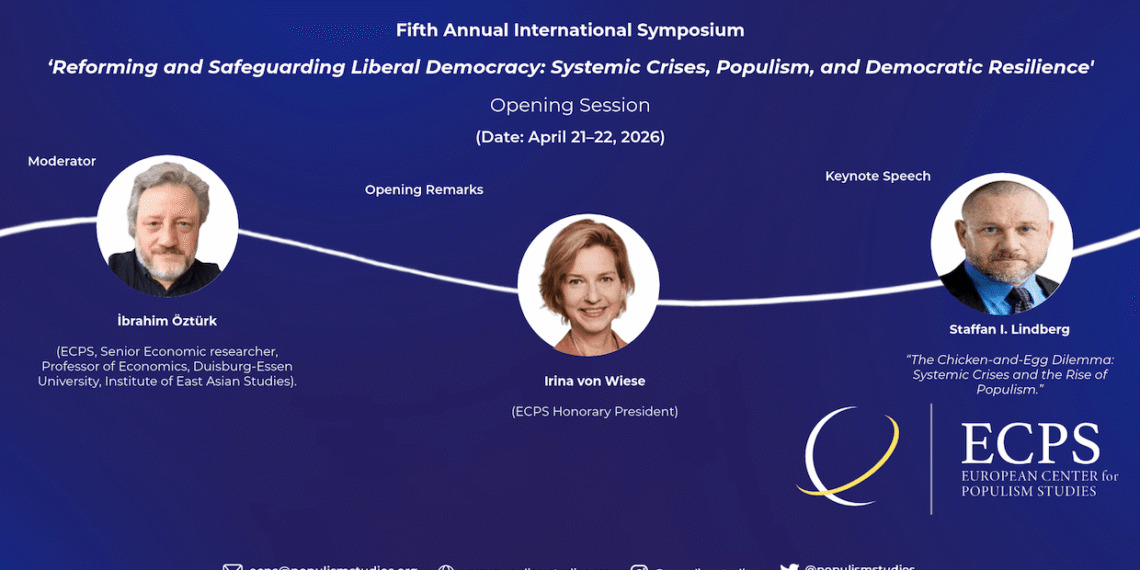
The opening session of the ECPS Fifth Annual International Symposium offered a timely and intellectually rigorous entry point into one of the central dilemmas of contemporary politics: how liberal democracy can be defended, renewed, and reimagined amid systemic crisis and accelerating autocratization. Moderated by Professor Ibrahim Ozturk, the session combined normative urgency with empirical depth. In her opening remarks, Irina von Wiese underscored the geopolitical immediacy of democratic strain, while Professor Staffan I. Lindberg’s keynote, grounded in V-Dem data, traced the global scale of democratic erosion and challenged simplistic readings of populism by foregrounding anti-pluralism as a more precise analytical category. The discussion that followed further enriched the session, probing the measurement, lived experience, and reversibility of democratic decline across contexts.
Reported by ECPS Staff
The opening session of ECPS Fifth Annual International Symposium opened on April 21, 2026 within a carefully structured intellectual framework that brought together empirical rigor, normative urgency, and interdisciplinary reflection. Moderated by Professor Ibrahim Ozturk, the opening segment of the symposium set out to interrogate one of the defining challenges of contemporary politics: how liberal democracies can be reformed and safeguarded in an era marked by systemic crises, populist mobilization, and intensifying pressures on institutional resilience.
From the outset, the session positioned itself at the intersection of scholarly analysis and real-world political developments. The framing emphasized that democratic backsliding is no longer a peripheral or regionally confined phenomenon, but a global trend with profound implications for governance, legitimacy, and international order. In this context, the symposium’s thematic focus—linking systemic crises to populism and democratic resilience—provided a coherent lens through which to examine both structural drivers and political responses.
The opening remarks by ECPS Honorary President Irina von Wiese underscored the urgency of the moment, situating the symposium within a rapidly evolving geopolitical landscape. Her reflections highlighted the accelerating pace of political change, particularly in transatlantic relations, and the difficulty of keeping analytical frameworks aligned with unfolding realities. This sense of temporal compression—where events outpace interpretation—reinforced the need for sustained, collective intellectual engagement.
The keynote address by Staffan I. Lindberg, Professor of Political Science, University of Gothenburg, Founding Director (2012–2025) of V-Dem Institute, further anchored the session in empirical analysis, offering a data-driven diagnosis of global democratic decline. By questioning conventional interpretations of populism and emphasizing the role of anti-pluralism, the keynote set the stage for a deeper exploration of the mechanisms underlying democratic erosion.
The discussion segment that followed extended the analytical depth of the opening session by bringing empirical findings, methodological concerns, and lived political experience into direct dialogue. Participants engaged critically with the keynote’s claims, probing the interpretation of data, the pace and nature of democratic decline, and the conditions under which institutional resilience may still operate. The exchange moved fluidly between macro-level indicators and context-specific realities, revealing both the strengths and limits of comparative measurement in capturing complex political transformations. In doing so, the discussion underscored a central theme of the symposium: that understanding democratic backsliding requires not only robust data, but also careful attention to institutional nuance, temporal dynamics, and the contested nature of political change.
Taken together, the opening session established both the analytical foundations and the normative stakes of the symposium. It framed the subsequent discussions around a central tension: while the challenges facing liberal democracy are systemic and far-reaching, the possibilities for resilience and renewal remain contingent on timely, informed, and collective responses.
Read the Full Report of Opening Session of ECPS Symposium 2026