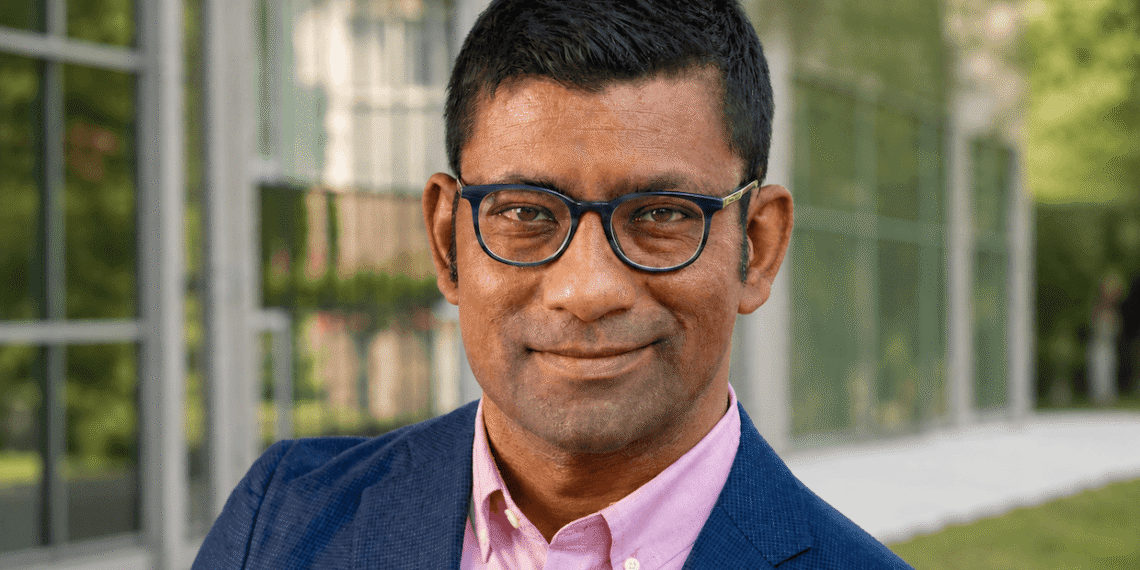
As democratic backsliding increasingly unfolds through legal institutions rather than overt constitutional rupture, what distinguishes constitutional resilience from constitutional decline? In this wide-ranging interview with the ECPS, Professor Aziz Huq of the University of Chicago examines how populism, executive power, judicial doctrine, digital platforms, and artificial intelligence are transforming liberal constitutionalism in the United States and beyond. Drawing on comparative constitutional law, he argues that contemporary democratic erosion often proceeds “under the cover of law,” while warning that populists are developing their own constitutional vision. From presidential immunity and democratic backsliding to algorithmic governance and AI-driven power concentration, Professor Huq offers a timely and sophisticated analysis of democracy’s evolving constitutional challenges in the twenty-first century.
Interview by Selcuk Gultasli
Across much of the democratic world, constitutional democracy is undergoing a profound transformation. Contemporary democratic erosion rarely arrives through military coups or overt constitutional rupture. Instead, it increasingly unfolds through courts, legislatures, executive decrees, and formally legal mechanisms that gradually weaken institutional constraints while preserving the appearance of constitutional continuity. At the same time, digital platforms and artificial intelligence are reshaping the public sphere, altering the production and circulation of political information, and redistributing power between states, private technology companies, and citizens. Together, these developments raise fundamental questions about the future of liberal constitutionalism, democratic resilience, and the capacity of democratic institutions to withstand both populist governance and technological disruption.
Few scholars have done more to illuminate these intersecting challenges than Professor Aziz Huq, Frank and Bernice J. Greenberg Professor of Law at the University of Chicago. One of the world’s leading authorities on constitutional law, democratic backsliding, judicial independence, executive power, and the constitutional implications of artificial intelligence, Professor Huq has produced influential scholarship that bridges American constitutional law with comparative democratic politics. His work has fundamentally reshaped scholarly debates on constitutional resilience, the institutional foundations of liberal democracy, and the legal mechanisms through which elected governments may gradually undermine democratic competition without abandoning constitutional forms.
In this wide-ranging conversation with the European Center for Populism Studies (ECPS), Professor Huq argues that understanding contemporary democratic backsliding requires moving beyond conventional labels such as populism or authoritarianism toward a more institutional analysis of incentives, constitutional design, and political time horizons. Drawing on Mancur Olson’s theory of the “stationary bandit,” he suggests that “the crucial question” is not simply whether a leader is populist, but “what the time horizon of a populist leader is.” In his view, democratic stability depends heavily on whether political leaders remain constrained by long-term institutional incentives or instead pursue short-term extraction of political and economic rents.
Turning to the United States, Professor Huq contends that “American democratic erosion is proceeding under the cover of law.” Rather than dramatic constitutional breakdown, he identifies legal innovations—including aggressive partisan gerrymandering, expansive presidential authority, and recent Supreme Court jurisprudence—as mechanisms through which democratic competition is being incrementally weakened. Most strikingly, he argues that “the Supreme Court has been responsible for creating the conditions for democratic backsliding,” particularly through its broad conception of presidential immunity and its endorsement of constitutional doctrines that facilitate the concentration of executive power.
Yet Professor Huq’s analysis extends well beyond the American case. He argues that “populists have developed their own version of constitutionalism,” challenging the assumption that constitutionalism necessarily remains synonymous with liberal democracy. Rather than witnessing the disappearance of constitutional government, he suggests, democracies may instead be entering an era in which competing constitutional visions coexist and contest one another. Simultaneously, the digital transformation of politics introduces an additional layer of constitutional complexity. While acknowledging that empirical evidence remains incomplete, Professor Huq warns that contemporary information ecosystems reward emotional engagement over deliberation, observing that “the shift from reasoning to emotion favors populist politics.” He also cautions that, despite its transformative potential, artificial intelligence is currently reinforcing rather than reducing inequalities, concluding that “AI is concentrating power rather than leveling the playing field.”
Ultimately, Professor Huq offers neither fatalism nor easy optimism. Instead, he presents a sober institutional diagnosis of democracy’s contemporary challenges while emphasizing that democratic renewal will require rebuilding effective constitutional constraints, representative institutions, and political organizations capable of responding both to populist pressures and to the unprecedented constitutional questions raised by the digital age.
Here is the revised version of our interview with Professor Aziz Huq, edited lightly to enhance clarity, readability, and overall flow for publication.
The Crucial Question Is Whether a Populist Leader Has a Long or Short Time Horizon

Professor Aziz Huq, welcome! Let me begin with your recent commentary, “The Orange Bandit.” In this commentary, you employ Mancur Olson’s distinction between “stationary” and “roving” bandits to argue that Donald Trump’s second presidency has shifted from a potentially durable governing project toward the short-term extraction of political and economic rents. How does this framework deepen our understanding of democratic backsliding beyond the conventional language of populism or authoritarianism?
Professor Aziz Huq: Mancur Olson was an important political scientist and economist who wrote an influential article explaining both the origin of states and the way states evolve into either dictatorships or democracies. Olson’s model, although a highly simplified one, offers us a way of thinking about the development of states and the ways in which they legitimate themselves over time in a fashion that I think is helpful both in the United States and more generally.
Olson’s basic model is that a state begins when a powerful force that has acted as a predator upon a population ceases to move around. It goes from being mobile to what Olson called a stationary bandit and starts extracting revenues, in the form of taxation, from a stable and geographically persistent population. That part of Olson’s model explains the origin of the state.
What’s relevant here is that Olson then identifies two different strategies that the stationary bandit can pursue. The first is to extract a relatively limited amount of revenue with the aim of maintaining long-term economic prosperity and stability, thereby enabling a high rate of revenue extraction over time, even if only a relatively small percentage of revenue is extracted in any given period. So, that is a strategy that depends upon having a long-time horizon.
The second strategy that Olson identifies is one in which the stationary bandit seeks to extract as much as it can in as short a period of time as possible. That strategy is obviously not stable, but it is likely to produce both economic deterioration and political instability over the medium term.
One thing we have seen in the second Trump administration is an acceleration of revenue- and rent-extraction activities on the part of the White House. This is underscored by reporting that appeared in the last two days, after the Project Syndicate piece that you mentioned, describing the president’s increase in assets between 2024 and the end of 2025. That reporting shows that his assets have increased by about $2 billion. Much of this comes from activities in the cryptocurrency and financial speculation space. Other parts come from deals forged either with foreign governments or through the facilitation of foreign governments via the larger Trump Organization.
What the piece argues is that what we are seeing in the United States is a transition from the first to the second form of Olson’s stationary bandit. We are witnessing a move from a stationary bandit—or a state—that has a long-time horizon and therefore is able to constrain itself when it comes to rent extraction, to one in which the incentives for constraint seem to have vanished.
What is useful about Olson’s model—not just for the American case but more generally for the study of populism—is that it foregrounds a specific and important question. That question concerns the time horizon of a populist leader. It encourages us, I hope productively, to think about why a populist leader might, at certain moments, have a long time horizon, in which they are relatively constrained in terms of revenue and rent extraction, while at other moments they may have a much shorter time horizon, in which case the incentives for restraint are much weaker.
American Democratic Erosion Is Proceeding Under the Cover of Law
Much of your scholarship argues that democratic erosion proceeds through constitutional and legal mechanisms rather than overt constitutional rupture. Looking at the United States today, which recent developments most clearly illustrate constitutional backsliding under the veneer of legality, and how has Trumpism transformed the American constitutional order in ways that may outlast Donald Trump himself?
Professor Aziz Huq: Let me give you two examples of forms of backsliding—or mechanisms of backsliding—that are presently unfolding in the United States under legal cover. The first is the reorganization of legislative districts, which are the units of representation within the national Congress, through a process known as gerrymandering. Gerrymandering involves drawing district boundaries in ways that make it almost certain that one party—the favored party—will win the election. Historically, gerrymandering has been constrained by a web of federal statutes and constitutional requirements. However, over the past 12 months, the Supreme Court has dramatically weakened those statutory and constitutional constraints, allegedly in the name of advancing democracy.
The president has pressed his political allies, first in Texas, then in Florida, and subsequently in other states, to aggressively gerrymander those states in favor of Republicans. The result is that the electoral map—initially in Republican-controlled states and then, in response, in Democratic-controlled states—has become one in which almost all districts are safely Republican or safely Democratic. In other words, politicians know in advance how those districts will vote because of their demographic composition, leaving very few genuinely competitive elections. This is a process that is producing, through formally legal means, an electoral map that is effectively glaciated and largely immune to changes in popular preferences. That is one example.
The second, much more recent example is that only last week, the US Supreme Court, in a case called Trump v. Slaughter, embraced a constitutional doctrine known as the Unitary Executive Theory. The Unitary Executive Theory holds that the president has virtually unlimited authority to remove almost all officials below him or her within the executive branch. The president has already exercised versions of the authority this theory confers by dismissing a large number of regulatory officials and prosecutors within the Department of Justice. Prosecutors within the Department of Justice who remain subject to the threat of dismissal have come under immense pressure to bring cases against individuals whom the president has identified as political opponents, including James Comey, the former Director of the FBI, and Letitia James, the Attorney General of New York State.
That is an example of a legal theory that the Supreme Court has embraced under the rubric of democracy and a particular interpretation of the Constitution—an interpretation that I find unpersuasive, to put it mildly. Its direct and significant consequence has been to facilitate the weaponization of prosecutorial power. And I know you know the Turkish case very well—but we also know from many other cases of democratic backsliding that once prosecutions become weaponized, the space for democratic contestation narrows dramatically.
History Is Made by Both Long-Term Structures and Unpredictable Moments

Your work suggests that democratic fragility emerges from the interaction of long-term structural forces—including constitutional design, widening economic inequality, and identity politics—rather than isolated political events. To what extent should Trump’s rise be understood as a symptom of these deeper pathologies rather than their principal cause?
Professor Aziz Huq: This is a large question that verges on the philosophical. If you speak to historians, some will emphasize what French scholars call la longue durée—the tectonic, slow-moving social and economic forces that serve as the engines of historical change. Others will point to discrete events—for example, the COVID pandemic or 9/11, which, in recent memory, have been important turning points for the United States—as the principal drivers of change. Still others might point to so-called great men, particular individuals who appear to play an outsized historical role.
My own view is that both of these accounts capture part of the truth, albeit to different degrees and at different moments. I think that understanding our current political moment requires attention both to the underlying structural forces—which, as you suggest, are economic in nature and also concern cultural change—and to the particular and unpredictable effects of discrete individuals and discrete events.
For example, it would be difficult to explain Trump’s second electoral victory in 2024 without taking into account one medium-term structural factor: the rise and subsequent decline of inflation in the wake of the COVID pandemic. At the same time, it would be a mistake to explain that outcome without paying attention to discrete events, particularly the failed assassination attempts against President Trump and the manner in which he responded to it. Both of these factors are important. The weight one assigns to each is, however, in part a reflection of one’s underlying philosophical commitments.
There Are More Parallels Than Divergences Between the US and Other Backsliding Democracies
Comparative studies of democratic backsliding often highlight attacks on courts, electoral administration, the civil service, and independent oversight bodies. Does the United States now resemble trajectories previously observed in countries such as Hungary, Poland, Turkey, or India, or does its constitutional architecture produce a distinct American model of democratic erosion?
Professor Aziz Huq: There are more parallels than divergences between the United States and the other jurisdictions you mentioned. In the United States, the insulation of the independent bodies you listed has always been imperfect. The courts are probably the most constitutionally entrenched of those institutions. However, the appointment mechanism for judges to the federal bench in the United States has, since the 1780s, run through the White House and the Senate. As a consequence, it has always been politicized, and there has never been a moment in American history when the US Supreme Court, in particular, as the country’s apex court, has been meaningfully free from the partisan forces that have shaped and directed its agenda. So, the Supreme Court has always been political. It just so happened that, at the beginning of his second term, Trump inherited a Court with six justices aligned with his party, including three whom he himself had appointed.
With respect to the civil service and other independent bodies, there is a degree of insulation that is not embodied in the constitutional text but rather in federal statutes. At least this administration has been quite successful in attacking—or simply ignoring—those statutory constraints. One important way in which the United States does differ from other jurisdictions that have experienced democratic backsliding, however, is its federal structure. In this respect, it is unlike Hungary, unlike Poland, and unlike Turkey, as I understand it, although somewhat similar to India.
Critically, under the Constitution, responsibility for election administration is largely diffused across the state and local levels and is therefore insulated from direct federal control. What this means is that federal efforts to seize control of election administration face extraordinarily high transaction costs. This is why Trump has been pushing the SAVE Act in Congress, which represents an effort to partially federalize—arguably unlawfully—a number of aspects of election administration. This is also why there has been discussion of deploying immigration agents—ICE agents—to polling stations around the country in November. These are the pathways being pursued because the more direct instruments available in countries such as Hungary and Poland are not necessarily available in the United States due to its federal electoral structure.
Presidential Immunity Has Changed the Constitutional Balance of Power

In “The Counterdemocratic Difficulty” and your work on judicial independence, you argue that courts shape democracy not merely through landmark decisions but through their broader institutional role. How should we evaluate today’s Supreme Court—and the federal judiciary more broadly—in either constraining or facilitating democratic backsliding during Trump’s second presidency?
Professor Aziz Huq: The Supreme Court has been responsible for creating the conditions for democratic backsliding, not only through the mechanisms that I’ve already identified, but also through other decisions that have made democratic backsliding much easier and much more attractive.
The most important of those decisions is one that the scholarship you mentioned does not address because it postdates that work. This is the Supreme Court’s 2024 decision granting the president a broad, almost absolute degree of immunity from criminal prosecution. That decision arose from a case involving the president’s role in the violence of January 6, 2021, and the associated efforts to derail the certification of the 2020 presidential election results. The effect of this presidential immunity ruling, which formally applies only to the president but, in practice, is likely to extend to and shield much of the conduct of the president’s subordinates, has been profound.
This is why you now see presidential advisers willing to argue that all federal agents are effectively immune from legal constraints. Stephen Miller, for example, made precisely that claim only days before ICE agents shot and killed Alex Pretti in Minneapolis, Minnesota. This is why you see not only a sense of immunity on the part of the president, but also a broader community of federal officers and agents behaving as though the law no longer applies to them. I think responsibility for that consequence—and, arguably, moral responsibility for the harms, including the deaths that have followed—must be laid at the feet of the Supreme Court that issued the immunity ruling.
Populists Have Developed Their Own Version of Constitutionalism
Across Europe and North America, populist leaders increasingly portray constitutional checks, independent institutions, and the administrative state as obstacles to the authentic will of “the people.” Has constitutionalism entered a new phase in which its greatest challenge comes not from coups or revolutions but from democratically elected governments themselves?
Professor Aziz Huq: I would modify the question slightly and distinguish between, on the one hand, liberal democratic constitutionalism, which is coming under the pressure that you describe, and, on the other hand, new populist forms of constitutionalism.
I think we make an analytical mistake—or go analytically awry—if we do not take seriously the idea that the new wave of populists, from Hungary to Turkey, from India to Japan, and even to the United States, have developed their own version of constitutionalism. That version may or may not, in some of those jurisdictions, become a durable and long-term form of constitutional order. So, I do think that we are witnessing a change in the nature, or at least the potential, of constitutionalism as a style of government.
I also think that the liberal, individual rights-focused conception of constitutionalism—and democratic in the sense of enabling not only free political choice but also the revision and reconsideration of political preferences—is the defining characteristic of liberal democracy. Those ideas are coming under increasing pressure, not simply because of innovations in American constitutional theory, but because those innovations are being diffused. They are learned in one jurisdiction after first being developed and deployed in another. What emerges from this process is not the disappearance of constitutionalism, but rather something new: a different form of constitutionalism that has yet to assume a fully coherent shape, and one that many of us—I would certainly include myself among them—are still struggling to understand and to map.
The Shift from Reason to Emotion Favors Populist Politics
You have argued that digital platforms have become part of democracy’s constitutional infrastructure rather than merely private communication spaces. How are social media platforms, algorithmic amplification, and generative AI reshaping the dynamics of populism, democratic polarization, and constitutional governance?
Professor Aziz Huq: This is a very important question, but one on which the empirical evidence remains imperfect. We know that people, not just in the United States but around the world, increasingly obtain their news and information from social media, particularly from platforms such as TikTok and Instagram, where information is broken down into very small, highly digestible components.
We also know that many—though not all—social media algorithms are designed to recommend content not on the basis of its truthfulness, but according to its likelihood of generating further user engagement. These recommender algorithms tend to steer users toward increasingly radical forms of speech—politically radical speech, as well as speech that is radical with respect to cultural and ethical norms, particularly around questions of gender and sexuality.
What we do not yet have, however, is strong evidence about how what appear to be profound structural changes in the public sphere—and I use that term both in the technical sense employed by Habermas and in the ordinary sense that most people would understand—translate into changes in political behavior. We can clearly observe that the public sphere is changing, but the number of studies linking those transformations to changes in political behavior remains relatively small, and their findings are often inconclusive.
So, we have to be very careful, as scholars, when thinking about the relationship between changing structures of public communication, on the one hand, and changing patterns of political behavior, on the other. It does seem difficult to imagine, however, that the forces broadly described as populist would not benefit from this new kind of media environment. It is hard to see how they would not be advantaged by the abbreviation of communication, by the shift from reasoning to emotion, and by the outrage- and clickbait-driven structure of the information ecosystem through which people engage with and learn about the world.
AI Is Concentrating Power Rather Than Leveling the Playing Field

Your recent scholarship examines artificial intelligence through the lenses not only of procedural fairness and due process but also distributive justice. As AI becomes increasingly embedded in courts and public administration, how might these technologies either reinforce or reduce inequalities in access to justice, legal accountability, and the rule of law?
Professor Aziz Huq: One of the issues I’ve been thinking about concerns what happens when the state, and in particular its judicial apparatus, introduces or adopts new technologies such as generative AI and other predictive tools. How do these technologies change the way adjudication is delivered? How do they affect who has access to adjudication? And how do they alter the distribution of power between the state and private actors?
At present, what we see is AI tools being adopted primarily in contexts where the adopter is a relatively powerful, centralized actor. This is true in the private sector, but it is also true in the public sector, where the most significant applications that have been studied are found in criminal law, social control, and national security. These are all areas in which the state exercises coercive power to achieve its policy objectives, often in relatively opaque ways. Yet these are precisely the domains in which we are seeing the most rapid technological adoption. That suggests that the introduction of AI generally shifts power from private actors to the state.
At the same time, however, the state is becoming increasingly dependent on a very small number of private actors for the services it requires. For example, the American state functionally relies on Amazon Web Services for much of its computing capacity. It contracts with firms such as Palantir for many of its predictive capabilities. So, even as the state becomes more powerful, it is simultaneously empowering a relatively small coterie of commercial actors. This is perhaps the clearest in the case of Palantir, whose CEO, Alex Karp, has been very public about his governing philosophy. What you therefore have is a group of private corporate actors that has become increasingly influential while holding a very particular vision of the state and of its relationship to the state. What we have seen so far is a relative concentration of power, enabled by technology, in ways that are, at least on their face, not obviously normatively attractive.
On the other hand, although there are many proposals to use generative AI and other AI tools to empower actors who would otherwise be marginalized by the criminal justice system or by ordinary adjudicative processes, it is very difficult to identify examples of such projects being implemented and operating at scale. What this suggests is that, even if AI has the potential either to level the playing field or to make it more asymmetrical, in practice it appears to be making the playing field more asymmetrical.
Militant Democracy Cannot Simply Be Imported into the Digital Age
In “Militant Democracy Comes to the Metaverse?” you revisit the theory of militant democracy to analyze digital platforms. As generative AI accelerates misinformation, deepfakes, and synthetic political communication, should constitutional democracies reconsider traditional understandings of free speech, platform neutrality, and democratic self-defense without undermining liberal constitutional values?
Professor Aziz Huq: As digital platforms become increasingly important, it is inevitable that states will reconsider the ways in which they are regulated. The theory of militant democracy, which emerged in the 1930s in response to the rise of fascism in Germany and Italy, provides us with important intellectual resources for thinking about that challenge. Militant democracy, however, has had, at best, a mixed track record in Europe. It has produced more misfires than successes.
So, part of the purpose of the paper you mentioned is to caution against any wholesale importation of militant democratic ideas into this new context. Rather, we should learn from both the successes and the failures of militant democracy and think carefully about how to adapt its successes to this new technological environment.
Populists Have Evolved Faster Than Their Democratic Opponents
Looking comparatively across the democratic world, do you believe constitutional democracies have become more resilient since the first global wave of democratic backsliding began roughly a decade ago, or have populist and authoritarian leaders simply become more sophisticated in pursuing incremental, legalistic forms of democratic erosion?
Professor Aziz Huq: What we have seen so far is rapid evolution on the side of populists, slower evolution on the side of those who oppose populists, and now, in countries such as Hungary and Poland, an effort to think about what happens after populism and how one insulates a polity from populism once it has taken hold.
I would not describe this as a situation in which one side has gained the upper hand while the other has been weakened. Rather, I would say that we have moved through different moments or cycles, each characterized by different forms of contestation and by different pragmatic and moral questions that have emerged.
The Next Great Democratic Challenge Is Rebuilding Political Representation

Finally, Professor Huq, if you were advising constitutional reformers seeking to future-proof liberal democracy against both authoritarian populism and the emerging challenges posed by artificial intelligence, digital platforms, and algorithmic governance, what institutional reforms would you prioritize?
Professor Aziz Huq: This is obviously the million-dollar question. And I don’t have a million-dollar answer. I do think that we have learned a lesson that the brilliant political scientist Juan Linz tried to teach us in the 1970s about what he called the perils of presidentialism. We’ve seen, time and again, the importance of having effective checks on the power of the executive branch. These can come from the courts, from so-called guarantor or fourth-branch institutions, such as auditors’ offices or independent prosecutors, and from the creation of a federal structure.
We’ve also seen the importance of building effective systems of representation that do not flow through the presidency. So, for example, in the United States, there is a real need to rethink how Congress is constituted. What are the structures of representation that generate the federal Congress? And how do you create a federal Congress that has both the incentive to respond to shifts in popular sentiment and is sufficiently coordinated to stand up to the presidency? That requires, among other things, a shift from a first-past-the-post system to a more proportional electoral system.
I also think it is difficult to imagine that this kind of reform of non-executive representative bodies can occur without also rethinking the political party structures that underpin them. One of the things that has happened over the last two decades is the collapse of traditional party structures. I think this is very clear in Europe. In the United States, you are seeing the same process unfold, albeit in a slower and more opaque fashion. The Republican Party has functionally collapsed. It has been taken over by its MAGA faction. And if you look at Democratic voters’ views of the Democratic Party, you see that the Democratic Party no longer has the kind of stable base or loyalists that it had 30 or 40 years ago. So that looks to me like a collapsed party structure of the kind that is plainly manifest in the United Kingdom, plainly manifest in France, and in other European jurisdictions. It simply has not yet taken an electoral form in the United States.
In that context, we need to think very hard about the associational forms of political representation. How do we coalesce into political communities in ways that effectively represent people, and, in particular, those who are on the sharp edge of economic change, whether that change stems from globalization or from the wave of unemployment that AI may well generate?
I don’t know if there is a general legal answer to that question. The answer in the United States is almost certainly going to be different from the answer in the United Kingdom, different from the answer in France, and different from what Turkey looks like. But it is one of the most important areas of reformist thinking that needs to be pursued over the next five to ten years.