

Professor Ibrahim Ozturk examines the deeper political economy behind The Economist’s recent critique of Nobel laureate Daron Acemoglu, arguing that the dispute reaches far beyond disagreements over institutional theory or AI productivity. He situates the controversy within a systemic crisis marked by inequality, weakened labor, technological concentration, declining governing capacity, and the erosion of liberal democracy’s social foundations. Drawing on Acemoglu alongside Polanyi, Rodrik, Stiglitz, Rawls, and Piketty, Professor Ozturk argues that technological progress is inherently political: institutions and power determine who directs innovation and captures its gains. The commentary contends that Acemoglu’s most consequential challenge is his insistence that markets cannot discipline concentrations of power they have themselves created—and asks whether the coming systemic reset will genuinely redistribute power or merely reproduce existing winners under a new institutional settlement.
The Economist’s attack on Nobel laureate in economics Daron Acemoglu is more than an academic dispute. It exposes a deeper struggle over who will govern technological change, who will bear the costs of systemic reform, and whether liberal democracy can discipline concentrated economic power. Acemoglu’s real offense is not pessimism. It is his insistence that technological progress is a political choice, that liberal democracy cannot survive without shared prosperity, and that markets cannot discipline concentrations of power that they have themselves created. The dispute is therefore larger than one economist or one disputed estimate. At stake is whether the coming systemic reset will redistribute power as well as losses—or merely reshuffle the cards while leaving ownership of the table in the same hands.
The Political Economy Behind the Acemoglu Controversy
A growing body of research shows that the contemporary crisis of liberal democracy cannot be explained solely by the personalities of populist leaders or the supposed irrationality of their supporters. Its deeper sources lie in systemic disruptions caused largely by the corporate capitalism of the neoliberal Washington consensus that came with unregulated hyper-globalization, widening inequality, weakened labor, financial instability, regional decline, technological concentration, and the diminishing capacity of elected governments to protect citizens from externally generated shocks.
This interpretation belongs to a substantial political economy tradition. Karl Polanyi argued that attempts to disembed markets from society eventually provoke a protective countermovement. But that countermovement need not always be democratic or progressive. If legitimate democratic institutions cannot provide social protection, nationalism, protectionism, and authoritarian populism may offer it.
Dani Rodrik similarly anticipated that advanced economic globalization would provoke a political backlash. Trade, capital mobility and global production networks generated aggregate gains, but the losses were geographically concentrated, socially persistent and inadequately compensated. In Rodrik’s formulation, the problem was not globalization alone but “hyper-globalization”: the subordination of domestic economic and social arrangements to the requirements of international markets.
Joseph Stiglitz has approached the same problem through the failures of neoliberalism. Deregulation, regressive taxation, weakened public services, and the political power of concentrated wealth did not produce the competitive market order that their advocates promised. They produced what Stiglitz calls a crisis of capitalism and democracy. Four decades of policies favoring capital over labor did not remove the state from the economy; they reorganized state power around particular interests.
In my recent works, I argued that unmanaged globalization creates political space for populists, who then weaken the autonomous institutions required for democratic correction. Turkey under Erdogan shows how institutional capture can insulate authoritarian populism from economic failure. Brazil under Lula, by contrast, demonstrates that a broad coalition can defeat an authoritarian-populist project, although its media, patronage and identity networks may survive electoral defeat. My comparative analysis of Lula and Erdogan therefore suggests that democracy must do more than remove populist leaders; it must rebuild the social and economic foundations of representation.
Reverse Convergence and the Crisis of the Western Model
I have placed these national cases within a broader process that I call “reverse convergence.” The post-Cold War expectation was that China’s integration into global capitalism would gradually make it more liberal, more transparent, and more institutionally similar to the democratic West. Markets would create an independent middle class; international integration would strengthen the rule of law; and economic modernization would ultimately generate political liberalization.
That prediction proved deeply misleading. China incorporated markets, global trade, multinational investment, and advanced technology without surrendering authoritarian political control. At the same time, the United States and parts of Europe began adopting practices once associated with illiberal systems: economic nationalism, strategic protectionism, industrial subsidies tied to geopolitical objectives, expanding surveillance, executive discretion, and restrictions on technological exchange.
China did not simply converge toward the West. In important respects, the West began to converge toward China. As I argued in “Capitalist Disruptions and the Democratic Retreat,” this reciprocal movement is rooted in the systemic crisis of corporate capitalism. Liberal regimes are adopting illiberal instruments, while authoritarian regimes maintain repression and selectively integrate into global markets. The institutional and normative distance between the two systems is narrowing from both sides.
This does not mean that China and Western democracies have become identical. Political pluralism, judicial independence, civil liberties, and electoral competition still create fundamental distinctions. Reverse convergence describes a direction of movement, not a completed state. Its warning is that market integration alone does not automatically liberalize authoritarian regimes, while economic insecurity and geopolitical rivalry may progressively illiberalize democratic ones.
The empirical literature on the so-called China Shock strengthens this argument. David Autor, David Dorn and Gordon Hanson showed that communities exposed to Chinese import competition experienced persistent employment and wage losses rather than the rapid adjustment predicted by standard trade models. Their subsequent research connected trade exposure with greater political polarization. These findings do not prove that globalization alone caused Trumpism. They do demonstrate that the distributional and geographical effects of trade cannot be treated as temporary deviations from an otherwise frictionless adjustment process.
Rodrik’s distinction between the demand and supply sides of populism is crucial here. Economic shocks generate insecurity and resentment, but political entrepreneurs decide how these grievances are interpreted. The anger may be directed against financial elites, multinational corporations, and inequality, or diverted towards migrants, minorities, and external enemies. Material dislocation and cultural politics are not mutually exclusive explanations; economic insecurity can be translated into identity conflict.
The transformation of Western party systems reinforces the problem. Thomas Piketty, Amory Gethin and Clara Martínez-Toledano document the emergence of a “Brahmin Left” representing highly educated voters and a “Merchant Right” representing high-income and wealth-owning groups. Sections of the working and lower-middle classes increasingly feel politically unrepresented. They face a cultural elite on one side and an economic elite on the other.
This helps explain why citizens experiencing abandonment may turn to leaders whose economic programs do not objectively serve them. Populism offers what technocratic liberalism no longer provides: a language of belonging, recognition and political conflict. Its solutions may be false and its leadership authoritarian, but its diagnosis begins with a real representational void.
The Global Policy Machine Is Running Out of Room
The world economy is now entering a phase in which national policy responses increasingly neutralize one another. Japan is caught between enormous accumulated public debt, rising financing costs, demographic contraction and a central bank whose policy space has narrowed. The United States combines structural fiscal deficits and high debt-service costs with protectionism and an increasingly explicit effort to preserve technological supremacy. Europe wants greater strategic autonomy, military capacity, green transformation and social protection, but confronts weak growth, high energy costs, fragmented capital markets and restrictive fiscal politics.
Each major economy is trying to transfer part of the adjustment burden elsewhere. The United States uses tariffs, industrial subsidies and the structural power of the dollar. China responds through production scale, export penetration and state-supported technological upgrading. Europe turns to defensive regulation and industrial policy. Emerging economies compete for investment through tax concessions, cheap labor, suppressed wages and regulatory exemptions.
What appears rational for each country separately becomes contradictory at the systemic level. Everyone wants to export more, protect strategic industries, attract capital, subsidize domestic production and prevent unemployment. Not everyone can do so simultaneously.
Monetary policy confronts similar limits. High interest rates may suppress inflation but intensify debt-service pressures, weaken investment and expose financial fragilities. Lower rates may sustain asset prices and indebted governments but revive inflation, encourage leverage and postpone restructuring. Fiscal expansion supports demand but confronts anxious bond markets. Austerity reassures creditors while weakening social legitimacy and accelerating political radicalization.
The world is approaching a point where conventional policies no longer resolve problems. They transfer them across time, borders and social classes. When these contradictions can no longer be postponed, governments will be tempted to reshuffle the cards: recognize losses, rescue selected institutions and transfer the bill to those least able to resist. Workers, taxpayers, small savers, pensioners and younger generations will be required to absorb the consequences of decisions they did not make. Without structural reform, the next major crisis will not be merely another business-cycle downturn. It may become a simultaneous crisis of distribution, political legitimacy and democratic representation.
The questions Acemoglu now addresses are therefore the real questions confronting liberal democracy: Why do governments change while economic direction remains largely fixed? Why can political systems identify their crises yet remain unable to reform the structures that reproduce them? And why does electoral alternation so often rotate the administrators of the system without altering the distribution of economic power, the direction of technological change or the mechanisms through which the costs of crisis are transferred?
United Kingdom offers a revealing example. Prime ministers and governing parties change, yet weak productivity, regional inequality, deteriorating public services, housing shortages, chronic underinvestment and the unresolved consequences of Brexit remain. Political alternation survives, but transformative capacity has weakened. Elections change the system’s managers without necessarily changing its economic direction. Acemoglu is searching, at his own analytical scale, for an explanation of this crisis of reform capacity and for a route beyond it.
This is precisely where The Economist occupies a paradoxical position. It presents itself as an unsentimental analyst of political and economic failure, yet its ideological framework often prevents the causal chain from being followed back to the underlying distribution of power. Governments fail, voters become irrational, institutions deteriorate, and populists advance; meanwhile, the ownership structures, fiscal privileges, financial interests, and technological concentrations that restrict meaningful reform remain less visible. Acemoglu’s recent work is disturbing because it begins to turn the analytical finger towards these protected centers of power.
A Critique with Two Very Different Layers
On August 17th 2026, The Economist published an unusually personal attack under the headline “The world’s most influential economist is oddly unconvincing.” The article acknowledges that Acemoglu is exceptionally productive, intellectually formidable, and generous towards younger scholars. It then devotes the rest of its space to questioning whether his reputation at the summit of the economics profession is justified.
This is a legitimate question to ask about any celebrated scholar, including a Nobel laureate. Acemoglu’s empirical research, institutional theory and estimates of AI’s productivity effects are not beyond criticism. The history of economics is full of influential theories that later proved incomplete, context-dependent or empirically fragile. Yet The Economist’s intervention does not read like a conventional scholarly assessment. Its tone, timing and structure suggest that something else is at stake. For instance, it moves from technical disagreements over colonial mortality data to dismissive judgments about Acemoglu’s political analysis, his account of technological change and his support for pro-worker AI. It does not merely claim that some of his estimates may be wrong. It seeks to diminish the intellectual authority he draws on to challenge today’s concentration of technological and economic power.
The article combines two fundamentally different kinds of criticism. The first is methodological. It revisits the famous 2001 paper by Acemoglu, Simon Johnson and James Robinson on the colonial origins of comparative development. Their argument—those different colonial environments produced different institutional arrangements whose effects persisted—became foundational to contemporary institutional economics. The Nobel Committee recognized the three economists in 2024 “for studies of how institutions are formed and affect prosperity.”
The settler-mortality data used in their original paper have genuinely been disputed. David Albouy questioned observations transferred between territories, the comparability of historical mortality figures, and the robustness of the instrumental-variable estimates. Acemoglu, Johnson and Robinson responded that Albouy’s conclusions depended on removing much of Latin America and Africa from the sample and adding a questionably coded campaign dummy. Their formal reply was published alongside Albouy’s critique.
These are substantial questions, and The Economist is justified in discussing them. Yet the limits of the research program extend beyond one dataset. Adam Przeworski questioned whether endogenous institutions can coherently be treated as the primary cause of development; Edward Glaeser and his co-authors argued that human capital and prior development may themselves generate institutional improvement; and Gareth Austin showed how the reversal-of-fortune thesis compresses African history and underweights colonial political economy and local trajectories. More broadly, the inclusive–extractive distinction risks becoming an ex-post classification if imperial power, war, class conflict, external intervention and variation within countries receive insufficient weight. These objections limit the framework’s claim to a unified explanation; they do not render institutional analysis worthless.
The paper’s influence also extends beyond its precise coefficient. It helped shift development economics away from treating markets, capital accumulation, and technological diffusion as processes operating independently of political power. Institutions determine whose property is protected, whose contracts are enforced, who receives education, who controls the state, and who can organize collectively.
The second layer of The Economist’s critique goes beyond identification strategies or historical evidence and dismisses Acemoglu’s ideas as obvious, gloomy, or insufficiently adventurous. His argument that Trump increases executive power by destroying constraining institutions is met with “Well, obviously.” The magazine’s article characterizes his idea of pro-worker AI as attractive but self-evident. It presents his concern about the social direction of technology as pessimism.
This is not technical refutation. It is rhetorical minimization. A familiar method is at work: acknowledge that an argument is correct, then declare it too obvious to matter. Yet many of the most consequential truths in political economy appear obvious only after somebody has identified their mechanisms and shown why prevailing institutions systematically violate them. If it is obvious that AI should complement workers rather than displace them, why do corporate incentives and tax systems so often favor automation? If it is obvious that executive power must be constrained, why are liberal democracies progressively normalizing emergency powers, politicized administration, and rule by decree? If shared prosperity is an obvious foundation of democratic stability, why has it been so consistently subordinated to asset-price appreciation and capital mobility?
A Magazine Contradicting Its Own Acemoglu Archive
The severity of the 2026 verdict is striking because it does not grow naturally out of The Economist’s own record. When Acemoglu and Robinson were turning a partly Western-centered institutional narrative into a global theory—precisely when its circularity, historical compression and treatment of colonial power most required sustained scrutiny—the magazine largely welcomed the framework. It insisted that “institutions matter, a lot,” reported favorably on research connecting democracy and growth, and applied the Why Nations Fail framework to rebuilding fragile states. Its archive was not uncritical, but it was serious and constructive. The latest article abruptly converts familiar disputes into a personalized verdict on whether Acemoglu deserves his standing at the apex of economics.
| Date | Article | Acemoglu’s role | Editorial posture |
| March 2012 | Why Nations Fail — review | Book and institutional thesis | Positive, with reservations |
| 6 March 2013 | Institutions matter, a lot | Acemoglu–Robinson reply to Bill Gates | Defensive / favorable |
| 25 June 2015 | Have your cake and eat it | Democracy and growth research | Favorable |
| 7 January 2017 | Why states fail and how to rebuild them | Why Nations Fail framework | Favorable / applied |
| 26 March 2019 | Slower growth in ageing economies is not inevitable | Ageing, robots and productivity | Constructive |
| 5 September 2020 | Economists are turning to culture… | Institutions versus culture; The Narrow Corridor | Constructively critical |
| 16 January 2021 | The robots are coming for jobs—but stealthily | Automation and labor research | Serious / neutral |
| 21 January 2021 | Economic crises and political ruptures | Economic networks and fascism | Serious / neutral |
| 28 November 2023 | Welcome to a golden age for workers | Robots, tight labor markets and worker power | Neutral; more optimistic |
| 17 August 2026 | The world’s most influential economist is oddly unconvincing | Career-wide assessment | Adversarial / personalized |
Archive searches are imperfect, especially across changed URLs and print editions. The conservative claim is therefore not an exact lifetime total but at least ten identifiable, substantial Economist articles between 2012 and 2026 in which Acemoglu or his co-authored work is central. Passing citations, daily briefings, and Economist events would raise the broader count.
The inconsistency is not that a magazine changed its mind; serious publications should do so when evidence changes. The new verdict neither identifies decisive new evidence nor explains the editorial reversal. Nor has The Economist stopped treating Acemoglu as authoritative: its Antitrust Summit agenda schedules him for a discussion with the magazine on October 28th, 2026. The same institution can market his authority in one venue while attempting to deflate it in another. That tension deserves acknowledgment.
Institutions: Tautology or An Analysis of Power?
Acemoglu’s institutional theory does face a genuine analytical challenge. If successful countries are said to possess “inclusive institutions” and unsuccessful countries “extractive institutions,” there is a risk of circular reasoning. Inclusive institutions produce prosperity, while prosperity becomes evidence that institutions were inclusive.
Tyler Cowen and other critics have questioned whether institutional change is sometimes explained by reference to earlier institutional change, producing an infinite regress. Critics also point to China: how can a politically authoritarian and plausibly extractive system generate decades of extraordinary growth? These objections should be taken seriously. Institutions cannot become a residual category covering laws, norms, culture, political power, state capacity, and every historical event not explained elsewhere. A theory that explains everything after the event may predict very little before it.
Yet China does not automatically disprove Acemoglu’s argument. His claim is not that extractive systems cannot grow. Such regimes can mobilize resources, import technology, suppress consumption, direct credit, and achieve rapid catch-up. The stronger claim is that innovation-driven, broadly shared prosperity becomes harder to sustain when political power remains concentrated and accountability weak. China therefore represents less a decisive refutation than an unresolved test. Its future trajectory will depend on whether centralized control can coexist with innovation, demographic transition, rising debt, entrepreneurial autonomy and the increasingly complex information requirements of an advanced economy.
More importantly, institutional analysis becomes far less tautological when institutions are understood as structured distributions of power. Institutions establish who can veto policy, organize labor, own productive assets, finance political campaigns, control information, and impose losses on others. They are not merely “good rules” producing good outcomes. They are settlements among social forces. This interpretation connects Acemoglu to an older political-economy tradition rather than separating him from it. Polanyi’s embedded markets, Rawls’s fair value of political liberty, Stiglitz’s progressive capitalism and Rodrik’s productivist agenda all ask how economic power can be made compatible with democratic citizenship.
John Rawls insisted that political liberties must possess not only formal existence but “fair value.” Citizens must have a substantively comparable opportunity to influence political outcomes. His later preference for a property-owning democracy over conventional welfare-state capitalism was based partly on the fear that wealth concentrated in a few hands would dominate politics. This is no longer an abstract philosophical concern. Martin Gilens demonstrated that policy outcomes in the United States are far more responsive to affluent citizens than to those on middle or lower incomes. When unequal economic power becomes unequal political influence, liberal democracy may retain elections while losing substantive representation.
The “Old Acemoglu” and the “New Acemoglu”
Some defenders of Acemoglu have interpreted The Economist’s article as retaliation by “the system” against an economist who has become “dangerously radical.” An ideological reaction may be at work, but this interpretation should not be exaggerated.
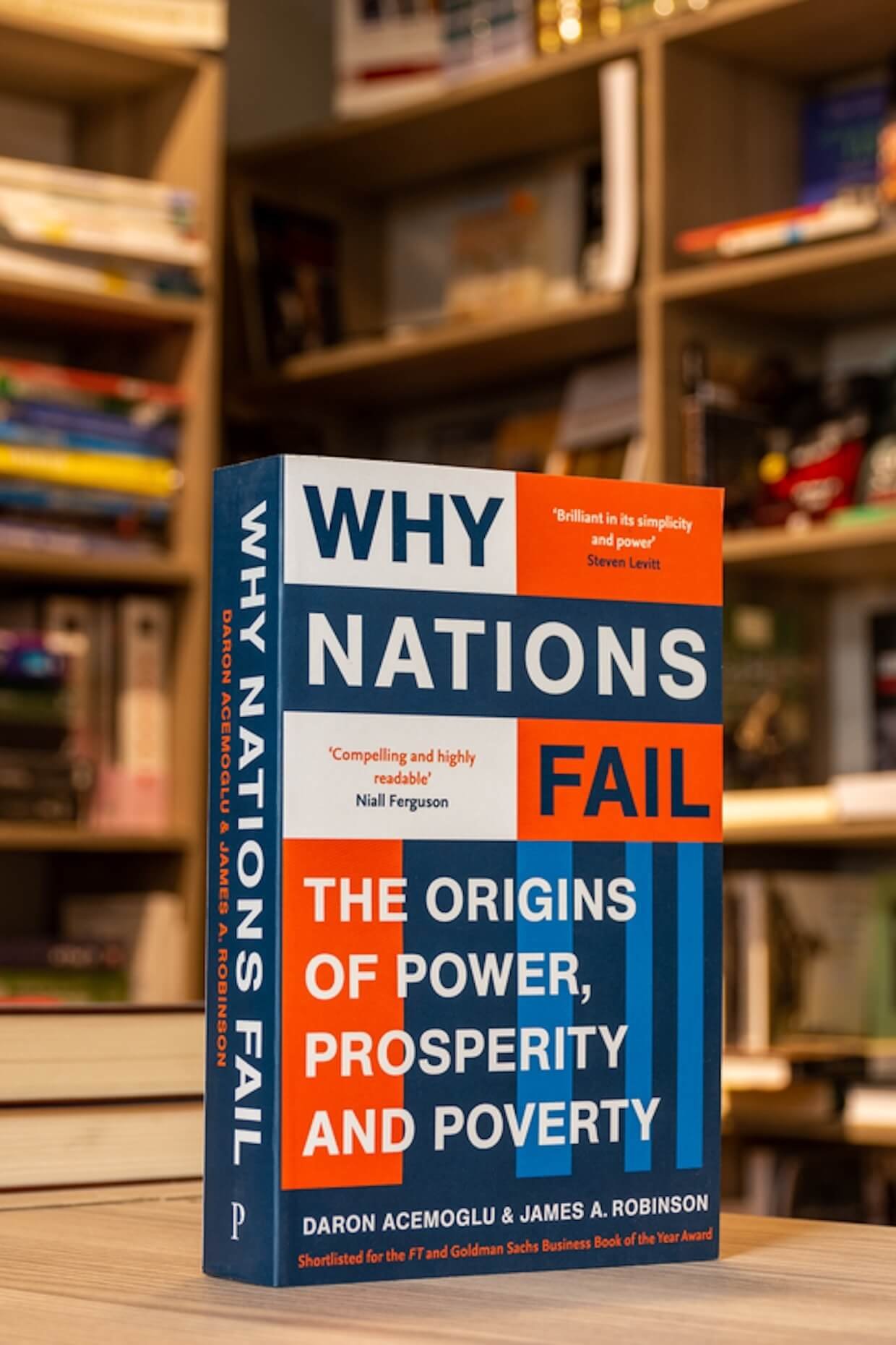
As a good student of institutional economics, I would argue that Acemoglu is not a socialist revolutionary. He does not advocate abolishing markets or private property. He does not romanticize Soviet planning, Maoism, or Chinese authoritarian state capitalism. His project is reformist: to rescue liberal democracy from the consequences of its political and economic degeneration. His new book, What Happened to Liberal Democracy?, makes this explicit. Acemoglu argues that liberal democracy flourished when it combined individual freedom, political participation, and shared prosperity. It lost legitimacy when post-industrial liberalism abandoned that settlement, let economic and educational elites detach from the rest of society, and failed to manage the disruptions caused by globalization and digital technology. His alternative is “working-class liberalism”: a democratic order centered on shared prosperity, empowered communities, human dignity, and a wider range of legitimate social values. The book’s central argument is the reconstruction of liberalism, not its destruction.
Acemoglu’s criticism of sections of the contemporary left is also important. He argues that progressive politics became too detached from working-class economic interests and too closely associated with highly educated metropolitan groups. That claim corresponds strikingly with Piketty’s “Brahmin Left” analysis. The cultural and educational elite may support minority rights and cosmopolitan values while remaining insufficiently attentive to labor power, regional decline, and economic insecurity. In this respect, Acemoglu is closer to Rawlsian social liberalism or renovated social democracy than to anti-capitalism. Markets should remain, but they must be embedded in democratic institutions. Technology should advance, but society must influence its direction. Capital should invest and innovate, but concentrated private power should not colonize politics, knowledge and public life.
Precisely because this is not a revolutionary program, it poses an uncomfortable challenge to defenders of the status quo. Acemoglu cannot easily be dismissed as an enemy of capitalism. He criticizes capitalism in the language of productivity, competition, opportunity, and liberal democracy itself. His message is not that liberal democracy failed because its enemies defeated it. It is that liberalism damaged its own social foundations.
This recasts the central democratic question. Are liberal democracies being destroyed from outside by populists, or hollowed out from inside by the concentration, dependency and inequality generated under economic liberalism? The alternatives are false if treated as mutually exclusive. Populist leaders are real agents of institutional destruction, but they also accelerate a prior internal decay. When markets concentrate wealth, governments lose governing capacity, work loses bargaining power, and citizens experience elections without economic agency, the constitutional shell remains while democratic substance thins. Trump, Bolsonaro and Erdogan did not invent this vulnerability; they organized and weaponized it. Lula’s return shows that electoral correction is possible, but also that removing a populist is not the same as rebuilding democracy’s social foundations.
The Reform Question Neoliberalism Avoids
For four decades, the dominant policy framework promised that trade liberalization, deregulation, financial deepening, labor-market flexibility and technological innovation would increase aggregate prosperity. Distributional losses could supposedly be handled afterward through education, worker mobility and limited fiscal compensation.
The promised compensation was frequently inadequate or never arrived. Productivity gains were distributed unevenly. Trade unions weakened. Labor lost bargaining power. Financialization expanded. Market and wealth concentration increased. Tax systems often treated capital gains, inherited wealth and multinational profits more favorably than ordinary labor income.
Stiglitz describes the necessary alternative as progressive capitalism: markets combined with strong public institutions, competition, social investment and limits on rent extraction. Rodrik’s “productivism” similarly shifts attention from redistribution after-market outcomes to the organization of production itself. Firms’ investment, employment, and innovation decisions reproduce poverty, inequality, and exclusion daily. Waiting to repair them afterward is both economically inefficient and politically destabilizing.
This is where Acemoglu’s pro-worker technology argument acquires significance. The distributional consequences of technology should be addressed when technologies are selected, designed, and deployed—not only after workers have been displaced.
Technology Does Not Choose Its Own Direction
The Economist presents Power and Progress, written by Acemoglu and Simon Johnson, as an excessively gloomy history of technological change. It responds that technological progress has made the average person vastly richer than people living before the Industrial Revolution.
That statement is true, but it does not answer Acemoglu’s argument. Acemoglu and Johnson do not claim that technology has produced no progress. Their central proposition is that the benefits of innovation are neither automatic nor naturally distributed. Technology creates possibilities; institutions, political organization, and bargaining power determine how those possibilities are deployed and who captures the gains. The MIT summary of Power and Progress states the issue clearly: technological advances can become empowering and democratizing, but not if decisive choices remain concentrated in the hands of a few technology leaders.
The Industrial Revolution eventually raised living standards, but its early decades also produced brutal factory discipline, child labor, unsafe cities, and the destruction of established livelihoods. The eventual social gains were not created by machinery alone. Labor organization, public health, education, political enfranchisement, social insurance, competition policy, and progressive taxation mediated them.
Acemoglu’s critics frequently collapse two different propositions: i) Technology can increase aggregate productivity. ii) Technology will automatically produce broadly shared prosperity.
The first can be true while the second remains false.
The same distinction appears in the economic literature on automation. Acemoglu and Pascual Restrepo distinguish between a displacement effect, through which machines take over tasks previously performed by labor, and a reinstatement effect, through which technological change creates new tasks in which human labor has a comparative advantage. Automation can raise productivity while reducing labor’s share of income if the creation of new human tasks is too weak. The question is therefore not “technology or no technology.” It is what kind of technological trajectory societies encourage.
AI, Labor and Concentrated Power

Artificial intelligence makes this problem more urgent because AI is not merely another machine. It can reorganize the production of knowledge, monitor workers, shape communication, automate administrative judgment and concentrate informational power in companies controlling data, cloud capacity, advanced chips and foundation models.
An AI system may increase corporate productivity while reducing labor’s bargaining power. It may improve prediction while enabling pervasive surveillance. It may create useful information while degrading the shared epistemic environment required for democratic deliberation. It may create new occupations in aggregate while destroying the career ladders through which younger workers acquire expertise.
The International Labor Organization (ILO) finds that transformation and augmentation are more likely than the immediate disappearance of entire occupations. This supports neither technological utopianism nor apocalyptic unemployment forecasts. It supports Acemoglu’s emphasis on institutional choices: outcomes depend on how tasks are reorganized, whether workers participate in deployment decisions, and who captures the productivity gains.
The competition problem is equally serious. An OECD assessment identifies powerful concentration pressures arising from access to computing capacity, data and specialized skills, along with first-mover advantages and vertical integration. In other words, concern about AI oligopoly is not merely an ideological suspicion Acemoglu entertains. It is now a central competition-policy problem.
This connects Acemoglu’s position with Shoshana Zuboff’s concept of surveillance capitalism. Digital business models do not simply sell services. They extract behavioral data, convert human experience into a commercial resource, and acquire capacities to predict or influence behavior. This produces not only market power but a form of private authority over information and social coordination.
The issue is therefore larger than monopoly pricing. When a handful of corporations control the infrastructures through which citizens communicate, work, acquire knowledge and participate in politics, economic concentration becomes constitutional power.
Is Acemoglu Too Pessimistic About AI Productivity?
Here, The Economist has a legitimate point. Acemoglu’s 2024 paper estimated that AI would generate only modest productivity gains over the following decade—no more than approximately 0.66% in total factor productivity under its main assumptions. The calculation was deliberately conservative. It used a task-based model, focused on tasks that could plausibly be automated or assisted, and excluded some speculative future applications. Acemoglu subsequently acknowledged that he did not fully anticipate the speed of agentic AI and may have underestimated its applications in scientific research. That is an important concession. AI may accelerate software development, experimentation, materials science, drug discovery, organizational coordination and decision-making. Agentic systems can combine reasoning, memory, planning and external tools in ways not captured by earlier estimates. If these complementary innovations scale rapidly, Acemoglu’s original productivity estimate may prove too low.
But this argues for revising the quantitative estimate, not abandoning his political economy. Indeed, faster AI progress makes his institutional concerns more important. If AI were only a marginal productivity instrument, its concentration in a few corporations would matter less. If it becomes a general-purpose infrastructure governing production, knowledge and communication, democratic oversight becomes indispensable.
There is also an asymmetry in the dominant technology debate. AI firms and their investors routinely make spectacular claims about productivity, employment and scientific transformation. These claims influence valuations, infrastructure investment, electricity policy, tax incentives and public subsidies. Yet skepticism toward commercially driven forecasts is treated as ideological pessimism, while AI executives’ optimistic claims are presented as neutral technological expertise.
The people predicting an inevitable AI revolution are often the same people raising capital, demanding regulatory exemptions and accumulating political influence from that expectation. Injecting realism into these forecasts is not hostility towards technology. It is an elementary requirement of political economy.
Who Is the “We” That Should Steer AI?
Editorial independence is not the same as institutional neutrality. The magazine’s institutional setting must be discussed with precision. The Economist Group has formal safeguards for editorial independence, including independent trustees charged with protecting the publication’s character and preventing control by any single interest. Those safeguards matter. Yet editorial independence—a prohibition on owners dictating the line—is not the same as institutional neutrality or social distance from the economic sectors under scrutiny.
The Group’s own board disclosures show an unusually dense overlap among media governance, finance, ownership and technology.
Group chair Paul Deighton also chairs Goldman Sachs International and Goldman Sachs International Bank.
Mustafa Suleyman, chief executive of Microsoft AI, has served as a non-executive director of the Group since 2019 and sits on its technology investment committee.
Suzanne Heywood is chief operating officer of Exor—the Group’s largest shareholder—and also serves on that committee.
Diego Piacentini, another committee member, previously held senior roles at Amazon and Apple.
Editor-in-chief Zanny Minton Beddoes is herself a member of the Group board.
The commercial adjacency extends to AI. The October 2025 launch announcement for Economist Insider, the premium video product, said the launch was “supported by Claude—the AI for problem solvers.” It is safer to call Anthropic/Claude the disclosed launch supporter than to infer control over editorial content. The distinction matters: sponsorship or commercial support creates a relationship readers may reasonably examine, but it does not establish that a sponsor selected an article or dictated its conclusions.
Historical board links reinforce the point about proximity, not conspiracy. Eric Schmidt, then executive chairman of Alphabet, left the Group board in 2015. The relevant inference is limited: the publication’s governance network has long overlapped with the commanding heights of technology and finance. It would be wrong to leap from that fact to a claim of editorial instruction. It would be equally naïve to treat institutional location as irrelevant to which assumptions appear normal, which reforms seem excessive and which concentrations of power receive the benefit of the doubt.
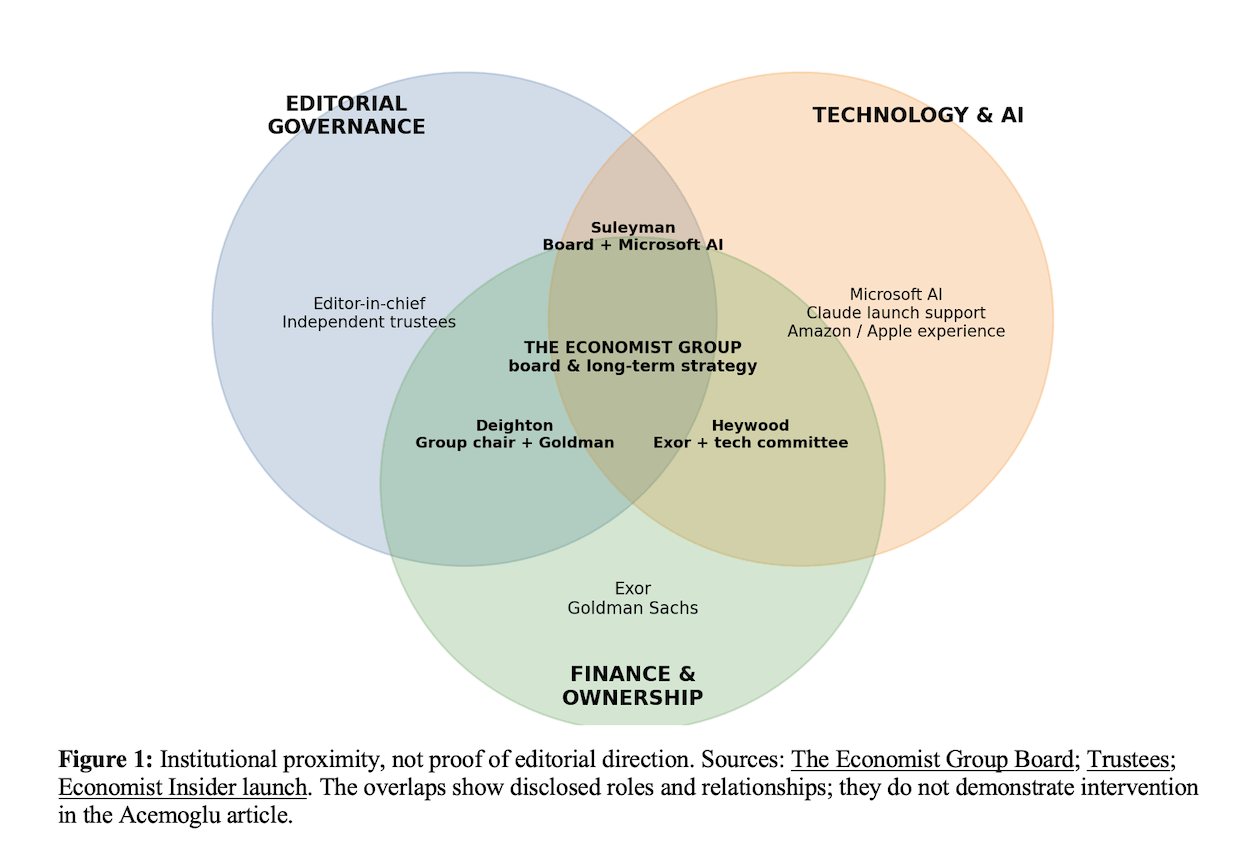
No publicly available evidence establishes that Microsoft, Goldman Sachs, Exor, Anthropic or any board member commissioned, edited or approved the August 2026 attack on Acemoglu. This essay does not allege such intervention. Its narrower claim is that the magazine’s authority should not be confused with a view from nowhere. Formal editorial autonomy can coexist with a governing and commercial ecosystem whose members share exposure to the technologies, financial structures and ownership interests Acemoglu wants democratic politics to discipline.
This institutional proximity becomes more consequential when The Economist moves from analysis to explicit policy advocacy. Only three days after attacking Acemoglu’s critique of concentrated technological power, the magazine published a leader declaring that Britain would be “bonkers to ditch Palantir,” thereby urging the government not to exercise the break clause in Palantir’s £330m NHS data-platform contract. The Palantir leader was unrelated to Anthropic’s sponsorship, and no evidence shows Palantir commissioned or influenced it. Nevertheless, it was an unmistakable editorial intervention in favor of maintaining a major public-sector relationship with a controversial American technology contractor—even after a parliamentary committee had warned of vendor lock-in and described Britain’s dependence on Palantir as an “unacceptable point of weakness.” The juxtaposition is difficult to ignore: The Economist dismisses Acemoglu’s warnings about concentrated technological power as gloomy or obvious while deploying its own institutional voice to defend precisely the kind of state–technology dependency his political economy asks democratic societies to scrutinize.
The Economist asks a fair question about Acemoglu’s demand that “we” steer AI in a pro-human direction. Who exactly constitutes this “we”? Governments can be captured. Regulators may lack technical expertise. Trade unions do not represent everyone. Expert committees can become unaccountable. National regulation may encourage investment to migrate towards more permissive jurisdictions. “Pro-worker AI” is not a self-executing program. But these difficulties do not justify leaving technological direction to the market. Markets do not remove political choice; they transfer decision-making to corporate executives, investors, platform owners and venture capital funds.
The absence of democratic governance is not neutrality. It is private governance. The real question is not whether somebody will steer AI. Somebody already does. The question is whether its direction will be determined exclusively by profitability, labor substitution, data extraction and market domination—or also by public purposes such as better employment, education, health care, scientific discovery and democratic resilience.
A credible pro-human AI agenda would therefore require more than a slogan. It would include competition policy, interoperability, public-interest access to computing infrastructure, public research funding, reform of tax incentives that favor automation, worker participation in workplace deployment, limits on algorithmic surveillance, and transparency in high-stakes automated decisions. Acemoglu’s prescriptions may be incomplete. Incompleteness invites us to develop the program, not to return decision-making to the oligopolies creating the problem.
Meanwhile, no publicly available evidence shows that The Economist’s article was commissioned by a technology company or produced as part of a coordinated campaign. Calling it a purchased attack without evidence would weaken the argument. An article does not need to be literally commissioned, however, to perform an ideological function. Its function is to narrow the boundaries of acceptable reform.
For decades, the liberal establishment was comfortable with institutional economics when it explained the poverty of developing countries through corruption, insecure property rights and authoritarian government. It becomes less comfortable when it applies the same analytical framework to Western capitalism and asks whether concentrated corporate power, weakened labor, regressive taxation, and technological oligopoly are themselves extractive institutions.
Acemoglu’s earlier work could be read as a vindication of the liberal order: inclusive Western institutions generated prosperity, whereas extraction explained stagnation elsewhere. His recent work turns the same lens inward. Formerly inclusive institutions can become extractive as wealth concentrates, labor weakens, shared prosperity recedes, and an increasingly consequential alliance forms among AI corporations, capital, and government. This resembles what I call reverse convergence: instead of drawing authoritarian systems towards Western norms, the West begins sacrificing its own restraints, competitive order and democratic commitments. The discontinuity is difficult to miss. The earlier Acemoglu was welcomed when extraction diagnosed failed states; the newer Acemoglu becomes objectionable when he asks whether the Western establishment is producing it from within.
That is the genuinely uncomfortable Acemoglu. He does not merely warn against Trump, Erdogan, Bolsonaro, or other populist-authoritarian leaders. He asks what failures of liberalism made their ascent possible. He does not excuse attacks on democracy, but he also does not let established elites present themselves as innocent guardians of a system they helped discredit.
His argument deprives the liberal establishment of its preferred moral simplicity: enlightened institutions on one side and irrational populism on the other. Between them lies the political economy of abandoned regions, insecure employment, declining mobility, concentrated wealth and citizens who experience democracy as periodic voting without meaningful influence over the forces shaping their lives.
Reform or Systemic Rupture
Acemoglu’s program may not be radical enough for the anti-capitalist left, yet it remains too interventionist for market liberals. That is precisely why it matters. It attempts to construct a reformist route between neoliberal exhaustion and authoritarian rupture.
The world does not lack warnings about populism. It lacks a political economy capable of removing the conditions from which populism draws its power. Democracy cannot survive indefinitely if its defenders offer citizens constitutional lectures while denying them economic security, social recognition and effective representation. Nor can democracy be protected merely by banning movements that attract disappointed voters. Suppressing political symptoms without addressing the economic and institutional disease risks transforming liberal democracy into rule by enlightened guardians—liberal in vocabulary but increasingly illiberal in practice.
This does not require accepting every demand articulated in the name of “the people.” Majorities can violate minority rights, attack judicial independence and empower authoritarian leaders. As Rodrik and Sharun Mukand emphasize, electoral democracy and liberal democracy are not identical. Political rights, civil rights and property rights rest on different social coalitions and may come into conflict. But defending minority rights and constitutional constraints cannot be permanently separated from material inclusion. Liberal democracy needs social and economic foundations—what Acemoglu calls shared prosperity and what Rawls approached through the fair value of political liberties.
The necessary reform must therefore go beyond ordinary regulation. It must reconsider the relationship between labor and capital, public authority and private power, national democracy and global markets. It must confront oligopoly, tax avoidance, the decline of collective bargaining, the privatization of knowledge, financial fragility and the political power accumulated by technology platforms. It must also recognize that efficiency is not the only criterion by which an economic order should be judged. Resilience, dignity, participation, social cohesion and democratic legitimacy are productive assets even when conventional models struggle to price them.
This does not make every Acemoglu proposition correct. His institutional categories can become too broad. His narratives may perform better retrospectively than predictively. His AI productivity estimate may require substantial revision. His reform agenda needs clearer instruments, stronger political coalitions, and feasible international implementation. These are reasons to debate Acemoglu seriously, not to dismiss or deny his contribution.
The Economist instead alternates between technical objections and rhetorical condescension. It asks why institutions matter if institutions emerge from earlier institutions. Yet all social explanation must begin with inherited structures, historical shocks, and political conflict. It describes pro-worker technology as obvious while economic incentives overwhelmingly favor labor substitution. It criticizes Acemoglu for underestimating technology’s benefits while neglecting his central question: who possesses the power to direct those benefits?
So, Whose Voice Is The Economist Speaking For?
Perhaps the answer is simpler than conspiracy. The Economist appears to want Acemoglu the institutional economist, but not Acemoglu the political economist of concentrated power. It was comfortable with the scholar who explained why poorer countries require better institutions; it is markedly less comfortable with the Nobel laureate who argues that the institutions of rich liberal democracies are themselves being captured and must be reconstructed. The archive therefore suggests that what changed is not simply the quality of Acemoglu’s scholarship, but the direction in which his institutional lens is now pointed.
It wants criticism of authoritarian populism without a complete investigation of the economic order that produced populist demand. It welcomes innovation but resists democratic claims over its direction. It accepts limited regulation while remaining suspicious of any project that would redistribute decision-making power from capital owners, digital platforms and credentialed elites towards workers and communities.
This does not mean that the magazine speaks under instruction from a hidden group of technology billionaires. Its voice is more structural than conspiratorial. It expresses the worldview of a liberal-capitalist establishment that recognizes the excesses of the existing order but remains reluctant to reconsider its distribution of power.
This distinction becomes decisive as the available policies and strategies approach their limits. Monetary policy is trapped between inflation and debt; fiscal policy between social demand and bond-market discipline; industrial policy between national security and retaliatory protectionism; democratic politics between electoral competition and declining governing capacity. We can already feel the breath of the next crisis. The central question is no longer whether the cards will be reshuffled, but who will be permitted to reshuffle them – and who will own the table after the reshuffle.
The defenders of the existing order may accept new leaders, a new regulatory vocabulary and even a redesigned institutional facade. What they resist is a settlement in which the groups that absorbed the old system’s losses gain real power over the new one. Their preferred reform redistributes the cards, but the old owners remain the winners: governments change, technologies change, and the language of policy changes, while command over capital, data, knowledge, and political influence remains substantially intact.
From this perspective, the attack on Acemoglu matters not simply because it targets a Nobel laureate. It attempts to weaken one of the intellectual routes leading public attention from the visible failure of governments to the deeper structures that constrain them. Acemoglu encourages us to ask not only why one government failed, but why successive governments confront the same wall; not only why populists win, but why liberal democracy no longer corrects the grievances on which they feed; and not only whether AI raises productivity, but who will control that productivity and appropriate its gains.
It favors reform, provided it does not become a transfer of power. Acemoglu’s real offense is not pessimism. It is his insistence that technological progress is a political choice, that liberal democracy cannot be separated from shared prosperity, and that markets cannot discipline concentrations of power they have themselves created.
The irony is that Acemoglu is trying to save, not destroy, the liberal order that The Economist historically defended. He warns that unless capitalism is disciplined, technology democratized, and prosperity more broadly shared, the next stage will not be a purer liberalism. It will be deeper oligarchy, more aggressive populism and an expanding authoritarian state.
The global system is running out of conventional policy space. Its monetary, fiscal, geopolitical and technological contradictions can no longer be resolved by indefinitely shifting costs onto workers, taxpayers and future generations. Either liberal democracy develops the capacity to reform the structures producing inequality, insecurity and concentrated power, or a future crisis will reform them through disorder.
One may disagree with Acemoglu’s models, historical interpretations, or remedies. But dismissing his central warnings as gloomy or obvious is not an answer. The essential question is no longer whether the existing order needs reform. It is whether reform can arrive before the next crisis—and whether reshuffling the cards will create a genuinely new settlement or merely reproduce the old winners under a new institutional name.

One Response
This was one of the best short pieces on our state of affairs that I have read in the last couple of years, thank you!!