Ahead of Sweden’s September 13, 2026 election, Associate Professor Anders Hellström argues that the Sweden Democrats’ influence can no longer be measured only by their vote share. Positions once treated as extreme have increasingly become “the default position, the standard,” while nativist rhetoric has become “a kind of ‘common sense.’” He also warns of growing resistance to the consequences of this restrictive turn, especially the expulsion of people deeply rooted in Swedish society, noting that “many Swedes feel that rejudification has gone too far.” For Assoc. Prof. Hellström, the deeper democratic challenge is whether mainstream parties can construct an inclusive national vision without reproducing SD’s exclusionary understanding of belonging, welfare, identity, and Swedishness.
Interview by Selcuk Gultasli
As Sweden heads toward the September 13, 2026 general election, the country faces a political landscape increasingly shaped by the long-term normalization of the Sweden Democrats (SD) and by a broader mainstreaming of restrictive positions on migration, integration, citizenship, and national belonging. Once treated as a stigmatized outsider, SD has become a central actor in Swedish politics and is now deeply embedded in the governing architecture created through the Tidö Agreement. At the same time, the party continues to compete with the Moderates (M) for leadership of the Swedish right, while its core themes have increasingly influenced the language and policy priorities of mainstream parties.
In an interview with the European Center for Populism Studies (ECPS), Associate Professor Anders Hellström, Senior Lecturer in International Migration and Ethnic Relations at Malmö University and affiliated with the Malmö Institute for Studies of Migration, Diversity and Welfare (MIM), argues that the most important transformation may not be SD’s electoral strength alone, but the extent to which ideas once considered politically extreme have become normalized. According to Assoc. Prof. Hellström, positions on immigration that would have been regarded as beyond the mainstream a decade ago have increasingly become “the default position, the standard.”
This development, he suggests, has altered the political balance between stigmatization and accommodation. SD, once able to mobilize as an excluded underdog, has become part of the establishment. Yet mainstream accommodation has not necessarily weakened the party. As Assoc. Prof. Hellström puts it, from the voter’s perspective, “why should we vote for the copy when we have the original?” He also argues that nativist rhetoric has itself become “a kind of ‘common sense,’” reflecting a deeper transformation in the boundaries of legitimate political discourse.
The interview situates these developments within broader struggles over national identity, political myth, welfare chauvinism, and the meaning of Swedishness. Assoc. Prof. Hellström emphasizes the continuing importance of Folkhemmet as a powerful national narrative whose boundaries can be drawn inclusively or exclusively. He also highlights SD’s restorative vision of Sweden, built around nostalgia for an earlier and more homogeneous society.
At the same time, Assoc. Prof. Hellström points to growing resistance against the consequences of increasingly restrictive policies. He notes that many Swedes are uncomfortable with the expulsion of people who were born in Sweden, speak fluent Swedish, and have contributed to Swedish society, concluding that “many Swedes feel that rejudification has gone too far.”
Against the backdrop of the September 13 election, the interview therefore moves beyond the immediate question of who will govern Sweden. It asks whether the deeper transformation lies in SD entering government—or in the extent to which the political mainstream itself has already been reshaped by SD’s language, assumptions, and conception of national belonging. As Assoc. Prof. Hellström observes, “the Sweden Democrats have already won” in one important sense: Sweden’s major parties now broadly accept the need for a highly restrictive immigration policy.
Here is our interview with Associate Professor Anders Hellström, edited lightly to enhance clarity, readability, and overall flow for publication.
The SD’s Views on Immigration Policy Have Become the Default Position
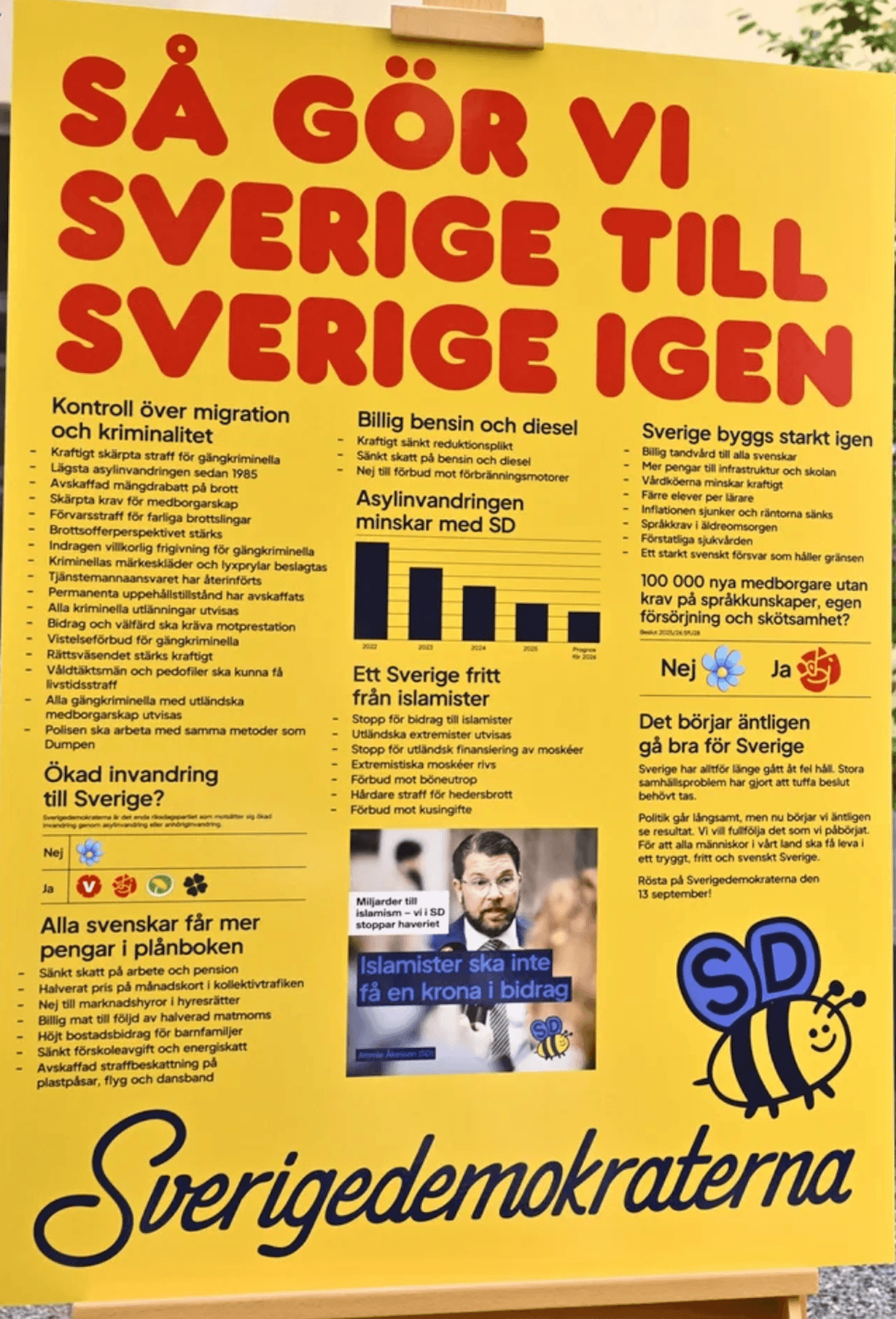
Professor Hellström, welcome! Just days before the September 13 election, the Sweden Democrats remain close to 20 percent and are again competing with—or polling ahead of—the Moderates for leadership of the Swedish right. More than a decade ago, you described SD as the stigmatized “beast” of Swedish politics, excluded by mainstream parties but able to mobilize precisely through that exclusion. Today, SD is deeply embedded in the Tidö governing arrangement. Does this election mark the completion of SD’s journey from stigmatized outsider to normalized pillar of the Swedish party system, or does some element of its outsider status remain politically indispensable to its appeal?
Assoc. Prof. Anders Hellström: Yes and no. There is a concept we might call the mainstreaming of previously extreme positions. Ten years ago, derogatory statements about immigration and immigrants were regarded as extreme. The Sweden Democrats (SD) said things that the mainstream parties did not. Today, however, SD does not even have to say very much, because other parties—and their leaders—are themselves using very hostile language when talking about immigration and immigrants. They argue that Sweden needs a very restrictive immigration policy, and so forth.
So, what was depicted as extreme 10 years ago has become mainstream today. But you can also talk about a third stage. From the beginning, the Sweden Democrats were regarded as too extreme. Then they came to be seen as more radical challengers of the establishment: you could vote for the Sweden Democrats because they wanted to challenge the government and the establishment. But now something very interesting has happened. The Sweden Democrats have themselves become part of the establishment.
All the other parties are also saying insane things. Of course, the Sweden Democrats are still a little more extreme. But they are no longer seen as the underdog, because their views on immigration policy have become the default position, the standard.
Therefore, of course, I do not know what will happen in the election or how big they will become, but there is a feeling in society that many Swedes think developments toward rejudification have gone too far. Why do we expel people who were actually born in Sweden, who earn a lot of money, who speak fluent Swedish, and send them back to countries where perhaps their grandfather came from, even though they themselves have never been there? Why do you expel people who have done nothing wrong? So there is a tendency for many Swedes to feel that rejudification has gone too far.
‘The Beast’ Has Been Tamed
In “Feeding the Beast,” you and Peter Hervik challenged the idea that anti-immigration sentiment simply accumulates beneath an elite-imposed consensus until it eventually erupts. Instead, you argued that nativist rhetoric itself can make immigration anxieties more salient and thereby nourish radical-right support. Looking at Sweden in 2026, where restrictive migration rhetoric is now common across much of the mainstream, has the political system effectively “fed the beast” by adopting the language and problem definitions that originally distinguished SD?
Assoc. Prof. Anders Hellström: Yes. When we wrote this article, the Sweden Democrats were actually the beast. They were seen as something that should not be part of the establishment—something the cat had dragged in. But now, the beast has been tamed, so it has become, as I said before, something default, something standard. I would say that nativist rhetoric has become a kind of “common sense.”
Why Should We Vote for the Copy When We Have the Original?
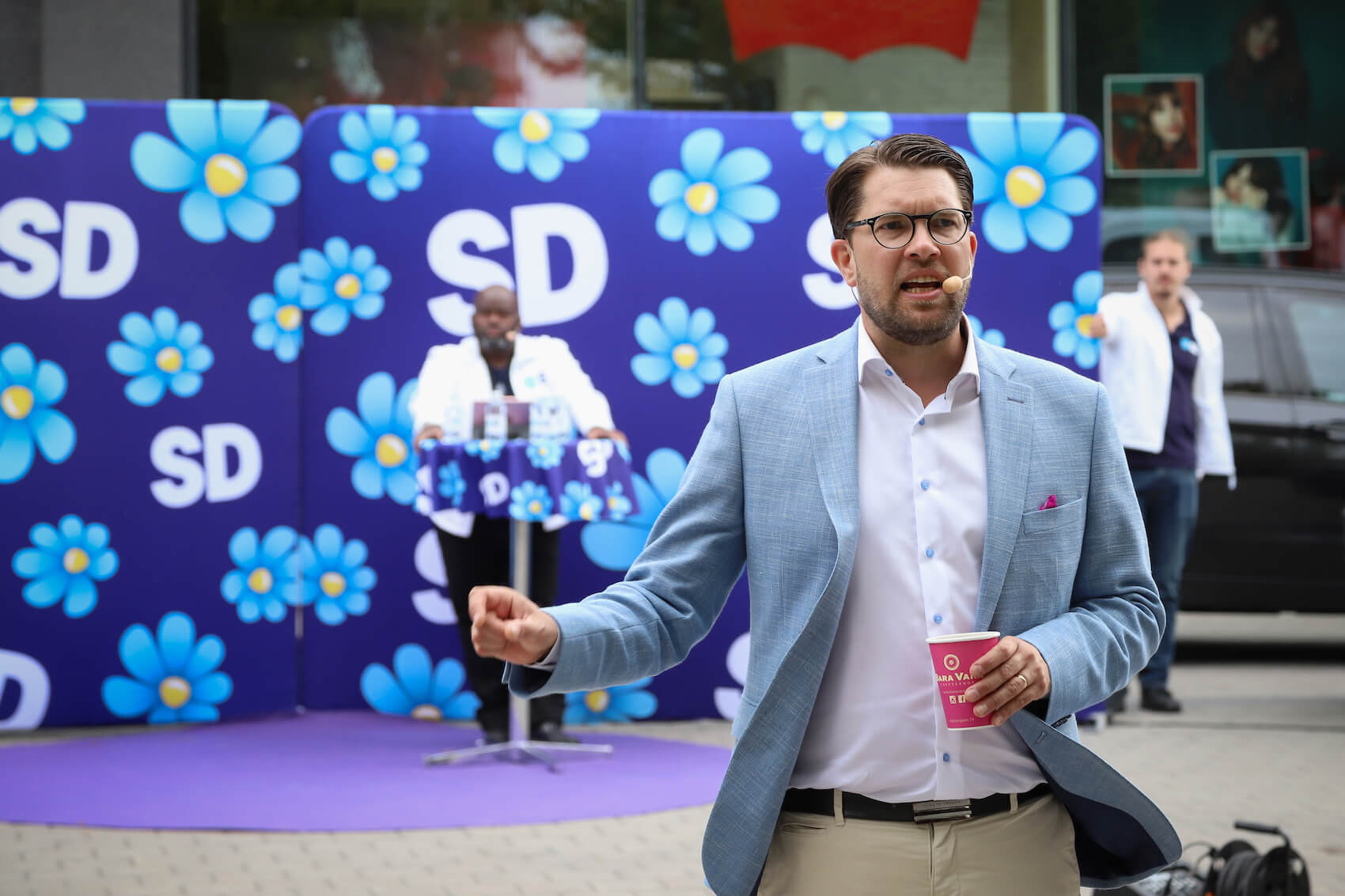
The Moderates (M), Christian Democrats (KD), and Liberals (L) have progressively abandoned the cordon sanitaire around SD, while migration, crime, citizenship, and integration policies have moved markedly in a restrictive direction. Mainstream parties often justified this shift as a strategy for neutralizing SD by responding to voter concerns. Yet SD remains close to one-fifth of the electorate. Does this suggest a fundamental failure of the accommodation strategy—that mainstream parties can adopt radical-right policies without recovering the voters who originally demanded them?
Assoc. Prof. Anders Hellström: Yes, I would say so, because from the voter’s perspective, you vote for the original, not the copy. So it doesn’t matter if the Moderates and the other parties are becoming more friendly toward SD or if they no longer see SD as a beast. Rather the opposite: they have understood the truth. Then voters say, “Okay, why should we vote for the copy when we have the original?” Therefore, this has actually strengthened their momentum, because, from the voter’s perspective, why should they vote for the copies?
The Stigma—That Tool for Mobilization—Is Gone
Your earlier work showed how the stigma attached to SD could paradoxically be politically productive because the party could portray itself and its voters as unfairly excluded from the legitimate political community. Now that institutional exclusion has largely disappeared, has SD lost an important mobilizational resource? Or has the party successfully transferred the old stigma from itself onto other antagonists—immigrants, Muslims, “liberal elites,” the media, or supranational institutions?
Assoc. Prof. Anders Hellström: It has lost that because there is a potential advantage in being a radical underdog. That can also be attractive to voters—you want to vote for the newcomer. But now, that stigma—that tool for mobilization—is gone. So it is good to be radical, but not to be seen as too extreme. You want to be close to the sum of equations, so to speak.
But now people are saying that maybe they have got too much power. And there may be, as I said, reactions against too many restrictions. But, of course, I don’t know that. Maybe there are a lot of people. We will see. It could be very interesting to see the election results on Sunday. There is a fraction of the Swedish population who actually like the policies that have been suggested by SD, but I don’t know how large that fraction is.
They Want to “Bring Sweden Back”
Your work on Nordic populist radical-right parties shows that the Sweden Democrats have been particularly active in constructing national myths around a lost “golden age” of ethnic homogeneity and social cohesion. How important is this nostalgic structure to SD’s appeal in the 2026 election? Is the party fundamentally mobilizing voters against immigration, or is immigration functioning as a symbol of a broader narrative that Sweden has lost something culturally, socially, and politically valuable?
Assoc. Prof. Anders Hellström: One thing that is important to understand is that SD does not want to create a new niche or anything like that. They want to restore Sweden. They want to bring Sweden back—to make Sweden great again, as Donald Trump says. For them, Sweden was great in the 1950s and 1960s, before the official adoption of multiculturalism in 1997 and before refugee migration.
For instance, an interesting fact is that in 1960, 4% of the Swedish population were foreign-born. Now, the figure is at least 20%. So this kind of demographic shift has created fissures in the population. This strategic appeal resonates with voters because they want to return to the period when they and their parents were young. They remember their childhood as a time when things were easier and society was more homogeneous. That is a fact: Sweden has become more diverse, and some people in the electorate dislike that demographic shift.
The Folkhemmet Has Always Had Both Inclusive and Exclusive Features
You have shown that SD has been unusually successful in appropriating the historical language of the Folkhemmetand linking the Social Democratic welfare-state tradition to a culturally bounded conception of national belonging. Has this appropriation altered the very meaning of the Swedish welfare state—from a universalist social project toward something increasingly conditional on national, cultural, or civilizational belonging?
Assoc. Prof. Anders Hellström: That is, of course, hard to tell. But if you have to remember one thing about the Folkhemmet, it is that it is a myth used strategically by political actors, but it is also a narrative of what Sweden is. Folkhemmet conveys the idea of Sweden as a people’s home. It is deeply embedded in many people’s minds, and the people’s home has always had both inclusive and exclusive features.
So, we welcome everyone—yes, everybody can become Swedish—but there have always been boundaries defining those who are not part of the people. Whether the people’s home becomes more inclusive or more exclusive depends, for instance, on which parties hold power. But the people’s home remains a major historical narrative that binds Swedes together. And it can be both inclusive and exclusive.
Who Actually Has the Right to Welfare Resources?
The concept of ‘welfare chauvinism’ captures the combination of social protection for insiders with exclusion or conditionality for outsiders. As migration politics has moved into the mainstream, do you see welfare chauvinism itself becoming normalized in Sweden—not merely as an SD position, but as an increasingly accepted way of defining solidarity and deservingness across the party system?
Assoc. Prof. Anders Hellström: Welfare chauvinism says that we want to have welfare. But for whom do we want welfare? Welfare for our people. It is the idea that you combine an active welfare state with social cohesion or cultural conformity. That also means having an idea of who is included among “the people.” Are immigrants included, or is it only for native Swedes? Who actually has the right to welfare resources?
And again, what will happen in the future depends very much on who actually leads the country. There are parties and movements representing both regressive and progressive forces in society and within the party-political structure as well. So there is a struggle right now, and I do not know exactly which direction Sweden will take.
For the SD A Muslim Can Never Truly Be Swedish

In your work on racism as a political activity, you emphasize that political struggles concern not only whether racism exists but also who gets defined as victim and perpetrator. You identify victim–perpetrator reversal as an important feature of far-right discourse. How significant is the growing rhetoric of ‘svenskfientlighet’ —hostility toward Swedes—in this transformation of Swedish political language? Does it allow majority-group grievance to be recoded as victimhood while simultaneously making structural inequalities affecting minorities more difficult to articulate?
Assoc. Prof. Anders Hellström: Yes, exactly. The victim-perpetrator reversal concerns the question of who the immigrant is. Is he or she a victim, or is he or she actually a perpetrator who threatens our Swedish values and can never become like us? This rhetoric—who is the victim and who is the perpetrator?—can also be applied, for instance, to the Israel-Palestine conflict. Who is the perpetrator, and who is the victim? That makes it important to look at the ideological motives behind such statements. According to the actor, who is the perpetrator and who is the victim? That can actually shift.
For instance, something I am looking at right now is the discussion about whether it is possible to be both Muslim and Swedish. For the Sweden Democrats, you have to make a choice between being a Muslim believer and being a Swede. You have to let go of one of those two identities. For them, a Muslim can never truly be Swedish. Or he or she can, but only by first letting go of the Islamic identity.
The SD Is No Longer Stigmatized
One of the puzzles running through your earlier research was that SD could expand despite overwhelmingly negative treatment from mainstream political and media actors. Your work on the “politics of shame” suggests that stigmatization may help create counterpublic identities in which supporters experience themselves as silenced, morally condemned, or excluded. Has Swedish democracy underestimated the political power of this counterpublic dynamic—particularly the way perceived exclusion can strengthen identification with populist radical-right movements?
Assoc. Prof. Anders Hellström: Yes, in the politics of shame, it is about how stigmatization can be used to create a shared identity. We have been stigmatized together, so we have something in common. They are evil, and we are the good guys. We come together, and that can trigger or stimulate a sense of in-group mobilization. But, as I said before, when SD is seen as part of the establishment, it loses that capacity. The party is no longer stigmatized. Increasingly, the risk SD faces is that it becomes associated with old news.
Liberal Democrats Need to Mobilize People Around a Common Vision
If condemnation and exclusion can reinforce populist counterpublics, but accommodation can normalize their worldview, mainstream democratic parties appear trapped between two strategies that can both strengthen the radical right. Is there a genuine democratic alternative between stigmatization and accommodation ? What would an effective strategy toward SD look like if the objective is neither moral ostracism nor ideological imitation?
Assoc. Prof. Anders Hellström: You’re right: there is probably no single correct answer. But what you can do is focus on your own liberal-democratic institutions and build up their resilience. You also need to articulate clear visions—visions that can bring people together. Perhaps you can focus on other issues around which people can unite, such as fighting climate change, or something else that can mobilize people around a common purpose.
And when it comes to immigration, one-fifth of the Swedish population are immigrants. That is a reality. It is too late to say that immigrants should go home. Instead, you need to mobilize people around a common vision and be secure and confident in your own institutions.
Of course, you can disagree with someone and not share their views, but that does not mean you need to kill or beat them. At least you can talk. It is perfectly legitimate to have different opinions. The key is not to eliminate conflict, because conflict is natural and is part of politics. If you combine that recognition with the understanding that not everyone needs to agree with you, then you can be clear about your own vision—and create a vision that includes more people.
Democracy Necessitates Both Majority Rule and Minority Protection
Sweden continues to rank as a strong liberal democracy, yet democratic resilience is not only about the survival of elections and institutions. It also concerns the boundaries of legitimate political discourse, minority protection, pluralism, and social trust. Should we therefore understand the normalization of nativist language as a form of democratic erosion even when formal institutions remain stable? Or would that stretch the concept of democratic backsliding too far?
Assoc. Prof. Anders Hellström: If you look at what democracy is, Jonathan Bouffe wrote about the democratic paradox. Democracy is a paradox because it involves both majority rule and the protection of minorities. There is always a tension between the two; it is a compromise. There is no final, perfect solution. It is a balance that needs to be discussed continuously. You cannot simply say, “This is the perfect solution; this is how we do it.” That is why we have different people with different opinions.
Regarding your question, yes, problems can arise if you have a democracy that protects only the majority and disregards minorities. That creates a risk of sliding toward a more authoritarian state. You can end up with an illiberal democracy. But in order to have a liberal democracy, you need both majority rule and minority protection.
Sweden Was a Role Model for Integration Policy

The success of SD has often been explained through failures in immigration policy, integration, crime prevention, or political responsiveness. But could the deeper failure of mainstream parties be representational rather than policy-specific—their inability to articulate a persuasive account of national belonging that acknowledges insecurity and social change without translating them into an exclusionary distinction between a virtuous native “people” and threatening outsiders?
Assoc. Prof. Anders Hellström: In a way, it is very interesting that you raised that, because what actually triggered my interest in the Sweden Democrats in the first place, a long time ago when I started, was a big paradox. Everyone, from the left to the right, was talking about the failure of integration. Then I looked at the Migrant Integration Policy Index (MIPEX), and according to it, Sweden was the best in class. So Sweden was a role model for integration policy, while everyone on the street was talking about the failure of integration.
This paradox interested me. If you have this mantra of the failure of integration—and I am not saying that integration has been super successful—I am saying that if you have a population with more than 20% immigrants, of course, you can find examples of very successful integration, and you can also find examples of very poor integration. Because there are so many people, you can find many examples, depending on what you are looking for.
If you have this mantra, it has actually been very good news for the Sweden Democrats, because they can say, “We have an answer to that problem.” And for them, it is like: “don’t let them come here, and for those who do come, give them money so they can leave the country. And we don’t want to spend any money on integration.” But they have a recipe, while all the other parties, or most of the other parties, are talking about how integration has been so bad, so horrible, and that we have to do something. From the voter’s perspective, do you vote for someone who can say, “Okay, we have a solution”? Because everyone agrees that there is a problem.
Apart from that, you can also mention that it is very common in the debate to say that nobody wants to return to 2015, when you had the big reception crisis. I actually wrote a report on that period, and I concluded that it was a window of opportunity for both progressive and regressive forces in society. Yes, it created enormous pressure on municipalities. At the same time, you had a period when people opened their homes, there were language cafés, and there were very strong forces in civil society and in the Swedish Church. Everybody was saying, “Let’s fight together; we want to help the refugees.”
So there you have this tendency: both progressive and regressive forces. It is important to remember that. And when it comes to integration, you have examples of very good integration and also very poor integration. You can have both.
Politics Also Needs Stories
In your scholarship, political myths do not simply falsify history; they provide narratives through which communities establish continuity, belonging, and moral meaning. SD has been particularly effective at constructing a story in which contemporary Sweden represents a fall from an earlier, more cohesive national community. Why have mainstream parties been so much less effective at producing an alternative national narrative capable of combining diversity with social solidarity and a credible sense of collective continuity?
Assoc. Prof. Anders Hellström: That’s a very good question. From my perspective, you need to appreciate the storytelling dimension of representative politics. There is nothing wrong with telling stories that bind people together. In that sense, populism can be seen as a protest against politics as usual. It offers something beyond pragmatism—also a sense of redemption. It says: come together and find this emancipatory glue that can bind us together.
I think the answer—the key to addressing this—is not to reduce politics to technocratic means, because that becomes too rational. Politics also needs stories. For instance, you can tell a story about diversity: Sweden has become a much more exciting country to live in than it was 50 years ago. It is much more interesting, I would say, also from an outsider’s perspective. Yes, it is more exciting these days.
The SD Radicalizes Mainstream Popular Concerns
One of your articles distinguishes different strands within far-right ideology and argues that racism should be understood as a struggle over meaning rather than simply as an individual prejudice. As SD has professionalized and moderated parts of its public language, should scholars pay less attention to explicit racist statements and more attention to the underlying political work performed by categories such as culture, civilization, integration, national values, and “Swedishness”?
Assoc. Prof. Anders Hellström: That is one common distinction between the extreme and the radical. The thing is, if you look at the Sweden Democrats, they no longer use that language—that race-revolutionary language. Maybe they did in the late 1980s and early 1990s. They want to appear like the common man.
And their opponents normally make a mistake. They look at them and say, “No, don’t vote for SD.” Why? Or they portray them as very bad people, as evil guys. But the thing is, the Sweden Democrats do not use this kind of explicit racist rhetoric.
Instead, you can say that they radicalize mainstream popular concerns. And you can say that they rely on an identitarian logic—the logic of difference. It is like: “One people belongs to one country. Yes, those people are very nice, but they should not be here in Sweden. I don’t have anything against you, but you are not welcome in Sweden. It’s only for the Swedes. And the Swedish people are based on an ethnically homogeneous community.”
Politics Is Not Only About Distribution; It Is Also About Identity
The September 13 election appears increasingly structured not simply by a conventional left–right cleavage but by competing understandings of nation, migration, identity, and political community. Are we witnessing a durable transformation of Sweden’s cleavage structure in which the central conflict is becoming less about redistribution and more about who belongs to the nation, who deserves solidarity, and whose version of Swedishness is politically legitimate?
Assoc. Prof. Anders Hellström: I would say that it’s not an either-or question. Questions of distribution are important, and so are questions about identity and other issues. More and more, these have become political issues, so political cleavages are no longer only between the left and the right, but also between good and evil, or some kind of moralization of politics. So, these kinds of identity-related issues matter. But it doesn’t mean that redistribution does not matter. It only says that politics is not only about distribution; it is also about identity.
The Sweden Democrats Have Already Won
And lastly, Professor Hellström, looking beyond the immediate question of who governs after September 13, what would you regard as the more consequential long-term outcome: that SD formally enters government, or that its nativist conception of nationhood becomes sufficiently normalized that the distinction between the Sweden Democrats and the democratic mainstream becomes progressively harder to identify? In other words, is the deeper test of Swedish democratic resilience about keeping the radical right out of office, or about preventing the political mainstream itself from being transformed in its image?
Assoc. Prof. Anders Hellström: The thing is, we don’t know that yet. But both the current Prime Minister and the leader of the largest opposition party (Social Democrats) are talking about the need for a very restrictive immigration policy. So, from that perspective, the Sweden Democrats have already won. The biggest parties—the mainstream parties—agree that Sweden needs a very restrictive immigration policy.
But I can only say that there is considerable resistance to this. People are not very comfortable with it, especially when people who were actually born in Sweden, who may be well known, speak fluent Swedish, and have contributed a great deal to Swedish society are expelled from the country. A lot of Swedish people dislike that development.
What will happen in the future, we don’t know. We can only hope for the best. And it is important to acknowledge the storytelling dimension of representative politics and to build a vision that people can share and believe in.