Photo: Shutterstock.

Rising discontent with the EU, the Rise of the Right and the 2024 European Parliament Elections in Cyprus

Please cite as:
Theophanous, Andreas & Varda, Mary. (2024). “Rising discontent with the EU, the Rise of the Right and the 2024 European Parliament Elections in Cyprus.” In: 2024 EP Elections under the Shadow of Rising Populism. (eds). Gilles Ivaldi and Emilia Zankina. European Center for Populism Studies (ECPS. October 22, 2024.https://doi.org/10.55271/rp0065


DOWNLOAD REPORT ON CYPRUS

Abstract

The objective of this chapter is to discuss the causes of rising discontent in Cyprus and assess the political outcomes. Within this framework we briefly assess how the EU has dealt with various crises in the last few years. Perceptions in Cyprus about the EU have changed over time. In the 9 June European elections, a member of the extreme right-wing party, National People’s Front (Ethniko Laiko Metopo, ELAM), was elected for the first time to the European Parliament. Understanding the circumstances in Cyprus that have gradually led to disillusionment with the national political system and the EU is essential to making sense of these developments.

Keywords: Cyprus; extreme right; economic crisis; voter disillusionment; European elections


By Andreas Theophanous(Department of Politics and Governance, University of Nicosia, Cyprus Center for European and International Affairs, Cyprus) & Mary Varda** (Cyprus Center for European and International Affairs, University of Nicosia, Cyprus)

Introduction

Undoubtedly, the EU currently faces multiple challenges. In addition to Euroscepticism, we are also faced with populism, which at times may lead to dangerous outcomes (Katsambekis, 2014). Yet, despite much criticism on multiple themes, the EU remains one of, if not the most desirable places in the world to live. The objective of this chapter is to discuss the causes of rising discontent in Cyprus and the political outcomes. Within this framework we briefly refer to how the EU dealt with some of the crises in the last few years.

Perceptions of the EU in Cyprus have changed over time. It is essential to understand the circumstances in this island state that have gradually led to disillusionment with the Cypriot political system and the EU. This disillusionment is one of the reasons that has led to the rise of populist trends across all Cypriot parties. Through recourse to populism, parties across the political spectrum have attempted to get closer to voters. For the purposes of this chapter, we will be focusing essentially on the case of rising right-wing rhetoric.

When Cyprus applied for membership in the EU on 4 July 1990, there were very high expectations. The principal perception was that the EU institutions and value system would eventually contribute to the termination of the occupation of the northern part of Cyprus and to a just solution to the problem. At the same time, there were high expectations regarding socioeconomic modernization and a new era. According to polls taken during the accession negotiations, Cyprus had the most favourable attitude towards the EU.

Eventually, these perceptions gradually changed, with the initial optimism fading (Katsourides, 2014). Indeed, retrospectively, Cypriots now view their initial perceptions as illusions. There were some specific issues which led to these changes. During the negotiations to resolve the Cyprus problem, which coincided with the period leading to accession, pressures were exerted on the Greek Cypriot side by the United Nations (UN), the United States and the United Kingdom, the former colonial power on the island. The EU more or less followed their lead. When Professor Shlomo Avineri of the University of Jerusalem and Ex-Director General of the Ministry of Foreign Affairs of Israel read the UN’s Annan Plan, he noted that it amounted to ‘the favourite occupation of the EU and the UN’ (Avineri, 2004). Yet, the Greek Cypriots were demonized for rejecting this plan.

It is instructive to compare and contrast the EU stance towards Russia and Turkey. Although by definition each case is unique, there are also some common characteristics. In both cases, there have been violations of international law. When Russia invaded Ukraine on 24 February 2022, there was a strong reaction on the part of the West. As Theophanous (2023: 205) notes: ‘The response of the EU was firm and punitive’. Russia soon became the most sanctioned country in the world, while Ukraine has received massive economic and military aid. ‘In the case of Cyprus, however’, Theophanous further reminds us, ‘Turkey has been tolerated and accommodated. This is because Russia is considered a foe, while Turkey is perceived as a strategic partner’ (Ibid.).

In the case of Cyprus, the West (including the EU) has more or less adjusted to the fait accompli created by Turkey’s occupation of 37% of the territory of Cyprus. The West (including the EU) tolerates this occupation and its entailing colonization and Islamization, the usurpation of Greek Cypriot properties in the north, as well as its systematic violations of the Cypriot exclusive economic zone (EEZ) by Turkey. In addition, the EU has not made economic aid to the Turkish Cypriots conditional, which would incentivize co-operation. Understandably, Greek Cypriots are not pleased with these policies and practices. As a result, the way the EU is perceived has changed in the eyes of most Cypriots.

When Cyprus faced a significant economic crisis in 2013, the EU’s treatment was rather punitive and irrational. There is no doubt that there was a need for a major restructuring of the Cypriot economy. However, the way it was promoted unnecessarily entailed a huge socioeconomic cost.

These developments, coupled with the ongoing economic turmoil caused by rising inflation, have made Cypriot voters susceptible to populist rhetoric. These conditions made the far-right and anti-systemic rhetoric of the National People’s Front (Ethniko Laiko Metopo, ELAM) appear as a viable way out of the crises for some voters. Others turn to ELAM as a form of protest against the current political system (Knews Kathimerini, 2023). This is demonstrated through ELAM’s electoral success at the 2024 European elections, where the party, which was founded in 2008, managed to secure its first seat in the European Parliament.

The historical context of right-wing politics in Cyprus

Right-wing politics in Cyprus has a long and complex history, deeply intertwined with the island’s political and social developments (Charalambous, 2018). The roots of right-wing ideology can be traced back to the early twentieth century, during the struggle against British colonial rule and the pursuit of enosis (union with Greece). This period saw the rise of nationalist sentiments and the establishment of right-wing political organizations such as the National Organization of Cypriot Fighters (EOKA), which played a significant role in the anti-colonial movement and Cyprus’ subsequent independence from Britain in 1960.

Following independence, right-wing politics continued to be influential. This trend persisted after the Turkish invasion of 1974 as well. In 1976 the Democratic Rally (DISY) was founded and gradually emerged as a major political force. It has long advocated a market-oriented economy, closer ties with the West and a pragmatic stance on the Cyprus issue. Over time, however, the political landscape began to shift, particularly in the wake of the 2008 global financial crisis and the Eurozone crisis that followed. These economic challenges, which entailed high unemployment rates, austerity measures and corruption, fuelled public discontent and created fertile ground for the resurgence of far-right rhetoric (Katsourides, 2014).

Most Cypriots believe that the EU did not treat Cyprus rationally and with solidarity when the country found itself in a difficult economic condition in 2013. The Cypriot economic crisis had both endogenous and exogenous causes. Cyprus’ treatment by the Troika – the European Commission, the European Central Bank (ECB) and the International Monetary Fund (IMF) – was harsh and punitive. Several politicians and analysts indicated that Cyprus was used as a guinea pig (Žižek, 2014). Many Cypriots feel that it is doubtful whether the Troika would have treated a Catholic or a Protestant country in the same way as Cyprus and Greece were treated. In the process the Cypriot banking system was in essence destroyed. Currently, the banking system essentially belongs to foreign capital. Furthermore, the cost of services has increased while quality has declined. Cyprus Airways closed down, with foreign carriers taking over its routes. Inequality grew and the Cypriot economic structure changed. Despite the Troika, Cyprus recovered, albeit at a high socioeconomic cost (Theophanous, 2018). Cypriots also feel that the EU is currently not exhibiting adequate solidarity in relation to the immigration crisis. Cyprus is the top EU country in terms of per capita asylum applications.

Inevitably, these issues have led to Euroscepticism and discontent concerning the EU. At the same time, critics feel that the mainstream political parties have not successfully addressed the significant challenges Cyprus faces. Discontent with the Cypriot political system has been growing, given that there have been serious incidents of corruption on several occasions, and the country has failed to cope successfully with multiple challenges.

Considering all these factors, it is hardly surprising that voter turnout has declined as more and more Cypriots disengage from politics. At the same time, according to polls and actual election results, ELAM’s public support has been growing. It could be said that many of those who support it are expressing a protest on the one hand and a warning on the other. These voters are part of a broader trend of far-right populism gaining traction across Europe, driven by economic insecurities, cultural anxieties and disillusionment with mainstream politics. Despite its radical positions, ELAM has managed to integrate into the political mainstream to some extent, collaborating with other parties on specific issues while maintaining its distinct far-right identity. For example, Annita Demetriou (DISY), the president of Cyprus’ parliament, was elected thanks to the votes of the MPs of ELAM and another small centrist party, Democratic Alignment (DiPa), who voted with her party. The historical presence of right-wing politics in Cyprus and the contemporary rise of ELAM illustrate the dynamic and evolving nature of political ideologies on the island, shaped by historical legacies and current sociopolitical challenges.

The political context of the 2024 European Parliament elections

When a country faces occupation, existential issues, difficult socioeconomic conditions, corruption, high immigration flows and identity issues and the political system cannot respond adequately, extreme tendencies at some point become inevitable. Even before the European parliamentary election results were announced, there was a widespread belief that the political system required much improvement. Thus, the rise of right-wing rhetoric, especially in the case of Cyprus, did not come as a surprise, and its representation in the European Parliament was expected.

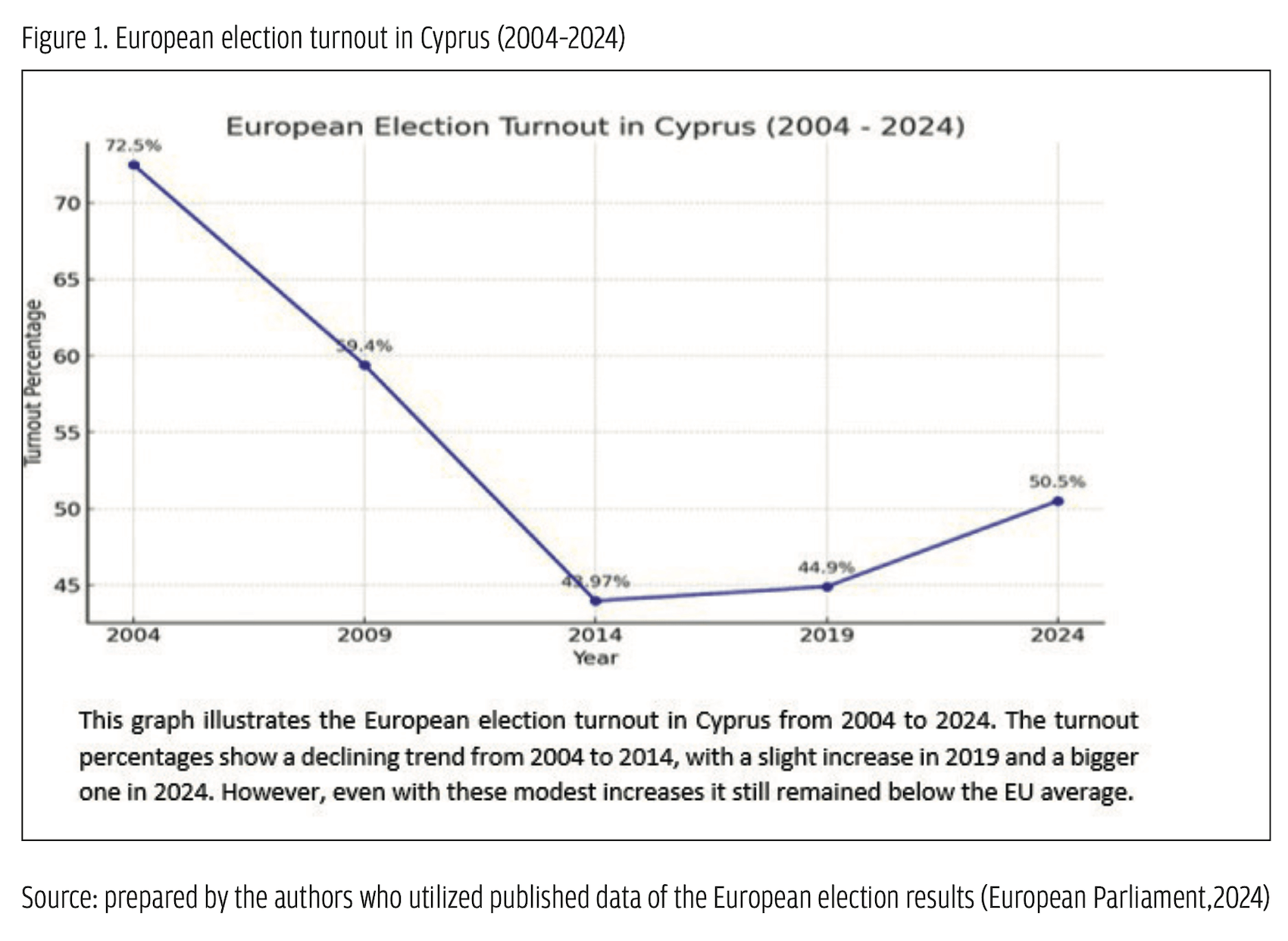
Furthermore, even though two elections were held concurrently on 9 June 2024 – for the European Parliament and local government – the voter turnout was dismally low at 50.5% (Philenews, 2024). The low turnout rates indicate the disillusionment of the Cypriot electorate towards both national and European politics. It is worth noting that the Cypriot electorate has never demonstrated particularly high levels of engagement with European politics, which has fallen even lower since the Eurozone crisis in 2013 (see Figure 1). As mentioned earlier, its significant social impact on Cyprus seemed to alter citizens’ views towards the EU during this period (Katsourides, 2013).
In recent years, voters have repeatedly warned the political system in various ways, but the response has not been satisfactory. As mentioned earlier, the EU’s stance on several issues has been inadequate, requiring member states to pick up the slack in many instances, such as on the issue of asylum seekers. Even before the 2024 elections, the political system and the three major political parties – DISY, the Democratic Party (DIKO) and the Progressive Party of Working People (AKEL) – faced crisis and our brief overview shows there were already plenty of warning signs (Theophanous, 2024a; Theophanous, 2024b; Theophanous, 2024c). Citizens also gave politicians many warnings and opportunities to change course. Because they did not see any real change, their messages were much stronger at the 9 June elections. It would not be an exaggeration to describe the results (the election of an extreme right-wing candidate and an independent candidate with no prior political experience) as a political earthquake.

It should be noted that, firstly, during the European election campaign, there was not much discussion on the challenges facing the EU or the candidates’ positions. Most notably, Fidias Panayiotou, the independent candidate with no background in politics or social issues, made it clear in his pre-election campaign that he had yet to formulate any political opinions on matters such as the Cyprus question or the role of the EU. Nor was there any discussion of the role of Cyprus in the European project (Theophanous, 2024e). Secondly, a vital objective of the local government reform preceding the June elections was to reduce the cost of running it. However, fears have already been expressed that there will probably be an increase in costs. This has further deepened the grievances of the Cypriot electorate with the current political system and the parties responsible for this reform. The disillusionment of the electorate and their preference for ‘apolitical politics’ was also evident in the latest presidential elections in Cyprus, where the incumbent president, Nikos Christodoulides, won even though he focused more on his public image than on policies to address fundamental issues. This strategy proved highly successful as it enabled him to stand apart from the established political parties of the island, which Cypriot citizens have long accused of corruption (Triga et al., 2023).

The results of the 2024 European elections

It is also important to assess the election results, even if only briefly, concerning the performance of the political parties. A brief introduction of the main political parties of Cyprus – DISY, DIKO and AKEL – is thus necessary. DISY is a Christian Democratic party with a liberal–conservative ideology, while DIKO is a nationalist–centrist political party, and AKEL is Cyprus’ communist party.

In June, DISY recorded its lowest percentage vote share ever (24.8%). Despite the decline in support, it was the party that paid the smallest price. Furthermore, while it may not have had satisfactory results in the local government elections, retaining the two seats in the European Parliament was a tremendous boon.
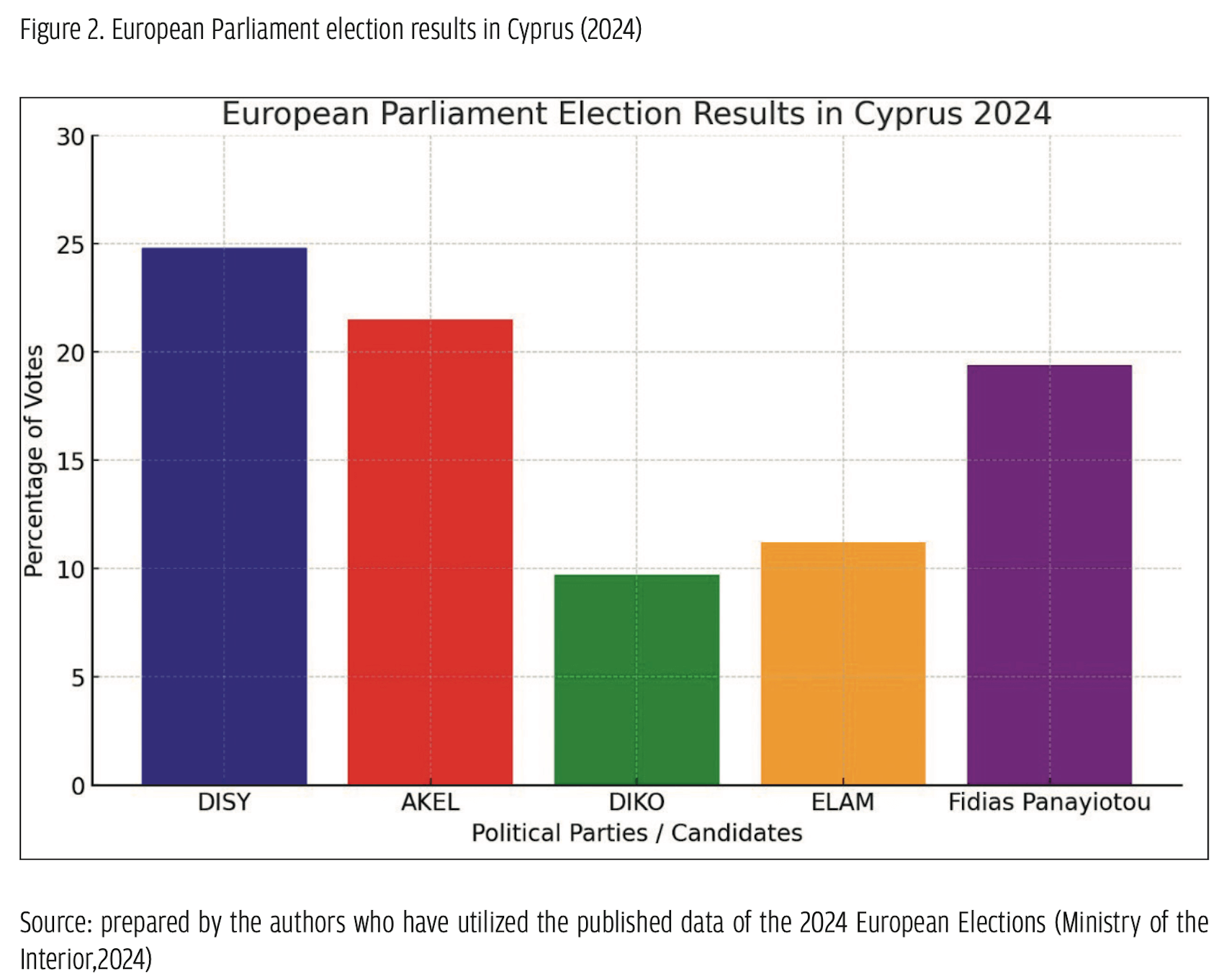
After losing three presidential elections and considering the difficult socioeconomic conditions, one would have expected AKEL to recover and present itself as a leading force. This did not happen. Despite the relatively positive performance in the local government elections, the result for the European elections (21.5%) and the loss of one seat constitute a major defeat for the party. Obviously, the causes of this result run deeper than the election campaign. AKEL’s leadership should, among other things, ask itself why citizens expressed their disdain for the current state of political affairs by supporting a candidate without a political background and concrete policy proposals, among other candidates, rather than the largest opposition party.

Inevitably, its showing (9.7% of the vote) was also a defeat for DIKO, even though it retained its seat in the European Parliament. The fact that the party’s share fell below 10% while ELAM surpassed it contains both substantive and symbolic messages. We should recall that one of DIKO’s campaign slogans was ‘vote DIKO for effective governance’. Obviously, the electorate did not respond. Nor is it a coincidence that the other two parties that supported President Nicos Christodoulides also saw their electoral strength decline.

During the election campaign, one of the top priorities of almost all parties was the need to contain ELAM. Nevertheless, ELAM continued to grow, securing a double-digit share of the vote (11.2%), surpassing DIKO and securing one EP seat. The political system should also ask itself what would have happened to ELAM’s percentage if not for the candidacy of the independent, Fidias Panayiotou, who gained 19.4% of the votes.

One of the most important advantages of ELAM is its ability to resonate strongly with younger voters, something the traditional parties have been struggling to do. Indeed, ELAM’s voter base is disproportionately made up of young male voters (Knews Kathimerini, 2023). ELAM’s strength, much like Fidias Panayiotou’s, came from its ability to mobilize younger voters who failed to show up in large numbers in previous elections. However, unlike ELAM, Panagiotou did not present any specific policy positions. From this observation, we can see how Cyprus’ political system has cultivated an apolitical mentality, fostering a climate for the advent and strengthening of populism (Theophanous, 2024d). Panayiotou took advantage of this state of affairs – the disdain and disappointment of thousands of citizens, especially young people – to secure a seat in the European Parliament.

Obviously, there is an urgent need to redefine the political system and public life in Cyprus. The parties and the political system should take stock of recent developments and look for new ideas, novel approaches and fresh faces. Cyprus and its people are facing serious challenges. It is crucial to get politics back on track.

The National People’s Front’s appeal and political trajectory

As touched on above, ELAM was founded in 2008 as the Cypriot sister party of the Golden Dawn, a neo-Nazi party in Greece. The group that founded the party sought to register it under the same name (Golden Dawn), but the authorities denied this request (Charalambous and Christoforou, 2018; Katsourides, 2013). ELAM, however, passed through a transitional period, during which it shaped a new public face in the political landscape, escaping from the shadow of Golden Dawn. What prompted and necessitated this change was the fact that Golden Dawn and its leaders were convicted and imprisoned for operating a criminal organization that was tied to murder and criminal violence. In addition, in an attempt to become accepted as part of the Cypriot political system and cast off its image as an extremist organization, ELAM proceeded to distance itself from other extreme European right-wing parties and organizations – such as the National Democratic Party (NPD) in Germany, Forza Nuova in Italy, and the Movement Against Illegal Immigration (DPNI) in Russia – with which they had previously advertised their close ties. ELAM, for example, ensured that links to the websites of the above European parties were deleted from its website. In addition, it removed all documents and text it shared with the Golden Dawn website.

ELAM’s political positions have relied on principles and policies adopted by both parties on the left and right. Their practices were determined by both ideological and tactical motives. In its early steps, it appeared increasingly difficult for ELAM to make a breakthrough in the Cypriot political scene as its program transcended mainstream party politics. In addition to the Cyprus problem, the advent of the economic crisis of 2011 and the austerity measures imposed by the Troika in 2013, along with the severe budget cuts, the ‘haircut’ uninsured depositors had to take on balances above €100,000, as well as political corruption, gave ELAM the opportunity to establish itself as a legitimate political force. It could do so because, unlike the traditional parties deemed responsible for such crises, ELAM was a novel political force untarnished by corruption at the time. It could thus enter the political scene as the new political force that would hold traditional parties accountable.

All of ELAM’s policies have the underlying principle of protecting the Greek Cypriots. ELAM narrowly identifies the issues to be addressed by and for the Greek Cypriots (mostly the Turkish occupation of the northern part of Cyprus, the neoliberal policies of the EU and illegal immigration). Identifying explicit threats against the interests of the Greek Cypriots enables ELAM to propose clear solutions (regardless of whether they are pragmatic or not). This simplicity of ELAM’s discourse seems to appeal to many voters. The success of this discourse is reflected in the gradual and steady rise in ELAM’s votes from 663 votes in the 2009 European Parliament elections to 4.056 in the Cyprus parliamentary elections of 2011, 13.040 in 2016 and 24.255 in May 2021, becoming the fourth largest party on the island. During the 2024 European Parliament elections, ELAM secured its first seat in the European Parliament with 41.215 votes (Cyprus Mail, 2024). Currently, ELAM is the third-largest party on the island.

ELAM promotes a narrative emphasizing support for families, youth, vulnerable populations, low-income workers, and pensioners, proposing measures to aid these groups (Chatzistylianou, 2019). Within this framework, it often contrasts this support with the assistance given to Turkish Cypriots, migrants and asylum seekers, advocating for policies favouring native Greeks.

Although ELAM criticizes other political parties as corrupt and accountable for the country’s problems, its anti-establishment stance becomes ambiguous following its entry into the House of Representatives in 2016. It has co-operated with the ruling Democratic Rally to pass budgets and, as mentioned, elect the president of the parliament in 2021. In a political landscape where mainstream parties, including DISY, adopt anti-immigration stances, ELAM distinguishes itself as the authentic representative of these views.

ELAM supports left-wing economic policies aimed at wealth redistribution and increased state intervention in market regulation. It advocates for social protection measures, reduced business taxes in rural areas, incentives for technology and innovation, and various forms of business support.

The economic crisis which started in 2008 and the COVID-19 pandemic provided ELAM with opportunities to develop its strategy, focusing on aiding those in need while distinguishing between natives and non-natives. The party’s approach involves reallocating state aid from migrants and asylum seekers to native Greeks, thereby positioning itself as a champion of vulnerable groups (Charalambous & Christoforou, 2018). This strategy helped ELAM differentiate itself from other populist parties, as it capitalized on the public’s discοntent with systemic parties blamed for the crises, allowing ELAM to emerge as a perceived saviοur.

Concluding remarks

The rise of right-wing rhetoric in Cyprus, exemplified by the success of ELAM, reflects broader regional and global trends of populist movements. The fact that the EU has been unable to respond effectively to pressing issues plaguing the Union (immigration and economic crises as well as the war in Ukraine) allowed for the rampant spread of Euroscepticism. Cypriot citizens have an additional reason for their Eurosceptic attitude as their expectations of the EU regarding the Cyprus problem have not been met. Inevitably, many citizens adopted the Eurosceptic stance of ELAM. In addition, the failure of the Cypriot political system and the mainstream parties to effectively address issues has been a significant factor in the rise of ELAM.

This article has traced the historical roots and contemporary dynamics of right-wing politics in Cyprus, highlighting that the support for such ideologies is deeply embedded in the country’s political history. Indeed, it can even be argued that if the extreme right were not associated with the disaster of 1974, perhaps its support would have been even higher. The recent electoral success of ELAM underscores the urgent need for the political system to address the underlying causes of this trend and redefine its approach to public life and governance. Likewise, it is essential to assess how this climate of discontent can be ameliorated both in the EU as a whole and in the member states.


(*) Andreas Theophanous, Professor, Head of the Department of Politics and Governance, School of Law, University of Nicosia, President, Cyprus Center for European and International Affairs, theophanous.a@unic.ac.cy.

(**) Mary Varda, Research Fellow of the Cyprus Center for European and International Affairs, varda.m@unic.ac.cy


References

Charalambous, G. (2018). Constructing ‘The People’ and its ‘Enemies’ in the Republic of Cyprus: A country of populist frames but not fully fledged populism. Cyprus Review, 30(2), 25–41.

Charalambous, G., & Christoforou, P. (2018). Far-right extremism and populist rhetoric: Greece and Cyprus during an era of crisis. South European Society and Politics, 23(4), 451–477. https://doi.org/10.1080/13608746.2018.1555957

Chatzistylianou, M. (2019, 27 May). ELAM has begun to grow. Philenews. Retrieved 26 May 2020, from https://philenews.com/europeanunionleuroeklooes2019/article/709451t-lm-rhsna

Cyprus Mail. (2024, 10 June). Cyprus’ six MEPs: ELAM and Fidias win seat, AKEL loses one. Cyprus Mail. Retrieved from https://cyprus-mail.com/2024/06/10/cyprus-six-meps-elam-and-fidias-win-seat-akel-loses-one/

European Parliament. (2024). European elections results 2019–2024: Cyprus national resultshttps://results.elections.europa.eu/en/national-results/cyprus/2019-2024/constitutive-session/

Knews Kathimerini. (2023, 19 June). ELAM’s surge is shaking up Cyprus politics. Knews Kathimerini. Retrieved from https://knews.kathimerini.com.cy/en/news/elam-s-surge-is-shaking-up-cyprus-politics

Katsambekis, G. (2014). Populism against democracy or Europe against itself? Populism, political ecology and the Balkans pp. 43–56.

Katsourides, Y. (2013). Determinants of extreme right reappearance in Cyprus: The National Popular Front (ELAM), Golden Dawn’s sister party. South European Society and Politics, 18(4), 567–589. https://doi.org/10.1080/13608746.2013.798893

Ministry of the Interior. (2024). European Elections 2024–Islandwide results. Retrieved from http://results.elections.moi.gov.cy/english/european_elections_2024_163/Islandwide

Katsourides, Y. (2014). Negative images of Europe in an era of crisis: The media and public opinion in Cyprus. Journal of Contemporary European Studies, 24(1), 61–85. https://doi.org/10.1080/14782804.2014.986440

Shlomo Avineri. (2004, 29 February). A deeply flawed peace plan for Cyprus. Jerusalem Post.

Theophanous, A. (2018). Cyprus in search of a new economic paradigm. Cyprus Review, 30(2), 213–242.

Theophanous, A. (2023) The Cyprus Problem, The EU and the UN: An Overall Assessment and the Way Forward. The Cyprus Review (A Journal of Social Science), 35(2), pp.195–216.

Theophanous A. (2024a, 31 March). I krisi tou politikou sistimatos ke o dimokratikos sinagermos (in Greek). Philenews. Retrieved from https://www.philenews.com/politiki/article/1454084/i-krisi-tou-politikou-sistimatos-ke-o-dimokratikos-sinagermos/

Theophanous, A. (2024b, 7 April). I krisi tou politikou sistimatos ke to AKEL. Philenews. Retrieved from https://www.philenews.com/politiki/article/1456286/i-krisi-tou-politikou-sistimatos-ke-to-akel/

Theophanous A. (2024c, 14 April). I krisi tou politikou sistimatos ke to DIKO (in Greek). Philenews. Retrieved from https://www.philenews.com/politiki/article/1459049/i-krisi-tou-politikou-sistimatos-ke-to-diko

Theophanous, A. (2024d, 22 May). Chypre, l’UE à la croisée des chemins. Confrontations Europe. Retrieved from https://confrontations.org/chypre-lue-a-la-croisee-des-chemins/

Theophanous, A. (2024e, 10 June). Kambana gia tin anavathmisi toy politikou sistimatos (in Greek). Philenews. Retrieved from https://www.philenews.com/apopsis/paremvaseis-ston-f/article/1480254/kampana-gia-tin-anavathmisi-tou-politikou-sistimatos

Triga, V., Ioannidis, N., & Djouvas, C. (2023). The waning of ideology? Presidential elections in the Republic of Cyprus, 5 February 2023. South European Society and Politics, 28(2), 177–206. https://doi.org/10.1080/13608746.2024.2304445

Žižek, S. (2014). Breaking our eggs without the omelette, from Cyprus to Greece. In What Does Europe Want? The Union and Its Discontents (pp. 1–11). Columbia University Press.
DOWNLOAD REPORT ON CYPRUS

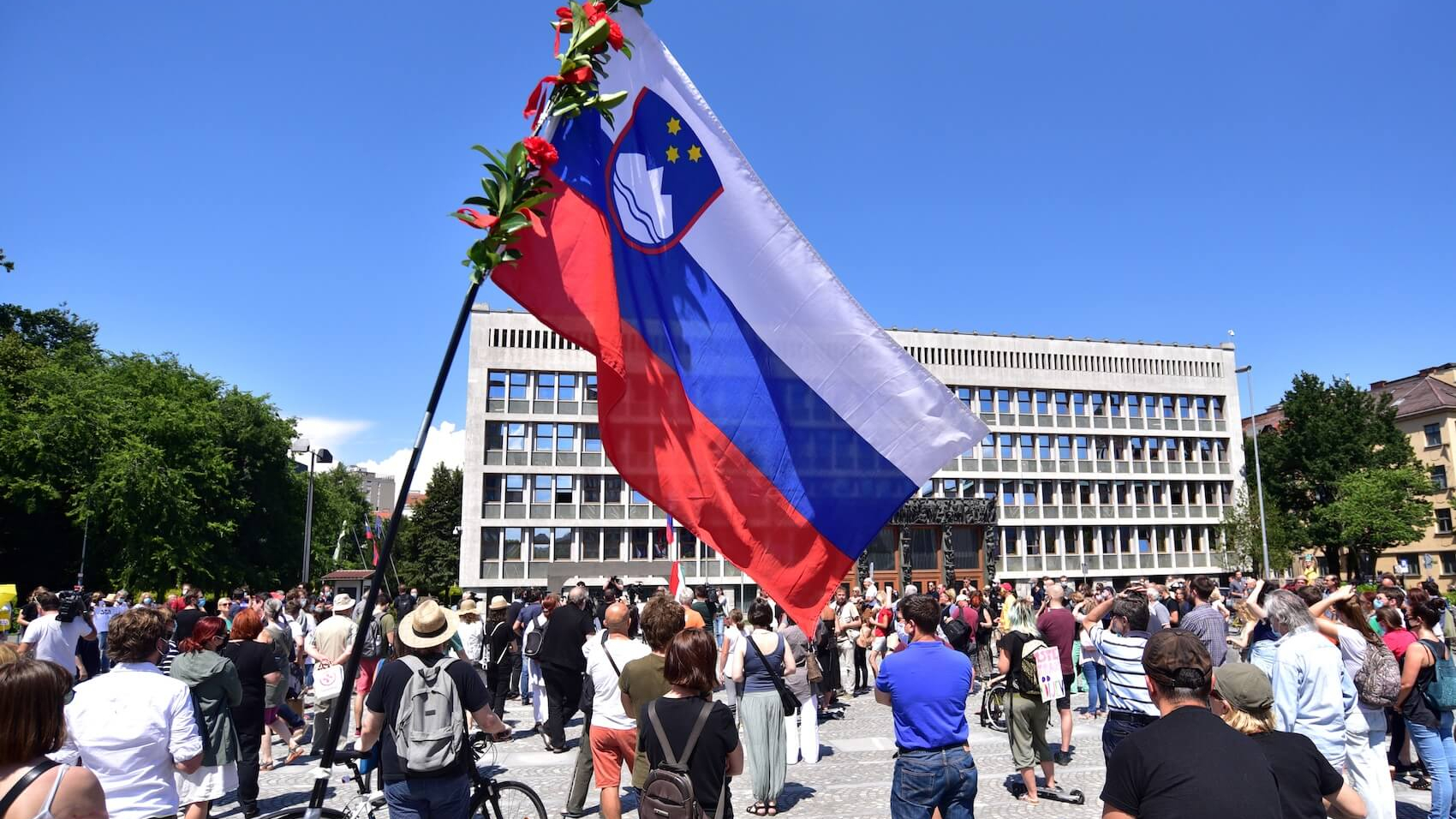
Protesters advocating for freedom of the press in Ljubljana, Slovenia, on July 15, 2020. Photo: Igor Kupljenik.

Digital Strategies of Political Parties in the 2024 European Elections: The Case of Slovenia

Please cite as:

Oblak Črnič, Tanja & Koren Ošljak, Katja. (2024). “Digital Strategies of Political Parties in the 2024 European Elections: The Case of Slovenia.” In: 2024 EP Elections under the Shadow of Rising Populism. (eds). Gilles Ivaldi and Emilia Zankina. European Center for Populism Studies (ECPS. October 22, 2024. https://doi.org/10.55271/rp0083


DOWNLOAD REPORT ON SLOVENIA

Abstract

This report offers a systematic analysis of Slovenian political parties in online campaigning during the 2024 EP elections. It draws on a dataset of political parties and their online representations, selected from official party websites and dominant social media platforms, such as Facebook, Instagram and TikTok, in May 2024. The results show that Slovenian parties’ communication during the 2024 EP campaign was quite self-referential, accompanied by images of the candidates, indicating a high degree of personalization of politics. Moreover, the results show the “non-European orientation” of the campaign, as domestic issues dominated the parties’ social media profiles and websites. Furthermore, the content analysis of the parties’ websites revealed five issues where some cross-party differences in attitudes were observed: 1) agreement in party attitudes towards the environment; 2) on Ukraine and Palestine, parties on the right took different positions; 3) the centre-left coalition supported the government’s domestic policy the most; 4) right-wing actors tended to frame migration and minority rights in a restrictive way; actors with a left-wing orientation took a more humanitarian approach; and 5) left-wing actors were most tolerant vis-à-vis gender and reproductive rights. The results, therefore, imply a clear distinction between Slovenian parties of the left and right during the 2024 EP campaign.


By Tanja Oblak Črnič* & Katja Koren Ošljak* (University of Ljubljana)

Introduction

Many studies over the last two decades have confirmed how the internet and social media have changed the conditions of political communication (Blumer and Kavanaugh 1999). Some argue that media changes are radically shaping the conditions of political communication (Chadwick, 2023; Kreiss, 2023). Chadwick (2023: 21) argues that a hybrid media system is a more fluid and contested space than previous mass media systems. These shifts are evident during election campaigns, which are characterized by computational politics (Tufekci, 2014).

The data collected during the formal campaign for the 2024 European elections describe the primary digital strategy of Slovenian political parties and a brief comparison of the selected strategies during the EP campaign. The question is, therefore, how candidates and their parties present themselves in these digital presentations, how they address their potential voters, what messages they use to occupy the digital channels they manage, and with what degree of communicative responsibility they engage with citizens.

First, we analysed their landing pages to identify ideological identifiers and several other issues that could indicate the national or European orientation of the parties. We then focused on identifying the main issues included in their campaign as potential indicators of a propensity towards populism and the attitudes of the observed parties towards selected public issues such as climate change, rights of the LGBTQ+ community, human rights of migrants and other minorities, national government policies, violence against women, abortion and reproductive rights, and gender and sexual identity. In addition to these “identity policy orientations”, we also looked at the extent to which each party focused on the wars in Ukraine and Palestine. The main findings are placed in the context of the critical role of social media in so-called data-driven campaigning (Chadwick and Stromer-Galley, 2016).

Research design, methods and sample

The analysis of the online presence of Slovenian political actors has a long history (see Oblak, 2003; Oblak and Željan, 2007; Oblak and Ošljak, 2013; Oblak, 2017). For this report, we have chosen a quantitative approach with mainly descriptive aims regarding the communicative characteristics of the selected political actors within a case study: the 2024 European elections. The data were collected using the content analysis method: an extended set of variables was constructed, in which we revised the instrument used in the Digital Citizenship project (see Oblak, 2016). The data, which was collected on the websites of political parties and social media profiles, allowed for the relatively easy identification of several pieces of information. The data collection was part of the assignments within the undergraduate course on Politics and Digital Culture at the University of Ljubljana, Faculty of Social Sciences.

We have analysed the websites of the six Slovenian parties that officially entered the 2024 European elections: three of them – Gibanje svoboda (GS), Levica (LP), and Socialni demokrati (SD) – belong to the ruling coalition government, while Nova slovenija (NS) and Slovenska demokratska stranka (SDS) were political parties in opposition. Thus, the majority of analysed parties were campaigning as Slovenian parliamentary parties. In addition, we analysed the online presence of Vesna–zelena stranka (green party), which competed as a nonparliamentary party. Regarding their associations with political groups in the European Parliament, 38% belong to the European People’s Party (EPP), 15% to the Socialists and Democrats (S&D), another 15% to the liberal Renew Europe and 15% to the Left.

Table 1: Results of the 2024 EP elections in Slovenia

National political parties Vote share (%)
[Right] SDS–Slovenska demokratska stranka 30.59
[Centre] Svoboda!–Gibanje svoboda (GS) 22.11
[Centre] Vesna–Vesna–zelena stranka (green party) 10.53
[Left] SD–Socialni demokrati 7.76
[Right] N.Si–Nova slovenija – Krščanski demokrati (NS) 7.68
SLS–Slovenska ljudska stranka 7.21
[Left] Levica–Stranka levica (LP) 4.81
Resni.ca–Državljansko gibanje Resni.ca 3.97
DeSUS–DD–Coalition DeSUS–DD (Demokratična stranka upokojencev Slovenije, Dobra država) 2.22
ZS–Zeleni slovenije 1.61
Druge stranke–Druge stranke 1.52
Total 100
Source: European Parliament (2024).

Political actors’ online presence during the EP election campaign

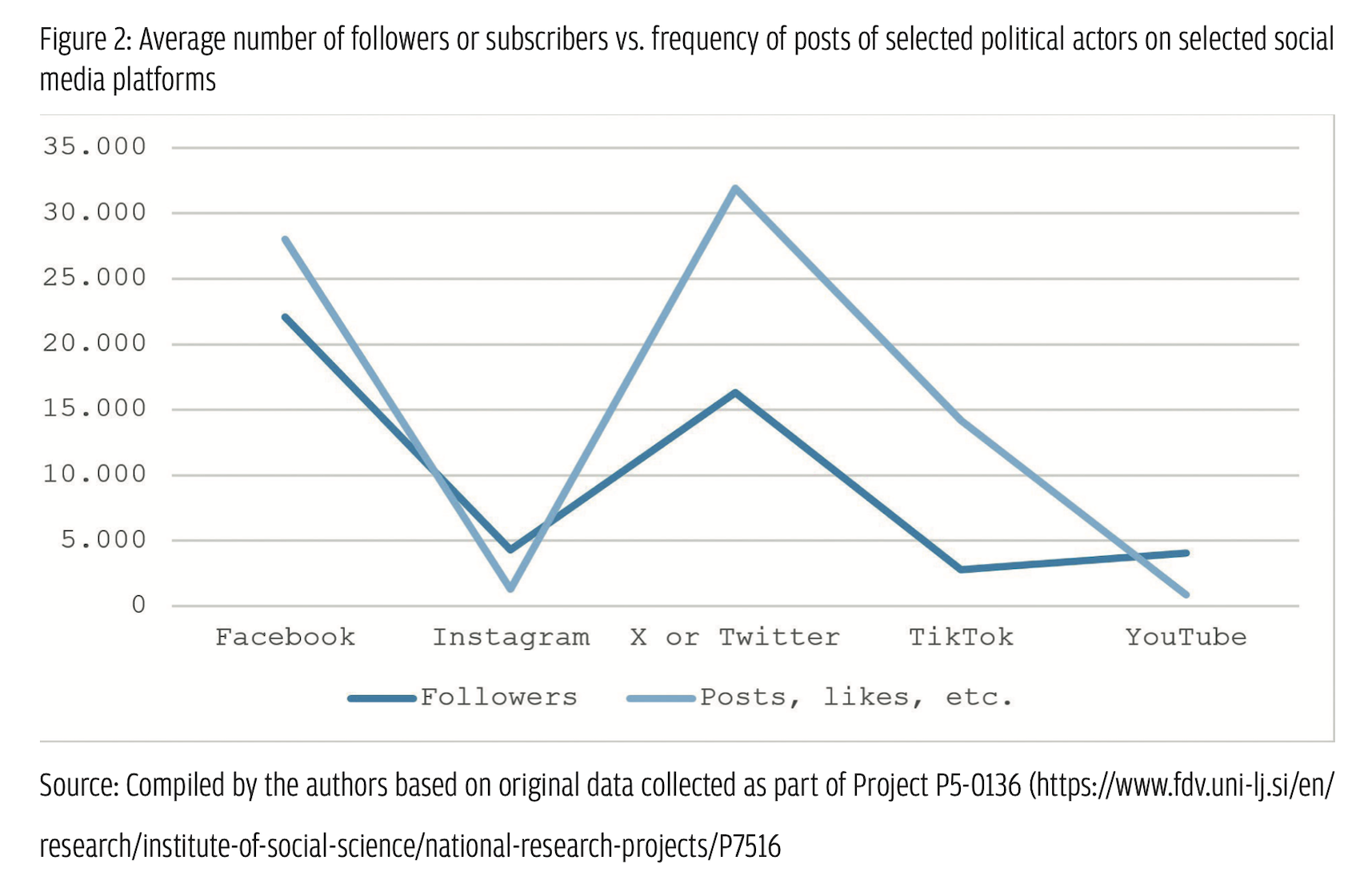
According to preliminary data, our analysis of the online presence of parliamentary parties and selected nonparliamentary candidates for the European elections (e.g., Vesna) shows that all actors were present on Facebook, Instagram and YouTube, while some of them also promoted themselves on X/Twitter and TikTok (see figure 1). However, their activity and visibility on these networks varied considerably. For example, on average, the number of followers or subscribers to the most present social media was highest on X, followed by Facebook and TikTok (see figure 2).

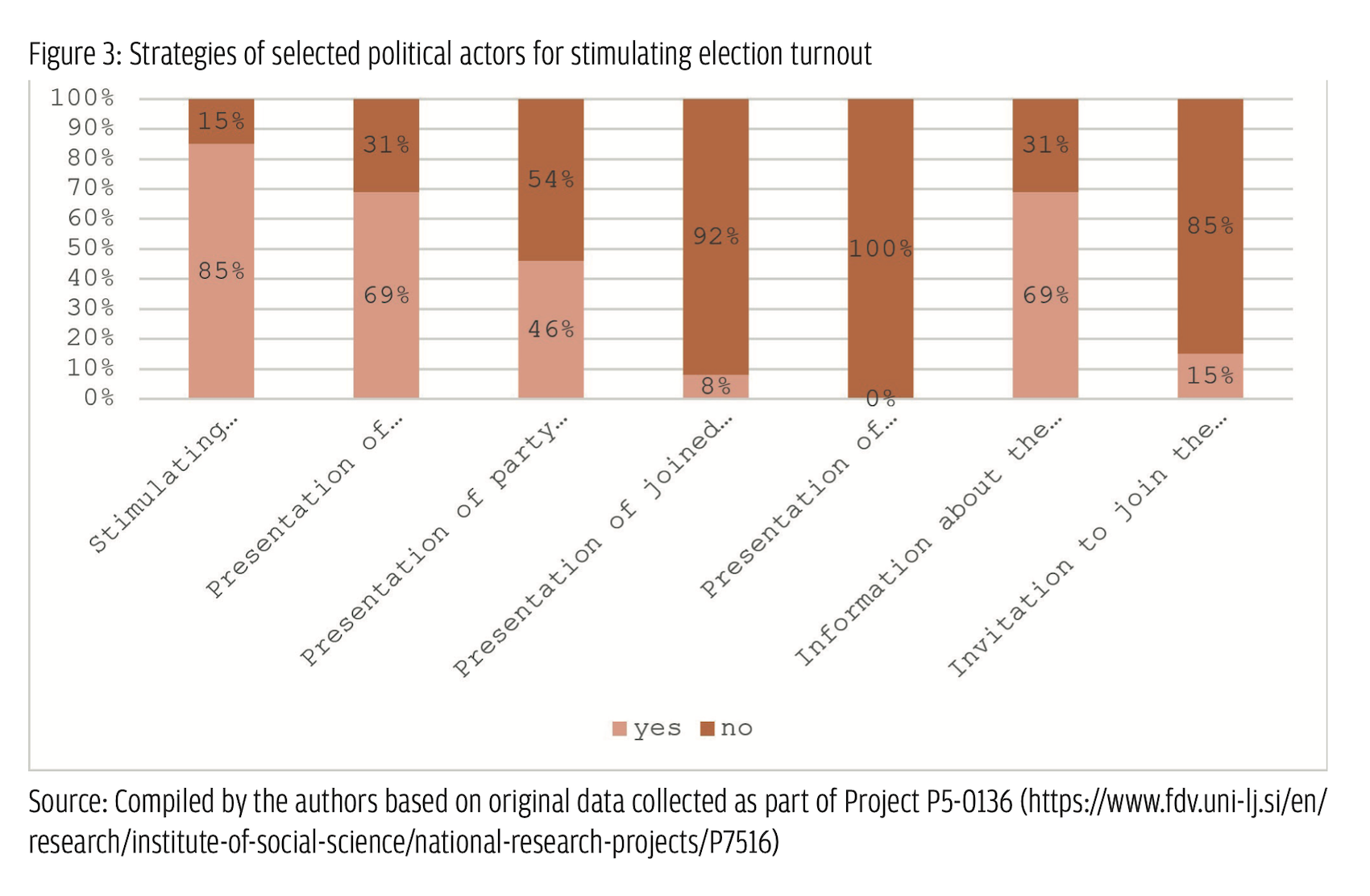
However, the online political landscape during the 2024 EP election campaign was more diverse in terms of the forms of participation on social media and the thematic focuses they gave their attention to. The data shows (see figure 3) that while direct invitations to vote dominated, immediately afterwards, the focus shifted to candidate presentations and information about their visits “on the ground”. This trend is a long-standing one in conventional digital campaigns, and it would be hard to call the 2024 campaign an outlier. It is also evident that Slovenian political parties were not very well placed in the European context, nor did they provide information on which EP group they belong to and with whom they are aligned.

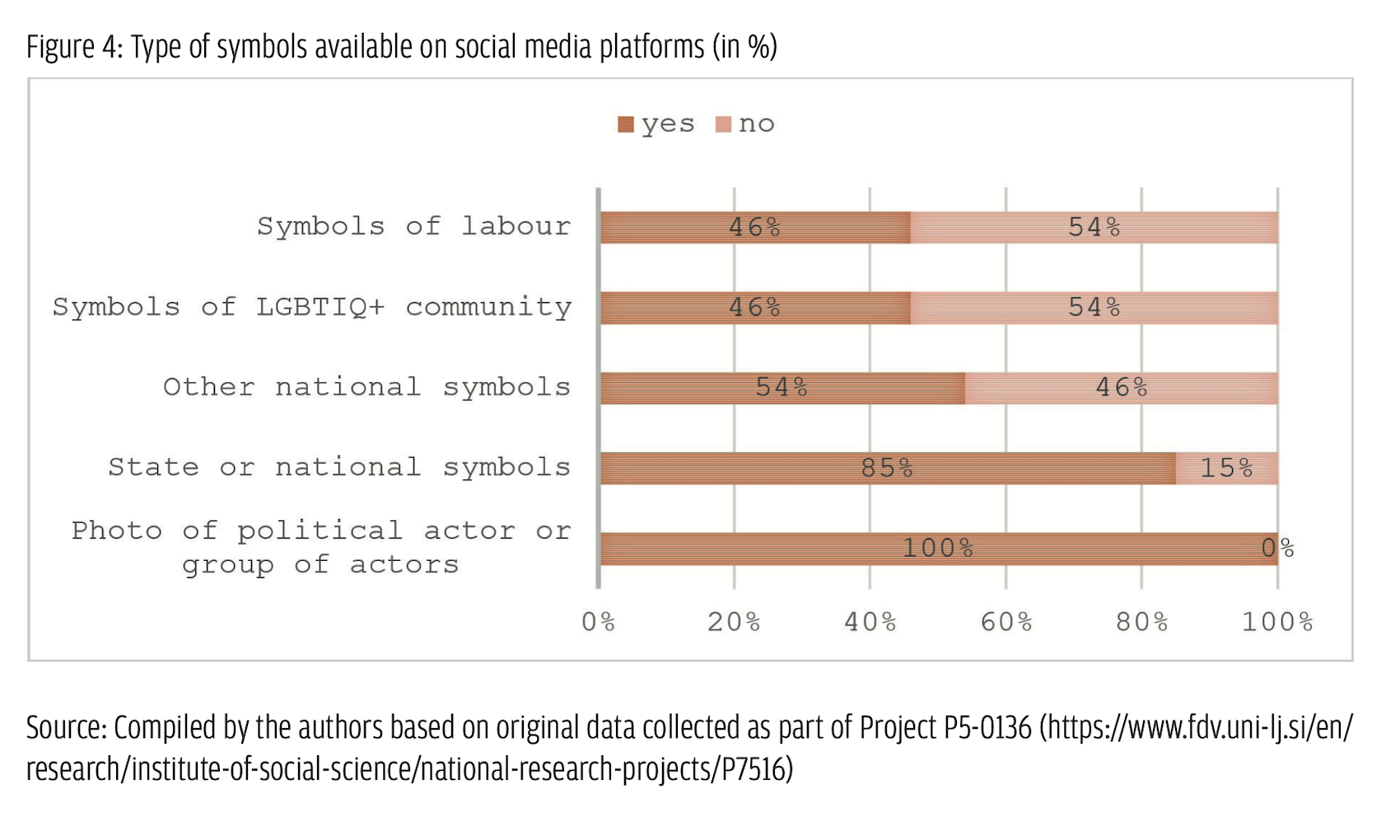
Such “self-referential coverage”, regularly accompanied by photos and videos of the candidates, is another familiar step towards a strong personalization of politics, which is at the same time distinctly local and pragmatic: rather than a concrete commitment to something, the focus is mainly on a specific political figure and his or her activities. As a result, we looked at what kind of symbols are most present in social media profiles, especially to see if there is a common logic in such election campaigns (see figure 4).

The main topics and political parties’ attitudes towards political issues

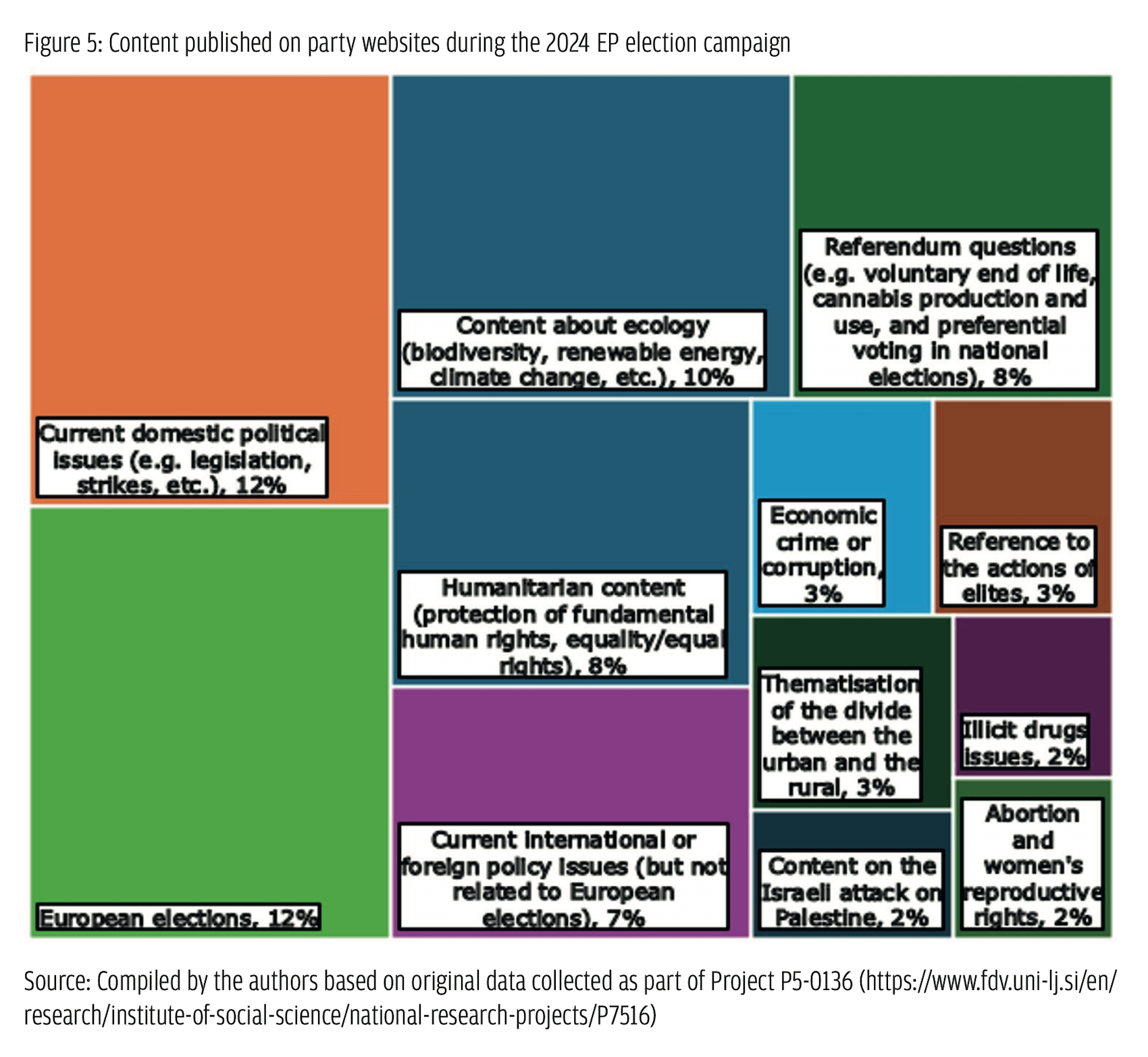
The data suggest that the “non-European orientation” of the campaign was at least partly reflected in attitudes to pressing issues: the parties’ social media profiles and websites were dominated by domestic issues, followed by ecology and climate change; there was also a strong presence of referendum issues and issues related to women’s reproductive rights (see figure 5).

In order to explore the attitudes of Slovenian political parties in their campaigns for the 2024 EP elections, the websites of the six political parties were also monitored. We were interested in whether and how they positioned themselves on the nine selected issues, which we used as indicators of potential biases. We also observed and coded cases where a particular issue was not present on the website.

In the analysis, the six campaigning parties were paired into three general categories of the political spectrum: 1) the right (Nova Slovenija and Slovenska demokratska stranka), 2) the centre (Gibanje Svoboda and Vesna–zelena stranka) and 3) the left (Levica and Socialni demokrati). In cases where the attitudes of two parties from the same part of the political spectrum were coded in different categories, both categories were marked (see table 2).

Table 2: Attitudes of Slovenian political parties towards the political issues

1) Ecology. When the topic of ecology or climate change appears on the website, how is it addressed?
Parties Denial Neutral Awareness Not present
Right +    
Centre      
Left      
2) Ukraine. When the topic of the war in Ukraine comes up on the website, how is it handled?
Parties Pro-Russia Neutral Pro-Ukraine Not present
Right     + +
Centre     + +
Left     + +
3) Palestine. When the topic of Palestine appears on the website, how is it addressed?
Parties War, genocide Neutral Israeli defence Not present
Right      
Centre    
Left      
4) Government. When the government of the Republic of Slovenia topic appears on the website, how is it treated?
Parties Critically Neutral Supportively Not present
Right      
Centre    
Left      
5) Human rights. When the topic of human rights (i.e., minorities or migrants) is raised on the website, how is it addressed?
Parties Restrictive Neutral Supportive Not present
Right      
Centre      
Left    
6) Abortion. When the topic of abortion rights or reproductive rights is raised on the website, how is it addressed?
Parties Against Neutral Pro Not present
Right      
Centre      
Left      
7) Violence against women. When the topic of violence against women appears on the website, how is it addressed?
Parties Not a problem Neutral As a problem Not present
Right    
Centre    
Left      
8) LGBTIQ+. When the topic of the LGBTIQ+ community appears on the website, how is it addressed?
Parties Restrictive Neutral Supportive Not present
Right +     +
Centre      
Left      
9) Gender equality. When the topic of gender equality or gender identities is raised on the website, how is it addressed?
Parties Restrictive Neutral Supportive Not present
Right      
Centre      
Left      
Source: Compiled by the authors based on original data collected as part of Project P5-0136 (https://www.fdv.uni-lj.si/en/research/institute-of-social-science/national-research-projects/P7516)

What can such results tell us about the parties’ attitudes to a selected set of public and political issues?

  1. Environmental issues: According to the results, political actors seemed to be most united in their attitudes towards environmental crises or ecological issues. However, one of the actors from the right differed significantly in this respect, expressing the irrelevance of environmental problems.
  2. War and conflict: Regarding the war in Ukraine, there is no dilemma that Slovenian political actors expressed pro-Ukrainian positions during the election campaign, or in this case, Russia was seen as the war aggressor. However, it is worth noting that the war in Ukraine was not an issue on 50% of the parties’ websites during the same period. Although Palestine is also an armed conflict, the results suggest a different picture: right-wing parties raised the issue of Israel’s right to self-defence. Left-wing parties, on the other hand, reported more on the war and genocide against the Palestinians.
  3. Domestic politics: Given the centre-left government coalition, the attitude of the political parties towards the government’s work is not surprising: the right-wing actors were critical, while the left and centre were supportive. The only exception was the Green Party Vesna, which is not part of the current coalition and did not comment on the government’s work on its website during this election campaign.
  4. Human rights and minorities: Human rights, especially in relation to minorities and migrants, were also a divisive issue for political parties during the European election campaign in Slovenia. Right-wing actors framed the issue of migration and minority rights in more restrictive terms, while centre-left and left-wing parties adopted a more humanitarian approach in their reports.
  5. Gender and reproductive rights: The issue of gender and women’s reproductive rights draws an even sharper line between the anti-abortion right and the rest: the political centre and the left defend women’s right to decide about their bodies. A different picture emerges in the case of violence against women, which is addressed as a problem by actors across the political spectrum: here, one centre-right and one right-wing actor did not address the issue on their websites during the 2024 election campaign. However, positions on gender justice and (non-binary) gender identities shifted this logic again: The websites of the right-wing political actors were similarly restrictive, while the left explicitly supported gender equality; the political parties of the centre seemed to avoid such issues on their websites during the EU election campaign.

Attitudes of young citizens towards the personalization of politics during the EP campaign

Based on the preliminary results of our datasets on the online presence of Slovenian political parties in the run-up to the 2024 European elections, we found a marked personalization of the campaign, where candidates’ personal profiles can have a significantly higher reach than parties’ profiles. We also found that parties often resort to populism, either based on the othering of minorities and foreigners and the division between ‘us and them’ or on the glorification of tolerance and inclusive discourse.

The analysis also shows a strong tendency for parties to use a more personalized campaign, where candidates’ personal profiles can have a much wider reach than party profiles. Furthermore, reflecting on the analyses from the perspective of the students who collected the data as part of the course, their reflections were quite common: they strongly agreed that political parties do not adequately address them in the campaign. For example, they noted that the parties mainly appealed to young people to participate in the elections, while at the same time, there were very few young people on the lists of candidates, who were also mostly placed at the back of the queue.

Students also criticized the patronage of political parties that do not communicate transparently during election campaigns. They added that their publications were not informative, their positions were not sufficiently argued, etc. Among the issues that were very important to young people but not well covered by the parties, students highlighted the war in Ukraine, the genocide in Palestine, human rights, migration and climate change.


(*) Tanja Oblak Črnič is professor of Communication Studies at the Faculty of Social Sciences, University of Ljubljana and a member of the research program Political Research (J5-036). Contact: tanja.oblak@fdv.uni-lj.si

(**) Katja Koren Ošljak is an assistant and researcher at the Faculty of Social Sciences, University of Ljubljana. She is also finalizing her PhD in the reconceptualization of media education in the context of mediatized childhood. Contact: katja.osljak@fdv.uni-lj.si.


References

Blumler, J. G., & Kavanagh, D. (1999). The third age of political communication: Influences and features. Political Communication 16(3): 209–230, https://doi.org/10.1080/
105846099198596

Chadwick, A. (2013) The hybrid media system: Politics and power, Oxford: Oxford University Press

Chadwick, A. and Stromer-Galley, J. (2016) Digital media, power, and democracy in parties and election campaigns: Party decline or party renewal? International Journal of Press/Politics 21(3), pp. 283–294. DOI: 10.1177/1940161216646731

European Parliament (2024), Slovenia – Official results. Accessed 8 October 2024 from https://results.elections.europa.eu/sl/nacionalni-rezultati/slovenija/2024-2029/

Oblak Črnič, T. (2002) Dialogue and representation: Communication in the electronic public sphere. Javnost, 9(2): 7–22

Oblak Črnič, T. (2003) Boundaries of interactive public engagement: political institutions and citizens in new political platforms. Journal of Computer-Mediated Communication 8(3): 1–21. http://jcmc.indiana.edu/vol8/issue3/oblak.html

Oblak Črnič, T. (2017). Neglected or just misunderstood?: The perception of youth and digital citizenship among Slovenian political parties. Teorija in praksa: revija za družbena vprašanja 54: 96–111

Oblak Črnič, T., & Koren Ošljak, K. (2013). Politically un-interactive web: Transformations of online politics in Slovenia. International Journal of Electronic Governance 6(1): 37–52.

Oblak Črnič, T., & Željan, K. (2007) Slovenian online campaigning during the 2004 European parliament election: Struggling between self-promotion and mobilisation. In: Kluver, R., Jankowski, N., Foot, K., and Schneider, S.M. (eds.), The Internet and national elections: A comparative study of web campaigning (pp. 60–76). London and New York: Routledge. 

Tufekci, Z. (2014). Engineering the public: Big data, surveillance and computational politics. First Monday 9(7), https://doi.org/10.5210/fm.v19i7.4901


DOWNLOAD REPORT ON SLOVENIA


Right-wing political rally in Zagreb's main square, featuring men dressed in black waving Croatian, black and anti-EU flags Croatia on June 23, 2019. Photo: Shutterstuck.

Between ‘Kingmakers’ and Public Indifference: Croatia’s National Conservative Right in the European Elections of 2024

Please cite as:

Petsinis, Vassilis. (2024). “Between ‘Kingmakers’ and Public Indifference: Croatia’s National Conservative Right in the European Elections of 2024.” In: 2024 EP Elections under the Shadow of Rising Populism. (eds). Gilles Ivaldi and Emilia Zankina. European Center for Populism Studies (ECPS. October 22, 2024. https://doi.org/10.55271/rp0064


DOWNLOAD REPORT ON CROATIA

Abstract

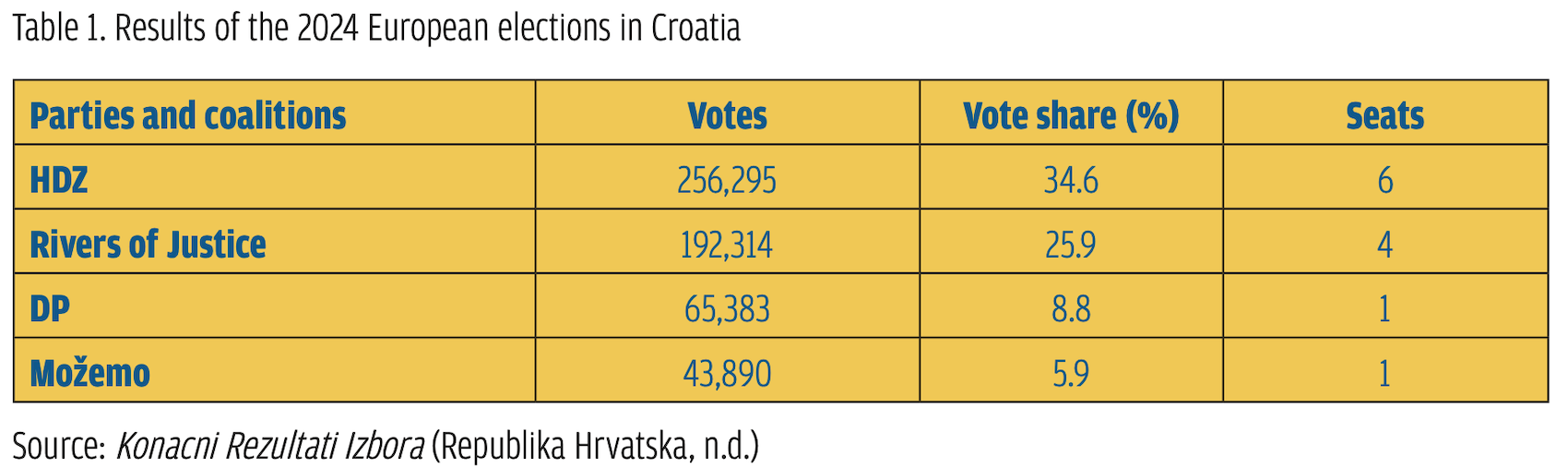
This chapter focuses on Croatia and deals with the national conservative Domovinski Pokret/Homeland Movement (DP) party. In the latest European elections, the DP garnered a percentage of 8.82% (65,383 votes and one seat), taking third spot after the ruling (centre-right) Croatian Democratic Union (HDZ) and the ‘Rivers of Justice’ coalition spearheaded by the (centre-left) Social Democrat Party (SDP). I begin the present chapter by sketching a typology of the constituent segments along the broad spectrum of the European right wing and situate the DP within it. I then offer a summary of the DP’s founding principles vis-à-vis further European integration and clarify the extent to which these principles were reflected in the party’s stances and active engagement in the latest European elections. I then identify the main catalysts behind the DP leadership’s success in mobilizing target groups and galvanizing electoral support for the party.

Keywords: Radical Right, National Conservatives, European Elections, Euroscepticism, Croatia, Ukraine


By Vassilis Petsinis* (Institute of Global Studies, Corvinus University of Budapest)

Introduction

The results of the European elections (6–9 June 2024) have generated diverse political repercussions on the national, European and global levels. On the one hand, the parties of the centre-right, grouped under the European People’s Party (EPP), and the parties of the centre-left, rallying behind the banner of the Progressive Alliance of Socialists and Democrats (S&D) group, succeeded in maintaining the top and the second spot, respectively, at the European level. On the other hand, the landscape became hazier concerning the political forces clustered along the broader right-wing spectrum beyond the EPP – namely, the parties of the national conservative as well as the populist and radical right in the European Parliament (EP).

One catalyst that has complicated the precise assessment of those parties’ performance is that the political forces beyond the conservative centre-right were scattered among different coalitions such as the European Conservatives and Reformists (ECR) and Identity and Democracy (ID) groups – also including powerful non-attached (NA) political actors including Hungary’s Fidesz party. Nevertheless, it appears that these parties succeeded in one of three ways in the latest European elections. First, some consolidated their already preeminent positions in the domestic politics of their respective states, such as the National Rally (RN) in France, or enhanced their positions significantly, as in the case of the Alternative for Germany (AfD) in Germany, the Freedom Party (PVV) in the Netherlands, and the Law and Justice party (PiS) in Poland. A second set expanded and augmented, to varying degrees, their public appeal, including Vox in Spain, Chega in Portugal, and the Hellenic Solution (EL) in Greece. A third, smaller group saw their support erode due to the emergence of new contenders, most notably the ruling Fidesz party in Hungary, which has ceded popularity to the centre-right Respect and Freedom party (Tisza).

In Central and Southeast Europe, the voter turnout in the latest European elections ranged from relatively high (e.g., Hungary, 59.46%) to relatively low (e.g., Poland, 40.65%; Slovakia, 34.38%) and meagre (e.g., Lithuania, 28.35%) (European Parliament, n.d.). This article casts its lens on Croatia, one of the new member states where the turnout rate was the lowest in the EU (21.35%) (Ibid).

Despite the lack of voter interest, the EU is a significant benefactor for Croatia, which has been heavily dependent on financial support from Brussels since it joined the Union in 2013. In particular, the EU’s Structural and Cohesion Funds have been of crucial significance in upgrading the local infrastructure in the less-developed regions of the country (e.g., certain parts of Eastern Slavonia and Dalmatia). Moreover, especially following the country’s accession to the Schengen Area (1 January 2023), employment opportunities within the EU have provided both ‘white collar’ and ‘blue collar’ professional categories with a vital ‘lifeline’. As an aggregate of these sociopolitical realities, the primary concerns and expectations of the Croatian electorate during the latest European elections predominantly revolved around the economy, and public Euroscepticism was not noticeably high. At the same time, global and regional crises generated shockwaves within the Croatian public and among the country’s political elites. The Russian invasion of Ukraine in February 2022 is a particular case in point, with several political actors across the political divide seeking to draw tentative analogies between this weighty geopolitical moment and Croatia’s Domovinski Rat (‘Homeland War’) from 1991 to 1995.

As a consequence of the Domovinski Rat, Croatia has several parties that oscillate between the categories of the radical and the extreme right. While formed between the early 1990s and the early 2000s, these parties – including the Croatian Party of Rights (HSP), the Croatian Pure Party of Rights (HČSP) and the Autochthonous Party of Rights (A–HSP) – tend to claim roots in the same nineteenth-century nationalist Hrvatska Stranka Prava or Croatian Party of Rights.

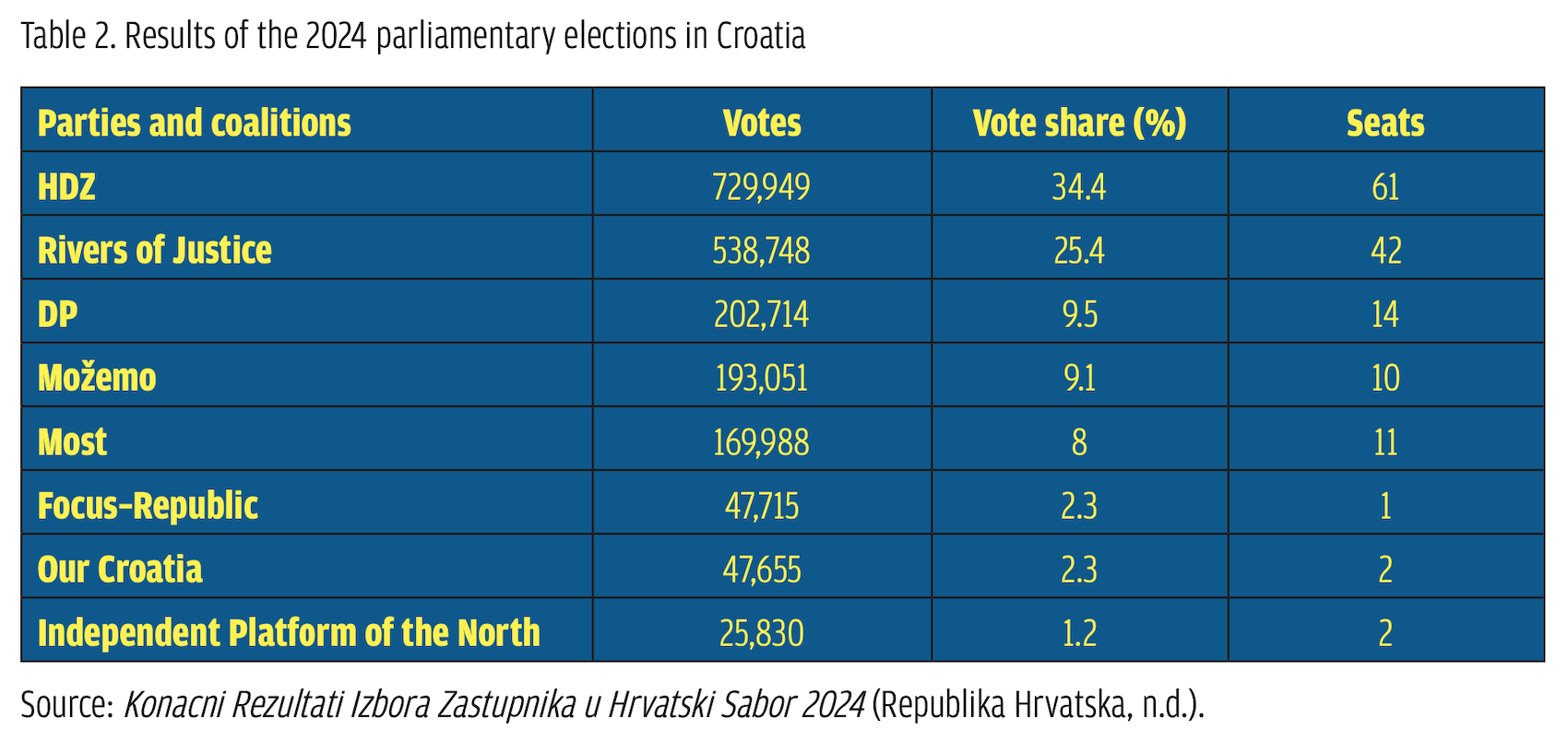
Nevertheless, since not one of these older parties has been represented either in the Croatian Sabor (national assembly) or the EP for longer than a decade, this article focuses on the national conservative party, the Domovinski Pokret (Homeland Movement, DP), which in the short period since its formation has become the most vocal opposition party of the right. In the 2024 European elections, the DP garnered 8.82% of the vote, taking one seat and securing the third spot after the ruling, centre-right Croatian Democratic Union (HDZ) and the ‘Rivers of Justice’ coalition spearheaded by the centre-left Social Democrat Party (SDP) (Table 1). Launched on 29 February 2020, the DP has set its principal objective to antagonize the ruling HDZ from the right. This aim acquires a greater significance, considering that roughly one month earlier, under the leadership of Ivan Penava, the DP secured third place in the Croatian parliamentary elections (17 April 2024) with a percentage of 9.56%, taking 14 seats (Table 2). This result, in turn, upgraded the party’s leverage in the negotiations for the formation of a new government after the elections and rendered the DP a ‘kingmaker’ until its official inclusion in the governing coalition with the HDZ in May 2024 (Tesija, 2024; Hajdari, 2024).

I begin the present chapter by sketching a typology of the constituent segments along the broad spectrum of the European right wing and situate the DP within it. I then offer a summary of the DP’s founding principles vis-à-vis further European integration and clarify the extent to which these principles were reflected in the party’s stances and active engagement in the latest European elections. I then identify the main catalysts behind the DP leadership’s success in mobilizing target groups and galvanizing electoral support for the party.

Situating the Homeland Movement within the European populist and radical right

This schematic categorization pays primary attention to political origins, evolutionary trajectories, and patterns of (active) political engagement (Petsinis, 2019: 166–167). Parties of the populist and radical right tend to scrutinize constitutional order while striving to promote their political cause(s) principally via parliamentary and democratic institutions and procedures. Populist and radical right-wing parties may often be by-products of top-level formation processes (so-called ‘cadre’ parties) that have come into being after (a) the reformation or merger of already existing parties, as with the Sweden Democrats (SD), the Finns Party in Finland, and the Conservative People’s Party (EKRE) in Estonia; or (b) the secession of ‘splinter groups’ from larger parties such as the cases of the Independent Greeks (ANEL) and, more recently, EL in Greece.

Attention must also be paid to one more subcategory of right-wing parties beyond the centre right – the national conservatives. The political platforms of such parties maintain ethnonationalist and nativist components, as well as occasional pledges to protect ‘naturally ascribed’ gender norms and religious values, but their populist and anti-establishment tones appear somewhat less intense. A few representative examples from Central and Eastern Europe are (to a certain extent) Fidesz in Hungary, PiS in Poland and the National Alliance in Latvia.

By contrast, parties of the extreme right may actively challenge (or even attempt to temporarily substitute) the operation of state institutions (e.g., by organizing party militias or youth wings into self-styled ‘street patrols’). Such parties have usually come into being due to processes spearheaded by a grassroots nucleus often aided by semi-paramilitary groupings, therefore regularly opting for a more militant engagement. Parties of this subgroup with a non-negligible public appeal have become active across Central and Southeast Europe – notable cases during the last 10–15 years include the ‘old’ Jobbik in Hungary, ‘Our Slovakia’ (ĽSNS), Bulgaria’s ‘Ataka’, and the Golden Dawn in Greece (Ellinas, 2015; Sygkelos, 2015; Drábik, 2022).

‘Uncompromising opposition’ from the right: Where does the Homeland Movement stand on the issues?

As early as 2020, the DP leadership has set as top priorities: (a) safeguarding of national and Christian values; (b) stricter control of immigration and tougher ‘law and order’ measures, and; (c) revision of certain clauses in legislation protecting minority rights (Domovinski Pokret, 2020a). Regarding the ethnonationalist component of its political agenda, the party objects to the adoption of the ‘fixed’ quota arrangement toward the representation of ethnic minorities in the Sabor (i.e., the so-called ‘electoral district 12’), the ethnic Serb minority in particular (Domovinski Pokret, 2020b: 32). In addition, DP contends that ‘this arrangement has mostly enabled certain individuals and groups to serve their private interests’ (Ibid.: 31) and calls for this model to be abolished (Ibid).

Regarding gender-related issues, DP pledges to ‘respect and safeguard traditional family values’ (Domovinski Pokret, 2020a: 2), whereas the full party manifesto defines ‘marriage as the union between a man and a woman, as stipulated by the Constitution … [T]his guideline must be respected by the Croatian institutions’ (Domovinski Pokret, 2020b: 20). As far as the DP’s nativist principles on immigration are concerned, the party holds that ‘the protection of borders and citizens from potential threats must be assigned primarily to the authorities of sovereign states within the European Union’ (Domovinski Pokret, 2020b: 29).

In their rhetoric, the leader Ivan Penava and other high-ranking members have regularly accused political opponents of ‘incompetence and irresponsibility’, including in attacks on the HDZ for its ongoing cooperation with the ethnic Serb Independent Democratic Party (SDSS) as well as the ‘relentless promotion of pro-LGBT agendas and woke culture’ by the SDP and above all the Green-left coalition of Možemo (‘We Can!’). Nevertheless, the speed with which the current governing coalition between the HDZ and the DP was concluded and the relative flexibility with which any noteworthy obstacles were bypassed hint at a party ostensibly keener on engaging from within the halls of power instead of uncompromisingly opposing the mainstream establishment. Therefore, despite the occasional display of paraphernalia associated with the wartime fascist Ustaše (‘Insurgents’) regime (1941–1945) in public events co-ordinated by the DP (Hajdari, 2024; Novakov & Čolić, 2024), based on top-level decision-making and political values, the DP seems to fit more closely the prototype of a national conservative party. This observation is reinforced by the DP’s joining the ECR group in the EP after the European elections.

The Homeland Movement and the process of European integration

Soon after it was founded and against a backdrop of soft Euroscepticism and concerns over interethnic relations, the DP began expressing discontent with longstanding external pressures from the Venice Commission (Council of Europe) and the EU. This discontent centred on the pre-accession push (in 2000–2002) for Croatia to adopt the ‘fixed’ quota arrangement for ethnic minority representation in the Sabor (Domovinski Pokret, 2020b: 32).

On a macropolitical level, the soft Eurosceptic stance of the DP leadership is reflected in its framing of the European Union as ‘a confederal union of sovereign states and not as a supranational, federal, state with the prospects of becoming unitary’ (Domovinski Pokret, 2020a: 3). Along the same lines, the DP prescribes that Croatia must develop closer relations with the Visegrad Four (Hungary, Poland, Slovakia and the Czech Republic) because of ‘the shared historical experiences, as well as the similar positions and outlooks on the European and global developments’ with this group of countries (Domovinski Pokret, 2020b, p. 30). Herein, it should be underlined that, despite its soft Eurosceptic orientation, the DP never advocated for the development of more extensive relations between Croatia and ‘alternative partners’ in global politics, like Russia, China or the BRICS. In this light, the DP seems to align with the staunchly and idiosyncratically sovereigntist stances regarding relations with both the West and non-Western powers that characterize parties to the right of the HDZ in Croatian politics (Petsinis, 2024).

Seizing the geopolitical moment: The Homeland Movement’s reaction to Russia’s invasion of Ukraine

The DP leadership has been quick to seize the geopolitical moment occasioned by Russia’s aggression against Ukraine. Aligning with a more general tendency across Croatia’s political divide, the party’s leader, Ivan Penava, and other high-ranking members have drawn (at times oblique) links between the legacies of Croatia’s Domovinski Rat (1991–1995) and Ukraine’s struggle to resist Russian aggression.

On 24 February 2022, Penava stated, ‘Our party expresses its firm solidarity with Ukraine and the Ukrainian people … we hope that this conflict will last as shortly as possible with as few human and material losses as possible’ (Ibid.). He also urged the state authorities to organize the accommodation of Ukrainian refugees in Croatia and efficiently allocate the material resources required. In addition to highlighting the commonalities between the Homeland War and the developments in Ukraine, Penava cast doubts on the competence of the government to manage a migration crisis in Croatia (Ibid.). More emphatically, on 6 April 2022, the party’s MP Stipo Mlinarić praised Volodymyr Zelenskyy for dealing with the ‘fifth column’ in Ukraine and deplored the fact that ‘the HDZ-led government has not done the same with the ‘fifth column’ that operates from within the Serb Democratic Independent Party’ (Domovinski Pokret, 2022b).

Nevertheless, between Russia’s large-scale invasion of Ukraine in early 2022 and the end of 2023, the DP suffered a plateauing, if not a significant decline, in its popularity vis-à-vis the HDZ and other minor contenders on the right. As indicated in several public surveys conducted by the Promocija Plus, 2X1 Komunikacije and Ipsos polling agencies between March and December 2022, the DP had been lagging behind both Možemo and the centre-right, conservative Most (‘The Bridge’) party (Europe Elects, 2024). Therefore, to reverse this decline in popularity, the DP started putting greater stress on the rapidly increasing cost of living and the government’s alleged incompetence in dealing with galloping inflation (Domovinski Pokret, 2022c).

Due to this change of course and the party’s gradual adoption of a strategy more focused on domestic policy, which persisted until the Croatian parliamentary and the European elections, no extensive or concrete references were made to the war in Ukraine. On the contrary, the DP’s Ustani i Ostani! (‘Stand Up and Remain!’) political program, which the party launched for both the national and the European elections, cites Ukraine only on one occasion: in the section about national defence and the need to upgrade the equipment of the Croatian armed forces – the navy, in particular. In greater detail, the program stresses that: ‘Ukraine demonstrated how the use of new military technologies, such as drones, can paralyse even the naval forces of global superpowers (namely, Russia)’ (Domovinski Pokret, 2024a: 23). Otherwise, any references by DP to the EU during its campaign for the European elections concentrated on more general aspects of European politics in accordance with the party’s founding principles regarding the process of European integration.

The Homeland Movement’s campaign in the 2024 European elections

Right at the beginning of the Ustani i Ostani! policy document, the DP underlines its fundamental stance on state sovereignty within the EU: “Many types of crises during the last years (e.g., the financial crisis, Brexit, the migration crisis, and the COVID-19 crisis) have demonstrated that the EU reacts in a slow and non-coordinated manner whereas, at the same time and under these irregular circumstances, the member states prioritize their own interests exclusively. This is why Croatia must prioritize its own interests, too (Croatia comes first!)” (Domovinski Pokret, 2024a: 26).

At a later point in the same policy document, the DP leadership reiterates that it is a sovereigntist party which primarily views the EU as ‘a community of equal and sovereign states and nations rooted in Christian foundations and principles … the detachment of the EU from its Christian roots has resulted in great identity confusion’ (Ibid). Furthermore, the party contends that ‘decisions about Croatia should be taken by Croatian politicians in Zagreb and not by Brussels-based officials’ (Ibid). With specific regard to the area of national defence and the prospects for the EU’s strategic autonomy, DP holds that any projects designed to bolster EU defence policy must not be misused by Brussels in order to weaken further the sovereignty of nation-states (Domovinski Pokret, 2024a: 26).

In addition, DP adamantly opposes Serbia’s accession to the EU, in no small part due to the legacies of the wars of the 1990s in which Serbia is seen as the aggressor against Croatia. Contrarywise, the party underlines that ‘the things that Croatia must demand without compromise from Serbia, which committed aggression on Croatian territory, are payment of war reparations, a thorough search for disappeared persons, and the return of cultural treasures that were stolen during the war’ (Domovinski Pokret, 2024a: 28). At the same time, the party accuses the Serbian government of ‘promoting the ideology of Greater Serbia and openly endorsing Russian aggression against Ukraine’ (Ibid).

Apart from Ustani i Ostani!, individual MPs reiterated these standpoints concerning major policymaking areas on the EU level, both in the Croatian and the European Parliaments, on numerous occasions. Regarding immigration, in the aftermath of a knife attack in Mannheim, Germany, in May 2024, Ivo Čaleta-Car, a DP deputy in the Sabor, warned in a speech that:

The EU is slowly turning into a unitary supranational state. The EU is trying to create an unnatural federation of states that will be held together by migrants and their descendants through mixing with the indigenous populations (Domovinski Pokret, 2024b).

In the same speech, he stressed: ‘Yes to the EU as a community of sovereign nations! No to the EU as a superstate!’ (Ibid.). Moreover, DP concisely but effectively publicized and summarized its main standpoints on European politics through the party’s official pages on social media (e.g., X and Instagram). On the party’s Instagram page, for instance, its main slogans for the European elections feature as follows: “‘Croatia comes first!’, ‘We stop the extension of the Brussels’ jurisdiction!’, ‘For a counteraction to the globalist agendas!’, ‘No to the propagation of gender ideology! We do not want gender ideology in our schools!’, ‘For the protection of national borders!’, ‘For the demographic rebirth of Croatia and Europe!’, ‘Rebirth of the village for the rebirth of Croatia and Europe!’, ‘For a Europe that respects its Christian foundations!’” (Domovinski Pokret, 2024c).

Here, it should be noted that several party candidates incorporated slogans related to policies on the EU level into their campaigns for both the national and the European elections. Stipe Mlinarić, for instance, reiterated that ‘Serbia cannot join the EU before it pays Croatia war reparations for the villages and towns that it destroyed’ (Domovinski Pokret, 2024d), Meanwhile, other party candidates pledged to fight for ‘a Europe that respects its Christian foundations’ (Domovinski Pokret, 2024e), reiterated that ‘Croatia must retain its sovereignty in Europe’ (Domovinski Pokret, 2024f), and underlined that ‘Christianity is the foundation of the EU’ (Domovinski Pokret, 2024g).

Embedding the European in the national: A contextual analysis of the Homeland Movement’s political strategy in the European elections of 2024

With a turnout rate of 21.35%, Croatia had the lowest voter participation among all EU member states in the most recent European elections. Croatians’ lack of interest is underscored if we compare this turnout with the much higher rate of 62.30% in the Croatian parliamentary elections that took place on 17 April 2024 (Republika Hrvatska, n.d.). With European elections held shortly after the parliamentary ones, it is clear that Croatia’s major political leaders prioritized the latter. This was especially true for DP, which emerged as a ‘kingmaker’ after the national elections. Faced with a choice between continuing its role as a perennial gadfly berating the HDZ establishment from opposition or seeking real power on the inside, DP leader Ivan Penava chose the latter, aligning his party with the HDZ and joining it in a governing coalition. 

Considering the relatively more ‘parochial’ outlook of the Croatian electorate on global and European politics, the DP’s leadership has since 2020 been rather eclectic and places primary stress on those developments that, due to sociocultural catalysts, might resonate more directly with the ‘collective subconscious’ of the party’s target groups. This appears to have been a fairly commonplace practice for right-wing political actors in Croatia. For instance, between 2018 and 2019 (two years prior to the formation of the DP), the ‘right-wing faction’ within the ruling HDZ extensively capitalized on public grievances vis-à-vis the guidelines of the ‘Istanbul Convention’ for LGBTQ+ rights and gender equality (Milekic, 2018). Along comparable lines, the DP sought to capitalize on the shockwaves that Russia’s invasion of Ukraine generated across Croatian society by drawing tentative links between Ukrainian resistance and the Croatian Domovinski Rat in the 1990s. However, after 2023, the party leadership switched to a more domestic-focused strategy, emphasizing the rapidly increasing cost of living and Croatia’s galloping inflation as part of the endeavour to reverse its declining popularity.

Consequently, in its political program and the individual campaigns of its candidates and the party’s social media, the DP adopted an even more eclectic pattern of engagement for the European elections that consisted of (a) frequent and repetitive use of ‘catchphrase’ slogans (e.g., ‘Croatia comes first!’) and (b) a paramount, yet synoptic, stress on these aspects of European politics that resonated the most with the party’s founding principles and the dominant trends on identity politics among its target groups in the electorate. Therefore, primary importance was placed on (a) the purported need to safeguard Croatia’s state sovereignty from any extension of the EU’s jurisdiction; (b) calls to veto Serbia’s accession to the EU; (c) opposition to the alleged propagation of ‘gender ideology’ and counter-proposals in increase birthrates in Croatia and the rest of Europe, and; (d) the effective protection of national borders and stricter regulation of immigration from ‘third’ countries outside of Europe.

In the long run, it appears that this more eclectic strategy, which prioritized the embedment of the European in the national, facilitated the DP’s galvanizing of the groupness of its electorate, especially in the strongholds of Eastern and Western Slavonia (i.e., the IV. and V. electoral districts) and claim the third spot behind the HDZ and the SDP (but ahead of Most and Možemo) in both the parliamentary and European elections. Slavonia, as a whole, is a region that was heavily scarred by protracted warfare during the first half of the 1990s. In particular, Vukovar, an Eastern Slavonian town on the border with Serbia along the western bank of the Danube, has been established as a ‘master symbol’ of resistance to the Yugoslav People’s Army (JNA) in Croatian nationalist imagery. Most importantly, Vukovar is the town of which Ivan Penava has been the local mayor since 2014. The long-term evolution of the HDZ–DP coalition will demonstrate whether the party leadership is keener on (a) alleviating its stances on Euroscepticism and identity politics to secure its status more firmly inside the halls of power or (b) seeking a ‘new’ pact with the ideologically compatible ‘right-wing faction’ within the ruling HDZ in an attempt to trigger a more decisive swing of the governing coalition towards the right.


(*) Vassilis Petsinis (PhD Birmingham UK) is an Associate Professor of Political Science at the Corvinus University (Institute of Global Studies) in Budapest, Hungary. He is a political scientist with expertise in European Politics and Ethnopolitics. His Marie Skłodowska-Curie (MSCA-IF) individual research project at the University of Tartu (2017–19) was entitled: ‘Patterns and management of ethnic relations in the Western Balkans and the Baltic States’ (project ID: 749400-MERWBKBS). Vassilis Petsinis is a specialist in the politics of Central and Eastern Europe. He is the author of the monographs National Identity in Serbia: The Vojvodina and a Multiethnic Community in the Balkans (Bloomsbury, 2020) and Cross-regional Ethnopolitics in Central and Eastern Europe: Lessons from the Western Balkans and the Baltic States (Palgrave Macmillan, 2022), as well as other academic publications that cover a range of countries as diverse as Serbia, Croatia, Romania, Hungary, Slovakia, Estonia, Latvia and Greece.


References

Domovinski Pokret. (2020a). Parlamentarni Izbori 2020: Zašto Što Svoje Volim. Domovinski Pokret.

Domovinski Pokret. (2020b). Program Delovanja, lipanj 2020. Domovinski Pokret.

Domovinski Pokret. (2022a, February 24). ‘Penava: Domovinski Pokret Iskazao Solidarnost s Ukrajinom i Ukrajinskom Narodom’. Retrieved 22 September 2024 from https://www.dp.hr/blog/Penava_Domovinski_pokret_iskazao_solidarnost_s_Ukrajinom_i_ukrajinskim_narodom/544

Domovinski Pokret. (2022b, April 6). ‘Mlinarić: Za razliku od Ukrajine, mi se Još Nismo Obračunali sa Svojom Petom Kolonom’. Retrieved 22 September 2024 from https://www.dp.hr/blog/Mlinaric_Za_razliku_od_Ukrajine__mi_se_jos_nismo_obracunali_sa_svojom_petom_kolonom/553

Domovinski Pokret. (2022c, September 8). ’Kada je Država Skupa i Neučinkovita, Nema te Mjere Koja Je Može Spasiti!’ Retrieved 22 September 2024 from https://www.dp.hr/blog/Kada_je_drzava_skupa_i_neucinkovita__nema_te_mjere_koja_je_moze_spasiti/593

Domovinski Pokret. (2024a). Politički Program: Ustani i Ostani! Domovinski Pokret.

Domovinski Pokret. (2024b). ‘Ćaleta-Car: EU kao zajednica suverenih nacija da, EU kao nadnacionalna naddržava ne!’, https://www.instagram.com/p/C8XZBJDCYO1/

Domovinski Pokret. (2024c). ‘Hrvatice i Hrvati, izađite na izbore za EU parlament i podržite program Domovinskog pokreta’, https://www.instagram.com/p/C7vxzG6iyXz/

Domovinski Pokret. (2024d). ‘Mlinarić: Srbija ne može ući u EU dok ne plati ratnu odštetu Hrvatskoj za porušena sela i gradove!’, https://www.instagram.com/p/C7d41zDK7vo/

Domovinski Pokret. (2024e). ‘Bartulica: Za Europu koja poštuje svoje kršćanske temelje!’, https://www.instagram.com/p/C7jE99YC8gX/

Domovinski Pokret (2024f). ‘Vaš suverenistički glas u Europi!’ https://www.instagram.com/p/C7PSe2iCcNz/

Domovinski Pokret (2024g). ‘Lozo: U Europskom parlamentu zauzimat ćemo se za zaštitu tradicionalnih vrijednosti i očuvanje Europe na kršćanskim osnovama’, https://www.instagram.com/p/C7zTI0rCA8u/?img_index=1

Drábik, J. (2022). ‘“With Courage against the System”. The Ideology of the People’s Party Our Slovakia’. In Journal of Contemporary Central and Eastern Europe, 30 (3), p.p.417–434.

Ellinas, A. (2015). ‘Neo-Nazism in an Established Democracy: The Persistence of Golden Dawn in Greece’. In South European Society and Politics, 20(1), pp.1–20.

European Parliament. (n.d.). 2024 European Parliament elections: Turnout. European Parliament Election Results. Retrieved 22 September 2024, from https://results.elections.europa.eu/en/turnout/

Europe Elects. (2024). ‘Croatia: National Poll Average’, Retrieved 22 September 2024, from https://europeelects.eu/croatia/

Hajdari, U. (2024). ‘Croatia Election Winner Cozies up with Far Right in New Government’ in Politico, 9 May 2024, https://www.politico.eu/article/croatia-forms-far-right-government-homeland-movement-croatian-democratic-union-andrej-plenkovic/

Milekic, S. (2018). ‘Croatian Conservatives Protest Against Anti-Violence Treaty’ in Balkan Insight, 13 April 2018, https://balkaninsight.com/2018/04/13/anti-istanbul-convention-protesters-turn-against-croatian-pm-04-13-2018/

Novakov, S. and Čolić, N. (2024). ’Ekstremna Desnica Postaje Krojač Sudbine Hrvatske’ in NIN, 20 April 2024, https://www.nin.rs/svet/vesti/48239/domovinski-pokret-kao-tas-na-vagi-ko-ce-formirati-vladu-u-hrvatskoj

Petsinis, V. (2019). ‘Hijacking the Left? ‘The Populist and Radical Right in Two Post-Communist Polities’. In G. Charalambous & G. Ioannou (Eds.), Left Radicalism and Populism in Europe (pp. 156–180). Routledge.

Petsinis, V. (2024). ‘National Conservative, Radical, and Extremist Right-wing Parties in Croatia: A Critical Retrospective Overview’ in Péter Marton, Gry Thomasen, Csaba Békés and András Rácz (Eds.), The Palgrave Handbook of Non-State Actors in East-West Relations (pp. 1–17). Basingstoke, Palgrave Macmillan.

Republika Hrvatska. (n.d.). Konačni rezultati izbora. Retrieved 22 September 2024 from https://www.izbori.hr/sabor2024/rezultati/

Sygkelos, Y. (2015). ‘Nationalism versus European Integration: The Case of ATAKA’, In East European Quarterly, 43(2–3), pp.163–188.

Tesija, V. (2024). ‘Croatia’s HDZ Secures Third Govt Term in Alliance with Far-Right’ in Balkan Insight, 8 May 2024, https://balkaninsight.com/2024/05/08/croatias-hdz-secures-third-govt-term-in-alliance-with-far-right/


DOWNLOAD REPORT ON CROATIA

Members and supporters of nationalist organizations participate in Lukovmarch procession - a march in commemoration of general Hristo Lukov in Sofia, Bulgaria on February 16, 2019. Photo: Shutterstock.

Populism and Polycrisis in Bulgaria on the Eve of the 2024 European Parliament Elections

Please cite as: 
Zankina, Emilia. (2024). “Populism and Polycrisis in Bulgaria on the Eve of the 2024 European Parliament Elections.” In: 2024 EP Elections under the Shadow of Rising Populism. (eds). Gilles Ivaldi and Emilia Zankina. European Center for Populism Studies (ECPS. October 22, 2024. https://doi.org/10.55271/rp0063


DOWNLOAD REPORT ON BULGARIA

Abstract

The 2024 European Parliament election in Bulgaria took place amidst a prolonged political crisis and economic uncertainty. The EP elections, for the first time, coincided with national legislative elections – the sixth parliamentary elections in just three years. This two-in-one vote led to a complete overshadowing of the debate on Europe by domestic issues and concerns over the composition of the next national parliament and the likelihood of forming a stable government. The centre-populist GERB convincingly won the elections, although the populist radical right increased its representation by one MEP. Like many European countries, Bulgaria has had to contend with the rise of populism and nationalism, in addition to its continued struggle against corruption and, as a result of the war in Ukraine, with a population divided in attitudes towards Russia. This polycrisis has led to continued political fragmentation and polarization with little prospect of stable government and a growing disillusionment among voters.

Keywords: European Parliament elections; populism; polycrisis; Bulgaria; new parties


By Emilia Zankina* (Temple University, Rome, Italy)

Introduction

The 2024 European Parliament election in Bulgaria took place amidst a prolonged political crisis and economic uncertainty. The EP elections, for the first time, coincided with national legislative elections – the sixth parliamentary elections in just three years. This two-in-one vote led to a complete overshadowing of the debate on Europe by domestic issues and concerns over the composition of the next national parliament and the likelihood of forming a stable government. The centrist populist GERB convincingly won the elections, although the populist radical right (PRR) increased its representation by one MEP. Like many European countries, Bulgaria has had to contend with the rise of populism and nationalism, in addition to its continued struggle against corruption and, as a result of the war in Ukraine, with a population divided in attitudes towards Russia. This polycrisis has led to continued political fragmentation and polarization with little prospect of stable government and a growing disillusionment among voters.

Anatomy of a polycrisis: Between economic uncertainty and political turmoil

The past four years in Bulgaria have been characterized by political instability, turmoil and never-ending electoral campaigning. A string of caretaker governments, six parliamentary elections (with a seventh one scheduled for October 2024), a presidential election and a local election have led to politicizing every issue in society for electoral gain. During this period, a number of new parties have appeared with varied success dramatically changing the configuration of political actors and patterns of voter support, while voter turnout has steadily decreased (Figure 1). This political uncertainty is unfolding in the context of multiple pressing issues: 1) economic downturn and slow recovery from the pandemic, coupled with lack of political consensus on economic priorities; 2) geostrategic uncertainty as a result of the war in Ukraine and the escalating conflict in the Middle East with the war in Israel, Gaza, and now also in Lebanon; 3) deepened divisions among political actors and voters along the long-standing pro-Russian/anti-Russian divide; 4) rising nationalist sentiments stirred by deteriorating relations with Russia and North Macedonia (Zankina 2024b). 

With the start of the COVID-19 pandemic, Bulgaria plunged into a period of economic uncertainty and political turmoil. Four years later, Bulgaria still struggles with economic recovery and is unable to effectively absorb and utilize funds from the European Recovery and Resilience Facility. Prolonged anti-government protests that started in July 2020 unleashed a never-ending cycle of parliamentary elections and a mushrooming of new political formations. 

Between April 2021 and June 2024, Bulgaria held six parliamentary elections and had two short-lived regular governments. Interim governments appointed by President Radev became the norm while a series of parliaments failed to agree on a governing formula. Thus, early elections were held in July 2021, November 2021, October 2022, April 2023 and June 2024. The leading parties have changed significantly compared with just a few years ago. Although Citizens for European Development (GERB), which has dominated domestic politics since 2007 and has led three governments, still attracted the most votes in the elections of October 2022, April 2023 and June 2024, it lost over half a million votes (or more than half of the voter support it had in 2017). The centre-left Bulgarian Socialist Party (BSP), the oldest political party in the country and the heir to the former communist party, saw its vote share drop to 7% in June 2024 compared to 28% in 2017. 

In the meantime, new parties emerged as dominant political forces—namely Prodalzhavame Promyanata (PP—We Continue the Change), a new anti-corruption and pro-European party, and Vazrazhdane (Revival), a starkly nationalist and pro-Russian party. More new parties have come and gone, with some managing to register momentary success, such as the populist party headed by prominent folk-pop singer and television showman Slavi Trifonov, Ima Takav Narod (ITN—There Is Such a People), which won the July 2021 early elections with 24% of the vote, but failed to form a government and has since oscillated around the parliamentary threshold. Others, such as, Izpravi se! Mutri vŭn! (Stand Up! Mafia, Get Out!) led by a former ombudswoman, Maya Manolova, managed to pass the threshold in April and July of 2021 but then disappeared altogether. The democratic centre-right witnessed yet another reconfiguration in a new collation called Demokratichna Balgariya (Democratic Bulgaria, DB), bringing together Demokrati za Silna Balgariya (Democrats for a Strong Bulgaria, DSB) and Da Bulgariya (Yes, Bulgaria) and a new nationalist formation called Velichie (Glory) surprised political analysts with 4.65% at the national elections in June 2024. 

Within this period, Bulgaria had two short-lived regular governments. A new coalition government was formed in December after the November 2021 elections, under the premiership of Kiril Petkov, uniting the winner of the election PP (25.67%) with three coalition partners—BSP, ITN and the DB alliance. The government survived until June 2022, when it was removed by a parliamentary vote of no confidence initiated by GERB after ITN ended its support for the government and withdrew its members from ministerial posts. The Petkov government had the difficult task of dealing with the war in Ukraine, which erupted in February 2022 and divided public opinion in Bulgaria. With a large pro-Russian population, the war enabled parties like Vazrazhdane to thrive while constraining the government to maintain a delicate balance between the country’s commitment to its Euro-Atlantic partners and pressure from pro-Russian groups. Although Bulgaria enforced EU sanctions on Russia, phased out Russian oil deliveries, and provided military support for Ukraine, there has been continuous opposition from both inside and outside the National Assembly to these actions (Zankina, 2023).

The second regular government was formed following the April 2023 elections. In these elections, GERB placed first, with 26.5% of the votes and 69 seats, closely followed by an alliance between PP and DB, which obtained 24.6% of the votes and 64 seats. GERB sought to form a coalition government with PP–DB. After several rounds of difficult negotiations and a second mandate granted by President Radev, the two alliances agreed on a technocratic government with a rotating prime minister. Despite the strong antagonism and competition between the two leading blocs in parliament, GERB and PP–DB recognized as a greater threat the continued rise in electoral support for Vazrazhdane and the growth in pro-Russian sentiments in the country. Hence, a government headed by Nikolai Denkov of PP–DB was approved by the National Assembly. Denkov was to be replaced by the Deputy Prime Minister and minister of foreign affairs and former European Commissioner, Mariya Gabriel of GERB, after a period of nine months. As expected, the rotation did not take place, and the coalition partners slid into political bickering and mutual accusations. The government collapsed in March 2023, and two-in-one elections (European parliament plus early parliamentary elections) were scheduled for June 2024. 

Populism in Bulgaria

Populism has been a permanent feature of Bulgarian political life since the early 2000s, expressing itself both in the centre and the radical right. While there have not been left populist parties in Bulgaria, both centre and radical-right populists have been noted for advocating various left and extreme left policies, from significant increases in pensions to nationalization of entire industrial sectors. In addition to the PRR, which has had a permanent presence in the national parliament since 2005, Bulgaria is also notable for having populists in government who have held power almost uninterruptedly between 2009–2021 and, most recently, in 2023–2024. 

Centre populism

Centrist populists have had much greater success than radical-right populists in Bulgaria, all of them having led or participated in governing coalitions. This participation makes the Bulgarian case rather unique. Unlike radical-right populists who represent varying combinations of authoritarianism, nativism and nationalism, centrist populists in Bulgaria have been decidedly pro-European. The main mobilizing factor in their success has been a mix of charismatic leadership and anti-corruption appeals. 

Populism made its grand entrance on the Bulgarian political scene in 2001 when the former Bulgarian king, Simeon Sakskoburggotski (King Simeon II from 1943–1946), who had been in exile for nearly six decades, made a dramatic reappearance. Heading the National Movement Simeon the Second (NDSV), the former king convincingly won the 2001 parliamentary elections and became prime minister. A typical personalist and populist party, NDSV had loose structures based on circles of associates, proclaiming itself to be not a party but a “coalition of like-minded individuals”. Capitalizing on disillusionment with the transition and established elites, NDSV relied on a vague platform and ambitious promises such as “fixing the country in 800 days” (Gurov and Zankina, 2013). The NDSV government firmly pushed the country towards the Euro-Atlantic alliance and oversaw Bulgaria’s entrance into NATO. Despite such success, in the subsequent 2005 elections, NDSV lost its leading position, taking part instead in a BSP-led coalition government. By 2009, NDSV had all but disappeared from the political scene, only to be replaced by another personalist and centrist populist party – GERB. The short-lived success of NDSV marked the birth of populism in post-communist Bulgarian politics and legitimized the personalist party model, which dominates politics to the present day.

GERB was formed in late 2006 by Boyko Borisov, while he was mayor of Sofia. Shortly after its establishment, GERB gained the endorsement of the European People’s Party (EPP) at the first European Parliament elections in Bulgaria after the country joined the EU in 2007 and secured 5 of the 18 Parliament seats allocated to Bulgaria. By the time of the July 2009 Bulgarian legislative elections, GERB had established itself as a major political force and received over 40% of the votes. Boyko Borissov became the dominant figure in Bulgarian politics, serving as prime minister three times (Spirova and Sharenkova-Toshkova, 2021).

Replicating Sakskoburggotski’s formula, GERB at first lacked an established party structure and ideological coherence. GERB’s program consisted of elusive and symbolic issues, such as ‘corruption’ and ‘crime’, which appealed to a discontented electorate, while its party officials represented a hastily and often apparently randomly selected group of experts and people from Borisov’s personal circle. In the course of its long and successful rule, GERB developed dense structures throughout the country, penetrating the national, regional and local governments and establishing a loyal electoral base. These structures have been crucial in securing GERB’s almost uninterrupted hold on power for over a decade and the party’s continued success in every parliamentary and European election since 2007.

GERB’s rule ultimately became associated with the corrupt status quo, provoking prolonged anti-government protests on several occasions. The 2020–2021 anti-government protests posed the greatest challenge to GERB’s hold on power, with demands that Borissov and the prosecutor-general, Ivan Geshev, resign, calls that were backed by President Radev. The protests gave birth to a string of new political formations, the most notable of which was ITN.

Electorally, the most significant party to emerge and achieve success from the anti-government protests was founded and led by the prominent singer and long-standing television showman Slavi Trifonov: Ima Takav Narod (There Is Such a People, ITN). Although his party was new, Trifonov was not new to politics; most notably, he had been a driving force behind the 2016 referendum on reform of the electoral system. Trifonov used his media appearances, including his own TV station and virtual concerts, to spread his anti-corruption and anti-status quo message to voters at home and abroad alike, striking a chord of homeland undertones (Haughton, Neudorfer and Zankina, 2024). In the July 2021 elections, ITN garnered 24.1% of the votes and 65 seats and succeeded in narrowly defeating GERB, which only managed to attract 23.5% and 63 seats, marking the first time since 2007 that GERB or a GERB-led coalition had not been placed first in elections. ITN failed to form a government and was eclipsed by yet another populist party from the centre, Prodalzhavame Promyanata (We Continue the Change, PP). Formed by entrepreneurs and Harvard graduates Kiril Petkov and Assen Vassilev, PP reaped the popularity its leaders had gained as ministers in the outgoing caretaker government. PP placed first in the November 2021 legislative elections with 25.7% of the vote and 67 seats. Running on an anti-corruption platform and declaring to “promote left politics with right instruments”, PP managed to undercut other new protest parties, including ITN. A new coalition government was formed, headed by Kiril Petkov, with three coalition partners – BSP, ITN and DB. Since its appearance in the fall of 2021, PP has already lost more than half of its electoral support, although its coalition with DB has managed to remain among the top three political formations in the national parliament. Most importantly, the PP–DB alliance managed to return to government in coalition with GERB in 2023 on a pro-European and reform-oriented platform. Coalescing with GERB proved disastrous for the PP–DB coalition, which lost over half of its support in the concurrent national and EP elections of June 2024.

Radical-Right Populism

In 2005, Bulgaria witnessed the firm establishment in politics of the populist radical right (PRR), which since then has been represented in parliament as well as in the European Parliament. Radical-right populism in Bulgaria emerged relatively late compared to other East European countries. Since 2005, various configurations of nationalist populist radical-right parties have been represented in parliament and, between 2017–2021, even in government. Those include Ataka, the Internal Macedonian Revolutionary Organization (VMRO), the National Front for Salvation of Bulgaria (NFSB), and, more recently, Revival (Vazrazhdane) and Greatness (Velichie). In the decade and a half before 2021 and the cycle of early parliamentary elections, around one in ten voters cast their ballots for nationalist parties (Haughton, Neudorfer and Zankina, 2024). 

Most recently, the PRR vote has significantly increased, reaching over 18% in the June 2024 elections, a function also of the historically low voter turnout (Figure 1). The PRR vote has been extremely volatile and shifting between various PRR parties and new protest parties. In the July 2021 election, for instance, IMRO–Bulgarian National Movement, the Volya Movement and NFSB came together under the umbrella of Bulgarian Patriots. But during the November 2021 election, all three of those parties and Ataka ran separately, yielding no seats for any of them, at the expense of Vazrazhdane, which increased its support tenfold from March 2017 to April 2023 (ibid., 2024).

PRR parties rely on the usual repertoire of dividing issues. Bulgaria’s sizeable ethnic Turkish and Roma minorities, as well as a string of migration crises in Europe, have provided fertile ground for nationalist rhetoric and mobilization. Most of those actors are clearly anti-elite, anti-West, and even antidemocracy (Zankina, 2023). PRR parties have cashed in on the overall discontent with politics and political elites, as well as on particular issues such as ethnic minorities, LGBTG+ rights, social provisions and welfare chauvinism, as well as criticism of NATO and EU memberships. With 58% of the population reporting positive attitudes towards Russia and Putin before 2022, the war in Ukraine has provided a fertile ground for PRR parties who have been pronouncedly pro-Russian (Zankina, 2023). Vazrazhdane has been particularly successful in benefiting from the polycrisis, combining anti-vax, anti-NATO and anti-EU rhetoric. 

The war in Ukraine provided an unprecedented opportunity for Vazrazhdane’s leader, Kostadin Kostadinov, to broadcast his pro-Russian views and stage eccentric activities, attracting ever more votes with each subsequent early election (Zankina, 2024a). In the combined June 2024 elections for the national parliament and the European Parliament, Vazrazhdane scored close to 14%, becoming the third largest party in the Bulgarian parliament with 38 MPs, coming in fourth in the European Parliament elections and sending 3 MEPs to Brussels. While most parties have adopted a cordon sanitaire towards Vazrazhdane, the party has become a key factor in Bulgarian politics and an actor to reckon with. Just like Vazrazhdane managed to steal the votes from early PRR formations, Velichie has managed to grab enough votes to enter parliament. Its party group dissolved only a couple of weeks after entering parliament, and the party is unlikely to pass the threshold in the October 2024 election. Velichie’s success illustrates what we observe at the European level – that the radical right has a permanent and growing presence, yet it is highly divided.

The 2024 European Parliament elections

Centrist and radical-right populists have been represented at the European Parliament since the first EP elections in Bulgaria in 2007 (See table 2). GERB is considered an important partner for the EPP, sending five to six MEPs in each parliament. Populist radical-right parties, in turn, have been represented among the Non-attached (NA), the ECR and now also the ESN. 

The 2024 EP elections are the first EP elections in Bulgaria to coincide with national legislative elections. Analysts expected a higher voter turnout due to the mobilizing effect of national elections. While voter activity in 2024 was about 1% higher than in 2019 (33.78% and 32.64%, respectively), the voter turnout for the national elections dropped to 34.41% from 40.69% in April 2023. This record-low voter turnout due to the multiple early parliamentary elections in the past three years did not have the expected mobilizing effect. Of those who did not vote, 40% indicated a lack of trust in politics as their reason to abstain – almost double the EU average (Eurobarometer, 2024). Yet, Bulgaria was not the one with the lowest voter turnout, as Lithuania and Croatia registered the lowest figures at 28.97% and 21.35%, respectively. 

More importantly, the two-in-one elections significantly shifted the debate towards domestic issues. Opinion polls indicated corruption (59%), low income (57%), and healthcare (45%) to be the top three issues of voter concern (Alpha Research 2024a), while poverty and equality were singled out as the top priorities the EU should focus on (Trend 2024). Rising prices and increased cost of living (56%) along with the economic situation (53%) were the main motivators for Bulgarian voters – much more so than the EU average of 42% and 41%, respectively (Eurobarometer 2024). 

In the context of six national legislative elections and a string of caretaker governments, the European debate was completely overshadowed by preoccupations over the composition of the future national parliament and the likelihood of forming a stable government. Even pressing topics such as expanding Schengen to land borders and joining the Eurozone remained in the background. The former coalition partners GERB and PP–DB, the two most pronouncedly pro-European parties in the country, were caught in political bickering and mutual accusations, failing to effectively articulate their priorities for the next European Parliament. In the meantime, Vazrazhdane ran an aggressive anti-EU campaign with the slogan “Out of the EU and NATO”. Less Eurosceptic parties like ITN advocated for national sovereignty and energy security, opposing the European Green Deal and the closing of coal electric plants. The Green Deal is strongly criticized by Vazrazhdane as well. The war in Ukraine prominently featured in the campaign, dividing political parties over support for Ukraine (GERB, PP–DB, and DPS) vs. maintaining neutrality and spending the money on other priorities (BSP, Vazrazhdane and ITN). The division perfectly aligns with the anti-Russian and pro-Russian attitudes of the respective parties and their supporters – one of the key dividing issues in Bulgarian society for the past two centuries. 

Although there was little debate about Europe, Bulgarian voters remain starkly pro-European, with over 60% approving EU membership and only 16% having negative attitudes (Figure 2), while 60% are optimistic about the future of Europe (Eurobarometer, 2024). A study by Trend further indicates that 41% of respondents think that Bulgaria has benefitted from EU membership, with free travel and EU funds being singled out as the top benefits (Trend, 2024). The same study found that 45% of respondents feel safer in the current geostrategic situation thanks to EU membership, and 41% think membership also contributes to greater economic and social stability. 

GERB convincingly won the 2024 European Parliament elections with 23.55% of the votes and five seats. Second came Dvizhenie za Prava i Svobodi (Movement for Rights and Freedoms, DPS) with 14.66% of the votes and three seats, closely followed by the PP–DB alliance, with 14.45% and the same number of seats, and Vazrazhdane (Revival) with 13.98% and also three seats. While pro-EU parties received the majority of the votes in the election, the results of Vazrazhdane and the increase of radical-right MEPs from 2 to 3 are a cause for great concern amidst an overall rise of the populist radical right in the European Parliament. 
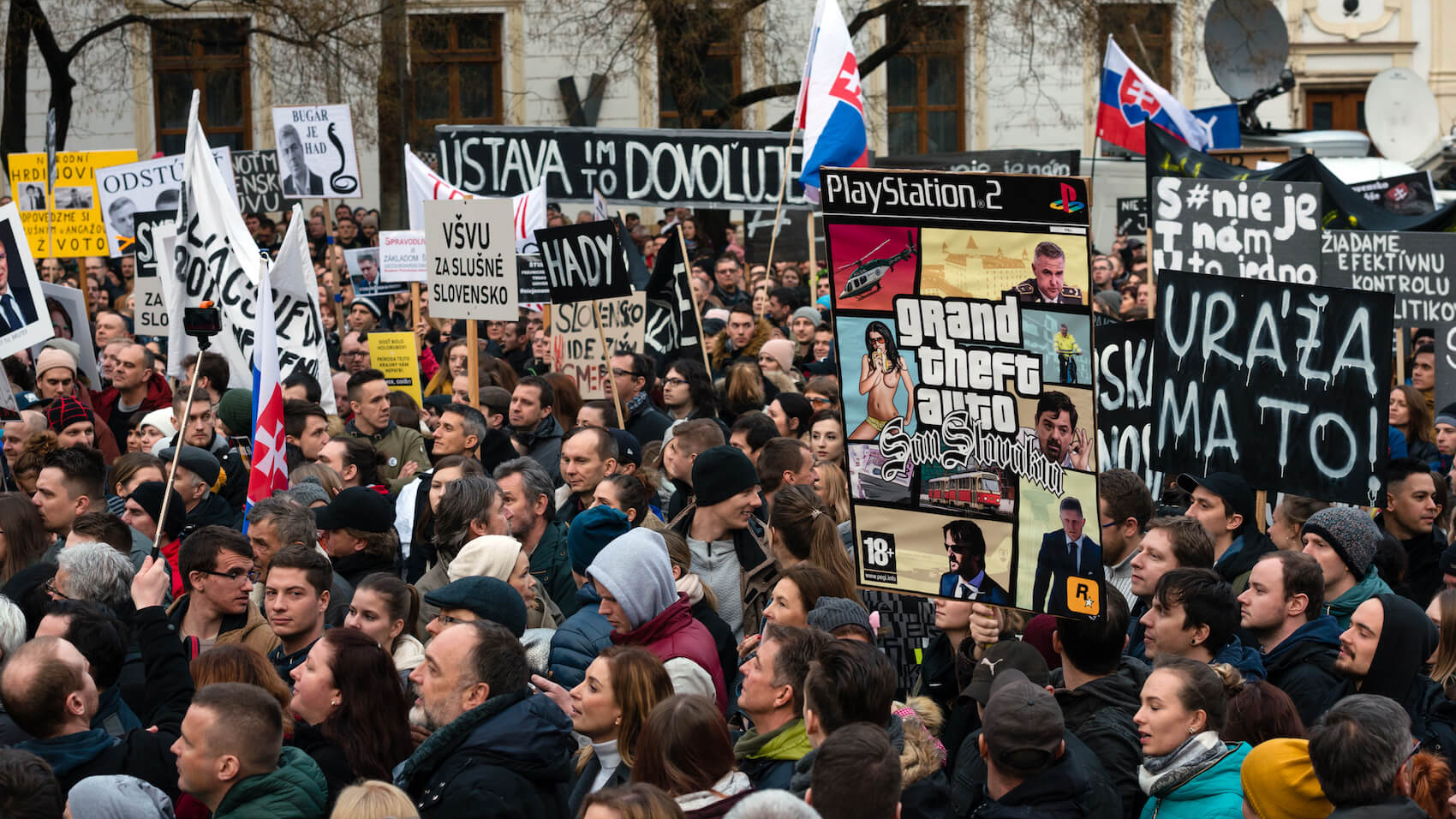
Similarly, GERB won the national elections with 24.7% of the votes, which made little difference in terms of forming a government. Parties in the fragmented and polarized parliament failed to agree on a governing formula, and subsequently, a seventh legislative election is scheduled for 27 October 2024. Early forecasts predict seven political formations in the subsequent parliament with little prospect for a governing coalition. In fact, 53% of voters do not believe that the new parliament will be able to produce a regular government (Alpha Research 2024b). Who benefits from yet another round of early elections, although, is Vazrazhdane who will have more opportunities to broadcast their pro-Russian, anti-EU and anti-NATO rhetoric and attract more disillusioned voters. Bulgaria’s future remains uncertain – politically, economically and geostrategically.


(*) Emilia Zankina is an Associate Professor in political science, Dean of Temple University Rome Campus and Vice Provost of Global Engagement at Temple University. Her research focuses on populism and political parties, politicization and public administration reform, gender representation and East European politics.


References

Alpha Research. (2024a). Public Opinion at the Start of the Electoral Campaign for National and European Parliament [Обществени нагласи на старта на предизборната кампания за Национален и Европейски парламент]. May 2024. https://alpharesearch.bg/post/1021-obshtestveni-naglasi-na-starta-na-predizbornata-kampania-za-nacionalen-i-evropeiski-parlament.html 

Alpha Research. (2024a). At the start of the campaign: seven political forces in the future parliament [На старта на кампанията: седем политически сили в бъдещия парламент]. September 2024. https://alpharesearch.bg/post/1025-na-starta-na-kampaniata-sedem-politicheski-sili-v-budeshtia-parlament.html 

Eurobarometer. (2024). Special Eurobarometer 101.5: Country Results: Bulgaria. European Parliament, https://europa.eu/eurobarometer/api/deliverable/download/
file?deliverableId=94206

Gurov, Boris and Emilia Zankina. (2013). “Populism and the Construction of Political Charisma: Post-transition Politics in Bulgaria”. Problems of Post-Communism, 60(1), pp. 3–17.

Haughton, Tim, Natascha Neudorfer and Emilia Zankina. (2024). “There Are Such People: The Role of Corruption in the 2021 Parliamentary Elections in Bulgaria”. East European Politics, 40(3), pp. 521–546.

Spirova, Maria and Radostina Sharenkova-Toshkova. (2021). “Juggling Friends and Foes: Prime Minister Borissov’s Surprise Survival in Bulgaria”. East European Politics 37 (3): 432–447. https://doi.org/10.1080/21599165.2021.1883589

Trend. (2024). Attitudes towards EU policies at the forenight of EP elections [Нагласи на българите спрямо политиките на ЕС в навечерието на изборите за Европейски парламент]. April 2024. https://rctrend.bg/project/attitudes 

Zankina, Emilia. (2023). “Pro-Russia or anti-Russia: political dilemmas and dynamics in Bulgaria in the context of the war in Ukraine”. In Ivaldi and Zankina (eds.), The Impacts of the Russian Invasion of Ukraine on Right-Wing Populism in Europe. European Center for Populisms Studies. Brussels, pp. 48–63. 

Zankina, Emilia. (2024a). “The Consequences of the War in Ukraine in Bulgaria: Political, Economic, and Cultural Divides”. In Mörner, Ninna (ed.), A World Order in Transformation? A Comparative Study of Consequences of the War and Reactions to These Changes in the Region. CBEES State of the Region Report 2024, pp. 82–90. https://sh.divaportal.org/smash/record.jsf?pid=diva2%3A1846696&dswid=1173 

Zankina, Emilia. (2024b). “Bulgaria: History”. In Europa Publications (ed.) Central and South-Eastern Europe 2025 (25th Edition), Routledge, pp. 115–120.


DOWNLOAD REPORT ON BULGARIA

Protesters hold signs during an anti-government demonstration demanding a change in government in Bratislava, Slovakia on March 16, 2018. Photo: Ventura.

Slovakia: Mixed Results of Populist Parties in the 2024 EP Elections

Please cite as:

Rybář, Marek. (2024). “Slovakia: Mixed Results of Populist Parties in the 2024 EP Elections.” In: 2024 EP Elections under the Shadow of Rising Populism. (eds). Gilles Ivaldi and Emilia Zankina. European Center for Populism Studies (ECPS. October 22, 2024. https://doi.org/10.55271/rp0082


DOWNLOAD REPORT ON SLOVAKIA

Abstract

Since Slovakia’s EU accession in 2004, populist parties have dominated national politics, although they are less influential in European Parliament (EP) elections. While Smer–Slovak Social Democracy led five national elections and Ordinary People and Independent Personalities (OĽaNO) triumphed in 2020, populist parties performed weaker in EP elections. Progressive Slovakia (PS) won in 2019 and 2024, signalling different electoral dynamics. The rise of populism in Slovakia reflects a shared narrative of a virtuous people vs. a corrupt elite, although each party incorporates populism differently. Smer, led by Robert Fico, has shifted towards far-right nationalism, while OĽaNO evolved into Movement Slovakia (MS), with a focus on anti-corruption. The neo-Nazi Kotlebists (ĽSNS), initially successful, has splintered, losing its foothold in national politics. The 2024 EP elections, held amid an assassination attempt on Prime Minister Fico, reflected the political tensions. Smer placed second with 24.8%, while MS and ĽSNS underperformed. These results highlight the varied impact of populist parties on national and EU politics in Slovakia.

Keywords: populism; Slovakia; European elections; Smer; Movement Slovakia


By Marek Rybář* (Department of Political Science, Masaryk University, Czech Republic)

Background

Since Slovakia’s accession to the European Union (EU) in 2004, populist political parties have largely dominated the national political landscape. In countries with proportional electoral systems, electoral success is typically determined by the ability to form interparty alliances that command a majority in the national parliament. Nevertheless, in Slovakia, it has consistently been a populist party that has secured the largest share of parliamentary seats. Direction–Slovak Social Democracy (Smer) achieved this outcome in five elections, while the Ordinary People and Independent Personalities (OĽaNO) – rebranded as ‘Movement Slovakia’ (MS) in late 2023 – emerged as the leading party in 2020. In five out of six cases, the victorious populist party also became the largest party controlling the government.

However, populist parties are notably less dominant in EP elections. While Smer emerged victorious in two EP elections (2009 and 2014), the now-defunct Slovak Democratic and Christian Union won the first EP elections in 2004, and Progressive Slovakia (PS) secured wins in both 2019 and 2024. These results demonstrate that the electoral dynamics in EP elections differ from those in national contests. The second-order status of EP elections contributes to this difference, with lower voter turnout and opposition parties effectively mobilizing voters against the incumbent government. However, mainstream opponents of populist parties tend to be more supportive of European integration, and their supporters are generally more motivated to express this stance at the ballot box, with consequences for the results of EP contests.

Populism is an elusive concept, often used not only to describe political phenomena but also as a value-laden term to discredit opponents. For the purposes of this briefing, I define ‘populist’ parties as those identified in the authoritative PopuList 3.0 database (https://popu-list.org/applications/). The latest edition identifies Smer, OĽaNO (now MS), We Are Family (SR), and Kotlebists – People’s Party Our Slovakia (ĽSNS) as the party-political embodiments of populism in Slovakia. The four parties differ in their ideologies, degree of popular support, stances on the European integration and many other important aspects. What they have in common is their depiction of society as being divided into two opposing groups: the virtuous people and the corrupt political elite, with the latter seen as betraying the interests of the former.

It is also worth mentioning that none of the populist parties analysed here has ‘populism’ as the sole defining characteristic feature. In fact, populism is understood as a thin ideology that can coexist with a host of other ideologies and may play only a secondary role in the party’s profile.

Smer is a case in point. Established in the late 1990s as a left-leaning statist party, it has transformed into a far-right party. Smer managed to return to power in 2023 after three years in opposition, during which its popular support plummeted and its parliamentary caucus suffered a break-up, after which the Voice-Social Democracy (Hlas), led by the former prime minister, Peter Pellegrini, formed as a separate entity. Although Smer has always featured nationalist, Eurosceptic and illiberal standpoints, from 2021 onward, Fico focused on building alliances with ‘alternative media’, extra-parliamentary opposition and far-right groups. The COVID-19 pandemic and the Ukraine crisis fostered a critical public sentiment (such as anti-vaxxers and pro-Russian authoritarians) that was opposed to the government, which Fico effectively harnessed. By collaborating with far-right politicians and organizing joint anti-government rallies, he further strengthened the nationalist elements of Smer’s message (Haughton, Cutts and Rybář, 2024). Although nominally social democratic, Fico has effectively moved the party towards the illiberal far right.

In contrast, OĽaNO (now Movement Slovakia) began as an openly populist party, positioning itself as the voice of ‘the ordinary people’ against a self-serving and corrupt political establishment. Since it entered the national parliament in 2010, the party has centred its political agenda on anti-corruption rhetoric. Initially a loose coalition of anti-corruption and pro-life activists, it evolved into a Christian conservative populist movement with a fluid organizational structure centred around its leader and founder, Igor Matovič. In a surprising outcome, the party won the 2020 national elections, capitalizing on the disillusionment of voters drawn to its sharp criticism of corruption and clientelism associated with the Smer-led government. Following its electoral success, the party managed to form a four-party coalition government, with Matovič assuming the role of prime minister. However, the new government, composed of mostly inexperienced ministers, encountered significant governance challenges, including managing the global COVID-19 pandemic and responding to Russia’s invasion of Ukraine. Matovič’s unpredictable governing style, characterized more by performance and sensationalism than well-considered policymaking, further exacerbated the government’s declining popularity. His approach led to numerous personal conflicts, not only with the opposition but also with his coalition partners. After one year, Matovič swapped positions with Finance Minister Eduard Heger, becoming the new Finance Minister himself. However, this move eventually failed to prevent the withdrawal of support from one of the coalition partners, resulting in a successful vote of no confidence in parliament. Consequently, the OĽaNO-led cabinet was replaced by a caretaker government appointed by President Zuzana Čaputová to lead the country toward early elections in September 2023.

Finally, the Kotlebists (ĽSNS) started as an extreme-right party that has used anti-establishment populist appeals combined with radical nativist ideology from its inception. The party managed to enter the Slovak parliament in 2020 and the EP a year earlier. However, the party caucus broke up in 2021, and the breakaway faction established a new party called Republika (Republic). It elected MEP Milan Uhrík as the party leader and distanced itself from what they portrayed as increasingly autocratic practices of the ĽSNS leader Marian Kotleba. Since then, popular support for ĽSNS has sharply declined; most former voters of the party turned to Republika, as did other far-right supporters, leaving ĽSNS out of the national parliament in 2023.

The political context of the 2024 EP elections

The campaign and the results of the EP elections in Slovakia in 2024 were significantly shaped by two factors. Firstly, the elections took place just weeks after the direct presidential elections (held at the turn of March and April 2024) and several months after the national parliamentary elections of September 2023. Because of their temporal proximity, all three electoral contests were related. Secondly, the elections were organized in the shadow of the assassination attempt on Prime Minister Robert Fico of Smer that took place in May 2024. The assassination attempt shook the country and impacted the campaign and elections both directly and indirectly.

In the national parliamentary elections of September 2023, Smer emerged as the leading party, securing a plurality with 22.9% of the votes. The party formed a coalition government with Hlas, a splinter faction from Smer, and the Slovak National Party (SNS), which managed to re-enter the national parliament after being absent in the previous electoral cycle, with Robert Fico appointed as prime minister. The socially liberal PS finished second, securing 18% of the vote. During post-election negotiations, PS made an unsuccessful attempt to dissuade Hlas from aligning with Smer, offering its leader Peter Pellegrini the position of prime minister in exchange for joining a government with other opposition parties. However, Smer provided a more favourable offer: Hlas would receive an equal number of ministries as the significantly larger Smer, and Pellegrini would gain Smer’s backing for his bid in the directly elected presidential race. As a result, the presidential election effectively became a second round in the contest for control over national institutions.

The former governing parties faced a devastating defeat: two failed to secure any parliamentary seats, while OĽaNO, led by former prime minister Igor Matovič, saw its vote share diminish to less than one-third of its 2020 result. Only Freedom and Solidarity (SaS), an economically liberal junior coalition partner of OĽaNO, maintained its performance from 2020. Additionally, the Christian Democratic Movement (KDH) succeeded in winning parliamentary seats for the first time since 2012.

Shortly after its formation, the new government embarked on a political course that, in many respects, starkly contrasted with that of the 2020–2023 administrations. The official Government Program included, among other things, plans to dismantle the national public broadcaster RTVS, abolish the Special Prosecution Office responsible for investigating the most serious criminal cases (including high-profile corruption cases), and overhaul the penal code, which would directly affect dozens of ongoing investigations. It also suggested preparing a special law targeting ‘foreign agents’, namely non-governmental organizations receiving grants from international donors.

Internationally, the new government pledged to halt all military assistance to Ukraine in its defence against Russian aggression and adopt a more neutral stance toward Russia. Significantly, many of these changes were set to be implemented not only without consultations with relevant stakeholders but also by using a special legislative procedure to fast-track the measures through parliament in a very short timeframe. The opposition criticized these plans and legislative proposals, arguing that they would obstruct the investigation and prosecution of corruption cases during the previous Smer-led administration. Furthermore, some measures appeared to enable the new government to bypass existing legislative safeguards and take control of independent public bodies.

In an effort to counter these legislative moves by the new parliamentary majority, opposition parties appealed to the European Commission and their partners in the EP to urge the Slovak government to reconsider its plans. However, the government made few changes and instead accused the opposition of damaging the country’s reputation internationally. Consequently, the period following the parliamentary and presidential elections was marked by intense confrontation between the governing parties and the parliamentary opposition.

Although the opposition-backed independent candidate won the first round of the presidential elections, Pellegrini ultimately prevailed in the runoff and was elected president. His victory had two significant consequences for the dynamics of interparty competition. First, since Slovak presidents traditionally renounce their party membership and strive to maintain a non-partisan role, Pellegrini’s departure as its founder and most trusted representative weakened the Hlas party. Second, it provided additional impetus for the opposition, particularly PS, to mobilize its supporters in the EP elections with the slogan ‘they cannot have everything’, a reference to the governing parties. Boosting its electoral prospects, PS ‘recruited’ Ľudovít Ódor, the former prime minister of the 2024 caretaker government and former Vice-Governor of the Central Bank, to lead its party list in the EP elections.

Assassination attempt on Robert Fico and the campaign

Just before the most intense phase of the campaign was set to begin, the trajectory of domestic politics was dramatically altered by a failed assassination attempt on Prime Minister Robert Fico. On 15 May, while Fico was addressing a crowd of his supporters in the small town of Handlová, a 71-year-old man fired five shots at him, four of which struck Fico, causing gunshot wounds to his abdomen. Shortly afterwards, several leading representatives of Smer and SNS blamed the opposition and independent media for the attempt, claiming it resulted from a polarized political environment they allegedly created. They further suggested that unspecified measures were necessary to increase government control over the media and regulate the right of assembly to enhance public safety. While there were moderate voices within the government advocating for de-escalation, the coalition parties’ primary message was to blame their political opponents. Although the assassin had no record of links to any political party, some government representatives attempted to associate him with PS, alleging he had attended opposition rallies in the months preceding the attack.

In response to the assassination attempt, PS and other opposition parties suspended their election campaigns and proposed a meeting of the highest representatives of all parliamentary parties, but the governing parties rejected this proposal. Similarly, President Čaputová and President-elect Pellegrini jointly suggested a national roundtable involving all major parties, but some government representatives also rejected this initiative.

Whatever campaign strategy Smer had prepared for the EP election was eventually reduced to two slogans: ‘For Peace in Europe’ and ‘For Robert Fico’. The party sought to promote the narrative that the previous government had falsely criminalized Fico and his associates, and upon Smer’s return to power, justice needed to be restored. Furthermore, Smer conveyed to its voters the message it had promoted in the 2023 national campaign: peace in Europe is endangered because previous governments (and the EU) supplied weapons to Ukraine. According to Smer, Slovakia should remain neutral, and such neutrality would restore peace. The Smer manifesto stated: ‘We want to be the extended arm of Robert Fico’s government, which will face increasing attacks from Brussels’ warmongers for striving for peace and refusing to send weapons to Ukraine’ (Smer 2024). Additionally, Smer attacked what it called ‘extreme progressive gender ideologies’ and sought to associate them with PS. Following the assassination attempt, Smer leaders and candidates attempted to rhetorically link ‘progressivism’ with ‘extremism’ to discredit their primary opponent.

Although PS, along with other opposition parties, initially suspended its campaign, it soon resumed its activities. The party sought to mobilize its supporters by arguing that the Smer-led government had undermined Slovakia’s position within the EU and that its policies could lead to Slovakia’s isolation or even result in the suspension of EU funds due to non-compliance with rule-of-law criteria. It also contended that achieving national reconciliation after the assassination attempt should not imply that the opposition would abandon its primary role of holding the government accountable for its actions and proposals.

The main campaign issues and stances of populist parties

Smer, as the leading representative of party-based populism, produced a five-page manifesto summarizing its central positions concerning several crucial EU policies. It consistently promoted the key manifesto stances in public rallies, media interviews and on social networks. As mentioned, Smer blamed the EU for ‘prolonging war in Europe’ by supporting Ukraine. As in the past, the party questioned the rationale of sanctions against Russia and has been critical of the EU foreign policy against other authoritarian regimes by calling it ‘a patronizing approach’ and ‘the imposition of the European liberal model’ towards countries that ‘have the right to their own historical path’ (Smer 2024).

The party also rejected the recently adopted EU Pact on Migration and Asylum, particularly the scheme that includes the relocation of asylum seekers among the EU countries. It proposed no concrete measures but only generally stated that the EU external border should be protected more and that illegal migration should be dealt with in the country of origin. The opposition to compulsory relocation schemes has been central to the party’s stance since the mid-2010s. Smer also claimed it would initiate reopening the European Green Deal, which was labelled as an ‘extreme environmental initiative’ and claimed it was pushed through by ‘Eurocrats with no accountability’. It specifically rejected the target of reducing emissions by 55% by 2030 (Smer 2024).

Smer linked the EU’s handling of the COVID-19 pandemic to control by supranational elites, particularly ‘multinational corporations and pharmaceutical companies’, leading to the ‘imposition of experimental vaccinations’ and the ‘criminalization of people for their opinions’ (Smer 2024). Since first gaining representation in the EP, Smer’s Members of the European Parliament (MEPs) have been part of the leading Socialist group (Socialists & Democrats, S&D). However, in the previous parliament, their membership was suspended due to their alliance with the far-right Slovak National Party (SNS) (Euronews 2023). The examples above demonstrate that Smer itself has shifted towards the far right.

It is instructive to compare Smer’s position with that of another populist party, the far-right neo-Nazi Kotlebists – People’s Party Our Slovakia (ĽSNS). Although now electorally marginal, ĽSNS was represented in both the national (2016–2020) and European (2019–2024) parliaments. The party did not produce an official EP election manifesto in 2024 but instead promoted its views on various social media platforms.

The primary difference between the two populist parties in 2024 was their stance on Slovakia’s EU membership. Smer claimed to support EU membership despite its many shortcomings. In contrast, ĽSNS argued that what it sees as the drawbacks of EU membership are inherent to how the EU operates and that the EU cannot be reformed. Consequently, it advocated for Slovakia’s exit from the EU (ĽSNS 2024). The party leader stated that, if elected to the EP, ĽSNS would ‘lay the groundwork for Slovakia’s exit from the European Union and break the EU from within’ (ĽSNS 2024).

However, the positions of Smer and ĽSNS were quite similar regarding their assessment of Russia’s invasion of Ukraine, the Green Deal and the COVID-19 pandemic. While their reasoning differed, their objectives overlapped:

ĽSNS opposed any military support for Ukraine, claiming it ran counter to efforts to achieve peace. It further argued that the ultimate goal of the EU was to escalate the conflict, with the final aim of full and open participation of European countries in the conflict (RTVS 2024). ĽSNS also blamed the West for the conflict, citing its overall unfair stance towards Russia and its legitimate interests.

Regarding their opposition to the Green Deal, Smer argued that it would harm Slovakia’s automotive industry. In contrast, ĽSNS contended that the proposed measures were misguided: strict protection of water, soil and forests should occur at the national level. However, a clear nativist tone was evident in their proposed measures, suggesting that ‘the fundamental solution was to prevent the purchase of land by foreigners’ (Hlavný denník 2024).

Finally, ĽSNS’s rejection of the EU’s handling of the COVID-19 pandemic was similar to Smer’s, but its reasoning was more extreme and conspiratorial. The party suggested that vaccination campaigns and deals with pharmaceutical companies were part of a broader plan to transform Europe. ĽSNS claimed that the EU was attempting to destroy the Christian tradition in Europe by promoting mandatory vaccinations that would prevent young Europeans from having their own children. This move, they argued, would align with the EU’s alleged goal of ‘replacing the original inhabitants of Europe with migrants brought in from all corners of the world’ (ĽSNS 2024).

The positions of the third populist party, MS (formerly OĽaNO), differed most significantly from those of Smer and ĽSNS in the area of international politics. MS argued that the conflict in Ukraine was a result of Russia’s imperial ambitions and that it was the duty of European democracies to help Ukraine defend itself. The party claimed that Ukraine was also fighting for ‘our freedom and democracy’ (Hnutie Slovensko 2024).

MS was also critical of the Green Deal but proposed a revision that would involve postponing the timeline for key targets, arguing that ‘reckless and hasty implementation of electromobility will lead to greater poverty and reduced mobility for vulnerable groups’ (Hnutie Slovensko 2024). The party’s positions on other contentious issues, such as immigration and the COVID-19 pandemic, were vaguer. Instead, its manifesto prioritized the need to combat disinformation and corruption at the EU level in an attempt to link its opponent, Smer, to these issues.

The results and implications of the EP elections

The elections were held on a single day, 8 June and their results were remarkable in several respects. The turnout of 34.4%, although the fourth lowest among all EU countries, was the highest ever recorded in EP elections in Slovakia, an increase of nearly 12 percentage points compared to 2019. Of the three populist parties, only Smer managed to gain parliamentary representation, finishing a close second after PS with 24.8% of the vote, thereby expanding its EP representation from three to five MEPs. The other two populist parties failed to cross the 5% threshold, receiving just 2% (MS) and 0.5% (ĽSNS), respectively.

In the absence of exit polls or other opinion data, it is difficult to determine the factors that led to these results. As discussed, the outcomes were decisively influenced by the fact that this was the third nationwide electoral contest within nine months and by the assassination attempt on Robert Fico, the leader of Smer. The two electoral defeats of the parliamentary opposition and the polarizing effects of these losses likely bolstered support for PS, whose electoral base is strongly aligned with Slovakia’s EU membership (Haughton et al., 2024). The assassination attempt likely increased sympathy for Fico and his party, prompting some voters of non-parliamentary opposition parties (other than Smer) to support Smer in the EP elections. Smer’s two coalition partners performed poorly, with SNS failing to gain any seats despite its party list featuring all major figures, including the party leader. Since a sizeable share of their supporters view Fico favourably, they likely voted for Smer (Hopková 2024). In contrast, ĽSNS was electorally weakened by the departure of Republika, its breakaway faction, which performed well in the EP elections. Finally, Movement Slovakia’s low support probably reflected disappointment with its performance in the 2020–2023 government.

The election results put the Slovak government in an awkward position, as none of its six MEPs (five from Smer and one from Hlas) are likely to sit in a major faction in the EP. In contrast, the parliamentary opposition parties will join the Renew (six from PS) and European People’s Party (EPP) (one from KDH) groups in the EP. This constellation is likely to further alienate the Slovak government from its European partners.

Table 1: Results of the most recent national and EP elections

Party  EP 2019 (%) EP 2019 (seats) NR SR 2023 (%) EP 2024 (%) EP 2024 (seats)
PS 20.1 4 17.96 27.8 6
Smer 15.7 3 22.94 24.76 5
Republika 4.75 12.53 2
Hlas 14.7 7.18 1
KDH 9.7 2 6.82 7.14 1
ĽSNS 12.1 2 0.84 0.48 0
SaS 9.6 2 6.32 4.92 0
MS (OĽaNO) 5.3 1 8.89 1.98 0
SNS 4.1 0 5.62 1.9 0
Source: www.statistics.sk. Electoral threshold of 5% applies for a single party in both types of elections. All parliamentary parties represented in at least one parliament are listed


(*) Marek Rybář is Associate Professor at the Department of Political Science, Faculty of Social Studies and the International Institute of Political Science, Masaryk University, Brno, the Czech Republic. He has written numerous journal articles and book chapters on political parties, politico-administrative relations and executive political institutions in Central Europe. marek.rybar@mail.muni.cz, ORCID: 0000-0001-5242-2895


References

Euronews 2023. https://www.euronews.com/2023/10/13/slovak-meps-to-be-suspended-from-eu-parliaments-socialist-group-over-far-right-government-

Haughton, T.; Cutts, D.; Rybář, M. 2024. A Narrow Path to Victory: Robert Fico, Smer-SD and the 2023 Elections in Slovakia (unpublished manuscript).

Hlavný Denník. 2024. https://www.hlavnydennik.sk/2023/07/31/lsns-ponuka-radikalny-krok

Hnutie Slovensko. 2024. Čestne za vás na Slovensku aj v Bruseli (volebný program do EP 2024).

Hopková, D. 2024. Šéf Focusu Slosiarik: Eurovoľby priniesli tri prekvapenia (rozhovor). Available at: https://www.aktuality.sk/clanok/cTAjiLY/sef-focusu-slosiarik-eurovolby-priniesli-tri-prekvapenia-rozhovor/

Rybář, M. 2020. Slovakia. In V. Hloušek and P. Kaniok (eds.) The European Parliament Election of 2019 in East-Central Europe. Houndmills: Palgrave, pp. 229–251.

Smer. 2024. Program strany SMER–SSD do volieb do Európskeho parlamentu 2024.

RTVS. 2024. Predvolebná diskusia politických strán vo voľbách do EP, available at http://kotlebovci.sk/2024/06/marian-kotleba-v-rtvs-ideme-rozbit-europsku-uniu-zvnutra/

ĽSNS. 2024. Rogel a Kotleba k vlastencom: S Európskou úniou urobíme krátky proces! available at http://kotlebovci.sk/2024/06/rogel-a-kotleba-k-vlastencom-s-europskou-uniou-urobime-kratky-proces/

DOWNLOAD REPORT ON SLOVAKIA

Demonstration by the Flemish far-right party Vlaams Belang in Brussels, Belgium, on May 29, 2023. Photo: Alexandros Michailidis.

Populist Radical Parties in Belgium and the 2024 European Elections

Please cite as:
van Haute, Emilie. (2024). “Populist Radical Parties in Belgium and the 2024 European Elections.” In: 2024 EP Elections under the Shadow of Rising Populism. (eds). Gilles Ivaldi and Emilia Zankina. European Center for Populism Studies (ECPS. October 22, 2024. https://doi.org/10.55271/rp0062


DOWNLOAD REPORT ON BELGIUM

Abstract

In 2024 elections in Belgium were concurrently held for the European, federal and regional levels. For that reason, the European elections were clearly second-order elections. As the main opposition parties at the federal level, populist radical parties of the right (Vlaams Belang, VB) and the left (the Workers’ Party of Belgium, PTB–PVDA) approached the 2024 elections in a strong position. They were portrayed as clear favourites in the polls and the media. From 2019 to 2024 they managed to set the agenda on their issues: migration and law and order for the VB, socioeconomic issues and civil liberties and rights for the PTB–PVDA. Both parties came out of the elections with more votes and seats. Part of the reason for this success is that their program matched with voters’ priorities. Their populist, anti-elite rhetoric also permeated public opinion. Yet they were perceived as having underperformed electorally. Moreover, because they were not politically indispensable, they were quickly sidelined. At the European level, the VB and the PTB–PVDA will likely continue directly pushing their respective populist, Eurosceptic and radical agendas. They are also likely to have a real indirect contamination effect through mainstream parties and public opinion integrating part of their programmatic positions and priorities.

Keywords: Belgium; radical parties; populism; voting behaviour; European elections

By Emilie van Haute* (Department of Political Science, Université libre de Bruxelles (ULB), Brussels, Belgium)

Introduction

The 2024 European elections in Belgium appeared distinctly like the ‘mother of all elections’. Voters were called to cast ballots concurrently in three separate elections (European, federal and regional) held on the same day. Additionally, it had been five years since Belgian voters had faced a single election. Consequently, it was also a test of the balance of power between the numerous parties that form the two separate party systems operating in the country.

Belgium has a highly fragmented multiparty system. Since the split of traditional party families along the linguistic divide, Belgium has been characterized by two party systems operating separately (Table 1): Flemish parties compete in Flanders (the north of the country), whereas Francophone parties compete in Wallonia (in the south). Parties only compete together in Brussels. 

Among these parties, two are clear cases of populist radical parties based on the PopuList categorization (https://popu-list.org): the radical-left Workers’ Party (Parti du Travail de Belgique–Partij van de arbeid, PTB–PVDA), the only relevant national party in Belgium (Delwit, 2014; 2022), and the radical-right Flemish Interest (Vlaams Belang, VB), a party that competes only in Flanders and in Brussels (van Haute & Pauwels, 2016). On the French-speaking side, the populist radical-right parties have always had a hard time anchoring themselves structurally in the political landscape (De Jonge, 2021b; Delwit & van Haute, 2021). The present chapter therefore analyses the electoral performance of the PTB–PVDA and the VB at the 2024 EP elections.
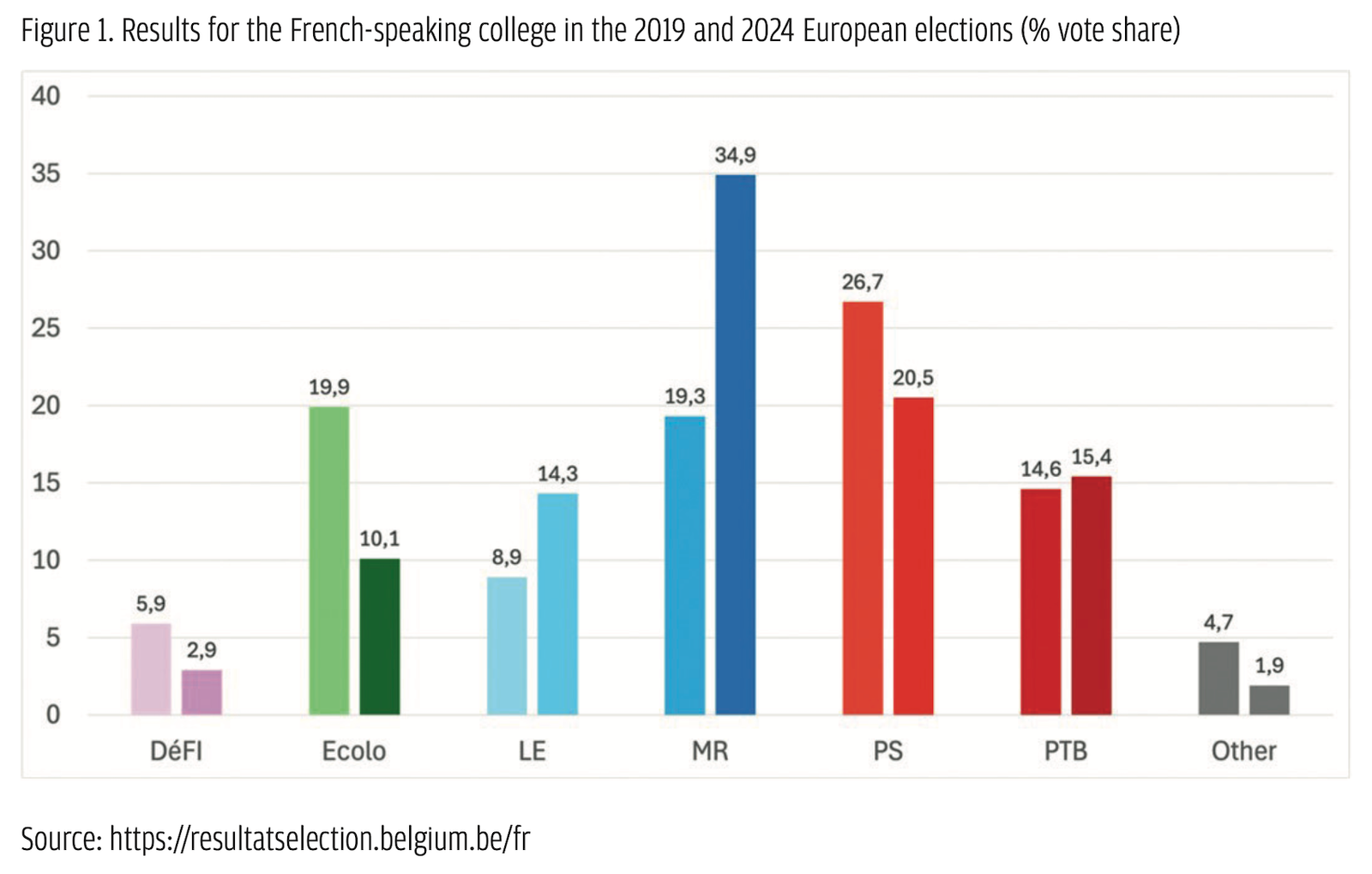
Background

After a series of electoral setbacks after 2007 caused by the emergence of an alternative Flemish nationalist vote with the N–VA and internal tensions around the dominance of the party elite from Antwerp (van Haute & Pauwels, 2016), the populist radical-right VB returned to success at the 2019 European, federal and regional elections. The VB won a substantial number of seats: from 3 seats in the House of Representatives at the federal level in 2014 to 18 seats in 2019. More generally, 2019 saw a substantial shift in party preferences towards radical populist parties (Goovaerts et al., 2020) since the PTB–PVDA also won a significant number of seats (from 2 in 2014 to 12 seats in 2019). These results contributed to a fragmented and polarized political landscape, with VB gaining grounds in Flanders and PTB–PVDA winning in Walloon constituencies. These trends also characterized the concurrent European elections (Figures 1 and 2).

The profile of VB and PTB–PVDA voters in 2019 presented similarities. Data from the 2019 Belgian panel survey (Michel et al., 2024) show that both parties attracted a younger, more male voter group with lower levels of education and a protest component, and displaying lower levels of trust and satisfaction with the government, but also higher levels of anger (Gallina et al., 2020; Jacobs et al., 2024). Populist radical parties thus clearly capitalized on voters seeking an alternative. But they also attracted issue-based voting on their core respective issues (Goovaerts et al., 2020; Walgrave et al., 2020).
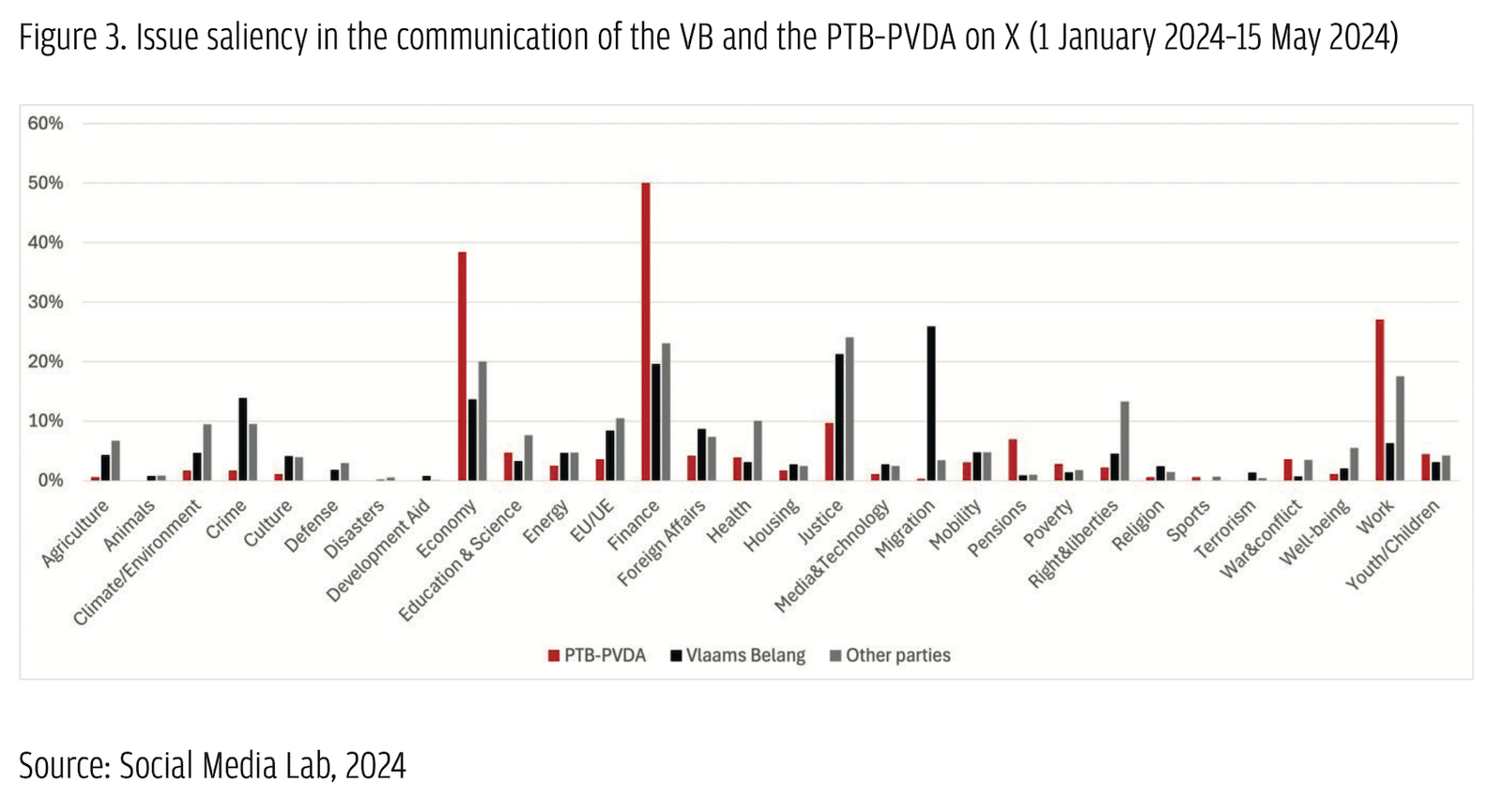
VB voters position themselves furthest to the right on the left–right axis and PTB–PVDA furthest to the left. For the PTB–PVDA, this positioning reflects the salience of socioeconomic issues for its voters, whereas for the VB, cultural issues are most salient (Pilet et al., 2020). What explains this difference in the success of populist radical parties across the linguistic divide is not so much the differences in attitudes between French- and Dutch-speaking voters. The average position on socioeconomic and migration issues, for instance, are very similar (Walgrave et al., 2019). 

Rather, it is the structure of the party system and the salience of issues that make a difference. The weakness of the radical-right party organizations in French-speaking Belgium is patent (Close & Ognibene, 2021); in contrast to the VB, such parties lack local anchorage, links with civil society organizations and leadership. Partly due to the cordon sanitaire in the French-speaking media (De Jonge, 2021a), radical-right parties are not able to push their issues on top of the political agenda. While migration was the top priority among voters in Flanders in 2019, it only ranked fifth in Wallonia, where socioeconomic issues dominated (Walgrave et al., 2019).

The 2019–2024 legislature was particularly difficult at the federal level. The polarized results of 2019 put centrifugal pressures on parties in the two political sub-systems. Despite the extended period of minority caretaker government after the N–VA withdrew from the federal government in December 2018, the negotiations to form a new government after the 2019 elections quickly stalled. The position of the two main parties on each side of the linguistic border, the N-VA and the PS, proved irreconcilable as they were both pushed by the pressure of their respective radical challengers, the VB and the PTB. In March 2020, the COVID-19 crisis was an accelerator, and the caretaker government was given six months of full power as a minority government. In October 2020, sixteen months after the elections, a full government was finally formed, composed of seven parties: the two liberal parties (OpenVLD and MR), the two socialist parties (Vooruit and PS), the two green parties (Groen and Ecolo), and the Dutch-speaking Christian Democrats (CD&V). The new government had to deal with COVID-19 and its aftermath, as well as Russia’s February 2022 invasion of Ukraine, the consequent influx of refugees, the energy crisis and high inflation. With seven parties around the table, it was very difficult to agree on major reforms.

The challenge made it easy for opposition parties to capitalize on the weakness of the federal government. On the Dutch-speaking side, the main opposition came from the VB, as the N-VA was leading the Flemish regional government, which was also facing difficulties. On the French-speaking side, the main opposition came from the PTB and Les Engagés.

An analysis of the communication of all 13 parties represented in the federal parliament and their leaders on Twitter (now X) between 1 January 2022 and 31 March 2023 (N=16,330 tweets) reveals that populist radical parties were much more active on social media than mainstream parties (Close et al., 2023; see also Delwit & van Haute, 2021).

The content of this communication provides insights into the saliency and ownership of issues. Overall, the public debate in Flanders and French-speaking Belgium revolved around different issues. Flanders saw more focus on migration, law and order issues (crime, justice), and finance, whereas in French-speaking Belgium, the focus was more on energy, civil rights and liberties, and work (Close et al., 2023). Despite the international context, European issues and foreign affairs were not dominant.

This agenda was particularly favourable to the populist radical parties. Close et al. (2023) have shown that the VB positions itself clearly on the most salient issues in Flanders. They come up first in terms of mentions of migration, law and order (including terrorism), but also lifestyle and religion. Interestingly, the party also comes second on EU issues after the Dutch-speaking Liberals (who held the federal prime ministership) and on animal welfare. They come up third in agriculture.

The PTB also position itself also on the most salient issues in Wallonia (Close et al., 2023), especially civil rights and liberties. The difference in discourse between the two branches of the party is striking in that regard. The results also show that the party avoids any mention of migration issues. Conversely, it clearly owns socioeconomic issues. The party ranks first in terms of mentions of employment, work, pensions, finances, and disasters (on the French-speaking side, linked to the floods of 2021). It ranks second on economy and foreign affairs.

Populist radical parties thus approached the 2024 elections in a strong position. They occupied the position of outsiders and alternative vote to an unpopular federal government. They owned the most salient issues in their respective polarized political landscapes. In Flanders, the VB was systematically polling first after autumn 2022 (VRT, 2023), and the PVDA was for the first time also showing anchorage in Flanders. In Wallonia, the PTB was polling third from March 2020, and the gap with the first two parties, the Socialists and the Liberals, was closing in after March 2022.

An electoral victory portrayed as a political defeat

The European elections in Belgium were marked by a change in the electoral rules, allowing 16- and 17-year-olds to vote. After a controversy, voting was also made compulsory for this segment of the electorate. More generally, with no elections held in Belgium since 2019, the 2024 electorate comprised more than a million first-time voters, including 268,000 voters aged 16–17 for the EP elections, which had the potential to weigh on the results.

Radical parties performed extremely well electorally on 9 June (see Figures 1 and 2). At the European level, the VB ranked first in the Dutch-speaking group with 22.9% of the votes, representing an increase of almost 4 percentage points. Given the low number of seats allocated to the Dutch-speaking group (13 out of 22 for Belgium), the party failed to gain an additional seat and therefore tied with N-VA. The progress of the PTB–PVDA was asymmetrical. On the Dutch-speaking side, the party almost doubled its vote share, from 4.9% in 2019 to 8.1% in 2024. It allowed the party to get its first seat in the European Parliament in the Dutch-speaking group. On the French-speaking side, the PTB also confirmed progress. With 15.4% of the votes in the French-speaking group, it gained about 1 percentage point and climbed from the fourth (2019) to the third position. Again, given the low number of seats allocated (8), this symbolic progress did not see the party gain any additional representatives, again taking just one seat in the EP in the French-speaking group.

However, these good electoral performances were overshadowed by what happened at the federal and regional levels. On the Dutch-speaking side, even if the VB progressed and the N-VA lost votes and seats, the latter managed to remain the first party at these levels. The VB underperformed compared to expectations based on the pre-election polling, possibly due to the large number of undecided voters, which makes accurate polling difficult (Pilet et al., 2024). Also, politically, Bart De Wever, leader of the N-VA, clearly closed the door to the VB a couple of days before the elections and encouraged voters to vote for the N-VA, saying that a vote for the VB would be a lost vote. This call for strategic voting seems to have paid off, as N-VA remained the first party at the regional and federal levels but not at the European level, where voters had a lower incentive for strategic voting.

Another element that may have weighed is the performance of De Wever in a new popular TV show, ‘Het conclaaf’ (‘The Conclave’), where he spent a weekend locked away with the VB leader Tom Van Grieken. De Wever clearly dominated the exchanges. Finally, together, N–VA and VB did not come out of the elections with a majority of seats in the Flemish parliament, which de facto excluded this only coalition option. Vlaams Belang was thus quickly portrayed as the underperformer; N-VA managed to frame these results as a victory, and VB was excluded from the negotiations for government formation at the regional and federal levels. The PTB–PVDA also gained votes and seats. At the federal level they progressed in Flanders (from three seats in 2019 to six in 2024, now getting at least one seat in each constituency) and in Brussels (from two to three seats). In Brussels, the PTB mainly gained voters from the socialist party PS and came top among first-time voters (Biesemans et al., 2024). However, the party lost seats in the Walloon constituencies (one at the federal level, two at the regional level). It did not manage to steal as many former PS voters, and it did not convince the first-time voters who turned more massively to the Liberals (MR) and the former Christian Democrats (LE) (Close et al., 2024). As for the VB, the party underperformed compared to what the polls had created regarding expectations, which overshadowed its other victories. The leadership of right-wing parties in the negotiations for government formation in Brussels and Wallonia also meant that the party was directly excluded from the equation.

A program and communication in tune with voters’ priorities

Vlaams Belang presented a classic populist radical-right manifesto for the 2024 elections. Titled ‘Flanders Back to Us’ (VB, 2024), the program puts ethnonationalism first, advocating for Flanders’ independence from Belgium, power to the people, a stop to immigration and a strong take on law and order. Socioeconomic, fiscal and cultural issues are framed in ethnonationalistic terms. In a classic welfare chauvinist approach, national preference is portrayed as the solution to poverty and high housing prices and better health care services; independence is painted as the solution to fiscal and budgetary issues, as the party denounces fiscal transfers to French-speaking Belgium and asks for the return of ‘Flemish money in Flemish hands’ (VB, 2024: 10).

Since elections were held concurrently for three levels, more local issues were covered first, while Europe was discussed in detail only on the last two pages of the VB manifesto (VB, 2024: 96–97). The party uses the ‘taking back control’ tagline and denounces EU leaders as ‘extreme’ (and overly bureaucratic/technocratic), hallmarks of a populist radical-right platform. The party opposes further enlargement and positions itself against EU interference in the national politics of illiberal democracies (e.g., Hungary), as well as EU policies on climate, agriculture and migration. The party’s list of specific proposals includes stifling the European Parliament, reducing Belgium’s budget contribution, negotiating a package of opt-outs from certain EU policies and legislation, defending Western values and promoting the subsidiarity principle and member states’ sovereignty. Interestingly, the manifesto avoids concrete topics related to foreign affairs, such as the Russia–Ukraine War and the war in Gaza.

PTB–PVDA also presented a classic populist radical-left program for the 2024 elections. Titled ‘The Choice to Break Away’ (PTB, 2024), the program puts socioeconomic issues first, advocating for fiscal justice, more social policies and purchasing power for households, better jobs, the right to healthcare, the end of political privileges, and a social climate policy. Highly active on university campuses, the party also tailored its message to young people, which was also likely driven by an interest in mobilizing first-time voters. Similarly, the party takes a notably progressive position on rights and liberties, especially racial discrimination, feminism and LGBTQ+ issues.

The concurrent elections also blurred the VB’s specific positions regarding the EU. The party developed a separate program for the European elections, which did not contribute to making it visible. This program reflected the VB’s populist orientation, with an explicit equation of Europe with a distant class of wealthy and privileged elites. Nevertheless, while the VB mobilizes cultural values and identities to underpin its populist rhetoric, the PTB–PVDA mobilizes a socioeconomic discourse that denounces a capitalist Europe imposing austerity on the poor through nondemocratic rules. The party takes a clear stance against austerity, privileges, inequalities, poverty, punitive environmental taxes, social dumping and the logic of profit and the market. It advocates addressing the root causes of migration, such as poverty in the Global South. Regarding external affairs, the party justify its nonalignment and rejection of NATO in terms of a commitment to striving for peace. On the Israel–Hamas war, it takes a clear position in favour of Palestine, denouncing acts of genocide as against international law and human rights.

The parties’ programs were heavily relayed online. Vlaams Belang is the absolute leader in online communication in Belgium. The party spent €1.5 million during the four months preceding the elections (Ryckmans, 2024). PVDA ranked fourth, spending €708,933. While the PTB had been very present during the legislature, it took a step back during the campaign.

The content of their respective communication reveals the saliency of issues they own (Figure 3). The VB clearly made migration the salient issue in its communication during the campaign. More than a quarter of its communication on X is on this issue. The gap with other parties is massive. The party also over-communicated on crime but to a lesser extent. The PTB–PVDA clearly stands out with its focus on finance, the economy, pensions, work and all socioeconomic issues. Europe is not central to these parties; they mention it less than other parties.

While the content reveals the ideological focus of these parties, the tone of their communication connects to their populist core. Both parties heavily rely on attacks as a mode of communication. Previous studies have shown that personal or programmatic attacks represent 26.5% of the total communication of the VB on X (first party in Belgium) and 25% for the PTB–PVDA (Close et al., 2023).
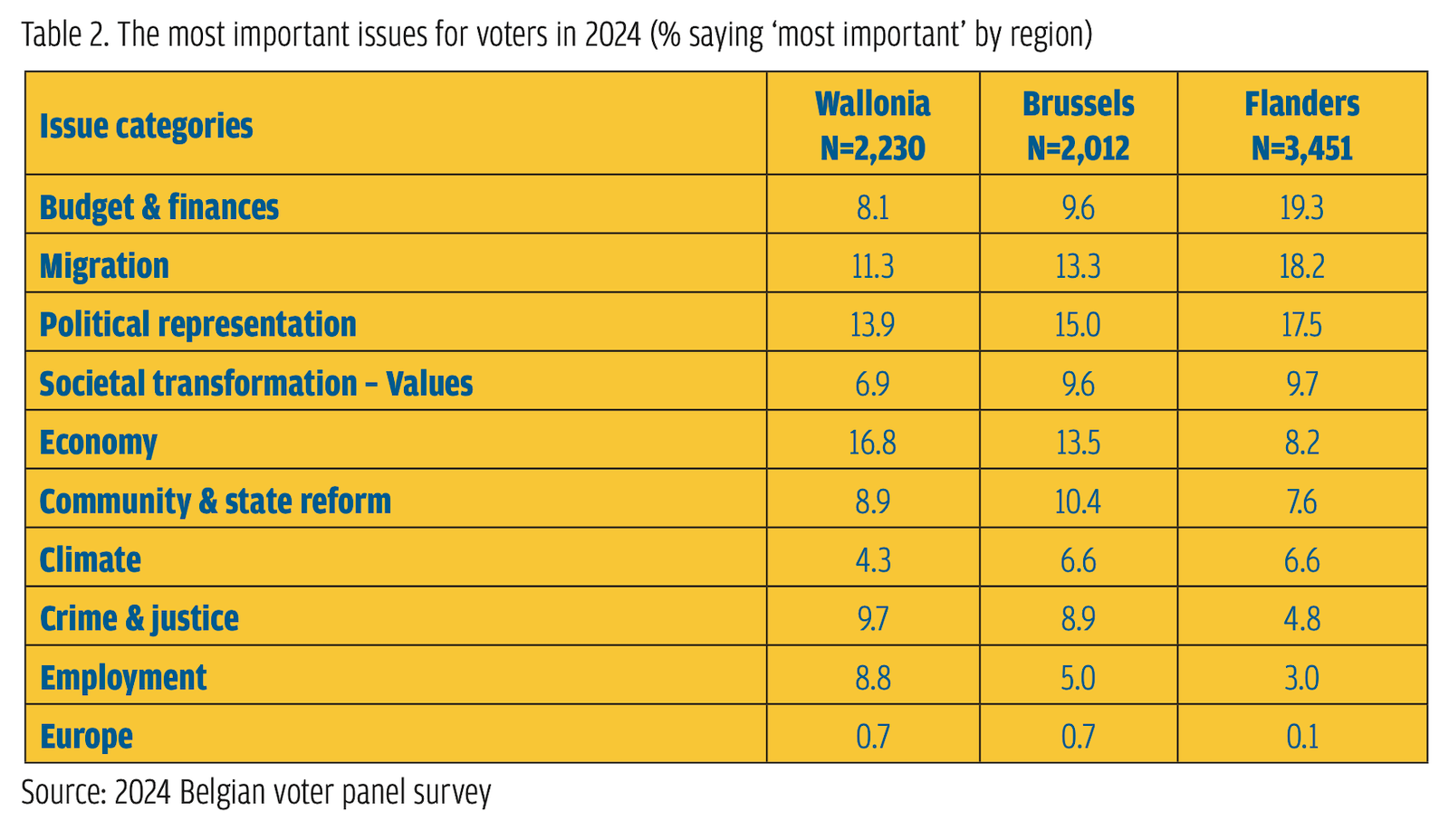
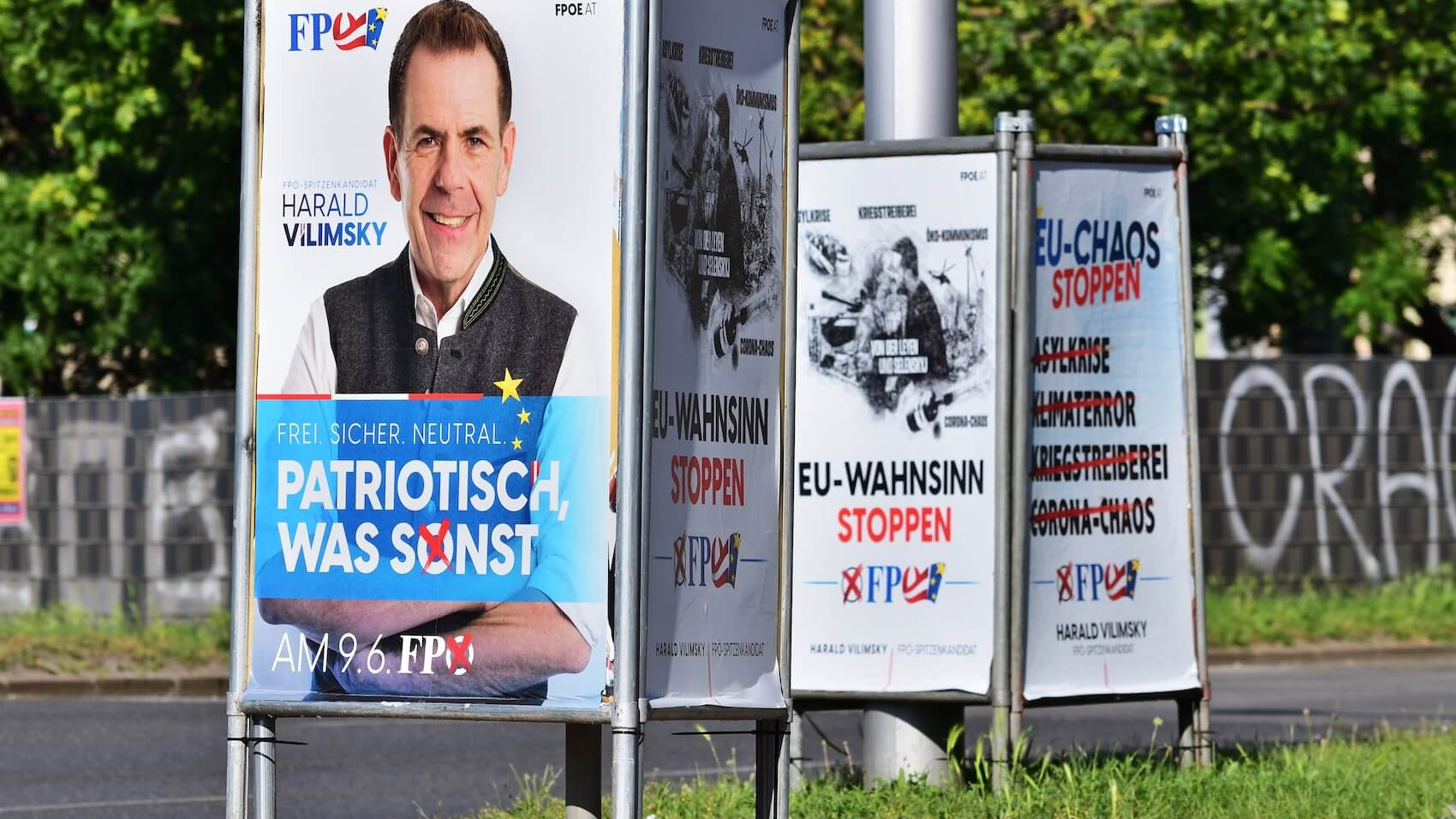
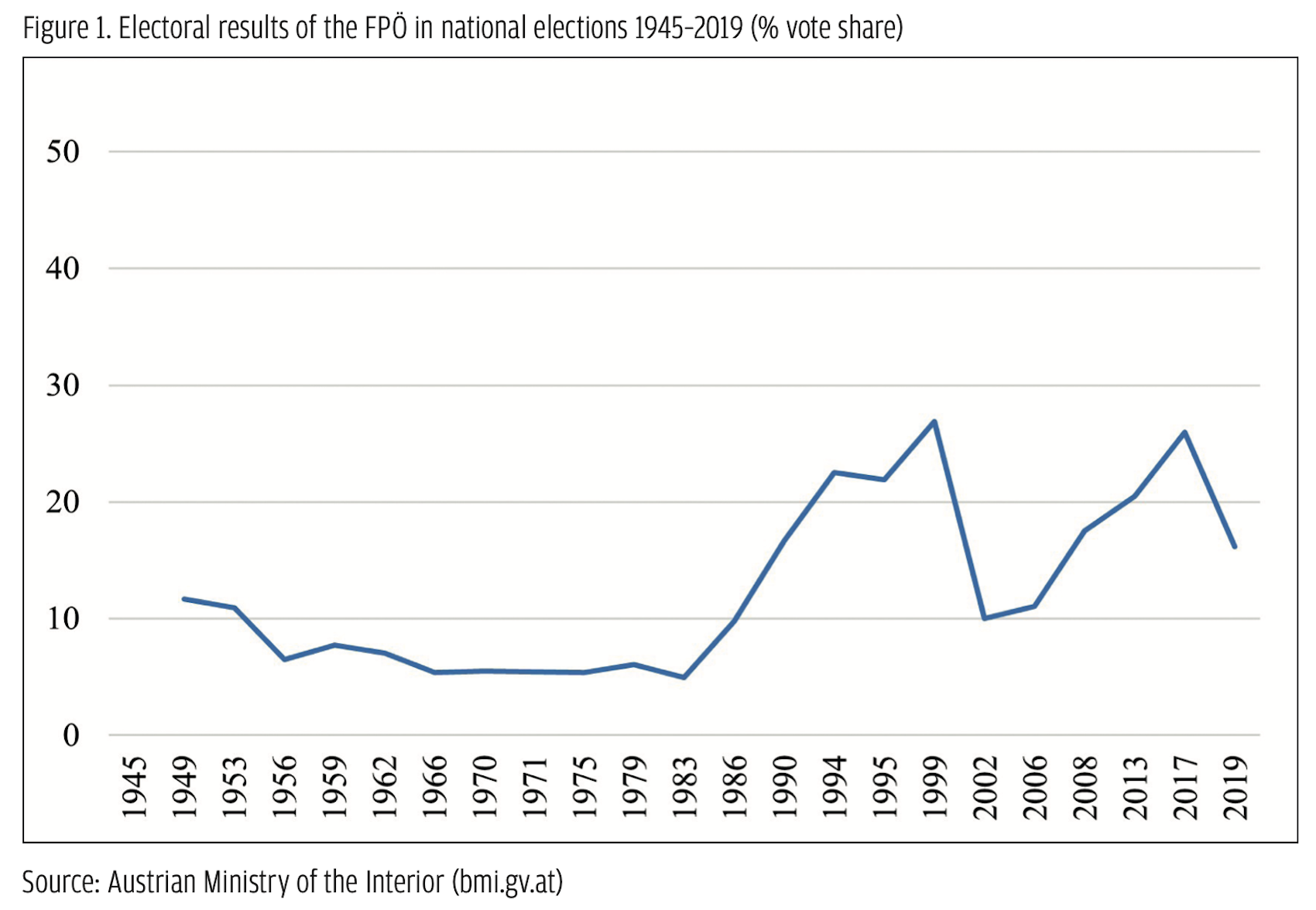
These programmatic priorities match voters’ priorities. The 2024 Belgian voter panel survey asked voters an open-ended question: ‘What is the most important issue in Belgium at the moment?’ The question was asked in wave 2 of the survey during the campaign. Results show that, in Flanders, three issues stand out: budget and finances, as well as migration and political representation, a category that refers to trust, competence, extremism, and populism (Table 2). These issues match populist radical-right demands. In Brussels and Wallonia too, migration and political representation rank high, together with the economy. Crime and Justice, Employment and institutional reforms form a second block of priorities. These priorities match populist demands towards a change in political elites and institutions, as well as the socioeconomic agenda of the radical left. The populist, anti-elite rhetoric of the two parties also permeated public opinion.

Conclusion

The 2024 elections in Belgium saw voters casting ballots for three separate levels: European, federal and regional. In this context, the EU elections were clearly second-order elections. As main opposition parties at the federal level, populist radical parties of the right (VB) and the left (PTB–PVDA) approached the 2024 elections in a strong position. They were portrayed as clear favourites in the polls and the media. During 2019–2024 they managed to set the agenda on their issues, among other things, via a robust online presence.

Both parties came out of the elections with more votes and seats. Part of this success is because their programs matched voters’ priorities. Yet they were perceived as having underperformed. And because they were not politically indispensable, they were quickly sidelined from negotiations at the regional and federal levels. At the European level, the Belgian delegation is limited, and the fragmentation of the party systems leaves the VB and the PTB–PVDA with a very limited number of seats to weigh in on policies. Nevertheless, they are expected to continue pushing their respective populist, Eurosceptic and radical agendas. As has been the case at the national level in Belgium, their programmatic positions and priorities have contaminated public opinion and the mainstream parties, which feel pressured by their success, something that is a significant source of concern.


(*) Emilie van Haute is Francqui Research Professor at SciencePo ULB (Centre d’étude de la vie politique – Cevipol). Her research interests focus on political parties, political participation and representation, elections and democracy. Her work has appeared in numerous international journals, including Comparative European Politics, the European Journal for Political Research, the Journal of Elections, Party Politics, Public Opinion and Parties, Representation and West European Politics. She is the co-editor of Acta Politica. Email: emilie.van.haute@ulb.be


References

2024 Belgian voter panel survey (2024). https://notlikeus.be.

Biesemans, R., Delwit, P., Vandeleene, A., & van Haute, E. (2024). Les dynamiques de vote à Bruxelles le 9 juin 2024. Premiers éléments. Note du Centre d’étude de la vie politiquehttps://cevipol.phisoc.ulb.be/fr/les-dynamiques-du-vote-a-bruxelles-le-9-juin-2024-premiers-elements

Close, C., & Ognibene, M. (2021). Les droites radicales en Belgique francophone. In P. Delwit & E. van Haute (eds.), Les partis politique en Belgique. Brussels : Éditions de l’Université de Bruxelles, 4th edition.

Close, C., Delwit, P., Vandeleene, A., & van Haute, E. (2024). Les dynamiques du vote en Wallonie le 9 juin 2024. Premiers éléments. Note du Centre d’étude de la vie politiquehttps://cevipol.phisoc.ulb.be/fr/les-dynamiques-du-vote-en-wallonie-le-9-juin-2024-premiers-elements

Close, C., Kins, L., Kumar, T., & Jacobs, L. (2023). Les partis politiques et leurs president.e.s sur Twitter : quelles tendances un an avant l’élection de 2024?, Social Media Lab @ULB.

Delwit, P. (2014). PTB. Nouvelle gauche, vieille recette. Liège: Luc Pire.

Delwit, P. (2022). The Labor Party of Belgium (PTB–PVDA): A Modern Radical Left Party?, Frontiers in Political Science, 4. doi.org/10.3389/fpos.2022.862949

Delwit P., & van Haute, E. (eds.) (2021). Les partis politique en Belgique. Brussels : Éditions de l’Université de Bruxelles, 4th edition.

De Jonge, L. (2021a). The Curious Case of Belgium: Why is There No Right-Wing Populism in Wallonia? Government and Opposition, 56(4), 598–614. doi:10.1017/gov.2020.8

De Jonge, L. (2021b). The Success and Failure of Right-Wing Populist Parties in the Benelux Countries. London: Routledge.

Gallina, M., Baudewyns, P., & Lefevere, J. (2020). Political Sophistication and Populist Party Support. The Case of PTB–PVDA and VB in the 2019 Belgian Elections. Politics of the Low Countries, 2(3), 265–288. doi:10.5553/PLC/258999292020002003003

Goovaerts, I., Kern, A., van Haute, E., & Marien, S. (2020). Drivers of Support for the Populist Radical Left and Populist Radical Right in Belgium. Politics of the Low Countries, 2(3), 228–264. 10.5553/PLC/258999292020002003002

Jacobs, L., Close, C., & Pilet, J.-B. (2024). The angry voter? The role of emotions in voting for the radical left and right at the 2019 Belgian elections. International Political Science Review, Online First. doi.org/10.1177/0192512123122452

Michel, E., Feitosa, F., Lefevere, J., Pilet, J.-B., van Erkel, P., & van Haute, E. (2024). Studying Dimensions of Representation: Introducing the Belgian RepResent Panel (2019–2021). European Political Science, 23, 199–217. doi.org/10.1057/s41304-023-00430-z

Pilet, J., Lefevere, J., Baudewyns, P., & Eck, B. (2024). Analyse de l’enquête du project NotLikeUs: Les électeurs indécis.

PTB (2024). Programme européen. https://www.ptb.be/programme-europeen

Ryckmans, G. (2024). Plus de 7,4 millions d’euros dépensés sur les réseaux sociaux par les partis politiques lors de la campagne, une stratégie payante?’, RTBF Décrypte, 23 juin 2024.

Social Media Lab (2024). Database of parties and party leaders posts on X (01/01/2024 – 15/05/2024). Social Media Lab @ULB.

Van Erkel, P., Lefevere, J., Walgrave, S., Jennart, I., Kern, A., Marien, S., & Baudewyns, P. (2020). Des transferts de voix avant ou pendant la campagne? Une étude sur les transferts électoraux lors des élections 2019 en Belgique. In J.-B. Pilet, P. Baudewyns, K. Deschouwer, A. Kern, & J. Lefevere (Eds.), Les Belges haussent leur voix (pp.29–58). PUL.

Van Haute, E., & Pauwels, T. (2016). The Vlaams Belang: Party Organisation and Party Dynamics. In R. Heinisch, O. Mazzoleni (Eds.), Understanding Populist Party Organisation. The Radical Right in Western Europe (pp.49–77). Palgrave.

Vlaams Belang (2024). Vlaanderen weer van ons. Verkiezingsprogramma.

VRT (2023). Sondage en Flandre : Vlaams Belang reste le plus grand parti, Vooruit gagne plus de terrain, le PVDA monte à la 4ème place, https://www.vrt.be/vrtnws/fr/2023/
05/13/sondage-en-flandre-vlaams-belang-reste-le-plus-grand-parti-vo/

Walgrave, S., et al. (2019). Vlamingen and Walen stemden voor verschillende partijen maar verschillen minder van mening over het beleid dat ze willen. Nota op basis van RepResent-studie. http://represent-project.be/wp-content/uploads/2019/09/EOS-nota-attitude-Vlamingen-en-Walen.pdf

Walgrave, S., van Erkel, P., Jennart, I., Lefevere, J., & Baudewyns, P. (2020). How Issue Salience Pushes Voters to the Left or to the Right. Politics of the Low Countries, 2(3), 319–352.


DOWNLOAD REPORT ON BELGIUM

European Parliamentary election posters of the FPÖ in Vienna, Austria, on May 15, 2024. Photo: Shutterstock.

The Populist Radical-right Freedom Party in the Austrian 2024 EU elections

Please cite as:

Miklin, Eric. (2024). “The Populist Radical-right Freedom Party in the Austrian 2024 EU elections.” In: 2024 EP Elections under the Shadow of Rising Populism. (eds). Gilles Ivaldi and Emilia Zankina. European Center for Populism Studies (ECPS. October 22, 2024. https://doi.org/10.55271/rp0061


DOWNLOAD REPORT ON AUSTRIA

Abstract

The only competitive populist party running in the 2024 EU elections in Austria, the radical-right Freedom Party of Austria (FPÖ) relied on well-proven recipes that have made it one of the most successful populist parties in (Western) Europe for the last 30 years. It called for cutting down the EU’s competences to half the size of its institutions and budget and harshly criticized its policies concerning migration, the war in Ukraine, the climate crisis and the COVID-19 pandemic. This criticism was combined with a highly alarmist rhetoric that portrayed political opponents as either corrupt, fanatical or insane. While all this met with uniform criticism by other Austrian parties and large parts of the media, this again allowed the party to present itself as the sole party actually fighting for the Austrian interest against a broken system controlled by a single establishment ‘unity party’ (Einheitspartei). Once more, this strategy paid off and the FPÖ landed in the first place for the first time in a nationwide election.

Keywords: Austria; populist radical right; Euroscepticism; anti-establishment positioning; European Parliament


By Eric Miklin*(Department of Political Science, Paris-Lodron University, Salzburg, Austria)

Austrian populism: The radical right Freedom Party

Populism in Austria so far has been confined mainly to parties of the (more or less) radical right. Throughout the years, several of these parties have entered the national and regional parliaments but sooner or later departed the scene. The one exception to this is the Austrian Freedom Party (FPÖ). Founded in 1956, it did not start as a populist party but descended from both liberal and German nationalist currents of the nineteenth century. While it managed to enter parliament in 1956 and has stayed there ever since it played a rather marginal role in the Austrian party system for the first three decades. However, this changed in 1987, when Jörg Haider was elected as party leader, transforming the FPÖ into one of the first and most successful populist radical-right parties in Europe (Heinisch 2003). Since then, the party has reached up to 27% of the vote in national elections and has not only participated in regional governments regularly but also entered national government three times (2000–2003, 2003–2005, and 2017–2019) through coalitions with the centre-right Austrian Peoples Party (ÖVP).

The party’s success has been based on a strong focus on opposing migration policies, identity politics and authoritarianism, combined with classical elements of populism as a ‘thin ideology’ (Mudde 2017). Hence, the party holds a critical stance towards liberal elements of democracy like representation, the separation of powers, the protection of minorities and basic rights. Politics, thereby, is seen as a Manichean battle between ‘good’ and ‘evil’ in which the FPÖ portrays itself as the sole defender of the will of the Austrian people against corrupt (political) elites (Wodak 2005). While the fight against migration clearly has remained its core issue, the party has taken highly critical positions on measures aiming at fighting climate change or towards protective measures taken by the Austrian government during the COVID-19 pandemic (Eberl et al. 2021), among others.

Over the years, the FPÖ has gone through major crises, leading to party splits and significant electoral losses (see Figure 1). The party’s successful ‘stock response’ so far has been its further radicalization in terms of its policies and rhetoric (Heinisch & Hauser 2016), but also in terms of its proponents and their contacts with organizations that have been classified as ‘extreme right’ by the Austrian Federal Office for the Protection of the Constitution like the Identitarian movement or selected German nationalist fraternities (Bundesministerium für Inneres 2023). By now, the party has also established a quite dense network with other anti-liberal populist actors like the Alternative for Germany (AfD) and the French National Rally (RN), but also Vladimir Putin’s United Russia, with which the FPÖ even signed a formal partnership agreement in 2016 (i.e., after Russia’s illegal annexation of Ukrainian Crimea; Heinisch & Hofmann 2023).

During the 2024 EU elections, the FPÖ was the only populist party represented in the Austrian parliament. The only other party that might be classified as populist that ran in the elections was the Democratic, Neutral, Authentic (DNA) list led by a former physician and anti-vaccine activist, who played an active role in protests directed against the protective measures taken by the Austrian government during the COVID-19 pandemic. This party, however, was founded just months before the elections, received hardly any media- and public attention, and failed to win a seat, taking just 2.7% of the votes. The following report will therefore restrict its focus to the FPÖ.
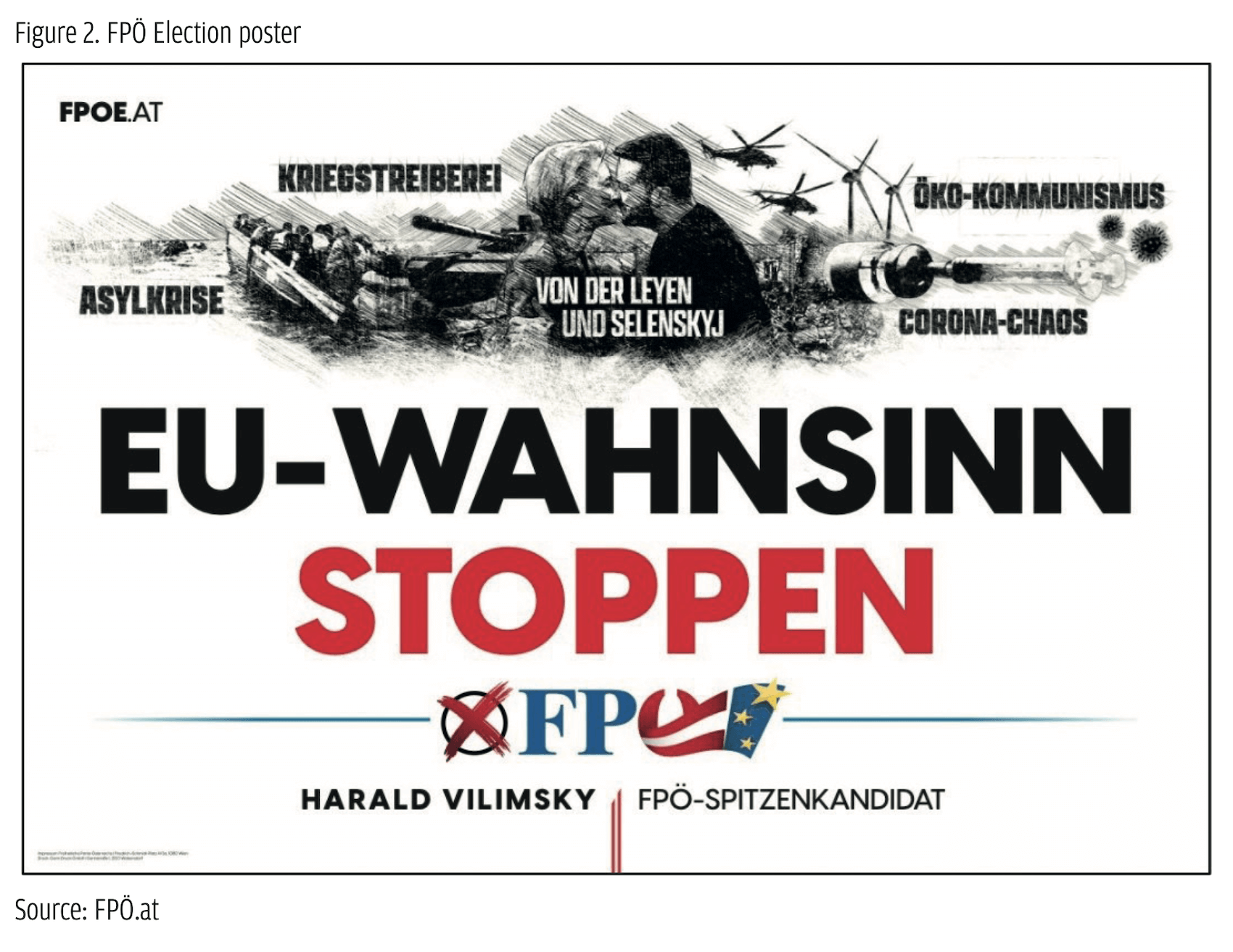
The Freedom Party and EU affairs

Due to its German nationalist origins and the resulting denial of an Austrian nation, the FPÖ for decades was quite positive about the country joining the EU as a second-best option given the impossibility of a ‘reunification’ with Germany (Fallend 2008: 2010ff). It was only in 1991 when the party started to take a more critical position – which in the literature has been interpreted less as an ideological repositioning but as driven by electoral considerations of its then-party leader Haider, who in 1988 was still claiming the Austrian nation was an Ideologische Missgeburt or ‘ideological monstrosity’ (Frölich-Steffen 2004). As a result, the right-wing FPÖ, together with the left-wing Green Party, opposed Austria’s EU accession during the campaign for the required constitutional referendum in 1994. However, while the Green Party modified its position soon after the referendum had passed successfully, the FPÖ stuck to its negative position, making itself (for most of the 30 years since then) the only parliamentary party publicly voicing harsh opposition against EU integration.

In line with the FPÖ’s ideological move from German nationalism to Austrian patriotism (Frölich-Steffen 2004), its position became even more critical over time. Until today, the party has never (openly) called for Austria to leave the EU. Still, it hailed the UK’s decision in favour of Brexit and, so far, has never rejected the possibility of a future ‘Öxit’ (Bartlau 2023). Also, the party not only opposes further integration but calls for the renationalization of decision-making powers to unwind purported aberrations evoked by both the Maastricht and the Lisbon Treaties (FPÖ 2017). In its current party manifesto, the FPÖ envisages a ‘Europe of Peoples’, rejecting ‘any artificial synchronisation … through forced multiculturalism, globalization, and mass integration’. In the party’s view, cooperation within the EU must be based on the principles of subsidiarity and federalism and ‘[t]he basic constitutional principles of sovereign member states must have absolute priority over Community law’ (FPÖ 2024a).

The Freedom Party’s 2024 EU campaign

In line with this position, in its 2024 campaign, the FPÖ repeatedly stated that it would not aim for an ‘Öxit’. However, it framed the elections as a ‘referendum’ about Austria’s ‘future’ and as a choice between a ‘centralized state’ on the one hand and ‘sovereignty’ on the other (Kurz, 2024). For this to be achieved, it called for ‘the EU to shed some pounds’ (‘Weg mit dem Speck’) by halving both the size of the EU’s budget and its institutions. As the party’s front runner, Harald Vilimsky, put it: “The smaller the bureaucratic monster in Brussels, the less it is able to intervene in the lives of European citizens with ever more regulations. In contrast to what our opponents claim, we don’t want to destroy anything …. We only want to focus European cooperation on the original idea of ​​the EU, which has long been forgotten: peace, freedom and prosperity” (Freiheitlicher Parlamentsklub 2024).

According to its electoral manifesto (FPÖ 2024b), the number of MEPs should be cut by half since even the US Congress functions with fewer members, and that, in any event, the EP does not count as a real parliament (Vilimsky 2023). Moreover, the idea brought by Hungarian Prime Minister Victor Orbán to abolish direct elections in favour of the pre-1979 system of national MPs representing their member states was seen as ‘definitely worth considering’ by Vilismky (Kurier 2024).

Regarding policies, four topics dominated the party’s campaign: migration, the war in Ukraine, Climate change and, notably, the COVID-19 pandemic. Amongst those four, migration was the most important. The FPÖ rejected the EU’s Pact on Migration and Asylum and generally any mandatory distribution of asylum seekers across the EU. Instead, it called for a ‘Fortress Europe’ based on a ‘Pact on Re-Migration’ that should transform Europe’s human rights framework into a legal system that permits (a) pushbacks at the EU’s internal and external borders, (b) the denial of asylum to refugees stemming from non-European territory and (c) extra-territorial refugee camps, amongst others. While the Israel–Hamas war was scarcely raised as an issue, the party harshly criticized the EU’s activities in the war between Russia and Ukraine. It called for an immediate end to financial and military aid to Ukraine, as well as for the sanctions against Russia to be abolished due to their detrimental effects on the economy. While the EU was criticized for not trying to find a peaceful solution faithfully, the support for its policies by the Austrian government was criticized as a breach of the country’s constitutional obligation of neutrality.

Regarding environmental policy, the FPÖ demanded a stop to the European Green Deal, the EU Nature Restoration Law, and the scheduled ban on combustion engines. Concerning COVID-19, the party called for a ruthless elucidation of the EU’s allegedly questionable role during the pandemic. Amongst others, it demanded the disclosure of text messages sent between Commission President Ursula von der Leyen and the CEO of Pfizer, the pharmaceutical company from which the EU obtained its vaccinations (Vilimsky, 2024a). More generally, the EU’s COVID-19 policies were criticized for unjustified restrictions on individual freedoms and for having been abused to turn the EU into a Schuldenunion or ‘debt union’ (FPÖ 2024b). 

The frames used by the FPÖ when pushing these claims were located mainly on the cultural dimension when it comes to questions of migration and the EU’s future development (see above). Arguments regarding global warming and the war in Ukraine were framed mainly in economic terms. The party called for Klimapolitik mit Augenmaß, namely, climate policies with a ‘sense of proportion’ regarding their economic effect. At the same time, the sanctions against Russia were criticized for hurting Austria and the EU more economically than they hurt Russia.

Generally, however, the party’s campaign was based less on arguments than on evoking negative emotions by using highly alarmist language combined with rhetoric that portrayed its political opponents on the national level – the ÖVP, the Social Democrats (SPÖ), the Greens and the Liberals – as all being part of an Einheitspartei or ‘single political party’ (Vilimsky 2024b), and EU-level actors as either corrupt, fanatical or insane. For example, on an election poster entitled ‘Stop the EU-lunacy’, a dystopic photo montage showed Ukrainian President Volodymyr Zelensky and Commission President von der Leyen allegedly kissing each other intimately, surrounded by scenes entitled ‘eco-communism’, ‘COVID-19 chaos’, ‘warmongering’ and ‘asylum-crisis’ (Figure 2).

The demand side of the EU: Critical populism in Austria
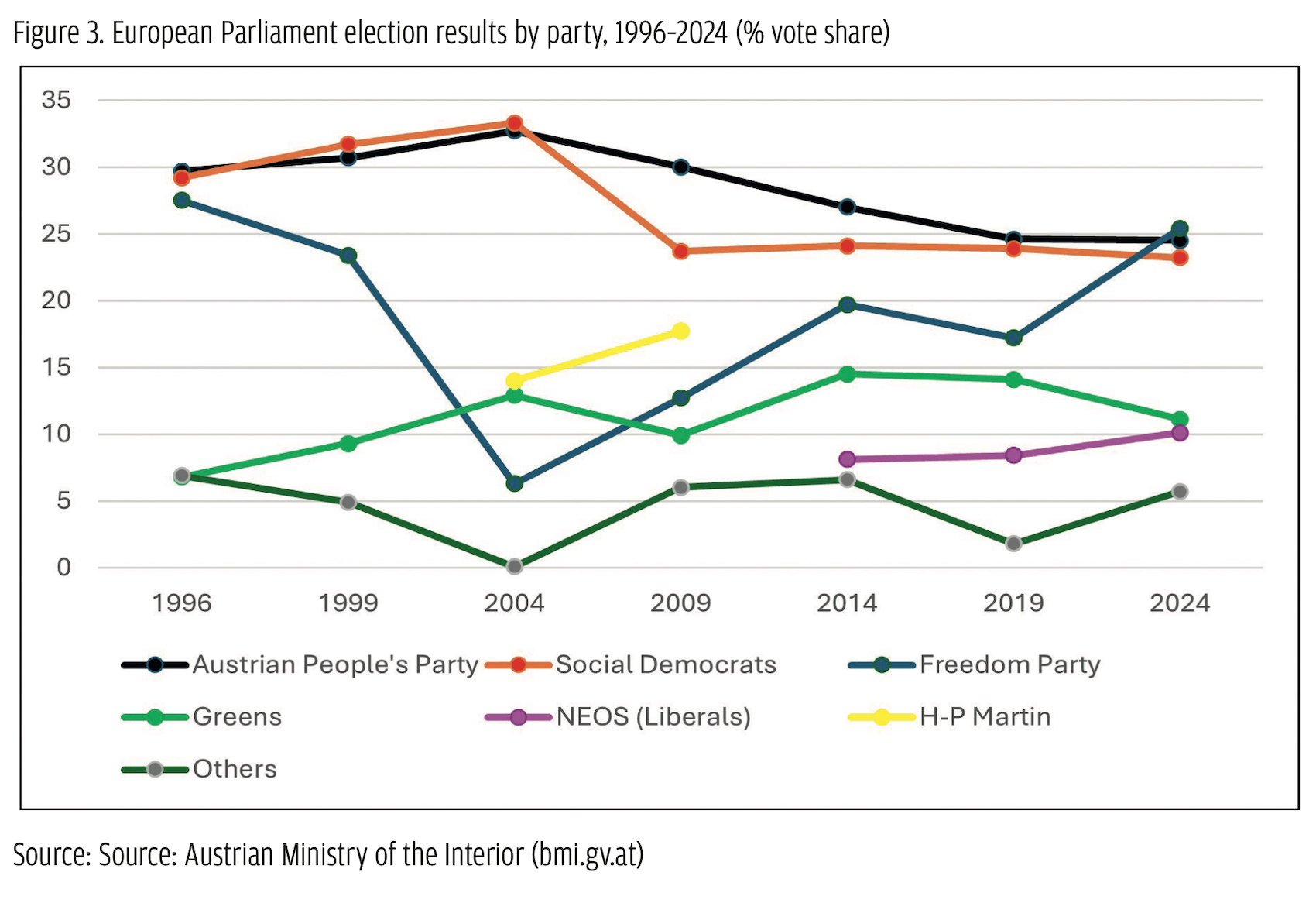
The FPÖ’s mix of issues and its communicative strategy turned out to be successful (Figure 3). First, it increased its vote share significantly compared to 2019 (it should be noted, however, that the party was hit by a huge scandal – the so-called Ibiza affair – that led to the step-down of the FPÖ’s then-party leader and Austria’s deputy chancellor, Heinz-Christian Strache and the collapse of the then ÖVP–FPÖ governing coalition just eight days before the election). Second, and more importantly, for the first time ever, the FPÖ managed to end up in first place in a nationwide election. According to exit polls, the party won votes mainly from the ÖVP (about 221.000 out of the 891.000 votes for the FPÖ) but also from about 100,000 voters who, perhaps demotivated by the Ibiza affair, did not vote in 2019 (Laumer & Praprotnik 2024). Despite the win, electoral analyses in the media interpreted the result as slightly disappointing for the party, as many polls leading up to the election had predicted an even larger victory and a greater margin over the runner-up, the ÖVP.

There are three possible explanations for this. First, the turnout rates of FPÖ supporters at EU elections have traditionally been lower than in other national elections. Second, FPÖ voters, on average, had decided who they would vote for earlier than supporters of other parties, which might have led to biased polling results. Third, the second ‘populist’ party running for election, DNA, in many regards, focused on similar issues and hence provided an alternative to protest voters who otherwise might have opted for the FPÖ.

Looking at sociodemographic characteristics (Figure 3), the FPÖ somewhat underperformed amongst voters below the age of 30. Regarding education, it was most successful amongst voters who had completed vocational training and least successful amongst high-school and university graduates. Interestingly, and in line with preceding regional elections (Salzburger Nachrichten, 2024), the once significant gender gap has shrunk considerably compared to the elections in 2019. While back then, 26% of men but only 10% of women voted for the FPÖ, this time it was 27% of men compared to 24% of women. Amongst voters holding at least a college degree, the gap even vanished entirely, with 16% of men and 17% of women opting for the FPÖ (Laumer & Praprotnik, 2024). Amongst others, these changes may be a consequence of the position the party took during the COVID-19 pandemic (especially its critique to discriminate restrictions between vaccinated and non-vaccinated citizens) – which was also found among many (also highly-educated) women (Die Presse, 2021).
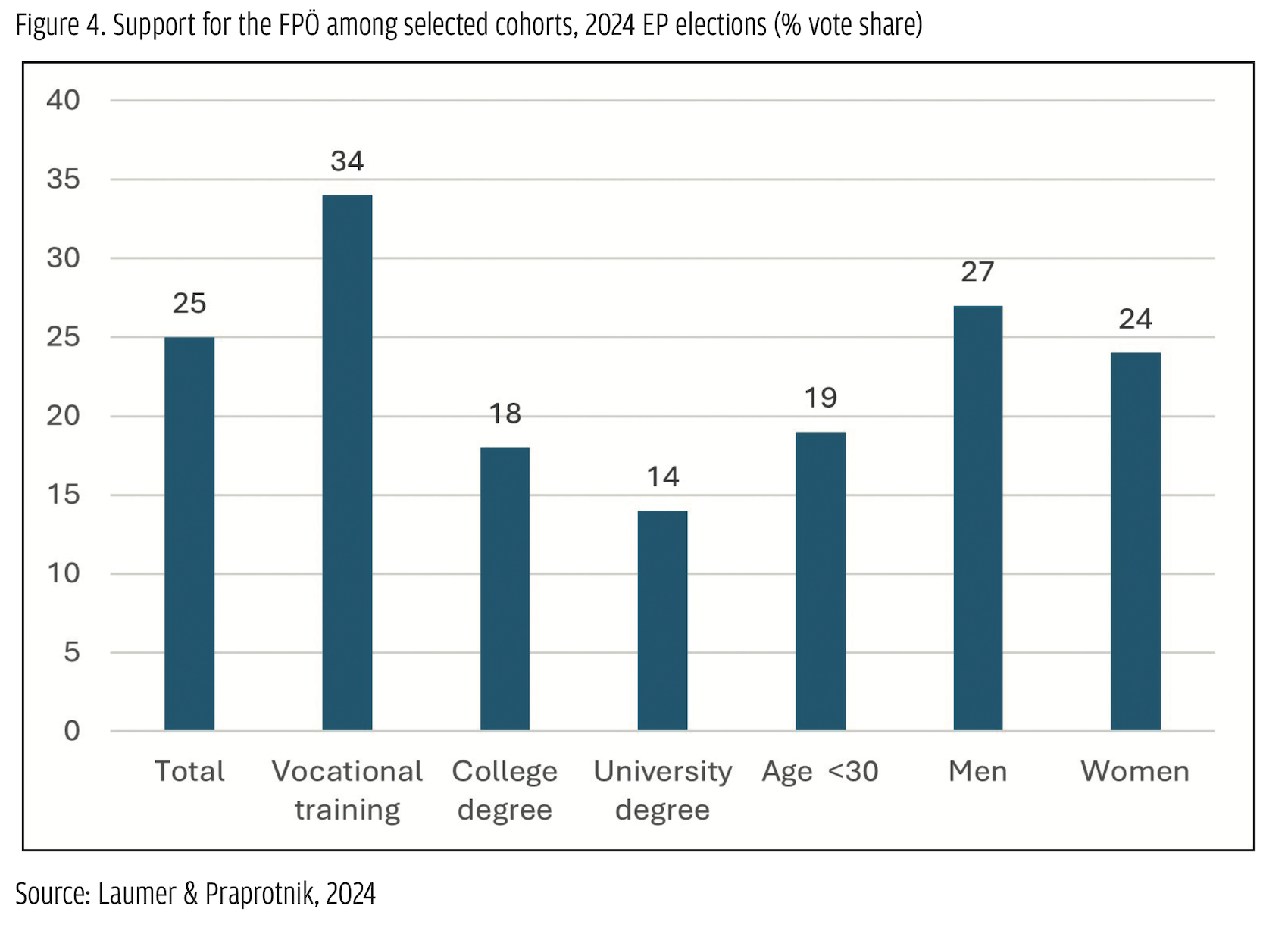
Looking at voters’ issue preferences shows that, generally, there is quite a significant demand for EU-critical positions within the Austrian electorate. While in the 1994 constitutional referendum on the country’s EU accession, a two-thirds majority voted ‘yes’, approval rates started to drop soon thereafter, and Austrian citizens have ranked amongst the most critical ones across the EU ever since (Fallend, 2008). As Figure 5 shows, in the Eurobarometer from autumn 2023 (European Parliament, 2023), Austria not only recorded the highest share of citizens seeing EU membership as a ‘bad thing’ (22%) but also the lowest share of those seeing it as a ‘good thing’ (42%). 
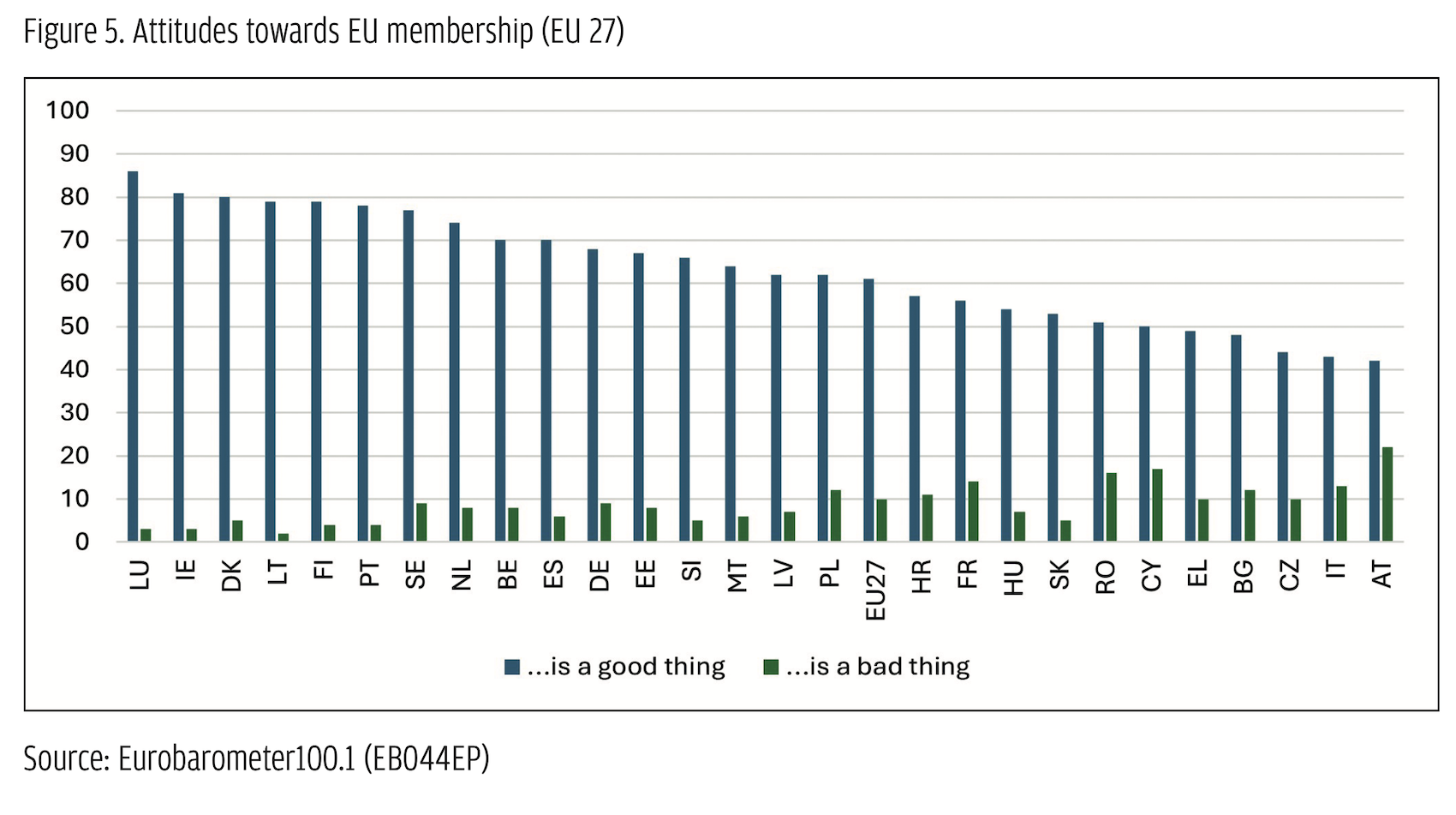
The FPÖ was very successful in attracting these groups. According to exit polls, 84% of its voters see the EU taking a rather negative development and 63% would even support Austria leaving the EU (Figure 6).
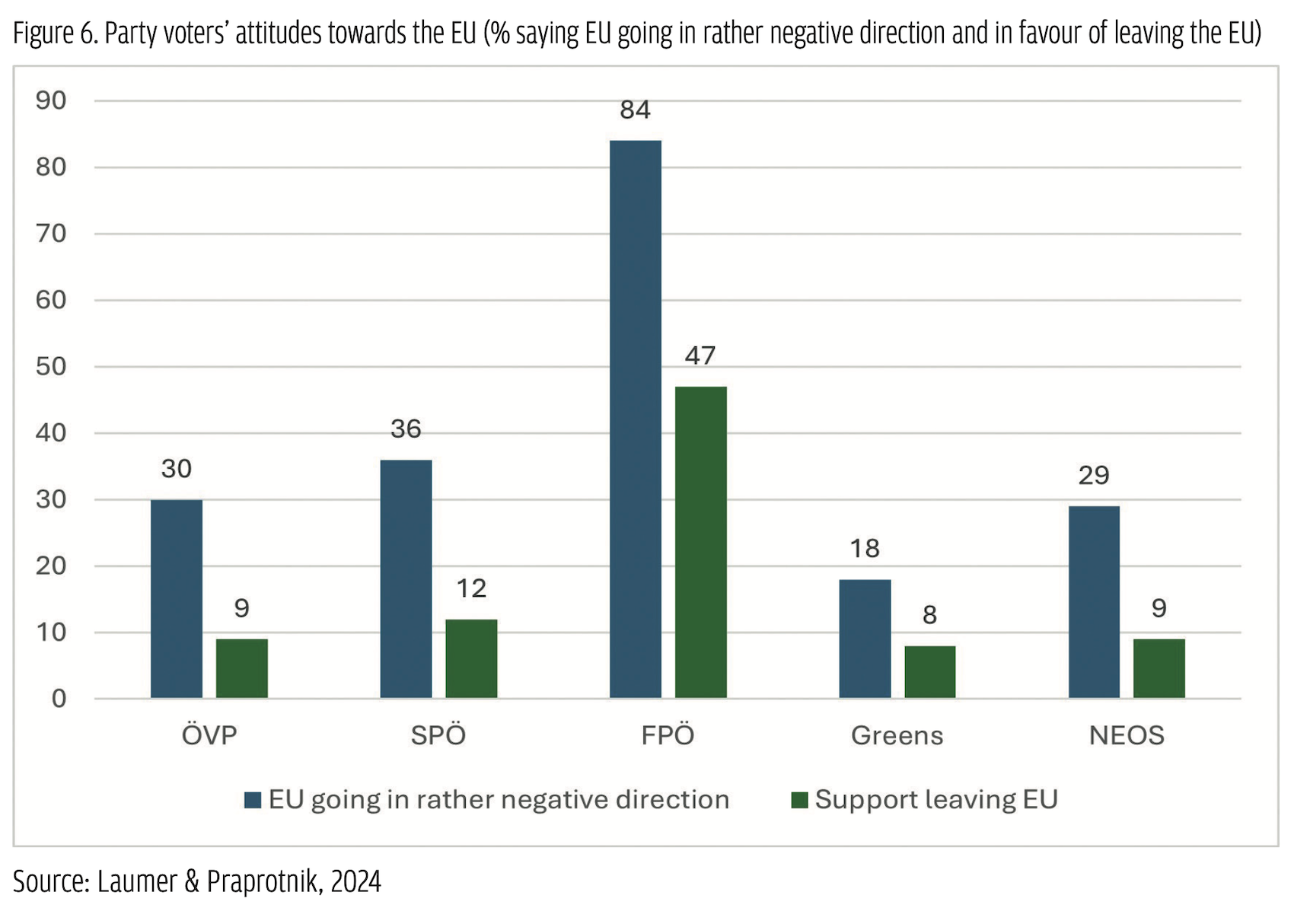
Overall, however, only 4% stated that EU protest was their main reason to vote for the FPÖ, while 40% pointed to the party’s issue positions more generally. Looking at these issues, again, reveals a considerable overlap with the issues the party pushed in its campaign. Among the issues FPÖ voters discussed ‘a lot’ before the elections, ‘migration’ clearly ranks highest (71%), followed by ‘security and war’ (48%), the ‘economy’ (36%), and the ‘Covid pandemic’ (30%), with ‘environment and climate protection’ clearly lagging behind (20%).
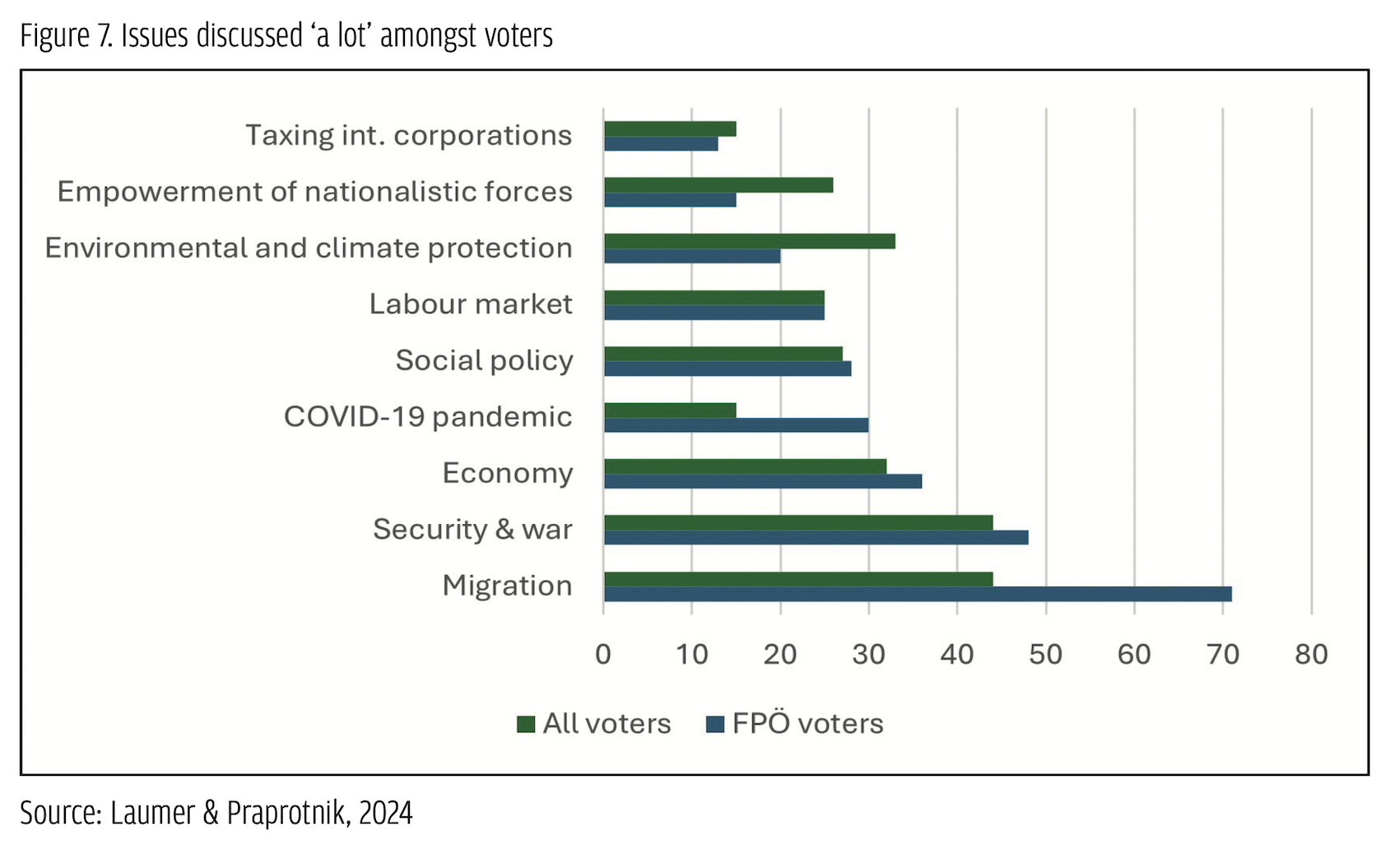
Public attention for the elections overall was relatively modest. About eight weeks before the elections, less than 50% of the Austrian electorate reported knowing the parties’ lead candidates, and even more stated that they could not assess their work (Die Presse, 2024). To the extent that the election was an issue, however, the FPÖ and its core issues featured quite prominently in the debates. In the three TV debates that featured all lead candidates, migration and the war between Russia and Ukraine were discussed for the longest time (followed by the climate crisis). Given the singularity of its positions, the FPÖ was criticized by all other parties quite harshly in all these debates. This criticism resulted in the FPÖ receiving by far the most attention and also allowed the party to (once again) present itself as the only ‘real’ alternative vis-à-vis a purported Einheitspartei (‘single political party’), composed of the ÖVP, the Social Democrats (SPÖ), the Greens and the Liberals. A similar phenomenon can be observed regarding general news coverage where, for example, the election poster discussed above met with extensive criticism by journalists both nationally and internationally, pushing attention to the FPÖ itself and its political demands even further (Hammerl, 2024).
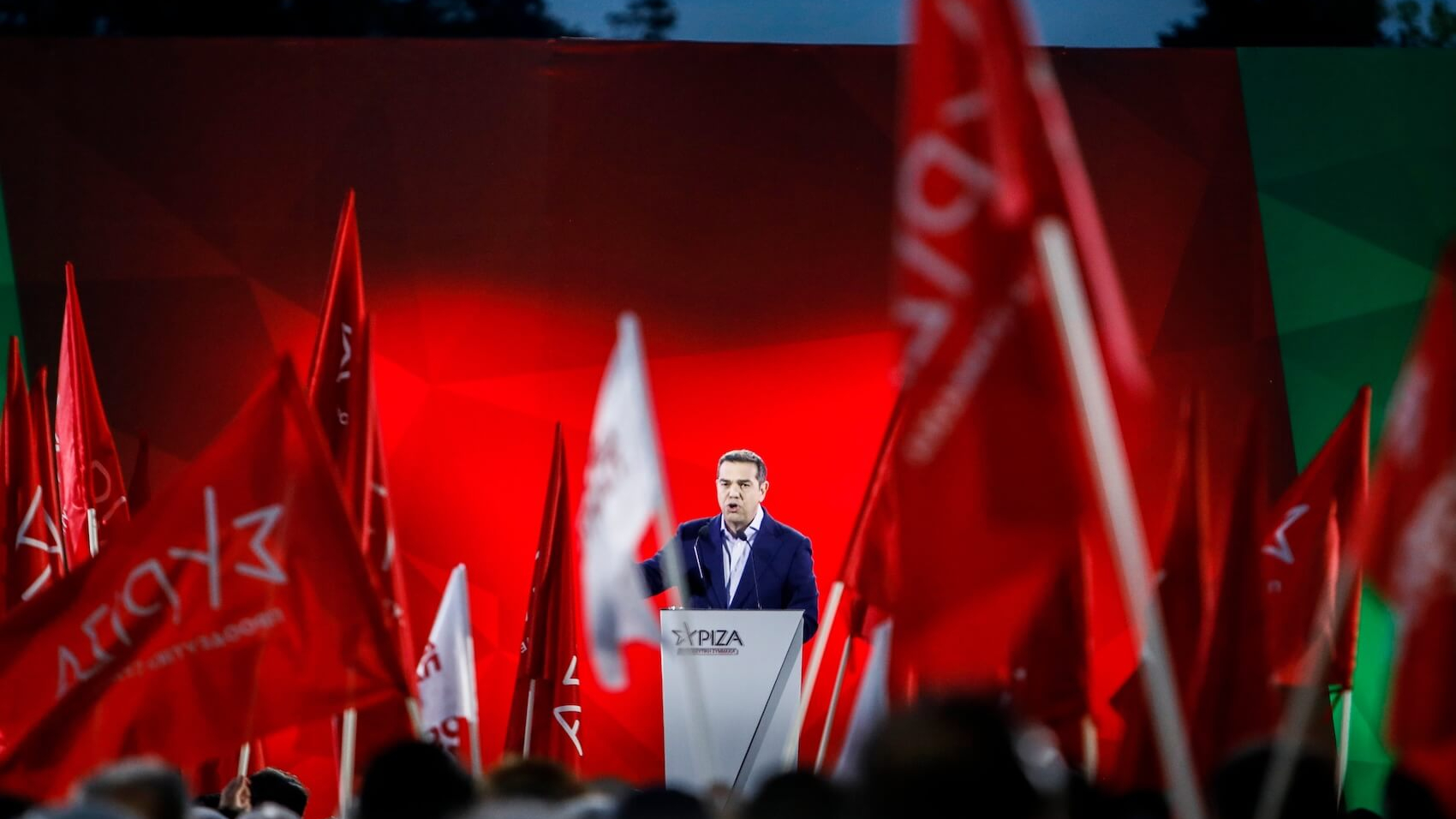
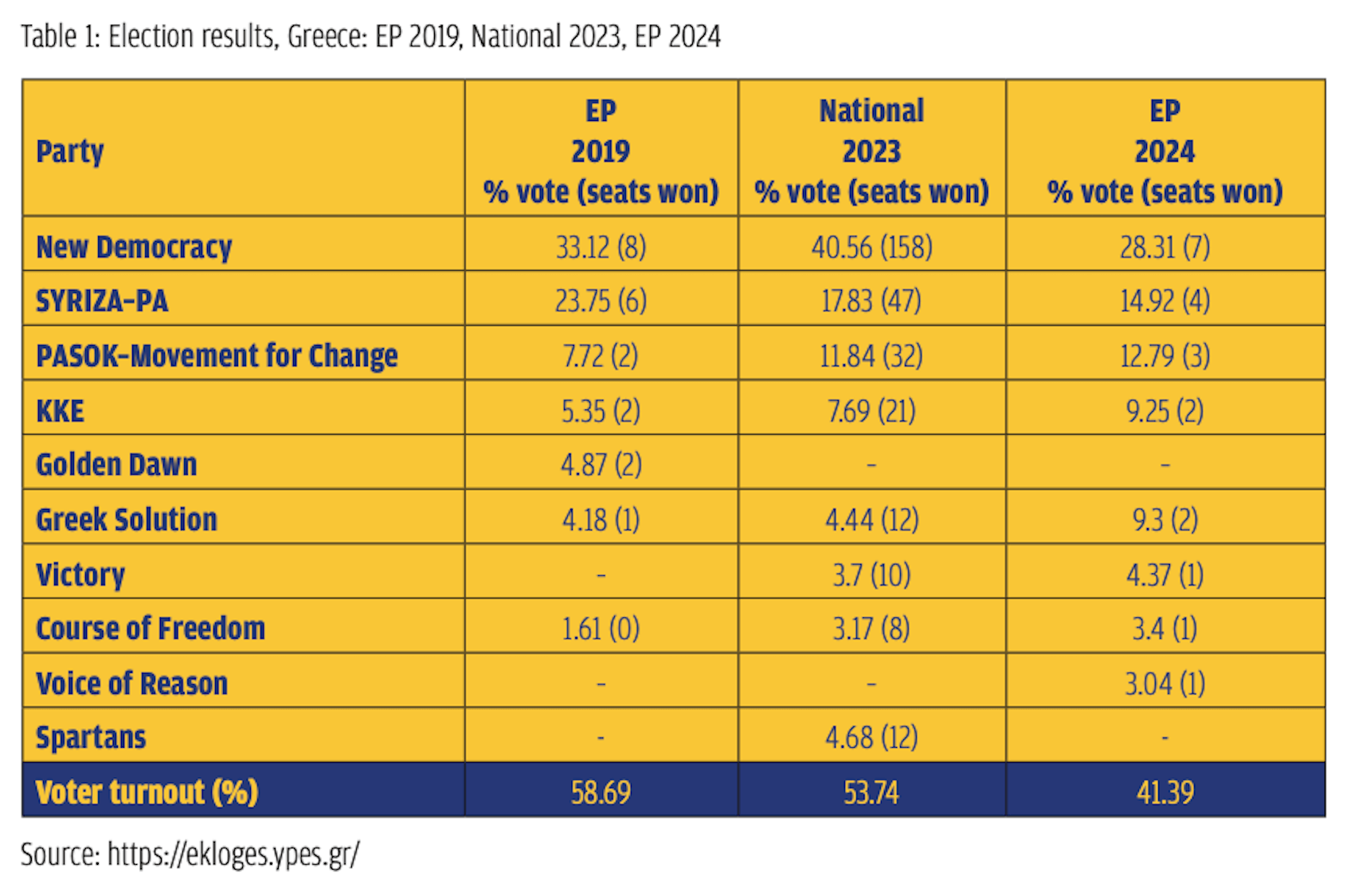
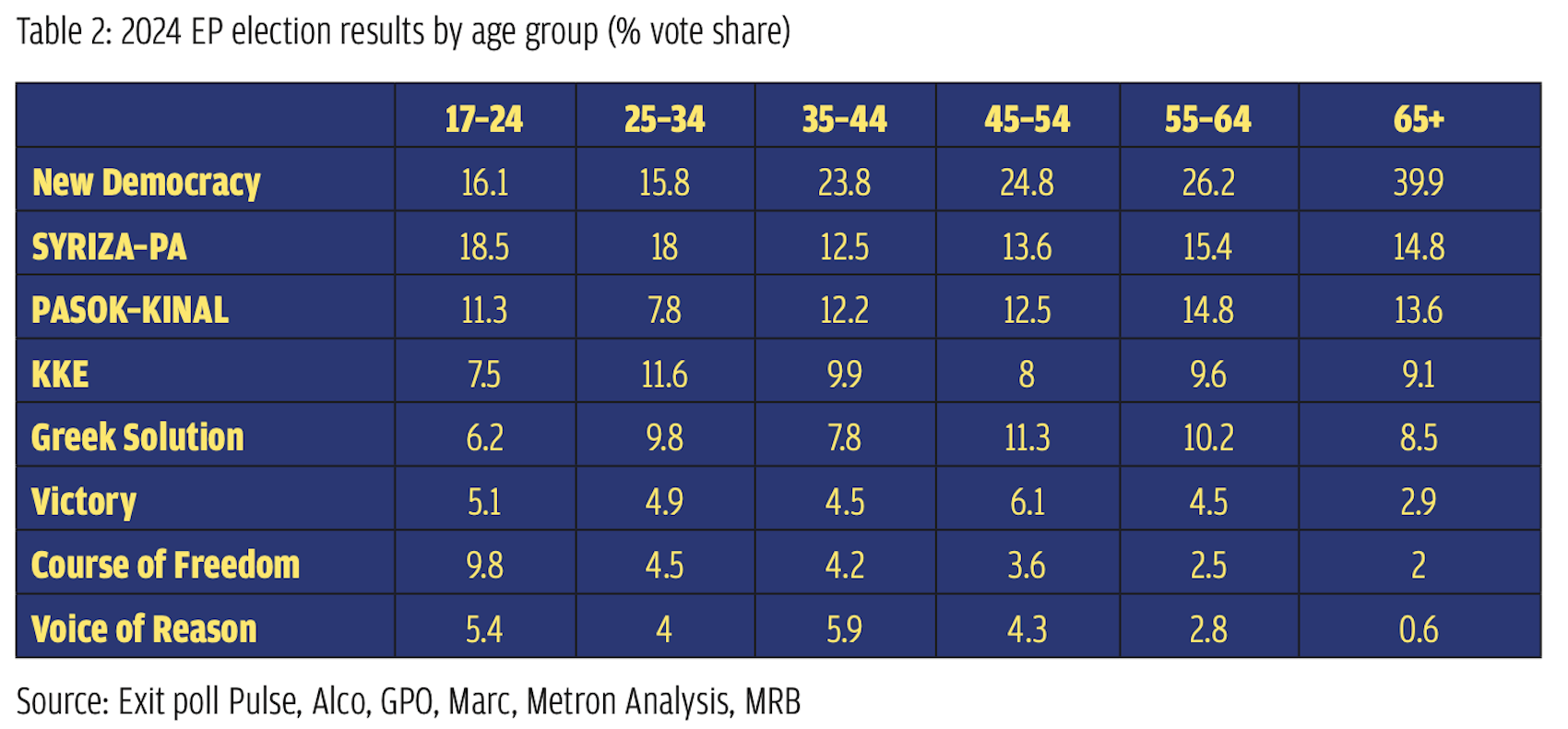
Discussion and perspective

Summing up, the populist radical-right Freedom Party’s run for the 2024 EP elections relied on well-proven recipes, which the party has been applying highly successfully throughout the last 30 years. In terms of issues, it focused on culturally framed topics like EU critique and calls against migration, which it combined with other issues that have been highly salient amongst the Austrian electorate and on which the party took a position that was taken by no other (established) Austrian party like an alleged ‘neutral’ position in the Ukrainian war (which de facto would result in strengthening the Russian side), and a highly critical position towards EU-measures to combat the climate crisis. Rhetorically, the party strongly relied on a Manichean frame, portraying its national opponents and EU-level actors/institutions as corrupt elites or members of the de facto Einheitspartei. This strategy seemingly paid off, as the FPÖ landed in the first place for the first time in a nationwide election.

Due to this success, there is little reason to expect the FPÖ to significantly change its strategy or the policies it prioritizes in the coming legislative period. Issues like migration, climate change or even the war in Ukraine are unlikely to vanish soon. And given that EU decisions constitutionally rely on broad centrist compromises, it suggests that whatever policies EU institutions manage to agree on, they will always provide ample room for criticism from a populist, radical-right point of view.

Concerning politics, it will be interesting to see how cooperation with other populist parties will proceed and develop in the coming term. Notably, the FPÖ was one of only two parties of the Identity and Democracy (ID) group that voted against the exclusion of the AfD due to statements of the latter’s lead candidate suggesting sympathy for former members of the national-socialist SS just before the elections. After the elections, the FPÖ left ID and, together with Hungary’s Fidesz (which left the European People’s Party in 2021) and the Czech ANO (formerly of Renew Europe), founded Patriots for Europe (PfE), which most of the other former ID members have subsequently joined. However, negotiations with the AfD to join the group failed, leading to the foundation of another new group – Europe of Sovereign Nations (ESN).

It remains to be seen how the FPÖ will position itself in possible future disputes between and within these groups like, for example, when it comes to their position concerning the Russia–Ukraine War, where some parties (like the FPÖ) hold close ties with Russia, while others see Russia as a security threat to their own country. Overall, however, it seems that politics at the EU level play a subordinate role for the party at large. Owing also to its nationalist agenda, the party probably does not see the main purpose of EU-level politics as shaping policies in Brussels but rather leveraging them to increase electoral support at home.


(*) Eric Miklin is Associate Professor of Austrian Politics in Comparative European Perspective in the Department of Political Science at the Paris-Lodron University of Salzburg, Austria. His research and publications focus on democracy, party politics and parliamentarism with a special focus on the interplay between the national and the European level. E-mail: eric.miklin@plus.ac.at


References

Bundesministerium für Inneres (2023) Verfassungsschutzbericht 2023.https://www.dsn.gv.at/501/files/VSB/180_2024_VSB_2023_V20240517_BF.pdf

Bartlau, C. (2018, 2 February) Freiheitliche Partei Europas: Wie hätt’ ma’s denn gern? Zeit Onlinehttps://www.zeit.de/politik/ausland/2018-02/freiheitliche-partei-oesterreichs-regierung-opposition-identitaet/komplettansicht

Die Presse (2021, 8 August) Impfung: Frauen sind skeptischerDie Presse https://www.diepresse.com/6018633/impfung-frauen-sind-skeptischer

Die Presse (2024, 22 April) Nicht einmal die Hälfte der Österreicher kennt die EU-Spitzenkandidaten. Die Presse https://www.diepresse.com/18391193/nicht-einmal-die-haelfte-der-oesterreicher-kennt-die-eu-spitzenkandidaten

Eberl, J. M., Huber, R. A., & Greussing, E. (2021) From populism to the ‘plandemic’: Why populists believe in COVID-19 conspiracies. Journal of Elections, Public Opinion and Parties31(sup1), 272–284.

European Parliament (2023) Eurobarometer Data Annex, Parlameter 2023. Directorate General for Communication (Public Opinion Monitoring Unit). file:///C:/Users/miklin/Downloads/EP_Autumn_2023_EB044EP_Results_Annex_en.pdf

Frölich-Steffen, S. (2004). Die Identitätspolitik der FPÖ: Vom Deutschnationalismus zum Österreich-Patriotismus. Österreichische Zeitschrift für Politikwissenschaft33(3), 281–295.

FPÖ (2017) Österreicher verdienen Fairness. Freiheitliches Wahlprogramm zur Nationalratswahl 2017. (Brochure). https://www.fpoe.at/fileadmin/user_upload/Wahlprogramm_8_9_low.pdf

FPÖ (2024a, 10 July) Party Program of the Freedom Party of Austria (FPÖ).https://www.fpoe.at/parteiprogramm/parteiprogramm-englisch/

FPÖ (2024b) Vorhang auf für UNSER Österreich. Frei. Sicher. Neutral. [Brochure]. https://www.fpoe.at/fileadmin/user_upload/www.fpoe.at/Websites/EU-Wahl_2024/Wahlprogramm/Wahlprogramm_20x20_Web.pdf

Fallend, F. (2008). Euroscepticism in Austrian political parties: ideologically rooted or strategically motivated? In: P. Taggart, P., & A. Szczerbiak (eds) Opposing Europe? The Comparative Party Politics of Euroscepticism. Vol. I: Case Studies and Country Surveys. Szczerbiak, Oxford University Press, 201–220.

Freiheitlicher Parlamentsklub (2024, 10 May) FPÖ – Vilimsky zu EU-Wahlkampfauftakt: ‚Wir wollen die Nummer eins werden!‘ [Press release], https://www.ots.at/presseaussendung/OTS_20240510_OTS0109/fpoe-vilimsky-zu-eu-wahlkampfauftakt-wir-wollen-die-nummer-eins-werden

Hammerl, M. (2024, 7 June) Wie die Kandidaten im EU-Wahlkampf performt haben. Kurierhttps://kurier.at/politik/inland/eu-wahl-kandidaten-analyse-schieder-lopatka-vilimsky-schilling-brandstaetter-performance/402910168

Heinisch, R. (2003) Success in opposition–failure in government: explaining the performance of right-wing populist parties in public office. West European Politics, 26(3), 91–130.

Heinisch, R. & Hauser, K. (2016) The Mainstreaming of the Austrian Freedom Party: The More Things Change…. In: Tjitske Akkerman, Sarah de Lange, Matthijs Rooduijn (eds) Radical Right-Wing Populist Parties in Western Europe: Into the Mainstream? Routledge, 46–62.

Heinisch, R. & Hofmann, D. (2023) The Case of the Austrian Radical Right and Russia During the War in Ukraine. In: Gilles Ivaldi. G & Zankina, E. (eds) The Impacts of the Russian Invasion of Ukraine on Right-wing Populism in Europe. European Center for Populism Studies (ECPS), 33–46.

Kurier (2024, 12 February) FPÖ: Orban-Vorstoß gegen EU-Direktwahl ‚überlegenswert‘ Kurierhttps://kurier.at/politik/inland/fpoe-orban-vorstoss-gegen-eu-direktwahl-ueberlegenswert/402776170

Kurz, H-P (2024, 8 June) Morgen, am 9. Juni geht es um alles. Die #Europawahl2024 ist eine Volksabstimmung über unsere Zukunft. Wir wollen keinen EU-Zentralstaat, sondern unsere #Souveränität zurück. [Post]. X. https://x.com/hpkurz_fpoe/status/1799471451373785220/photo/1

Laumer, D & Praprotnik, K (2024) Europawahl 2024. Wählerstromanalyse und Wahlbefragung. Institut für Strategieanalysen GmbH & FORESIGHT Research Hofinger GmbH.  https://www.foresight.at/fileadmin/user_upload/wahlen/2024_FORESIGHT-ISAWahlbefragung_EUW24-Grafiken.pdf

Mudde, C. (2017) Populism. An Ideational Approach. In: Rovira Kaltwasser, C., Taggart, P., Ochoa Respejo, P. & Ostiguy, P. (eds) The Oxford Handbook of Populism, Oxford University Press, 27–47

Obermaier, F. & Obermayer, B. (2019) Die Ibiza-Affäre. Innenansichten eines Skandals, Kiepenheuer & Witsch.

Salzburger Nachrichten (2024, 5 March) Gender Gap: Frauen wählen tendenziell links.

Salzburger Nachrichtenhttps://www.sn.at/politik/innenpolitik/gender-gap-frauen-154507360.

Vilimsky, H. (2023, 17 July) Mit seinen aktuell 705 Abgeordneten ist das Europaparlament schon heute das drittgrößte Parlament der Welt. …. [Post]. X. https://x.com/vilimsky/status/1680822701370294272

Vilimsky, H. (2024a, 24 May) Ein belgisches Gericht hat jetzt die Ermittlungen zu ‚Pfizergate‘, der umstrittenen EU-Impfstoffbeschaffung, auf Dezember verschoben … [Post]. X. https://x.com/vilimsky/status/1794002389063938116

Vilimsky, H. (2024b, 9 June) Liebe Freunde, warum es SO WICHTIG ist, am Sonntag die FPÖ zu wählen… [Post]. X. https://x.com/vilimsky/status/1799639530573647977

Wodak, R. (2005). Populist discourses: the Austrian case. In: Rydgren, J. (ed.) Movements of exclusion: Radical right-wing populism in the Western world. Nova Publishers, 121–145.

DOWNLOAD REPORT ON AUSTRIA

Leader of the Syriza party, Alexis Tsipras, delivers a speech during a pre-election campaign event in Thessaloniki, Greece, on May 16, 2023. Photo: Giannis Papanikos.

Economic Malaise and Political Discontent: An Analysis of the 2024 European Parliament Election in Greece

Please cite as:

Vasilopoulou, Sofia. (2024). “Economic Malaise and Political Discontent: An Analysis of the 2024 European Parliament Election in Greece.” In: 2024 EP Elections under the Shadow of Rising Populism. (eds). Gilles Ivaldi and Emilia Zankina. European Center for Populism Studies (ECPS. October 22, 2024. https://doi.org/10.55271/rp0072


DOWNLOAD REPORT ON GREECE

Abstract

The 2024 European Parliament (EP) election in Greece was held against a background of geopolitical instability in Europe’s neighbourhood. However, domestic – rather than European – issues dominated the campaigns, including the economy, inflation and the cost-of-living crisis. The electoral results were primarily an anti-government protest vote and confirmed a trend of electoral fragmentation across the political spectrum. On the right, three relatively new far-right populist parties received parliamentary representation, i.e., the Greek Solution, Victory and the Voice of Reason. On the left, SYRIZA–PA maintained its second place, although its support declined substantively compared to the previous EP election. Course of Freedom and the KKE, on the other hand, were key electoral beneficiaries in the left-wing space. Younger age groups primarily opted for SYRIZA–PA, whereas older groups were more likely to support New Democracy. That said, far-right parties also received votes from younger generations. Geographically, the far right is more successful in the north of Greece. The key message of this election was political discontent and a general feeling of economic malaise posing dilemmas across the political spectrum.

Keywords: elections; public opinion; populism; the left; the right; Greece


By Sofia Vasilopoulou* (King’s College London)

Introduction

Greeks went to the polls on Sunday, 9 June 2024, to elect 21 Members of the European Parliament (MEPs). Although a total of 31 parties competed for Greek citizens’ votes, only eight received enough votes to reach the 3% electoral threshold for parliamentary representation. The elections were held against a background of geopolitical instability with the war in Ukraine and the conflict in Gaza. Yet, domestic questions, such as the economy, inflation and the cost-of-living crisis, influenced the vote.

The electoral results confirmed a trend of electoral fragmentation on both the left and right ends of the politicalspectrum despite the centre-right New Democracy retaining first place. On the right, three far-right parties with populist agendas, including Greek Solution, Victory and Voice of Reason, elected four MEPs in total. The substantive policies of these parties share several similarities, and their narratives are all based on a similar populist logic. However, their 2024 EP election campaigns prioritized different issues. Whereas Greek Solution talked more about its economic agenda and the cost-of-living crisis, Victory focused on religion and family, and Voice of Reason placed emphasis on Islam and the so-called ‘woke culture’.

On the left, the Coalition of the Radical Left–Progressive Alliance (SYRIZA–PA) came second with approximately 15% of the vote, translating into four EP seats. The Communist Party of Greece (KKE) and the Course of Freedom secured two and one seats, respectively. These parties vary substantively in their policies. SYRIZA–PA put forward a centre-left agenda, Course of Freedom continued its anti-establishment rhetoric, and KKE maintained its communist agenda.

In what follows, I first analyse the policies of Greek populist parties on domestic and international issues. I then proceed to examine the electoral results, offering a glimpse into some socio-demographic and geographic patterns of the vote. I will finally conclude with some thoughts about the dilemmas presented to parties following the electoral results.

The ‘supply-side’ of Greek populism in the 2024 EP election

Greece has been characterized as a populist democracy (Pappas, 2014), in which populism tends to be observed across the party system and is expressed through blame-shifting and exclusivist narratives (Vasilopoulou et al., 2014). Greek populism cuts across the left–right dimension and is generally concentrated among the political parties that reject the mainstream politics of the ‘old two-party system’ associated with the Panhellenic Socialist Movement (PASOK) and New Democracy (Tsatsanis et al., 2018). Based on this distinction, this section discusses the ideologies and positions of six populist parties in Greece in the run-up to the 2024 EP election in Greece.

Right-wing populism

Greek Solution (Ελληνική Λύση) – EP group: European Conservatives and Reformists

The far-right populist Greek Solution was founded in 2016 by Kyriakos Velopoulos, a former member of the far-right Popular Orthodox Rally (Λαϊκός Ορθόδοξος Συναγερμός) and the centre-right New Democracy (Νέα Δημοκρατία).

The party rose to prominence amid Greek protests against the Prespa Agreement signed between Greece and North Macedonia to settle an enduring dispute between the two nations. During that time, other far-right parties in Greece were experiencing electoral decline, which favoured Greek Solution. For example, members of the Golden Dawn (Χρυσή Αυγή), an extreme right-wing party (Vasilopoulou & Halikiopoulou, 2015) were being indicted for running a criminal organization, and the Independent Greeks (Ανεξάρτητοι Έλληνες) had lost credibility among their voters for participating in an electoral coalition with the left-wing SYRIZA (Συνασπισμός της Ριζοσπαστικής Αριστεράς).

Greek Solution has a prominent anti-establishment narrative glorifying the ‘pure’ Greek people against the ‘evil’ and ‘corrupt’ Greek political elites. Its populist message is combined with an ethnonationalist rhetoric, which is said to derive its strength from ‘Hellenism’. The party’s core beliefs may be summarized by its focus on ‘Greece, religion, family’. During the 2024 EP election campaign, the party leader professed to ‘make Greece and Greeks proud again’, arguing that Greek Solution has ‘clean hands and clean ideas’ (Greek Solution, 2024a).

On the cultural dimension, Greek Solution is critical of immigration, and what it calls ‘the language of rights’ and ‘imposed’ multiculturalism (Greek Solution, 2024b). It is pro-Russian (Dimitropoulos 2022; Wondreys, 2023) and against compulsory vaccinations (in.gr, 2021). While not openly calling for a Greek exit from the European Union (EU), Greek Solution has a vision for a Europe of nation-states extending from Lisbon to Siberia that is Christian and includes Russia, i.e., what the party calls a ‘European Europe’ that gives veto power to all member states (Greek Solution, 2024c). Despite its Eurosceptic position, the leader of Greek Solution argued that EP elections are very important because nine out of ten decisions made in the Greek Parliament derive from EU legislation and that, therefore, abstention would mean support for the national government (Greek Solution, 2024d).

On the economic dimension, the party offers a somewhat blurred policy combination of low taxation mixed with economic intervention and welfare chauvinism (Georgiadou & Mavropoulou, 2022). The party’s EP election campaign primarily focused on the ‘cost-of-living crisis’ framed with a robust anti-establishment narrative. For example, they castigated the government, declaring that ‘Greeks are hungry and poor, but politicians are rich’. In its pre-electoral campaign, the party also focused on the expressed needs and priorities of the primary economic sector, specifically agriculture. Its economic plan consisted of reducing food production costs to support farmers by removing fuel duty, flat taxes and investment in mining to subsidize free schemes for energy self-sufficiency across Greece. Interestingly, and contrary to the cultural model of far-right voting behaviour (Norris & Inglehart, 2019), Greek Solution’s party leader attributes the rise of far-right parties to economic reasons, such as poverty, unemployment and the cost-of-living crisis (Greek Solution, 2024b).

Democratic Patriotic Movement–Victory (Δημοκρατικό Πατριωτικό Κίνημα–Νίκη) – EP group: Non-Attached

The far-right Victory was founded in 2019, shortly after the signing of the Prespa Agreement, which, it argues, has been a betrayal to the Greek people considering that there is only ‘one’ Macedonia, which is ‘only Greek’ (Victory, 2024). The party first competed in the 2023 general election and gained ten seats. It puts forward an ultra-conservative religious narrative premised on an ethnic conception of Greek national identity and a belief in the primacy of the church over the state.

Victory makes populist appeals differentiating between the ‘good’ Greek people (who are equated to the Greek nation) and the elites presented as ‘gangs’ that place their partisan interests over the ‘sacred’ national interest (Victory, 2024). The party rejects left–right ideology, suggests that parties have colluded against the Greek people and the Greek nation, and promises to ‘free’ Greece from these partisan interests. It calls for binding referendums on important questions, the removal of the electoral threshold, and the reduction of the size of the Greek Parliament from 350 to 200 deputies.

On the cultural dimension, the party opposes liberal values, is against minority rights, and talks about Greece’s ‘spiritual, biological and territorial self-destruction’ (Victory, 2020). Its ideology is premised on a strong belief in the Orthodox Christian religious tradition. The party is careful to avoid criticisms that it strategically employs religion in its discourse and argues that ‘We do not have a religion, we have faith’. Victory is firmly against LGBTQ+ rights and abortion, arguing that ‘nature is law’, and proposes to establish a ‘Ministry of National Demographic Growth’ that would ‘ensure the biological future of the Greek nation in our ancestral land’ (Victory, 2020b) and address issues related to family, childbirth, immigration and repatriation. To that end, the party promises birth subsidies, benefits for stay-at-home mothers with two or more children, and tax reductions for families. The party is prone to conspiracy theories, for example, arguing that LGBTQ+ Pride events are supported and subsidized by the US embassy, George Soros and international lobbies (Victory, 2024b). It is also against vaccinations (Newsbeast, 2023).

Victory’s position towards the EU is rather blurry. The party appears to support a Greek exit from the EU so the country is ‘free from its guardians’, but it does not openly advocate for it. It suggests that Greece needs to focus first on being socially and economically stronger and praises the Visegrad countries (Poland, the Czech Republic, Slovakia, and Hungary) for promoting their national interests within the EU (Victory, 2020c). It is noticeable, however, that the EU was not a salient issue in the party’s 2024 European manifesto, which focuses primarily on domestic issues, including measures to support family, population growth, cheap energy and rural communities. Victory is pro-Russian and criticizes Greece’s support for Ukraine in the ongoing conflict.

The party has a staunch anti-globalization agenda, supports strategic investment in agriculture and Greek self-sufficiency in food and energy. While it supports low taxation for both businesses and households, it proposes tax increases on banks and multinational corporations as well as on money transfers to other countries.

Voice of Reason (Φωνή Λογικής) – EP group: Patriots for Europe

Voice of Reason is a relatively new far-right party founded in 2023 by Afroditi Latinopoulou, a former New Democracy candidate. The party describes itself as a contemporary patriotic movement that serves Greek identity and values, such as ‘Homeland, religion, family.’ Like Greek Solution and Victory, it portrays Greece in decline and seeks to appeal to the ‘ordinary Greek’ against the corrupt establishment. The party is against ‘political correctness’ and portrays itself as being censored from Greek media (Latinopoulou, 2024). Interestingly, although the party does not have any known links to the Spartans or the Golden Dawn, Latinopoulou criticized as anti-democratic the decision of the Greek Supreme Court to ban the Spartans from running in the 2024 EP election on suspicion they were being led by Ilias Kasidiaris, a former Golden Dawn member of the Greek Parliament currently serving a prison sentence for directing a criminal organization (Newsbreak, 2024).

The ideology of Voice of Reason draws inspiration from the so-called ‘Great Replacement’ theory. It argues that globalization, atheism, Muslim immigration and a rights discourse are replacing Greek culture and Christianity. It maintains that ‘Brussels’ is a pro-globalization entity whose decisions support global financial interests. The leader claims that she is in favour of a ‘Europe of nations, not a Europe of illegal immigrants and rights’ activists’ (Danikas, 2024). According to the party, migration policy and the so-called ‘woke culture’ were at stake in the 2024 EP election (Voice of Reason, 2024). The party warns about the ‘Islamization of Greece and Europe’. Its policy solutions consist of the deportation of illegal immigrants, the closing of Greek borders, and the relocation of reception centres for migrants outside Greece. The party is staunchly against the acceptance of non-heterosexual sexual orientations, same-sex marriage and adoption rights. It prioritizes demographic growth through measures that support the ‘Greek’ family.

Left-wing populism

Coalition of the Radical Left–Progressive Alliance (Συνασπισμός της Ριζοσπαστικής Αριστεράς – Προοδευτική Συμμαχία, SYRIZA–PA) – EP group: The Left

SYRIZA has been the main opposition party in Greece since 2019. The party was founded in 2004 and remained at the margins of the Greek party system until it rose to power during the Greek crisis. SYRIZA is a radical left populist party that critiques international capitalism and attempts to provide a socially just alternative to it. It is socially progressive, committed to equality and rights, and has historically put forward a version of soft Euroscepticism, criticizing the EU’s democratic deficit. During the Greek crisis, it adopted a fervent populist rhetoric blaming domestic and international elites for the Greek crisis (Vasilopoulou et al., 2014). It embraced an anti-establishment protest strategy, arguing that a different – anti-neoliberal – path was possible to take Greeks out of poverty and social exclusion.

After SYRIZA-PA’s defeat in the 2023 national election, the party elected a new leader, Stefanos Kasselakis, a relatively unknown politician and a former banker. Kasselakis was elected on a ticket prioritizing transparency, justice, labour rights, progressive taxation, and LGBTQ+ rights. The transformation of the party following its new leadership remains to be seen, especially considering that it has led to ongoing debates and factional splits within the party. During the 2024 EP election campaign, the party refrained from strong anti-neoliberal rhetoric and instead talked about a ‘progressive’ political space. The party had a positive message asking Greeks to opt for SYRIZA-PA at the ballot box: ‘For a better life, now’. Instead of an anti-establishment agenda, SYRIZA-PA talked about social protection, security and opportunities for all.

Course of Freedom (Πλεύση Ελευθερίας) – EP group: Non-attached

Course of Freedom is an anti-establishment political party founded in 2016 by former President of the Greek Parliament and SYRIZA MP Zoe Konstantopoulou. Its policy proposals are mixed, making it difficult to firmly place the party on the left–right spectrum. The leader explicitly argues: ‘We look neither right nor left. We look forward’ (CNN, 2024).

On the cultural dimension, the party puts forward an equality and inclusion agenda that tolerates differences and supports human, minority and LGBTQ+ rights (Course of Freedom, 2024b). It supports same-sex marriage and is pro-Palestinian (Chatzikonstantinou, 2024). At the same time, the party adopts a strong sovereigntist narrative seeking to appeal to ‘popular conscience’ with emotive language. For example, it demands reparations from Germany for the Second World War and seeks to ‘shake off the yoke of the memorandum despotism, the totalitarianism of the Eurobureaucracy, the debtocracy, the bankocracy and the interests and oligarchies that support, feed and benefit from this anti-democratic regime’ (Course of Freedom, 2024a). Course of Freedom has also been critical of the Prespa Agreement, appealing to nationalist voters opposed to austerity.

Communist Party of Greece (Κομμουνιστικό Κόμμα Ελλάδας, KKE) – EP group: Non-attached

The KKE was founded in 1918 and is considered an orthodox communist party guided by the ‘revolutionary worldview of Marxism–Leninism’ (KKE, 2013). It is among the few parties in Europe with such an ideological agenda that has maintained a persistent level of electoral success. In line with its communist ideology, the party rejects ‘bourgeois democracy’ and seeks to overthrow capitalism.

The KKE employs populism in its discourse (Hawkins et al., 2020). It has an anti-elite rhetoric arguing that Greek mainstream parties ‘blackmail the people’ and that New Democracy should be ‘afraid of the people’ (902.gr, 2024). On the cultural dimension, whereas KKE is tolerant of immigration, it is fervently against the decriminalization of drug use and exhibits culturally conservative attitudes towards LGBTQ+ rights, including same-sex marriage and adoption (Naftemporiki, 2024).

The party has a hard Eurosceptic stance, supporting Greece’s exit from the EU. It views the EU as imperialistic, anti-democratic, capitalist and exploitative. It perceives the EU’s impact on national sovereignty to be adverse and an impediment to social justice. In his pre-electoral speech, the party leader called the workers and the people to use their vote in order to ‘raise a red flag against the EU, SYRIZA and PASOK’, arguing that these parties satisfy the wishes of their ‘exploiters’ under the ‘delusion’ of social democracy (902.gr, 2024).

The KKE is also anti-American, anti-NATO and anti-EU. It is pro-Palestinian yet views the war in Ukraine as an imperialistic conflict between the ‘bourgeois powers’, i.e., the EU, NATO and the US, and ‘capitalist Russia’ (KKE, 2023). Economically, it proposes the nationalization of all industries and a centrally planned economy.

The campaign context

The 2024 EP election occurred against the backdrop of public dissatisfaction with domestic politics. Based on a Pew Research Centre (2024) opinion poll conducted between January and March 2024, 53 % of Greek respondents reported an unfavourable view towards the EU, which was 3 percentage points higher compared to 2023 and the largest group across the European countries surveyed. The same poll reported that in Greece, in contrast to other EU member states, public Euroscepticism derives primarily from left-leaning citizens. In addition, satisfaction with democracy had dropped from 32 % in 2021 to 22 % in 2024 (Pew Research Centre, 2024b) and was – not for the first time – the lowest across the sample of European countries. It is therefore no surprise that citizen dissatisfaction with the government was prominent among the public. For example, only 35% of respondents thought that their vote in the EP election would change things in Greece, 48% saw it as an opportunity to express protest (Alco, 2024), and 60% as a chance to vote against the government (To Vima, 2024).

Although public interest in the EP election was relatively high at 56% (Alco, 2024), national issues dominated the campaigns and were core to citizens’ decision-making. When presented with a list of issues that would influence their vote in the 2024 EP elections, 53.4 % of respondents answered the cost-of-living crisis and the economy. Other issues included European issues (8.2%), security (7.8%), health (7.6%), foreign policy (6.9%), the Tempi train crash (a deadly head-on collision between two trains in the Thessaly region in 2023) (6.5%), education (2.9%) and same-sex marriage (2.9%) (To Vima, 2024). These responses reflected a feeling of general economic malaise. For example, according to a Metron Analysis survey conducted in May 2024, the top two most important issues facing the country included the cost-of-living crisis (40%) and the economy (27%) (Kathimerini, 2024a). Most parties also devoted their campaigns to national issues. Although there was no official pre-electoral TV debate, on 24 May 2024, there was an informal debate in the Greek Parliament during its last session prior to the EP election, where questions of inflation and the cost-of-living crisis also dominated.

Interestingly, according to the Youth and Democracy Eurobarometer (2024) survey, the top priority for young Greeks is fighting poverty and economic and social inequalities (45%, 9 percentage points above the EU average). This is followed by preserving peace, reinforcing international security and promoting international cooperation (35%), and promoting human rights, democracy and common European values (31%).

Electoral results

Confirming the ‘second-order’ character of EP elections, only 41.39% of the electorate turned out to vote (table 1). Although this followed a general trend of declining turnout (Vasilopoulou & Halikiopoulou, 2012), turnout was particularly low in 2024, i.e., over 12 percentage points lower than the 2023 national election and over 17 percentage points lower than the 2019 EP election.

Prior to the election, New Democracy and SYRIZA-PA had set themselves specific goals. On the one hand, the leader of New Democracy claimed that he was aiming for the same electoral result as in 2019 (Reporter, 2024). On the other hand, SYRIZA-PA’s Kasselakis claimed that he would be satisfied if his party gained over 20% of the vote (EFSYN, 2024). Both leaders’ claims failed to materialize, as the electoral result was overall one of electoral fragmentation both on the right and the left.

On the left, SYRIZA-PA’s electoral result dropped compared to the previous national and EP elections to just under 15%. The KKE received 9.25% of the vote, translating into two MEPs. Lastly, Course of Freedom received 3.4% of the vote, remaining relatively stable compared to the 2023 national election. On the right, three political parties received parliamentary representation, including Greek Solution with 9.3 %, Victory with 4.37 % and Voice of Reason with 3.04%. Together these parties elected 4 out of 21 MEPs.

The socio-demographics of the vote

There were no clear socio-demographic patterns of support for populist parties as defined by age and employment (Tables 2 and 3). Based on the exit poll (Kathimerini, 2024b), younger age groups primarily opted for SYRIZA–PA, whereas older groups were much more likely to support New Democracy. Course of Freedom benefited electorally from the youngest 17–24 age group. Young Greeks also opted for the far right going against the perception that these parties’ strongholds are among the older generations. In fact, older people voted primarily for New Democracy. Whereas Greek Solution received the least votes from the 17–24 age group, Voice of Reason received its second-best outcome in the same group. In addition, Greek Solution was the third most preferred party among the 25–34 age group.

In terms of employment status, SYRIZA–PA attracted support from public and private sector employees as well as pensioners. KKE was mostly successful among private sector employees and farmers. On the right, Greek Solution received significant support from farmers, which is consistent with the party’s strategy to add to its ballot a female farmer from the north of Greece, Galato Alexandraki, who was elected as an MEP. Farmers, nonetheless, were quite fragmented in their political preferences also supporting the left-wing populist Course of Freedom. Pensioners were much less likely to opt for Greek Solution, Victory or Voice of Freedom. Victory was very successful among public sector employees, whereas private sector employees were the top group for Voice of Reason.

There is also an interesting geographic dimension to the far-right populist vote (for a European perspective, see also Ejrnæs et al., 2024). In many districts in Northern Greece, these parties received above-average results. Specifically, Greek Solution came second in six electoral districts of the north, including Imathia (18.42%), Pella (17.28%), Kilkis (16.54%), Thessaloniki B (15.82%), Serres (15.64%), and Drama (15.52%).
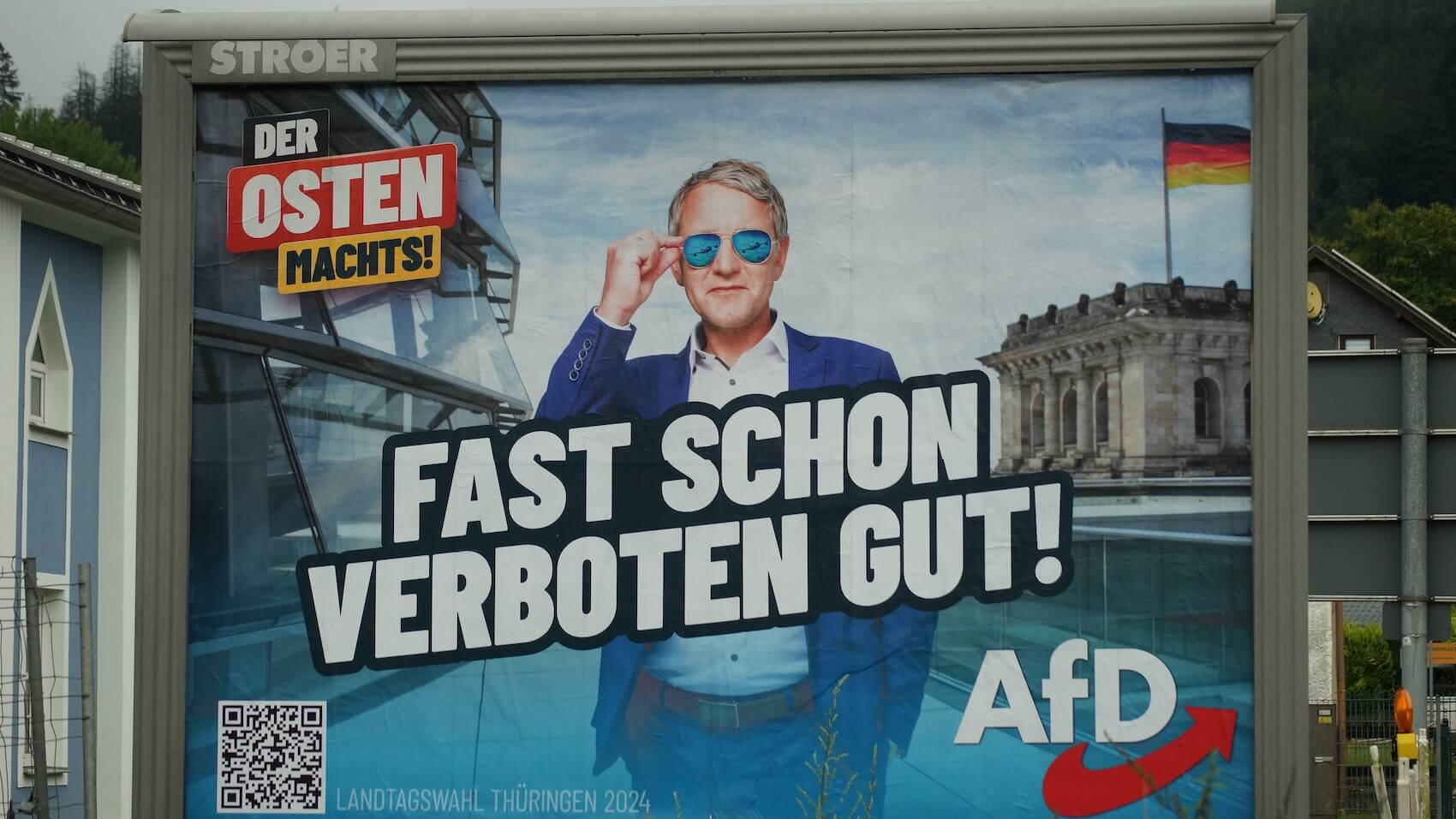
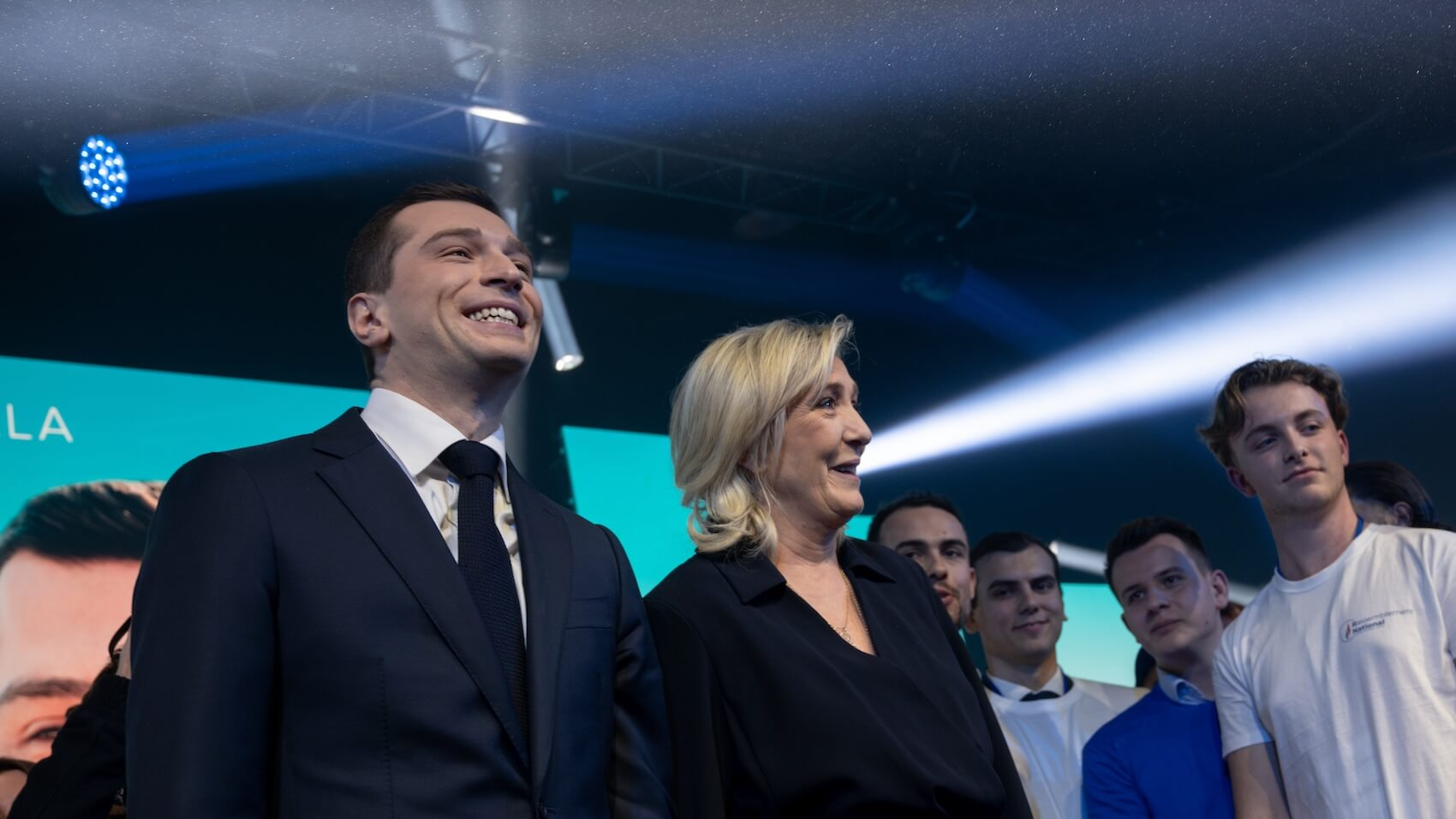
Conclusion

The key message of this election is political discontent and a general feeling of economic malaise. Citizen protest against the government and domestic issues, such as inflation, the economy and the cost-of-living crisis, dominated the 2024 EP election in Greece. The results confirmed a trend of fragmentation across the political spectrum, which poses dilemmas both on the right and the left. On the right, the strength of the populist far right limits the electoral potential of a centrist strategy for the centre-right New Democracy. If New Democracy were to move towards the centre, multiple contenders would likely contest for the political space to its right. At the same time the far right is also divided, and it is not clear whether these parties are willing to work together. On the left, there is a discussion on the possibility of SYRIZA–PA joining forces in order to be able to challenge New Democracy. This strategy is also not without complexity: for SYRIZA–PA, it might entail that the party fully loses its radical and populist appeal, whereas PASOK might be seen as disloyal towards its core voters.


(*) Sofia Vasilopoulou (PhD LSE) is Professor of European Politics at King’s College London, UK. Her research and teaching interests lie in Comparative Politics, Political Behaviour, Party Politics and European Union Politics. Her work examines the causes and consequences of political dissatisfaction among the public and the ways in which this is channelled through party strategies and party competition. Specific themes include Euroscepticism and far-right politics. She has published articles in leading international peer-reviewed journals, including the European Journal of Political Research, Political Behavior, European Union Politics, the Journal of Common Market Studies, the Journal of European Public Policy and West European Politics. She is the author of Far-Right Parties and Euroscepticism: Patterns of Opposition (ECPR Press and Rowman & Littlefield 2018) and The Golden Dawn’s Nationalist Solution: Explaining the Rise of the Far Right in Greece (Palgrave Macmillan 2015 with Daphne Halikiopoulou). She is Joint Editor in Chief of the European Journal of Political Research.


References

902.gr (2024, May 22) Ομιλία του Δ. Κουτσούμπα σε συγκέντρωση στο Περιστέρι (LIVE) https://www.902.gr/eidisi/politiki/364936/omilia-toy-d-koytsoympa-se-sygkentrosi-sto-peristeri-live 

Alco (2024). Ερευνα APLHA 2–6 Ιουνίου. Alcopolls. http://alcopolls.gr/portfolio/%CE%B5%CF%81%CE%B5%CF%85%CE%BD%CE%B1-aplha-2-6-%CE%B9%CE%BF%CF%85%CE%BD%CE%B9%CE%BF%CF%85

Chatzikonstantinou, M. (2024, May 23) Αναγνώριση του παλαιστινιακού κράτους και από την Ελλάδα ζητά η αντιπολίτευσηhttps://www.naftemporiki.gr/politics/1669023/anagnorisi-toy-palaistiniakoy-kratoys-kai-apo-tin-ellada-zita-i-antipoliteysi/

CNN (2024, May 23) «Θέλεις Ζωή και στην Ευρωβουλή;»: Το σποτ της Κωνσταντοπούλου για τις ευρωεκλογέςhttps://www.cnn.gr/politiki/story/420745/theleis-zoi-kai-stin-evrovouli-to-spot-tis-konstantopoylou-gia-tis-evroekloges

Course of Freedom (2024a) Ιδρυτική Διακήρυξη https://www.plefsieleftherias.gr/idrytiki-diakiryxi/

Course of Freedom (2024b, June 17) Post on X. https://x.com/pl_eleftherias/status/1802612195508769248

Danikas, D. (2024, May 20) Αφροδίτη Λατινοπούλου στον Δανίκα: «Εγώ είμαι με τη Μελόνι και τη Λεπέν που είναι κεντροδεξιές» https://www.protothema.gr/politics/article/1499187/afroditi-latinopoulou-ston-danika-ego-eimai-me-ti-meloni-kai-ti-lepen-pou-einai-kedrodexies/ 

Dimitropoulos, G. (2022, February 24) Ελληνική Λύση: Τι λέει για την εισβολή της Ρωσίας στην Ουκρανίαhttps://www.flash.gr/elliniki-lysi-ti-leei-gia-tin-eisvoli-tis-rosias-stin-oukrania-842357

EFSYN (2024). Κασσελάκης: Θα είμαι ικανοποιημένος με ποσοστό πάνω από 20%. Efsyn.https://www.efsyn.gr/politiki/antipoliteysi/433749_kasselakis-tha-eimai-ikanopoiimenos-me-pososto-pano-apo-20

Ejrnæs, A., Jensen, M. D., Schraff, D., & Vasilopoulou, S. (2024). Introduction: Regional inequality and political discontent in Europe. Journal of European Public Policy, 31(6), 1465–1493. https://doi.org/10.1080/13501763.2024.2333850

Eurobarometer (2024). Youth and Democracy. Europa. https://europa.eu/eurobarometer/surveys/detail/3181

Georgiadou, V., Mavropoulou, J. (2022). Greek Solution, Populism in Europe – a comparative study of nine populist parties. Athens: Friedrich-Ebert-Stiftung. https://athens.fes.de/projekte/populism-in-europe

Greek Solution (2024a) Προεκλογικό σποτ της Ελληνικής Λύσης – Ευρωεκλογές 2024 https://elliniki-lisi.gr/proeklogiko-spot-ellinikis-lysis-efroekloges-2024-2

Greek Solution (2024b) Το πρώτο δεκάλεπτο σποτ της Ελληνικής Λύσης για τις Ευρωεκλογές 2024 https://elliniki-lisi.gr/to-proto-dekalepto-spot-tis-ellinikis-lysis-gia-tis-efroekloges-2024

Greek Solution (2024c) Δεκάλεπτο σποτ της Ελληνικής Λύσης για τις Ευρωεκλογές 2024 https://elliniki-lisi.gr/dekalepto-spot-tis-ellinikis-lysis-gia-tis-evroekloges-2024

Greek Solution (2024d) Σαρανταπεντάλεπτο σποτ της Ελληνικής Λύσης για τις Ευρωεκλογές 2024 https://elliniki-lisi.gr/to-sarantapentalepto-tis-ellinikis-lysis-evroekloges-2024

Hawkins, K. A., Rovira Kaltwasser, C., & Andreadis, I. (2020). The Activation of Populist Attitudes. Government and Opposition, 55(2), 283–307. doi:10.1017/gov.2018.23

In.gr (2021, July 1) Ο Βελόπουλος που πουλούσε αλοιφές για τον κοροναϊό, ζητά τα πιστοποιητικά εμβολιασμού των βουλευτών https://www.in.gr/2021/07/01/politics/paraskinio/o-velopoulos-pou-poulouse-aloifes-gia-ton-koronaio-zita-ta-pistopoiitika-emvoliasmou-ton-vouleyton/#google_vignette

Kathimerini (2024a). Δημοσκόπηση: 4 κόμματα στη μάχη του 3% – Τα 5 σημαντικότερα προβλήματα για τους πολίτες. Kathimerini.  https://www.kathimerini.gr/politics/563047735/dimoskopisi-4-kommata-sti-machi-toy-3-ta-5-simantikotera-provlimata-gia-toys-polites/?utm_source=piano&utm_medium=email&utm_campaign=editors_pick&pnespid=D7Is70cC7HoDk1uM5pzfF0Ubrhkiyblztw9AHKRYI4HKP03HW5.wxqL1jbnlOmyh_c5VeSvEaw

Kathimerini (2024b). Ευρωεκλογές 2024: Η ακτινογραφία της κάλπης της Κυριακής.

Kathimerini. https://www.kathimerini.gr/politics/563073946/eyroekloges-2024-i-aktinografia-tis-kalpis-tis-kyriakis/

KKE (2013) Το Πρόγραμμα του ΚΚΕ https://www.kke.gr/arxes-stoxoi/programma/

KKE (2023, March 27) On the one year since the imperialist war in Ukraine https://inter.kke.gr/en/articles/ON-THE-ONE-YEAR-SINCE-THE-IMPERIALIST-WAR-IN-UKRAINE/

Latinopoulou, A. (2024, June 4) Post on X https://x.com/latinopoulou/status/1798019604637417943

Naftemporiki (2024, January 29) ΚΚΕ: Γιατί λέμε όχι στον γάμο των ομόφυλων ζευγαριών – Αναλυτικά το σκεπτικόhttps://www.naftemporiki.gr/politics/1578537/kke-giati-leme-ochi-ston-gamo-ton-omofylon-zeygarion-analytika-to-skeptiko/

Newsbeast (2023, November 27) «Να σταματήσει η παραπλανητική προπαγάνδα κατά του εμβολιασμού για την Covid-19» λέει η υφυπουργός Υγείας Ειρήνη Αγαπηδάκη https://www.newsbeast.gr/politiki/arthro/10263186/na-stamatisei-i-paraplanitiki-propaganda-kata-tou-emvoliasmou-gia-tin-covid-19-leei-i-yfypourgos-ygeias-eirini-agapidaki

Newsbreak (2024, April 25) Η Αφροδίτη Λατινοπούλου για το «μπλόκο» στους «Σπαρτιάτες» στις Ευρωεκλογέςhttps://www.newsbreak.gr/politiki/589036/i-afroditi-latinopoyloy-gia-ton-mploko-stoys-spartiates-stis-eyroekloges/

Norris, P., & Inglehart, R. (2019). Cultural backlash: Trump, Brexit, and authoritarian populism (1st ed.). Cambridge University Press. https://doi.org/10.1017/9781108595841

Pappas, T.S. (2014). ‘Populist Democracies: Post-Authoritarian Greece and Post-Communist Hungary’, Government and Opposition, 49(1), 1–23. doi:10.1017/gov.2013.21.

Pew Research Centre (2024a). Ratings of the EU remain broadly positive in member countries, but have gone down slightly since 2022. Pew Research Centre. https://www.pewresearch.org/short-reads/2024/06/03/ratings-of-the-eu-remain-broadly-positive-in-member-countries-but-have-gone-down-slightly-since-2022/

Pew Research Centre (2024b). Satisfaction with democracy has declined in recent years in high-income nations. Pew Research Centre. https://www.pewresearch.org/short-reads/2024/06/18/satisfaction-with-democracy-has-declined-in-recent-years-in-high-income-nations/

Reporter (2024). Γιατί έβαλε ο Μητσοτάκης το όριο της επιτυχίας στο 33%; Reporter.https://www.reporter.gr/Apopseis/Anemodeikths/602265-Giati-ebale-o-Mhtsotakhs-to-orio-ths-epitychias-sto-33

To Vima (2024). Δημοσκόπηση GPO: Η ακρίβεια, η αντιπολίτευση του «κανένα» και τα φαβορί για την Ευρωβουλή. To Vima.  https://www.tovima.gr/2024/05/30/politics/dimoskopisi-gpo-i-akriveia-i-antipoliteysi-tou-kanena-kai-ta-favori-gia-tin-eyrovouli/

Tsatsanis, E., Andreadis, I., & Teperoglou, E. (2018). Populism from Below: Socio-economic and Ideological Correlates of Mass Attitudes in Greece. South European Society and Politics, 23(4), 429–450. https://doi.org/10.1080/13608746.2018.1510635

Vasilopoulou, Sofia & Daphne Halikiopoulou (2013). In the Shadow of Grexit: The Greek Election of 17 June 2012, South European Society and Politics, 18(4), 523–542, DOI:10.1080/13608746.2013.779784

Vasilopoulou, S., & Halikiopoulou, D. (2015). The Golden Dawn’s nationalist solution: Explaining the rise of the far right in Greece. Palgrave.

Vasilopoulou, S., Halikiopoulou, D. and Exadaktylos, T. (2014). Greece in crisis: Austerity, Populism and the Politics of Blame. Journal of Common Market Studies, 52: 388–402. https://doi.org/10.1111/jcms.12093

Victory (2020a, September 2) Πολιτική Διακήρυξη https://nikh.gr/i-niki

Victory (2020b) Εθνικό Ολοκληρωμένο Πρόγραμμα για το Δημογραφικό https://nikh.gr/theseis/dimografiko/2-ethniko-olokliromeno-programma-gia-to-dimografiko

Victory (2020c, September 4) Ευρωπαϊκή Ένωση και Ευρώ https://nikh.gr/theseis/oikonomia/2-evropaiki-enosi-kai-evro

Victory (2024a) Ευρωεκλογές 2024 https://nikh.gr/euroekloges2024

Victory (2024b, June 2015) Victory post on X https://x.com/nikhgreece/status/1802109732531913130

Voice of Reason (2024) Letter of the leader https://fonilogikis.gr/

Wondreys, J. (2023). Putin’s puppets in the West? The far right’s reaction to the 2022 Russian (re)invasion of Ukraine. Party Politics, 0(0). https://doi.org/10.1177/13540688231210502

DOWNLOAD REPORT ON GREECE

Election poster of Björn Höcke for the AfD party with the slogan roughly translating to "forbidden good" in Sonneberg, Thuringia, Germany, on August 4, 2024. Photo: Shutterstock.

Germany’s 2024 EP Elections: The Populist Challenge to the Progressive Coalition

Please cite as:

Arzheimer, Kai. (2024). “Germany’s 2024 EP Elections: The Populist Challenge to the Progressive Coalition.” In: 2024 EP Elections under the Shadow of Rising Populism. (eds). Gilles Ivaldi and Emilia Zankina. European Center for Populism Studies (ECPS. October 22, 2024. https://doi.org/10.55271/rp0071


DOWNLOAD REPORT ON GERMANY

Abstract

The 2024 European parliamentary election in Germany marked a significant shift in the political landscape, with devastating results for the governing coalition of the Social Democrats (SPD), the Greens, and the Liberal Democrats (FDP). Chancellor Scholz’s SPD and the Greens experienced substantial losses, while the opposition Christian Democrats (CDU/CSU) saw a modest increase in their vote share. The most notable gains were made by the populist radical-right Alternative for Germany (AfD) and the newly formed left-wing populist Sahra Wagenknecht Alliance (BSW), a breakaway from the Left (Die Linke), highlighting a growing demand for populist politics in Germany. The Left itself suffered heavy losses. Despite internal scandals and controversies that contributed to a considerable drop in support in pre-election polls, the AfD leveraged anti-immigration sentiments and economic concerns to gain substantial support. The BSW capitalized on left–authoritarian positions, emphasizing welfare and anti-immigration policies. Both parties also criticized Germany’s support for Ukraine and styled themselves as agents of ‘peace.’ The election results underscored the unpopularity of the ‘progressive coalition’ in Germany and reflected the impact of high inflation, energy security concerns and contentious climate policies on voter behaviour. Voter turnout was the highest since 1979, indicating heightened political engagement. Like in previous elections, populist parties were much more successful in the post-communist eastern states. While its impact on the European level is limited, the election sent shock waves through Germany, suggesting a shift in future policy directions, particularly concerning the green transformation and relations with Russia.

Keywords: Alternative for Germany (AfD); Sahra Wagenknecht Alliance (BSW); Germany; Russia; Ukraine; east–west differences


By Kai Arzheimer* (Institute for Political Science, University of Mainz)

Introduction and background

The result of the 2024 European parliamentary election in Germany was devastating for the governing three-party coalition of the Social Democrats (SPD), the Greens, and the Liberal Democrats (FDP). Chancellor Scholz’s SPD lost 2 percentage points compared to the 2019 EP election, polling just 13.9%, the worst result for the party in any national election since the Second World War. The Greens, which had done exceedingly well in the 2019 ‘green wave’, lost nearly half their votes and fell back to 11.9%. The Liberals lost only 0.2 percentage points, but their result of 5.2% put them precariously close to the electoral threshold that applies in national elections (although not in European ones).

Conversely, the main opposition Christian Democrats (CDU/CSU) polled a combined 30%, a modest 1.1-percentage-point improvement on their 2019 result. While the result ensures they are the strongest party, it is low given both historical standards (they won 44.5% just 20 years ago) and the abysmal approval ratings of the government parties.

The combined vote share of these mainstream parties was just 61%. At least as far as perceptions were concerned, the big winner in these elections was the populist radical-right ‘Alternative for Germany’ (AfD, 15.9%), followed by the new left-wing populist ‘Sahra Wagenknecht Alliance’ (BSW, 6.2%). An additional 17% of the vote went to smaller parties, including the arguably populist ‘Left’ (2.7%), the arguably right-wing populist ‘Free Voters’ (FW, 2.7%), and ‘The Party’ (1.9%), a satirical outfit.

These results were almost perfectly in line with pre-election polls. The so-called ‘progressive coalition’ and its policies have been deeply unpopular almost from the get-go (Forschungsgruppe Wahlen, n.d.), and the radical-right AfD has been the main beneficiary of this discontent. More specifically, after the initial rally-round-the-flag effect following Russia’s renewed attack on Ukraine in February 2022, the government’s popularity began to decline due to high inflation and worries about (energy) security.

In 2023, things went from bad to worse for the government and have not improved since. The coalition had planned to re-purpose unused special credit lines enacted during the pandemic to fund their programs for a green transformation of Germany’s economy. The intention was to reconcile the Greens’ ambitious plans for climate protection with the SPD’s interest in expanding welfare and the FDP’s insistence on not declaring a ‘budgetary emergency’ for 2024. While such a declaration would have allowed the government to suspend the constitutional ‘debt brake’, abusing the older credit allowances to notionally comply with the deficit rules was a dubious move at best. Following a complaint by the Christian Democrats, Germany’s Constitutional Court declared the federal budget unconstitutional and void, throwing the coalition in disarray just six months before the election (Kinkartz, 2023). With no money left to paper over them, the fundamental conflicts within the coalition were laid bare.

Early in 2023, the Christian Democrats, alongside much of the media, had also launched a campaign against a government flagship policy aimed at reducing Germany’s CO2 emissions by accelerating the phasing out of older oil and natural gas heating systems. Subsequently, all of the opposition parties and much of the media framed this policy as ideological and removed from the lives of ordinary people, making heat pumps a part of the culture wars and forcing the government to water down its proposals.

As previous Christian Democrat-led governments had signed up to the relevant European and international rules and agreements and had enshrined in German law the very climate targets the policy was designed to meet, this was arguably a populist (in a broader sense) move by the main opposition, one that was happily supported by smaller opposition parties and even by some FDP MPs. Both mainstream and populist opposition parties also sided with large-scale farmers’ protests against some cuts to agrarian subsidies that eventually forced another government U-turn (Arzheimer, 2024).

Finally, Germany accepted more than a million Ukrainian refugees after Russia’s 2022 invasion. While this caused few large-scale problems, an ongoing and very public conflict over funding between the federal government, the state governments and the municipalities, as well as the Christian Democrats’ constant push for harsher rules and stricter enforcement, helped to bring the issue of immigration back onto the agenda in 2023, after its salience had been low for several years (Forschungsgruppe Wahlen n.d.). The Israel–Hamas war played only a minor role in the campaign, but a knife attack by an Afghan man on an anti-Islam activist that left a police officer dead just days before the election triggered a fresh debate about immigration, Islamism and the longstanding policy against deportations to Afghanistan (Deutsche Welle, 2024c).

Against this background, the result of the European elections was hardly surprising. Nonetheless, it sent shock waves through the German polity that still reverberate.

The supply side: populist parties in the ascendancy

Alternative for Germany

The AfD was founded in 2013 as a right-of-centre, soft-Eurosceptic outfit that presented an ‘alternative’ to the bailout policies that followed the 2010–2011 Eurozone crisis (Arzheimer 2015). It quickly transformed into a characteristic radical-right populist party that attracted the prototypical electorate (Arzheimer & Berning, 2019). While many radical-right parties are striving to soften their public image, the most radical faction has dominated the AfD since 2017 (Pytlas & Biehler, 2023), and the AfD embraces openly extremist actors both within and outside the party (Arzheimer, 2019). As a consequence, the party as a whole is under surveillance by the domestic intelligence agency, and its youth wing, as well as several state branches, have already been classified as right-wing extremist. Like many other far-right parties in Europe, the AfD also has a longstanding association with Russia and has repeatedly voiced sympathy for Putin and his regime. Although the party toned down its statements immediately after the February 2022 invasion, it has since highlighted the economic consequences of the war and the sanctions for Germany and re-invented itself as a party of ‘peace’ (Arzheimer, 2023), even adopting the classic dove symbol in some of its publicity materials.

In the run-up to the 2024 European elections, the party floated the idea of including a call for the dissolution of the European Union in its manifesto, dropping this idea from the final version after a public backlash. However, the selection of candidates was strongly influenced by the most radical elements within the party. The top spot of the list went to Maximilian Krah, a sitting MEP with well-documented connections to German right-wing extremists, Russia and particularly China. Krah’s membership in the Identity and Democracy (ID) group had previously been suspended over allegations of fraud (Dahm, 2023). Petr Bystron, the second on the list, was a sitting MP in Germany’s Bundestag, known both for his extreme views, his fondness of conspiracy myths, and his support for Putin’s Russia. Asked why he would give up his seat in the Bundestag to become an MEP, he said he needed to get to ‘the source of the poison’ (Fiedler, 2023).

In January 2024, the AfD’s campaign got in trouble even before its official start. Investigative journalists reported on a meeting between representatives of the AfD, members of the extremist ‘Identitarian movement’, and potential donors. At the meeting, the participants had discussed plans for a ‘remigration’ – a euphemism for the expulsion of millions of immigrant-origin Germans. This story triggered a large-scale countermobilization, with hundreds of thousands of Germans taking to the streets to protest the AfD (Deutsche Welle, 2024a). These events contributed to a relative decline of AfD support in the polls, which had risen to an unprecedented 22% in December 2023 but dropped to around 17% over the next six weeks or so. It also negatively affected the relationship between the AfD and Marine Le Pen, who dominates the ID group in the European Parliament.

But his was just the beginning of the campaign’s woes. Two months before the election, a Czech newspaper published audio files that strongly suggested that Bystron had received at least 20,000 euros from the Russian propaganda portal ‘Voice of Europe’. As Bystron was a German MP at the time and vote buying is illegal in Germany, he quickly became the object of a full criminal investigation, which is still ongoing. Just a couple of days later, Krah’s parliamentary offices were searched by the police, and one of his aides was arrested as an alleged Chinese spy. While Krah himself has not been charged so far, a preliminary probe into allegations that he sold his vote to China and Russia is still underway (Deutsche Welle, 2024b).

Things came to a head in mid-May when Krah played down the atrocities committed by the Waffen SS in countries occupied by Nazi Germany in an interview with an Italian journalist. In response, the whole AfD delegation in the EP was excluded from the ID group (Reuters, 2024). Krah resigned his seat on the AfD’s national executive and was formally barred from speaking on the stump by the leadership, leading to the paradoxical situation that the campaign rolled on without the two top candidates.

As much of the AfD’s activities are social media-centric anyway, it probably did not matter too much. The AfD continued to push their core issues – first and foremost immigration, but also the economic impact of the war on Germany, climate denialism and hard Euroscepticism – without too much regard for their invisible candidates.

The Left and the Sahra Wagenknecht Alliance

The Left party is the product of a merger between the (primarily eastern) PDS, itself the successor of the GDR’s former state party, and the WASG, a mostly western group that broke away from the SPD over welfare reforms enacted in the early 2000s (Hough, Koß & Olsen, 2007). It is considered far left and populist (Rooduijn et al., 2023), although many in the party take a rather pragmatic approach to politics, especially at the local and regional levels.

Sahra Wagenknecht was arguably the party’s most prominent, controversial and charismatic politician. She started out as an orthodox communist in the early 1990s, a position that left her isolated within a decidedly post-communist party even after she changed her views. She gladly embraced the role of the outsider. As a gifted and very telegenic public speaker, she has been one of the most frequently invited guests on political talk shows for decades, although she stands for minority positions within a minor party.

During the so-called immigration crisis of 2015–2016, Wagenknecht became a (moderate) immigration sceptic. In 2018, she helped launch a leftist network that brought together tens of thousands of supporters but collapsed when she abandoned it the following year instead of turning it into a personal party, as many had expected. Wagenknecht was also critical of the anti-COVID measures and began cultivating a sizeable audience on social media during the pandemic (MDR, 2024).

In 2021, Wagenknecht published a book that was widely seen as the manifesto of an upcoming political project. In it, she accused her party of pandering to a ‘lifestyle left’ while ignoring the concerns of true working-class voters: welfare and immigration.

The Left’s reaction to Russia’s attack then provided the final straw. The 2011 basic program stresses the party’s links to the peace movement, highlights its ‘internationalist’ credentials and calls for the dissolution of NATO and a ‘common security architecture’ that would include Russia. However, the sheer scale of human suffering in Ukraine has led many in the Left to reconsider these positions. The Left’s manifesto for the European elections reflects this ambiguity. On the one hand, the document is highly critical of the US and NATO and even claims that the eastern enlargement of NATO has ‘contributed to the crisis’ (Die Linke n.d., 65). On the other, it highlights Ukraine’s right to self-defence, condemns the attack as a war crime, and demands that Russia withdraw its troops from Ukrainian territory (without specifying whether that includes Crimea). Wagenknecht, however, took a more clearly pro-Russian stance. She routinely claims that the US and the collective West are blocking a peace agreement between Russia and Ukraine for reasons of their own.

In September 2023, Wagenknecht and her supporters in the Left’s parliamentary registered the ‘Sahra Wagenknecht Alliance — Reason and Justice’ (BSW), which legally became a political party on 8 January 2024. Ten of the Left’s 38 MPs in the Bundestag eventually joined the new group. Amongst state-level MPs and the rank-and-file, the rate of defections was much lower.

This new party created much interest amongst political observers even before it was formally founded because it was assumed that it would cater to the so-far neglected demand for left–authoritarian (i.e., pro-welfare but anti-immigrant) politics in Germany (Wagner, Wurthmann, & Thomeczek, 2023). The EP election manifesto published in April 2024 (Bündnis Sahra Wagenknecht, 2024) offers precisely that, dressed up in a populist fashion. The preamble blames politicians and EU elites for broken promises and ignoring the problems of ordinary citizens. The BSW wants to shrink the bureaucracy and, more importantly, the scope of the European Union by shifting back competencies to the member states.

At the same time and somewhat contradictory, they want the EU to enact higher minimum wages, higher corporate tax rates, stricter rules against money laundering, and limits on financial transactions. The BSW also demands new policies that would allegedly strengthen Europe’s industrial base through a ‘reasonable’ approach to climate protection and securing access to cheap energy and raw materials. This policy is framed as a precondition for expanding welfare. The BSW also rejects future enlargements and wants to curb not just illegal migration but also the recruitment of qualified workers from outside the EU. Instead, the party wants to reduce the ‘push factors’ for immigration by creating more equitable conditions globally. While the rejection of Islam is more muted than in the AfD’s statements, and while the AfD in turn keeps their most radical demands out of their manifesto, this is quite similar to the policies that the AfD offers.

However, the highest degree of overlap with the AfD can be seen in the BSW’s approach to Russia’s war on Ukraine. The sanctions, which are mentioned 14 times in a manifesto of 20 pages, are painted as harmful for Germany while having no effect on Russia itself. For the BSW, the attack on Ukraine is a ‘proxy war’ between the US and Russia (Bündnis Sahra Wagenknecht, 2024: 14) that was ‘started on a military level by Russia’ but ‘could have been prevented and stopped by the West’ (Bündnis Sahra Wagenknecht, 2024: 17). The only (alleged) violations of international law that the manifesto addresses are the Western interventions in Afghanistan, Iraq, and Syria (Ibid.). The BSW even adopts an idea that the AfD previously launched in parliament (AfD Fraktion im Bundestag, 2023: 3) – making support for Ukraine conditional on Kyiv’s willingness to enter negotiations with Russia – albeit with a twist. It would incentivize Russia by offering to stop all military aid for Ukraine immediately should Russia agree to negotiate.

Demand for populism in Germany

Taken together, the AfD (15.9%), Left (2.7%), and BSW (6.2%) achieved a significant (nearly 25%) share of the vote. Moreover, at 64.8%, turnout was the highest since the EP’s first direct election in 1979, which suggests a high degree of interest and political involvement. Put differently, there is considerable demand for populist politics in Germany, even if the level is still lower than in France or Italy.

In line with second-order-election theory (Reif and Schmitt 1980), domestic actors and attitudes (the unpopularity of the federal government in particular) dominated the campaign. In a post-election poll (see ZDF Heute, 2024), just 10% of the AfD’s voters, 38% of the BSW’s voters, but a massive 85% of the Left’s remaining voters said that ‘Europe’ was more important for their decision than ‘Germany’. This poll result suggests that AfD voters are (even) more inward-looking and fundamentally Eurosceptic than the BSW’s. The average across all parties was 47%.

However, the issues at stake (immigration, Russia’s war against Ukraine, social and economic transformations) are international by nature and were often presented within a European frame of reference by the parties. Moreover, the AfD’s ouster from the ID group, as well the overtures of the (German) president of the commission towards Giorgia Meloni and her European Conservatives and Reformists (ECR) group, helped to make this one of the most Europeanized EP elections ever.

Nonetheless, support for all three populist parties showed a striking geographical pattern that is very specific to German politics: they are much more successful in the eastern states (i.e., the territory of the former German Democratic Republic). Outside some university towns and the Berlin/Potsdam region, the AfD became the strongest party in all eastern districts and states, with state-wide results varying between 27.5% in Brandenburg and 31.8% in Saxony. In their heartlands in rural Saxony, they won up to 40% of the vote. Conversely, their best results in the western states were 14.7% in Baden-Württemberg and 15.7% in Saarland. There is no western district where they won more than 21%.

These lopsided results are hardly surprising: the multi-faceted legacy of the GDR, the shock and aftermath of the transformation in the 1990s and specific patterns of outmigration have led to a situation where individual levels of populism, nativism and place resentment — the feeling that one’s locale does not get the recognition and resources it deserves — are substantively higher in the eastern states than in the west even decades after unification (Arzheimer and Bernemann 2024). It is, however, important to note that AfD has made considerable inroads in the west of Germany, particularly in regions and even neighbourhoods that could be described as ‘left behind.’

The AfD also drew more support from men (19%) than women (12%), a gender gap that has been stable since 2014, whereas gender differences for the Left and BSW were within the margin of error. For a decade, the AfD was a party of middle-aged voters that struggled to mobilize the very young and the elderly. The latter is still true, but for the first time, AfD support amongst the under-30s is now (just) above average. The Left remains somewhat more popular (6%) in this group than with older voters, while BSW support hardly varies with age.

In socio-structural terms, workers (25%) and voters with medium levels of education (23%) had the highest propensity to vote for the AfD. For the Left and the BSW, there are no clear patterns, but one must bear in mind that in national polls, relatively few of their voters are sampled. Exit polls also suggest that 29% of the BSW’s voters had previously voted for the SPD and another 24% for the Left, while less than 10% were former AfD voters (Palzer, 2024). However, such transition analyses are fraught with methodological problems.

Across all respondents, the AfD remains deeply unpopular, with an average rating of –2.9 on a scale running from –5 to +5. The average values for the Left and BSW are –1.7 and –1.2, respectively. For comparison, the Greens, which have a smaller voter base than the AfD and are the least popular government party, receive a rating of –0.9. This suggests a considerable level of polarization between populist (and particularly radical-right) voters on the one hand and the voters of non-populist parties on the other.

Discussion and perspectives

Both the AfD and the BSW are nationalist parties, and the BSW, in particular, saw the EP election chiefly as an opportunity to gain media attention and access to public funds in preparation for the upcoming state elections. The AfD is still not welcome in the renamed ID (now Patriots for Europe, PfE) group and was forced to team up with a motley crew of fringe MEPs to reach the requisite number for forming a ‘Europe of Sovereign Nations’ group that gives them access to proper funding. BSW has not managed even that, and their MEPs are now sitting as Non-attached (NA). Nonetheless, both the AfD and the BSW will likely vote against any policies related to the green transformation or support for Ukraine and will push for ‘negotiations’ with – and closer economic ties to – Russia.

At least in the short term, however, their most significant impact will be on German politics. If they end up as the strongest or second-strongest party in one or more of the eastern states that go to the polls in autumn, that will have dramatic consequences not just for the Länder in question but for Germany’s system of decentralized and consensual policymaking, which could leave the country in uncharted waters.


(*) Kai Arzheimer is Professor of German Politics and Political Sociology at the University of Mainz. He works in the field of political behaviour, broadly defined and is particularly interested in far-right parties and their voters.


References

AfD Fraktion im Bundestag (2023). ‘BT Drucksache 20/5551’. Der Deutsche Bundestag. https://dserver.bundestag.de/btd/20/055/2005551.pdf

Arzheimer, Kai (2015). ‘The AfD: Finally a Successful Right-Wing Populist Eurosceptic Party for Germany?’ West European Politics 38: 535–56, https://doi.org/10.1080/01402382.2015.1004230

——— (2019). ‘Don’t Mention the War! How Populist Right-Wing Radicalism Became (Almost) Normal in Germany’. Journal of Common Market Studies 57 (S1): 90–102. https://doi.org/10.1111/jcms.12920

——— (2023). ‘To Russia with Love? German Populist Actors’ Positions Vis-a-Vis the Kremlin’. In The Impacts of the Russian Invasion of Ukraine on Right-Wing Populism in Europe, edited by Gilles Ivaldi and Emilia Zankina, 156–67. Brussels: European Center for Populism Studies (ECPS). https://doi.org/10.55271/rp0020

——— (2024). ‘The Far-Right Is Piggybacking on the German Farmers’. Euobserver, 11 January, https://euobserver.com/eu-political/arc8e852f9

Arzheimer, Kai and Theresa Bernemann (2024). ‘“Place” Does Matter for Populist Radical Right Sentiment, but How? Evidence from Germany’. European Political Science Review 16 (2): 167–86. https://doi.org/10.1017/S1755773923000279

Arzheimer, Kai and Carl Berning (2019). ‘How the Alternative for Germany (AfD) and Their Voters Veered to the Radical Right, 2013-2017’. Electoral Studies 60: online first. https://doi.org/10.1016/j.electstud.2019.04.004

Bündnis Sahra Wagenknecht (2024). ‘Programm Für Die Europwahl 2024’. https://bsw-vg.de/wp-content/uploads/2024/02/BSW_Europawahlprogramm_2024.pdf

Dahm, Julia (2023). ‘German Far-Right Led into European Elections by Anti-EU Hardliner’. Euractiv, 31 July 2023. https://www.euractiv.com/section/politics/news/german-far-right-led-into-european-elections-by-anti-eu-hardliner/

Deutsche Welle (2024a, 3 February). ‘Germany: Tens of Thousands in Berlin Protest Far Right’. https://www.dw.com/en/germany-tens-of-thousands-in-berlin-protest-far-right/a-68164252

——— (2024b, 16 May). ‘Germany: Money-Laundering Probe into Far-Right AfD Lawmaker’. https://www.dw.com/en/germany-money-laundering-probe-into-far-right-afd-lawmaker/a-69094119

——— (2024c, 4 June). ‘Mannheim Knife Attack: Authorities Suspect Islamist Motive’. https://www.dw.com/en/mannheim-knife-attack-authorities-suspect-islamist-motive/a-69259747

Die Linke (n.d.) ‘Zeit Für Gerechtigkeit. Zeit Für Haltung. Zeit Für Frieden’. Accessed 21 June 2024. https://www.die-linke.de/fileadmin/user_upload/Europawahlprogramm.pdf

Fiedler, Maria (2023). ‘Extrem, Rechts Und Bald in Brüssel: Wen Die AfD Ins Europaparlament Schicken Will’. Tagesspiegel, 29 July, https://www.tagesspiegel.de/politik/extrem-rechts-und-bald-in-brussel-wen-die-afd-ins-europaparlament-schicken-will-10233988.html

Forschungsgruppe Wahlen (n.d.) ‘Politik II: Langzeitentwicklung Wichtiger Trends Aus Dem Politbarometer Zu Politischen Themen’. Accessed 2 July 2024. https://www.forschungsgruppe.de/Umfragen/Politbarometer/Langzeitentwicklung_-_Themen_im_Ueberblick/Politik_II/

Hough, Dan, Michael Koß, and Jonathan Olsen (2007). The Left Party in Contemporary German Politics. Houndmills: Palgrave Macmillan.

Kinkartz, Sabine (2023). ‘What Is Germany’s Debt Brake?’ Deutsche Welle, 23 November. https://www.dw.com/en/what-is-germanys-debt-brake/a-67587332

MDR (2024, 13 June). Sahra Wagenknecht: from outsider to left-wing icon and party founder, MDR, https://www.mdr.de/nachrichten/deutschland/politik/sahra-wagenknecht-partei-bsw-biografie-100.html

Palzer, Kerstin (2024). ‘Aus dem Stand auf 6,2 Prozent’ Tagesschau, 10 June 2024, https://www.tagesschau.de/europawahl/bsw-linkspartei-100.html

Pytlas, Bartek, and Jan Biehler (2023). ‘The AfD Within the AfD: Radical Right Intra-Party Competition and Ideational Change’. Government and Opposition, online first. https://doi.org/10.1017/gov.2023.13

Reif, Karlheinz, and Hermann Schmitt (1980). ‘Nine National Second-Order Elections: A Systematic Framework for the Analysis of European Elections Results’. European Journal of Political Research 8: 3–44.

Reuters (2024, 23 May). ‘European Parliament’s Far-Right Group Expels Germany’s AfD After SS Remark’. https://www.reuters.com/world/europe/far-right-european-parliament-group-expels-germanys-afd-after-ss-remark-2024-05-23/

Rooduijn, Matthijs, et. al. (2023). ‘The PopuList 3.0’. https://doi.org/10.17605/OSF.IO/2EWKQ

Wagner, Sarah, L. Constantin Wurthmann, and Jan Philipp Thomeczek (2023). ‘Bridging Left and Right? How Sahra Wagenknecht Could Change the German Party Landscape’. Politische Vierteljahresschrift 64: 621–36.

ZDF Heute (2024, 10 June). ‘Europawahl 2024’. https://www.zdf.de/nachrichten/
thema/europawahl-142.html


DOWNLOAD REPORT ON GERMANY

Marine Le Pen and Jordan Bardella are seen at the conclusion of a political meeting for the Rassemblement National party in Marseille on March 3, 2024. Photo: Obatala-photography.

A Tipping Point for Far-Right Populism in France

Please cite as:
Ivaldi, Gilles. (2024). “A Tipping Point for Far-Right Populism in France.” In: 2024 EP Elections under the Shadow of Rising Populism. (eds). Gilles Ivaldi and Emilia Zankina. European Center for Populism Studies (ECPS. October 22, 2024. https://doi.org/10.55271/rp0070


DOWNLOAD REPORT ON FRANCE

Abstract

The 2024 French European election took place against the backdrop of an economic and cost-of-living crisis in a context marked by global uncertainty arising from the war in Ukraine, social unrest and deep political discontent with President Emmanuel Macron. Marine Le Pen’s Rassemblement National (RN) emerged as the big winner with 31.4% of the vote, while Macron’s Renaissance list trailed far behind at 14.6%. Meanwhile, Jean-Luc Mélenchon’s left-wing populist La France Insoumise (LFI) won 9.9%, reflecting current internal dissent within the party and deep ideological divisions exposed by the Israel–Hamas war. National issues dominated the electoral agenda in June. Populist voting across both sides of the political spectrum was strongly fuelled by political discontent with Macron, making the 2024 European elections primarily a ‘second-order’ national election. A crucial test for Emmanuel Macron, the outcome of the European election led to the decision by the incumbent president to call a snap legislative election. The election confirmed the electoral strength of the RN; however, it showed the revitalization of the Republican Front against the far right, which blocked Le Pen’s party from winning an absolute majority, delivering instead a hung parliament split into three blocks.

Keywords: European elections; populism; France; Le Pen; Zemmour; Mélenchon


By Gilles Ivaldi(Sciences Po Paris-CNRS (CEVIPOF))

Background

The 2024 French European election took place against the backdrop of the economic and cost-of-living crisis in a context marked by global uncertainty arising from the war in Ukraine, social unrest and deep political discontent with President Emmanuel Macron.

The European election showed substantial gains by populist parties, particularly on the right of the political axis, with Marine Le Pen’s Rassemblement National (RN) emerging as the big winner at 31.4% of the vote. The outcome of the European election led to the decision by Emmanuel Macron to dissolve the National Assembly. The snap election that immediately followed confirmed the electoral strength of the RN; however, it showed the revitalization of the traditional Republican Front (Front Républicain) against the far right by both parties and voters, which had been significantly weakened in the 2022 legislative election. This revival blocked Le Pen’s party from winning an absolute majority, delivering a hung parliament split into three blocks, which more generally reflected the shape and increasing polarization of the French party system since 2017.

This chapter examines the strategies and performances of populist parties and the array of economic, cultural and political factors behind the rise in support for populism in France, particularly on the right of the political spectrum. Based on survey data, the analysis suggests that the 2024 French European election was primarily a ‘second-order’ national election fought on domestic issues, in which voters on both sides of the populist spectrum essentially expressed their political dissatisfaction with the incumbent president.

A topography of populism in France

In Western Europe, populism is predominantly found in the radical left and radical right (Mudde & Rovira Kaltwasser, 2018). Reflecting such diversity, three main parties currently dominate the populist scene in France, namely Marine Le Pen’s RN and Éric Zemmour’s Reconquête on the right of the political spectrum, and Jean-Luc Mélenchon’s La France Insoumise (LFI) on the left.

The RN exemplifies the typical radical right-wing variant of populism, operating on its core defining features of nativism and authoritarianism (Mudde, 2007; Pirro, 2022). The 2024 European campaign led by its popular young leader Jordan Bardella emphasized typical RN nativist policies calling for a ‘stop to the immigration flood by controlling borders and expelling illegal immigrants’ and for ‘defence of the security and civilizational values of the French through zero tolerance and the deportation of foreign delinquents and Islamists.’

Under the leadership of Marine Le Pen, the RN has embraced ‘social populism’, namely, a mix of egalitarian social protection and economic nationalism (Ivaldi 2023a). In the 2022 presidential election, this move allowed her to exploit the Russia–Ukraine War-related issues of energy and rising prices among working- and lower-middle-class voters most hit by the crisis (Ivaldi 2023b). The cost of living was again a key issue in the RN’s communication strategy in the 2024 European election, where the party pledged to ‘lower electricity bills’ and ‘reject all European taxes on energy’. Meanwhile, the party continued its economic nationalist agenda, declaring it would ‘prioritize French companies in public procurement’. Riding the wave of discontent among French farmers, the RN also pledged to ‘put an end to punitive ecological policies and fight unfair competition’ to protect farmers’ interests.

Euroscepticism has been a central feature of the FN/RN in France since the mid-1990s (Hainsworth et al., 2004), tapping into a wide range of institutional, economic and cultural issues (Ivaldi, 2018a). Since 2017, the RN has moderated its positions and abandoned its previous policy of ‘Frexit’, adopting, however, a more ambiguous stance vis-à-vis the EU and de-emphasizing European issues to increase its appeal to moderate voters. The RN’s 2024 campaign reiterated the call for ‘a Europe of nations against Macron’s Europe’ while pledging to ‘put an end to European Union enlargement’ and preserve France’s ‘sovereignty and right of veto’ so that ‘no decisions could be made contrary to France’s vital interests.’

Éric Zemmour’s Reconquête shows a populist radical-right profile similar to the RN’s (Ivaldi, 2023a). A well-known political commentator, columnist and author, Zemmour entered national politics at the 2022 presidential election, making nativism and anti-Muslim rhetoric a centrepiece of his presidential bid. In 2024, the Reconquête campaign led by Marion Maréchal, a former member of the RN and Marine Le Pen’s niece, exhibited the central ideological tenets of nativism and authoritarianism alongside populism and Euroscepticism. The manifesto called for a halt to ‘the Islamization of Europe’ and pledged to erect a ‘naval blockade against immigration in the Mediterranean’ while explicitly endorsing the extreme right-wing idea of ‘remigration’ by promising to deport all illegal immigrants, criminals and ‘foreign Islamists.’ Reconquête’s 2024 campaign was significantly hampered, however, by growing disagreement between Zemmour and Maréchal over party strategy and a possible rapprochement with the RN.

On the other hand, Mélenchon’s populist radical left LFI presents a universalistic profile, embracing a more socially inclusive notion of the people, which is essentially pitted against economic and political elites (Ivaldi, 2018b). LFI shows strong anti-establishment features, and its discourse and ideology illustrate radical left populist mobilization, which seeks to offer an alternative to the neoliberal hegemony. In June 2024, the campaign led by the party’s young leader, Manon Aubry, strongly opposed austerity and advocated economic redistribution and public spending.

LFI’s economic policies included higher taxes on capital, the expansion of public services, nationalizing the banking sector to fight speculation, raising the minimum wage and abolishing the 2023 pension reform to return the retirement age to 60. Additionally, the 2024 platform emphasized environmental issues and ecological transition policies, attesting to the more general ‘greening’ of the populist radical left in France since 2017. Like the RN, LFI has toned down its Euroscepticism in recent years, moving away from its previous call to leave the EU and that France should ‘disobey’ the European treaties to ‘preserve the national sovereignty of the French people’ (Ivaldi, 2018b).

LFI took a more radical course in the months before the election, however, reflecting Mélenchon’s ‘revolutionary’ strategy and the controversial stances taken by the party’s leadership concerning the Israel–Hamas war. Following the October 2023 attacks, Mélenchon came under fierce criticism for what was perceived as his ambiguous reaction to the events in Israel, declining to condemn Hamas as a terrorist group and adopting aggressive pro-Palestinian positions. Mélenchon and members of LFI were later accused of antisemitism and of fuelling political anger at Macron and the government while also targeting some of their allies in the newly formed left-wing alliance (New Ecological and Social People’s Union, NUPES) in parliament. Mélenchon’s strategy of radicalization caused enormous turmoil inside the party as prominent leaders such as François Ruffin openly expressed their criticism.

All three populist parties have made significant gains in recent national elections. The April 2022 presidential election saw a surge in electoral support for populism across the political spectrum (Perrineau, 2022). Le Pen won 23.2% of the presidential vote, coming in second place behind incumbent centrist President Emmanuel Macron (at 27.9%), progressing into the run-off where she received a record high 41.5%. In the first round, Zemmour made a significant breakthrough at 7% of the total votes cast. Finally, Mélenchon came in third place with 22% of the vote, taking the lead on the left from the once-dominant Socialist Party (PS).

In the subsequent legislative election of June 2022, the RN received 18.7% of the vote and 89 seats, by far the best result ever achieved by the far right in France, making the RN the largest parliamentary opposition. Mélenchon’s LFI was the dominant player within NUPES, which won a total of 26% of the vote and 157 seats, 75 of which were taken by the LFI.

The context of the 2024 EP elections in France

The 2024 French European election took place against the backdrop of the economic crisis and the rising cost of living in a context marked by global uncertainty arising from the war in Ukraine, social unrest and deep political discontent with President Emmanuel Macron.

Politically, the European elections were located halfway through Macron’s second presidency since April 2022, which had been significantly weakened by the loss of its absolute majority in the 2022 legislative election. Between 2022 and 2024, minority governments led by Élisabeth Borne and Gabriel Attal struggled to find agreements to pass legislation in an increasingly ideologically polarized parliament dominated by LFI and the RN. The Borne government was strongly criticized for repeatedly using the provisions of Article 49(3) of the Constitution, which allows bills to be passed without a vote. Political unrest culminated in March 2023 after the government used Article 49(3) to pass a highly unpopular law raising the retirement age from 62 to 64. Both LFI and the RN opposed the reform, which was overwhelmingly rejected by the French, resulting in mass demonstrations and strikes.

The new Attal government and Emmanuel Macron entered the 2024 election with low popularity ratings: in June, less than a quarter (24%) of the French said they ‘trusted the president to handle the country’s biggest problems’; the comparable figure for Prime Minister Attal was 29% (Elabe, 2024). The European election campaigns of both the RN and LFI tried and capitalized on such political discontent by making the election a referendum for or against Emmanuel Macron and the government, essentially emphasizing domestic concerns over European issues.

Economic fears clearly dominated the campaign, creating a propitious context for populist politics across the board. According to polls, no fewer than 54% of French voters said the cost of living and purchasing power would be important to their vote. Meanwhile, immigration emerged as a salient issue for another 44%, followed by law and order at 26% (CEVIPOF, 2024a). This salience reflected growing public concerns over Islamist terrorism and debates surrounding immigrant integration in France following the urban riots of summer 2023 throughout the country. In December 2023, a vote for a new restrictive immigration law marked a significant shift to the right by the government. The law was widely seen as emulating the nativist policies of the RN, some of which had been brought into the draft bill by the mainstream right, attesting to the radical right turn of the Républicains (LR) under the leadership of Éric Ciotti (Ivaldi, 2024).

Populist voting in the 2024 EP elections

The 2024 French European election saw a rise in electoral support for far-right populism. Turnout was 51.5%, representing a mere increase of about 1.4 points compared to five years earlier and very close to the European average (51.1%). Le Pen and Bardella’s RN emerged as the big winner at 31.4% of the vote (up 8 percentage points compared to 2019), taking 30 of France’s 81 seats in the European Parliament. Macron’s Renaissance list came in a distant second at 14.6%. Meanwhile, Mélenchon’s left-wing populist LFI won 9.9%, a gain of 3.6 percentage points on its previous result in the 2019 EP elections, which was, however, far lower than Mélenchon’s performance in the 2022 presidential election. To the left, LFI was outperformed by the socialist list led by MEP Raphaël Glucksmann in alliance with his Place Publique movement, which came third with 13.8%. Finally, the Reconquête list led by Maréchal received 5.5% of the vote and five seats, making its first entry into the European Parliament.

Polling data confirm that the mix of economic insecurity, immigration fears, and political discontent with Macron may have created a ‘perfect storm’ for far-right populism in the 2024 French European election. Economic grievances and issues have been important factors in the electoral revitalization of far-right populism in France since the early 2010s. Support for the FN has been fuelled by feelings of economic alienation mediated by cultural concerns over immigration and strong anti-elite sentiments (Ivaldi, 2022). In the 2024 EP election, support for the RN was primarily motivated by immigration (77%), the cost of living (67%), and law and order (40%). Similarly, immigration (89%) and security issues (58%) were paramount to Reconquête voters, reflecting the typical far-right agenda. In contrast, LFI voters said they were primarily concerned with the cost of living (61%), social inequalities (49%), and the environment (34%) (CEVIPOF, 2024a).

Polls indicate that the 2024 European election served as a referendum on Macron and the Attal government. Political protest and anti-incumbent sentiments were key to populist voting across the spectrum. While 39% of the French (36% in 2019) said they essentially voted to manifest their opposition to the president and the government, it was 53% among LFI voters, 54% in Reconquête, and no less than 68% among those who had turned to the RN (IPSOS, 2024a). Finally, polls showed a different trade-off between domestic and European issues across voters. Overall, 45% of the electorate said they voted based on domestic concerns, a proportion like the one observed in 2019 (43%). To the left, LFI voters were like the national average at 45%. On the other hand, national issues clearly dominated the electoral agenda of far-right populist voters, with 62% of Reconquête voters and nearly three-quarters (73%) of RN voters saying these issues had been decisive at the ballot box. In contrast, European concerns were paramount to over 80% of Renaissance, socialist, and ecologist voters (IPSOS, 2024a).

Such differences were reflected in attitudes towards Europe, which varied significantly across parties. Overall, only 22% of the French said they opposed European integration, with a majority (57%) saying they supported Europe but would like it to take a different course. Opposition to the EU was substantially stronger among Reconquête (42%) and RN (43%) voters. On the other hand, LFI voters showed more positive views of Europe, with only 16% expressing opposition to further integration (CEVIPOF 2024b).

With nearly a third of the vote, the RN list managed to attract voters across most socio-demographic groups. As in 2022, the RN closed the traditional radical-right gender gap (Durovic & Mayer, 2022), winning 32% and 30% of the vote among men and women, respectively. The Bardella list also did significantly better than the other parties among young voters under 25 years (25%). While consolidating its traditional working- and lower-middle-class constituencies – with no less than 54% of the vote among workers and 40% among white collars – the RN further widened its electoral base by making significant inroads in other occupational groups, winning 29% of the vote among technicians and associate professionals while also going neck-and-neck with the socialists among managers and professionals at 20% of the vote. Finally, the RN won no less than 29% of the vote among pensioners – up to 36% among those from a lower social strata background – thus making significant gains in a group traditionally more resilient to far-right populism in France (IPSOS, 2024b).

To the left, the LFI list led by Manon Aubry essentially overperformed among young voters, receiving a third of the vote (33%) among those aged 18–24 years and 20% among those aged 25–34 years. This result may reflect the strong position taken by LFI on the war in Gaza, which emerged as one of the main concerns in those age groups (IPSOS, 2024b). The salience of the Israel–Hamas conflict was also confirmed by the extremely high level of support (64%) for LFI among the small group of self-declared Muslims in polls (CEVIPOF, 2024a), in line with Mélenchon’s appeal to voters from an immigrant background. More generally, LFI voters showed higher average educational attainment than their RN counterparts, and Aubry’s list achieved a higher level of support amongst voters with a university degree (15%).

The snap legislative election

The outcome of the European election led to the unexpected decision by Emmanuel Macron to dissolve the National Assembly and call a snap election within three weeks despite anticipations of an RN victory and forecasts of a far-right absolute majority. Macron’s political gamble was seen as a strategic move to make parties and voters both face up to their own responsibilities in the event of an RN majority in parliament while also exposing the RN’s unpreparedness for government. Macron called upon the ‘silent majority of voters’ against the ‘disorder’ caused by radical parties (AFP, 2024), hoping to form a new centrist majority by aggregating the centre-left and centre-right against the immediate and tangible threat of the far right gaining power.

Within the extremely short pre-election period, tactical alliances were built across both sides of the political spectrum. Most notably, despite diverging positions on Europe, Gaza and Ukraine, the major parties of the left agreed to form a broad coalition dubbed the Nouveau Front Populaire (NFP), bringing together LFI, the Communist Party, the Greens and the Socialists together with Glucksmann’s Place Publique. While they had all competed individually in the European elections, the NFP member parties agreed to select single candidates (i.e., avoid running against one another) in almost all of France’s 577 constituencies, and there were few dissident left-wing candidates. The breakdown of NFP candidates showed that LFI remained the dominant force (229 candidates), followed by the socialists (175) and the Greens (92).

At the centre, Macron’s Renaissance movement rallied its previous allies in the outgoing parliament inside his Ensemble coalition, i.e., François Bayrou’s centrist Mouvement démocrate (MoDem) and Édouard Philippe’s centre-right Horizons. Further to the right, the 2024 legislative election saw a notable reshuffling of the sub-party system. Éric Ciotti, head of the Republicans, struck an electoral pact with the RN, eventually running a total of 62 candidates with the far right under the new À Droite (To the Right) banner. Other LR leaders vehemently opposed such a decision, including Laurent Wauquiez, a close ally of Ciotti and hardliner within the party. This resulted in bitter infighting and the attempt by LR to expel Ciotti, which was overturned by a Paris court before the election. The Republicans entered the legislative election significantly divided and weakened, running candidates in 305 constituencies.

The results of the first round of the June legislative election showed a surge in voter turnout (to 66.7%), a substantial increase (about 19 percentage points) from the previous 2022 election, reflecting both voter desire for change after seven years of Macron’s presidency, and growing fears of the far right getting closer to power. On election night, the RN was again the big winner, receiving 29.3 % of the vote – its best performance ever in a legislative election – to which one must add the 4% received by Ciotti’s À Droite candidates, giving a total of about a third of the total vote cast for the far right. RN candidates topped the polls in 297 out of 577 constituencies, and they could progress to nearly all the second-round run-offs. This result confirmed the geographical spread of the RN vote across all regions of France, which had already been observed in the European election.

Further to the right, the results of the snap election showed the electoral marginalization of Éric Zemmour’s Reconquête, reflecting growing intra-party dissent and disagreement over party strategy between Zemmour and Maréchal. Ahead of the first round, Maréchal was expelled from the party together with two other vice presidents – Guillaume Peltier and Nicolas Bay – after she had initiated talks with the RN leadership and had publicly called for a union of the two far-right parties. Reconquête entered the election independently and fielded 330 candidates who collectively polled a mere 0.75 % of the vote in the first round, making Zemmour’s party politically irrelevant. To the left, the newly formed NFP came second at 28.5% and took the lead in 159 constituencies. Macron’s Ensemble coalition finished third with 21.8% of the vote cast, topping the polls in 70 constituencies, essentially in the western part of the country and the more bourgeois areas inside and around Paris.

Legislative run-offs were fought in the 501 constituencies where two or more candidates had surpassed the institutional threshold of 12.5% of registered voters to be allowed to progress into the second round. Between the two rounds, the traditional Republican Front – that is, the ad hoc alliances of parties and voters across the spectrum that coalesce whenever the RN is likely to win a decisive round – was revitalized, resulting in 217 candidates withdrawing from three-way races in their constituencies to reduce the chances of an RN victory.

The second round attested to the mobilization of voters against the far right. At 66.6%, voter participation rose to the highest level since the 1997 legislative elections (up from 53.8% in 2022). Between the two rounds, mass protests against the RN were a strong sign of growing public concern about the far right getting into power in France. The second round delivered a hung parliament divided into three blocks. The left-wing NFP secured the most seats after the second round, winning a total of 180, falling short, however, of the 289 seats needed for an overall majority. LFI lost its predominance inside the broad left-wing coalition, taking 72 seats, as opposed to 66 for the socialists and 38 for the Greens. Macron’s centrist Ensemble alliance came third with 163 seats, down 87 seats from the already relative majority it had secured in the 2022 election.

The 2024 legislative election came as a disappointment for the RN after its historical first-round performance and the presence of its candidates in most second-round run-offs. With a total of 143 seats (including Ciotti’s À Droite MPs), Le Pen’s party fell well short of the absolute majority needed to form a government, although this represented a substantial increase in the total number of RN seats compared with 89 in the 2022 elections. Because of the Republican Front put forward by mainstream parties, the number of three-way run-offs featuring the RN and two other parties was reduced from 306 to 89, significantly impacting the outcome for the far right: the RN lost no fewer than 154 constituencies where it had taken the lead in the first round.

Other factors contributing to the RN’s electoral setback included the party’s poor credentials for government and the extreme right-wing profile of its candidates. The campaign exposed the RN’s unpreparedness for the government despite the Matignon Plan – essentially a list of candidates for all 577 constituencies in the National Assembly – put forward in haste by Bardella just before the first round. The election was punctuated with hesitations and U-turns on some of the party’s key economic and immigration policies, such as lowering the retirement age back to 60 and restricting access to public jobs for people with dual citizenship. Meanwhile, the media revealed that many of the RN candidates hastily brought to the campaign from the party rank-and-file had repeatedly posted racist, homophobic, pro-Putin, COVID-19 denial and anti-Semitic comments on social media, casting doubt about Le Pen’s claim that she had detoxified her party. Additionally, some RN candidates had links with violent ultra-nationalist organizations in France, and one of them was found to have a criminal record for armed robbery.

Discussion and perspectives

The 2024 legislative election has left France in a political deadlock, delivering a hung parliament split into three blocks. The outcome of the 2024 European and legislative elections have more generally reflected the shape and increasing polarization of French politics since 2017; that is, a weakened yet still resilient centrist block squeezed between two radical alternatives on the left (LFI) and right (RN) of the party system. While parties of the left have managed to somewhat overcome their ideological and policy divergences, electoral support for the left remains relatively low, casting doubt about the possibility of a credible left-wing alternative while also attesting to the shift to the right that has taken place in French politics, a trend seen in many other European countries.

With an ever more fragmented parliament and no stable government in sight, the outcome of the 2024 elections will undoubtedly prolong uncertainty and political instability in a context marked by social unrest, growing economic anxiety and public debt and deficit. Such uncertainty will likely fuel electoral support for populism across the political spectrum in the forthcoming months, as economic and cultural fears will continue to top the political agenda. Macron and his centrist party face the challenge of building ad hoc alliances across ideologically diverse parties to pass legislation to address such concerns. Meanwhile, both LFI and the RN will need to work on their policy credibility, organization and membership to try and establish themselves as viable alternatives in the 2027 presidential election.


(*) Gilles Ivaldi is researcher in politics at CEVIPOF and professor at Sciences Po Paris. His research interests include French politics, parties and elections, and the comparative study of populism and the radical right in Europe and the United States. Gilles Ivaldi is the author of De Le Pen à Trump: le défi populiste (Bruxelles: Editions de l’Université de Bruxelles, 2019), The 2017 French Presidential Elections. A political Reformation? 2018, Palgrave MacMillan, with Jocelyn Evans. He has recently co-edited The Impacts of the Russian Invasion of Ukraine on Right-Wing Populism in Europe, European Center for Populism Studies (ECPS), 2023, with Emilia Zankina. His research has appeared in journals such as Electoral Studies, the International Journal of Forecasting, Revue Européenne des Sciences Sociales, French Politics, Revue Française de Science Politique or Political Research Quarterly.


References

AFP (2024) Macron defends surprise snap-election call as ‘most responsible solution’, 18 June, https://www.france24.com/en/france/20240618-macron-defends-surprise-snap-election-call-most-responsible-solution-france

CEVIPOF (2024a) Enquête électorale française Élections européennes – vague 6, Ipsos, Le Monde, Fondation Jean Jaurès et Institut Montaigne, June.

CEVIPOF (2024b) Enquête électorale française Élections européennes – vague 5, Ipsos, Le Monde, Fondation Jean Jaurès et Institut Montaigne, May.

Durovic, A. & Mayer, N. (2022) Wind of change? The reconfiguration of gender gaps in the 2022 French presidential election: The reconfiguration of gender gaps in the 2022 French presidential election. Revue française de science politique, 72, 463–484. https://doi.org/10.3917/rfsp.724.0463

ELABE (2024) Baromètre ELABE pour Les Échos, 13 June. https://elabe.fr/wp-content/uploads/2024/06/20240613_les_echos_observatoire-politique.pdf

IPSOS (2024a) Comprendre le vote des Français, Enquête Ipsos pour France Télévisions, Radio France, France24/RFI, Public Sénat/LCP Assemblée Nationale, 6–7 June.

Ivaldi, G. (2018a) Contesting the EU in Times of Crisis: The Front National and Politics of Euroscepticism in France, Politics, 38(3): 278–294.

Ivaldi, G. (2018b) Populism in France, in Daniel Stockemer (ed.) Populism around the world: A Comparative Perspective, Cham: Springer, pp.27–48.

Ivaldi, G. (2022) Le vote Le Pen, in Perrineau, Pascal (dir.) Le Vote clivé. Les élections présidentielle et législatives d’avril et juin 2022, Presses Universitaires de Grenoble/UGA éditions, pp.153–164.

Ivaldi, G. (2023a) When far right parties compete: a case study of Éric Zemmour and Marine Le Pen in the 2022 French presidential election, French Politics, online first 13 July 2023.

Ivaldi, G. (2023b) The impact of the Russia-Ukraine War on right-wing populism in France, in Ivaldi, Gilles and Zankina, Emilia (Eds). (2023) The Impacts of the Russian Invasion of Ukraine on Right-Wing Populism in Europe. European Center for Populism Studies (ECPS). 8 March 2023. Brussels, p.141–154.

Ivaldi, G., Torner, A. (2023) From France to Italy, Hungary to Sweden, voting intentions track the far-right’s rise in Europe, The Conversation, 4 October, https://theconversation.com/from-france-to-italy-hungary-to-sweden-voting-intentions-track-the-far-rights-rise-in-europe-214702

Ivaldi, G. (2024) The Populist Radical Right Turn of the Mainstream Right in France, in The transformation of the mainstream right and its impact on (social) democracy, Policy Study, Foundation for European Progressive Studies (FEPS), April, pp.80–93.

Mudde, C. (2007) Populist Radical Right parties in Europe. Cambridge University Press.

Mudde, C. and Rovira Kaltwasser, C. (2018) Studying Populism in Comparative Perspective: Reflections on the Contemporary and Future Research Agenda. Comparative Political Studies, 51(13), 1667–1693.

Perrineau, P. (2022) Le Vote clivé: Les élections présidentielle et législatives d’avril et mai 2022. Presses Universitaires de Grenoble.

Pirro, A.L.P. (2022). Far right: The significance of an umbrella concept. Nations and Nationalism, 29(1), 101–12. https://doi.org/10.1111/nana.12860


DOWNLOAD REPORT ON FRANCE