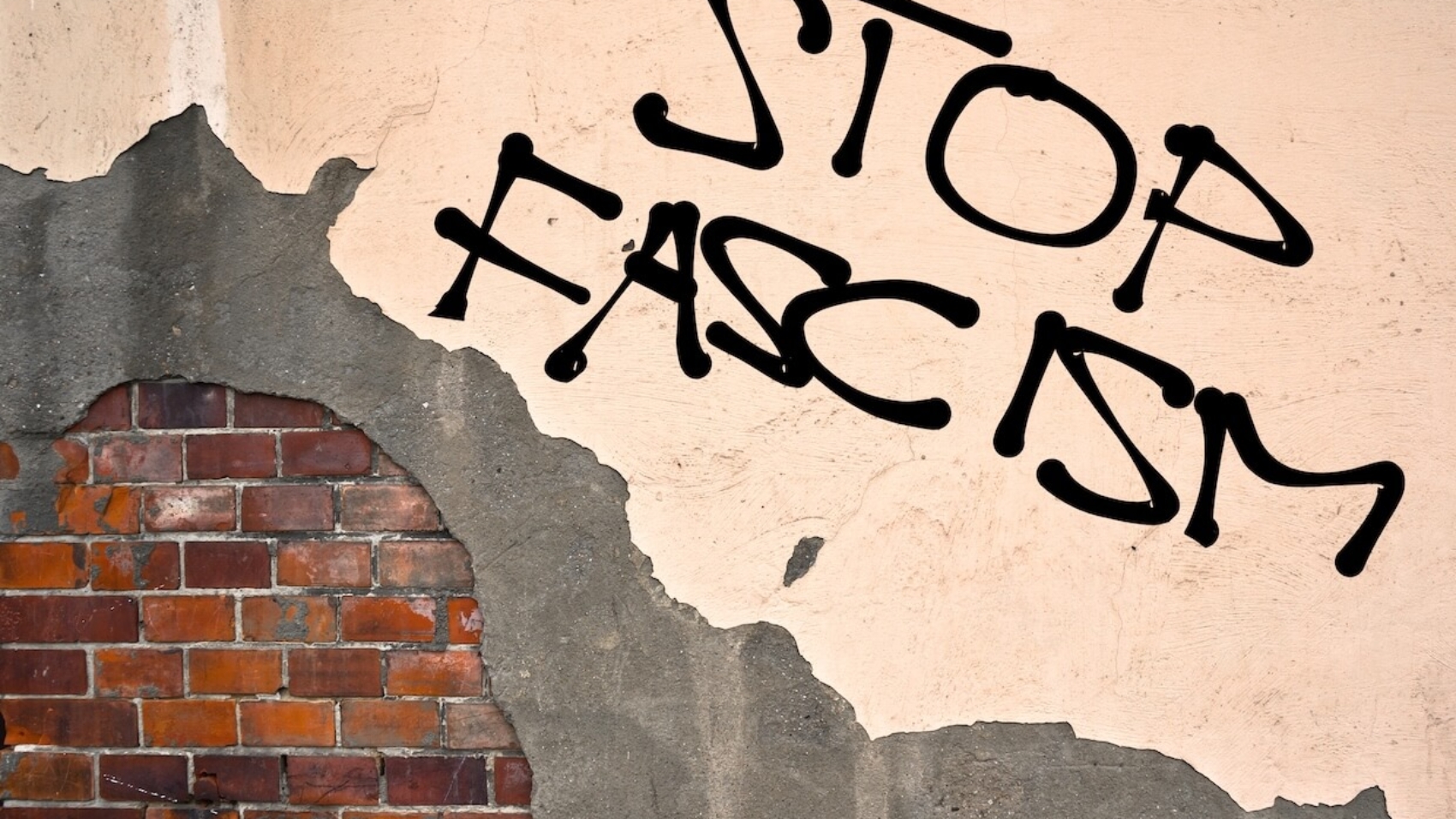
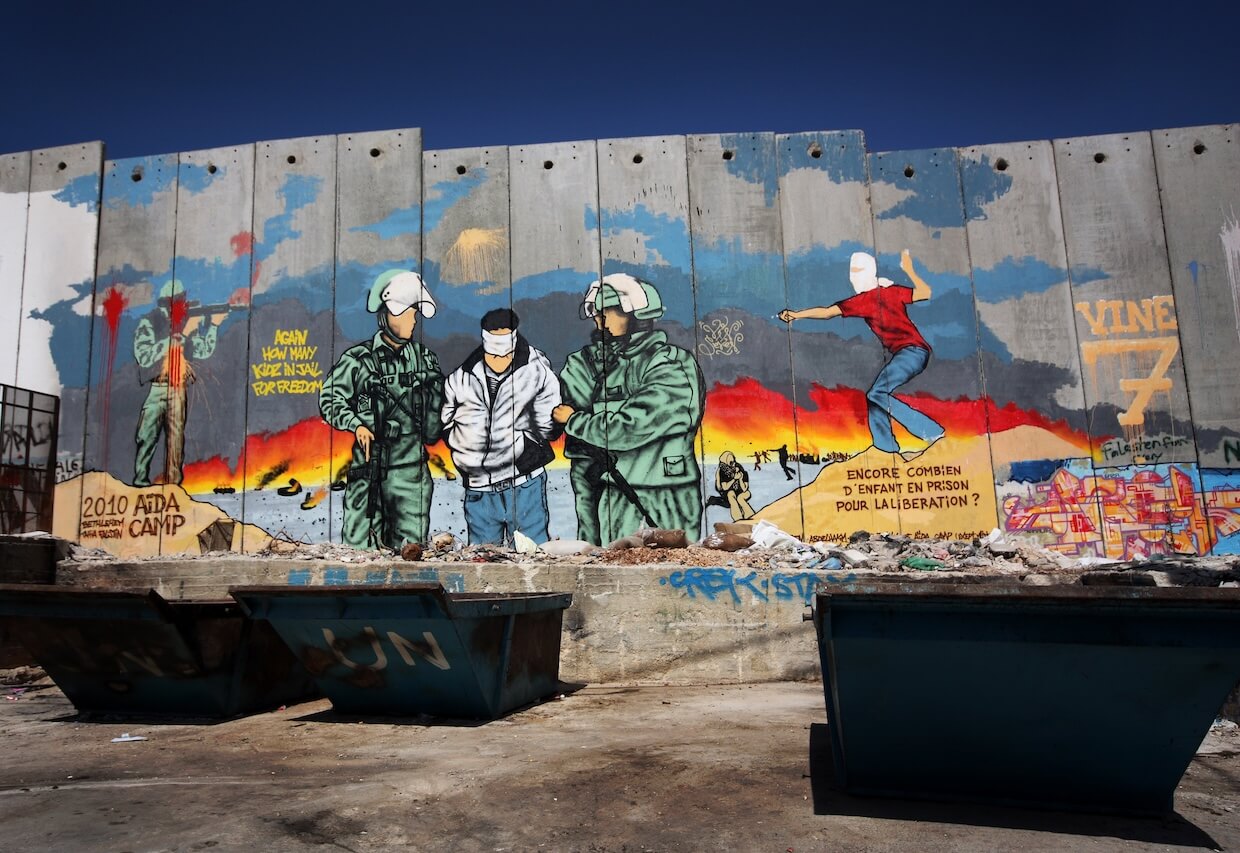
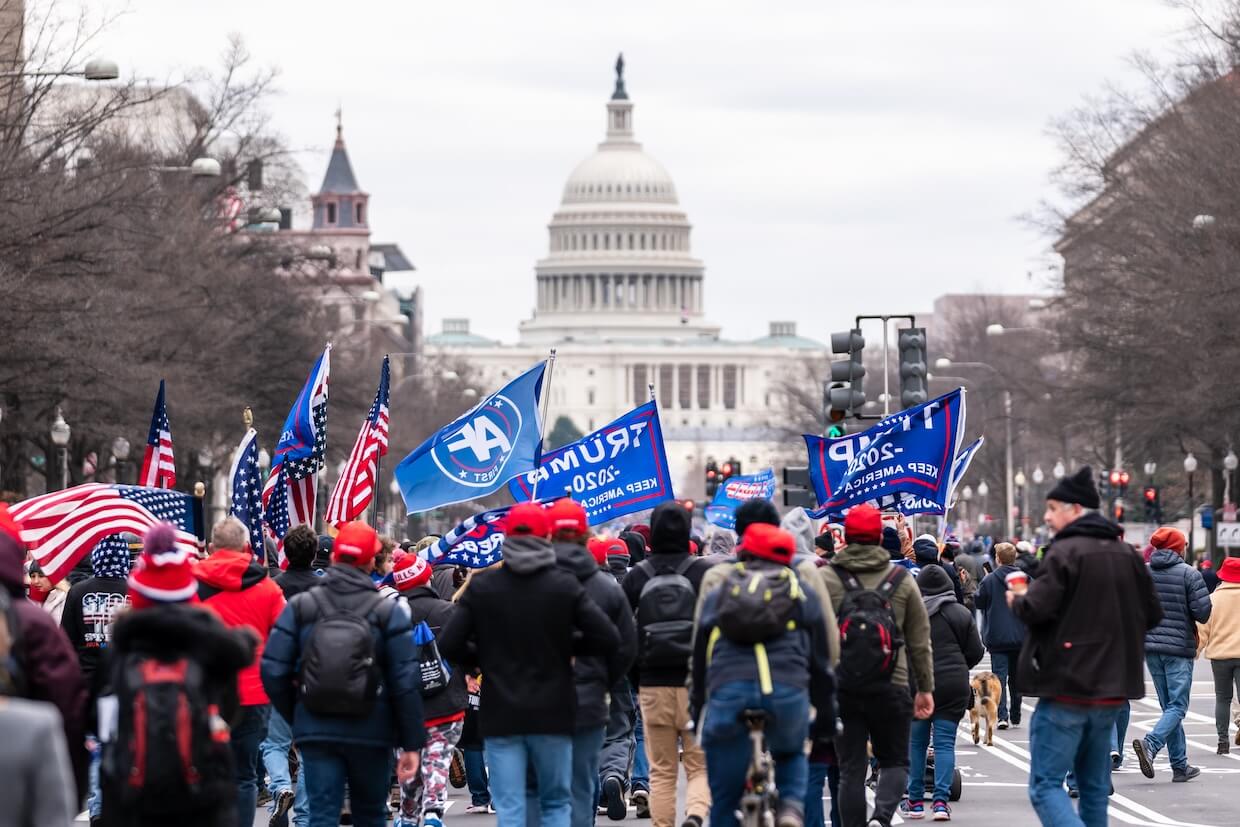
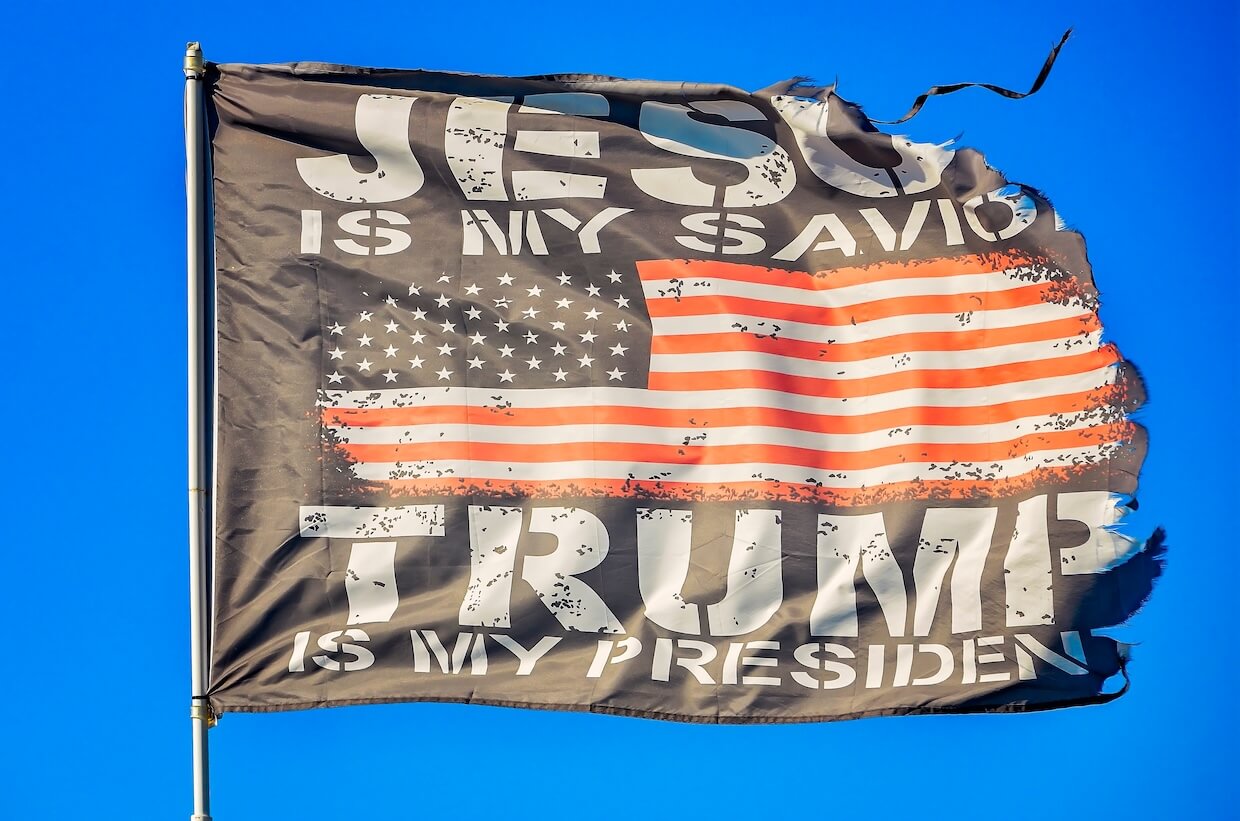
In this commentary, Dr. João Ferreira Dias traces the rise of white Christian nationalism from Nixon’s “Southern Strategy” and Reagan’s Moral Majority to the Tea Party and today’s MAGA movement. He argues that what appears as grassroots populism is, in fact, a carefully engineered project to transform fringe radicalism into a national force. Electoral restrictions, demographic anxieties, and evangelical mobilization have converged to produce a politics that is ever more exclusionary, authoritarian, and puritanical. Dr. Dias asks: Is MAGA truly the majority, or is it the triumph of minority rule through strategic manipulation?
The Charlie Kirk Memorial was a turning point in the American ideological trajectory for the next decade, leaving the US in a state of social fracture only comparable to the civil rights era and the Vietnam War. We are witnessing the “great awakening” of nationalist evangelism, reminiscent of the peak of that authoritarian fusion between evangelical Christianity and political power in the 1930s, so vividly portrayed in the Perry Mason television series.
Indeed, Jason Stanley (2018) argued early on that Donald Trump revived the 1930s, precisely the period when fascist ideals were in vogue in the United States, with the cult of the “nation” and the strong leader, moral panic, and pamphleteering attacks against minorities and immigrants, as well as the cult of radically conservative religious values.
But is the MAGA movement truly a majority in the US, or are we witnessing a power grab by a minority through carefully engineered political strategy, with Trump serving merely as its face?
From a sociological perspective, there are clear demographic, cultural, and political changes fueling a socio-economic panic over the loss of social status—what Barbara Ehrenreich (1989) called the “fear of falling.” This has led to radicalization around ethnonationalist values, broadly classified in Political Science as nativism (see Art, 2022; Betz, 2019, 2017).
Nowhere has this shift been more evident than in the US, with a well-identified turning point: the civil rights movement, which transformed the Republican Party into what one of its strategists, Stuart Stevens, called the “de facto white party,”its key base being Southern whites, historically Democrats.
Richard Nixon and later Ronald Reagan capitalized on the Southern white vote with the rhetoric of “law and order.”Reagan went further by adding a Christian dimension to the white front, giving rise to the Moral Majority. From then on, the Republican Party was captured by what Steven Levitsky and Daniel Ziblatt (2024) call the “racially conservative base,” responding to demographic changes in the US from the 20th to the 21st century, as the white population fell to just 58% by 2020 and the proportion of non-white members of Congress quadrupled. A new racial order emerged in America, and the white majority entered into demographic and social panic, exacerbated by progressive shifts in American society.
With non-white Americans voting in growing numbers, Black voter turnout surpassed white turnout for the first time in US history in 2012. Faced with these profound changes, the Republican Party had two options: change its rhetoric/strategy or change the electoral map. It chose the latter. This was done through state-level legislative changes, such as requiring photo ID to vote, disproportionately affecting poor, Black, and Latino citizens—Blacks are twice as likely and Latinos three times as likely not to have photo identification. In Kentucky, Virginia, and Florida, those with a criminal record cannot vote, a maneuver that once again disproportionately impacts racial minorities, in a country marked by racialized incarceration and sentencing disparities. Additionally, attempts were made to pass laws shortening early voting and preventing election extensions in cases of long lines—measures struck down in court for deliberately targeting the African-American electorate.
Yet restrictions continued, with seven of the eleven states with majority African-American electorates and twelve states with majority Hispanic electorates adopting mechanisms that effectively disenfranchised these populations.
Amid demographic change, the Republican Party skillfully read and instrumentalized the fears of a shrinking white population. Many whites interpreted these demographic shifts, combined with changes in the social pyramid, as a threat. A 2015 poll found that 72% of white evangelicals believed America had changed for the worse since the 1960s, alongside another poll showing a growing perception of “anti-white prejudice.”
It was in this context that the Tea Party (Formisano, 2012) — a reactionary movement of mostly middle-aged white evangelicals — emerged in 2009 after Obama’s election, spreading quickly under the slogan of “taking the country back.” The old social order of Jim Crow laws (Tischauser, 2012) was remembered with nostalgia. The Tea Party’s social impact was crucial in shaping the MAGA movement, decisively rooting white Christian nationalism as a core identity marker of Republican politics in America.
Therefore, the answer to the question posed in this text is clear: we are witnessing an electoral and political engineering process that has transformed radicalized fringe electorates into a national electoral force, steering the country toward white Christian nationalism—ever more exclusionary, ever more puritanical, ever more authoritarian.
References
Art, D. (2022). “The myth of global populism.” Perspectives on Politics, 20(3), 999-1011.
Betz, H. G. (2019). “Facets of nativism: a heuristic exploration.” Patterns of Prejudice, 53(2), 111-135.
Betz, H. G. (2017). “Nativism across time and space.” Swiss Political Science Review, 23(4), 335-353.
Ehrenreich, B. (1989). Fear of falling: The inner life of the middle class. New York: Pantheon Books.
Formisano, R. P. (2012). The Tea Party: a brief history. JHU Press.
Levitsky, S., & Ziblatt, D. (2024). Tyranny of the minority: Why American democracy reached the breaking point. Random House.
Stanley, J. (2018). How fascism works: The politics of us and them. Random House Trade Paperbacks.
Tischauser, L. V. (2012). Jim crow laws. Bloomsbury Publishing USA.
In an interview with ECPS, Dr. Mom Bishwakarma reflects on Nepal’s September 2025 uprising, widely described as a Gen Z revolution. While youth mobilization toppled a government and ignited debates on corruption and “Nepo baby” privilege, Dr. Bishwakarma warns that deeper inequalities remain untouched. “Basically, we can say this has brought some destruction to political institutions, but not real change,” he stresses. Despite promises of inclusion in the 2015 constitution, caste discrimination and elite dominance persist, leaving Dalits marginalized. Drawing parallels with Sri Lanka and Bangladesh, he cautions that without dismantling entrenched structures, Nepal risks repeating cycles of revolt and disappointment rather than achieving a genuine democratic transformation.
The September 2025 youth-led uprising in Nepal, widely framed as a Gen Z revolution, has generated global debate about the prospects for democratic renewal in post-conflict societies marked by entrenched inequality and elite capture. To probe the deeper social and political implications of this moment, the European Center for Populism Studies (ECPS) spoke with Dr. Mom Bishwakarma, researcher in the Department of Sociology and Social Policy at the University of Sydney and sessional academic at the University of Tasmania, Australia. A specialist on caste politics and Dalit struggles for justice, Dr. Bishwakarma situates the uprising within Nepal’s broader trajectory of populist-authoritarian bargains and incomplete democratic transformation.
At the heart of the movement, he explains, was not caste or identity politics but a narrowly defined resistance against corruption and “Nepo baby” privilege. As he notes, “To be honest, it has not really addressed the issue of caste inequalities… Instead, they were primarily resisting forms of ‘Nepo baby’ privilege and the elitism of the ruling class.”This narrow focus, centered especially on the government’s attempt to ban social media, created mobilization energy but left deeper structures of inequality intact.
Digital platforms played a pivotal role, enabling new forms of youth subjectivity while simultaneously constraining the scope of protest. “Youth use social media as a means of organization and as a medium to express discontent against various problems,” Dr. Bishwakarma observes, yet he underscores the limits of such digitally mediated politics in a semi-feudal society where caste discrimination remains pervasive. For Dalit youth in particular, visibility remained minimal: “We can’t see even a single person leading the Gen Z movement… This means that the protest was not specifically raising the issue of caste inequalities or other forms of discrimination in Nepal.”
The uprising also revealed the fragility of Nepal’s federal constitutional order. Despite provisions for inclusion, everyday discrimination remains widespread, with law enforcement institutions often biased and ineffective. For Dr. Bishwakarma, this gap underscores a sobering conclusion: “One legal provision alone does not guarantee rights, nor does it prevent the persistence of discrimination nationwide.”
Above all, he stresses that the uprising has not yielded the systemic change many anticipated. “Basically, we can say this has brought some destruction to political institutions, but not real change. People were expecting deeper reform, but this political outcome has not been delivered. I am not very hopeful that it will bring the transformation the country needs.”
Drawing parallels with Sri Lanka’s Aragalaya and Bangladesh’s 2024 uprising, Dr. Bishwakarma warns that Nepal too risks sliding into cycles of disappointment unless its youth movements move beyond symbolic anti-elite populism toward a deeper confrontation with caste, inequality, and authoritarian legacies.
Here is the transcript of our interview with Dr. Mom Bishwakarma, lightly edited for clarity and readability.
The Uprising Changed the Government, But Not the System
Photo: Dreamstime.
Dr. Bishwakarma, thank you very much for joining our interview series. Let me start right away with the first question: Analysts frame the September 2025 uprising as a Gen Z revolution. From your perspective, how did entrenched caste-based inequalities and elite hegemony intersect with rising youth discontent to generate this rupture? And to what extent should we interpret this upheaval as a repudiation of Nepal’s long-standing populist-authoritarian bargains between ruling elites and marginalized publics?
Dr. Mom Bishwakarma: Thank you so much for this opportunity. Of course, we have to look at the recent political uprising in Nepal from different perspectives. From the point of view of caste inequality, this movement could certainly have done much more. To be honest, it has not really addressed the issue of caste inequalities. Basically, Gen Z started this movement against corruption and against any form of elite hegemony in Nepal’s ruling system. In that sense, it was broadly against discrimination, but more specifically it focused on corruption and on the government’s attempt to ban social media.
In this regard, I should say that caste issues have not been central to the Gen Z movement, and they have not been explicitly addressed. I know this is a very difficult and important issue in Nepal, but at this stage Gen Z could not directly confront caste inequalities. Instead, they were primarily resisting forms of “Nepo baby” privilege and the elitism of the ruling class. As a result, the movement did not specifically take up the concerns of marginalized communities. So, I would conclude that the uprising was not directed against caste discrimination or other forms of discrimination per se. It was mainly targeting corruption in Nepal.
Much of the mobilization was digital and youth-led. How do you interpret the relationship between Nepal’s semi-feudal social order and the emergence of digitally mediated political subjectivities among Gen Z, particularly in light of global debates on how new media both enables and disciplines democratic dissent?
Dr. Mom Bishwakarma: Looking at Nepal’s recent development process, social media has been one of the areas where there has been massive change — a significant digital transformation, we might say. Basically, access to phones and social media has been a really important shift. That is the main reason why Gen Z became affiliated with each other in different groups, formed associations, and started creating resistance against corruption and other issues.
But looking at society itself, Nepal is still semi-feudal, with persistent discrimination and many challenges yet to be addressed. Digitalization, moreover, has not penetrated rural areas or many other parts of society. So yes, young people are very comfortable with social media, and they are using this tool to raise issues and push for change. Essentially, youth use social media as a means of organization and as a medium to express discontent against various problems. However, they have not fully engaged with the deeper social issues or the root causes behind them. They could have raised concerns about caste inequalities, other forms of inequality, poverty, underdevelopment, or unemployment — all of which would have been valuable. Instead, they focused mainly on two issues: corruption and the government’s attempt to ban social media.
This narrow focus has not created a real chance for broader change in Nepal, nor has it produced significant transformation in other areas. Yes, of course, the uprising changed the government, but at the end of the day, we are not seeing the outcomes that many people in Nepal were hoping for or expecting.
Nepo Babies Have Been Resisted, But Caste Discrimination Has Been Left Untouched
The discourse against “nepo kids” suggests a moral economy of resentment. Do you see this as a continuation of older struggles against caste privilege and elite reproduction, or as a qualitatively new form of digitally amplified populist class politics rooted in spectacle and affect?
Dr. Mom Bishwakarma: This Nepo babies movement is essentially rooted in social media. Of course, it stands against any form of elite hegemony in the country, but it is not directly addressing the issue of caste discrimination. We can see that in the leadership of the Gen Z movement, not many youths from so-called marginalized or lower-caste groups are represented. They are not in leadership positions, nor are they given that opportunity.
Many young people from different classes and communities may have joined the resistance, but they remain outside leadership roles. So, in essence, this is more of a symbolic resistance against elite hegemony or authoritarian governance, rather than a movement that specifically addresses caste or other marginalized groups. It is, in effect, resistance against political leaders, Nepo babies, and elite authoritarianism in Nepal.
With symbols of state power set ablaze, some argue the uprising reflected anarchic nihilism, while others see a democratic re-founding. Do you interpret this as a destructive rejection of institutions, or as the embryonic formation of what might be called a post-elitist and post-authoritarian democratic imagination?
Dr. Mom Bishwakarma: We have to look at this from two perspectives. Yes, of course, we can see it as post-elitist, or an anti-elitist movement, and there is a reimagining of a new democratic process in Nepal. But the way it has unfolded in the political system, particularly after the uprising and the formation of the interim government, shows that they are still working within the current constitution, and there has not been much change in the governance system.
Gen Z demanded a directly elected prime minister or a directly elected president, reforms in the electoral system, and strict action against corrupt political parties, but not much of this is happening. After the uprising, an interim government was formed, led by the former Chief Justice and other independent leaders who are very well known in the country, but they are still operating under the articles of the existing Constitution. This means there has been no suspension of the Constitution.
There is no guarantee of a directly elected prime minister or president. There is no guarantee of a new electoral process that would ensure representation of all communities, including marginalized groups. In other words, there has not been a real outcome from this process. So, basically, we can say this has brought some destruction to political institutions, but not real change. People were expecting deeper reform, but this political outcome has not been delivered. I am not very hopeful that it will bring the transformation the country needs.
What Nepal Needs Is Total Reformation, Not Symbolic Change
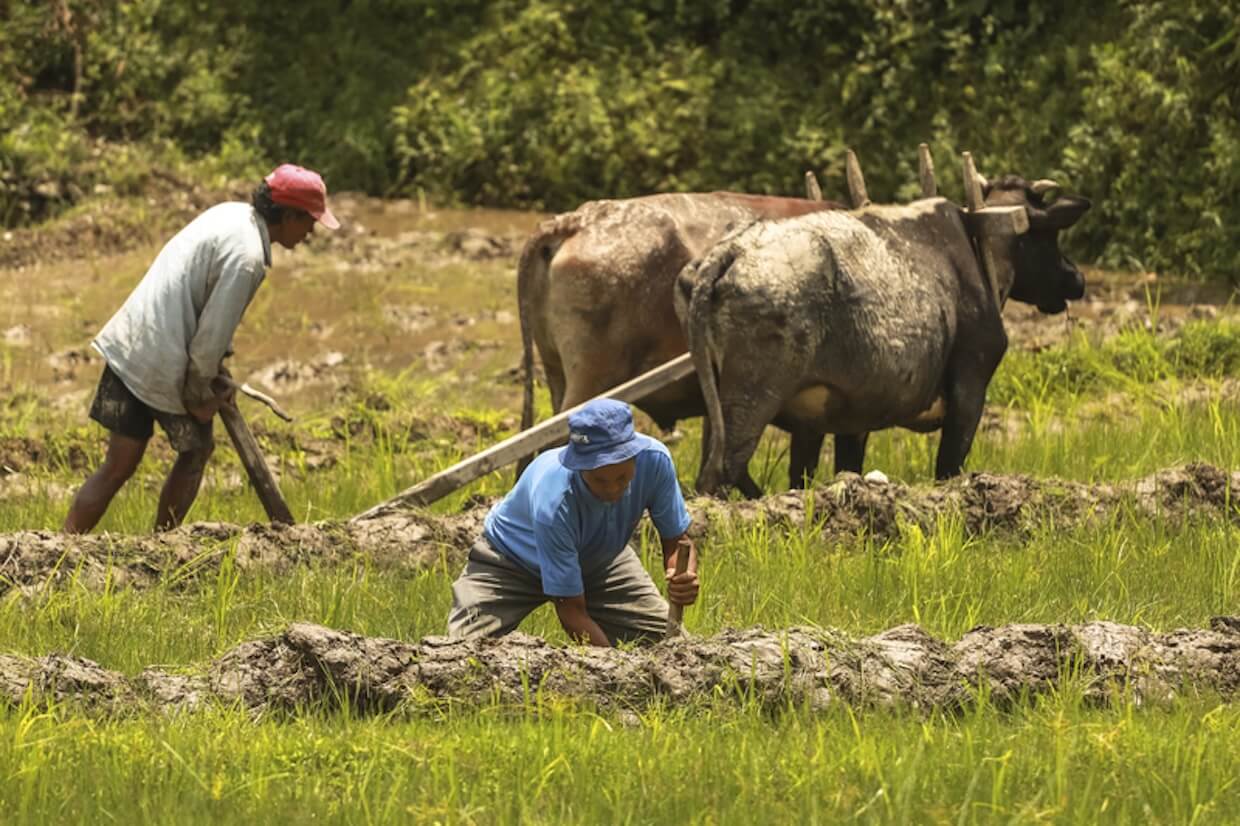
A Nepali farmer at work in a rural field during the monsoon season. As the rains arrive, farmers across Nepal become busy in their fields, though most still rely on traditional farming techniques. Photo: Shishir Gautam.
Your book stresses the twin imperatives of redistribution and recognition in the struggle for Dalit justice. Do you see Nepal’s Gen Z revolution as embodying these imperatives—or does its populist anger risk collapsing recognition into resentment and redistribution into vague anti-elitist rhetoric?
Dr. Mom Bishwakarma: Thank you for this question as well. I would again like to emphasize that, yes, we are expecting much more change, deeper change, or reformation. As I stated in my book, to address the issues of Dalit and other marginalized groups in Nepal, there must be total reformation — both redistribution of state resources and recognition of communities like the Dalits in Nepal. But after this youth-led or Generation Z-led uprising, we are still not seeing much redistribution, nor is total reformation likely to happen in the country.
This means there is still a great deal to be done, even though the Constitution of Nepal in 2015 addressed a wide range of issues — for example, social inclusion, the republican system, and different forms of governance, such as local, federal, and state government. Many things were introduced with that new constitution, but there has not been real change regarding caste discrimination and other forms of exclusion.
Young people, in particular, are looking for rapid change and fast development in Nepal, which has not materialized, either after 2015 or, if we look back further, after 2006, when the republican system was introduced in 2008. People expected much more meaningful change so that there would be development, opportunities, and inclusion. Yes, there was some symbolic inclusion in Parliament and in other mechanisms — Dalits and other marginalized groups were included, as were women and other communities — but in rural areas, ordinary people did not feel the impact.
There has continued to be high unemployment and high corruption. So, from that perspective, yes, there is still much to be done in Nepal, and what is needed is total reformation rather than symbolic change. This particular uprising is indeed a revolt or resistance against elite authoritarianism, but it is not producing meaningful change, nor is it bringing about the kind of total reformation Nepal needs.
Despite legal prohibitions, everyday caste discrimination persists. To what degree do Gen Z protests transcend entrenched caste boundaries, and how do you assess whether Dalit youth achieved disproportionate visibility—or conversely remained marginal—in this anti-authoritarian mobilization?
Dr. Mom Bishwakarma: Thank you so much for this very good question. As I stated before, Dalits once again seemed to be marginalized in this process, because we can’t see even a single person leading the Gen Z movement. If you look at the composition of Gen Z leaders, I don’t see any Dalit in that position. Of course, there were a couple of people killed during the protest, and there are other incidents as well, but in terms of leadership, I can’t see any Dalit member included in that process. This means that the protest was not specifically raising the issue of caste inequalities or other forms of discrimination in Nepal. It was more focused on anti-corruption and the ban on social media. Yes, of course, that is really important for the development of the nation, but when it comes to issues like caste inequalities, other forms of discrimination, and many broader social concerns, they have not really been addressed at this stage. That’s why I am again saying that, in the case of caste and other forms of discrimination, we need another form of revolt or resistance that truly addresses the issue of caste, so that there will be no discrimination, and marginalized communities will have more opportunities and be able to develop in Nepal.
Without Effective Mechanisms, Discrimination Persists Nationwide
Federal restructuring and the 2015 constitution promised inclusive representation, yet inequalities remain deeply institutionalized. Did the 2025 uprising expose the limitations of Nepal’s federalism as a tool for substantive equality, or was it more a populist indictment of the state’s moral legitimacy?
Dr. Mom Bishwakarma: I’ve already mentioned this issue before, but I would like to emphasize again that, yes, the 2015 Constitution specifically addressed social inclusion. Because of that constitution, there is representation of marginalized groups, including Dalits, women, and other ethnic communities, in Parliament as well as in local and state government. But it has not directly addressed caste inequalities or everyday discrimination.
Discrimination remains widespread across the country. The government’s law enforcement mechanisms are either ineffective or deeply biased, which is why existing laws are not being properly implemented. Yes, there is legislation against caste-based discrimination — an act from 2000 that was enforced after 2011 — and the 2015 Constitution also clearly states that caste discrimination is illegal.
There are rights on paper for Dalits and other marginalized communities, but one legal provision alone does not guarantee those rights, nor does it prevent the persistence of discrimination nationwide. What is needed is an effective implementation mechanism, such as police and administrative institutions, that take the issue of discrimination seriously. At the moment, such mechanisms are absent, and there is also a lack of Dalit representation within law enforcement itself. This creates a vacuum and leaves little hope for people, especially those from lower-caste and Dalit communities in Nepal.
Critics warn that anti-corruption and anti-nepotism discourses can be easily co-opted by authoritarian populists who claim to “purify” politics while entrenching new hierarchies. Do you see parallels between the risks inherent in caste-based identity mobilization and the dangers of these new anti-elite narratives?
Dr. Mom Bishwakarma: Of course, I agree with that point, because this present youth uprising, or Gen Z movement, is against elite authoritarian government systems and the leaders who were running the government in Nepal. But there is always the issue of caste identity and representation. Most of the leaders of the Gen Z movement are again from higher castes, and there are not many Dalits or other marginalized groups included in leading positions or processes. This clearly shows that caste inequality and caste identity have not been specifically addressed through this uprising, even though they could have been. The core issues of the movement were essentially anti-corruption and opposition to the social media ban. This means they did not give much attention to other social problems, such as caste discrimination, unemployment, and broader structural inequalities. That is why there is always a risk: if the youth and others involved in such movements do not fully understand Nepal’s social fabric, history, and the deeper changes needed, their mobilization risks remaining superficial.
Another point I want to emphasize is that, even though these young people are driven by social media and digital transformation, their mindset is still shaped by their families, parents, and society. Many come from elite backgrounds and continue to enjoy caste privilege. That is the real risk and danger. It means that, in the future, even if they come to power — whether as ministers or prime ministers — they are unlikely to directly address caste discrimination or other forms of marginalization. That remains a serious danger in Nepal’s current context.
People Expected Faster Progress on Corruption and Development
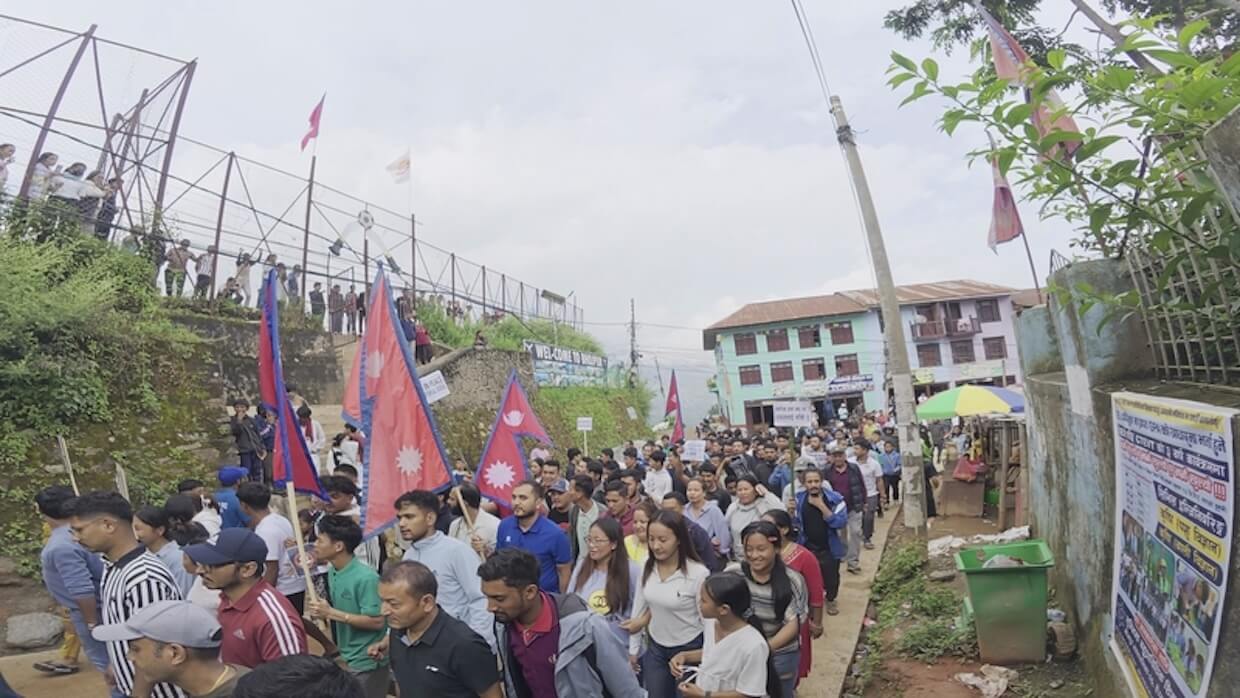
Many Nepali citizens join Gen Z–led protests in Bhojpur, Nepal on September 9, 2025, showing solidarity with nationwide demonstrations. Photo: Dipesh Rai.
Nepal’s Maoist insurgency once mobilized Dalits and marginalized groups in large numbers, but its legacy was one of institutional capture and elite circulation. How do today’s youth movements relate to—or explicitly repudiate—this Maoist populist-authoritarian inheritance?
Dr. Mom Bishwakarma: Many people now view the Maoist revolt as another form of elite authoritarian process, and in that sense, it did not fulfill expectations. But we also need to look at it from a historical perspective. Nepal was then ruled by a king, opportunities were very limited, and although there was democracy, there was little real progress and no meaningful inclusion. After the Maoist movement, however, many things did change.
For example, the issue of inclusion was strongly raised, and afterward a new constitution was promulgated. That constitution guaranteed social inclusion, secularism, and a republican federal system in the country. Still, these gains did not translate into substantial improvements on the ground. Change was happening, but people were expecting much faster progress in addressing corruption, unemployment, and development. Corruption, in particular, was a major issue, and while the Maoists attempted to address it when they came to power, they ultimately fell short.
This led to political shifts. The main parties, like the Nepali Congress and CPN-UML, came together, formed a coalition, and removed the Maoists from power. So elite resistance was strong. At the same time, many argued that the Maoists themselves had become elitist, were involved in corruption, and failed to deliver real change. That became a major criticism of the Maoist Party.
Another structural issue was the electoral system. The Maoists favored a full proportional system, but the 2015 political settlement established a first-past-the-post system. This system made it almost impossible for any single party to win a full majority, leading to frequent coalition governments and instability. That is also why the recent youth uprising demanded reforms: a directly elected prime minister or president, a different electoral system, and a state-funded electoral process.
But even after this uprising, none of these demands have materialized. With Parliament dissolved, constitutional amendments cannot move forward. We now have to wait and see what the interim government does. One of its mandates is simply to hold another election. After that, we will see whether a single party can secure a majority, or whether a youth-led party will emerge and participate in the elections. These are the developments we will need to watch in the future.
Dalit Politics Requires Both Recognition and Redistribution
Your scholarship emphasizes Dalit demands for recognition alongside material redistribution. Do you think the revolutionary anger of Gen Z risks dissolving such group-specific claims into a homogenized “anti-elite” populism that reproduces old exclusions under new slogans?
Dr. Mom Bishwakarma: While doing my research, I argued for two key points. First, for Dalit communities in Nepal, there must be total reformation and recognition of the Dalit community. Within the Dalit community itself, there are many different groups, and there is not much unity. To bring them together around their common concerns, there should be recognized group politics. That is why I argued that group politics for the Dalit community should be formally acknowledged by political parties and state institutions.
The second point is redistribution — the redistribution of state resources and state positions, including, for example, land reform and other measures. But even the 2015 Constitution of Nepal did not truly address either redistribution or recognition. Yes, to some extent it recognized Dalit issues, but only superficially.
In terms of representation, because the constitution did not establish a fully proportional electoral system, there is no guarantee of 13% representation for the Dalit community, even though Dalits make up around 13% of the population. In this sense, I always argue that there must be total reformation — one that meaningfully addresses caste discrimination, lack of representation, unemployment, poverty, and related issues. The 2015 Constitution addressed some of these concerns only partially.
The recent uprising and the new process have not specifically addressed caste inequalities or other forms of discrimination. So, I am not very hopeful that the new process — meaning the new election and new parliament — will directly address inequality, since no new constitution is likely to emerge. I don’t know which political parties will return to power or form a government, whether there will be an absolute majority for one party, or whether a youth-led government will emerge. At this stage it is not clear. That is why I am not fully confident that the new process will specifically address caste inequalities or Dalit concerns.
Nepal Risks Sliding Into the Same Disappointments as Sri Lanka and Bangladesh
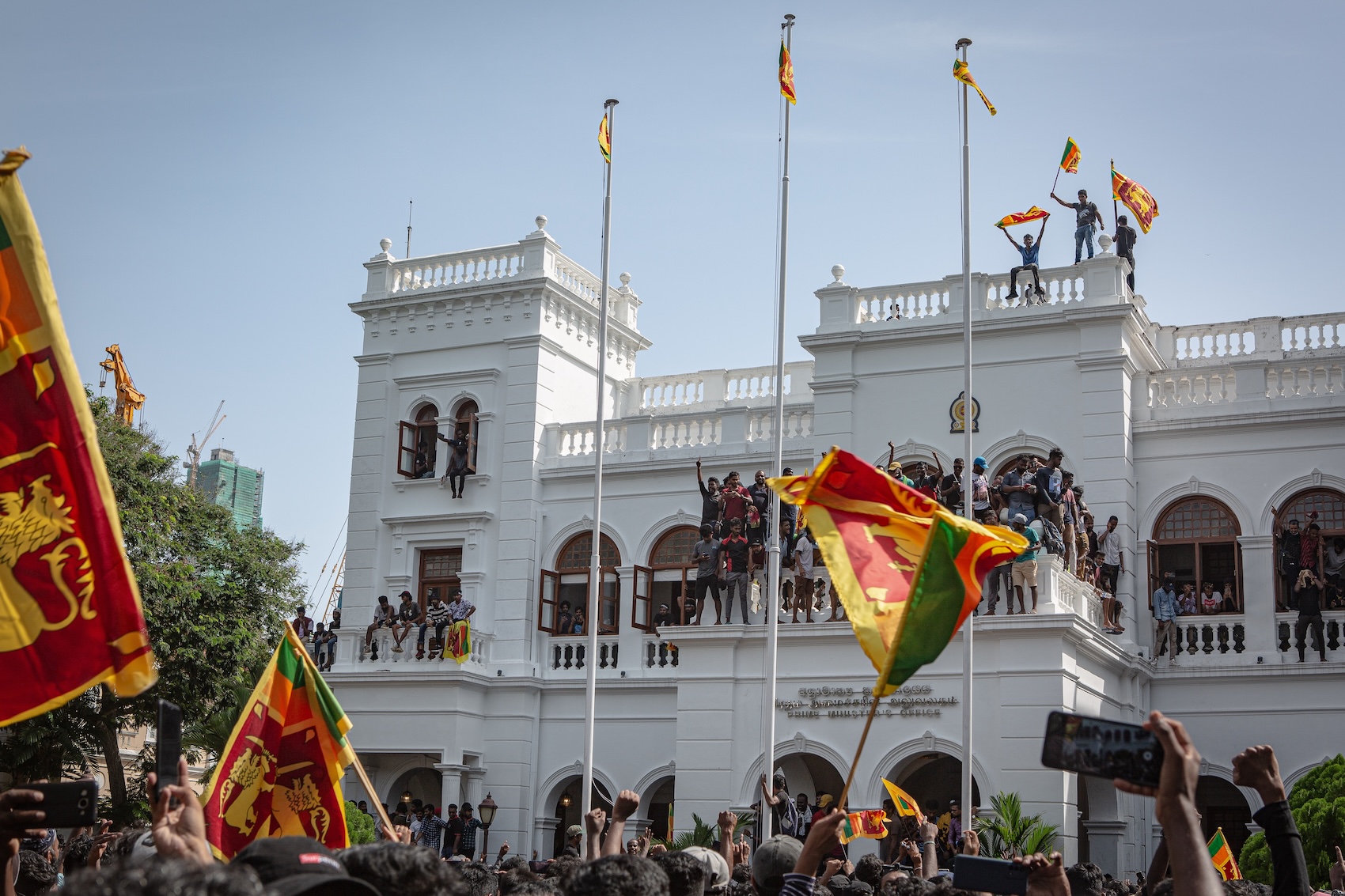
Sri Lankan protesters storm the prime minister’s office in Colombo on July 13, 2022, demanding the resignation of President Gotabaya Rajapaksa and Prime Minister Ranil Wickremesinghe. Photo: Ruwan Walpola.
Lastly, Sri Lanka’s Aragalaya and Bangladesh’s 2024 uprising both toppled governments but slid toward renewed authoritarian populism or elite restoration. What lessons should Nepal’s Gen Z revolution draw from these trajectories if it is to avoid similar cycles of disappointment?
Dr. Mom Bishwakarma: You’re right that the recent examples from Sri Lanka and Bangladesh, as well as other forms of civic resistance in different parts of the world, show that even when there is revolt or resistance against elite authoritarianism, the outcomes are often disappointing. That is exactly what happened in Sri Lanka, in Bangladesh, and in Nepal. The similarities are clear: young people want total reformation, development, and change. That is what the youth in Bangladesh demanded as well, but at the end of the day, the political process did not move in that direction.
In Bangladesh, for instance, there was a revolt against the government, the prime minister fled to India, and a new interim government was installed. Yet elections have still not been held. The same risks exist in Nepal. Here, an interim government was also formed, and young people demanded an independent figure as prime minister. That is why the Chief Justice was appointed as interim prime minister, with a mandate to organize elections by the given deadline. But looking at the current political process, it is not moving in the right direction. Whether elections will even take place on time is uncertain, and many people are openly speculating about delays.
The problem is that dialogue with political parties has not yet begun. At the end of the day, democracy requires political parties to be central stakeholders. Without them, a democratic election cannot be organized. Elections cannot simply be carried out without agreement among the political parties.
For this reason, I am not hopeful that there will be real change, or that the core demands of the Gen Z movement will be addressed either by the interim government or by the new government after elections. Yes, the uprising was a real resistance against elite authoritarianism in Nepal, but the results so far are not heading in a positive direction. The outcome is not what the people of Nepal had hoped for.
I am also not optimistic that the new process will address deeper issues such as caste inequalities or caste-based discrimination. Until and unless the caste system in Nepal is dismantled, discrimination will persist. If there is no new constitution, or at least no specific program aimed at uprooting the caste system, then marginalized groups such as Dalits will continue to face severe discrimination in the future. We will have to wait and see what happens, but at this stage, it remains very unclear what kind of change will come even after new elections in Nepal.
When Keir Starmer denounced populism as a “snake oil charm” in July 2024, he became the first British Prime Minister to attack it so explicitly in a major parliamentary speech. Yet inside Labour, the strategy is contested. Should populism be called out as corrosive to democracy, or quietly disarmed by fixing everyday grievances? Starmer prefers direct confrontation; his strategist Morgan McSweeney stresses delivery — “potholes, not populism.” Luke Malhi’s interviews with MPs, aides, and journalists reveal a party caught between naming the threat and co-opting parts of its language to blunt Reform UK’s rise. The debate echoes dilemmas across Europe, underscoring a central question: how can mainstream parties defend institutions without alienating the voters populists claim to represent?
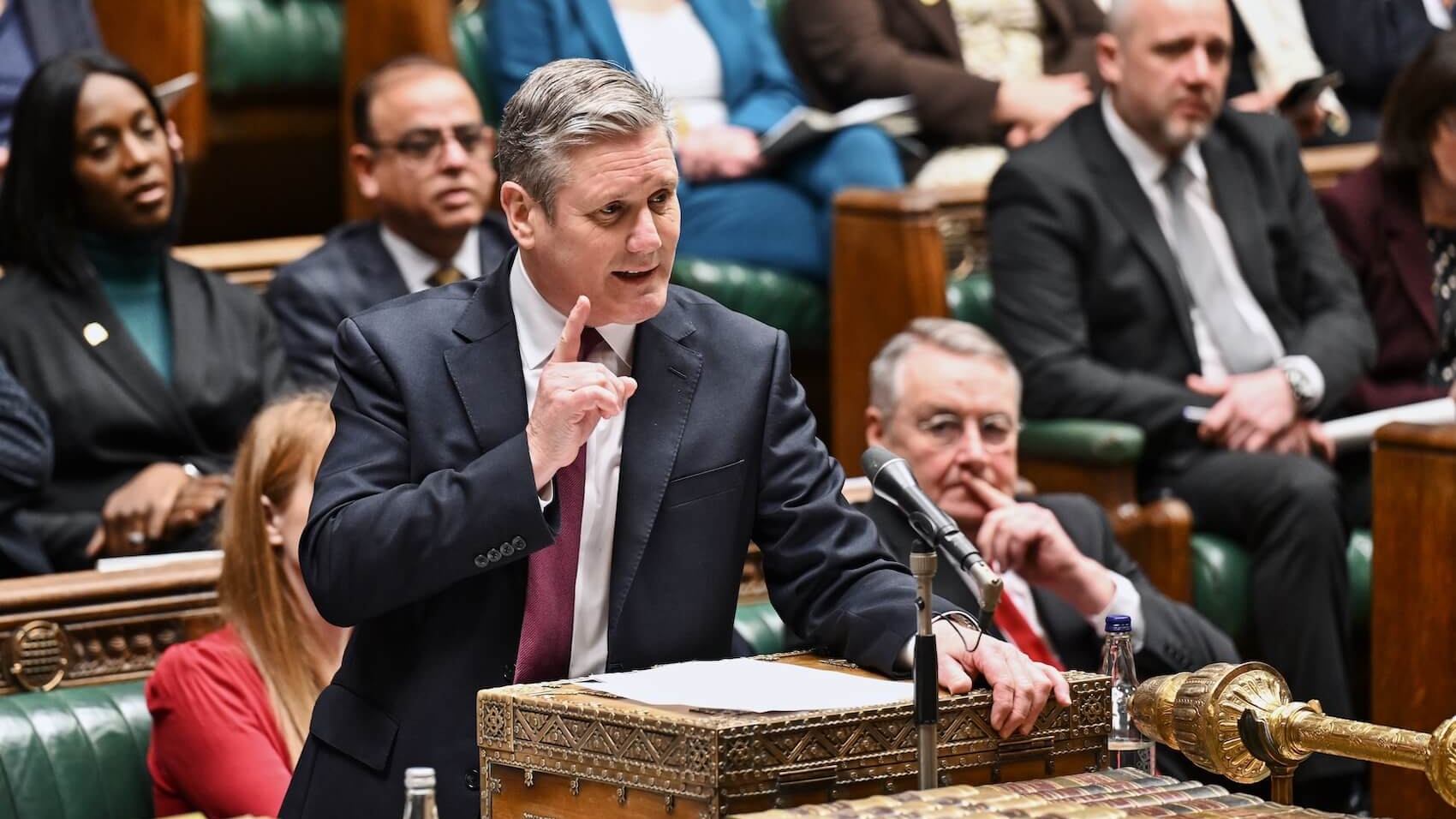
On a warm July morning in 2024, as parliament resumed for the first time following the election, Keir Starmer stood at the dispatch box and denounced populism as a “snake oil charm” that promised easy answers but could deliver only division (Starmer, 2024a). It was the first time a British Prime Minister had attacked populism so explicitly in a set-piece moment of national politics. For some, it sounded like the steady voice of reason after years of turbulence. For others, it risked reinforcing the image of a detached mainstream elite who scold rather than persuade the most dissatisfied in society.
Behind the scenes, Labour figures admit the party is still working out how best to handle the populist threat presented by Reform UK, a populist radical right (PRR) party which secured 14.3% of the vote in 2024, and is now polling at around 34% (Ipsos, 2025). In January of 2025, I conducted interviews with MPs, strategists, and senior journalists, with the promise of anonymity to encourage them to speak candidly. What emerged was a picture of a party that both fears the corrosive potential of populist politics and struggles with how directly to confront it.
Exploring these tensions matters because Britain is hardly alone. Across Europe, mainstream parties face the same dilemma of how they should respond to populists who thrive on frustration with the status quo. Do they call out populism as dangerous, risking charges of elitism? Do they try to quietly address the grievances that fuel it? Or do they attempt to co-opt aspects of the populist policy platform and rhetoric in an attempt to diffuse their appeal? Labour’s struggle with this balance offers a case study in how mainstream parties might navigate this populist age, and what that means for the future of democracy.
Labour’s Response to Populism
When asked how Labour’s inner core thinks about populism, one party strategist sighed: “It’s the problem we can’t ignore, but we can’t talk about it either.” On the surface, Starmer has not been shy about naming populism. In his New Year speech, he condemned “the politics of the easy answer” and accused right-wing populists of offering “grievances, not solutions” (Starmer, 2024c). In the King’s Speech, he branded populism a “snake oil charm” that divided communities (Starmer, 2024a). On a train to the 2025 party conference, he described a battle with the “populist Right Reform” for “the soul of the country” (Starmer, as quoted in BBC, 2025, 03:00). Several MPs told me this reflected his genuine conviction that populism corrodes democracy. One said: “he really does think it’s dangerous. He sees it as a slide toward US-style democratic backsliding.”
Yet many Labour elites worry that naming populism head-on risks alienating voters. As one backbencher put it: “You can’t just tell people they’ve been conned. That sounds like you’re calling them stupid.” A Labour strategist was even more blunt: “That was the Remain mistake. They shouted about how bad Brexit would be and people told them to sod off. If we repeat that with populism, we’ll lose again.”
These doubts are rooted in recent history. The failure of the “Stronger In” campaign during the 2016 referendum still looms large. Its warnings of economic collapse were dismissed by many voters as fearmongering, and that experience has left strategists wary of repeating the mistake of lecturing voters. Several MPs pointed out that even the term “populist”risks alienating audiences, since it is almost always used in a pejoratively charged manner, often shorthand for “irrational” or “ignorant.”
This tension has produced what insiders describe as a split between Starmer and his chief strategist, Morgan McSweeney. Starmer leans toward confrontation, “naming and shaming” populists in the words of one MP, while McSweeney takes the opposite view. According to a Labour aide, “Morgan thinks delivery is the only answer. Fix the potholes, raise living standards, and you’ll take the wind out of Reform’s sails. That’s the fight.”
But delivery is only part of the story. McSweeney’s strategy was said to increasingly involve borrowing selectively from populists where feasible, adopting their language on issues like patriotism or immigration, and co-opting policy themes that resonate with disaffected voters. One journalist explained: “It’s not just about competence. Morgan’s theory is giving people some of the populist framing but strip out the nastiness. Show them you hear their anger but redirect it.”
The difference between the two men is not just tactical but stylistic. Starmer prefers sober warnings about the dangers of populism. McSweeney is more interested in whether voters feel their everyday concerns are being met. As one Labour organiser summarised: “Keir wants to talk about democracy. Morgan wants to talk about potholes. And that’s the real debate inside Number 10.”
Journalists I spoke to consistently described Starmer’s style as technocratic. Some called him “prosecutorial,” others “old-fashioned” or “statesmanlike.” Even sympathetic insiders conceded that he can come across as an “enforcer of the status quo.” Several argued that this style is both personal and political: it reflects Starmer’s legal training, but also Labour’s deliberate attempt to ‘detoxify’ after Jeremy Corbyn. One campaign aide said: “We knew we couldn’t win if we looked like we were promising the moon again. Voters didn’t want grand visions. They wanted someone boring enough to fix the basics.”
That instinct shaped the 2024 campaign. Unlike Boris Johnson, who thrived on flamboyant gestures, or Corbyn, who rallied crowds with populist appeals to the “many not the few,” Starmer positioned himself as the steady alternative. His rhetoric avoided spectacle. His speeches focused on detail, compromise, and delivery. A senior journalist put it this way: “The whole pitch was: ‘We’ll be dull but competent.’ After fifteen years of drama, dull sounded good.”
At times, this meant deliberately lowering expectations. Multiple insiders recalled that Starmer instructed the party to avoid language that might create impossible promises. One MP said: “He didn’t want a repeat of 2017 or 2019, when we wrote cheques we couldn’t cash. He genuinely fears that broken promises feed populism.”
Starmer’s Worldview and the Parliamentary Party
Starmer’s instinct to treat populism as a moral threat is rooted in his background. As a barrister and former Director of Public Prosecutions, he was steeped in the idea that rules and institutions hold society together. Starmer’s choice to appoint Richard Hermer as attorney general in July 2024 was a clear example of this, and something which required ‘considerable effort’ according to one political journalist (Rodgers, 2025). Soon after his appointment, Hermer (2024) gave a speech which made clear his concern about populism and his plans to counter it:
‘We are increasingly confronted by the divisive and disruptive force of populism… We face leaders who appeal to the ‘will of the people’ – as exclusively interpreted by them – as the only truly legitimate source of constitutional authority. Their rhetoric conjures images of a conspiracy of ‘elites’ – an enemy that is hard to define but invariably including the people and independent institutions who exercise the kind of checks and balances on executive power that are the essence of liberal democracy and the rule of law… I hope you take some comfort in the fact that the importance of the rule of law and the constitutional balance is embedded in my DNA and that of a Prime Minister who not only rose to the top ranks of the Bar but served his country as DPP.’
Political journalist Ian Dunt correctly observed that it is rare for British politicians, especially attorney generals, to demonstrate “the kind of political and philosophical depth shown in that speech.” Given their shared history, Dunt (2025) claimed Starmer “had clearly authorised him to do the work they both believed in [to counter populism], in a much more robust and outspoken way.”
Labour’s MPs generally echoed Starmer and Hermer’s worldview. In interviews, many brought up Cas Mudde’s (2017) definition of populism unprompted, describing it as a worldview that pits a virtuous “people” against a corrupt “elite.”They consistently rejected this framing as corrosive to democracy. One MP told me: “The idea that politics is just a battle between good, ordinary people and a corrupt elite goes against how democracy really works – I think we’ve tried to push against that.” Indeed, Labour interviewees’ comments echoed many of the inherent dangers of populism for democracy identified by political scientist Jan Werner Muller (2016). They stressed that compromise and pluralism are essential, that it is impossible to distil the will of the people into a single viewpoint, and that institutions such as the judiciary and Parliament are safeguards, not obstacles. One insider remarked: “Respect for institutions is what sets us apart from the populists. I think for everyone here, that is absolutely key.”
This worldview shaped Labour’s stance on contentious issues. When the Conservatives tried to override the Supreme Court on the Rwanda deportation scheme, Yvette Cooper (2024) chastised a party that wanted to “stop all courts.” When Boris Johnson was accused of breaking lockdown rules during Partygate, Angela Rayner (2024) argued that the Prime Minister had “degraded” Britain’s institutions. When Conservative MPs criticised the International Criminal Court (ICC) for issuing an arrest warrant for Benjamin Neteyahu, David Lammy (2025) passionately argued that the UK’s duty was to uphold international law, no matter what.
For MPs, these moments weren’t simply opportunistic attack lines. Rather, they reflect an institutionalist ethos that sets Labour apart from its populist rivals. Several interviewees contrasted this with both right-wing populism and left-wing ‘Corbynism,’ which, at times, they claimed, flirted with a Manichean and binary view of “the people versus the elite”described by the ideational definition of populism (Mudde, 2017). As one journalist observed: “Starmer doesn’t do binaries. He does compromise. That’s his politics.” This rejection of populism runs deep within the identity of the Parliamentary Labour Party. MPs and advisers alike saw their role as defending the structures and norms of democracy against the polarising logic of populism.
A Compromise Strategy
Despite these convictions, Labour’s public-facing stance has been more muted. The compromise between Starmer and McSweeney means explicit attacks on populism are largely confined to Starmer’s speeches, whilst the wider party message stresses competence and delivery. At the same time, McSweeney’s strategy has steered Labour toward selective co-option of populist themes, borrowing rhetoric on sovereignty, fairness, and security when it helps shore up support against the PRR Reform UK.
MPs are divided over this balancing act. Some welcomed Starmer’s willingness to call out populism explicitly, saying it reassured the new intake that the party was willing to “name the problem.” Others warned that in Leave-voting constituencies such rhetoric could backfire.
A similar divergence in opinion appeared when MPs were asked about McSweeney’s push for Labour to co-opt populist policies and rhetoric in certain areas. Some Labour elites felt that, although it was uncomfortable, it was necessary to reduce the electoral appeal of Reform UK. However, others felt it risked legitimising right-wing populists and alienating their voter base on the left.
Indeed, recent research highlights that mainstream parties risk alienating their core voter bases when co-opting populist policies or rhetoric. A 2024 study on mainstream partisans’ responses to populist radical right parties found that even tactical forms of cooperation can provoke feelings of betrayal among core supporters, while outright exclusion may conversely reassure them that democratic boundaries are being defended (van der Brug et al., 2024). In other words, accepting far-right actors as legitimate competitors may backfire by alienating loyal voters, reinforcing the dilemma that ignoring populism allows it to grow, but engaging with it risks damaging mainstream parties’ own legitimacy.
The result is a fractured Labour elite, and a party that highlights it is not populist, but is simultaneously cautious about declaring itself against populism. As one senior journalist told me: “They’ll quietly fix things, and when it helps, they’ll borrow the populist language.”
The European Dilemma
Labour’s balancing act is part of a wider European story. Both the Social Democratic Party (SPÖ) and the Austrian People’s Party (ÖVP) frequently denounce the Freedom Party (FPÖ) as a right-wing populist force that threatens democratic stability. They highlight the FPÖ’s history of extremism and corruption scandals to argue it is unfit to govern. However, some analysts suggest that this moralising tone has also reinforced the FPÖ’s image as an outsider persecuted by the political establishment (Greilinger, 2024).
In France, Emmanuel Macron has pitched himself as the rational bulwark against Marine Le Pen. His rhetoric helped him win two presidential elections, yet his reputation as the anti-populist “president of the elite” has also fuelled the resentment that benefits her party (Alduy, 2024).
And in Slovakia, opposition leaders stress the importance of defending institutions against Robert Fico, though appeals to democratic norms often fail to resonate with voters who are more concerned about wages or security (OSW Centre for Eastern Studies, 2025).
Labour’s interviews echo these patterns. Starmer’s decision to call populism a “snake oil” resembles Macron’s confrontational stance, while McSweeney’s “pothole theory” mirrors the German CDU’s instinct to quietly address material grievances. And his tactic of co-opting populist themes recalls centre-left parties across Europe that have edged rightward on migration or nationalism in hopes of undercutting their rivals. Both approaches highlight the same paradox: ignoring populism lets it grow but confronting it risks alienating dissatisfied voters drawn to populist ‘common sense’solutions.
Conclusion: Lessons for Democracy
Labour’s struggle over how to deal with populism reflects a central dilemma facing European democracies. Mainstream parties increasingly recognise that populism threatens democratic norms, yet they are torn between exposing it and addressing the grievances that fuel it.
My interviews reveal a party uneasy about this balance. Starmer is inclined to call out populism for what it is. McSweeney and other strategists argue that delivery, not denunciation, is what keeps populists at bay – along with carefully borrowing some of their language and themes. MPs, often caught in between, worry about how rhetoric plays in their constituencies.
Since my research in January 2025, Starmer appears to have shifted closer to McSweeney’s view. He has grown more willing to co-opt populist policy positions and language in the hope of winning back voters tempted by Reform UK. A YouGov poll in early 2025 showed Reform UK as likely to be the largest party in parliament if a snap election were called, underscoring how desperate party elites have become. But comparative research suggests that Labour’s gamble may backfire. Political scientist Tarik Abou-Chadi has shown that when mainstream parties adopt aspects of populist policies from the far-right, they rarely succeed in winning over these voters. Instead, they might risk normalising the very politics they sought to resist.
Labour’s experience illustrates the challenge facing mainstream parties: how to safeguard democratic principles while competing in a political landscape reshaped by populism. These are not uniquely British problems, but global ones. For young people inheriting these democracies, the question is urgent: how can political actors who genuinely care about democracy confront populism without alienating voters or belittling their grievances?
Lammy, D. (2025, March 10). “Statement on the International Criminal Court.” Hansard. https://hansard.parliament.uk
March, L. (2018). “Left and right populism compared: The British case.” The British Journal of Politics and International Relations, 20(2), 281–298. https://doi.org/10.1177/1369148118763892
Müller, J.-W. (2016). What is populism? University of Pennsylvania Press.
Russo, Luana & Brock, Paula Schulze. (2025). “Mainstream partisans’ affective
response to (non) cooperation with populist radical right parties.” West European Politics, 48:6, 1389-1427, DOI: 10.1080/01402382.2024.2336436
Starmer, K. (2024a, July 17). “Debate on the address.” Hansard. https://hansard.parliament.uk
Starmer, K. (2024b, October 14). “PM International Investment Summit speech.” UK Government. https://www.gov.uk/government/speeches/pm-international-investment-summit-speech-14-october-2024
“Transitional Nepal may face real dangers from rising religious populism,” cautions Dr. DB Subedi, lecturer in Peace and Conflict Studies at the University of Queensland, in an interview with the ECPS. While the September 2025 youth-led uprising signaled a break with entrenched corruption, nepotism, and elite capture, Dr. Subedi warns that Nepal’s weak secularism leaves space for actors seeking to reinstate Hindu statehood. Such a trajectory, he argues, risks fusing populist nationalism with sectarian identity—posing a greater threat than conventional elite dominance. Yet he also sees in Gen Z’s unprecedented mobilization the embryonic signs of a participatory, post-elitist democracy. Much depends, he stresses, on whether Nepal’s interim government can ensure a smooth, accountable transition to elections.
“Transitional Nepal may face real dangers from rising religious populism,” warns Dr. DB Subedi, a leading scholar of peace and conflict studies at the University of Queensland, Australia. In an exclusive interview with the European Center for Populism Studies (ECPS), Dr. Subedi argues that while Nepal’s September 2025 uprising carries the seeds of a more participatory, post-elitist democracy, the country also risks sliding into a form of exclusionary right-wing politics. Having been the world’s only Hindu state until 2015, Nepal is now formally secular but only weakly so in practice. Everyday political life continues to be saturated with religion, leaving space for political actors and interest groups who seek to reinstate Hindu statehood. In Dr. Subedi’s assessment, this trajectory could open the door to religious populism—an outcome more dangerous than other forms of elite capture because it fuses populist nationalism with sectarian identity.
Yet, Dr. Subedi stresses, the September uprising cannot be reduced to a story of risks alone. It is also a product of deep structural inequalities, socioeconomic stagnation, and the frustrations of a digitally native generation. What began as a protest against the Oli government’s ban on 26 social media platforms quickly crystallized into a mass youth-led revolt against corruption, nepotism, and elite reproduction. The protests were unprecedented in scale, non-hierarchical in organization, and notable for their broad public legitimacy. Dr. Subedi sees in this horizontal mobilization the embryonic forms of a post-elitist democracy, rooted less in patronage or coercion and more in inclusive participation.
Placing Nepal within a wider regional frame, Dr. Subedi draws parallels with Sri Lanka’s Aragalaya (2022) and Bangladesh’s anti-quota protests (2024). Across these South Asian contexts, the drivers are strikingly similar: generational exclusion from politics, widening socioeconomic inequality, and a pervasive sense of injustice. In each case, social media functioned both as a catalyst and as connective tissue, transforming diffuse frustrations into coordinated movements. Yet Nepal’s fragile secularism makes it particularly vulnerable to the instrumentalization of religion by authoritarian populists, as has been evident in Bangladesh.
For Dr. Subedi, the stakes of the coming months are therefore clear. Much depends on whether the interim civilian government—tasked with organizing elections within six months under the leadership of former Chief Justice Sushila Karki—can ensure a smooth, legitimate transfer of power. The challenge lies not only in delivering credible elections but also in holding past regimes accountable for corruption and abuses of power, while simultaneously preventing a populist-nationalist hijack of the transitional moment.
In the conversation that follows, Dr. Subedi provides a detailed analysis of Nepal’s September uprising, reflecting on its social, economic, and political roots, situating it in the broader South Asian context, and sounding a critical warning about the dangers of religious populism in Nepal’s fragile democracy.
Here is the transcript of our interview with Dr. DB Subedi, lightly edited for clarity and readability.
A Revolution Born of Structural Inequalities and a Youth Bulge
Nepal Protests 2025 — Demonstrators, largely Gen Z, rally against the government’s ban on 26 social media platforms, including WhatsApp, Instagram, and Facebook. Police presence and Nepalese flags marked the nationwide unrest. Photo: Tetiana Strilchuk.
Professor Subedi, thank you very much for joining our interview series. Let me start right away with the first question: Analysts describe the September 2025 uprising as a Gen Z revolution, yet youth mobilization in Nepal has a long genealogy. From your perspective, what specific social, economic, and political configurations enabled this generation to rupture the cycle of elite reproduction where earlier movements failed?
Dr. DB Subedi: Thank you so much, I am very happy to be here talking to you about protests in Nepal. As you mentioned, Nepal has experienced different cycles of revolutions in the past. In particular, I would like to highlight two peaceful revolutions that at one point turned violent—those of 1990 and 2006. In between, Nepal also endured Maoist revolutions lasting 10 years, a very violent civil war. This current youth uprising, however, primarily led by Gen Z in Nepal, is driven by a number of structural and systemic issues. In fact, the protests, which began on 7th September, were directed against what protesters identified as corruption, elitism, and the lack of generational change in Nepal’s politics.
These are much larger structural and systemic issues, driven primarily by three interrelated factors. First, on the economic front: despite Nepal having undergone shifts in political systems in the past—most notably in 2015, when the country transformed from a constitutional monarchy to a federal republic (a decision made in 2008 but further institutionalized with the drafting of new constitution in 2015)—this was indeed a massive political shift. However, when it comes to economic change, Nepal still has a long way to go. Economic and developmental stagnation persists, and the institutions created and re-strengthened after the 2015 constitution have failed to provide meaningful incentives to the broader population, especially young people.
Rather, what we have seen over the past two decades is a deepening of socioeconomic inequalities in the country. These economic factors are further compounded by political and social ones. Politically, even though Nepal has gone through different cycles of democratization, most major parties lack intra-party democratization, as political leadership has not been passed on to younger generations. Thus, there is both a lack of internal party democracy and a lack of generational shift within political parties. At the same time, there are numerous examples of elite capture and domination of the economic and productive sectors, producing what we call cronyism. Nepal has recently experienced a particular form of cronyism that emerged through a nexus between economic elites and political elites.
And the third, social dimension is particularly important in relation to this recent youth revolution. Looking at demographic figures in Nepal over the past decades, we can observe a youth bulge pattern, meaning that a large proportion of the population consists of young people. This demographic trend creates vulnerable conditions for revolutions to emerge.
In a nutshell, the economic, social, and political factors came together and produced structural conditions and political opportunity structures on which this recent youth uprising and revolution have taken place in Nepal.
Gen Z Turns Precarity into Protest
A Nepali farmer at work in a rural field during the monsoon season. As the rains arrive, farmers across Nepal become busy in their fields, though most still rely on traditional farming techniques. Photo: Shishir Gautam.
Nepal’s youth today confront what might be called a triple disjuncture: mass migration, precarious labor markets, and the expansion of the digital public sphere. How do these dynamics intersect to produce a new political subjectivity that resists both elite capture and authoritarian closure?
Dr. DB Subedi: Mass migration and precarious labor markets are, in fact, deeply interconnected. While this is true in other contexts as well, in the case of Nepal the interconnections are much more significant. Moreover, these are not new issues. At one level, there is a trade-off between political elites and the people at large, especially young people, when it comes to migration, because political elites have viewed mass migration as a source of remittances—income sent home by those working overseas, particularly in labor migration. But from a political perspective, this has also functioned as a tactic of social control. When the young population is displaced from the country and moves abroad, only the elderly and very young remain in society. Such a society, from a political point of view, is easier to control, since politicians and elites at both national and local levels face far less political opposition, especially from young people. This trend has persisted for a long time and, as I mentioned earlier, has coincided with the rise of a crony-led economy that has grown exponentially in recent years.
For young people who have migrated and are working in extreme conditions in the Middle East and elsewhere, it is a sort of double-edged sword. On one hand, they see overseas employment and labor migration as a way to support and look after their families. But at the same time, there is also a sense of missing out on engaging in social and political activities locally. This was the situation for about 20–25 years. With the rise of social media and digital platforms in the age of the internet, however, we have also seen the emergence of transnational political activism. Now, even if young people have migrated and been away, they can engage in discussions about the politics of their homeland through social media. This kind of transnational political activism, facilitated by digital platforms, has also been a contributing factor in generating support for youth activism in Nepal.
You mentioned the precarious situations. In fact, among younger generations there is also the perception that a remittance-led economy is very inconsistent. It is not sustainable, as it largely depends on the economies of migrant-receiving countries. Recently, we have seen that young people are increasingly interested in exploring opportunities within the country rather than migrating overseas for short- or long-term employment. As a result, economic conditions in the country have been very precarious, with lands left uncultivated for a long time, especially in the hills and other areas. There are also villages where young people have been absent for years. This has affected the demographic configuration of the country as much as its economic configuration. Altogether, these factors contribute to a sense of vulnerability, and among young people, there is a growing urgency for social, political, and economic change. The September protest was an expression of that urgency for social change, which political parties and elites have so far failed to deliver.
A Tactical Blunder and an Authoritarian Reflex
Many Nepali citizens join Gen Z–led protests in Bhojpur, Nepal on September 9, 2025, showing solidarity with nationwide demonstrations. Photo: Dipesh Rai.
The ban on social media is often cited as the immediate spark of revolt. Should this be understood as a mere tactical blunder by Oli’s government, or as symptomatic of a deeper authoritarian reflex embedded within Nepal’s ruling elite?
DB Subedi: That’s a very good question, and I think it is indeed both. On the one hand, it was what I would call a tactical blunder of the Oli government, because the ban on 26 social media platforms was based on a miscalculation of the possible social and political consequences it could produce. The reason it was a miscalculation is that we have now seen how it actually drove people to take to the streets—not only in Kathmandu but across the country. It was a tactical blunder because it failed to anticipate the reactions, especially from younger generations, Gen Z and others, who are digital nomads and live in the digital space. For them, the digital space is everyday life, not just a platform for networking and entertainment, but increasingly also a space for political competition and contestation. The government failed to predict the potential political and social backlash and consequences of this. Or at least, they were probably not ignorant of it but simply undermined the consequences.
At the same time, this also reflects a symptom of the increasingly authoritarian style of politics of the Oli government. One example I would cite is that when social media was banned on 4th September, news still circulated on the platforms that remained operational at the time—I think this included Viber and a few others—where the frustrations of young people were voiced. Through those platforms, there was a call for a nationwide protest against the government’s decision.
Rather than engaging with the people—especially the younger generation—and explaining to the population at large why the ban would be necessary, for example, as the government claimed, to maintain social cohesion and avert social fragmentation caused by misinformation and disinformation circulating on social media, the Oli government failed to make its case. That could have been a well-intentioned policy, and there may have been good intent behind it. However, the government not only failed to explain this to the people, but at the same time, ex-Prime Minister Oli was seen publicly criticizing and undermining young people’s frustration. This was symbolic and spoke directly to his authoritarian stance on the use of social media. For young people, it was not simply a matter of compliance; they saw it as an attack on their freedom of speech. In my view, then, the decision to ban social media was partly a tactical blunder and partly a symbolic expression of the increasingly authoritarian politics of the ruling elites at that time.
Nepo-Babies as a Symptom of Neo-Elitism
Viral outrage against “nepo-babies” seems to reflect a moral economy of resentment against elite entitlement. To what extent did the digital spectacle of political heirs flaunting luxury lifestyles crystallize diffuse frustrations into a new form of class politics—distinct from the agrarian and proletarian struggles of earlier eras?
Dr. DB Subedi: The outrage against nepo-babies, which we have seen on social media for some time in Nepal, is not unique to Nepal. In Asia, we have also seen similar kinds of outrage against nepo-babies in Indonesia and elsewhere; the Philippines is another example. But in the case of Nepal, this is actually a symptom of a deep cultural conflict within Nepal’s politics. It also points to the inequalities and disparities that have grown between political elites and ordinary people in the past decades.
Of course, nepo-babies are also a symbol of neo-elitism and a growing political culture that endorses elite entitlement and elite resource capture in a resource-poor country like Nepal. In other words, the outrage against nepo-babies—or the framing of nepo-babies as a particular type of social class on social media—is a symptom of growing socioeconomic inequalities and political divides in the country. This has also supported a different kind of elitist political culture, one that people did not expect after the massive political change in 2015.
To put that into context, when the Maoists called for a revolution—armed revolution—in 1996, during the 10 years of insurgency, 17,000 people died. Many hundreds, even thousands, are still missing. And there are thousands upon thousands of families that have been disintegrated or displaced because of the insurgency.
There are also ex-combatants who actively fought in the war—from the Maoist side as well as from the government side—who are now living with disability and carry deep emotional and psychological distress inherited from the war. The memory of those precarious, insecure times has not faded away. For Nepalese society, this is not a very distant event in history. People remain very much aware of what was sacrificed—not just by those who fought in the war, but also by ordinary people during the Maoist insurgency.
Then there was a political shift in 2008 and 2015, but now you can contrast these situations with the children of political elites—politicians who are living a luxurious life and, most importantly, flaunting that life and their privileges on social media. That kind of contrasting scenario is obviously going to be outrageous for people who feel they lost a decade of their lives because of the insurgencies, and who see few opportunities available for the masses.
So, what we have seen in the recent revolutions is the clash of those two types of political cultures, and the very contrasting lives people are living. That is why young people have shown their frustrations against nepo-babies. But again, nepo-babies are a product of bad political culture, rising neo-elitism, and institutional failure to bring about equitable socioeconomic change and transformation in the country.
Different Triggers, Shared Inequalities
Nepal is the third South Asian country in four years to witness mass youth-led uprisings, after Sri Lanka in 2022 and Bangladesh in 2024. What do you see as the common drivers across these cases, and what is unique to Nepal’s trajectory?
Dr. DB Subedi: Actually, there are several common drivers. One of the main ones is that in all three revolutions, there was overwhelming involvement and participation of young people, especially in Bangladesh and Nepal. We have seen Gen Z play a leading role in these kinds of protest movements. In Sri Lanka, in the Aragalaya, it was a bit different because people from three different ethnic groups—Tamils, Sinhalese, and Muslims—came together. This movement was also mostly led by young people, but people from other generations were involved as well in the revolution that toppled the government of Rajapaksa.
Of course, there are contextual differences too—differences in terms of politics, history, and so on. But there are also common structural issues behind the rise of these movements in all three countries. At the center of that structural inequality, that structural issue, is the perception of injustice. In Sri Lanka, the Aragalaya movement was mostly fueled by the government’s failure—economic collapse and the government’s failure to manage the economy when the country transitioned from decades of civil war to peace and stability.
In Bangladesh, this was directed towards a bad government policy by Sheikh Hasina’s government regarding quotas in government jobs and opportunities for young people. So, it was actually aimed at a particular kind of policy. In Nepal, by contrast, it was triggered by another policy decision—the ban on social media.
Regardless of these three different trigger factors, what we have seen is growing socioeconomic inequality, lack of generational change in politics, the perceptions of young people, and the reality of their sense of socioeconomic exclusion, relative deprivation, and frustration toward increasingly elitist types of politics. These are the common issues we can observe in all three countries. And when these issues converge in motivating young people to take to the streets, social media plays an important role as a facilitator of this kind of collective movement.
The Key Is a Proper Handover of Power
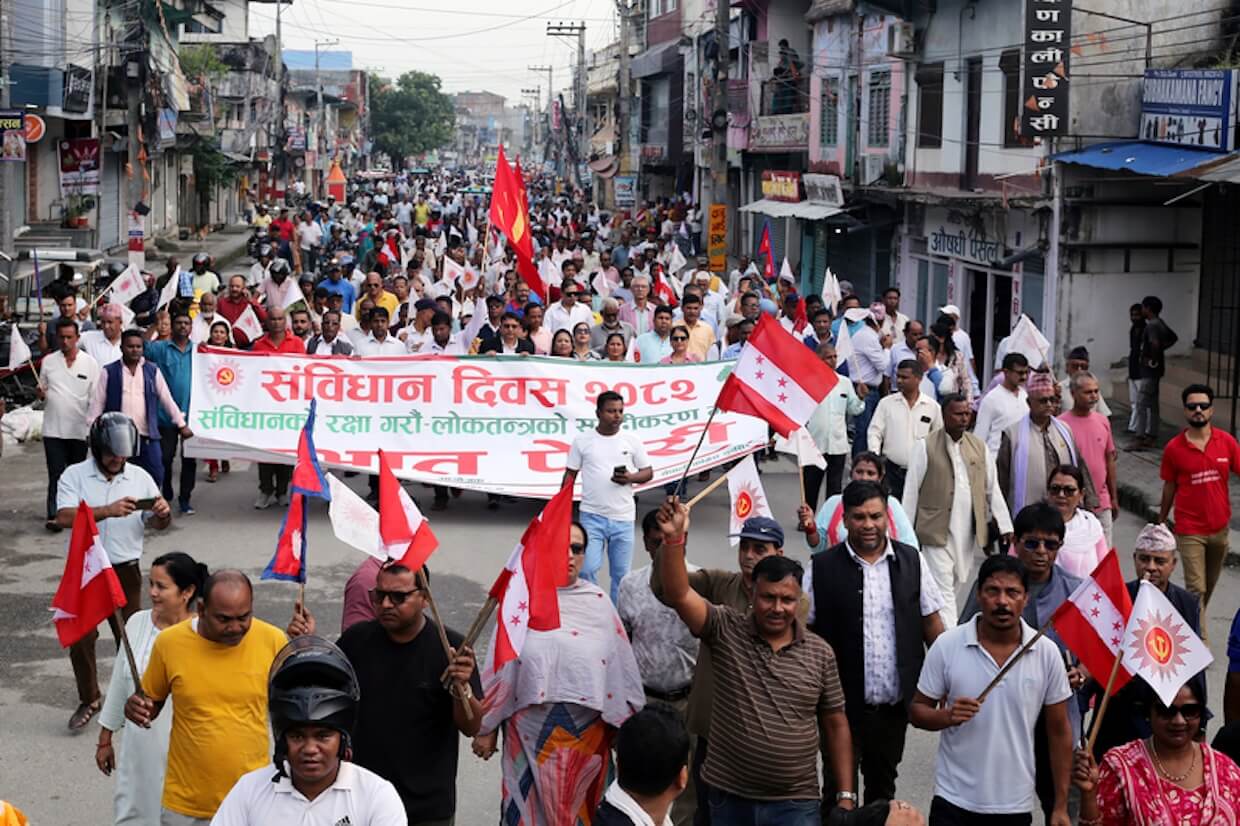
Thousands joined a joint morning procession organized by the CPN-UML and Nepali Congress district committees in Inaruwa Bazaar on September 19, 2025, to mark Constitution Day. Photo: Nabin Gadtaula.
In Sri Lanka, the Aragalaya protest movement toppled the Rajapaksas but was quickly reabsorbed into elite politics. What lessons should Nepali youth learn from the Sri Lankan experience to avoid repeating this cycle of betrayal?
Dr. DB Subedi: Sri Lanka’s case is probably somewhat different from that of Nepal, particularly when it comes to the transfer of political authority at the end of the revolutions. There is now a new government that came to power after the elections—a progressive government, distinct from the previous populist nationalist government of Rajapaksa. What we have seen in Sri Lanka is a very quick and relatively smooth transfer of power from the previous regime to the new progressive government, which, as the recent elections show, has received an overwhelming mandate from the Sri Lankan people. The transition was, of course, fragile, but the Sri Lankans managed it very well in terms of shifting power from the previous regime to the new one.
In the case of Nepal, we now have a civil society government, a pattern more or less similar to what we saw in Bangladesh after the 2024 revolution. This civilian government has been given a mandate to hold elections within six months, and it is headed by the former Chief Justice of the country, Sushila Karki. Nepal can actually learn a few things here from Sri Lanka. One is that it will always be in the best interest of the people and the political system to manage these transitions and make them as short as possible, because a proper handover of power from previous governments to the next elected government is the key.
In the meantime, there are also additional challenges for the Nepalese government—the civilian government in power at the moment. Nepal also faces the challenge of holding those from previous governments accountable for the loss of life during the protest movement. Proper investigations into the abuse of power and coercion by the previous regimes are difficult issues, but they need to be addressed. At the same time, there is widespread public frustration and anger about corruption cases. There are dozens of cases dating back as early as the 1990s that have not been properly investigated, and political power has been used, misused, and abused to avoid scrutiny.
So, while the civilian government in power at the moment has many challenges, the main lesson it could learn from Sri Lanka in particular is the importance of ensuring that processes, mechanisms, and systems are in place to transfer power from previous authorities to newly elected authorities.
The Risks of Religious Populism
In Bangladesh, the fall of Sheikh Hasina has opened space for religious extremism and new forms of repression. How should we understand the dangers of authoritarian populists exploiting anti-corruption or anti-elitist discourses in fragile democracies?
Dr. DB Subedi: That’s a very good question, and Nepal also has—I wouldn’t say a strong possibility, but there may be—some scenarios where certain political forces, either existing or emerging, might use populist rhetoric to exploit the fluid situation in the transitional period. In other words, there may be risks of populist, nationalist kinds of political narratives being circulated as mainstream narratives in the meantime and taking over in the post-revolution political system. The risks are always there. In Bangladesh, we have seen religious extremist narratives circulating in the political domain and influencing politics, and this is typical of Bangladesh because of its sociocultural and socio-religious configurations.
In the case of Nepal, there are two potential scenarios where populist forces seeking to exploit the situation could emerge. In my view, one is that there is probably a lesser risk of right-wing populist politics exploiting culture or ethnicity to advance populist agendas in Nepal. Because Nepal is ethnically diverse, if any populist forces emerge at this stage, one possibility is that they might actually mobilize people across ethnic divides. In that sense, it might look less like the right-wing populism we have seen elsewhere.
But at the same time, the bigger risk is that Nepal was the only Hindu state in the world until 2015. When the new constitution was passed in 2015, it became a secular country. And even though it is now formally secular, it is weakly so, because in practice, in everyday life, religion is still present in the public domain. It has not been retracted into the private sphere. As a result, there are certain political parties and interest groups that want to reinstate the Hindu state in Nepal. That is another risk, where there may be potential for populist politics to emerge in this transition, mobilizing and exploiting religious factors, narratives, and ideologies. If that happens, that sort of populist politics might be more dangerous, because it could share certain elements of right-wing populism we have seen elsewhere, since it would be a form of religious populism in Nepal.
So, yes, like Sri Lanka, Nepal also faces risks. But at the same time, it also has an opportunity, because elections have been called in six months’ time, and if elections take place and there is a smooth transition of power, then Nepali society might be able to navigate these challenges in the days to come.
Unprecedented Support, Uncertain Future
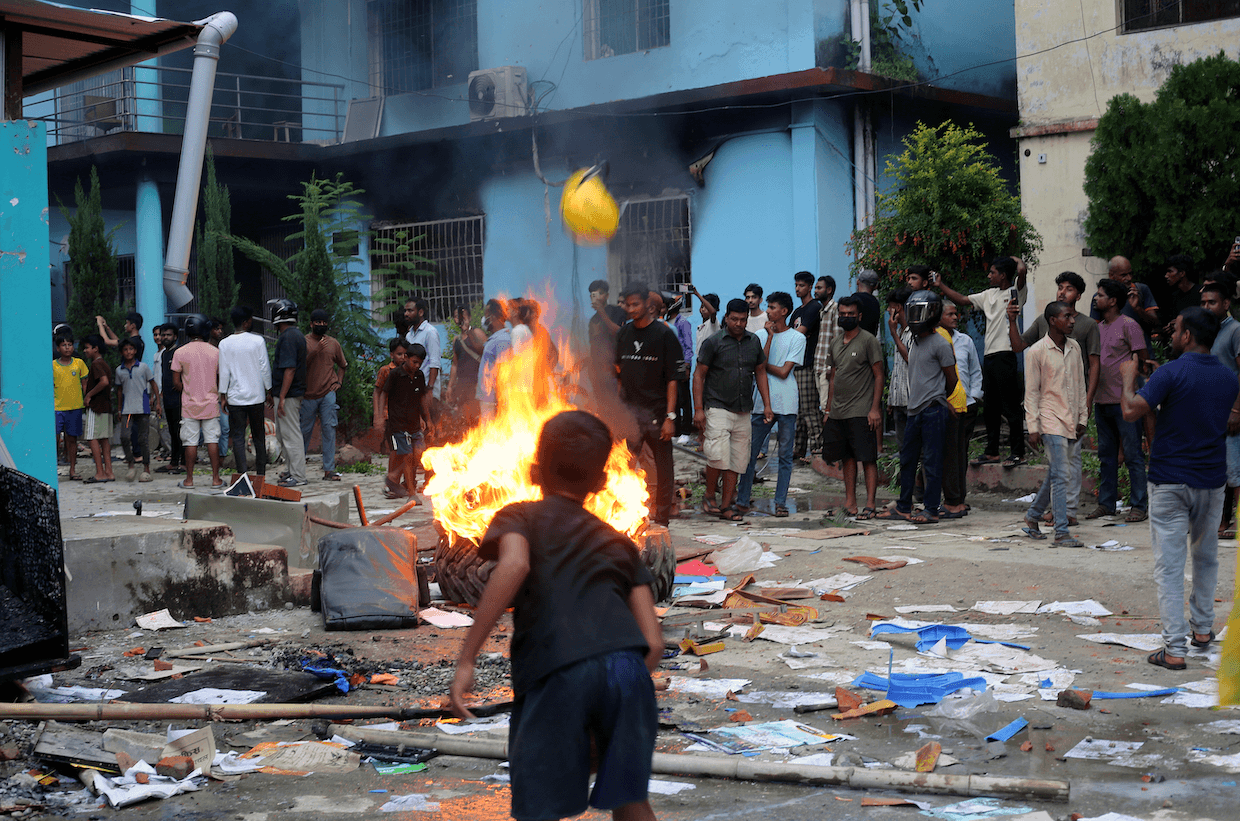
The municipality office in Inaruwa, Sunsari, lies heavily damaged after protesters targeted it during the nationwide demonstrations against corruption and the social media shutdown on September 9, 2025. Photo: Nabin Gadtaula
And finally, Professor Subedi, do you see in Nepal’s Gen Z uprising the embryonic forms of a post-elitist democracy—an order rooted not in patronage or coercion but in participatory, inclusive politics? Or does the violence of the movement suggest that the path forward remains perilously uncertain?
Dr. DB Subedi: At the moment, I would like to be optimistic about your question, and I would say there are signs of a post-elitist kind of politics beginning to emerge in this case. But again, a lot depends on what kind of political institutions will consolidate in the days to come. Looking at the past, one of the major challenges in Nepal is that even though there were political changes—political shifts in 2015, 2008, and even earlier—the change in institutional setup did not result in meaningful socioeconomic transformation. One reason it didn’t happen is because institutions changed, but the institutional culture inherited from the past essentially remained the same. As a result, corruption continued, exclusion continued, and people’s frustrations with the system and political elites deepened.
In these situations, how the voices of younger generations can be institutionalized and established in mainstream politics in the days to come will determine a lot. Still, I would view this change more optimistically than pessimistically, because despite some losses—there was destruction and violence when the protests intensified on the second day—there is nonetheless a sense of awareness among the public that change was inevitable, change was necessary, and that we have come to a time when much more meaningful change is required, both in terms of political institutions, systems of governance, and political participation. But changing political culture is also necessary.
And I think if more and more young people are able to participate in politics, they might be able to foster a political culture that is much more participatory and inclusive, and can establish not only economic systems but also political systems that are fair, inclusive, and capable of bringing about the change desired by those who sacrificed their lives, as well as those who participated in these protest movements. A lot depends on how the state and society will navigate this challenge and crisis, because sometimes past history also gives us a clue to predict the future. Unfortunately, the past record of how Nepalese society has navigated post-revolutionary political space is not very encouraging.
But this time, because the revolution was led particularly by young people outside of the political parties’ participation—it was not hierarchical, as would have been the case if it were led by political parties—at the same time, even though it was a leaderless movement, it very quickly sought some results, some consequences. So, the kind of public support this protest movement has received is unprecedented. In that sense, there is huge public support, and in fact, that kind of public support is also a good indicator of the legitimacy of the current government, and also the government that will take over when it is handed over to an elected government. That kind of legitimacy is good for any government and any political leaders who come to power with the intention of bringing about meaningful social, economic, and political change. And that is what we can hope for at this stage. But a lot depends on how this will be managed, and how society will navigate through it.
This commentary examines how queerness intersects with genocide and international law in the context of Palestine. Ass. Professor Izat El Amoor argues that queer Palestinians confront not only Israel’s genocidal violence but also Western pinkwashing narratives that weaponize queerness to justify oppression. By situating pinkwashing and pinkwatching within broader struggles of decolonization, the piece shows how queer analysis exposes the hypocrisy of Western legal and human rights frameworks while offering new tools for resistance. Linking Israel’s use of pinkwashing to global failures of international law—including the ICJ case brought by South Africa—the essay insists that genocide studies must reckon with queerness as central, not peripheral, to understanding both the violence in Gaza and pathways toward Palestinian liberation.
In the colossal scope of the annihilation of Palestinians since October 7, queerness is not a mere addendum when positioned in the scholarship and legality of genocide. As Palestinians contested Western discourses of international law and genocide for their liberation, queer Palestinians in parallel challenged Western discourses of queerness – pinkwashing[1] – that have been employed as genocidal tools against all Palestinians. Within the larger Palestinian decolonization struggle, a queer analysis reveals additional shortcomings of the current genocide scholarship and legal frameworks that are useful for Palestinian resistance yet might otherwise remain hidden.
Pinkwashing genocide emerged boisterously from within Israel’s toolbox against an increasing diplomatic and legal global isolating pressure. This pressure entailed a string of legal and humanitarian decisions/actions such as UN Security Council votes for Palestinian statehood and membership; UN Human Rights Council resolutions of crimes against humanity; ambassador recalls and severance of diplomatic relations with many countries; states’ recognition of Palestine; state-calls on the International Criminal Court (ICC) to investigate war crimes against civilians; state-requests for a court opinion on whether Israel’s occupation violates international law. Pinkwatching[2] aims at strengthening this pressure that Israel has been diligently countering via pinkwashing, amongst other schemes. Consequently, pinkwashing and pinkwatching—while contradictory—transpire as instructive of the pretense of Western hypocritical dichotomies tied to human rights, international law, and preventing/ending genocide insofar as Palestinian liberation.
The ICJ Case Through a Queer Lens
Though not obviously connected at first glance, South Africa’s case against Israel at the ICJ—filed on December 29, 2023, regarding Israel’s actions in Gaza and widely considered the most significant diplomatic/legal attempt to isolate Israel—can also be analyzed through this queer framework. South Africa alleged that Israel has committed genocide in Gaza, violating the Genocide Convention through 75 years of apartheid, 56 years of occupation, and a 16-year blockade prior to October 7. Specifically in Gaza, South Africa accused Israel of eight “genocidal acts”: killing Palestinians; inflicting serious bodily and mental harm; mass displacement; deprivation of food and water; denial of shelter, clothing, hygiene, and sanitation; blocking medical care; destroying Palestinian life; and imposing measures to prevent births.
On January 11–12, 2024, the Peace Palace in The Hague hosted two days of hearings on South Africa’s request for provisional measures. On January 26, 2024, the Court ordered Israel to take all steps to prevent acts that could qualify as genocide under the 1948 Genocide Convention. The Court acknowledged that at least some of South Africa’s claims could fall within the Convention’s scope. However, it did not order Israel to halt its military operations in Gaza, as South Africa requested. Still, both governments declared the ruling a win, each interpreting it as validation of their stance.
Although ICJ rulings carry binding force, they lack enforcement power, and Israel has refused to comply. South Africa’s foreign minister Naledi Pandor emphasized that compliance would be impossible without a ceasefire. On February 26, 2024, Human Rights Watch reported that Israel had not implemented the Court’s provisional measures and had “continued to obstruct the provision of basic services and the entry and distribution within Gaza of fuel and lifesaving aid.” That same day, Amnesty International stated that Israel was “defying” the ICJ ruling. On March 28, 2024, in response to worsening conditions, the ICJ issued additional emergency measures requiring Israel to guarantee basic food supplies to stave off famine. Then, on May 24, 2024 the Court ordered an immediate halt to Israel’s Rafah offensive, which Israel outright rejected.
Because both Israel and South Africa are signatories to the Genocide Convention, jurisdiction is established. South Africa argues that, as a state party, it has a duty to act to prevent genocide and is legally obligated to pursue all necessary measures. The Genocide Convention extends beyond punishment to prevention, recognizing genocide as more than mass killing. South Africa’s petition highlights this obligation, aiming to fulfill the Convention’s purpose. Despite historical precedent of international law failing Palestinians and the slim likelihood of success, the case still carried hope—not only for a ruling in South Africa’s favor but also for a possible end to Israel’s genocidal campaign.
Decolonial Struggles Beyond the Courtroom
Pinkwatching operates on a similar basis of hope for Palestinian collective liberation, even though Israel is unlikely to abandon its pinkwashing efforts. Both South Africa’s ICJ case and pinkwatching contribute to the Palestinian decolonization struggle, offering different tools for globally isolating Israel and its supporters. While pinkwatching may occupy a small place in international legal and political arenas, it nonetheless provides an important pathway for resistance. This resonates with Palestinian scholar Nora Erakat’s (2020) claim that law must work alongside political strategies if it is to meaningfully support Palestine.
Like South Africa’s ICJ case, pinkwatching underscores the divide between legality and morality in international affairs. Western responses to both overlook moral dimensions, thus blocking accountability-based decolonial breakthroughs. Legal efforts are essential to halt genocide, but they remain insufficient to achieve the deeper moral and spiritual transformation necessary in the West to ensure genocide truly stops and does not recur. Treating genocide solely as a legal matter exposes the inadequacy of law when societies, like Israel’s, persist in the immoral conviction of having the right to commit it. Pinkwashers similarly claim false moral authority, reinforcing the Western legal hypocrisy that South Africa challenges. Recognizing this, pinkwatching organizers long ago chose to work outside such flawed structures, rejecting Western queer discourses that cannot deliver Palestinian liberation. Their efforts affirm that a queer-informed path to freedom cannot rely on Western legal or rights-based paradigms.
International law’s stated responsibility to prevent genocide and protect victims has repeatedly faltered due to “realpolitik, the lack of political will, and economic interests,” in the words of scholar Samuel Totten (2011). Historically, Totten says, responses to genocide have been “inconsequential. Nothing that will rock or threaten a [genocidal] government or nation’s well-being. Nothing punitive.” Israel dismissed South Africa’s charges as “baseless,” accusing it of acting as “the legal arm” of Hamas while insisting its actions were self-defense under international law—claims that largely went uncontested.
Pinkwashing, Early Warnings, and the Dynamics of Genocide
A clear example of realpolitik overriding legal and scholarly genocide frameworks came in the US, Germany, and France backing Israel at the ICJ, despite their histories of complicity in past genocides. France declared that accusing Israel of genocide “is to cross a moral threshold.” Germany pledged to defend Israel in light of the Holocaust. The US dismissedthe ICJ case as a distraction from “peace and security.” Beyond a lack of will to prevent genocide, South Africa’s case reveals that failure itself is pursued to serve Western interests.[3] Thus, by undermining their own institutions of “justice” such as international law and the UN, Western powers show themselves not only complicit in but active facilitators[4] of genocide. Their justifications parallel pinkwashing narratives, which weaponize queerness under a veneer of liberal progressivism while disregarding Palestinian lives—queer and non-queer alike.
From a queer perspective, Gaza’s genocide illustrates what scholar Sheri Rosenberg (2013) describes as the “danger of classifications” in genocide prevention. The targeting of queer Palestinians demonstrates that genocide “must be understood as an unfolding process, considered in light of historical, political, and social factors” and recognized as a complex phenomenon rather than reduced to a definition. When genocide is confined to legal definitions “against which unfolding events are to be measured,” it prioritizes “legalism [and] subjects each genocide to a rigid test in order to maintain the integrity of the term and determine criminal culpability.” Seeing genocide in Palestine as dynamic rather than static makes space for analyzing pinkwashing and pinkwatching as integral to genocide studies. Queerness unsettles the field’s fixation on definitional debates and strengthens arguments such as Rosenberg’s for “early warning systems [that] seek to collect, analyze, and communicate information” to identify potential genocides before escalation. For Palestinians, decades of orientalist tropes—including the use of homophobia to dehumanize them—could have served as early warnings had queer experiences been taken seriously.
Beyond South Africa, a queer reading of Gaza’s genocide also pushes genocide studies to destabilize fixed ideas of group identity. Scholars like Lily Nellans (2020) and Patrick Vernon (2021) have noted the Genocide Convention’s failure to recognize groups defined by gender and sexuality. Scholar Matthew Waites (2018) argues that including sexual orientation and gender identity as protected groups allows recognition of violence against queer communities in Nazi Germany, Uganda, and the Gambia as genocidal. Although Israel’s violence in Gaza targets Palestinians indiscriminately, pinkwashing’s use of queerness to normalize genocidal policies highlights how queer identities are manipulated within genocidal contexts. This manipulation, shaped by pinkwashing, differs from past genocides, marking a distinct phenomenon in the Palestinian experience.
Testimonies Erased: Pinkwashing as Justification and Diversion
Scholar Thomas Simon (1996) argues that in the initial legal definitions of genocide, the Convention’s drafters assumed that the groups requiring protection were “permanent, stable, and intractable,” recognizable by all. Because queer Palestinians have historically resisted Western queer visibility politics—centered on recognition, citizenship, and coming out—they cannot be defined as a protected group under this framework. Scholars like Freda Kabatsi (2005) argue that while the drafters treated group existence as a prerequisite for other rights, pinkwashing constructs queer Palestinians as a group only through a savior-like gaze that conditions their rights and protection on Western recognition. By forcibly separating queer Palestinians from the broader society, this group-based framing legitimizes a genocide that in reality indiscriminately targets all Palestinians. This occurs, Kabatsi (2005) says, when the “group and membership in it are defined by the perpetrator.” Through pinkwashing, Israel reshapes the definition of the Palestinian collective by isolating its queer members, portraying them as exceptions to the population at large. This narrative enables Israel to justify violence against Palestinians—including queers—while presenting itself as a defender of queer rights.
When examined through pinkwashing and pinkwatching, the instrumentalization of queerness to justify genocide reveals a key distinction between contemporary and historical genocides as studies by Robert Melson (2011) show. While queer people have been killed in earlier genocides, the case in Gaza differs because of the weaponization of both alleged Palestinian heteronormativity and Israel’s homonormativity, the latter being used to claim the role of “savior” of queer Palestinians in the process of ‘othering’ all Palestinians. This demonstrates, to build on Vernon (2021), that both heteronormativity and homonormativity are “relevant to genocidal violence against non-queer people as well as violence against queer people.”
Genocide, therefore, emerges as a behavior rather than a consistent phenomenon across cases. In Palestine, this “comportment of genocide”—which may either define or obscure genocide—takes the form of pinkwashing (Kabatsi, 2005). Here, pinkwashing functions as both a tool of justification and a means of diversion in the genocidal narrative against Palestinians. This may, in fact, represent the first documented instance of such comportment through pinkwashing.
Queering the analysis of genocide in Palestine beyond legal approaches further underscores the importance of listening to victims. In genocidal contexts, as Melson (2011) argues, “testimonies of victims and survivors must be taken into account in order to better understand the motives of the perpetrators and bystanders” and to give victims and survivors a voice in the narrative of destruction. The testimonies of queer Palestinians and the work of pinkwatching activists, however, remain especially marginalized—not only because queer Palestinians, like all Palestinians, are killed in the genocide, but also because pinkwashing depicts them as either nonexistent or limited to experiencing social death in their communities, thus erasing their capacity to provide testimony. This is particularly relevant in light of the ICJ’s order that Israel preserve evidence of genocide and comply with UN investigations. Instead, Israel has systematically destroyed evidence by blocking journalists from entering Gaza, targeting and killing reporters, and denying UN workers access for documentation.
From Exceptionalism to Resistance: Rethinking Genocide Studies
Israel’s reliance on pinkwashing to avoid accountability has broader consequences beyond the devastation in Palestine. By exploiting queer communities in pursuit of ethnonationalist goals, Israel signals to other states that such practices can be adopted with impunity, without fear of consequences. Condemning Israel and the West’s disregard for international law, Irish MEP Clare Daly stated, “the rules-based order is in roaring form.” Israeli exceptionalism reinforces the fact that the West has always applied one standard of international law for its allies and another for the rest of the world. After months of openly discarding international law in Gaza, the collapse of the post–World War II system—built by the US and Europe to maintain global dominance—has become undeniable. Palestinians, including queer Palestinians and their pinkwatching allies, remain steadfast in their resistance to this destructive order.
Pinkwashing and pinkwatching emphasize the need for genocide studies and international law to adopt queer perspectives in documenting, analyzing, and explaining both Israel’s genocide and the international community’s failure to prevent it. Building on the leadership of pinkwatching activists, scholars must foreground the heteronormative and homonormative structures of Zionism, nationalism, colonialism, orientalism, and imperialism as central to understanding genocidal violence in Gaza and beyond. As scholarship continues to evolve, queerness must be acknowledged as an essential contributor to Palestinian liberation, complementing other political strategies. Since legal approaches alone have repeatedly proven insufficient for advancing decolonization, recognizing queerness at the intersection of law and politics is crucial.
(*) Dr. Izat ElAmoor is a self-identified queer Palestinian, and an Assistant Professor of Sociology at Hendrix College studying LGBTQ issues in the Arab world, Palestine included.
References
Erakat, N. (2020). Justice for some: Law and the question of Palestine. Stanford University Press.
Kabatsi, F. (2005). “Defining or diverting genocide: Changing the comportment of genocide.” International Criminal Law Review, 5(4), 387–407.
Melson, R. (2011). “Critique of current genocide studies.” Genocide Studies and Prevention, 6(3), 279–286.
Nellans, L. (2020). “A queer (er) genocide studies.” Genocide Studies and Prevention: An International Journal, 14(3), 7–16.
Rosenberg, S. P. (2012). “Genocide is a process, not an event.” Genocide Studies and Prevention, 7(1), 16–23.
Simon, T. W. (1996). “Defining genocide.” Wisconsin International Law Journal, 15(2), 243–289.
Totten, S. (2011). “The state and future of genocide studies and prevention: An overview and analysis of some key issues.” Genocide Studies and Prevention, 6(3), 211–230.
Vernon, P. (2021). “Queering genocide as a performance of heterosexuality.” Millennium: Journal of International Studies, 49(2), 248–279.
Waites, M. (2018). “Genocide and global queer politics.” Journal of Genocide Research, 20(1), 44–67.
Footnotes
[1] To pinkwash, Israel exploits queer rights to project a progressive queer friendly image of itself while concealing its occupation and apartheid of Palestinians.
[3] Some signs include the May 6th threatening letter by 12 US republican senators, led by Sen. Tom Cotton, to the ICC chief prosecutor Karim A.A. Khan with sanctions and banning ICC “employees and associates” from entering the US over possible warrants against Israel, saying explicitly, “target Israel and we will target you.” South Africa’s Pandor received the same letter. On May 20th, Khan applied for arrest warrants for Hamas chief Yahya Sinwar and Israeli Prime Minister Benjamin Netanyahu.
[4] The US and Germany, Israel’s top arms supplier, saw their weapon manufacturer corporates directly profit from the genocide as their share prices have exponentially risen since October 7.
Date/Time: Thursday, September 25, 2025 – 15:00-17:00 (CET)
Moderator
Dr. Cengiz Aktar (An Adjunct Professor of Political Science at the University of Athens).
Speakers
“Locating the Fight? Strategic Engagement in the United States and Europe,” by Dr. Mabel Berezin (Distinguished Professor of Arts & Sciences in Sociology and Director of the Institute for European Studies at Cornell University).
“Democracy for all: Rethinking a Failed Model,” byDr. Steven Friedman(Research Professor in the Faculty of Humanities, University of Johannesburg).
“That Which Precedes the Fall: ‘Religion’ and ‘Secularism’ in the US,” by Dr. Julie Ingersoll(Professor of Religious Studies and Florida Blue Ethics Fellow at the University of North Florida).
“Emancipatory Politics in a Dark Time,” by Dr. Richard Falk (Albert G. Milbank Professor of International Law and Practice, Emeritus at Princeton University).
“Combatting Authoritarian Populism,” by Dr. Larry Diamond(Professor of Sociology and of Political Science, Senior Fellow at the Hoover Institution and the Mosbacher Senior Fellow in Global Democracy at the Freeman Spogli Institute for International Studies at Stanford University).
The ECPS convened leading scholars to assess how populist movements are accelerating democratic decay and edging toward fascism. Moderated by Professor Cengiz Aktar, the panel featured Professors Mabel Berezin, Steven Friedman, Julie Ingersoll, Richard Falk, and Larry Diamond. Discussions ranged from Christian nationalism and techno-utopianism in the US, to the failures of Western democratic models, to the global hypocrisy of international law. Panelists warned that populism now serves as a vehicle for authoritarian consolidation with worldwide reverberations. They underscored the responsibility of intellectuals to resist euphemism, speak with clarity, and help reimagine democracy in an age of disinformation, mass manipulation, and systemic crisis.
Reported by ECPS Staff
The European Center for Populism Studies (ECPS) hosted a panel titled “From Populism to Fascism? Intellectual Responsibilities in Times of Democratic Backsliding.”The session gathered distinguished scholars to examine the accelerating erosion of democracy, the potential transition from populism to fascism, and the moral and intellectual duties of those who continue to defend democratic values in dark times.
Selcuk Gultasli, ECPS Chairperson, opened the session by emphasizing the urgency of the theme. He noted that the panel sought not only to analyze the rise of populism but also to confront how authoritarian tendencies may harden into fascism. ECPS, he explained, is committed to making the discussion widely accessible through a detailed report and online recordings, ensuring that policymakers, academics, and engaged citizens can benefit from the insights shared.
Moderator Professor Cengiz Aktar, adjunct professor of political science at the University of Athens, then set the tone by recalling ECPS’s mission: to document and analyze how populism threatens democracy worldwide. He warned that populist leaders are not isolated figures but draw legitimacy from mass support, which, in Arendtian terms, provides the essential condition for fascist governance. Today’s task, Professor Aktar concluded, is no longer about building democracy but about preventing its collapse.
Professor Mabel Berezin (Distinguished Professor of Arts & Sciences in Sociology and Director of the Institute for European Studies at Cornell University) opened with a comparative analysis of populism in Europe and the United States. She argued that American populism, embodied by Donald Trump, is marked by unpredictability and authoritarian experimentation, untethered from coherent historical anchors. The most dangerous development, she suggested, lies not in street militias but in “social authoritarianism”—elite legal and intellectual projects such as Project 2025 that aim to dismantle democracy from within. The elevation of Charlie Kirk as a martyr, she warned, signals a new form of religious-political mobilization with fascistic overtones.
Professor Steven Friedman (Research Professor in the Faculty of Humanities, University of Johannesburg) challenged the myth of a pristine democracy interrupted by an authoritarian onslaught. He argued that the current model of democracy was already exclusionary before the rise of authoritarianism, and the current Western model itself is failing. By ignoring the dangers of private corporate power and clinging to Eurocentric notions of “consolidation,” democrats have overlooked the deeper roots of disillusionment. For Professor Friedman, the task is to redefine democracy as equal human choice in all decisions that affect people’s lives—a principle that requires confronting both state and private power.
Professor Julie Ingersoll (Professor of Religious Studies and Florida Blue Ethics Fellow at the University of North Florida) provided an ethnographic perspective on Christian nationalism in the United States. She mapped three strands—evangelical dominionism, Catholic integralism, and Pentecostal-charismatic movements—that, despite historical rivalries, now converge in rejecting pluralism and democracy. She also highlighted the convergence of these religious forces with secular techno-utopianism and nihilistic online subcultures. The result, she argued, is a coalition oriented toward collapse and accelerationism, united less by theology than by anti-democratic aspirations.
Professor Richard Falk (Albert G. Milbank Professor of International Law and Practice, Emeritus at Princeton University) situated the discussion in a global frame. He argued that democracy was tarnished long before populism’s rise, corrupted by Cold War secrecy, US hypocrisy in international law, and the exploitative logic of capitalism. Populism, in his view, compounds these crises by waging an “epistemological war” against truth and expertise. Facing climate change, nuclear peril, and extreme poverty, Professor Falk urged intellectuals to embrace utopian thinking and even revolutionary transformation, reorienting governance toward the global public good.
Professor Larry Diamond (Professor of Sociology and of Political Science, Senior Fellow at the Hoover Institution and the Mosbacher Senior Fellow in Global Democracy at the Freeman Spogli Institute for International Studies at Stanford University) concluded with a stark warning about the authoritarian project underway in the United States. Drawing lessons from leaders such as Hungary’s Orbán and Turkey’s Erdoğan, he argued that Trump and his allies are pursuing a systematic strategy of democratic dismantling: media capture, judicial purges, lawfare, and gerrymandering. While fascistic elements are present, Professor Diamond stressed the importance of terminological precision. Resistance, he suggested, requires early mobilization, broad coalitions, and a focus on economic issues that resonate with ordinary voters.
Together, the panelists painted a sobering picture: populism today is no longer merely a style of politics but a vehicle for authoritarian consolidation with global reverberations. From Christian nationalism to techno-utopianism, from corporate power to manipulated legal frameworks, the threats are multifaceted. Yet the panel also underscored a common responsibility—that intellectuals must speak with clarity, resist euphemism, and foster new visions of democracy suited to the crises of our age.
Professor Mabel Berezin: “Locating the Fight? Strategic Engagement in the United States and Europe”
People gather at Turning Point USA headquarters in Phoenix, Arizona, on September 13, 2025, for a memorial following the fatal shooting of Charlie Kirk during his speech at Utah Valley University in Orem. Photo: Dreamstime.
In her presentation, Professor Mabel Berezin delivered a sobering analysis of the current trajectory of democracy in the United States and Europe. Speaking from the vantage point of an academic who has long studied populism and fascism, she situated the discussion within a comparative framework, but with particular urgency regarding developments in the United States since the 2024 presidential election.
Berezin opened with a reflection on the language used to describe contemporary democratic crises. The term “democratic backsliding,” she argued, now feels wholly inadequate for the American case. Since Donald Trump’s return to power, the country has been subject to what she described as a “high-speed wrecking ball” against its democratic institutions. While democratic erosion is a global phenomenon, its forms vary across national contexts, depending on political histories and institutional resilience. This, she suggested, underscores the need for context-specific strategies of intellectual and civic engagement.
European Populism and American Exceptionalism
Berezin revisited an argument she first articulated in 2017 in her essay “Trump is Not a European-Style Populist and That is Our Problem.” In that piece, she observed that while European far-right populists—such as Marine Le Pen in France or Giorgia Meloni in Italy—often ground their appeals in nostalgia for a stronger nation-state and postwar social protections, the American populist right is marked by unpredictability. European populists, she argued, want “more state, not less,” and their grievances frequently revolve around immigration and monetary issues within the European Union framework. By contrast, the American case lacks a coherent historical anchor, and Trump’s political appeal did not fit neatly into established narratives.
For Professor Berezin, this unpredictability made Trump particularly dangerous. While European populists often pursue recognizable policy goals rooted in the past, Trump’s movement was untethered, fueled instead by volatile grievances and charismatic mobilization. The absence of clearly defined political expectations in the US created fertile ground for authoritarian experimentation.
The Rise of Social Authoritarianism
Turning to the US after the 2020 and 2024 elections, Professor Berezin noted the growing academic consensus that Trumpism bears fascist characteristics. However, she argued that the most pressing threats to democracy are not necessarily the paramilitary groups that rallied in Charlottesville or stormed the Capitol on January 6, 2021. Instead, the greater danger lies in what she termed “social authoritarianism”—a project spearheaded by intellectual cadres aligned with institutions such as the Heritage Foundation, the Federalist Society, and the architects of “Project 2025.”
These actors, she explained, represent the true intellectual core of the movement. Unlike the visible extremists brandishing weapons, these figures deploy law, language, and bureaucracy as instruments of authoritarian consolidation. By targeting institutions and systematically reshaping the judiciary, they seek to dismantle the so-called “deep state” and restrict fundamental freedoms under the veneer of legality. As Professor Berezin quipped, it is easier to imprison someone who fires an AR-15 than it is to restrain a legal strategist whose weapon is a thesaurus.
The Paramilitary of Jesus
While she downplayed the long-term mobilizing potential of armed militias, Professor Berezin identified a new and alarming development: the posthumous elevation of Charlie Kirk, a conservative media figure assassinated in September 2025. Initially dismissing him as a fringe podcaster, Professor Berezin admitted she was shocked by the scale and spectacle of his memorial service, which she described as a “paramilitary of Jesus with the blessings of the state.” The event drew millions of attendees and viewers, including Trump and much of his cabinet, and revealed a level of organization, youthful enthusiasm, and emotional intensity that Professor Berezin found profoundly unsettling.
What struck her most was the fusion of evangelical symbolism with political mobilization. The service emphasized family, reproduction, and communal solidarity, urging followers to “have more children than you can afford” and to embrace family as one’s central role in society. While the rhetoric appeared religious, Professor Berezin suggested it was in fact a form of secular mobilization—anchored less in theology than in a cultural project of authoritarian belonging.
Kirk’s assassination, she argued, paradoxically strengthened the movement. In death, he was transformed into a martyr, his charisma frozen in time, and his image available for endless appropriation by the MAGA movement. This development, she warned, fills a “missing link” in the analytical framework of American authoritarianism, supplying the movement with an emotionally powerful narrative and a mobilizing force that mainstream democratic actors struggle to match.
Intellectual Responsibilities
The central theme of Professor Berezin’s speech was the intellectual responsibility of scholars in confronting authoritarianism. She acknowledged the limitations of academic writing and debate in the face of mobilized authoritarian forces but insisted that silence or timidity is not an option. Universities, law schools, and other institutions must be willing to say “no” to authoritarian incursions, resisting the erosion of academic freedom and democratic values.
Dialogue, she suggested, remains valuable, but only if understood not as a tool of conversion but as a means of fostering engagement. In her own teaching on fascism and nationalism, Professor Berezin frequently encounters conservative students who seek to talk rather than proselytize. Creating spaces for such conversations, she argued, can generate a deeper understanding of democratic principles across divides.
Yet Professor Berezin also warned against complacency. She noted that the rhetoric of Trump’s movement is saturated with appeals to “freedom,” while democracy itself is rarely mentioned. The gap between these two concepts must be addressed directly. For her, one crucial task is rearticulating what democracy actually means in the public sphere. Many Americans, she lamented, support democracy as an abstract good but lack a concrete understanding of its practices and requirements.
Democracy and Education
Professor Berezin concluded by situating intellectual responsibility within the longer history of democratic education. She invoked John Dewey’s Democracy and Education (1916) and the civic initiatives launched in the United States during the onset of World War II, such as the National Foundation for Education and American Citizenship. These historical precedents, she argued, remind us that democracy must be taught, nurtured, and continuously reinforced through education.
For Professor Berezin, the path forward lies not in rhetorical denunciations of fascism but in cultivating a renewed public understanding of democracy itself. Education, both formal and informal, is the most effective channel for resisting the deeply embedded authoritarian forces now at work. If democracy is to be saved—or at least its decline attenuated—scholars, educators, and intellectuals must reclaim their role in shaping civic culture.
Conclusion
Professor Berezin’s presentation offered a bracing assessment of the state of democracy in America and beyond. By contrasting European and American populisms, highlighting the intellectual underpinnings of authoritarianism, and analyzing the symbolic mobilization of figures like Charlie Kirk, she illuminated the complex and evolving threats facing democratic societies. Her call to intellectual responsibility—grounded in education, engagement, and the defense of democratic institutions—underscored the urgent role of scholars in meeting this historical moment.
Professor Steven Friedman: “Democracy for All: Rethinking a Failed Model”
The controversial Israeli separation wall dividing Israel from the West Bank, often referred to as the segregation wall in Palestine. Photo: Giovanni De Caro.
In his presentation, Professor Steven Friedman offered a provocative and deeply critical re-examination of contemporary democratic theory and practice. Speaking as both a South African scholar and a citizen who lived through apartheid and the democratic transition of 1994, Professor Friedman challenged prevailing assumptions about democracy’s origins, legitimacy, and sustainability. His core argument was clear: the crisis facing democracy today is not merely the product of authoritarian incursions or populist disruption but the collapse of a flawed model of democracy that has dominated global thinking for the past three decades.
The Myth of a Pristine Democratic Past
Professor Friedman began by dismantling what he called the “myth of the pristine democratic environment.” Many observers, he argued, continue to think of democracy as a fully functioning, well-ordered system that has been corrupted by external “barbarians.” While acknowledging the existence of authoritarian challengers, Professor Friedman insisted that this framing misdiagnoses the problem. According to him, democracy has not simply been hijacked; rather, the dominant model itself is failing. To understand today’s crisis, we must interrogate the assumptions underpinning this model.
Democracy as a Western Export
The first of these assumptions, Professor Friedman argued, is the idea that democracy is inherently Western. For decades, he noted, democracy outside North America and Western Europe has been judged by the extent to which it resembles an idealized Western model. This attitude, embedded in the “transition to democracy” scholarship of the late twentieth century, created a hierarchy in which Africa, Asia, and Latin America were cast as perpetual apprentices striving to approximate Western democracies.
He pointed to the academic obsession with “democratic consolidation” as an example. Despite the proliferation of literature on the subject, there has never been a coherent definition of what a “consolidated democracy” actually is. In practice, Professor Friedman argued, the concept functioned as a mirror: if a country looked like Western Europe or North America, it was deemed consolidated; if not, it was considered deficient. This was less a political theory, he suggested, than an ethnic bias.
Today, the irony of this model is stark. The very Western democracies once held up as exemplars are themselves eroding fundamental freedoms. Professor Friedman shared a telling personal anecdote. During apartheid, South Africans envied Western societies for their freedoms of speech and assembly. Yet today, he noted, German academics fear losing their jobs for participating in discussions critical of Israel, and Americans risk detention for political speech. The “boot,” he observed, “is now on the other foot.” Modeling democracy on the West, he concluded, is no longer tenable.
Palestine as a Democracy Problem
Professor Friedman underscored this argument with a pressing contemporary example: Palestine. He contended that the suppression of pro-Palestinian expression in Western democracies represents a profound democratic failure. Citizens in the UK and elsewhere have been arrested for holding signs opposing genocide, while in many countries, calls for boycotts—an elementary form of democratic speech—are criminalized.
Equally troubling, Professor Friedman argued, is the gap between public opinion and elite policy. Surveys consistently show overwhelming public support for a just resolution to the conflict, yet Western governments either ignore this consensus or offer token gestures while maintaining policies that sustain the crisis. This disconnect illustrates how democracy, when treated as a Western possession, erodes its own legitimacy. For Professor Friedman, the Palestine issue is not peripheral but central to understanding democracy’s current global malaise.
Ignoring Private Power
The second flawed assumption of the dominant model, Professor Friedman argued, is its fixation on the state as the sole threat to freedom. According to this view, democracy exists primarily to constrain state power and ensure accountability to citizens. While important, this perspective ignores another crucial reality: private power can be equally oppressive when left unregulated.
Professor Friedman reminded his audience that this insight is hardly radical. Theodore Roosevelt, in the early twentieth century, warned that unregulated commercial power could dominate and oppress citizens just as much as the state. For much of the postwar period, Western democracies acknowledged this reality, regulating corporate influence to safeguard public interests. Yet in the past thirty years, this recognition has disappeared from mainstream democratic theory. Private power is rarely mentioned in contemporary scholarship or policy debates, leaving citizens vulnerable to corporate domination.
He illustrated this point with evidence from the 2024 US elections. Democratic candidates who campaigned on regulating corporate price gouging outperformed their peers by 8–10 percentage points, sometimes winning in unexpected constituencies. This, Professor Friedman argued, underscores the centrality of addressing private power to democratic renewal. Citizens disengage not because they are seduced by authoritarianism, but because they see mainstream parties as unwilling or unable to improve their material conditions.
The Real Crisis: Disillusionment, Not Populism
Professor Friedman pushed back against the notion that democracy’s greatest threat lies in the rise of populist strongmen. The problem, he suggested, is not the growth of the authoritarian right but the erosion of faith among non-right constituencies. In the US, for example, Trump did not dramatically expand his base between 2020 and 2024. Instead, 17 million former Democratic voters simply abstained. Disillusionment, not conversion, handed Trump his victory.
This phenomenon is not unique to the US. Across Western Europe, too, the crisis of democracy stems less from the swelling of the right than from the alienation of citizens who feel their votes no longer matter. When private power goes unregulated and living standards stagnate, democratic participation declines. Professor Friedman emphasized that this structural disillusionment is a more urgent challenge than the electoral gains of right-wing populists.
Redefining Democracy
In concluding, Professor Friedman turned to the question of intellectual responsibility. Scholars, he argued, must abandon the failed model of democracy and reimagine its meaning. For him, democracy is not a set of institutions or a Western inheritance but a principle: every adult human being should have an equal say in every decision that affects them.
He acknowledged that no society has ever fully realized this ideal. But, citing South African theorist Richard Turner’s essay “The Necessity of Utopian Thinking,” Professor Friedman insisted that such standards must serve as guiding measures. Without them, democrats risk losing sight of their goals.
Placing equal human choice at the center of democracy, Professor Friedman argued, has two transformative implications. First, it erases the Western bias by recognizing democracy as a universal entitlement, not a Western export. Second, it compels recognition that private power must be regulated just as much as state power to ensure genuine freedom. Free speech, free assembly, and other democratic rights flow from this foundational principle.
Conclusion
Professor Friedman’s presentation was both a diagnosis and a manifesto. He rejected nostalgic narratives of a lost democratic golden age, instead locating today’s crisis in the flaws of a dominant model that has privileged Western forms and ignored private power. By highlighting the Palestine issue, he demonstrated how democratic principles are being eroded in the very societies that claim to embody them. By pointing to corporate power, he revealed the blind spots of a state-centered understanding of democracy.
Ultimately, Professor Friedman’s call was for a radical rethinking of democracy as a universal system of equal human choice. Only by embracing this vision, he argued, can democrats move beyond disillusionment and resist both authoritarianism and apathy. His intervention offered a powerful reminder that democracy’s renewal depends not on replication of Western models but on confronting the structural inequalities—both public and private—that undermine it.
Professor Julie Ingersoll: “That Which Precedes the Fall: ‘Religion’ and ‘Secularism’ in the US”
Donald Trump’s supporters wearing “In God We Trump” shirts at a rally in Bojangles’ Coliseum in Charlotte, North Carolina, on March 2, 2020. Photo: Jeffrey Edwards.
In her presentation, Professor Julie Ingersoll offered a sobering ethnographic analysis of how religious and ostensibly secular movements in the United States have converged into a powerful populist force. Drawing on more than three decades of field-based scholarship on American religion, Professor Ingersoll explained how seemingly disparate strands of Christianity—along with nonreligious ideological currents—have coalesced into a theocratic, anti-democratic vision that underpins the populist movement known as MAGA. Her intervention highlighted the importance of rethinking how scholars conceptualize religion itself, arguing that theological differences often obscure shared cultural and political commitments.
The Ethnographer’s Lens
Professor Ingersoll situated her perspective within her disciplinary background. Unlike scholars who approach populism through theories of democracy or abstract political models, her work is rooted in ethnography and the close study of religious communities over time. Her aim, she explained, is not to prescribe strategies for saving democracy but to document the lived dynamics of religious movements and to clarify what society is up against. This commitment to description and analysis, she argued, is itself a vital intellectual responsibility: to bear witness, to explain, and to equip others with a deeper understanding of the cultural forces reshaping American politics.
Three Streams of Christian Nationalism
Central to Professor Ingersoll’s presentation was her mapping of Christian nationalism into three distinct but increasingly interconnected traditions.
Evangelical Protestant Dominionism: The first stream emerges from white conservative evangelical Protestantism, particularly the Reconstructionist movement of the 1950s. These groups believe the Bible speaks to every area of life and advocate a theocratic social order rooted in pro-slavery Southern Presbyterianism. They view pluralism and social equality as heretical and insist that Christians are commanded to exercise “dominion” over the world, a mandate they trace back to Genesis. This dominionist vision has informed generations of evangelical activism, positioning biblical law as the sole legitimate foundation for governance.
Catholic Integralism: The second stream arises from Catholic integralism, a minority tradition within Catholicism that rejects church-state separation and seeks to organize society according to Catholic teaching. Integralists draw inspiration from the historic doctrine of the divine right of kings and today align themselves with efforts to dismantle the administrative state. Professor Ingersoll pointed to Leonard Leo and the Federalist Society’s transformation of the US Supreme Court as evidence of integralist influence. Their promotion of the “unitary executive” doctrine reflects a broader ambition to consolidate political power in ways that erode checks and balances.
Charismatic and Pentecostal Movements: The third stream comes from charismatic and Pentecostal Christianity, particularly the New Apostolic Reformation (NAR) that arose in the 1990s. Emphasizing prophecy, apostleship, and spiritual warfare, these groups interpret the world as a literal battlefield between divine and demonic forces. Their “Seven Mountains Mandate” envisions Christians seizing control of key spheres of society, from government and business to media and education. Professor Ingersoll warned that this branch of Christian nationalism, with its apocalyptic worldview and demonization of opponents, is especially prone to violence.
While historically divided and even hostile to one another, these three streams have forged common cause within the MAGA movement. Their theological disagreements, Professor Ingersoll argued, often matter less in everyday practice than their shared opposition to pluralism, egalitarianism, and democracy.
Rethinking Religion
A major contribution of Professor Ingersoll’s presentation was her challenge to conventional understandings of religion. Too often, she argued, scholars and observers treat religion as a coherent set of theological beliefs derived from sacred texts. In reality, religious communities function as shifting assemblages of practices, narratives, and cultural markers that organize social life, demarcate insiders and outsiders, and legitimate particular hierarchies.
She illustrated this with a simple example for her students: when people choose a church, they often do so based on social comfort and community ties, not doctrinal precision. Over time, their beliefs shift to align with the group. In this sense, theology frequently follows social belonging rather than the other way around. Recognizing this dynamic, she argued, helps explain how divergent Christian traditions can set aside doctrinal disputes to advance a shared political project.
The Blurring of Religious and Secular
Importantly, Professor Ingersoll emphasized that Christian nationalism does not exist in isolation. It converges with ostensibly secular ideological movements, most notably Silicon Valley techno-utopianism. Tech futurists, accelerationists, and advocates of the “Dark Enlightenment” envision the collapse of democracy and its replacement by corporate-style governance, with CEOs and elite boards as rulers. They promote building digital and physical enclaves—whether in the cloud, on artificial islands, or even on Mars—where hierarchy replaces equality.
Despite their secular self-image, these movements align with Christian nationalism on core commitments: hostility to egalitarianism, skepticism toward democracy, and openness to societal collapse as an opportunity for renewal. Together, they form a strange but potent coalition, bound less by shared theology than by shared anti-democratic aspirations.
Professor Ingersoll also pointed to nihilistic online subcultures that defy the left-right binary, particularly those implicated in the assassination of Charlie Kirk. These groups embrace collapse and seek to accelerate it, even if what follows is “nothingness.” Though ideologically incoherent, they reinforce the broader accelerationist impulse uniting religious and secular anti-democratic forces.
Theocratic Visions and Apocalyptic Anticipations
Across these groups—whether dominionist, integralist, Pentecostal, techno-utopian, or nihilist— Professor Ingersoll identified a common conviction that society is in chaos and decline, and that collapse is either inevitable or desirable. Some even imagine themselves as agents accelerating history toward apocalyptic ends. Though they may diverge sharply on what comes after collapse—the Kingdom of God, a Mars colony, or nihilistic nothingness—they are united in their rejection of democracy and equality in the present.
This convergence, she warned, explains why observers have underestimated their power. Analysts often dismissed each strand as fringe or mutually exclusive, missing the cultural work that bound them together. Only by reframing religion not as fixed belief but as lived practice can we see the coherence of this coalition.
Intellectual Responsibilities
Professor Ingersoll concluded by reflecting on the intellectual responsibilities of scholars in this precarious moment. She admitted that offering prescriptive solutions has never been her strength, nor does she claim to have a plan for saving American democracy. What she can do, she insisted, is “stay in her lane”: documenting, explaining, and bearing witness to the forces reshaping society.
She acknowledged the difficulty of gaining perspective within the United States, where daily life remains unchanged for many even as democratic institutions crumble. Yet she argued that democracy has already collapsed in significant ways, and the upcoming 2026 election may already be compromised beyond repair.
For academics, the challenge is compounded by growing pressures to remain silent. Universities, law firms, media organizations, and even independent institutions have faced campaigns to suppress dissent. Faculty—tenured, untenured, and even retired—have been fired or disciplined for their speech, often on the basis of accusations tied to social media. The silencing of intellectual voices, Professor Ingersoll warned, represents not just an attack on individuals but an erosion of democracy itself.
Conclusion
Professor Julie Ingersoll’s presentation illuminated the deep entanglements of religion, culture, and politics in the rise of American populism. By tracing the convergence of evangelical dominionists, Catholic integralists, Pentecostal charismatics, techno-utopians, and nihilist subcultures, she revealed a coalition united not by theology but by anti-democratic commitments. Her insistence on reframing religion as lived practice rather than doctrinal belief opened new avenues for understanding how these disparate groups reinforce one another.
Ultimately, her message was both analytical and cautionary. The coalition she described thrives on visions of collapse and acceleration, rejecting democracy and equality in favor of theocratic or technocratic alternatives. For scholars, the responsibility is to continue speaking, documenting, and explaining—even in the face of silencing. As Professor Ingersoll made clear, the stakes are nothing less than the future of American democracy.
Professor Richard Falk: “Emancipatory Politics in a Dark Time”
UN Security Council meeting on the United Nations Interim Administration Mission in Kosovo, New York, August 25, 2016. Photo: Ognjen Stevanovic.
In his presentation, Professor Richard Falk offered a sobering international perspective on the decline of democracy, the failures of US leadership, and the urgent need to rethink political responsibility in light of global crises. Speaking as a longtime scholar of international law and global order, Professor Falk situated the challenges of populism and authoritarianism within broader structural failures—of US democracy, capitalism, and the international system established after World War II.
The Tarnishing of Democracy
Professor Falk began by challenging the notion that populism alone is the cause of democratic erosion in the US. Democracy, he argued, was already “badly tarnished” long before the rise of Trumpism. For decades, the United States projected itself as the world’s exemplary democracy, yet in practice it offered citizens only a “choiceless democracy.” The two-party system, constrained by Cold War ideologies, provided little space for fundamental debate on the most pressing issues.
Secrecy further hollowed out democratic practice. The CIA and other US agencies subverted democratic movements abroad—staging coups in Iran, Chile, and elsewhere—while concealing these actions from the American public under the guise of national security. By normalizing criminal interventions as necessary for security, Professor Falk argued, the US “permanently corrupted the moral sensibilities of the citizenry.” Democracy was reduced to participation in elections that offered no real alternative, fueling disillusionment among the poor, racial minorities, and other marginalized groups whose grievances were consistently dismissed.
The Global Projection of Hypocrisy
Internationally, the United States squandered the opportunity after World War II to construct a just world order. Instead, it entrenched a system that privileged the victors. The United Nations Security Council institutionalized inequality by exempting the five permanent members from compliance with international law. As Professor Falk emphasized, this design elevated geopolitics over morality and law, undermining the credibility of global governance from the start.
The consequences of this hypocrisy are evident today. In conflicts such as Ukraine and Gaza, international law is selectively invoked: wielded as a weapon against adversaries while ignored when allies commit violations. This double standard, Professor Falk argued, has transformed the US from a supposed champion of the rule of law into “the champion of moral hypocrisy.” The result is widespread alienation across much of the Global South, where US credibility as a promoter of democracy has eroded.
Capitalism, Populism, and the Assault on Truth
A further obstacle to democratic renewal lies in the current stage of global capitalism. Contemporary capitalism, Professor Falk argued, is both exploitative and ecologically destructive. By privileging short-term profits over sustainability, it undermines governments’ ability to act in the public interest. Corporate influence on politics ensures that urgent global challenges—climate change, poverty, and disarmament—are subordinated to private interests.
Within this context, populism becomes not a solution but an amplifier of democratic decay. Trumpism, Professor Falk contended, embodies an “epistemological war against the Enlightenment.” It is hostile to expertise, reason, and evidence, and sanctions those who attempt to tell inconvenient truths. The suppression of international voices speaking out about the humanitarian catastrophe in Gaza, including United Nations officials, is emblematic of this assault on truth. Words such as “genocide” are rendered almost unspeakable, even as atrocities unfold in real time. By eroding the possibility of truth-telling, populist politics undermines responsible citizenship and corrodes the foundations of democratic accountability.
Toward Emancipatory Politics
Against this backdrop, Professor Falk posed the critical question: what does it mean to be a responsible citizen in such dark times? His answer pointed toward the necessity of utopian thinking and, potentially, revolutionary transformation. Incremental reform within existing structures, he argued, is insufficient. The dominant social forces—military-industrial complexes, corporate lobbies, and entrenched elites—must be displaced by actors committed to the global public good.
For Professor Falk, the form of governance is less important than its orientation toward reality. Addressing existential challenges—climate change, nuclear proliferation, mass poverty—requires political systems that privilege truth, sustainability, and the collective interest over short-term expediency. Intriguingly, he noted, some of the most responsible practices in these areas currently come from China, a state that is highly autocratic and, in many respects, anti-democratic. This paradox raises the possibility that the ecological and geopolitical crises of the twenty-first century may demand post-democratic or post-populist forms of governance if humanity is to survive.
Conclusion
Professor Richard Falk’s presentation was a sweeping indictment of both US democracy and the international order it helped create. He argued that the failures of American democracy—its secrecy, its choicelessness, and its moral corruption—have reverberated globally, eroding trust in the very idea of liberal democracy. Coupled with an ecologically destructive capitalism and a populism hostile to truth, these dynamics leave humanity in a perilous position.
Yet Professor Falk’s talk was not only diagnostic but also prescriptive in spirit. He called for a politics of emancipation grounded in truth-telling, utopian imagination, and global solidarity. Whether through democratic renewal or through new, post-democratic arrangements, he urged that political systems must be reoriented toward the survival and flourishing of the human species. In a dark time, emancipation requires both courage and a willingness to envision radical alternatives.
Professor Larry Diamond:“Combatting Authoritarian Populism”
In his presentation, Professor Larry Diamond delivered a sweeping and sobering assessment of the threats facing democracy in the United States and around the world. Framing his remarks against a backdrop of rising authoritarian populism, Professor Diamond emphasized that the global tide of illiberalism is far from cresting. Instead, the forces of democratic backsliding—anchored in right-wing populism—are accelerating across multiple continents, diffusing strategies and legitimizing authoritarian models. Against this international canvas, he examined the United States as a critical battleground, where Donald Trump’s return to power has raised the prospect of a systematic dismantling of liberal democracy.
A Global Wave of Authoritarian Populism
Professor Diamond began by situating current US dynamics within a global context. Across Latin America, he observed, populist models inspired by both Donald Trump and El Salvador’s Nayib Bukele are gaining traction. Chile may soon see a populist restoration, Bolivia and Colombia could follow suit, and Ecuador has already taken a hard turn to the right. These trends reflect a wider diffusion effect: just as democratic activists once drew inspiration from leaders such as Mario Soares in Portugal or Vaclav Havel in Czechoslovakia, today’s populist movements model themselves on figures like Viktor Orbán in Hungary and Recep Tayyip Erdoğan in Turkey.
Europe, too, faces serious risks. Marine Le Pen’s National Rally stands poised to take power in France, while Nigel Farage has become a plausible candidate for prime minister in the United Kingdom. Germany, traditionally a bulwark of liberal democracy, now contends with dynamics of polarized pluralism reminiscent of interwar Europe. In Central and Eastern Europe, right-wing parties are resurgent, with Poland’s Law and Justice (PiS) party threatening hard-won democratic restoration. Taken together, Professor Diamond warned, these developments mark an era of “deeply, dangerously fluid” political polarization.
Trumpism and the Project of Authoritarian Entrenchment
Within this global wave, the United States has reemerged as both a model and a cautionary tale. After returning to the presidency, Trump has pursued a far more methodical strategy to consolidate power, guided by the Heritage Foundation’s Project 2025. This playbook, Professor Diamond explained, echoes Orbán’s transformation of Hungary from a liberal democracy to what he termed an “illiberal non-democracy”—a regime that preserves the appearance of competitive elections while hollowing out checks and balances.
Trump’s project, Professor Diamond warned, has advanced along nearly every step of the authoritarian “12-step program” outlined in his earlier book Ill Winds: Saving Democracy from Russian Rage, Chinese Ambition, and American Complacency. These steps include extreme polarization, demonization of the opposition, systematic attacks on the media, politicization of the courts, and the purge of independent institutions. What distinguishes the current moment, he stressed, is that these efforts are no longer impulsive but deliberate, refined over four years of preparation.
The Assault on Media, Courts, and Institutions
Professor Diamond catalogued the multiple fronts of authoritarian encroachment. Independent media face unprecedented threats from concentrated ownership by Trump-aligned billionaires, such as the Ellison family’s acquisitions of TikTok and Paramount (including CBS News). Once pillars of journalistic independence, these outlets risk being transformed into regime mouthpieces. The trend mirrors patterns in Turkey, Venezuela, and Hungary, where businessmen allied with ruling parties purchased media outlets to neutralize dissent.
The judiciary has likewise been targeted. Inspectors general across federal agencies were summarily dismissed at the outset of Trump’s new administration. Judge Advocate Generals in the Army, Navy, and Air Force—key advisors on constitutional limits within the military—were purged, raising concerns about the politicization of the armed forces. This, Professor Diamond noted, is a particularly ominous development: authoritarian leaders often seek to secure military loyalty as a safeguard against democratic resistance.
Universities, NGOs, and philanthropic foundations are also under attack. As in Hungary, where Orbán vilified George Soros, Trump’s allies have begun targeting major civil society organizations such as the Open Society Foundations and the Ford Foundation. Lawfare—weaponizing legal mechanisms to intimidate and suppress—has become a defining strategy, extending even to efforts to prosecute political opponents like former FBI director James Comey.
Gerrymandering, Lawfare, and Electoral Manipulation
At the electoral level, Trump’s allies have embraced grotesque gerrymandering to entrench minority rule. By redrawing districts with ruthless precision, they aim to secure durable Republican control of the House of Representatives, even without majority support. Echoing Orbán’s tactics in Hungary, such manipulation risks creating a façade of competition while structurally foreclosing alternation in power.
The broader strategy, Professor Diamond explained, is not to abolish elections but to subvert them—maintaining a veneer of democratic legitimacy while ensuring outcomes favorable to the regime. This is why vigilance over the 2026 midterms and 2028 presidential elections is crucial. Without robust mobilization and institutional safeguards, the US risks sliding into electoral authoritarianism.
Intellectual Responsibilities: Rigor and Precision
Responding to the session’s theme of intellectual responsibility, Professor Diamond underscored the importance of terminological clarity. While Trumpism has fascistic elements—such as the stigmatization of minorities and the elevation of a charismatic leader—he cautioned against prematurely labeling the United States a fascist regime. Misusing charged terms, he argued, risks polarizing discourse further and alienating potential allies in the defense of democracy. Instead, scholars must distinguish carefully between illiberal democracy, electoral authoritarianism, and full-fledged authoritarianism. Intellectual rigor, he insisted, is itself a form of civic responsibility.
Lessons for Resisting Authoritarianism
Professor Diamond concluded with several lessons drawn from global experiences of democratic backsliding.
Mobilize early and vigorously: The sooner authoritarian projects are resisted, the greater the chance of success. Once the bureaucracy, judiciary, and security services are stacked with loyalists, reversing course becomes exponentially harder.
Combine institutional and civic strategies:Courts, legislatures, and oversight mechanisms remain critical tools, even if weakened. Judicial rulings can still draw lines, and regaining control of congressional committees would enable investigations into corruption. At the same time, civil society mobilization is indispensable: protests such as “No Kings Day,” which drew millions into the streets, exemplify the power of mass resistance.
Build broad electoral coalitions: Ultimately, authoritarian leaders are most often defeated at the ballot box. Opposition coalitions must transcend class and identity divides, adopting inclusive strategies that resonate beyond traditional partisan bases. Professor Diamond cited Turkey’s municipal elections, in which campaigns of “radical love” forged unlikely alliances, as an instructive model.
Prioritize economic performance: Voters care most about material conditions. Autocrats often mismanage economies due to corruption and cronyism, creating openings for opposition campaigns focused on bread-and-butter issues. As James Carville’s dictum reminds us: “It’s the economy, stupid.” Professor Diamond noted that Trump’s approval ratings are underwater across all policy areas, including crime and immigration, reflecting widespread dissatisfaction with his governance.
Conclusion
Professor Larry Diamond’s presentation painted a stark picture of democracy under siege. Around the world, populist leaders are modeling themselves not on democratic icons but on illiberal strongmen. In the United States, Donald Trump’s methodical pursuit of power threatens to transform the country into an electoral authoritarian regime. From media capture and judicial purges to gerrymandering and lawfare, the signs are clear: America is far along the authoritarian pathway.
Yet Professor Diamond also offered hope rooted in historical lessons. Authoritarian regimes often collapse under the weight of their corruption, economic mismanagement, and overreach. Intellectuals must contribute with rigor and clarity, resisting hyperbolic labels while documenting authoritarian encroachments. Civil society must mobilize boldly, institutions must be defended, and electoral coalitions must be broadened.
The struggle, Professor Diamond concluded, is urgent but not lost. The fate of American democracy—and its global influence—will hinge on the ability of citizens, scholars, and leaders to confront authoritarianism with courage, precision, and unity.
Q&A Highlights
A Trump flag waves at a pier on Coden Beach in Coden, Alabama, on June 9, 2024. The flag bears the slogan, “Jesus is my Savior. Trump is my President.” Photo: Carmen K. Sisson.
The Q&A session following the panel underscored the urgency and complexity of the challenges facing contemporary democracy. Questions probed deeply into the militarization of politics, the durability of authoritarian regimes, and the prospects for democratic renewal. The exchange illuminated both the dangers at hand and the intellectual responsibility of scholars to frame these dangers with clarity.
Militarization of Politics in the US
The first question raised the issue of Donald Trump’s overt and covert attempts to draw the military into American politics. Referencing the July 4th military parade and the deployment of the National Guard in major US cities including Washington, D.C., and Los Angeles, the questioner asked whether such actions risked militarizing US politics or politicizing the armed forces, with potential implications for other struggling democracies.
Professor Larry Diamond responded with grave concern. He described these moves as “serious, intentional, and very dangerous,” with both symbolic and practical consequences. Beyond rallying an exclusionary nationalism, Trump’s efforts have raised fears of outright constitutional violations. Professor Diamond relayed the warning of a senior retired military officer that Trump might attempt to deploy the National Guard in contested districts during the 2026 congressional elections to interfere with ballot access and recounts. Such maneuvers, he stressed, would mark a decisive step toward authoritarianism, as they seek to build a military apparatus personally loyal to Trump and the MAGA movement.
Professor Julie Ingersoll added another dimension, noting the religious undercurrents in Trump’s ties to figures such as Pete Hegseth, whose deep connections to Christian Reconstructionist networks highlight the fusion of military symbolism with theocratic ideologies. This overlap, she argued, further illustrates the blurred boundaries between religion, politics, and authoritarian aspirations in the US.
Can Authoritarian Regimes Be Reversed?
A second question asked whether history offered examples of authoritarian governments being deposed through democratic means, referencing Armitage’s claim that such reversals are rare. Responding, Professor Diamond acknowledged the difficulty but pointed to Poland as a partial example of democratic restoration, albeit one fraught with constitutional landmines left behind by previous authoritarian-minded governments. He predicted that future reversals would similarly confront dilemmas: how to dismantle authoritarian structures without replicating their illiberal methods.
Professor Diamond rejected the notion that authoritarian projects last indefinitely. Their corruption, failures, and reliance on aging leaders such as Erdoğan, he argued, ultimately erode their viability. New democratic moments do emerge, though they face immense challenges. For the US, the fundamental test will come in the 2026 midterm elections, where the integrity of voting and counting remains the essential condition for democracy.
Concluding Reflections by Professor Cengiz Aktar
In his closing remarks, moderator Professor Cengiz Aktar reflected on the themes of the discussion with a sobering tone. He observed that the global zeitgeist had shifted dramatically: no longer are scholars debating how to build democracy, but rather how to prevent its collapse. Echoing Richard Falk’s notion of “dark times,” Professor Aktar emphasized that naming the threat accurately—calling fascism by its name—is essential. Euphemisms, he argued, obscure the gravity of the crisis.
Professor Aktar pointed to both danger and paradox. While populist and authoritarian leaders draw significant mass support, their rise reveals the gap between freedom and democracy. He recalled Professor Mabel Berezin’s warning that invocations of “freedom” are often decoupled from democratic commitments, enabling libertarian and extremist actors to weaponize speech through digital platforms. At the same time, freedom of expression is selectively curtailed, as seen in the suppression of voices denouncing atrocities such as the Gaza genocide.
Ultimately, Professor Aktar concluded that the world is entering an especially perilous period marked by democratic erosion, mass manipulation, and authoritarian resilience. In this context, he stressed the vital role of intellectual gatherings like this one, noting that the ECPS will likely need to convene further forums to analyze and resist these trends. His remarks closed the session on a sober but mobilizing note: intellectuals, activists, and citizens alike must remain vigilant and engaged in defense of democracy.
Overall Conclusion
The ECPS panel “From Populism to Fascism? Intellectual Responsibilities in Times of Democratic Backsliding” offered a sobering yet clarifying examination of the forces eroding democracy across the globe. What emerged most clearly is that populism today cannot be dismissed as a passing style of politics or a democratic “correction.” Rather, it increasingly serves as a vehicle for authoritarian entrenchment, exploiting institutions, culture, religion, and technology in ways that carry fascistic echoes.
Professor Mabel Berezin’s analysis highlighted the transformation of US populism into what she termed “social authoritarianism”—a strategy less reliant on militias than on legal, cultural, and intellectual frameworks that dismantle democracy from within. Professor Steven Friedman dismantled the illusion of a pristine democratic past, reminding us that Western models themselves are faltering, especially when they ignore the power of corporate interests and the structural exclusions on which they rest.
Professor Julie Ingersoll exposed the convergence of Christian dominionists, Catholic integralists, Pentecostal-charismatics, and techno-utopians into a shared anti-democratic coalition—an unlikely but potent fusion united by hostility to pluralism and democracy. Professor Richard Falk placed these developments in global perspective, underscoring the hypocrisy of US democracy promotion, the corrosive effects of secrecy and capitalism, and the urgent need for emancipatory politics grounded in truth-telling and ecological survival. Finally, Professor Larry Diamond warned of deliberate authoritarian projects in the United States, modeled on Orbán and Erdoğan, that weaponize law, gerrymandering, media capture, and even the military to consolidate power.
The Q&A deepened these concerns, particularly around the militarization of politics under Trump and the fragility of democratic reversals. The possibility of deploying the National Guard for electoral interference, as Professor Diamond relayed, illustrates how quickly democratic norms can collapse.
Moderator Cengiz Aktar closed with a stark reminder: the global zeitgeist has shifted. We are no longer asking how to build democracy but how to prevent its collapse. The panelists converged on a central responsibility—that intellectuals must resist euphemism, call authoritarianism and fascism by their names, and provide frameworks that clarify rather than obscure. In an era marked by disinformation, selective freedoms, and systemic crisis, clarity itself becomes a democratic act.
The challenge, then, is twofold: to defend democracy where it still exists and to reimagine it in forms capable of confronting the structural inequalities, ecological perils, and authoritarian tactics of our age.
In an exclusive ECPS interview, Professor Kenneth Roth—former Executive Director of Human Rights Watch and now at Princeton—warns that Israel is cynically using charges of antisemitism to shield what he calls genocide and mass atrocities in Gaza. “Netanyahu and his supporters are not defending Jews worldwide,” Professor Roth stresses. “They are sacrificing them—cheapening the very concept of antisemitism just when it is most needed.” Drawing on three decades of human rights leadership, Professor Roth situates Israel’s narrative strategy within a broader authoritarian playbook: populist leaders tilt elections, capture institutions, and scapegoat minorities while silencing dissent. His central warning is stark: criticism of Israel is not antisemitism, and blurring this line endangers both Palestinians and Jews worldwide.
In this exclusive ECPS interview, Professor Kenneth Roth—longtime executive director of Human Rights Watch and now Charles and Marie Robertson Visiting Professor at the Princeton School for Public and International Affairs—warns that the Israeli government is cynically using allegations of antisemitism to silence criticism of what he describes as genocide and mass atrocities in Gaza. “Netanyahu and his supporters are not defending Jews worldwide,” Professor Roth stresses. “They are sacrificing them—cheapening the very concept of antisemitism just when it is most needed.” For him, conflating criticism of Israel with antisemitism not only shields state crimes but also undermines real protections against anti-Jewish hatred.
Professor Roth’s reflections build on more than three decades of global human rights advocacy. At Human Rights Watch, which he directed until August 2022, he oversaw the organization’s expansion into one of the world’s leading rights watchdogs, active in about 100 countries. Earlier, he worked as a federal prosecutor in New York and on the Iran-Contra investigation in Washington. From that vantage, he situates Israel’s narrative strategy within a wider pattern of populist-fueled authoritarianism. Today’s autocrats, Professor Roth argues, “still crave elections but tilt the playing field,”systematically undermining courts, capturing media, restricting NGOs, and intimidating universities. Democracy, he insists, cannot be reduced to ballots alone—it requires freedoms of expression, association, and the rule of law, all under attack.
Even amid authoritarian resurgence, Professor Roth emphasizes the power of coalitions of democratic, rights-respecting states. He recalls decisive breakthroughs such as the treaty banning landmines and the Rome Statute establishing the International Criminal Court (ICC)—both achieved despite superpower opposition. More recent successes, from UN oversight of the Saudi-led bombing campaign in Yemen to European-Turkish pressure curbing Russian strikes in Syria, show that principled middle-power alliances still matter. NGOs, too, must remain unwaveringly consistent: “Our work doesn’t distinguish between perceived friend and foe—we apply the same standards to everybody,” Professor Roth explains. That consistency, he argues, sustains credibility and strengthens the politics of shaming.
The interview traverses urgent contemporary debates: Trump’s embrace of authoritarian leaders, his sanctions on the ICC, and his “flood-the-zone” tactic of overwhelming institutions with constant shocks. Professor Roth dissects the dangers of scapegoating minorities, the misuse of Holocaust memory to excuse present atrocities, and the precedent of blurring law enforcement with war in extrajudicial killings. At every step, he insists that human rights must not be selectively applied or subordinated to cynical populist narratives.
Taken together, Professor Roth’s insights offer both a sobering indictment and a pragmatic roadmap: exposing the authoritarian logic that links populism, repression, and impunity, while affirming that principled coalitions and civil society can still defend rights. Above all, his warning is clear: criticism of Israel is not antisemitism—and protecting the integrity of that distinction is essential for Jews worldwide, Palestinians under siege, and the universality of human rights.
Dr. Cengiz Aktar (An Adjunct Professor of Political Science at the University of Athens).
Speakers
“Locating the Fight? Strategic Engagement in the United States and Europe,” by Dr. Mabel Berezin (Distinguished Professor of Arts & Sciences in Sociology and Director of the Institute for European Studies at Cornell University).
“Democracy for all: Rethinking a Failed Model,” byDr. Steven Friedman(Research Professor in the Faculty of Humanities, University of Johannesburg).
“That Which Precedes the Fall: ‘Religion’ and ‘Secularism’ in the US,” by Dr. Julie Ingersoll(Professor of Religious Studies and Florida Blue Ethics Fellow at the University of North Florida).
“Emancipatory Politics in a Dark Time,” by Dr. Richard Falk (Albert G. Milbank Professor of International Law and Practice, Emeritus at Princeton University).
“Combatting Authoritarian Populism,” by Dr. Larry Diamond(Professor of Sociology and of Political Science, Senior Fellow at the Hoover Institution and the Mosbacher Senior Fellow in Global Democracy at the Freeman Spogli Institute for International Studies at Stanford University).
Dr. Cengiz Aktar is an adjunct professor of political science at the University of Athens and a former UN director specializing in asylum policies. A leading advocate of Turkey’s EU integration, he has been active in major civil initiatives, including Istanbul’s European Capital of Culture bid and the “European Movement 2002.” His research focuses on EU integration, refugee law, political centralism, and the politics of memory concerning ethnic and religious minorities.
Speakers
Locating the Fight? Strategic Engagement in the United States and Europe
Dr. Mabel Berezin is Distinguished Professor of Sociology and Director of the Institute for European Studies at Cornell University. A comparative sociologist, her work examines challenges to democracy, nationalism, and populism in Europe and the United States. She is the author of Making the Fascist Self, Illiberal Politics in Neoliberal Times, and co-editor of Europe without Borders. Her forthcoming book, The End of Security and the Rise of Populism (Oxford University Press), explores the global resurgence of nationalism and its implications for democratic practice.
Abstract: Democratic backsliding in its various authoritarian forms is a global phenomenon that demands a response in the academy and beyond. This talk will argue that the threat to democracy varies depending on national context and the struggle to overcome these threats will depend on specific political histories.
Democracy For All: Rethinking a Failed Model
Dr. Steven Friedman is Research Professor in the Humanities Faculty at the University of Johannesburg. A political scientist, he has written extensively on South Africa’s transition to democracy and more recently on the relationship between democracy, inequality, and economic growth. He is the author of numerous books and articles on democratic theory and practice and writes Against the Tide, a weekly column in Business Day on current political trends.
Abstract: I will argue that democracy is currently threatened because the model of democracy which has reigned over the past three decades has made the current backlash against it inevitable. While the model has, rightly, insisted on the need for citizens to hold public power to account, it has ignored the need to do the same to private power. This has handed excessive power to the wealthy and has left citizens at their mercy. While proclaiming democracy as a universal system which enables all human beings to exercise choice, it associates democracy with Western-ness. This has weakened its appeal outside the West and left it unable to cope with racial and religious diversity within it. The solution is a democracy which recognises the need to restrain private and public power and is unabashedly universal.
That Which Precedes the Fall: ‘Religion’ and ‘Secularism’ in the US
Dr. Julie Ingersoll is Professor of Religious Studies and Florida Blue Ethics Fellow at the University of North Florida. She is a foremost scholar of Christian Reconstructionism, a 20th century movement that underpins much of today’s Chrisitan Nationalism. She is author of Building God’s Kingdom: inside the world of Christian Reconstruction and Evangelical Christian Women:: war stories on the Gender Battles. She has written broadly on religion and politics, religion and violence and related topics.
Abstract: I’ll discuss how seemingly contradictory social movements (both “religious” and “secular” share immediate, earthly concerns, values, and perspectives that have brought them together in the US despite their differences. As factions they have been dismissed as “fringe” groups, but I’ll show why what they share matters more than their differences, and how combined they’ve become a profound threat to democracy.
Emancipatory Politics in a Dark Time
Dr. Richard Falk is Albert G. Milbank Professor of International Law and Practice, Emeritus, at Princeton University, and former Visiting Distinguished Professor in Global and International Studies at the University of California, Santa Barbara. A leading scholar of international law and global governance, he has served on the Independent International Commission on Kosovo and on the editorial boards of The Nation and The Progressive. He is also Chair of the Board of the Nuclear Age Peace Foundation.
Abstract: I will explain briefly why authoritarianism has flourished, and seems trending toward fascism in many parts of the world. My main attempt will be to argue that an emancipatory political future for the Global West seems ‘impossible,’ but that the impossible happens (e.g. Mandela release, Soviet collapse, Arab Spring) and the future unknowable, making it rational for those of democratic and progressive inclination to struggle for what they believe. The alternative of silence in the face of evil in such a convulsive period is as Gramsci put is to nourish ‘monsters.’ I want to insist that at such historical and political crisis ‘angels’ can also emerge.
Combatting Authoritarian Populism
Dr. Larry Diamond is a senior fellow at the Hoover Institution and the Freeman Spogli Institute for International Studies at Stanford University, where he leads programs on global democracy, Arab reform, and Taiwan in the Indo-Pacific. He is founding co-editor of the Journal of Democracy and a senior consultant at the National Endowment for Democracy. His research focuses on democratic trends, challenges, and reforms worldwide. His most recent book, Ill Winds: Saving Democracy from Russian Rage, Chinese Ambition, and American Complacency, examines threats to liberal democracy and strategies to defend it.
Abstract: This talk will explain how and why authoritarian populists gain power and seek to expand it to erode or destroy democracy, and how democratic forces can resist this project.
Please cite as: Ben-Porat, Guy & Filc, Dani. (2025). “Authoritarianism Curbed? Populism, Democracy and War in Israel.” Journal of Populism Studies (JPS). September 24, 2025. https://doi.org/10.55271/JPS000118
Abstract
Since January 2023 hundreds of thousand Israelis took to the streets in an unprecedented wave of protests against the governments’ plan to restrict the power of the Supreme Court. The government, a coalition between the Likud’s populist party, the Ultra-Orthodox and the extreme religious-right announced a legislation package threatening Israel’s institutions’ -limited- liberal constitutionalism, opening the possibility of authoritarianism. Right-wing populism, that in its Israeli version combines populist tropes with religion and nationalism, combined with other radical right parties to form a tight and determined coalition set to transform Israel’s political system into what was described by the government’s opposition as an authoritarian (and theocratic) threat. Notwithstanding the governments’ intentions we argue, using the Israeli case study, that the “slide” from right-wing populism to authoritarianism is not inevitable. First, right-wing populism positions itself as anti-liberal rather than anti-democratic. Consequently, second, it has to contend with a potential opposition, a large one undermining its claim to speak “for the people.” And third, when anti-liberal stance relies also on religious discourse, it not only evokes liberal opposition but also divisions among populists regarding religious authority. These three reasons make authoritarianism a possibility but not an obligatory telos.
In January 2023 hundreds of thousand Israelis took to the streets in an unprecedented wave of demonstrations against the government’s reform plan depicted as a threat to democracy. The government, a coalition between the Likud, Ultra-Orthodox and the extreme religious-right parties, one hitherto excluded from coalitions, introduced a legislation package that would, according to its opponents, undermine Israel’s democratic institutions, in particular the Supreme Court, and open the way for authoritarianism. The protestors, who took to the streets in the name of liberal democracy, compared the developments in Israel to those in Hungary and Poland, argued that the government plan would not only undermine Israel’s [already limited] democracy but also threaten civil rights, freedom and gender equality. Not only the threat of authoritarianism but also the potential transformation into a theocracy evoked the protests. Coalition agreements and proposed laws, advocated by the religious parties, would, once legislated, it was argued, undermine secular, LGBTQ+, and women’s rights. The protest involved not only large-scale demonstrations for months, but also roadblocks, economic boycotts, appeals to international leaders and media, and even declarations of army reservists they would not report to duty if the proposed legislation would be completed as planned.
Right-wing populism, that in its Israeli version combines populist tropes with religion and nationalism, combined with other radical right parties to form a tight and determined coalition set to transform Israel’s political system into what was described by the government’s opposition as an authoritarian (and theocratic) threat. Notwithstanding the governments’ intentions we argue, using the Israeli case study, that the “slide” from right-wing populism to authoritarianism is not inevitable. First, right-wing populism positions itself as anti-liberal rather than anti-democratic. Consequently, second, it has to contend with a potential opposition, a large one undermining its claim to speak “for the people.” And third, when anti-liberal stance relies also on religious discourse it not only evokes liberal opposition but also divisions among populists regarding religious authority. These three reasons make authoritarianism a possibility but not an obligatory telos.
It is impossible to predict whether authoritarianism was curbed, even more so in light of the war in Gaza after Hamas attack in October 2023. Rather, our purpose is more modest, to highlight the inconsistencies within right-wing populism that enable opposition and potentially prevent authoritarianism based on the experience from Israel. Accordingly, we ask, first, looking beyond instrumental benefits, what explains the formation of a coalition between different expressions of radical right and religious fundamentalism? Second, how the anti-liberal and anti-democratic trends and commitment to religious ideas and identities combine and contrast in the government’s plan? And third, how have the anti-liberal and anti-democratic threat of Israeli right-wing populism enabled the opposition?