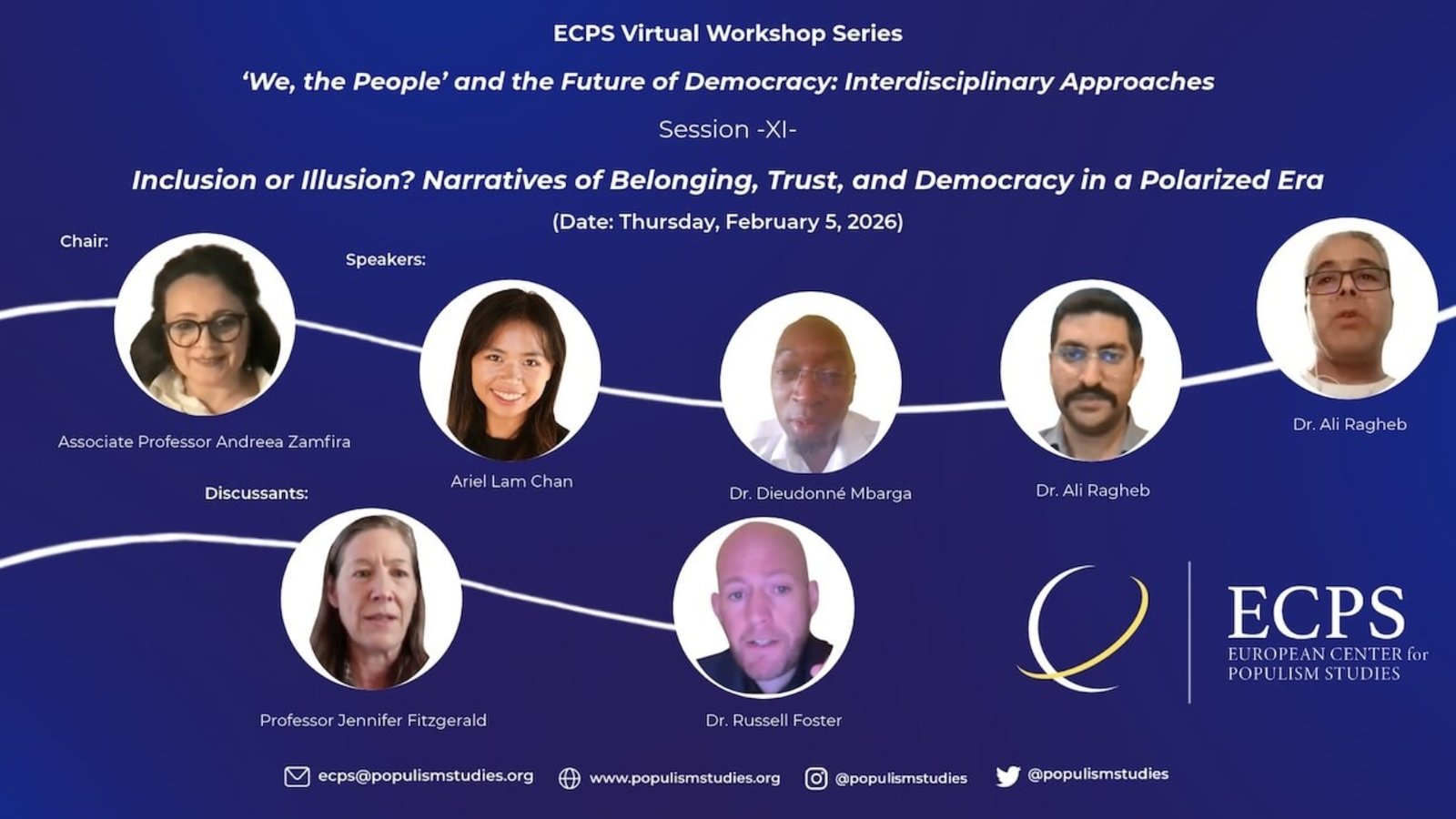
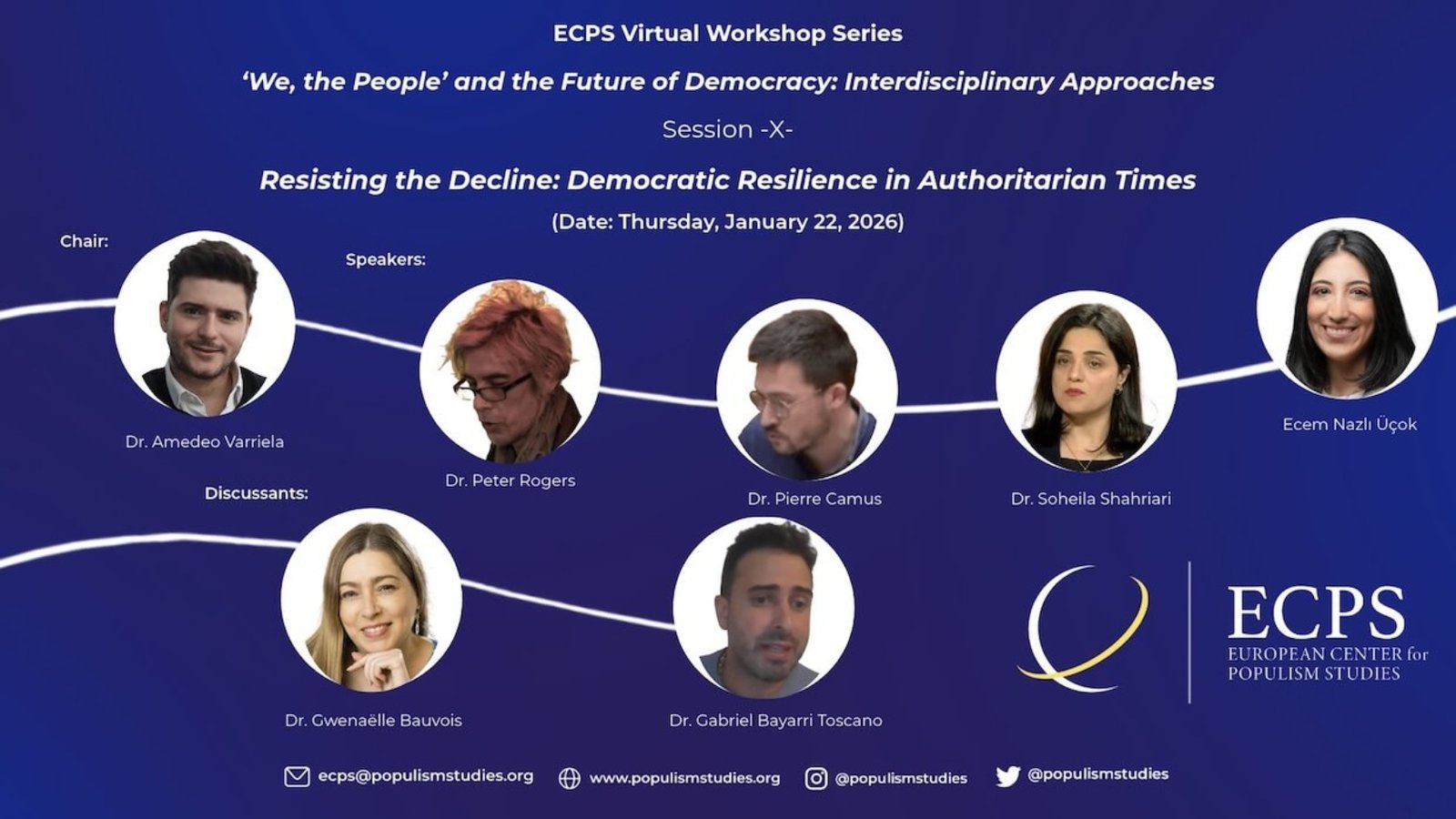
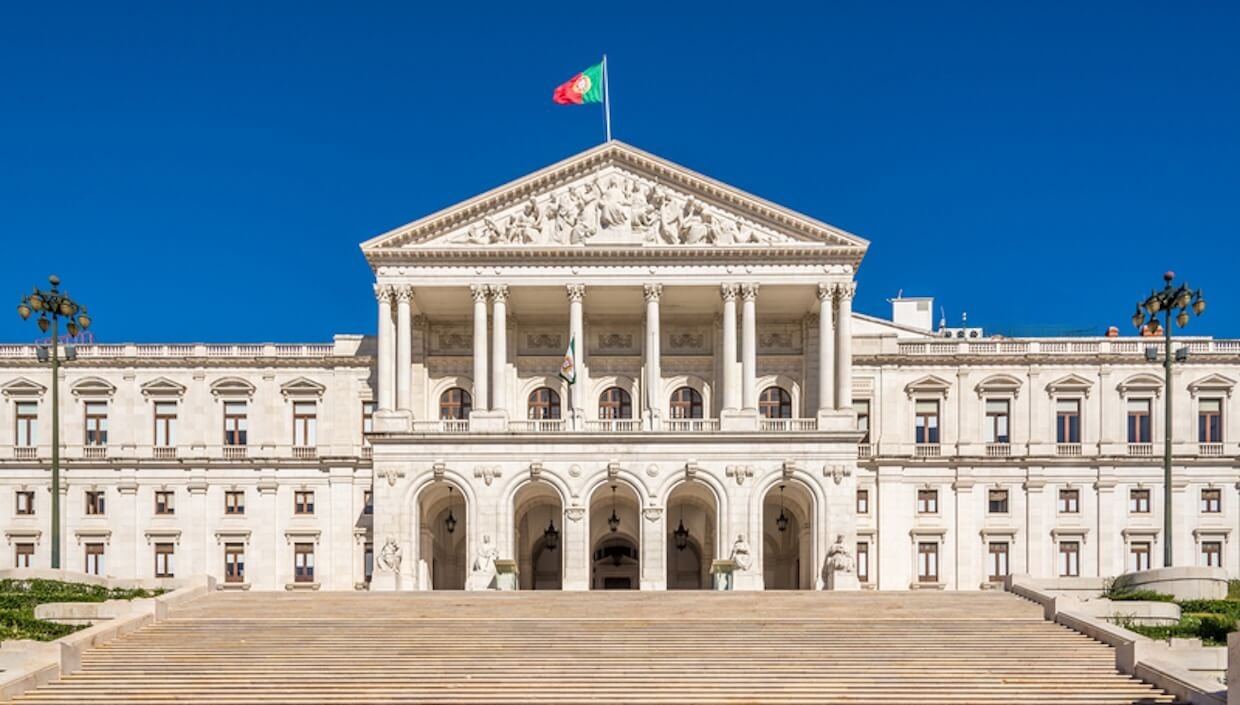
Session 11 of the ECPS Virtual Workshop Series examined the tension between democratic inclusion as a normative promise and inclusion as an everyday institutional practice. Bringing together interdisciplinary perspectives, the panel explored how belonging is constructed, experienced, and contested across administrative, participatory, historical, and theoretical domains. Contributions highlighted how exclusion often operates through subtle mechanisms—bureaucratic encounters, identity-based narratives, digital mobilization, and post-revolutionary boundary drawing—rather than overt denial. Across cases from the United States, Sub-Saharan Africa, Iran, and liberal democracies more broadly, the session underscored that democratic legitimacy today depends on both representation and effective, fair governance. Collectively, the discussions illuminated why gaps between democratic ideals and lived experiences continue to fuel distrust, polarization, and populist mobilization.
Reported by ECPS Staff
On Thursday, February 5, 2026, the European Center for Populism Studies (ECPS) convened Session 11 of its Virtual Workshop Series, “We, the People” and the Future of Democracy: Interdisciplinary Approaches, under the theme “Inclusion or Illusion? Narratives of Belonging, Trust, and Democracy in a Polarized Era.” The session brought together scholars working across political theory, political sociology, comparative politics, and historical analysis to examine a central tension of contemporary democracy: the growing disjuncture between formal promises of inclusion and the everyday experiences and institutional practices through which belonging is granted, denied, or conditionally recognized.
The workshop opened with welcoming and framing remarks by ECPS intern Stella Schade, who situated the panel within the broader aims of the series: to scrutinize how invocations of “the people” can function both as a democratic claim-making device and as a mechanism of boundary drawing that facilitates exclusionary politics.
Associate Professor Andreea Zamfira (University of Bucharest) chaired and moderated the session, providing an interpretive frame that foregrounded the duality between the “defined” and the “definers.” Her introduction emphasized that inclusion operates simultaneously as an affective, lived experience of belonging and as a political-institutional process through which elites, parties, bureaucracies, and other authorities define legitimate membership in the demos. This perspective oriented the panel toward subtle mechanisms—discursive, administrative, legal, and historical—through which democratic inclusion may become performative, selective, or strategically narrowed.
The papers collectively illuminated how legitimacy and exclusion are produced at multiple levels of governance and across distinct contexts. PhD candidate Ariel Lam Chan (Stanford University) examined citizen engagement with the administrative state through a conjoint experimental design that tested how procedural and performance cues shape “approach intention” toward public-facing agencies.
Dr. Dieudonné Mbarga (Independent Researcher) brought a comparative Global South perspective to democratic resilience, analyzing how active citizenship and participatory governance can strengthen accountability while also risking polarization and instrumentalization—particularly in digitally mediated political environments.
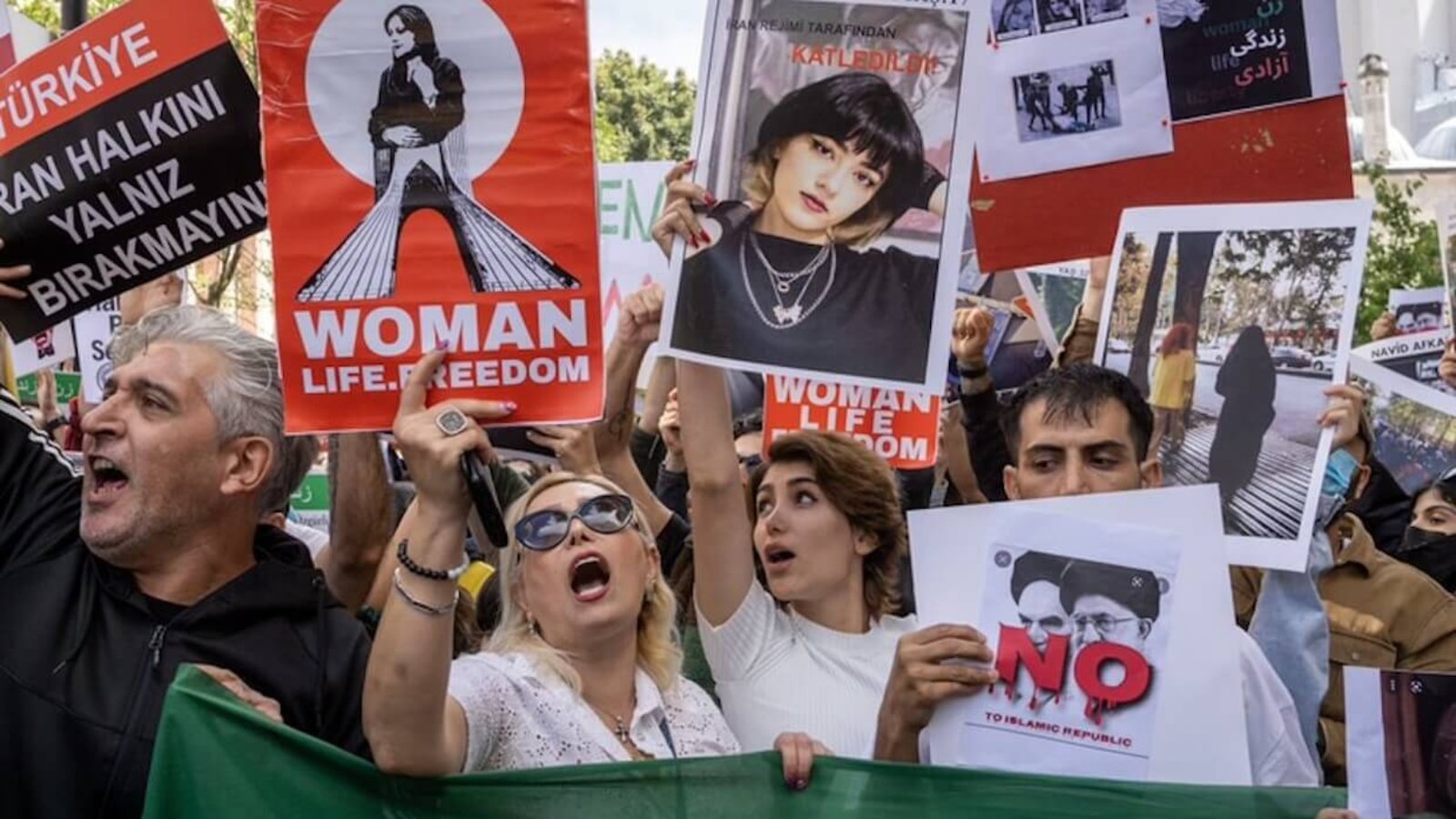
Dr. Ali Ragheb (University of Tehran) offered a historically grounded account of the Iranian Constitutional Revolution (1905–1906), arguing that democratic breakdown followed from the post-victory narrowing of “the people,” especially through the exclusion of women and minorities.
Complementing these empirical interventions, PhD candidate Saeid Yarmohammadi (University of Montreal) developed a theoretical argument about how identity politics and contested procedures of social justice can unintentionally intensify populist dynamics by deepening “us/them” boundaries within liberal democracies.
The session’s discussion was enriched by interventions from Professor Jennifer Fitzgerald (University of Colorado) and Dr. Russell Foster (King’s College London), whose feedback linked the presentations to wider debates on legitimacy, polarization, civic participation, and the variable meanings of “the people.”
Taken together, Session 11 offered a cohesive and analytically layered exploration of how contemporary democracies confront not only the challenge of governing effectively, but also the deeper question of who is recognized as belonging—and on what terms—in an increasingly polarized political age.
Please cite as: ECPS Staff (2026). “Virtual Workshop Series — Session 11: Inclusion or Illusion? Narratives of Belonging, Trust, and Democracy in a Polarized Era.” European Center forPopulismStudies (ECPS). February 6, 2026.https://doi.org/10.55271/rp00142
Session 11 of the ECPS Virtual Workshop Series examined the tension between democratic inclusion as a normative promise and inclusion as an everyday institutional practice. Bringing together interdisciplinary perspectives, the panel explored how belonging is constructed, experienced, and contested across administrative, participatory, historical, and theoretical domains. Contributions highlighted how exclusion often operates through subtle mechanisms—bureaucratic encounters, identity-based narratives, digital mobilization, and post-revolutionary boundary drawing—rather than overt denial. Across cases from the United States, Sub-Saharan Africa, Iran, and liberal democracies more broadly, the session underscored that democratic legitimacy today depends on both representation and effective, fair governance. Collectively, the discussions illuminated why gaps between democratic ideals and lived experiences continue to fuel distrust, polarization, and populist mobilization.
Reported by ECPS Staff
On Thursday, February 5, 2026, the European Center for Populism Studies (ECPS) convened Session 11 of its Virtual Workshop Series, “We, the People” and the Future of Democracy: Interdisciplinary Approaches, under the theme “Inclusion or Illusion? Narratives of Belonging, Trust, and Democracy in a Polarized Era.” The session brought together scholars working across political theory, political sociology, comparative politics, and historical analysis to examine a central tension of contemporary democracy: the growing disjuncture between formal promises of inclusion and the everyday experiences and institutional practices through which belonging is granted, denied, or conditionally recognized.
The workshop opened with welcoming and framing remarks by ECPS intern Stella Schade, who situated the panel within the broader aims of the series: to scrutinize how invocations of “the people” can function both as a democratic claim-making device and as a mechanism of boundary drawing that facilitates exclusionary politics.
Associate Professor Andreea Zamfira (University of Bucharest) chaired and moderated the session, providing an interpretive frame that foregrounded the duality between the “defined” and the “definers.” Her introduction emphasized that inclusion operates simultaneously as an affective, lived experience of belonging and as a political-institutional process through which elites, parties, bureaucracies, and other authorities define legitimate membership in the demos. This perspective oriented the panel toward subtle mechanisms—discursive, administrative, legal, and historical—through which democratic inclusion may become performative, selective, or strategically narrowed.
The papers collectively illuminated how legitimacy and exclusion are produced at multiple levels of governance and across distinct contexts. PhD candidate Ariel Lam Chan (Stanford University) examined citizen engagement with the administrative state through a conjoint experimental design that tested how procedural and performance cues shape “approach intention” toward public-facing agencies.
Dr. Dieudonné Mbarga (Independent Researcher) brought a comparative Global South perspective to democratic resilience, analyzing how active citizenship and participatory governance can strengthen accountability while also risking polarization and instrumentalization—particularly in digitally mediated political environments.
Dr. Ali Ragheb (University of Tehran) offered a historically grounded account of the Iranian Constitutional Revolution (1905–1906), arguing that democratic breakdown followed from the post-victory narrowing of “the people,” especially through the exclusion of women and minorities.
Complementing these empirical interventions, PhD candidate Saeid Yarmohammadi (University of Montreal) developed a theoretical argument about how identity politics and contested procedures of social justice can unintentionally intensify populist dynamics by deepening “us/them” boundaries within liberal democracies.
The session’s discussion was enriched by interventions from Professor Jennifer Fitzgerald (University of Colorado) and Dr. Russell Foster (King’s College London), whose feedback linked the presentations to wider debates on legitimacy, polarization, civic participation, and the variable meanings of “the people.”
Taken together, Session 11 offered a cohesive and analytically layered exploration of how contemporary democracies confront not only the challenge of governing effectively, but also the deeper question of who is recognized as belonging—and on what terms—in an increasingly polarized political age.
Assoc. Prof. Andreea Zamfira: The Defined and the Definers — Power, Inclusion, and Democratic Meaning
Andreea Zamfira is an Associate Professor with the Department of Political Science, University of Bucharest.
In her opening assessment of Session 11, Associate Professor Andreea Zamfira offered a conceptually rich and analytically nuanced framing of the panel’s central theme, “Inclusion or Illusion?”, situating it firmly within contemporary debates on democracy, populism, and representation. Drawing on insights developed during the ECPS hybrid conference “We, the People and the Future of Democracy,” she emphasized that the question of inclusion is not merely empirical but deeply political, normative, and discursive.
Dr. Zamfira structured her reflection around a key duality: the defined and the definers. On the one hand, inclusion and exclusion refer to citizens’ lived experiences of belonging within the political community—the demos. On the other, they point to the actors and institutions with the power to define “the people,” impose official narratives, and translate these narratives into policy. This distinction allowed her to foreground both bottom-up perceptions of political membership and top-down constructions of political identity.
She further argued that the panel’s contributions collectively interrogate subtle and often overlooked mechanisms of inclusion and exclusion, moving beyond formal citizenship or electoral participation to examine discursive, symbolic, and institutional practices. In this sense, the session was positioned as an effort to bridge the gap between how political belonging is experienced socially and how it is strategically constructed by political elites.
Dr. Zamfira critically engaged with competing explanations for the contemporary “deplorable state of democracy.” While some scholarly accounts attribute democratic decline to citizens’ alienation, mistrust, and limited understanding of governance, others place responsibility on political parties and governing elites that increasingly fail to represent societal interests while demanding popular trust. She leaned toward the latter interpretation, highlighting a growing distance between political elites and citizens, marked by disregard for personal autonomy, popular sovereignty, and the general will.
Invoking the work of scholars such as Peter Mair and Colin Crouch, Dr. Zamfira framed this rupture as a symptom of post-democracy, generated by the convergence of state bureaucracies and dominant economic actors. This convergence, she argued, erodes democratic sovereignty and fuels populist mobilization. Importantly, she warned against reductive or dogmatic analyses of populism, emphasizing instead Mair’s proposition that populism should be understood first as a symptom of de-democratization, and only secondarily as its cause.
In closing, Dr. Zamfira turned to the contentious concept of militant democracy, noting its growing prominence in responses to democratic crises. While some view it as a necessary safeguard, she cautioned that its restrictive logic risks undermining pluralism and further narrowing the political community. Her concluding question—whether such models protect democracy or deepen exclusion—set a critical and reflective tone for the panel discussions that followed.
Ariel Lam Chan: “What Does the Public Want? A Multidimensional Analysis of Cues in the Administrative State”
Ariel Lam Chan is a PhD student in the Department of Sociology at Stanford University.
In her presentation, Ariel Lam Chan offered a theoretically grounded and methodologically innovative contribution to ongoing debates on democratic legitimacy, administrative governance, and citizen–state relations. Her study interrogates a central but underexplored question in the literature on public administration and democratic governance: what cues motivate citizens to engage with the administrative state, particularly in everyday encounters that shape perceptions of government legitimacy?
Chan situated her research within the administrative state as the primary and most tangible interface between citizens and government. Rather than abstract institutions such as legislatures or courts, she emphasized that citizens’ lived experiences of the state are mediated through street-level bureaucrats—police officers, teachers, welfare officials, and frontline administrators. These quotidian interactions, she argued, play a decisive role in shaping trust, avoidance, or engagement with public authority. The metaphor of the Department of Motor Vehicles (DMV) served as an emblematic site where bureaucratic friction, frustration, and legitimacy are most acutely felt.
The presentation engaged critically with existing scholarship on administrative burden, which traditionally focuses on learning costs, compliance costs, and psychological costs that deter service take-up. Chan identified two limitations in this literature. First, service take-up captures only completed interactions and overlooks the prior decision of whether to approach the state at all. Second, attitudinal surveys often measure abstract preferences without embedding respondents in decision-making contexts that approximate real-world choices. To address these gaps, Chan introduced a conjoint experimental design that centers on approach intention—the subjective willingness of citizens to engage with a public service agency before interaction occurs.
Theoretically, the study bridges two influential but often competing frameworks of legitimacy. On one side is performance-based trust, which views legitimacy as a function of efficiency, speed, and outcome effectiveness. On the other is procedural justice theory, which emphasizes fair, respectful, and impartial treatment as the foundation of relational legitimacy. Chan’s intervention does not privilege one framework a priori; instead, it empirically tests how citizens respond to competing process and outcome cues when making hypothetical but realistic choices between public service offices.
Methodologically, the study employed a nationally representative survey experiment with 1,073 US respondents. Participants evaluated pairs of public service agencies across three decision tasks, yielding over 6,000 agency evaluations. Agencies spanned fourteen domains, including the DMV, Social Security Administration, and welfare offices. Cues were randomized along two dimensions: process cues (fairness and respectful treatment) and outcome cues (efficiency and performance). Importantly, cue statements were designed to mimic short online reviews, thereby approximating informational environments citizens commonly encounter.
Chan’s findings offer several important insights. First, all positive cues—both procedural and outcome-oriented—significantly increased citizens’ willingness to approach an agency, confirming that legitimacy signals matter at the point of engagement. However, the relative importance of these cues varied by measurement context. When respondents evaluated agencies on an ordinal confidence scale, considerations of fairness and efficiency carried comparable weight. Yet when forced into a binary choice between two offices, respondents prioritized outcome cues over process cues. This distinction suggests that while procedural justice remains normatively salient, instrumental performance becomes decisive when choices are constrained.
A particularly robust finding concerned fairness. Across both ordinal and binary models, fairness emerged as a stable predictor of approach intention, indicating that it functions as a foundational element of perceived legitimacy rather than a contingent preference. At the same time, the study found no evidence that process cues systematically outweighed outcome cues, challenging some expectations derived from procedural justice theory.
The analysis further revealed important interaction effects. High process cues amplified the impact of favorable outcome cues beyond their additive effects. Agencies perceived as both competent and respectful enjoyed a 5.2–6 percent boost in likelihood of selection, suggesting that relational capacity operates as a multiplier of performance rather than a substitute for it. This finding underscores the complementary, rather than competitive, relationship between efficiency and procedural justice.
Chan also examined subgroup differences, testing hypotheses related to racialized administrative burden, political ideology, and socioeconomic status. Contrary to expectations, marginalized groups and frequent welfare users did not exhibit stronger preferences for relational cues over outcomes. Similarly surprising was the ideological pattern: Democrats displayed a significantly stronger preference for outcome cues than Republicans, suggesting a potential shift toward demands for a high-capacity, high-performing state even among traditionally process-oriented constituencies. In contrast, higher-income and more highly educated respondents prioritized outcomes over relational ease, aligning with established literature.
In conclusion, Chan argued that public trust in the administrative state rests on a dual expectation of competence and fairness. While efficiency and results guide immediate engagement decisions, procedural justice remains the aspirational bedrock of institutional legitimacy, as reflected in respondents’ open-ended responses. Her presentation closed by advancing a normative implication: investments in relational capacity should not be treated as ancillary but as essential to rebuilding trust, reducing avoidance, and strengthening the democratic fabric linking citizens and the state.
Dr. Dieudonné Mbarga: “Active Citizenship, Democracy and Inclusive Governance in Sub-Saharan Africa. Nexus, Challenges and Prospects for a Sustainable Development”
Dr Dieudonne Mbarga is an independent researcher.
In his presentation, Dr. Dieudonné Mbarga offered a comparative and empirically grounded analysis of the role of active citizenship in fostering inclusive governance and democratic resilience in Sub-Saharan Africa. Speaking from the perspective of a Global South scholar, Dr. Mbarga emphasized both the analytical relevance and normative urgency of situating debates on inclusion, participation, and populism within contexts marked by fragile democratic transitions, deep social pluralism, and uneven institutional capacity.
Dr. Mbarga framed his intervention around a central puzzle: how active citizenship can strengthen democratic governance in polarized environments without reinforcing exclusionary or populist narratives of “the people.” He noted that Sub-Saharan Africa presents a particularly complex terrain for addressing this question, given the coexistence of declining institutional trust, intensifying political polarization, and rising mobilization of youth and women—dynamics increasingly mediated by digital platforms.
Conceptually, Dr. Mbarga defined active citizenship as the sustained commitment of individuals to participate meaningfully in public governance, drawing on established definitions from governance and citizenship studies. His theoretical framework combined insights from deliberative democracy, participatory governance, and contributivist approaches to populism. While participation is often normatively associated with accountability, legitimacy, and inclusion, Dr. Mbarga cautioned that it can also generate division when political actors instrumentalize popular mobilization through exclusionary definitions of “the people.”
Methodologically, the study adopted a qualitative and comparative approach, combining interviews, participant observation, policy analysis, and secondary literature across five country cases: Kenya, Ghana, Ethiopia, Senegal, and Cameroon. This design allowed Dr. Mbarga to trace both common patterns and context-specific dynamics of civic engagement across diverse political and institutional settings.
The findings revealed a dual and ambivalent role of active citizenship in the region. On the one hand, civic engagement has demonstrably strengthened accountability and policy performance. In Kenya, youth and women’s mobilization has shaped climate governance and inclusion agendas. In Ghana, participatory budgeting initiatives have enhanced transparency and local accountability. Ethiopia’s community-based participation mechanisms have contributed to improved social protection outcomes. These cases underscore the democratic potential of active citizenship when embedded in participatory institutions.
On the other hand, Dr. Mbarga highlighted the risks of politicized and instrumentalized mobilization. In Senegal, digitally mediated youth participation has energized political engagement but also intensified polarization. In Cameroon, civic engagement persists despite restrictive institutional environments, yet often takes fragmented and informal forms. Across cases, Dr. Mbarga observed that digital platforms simultaneously expand opportunities for inclusion and amplify fragmentation, enabling political elites to mobilize citizens—particularly youth—without fostering sustained civic understanding or democratic learning.
A recurring theme in Dr. Mbarga’s analysis was the salience of ethnic and tribal identities in shaping political participation. Unlike racialized dynamics more common in Western democracies, Sub-Saharan African contexts are often structured around multi-ethnic and multi-tribal cleavages. These identities, he argued, can be readily activated by populist leaders, transforming civic participation into a vehicle for exclusion rather than inclusion and undermining institutional trust.
In terms of policy implications, Dr. Mbarga emphasized the need to institutionalize participatory governance mechanisms, strengthen civic education, support youth and women’s leadership, protect civic space, and promote inclusive digital participation in line with SDG 16. His concluding assessment stressed that active citizenship could enhance democratic resilience only when anchored in inclusive institutions, structured participation, and protected civic freedoms.
Overall, Dr. Mbarga’s presentation contributed a nuanced Global South perspective to the session’s broader inquiry into inclusion and illusion, highlighting both the democratic promise and the political risks of active citizenship in polarized and plural societies.
Dr. Ali Ragheb: “Silenced Voices in a Democratic Dawn: How the Iranian Constitutional Revolutionaries (1905–1906) Weaponized ‘the People’ Against Minorities”
Dr. Ali Ragheb is from University of Tehran.
Dr. Ali Ragheb’s contribution to Session 11 was delivered in the form of a pre-recorded presentation, necessitated by repeated and ultimately unsuccessful attempts to join the session live due to enforced internet restrictions in Iran. This constraint, which Dr. Ragheb explicitly framed as an instrument of political control during a moment of acute national crisis, served not merely as a logistical obstacle but as a poignant extension of the substantive themes of his paper. His intervention thus unfolded at the intersection of historical inquiry, political theory, and lived authoritarian experience.
Dr. Ragheb’s presentation addressed the Iranian Constitutional Revolution of the early twentieth century as a critical historical case for understanding the paradoxes of popular mobilization, inclusion, and democratic failure. He began by situating the phrase “We, the People” not as a constitutional abstraction for Iranians, but as a lived and contested condition—one shaped by resistance, repression, and repeated cycles of hope and betrayal. This framing connected Iran’s contemporary crisis, marked by violent repression of popular protests and renewed exposure to war, to a longer genealogy of failed democratic aspirations.
The core research question guiding Dr. Ragheb’s study was deceptively simple yet theoretically ambitious: why did a revolution that succeeded through mass participation fail to defend itself once it achieved institutional power? While existing historiography has emphasized external imperial intervention and internal structural weaknesses—such as low literacy rates or institutional fragility—Dr. Ragheb argued that these explanations overlook a crucial dynamic: the deliberate narrowing of the political meaning of “the people” by revolutionary elites after victory.
Theoretically, Dr. Ragheb approached “the people” as a political construction rather than a fixed sociological entity. Drawing on Ernesto Laclau’s notion of the people as an “empty signifier,” he conceptualized revolutionary mobilization as a moment in which heterogeneous social demands were temporarily unified under an ambiguous political banner. Jacques Rancière’s work informed his analysis of political visibility, helping to explain how marginalized groups briefly entered the political stage before being rendered invisible once again. Partha Chatterjee’s distinction between civil society and political society further clarified how revolutionary elites selectively recognized some actors as legitimate citizens while governing others through exclusion and control.
Methodologically, the study was grounded in extensive qualitative analysis of parliamentary debates, constitutional drafts, electoral laws, petitions, underground pamphlets, intelligence reports, newspapers, memoirs, and visual materials. This rich archive allowed Dr. Ragheb to trace the transition from inclusive mobilization to exclusionary consolidation with empirical precision.
The findings highlighted the internal heterogeneity and fragility of the revolutionary coalition. Intellectuals sought legal-rational representation, merchants prioritized property and trade security, clerics were divided between constitutionalist and conservative camps, and the urban poor mobilized largely in response to economic precarity. During the revolutionary phase, these divergent interests were held together through strategic ambiguity. After victory, however, revolutionary leaders increasingly prioritized stability, elite consensus, and property rights, reframing mass participation as disorderly and dangerous.
This shift had far-reaching consequences. The urban poor, whose economic grievances were largely ignored by parliament, became disillusioned and politically volatile, making them susceptible to counter-revolutionary mobilization. Women, despite their active participation through demonstrations, boycotts, armed resistance, and petitions, were systematically excluded from political recognition; electoral laws explicitly denied them suffrage, transforming revolutionary visibility into post-revolutionary invisibility. Religious minorities—Armenians, Jews, and Zoroastrians—faced similarly entrenched exclusion. Although early constitutional debates promised equality, political belonging was ultimately defined in Islamic terms, rendering minorities conditionally visible and politically expendable.
Dr. Ragheb emphasized that this exclusion was not accidental but the result of strategic compromises between secular constitutionalists and conservative clerics, in which minority rights were sacrificed to preserve elite unity. Exclusion was further institutionalized through restrictive suffrage laws, class-based representation, and the overrepresentation of Tehran at the expense of provinces, tribes, peasants, and ethnic minorities.
At the discursive level, revolutionary elites increasingly portrayed the masses as ignorant and irrational, legitimizing demobilization and repression. When counter-revolutionary forces regrouped, parliament stood isolated—not because of popular apathy, but because the social base that had enabled revolutionary victory had been systematically excluded and betrayed.
Dr. Ragheb concluded by situating the Iranian case within a broader comparative frame, noting parallels with the French Revolution and the Young Turks Revolution. His central lesson was universal: revolutions that rely on broad coalitions cannot survive if they consolidate power by narrowing the definition of the people. Without institutionalized pluralism across class, gender, religion, and region, revolutionary victories remain fragile. His closing remarks, honoring those silenced in Iran’s current crisis, powerfully underscored the enduring relevance of this historical insight.
Saeid Yarmohammadi: “When Identity Politics and Social Justice Procedures Contribute to Populism”
Saeid Yarmohammadi is a PhD candidate in religious studies at the Institute of Religious Studies, University of Montreal, Canada.
In his presentation, PhD candidate Saeid Yarmohammadi offered a theoretically oriented and normatively reflective analysis of the relationship between identity politics, social justice procedures, and the expansion of populist discourse in liberal democracies. Despite joining the session with technical difficulties and presenting in a condensed format, Yarmohammadi articulated a coherent argument that linked sociological theories of otherness with political-philosophical debates on democracy and justice.
Yarmohammadi framed his intervention around a central concern: how contemporary identity politics and the politicization of social justice principles can unintentionally reinforce populist dynamics rather than counter them. His point of departure was the concept of “otherness,” which he traced to ethnographic traditions historically rooted in colonial modes of knowledge production. Although ethnography has increasingly turned its analytical lens toward Western societies, he argued that the conceptualization of outsiders—particularly immigrants and marginalized groups—often continues to reproduce a dichotomous logic of “us” versus “them.” This persistent distinction, he suggested, provides fertile ground for populist narratives that claim to represent a homogenous “people” against constructed outsiders.
Building on this foundation, Yarmohammadi examined identity politics as a central mechanism through which the “We, the People” discourse is articulated. Identity politics, in his account, seeks to define a unified in-group by emphasizing selected cultural, social, or political characteristics while marginalizing or essentializing others as an out-group. This process intensifies polarization by shifting political disagreement away from contestation over shared problems and policy solutions toward the assertion of incompatible group interests. As a result, the political community becomes fragmented into competing “we’s,” a condition that populist actors can readily exploit.
To deepen this analysis, Yarmohammadi drew on social identity theory, highlighting four key components relevant to populist mobilization: categorization, identification, social comparison, and psychological distinctiveness. Together, these mechanisms help explain how individuals derive political meaning and emotional attachment from group membership, reinforcing in-group solidarity while sharpening out-group exclusion. In politicized contexts, this dynamic transforms identity from a social marker into a political weapon.
The second major strand of the presentation focused on the formation of social justice principles. Yarmohammadi argued that debates over justice, when conducted under conditions of polarized identity politics, tend to exacerbate rather than mitigate populist tendencies. He contrasted populist conceptions of democracy—where “the people” are treated as a singular collective agent—with alternative democratic models grounded in liberal egalitarian and republican traditions. Drawing on John Rawls and Jürgen Habermas, he emphasized that democratic legitimacy in liberal democracies depends on public reason, overlapping consensus, and the recognition of citizens as free and equal participants in a shared political enterprise.
In this framework, justice emerges not from the dominance of particular groups but from inclusive deliberative processes embedded in democratic institutions. However, Yarmohammadi argued that when identity politics reshapes democratic participation, agreement on social justice principles shifts from individual reasoning to group-based priority setting. This transformation undermines the possibility of shared consensus and instead deepens polarization, creating conditions conducive to populist democracy.
A key implication of this argument concerned the failure of bottom-up democratic efforts to formulate social justice principles within civil society. Yarmohammadi suggested that such efforts are increasingly overridden by top-down identity-based mobilization, resulting in the erosion of liberal democratic norms, rising inequality, and heightened social anger and anomie. These conditions, in turn, further enable populist movements to thrive.
In conclusion, Yarmohammadi maintained that the relationship between social justice and populism is contingent on the underlying model of democracy. Where justice is grounded in inclusive, deliberative, and institutionally mediated processes, populism can be constrained. Where justice becomes politicized through polarized conceptions of “the people,” populist discourse finds fertile ground. His presentation thus contributed a critical theoretical lens to the session’s broader exploration of inclusion, exclusion, and the fragility of democratic norms.
Discussants’ Feedback
Dr. Russell Foster
Dr. Russell Foster is a Senior Lecturer in British and International Politics at King’s College London, School of Politics & Economics, Department of European & International Studies.
In his role as discussant, Dr. Russell Foster offered an intellectually generous, theoretically informed, and methodologically attentive commentary on the panel as a whole and on each of the individual papers presented. His intervention did not merely evaluate the technical merits of the papers but situated them within a broader diagnosis of the contemporary democratic condition, thereby reinforcing the session’s overarching theme of the growing gap between political institutions and the demos.
Dr. Foster opened by explicitly engaging with Assoc. Prof. Zamfira’s framing of the session, noting that all papers directly addressed what she identified as the widening “void” between political elites and popular constituencies across different contexts. He highlighted the relevance of her discussion of militant democracy, connecting it to Karl Popper’s paradox of intolerance. In particular, Dr. Foster underscored the normative tension inherent in militant democratic strategies: while potentially necessary in moments of democratic crisis, such approaches risk excluding precisely those segments of the demos that democracy claims to represent. This conceptual tension, he suggested, resonated strongly with the empirical findings of the papers under discussion.
Turning first to the presentation by Ariel Lam Chan, Dr. Foster praised the paper as a “rich” and “refreshing” contribution to the study of the administrative state, particularly for its focus on street-level bureaucracy rather than elite institutions. He commended the paper’s attention to the psychological and somatic dimensions of administrative burden, noting that these factors are often overlooked in studies of legitimacy and governance. By foregrounding everyday encounters with public institutions—such as interactions with the DMV—the paper illuminated how legitimacy is constructed or eroded through mundane, routine experiences rather than grand constitutional moments.
At the same time, Dr. Foster offered several constructive critiques and suggestions for refinement. He questioned the applicability of the phrase “voting with one’s feet” in the context of what he described as “captive bureaucracies,” where citizens lack meaningful alternatives to state-provided services. This raised an important conceptual issue about agency and choice within administrative systems. Dr. Foster also engaged critically with the paper’s discussion of instrumental versus relational legitimacy, suggesting that the empirical failure of initiatives such as the US “Department of Government Efficiency” (DOGE) might call into question the coherence or sustainability of purely instrumental legitimacy models. He encouraged the author to further explore alternative institutional cases that might better illustrate instrumental legitimacy in practice.
Methodologically, Dr. Foster expressed appreciation for the paper’s extensive dataset and sophisticated experimental design, while recommending greater clarity regarding case selection. He suggested that the paper would benefit from explicitly identifying the public agencies included in the study and clarifying whether they operated at federal, state, or local levels. This distinction, he argued, could significantly shape citizens’ perceptions of competence and fairness. Dr. Foster also proposed expanding the analysis of age-based differences in perceptions of administrative legitimacy, particularly given the growing salience of generational divides in populist politics. Finally, he encouraged greater transparency regarding the use of AI tools, such as ChatGPT, for coding qualitative data, including clearer justification and documentation of prompts and procedures.
In his discussion of Dr. Dieudonné Mbarga’s paper on active citizenship in sub-Saharan Africa, Dr. Foster emphasized the importance of hearing Global South perspectives articulated by scholars embedded in the contexts they study. He praised the paper’s nuanced account of polarization, uneven democratic consolidation, declining institutional trust, and expanding youth civic engagement. Dr. Foster noted that the paper offered valuable insights into how active citizenship can simultaneously strengthen accountability and intensify populist dynamics.
Here too, Dr. Foster suggested avenues for further development. He encouraged greater temporal specificity, asking whether the patterns identified were recent phenomena, post-pandemic developments, or part of longer historical trajectories. He also proposed deeper comparative reflection across the selected case studies, including attention to linguistic differences between Anglophone and Francophone contexts and their implications for populist communication. A particularly salient contribution of Dr. Foster’s feedback was his emphasis on blame attribution in populist discourse. He invited the author to more explicitly analyze who populist actors in sub-Saharan Africa identify as internal and external enemies, noting emerging narratives that simultaneously reject Western powers while embracing alternative global actors such as Russia. Dr. Foster also highlighted the paper’s compelling comparison between racism in the Global North and tribalism in the Global South, suggesting that this analytical parallel could be further elaborated.
In his final set of remarks, Dr. Foster addressed Dr. Ali Ragheb’s pre-recorded presentation on the Iranian Constitutional Revolution. He expressed solidarity with the author’s situation and praised the paper as both theoretically sophisticated and historically illuminating. Dr. Foster emphasized the originality of the argument, particularly its challenge to conventional explanations for revolutionary failure that focus on foreign intervention or elite factionalism. Instead, he highlighted the paper’s central claim that revolutionary leaders narrowed the definition of “the people” after achieving power, thereby undermining the very coalition that had enabled success.
Dr. Foster commended the paper’s creative integration of Western political theory—particularly Laclau’s concept of empty signifiers and Chatterjee’s distinction between civil and political society—into the Iranian historical context. He also welcomed the shift away from elite-centered narratives toward everyday political experiences, drawing on Reinhart Koselleck’s notion of Alltagsgeschichte. At the same time, he suggested that the paper could be strengthened by greater methodological transparency regarding archival sources, translation challenges, and criteria of selection. He also encouraged further exploration of intra-urban dynamics, asking whether the revolutionary experience differed across Iranian cities beyond the Tehran–province divide.
In closing, Dr. Foster characterized all three papers as theoretically rich, empirically grounded, and highly relevant to understanding what he described as “the great crisis of our time.” His feedback not only affirmed the scholarly quality of the contributions but also demonstrated how they collectively advance critical debates on populism, legitimacy, and democratic fragility across diverse global contexts.
Professor Jennifer Fitzgerald
Jennifer Fitzgerald is Professor of Political Science at the University of Colorado.
Professor Jennifer Fitzgerald’s intervention as discussant offered a reflective, conceptually rich, and methodologically attentive assessment of the papers presented. Her remarks were unified by a strong concern with how foundational democratic concepts—legitimacy, accountability, transparency, inclusion, and exclusion—are not merely institutional abstractions but are actively produced and contested through everyday political experiences. Across her discussion, Professor Fitzgerald consistently emphasized the importance of connecting macro-level democratic theory to micro-level encounters between citizens and the state.
At the panel level, Professor Fitzgerald highlighted the shared strength of the presentations in foregrounding lived experience. She praised the “street-level” orientation running through the papers, noting that citizens’ daily interactions with bureaucracies, civic institutions, and political movements profoundly shape how democracy is perceived, trusted, or rejected. These encounters, she argued, inform whether individuals feel that rules apply fairly to them, whether they belong to the political community, and whether they are seen as politically consequential. In this sense, the panel collectively illuminated how democratic legitimacy is built—or eroded—not only through formal institutions but through routine practices and symbolic recognition.
Turning to Ariel Lam Chan’s presentation, Professor Fitzgerald described the project as innovative and intellectually exciting. She singled out the concept of “approach intention” as a particularly original contribution, interpreting it as a promising analytical bridge between individual political behavior and the administrative state. In her view, this concept captures how citizens anticipate and navigate interactions with public services, thereby expanding political analysis beyond elections and party competition.
Professor Fitzgerald encouraged deeper theoretical engagement with political science debates that seek to broaden the definition of politics to include service delivery as a core democratic outcome. She suggested that integrating this literature could substantially widen the paper’s audience and underscore its relevance to scholars concerned with how governance is experienced at the ground level. She also proposed several potential extensions, including closer attention to gender and generational dynamics. Drawing on existing research, she noted that women and men often engage differently with public services and possess distinct forms of political knowledge, while age cohorts may vary in their expectations of state responsiveness—patterns that could further enrich the analysis.
Additionally, Professor Fitzgerald raised the possibility that citizens’ experiences of legitimacy may be shaped by the perceived identity of bureaucratic actors themselves. Inspired by work on interviewer effects, she suggested that factors such as gender, age, language, or cultural similarity between citizens and street-level officials could influence how fairness and competence are evaluated. While framed explicitly as future research directions rather than critiques, these reflections reinforced her broader emphasis on relational dynamics in democratic governance.
In discussing Dr. Dieudonné Mbarga’s presentation, Professor Fitzgerald characterized the work as ambitious, timely, and normatively significant. She expressed particular interest in the paper’s focus on digital polarization, emphasizing that scholars still lack a sufficient understanding of how digital environments reshape political participation, trust, and fragmentation. The notion of inclusive digital governance, in her view, represented a particularly fertile conceptual space with strong potential for theoretical and policy-relevant contributions.
Professor Fitzgerald also situated Dr. Mbarga’s analysis within a broader comparative framework, suggesting connections to research on local governance and gendered leadership in contexts such as India, as well as to historical analyses of democratic fragility, including work on interwar Europe. These linkages, she argued, could help position the paper within wider debates on institutional design, democratic resilience, and participation in polarized societies.
Her engagement with Dr. Ali Ragheb’s presentation was marked by both scholarly admiration and personal reflection. Professor Fitzgerald openly acknowledged the privilege of conducting academic work in secure environments and expressed humility in light of Dr. Ragheb’s circumstances and subject matter. She praised the paper’s theoretical clarity and framing, describing it as exemplary in its ability to demonstrate how revisiting neglected dimensions of a historical event can fundamentally reshape understanding.
A central theme she drew from Dr. Ragheb’s work was the fluidity and political malleability of “the people.” Professor Fitzgerald emphasized the analytical power of treating “the people” not as a fixed category but as a rhetorical construct that can be strategically expanded or narrowed. She underscored how such shifts carry profound consequences for inclusion, exclusion, and political violence, making the paper highly relevant to contemporary debates on populism and authoritarianism.
Importantly, Professor Fitzgerald noted that Dr. Ragheb’s analysis demonstrated how redefining the boundaries of the people is never merely symbolic; it has concrete implications for political participation, rights, and historical trajectories. She viewed this insight as one of the paper’s most enduring contributions, with clear pedagogical value for graduate training and broader comparative research.
Finally, Professor Fitzgerald offered reflections on Saeid Yarmohammadi’s presentation, which examined the intersection of identity politics and social justice procedures. She described this thematic space as critically important, particularly in polarized liberal democracies where democratic participation can paradoxically reinforce populist dynamics. Professor Fitzgerald highlighted the paper’s core insight that when social justice principles are formulated within fragmented and politicized conceptions of “we, the people,” democratic deliberation risks being displaced by group-based prioritization and zero-sum logic.
Drawing from political science and anthropology, she suggested that Yarmohammadi’s work could be fruitfully connected to the concept of “culture as points of concern,” which posits that what defines a political culture is not consensus, but the issues over which disagreement is most intense. From this perspective, the paper sheds light on how contested understandings of justice and identity become focal points for populist mobilization. Fitzgerald also recommended engagement with scholarship on emotions in politics—such as resentment and envy—as complementary lenses for understanding how identity-based narratives gain traction among mass publics.
In concluding her remarks, Fitzgerald expressed strong appreciation for all the projects discussed, describing them as theoretically rich, empirically grounded, and deeply relevant to the central democratic challenges of the present moment. Her feedback underscored a unifying message: democratic backsliding and populism cannot be understood solely through institutional decay or elite maneuvering, but must also be analyzed through the everyday practices, identities, and expectations that shape how citizens experience—and contest—democracy itself.
Responses to Discussants’ Feedback
Ariel Lam Chan
In her response to the discussants’ feedback, Ariel Lam Chan offered a reflective and methodologically transparent engagement with the comments raised, situating her project within both its intellectual genealogy and its future research trajectory. She began by acknowledging Professor Jennifer Fitzgerald’s remarks as highly resonant, emphasizing that the project itself originated in a political science classroom environment. Chan credited the formative influence of Michael Tomz and Paul Sniderman, particularly Sniderman’s encouragement to examine how citizens respond to institutional cues at the administrative level rather than focusing solely on elite or electoral politics. This framing reinforced the project’s grounding in behavioral political science while underscoring its interdisciplinary ambitions.
Chan directly addressed the discussants’ suggestion regarding the social characteristics of public service offices and bureaucratic actors. She noted that the project’s original design was indeed motivated by social identity theory and an interest in how intergroup affiliations might shape citizens’ responses to administrative institutions. However, she explained that a key methodological constraint emerged in the conjoint experimental design: operationalizing social identity cues in a realistic manner without exposing participants to psychological discomfort or ethical risk proved challenging. This tension, she suggested, reflects a broader trade-off between experimental rigor and ethical sensitivity, and she expressed openness to continuing this discussion beyond the workshop setting.
Responding to questions about gender, Chan clarified that while the analysis did not yield statistically significant gender differences in overall cue responsiveness, there were indicative patterns suggesting that women tend to prioritize relational cues more strongly. She interpreted this as a potentially meaningful finding that warrants deeper qualitative and contextual exploration, particularly in relation to women’s prior experiences navigating public services and their practical knowledge of institutional pathways.
Chan also welcomed encouragement to further elaborate the concept of “approach intention,” acknowledging her initial caution in advancing a framework not yet well established in the literature. The discussants’ validation, she noted, strengthened her confidence in developing this concept more explicitly as a theoretical contribution. Finally, she expressed enthusiasm for comparative extensions of the project, signaling openness to cross-national applications and collaborative dialogue as the research evolves.
Dr. Dieudonné Mbarga
Dr. Dieudonné Mbarga’s response was marked by a reflective and collegial tone, emphasizing openness to critique and scholarly learning. He expressed sincere appreciation for the discussants’ feedback and situated his intervention within an early stage of academic development. Framing the comments as constructive guidance, he underscored his intention to integrate them into the revision of his paper and signaled willingness to continue the dialogue, exemplifying an iterative and collaborative approach to knowledge production.
Closing Assessment by Assoc. Prof. Andreea Zamfira
In her closing assessment, Assoc. Prof. Andreea Zamfira offered a concise yet conceptually rich synthesis of the panel’s contributions, situating them within broader debates on democratic legitimacy, representation, and exclusion in contemporary political systems. Her remarks foregrounded the analytical coherence of the session, emphasizing how diverse empirical cases converged around shared structural tensions affecting democracies across regions and historical contexts.
Reflecting on Ariel Lam Chan’s presentation, Dr. Zamfira highlighted the dual democratic deficit facing modern states: declining representation and declining governance effectiveness. She underscored that citizens’ expectations toward democratic systems increasingly encompass both procedural representation and administrative efficiency. Failures on either front, she noted, can generate political disillusionment, disengagement, and radicalization—dynamics that feed into broader patterns of democratic erosion. This observation positioned administrative performance not as a technocratic concern, but as a core component of democratic legitimacy.
Turning to Dr. Mbarga’s contribution, Dr. Zamfira emphasized the corrosive effects of exclusion from meaningful political participation. She framed his findings within a wider comparative trajectory, noting that political parties and representative institutions across contexts are struggling to mediate effectively between citizens and the state. This growing disconnect, she argued, fuels skepticism, erodes trust, and contributes to increasingly critical attitudes toward democratic regimes—not only in Europe or the United States, but globally.
Dr. Zamfira’s engagement with Dr. Ragheb’s historical analysis of Iran’s Constitutional Revolution further reinforced this theme. She underscored that the revolution’s failure stemmed not from societal backwardness or external interference, but from the deliberate narrowing of the definition of “the people” by revolutionary elites. The systematic exclusion of key social groups—along class, gender, religious, and ethno-national lines—undermined pluralism and prevented durable democratic consolidation. Dr. Zamfira stressed the contemporary relevance of this case, drawing parallels with modern forms of exclusion driven by identity politics.
In integrating Saeid Yarmohammadi’s analysis, she highlighted how identity-based exclusions help explain why significant segments of society gravitate toward anti-system or populist movements. Across the panel, exclusion emerged as a recurring mechanism linking democratic disenchantment with populist mobilization.
Dr. Zamfira concluded by urging scholars to critically interrogate competing democratic models—pluralist, elitist, technocratic, or epistemocratic—and their implications for inclusion, representation, and effective governance. In an era marked by polarization and post-democratic challenges, she emphasized that many foundational questions remain unresolved, underscoring the need for continued research and collective scholarly engagement.
Conclusion
Session 11 of the ECPS Virtual Workshop Series provided a conceptually integrated and empirically rich examination of the tension between democratic inclusion as promise and inclusion as practice. Across diverse methodologies, regions, and theoretical traditions, the contributions converged on a central insight: contemporary democratic fragility is deeply rooted in the gap between formal claims of belonging and the lived, institutionalized, and discursively mediated experiences through which political membership is enacted or denied.
The papers collectively demonstrated that exclusion rarely operates through overt denial alone. Instead, it emerges through subtle yet consequential mechanisms—administrative encounters that discourage engagement, participatory processes vulnerable to instrumentalization, identity-based narratives that harden boundaries, and historical moments in which revolutionary coalitions are narrowed after victory. Whether in the everyday interactions of citizens with the administrative state, the dynamics of digitally mediated participation in Sub-Saharan Africa, the post-revolutionary consolidation of power in Iran, or the politicization of social justice in liberal democracies, exclusion repeatedly appeared as a driver of democratic disillusionment and populist mobilization.
Equally important, the session highlighted that democratic legitimacy today rests on a dual expectation. Citizens demand not only representation and voice, but also competence, fairness, and effectiveness. Failures on either dimension—procedural or performance-based—risk eroding trust and fostering disengagement. As several interventions underscored, technocratic efficiency without inclusion, or participation without institutional grounding, can both generate democratic backlash.
Rather than offering definitive resolutions, Session 11 productively foregrounded unresolved questions about how democracies can reconcile pluralism, participation, and governance capacity under conditions of polarization and post-democracy. In doing so, it reaffirmed the importance of interdisciplinary, historically informed, and globally attentive scholarship for understanding—and potentially reimagining—the future of democratic belonging.
André Ventura’s qualification for the presidential runoff marks a critical moment in Portuguese politics, long viewed as resistant to far-right breakthroughs. In this interview with the ECPS, Dr. Hugo Ferrinho Lopes (EEG-UMinho & Iscte-IUL; ICS-ULisbon) argues that Ventura’s advance is “less a sudden presidential earthquake than a clear manifestation” of an ongoing party-system shift—deepened by fragmentation on the mainstream right and declining abstention. Dr. Lopes explains how Chega mobilized “latent populists” once a viable radical-right option emerged, while also stressing the limits of authoritarian and nativist appeals in a second-round contest that requires broader legitimacy. The result, he suggests, is a normalized but still constrained radical right: agenda-setting and organizationally consolidated, yet facing ceilings shaped by elite incentives, affective polarization, and presidential norms of moderation.
The qualification of André Ventura, leader of the populist radical right party Chega, for the presidential runoff marks a watershed moment in contemporary Portuguese politics. Long regarded as an exception within Southern Europe for its resistance to far-right breakthroughs, Portugal now finds itself grappling with a transformed party system, declining abstention, and the normalization of a radical right actor at the highest symbolic level of the state. In this wide-ranging interview with the European Center for Populism Studies (ECPS), Dr. Hugo Ferrinho Lopes, an invited assistant professor at EEG-UMinho and Iscte-IUL, and an associate researcher at ICS-ULisbon, offers a nuanced and empirically grounded analysis of what Ventura’s rise does—and does not—signify for the future of Portuguese democracy.
At the core of Dr. Lopes’s argument is a rejection of the idea that Ventura’s presidential advance represents a sudden rupture. Instead, he situates it within a longer trajectory of party-system transformation. As he notes, Ventura’s runoff presence is “less a sudden presidential earthquake than a clear manifestation of a party-system shift that has already been underway,” one that began with Chega’s parliamentary breakthrough and was accelerated by fragmentation on the mainstream right. In Sartorian terms, Portugal is experiencing increasing ideological distance and fragmentation, dynamics that presidential elections—through personalization and strategic voting—tend to amplify.
A central theme running through the interview is the role of political supply. Dr. Lopes emphasizes that Chega did not emerge because Portuguese voters suddenly radicalized, but because a long-standing gap on the cultural and conservative dimension of party competition was left unfilled. This allowed Ventura, an experienced political communicator with extensive media exposure, to capture what Dr. Lopes describes as “latent populists who were activated once a viable alternative became available.” Importantly, this mobilization was facilitated by institutional conditions—such as a lower effective electoral threshold in 2019—and by Chega’s rapid transition from entrepreneurial project to organizationally consolidated party.
Yet the interview also highlights the limits of Ventura’s appeal. Despite declining abstention disproportionately benefiting Chega, Dr. Lopes stresses that Ventura’s electorate remains strikingly stable rather than expansive. “Ventura is competing against himself,” he observes, as voters from eliminated candidates increasingly coalesce behind his opponent in the runoff. This pattern reflects what he characterizes as a de facto cordon sanitaire driven less by formal elite coordination than by affective polarization and voter hostility toward the far right.
Perhaps most importantly, Dr. Lopes cautions against overestimating the governing potential of authoritarian rhetoric in Portugal. While Chega has successfully imposed issues such as immigration and security on the national agenda, “relying solely on authoritarian and nativist appeals is insufficient” in a second-round presidential contest that demands broader democratic legitimacy. The interview thus paints a picture of a radical right that is normalized, agenda-setting, and organizationally entrenched—but still constrained by institutional structures, elite incentives, and the enduring appeal of moderation in Portuguese presidential politics.
Together, these insights offer a sober prognosis: Chega has reshaped the political landscape, but its path toward governing viability remains uncertain, contested, and far from inevitable.
In this reflective essay, 15-year old Sojoud Al-Hjouj interrogates the intimate relationship between language, identity, and authenticity in contemporary life. Framed through the evocative figure of the “Ajji”—the individual orphaned from their mother tongue—the piece argues that abandoning one’s native language entails a deeper estrangement from the self. Moving between personal memory, cultural critique, and existential inquiry, Al-Hjouj shows how performative speech, social expectation, and fear of misunderstanding erode sincerity and belonging. Language, she contends, is not merely a communicative tool but the homeland of the soul, the medium through which memory, emotion, and identity are formed. Loyalty to language thus emerges as an existential act: a form of resistance, self-recognition, and true civilization.
By Sojoud Al-Hjouj
Speaking of one’s identity has become everyone’s business. Consequently, the intellectual and the eloquent no longer dare to oppose others’ opinions—not for a lack of argument, but because their tongues itch with truth. So, we let them speak like a burning fire that craves more wood to blaze higher.
As one philosopher once said: “Man was created with two eyes and one tongue.” One must realize that what the first eye might miss, the second will surely notice in the words we utter.
By nature, humans love to speak and learn, like a child learning the alphabet. However, one often stops at the boundaries of their own language, which separates them from the world—and other languages they must discover. Here, the story begins.
It is a story unlike any other; it is a reality we live and evolve through. But why? Humans have started expressing their feelings in a language that consumes their very thoughts and emotions. It does not allow them to honestly convey what burns in their hearts or what occupies their minds. They live beautiful moments under a self-invented illusion: “We are ashamed of our feelings.”
When will man realize, in this vanishing world, that his life will not happen twice? When will he realize that loved ones are like drifting dust, lost at any moment without permission?
But most importantly: Why? Why doesn’t man use the language he was raised with, the one he mastered since childhood? Instead, he abandons it, deceiving himself into becoming an “Ajji” (a person orphaned from their mother tongue) in this life.
We live in a world that values appearance over essence and the surface over the depth. Thus, many choose to hide their true voices behind carefully filtered words, as if truth itself has become a danger, and sincerity a rare currency. Man fears showing weakness or love, dreading being misunderstood, forgetting that language is the bridge between his heart and the world. To abandon it is to abandon oneself.
In the silence of the night, when one sits with themselves, they remember the first word they spoke, the first letter they drew, the first story they heard from their mother. The image of their inner child appears, fascinated by the alphabet, with boundless curiosity, without fear or shame. This child is the essence of freedom and the core of belonging to a language that both protects and reveals. If this child loses their language, they lose the deepest part of who they are.
How often do we see people choosing a language their hearts do not understand? A language that pleases others but suffocates their souls? How often do they laugh while their hearts weep? This is the tragedy of the modern human: to be a stranger in their own language and an alien to their own feelings.
Language is the homeland of the soul; it is where memories are stored and identities are built. Whoever leaves their language leaves their internal home and becomes homeless. Each forgotten word and each suppressed feeling is a step toward loss.
The concept of the “Ajji” here is not just a poetic image; it is a reality. If language is the mother, then abandoning it leaves one as an “Ajji”—orphaned and vulnerable before the noise of the world. Anyone who does not realize this will never know the meaning of loyalty or what it means to be true to oneself and others.
In every moment, we face choices: Do we speak what we feel or what people expect? Do we write what reflects our essence or what pleases those around us? This constant struggle is what makes life real, but also what makes it bitter. Silence is sometimes more dangerous than speech, for speech at least proves your existence.
Loyalty to language, identity, and true feelings is an existential necessity. Your language is the first mirror in which you see your true self. To ignore it is to lose the most profound thing you own.
And here, we return to the story: a reality lived moment by moment. The story that doesn’t repeat, made of our words, hearts, and minds. It makes us faithful to the child we were—to the “Ajji” within us who still seeks his mother’s embrace, his internal home, and his true self.
Woe to the man who abandons his language to please another. True civilization is to stay faithful to one’s roots, for if the language withers, the soul follows. This is true loyalty.
Sojoud Al-Hjouj is an award-winning young writer and thinker from Jordan, recognized as a “World Youth Essay Ambassador. She possesses a literary voice that blends philosophical depth with social critique. Her work focuses on themes of identity, the sanctity of the mother tongue, and the emotional challenges of the digital age and she is 15 years old.
André Ventura’s qualification for the presidential runoff marks a critical moment in Portuguese politics, long viewed as resistant to far-right breakthroughs. In this interview with the ECPS, Dr. Hugo Ferrinho Lopes (EEG-UMinho & Iscte-IUL; ICS-ULisbon) argues that Ventura’s advance is “less a sudden presidential earthquake than a clear manifestation” of an ongoing party-system shift—deepened by fragmentation on the mainstream right and declining abstention. Dr. Lopes explains how Chega mobilized “latent populists” once a viable radical-right option emerged, while also stressing the limits of authoritarian and nativist appeals in a second-round contest that requires broader legitimacy. The result, he suggests, is a normalized but still constrained radical right: agenda-setting and organizationally consolidated, yet facing ceilings shaped by elite incentives, affective polarization, and presidential norms of moderation.
The qualification of André Ventura, leader of the populist radical right party Chega, for the presidential runoff marks a watershed moment in contemporary Portuguese politics. Long regarded as an exception within Southern Europe for its resistance to far-right breakthroughs, Portugal now finds itself grappling with a transformed party system, declining abstention, and the normalization of a radical right actor at the highest symbolic level of the state. In this wide-ranging interview with the European Center for Populism Studies (ECPS), Dr. Hugo Ferrinho Lopes, an invited assistant professor at EEG-UMinho and Iscte-IUL, and an associate researcher at ICS-ULisbon, offers a nuanced and empirically grounded analysis of what Ventura’s rise does—and does not—signify for the future of Portuguese democracy.
At the core of Dr. Lopes’s argument is a rejection of the idea that Ventura’s presidential advance represents a sudden rupture. Instead, he situates it within a longer trajectory of party-system transformation. As he notes, Ventura’s runoff presence is “less a sudden presidential earthquake than a clear manifestation of a party-system shift that has already been underway,” one that began with Chega’s parliamentary breakthrough and was accelerated by fragmentation on the mainstream right. In Sartorian terms, Portugal is experiencing increasing ideological distance and fragmentation, dynamics that presidential elections—through personalization and strategic voting—tend to amplify.
A central theme running through the interview is the role of political supply. Dr. Lopes emphasizes that Chega did not emerge because Portuguese voters suddenly radicalized, but because a long-standing gap on the cultural and conservative dimension of party competition was left unfilled. This allowed Ventura, an experienced political communicator with extensive media exposure, to capture what Dr. Lopes describes as “latent populists who were activated once a viable alternative became available.” Importantly, this mobilization was facilitated by institutional conditions—such as a lower effective electoral threshold in 2019—and by Chega’s rapid transition from entrepreneurial project to organizationally consolidated party.
Yet the interview also highlights the limits of Ventura’s appeal. Despite declining abstention disproportionately benefiting Chega, Dr. Lopes stresses that Ventura’s electorate remains strikingly stable rather than expansive. “Ventura is competing against himself,” he observes, as voters from eliminated candidates increasingly coalesce behind his opponent in the runoff. This pattern reflects what he characterizes as a de facto cordon sanitaire driven less by formal elite coordination than by affective polarization and voter hostility toward the far right.
Perhaps most importantly, Dr. Lopes cautions against overestimating the governing potential of authoritarian rhetoric in Portugal. While Chega has successfully imposed issues such as immigration and security on the national agenda, “relying solely on authoritarian and nativist appeals is insufficient” in a second-round presidential contest that demands broader democratic legitimacy. The interview thus paints a picture of a radical right that is normalized, agenda-setting, and organizationally entrenched—but still constrained by institutional structures, elite incentives, and the enduring appeal of moderation in Portuguese presidential politics.
Together, these insights offer a sober prognosis: Chega has reshaped the political landscape, but its path toward governing viability remains uncertain, contested, and far from inevitable.
Here is the edited version of our interview with Assistant Professor Hugo Ferrinho Lopes, revised slightly to improve clarity and flow.
Ventura’s Runoff Is No Shock—It’s the Symptom of a Shifting Party System
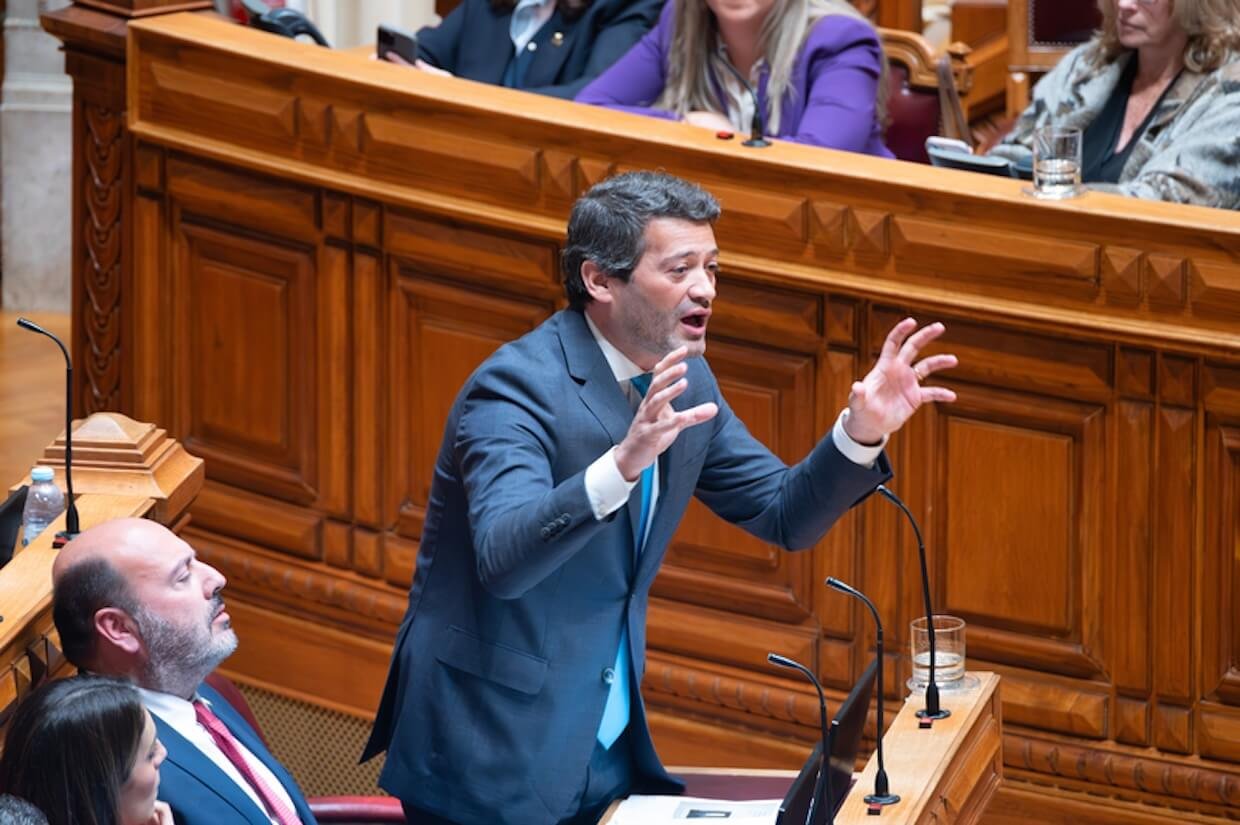
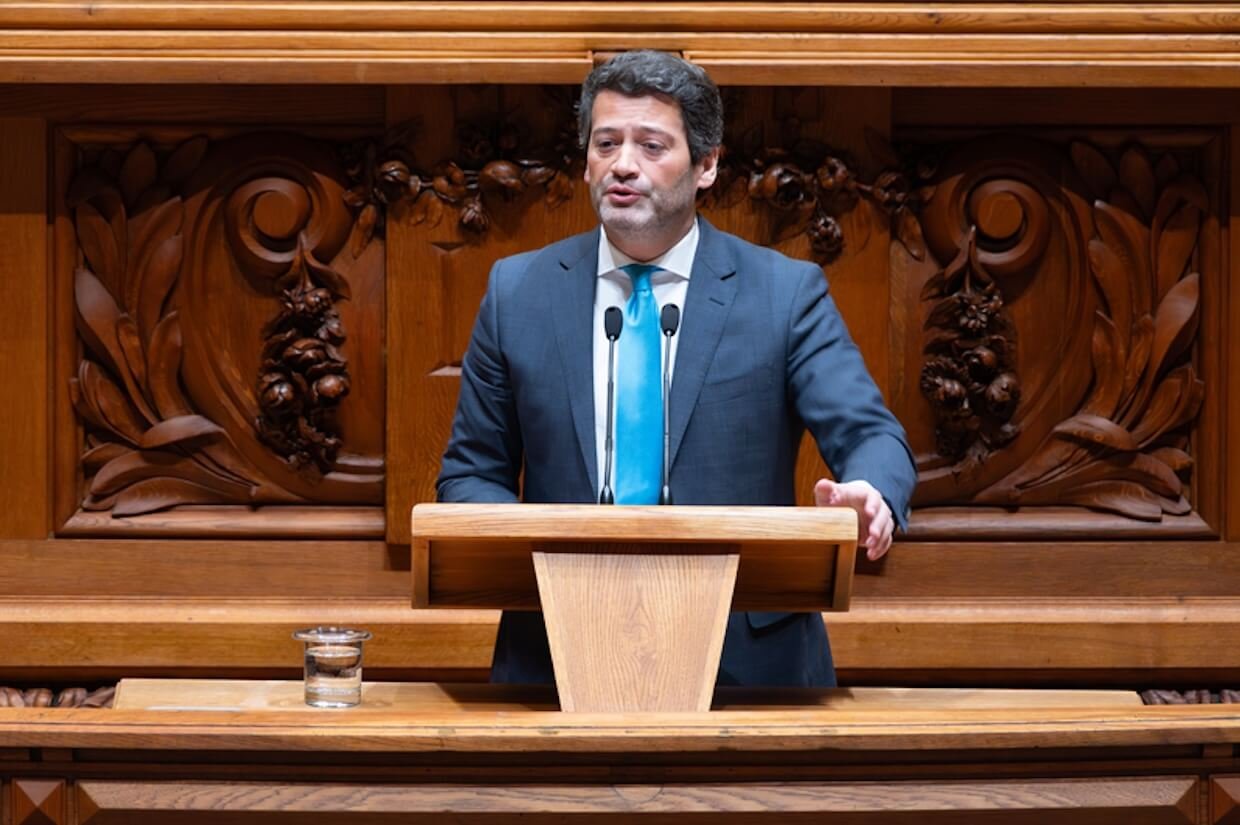
André Ventura of the Chega party speaking during the plenary session of the Portuguese Parliament debating the government’s motion of confidence, March 11, 2025.
Dr. Hugo Ferrinho Lopes, thank you very much for joining our interview series. Let me start right away with the first question: Ventura’s qualification for the presidential runoff marks an unprecedented moment for the Portuguese far right. How should we interpret his first-round performance in relation to the 2024 snap elections? Should it be understood as a continuation of party-system transformation toward polarized pluralism, or as a distinct presidential dynamic reshaping existing voter coalitions?
Dr. Hugo Ferrinho Lopes: Thank you very much for having me. I would argue that this development largely reflects the ongoing transformation of Portugal’s party system. Ventura’s presence in the runoff is less a sudden presidential earthquake than a clear manifestation of a party-system shift that has already been underway.
What I mean is that, one year earlier, in the general parliamentary elections, Chega’s legislative breakthrough signaled a departure from the traditional two-party system. In the first round of the 2026 presidential election, this shift was further reinforced by a coordination problem on the mainstream right. We witnessed several viable center-right and right-wing candidates competing simultaneously, which fragmented the vote and lowered the threshold for Chega to secure second place—an outcome that Ventura ultimately achieved.
In Sartorian terms, the longer-term trend in Portugal points to increasing fragmentation and growing ideological distance among the main parties and candidates. The distinct dynamics of presidential elections—shaped by personalization and strategic voting—are likely to accelerate a transformation that is already well underway in the Portuguese political system.
Why Declining Abstention Worked in Ventura’s Favor
The decline of abstention has been one of the most striking features of recent Portuguese elections. To what extent does the 2026 first round confirm your earlier finding that increases in turnout disproportionately benefit Chega, and what does this suggest about the political activation of previously disengaged voters?
Dr. Hugo Ferrinho Lopes: There are two main points I would like to emphasize here. First, the incumbent president, Marcelo Rebelo de Sousa, is constitutionally barred from running for a third term. In Portugal, when presidential elections take place without an incumbent seeking re-election, turnout tends to increase and abstention tends to decline, because the perceived odds of victory for competing candidates are higher. Historically, all Portuguese presidents who have run for a second term have been re-elected. From this perspective, it was expected that abstention would decrease in this election, at least in the first round.
Second, and more importantly, we know that turnout is closely related to voting for the far right in Portugal. In this election in particular, voting-intention data from public opinion polls show that Ventura had the most stable base of support. This means that he retained the largest share of voters who had previously voted for Chega in the legislative elections, compared to any other candidate.
By contrast, António José Seguro, who also advanced to the runoff, was less stable among socialist voters. Similarly, Luís Marques Mendes —supported and endorsed by the center-right PSD and CDS, the governing coalition—lost a significant number of votes from his party to other right-wing candidates.
As a result, we observed a first round in which Ventura amassed the largest number of votes from his own party relative to any other candidate. Other contenders not only needed to mobilize their core constituencies but also attempted to attract voters from different ideological camps. This proved far more difficult for them, and this dynamic is closely related to patterns of abstention.
Issue Ownership Opened the Door for Chega
Sign of the right-wing conservative political party Chega, led by André Ventura, in Faro, Portugal, March 16, 2023. Photo: Dreamstime.
In your work on the 2024 elections, you emphasize the “supply side” of party competition. Which supply-side factors—party fragmentation, leadership credibility, agenda ownership, or organizational reach—were most decisive in enabling Ventura’s advance to the runoff?
Dr. Hugo Ferrinho Lopes: That is a very interesting question. The first factor I would highlight is issue ownership. Applying a supply–demand logic to politics, Portugal experienced, for more than four decades, what is often described as “Portuguese exceptionalism” toward the far right: unlike in many other countries, the far right was unable to break through to Parliament. However, this situation left an opening on the supply side of party competition—particularly in the cultural and conservative dimension—for a new challenger party on the right to emerge.
For example, while the radical left in Portugal has been strong in Parliament for decades and has enjoyed stable representation—indeed, more than one radical left party has been represented—no radical right party managed to enter Parliament until 2019, with the emergence of André Ventura and Chega. Why did this happen?
First, it was due to this long-standing breach on the supply side of party competition. Second, it was related to leadership. André Ventura is an experienced politician who came from the PSD. He left the party following an internal split and benefited from extensive media coverage. Prior to founding Chega, he was a football commentator, which gave him a level of public visibility that previous far-right candidates had lacked.
There is also an additional institutional explanation. In the 2019 elections, the effective threshold of the electoral system was lower, making it easier for parties to enter Parliament with fewer votes than in previous elections. A recent example is LIVRE—a left libertarian party—which failed to enter Parliament in 2015 but secured one MP in 2019. Chega and the Liberal Initiative on the right similarly entered Parliament in 2019 with fewer votes than would have been required in earlier elections.
Once inside Parliament, the media coverage Ventura received and the institutional space to disseminate his message made further growth much easier in the years that followed.
The De Facto Cordon Sanitaire Around Chega
Election night event of the Democratic Alliance (AD)—a coalition of the Social Democratic Party (PSD) and the CDS–People’s Party—held at the Epic Sana Marquês Hotel, Lisbon, Portugal, on 18 May 2025. Photo: Ricardo Rocha.
Portugal’s presidential elections traditionally reward moderation and cross-party appeal. Does Ventura’s strong showing indicate a weakening of this logic, or has Chega successfully adapted its populist appeal to the presidential arena without fundamentally expanding its social base?
Dr. Hugo Ferrinho Lopes: Ventura’s presidential campaign is, in many ways, a continuation of the strategy he pursued in the parliamentary elections one year earlier. That said, presidential elections in Portugal have historically favored moderation and centrist candidates, and this pattern was still visible in the first round. If we look at the vote shares, candidates occupying moderate ideological positions collectively garnered far more support than Ventura. We are seeing a similar dynamic unfold in the runoff campaign.
Although we have only limited data so far, as the second-round campaign has just begun, most supporters of the eliminated candidates indicate that they are inclined to vote for Seguro rather than Ventura in the runoff. This reinforces my earlier point: Ventura’s support base is remarkably stable, with only marginal expansion beyond his core voters, while supporters of other candidates tend to coalesce around the alternative contender.
What does this imply? Essentially, Ventura is competing against himself, attempting to marginally expand his vote share, while all other candidates—now consolidated behind Seguro, who placed first in the opening round—are effectively competing against Ventura. In this sense, it becomes a contest of Ventura versus everyone else. This pattern aligns with findings in the literature on affective polarization, which show that the far right tends to be the primary target of hostility and negative affect, often to a greater extent than the hostility expressed by right-wing voters toward other parties. In practice, this amounts to a de facto cordon sanitaire around Chega in the second round.
Grievance, Not Poverty, Fuels Chega’s Regional Strength
Chega has performed particularly well in regions historically dominated by the center-right and, in some cases, the left. How do you assess the role of territorial grievance, regional economic restructuring, and perceived political neglect in shaping Ventura’s first-round electoral geography?
Dr. Hugo Ferrinho Lopes: That’s a very good question. Ventura’s electoral geography fits a broader European pattern. Places that feel bypassed by economic growth and unheard by the political center—namely Lisbon—tend to become more receptive to anti-establishment political entrepreneurs. Recent work on Portugal, for example a study by João Cancela and Pedro Magalhães links radical right support in these regions—often rural and formerly left-wing, even communist, strongholds—to perceived political neglect and broader economic transformations, rather than to a simple story of poverty.
What this suggests is that the key mechanism is often mediated: grievance, distrust, and resentment create openness to punitive, nativist, and anti-elite messaging, rather than voting behavior being driven solely by material hardship. In southern Portugal and in rural areas more broadly, voters are therefore more likely to support the radical right because they feel politically neglected and marginalized by decision-makers.
The Youth Gender Gap and Chega’s Electoral Future
Post-2024 analyses highlighted Chega’s disproportionate support among young, less-educated men and the emergence of a “modern gender gap.” How does the 2026 first-round vote confirm or complicate this sociological profile, and what does it imply for long-term ideological realignment?
Dr. Hugo Ferrinho Lopes: At this stage, we have very limited data from the first round, so any assessment must remain tentative. More robust evidence will emerge in the coming months. That said, existing data for Portugal point to a pronounced youth gender gap in far-right support, with young men far more likely than young women to back far-right parties—Chega in particular. This pattern is also consistent with trends observed across other European and Western democracies.
If this profile is reproduced in the second round of the 2026 presidential elections, it would suggest the presence of a pipeline for long-term ideological realignment. If, however, the pattern softens, it would indicate that Ventura’s presidential surge reflects coalition broadening rather than cohort deepening. Ultimately, more data will be needed to assess this dynamic conclusively.
Is Chega Still Expanding—or Hitting Its Limits?
Guarda, Portugal — June 12, 2018: The ancient Jewish quarter (Judiaria) of Guarda, Portugal, where residents live amid streets that retain much of their 14th-century character. Photo: Dreamstime.
Your research on party membership switching suggests that Chega mobilized “latent populists” rather than converting ideologically moderate voters. Does Ventura’s presidential performance suggest that this reservoir of latent support is still expanding, or are we approaching a ceiling effect?
Dr. Hugo Ferrinho Lopes: We may be approaching a ceiling effect, but it is still too early to tell. What we know so far relates to the supply-side dynamics I mentioned earlier. Many party members who were previously housed in other parties switched to Chega once a viable radical-right alternative became available. These were politically interested citizens who had already chosen to participate in politics through the options available to them at the time. When this new option emerged and became electorally viable—which is crucial—they felt able to switch to it.
That said, we do not yet know whether a ceiling effect has been reached, because this would require observing at least one election in which Chega or Ventura stops growing. At this stage, we cannot determine whether citizens’ preferences are stabilizing or continuing to shift over time.
What we do know, however, is that the far right has been increasingly successful in imposing its agenda on the media and on other political parties. These actors are now responding to the incentives set by the far right by prioritizing issues such as security and immigration. Immigration is a good example. For decades, Portugal stood out as one of—perhaps even the—European countries where the salience of immigration was lowest. In the standard Eurobarometer question asking citizens to name the three most important issues facing their country, immigration was frequently mentioned in most European democracies, but far less so in Portugal.
Although immigration remains less salient in Portugal than in many other countries, its importance has increased significantly over the past two years. This signals that Ventura and Chega have been able to place this issue firmly on the political agenda. We have also seen other parties responding to this rising salience, not only by positioning themselves against it, but also through concrete policy responses—for example, government legislation on the issue.
From Abstainers to the Right: A Narrow Path to Expansion
Chega’s rise has been driven largely by voters defecting from the mainstream center-right. How has this pattern shaped Ventura’s claim to leadership of the “non-socialist space” in the presidential election, and what limits does it impose on his runoff strategy?
Dr. Hugo Ferrinho Lopes: Ventura can plausibly claim that he represents the pole of the non-socialist electorate, but there are two important caveats. First, he draws more support from former abstainers than from the mainstream right, even though he does attract some voters from the PSD and CDS. Overall, however, his gains come primarily from previously disengaged voters rather than from direct transfers within the center-right.
Second, the runoff presents a different strategic context. In the second round, Ventura must rely on voters from parties that are unwilling to formally endorse him. A clear example is the PSD leadership, which refused to support either of the two candidates who advanced to the runoff. In this context, mobilizing center-right voters through individual-level choices rather than party-led coordination is far more difficult, creating a ceiling for Ventura’s expansion. Without elite cues and under greater public scrutiny, it becomes harder for Chega—and for Ventura in particular—to move beyond its core protest electorate.
Ventura the Brand, Chega the Machine
André Ventura of the Chega party speaks during a plenary session of the Portuguese Parliament debating the government’s motion of confidence in Lisbon, Portugal on March 11, 2025. Photo: Ricardo Rocha.
Presidential elections personalize politics more strongly than legislative contests. To what extent is Ventura’s success best explained by André Ventura as a political entrepreneur, rather than by Chega as a party organization?
Dr. Hugo Ferrinho Lopes: Ventura is clearly the brand; he is a political entrepreneur, as I have noted before. At the same time, Chega as a party has increasingly become the organizational machine that makes this brand effective. Ventura is electorally viable, and when he is not running, Chega’s results tend to be significantly lower than when he is on the ballot. Still, the party structure matters, and Chega now has a substantial grassroots base actively working on its behalf.
In presidential elections, voters tend to reward candidate-centered campaigns, making the contest highly personalized. In this respect, Ventura’s media skills are a clear asset. Yet Chega’s rise as a major political actor also signals growing organizational penetration and normalized visibility. What we are witnessing is a shift from an initial entrepreneurial breakthrough driven by Ventura toward a gradual—but increasingly solid—process of party institutionalization by Chega itself. This is an incremental development, not one that occurs overnight.
Authoritarian Appeals Mobilize Some—but Not Enough
Your findings indicate that Chega switchers often exhibit higher authoritarian attitudes than first-time party members. How might this shape Ventura’s rhetoric and positioning in a second-round contest that requires broader democratic legitimacy?
Dr. Hugo Ferrinho Lopes: First, my findings suggest that switchers resemble latent populists who were activated by the rise of Chega as a viable alternative. However, when we examine the data in more detail, we see that the higher levels of authoritarian values are driven mainly by former right-wing party members who switched to Chega.
What does this mean? It means that most of Chega’s base—around 74 percent—consists of first-time members who joined the party for a variety of reasons. In contrast, those coming from right-wing parties joined Chega primarily because they felt that the PSD and CDS no longer represented what they considered important in the sociocultural domain, particularly in terms of values and authoritarian preferences. As a result, these attitudes are not evenly distributed across Chega’s grassroots.
Second, in the context of the presidential runoff, Ventura needs to appeal to a much broader electorate. Relying solely on authoritarian and nativist appeals is therefore insufficient, as he must attract voters from the center-right. Voters who have not previously switched electorally to Chega are unlikely to do so based only on authoritarian cues. Consequently, Ventura needs to go beyond these appeals in the second round.
Anti-System Rhetoric Meets Institutional Trust
Some Chega supporters display relatively higher institutional trust than expected for a populist radical right electorate. How does this tension shape Chega’s “anti-system” discourse when competing for an institutionally symbolic office like the presidency?
Dr. Hugo Ferrinho Lopes: Chega’s base within the party generally distrusts politicians and political institutions. However, within its grassroots—at the level of party membership—those who switched from another party to Chega tend to display higher levels of institutional trust. This points to a legacy effect among those who were politically experienced prior to joining Chega, even though overall trust in institutions remains quite low. This suggests that many of these switchers moved to Chega primarily for ideological reasons, not solely because of institutional distrust or anti-elite sentiments. They are therefore mobilized more by ideological cues than by explicitly anti-system appeals.
This tension produces a dual message for the party. On the one hand, Chega needs to argue that the system is broken; on the other, it must present itself as capable of safeguarding the nation’s institutions. This balancing act is particularly difficult in presidential elections, given the debates surrounding the limits of presidential power and the Constitution—whether Ventura embraces those limits or seeks to revise them. Since the president does not hold executive power, the role is closer to that of a moderator. Ventura must therefore convince his electorate that he can still meaningfully influence policy despite not being part of the executive or the cabinet.
Between Containment and Accommodation
The refusal of the PSD to endorse a runoff candidate highlights elite fragmentation on the right. How does Ventura’s runoff presence recalibrate elite incentives around containment, tacit accommodation, or strategic neutrality?
Dr. Hugo Ferrinho Lopes: The PSD’s neutrality is a way of avoiding two risks at once: legitimizing Ventura on the one hand, and alienating voters who might defect if given explicit instructions on the other. In terms of party competition, this reflects a form of elite coordination failure with a strategic rationale. The party is attempting to contain Chega organizationally while allowing individual voters the space to vote strategically in the runoff.
Over time, this situation recalibrates elite incentives. Some elites double down on non-accommodation, while others experiment with selective or tacit accommodation toward Chega. Despite this, most PSD elites are, in practice, supporting Seguro against Ventura in the runoff.
Above all, the governing party is trying to avoid giving Ventura the opportunity to claim that it is aligned with the Socialists or the left, or to be accused of accommodating the left rather than the right. Nevertheless, the reality is that most governing party elites are backing Seguro against Ventura.
This stance is neither full strategic coordination nor outright accommodation; rather, it represents an attempt to occupy a middle ground. That strategy carries risks for PM Luís Montenegro and the governing party, because they do not want Ventura to secure even a single vote more than Chega obtained in the legislative elections. Otherwise, Ventura could claim—despite losing the presidential race—that he enjoys greater electoral legitimacy than the prime minister, on the grounds that more voters support him than the government. There is therefore a shadow form of strategic coordination aimed at preventing Ventura from achieving further electoral success.
Normalizing Chega at the Presidential Level
Photo: Tatiana Golmer.
Portugal’s semi-presidential system grants the president significant agenda-setting and veto powers. Even if Ventura is unlikely to win, how might his normalization as a runoff contender reshape expectations about presidential authority and democratic restraint?
Dr. Hugo Ferrinho Lopes: If Ventura loses the election, then there is no immediate risk. What it does is normalize the idea that a Chega-aligned presence in the presidential arena is thinkable, and it extends the party’s shadow over issues such as veto power, agenda-setting, and signaling—particularly through the president’s ability to publicly highlight certain issues as priorities when meeting weekly with the prime minister. International coverage of this election has often emphasized that the Portuguese presidency, despite frequently being described as largely ceremonial, still retains meaningful powers, including the veto and the dissolution of Parliament, which can be consequential under minority governments, such as the current one. However, with Ventura remaining outside the presidency, it is unlikely that expectations regarding presidential powers themselves—rather than government stability or future alternation in office—will change in any significant way.
An Uncertain Path for Portugal’s Radical Right
And finally, Professor Lopez, taken together—rising turnout, party-system fragmentation, youth realignment, and Chega’s organizational consolidation—what is your best scholarly prognosis for the populist radical right in Portugal? Are we witnessing a durable opposition hegemony, a future coalition actor, or the gradual construction of governing viability?
Dr. Hugo Ferrinho Lopes: That is a very good question, and one to which I do not have a clear answer—both in the absence of a crystal ball and because current government signals point in different directions. The government has been pursuing piecemeal deals with both the Socialists and the radical right to pass legislation, while the opposition often coordinates to block the government, including cooperation between the Socialists and the far right. As a result, the situation remains difficult to assess.
That said, as long as Luís Montenegro remains the leader of the PSD, the party is unlikely to enter a coalition with the radical right or include it in government. However, if Ventura were to win an election at some point, Montenegro would likely resign as PSD leader, and it is unclear who would succeed him or what strategy a new leader would adopt—whether a German-style cordon sanitaire or a path toward accommodation or coalition-building with the far right.
At this stage, the trajectory remains highly unpredictable. I realize this may not be the definitive answer you were hoping for, but it is the most accurate one that can be offered at present.
From Pax Americana to Pax Silica, US grand strategy is undergoing a quiet but consequential transformation. In this timely commentary, Dr. Prerna Chahar argues that recent US security documents—the 2025 National Security Strategy and the 2026 National Defense Authorization Act—signal a shift away from global stewardship toward a selective, technology-centered, and leverage-driven order. Rather than underwriting international rules and alliances, Washington is increasingly exercising power through control over strategic technologies, supply chains, and infrastructural chokepoints—a model Dr. Chahar conceptualizes as Pax Silica. This reorientation prioritizes hemispheric consolidation, technological dominance, and transactional partnerships over normative leadership. For partners such as India, the implications are profound: engagement remains valuable but conditional, reinforcing the logic of strategic autonomy, calibrated cooperation, and multi-alignment in a fragmented global order.
By Prerna Chahar*
What is unfolding in US security policy is neither isolationism nor traditional internationalism, but a selective strategy centered on leverage, technology, and regional primacy. American grand strategy is undergoing a quiet yet consequential transformation one that redefines how power is exercised, how partnerships are valued, and how international order is sustained. Recent US strategic documents, the National Security Strategy (NSS), and the National Defense Authorization Act (NDAA) point to a decisive shift away from managing global order toward consolidating national advantage, with far-reaching implications for allies and partners.
The National Security Strategy (NSS), published on December 4, 2025, and the National Defense Authorization Act (NDAA) for Fiscal Year 2026, signed into law on December 18, 2025, together confirm that the era of Pax Americana characterized by institutional stewardship, alliance management, and normative leadership is giving way to a more selective, technology-centered, and transactional order. This emerging configuration may be described as Pax Silica: an order grounded less in alliances and rules and more in control over technology, supply chains, and strategic chokepoints.
NSS and NDAA: Reframing US Grand Strategy
The framing of the NSS 2025 itself signals a deliberate break from earlier approaches to American grand strategy. Four recurring themes encapsulate this reorientation.
First, the strategy explicitly rejects “old policies,” portraying past commitments to liberal internationalism, open-ended multilateralism, and interventionism as having diluted US sovereignty, weakened economic resilience, and overstretched strategic focus. This narrative of rupture legitimizes a more restrained and interest-driven approach to global engagement.
Second, the NSS defines what America wants with unusual clarity. Rather than emphasizing the maintenance of international order, it articulates bounded national priorities border security, economic nationalism, technological dominance, and hemispheric stability. Global leadership is no longer treated as an intrinsic responsibility but as a derivative of clearly specified national interests.
Third, both the NSS and the NDAA foreground American strength in material rather than normative terms. The NDAA 2026 authorizes over $900 billion in national defense funding, making it one of the largest defense policy bills in recent history. This level of spending underscores a sustained emphasis on military readiness, industrial capacity, and technological superiority. Military capability, innovation ecosystems, industrial depth, and technological leadership take precedence over values-based diplomacy, institutional rule-making, or normative influence.
The NDAA further operationalizes this shift through enhanced cybersecurity authorities, frameworks for the secure development and deployment of artificial intelligence and machine-learning systems and strengthened protections for US Cyber Command and digital infrastructure. It also expands authorities related to airspace security and counter-unmanned aerial systems under provisions such as the Safer Skies Act broadening civil and federal counter-drone capabilities. Together, these measures reflect the logic of Pax Silica, in which control over technology and infrastructure replaces institutional stewardship as the primary currency of influence.
Fourth, the NSS report clarifies the renewed strategic focus on the Western Hemisphere. While global competition remains important, the strategy prioritizes hemispheric stability, border control, migration management, and economic dominance within the Americas. This represents a modernized revival of Monroe Doctrine logic, where securing influence in the immediate neighborhood is treated as foundational to national security. Engagement beyond the hemisphere is increasingly selective and interest-driven, filtered through considerations of domestic security, economic resilience, and technological advantage rather than assumptions of automatic leadership. The NDAA reinforces this orientation by prioritizing resources for homeland protection, maritime domain awareness in the Atlantic and Caribbean, and defense readiness tied to territorial security. Together, these documents signal a shift from global managerial ambitions toward consolidation of power closer to home.
Taken collectively, these elements reflect a fundamental strategic reorientation. Rather than presenting the United States as the custodian of international order, the NSS positions it as a state intent on consolidating advantage, preserving autonomy, and exercising leverage. This underscores the durability of what may be termed the Trump Corollary: the notion that alliances, institutions, and global engagements are instruments to be justified by tangible returns rather than commitments sustained for systemic stability or normative leadership.
US ‘Pax Silica’: Renewed Instrument of Power
Within this hemispheric and technological reorientation, Pax Silica captures the defining feature of the emerging order: power exercised through technological and infrastructural dominance rather than institutional rule-making. Semiconductors, artificial intelligence, critical minerals, digital platforms, and financial networks now constitute the backbone of strategic competition. Control over access to these systems enables coercion and influence without overt force.
Edward Fishman, in his book Chokepoints: American Power in the Age of Economic Warfare, demonstrates how American power increasingly operates through the regulation of markets, technology flows, and supply chains, an approach clearly visible in export controls, investment screening, and technology-denial regimes embedded in both the NSS and the NDAA. Unlike Pax Americana, which relied on openness, predictability, and alliance cohesion, Pax Silica is exclusionary and conditional. Cooperation is granted rather than guaranteed; access replaces inclusion as the principal mechanism of influence.
The most consequential aspect of this transition is the decoupling of power from stewardship. The United States remains pre-eminent, but it no longer seeks to underwrite global order as a public good. Instead, it prioritizes regional consolidation, technological control, and transactional leverage. This is not withdrawal, but re-hierarchization: the Western Hemisphere first, strategic technologies second, and global commitments contingent on domestic advantage.
Implications for India
The renewed US focus on the Western Hemisphere carries important implications for India. While the Indo-Pacific remains relevant, it is no longer the singular organizing theatre of US grand strategy. Engagement in Asia is increasingly shaped by cost-benefit calculations and capability contributions rather than long-term commitments to regional order. For India, this creates both opportunity and uncertainty. Reduced ideological pressure allows greater strategic autonomy, but transactional partnerships demand constant negotiation. Cooperation in defense, technology, and supply-chain resilience particularly in semiconductors and critical technologies remains valuable yet inherently conditional. India’s participation in groupings such as the Quad must therefore be understood as calibrated engagement rather than alignment, reinforcing the logic of multi-alignment and diversification.
Conclusion
The shift from Pax Americana to Pax Silica reflects a profound transformation in US statecraft. The renewed focus on the Western Hemisphere, combined with technological competition and transactional diplomacy, marks a move away from global stewardship toward selective, leverage-based power. For partners such as India, the challenge is to engage without illusion cooperating where interests converge, hedging where vulnerabilities emerge, and sustaining strategic autonomy in a world where leadership is fragmented and power is increasingly exercised through control rather than consensus.
(*) Dr. Prerna Chahar is a scholar of International Relations with published research on US foreign policy in the Indo-Pacific, regional coalition-building, and India’s foreign policy. She holds a Ph.D. in International Relations from the Centre for the Study of the Americas (CCUS&LAS), School of International Studies, Jawaharlal Nehru University, New Delhi, India.
Davos 2026 revealed a global order no longer converging on a single liberal model, but sliding into a harsher era in which power increasingly outweighs rules and “integration” is reframed as vulnerability. The most striking paradox was that this diagnosis came not from critics at the margins, but from the system’s own architects—transforming elite “candor” into a strategy for managing declining legitimacy. In a world shaped by fragmentation and coercive interdependence, China’s state-capitalist model is increasingly perceived as a more effective crisis-response framework, while the United States and Europe drift toward a troubling hybrid: adopting not China’s developmental strengths, but its coercive instruments of control. This dynamic reflects an emerging logic of reverse convergence—the West is no longer guiding the world toward liberalism, but being pulled toward the governance style of its principal rival.
The Davos platform can be seen as a stage where dominant actors test narratives, identify legitimacy losses, and modify the public vocabulary they use to govern (or justify governing). It rarely makes formal decisions; instead, it indicates what elites believe they can still publicly defend—and what they can no longer convincingly pretend. Davos 2026, in that sense, can be viewed less as a policy summit and more as a diagnosis of the regime.
In this context, Davos 2026 is significant because the words spoken inside the room seemed less like a reaffirmation of the post-1990 liberal-global order and more like an early draft of its obituary. Larry Fink, Interim Co-Chair of the World Economic Forum (WEF) and CEO of BlackRock—one of the world’s largest asset managers—started with a blunt admission that the world trusts Davos and the WEF’s ability to shape the future “far less,” warning that the forum risks seeming “out of step with the moment: elites in an age of populism” (Fink, 2026). Mark Carney, Prime Minister of Canada, took it even further. He suggested that the problem isn’t just declining trust in institutions; it’s the collapse of the narrative foundations of the “rules-based liberal multilateral order” itself. He described “the end of a pleasant fiction… and the beginning of a harsh reality,” emphasizing that “we are in the midst of a rupture, not a transition” (Carney, 2026).
If anything was “announced,” then it was not a new treaty or a coordinated policy package. It was an elite confession: the old legitimating story no longer works.
What Exactly Is Ending?
The natural questions—What was declared at Davos? Is it the end of the Western system? Is Chinese-style state capitalism rising? —are the right ones. But they require careful separation of the West as power from the West as ideology, and of neoliberal globalization from liberal democracy. What seems to be ending is not “the West” as a geographical or civilizational fact, but a historically specific settlement—visible in three interlocking dimensions.
The end of the convergence myth:One part of the story traces back to assumptions about nineteenth- and twentieth-century modernization. Classical modernization thinking regarded history as a linear, stage-like process where societies would converge toward a single “advanced” model through diffusion, emulation, and integration—so that cross-civilizational differences would eventually appear as “time lags,” not alternative paths (Apter, 1965; Inglehart & Welzel, 2005; Rostow, 1960). In that framework, modernity was not just one option among many; it was seen as the expected endpoint of development.
Francis Fukuyama’s “end of history” thesis—initially presented as an essay and later expanded into a book—was a late-twentieth-century extension of this modernization perspective (Fukuyama, 1989, 1992). After the fall of Soviet-style planning, liberal capitalism seemed not just victorious but final: no significant systemic challengers remained, and future conflicts were seen as minor issues rather than real alternatives.
Davos 2026, however, seemed to quietly acknowledge that this convergence theory has run its course. After decades of “learning-by-doing” globalization, the idea that marketization, integration, and digitization would inevitably lead to liberal-democratic outcomes has become less convincing. Among many others, Öztürk (2025) calls this a fundamental “liberal fallacy,” revealed by post-2008 stagnation, growing inequality, and the resilience of authoritarian governance under capitalist conditions.
The decline of the authority of the “rules-based order” (as performance):A second aspect involves the public authority of institutional rules. Carney’s remarks illustrated a familiar phenomenon: states show belief in a rules-based order—displaying the “sign” publicly—while privately recognizing how often the rules break down in practice (Carney, 2026). His metaphor strongly mirrors Václav Havel’s assessment of late-socialist legitimacy: the system’s survival relied on ritualistic compliance and public participation in an official fiction, even when no one truly believed it (Havel, 1978).
In modern global politics, this is the credibility crisis of liberal internationalism: the rules exist, but enforcement seems selective; the universal language stays, but power distribution shapes outcomes. This is exactly where realism comes back—sometimes openly, sometimes disguised as “values-based pragmatism.”
The end of elite capitalism’s moral economy:Third, Davos 2026 hosted a legitimacy check on elite-led capitalism itself. Fink’s insistence that prosperity cannot be reduced to total GDP gains or stock-market success implicitly admits what critics have argued for decades: growth narratives do not automatically generate social approval when the distribution of wealth is unfair, public services decline, and opportunities disappear (Fink, 2026; Piketty, 2020).
This line closely mirrors Robert F. Kennedy’s well-known critique of national income accounting, asserting that GDP can measure “everything… except that which makes life worthwhile” (Kennedy, 1968). What once seemed like fresh wisdom at Davos in 2026 now appears as delayed recognition: a long-overdue admission that the legitimacy of capitalism cannot rely solely on aggregate indicators. Taken together, these three dimensions do not imply “the end of the West.” They signify the end of the West’s story about itself—the self-description of a system that universalizes its model as destiny, naturalizes its institutions as neutral rules, and considers legitimacy to be the automatic result of growth. Historically, when a hegemonic story collapses, systems rarely vanish overnight; instead, they change and adapt.
The Crisis of Corporate Capitalism as a Reflection of the System
Öztürk’s (2025) “reverse convergence” hypothesis provides one of the clearest ways to interpret Davos 2026. It avoids two lazy conclusions— (1) “China is replacing the West,” and (2) “nothing changes; it’s only noise”—by arguing that the direction of convergence has reversed. Liberal democracies are increasingly adopting illiberal governance techniques (expanded surveillance, executive discretion, securitized policy frames, controlled pluralism), while authoritarian regimes are adopting capitalist tools (market mechanisms, technological dynamism, corporate scale) without liberalizing. This is not ideological convergence through persuasion. It is functional convergence driven by systemic pressure.
Here, Karl Polanyi’s concept of the “double movement” becomes central: disembedded markets cause social division and political backlash, but the protective countermovement can be seized—redirected into nationalist, exclusionary, or authoritarian forms instead of democratic re-embedding (Polanyi, 1944). Fernand Braudel’s distinction is also important: capitalism is not the same as competitive markets; it is often a structure of lasting domination shielded from democratic accountability (Braudel, 1982, 1984).
Add the modern layer of digital political economy. The tools of governance increasingly function through infrastructures of data extraction, algorithmic control, and dependency rather than through persuasion or consent. This is the shared domain of surveillance capitalism (Zuboff, 2019), vectoral power and information monopolies (Wark, 2004, 2019), and “techno-feudal” rent extraction via digital platforms and cloud infrastructures (Varoufakis, 2023). In this view, Davos 2026 was not just a geopolitical event; it also revealed that corporate capitalism has created a legitimacy gap that traditional liberal narratives can no longer fill.
When Fink’s speech is analyzed through the perspectives of Polanyi and Braudel, it seems to outline a plan to restore legitimacy. He urged the WEF to “regain trust,” boost participation, and modernize the language used to defend capitalism (Fink, 2026). Even if the diagnosis is sound, the messenger presents a problem. The contradiction is structural: the credibility crisis he describes is closely linked to the financial and corporate structures that BlackRock represents. When the “doctor” is also one of the system’s most powerful beneficiaries, criticism is often seen as mere damage control by elites rather than genuine reformist bravery.
Fink also emphasized that prosperity must become distributive, turning “more people into owners of growth,” not spectators (Fink, 2026). Yet this is where Davos rhetoric regularly stalls: it acknowledges the legitimacy problem but often proposes solutions at the level of communication rather than at the level of reconstruction. The 2026 shift, then, is not the defense of globalization’s moral premise; it is an attempt to rewrite capitalism’s legitimacy contract amid mass distrust.
A key concern running through the Davos discussions about AI is anxiety. The worry is that AI will repeat the distributional betrayal of globalization: early benefits go to owners of data, compute, models, and platforms, while the social costs are spread out to others. Without strong redistribution and governance, AI risks being less of a productivity leap and more of a new enclosure system—worsening dependence instead of expanding opportunities (Zuboff, 2019; Varoufakis, 2023).
From Benign Interdependence to Fortress Logic
Carney’s intervention was more impactful because it explicitly addressed what “trust” rhetoric often overlooks: the geopolitical and geoeconomic rupture of the rules-based order. His speech repeatedly suggested that the liberal promise of mutual interdependence has run its course. Integration can become a source of vulnerability and subjugation, leading states to pursue strategic autonomy in energy, food, critical minerals, finance, and supply chains (Carney, 2026).
At one point, Carney invoked a brutally realistic moral: “the strong can do what they can, and the weak suffer what they must.” The phrase echoes the Melian Dialogue in Thucydides—a canonical statement of power politics rationality (Thucydides, trans. 1972). The significance is not the originality of the reference; it is that Davos discourse now treats such realism as publicly speakable.
This is where “weaponized interdependence” becomes relevant: network power can be transformed into coercion when states or firms control critical chokepoints in finance, infrastructure, trade, and digital platforms (Farrell & Newman, 2019). Carney’s prescription—strategic autonomy or a “world of fortresses”—is therefore less a nationalist shift than an acknowledgment that global integration is no longer seen as harmless.
Seen from the broader perspective of globalization discourse, Davos 2026 signifies a significant reversal of the assumptions that characterized the early 2000s. Thomas Friedman’s The World Is Flatsummarized the era’s belief that digital connectivity and integrated supply chains were “flattening” the world into a more open, opportunity-filled, and ultimately convergent space (Friedman, 2005). Two decades later, David J. Lynch’s The World’s Worst Betreads like an obituary for that optimism: globalization now seems less like a benign force for shared prosperity and more like a risky gamble that has weakened industrial resilience, increased inequality, empowered strategic competitors, and fueled political backlash in the West (Lynch, 2025). The transition from “flatness” to “worst bet” reflects the same shift Carney now describes in geopolitical terms: integration is no longer assumed to be mutually beneficial; it is increasingly viewed as a potential pathway to dependence, coercion, and subjugation (Carney, 2026; Friedman, 2005; Lynch, 2025).
This closely aligns with Amitav Acharya’s argument that the liberal “rules-based order” was never entirely universal; it functioned as a Western-centered system with selective membership and inconsistent enforcement. What follows, according to Acharya, is not just “multipolarity,” but a decentralized “multiplex” world—more diverse, more contested, and less controlled by a single hegemon (Acharya, 2017; Acharya, 2018). Even defenders sympathetic to the liberal order acknowledge its historically Western core and its expansion after the Cold War (Ikenberry, 2008, 2018).
Davos 2026, therefore, seemed like a moment when elites started speaking more openly than before about a world they can no longer describe as heading toward a single institutional model. However, there is a deeper contradiction at Davos: many of the harshest critiques in 2026 were made not by independent critics but by the system’s own architects—CEOs, senior officials, and high-level political leaders. This doesn’t invalidate their diagnosis, but it should change how we interpret it: what looks like honesty may also be a form of preemptive storytelling, a controlled version of systemic self-criticism aimed at maintaining core power structures while giving rhetorical ground.
The US–EU–China Triangle: Three Paths, One Convergent Pressure
Against this backdrop, the question facing mainstream systems is no longer just whether globalization can be “fixed,” but which governance model is increasingly seen as the better response to a high-stress world full of uncertainty, fragmentation, and coercive interdependence. Under conditions of heightened geopolitical competition, supply-chain insecurity, volatility in energy and food, and rapid technological rivalry, the focus is quietly shifting toward the idea that China’s model—often called socialist state capitalism—may provide faster, more disciplined, and more strategically coordinated solutions than the liberal market approach, mainly because it can mobilize resources, direct finance, and prioritize long-term national goals. In this context, Davos 2026 didn’t just expose a legitimacy crisis; it also pointed to a growing competition over “effective modernity,” where resilience and the ability to command are beginning to matter more than openness and procedural legitimacy.
Indeed, an even more concerning sign is emerging from within the West itself: leading trends in the United States and the European Union increasingly indicate that what they are taking from China is not its potentially positive strengths—such as developmental coordination or strategic industrial policy—but rather its negative governance traits: securitization, surveillance expansion, executive centralization, and the normalization of emergency-style rule. This creates a growing zone of hybridization, where liberal democracies preserve electoral rituals while gradually adopting illiberal techniques of control and exclusion. In other words, the West seems to be entering a phase of reverse convergence—a process where the “center” shifts toward the logic of its challenger, often in its most coercive forms—a dynamic that I will explore in detail.
Öztürk’s (2025) structured comparison across five dimensions—surveillance regimes, populist discourse, regulatory architecture, market concentration, and distributional outcomes—acts like a decoder for Davos 2026. It does not claim that the US, EU, and China are becoming identical. Instead, it argues that all three are responding to the same structural pressures—tech-driven control, oligopolistic concentration, legitimacy erosion—while doing so through different institutional legacies.
China’s large-scale integration of state and capitalshows that advanced capitalism can exist without liberal democracy. It combines market activity and corporate growth within one-party control, increasingly extending worldwide through infrastructure, standards, and digital systems (Callahan, 2016; Creemers, 2018; Dai, 2020). Its governance tools—such as data-driven monitoring, biometric systems, and ideological control of platforms—provide an attractive model for regimes dealing with insecurity and social unrest, even though it also poses legitimacy challenges (Greitens, 2020).
The United States’ hybrid driftshows how liberal democracy can weaken internally due to inequality, institutional capture, and polarization, especially after the 2008 crisis delegitimized traditional economic promises and heightened distrust between elites and the public (Öztürk, 2025). Illiberal populism has proved to be a resilient narrative ecosystem (Levitsky & Ziblatt, 2018; Mounk, 2018). Meanwhile, corporate surveillance and algorithmic governance operate alongside expanding security measures, leading to convergence driven by technique rather than ideology (Zuboff, 2019).
The European Union’s regulatory ambition, even under legitimacy stress,stands as the strongest counterexample to simple convergence claims because it has built the most ambitious rights-based regulatory framework in the democratic world, especially in the digital area (Floridi, 2020; Véliz, 2021). However, it remains vulnerable to legitimacy stress: far-right normalization, internal rule-of-law conflicts, uneven fiscal capacity, and ongoing reliance on US platform power. Regulation can limit domination, but legitimacy ultimately depends on distributive foundations—not just technocracy (Brown, 2019; Piketty, 2020).
If one sentence embodies the West’s strategic trauma, it is this: China demonstrates that sophisticated capitalism can operate without liberal democracy—and at scale. The Davos concern is not just that China competes, but that China’s model is increasingly serving as a reference point for organizing power in the twenty-first century (Öztürk, 2025).
The Hidden Davos Declaration
If we summarize Davos 2026 into a single implicit statement, it is: The global order based on rules-based multilateralism, benign interdependence, and trickle-down legitimacy has reached a final crisis. What comes next is probably going to be centered around: i) strategic autonomy (energy, supply chains, critical minerals, digital sovereignty) (Carney, 2026), ii) narrative legitimacy repair (“inclusive prosperity,” participation, trust) (Fink, 2026). iii)technological control architectures (AI governance, surveillance trade-offs, platform regulation conflict) (Zuboff, 2019; Varoufakis, 2023), and iv)a reduced faith in universalism, and a greater acceptance of bloc rivalry, vulnerability management, and “value-based realism” (Acharya, 2017; Ikenberry, 2018).
This is why Davos 2026 felt like a turning point: elites are no longer pretending we still live in the 1990s. But the new order being outlined is not automatically democratic. It can just as easily shift toward market authoritarianism—combining capital preservation with control-first governance. A democratic solution is still conceptually possible: re-embedding markets in democratic institutions (Polanyi, 1944), rebuilding a distributive social contract (Piketty, 2020), and limiting both corporate and government power through enforceable rights (Floridi, 2020; Véliz, 2021). Davos 2026, however, raises a brutally practical question:Can democracies re-legitimate themselves quickly enough before surveillance, AI, and strategic autonomy become permanent justifications for executive insulation?
That question, more than any speech, was the true “announcement.”
References
Acharya, A. (2017). After liberal hegemony: The advent of a multiplex world order. Ethics & International Affairs, 31(3), 271–285. (Cambridge University Press & Assessment)
Acharya, A. (2018). The end of American world order (2nd ed.). Polity. (Wiley)
Apter, D. E. (1965). The politics of modernization. University of Chicago Press.
Braudel, F. (1982). The wheels of commerce (Vol. 2). Harper & Row.
Braudel, F. (1984). Civilization and capitalism, 15th–18th century: Volume 2—The wheels of commerce (S. Reynolds, Trans.). Harper & Row.
Brown, W. (2019). In the ruins of neoliberalism: The rise of antidemocratic politics in the West. Columbia University Press. (Columbia University Press).
Callahan, W. A. (2016). China dreams: 20 visions of the future. Oxford University Press.
Carney, M. (2026, January). Special address by Mark Carney, Prime Minister of Canada, at the World Economic Forum Annual Meeting (Davos 2026). World Economic Forum.
Creemers, R. (2018). China’s social credit system: An evolving practice of control. SSRN.
Dai, X. (2020). Enacting the social credit system: Governance through digital trust in China. Media, Culture & Society, 42(3), 408–423.
Farrell, H., & Newman, A. L. (2019). Weaponized interdependence: How global economic networks shape state coercion. International Security, 44(1), 42–79.
Fink, L. (2026). Remarks as Interim Co-Chair of the World Economic Forum at the 2026 Annual Meeting in Davos. LinkedIn.
Floridi, L. (2020). The fight for digital sovereignty: What it is, and why it matters, especially for the EU. Philosophy & Technology, 33(3), 369–378.
Friedman, T. L. (2005). The world is flat: A brief history of the twenty-first century. Farrar, Straus and Giroux.
Fukuyama, F. (1989). The end of history? The National Interest, 16, 3–18.
Fukuyama, F. (1992). The end of history and the last man. Free Press.
Greitens, S. C. (2020). Dealing with demands for surveillance. Journal of Democracy, 31(3), 15–29.
Havel, V. (1978). The power of the powerless. (Essay; English trans. published 1985).
Ikenberry, G. J. (2008). The rise of China and the future of the West: Can the liberal system survive? Foreign Affairs, 87(1), 23–37.
Ikenberry, G. J. (2018). The end of liberal international order? International Affairs, 94(1), 7–23.
Inglehart, R., & Welzel, C. (2005). Modernization, cultural change, and democracy: The human development sequence. Cambridge University Press.
Kennedy, R. F. (1968, March 18). Remarks at the University of Kansas. John F. Kennedy Presidential Library and Museum, (jfklibrary.org).
Levitsky, S., & Ziblatt, D. (2018). How democracies die. Crown.
Lynch, D. J. (2025). The world’s worst bet: How the globalization gamble went wrong (and what would make it right). PublicAffairs.
Mounk, Y. (2018). The people vs. democracy: Why our freedom is in danger and how to save it. Harvard University Press.
Ozturk, Ibrahim. (2025). “Capitalist Disruptions and the Democratic Retreat: A US–EU–China Comparison.” Journal of Populism Studies (JPS). September 11, 2025. https://doi.org/10.55271/JPS000116
Piketty, T. (2020). Capital and ideology. Harvard University Press.
Polanyi, K. (1944). The great transformation: The political and economic origins of our time. Beacon Press.
Thucydides. (1972). The Peloponnesian War (R. Warner, Trans.). Penguin Classics.
Varoufakis, Y. (2023). Technofeudalism: What killed capitalism. Bodley Head.
Véliz, C. (2021). Privacy is power: Why and how you should take back control of your data. Bantam.
Wark, M. (2004). A hacker manifesto. Harvard University Press.
Wark, M. (2019). Capital is dead: Is this something worse? Verso. (Verso)
Zuboff, S. (2019). The age of surveillance capitalism: The fight for a human future at the new frontier of power. PublicAffairs.
ECPS convened Session 10 of its Virtual Workshop Series, bringing together scholars to examine how democracies endure, adapt, and contest authoritarian pressures amid the normalization of populist discourse and the weakening of liberal-constitutional safeguards. Chaired by Dr. Amedeo Varriale, the session framed resilience as an active democratic project—defending rule of law, pluralism, and civic participation against gradual forms of authoritarian hollowing-out. Presentations by Dr. Peter Rogers, Dr. Pierre Camus, Dr. Soheila Shahriari, and Ecem Nazlı Üçok explored resilience across market democracies, local governance, feminist self-administration in Rojava, and diaspora activism confronting anti-gender politics. Discussants Dr. Gwenaëlle Bauvois and Dr. Gabriel Bayarri Toscano connected these contributions through probing questions on the ambivalence, burdens, and transformative potential of resilience.
Reported by ECPS Staff
On Thursday, January 22, 2026, the European Center for Populism Studies (ECPS) convened Session 10 of its Virtual Workshop Series, titled “We, the People” and the Future of Democracy: Interdisciplinary Approaches. Held under the theme “Resisting the Decline: Democratic Resilience in Authoritarian Times,” the session brought together an interdisciplinary group of scholars to examine how democratic systems, institutions, and civic actors seek to withstand—and, at times, transform—the pressures generated by authoritarian resurgence, the normalization of populist discourse, and the erosion of liberal-constitutional guarantees across diverse political contexts.
The workshop opened with welcoming remarks by ECPS’s Reka Koleszar, who introduced the session’s theme, outlined the format, and presented the contributing scholars and discussants. Her opening situated Session 10 within ECPS’s broader intellectual agenda: advancing comparative, theory-informed, and empirically grounded research on populism and its implications for democratic governance, civic space, and rights-based politics.
The session was chaired by Dr. Amedeo Varriale (PhD, University of East London), whose framing remarks offered a synthetic lens for the panel. Drawing attention to the contemporary “populist zeitgeist,” Dr. Varriale underscored how authoritarianism increasingly advances not merely through abrupt ruptures, but through gradual practices that hollow out democratic norms while preserving formal institutional shells. Against this backdrop, he proposed democratic resilience as an active project: the defense of rule of law, pluralism, and rights through institutions and civic participation, as well as the re-engagement of citizens whose disillusionment can become a resource for anti-democratic entrepreneurs.
Four presentations explored resilience across distinct but connected domains. Dr. Peter Rogers (Senior Lecturer in Sociology, Macquarie University) delivered “Resilience in Market Democracy,” interrogating resilience as a traveling concept shaped by market logics, welfare-state capacities, and shifting moral expectations of citizenship. Dr. Pierre Camus (Postdoctoral Fellow, Nantes University) presented “The Contradictory Challenges of Training Local Elected Officials for the Future of Democracy,” analyzing how professionalization and training—often justified as democratizing—can also reproduce inequalities and widen the distance between representatives and citizens. Turning to conflict and non-state governance, Dr. Soheila Shahriari (EHESS) offered “The Rise of Women-Led Radical Democracy in Rojava,”examining feminist self-administration as civil-society resilience amid regional authoritarianism and geopolitical exclusion. Finally, Ecem Nazlı Üçok (PhD Candidate, Charles University) presented “Feminist Diaspora Activism from Poland and Turkey,” conceptualizing exile-based feminist organizing as a site of transnational resistance to anti-gender politics and authoritarian repression.
Discussion was enriched by two discussants: Dr. Gwenaëlle Bauvois (University of Helsinki) and Dr. Gabriel Bayarri Toscano (Rey Juan Carlos University), whose interventions connected the papers through shared questions about the ambivalence of resilience, the distribution of democratic burdens, and the conditions under which resilience becomes transformative rather than merely adaptive.
In this in-depth ECPS interview, Professor António Costa Pinto—one of Europe’s leading scholars of authoritarianism—offers a historically grounded analysis of Chega’s meteoric rise and André Ventura’s advance to the second round of Portugal’s 2026 presidential election. Far from an electoral accident, Professor Costa Pinto situates Chega’s breakthrough within long-standing structural conditions, recurrent political crises, and the fragmentation of the center-right. He traces how Ventura mobilizes authoritarian legacies of “law and order,” welfare chauvinism, and anti-elite resentment without openly rehabilitating Salazarism. Immigration, demographic change, and plebiscitary populism emerge as key drivers of Chega’s success. Crucially, Professor Costa Pinto argues that Orbán’s Hungary—not Trump or Bolsonaro—serves as Ventura’s primary model, raising urgent questions about democratic resilience in Portugal as uncertainty on the right deepens.
In this in-depth interview with the European Center for Populism Studies (ECPS), Professor António Costa Pinto—Research Professor (ret.) at the Institute of Social Sciences, University of Lisbon, and a leading authority on authoritarianism and the radical right—offers a historically grounded analysis of the unprecedented rise of Chega and its leader, André Ventura. The discussion is anchored in a critical political moment: Ventura’s advance to the second round of the 2026 presidential election, which Professor Costa Pinto describes as neither a mere accident nor a sudden rupture, but the product of deeper transformations within Portuguese democracy.
As Professor Costa Pinto explains, Chega’s breakthrough cannot be understood as an isolated electoral shock. “The Chega Party and André Ventura have, in a way, a short history in Portuguese democracy,” he notes, “but over the last four years, the party has gone from one MP and 1.5 percent to 23 percent.” This rapid ascent, he argues, reflects the convergence of long-standing structural conditions—most notably the persistence of conservative authoritarian values in Portuguese society—with a series of destabilizing political crises that created what he calls “populist junctures.”
A central theme of the interview is the fragmentation of the center-right, which Professor Costa Pinto identifies as a key enabling factor. Portugal now has “three parties representing the right in Parliament,” and Chega’s strategy is explicitly hegemonic: to replace the traditional center-right as the dominant force. Ventura, Professor Costa Pinto observes, has succeeded because “he was able to mobilize his electorate,” even as his capacity to expand it in a runoff remains uncertain.
The interview also situates Chega within Portugal’s authoritarian legacies without reducing it to a simple revival of Salazarism. While Chega does not openly rehabilitate the Estado Novo (the corporatist Portuguese state installed in 1933), Professor Costa Pinto notes that it selectively draws on the past, particularly through “law and order” and moral authority. “Salazar is presented as the example of a non-corrupt dictator,” Professor Costa Pinto explains, adding that Chega appropriates “the idea of a conservative regime in which law and order prevailed,”while avoiding deeper identification with an unpopular dictatorship.
Immigration emerges as the party’s most powerful mobilizing issue. According to Professor Costa Pinto, “the central card that Chega has been playing over the last four years—and one that is closely associated with its electoral success—is immigration.” He links this to recent demographic shifts, especially increased migration from South Asia, and to growing anxieties among working-class voters. These dynamics underpin Chega’s welfare chauvinism, which combines statist social policies with exclusionary nationalism.
Crucially, Professor Costa Pinto frames Ventura within a transnational authoritarian constellation. “In a way, Orbán is the model for Ventura,” he states plainly. “The type of regime that Ventura would seek to consolidate in Portugal… is precisely the kind of competitive authoritarian regime that Orbán has managed to establish in Hungary.” While Trumpist styles and Bolsonaro’s experience in Brazil matter symbolically, Professor Costa Pinto stresses that Ventura adapts these influences pragmatically to Portuguese political culture.
Ultimately, the interview raises pressing questions about democratic resilience. While Professor Costa Pinto believes that Ventura is unlikely to win the presidency, he cautions that “the game is not over” on the right. Portugal, he concludes, faces a period of sustained uncertainty—one in which democratic institutions remain intact, but increasingly contested.
In this in-depth ECPS interview, Professor António Costa Pinto—one of Europe’s leading scholars of authoritarianism—offers a historically grounded analysis of Chega’s meteoric rise and André Ventura’s advance to the second round of Portugal’s 2026 presidential election. Far from an electoral accident, Professor Costa Pinto situates Chega’s breakthrough within long-standing structural conditions, recurrent political crises, and the fragmentation of the center-right. He traces how Ventura mobilizes authoritarian legacies of “law and order,” welfare chauvinism, and anti-elite resentment without openly rehabilitating Salazarism. Immigration, demographic change, and plebiscitary populism emerge as key drivers of Chega’s success. Crucially, Professor Costa Pinto argues that Orbán’s Hungary—not Trump or Bolsonaro—serves as Ventura’s primary model, raising urgent questions about democratic resilience in Portugal as uncertainty on the right deepens.
In this in-depth interview with the European Center for Populism Studies (ECPS), Professor António Costa Pinto—Research Professor (ret.) at the Institute of Social Sciences, University of Lisbon, and a leading authority on authoritarianism and the radical right—offers a historically grounded analysis of the unprecedented rise of Chega and its leader, André Ventura. The discussion is anchored in a critical political moment: Ventura’s advance to the second round of the 2026 presidential election, which Professor Costa Pinto describes as neither a mere accident nor a sudden rupture, but the product of deeper transformations within Portuguese democracy.
As Professor Costa Pinto explains, Chega’s breakthrough cannot be understood as an isolated electoral shock. “The Chega Party and André Ventura have, in a way, a short history in Portuguese democracy,” he notes, “but over the last four years, the party has gone from one MP and 1.5 percent to 23 percent.” This rapid ascent, he argues, reflects the convergence of long-standing structural conditions—most notably the persistence of conservative authoritarian values in Portuguese society—with a series of destabilizing political crises that created what he calls “populist junctures.”
A central theme of the interview is the fragmentation of the center-right, which Professor Costa Pinto identifies as a key enabling factor. Portugal now has “three parties representing the right in Parliament,” and Chega’s strategy is explicitly hegemonic: to replace the traditional center-right as the dominant force. Ventura, Professor Costa Pinto observes, has succeeded because “he was able to mobilize his electorate,” even as his capacity to expand it in a runoff remains uncertain.
The interview also situates Chega within Portugal’s authoritarian legacies without reducing it to a simple revival of Salazarism. While Chega does not openly rehabilitate the Estado Novo (the corporatist Portuguese state installed in 1933), Professor Costa Pinto notes that it selectively draws on the past, particularly through “law and order” and moral authority. “Salazar is presented as the example of a non-corrupt dictator,” Professor Costa Pinto explains, adding that Chega appropriates “the idea of a conservative regime in which law and order prevailed,”while avoiding deeper identification with an unpopular dictatorship.
Immigration emerges as the party’s most powerful mobilizing issue. According to Professor Costa Pinto, “the central card that Chega has been playing over the last four years—and one that is closely associated with its electoral success—is immigration.” He links this to recent demographic shifts, especially increased migration from South Asia, and to growing anxieties among working-class voters. These dynamics underpin Chega’s welfare chauvinism, which combines statist social policies with exclusionary nationalism.
Crucially, Professor Costa Pinto frames Ventura within a transnational authoritarian constellation. “In a way, Orbán is the model for Ventura,” he states plainly. “The type of regime that Ventura would seek to consolidate in Portugal… is precisely the kind of competitive authoritarian regime that Orbán has managed to establish in Hungary.” While Trumpist styles and Bolsonaro’s experience in Brazil matter symbolically, Professor Costa Pinto stresses that Ventura adapts these influences pragmatically to Portuguese political culture.
Ultimately, the interview raises pressing questions about democratic resilience. While Professor Costa Pinto believes that Ventura is unlikely to win the presidency, he cautions that “the game is not over” on the right. Portugal, he concludes, faces a period of sustained uncertainty—one in which democratic institutions remain intact, but increasingly contested.
Here is the edited version of our interview with Professor António Costa Pinto, revised slightly to improve clarity and flow.
A Historic Runoff and a Fractured Right
André Ventura of the Chega party speaking during the plenary session of the Portuguese Parliament debating the government’s motion of confidence, March 11, 2025.
Professor António Costa Pinto, thank you so much for joining our interview series. Let me start right away with the first question: André Ventura’s advance to the second round of the 2026 presidential election marks a historic breakthrough for the Portuguese far right. From alongue duréeperspective, how should we interpret this moment: as an electoral shock, or as the culmination of structural shifts long underway within Portuguese democracy?
Professor António Costa Pinto: Let me tell you two things. First, the Chega Party and André Ventura have, in a way, a short history in Portuguese democracy. Over the last four years, the party has gone from one MP and 1.5 percent in legislative elections to 23 percent. The reason why André Ventura will be present in the second round of the presidential elections is therefore more complicated. The Portuguese center-right and right are going through a rather curious period of party fragmentation. We now have three parties representing the right in Parliament: the center-right that is in power, a liberal right with 7.5 percent, and the Chega Party with 23 percent.
The question surrounding this presidential election is, in a way, simple. There was an independent candidate who was expected to be the winner a year ago. Admiral Henrique Gouveia e Melo was a sort of hero of the response to the pandemic a couple of years ago. In this sense, the presidential election is unusual in terms of the number of candidates, with four candidates competing on the right-wing side of the political spectrum.
The reason why Ventura is in the second round is straightforward. The main reason is that he was able to mobilize his electorate. The more difficult challenge for Ventura lies in the second round: whether he will be able to expand his electorate, because, in theory, he is going to lose.
Why the Far Right Arrived Late in Portugal
Portugal was long considered an outlier in Southern Europe for its resistance to far-right populism. In your view, what factors delayed the emergence of a party like Chega, and what has changed—politically, socially, or culturally—to make its rise now possible?
Professor António Costa Pinto: There are structural factors and conjunctural factors. The structural factor is, first of all, that since the 1980s we have known already quite clearly from surveys that around 80 percent of Portuguese society has expressed conservative authoritarian values. That was very clear. The main problem, of course, was the opportunity to express these values in electoral and political terms. Until very recently, the two main parties, especially on the right-wing side of the political spectrum—and particularly the main center-right party—had the capacity, in a way, to frame and absorb this electorate to their right.
What happened in the meantime? There were two general elements. The first was what we could call a populist juncture. A couple of years ago, a Socialist prime minister, António Costa—who now holds a position in the European Union institutions—faced, while in office, an accusation from the court system. Not exactly for corruption but associated with corruption. His response was basically to resign. The president then decided to call early elections. This was the first populist juncture responsible for the initial breakthrough of the Portuguese radical right in Parliament. Over the last four years, there have been three early elections, all associated with this kind of populist juncture.
The most recent one, seven months ago, was also the result of a problem involving a conflict of interests, in which a center-right prime minister was accused in Parliament of maintaining a small family business that was incompatible with the role of prime minister. So, Portugal has experienced several electoral populist junctures over the past four years, and these conjunctural elements have driven the growth of the Chega Party during this period.
We therefore have structural dimensions, of course, but above all, we have conjunctural dynamics that explain this development. There is also a central element in this process: the leader of the Chega Party. He is a very charismatic figure, extremely well known in the media. He began as a football commentator in the press, closely connected to popular segments of Portuguese public opinion. He then emerged as a party leader, and we must admit that, for the first time in Portugal, a right-wing political entrepreneur managed to establish direct contact with potential voters of a radical right party—and he succeeded in doing so.
Old Repertoires, New Populism?
Sign of the right-wing conservative political party Chega, led by André Ventura, in Faro, Portugal, March 16, 2023. Photo: Dreamstime.
Drawing on your work on the “Estado Novo,” to what extent does Chega represent a reactivation of authoritarian political repertoires—such as moralism, punitive order, and anti-pluralism—rather than a novel populist phenomenon detached from Salazarist legacies?
Professor António Costa Pinto: When we look at populist radical right-wing parties in Europe, discussing their origins can become a political trap. Why? Because the trajectories are highly diverse. We know, for instance, that the Swedish populist party emerged from a very small neo-Nazi group; Fratelli d’Italia in Italy also originated in a marginal neo-fascist party; while in Spain, Vox comes from the center-right.
In the Portuguese case, the Chega Party has a very small core of leaders—essentially one figure—who comes from the political culture of the Portuguese extreme right of the past. However, the majority of its leadership, including André Ventura, comes from the main center-right party, as is also the case in Spain. Ventura himself ran for a municipal position many years ago through the Social Democratic Party, Portugal’s main center-right party, mobilizing a Roma-chauvinistic discourse. He contested a former communist municipality and played on anti-Roma sentiment in very populous suburbs of Lisbon, and this strategy proved effective. That was the starting point of his political career.
When it comes to the past, two elements are particularly important in the radical right’s mobilization of authoritarian legacies. These are not directly tied to Salazarism, but rather to a more homogeneous conception of the nation-state: the glorification of Portugal’s past, the narrative of the “Discoveries,” the Portuguese Empire, and, in many cases, the mobilization of veterans of the colonial wars. Portugal experienced a deeply traumatic decolonization, and this remains the central historical reference in how Chega engages with the past—especially the colonial wars in Africa, in Mozambique, Angola, and Guinea-Bissau.
At the same time, and this is especially interesting, Chega represents a break with the political culture of the conservative right. Traditionally, the conservative right promoted a loose or “tropical” notion of empire, arguing that the Portuguese Empire was not racist and was, overall, a positive historical experience. Chega breaks with this tradition. Its chauvinistic, anti-immigration discourse—targeting African, Brazilian, and Asian immigration—marks a clear rupture with the conservative right’s legacy in Portugal.
What emerges, then, is a new-old conception of national identity. Chega occasionally invokes Salazar, but above all it mobilizes the past through the theme of corruption: fifty years of corruption, fifty years of an oligarchic political class—coinciding, symbolically, with the fifty years of democracy Portugal celebrated last year. Salazar himself poses a problem as a reference, as he is associated with repression and with a period that remains unpopular in Portugal, except in one key dimension: law and order.
These, ultimately, are the two elements Chega draws most clearly from the authoritarian past: the myth of a glorious colonial empire and, above all, the appeal to law and order.
Presidentialization and the Rise of Plebiscitary Populism
Parliament building in Lisbon, Portugal. Photo: Dreamstime.
While Chega does not explicitly rehabilitate Salazar, do you see elements of what you have described as Salazarism’s “politics of order” and depoliticization resurfacing in Ventura’s discourse, particularly his emphasis on discipline, punishment, and national moral renewal?
Professor António Costa Pinto: As I mentioned earlier, Chega draws on Salazar primarily through two elements. First, Salazar is portrayed as an example of a non-corrupt dictator. Second, Salazarism is evoked as a conservative regime in which law and order prevailed. These are essentially the two aspects Chega appropriates from the Salazarist past. However, as I also noted, most of the references to authoritarian legacies are linked less to Salazar himself than to the former greatness of the Portuguese colonial empire in Africa.
In your comparative work on charisma and authoritarian leadership, you note that charisma need not be revolutionary or mass-mobilizing. How would you characterize Ventura’s leadership style: as plebiscitary populism, mediated celebrity politics, or a new post-charismatic form of personalization?
Professor António Costa Pinto: Ventura clearly belongs to the plebiscitary, authoritarian populist parties in Europe. By this I mean that the main elements of political mobilization of the Portuguese radical right revolve around law and order, the idea of corruption associated with the oligarchic political class that has dominated Portuguese democracy since its transition, and a set of conservative values typically linked to this form of plebiscitary authoritarian democracy—such as proposals for the sterilization of pedophiles, or even the reintroduction of the death penalty in Portugal.
These are dimensions tied to this broader political vision, and a significant segment of Portuguese society does support such ideas. As a result, this is not primarily about the functioning of parliamentary institutions, but rather about a plebiscitary, referendum-style conception of political power.
This is also how Ventura behaves in the current presidential elections. He seeks, in a sense, to use the powers of the presidency to advance many of these political proposals, through a form of presidentialization within Portugal’s semi-presidential system.
Electoral Strategies of Chega Is Cannibalizing the Right
Salazarism relied on corporatist and technocratic governance rather than mass populist mobilization. Does Chega’s rise suggest a transition from elite-managed authoritarianism to popular authoritarianism, or are we witnessing a hybrid form adapted to democratic institutions?
Professor António Costa Pinto: As with many other radical right-wing parties in Europe, Chega operates within democratic institutions. It is primarily an electoral party. There are very small segments—one could describe them as a residual effect—of neo-fascist and extreme right-wing groups, but these remain marginal. For the most part, Chega plays the electoral card.
In fact, in the current presidential election and campaign, an important dynamic concerns the right-wing side of the political spectrum in Portugal. Ventura and Chega are present, but Ventura is the only right-wing candidate to advance to the second round. His strategy is to combine two approaches: on the one hand, mobilizing the radical right and, at times, even the extreme right; on the other, presenting more conservative and moderate political proposals. The objective is straightforward: to become the main party representing the right-wing side of the political spectrum in Portugal and to cannibalize the conservative right-wing electorate.
The cards have been played, but the outcome remains highly uncertain. We will see what happens in these presidential elections, even if Ventura does not ultimately win.
Selective Moralism in Portugal’s Populist Right
Your research highlights the role of political Catholicism in shaping authoritarian moral frameworks. To what extent does Chega’s moralized discourse on family, crime, and social order echo these traditions, even in a formally secular and pluralist society?
Professor António Costa Pinto: Chega has clear, or very conservative, values associated with religion—not only with the Roman Catholic Church. We should also not underestimate the role of small evangelical groups, particularly among certain popular segments of Portuguese society. Undoubtedly, Chega has adopted pro-life positions, anti-abortion values, and other conservative stances. At the same time, however, Chega is a populist party. For that reason, it does not consistently play the anti-abortion card. Why? Because its leaders look at opinion surveys and recognize that the majority of Portuguese society supports the legalization of abortion, as is currently the case in Portugal.
What we see, then, is a core of conservative values, but above all a strong emphasis on anti-corruption rhetoric, hostility toward the political class, and the idea that Portuguese society is being held back by centrist, non-reformist center-right and center-left governments. So yes, conservative values matter for Chega, but the party does not emphasize all of them when it realizes that they do not translate into electoral gains.
There is, however, one aspect I would like to stress: As in many other European democracies, Chega is a typical social welfare–chauvinistic party. It does not embrace ultra-liberalism, unlike some other right-wing populist figures outside Europe, such as Jair Bolsonaro in Brazil or Javier Milei in Latin America. Instead, Chega clearly plays the card of a welfare state “for the Portuguese,” combined with anti-immigrant narratives that accuse immigrants of exploiting the welfare state and the national health system. At the same time, it advances a vision of social policy that is explicitly not anti-statist.
From Emigration Country to Immigration Backlash
Ventura’s campaign placed immigration at the center of political conflict, despite Portugal’s relatively recent experience as a destination country. How do you explain the salience of immigration in a context historically defined by emigration rather than immigration?
Professor António Costa Pinto: The central card that Chega has been playing over the last four years—and one that is closely associated with its electoral success—is immigration. Portugal was long accustomed to immigration from Portuguese-speaking African countries and to some extent from Brazil. However, over the past five years—a very recent development—there has been a sharp increase in immigration from Asia, which is new in the Portuguese context. Migrants from Nepal, Bangladesh, and Pakistan are now highly visible across different segments of Portuguese society and the economy, from delivery services and other forms of urban transport in major cities to the agro-export sector in the south of the country. In that sector alone, around 70 percent of the labor force now comes from Asian countries such as Pakistan, Nepal, and Bangladesh. Similar patterns are visible in tourism as well.
This shift is driven, of course, by economic needs. Portugal is one of the most rapidly aging societies in Europe, and demographic aging is a central structural feature of the Portuguese economy and society. Immigrants already play a crucial role in sustaining pensions, social benefits, and key sectors of the labor market.
However, the social reaction to this new wave of immigration—particularly among lower-middle-class and working-class segments of Portuguese society—is perhaps the most important explanation for Chega’s electoral success. At the same time, as Chega has come to dominate the political agenda on immigration, the center-right government, feeling electorally threatened, has responded by negotiating with the radical right and adopting new restrictive policies on immigration, access to Portuguese nationality, and related issues.
The Crisis of the Traditional Right in Portugal
The PSD’s historically weak performance and its refusal to endorse a runoff candidate point to a crisis of the traditional right. How important is center-right fragmentation in enabling Chega’s claim to leadership of the “non-socialist space”?
Professor António Costa Pinto: Undoubtedly, Chega is cannibalizing segments of the center-right, much more so than voters on the left or the radical left. At the same time, Chega is now present in many areas of Portuguese society—particularly in the South—that were electorally communist in the past. However, this is less significant today, given that the Portuguese Communist Party now represents around 2 percent of the vote.
What is more important is that Chega has increased its vote share in many areas, especially in the south and in the outskirts of Lisbon, which previously voted for the Communists and the Socialist Party. Today, however, Chega has become a national party with a very homogeneous electorate. As a result, it is primarily cannibalizing votes from the right.
The only real challenge to Chega, aside from the center-right, comes from a small right-wing liberal party that appeals mainly to younger and more educated voters. Chega, by contrast, is clearly dominant on the right-wing side of the political spectrum among segments of Portuguese society with less than secondary education. For this reason, any further electoral growth for Chega can only come from right-wing voters.
In the last legislative elections, the Social Democratic Party (PSD), the main center-right party, did increase its vote share. It is now in power with a minority government that is forced to negotiate much of its legislation with the radical right. Labor reform is a clear example: the only viable negotiating partner is the radical right, since the center-left has already decided to vote against it.
So yes, the challenge posed by the radical right is very significant, and the game is far from over. While the cards have been played, there remains considerable fluidity and uncertainty on the right-wing side of the political spectrum. On the left, by contrast, the Socialist Party lost the election and many voters, but it has nonetheless survived as the main force of the center-left.
From Trump to Orbán: How Transnational Models Shape Portugal’s Radical Right
Viktor Orban, Hungary’s prime minister arrives to attend in an informal meeting of Heads of State or Government in Prague, Czechia on October 7, 2022. Photo: Alexandros Michailidis.
Observers have described Ventura’s rise as part of the “Trumpification” of the right. To what extent do transnational populist styles, media strategies, and narratives of cultural grievance matter more today than domestic historical legacies?
Professor António Costa Pinto: Domestic legacies are important, but undoubtedly Chega and Ventura are, first of all, integrated into the radical right political family in the European Parliament. There is a strong sense of identification with Giorgio Meloni, and also with Vox in Spain.
Above all—and this is very important—even when it is not openly emphasized, there is a strong sense of identification with Orbán. In a way, Orbán is the model for Ventura. The type of regime that Ventura would seek to consolidate in Portugal, if he were to win elections and gain access to power, is precisely the kind of competitive authoritarian regime that Orbán has managed to establish in Hungary.
In the Portuguese case, and in Portuguese political culture more broadly, we should not forget Portugal’s strong links with Brazil. Chega was a strong supporter of the Bolsonaro experience in Brazil, firmly anti-Lula and anti-left, and this reflects deeper cultural and political connections between Portugal and Brazil.
More recently, however, Trump’s challenge to NATO and episodes such as the “Greenland affair” have made Ventura more cautious. He is aware that, within Portuguese public opinion, Trump’s positions on NATO and the European Union are problematic. This matters because the Portuguese electorate is generally optimistic about the European Union and not receptive to such positions, so Ventura avoids adopting them openly.
So, as in many other radical right-wing populist experiences in Europe, there is a core of values associated with right-wing authoritarianism, but there is also a popular strategy that plays the cards that are popular and avoids those that are unpopular.
Uncertainty on the Right and the Future of Portuguese Democracy
And finally, Professor Pinto, from the perspective of democratic theory and historical comparison, does the 2026 election represent a critical juncture for Portuguese democracy—or does Portugal still possess institutional and cultural buffers capable of containing far-right populism in the long run?
Professor António Costa Pinto: That is a very interesting question, and it is not easy to answer. For the first time, this presidential election has prompted a clear stance among many figures on the right, including several politicians from the center-right, in support of the moderate candidate of the left. This is the first time such a development has occurred in Portugal. Why? Because in the last legislative elections, seven months ago, the Social Democratic Party completely abandoned any strategy of maintaining red lines against the radical right and entered into negotiations with it.
For the second round of the presidential election, both the prime minister and the main leader of the conservative party supporting the government chose not to take public positions. However, they gave instructions to most local leaders—mayors and other municipal figures—to support the center-left candidate. This was also a very pragmatic decision.
They know that, as president, the center-left candidate would respect democratic norms and the formal and informal rules governing relations between the president and the government. We should not forget that Portugal is a semi-presidential democracy. They also know very clearly that if, by any chance, the radical right was to win the election and Ventura became president—which is not going to happen—it could lead to a presidentialization of the system and favor his party in terms of cabinet influence.
In that sense, Portuguese democracy could be subverted not only through legislative elections but also through presidential ones, if Ventura were to gain presidential power—and that is not going to happen.
Overall, Portuguese democracy will continue to face a degree of uncertainty, particularly on the right-wing side of the political spectrum, where the game is not over. At this stage, we do not know which party will ultimately become the dominant force on the center-right. Will Portugal move toward an Italian-style scenario, in which the radical right dominates and the center-right becomes a junior partner? Or will it continue, as it does today, with a minority center-right government supported by a liberal democratic party such as Iniciativa Liberal? With Chega holding 23 percent of the vote, the future of the right-wing political landscape in Portugal remains highly uncertain.