In this interview with ECPS, Dr. María José Urzúa Valverde examines how authoritarianism, populism, and democratic backsliding increasingly intersect with struggles over civil society and international norms. She argues that autocracies view independent civic mobilization as a strategic threat because rights-based movements can generate broader networks of resistance. The conversation also explores how conservative and populist actors use transnational networks to contest LGBTQ+ rights, human rights norms, and the role of international organizations. Dr. Valverde highlights the growing polarization of international civil society, the strategic use of migration as interstate leverage, and the resurgence of sovereignty-based challenges to the liberal international order. Together, these developments reveal how democratic erosion increasingly unfolds across both domestic and international arenas.
In an era marked by democratic backsliding, transnational populism, and growing contestation over international norms, the struggle over civic space has become increasingly central to the future of liberal democracy. In this wide-ranging interview with the European Center for Populism Studies (ECPS), Dr. María José Urzúa Valverde, Assistant Professor in the Department of International Studies at ITAM in Mexico, argues that authoritarian governments do not merely resist particular rights claims; they are deeply concerned with the broader political capacity that autonomous civil society can generate. As she puts it, “Any rights-based mobilization becomes a focal point around which other regime opponents can build networks to resist the regime’s power.”
This insight lies at the heart of Dr. Valverde’s analysis of authoritarian opposition to LGBTQ+ rights. Drawing on her Journal of Democracy research with Gino Pauselli, she emphasizes that conservative ideology alone cannot explain authoritarian behavior. Their argument instead identifies a threefold logic: “repression of civil society, opposition to the liberal international order, and the instrumental use of conservative ideology.” For Dr. Valverde, the civil-society mechanism is especially revealing because rights-based mobilization can create organizational capacities that extend well beyond a single policy issue. Hence her conclusion that “both liberal and illiberal networks and governments understand civic space access itself as a strategic asset.”
The interview also broadens this argument beyond domestic authoritarianism. International organizations themselves, Dr. Valverde argues, have become arenas of normative competition. Conservative NGOs and governments increasingly use the same institutional channels once associated primarily with progressive advocacy, while seeking to influence judges, commissioners, and policy agendas. What is at stake, she stresses, is “not only outcomes, but also the IO’s function itself.” This process can produce what she calls “neutralization”: weakening an international organization’s capacity to advance norms without formally reversing its previous commitments.
These dynamics are closely connected to populism. Dr. Valverde rejects the idea that populists simply learn from autocracies; she instead points to “shared transnational infrastructure” linking conservative and populist actors across borders. She also warns against reducing democracy to electoral legitimacy. Populist leaders, she notes, often reason that “If I won the election, then I represent the people, and if I represent the people, I can do no wrong.” Such logic, she argues, can rapidly undermine checks and balances and weaken non-elected institutions essential to democracy.
Taken together, the conversation presents civic space not as a secondary democratic concern, but as a core arena in which authoritarianism, populism, human rights, and international order increasingly intersect.
Please cite as: Yang, Li; Yeh, Kuang-Ho; Raza, Hassan; Abdelbaki, Mohamed; Incani, Noemi; Koleszar, Réka; Ruttencutter, Sarah & Camoletto, Virginia. (2026). “From Tariffs to Conditional Integration: An EU Strategy for Chinese Electric-Vehicle Investment under the Industrial Accelerator Act.” Policy Papers. European Center for Populism Studies (ECPS). September 3, 2026. https://doi.org/10.55271/pop0006
Abstract
Europe does not face a simple choice between admitting inexpensive Chinese electric vehicles and closing its market to protect domestic producers. The harder question is how foreign manufacturing can support decarbonization without hollowing out the industrial and employment base that makes the transition politically sustainable. The European Commission’s proposed Industrial Accelerator Act (IAA) is an important but incomplete answer. Tariffs can buy time and origin rules can anchor production, but neither instrument alone can create software capabilities, retrain workers or strengthen regional suppliers. This paper compares defensive localization, managed openness and conditional integration, and recommends the third. Its three core proposals are a European Automotive Investment Compact, a Skills and Regional Transition Covenant, and a ring-fenced European Automotive Transition Financing Window. A software and data pillar and a structured implementation dialogue with China would support delivery. The aim is not decoupling or unconditional access, but the conversion of market-seeking investment into capabilities that Europe can retain.
Keywords: European Union; China; electric vehicles; Industrial Accelerator Act; conditional integration
By Li Yang, Kuang-Ho Yeh, Hassan Raza, Mohamed Abdelbaki, Noemi Incani, Réka Koleszar, Sarah Ruttencutter & Virginia Camoletto
Introduction
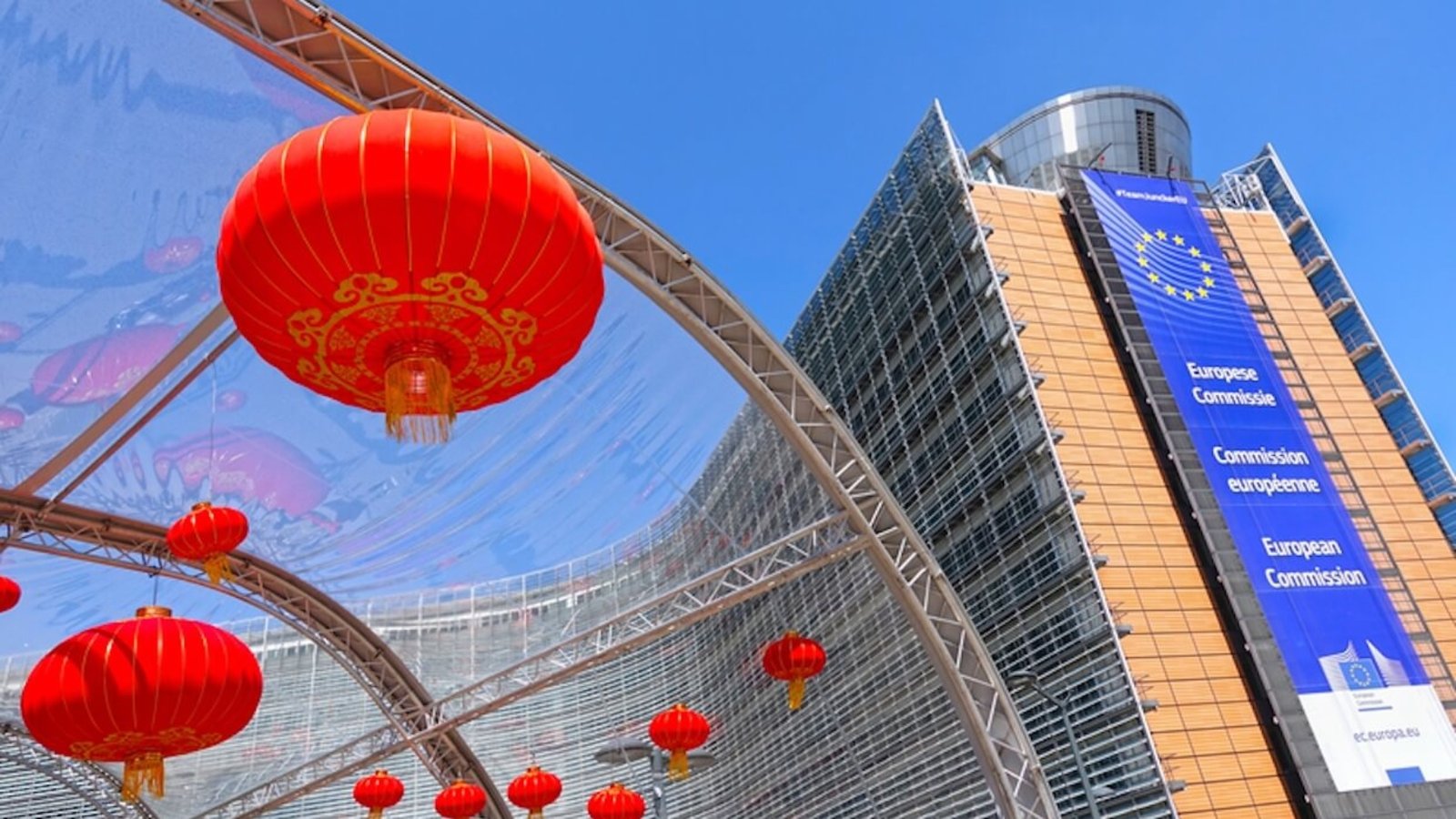
Europe’s automotive debate is often framed as a contest between climate ambition and industrial protection. The issue is broader: can the European Union decarbonize transport while retaining enough productive, technological and social capacity to sustain public support? The sector provides direct and indirect work for approximately 13.8 million Europeans and supports extensive networks in steel, chemicals, electronics, software, logistics and services (European Commission, 2026a). When a major plant or supplier reduces production, the effects concentrate in towns where alternative employment may be scarce, and industrial identity remains politically important.
The pressure is real, but its causes are mixed. European producers face high energy costs, fragmented capital markets, uneven charging infrastructure, regulatory complexity and slow progress in software-defined vehicles (Draghi, 2024; European Commission, 2025; van Wieringen, 2024). They also confront a Chinese industry built on scale, intense domestic competition, integrated battery supply chains and rapid product development. China accounted for more than 70 percent of global electric-car production in 2024, while sales of Chinese-made electric cars in Europe continued to grow in 2025 (IEA, 2025; IEA, 2026). This is not merely an import surge, but a collision between industrial systems as EU regulation creates a large market for electric mobility (Ban & Šćepanović, 2026; van Wieringen, 2024).
This collision has a political dimension. The IAA proposal notes that more than 100,000 automotive job cuts were announced in 2024 and 2025 (European Commission, 2026c). Chinese competition is not the sole cause: weak demand, delayed investment, management choices and technological change also matter. Research on Germany shows that actual job loss and fear of future decline can produce different forms of protest, with right-wing populist support particularly responsive where manufacturing remains central to local identity, but its future appears insecure (Bayerlein, Kölzer & Metten, 2026). Trade shocks also make openness easier to portray as a bargain imposed on workers rather than negotiated with them (Poletti, 2026).
The EU has already responded. Following its anti-subsidy investigation, it imposed definitive countervailing duties on battery electric vehicles imported from China, with company-specific rates ranging from 7.8 to 35.3 percent in addition to the ordinary tariff (European Commission, 2024). The duties address identified subsidization and create breathing space for European manufacturers. They do not resolve Europe’s internal weaknesses. A tariff cannot build a battery plant, train a software engineer, connect a factory to affordable electricity or help a medium-sized supplier convert from combustion-engine components to power electronics.
The European Commission’s March 2026 proposal for the Industrial Accelerator Act (IAA) moves beyond border measures. It would create lead markets for low-carbon and European-made products, simplify permitting and seek to ensure that major foreign investments generate value inside the Union. Its foreign-investment chapter would cover investments above EUR 100 million in strategic sectors when a single third country holds more than 40 percent of global manufacturing capacity. Under the Commission proposal, covered investments would have to meet at least four of six conditions concerning ownership, joint ventures, technology licensing, EU research spending, employment and local sourcing; the employment condition would be mandatory (European Commission, 2026c, 2026d).
This policy paper argues that the IAA should become the basis for a policy of conditional integration rather than defensive exclusion. Chinese investment can accelerate European electrification and add manufacturing capacity. Yet investment should not be treated as beneficial simply because a factory stands within EU borders. The relevant test is whether it strengthens capabilities that remain in Europe: skilled employment, local suppliers, research, engineering, data governance, circular production and regional resilience. The task for DG TRADE, DG GROW and the wider Commission is to make these conditions predictable, proportionate and common across the Single Market.
Europe’s Automotive Dilemma
The EU’s dependence on China runs through battery cells, processed materials, components and production equipment, not only finished vehicles. Chinese firms benefit from a dense ecosystem in which battery makers, car manufacturers, software providers and suppliers develop products quickly and at scale. European companies remain strong in engineering, premium brands, safety and research, but competition increasingly turns on vehicle software, battery management, data integration, user interfaces and rapid product cycles (IEA, 2025; IEA, 2026; van Wieringen, 2024).
This is why the present ‘China shock’ differs from a conventional import surge. European climate policy is deliberately expanding demand for electric mobility. If European firms and suppliers cannot respond quickly, the demand created by EU regulation will be met by imported vehicles and components. Decarbonization would proceed, but with fewer of the industrial learning effects, investments and jobs that policymakers expected. The dilemma is therefore not whether Europe should remain open. It is how to prevent openness from becoming a one-way transfer of market share while avoiding a protectionist turn that raises consumer prices and slows electric-vehicle adoption (IEA, 2026; van Wieringen, 2024).
Trade figures reinforce the sense of imbalance. In 2025, the EU exported EUR 199.6 billion in goods to China and imported EUR 559.4 billion, producing a deficit of EUR 359.8 billion (Eurostat, 2026). A bilateral deficit is not, by itself, evidence of unfair trade. It does, however, intensify political pressure when it coincides with plant closures and visible import growth in a strategic industry. Measures presented as technical trade defense can quickly become symbols in a wider argument about sovereignty, dependence and the distribution of globalization’s costs.
Hard protectionism would not solve the problem. Europe still needs affordable EVs, competitive batteries and private investment, as well as cooperation with China on climate, standards and trade. Closing the market would reduce competition, delay capacity expansion and invite retaliation. It could also divert Chinese exports towards Europe’s southern neighborhood, where European manufacturers already face stronger competition (Fulton, Lons & Tsang, 2026). A broader protectionist turn would also shrink a major market for Chinese firms and make EU rules less predictable (IEA, 2026; Tagliapietra, Trasi & Sebastian, 2025).
Unqualified openness is equally inadequate. Chinese car and battery manufacturers are investing in Europe or considering local production, which can create jobs and shorten supply chains. Yet local assembly does not necessarily create local capability. A plant may import high-value inputs, retain research and software functions elsewhere and generate mainly assembly jobs. Separate Member-State negotiations can therefore produce uneven benefits and a subsidy race in which the largest public budgets attract the most valuable projects (Tagliapietra, Trasi & Sebastian, 2025).
The green transition must therefore be understood as a political bargain. Consumers need affordable vehicles. Firms need predictable rules and access to finance. Workers need credible routes into new occupations. Regions need replacement investment before old capacity disappears. The EU needs resilience without autarky, and Chinese investors need access without assuming that access can remain detached from European social and industrial concerns. Conditional integrationoffers a way to connect these interests.
Why the Industrial Accelerator Act Is Only a Partial Answer
The proposed IAA is significant because it recognizes that trade policy, industrial policy and foreign investment can no longer be treated as separate fields. Its demand-side measures would use public procurement and support schemes to favor low-carbon and European-made products in selected sectors. Its permitting provisions would aim to reduce delays through digital procedures and industrial acceleration areas. Its investment chapter would seek to prevent strategic foreign projects from operating as isolated enclaves by linking approval to European participation, research, training and value-chain integration (European Commission, 2026c, 2026d).
These are useful corrections to a policy model that relied heavily on carbon regulation and market incentives while assuming that industrial capacity would follow. The proposed IAA also reflects the Draghi Report’s argument that decarbonization can support growth only when climate targets are matched by investment, innovation and coordinated industrial action (Draghi, 2024). In the automotive sector, the proposed Act could help create demand for European batteries and components and give public authorities leverage when negotiating with major investors.
The difficulty is that location is not the same as competitiveness. The proposed IAA is strongest on vertical questions: where a battery cell is produced, how much Union-origin content a supported vehicle contains, or whether an investment creates jobs. It is weaker on the horizontal systems that determine long-term performance, including software platforms, vehicle data, cybersecurity, testing environments, charging infrastructure and recycling (European Commission, 2025; van Wieringen, 2024). A factory may satisfy an origin rule while remaining dependent on technology and critical components controlled elsewhere.
The proposed foreign-investment provisions also need refinement. A four-out-of-six test gives flexibility, but investors may select the least demanding combination without producing the capabilities Europe most needs. The proposed 50 percent EU-workforce threshold cannot distinguish temporary assembly jobs from durable technical and research positions. Moreover, conditions tied directly to the purchase or use of domestic goods can create risks under the WTO Agreement on Trade-Related Investment Measures, while compulsory or uncompensated technology transfer would be politically and legally vulnerable (WTO, 1994). China’s Ministry of Commerce has criticized the proposal on precisely these grounds and warned of countermeasures (MOFCOM, 2026a, 2026b).
A further weakness is finance. The proposal warns that uncoordinated national measures can fragment the Single Market, but much industrial support still depends on national fiscal capacity. Germany or France can offer packages that smaller or more indebted Member States cannot match. Without a common EU layer, ‘Made in EU’ may in practice become ‘made in the Member States with the largest subsidy budgets.’ This would deepen regional inequalities and weaken the collective bargaining power that a common European approach is meant to create (Collin, García Bercero & McWilliams, 2026; Tagliapietra, Trasi & Sebastian, 2025).
Finally, the proposed IAA’s social logic remains too automatic. It assumes that anchoring production will anchor employment. Yet electrification changes the industry’s occupational structure, and new factories may be far from the regions losing old ones. Research on the European car industry shows that the transition can reproduce regional and social inequalities unless policy addresses who receives investment, who bears adjustment costs and who participates in decisions (Szabó & Newell, 2024). The European Trade Union Confederation (ETUC) is therefore right to call for mandatory training, worker participation and regional transition planning, not employment numbers alone (ETUC, 2026).
The proposal should not be abandoned. It should be completed. Its central insight is correct: access to the scale of the Single Market gives the EU bargaining power. That power should be used to secure outcomes rather than to build a wall. Recent assessments similarly caution that poorly calibrated origin and investment rules could delay capacity formation or distort the Single Market unless they are tied to clearer sectoral objectives (Collin, García Bercero & McWilliams, 2026).
Assessing Three Policy Options
At the present stage of the legislative debate, three policy approaches can be envisaged.
The first option is defensive localization. The EU would tighten ‘Made in EU’ rules, maintain or increase tariffs, restrict Chinese participation in public support and apply the proposed IAA’s ownership and technology conditions in their most demanding form. It offers a visible response to job losses and may create protected demand while European producers scale up.
The costs would be substantial. Strict exclusion would raise prices, reduce competitive pressure and delay capacity expansion. It would invite retaliation, while broad local-content requirements could conflict with WTO rules if they discriminated against imported goods (WTO, 1994). Protection would not guarantee innovation: firms could gain a sheltered market without closing gaps in software, batteries and production speed. Export diversion would also expose European manufacturers to stronger Chinese competition in nearby third markets (Fulton, Lons & Tsang, 2026).
This option carries a political paradox. Protection can temporarily reassure workers, but if it leads to expensive electric vehicles, weak demand and continued restructuring, populist actors will shift their argument. Brussels can then be blamed both for imposing the transition and for making it unaffordable. Evidence from manufacturing regions also cautions against assuming that one visible protective measure will settle deeper anxieties about status, employment and regional decline (Bayerlein, Kölzer & Metten, 2026; Poletti, 2026).
The second option is managed openness. The EU would retain countervailing duties and general investment-screening tools while welcoming Chinese factories case by case. Member States would remain free to negotiate investment packages, and the Commission would intervene mainly where subsidies, security risks or market distortions were evident. This approach could attract capital quickly and expand European production without the conflict generated by rigid joint-venture or technology-transfer requirements.
Managed openness is preferable to a trade war, but it is too weak for the scale of the transition. Individual Member States may compete to offer subsidies, land and tax advantages while accepting limited commitments on suppliers, research or skills. Investors could divide production across Europe in ways that maximize incentives rather than industrial coherence. A series of assembly plants would improve output statistics without necessarily strengthening European capability. The approach would also disadvantage smaller Member States and make monitoring uneven (Tagliapietra, Trasi & Sebastian, 2025).
The third option, recommended in this paper, is conditional integration. It starts from two propositions. First, Chinese investment is not inherently a threat; it can support decarbonization, competition and employment. Second, the value of an investment cannot be measured by its location alone. It should be judged by the capabilities it creates and retains in Europe.
Conditional integration would establish common EU rules for major electric-vehicle and battery projects, regardless of which Member State hosts them. Investment approval, eligibility for relevant public support and access to lead-market measures would remain available when investors make verifiable contributions to local research, skilled employment, supplier development, circularity and secure digital systems. The framework would not require firms to surrender corporate control or transfer proprietary technology. Instead, it would impose outcome-based obligations proportionate to the scale of the investment and the public support received.
This approach better balances openness and resilience. It uses the Single Market as leverage without treating investment as a zero-sum contest and aligns with proposals for a common European strategy towards Chinese EV investment (Tagliapietra, Trasi & Sebastian, 2025). Chinese firms would gain a predictable route into Europe: invest for the long term, build local capabilities and meet common standards. Europe would convert competitive pressure into learning and capacity-building rather than a sequence of trade disputes and national restrictions.
Political Feasibility on Both Sides
Conditional integration is viable only if it can be defended in domestic politics. In Europe, governments must show that openness does not mean accepting low-value assembly while research and supplier development remain elsewhere. Commitments on permanent technical jobs, paid retraining and regional supplier conversion should therefore be visible before public support is granted. This matters in industrial regions where expected decline can be as politically consequential as closures already recorded (Bayerlein, Kölzer & Metten, 2026), and it answers populist claims that trade policy protects abstract European interests while local communities absorb the costs (Poletti, 2026).
China faces a different constraint. Beijing is unlikely to accept a framework described as forced technology transfer, discriminatory localization or an anti-China ownership regime (MOFCOM, 2026a, 2026b). Chinese firms may nevertheless accept training, European R&D, supplier-development and carbon-performance commitments when these are presented as normal conditions for long-term investment and apply to all covered foreign investors. Deeper localization can then be framed as commercial adaptation rather than a political concession.
The framework should therefore privilege measurable outcomes over symbolic ownership tests. Country-neutral rules, protection of pre-existing intellectual property and a transparent route to approval make conditional integration easier to defend on both sides: Europe gains visible domestic value, while Chinese investors avoid openly punitive treatment.
Three Core Recommendations
1. Establish a European Automotive Investment Compact
The first step should be a European Automotive Investment Compact anchored in the proposed IAA framework. During the legislative negotiations, the co-legislators should strengthen Article 18 by making capability creation a mandatory element of covered EV and battery investments. In addition to the proposed employment requirement, each project should meet either the EU research-and-development condition or a strengthened supplier-development condition. The relevant legal bases are Articles 18(2)(d), 18(2)(f) and 18(3). The Commission should then use the implementing act foreseen in Article 18(5) of the proposal to establish a sector-specific verification scorecard (European Commission, 2026c).
The scorecard should test substance: technical and permanent jobs, engineering and research performed in Europe, paid training, supplier contracts and the treatment of jointly created intellectual property. An investor should not be able to meet formal ownership conditions while contributing little to learning, nor should a project be rejected merely because a joint venture is commercially inappropriate.
Technology cooperation must be handled carefully. The Compact should recognize paid licensing, joint research centers, jointly created intellectual property, testing facilities and university partnerships, while protecting pre-existing rights. Europe should seek competence rather than ownership of every foreign technology. Supplier conditions should be framed as verifiable value-chain development rather than a blanket obligation to purchase domestic goods, reducing WTO risk (WTO, 1994).
2. Attach a Skills and Regional Transition Covenant to Major Investments
The second recommendation is a Skills and Regional Transition Covenant. The Commission’s March 2026 IAA proposal would require at least half of the workforce in covered investments to be EU workers across occupational categories, accompanied by training. A qualitative plan should also identify the occupations created, qualifications required, share of permanent positions and routes for displaced automotive workers to enter them (European Commission, 2026c).
Investors should partner with vocational schools, universities and recognized training providers. Training should occur during paid working time and extend to affected supplier firms. Where projects receive significant public support, unions and worker representatives should participate in design and monitoring, preventing Europe from gaining mainly assembly jobs while high-value engineering remains elsewhere (ETUC, 2026).
The Commission should also favor projects linked to regions undergoing automotive restructuring, where infrastructure and skills conditions permit. Industrial Acceleration Areas should be tied to regional development, clean-energy access and supplier conversion rather than treated as deregulatory enclaves. A new battery plant does not automatically compensate for a distant components-factory closure; the connection must be designed and funded (Szabó & Newell, 2024).
3. Create a European Automotive Transition Financing Window
The third recommendation is a ring-fenced European Automotive Transition Financing Window under existing EU instruments, coordinated by the Commission and the European Investment Bank. The proposed IAA relies on synergies across the Innovation Fund, InvestEU, Horizon Europe, the Connecting Europe Facility and cohesion funds rather than a new spending envelope (European Commission, 2026c). The Commission should begin preparing a coordinated pilot in 2027, with implementation to follow once the IAA’s legal basis and the necessary budgetary arrangements are in place. In the longer term, the financing window could be incorporated into the European Competitiveness Fund if that instrument is established under the 2028-2034 Multiannual Financial Framework.
The window should finance shared European public goods rather than routine vehicle production: supplier conversion, battery recycling, testing facilities, worker training, grid connections and first-of-a-kind manufacturing. Cross-border value chains and shared research should receive priority over isolated plants with limited spillovers.
National aid could continue, but major packages should be listed on a common transparency platform with public contributions, expected jobs, training, supplier contracts and environmental performance. Investors would then face one European framework rather than a patchwork of national bargains, accepting consistent obligations in return for access to finance and lead markets.
Two Enabling Measures
A Software, Data and Innovation Pillar
The proposed IAA’s emphasis on manufacturing is understandable, but the competitive frontier is shifting towards software-defined vehicles, autonomous-driving systems, battery management, digital services and data. Europe could localize vehicle assembly while remaining dependent on external operating systems and data architectures. That would replace one form of dependence with another (European Commission, 2025; van Wieringen, 2024).
The Commission’s automotive action plan already points towards testing zones, connected and autonomous vehicle alliances and public-private research. These initiatives should be linked to the proposed IAA investment regime. Major projects should comply with EU cybersecurity, data-protection and competition rules; critical software updates and remote-control functions should face independent security auditing; and access to vehicle data generated in Europe should be governed by transparent legal rules (European Commission, 2025).
This pillar should remain open to Chinese firms. Exclusion from European research ecosystems would slow learning and encourage incompatible standards. Participation, however, should depend on interoperability, auditability and compliance with EU data governance. Joint testing facilities could allow European and Chinese firms to develop products for the EU market while ensuring that safety, cybersecurity and data standards are verified in Europe.
A Structured EU-China Implementation Dialogue
The second enabling measure is a structured EU-China implementation dialogue. It should not replace enforcement or offer China exemptions unavailable to others. A working group involving DG TRADE, DG GROW, relevant Chinese ministries, industry and social partners should instead reduce uncertainty during the proposed IAA’s legislative and implementation phases.
The agenda should cover Union-origin calculations, joint research and intellectual property, recognition of training expenditure, reporting and carbon accounting. It could also examine WTO-compatible alternatives to duties, including price undertakings where they address the subsidization identified by the Commission (European Commission, 2026b). Non-confidential guidance should be published for firms on both sides.
Reciprocity should remain on the agenda, but through defined sectors and measurable commitments rather than a demand that every market opens simultaneously. Progress on procurement, standards and research partnerships could be linked to greater confidence in implementation of the proposed IAA. The aim is managed bargaining, not rhetorical escalation.
Risks and Safeguards
Conditional integration will not eliminate conflict. China may challenge provisions of the proposed IAA or retaliate against European firms. The EU should prepare sector-specific contingencies, diversify critical inputs and use trade-defense instruments when evidence supports them. Rules should remain country-neutral and rest on transparent market-share, security and value-creation criteria, making them easier to defend legally (European Commission, 2026c; WTO, 1994).
Symbolic compliance is another risk. Research centers or training programmes may remain small relative to the investment. Approval decisions should therefore include measurable milestones and five-year reporting on permanent jobs, paid training, R&D, jointly developed intellectual property, supplier contracts, recycled content and carbon performance. Failure to meet commitments should trigger proportionate recovery of support or revised approval conditions.
Industrial policy can also become detached from affordability. Consumers cannot carry the full adjustment cost through higher vehicle prices. The Commission should preserve competition, expand charging infrastructure and target demand measures towards small and affordable EVs. Resilience will not be politically sustainable if electric mobility becomes a premium product (European Commission, 2025; IEA, 2026).
Finally, the proposed IAA should not be sold as a victory over China. Such language would strengthen nationalist narratives on both sides. It should be presented as a rule for all major investors: access to public support and the Single Market comes with responsibilities to workers, regions, innovation and climate goals. Visible local benefits are the strongest answer to populist claims that trade and decarbonization serve only distant institutions and large corporations (Poletti, 2026).
Conclusion
The European automotive transition cannot be secured by tariffs alone. Nor can Europe assume that any factory built within its borders will automatically deliver resilience. The decisive issue is the quality of industrial integration.
Defensive localization would protect selected producers but risk higher costs, retaliation and technological complacency. Managed openness would attract capital but leave Member States competing for investments that may create limited European spillovers. Conditional integration offers a more durable route. It welcomes Chinese electric-vehicle and battery investment when that investment creates capabilities Europe can retain skilled jobs, research, suppliers, secure digital systems, circular production and regional development.
The proposed Industrial Accelerator Act provides the beginnings of such a framework, but it needs clearer priorities, a realistic financing channel and stronger links to skills, software and regional policy. A European Automotive Investment Compact would turn broad legal conditions into predictable sectoral rules. A Skills and Regional Transition Covenantwould connect industrial location to social legitimacy. A European Automotive Transition Financing Window would limit fiscal fragmentation, while the two enabling measures would address future technological competition and reduce uncertainty without weakening enforcement.
Europe should not ask Chinese firms to become European. It should ask every major investor benefiting from the European market to make a measurable contribution to European capacity. The strategic shift is from market access to co-development, and from the location of output to the creation of capability. Implemented in that form, the proposed IAA could do more than manage a trade dispute. It could support decarbonization, democratic stability and a more balanced EU-China economic relationship.
(*) This policy paper is based on research conducted by the ECPS Summer School 2026 China Team during the case competition on the side of Summer School titled “Europe Between Oceans: The Future of EU Trade Between the Atlantic and the Indo-Pacific,” held on July 6-10, 2026.
References
Ban, C. & Šćepanović, V. (2026). ‘Das Auto and the Second China Shock: Industrial Policy and the Disruption of Technological Incumbency.’ Politics and Governance, 14. https://doi.org/10.17645/pag.11456
Bayerlein, M., Kölzer, J. & Metten, A. (2026). ‘Industrial Employment and Populism in Germany – Exploring the Effect of Actual and Looming Decline.’ Politische Vierteljahresschrift, 67, 163-194. https://doi.org/10.1007/s11615-025-00606-w
European Commission (2024). Commission Implementing Regulation (EU) 2024/2754 of 29 October 2024 Imposing a Definitive Countervailing Duty on Imports of New Battery Electric Vehicles Originating in the People’s Republic of China. Official Journal of the European Union. https://eur-lex.europa.eu/eli/reg_impl/2024/2754/oj/eng
European Commission (2026c). Proposal for a Regulation Establishing a Framework of Measures for the Acceleration of Industrial Capacity and Decarbonisation in Strategic Sectors (Industrial Accelerator Act), COM(2026) 100, 4 March 2026. https://eur-lex.europa.eu/legal-content/EN/TXT/?uri=CELEX:52026PC0100
International Energy Agency (IEA) (2026). Global EV Outlook 2026: Manufacturing and Trade. Paris: IEA. https://www.iea.org/reports/global-ev-outlook-2026/manufacturing-and-trade
Poletti, A. (2026). “’EU-US-China Trade Relations.” In: M. Riddervold, G. Rosén & J. R. Greenberg (eds), Populism and the Future of Transatlantic Relations: Challenges and Policy Options. European Center for Populism Studies. https://doi.org/10.55271/rp00127
Szabó, J. & Newell, P. (2024). “Driving towards a Just Transition? The Case of the European Car Industry.” Energy Research & Social Science, 115, 103649. https://doi.org/10.1016/j.erss.2024.103649
In this interview, Imran Bayoumi examines how the weakening of multilateral institutions and the rise of transactional diplomacy are reshaping global power in ways that often favor authoritarian and populist governments. He argues that authoritarian middle powers benefit from greater flexibility to hedge between competing blocs, while democracies remain constrained by alliances, institutions, and domestic accountability. Turkey under President Recep Tayyip Erdogan emerges as a key example: Ankara has “managed to play and interact with both realms at the same time,” using populist nationalism to present strategic balancing as the defense of national interests. Bayoumi also warns that weakening Western cohesion benefits revisionist powers, while calling for a “retooled American leadership” capable of rebuilding democratic cooperation in a more fragmented international order.
In an era of intensifying geopolitical fragmentation, weakening multilateral institutions, and increasingly transactional diplomacy, authoritarian and populist governments may find themselves unusually well positioned to exploit the emerging international disorder. In this wide-ranging interview with the European Center for Populism Studies (ECPS), Imran Bayoumi, Deputy Director and Resident Fellow with the GeoStrategy Initiative at the Atlantic Council’s Scowcroft Center for Strategy and Security, examines how the erosion of the rules-based international order is altering the balance between democratic constraints and authoritarian flexibility. His central argument is not that autocracies are inherently stronger, but that a fragmented system can reward governments able to hedge between competing powers, bypass institutional constraints, and personalize foreign policy. As Bayoumi puts it, authoritarian middle powers “have experience with hedging” and are less constrained by the institutions and alliances that shape the choices of democratic states.
The decline of multilateralism is particularly consequential because it lowers the costs of defying established rules. According to Bayoumi, states increasingly feel comfortable “bypassing multilateral bodies,” ignoring treaties and challenging norms because the prospect of meaningful punishment has diminished. Yet he cautions against reducing this transformation simply to populism: “It’s a mix of both things: populism and power.” At the same time, the personalization of diplomacy associated with contemporary populist politics is becoming increasingly significant, as foreign policy becomes more closely tied to leaders themselves rather than institutions and professional bureaucracies.
Turkey provides one of the interview’s clearest illustrations of this emerging geopolitical flexibility. Still embedded in NATO and Western institutions, Turkey under President Recep Tayyip Erdogan has simultaneously cultivated relations across competing geopolitical blocs. Bayoumi describes Turkey as a country that has “managed to play and interact with both realms at the same time.” Populist nationalism, he argues, has been crucial to legitimizing this strategy domestically: “Erdogan has been able to sell this balancing strategy as a way of being able to secure Turkey’s interests first.” The willingness to purchase Russian air-defense systems while remaining within NATO exemplifies how Ankara combines alliance membership with strategic hedging.
More broadly, Bayoumi warns that weakening Western alliances and institutional cohesion ultimately benefits revisionist authoritarian powers. “Every action that undermines the strong ties between the United States and its allies is a benefit for them,” he argues, pointing to the growing cooperation among Russia, China, Iran, and North Korea. Yet he rejects the idea that authoritarian ascendancy is inevitable. Instead, he calls for “some sort of retooled American leadership” capable of accommodating the growing autonomy of middle powers while rebuilding institutions and democratic cooperation. The challenge, therefore, is not simply to restore the old international order, but to construct a more resilient one capable of reconciling democratic values, strategic power, and an increasingly multipolar world.
Here is our interview with Imran Bayoumi, edited lightly to enhance clarity, readability, and overall flow for publication.
Authoritarian Middle Powers Are Better Equipped to Hedge
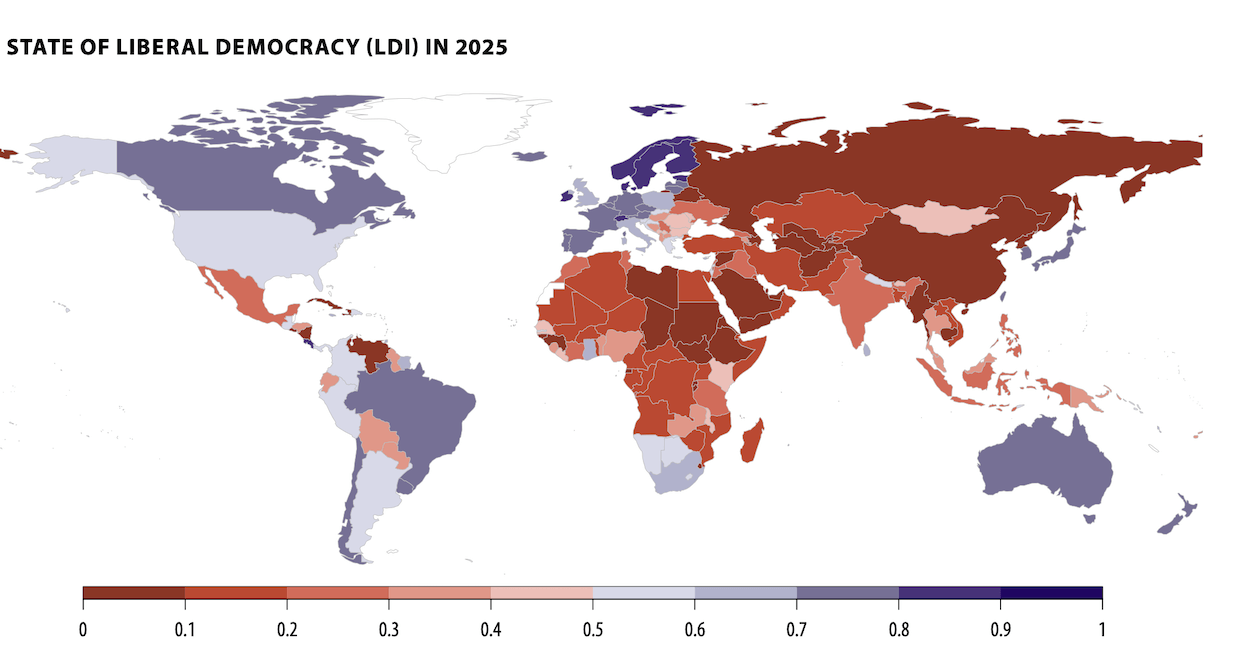
Figure from the V-Dem Institute Democracy Report 2026.
Mr. Bayoumi, welcome!In “Why Today’s Global Disorder Rewards Authoritarians,” you argue that autocratic middle powers are particularly well placed to benefit from today’s fragmented international system because they can hedge between larger powers and pursue highly transactional relationships. What is it specifically about authoritarian government that gives these countries greater room for maneuver than democratic middle powers? Could democratic states adopt similar strategies without weakening their democratic principles?
Imran Bayoumi: In the article, I lay out two factors that I’ve identified. The first is that these autocratic middle powers have experience with hedging. They’ve balanced between different blocs of great powers for a lot longer than these democratic middle powers are now trying to. They’re not constrained by these broader institutions and alliances that are now seeming more and more like a burden.
The second factor is that they are adept at these kinds of personalist politics that we’ve seen really dominate the second Trump administration and the broader political deal-making space. You saw Qatar donate the Boeing 747 for the new Air Force One at the start of the second Trump administration. In terms of hedging, I talk about it in the article, but Kazakhstan, for example, has signed up to both China and Washington’s flagship AI programs.
Therefore, these states are really better in this kind of disruption. They know how to gain influence in ways that democratic states would struggle with. If a democratic state was to donate a jumbo jet, there would probably be some sort of parliamentary pushback, discussions in the media, and potential repercussions that I don’t think authoritarians would be subject to.
So, can democratic states adopt these traits? Sure, it’s just harder for them to do so. There’s nothing stopping them from having a more personalist foreign policy. Nothing’s stopping them from hedging, but they face constraints. I don’t think their populations may want that. It’s harder to leave treaties if you have to have a parliament approve that. I think norms are a big thing, too. I can’t imagine that the Canadian public, for example, would be happy if Prime Minister Carney donated a large amount of military equipment to the United States in exchange for a trade deal. So, there’s nothing in theory stopping them, but the institutions and norms that they adhere to are a real limit.
Alliances Remain an Asset, but New Risks Are Emerging
You suggest that democratic middle powers such as Canada, Australia, South Korea, and the United Kingdom are constrained partly because their economies and security systems were deeply integrated into the US-led postwar order. By contrast, authoritarian middle powers were often less integrated into that system. Has the very institutional dependence that once protected democracies now become a strategic weakness in a more unstable world?
Imran Bayoumi: I’m not sure I would say that it’s a weakness. I don’t think the NATO alliance is a weakness. That’s still the most successful alliance in history, and there’s still great value to states being part of it, regardless of how disruptive and unpredictable they might see Washington as acting.
That being said, it also exposes them to new risks. I think you’ve seen the United States talk about annexing Greenland, making Canada the 51st state, putting kind of ad hoc tariffs in place, and all of this really weakens the strength of those institutions. So, I wouldn’t go so far as to say being part of them is a weakness right now, but it’s certainly a factor that undermines the security, economic interests, and sovereignty of some of these states in the current moment.
If we were really to see full-out great power war, and NATO was attacked and responded, Article 5 was invoked, I don’t think any of these states would see that as a weakness. They would see the alliance as a great benefit. So, these institutions still have great potential and promise. The problem is that we’re actively undermining them, and we need to change that course.
Bilateral Diplomacy Thrives as Institutional Constraints Weaken
Populist leaders often present international institutions, treaties, courts, and alliances as restrictions imposed by distant elites on national sovereignty. Does the weakening of the rules-based international order therefore create a particularly favorable environment not only for authoritarian governments but also for populist leaders who prefer bilateral deals and leader-to-leader diplomacy over multilateral institutions?
Imran Bayoumi: I think the current moment does. When we saw the rules-based international order with bodies like the UN supported by the US and backed by other countries, there were real costs to defying these major institutions and going against global norms. The threat of sanctions was real, as were the loss of market access and diplomatic isolation. What we’ve seen is that now states of all sizes feel more comfortable bypassing multilateral bodies to get action, ignoring treaties, ignoring what they previously signed, and maybe bucking norms because they think that the threat or possible punishment is lesser. There’s no cost associated with their revisionist actions. These bilateral deals are peaking because of that.
The stronger state can now enforce a deal that it wants and get its outcome. But, there are a few interesting threads also to pick up. One is that even though these multilateral institutions maybe are not as strong, the value and the brand of them are still strong. We still see populist autocratic leaders traveling to the UN every September to make a speech. So, there’s still value in that brand and in that address. Maybe the institution is not strong, but the broader value is and could be resurrected.
I touched on this earlier, but to return to your original question, I’m not sure it favors populist leaders so much as actors with power. Looking back, even before the Trump administration, if the United States pursued a bilateral deal with a less powerful populist leader, it would still be able to dictate the terms of that deal largely because of its relative power. So, it’s a mix of both things: populism and power.
Populism Is Accelerating the Personalization of Foreign Policy
Photo: Shutterstock.
Your argument focuses heavily on increasingly personalized and transactional diplomacy. This also seems characteristic of populist politics, where leaders frequently claim that personal strength and negotiating skill can replace institutions and professional bureaucracies. Do you see a connection between the global rise of populism and the wider shift from institutional diplomacy toward personalized diplomacy?
Imran Bayoumi: Yes, similar to my previous answer, that as populism rises and the foreign policy of countries increasingly becomes about the personalities of those leaders themselves, you do start to see this trend. People start to meet their partners where they are. I think there are some good examples here. King Charles gifted President Trump a bell from a naval submarine that bore his name. We’re even starting to see democracies meet this kind of populist trend. But I’d go back to the power thing. I think power really underpins this system. So, I’m not sure that personal strength and negotiating skill are any better than multilateral institutions if you’re still negotiating, arguing, or dealing with a more powerful state. Military and economic power are two constant underpinnings that exist regardless of the broader dynamic.
Democracies Still Face Constraints That Autocracies Escape
You write that autocratic governments are primarily concerned with regime survival rather than electoral accountability. But democratic populist governments can sometimes develop similar priorities by weakening courts, attacking independent media, politicizing the bureaucracy, and concentrating authority around the executive. Should we therefore think of the advantage you describe as belonging strictly to authoritarian regimes, or more broadly to highly centralized and personalized political systems?
Imran Bayoumi: I think it applies to both, but with the caveat that, in these still highly centralized systems that are maybe partially free democracies, the party can still lose power. If you look at Hungary, there was an election and there was a change in government.
I really tried to focus on autocratic states in my article, arguing that they don’t have to worry about these kinds of institutional checks and balances that highly centralized liberal democracies may have to worry about to a lesser extent, but that are still there. There’s still media, there are still courts, and there are still other ways that they can pressure the government.
Whereas in autocracies, they don’t have to worry about that. So, I think it applies to both, but there’s that caveat that it could change. Political systems change, and in these highly centralized, personalized systems, the media ecosystem, the justices, and the courts could be a vector for that change.
Washington Has Fully Embraced Personalized Foreign Policy
The Trump administration itself raises an important question for your argument. Trump has repeatedly criticized international organizations and alliances, emphasized personal relationships with foreign leaders, and favored transactional bargaining over traditional diplomatic institutions. To what extent has the United States under Trump begun to practice the kind of personalized foreign policy that you associate with authoritarian states?
Imran Bayoumi: Two things here. First, Washington has fully embraced this personalized approach to foreign policy. The diplomacy between President Trump and Kim Jong-un of North Korea during Trump’s first term is a good example. It involved exchanging letters and Trump addressing Kim Jong-un personally. I don’t think it was particularly successful, although it did result in a few summits. Tensions between the two countries remain high, but that kind of personalized diplomacy has clearly carried over into the second administration.
I would, however, push back somewhat on the idea that this approach is associated solely with authoritarian states. At the moment, authoritarian states may be better suited to handle it because they have more experience with this kind of diplomacy and know how to make it work. But over the longer term, they are unlikely to be the only states to practice or utilize personalist foreign policy.
Democratic Backsliding Could Carry Strategic Costs Abroad
Following from that, could there be an authoritarian dimension to the transformation of American foreign policy under Trump? I do not mean that the United States has simply become an authoritarian state, but rather whether the weakening of institutional constraints, the personalization of executive power, and the preference for loyalty and bilateral bargains are making American statecraft resemble some features traditionally associated with authoritarian governance.
Imran Bayoumi: The literature and public discourse around this topic are pretty clear. There is a very real risk of democratic backsliding in the United States, and there are concerns there. Ultimately, whatever US foreign policy looks like over the next decade, the next five years, or whatever timeframe you want to look at, there is a real risk that the kinds of factors you laid out—the personalization of executive power, the preference for blind loyalty, and bilateral deals—will weaken US foreign policy and national security writ large, rather than simply making the United States resemble an autocratic foreign policy.
I think the bigger challenge is not so much what it looks like, but what results it achieves for Washington and for American citizens. The risk is that it will produce a more dangerous world, one where we have more shaky, bilateral, ad hoc deals that are not built on these broad, treaty-bound alliances.
It would be a world where American interests are harder to define and therefore harder to defend, and where American power has lost some credibility. So, revisionist states feel more comfortable challenging it, undermining it, and acting against it. That’s a real challenge. How do we stop that? How do we change that? And what does a new, more powerful, newly designed American foreign policy look like to meet the challenges of the 21st century, deal with revisionist autocracies that are challenging Washington’s power, and also recognize the growing power of these smaller middle-power countries?
Fragmentation Rewards States That Can Move Faster and Hedge More Freely
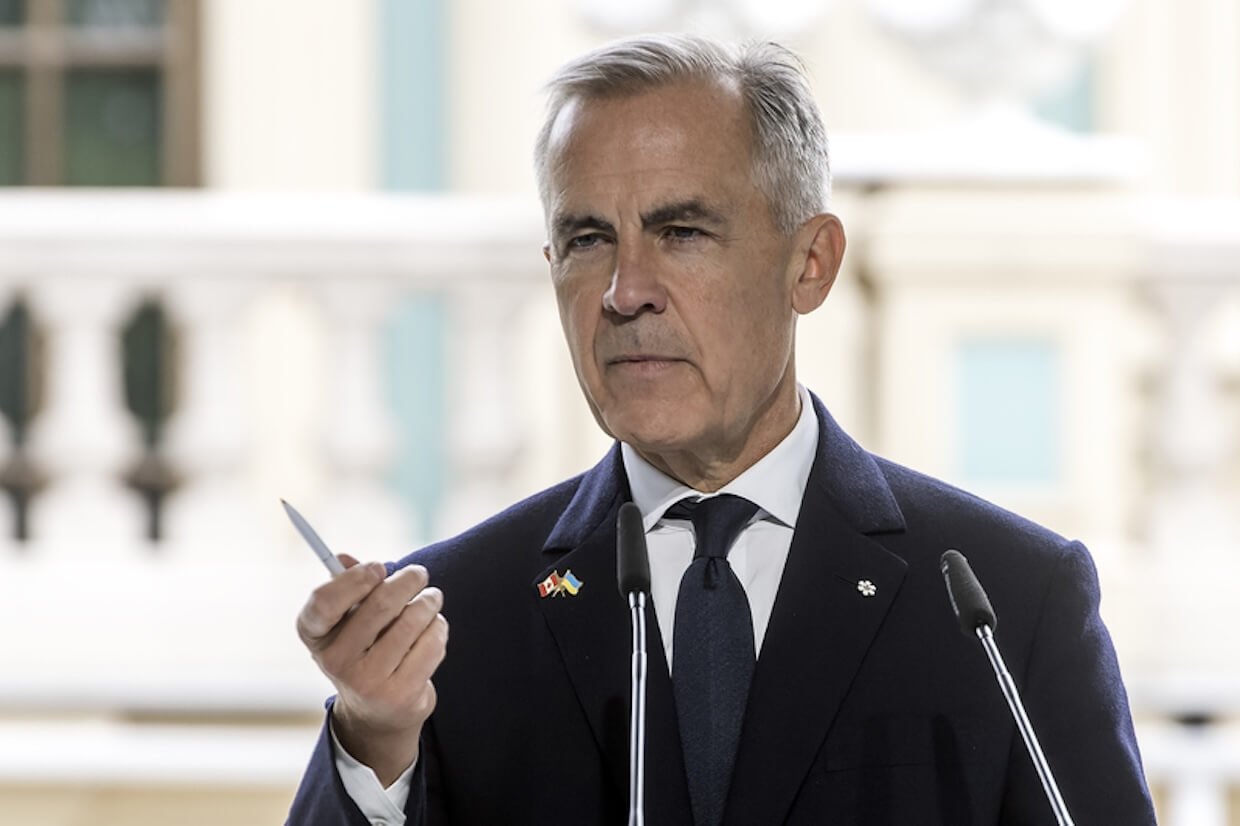
Canadian Prime Minister Mark Carney attends a joint press conference with Ukrainian President Volodymyr Zelenskiy on Ukraine’s Independence Day in Kyiv, Ukraine on August 24, 2025. Photo: Vladyslav Musiienko / Dreamstime.
In “Don’t Fall for the Middle-Power Mirage,” you question Mark Carney’s hope that democratic middle powers can build an alternative multilateral order. Democratic states appear divided over how far they should distance themselves from Washington, while authoritarian middle powers can cooperate selectively with Washington, Beijing, Moscow, and regional powers at the same time. Does this mean that fragmentation itself structurally favors governments that are less committed to fixed alliances and common political values?
Imran Bayoumi: In the current moment, 100%. That article really talks about two factors. One is that democratic middle powers, even if they were to answer the call that Prime Minister Mark Carney laid out at the Davos World Economic Forum earlier this year, can’t agree on the approach to doing so. In that article, I talk about then-UK Prime Minister Keir Starmer and Mark Carney. The week after Carney’s speech, Starmer had a different approach. He said, we don’t have to choose; we can balance all sides, play all sides, something to that effect. So that’s the first challenge. Democratic middle powers are not even on the same page.
I think that, in this era of disruption and upheaval, countries that don’t have these long-standing institutional ties and alliances can play both sides. They’re more nimble and can move faster. It goes back to the other article we talked about, where their populations may not want leaders to stay committed to these institutions, or, if they do, the leaders can ignore the will of their population. So, they’re more comfortable making these deals that might invite media blowback.
They don’t necessarily have to get parliamentary approval, or, if they do, it could be rubber-stamped. So, they’re more nimble and can act in different ways. The challenge for them is that they still recognize that there’s value in alliances and in this broader dynamic. Even if you look at Canada, which under Carney is trying to advocate for this new kind of vision of the international system, it’s not about abandoning NATO or totally pulling out of NORAD, the binational command here.
Therefore, there’s still a recognition that alliances are valuable and that these kinds of treaty-bound obligations are strong for a reason. These bilateral deals may be a temporary boon, but I don’t think they should be read as an indication of long-term success.
Revisionism and Pragmatism Increasingly Coexist
You distinguish between authoritarian states that actively seek to revise the international order and those that simply exploit its weakening. But is “pragmatic opportunism” really politically neutral? When governments such as Turkey, the UAE, Saudi Arabia, Egypt, and Kazakhstan benefit from weaker democratic norms, looser conditionality, and more transactional great-power competition, do they not also have an interest in preserving—and perhaps deepening—the erosion of the rules-based order, even if they do not openly seek to replace it?
Imran Bayoumi: This is a really important point. These states—their erosion, or actions contributing to the erosion, of the current international order—are a real risk. Going back to my previous answer, I don’t think they’re trying to build what comes next. There’s not a clearly defined broader international architecture that they’re building toward. They’re more taking advantage of the current disruption.
In the long-term, I don’t know what they will try to build. Even though they’re now preying on this disruption, it would be a mistake to say that they didn’t benefit in some way from the previous international order as well. So, even though Carney’s vision might be incredibly tough to achieve, he’s at least trying to figure out what comes next.
To your point, I think they have an interest in both sides. In some areas and sectors, they want to weaken the current international order and advance their own interests. On some topics, however, they want to strengthen it.
China, for example, is still very committed to this idea of international standard-setting when it comes to telecoms and, potentially, artificial intelligence. These are the broad multilateral structures, forums, and venues that we associate with the previous international order. But in other ways, China and other states are quite revisionist. They don’t want to cede sovereignty; they want to achieve their own goals.
So, I think it’s this balancing act, and part of this tension is a realization that there’s a real question of what comes next. You will have to build what comes next, and that might be harder than merely reacting to the current disruption.
Turkey Shows How Populist Nationalism Can Legitimize Geopolitical Hedging
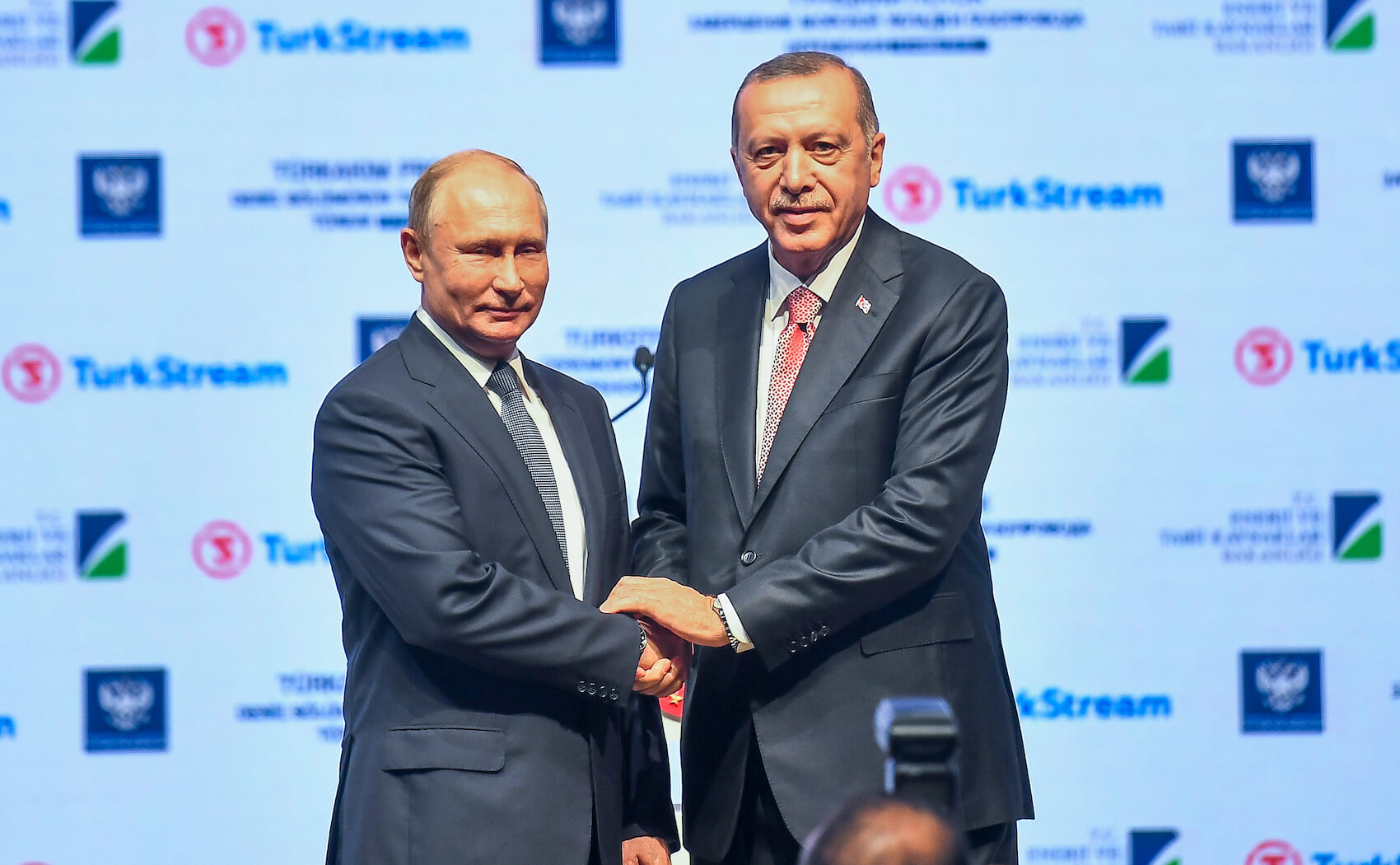
Russian President Vladimir Putin and Turkish President Recep Tayyip Erdogan made the opening of the Natural Gas Pipeline (Turkstream) in Istanbul, Turkey on November 19, 2018.
Turkey seems to present an especially difficult case for your argument. It remains a NATO member and benefits from Western security and economic institutions, while under Erdogan it has also experienced severe democratic backsliding, increasing authoritarianism, and a highly personalized and populist foreign policy. Is Turkey effectively benefiting from both worlds—using its place inside the Western institutional order while simultaneously exploiting the strategic flexibility associated with authoritarian middle powers? And to what extent has populist nationalism enabled Erdogan to present this balancing strategy not as dependence or inconsistency, but as evidence of multi-directional foreign policy, sovereignty, and national strength?
Imran Bayoumi: Turkey’s a very interesting case, and it’s one of those countries that has really managed to play and interact with both realms at the same time. The most recent kind of development there, with President Trump talking about lifting sanctions on Turkey that he himself put in place in his first term, is really a testament to the kind of power of personalized diplomacy and the strides in relations that Turkey has developed with the Trump administration in this second term.
To the second part of your question, in terms of populist nationalism, I think that’s key. Erdogan has been able to sell this balancing strategy as a way of being able to secure Turkey’s interests first. If that means buying Russian air defense systems while also being part of NATO, that’s what it takes. But, it goes back to my earlier point, where these kinds of illiberal, partially free democracies that still have elections, these leaders are still susceptible at some stage. So, there’s still, even if it’s limited, kind of opposition media in and out of the country that can pressure these leaders, and that maybe be a weakness. Therefore, there’s also a recognition that they need to work with everyone or work to sell the message more so than true authoritarian states that may not even communicate these foreign policy decisions.
Turkey’s Dual Alignment Reflects Strategic Geography and Diplomatic Flexibility
The recently signed Mecca Joint Defense Agreement between Turkey, Saudi Arabia, and Pakistan seems to take this strategy a significant step further by creating a collective-defense arrangement among three important regional powers, while Turkey simultaneously remains inside NATO. Do you see the Mecca Pact as another example of Ankara hedging within an increasingly fragmented order, or does it represent something more consequential—the beginning of an alternative security architecture that could gradually reduce Turkey’s dependence on the Western alliance system? And what does Turkey’s ability to participate in both arrangements tell us about why today’s global disorder may particularly reward authoritarian or highly personalized middle powers?
Imran Bayoumi: I actually think the Mecca Pact is more about regional security. I don’t think it should be read as an attempt by Turkey, Pakistan, or Saudi Arabia to build a true international order alternative to the US-led alliance system, or to China or Russia. For these three countries, it reflects a recognition that the Middle East will remain markedly different after the conclusion of the Iran war, whenever that might be. They’ve seen that Iran may be weakened in some respects. Its economy has certainly taken a beating. The Supreme Leader was killed, but at the same time, it remains quite disruptive when it wants to be. It has control of the Strait of Hormuz and has launched attacks on a lot of the Gulf countries.
This is really about ensuring these countries’ own security in the region. You have Iran on one side, and then there’s also a recognition that the long-term presence of the United States in the region can no longer be guaranteed. No one knows what that will look like. It could be a substantial drawdown, and without the US there, there are all these other long-standing security threats that may emerge.
So, I see this pact more as strengthening the security of these three countries within the Middle East, within a volatile region that all three of them occupy. It’s a long-term bet that the region will remain unstable and that there’s value in having these alliances and partnerships.
The question with the Mecca Pact in particular is: how far does it go? What does it look like when a state is actually challenged? Is there an Article 5-style response, like you would see with NATO, where other nations commit troops and commit to fighting? Or is there just the provision of economic aid or military equipment, without necessarily joining the conflict with troops on the ground?
What Turkey’s ability to participate in both arrangements tells us is that Turkey has been able to play this system well. It understands that it occupies a geographically strategic and relevant location. It’s able to maintain ties and communications with key global players, and there’s recognition among the US and other NATO countries that it’s perhaps in their interest to have Turkey able to hold discussions with Russia and facilitate that channel, while also having a strong ally in the Middle East that can represent the alliance’s interests there.
So, as much as I think it’s a testament to Turkey’s ability to navigate this disruption, there’s also probably a bit more give than we may want to admit on Washington’s side, London’s side, and Berlin’s side. It’s helpful to have states that can both be your ally and talk to other still powerful, if not revisionist, countries.
Revisionist Autocracies Benefit Whenever Western Cohesion Weakens
In your New Statesman article on the “axis of autocracies,” you emphasize that China, Russia, Iran, and North Korea do not constitute anything like an authoritarian NATO. Their interests differ, and their cooperation remains limited and transactional. Yet you argue that they can still benefit from American strategic mistakes. Is it therefore misleading to focus too much on whether authoritarian states form a coherent alliance, when the more important issue may be that they benefit from the same weakening of Western institutions?
Imran Bayoumi: That’s right. To be clear, they’re working very closely together. Russia, for example, is providing targeting data to Iran to assist with Iran’s war that the United States is fighting. China has been an economic lifeline to Russia during its full-scale invasion of Ukraine and North Korea is providing troops to Russia to fight in Ukraine. Even though there’s no formal alliance system, these kinds of levers of cooperation and ties are deepening between these states.
You’re also right that we don’t need to focus on, or wait for, them to sign a formal alliance before being worried about the threat they pose. Every action that undermines the strong ties between the United States and its allies is a benefit for them. Tariffs against Washington’s trading partners that force them to look to new sources, such as China, are a weakness. Actions that undermine alliance cohesion, like threatening to take Greenland, are also a weakness, and the beneficiaries are really these revisionist autocracies.
So, we don’t need to wait for them to form a formal alliance and sign a treaty. We can be worried in the short term. I’m not sure they’ll ever get to that place, and that doesn’t mean we should wait to counter that threat.
Without Clear Goals, Tactical Victories Can Undermine Long-Term Power
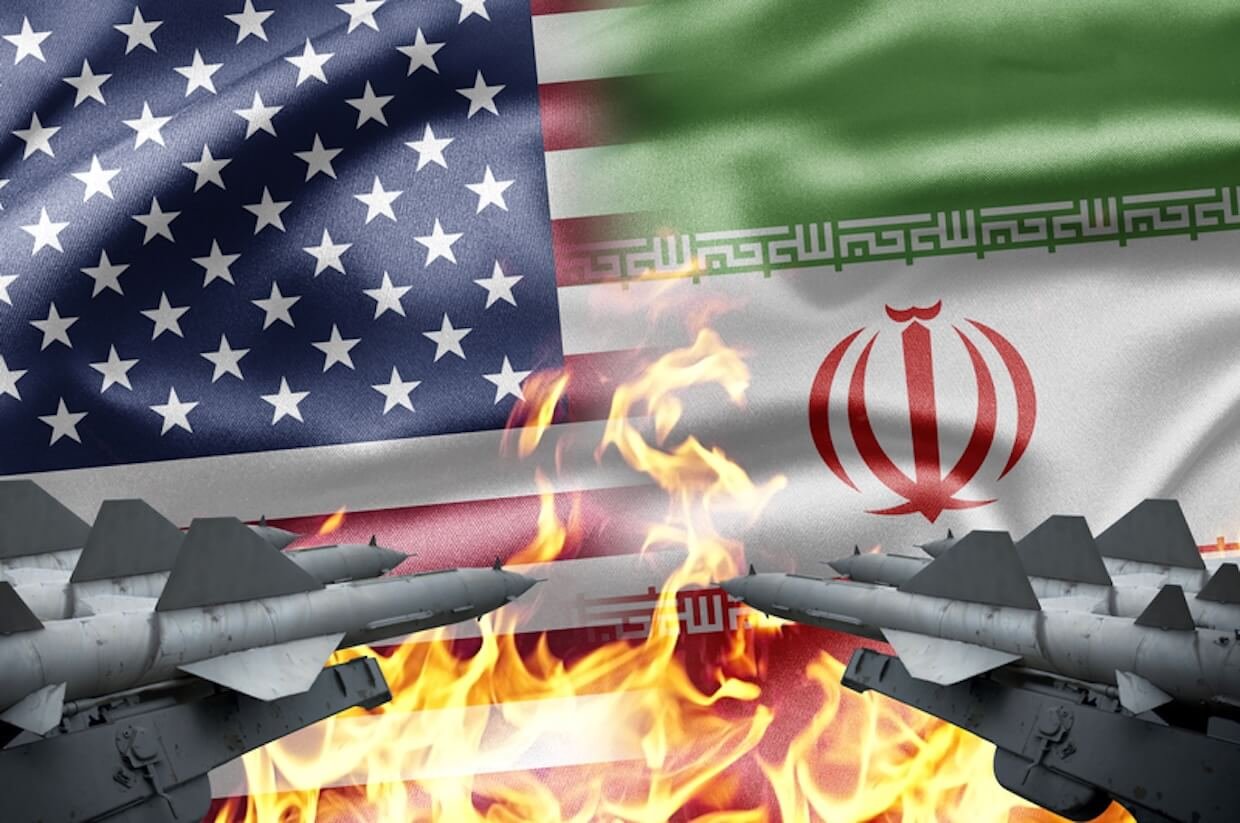
Photo: Pavel Kusmartsev / Dreamstime.
Your analysis of the Iran war makes an important distinction between tactical success and strategic success. The United States might weaken Iran militarily while simultaneously increasing Russian energy revenues, diverting American military resources away from Asia, and creating tensions with European allies. Does this reflect a wider problem in American strategy—an ability to win individual confrontations while gradually weakening the alliances and resources that underpin its long-term power?
Imran Bayoumi: This has been a recurring challenge for the United States since it launched the 2003 Iraq War. It has been hard for the US to win decisively, and looking back to the first Trump administration, there was more of a recognition of that. This administration—the second Trump administration—may have been somewhat falsely emboldened by the relatively well-executed operation to remove Nicolas Maduro, the president of Venezuela, and bring him back to the United States to face trial. Militarily and tactically, that was quite a spectacular operation, with no lives lost. You can debate whether there has really been a transition to democracy or whether the lives of Venezuelan people have markedly improved, but more broadly, this was seen as a success and may have given a false sense of security moving into the Iran war.
One interesting thing to note about the Iran war, and this demonstrates that values still matter, is that if you look at the start of the war and German Chancellor Merz’s statements, he was initially in support of it when President Trump was framing the war as an opportunity for the Iranian people to rise up and overthrow their leaders. Then, once we saw the United States abandon that goal—though it was never really clear whether that was one of the core goals to begin with—and there was a recognition that this was going to be a longer-term conflict, you then saw Merz and other leaders come out against it.
There are a few things here. First, there is definitely a difference between tactical military success on the battlefield and translating that into strategic success in the long term. That’s a long-standing challenge. But the other point that’s maybe a bit more interesting and harder to tease out is that there is still support for these broad values-based interventions. The problem is that, in Iran specifically, I don’t think the war is being executed with a level of strategy and clear goals that would allow allies to support it.
That’s the challenge. Now we’re in this stalemate where both Iran and the United States increase leverage week over week. Sometimes one has more than the other, and there’s no clear off-ramp. That undermines US power and credibility and raises the question, in the eyes of allies: what does the US want here?
Rebuilding Allied Trust Will Take Much Longer Than Losing It
There may also be a populist dimension to this problem. Populist foreign policy often favors highly visible demonstrations of strength—tariffs, military strikes, threats, sanctions, territorial claims—because they can be presented domestically as proof of decisive leadership. But can policies that are politically attractive at home produce strategic costs abroad that only become visible years later?
Imran Bayoumi: That’s a real challenge, and we’re starting to see that now. With the Iran war—and more broadly with the actions this administration has taken—it will take a long time to rebuild the trust that the US had with its allies and partners. That trust still exists on some level. I don’t think it’s totally gone, but it has diminished. The next administration—or this administration, if it decides to change course going forward—will face a key question: how do we manage our relationships with allies, recognizing that they will now want more? They’ve diversified, they’ve taken steps to increase their defense spending, and they want to ensure their sovereignty as well. So what does this broader dynamic look like going forward? That’s a real challenge that I’m not sure many are thinking about.
What the future of the international order looks like is going to be a real challenge. I don’t think everything we’ve taken for granted over the past 80 years can continue to be taken for granted. Things will have to change. Some of these challenges might not be evident in the immediate future.
China Gains Influence by Showing Up Where Democracies Do Not
Map: Shutterstock.
In your work on China’s policing partnerships in the Pacific, you show that Beijing gains influence not simply through military power but through police training, surveillance systems, security assistance, infrastructure, and relationships with political elites. Does authoritarian influence spread partly because authoritarian governments are particularly willing to connect foreign policy with internal security and regime protection? And how should democracies compete without supporting similar forms of political control?
Imran Bayoumi: I think that’s certainly part of it. There is this recognition in authoritarian states that the technology China is selling can help preserve their power. But in the Pacific specifically, it’s more about the fact that China showed up and is willing to offer these goods for cheap. Public safety is a real concern for these governments, and if China is the one offering to help with policing when the US, Australia, or New Zealand is not there, most countries would take that offer of help.
The broader challenge is for the US and its allies to show up and offer cheap or affordable solutions and policies. In terms of what can be done differently, the Pacific is actually almost a success story now. You’ve seen Australia really invest in deepening its security ties across the region, and I’m focusing on that since that was the starting point of this article, or this question. It’s built out these broad security deals. It’s providing police training. There’s a big Pan-Pacific policing initiative, security initiative, and Australia has invested in cultural ties as well. Fore example, it’s used rugby as a way to strengthen support and ties and really build those stronger connections.
So, I don’t think democracies can’t compete or can’t still be attractive partners. The challenge, though, is that they have to offer something as good or better at a competitive price point. It’s hard when that can’t be underwritten by the state.
Democracy Remains a Valuable Organizing Principle
You have also criticized Washington for overlooking democratic backsliding or human-rights violations when dealing with strategically important partners. But if great-power competition gives authoritarian governments more alternatives, American pressure becomes harder to apply because governments can threaten to turn toward China or Russia. How can democracies defend democratic standards without pushing strategically important states toward authoritarian powers?
Imran Bayoumi: I’ll focus specifically on the US here. The United States still has a ton to offer, and countries still want to partner with it, regardless of how disruptive it may be in the current moment. It’s partly about the United States being comfortable using its leverage and its power. We’re seeing it use that power and leverage in ways that undermine its relationships and weaken them writ large. So I would pull that back and instead focus on how we build stronger relationships and how we present the US as a still attractive partner especially in terms of economic and military power.
Then, what are the conditions for partnering with the US? I don’t think that’s really any different from the past. There are opportunities to condition arms sales, trade agreements, and broad diplomatic agreements. So, Washington still has this kind of draw. Even though authoritarian states may be able to hedge better, they’re still hedging, which means there are still two powers—or multiple great powers. They’re not blindly allying themselves with Russia or China, or some combination of that. There’s still something they want from Washington.
It’s all about how we use what Washington has to incentivize changes in behavior. One last point: Democracy is still a valuable organizing principle. You could look at Madagascar last year, which had a youth movement that toppled the government and helped push it toward what may be some sort of democratic transition. So, there is still support for these values, and Washington needs to find a way to elevate that and try to create conditions for that change.
Renewed American Leadership Must Accommodate a More Decentralized World
Finally, you do not argue that authoritarian victory is inevitable. Russia and China have serious economic and demographic weaknesses, and authoritarian partnerships remain much less reliable than democratic alliances. If today’s disorder currently rewards authoritarian and populist forms of politics, what changes would be necessary for the international system to reward democratic cooperation again? And does that require simply restoring American leadership, or developing a new model in which democratic middle powers have much greater autonomy?
Imran Bayoumi: I’m not sure I know the answer to what changes the international system needs to make. But one important point, which I’ve touched on before and which you picked up in the question, is that the international system will look different going forward. What we will have to grapple with—we being the United States, or policymakers here in the United States—is that middle powers, both democratic and authoritarian, will have more power. They might not be able to build a whole new international system, but they will have the power to advance their interests in certain sectors, on certain topics, and in certain regions. So, the new international system will have to deal with their desire for autonomy.
That being said, I still think there is value in having a hegemon. The system still needs one strong power that can draw all of these states together, make them work together, and enforce the rules of the system while maintaining and growing it. Going forward, what we’ll need is some sort of retooled American leadership—one that recognizes the growing power of smaller states and the defining challenges of the moment, whether those come from revisionist states or from non-state threats such as climate change and the challenge of dealing with technology. It also needs to be able to build new institutions or revitalize existing ones in order to spur cooperation and continue that momentum.
In this interview with ECPS, Dr. María José Urzúa Valverde examines how authoritarianism, populism, and democratic backsliding increasingly intersect with struggles over civil society and international norms. She argues that autocracies view independent civic mobilization as a strategic threat because rights-based movements can generate broader networks of resistance. The conversation also explores how conservative and populist actors use transnational networks to contest LGBTQ+ rights, human rights norms, and the role of international organizations. Dr. Valverde highlights the growing polarization of international civil society, the strategic use of migration as interstate leverage, and the resurgence of sovereignty-based challenges to the liberal international order. Together, these developments reveal how democratic erosion increasingly unfolds across both domestic and international arenas.
In an era marked by democratic backsliding, transnational populism, and growing contestation over international norms, the struggle over civic space has become increasingly central to the future of liberal democracy. In this wide-ranging interview with the European Center for Populism Studies (ECPS), Dr. María José Urzúa Valverde, Assistant Professor in the Department of International Studies at ITAM in Mexico, argues that authoritarian governments do not merely resist particular rights claims; they are deeply concerned with the broader political capacity that autonomous civil society can generate. As she puts it, “Any rights-based mobilization becomes a focal point around which other regime opponents can build networks to resist the regime’s power.”
This insight lies at the heart of Dr. Valverde’s analysis of authoritarian opposition to LGBTQ+ rights. Drawing on her Journal of Democracy research with Gino Pauselli, she emphasizes that conservative ideology alone cannot explain authoritarian behavior. Their argument instead identifies a threefold logic: “repression of civil society, opposition to the liberal international order, and the instrumental use of conservative ideology.” For Dr. Valverde, the civil-society mechanism is especially revealing because rights-based mobilization can create organizational capacities that extend well beyond a single policy issue. Hence her conclusion that “both liberal and illiberal networks and governments understand civic space access itself as a strategic asset.”
The interview also broadens this argument beyond domestic authoritarianism. International organizations themselves, Dr. Valverde argues, have become arenas of normative competition. Conservative NGOs and governments increasingly use the same institutional channels once associated primarily with progressive advocacy, while seeking to influence judges, commissioners, and policy agendas. What is at stake, she stresses, is “not only outcomes, but also the IO’s function itself.” This process can produce what she calls “neutralization”: weakening an international organization’s capacity to advance norms without formally reversing its previous commitments.
These dynamics are closely connected to populism. Dr. Valverde rejects the idea that populists simply learn from autocracies; she instead points to “shared transnational infrastructure” linking conservative and populist actors across borders. She also warns against reducing democracy to electoral legitimacy. Populist leaders, she notes, often reason that “If I won the election, then I represent the people, and if I represent the people, I can do no wrong.” Such logic, she argues, can rapidly undermine checks and balances and weaken non-elected institutions essential to democracy.
Taken together, the conversation presents civic space not as a secondary democratic concern, but as a core arena in which authoritarianism, populism, human rights, and international order increasingly intersect.
Here is our interview with Dr. María José Urzúa Valverde, edited lightly to enhance clarity, readability, and overall flow for publication.
Rights from Above Do Not Empower Civil Society
United Nations headquarters in New York City, US. Photo: Dreamstime.
Dr. María José Urzúa Valverde, welcome! YourJournal of Democracyarticle argues that authoritarian governments oppose LGBTQ+ rights not simply because of cultural conservatism but because these rights strengthen civil society, reinforce liberal international norms, and potentially expand spaces for political contestation. This moves the discussion beyond morality into regime survival. To what extent should we understand contemporary anti-LGBTQ+ campaigns as instruments of authoritarian governance rather than merely expressions of conservative ideology?
Dr. María José Urzúa Valverde: That’s a fantastic question, and first of all, thank you very much for your interest in my article with Gino Pauselli in the Journal of Democracy. As scholars, we always dream of being read and of our scholarship being of interest. Responding to your question, I think that the dichotomy is analytically useful, but empirically, maybe it’s too clean. Our article shows that autocracies vote against SOGI, or Sexual Orientation and Gender Identity Resolutions at the United Nations Human Rights Council, over 80% of the time. It explains this through a threefold logic: repression of civil society, opposition to the liberal international order, and the instrumental use of conservative ideology, not ideology alone.
I think that maybe the civil society repression channel is the most diagnostic. Social rights function as a proof of concept that a minority, once granted rights, mobilizes to expand them, or also just to gain them. That, exactly, is a capacity autocracies need to suppress, regardless of the issue. The clearest evidence in our article that the governance logic beyond ideology is what works best is Cuba: an authoritarian government that voted in favor of all five United Nations Human Rights Council social resolutions between 2011 and 2022, while never empowering independent LGBTQ+ civil society. So, rights granted from above, with no domestic accountability and mobilization attached.
So, yes, conservative ideology is one of the three interacting levers in our article, but we think about it as deployed instrumentally, where useful for legitimation and alliance building, and dispensable where regime survival logic points elsewhere, as in Cuba.
Civic Space Is a Strategic Asset
Your explanation places civil society at the center of authoritarian calculations. Rather than fearing LGBTQ+ communities themselves, authoritarian governments appear to fear the broader mobilizational capacity that rights-based movements generate. Does this suggest that authoritarian regimes increasingly perceive all forms of autonomous civic organization as interconnected threats, regardless of the specific issue around which they initially mobilize?
Dr. María José Urzúa Valverde: Yes, I do think so. I think that the mechanism doesn’t necessarily depend on said rights specifically. Any rights-based mobilization becomes a focal point around which other regime opponents can build networks to resist the regime’s power. So, this generalizes empirically to the tools autocracies more generally use, like foreign agent laws, NGO registration barriers, and propaganda status.
I’m currently working on anti-gender network mobilization at the Organization of American States (OAS), which shows the same generalized logic from the opposite ideological direction: conservative civil society networks treating access to international organizations (IOs) as an important focal point for infrastructure building, so, like, for training, coalition formation, and the creation of relevant normative frameworks, independent of any single policy win. And so, I think both liberal and illiberal networks and governments understand civic space access itself as a strategic asset.
Transnational Networks Matter More Than Autocratic Learning
Across Europe and Latin America, populist leaders frequently portray LGBTQ+ rights, gender equality, migration, and multiculturalism as elements of a single ideological project imposed by liberal elites. Do you see evidence that contemporary populists have learned from authoritarian regimes how to transform cultural issues into broader narratives about national sovereignty and democratic legitimacy?
Dr. María José Urzúa Valverde: That’s also a great question. I would resist learning from autocracies as the primary mechanism. It is better explained by shared transnational infrastructure than by diffusion from authoritarian regimes to populist governments.
I’ve been working on gender ideology at the OAS, and that gender ideology, as a concept, is a deliberately elastic floating signifier that articulates SOGI, reproductive rights, education, and public health into a single civilizational frame. In the case of the OAS, that infrastructure is facilitated by some very famous NGOs and networks, like Alliance Defending Freedom, CitizenGo, the International Organization for the Family, and the Congreso por la Vida y la Familia, which train and finance authoritarian-adjacent but also democratically elected populist actors at the same time.
So, I would say that, in the case of Latin America, the populist right couples sovereigntist nationalism with a religiously coded foreign threat, rather than immigration-centered nativism, which is also interesting. But this is a parallel development to the frameworks used and the narratives employed by authoritarian regimes. I wouldn’t say that populist governments learn from authoritarian regimes.
International Norms Create Lasting Institutional Effects
Participants march through the streets during Prague Pride, a major LGBTQ+ parade and celebration, in Prague, Czech Republic, on August 12, 2017. Photo: Madeleine Steinbach.
Your research demonstrates that battles over LGBTQ+ rights increasingly unfold within international organizations, particularly the United Nations Human Rights Council. Some observers assume these debates are largely symbolic. Yet your work suggests they have genuine political consequences. Why do authoritarian governments invest so much diplomatic capital in resisting seemingly non-binding international norms?
Dr. María José Urzúa Valverde: That’s a great question as well. I would say that non-binding norms matter. Non-binding doesn’t mean costless or inconsequential, so precedent accumulates. Also, regarding United Nations Human Rights Council resolutions specifically, they might be non-binding, but at the same time they establish mandates. For example, in the case of SOGI resolutions at the United Nations, they created the Independent Expert on SOGI rights in 2016, whose mandate was renewed by the resolutions of 2019 and 2022. That creates institutional machinery, reporting, monitoring, and a reference point that autocracies correctly read as a foothold for further, maybe even binding, developments.
In the case of autocracies, what happens at the domestic level matters less because of their repression of civil society and the lack of pathways for different domestic actors to influence politics. But in the case of democracies, even non-binding resolutions may serve as mobilization focal points for domestic policy wins. So, non-binding norms have evidently become relevant sites of contestation for both authoritarian regimes and opposing democratic regimes. And that has made such resolutions rare items at the United Nations Human Rights Council because they are consistently forced to a formal vote.
So, unlike the 74% of resolutions passed by consensus at the Council between 2006 and 2020, SOGI resolutions are usually voted on because of the relevance attached to them, and they draw above-average opposition, with up to 43% voting no against a 21% baseline. I would also say that what happens at the United Nations Human Rights Council is relevant as a coordination good for autocracies and other anti-SOGI rights actors themselves, because participation and opposition allow them to build what we can call backlash networks and rehearse a shared vocabulary that travels to other normative fights in international and national forums.
International Organizations Are Arenas of Normative Competition
Your doctoral research examines how civil society gains access to international organizations and transforms access into political influence. At a time when authoritarian governments seek to restrict civic participation both domestically and internationally, have international organizations themselves become contested arenas where democracy and authoritarianism increasingly compete for normative influence?
Dr. María José Urzúa Valverde: Yes, I would say definitely so, and increasingly in more symmetric ways. You mentioned my doctoral thesis, and in my thesis I work on civil society access to international organizations. In my thesis, I show, for example, conservative NGO participation at the Organization of American States (OAS), which is an organization I mentioned before but didn’t quite explain. The OAS is the main regional, multi-purpose organization of the Americas. The United States, Canada, Latin American countries, and the Caribbean countries participate in this organization, and it has been very relevant in terms of normative developments in the human rights arena, as well as in other issues.
In the case of human rights, it has a commission, the Inter-American Commission on Human Rights, and the Inter-American Court of Human Rights, which closely parallels the European Court of Human Rights, if people reading this interview are familiar with the European Court. Individuals can access the Commission and the Court in order to get redress for human rights violations at the national level. And it’s very interesting how the Inter-American human rights system has driven progress on SOGI rights, especially in Latin America.
It, for example, led to the adoption of same-sex marriage in Costa Rica, and that has generated backlash. Conservative NGO participation—anti-SOGI rights NGO participation at the OAS, especially at the General Assembly—went from zero in the 1990s to 128 organizations by 2019, reaching close to a third of civil society participation at its peak, using identical access channels and similar strategies to those of pro-SOGI rights NGOs.
Conservative NGOs and conservative governments are also lobbying for the election of conservative judges and commissioners, so what’s contested is not only outcomes, but also the IO’s function itself.
In a later paper, which builds around my work on my doctoral dissertation, I talk about neutralization, which is disabling an IO as a driver of norm expansion without reversing prior commitments. That’s what we see today at the OAS, where discussions on SOGI rights are being stalled because of backlash and fear of backlash. I think that’s a very interesting development happening at IOs today.
International Civil Society Is More Polarized Than We Thought
Much of the democratic backsliding literature focuses on elections, constitutions, and judicial independence. Your scholarship instead highlights civil society, international norms, and transnational advocacy networks. Has political science underestimated the extent to which democratic erosion occurs through the gradual weakening of societal actors rather than through dramatic institutional change?
Dr. María José Urzúa Valverde: I am a student of international relations, a scholar of international relations, so I would say that, yes, political science has indeed underestimated the extent to which democratic erosion might also be advanced at the international level—at that level, through the weakening of societal actors rather than through dramatic institutional change. I wouldn’t necessarily generalize to research on domestic politics.
But I do think that, at the international level, in international relations, we have tended to think of societal actors as pretty homogeneous. So, most of the literature and research of the 1990s on civil society actors in IOs and transnational advocacy networks focused on pro-progressive human rights actors, or progressive actors more generally. And it was, like, the conventional knowledge that only those actors actually cared about what happened at the international level and accessed the international level to exercise pressure on their domestic governments to advance human rights causes, for example.
We have learned more recently that that’s definitely not the case, and that we even ignored, for a long time, how diverse civil society is, not only at the domestic level but also at the international level, and the polarization dynamics that emerge when civil society organizations that have contrasting ideas on certain topics, like SOGI rights, all access and all try to push forward their agendas in IOs.
I do think that this is a phenomenon that is usually not observed as dramatic institutional change, but rather as something that builds more progressively in IOs, and that has interesting implications for what IOs can do in terms of advancing human rights and advancing democracy. And I think that neutralization, for example, which I already mentioned, is a category that talks about this more nuanced and more progressive, little-by-little institutional change.
‘Backlash Networks’ Are Still Mostly Defensive
In yourJournal of Democracyarticle, you describe how authoritarian governments cooperate internationally to resist the expansion of LGBTQ+ rights through what might be called “backlash networks.” These coalitions appear increasingly coordinated across regions. Are we witnessing the emergence of an alternative international normative order, or are these alliances better understood as defensive coalitions seeking to slow liberal norm diffusion?
Dr. María José Urzúa Valverde: Based on the empirical evidence, I would say that, up until today, the system is more defensive. So, for example, the anti-gender networks’ litigation at the OAS is reactive, no? It tries to diminish the influence of progressive actors at the OAS, for example, by submitting amici curiae in cases brought by others. So, I read that as a response to an unfavorable opportunity structure in the Inter-American human rights system, and that might change over time.
But I do think that, right now, what we see is not reversal yet. I think reversal might happen, but right now, we don’t see decisions at the OAS or at the United Nations Human Rights Council that adopt substantive alternative standards from anti-SOGI rights networks. So, we do not see resolutions regarding, for example, an absolute right to life, or gender ideology being used as a category to talk about a threat, as it is usually framed by anti-SOGI rights actors.
So, rather, we see defensive coalitions seeking to slow liberal norm diffusion, as you mentioned. Influence shows up in stalled agendas and dissenting opinions, not new international norms. That said, I would say that the coordination infrastructure of backlash networks—for example, lobbying for ideologically proximate judges and commissioners at the OAS, training pipelines, and north-south funding flows—is being built for the long run.
And elected officials now sympathetic to these agendas are positioned to eventually build an alternative international normative order. So, I would say that being defensive today and building an alternative order later are not mutually exclusive, and we might see that in the future.
Migration Control Creates Interstate Leverage
Disembarkation of 300 migrants from Libya from the German rescue ship Sea-Watch 3 in Pozzallo, Province of Ragusa, Italy, on June 9, 2022. Photo: Alec Tassi.
Your more recent work introduces the concepts of migration power and migration statecraft, arguing that migration flows themselves have become instruments of interstate influence. This shifts migration from being merely a humanitarian or domestic policy issue to becoming a foreign policy resource. How does this conceptualization change the way political scientists should understand migration in an era of geopolitical competition?
Dr. María José Urzúa Valverde: That’s an interesting question, and also thank you for reading that paper with Natalia Saltalamacchia. In that paper, we reconceptualized migration flows themselves as a power resource, comparable in kind, not just in effect, to more conventional instruments of statecraft.
Using Baldwin’s relational anatomy of power, the key conceptual move is that migration power is constituted, so it exists only because destination states have decided domestically that controlling migration is a vital interest.
So, the target zone securitization of migration is what turns a transit or origin state’s population movements into leverage, or an instrument of statecraft. I think this is interesting. It reframes the weapon of the weak intuition as conditional, not structural. Exercising migration power credibly requires real institutional capacity, so border enforcement and processing infrastructures, which some fragile states lack.
But that’s why we see the strongest cases, like Morocco, Turkey, and Egypt. They are all states with functioning migration bureaucracies. But I do think that it’s an interesting turn to think not necessarily in terms of geopolitical competition. I think it’s more interesting for thinking about North-South relations.
What typically is the leverage that less powerful states have vis-à-vis more powerful states? So, for example, the case of Mexico vis-à-vis the United States. For the United States, for the government of Donald Trump, it is very important that Mexico engages and cooperates with the US in terms of the containment of migrants at the US-Mexico border. That gives Mexico some leverage vis-à-vis the United States, even when we as Mexicans have always been very aware of how asymmetrical our relationship with the US is. So, it’s very interesting to think about how North-South dynamics change when this leverage exists on the side of southern countries, and this leverage is, paradoxically, created in part by northern states that see migration as a threat.
Migration has increasingly become a bargaining tool in relations between states—from the Belarus–EU border crisis to Turkey’s agreements with the European Union and Morocco’s management of migration toward Spain. Does your framework suggest that migration is evolving into a standard instrument of statecraft comparable to sanctions, trade policy, or energy diplomacy?
Dr. María José Urzúa Valverde: I am not a scholar of migration, but I think this is a conceptual article. It is trying to provide some analytical tools and some relevant concepts to understand dynamics that we are indeed observing today, including some of the relevant empirical examples you just mentioned. I would also mention the very recent crisis regarding Morocco-Spain relations in Ceuta. In late July, thousands of people left Morocco and tried to reach Spain through Ceuta, which is a Spanish territory, in an enormous flow of people that unfortunately had terrible humanitarian consequences, because many of those migrants died.
What probably happened, given the enormous number of people crossing at the same time, was that the Moroccan government facilitated the crossing, or encouraged the crossing, to exercise political pressure on Spain. Migration is being used as an instrument of statecraft. I would compare it to energy sanctions or trade policy. In this case, the one that can exercise migration statecraft is the less powerful state, which doesn’t necessarily happen with all types of statecraft. Obviously, it varies.
I just want to finish the comment by recognizing also how problematic this is in terms of ethics. Because what we’re talking about is people’s lives. Exercising migration contention, or facilitating migration flows to exercise pressure on other states, depends on governments mobilizing or containing people who are trying to move across borders to have access to better living conditions. Migration statecraft is very problematic in this sense, but it’s something that we are observing today in the world, and that it’s important to name.
Populism and Migration Diplomacy Reinforce Each Other
Populist leaders often frame migration as an existential domestic threat, while governments simultaneously employ migration strategically in international negotiations. How do these two dimensions interact? Are domestic populist narratives and international migration statecraft increasingly reinforcing one another?
Dr. María José Urzúa Valverde: That’s a great question, and I think the two are indeed mutually reinforcing through the co-constitution mechanism at the center of Natalia Saltalamacchia’s and my article. Populist domestic narratives that frame migration as an existential threat are precisely what increase the value states place on migration control. That value, in turn, creates leverage that other states can exploit.
So, the causal relationship runs both ways. When migration statecraft succeeds, the episode can also be interpreted domestically as confirmation that migration is indeed the existential threat populists have described, thereby reinforcing the very narrative that generated the vulnerability in the first place. This creates a feedback loop with no obvious breaker.
The more governments perform toughness on migration for domestic audiences, the more valuable migration becomes as a lever for whoever controls the migration flow. That’s a genuinely understudied dynamic linking the populism and migration diplomacy literatures, which have generally developed separately.
The Liberal Order Is Being Challenged from Within
From Left: Hungary PM Viktor Orban, Poland PM Beata Szydlo, Czech PM Bohuslav Sobotka and Slovakia PM Robert Fico pose prior their meeting in Prague on February 15, 2016.
Throughout your scholarship, there is an ongoing tension between universal human rights and state sovereignty. In today’s geopolitical environment, where sovereignty has re-emerged as a central political slogan for both populist and authoritarian governments, has the balance between these principles shifted in ways that fundamentally challenge the post-Cold War liberal international order?
Dr. María José Urzúa Valverde: That’s also a great question. I would start by recognizing that the tension between universal human rights and state sovereignty has always existed. What universal human rights seek to achieve is to protect citizens from abuses of power by their own governments. There has therefore always been this very interesting tension between international human rights norms, institutions, and mechanisms, on the one hand, and state sovereignty, on the other, because when IOs or other states criticize a country’s human rights record, they are addressing a deeply internal matter: how a government treats its own citizens. So, this is not new.
However, I do think that the sovereignty-based justification for opposing international human rights norms has become more salient in the last couple of years because of the turn toward more nationalist governments in much of the world, and also because of the rise of authoritarian governments. These governments are, of course, particularly opposed to universal human rights norms and to international actors expressing opinions about or criticizing their domestic records, because they frequently violate human rights. That’s a basic trait of authoritarianism.
But yes, this is also because they want to maintain very tight control over domestic civil society. So, I would say that, yes, definitely, this tension has become more salient over time, and this does challenge the post-Cold War liberal international order. We must also recognize that it is not only authoritarian governments or populist governments in the Global South that are opposing or contesting universal human rights. Some of the main proponents of the liberal international order itself are also doing so, with the United States being the most relevant case.
So, besides normative contestation at IOs, we must also look at what happens, for example, with funding in the next couple of years. There is a real threat that international institutions may no longer be able to deliver in areas such as monitoring mechanisms because funding that has traditionally been provided by the United States may no longer be available. I think this is also a highly relevant dynamic, beyond the more discursive contestation of universal human rights norms.
Winning Elections Is Not Enough for Democracy
Your work on civil society implicitly broadens the concept of political representation beyond elected institutions. Many populist leaders claim that elections alone provide sufficient democratic legitimacy. Yet your research suggests that democratic governance also depends upon organized civic participation and international advocacy. Should we rethink democratic representation as extending well beyond electoral politics?
Dr. María José Urzúa Valverde: Yes, I would say it is a fundamental, core trait of populist governments to associate democratic legitimacy almost entirely with the electoral mandate, and that’s obviously worrisome. It leads populist leaders to say, “If I won the election, then I represent the people, and if I represent the people, I can do no wrong.” That kind of logic can quickly lead to dynamics of democratic erosion, for example, at the domestic level, by contesting and weakening non-elected officials who are also fundamental to democracy. A particularly emblematic case is the judiciary.
So, we must consider that democratic representation extends well beyond electoral politics and also depends on checks and balances on elected leaders, however large their mandates might be. We traditionally think of those checks and balances as domestic, and those are obviously the most relevant ones—for example, what happens at the legislative and judicial levels. But I think the international system also matters as a check and balance on the actions of domestic governments, especially in the case of human rights and other international commitments that the international community has a legitimate interest in upholding.
Gender Ideology Bundles Multiple Political Conflicts
The political contestation surrounding LGBTQ+ rights increasingly overlaps with debates about migration, gender equality, reproductive rights, and academic freedom. Do you see these issues gradually converging into a broader global struggle over the meaning of democracy itself, rather than remaining separate policy debates?
Dr. María José Urzúa Valverde: It’s a very interesting question. There is definitely some convergence across the issue agendas you mentioned. I would not necessarily describe it as a struggle over the meaning of democracy itself, but there is certainly a real convergence in the way these issues are framed.
For example, in my research on the OAS, I examine the use of gender ideology as a unifying concept among populist-right actors and conservative NGOs. In that context, it functions as a deliberately elastic floating signifier that allows the same coalition to move across different topics—including education, public health, SOGI rights, and reproductive rights—without losing coherence.
Populist sovereigntist rhetoric performs a similar bundling function in relation to issues such as migration and multiculturalism. But I would caution against treating all of this as one undifferentiated struggle. The actors, mechanisms, and even regime-type correlations differ from one issue to another.
For example, the relationship between autocracy and LGBTQ+ rights is very robust, as we have already discussed, and autocracies are very likely to oppose SOGI rights. Migration statecraft, by contrast, operates differently. In the case of migration, it is wielded by both democracies and autocracies with roughly symmetric logics.
And regarding the meaning of democracy itself, I would say that the dispute is not so much about democracy being destroyed as about how much democracy actually matters and whether democratic regimes are still considered necessary. It is also about whether we still need the international system and the liberal international order that was constructed after World War II. Two main issues definitely contested across these different, issue agendas.
Populist-Right Trends Are Converging Across Regions
Nested dolls depicting authoritarian and populist leaders Vladimir Putin, Donald Trump, and Recep Tayyip Erdogan displayed among souvenirs in Moscow on July 7, 2018. Photo: Shutterstock.
Having worked extensively on Latin American politics while engaging broader comparative questions, do you believe Latin America offers distinctive insights into democratic resilience that Europe and North America often overlook? Conversely, are there emerging authoritarian strategies in Europe that may increasingly influence political developments across Latin America?
Dr. María José Urzúa Valverde: I would actually say that the current trends in Europe and Latin America are quite similar. We are seeing a rise of populist-right governments in both regions. In Latin America, over the past few months, we have seen the election of Alberto de la Espriella in Colombia and Kast in Chile. Elections are coming up in October in Brazil, and it’s unclear whether the Bolsonaros will return to government or whether Lula will be re-elected. We also see this turn in Argentina with Milei—this is not just a development of the last couple of months, but of the last couple of years.
We also see right-wing governments associated with Fujimori in Peru and with Noboa in Ecuador. And there is a broader trend, at least in the Western world, toward these right-wing governments. We might even think of them as forming a kind of transnational coalition, in the sense that there are links between different far-right and populist-right actors at both the European and Latin American levels.
For example, the influence of the Spanish far right in Latin America is very interesting. In Spain, the far right is represented by Vox, which also has a civil society branch, CitizenGo. CitizenGo and Vox have very interesting links to the populist right in Latin America, including support for political campaigns. Some of the narratives they employ are also copied and used in Latin American countries, and CitizenGo provides funding to Latin American conservative civil society organizations.
So, there are definitely political developments in both regions influencing one another. I don’t know whether Latin America offers distinctive insights into democratic resilience. I’m actually very concerned about current political developments in the region, and our institutions are weaker than those in most European countries. We will see how institutions respond to the democratic erosion dynamics that may emerge across Latin America in the next few years, and how those processes compare with developments in Europe. But the jury is still out on this particular question.
Backsliding and Institutional Backlash Are Increasingly Intertwined
And lastly, Professor Valverde, taken together, your scholarship examines civil society, international organizations, migration, human rights, and democratic governance from multiple perspectives. Looking ahead, which emerging development—whether democratic backsliding, transnational populism, migration diplomacy, digital disinformation, geopolitical fragmentation, or the weakening of international institutions—do you believe will most profoundly reshape the future of liberal democracy over the next decade, and where should scholars concentrate their attention?
Dr. María José Urzúa Valverde: I am particularly interested in democratic backsliding processes and in how international institutions might lock in certain international commitments to preserve international norms such as human rights norms, or whether they will fail to play this relevant locking role, which is something that has been theorized in international relations.
So, for example, there are some very famous articles from the 1990s, especially the one by Andrew Moravcsik on how transitioning democracies lock in international commitments in order to prevent future governments from backsliding, because there is already an international commitment to uphold. He writes about this in the context of European countries committing to the European human rights system.
I think that we are at an interesting time to test that theory and to see whether the international system will provide some safeguards against democratic backsliding, but also how international organizations and international institutions more generally will be—and already are—arenas of contestation over issues related to democratic backsliding, but also to the more general upholding of international human rights norms.
I think it’s a very interesting time to study, both from the perspective of comparative politics and from international relations, how these dynamics of democratic backsliding and the backlash against international institutions interact.
In this commentary, Filippo Palmieri examines how digital platforms are reshaping the political socialization of young Europeans. As mass parties decline, politics is increasingly encountered through personalized feeds, influencers, recommendation systems, and fragmented online publics. Palmieri argues that this transformation does not make populism inevitable, but it creates an environment in which populist appeals to immediacy, personalization, and distrust of intermediaries can travel more easily. Drawing on the concepts of “mass individualism” and “bubble democracy,” the commentary explores how digital participation can broaden political engagement while weakening durable forms of representation and accountability. The central democratic challenge, Palmieri suggests, lies in the growing gap between political expression, collective organization, and meaningful representation.
A political message on TikTok rarely arrives alone. It appears between a song, a comic sketch and a creator’s account of an ordinary day. On Instagram, a carousel explaining an election may be followed by an advertisement or a friend’s holiday photograph. For many young Europeans, this is no longer a secondary route into politics. It is where politics is first encountered.
The European Parliament’s Youth Survey 2024 gives a measure of the change. Among Europeans aged 16 to 30, 42 percent name social media as a main source of information on political and social issues. Television follows at 39 per cent (European Parliament, 2025). These figures do not prove that young people have lost interest in public affairs. They tell us something more precise: a generation is forming its political habits inside spaces built around personal profiles, recommendation systems and an endless competition for attention.
The consequences reach beyond communication. Politics learned through a feed has a different pace, different intermediaries and a different sense of proximity. This helps explain why populist language often moves easily across digital platforms. It does not mean that social media manufacture populists. The relationship is less direct, and more interesting, than that.
What the Party Used to Provide
The decline of mass parties is often measured through membership figures or electoral volatility. Those indicators matter, but they capture only part of what has disappeared. A party once offered a place where separate experiences could be translated into common claims. It trained activists, selected leaders and connected local disputes to an interpretation of society. The process was slow. It was also unequal: hierarchies were rigid, internal dissent could be suppressed, and many citizens remained outside the organizations that claimed to represent them. Yet the intermediary was visible. It had offices, rules, officials and a name.
Mauro Calise describes the new configuration as “mass individualism.” The collective actor once organized by party machines has broken into a multitude of connected individuals (Calise, 2025). The phrase is deliberately paradoxical. Users act through personal accounts, but they do so before mass audiences. They can speak and mobilize at a scale that would once have required an organization, while the content reaching each of them is increasingly personalized.
This distinction matters most for those who did not acquire political habits before the digital turn. A twenty-year-old may discover a housing protest through a short video, learn its vocabulary from a creator, share it with friends and join a demonstration organized in a group chat. Information, expression and participation take place on the same device, sometimes within a few hours. As Ohme and his colleagues observe, digital environments have brought exposure to news and political action unusually close together (Ohme et al., 2022).
That can produce real participation. Climate strikes, campaigns against gender violence and mobilizations over university costs have travelled through networks that traditional parties struggled to reach. But the same mobilization may dissolve when attention moves to another issue. A hashtag can assemble a public without building an organization able to negotiate, decide or remain accountable after the peak of visibility has passed.
There is no single European “digital generation” either. A study covering nine countries found marked class differences among young people’s conventional, community-based and online participation (Grasso & Giugni, 2022). Education, resources and political confidence still shape whose voice becomes public. Cheap access to a platform does not make political influence equally available.
Disintermediation Without the Disappearance of Intermediaries
Social media are regularly described as instruments of disintermediation. The term suggests that parties, journalists and associations have been removed from the relationship between citizens and power. Only half of that story is true. Older gatekeepers have weakened; mediation itself has not vanished. It has changed hands.
TikTok’s recommendation system decides which political clip travels beyond its original audience. Instagram gives visual advantage to claims that can be compressed into a reel or a sequence of cards. Influencers translate public controversies into the language of personal experience, while visible counts of likes and shares make some positions appear socially dominant before a user has examined them. None of these mechanisms is politically neutral, even though none resembles a party headquarters or a newspaper editorial meeting.
Damiano Palano’s notion of “bubble democracy” offers a useful description of the result. Palano argues that the public associated with earlier forms of representative democracy is fragmenting into multiple, partly self-referential audiences (Palano, 2019). A bubble is not a sealed room. Users still meet disagreement, and content moves unpredictably between networks. The deeper change concerns the distribution of attention. A controversy that feels unavoidable on one feed may be almost absent from another. Citizens do not simply reach different conclusions; they may begin from different political events.
This is why the familiar image of the echo chamber is insufficient. The problem is not only that people prefer information consistent with their beliefs. Platform publics are temporary and uneven. They gather around an election, a scandal or a war, then rearrange themselves. Public opinion begins to resemble the intermittent convergence of several streams rather than a single national conversation.
Representative politics has always involved distance. Nadia Urbinati argues that representation does not require citizens and representatives to become identical. It depends on a continuing relationship in which decisions can be judged, contested and revised (Urbinati, 2010). Social media create the impression that this distance has closed. A leader speaks from a phone, replies to followers and comments on events before the evening news. The tone is intimate. Power may remain highly concentrated.
Why Populist Narratives Travel Well
Populism fits this environment because it turns representation into a promise of direct presence. A leader speaks as the authentic voice of “the people”; whoever stands between the two can be presented as an obstacle. Parties distort. Experts complicate. Journalists hide. Procedures delay. These accusations long predate TikTok and Instagram, but platforms allow them to be repeated daily, adapted to audience reactions and attached to an individual face.
Personalization is part of the advantage. A recognizable leader circulates more easily than an organization with competing factions and a detailed programme. Speed matters too. Every event can be framed as an urgent test of whether institutions are listening. Conflict completes the pattern: the distinction between an authentic community and those allegedly frustrating its will is well suited to systems that reward reaction.
Still, there is no universal digital law favoring populists. Davidson and Enos examined more than 400 European parties between 2010 and 2020. Populist parties received more engagement than their competitors on Facebook, but the same advantage did not appear consistently on Twitter. It also varied between countries and was concentrated especially among right-wing populists (Davidson & Enos, 2025). Platform architecture matters. So do political culture, party strategy and national context.
Research from the Netherlands adds another complication. People with populist attitudes were more likely to react to political content, yet their use of social media did not consistently trap them in a populist electoral funnel (Jeroense et al., 2022). A feed is not a machine with a predetermined political output. It changes the incentives under which politics is communicated: some claims become easier to circulate, some actors become more visible, and directness acquires a persuasive value of its own.
For young citizens, this is also a question of familiarity. If politics is first experienced through personal profiles and short cycles of attention, the leader’s direct appeal may not look like a rebellion against ordinary democratic practice. It may look like ordinary democratic practice. Bargaining, party organization and institutional compromise then appear distant and evasive, even though they remain necessary whenever a demand must be converted into a collective decision.
A Different Experience of Democracy
It would be misleading to tell this story as a fall from a democratic golden age. Mass parties often demanded obedience and filtered out inconvenient voices. Digital media have allowed experiences once ignored by established organizations to enter public debate. They have made rapid mobilization across cities and borders possible. Young Europeans have used them to force climate change, racial justice, gender equality and economic insecurity onto political agendas.
What has become fragile is the link between expression and representation. A post shared hundreds of thousands of times shows intensity, not necessarily durability or representativeness. A creator can become an influential political interpreter without accepting the obligations normally attached to political leadership. A digital campaign may be remarkably effective at naming a problem and much less able to determine who can legitimately negotiate in its name.
Young Europeans have not abandoned politics. They are learning it in a public sphere whose boundaries move from one issue to the next and whose most powerful intermediaries seldom present themselves as political institutions. This does not make populism inevitable. It makes the populist promise of immediacy easier to recognize and the suspicion of mediation easier to understand.
The relevant question, then, is not whether young people are democratic enough. It is what democracy comes to mean when it is first encountered as a stream of personalized messages rather than as membership in a collective organization. The passage from mass parties to digital bubbles is therefore more than a shift in political communication. It is a change in the everyday experience through which representative politics becomes intelligible.
(*) Filippo Palmieri holds a master’s degree in International and Diplomatic Sciences, specializing in Politics and International Security, from the University of Bologna. His research focuses on democratic theory, populism, political representation, the transformation of political parties and the effects of digital communication on contemporary democracy. His master’s thesis examined the changing analytical value of the concept of populism in twenty-first-century democracies. He has presented research on democracy, populism and illiberalism at academic events hosted by the Università Cattolica del Sacro Cuore, the Italian Political Science Association and Venice International University. Email: filippo.palmieri3@studio.unibo.it
Davidson, T. R. & Enos, J. (2025). “Engaging populism? The popularity of European populist political parties on Facebook and Twitter, 2010–2020.” Political Communication, 42(1), 171–199. https://doi.org/10.1080/10584609.2024.2369118
Grasso, M. & Giugni, M. (2022). “Intra-generational inequalities in young people’s political participation in Europe: The impact of social class on youth political engagement.” Politics, 42(1), 13–38. https://doi.org/10.1177/02633957211031742
Jeroense, T.; Luimers, J.; Jacobs, K. & Spierings, N. (2022). “Political social media use and its linkage to populist and postmaterialist attitudes and vote intention in the Netherlands.” European Political Science, 21(2), 193–215. https://doi.org/10.1057/s41304-020-00306-6
Ohme, J.; Andersen, K.; Albæk, E. & de Vreese, C. H. (2022). “Anything goes? Youth, news, and democratic engagement in the roaring 2020s.” The International Journal of Press/Politics, 27(3), 557–568. https://doi.org/10.1177/19401612221093008
Palano, D. (2019). La democrazia alla fine del “pubblico”: Sfiducia, frammentazione, polarizzazione: verso una “bubble democracy”? Governare la paura, 35–92.
In this commentary, Dr. Lilliam Arrieta examines how Nayib Bukele’s rise in El Salvador illustrates the speed with which elected populist leadership can evolve into authoritarian consolidation. Focusing on the erosion of judicial independence, she traces how the removal of Supreme Court justices, forced judicial retirements, and the weakening of constitutional safeguards have concentrated power in the executive. Dr. Arrieta situates these developments within a broader Latin American pattern in which populist leaders undermine courts, militarize public security, and weaken checks and balances in the name of popular sovereignty and order. While Bukele’s security policies have attracted “international admiration,” the article highlights their deeper institutional costs for fundamental rights, judicial protection, democratic accountability, and the long-term resilience of constitutional democracy.
El Salvador is a clear example of how quickly and extensively populist rulers can consolidate power and move towards authoritarianism once democratically elected. In the last two decades, across Latin America, several populist presidents gained office through elections but rapidly took steps to undermine democracy, such as Hugo Chávez in Venezuela, Daniel Ortega in Nicaragua, or Evo Morales in Bolivia. These types of leaders often present themselves as messianic figures—outsiders and saviors—claiming to be the only solution to the problems created by traditional political actors: corruption, nepotism, insecurity, inflation, to name a few, and often the more pressing issues for a concrete population. Aside from being or claiming to be outsiders, a second common trait that these strong individual politicians share is their communication skills. They do not merely communicate with the public; they claim to speak for the people, asserting that they embody the largely forgotten majorities themselves (Temelkuran, 2019). Finally, a third distinctive trait is the disregard for traditional checks and balances, especially for judicial review of the Executive’s policies.
El Salvador’s president, Nayib Bukele embodies these three elements. One of the most pressing examples is the quick measures taken after winning the majority of seats in congress during the 2021 elections. Having obtained a large majority of congressional seats (Martinez, 2021), Bukele’s party quickly enacted laws that undermined democracy and dismissed all opposition as his party claimed to do so in the name of “the people.” During the inaugural session of that legislature, Nueva Ideas (New Ideas) party members voted to remove five justices of the Supreme Court without due process of law or any attempt to conduct a proper impeachment procedure (Arauz, 2021). This unconstitutional removal gave Bukele control over the three branches of government. In the following 2024 congressional elections, after having passed legislation to reduce congressional seats from 84 to 60, the ruling party won 57 of them, consolidating total control over the three branches of Government.
This quick overview of the Salvadoran experience shows that Bukele seems to have followed the same patterns as other Latin American populist leaders. Experiences from Bolivia, Nicaragua, and Venezuela had already demonstrated that, to consolidate and maintain power, populist leaders seek control over two main institutions. In no particular order, first, controlling the Armed Forces—and the Police—allows presidents to suppress dissent and instill fear among the population (Bernal, 2021; Infodefensa, 2021; EFE, 2021). Second, reducing the autonomy of the Judiciary.
Authoritarian leaders often seek to dominate the courts, especially the Supreme Court, to bypass legal constraints on their power (Foa, 2021). Checks and balances are considered obstacles, making the dismantling of judicial independence a priority; for example, Hugo Chávez in Venezuela in 2008, Daniel Ortega in Nicaragua in 2010, and Evo Morales in Bolivia in 2017 were able to extend their time in office beyond the constitutional limit thanks to Supreme Court rulings (Sala de lo Constitucional del Tribunal Supremo de Justicia, 2008; Sala de lo Constitucional,sentencia No.06 Corte Suprema de Justicia, Managua, 2010; Sala Plena del Tribunal Constitucional Plurinacional de Bolivia, 2017). However, before obtaining control of the judiciary, authoritarian populists often target this branch and accuse it of corruption or ineptitude to prevent unelected public officers from obstructing the Executive’s policies.
The undermining of judicial independence in El Salvador occurred especially through two actions taken as soon as the president gained congressional majority. First, on May 1 of 2021, Nuevas Ideas’ representatives voted to remove five Supreme Court justices without due process of law (Arauz, 2021). Their terms were not set to expire until 2027, but they were arbitrarily removed because of a few previous rulings that were averse to some presidential measures (DW, 2020). It was a power-grab move that violated the Constitution and existing legislation. The ruling party justified it by claiming to have acted on the people’s behalf and accordingly to their will. That same day, congress appointed five new justices whose rulings have since consistently favored the President (BBC, 2021). One of those rulings was the landmark decision that removed a corner stone of Salvadoran constitutional democracy which for more than 35 years prevented presidents from seeking reelection creating a way for Bukele to seek his second term.
Second, early retirement and transfers of career judges. On August 3, 2021, Congress passed a law forcing over 150 judges into early retirement, violating article 182 of the Salvadoran Constitution, which grants the Supreme Court the exclusive authority to appoint and discipline members of the Judiciary. Following this legislation, the Supreme Court appointed a group of new judges (Cornejo, 2021), many of whom have already reversed rulings against political opponents of the President. A few independent judges that were not removed through the early retirement act resigned due to pressures or were transferred to less influential positions (Oliva, 2022; Calderón, 2021).
An assessment by the Latinobarómetro Corporation in 2021 noted that “Bukele has shown that democracy exists only as long as it serves his needs. When it fails to do so, he imposes his will by force. El Salvador is on the verge of becoming a populist autocracy, with significant public support, reminiscent of the early days of Hugo Chávez” (Latinobarómetro Corporation, 2021). The resulting control over the three branches of government has not only undermined democracy or judicial independence in an abstract or institutional manner, but it has also affected citizens’ rights in very concrete ways, as shown by the overwhelming number of people detained under the state of exception, some for over three years, without having had their day in court.
Almost 100,000 people have been detained in El Salvador during a four-year long state of exception, but practically no one has been sentenced, and according to human rights organizations, many of these arrests can be considered arbitrary detentions under international standards (WOLA, 2024). The Constitutional Chamber has failed to rule on over 3,000 habeas corpus petitions it has received since the declaration of the state of exception in March 2022 (El Salvador.com, 2024), effectively neglecting the one judicial protection citizens have against arbitrary detentions in El Salvador (DPLF, 2024).
In May 2025, two prominent lawyers, Ruth López and Enrique Anaya Barraza,—widely recognized for their outspoken criticism of government corruption, human rights violations, and systemic abuses—were detained on charges of embezzlement and money laundering. These charges appear to have been used as a means of silencing dissent and creating a climate of intimidation among other critics and independent voices. The lack of judicial independence has had a profoundly adverse impact on their situation (EDH, 2025). Bail was denied, and both lawyers were remanded in custody pending trial. Their legal representatives have reported serious obstacles to maintaining regular and confidential communication with them. At present, no effective judicial review exists to challenge these apparently politically motivated arrests, as no judge has thus far been willing to issue rulings contrary to what are widely understood to be measures directed by the President or the Executive Branch.
Many countries today appear eager to replicate President Nayib Bukele’s approach to reducing crime and violence, often citing El Salvador’s dramatic decline in homicide rates as evidence of the effectiveness of his policies. What is less frequently acknowledged, however, is the institutional and normative cost underlying these outcomes: the dismantling of checks and balances, the erosion of judicial independence, the weakening of safeguards against human rights violations, and the expansion of a heavily militarized security apparatus. The risks of these developments have been repeatedly illustrated in recent Latin American history.
Importantly, such concentrations of authoritarian power and sustained violations of fundamental rights cannot occur without the curtailment of judicial autonomy, as independent courts constitute a central mechanism for constraining executive authority and enforcing constitutional limits. At the same time, the broader societal significance of judicial independence often remains difficult to communicate to the public, owing to a range of historical, institutional, and sociopolitical factors that lie beyond the scope of this commentary but help explain the relative ease with which judicial erosion can proceed.
These are not abstract concerns; they are lived realities in El Salvador. While the model may appear effective in the short term, its long-term implications for freedom, independent justice, and democratic governance are profound and reverting its impact may take a long time and more than one generation
(*) Dr. Lilliam Arrieta is a Salvadoran lawyer and law professor who has dedicated most of her professional career to teaching and researching topics related to the rule of law and, most recently, gender studies. Dr. Arrieta holds a PhD in Law.
Latinobarómetro Corporation, Informe 2021: Adiós a Macondo, Santiago, Chile, October 2021, p. 23(Bukele ha demostrado que la democracia llega hasta donde le funciona para lo que él necesita. Ycuándo esta no hace lo que el necesita, se impone por la fuerza. El Salvador es un candidato serio atransformarse en una autocracia populista, con altos niveles de apoyo del pueblo. Algo parecido a lascaracterísticas iniciales de Hugo Chávez), at https://www.latinobarometro.org/lat.jsp
In this commentary, Dr. Lilliam Arrieta examines how Nayib Bukele’s rise in El Salvador illustrates the speed with which elected populist leadership can evolve into authoritarian consolidation. Focusing on the erosion of judicial independence, she traces how the removal of Supreme Court justices, forced judicial retirements, and the weakening of constitutional safeguards have concentrated power in the executive. Dr. Arrieta situates these developments within a broader Latin American pattern in which populist leaders undermine courts, militarize public security, and weaken checks and balances in the name of popular sovereignty and order. While Bukele’s security policies have attracted “international admiration,” the article highlights their deeper institutional costs for fundamental rights, judicial protection, democratic accountability, and the long-term resilience of constitutional democracy.
By Lilliam Arrieta
El Salvador is a clear example of how quickly and extensively populist rulers can consolidate power and move towards authoritarianism once democratically elected. In the last two decades, across Latin America, several populist presidents gained office through elections but rapidly took steps to undermine democracy, such as Hugo Chávez in Venezuela, Daniel Ortega in Nicaragua, or Evo Morales in Bolivia. These types of leaders often present themselves as messianic figures—outsiders and saviors—claiming to be the only solution to the problems created by traditional political actors: corruption, nepotism, insecurity, inflation, to name a few, and often the more pressing issues for a concrete population. Aside from being or claiming to be outsiders, a second common trait that these strong individual politicians share is their communication skills. They do not merely communicate with the public; they claim to speak for the people, asserting that they embody the largely forgotten majorities themselves (Temelkuran, 2019). Finally, a third distinctive trait is the disregard for traditional checks and balances, especially for judicial review of the Executive’s policies.
El Salvador’s president, Nayib Bukele embodies these three elements. One of the most pressing examples is the quick measures taken after winning the majority of seats in congress during the 2021 elections. Having obtained a large majority of congressional seats (Martinez, 2021), Bukele’s party quickly enacted laws that undermined democracy and dismissed all opposition as his party claimed to do so in the name of “the people.” During the inaugural session of that legislature, Nueva Ideas (New Ideas) party members voted to remove five justices of the Supreme Court without due process of law or any attempt to conduct a proper impeachment procedure (Arauz, 2021). This unconstitutional removal gave Bukele control over the three branches of government. In the following 2024 congressional elections, after having passed legislation to reduce congressional seats from 84 to 60, the ruling party won 57 of them, consolidating total control over the three branches of Government.
This quick overview of the Salvadoran experience shows that Bukele seems to have followed the same patterns as other Latin American populist leaders. Experiences from Bolivia, Nicaragua, and Venezuela had already demonstrated that, to consolidate and maintain power, populist leaders seek control over two main institutions. In no particular order, first, controlling the Armed Forces—and the Police—allows presidents to suppress dissent and instill fear among the population (Bernal, 2021; Infodefensa, 2021; EFE, 2021). Second, reducing the autonomy of the Judiciary.
Authoritarian leaders often seek to dominate the courts, especially the Supreme Court, to bypass legal constraints on their power (Foa, 2021). Checks and balances are considered obstacles, making the dismantling of judicial independence a priority; for example, Hugo Chávez in Venezuela in 2008, Daniel Ortega in Nicaragua in 2010, and Evo Morales in Bolivia in 2017 were able to extend their time in office beyond the constitutional limit thanks to Supreme Court rulings (Sala de lo Constitucional del Tribunal Supremo de Justicia, 2008; Sala de lo Constitucional,sentencia No.06 Corte Suprema de Justicia, Managua, 2010; Sala Plena del Tribunal Constitucional Plurinacional de Bolivia, 2017). However, before obtaining control of the judiciary, authoritarian populists often target this branch and accuse it of corruption or ineptitude to prevent unelected public officers from obstructing the Executive’s policies.
The undermining of judicial independence in El Salvador occurred especially through two actions taken as soon as the president gained congressional majority. First, on May 1 of 2021, Nuevas Ideas’ representatives voted to remove five Supreme Court justices without due process of law (Arauz, 2021). Their terms were not set to expire until 2027, but they were arbitrarily removed because of a few previous rulings that were averse to some presidential measures (DW, 2020). It was a power-grab move that violated the Constitution and existing legislation. The ruling party justified it by claiming to have acted on the people’s behalf and accordingly to their will. That same day, congress appointed five new justices whose rulings have since consistently favored the President (BBC, 2021). One of those rulings was the landmark decision that removed a corner stone of Salvadoran constitutional democracy which for more than 35 years prevented presidents from seeking reelection creating a way for Bukele to seek his second term.
Second, early retirement and transfers of career judges. On August 3, 2021, Congress passed a law forcing over 150 judges into early retirement, violating article 182 of the Salvadoran Constitution, which grants the Supreme Court the exclusive authority to appoint and discipline members of the Judiciary. Following this legislation, the Supreme Court appointed a group of new judges (Cornejo, 2021), many of whom have already reversed rulings against political opponents of the President. A few independent judges that were not removed through the early retirement act resigned due to pressures or were transferred to less influential positions (Oliva, 2022; Calderón, 2021).
An assessment by the Latinobarómetro Corporation in 2021 noted that “Bukele has shown that democracy exists only as long as it serves his needs. When it fails to do so, he imposes his will by force. El Salvador is on the verge of becoming a populist autocracy, with significant public support, reminiscent of the early days of Hugo Chávez” (Latinobarómetro Corporation, 2021). The resulting control over the three branches of government has not only undermined democracy or judicial independence in an abstract or institutional manner, but it has also affected citizens’ rights in very concrete ways, as shown by the overwhelming number of people detained under the state of exception, some for over three years, without having had their day in court.
Almost 100,000 people have been detained in El Salvador during a four-year long state of exception, but practically no one has been sentenced, and according to human rights organizations, many of these arrests can be considered arbitrary detentions under international standards (WOLA, 2024). The Constitutional Chamber has failed to rule on over 3,000 habeas corpus petitions it has received since the declaration of the state of exception in March 2022 (El Salvador.com, 2024), effectively neglecting the one judicial protection citizens have against arbitrary detentions in El Salvador (DPLF, 2024).
In May 2025, two prominent lawyers, Ruth López and Enrique Anaya Barraza,—widely recognized for their outspoken criticism of government corruption, human rights violations, and systemic abuses—were detained on charges of embezzlement and money laundering. These charges appear to have been used as a means of silencing dissent and creating a climate of intimidation among other critics and independent voices. The lack of judicial independence has had a profoundly adverse impact on their situation (EDH, 2025). Bail was denied, and both lawyers were remanded in custody pending trial. Their legal representatives have reported serious obstacles to maintaining regular and confidential communication with them. At present, no effective judicial review exists to challenge these apparently politically motivated arrests, as no judge has thus far been willing to issue rulings contrary to what are widely understood to be measures directed by the President or the Executive Branch.
Many countries today appear eager to replicate President Nayib Bukele’s approach to reducing crime and violence, often citing El Salvador’s dramatic decline in homicide rates as evidence of the effectiveness of his policies. What is less frequently acknowledged, however, is the institutional and normative cost underlying these outcomes: the dismantling of checks and balances, the erosion of judicial independence, the weakening of safeguards against human rights violations, and the expansion of a heavily militarized security apparatus. The risks of these developments have been repeatedly illustrated in recent Latin American history.
Importantly, such concentrations of authoritarian power and sustained violations of fundamental rights cannot occur without the curtailment of judicial autonomy, as independent courts constitute a central mechanism for constraining executive authority and enforcing constitutional limits. At the same time, the broader societal significance of judicial independence often remains difficult to communicate to the public, owing to a range of historical, institutional, and sociopolitical factors that lie beyond the scope of this commentary but help explain the relative ease with which judicial erosion can proceed.
These are not abstract concerns; they are lived realities in El Salvador. While the model may appear effective in the short term, its long-term implications for freedom, independent justice, and democratic governance are profound and reverting its impact may take a long time and more than one generation
(*) Lilliam Arrieta is a Salvadoran lawyer and law professor at Universidad Centroamericana José Simeón Cañas in El Salvador. Her teaching and research focus on the rule of law and, more recently, gender studies. Dr. Arrieta holds a PhD in Law.
Latinobarómetro Corporation, Informe 2021: Adiós a Macondo, Santiago, Chile, October 2021, p. 23(Bukele ha demostrado que la democracia llega hasta donde le funciona para lo que él necesita. Ycuándo esta no hace lo que el necesita, se impone por la fuerza. El Salvador es un candidato serio atransformarse en una autocracia populista, con altos niveles de apoyo del pueblo. Algo parecido a lascaracterísticas iniciales de Hugo Chávez), at https://www.latinobarometro.org/lat.jsp
In this interview, Professor Oscar Mazzoleni and Dr. Klaudia Koxha, editors of the recently published volume ‘The Radical Right and Demographic Populism,’ examine how contemporary populist radical right politics increasingly connects immigration, fertility, gender, family, religion, and national identity through the politics of demographic survival. They conceptualize “demographic populism” as a framework linking cultural survival to biological reproduction and transforming demographic change into an existential political struggle. The discussion explores demographic weaponization, conspiracy narratives, Fratelli d’Italia’s calculated ambivalence, and generational adaptations within the Austrian Freedom Party’s youth organizations. Moving beyond Europe, Professor Mazzoleni and Dr. Koxha also address transnational diffusion, political sovereignty, aging, migration, labor shortages, and AI, highlighting how demographic transformations may create new opportunities for populist radical right mobilization while posing significant challenges to democratic resilience.
Contemporary populist radical right (PRR) politics increasingly organizes questions of immigration, fertility, gender, religion, family, and national identity around a common concern: the demographic reproduction of “the people.” In this ECPS interview, Professor Oscar Mazzoleni of the University of Lausanne and Dr. Klaudia Koxha (a Postdoctoral Fellow at the University of Lausanne), editors of the recently published volume The Radical Right and Demographic Populism, explain how this convergence can be understood through the concept of “demographic populism.” As Professor Mazzoleni puts it, issues conventionally treated as separate increasingly converge on a fundamental political question: “Who is entitled to reproduce the true people?” Demographic populism, he argues, reveals how anti-immigration, anti-gender, and pronatalist claims can share “a single Manichean logic of demographic survival versus extinction.” Dr. Koxha sharpens this argument, explaining that “cultural survival” becomes tied to “the biological reproduction of a specific people with specific characteristics.”
The interview begins by developing this conceptual intervention and distinguishing demographic realities from their political weaponization. Aging, declining fertility, and migration are genuine policy challenges, Dr. Koxha stresses; what distinguishes populist radical-right politicization is the question of whose reproduction constitutes the desirable demographic future. This is how demographic change becomes “existential and moralized.” Professor Mazzoleni similarly identifies “demographic weaponization” as central to understanding how statistical and social transformations are reframed as political struggles over collective survival. Their approach consequently bridges populism studies and critical demography, treating demography simultaneously “as a set of conditions and as a political frame.”
The discussion then turns to how demographic populism operates in concrete political settings. Professor Mazzoleni examines Giorgia Meloni’s Fratelli d’Italia, arguing that governmental participation has encouraged not straightforward ideological moderation but “more sophisticated strategies.” Through calculated ambivalence, coded references to “demographic winter,” and a division of discursive labor, radical ideas can be maintained while communication is adapted to broader audiences. In this formulation, demographic populism shifts the perceived threat “from political and economic dispossession to biological and cultural survival,” while immigration becomes embedded within a wider master frame encompassing natality, family, welfare, and religion.
Dr. Koxha’s analysis of the Austrian Freedom Party’s (FPÖ) youth organizations then introduces a generational dimension. While youth branches reproduce core radical-right positions, they adapt them to young people’s concerns and can sometimes “radicalize it further.” Yet Dr. Koxha also identifies greater internal heterogeneity than might be expected, particularly regarding religion, abortion, and LGBTQ+ issues. Crucially, declining religiosity does not necessarily entail rejecting cultural Christianity, which can instead operate “as a marker of national or civilizational identity.”
Finally, the interview broadens comparatively to transnational diffusion, sovereignty, demographic decline, migration, labor shortages, and artificial intelligence. Professor Mazzoleni argues that these transformations “can create a structure of opportunities for radical-right populism,” while Dr. Koxha highlights the political contradiction whereby migration can simultaneously be a practical response to aging and be reframed as evidence of “demographic displacement.” The democratic challenge, she concludes, is to confront the material consequences of demographic transformation without accepting that demographic change necessarily entails “cultural extinction” or that “one group’s security requires another’s exclusion.”
In this commentary, Dr. João Ferreira Dias examines the migration crisis in Ceuta as a “total crisis” encompassing humanitarian obligations, political legitimacy, social cohesion, and the future of Europe’s liberal-multicultural order. Rejecting both an expansive humanitarianism that neglects the pressures experienced by receiving communities and far-right narratives that reduce migrants to a homogeneous civilizational threat, Dr. Dias argues for an approach combining compassion with effective migration governance. Drawing on research into migration, local exposure, and multicultural citizenship, he contends that diversity requires a shared civic framework grounded in democratic law, equality, rights, and obligations. For Dr. Dias, Europe’s challenge is therefore not to choose between humanitarian protection and border control, but to reconcile protection, effective borders, integration, and social stability if liberal multiculturalism is to remain politically sustainable.
The situation in Ceuta is what I would call a “total crisis”: social, political, and humanitarian at the same time. Looking at it in those terms is an attempt to escape the constraints of affective polarization (Iyengar et al., 2019), which increasingly turns political analysis into a moral exercise in deciding who deserves our sympathy.
Two dominant perspectives usually emerge in European debates on migration. One emphasizes humanitarian duties and often expands them into an almost unlimited moral obligation to receive those who reach European borders. The other responds through cultural anxiety, demographic fear and, at its extreme, the rhetoric of a “Great Replacement.” Both perspectives capture something real. Neither sees the whole picture.
Europe has unquestionable obligations towards refugees and asylum seekers. The right to seek asylum and the principle of non-refoulement are central elements of the international and European legal order. A liberal Europe cannot abandon those principles simply because applying them has become politically difficult. But neither international law nor European law establishes an unlimited right for every migrant to enter and remain permanently in Europe.
That distinction matters. States have duties towards those entitled to international protection. But governments also have duties towards the societies they govern. Migration policy cannot ignore reception capacity, housing, public services, integration, security and social stability. Humanitarianism does not operate outside politics. This is where part of the progressive discourse on migration becomes problematic. Its moral vocabulary is universal, while the social consequences of migration are unevenly distributed.
It is relatively easy to demand empathy from the inhabitants of border communities when one does not share their streets, their schools, their public services or their fears. The paradox is striking: those who correctly demand empathy towards migrants sometimes display surprisingly little empathy towards the communities expected to absorb the immediate consequences of large migratory movements.
Ceuta makes that contradiction difficult to ignore. Research also suggests that local exposure matters. Sudden demographic change can generate stronger opposition to immigration when it becomes politically salient (Hopkins, 2010). Hangartner et al. (2019), studying Greek islands exposed to the refugee crisis, found that direct exposure to large refugee arrivals produced more restrictive attitudes towards refugees, immigrants and Muslim minorities.
This does not mean that every fear expressed by local populations is justified. But it means that fear cannot simply be dismissed as ignorance or xenophobia. For the inhabitants of Ceuta, migration is not an abstract seminar on cosmopolitan ethics. It is the sudden presence of thousands of people in a geographically confined territory. It means pressure on public spaces and services, deteriorating sanitary conditions, disruption of everyday life and, inevitably, perceptions of insecurity. Some of those perceptions may be exaggerated. Others may not. But democratic politics cannot simply tell citizens that their fears are morally illegitimate.
At the same time, the opposite camp commits an equally serious mistake. Migrants are not a homogeneous civilizational bloc. Among those arriving in Europe are women escaping oppressive social environments, political dissidents, religious minorities, educated young people looking for opportunities, families seeking security and people whose values may be substantially closer to European liberalism than those of the societies they have left behind. Reducing all migrants to a demographic or cultural threat is therefore both empirically crude and morally indefensible. The crisis has two human faces: those who arrive and those who receive them. Any serious migration policy must be capable of seeing both.
Ceuta also reveals a deeper European problem: the crisis of what might be called liberal multiculturalism. The central intuition of liberal multiculturalism was both powerful and legitimate: people should not be required to erase their cultural, religious or linguistic identity in order to become equal citizens. Kymlicka’s defense of multicultural citizenship remains one of the strongest formulations of this position. But there is a difference between accepting diversity and assuming that social cohesion emerges automatically from it. It does not. A society cannot indefinitely become a patchwork of parallel cultural, ethnic and religious communities without also developing institutions capable of producing a common civic ground.
This does not mean assimilation. It means integration. Language matters. Constitutional principles matter. Equality between men and women matters. Religious freedom matters, including the freedom to abandon religion. Acceptance of democratic law matters. A shared understanding that citizenship involves both rights and obligations matters. European states themselves have increasingly recognized this. The gradual retreat from some versions of multiculturalism and the rise of civic integration policies documented by Joppke (2004, 2007) reflect precisely this concern.
Multiculturalism without integration creates islands. Diversity without a shared civic framework can produce coexistence without community. This is why migration control should not be understood as the opposite of liberal multiculturalism. It may actually be one of its conditions of survival.
Europe needs effective borders precisely because migration will continue. It needs credible asylum procedures because humanitarian protection remains part of the European liberal order. It must distinguish between those who have legitimate claims to international protection and those who do not. It must be capable of receiving and integrating those who are entitled to remain. And it must also be capable of repatriating, humanely and legally, those who have no right to stay. Otherwise, the distinction between legal and illegal migration becomes politically meaningless.
The way Spain responds to Ceuta therefore matters beyond Ceuta. If European governments are unable simultaneously to protect refugees, control borders, manage migration and sustain social integration, voters will increasingly conclude that the entire liberal-multicultural model has failed. That conclusion would have profound political consequences. A Europe that abandons humanitarian protection abandons part of its liberal identity. But a Europe that loses control over migration, fails to integrate newcomers and refuses to acknowledge the fears of receiving communities may eventually create the political conditions for the rejection of liberalism itself.
The real choice is therefore not between compassion and control. Europe needs both. Without compassion, it ceases to be liberal. Without control and integration, it may cease to be politically capable of remaining liberal.
References
Hangartner, D.; Dinas, E.; Marbach, M.; Matakos, K. & Xefteris, D. (2019). “Does exposure to the refugee crisis make natives more hostile?” American Political Science Review, 113(2), 442–455.
Hopkins, D. J. (2010). “Politicized places: Explaining where and when immigrants provoke local opposition.” American Political Science Review, 104(1), 40–60.
Iyengar, S.; Lelkes, Y.; Levendusky, M.; Malhotra, N. & Westwood, S. J. (2019). “The origins and consequences of affective polarization in the United States.” Annual Review of Political Science, 22, 129–146.
Joppke, C. (2004). “The retreat of multiculturalism in the liberal state: Theory and policy.” The British Journal of Sociology, 55(2), 237–257.
Kymlicka, W. (1995). Multicultural citizenship: A liberal theory of minority rights. Oxford University Press.
In this commentary, Dr. Kamil Jonski examines Poland’s protracted constitutional crisis through the prospect of what he calls “Schrödinger’s Tribunals”: parallel Constitutional Tribunals simultaneously regarded as legitimate and illegitimate by opposing political constituencies. Tracing the conflict from disputes surrounding the 1997 Constitution through the Law and Justice (PiS) government’s capture of the Constitutional Tribunal and the current center-left majority’s attempts at restoration, Dr. Jonski argues that the crisis reflects deeper, competing interpretations of Poland’s constitutional identity. As rival political camps contest judicial appointments, institutional legitimacy, and constitutional authority, efforts to restore the Tribunal may reproduce rather than resolve its politicization. Dr. Jonski ultimately raises a more fundamental question: whether effective constitutional review in Poland now requires institutional solutions beyond the existing Tribunal itself.
The consequences of illiberal assault on Polish Constitutional Tribunal in 2015-2016 – and contemplated attempts to restore it – risks producing singular outcome: two parallel tribunals recognized as “legitimate” and “illegitimate” at any given time by respective sides of the political divide.
It turned out that initial opposition to the Constitution, support for Tribunal packing, and approval of the captured CT were all concentrated largely among self-identified rightists who regularly participate in religious services. Intriguingly, the results of the 2025 presidential runoff, analyzed at the level of 370 NUTS 4 regions, correlate with the results of the 1997 constitutional referendum, corroborating the claim that the current conflict over (dis)obeying the Constitution is linked to the past conflict over its adoption.
These empirical findings correspond with the narrative provided by the late professor L. Morawski – constitutional scholar and 2015 CT packing participant. As he explained during 2017 Oxford symposium, right-wingers and their opponents disagree on “how the Polish Constitution should be interpreted” with the government favoring “republican” and opposition – a “liberal way.” For him, “the republican tradition does not reject all liberal values. [Sharing] a deep respect for democracy, human rights and freedoms. But apart from this, Polish republicanism strongly emphasizes the attachment to values such as patriotism, solidarity, a strong state as a guardian of human rights, the role of the Catholic Church and religion in public life. In political reality, it means that Polish republicans defend the traditional family model and strongly oppose abortion and so on.”
I argue that lacking the majority required to amend the Constitution, right-wingers seek control of the CT – the only institution in the legal system, that is capable to saturate it with rightist values and identity (or increase the level of this saturation). That allows them to replace “liberal” meaning of the constitution with “republican” one – without altering its text at all.
The history of Polish Constitutional Tribunal dates back to communist era “normalization” after 1981 martial law. By coincidence, half of the bench had been ought to be replaced shortly after the groundbreaking semi-free elections of June 4, 1989, offering CT unique opportunity to successfully reinvent itself to the new, democratic reality.
However, the right-wing quickly became to contest the Tribunal. The first draft of the law that would enable CT purge had been submitted in 1992 (Doc. no. 458, I Term) but it was rejected by the major political forces pursuing negotiated transition to the democracy and market economy.
The issue returned to the agenda when so called “post-communist cleavage” gave way to the current divide between Civic Coalition (Platform) of Donald Tusk and Law & Justice (PiS) of Kaczyński twins.
The double elections of 2005 delivered Lech Kaczyński’s presidency and a fragile coalition government under leadership of Jaroslav Kaczyński. Although the cabinet lasted only to 2007 snap elections, it embarked “political mobbing” against CT and undertook two failed attempts to force PiS appointee as a CT Chief Justice (for first see Doc. no. 765, for second Doc. no. 2030, V Term).
Ten years later, another double election paved the way to Polish constitutional crisis of 2015. PiS’s candidate Andrzej Duda unexpectedly won presidency, and PiS itself secured first single-party majority since 1989. Perhaps mindful of the 2005-2007 excesses, outgoing parliamentary majority led by Civic Platform embarked an attempt to pack CT, passing legislation that allowed appointment “in advance” of five – instead of scheduled three – justices.
The parliamentary election of 2023, leading to the formation of center-left cabinet of Donald Tusk, inspired hope of rule of law “restoration”. On March 6, 2024 the Lower Chamber of the Parliament (Sejm) adopted resolution proclaiming that irregularities in CT amassed to the point where it is unable to carry out constitutional review and protect human rights (M.P.2024.198). That same day two draft laws had been submitted to reshape CT (Doc. no. 253 and 254, X Term). Passed on September 13, 2024, they were referred to the right-captured CT by President Duda and declared unconstitutional in its judgment of July 29, 2025 (Kp 3/24). Given that failure, on December 18, 2024, the Cabinet adopted resolution on captured CT’s inability to perform its tasks and denying promulgation of its judgments (M.P. 2024.1068).
As right-wing Karol Nawrocki replaced President Duda in 2025, it became apparent that legislative “restoration” of the CT is out of reach in the foreseeable future. The B-plan, involving judicial appointments, was launched in March 2026.
According to the Constitution, CT is composed of 15 justices. As of August 31, 2026, they can be divided into four groups, illustrating what Jakub Jaraczewski and Laurent Pech called “dualist constitutional court.”
Justyn Piskorski and Jarosław Wyrembak, who replaced two late “doubles,” are recognized as legitimate justices by right-wingers (and Chief Justice Bogdan Święczkowski), but their status is contested by the current majority citing judgments of CT, ECHR and CJEU.
Stanisław Piotrowicz, Bartłomiej Sochański (deputy Chief Justice), Jakub Stelina, Wojciech Sych, Święczkowski (Chief Justice) and Rafał Wojciechowski remain uncontested PiS-appointed justices.
Magdalena Bentkowska, Sławomir Patyra and Dariusz Szostek are uncontested appointees of the current, center-left majority, properly sworn in by the President Karol Nawrocki.
Marcin Dziurda, Anna Korwin-Piotrowska, Krystian Markiewicz and Maciej Taborowski are recognized by the current majority that appointed them, but contested by right-wingers (and Chief Justice Święczkowski), as President Nawrocki denied them opportunity to be sworn in.
Regardless the differences, both scholars agreed that some sort of CT restoration is both feasible and desirable. However, that is hardly the case if “dualist constitutional court” is indeed the consequence of parallel meanings, ascribed to the Constitution by polarized politicians, lawyers and large clusters of voters.
Leaving aside specific legal tactics, CT restoration is likely to involve the following sequence: the eight appointees of the current center-left majority (at least four of them contested by the right) would somehow assume the role of the CT’s General Assembly. Next, they will use the PiS-created institution of a justice chairing the CT to bypass Chief Justice Święczkowski (either on the grounds of “doubles” involvement in his appointment or by using disciplinary charges), paving the way for review (in five-justice panels) of the key PiS-enacted laws. Most likely, the so-called interpretative judgment technique will be used, in a way similar to the judgment of November 7, 2016 (K 44/16). These judgments will be promulgated in the Journal of Laws and enforced by the cabinet.
The reaction of the right-wingers seems equally predictable—they will deny the status of the CT’s General Assembly and frame the events as an illegal court capture. Święczkowski will carry the torch of “constitutional legitimacy” until February 2031, when his term in office expires. And once elections deliver a right-wing majority, it will unconstitutionally nullify the judicial appointments—just as in the case of the 2015 CT packing—to appoint another set of “doubles” contested by the liberals.
The two parallel interpretations of the Constitution will be crowned by two distinct benches of Tribunal justices, producing their respective jurisprudence. Just like Schrödinger’s cat—simultaneously dead and alive—the parallel Tribunals would be recognized as “legitimate” and “illegitimate” by their respective constituencies at any given time, with the current majority and cabinet determining whose case law should be followed and whose judgments ought to be promulgated and enforced.
It is widely acknowledged that, since 2016 (i.e., one-fourth of contemporary Polish democratic history), the CT has lacked the capacity to carry out effective constitutional review. In the longer run, Schrödinger’s Tribunals are unlikely to work any better. In an environment of clashing interpretations of the Polish Constitution, unorthodox solutions for improving rights protection—including abolishing the CT altogether and empowering ordinary and administrative courts—are badly needed. Unfortunately, it seems that old ideas have to be tested to destruction first.