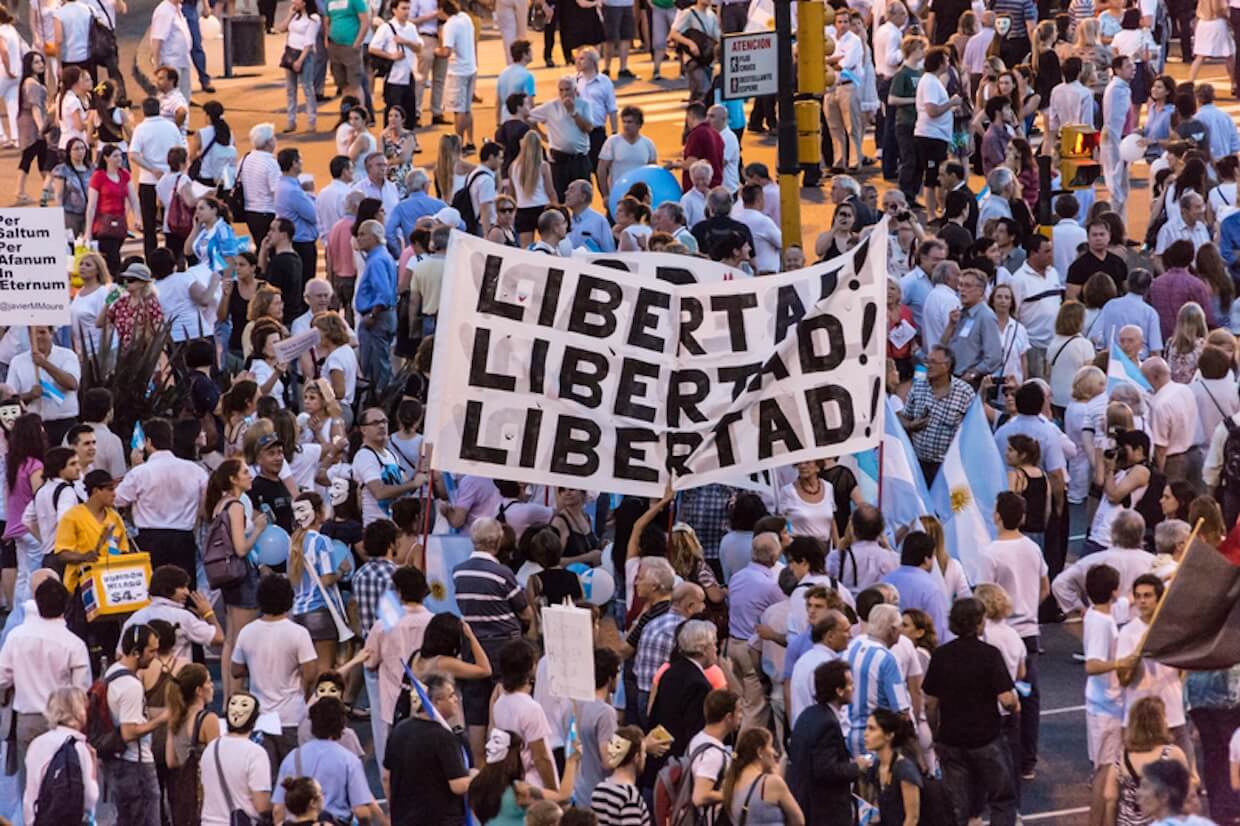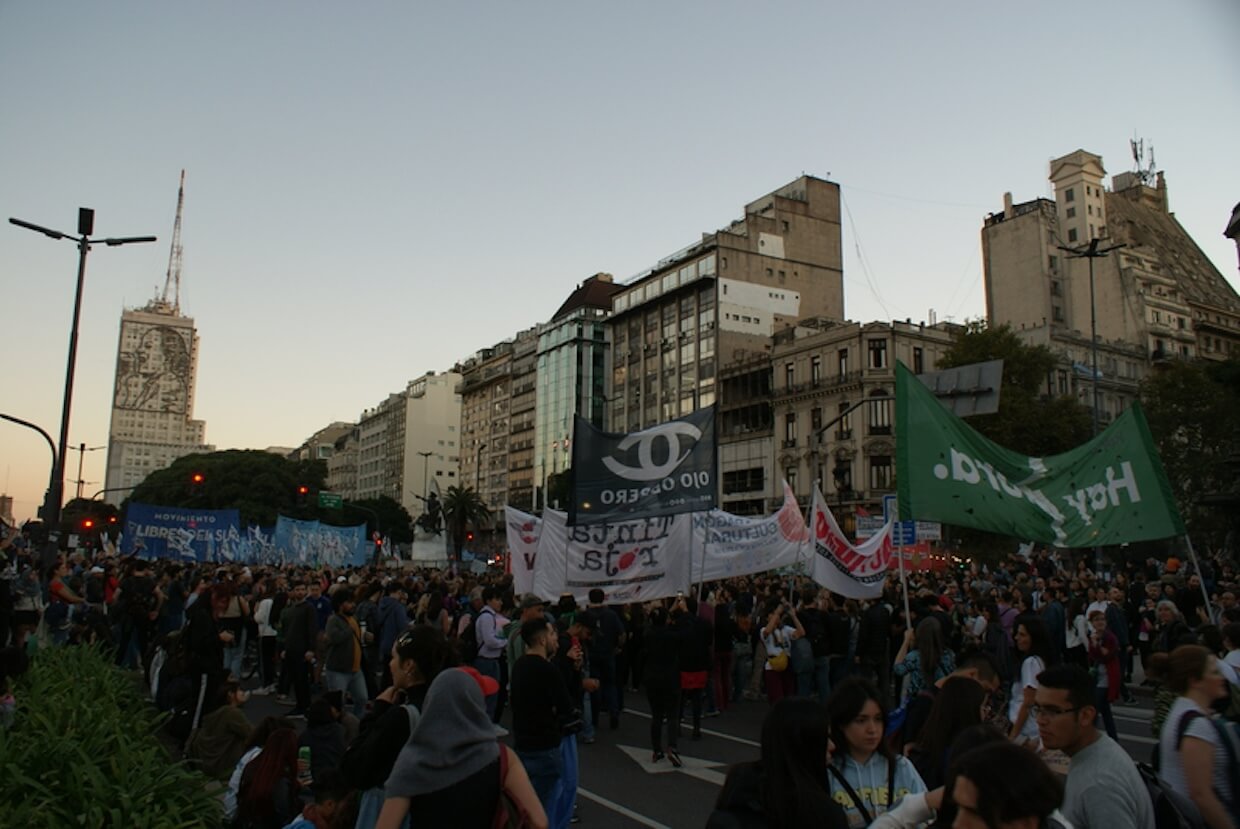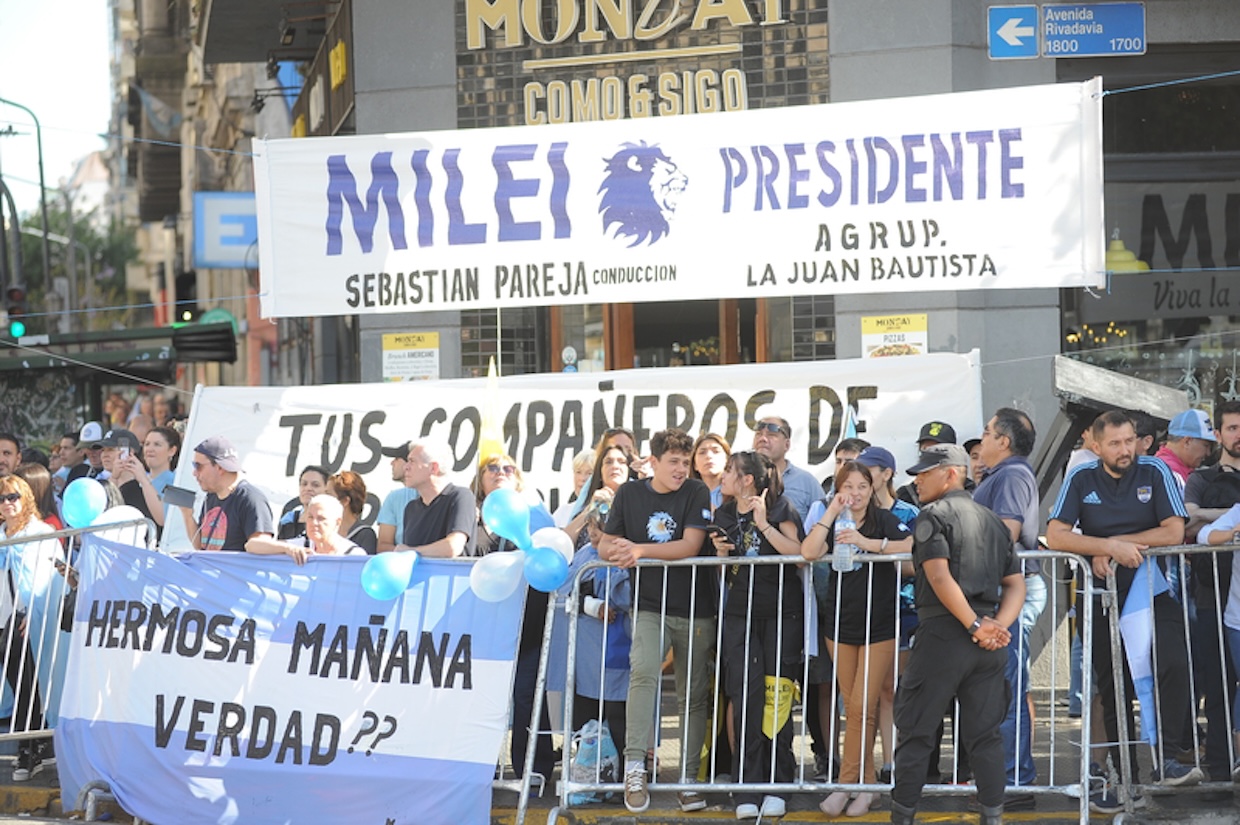
Large protests demand the resignation of Prime Minister Sheikh Hasina’s government as part of the Anti-Quota Movement and Bangladesh Quota Reform Protests. Thousands took to the streets in Dhaka, Bangladesh, on August 4, 2024. Photo: M.D. Sabbir.

Prof. Cheeseman: Mass Mobilization Is Critical When Institutions Fail to Contain Authoritarianism

In an interview with the ECPS, Professor Nic Cheeseman dissects the global resurgence of authoritarian populism and the uneven pathways of democratic backsliding. Warning against the “temporal fallacy,” he argues that crises unfolding simultaneously do not share a single cause—from Europe’s far-right surge to West Africa’s coups. Professor Cheeseman spotlights the twin pillars of democratic defense: resilient institutions and organized civic resistance. “In countries where institutions are weak, mass mobilization becomes absolutely critical—often the only mechanism left to stop populist or authoritarian leaders from consolidating power,” he says. Citing Ghana, Kenya, and Zambia, he urges context-specific democracy support that amplifies local strengths over one-size-fits-all templates.

Interview by Selcuk Gultasli

Giving an interview to the European Center for Populism Studies (ECPS), Dr. Nic Cheeseman, Professor of Democracy at the University of Birmingham, and the Director of the Centre for Elections, Democracy, Accountability and Representation (CEDAR), offers a comprehensive analysis of the global resurgence of authoritarian populism, democratic backsliding, and the vital role of civic resistance in fragile democracies. As a signatory of the June 13, 2025, anti-fascist declaration, Professor Cheeseman warns against the normalization of exclusionary, illiberal politics and highlights the need to rethink strategies for safeguarding democracy in the 21st century.

Professor Cheeseman emphasizes that democratic decline is not uniform but highly context-specific, urging caution against what he calls the “temporal fallacy”—the assumption that simultaneous crises share common causes. While far-right populism is reshaping politics in Europe, democratic erosion elsewhere often follows different patterns, such as military coups in West Africa or institutional capture in Latin America. “What we’re seeing is a highly complex set of processes pushing countries away from democracy, but these processes do not necessarily share a common underlying theme,” he explains.

A central theme of the interview is Professor Cheeseman’s analysis of the relationship between institutional resilience and mass mobilization in resisting authoritarianism. Drawing on Afrobarometer data and recent case studies, he underscores that strong institutions remain the first line of defense against creeping autocracy. However, in contexts where institutional capacity is weak, civic resistance becomes decisive: “In countries where institutions are weak, mass mobilization becomes absolutely critical—often the only mechanism left to stop populist or authoritarian leaders from consolidating power,” Professor Cheeseman asserts.

This argument resonates particularly in African contexts, where frustration with democratic performance—stemming from economic hardships, governance failures, and elite corruption—has fueled coups and populist takeovers. Yet, Professor Cheeseman points to inspiring counterexamples like Kenya, Ghana, and Zambia, where citizens have mobilized successfully to safeguard democratic norms. In Zambia, for instance, “hundreds of thousands of citizens turned out to vote, even believing the election wouldn’t be fully free and fair, because they knew collective action could bring political change—and it did.”

Professor Cheeseman also critiques “one-size-fits-all” democratization strategies, urging international actors to develop context-specific approaches grounded in local realities, civic strengths, and the dynamics of populist narratives.

Overall, the interview highlights Professor Cheeseman’s central thesis: defending democracy requires a dual strategy of institutional strengthening and societal mobilization. Where one falters, the other must rise.

Dr. Nic Cheeseman, Professor of Democracy at the University of Birmingham and Director of the Centre for Elections, Democracy, Accountability, and Representation (CEDAR).

Here is the transcript of our interview with Professor Nic Cheeseman, edited lightly for readability.

Beware the ‘Temporal Fallacy’: Mapping the Varied Paths of Authoritarian Populism

Professor Cheeseman, thank you very much for joining our interview series. Let me start right away with the first question: As a signatory of the June 13, 2025, anti-fascist declaration, how do you interpret the resurgence of authoritarianism and illiberal populism globally? Do contemporary far-right movements represent a new form of “neo-fascism,” or are they better understood as populist-authoritarian hybrids adapted to 21st-century democracies?

Professor Nic Cheeseman: That’s a big question to start with. I’ll begin by reiterating something I often emphasize when discussing the recent phase of global politics and the authoritarian trend: we must be cautious of what I call the temporal fallacy. The temporal fallacy is the assumption that, because many developments are occurring simultaneously, they must be driven by the same underlying causes. For example, if we examine the challenges to democracy worldwide and the rise of authoritarian leaders, we see that some of these leaders fit into a proto-populist, right-wing, exclusionary politics mold.

We can observe the rise of the far-right across Europe, and, of course, we should note that right now, as we speak, far-right candidates or parties are leading in opinion polls in France, Germany, and the United Kingdom—something unprecedented in my lifetime. However, this trend applies only to a certain set of countries. In other contexts, democratic decline has occurred for very different reasons. For example, in West Africa, we’ve seen junta leaders seize power with little connection to right-wing populism. In some cases, there’s instead a pan-African, almost leftist form of old-school populism, modeled more on figures like Ghana’s Jerry Rawlings than on Europe’s fascist traditions. Similarly, in parts of Latin America and elsewhere, we observe yet different dynamics. Overall, what we’re seeing is a highly complex set of processes pushing countries away from democracy, but these processes do not necessarily share a common underlying theme.

So, in that sense, even if we were to agree that some of these cases provide a strong parallel to the fascist movements of the 1930s–1940s, we would, of course, be talking about only a small subset of them. And that brings us to the question of why sign a letter against the rise of fascism. I think what we wanted to do in the letter—and obviously, I can only speak for myself, not for the other signatories—was to raise a warning flag and say: we are beginning to see the early signs of something that increasingly resembles the kind of outright hostility toward other cultures and migrants that we have witnessed before in history.

At present, I think it’s fair to say that we are not yet at that scale. But what we are seeing—and this is what truly concerns me—is that both from senior political figures, like Nigel Farage or Donald Trump, and from below, through social media and conversations among people who share similar views, we now have an almost full legitimization of exclusionary, racist, and hostile discourse happening simultaneously from the top and the bottom. Social media is emboldening people, and the rhetoric of leaders is emboldening people. These two dynamics, unfolding together, mean that things people would not have dared to say 10 or 20 years ago, they now feel confident expressing publicly, believing that others will support them. 

Now, the final point I want to make is that we must be very careful not to assume that the values and prejudices we’re hearing today are somehow new. In many cases, people are simply feeling emboldened to express views they have held for a long time. One mistake we must avoid is interpreting these new expressions as evidence that we had previously solved these issues and that they have suddenly reemerged. My sense is that we never effectively addressed many of these underlying problems; instead, they were allowed to fester beneath the surface. What’s different now is that these prejudices are being emboldened and amplified in this particular moment. So, we face a dual challenge: how to confront the current manifestation of exclusionary politics and why we failed to tackle the root causes and reduce these prejudices more effectively over the last 20 to 30 years.

Frustration with Democracy Fuels Support for Military Intervention 

Thai military seizes control from Prime Minister Thaksin Shinawatra in a coup in Bangkok, Thailand, on September 22, 2006. Photo: Charlie Milsom.

Drawing on your work in “War and Democracy” in 2018, to what extent do rising authoritarian movements exploit institutional weaknesses and democratic fatigue, particularly in post-colonial states? How might these dynamics explain the erosion of liberal norms both in Africa and globally?

Professor Nic Cheeseman: I think frustration with democracy is a really important factor in many parts of the world. Some people believe that they once had a good-quality democracy and that it was taken away, while others feel that democracy was strong but ultimately failed them. For example, in the United States, many might feel that, on the one hand, they have been told they live in a functioning democracy, but on the other hand, they have seen class mobility decline and their ability to achieve a better life than their parents diminish—leading, in a sense, to the erosion of belief in the American dream. Alternatively, we can look at societies in Africa that have never truly been granted democracy. In that article, we discussed countries like Uganda and Rwanda, where we have essentially seen prolonged periods of authoritarian rule.

Now, today, for example, in Uganda, we have a system that is called a multi-party electoral system; it is described as a democracy by the government, but the opposition has never been allowed to win. We know that the game is systematically stacked against the opposition. There was even a survey that found a majority of Ugandan people did not believe that power could be changed through the ballot box. So, when you reach a situation where most voters don’t believe they can actually remove the government through elections, that creates a very dangerous dynamic. It gives people an incentive to start contemplating and supporting alternative ways of changing power—for example, through armed force. And if we were to ask what conditions led to the coups in West Africa, one of the key factors was that citizens had become frustrated and fed up with democracy, no longer believing that it would deliver, and no longer necessarily believing that democratic systems or electoral processes would enable them to elect better leaders in the future. Under those conditions, support for the military and for military intervention becomes something that people are more willing to contemplate.

So, if we look at the Afrobarometer data, for example—survey data across West Africa—one of the things it shows us is that most people are still against military rule. However, even those who oppose military rule in principle are sometimes willing to say that the military has a right to intervene if civilian-led leaders have abused their power. In other words, what people are telling us is: we don’t want the military to govern, but if civilian leaders undermine their own legitimacy, perhaps the military is necessary to provide a clean break and a new opportunity to rebuild the system. I think some of that frustration with the performance of democracy—in terms of its failure to shield people from economic hardships, provide meaningful jobs, and offer a sense that people’s lives have worth and value—is also at the heart of some of the challenges facing democracy in Europe and North America, today.

When Populism Meets Ethnic Exclusion, the Risk of Proto-Fascism Rises

Entrance to the National Genocide Memorial in Kigali, Rwanda, on March 2, 2017. Photo: Karen Foley.

In your article “Ethnopopulism in Africa” in 2015, you describe how African leaders fuse populist economic narratives with ethnic mobilization. How do you assess the risks of ethnopopulism evolving into proto-fascist politics in fragile democracies, particularly where leaders invoke existential threats to justify state violence?

Professor Nic Cheeseman: I think the threat is really significant. But we have to be very careful about approaching this on a case-by-case basis. For example, we wrote that article with certain parts of sub-Saharan Africa in mind, where, on the one hand, you see leaders trying to mobilize in a more populist fashion using economic issues, but on the other hand, mobilizing along ethnic lines because they also recognize the need to carry their ethnic community with them. This results in piecing together a complex constituency that is, at times, inherently contradictory. If you want to deliver broad populist goals and improve the lives of citizens and the average person, you’re appealing to everyone—the common man. But if you then make an ethnic appeal and promise to deliver primarily to your own ethnic community, you narrow your focus to just that constituency. In that sense, it creates an internally contradictory approach.

And what we tried to address in that article is when this approach holds together and when it doesn’t. We essentially pointed out that it is more likely to hold together when a leader’s own ethnic community—perhaps due to historical experiences or socialization into certain values and ideas—is more inclined toward populism and actually shares populist values. This could involve supporting strong state intervention in the economy to deliver rapid change or desiring a “big man” leader and being willing to sacrifice democratic checks and balances to achieve those goals.

So, there’s a kind of tension there that can be overcome, and leaders can use it effectively. But, where those identifications are different, where the ethnic constituency of a leader wants something very different from what perhaps the common person on the street wants, or when there’s a real tension and polarization around ethnic identity, it can be extremely difficult to make them consistent, and actually, a lot of these strategies don’t end up winning power. They collapse under the weight of their own internal contradictions.

Now, where I think this becomes really dangerous—and we see this clearly in other parts of the world, including parts of Europe and Asia—is when you get that combination of a populist leader mobilizing around ethnicity, an exclusionary version of ethnicity, and using the demonization of either external countries or internal minorities as a way to unify their support base. When that happens, you get a particularly troubling form of proto-fascist mobilization. On the one hand, you are deliberately using that community as the glue holding your coalition together, making it impossible to abandon this strategy since it sustains the regime. On the other hand, the populist nature of this mobilization further erodes checks and balances, making it easier for human rights abuses to occur and putting the targeted community in particular danger. That’s where this exclusionary form of politics risks boiling over into something far more violent and repressive. That said, it’s important to remember that this pattern is not universal: some right-wing populists in power have not yet led to severe attacks on minorities, while others clearly have. There is, in other words, significant variation.

One of the things that’s quite interesting to me at the moment is looking at where we see leaders like this who seem genuinely interested in reshaping multiple levels of society, versus those who don’t. In Italy, for example, it seems to me that the government isn’t particularly interested in controlling what academics think or say, nor does it appear heavily involved in censoring universities or seeking to control society down to the grassroots. I could be wrong, but from talking to friends, that seems to be the case. By contrast, in the United States, you have a government that is actively waging war with some of its own universities—trying to impose forms of censorship, remove certain issues from the agenda, and push its own values onto it. 

So, one of the things I think we need to reflect on more carefully is the question: why? Why do we have some movements and leaders who focus primarily on marginalizing communities within an exclusionary narrative, while others are far more invested in intervening directly to reshape society, including academia, universities, and cultural institutions? And why do we have some leaders who seem more focused on controlling the commanding heights of the state without necessarily pursuing deeper social transformation? What drives these different kinds of regimes, and what distinct consequences do they produce for their own societies?

Populists Rise on Anti-Corruption Rhetoric but Often Deepen Clientelism and Corruption

Brazilian citizens take to the streets demanding the impeachment of President Dilma, the arrest of former President Lula, and the fall of the Workers’ Party (PT), amid corruption scandals, in São Paulo, Brazil, on March 13, 2016. Photo: William Rodrigues Dos Santos.

In your 2016 article “Patrons, Parties, and Political Linkages, and the Birth of Competitive-Authoritarianism in Africa,” you highlight the role of clientelist networks in shaping political behavior. How do you see clientelism interacting with populism to facilitate creeping authoritarianism, especially when leaders frame loyalty to the state as loyalty to “the people”?

Professor Nic Cheeseman: It’s a very good question and I think there are two different parts to it. I mean, one is that, in a sense, classic populist leaders face a challenge when it comes to clientelism. Because, of course, if you’re arguing that people should support you because you embody the will of the people, you should be arguing, in a sense, that they should vote for you because they recognize you as the embodiment of the will of the people, and because of your agenda, platform, and personality. And that slightly cuts against the idea that you should, of course, mobilize people through clientelistic models, either by offering them very specific services in order to assist them. For example, the kind of model that we understand in the United States, where we see the government historically delivering specific localized services—for example, for the House of Representatives and so on—in return for votes, or, in sub-Saharan Africa, where we might expect there to be a relationship between leaders and their own ethnic community, exchanging resources in that way. And that, kind of, cuts against the logic of populist mobilization if we think about classic populist thought.

But of course, in reality, we know that these two things have often gone hand in hand, and clientelistic machines have often been the underpinnings of populists who use this kind of rhetoric but actually rely on clientelism to stay in power. Moreover, one of the things that we don’t think about enough is what happens to corruption when populists win power. So, for example, we know that one of the ways that populists mobilize support is that they claim that the state is corrupt. They claim the political elite is corrupt. They make great hay out of any corruption scandals.

Trump, of course, did this. It’s been a current theme in American politics: drain the swamp, reduce the corruption in the government. It’s true more broadly that people have a suspicion about government being corrupt and being inefficient, and so populists have understood that and play on that as a key part of their message. Of course, corruption is a particularly valuable message if you’re a populist leader. Because what you can say to people is: the system is so corrupt, it’s endemic, and it’s pervasive, and therefore, the only way we can deal with it is by electing someone who’s an outsider. And therefore, you have to elect me because I’m the outsider populist. None of those people in the system can be trusted to actually deal with it. So, you get corruption and anti-corruption as one of the key mobilizing messages of populists.

But, of course, when populists are in power, they then often prove to be just as corrupt, or even more corrupt, than the people they’ve replaced. One reason for that, of course, is that populists tend to remove checks and balances, they weaken institutions, they rule in a more spontaneous way, and often in a more individual and personalized way that undermines systems of accounting and systems of audit. Therefore, what you often see is the same populists who get elected on anti-corruption messages then commit greater corruption, partly for personal aggrandizement and wealth, partly to drive the clientelistic networks that were also part of your question. When they leave power, they actually also leave the states and the government more vulnerable to corruption in the future, precisely because they’ve weakened the institutions that were designed to prevent corruption.

So, in some countries, we’ve even seen more corruption when the populist leader has left power and someone else has come in who has been more corrupt-minded but then faces a situation with far fewer constraints. So, corruption and clientelism are fundamental to populism and the rise of populist leaders, both in terms of the mobilization of voters and getting into power, and then in terms of how they sustain power and the legacy they have for political systems.

Mass Mobilization: The Last Defense Against Authoritarianism

Peaceful protests on Niezaliežnasci Street in Minsk, Belarus. Demonstrators rally and march toward Independence Avenue on August 23, 2020. Photo: Shutterstock.

Based on your research on Kenya’s 2022 elections, to what extent can constitutional reforms and decentralization act as safeguards against authoritarian populism? Or do populist leaders inevitably find ways to co-opt democratic institutions?

Professor Nic Cheeseman: I think this depends a lot on how strong the institutions are before a populist leader comes to power, and it also depends on the balance of power. To what extent does the populist leaders get a parliament that is loyal to them? And there are two dimensions to that. One is the extent to which MPs, as part of the populist leader’s party or aligned with them, are elected so that they get an easy ride with Parliament. The other is how easy it is for them to buy over MPs in the context of weak legislatures and weak party systems. So, I think this varies significantly across different places. It seems so far that European countries that have experienced populism—with the exception, obviously, of Hungary—have managed to withstand it to some extent.

Partly because electoral commissions have remained credible, we’ve actually seen democratic institutions withstand some of the challenges, leading to cases of democratic bounce-back. For example, we might think of Poland, where an authoritarian-minded government took power and was later defeated. Similarly, we might expect a more significant prospect of the current government in Italy losing power in the future than in other contexts where institutions have been much weaker and more compromised from the start. Of course, that’s not to say that Italian political institutions are free of corruption or particularly strong. 

But if we compare them, for example, to some countries in sub-Saharan Africa that I work on—where legislatures have historically been extremely weak, and presidents have used corruption and patronage to demobilize scrutiny and opposition within the legislature—we see very quickly that institutions there are often far less able to operate as effective checks and balances. And in the cases of the coups we’ve discussed, we often see Parliament dissolved, political parties banned, and constitutions suspended, leaving political institutions with no real capacity on their own to constrain the new government. 

So, it’s a very mixed picture, and one that gives us important things to consider when it comes to democratic resilience. Some states are going to have much greater resilience than others because of the institutional strengths they possess.

The other thing that’s important to say briefly about this is that we need to think about both democratic resilience—that is, the extent to which institutions can cope with a shock, deal with a non-democratic leader, constrain them, and ensure the rule of law is followed—and resistance, meaning citizens on the streets, civil society mobilization, and people protesting against the government. Particularly in countries where institutions are weak, it is often this form of civil society mobilization and mass protest that prevents authoritarian takeovers. So, I think it’s really interesting to look at this combination. In some countries, institutions hold power; in others, institutions cannot, but mass mobilization can. And in that context, mass mobilization becomes absolutely critical, because it is almost the only mechanism left to stop populist or authoritarian leaders from consolidating their hold on power.

Democracy Can’t Be Saved with One-Size-Fits-All Solutions

Israelis protest in Tel Aviv against Netanyahu’s Judicial Coup in Israel. Photo: Avivi Aharon.

In your co-authored 2018 article “Ten Challenges in Democracy Support,” you warn against “one-size-fits-all” democratization models. How should international actors adapt their strategies when confronting populist movements with explicitly anti-democratic tendencies?

Professor Nic Cheeseman: One of the things I’ve done with some colleagues at CEDA—the Center for Elections, Democracy, Accountability, and Representation at the University of Birmingham—is to think through the different pathways of autocratization. We’ve identified at least four or five ways in which states can become more authoritarian. One is executive aggrandizement, where the incumbent leader expands their power and weakens checks and balances. Another is military interventions—violent takeovers, such as the Taliban retaking power or coups. A third involves state capture, with pervasive corruption corroding the system, though not necessarily led by a single political figure. Finally, there’s populist takeover, where outsider, anti-system candidates win power and then subvert democratic institutions. Understanding these pathways is essential for assessing the biggest threats to democracy and determining how best to build democratic resilience and support systems that uphold democratic norms.

Those strategies or pathways that I outlined are, of course, often overlapping, so they’re not mutually exclusive. For example, you could have executive aggrandizement occurring alongside state capture. But thinking about them carefully is important because it helps identify the biggest challenge in a given context. For instance, if you believe the primary threat in a particular country is a military coup, then the strategy should focus on coup-proofing: How can we professionalize the military? How can we deter it from seizing power through force? Conversely, if the main threat is executive aggrandizement, the priority becomes strengthening checks and balances—ensuring that legislatures and judiciaries are robust enough to hold the president accountable. 

So, the potential solutions, or where you might emphasize investment, depend on assessing the specific threat. One of the risks, however, is that as a global community, we keep repeating the same approaches—supporting elections, legislatures, and civil liberties—without recognizing the need to be more problem-driven, focused, and context-specific. Within the policy community, everyone acknowledges that every reform and program should be tailored to context. But in practice, this is very difficult to achieve. It’s easy to say, “let’s adapt to context,” but much harder to determine what that context actually is and how best to respond to it. Thinking carefully about the most likely pathway of autocratization—and how to insulate against it—is, I believe, one way to encourage a more distinctive and effective approach in different settings.

Of course, you also need to consider other factors, such as identifying the main strengths of the democracy movement in a given country. In which areas is it powerful, and in which areas is it weak? How can we harness these strengths to build a truly effective coalition? That, again, depends on fully understanding which forces on the ground are most influential. In some countries, these might be trade unions, while in many parts of the world, trade unions have been so weakened that they can no longer play this role. In other contexts, religious organizations or other forms of civil society might serve as the driving forces. Ultimately, developing a clear understanding of the local context is critical for identifying the biggest threats and designing the best solutions.

Negative Messaging Can Strengthen Populist Narratives

In your 2024 article “Opening the Door to Anti-System Leaders,” you show how anti-corruption campaigns can paradoxically empower populist outsiders who then undermine democratic institutions. How do you interpret this dynamic in the broader resurgence of authoritarian populism, and are there parallels in Kenya, Zambia, or Tanzania?

Professor Nic Cheeseman: This is one of the things that, in some ways, is the most depressing: some of the things we try to do for good can end up having negative effects. It’s worth taking a step back for a moment from our specific research on corruption to explain why this happens and why it’s so important more broadly. One of the things researchers have started to find is that public awareness messaging—things like “don’t smoke, it’s bad for you,” “don’t drink and drive,” or “follow COVID rules”—can sometimes do more harm than good. One reason, we think, is that by telling people that lots of others are not doing something, you may subconsciously make them think that behavior is more acceptable, easier to get away with, and more socially legitimate.

For example, if I say to you, “lots of people are not following COVID regulations, so COVID is escalating, and we need to follow these regulations,” part of what you may be thinking, perhaps subconsciously, is: “well, if lots of people are not following COVID regulations, then maybe I shouldn’t either, because the norm is not to follow them.” And you might also think, “I won’t get in that much trouble, because loads of other people are already not following them.”

What you need to be really careful about when putting out messages is avoiding language that exacerbates or reinforces people’s sense that the behavior you’re warning against is pervasive, widespread, and normal. This is especially true when it comes to corruption. If you create an advert or message that makes people believe the country is even more corrupt than they already thought, or if you make them focus too heavily on the extent of corruption, you risk encouraging a sense of helplessness and powerlessness. That, in turn, can make people feel they should simply “go with the flow” rather than resist.

We’ve conducted research in a number of countries—Albania, Nigeria, and others—on what happens when this kind of messaging is used, where the focus is on how bad things are, employing what we call a “negative message.” In general, these messages not only fail to encourage people to do what you want—whether following COVID rules, quitting smoking, or, in our case, fighting corruption—but they also often have backlash effects. What we frequently observe is a backfiring effect, where people who receive these messages actually become more willing to engage in corruption rather than less. We believe this happens because such messaging fosters apathy rather than activism and reinforces people’s pre-existing skepticism about the state.

So, what this means is that anti-corruption messages themselves can unintentionally create the very foundations that populists exploit. For example, if anti-corruption messaging makes people more concerned about the extent of corruption but also more apathetic about their ability to change it—feeding a sense that the situation is hopeless—then people may become more willing to accept populist alternatives. In the paper you’re referencing, that’s exactly what we show: people who were exposed to some of these messages—which were intended to encourage anti-corruption activity—actually demonstrated increased support for populist values and attitudes. That’s an unintended and unwanted side effect.

So, we have to be very careful with how we fight, not just in anti-corruption campaigns but across many other areas. If we rely too heavily on negative messaging that focuses on how bad problems are, we may not only fail to achieve positive outcomes but also risk creating backfiring effects—making people more willing to tolerate corruption and other harmful behaviors.

For example, we’ve found associations between negative messaging and declining support for paying taxes, as well as reduced support for other critical elements of the social contract. I think this has significant implications for how we fight back against authoritarianism and sustain democracy. Messages like “everywhere is authoritarian” are ineffective because they reinforce the perception that authoritarianism is pervasive and widely tolerated. Instead, we need to craft messages that highlight how many citizens actually believe in the values we care about—how many support fighting corruption, how many believe their country would be better if it were less corrupt, and how many value democracy. These kinds of positive messages can mobilize people and build solidarity. Negative messaging, however, is really dangerous, and we need to avoid it.

Africa Offers Inspirational Lessons in Democratic Resilience

Two queues of people at a polling station during the 2011 general elections in Zambia. Photo: Dreamstime.

As a follow-up to our discussion on democratic backsliding and a final question, is there, in your view, any notable example of successful democratization across the African continent that offers inspiration amid the rising threats of resurgent fascism, populist mobilization, and authoritarian consolidation? What lessons can ailing democracies—both within Africa and globally—draw from such cases? 

Professor Nic Cheeseman: There are a number of really inspirational cases. Ghana, for instance, springs to mind. It is a country that experienced a series of coups and instability in the 1970s and 80s, followed by a period under military leader Jerry Rawlings, and then managed to emerge in the 1990s with a solid constitution that institutionalized a separation of powers. Rawlings then stepped down when his two-term limit came up, leading to a peaceful transfer of power. Since then, there have been a succession of such transfers. Now, that’s not to say Ghana’s democracy is fully consolidated. In some ways, we need to move away from the idea that democracy can ever be fully consolidated and recognize that, in a sense, it is always under threat, always being challenged. But one of the most striking things about Ghana is that it successfully made the transition from military to democratic rule, and the military has returned to the barracks and stayed out of politics ever since. In terms of one of the biggest trends in West Africa, the Ghanaian experience is a particularly valuable one to learn from. 

I also think we have really interesting examples elsewhere. For example, two countries very close to my heart—Zambia and Kenya. Kenya, on the one hand, is in the middle of a very intense period right now. On one side, you have a government trying to push through very unpopular economic policies, and on the other, there is mass citizen engagement against them—mass protests led largely by youths—alongside significant human rights abuses and violations in the government’s attempts to repress those protests. And so, again, I’m not for a second saying that Kenya has “got it sorted” or reached a point where democracy is fully protected and safe. But if you think about where Kenya was 40 years ago—as a one-party state dominated by Daniel arap Moi—or then move forward to 2007, when Kenya suffered serious ethnic violence after a controversial election, the progress is striking.

In response to that flawed 2007 election and the violence that followed, Kenya built a new constitution that was more inclusive, devolved power to 47 counties, and created a Supreme Court that not only exists but was one of the first courts in the world to nullify the election of a sitting president on the basis that the election didn’t meet the necessary standards. The fact that Kenya has gone through all of that—and that, in some ways, the multi-party system today could be said to be more robust than it was 20 years ago, with a stronger constitution—means that Kenya has the potential to ride out the current challenges, struggle through them, and move forward by instituting new reforms.

And I think it’s that process that gives me inspiration. It’s not easy. People have fought for it every step of the way. People have risked their lives; many have died, trying to push forward democracy, to build a more accountable and effective system, and to resist authoritarian leaders. But at the same time, that process of struggle has actually generated a situation where, over time, the institutions have become stronger. And while they still need to be strengthened considerably from here on, Kenya is in a much better position than it was—despite all the challenges the country faced in the early 1990s, coming out of its period of strongman rule.

And the same, very briefly, to an extent, applies in Zambia. Zambia, too, is struggling with the question of democracy, the government’s commitment to it, and the challenge of making progressive reforms. But at the last election, Zambia actually managed to remove an authoritarian—or increasingly authoritarian-minded—leader, President Edgar Lungu, and witnessed a peaceful transfer of power as hundreds of thousands of Zambians went out to vote. They did so even though many did not believe the election would be completely free and fair, because they believed that if they came out together in their hundreds of thousands, they could bring about political change—and they did, by voting for a change of government.

It’s also worth keeping in mind, especially for those skeptical about the feasibility of democracy in Africa, that only two countries globally moved toward greater democracy during the COVID-19 pandemic, according to major democracy ratings indices. And those two countries were Malawi and Zambia—both in Africa. So, I do think Africa provides some genuinely inspirational examples where the struggle for democracy is very much ongoing. These are countries that have not lapsed into pure authoritarianism; their institutions are gradually becoming stronger, and citizens are consistently mobilizing to safeguard their rights and liberties.

And that, I think, is a good model for other countries in different parts of the world that are now beginning to face their own democratic difficulties.

Refugees and migrants disembark at the port of Thessaloniki after being transferred from the Moria refugee camp on Lesvos Island, Greece, September 2, 2019. Photo: Vasilis Ververidis.

Locked Out, Building In: Refugees in Greece Persevere Amidst Exclusion

Greece has become a critical gateway for asylum-seekers, yet increasingly restrictive migration policies, harsh detention conditions, and reduced aid leave refugees in precarious circumstances. Amid systemic exclusion, NGOs like REFUGYM, Sama Community Center, and El-Sistema Greece foster hope, dignity, and belonging through education, sports, arts, and grassroots initiatives. Drawing on interviews with NGO leaders, refugees, and first-hand field observations, this article highlights both the barriers asylum-seekers face and the community-led solutions redefining resilience. In a climate of tightening borders and rising polarization, refugee-led spaces remain vital for empowerment, solidarity, and imagining more inclusive futures.

By Layla Hajj*

On July 9th, 2025, Prime Minister Kyriakos Mitsotakis announced that Greece will stop the processing of asylum applications arriving from North Africa for three months, claiming that those who enter the country illegally will be “arrested and detained.” Despite the Greek Council for Refugees demanding that there be no suspension of asylum under the premise that it is “illegal,” a violation of international law, and a demonstration of Greece’s failure to guarantee basic fundamental rights, Greece has justified their migration restrictions with the influx of migrants arriving via the Mediterranean route. The government defends that they must halt all illegal migration to increase their country’s security and ensure that they have the adequate resources to distribute to their own citizens, who are currently facing issues such as widespread unemployment.

Despite being one of Europe’s main gateways for migration, with 80% of asylum-seekers who cross the Mediterranean landing in Greece, the country continues to tighten restrictions on asylum seekers, who already face a life-threatening journey to reach the island-nation (IRC). The UN agency IOM reports that as of July 2025, 743 people have died this year as they attempt to cross the Mediterranean to Europe, inducing 538 on the Central Mediterranean route, one of the main pathways to Greece and the deadliest migration route in the world. 

Those who make it to Greece live in detention centers, formally called refugee camps. Despite government officials denying all accusations, Cyprus and Greece have been repeatedly accused of human rights violations and push backs against migrants by the European Court of Human Rights and other councils.

While camps have always been isolated, cast away in remote mountains outside of the line of sight of most Greek citizens, they have become increasingly restricted in recent years. In 2020, the Greek government built 10 foot concrete retainer walls around a camp referred to as Malakasa 1, which was already surrounded by barbed wire. Within these towering walls, the government has limited the entrepreneurship of refugees, including shutting down most, if not all, of the small businesses running in the camps.

The government has even limited assistance for basic survival necessities. In 2021, between the months of October and December, the state stripped asylum seekers of cash card assistance, a provision that impacted many thousands of asylum-seekers (Refugees International). In 2024, cash assistance was not paid out to migrants for the months of May, June, July, and August. Recently in March of 2025, the government reduced the eligibility period for Refugee Cash Assistance (RCA) and Refugee Medical Assistance (RMA) from 12 months to 4 months. The government has not provided a specific reason for the halting of said assistance. 

In an interview with Britty Grace, founder of the NGO REFUGYM and a former service worker in Malakasa 1, she shared some insights into the realities of life inside the camps. “People refer to the camps as prisons” she revealed. People are often uninformed of their rights, detained in the camps for weeks on end for paperwork processing, which inhibits their ability to get a job and provide for their families, and are stripped of housing opportunities overnight. And when asked if the conditions inside of camps have improved over the years, she responded with a direct “No. Things have gotten worse. And when you think things can’t get any worse, they do.” 

Britty Grace started working in camps in 2016. Two years later, she started REFUGYM, an NGO that provides community-led-sports programming and language lessons to asylum-seekers. While there are many NGOs like Grace’s dedicated to servicing individuals living in refugee camps, the Greek government has placed several restrictions on their entry. According to Grace, the process of registration with a camp is “very expensive, bureaucratic, and difficult. Even after registration, it ultimately comes down to the discretion of the camp manager. Oftentimes, they don’t provide a reason for kicking us out. And I guess they don’t have to – they’re in charge.”

Grace was kicked out of the camp 5 times over the course of 6 years for trying to implement REFUGYM. “When I started it (REFUGYM), I had always created it to be a community led gym in the eventuality I would be kicked out. That way, it wasn’t completely dependent on me. So when I was forced to leave, REFUGYM was still able to continue for 6 years being led by the community.” However, her continued removal from the camps made management of her organization incredibly difficult, forcing Grace to eventually move her services to an external location.

A colleague of Grace’s, Katerina Tsikalaki, who now collaborates with Grace at her new location, shares similar experiences from working within the camps. As the co-founder of the NGO Science United, she is dedicated to providing science education to displaced youth in Greece. A valuable aspect of her services is providing children with the opportunity to go on field trips to observe the subjects they are learning about.

Tsikalaki shared a vivid memory of a setback she faced while implementing her travel programming: “A few years ago, I spent time planning a science field trip for the kids so that they could visit the Athens Science Festival. It was a much needed opportunity for them to get out of the camp and learn. However, on the planned day of the excursion, the minister abruptly decided to lock down the camp for what he described as procedures. Instead of a fun science excursion, the kids were stuck in the camps all day, watching their parents run through another round of security checks.”

“This was not an isolated event,” Tsikalaki continued. “While residents are allowed out of the camp, they must show identification. And if something goes wrong, they must remain in the camp until further notice. The children, and even adults, absolutely do not have the same rights as Greek residents outside of the camps. But it’s not surprising. We now have a very far-right minister of migration and asylum, Thanos Plevris.”

In the face of strict policy, refugees, with the support of NGOs, still manage to create their own spaces for belonging and success. Since relocating REFUGYM to the Sama community center, positioned right outside Malakasa 1 and 2,  Britty Grace has been able to do so much more with her organization. A big part of REFUGYM’s programming has always been the escapism element that it presents participants – before from the typical day in the camps and since relocating, from the camps altogether. 

“People come to hang out at Sama when we’re not there. It’s a safe space – a home,” Grace reflects.

Jumping in to support Grace’s comment, a refugee attending a Sama event revealed that “Sama makes life in the camps bearable. Sama gives me a purpose. When I leave to go back to camp, I am more joyful and hopeful.”

Sama is both a place of comfort and excitement. REFUGYM’s sports programming includes climbing trips, hiking, watersports, boxing, yoga and more. The center also hosts women’s weekly only days, cultivating a space in which women feel empowered and secure by offering activities like self-defense and meditation. On top of programming, Sama offers medical services and asylum support every week with the help of doctors and social workers from other NGOS.

A 16 year old frequenter of Sama serves as a prime example of the impact of the centers’ multifaceted program opportunities. He came to Sama illiterate and with a very bad eye condition. However, Britty Grace was able to connect him with an ophthalmologist and get him strong prescription glasses. From that point forward, his confidence increased exponentially. He became literate and learned English within months. Now, he helps translate the English classes for his less-fluent peers. This boy is one of many dedicated participants at the Sama community center. “People often attend 3 or 4 language classes. They are thirsty and keen for knowledge!” Grace exclaimed.

“Over the years a lot of people have asked me to write reference letters for them from when they were a leader in our program, and then that helped them to obtain a job,” Grace revealed. Their dedication inside Sama presents far-reaching opportunities.

Sama community center has also manifested into a space for cultural exchanges. Oftentimes, a Greek native named Maria, who helps teach the Greek lessons, plays music for the migrants on weekends. In return, migrants teach songs to their peers in their native language. “It is a super lovely reciprocal exchange of music. This is such an amazing, organic element that we should encourage,” Grace reflects. “Music is so universal and is an incredible way to promote mutual understanding and connection.” 

El-Sistema Greece, a partner organization of REFUGYM, utilizes music as its key tool to promote unity. The organization is a Greek-led NGO that teaches music to both displaced youth and Greek locals, cultivating a space that promotes understanding and cohesion. The team is adamant that they remain a completely Greek team in order to foster a tight-knit community that promotes Greek inclusion, and makes the clear statement that Greece is an inviting country.

In an interview with Anis Barnat, co-founder of the NGO, he explained that: “What we developed is not so much music lessons, it’s nice but it’s not the purpose of what we’re doing. The social element is the most important one and the values that we’re giving to the kids, like learning how to understand differences and how to understand that barriers are most of the time very psychological so you have to overcome that. We try to give our kids as much control over the lesson plan as possible, and encourage them to work together in order to devise a plan. This is the thing that is lacking, I think, in the world in general. Fear and polarization are overtaking our world – and we seek to combat that division through El-Sistema.  I love the arts, but we are creating good people, good leaders, and good citizens.”

“It’s essential to start community led projects so that they can be sustainable,” adds Grace. “In such programs. community members feel like it’s their space, so they contribute to it. It’s not just something that they passively show up to. They contribute to it, they help with upkeep, cleaning, and teaching. It’s a collective space as opposed to a hierarchical one.”

We will only see more people displaced from their home countries with the rise of climate change, poverty, and global conflict. In such a time, it is critical to lean on communities and cultivate spaces for inclusion. In the words of Britty Grace, “we must break down barriers in order to foster belonging.”


Layla Hajj is a rising senior at the National Cathedral School in Washington, D.C., and the founder of Refugee Youth Support, a 501(c)(3) nonprofit providing tutoring, mentorship, and school-prep programs for refugee children in the DC area. Over the past three summers, she has interned with the Blossom Hill Foundation, supporting educational initiatives for displaced youth worldwide. She has also traveled to Jordan and Greece to teach English to refugee children, conduct interviews with migration experts and asylum-seekers, and document grassroots efforts to build inclusive communities.

As a youth writer and advocate, Layla works to empower migrant youth and address systemic barriers facing displaced communities. For this article, she draws on interviews with NGO leaders and refugees, as well as her first-hand experiences working near refugee camps, aiming to amplify and contextualize the voices of migrants themselves.


References

Al Jazeera. (2025, June 17). “At least 60 people ‘feared dead’ after shipwrecks off the coast of Libya.” https://www.aljazeera.com/news/2025/6/17/at-least-sixty-asylum-seekers-missing-after-shipwrecks-off-the-coast-of-libya (accessed on September 1, 2025).

Al Jazeera. (2025, July 9). “Greece halts migrant asylum processing from North Africa.” https://www.aljazeera.com/news/2025/7/9/greece-to-halt-migrant-asylum-processing-from-north-africa (accessed on September 1, 2025).

Greece Refugee.info. (n.d.). “Information and services about rights and procedures for refugees in Greece.” https://greece.refugee.info/en-us (accessed on September 1, 2025).

Mixed Migration Centre. (2024). Quarterly Mixed Migration Update: Europehttps://mixedmigration.org/wp-content/uploads/2025/02/QMMU-2024-Q4-Europe.pdf

International Rescue Committee. (n.d.) Refugee Inclusion, Greecehttps://www.rescue.org/country/greece (accessed on September 1, 2025).

Spinnicchia, C. (2025, April 11). “Greece: Government suspends cash assistance to asylum seekers for nine months.” Melting Pot Europahttps://www.meltingpot.org/en/2025/04/greece-the-government-has-suspended-economic-assistance-to-asylum-seekers-for-9-months/ (accessed on September 1, 2025).

MedMA, Mediterranean Migration & Asylum Policy Hub. (2025, February 24). “Unpacking Greece’s 2024 Migration & Asylum Report: Data and Trends. https://med-ma.eu/publications/unpacking-greeces-2024-migratio (accessed on September 1, 2025).

Coming from a family of Holocaust survivors, Professor William Schabas is one of the world’s foremost authorities on international criminal law and genocide studies, and a professor at Middlesex University.

Professor Schabas: US, Germany, and Others Could Be Held Liable as Accomplices to Genocide in Gaza

In an exclusive interview with ECPS, Professor William Schabas, one of the world’s foremost authorities on genocide and international criminal law, warns that the Gaza crisis represents a “litmus test” for the credibility of international justice. He argues that the case filed by South Africa against Israel at the ICJ is “arguably the strongest case of genocide ever brought before the Court,” citing Israeli military actions and statements by senior officials as evidence of genocidal intent. Professor Schabas also highlights Prime Minister Netanyahu’s populist rhetoric, framing Gaza’s population as an existential threat, which he links to patterns of incitement fueling atrocities. Crucially, he stresses that third-party states, including the US, Germany, and others risk legal liability as “accomplices to genocide.”

Interview by Selcuk Gultasli

In an extensive interview with the European Center for Populism Studies (ECPS), Professor William Schabas—one of the world’s foremost authorities on international criminal law and genocide studies, and a professor at Middlesex University—offers a detailed assessment of the unfolding crisis in Gaza through the lens of international law, populist politics, and global governance. Coming from a family of Holocaust survivors, Professor Schabas warns that Gaza represents a “litmus test” for the credibility of international justice and the authority of global legal institutions.

At the heart of his analysis is a stark conclusion: the case brought by South Africa v. Israel before the International Court of Justice (ICJ) is “arguably the strongest case of genocide that has ever come before the Court.” He argues that evidence of genocidal intent can be inferred not only from Israel’s military conduct but also from statements by senior Israeli officials, such as Defense Minister Yoav Gallant’s remarks about cutting off food, water, and electricity in Gaza. “We have more than just a pattern of conduct—we also have statements and clear indications of policy. All of these must be considered together when making a final judgment,” said Professor Schabas.

Professor Schabas also highlights how Prime Minister Netanyahu’s populist framing of Gaza’s population as an existential threat has intensified concerns about incitement and mass atrocity crimes. “Racist populist rhetoric has often been part of genocidal contexts, mobilizing mass support for atrocities. We see elements of that dynamic in Israel today,”he said. Drawing comparisons to Rwanda (1994) and the Namibia genocide (1904–1906), he underscores both the parallels and distinctions, warning against simplistic analogies while emphasizing recurring patterns where populist narratives fuel extreme violence.

Importantly, Professor Schabas stresses that third-party states—including the US, Germany, Canada, and others—risk being held legally accountable under Article III of the Genocide Convention for aiding and abetting Israel through military and political support. He warns: “To the extent that they are providing material assistance of a significant nature, they can be held responsible as accomplices to genocide.”

Finally, he frames Gaza as a defining moment for international justice mechanisms like the ICJ and ICC, warning that failure to apply consistent standards risks entrenching a “two-tier system of international law” and undermining human rights globally: “These institutions are absolutely vulnerable, and they are aware of it. Gaza is a test for their credibility and authority.”

This interview situates Gaza within broader debates about populism, authoritarianism, and international accountability, offering an urgent call to rethink legal, institutional, and political frameworks for preventing mass atrocities in an era of resurgent populist authoritarianism.

Here is the transcript of our interview with Professor William Schabas, edited lightly for readability.

Destruction in Shejayia, Gaza City, Gaza Strip. Photo: Dreamstime.

Gaza Is a Litmus Test for the Credibility of International Justice

Professor Schabas, thank you very much for joining our interview series. Let me start right away with the first question: As a leading genocide scholar and coming from a family of Holocaust survivors, before delving into the legal and political complexities, how would you characterize the current situation in Gaza from the perspective of international law? Considering the patterns of conduct, the scale of destruction, and official statements by Israeli leaders, do the unfolding events appear to meet the legal thresholds of genocide, crimes against humanity, or ethnic cleansing under Article II of the Genocide Convention, or are we still at a stage where these legal categories remain indeterminate?

Professor William Schabas: There’s always going to be debate about legal categories, and you’re asking me, as a scholar and specialist in the field, to make an assessment. Ultimately, the International Court of Justice (ICJ) will deliver its judgment, primarily in the case filed by South Africa against Israel. In my view, South Africa’s case is exceptionally strong—arguably the strongest case of genocide ever brought before the ICJ. Of course, I have not seen South Africa’s full submissions, as these remain confidential until the hearing begins, which is likely to take place in two or three years. However, based on the information and material currently available in the public domain, I believe their case rests on a very solid foundation.

Based on that, I think South Africa is likely to prevail in the case, and Israel will lose and be found to have violated the Genocide Convention. You mentioned some of the factors that will be part of that assessment—the notorious statements by Israeli politicians, declarations of various kinds that continue. These all contribute to identifying the policy of the State of Israel. But there are other factors as well, mainly the conduct of Israel, which indicates that its policy is directed towards the elimination of the presence of the Palestinian Arab people in Gaza. That leads to genocide. You also mentioned other terms, like “ethnic cleansing,” which, technically speaking, is not covered by an international treaty and is not, strictly speaking, a crime under the Rome Statute of the International Criminal Court (ICC). However, it is used to describe a type of conduct that borders on the crime of genocide—in other words, the expulsion of people from a territory so that another population can prevail there.

I think it’s often misunderstood that there is not a bright line between genocide and ethnic cleansing. The ICJ, in its important judgments on the Genocide Convention, has clearly stated that, while ethnic cleansing is not necessarily genocide, it can also amount to genocide. So, there’s a zone between the two concepts—it’s not a sharp division.

Another commonly misunderstood point concerns intent. One of the arguments we hear from those defending Israel is that “they could have killed more people, and they haven’t,” suggesting that this proves there is no intent to commit genocide. We have encountered similar claims in assessments of the Holocaust and other historical examples of genocide, where it was argued that the absence of even greater killings indicates a lack of intent. However, this reasoning has never been accepted by courts. So, briefly—though I could speak on this subject for much longer—that is my assessment.

US and European Devotion to Israel Has Undermined International Law

Election billboard showing Netanyahu shaking hands with Trump, with the slogan “Netanyahu. Another League,” in Jerusalem on September 16, 2019. Photo: Dreamstime.

In your work on preventive obligations, you highlight that early warning mechanisms are underutilized in atrocity prevention. In Gaza, where warnings have existed for years, what explains the persistent inaction by international bodies like the UN and the ICC?

Professor William Schabas: Well, a significant problem with the United Nations is that it is ultimately guided by the political views of its member states, particularly the most powerful ones—the permanent members of the Security Council. I am talking here mainly about the United States, but I would not overlook the United Kingdom and France either. Other wealthy and influential states, primarily in Europe or European settler states elsewhere, such as Canada and Australia, are also deeply devoted to Israel. They have been reluctant to take measures that would rein Israel in and, on the contrary, have often encouraged and emboldened it, frequently turning a blind eye when Israel has engaged in particularly troubling actions. As a result, they have significantly constrained the United Nations’ ability to address Israel’s violations of international law effectively.

I think we can trace that position back a century or more, even before the creation of Israel, to when the mandate was given to the British at the end of the First World War. The British had long coveted the territory of Palestine and had encouraged Zionism for decades before receiving the mandate. In effect, what they sought was a settler state in the Middle East that would allow them to influence and control the region as much as possible.

I don’t believe that underlying objective has changed. This explains the deep devotion to Israel not only by the United States but also by the major European powers, for whom the Middle East remains of immense economic and strategic importance. They need to maintain control over the region, and they cannot rely on other governments there in the same way they can rely on Israel—although some, like Saudi Arabia, are also closely aligned with and loyal to the European powers and the United States. But they cannot count on them in the same way they can with Israel.

Israel Cannot Invoke Self-Defense While Acting Unlawfully in Gaza

Drawing on your analysis of the ICJ’s evolving jurisprudence, how might the Court balance Israel’s claims of “self-defense” with its responsibilities as an occupying power under the Fourth Geneva Convention, especially after its 2024 advisory opinion reaffirming Gaza’s occupied status?

Professor William Schabas: Israel has invoked the notion of self-defense, and this is echoed in the defenses of Israel that we hear from countries like Germany, the United Kingdom, France, and the United States. I really don’t think—I’ve thought a lot about this—that Israel can legitimately invoke self-defense in relation to what it’s doing in Gaza. Regarding the attacks that took place in October 2023, there is an element of self-defense they could claim, as this was an incursion into their territory by various Palestinian forces. However, Israel’s response in Gaza is entirely disproportionate to what self-defense would require.

Moreover, the International Court of Justice has declared the occupation of Gaza to be unlawful. You cannot claim self-defense while engaging in unlawful actions. It’s like a bank robber who fires on the police because they’re firing on him—he can’t go to court and invoke self-defense, because he is, by definition, acting unlawfully. In the same way, I don’t think Israel can credibly rely on self-defense here. In my view, this is simply a bogus argument.

Evidence of Genocidal Intent in Gaza Goes Beyond Circumstantial Patterns

Morning bombing attack on Gaza near the Al-Saraya buildings. Photo: Ahmed Fraije.

Given your argument that genocidal intent can be inferred from patterns of conduct and policy, rather than explicit declarations, how do you assess Israel’s military strategy in Gaza in the light of Article II of the 1948 Genocide Convention? To what extent do statements by Israeli leaders, such as Yoav Gallant’s remarks about cutting off food, water, and electricity, strengthen claims of genocidal intent?

Professor William Schabas: The proof of genocidal intent is almost always at the core of legal debates about whether genocide is occurring. It has been central to the judgments of the International Court of Justice in cases from the former Yugoslavia, as well as to rulings of the International Criminal Tribunal for the former Yugoslavia in prosecutions of individuals for genocide. The case law is quite consistent: when evidence of genocidal intent relies exclusively on conduct—in other words, on what is known as circumstantial evidence—you must be able to rule out any other reasonable explanation for that conduct. If ambiguity remains, the claim of genocide must be rejected. This principle, derived from basic criminal law, is applied in most jurisdictions when dealing with crimes of this nature and cases based entirely on circumstantial evidence.

The point, however, is that we have more than just circumstantial evidence here. We have more than a mere pattern of conduct—we also have statements and other indications of policy. All of these elements must be considered together when making a final judgment. Ultimately, this assessment rests with judges or, in some contexts, juries, depending on the legal framework. They will need to determine whether the totality of this evidence amounts to genocide.

As I mentioned at the outset of the interview, my own conclusion is that it does. However, we will have to see how the judges respond. They may not be unanimous; there could be a majority either for or against. Time will tell how they weigh the evidence. In my view, there is already sufficient evidence in the case to reach a conclusion. We must also see what arguments Israel presents in its reply and what its defense entails. If their primary claim is that they are acting in self-defense, for the reasons I’ve already explained, I don’t think they’re going to fare very well.

The ICJ Is Becoming a Forum for Issues Once Left to Politics

You have noted that international law is moving toward a broader interpretation of genocide, as seen in the ICJ’s handling of the South Africa v. Israel case. Do you believe this shift represents a new phase in international jurisprudence? How might it redefine accountability for powerful states in future conflicts?

Professor William Schabas: Yes, I think there is something significant happening at the International Court of Justice (ICJ), particularly regarding the interpretation of genocide, which is likely to make proving genocidal intent somewhat easier. I base this view not only on the conduct of the Court in some of its recent decisions dealing with genocide cases—it currently has four such cases before it—but also on the attitude taken by governments.

One of the striking features of recent litigation before the ICJ, not just in the case brought by South Africa against Israel but also in The Gambia’s case against Myanmar and Ukraine’s case against Russia, is the unprecedented number of state interventions. In the entire 80-year history of the Court, there had only been a handful of interventions in any cases until 2022–2023. Now, we have around 50 states intervening in ongoing genocide-related cases. This level of engagement has never happened before—not even in the Yugoslavia cases.

I think this indicates that states now expect the Court to do more with the Genocide Convention than it has done in the past, which may involve a somewhat more liberal interpretation of genocidal intent. However, this does not mean there is pressure to expand the definition of genocide itself; states are not seeking to add political groups or new categories to the Convention. Rather, they are calling for the Court to be more receptive to evidence indicating genocidal intent, and if the Court responds to this expectation, it will likely be reflected in its final decisions.

Time will tell, of course, but ultimately, the ICJ is the states’ court—it is, in a way, their institution. By choosing to participate, states are signaling their trust in the Court and their expectation that it will deliver justice. What is also remarkable and relatively new is that states are increasingly turning to the Court on matters that were traditionally settled in political forums like the UN General Assembly, the Human Rights Council, or the Security Council.

Now, they are asking the ICJ to decide on issues beyond genocide, such as climate change, occupation of territory, decolonization, labor rights, and even the right to strike. Instead of negotiating these matters politically, states are effectively saying: “We will let these 15 judges decide, based on the law, what should be done.” That marks a significant shift compared to how things were handled 10, 15, or 20 years ago.

The entrance sign of the International Criminal Court (ICC) at its headquarters in The Hague, Netherlands, on February 14, 2018. Photo: Robert Paul Van Beets.

Western Inconsistencies Expose a Two-Tier System of International Justice

In one of your interviews, you highlighted the selective application of the genocide label, noting that “our enemies commit genocide, not our friends.” Considering Western reluctance to describe Israel’s actions in Gaza as genocide—while readily applying the term to cases like Russia in Ukraine or China with the Uyghurs—and reflecting on your 2013 article “The Banality of International Justice” where you discuss the ICC’s tendency to target weaker states while avoiding powerful ones, do you believe this dynamic risks reinforcing perceptions of a two-tier system of international justice and undermining the credibility of international law?

Professor William Schabas: Double standards have been a feature of international law forever, really. International law was created by European colonialist states and used, in large part, to govern the rest of the world that they controlled as a result of colonization. Over time, it has evolved and changed, largely because states—particularly those that were not initially considered “states” in the European sense—have insisted that the same standards be applied to wealthy, powerful states as to what we now call the Global South.

I could give a lengthy demonstration of these double standards, particularly in the conduct of the political bodies of the United Nations. For example, when we have a political body like the Security Council and a government like the United States says, “South Africa is committing genocide against the white population”—this was President Trump’s claim a few months ago—that’s an absurd suggestion and profoundly insulting to the people of South Africa, who endured apartheid for so long. At the same time, the US dismisses South Africa’s application to the International Court of Justice against Israel as “meritless,” to use Secretary Blinken’s term. When this happens in a political forum, people tend to shrug and say, “Well, that’s politics.” Terms like genocide are used politically to condemn enemies and dismissed when it comes to allies.

The International Court of Justice and the judicial route are not entirely immune to double standards, but they are less vulnerable than political bodies. For example, in The Gambia’s case against Myanmar at the ICJ, several Western states—Canada, Germany, France, the UK, Denmark, and the Netherlands—filed a joint intervention in late 2023, before South Africa filed its case against Israel. In that intervention, they called for a more liberal approach to genocide, suggesting that genocidal intent could be inferred from factors like forced displacement within a territory—something we see regularly in Gaza—or the victimization of children, which we also see very dramatically in Gaza.

Of course, these states didn’t have Gaza in mind when they submitted that intervention, and they would likely reject any argument applying their position there. But they are now, in a sense, stuck with their own words. For instance, Germany later intervened in the Ukraine v. Russia case and took a different stance. There, Germany did not call for a broader interpretation of genocide; instead, it leaned toward a stricter interpretation, because it suited their position defending Ukraine’s claim that Russia was misusing the term “genocide.”

This inconsistency will likely embarrass Germany and others before the ICJ when lawyers point out that they argue one thing in one case and the opposite in another. In a judicial environment, it is harder to sustain such contradictions than in a political environment, where people can simply dismiss it as “just politics.”

Populist Incitement Can Mobilize Mass Support for Atrocities

Benjamin Netanyahu, Prime Minister of Israel visits the Synagogue of Copacabana in Rio de Janeiro, Brazil on December 28, 2018.

Considering Prime Minister Netanyahu’s populist framing of Gaza’s population as an existential threat, how do you assess the relationship between populist political rhetoric, incitement, and the potential establishment of genocidal intent? Can parallels be drawn with earlier contexts—such as Rwanda in 1994—where inflammatory discourse played a decisive legal role, and to what extent do such political narratives influence judicial assessments at the ICJ?

Professor William Schabas: This is a complicated question to answer because you’re asking me to make parallels or equivalences between what happened in Rwanda in 1994 and what’s going on in Israel today. Parallels are always difficult to draw, and I see this increasingly in discussions about genocide. There is a tendency, when we talk about genocide, to treat the concept—and the Genocide Convention itself—as something premised mainly on the Holocaust, the Shoah of the Second World War.

People often say that the Genocide Convention resulted from the Holocaust, as a direct reaction to it. But that’s not entirely accurate. I’ve examined the drafting history of the Genocide Convention in great detail, and the convention itself explicitly points out that genocide has been committed at all times in human history. The same is true of the General Assembly resolution that preceded it. In 1946, 1947, and 1948, when the Genocide Convention was being adopted, there was a very clear desire to emphasize that genocide is not only about the Holocaust but also about other historical examples.

When we compare different genocides and attempt to draw parallels, we find significant differences among them, which makes it hard to generalize. You mentioned populism, and indeed, racist populist rhetoric has often been part of genocidal contexts. Mobilizing mass support for atrocities is common, and we do see elements of that in Israel. There is opposition, of course, but it is relatively subdued. Many within the Israeli population, without explicitly endorsing what Netanyahu and his government are doing, are primarily focused on rescuing captives—the hostages in Gaza—rather than on acknowledging the scale of crimes and abuses being perpetrated against Palestinians.

One analogy I’ve found striking comes from my recent reading for an article I’m writing on what is widely recognized as the first genocide of the 20th century: the genocide perpetrated by Germany in Namibia, then called Southwest Africa, between 1904 and 1906. That conflict began with a rebellion by the local indigenous people against German colonial rule, during which, according to German accounts, serious atrocities were committed by the rebels. The rebellion itself was not peaceful; it was quite brutal. Germany’s response, however, was genocidal. Today, Germany acknowledges this as genocide, though it classifies it as a “historic genocide” to distinguish it from genocides covered by international law and to limit its legal obligations.

But what I find striking are the parallels between the genocide that took place in Namibia in 1904 and what has happened in Gaza over the last two years. Not that Germany would want to draw this parallel, of course, but there are undeniable similarities. The German brutality was a response to a rebellion by the people of Namibia, yet Germany does not claim it was acting in self-defense. Instead, it has since apologized and officially acknowledged that it committed genocide between 1904 and 1906.

That said, there are also important differences between these cases. There are some similarities between the Rwandan genocide and what we see in Gaza, but Rwanda’s genocide was largely a mass atrocity carried out by irregular forces. In contrast, the situation in Gaza involves actions conducted by the Israeli army, using highly advanced and modern weaponry. Rwanda’s context was also quite different because it did not involve the colonial settler-state dynamics that are present in Gaza.

Each case of genocide has its own distinctions and unique historical circumstances. I think we must be very careful about expecting them all to follow a single pattern or model.

Article III Makes Enablers Responsible: US and Germany Face Legal Exposure

Given the ICJ’s clarification that states party to the Genocide Convention have obligations both to prevent genocide and to avoid complicity, how should countries like Germany and the United States—as major suppliers of military aid to Israel—be held accountable under international law? Moreover, how should international legal frameworks evolve to better define the responsibility of third-party enablers, particularly when geopolitical alliances influence states’ actions and responses?

Professor William Schabas: The Genocide Convention specifies explicitly in Article III that you violate the Convention by complicity—by being an accomplice to genocide—and what you’ve referred to as “enablers.” You’ve mentioned the United States and Germany, but there are other states as well that have been enabling Israel in different ways.

To the extent that they are providing material support of a significant nature—and there’s no doubt this applies to the United States, Germany, and others—they can be held responsible as accomplices to genocide. In fact, there is currently a case before the International Court of Justice (ICJ) where Germany is being charged with complicity in genocide, filed by Nicaragua.

There is another important facet you’ve raised regarding the prevention of genocide. The treaty is formally titled the Convention on the Prevention and Punishment of the Crime of Genocide, yet its provisions largely concern punishment. However, in the landmark 2007 judgment in Bosnia v. Serbia, the ICJ developed a significant doctrine on prevention. The Court emphasized that the obligation to “prevent” genocide is meaningful and binding. States party to the Convention—including Germany, the United States, and more than 150 others—have a duty to use their influence on other states or entities perpetrating genocide.

In Bosnia v. Serbia, the Court clarified that states are not required to send troops but must take all lawful measures available to prevent genocide. For example, in 1994, when France stood by as the Rwandan government perpetrated genocide against the Tutsi population, there was arguably a legal obligation to act—even though no case has yet been brought before the ICJ on that matter.

Importantly, the Court also ruled that this duty arises not only when genocide is being committed but when there is a serious risk of genocide. That sets a lower threshold. In Gaza, there is, at the very least, a serious risk of genocide. This means that states like Germany and the United States have a legal obligation to use their influence on Israel to prevent it.

Furthermore, because the ICC has jurisdiction over the territory of Palestine, this opens the possibility that German and American leaders could be investigated and potentially prosecuted as individuals for failing to prevent genocide or for aiding and assisting Israel.

Finally, much of this has implications for domestic litigation as well. Activist lawyers in various countries are already pursuing cases, and the legal principles developed by the ICJ and ICC are increasingly being used to support these efforts.

European Hypocrisy on Gaza Undermines Decades of Human Rights Advocacy

You have suggested that Gaza represents a “litmus test” for the credibility of international justice mechanisms. If the ICJ and ICC fail to apply consistent standards to Israel as they have in other contexts, what are the long-term implications for global governance, human rights protection, and the authority of international law?

Professor William Schabas: Yes, it’s a test for the courts. There have been similar tests in the past, and I’ll give you an example of a historic one involving the International Court of Justice in the 1960s. The Court was confronted with a case filed by two African states, Ethiopia and Liberia, both of which had also been members of the League of Nations. They brought a case against South Africa concerning Namibia and the administration of the mandate—and later the trusteeship—over Namibia by the South African government, which had imposed apartheid there.

The case was ultimately thrown out by the International Court of Justice by a single vote. It was a very close decision, but it severely discredited the Court. Well, not everywhere. In South Africa, and probably in the United Kingdom, the United States, and some other European colonial powers like Belgium and perhaps France, there was a sigh of relief when that ruling came down. But in most parts of the world, countries and people were deeply shocked by the Court’s decision.

For the next 20 years, the ICJ had very little work. It went years without holding any trials because the world, in a sense, had voted its disapproval. It was terribly disappointing, and the Court had lost its credibility. Slowly, it has regained that credibility, and the judges today are well aware of this history.

I think at the International Criminal Court, the judges and the prosecutor are also aware that, for too long, the ICC has been seen as a court dealing primarily with situations in Central Africa and resisting opportunities to engage with cases involving major powers. Even as it has begun to shift away from that focus, it remains vulnerable to criticism—especially since it has concentrated so much of its efforts on Russia and Ukraine while devoting relatively few resources to Gaza.

It has now taken some steps with the issuance of two arrest warrants, and I believe there are probably two more—against Smotrich and Ben-Gvir—that have either been issued or are about to be issued, though it’s unlikely that will be made public. We won’t know for sure until, or unless, those individuals are apprehended, which could happen at some point in the future.

But yes, these institutions are absolutely vulnerable, and they are aware of it. I should also note that it’s not only the United States that is being discredited for its attitude towards Gaza—it’s also many European states. For the last 20 or 30 years, European countries have enjoyed a position of moral authority, lecturing others around the world about human rights violations, calling them to account, and supporting NGOs in these efforts—many of which I’ve supported myself.

But this reveals a profound hypocrisy, and it’s becoming increasingly transparent. This damages the credibility of their broader efforts to promote human rights globally. I won’t limit this critique to the so-called “Global South” either; even in the United States, there have been human rights violations, and European states have occasionally intervened—for example, in death penalty cases before the US Supreme Court.

Nonetheless, Europe’s sanctimonious attitude—this assumption of being the “most human rights-friendly” part of the planet—is now exposed as deeply inconsistent, particularly due to its unwillingness to apply the same standards to Gaza. That said, there are exceptions. A few European states, such as Ireland, Spain, Norway, and Slovenia, have taken more principled positions. But for many others, their stance has been quite shocking, and I believe they will ultimately pay a price for it.

Restoring Trust in International Justice Depends on Enforcing the Law

The flag in front of the International Criminal Court in The Hague, Netherlands on March 27, 2016. Photo: Dreamstime.

And lastly, Professor Schabas, looking forward, what mechanisms—legal, institutional, or political—do you believe are necessary to restore trust in international justice, ensure accountability for Gaza, and prevent future atrocities where powerful states are involved?

Professor William Schabas: I think I’ve largely addressed that question in my previous responses. I certainly have high expectations for the International Criminal Court (ICC) and the International Court of Justice (ICJ), but, based on their historical performance, I am also prepared for disappointment. What I’m ultimately hoping for are meaningful and positive contributions from these institutions, which would—this is really the key test—demonstrate their continued relevance and authority.

People often lament that judgments are ignored. I think that’s somewhat overstated when we look, for example, at the ICJ’s orders in the South African case. While they’ve been largely disregarded by Israel, they have nonetheless had significant political impact elsewhere. The same can be said of the work of the ICC.

However, all of this underscores an important reality: the ICJ—and, to a large extent, the ICC as well—remain fundamentally dependent on states and international organizations for the enforcement of their decisions.

In both cases, the ICC can only arrest people if states assist them in doing so. And in the case of the arrest warrants against Netanyahu and Gallant, we’ve had some ambiguous statements from certain governments about whether or not they would actually arrest them if given the opportunity. Hungary openly defied the order of the Court by inviting Netanyahu—Hungary is a special case, of course, because of its government and its head of state—but there were also ambiguous statements from other governments.

That’s really the test. And it’s the same for the International Court of Justice. There is already more room for enforcement, for example, of the advisory opinion of the International Court of Justice of July 2024, which confirmed the illegality of the occupation—not just of Gaza, but also of the occupied West Bank and East Jerusalem. That needs to be addressed, and states could do a lot more in terms of implementing the conclusions of that advisory opinion.

Professor Ruth Wodak is Emerita Distinguished Professor of Discourse Studies at Lancaster University, affiliated with the University of Vienna, and a member of the ECPS Advisory Board.

Professor Wodak: Autocracy Has Become a Global Economic Corporation Backed by Oligarchs and Social Media Power

In this powerful interview with ECPS, Professor Ruth Wodak warns that “autocracy has become a global economic corporation”—a transnational network where oligarchs, libertarians, and tech barons control discourse, distort truth, and undermine democracy. From Trump’s incitement of violence to Orbán’s fear-based migrant scapegoating, Professor Wodak outlines how authoritarian populists weaponize crises and social media to legitimize regressive policies. Yet she also defends the vital role of public intellectuals, urging them not to give in to “preemptive fear.” With deep insight into the politics of fear, techno-fascism, and discursive normalization, Professor Wodak’s reflections serve as both an alarm and a call to resistance in our increasingly volatile democratic landscape. A must-read for anyone grappling with today’s authoritarian turn.

Interview by Selcuk Gultasli

In a time when liberal democracies are increasingly challenged by authoritarian populism, far-right, disinformation, and escalating political violence, the voice of critical scholars has never been more urgent. In this in-depth interview with the European Center for Populism Studies (ECPS), Professor Ruth Wodak—Emerita Distinguished Professor of Discourse Studies at Lancaster University, affiliated with the University of Vienna, and a member of the ECPS Advisory Board—provides a sobering assessment of our contemporary moment. With decades of pioneering work on discourse, racism, and the far right, Professor Wodak, who is also one of the signatories of the International Declaration Against Fascism,” published on June 13, 2025, alongside Nobel laureates, public intellectuals, and leading scholars of democracy and authoritarianism, brings both scholarly rigor and moral clarity to an increasingly fraught public debate.

At the heart of this conversation lies a stark warning: “We are facing a kind of global kleptocracy and oligarchy that owns social media and is, in some cases, part of governments,” Professor Wodak says. Drawing on Anne Applebaum’s recent book Autocracy, Inc., she argues that autocracy has evolved into a global economic corporation—one where power, capital, and algorithmic control are intertwined and weaponized against democratic norms. This nexus, she explains, enables “very powerful individuals, libertarians, and oligarchs—supported by governments—to wield enormous influence.”

Professor Wodak also elaborates on what she calls the “politics of fear,” a strategy used by populist and authoritarian actors to exploit or fabricate crises in order to manufacture scapegoats and position themselves as national saviors. “It’s a very simple narrative,” she explains. “There is danger, someone is to blame, I am the savior, and I will eliminate the threat.” From Donald Trump’s MAGA slogan to Orbán’s anti-migrant rhetoric, such narratives are not only emotionally charged but “discursively effective in obscuring regressive agendas while appearing to restore order.”

The interview further explores how fascist traits—particularly state-sponsored or paramilitary violence—are resurfacing even in democratic societies. Professor Wodak points to cases in the United States, Germany, Turkey, and Greece as troubling examples. “We do see that the government in the US is taking very violent actions,” she warns, referring to ICE raids and militia-linked violence under Trump. Similarly, she notes how “Golden Dawn in Greece only became scandalized after the murder of a pop singer—despite its long history of violent attacks on migrants.”

Yet amid these challenges, Professor Wodak emphasizes the indispensable role of public intellectuals. Despite increasing hostility, she insists, “one shouldn’t be afraid to speak out.” Indeed, she urges scholars and citizens alike not to succumb to what she calls “preemptive fear,” which “leads you to accommodate to some kind of danger which you envision—but which is actually not there.”

In this urgent and wide-ranging dialogue, Professor Wodak offers a powerful analysis of how authoritarianism is being normalized—and how it can still be resisted.

Here is the transcript of our interview with Professor Ruth Wodak, edited lightly for readability.

Fascist Rhetoric and Violence Are Reemerging Across Democracies

Border Patrol agents monitor an anti-ICE protest in downtown Los Angeles, June 8, 2025. Demonstrators rallied against expanded ICE operations and in support of immigrant rights. Photo: Dreamstime.

Professor Ruth Wodak, thank you so very much for joining our interview series. Let me start right away with the first question: How do you interpret the contemporary resurgence of fascist traits in democratic societies, especially in light of the anti-fascism declaration you co-signed on June 13, 2025? In your view, what are the key discursive markers we should be most vigilant of, both conceptually and in concrete political communication? Could you provide some recent illustrative examples—from campaign speeches, media discourse, or policy debates—that exemplify these traits in action?

Professor Ruth Wodak: I think that’s a huge question. There are, unfortunately, many examples of what you explained just now and asked about. First, I would like to say that we should be careful when using the term fascism, because it always leads us to associate it with the 1930s, National Socialism, Mussolini, etc. So, we should be aware of what the main characteristics of fascism are, and one important point to mention is the existence of violence and paramilitary movements that support a fascist movement or government.

What we can observe right now is an increasing level of violence. For example, in the US, quite recently, there was violence in Los Angeles, where Immigration and Customs Enforcement (ICE), along with the National Guard, were called in by President Trump to apprehend so-called illegal migrants and deport them to camps in El Salvador and other South American countries. These camps, in some ways, resemble concentration camps. Most surprisingly and disturbingly, Donald Trump had photos taken of himself at one such camp, appearing to be proud of these actions.

Now, when we think back just a few years—if you remember Charlottesville and the riots that took place there due to the attempt to remove the statue of a so-called hero of the Confederacy—the Proud Boys, a truly fascist movement of young, mainly male supporters, killed a young woman. Trump then said, “Well, actually, both the protesters and the Proud Boys were to be seen in an equal way.” So, we do see that currently the government in the US is taking very violent actions. These are still visible as snapshots—yes, they are localized in places like Los Angeles or elsewhere; they’re not yet covering the entire country. But of course, this could be a sign of what is to come. I think it’s very dangerous. And if you look back, you asked me about speeches and rallies—there was a speech by Trump where a protester entered the rally, and Trump just said, “Beat him up.” So, you can really also observe a rhetoric that orders or supports people to implement violence.

But this is not only the case in the US—it’s just a case we are all very aware of. If you look at Turkey, for example, where the Mayor of Istanbul was taken into prison, we again see violence enacted by the government. It’s not as if he was taken to court, there was a trial, and then democratic procedures were followed. No—this mayor was simply taken to prison, and as far as I know, nobody knows how long he will remain there. I depend on the media—you know much more about this.

We also saw violence—though again, very localized—in Germany, where there is no significant fascist mass movement that we can observe, except for very small groups of neo-Nazis and identitarians. But we do see assassinations and attacks on prominent politicians. There was an attack on a Social Democratic politician before the election. There are attacks on Green politicians. A mayor was actually shot. So, this is all very disconcerting.

Moreover, if we look back a little further—if you remember Golden Dawn, which was clearly a paramilitary fascist movement that was very strong in Greece around 2010 and a bit later—they enacted a great deal of violence against migrants. In fact, this only became widely scandalized when they killed a well-known Greek pop singer. Then, suddenly, it was talked about. But Golden Dawn had long used symbols of fascism, and so forth.

So, there is a trend that is leading up to the violence we see enacted today. And of course, I don’t even want to talk about Russia, because there, violence against protesters or opposition politicians has been ongoing for decades.

We’re Witnessing the Rise of Techno-Fascist Capitalism

Elon Musk speaks at the Conservative Political Action Conference (CPAC) at the Gaylord National Resort & Convention Center on February 20, 2025, in Oxon Hill, Maryland. Photo: Andrew Harnik.

The declaration highlights “techno-fascist enthusiasts” among media barons. How do you conceptualize the role of digital platforms and algorithmic governance in sustaining what you call the “politics of fear”?

Professor Ruth Wodak: First, let me explain what the politics of fear is about. It refers to how political groups or parties instrumentalize existing crises—or exaggerate them—and sometimes even create crises artificially through fake news and disinformation. They use these crises to construct scenarios of threat and fear—very dystopian visions of decay, collapse, and terrible events looming ahead.

Then, the leader of the party or group—because there are also women who do this—presents him or herself as the savior. So, there is a kind of link: on the one hand, creating a fearful scenario, and on the other, projecting a vision or utopia where the savior will rescue the country and eliminate those deemed responsible for the crisis.

This strategy also involves the creation of scapegoats, because someone must be blamed—someone must be guilty of the major problems that exist. The identity of these scapegoats depends on the context. Sometimes they are Turks and migrants, sometimes Jews and Roma. It all depends on who is available to be constructed as the scapegoat.

In this way, the narrative becomes very simple: there is danger, someone is to blame, I am the savior, and I will eliminate the threat—then everything will be fine.

It’s a very simple narrative and a very simple argument. But many people who are currently very insecure—because of the polycrisis we are all experiencing—seem to be easily manipulated into believing such a narrative.

And now we come to social media, which plays a very big role in this manipulation and in this propaganda. If we think of the big social media networks—for example, X—and Elon Musk, who is obviously the richest man on earth, we have someone who owns such a vast platform and who can actually manipulate the content.

In this way, dangerous content and disinformation are widely distributed, while evidence and factual counter-narratives are either deleted or not distributed—or at least distributed far less. Beyond that, there are also trolls and bots who amplify this content even further. So the whole—I would say—secondary discourse world of social media is saturated with disinformation.

There isn’t enough counter-information. We do now have Bluesky, for example, which tries to counter X—quite successfully in some ways. Many people have switched from X to Bluesky as a form of protest. But still, X remains more powerful because it is backed by an enormous amount of money.

In that way, I would say, power and money are going hand in hand right now in a really unpredictable way. We haven’t experienced something like this for a long time. I would point to the Russian oligarchs after 1989—but that was more localized. Now we are facing a kind of global kleptocracy and oligarchy that owns social media and is, in some cases, part of governments.

I would also mention a recent and very interesting book by Anne Applebaum, Autocracy, Inc.—yes, “the corporation.” So autocracy has become a big economic corporation, because power is now linked to money and to specific groups of libertarians, very powerful individuals, and oligarchs who are supported by governments and who wield enormous power.

Fear of Losing Control and Status Fuels the Far Right’s Rise

White nationalists and counter protesters clash in during a rally that turned violent resulting in the death of one and multiple injuries in Charlottesville, VA on August 12, 2017. Photo: Kim Kelley-Wagner.

The declaration refers to fabricated enemies and the weaponization of security. How have right-wing populist actors used crisis narratives (e.g., migration, pandemics) to justify authoritarian measures?

Professor Ruth Wodak: We see that happening all the time. I mean, migration has become such an important agenda in this construction of fear. And looking at recent EU barometers, it’s actually quite interesting that other topics also generate a lot of fear but are not instrumentalized in the same way. The statistics show us that, for example, the fear of the cost-of-living crisis, the energy crisis, the climate crisis, and the fear of wars—yes, we have, for the first time since the 1990s and the Yugoslavian wars, a war very close to or even within Europe, namely Ukraine—all of that could also be talked about extensively and used to create fear. But it seems to be migration that is, for the far right, the so-called best agenda to be instrumentalized. And that is the case across the board. I mean, I cover especially the Austrian and German debates, but I also follow the French and British debates.

I just read The Guardian yesterday, where there were reports of anti-foreigner riots in Manchester and another city in the north of England, and I was really disturbed—because, as you know, I’ve lived in the UK for 12 years in the North, and I had never encountered anything like that. I mean, there’s xenophobia everywhere, yes, but to have these riots, which were triggered by far-right groups—this is really very scary in the UK.

And again, if you look at Austria, the extreme right, far-right party—the Austrian Freedom Party—has been leading the polls since 2022 and won the last national election. They are not in government, but right now they are still leading the polls. Their main agenda is constructing the fear of migrants, and it’s really a paradox because, on the one hand, it’s obvious that in all European countries—or all countries of the European Union—specialist workers and people with expertise in various professions are needed. There are special ways of allowing them to enter the various countries—special permits and so on—and, on the other hand, this fear of migration still seems to resonate strongly.

We have to ask why the construction of this scapegoat is so successful. And it’s especially—and again, not only—targeted at Muslim migrants. Because this fear of migrants has already been a huge manipulative device, so to speak, since as early as 1989. If you recall the fall of the Iron Curtain in 1989—the end of the so-called Eastern Bloc—you’ll remember that many people from Czechoslovakia, Hungary, Romania, and Poland entered the West—yes, the so-called West. The Freedom Party in Austria, and especially Jörg Haider—who was quite a charismatic and very clever rhetorician—constructed his entire agenda against foreigners and became very successful.

And that was not during a time of crisis. There was no economic crisis at that time. We did a big study back then, and we found that the discursive patterns used at that time are very similar to those used now—except that at the time, the migrants were white Christian people, and now we have Muslims coming from Syria, Iraq, or elsewhere as refugees. But basically, the discourse of exclusion is very similar.

And if you ask yourself what triggers this enormous fear, I think there are basically two—possibly many more—but two really important points. One is the fear of losing control, which has become salient in the context of the polycrisis, but was also very visible during the Brexit campaign. So, the fear of losing control—because so many people are coming—and then you don’t know what’s happening anymore. The slogan at that time in the UK, “Take back control,” was very successful.

The second big issue is the fear of losing your social welfare—all the benefits, your jobs—they will take things away. So you haven’t lost them yet, but you might lose out. It’s not just the people who have already lost out, as is often discussed. It’s the fear among the middle class and the lower middle class of losing their status, their benefits, their way of living. That also explains why, for example, in very rich countries like Austria, Denmark, Switzerland, and Sweden, the far right is so prominent.

Authoritarianism Thrives on Silence; Intellectuals Must Refuse It

The open letter evokes the historical memory of anti-fascist intellectuals in 1925. How do you see the role of public intellectuals and discourse scholars today in resisting what you have termed “shameless normalization”?

Professor Ruth Wodak: I think it’s a hard job, and it really is difficult to summarize—or even observe—what impact public intellectuals might have, because they are, of course, part of the elite—the so-called elite—that the far right is fundamentally campaigning against. So public intellectuals form a group that is not wanted by the far right.

That said, it’s really important that people speak out. And the more people do so—and are listened to, and their voices are heard in social media, newspapers, and so forth—the more others become aware that there is a different position, a counter-discourse. I believe that to be very important, even if it isn’t widely distributed by platforms like X or other major channels.

So the more people speak out, the better it is—and one shouldn’t be afraid of doing so. Of course, this really depends on where you live. If you are in a dictatorship or a classically authoritarian state, public intellectuals may have a very hard time—they might be imprisoned, as has happened, or even killed, as we see in countries like Russia or China. And if we look at Turkey, they are imprisoned—just like many journalists—so they are forced into exile and speak out from abroad.

But if you live in a country that still allows freedom of opinion and supports human rights and the Human Rights Charter, then it is even more important to speak out—because you have the right to do so. And you shouldn’t be afraid.

Personally, I’ve never been afraid to speak out. Of course, I’ve encountered a lot of opposition. I’m not liked by everyone—but I tell myself, I don’t have to be loved by everybody. I also see many colleagues in the US or in Germany who speak out—not only at conferences and in academic settings, but who also leave the ivory tower and engage with the public, speak in schools or wherever they’re invited.

And I believe that it’s very important not to be frightened preemptively, especially in countries where freedom of opinion exists, where you don’t have to fear imprisonment or worse. There’s no reason to silence yourself out of imagined fear. Preemptive fear is dangerous, because it makes you accommodate to a threat that you envision—but which may not actually be there.

So in that way, I encourage scholars and intellectuals who are able to speak out—to do so.

Slogans Like MAGA Obscure Regressive Agendas Through Nostalgia

A Trump supporter holds up a “Make America Great Again” sign at presidential candidate Donald Trump’s rally in the convention center in Sioux City, Iowa, on November 6, 2016. Photo: Mark Reinstein.

How would you analyze the role of Trump’s “Make America Great Again” narrative and the narratives of Erdoğan, Putin, Netanyahu, Modi, Orban etc.—not just rhetorically but also in terms of its affective and mobilizing power? What makes such slogans so resonant across diverse audiences, and how do they function discursively to both obscure and legitimate regressive political agendas?

Professor Ruth Wodak: These slogans—and I would say these are really slogans—
MAGA, for example, resonates because, as I already said, many people are afraid and feel insecure—legitimately so—because there are existential crises right now. And these slogans construct a past that seems to have been much better. I say “seems” because it never was much better. There were always problems, always crises, etc.

We once conducted a study that looked at all the crises the European Union had experienced up until 2009, and it clearly showed a continuity of crises. There were always crises, so you could say the EU was essentially moving from one crisis to the next.

It’s basically what Bauman calls “retrotopia”—a fantasy, an imaginary past that is perceived as better. Now, we can think about what Trump actually—or what he might—mean when pointing to such a past. And it’s quite obvious that the past being invoked might be the period before the civil rights movement—a time when traditional gender roles were still enforced, when there was no political correctness, and so forth.

So, a past that some people would really like to return to, or at least evoke again. But of course, this is impossible. We cannot turn the clock back, and in that sense, it remains a complete fantasy or imaginary. Yet it resonates—because there is so much nostalgia. There is nostalgia, there is a lot of anger, and there is also, as Eva Illouz puts it, a lot of love and patriotism. This imaginary—where “we all were together” in some kind of imagined white community in the US, where all these values were still upheld—resonates strongly.

The same applies, of course, in other contexts, where one has to look at the specific historical elements that are being invoked.

Meloni’s Soft Fascism Balances Between Brussels and Trump

Italian Prime Minister Giorgia Meloni and EU Commission President Ursula von der Leyen meet in Brussels, Belgium on November 03, 2022. Photo: Alexandros Michailidis.

And lastly, Professor Wodak, you’ve researched the discourse of the European far right extensively. How would you compare the current discourse strategies of far-right and populist actors in Austria or Hungary with those in the United States, Turkey, or India?

Professor Ruth Wodak: I have not researched Turkey and India extensively, because I don’t speak the languages. And it is, of course, for us as linguists and discourse analysts, always important to look at the original texts—visual, written, oral—because we need to understand all the nuances, the intonation, the latent meanings, and so forth. So translation is not enough.

But if I now speak about what is reported, what I can read about, and if I look—as I already cited examples from the US—there is a difference between these authoritarian or neo-authoritarian countries and the still liberal democracies.

So, for example, if we look at Italy, where Giorgia Meloni is leading the government and comes from a fascist movement which she claims to have left completely, we see an example of soft fascism. She balances between the EU—she is still also a friend of Trump—but she wants the EU funds to continue, so she negotiates in a nice way with von der Leyen and with the European People’s Party. She is for Ukraine and against Russia, and so forth. So there are many interesting positions. But in the actual domestic policies in Italy, her party attacks journalists. There are attacks on press freedom, freedom of opinion, freedom of assembly, and so forth.

However, civil society in Italy is very strong, so this is also being resisted. And this marks a difference—at least in some ways—from Hungary, where Orbán has really implemented an authoritarian state. But there too, civil society and the opposition are now growing. So it’s not clear what will happen in the elections next year, because there is a conservative opposition party led by Magyar, which has been leading the polls for several months.

And if we look at Austria and Germany again, this kind of explicit, violent speech would not be possible—or at least, when it occurs, it is scandalized. Certain politicians might say such things, but they are often suspended from their parties, especially if they make statements that invoke the fascist past. There are strict laws against that, and those laws are enforced. You cannot use these symbols or rhetoric freely.

Whereas—and this marks a major difference from the US—Trump openly violates such laws, human rights norms, and taboos, and yet there is comparatively little opposition—not the kind we see here. So I think the difference lies in EU legislation and national contexts, where violence and the breaking of taboos are still scandalized, prohibited, and prosecuted—unlike in countries where the government can break these taboos and act unlawfully, and it seems everything goes.

Omer Bartov, Dean’s Professor of Holocaust and Genocide Studies at Brown University-

Professor Bartov: Making Life Impossible in Gaza Is a Deliberate Strategy of Slow-Moving Genocide

In a powerful interview with ECPS, genocide scholar Omer Bartov argues that Israel’s military campaign in Gaza amounts to a “deliberate strategy of slow-moving genocide.” Drawing on the legal framework of the UN Genocide Convention and field reports from Israeli human rights groups, Professor Bartov contends that the Israeli government is intentionally making Gaza uninhabitable through starvation, displacement, and destruction of civilian infrastructure. He warns of a broader system of international complicity—what he calls a “diplomatic Iron Dome”—shielding Israel from accountability. As he dissects settler-colonial logic, media self-censorship, and the erasure of Palestinian voices, Professor Bartov issues a clear call: it is time for the world to confront both the scale of the violence and its own enabling silence.

Interview by Selcuk Gultasli

In a searing and uncompromising interview with the European Center for Populism Studies (ECPS), Omer Bartov—Dean’s Professor of Holocaust and Genocide Studies at Brown University—offers a stark diagnosis of the ongoing war in Gaza: a deliberate strategy of “slow-moving genocide.” Drawing on decades of scholarship on genocide, historical memory, and the politics of violence, Professor Bartov asserts that Israel’s military campaign is not merely excessive or misguided but rather exhibits clear patterns of intent to destroy Palestinian society in Gaza through starvation, forced displacement, and the systematic destruction of essential infrastructure. “Making life impossible,” he warns, “has become a central strategy—not an accidental consequence—of Israeli policy.”

Professor Bartov’s assessment, rooted in both empirical observation and the legal definitions enshrined in the UN Genocide Convention, challenges conventional narratives that frame the Gaza campaign solely as a response to Hamas’s October 7 attacks. While condemning massacre as a war crime and crime against humanity, Professor Bartov insists that it must be placed within a broader context of occupation, siege, and settler-colonial ideology that predates the current conflict. By May 2024, he argues, the Israeli Defense Forces had clearly shifted from their stated war aims to a policy of intentional devastation aimed at rendering Gaza uninhabitable.

What makes this analysis all the more urgent, Professor Bartov notes, is not only the scale of the destruction, but the active complicity of powerful international actors. He draws particular attention to what he calls the “diplomatic Iron Dome”—a term he uses to describe the protective shield provided by the United States and its European allies, who have continued to supply arms and political cover to Israel despite growing evidence of atrocity crimes. “This is extraordinary,” he says, “because the very countries that present themselves as guardians of international law are those facilitating what may well amount to genocide.”

Professor Bartov does not exempt the Israeli media from this dynamic of obfuscation. He highlights the role of pervasive self-censorship in shaping Israeli public opinion, describing a near-total internalization of the government’s narrative that casts all Gazans as complicit in terrorism. And yet, he also sees hope in first-person Palestinian accounts—testimonies that survive, sometimes only fleetingly, before their authors are killed. These narratives, he suggests, may ultimately reshape our collective understanding of the Gaza war and expose the moral cost of international silence.

In this wide-ranging interview, Professor Bartov unflinchingly dissects the ideological, political, and historical forces behind Israel’s war in Gaza—and calls on the world to reckon with its own responsibility.

Here is the transcript of our interview with Professor Omer Bartov, edited lightly for readability.

The Intent to Destroy Gaza Is No Longer Hidden—It’s Being Systematically Implemented

Destruction in Shejayia, Gaza City, Gaza Strip. Photo: Dreamstime.

Professor Omar Bartov, thank you very much for joining our interview series. Let me start right away with the first question: Given your extensive work on the complexities of defining genocide and the centrality of intent, how should we evaluate the Israeli military campaign and mass killings in Gaza through the lens of genocide studies—particularly when patterns of indiscriminate force, dehumanizing rhetoric, and systematic targeting of civilians are framed by the Netanyahu government as necessary and legitimate acts of self-defense?

Professor Omer Bartov: Thank you for that question. First of all, the most important thing to understand when you try to determine whether genocide is happening is that you need to show that there’s an intent—an intent to destroy a particular group, in whole or in part, as such—and that that intent is being implemented.
Now, all regimes or organizations that commit genocide typically employ alternative rhetoric. They claim it is a matter of security, that they have no other choice, that war is inherently brutal, and that terrible actions are sometimes necessary in such contexts. Therefore, it is essential to cut through this rhetoric to determine whether there is a demonstrable intent to destroy a group, and whether that intent is being actively implemented on the ground.

I concluded that that intent was both expressed and then implemented in May of 2024. The reason was that already in October, immediately after the Hamas attack of October 7th, statements were made by Israeli politicians and generals that appeared to have genocidal content—statements that spoke about flattening Gaza, cutting off water, food, and energy; that nobody was uninvolved; and describing people there as human animals. But the government also then declared that its war goals were to destroy Hamas and to release the hostages, and that seemed to be a more limited kind of objective.

By May, it became evident to me that the IDF was no longer pursuing its stated war goals, but rather carrying out precisely what had been declared in the immediate aftermath of October 7th—namely, a systematic and deliberate destruction of Gaza, aimed at rendering it uninhabitable for its population. This became particularly clear when the IDF moved into Rafah, ordering the evacuation of a million people—most of whom had already been displaced at least once or multiple times—and relocated them to the Mawasi area along the coast, which lacked any form of humanitarian infrastructure. Following this forced displacement, the IDF proceeded to destroy Rafah.

That seemed to indicate that the pattern of operations—which is one way to assess whether genocide is occurring—was aimed not only at making Gaza uninhabitable through its physical destruction, but also at systematically eliminating all essential infrastructure. As we now know from a recent report by Physicians for Human Rights in Israel, this included the deliberate destruction of health services, universities, schools, and mosques—effectively targeting everything necessary for a population to care for its health, receive an education, and ultimately reconstitute itself as a community, once the violence ends—if it ever does.

That’s a conclusion I reached as early as May 2024. I wrote about it that August, but since then, of course, we’ve seen much more evidence supporting it, along with numerous additional expressions of intent to carry out ethnic cleansing in Gaza. This is a form of ethnic cleansing that, notably, cannot be fully accomplished—because there is no place for the population to flee. Consequently, we are increasingly witnessing not only the killing of large numbers of people and the creation of conditions that make life unsustainable, but also—as outlined in one of the subsections of the Genocide Convention—the severe diminishment of the ability to give birth or deliver healthy children. This is due, among other factors, to starvation, food shortages, and the collapse of medical services. One striking figure: there has been a 300% increase in miscarriages among women in Gaza since October 7th.

Israel’s Most Far-Right Government Is Mainstreaming Extremism

Billboard reading “The Looting Government,” part of a protest campaign against the conservative coalition’s policies in Ra’anana, Israel, May 2023. Photo: Rene Van Den Berg

In your 2023 Guardian op-ed, you describe the Israeli far right as increasingly theocratic and exclusionary. How does this ideological shift, when coupled with populist rhetoric, justify or normalize indiscriminate violence?

Professor Omer Bartov: I would say that the current Israeli government is the most far-right government the country has ever had. It includes not only Netanyahu—who himself has become much more extreme, while remaining a savvy and cynical politician—but also members of parties that, until the coalition was formed in late 2022, had been anathema to Israeli politics and considered marginal. This includes the party led by Bezalel Smotrich, a settler who promotes an ideology rooted in Jewish supremacy, and Itamar Ben-Gvir, who represents another strain ideologically connected to Rabbi Meir Kahane—a figure often described as a Jewish Nazi. Kahane was banned from running for the Knesset by the Supreme Court, and Ben-Gvir is widely regarded as his ideological descendant.

These two people are now the most powerful ministers in Netanyahu’s government. However, I would add that alongside these figures—who are religious fanatics, anti-democratic, and openly racist—there are also other members of the government who are secular. While they do not belong to the religious camp, they are nonetheless extremely radical in their views. The current Minister of Defense, Israel Katz, for instance, has openly proposed the creation of what he calls a “humanitarian city” over the ruins of Rafah—which, in fact, would function as a vast concentration camp. Into this space, approximately 600,000 Palestinians—those who were displaced last year and sent to the Mawasi area—would be crammed, and they would only be allowed to leave if they exited the Gaza Strip altogether. Figures like Katz, and Levin, the current Minister of Justice, are extremely radical both in terms of their ambitions to transform Israel’s political system and in their approach to the treatment of Palestinians. Yet, they are not part of the religious-messianic faction.

Genocide Is Framed as Justified Retaliation in Israeli Public Discourse

In your article “Israel’s War in Gaza and the Question of Genocide” (2025), you argue that Israeli policies in Gaza are shaped by settler-colonial logic and a dehumanizing view of Palestinians, often perceived by many Israelis as a collective threat. In the light of Hamas’s October 7 massacre, how should we interpret the moral and legal boundaries of state response—especially when that attack is used to legitimize large-scale military campaigns that may constitute genocide? 

Professor Omer Bartov: There are two levels here that you need to think about. One is what most people who are trying to defend Israel would like to forget—that the Hamas attack of October 7th, however heinous it was—and to my mind, it was a massacre, a war crime, and a crime against humanity—came within a broader context, which we should not ignore. That context includes, first of all, the siege of Gaza, which has gone on for 16 years by Israel since Hamas took over, and more generally, the occupation of Palestinians since 1967. So, for most of the existence of the State of Israel— I was 12 when Israel won the 1967 War and began the occupation. That’s the occupation. 

By the way, most of the Palestinians who were living then in the Gaza Strip and the West Bank were people or descendants of people who had been expelled from Israel in 1948. So, they had already become refugees. Now I’m 71. It’s most of my lifetime that Israel has occupied those people. When you occupy large numbers of people—and there are equal numbers of Jews and Palestinians between the river and the sea—this has a dehumanizing effect on both sides. Obviously, the occupier dehumanizes those they occupy, because that’s the only way they can justify it to themselves. And they, too, are dehumanized by that process. So that’s the broader context that helps explain, in part, why the Israeli public is so indifferent to what is happening in Gaza.

But the second, of course, is the attack itself. The Hamas attack created a sense of trauma, confusion, and insecurity within the Israeli public that seemed to justify any kind of response to such an extent. Now there is more discussion of that—both around the world and even in parts of Israel—to the extent that people were willing to entertain the idea of genocide in response to a massacre—which, of course, is not only illegal under international law but is plainly unethical. So, the situation we find ourselves in now is that, for large parts of the Israeli public over all those months, it appeared that, because of the attack of October 7th, the only guilty party in starving the population, destroying Gaza altogether, and killing large numbers of people was Hamas. And that’s a typical dynamic in these kinds of situations. Usually, organizations carrying out genocide—and the public that supports them—see their victims as the main perpetrators. That’s a very common aspect of genocide. And that is what we’re seeing now in Israel.

A Deliberate Strategy to Render Gaza Uninhabitable Is Unfolding Before Our Eyes

Ramallah, Palestine, surrounded by the controversial Israeli wall that separates the State of Israel from West Bank.
Photo: Giovanni De Caro.

Two prominent Israeli human rights organizations, B’Tselem and Physicians for Human Rights, recently reported that Israel is committing genocide in Gaza by targeting civilians based solely on their Palestinian identity—causing severe, and in some cases irreparable, harm to Gazan society. As a genocide scholar, could you evaluate how such assessments reinforce or complicate international legal debates surrounding intent, proportionality, and the criteria for defining state violence as genocide?

Professor Omer Bartov: First of all, what is important to point out is that both the report—which I was reading drafts of over the last few weeks—and Physicians for Human Rights in Israel, these are Israeli NGOs. And it’s the first time that Israeli NGOs, made up of Israeli physicians, scholars, legal scholars, have said openly, with a huge amount of evidence, that what they’re seeing is genocide. They make slightly different arguments, but it comes down to the same thing. That as such is very important, because this is coming from within Israeli society itself.

The debate over whether this constitutes genocide has gone on for a long time. As I wrote in The New York Times, I believe there is a growing consensus among both genocide scholars and legal experts that this is, in fact, genocide. It’s true that genocide can be difficult to identify, and it’s also true that if the debate focuses solely on whether this is genocide, there is a risk of overlooking the fact that—even if the classification remains uncertain—clear war crimes and crimes against humanity are being committed on a daily basis. Thus, the ongoing debate may actually divert attention from the criminality of the war itself, as we remain preoccupied with the question: “Is it genocide or not?”

But by now, I think intentionality is clearly there. In fact, one curious aspect of this event is that intentions were declared very early on, and that’s not always the case. The question was whether these declared intentions were being implemented. And as I said, that to me became clear well over a year ago, right in May last year.
And by now, I think it’s clear that what the IDF tried to do between October and January was to ethnically cleanse Northern Gaza and the area north of the Netzarim Corridor. Since breaking the ceasefire in March, its focus has shifted to starving the population—not merely as an unintended consequence, but as a deliberate tactic to force people to move south. That was the objective: first, to withhold food from the North so that people would leave; and second, once distribution points were finally established—four in total—three were located in the South, clearly intended to draw people there and concentrate them in preparation for the next phase, which would be to push them out altogether.

So, I think these reports contribute significantly to the discussion. I would say that the report by Physicians for Human Rights is especially valuable, in addition to the other report, because it clearly demonstrates—for the first time—that there was a deliberate destruction of the entire healthcare system in Gaza. This, even more than the ongoing famine, will have long-term repercussions. It’ll be very hard to rebuild it, if ever, and the consequences for the life and health of the population will be very long term.

And so, it speaks about a sort of slow-moving genocide, among other things, explaining why, as they understand it, the Israeli government refrained from killing larger numbers of people that might have brought more public attention and international pressure on Israel, but rather doing it in a slower version that is more difficult to prove, at least while it is happening. So, you can see a tactic here—and a deliberate one—to make life impossible in Gaza for its Palestinian population.

Israel Is Operating Under a Diplomatic Iron Dome While Advancing Ethnic Cleansing

Election billboard showing Netanyahu shaking hands with Trump, with the slogan “Netanyahu. Another League,” in Jerusalem on September 16, 2019. Photo: Dreamstime.

In your 2021 article “Blind Spots of Genocide,” you critique the Western-centric orientation of genocide studies and call for the inclusion of settler-colonial violence and victim perspectives. How should these frameworks be revised to more accurately reflect the dynamics of Israeli state violence in Gaza? Moreover, how does the international community’s muted response to this violence- especially in contrast to its swift condemnation of Hamas’s October 7 massacre- highlight enduring asymmetries in how global discourse defines and recognizes victimhood and perpetration?

Professor Omer Bartov: There’s a lot in your question, so I’ll focus on at least part of it—perhaps the most crucial part right now, or maybe two aspects. The first is that it is absolutely extraordinary that, since October 7th, Israel has operated with complete impunity in its actions in Gaza—and, of course, also in the West Bank, which we can discuss in a moment. This is not merely impunity in the sense that no one intervenes to stop it, but active facilitation through massive military assistance. The Israeli IDF could not have carried out its operations without a constant supply of arms and munitions from the United States, as well as from European allies—most notably Germany, which is the second-largest supplier of arms to Israel—and substantial diplomatic cover.

You know that Israel is living under a diplomatic Iron Dome—protected by the United States, which, as a permanent member of the UN Security Council, vetoes any attempt to sanction Israel for its actions. This is extraordinary, because the countries facilitating Israel’s actions in Gaza are the very ones most strongly identified as defenders of international law and human rights—that is how they describe themselves. And Israel is not Syria, Russia, China, or Somalia; it is a country described by itself and its allies as the only democracy in the Middle East, as a protector of human rights. It is, therefore, an exceptional case that receives exceptional support from the very actors who champion the rules and norms of the international legal order—rules that Israel is now in severe breach of. That’s an extraordinary situation. There are reasons for this, and they are somewhat complex, but that is the reality.

The second issue, of course, is: why is Israel doing what it is doing? Israel is doing this because, I would say, until October 7th, Netanyahu had managed to persuade most of the Israeli public—and, in fact, much of the international community—that Israel could, so to speak, manage the occupation. That there was no need for any territorial compromise or further negotiations, because the occupation was containable. One way he did this was by supporting Hamas. We tend to forget that Hamas was seen by the Israeli right—by figures like Smotrich, and very much by Netanyahu himself—as an asset. Israel persuaded Qatar to provide millions of dollars to Hamas, which were literally handed over in large cash bags by Israelis to Hamas. A fair amount of that money, in fact, was used to build Hamas’s tunnel infrastructure.

The rationale was: it’s advantageous to have Hamas, because Hamas is widely viewed as a terrorist and fundamentalist organization, one that seeks to replace Israel with an Islamic state. Therefore, it is not considered a viable partner for negotiations. In contrast, the Palestinian Authority (PA) is recognized internationally—which is not favorable for Israel—but it is also perceived as weak and corrupt, and thus not a significant threat. Moreover, the PA collaborates with Israel in the West Bank, which further diminishes any urgency for diplomatic engagement from Israel’s perspective.

That all blew up on October 7th, when Hamas launched its attack. Initially, the Israeli government and military were quite shocked by the events, and it took them a few days to recover. Then, figures like Netanyahu, Smotrich, and Ben-Gvir suddenly realized—at least in their minds—that this was an opportunity rather than merely a fiasco. They saw it as a chance to resolve the issue by other means. If the occupation could no longer be effectively managed, then the alternative, in their view, was to ethnically cleanse the population—using the global consensus that Israel had been attacked and that hundreds of Israeli civilians had been massacred as a justification to now “solve” the problem.

But for Netanyahu, of course, there is a dilemma. And the dilemma is this: if, as he claims, he needs absolute victory—total victory—what does that actually mean? If Hamas is eliminated from Gaza, who takes over Gaza? Who would govern it? The IDF does not want to assume that role—for good reason. It would be too costly, both in lives and in resources; it would be unsustainable. So, who would govern? The natural choice would be the Palestinian Authority—perhaps a reconfigured version of it—but ultimately, it would need to be ruled by Palestinians. And that would defeat the entire purpose of this government, which is to maintain the separation between Gaza and the West Bank, complete the operation in Gaza, and then accelerate the creeping ethnic cleansing of the West Bank. This is the situation we find ourselves in now. The dynamic this government is pursuing is the completion of ethnic cleansing and, to the extent possible, the annexation of territories in both Gaza and the West Bank.

Holocaust Memory Has Been Turned Into a License for Extreme Violence

In your New York Times and Guardian commentaries, you warn against the instrumentalization of Holocaust memory as a means of shielding the Netanyahu regime from accountability. How has the Israeli far right- particularly figures like Netanyahu and Ben-Gvir- invoked Holocaust analogies to deflect allegations of war crimes and genocide in Gaza? 

Professor Omer Bartov: I want to point out that it’s not only the far right in Israel that uses these analogies. The phenomenon is much broader. In fact, there is almost a consensus in Israeli society—ranging from the left to the far right. This has been a long process. I would argue that the use of the Holocaust as both a unifying memory for Israeli society and a license to exercise extreme violence against anyone perceived to be resisting Israeli rule and occupation, accelerated particularly in the late 1970s and early 1980s. You may recall that Israeli Prime Minister Menachem Begin—the first right-wing prime minister of Israel and a disciple of Ze’ev Jabotinsky—remarked in 1982, following the Israeli invasion of Lebanon, that Arafat, who was then in Beirut, was hunkering down in his bunker like Hitler in Berlin during World War II. These kinds of associations between Palestinians, the PLO, Hamas—and Nazis—have become embedded in the fabric of Israeli politics.

If you listen to mainstream Israeli media—which never shows images of the horrors in Gaza—they consistently refer to Hamas as Nazis. This triggers, within the Israeli public, a perception that the threat is existential, that Auschwitz is just around the corner. And if Auschwitz is around the corner, then Israel must do everything it can to prevent it and to destroy its enemies entirely. To hell with what the international community says, to hell with international law—we are fighting for our very existence. That’s the kind of rhetorical mechanism that has been perfected.
To this, Netanyahu has added a crucial element: the weaponization of anti-Semitism. Any protest against Israel—regardless of whether it comes from Jewish students on American campuses demonstrating against the atrocities in Gaza—is immediately labeled as anti-Semitism. He has succeeded in doing this to such an extent that, both in Europe—particularly in Germany—and in the United States, there has been a clampdown on these protests in the name of combating anti-Semitism.

This Isn’t Censorship—It’s Self-Mobilization

Israeli newspapers and magazines on display in the streets of Tel Aviv, December 12, 2018. Photo: Jose Hernandez.

In “Blind Spots of Genocide” (2021), you stress the need to center victims’ perspectives. In Gaza, how do Israeli media censorship and the framing of all Gazans as “Hamas” obscure or erase civilian experiences?

Professor Omer Bartov: It does, of course. But again, I want to say—when you say censorship, you’re being kind. Because on mainstream outlets, such as the public TV channel Kan 11, there is no formal censorship. There is military censorship—they can’t reveal certain information—but they have every right to report on what’s happening to Palestinians in Gaza. They choose not to, out of self-censorship. And self-censorship is a much more effective mechanism, one that has existed in the Israeli media for a long time.

My father was a journalist, and I remember that kind of self-censorship since I was a child under the Labor governments. This was not invented today. But now, at this point, it’s extraordinary—the extent of both self-censorship and the mobilization of the entire spectrum of the Israeli media—with two very small but important exceptions: Haaretz newspaper, which is reporting very bravely (in fact, some of the best reporting on the war in Gaza is coming from Haaretz itself), and Local Call or +972, which is an even smaller group of intrepid reporters.

But by and large, this is not censorship; this is self-censorship and self-mobilization. And that’s something much more difficult to fight against. In part, it has to do—as so much does in the world today—with ratings. They don’t want to alienate their own viewers by saying things the audience doesn’t want to hear. But in part, it’s that they themselves have internalized the narrative. And while they may not be particularly supportive of Netanyahu, and certainly not of the far-right elements in his government, they generally view this as a just war, and they tend to regard the killing in Gaza as, at best, lamentable collateral damage. And that’s a far worse situation than the kind of censorship that could be removed simply by changing the government.

First-Person Testimonies Will Redefine How the World Remembers Gaza

And lastly Professor Bartov, in “Between Integrated and First-Person History” (2021), you advocate for incorporating personal narratives. How might first-person Palestinian accounts reshape dominant narratives about the Gaza war and its moral consequences?

Professor Omer Bartov: So, about the Gaza war itself—I think, look, it’s deeply tragic, because so many of the reports that have come out of Gaza are not only heartbreaking; often, they are accounts by people who were themselves killed shortly afterward. But I do think these reports are increasingly having an effect around the world. Clearly, there has been a widespread failure—perhaps not an intentional one, but nonetheless real—on the part of the international media, which, being denied access to Gaza, has largely accepted this absence of reporting. It has not pressed hard enough to provide objective coverage of events inside Gaza and has, in general, paid insufficient attention to what is happening.

This has changed somewhat now because of the widespread starvation. And, as has happened in many past genocides and other forms of war crimes, there often comes a moment when certain images begin to shift public perception and draw global attention. This occurred during the war in the former Yugoslavia, for example, with the photographs of Bosniaks behind barbed wire. It also happened during the Vietnam War with the iconic image of the girl burned by napalm. Similarly, the recent images of starving children have had a profound effect—a different kind of narrative, in a way. At the very least, you see the people themselves. You see what is happening to obviously innocent children. You simply can’t present that as anything other than what it is.

I think in the future—I’ve read several such texts by people who were there and who, fortunately, managed to get out and write accounts. As a strong believer in first-person narratives—which convey what you will never hear or understand if you rely solely on top-down documentation—I believe there will be more of these stories. And I think that, eventually, our understanding of what is going on—and, once it’s over, what had gone on—will deepen significantly, and the horror will be revealed to have been even greater than we could have imagined.


US President Donald Trump delivers a speech to the people of Poland at Krasinski Square in Warsaw, July 6, 2017. Photo: Dreamstime.

Trump, Trade, and the Fracturing of ‘Western Civilization’

Donald Trump once portrayed himself as the guardian of Western Civilization. Yet his second administration has aggressively undermined the very unity it claimed to defend. The recent US-EU trade deal—imposing steep tariffs on European exports while demanding vast investments in American industries—signals a shift from partnership to dominance. This economic blow coincides with a deeper ideological rupture: Trump no longer sees Europe, especially the EU, as a cultural ally but as a bureaucratic adversary. Aligning instead with nationalist and religiously conservative leaders, Trump’s vision of the West excludes liberal, secular Europe in favor of sovereigntist regimes. Civilizational language remains—but it now serves to justify a reordered West where power, not pluralism, defines belonging.

By Nicholas Morieson

The Trump administration’s recent trade deal is the culmination of its economic confrontation with the European Union (EU). However EU leaders choose to frame it, the agreement is hardly a positive development for Europe. It imposes a 15% tariff on most EU exports to the US, while granting zero tariffs on a range of US goods, including aircraft parts, chemicals, and generic drugs. In return, the EU committed to invest approximately $600 billion in the US, along with $750 billion in purchases of American energy products over a three-year period—a concession best described as economic capitulation.

Trump’s aggressive deal-making, which appears deliberately designed to undermine Europe’s industrial base, and his administration’s strong criticisms of the lack of political freedom in several European nations, especially Germany, sit uneasily alongside his earlier rhetoric on defending Western Civilization. For example, in his 2017 speech in Warsaw, Trump surprised many commentators by casting himself not as a narrow “America First” populist-nationalist, but as a defender of the West. Speaking in lofty tones, he warned his Polish audience that Western Civilization was in grave danger, facing threats both within and beyond its borders:
“Our own fight for the West does not begin on the battlefield,” he declared. “It begins with our minds, our wills, and our souls.”

Drawing on Poland’s resistance to Nazism and Communism, Trump framed the US and Poland as cultural allies within a civilizational mission. To preserve that mission, he argued, both nations must keep alive the “bonds of history, culture, and memory.”

“Just as Poland could not be broken,” he said, “I declare today for the world to hear that the West will never, ever be broken. Our values will prevail. Our people will thrive. And our civilization will triumph.”

Among the enemies of the West identified by Trump were “radical Islamic” actors and, more vaguely, immigrants “who reject our values and who use hatred to justify violence against the innocent.” Yet he insisted these forces would fail—because of the West’s unity, strength, and cultural brilliance:

“We write symphonies. We pursue innovation. We celebrate our ancient heroes, embrace our timeless traditions… We cherish inspiring works of art that honor God. We treasure the rule of law and protect the right to free speech… We debate everything. We challenge everything. We seek to know everything so that we can better know ourselves.”

This was civilizational language in a distilled form, and which exalted a shared Western historical mission, moral legacy, and cultural inheritance. In using this language, Trump positioned himself as the defender of a great civilization under siege, one that would endure if it remained unified, and perhaps with Trump himself at its leader.

This was not the only civilizational note struck, so to speak, by the Trump administration. As Jeffrey Haynes noted, the administration explicitly elevated “Judeo-Christian values” in foreign policy, replacing the “more flexible Christocentric approach” of previous US governments. This shift was expressed in the promotion of religious freedom for Christians, the withdrawal of funding from abortion-linked aid programs, and consistent alignment with conservative religious causes internationally. Israel, in this framing, was incorporated into the West not through geography, but because it was understood as an outpost of Judeo-Christian civilization in the Middle East.

However, the second Trump Administration has hardly made civilizational unity with Europe a priority. It has, in fact, adopted an almost implacably anti-European tone. Gone is the soaring rhetoric praising European culture—replaced by direct critique. In Trump’s view, the Europeans do not spend enough on defense, choose not to protect themselves from Russian aggression, and instead free-ride on American military and economic might. Vice President J.D. Vance has been especially critical of Europe, arguing that the region is increasingly undemocratic, and singling out Germany for its attempts to ban the right-wing populist Alternative für Deutschland (AfD) party. Since returning to power, Trump has disparaged NATO, launched economic attacks on the European Union, and pursued trade policies that harm core European industries. He sought rapprochement with Vladimir Putin, dismaying US allies, although these efforts were not reciprocated, forcing him to backtrack and grudgingly sponsor Ukraine’s self-defense.

Under the second Trump Administration, then, Europe—especially the EU—is seen not as a partner, but rather as an ideological and economic adversary. This may be surprising, given Trump’s earlier stated enthusiasm for civilizational unity. Yet signs of this antagonism were already present in the Warsaw speech, where Trump identified not just radical Islam but also the “steady creep of government bureaucracy” as a threat to the West. This was unmistakably code for Brussels and the wider liberal technocratic architecture of the EU. In Trump’s conception, the authentic West is not embodied by the EU or the secular, liberal nations of Western Europe, but by Hungary and Poland: nations that defend sovereignty, tradition, and Christian identity. 

This helps explain Trump’s selective alliances.

Although Trump spoke of Western unity in Warsaw, his closest allies while in office have not been Europe’s liberal democracies, but rather a cohort of populist and nationalist leaders who share his disdain for globalism, technocracy, and liberal norms. In Europe, this included Viktor Orbán’s Fidesz party in Hungary and the Law and Justice (PiS) government in Poland, who both claimed to be defending Christian civilization against Muslim migrants and Brussels bureaucrats. But the pattern extended globally. Trump cultivated ties with Narendra Modi, whose Hindu nationalist project reimagines Indian identity in explicitly civilizational terms. He praised Jair Bolsonaro, who framed himself as a religious crusader against globalism and cultural Marxism. He supported Benjamin Netanyahu’s vision of Israel as a Jewish ethnostate and a bulwark protecting Western Civilization from radical Islam. What unites these figures is not cultural proximity or geopolitical strategy, but a shared political discourse that is nationalist, anti-liberal, often religiously framed, and contemptuous of international institutions.

Trump’s vision for international politics might be predicated on the protection of Western civilization, but in practice it constructs a loose front of ideologically aligned regimes that reject liberal universalism and prioritize ethnic or religious identity, sovereignty, and security. Viewed in this light, the Warsaw speech takes on a different meaning. Its invocation of “our civilization” may have sounded like a call to Western unity, but in hindsight it was a call to reorder that unity to displace Brussels with Budapest, liberalism with traditional values, and multilateralism with national sovereignty. 

But not all of this is purely tactical. A clearer ideological logic emerges from the growing influence of post-liberal thinkers within the administration.

Around Trump, a group of advisers and public intellectuals, including Patrick Deneen, Rod Dreher (who now lives in Hungary), Adrian Vermeule, and most importantly Vice President Vance, possess a coherent civilizational vision of ‘the West.’ Their argument is not that Western civilization should be abandoned, but rather rescued from liberalism, which they see as having hollowed out Christianity, dismantled moral authority, and opened the gates to unchecked migration, especially from Muslim-majority countries. For these post-liberals, Europe’s embrace of secularism, technocracy, and progressive norms represents a betrayal of the West’s true civilizational inheritance. As a result, they do not see Western Europe and the EU as authentically ‘Western,’ but rather agree with Viktor Orban, who once told an American audience that “the Democratic Party and President Obama were ‘globalists’” who oppose Christian values, and who along with “Brussels” represent the enemies of Western civilization.

This vision marks a decisive break from the postwar consensus that linked Western civilization with liberal democracy, secularism, pluralism, and transatlantic solidarity. Trump’s EU trade deal, with its punitive tariffs and lopsided concessions, demonstrates the depth of this rupture. It is less an economic agreement than a demonstration of American power and signals that Washington now sees Brussels as an economic and ideological rival, not a member of the same civilization. 

For Europeans, the implications are stark. Trump’s idea of “the West” is very different to the EU leaders’ idea of the West. Furthermore, Trump’s Warsaw rhetoric of Western unity is now largely absent, replaced with a transactional, often hostile, posture toward the EU and its liberal-democratic and technocratic core values. 

Europeans, Aris Roussinos has observed, now face an unavoidable choice between embracing a specific set of ‘European’ values, and attempting to unify as a cultural and economic bloc in order to protect themselves from American power, or resign themselves to a subordinate role in a West utterly dominated by the United States. Emmanuel Macron has given this dilemma explicit political form, calling for Europe to become a civilizational power in its own right. Whether Europe can realize this ambition remains uncertain. But the trade deal imposed by Trump leaves little doubt: whatever the language of Warsaw once promised, there will be no simple civilizational unity between Europe and the United States.

Voters wait in line at Mary Rose Cardenas Hall North on the University of Texas at Brownsville campus during the 2008 US presidential election on November 4, 2008. Photo: Dreamstime.

Does Representative Democracy Still Make Sense?

The rise of populism has exposed the fragility of representative democracy, particularly in an era of rapid technological change. The digital age has blurred the lines between the personal and the political, as social media platforms empower populist leaders to claim direct representation of the people. As the public’s trust in institutionalized forms of democracy wanes, this has led to a recalibration of what representation should entail. Beyond mere vote casting, representation is increasingly about ensuring a broader, more inclusive range of voices within political discourse. However, as Peter Mair (2013) and others have noted, this expansion often leads to fragmentation rather than cohesion, making the task of political representation more complex and urgently in need of reinvention in the face of emerging global challenges.

By João Ferreira Dias

Social media have become the contemporary embodiment of democracy’s broader promise: not only that every citizen holds one vote, but that each voice carries equal value. When this illusion of equal voice meets the populist perfume of a leader who claims to be “the voice of the people,” representative democracy—an invention of over two centuries ago—starts to feel stale.

James Madison, one of the Founding Fathers of the United States, argued that the public voice, articulated by representatives, would more likely align with the public good than if expressed directly by the people themselves (Madison, 1788). This idea, by its very nature, raises questions about one of liberal democracy’s foundational pillars: representation.

Since the rise of representative institutions—cortes, parliaments, and a wide array of mediating bodies—citizens have accepted that, in a complex and plural world, they cannot participate directly in the life of the polis. Hence, professional associations, unions, and political representatives have become the legitimate “voice” of the people. This pathway led to the modern construct of representative democracy.

However, representative democracy has long struggled between two competing approaches: authorization and accountability. As Hannah Pitkin (1967) noted in her seminal work The Concept of Representation, authorization theories ignore the substantive content of representation—who represents, what is represented, and how—while accountability models focus narrowly on control mechanisms, disregarding substantive political action.

With the end of the Cold War and the global expansion of liberal democracy, representation transcended both the consent implicit in the social contract and mere accountability. It evolved into a dynamic social process, marked by innovations such as participatory budgets, grassroots movements, and NGOs (Fung, 2006).

Demands for representation acquired a new momentum under the concept of representativeness. It no longer suffices that votes reflect diverse political tendencies; politics must now mirror the broader social spectrum. This raises the fundamental question of whether representation should be merely “acting on behalf of” or rather “acting as if one were” the represented.

Consequently, representative democracy is no longer the simple translation of votes into preselected politicians. It increasingly encompasses the demand for pluralism that reflects society’s diversity, with growing calls from various sectors for a seat at the table. In this sense, democracy has become more vibrant—thanks in large part to social activism.

Yet while historically marginalized social groups have gained ground and accelerated social integration after decades (and centuries) of exclusion, the so-called “silent majority” awoke in resentment, particularly after the 2008 crisis cast millions into uncertainty, reviving the category of the “have-nots.”

Alienated and angry, many fell prey to populist and demagogic narratives that promised to give them voice amidst a complex world of interdependent economies, international institutions like the IMF and the European Central Bank, distant political elites, and feelings of abandonment in peripheral regions (Mounk, 2018; Crouch, 2004).

Representative democracy—where people vote every four years for MPs they rarely see—started to seem like the enemy. Into this void entered radical right populism, promising direct democracy, dismantling liberal institutional checks and balances, and restoring order by targeting elites, immigrants, minorities, and the progressive media (Müller, 2016).

At the same time, young people are increasingly disenchanted and radicalized. Some polls show a growing preference for authoritarian or even military solutions among younger generations (Norris & Inglehart, 2019). The intergenerational gap in political expectations is widening, driven by feelings of economic stagnation, climate anxiety, and a perception that conventional politics lacks urgency and authenticity.

A crucial dimension of this crisis is the perceived irrelevance of political parties. Once central instruments of representation and social integration, parties are now often seen as closed ecosystems, dominated by professional politicians disconnected from everyday life. As Peter Mair (2013) argued in Ruling the Void, parties have increasingly withdrawn from civil society, becoming instruments of state management rather than democratic mediation. This erosion of intermediary structures has left citizens politically orphaned—searching for identity and belonging outside traditional institutions.

Compounding this, political elites frequently reproduce themselves through dynastic networks and clientelistic logic, further alienating citizens from the institutions that claim to represent them. Bernard Manin (1997) described the shift from party democracy to audience democracy, where visibility, media skills, and personal charisma often trump ideological coherence or programmatic depth.

Another factor intensifying the strain on representative democracy is the digital environment. While social media platforms initially promised to democratize public discourse, they have in fact created fragmented and polarized spheres of communication (Sunstein, 2017). Algorithms amplify outrage, misinformation spreads faster than correction, and filter bubbles isolate users from dissenting views. Zeynep Tufekci (2017) rightly warns that networked protest, though powerful in mobilization, often lacks the institutional leverage to produce durable change.

In this ecosystem, affect often supersedes argument. Political discourse is increasingly shaped by emotional resonance rather than factual coherence. Trust in institutions collapses, not merely because of poor performance, but due to a structural shift in how authority is perceived and contested.

Thus, representative democracy now finds itself under pressure from both sides: historically marginalized groups demanding a more inclusive society, and alienated majorities demanding a return to simplicity, order, and identity. In this dual crisis, democracy is pulled between the imperatives of inclusion and the backlash of exclusion.

Still, the core question remains: does representative democracy still make sense?

Paradoxically, the answer may be yes. But only if it undergoes deep reform. It must break with dynastic politics and party machinery, and become a truer mirror of society’s pluralism. It needs to reconnect with its purpose—not as a relic of Enlightenment rationalism, but as a living framework to mediate conflict, ensure fairness, and guarantee freedom (Rosanvallon, 2008; Mouffe, 2005).

Renewal must also involve institutional innovation. Mechanisms such as deliberative assemblies, civic juries, and participatory budgeting are no longer utopian experiments but necessary adaptations to rebuild trust. Likewise, the integration of minority voices and the opening of spaces for youth political engagement must become structural priorities, not merely rhetorical gestures.

Representative democracy should not be discarded as a decaying ruin, but renewed as an indispensable horizon—a system capable of withstanding both the tyranny of elites and the tyranny of the crowd.


References

Crouch, C. (2004). Post-Democracy. Cambridge: Polity Press.

Fung, A. (2006). “Varieties of participation in complex governance.” Public Administration Review66(s1), 66–75. https://doi.org/10.1111/j.1540-6210.2006.00667.x

Madison, J. (1788). The Federalist No. 10. In: A. Hamilton, J. Madison, & J. Jay, The Federalist Papers. New York: Independent Journal.

Mair, P. (2013). Ruling the Void: The Hollowing of Western Democracy. London: Verso.

Manin, B. (1997). The Principles of Representative Government. Cambridge: Cambridge University Press.

Mouffe, C. (2005). On the Political. London: Routledge.

Mounk, Y. (2018). The People vs. Democracy: Why Our Freedom Is in Danger and How to Save It. Cambridge, MA: Harvard University Press.

Müller, J.-W. (2016). What Is Populism? Philadelphia: University of Pennsylvania Press.

Norris, P., & Inglehart, R. (2019). Cultural Backlash: Trump, Brexit, and Authoritarian Populism. Cambridge: Cambridge University Press.

Pitkin, H. F. (1967). The Concept of Representation. Berkeley: University of California Press.

Rosanvallon, P. (2008). La légitimité démocratique: Impartialité, réflexivité, proximité. Paris: Seuil.

Sunstein, C. R. (2017). #Republic: Divided Democracy in the Age of Social Media. Princeton, NJ: Princeton University Press.

Tufekci, Z. (2017). Twitter and Tear Gas: The Power and Fragility of Networked Protest. New Haven: Yale University Press.

Professor Tariq Modood, the founding Director of the Bristol University Research Centre for the Study of Ethnicity and Citizenship.

Professor Modood: A ‘Multiculturalist International’ Needed to Counter ‘Far-Right International’

In this wide-ranging interview with ECPS, Professor Tariq Modood calls for the creation of a “multiculturalist international” to counter the rise of far-right transnational networks and exclusionary nationalisms. Highlighting the dangers posed by xenophobia, Islamophobia, and authoritarian populism across Europe and beyond, Professor Modood argues that multiculturalism is “not simply a reaction to populism… it is a positive vision” that affirms shared citizenship while respecting diversity. He contrasts his model of “moderate secularism” with French laïcité and Hindu nationalist secularism, emphasizing inclusivity and equality. Brexit, he notes, weakened the EU’s capacity for multicultural integration: “We need to create a multiculturalist alliance across countries, in the way that the far right is creating its own transnational network.”

Interview by Selcuk Gultasli

In an era marked by the transnational rise of far-right populism, exclusionary nationalism, and algorithmically amplified xenophobia, Professor Tariq Modood, the founding Director of the Bristol University Research Centre for the Study of Ethnicity and Citizenship, offers a deeply considered and nuanced account of how multiculturalism can serve as both a critique of and alternative to these reactionary forces. As one of Europe’s leading theorists of multicultural citizenship, Professor Modood’s work insists on reconciling respect for ethno-religious group identities with an inclusive and reconstituted national identity—a project he characterizes as “multicultural nationalism.”

In this interview with the European Center for Populism Studies (ECPS), Professor Modood, who is also one of the signatories of the International Declaration Against Fascism,” published on June 13, 2025, alongside Nobel laureates, public intellectuals, and leading scholars of democracy and authoritarianism, explains that his vision of multiculturalism is “not simply a reaction to populism, nor a political strategy against it; it is a positive vision.” For Professor Modood, multiculturalism affirms that “we are not just individuals” but also members of groups whose identities have historically been marginalized or excluded from full membership in national life. Yet this project is integrative, not separatist: “We must not become anti-national. We must oppose the exploitation of national identity to exclude, racialize, or degrade others,” he emphasizes, rejecting both monocultural nationalism and cosmopolitan detachment.

A key element of Professor Modood’s thought is his advocacy for “moderate secularism,” which contrasts sharply with both French laïcité and authoritarian appropriations of secularism in places like India. Unlike the rigid secularism that seeks to privatize or marginalize religion, moderate secularism recognizes the public role of religious identities while embedding them in democratic equality and inclusion: “Moderate secularism can be inclusionary and potentially develop in a multiculturalist direction,” he explains.

In response to the global diffusion of far-right discourse—whether through social media networks or coordinated political strategies—Professor Modood argues for an explicitly internationalist response rooted in multicultural values. “I would like to say that one way of resisting that is trying to create a multiculturalism international—not just a far-right international, but a multiculturalism international,” he asserts. Brexit, in this regard, represented a significant setback: “When we left the European Union, much against my wishes, the European Union became weaker in relation to multiculturalism and anti-racism.”

Throughout this wide-ranging conversation, Professor Modood emphasizes that multicultural nationalism requires a “rethinking of our national identity and national story so that minority identities can become part of the national identity,” offering examples from Britain’s imperial history and inclusive popular culture, such as the 2012 London Olympics. His vision ultimately calls for a democratic, pluralistic, and solidaristic reimagining of national belonging—an urgent project in a time of resurgent authoritarianism.

Here is the transcript of our interview with Professor Tariq Modood, edited lightly for readability.

Religious tolerance-themed graffiti in Bristol, UK. August 31, 2009. Photo: Dreamstime.

Multiculturalism Is a Positive Vision, Not Just a Strategy Against Populism

Professor Tariq Modood, thank you very much for joining our interview series. Let me start right away with the first question: As a signatory of the June 13, 2025 anti-fascism declaration, how would you theorize the contemporary far-right populist phenomenon as an incipient form of fascism—particularly in the light of Viktor Orbán’s “illiberal democracy” in Hungary and Donald Trump’s authoritarian revival in the US—and what normative resources does your conception of multicultural nationalism offer for resisting this resurgence while preserving democratic pluralism?

Professor Tariq Modood: Thank you very much for inviting me onto your site. I should explain that while I was a signatory to that letter—which I thought was important and was glad to sign—it is not, as such, an example of my own research or thinking.

You asked how I see multicultural nationalism relating to the fight against fascism and populism. The first thing to say is that I see them as connected, but not directly or immediately; they are connected through several layers of unpacking. For me, multiculturalism—the central theoretical and political idea I work with—is a positive idea and a value in itself. It is not simply a reaction to populism or a political strategy against it; it is a positive vision.

And what is this positive vision? It is the idea that we are not just individuals. We have various group identities that are important to us, and some of these identities have been the basis for exclusion from rights, opportunities, participation, and full membership in citizenship and national identity.

Multiculturalism asserts that if these identities are important and valuable to their bearers, then not only must they not be a basis for exclusion or discrimination, but they should also be valued within our common citizenship. These group memberships and identities are part of who we are—not merely abstract individuals as understood by law.

Another important identity for multiculturalism is national identity. Why? Because multiculturalism, in order to get people to respect group identities, has to work with a strong concept of citizenship. Citizenship requires respect for group identities as a basis of inclusion because citizenship is egalitarian and inclusive. But this is not just liberal citizenship focused on equality before the law and individual rights; rather, it is a stronger concept of citizenship as a collectivity with shared identity and significance for its members. Citizenship and national identity are tied together. When we appeal for multicultural equality, we appeal to citizenship, but we need a strong sense of citizenship—identifying with and insisting on our right to belong to that national identity.

That is why multiculturalism works with two identities: respect for group identities (e.g., British Pakistani, Jewish, Hindu, Black) and respect for national identity, which should bring us all together. Multiculturalism must also resist exclusion when it occurs. Once we understand this, we see that multiculturalism is diametrically opposed to monocultural nationalism, which is exclusionary and creates two tiers of citizenship: “real” nationals and second-class citizens who do not really belong. Multiculturalism is totally against that idea and, therefore, against nationalist populism—but it opposes it because of its own value commitments. It is not simply a political strategy for opposing fascism.

Multiculturalism as an Alternative Nation-Building Project

What do you take to be the normative and institutional obligations of democratic polities in mediating the tension between protecting minorities from processes of “othering” and responding to legitimate concerns of cultural majorities—particularly in contexts where populist narratives exploit these tensions?

Professor Tariq Modood: Some people who are anti-right-wing and anti-populism misunderstand the situation. You referred to those who exploit national identity and tensions within our national community—the key word being exploit. We must not become anti-national; we must oppose the exploitation of national identity to exclude, racialize, or degrade others. The national itself is not the problem. That’s why I say some anti-populists misunderstand this issue: they declare themselves anti-nationalism.

Well, I am certainly not anti-nationalism, because I support multicultural nationalism. I believe in an alternative conception of national belonging and identity that contrasts with populist, divisive, monocultural nationalism. I’m not anti-national or anti-nationalist.

The key is to reclaim the idea of the national. We mustn’t allow right-wing figures like Nigel Farage in Britain, Marine Le Pen in France, and others to define themselves as the “true nationalists” while casting people like me—and perhaps you—as anti-nationalists. No, I want to assert that I am a nationalist too, but with a better understanding of who we are today and who we can become in the future—how we can unite our nation rather than divide it, not to transcend our nation but to transform it.

In this sense, multiculturalism is an alternative nation-building project, and that’s how we counter those who exploit tensions within our national community.

Moderate Secularism as an Inclusive Alternative to Authoritarian Models

Muslims demonstrating against Islamophobia outside the Grande Mosquée de Paris, France. Photo: Tom Craig.

In what ways does your model of “moderate secularism” serve as a corrective to both French laïcité and Hindu nationalist instrumentalizations of secularism in India, and how can it safeguard against appropriation by exclusionary or authoritarian iterations of secularism emerging from the populist right?

Professor Tariq Modood: This is quite a complicated question you’ve asked me because it brings in something new—namely, the idea of moderate secularism. So, I first need to explain that idea before I can answer the rest of the question.A lot of people—liberals and progressives—say that we live in secular societies and therefore shouldn’t have religion in politics or shouldn’t have the state recognizing religious groups, Christians or Muslims or Hindus. But that’s not the reality of the societies we live in.

France is somewhat different, but Britain, the Netherlands, Germany, Sweden, Norway—these are all secular societies. No one can say they’re not secular polities, but they accommodate religion or some religions within the public sphere. They often fund various aspects of organized religious activity, whether it’s education, maintaining cathedrals and church heritage, or expecting religious organizations to provide welfare work. Germany, for instance, has an enormous welfare budget that it hands over to churches as well as collecting taxes to give to the churches.

So, I say we need a concept to describe this relationship. We are clearly secular polities—we are not run by religious organizations. Britain is not governed by the Church of England, and the Church of England is not a powerful institution. So, we are secular countries—but what kind of secularism is this? It’s not like the laïcité of France; it’s not like the secularism of the Soviet Union or the People’s Republic of China. Those are forms of radical secularism.

By contrast, this is a form of moderate secularism. One of the things moderate secularism can do is serve as a platform for recognizing excluded or newly settled religious minorities, like Muslims, for instance. Therefore, moderate secularism can be inclusionary and potentially develop in a multiculturalist direction, so that it doesn’t have to be exclusionary, as it is in France. Laïcité is hardening—it’s not being moderated; it’s being hardened in order to discipline or exclude Muslims, to confront them in the name of so-called secular values, national culture, or national identity. 

We have to oppose those kinds of authoritarian secularisms. Sometimes these secularisms are not quite like France in that they are not anti-religious, but rather in alliance with the majority religion. This fits the example you gave of India, where the majority religion is being reconceptualized as a national ideology: everyone has to belong, in some way or another, to this Hindu nation; otherwise, they’re not a true Indian. So that’s a kind of secularism, because otherwise India has a very pluralistic tradition—a pluralistic secularism—which is now being defeated, pushed aside by the current Modi government; they’ve been doing this for about 15 years.

That’s how moderate secularism can be inclusive—unlike the radical secularism of France or China, and unlike the majoritarian religious nationalism of countries like India or, for that matter, Turkey. Quite a few Sunni Muslim countries also move in that direction. India has taken it even further, but this kind of authoritarian religious majoritarianism is, at present, all too common in Muslim countries around the world.

Rethinking National History as a Shared Story of Inclusion

To what extent does multicultural nationalism necessitate a historiographical reconstitution of national narratives, and how can such reconstructions avoid exacerbating cultural polarization or being dismissed as an elite project of historical revisionism?

Professor Tariq Modood: That’s a good question, and I don’t really have a fully satisfactory answer, because we really do need to rethink our history. Take Britain: British Empire, British glory, conquered the world, and so on. Well, we can’t tell that story in a simplistic way, as if the British were simply on top, a superior race, doing all this to the rest of the world. We need to tell a story that is about domination and conquest, but also about mixing—how India became part of Britain because the British went out there and ruled India but did so by connecting with Indians in various ways. They certainly modified India in major ways, but there was influence coming back as well. Just think about the number of Urdu and Hindi words in the English language—it’s enough to fill a big dictionary, and these dictionaries exist.

In any case, we need to tell that history to explain how we came to be the current population of Great Britain. There’s an old political slogan: “I’m over here because you were over there.” So yes, we need to tell this story of how the British made Indians British, because my story of being a Briton does not begin when I came to Britain as a child; it’s older than that. It belongs to the British making India British—that includes my dad, my grandparents, my ancestors, and so on. I became part of the British story through a historical formation of domination and conquest—but not only so. 

In any case, we have to tell that story. I can see there are difficulties in how we tell it because it can be conflictual, and that’s something we want to avoid because multicultural nationalism is about bringing people together, respecting each other, and treating each other as equal members. So, there will be some revision and tension—I don’t think we can avoid it—but we need to try, bite the bullet, and think our way through. But there can be positive presentations; it doesn’t have to be just an elite project.

One of the best examples of a non-elite presentation of this project is the opening ceremony of the London Olympics of 2012. Have you seen it? You really should, and your readers really should. It’s not very long—about 45 minutes or so—and it told, in a dramatic, playful, and friendly way, to British people and the rest of the world, “this is the country we are.” It was a very inclusive Britain, which included people from the West Indies, Africa, Pakistan, India, Bangladesh, and so on—and the youth culture they have created today. So, I think there are non-elitist ways of telling this story. Probably sport is actually the main vehicle at the moment through which this story is being told—or if it’s not a story, these emotions and sensibilities are being formed. We have lots of Black players in our football teams, followed all over the world, and in our national team as well. We have multi-ethnic cricket teams and other sports. Entertainment is a real melting pot or mixing place for people of different heritages and colors, who then put on an England shirt or a British badge and are cheered and recognized as such by all the fans. So that’s another way of doing it in a non-elitist way.

Respect for Group Identities Must Go Hand in Hand with Shared National Belonging

Women in festive costumes with decorative flowers in their hair dance through the streets during the annual Belfast Mela Carnival Parade, celebrating multiculturalism and diversity in Belfast, UK, on August 17, 2024. Photo: Dreamstime.

How do you address critiques that your emphasis on the public recognition of ethno-religious identities risks entrenching communitarian enclaves, as critics argue may be occurring in parts of Belgium or Germany, potentially impeding the development of integrative civic identities?

Professor Tariq Modood: Yes, I can see that sometimes ethnic community identities, based on flows of migrations over 50 years or so, can sometimes become segregated parts of cities and can be quite inward-looking. There are a number of aspects to this. One is that when people come to a city or country, they obviously need to meet people who speak their language and who can guide them, assist them, advise them about housing, work, schools for their children, where to shop for food they want, and about places of worship—they may want to live near a temple or mosque. So, all these things lead to a certain amount of clustering, and that’s very understandable.

But they may also feel unsafe because they fear racist abuse against themselves, the elderly, or their children. So again, they may huddle together for safety. We also have the phenomenon of white flight: when significant numbers of ethnic minorities move into a neighborhood or street, white residents begin to leave. That, of course, makes it more of a ghetto, more segregated. So, we do have to avoid segregated communities—it is an issue. We have to encourage people to mix more. Certainly, we have to protect them from racist abuse in the street and in workplaces, and from violence against themselves, their property, cultural centers, mosques, and so on. All those things need to be done to enable people to more freely spread out and not be so concentrated together.

Moreover, there are issues to do with identity. Going back to the beginning helps me round this off. I said it is important for multiculturalists to respect group identities that their bearers value, but at the same time, to allow everyone to join in, share in, and take pride in our national identity and citizenship. Similarly, when it comes to what are called divisive identities or communitarianism, we need to encourage these dual identities—they are not just dual, really, they are multiple. But the key point is that we need to encourage identities that matter to individuals as members of a group, while also encouraging identities that matter to them as members of their country.

For multiculturalism in particular, the important thing is that these aren’t just two things we do in parallel, but that we bring them together and do them together. One way of doing this is by rethinking our national identity and national story so that minority identities can become part of the national identity. I gave you examples of how the British coming to India made my ancestors and my family part of Britain—and so we need to recognize that. I also gave you the example of the London Olympic opening ceremony, which celebrated an idea of what it is to be British that was not tied to being white, Christian, or secular. It was tied to other identities important to people as well, not forgetting national identities such as Scottish, Welsh, and Northern Irish. These are ways we can avoid narrow identities, because we want to respect identities—but within a national framework of equality, inclusion, recognition, and valuing ourselves as members of a national community.

Multiculturalist International vs. Far-Right International

Given the anti-fascist imperative to “defy authoritarianism globally,” how might multicultural frameworks respond to transnational threats such as algorithmic disinformation networks amplifying xenophobia, global Islamophobia intensified by networks stretching from India to Europe, and exclusionary imaginaries promoted by far-right parties like Alternative für Deutschland or Italy’s Fratelli d’Italia?

Professor Tariq Modood: Your question brings together a number of things. Firstly, some fascist and racist messages become transnational. I understand that, of course, because the social media we are using is global and things go viral on it—it’s a real problem. But of course, the opposite—positive messages—can also become global and viral. For example, Black Lives Matter wasn’t simply a local Minnesota thing or even just a US movement; it became very important in Britain, parts of Europe, and other parts of the world. So clearly, social media has both positive and very negative, divisive aspects.

Another part of your question was about the power of certain projections like Alternative für Deutschland, because AfD is really quite a national project—they’re not trying to be transnational—but various kinds of far-right groups are connecting in a transnational way. That is obvious, often led by the American far right or by Hungarian-sponsored conferences and networks because of Orbán. So yes, they want to group together, and it’s quite paradoxical that they do, because they all want to say their country is the most important—make America great again, make Germany great again, leave the EU, make Britain great again, etc.—and yet they see they can best cooperate because they have a similar message in their own countries.

I would like to say that one way of resisting that is trying to create a multiculturalism international—not just a far-right international, but a multiculturalism international. In this regard, Brexit was really very disappointing for people like me, because I think that Britain is the most multiculturalist country in Europe. So, when we left the European Union, much against my wishes and for other reasons as well, the European Union became weaker in relation to multiculturalism and anti-racism. So, I do think we need to create a multiculturalist alliance across countries, in the way that the far right is creating its own kind of exclusionary nationalism within a transnational network.

Chloé Ridel, Member of the European Parliament from the Socialist Group and Rapporteur for transnational repression, during her interview with ECPS’s Selcuk Gultasli. Photo: Umit Vurel.

EP Rapporteur Ridel: EU Should Expand Sanctions Regime to Effectively Target Transnational Repression

In an exclusive interview with ECPS, MEP Chloé Ridel, rapporteur for the European Parliament’s forthcoming report on transnational repression, underscores the urgent need for the EU to confront transnational repression—state-organized efforts by authoritarian regimes such as Russia, China, Turkey, and Iran to silence critics abroad. Ridel calls for expanding the EU’s Global Human Rights Sanctions Regime to explicitly include transnational repression and highlights the procedural challenge posed by unanimity voting: “The only people we manage to sanction are mostly Russian… we will have difficulties applying the values we believe in.” She stresses that this is a human rights, security, and democratic issue requiring coordination, oversight of enablers, and stronger protection for vulnerable groups.

Interview by Selcuk Gultasli

In a context of intensifying authoritarian encroachment beyond national borders, transnational repression has emerged as a growing threat to Europe’s democratic integrity, sovereignty, and human rights commitments. Authoritarian regimes—including Russia, China, Turkey, and Iran—have refined techniques of intimidation and control targeting exiles, dissidents, and diaspora communities residing in democratic states, employing legal tools such as Interpol Red Notices, coercion-by-proxy against relatives, and increasingly sophisticated forms of digital harassment. In her capacity as rapporteur for the European Parliament’s forthcoming report on transnational repression, MEP Chloé Ridel of the Socialists and Democrats Group has foregrounded the urgency of a robust, coordinated European response.

In this interview with the European Center for Populism Studies (ECPS), MEP Ridel makes a compelling case for expanding the EU’s Global Human Rights Sanctions Regime to address transnational repression explicitly. She explains that “there is already an EU sanctions regime that exists, and we want this regime to also apply to states that commit transnational repression.” MEP Ridel’s recommendation is clear: the EU must recognize transnational repression as a distinct pattern of authoritarian interference, codify it in sanctions policy, and ensure it can be enforced consistently across Member States.

MEP Ridel is also critical of the procedural obstacles that blunt the effectiveness of EU sanctions, pointing to the unanimity requirement that has resulted in skewed enforcement patterns: “The only people we manage to sanction are mostly Russian; 70% of those sanctioned under the EU sanctions regime are from Russia.” Without reforms enabling qualified majority voting for sanctions decisions, she warns, “we will have difficulties applying the values we believe in on human rights.”

This approach, MEP Ridel emphasizes, is inseparable from broader efforts to coordinate intelligence, protect vulnerable groups such as women, human rights defenders, and hold enablers—particularly social media platforms—accountable. “States rely on enablers such as social media platforms and spyware businesses, and these enablers must also be held accountable,” she argues. In advocating for expert focal points on transnational repression in both EU delegations and national administrations, Ridel calls for the EU to develop institutional expertise to “help victims of transnational repression” who often “don’t even know they are victims” until attacked.

This interview provides an incisive analysis of the tools and frameworks required to confront transnational repression effectively. EP rapporteur Ridel’s proposals offer a principled roadmap for embedding human rights and democratic sovereignty at the heart of EU foreign and security policy.

Chloé Ridel, Member of the European Parliament from the Socialist Group and EP Rapporteur for transnational repression.

Here is the transcript of our interview with MEP Chloé Ridel, edited lightly for readability.

Transnational Repression Must Be Defined Properly

Chloé Ridel, thank you very much for joining our interview series. First of all, can you please tell us about the fate of the report? You submitted it to the subcommittee on human rights. What will happen next?

MEP Chloé Ridel: I submitted my draft report in June to the Committee on Human Rights, which is a subcommittee of the Foreign Affairs Committee here in the European Parliament. Time was then allowed for other political groups to table amendments, which will be discussed throughout September. We will have a vote in the Foreign Affairs Committee in October, followed by the final vote in the plenary session of the European Parliament at the end of November.

Your draft report acknowledges the lack of a universally accepted definition of transnational repression. How should the EU conceptualize this phenomenon in legal and policy terms, especially considering the practices of regimes like Turkey, Iran, China, and Russia, to ensure both legal precision and operational flexibility?

MEP Chloé Ridel: Yes, you’re absolutely right. There is no definition of transnational repression in EU law or international law. Recently, the UN adopted a definition for transnational repression because it’s a growing phenomenon, as I tried to describe in my report. So, I suggest an EU definition for transnational repression because if we don’t know what it is, we cannot fight it properly. We define transnational repression as “state-organized actions that cross borders to coerce, control, or silence individuals through physical, legal, or digital means.”

This is a growing and quite concentrated phenomenon: 80% of all transnational repression actions are committed by just 10 states. Among these states are China, Turkey, Iran, Tajikistan, Uzbekistan, Belarus, and Russia. It is committed by authoritarian regimes that seek to silence members of their diaspora, political opponents, or journalists. For the EU, it’s a significant challenge because it constitutes foreign interference, is a security matter, and targets human rights defenders whom we have an interest in protecting — and we are not doing enough to protect them.

Transnational Repression Is a Security Issue, a Human Rights Issue, and a Democratic Issue

Given that transnational repression by authoritarian and repressive regimes blurs the lines between external authoritarian influence and internal security threats, should the EU frame this challenge primarily as a human rights issue, a security concern, or a hybrid phenomenon demanding an integrated policy response?

MEP Chloé Ridel: I think this is all of it at once. It is a human rights issue, of course, because it targets human rights defenders, and I will return to that. It is also a security and sovereignty issue because we cannot accept that foreign authoritarian regimes come to our streets to threaten people who are legal residents and under our protection. It becomes a threat to us as well. Unfortunately, transnational repression continues to occur in Europe. It includes physical threats, poisoning, and digital surveillance. Take the example of the Russian diaspora: after the invasion of Ukraine in 2022, more than 90 Russian journalist agencies came to Europe to continue their work freely. It is in our interest to protect these journalists because they are the last free Russian journalists in the world, and they still speak to the Russian people. We know that Putin expands his power by controlling people’s minds, and if we want to fight this kind of war with Putin, we need free journalism that can still speak to the Russian people back home. So yes, it is a security issue, a human rights issue, and also a democratic issue.

EU’s Digital Services Act Must Hold Platforms Accountable

Authoritarian regimes including China, Russia, Turkey and Iran have weaponized digital platforms to target exiles. How can the EU ensure that the Digital Services Act is effectively enforced to mitigate these risks, particularly protecting vulnerable groups like women human rights defenders from online harassment orchestrated by authoritarian actors?

MEP Chloé Ridel: As you pointed out very well, digital transnational repression is growing and authoritarian regimes use social media to harass opponents, often targeting women, sometimes through the circulation of sexualized content. This is a specific and growing form of violence, and social media platforms are enabling it. They are not doing enough to prevent transnational repression online, and they should. By companies, I mean the platforms themselves, because they now constitute major public spaces where public debate happens. 

We need rules because we cannot have such impactful public spaces controlled by private companies without oversight. In Europe, we voted for a strong legislative framework, the Digital Services Act (DSA), but we are still waiting for it to be effectively enforced. For example, an investigation was opened against X (formerly Twitter) two years ago, but there are still no conclusions or sanctions, despite clear violations of the DSA—there is no content moderation, widespread disinformation, and manipulation of algorithms to boost certain types of content. We need effective enforcement of the DSA to hold these big companies accountable. While transnational repression is state-organized, states rely on enablers, such as social media platforms and spyware businesses, and these enablers must also be held accountable for that repression.

Iran, Egypt, Turkey and Tajikistan are notorious for coercion-by-proxy, targeting relatives of exiles to silence dissent abroad. What practical measures can the EU adopt to recognize, document, and respond to this diffuse and intimate form of repression?

MEP Chloé Ridel: You are right, transnational repression can occur when authoritarian regimes target family members who remain in the home country while someone goes abroad to seek exile or refuge. And it’s very difficult. Currently, the EU does not protect family members who may be threatened by authoritarian regimes simply because they are related to a prominent human rights defender or similar figure. So, I think we should enable the EU program called ProtectDefenders.eu to also protect family members of a defender, not just the defender themselves, because we know that authoritarian regimes use threats against family to repress human rights defenders.

A Coordinated EU Response Needed to Stop Abuse of Red Notices

Given that Turkey, Russia, and China systematically abuse Interpol Red Notices and extradition treaties to pursue political exiles, what reforms should the EU promote within its judicial cooperation frameworks and at Interpol to prevent instrumentalization while safeguarding legitimate law enforcement cooperation?

MEP Chloé Ridel: The abuse of Interpol Red Notices is a very important matter for me, and it’s a key part of my report because, as you mentioned, even though Interpol is aware of abuses, the problem persists. Authoritarian regimes continue to send or request Red Notices against human rights defenders, even though these notices are supposedly intended to target terrorists or very serious criminals. For example, there are currently more than 200 Red Notices from Tajikistan targeting human rights defenders living in the EU. So, we need to raise awareness among member states not to arrest or execute these notices and to develop a coordinated EU response on this issue.

In my report, I suggest that transnational repression be included in Europol’s mandate, so that Europol can assess the relevance of Red Notices when they target human rights defenders and provide assessments to member states, exerting pressure on national governments not to execute abusive Red Notices. 

For example, there was the case of an Iranian activist in Italy in 2017 who was arrested based on a Red Notice from Iran and later freed. There was also the case of Paul Watson, an environmental activist defending whales, who was targeted by a Red Notice from Japan. He could live freely in France and Germany but was ultimately arrested by Denmark based on this Red Notice. What kind of coordination is this? He was eventually freed, but only after months in jail, and clearly the Red Notice against him was abusive.

We need to stop this abuse, and one way to do so is to involve the EU—not by giving the EU the power to execute Red Notices, which remains a national competence—but by enabling it to assess and declare when a Red Notice is abusive and should not be executed.

“We Must Coordinate at EU Level to Tackle Transnational Repression”

Chloé Ridel, Member of the European Parliament from the Socialist Group and EP Rapporteur  for transnational repression.

How can the EU promote harmonization of national legal frameworks to ensure that no Member State becomes a permissive jurisdiction or “safe haven” for authoritarian actors from regimes such as Belarus or Egypt, while respecting national sovereignty and legal diversity?

MEP Chloé Ridel: We need more coordination at the EU level to tackle transnational repression. Transnational repression should be more widely discussed among ministers of internal affairs, security, foreign affairs, and heads of state as well. It was discussed recently at the G7 forum, and it is a matter for all democracies because we can see a kind of authoritarian internationalism building itself, notably through transnational repression, where authoritarian regimes help each other control, coerce, and silence their political opposition. We have an interest in protecting this political opposition because they are sometimes the last free voices of civil society in some countries.

We need to do more to coordinate at the European level and to raise awareness at the European level. Sometimes I have noticed during my work on this report that security services have difficulty assessing and recognizing transnational repression. So, I suggested in my report having an expert on transnational repression in each security administration in each member state—a contact point or something like that. For instance, this exists in Canada, Australia, and the US, where they have teams specifically responsible for transnational repression involving many different ministries. It is important that we build expertise within each nation on transnational repression and that all of this be coordinated at the European level.

Oppressive states like Turkey and China often use religious, cultural, and educational institutions abroad as instruments of covert surveillance and influence. How should EU policy distinguish and regulate these activities to protect democratic norms without stigmatizing legitimate diaspora engagement?

MEP Chloé Ridel: Sure. I think this is indeed a problem, and we need to control funds that go to religious institutions, for instance. We cannot allow authoritarian or adverse regimes to fund NGOs or religious institutions on European soil without oversight of how those funds are used. This is something we must address because it’s a growing and concerning phenomenon.

Prevent Discrimination and Promote Integration to Counter Radicalization

Given that authoritarian regimes actively manipulate divisions within diasporas—for example, Turkey’s polarization of Turkish communities in Europe—how should EU integration and anti-radicalization strategies respond to these fractures to avoid inadvertently amplifying authoritarian influence?

MEP Chloé Ridel: This is another topic—it’s not transnational repression per se, but rather manipulation of diasporas to harm a country or create conflict. We can see it in my country, France, where there is a Turkish association called the Grey Wolves, a very dangerous group that was ultimately banned and dissolved. It’s an example because there were violent demonstrations by members of this group, and they exerted a kind of control over the Turkish diaspora in France, dictating how they should behave, which also prevented good integration into French society for Turkish immigrants.

We need to fight back and have state solutions against such extremist associations. We must also ensure that public services and integration services—through work, language learning, and civic values—are available so that we can prevent radicalization. Radicalization happens when there is discrimination; extremists target marginalized people and say, “France is discriminating against you, it doesn’t want you here, so you should abide by this ideology instead.” To prevent that, we must prevent discrimination and ensure that these individuals feel part of the national community in Europe. It’s a matter of integration to fight radicalization, and also a security matter: to be able to identify and prohibit such associations and groups when they form, if they are dangerous.

Coordinated EU Action Key to Protecting Rights Defenders

Your report recommends focal points on human rights defenders within EU delegations. What skills, mandates, and resources will these officers need to respond effectively to transnational repression, particularly from aggressive regimes like Russia and China, in high-risk environments?

MEP Chloé Ridel: It’s important that we have contact points in every EU delegation throughout the world that can gather information on how authoritarian regimes exert transnational repression. Coordination is key to fighting this growing phenomenon. We need contact points both in EU delegations and in each national administration, and through the exchange of information we can tackle it. We are stronger together in Europe; if we gather information and experts across different countries and Europe plays a coordinating role, we can collect valuable intelligence and help victims of transnational repression. Sometimes they don’t even know they are victims—there are people being followed or surveilled until the day they are attacked; people who have spyware on their phones and don’t know it because they are not trained in cybersecurity.

In my report, I want to incentivize and raise awareness about spyware, to emphasize that, first, the EU should ban the export of spyware technologies produced in Europe to authoritarian regimes, because we know this will be used against us and against human rights defenders on our soil. We should also, when we know that a human rights defender is at risk of transnational repression, say: come to our office, we will explain a few security rules to you as a matter of prevention so you can regularly check your phones or computers to ensure there is no spyware, because nowadays it’s very easy to hide spyware on a phone or computer.

And lastly, do you see a role for the EU in spearheading an international legal instrument specifically addressing transnational repression, modeled on Magnitsky-style sanctions, to confront regimes such as Belarus, Saudi Arabia, China and Turkey? How might this enhance global accountability and norm-setting?

Chloé Ridel: Actually, there is already an EU sanctions regime that exists and we want this regime to also apply to states that commit transnational repression. So, I call in my report to enlarge the EU sanctions regime so that it effectively targets transnational repression. There is also a longstanding demand from our group, the Socialists and Democrats group, that EU sanctions be decided by qualified majority and not unanimity, because with unanimity, often you go nowhere. The only people we manage to sanction are mostly Russian; 70% of those sanctioned under the EU sanctions regime are from Russia. I’m sure many more countries I’ve described to you could be sanctioned in the name of human rights and under the EU sanctions regime. So, if we don’t move toward qualified majority, we will have difficulties applying the values we believe in on human rights. 

Demonstrators at The People’s March, an evolution of the Women’s March, NYC, January 18, 2025. A protester holds a sign reading “Presidents Are Not Kings.” Photo: Erin Alexis Randolph.

Professor Friedman: We Need to Recognize That the Older Democratic Model Is Being Rejected

In this wide-ranging interview with the ECPS, Professor Steven Friedman critiques dominant liberal democratic paradigms that prioritize constraining state power while ignoring the dangers of unregulated private power. “Private power exists and poses significant challenges,” he argues. Professor Friedman warns against the myth that today’s authoritarian surge simply threatens well-functioning democracies, pointing instead to the alienation of citizens by systems failing to meet their needs. He also critiques the hypocrisy of the so-called “rules-based international order,” emphasizing that “if we do not have international law that applies equally to everyone, then we do not have international law at all.” For Friedman, democratic renewal must address inequality and defend universal principles of participation and inclusion.

Interview by Selcuk Gultasli

In this interview conducted for the European Center for Populism Studies (ECPS), Professor Steven Friedman, Research Professor in Politics at the University of Johannesburg, offers a rigorous critique of prevailing liberal democratic paradigms and their limitations in addressing structural inequalities, especially in postcolonial contexts such as South Africa. While affirming his commitment to democracy, Professor Friedman challenges the tendency among many scholars and policymakers to frame the current authoritarian surge as a simple rupture in otherwise well-functioning democracies. As he puts it: “We need to recognize that statements like the one we signed have become necessary precisely because that older model of democracy is being rejected—not primarily by converts to authoritarianism, but by citizens alienated by a democratic system that failed to respond to their needs.”

A central theme in Professor Friedman’s analysis is the narrow theoretical focus of dominant democratic models, which historically have prioritized constraining state power while neglecting the role of concentrated private economic power in undermining democracy. “Private power exists and poses significant challenges,” he observes. “If we fail to regulate private power, we end up with today’s reality: vast concentrations of economic power in the hands of a few individuals.”This critique resonates powerfully in South Africa, where democracy has unfolded in conditions of stark inequality deeply rooted in racialized histories of dispossession.

Professor Friedman also reflects critically on South Africa’s place in global debates about authoritarian populism, noting that local authoritarian trends often imitate those in the global North—particularly xenophobic politics centered on immigration—even though they arise from different historical trajectories. He emphasizes that this mimicry, combined with a homegrown narrative that dismisses constitutional democracy as a Western imposition, has created fertile ground for anti-democratic forces. Professor Friedman warns against this false equivalence: “Democracy is for everyone. It is not just for white Western people.”

In addition, Professor Friedman interrogates the concept of the “rules-based international order,” a central theme in liberal internationalism. While acknowledging that breaches of international law—such as Russia’s invasion of Ukraine—are serious, he argues that the real problem is the hypocrisy of this order’s application: “In Africa, as elsewhere in the global South, the suspicion is not that we do not need a rules-based order, but that the rules only apply to some.” He draws on personal experience of apartheid South Africa to highlight the corrosive effects of legal double standards, concluding that “if we do not have international law that applies equally to everyone, then we do not have international law at all.”

Throughout the conversation, Professor Friedman underscores the responsibilities of intellectuals in confronting both authoritarian populism and the failures of democratic systems themselves. He insists that defending democracy today requires scholars and public intellectuals not only to protect constitutional principles but also to advocate for a more inclusive, participatory model that recognizes and addresses entrenched inequalities—particularly those shaped by private economic power.

By foregrounding these themes, this ECPS interview invites a broader rethinking of how we understand authoritarian threats globally and how democratic renewal must involve far more than defending electoral institutions: it must include grappling with the material inequalities that undermine democratic legitimacy.

Dr. Steven Friedman is Research Professor in Politics at the University of Johannesburg.

Here is the transcript of our interview with Professor Steven Friedman, edited lightly for readability.

Decolonization Means Adding Voices from the Global South, Not Excluding the North

Professor Steven Friedman, thank you so very much for joining our interview series. Let me start right away with the first question: As a signatory to the declaration published on June 13, 2025, which invokes the history of 1925 Italy to characterize contemporary authoritarian populism globally, how persuasive do you find this analogy for understanding authoritarian threats in postcolonial contexts such as South Africa—particularly in the light of your own critique of applying Northern paradigms to Southern democracies?

Professor Steven Friedman: Before I answer directly, just a word about that critique you mentioned. What I’m trying to do in that critique is not close down but open up. In other words, I don’t want to be misunderstood as one of those voices who say, “We don’t want to learn anything from the global North; only what happens in the global South matters.” And then you get a whole lot of essentialism about what is really, authentically African or Asian, or whatever the case may be. My concern has always been that a particular way of thinking and a particular experience has been foisted on the rest of us, but that certainly doesn’t mean that experience is irrelevant. I wrote a long article a couple of years ago on decolonization, in which I made the point that decolonization was not about excluding voices from the global North—it was about adding voices from the global South to those voices. 

So, as you correctly say, fascism was an Italian experience about a century ago. But it’s an experience which is relevant for us today. We are passing through a moment globally where the extinguishing or severe weakening of existing democracies is certainly a global concern at the moment, on all continents. And therefore that it’s appropriate. It happened to be enforced around the anniversary of the Intellectuals’ Declaration. But I don’t think the fact that it happened in Italy in the 1920s excludes the possibility that it speaks to a reality today which affects us just as it affects everybody else. 

Scholars Must Engage in Public Debate

The declaration calls on intellectuals, artists, and scholars to “act” as a bulwark against authoritarianism. From your perspective on intellectual responsibility in transitional societies, what forms of scholarly engagement are most ethically and politically effective in confronting democratic erosion today?

Professor Steven Friedman: I think just one point: it was probably quite normal to talk about us as transitional societies 10 or 15 years ago. Today, I’m not quite sure that’s appropriate, because I think right now, just about everywhere is a transitional society.
We’re at a moment in which those certainties—which, as you correctly point out, I’ve written and criticized a great deal—that idea that there are democracies that have “made it” and democracies that are still “trying to make it,” that there are democracies that are secure and democracies that are not secure, all of that is no longer appropriate. There are very few places in the world—Costa Rica and Botswana spring to mind—that probably aren’t under great threat at the moment. But it’s a problem just about everywhere else. Therefore, what I’m going to say applies generally. 

I think it’s very important—though this may sound trite but is often forgotten—that scholars and intellectuals cannot play their role from the classroom or the library alone. They have to be willing to engage in the public debate. And once engaged, they must carefully consider key strategic questions: Are you talking down to people? Are you saying things that seem insensitive to their circumstances? Are you assuming that because you’ve read many books and they haven’t, you are superior? It’s crucial to participate in public debate in ways that open conversations rather than close them down. Too often, intellectuals are guilty of saying, “Yes, of course I participated; I explained to them why they were all wrong and I was right.” You don’t need a psychology degree to see how that’s going to offend people.

I also think it’s important for intellectuals to engage—let me phrase this carefully—with citizens’ organizations and citizens themselves. I certainly don’t mean becoming an uncritical messenger for everything a particular organization or group says, but it’s essential to keep channels open and remain available for dialogue. I’m not suggesting that intellectuals have unlimited influence; I’m well aware of the limits of their role. But we shouldn’t underestimate their impact either. One can move from the illusion of having more power than one actually does to the equally misguided belief that only material power matters and ideas don’t—which I don’t think is true.

Evidence and Argument Are More Essential Than Ever

A key theme of the declaration is the defense of “facts and evidence” in a climate of disinformation. Given your critique of how elite-driven narratives often delegitimize popular grievances, how can intellectuals defend epistemic rigor without reinforcing social exclusion or epistemic inequality?

Professor Steven Friedman: My critique of these narratives stems precisely from their disregard for evidence and argument. If they accurately reflected empirical realities, I would have little cause to criticize them. What one often encounters, however, is the repetition of entrenched prejudices, presented as if they were grounded in evidence and argument.

In the field of democracy studies, for instance, a striking example is the paradigm of democratic consolidation—a concept that was highly influential and arguably remains so, even if the term is now invoked less frequently. I have written extensively on this topic because, for many years, scholars researched, wrote, and published on democratic consolidation as though its meaning were self-evident and its foundations empirically robust.

Yet, when I subjected this concept to detailed critical scrutiny some years ago, I discovered something remarkable: despite its prominence, it had never been coherently defined. To illustrate, at one point some eminent scholars claimed that “democracy is consolidated when it’s the only game in town.” But if you examine that carefully, it’s an extremely vague, untestable notion of how to determine whether a democracy is consolidated.

So I think it is important to emphasize that while much of my work critiques the imposition of global North perspectives, this should never be taken to imply that evidence and argument are unimportant. On the contrary, it underscores that evidence and argument are more essential than ever. We must remain vigilant to the extent to which conventional wisdom—particularly the orthodoxies that dominate the academy—are not grounded in evidence and argument.

Indeed, I would contend that all my critiques of what some call Western or global North bias have fundamentally been arguments in favor of rigorously applying evidence and argument. I see no contradiction in this position.

This is a particularly pressing concern today. I do not subscribe to the view that digital media—and I deliberately use the term “digital media” rather than “social media,” which I regard as an odd label for large, well-resourced corporations marketing products—possess an extraordinary, autonomous power to transform our lives. Rather, what is transforming our lives is that these media amplify preexisting prejudices and misrepresentations.

Centuries ago, people burned women as witches, based on rumors very similar to the misrepresentations we encounter today. But those tended to spread in small, localized communities. Today, you can put a lie into the world and reach millions of people within minutes. That is a tremendous challenge, and it’s a challenge everywhere. But I certainly don’t think the problem lies in evidence and argument being culturally biased. Quite the contrary—the cultural biases we face tend to eliminate or weaken evidence and argument.

Participation Must Be Continuous

Thousands of protesters march for social justice and women’s rights in Atlanta, January 21, 2017, the day after President Trump’s inauguration. Protest signs rise above the crowd. Photo: Dreamstime.

The declaration warns against authoritarian leaders claiming an “unlimited popular mandate.” In your scholarship, you’ve emphasized democratizing participation rather than limiting it—how would you suggest navigating the tension between majoritarian legitimacy and the protection of pluralism?

Professor Steven Friedman: Majoritarianism tends to exclude public participation. To put it bluntly, that is precisely what’s wrong with it: majoritarian populism asserts, “We won an election, so we have an unlimited mandate to do whatever we like for the next five years.” In some cases, of course, they manipulate the system to ensure that their rule lasts far longer than five years. At present, in the United States—a case that understandably concerns many around the world—we see a situation where a president who, let us recall, did not win a majority of the popular vote in a system where the popular vote does not determine the winner, nonetheless claims an overwhelming mandate to disregard constitutional constraints.

In my work, I have consistently emphasized that one of the key reasons we need participation is precisely because electoral mandates are inherently limited. I have argued—though this is by no means an original observation—that in multi-party democracies, very few voters agree with every position their chosen party advances. Most citizens select the party that most closely aligns with their preferences but do not endorse its entire platform. Therefore, no party can assume that any specific policy or legislative initiative enjoys popular support simply because it won an election. That support must be demonstrated and actively sought—this is precisely where the principle of participation begins.

The problem with majoritarianism, which the declaration rightly rejects, is not the familiar cliché of the “tyranny of the majority.” The problem is elites claiming that an electoral mandate gives them a blank check to determine what becomes law. Moreover, given the nature of electoral cycles—even in countries where elections are held every two years—a great deal can happen between elections. Governments frequently face circumstances that did not exist at the time voters cast their ballots, so they cannot plausibly claim a mandate to act in those situations.

One of the key points I have long stressed—and why I found that part of the declaration so appropriate—is that we need rules, we need constitutions, and we need power to be subject to constraints. When power is unconstrained, it inevitably acts as it pleases. History shows that utopian democratic experiments without rules tend to become authoritarian very quickly.

The Real Danger Is Alienation from a Democracy

In equating today’s far-right movements with “fascism,” is there a danger of universalizing European historical experiences at the expense of recognizing the structural drivers of discontent in contexts of ongoing inequality, such as South Africa and other postcolonial states?

Professor Steven Friedman: There are certainly dangers, and I think you’ve identified something important here. In itself, I don’t see a problem—as I noted earlier—because by signing a statement that refers to fascism, neither I nor anyone else is suggesting that only the European experience of a century ago is instructive. Rather, we are acknowledging it as one instructive historical experience.

The danger you highlight lies in the framing: that what we are witnessing today is often understood—particularly by many mainstream scholars—as an intrusion upon democracies that had supposedly been serving their citizens well. That assumption, I believe, is widespread but profoundly problematic.

I would argue strongly—and you rightly highlight inequality, which is central to my concerns—that these democracies were not, in fact, adequately serving their citizens. To be clear, I would not have signed the statement if I did not believe democracy is worth defending. But what we are witnessing now is, unfortunately, a challenge posed by anti-democrats, not by more engaged democrats. This challenge emerges against the backdrop of an attenuated form of democracy—one that failed to address people’s needs. It was a thinner version of democracy than the postwar models in the global North, which incorporated stronger constraints on private power.

At a theoretical level, this dominant democratic model focused solely on constraining the relationship between citizen and state, while largely ignoring private power. Yet private power exists and poses significant challenges. If we fail to regulate private power, we end up with today’s reality: vast concentrations of economic power in the hands of a few individuals.

This is not an inevitable feature of democracy. Postwar European societies—even conservative models like Germany’s social market economy—recognized the need to constrain private power. When Elon Musk can spend $250 million to influence a US election in favor of Donald Trump, this reflects a model of democracy that accepts influence as legitimate as long as it is directed at the state, without demanding constraints on private concentrations of power.

One important but under-discussed finding from recent US elections illustrates this point: Democratic Party candidates who campaigned on platforms addressing private power—through competition policy, price regulation, or related measures—performed about eight percentage points better than those who did not. This helps explain otherwise puzzling outcomes, such as Democratic victories in certain Midwestern states despite national Republican dominance. Those candidates were speaking directly to popular concerns about inequality and economic insecurity.

So, to return to your question: the real danger of invoking this model uncritically is that it encourages a simplistic narrative—“we had a good democracy, and now bad people are threatening it.” We need to recognize that statements like the one we signed have become necessary precisely because that older model of democracy is being rejected—not primarily by converts to authoritarianism, but by citizens alienated by a democratic system that failed to respond to their needs.

Another myth I’m concerned about is the claim that large numbers of people are suddenly embracing authoritarian or anti-democratic ideas. In most countries, this is not what is happening. More prominent is the phenomenon of citizens who value democracy but feel so alienated by its attenuated form that they no longer participate.

This connects back to the issue of majoritarianism. The problem is not, as some critiques suggest, an illiberal mass dictating to a liberal elite. The real problem is that citizens who would strongly support a robust democracy feel unheard, alienated, and excluded from meaningful participation. 

To return to the recent US election—a key reference point because of its global resonance—the Republicans didn’t win; the Democrats lost. Nineteen million voters who had supported the Democrats in 2020 did not vote in this election. This reflects profound discontent among potential supporters of democracy itself. If we fail to acknowledge this, then democracy is in even more trouble than we already recognize.

International Law That Applies Unequally Is No Law at All

The Hague, Netherlands — February 14, 2018: Entrance sign of the International Criminal Court (ICC) at the ICC building. Photo: Robert Paul Van Beets.

The declaration’s robust defense of multilateralism aligns with a liberal internationalist vision. How should scholars reconcile this with postcolonial critiques of global governance institutions as sites of inequality and dependency, particularly from an African vantage point?

Professor Steven Friedman: From any vantage point, the problem is not that liberal internationalism—if we want to call it that; it’s as good a name as any—is a bad idea. The problem is that it has largely been honored in the breach: it is often invoked but rarely practiced.

This connects to another myth we should interrogate today: the notion that anti-democrats alone are responsible for tearing up the international order. In fact, part of the reason they are doing so is because the self-proclaimed elite democrats undermined that order long ago.

So, when Russia invades Ukraine, we hear that this is a breach of the “rules-based international order.” And indeed, if such an order truly functioned, it would be a serious breach. But the issue is not that anything Russia did was justified—it was not. The issue is the double standard.

Beyond the oft-made point that, apparently, in the rules-based order it is permissible to bomb civilians if they happen to be Palestinian, there is the fact that when Putin decimated Grozny in Chechnya—full of Russian Muslims—the international order was silent. When Russian forces bombed Aleppo into rubble, again, there was no response. Only when Putin attacked white Europeans did the “rules-based order” suddenly become important.

In Africa, as elsewhere in the global South, the suspicion is not that we do not need a rules-based order, but that the rules only apply to some. A specific and highly relevant example is the International Criminal Court (ICC). In principle, an international court that intervenes when states fail to prosecute human rights abuses is an excellent idea. But until very recently, the ICC was used almost exclusively to prosecute Africans. There was one notable exception—Bosnia and the prosecution of figures such as Radovan Karadžić—but overwhelmingly, the focus was on Africa, despite abundant evidence of war crimes elsewhere. And now, as the ICC attempts to fulfill its intended role more broadly, that effort is frustrated. When the Court issues arrest warrants for individuals favored by Northern elites, it faces sanctions. For instance, when the ICC indicted Israeli and Hamas figures, it was widely reported that a prominent politician remarked that the ICC “is only for Africans and thugs like Putin.”

This underscores a very basic point I have made many times: if you or I lived in a country where the law clearly applied to some people but not to others, we would consider that unacceptable. I speak from personal experience—before 1994, I lived in a country where there was one law for some people and another for others. Fortunately, after sustained international pressure, that system was deemed intolerable.

So, I was quite happy to sign a statement acknowledging that the international rules-based order is in trouble, because I believe it is in more than trouble. But not all signatories would agree on what precisely the problem is or how it should be addressed. My own view is simple: if we do not have international law that applies equally to everyone, then we do not have international law at all. It’s a straightforward proposition.

Authoritarian Populism in South Africa Imitates Northern Patterns

Lastly Professor Friedman, do you see a distinctively South African form of authoritarian populism emerging today? If so, how would you differentiate it analytically from global trends, given your emphasis on the rootedness of South African democratic struggles in racial and economic inequality?

Professor Steven Friedman: Yes, it’s a significant problem here today. Let me first say something more about this issue of global experiences and the influence of particular ideas and ways of seeing the world. A few years ago, I wrote a book on COVID-19, arguing that South Africa failed to deal effectively with the pandemic because we insisted on responding in exactly the same way as the US and Europe, despite the fact that those countries had some of the highest infection and fatality rates globally. It would have seemed far more rational to look at countries like South Korea, which had far lower rates. The broader point is that much of the discourse in South Africa simply repeats what is said in the global North, and that has profound influence on local thinking.

As a result, much of the authoritarian populism we now face imitates Northern patterns, despite arising in a very different environment. A clear example is immigration. As in many parts of the global North, hostility to immigration has become a major threat to democracy in South Africa. Anecdotally, I was invited to speak at the Human Rights Commission and noted to the audience that during the 20-minute drive to the event, I heard xenophobic attacks on immigrants roughly 30 times on talk radio. Even unrelated issues were immediately framed as problems caused by “foreign nationals.” This xenophobia is particularly bizarre in our context, given that the difference between a South African and a Zimbabwean is often simply which side of a colonial border drawn at the Berlin Conference they happen to have been born on.

This underscores a point I have made repeatedly: many of the Northern attitudes of superiority I criticize are absorbed and internalized by people in the global South, as we see here in the xenophobic discourse.

Another feature of South African authoritarian populism that mirrors global patterns is the deep cynicism toward government. Uniquely, in South Africa today, one is considered “brave” for even mildly defending the government. About 30% of the population—those most visible in political debate—express pervasive hostility to government. While a critical citizenry is generally preferable to a compliant one, in our context this cynicism is weaponized by anti-democrats.

Democracy Is Not a Western Construct — It Is for Everyone

Two queues of people at a polling station during the 2011 general elections in Zambia. Photo: Dreamstime.

Our official opposition party currently campaigns on a platform that explicitly seeks to abolish the Constitution, precisely because they object to the democratic freedoms it enshrines. Given widespread cynicism, anti-democratic actors know that if they wish to undermine a democratic politician, they need only make corruption allegations—regardless of whether they are true—because public discourse will presume their truth.

A current example illustrates this: a senior police officer recently held a press conference alleging widespread corruption among politicians and judges, naming only two individuals: the Minister of Police (a leading pro-constitution figure) and a senior police officer at odds with the populist president. The President announced a commission of inquiry to investigate the claims, but was pilloried for doing so; the public narrative suggests that the allegations themselves suffice to prove guilt. This creates fertile ground for anti-democrats: all they need to do is make accusations to damage democratic figures.

Another dimension of authoritarian populism in South Africa is the misuse of anti-imperialist rhetoric. The opposition party argues that the Constitution itself is a Western imperialist imposition—that the rule of law and democratic accountability are inventions of Western elites designed to enslave Africans. This is a deeply problematic claim that must be confronted.

I have consistently argued that democracy is not a Western or white construct. Certain core democratic principles are universal. I define democracy, rather idealistically, as a society in which every adult has an equal say in every decision affecting them. While no such society has ever existed, this provides a normative standard that clearly transcends any particular culture or geography: democracy, properly understood, cannot be exclusively white or Western because it affirms the equal right of all individuals to participate in decision-making.

This argument must be won here in South Africa because there is a persistent refrain that democracy was imposed by the West and that abandoning democracy would somehow liberate us. Just to be anecdotal again, because I think it illustrates the point: I have served for several years on an awards committee that recognizes outstanding Africans. Recently, I had a major debate with my colleagues because they wanted to give an award to a man who had staged a military coup. I was in the minority, but I said, “I don’t care how fine his speeches are—if he staged a military coup, he is out of the question.” In the end, they accepted the point.

What I found striking was that my colleagues are not right-wing, authoritarian populists by any means. The reason they wanted to give him the award was precisely because he claimed he sought to free his country from Western influence.

This reflects the idea—widespread here—that being anti-democratic is somehow authentically African. It is something we must resist. I believe the way to resist it is to insist, consistently, that democracy is for everyone. It is not just for white Western people.