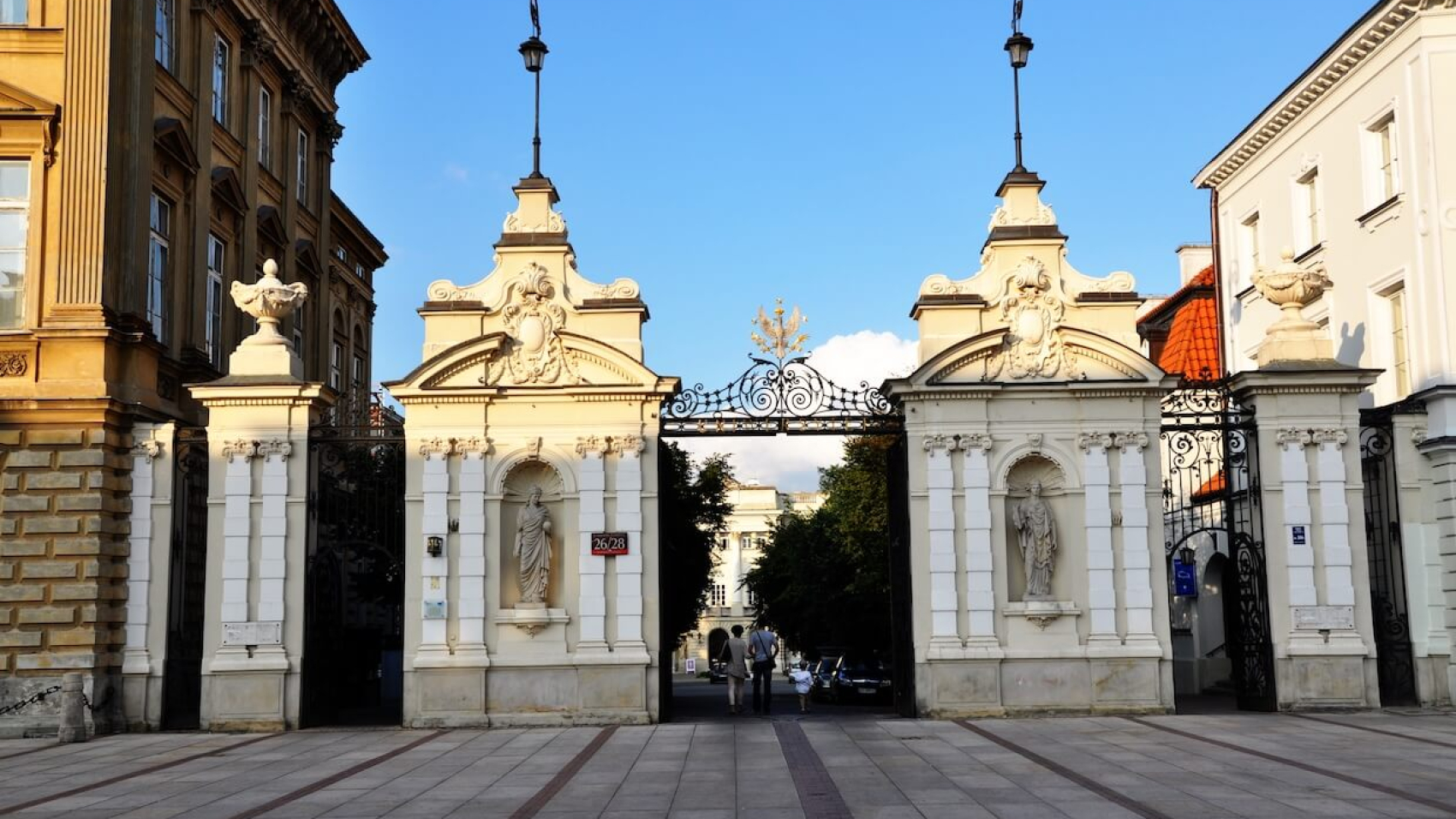
University of Warsaw

Fourth Annual International Symposium on ‘Civilizational Populism: National and International Challenges’

Date: May 22-23, 2025
Venue: University of Warsaw, Krakowskie Przedmiescie 26/28, 00-927, Warsaw


This two-day symposium will explore different aspects of the interplay between populism, religion, and civilizationism from local, national, transnational, international and global perspectives. Evaluating their combined impact on plural societies, intergroup relations, social cohesion and democratic institutions, the symposium will analyze how populists from diverse cultural, geographical, and political contexts both in Global North and Global South interact with and employ religion, civilizationism and digital technologies in their discourses and performances.

Populism has emerged as a defining feature of contemporary politics, exerting profound local, national, international, and global influences. Increasingly, it has become part and parcel of states’ transnational activities in constructing and reaching out to their “peoples” outside of their nation-state boundaries. The rise of digital technologies and the rapid advances in AI applications have only intensified the impact of populism, locally, transnationally and globally.

Often characterized as a “thin ideology,” populism operates alongside core/thick ideologies such as socialism, neoliberalism, racism, or religion, serving as a potent force for impacting emotions, mobilizing the masses, shaping public opinion and securing (or seizing) political power. Within this context, civilization —in some cases — serves as a metanarrative through which populists emphasize distinctions and escalate antagonistic relations among ‘the people” and ‘others,’ usually along religious lines. Civilizational populism not only employs the traditional ‘us’ versus ‘them’ rhetoric but also accentuates cultural, civilizational and religious identities, intensifying conflicts within, beyond and between nations. Civilizational populist discourses have also initiated discussions on transnationalism, south-south cooperation, globalization, and multipolarity, thereby potentially influencing international relations. 

In this new and rapidly changing context dominated by uncertainty on many levels, the symposium will focus on the complexity of populism not only from different disciplinary perspectives but also across multiple political, religious, and cultural groups beyond the North/South divide. The symposium also aims to provoke discussions on innovative ways to think about the policy implications of this complex phenomenon in cyberage. 

Organizing Institution

European Center for Populism Studies (ECPS) (Brussels)
Hosting Institution

Centre for Europe, University of Warsaw (Warsaw)
Partner Institutions

Georgetown University (Washington DC)
University of Birmingham (Birmingham)
Deakin University (Melbourne)
DAAD / Cambridge University

University of Duisburg-Essen, Institute of East Asian Studies 
Centre for International Relations (Warsaw)

Program Flow

DAY ONE – May 22, 2025

Adress: Sala Kolumnowa, Faculty of History, University of Warsaw, Krakowskie Przedmiescie 26/28, 00-927.

Welcoming Coffee

(08:30 – 09:00)

Opening Ceremony

(09:00 – 09:40)

Moderator

Dr. Azize Sargın (Director for External Relations, ECPS).

Welcome Remarks

Dr. Kamil Zajączkowski (Professor of International Relations, Director of the Centre for Europe, Warsaw University).

Irina von Wiese (Honorary President of ECPS, Lawyer, Academic, former MEP, and Councilor in the London Borough of Southwark).

Dr. Malgorzata Bonikowska (Professor of International Affairs and European Studies, President of the Center for International Relations).

Opening Speeches

Dr. Adam Bodnar (Minister of Justice of Poland / (Video Recording).

Dr. Alojzy Z. Nowak (Professor, Rector of the University of Warsaw).

Keynote Speech

(09:40 – 10:05)

“A Relational Approach to Religion and Populism: Recontextualizing Civilizational Narratives in National and Global Contexts,” by Dr. Jocelyne Cesari (Professor and Chair of Religion and Politics at the University of Birmingham, UK, and Senior Fellow at the Berkeley Center for Religion, Peace, and World Affairs at Georgetown University).

Panel 1

(10:05 – 11:30)

Populism: Is It a One-way Route from Democracy to Authoritarianism?

Moderator

Dr. Erkan Toguslu (Researcher at the Institute for Media Studies at KU Leuven, Belgium).

Speakers

“Making Sense of Multiple Manifestations of Alternatives to Liberal Democracies,” by Dr. Radoslaw Markowski (Professor of Political Science, Center for the Study of Democracy, Director, SWPS University of Social Sciences and Humanities, Warsaw & Polish Academy of Sciences & Polish National Election Study, Principal Investigator).

“Constitutional Intolerance: The Fashioning of ‘the Other’ in Europe’s Constitutional Repertoires,” by Dr. Marietta van der Tol (Politics & International Studies, DAAD-Cambridge).

Paper Presenter

“Identity Construction Mechanisms in the Age of Populism: A Tale of the West Against Rest?” by Amna Ben Amara (Senior researcher at George Simons International, The University of Tours, France).

Coffee Break

(11:30 – 11:50)

Panel 2

(11:50 – 13:00)

Civilizational Rhetoric, Emotions, and Societal Cohesion

Moderator

Dr. Erin K. Wilson (Professor, Chair of Politics and Religion, the Faculty of Religion, Culture, and Society, University of Groningen).

Paper Presenters

“Populism, Civilization, and Restorative Nostalgia,” by Dr. Nicholas Morieson (Research Fellow, Deakin University’s Alfred Deakin Institute for Citizenship and Globalization).

“Emotional Dimensions of Civilisationist Populism: A Comparative Analysis of Erdogan, Modi, and Khan with Transformer-Based Classification,” by Dr. Matthew Belanger (Lecturer in Substance Use Sociology, Social Policy, and Criminology Faculty of Social Sciences University of Stirling) and Dr. Ana-Maria Bliuc (Reader in Psychology, School of Humanities, Social Sciences, and Law at the University of Dundee).

Keynote Speech

(13:00 – 13:30)

The Role of the UN in Fighting for Human Rights in This Populist Age,” by Kamil Wyszkowski (Director of UN Global Compact).

Lunch

(13:30 – 15:00)

Panel 3

(15:00-17:00)

Religion and Populism: Local, National, and Transnational Dimensions

Moderator

 Dr. Jocelyne Cesari (Professor and Chair of Religion and Politics at the University of Birmingham (UK) and Senior Fellow at the Berkley Center for Religion, Peace, and World Affairs at Georgetown University).

Speakers

“Remember to be Jewish: Religious Populism in Israel,” by Dr. Guy Ben-Porat (Professor of International Relations and Politics, Ben-Gurion University of the Negev).

“Religious Populism and Civilizationalism in International Politics: An Authoritarian Turn,” by Dr. Ihsan Yilmaz (Research Professor of Political Science and International Relations and Chair in Islamic Studies at Deakin University’s Alfred Deakin Institute for Citizenship and Globalization) & Dr. Nicholas Morieson (Research Fellow, Deakin University’s Alfred Deakin Institute for Citizenship and Globalization).

Paper Presenters

“National Populists of Christian Europe, Unite? Civilizations Dimensions of Far-right Populist Alliances in Post-Brexit Britain,” by Dr. Rafal Soborski (Professor of International Politics, The Department of Social Science at Richmond American University and Senior Research Fellow at the Global Diversities and Inequalities Research Centre at London Metropolitan University).

“Anwar Ibrahim’s Civilisational Populism: Between the Muslim World and Malaysia,” by Dr. Syaza Shukri (Assoc. Professor & Head of Department of Political Science, International Islamic University Malaysia).


DAY TWO – May 23, 2025

Adress:  Biblioteki Uniwersyteckiej, Room: 308, University of Warsaw
Krakowskie Przedmiescie 26/28, 00-927.

Keynote Speech 

(10:00 – 10:30

Dariusz Mazur (Deputy Minister of Justice of the Republic of Poland).

Panel 4

(10:30 – 12:00)

Impacts of Civilizational Populism on the Market and Globalization

Moderator

Antoine Godbert (Affiliate Professor of Law, Economics & Humanities at ESCP Business School, Paris, and Director of International Affairs at the Rectorat of Île-de-France – Paris).

Speakers

“On the Nature of Economics and the future of Globalization under Civilizational Populism,” by Dr. Ibrahim Ozturk (Professor of Economics, Duisburg-Essen University, Institute of East Asian Studies (IN-EAST), Germany, Senior Economic Researcher at the ECPS, Brussels).

“Populism as a Reaction to Neoliberal Technocratism,” by Dr. Krzysztof Jasiecki (Professor of Economic Sociology at the Centre for Europe, University of Warsaw).

“Far-Right Populism and the Making of the Exclusionary Neoliberal State,” by Dr. Valentina Ausserladscheider (Associate Professor, Department of Economic Sociology, University of Vienna and Research Affiliate, Department of Sociology, University of Cambridge).

Coffee Break

(12:00 – 12:20)

Panel 5

(12:20 – 14:20)

Religion and Identity Politics

Moderator

Dr. Ana-Maria Bliuc (Reader in Psychology, School of Humanities, Social Sciences, and Law at the University of Dundee).

Speaker

“Religion and Power in an Age of Identity Politics,” by Dr. Erin K. Wilson (Professor, Chair of Politics and Religion, the Faculty of Religion, Culture, and Society, University of Groningen).

Paper Presenters

“Civilizational Populism and the Making of Sexualized Cultural Christianity,” by Dr. Ludger Viefhues-Bailey (Distinguished Professor of Philosophy, Gender, and Culture, Le Moyne University, NY).

“Imagine No More Small Boats in the Channel’: How Populist Parties and Their Leaders Normalize Polarization in Their Communication on Social Media Platforms, a Multimodal Discourse Analysis,” by Dr. Valeria Reggi (Post-doc Researcher at the University of Venice and Adjunct Professor and Tutor at the University of Bologna).

“Populism from a Double Perspective. Timo Soini and the Finnish Version of Populism,” by Dr. Jarosław Suchoples (Centre for Europe, University of Warsaw, Former Polish Ambassador to Finland).

Closing Remarks 

(14:20 – 14:30)

Dr. Kamil Zajączkowski (Professor of International Relations, Director of the Centre for Europe, Warsaw University).

Lunch

(14:30 – 15:30)


Workshops

Populism in Regions

(15:30 – 17:00)
(Room 308)

Moderators/ Discussants

Dr. Guy Ben-Porat (Professor of International Relations and Politics, Ben-Gurion University of the Negev).

Dr. Rafal Soborski (Professor of International Politics, The Department of Social Science at Richmond American University and Senior Research Fellow at the Global Diversities and Inequalities Research Centre at London Metropolitan University).

Paper Presenters

“Civilizational Populism and Foreign Policy: Analyzing Italy-Tunisia Migration,” by Dr. Helen L. Murphey (Post-Doctoral Scholar at the Mershon Center for International Security Studies at the Ohio State University).

“Greater Than the Nation: Civilizational Discourse in Orbán’s Hungary,” by Dr. Tamas Dudlak (International Relations, the ELTE Eötvös Loránd University of Budapest, and researcher in the Contemporary Arab World Center, Budapest, Hungary).

“Civilizational Populism in Hybrid Regime: The Case of Serbia,” by Nikola Ilić (PhD Candidate in political science at the University of Belgrade).

“The Return of Kahanism to Israeli Politics – the 2022 Elections,” by Adam Sharon (Ph.D. Candidate, Department of Politics and International Relations
University of Oxford, Somerville College)


Selected Topics in Populism

(15:30 – 17:30)

(Room 106)

Moderators/ Discussants

Dr. Ludger Viefhues-Bailey  (Distinguished Professor of Philosophy, Gender, and Culture, Le Moyne University, NY).

Dr. Joanna Kulska (University Professor, Institute of Political Science and Administration, University of Opole)

Paper Presenters

“Turanism, the Great Kurultáj and ‘Eastern Opening’: An Alternative View of Eurasia and the ‘West,’” by Dr. Robert Imre (Associate Professor in Political Sciences at the University of the Faroe Islands).

“Sanitary Segregation Enforced by Big Brother: A Multimodal Critical Discourse Analysis of Grzegorz Braun’s Extreme Anti-Vaccine Rhetoric,” by Dr. Marcin Kosman (Assistant Prof., The University of Economics and Human Sciences in Warsaw, Department of Social Sciences).

“State-led Civilizational Populism: A Comparison of Pakistan and Israel,” by Dr. Fizza Batool (SBAZIT University, Karachi, Pakistan).

“Populism and Traditional Catholicism in the United States: A Convergence of Religious Identity and Political Ideology,” by Tiffany Hunsinger (Ph.D. Candidate in Theology at the University of Dayton).

“The Role of Culture War in Shaping the Alliance Between Christian Conservative Movements and Chega Party,” by Francisco Batista (Ph.D. Candidate and Researcher, Political Science, Universidade Nova de Lisboa).

Religious symbols on sand: Christianity, Islam, Judaism, Orthodoxy Buddhism and Hinduism. Photo: Godong Photo.

Brief Biographies

Dr. Azize Sargin

Dr. Azize Sargin is the Director of External and Institutional Relations at the European Center for Populism Studies (ECPS) and a political consultant. She holds a PhD in International Relations from the University of Kent. Her research interests include foreign policy and populism, EU politics, transnationalism, globalisation, migrant belonging and integration, diversity, and global cities. Dr. Sargin previously served for 15 years as a diplomat in the Turkish Ministry of Foreign Affairs, holding various positions and assignments in countries such as Romania, the United States, and Belgium. In her final diplomatic posting, she was Political Counsellor at the Permanent Delegation of Turkey to the EU, where she focused on Turkey-EU relations and EU politics. She currently coordinates large-scale academic research projects and organizes academic events. Dr. Sargin is also involved in the EU-funded Horizon Europe project ENCODE, which explores the intersection of politics and emotions.

Dr. Kamil Zajączkowski

Dr. Kamil Zajączkowski is Assistant Professor and Coordinator for Research and International Cooperation at the Centre for Europe, University of Warsaw; recipient of the prestigious Ministry of Science and Higher Education Scholarship for the Best Young Scholars (2013). Holds a PhD in political science and international relations. Vice-President of the Polish Association for European Community Studies; member of the Polish-African Association and the Polish Association for International Studies.

Dr. Zajączkowski’s main research interests include: the EU in international relations, EU foreign policy, EU policy toward non-European countries (especially Sub-Saharan Africa), development and humanitarian policy, and emerging markets. He is the author of numerous publications on these topics. He has edited two books: Introduction to European Studies: A New Approach to a Uniting Europe, Centre for Europe Publishing Program, University of Warsaw, Warsaw 2013 (co-editors: D. Milczarek and Artur Adamczyk); Poland in the European Union: Adaptation and Modernization. Lessons for Ukraine, Centre for Europe Publishing Program, University of Warsaw, Warsaw-Lviv 2012 (co-editor: A. Adamczyk).

Irina von Wiese

Irina von Wiese is the Honorary President of the European Center for Populism Studies (ECPS). Born in Germany to a family of Polish and Russian refugees, she studied law in Cologne, Geneva, and Munich before receiving a scholarship to pursue a Master in Public Administration at the Harvard Kennedy School. Her legal training took her to Berlin, Brussels, and Bangkok, where she first engaged with the struggles of refugees and human rights defenders worldwide.

From 1997 to 2019, Irina worked as a lawyer in both the private and public sectors in London, while actively volunteering for human rights organizations. She has long advocated for progressive migration policies and has hosted refugees in her home for many years. In 2019, she was elected as a Member of the European Parliament representing the UK Liberal Democrats. She served as Vice Chair of the Human Rights Subcommittee and was a member of the cross-party Working Group on Responsible Business Conduct, contributing to landmark legislation on mandatory human rights due diligence in global supply chains. She also served on the Executive Committee of the European Endowment for Democracy, supporting grassroots civil society in fragile democracies.

Following the UK’s exit from the EU and the loss of her parliamentary seat, Irina returned to the UK and was elected to Southwark Council, representing one of London’s most diverse boroughs. She continues her engagement with EU affairs through her advisory role at FGS Global, focusing on EU law and ESG policy. Additionally, she is an Affiliate Professor at ESCP Business School, where she teaches international law and politics, including the course Liberalism and Populism.

Dr. Małgorzata Bonikowska

Dr. Małgorzata Bonikowska, Advisory Board Member at ECPS, holds a PhD in humanities and is a specialist in international relations, with a particular focus on the European Union and communication within public institutions. An accomplished EU expert, government advisor, and academic, Dr. Bonikowska earned degrees in Italian studies from the University of Warsaw, in history and political science from the University of Paris-Sorbonne, and in cultural history from the State College of Theatre (PWST). She is an alumna of two doctoral programs—one at the Polish Academy of Sciences and another at the SSSS in Italy. Additionally, she completed a specialized course in international affairs at Columbia University’s School of International and Public Affairs (SIPA) as a Fulbright Scholar. Dr. Bonikowska has authored over 150 publications and has supervised more than 100 BA, MA, and postgraduate theses.

Dr. Adam Bodnar

Dr. Adam Bodnar (Ph.D., habil.) is Poland’s Minister of Justice. He was born on January 6, 1977, in Trzebiatów. He received his PhD in law in 2006 and completed his habilitation in 2019. From 2006 to 2020, he lectured at the University of Warsaw’s Faculty of Law and Administration and served as a professor at the Polish-Japanese Academy of Information Technology (2019–2020). Since 2021, he has been the Dean of the Faculty of Law at SWPS University. He is also a visiting professor at the University of Cologne and a Senior Fellow at the Democracy Institute of Central European University.

In the late 1990s, Bodnar collaborated with the “Never Again” Association and worked at the law firm Weil, Gotshal & Manges (1999–2004). He has served on the boards of the European Institute for Gender Equality, the UN Fund for Victims of Torture, and was an expert for the EU Agency for Fundamental Rights. He was actively involved in numerous NGOs, including the Panoptykon Foundation (as Program Board Chair) and the Association of Prof. Zbigniew Hołda (as co-founder and board member). From 2004 to 2015, he worked with the Helsinki Foundation for Human Rights, eventually becoming Vice President of its Management Board.

Bodnar served as Poland’s Ombudsman from 2015 to 2021 and has received numerous national and international awards for his defense of the rule of law and human rights. Notable recognitions include the Rafto Prize, the Badge of Honor of Gryf West Pomeranian, the Wincenty Witos Medal, and France’s Legion of Honor (Knight).

He is the founder of the “Congress of Civil Rights” Foundation and serves on advisory boards of organizations such as the World Justice Project, International IDEA, and the Civil Liberties Union for Europe. Elected to the Polish Senate in 2023, Bodnar represents Warsaw’s 44th district.

Dr. Alojzy Zbigniew Nowak

Prof. Alojzy Z. Nowak is a prominent Polish economist and academic. He holds a PhD and a habilitation in economics, and currently serves as Rector of the University of Warsaw. He specializes in international economic relations, banking, and financial risk management. Prof. Nowak has served as Dean of the Faculty of Management at the University of Warsaw (2006–2012, 2016–2020) and previously held roles at the University of Illinois, University of Exeter, and Freie Universität Berlin. He also worked at Kozminski University in Warsaw.

He has been a member of numerous supervisory boards, including PZU SA, Bank Millennium, JSW, and ZE PAK. He also served as an advisor to the CEO of PZU and chaired the Scientific Council of the National Bank of Poland. He is a member of President Andrzej Duda’s National Development Council and the Scientific Council of the Institute of New Structural Economics in Beijing.

Since 2018, he has been President of the Academic Sports Association (AZS), Poland’s largest student organization. Prof. Nowak has received numerous honors, including the Gold Cross of Merit (2002), a Doctor Honoris Causa from the University of Physical Education in Wrocław (2022), and the Gold Medal for Merit to Polish Science Sapientia et Veritas (2023).

Dr. Jocelyne Cesari

Dr. Jocelyne Cesari holds the Chair of Religion and Politics at the University of Birmingham (UK) and is Senior Fellow at the Berkley Center for Religion, Peace, and World Affairs at Georgetown University. Since 2018, she is the T. J. Dermot Dunphy Visiting Professor of Religion, Violence, and Peacebuilding at Harvard Divinity School. President elect of the European Academy of Religion (2018-19), her work on religion and politics has garnered recognition and awards: 2020 Distinguished Scholar of the religion section of the International Studies Association, Distinguished Fellow of the Carnegie Council for Ethics and International Affairs and the Royal Society for Arts in the United Kingdom. Her new book: We God’s Nations: Political Christianity, Islam and Hinduism in the World of Nations, was published by Cambridge University Press in 2022 (https://www.cambridge.org/core/books/we-gods-people/314FFEF57671C91BBA7E169D2A7DA223) (Book Award of the Scientific Society for the Study of Religion). Other publications: What is Political Islam? (Rienner, 2018, Book Award 2019 of the religion section of the ISA); Islam, Gender and Democracy in a Comparative Perspective (OUP, 2017), The Awakening of Muslim Democracy: Religion, Modernity and the State (CUP, 2014). She is the academic advisor of www.euro-islam.info and Advisory Board Member of ECPS.

Dr. Erkan Toguslu

Dr. Erkan Toguslu is the Director of the Extremism and Radicalisation research program at ECPS. He holds an MA and PhD in sociology from the École des Hautes Études en Sciences Sociales (EHESS) in Paris. His research explores transnational Muslim networks in Europe, Islamic intellectual movements, interfaith dialogue, the public-private divide in Islam, and the intersection of religion and radicalization. Dr. Toguslu is co-editor of the Journal of Populism Studies (JPS) and editor or co-editor of several volumes, including Everyday Life Practices of Muslims in Europe, Europe’s New Multicultural Identities (with J. Leman and I. M. Sezgin), and Modern Islamic Thinking and Islamic Activism (with J. Leman), all published by Leuven University Press. His recent scholarly work focuses on violent extremism, including articles such as “Caliphate, hijrah, and martyrdom as a performative narrative in ISIS’ Dabiq magazine” (Politics, Religion and Ideology) and “Capitalizing on the Koran to fuel online violent radicalization: A taxonomy of Koranic references in ISIS’s Dabiq” (Telematics and Informatics, co-authored).

Dr. Radosław Markowski

Dr. Radosław Markowski is Professor of Political Science, Center for the Study of Democracy, Director, SWPS University of Social Sciences and Humanities, Warsaw & Polish Academy of Sciences. He specializes in comparative politics and political sociology, with research interests in elections, voting behavior, democracy, and party systems. He also serves as the director of the Polish National Election Study (PGSW). He is a recurring visiting professor at Central European University in Budapest and has previously held visiting positions at Duke University, the University of Wisconsin–Madison, and Rutgers University.

Dr. Markowski has published extensively in leading journals such as Electoral Studies, Party Politics, Political Studies, and West European Politics. He is co-author of the widely cited book Post-Communist Party Systems (Cambridge University Press) and has edited or contributed to volumes published by Oxford University Press, Manchester University Press, Routledge, and Sage. He is also an expert contributor to research projects conducted by the Bertelsmann Foundation and the Varieties of Democracy (V-Dem) project.

Dr. Marietta van der Tol

Dr. Marietta van der Tol is a political theorist and legal historian whose research explores religion, nationalism, and democratic politics. She earned her PhD from the University of Cambridge in 2020 with a dissertation on Politics of Religious Diversity, analyzing toleration, religious freedom, and the visibility of religion in public life in France, Germany, and the Netherlands.

She was the inaugural Alfred Landecker Postdoctoral Research Fellow at the Blavatnik School of Government and held a Junior Research Fellowship at New College, Oxford. In 2023, she taught Comparative Politics at St Peter’s College and was a full-time College Lecturer in Politics at Lincoln College (Oxford) during 2023–2024. She currently holds a Leverhulme Early Career Fellowship at Cambridge (2024–2025).

Dr. van der Tol leads interdisciplinary research networks including Religion, Ethnicity and Politics in German, Dutch and Anglo-American Contexts: Nationalism and the Future of Democracy (DAAD-Cambridge) and Protestant Political Thought: Religion, State, Nation (with Dr. Sophia Johnson). She co-edited special issues such as Rethinking the Sacred in Religion and Nationalism (Religion, State & Society) and Old Testament Imaginaries of the Nation (Journal of the Bible and Its Reception). She is also a convenor of the annual Political Theologies conference series.

Amna Ben Amara

Amna Ben Amara is a Ph.D candidate, researcher and consultant in intercultural management. She holds two master’s degrees: one in Intercultural Management from Slovenia and another in Cultural Studies from the Faculty of Arts and Humanities in Sousse, Tunisia, her home country. Currently, she is pursuing a Ph.D. at the University of Tours, France, focusing on the geopolitical construction of the Middle East in American foreign policy discourse. Amna has authored several journal articles and presented her work at numerous national and international conferences. She has also completed various training programs through Erasmus+ and DAAD. Most recently, she served as a visiting researcher at the University of Paris-Est Créteil, France.

Dr. Erin Wilson

Dr. Erin Wilson is an associate professor of Politics and religion at the Faculty of Religion, Culture and Society . She studied Political Sciences and was awarded a PhD by the University of Queensland in 2008. Her research is at the interface of religious studies, international relations and philosophy. Wilson developed the ‘relational dialogism’ model, which provides new explanations for the roles and meaning of religion in terms of international relations. Her work is intended to be practical for politicians and policy-makers.

Dr. Matthew J. Belanger

Dr. Matthew J. Belanger is a Lecturer in the Department of Sociology, Social Policy, and Criminology at University of Stirling, United Kingdom. He serves on the research advisory board at the Recovery Outcomes Institute and is on the board of directors at Recovery Scotland. He has a BSc in Kinesiology (2017) from the University of Massachusetts – Amherst, an MSc in Brain Sciences (2019) from the University of Glasgow, and a PhD in Addiction Psychology/Data Science (2024) from the University of Dundee, where he studied biopsychosocial factors influencing addiction recovery. Previously, he worked as a research scientist in the Department of Psychiatry and Psychotherapy at Universitaetsklinikum Carl Gustav Carus in Dresden Germany, undertaking research concerning environmental influences on behaviour. Beyond addiction recovery, Belanger’s interdisciplinary research also heavily involves the application of machine learning in sociological and political contexts.

Arkadiusz Myrcha

Arkadiusz Myrcha is a Polish politician of the Civic Platform and Deputy Minister of Justice in Poland. He has been a member of the Sejm since 2015. He was previously a city councillor of Toruń from 2010 to 2015.

Dr. Guy Ben Porat

Dr. Guy Ben Porat is a Distinguished Professor in political science and international relations, having earned his doctorate in political science and government from Johns Hopkins University. His doctoral dissertation, titled “Globalization, Peace, and Discontent: Israel and Northern Ireland,” laid the foundation for his book, Global Liberalism, Local Populism: Peace and Conflict in Israel/Palestine and Northern Ireland, which received the Ernst-Otto Czempiel award from the Peace Research Institute Frankfurt. His other areas of research include international relations, comparative politics, the relationship between religion and state and processes of secularization in Israel, and the relationship between the police and minorities in Israel and the global community. His research on the impact of economic and demographic changes on religious and secular identities in Israel won awards from the Association for Israel Studies and the Israeli Political Science Association. Dr. Porat is a full professor in the department of politics and government at Ben-Gurion University of the Negev, where he served as department head from 2018 to 2022. In his work at the Mandel Center for Leadership in the Negev, Dr. Porat teaches topics in government, policy, and local government, with a focus on the Negev, and is involved in s​haping the Mandel Program for Senior Executive ​Leadership in the Negev.

Dr. Ihsan Yilmaz 

Dr. Ihsan Yilmaz is Deputy Director (Research Development) of the Alfred Deakin Institute for Citizenship and Globalisation (ADI) at Deakin University, where he also serves as Chair in Islamic Studies and Research Professor of Political Science and International Relations. He previously held academic positions at the Universities of Oxford and London and has a strong track record of leading multi-site international research projects. His work at Deakin has been supported by major funding bodies, including the Australian Research Council (ARC), the Department of Veterans’ Affairs, the Victorian Government, and the Gerda Henkel Foundation.

Presently, he leads two ARC Discovery projects: “Civilisationist Mobilisation, Digital Technologies, and Social Cohesion: The Case of Turkish & Indian Diasporas in Australia” (in collaboration with Prof Greg Barton) and “Religious Populism, Emotions, and Political Mobilisation: Civilisationism in Turkey, Indonesia, and Pakistan.” Additionally, he co-leads a Gerda Henkel Foundation (Germany) project titled: “Smart Digital Technologies and the Future of Democracy in the Muslim World.”

He stands as one of Australia’s foremost scholars on religion & law & politics, authoritarianism, digital politics, populism, transnationalism, soft power, and sharp power, with a particular focus on Turkey, Indonesia, and Pakistan. His prolific authorship is evident through publications in leading political science and international relations journals across the globe.

Furthermore, he holds the position of a Non-Resident Senior Fellow at Oxford University’s Regent College and is associated with the Brussels-based think tank, the European Center for Populism Studies (ECPS). His advisory role extends to numerous government departments, policy makers, and bureaucrats in the UK, USA, EU, and Turkey. His contributions span renowned institutions such as the Council on Foreign Relations (CFR), the Brookings and Hudson Institutes, as well as esteemed media outlets including CNN, BBC, the New York Times, ABC, Sydney Morning Herald, and The Australian.

Dr. Rafal Soborski

Dr. Rafal Soborski is Professor of International Politics at The Department of Social Science at Richmond American University and Senior Research Fellow at the Global Diversities and Inequalities Research Centre at London Metropolitan University. Dr Soborski holds a PhD in Political Science from University of Surrey. He has taught extensively in areas of ideology, global studies and development and published several peer-reviewed articles and chapters on globalization, ideology, social movements, Euroscepticism and green political thought. Dr Soborski is the author of two monographs: Ideology in a Global Age: Continuity and Change (Palgrave Macmillan 2013) and Ideology and the Future of Progressive Social Movements (Rowman & Littlefield 2018). He is the editor of The International Journal of Interdisciplinary Global Studies and chairs the Global Studies Research Network. He is also on the Committee of the Global Studies Association UK.

Dr. Syaza Shukri

Dr. Syaza Shukri is an associate professor at the Department of Political Science, Kulliyyah of Islamic Revealed Knowledge and Human Sciences, International Islamic University Malaysia. Her area of specialization is in comparative politics, specifically in democratization and politics in the Middle East and Southeast Asia. Her current research interests include populism, identity politics, inter-ethnic relations, political Islam, geopolitics, and gender studies, specifically in Muslim-majority contexts. Among Dr. Shukri’s recent works is “Populism and Muslim Democracies,” published in Asian Politics & Policy.

Adriana Porowska

Adriana Porowska is Minister for Civil Society of Poland, chairwoman of the Public Benefit Committee Minister for Civil Society, chairwoman of the Public Benefit Committee– Adriana Porowska. Porowska is a Polish social and political activist, specializing in civil society issues.

Porowska is an experienced social worker who has been committed for many years to helping marginalized individuals and refugees. She served as the president of the Camillian Mission for Social Assistance, where she managed a shelter and training apartments for people experiencing homelessness and war refugees from Ukraine.

For 19 years, she has been working actively with NGOs, local governments, and national administrations. Her roles include co-chairing the Expert Commission on Combating Homelessness under the Polish Ombudsman, serving as a member of the Ombudsman’s Social Council, and chairing the Sectoral Social Dialogue Commission on Homelessness under the Mayor of Warsaw.

Joanna Kos-Krauze

Joanna Kos-Krauze is a Polish film director and screenwriter, best known for her creative partnership with her late husband, Krzysztof Krauze. Together, they co-wrote and directed acclaimed films such as My Nikifor (2004), Plac Zbawiciela (2006), and Papusza (2013), a biopic of the Romani poet. Her most recent work, Birds Are Singing in Kigali(2017), explores themes of trauma and reconciliation.

Kamil Wyszkowski

Kamil Wyszkowski has been working for the United Nations. He currently serves as the Representative and Executive Director of the UN Global Compact Network Poland and as the Representative of UNOPS in Poland. He is an expert on UN and EU policies, particularly in areas intersecting business and public administration.

From 2002 to 2009, he worked at the United Nations Development Programme (UNDP), where he was responsible for international and multilateral cooperation and for developing programs across Europe and Asia. He has implemented development projects in dozens of countries, including Iraq, India, Thailand, and Romania, drawing on knowledge transfer from Poland. He has also worked at UNDP headquarters in New York and its regional center for Europe and the CIS in Bratislava. From 2009 to 2014, he was the Director of the UNDP Office in Poland. Since 2004, he has been the National Representative and Chair of the Board of the UN Global Compact Network Poland (GCNP), which coordinates cooperation between the UN and business, academia, cities, public administration, and NGOs in Poland. He has also led the Know How Hub (a UNDP Poland initiative, now under GCNP) since 2011.

He lectures at institutions including Central European University (Bucharest), Ukrainian Catholic University (Lviv), Warsaw School of Economics, Kozminski University, Collegium Civitas, SWPS University, the Paderewski Institute of Diplomacy, and the University of Warsaw.

Antoine Godbert

Antoine Godbert is Affiliate Professor of Law, Economics & Humanities at ESCP Business School, Paris, and Director of International Affairs at the Rectorat of Île-de-France – Paris.

A graduate of the École Normale Supérieure de Fontenay-Saint-Cloud and the École Nationale d’Administration, Godbert holds a postgraduate degree (DEA) in epistemology from Paris VII University and an agrégation in geography. He began his career as a lecturer and researcher in geopolitics at ESCP Business School before joining the General Secretariat for National Defense as a policy officer in an interministerial crisis management unit. He later served at the Directorate-General for Administration and the Civil Service as director of the “senior management and careers” mission.

His distinguished career in public service led him to serve as coordinator of the governance and East Paris hubs within the “Capital Region Mission” under the Secretary of State for Capital Region Development, and subsequently as diplomatic adviser to the Minister of National Education. In recognition of his merit and expertise, he was later appointed Director of the French National Erasmus+ Agency, Director General of the Royal Abbey of Fontevraud, and most recently, Project Director at the Defender of Rights office.

Dr. Ibrahim Ozturk

Dr. Ibrahim Ozturk is professor of economics and a visiting fellow at the University of Duisburg-Essen since 2017. He is studying developmental, institutional, and international economics. His research focuses on the Japanese, Turkish, and Chinese economies. Currently, he is working on emerging hybrid governance models and the rise of populism in the Emerging Market Economies. As a part of that interest, he studies the institutional quality of China’s Modern Silk Road Project /The Belt and Road Initiative (BRI), its governance model, and implications for the global system. He also teaches courses on business and entrepreneurship in the Emerging Market Economies, such as BRICS/MINT countries. Ozturk’s Ph.D. thesis is on the rise and decline of Japan’s developmental institutions in the post-Second WWII era.

Dr. Ozturk has worked at different public and private universities as both a part-time and full-time lecturer/researcher between 1992-2016 in Istanbul, Turkey. In 1998, he worked as a visiting fellow at Keio University, in Tokyo, and again in 2003 at Tokyo University. He’s also been a visiting fellow at JETRO/AJIKEN (2004); at North American University, in Houston, Texas (2014-2015); and in Duisburg/Germany at the University of Duisburg-Essen (2017-2020).

Dr. Ozturk is one of the founders of the Istanbul Japan Research Association (2003-2013) and the Asian Studies Center of Bosporus University (2010-2013). He has served as a consultant to business associations and companies for many years. He has also been a columnist and TV-commentator.

Dr. Krzysztof Jasiecki

Dr. Krzysztof Jasiecki is a political scientist and economic sociologist, professor of social sciences, and long-time researcher at the Institute of Philosophy and Sociology of the Polish Academy of Sciences (1987–2017). He served as a member of the Scientific Council for the Discipline of Sociology at the University of Warsaw (2019–2020) and was awarded the University of Warsaw Rector’s Individual Third-Degree Award for Scientific Achievement (November 2020). He has been a member of the Jury for the Prof. Tadeusz Kotarbiński Award since 2021 and serves on the Scientific Council of the Institute of Political Studies of the Polish Academy of Sciences.

His research focuses on economic sociology, institutions of contemporary capitalism, the role of political and economic elites, interest groups and lobbying, the material and social dimensions of wealth, social and civic dialogue, Poland’s EU membership, and the political and economic dimensions of globalization, with special emphasis on Central and Eastern Europe.

He has contributed to numerous Polish and international journals and edited volumes. He serves on the advisory board of the Warsaw Forum of Economic Sociology (WFES) and reviews for journals including Polish Sociological Review and Studia Socjologiczne.

Prof. Jasiecki was a member of the Anti-Corruption Program Council at the Stefan Batory Foundation (2008–2013) and served as an expert for the Polish parliamentary special committee on lobbying legislation (2003–2005). He has also been part of the Poland 2025+ Club under the Polish Bank Association (ZBP) and its Ethics Committee. He was awarded the Nicolaus Copernicus Medal by ZBP and recognized by the Wokulski Foundation as “Positive Thinker of the Year” in 2012 for promoting entrepreneurship.

Dr. Valentina Ausserladscheider

Dr. Valentina Ausserladscheider is an Assistant Professor of Economic Sociology at the University of Vienna. Before joining the University of Vienna, she completed her PhD in Sociology at the University of Cambridge. Her research empirically investigates institutional change and continuity in times of crises. Currently, she explores climate-vulnerable industries´ responses to climate change. Her work has been published in Review of International Political Economy, New Political Economy, Cambridge Journal of Economy, Regions and Society, and the Journal of Cultural Economy.

Dr. Ana-Maria Bliuc

Dr. Ana-Maria Bliuc is an Associate Professor of Social and Political Psychology in the Psychology Department at the University of Dundee, where she has been a faculty member since 2019. Her research explores how social identities influence behavior across various contexts, including health, environmental issues (such as climate change), and socio-political domains (such as collective action and social change). Recently, her work has focused on online communities, investigating how collective identities and behaviors are shaped through digital interactions.

Dr. Ludger Viefhues-Bailey

Dr. Ludger Viefhues-Bailey is a Distinguished Professor of Philosophy, Gender, and Culture Chair at the Department of Philosophy at Le Moyne University, NY. Dr. Viefhues-Bailey is a scholar whose work bridges philosophy, gender studies, and cultural theory. His research explores the intersections of religion, secular democracy, and sexuality. He is the author of No Separation: Christians, Secular Democracy, and Sex (Columbia University Press, 2023), Between a Man and a Woman? Why Conservatives Oppose Same-Sex Marriage (Columbia University Press, 2010), and Beyond the Philosopher’s Fear: A Cavellian Reading of Gender, Origin, and Religion in Modern Skepticism (Ashgate, 2007). He serves on the editorial board of the journal Political Theology.

Dr. Valeria Reggi

Dr. Valeria Reggi is an Adjunct Professor Department of the Arts, Department of Modern Languages, Literatures and Cultures, and Department of Political and Social Sciences, University of Bologna. Dr. Reggi is a discourse analyst and certified English–Italian translator. She holds a PhD from the Centre for Translation Studies (CenTraS) at University College London, a specialization in literary translation from the University of Venice, and a degree with honours in Modern Languages from the University of Bologna.

She collaborates with several institutions, including UCL, the University of Brescia, and the University of Turin, and currently serves as an adjunct professor and tutor at the University of Bologna. Until 2020, she was a subject expert and a member of the Scientific Committee of the international research hub WeTell Alma Idea, focused on storytelling and civic awareness.

Reggi is a member of the editorial board of New Explorations: Studies in Culture and Communication (University of Toronto), a journal dedicated to media ecology. Her work, with a particular emphasis on qualitative discourse analysis and multimodality, includes contributions to literary criticism, translation, and discourse analysis, published by John Benjamins, Routledge, Peter Lang, Stockholm University Press, and Tangram.

Dr. Jarosław Suchoples

Dr. Jarosław Suchoples holds a Ph.D. in History from the University of Helsinki (2000) and an M.A. from the University of Gdańsk (1993). His career includes roles as an analyst at the Polish Institute of International Affairs (2000–2001) and visiting researcher at the University of California, Berkeley (2001–2002). From 2003 to 2013, he taught at institutions in Poland and Germany, including the Willy Brandt Centre, Humboldt University, and Free University Berlin. He later served as Associate Professor at the National University of Malaysia (UKM) and, in 2017, returned to Finland as Poland’s Ambassador. Currently, he is a Senior Research Fellow at the University of Jyväskylä, focusing on the history and memory of World War I, World War II, and the Cold War.

Dr. Helen L. Murphey

Dr. Helen L. Murphey is Post-Doctoral Scholar at the Mershon Center for International Security Studies at the Ohio State University. Murphey received her PhD from the University of St Andrews in 2023, where she was a Carnegie Ph.D. Scholar. She previously held a post as a Visiting Assistant Professor of Politics at Whitman College. Her research focuses on the role of identity and ideology in politics, with a specialization in religious political parties in North Africa, populism, conspiracy theories and polarization.  Her work has been published in Mediterranean Politics, the Journal of North African Studies, Feminist Media Studies and Oxford Middle East Review, among others. She is a Research Associate at the Institute of Middle East, Central Asia and Caucasus Studies at the University of St Andrews.

Nikola Ilić

Nikola Ilić is a junior researcher at the University of Belgrade – Faculty of Political Sciences, where he is currently pursuing doctoral studies in political science. Professionally, Ilić has worked as a teaching associate in courses such as Contemporary Political Theory, Political Culture and Political Order, and Human Rights Culture and Politics. He is currently involved in the Horizon Europe project EMBRACing changE: Overcoming obstacles and advancing democracy in the European Neighbourhood as an assistant researcher.

Dr. Tamas Dudlak

Dr. Tamas Dudlak is a Doctor of International Relations based in Budapest, Hungary and affiliated with the ELTE Eötvös Loránd University of Budapest as a researcher in the Contemporary Arab World Center. He previously received degrees in History, Arabic, and Turkish and studied geopolitics. His main research interest lies in the Middle East; he analyses contemporary Turkish politics from a comparative perspective. He focuses on the similarities and differences betweenTurkey and Hungary in various fields, such as migration policies, the characteristics of the populist regimes, electoral strategies of the incumbents and the oppositions, and the role of religion and civilizational discourse as the underlying ideologies of the Hungarian and Turkish governments.

Adam Sharon

Adam Sharon is a Ph.D. candidate in the Department of Politics and International Relations at the University of Oxford, Somerville College. Prior to his doctoral studies, he earned an M.A. in Politics and Philosophy from the University of Edinburgh, graduating with First Class Honours. He has served as a research assistant at Tel Aviv University, collaborating with Professor Uriya Shavit on his forthcoming book, The Jewish Civil War (2025), which explores the influence of religion on voting behavior in Israel. During his time at the Institute for National Security Studies (INSS), he also conducted research on Middle Eastern affairs and co-authored articles focusing on the foreign policies of Egypt and Jordan.

Dr. Joanna Kulska

Dr. Joanna Kulska is an Assistant Professor at the Institute of Political Science of University of Opole where she also holds the post of the director of trinational Polish-German-French Europa Master Program and Erasmus program coordinator. She graduated from Warsaw University (International Relations) and University of Lodz (Knowledge of Culture). She received her Doctoral Degree from the Faculty of Journalism and Political Science of Warsaw University based on the doctoral thesis published in 2006 entitled The Holy See in International Cultural Relations from John XXIII to John Paul II.  She was the fellow of John Paul II Foundation in Rome (2001) and The Kosciuszko Foundation in New York (2015) conducting her research at the University of Chicago. In 2017 she was the guest professor at the Institute of Political Science at University of Mainz within Polonikum Program. Her main area of interest are international cultural relations and more specifically the changing role of religious factor in international relations with the special focus on religious peacebuilding as well as the evolution of contemporary diplomacy.

Dr. Robert Imre

Dr. Robert Imre is an Associate Professor in Political Sciences at the University of the Faroe Islands. He holds university degrees from Queen´s University and University of Victoria in Canada and a PhD degree from the University of Queensland in Australia.

Dr. Imre has spent many years as a researcher and lecturer in several countries around the world. He has worked as an academic at the University of Victoria in Canada, Tampere University in Finland, the University of Regensburg in Germany, the University of Newcastle in Australia, the University of Notre Dame in Australia and other universities in Australia and Hungary.

Robert Imre’s current interest of research is the comparative politics of small states. He is  concerned with security policies, environmental and green politics, and is working on comparative civil defence projects dealing with how small states might think about their own changing civil defence needs including food security, environmental and economic security. He is also interested in Arctic security, Nordic and Baltic states politics, and small states in East Central and South East Europe.

Dr. Marcin Kosman

Dr. Marcin Kosman is Assistant Professor at Department of Social Sciences of University of Economics and Human Sciences in Warsaw. Dr. Kosman is a media scholar, discourse analyst, linguist, and psychologist. He holds a Ph.D. in the humanities and is an assistant professor at the University of Economics and Human Sciences in Warsaw. He is a two-time recipient of the Polish Minister of Science and Higher Education scholarship for outstanding academic achievements. With funding from the National Science Centre, he is currently conducting a research project on media discourse surrounding the situation at the Polish-Belarusian border. His academic interests include mechanisms of political (de)legitimization, social communication, public discourse analysis, and political marketing.

Dr. Fizza Batool

Dr. Fizza Batool is an academic and policy researcher interested in Comparative Politics, Comparative Democratization, Peace Studies and Populism. She is a post-doctoral fellow at the Central European University (CEU) Democracy Institute in Budapest and an Assistant Professor (Social Sciences) at SZABIST University, Karachi. She has authored two books on populism in Pakistan, both published by Palgrave Macmillan. Her works have also been published in prestigious research journals like Third World Quarterly, South Asia: Journal of South Asian Studies, Pakistan Horizon etc. She also contributes to English dailies in Pakistan and international research magazines such as South Asian Voices. She was one of the 2020 SAV Visiting Fellows at Stimson Center, DC.

Tiffany Hunsinger

Tiffany Hunsinger is a PhD student in Theology at the University of Dayton specializing in traditional Catholicism and politics in the United States. She has written and presented papers on St. Oscar Romero and the Christian Democratic Party, theology of immigration, the political grammar of critical race theory, and the continuity of the political messages from papal encyclicals. Her current project is her dissertation which investigates the influence of the hagiography of G.K. Chesterton on traditional Catholic movements and education in the United States. She is involved in community initiatives relating to the environment, immigration, and women’s justice.

Francisco Batista 

Francisco Batista is a Ph.D. candidate in Political Science at NOVA FCSH, specializing in Elite and Political Behaviors. His doctoral research, supervised by Professor Madalena Meyer Resende, focuses on “The Role of Culture War in Shaping the Alliance Between Christian Conservative Movements and the Chega Party.” His academic interests span Religion and Politics, Populism and the Radical Right, Political Philosophy, and Social Movements.
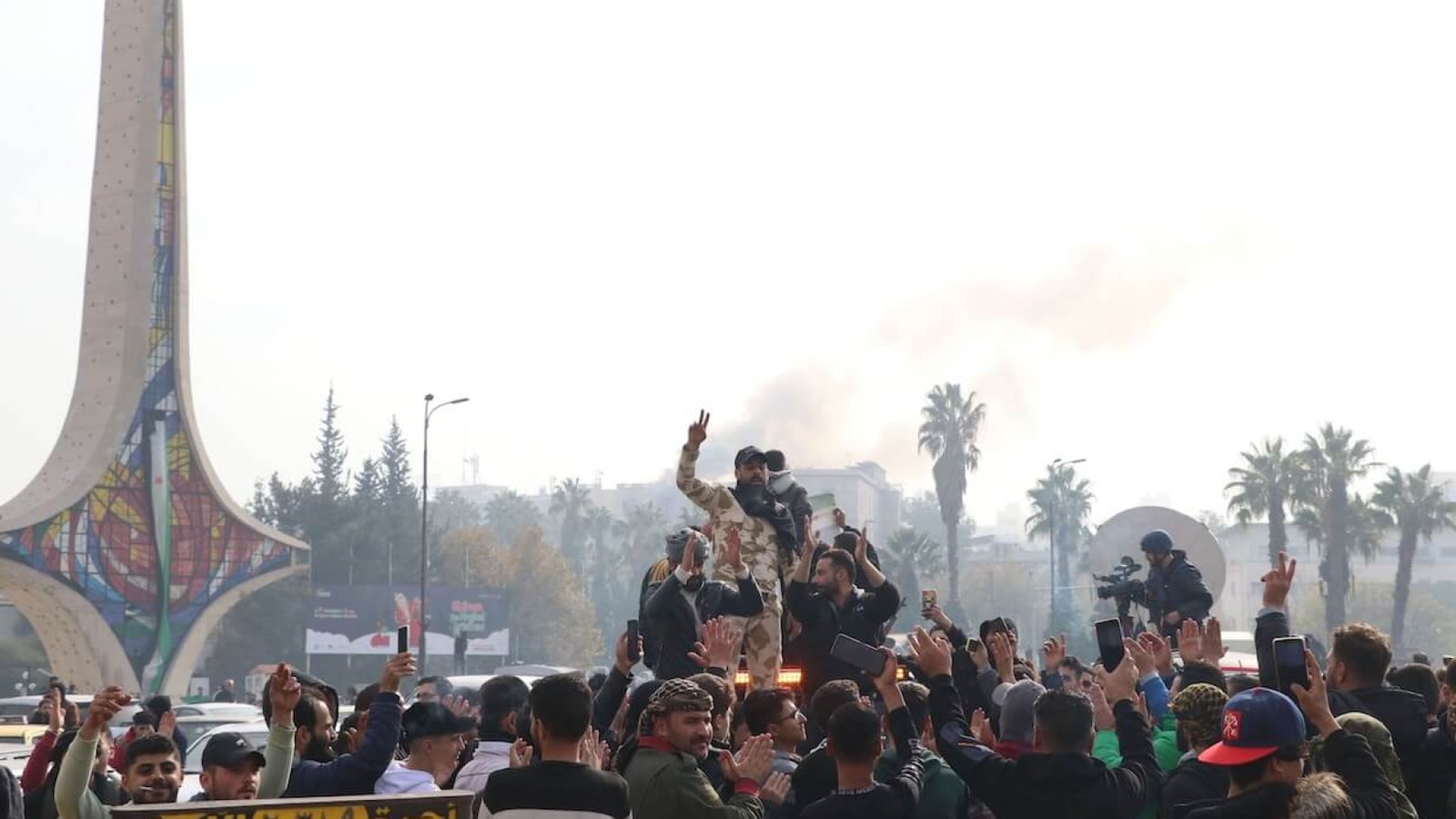
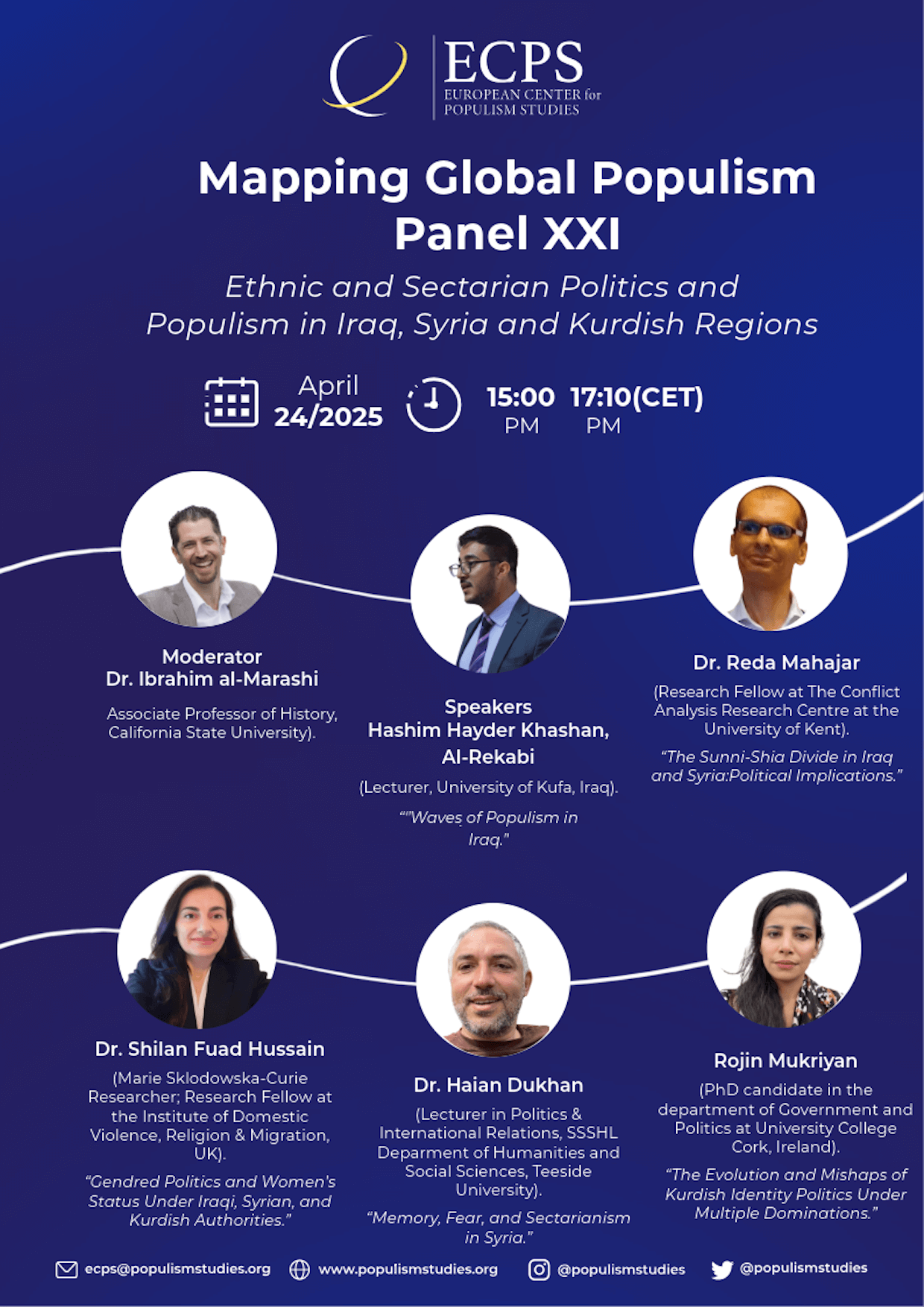
Syria

Mapping Global Populism — Panel XXI: Ethnic & Sectarian Politics and Populism in Iraq, Syria and Kurdish Regions

Date/Time: Thursday, April 24, 2025 — 15:00-17:10 (CET)


Click here to register!


Moderator

Dr. Ibrahim al-Marashi (Associate Professor of History, California State University).

Speakers

“Syrian Sunni Jihadi Chickens Home to Roost: Assad’s Fatal Gamble in Iraq,” by Dr. Reda Mahajar (Research Fellow at The Conflict Analysis Research Centre (CARC) at the University of Kent).

“Waves of Populism in Iraq,” by Hashim Hayder Khashan Al-Rekabi (Lecturer, University of Baghdad).

“Memory, Fear, and Sectarianism in Syria,” by Dr. Haian Dukhan (Lecturer in Politics & International Relations, SSSHL Department of Humanities and Social Sciences, Teeside University).

“Gendered Politics and Women’s Status Under Iraqi, Syrian, and Kurdish Authorities,” by Dr. Shilan Fuad Hussain (Marie Sklodowska-Curie Researcher; Research Fellow at the Institute of Domestic Violence, Religion & Migration, UK).

“The Evolution and Mishaps of Kurdish Identity Politics Under Multiple Dominations,” by Rojin Mukriyan (PhD candidate in the department of Government and Politics at University College Cork, Ireland).

Click here to register!

Brief Biographies and Abstracts

Dr. Ibrahim Al-Marashi is Associate Professor of Middle East History at California State University San Marcos, and an advisory board member of the International Security and Conflict Resolution (ISCOR) program at San Diego State University (SDSU), as well as an adjunct lecturer at its School of Public Health. He is also a visiting lecturer with the University of San Diego’s Department of Political Science and International Relations. Al-Marashi received his doctorate from the University of Oxford. He is the co-author of Iraq’s Armed Forces: An Analytical History (2008), The Modern History of Iraq (2016), and A Concise History of the Middle East (2024).

Syrian Sunni Jihadi Chickens Home to Roost: Assad’s Fatal Gamble in Iraq

Dr. Reda Mahajar is a research fellow at the Conflict Analysis Research Centre (CARC) at the University of Kent. His current postdoctoral research focuses on how the Hajj rituals reproduce the ‘Sunni’ and ‘Shia’ labels as categories of power in Western Europe. Dr. Mahajar earned his PhD in International Relations from the University of Kent. His PhD dissertation, titled “Shialism: The Historical Persistence of the Sunni-Shia Binary,” examines the historical persistence of the ‘Sunni’/‘Shia’ labels as constructs of power in the ‘Arab’ and ‘Muslim’ worlds, as well as in the ‘proverbial West.’Dr. Mahajar’s research interests include exploring the ontological, temporal, and epistemological assumptions that underpin conceptualizations of identities as categories of power in the fields of international relations, migration, Middle Eastern studies, and nationalism studies.

Waves of Populism in Iraq

Mr. Hashim Hayder Khashan Al-Rekabi is a lecturer at Baghdad University, where he teaches courses in behavioral statistics and introduction to political science. He also mentors senior students in drafting their capstone research projects. Additionally, he is the founder of the Platform Center for Sustainable Development (PSDIraq), which aims to establish a policy-oriented youth network to drive positive change through policy work. Al-Rekabi holds a Master’s degree in Comparative Politics from Western Illinois University.

Abstract: My presentation challenges the views that post-2003 Iraq should be studied in isolation and demonstrates that many of the pre-2003 dynamics impacted the post-2003 era, mainly populism. It sheds light on the three waves of populism in Iraq, the authoritarian populism of Saddam’s regime being the first, given that he was the leader of a secular and pan-Arab party but frequently used religion and nationalism strategically and selectively under certain conditions, creating the context of modern populism. The second wave is the ethno-sectarian populism post-2003 that created multiple populist actors who demonstrated their allegiance to parliamentary democracy but undermined it by their practices. The third and final wave this paper examines is the modern populism of post-2014, where insiders nurtured nationalist populism due to the declining appeal of sectarianism, the deep political divisions, and widespread disappointment. This paper is based on a field study measuring popular perception of post-2003 political systems, including populist tendencies, level of trust, and other demographic and democratic factors.” 

Memory, Fear, and Sectarianism in Syria

Dr. Haian Dukhan is a Lecturer in Politics and International Relations at Teesside University and a Fellow at the Centre for Syrian Studies, University of St Andrews. He is the author of State and Tribes in Syria: Informal Alliances and Conflict Patterns (Routledge, 2019) and co-editor of Spoils of War in the Arab East: Reconditioning Society and Polity in Conflict (Bloomsbury, 2024). His research focuses on the international relations of the Middle East, with a particular emphasis on the role of non-state actors in armed conflicts. His work has appeared in the International Journal of Middle East Studies, Nations and Nationalism, Small Wars and Insurgency, and others. He has also authored multiple policy reports for USAID, the Konrad Adenauer Foundation, the Middle East Institute, and others on issues related to sectarianism, extremism, and forced migration. Previously, he taught politics and international relations at the universities of Leicester, Edinburgh, and Queen Mary University of London, and held research positions at the Central European University in Austria and Roskilde University in Denmark.

Abstract: The Syrian uprising and subsequent civil war have been extensively studied with a predominant emphasis on sectarianism between the Sunni and Alawite sects. This narrow focus overlooks the profound influence of other religious and ethnic elements within Syrian society. My Presentation aims to broaden the analytical lens by examining the position and attitudes of Christians in the Al-Hasakah governorate regarding the Syrian uprising and opposition forces. My presentation addresses two key inquiries: first, the factors influencing Christians’ position in Al-Hasakah regarding the Syrian uprising, and second, the ramifications of these positions on intercommunal relationships in the region. I will argue that the collective memory of fear experienced by Christians, manipulated by the Syrian regime, has contributed to the emergence of “sectarianism from below” and “sectarianism from above.” The former reflects the construction of sectarian identities by Christians in response to discrimination and marginalization, while the latter pertains to influential institutions perpetuating sectarian identities and divisions. My findings highlight the complex interplay of factors shaping communal attitudes and relations during times of upheaval and conflict.

Gendered Politics and Women’s Status Under Iraqi, Syrian, and Kurdish Authorities

Dr. Shilan Fuad Hussain is dedicated to advancing gender equality and advocating women’s rights. She is a Fellow at the Institute of Domestic Violence, Religion & Migration, and The Integrity Centre. She is an Associate Editor for Brill and Routledge and a Senior Consultant for gender-related societal issues. She is an Associate Fellow of the Higher Education Academy. She was previously a Marie Sklodowska-Curie Postdoctoral Fellow in Gender Studies and Cultural Analysis (UKRI), a Visiting Fellow at the Washington Kurdish Institute (U.S.), and a Doctoral Fellow at the Geneva Centre for Security Policy (Switzerland), where she has published several papers and received tailored training. She holds a Master’s Degree in Middle Eastern Studies from the University of Bologna and a PhD in Cultural Analysis from the University of Urbino (Italy). She has developed a track record in Cultural Analysis alongside Middle Eastern Studies. She is an interdisciplinary academic and works on a variety of topics, including cultural representation, production, and practices; gender-based violence, women’s human rights and empowerment; state policies enhancing female equality. She has published 20 articles in peer-reviewed academic journals, 3 special issues, 4 book chapters, one co-edited book, 12 open-access articles online, 10 op-eds; one single-authored book is forthcoming, and an edited book and edited Volume. Personal website: www.shilanfuadhussain.com.

Abstract: This study examines the intersection of gendered politics and women’s status under Iraqi, Syrian, and Kurdish authorities, analysing how political structures, legal frameworks, and societal norms shape women’s rights and participation in governance. Utilizing a comparative approach, the research draws on legal documents, policy analyses, and interviews with activists, policymakers, and scholars to assess the extent to which state and non-state actors influence gender dynamics. The findings reveal stark contrasts between authoritarian regimes, semi-autonomous governance, and stateless political movements in their approaches to women’s rights. In Iraq and Syria, shifting power structures, sectarian conflicts, and legal pluralism have led to inconsistent protections for women, often subordinating gender equality to nationalist or religious agendas. In contrast, Kurdish-led administrations have promoted more progressive gender policies, though challenges remain in implementation and enforcement. The study argues that women’s status is not only a reflection of legal rights but also of broader political ideologies and power struggles. By situating gender within the framework of state-building and governance, this research contributes to the understanding of how political authority affects women’s agency, representation, and security in conflict-affected and transitional societies.

The Evolution and Mishaps of Kurdish Identity Politics Under Multiple Dominations

Rojin Mukriyan is a PhD candidate in the Department of Government and Politics at University College Cork, Ireland. She has also obtained a BA and MSc from University College Cork after fleeing from Iran for political reasons in 2014. For her BA, she double majored in Philosophy and Politics, and wrote a dissertation on the role of ontological insecurity in Turkey’s treatment of the Kurds. She then obtained an MSc in Government and Politics from UCC with a thesis on the application of classical republican conceptions of domination and political liberty to the Kurds of Rojava (West Kurdistan). Presently, her PhD research project is focused on a thorough analysis of jailed Kurdish leader Abdullah Ocalan’s conceptions of democratic confederalism and democratic civilization.

Rojin’s main research areas are in political theory and Middle Eastern politics, especially Kurdish politics. She has published articles in the Journal of International Political Theory, Philosophy and Social Criticism, and Theoria. Her research has thus far focused on the areas of Kurdish liberty, Kurdish statehood, and Kurdish political friendship. She has published many think tank commentaries and reports on recent political developments in eastern Kurdistan (Rojhelat), or north-western Iran. She has also frequently appeared on a variety of Kurdish and Persian language news channels. 

Abstract: This presentation conducts a critical comparative analysis of populism by examining the PYD-led Democratic Autonomous Administration of North and East Syria (DAANES) alongside the PUK and KDP-led Kurdistan Regional Government (KRG). Drawing upon Ernesto Laclau’s  conceptualization of populism as a strategy for hegemonic struggle and Jan-Werner Müller’s characterization of populism as a ‘permanent shadow’ over representative democracy, this study refrains from adopting a monolithic definition of populism. Instead, it establishes a set of criteria for assessing whether the DAANES or the KRG can be classified as populist governments. The investigation explores the theoretical and ideological frameworks underpinning both political entities, bolstered by qualitative data derived from their public speeches, publications, and policy documents. The analysis argues that DAANES can be viewed as exhibiting left populist characteristics that challenges both existing state institutions and the rise of Islamist extremism. In contrast, the KRG, dominated by the PUK and KDP, does not exhibit the characteristics of left populism, as it fails to challenge the existing system or promote an inclusive notion of peoplehood aimed at equality and freedom. Although some figures within the KRG may display populist tendencies, the KDP and PUK are predominantly formed and controlled by two elite families, thereby offering no anti-establishment prospects; consequently, they do not embody right-wing populism either. It is likely better to view both parties as exhibiting the expected neoliberal tendencies of parties inclined to use the state as a means for laundering their private interests. In turn, following Chantal Mouffe’s line of argument, this paper asserts that the left populism found in the DAANES could effectively challenge the corrupt and clientelist governance within the KRG if it found support within the Kurdish region of Iraq. This paper aims to contribute to a nuanced understanding of populism within the context of Kurdish politics. By doing so, it enriches the field of Kurdish political studies by offering a comprehensive analysis of populism in a context that has been insufficiently explored, thereby advancing the broader discourse on populism.

Photo: Shutterstock.

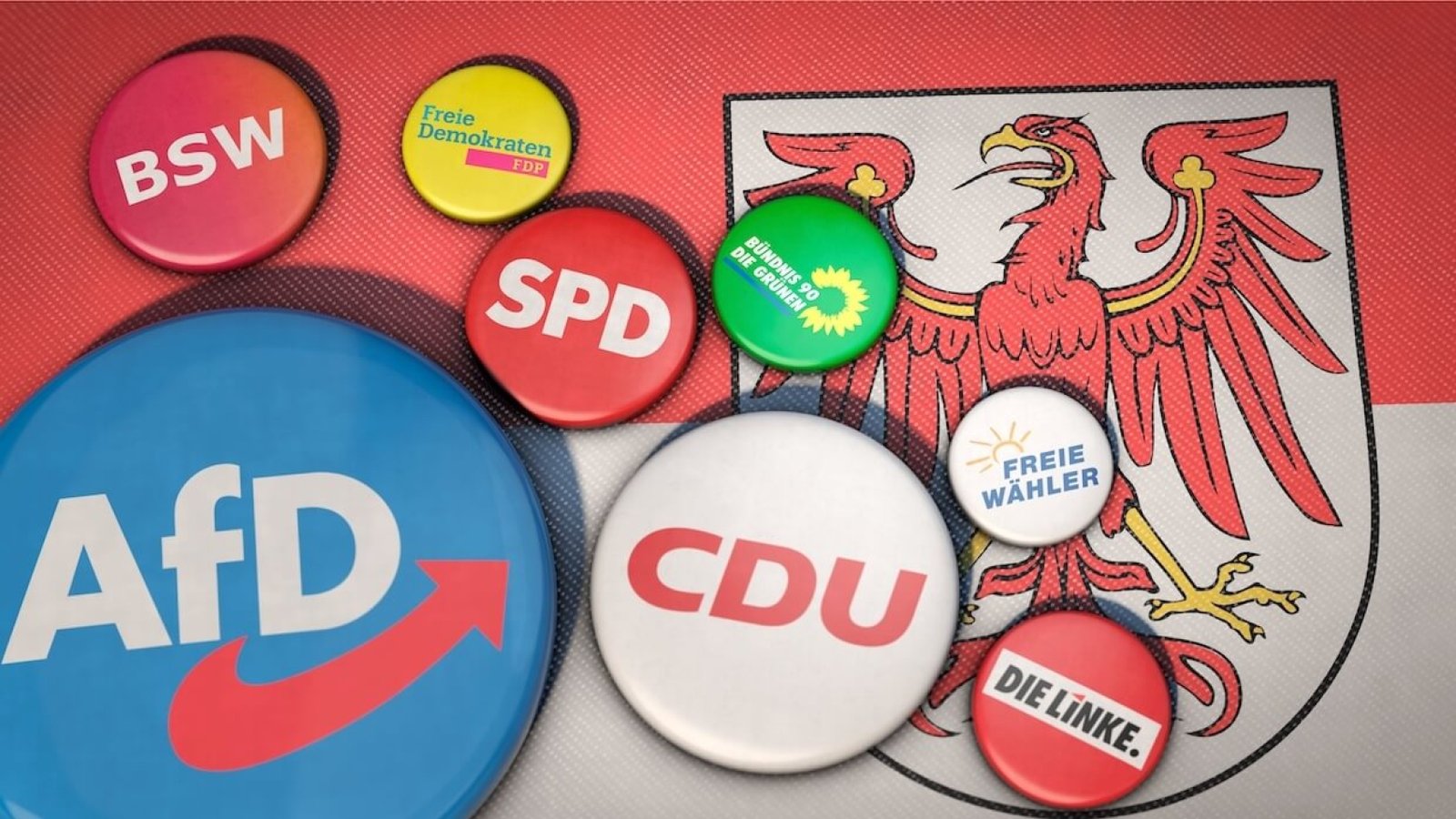
ECPS Panel — Discussing Post-Election Germany: Democracy, Populism and the Far-Right Surge

Date/Time: Thursday, March 13, 2025 / 15:00-17:00 (CET)


Click here to register!


Moderator

Dr. Cengiz Aktar (Adjunct Professor of Political Science at the University of Athens and ECPS Advisory Board Member).

Speakers

“How Worried Should We Be About the AfD and the Transatlantic Relationship?” by Dr. Eric Langenbacher (Teaching Professor and Director of the Senior Honors Program in the Department of Government, Georgetown University).

“How Can We Explain the Rise of the AfD in the 2025 Election?” by Dr. Kai Arzheimer (Professor of Political Science at the University of Mainz).

“Accommodation or Exclusion? Immigration, the AfD, and Democratic Challenges in the 2025 Election,” by Dr. Hannah M. Alarian (Assistant Professor of Political Science at the University of Florida).

“The AfD’s Surge in the 2025 Germany Federal Election: Patterns of Realignment and Political Implications,” by Dr. Conrad Ziller (Assistant Professor of Political Science at the University of Duisburg-Essen).

“Germany’s Far Right: Antifeminism Sells,” by Dr. Sabine Volk (Postdoctoral Researcher at the Chair of Political Science and Comparative Politics, Faculty of Social and Educational Sciences, University of Passau).

Click here to register!


Brief Biographies and Abstracts/Outlines

Dr. Cengiz Aktar is an adjunct professor of political science at the University of Athens. He is a former director at the United Nations specializing in asylum policies. He is known to be one of the leading advocates of Turkey’s integration into the EU. He was the Chair of European Studies at Bahçeşehir University-Istanbul. In addition to EU integration policies, Dr. Aktar’s research focuses on the politics of memory regarding ethnic and religious minorities, the history of political centralism, and international refugee law.

How Worried Should We Be About the AfD and the Transatlantic Relationship?

Dr. Eric Langenbacher is a Teaching Professor and Director of Honors and Special Programs in the Department of Government, Georgetown University. His research interests center on political culture, collective memory, political institutions, public opinion and German and European politics. His publications include From the Bonn to the Berlin Republic: Germany at the Twentieth Anniversary of Unification (co-edited with Jeffrey J. Anderson, 2010), Dynamics of Memory and Identity in Contemporary Europe (co-edited with Ruth Wittlinger and Bill Niven, 2013), The German Polity, 10th, and 11th, 12th edition” (2013, 2017, 2021) (co-authored with David Conradt), The Merkel Republic: The 2013 Bundestag Election and its Consequences (2015), and Twilight of the Merkel Era: Power and Politics in Germany after the 2017 Bundestag Election (2019). He is also Managing Editor of German Politics and Society, which is housed in Georgetown’s BMW Center for German and European Studies.

How Can We Explain the Rise of the AfD in the 2025 Election?

Dr. Kai Arzheimer is a Professor of German Politics and Political Sociology at the University of Mainz in Germany. He is particularly interested in European far right parties and their voters.

Abstract: Within just three years, Germany’s Far Right “Alternative for Germany” has managed to double the 2021 result, making them the second largest party in the new parliament. During this period, the party has undergone a bewildering transformation that involved (further) radicalization on the one hand and normalization on the other. In my presentation, I trace this process and will also use (very preliminary) survey data to look into the micro-foundations of the AfD’s meteoric rise.

Accommodation or Exclusion? Immigration, the AfD, and Democratic Challenges in the 2025 Election

Dr. Hannah Alarian is an Assistant Professor of Political Science at the University of Florida, where she is also a faculty affiliate with the Center for Arts, Migration, and Entrepreneurship and the Center for European Studies. Dr. Alarian’s research examines questions of immigration, citizenship, and far-right politics in Europe and the United States. Her research appears in the American Political Science Review, the Journal of Politics, and Comparative Political Studies, among others.

Abstract: The 2025 German Federal Election marked a seismic political shift. Voter turnout soared to its highest since reunification, the far-right AfD secured 20.8%, becoming the second-largest party in the Bundestag, and the FDP lost all parliamentary representation for only the second time in history. How did Germany reach this moment of far-right ascendence, and what lies ahead? This presentation addresses these pressing questions, examining the democratic challenges posed by AfD. In particular, I examine the expected driver of far-right support (i.e., immigration) and party strategies regarding accommodation or exclusion of the AfD in parliament (i.e., breaching the Brandmauer). I conclude by discussing the democratic challenges facing the next German government and strategies the coalition may employ to stave off further far-right mobilization.

The AfD’s Surge in the 2025 Germany Federal Election: Patterns of Realignment and Political Implications

Dr. Conrad Ziller is an Assistant Professor in the Department of Political Science at University of Duisburg-Essen. His research interests focus on the role of immigration in politics and society, the radical right, and policy effects on citizens, amongst others. More information can be found here: https://conradziller.com/

Outlines: In the 2025 German federal election, the Alternative für Deutschland (AfD) achieved a historic 20.8% of the vote, doubling its previous performance and marking its strongest postwar result. This surge was particularly pronounced in economically disadvantaged regions, especially in the former East Germany, where the AfD secured up to 46% of votes in certain districts. Notably, the party made significant inroads in traditional Social Democratic Party (SPD) strongholds, such as Gelsenkirchen in North Rhine-Westphalia, a constituency long dominated by the SPD. Additionally, the AfD has gained popularity among young men and even attracted votes from immigrant communities, indicating a substantial realignment of voter bases. The implications for German politics over the next four years are profound. With a stronger parliamentary presence, the AfD’s will continue to challenge the traditional party system and influence debates on immigration, economic reform, and Germany’s role in the European Union. While mainstream parties have ruled out coalitions with the AfD, their electoral losses highlight growing societal divisions. Addressing the economic and cultural divisions fueling the AfD’s rise will be crucial for maintaining political stability and democratic cohesion.

Germany’s Far Right: Antifeminism Sells

Dr. Sabine Volk is a postdoctoral researcher at the Chair of Political Science and Comparative Politics, Faculty of Social and Educational Sciences, University of Passau. She is affiliated with the Hub on Emotions, Populism and Polarisation, Faculty of Social Sciences, University of Helsinki. Her research appears in European Societies, European Politics and Society, Frontiers in Political Science, German Politics, Political Research Exchange and Social Movement Studies, as well as in edited volumes. Her research interests include populism and the far right, party politics and social movements in Germany and Europe. 

Abstract: The issue of immigration surely dominated the German federal election campaign. Mainstream parties adopted an increasingly harsh anti-immigration discourse under the impression of AfD’s increasing strength in the polls. This presentation shifts our attention to yet another important issue of far-right politics in Germany and beyond: antifeminism or ‘antigenderism’. Addressing the puzzle of AfD’s lesbian leader Alice Weidel, it examines how AfD successfully fashions itself as Germany’s key antifeminist actor. Among other things, it traces AfD’s radicalization in the issue areas of women’s reproductive rights as well as trans and gender diverse minority rights.

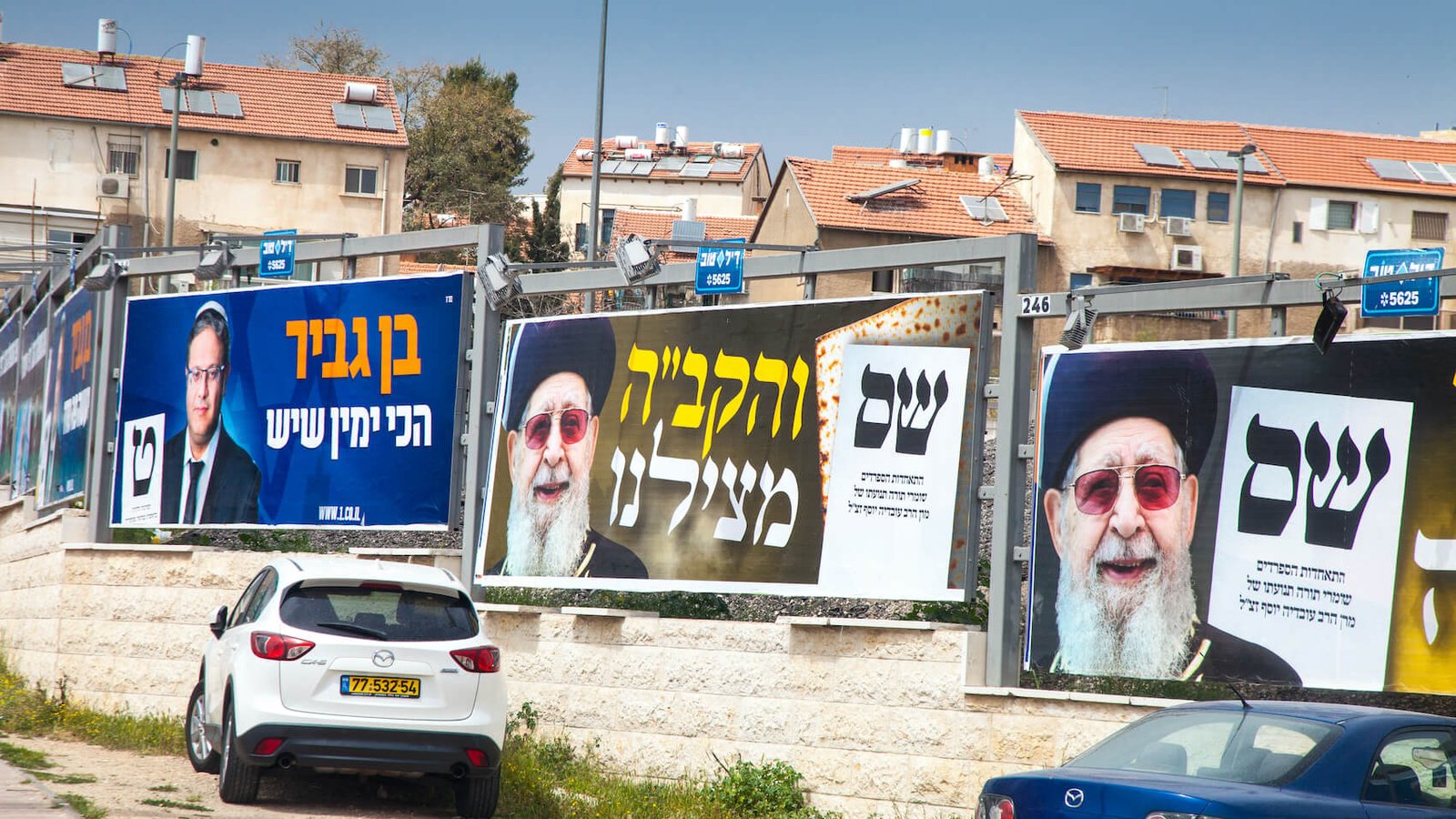
Election billboards of religious political parties Shas and Otzma Yehudit before Israel’s fourth election in two years in a street of Jerusalem on March 22, 2021. Photo: Gali Estrange.

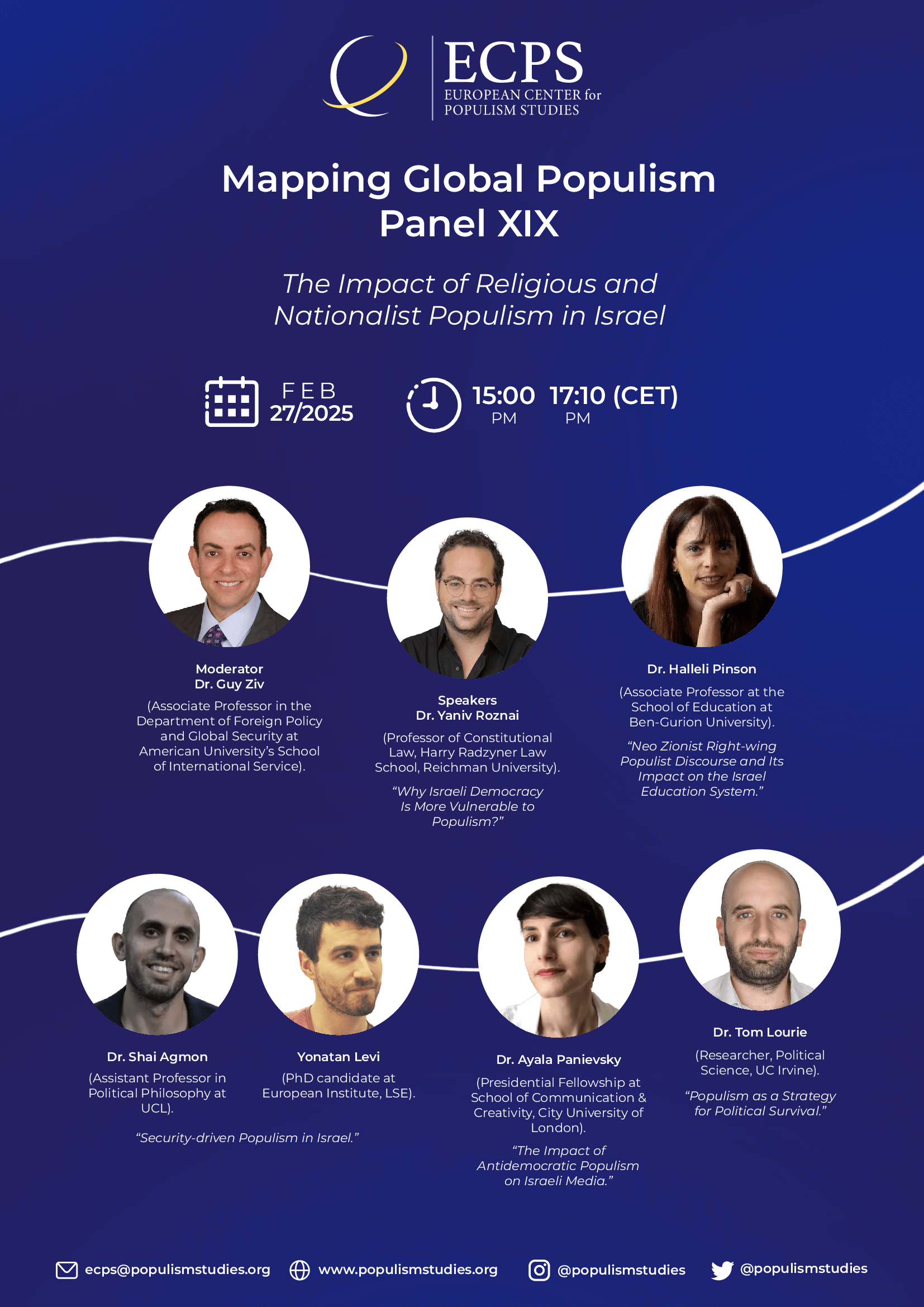
Mapping Global Populism — Panel XIX: The Impact of Religious and Nationalist Populism in Israel

Date/Time: Thursday, February 27, 2025 — 15:00-17:10 (CET)


Click here to register!

Moderator

Dr. Guy Ziv (Associate Professor in the Department of Foreign Policy and Global Security at American University’s School of International Service (SIS)).

Speakers

“Why Israeli Democracy Is More Vulnerable to Populism?” by Dr. Yaniv Roznai (Professor of Constitutional Law, Harry Radzyner Law School, Reichman University).

“Neo Zionist Right-wing Populist Discourse and Its Impact on the Israel Education System” by Dr. Halleli Pinson (Associate Professor at the School of Education at Ben-Gurion University).

“Security-driven Populism in Israel,” by Dr. Shai Agmon (Assistant Professor in Political Philosophy at UCL) & Yonatan Levi (PhD candidate at European Institute, LSE).

“The Impact of Antidemocratic Populism on Israeli Media,” by Dr. Ayala Panievsky (Presidential Fellowship at School of Communication & Creativity, City University of London).

“Populism as a Strategy for Political Survival,” by Dr. Tom Lourie (Researcher, Political Science, UC Irvine).

Click here to register!


Brief Biographies and Abstracts

Dr. Guy Ziv is an Associate Professor in the Department of Foreign Policy and Global Security at American University’s School of International Service (SIS). He also serves as the associate director of AU’s Meltzer Schwartzberg Center for Israel Studies. He teaches courses on U.S. foreign policy, international negotiations, U.S.-Israel relations, and Israeli-Palestinian peacemaking. His latest book is titled “Netanyahu vs The Generals: The Battle for Israel’s Future,” published by Cambridge University Press (2024). His first book, “Why Hawks Become Doves: Shimon Peres and Foreign Policy Change in Israel,” was published by SUNY Press in 2014. Dr. Ziv has a background in policy, having worked on Capitol Hill and for not-for-profit organizations that promote Israeli-Palestinian peacemaking.

Why Israeli Democracy Is More Vulnerable to Populism? 

Dr. Yaniv Roznai is an Associate Professor and Vice-Dean at the Harry Radzyner Law School, and Co-director at the Rubinstein Center for Constitutional Challenges, Reichman University. He holds a PhD and LL.M (Distinction) from The London School of Economics (LSE). He is the Co-Founder of the Israeli Association of Legislation and was a Co-Chair between 2017-2020. He is an elected board member and former secretary general of the Israeli Association of Public Law. Dr. Roznai’s scholarship focuses on comparative constitutional law, constitutional theory, legisprudence, and public international law.

Abstract: I will explain that compared with other systems, Israeli democracy is especially vulnerable to populism, because of its unique institutional design factors coupled with social factors. Only with understanding these factors can one grasp the risks that the judicial overhaul – a populist project – poses to Israeli democracy.

Neo Zionist Right-wing Populist Discourse and Its Impact on the Israel Education System

Dr. Halleli Pinson (BA, TAU; MPhil, PhD, Cambridge University) is an Associate Professor at the School of Education at Ben-Gurion University. Pinson is a political sociologist of education, and her main interest is with the changing role of schooling in the age of globalization. She has three main research areas: gender patterns of participation in STEM fields; citizenship education and the impact of political populism on education policy; and state education responses to global migration. She is the co-author of Education, Asylum and the ‘Non-Citizen’ Child, and a co-editor of the Edward Elgar Handbook on Education and Migration and the Routledge’s book series on Education and Migration. She is also a member of the editorial boards of the British Journal of Sociology of Education and Race Ethnicity and Education. She is also the former president of the Israeli Comparative Education Research Association and currently serves as the chair of the Global Migration SIG at the CIES.

Abstract: Over the past decades, and particularly since 2009, neo-Zionist discourse has gain prominence in Israel. This approach, which gives preference to the definition of Israel as a Jewish state over and above its definition as a democracy, should be seen as a specific version of religious-nationalism and an expression of authoritarian populism. This paper explores how educational discourses and policies changes in Israel are being shaped by right-wing populist organization and politicians. This presentation focuses on three examples from recent years. The first example, the campaign to ban the activist groups ‘Breaking the Silence’ – a group of army veteran who collect testimonies on Israel’s misconducts in the occupied territories – from entering schools. The second example is the case of ‘Im Tirtzu’, a right-wing organization, and their campaign against left-wing influences in the academy by employing practices, such as online anonymous reports on ‘left-wing biased teaching’. A third example is the recent attempts to change the Council of Higher Education bill, what is referred to as ‘the silencing bill’, aimed at silencing critical voices in academia under the face of the ‘fight against terrorism.’ In examining these cases I will demonstrate how right-wing organizations and politicians employ different populist strategies and how they impact education institutions and policies. 

Security-driven Populism in Israel

Dr. Shai Agmon is the Rank-Manning Junior Research Fellow at New College, University of Oxford. His research lies primarily in political and legal philosophy, on topics ranging from the philosophy of competition to political authority and the moral limits of markets. additionally, he writes on issues in contemporary Israeli politics – mostly focusing on the relation between the illegal settlements project and Israel’s national security, and the rise of Israeli right-wing populism. His academic work has appeared in Ethics; Politics, Philosophy & Economics; The Journal of Ethics and Social Philosophy and Contemporary Politics. He also writes for Haartez, Ynet, Telem Magazine and more. Shai also has a rich experience in politics and public policy. Amongst other things, he was a Campaign Manager in the 2019 primaries for the Israeli Labour Party leadership; lead negotiator of the Green Party during the establishment of the Democratic union Party; policy advisor at the ‘first 100 days’ team of Blue and White Party; Political Officer for the British Ambassador in Tel-Aviv; and an Articled Clerk at Israel’s Attorney General Office in the Department of Fiscal and Economic Matters.

Yonatan Levi is a PhD candidate specialising in millennial politics. His doctoral project is a comparative analysis of the generational politics of millennials in the United States and Israel over the last decade. He is particularly interested in the ways in which his generation understands and approaches power, politics and organisation. Prior to his doctoral studies, Yonatan worked as a journalist for Israel’s leading daily newspaper, an investigative researcher for a Jerusalem-based progressive think tank, and a political campaigner. In 2011 he was one of the leaders of the Israeli social justice protest movement – the largest civic mobilisation in the country’s history. In 2016 he worked in the UK Parliament. Yonatan is a recipient of the British Foreign Office’s Chevening Scholarship for students with outstanding leadership qualities, as well as NYU’s Paths to Peace Scholarship. He is a research fellow at Molad – the Centre for the Renewal of Israeli Democracy, and at the Israeli Labour Movement’s Berl Katznelson Centre. His writing has appeared in various media outlets, including The Guardian, Ha’aretz and Contemporary Politics.  Yonatan holds an MSc in Political Theory from LSE and a BA in History and Literature from Tel-Aviv University.

The Impact of Antidemocratic Populism on Israeli Media

Dr. Ayala Panievsky is currently a Presidential Fellow in the Journalism Department at the City University of London, a Research Associate at the Sociology Department at the University of Cambridge, and a Research Fellow at the Centre for the Renewal of Israeli Democracy. She is a researcher specialising in media under attack, right-wing populism, and democratic backsliding. Her research appeared in journals such as The International Journal of Press/Politics and Digital Journalism, and featured in media outlets like the BBC, The News Agents, LBC and ABC. 

She holds a PhD (no corrections) from Cambridge University, an MPhil in Political Communication (with distinction) from Goldsmiths College, and a BA in Journalism and Communication (with distinction) from the Honours Programme at the Hebrew University of Jerusalem. Her work received the ICA Outstanding Dissertation for 2024, the 2023 IJPP Best Article of the Year Award, and an honourable mention by the 2023 ICA Wolfgang Donsbach Outstanding Article of the Year Award, among others.

As a former journalist, she works with journalists worldwide to improve the future of news in times of sophisticated threats to democracy, equality, freedom, and justice. Her first book, The New Censorship, will be out next year with Footnote Press.

Populism As a Strategy of Political Survival

Dr. Tom Lourie holds a PhD in political science and is a research fellow at the Ethics Center at the University of California, Irvine.

Abstract: Conventional wisdom suggests that populism in Israeli politics dates back to the 1970s, portraying Likud as a populist party and its founder, Menachem Begin, as Israel’s first populist prime minister. However, evidence indicates that populism at the executive level is a relatively new phenomenon in Israel. Content analysis and case studies of Israeli prime ministers from 1977 to 2023 suggest that Benjamin Netanyahu was the first to adopt a populism, doing so during the 2015 election campaign. Process tracing further reveals that Netanyahu employed populism as a strategy for political survival in response to his legal troubles. As part of this approach, he systematically targeted institutions involved in his legal proceedings, raising concerns about its implications for Israeli democracy.


Internship

Internship Positions at the European Center for Populism Studies (ECPS)

DOWNLOAD ANNOUNCEMENT


Duration: 6 months

Commitment: Part-time (20 hours per week)

Location: Remote internship


Description

The European Center for Populism Studies (ECPS) is looking for motivated interns to join our team. As an intern, you will have the opportunity to enhance your analytical thinking, academic writing, research skills, and organizational and networking abilities in a dynamic multicultural environment. The internship will begin at the end of February and will last for six months.

Main Tasks

    • Conduct academic research (primarily desk research) and write essays, commentaries, and articles on topics covered by ECPS research programs, including authoritarianism, digital populism, economics, gender, migration, environment and climate, extremism and radicalization, foreign policy, human rights, global peace and order, and leadership.
    • Prepare briefs and reports summarizing monthly and annual activities (such as panels, seminars, and conferences) for publication on the ECPS website.
    • Assist ECPS experts in organizing various events (including book talks, seminars, panels, summer schools, and symposiums).
    • Support the ECPS team with communication activities, such as preparing the online newsletter and managing social media accounts.
    • Contribute to project applications (e.g., EU-funded projects).
    • Help implement ongoing projects, including data collection, report writing, dissemination, communication activities, and event organization, depending on ECPS’s role in the project.

    Who We Are

    The European Center for Populism Studies (ECPS) is an independent, nonpartisan, nonprofit organization based in Brussels dedicated to researching and analyzing the challenges posed by rising political populism. ECPS promotes an open society by adhering to the principles of liberal democracy, including the rule of law, human rights, pluralism, freedom of speech, gender equality, social and environmental justice, transparency, and accountability. We facilitate collaboration among networks of academics, practitioners, policymakers, media, and other stakeholders. We offer a platform for exploring policy solutions related to rising populism and provide insights for effective policymaking and critical analysis. To achieve this, ECPS produces research publications, policy reports, white papers, and commentaries, conducts interviews with experts, and organizes events, seminars, workshops, and conferences.

    Qualifications and Experience

    Essentials    

    •           Possess at least a master’s degree in social sciences (applications from master’s students at the stage of dissertation writing will be accepted)

    •           Knowledge and/or interest in global politics and populism-related topics, particularly in, but not limited to, the European context

    •           Knowledge and experience in academic writing

    •           Knowledge of scientific methodology (qualitative or quantitative research methods)

    •           Fluency in the English language (both verbal and written)

    •           Excellent influencing, facilitation and communication skills (both orally and in writing)

    •           Being able to work, organize and prioritize autonomously

    •           Being competent in off-the-shelf software (MS Excel, Word, Outlook and PowerPoint)

    •           A collaborative team member

    •           Experience of work/study in a multicultural environment

    •           Possess a creative, proactive and open mindset with high respect for deadlines.

    What We Offer

    •           Enlarge your network with academics, policymakers, project experts and other stakeholders across Europe

    •           Learn about populism and gain a deeper insight into contemporary issues in European and global politics

    •           Publish your research product and related outputs through ECPS

    •           Take part in the EU events, academic conferences, seminars, workshops, project preparation and implementation activities in Brussels

    •           Improve your organizational, communication and networking skills through actively taking part in ECPS events

    •           Opportunity to be a permanent member of the ECPS Youth

    •           Gain invaluable experience in an international and multicultural environment

    Internship Conditions

    •           The internship is unpaid, remote and part-time for 6 months starting at the end of February 2025. 

    How to Apply?

    If you are interested in joining us and making ECPS your next professional experience, please send your CV and cover letter (a maximum of one page) to Seyma Celem at scelem@populismstudies.org by midnight CET on February 15, 2025, with the subject line “Internship at ECPS.”

    Unfortunately, we cannot respond to every application; only short-listed candidates will be contacted. However, all applications will be kept in file, and candidates will be contacted if a suitable opportunity arises. The information provided in the applications is subject to EU legislation on the protection of personal data and confidentiality of information.

    ECPS is committed to diversity and inclusion to ensure that everyone has equal opportunities for employment, advancement, and retention, regardless of their gender, age, nationality, ethnic origin, religion or belief, cultural background, sexual orientation, or disability.

    Illustration by Lightspring.

    Call for Papers & Panels — ‘We, the People’ and the Future of Democracy: Interdisciplinary Approaches

    DOWNLOAD CALL for PAPER

    Date: July 1-3, 2025

    Venue: European Studies Centre, Oxford University 

    Deadlines

    Abstract Submission: February 28, 2025

    Decision Notification: April 7, 2025

    Draft Paper Submissions: June 9, 2025


    Organisers

    European Center for Populism Studies (ECPS) 

    The Humanities Division, Oxford University

    European Studies Centre, St Antony’s College, Oxford University

    Oxford Network of Peace Studies (OxPeace) 

    Oxford Democracy Network

    Between 2012 and 2024, one-fifth of the world’s democracies eroded. During this period, ‘us vs. them’ rhetoric and divisive politics have severely undermined social cohesion. Yet, in some cases, democracy has demonstrated resilience. A crucial factor in the rise and fall of liberal democracies lies in the use and abuse of the concept of “the people.” This idea can either serve to unite civil society or create deep social divisions by pitting “the (true) people” against “the others.” The dichotomy of “the people vs. the others” is a central focus in populism studies. However, the conditions under which “the people” act as a driving force for democratization or become a tool for majoritarian oppression require further comparative and comprehensive analysis. Understanding this dynamic is critical, as it has profound implications for the future of democracy worldwide.

    This workshop invites submissions of paper and panel proposals, posters, and artwork on the rise and fall of liberal democracies across different periods and contexts while exploring future implications and potential solutions. By bringing together scholarship from the humanities, arts, social sciences, and policy research, the workshop aims to foster a comprehensive and interdisciplinary dialogue on the challenges of democratic decline and pathways to resilience. Key themes include broader settings and contexts that shape “the people,” influence the human condition, and the building, maintenance, or erosion of democracy, democratic institutions and cultures. Researchers at any career stage, especially early career researchers (PhD students, post-docs, and assistant professors), are encouraged to present completed and ongoing research.  

    Potential topics include but are not limited to

    – Theories and political philosophy on the people, public, popular and civil/civic, elite, volk, populus, demos, ochlocracy, proletariat, sovereign, human condition, constitutional imagination

    -The role and use of “the people” in service of nationalism, racism, populism, or democracy

    -The role of civil society in fostering and sustaining democratic systems and creating inclusive and sustainable democratic institutions

    -Local, global and civilizational approaches to “us vs. them” & illiberal democracy (majoritarianism, “global elites,” minorities, Orientalist or Occidentalist rhetoric, etc.)

    -Political economy and psychology shaping the idea of the people and globalization

    -Historical trends, human condition, and future implications for democracy

    -Cultures and subcultures of democracy (community building across differences, public spaces, arts and activism)  

    -The role of the arts (literature, music, film), new media, and AI in shaping “the people” and the people vs. the others

    -Colonial, decolonial, postcolonial, and gendered approaches to the idea of the people

    -Political psychology, civil society, and ways to strengthen domestic and international democratic institutes  

    -Bottom-up approaches to global governance and democracy 

    For submissions, please fill out this form before February 28, 2025: https://docs.google.com/forms/d/e/1FAIpQLSdgyojykmVYiElqFSAxaiCbjyX6eZNAjYhdNUWDEoQFUGKnug/viewform?vc=0&c=0&w=1&flr=0


    Opening Speech

    Janet Royall (Principle of Summerville College, Oxford University and Baroness Royall of Blaisdon).


    Roundtable Contributions

    Naomi Waltham-Smith (Professor, Oxford University, Music Faculty).

    Martin Conway (Professor, Oxford University, History Faculty).

    Luke Bretherton (Professor, Duke University Divinity School; Oxford University Faculty of Theology and Religion).

    Jonathan Wolff (Professor, Oxford University, Blavatnik School and President of the Royal Institute of Philosophy).

    David J. Sanders (Professor, Essex University, Department of Government).

    Aurelien Mondon (Senior Lecturer, University of Bath).

    Angelos Chryssogelos (Reader, London Metropolitan University, Politics & International Relations).

    Clare Woodford (Director of CAPPE Critical Theory Strand, Centre for Applied Philosophy, Politics and Ethics, University of Brighton).


    Editorial Team

    Hugo Bonin (Postdoctoral Fellow, University of Jyväskylä).

    Heidi Hart (Senior Non-resident Research Fellow, ECPS).

    Anne-Margret Wolf (Fellow, All Souls College, University of Oxford).


    Populism & Politics (P&P), a journal of ECPS, offers publication opportunity for select articles. 


    Where to Stay: Accommodation Recommendations

    For those attending the conference, Oxford colleges are often the most affordable and reliable accommodation option. Many operate as B&Bs, but availability during the summer can be limited due to summer school programs. Below is a list of colleges near our venue. If their websites indicate “no availability,” we recommend emailing them directly and mentioning your attendance at the conference, as this may improve your chances of securing a booking.

    Recommended Colleges

    Hotels Near Jesus College

    For those preferring hotels, here are some options close to Jesus College:

    B&B and Self Catering

    The Randolph Hotel, by Graduate Hotels

    George Oxford Hotel

    Vanbrugh House Hotel

    Additional Suggestions

    Royal Oxford Hotel: Conveniently located near the train station and city centre.

    We also recommend comparing prices on various booking platforms such as booking.com, as rates and availability can differ. 

    Emirati men perform the traditional Al Ayala dance in Abu Dhabi, UAE, on December 23, 2019. Photo: Shutterstock.

    Mapping Global Populism – Panel XVIII: Populism and Autocracy in the Gulf Countries

    Date/Time: Thursday, December 19, 2024 — 15:00-17:30 (CET)


    Click here to register!


    Moderator

    Dr. Courtney Freer (Assistant Professor, Department of Middle Eastern and South Asian Studies, Emory University, Atlanta, GA).

    Speakers

    “Key Drivers of Autocratization in the Gulf Region,” by Dr. Thomas Demmelhuber (Professor, Chairholder, Institute of Political Science, Chair of Middle East Politics and Society, the Friedrich-Alexander-University of Erlangen-Nürnberg).

    “The Evolving Social Contract in the GCC,” by Dr. Gail Buttorff (Associate Director of the Center for Public Policy and Assistant Professor at the Hobby School, University of Houston).

    “The New Green Autocrats: How Saudi Arabia and the UAE Redefine Environmental Leadership,” by Dr. Tobias Zumbraegel (Postdoc at Geography Institute, the University of Heidelberg).

    “The Role of Salafism in the National and International Politics of Gulf Monarchies,” by Kardo Kareem Rached (Assistant Professor at University of Human Development, Sulaymaniyah, Kurdistan Region of Iraq).

    “Populism in Gulf Monarchies:  Suppression, Cooptation, Adoption,” by Dr. Kristin Smith Diwan (Senior resident scholar at the Arab Gulf States Institute in Washington).

    Click here to register!


    Brief Biographies and Abstracts

    Dr. Courtney Freer is Assistant Professor of Middle Eastern Studies at Emory University and Senior Fellow at Emory’s Center for the Study of Law and Religion. She previously served as Assistant Professorial Research Fellow at the Middle East Centre at the London School of Economics and Political Science (LSE) between 2015-2021. Courtney’s academic work focuses on the domestic politics of the Arab Gulf states, particularly the political role of religion, and Islamism more broadly. She received her DPhil in Politics from the University of Oxford in 2015, having written a thesis examining the socio-political role played by Muslim Brotherhood groups in Kuwait, Qatar, and the United Arab Emirates (UAE). The findings of this work were published by Oxford University Press in 2018 as Rentier Islamism: The Influence of the Muslim Brotherhood in Gulf Monarchies. She previously worked at the Brookings Doha Center in Qatar and the US-Saudi Arabian Business Council in Washington, DC, and holds a BA in Near Eastern Studies from Princeton University and an MA in Middle Eastern Studies from The George Washington University.

    Key Drivers of Autocratization in the Gulf region

    Dr. Thomas Demmelhuber is Professor of Middle East Politics and Society at the Friedrich-Alexander-University Erlangen-Nürnberg (Germany) and visiting professor at the College of Europe (Natolin). He has been researching the Middle East and its transregional entanglements for more than two decades. He has lived and worked in different countries with substantial field work experience all across the region. As PI and Co-PI he has so far been awarded more than EUR 5 Mio. in research grants. Demmelhuber has advised different German ministries, the European Parliament (Subcommittee on Human Rights) and various foundations. He is serving in different scientific advisory councils, e.g. of the German Institute for International and Security Affairs in Berlin (SWP) or the German Orient-Institute in Beirut (Max Weber Foundation). Demmelhuber is also board member and Hon. Secretary of the German Middle East Studies Association. Demmelhuber publishes regularly in leading international journals (e.g. Democratization, Third World Quarterly) and has published/edited numerous books, for example: The comprehensive volume on Authoritarian Gravity Centres: A Cross-Regional Study of Authoritarian Promotion and Diffusion (co-authored with Marianne Kneuer, Routledge 2020, paperback 2021) presents cutting-edge findings on the international dimension of authoritarianism.

    Abstract: There is a scholarly consensus that the countries of the Arabian Peninsula – particularly the Gulf monarchies – exhibit a clustering of autocratic governance. However, it would be fundamentally wrong to perceive this regime type as static. Gulf politics is instead shaped by dynamic and vivid discourses, including domestic debates on regime consolidation (that go well beyond pertinent factors like repression, cooptation et al.), regional efforts to forge a shared regime identity, and international networks that facilitate the diffusion of autocratic practices, ideas, and norms. While structural factors, such as shifts in the international order, play a role, I try to argue in my talk that the primary drivers of autocratization must be understood through the actions and perspectives of individual actors, i.e. the politically relevant elite.

    Resource Curse, Authoritarian Elections and Opposition in Gulf Countries

    Dr. Gail Buttorff  is Research Associate Professor, Hobby School of Public Affairs Associate Director, Center for Public Policy. Dr. Buttorff joined the Hobby School as a Visiting Assistant Professor in 2017. She holds a Ph.D. and M.A. in Political Science from the University of Iowa. Her research interests focus on elections and gender and public policy in the Middle East and Gulf Cooperation Council countries, quantitative and survey methodologies. She is the author of Authoritarian Elections and Opposition Groups in the Arab World. Her work as also been published by Electoral Studies, Journal of Theoretical Politics, and by the Baker Institute for Public Policy, among others.

    The New Green Autocrats: How Saudi Arabia and the UAE Redefine Environmental Leadership

    Dr. Tobias Zumbrägel is a senior researcher and lecturer at the department for Human Geography at Heidelberg University. Prior to this, he worked at the center for excellence Climate, Climatic Change and Society (CLICCS) at the University of Hamburg where he is an associate fellow. He studied History, Political Science and Middle Eastern Studies in Cologne, Tuebingen and Cairo. and holds a Ph.D. from the Friedrich-Alexander University Erlangen-Nuremberg. Zumbrägel is the author of Political Power and Environmental Sustainability in Gulf Monarchies (Palgrave 2022). His main research focuses on questions of legitimacy, power and state authority in the Middle East with a special interest in Political Ecology, Energy Policy, Sustainability and Political Economy.

    Abstract: Especially Saudi Arabia and the United Arab Emirates are leveraging sustainability transformations as strategic tools to enhance domestic legitimacy and project international influence, promoting a model of ‘soft’ authoritarianism. By diversifying energy portfolios and positioning themselves as influential players in global climate policy, both countries aim to foster public consent and strengthen internal regime support. Internationally, they pursue outward-oriented legitimacy by aligning with Western sustainability ideals while collaborating with other authoritarian states to diffuse this model, particularly in developing countries. Through flagship initiatives like Saudi Arabia’s NEOM, the Middle East Green Initiative, and the UAE’s Masdar City, they serve as role models for sustainable development within an authoritarian framework. This approach blends environmental innovation with a new form of governance, advancing their soft power on the global stage.

    The Role of Salafism in the National and International Politics of Gulf Monarchies

    Kardo Rached is a lecturer at the University of Human Development UHD—Sulaimany and Dirctor of the Quality Assurance at UHD. He is also manager of the Turkish Studies Unit at Sbay Research Center – Sulaimany. He has published various articles, most recently: “State-Reconstruction: Iraq after ISIS as a Case Study.” Analecta 13.25 (2023); “Financing of non-state armed groups in the Middle East: Iraqi Popular Mobilization Forces (PMF) as a case study.” Studies in Conflict & Terrorism (2022): 1-26; “Institutionalizing the Salafi Thoughts by the State: The Saudi Salafism as a Case.” Trames 25.2 (2021): 239-255; “United States: A Review of the US Middle East Policy from Harry Truman to Bill Clinton.” (2021); “Post-ISIS Era and the State Dissolution in the Middle East: Iraq as a Case.” Academic Journal of Interdisciplinary Studies (2020); “Post-ISIS Iraq and the Shia Armed Groups.” Central European Journal of International & Security Studies 13.1 (2019); “Article Review of Islamic Mobilization: Social Movement Theory and the Egyptian Muslim Brotherhood.” Canadian Social Science (2018); “Public diplomacy effort across Facebook: A comparative analysis of the US consulate in Erbil and the Kurdistan Representation in Washington.” Sage Open 8.1 (2018); “The Likelihood of a Durable Peace and Longstanding Stability in an Integrated Iraq in the Aftermath of the Military Defeat of the Islamic State (IS) Group.” The Journal for Interdisciplinary Middle Eastern Studies 3 (2018): 73.

    Populism in Gulf Monarchies:  Suppression, Cooptation, Adoption

    Dr. Kristin Diwan is a senior resident scholar at the Arab Gulf States Institute in Washington. Her current projects concern generational change, nationalism, and the evolution of Islamism in the countries of the Gulf Cooperation Council. Recent publications include “The New Industries:  Tourism and Entertainment in a Changing Saudi Arabia,” in Sfakianakis, ed,  The Economy of Saudi Arabia in the 21st Century (Oxford, 2024) and “Clerical associations in Qatar and the United Arab Emirates: soft power competition in Islamic politics,” International Affairs, 97.4 (2021): 945–963.   Diwan was previously an assistant professor at the American University School of International Service and has held visiting scholar positions at the George Washington University and Georgetown University. She received her PhD from Harvard University.

    Abstract: Gulf monarchies are not immune to the global rise in populist movements, despite their wealth and generous welfare systems.  The adoption of austerity measures alongside the growing concentration of wealth in the hands of political and business elites is fueling a populist response, visible on social media and in Gulf parliaments.  In this talk I will look at examples of populist opposition and how royal leadership is countering it, through suppression, cooptation, and the adoption of populist rhetoric to advance their own ruling agendas.

    Supporters await the arrival of Turkish President Recep Tayyip Erdogan at a referendum rally in Istanbul on April 8, 2017. Photo: Thomas Koch.

    Mapping Global Populism – Panel XVII: The Rise and Reign of Autocratic Populism and Islamist Nationalism in Turkey

    Date/Time: Thursday, November 28, 2024 — 15:00-17:10 (CET)

    Click here to register!

    Moderator

    Dr. Jocelyne Cesari (Chair of Religion and Politics at the University of Birmingham (UK) and Senior Fellow at the Berkley Center for Religion, Peace, and World Affairs at Georgetown University).

    Speakers

    “In Search of the ‘Infant People’: Continuity and Rupture in Turkey’s Political Landscape,” Dr. Spyros Sofos (Assisstant Professor, Department of Global Humanities, Simon Fraser University, Vancouver).

    “Populism in Transition: Continuities and Shifts in Turkey’s Political Landscape (2023-2024),” by Dr. Emre Erdogan (Professor of Political Science at Istanbul Bilgi University).

    “Autocratic Practices of The Gendered Regime in Turkey,” by Hafza Girdap (Women’s, Gender, and Sexuality Studies, Stony Brook University, New York).

    “Erdogan’s Media Capture Strategies and Their Role in Founding and Consolidating Autocracy in Turkey,” by Ergun Babahan (Journalist, Former Editor-in-Chief of Sabah daily and Ahval news).

    “Erdogan Regime as Emerging Sharp Power,” by Dr. Aleksandra Spancerska (Research Fellow at the Polish Institute of International Affairs).


    Click here to register!


    Brief Biographies and Abstracts

    Professor Jocelyne Cesari holds the Chair of Religion and Politics at the University of Birmingham (UK) and is Senior Fellow at the Berkley Center for Religion, Peace, and World Affairs at Georgetown University. Since 2018, she is the T. J. Dermot Dunphy Visiting Professor of Religion, Violence, and Peacebuilding at Harvard Divinity School. President elect of the European Academy of Religion (2018-19), her work on religion and politics has garnered recognition and awards: 2020 Distinguished Scholar of the religion section of the International Studies Association, Distinguished Fellow of the Carnegie Council for Ethics and International Affairs and the Royal Society for Arts in the United Kingdom. Her new book: We God’s Nations: Political Christianity, Islam and Hinduism in the World of Nations, was published by Cambridge University Press in 2022 (Book Award of the Scientific Society for the Study of Religion). Other publications: What is Political Islam? (Rienner, 2018, Book Award 2019 of  the religion section of the ISA); Islam, Gender and Democracy in a Comparative Perspective (OUP, 2017), The Awakening of Muslim Democracy: Religion, Modernity and the State (CUP, 2014). She is the academic advisor of www.euro-islam.info

    In Search of the ‘Infant People’: Continuity and Rupture in Turkey’s Political Landscape

    Dr. Spyros Sofos is Assistant Professor in Global Humanities at Simon Fraser University, Canada. He has held academic positions in the UK, Sweden, and Italy, including at Lund University and the London School of Economics. His research examines the intersection of societal insecurity, identity, and collective action, with a focus on Turkish politics, nationalism, populism, European Muslim identities, and populism theory. His latest book, Turkish Politics and ‘The People’: Mass Mobilisation and Populism (Edinburgh University Press, 2022), traces the genealogy of populism in contemporary Turkey. He is the founder and lead editor of #RethinkingPopulism, originally launched in collaboration with openDemocracy.

    Abstract: This talk explores the construction and evolution of the concept of “the people” in Turkey’s political discourse. It examines how ideas of popular identity have been historically used to support autocratic regimes, from Ataturk’s secularist rule in early republican Turkey to the tutelary democracies that followed his death and finally to the Islamist-nationalist populism of the present day. Central to this analysis is the metaphor of “the infant people,” a symbol embodying both innocence and helplessness. The talk highlights how political elites have alternately celebrated and patronized “the people,” portraying them as the rightful bearers of sovereignty while simultaneously deeming them unprepared to exercise their rights. This dual approach has fostered a flexible yet exclusionary narrative of nationhood—one that legitimizes authoritarian governance and deepens divisions between the people, their supposed guardians, and perceived enemies. By situating this analysis within broader discussions of populist authoritarianism in the Global South, the talk sheds light on the intersection of identity politics and power.

    Populism in Transition: Continuities and Shifts in Turkey’s Political Landscape (2023-2024)

    Dr. Emre Erdogan is a Professor at the Department of International Relations, Istanbul Bilgi University. With a doctoral degree in Political Science from Bogaziçi University, he has served as researcher and senior consultant in various projects in academia and civil society. His research focuses on political participation, foreign policy and public opinion, child and youth well-being, methodology and statistics. He extensively studies and publishes about youth in Turkey, integration of Syrian refugee youth in Turkey, othering, polarization and populism.

    Abstract: This presentation examines the evolving dynamics of populism in Turkey, focusing on the 2023 presidential and 2024 local elections. It highlights the continuities and shifts in populist strategies, exploring how nationalist rhetoric, religious symbolism, and anti-elitist narratives have persisted as central pillars of political discourse. Simultaneously, the presentation delves into significant changes, such as the impact of economic challenges, the rise of new populist actors, and the opposition’s adoption of populist tactics to counter the ruling party. By analyzing these trends, the study reveals how populism has reshaped Turkey’s political and social landscape over the past two years. It addresses critical themes, including heightened polarization, the strategic use of media, and the enduring focus on identity politics. Special attention will be given to how crises like economic instability and natural disasters have influenced populist rhetoric and voter behavior. The presentation aims to provide a comprehensive understanding of the interplay between continuity and change in Turkish populism, offering insights into its implications for democracy and governance. Through this lens, the audience will gain a nuanced perspective on the strategies employed by political actors and the broader socio-political consequences of rising populism in Turkey.

    Autocratic Practices of the Gendered Regime in Turkey

    Hafza Girdap is an adjunct lecturer in Women’s and Gender Studies at Stony Brook University, New York, where she is also a Ph.D. candidate. She is the spokesperson and program director at Advocates of Silenced Turkey (AST) and a founding member of Set Them Free, focusing on addressing women’s rights violations in Turkey. Girdap’s research examines human rights and the lives of Muslim women, particularly immigrant women’s experiences of integration and cultural identity. Her doctoral work explores self-identification and gendered racialization among immigrant women from Turkey in the US. Beyond academia, Girdap collaborates with research institutes on gender studies, incorporating the voices of women from non-Western contexts. Living in the US since 2016 due to political persecution, she has organized and spoken at UN panels on women’s issues, mentors youth, and runs online global book clubs that address women’s and youth empowerment.

    Abstract: This presentation examines how patriarchy, nationalism, and political Islam intersect to shape women’s status and rights in Turkey, with a specific focus on the Justice and Development Party (AKP) era. Both secular and political Islamist patriarchies impose traditional roles on women, while Sunni nationalist hegemony marginalizes not only ethnic minorities, non-Sunni groups, and LGBTQ+ individuals but also those who fall outside the established identity of the mainstream political framework. Drawing on Islamist discourse, I will explore how the AKP has employed state policies and discursive language to regulate women’s status and justify systemic oppression. These dynamics underscore the gendered dimensions of Turkey’s autocratic regime, where authoritarian practices perpetuate systemic violence and inequality.

    Erdogan’s Media Capture Strategies and Their Role in Founding and Consolidating Autocracy in Turkey

    Ergun Babahan, born in Izmir, Turkey, in 1960, is a senior Turkish journalist. He studied law at Istanbul University, graduating in 1981. After practicing law for a year, he chose journalism as his profession. Over the years, he has worked in various prominent newspapers, including Yeni Asir, Soz, Hurriyet, Sabah, Aksam, and Star, serving as a reporter, editor, managing editor, editor-in-chief, and columnist. As editor-in-chief of Sabah, then Turkey’s second-largest newspaper, he successfully led the publication out of bankruptcy. Mr. Babahan has also enriched his professional experience internationally, attending the John S. Knight Journalism Fellowship Program at Stanford University through a scholarship from the German Marshall Fund. Additionally, he participated in a seminar on the American Foreign Policy Process at the University of Maryland, supported by the Ford Foundation.

    Abstract: Erdogan once remarked to me, “The media does not bring you to power, but it can easily take you out of power.” This insight shaped his determination to control the media from the beginning of his political career. Having endured significant challenges from a media landscape under the influence of the military tutelage regime, Erdogan sought not to create an independent media but rather to make the media entirely subservient to his authority. He achieved this by exploiting conflicts among media proprietors and leveraging the state’s financial and legal resources. Today, no media structure in Turkey operates independently of Erdogan’s influence—not even outlets that label themselves as opposition. Turkey’s historical tradition of media servitude to those in power has significantly facilitated this process. Erdogan’s unprecedented control over the media now rivals the dominance once held by Mustafa Kemal Ataturk and the architects of military coups, shaping what he terms as “truth.” In this presentation, I will explore why the emergence of an independent media is virtually impossible in a society where reverence for state authority and wealth is deeply ingrained.

    Erdogan Regime as Emerging Sharp Power

    Dr. Aleksandra Maria Spancerska is a research fellow on Türkiye in the Middle East and Africa Programme. She graduated in international cultural studies and international relations with an oriental specialisation from the Faculty of International and Political Studies at the University of Lodz. She received her PhD in 2024 in the field of social sciences in the discipline of political science and administration. She conducts research on Turkish domestic and foreign policy. She speaks English and Turkish.

    Abstract: The concept of sharp power represents a novelty in the study of international relations. It was introduced into scholarly discourse by Christopher Walker and Jessica Ludwig in 2017 at the International Forum for Democratic Studies. The purpose of the speech is to indicate the different areas of Türkiye’s activity in the international forum in terms of sharp power. In my speech I will focus in particular on: technology, modern forms of censorship, political dissidents, and the Turkish diaspora abroad.

    llustration by Spiral Design for International Nelson Mandela Day, via Shutterstock.

    ECPS Book Talk: Remembering Democracy and Peace Building Process of South Africa in the Context of Global Political Climate

    Date/Time: Wednesday, November 20, 2024 – 18:00 (CET)


    Click here to register!


    Speaker

    Revd. Dr. Liz Carmichael (Emeritus Fellow at St John’s College, Oxford)

    Discussants

    Dr. Henning Melber (Extraordinary Professor at the Department of Political Sciences/University of Pretoria and the Centre for Gender and Africa Studies/University of the Free State in Bloemfontein and a Senior Research Fellow at the Institute of Commonwealth Studies at the University of London).

    Dr. Palesa Nqambaza (Postdoctoral fellow in the Department of Political Studies at the University of the Witwatersrand and a Visiting Research Fellow in the School of Philosophy, Religion, and History of Science at the University of Leeds).

    Organizator and Presenter

    Neo Sithole (Non-resident Research Fellow at ECPS Foreign Policy Research Group. Ph.D. researcher at the University of Szeged, Hungary).


    Objective

    In a time when democracies are being tested, understanding how peace-building and democratic transitions succeed is more crucial than ever to remember and think collectively about the democratisation process, ECPS invites you to join the talk to explore Dr. Liz Carmichael’s Peacemaking and Peacebuilding in South Africa: The National Peace Accord, 1991-1994.

    The case of South Africa in negotiating peace and democracy teaches us about resilience and unity and has global significance, especially in today’s world. Thus, this book is more than a historical account. It provides timeless insights into how diverse communities, including businesses, civil groups, religious organizations, and political parties, overcame political violence and fostered a shared vision of national peace. Carmichael shows that even in deeply divided societies, peace and democratization are only possible when carried by the people and not as top-down government projects.

    Brief Biographies

    Revd. Dr. Liz Carmichael MBE is an Emeritus Fellow at St John’s College, Oxford. Born in England, Liz was a doctor at Baragwanath Hospital, Soweto 1975-1981, then studied Theology at Oxford and worked in the Anglican Diocese of Johannesburg 1991-1996, being ordained priest and serving on peace committees under the National Peace Accord. She was Chaplain and Tutor in Theology at St John’s College 1996 -2011, and then held an Emeritus Research Fellowship, 2011-2023, which enabled her to research and write Peacemaking and Peacebuilding in South Africa. The National Peace Accord 1991-1994.

    Dr. Henning Melber is an Extraordinary Professor at the Department of Political Sciences/University of Pretoria and the Centre for Gender and Africa Studies/University of the Free State in Bloemfontein and a Senior Research Fellow at the Institute of Commonwealth Studies at the University of London. Melber came to Namibia as a son of German immigrants in 1967, where he joined the anticolonial movement SWAPO in 1974. He was Director of The Namibian Economic Policy Research Unit in Windhoek, Research Director of the Nordic Africa Institute and Director of the Dag Hammarskjöld Foundation, both in Uppsala/Sweden.

    Dr. Palesa Nqambaza is a scholar specializing in gender studies, political theory, and African philosophy. She is currently a postdoctoral fellow in the Department of Political Studies at the University of the Witwatersrand and a Visiting Research Fellow in the School of Philosophy, Religion, and History of Science at the University of Leeds. Dr Nqambaza’s research engages deeply with contemporary South African politics through cultural expressions, particularly the Amapiano music genre, which she explores as a lens for understanding the socio-political perspectives of young South Africans post-1994. 

    Neo Sithole is a non-resident research fellow at ECPS Foreign Policy Research Group. His Ph.D. at the University of Szeged, Hungary, examines the history and trends of populism and political communication in sub-Saharan Africa. Sithole has contributed to publications on democracy, the influence of populism on Western liberal democracies, democratic legitimation and populism possibilities for alternative kinds of democratic imaginings. His academic interests span African and European populism, Afro-European diplomacy, foreign policy, regional and global security, and promoting international solidarity. Sithole also serves as an ambassador for the Doktoranduszok Országos Szövetsége (DOSZ), the Hungarian Association of Doctoral Students, working to foster an inclusive and integrated scientific community.


    Click here to register!


    In this AI-generated image, US presidential candidates Kamala Harris and Donald Trump appear. Photo: Shutterstock.

    ECPS Panel: What Do the US Election Results Tell Us About the Global Trajectory of Populism?

    Date/Time: Thursday, November 14, 2024 — 15:00-17:00 (CET)


    Click here to register!


    Moderator

    Ali H. Aslan (Washington-based Senior Journalist, Former Washington Correspondent & Columnist of Zaman Daily).

    Speakers

    “It Was (Mostly) the Economy, Stupid: Explaining Trump’s Victory,” by Dr. Alan Abramowitz (Professor Emeritus of Political Science at Emory University).

    “Explaining the US Election Outcome and Its Implications for Global Populism,” by Dr. Jennifer McCoy (Regent’s Professor of Political Science at Georgia State University; Nonresident Scholar at the Carnegie Endowment for International Peace & Research Affiliate at CEU’s Democracy Institute in Budapest).

    “The Role of White Evangelicals in the 2024 US Presidential Election: What We Know So Far,” by Dr. Marcia Pally (Professor at New York University, the Mercator Guest Professorship in the theology department at Humboldt University-Berlin).

    “Does Trumpism Cross the Atlantic?” by Dr. Mabel Berezin (Distinguished Professor of Arts & Sciences in Sociology and Director of the Institute for European Studies at Cornell University). 

    “The Return of Trump and the Future of Global Democracy,” by Dr. Marina Nord (Postdoctoral research fellow at the V-Dem Institute, University of Gothenburg).


    Click here to register!


    Bios and Abstracts

    Ali H. Aslan is a Washington-based Senior Journalist, Former Washington Correspondent & Columnist of Zaman Daily. Aslan, who was born in Turkey, holds a bachelor’s degree in business administration from Turkey’s prestigious Bogazici (Bosporus) University. Immediately after college, he started a 27-year journalism career at Zaman newspaper. Having assumed various duties at Zaman Istanbul headquarters including Deputy News Editor, he was assigned as Washington Correspondent of Zaman in 1997. He also wrote weekly columns for Zaman and its English language affiliate Today’s Zaman until they were forcibly taken over by Turkish government in 2016. Specialized in international relations with a focus on US, Turkey and the Middle East, Aslan’s work also appeared occasionally on US publications such as Foreign Policy and European Affairs.

    It Was (Mostly) the Economy, Stupid: Explaining Trump’s Victory

    Dr. Alan Abramowitz is the Alben W. Barkley Professor Emeritus of Political Science at Emory College of Arts and Sciences. His research focuses on American politics, political parties, elections, and voting behavior. His current work examines party realignment in the U.S. and its impact on presidential and congressional elections.

    Abstract: In my presentation, I will discuss how and why Donald Trump managed to win a decisive victory over Kamala Harris in the 2024 presidential election.  I will argue that Trump won the election despite having a higher unfavorable than favorable rating among the electorate, being perceived as too extreme by a majority of voters and supporting unpopular policies on a number of important issues including abortion, health care and climate change. They key to Trump’s victory was that the incumbent Democratic president was deeply unpopular.  Kamala Harris simply could not overcome being closely connected with that incumbent as the candidate of the president’s party and as the sitting vice-president. Nevertheless, Trump’s serious flaws as a candidate allowed Harris to outperform the normal expectations for the candidate from the incumbent party with a deeply unpopular leader. 

    Harris’s defeat followed a pattern that has been seen across western democracies in the aftermath of the 2020-2021 Covid pandemic—widespread discontent with high inflation and other economic problems leading to the defeat of incumbent parties of both the left and right.  I will argue that claims that the 2024 election may presage a realignment of the American party system because of increased support for the Republican candidate among nonwhite voters are premature.  We have seen claims like this before after the 1972, 1984, and 2004 elections and they proved incorrect.  Donald Trump is likely to be as unpopular in his second term as he was in his first and Democrats should be well positioned to make gains in the 2026 midterm elections and in 2028 when Trump will be ineligible to run again. 

    The Role of White Evangelicals in the 2024 US Presidential Election: What We Know So Far

    Dr. Marcia Pally is a Professor at New York University and has held the Mercator Professorship in the Theology Faculty at Humboldt University, Berlin. She continues to serve there as an annual guest professor and is a member of the Center for Interreligious Theology and Religious Studies and the Berlin Institute for Public Theology. In 2019-2020, she was a Fellow at the Center for Theological Inquiry (Princeton). Her recent books include: White Evangelicals and Right-wing Populism: How Did We Get Here?; From This Broken Hill I Sing to You: God, Sex, and Politics in the Work of Leonard Cohen; Commonwealth and Covenant: Economics, Politics, and Theologies of Relationality; America’s New Evangelicals: Expanding the Vision of the Common Good.

    Abstract: This presentation will first review the religious and historical factors along with the current conditions that have positioned many white evangelicals for right-wing populist positions and to vote for candidates they believe hold those positions. It will then look at tallies in the US presidential and key state elections and discuss the results (i) for the US presidency, (ii) the composition of federal and state legislative and judicial bodies (iii) speculatively, US influence abroad.

    Does Trumpism Cross the Atlantic?

    Dr. Mabel Berezin is Distinguished Professor of Arts and Sciences in Sociology and Director of the Institute for Europeans Studies at Cornell University.  She writes on challenges to democratic cohesion and solidarity in Europe and the United States.  She is working on The End of Security and the Rise of Populism under contract at Oxford that examines the current global resurgence of nationalism and the populist challenge to democratic practice.

    Abstract:  Whether Trump wins or loses, Trumpism is with us in the United States.  But to what extent does it have a transnational appeal, or to what extent does it influence right wing populists across the globe.  My argument is that the political culture of the US does not translate easily to the European context.  American political culture has a deeply  individualist cast that makes for American exceptionalism in a good and bad way.  My talk will explore American differences in light of the outcome of the presidential election.  My main point will be that it will inspire and embolden some parts of the European right and not be relevant to others—except of course that everyone will have to recognize and engage diplomatically with whomever the American president is.

    Explaining the US Election Outcome and Its Implications for Global Populism

    Dr. Jennifer McCoy is Regent’s Professor of Political Science at Georgia State University and Nonresident Scholar at the Carnegie Endowment for International Peace, as well as Research Affiliate at CEU’s Democracy Institute in Budapest. She was named a 2024 Andrew Carnegie Fellow for her project, “Mitigating Pernicious Polarization through Innovative Civic Educational Interventions.” Her current book project is Depolarizing Politics with Murat Somer, under contract with Princeton University Press. Her latest volume is Polarizing Polities: A Global Threat to Democracy, co-edited with Murat Somer (2019).

    Dr. McCoy’s areas of expertise include democratic resilience, democratic erosion and partisan polarization; crisis prevention and conflict resolution; democracy promotion and collective defense of democracy; election processes and international election observation; and Latin American Politics. McCoy served as Director of the Carter Center’s Americas Program (1998-2015), leading projects on democratic strengthening, mediation and dialogue, and hemispheric cooperation. She has authored or edited six books and dozens of articles.

    The Return of Trump and the Future of Global Democracy

    Dr. Marina Nord is a postdoctoral research fellow at the V-Dem Institute (University of Gothenburg), and a member of the German research network ‘External Democracy Promotion’. Her research focuses on explaining autocratization and democratization processes, and interplay between economic processes and political transformation. Before joining the V-Dem Institute, she worked on several research projects at the Hertie School and at the German Institute for Economic Research, where she became passionate about bridging the gap between academic research and policy domains.

    Abstract: What does the outcome of the US presidential election mean for the future of global democracy? As politics has become more polarized over the last decades, the outcome of the US presidential election is perceived as increasingly high stakes for the future of democracy worldwide. This presentation will give broader context to the story of global democracy and discuss the possible implications of a second Trump administration for the future of liberalism, democratic norms, polarization, and deliberation worldwide.