In this incisive conversation, Brookings scholar Professor William A. Galston argues that America’s decentralized system remains a crucial brake on executive overreach. While warning of real risks, he maintains, “We’re not there yet,” distinguishing the US from harder cases of institutional capture abroad. Professor Galston spotlights federalism and the courts as the decisive arena of resistance—urging institutions to defend their prerogatives through litigation, “not street protests but the law.” He assesses the influence of Project 2025, redistricting fights in Texas/California, and the politics of immigration, crime, and DEI, noting potential backlash among centrist voters. The result is a clear-eyed appraisal of democratic resilience—and the legal contests that will shape whether the US moves toward or away from competitive authoritarianism.
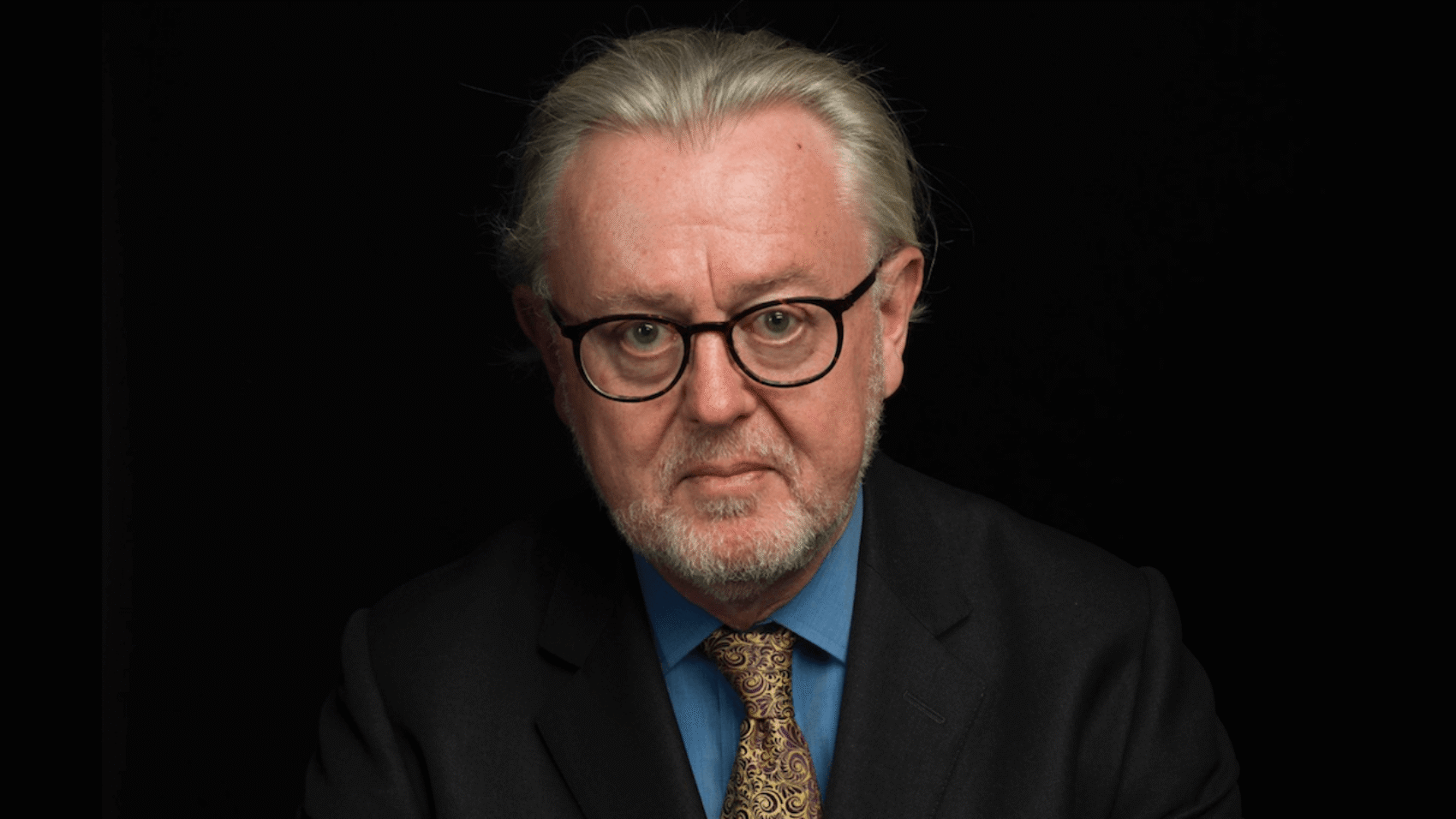
Giving an in-depth interview to the European Center for Populism Studies (ECPS),Professor William A. Galston — senior fellow and the Ezra K. Zilkha Chair in the Governance Studies program at Brookings Institution and a leading authority on American governance, populism, and institutional resilience — provides a comprehensive analysis of the evolving dynamics of US democracy under President Donald Trump’s second administration. Drawing on his deep expertise in political institutions and constitutional law, Professor Galston examines how federalism, legal contestation, and civil society remain central to safeguarding checks and balances amid mounting executive centralization.
As the title emphasizes, “US. Federalism Slows the Shift Toward Competitive Authoritarianism,” Professor Galston underscores that America’s decentralized political structure continues to serve as a buffer against executive overreach. He stresses that, despite concerns about democratic backsliding, the US is not yet on par with countries such as Hungary, Turkey, or India, where institutional capture has been far more extensive. “We’re not there yet,” Professor Galston explains, “and I am hopeful that we’ll never get there.”
A recurring theme throughout the interview is the growing role of law as the principal arena of political struggle. Professor Galston argues that the resilience of US democracy increasingly depends on institutions defending their legal prerogatives: “Pushing back, using not street protests but the law, will be the most important venue of contestation.”
This dynamic is vividly illustrated in his discussion of a recent legal battle involving Harvard University, which challenged the Trump administration’s attempt to withhold federal research funds. A federal judge sided with the university, ruling that the administration’s actions were unconstitutional. For Professor Galston, this episode demonstrates that institutions “with the will to defend their legal rights can push back — and push back effectively.”
The interview also delves into the strategic influence of Project 2025 and the Heritage Foundation in shaping Trump’s second-term agenda. Professor Galston notes that the initiative has successfully translated its ideas into both institutional frameworks and personnel appointments, allowing the administration to pursue expansive interpretations of executive authority while testing the limits of constitutional constraints.
Additionally, Professor Galston examines redistricting battles, such as those in Texas and California, highlighting how federalism enables both parties to counterbalance each other’s maneuvers, thereby slowing the concentration of power at the national level.
Finally, Galston reflects on the broader trajectory of US democracy, warning that the coming years will be decisive in determining whether constitutional norms can withstand mounting pressures. Yet he remains cautiously optimistic, noting that state governments, universities, professional associations, and civil society are “waking up” to the importance of defending democratic principles.
This interview offers a nuanced, scholarly perspective on the complex interplay between institutional resilience and executive ambition, providing crucial insights into America’s democratic future.
In a wide-ranging ECPS interview, Ben-Gurion University scholar Halleli Pinson argues that Israel’s Gaza policy is intertwined with an illiberal turn at home. “The polarization we saw before October 7 around judicial reform,” she notes, “is now translated into how people understand the war and the hostages,” adding that “the continuation of the war serves this broader agenda… to reconstruct the Israeli regime into an illiberal one.”Dr. Pinson details how curricula sideline liberal democracy while NGOs and academics face a shrinking space for dissent. Media framings and social media echo chambers deepen an “epistemic polarization.” Though anti-war discourse is growing, she warns that animosities are hardening: “It may take a generation to shift the discourse toward a more liberal, mainstream orientation.”
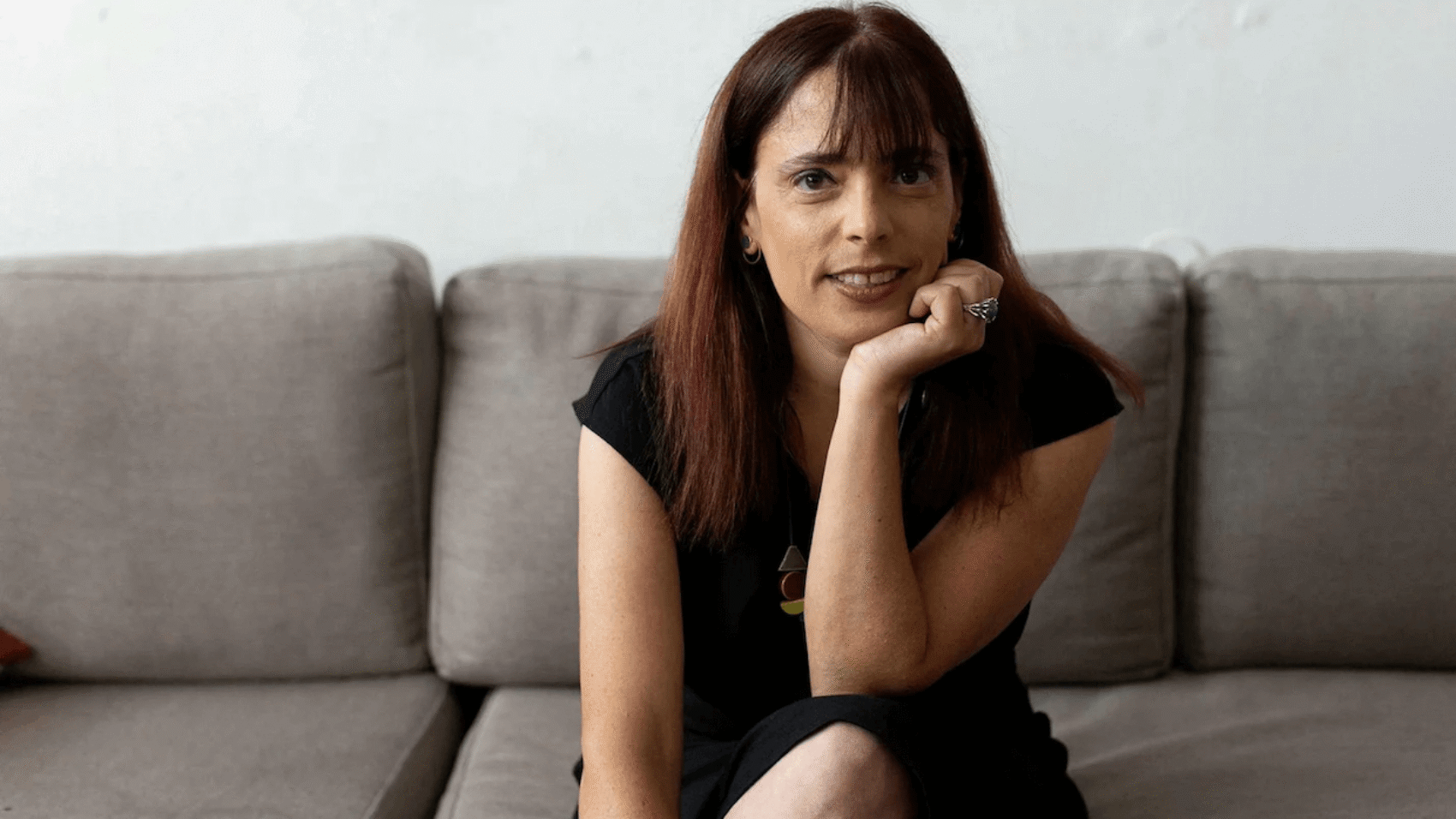
The ongoing Gaza war has not only reshaped regional geopolitics but has also profoundly transformed Israel’s political culture, educational discourse, and democratic institutions. In this exclusive interview with the European Center for Populism Studies (ECPS), Associate Professor Halleli Pinson, a political sociologist of education at Ben-Gurion University of the Negev, provides a compelling analysis of the interplay between right-wing populism, illiberalism, and knowledge production in Israel, revealing how the conflict intersects with broader ideological projects.
At the heart of her argument lies a critical assessment of the government’s use of the war to advance structural political changes. As Dr. Pinson observes, “The polarization that we experienced in the year and a half before October 7th around the judicial reform is, in a sense, translated into how people understand the government’s policy regarding the war and the hostages.” She highlights a direct link between the government’s attacks on democratic institutions — such as the Supreme Court and the Attorney General — and its broader populist strategy: “The continuation of the war serves this broader agenda, attempting, in a way, to reconstruct the Israeli regime into an illiberal one.”
For Dr. Pinson, this illiberal turn is deeply embedded in Israel’s educational and discursive transformation. Over the past decade and a half, she argues, populist discourse has profoundly reshaped curricula, civic education, and public understanding of democracy. Discussions of liberal values, multiculturalism, and human rights are increasingly sidelined, while “illiberal democratic models” are emphasized. As she explains, Israel is being redefined “as primarily Jewish first and democratic only when it aligns with that identity,” a shift that has normalized the erasure of the Green Line and reframed settlements as integral parts of Israel.
The interview also delves into the shrinking space for dissent in both schools and universities. NGOs like Breaking the Silence and other human rights groups are excluded from classrooms, while academics face growing pressures under proposed legislation that would allow universities to dismiss professors “accused of supporting terrorism” — a definition so vague, Dr. Pinson warns, that “saying that there is starvation in Gaza or standing with photographs of children who lost their lives could be considered as support for terrorism.”
Finally, Dr. Pinson reflects on Israel’s fractured society and the growing epistemic polarization intensified by the war. While public criticism of the government has increased, she is concerned about entrenched animosities: “The level of hatred being cultivated between camps is deeply concerning… I’m not very optimistic, and I believe it’s going to take a generation to shift the discourse toward a more liberal, mainstream orientation.”
This conversation offers an essential lens for understanding how the Gaza war intersects with Israel’s democratic backsliding, populist rhetoric, and societal divides.
Here is the transcript of our interview with Associate Professor Halleli Pinson, edited lightly for readability.
Populist Discourse Is Reshaping Education and Normalizing the Occupation
Professor Pinson, thank you very much for joining our interview series. Let me start right away with the first question: How has the rise of right-wing populism in Israel shaped curriculum design, educational policy, and civic education? In what ways does this curricular engineering affect how younger generations understand Gaza, Palestinian society, and the broader conflict?
Associate Professor Halleli Pinson: Let me start by saying that populist discourse over the past decade, or even longer, has significantly influenced curriculum and educational discourse — not only in high schools and schools in general but also within higher education institutions. While it is somewhat speculative to assess precisely how this shapes views of Gaza, I can offer a few examples of how such populist discourse has manifested in the field of education. For instance, just this week we learned that the civic education curriculum — specifically the matriculation exam for next year — will exclude discussions of liberal democracy, human rights, and related topics. Although it does not explicitly state that these subjects are being removed from the curriculum, the Ministry of Education sets annual focus areas, and this year, these topics have simply been omitted from that focus.
On the other hand, when it comes to defining Israel as a Jewish state, its commitment to the Jewish people, and other models of democracy referenced in textbooks or the curriculum — what I would term “illiberal democratic models” — these are increasingly emphasized at the expense of discussions on liberal democracy, multiculturalism, civil rights, and human rights. This reflects the particular type of populism characteristic of Israel, which prioritizes defining Israel as a Jewish state rather than as a democratic one, effectively reducing its democratic nature to a very thin model of democracy. These changes are consistently reflected in school curricula.
I would argue that this shift — from understanding Israel as both Jewish and democratic, or democratic and Jewish, to viewing it as primarily Jewish first and democratic only when it aligns with that identity — has, over the past decade and a half, become fully normalized within educational discourse and the production of knowledge in education. It began with significant changes to the civic curriculum but extended further, such as the complete erasure of the Green Line from geography and history textbooks, effectively normalizing settlements in the West Bank as integral parts of Israel.
I am quite certain that if you asked the average high school student in Israel, or even an undergraduate, many would neither know where the Green Line is nor recognize that places like Ariel are located in occupied territory. They are unlikely to use the language of “occupied territories” or acknowledge that understanding at all. In my generation, people debated whether Israel should continue the occupation or not, but it was at least understood as an open question. Today, however, the occupation has been so normalized that most people no longer perceive it as occupation. This, without doubt, has significant ramifications for how the conflict in Gaza — and the ongoing war there — is understood and discussed, if at all, in education today.
Shrinking Space for Dissent: Populism Redraws the Boundaries of Legitimate Discourse
The exclusion of NGOs such as Breaking the Silence and growing pressures on left-leaning academics point to shrinking intellectual pluralism. To what extent do these measures reflect a broader populist strategy to control knowledge production and suppress dissent?
Associate Professor Halleli Pinson: I want to broaden the discussion beyond knowledge production to consider how actions such as the exclusion of NGOs like Breaking the Silence, the Forum for Grieving Families, and other left-wing or human rights organizations from schools reflect a broader process. I see this as part of a deliberate redrawing of the boundaries of legitimate discourse within the Israeli education system. It is not only about knowledge production itself, which primarily occurs through curriculum design, but also about the types of discourse and political perspectives to which students are exposed. In this regard, the boundaries have been significantly reshaped — a process that began before October 7th but has deepened even more profoundly over the past two years.
Several practices are being employed by right-wing populist organizations and politicians. The first is portraying groups like Breaking the Silence as “traitors.” Especially during wartime, they are framed as supporters or enablers of terrorism. In such an environment, if you do not want to be associated with terrorism, you are compelled to distance yourself from these discourses. This is not only about shifting the boundaries of discourse but also about redefining what is considered legitimate political conversation within schools — what you are allowed to question and what you are not.
To illustrate, I’ll give an example from the last two weeks. A group of school principals and high school teachers published a video calling for an end to the war, criticizing the government’s policies, and expressing concern over the humanitarian crisis and death toll in Gaza, as well as demanding the release of hostages. Following the video, about 20 principals were summoned to the Ministry of Education for what was essentially a disciplinary warning, even though it was not an official hearing. They were cautioned that they had crossed the boundaries of what is considered permissible for educators to say. The same applied to teachers.
Then, on September 1st — the first day of the school year in Israel — students at several schools organized a strike calling for an end to the war, the release of hostages, and an end to the suffering in Gaza. The response from Education Minister Yoav Kish was twofold. First, he instructed schools to mark these students as absent in their personal files, introducing a punitive element. Second, he publicly addressed the striking students, accusing them of jeopardizing national unity and being divisive.
From my perspective, as someone who studies the effects of populism on both schools and higher education, this demonstrates how the space for criticism and democratic discourse is constantly shrinking. A year ago, it was more mainstream to discuss the hostages openly. Now, combining discussions about hostages with calls to end the war is framed as crossing the boundaries of legitimate discourse established by the Ministry of Education.
This extends beyond schools to higher education institutions. Less than two weeks ago, during a nationwide strike organized by the campaign to end the war and release the hostages, many university professors — including heads of major Israeli universities — declared they would personally participate. The Minister of Education responded by instructing the Ministry of Finance to dock their pay for the day of the strike.
These measures, especially when directed at principals and teachers who are more vulnerable than university professors, create a powerful chilling effect on critical discourse and dissent within Israel’s educational system.
Public Opinion Shifts, but Denial and Division Persist
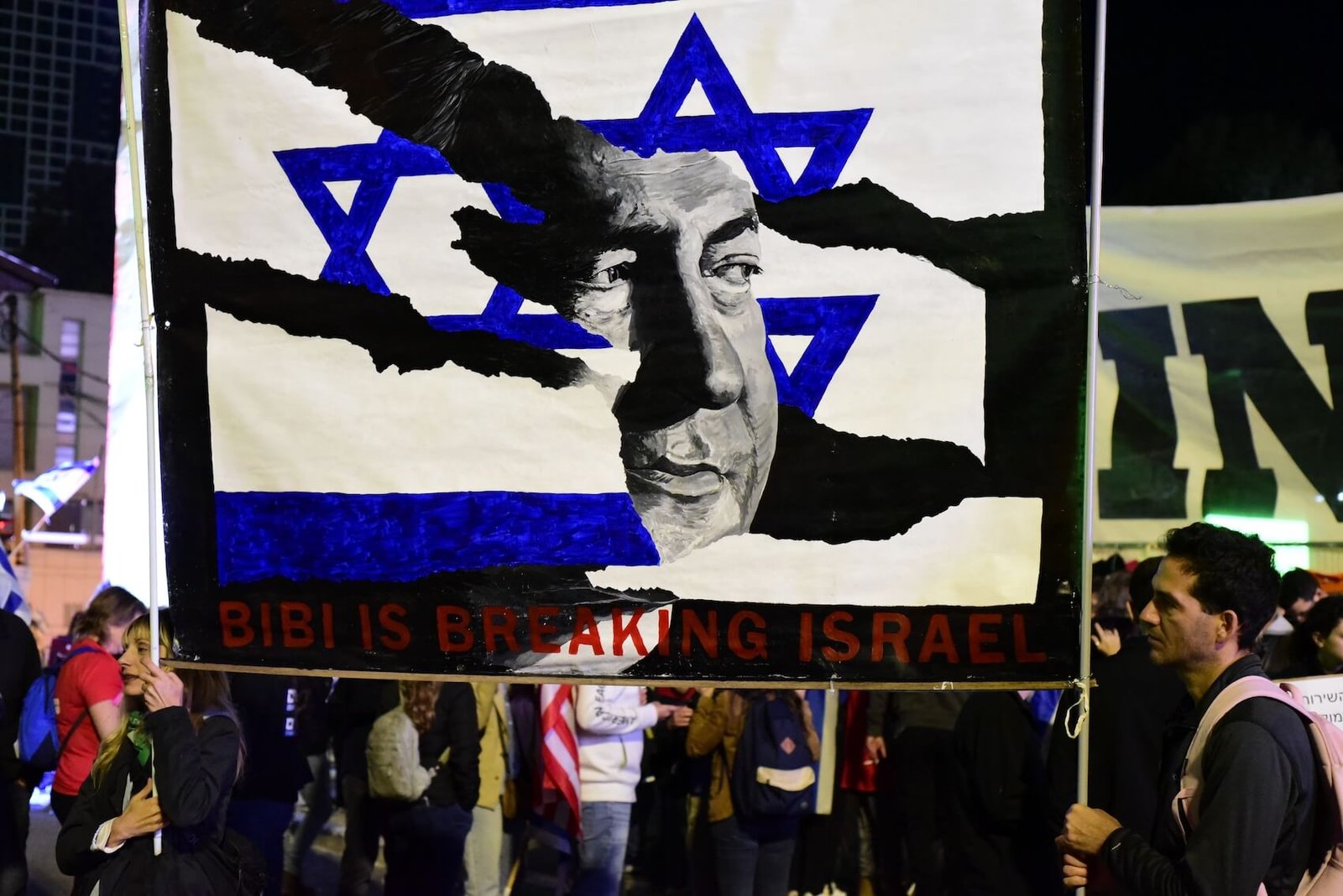
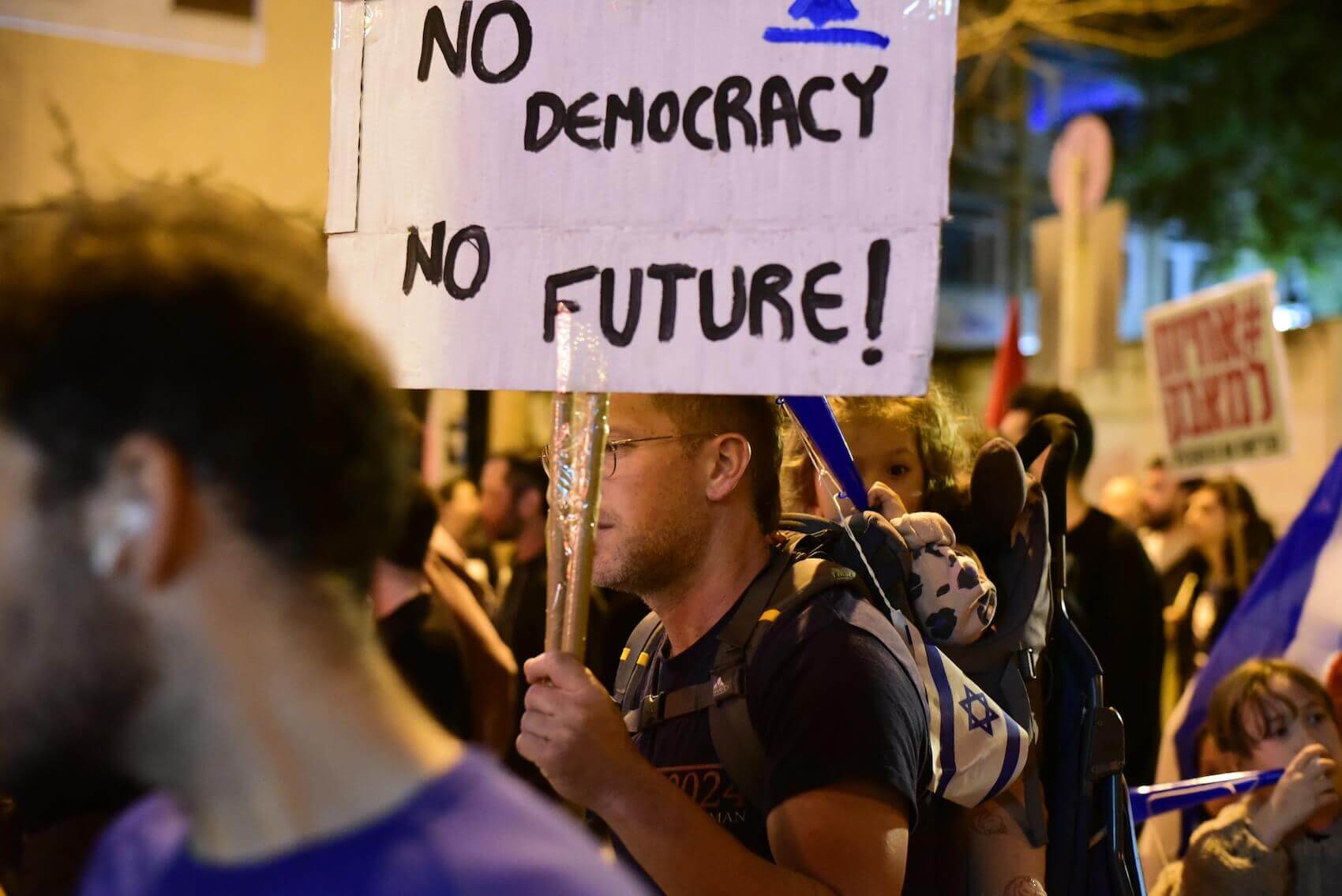
Israelis protest at Tel Aviv against Netanyahu’s anti-democratic coup on April 1, 2023. Photo: Avivi Aharon.
How has Israeli public opinion evolved throughout the Gaza war, and to what extent do these shifts reflect deeper sociopolitical cleavages within Israeli society—such as ethnic, ideological, or generational divides?
Associate Professor Halleli Pinson: This is a very good question, and there has indeed been some evolution in how the Israeli public responds to the war. To some extent, there is a change, and I’ll try to explain what I mean by that. The war itself is now more heavily criticized. A large part of the Israeli Jewish population, according to public polls, seems to understand that the continuation of the war is political, serving the interests of the current government, and particularly Benjamin Netanyahu. In this sense, there has been an evolution.
A year ago, or even right after October 7th, the majority of the Israeli public believed the war was justified — that it was the only solution and what needed to be done. Now, however, there is a more critical understanding of the continuation of the war. People are increasingly critical of the burden that many reserve soldiers are paying as the price of sustaining it, and there is a deep concern about the fate of the hostages as the conflict drags on. In that sense, there has been a significant shift in public opinion.
But what hasn’t changed much, or not to the same extent, is the ability of the Israeli public to actually understand, acknowledge, or be critical of what’s happening in Gaza. I think Jewish-Israeli public opinion can be divided into groups — setting aside those on the far right who openly support the continuation of Gaza’s destruction and even talk about plans such as building a Riviera there once they “get rid of everyone.” For the majority, however, there is either complete denial of what’s happening in Gaza or apathy toward it.
In that respect, I’m not sure how much public opinion has truly changed. There are cracks, yes — more attempts by left-wing activists and organizations to bring the issues of starvation, rising death tolls, and widespread destruction into the public sphere. But there is also widespread disbelief, with some dismissing reports about starvation as “AI-generated” or fake, while others say, “Yes, it’s regrettable, but it’s their fault because of October 7th.” Some express even harsher views, saying, “After October 7th, I lost all ability to be compassionate about the other side.”
For me, this is extremely difficult to hear and accept, but I think it reflects ongoing processes in Israeli society that began long before October 7th and whose consequences we are now witnessing.
I would also say there’s a strong correlation between the people who, before October 7th, were out on the streets protesting the judicial overhaul and the actions of the current government against the Supreme Court and other democratic gatekeepers, and those who are now protesting the continuation of the war. But it’s important to note that many of these protesters are not necessarily motivated by concern for the humanitarian crisis in Gaza; rather, they oppose the war because they believe it harms Israel’s own interests, undermines its security, and jeopardizes its democracy.
Competing Truths and Growing Epistemic Polarization
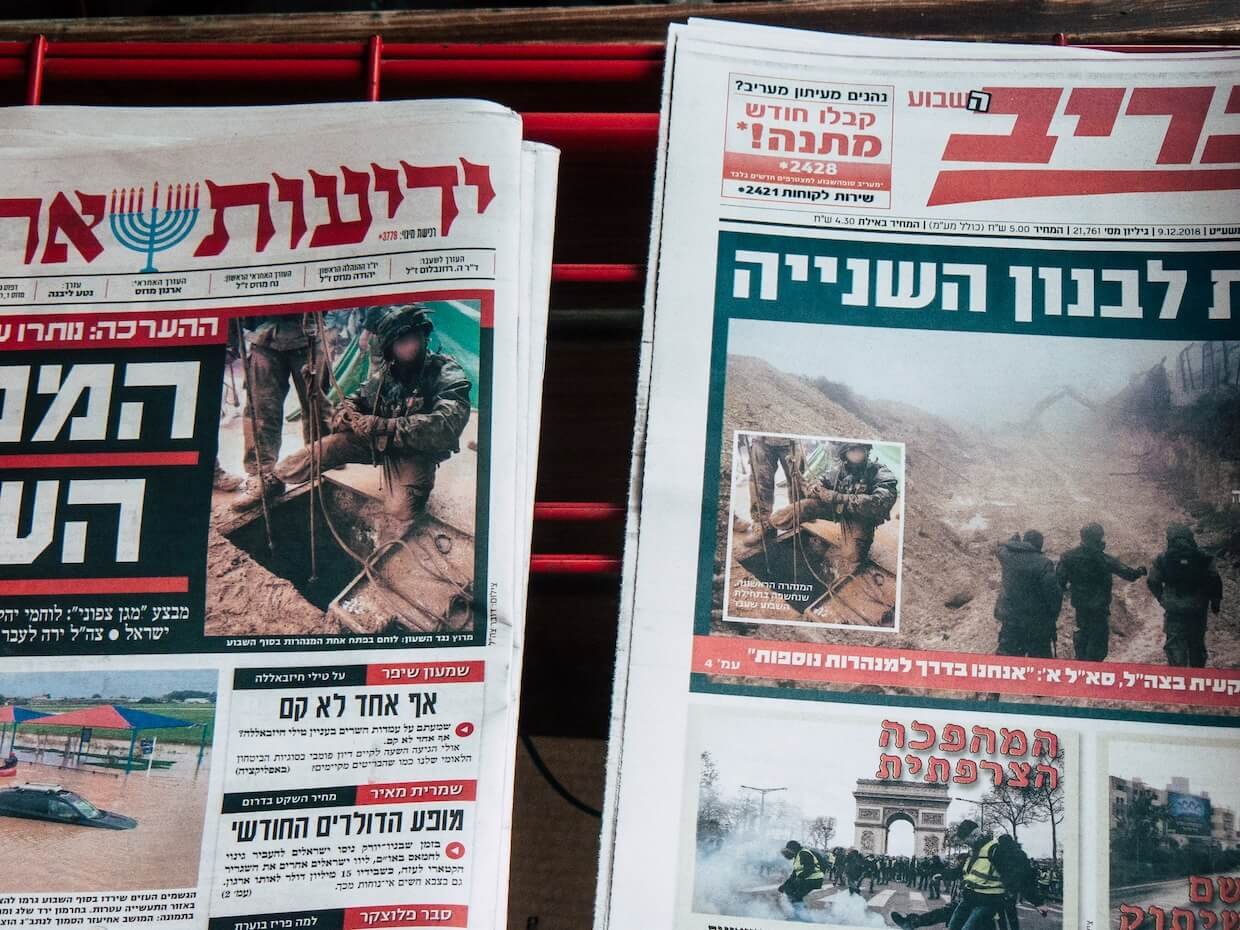
Israeli newspapers and magazines on display in the streets of Tel Aviv, December 12, 2018. Photo: Jose Hernandez.
To what degree has the Israeli media ecosystem—spanning state-controlled outlets, private mainstream channels, and social media—contributed to the construction of competing “truth regimes” around the Gaza war? Are we witnessing a process of epistemic polarization that reshapes how different publics understand the conflict?
Associate Professor Halleli Pinson: Let’s start with the mainstream media. The mainstream media has completely failed in its role of exposing the Israeli public to the full picture of what’s going on, including the costs for everyone. For the better part of at least the first year and a half, there were very rarely any reports about what was happening in Gaza. And, when there were reports from Gaza, they were almost always from the perspective of the soldiers. You’d have a reporter or reporters joining one of the units serving in Gaza — Israeli journalists — and all of this was always coordinated by the IDF spokesperson unit. As a result, the majority of the Israeli public was not really exposed to what was actually happening in Gaza. Even now, when there is a bit more discussion and slightly greater exposure, it is still presented in a very limited way and within a very specific narrative that avoids placing any blame on the actions of Israel.
So, just to give you an example — I don’t remember the exact phrasing, but when the international reports about starvation in Gaza started to appear, one of the Israeli channels — I think it was Channel 13 — reported, kind of “revealing” that the majority of the children who died of starvation had pre-medical conditions that probably contributed to them dying from starvation. The way it was framed, it was like, “Hey, here we reveal the big lie. There is no starvation; people are not dying of starvation in Gaza. Actually, those who died from starvation were dying because they had pre-medical conditions.” And that was, in a way, saying to the Israeli public, “Hey, look, it’s not our fault.”
When it comes to social media, I sometimes feel almost like I’m in my own bubble because this is the way social media works. So, I see reports of the destruction in Gaza — and I’m exposed to this sort of information, and the majority of my social media friends, followers, or the people I follow are in agreement with me. But when you look a bit outside, you’ll see — and I’ve heard it from people at the university whom I would consider smart, critical people — they’ll say, “This is fake news; this is AI. The whole starvation photographs are all AI-generated. There’s no real starvation.”
There’s great disbelief in the reports coming from Gaza and a lack of critical questioning, like, “How come we don’t get independent reports from Gaza, for instance?” This is a question I’d like my students to ask — why we don’t know. And so, this is something where we see a great epistemic crisis, in a sense, or polarization between those who are 100% aware and exposed to what’s going on in Gaza and what’s going on in the rest of the world, and, on the other hand, those who are kind of completely blind or in denial about what’s going on.
I’ll just give you an example. This polarization is also visible in political activism in the streets. In the past several months, there’s been an initiative in Tel Aviv during the big weekly demonstration — the one for the release of the hostages and against the continuation of the war. There’s a growing group of people who stand with photographs of children who were killed in Gaza. And this is amidst a crowd that’s there to say they’re against the war. In that instance, I think it made people think and reflect, like, “Okay, maybe it’s not just our suffering.”
But when this sort of vigil went to other parts of the city — not during the weekly demonstration — and I stood in those vigils, the level of contempt and hatred it attracted was intense because it put a mirror in front of people in Israel. We were standing with photographs of children, and the responses would be either disbelief or accusations: “You’re Hamas supporters.” Or, “Well, even if they are children, they’ll grow up to be Nukhba (the special forces unit of Al-Qassam Brigades, the military wing of Hamas)and they’ll do the next massacre.”
So, again, there’s this movement between denial and justification, for lack of a better word. And I’ll give you another example. There’s also a campaign against starvation, which is, again, a vigil where we stand holding empty pots and pans in the street. There was a video released two days ago of about 15 chefs and restaurateurs standing with empty pots and pans and calling for an end to starvation. This was just two days ago. The chefs of these restaurants have been under attack for the last two or three days. Their Google rankings dropped because people are condemning them. Again, anything you say that expresses concern and empathy is immediately — in the public discourse, even among those who object to the war — seen as coming at the expense of caring for the hostages or “our own kind.” It is immediately framed as, “You support the other side.” So, again, there’s this sense that you cannot be compassionate toward both.
From Judicial Reform to Gaza: Populism Driving Israel’s Illiberal Turn
Massive protests against Netanyahu’s government predated the Gaza war but have intersected with it in complex ways. How do these demonstrations reveal competing conceptions of democracy in Israel, and do they indicate a growing rift between state policy and societal norms?
Associate Professor Halleli Pinson: The short answer is definitely yes. You can clearly see the polarization — and I mentioned it before — that we experienced in the year and a half before October 7th around the judicial reform being, in a sense, translated into how people understand the government’s policy regarding the war and the hostages. There are also many connections being made between the government’s attacks on the Supreme Court, the Attorney General, and other democratic institutions, and how the continuation of the war serves this broader agenda, attempting, in a way, to reconstruct the Israeli regime into an illiberal one.
Going back to populism and the first question you asked me, we can see that many of the justifications the government uses draw directly on this populist discourse of “us against them,” “the will of the people,” “the true people,” and identifying those who are singled out as the “enemy within” or the “objective enemy,” and so on. These sorts of practices are used both in the context of the judicial reform and in justifying the continuation of the war.
The Catch-22 of International Boycotts
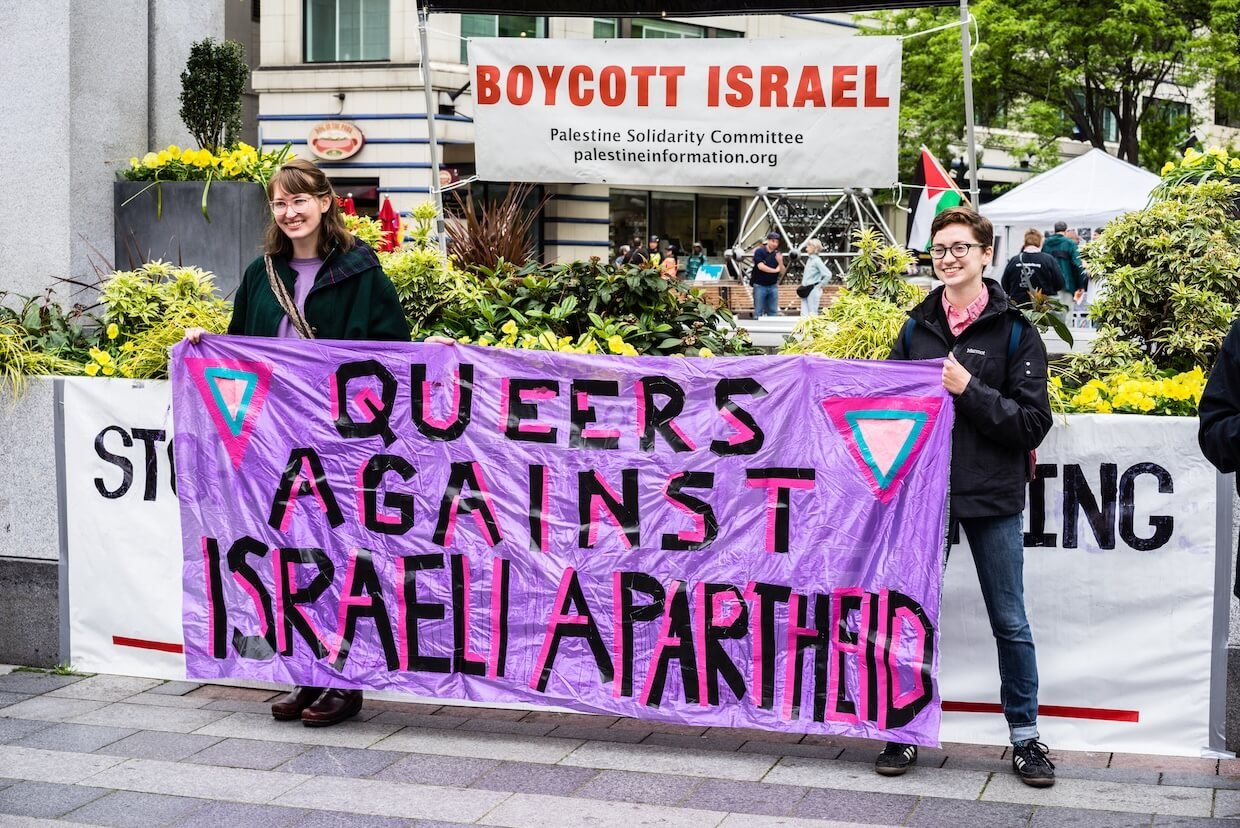
Pro-Palestinian protesters hold signs. Photo: Oliver Perez.
How does international criticism—including accusations of genocide by prominent scholars and institutions—shape Israeli public opinion and elite discourse? Do external pressures generate defensive consolidation around government narratives, or do they stimulate critical reflexivity among Israeli publics?
Associate Professor Halleli Pinson: This is something that I find very difficult to respond to. First, I would focus even more on the calls for an academic boycott of Israel. And let me say, to begin with, that I understand why people — my colleagues in other places around the world, university students, or academic associations — feel that they need to do something about what’s going on in Gaza. Whatever label we put on it, genocide or not, what’s going on in Gaza is on a scale that is unimaginable, and I wouldn’t like to see people being silenced globally in the face of what’s happening there.
But then, when I look at how this sort of criticism is being perceived in Israel, it’s more complex than that, and the political effectiveness of such measures is problematic. Just to explain, there’s a sort of Catch-22. I spoke about how Israeli media and the Israeli public perceive what’s going on in Gaza and about the movement of the majority of the public between denial, apathy, and justification — but with little, if any, self-reflection or sense of responsibility.
When this narrative is so strong — and it is a very strong narrative, even among those who oppose the continuation of the war — then, when people, organizations, or states call for sanctioning or boycotting Israel, the way it’s interpreted is: “Okay, here again, this is another proof that the world is against us.”
I had numerous conversations with people whom I greatly respect, and they would say things like, “Israel is being held to higher standards, and this is why we are attacked,” and, of course, they argue that this is no more than another expression of anti-Semitism. So, these are the sorts of ways this is perceived among the Israeli public. I’m not necessarily saying that people who oppose the government or Netanyahu will rally around him, but it is definitely not perceived as something helpful in terms of shaping public opinion or making people in Israel more aware or more reflective about their role or responsibility.
When it comes to the academic boycott — and this is, again, something I feel uneasy saying because, obviously, I am directly affected as an Israeli academic — I can only reflect on my own experience. I would say that, in a way, Israeli universities, and especially professors in the social sciences and humanities, have been targeted by the government for at least the past decade and a half. We’re being portrayed either as “the enemy within” or directly targeted through legislative measures intended to narrow or restrict the boundaries of legitimate discourse and sanction academics.
There is one very important piece of legislation currently under discussion — it has already passed its first reading in the Knesset — which states that universities will have to fire, without any due process, any professor accused of supporting terrorism. On the face of it, it sounds like, “Okay, of course, no country can allow anyone who supports terrorism to teach in a university.” But the way it’s framed in this legislation is problematic. First, it’s important to note that it essentially seeks to change the legislation around the autonomy of the Council of Higher Education, which is, in itself, a very problematic and populist move, taking a page out of Orbán’s book in Hungary. But basically, it doesn’t define what “supporting terrorism” means. And in the eyes of the government, as I explained before, saying that there is starvation in Gaza or standing with photographs of children who lost their lives in Gaza is considered support for terrorism. So, if this legislation passes, someone from a right-wing organization could accuse me — Halleli Pinson — of supporting terrorism, and the university would be obliged to fire me without compensation, without my pension. And if the university refuses to fire me, the government would cut its funding.
This legislation hasn’t fully passed yet, and it probably won’t pass in its harshest form, but even in its current form, it has a chilling effect. And again, right-wing organizations like Im Tirtzu and others are actively targeting university professors — not just for what we teach or don’t teach in the classroom, but also, not in my case personally, for what we post on our Facebook pages, demanding that universities fire professors who “don’t say the right thing.”
There’s also similar legislation being discussed to restrict student activities, which, of course, puts Palestinian professors and students at even greater risk than people like me who are identified as left-wing. So, I’m saying all this to explain that, in a way, it feels like, in the past year, we are being attacked by our colleagues abroad for not taking enough action or responsibility, and the calls for boycotting are growing stronger and stronger. But at the same time, I’m not sure the international community fully understands that we are also being attacked from within for speaking out about what’s going on in Gaza.
I’m not sure that boycotting us will actually make a difference in terms of policy because this government already has its vendetta against universities to begin with. And definitely, if I have less power within Israel and also have to worry about my collaborations outside Israel, then my ability to influence change becomes questionable — whether it grows or is, in fact, reduced. And I think that’s the Catch-22 here, which is problematic when it comes to calls for boycotting and sanctioning Israel. The real question is whether it’s effective — and I’m not sure that it is.
Gaza War Deepens Divides, A Generation Needed for Democratic Renewal
And lastly, Professor Pinson, looking beyond the immediate conflict, how might the Gaza war transform Israeli political culture, intergroup relations, and trust in democratic institutions? Do you foresee the entrenchment of a security-oriented populist paradigm, or is there potential for societal reimagining and reconciliation?
Associate Professor Halleli Pinson: I would say that I’m very much encouraged by the growing discourse in Israel against the war, and this is something that has been evolving over the past six months, or even more, over the past year. But I’m quite certain that, at some point, the war will end, as wars tend to. However, the damage being done to Israeli society internally is profound — both in terms of what has already happened and what is yet to come. Will people actually realize what has been going on in Gaza, come to terms with it, or will denial no longer be possible?
There is also the deepening rift that has been created, which is becoming even more pronounced, between those who support the continuation of the war and those who don’t — between the heads of the right-wing parties and their supporters, on the one hand, and segments of the more mainstream public on the other. The level of animosity and hatred that is, in a sense, being cultivated between these two camps is deeply concerning.
So, I’m not very optimistic, and I believe it’s going to take a generation to shift the discourse toward a more liberal, mainstream orientation.
In this incisive conversation, Brookings scholar Professor William A. Galston argues that America’s decentralized system remains a crucial brake on executive overreach. While warning of real risks, he maintains, “We’re not there yet,” distinguishing the US from harder cases of institutional capture abroad. Professor Galston spotlights federalism and the courts as the decisive arena of resistance—urging institutions to defend their prerogatives through litigation, “not street protests but the law.” He assesses the influence of Project 2025, redistricting fights in Texas/California, and the politics of immigration, crime, and DEI, noting potential backlash among centrist voters. The result is a clear-eyed appraisal of democratic resilience—and the legal contests that will shape whether the US moves toward or away from competitive authoritarianism.
Giving an in-depth interview to the European Center for Populism Studies (ECPS),Professor William A. Galston — senior fellow and the Ezra K. Zilkha Chair in the Governance Studies program at Brookings Institution and a leading authority on American governance, populism, and institutional resilience — provides a comprehensive analysis of the evolving dynamics of US democracy under President Donald Trump’s second administration. Drawing on his deep expertise in political institutions and constitutional law, Professor Galston examines how federalism, legal contestation, and civil society remain central to safeguarding checks and balances amid mounting executive centralization.
As the title emphasizes, “US. Federalism Slows the Shift Toward Competitive Authoritarianism,” Professor Galston underscores that America’s decentralized political structure continues to serve as a buffer against executive overreach. He stresses that, despite concerns about democratic backsliding, the US is not yet on par with countries such as Hungary, Turkey, or India, where institutional capture has been far more extensive. “We’re not there yet,” Professor Galston explains, “and I am hopeful that we’ll never get there.”
A recurring theme throughout the interview is the growing role of law as the principal arena of political struggle. Professor Galston argues that the resilience of US democracy increasingly depends on institutions defending their legal prerogatives: “Pushing back, using not street protests but the law, will be the most important venue of contestation.”
This dynamic is vividly illustrated in his discussion of a recent legal battle involving Harvard University, which challenged the Trump administration’s attempt to withhold federal research funds. A federal judge sided with the university, ruling that the administration’s actions were unconstitutional. For Professor Galston, this episode demonstrates that institutions “with the will to defend their legal rights can push back — and push back effectively.”
The interview also delves into the strategic influence of Project 2025 and the Heritage Foundation in shaping Trump’s second-term agenda. Professor Galston notes that the initiative has successfully translated its ideas into both institutional frameworks and personnel appointments, allowing the administration to pursue expansive interpretations of executive authority while testing the limits of constitutional constraints.
Additionally, Professor Galston examines redistricting battles, such as those in Texas and California, highlighting how federalism enables both parties to counterbalance each other’s maneuvers, thereby slowing the concentration of power at the national level.
Finally, Galston reflects on the broader trajectory of US democracy, warning that the coming years will be decisive in determining whether constitutional norms can withstand mounting pressures. Yet he remains cautiously optimistic, noting that state governments, universities, professional associations, and civil society are “waking up” to the importance of defending democratic principles.
This interview offers a nuanced, scholarly perspective on the complex interplay between institutional resilience and executive ambition, providing crucial insights into America’s democratic future.
Professor William A. Galston is a senior fellow and the Ezra K. Zilkha Chair in the Governance Studies program at Brookings Institution and a leading authority on American governance, populism, and institutional resilience.
Here is the transcript of our interview with Professor William A. Galston, edited lightly for readability.
Executive Power Expands, but the Rule of Law Faces Its Test
Professor Galston, thank you very much for joining our interview series. Let me start right away with the first question: How has Trump’s second-term agenda accelerated the concentration of executive power relative to his first term? Do you see evidence of a shift from ad hoc populist mobilization toward more institutionalized mechanisms of executive aggrandizement?
Professor William A. Galston: I certainly do. There has been a dramatic shift from President Trump’s first term to his second, largely because those around him who share his general worldview used those four years to craft a highly detailed agenda — not only a policy agenda but also an institutional and legal one — aimed at expanding the perimeter of executive power. They are pursuing this through the strategic use of existing laws and mechanisms. They are not coming in and declaring the Constitution invalid or claiming that the laws do not count. Rather, they are saying, “Here’s how we interpret the law,” in order to give the president the authority to do things that previous presidents did not attempt. This has created a legal struggle, which I believe lies at the heart of the current divisions in American politics.
In your statement to the NYT, you argue that Trump has pushed the role of the president far beyond what his predecessors would have ever tried. There are already respected scholars who call Trump ‘a dictator.’ Would you agree with this characterization?
Professor William A. Galston: No, I would not — at least not yet. The president has said that if the Supreme Court rules against him in a particular matter, he will respect that ruling and will no longer do what he is forbidden to do. That promise has not yet been tested. But the moment of truth will come sometime in the next 12 months. The Supreme Court, I believe, is very likely — and I can’t tell you which rulings it’s going to be — to rule against the president in some areas of his assertion of presidential authority. And if that happens, and I think the odds are very high that it will come sometime in the next 12 months, we will see whether President Trump intends to keep his word and respect the holding of the court. If he does keep his word, then I would have to say that, like some presidents before him, he has used every device to try to expand his power, but in the end, he recognizes that he is constrained by the rule of law. If he says, “The Supreme Court has made its decision, but I disagree with it, and I’m not going to obey it,” at that point, he will be asserting non-constitutional powers. And if he gets away with it, at that point, I would be willing to call him — if not a dictator — an authoritarian ruler who is ruling outside the law. That hasn’t happened yet.
Trump Moves to Institutionalize Power and Reshape Electoral Rules
To what extent does Trump’s governance illustrate a transition from charismatic populism to incipient authoritarianism, and which institutional indicators best capture this trajectory?
Professor William A. Galston: Well, this, in a way, extends the first question you posed to me, namely the difference between the first Trump term and the second. There is certainly an effort to institutionalize not only a more powerful presidency but also a stronger Republican Party that has been reshaped in the president’s image. The efforts to change the electoral rules of the game between now and the midterm elections through state-based redistricting represent an attempt to institutionalize an advantage for his party.
Similarly, the president is seeking to reshape the laws that govern elections — who can vote, how they can vote, and what the requirements are for voting — all with the aim of securing an edge over the Democratic Party. These are clear attempts to institutionalize not only his authority as chief executive but also the power of his party. Some of these efforts may succeed, while others will fail. It’s hard to predict.
Certainly, the president has the right to ask a particular state to engage in redistricting, and many, though not all, states will be able to respond to that in one way or another. So that’s certainly within existing political bounds. President Franklin Roosevelt, for example, tried to use an election to purge members of his party with whom he disagreed. His party fought back, and he was rebuffed. So this is not the first time a president has tried to institutionalize greater power and authority for himself and his party. Previous efforts have not succeeded, at least not entirely. For example, Roosevelt attempted in 1935 to do what President Trump is trying to do in 2025 — eliminate independent agencies whose leaders are exempt from firing simply because the president dislikes them or disagrees with some of their decisions. The Supreme Court said no to Roosevelt in 1935, and he respected that. He wasn’t happy about it, he grumbled, but he respected the decision. We’ll see what happens this time. Those of us with some knowledge of American political history recognize aspects of what’s going on now — not all of it, but some of it.
Culture Wars and Power Plays Redefine US Political Fault Lines
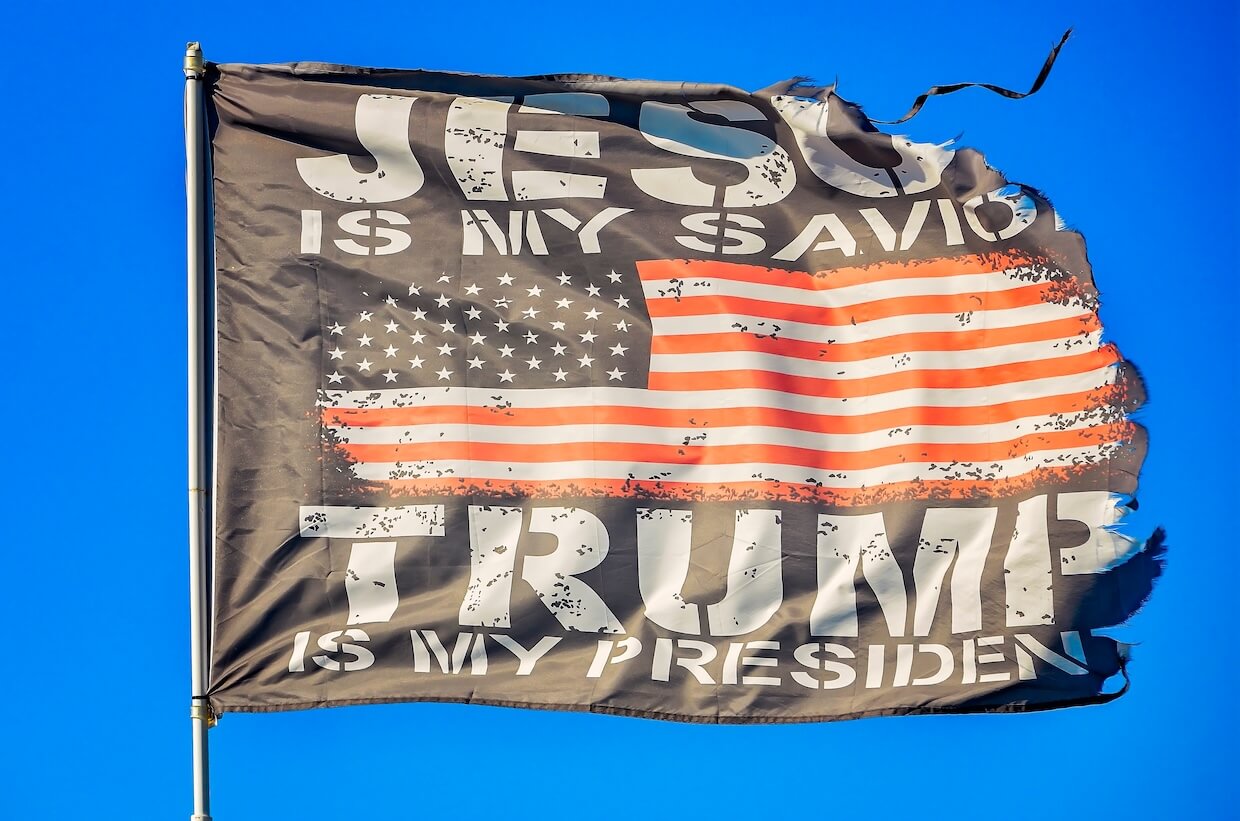
A Trump flag waves at a pier on Coden Beach in Coden, Alabama, on June 9, 2024. The flag bears the slogan, “Jesus is my Savior. Trump is my President.” Photo: Carmen K. Sisson.
Trump has repeatedly sought to limit congressional oversight and weaken checks and balances. Do these efforts signal a temporary partisan strategy or a structural erosion of US democratic institutions?
Professor William A. Galston: The erosion of congressional oversight has occurred through political processes rather than institutional changes and, therefore, could be reversed by a president with a different attitude. Just this week, for example, the chairman of the Senate Intelligence Committee, Senator Mark Warner of Virginia, was scheduled to conduct oversight at one of the intelligence facilities under the aegis of the Department of Defense, and reportedly, the Secretary of Defense intervened and canceled the site visit that Senator Warner was going to make. That was a clear effort to reduce congressional oversight. However, there was nothing institutional about it.
By the way, I misstated earlier: Senator Warner used to be the chairman of the Intelligence Committee and is now the leading Democrat on a committee chaired by a Republican colleague, with whom he has worked very well. So, I don’t think that the reduction of Congress’s oversight capacity has been institutionalized. I do think it reflects the will of the current president and the unwillingness of members of his own party in Congress to challenge his will. For a very simple reason: they’re afraid of him. They’re afraid of what he can do to them—to damage their political careers—and perhaps for other reasons as well. That’s not an institution; that’s an individual set of relationships.
How do you assess the strategic deployment of culture wars in Trump’s political agenda? Are they primarily an ideological project, or do they function as a power-consolidation tool to reshape voter alignments and institutional priorities?
Professor William A. Galston: Both. And certainly, President Trump, as a candidate and as a president, has been very good at discerning the fundamental fault lines or cleavages in American political culture and defining those fault lines in a way that maximizes the number of people who will be on his side of the line. Part of effective leadership is to define controversies that work to your advantage. In the cultural arena, President Trump has an instinct for those conflicts. I don’t think all of them that he’s picked have worked to his advantage, but certainly, the three that he emphasized in the 2024 presidential election, and again in the early months of his administration—namely immigration, crime, and so-called DEI (diversity, equity, and inclusion) initiatives—have all worked to his advantage so far.
Having said that, there are signs that voters in the middle of our political spectrum—and yes, there are still many of them—are beginning to conclude that the president may be going too far in the tactics he’s using. That’s demonstrably the case in immigration, where there is widespread disapproval not of the president’s objectives but of the means he’s using to achieve those objectives, which many citizens in the middle of the political spectrum view as unnecessarily cruel and as failing to provide potential candidates for deportation with sufficient legal rights to challenge the grounds of their deportations. And while Americans, generally speaking, align with the president’s goals on crime and some of the measures he’s used to reduce it, there isn’t the kind of mass support for the use of federal troops in American cities that the president imagines. At this point, I would say that probably a narrow majority of Americans believe that’s not the right long-term approach to fighting crime.
Project 2025 Drives Trump’s Institutional Power Agenda
How do you evaluate the role of Project 2025 and the Heritage Foundation’s allied networks in shaping Trump’s second-term policy framework? Are these actors contributing to the institutionalization of authoritarian governance through ideologically driven restructuring of federal institutions?
Professor William A. Galston: I believe the Heritage Foundation, through Project 2025, has been enormously successful in shaping the second Trump administration. If you listen to current Heritage leaders — as well as former leaders who now hold senior positions in the administration — their argument isn’t that they’re overturning the Constitution, but rather that they’re correcting what they see as improper interpretations of it.
For example, more than half a century ago, Congress passed a law preventing the president from withholding funds appropriated for specific purposes. In my view, the president has acted in ways inconsistent with that law. Yet his leading budget advisor — the head of the Office of Management and Budget (OMB) — has stated flatly that this law is unconstitutional. They are determined to use this controversy to take the matter to the Supreme Court, arguing that the statute improperly restricts presidential authority.
All of this was carefully planned in advance by senior members of the Heritage Foundation. In fact, the current head of OMB was one of the architects of Project 2025. There has been a direct translation of Project 2025’s core ideas into both the institutions and the personnel of Trump’s second term. The Heritage effort has effectively served as a recruitment mechanism: identifying individuals aligned with the president’s agenda, testing their loyalty, and placing them in key policymaking and policy-executing roles.
It has been a tremendous success — we’ve rarely seen anything like this. And speaking as a member of a rival think tank, the Brookings Institution, I must admit: although I disagree with much of what the Heritage Foundation proposed in Project 2025, I have to tip my hat to them. They’ve been enormously effective and have played their cards extremely well.
Comparing Trump with Orbán, Erdoğan, and Modi: Similar Rhetoric, Weaker Grip
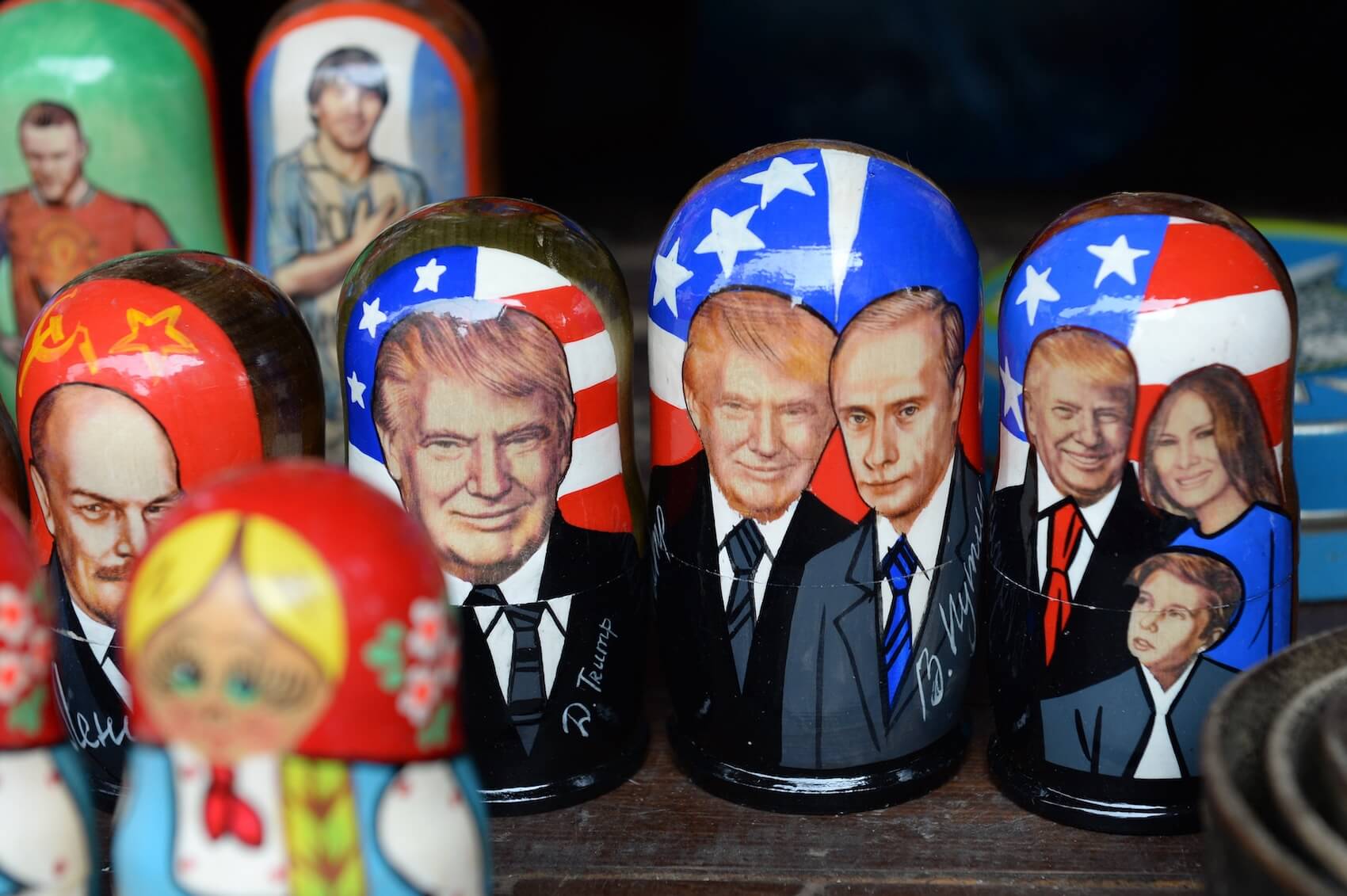
Matryoshka dolls featuring images of Vladimir Putin and Donald Trump displayed at a souvenir counter in Moscow on March 16, 2019. Photo: Shutterstock.
In comparative perspective, how does Trump’s reliance on identity-based polarization and his governing style align with global populist-authoritarian trajectories — such as those of Orbán in Hungary, Erdoğan in Turkey, and Modi in India — particularly regarding institutional capture, media control, and judicial weakening?
Professor William A. Galston: I would say that, in his use of identitarian and nationalist policy themes, he is very similar to them. He has not yet, however, achieved the degree of control over the institutions that you just listed that we see in places like Hungary and Turkey, and, to a somewhat lesser extent, but still considerable, in India.
The press right now is not under Trump’s control to the extent that it is in Hungary. You do not have the state owning, either directly or indirectly, the share of the media landscape that Mr. Orbán has been able to create through docile intermediaries.
Nor has Mr. Trump been able to achieve the mastery of the judiciary that, certainly, Orbán and Erdoğan have achieved. The judiciary remains independent, and you can see that that’s the case because of the number of court decisions that have gone against President Trump just in the past few weeks.
Now, it is quite possible that the Supreme Court will end up ratifying the President’s position in some of those cases. Still, it has not been a complete takeover.
If you look at the direction in which the United States is heading, certainly down a very long road yet to be traveled lies the kind of political systems that we now see in the three countries that you listed. But there are many miles to go before this president enjoys that kind of authority, and, frankly, I personally believe that he is unlikely to get to the end of the road. I don’t think the American people or the American legal system will permit him to do so.
Having said that, I think, at the end of his second term — and I’m making the optimistic assumption that he will not violate the Constitution and try to run for a third term — he will leave behind him an enlarged presidency with much more robust executive powers.
Then his successor will have to decide whether to use that expanded authority for purposes of his own or recommend reforms that would create new legal limits on executive authority. So, that issue will be determined by the outcome of the 2028 election, and I expect it to be one of the major debates in that election.
Federalism Acts as a Guardrail Against Competitive Authoritarianism
Given your analysis of the 2026 midterms, how pivotal is the Texas redistricting battle in shaping Republican prospects, and what does it reveal about the role of electoral engineering in sustaining partisan dominance? To what extent might such aggressive gerrymandering strategies erode democratic legitimacy and push the US toward a ‘competitive authoritarian’ model?
Professor William A. Galston: Once again, and I feel I’m giving you versions of the same answer to all of your questions, I am distinguishing between the direction of change that we can discern, on the one hand, and its proximity to full competitive authoritarianism on the other. I don’t think we’re there. One reason we’re not there yet, and I expect won’t get there, is, as you know, the United States has a very strong federal system — unlike, say, countries at the other extreme, like France, where almost all power flows from the center. In the United States, the 50 states have robust powers of their own, and there are constitutional and legal limits on the ability of the national government to direct the states to do things that they don’t want to do. If I had an hour, I could explain all of the details, but the headline is that federalism serves as a check on presidential authority and on the power of the president’s party. So, to take a simple example, Texas, responding to President Trump’s suggestion, has undertaken and has just enacted a redrawing of legislative boundaries that will probably, but not necessarily, lead to a gain of up to five Republican seats in the House of Representatives.
That would make it harder for Democrats to regain the majority because the Republican majority would expand from three seats to eight seats. On the other hand, and in response, the governor of California, a state that’s heavily dominated by Democrats, has said, “Well, if you’re gonna do that, then we’re going to counter with our own redistricting plan that will increase the number of Democratic seats in the state of California going to the House of Representatives by five.”
Okay, so if that effort to counterbalance Texas succeeds in November in California — and the new maps are being submitted directly to the voters for their approval or disapproval — if they’re approved, then California will have nullified what Texas did, and there would be no net gain. Now, the Republicans are trying to expand this redistricting effort to other states, but there the potential gains are smaller. Perhaps one seat or two seats.
But here again, Democrats are countering with outreach to states where they control the governorship and the legislature, such as my home state of Maryland. Right now, Maryland has eight seats in the US House of Representatives, seven of them occupied by Democrats, and one lonely seat occupied by a Republican. Now, it is probably the case that Maryland could redraw its boundaries to eliminate that eighth seat and bring it under Democratic control.
For all sorts of reasons, I’m not sure that the governor of Maryland or the state Democratic Party really wants to go down that road, but they may feel, in a month or two, or three, that they have no choice. So, I think it’s important to see how, at the very least, our system of federalism slows the movement towards competitive authoritarianism.
And let me add one other thing. If you look at the language of the Constitution, who gets to control the time, the place, and the manner of elections, it’s the Congress of the United States and the state governments. The President of the United States has no role whatsoever to play in that.
And so, if President Trump says, “I’m going to issue an executive order forbidding the use of voting machines, forbidding the use of mail-in ballots, or requiring every citizen to show certain kinds of identification before voting,” well, that’s fine — he’s issued that order — but he has no legal authority to enforce it because the Constitution doesn’t give him that power.
So, you know, I read all of the same journals that I suspect you do, and the issue of competitive authoritarianism is very much in the air, and it’s a very real issue. And there are real and important examples of it around the world. But I want the people who will listen to (or read) this interview to understand that, although there are real constitutional risks in the United States today, and many things are drifting in the wrong direction, I don’t think we are as far away from constitutional government or as close to competitive authoritarianism as many people think we are, and as the other nations, like Hungary, Turkey, India, and others, already are.
Economic Pressures Overshadow Trump’s Cultural Appeals
With rising opposition to Trump’s tariffs, even among his base, do you foresee economic discontent weakening his political legitimacy, or will identity cleavages continue to override economic self-interest in voting behavior?
Professor William A. Galston: The single most important issue in the 2024 presidential election was inflation and high prices. I monitor public opinion surveys on a daily basis, and that has not changed. If President Trump thinks that he can use identitarian issues or cultural issues to neutralize public concern about high and rising prices, he’s fooling himself. That won’t happen. He’ll try to make it happen unless prices come down over the next year, in which case he’ll brag about bringing prices down, and the American people will, if those price reductions are real, give him a lot of credit, and they’ll give him their vote. But the economy — the affordability of basic things like housing, transportation, energy, and food — still looms over the entire political landscape.
Defending Democracy Requires Law, Not Street Protests
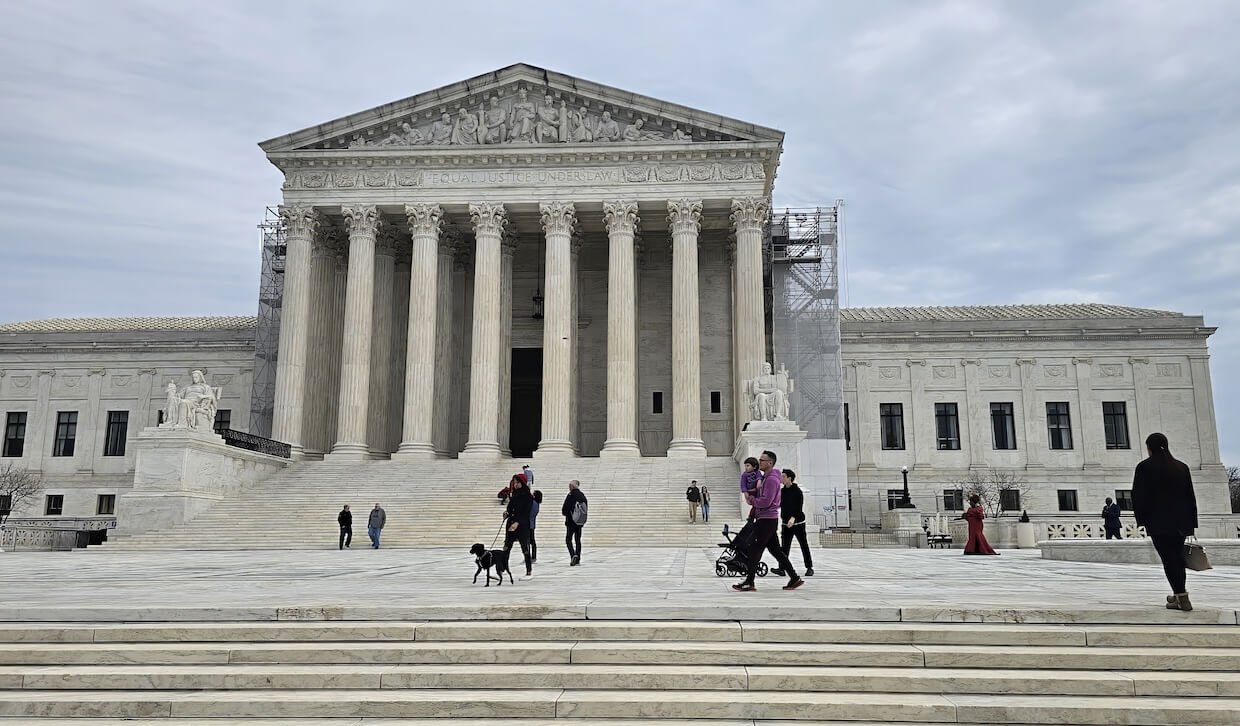
Frontal view of the U.S. Supreme Court Building in Washington, D.C., on February 10, 2024. Photo: Gualberto Becerra P.
And lastly, Professor Galston, what strategies should democratic institutions, civil society actors, and the media adopt to safeguard checks and balances and reinforce democratic resilience in the face of rising executive centralization?
Professor William A. Galston: All of those institutions should use their cultural power and their legal power to defend their integrity and their independence, which goes all the way back to my answer to your first question. I think that the principal venue of contestation in America today is the law. It is the law, ultimately, and the willingness of institutions to use their legal power to contest expansions of executive power that they don’t like. That will make the difference between the preservation of constitutional checks and balances and their erosion.
I’ll give you a very recent example from Wednesday’s newspaper. I think most people in Europe are aware of Harvard University, which is probably America’s most famous and prestigious university, and Harvard, a few months ago, decided that the Trump administration was making some demands that they could not yield to without forfeiting their institutional independence and their raison d’être as an academic institution. So they drew a line and said, “This far and no farther,” and they went to court to try to get legal reinforcement for where they’d drawn the line, and on Wednesday, a federal judge gave it to them and said that most of what President Trump was doing to Harvard was unconstitutional.
The administration was ordered to restore the $2.2 billion in research money that the judge said was arbitrarily and unconstitutionally withheld from them. Now, is that the last word? Absolutely not. Donald Trump believes in litigating everything as high as he can go in the hopes of achieving a more favorable verdict someplace. But that’s an example of how an institution that has the will to defend its legal prerogatives can push back — and push back effectively.
And I think that pushing back, using not street protests but the law, will be the most important venue of contestation. The extent to which the law is used to reinforce constitutional norms will determine the extent to which the United States goes down the road towards competitive authoritarianism. But, to repeat, we’re not there yet. We’re not even close to a decline into competitive authoritarianism. And I am hopeful that we’ll never get there. I can’t promise anybody that we won’t, but I do know that institutions in America outside the federal government — the states, universities, professional associations, civil society — are waking up.
And they are beginning to understand that unless they are willing to assert their legal rights, nobody else is going to protect them. They must act firmly, but legally, for themselves, and if they do, I think the outcome will be a very challenging situation for the adherents of liberal democracy in the United States. Don’t get me wrong. I won’t say it’s an emergency. It’s not quite an emergency, but it is a moment that challenges citizens who’ve taken liberal democracy for granted to realize that it’s not been handed down like the tablets to Moses on Mount Sinai. It’s a human creation, and all human creations are subject to human erosion and human destruction.
We know one of the few lessons from history that I think is impossible to deny and very clear to all who care to read it. And so, the quote that everybody is using, when Benjamin Franklin was asked after the Constitutional Convention, “What form of government have you created, Mr. Franklin?” — and his answer was, “A republic, if you can keep it.”
Well, those words now are a challenge to citizens of the United States today. Can we keep what we inherited? Sometime in the next decade, we’ll find out the answer to that question.
In an interview with the ECPS, Professor Nic Cheeseman dissects the global resurgence of authoritarian populism and the uneven pathways of democratic backsliding. Warning against the “temporal fallacy,” he argues that crises unfolding simultaneously do not share a single cause—from Europe’s far-right surge to West Africa’s coups. Professor Cheeseman spotlights the twin pillars of democratic defense: resilient institutions and organized civic resistance. “In countries where institutions are weak, mass mobilization becomes absolutely critical—often the only mechanism left to stop populist or authoritarian leaders from consolidating power,” he says. Citing Ghana, Kenya, and Zambia, he urges context-specific democracy support that amplifies local strengths over one-size-fits-all templates.
Giving an interview to the European Center for Populism Studies (ECPS), Dr. Nic Cheeseman, Professor of Democracy at the University of Birmingham, and the Director of the Centre for Elections, Democracy, Accountability and Representation (CEDAR), offers a comprehensive analysis of the global resurgence of authoritarian populism, democratic backsliding, and the vital role of civic resistance in fragile democracies. As a signatory of the June 13, 2025, anti-fascist declaration, Professor Cheeseman warns against the normalization of exclusionary, illiberal politics and highlights the need to rethink strategies for safeguarding democracy in the 21st century.
Professor Cheeseman emphasizes that democratic decline is not uniform but highly context-specific, urging caution against what he calls the “temporal fallacy”—the assumption that simultaneous crises share common causes. While far-right populism is reshaping politics in Europe, democratic erosion elsewhere often follows different patterns, such as military coups in West Africa or institutional capture in Latin America. “What we’re seeing is a highly complex set of processes pushing countries away from democracy, but these processes do not necessarily share a common underlying theme,” he explains.
A central theme of the interview is Professor Cheeseman’s analysis of the relationship between institutional resilience and mass mobilization in resisting authoritarianism. Drawing on Afrobarometer data and recent case studies, he underscores that strong institutions remain the first line of defense against creeping autocracy. However, in contexts where institutional capacity is weak, civic resistance becomes decisive: “In countries where institutions are weak, mass mobilization becomes absolutely critical—often the only mechanism left to stop populist or authoritarian leaders from consolidating power,” Professor Cheeseman asserts.
This argument resonates particularly in African contexts, where frustration with democratic performance—stemming from economic hardships, governance failures, and elite corruption—has fueled coups and populist takeovers. Yet, Professor Cheeseman points to inspiring counterexamples like Kenya, Ghana, and Zambia, where citizens have mobilized successfully to safeguard democratic norms. In Zambia, for instance, “hundreds of thousands of citizens turned out to vote, even believing the election wouldn’t be fully free and fair, because they knew collective action could bring political change—and it did.”
Professor Cheeseman also critiques “one-size-fits-all” democratization strategies, urging international actors to develop context-specific approaches grounded in local realities, civic strengths, and the dynamics of populist narratives.
Overall, the interview highlights Professor Cheeseman’s central thesis: defending democracy requires a dual strategy of institutional strengthening and societal mobilization. Where one falters, the other must rise.
Indonesia is witnessing its largest wave of protests since Reformasi, sparked by the death of Affan Kurniawan during Jakarta’s labor demonstrations. Demands range from fair wages and job security to dismantling elite privileges and revising the controversial Omnibus Law. Drawing on Ernesto Laclau’s theory of populist reason, the article analyzes how heterogeneous grievances converged into a collective identity of “the people” against “the elites,” fueled by widening inequality, institutional distrust, and elite arrogance. It further examines government securitization, social media narratives, and intra-elite rivalries, situating the unrest within Indonesia’s democratic backsliding. Hasnan Bachtiar argues this moment marks a potential turning point — either toward renewed progressive populism or deeper authoritarian entrenchment.
Affan Kurniawan (21) was still wearing the green jacket from his app-based food-delivery job as he stepped out to earn a living. The family’s breadwinner, he was expected to bring home a small bag of rice for everyone to share when he returned from work. But in the middle of a labor protest in Jakarta, he was struck and crushed by a nearly five-ton police armored vehicle.
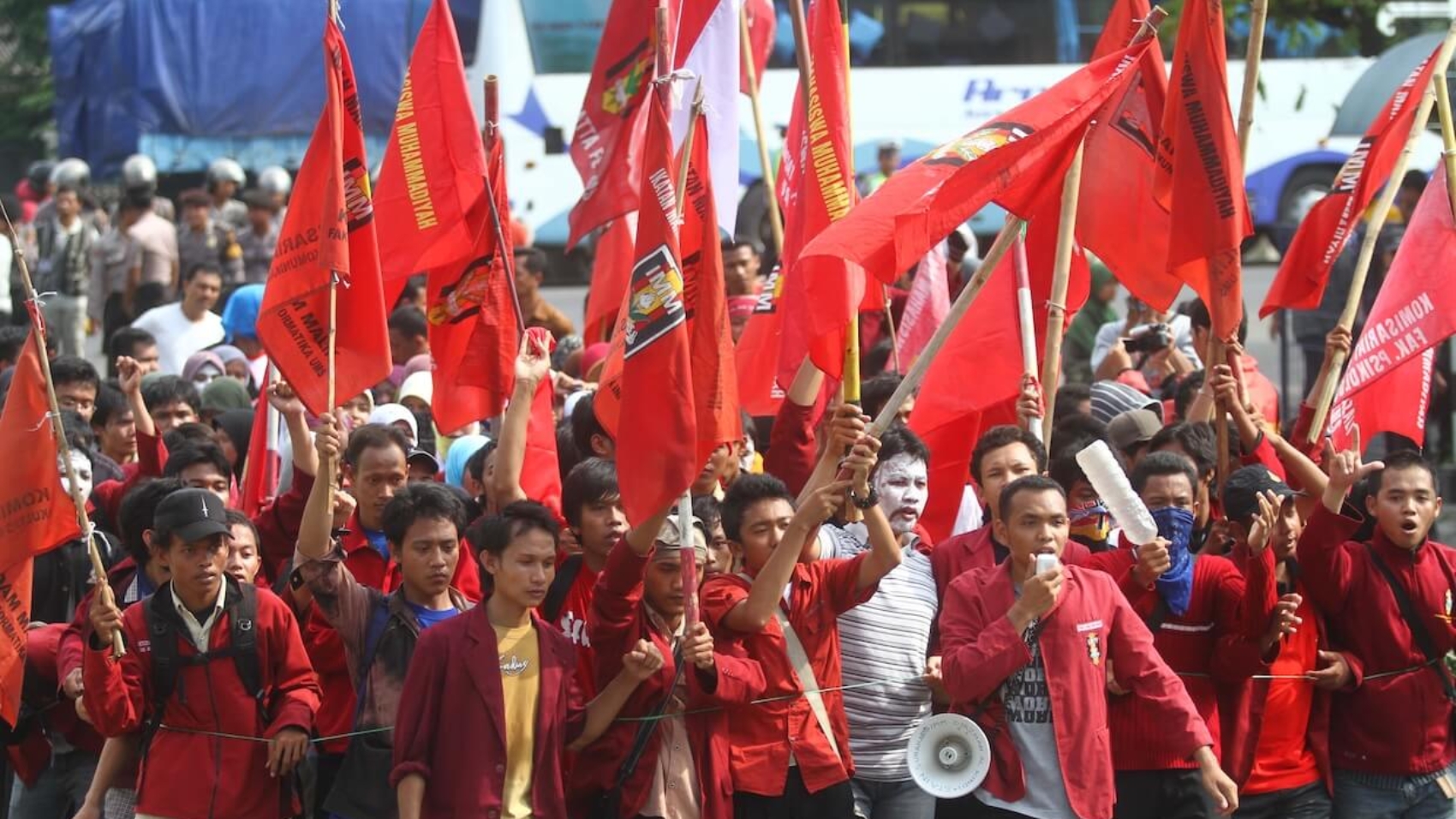
On the night of August 28, 2025, he died. But his death unleashed a larger, unstoppable wave of populist anger, like a boil about to burst. The protests that day were not limited to Jakarta, they also broke out in cities such as Surabaya, Bandung, Semarang, Yogyakarta, Medan, Banda Aceh, Batam, Palembang, Lampung, Banjarmasin, Pontianak, Samarinda, Makassar, Gorontalo, Ambon, Ternate, and Jayapura, among others, spreading across all 38 provinces of Indonesia.
The protests demanded an end to outsourcing and poverty wages, a halt to layoffs, a higher minimum wage, a higher non-taxable income threshold, the removal of taxes on holiday bonuses and severance pay, limits on contract employment and on foreign labor, and the repeal of the Omnibus Law in favor of a new labor code.
It turned out this wave of protests was the twelfth in a series, preceded by eleven demonstrations throughout 2025, including one organized under the hashtag #IndonesiaGelap. The following day, and continuing to the present, the protests have carried on with even more serious demands. For the record, several others died after Affan, they are Septinus Sesa (West Papua), Iko Juliant Junior (Semarang), Andika Luthfi Falah (Jakarta), Syaiful Akbar (Makassar), Muhammad Akbar Basri (Makassar), Sarinawati (Makassar), Rusmadiansyah (Makassar), and Reza Sendy Pratama (Yogyakarta).
Populis Logics
What is happening appears to align with Ernesto Laclau’s thinking in his work On Populist Reason (2005). He sees populism as a political logic that constructs a collective identity of “the people” in antagonism to the elite by using broad, flexible, and recognizable symbols and discourses to unite disparate demands.
Initially, a scatter of heterogeneous demands kept surfacing. Because the authorities failed to respond adequately, people came to feel they shared a common enemy. They then experienced a shared fate and burden as “marginalized subjects.” This spread, solidifying public sentiment and spurring the formation of “equivalential chains.” They arrived at a collective claim that “the people demand justice,” to be pursued through a movement of resistance as a hegemonic articulation. From a more ontological perspective of “the people,” as suggested by Yilmaz et al. (2025), if the elite prove incapable of governing the country, they should be replaced or even dismantled.
On the surface, it began with reports circulating about pay and benefit increases for officials, especially members of parliament. This came at a time when the public was facing severe economic hardship. On one side, the executive branch was rolling out “efficiency” measures that led to layoffs, service cuts, and heavier tax burdens. On the other, the elite were enjoying higher salaries and perks, access to lucrative projects, and economic rents. For comparison, while officials were set to receive 100 million rupiah (USD 6,092) per month, about 3 million rupiah (USD 184) a day, 68 percent of the population was getting by on less than 50,000 rupiah (USD 3). With incomes roughly sixty times higher than most people’s, this was seen as elite indifference toward the public and the imposition of a harsh double standard.
Moreover, some of those officials even danced in the parliament building when they heard about the pay raise. Others, like Uya Kuya (National Mandate Party/PAN), said that three million a day was a small amount compared to his salary. When the public flooded social media with criticism, lawmaker Eko Patrio (PAN) put out a DJ parody, blasting loud music, dancing, then covering his ears with headphones. This came across not only as a sign that they did not care about the criticism, but as an insult. They were dancing on the public’s suffering. When people grew furious and called for parliament (the DPR) to be dissolved, Ahmad Sahroni (National Democratic Party/NasDem) responded by calling them “the dumbest people in the world.”
The combination of economic hardship (crisis), a deficit of trust in the government, and widespread psychological pressure, especially a collective sense of humiliation, led the public to feel a shared grievance and to move together against a common enemy, the corrupt elite. All of this then manifested in collective protest movements filled with popular anger and even accompanied by violence that seemed inevitable.
Hijacking the Reformasi
Rather than engaging with the substance of public anger, the government responded with a hardline narrative with unproven claims of foreign infiltration. This seemed to be the point when the distance between the state and its citizens felt widest. The public demanded accountability, the state answered by criminalizing dissent. These dueling narratives hardened for a basic reason, that the people no longer believed that their representatives, whether in the executive or the legislature, would take their side, while the state treated criticism as a danger to be crushed. To confront the protesters, the government deployed not only the police but also military troops.
The public’s collective anger is clearly directed at the ruling regime. People see signs of recentralization as a replay of what happened for more than three decades under the military general Suharto. There is now symbolic militarization, increasingly entrenched political coalitions, and the concentration of state assets within a narrow circle, especially among those close to President Prabowo. All of this is viewed as the culmination of the post-1998 Reformasi trajectory. Reformasi, which was expected to open civic space, now seems instead to be in the process of being brutally dismantled.
More ironically, the rhetoric of fiscal efficiency is being wielded downward, squarely at ordinary people. Budgets for the regions have been cut, and the social safety net has shrunk, while luxury perks for parliament (the DPR) and defense spending have ballooned. For the record, the national defense budget rose from 139.27 trillion rupiah in 2024 to 247.5 trillion rupiah. At the start of 2025, the value-added tax (PPN) was raised to 12%, which many fears will significantly weaken purchasing power. Other issues seen as worsening the public’s socio-economic situation include the circulation of adulterated “premium” fuel, shortages of LPG canisters on the market, the nickel case in Raja Ampat, the transfer of four islands from Aceh to North Sumatra, the freezing of 120 million bank accounts by Indonesia’s Financial Transaction Reports and Analysis Center (PPATK), and a rule under which idle land and houses would be seized by the state, among others.
So, for the public, “efficiency” has become a pretext for tightening their own belts, not for reining in elite appetites. Because budget “efficiency” is centralized, local governments that would normally receive transfers from the center have been left scrambling, with little choice but to raise local revenues. On August 13, 2025, residents protested in the city of Pati, Central Java, after the Pati regent, Sudewo (from Gerindra Party), raised the Land and Building Tax (PBB, essentially the property tax) by 250%. Other local governments that faced public backlash included Jombang (a 1,202% tax hike), Cirebon (1,000%), Semarang (441%), Bone (300%), and Lhokseumawe (248%).
In this context, the reform agenda appears to have been hijacked. An alliance of politicians, bureaucrats, and big business interests has deepened the private accumulation of public resources through seemingly democratic institutions. Meanwhile, political parties show almost no real ideological differentiation, they appear to speak with one voice in service of an oligarchic logic. At the same time, freedom of speech exists, and social media teems with criticism, but the distribution of economic and political power remains skewed. When the public pressed its case during the #IndonesiaGelap protests on February 17-20, 2025, the Chair of the National Economic Council and Special Presidential Advisor for Investment, Luhut Binsar Pandjaitan, replied: “Darkness lies in you, not Indonesia.”
The People’s Articulation
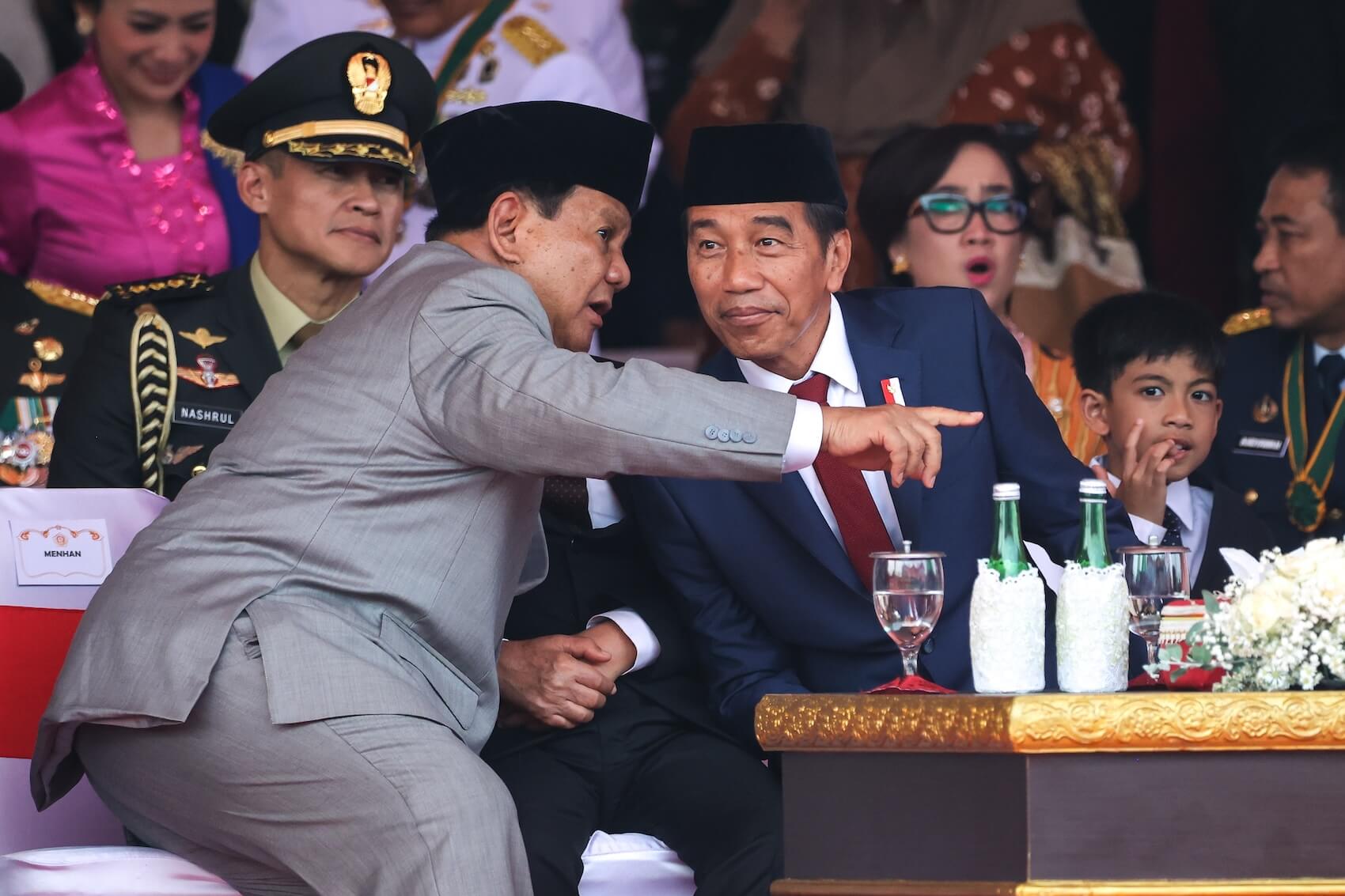
President-elect Prabowo Subianto with the 7th President of Indonesia, Joko Widodo, at the 79th Indonesian National Armed Forces Anniversary in Jakarta, Indonesia, on October 5, 2024. Photo: Donny Hery.
It cannot be doubted that the spread of protests was the result of many triggers converging at once. Tension in the streets created space for a populist mood to take hold, reinforced by narratives circulating on social media, kitchen-table anxieties, and political symbols that ignited collective emotion. The picture was further muddied by orchestrated messaging from anonymous “buzzers” (paid online amplifiers), making it hard for the public to see who was really behind the unrest.
On the ground, the crowd was heterogeneous (workers, students, online ride-hailing driver communities (ojek), and civil society organizations) pursuing overlapping aims that were not always identical, which often slowed coordination. Under that pressure, crowd psychology amplified emotions. Each new casualty triggered broader solidarity while also opening space for infiltration and provocation. At the same time, intra-elite conflicts (especially Prabowo-military vis-à-visJokowi-police) fueled the escalation. Factions within the ruling bloc competed, some ratcheted up tensions, while others capitalized on the moment for political gain.
The crowd’s anger in these protests was aimed at four main targets they saw as sources of injustice. First, the DPR (parliament) was perceived as a symbol of privilege and a legislature that often produces policies that betray the popular will. Then, the security forces (the police) because repeated violence and impunity have eroded the public’s sense of safety. Political parties were viewed as lacking real ideological differences and serving mainly to reinforce an oligarchic logic. The ruling faction (Prabowo) was criticized for pushing recentralization and was feared to be further narrowing the civic space that should belong to citizens.
From the streets, two tiers of demands rang out loud and clear. First came the urgent demands to be met by September 5, 2025, an independent investigation into cases of police violence against protest victims, an end to the involvement of the Indonesian National Armed Forces (TNI) in civilian affairs, the release of all detained protesters, accountability for security forces, a moratorium on increases to benefits for DPR members (parliament), full budget transparency, ethics sanctions for officials who displayed arrogance, an open public dialogue with the DPR, and comprehensive protections for workers.
Second, there were structural demands to clean up the parliament (DPR) of corruptions, to reform political parties and the system of executive oversight, to build a fairer tax system, to strengthen the Corruption Eradication Commission (KPK) through an asset-forfeiture law, to make the police professional, to ensure the military returns to the barracks without exception, to bolster the National Human Rights Commission (Komnas HAM) and other independent bodies, and to review economic and labor policies so they favor the public.
The demonstrations are not just seasonal “riots.” They are a serious sign that the state’s legitimacy is eroding. Indonesia learned in 1998 that when an economic crisis collides with a political crisis and injustice, the result is a multidimensional crisis. Those symptoms are back now, only with a new face, the public is more informed, more digitally connected, and more willing to test the state’s narrative against everyday experience.
Democracy rarely collapses overnight. It usually erodes slowly under the pretext of maintaining order. That is why this moment can be understood as an inflection point, will Indonesia slip back into a new form of authoritarianism hiding behind procedural democracy, or use it as a chance to repair a fractured social contract?
This is where progressive populism becomes relevant. The popular movement, now articulated through anger and concrete demands, opens the door to building a new political bloc committed to economic and social justice, transparency, and accountability. Rather than merely mobilizing emotion, progressive populism can serve as a platform to knit scattered demands into a coherent, measurable collective agenda.
Affan’s death has come to symbolize how a single life from the poor can speak louder than a thousand official speeches. If the establishment chooses to turn a deaf ear, whatever legitimacy remains will only grow more fragile. But if it dares to listen and channel the people’s energy toward a fairer transformation, this tragedy could mark the beginning of renewal.
While the global community often articulates refugee detention as a banner of humanitarian concern, escalating evidence from Libya and North African regions reveals a deeper systemic failure where stateless refugees and other displaced persons are being subjected to medical procedures and organ removal through coercion masked as border security and health screening. Across these detention zones, a shadow economy thrives thereby transforming stateless refugees into targets of extrajudicial biomedical intervention. This article uncovers the alarming rise of coerced organ extraction and exploitative medical practices presented as humanitarian care, introducing the concept biomedical sovereignty to expose the violent necropolitics at play. To build upon forensic data, survivor testimonies, and policy analysis, the following article calls for an urgent re-evaluation of international ethical obligations toward radically marginalized populations.
By Umavi Pagoda*
A 19-year-old Eritrean refugee is relocated from a detention center near Tripoli for what officials call a routine medical check-up. His departure marked the start of an absence that would never find closure as he became another unreturned face in a system that forgets too quickly. The following day, his belongings are returned to the dormitory with no explanation. His name is erased from records. His body is never found.
This incident is a fragment of a broader systematic pattern, one propagated across detention zones with troubling consistency in North Africa, where refugees are processed not only as asylum-seekers but as medical targets. While corridors of power continue to argue over the ethics and logistics of migration quotas and border security, a quieter atrocity is unfolding where the systematic medical exploitation of stateless persons, often unfolding into coerced organ removal. Within the ward where law disguises violence as care, silence kills quieter than bullets, outruns justice, and erases crimes before they are named. In extraction zones, silence enforced policy by design, not by accident.
Militias, Traffickers, and Medical Collusion
Since the fall of Muammar Gaddafi in 2011, Libya represents a textbook case of post-revolutionary power vacuum, dominated by militia entrenchment, coercion by proxy, and smuggling networks. Moreover, in the absence of central governance, detention centers have evolved into profit-generating hubs for human trafficking, including a disturbing development: organ trade.
Migrants and the displaced from sub-Saharan Africa, Syria, Bangladesh, and the Horn of Africa are frequently subjected to captivity under force along main transit routes through Agadez in Niger and eastern Sudan, with Libya positioned as Europe’s de facto checkpoint. In addition, these detention centers are often routinely run by militias and other non-state actors in alliance with traffickers and smugglers, under credible allegations of organ-trafficking risks and unease over possible complicity of medical personnel. Without independent oversight or any mechanism for accountability, these facilities—designed for secrecy—function as black boxes
From Rumor to Routine: Coerced Organ Removal Across Migration Routes
What was once a rumor is now routinized —measured in spreadsheets, hidden in budgets, and carved into bodies. In recent years, humanitarian workers and forensic specialists have uncovered disturbing patterns of disappearances and allegations of coerced medical procedures—making clear that the undocumented body, once erased by the state, is reintroduced into systems of value as currency, commodity, and collateral. Illicit transplant surgeries have been documented in multiple countries through police operations and court cases, even asUNODC’s Assessment Toolkit (2015) characterizes trafficking for organ removal as a hidden, under-reported crime whose true scale remains unknown.
From capitals to courtroom, global monitors have begun documenting the horror. The July 2024 IMO-UNHCR Mixed Migration Centre Report interviewed migrants, revealing patterns of detainees taken for blood testing and disappearing shortly afterward. Survivors report post-procedural states marked by disorientation, physical pain, and memory loss—reflecting a troubling loss of bodily agency under conditions where medical procedures are imposed rather than chosen.
In July 2023, the Office of the United Nations High Commissioner for Human Rights (OHCHR) warned of deepening shadows over Libya, where layers of entrenched crimes have become almost invisible to international oversight: human trafficking, arbitrary detention, enforced disappearances, and the systematic torture of migrants and refugees—many lacking recognized nationality and thus classified as stateless under international law (OHCHR, 2023).
Statelessness strips individuals of legal protection, leaving them defenseless against exploitation, including illicit organ removal. This risk is echoed in multiple reports, including a study led by the United Nations Human Rights Council (UNHRC), the International Organization for Migration (IOM), and the Mixed Migration Center (July 2024), which documents the experiences of refugees and migrants—many likely stateless—describing non-consensual organ removal along migration routes to the Mediterranean (Reuters, 2024). Witness journalism documents the experiences of 43 individuals from Sudan, South Sudan, and Eritrea—many of whom are absent from any civil registry—who sold a kidney under coercion, underscoring how displacement and the absence of state protection leave individuals acutely vulnerable to the most extreme forms of trafficking (The Guardian, 2024).
Borders Beneath the Skin
In the shadows of ports, prisons, and refugee camps, the passport has been reduced to flesh, and the border is inscribed in blood. The trail starts in Tripoli, where the Mixed Migration Centre’s Everyone’s Prey briefing (July 2019) reports patterns of kidnapping and extortion of migrants in Libya’s detention industry. Moreover structural analysis such as the OSCE study on trafficking for organ removal coupled with the ICAT policy brief highlight how displacement and detention centers formulate systematic flaws that can be preyed upon by trafficking networks.
Law-enforcement alarm remains unambiguous in INTERPOL’s 2021 assessment which documents that organized crime groups based in North and West Africa prey on migrants and other displaced persons for coerced organ removal often shadowed by medical collusion. The UNODC Global Report on Trafficking in Persons (2022) observes that such trafficking persists in shadows, though it remains rare when in comparison to sexual or labor exploitations. Diesel generators hum into the darkness, fueling flickering lights over neglected wounds. The hum echoes east, into Xinjiang’s Dabancheng complex. Moreover, survivors bore witness before the Uyghur Tribunal revealing that they were subjected to blood draws, tissue typing, and ultrasound scans stripped of consent. In forensic retrospect, these procedures suggest a system where the border no longer ends at territory but continues beneath the skin.
This brutality is mirrored in the testimonies of countless individuals whose voices bleed through silence. On August 10, 2024, The Diplomat reported the public testimony of Cheng Pei Ming, described as the first known survivor of forced organ harvesting in China to speak openly. Cheng remains a crucial witness to an ongoing, state-directed system of coerced organ extraction — a campaign that the independent China Tribunal (2019) concluded was organized and carried out by the Chinese Communist Party, beyond reasonable doubt.
However, Beijing rejects any acknowledgement of state-directed coerced organ harvesting, particularly when involving prisoners of conscience. The official position maintains a stance of denial, asserting that the practice of using organs from executed prisoners was halted in 2015.
Bodies as Evidence: Testimonies of Coerced Organ Harvesting and the Global Shadow Trade
Policy is prose, while the body is evidence. Cheng’s testimony stands as a singular, rare first-person account. He recounts: “They said that I had to undergo an operation, but I firmly refused. They held me down and gave me an injection, and I quickly lost consciousness. When I woke up, I was still in the hospital and felt terrible pain in my side.” Refusal. Confinement. Injection. Blackout. Waking up shackled, with an IV taped to his foot, a drainage tube in his chest, oxygen tubes in his nose, and a thirty-five-centimeter incision. “There was a tube with bloody liquid coming from under the bandaging that was on my side,” he adds, as documented in the ETAC media release.
Additionally, The Diplomat reports that Xinjiang authorities plan to establish six new organ transplant centers despite the region’s strikingly low official voluntary donation rate — a figure widely disputed by human rights organizations.
While the East provides a witness, the South offers a case file. Described by authorities as Egypt’s largest organ-trafficking case to date, the December 2016 raids targeted 10 medical centers, resulting in 37 convictions in 2018. Among those arrested were several medical professionals, and authorities reported the recovery of millions in assets.
Victims, including Sudanese asylum seekers, recounted waking from anesthesia to find fresh surgical dressings, visible scars, and the absence of a kidney. Within North and West Africa, INTERPOL (2021) assessment states that organized crime groups frequently prey on migrants and refugees, often under the guise of “altruistic donations” and frequently shadowed by medical-sector complicity.
Additionally, some clinics are reported to perform both legal and illegal procedures simultaneously. However, weak reporting mechanisms and fragmented medical registries allow the illicit trade to thrive in the shadows.
Across borders, the UNODC Global Report on Trafficking in Persons (2022) records that trafficking for organ removal remains a statistical rarity in detected cases and is chronically under-reported. Furthermore, the only treaty directly addressing organ trafficking, the Council of Europe Convention against Trafficking in Human Organs (CETS No. 216), continues to struggle with limited ratification.
In a parallel theatre, in the Sinai, Eritrean captives have been kidnapped and tortured for ransom. In some cases, they were killed when payments failed; several testimonies also allege organ removal—a practice all too familiar—although rights reporting primarily emphasizes the ransom-torture economy. Yet the trail does not end in Sinai.
In April 2025, the trail led to Saudi Arabia’s Eastern Province, where the body of 19-year-old Beatrice Warguru Mwangi was returned to Kenya. What was returned was missing a stomach, eyes, and reproductive organs; her neck was almost severed. “How is this my daughter? Her body was empty. No stomach inside. Her breasts were cut …,” her mother testified to Migrants-Rights.org. The post-mortem examination in Nairobi further documented signs of strangulation, dehydration, and prolonged starvation. Despite petitions, the case remains unanswered—with no formal inquiry, no published findings, and no transparent remedial steps. One body speaking for many, her body stands as a summons to states to intervene.
Surgical Sovereignty and Stateless Bodies
This cross-national pattern highlights how, in detention and transit zones, where oversight falters and legal authority is often liminal, protection gaps open like unhealed wounds. The absence of identification papers renders human beings harder to see and easier to exploit. These are not isolated anomalies; rather, they expose a deeper implementation gap: the 1954 Convention and the Palermo Protocol—while widely ratified—remain unevenly enforced in practice, repeatedly failing at the stage of implementation. As a result, data remain under-reported, justice remains selective, and access to remedies often depends on documentation and financial means.
At the core of this atrocity lies a collapse of medical integrity—a reversal of the healer’s oath. Clinical spaces become theatres of harm, with ethics dissolved into silence. The obligation remains clear: voluntary, informed consent and the absence of financial gain are fundamental norms, and physicians must not participate in abuse, including in detention settings.
Yet, in documented cases, detainees have repeatedly been subjected to medical procedures without consent and denied proper care—from coercive interventions behind the closed gates of Libyan detention centers to intrusive medical testing in Xinjiang—while criminal networks exploit these systemic gaps. In such contexts, human bodies are treated as inventory rather than as patients.
This dynamic aligns with the concept of surgical sovereignty—the ability of non-state and state-adjacent actors to exert coercive control and extract biological value from stateless and displaced persons.
The concept of surgical sovereignty refers to the ability to use medical infrastructure by non-state actors to exert coercive control and exploit the biological value of stateless persons — those “not considered as nationals by any State under the operation of its law,” as defined in the 1954 Convention Art.1 (1). In these spaces, procedures continue to occur without voluntary, informed consent or credible oversight, reversing medicine’s role from care to control. The framework aligns with biopolitics but specifically isolates the role of medical systems. Moreover, the Palermo Protocol defines trafficking to include exploitation for the removal of organs, even as its implementation remains weak.
In February 2025, authorities in southeast Libya uncovered two migrant mass graves, freed 76 captives, and made three arrests linked to suspected trafficking sites. The following month, Sudanese refugees reported accounts of starvation, rape, slavery — and, in some testimonies, organ harvesting — along migration routes to the north. From a forensic perspective, such conditions cannot sustain lawful surgery: there is no anesthesia, no sterile field, and no consent, as required under the WHO Guiding Principles. Moreover under international law, such death and disappearances demand the recognition of right to life and a duty to reinvestigate as outlined in International Covenant on Civil and Political Rights, Article 6 and the Human Rights Committee’s General Comment No. 36. An individual’s right to health requires consent, documentation and oversight under the International Covenant on Economic, Social and Cultural Rights, Article 12 and CESR General Comment No.14. Failure to keep records or examine remains may be treated as violations.
Although abuses remain widespread and often under-investigated, the law frequently erodes into silence. This is compounded by the absence of an effective accountability mechanism to enforce WHO health standards in conflict settings and detention sites. Current mandates also struggle to reach non-state actors who control many of these camps. As of 2025, the international response has been both limited and late.
Cut in Silence: The Cost of Global Inaction
This silence echoes earlier failures and undermines the very foundations of the post-war settlement the world claims to uphold. The 1947 Nuremberg Code declared voluntary, informed consent to be non-negotiable — even in times of conflict. Yet in modern-day Libya, while the principle is acknowledged in theory, it remains absent in practice.
What fails in implementation locally is often underwritten by decisions made in Europe. Amnesty International’s Europe’s Gatekeeper (2015) reported that EU funding and equipment to Libya’s coastguard and detention systems have given cover to abuses against migrants: arbitrary detention, torture, extortion. Moreover, UN reporting and rights groups have revealed a grim pattern: people returned to Libya vanish into detention centers or unregistered sites. Many then become effectively untraceable. Furthermore, The Global Protection Cluster cautions that Libya’s legal ambiguity between migrants, asylum seekers, refugees, and trafficking survivors becomes a structural barrier to protection and remedies. Médecins Sans Frontières has reported overcrowding and the lack of adequate care: conditions that are irreconcilable with the very principles of medical care and a blatant disregard for the laws of human dignity.
Yet beneath the reports and the evidence, a deeper question is left unanswered. What happens to the body unclaimed by nation, unnamed by law, unacknowledged by history? What happens to a life that holds no legal weight, does its loss echo anywhere? In these spaces, the lack of prosecution remains as the infrastructure of impunity.
Breaking the Silence on Hidden Atrocities
This article does not claim to resolve the failures of states. However, it demands that the silence surrounding medical atrocities be dismantled. As the world increasingly governs bodies before protecting them, a pressing question persists: how long until the promise of healing conceals the reality of extraction?
When the refugee body is no longer seen as a body in need but one that is policed, processed, and politicised, the surgeon’s scalpel — once an instrument of care — becomes a tool of control. These atrocities are not merely the actions of complicit individuals; they are the outcome of systemic structures that strip the stateless and the dispossessed of their humanity.
Once, the international community drew a line after gas seared lungs. Today, the responsibility falls on governments, international bodies, and all who claim moral authority to draw a new line — for those cut in silence — and to outlaw surgical violence against the voiceless. If we remember only the suffering but not the perpetrators, we bury the crime beside the victim.
Will those who once enforced accountability now hold states, militias, and complicit actors responsible for the scalpel used without consent — or will silence remain the price of statelessness? If the world outlawed gas, will it also outlaw surgical violence, or will the voiceless continue to pay the cost of inaction?
(*) Umavi Pagoda is a UK-based A-level student studying Politics, Chemistry, Biology, and Physics, with a focus on the intersection of medical ethics, human rights, and international law. Their work in international debate and policy stimulation has been recognized at multiple high-level Model United Nations conferences Worldwide. Email: pagodaumavi41@gmail.com
In an interview with the ECPS, Professor Nic Cheeseman dissects the global resurgence of authoritarian populism and the uneven pathways of democratic backsliding. Warning against the “temporal fallacy,” he argues that crises unfolding simultaneously do not share a single cause—from Europe’s far-right surge to West Africa’s coups. Professor Cheeseman spotlights the twin pillars of democratic defense: resilient institutions and organized civic resistance. “In countries where institutions are weak, mass mobilization becomes absolutely critical—often the only mechanism left to stop populist or authoritarian leaders from consolidating power,” he says. Citing Ghana, Kenya, and Zambia, he urges context-specific democracy support that amplifies local strengths over one-size-fits-all templates.
Giving an interview to the European Center for Populism Studies (ECPS), Dr. Nic Cheeseman, Professor of Democracy at the University of Birmingham, and the Director of the Centre for Elections, Democracy, Accountability and Representation (CEDAR), offers a comprehensive analysis of the global resurgence of authoritarian populism, democratic backsliding, and the vital role of civic resistance in fragile democracies. As a signatory of the June 13, 2025, anti-fascist declaration, Professor Cheeseman warns against the normalization of exclusionary, illiberal politics and highlights the need to rethink strategies for safeguarding democracy in the 21st century.
Professor Cheeseman emphasizes that democratic decline is not uniform but highly context-specific, urging caution against what he calls the “temporal fallacy”—the assumption that simultaneous crises share common causes. While far-right populism is reshaping politics in Europe, democratic erosion elsewhere often follows different patterns, such as military coups in West Africa or institutional capture in Latin America. “What we’re seeing is a highly complex set of processes pushing countries away from democracy, but these processes do not necessarily share a common underlying theme,” he explains.
A central theme of the interview is Professor Cheeseman’s analysis of the relationship between institutional resilience and mass mobilization in resisting authoritarianism. Drawing on Afrobarometer data and recent case studies, he underscores that strong institutions remain the first line of defense against creeping autocracy. However, in contexts where institutional capacity is weak, civic resistance becomes decisive: “In countries where institutions are weak, mass mobilization becomes absolutely critical—often the only mechanism left to stop populist or authoritarian leaders from consolidating power,” Professor Cheeseman asserts.
This argument resonates particularly in African contexts, where frustration with democratic performance—stemming from economic hardships, governance failures, and elite corruption—has fueled coups and populist takeovers. Yet, Professor Cheeseman points to inspiring counterexamples like Kenya, Ghana, and Zambia, where citizens have mobilized successfully to safeguard democratic norms. In Zambia, for instance, “hundreds of thousands of citizens turned out to vote, even believing the election wouldn’t be fully free and fair, because they knew collective action could bring political change—and it did.”
Professor Cheeseman also critiques “one-size-fits-all” democratization strategies, urging international actors to develop context-specific approaches grounded in local realities, civic strengths, and the dynamics of populist narratives.
Overall, the interview highlights Professor Cheeseman’s central thesis: defending democracy requires a dual strategy of institutional strengthening and societal mobilization. Where one falters, the other must rise.
Dr. Nic Cheeseman, Professor of Democracy at the University of Birmingham and Director of the Centre for Elections, Democracy, Accountability, and Representation (CEDAR).
Here is the transcript of our interview with Professor Nic Cheeseman, edited lightly for readability.
Beware the ‘Temporal Fallacy’: Mapping the Varied Paths of Authoritarian Populism
Professor Cheeseman, thank you very much for joining our interview series. Let me start right away with the first question: As a signatory of the June 13, 2025, anti-fascist declaration, how do you interpret the resurgence of authoritarianism and illiberal populism globally? Do contemporary far-right movements represent a new form of “neo-fascism,” or are they better understood as populist-authoritarian hybrids adapted to 21st-century democracies?
Professor Nic Cheeseman: That’s a big question to start with. I’ll begin by reiterating something I often emphasize when discussing the recent phase of global politics and the authoritarian trend: we must be cautious of what I call the temporal fallacy. The temporal fallacy is the assumption that, because many developments are occurring simultaneously, they must be driven by the same underlying causes. For example, if we examine the challenges to democracy worldwide and the rise of authoritarian leaders, we see that some of these leaders fit into a proto-populist, right-wing, exclusionary politics mold.
We can observe the rise of the far-right across Europe, and, of course, we should note that right now, as we speak, far-right candidates or parties are leading in opinion polls in France, Germany, and the United Kingdom—something unprecedented in my lifetime. However, this trend applies only to a certain set of countries. In other contexts, democratic decline has occurred for very different reasons. For example, in West Africa, we’ve seen junta leaders seize power with little connection to right-wing populism. In some cases, there’s instead a pan-African, almost leftist form of old-school populism, modeled more on figures like Ghana’s Jerry Rawlings than on Europe’s fascist traditions. Similarly, in parts of Latin America and elsewhere, we observe yet different dynamics. Overall, what we’re seeing is a highly complex set of processes pushing countries away from democracy, but these processes do not necessarily share a common underlying theme.
So, in that sense, even if we were to agree that some of these cases provide a strong parallel to the fascist movements of the 1930s–1940s, we would, of course, be talking about only a small subset of them. And that brings us to the question of why sign a letter against the rise of fascism. I think what we wanted to do in the letter—and obviously, I can only speak for myself, not for the other signatories—was to raise a warning flag and say: we are beginning to see the early signs of something that increasingly resembles the kind of outright hostility toward other cultures and migrants that we have witnessed before in history.
At present, I think it’s fair to say that we are not yet at that scale. But what we are seeing—and this is what truly concerns me—is that both from senior political figures, like Nigel Farage or Donald Trump, and from below, through social media and conversations among people who share similar views, we now have an almost full legitimization of exclusionary, racist, and hostile discourse happening simultaneously from the top and the bottom. Social media is emboldening people, and the rhetoric of leaders is emboldening people. These two dynamics, unfolding together, mean that things people would not have dared to say 10 or 20 years ago, they now feel confident expressing publicly, believing that others will support them.
Now, the final point I want to make is that we must be very careful not to assume that the values and prejudices we’re hearing today are somehow new. In many cases, people are simply feeling emboldened to express views they have held for a long time. One mistake we must avoid is interpreting these new expressions as evidence that we had previously solved these issues and that they have suddenly reemerged. My sense is that we never effectively addressed many of these underlying problems; instead, they were allowed to fester beneath the surface. What’s different now is that these prejudices are being emboldened and amplified in this particular moment. So, we face a dual challenge: how to confront the current manifestation of exclusionary politics and why we failed to tackle the root causes and reduce these prejudices more effectively over the last 20 to 30 years.
Frustration with Democracy Fuels Support for Military Intervention
Thai military seizes control from Prime Minister Thaksin Shinawatra in a coup in Bangkok, Thailand, on September 22, 2006. Photo: Charlie Milsom.
Drawing on your work in“War and Democracy”in 2018, to what extent do rising authoritarian movements exploit institutional weaknesses and democratic fatigue, particularly in post-colonial states? How might these dynamics explain the erosion of liberal norms both in Africa and globally?
Professor Nic Cheeseman: I think frustration with democracy is a really important factor in many parts of the world. Some people believe that they once had a good-quality democracy and that it was taken away, while others feel that democracy was strong but ultimately failed them. For example, in the United States, many might feel that, on the one hand, they have been told they live in a functioning democracy, but on the other hand, they have seen class mobility decline and their ability to achieve a better life than their parents diminish—leading, in a sense, to the erosion of belief in the American dream. Alternatively, we can look at societies in Africa that have never truly been granted democracy. In that article, we discussed countries like Uganda and Rwanda, where we have essentially seen prolonged periods of authoritarian rule.
Now, today, for example, in Uganda, we have a system that is called a multi-party electoral system; it is described as a democracy by the government, but the opposition has never been allowed to win. We know that the game is systematically stacked against the opposition. There was even a survey that found a majority of Ugandan people did not believe that power could be changed through the ballot box. So, when you reach a situation where most voters don’t believe they can actually remove the government through elections, that creates a very dangerous dynamic. It gives people an incentive to start contemplating and supporting alternative ways of changing power—for example, through armed force. And if we were to ask what conditions led to the coups in West Africa, one of the key factors was that citizens had become frustrated and fed up with democracy, no longer believing that it would deliver, and no longer necessarily believing that democratic systems or electoral processes would enable them to elect better leaders in the future. Under those conditions, support for the military and for military intervention becomes something that people are more willing to contemplate.
So, if we look at the Afrobarometer data, for example—survey data across West Africa—one of the things it shows us is that most people are still against military rule. However, even those who oppose military rule in principle are sometimes willing to say that the military has a right to intervene if civilian-led leaders have abused their power. In other words, what people are telling us is: we don’t want the military to govern, but if civilian leaders undermine their own legitimacy, perhaps the military is necessary to provide a clean break and a new opportunity to rebuild the system. I think some of that frustration with the performance of democracy—in terms of its failure to shield people from economic hardships, provide meaningful jobs, and offer a sense that people’s lives have worth and value—is also at the heart of some of the challenges facing democracy in Europe and North America, today.
When Populism Meets Ethnic Exclusion, the Risk of Proto-Fascism Rises
Entrance to the National Genocide Memorial in Kigali, Rwanda, on March 2, 2017. Photo: Karen Foley.
In your article “Ethnopopulism in Africa” in 2015, you describe how African leaders fuse populist economic narratives with ethnic mobilization. How do you assess the risks of ethnopopulism evolving into proto-fascist politics in fragile democracies, particularly where leaders invoke existential threats to justify state violence?
Professor Nic Cheeseman: I think the threat is really significant. But we have to be very careful about approaching this on a case-by-case basis. For example, we wrote that article with certain parts of sub-Saharan Africa in mind, where, on the one hand, you see leaders trying to mobilize in a more populist fashion using economic issues, but on the other hand, mobilizing along ethnic lines because they also recognize the need to carry their ethnic community with them. This results in piecing together a complex constituency that is, at times, inherently contradictory. If you want to deliver broad populist goals and improve the lives of citizens and the average person, you’re appealing to everyone—the common man. But if you then make an ethnic appeal and promise to deliver primarily to your own ethnic community, you narrow your focus to just that constituency. In that sense, it creates an internally contradictory approach.
And what we tried to address in that article is when this approach holds together and when it doesn’t. We essentially pointed out that it is more likely to hold together when a leader’s own ethnic community—perhaps due to historical experiences or socialization into certain values and ideas—is more inclined toward populism and actually shares populist values. This could involve supporting strong state intervention in the economy to deliver rapid change or desiring a “big man” leader and being willing to sacrifice democratic checks and balances to achieve those goals.
So, there’s a kind of tension there that can be overcome, and leaders can use it effectively. But, where those identifications are different, where the ethnic constituency of a leader wants something very different from what perhaps the common person on the street wants, or when there’s a real tension and polarization around ethnic identity, it can be extremely difficult to make them consistent, and actually, a lot of these strategies don’t end up winning power. They collapse under the weight of their own internal contradictions.
Now, where I think this becomes really dangerous—and we see this clearly in other parts of the world, including parts of Europe and Asia—is when you get that combination of a populist leader mobilizing around ethnicity, an exclusionary version of ethnicity, and using the demonization of either external countries or internal minorities as a way to unify their support base. When that happens, you get a particularly troubling form of proto-fascist mobilization. On the one hand, you are deliberately using that community as the glue holding your coalition together, making it impossible to abandon this strategy since it sustains the regime. On the other hand, the populist nature of this mobilization further erodes checks and balances, making it easier for human rights abuses to occur and putting the targeted community in particular danger. That’s where this exclusionary form of politics risks boiling over into something far more violent and repressive. That said, it’s important to remember that this pattern is not universal: some right-wing populists in power have not yet led to severe attacks on minorities, while others clearly have. There is, in other words, significant variation.
One of the things that’s quite interesting to me at the moment is looking at where we see leaders like this who seem genuinely interested in reshaping multiple levels of society, versus those who don’t. In Italy, for example, it seems to me that the government isn’t particularly interested in controlling what academics think or say, nor does it appear heavily involved in censoring universities or seeking to control society down to the grassroots. I could be wrong, but from talking to friends, that seems to be the case. By contrast, in the United States, you have a government that is actively waging war with some of its own universities—trying to impose forms of censorship, remove certain issues from the agenda, and push its own values onto it.
So, one of the things I think we need to reflect on more carefully is the question: why? Why do we have some movements and leaders who focus primarily on marginalizing communities within an exclusionary narrative, while others are far more invested in intervening directly to reshape society, including academia, universities, and cultural institutions? And why do we have some leaders who seem more focused on controlling the commanding heights of the state without necessarily pursuing deeper social transformation? What drives these different kinds of regimes, and what distinct consequences do they produce for their own societies?
Populists Rise on Anti-Corruption Rhetoric but Often Deepen Clientelism and Corruption
Brazilian citizens take to the streets demanding the impeachment of President Dilma, the arrest of former President Lula, and the fall of the Workers’ Party (PT), amid corruption scandals, in São Paulo, Brazil, on March 13, 2016. Photo: William Rodrigues Dos Santos.
In your 2016 article “Patrons, Parties, and Political Linkages, and the Birth of Competitive-Authoritarianism in Africa,” you highlight the role of clientelist networks in shaping political behavior. How do you see clientelism interacting with populism to facilitate creeping authoritarianism, especially when leaders frame loyalty to the state as loyalty to “the people”?
Professor Nic Cheeseman: It’s a very good question and I think there are two different parts to it. I mean, one is that, in a sense, classic populist leaders face a challenge when it comes to clientelism. Because, of course, if you’re arguing that people should support you because you embody the will of the people, you should be arguing, in a sense, that they should vote for you because they recognize you as the embodiment of the will of the people, and because of your agenda, platform, and personality. And that slightly cuts against the idea that you should, of course, mobilize people through clientelistic models, either by offering them very specific services in order to assist them. For example, the kind of model that we understand in the United States, where we see the government historically delivering specific localized services—for example, for the House of Representatives and so on—in return for votes, or, in sub-Saharan Africa, where we might expect there to be a relationship between leaders and their own ethnic community, exchanging resources in that way. And that, kind of, cuts against the logic of populist mobilization if we think about classic populist thought.
But of course, in reality, we know that these two things have often gone hand in hand, and clientelistic machines have often been the underpinnings of populists who use this kind of rhetoric but actually rely on clientelism to stay in power. Moreover, one of the things that we don’t think about enough is what happens to corruption when populists win power. So, for example, we know that one of the ways that populists mobilize support is that they claim that the state is corrupt. They claim the political elite is corrupt. They make great hay out of any corruption scandals.
Trump, of course, did this. It’s been a current theme in American politics: drain the swamp, reduce the corruption in the government. It’s true more broadly that people have a suspicion about government being corrupt and being inefficient, and so populists have understood that and play on that as a key part of their message. Of course, corruption is a particularly valuable message if you’re a populist leader. Because what you can say to people is: the system is so corrupt, it’s endemic, and it’s pervasive, and therefore, the only way we can deal with it is by electing someone who’s an outsider. And therefore, you have to elect me because I’m the outsider populist. None of those people in the system can be trusted to actually deal with it. So, you get corruption and anti-corruption as one of the key mobilizing messages of populists.
But, of course, when populists are in power, they then often prove to be just as corrupt, or even more corrupt, than the people they’ve replaced. One reason for that, of course, is that populists tend to remove checks and balances, they weaken institutions, they rule in a more spontaneous way, and often in a more individual and personalized way that undermines systems of accounting and systems of audit. Therefore, what you often see is the same populists who get elected on anti-corruption messages then commit greater corruption, partly for personal aggrandizement and wealth, partly to drive the clientelistic networks that were also part of your question. When they leave power, they actually also leave the states and the government more vulnerable to corruption in the future, precisely because they’ve weakened the institutions that were designed to prevent corruption.
So, in some countries, we’ve even seen more corruption when the populist leader has left power and someone else has come in who has been more corrupt-minded but then faces a situation with far fewer constraints. So, corruption and clientelism are fundamental to populism and the rise of populist leaders, both in terms of the mobilization of voters and getting into power, and then in terms of how they sustain power and the legacy they have for political systems.
Mass Mobilization: The Last Defense Against Authoritarianism
Peaceful protests on Niezaliežnasci Street in Minsk, Belarus. Demonstrators rally and march toward Independence Avenue on August 23, 2020. Photo: Shutterstock.
Based on your research on Kenya’s 2022 elections, to what extent can constitutional reforms and decentralization act as safeguards against authoritarian populism? Or do populist leaders inevitably find ways to co-opt democratic institutions?
Professor Nic Cheeseman: I think this depends a lot on how strong the institutions are before a populist leader comes to power, and it also depends on the balance of power. To what extent does the populist leaders get a parliament that is loyal to them? And there are two dimensions to that. One is the extent to which MPs, as part of the populist leader’s party or aligned with them, are elected so that they get an easy ride with Parliament. The other is how easy it is for them to buy over MPs in the context of weak legislatures and weak party systems. So, I think this varies significantly across different places. It seems so far that European countries that have experienced populism—with the exception, obviously, of Hungary—have managed to withstand it to some extent.
Partly because electoral commissions have remained credible, we’ve actually seen democratic institutions withstand some of the challenges, leading to cases of democratic bounce-back. For example, we might think of Poland, where an authoritarian-minded government took power and was later defeated. Similarly, we might expect a more significant prospect of the current government in Italy losing power in the future than in other contexts where institutions have been much weaker and more compromised from the start. Of course, that’s not to say that Italian political institutions are free of corruption or particularly strong.
But if we compare them, for example, to some countries in sub-Saharan Africa that I work on—where legislatures have historically been extremely weak, and presidents have used corruption and patronage to demobilize scrutiny and opposition within the legislature—we see very quickly that institutions there are often far less able to operate as effective checks and balances. And in the cases of the coups we’ve discussed, we often see Parliament dissolved, political parties banned, and constitutions suspended, leaving political institutions with no real capacity on their own to constrain the new government.
So, it’s a very mixed picture, and one that gives us important things to consider when it comes to democratic resilience. Some states are going to have much greater resilience than others because of the institutional strengths they possess.
The other thing that’s important to say briefly about this is that we need to think about both democratic resilience—that is, the extent to which institutions can cope with a shock, deal with a non-democratic leader, constrain them, and ensure the rule of law is followed—and resistance, meaning citizens on the streets, civil society mobilization, and people protesting against the government. Particularly in countries where institutions are weak, it is often this form of civil society mobilization and mass protest that prevents authoritarian takeovers. So, I think it’s really interesting to look at this combination. In some countries, institutions hold power; in others, institutions cannot, but mass mobilization can. And in that context, mass mobilization becomes absolutely critical, because it is almost the only mechanism left to stop populist or authoritarian leaders from consolidating their hold on power.
Democracy Can’t Be Saved with One-Size-Fits-All Solutions
Israelis protest in Tel Aviv against Netanyahu’s Judicial Coup in Israel. Photo: Avivi Aharon.
In your co-authored 2018 article “Ten Challenges in Democracy Support,” you warn against “one-size-fits-all” democratization models. How should international actors adapt their strategies when confronting populist movements with explicitly anti-democratic tendencies?
Professor Nic Cheeseman: One of the things I’ve done with some colleagues at CEDA—the Center for Elections, Democracy, Accountability, and Representation at the University of Birmingham—is to think through the different pathways of autocratization. We’ve identified at least four or five ways in which states can become more authoritarian. One is executive aggrandizement, where the incumbent leader expands their power and weakens checks and balances. Another is military interventions—violent takeovers, such as the Taliban retaking power or coups. A third involves state capture, with pervasive corruption corroding the system, though not necessarily led by a single political figure. Finally, there’s populist takeover, where outsider, anti-system candidates win power and then subvert democratic institutions. Understanding these pathways is essential for assessing the biggest threats to democracy and determining how best to build democratic resilience and support systems that uphold democratic norms.
Those strategies or pathways that I outlined are, of course, often overlapping, so they’re not mutually exclusive. For example, you could have executive aggrandizement occurring alongside state capture. But thinking about them carefully is important because it helps identify the biggest challenge in a given context. For instance, if you believe the primary threat in a particular country is a military coup, then the strategy should focus on coup-proofing: How can we professionalize the military? How can we deter it from seizing power through force? Conversely, if the main threat is executive aggrandizement, the priority becomes strengthening checks and balances—ensuring that legislatures and judiciaries are robust enough to hold the president accountable.
So, the potential solutions, or where you might emphasize investment, depend on assessing the specific threat. One of the risks, however, is that as a global community, we keep repeating the same approaches—supporting elections, legislatures, and civil liberties—without recognizing the need to be more problem-driven, focused, and context-specific. Within the policy community, everyone acknowledges that every reform and program should be tailored to context. But in practice, this is very difficult to achieve. It’s easy to say, “let’s adapt to context,” but much harder to determine what that context actually is and how best to respond to it. Thinking carefully about the most likely pathway of autocratization—and how to insulate against it—is, I believe, one way to encourage a more distinctive and effective approach in different settings.
Of course, you also need to consider other factors, such as identifying the main strengths of the democracy movement in a given country. In which areas is it powerful, and in which areas is it weak? How can we harness these strengths to build a truly effective coalition? That, again, depends on fully understanding which forces on the ground are most influential. In some countries, these might be trade unions, while in many parts of the world, trade unions have been so weakened that they can no longer play this role. In other contexts, religious organizations or other forms of civil society might serve as the driving forces. Ultimately, developing a clear understanding of the local context is critical for identifying the biggest threats and designing the best solutions.
Negative Messaging Can Strengthen Populist Narratives
In your 2024 article “Opening the Door to Anti-System Leaders,” you show how anti-corruption campaigns can paradoxically empower populist outsiders who then undermine democratic institutions. How do you interpret this dynamic in the broader resurgence of authoritarian populism, and are there parallels in Kenya, Zambia, or Tanzania?
Professor Nic Cheeseman: This is one of the things that, in some ways, is the most depressing: some of the things we try to do for good can end up having negative effects. It’s worth taking a step back for a moment from our specific research on corruption to explain why this happens and why it’s so important more broadly. One of the things researchers have started to find is that public awareness messaging—things like “don’t smoke, it’s bad for you,” “don’t drink and drive,” or “follow COVID rules”—can sometimes do more harm than good. One reason, we think, is that by telling people that lots of others are not doing something, you may subconsciously make them think that behavior is more acceptable, easier to get away with, and more socially legitimate.
For example, if I say to you, “lots of people are not following COVID regulations, so COVID is escalating, and we need to follow these regulations,” part of what you may be thinking, perhaps subconsciously, is: “well, if lots of people are not following COVID regulations, then maybe I shouldn’t either, because the norm is not to follow them.” And you might also think, “I won’t get in that much trouble, because loads of other people are already not following them.”
What you need to be really careful about when putting out messages is avoiding language that exacerbates or reinforces people’s sense that the behavior you’re warning against is pervasive, widespread, and normal. This is especially true when it comes to corruption. If you create an advert or message that makes people believe the country is even more corrupt than they already thought, or if you make them focus too heavily on the extent of corruption, you risk encouraging a sense of helplessness and powerlessness. That, in turn, can make people feel they should simply “go with the flow” rather than resist.
We’ve conducted research in a number of countries—Albania, Nigeria, and others—on what happens when this kind of messaging is used, where the focus is on how bad things are, employing what we call a “negative message.” In general, these messages not only fail to encourage people to do what you want—whether following COVID rules, quitting smoking, or, in our case, fighting corruption—but they also often have backlash effects. What we frequently observe is a backfiring effect, where people who receive these messages actually become more willing to engage in corruption rather than less. We believe this happens because such messaging fosters apathy rather than activism and reinforces people’s pre-existing skepticism about the state.
So, what this means is that anti-corruption messages themselves can unintentionally create the very foundations that populists exploit. For example, if anti-corruption messaging makes people more concerned about the extent of corruption but also more apathetic about their ability to change it—feeding a sense that the situation is hopeless—then people may become more willing to accept populist alternatives. In the paper you’re referencing, that’s exactly what we show: people who were exposed to some of these messages—which were intended to encourage anti-corruption activity—actually demonstrated increased support for populist values and attitudes. That’s an unintended and unwanted side effect.
So, we have to be very careful with how we fight, not just in anti-corruption campaigns but across many other areas. If we rely too heavily on negative messaging that focuses on how bad problems are, we may not only fail to achieve positive outcomes but also risk creating backfiring effects—making people more willing to tolerate corruption and other harmful behaviors.
For example, we’ve found associations between negative messaging and declining support for paying taxes, as well as reduced support for other critical elements of the social contract. I think this has significant implications for how we fight back against authoritarianism and sustain democracy. Messages like “everywhere is authoritarian” are ineffective because they reinforce the perception that authoritarianism is pervasive and widely tolerated. Instead, we need to craft messages that highlight how many citizens actually believe in the values we care about—how many support fighting corruption, how many believe their country would be better if it were less corrupt, and how many value democracy. These kinds of positive messages can mobilize people and build solidarity. Negative messaging, however, is really dangerous, and we need to avoid it.
Africa Offers Inspirational Lessons in Democratic Resilience
Two queues of people at a polling station during the 2011 general elections in Zambia. Photo: Dreamstime.
As a follow-up to our discussion on democratic backsliding and a final question, is there, in your view, any notable example of successful democratization across the African continent that offers inspiration amid the rising threats of resurgent fascism, populist mobilization, and authoritarian consolidation? What lessons can ailing democracies—both within Africa and globally—draw from such cases?
Professor Nic Cheeseman: There are a number of really inspirational cases. Ghana, for instance, springs to mind. It is a country that experienced a series of coups and instability in the 1970s and 80s, followed by a period under military leader Jerry Rawlings, and then managed to emerge in the 1990s with a solid constitution that institutionalized a separation of powers. Rawlings then stepped down when his two-term limit came up, leading to a peaceful transfer of power. Since then, there have been a succession of such transfers. Now, that’s not to say Ghana’s democracy is fully consolidated. In some ways, we need to move away from the idea that democracy can ever be fully consolidated and recognize that, in a sense, it is always under threat, always being challenged. But one of the most striking things about Ghana is that it successfully made the transition from military to democratic rule, and the military has returned to the barracks and stayed out of politics ever since. In terms of one of the biggest trends in West Africa, the Ghanaian experience is a particularly valuable one to learn from.
I also think we have really interesting examples elsewhere. For example, two countries very close to my heart—Zambia and Kenya. Kenya, on the one hand, is in the middle of a very intense period right now. On one side, you have a government trying to push through very unpopular economic policies, and on the other, there is mass citizen engagement against them—mass protests led largely by youths—alongside significant human rights abuses and violations in the government’s attempts to repress those protests. And so, again, I’m not for a second saying that Kenya has “got it sorted” or reached a point where democracy is fully protected and safe. But if you think about where Kenya was 40 years ago—as a one-party state dominated by Daniel arap Moi—or then move forward to 2007, when Kenya suffered serious ethnic violence after a controversial election, the progress is striking.
In response to that flawed 2007 election and the violence that followed, Kenya built a new constitution that was more inclusive, devolved power to 47 counties, and created a Supreme Court that not only exists but was one of the first courts in the world to nullify the election of a sitting president on the basis that the election didn’t meet the necessary standards. The fact that Kenya has gone through all of that—and that, in some ways, the multi-party system today could be said to be more robust than it was 20 years ago, with a stronger constitution—means that Kenya has the potential to ride out the current challenges, struggle through them, and move forward by instituting new reforms.
And I think it’s that process that gives me inspiration. It’s not easy. People have fought for it every step of the way. People have risked their lives; many have died, trying to push forward democracy, to build a more accountable and effective system, and to resist authoritarian leaders. But at the same time, that process of struggle has actually generated a situation where, over time, the institutions have become stronger. And while they still need to be strengthened considerably from here on, Kenya is in a much better position than it was—despite all the challenges the country faced in the early 1990s, coming out of its period of strongman rule.
And the same, very briefly, to an extent, applies in Zambia. Zambia, too, is struggling with the question of democracy, the government’s commitment to it, and the challenge of making progressive reforms. But at the last election, Zambia actually managed to remove an authoritarian—or increasingly authoritarian-minded—leader, President Edgar Lungu, and witnessed a peaceful transfer of power as hundreds of thousands of Zambians went out to vote. They did so even though many did not believe the election would be completely free and fair, because they believed that if they came out together in their hundreds of thousands, they could bring about political change—and they did, by voting for a change of government.
It’s also worth keeping in mind, especially for those skeptical about the feasibility of democracy in Africa, that only two countries globally moved toward greater democracy during the COVID-19 pandemic, according to major democracy ratings indices. And those two countries were Malawi and Zambia—both in Africa. So, I do think Africa provides some genuinely inspirational examples where the struggle for democracy is very much ongoing. These are countries that have not lapsed into pure authoritarianism; their institutions are gradually becoming stronger, and citizens are consistently mobilizing to safeguard their rights and liberties.
And that, I think, is a good model for other countries in different parts of the world that are now beginning to face their own democratic difficulties.
Greece has become a critical gateway for asylum-seekers, yet increasingly restrictive migration policies, harsh detention conditions, and reduced aid leave refugees in precarious circumstances. Amid systemic exclusion, NGOs like REFUGYM, Sama Community Center, and El-Sistema Greece foster hope, dignity, and belonging through education, sports, arts, and grassroots initiatives. Drawing on interviews with NGO leaders, refugees, and first-hand field observations, this article highlights both the barriers asylum-seekers face and the community-led solutions redefining resilience. In a climate of tightening borders and rising polarization, refugee-led spaces remain vital for empowerment, solidarity, and imagining more inclusive futures.
By Layla Hajj*
On July 9th, 2025, Prime Minister Kyriakos Mitsotakis announced that Greece will stop the processing of asylum applications arriving from North Africa for three months, claiming that those who enter the country illegally will be “arrested and detained.” Despite the Greek Council for Refugees demanding that there be no suspension of asylum under the premise that it is “illegal,” a violation of international law, and a demonstration of Greece’s failure to guarantee basic fundamental rights, Greece has justified their migration restrictions with the influx of migrants arriving via the Mediterranean route. The government defends that they must halt all illegal migration to increase their country’s security and ensure that they have the adequate resources to distribute to their own citizens, who are currently facing issues such as widespread unemployment.
Those who make it to Greece live in detention centers, formally called refugee camps. Despite government officials denying all accusations, Cyprus and Greece have been repeatedly accused of human rights violations and push backs against migrants by the European Court of Human Rights and other councils.
While camps have always been isolated, cast away in remote mountains outside of the line of sight of most Greek citizens, they have become increasingly restricted in recent years. In 2020, the Greek government built 10 foot concrete retainer walls around a camp referred to as Malakasa 1, which was already surrounded by barbed wire. Within these towering walls, the government has limited the entrepreneurship of refugees, including shutting down most, if not all, of the small businesses running in the camps.
The government has even limited assistance for basic survival necessities. In 2021, between the months of October and December, the state stripped asylum seekers of cash card assistance, a provision that impacted many thousands of asylum-seekers (Refugees International). In 2024, cash assistance was not paid out to migrants for the months of May, June, July, and August. Recently in March of 2025, the government reduced the eligibility period for Refugee Cash Assistance (RCA) and Refugee Medical Assistance (RMA) from 12 months to 4 months. The government has not provided a specific reason for the halting of said assistance.
In an interview with Britty Grace, founder of the NGO REFUGYM and a former service worker in Malakasa 1, she shared some insights into the realities of life inside the camps. “People refer to the camps as prisons” she revealed. People are often uninformed of their rights, detained in the camps for weeks on end for paperwork processing, which inhibits their ability to get a job and provide for their families, and are stripped of housing opportunities overnight. And when asked if the conditions inside of camps have improved over the years, she responded with a direct “No. Things have gotten worse. And when you think things can’t get any worse, they do.”
Britty Grace started working in camps in 2016. Two years later, she started REFUGYM, an NGO that provides community-led-sports programming and language lessons to asylum-seekers. While there are many NGOs like Grace’s dedicated to servicing individuals living in refugee camps, the Greek government has placed several restrictions on their entry. According to Grace, the process of registration with a camp is “very expensive, bureaucratic, and difficult. Even after registration, it ultimately comes down to the discretion of the camp manager. Oftentimes, they don’t provide a reason for kicking us out. And I guess they don’t have to – they’re in charge.”
Grace was kicked out of the camp 5 times over the course of 6 years for trying to implement REFUGYM. “When I started it (REFUGYM), I had always created it to be a community led gym in the eventuality I would be kicked out. That way, it wasn’t completely dependent on me. So when I was forced to leave, REFUGYM was still able to continue for 6 years being led by the community.” However, her continued removal from the camps made management of her organization incredibly difficult, forcing Grace to eventually move her services to an external location.
A colleague of Grace’s, Katerina Tsikalaki, who now collaborates with Grace at her new location, shares similar experiences from working within the camps. As the co-founder of the NGO Science United, she is dedicated to providing science education to displaced youth in Greece. A valuable aspect of her services is providing children with the opportunity to go on field trips to observe the subjects they are learning about.
Tsikalaki shared a vivid memory of a setback she faced while implementing her travel programming: “A few years ago, I spent time planning a science field trip for the kids so that they could visit the Athens Science Festival. It was a much needed opportunity for them to get out of the camp and learn. However, on the planned day of the excursion, the minister abruptly decided to lock down the camp for what he described as procedures. Instead of a fun science excursion, the kids were stuck in the camps all day, watching their parents run through another round of security checks.”
“This was not an isolated event,” Tsikalaki continued. “While residents are allowed out of the camp, they must show identification. And if something goes wrong, they must remain in the camp until further notice. The children, and even adults, absolutely do not have the same rights as Greek residents outside of the camps. But it’s not surprising. We now have a very far-right minister of migration and asylum, Thanos Plevris.”
In the face of strict policy, refugees, with the support of NGOs, still manage to create their own spaces for belonging and success. Since relocating REFUGYM to the Sama community center, positioned right outside Malakasa 1 and 2, Britty Grace has been able to do so much more with her organization. A big part of REFUGYM’s programming has always been the escapism element that it presents participants – before from the typical day in the camps and since relocating, from the camps altogether.
“People come to hang out at Sama when we’re not there. It’s a safe space – a home,” Grace reflects.
Jumping in to support Grace’s comment, a refugee attending a Sama event revealed that “Sama makes life in the camps bearable. Sama gives me a purpose. When I leave to go back to camp, I am more joyful and hopeful.”
Sama is both a place of comfort and excitement. REFUGYM’s sports programming includes climbing trips, hiking, watersports, boxing, yoga and more. The center also hosts women’s weekly only days, cultivating a space in which women feel empowered and secure by offering activities like self-defense and meditation. On top of programming, Sama offers medical services and asylum support every week with the help of doctors and social workers from other NGOS.
A 16 year old frequenter of Sama serves as a prime example of the impact of the centers’ multifaceted program opportunities. He came to Sama illiterate and with a very bad eye condition. However, Britty Grace was able to connect him with an ophthalmologist and get him strong prescription glasses. From that point forward, his confidence increased exponentially. He became literate and learned English within months. Now, he helps translate the English classes for his less-fluent peers. This boy is one of many dedicated participants at the Sama community center. “People often attend 3 or 4 language classes. They are thirsty and keen for knowledge!” Grace exclaimed.
“Over the years a lot of people have asked me to write reference letters for them from when they were a leader in our program, and then that helped them to obtain a job,” Grace revealed. Their dedication inside Sama presents far-reaching opportunities.
Sama community center has also manifested into a space for cultural exchanges. Oftentimes, a Greek native named Maria, who helps teach the Greek lessons, plays music for the migrants on weekends. In return, migrants teach songs to their peers in their native language. “It is a super lovely reciprocal exchange of music. This is such an amazing, organic element that we should encourage,” Grace reflects. “Music is so universal and is an incredible way to promote mutual understanding and connection.”
El-Sistema Greece, a partner organization of REFUGYM, utilizes music as its key tool to promote unity. The organization is a Greek-led NGO that teaches music to both displaced youth and Greek locals, cultivating a space that promotes understanding and cohesion. The team is adamant that they remain a completely Greek team in order to foster a tight-knit community that promotes Greek inclusion, and makes the clear statement that Greece is an inviting country.
In an interview with Anis Barnat, co-founder of the NGO, he explained that: “What we developed is not so much music lessons, it’s nice but it’s not the purpose of what we’re doing. The social element is the most important one and the values that we’re giving to the kids, like learning how to understand differences and how to understand that barriers are most of the time very psychological so you have to overcome that. We try to give our kids as much control over the lesson plan as possible, and encourage them to work together in order to devise a plan. This is the thing that is lacking, I think, in the world in general. Fear and polarization are overtaking our world – and we seek to combat that division through El-Sistema. I love the arts, but we are creating good people, good leaders, and good citizens.”
“It’s essential to start community led projects so that they can be sustainable,” adds Grace. “In such programs. community members feel like it’s their space, so they contribute to it. It’s not just something that they passively show up to. They contribute to it, they help with upkeep, cleaning, and teaching. It’s a collective space as opposed to a hierarchical one.”
We will only see more people displaced from their home countries with the rise of climate change, poverty, and global conflict. In such a time, it is critical to lean on communities and cultivate spaces for inclusion. In the words of Britty Grace, “we must break down barriers in order to foster belonging.”
Layla Hajj is a rising senior at the National Cathedral School in Washington, D.C., and the founder of Refugee Youth Support, a 501(c)(3) nonprofit providing tutoring, mentorship, and school-prep programs for refugee children in the DC area. Over the past three summers, she has interned with the Blossom Hill Foundation, supporting educational initiatives for displaced youth worldwide. She has also traveled to Jordan and Greece to teach English to refugee children, conduct interviews with migration experts and asylum-seekers, and document grassroots efforts to build inclusive communities.
As a youth writer and advocate, Layla works to empower migrant youth and address systemic barriers facing displaced communities. For this article, she draws on interviews with NGO leaders and refugees, as well as her first-hand experiences working near refugee camps, aiming to amplify and contextualize the voices of migrants themselves.
GreeceRefugee.info. (n.d.). “Information and services about rights and procedures for refugees in Greece.” https://greece.refugee.info/en-us (accessed on September 1, 2025).
In an exclusive interview with ECPS, Professor William Schabas, one of the world’s foremost authorities on genocide and international criminal law, warns that the Gaza crisis represents a “litmus test” for the credibility of international justice. He argues that the case filed by South Africa against Israel at the ICJ is “arguably the strongest case of genocide ever brought before the Court,” citing Israeli military actions and statements by senior officials as evidence of genocidal intent. Professor Schabas also highlights Prime Minister Netanyahu’s populist rhetoric, framing Gaza’s population as an existential threat, which he links to patterns of incitement fueling atrocities. Crucially, he stresses that third-party states, including the US, Germany, and others risk legal liability as “accomplices to genocide.”
In an extensive interview with the European Center for Populism Studies (ECPS), Professor William Schabas—one of the world’s foremost authorities on international criminal law and genocide studies, and a professor at Middlesex University—offers a detailed assessment of the unfolding crisis in Gaza through the lens of international law, populist politics, and global governance. Coming from a family of Holocaust survivors, Professor Schabas warns that Gaza represents a “litmus test” for the credibility of international justice and the authority of global legal institutions.
At the heart of his analysis is a stark conclusion: the case brought by South Africa v. Israel before the International Court of Justice (ICJ) is “arguably the strongest case of genocide that has ever come before the Court.” He argues that evidence of genocidal intent can be inferred not only from Israel’s military conduct but also from statements by senior Israeli officials, such as Defense Minister Yoav Gallant’s remarks about cutting off food, water, and electricity in Gaza. “We have more than just a pattern of conduct—we also have statements and clear indications of policy. All of these must be considered together when making a final judgment,” said Professor Schabas.
Professor Schabas also highlights how Prime Minister Netanyahu’s populist framing of Gaza’s population as an existential threat has intensified concerns about incitement and mass atrocity crimes. “Racist populist rhetoric has often been part of genocidal contexts, mobilizing mass support for atrocities. We see elements of that dynamic in Israel today,”he said. Drawing comparisons to Rwanda (1994) and the Namibia genocide (1904–1906), he underscores both the parallels and distinctions, warning against simplistic analogies while emphasizing recurring patterns where populist narratives fuel extreme violence.
Importantly, Professor Schabas stresses that third-party states—including the US, Germany, Canada, and others—risk being held legally accountable under Article III of the Genocide Convention for aiding and abetting Israel through military and political support. He warns: “To the extent that they are providing material assistance of a significant nature, they can be held responsible as accomplices to genocide.”
Finally, he frames Gaza as a defining moment for international justice mechanisms like the ICJ and ICC, warning that failure to apply consistent standards risks entrenching a “two-tier system of international law” and undermining human rights globally: “These institutions are absolutely vulnerable, and they are aware of it. Gaza is a test for their credibility and authority.”
This interview situates Gaza within broader debates about populism, authoritarianism, and international accountability, offering an urgent call to rethink legal, institutional, and political frameworks for preventing mass atrocities in an era of resurgent populist authoritarianism.
In an exclusive interview with ECPS, Professor William Schabas, one of the world’s foremost authorities on genocide and international criminal law, warns that the Gaza crisis represents a “litmus test” for the credibility of international justice. He argues that the case filed by South Africa against Israel at the ICJ is “arguably the strongest case of genocide ever brought before the Court,” citing Israeli military actions and statements by senior officials as evidence of genocidal intent. Professor Schabas also highlights Prime Minister Netanyahu’s populist rhetoric, framing Gaza’s population as an existential threat, which he links to patterns of incitement fueling atrocities. Crucially, he stresses that third-party states, including the US, Germany, and others risk legal liability as “accomplices to genocide.”
In an extensive interview with the European Center for Populism Studies (ECPS), Professor William Schabas—one of the world’s foremost authorities on international criminal law and genocide studies, and a professor at Middlesex University—offers a detailed assessment of the unfolding crisis in Gaza through the lens of international law, populist politics, and global governance. Coming from a family of Holocaust survivors, Professor Schabas warns that Gaza represents a “litmus test” for the credibility of international justice and the authority of global legal institutions.
At the heart of his analysis is a stark conclusion: the case brought by South Africa v. Israel before the International Court of Justice (ICJ) is “arguably the strongest case of genocide that has ever come before the Court.” He argues that evidence of genocidal intent can be inferred not only from Israel’s military conduct but also from statements by senior Israeli officials, such as Defense Minister Yoav Gallant’s remarks about cutting off food, water, and electricity in Gaza. “We have more than just a pattern of conduct—we also have statements and clear indications of policy. All of these must be considered together when making a final judgment,” said Professor Schabas.
Professor Schabas also highlights how Prime Minister Netanyahu’s populist framing of Gaza’s population as an existential threat has intensified concerns about incitement and mass atrocity crimes. “Racist populist rhetoric has often been part of genocidal contexts, mobilizing mass support for atrocities. We see elements of that dynamic in Israel today,”he said. Drawing comparisons to Rwanda (1994) and the Namibia genocide (1904–1906), he underscores both the parallels and distinctions, warning against simplistic analogies while emphasizing recurring patterns where populist narratives fuel extreme violence.
Importantly, Professor Schabas stresses that third-party states—including the US, Germany, Canada, and others—risk being held legally accountable under Article III of the Genocide Convention for aiding and abetting Israel through military and political support. He warns: “To the extent that they are providing material assistance of a significant nature, they can be held responsible as accomplices to genocide.”
Finally, he frames Gaza as a defining moment for international justice mechanisms like the ICJ and ICC, warning that failure to apply consistent standards risks entrenching a “two-tier system of international law” and undermining human rights globally: “These institutions are absolutely vulnerable, and they are aware of it. Gaza is a test for their credibility and authority.”
This interview situates Gaza within broader debates about populism, authoritarianism, and international accountability, offering an urgent call to rethink legal, institutional, and political frameworks for preventing mass atrocities in an era of resurgent populist authoritarianism.
Here is the transcript of our interview with Professor William Schabas, edited lightly for readability.
Destruction in Shejayia, Gaza City, Gaza Strip. Photo: Dreamstime.
Gaza Is a Litmus Test for the Credibility of International Justice
Professor Schabas, thank you very much for joining our interview series. Let me start right away with the first question: As a leading genocide scholar and coming from a family of Holocaust survivors, before delving into the legal and political complexities, how would you characterize the current situation in Gaza from the perspective of international law? Considering the patterns of conduct, the scale of destruction, and official statements by Israeli leaders, do the unfolding events appear to meet the legal thresholds of genocide, crimes against humanity, or ethnic cleansing under Article II of the Genocide Convention, or are we still at a stage where these legal categories remain indeterminate?
Professor William Schabas: There’s always going to be debate about legal categories, and you’re asking me, as a scholar and specialist in the field, to make an assessment. Ultimately, the International Court of Justice (ICJ) will deliver its judgment, primarily in the case filed by South Africa against Israel. In my view, South Africa’s case is exceptionally strong—arguably the strongest case of genocide ever brought before the ICJ. Of course, I have not seen South Africa’s full submissions, as these remain confidential until the hearing begins, which is likely to take place in two or three years. However, based on the information and material currently available in the public domain, I believe their case rests on a very solid foundation.
Based on that, I think South Africa is likely to prevail in the case, and Israel will lose and be found to have violated the Genocide Convention. You mentioned some of the factors that will be part of that assessment—the notorious statements by Israeli politicians, declarations of various kinds that continue. These all contribute to identifying the policy of the State of Israel. But there are other factors as well, mainly the conduct of Israel, which indicates that its policy is directed towards the elimination of the presence of the Palestinian Arab people in Gaza. That leads to genocide. You also mentioned other terms, like “ethnic cleansing,” which, technically speaking, is not covered by an international treaty and is not, strictly speaking, a crime under the Rome Statute of the International Criminal Court (ICC). However, it is used to describe a type of conduct that borders on the crime of genocide—in other words, the expulsion of people from a territory so that another population can prevail there.
I think it’s often misunderstood that there is not a bright line between genocide and ethnic cleansing. The ICJ, in its important judgments on the Genocide Convention, has clearly stated that, while ethnic cleansing is not necessarily genocide, it can also amount to genocide. So, there’s a zone between the two concepts—it’s not a sharp division.
Another commonly misunderstood point concerns intent. One of the arguments we hear from those defending Israel is that “they could have killed more people, and they haven’t,” suggesting that this proves there is no intent to commit genocide. We have encountered similar claims in assessments of the Holocaust and other historical examples of genocide, where it was argued that the absence of even greater killings indicates a lack of intent. However, this reasoning has never been accepted by courts. So, briefly—though I could speak on this subject for much longer—that is my assessment.
US and European Devotion to Israel Has Undermined International Law
Election billboard showing Netanyahu shaking hands with Trump, with the slogan “Netanyahu. Another League,” in Jerusalem on September 16, 2019. Photo: Dreamstime.
In your work on preventive obligations, you highlight that early warning mechanisms are underutilized in atrocity prevention. In Gaza, where warnings have existed for years, what explains the persistent inaction by international bodies like the UN and the ICC?
Professor William Schabas: Well, a significant problem with the United Nations is that it is ultimately guided by the political views of its member states, particularly the most powerful ones—the permanent members of the Security Council. I am talking here mainly about the United States, but I would not overlook the United Kingdom and France either. Other wealthy and influential states, primarily in Europe or European settler states elsewhere, such as Canada and Australia, are also deeply devoted to Israel. They have been reluctant to take measures that would rein Israel in and, on the contrary, have often encouraged and emboldened it, frequently turning a blind eye when Israel has engaged in particularly troubling actions. As a result, they have significantly constrained the United Nations’ ability to address Israel’s violations of international law effectively.
I think we can trace that position back a century or more, even before the creation of Israel, to when the mandate was given to the British at the end of the First World War. The British had long coveted the territory of Palestine and had encouraged Zionism for decades before receiving the mandate. In effect, what they sought was a settler state in the Middle East that would allow them to influence and control the region as much as possible.
I don’t believe that underlying objective has changed. This explains the deep devotion to Israel not only by the United States but also by the major European powers, for whom the Middle East remains of immense economic and strategic importance. They need to maintain control over the region, and they cannot rely on other governments there in the same way they can rely on Israel—although some, like Saudi Arabia, are also closely aligned with and loyal to the European powers and the United States. But they cannot count on them in the same way they can with Israel.
Israel Cannot Invoke Self-Defense While Acting Unlawfully in Gaza
Drawing on your analysis of the ICJ’s evolving jurisprudence, how might the Court balance Israel’s claims of “self-defense” with its responsibilities as an occupying power under the Fourth Geneva Convention, especially after its 2024 advisory opinion reaffirming Gaza’s occupied status?
Professor William Schabas: Israel has invoked the notion of self-defense, and this is echoed in the defenses of Israel that we hear from countries like Germany, the United Kingdom, France, and the United States. I really don’t think—I’ve thought a lot about this—that Israel can legitimately invoke self-defense in relation to what it’s doing in Gaza. Regarding the attacks that took place in October 2023, there is an element of self-defense they could claim, as this was an incursion into their territory by various Palestinian forces. However, Israel’s response in Gaza is entirely disproportionate to what self-defense would require.
Moreover, the International Court of Justice has declared the occupation of Gaza to be unlawful. You cannot claim self-defense while engaging in unlawful actions. It’s like a bank robber who fires on the police because they’re firing on him—he can’t go to court and invoke self-defense, because he is, by definition, acting unlawfully. In the same way, I don’t think Israel can credibly rely on self-defense here. In my view, this is simply a bogus argument.
Evidence of Genocidal Intent in Gaza Goes Beyond Circumstantial Patterns
Morning bombing attack on Gaza near the Al-Saraya buildings. Photo: Ahmed Fraije.
Given your argument that genocidal intent can be inferred from patterns of conduct and policy, rather than explicit declarations, how do you assess Israel’s military strategy in Gaza in the light of Article II of the 1948 Genocide Convention? To what extent do statements by Israeli leaders, such as Yoav Gallant’s remarks about cutting off food, water, and electricity, strengthen claims of genocidal intent?
Professor William Schabas:The proof of genocidal intent is almost always at the core of legal debates about whether genocide is occurring. It has been central to the judgments of the International Court of Justice in cases from the former Yugoslavia, as well as to rulings of the International Criminal Tribunal for the former Yugoslavia in prosecutions of individuals for genocide. The case law is quite consistent: when evidence of genocidal intent relies exclusively on conduct—in other words, on what is known as circumstantial evidence—you must be able to rule out any other reasonable explanation for that conduct. If ambiguity remains, the claim of genocide must be rejected. This principle, derived from basic criminal law, is applied in most jurisdictions when dealing with crimes of this nature and cases based entirely on circumstantial evidence.
The point, however, is that we have more than just circumstantial evidence here. We have more than a mere pattern of conduct—we also have statements and other indications of policy. All of these elements must be considered together when making a final judgment. Ultimately, this assessment rests with judges or, in some contexts, juries, depending on the legal framework. They will need to determine whether the totality of this evidence amounts to genocide.
As I mentioned at the outset of the interview, my own conclusion is that it does. However, we will have to see how the judges respond. They may not be unanimous; there could be a majority either for or against. Time will tell how they weigh the evidence. In my view, there is already sufficient evidence in the case to reach a conclusion. We must also see what arguments Israel presents in its reply and what its defense entails. If their primary claim is that they are acting in self-defense, for the reasons I’ve already explained, I don’t think they’re going to fare very well.
The ICJ Is Becoming a Forum for Issues Once Left to Politics
You have noted that international law is moving toward a broader interpretation of genocide, as seen in the ICJ’s handling of the South Africa v. Israel case. Do you believe this shift represents a new phase in international jurisprudence? How might it redefine accountability for powerful states in future conflicts?
Professor William Schabas: Yes, I think there is something significant happening at the International Court of Justice (ICJ), particularly regarding the interpretation of genocide, which is likely to make proving genocidal intent somewhat easier. I base this view not only on the conduct of the Court in some of its recent decisions dealing with genocide cases—it currently has four such cases before it—but also on the attitude taken by governments.
One of the striking features of recent litigation before the ICJ, not just in the case brought by South Africa against Israel but also in The Gambia’s case against Myanmar and Ukraine’s case against Russia, is the unprecedented number of state interventions. In the entire 80-year history of the Court, there had only been a handful of interventions in any cases until 2022–2023. Now, we have around 50 states intervening in ongoing genocide-related cases. This level of engagement has never happened before—not even in the Yugoslavia cases.
I think this indicates that states now expect the Court to do more with the Genocide Convention than it has done in the past, which may involve a somewhat more liberal interpretation of genocidal intent. However, this does not mean there is pressure to expand the definition of genocide itself; states are not seeking to add political groups or new categories to the Convention. Rather, they are calling for the Court to be more receptive to evidence indicating genocidal intent, and if the Court responds to this expectation, it will likely be reflected in its final decisions.
Time will tell, of course, but ultimately, the ICJ is the states’ court—it is, in a way, their institution. By choosing to participate, states are signaling their trust in the Court and their expectation that it will deliver justice. What is also remarkable and relatively new is that states are increasingly turning to the Court on matters that were traditionally settled in political forums like the UN General Assembly, the Human Rights Council, or the Security Council.
Now, they are asking the ICJ to decide on issues beyond genocide, such as climate change, occupation of territory, decolonization, labor rights, and even the right to strike. Instead of negotiating these matters politically, states are effectively saying: “We will let these 15 judges decide, based on the law, what should be done.” That marks a significant shift compared to how things were handled 10, 15, or 20 years ago.
The entrance sign of the International Criminal Court (ICC) at its headquarters in The Hague, Netherlands, on February 14, 2018. Photo: Robert Paul Van Beets.
Western Inconsistencies Expose a Two-Tier System of International Justice
In one of your interviews, you highlighted the selective application of the genocide label, noting that “our enemies commit genocide, not our friends.” Considering Western reluctance to describe Israel’s actions in Gaza as genocide—while readily applying the term to cases like Russia in Ukraine or China with the Uyghurs—and reflecting on your 2013 article “The Banality of International Justice” where you discuss the ICC’s tendency to target weaker states while avoiding powerful ones, do you believe this dynamic risks reinforcing perceptions of a two-tier system of international justice and undermining the credibility of international law?
Professor William Schabas: Double standards have been a feature of international law forever, really. International law was created by European colonialist states and used, in large part, to govern the rest of the world that they controlled as a result of colonization. Over time, it has evolved and changed, largely because states—particularly those that were not initially considered “states” in the European sense—have insisted that the same standards be applied to wealthy, powerful states as to what we now call the Global South.
I could give a lengthy demonstration of these double standards, particularly in the conduct of the political bodies of the United Nations. For example, when we have a political body like the Security Council and a government like the United States says, “South Africa is committing genocide against the white population”—this was President Trump’s claim a few months ago—that’s an absurd suggestion and profoundly insulting to the people of South Africa, who endured apartheid for so long. At the same time, the US dismisses South Africa’s application to the International Court of Justice against Israel as “meritless,” to use Secretary Blinken’s term. When this happens in a political forum, people tend to shrug and say, “Well, that’s politics.” Terms like genocide are used politically to condemn enemies and dismissed when it comes to allies.
The International Court of Justice and the judicial route are not entirely immune to double standards, but they are less vulnerable than political bodies. For example, in The Gambia’s case against Myanmar at the ICJ, several Western states—Canada, Germany, France, the UK, Denmark, and the Netherlands—filed a joint intervention in late 2023, before South Africa filed its case against Israel. In that intervention, they called for a more liberal approach to genocide, suggesting that genocidal intent could be inferred from factors like forced displacement within a territory—something we see regularly in Gaza—or the victimization of children, which we also see very dramatically in Gaza.
Of course, these states didn’t have Gaza in mind when they submitted that intervention, and they would likely reject any argument applying their position there. But they are now, in a sense, stuck with their own words. For instance, Germany later intervened in the Ukraine v. Russia case and took a different stance. There, Germany did not call for a broader interpretation of genocide; instead, it leaned toward a stricter interpretation, because it suited their position defending Ukraine’s claim that Russia was misusing the term “genocide.”
This inconsistency will likely embarrass Germany and others before the ICJ when lawyers point out that they argue one thing in one case and the opposite in another. In a judicial environment, it is harder to sustain such contradictions than in a political environment, where people can simply dismiss it as “just politics.”
Populist Incitement Can Mobilize Mass Support for Atrocities
Benjamin Netanyahu, Prime Minister of Israel visits the Synagogue of Copacabana in Rio de Janeiro, Brazil on December 28, 2018.
Considering Prime Minister Netanyahu’s populist framing of Gaza’s population as an existential threat, how do you assess the relationship between populist political rhetoric, incitement, and the potential establishment of genocidal intent? Can parallels be drawn with earlier contexts—such as Rwanda in 1994—where inflammatory discourse played a decisive legal role, and to what extent do such political narratives influence judicial assessments at the ICJ?
Professor William Schabas:This is a complicated question to answer because you’re asking me to make parallels or equivalences between what happened in Rwanda in 1994 and what’s going on in Israel today. Parallels are always difficult to draw, and I see this increasingly in discussions about genocide. There is a tendency, when we talk about genocide, to treat the concept—and the Genocide Convention itself—as something premised mainly on the Holocaust, the Shoah of the Second World War.
People often say that the Genocide Convention resulted from the Holocaust, as a direct reaction to it. But that’s not entirely accurate. I’ve examined the drafting history of the Genocide Convention in great detail, and the convention itself explicitly points out that genocide has been committed at all times in human history. The same is true of the General Assembly resolution that preceded it. In 1946, 1947, and 1948, when the Genocide Convention was being adopted, there was a very clear desire to emphasize that genocide is not only about the Holocaust but also about other historical examples.
When we compare different genocides and attempt to draw parallels, we find significant differences among them, which makes it hard to generalize. You mentioned populism, and indeed, racist populist rhetoric has often been part of genocidal contexts. Mobilizing mass support for atrocities is common, and we do see elements of that in Israel. There is opposition, of course, but it is relatively subdued. Many within the Israeli population, without explicitly endorsing what Netanyahu and his government are doing, are primarily focused on rescuing captives—the hostages in Gaza—rather than on acknowledging the scale of crimes and abuses being perpetrated against Palestinians.
One analogy I’ve found striking comes from my recent reading for an article I’m writing on what is widely recognized as the first genocide of the 20th century: the genocide perpetrated by Germany in Namibia, then called Southwest Africa, between 1904 and 1906. That conflict began with a rebellion by the local indigenous people against German colonial rule, during which, according to German accounts, serious atrocities were committed by the rebels. The rebellion itself was not peaceful; it was quite brutal. Germany’s response, however, was genocidal. Today, Germany acknowledges this as genocide, though it classifies it as a “historic genocide” to distinguish it from genocides covered by international law and to limit its legal obligations.
But what I find striking are the parallels between the genocide that took place in Namibia in 1904 and what has happened in Gaza over the last two years. Not that Germany would want to draw this parallel, of course, but there are undeniable similarities. The German brutality was a response to a rebellion by the people of Namibia, yet Germany does not claim it was acting in self-defense. Instead, it has since apologized and officially acknowledged that it committed genocide between 1904 and 1906.
That said, there are also important differences between these cases. There are some similarities between the Rwandan genocide and what we see in Gaza, but Rwanda’s genocide was largely a mass atrocity carried out by irregular forces. In contrast, the situation in Gaza involves actions conducted by the Israeli army, using highly advanced and modern weaponry. Rwanda’s context was also quite different because it did not involve the colonial settler-state dynamics that are present in Gaza.
Each case of genocide has its own distinctions and unique historical circumstances. I think we must be very careful about expecting them all to follow a single pattern or model.
Article III Makes Enablers Responsible: US and Germany Face Legal Exposure
Given the ICJ’s clarification that states party to the Genocide Convention have obligations both to prevent genocide and to avoid complicity, how should countries like Germany and the United States—as major suppliers of military aid to Israel—be held accountable under international law? Moreover, how should international legal frameworks evolve to better define the responsibility of third-party enablers, particularly when geopolitical alliances influence states’ actions and responses?
Professor William Schabas: The Genocide Convention specifies explicitly in Article III that you violate the Convention by complicity—by being an accomplice to genocide—and what you’ve referred to as “enablers.” You’ve mentioned the United States and Germany, but there are other states as well that have been enabling Israel in different ways.
To the extent that they are providing material support of a significant nature—and there’s no doubt this applies to the United States, Germany, and others—they can be held responsible as accomplices to genocide. In fact, there is currently a case before the International Court of Justice (ICJ) where Germany is being charged with complicity in genocide, filed by Nicaragua.
There is another important facet you’ve raised regarding the prevention of genocide. The treaty is formally titled the Convention on the Prevention and Punishment of the Crime of Genocide, yet its provisions largely concern punishment. However, in the landmark 2007 judgment in Bosnia v. Serbia, the ICJ developed a significant doctrine on prevention. The Court emphasized that the obligation to “prevent” genocide is meaningful and binding. States party to the Convention—including Germany, the United States, and more than 150 others—have a duty to use their influence on other states or entities perpetrating genocide.
In Bosnia v. Serbia, the Court clarified that states are not required to send troops but must take all lawful measures available to prevent genocide. For example, in 1994, when France stood by as the Rwandan government perpetrated genocide against the Tutsi population, there was arguably a legal obligation to act—even though no case has yet been brought before the ICJ on that matter.
Importantly, the Court also ruled that this duty arises not only when genocide is being committed but when there is a serious risk of genocide. That sets a lower threshold. In Gaza, there is, at the very least, a serious risk of genocide. This means that states like Germany and the United States have a legal obligation to use their influence on Israel to prevent it.
Furthermore, because the ICC has jurisdiction over the territory of Palestine, this opens the possibility that German and American leaders could be investigated and potentially prosecuted as individuals for failing to prevent genocide or for aiding and assisting Israel.
Finally, much of this has implications for domestic litigation as well. Activist lawyers in various countries are already pursuing cases, and the legal principles developed by the ICJ and ICC are increasingly being used to support these efforts.
European Hypocrisy on Gaza Undermines Decades of Human Rights Advocacy
You have suggested that Gaza represents a “litmus test” for the credibility of international justice mechanisms. If the ICJ and ICC fail to apply consistent standards to Israel as they have in other contexts, what are the long-term implications for global governance, human rights protection, and the authority of international law?
Professor William Schabas: Yes, it’s a test for the courts. There have been similar tests in the past, and I’ll give you an example of a historic one involving the International Court of Justice in the 1960s. The Court was confronted with a case filed by two African states, Ethiopia and Liberia, both of which had also been members of the League of Nations. They brought a case against South Africa concerning Namibia and the administration of the mandate—and later the trusteeship—over Namibia by the South African government, which had imposed apartheid there.
The case was ultimately thrown out by the International Court of Justice by a single vote. It was a very close decision, but it severely discredited the Court. Well, not everywhere. In South Africa, and probably in the United Kingdom, the United States, and some other European colonial powers like Belgium and perhaps France, there was a sigh of relief when that ruling came down. But in most parts of the world, countries and people were deeply shocked by the Court’s decision.
For the next 20 years, the ICJ had very little work. It went years without holding any trials because the world, in a sense, had voted its disapproval. It was terribly disappointing, and the Court had lost its credibility. Slowly, it has regained that credibility, and the judges today are well aware of this history.
I think at the International Criminal Court, the judges and the prosecutor are also aware that, for too long, the ICC has been seen as a court dealing primarily with situations in Central Africa and resisting opportunities to engage with cases involving major powers. Even as it has begun to shift away from that focus, it remains vulnerable to criticism—especially since it has concentrated so much of its efforts on Russia and Ukraine while devoting relatively few resources to Gaza.
It has now taken some steps with the issuance of two arrest warrants, and I believe there are probably two more—against Smotrich and Ben-Gvir—that have either been issued or are about to be issued, though it’s unlikely that will be made public. We won’t know for sure until, or unless, those individuals are apprehended, which could happen at some point in the future.
But yes, these institutions are absolutely vulnerable, and they are aware of it. I should also note that it’s not only the United States that is being discredited for its attitude towards Gaza—it’s also many European states. For the last 20 or 30 years, European countries have enjoyed a position of moral authority, lecturing others around the world about human rights violations, calling them to account, and supporting NGOs in these efforts—many of which I’ve supported myself.
But this reveals a profound hypocrisy, and it’s becoming increasingly transparent. This damages the credibility of their broader efforts to promote human rights globally. I won’t limit this critique to the so-called “Global South” either; even in the United States, there have been human rights violations, and European states have occasionally intervened—for example, in death penalty cases before the US Supreme Court.
Nonetheless, Europe’s sanctimonious attitude—this assumption of being the “most human rights-friendly” part of the planet—is now exposed as deeply inconsistent, particularly due to its unwillingness to apply the same standards to Gaza. That said, there are exceptions. A few European states, such as Ireland, Spain, Norway, and Slovenia, have taken more principled positions. But for many others, their stance has been quite shocking, and I believe they will ultimately pay a price for it.
Restoring Trust in International Justice Depends on Enforcing the Law
The flag in front of the International Criminal Court in The Hague, Netherlands on March 27, 2016. Photo: Dreamstime.
And lastly, Professor Schabas, looking forward, what mechanisms—legal, institutional, or political—do you believe are necessary to restore trust in international justice, ensure accountability for Gaza, and prevent future atrocities where powerful states are involved?
Professor William Schabas: I think I’ve largely addressed that question in my previous responses. I certainly have high expectations for the International Criminal Court (ICC) and the International Court of Justice (ICJ), but, based on their historical performance, I am also prepared for disappointment. What I’m ultimately hoping for are meaningful and positive contributions from these institutions, which would—this is really the key test—demonstrate their continued relevance and authority.
People often lament that judgments are ignored. I think that’s somewhat overstated when we look, for example, at the ICJ’s orders in the South African case. While they’ve been largely disregarded by Israel, they have nonetheless had significant political impact elsewhere. The same can be said of the work of the ICC.
However, all of this underscores an important reality: the ICJ—and, to a large extent, the ICC as well—remain fundamentally dependent on states and international organizations for the enforcement of their decisions.
In both cases, the ICC can only arrest people if states assist them in doing so. And in the case of the arrest warrants against Netanyahu and Gallant, we’ve had some ambiguous statements from certain governments about whether or not they would actually arrest them if given the opportunity. Hungary openly defied the order of the Court by inviting Netanyahu—Hungary is a special case, of course, because of its government and its head of state—but there were also ambiguous statements from other governments.
That’s really the test. And it’s the same for the International Court of Justice. There is already more room for enforcement, for example, of the advisory opinion of the International Court of Justice of July 2024, which confirmed the illegality of the occupation—not just of Gaza, but also of the occupied West Bank and East Jerusalem. That needs to be addressed, and states could do a lot more in terms of implementing the conclusions of that advisory opinion.