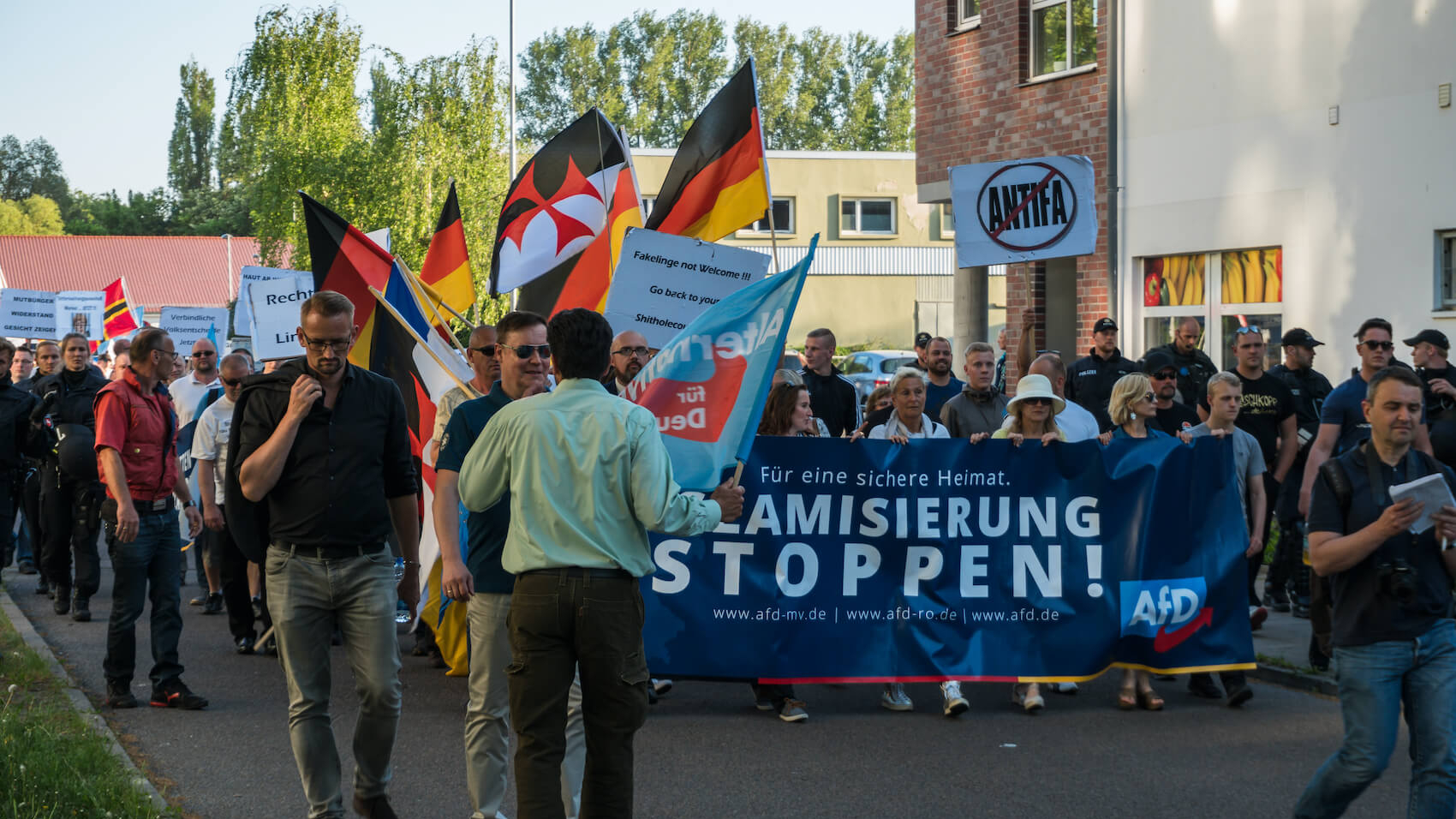
AfD demo with slogan Stop Islamization and counter demonstration of the Left in Luetten Klein in Rostock, Germany on May 14, 2018. AfD, Alternative for Germany, is a right wing political party in Germany. Photo: Shutterstock.

Enemies Inside: European Populism and Dimensions of Euroscepticism

DOWNLOAD PDF

Please cite as:

Tostes, Ana Paula. (2024). “Enemies Inside: European Populism and Dimensions of Euroscepticism.” Populism & Politics (P&P). European Center for Populism Studies (ECPS). December 5, 2024. Doi: https://doi.org/10.55271/pp0043b


Abstract

The article seeks to investigate the EU crises impacting electoral support for new right-wing and left-wing extremist ideologies with populist characteristics. We examine populist political parties’ performances in national elections in 15 Western European countries to understand better the current state of specific and diffuse Euroscepticism (Kopecky & Mudde, 2002). Finally, we confirm that Euroscepticism increases in periods of crisis and can be identified as expressions of those contesting EU policies related to the economy, specifically, or social and political integration when it encompasses a more generalized attitude against the EU.

Keywords: populism, Euroscepticism, EU crises

(Received June 6, 2024, Published December 5, 2024.) 


By Ana Paula Tostes*

Introduction

Despite the ambiguities of the concept of populism (Judis, 2016; Müller, 2016; Kaltwasser, 2012), in this article, we discuss its emergence in the context of the EU integration process, reflected in the increase in Euroscepticism. Popular support for EU institutions and policies has been the primary measure of the legitimacy of the authority of the European institutions, as it provides greater transparency on the coherence between the expectations and perceptions of European citizens and EU governance (Cmakalová & Rolenc, 2012). Public opinion and voter preference for pro-European political parties have been considered relevant in the conditions under which direct elections are held only for the European Parliament, and supranational institutions have been created without public participation and sufficient understanding of the European public.

For this study, we used the national electoral results of extremist political parties from the time the new European far-right ideology emerged in the late 1980s to 2023. We examined the electoral platforms, political strategies, and electoral support of populist political parties in 15 Western European countries to understand better the current state of Euroscepticism in the region and extremist far-right and far-left political parties.

There is a significant amount of literature about the impact of regional integration on European societies, domestic politics, and party systems. Scholars have engaged in lengthy debates on its impact levels, limits and importance (e.g. Kitschelt, 1992; Gabel, 2000; Mair, 2005, 2007; Poguntke & Scarrow, 1996). Taggart (1998) and Marks et al. (2002, 2006) examined voter preferences in national elections based on the level of support for regional integration. They found that national political parties’ position on the regional integration process in Europe is an important variable in explaining voter preferences. Marks et al. (2002, 2006) rated European electors’ ideological and party positions according to the level of support for integration in the economic, political and social spheres. Issues related to identity, sovereignty, security, etc. – that is, “non-material” elements in ideological positions on both the right and the left – proved to be variables that influence the preferences of European voters.

Since the early single market consolidation until the euro crisis in 2008-2009, views that strongly oppose economic integration, such as the ones voiced by far-left political parties, have not received much support from voters. Criticisms of the liberal model for a single market have not been enough to convince citizens that the integration process could cause actual harm, especially those who are distant from it and do not feel that it threatens economic losses. On the contrary, throughout the 1990s, the countries affected the most by the 2008 financial crisis benefitted from the European Structural Funds resource transfers. The situation was similar during the COVID-19 pandemic, which resulted in an unprecedented economic contraction in 2020. In both cases, the EU transfer of benefits and funds was fast, forceful and well-coordinated at all levels.

The same cannot be said about the opponents of social and political integration, the same groups in European societies that see the migration crisis as a critical element causing intolerance and populism to grow in the region. Since the European migration crisis began in 2015, there has been a considerable increase in the politicization of the defence of national identity and culture due to the stances of new far-right political parties.

We have researched public documents and sources and political party manifestos to classify populist political parties by country and, according to Marks et al. (2002, 2006), scale for the consideration of ideological positions impacting the support for integration in the economic sphere and the political and social spheres. Then, we collected the number of votes each party received in each national (Parliamentary) election in the 15 Western European countries to apply the dimensions of Euroscepticism (Kopecky & Mudde, 2002).[1]

EU Contestation and Populism

No crisis in the history of the European Union (EU) compares to the massive wave of migration to Europe, which reached its highest point in 2015 and has not yet come to an end. The EU is a complex and long-term construction, which would only be possible to build continuously or without route changes. There have been essential crises in recent decades, including the Maastricht crisis in the 1990s, the attempt to approve the Constitutional Treaty in 2005 and the series of crises triggered by the economic and financial collapse that affected all the countries in the eurozone in 2009. The EU’s crises have been the object of research and theories to explain different features, contexts, and impacts on the legitimacy and stability of its institutional structure and policies (Brack & Gürkan, 2020). However, a common consequence of the economic and migration crises was the growth of political radicalism and EU contestation. Over the last two decades, the resurgence of terrorism and political radicalism has contributed to the emergence of a socio-political scenario that has become a new normal for Europe: one fraught with assuming populisms and nationalisms that have chosen the EU as a target of criticism.

This article does not ignore a broader, global wave of conservatism that uses populist political platforms, affecting political environments across the Americas, from the United States to Argentina, Brazil and other Latin American countries. However, in the case of the EU, which represents the most critical and successful regional organization and is mentioned as a model for other regions such as South America, it is important to understand under which political circumstances greater integration among states generates opposition. In other words, when does support for regional institutions and norms turn into criticism and skepticism?

Populism found fertile ground to develop during the two major recent crises in the EU: when the euro crises shook the eurozone’s member states (2008-2009) and during the peak in European immigration levels (2015). Although this new acceptance and recognition of criticisms of the excesses of EU institutionalization and the distance between it and national civil society sectors had different effects on different groups, EU contestation was a common strategy for many of them. Criticisms about accountability and participation in building European architecture have always existed. Still, the “nudges” (Sunstein, 2020) are not capable of generating a new set of critical positions articulated around a narrative that accuses elites and representative models of usurping nativist and identity preferences. We now know, especially after the Brexit experience, that criticism of the EU is stronger among portions of the UK population that do not feel that they benefit from globalization or integration, not even the way they facilitate the circulation of people, goods, services and capital within the European Single Market region.[2] Disapproval of the representative model, which extends to the EU, has come mainly from those who possibly (or apparently) perceive themselves as having been harmed by European regional integration or not benefitting from it, even if their dissatisfaction with political, social or economic issues are not related to regional integration itself.

Marks, Wilson, and Ray (2002) examined voter preferences in national elections and the relations, if any, to regional integration. The authors rated voters’ ideological and party positions according to their level of support for European integration in the economic, political and social spheres. Themes related to identity, sovereignty, security, etc. – that is, “non-material” issues found in ideological positions on both the right and the left – proved to be variables that influence the preferences of European voters. Based on their categorization of political parties’ party family by ideology (Mair & Mudde, 1998; Marks et al., 2002), we expect that economic crises are more likely to affect voters with critical views from the left and alternative side of the ideological spectrum, while those related to immigration affect more conservative and nationalist voters, whose ideological preferences are similar to those of the new extreme right-wing political parties.

 In both cases, parties at the opposite ends of the political spectrum promise immediate and easy solutions to complex problems, which they frame in similar, comparable scenarios while evoking “fears,” “frustrations,” “anger,” or “resentments” (Müller, 2016, p. 12). Although populism is on the rise in different social and political contexts around the world, this article discusses a possible correlation between critical events associated with EU politics and policies and the increase in votes for populist electoral platforms fueled by social groups related to the new political cleavages identified with the extreme left and the extreme right (Marks et al., 2002; Kurt, 2013). When we look at national electoral results, we find that political and social turmoil is conducive to the success of populist strategies in EU member states’ national elections.

For this article, we used data from the 15 Western European member states (EU15) on electoral support for extremist political parties over nearly 40 years. These countries allow us to consider similarities in their political party ideologies and systems, as the period of the research enables us to identify changes in support for extremist political parties in national elections, as it goes from the time the new European far-right parties emerged in the 1980s (Ignazi, 1996) in the EU15 to recent days.[3] We do not consider their success in obtaining seats in national parliaments, but rather the votes they obtained to indicate voter support for the extremists’ platforms.

Theoretical and Conceptual Framework

The EU represents the status quo for liberal democracy, and it claims to be the promoter of the rule of law and Western values, both within the region of integration and outside it, through its international relations policies and strategies. Anti-establishment voters who fuel criticisms of representative institutions in national elections ground their positions on the regional model of EU institutionalization based on representation without any mechanisms for direct participation. The European Parliament is the only directly elected EU institution, and the European Parliament elections are seen as “second-order” (Reif & Schmitt, 1980; Reif & Norris, 1997) and less important than national ones. To support our argument, we revisited the literature on populism to find signs of populist political strategies in national elections that feed on dissatisfaction with supranational governance and regional integration.

Euroscepticism and Populisms

Euroscepticism has become a “catch-all term” (Bertoncini & Koenig, 2014) broadly used by society and the media, but also by the academic world that seeks to classify and conceptualize it to clarify positions on and the dimensions of skepticism towards Europe and its model of economic and political integration. As a result, there is a point where Euroscepticism and populism overlap. The latter is an older concept with several historical and methodological variations but no single unambiguous definition. Thus, in recognition of the conceptual difficulties related to the term “populism”, it is necessary to clarify how the term will be used and the limits of its use in this article. While we do not consider Euroscepticism a subcategory of populism, Eurosceptic parties have used populist strategies in their campaigns and accused Brussels of many economic problems and the migration crisis.

Although there is no single definition of populism, two common affirmations in the literature are that the term is generally used to discredit political opponents associated with an elite that has expropriated the power of the people and that the populist leader appears as an alternative for reclaiming legitimacy and the authority to represent the “popular will” (e.g., Taggart, 2000, 2002; Laclau, 2005; Mudde, 2007, 2016, 2017; Stanley, 2008; Müller, 2016).

Political scientists use the term “populism” to refer to the call for the “people” to assume their place as historical actors. The social sciences field originally coined the term “populism” in the Weberian sense of “charismatic” leadership: in other words, a populist is a leader who seeks to have his actions legitimized directly by the people and replace institutions. Even so, new populism aims to use public consultations strategically to restore democratic legitimacy. A common conclusion in the literature is that populists attract voters who are “frustrated” with traditional politics and “angry” with or “resentful” towards elites that allegedly did not heed their demands (Müller, 2016). This helps to understand why populists demand public consultations to evade institutional control. This is not a novelty in the contemporary world, as Max Weber had already identified back in the 19th century in England (in “Politics as a Vocation”, published in 1919 in Germany) the practice of “charismatic leaders” holding direct consultations with the people. These leaders use plebiscitary democracy and direct dialogue with the masses, without the intermediation of institutions, to seek legitimacy to bypass procedures and representative institutions. Therefore, the most significant danger of contemporary populism is that it adopts democratic procedures and values to denounce the illegitimacy of democracy. They promise to rescue the people’s “will” while opposing an “elite”.

The “real” power of the people will not, however, be “democratically rescued” by promises of ongoing political participation nor by an “open-ended process of deliberation among actual citizens to generate a range of well-considered popular judgments” (Müller, 2016, p. 29). Populists use referendums to ratify what populist leaders have already chosen as the real issue for people to approve or disapprove to regain their lost identity (Müller, 2016). Popular participation is to substitute the action of representative institutions. It should be noted, however, that populism is not necessarily a prerogative of populist leaders or parties but rather a strategy that mainstream political groups can adopt. For instance, David Cameron’s promise to hold the British referendum on Brexit during the 2014 campaign to guarantee his victory in 2015 has been classified as a populist act committed by a non-populist leader.

Another example is the referendum held on July 5, 2015, in Greece, in which the “no” to the European bailout plan won. Prime Minister Alexis Tsipras, leader of Syriza, promoted the referendum while he continued to negotiate austerity packages for Greece. Tsipras opposed leaving the EU but allowed the referendum, as he did not believe the popular consultation would produce the outcomes it did. The people of Greece did not realize that the agreements on the rescue plan were already on the negotiating table with the Troika and that the alternative to austerity measures was the Grexit. Those who voted against the measures did not necessarily support the idea of Greece withdrawing from the EU. This is a clear case, then, where the oversimplification of an issue during a referendum can produce results that go against the people’s will and threaten the future of the EU. In any case, the strategic use of plebiscitary democracy in the EU to gain popularity and power is a topic of research that warrants further study.

Finally, populism is based on the promise of salvaging morality. The moralization of political discourse and the idea of recovering dignity lost or threatened by corrupt or mistaken politicians justify replacing institutions and procedures with calls for the people to make general decisions on often complex and multifaceted problems. Müller (2016) describes well the difference between “participation” and “the use of referendums” to approve predetermined ideas that do not always reflect the complexity of the solution to a political problem.

A Perfect Match: The EU’s Institutional Complexity and Populist Strategies

The EU is one of the most vital innovations in international relations in the 20th century, mainly due to its institutional network and the regionalization of domestic policies. The creation of the EU intensified diplomatic ties in the region and increased intergovernmental cooperation on national policy issues such as justice and security. It also established a supranational legal framework and regional governance. However, this institutional development was not accompanied by a proportional increase in the different societies’ understanding and information about the European model of integration’s impacts on the social and political life of the citizens of EU member states.

Created only in the 1990s, nearly four decades after the first steps towards regional integration were taken, European citizenship was to contribute to the consolidation of social integration. The existence of European citizenship was to generate a compelling connection between individuals and supranational institutions, such as European Community Law, which organizes not only relations between member states but also between the EU, its institutions and individuals. All this institutional construction was, however, the result of diplomatic action between national governments without the direct participation of the European public. Public consultations were rare, and significant reforms and regional policy innovations were carried out without efforts to raise public awareness about the impacts they would have on national societies.[4] Intergovernmental and diplomatic negotiations used the instruments of representation and indirect democracy to their fullest. This partly explains why mistrust and rejection of European policy grows as EU institutions become more consolidated and visible to citizens.

Ignazi (1996; 2003) and Kitschelt (1994, 1995) associate the force of the new extreme right in Europe with the significant changes in the political spectrum in the region. These authors consider the new European far-right parties a by-product of post-industrial societies and thus classify them as “anti-system parties”. Stefano Bartolini (2007) highlights another critical event in the development of post-industrial European societies. The author sustained that no other issue in “post-war electoral history” has had the same broad and standardizing effects across the European party system as the regional integration process has.

In this integration scenario, when immigration started to increase considerably, we witnessed anti-immigration policies become one of the main points on the platform of new far-right populist parties in the region when they reformulated the focus of their arguments and criticism of democratic institutions. At a lower level, anti-immigration attitudes have emerged since the signing and implementation of the Schengen Agreement in 1985, which generated the slow (but consistent) growth of this new far-right ideology throughout the 1990s. Between 1989 and 1999, in response to the occupancy of seats in the EP by representatives of the far-right, racism and xenophobia began to be monitored regularly in the region, which led to the publication of the first report on the issue in June 1999.[5] It was clear, then, that European citizens’ coexistence with different cultures and nationalities generated social integration and defensive and xenophobic reactions. Around that time, the National Front, the most consolidated political party of the new far-right in Europe, founded in 1972 by Jean-Marie Le Pen (father of Marine Le Pen, president of the party since 2011), began to win seats in the French parliament in 1986. Jean-Marie Le Pen was elected to the European Parliament for the first time in 1984 and has not lost electoral support to represent French extremists in the EU since then.[6]

There is a wealth of theoretical works and empirical studies that establish definitions for and characterize a new right-wing ideology that emerged in Europe in the 1980s and its refinement and organization into parties in the 1990s (e.g., Ignazi, 1996; 2003; Kitschelt, 1988; 1994; 1995; Mudde, 2007, 2016, 2017; Taggart, 1996, 1998). While regional integration has undeniably impacted domestic politics, societies and party systems in Europe, there are different views. Scholars eventually reached a consensus that national political parties’ position on regional integration is essential in explaining voter preferences (Taggart, 1998; Marks et al., 2002; 2006).

The literature identifies a “new political cleavage” from industrial capitalism’s transformation into post-industrial capitalism (Betz, 1994; Ignazi, 1996; Marks et al., 2002). As this cleavage resulted from positions critical of globalization and the liberal model of representative democracy, the region of European integration became fertile ground for new ideas on identity and demands related to the expropriation of sovereignty by “an elite” or threats to local and national culture. Common populist rhetorical strategies seek to incorporate these ideas in their justification for alternatives to liberal democracy based on representation and the rule of law.

In the early 2000s, Marks, Wilson, and Ray (2002) used the cleavage theory (Lipset & Rokkan, 1967) to create a new definition of transnational cleavage. Later, transnational cleavage was accepted by the literature related to the rise of the supranational governance of the EU and the benefits and criticisms of the high level of regional institutionalization (Hooghe & Marks, 2018). They argue that contestation on European integration can structure political competition focusing on two faces of the EU: political (and social) integration and economic (liberal) integration. The result is that on the far-left, Euroscepticism appears stronger concerning measures of economic integration (the far-left is firmly against economic integration and moderately against political integration). Euroscepticism appears diffusely on the far-right (or the “new” far-right, as the authors described). In other words, no support is expected at all for the EU policies from the new far-right.

Kopecky and Mudde (2002) identified two categories of European scepticism that complement the classification of the European political parties described above: diffuse Euroscepticism and specific Euroscepticism. Looking at national elections in Europe in recent decades, we see that the difference between the two sides of Euroscepticism is reproduced in the Eurosceptic ideological positions defended by the left and the right. Diffuse Euroscepticism refers to a “support for general ideas of European integration that underlie the EU” (Kopecky & Mudde, 2002, p. 300), which is more present in the ideas and platforms of the far-right parties. In contrast, in the case of the far-left, we found more specific criticisms of the EU by denoting support for reforming more general practices or rules. The critics are about “the EU as it is and as it is developing” (Kopecky & Mudde, 2002, p. 300). In other words, they can demand reforming the EU politics but not eliminate it (specific Euroscepticism).

Analysis & Discussion

Analyzing the national elections of the 15 Western European countries that were part of the EU before 2004—known as the EU-15—provides a clearer understanding of the changes in European voters’ positions regarding extremist and populist political parties and potential future changes in voter preferences. The exclusion of Eastern European countries in this article is justified by the need for different approaches for East and West countries.

We classified extremist political parties according to the party family typology proposed by Marks et al. (2002) and the identification of a new transnational cleavage in the EU region (Hooghe & Marks, 2015). However, in the case of the far-left, we excluded traditional communist parties aligned with a clear ideology advocating changes in the economic model as they are not necessarily populist. We are interested here in the emergence of a new far-left populism.

Selection Criteria and the Lists of Political Parties

During the time frame chosen for this study, political parties emerged, while others disappeared, and some changed their names. Tables 1 and 2 below list all extremist parties that received more than 1% of votes in elections between the late 1980s and 2023 by country. We did not describe the history of each political party in detail, which would require a large amount of space.[7] The selection criteria were based on two sources of classification: i) recognition of the party as far-right or far-left and as having populist characteristics in the literature, and ii) examination of political party manifestos (when available in the Manifesto Project’s data[8] or on the political parties’ official websites).

There are cases of what Ignazi (1996; 2003) refers to as the “renewal of political parties”. This is when, without changing their name, a few political parties became more radical and started to designate themselves as the new (and no longer traditional) extreme right, as was the case of the Portuguese National Renewal Party (NRP). From 2009 onwards, the NRP started to assume more populist characteristics and changed its political orientation, describing itself as a “new right-wing”. The same thing happened on the far-left, although in fewer cases. Here, we consider political parties far-left based on their adoption of rhetoric and themes such as anti-elitism, opposition to the establishment and other signs of anti-systemic stances. Some are openly nationalist, anti-immigrant, sovereigntist (radical), and in favor of the country leaving the European Union, while others identify as Eurosceptic and anti-EU.

Table 1- List of far-left parties

Country Political parties* Lifetime (first year they received votes/or the few years in which the party received votes)*
Austria N/A N/A
Belgium N/A N/A
Denmark N/A N/A
Finland N/A N/A
France La France Insoumise (FLI/FI)Left Front since 2017since 2012
Germany Die Linke since 2009
Greece SYRIZA since 2004
Ireland United Left Alliance (more traditional left) since 2011
Italy M5SPRCProletarian Democracy since 20131992-20061983, 1987
Luxembourg N/A N/A
Netherlands N/A N/A
Portugal B.E. since 1999
Spain PodemosUnidos Podemos (electoral alliance of left-wing parties) 2015since 2016
Sweden N/A N/A
United Kingdom N/A N/A

* Only political parties that received more than 1% of the votes are listed, and the table only contains the years within the article’s time frame.

Source: Dataset created by the author based on MANIFESTO PROJECT. MARPOR (Manifesto Research On Political Representation. WZB. 2024: https://manifesto-project.wzb.eu/ and public election data from: http://www.electionguide.org/https://www.electoralgeography.com/new/en/elections.

Table 2- List of far-right parties

Country Political parties* Life time (first year receiving votes/or the few years in which they received votes)*
Austria FPÖBZÖ since 1979since 2006
Belgium VB (Vlaams Blok/Vlaams Belang)LDD (Lijst Dedecker)PPNational Front  since 19812007, 2010since 20101991-2007
Denmark Z (Fremskridtspartiet)DFP  since 1981-1998since 1998
Finland Finnish Rural party (joined to Finns Party)True Finns/ Finns Party 1979-1995 since 1999
France National Front  since 1986
Germany REPNPDAfD 1990, 1994, 1998since 2005since 2013
Greece LAOS  since 2004 
Ireland N/A N/A
Italy LN (LN/MA, 2006)FT  since 19921996, 2008
Luxembourg ADRNM since 19891989-2004
Netherlands LNLVFPVVCD 20022002-2003since 20061994
Portugal N/A N/A
Spain N/A N/A
Sweden SDND  since 20021991-1994
United Kingdom UKIP since 2001 

* Only political parties that received more than 1% of the votes are listed, and the table only contains the years within the article’s time frame.

Source: Dataset created by the author based on MANIFESTO PROJECT. MARPOR (Manifesto Research On Political Representation. WZB. 2024: https://manifesto-project.wzb.eu/ and public election data from: http://www.electionguide.org/https://www.electoralgeography.com/new/en/elections.

Populist Characteristics and Their Impact on Support for the EU

As well summarized by Carlos de la Torre (2019), right- or left-wing populists share the same anti-institutional political logic, which is “based on the construction of a political frontier” (de la Torre, 2019, p. 66) between people and institutions. Despite their different narratives on who “the people” are, both right-wing and left-wing populist leaders and political parties use “similar politicizations of grievances and emotions” and they “aim to rupture exclusionary institutional systems to give power back to the people” (de la Torre, 2019, p. 68). The difference is in how they define “the people.”

“Right-wing populists use essentialist criteria of ethnicity to exclude minority populations. The people as constructed by Donald Trump, for example, face ethnic and religious enemies such as Mexicans, Muslims, or militant African American activists (de la Torre, 2017). Similarly, rightwing European populists defend the ordinary people against those below, such as immigrants, refugees, and former colonial subjects, and the privileged cosmopolitan New Class above. An alternative conceptualization of the people is primarily political and socioeconomic. Left-wing populists construct the category of the people as the majorities of their nations that were excluded by neoliberal policies imposed by supranational organizations like the IMF or the Troika. Hugo Chávez, Rafael Correa, Pablo Iglesias, and Alex Tsipras face the oligarchy.” (de la Torre, 2019, 67

We then calculated the votes cast for all political parties classified as far-right and far-left in national elections over the last 40 years.[9] Populist parties on the far-right were selected based on criteria used in the literature on this subject (Mudde, 2007, 2016, 2017; Ignazi, 2003; Marks et al., 2002; Poguntke & Scarrow, 1996), especially the terms they use in their political platforms. In some cases, the parties openly label themselves as the “new far-right”. For other parties that were not as forthcoming, we analyzed their history and platforms first to determine what the “new” and “old style” of far-right is (such as Nazi and antisemitic political parties, although the latter were not included in our analyses) and we classified them accordingly. Far-left populist parties were selected based on their demagoguery and their promises of simplistic solutions to complex problems and crises, often accusing neoliberal policies and the EU market of being responsible for the social and economic ills of member countries.

The election results were selected for far-left parties (FLPs) and far-right parties (FRPs) for approximately 40 years –from the first elections held in the early 1980s in the EU-15 until recent elections. After collecting data, to illustrate our findings and give a broader overview of the impact of crises on the shift in behavior in the countries studied, we divided the countries into two groups to identify the growth of votes on populist political parties from the left and the right: i) the countries affected the most by the 2008-2009 economic crisis (Greece, Italy, Portugal, Spain, and Ireland), and ii) the countries less affected by the 2008-2009 economic crisis (Austria, Belgium, Denmark, Finland, France, Germany, Luxembourg, the Netherlands, Sweden and United Kingdom).

The international crisis had the most significant impact on the eurozone countries between 2009 and 2013. Table 3 includes countries with four years of negative growth, measured by GDP (Gross Domestic Product), between 2009 and 2013, plus Ireland. Ireland was an exception in this group because it suffered from the effects of the economic crisis earlier, experiencing negative growth as early as 2008 (as did Italy). It had the highest negative growth rate (-7.8% in 2009).

Table 3- Growth of populist votes in countries affected the most by the 2008-2009 economic crisis

   Votes for FLPs Votes for FRPs 
GreeceTend to a more specificEuroscepticism growth in period of the economic crisis  growth in period of migration crisis
ItalyTend to a more diffuseEuroscepticism growth in period of the economic crisisgrowth in period of migration crisis(syncretic with economic platform)  growth in period of the economic crisisgrowth in period of migration crisis 
IrelandTend not to present Euroscepticism    
PortugalTend to a more specificEuroscepticism growth in period of the economic crisis  growth in period of migration crisis
SpainTend to a more diffuseEuroscepticism growth in period of migration crisis growth in period of migration crisis

Source: Dataset created by the author based on public election data (http://www.electionguide.org/https://www.electoralgeography.com/new/en/elections)

From the election results of the group of countries in Table 3, we conclude that once the euro crisis erupted in the region in 2008-2009, voters who supported left-wing ideology became more critical of EU austerity policies and rules (specificEuroscepticism). However, as the economy returned to a certain degree of normality and the migration crises emerged as a new source of regional instability, left-wing populist parties began to lose strength in most EU 15 countries, and far-right populism gained ground.

In cases such as in Portugal and Greece, it is essential to say that once far-left party leaders had been elected to government or stabilized themselves in coalitions to govern, they changed their strategies. Previously considered populist leaders, they lost space in their political parties or abandoned old narratives that accused the EU of all their ills and started to defend responsible policies as soon as they arrived in government. A new scenario followed the euro crisis in these two countries. The political parties of the Bloco de Esquerda (Left Bloc) in Portugal could no longer be classified as populist since they gained the government coalition. The old populist narratives in economic promises have been replaced by a responsible government that maintained leadership in the country until recently. A similar situation was seen in Greece when the split in Syriza generated by the rupture between Prime Minister Alexis Tsipras and Yanis Varoufakis, the minister of finance, occurred during the peak of the sovereignty crisis and the impasses in the negotiations with the Troika.[10] The result can be interpreted by what Judis (2016) has developed very well and de la Torre (2019) has considered as a de-radicalization of Syriza since 2015 and Podemos since 2018.

Ireland was the only country from Table 3 whose results showed no Euroscepticism in political parties’ positioning (considering the selection criteria of the political parties and level of public support). Until a few years ago, many questioned why Ireland seemed immune to the influence of populism. The country has far-right parties, such as the National Party, but they exist on the margins and have never won seats in the Irish Parliament. As for the new migration crisis, there was a kind of cooperation and an attitude of shared responsibility by the political elites and society. There is a general feeling of national pride and solidarity with refugees in the Irish public opinion.

More recently, Russia’s invasion of Ukraine generated an influx of Ukrainian refugees and asylum seekers to Ireland. While many welcomed them, an increase in anti-immigrant protesters in the country has been reported. Far-right populists saw this as an opportunity to spread feelings of rejection towards refugees and to be more critical of European and national governments due to a devastating housing crisis in the country.

Italy and Spain were cases of diffuse Euroscepticism that appeared among countries in Table 3. Left-wing populism in Spain (as in Greece and Portugal) found space in the government coalition in 2016, becoming less radical and less populist. Although Italy was significantly impacted by the immigration crisis, even before 2015, we highlight that far-right ideology in the country has already existed since the 1980s. It is also important to emphasize that Italy was the only case in which we saw the emergence of a populism already associated with the left (as shown in the table). Still, it is better associated with a syncretic position, as the more alternative and anarchist Italians self-designated themselves. A syncretic populist spectrum grew significantly during the euro crisis, behaving as a good example for the Green/alternative/libertarian (GAL) spectrum of the new political alignments addressed by Hooghe, Marks, and Wilson (2002). Here, we emphasize that we consider the votes for the Five Star Movement (M5S) not aligned with a left/right dimension of political ideology. Exceptionally, in our research, the movement professed the desire to “stay to change the Union from within” with a populist and economic platform, as the defence of a referendum on the euro in Italy (Zotto, 2017), but with a more GAL political dimension designed by the M5S’ leaders as a “syncretic” position.

We investigate the influence of a second dimension, a new political dimension that we conceive as ranging from Green/alternative/libertarian (GAL) to traditional/authoritarian/nationalist (TAN). We find that this dimension is the most general and powerful predictor of party positioning on the issues that arise from European integration.

As explained above, the countries in Table 4 are selected as those that were (comparably in the EU15 region) least affected by the euro crisis, having presented less than four years of growth, measured by negative GDP, between 2009 and 2013. Also, the countries in Table 4 appeared to have been more impacted by the migration crisis, which reached its highest point in 2015, than the economic one. In this case, the far-right ideology legitimated intolerant attitudes and xenophobia in the face of the humanitarian catastrophe that Europe was in the middle of.

Table 4 – Growth of populist votes in countries less affected by the 2008-2009 economic crisis

  Votes for FLPs Votes for FRPs 
AustriaTend to a more diffuseEuroscepticism growth in period of migration crisis growth in period of the economic crisisgrowth in period of migration crisis
BelgiumTend to a more diffuseEuroscepticism    growth in period of the economic crisis 
DenmarkTend to a more diffuseEuroscepticism growth in period of the economic crisis growth in period of migration crisis 
FinlandTend to a more diffuseEuroscepticism   growth in period of the economic crisisgrowth in period of migration crisis
FranceTend to a more diffuseEuroscepticism growth in period of the economic crisisgrowth in period of migration crisis growth in period of the economic crisisgrowth in period of migration crisis
GermanyTend to a more diffuseEuroscepticism growth in period of the economic crisis growth in period of the economic crisisgrowth in period of migration crisis 
LuxembourgTend to a more diffuseEuroscepticism    growth in period of the economic crisisgrowth in period of migration crisis
NetherlandsTend to a more diffuseEuroscepticism    growth in period of the economic crisisgrowth in period of migration crisis
United KingdomTend to a more diffuseEuroscepticism   growth in period of migration crisis 
SwedenTend to a more diffuseEuroscepticism   growth in period of migration crisis

Source: Dataset created by the author based on public election data (http://www.electionguide.org/https://www.electoralgeography.com/new/en/elections)

Most of the countries, as expected, presented a trend to increase vote preference for FRPs during the immigration crises. They tend to have a more diffuse Euroscepticism.[11] Also, Although Belgium presented no growth of votes for FLPs during the period of the euro crisis, we saw an increase of FRPs in the two moments of crises considered in this article. Austria appeared as an outsider. The Austrians presented a new trend to vote for the populist far-left during the immigration crisis. However, there has been a decrease in radical votes since the legislative election of 2019, when the Free Party of Austria (populist far-right) lost 20 seats in the Parliament.

The UK results show a clear relationship between populists of the far-right and the referendum that resulted in Brexit, followed by a quick decrease in support after the June 2016 event. Interestingly, the strength of populism in the country was evident in public manifestation, and the use of the media to promote an oversimplified view of the social problem raised by the rise in immigration in the country was not reflected in elections for the British Parliament. Even so, the case of the Brexit referendum is the clearest example of the influence of populism on electoral behavior and its consequences. The post-referendum shifts in public opinion from criticism to support for the EU revealed an apparent lack of understanding of the brutal consequences of Brexit for the British.[12]

Finally, when we look at the impact of migration crises on voter behavior, tables 3 and 4 illustrate that populism explains the growth of the far-right more than the economic crisis does. By separating the countries into ones affected the most and ones affected the least by the financial crisis (tables 3 and 4), we found that although the far-left grew more significantly in countries that suffered the most from the economic crisis, in most cases, left-wing radicalism tended to lose ground after the crises. While the rise of the far-right is prevalent during crises in general, the increase in votes for far-right parties occurred in 13 of the 15 countries analyzed during the migration crisis. Support for the far-left, however, increased during the migration crisis in Austria, France and Italy only.

Concluding Remarks

The article aims to investigate if and to what extent two decisive crises in the region affected support for political parties with Eurosceptic characteristics, which are more commonly aligned with extremist right or left-wing populist positions. The article sought to identify patterns in the growth of far-right and far-left populist parties to confirm the general perception that Euroscepticism and populism benefit from regional crises. We thus aimed to further the discussion on the risk of crises in the EU contributing to the increase in Euroscepticism and the tendency to vote for political parties that can weaken the European model based on the principles of liberal democracy, representation and the rule of law. The best predictor of the growth of Euroscepticism is migration issues. Our findings revealed the growing resistance in EU societies to the increasing number of immigrants in the region.

Also, in general, the results of this study show that populist agendas (both from the left or the right) found fertile ground in environments where support for democratic measures based on liberal institutions and representation was on the decline, “revealing hidden preferences that might have existed all along, but individuals were discouraged from making them public” (Brescia, 2019). We have seen a decline in the approval of EU institutions and norms and the emergence of intense hostility towards representative politics in countries during the period when populism was on the rise. However, to understand variations in the performances of populist political parties radically opposed to the EU, we analyzed them in the context of the two most significant crises challenging EU policies and politics in the last 40 years. Each country’s electoral findings in this article deserve a more in-depth analysis that could be better explored and developed in future works.

EU crises are seen as events that impact the behavior of European voters, and we assume that the growth of populism is harmful to democracy, even when populist parties and leaders are not elected (Müller, 2016). This is because the ability to spread ideas that discredit politics and representation as a norm of democracy has been dramatically strengthened by digital media, enabling populists to coordinate and promote these ideas transnationally, often linking them to conspiracy theories and denialism. In this context, the EU bureaucracy and its complex governance model are a clear target of populists. The EU adds supranational and intergovernmental institutional constraints to national ones (Müller, 2016, p. 95) and becomes an easy ‘punching bag’ for populist rhetoric.

We conclude that in a wave of growth of support for far-left parties in Western Europe, there are now signs of a bonanza for specific Euroscepticism (Kopecky & Mudde, 2002), which is more centered on criticisms of typical changes and reforms in the EU’s economic model of integration and more specific EU politics affecting the far-left political platforms. However, Diffuse Euroscepticism (Kopecky & Mudde, 2002), which is associated with a general contestation of the EU, involves its representative model of integration with supranational institutions and policy coordination. This side of Euroscepticism seems to be more closely associated with far-right populist narratives that are very much alive in the region.


(*) Dr. Ana Paula Tostes is Jean Monnet Chair at the Rio de Janeiro State University (UERJ), Brazil. Professor at the Graduate Program in Political Science at the Institute of Social and Political Studies (IESP/UERJ) and the Department of International Relations (DRI/UERJ). She is a Senior Fellow at the Brazilian Center of International Relations (CEBRI) and was a visiting researcher at the Free University of Berlin (FUB). She holds a PhD in Political Science (IUPERJ/IESP) and a Postdoc at the University of São Paulo (USP). She was a visiting researcher (2016-2017) at the Free University of Berlin (FUB) and an associate professor at Michigan State University (MSU). Currently, she is the coordinator of the Project for International Cooperation (PROBRAL CAPES/DAAD, 2023-2026) between IESP/UERJ and the German Institute of Global and Area Studies (GIGA), Hamburg, Germany. Results of research supported by the European Union (JMC Project EUgac n. 101127443), Productivity Scholarships from FAPERJ (Prociência/UERJ) and CNPq (n. 316785/2021-0).


References

Benfield, Jack. (2012). Populism in Europe: Sweden. Open Society Foundations. February 2012. https://www.opensocietyfoundations.org/publications/populism-europe-sweden (accessed on September 27, 2024).

Bertoncini, Yves & Koenig, Nicole. (2014). “Euroscepticism or Europhobia: Voice vs. Exit?” Jacques Delors Institut Berlin Policy Paper 121, 27 Nov. 2014. http://www.institutdelors.eu/media/euroscepticismoreurophobia-bertoncini-koenig-ne-jdi-nov14.pdf?pdf=ok (accessed on September 25, 2024).

Betz, Hans-Georg. (1994). Radical Right-Wing Populism in Western Europe. New York, St. Martin’s Press.

Borzel, Tanja & Risse, Thomas (2009). “Conceptualizing the Domestic Impact of Europe”. In: Featherstone, Keith & Radaelli, Claudio (eds.) The Politics of Europeanization. Oxford: Oxford University Press.

Brack, Nathalie & Gürkan, Seda. (2020) Theorising the Crises of the European Seda. New York: Routledge.

Brescia, Raymond H. (2019-2020). “On Tipping Points and Nudges: Review of Cass Sunstein’s How Change Happens”. Notre Dame Journal of Law, Ethics and Public Policy, vol. 55, n. 3. https://papers.ssrn.com/sol3/papers.cfm?abstract_id=3389471 (accessed September 24, 2024).

Cmakalová, K. & Rolenc, Jan Martin. 2012. “Actorness and legitimacy of the European Union”. Cooperation and Conflict, vol. 47, n.2, pp.260-210 doi:10.1177/0010836712443176

De la Torre, Carlos (2019). “Is left populism the radical democratic answer?” Irish Journal of Sociology, vol. 27, n. 1, pp. 64–71 https://journals.sagepub.com/doi/pdf/10.1177/0791603519827225 (accessed September 25, 2024).

Gabel, M. J. (2000). “European Integration, Voters, and National Politics.” West European Politics. vol. 23, n. 4, pp. 52–72. doi.org/10.1080/01402380008425400

Hooghe, Liesbet; Marks, Gary; Wilson, Carole J. (2002). “Does Left/Right structure party positions on European Integration?” Comparative Political Studies. vol. 35, no 8, pp. 965-989. doi:10.1017/CBO9780511492013.008

Ignazi, Piero. (1996). “The Intellectual Basis of Right-Wing Anti-Partytism”. European Journal of Political Research, vol. 29, no 3, pp. 279–296. doi.org/10.1111/j.1475-6765.1996.tb00653.x

_____. (2003), Extreme Right Parties in Western Europe. Oxford: Oxford University Press.

_____. (1992), “The silent counter‐revolution: Hypotheses on the emergence of extreme right‐wing parties in Europe”. European Journal of Political Research vol. 22, n.1. pp. 3- 34.

Judis, John B. (2016). The Populist Explosion. How the Great Recession Transformed American and European Politics. Columbia Global Reports: New York.

Kaltwasser, C. Rovira. (2012) “The ambivalence of populism: threat and corrective for democracy.” Democratization. vol. 19, no 2, pp. 184-208. doi.org/10.1080/13510347.2011.572619

Kitschelt, Herbert. (1994). The Transformation of European Social Democracy. New York: Cambridge University Press.

_____. (1995), The Radical Right in Western Europe: A Comparative Analysis. Michigan: University of Michigan Press.

______. (2002), “Popular Dissatisfaction with Democracy: Populism and Party Systems”. In: Mény, Y & Y. Surel, Y. (ed.) Democracies and the Populist Challenge. New York: Palgrave.

Kopecky, Petr & Mudde, Cas. (2002) “The Two Sides of Euroscepticism. Party Position on European Integration in East Central Europe.” European Union Politics. vol. 3, no 3, pp. 297-326. doi:10.1177/1465116502003003002

Lipset, Seymour M. & Rokkan, Stein. (1967). “Cleavage Structures, Party Systems and Voter Alignments: An Introduction” In LIPSET, Seymour M. & Rokkan, Stein. (eds.) Party System and Voter Alignments: Crossnational Perspectives. New York: Free Press.

Laclau, Ernesto. (2005). On Populist Reason. London, New York: Verso.

MANIFESTO PROJECT. (2024). MARPOR, Manifesto Research On Political Representation. WZB. https://manifesto-project.wzb.eu/ (accessed on September 30, 2024).

Mair, P. (2005). “Popular democracy and the European Union polity.” Working Paper, European Governance Papers C-05-03 https://cadmus.eui.eu/handle/1814/3292 (accessed September 24, 2024).

______. (2007), “Political opposition and the European Union.” Government and Opposition, vol. 42, 1, pp. 1-17.

Mair, Peter & Mudde, Cas (1998). “The party family and its study”. Annual Review of Political Science, vol.1, pp. 211–29 https://www.researchgate.net/publication/47379678_The_Party_Family_and_its_Study (accessed September 24, 2024).

Marks, Gary; Wilson, Carole; Ray, Leonard. (2002), “National Political Parties and European Integration”. American Journal of Political Science, vol. 46, no 3, pp. 585–594. https://garymarks.web.unc.edu/wp-content/uploads/sites/13018/2016/09/Marks.Wilson.Ray_.political-parties-and-european-integration.pdf (accessed on September 24, 2024).

Marks, Gary; Hooghe, Liesbet; Nelson, Moura; Edwards, Erica. (2006), “Party Competition and European Integration in East and West. Different Structure, Same Causality”. Comparative Political Studies, vol. 39, no 2, pp. 155-175. doi.org/10.1177/0010414005281932

Meijers, Maurits J., (2017). “Radical Right and Radical Left Eurocepticism. A dynamic Phenomenon”. Jacques Delors Institut Berlin Policy Paper 191. 7 April 7, 2017. https://www.hertie-school.org/fileadmin/user_upload/20170407_Euroscepticism-Meijers.pdf (accessed on September 24, 2024).

Mudde, Cas & Kaltwasser, C. Rovira. (2017) Populism. A Very Short Introduction. Oxford: Oxford University Press.

Mudde, Cas. (2017). “Populist Radical Right Parties in Europe Today”. In: Abromeit, John; Chesterton, G. Marotta; Norman, York. (eds.) Transformations of Populism in Europe and the Americas. London: Bloomsbury. pp. 295–307.

_______. (2016) On Extremism and Democracy in Europe. New York: Routledge.

______. (2007), Populist Radical Right Parties in Europe. New York: Cambridge University Press.

Müller, Jan-Werner (2016), What is Populism? Philadelphia: University of Pennsylvania Press.Norris, Pippa; Inglehart, Ronald. Cultural backlash: Trump, Brexit, and authoritarian populism. Cambridge University Press, 2019.

Poguntke, Thomas & Scarrow, Susan. (1996). “The Politics of Anti-Party Sentiment: Introduction”. European Journal of Political Research, vol. 29, no 3, pp. 257–262. doi.org/10.1111/j.1475-6765.1996.tb00651.x

Reif, Karlheinz & Schmitt, Herman. (1980). “Nine Second-Order Elections – A Conceptual Framework for Analysis of European Elections Results” European Consortium for Political Research, vol. 8, pp. 3-44. doi.org/10.1111/j.1475-6765.1980.tb00737.x

Reif, Karlheinz; Norris, Pippa; Schmitt, Hermann. (1997). “Second-order elections”. European Journal of Political Research. vol. 31, pp. 109-124. doi.org/10.1111/j.1475-6765.1997.tb00768.x

Risse, Thomas. (2003). “The Euro between National and European Identity”. Journal of European Public Policy, vol. 10, no 4, pp. 487–505. doi.org/10.1080/1350176032000101235

Stanley, Ben. (2008). “The Thin Ideology of Populism” Journal of Political Ideologies. vol. 13, no 1, pp.95-110. doi.org/10.1080/13569310701822289

Sunstein, Cass R. (2020). How Changes Happen. Cambridge: The MIT Press.

Taggart, Paul. (1998). “A Touchstone of Dissent: Euroscepticism in Contemporary Western European Party Systems”. European Journal of Political Research, vol. 33, no 3, pp. 363–388. doi.org/10.1111/1475-6765.00387

________. (1996), The New Populism and the New Politics. Chippenham: Antony Rowe Ltd.

________. (2000), Populism. Buckingham, PA: Open University Press.

________. (2002), “Populism and the Pathology of Representative Politics”. In: Mény, Y. & Surel, Y. (ed.) Democracies and the Populist Challenge. New York: Palgrave.

Weyland, Kurt. (2013). “The Threat from the Populist Left” Journal of Democracy. Vol 24, pp. 18–32. doi:10.1353/jod.2013.0045

What UK Thinks EU. (2024). https://www.whatukthinks.org/eu/ (accessed on September 30, 2024).

Zotto, Elena Dal. (2017). “Populism in Italy: The case of the Five Star Movement”. CIDOB Report n.1. Barcelona Centre for International Affairs. April 2017. https://www.cidob.org/en/articulos/cidob_report/n1_1/populism_in_italy_the_case_of_the_five_star_movement (accessed on September 24, 2024).


Footnotes

[1] http://www.electionguide.org/https://www.electoralgeography.com/new/en/electionshttp://www.electionworld.org/topic/europe

[2] Cf. e.g., https://www.sciencedirect.com/science/article/pii/S0176268018301320; https://whatukthinks.org/eu/wp-content/uploads/2016/12/NatCen_Brexplanations-report-FINAL-WEB2.pdf

[3] This includes national elections held up until the writing of this article.

[4] Since the 1970s, the Eurobarometer has been measuring the European public’s level of knowledge about regional integration. It shows that the level of information increased when the EU was in operation and its supranational institutions were being consolidated.

[5] Cf. http://fra.europa.eu/en/publication/1999/eumc-annual-report-1998

[6] Le Pen is currently in his tenth consecutive mandate. He was elected during the last EP elections, which were held in 2014. 

[7] We included the data of the first general election in which the political party received support (but did not necessarily win seats in a national parliament). The information in the database constructed to conduct the analyses on the votes cast in each election for each political party in each country is broader and more complex than what is shown in Tables 1 and 2. However, they provide minimal information to show why the parties were selected.

[8] Cf. MANIFESTO PROJECT. (2024) MARPOR: Manifesto Research On Political Representation. WZB. https://manifesto-project.wzb.eu/ (accessed on September 30, 2024).

[9] Parties that did not obtain more than 0.01% of votes were excluded from our calculations.

[10] Syriza is a party created in 2013, based on an anti-EU agenda and a populist narrative. In 2012, the country’s GDP had collapsed by 25%, unemployment reached almost a third of the population (28%) and hundreds of thousands of companies went bankrupt. Between 2010 and 2015 alone, Greece received three emergency rescue packages from the European Union (EU), totalizing more than 320 billion euros. After such negotiations, Prime Minister Tsipras accepted the EU’s conditions as a better option than bearing the consequences of leaving the eurozone. Despite the disappointment of many of populist leaders associated with Syriza, Greek voters chose to vote for moderate politicians without populist narratives than to take risks with the old elites or baseless promises.

[11]Sweden deserves to be studied as a separated case. A report (Demos Report), conducted by an Open Society Foundations initiative represents a pilot project tackling innovative approaches to keeping societies open in Europe. Findings revealed that since 2010, when far-right populists in Sweden entered the national parliament, their voters already showed a different profile from the rest of Europe. A large proportion of voters for the Swedish far-right, especially those who already followed the populist party Sweden Democrats on Facebook, were young people between 16 and 20 years old. In a 2010 survey, 63% of the party’s Facebook followers (the main social media platform at the time in the country) voted for the party – leaving out mainly those who were not old enough to vote in the country. (see Benfield, Jack. Populism in Europe: Sweden. Open Society Foundations. February 2012. https://www.opensocietyfoundations.org/publications/populism-europe-sweden accessed on September 27, 2024).

[12] Cf. WHAT UK THINKS EU. (2024). https://www.whatukthinks.org/eu/ (accessed on September 30, 2024).


Table of Abbreviations

CEBRI            Brazilian Center of International Relations

EU                   European Union

EP                   European Parliament 

FAPERJ          Fundação Carlos Chagas Filho de Amparo à Pesquisa do Estado do Rio de Janeiro

FLP                 Far-left parties

FRP                 Far-right parties

FUB                Free University of Berlin

GAL                Green/alternative/libertarian

GDP                Gross Domestic Product

GIGA              German Institute of Global and Area

IMF                 International Monetary Fund

MSU               Michigan State University

NRP                National Renewal Party

JMC                Jean Monnet Chair 

TAN                Traditional/authoritarian/nationalist

UERJ              Rio de Janeiro State University

USP                 University of São Paulo 

Distorted soft melting clock on the old books. Photo: Zef Art.

Populism and Time: Temporalities of a Disruptive Politics

Kenes, Bulent. (2024). “Populism and Time: Temporalities of a Disruptive Politics.” ECPS Book Reviews. European Center for Populism Studies. November 27, 2024. https://doi.org/10.55271/br0022


Andy Knott’s Populism and Time: Temporalities of a Disruptive Politics offers a groundbreaking exploration of populism through the lens of time, challenging traditional spatial and ideological frameworks. Knott and his contributors delve into the temporal dimensions of populism’s emergence, persistence, and transformation, drawing on historical, philosophical, and regional perspectives. The volume’s innovative use of metaphors and analyses sheds light on populism’s ability to navigate crises and disrupt hegemonic norms. By examining regional variations and the interplay between technology and populist dynamics, the book provides fresh and valuable insights. It is an essential resource for scholars, redefining populism as a diachronic force shaping contemporary politics.

Reviewed by Bulent Kenes

In Populism and Time: Temporalities of a Disruptive Politics, editor Andy Knott and contributing authors offer a compelling exploration of the relationship between populism and temporality, an often overlooked yet crucial aspect of this political phenomenon. While the spatial dimensions of populism have dominated much of the academic discourse, this volume distinguishes itself by situating populism within the framework of time, presenting fresh theoretical insights into its emergence, persistence, and impact.

The collection originated from an idea for a workshop that ultimately took place online during the COVID-19 lockdown. Keynote speakers María Esperanza Casullo and Simon Tormey laid the groundwork for the book’s rich intellectual inquiry. Comprising ten chapters organized into three thematic parts, the book addresses historical, technological, and regional dimensions of populism. Contributions from scholars such as Tormey, Clare Woodford, and Casullo tackle critical questions: What triggers populism’s explosive emergence? Why does it seem to thrive in particular historical moments? And how do technological advancements reshape populist dynamics? Why does populism arise in advanced democracies? What role does algorithmic interference play in forging populist solidarities? And why are populist leaders so resilient in power? These inquiries are enriched by conceptual frameworks like cyclicality, spatiotemporality, and populist constitutionalism, offering a nuanced lens to examine populism’s global manifestations.

Knott’s introduction critiques teleological frameworks that dismiss populism as a fleeting anomaly. He instead situates it as a dynamic, diachronic force capable of disrupting hegemonic political norms. Drawing on the philosophical insights of Nietzsche and Heidegger, alongside Machiavelli’s interplay of necessity and contingency, the volume investigates populism’s ontology, asking whether its recurrence stems solely from the politicization of “the people” or deeper ontological parameters that shape modern politics. Particularly compelling is the volume’s focus on regional specificity, especially in Latin America. Scholars such as Paula Biglieri and Eleonora Mesquita Ceia analyze how populism in the region navigates the dual pressures of rupture and institutionalization, challenging its characterization as inherently unstable.

The first chapter of the book titled “Introduction: Populism, Metaphor, Temporality” penned by editor Knott, highlights the neglect of temporality and seeks to address this gap by advancing a nuanced, interdisciplinary framework for understanding populism through the lens of time. Knott begins by critiquing the predominant spatial focus in populism studies, which has been shaped by disciplines such as comparative politics and international relations. He notes that global and regional analyses often overlook how populism operates within temporal frameworks, an omission that limits the depth of our understanding. This chapter ambitiously aims to reframe populism not as a static anomaly but as a dynamic, time-sensitive phenomenon with implications for political stability and transformation.

Central to Knott’s analysis is the role of metaphors in shaping perceptions of populism’s temporal character. The tidal metaphor, for example, suggests cyclicality and permanence, aligning with the ebbs and flows of political phenomena. In contrast, the wave and eruption metaphors evoke disruption, irregularity, and transformative power, underscoring populism’s capacity to challenge established political orders. These metaphors reveal populism’s temporal flexibility, adapting to various contexts while disrupting hegemonic political structures.

Knott further draws on philosophical perspectives, engaging with Martin Heidegger’s notions of temporality, Jacques Rancière’s plural modernities, and Niccolò Machiavelli’s interplay of necessity and contingency. By linking these theoretical insights to populism, Knott presents a compelling argument for understanding populism’s emergence, persistence, and evolution as deeply rooted in temporal contexts. Knott’s introduction effectively situates populism within a broader temporal framework, offering fresh insights into its ontology and dynamics. By bridging philosophy, history, and political theory, this chapter not only reframes populism as a diachronic phenomenon but also invites readers to reconsider its role in shaping contemporary political trajectories. It sets the stage for a rich exploration of populism’s temporalities throughout the volume.

In the second chapter titled “On Populism’s Beginnings,” Knott embarks on an ambitious exploration of the origins of populism, mapping out three distinct historiographical approaches while critiquing their methodologies and assumptions. This chapter serves as a foundational inquiry into the historiography of populism, bridging disciplines such as history, political science, and theory to illuminate how populism’s beginnings have been conceptualized. Knott identifies three frameworks: the first locates populism within specific historical case studies, such as the People’s Party in late 19th-century America and Russia’s narodniki movement. These case-based approaches often tie populism to particular social and economic conditions, such as industrialization and urbanization. The second framework, exemplified by Federico Finchelstein, elevates populism as a transnational regime with its roots in mid-20th-century politics, positioning it alongside liberal democracy, fascism, and communism. Lastly, theorists like Margaret Canovan and Ernesto Laclau trace populism back to antiquity, framing it as a persistent political logic grounded in the antagonistic relationship between “the people” and elites. Knott’s interdisciplinary analysis critically interrogates these approaches, highlighting tensions between populism as a historical phenomenon and as a timeless political form. By weaving together historical narratives and theoretical insights, Knott not only questions the adequacy of existing historiographies but also underscores the need for more nuanced, transdisciplinary research.

Clare Woodford’s chapter “Populism, Impossible Time, and Democracy’s People Problem” is a scathing critique of prevailing populism scholarship, exposing its foundational contradictions and its often-unacknowledged complicity in undermining democracy. Central to her argument is the bold assertion that much of the literature on populism perpetuates a flawed conceptualization of “the people” and “democracy,” framing the former as a perpetual threat to the latter. Woodford dismantles this perspective, arguing that such scholarship narrows democratic possibilities and inadvertently bolsters authoritarian tendencies. Woodford critiques the dominant binary framework that pits populism against democracy. Scholars, she argues, have too readily labeled populism as anti-democratic, ignoring the complexity of its interactions with democratic processes. By casting populism as inherently problematic, these academics, whom Woodford does not hesitate to criticize as gatekeepers of an elitist liberal-democratic orthodoxy, distort the political landscape into a restrictive populism-vs-democracy dichotomy. This oversimplification delegitimizes left-wing alternatives and conflates democratic expressions with anti-democratic tendencies, thereby shrinking the space for meaningful political discourse. 

Her engagement with theorists like Rancière, Ernesto Laclau, and Chantal Mouffe underscores the necessity of redefining populism. Woodford particularly emphasizes the aesthetic moment of democracy, where competing definitions of the people coexist, making politics an ongoing, transformative process rather than a static structure. By rejecting the “false dichotomy” of liberal minimalism versus right-wing authoritarianism, she challenges scholars to embrace the pluralistic, dynamic nature of democracy. Woodford’s chapter is a clarion call for populism scholars to abandon their entrenched biases and reconsider their theoretical foundations. Her critique is not merely an academic exercise but a plea for a renewed commitment to democracy that respects the people’s role as its central actors.

Adrià Porta Caballé’s chapter, titled “Politics and Time: The Nostalgic, the Opportunist and the Utopian. An Existential Analytic of Podemos’ Ecstatic Times,” offers a profound exploration of Podemos’ political trajectory in Spain, reframing its internal conflicts through the lens of temporality. By weaving Nietzsche’s and Heidegger’s philosophies into his analysis, the author develops a compelling framework to dissect the tensions within Podemos, which he categorizes as nostalgic, opportunist, and utopian – aligned with the past, present, and future, respectively. Caballé’s critique challenges traditional analyses that confine themselves to ideology, class, or politics, arguing that they neglect the crucial role of time in understanding political movements. His temporal framework posits that the internal factions within Podemos – Pablistas (nostalgic), Errejonistas (opportunist), and Anticapitalistas (utopian) – represent distinct, albeit incomplete, relationships with temporality. This fragmentation, Caballé argues, was both the source of Podemos’ initial success and its eventual decline.

The chapter excels in its integration of Heidegger’s existential temporality and Nietzsche’s historical triad, applying these abstract concepts to a concrete political case. Particularly striking is Caballé’s assertion that Podemos’ fragmentation mirrors the disunity of political temporality itself, where prioritizing one temporal mode over the others inevitably leads to imbalance and conflict. This approach not only sheds light on Podemos but also provides a heuristic for analyzing broader left-populist movements. Caballé’s work is a masterclass in blending philosophy and political analysis, offering an original perspective on the existential dynamics of time in politics. His call for an “authentic politics” that integrates nostalgia, opportunism, and utopia underscores the necessity of temporal unity for sustainable political action. 

Simon Tormey’s chapter, titled Populisation: Populism – Temporary Dysfunction or Modernity’s Revenge?” offers a comprehensive and provocative exploration of populism’s entrenchment in modern politics, challenging conventional narratives that view it as a transient phenomenon. Tormey’s core argument positions populism not as an aberration but as a symptom of deeper systemic crises in liberal democracy and late modernity. Through his concept of “populisation,” he illustrates how populism has evolved into a normalized and persistent feature of the political landscape. The chapter critically interrogates the dominant frameworks in populism studies – treating it as a regime, strategy, or event – and instead reframes it as a product of endemic tendencies within late modernity. These tendencies, including globalization, media transformation, and the erosion of traditional authority, create fertile ground for populist movements and leaders. Tormey’s analysis links populism to the cultural and economic grievances exacerbated by modernity’s rapid changes, offering a nuanced explanation of its rise across the political spectrum.

Particularly compelling is the chapter’s assertion that populism thrives on the pervasive sense of crisis, amplified by new media technologies that foster immediacy, emotionality, and a demand for simplistic solutions. Tormey argues that these conditions have entrenched a style of politics characterized by spectacle, hyper-representation, and an “outsider” ethos that increasingly defines democratic engagement. Thus, Tormey positions populism as a response to, and symptom of, late modernity’s failures – a reflection of systemic anxiety and dislocation rather than a temporary disruption. His insights provide a vital framework for understanding populism’s permanence and its implications for democratic systems.

In his chapter, titled Populism and the Mirror of Technology,” author Michaelangelo Anastasiou’s presents a critical intervention in populism studies by scrutinizing the predominance of synchronic analyses. He argues that such approaches reduce populism to static, episodic snapshots, neglecting its diachronic evolution and the political dynamics underlying its (re)constitution in time. This critique challenges the established methodologies within the field, which often favor universal definitions or linear cause-effect reasoning. Anastasiou identifies two significant shortcomings in current populism scholarship: first, the reliance on fixed typologies that fail to capture populism’s fluid and context-dependent manifestations; and second, the under-theorization of the political practices that enable populism’s emergence and evolution. By equating populism with a series of static outcomes, according to Anastasiou, these studies overlook its historical and temporal dimensions, thus underemphasizing the creative agency and disruptive potential inherent in populist politics.

The chapter advances a compelling theoretical framework grounded in post-Marxist thought, linking populism’s spatiotemporality to the affordances of modern technology. Technology, Anastasiou argues, acts as both an enabler of spatial connectivity and a catalyst for temporal disruption, thereby broadening the scope of populist possibilities. Through this lens, populism is positioned as a political logic rooted in the interplay of space and time, facilitated by the indeterminacy and dislocation characteristic of modern social configurations. The exploration of populism’s ontological ties to technology in this chapter offers an innovative perspective on its historical emergence and its adaptability across contexts. By situating populism within the broader socio-technological dynamics of modernity, Anastasiou provides a critique of synchronic methodologies, calling for a more nuanced, diachronic understanding of populist politics. 

Jamie Ranger’s chapter, titled “Populism, Social Media and the Technospheric,” critically examines the intersection of populism, social media, and the “technospheric condition.” Drawing on Bernard Stiegler and Hartmut Rosa, Ranger argues that the technospheric condition—a sociotechnical milieu accelerating since the Industrial Revolution—reshapes politics by distorting democratic contestability into technical expertise. This environment fosters public distrust in political institutions and contributes to the resonance of populist rhetoric, which opposes “the people” against technocratic elites. 

The chapter explores how the technospheric, underpinned by social media and the attention economy, intensifies political polarisation and disrupts traditional political processes. Ranger critiques the algorithmic steering of political affinities on platforms, arguing that chains of equivalence, central to populism, are increasingly shaped by algorithmic interference rather than authentic political will. This phenomenon, termed “semi-automated politics,” complicates the authenticity of populist solidarities, raising questions about the agency behind contemporary digital populism.

Ranger highlights the dual potential of social media as both a counter-hegemonic tool for progressive change and a breeding ground for reactionary forces. He emphasizes the risks of fragmented political subjectivities in the hyperconnected technospheric world, where misinformation and algorithm-driven partisanship challenge cohesive political mobilization. This chapter offers a deep analysis of the technospheric’s role in reshaping modern politics, making it a vital contribution to understanding populism’s rise in the digital age.

María Esperanza Casullo’s chapter, titled “Antagonism, Flexibility, and the Surprising Resilience of Populism in Latin America,” provides an incisive analysis of the resilience of Latin American populism, challenging dominant narratives that depict populism as a fleeting political phenomenon. By focusing on the leftist populist presidencies of Hugo Chávez, Néstor and Cristina Kirchner, Evo Morales, Rafael Correa, and Fernando Lugo, Casullo highlights how flexibility in antagonistic narratives and the capacity for rapid public mobilization underpin the endurance of these leaders in a politically volatile region.

Casullo effectively argues that populist leaders construct a compelling “myth” centered on a heroic leader, a villainous antagonist, and a damaged collective identity. This myth fosters unity among diverse constituencies and enables populists to adapt antagonistic rhetoric to shifting political contexts. Furthermore, she underscores the role of street mobilization as a critical tool for countering threats, illustrating how mass demonstrations often shield populist leaders from impeachment, protests, or coups. Her chapter also addresses objections to populist resilience, including arguments that attribute their longevity to favorable economic conditions or the absence of opposition. Casullo counters these claims by emphasizing the strategic nature of populist politics, which leverages antagonism and mobilization to navigate crises. Casullo’s exploration situates populism as a rational and effective political strategy, offering valuable insights into its persistent presence in Latin America’s political landscape.

Chapter 9 by Paula Biglieri and Gloria Perelló, titled “Populist Temporality in Latin America,” offers a theoretical exploration of the temporal and spatial dynamics of Latin American populism. Anchored in the works of Laclau and Mouffe, the authors argue that populism embodies an irreducible tension between rupture—a dislocation of established order—and spatialisation, the institutionalisation of new configurations. This duality, they contend, defines the “heart” of populist politics.

The chapter’s strength lies in its nuanced analysis of populist temporality as a moment of radical reactivation that disrupts entrenched practices, creating space for new possibilities. Biglieri and Perelló underscore how populist leaders connect this rupture to historical struggles, constructing a lineage that situates present movements as heirs of past resistance. This linkage not only legitimises their causes but also sustains popular mobilization by blending hope for the future with a reimagining of the past.

The authors also highlight how spatialisation translates populist ideals into institutional frameworks, such as constitutions that challenge neoliberal or colonial legacies. However, they argue that this institutionalisation never fully resolves the rupture, leaving an open-ended struggle that ensures the continuous evolution of populist politics.

Eleonora Mesquita Ceia’s chapter titled “Populism and Constitutionalism in Brazil: : An Enduring or Transitional Relationship in Time?” provides a comprehensive analysis of the interplay between populism and constitutionalism in Brazil’s political history. Through case studies of key populist leaders—from Getúlio Vargas to Jair Bolsonaro—the chapter examines how populist projects have alternately reinforced and challenged liberal-democratic constitutionalism. The chapter argues against the simplistic binary often drawn between populism and constitutionalism in Global North scholarship. Ceia highlights the diverse constitutional engagements of Brazilian populist regimes, noting how some, such as Lula’s and Dilma Rousseff’s administrations, upheld liberal-democratic principles, while others, like Vargas’s and Bolsonaro’s governments, pursued constitutional reforms and institutional capture to consolidate power.

Particularly striking is the chapter’s discussion of populism’s dual nature in Brazil, where it emerges as both a response to crises and a tool for political inclusion. Vargas’s reforms integrated the working class into the political process, while Bolsonaro’s far-right populism weaponized constitutional mechanisms to deepen societal divisions. Ceia underscores that these approaches reflect not populism as a monolith but its variability across time and contexts. A key takeaway from the chapter is the distinction between populism and authoritarian populism: while both can challenge liberal-democratic norms, only the latter consistently undermines constitutional protections and institutions. By contrasting different administrations’ approaches, Ceia offers an insightful critique of the notion of a “permanent populist constitutionalism” in Brazil. This chapter underscores the resilience of Brazil’s 1988 constitution, which has withstood authoritarian populist pressures, reaffirming the importance of institutional integrity in democratic systems.

Andy Knott’s concluding chapter titiled “Time for More? Populism’s Prospects” offers an examination of populism’s future by juxtaposing theoretical models with real-world contexts. Rather than presenting definitive answers, Knott embraces the speculative nature of his subject, framing populism as a contextual phenomenon shaped by crises and historical transitions. The chapter effectively contrasts Tormey’s populisation thesis, which views populism as a permanent feature of modern politics, with the cyclical model, which situates populism within recurring patterns of hegemonic breakdown and reconstruction. Knott’s use of sociological and ontological approaches enriches his exploration of populism’s adaptability and persistence. By grounding these models in historical examples from Europe and Latin America, the chapter avoids abstract theorizing, offering a nuanced understanding of populism’s dynamics. The critique of anti-populist narratives adds depth, challenging the dismissal of populism as an aberration. 

Populism and Time: Temporalities of a Disruptive Politics is a thought-provoking exploration that repositions populism within the framework of time, challenging traditional spatial and ideological analyses. By delving into the temporal dimensions of populist emergence, endurance, and transformation, Knott and his contributors provide a groundbreaking interdisciplinary perspective on this political phenomenon. The book’s innovative use of temporal metaphors, alongside rigorous engagement with historical, philosophical, and regional contexts, illuminates populism’s dynamic interaction with crises and hegemonic transitions.

Knott’s editorial vision is particularly commendable for bridging philosophical insights and political realities, effectively situating populism as a phenomenon deeply intertwined with historical and temporal conditions. While some chapters revisit familiar theoretical debates, the collection as a whole offers fresh and innovative perspectives, especially through its focus on regional variations and the transformative interplay between technology and populist dynamics. This volume is an essential resource for scholars and students of political theory, providing a deeper and more nuanced understanding of populism as a diachronic force shaping contemporary politics. Ultimately, the book stands as a timely and significant contribution to the ongoing debate on populism’s evolving role in influencing and redefining political trajectories in the modern world.


Andy Knott (eds). (2024). Populism and Time: Temporalities of a Disruptive Politics. Edinburgh University Press. 272 pp. Hardcover $103,12, ISBN-10: 139952772X, ISBN-13: 978-1399527729

A group of migrants entered the U.S. from Mexico through an opening in the border fence near Sasabe, Arizona, and turned themselves in to a waiting CBP agent on July 15, 2023. Photo: Aaron Wells.

Immigration Realities: Challenging Common Misperceptions

Kenes, Bulent. (2024). “Immigration Realities: Challenging Common Misperceptions.” ECPS Book Reviews. European Center for Populism Studies. November 11, 2024. https://doi.org/10.55271/br0021


Immigration Realities is a thorough, research-based analysis that examines and debunks widespread myths surrounding immigration while highlighting the contributions of immigrants. Authors Ernesto Castañeda and Carina Cione present an alternative view to common misconceptions by contextualizing migration within broader global frameworks. While the book’s perspective may not align with all viewpoints, its well-supported insights make it a valuable resource for readers interested in a nuanced, evidence-based understanding of migration, encouraging a thoughtful approach to policy and public dialogue.

Reviewed by Bulent Kenes

In their recently released book, Immigration Realities: Challenging Common Misperceptions, authors Ernesto Castañeda and Carina Cione address some of the most pervasive and misleading assumptions about immigration, inviting readers to critically examine often-repeated beliefs with fresh, research-backed insights. They deconstruct prevalent myths about immigration, providing a research-informed perspective to clarify these misconceptions. Each chapter explores a central question, such as “Is the US-Mexico border truly dangerous?” and “Would a border wall keep undocumented immigrants away?” Further questions tackled include whether immigrants are more likely to commit crimes, if they avoid learning English, and if they are disproportionately dependent on welfare and other government programs. The book also addresses critical issues like remittances and the debate on whether they drain the host economy, the supposed “refugee crisis,” and the broader relationship between globalization and migration.

The book then extends its focus to key questions around Brexit’s impact on immigration to the United Kingdom, examining “Will the decision to leave the European Union stop immigration?” Finally, the authors explore whether immigrants integrate into host societies and what lessons can be learned from different cities and countries regarding immigrant integration. Through these questions, the book provides a robust foundation for a more nuanced understanding of migration issues.

Through this rigorous analysis, Immigration Realities not only dispels common myths but also contextualizes immigration as part of larger global and historical processes. Castañeda and Cione emphasize that migration is not merely a legal issue but a human experience shaped by complex dynamics, including exclusion and belonging. By discussing concepts such as emigration and immigration, they examine how the realities of migration are affected by issues like crimmigrationxenophobic stereotypes, and pushbacks. These discussions are balanced with an exploration of themes such as assimilationsocial integration, and cosmopolitanism, revealing how migrants navigate inclusion and exclusion in host societies.

The authors further address how broader forces—globalization and deglobalization, for instance—impact migration patterns and individual experiences, while examining the effects of isolationism in shaping migration policies and public opinion. In this work, readers will encounter discussions of migradollars (remittances sent by immigrants to their home countries) and social remittances (the transfer of ideas and practices across borders), highlighting the multidimensional impact of migration on both host and origin countries.

By integrating these varied concepts, Immigration Realities seeks to bridge the gap between academic research and public understanding, making complex ideas accessible for readers who may be new to contemporary migration studies. This comprehensive approach underscores the importance of viewing migration through a lens that recognizes both its socio-political challenges and its contributions to society.

In the introduction, the authors argue that immigration, especially in the United States, is highly politicized and frequently portrayed in a way that alarms native-born populations. Misleading stereotypes about immigrants, particularly those of color, have fueled negative perceptions, creating an “us vs. them” mentality that often casts immigrants as threats to social and economic stability. The authors emphasize that these misconceptions are not only harmful but also lack factual basis, as only around 3.5% of the global population lives outside their country of birth. Castañeda and Cione also advocate for a broader understanding of migration beyond legal frameworks, viewing it as a fundamentally human experience. 

They emphasize that migration is part of larger historical and global processes, including globalization, cosmopolitanism, and deglobalization. This introductory section lays the groundwork for an in-depth exploration that challenges readers to critically engage with the nuanced realities of migration, making the topic accessible without sacrificing complexity. By framing each chapter around a misconception, the authors aim to equip readers with a factual, empathetic perspective on immigration, positioning the book as both a scholarly work and a timely resource for anyone interested in understanding the multifaceted nature of migration.

Chapter 1 of Immigration Realities, titled “The Southern Border is Safe, but Border Enforcement Makes it Unsafe for Many,” challenges the common portrayal of the US-Mexico border as a dangerous, lawless region. Through secondary data, published research, and surveys of El Paso residents, Castañeda and Cione argue that this image is largely a media-driven myth. In fact, border cities are some of the safest in the US, with lower crime rates than other areas due to heavy surveillance and Border Patrol presence. However, the authors highlight a stark contrast in experiences: while White Americans generally feel secure, migrants and minority communities face disproportionate threats of violence, detainment, and deportation, intensified by far-right rhetoric that criminalizes immigrants.

The authors underscore how populist rhetoric, notably from figures like Donald Trump, has fueled xenophobia and support for restrictive border policies. They link these policies to a border security industry that profits from a militarized approach, reinforcing exclusionary ideologies that endanger marginalized groups and undermine human rights. The chapter invites readers to question the prioritization of safety in border security discourse and raises awareness of the human rights violations inherent in populist-driven enforcement policies.

Chapter 2 of the book, titled “Border Walls Do Not Keep Immigrants Out of a Country,” offers a critical analysis of border walls’ ineffectiveness as immigration deterrents and the negative social, economic, and environmental impacts they impose. Castañeda and Cione argue that these walls, rather than serving functional purposes, act as symbolic tools driven by far-right ideologies equating border security with national identity preservation. Tracing the political momentum for a US-Mexico border wall from Reagan and Clinton through Trump’s administration, they contend that these policies stem more from ideological stances than practical immigration control.

The authors illustrate how Trump’s portrayal of immigration as an “invasion” fueled nationalist fears, leading to measures like the 2019 government shutdown over wall funding. They reveal that border walls, despite their high costs, fail to stop illegal immigration or drug trafficking, which primarily occurs at legal entry points, while also causing severe environmental damage. This chapter critiques the financial interests underlying the wall agenda, noting that private contractors, security firms, and detention centers profit from the manufactured perception of crisis. Castañeda and Cione advocate for redirecting resources toward humane immigration policies that recognize immigrants’ economic and social contributions, underscoring the need for cooperation over confrontation.

In Chapter 3, Castañeda and Cione dismantle the persistent myth that immigrants are more likely to commit crimes than native-born Americans. Through a comprehensive examination of crime data, historical analysis, and social research, the authors argue that this misconception is not only false but rooted in long-standing stereotypes and xenophobic biases. They emphasize that foreign-born individuals, especially Hispanic immigrants, tend to have lower crime rates than their native-born counterparts. For example, border cities like El Paso, which have significant immigrant populations, consistently report lower crime rates than comparable non-border cities. Additionally, immigrants contribute to safer neighborhoods, likely due to strong social networks and a desire to avoid interactions with law enforcement that could endanger their immigration status.

The authors further explore how political rhetoric has fueled the criminal immigrant stereotype, particularly through statements by figures like Trump, who in his 2016 campaign described Mexican immigrants as “bringing crime” and “rapists.” Castañeda and Cione reveal that such narratives are not only misleading but strategically used to justify exclusionary policies. They describe how these stereotypes perpetuate a “crimmigration” system that criminalizes immigrants, with laws such as the Illegal Immigration Reform and Immigrant Responsibility Act (IIRIRA) intensifying immigrant detentions and deportations, often for minor infractions that would not result in criminal penalties for US citizens. By debunking the idea that immigration increases crime, the authors point out that as immigration has risen, national crime rates have simultaneously dropped. They advocate for a critical examination of these stereotypes, urging readers to question how political agendas shape public perceptions. 

In Chapter 4 of the book the authors this time confront the prevalent myth that immigrants refuse to learn English and fail to integrate into American society. The authors argue convincingly that immigrants are, in fact, highly motivated to acquire English language skills, viewing it as essential for social and economic mobility in the US. However, they also highlight the many barriers immigrants face, including limited access to language education, financial constraints, and systemic discrimination. They reveal how immigrants often experience prejudice in the classroom and discrimination in daily interactions when speaking their native languages. This “language shaming,” they argue, leads many immigrants to avoid using their native tongues in public, despite the strong desire to maintain a connection to their cultural heritage. 

By addressing the structural factors that limit language learning—such as the high cost of classes, lack of time, and socioeconomic status—the authors debunk the stereotype of the “unwilling immigrant.” They argue that rather than resisting integration, immigrants are often forced to prioritize immediate survival over language acquisition. The chapter makes a compelling case for more robust support systems to assist immigrants with language learning and challenge readers to reconsider simplistic narratives around language and integration, urging empathy and policy reforms to foster a more inclusive society.

The following chapter addresses the widespread misconception that immigrants rely heavily on welfare programs. The authors provide a compelling analysis backed by historical and contemporary data to demonstrate that immigrants generally access fewer social services than native-born individuals, even when eligible. This chapter examines the social and political dynamics that contribute to this myth, such as policies from the Trump administration, which attempted to block “undesirable” immigrants based on financial criteria, using misleading statistics to justify these actions. The authors delve into the structural barriers that limit immigrants’ access to welfare, such as the 1996 Personal Responsibility and Work Opportunity Reconciliation Act (PRWORA), which reduced immigrants’ eligibility for programs like Medicaid and SNAP. They highlight that these restrictions disproportionately affect low-income immigrant families and have lasting effects on their well-being, as they often forgo essential services out of fear of jeopardizing their immigration status.

The chapter also expands the discussion to international contexts, including European Union countries and Australia, revealing similar patterns of limited welfare use among immigrants globally. By addressing racial and ethnic stereotypes, such as the stigmatization of Black and Latin American immigrants as “welfare abusers,” Castañeda and Cione illustrate how these prejudices fuel public opposition and restrictive policies. Thus, they challenge readers to reconsider the welfare myth surrounding immigrants, urging for data-driven policies that acknowledge immigrants’ contributions, such as their role in the labor force and taxes, while promoting equitable access to social services. The authors effectively debunk the stereotype of the “dependent immigrant,” emphasizing instead the resilience and economic independence of immigrant communities.

In Chapter 6, Castañeda and Cione tackle the misconception that remittances—money sent by immigrants to family in their countries of origin—drain host economies. The authors highlight that remittances, contrary to popular belief, do not deplete economic resources in host countries but rather enhance the global economy and contribute to local economies in multiple ways. The chapter addresses arguments from political figures, such as Trump, who claimed that remittances should be taxed to fund projects like the US-Mexico border wall. The aurhors argue that such taxes would not only be burdensome to implement but would also drive remittance flows underground, leading to informal, unregulated channels. Furthermore, the authors clarify that the income immigrants remit has already been taxed in the host country, making additional taxation on remittances an unfair “double taxation.” 

Additionally, they emphasize that remittances are not equivalent to foreign aid, as remittances are private, intra-family transactions that meet immediate needs, such as food, education, and health care. These funds contribute directly to the welfare of recipient families without government or bureaucratic interference, unlike traditional aid. While remittances can bolster struggling economies, they are not designed to function as development tools or replace structural support. The authors advocate for respecting the economic agency of immigrants and the crucial support remittances provide to families and economies globally.

In Chapter 7, the authors critique the narrative of a “refugee crisis” as a social construct rooted in xenophobic and colonial attitudes. They argue that labeling refugee arrivals as a “crisis” frames them as societal issues, distracting from the underlying causes of displacement, such as war, imperialism, and economic exploitation by Western powers. This chapter also delves into the impacts of historical and ongoing imperialism, illustrating how Western interference in regions like the Middle East, Africa, and Latin America has destabilized nations, leading to migration and asylum-seeking. The authors point out that Western countries often resist responsibility for these displacements, even as they benefit from economic arrangements that perpetuate inequality. For instance, the term “crisis” is frequently used by media and politicians to justify strict immigration controls rather than address the systemic issues creating forced migration. The chapter advocates for a reframing of refugee discourse, emphasizing the need for policies that prioritize humane treatment and cross-cultural support for refugees, recognizing their agency and dignity. 

The authors explore the often misunderstood relationship between globalization and migration in Chapter 8, emphasizing their independence. They argue that, while globalization and migration can appear interlinked, they are largely distinct processes. According to them, historical evidence shows that economic globalization—characterized by trade liberalization and capital movement—does not necessarily increase migration. Yet, the public often assumes a direct connection between these phenomena due to political rhetoric that conflates them. The chapter discusses how economic downturns, like the 2008 financial crisis, intensified backlash against globalization, which is sometimes unfairly directed at immigrants instead of economic policies. Castañeda and Cione illustrate how globalization’s impact on labor markets has led some politicians to blame immigrants for economic issues, reinforcing xenophobic sentiments rather than addressing systemic inequalities. By dissecting globalization’s influence, the authors advocate for a nuanced understanding that separates migration policy from global economic trends. 

In Chapter 9, the authors critically analyze Brexit’s impact on immigration to the UK. They argue that Brexit’s promise to reduce immigration, championed by anti-EU campaigners, is largely a misconception. Although Brexit allows the UK to impose stricter regulations on European Union immigrants, it has not significantly decreased immigration rates. Instead, Brexit has complicated the legal status of many EU nationals in the UK and disrupted the lives of British expatriates across Europe. In this chapter, the authors explore how Brexit, fueled by xenophobic rhetoric and a desire for “sovereignty,” reflects a deeper issue of misinformation about immigration’s economic and social impact. They underscore that immigrants, especially highly educated ones, contribute positively to the UK’s economy, addressing labor shortages and raising GDP. Despite Brexit’s restrictive policies on EU immigrants, non-EU immigration remains largely unchanged due to existing points-based systems. Thus, the authors challenge the belief that restricting EU immigration will “take back control” of British borders. Instead, it highlights Brexit’s potential for economic drawbacks, such as labor shortages, while debunking myths about immigrants’ supposed drain on resources.

According to the authors, immigrants can effectively integrate into their host societies without sacrificing their cultural identities. They explore in Chapter 10 the concepts of assimilation, acculturation, and integration, highlighting how each affects the immigrant experience differently. Unlike assimilation, which expects immigrants to abandon their heritage, integration allows for cultural coexistence and mutual respect, fostering a more inclusive society. Drawing on case studies from New York, Paris, and Barcelona, the authors illustrate how local policies and civil initiatives can significantly shape immigrants’ sense of belonging and success. For example, according to the authors, New York City’s multicultural framework and high tolerance for diversity make it a model of inclusion, contrasting with the more rigid and assimilationist policies seen in places like Paris. In Barcelona, public policies support cultural differences, helping immigrants maintain their identities while participating actively in society. Castañeda and Cione emphasize the role of cities and civil organizations in promoting integration, encouraging local governments to adopt policies that respect immigrants’ rights and cultural heritage. 

Immigration Realities offers a well-researched, comprehensive analysis that dismantles common myths about immigration while championing immigrants’ rights and contributions. Castañeda and Cione provide a valuable counter-narrative to mainstream misconceptions, effectively contextualizing migration within global economic, political, and social frameworks. However, the book’s left-leaning perspective, though clear and thought-provoking, may limit its appeal to readers with differing political views. The focus on systemic critiques—while essential to understanding many challenges facing immigrants—sometimes overshadows a nuanced discussion on how diverse perspectives might contribute to more balanced immigration policies. Nonetheless, the book’s grounded research and emphasis on compassion make it a crucial resource for readers seeking a deeper understanding of migration beyond divisive rhetoric. By bridging academic insights with accessible language, Immigration Realities encourages readers to see immigration as a multifaceted, enduring human experience that merits both empathy and informed policy reform.


Ernesto Castañeda & Carina Cione. (2024). Immigration Realities: Challenging Common Misperceptions. Columbia University Press. 368 pp. Paperback $30, Hardcover $120, ISBN: 9780231203753, ISBN: 9780231203746

A woman raises the Tunisian flag during an Ennahda Party-led protest against the Tunisian president in Tunis, Tunisia on February 13, 2022. Photo: Mohamed Soufi.

Islamist Parties and Power in Democratic Nation-States: A Comparative Analysis of Six Muslim-Majority Countries 

Kenes, Bulent. (2024). “Islamist Parties and Power in Democratic Nation-States: A Comparative Analysis of Six Muslim-Majority Countries.” ECPS Book Reviews. European Center for Populism Studies. October 30, 2024. https://doi.org/10.55271/br0020


In “Islamist Parties and Power in Democratic Nation-States: A Comparative Analysis of Six Muslim-Majority Countries,” authors Ihsan Yilmaz and Syaza Shukri argue that Islamist parties, at their core, are political entities that prioritize practical governance over strict ideology when necessary, leaving them vulnerable to voter rejection if they fail to address economic and social issues effectively. This adaptability underscores the book’s central argument that policy efficacy often takes precedence over Islamist rhetoric, shaping the evolution of Islamist parties within democratic contexts. While it occasionally includes a wealth of historical details that may seem excessive, the book’s nuanced approach offers a valuable resource for understanding the intersections of Islamism, Islamist populism, authoritarian Islamism, and democracy on a global scale.

Reviewed by Bulent Kenes

In the book titled Islamist Parties and Power in Democratic Nation-States: A Comparative Analysis of Six Muslim-Majority Countries, authors Ihsan Yilmaz and Syaza Shukri explore the multifaceted strategies of Islamist parties operating within democratic and semi-democratic settings across various Muslim-majority countries such as Malaysia, Indonesia, Pakistan, Morocco, Tunisia and Turkey. The book examines how these parties adapt ideologically and pragmatically to maintain influence, highlighting a shift from traditional opposition roles to coalition-building and power-sharing with secular or non-Islamist entities. The authors underscore that while Islamist parties share a religious foundation, their approaches to governance and democracy are diverse, challenging simplistic views that position them solely as anti-democratic. 

Yilmaz and Shukri aim to provide a nuanced understanding of how these parties manage power, respond to crises, and navigate issues like minority rights and foreign policy, particularly in today’s globalized and interconnected political landscape. The introduction of the book  under the title of “Islamist Parties Operating in Democracies,” sets the stage by examining the multifaceted nature of Islamist movements, defining them as entities aiming to incorporate Islamic principles into political and social realms. The authors clarify that while these groups are often perceived as monolithic, they are, in fact, a “diverse array of voices” with varying ideological and strategic priorities shaped by unique regional contexts.

One key strength of the introduction is its contextual framing of Islamist parties not just as ideological entities but as pragmatic actors responsive to “evolving conditions and societal expectations.” Yilmaz and Shukri discuss how these groups, while rooted in shared religious values, exhibit adaptability by forming coalitions and engaging in “power-sharing and coalition-building” with secular or even oppositional parties, particularly when in governance roles. This approach marks a significant departure from previous literature, as the authors aim to present Islamists as dynamic participants in democratic systems rather than static opponents to democratic principles.

Furthermore, the introduction highlights the book’s comparative methodology, which sets it apart from similar works that typically focus on a single region. By juxtaposing cases from countries like Turkey, Indonesia, and Tunisia, the authors aim to draw broader insights into “the complex dynamics” of Islamist governance. Yilmaz and Shukri suggest that understanding these dynamics is crucial for a “nuanced understanding” of Islamist politics that moves beyond reductive assumptions. Thus, the introduction promises a rich comparative analysis, shedding light on the strategic adaptability of Islamist parties and their potential to balance ideological goals with pragmatic governance in diverse political settings. 

Islam and Politics

In Chapter 2 which is titled Islam and Politics in Democratic Muslim-Majority Countries,” Yilmaz and Shukri present an insightful analysis into the complexities of Islamism and its intersection with democratic politics across diverse Muslim-majority nations. By grounding the discussion in scholarly debate, they explore how Islamist movements navigate between mainstream and extremist strands and examine the adaptive strategies employed by these parties in response to their unique political environments.

The chapter explores a critical dichotomy within Islamism, distinguishing between mainstream Islamists who participate in elections and seek gradual reform through democratic means and more extremist groups that often reject democratic processes. This distinction underlines the authors’ main argument about the adaptability of Islamist parties, emphasizing that while many engage in democratic processes, others lean toward authoritarian tendencies. This adaptation, as the authors argue, is driven by both political and socio-economic pressures, shaping Islamist strategies across different contexts.

Moreover, Yilmaz and Shukri delve into the ideological tensions within Islamist politics, such as the potential for majoritarianism and religious hegemony. They caution that unchecked Islamism could risk eroding minority rights and compromising democratic principles, especially in polarized societies. The authors support this claim by discussing the experience of Turkey under the Justice and Development Party (AKP), where populist tendencies and majoritarianism have raised concerns about the preservation of democratic institutions.

Finally, the chapter addresses the broader implications of Islamist governance and the complex role of political Islam. By examining case studies in countries like Tunisia, Indonesia, and Morocco, the authors provide a robust framework for understanding how Islamist parties balance religious principles with governance. This nuanced examination makes Chapter 2 a foundational overview for readers, highlighting both the potential and challenges of Islamism within democratic contexts.

PAS and Malaysia

In Chapter 3, Yilmaz and Shukri provide a comprehensive examination of Malaysia’s Parti Islam Se-Malaysia (PAS) under the title of “Seven Decades of PAS in Malaysian Politics,”  tracing its strategic evolution across the nation’s politically complex landscape. The authors explore PAS’ adaptability and pragmatism within Malaysia’s semi-democratic environment, highlighting how PAS has shifted from conservatism to moderate pluralism and, recently, to ethno-religious populism.

The chapter outlines PAS’ historical journey, from its foundation in 1951 as an offshoot of UMNO, focused on Malay-Muslim identity, to its modern status as a dominant Islamist party. PAS’ relationship with UMNO, marked by both rivalry and cooperation, underscores the party’s flexibility. The authors note that PAS has shifted between opposing UMNO’s secular nationalism and forming alliances under banners of “Muslim unity,” depending on political needs. Yilmaz and Shukri point to PAS’ success in adapting its ideology to suit changing political climates, illustrating its willingness to collaborate across the political spectrum for electoral gains.

According to the book, PAS’ governance of Kelantan since 1990 serves as a case study in implementing an Islamist agenda within a multicultural society. Despite advocating for “shariazation” policies, PAS has shown restraint at the federal level, balancing Islamic values with the realities of Malaysia’s diverse demographics. This pragmatic approach, the authors argue, has allowed PAS to maintain its influence, especially during its brief time in federal power from 2020-2022.

Further, the authors discuss PAS’ strategic response to global and national crises, including the COVID-19 pandemic, which bolstered its populist appeal through welfare measures. Yilmaz and Shukri conclude that PAS’ electoral flexibility and populist tactics have solidified its position among conservative Malay-Muslims, marking it as a key player in Malaysia’s evolving political landscape. The chapter demonstrates how PAS’ resilience and adaptability, despite operating within Malaysia’s semi-authoritarian framework, have contributed to its growing strength in Malaysian politics.

PKS and Indonesia

Chapter 4 of the book offers a nuanced analysis of Islamism within Indonesia’s multiparty political system under the title of PKS in Indonesia’s Multiparty System,” by spotlighting the evolution of the Partai Keadilan Sejahtera (PKS) and its role as a major Islamist party. The chapter contextualizes PKS within Indonesia’s post-1998 democratization efforts, focusing on how the nation’s rich cultural diversity and democratic constitution impact the moderation of Islamist agendas. Yilmaz and Shukri highlight PKS’s pragmatic approach, noting its blend of Islamic values with democratic ideals as it navigates Indonesia’s secular and religious pluralism.

The authors emphasize that PKS has achieved influence without strictly seeking to impose sharia law, contrasting with more radical movements like Hizbut Tahrir Indonesia (HTI). PKS’s stance on social justice, anti-corruption, and minority rights demonstrates a commitment to Indonesia’s Pancasila foundation, balancing Islamic identity with pluralist values. This adaptability has allowed PKS to participate in coalition governments while maintaining a distinct Islamist identity.

The chapter also explores PKS’s responses to regional and global Islamist trends, highlighting that PKS favors a moderate stance on Islamic solidarity, promoting peaceful international relations and opposing extremist ideologies. However, as the authors note, PKS faces rising pressures from conservative Islamic populism, which challenges Indonesia’s secular state model. They point to the complex balancing act of PKS as it negotiates between religious values and national priorities amid Indonesia’s diverse electorate.

Chapter 4 presents PKS as an example of Islamist pragmatism within a democratic framework, stressing its role in maintaining Indonesia’s status as a moderate Muslim-majority nation. The analysis showcases PKS’s strategic positioning within Indonesia’s political landscape, where moderation often proves more sustainable than radicalism.

Jamaat-e-Islami (JI) and Pakistan

In Chapter 5 of the book, authors Yilmaz and Shukri provide an in-depth exploration of Jamaat-e-Islami (JI), one of Pakistan’s most influential Islamist parties. This chapter, which is titled A Faithful Force: Jamaat-E-Islami and Islamist Politics in Pakistan,” examines JI’s evolution from a supporter of military regimes to a unique voice advocating social development within an Islamic framework. Describing JI as a “faithful force,” the authors highlight the party’s struggle to reconcile its foundational principles with the realities of ‘Pakistani democracy,’ illustrating both its successes and limitations in influencing national politics.

Initially, JI supported Pakistan’s military leadership, particularly during General Zia-ul-Haq’s regime, which advanced the Islamization process in Pakistan. The authors emphasize how JI’s alliance with Zia enabled it to push for Islamic laws, giving JI a rare moment of influence. However, as the chapter reveals, JI’s strict Islamist stance limited its broader appeal, especially as it encountered Pakistan’s diverse political landscape and increasing calls for pluralism.

Yilmaz and Shukri delve into JI’s organizational structure, describing it as both a strength and a “double-edged sword.” JI’s internal hierarchy, according to the authors, deeply rooted in discipline and loyalty, provides a solid foundation, yet its rigid framework hinders adaptability. Despite its “commitment to democratic principles” and holding intra-party elections, JI has struggled to expand its influence beyond its core supporters, often failing to capture significant electoral success on a national level.

The authors explore JI’s stance on the controversial blasphemy law and its impact on Pakistan’s democracy, particularly in relation to minority rights. JI’s call for the law’s strict enforcement has complicated its image, as it aligns the party with hardline interpretations of Islam that conflict with Pakistan’s aspirations for a more inclusive society. While JI advocates for “social justice, anti-corruption, and anti-imperialism,” its approach has been criticized for not sufficiently addressing the needs of Pakistan’s minority communities, a factor that limits its broader political appeal.

In discussing JI’s ideological adaptability, the authors argue that JI has recently shifted towards a “second-generation Islamism,” with an emphasis on social development and community welfare. The chapter notes JI’s active involvement in charitable work through its Al-Khidmat Foundation, an outreach strategy that has helped it maintain influence despite its limited political successes. This evolution highlights JI’s pragmatic side, as it aligns its goals with broader social issues while retaining an Islamic identity.

Yilmaz and Shukri conclude that JI’s trajectory exemplifies Pakistan’s complex relationship with Islam and democracy, where Islamist parties face the challenge of preserving religious identity while adapting to democratic norms. They suggest that while JI has struggled to secure a dominant political position, it remains a potent force due to its strong organizational base and grassroots support. Ultimately, Chapter 5 sheds light on the “delicate balance” between faith-based politics and the realities of Pakistan’s evolving democratic landscape.

PJD and Morocco

In Chapter 6, titled Islamist PJD and the Monarchy in Morocco,” the authors delve into the dynamics between Morocco’s monarchy and the Justice and Development Party (PJD), focusing on Morocco’s unique Makhzen system. This system, led by the king as emir al-mu’minin or “commander of the faithful,” establishes him as both a secular and religious authority, allowing the monarchy to manage Islam as an integral part of Morocco’s national identity. The chapter emphasizes how this framework has been crucial in tempering “the potency of political Islamism” and limiting the PJD’s influence, even as it formed a government following its 2011 electoral success.

The chapter examines the PJD’s decade in power, a tenure punctuated by moments of compromise and concession. Initially, the party enjoyed significant popular support, riding the wave of Arab Spring reforms that included expanded parliamentary power. However, as the chapter illustrates, the PJD quickly encountered the limits of its influence. The authors highlight how the monarchy’s interventions in key government functions, especially in “sensitive roles and veto powers,” underscored the persistence of monarchical authority, often stifling the PJD’s ability to implement its agenda fully.

The COVID-19 pandemic further strained the PJD’s position, contributing to its electoral decline in 2021 and symbolizing the end of its era of Islamist governance in Morocco. This chapter argues that the monarchy’s symbolic Islamic leadership, combined with its political authority, successfully framed itself as the true custodian of Moroccan identity, relegating the PJD to “a second-generation Islamist party forced to work within the system.” This analysis reveals that the PJD’s journey reflects the complex interplay of religious and political authority in Morocco, where Islam is strategically woven into the fabric of governance, ultimately ensuring that power remains centered in the monarchy.

Ennahda and Tunisia

Chapter 7, titled “Ennahda as Tunisia’s Muslim Democratic Party,” delves into the rise, evolution, and challenges faced by Tunisia’s Ennahda party, highlighting its remarkable adaptability within the country’s political landscape. Initially, Ennahda emerged from Tunisia’s conservative Muslim roots, but, in the wake of the Arab Spring, it evolved into what the authors describe as Tunisia’s “Muslim Democratic Party.” This transformation underscores Ennahda’s pragmatism and its attempt to blend religious principles with democratic ideals. After winning Tunisia’s first democratic elections in 2011, Ennahda adapted its stance to suit a diverse political landscape, opting for “a practical kind of national reconciliation”with secular parties, which became crucial for political stability.

The authors highlight Ennahda’s ideological moderation, particularly when it decided not to impose Sharia as the foundation of the 2014 constitution. This choice, according to Yilmaz and Shukri, reflected Ennahda’s understanding of “the importance of Maqasid al-Sharia over specific rules,” showcasing the party’s evolving position on Islamic law to resonate with a broader national identity. The shift was further reinforced during the 2016 Tenth General Congress, where Ennahda officially prioritized politics over religious preaching, effectively becoming “a conservative political force capable of handling governance.”

The chapter also sheds light on the recent strain in Tunisian democracy, exacerbated by the COVID-19 crisis, which impacted Ennahda’s reputation and led to widespread disapproval. Ennahda’s subsequent absence from the 2023 elections reflects a shift in its strategy, possibly spurred by President Kais Saied’s consolidation of power. In sum, Chapter 7 paints a nuanced picture of Ennahda’s transformation and challenges, illustrating its continued struggle between ideological values and the demands of a pragmatic political approach in Tunisia’s ever-shifting political terrain.

AKP and Turkey

Titled Islamist Populist AKP and Turkey’s Shift Towards Authoritarianism,” Chapter 8 of the book presents an in-depth analysis of Turkey’s Islamist Justice and Development Party (AKP) under President Recep Tayyip Erdogan, exploring its journey from “Muslim democrat” roots to an authoritarian populist regime. Initially, the AKP championed democratization, economic reform, and EU membership; however, its trajectory shifted post-2011, notably after the “Gezi protests of 2013” and the controversial 2016 coup attempt. These events, according to the authors, paved the way for a clampdown on dissent, particularly targeting journalists, activists, and opposition politicians, marking a stark turn towards authoritarianism.

Erdogan’s leadership has progressively consolidated power, transforming Turkey’s democratic infrastructure into what the authors describe as a “competitive authoritarian regime.” With the 2017 constitutional referendum, the office of the prime minister was abolished, granting the president sweeping executive powers, leading one observer to note that “Erdogan [became] the virtually unassailable ruler of Turkey.” By diminishing checks on presidential authority, Erdogan’s AKP harnessed Islam and nationalism to foster a narrative that secures his base while casting opposition voices as foreign-controlled threats to national unity.

In this chapter, Yilmaz and Shukri also examine the Turkish Directorate of Religious Affairs (Diyanet), highlighting its instrumental role in promoting the AKP’s vision of Islam as a component of Turkish identity. This vision extends internationally, where Turkey navigates a complex geopolitical landscape. According to the authors, through selective alliances, including with Russia and China, the AKP leverages religious and nationalist rhetoric to mitigate Western criticism, particularly regarding human rights issues. Yet, its economic policies, based on unorthodox monetary approaches, have led to high inflation and decreased living standards. The authors note that Erdogan’s insistence on low-interest rates, justified by Islamic teachings against usury, has led to what the text calls an “accelerated currency devaluation” that further strains Turkey’s economy.

In sum, Chapter 8 paints the AKP as a party that, while initially promising democratic reform, has instead pursued populist authoritarianism. This has strained Turkey’s democratic structures and polarized its society, positioning Erdogan as a powerful, divisive figure whose policies reflect both the aspirations and challenges of modern Turkish Islamism.

Trajectory of Islamist Parties

In Chapter 9, the authors overview Trajectory of Islamist Parties” and synthesize the book’s key findings, examining how various Islamist parties navigate the balance between Islamism and democracy. The chapter delves into how Islamist parties, when allowed political participation, engage in governance yet often struggle with the tension between God’s sovereignty and popular sovereignty. This complex relationship has led to a diversity of outcomes, ranging from authoritarian shifts in Turkey under the AKP to democratic engagement in Malaysia, Morocco, and Tunisia.

The authors highlight the significance of “strategic interaction theory,” which suggests that an Islamist party’s moderation is contingent upon its relationships with secular forces and the military. “Credibility of signals sent by the Islamist party” is crucial in establishing trust with non-Islamist actors, although, as in the AKP’s case, prolonged power can erode democratic practices. The chapter notes that the AKP’s “immoderation was the result of dismantling institutional checks and balances” due to political crises like the Gezi protests and the 2016 coup attempt.

Through comparative analysis, the authors argue that some Islamist parties adapt to electoral losses, as seen in Tunisia and Morocco, where they have “accepted defeat albeit with some resistance.” However, once in power, these parties tend to favor pragmatism over strict adherence to religious principles to sustain governance. This adaptability is essential, particularly in Muslim-majority secular states like Indonesia, where the “balance between Islamic identity and democratic diversity” is necessary for political survival.

The authors suggest in brief that Islamist parties are, at their core, political entities that prioritize practical governance over ideology when necessary, making them susceptible to voter rejection if they fail to deliver on economic and social issues. This adaptability underscores the book’s central argument that policy efficacy outweighs Islamist rhetoric, shaping the evolution of Islamist parties within democratic frameworks. While it occasionally includes abundance of historical details that may seem excessive, the book’s nuanced approach provides an insightful resource for understanding the intersections of Islamism, Islamist populism, authoritarian Islamism and democracy on a global scale.


Ihsan Yilmaz & Syaza Shukri. (2024). Islamist Parties and Power in Democratic Nation-States: A Comparative Analysis of Six Muslim-Majority Countries. Palgrave Macmillan. 313 pp. Hardcover: EUR 139.09. ISBN-10: 9819743427, ISBN-13: 978-9819743421.

Volunteers of Rashtriya Swayamsevak Sangh (RSS) on Vijyadashmi festival, a large gathering or annual meeting during Ramanavami a Hindu festival in Ghaziabad, Uttar Pradesh on October 19, 2018. Photo: Pradeep Gaurs.

Saffron Republic – Hindu Nationalism and State Power in India

Kenes, Bulent. (2024). “Saffron Republic – Hindu Nationalism and State Power in India.” ECPS Book Reviews. European Center for Populism Studies. September 22, 2024. https://doi.org/10.55271/br0019


The book edited by Thomas Blom Hansen and Srirupa Roy offers a critical examination of the rise and entrenchment of New Hindutva as a dominant force in Indian politics, providing an in-depth analysis of its implications for democracy, social cohesion, and the secular fabric of the nation. By critically examining the ideological foundations and practices of New Hindutva, the authors reveal the complexities and contradictions inherent in its project of constructing a Hindu majoritarian state. Ultimately, Saffron Republic serves as an essential resource for understanding the broader implications of Hindu nationalism’s ascendancy, particularly its impact on the erosion of democratic principles, the marginalization of minority communities, and the reconfiguration of Indian national identity. The book’s scholarly rigor and interdisciplinary approach make it an indispensable contribution to contemporary debates on populism, nationalism, authoritarianism, and the future of democracy in India.

Reviewed by Bulent Kenes

The book Saffron Republic – Hindu Nationalism and State Power in India, edited by Thomas Blom Hansen and Srirupa Roy, examines the phenomenon of contemporary Hindu nationalism or ‘new Hindutva’ that is presently the dominant ideological and political-electoral formation in India. There is a rich body of work on Hindu nationalism, but its main focus is on an earlier moment of insurgent movement politics in the 1980s and 1990s. In contrast, new Hindutva is a governmental formation that converges with wider global currents and enjoys mainstream acceptance. To understand these new political forms and their implications for democratic futures, a fresh set of reflections is in order. This book approaches contemporary Hindutva as an example of a democratic authoritarianism or an authoritarian populism, a politics that simultaneously advances and violates ideas and practices of popular and constitutional democracy. Therefore, this volume is crucial for understanding the ideological and political transformations within India since the Bharatiya Janata Party (BJP) and Narendra Modi came to power in 2014. 

The book seeks to explore and explain key questions surrounding the rise of Hindutva and its impact on India’s electoral democracy. It examines the causes and consequences of the ascent of Hindu nationalist organizations like the Rashtriya Swayamsevak Sangh (RSS) within a competitive democratic framework. The book also investigates the transition from nationalist mobilization to authoritarian populist governance, questioning what changes when Hindu nationalism becomes the mechanism of rule rather than protest. Additionally, it delves into how civilizational boundaries are defined, the nature of the Indic identity, and what constitutes the Indian way of life—a central concept in civilizational discourse. The book further explores how the core tenets of Hindutva have become ingrained in everyday common sense and widespread sentiment, enabling the BJP to maintain and expand its influence across northern, central, and western India for over three decades. 

The authors, Hansen and Roy, structure the book around four key themes: rule, articulation, inclusion, and violence, each representing a facet of New Hindutva. The discussion of “rule” highlights how the BJP, since coming to power in 2014, has engaged in practices of institutional capture and bypass, filling key positions with ideologically loyal individuals and undermining democratic checks and balances. The theme of “articulation” explores how Hindutva has become embedded in the social and spatial fabric of India, particularly in regions where anti-minority sentiments have been normalized. The “inclusion” theme examines the strategic incorporation of marginalized groups into the Hindutva fold, while “violence” addresses the central role of anti-Muslim violence in the project of Hindu nationalism.

The opening chapter of Saffron Republic, titled “What Is New about ‘New Hindutva’?” by Thomas Blom Hansen and Srirupa Roy, offers a deep exploration of the evolution of Hindu nationalism into a dominant ideological force in contemporary India. Hansen and Roy argue that New Hindutva marks a shift from a movement-based identity project to an institutionalized form of governance embedded within state structures. The chapter traces the transition from the insurgent mass mobilizations of the 1980s and 1990s—often centered around temple-building and religious identity—to the present-day governmental formation known as New Hindutva, which has gained significant institutional power and mainstream acceptance.

The authors emphasize that contemporary Hindu nationalism under New Hindutva differs markedly from its earlier versions. While cultural and religious identity remain central, the movement now also prioritizes economic and foreign policy initiatives. Hansen and Roy contend that New Hindutva embodies a form of democratic authoritarianism or authoritarian populism, paradoxically advancing and undermining democratic principles simultaneously. This governance style utilizes the mechanisms of constitutional democracy to legitimize and entrench its power, while gradually eroding the foundational norms of democratic governance.

The chapter reflects on the scholarly engagement with Hindu nationalism over the decades, noting that earlier studies primarily focused on the movement’s role in social engineering and identity formation. In contrast, the current scholarly focus has shifted to understanding how Hindu nationalism, now embedded in state power, seeks to transform India into a Hindu state. This transformation has led to the consolidation of Hindutva ideology across various societal domains, effectively blurring the distinction between a secular democracy and a majoritarian Hindu state. Overall, this chapter provides a compelling framework for understanding the multifaceted nature of New Hindutva, offering valuable insights into its ideological underpinnings and its efforts to reshape Indian society and politics. The authors’ analysis is both thorough and timely, making it an essential read for anyone interested in the current political landscape of India.

In Chapter 2, “New Hindutva Timeline: September 2013–October 2020” by Ashwin Subramanian, provides a detailed timeline of key events that have shaped the trajectory of New Hindutva, focusing on the period from September 2013 to October 2020. Subramanian highlights significant policy changes, legal reforms, and major incidents that have reinforced the BJP’s ideological project. This chronological overview serves as a useful reference for understanding the political and social milestones of Hindutva’s ascent to power.

In the chapter titled “Normalizing Violence: Lessons from Hindu Nationalist India,” Amrita Basu offers a compelling analysis of the evolving nature and growing normalization of violence under Hindu nationalism in contemporary India. Basu highlights how the RSS and its affiliates, which once orchestrated communal riots through carefully engineered rumors, now rely on decentralized acts of violence fueled by grassroots Hindutva sentiment. This shift reflects a broader societal acceptance of violence, particularly against religious minorities such as Muslims and Christians, as well as Dalits, women, and intellectuals who challenge the prevailing orthodoxy.

Basu argues that this normalization is deeply rooted in the current political environment, where the BJP under Modi has effectively blurred the lines between state and religion. By promoting leaders who endorse violence and enacting laws that implicitly encourage it, the BJP has created a climate where violence is not only tolerated but also justified as a defense of Hindu identity. Basu emphasizes that this violence serves to enforce upper-caste dominance and align Hindu nationalism with Indian nationalism, thereby redefining the boundaries of citizenship and nationhood. The chapter effectively illustrates how this modality of violence impacts not only the immediate targets but also the broader social fabric, signaling to minorities and dissenters that their place in society is conditional on their adherence to Hindu norms. Basu’s analysis is crucial for understanding the implications of Hindutva violence on the reconstitution of social identities and the erosion of democratic principles in India.

In Chapter 4, “Hindutva Establishments: Right-Wing Think Tanks and the Mainstreaming of Governmental Hindutva,” Srirupa Roy examines the transformation of Hindu nationalism into a governing ideology since the BJP’s rise to power in 2014. Roy highlights the pivotal role of right-wing think tanks in this shift, arguing that they have been instrumental in legitimizing and embedding Hindutva within India’s political mainstream. These think tanks function by translating Hindutva themes into the language of governance, connecting nationalist actors with existing power structures, and using strategic visibility and secrecy to advance their agenda. Roy also discusses the concept of “civilizational power,” used by these think tanks to subtly reframe Indian identity around Hindu values while marginalizing non-Hindu communities. This approach allows Hindutva to present itself as both modern and rooted in tradition, appealing to a broad spectrum of the Indian elite. The chapter offers a critical analysis of how Hindu nationalism has moved from the fringes to the center of Indian politics, raising concerns about the implications for democratic governance. Roy’s insights provide a deep understanding of the institutionalization of right-wing populism in contemporary India.

In Chapter 5, titled “New Hindutva and the ‘UP Model,’” Srirupa Roy and Thomas Blom Hansen present a revealing interview with journalist Neha Dixit and filmmaker Nakul Sawhney, exploring the institutionalization of Hindu nationalist ideologies in Uttar Pradesh under Chief Minister Yogi Adityanath. Dixit and Sawhney discuss the normalization of anti-minority violence, the politicization of law enforcement, and the consolidation of a Hindu majoritarian state in the region. The chapter illuminates how previously fringe practices, such as the “Love Jihad” narrative, have become formalized, and how state power is used to target dissenters, particularly Muslims, Dalits, and other marginalized groups. The interview highlights the growing complicity of the police in enforcing Hindutva agendas, the suppression of free speech, and the normalization of media censorship and self-censorship. These insights underscore the broader implications of the “UP Model” as a microcosm of authoritarian populism in India, raising critical concerns about the erosion of democratic principles and civil liberties under the guise of governance.

In Chapter 6, “The Making of a Majoritarian Metropolis: Crowd Action, Public Order, and Communal Zoning in Calcutta,” Ritajyoti Bandyopadhyay explores the historical processes that have transformed Calcutta into a majoritarian city, where Hindu dominance over urban space has become normalized. The chapter traces the marginalization and ghettoization of Muslims following the Partition of India in 1947 and examines how these developments laid the groundwork for the rise of Hindutva in the city. Bandyopadhyay argues that communal zoning and the systematic exclusion of Muslims from key areas have created a “majoritarian common sense” that shapes everyday urban life. The chapter reveals how long-standing societal divisions and tacit violence have facilitated the contemporary rise of Hindutva, making it an integral part of Calcutta’s socio-political landscape. The chapter offers a critical approach on how historical segregation and the normalization of communal identities continue to influence urban governance and electoral politics in the city today.

In Chapter 7, “Social Segregation and Everyday Hindutva in Middle India,” Thomas Blom Hansen provides a nuanced exploration of how Hindutva ideology has been deeply embedded in the everyday life and social structures of northern and western India, particularly in the city of Aurangabad. Through longitudinal fieldwork, Hansen examines the historical and contemporary processes that have led to the spatial and social segregation of Muslims and Hindus, highlighting how the rise of Hindu nationalism has co-opted and amplified pre-existing social divisions. The chapter emphasizes the role of industrial growth in reinforcing these divisions, as Muslims and Dalits were systematically excluded from economic opportunities, further entrenching their marginalization. Hansen argues that Hindutva’s success lies in its ability to adapt to local contexts, merging historical narratives of conflict with contemporary political agendas. This chapter offers a nuanced analysis of how Hindu nationalism has permeated the socio-economic and cultural fabric, as well as the everyday life, of middle India.

In Chapter 8, titled “‘Mitakuye Oyasin – We Are All Related’: Hindutva and Indigeneity in Northeast India,” author Arkotong Longkumer explores the intersection of Hindutva ideology with indigenous traditions in Northeast India and its international dimensions. Longkumer examines how Hindutva seeks to co-opt indigenous identities by aligning them with Hindu cultural and religious frameworks, thereby integrating them into a broader Hindu universe. The chapter delves into the strategic use of indigenous symbols, land, and rituals to strengthen Hindu nationalist narratives, particularly through organizations like the RSS, RIWATCH, and the International Center for Cultural Studies (ICCS), which operate both domestically and internationally. The ICCS, for example, is involved in fostering connections between Hindu nationalism and indigenous movements globally, promoting the idea that Hinduism shares common ground with various indigenous and pagan traditions around the world. This alignment is presented as a form of cultural nationalism that supports a universalizing narrative of Hindutva, while simultaneously challenging the distinctiveness of indigenous practices. Longkumer provides critical insights into how these international linkages reinforce Hindutva’s ideological expansion and cultural appropriation, complicating the relationship between indigenous identities and the homogenizing impulses of Hindu nationalism.

In Chapter 9, “From Castes to Nationalist Hindus: The Making of Hinduism as a Civil Religion,” Suryakant Waghmore explores how Hindutva has transformed Hinduism into a civil religion that merges religious identity with nationalist ideology. Waghmore critiques the common distinction between Hinduism and Hindutva, arguing that Hindutva has not only survived but thrived by integrating caste into a broader nationalist project. The chapter emphasizes how Hindutva strategically co-opts elements of Hinduism, particularly by downplaying caste hierarchies and promoting Hindu solidarity against external threats, such as Muslims and Christians. This transformation aims to create a unified, modernized Hindu identity that aligns with the values of nationalism, equality, and progress. However, Waghmore notes the inherent contradictions in this project, as caste remains deeply entrenched in Hinduism’s social fabric. 

In Chapter 10, “When Hindutva Performs Muslimness: Ethnographic Encounters with the Muslim Rashtriya Manch,” Lalit Vachani provides a critical analysis of the RSS’s Muslim outreach initiative through the formation of the Muslim Rashtriya Manch (MRM, Muslim National Forum). Vachani argues that the MRM’s primary function is not genuine inclusion but rather a performative strategy aimed at projecting a sanitized, compliant version of Indian Muslims that aligns with the RSS’s Hindu nationalist agenda. This chapter highlights how the MRM stages symbolic acts of Muslim participation in Hindu cultural practices to create a narrative of “inclusive Hindutva,” while simultaneously reinforcing the marginalization and secondary citizenship of Muslims. Vachani emphasizes that these performances are primarily designed for a Hindu audience, serving to legitimize the RSS’s broader majoritarian projects and deflect criticism. The chapter exposes the instrumentalization of Muslim identity within the framework of Hindutva, highlighting the complexities and contradictions inherent in the RSS’s outreach efforts.

In Chapter 11, “Violence after Violence: The Politics of Narratives over the Delhi Pogrom,” Irfan Ahmad critically examines the terminology used to describe communal violence, specifically focusing on the events of February 2020 in Delhi, which he argues should be accurately termed a “pogrom” rather than a “riot.” Ahmad challenges the pervasive nationalist epistemology that often equalizes Hindu and Muslim violence, thereby obscuring the significant power imbalances between these communities. He contends that this false equivalence perpetuates a biased narrative that overlooks the systematic nature of anti-Muslim violence in India. By engaging with historical and contemporary examples, Ahmad illustrates how this nationalist framework shapes both academic discourse and public perception, ultimately contributing to the ongoing marginalization of Muslims. The chapter is a powerful critique of the ways in which language and narrative are manipulated to serve political ends, emphasizing the need for precise terminology to understand and address the root causes of communal violence.

In Chapter 12, “Development: India’s Foundational Myth,” Mona Bhan critically explores the Indian government’s abrogation of Articles 370 and 35A in August 2019, which stripped Jammu and Kashmir of its semi-autonomous status. Bhan argues that this move was justified under the guise of promoting development, yet it is deeply rooted in a settler-colonial agenda aimed at erasing Kashmir’s Muslim-majority identity. The chapter challenges the myth that Kashmir is economically backward and dependent on India, revealing how this narrative has historically been used to legitimize Indian occupation and control. Bhan delves into how development has been weaponized as a tool of demographic warfare, with the intent to displace Kashmiri Muslims and alter the region’s cultural and religious landscape. Through a detailed examination of the economic, political, and ecological impacts of India’s policies in Kashmir, the chapter exposes the broader implications of India’s authoritarian turn under the Modi regime, which seeks to transform Kashmir into a Hindu-majoritarian state.

Although it contains editorial weaknesses, such as unnecessary and lengthy details about the weird speaking style of a Hindu peasant who built a shrine on land that a Muslim saint (pir), who frequently appeared in his dreams, claimed to belong to him in the past, Parvis Ghassem-Fachandi’s Chapter 13, titled “Pratikriya, Guilt, and Reactionary Violence,” offers a critical examination of the 2002 Gujarat pogrom. The chapter focuses on the politics of narrative, particularly the use of terms like “riot” and “pratikriya” (natural reaction) to downplay the severity of anti-Muslim violence. Ghassem-Fachandi argues that such terminology obscures the organized and premeditated nature of the violence, reframing it as a spontaneous response to the Godhra train incident. This narrative shift, he suggests, absolves Hindu perpetrators while placing collective blame on the Muslim community. The chapter also explores the broader socio-political implications, highlighting how this framing facilitated Narendra Modi’s rise to power by exploiting communal tensions and solidifying a majoritarian Hindu identity in Gujarat. Ghassem-Fachandi contends that the lack of public discourse on guilt and accountability has entrenched social divisions and normalized violence in the state’s political landscape.

Overall, Saffron Republic offers a critical examination of the rise and entrenchment of New Hindutva as a dominant force in Indian politics, providing an in-depth analysis of its implications for democracy, social cohesion, and the secular fabric of the nation. The contributors to this volume illuminate how Hindu nationalism have evolved from a fringe movement into a governmental ideology, now deeply embedded within state structures and mainstream political discourse. Through a comprehensive exploration of various regional and national contexts, the book highlights the pervasive influence of Hindutva on India’s socio-political landscape, including the normalization of violence, communal segregation, and the strategic manipulation of narratives that obscure state complicity in acts of violence.

By critically examining the ideological foundations and practices of New Hindutva, the authors reveal the complexities and contradictions inherent in its project of constructing a Hindu majoritarian state. Ultimately, Saffron Republic serves as an essential resource for understanding the broader implications of Hindu nationalism’s ascendancy, particularly its impact on the erosion of democratic principles, the marginalization of minority communities, and the reconfiguration of Indian national identity. The book’s scholarly rigor and interdisciplinary approach make it an indispensable contribution to contemporary debates on populism, nationalism, authoritarianism, and the future of democracy in India.


Thomas Blom Hansen & Srirupa Roy. (2022). Saffron Republic – Hindu Nationalism and State Power in India. Cambridge University Press. 330 pp. $99.99, ISBN: 978-1009100489, DOI: https://doi.org/10.1017/9781009118873

Illustration: Design Rage.

A World of Insecurity: Democratic Disenchantment in Rich and Poor Countries

Nguijoi, Gabriel Cyrille. (2024). “A World of Insecurity: Democratic Disenchantment in Rich and Poor Countries.” ECPS Book Reviews. European Center for Populism Studies. September 19, 2024. https://doi.org/10.55271/br0018


In this book, Professor Pranab Bardhan examines the complex interplay between economic and cultural insecurities through a mixture of empirical data and comparative case studies covering different socio-political backgrounds. It emphasizes populist politics by capitalizing on widespread feelings of vulnerability and disenchantment with traditional democratic institutions. Bardhan argues that populists tend to adopt a simplified, emotive rhetoric that appeals to fears of economic displacement, cultural loss, and existential threats, thereby circumventing nuanced, evidence-based discussions on the actual causes of insecurity. Unlike many studies that narrowly focus on economic inequality as the sole driver of populism, Bardhan’s work explores the broader spectrum of insecurities-economic, cultural, and existential-that foster democratic disenchantment. This book makes a significant contribution to the literature by providing a comprehensive, interdisciplinary analysis that enhances our understanding of the multifaceted challenges facing democracies today.

Reviewed by Dr. Gabriel Cyrille Nguijoi 

How do global societies navigate the increasing complexities and contradictions inherent in democratic governance amidst rising insecurity? What roles do economic anxieties, and cultural tensions play in shaping populist movements across the world? Why is understanding the multifaceted forms of insecurity essential to diagnosing the current democratic crisis? What drives citizens, particularly in diverse socio-political contexts, to place their trust in authoritarian figures who promise stability and protection? 

These are the pressing questions that Pranab Bardhan, Distinguished Professor Emeritus of Economics at the University of California, Berkeley, addresses in his critical work, A World of Insecurity: Democratic Disenchantment in Rich and Poor Countries. Published by Harvard University Press in 2022, Bardhan’s book offers a comprehensive exploration of the factors driving democratic backsliding and the erosion of civic norms across both developed and developing countries. Drawing on a wealth of empirical data and comparative case studies, Bardhan challenges the prevailing assumption that rising inequality is the sole driver of democratic disenchantment, proposing instead that a broader and deeper sense of insecurity-economic, cultural, and existential is at the core of this global phenomenon. Through a rigorous interdisciplinary approach, Bardhan offers a nuanced analysis that bridges the divide between the experiences of rich and poor countries, demonstrating that the threats to democracy are both universal in their essence and unique in their manifestation.

Bardhan’s exploration begins with an incisive critique of the commonly held belief that economic inequality is the predominant cause of democratic erosion. While acknowledging the importance of inequality, Bardhan shifts the focus toward a more complex web of insecurities that underlie the current discontent with democratic governance. He argues that economic insecurity, which includes job loss, wage stagnation, and the erosion of social safety nets, has fundamentally altered the political landscape in both wealthy and poorer nations. Drawing from recent data from the V-Dem Institute, Freedom House, and other democratic indexes, he notes that the world is witnessing a dramatic rise in “autocratization” with liberal democracies declining in number and influence. Autocracies now govern the majority of the world’s population, and only a small fraction of people live in countries that are becoming more democratic. The author’s argument is that this is not simply the result of increased economic inequality but is deeply tied to broader insecurities that extend beyond the economic domain, encompassing cultural, social, and even existential dimensions.

The book meticulously dissects the interplay between economic insecurity and cultural anxieties. Bardhan emphasizes that the economic anxieties triggered by globalization, automation, and technological disruptions have been compounded by cultural insecurities related to immigration, national identity, and perceived threats to social cohesion. He examines the populist backlash against globalization, noting that while there has been some decline in international trade due to geopolitical tensions and supply chain disruptions, the more significant issue is the perceived cultural threat posed by immigrants and minorities. Bardhan draws on case studies from various countries, including the United States, India, Brazil, and European nations, to illustrate how populist leaders exploit these insecurities to foster support for authoritarian measures. He highlights how figures like Donald Trump, Narendra Modi, Jair Bolsonaro, Viktor Orbán, and Recep Tayyip Erdogan have utilized nationalist rhetoric, historical grievances, and cultural myths to galvanize support and undermine democratic norms. By framing their leadership as a defense against external and internal enemies, these leaders create a narrative of existential threat that justifies the erosion of democratic institutions and civil liberties.

Bardhan’s analysis is particularly compelling in its examination of the dynamics of “majoritarianism” and the way populist leaders manipulate democratic processes to entrench their power. He provides a thorough critique of how elected leaders in countries such as India, Hungary, Turkey, and the United States have systematically undermined judicial independence, curtailed press freedom, and eroded checks and balances to consolidate authority. He argues that these leaders exploit cultural insecurities, presenting themselves as defenders of the “real” people against corrupt elites and dangerous minorities. This tactic resonates strongly with populations experiencing rapid social and economic change, who feel their traditional ways of life are under threat. The author presents evidence that these populist strategies are often successful in garnering mass support, especially in environments where economic insecurities are compounded by cultural fears of displacement and loss.

In addition to his analysis of populism and majoritarianism, Bardhan also tackles the growing attraction to authoritarian capitalism, particularly the “China model.” He explores how China’s perceived economic success has led to a fascination with authoritarian governance in many parts of the world, both among political elites and ordinary citizens who are disillusioned with democratic performance. He critiques the simplistic binary of democracy versus authoritarianism, arguing that the success of the Chinese model is not purely a result of its authoritarian nature but is also due to specific historical, institutional, and policy factors that are not easily replicable elsewhere. He points out that many democratic countries have adopted elements of state-led capitalism, such as strategic state investments in key industries, without abandoning democratic governance. Bardhan thus challenges the notion that authoritarianism is necessary for economic development, arguing instead for a democratic governance model that incorporates strong state capacity and effective public policies to promote social and economic stability.

Throughout the book, he skillfully combines theoretical insights with empirical data to support his arguments. He uses a wealth of examples from different regions to illustrate the universality and specificity of democratic disenchantment. For instance, he draws parallels between the cultural nationalism of Modi’s (India), which seeks to marginalize religious and ethnic minorities, and Trump’s (America), where the rhetoric of “America First” has been used to justify exclusionary policies and undermine democratic norms. The author’s global perspective is one of the major strengths of the book, as it allows him to highlight both the commonalities and differences in the experiences of democratic backsliding across various contexts.

The interdisciplinary approach is another notable feature of Bardhan’s book. He draws on insights from economics, political science, sociology, and cultural studies to provide a comprehensive understanding of the forces driving democratic erosion. His discussion of the economic dimensions of insecurity, such as the impact of globalization and automation on job security and wages, is particularly illuminating. Bardhan also explores how cultural insecurities are intertwined with economic anxieties, as people who feel left behind by economic changes often perceive themselves to be culturally marginalized as well. This dual focus on economic and cultural insecurity provides a more nuanced understanding of the populist challenge to democracy, as it shows how these two forms of insecurity reinforce each other to create a fertile ground for authoritarianism.

His discussion of potential solutions to the democratic crisis is just as thorough and well-founded. He advocates for a rejuvenation of social democracy as a viable alternative to both unfettered capitalism and authoritarian populism. Bardhan argues that social democracy, with its emphasis on social justice, economic security, and democratic participation, offers a path forward that can address the insecurities driving democratic discontent. He suggests that social democrats must reorient their policies to better address the needs of those who feel left behind by globalization and technological change. This includes advocating for policies such as universal basic income, progressive taxation, and public investment in education, healthcare, and infrastructure. He also emphasizes the importance of strengthening democratic institutions and promoting civic engagement to counter the influence of populist narratives and rebuild trust in democratic governance.

However, Bardhan does not shy away from acknowledging the challenges and limitations of his proposed solutions. He recognizes that the revival of social democracy will require significant reforms in welfare states, labor markets, and public finance, which may be politically difficult to achieve, especially in contexts where democratic institutions are already weakened. He also discusses the challenges of implementing social democratic policies in countries with weaker state capacity and more polarized political environments. He provides a critical examination of the obstacles to policy implementation, including resistance from powerful vested interests, bureaucratic inefficiencies, and the complexity of coordinating policy efforts across different levels of government. The author’s recognition of these challenges adds depth to his analysis and prevents it from becoming overly idealistic.

The book concludes with a reflection on the future of democracy in an age of insecurity. Bardhan reiterates his argument that the current crisis is not merely a result of economic inequality but is rooted in deeper insecurities that cut across economic, cultural, and social dimensions. He calls for a renewed commitment to democratic values and institutions, emphasizing that the solution to democratic disenchantment lies not in abandoning democracy but in reimagining it to meet the challenges of the twenty-first century. Bardhan’s call for a rejuvenation of social democracy is both a critique of current democratic practices and a hopeful vision for the future. He argues that by addressing the insecurities that fuel populism, democracies can be revitalized and made more resilient to the challenges they face.

Overall, Bardhan’s book A World of Insecurity: Democratic Disenchantment in Rich and Poor Countries is a thought-provoking and timely contribution to the literature on democratic erosion and populism. It offers a fresh perspective on the current democratic crisis by shifting the focus from inequality to insecurity and provides a nuanced analysis of the complex forces driving democratic disenchantment around the world. The book’s comparative approach, interdisciplinary method, and focus on both developed and developing countries make it a valuable resource for scholars, policymakers, and anyone interested in understanding the future of democracy. While Bardhan’s call for a revival of social democracy is compelling, his analysis also serves as a sobering reminder of the challenges involved in achieving such a transformation. The book is a must-read for those seeking to understand the underlying causes of democratic backsliding and the potential pathways to democratic renewal in an age of uncertainty and insecurity.


Bardhan, P. (2022). A World of Insecurity: Democratic Disenchantment in Rich and Poor Countries. Harvard University Press. 240 pp. Hardcover €25.95, ISBN 9780674259843

Turkey's President Recep Tayyip Erdogan and Ali Erbas, the head of the Directorate of Religious Affairs (Diyanet) is seen during a public rally in Istanbul on the second anniversary of failed coup attempt on July 15, 2016. Photo: Shutterstock.

Digital Authoritarianism and Religious Populism in Turkey

DOWNLOAD PDF

Please cite as:
Kenes, Bulent & Yilmaz, Ihsan.(2024). “Digital Authoritarianism and Religious Populism in Turkey.” Populism & Politics (P&P). European Center for Populism Studies (ECPS). September 14, 2024. https://doi.org/10.55271/pp0042


Abstract

This article explores the interplay between religious populism, religious justification and the systematic attempts to control cyberspace by the Justice and Development Party (AKP) in Turkey. Drawing from an array of scholarly sources, media reports, and legislative developments, the study unravels the multifaceted strategies employed by the ruling AKP to monopolize digital media spaces and control the information published, consumed and shared within these spaces. The narrative navigates the evolution of the AKP’s tactics, spotlighting the fusion of religious discourse with state policies to legitimize stringent control mechanisms within the digital sphere. Emphasizing the entwinement of Islamist populism with digital authoritarianism, the article provides evidence of the strategic utilization of religious platforms, figures, and media outlets to reinforce the narrative of digital authoritarianism as a protector of Islamic values and societal morality. Key focal points include the instrumentalization of state-controlled mosques and religious institutions to propagate government narratives on digital media censorship, alongside the co-option of religious leaders to endorse control policies. The article traces the rise of pro-AKP media entities and the coercive tactics used to stifle dissent, culminating in the domination of digital spaces by government-aligned voices. Furthermore, the analysis elucidates recent legislative endeavors aimed at further tightening the government’s grip on social media platforms, exploring the potential implications for free speech and democratic discourse in the digital realm. 

Keywords: Digital Authoritarianism, Religious Populism, Media Control, Islamism, Digital Governance, Cyberspace, Fatwas, Sermons


By Bulent Kenes & Ihsan Yilmaz

Introduction

The rise of religious populism and authoritarianism marks Turkey’s political trajectory under Erdoganism, in which the ruling Justice and Development Party (AKP) has transformed the nation’s governance since 2002. The aftermath of Kemalism brought with it a paradoxical quest for modernization within a less-than-democratic framework. The AKP’s ascent heralded a shift, initially portraying pro-democratic sentiments, but is now defined by authoritarian leanings akin to those of the Kemalist regime. This metamorphosis mirrors global trends that have witnessed authoritarian governance seeping into democratic systems.

The distinctiveness of Erdoganism lies in its merging of Islamist populism into Turkey’s political fabric, fostering electoral authoritarianism, neopatrimonialism, and populism. AKP leader and Turkish President Recep Tayyip Erdogan’s centralized authority converges the Turkish state, society, and governmental institutions, perpetuating a widespread sense of uncertainty, fear, and trust in a strong leader that bolsters authoritarianism. The dynamics of religion, state, and identity construction redefine Turkey’s sociopolitical landscape, with governmental activities aimed at constructing a ‘pious generation’ while diminishing voices of dissent (Yabanci, 2019).

The political landscape in Turkey, particularly under the rule of the AKP, has witnessed a discernible shift marked by increasingly stringent measures against various segments of society. This trend notably encompasses a wide spectrum of individuals, including political opposition factions, minority groups, human rights advocates, academics, journalists, and dissenting voices within civil society (Westendarp, 2021; BBC News, 2020; BBC News, 2017a; Homberg et al., 2017).

Statistics paint a stark picture of the government’s crackdown: alarmingly, more than 150 thousand individuals have faced dismissals from their positions, while over 2 million people have become subjects of “terrorism investigations” following a coup attempt in the country in 2016 (Turkish Minute, 2022). Furthermore, approximately 100 thousand arrests have been documented since the onset of these measures in 2016. The widespread erasure of oppositional or critical voices – real or potential – extends beyond the targeting of individuals and encompasses entire institutions. Academic institutions have borne the brunt of this oppressive regime, resulting in the closure of more than 3 thousand educational establishments, and the dismissal of 6 thousand scholars. The media sector has also suffered a significant blow, with 319 journalists arrested and 189 media outlets forcefully shut down, signaling a profound attack on free speech and the press. The legal profession has also faced targeting, witnessing the loss of 4 and a half thousand legal professionals (Turkey Purge 2019).

Moreover, the AKP’s influence has transcended national borders, impacting Turkish citizens living in diasporas around the world. Instances of extradition of members of the Turkish diaspora on charges related to terrorism or alleged connections to security threats have been reported, highlighting the government’s efforts to exert control beyond its territorial boundaries. This phenomenon has led to the perception of the government as possessing “long arms,” capable of reaching, influencing, and punishing individuals even when living outside the country (Edwards, 2018).

The evolution of Turkey’s digital landscape since 2016 reveals a pronounced shift marked by intensified security protocols and offline repressions. A critical assessment conducted by Freedom House, evaluating global internet freedom between 2016 and 2020, highlights a concerning and tangible decline in internet freedom in Turkey, which significantly intensified following the failed coup attempt in 2016. Notably, the classification of internet freedom as being “not free” underscores the severity of limitations imposed during these years (Daily Sabah, 2021a, 2021b; World Bank, 2021).

Pervasive Online Presence of Turkish Citizens

Despite this lack of freedom, statistics highlight the pervasive influence of the internet within Turkish society (World Bank, 2021). A study from the initial quarter of 2021 indicated that over 80 percent of internet users were consistently active online during these three months, highlighting the integral role the internet plays in the lives of citizens (Daily Sabah, 2021). Data reports tracking internet usage of Turkish citizens suggest that in early 2024, internet penetration in Turkey was at its highest level at 86.5 percent (Kemp, 2024). These findings demonstrate a picture of sustained and pervasive digital engagement within the populace.

Social media findings further underscore the influence of internet usage, revealing an average daily duration of 7 hours and 29 minutes per individual (Bianet, 2020). By January 2024, the number of social media users in the country stands at 57.5 million users, or nearly 70 percent of the total population (Kemp, 2024). Social media platforms, including Facebook, YouTube, WhatsApp, Instagram, TikTok, Snapchat, and Twitter, account for this considerable online presence (Bianet 2020). 

Crucially for this discussion, this digital landscape has become a vital arena for dissenting voices, particularly as traditional media outlets witness declining audience numbers.

Consequently, the internet has emerged as a potent tool for voices of opposition within Turkey. In response to the increased possibilities for these voices in an increasingly online society, the AKP government has initiated various regulatory and surveillance measures aimed at controlling and monitoring the digital sphere, reflecting efforts to suppress dissenting narratives and oppositional voices (Bellut, 2021). Their efforts at digital governance reflect and intensify the government’s broader strategy of curtailing dissent across various levels of society.

The AKP’s Use of Religion to Legitimize a Digital Authoritarian Agenda

The intertwining of religion and state under the AKP’s governance has legitimized and fortified its digital authoritarianism. For example, a recent trend reveals the government’s adept use of Islamic discourse to rationalize the imposition of censorship and crackdowns on online opposition, portraying control over digital technology as a safeguard for Turkish values and moral rectitude. The strategic operationalization of religious values as a legitimizing force for digital authoritarianism is highly indicative of the AKP government’s efforts at consolidating power and suppressing opposition within the online sphere, profoundly shaping the contours of digital discourse and expression in Turkey.

Central to this strategy is the dissemination of Islamic values through state-managed religious institutions, traditional media, and social media platforms, all serving as conduits for aligning public sentiment with the government’s digital autocratic agenda. The propagation of Islamic tenets has been instrumental in molding public opinion to favor the government’s stringent and increasingly authoritarian approach to digital governance. In an effort to increase legitimacy and garner wider support, religious leaders and organizations have been strategically co-opted to support the government’s digital authoritarian agenda.

The cumulative effect of the integration of religion and digital governance has created a pervasive climate of censorship and self-censorship online. Individuals are discouraged from expressing dissenting views or disseminating information that could be perceived as contradictory to religious principles. This climate of caution and apprehension consequently serves to inhibit free expression and discourse within the digital realm, by not only fortifying the government’s authoritarian stance but also influencing the behavioral patterns of online users, curtailing the free flow of information and divergent opinions.

By adopting an interdisciplinary approach encompassing political science, religious studies, media analysis, and socio-political discourse, the paper aims to provide a comprehensive and empirically informed understanding of how religious justification has been systematically employed to legitimize methods of controlling voices of dissent online and foster a pro-AKP narrative in Turkey’s digital governance landscape.

This analysis will contribute to a deeper comprehension of the complex interplay between religion, politics, and digital authoritarianism in contemporary Turkey. This study will highlight how the ruling AKP fuse religion with the state’s digital agenda. It will also demonstrate their reliance on a network of religious platforms, figures, and media to reinforce the narrative of digital authoritarianism as a means of upholding Islamic values and protecting societal morality. The confluence of religious influence and governmental objectives, it will be argued, serves to shape public opinion and garner support for stringent control measures within the digital realm.

Religious Populism of Erdoganism and the AKP’s Authoritarianism

Since the country’s formation in 1923, Turkey has never been perceived as a highly democratic country from the perspective of Western libertarianism. Its initial phase featured a sort of national reconstruction from the worn-out centuries of the Ottoman Empire, which had faced a humiliating defeat at the hands of the Allied forces in World War One (WWI) towards the Republic. The Young Turks, who later became the Kemalists, set the country on a path of reformation with paradoxical ideas of modernization. While the country moved from a centuries-old monarchy to a parliamentary system, it remained far from democratic (Yilmaz’ 2021a). Between 1923 and 1946, Turkey was ruled by the Kemalist Republican People’s Party (CHP) alone. Even following the commencement of multi-party elections, the Turkish political and institutional landscape continued to be dominated by Kemalists until the AKP rose to power. The only exception was a brief period between 1996 and 1997 when Necmettin Erbakan and his right-wing Milli Gorus’s (National View) inspired Welfare Party (RP) held office (Yildiz, 2003). 

The transition from Kemalism to Erdoganism, President Erdogan’s political ideology, was meticulously orchestrated, consolidating the state narrative and silencing opposing voices. The AKP initiated significant constitutional changes, starting with a referendum aimed at removing the Kemalist judiciary from power, and the Ergenekon and Sledgehammer trials which targeted key Kemalist military figures (Kuru, 2012: 51). Although these trials did not conclusively prove the accused’s ‘anti-state’ intentions, they significantly swayed public opinion against Kemalist control of the judiciary and military.

The 2010 Turkish Constitutional Referendum overwhelmingly favored the AKP, seeking increased control over the judiciary and military (Kalaycioglu, 2011). As a result, the outcome expanded parliamentary and presidential authority over appointments to the Constitutional Court and the Supreme Board of Judges and Prosecutors (HSYK), enabling the AKP government to install its own appointees. This marked the end of Kemalist dominance in these institutions and paved the way for AKP influence – and an increasingly authoritarian agenda.

The AKP’s authoritarianism is distinguished from Kemalism by its adept blending of Islamist populism into its political discourse and agenda. While Kemalists championed secularism and Turkish nationalism, Erdoganists espouse an iron-fisted Islamist ideology rooted in the legacy of the Ottoman Empire. This has birthed a new form of autocracy known as “Erdoganism” (Yilmaz & Bashirov, 2018), characterized by four pivotal elements: electoral authoritarianism, neopatrimonialism, populism, and Islamism. (Yilmaz & Turner, 2019; Yilmaz & Bashirov, 2018).

The socio-political landscape of Turkey has experienced a rapid decline, from an initially promising image of democratization to an authoritarian posture of governance with the ascent of AKP in 2002. The AKP’s transition from a seemingly pro-democracy to an authoritarian party has come to resemble the Kemalist tradition of violating democratic freedoms and rights (Yilmaz & Bashirov, 2018). Today, the public presence of the military, arbitrary crackdowns and arrests are now normalized activities of the Turkish state.

Erdogan’s dominant persona has resulted in the centralization of power around his leadership. This was particularly evident following the 2017 Constitutional Referendum, which transitioned the country into a Presidential system. Under this concentration of power, Erdoganism brought about an assimilation of the Turkish nation, state, and its economic, social, and political institutions (Yilmaz & Bashirov, 2018). By positioning himself as a referent object, Erdogan reinforces his grip on power while redefining the contours of Turkish identity, politics, and, as will be developed in this paper, the relationship between religion and the state (Yilmaz, 2000; Yilmaz, 2008, Yilmaz et al., 2021a; Yilmaz & Erturk 2022, 2021; Yilmaz et al., 2021b).

Co-opting of Religious Authorities and the Diyanet to Support AKP’s Authoritarian Agenda

President Erdogan has solidified the politicoreligious ideology of Erdoganism by fostering a close alliance with Turkey’s official religious authority, the Directorate of Religious Affairs (Diyanet). Initially established in 1924 by the Kemalist regime to centralize religious activities and advocate for a ‘secular’ form of Turkish Islam, Diyanet’s role has significantly expanded since the ascent of the AKP and has transformed to accommodate the party’s political Islamist identity.

This relationship is reflected in the increased budget allocation to the religious authority. The Turkish government’s 2023 budget proposal notably elevated Diyanet’s budget by 117 percent (Duvar, 2022). This influenced a substantial increase in funding grants, financial incentives and the heightened prestige of religious leaders and prominent imams. In return, Diyanet extends its loyalty and political support, including aligning with the AKP on digital policy and governance. President Erdogan strategically appoints pro-government religious figures such as Ali Erbas now President of Diyanet, to influential positions. Erbas, recognized for his religious conservatism, has cultivated a close relationship with President Erdogan and endorsed his call for a new Constitution (Martin, 2021).

Erbas’ conspicuous presence in public and political affairs underscores the intimate rapport between him and Erdogan. For instance, during the inauguration of the new Court of Cassation building, attended by President Erdogan, Erbas led a prayer praising its new location (Duvar, 2021). Additionally, Erbas represented President Erdogan at the funeral of Islamic cleric Yusuf al-Qaradawi, a supporter of Erdogan and the Muslim Brotherhood, in 2022 (Nordic Monitor, 2022). The building of ties between members of the government and the religious organization strengthens Diyanet’s role not just as a religious institution but also as a significant political force.

The Erdogan/AKP government has harnessed religious institutions, in particular mosques, to disseminate its positions and policies to the broader public through sermons, religious teachings, and various activities. A content analysis spanning from 2010 to 2021 reveals that Diyanet-run Friday sermons mirror the political stance of the AKP. These sermons were found to support Turkey’s involvement in the Syrian conflict, while vilifying ‘FETOists’—referring to the Gulen movement accused of terrorism. This analysis showcases how Diyanet employs affective religious rhetoric to endorse Erdogan’s decisions, discourage opposition, vilify perceived adversaries, propagate fear and conspiracies, and divert attention from the government’s shortcomings in areas spanning foreign policy, economics, and beyond (Yilmaz & Albayrak, 2022; Rogenhofer & Panievsky, 2020).

The Diyanet, has significantly expanded its media presence since 2010, operating television and radio channels, with an escalating expenditure on publicity. The organization and its leader Erbas also have an active presence and significant following on social media platforms such as YouTube, Twitter, and Facebook (Yilmaz & Albayrak, 2022). This heightened outreach has effectively filled the void created by the purge of groups like the Gulen movement and critical academic voices, both in the digital sphere and beyond (Yilmaz & Albayrak, 2022; Andi et al., 2020; Parkinson et al., 2014).

The close alliance between the Diyanet and the AKP has seen the past two heads of the organization employing faith-based justifications to support Erdogan’s moral campaign against perceived ‘internal’ and ‘external’ adversaries (Andi et al., 2020; Parkinson, et al., 2014). The increasingly stringent control over the digital sphere is justified by Diyanet with Islamic framing and justification. Thus, the emotionally charged narratives instrumentalized by the AKP (Yilmaz & Bashirov, 2018) have become directly intertwined with the religious directives and stances of the Diyanet (Yilmaz & Albayrak, 2022; Yilmaz et al., 2021a; Rogenhofer & Panievsky, 2020). Diyanet extends its influence not only within Turkish territories but also among the Turkish diaspora, functioning as an advisor for the AKP in diaspora communities. Consequently, through the transnational reach of the religious organization, the AKP’s authoritarian agenda has transcended national borders.

The Diyanet’s Moral Stance Against Social Media

Under the Presidential system, the President of Diyanet, appointed by Erdogan, wields significant influence as the centralized religious authority in Turkey and globally through its network of mosques (Danforth, 2020). Former President of Diyanet, Mehmet Gormez, openly criticized social media, attributing various societal harms to it. In 2016, Diyanet organized a forum titled “Social Media and the Family in the Context of Privacy,” aligning with the government’s calls for social media control. The forum aimed to emphasize traditional family values and discuss the perceived negative impact of social media on privacy and marriage. Gormez advocated for Diyanet to create a social media catechism, reinforcing the ideological harmony between Diyanet and Erdogan’s regime, consolidating authoritarianism both online and offline (Yilmaz & Albayrak, 2022; Yilmaz et al., 2021a; Danforth, 2020).

Diyanet has also actively engaged in efforts to exert stronger control over social media by publishing a booklet titled “Social Media Ethics,” using Islam as a guiding principle for this framework (Duvar, 2021). In the preface he personally authored, top imam Ali Erbas cautioned readers about the omnipotent governance of God extending to social media activities under Islamic law. Additionally, believers were alerted to the perils of “fake news” and urged to create a “world of truth” (Duvar, 2021; Turkish Minute, 2021).

Moreover, Diyanet’s Friday sermons have increasingly addressed themes related to social media, technology, and morality. On January 17, 2020, a sermon titled ‘Technology Addiction and Social Media Ethics’ was circulated by Diyanet, cautioning people about the dangers of the Internet violating the five fundamental values of Islam. It highlighted that the indiscriminate use of technology poses threats to human health, causes financial losses, erodes human dignity through unethical behaviors, undermines human faith with radical ideologies, and impairs cognitive abilities (Diyanet, 2020).

The Role of Islamic Scholars in Legitimizing the AKP Digital Authoritarian Agenda

Within academia, several pro-AKP Islamic scholars have aligned themselves with the government’s digital authoritarian agenda. Figures like Nihat Hatipoglu and Hayrettin Karaman (Kenes, 2018), associated with the AKP, believe that social media spreads misinformation targeting Turkish national interests and could mislead youth. Since 2016, Karaman, who has advised Erdogan on creating a more Islamist – and less tolerant – society has frequently accused social media of being used by “anti-Turkey” groups to spread lies (Yeni Safak, 2013). He highlights the dangers of false information being spread on these platforms, claiming that there’s no room for rebuttal (Yeni Safak, 2021). A poem written by Karaman supports AKP’s stance on social media, advocating for increased control to cultivate a “pious youth” and suppress critical remarks aimed at the AKP (Yeni Safak, 2020).

Nihat Hatipoglu, a prominent pro-AKP Turkish academic and theologian, has utilized his ATV show to issue fatwas, cautioning viewers about the potential sins associated with social media usage. For instance, he warns that engaging with “questionable” individuals on these platforms can lead to false rumors and sin, and accountability will come in the afterlife (Akyol, 2016). His messaging is potent in digital governance because it moves beyond conventional vices like alcohol or adultery and highlights the significance of sins associated with online behaviors and consumption, such as false testimonies and envy.

Furthermore, both Karaman and Hatipoglu are openly critical of “Western” media and social platforms, and advocate for Islamic content. Together, they represent a prevalent viewpoint supporting AKP discourse that emphasizes caution and adherence to Islamic principles while engaging with digital platforms.

Digital Authoritarian Measures Against the LQBTQ+ Community

The intersection of religion, politics, and social media in Turkey has also created a complex landscape where certain communities, particularly LGBTQ+ groups, have faced significant challenges. Religious leaders and government officials have used their platforms to vilify LGBTQ+ activists and communities, contributing to a hostile environment for these individuals (Greenhalgh, 2020).

This hostility has significantly deepened with anti-LQBTQ+ messaging from Turkish leadership. President Erdogan’s agenda has consistently focused on promoting a “pious youth” while openly expressing disapproval of atheists and LGBTQ+ identities as threats to societal and religious values (Gall, 2018). His party has employed rhetoric targeting Western values and certain youth groups, framing them as corruptive influences on Turkey’s future.

Although identifying as LGBTQ+ is not illegal in Turkey, the government has taken steps to restrict LGBTQ+ content and activism online (Woodward, 2019). This included censoring LGBTQ+ content on platforms like TikTok and imposing restrictions on advertising across social media channels to suppress opposition groups (Euronews, 2021).

Moreover, there have been instances of attempts to ban LGBTQ+ content, such as Netflix being prohibited from airing a movie with an LGBTQ+ storyline, and the mobilization of hashtags advocating for bans on LGBTQ+ content such as #LGBTfilmgunleriyasaklansin (#BanLGBTFilmDays); #İstiklalimizeKaraLeke (#StainOnOurIndependence) (Banka, 2020; Sari, 2018). These actions reflect the charged anti-LGBTQ+ sentiment prevalent in certain spheres of Turkish society and the state’s efforts to curtail LGBTQ+ visibility in the media and online discourse.

Government efforts at controlling and silencing LGBTQ+ members have clear repercussions in society. For example, influencing the demonization of LGBTQ+ youth during the Bogazici University protests in 2021 and subsequent limitations on LGBTQ+ content across various platforms (Kucukgocmen, 2021; Woodward, 2019; Euronews, 2021).

AKP’s Digital Network Control, Restrictions, and Bans

The Gezi Park protests in 2013 marked a turning point for the Turkish government’s efforts at controlling the digital landscape. During this period, civil society groups and activists turned to social media to coordinate the protests, prompting the government to denounce Twitter as a significant threat to society. Internet governance subsequently tightened, and internet blackouts were orchestrated by the newly established Telecommunication Technologies Authority (BTK) under government directives. While the government justified these internet restrictions as anti-terrorism measures, their political motives were evident. 

The pinnacle of Turkish government internet shutdowns occurred between 2015 and 2017. This was facilitated by Internet Law No. 5651, introduced in 2007, permitting website blocking on multiple grounds, including for terrorism-related content. The broadened definition of “terrorism” that had been enacted by the Erdogan regime was manipulated to silence dissenting voices and serve the interests of the ruling power. Gradually, the scope of a “terrorist” in Turkey expanded to encompass peaceful protesters from events like the Gezi Park protests, anti-government activists labelled as “FETOists,” and students involved in activism during Istanbul’s Bogazici University events in 2021 (Wilks, 2021; Yesil et al., 2017).

Internet Law 5651 thus became a tool to marginalize digital spaces for non-AKP or critical groups, using the power of the TIB (Telecommunication and Information Technology Authority) and imposing additional responsibilities on hosting services and intermediaries. The 2014 amendment to the Law on State Intelligence Services granted the National Intelligence Service (MIT) authority to gather, record, and analyze public and private data, compelling intermediaries to comply with MIT’s requests under the threat of incarceration (Human Rights Watch, 2014).

The eastern regions of Turkey, particularly areas with strong Kurdish resistance, bore the brunt of internet and cellular shutdowns during critical events like the 2015 Suruc suicide bombing and the 2016 Ataturk Airport bombing. These shutdowns were often localized and imposed during high-risk security incidents. The government’s increasingly authoritarian approach leveraged digital anti-terrorism laws to target marginalized groups, particularly the Kurds. It is noteworthy that most shutdowns occurred in the southeast, where political activities are more prevalent. For instance, the 2016 closure of internet and landlines in 11 cities following the arrests of Diyarbakir’s mayor and co-mayor sparked protests and incurred significant economic costs for Turkey (Yackley, 2016).

Although internet shutdowns decreased from six in 2016 to one in 2020, the financial toll remains substantial, reaching $51 million in 2020 (Buchholz, 2021). While the precise role of religious justification and religious organizations in legitimizing comprehensive network governance remains unclear, their collaboration remains crucial to the government. It also plays a significant role in legitimizing various forms of digital governance and actions taken by the government – such as these internet shutdowns – that undermine democratic and digital freedom principles.

Digital Oppression Through the ‘Safe Use of the Internet’ Campaign

The 2011 “Safe Use of the Internet” campaign initiated by the Telecommunication Technologies Authority (BTK) promoted a Turkish-built filter called the ‘family filter.’ However, despite its name, the campaign primarily focused on regulating internet access in public spaces like cafes and libraries, rather than imposing ‘safe’ restrictions within domestic settings. The campaign purported to protect children from accessing non-age-appropriate content by blocking adult websites, both foreign and domestic. Interestingly, this campaign didn’t enforce mandatory installation of the ‘family filter’ at home, seemingly placing the responsibility on parents to supervise their children’s internet use. Discussions about children’s privacy were also notably absent from the campaign despite the stated objective (Hurriyet Daily News, 2014; Brunwasser, 2011).

Over time, concerns have emerged regarding the broader implications of the ‘family filter.’ Many speculate that this initiative, while supposedly aimed at blocking pornographic content, also serves as a tool for the state to censor critical voices within the digital space (Yesil et al., 2017). The criteria for blacklisting websites remain ambiguous, granting significant power to state authorities. By 2017, approximately 1.5 million websites had been blocked, particularly in public areas like cafes. The BTK has concerningly refrained from disclosing the list of websites it restricts (Yesil et al., 2017). The lack of transparency has contributed to concerns about digital oppression and censorship orchestrated by the AKP through the guise of protecting children and youth online. 

AKP’s Digital Authoritarianism: Sub-Network, Website and Platform Level

The Internet Law (No. 5651) described above has facilitated the monitoring and blocking of webpages and websites in Turkey. Despite amendments, the law remains problematic due to its arbitrary and vague provisions. Internet governance institutions hold broad discretion in determining acceptable versus unacceptable content. According to Freedom House’s latest report, internet freedoms in Turkey have been increasingly restricted in recent years (Freedom House, 2021). 

In 2006, prior to the introduction of the Internet Law, only four websites were blocked in Turkey. However, by 2008, this number had escalated to 1,014, reaching a staggering 27,812 in 2015. Government decisions using this law lack transparency and accountability, as blocking orders, often issued by the BTK, lack clear justifications, leaving website owners with limited recourse for appeal. Suspicion and precautionary measures are sometimes the sole reasons cited for blocking a website.

Following the 2016 coup attempt in Turkey, websites related to the Gulen movement, Gezi Protests, corruption allegations, and terrorism charges were blocked or taken down (Ergun, 2018). Government actions also targeted websites advocating opposition, Kurdish rights, LGBTQ+ rights, and pornography. Several news outlets, including Zaman and Today’s Zaman, were shut down in 2016. Websites promoting atheism, such as the Atheism Association, were also blocked under Article 216 of the Turkish Penal Law, which prohibits actions inciting hatred or enmity among people (Hurriyet Daily News, 2015).

Digital Control at the Proxy or Corporation Level

The politicization and framing of the July 2016 events by Erdogan and the AKP as an assault on Turkish sovereignty triggered severe digital restrictions. The disbandment of the TIB over alleged pro-Gulenist ties led to the transfer of its powers to the Information and Communication Technologies Authority (BTK). Consequently, approximately 150 online and traditional media outlets were completely shut down, resulting in the loss of jobs for 2,700 Turkish journalists (Kocer & Bozdag, 2020). The legal framework governing digital spaces in Turkey has been wielded against opposition and civil society voices while favoring AKP and pro-AKP groups.

Social media intermediaries operating in Turkey have faced various restrictions. According to the Internet Law, they are required to comply with the Turkish government’s requests or face bans. During a period of heightened discontent against the AKP in 2014, the TIB pressured Twitter, YouTube, and Facebook to remove critical content damaging to the ruling party. While Facebook swiftly complied, Twitter and YouTube faced national blockades for several hours before eventually complying with the requests (Yesil et al., 2017). In 2016, Google also adhered to thousands of content removal requests from the Turkish state (Yesil et al., 2017).

The 2019 Transparency Reports from Twitter and Facebook shed light on Turkey’s extensive governmental demands for information and content removals. Twitter was issued with 350 information requests involving 596 accounts, and 6,073 removal requests affecting 8,993 accounts. The report indicated a compliance rate of 5 percent. Turkey was number one on the list for the highest number of legal demands for removals. Meanwhile, Facebook received 2,060 legal requests and 2,537 user information requests, complying with 73 percent of these requests (Freedom House, 2021).

Adding to this overall picture of digital surveillance and control, Turkey has imposed bans on approximately 450,000 domains, 140,000 URLs, and 42,000 tweets (Timuçin, 2021). IFOD announced on August 7, 2024, that by the end of the first quarter of that year, a total of 1,043,312 websites and domain names had been blocked in Turkey, based on 892,951 decisions from 833 different institutions and courts. The organization highlighted that this number could rise as more domain names are identified (IFOD, 2024). Furthermore, in 2017, Wikipedia was banned in Turkey following a ruling from Ankara’s first Criminal Court, linking certain articles to terror organizations. The court mandated edits to the articles before allowing the website to resume being accessible in the country in 2020 (Hurriyet Daily News, 2020; The Guardian, 2017).

The Turkish government’s manipulation of news and entertainment content distribution is a well-documented strategy, implemented through its control over media outlets both locally and internationally. Beyond influencing social media and restricting local websites, additional methods of control are exercised over television, streaming and various over-the-top media services (OTTs). In 2019, the government empowered the Radio and Television Supreme Council (RTUK) to issue licenses and make them mandatory to access content streaming in Turkey (Pearce, 2019; Yerlikaya, 2019).

The Turkish government has also employed various financial penalties, including fines and heavy taxes, to curb critical voices and hinder their independent operations. These tactics have forced many critical media outlets out of business, enabling pro-government entities to acquire their assets. For instance, the pro-government Demiroren Group acquired the Dogan Media Group following high taxes imposed by the government. Anadolu Ajansi (AA), enjoying government support, has significantly increased its backing for the AKP government by 545 percent since 2002, with 91.1 percent of its Twitter coverage found to favor the government. The government’s informal means of bolstering pro-government content include shutting down anti-government entities and transferring or selling their outlets or platforms to pro-government supporters, establishing a clientelist relationship between the state and media (Yilmaz & Bashirov, 2018). For example, during the state of emergency in 2016, the Gulen-linked Samanyolu Group, Koza Ipek Group, and Feza Publications were seized and redistributed to President Erdogan’s loyalists (Timucin, 2021; BBC News, 2016; Yackley, 2016).

Digital Authoritarianism at the Network-Node or Individual Level

The Turkish government has intensified its crackdown on individual social media and online activities, particularly following the 2016 coup attempt. The Ministry of Interior, for example, reported investigations on over ten thousand individuals for their online engagements, resulting in legal action against over 3,700 and the arrest of more than 1,600 people. Within a two-month span between January and March 2018, over 6,000 social media accounts were probed, leading to legal consequences for over 2,000 individuals. Freedom House’s 2021 assessment further revealed that between 2013 and 2018, the government initiated over 20,000 legal cases against citizens due to their social media activities (Ergun, 2018).

A climate of self-censorship among Turkish internet users has become entrenched. This is owing to multiple actions and crackdowns taken by the government in recent years. Following the coup attempt, for example, academics and civil society voices were targeted by pro-AKP media outlets that alleged their involvement in “terrorism” (GIT North America, 2016). Journalists have faced a diminished space to express dissenting opinions and face being accused of or charged with terrorism under various legal articles, including Article 314/2, related to association with armed organizations, and Article 147 and Article 5, concerning crimes associated with terrorist intent and groups (Sahinkaya, 2021). The restriction of anti-AKP voices has heavily tilted mainstream conversation in favor of pro-AKP narratives, dominating both online and offline domains.

The Turkish government actively suppresses dissent on social media, resorting to threats and arrests against individuals. In a 2014 incident, a Turkish court ordered Facebook to block pages and individuals engaging with content from Charlie Hebdo, a French magazine that published a cartoon insulting Prophet Muhammad (Johnston, 2015). The Director of Communications of the Presidency warned citizens in May 2020 that even liking or sharing a post deemed unacceptable by the government could lead to trouble. Journalists, scholars, opposition figures, and civil society leaders critical of the government are increasingly vulnerable to prosecution.

The AKP’s influence in the digital public sphere is also notable in its internet trolling and online harassment campaigns, which are aimed at shaping narratives in favor of the party and against the opposition. Critics of the AKP, including journalists, academics, and artists, face a culture of “digital lynching and censorship” perpetrated by an army of party-affiliated trolls (Bulut & Yoruk, 2017). Post-2016, this situation has worsened, subjecting critical voices to intensified cyberbullying and making their persecution more challenging (Shearlaw, 2016). Many of these trolls are graduates of pro-AKP Imam Hatip schools and reportedly receive a payment. Successful trolls likely receive additional benefits from pro-AKP networks, including the TRT and Turkcell (Bulut & Yoruk, 2017). In addition to employing trolls, the AKP also uses automated bots to amplify its presence in the digital space, disproportionately projecting their narrative across platforms (Irak & Ozturk, 2018). 

The manipulation of social media platforms across the globe has become a significant concern, and this is particularly the case in Turkey. In 2020, Twitter’s deletion of a substantial number of accounts from China, Russia, and Turkey revealed the extent of propaganda spread by these accounts. Many were focused on supporting President Erdogan, attacking opposition parties, and advocating for undemocratic reforms (Twitter Safety, 2020). The proliferation of fake accounts and bots, and the significant portion of posts originating from these accounts, has skewed the representation of daily Twitter (renamed as X) trends, and consequently affected political discourse.

Disturbingly, instances of online harassment and hate speech targeting individuals based on their political stance or ethnic background have been observed without effective intervention. For instance, Garo Paylan, an HDP deputy with Turkish-Armenian heritage, faced online harassment for his political stance during the Azerbaijan-Armenian skirmish in 2020 (Briar, 2020). Meanwhile, controversial statements, such as Ibrahim Karagul’s suggestion of ‘accidentally’ bombing Armenians, didn’t receive the same scrutiny for hate speech (Barsoumian, 2020). 

Conclusion

The merging of religion and the state’s digital authoritarian agenda serves as a potent tool for steering public opinion, validating control mechanisms, and fortifying the government’s authority. It exemplifies how the discourse of upholding Islamic values and societal morality can be strategically harnessed to garner support for stringent digital control measures, influencing public perception and behavior within the digital landscape. 

This article identifies numerous ways the AKP and its leader, administer their authority over the digital realm in Turkey. Voices of dissent and opposition are silenced through the enactment of a range of legislative and strategic measures, such as Internet Law No.5651, the “Safe Use of the Internet” campaign, and online trolling and harassment practices that directly target critics of the government. Additionally, the AKP make considerable attempts at controlling the online content its citizenry can or want to access; the discussion highlights the internet lockdowns, blacklisting of websites, and issuing warnings to Turkish citizens of the consequences of engaging with certain (oppositional) content.

The above measures are supported and legitimized by the AKP and Erdogan’s religious discourse, and through its network of pro-AKP religious authorities including the Diyanet, Islamic scholars and preachers. By aligning digital control measures with Islamic values and societal morality, the government can justify its actions as essential for preserving the ethical fabric of society. This moral grounding lends an air of legitimacy and righteousness to measures that might otherwise be viewed as intrusive or oppressive.

The fusion of religious rhetoric with digital governance acts as a deterrent to dissent. The government discourages dissenting voices by associating opposition to these measures with a departure from religious principles, fostering a climate of self-censorship and compliance within the digital sphere.

Religious institutions, particularly Diyanet, are heavily influential in conversations about social media ethics and endorsing greater control over digital spaces, leading to an Islamization of digital spaces. Strict limitations on blasphemy and criticism of Islamic beliefs curtail freedom of expression online.

Ultimately, the combination of information and content control, legal measures, religious influence, and online manipulation creates a challenging scenario for digital governance in Turkey. These various elements work together to shape narratives, control dissent, create a pervasive environment of censorship and self-censorship, and restrict freedoms in the digital realm, impacting the country’s broader socio-political landscape.


References

— (2014). “Turkey: Spy Agency Law Opens Door to Abuse.” Human Rights Watch (HRW). April 29, 2014. https://www.hrw.org/news/2014/04/29/turkey-spy-agency-law-opens-door-abuse (accessed on August 17, 2024).

— (2014). “’Turkey’s new Internet law is the first step toward surveillance society,’ says cyberlaw expert.” Hurriyet Daily News. February. 24, 2014 https://www.hurriyetdailynews.com/turkeys-new-internet-law-is-the-first-step-toward-surveillance-society-says-cyberlaw-expert-62815 (accessed on August 27, 2024).

— (2015). “Turkey Blocks Website of Its First Atheist Association.” Hurriyet Daily News. March 4, 2015. https://www.hurriyetdailynews.com/turkey-blocks-website-of-its-first-atheist-association-79163 (accessed on August 22, 2024).

— (2016). “Zaman newspaper: Seized Turkish daily ‘now pro-government’.” BBC News. March 6, 2016. https://www.bbc.com/news/world-europe-35739547 (accessed on August 18, 2024).

— (2017). “Turkey blocks Wikipedia under law designed to protect national security.” The Guardian. April 30, 2017. https://www.theguardian.com/world/2017/apr/29/turkey-blocks-wikipedia-under-law-designed-to-protect-national-security (accessed on August 21, 2024).

— (2017). “Turkey reverses female army officers’ headscarf ban.” BBC News. February 22, 2017. https://www.bbc.com/news/world-europe-39053064 (accessed on August 18, 2024).

— (2017a). “Turkey arrests 1,000 in raids targeting Gulen suspects.” BBC News. April 26, 2017.  https://www.bbc.com/news/world-europe-39716631 (accessed on August 18, 2024).

— (2019). “Turkey’s post-coup crackdown.” Turkey Purgehttps://turkeypurge.com/

— (2020). “Disclosing networks of state-linked information operations we’ve removed.” Twitter Safety. June 12, 2020.  https://blog.twitter.com/en_us/topics/company/2020/information-operations-june-2020 (accessed on October 21, 2023).

— (2020). “Turkey court jails hundreds for life for 2016 coup plot against Erdogan.” BBC News. November 26, 2020. https://www.bbc.com/news/world-europe-55083955 (accessed on August 18, 2024).

— (2020). “Wikipedia ban lifted after top court ruling issued.” Hurriyet Daily News. January 15, 2020.https://www.hurriyetdailynews.com/wikipedia-ban-lifted-after-top-court-ruling-issued-150993 (accessed on August 12, 2024).

— (2020). “There are 54 million social media users in Turkey.” Bianet. July 2, 2020.  https://m.bianet.org/english/society/226764-there-are-54-million-social-media-users-in-turkey (accessed on August 17, 2024).

— (2020). “Technology Addiction and Social Media Ethics.” Diyanet. January 17, 2020.  https://dinhizmetleri.diyanet.gov.tr/Documents/Technology%20Addiction%20and%20Social%20Media%20Ethics.doc

— (2020). “Turkey.” Freedom House. https://freedomhouse.org/country/turkey/freedom-net/2020 (accessed on August 14, 2024).

— (2021). “Individuals using the Internet (% of population).” World Bank Data Bank.  https://data.worldbank.org/indicator/IT.NET.USER.ZS?locations=TR (accessed on August 15, 2024).

— (2021). “Turkey’s top imam calls for social media regulation amid discussions on new gov’t body.” Turkish Minute.September 7, 2021. https://www.turkishminute.com/2021/09/07/rkeys-top-imam-calls-for-social-media-regulation-amid-discussions-on-new-government-body/ (accessed on October 21, 2023).

— (2021). “Turkey: Events of 2020.” Human Rights Watch (HRW).  https://www.hrw.org/world-report/2021/country-chapters/turkey#8e519f (accessed on August 17, 2024).

— (2021). “Turkey bans advertising on Twitter and Pinterest under social media law.” Euronews. January 19, 2021. https://www.euronews.com/2021/01/19/turkey-bans-advertising-on-twitter-and-pinterest-under-social-media-law (accessed on August 14, 2024).

— (2021). “Turkish religious authority recommends Islamic jurisprudence to curb social media in new book.” Duvar.September 7, 2021. https://www.duvarenglish.com/turkish-religious-authority-recommends-islamic-jurisprudence-to-curb-social-media-in-new-book-news-58737 (accessed on August 12, 2024).

— (2021). “Turkish Parliament to create ‘digital map’ of country.” Daily Sabah. May 24, 2021. https://www.dailysabah.com/politics/legislation/turkish-parliament-to-create-digital-map-of-country (accessed on August 23, 2024).

— (2021a). “Turkey to open social media directorate.” Daily Sabah. August 23, 2021. https://www.dailysabah.com/politics/legislation/turkey-to-open-social-media-directorate (accessed on August 23, 2024).

— (2021b). “Rate of internet users in Turkey rises to 82.6%.” Daily Sabah. August 26, 2021. https://www.dailysabah.com/turkey/rate-of-internet-users-in-turkey-rises-to-826/news (accessed on August 23, 2024).

— (2022). “More than 2 million terrorism investigations launched in Turkey following failed coup: official data.” Turkish Minute. December 13, 2022. https://www.turkishminute.com/2022/12/13/e-than-2-million-terrorism-investigations-launched-in-turkey-following-failed-coup-official-data/ (accessed on August 29, 2024).

— (2022). “Erdoğan sent his chief imam to the funeral of cleric who endorsed suicide bombings.” Nordic Monitor.October 3, 2022. https://nordicmonitor.com/2022/09/erdogan-sent-his-chief-imam-to-the-funeral-of-cleric-who-endorsed-suicide-bombings/ (accessed on August 7, 2024).

— (2024). “1 Milyondan Fazla Alan Adı Erişime Engelli.” IFOD. August 7, 2024. https://ifade.org.tr/engelliweb/1-milyondan-fazla-alan-adi-erisime-engelli/ (accessed on August 9, 2024). 

Akyol, A.R. (2016). “Iranian film about Prophet Muhammad causes stir in Turkey”. Al Monitor. November 15, 2016. https://www.al-monitor.com/originals/2016/11/turkey-iranian-movie-about-prophet-causes-stir.html#ixzz7BczW8uvz (accessed on August 19, 2024).

Andi, S.S.; Erdem A. & Carkoglu, A. (2020). “Internet and social media use and political knowledge: Evidence from Turkey.” Mediterranean Politics (Frank Cass & Co.)25(5), 579–599. https://doi.org/10.1080/13629395.2019.1635816

Banka, N. (2019). “Why Netflix cancelled a Turkish drama after row over an LGBTQ character.” Indian Express. July 22, 2019. https://indianexpress.com/article/explained/explained-why-netflix-cancelled-a-turkish-drama-after-row-over-an-lgbtq-character-6518401/# (accessed on August 11, 2024). 

Barsoumian, Nanore. (2020). “Sharp Rise in Hate Speech Threatens Turkey’s Armenians.” Armenian Weekly. October 8, 2020.  https://armenianweekly.com/2020/10/08/sharp-rise-in-hate-speech-threatens-turkeys-armenians/ (accessed on August 18, 2024). 

Bellut, D. (2021). “Turkish government increases pressure on social media.” DW. September 9, 2021. https://www.dw.com/en/turkish-government-increases-pressure-on-social-media/a-59134848 (accessed on August 13, 2024).

Briar, N. (2020). “Negligent Social Media Platforms Breeding Grounds for Turkish Nationalism, Hate Speech.” The Armenian Weekly. October 29, 2020. 2020https://armenianweekly.com/2020/10/29/negligent-social-media-platforms-breeding-grounds-for-turkish-nationalism-hate-speech/ (accessed on August 23, 2024).

Brunwasser, M. (2011). “Turkish Internet filter to block free access to information.” DW. January 6, 2011. https://www.dw.com/en/turkish-internet-filter-to-block-free-access-to-information/a-15123910 (accessed on August 30, 2024).

Buchholz, K. (2021). “The Cost of Internet Shutdowns.” Statista. January 6, 2021. https://www.statista.com/chart/23864/estimated-cost-of-internet-shutdowns-by-country/ (accessed on August 28, 2024).

Bulut, E. & Yoruk, E. 2017. “Digital Populism: Trolls and Political Polarization of Twitter in Turkey.” International Journal of Communication. 11, 4093–4117.

Conditt, Jessica. (2016). “Turkey shuts off internet service in 11 Kurdish cities.” Engadget. October 27, 2016. https://www.engadget.com/2016-10-27-turkey-internet-shutdown-kurdish-cities.html (accessed on August 22, 2024).

Danforth, N. (2020). “The Outlook for Turkish Democracy: 2023 and Beyond.” Washington Institute for Near East Policyhttps://www.washingtoninstitute.org/media/632 (accessed on August 12, 2024).

Colborne, Michael & Edwards, Maxim. (2018). “Erdogan’s Long Arm: The Turkish Dissidents Kidnapped from Europe.” Haaretz. August 30, 2018. https://www.haaretz.com/middle-east-news/turkey/.premium-erdogan-s-long-arm-the-turkish-nationals-kidnapped-from-europe-1.6428298 (accessed on August 13, 2024).

Elmas, Tugrulcan. (2023). “Analyzing Activity and Suspension Patterns of Twitter Bots Attacking Turkish Twitter Trends by a Longitudinal Dataset.” ArXiv. April 16, 2023. https://arxiv.org/abs/2304.07907 (accessed on August 23, 2024).

Ergun, D. (2018). “National Security vs. Online Rights and Freedoms in Turkey: Moving Beyond the Dichotomy.” Centre for Economics and Foreign Policy Studies (EDAM). https://edam.org.tr/wp-content/uploads/2018/04/TurkeyNational-Security-vs-Online-Rights.pdf

Gall, C. (2018). “Erdogan’s Plan to Raise a ‘Pious Generation’ Divides Parents in Turkey.” The New York Times. June 18, 2018. https://www.nytimes.com/2018/06/18/world/europe/erdogan-turkey-election-religious-schools.html (accessed on August 3, 2024).

GIT North America. (2016). “Pro-AKP Media Figures Continue to Target Academics for Peace.” Jadaliyya. April 27, 2016. https://www.jadaliyya.com/Details/33208 (accessed on August 23, 2024).

Greenhalgh, Hugo. (2020). “Hundreds of global faith leaders call for ban on LGBT+ conversion therapy.” Reuters.December 16, 2020. https://www.reuters.com/article/world/hundreds-of-global-faith-leaders-call-for-ban-on-lgbt-conversion-therapy-idUSKBN28Q00T/ (accessed on August 22, 2024).

Homberg, J.; Said-Moorhouse, L. & Fox, K. (2017). “47,155 arrests: Turkey’s post-coup crackdown by the numbers.” CNN. April 15, 2017. https://edition.cnn.com/2017/04/14/europe/turkey-failed-coup-arrests-detained/index.html (accessed on August 27, 2024).

Irak, D. & Ozturk, A. E. (2018). “Redefinition of State Apparatuses: AKP’s Formal-Informal Networks in the Online Realm.” Journal of Balkan and Near Eastern Studies20(5), 439–458. https://doi.org/10.1080/19448953.2018.1385935

Johnston, C. (2015). “Facebook Blocks Turkish Page That ‘Insults Prophet Muhammad’.” The Guardian. January 27, 2015. https://www.theguardian.com/technology/2015/jan/27/facebook-blocks-turkish-page-insults-prophet-muhammad (accessed on August 27, 2024).

Kalaycioglu, E. (2012). “Kulturkampf in Turkey: The Constitutional Referendum of 12 September 2010.” South European Society & Politics17(1), 1–22. https://doi.org/10.1080/13608746.2011.600555

Karaman, Hayreddin. (2013). “Çoğunluğu kale almamak.” Yeni Safak. November 7, 2013. https://www.yenisafak.com/yazarlar/hayrettin-karaman/cogunlugu-kale-almamak-40566 (accessed on September 1, 2024). 

Karaman, Hayreddin. (2020). “İnternet deryası ve pazarı.” Yeni Safak. October 25, 2020. https://www.yenisafak.com/yazarlar/hayrettin-karaman/internet-deryasi-ve-pazari-2056600 (accessed on September 1, 2024).

Karaman, Hayreddin. (2021). “Sosyal medya yalanları.” Yeni Safak. October 10, 2021. https://www.yenisafak.com/yazarlar/hayrettin-karaman/sosyal-medya-yalanlari-2059831 (accessed on September 1, 2024).

Kemp, S. (2024). “Digital 2024: Turkey.” Datareportal. February 23, 2024. https://datareportal.com/reports/digital-2024-turkey (accessed on August 18, 2024).

Kenes, Bulent. (2018). “Instrumentalization of Islam: Hayrettin Karaman’s Role in Erdogan’s Despotism.” Politurco.May 30, 2018. https://politurco.com/instrumentalization-of-islam-hayrettin-karamans-role-in-erdogans-despotism.html (accessed on September 1, 2024).

Kocer, S. & Bozdag, C. (2020). “News-Sharing Repertoires on Social Media in the Context of Networked Authoritarianism: The Case of Turkey.” International Journal of Communication. 14: 5292-5310. https://ijoc.org/index.php/ijoc/article/view/13134

Kuru, A.T. (2012). “The Rise and Fall of Military Tutelage in Turkey: Fears of Islamism, Kurdism, and Communism.” Insight Turkey. 14(2): 37–57.

Kucukgocmen, A. (2021). “Twitter labels Turkish minister’s LGBT post hateful as students protest.” Reuters. February 2, 2021. https://www.reuters.com/article/turkey-security-bogazici-int-idUSKBN2A21C1 (accessed on August 21, 2024).

Martin, Jose Maria. (2021). “Turkey’s judiciary calls on Ali Erbas to tone it down.” Atalayar. September 10, 2021. https://www.atalayar.com/en/articulo/politics/turkeys-judiciary-calls-ali-erbas-tone-it-down/20210909133027152860.html (accessed on August 19, 2024).

Parkinson, J.; Schechner, S. & Peker, E. (2014). “Turkey’s Erdogan: One of the World’s Most Determined Internet Censors.” The Wall Street Journal. May 2, 2014. https://www.wsj.com/articles/SB10001424052702304626304579505912518706936 (accessed on August 12, 2024).

Pearce, J. (2019). “Turkey to introduce new regulations for OTT services.” IBC. August 6, 2019. https://www.ibc.org/trends/turkey-to-introduce-new-regulations-for-ott-services/4239.article (accessed on August 16, 2024).

Rogenhofer, J. M. & Panievsky, A. (2020). “Antidemocratic populism in power: comparing Erdoğan’s Turkey with Modi’s India and Netanyahu’s Israel.” Democratization27(8), 1394–1412. https://doi.org/10.1080/13510347.2020.1795135

Sahinkaya, E. (2021). “Erdogan Says Media Are ‘Incomparably Free,’ But Turkish Journalists Disagree.” VoA. October 13, 2021. https://www.voanews.com/a/turkey-erdogan-press-freedom/6269435.html (accessed on August 11, 2024).

Shearlaw, M. (2016). “Turkish journalists face abuse and threats online as trolls step up attacks.” The Guardian. November 1, 2016. https://www.theguardian.com/world/2016/nov/01/turkish-journalists-face-abuse-threats-online-trolls-attacks (accessed on August 1, 2024).

Timucin, Fatma. (2021). 8-Bit Iron Fist: Digital Authoritarianism in Competitive Authoritarian Regimes: The Cases of Turkey and Hungary. (Master’s thesis, Sabanci University, Istanbul, Turkey). https://research.sabanciuniv.edu/42417/(accessed on August 21, 2024).

Westendarp, L. (2021). “Turkey orders arrests in latest crackdown on Gülen network.” Politico. October 19, 2021. https://www.politico.eu/article/turkey-arrest-crackdown-fethullah-gulen-network/ (accessed on August 11, 2024).

Wilks, A. (2021). “Turkey’s student protests: New challenge for Erdogan.” Al Jazeera February 6, 2021. https://www.aljazeera.com/news/2021/2/6/turkeys-student-protests-new-challenge-for-erdogan (accessed on August 15, 2024).

Woodward, A. (2019). “Documents Reveal That TikTok Once Banned LGBTQ, Anti-Government Content in Turkey.” Forbes. October 2, 2019. https://www.forbes.com/sites/annabellewoodward1/2019/10/02/documents-reveal-that-tiktok-once-banned-lgbtq-anti-government-content-in-turkey/?sh=5145d5c81d7e (accessed on August 15, 2024).

Yabanci, B. (2019). Work for the Nation, Obey the State, Praise the Ummah: Turkey’s Government-oriented Youth Organizations in Cultivating a New Nation. Ethnopolitics, 20(4), 467–499. https://doi.org/10.1080/17449057.2019.1676536

Yackley, J.A. (2016). “Turkey closes media outlets seized from Gulen-linked owner.” Reuters. March 1, 2016. https://www.reuters.com/article/us-turkey-media-gulen-idUSKCN0W34MLa (accessed on August 15, 2024).

Yerlikaya, T. (2019). “Supervision or Censorship? Turkey’s Regulation on Netflix and Web-Based Broadcasting.” Politics Today. August 29, 2019. https://politicstoday.org/supervision-or-censorship-turkeys-regulation-on-netflix-and-web-based-broadcasting/ (accessed on August 15, 2024).

Yesil, B.; Efe, K.Z. & Khazraee, E. (2017). “Turkey’s Internet Policy After the Coup Attempt: The Emergence of a Distributed Network of Online Suppression and Surveillance.” Internet Policy Observatoryhttps://repository.upenn.edu/internetpolicyobservatory/22 (accessed on August 25, 2024).

Yildiz, A. (2003). “Politico-Religious Discourse of Political Islam in Turkey: The Parties of National Outlook.” The Muslim World (Hartford)93(2), 187–209. https://doi.org/10.1111/1478-1913.00020

Yilmaz, I. (2000). “Changing institutional Turkish-Muslim discourses on modernity, West and dialogue.” Congress of The International Association of Middle East Studies (IAMES). Freie Universitat Berlin, Germany, October 2000. 

Yilmaz, I. (2008). “Influence of Pluralism and Electoral Participation on the Transformation of Turkish Islamism,” Journal of Economic and Social Research. 10(2): 43-65.

Yilmaz, I. (2009a). “Predicaments and Prospects in Uzbek Islamism: A Critical Comparison with the Turkish Case.” USAK Yearbook of International Politics and Law, 2: 321-347.

Yilmaz, I. (2009b). “An Islamist Party, Constraints, Opportunities and Transformation to Post-Islamism: The Tajik Case.” Uluslararası Hukuk ve Politika5(18), 133–147.

Yilmaz, I. (2009c). “Socio-Economic, Political and Theological Deprivations’ Role in the Radicalization of the British Muslim Youth: The Case of Hizb ut-Tahrir.” European Journal of Economic and Political Sciences 2(1): 89-101.

Yilmaz, I. (2009d). “Was Rumi the Chief Architect of Islamism? A Deconstruction Attempt of the Current (Mis)Use of the Term ‘Islamism’.” European Journal of Economic and Political Studies. 2(2): 71-84.

Yilmaz, I. (2010a). “A Comparative Analysis of Anti-Systemic Political Islam: Hizb ut-Tahrir’s Influence in Different Political Settings (Britain, Turkey, Egypt and Uzbekistan).” In: Michelangelo Guida and Martin Klus (eds) Turkey and The European Union: Challenges and Accession Perspectives. Bruylant, 253-268.

Yilmaz, I. (2016b). “The Experience of the AKP: From the Origins to Present Times.” In: Alessandro Ferrari and James Toronto (eds) Religions and Constitutional Transitions in the Muslim Mediterranean: The Pluralistic Moment. Abingdon, Oxon; New York, NY: Routledge, 2016, 162-175.

Yilmaz, I. (2018a). “Islamic Populism and Creating Desirable Citizens in Erdogan’s New Turkey.” Mediterranean Quarterly. 29(4): 52-76. https://doi.org/10.1215/10474552-7345451

Yilmaz, I. & Bashirov, G. (2018). The AKP after 15 years: emergence of Erdoğanism in Turkey. Third World Quarterly39(9): 1812–1830. https://doi.org/10.1080/01436597.2018.1447371

Yilmaz, I. (2019c). “Potential Impact of the AKP’s Unofficial Political Islamic Law on the Radicalisation of the Turkish Muslim Youth in the West.” In: Mansouri F., Keskin Z. (eds) Contesting the Theological Foundations of Islamism and Violent Extremism. Middle East Today. Palgrave Macmillan, Cham, 2019, 163-184. https://doi.org/10.1007/978-3-030-02719-3_9

Yilmaz, I. (2020a). “Islamist Populism in Turkey, Islamist Fatwas and State Transnationalism.” In: Shahram Akbarzadeh (ed) The Routledge Handbook of Political Islam, 2nd Edition. London and New York: Routledge.

Yilmaz, I. (2021a). Creating the Desired Citizens: State, Islam and Ideology in Turkey. Cambridge and New York: Cambridge University Press. 

Yilmaz, I. (2021b). “Islamist Populism in Turkey, Islamist Fatwas and State Transnationalism.” In: Shahram Akbarzadeh (ed) The Routledge Handbook of Political Islam, 2nd Edition, 170-187. London and New York: Routledge.

Yilmaz, I. & Albayrak, I. (2022). Populist and Pro-Violence State Religion: The Diyanet’s Construction of Erdoğanist Islam in Turkey. Singapore: Palgrave Macmillan.

Yilmaz, I.; Demir, M. & Morieson, N. (2021a). “Religion in Creating Populist Appeal: Islamist Populism and Civilizationism in the Friday Sermons of Turkey’s Diyanet.” Religions. 12: 359. https://doi.org/10.3390/rel12050359/

Yilmaz, I.; Shipoli, E. & Demir, M. (2021b). “Authoritarian resilience through securitization: an Islamist populist party’s co-optation of a secularist far-right party.” Democratization28(6), 1115–1132. https://doi.org/10.1080/13510347.2021.1891412

Yilmaz, I. & Erturk, O. (2022). “Authoritarianism and necropolitical creation of martyr icons by Kemalists and Erdoganists in Turkey.” Turkish Studies23(2), 243–260. https://doi.org/10.1080/14683849.2021.1943662

Yilmaz, I. & Erturk, O. F. (2021). “Populism, violence and authoritarian stability: necropolitics in Turkey.” Third World Quarterly42(7), 1524–1543. https://doi.org/10.1080/01436597.2021.1896965

Yılmaz, Z. & Turner, B. S. (2019). “Turkey’s deepening authoritarianism and the fall of electoral democracy.” British Journal of Middle Eastern Studies46(5), 691–698. https://doi.org/10.1080/13530194.2019.1642662

Matryoshka dolls for sale in souvenir shop in Budapest, Hungary on December 21, 2022. Photo: Alexandros Michailidis.

How China’s Rise as a ‘Civilization State’ Spurs European States to Challenge US Political Dominance

DOWNLOAD PDF

Please cite as:
Yilmaz, Ihsan & Morieson, Nicholas. (2024). “How China’s Rise as a ‘Civilization State’ Spurs European States to Challenge US Political Dominance.” Populism & Politics (P&P). European Center for Populism Studies (ECPS). September 10, 2024. https://doi.org/10.55271/pp0041         


Abstract 

This article explores how China’s rise as a ‘civilization state’ encourages some European states to challenge US political dominance. While countries like Russia and Turkey have also employed civilizational populist rhetoric in domestic and foreign policy issues, this article focuses on Xi Jinping’s recent visits to France, Hungary, and Serbia and examines how European leaders like Emmanuel Macron, Viktor Orbán, and Aleksandar Vučić find inspiration in China’s civilizational model. Further research is needed on the growing civilizational competition between these states and the West, particularly in Africa, where China, Russia, and Turkey project all variants (soft, smart, sharp and hard) of power to assert influence and challenge Western dominance in international relations and global politics.

By Ihsan Yilmaz & Nicholas Morieson

Xi Jinping’s Trip to France, Hungary, and Serbia

The Chinese President Xi Jinping’s trip to Europe sees him visit three “unlikely” – to quote the New York Times – countries: France, Hungary, and Serbia (Cohen & Buckley, 2024; Hawkins & O’Carroll, 2024).). While it is no surprise that Xi should visit France, Europe’s second-largest economy and one of the dominant powers within the European Union (EU), his decision to visit Hungary and Serbia, both comparatively smaller and economically less significant nations, raises important questions about China’s strategic interests in Europe. France, with its historical influence, advanced economy, and status as a permanent member of the United Nations Security Council, is a logical destination for a leader looking to engage with the political and economic powerhouses of Europe. However, Hungary and Serbia, despite their more modest economic profiles, have become increasingly important players in Europe, particularly in relation to China’s broader geopolitical and civilizational goals (Yilmaz & Morieson, 2022, 2023a; Yilmaz, 2023).

We argue that the rationale for Xi’s visits to Hungary and Serbia lies not solely in economic opportunities, though both nations have benefitted from Chinese investment in recent years, particularly through the Belt and Road Initiative (BRI). Rather, the visits are reflective of a deeper shift in the political landscape of these nations, which are characterized by an increasingly anti-American posture and skepticism toward the traditional liberal democratic order (Yilmaz & Morieson, 2024a). Both Hungary, under Prime Minister Viktor Orbán, and Serbia, under President Aleksandar Vučić, have expressed dissatisfaction with the dominance of the US and the EU in international and regional politics. This is where China’s appeal as a rising power offering a multi-polar global order becomes particularly significant. The governments of these countries see China as a potential ally in their efforts to challenge US hegemony and reshape the international system (Yilmaz & Morieson, 2024a).

The political leadership of France, Hungary, and Serbia increasingly align themselves with a worldview that emphasizes the decline of US dominance, and the rise of a multipolar order dominated by ‘civilization states’ (Yilmaz & Morieson, 2022; Yilmaz, 2023). This notion, which China has skillfully promoted, posits that the world is not merely divided by economic or political blocs, but by civilizations that possess distinct values, histories, and trajectories. China, under Xi Jinping, has positioned itself as the archetypal civilization state, drawing on thousands of years of history to assert its leadership on the global stage and present itself as an alternative to the Western liberal order. In this model, China seeks not only economic and political influence but also cultural and ideological legitimacy as a civilizational power.

For France, under President Emmanuel Macron, China’s rise presents both a challenge and an opportunity. Macron, while wary of China’s authoritarian tendencies, sees in China’s civilizational narrative a model for Europe’s own reawakening. The Chinese emphasis on unity, heritage, and the assertion of national and cultural identity resonates with Macron’s broader vision for Europe. Macron, like Xi, sees the dangers of the “false universalism” of the Anglo-American liberal order and is increasingly advocating for a European identity that stands apart from American influence. In this sense, China’s rise is not merely an economic partner for France but also a philosophical model for reclaiming European civilizational values (Yilmaz & Morieson, 2023b).

In Hungary, Viktor Orbán has long positioned himself as a critic of Western liberalism and American cultural hegemony. Orbán’s vision of Hungary as a bastion of traditional Christian civilization aligns well with China’s civilizational discourse. Orbán’s government has openly embraced the notion of a multipolar world where civilization states—rather than liberal democracies—are the dominant actors. The rise of China, along with Russia and Turkey, serves Orbán’s populist narrative that Hungary must resist the pressures of conforming to Western norms and, instead, forge its own path, drawing strength from its civilizational heritage (Yilmaz & Morieson, 2023b; Yilmaz, 2023).

Similarly, Serbia’s Aleksandar Vučić has distanced his nation from the Western liberal democratic order, positioning Serbia as a state that is culturally and politically distinct from the EU and the US. Vučić does not explicitly frame Serbia’s political trajectory in terms of a clash of civilizations, but his rejection of Western interference and his embrace of Chinese investment and political support suggest that he sees in China an alternative model of governance—one that allows for authoritarian control without the need to submit to Western-style liberalism. The Chinese concept of a civilization state provides Vučić with the ideological justification to resist Western pressures, strengthen his own rule, and maintain Serbian autonomy in a world increasingly defined by civilizational competition (Yilmaz & Morieson, 2024b).

This civilizational approach is not limited to China. Both Russia and Turkey have embraced the notion of a civilization state to justify their geopolitical ambitions and internal governance models (Yilmaz, 2023; Yilmaz & Morieson, 2024a). Russia, under Vladimir Putin, has adopted a civilizational discourse that emphasizes the uniqueness of Russian Orthodoxy, culture, and history. Putin’s Russia positions itself as a bulwark against Western liberalism, framing its foreign and domestic policies in terms of defending its civilizational values against a Western world it views as morally and politically degenerate. This framing allows Putin to justify both his authoritarian rule at home and Russia’s aggressive foreign policy, including its interventions in Ukraine and Syria.

Turkey, under President Recep Tayyip Erdogan, has similarly embraced a civilizational discourse, one that draws on Turkey’s Ottoman past and its Islamic heritage. Erdogan’s vision of a neo-Ottoman Turkey asserts independence from the West and emphasizes Turkey’s role as a leader in the Muslim world. Turkey’s turn toward Islamist populist authoritarianism, justified by Erdogan as a defense of Turkish and Islamic values against Western liberalism, mirrors the civilizational narratives employed by both China and Russia (Yilmaz, 2021; Yilmaz & Morieson, 2023c).

While Russia and Turkey’s adoption of civilizational rhetoric has certainly influenced their foreign policies and global politics, particularly in their respective regions, this article focuses specifically on China and its impact on Europe. We examine how Macron, Orbán, and Vučić find inspiration in China’s civilizational narrative and explore how China’s rise as a civilization state is reshaping the political and civilizational self-perception of these European nations. The emergence of a civilization-based framework in international relations is significant, not only for understanding China’s role in Europe but also for assessing the future of US-European relations (Yilmaz and Morieson 2024b).

Thus, we will take a closer look at Xi’s visits to France, Hungary, and Serbia and explore how the leaders of these countries are engaging with China’s civilizational narrative. We will examine how this engagement influences their domestic policies, foreign relations, and how this emerging partnership may affect the broader geopolitical landscape in Europe and beyond.

France: Drawing Inspiration from China’s Rise to Rejuvenate ‘European Civilization’

Emmanuel Macron and his wife Brigitte Macron welcoming chinese President Xi Jinping and his wife Peng Liyuan for thier state visit in France at the Elysee Palace in Paris on March 25, 2018. Photo: Frederic Legrand.

Xi’s visit to France is ostensibly to discuss trade issues with the populist French president, specifically those affecting China’s ability to sell electric vehicles in the European Union. Macron, for his part, also has economic issues to address with China, particularly regarding China’s restrictions on French agricultural goods. He has used this opportunity to urge Xi to stop supporting Russia and to pressure Putin into negotiating an end to the war in Ukraine. However, Xi’s decision to visit Serbia and Hungary – the European nations most sympathetic towards Moscow – suggests that Putin can expect continued support from China in their efforts to annex Ukraine.

These issues aside, there is a deeper purpose behind Xi’s visit and Macron’s enthusiastic reception, one that increasingly aligns with Macron’s views on the future of Europe and global politics. Indeed, Xi’s statement about France-China relations being a “model” for the world to follow suggests that something far more significant is taking place (Cohen & Buckley, 2024). Moreover, according to Xi, China “will work with France to deepen China-Europe mutually beneficial cooperation,” and the two are “major forces in building a multipolar world, two big markets that promote globalization, and two great civilizations that advocate cultural diversity” (Xi, 2024), a remark that underscores his civilizational perspective on global politics.

The leaders of both China and France, despite their differences, are drawn together by a shared antipathy towards the US and a shared civilizational perspective on global affairs, a perspective intrinsically connected with their anti-American politics. Naturally, China and France do not share the same opinion of the US. China views America as a rival; France views America, perhaps, as a perfidious ally, forcing ‘Anglo-Saxon’ culture upon an unwilling French people. However, both would prefer a world in which American culture was less pervasive, Western universalism abandoned, and American power reduced. Both believe that soon, the rise of civilization-states will drastically diminish American power and prestige globally.

Xi has dedicated himself to the rejuvenation of the great Chinese nation (sometimes understood as the Chinese ‘race’), which includes not only citizens of the People’s Republic of China but also Han Chinese globally (Carrai, 2021). At the same time, Xi portrays China not merely as a nation-state but as a continuation of Ancient Chinese culture merged with Marxism (Brown & Bērziņa-Čerenkova, 2018). Unlike Putin, he does not use the term “civilization state” to describe his country (Putin, 2023). However, much like Putin, Xi is adamant that China must draw on its civilizational heritage and reject the values of Western civilization, which he argues are not universal but particular to the West and thus unsuitable for China (Blackburn, 2021; Passeri, 2020). Civilizationism is thus a tool of liberation, through which Xi intends to free China of non-indigenous values and ideas, allowing it to overcome the US and establish the Chinese nation as Asia’s dominant power.

China’s increasing assertiveness in Asia is justified by Xi Jinping, if not motivated, as part of the necessary rise of Chinese civilization and its return to its rightful place as Asia’s hegemon, including the reclamation of traditional Chinese territories, such as Taiwan. Simultaneously, his regime’s repression of non-Han peoples, including the Muslim Uyghurs—a Turkic people—in Xinjiang, and the people of Tibet, is justified on the grounds that these regions have always been part of Chinese civilization. Therefore, the peoples of these regions are considered part of Chinese civilization, whether they accept it or not. In fact, those who resist must be coerced into this civilization, as evidenced by the ‘re-education’ camps in Xinjiang.

Moreover, Chinese leaders evidently believe that Western-style nation-states, particularly the small states of Europe, whatever their utility in the past, today prevent the West from gathering its true strength. In contrast, the large civilization-states of China, Russia, and India gain strength from their large populations and the ability to unite peoples who speak different languages under a single identity. In other words, Europe – despite its 300 million people – is weak because it is made up of many small nations, which would be far more powerful if they were to unite into a single polity. 

French leader Macron appears to agree with this assessment. Writer Aris Roussinos (2020), who seems somewhat sympathetic to Macron’s project, is among the few who have remarked on the importance Macron places on rejuvenating what he calls European Civilization. Indeed, while right-wing populist Marine Le Pen calls for the protection of France’s Judeo-Christian yet secular civilization (Morieson, 2021; 2022), Macron is moving beyond the nation-state paradigm, advocating for centralizing power within the EU to protect an otherwise moribund European civilization. Macron is perhaps best understood as a technocratic populist, but this label may not fully explain his complex and shifting political positions and may give the impression that he lacks core beliefs or policies (Perottino & Guasti, 2020). However, a close reading of his speeches reveals that Macron is deeply concerned about the future of European civilization and believes it represents the best of humanity, thus must protect its ‘humanist’ values.

One might ask from whom Macron proposes to protect European civilization. For Macron, European civilization has many enemies, but perhaps the key adversary is the US, which he views as an enemy precisely because it is an anti-civilizational power that defends the nation-state paradigm, insists that its values are universal, and desires a relatively weak Europe. Macron does not believe that American values are universal. He does not even believe that the US and other ‘Anglo-Saxon’ nations, such as Great Britain, can be included within European civilization. In this way, Macron reveals that he does not believe in Western civilization per se, but rather that continental Europeans possess their own civilization, which is quite different from the traditions of the Anglos, particularly in that continental Europeans do not embrace the market economy and the nation-state paradigm as wholeheartedly.

Roussinos (2020) observes that in 2019, Macron gave a speech to France’s ambassadors in which he argued that “China, Russia, and India were not merely economic rivals but genuine civilization states… which have not just disrupted our international order, assumed a key role in the economic order, but have also very forcefully reshaped the political order and the political thinking that goes with it, with a great deal more inspiration than we have” (Roussinos, 2020). Warning his ambassadors that ‘civilizations,’ including European civilization, are ‘disappearing,’ Macron declined to condemn states that draw on their cultural heritage and proclaim themselves heirs to great civilizations. Instead, he suggested that Europeans should take inspiration from the ‘civilizational projects’ of Russia and Hungary, praising what he referred to as their ‘inspiring’ ‘cultural and civilizational vitality’ (Roussinos, 2020). According to Macron, such nations “take a logical approach to the world, they have a genuine philosophy, a resourcefulness that we have, to a certain extent, lost” (Roussinos, 2020). Furthermore, France has a mission to construct a “collective narrative and a collective imagination” among Europeans, meaning that his national project of rejuvenating France “must be undertaken as a project of European civilization” (Roussinos, 2020).

Later, in April 2024, Macron told an audience at Sorbonne University that “the European spirit” was essentially tired and “left to those who attacked it.” Macron admits that Europe has “lost its self-esteem,” which he regards as “strange” given its achievements (Macron, 2024). However, he says a defining aspect of European civilization is this self-doubt and “culture of confession,” worsened by the continent’s “demographic decline” – an obvious existential threat (Macron, 2024). His solution to Europe’s problems is to build “a more united, more sovereign, and more democratic Europe” in order to “assert ourselves among the other powers and in light of the century’s transitions” (i.e., the transition of power from Western nation-states to the civilization-states of the East) (Macron, 2024). Equally, Macron says European civilization is “humanist,” and to survive, it must reject the “Anglo-American model,” which permits the private sector to gain enormous power over human life, but also reject the Chinese model, in which the government is given total control over human life (Macron, 2024). Macron promises to challenge the Anglo-American model by taking control of cyberspace and enforcing European norms by banning hate speech and inappropriate content of various kinds, something he calls “a cultural and civilizational combat” (Macron, 2024).

Macron’s meeting with Xi thus brings together two men with civilizational perspectives on global affairs, both of whom believe that the age of Anglo-American universalism is coming to an end and that the nation-state paradigm must give way to something more vibrant, something that binds together past and present: the civilization-state, or in the case of Europe, a kind of supercharged, centralized EU. Despite the vast differences between the two men and their respective ‘civilizations,’ and the fact that Macron ultimately views China as a civilization Europe must challenge in the emerging multipolar world, they share a common belief in civilizationism that unites them in opposition to the US.

Fighting Liberal ‘Elites’ and Defending Judeo-Christianity by Drawing Hungary Closer to China

Chinese and Hungarian flags fly in the sky. Photo: Andy Liu.

When Xi visits Hungary, he will encounter a nation and a prime minister, Viktor Orbán, eager for Chinese investment, particularly in the form of an electric car plant that the Hungarian leader hopes the Chinese will build in partnership with his country. However, for Xi, this visit and whatever trade deals result from it are partly a reward for Orbán’s pro-China policies, his ambivalent attitude toward Russia’s invasion of Ukraine, and his increasing anti-Western rhetoric, as well as his praise for China’s civilizational rejuvenation project. Equally, the visit demonstrates to Washington that Hungary cannot be relied upon to defend Western interests against Chinese aggression, and that Washington is growing increasingly isolated in its opposition to China’s rise.

Orbán is drawn to Xi in much the same way as Macron: both believe the rise of civilization-states like China is ineluctable, and both see China’s rise as an opportunity for their respective states – if not civilizations – to free themselves from Anglo-American norms. However, Orbán differs widely from Macron, and indeed the two might be understood as political enemies. While Macron calls for power to be centralized in Brussels, Orbán is a nationalist who rejects any notion that Hungary should comply with EU norms (Toomey, 2020). And although Orbán possesses a civilizational rejuvenation project, it is of an entirely different nature from Macron’s ‘humanist’ plan for Europe. Rather, Orbán calls for the re-Christianization of Europe, the strengthening of the nation-state and its borders, and he speaks not so much of European civilization but of Judeo-Christian civilization, a term that encompasses a different group of nations, possibly including Russia and the ‘Anglosphere’ nations. Where Macron sees the rejuvenation of European civilization as a way to defy growing autocracy in the East and the domination of the market in the West, Orbán is increasingly enamored with authoritarians abroad and authoritarian rule at home. Both believe that Europe’s demographic problem is existential, and that action is required to repopulate the continent. However, where Macron rejects ‘blood and soil’ ethno-religious nationalism, Orbán considers it a prerequisite for any successful plan to save Europe.

Furthermore, Morieson and Yilmaz (2024) observe that Orbán argues that “the EU and, particularly, the United States [are] so bent on forcing liberal culture on the world that they were inextricably moving all nations toward civilizational conflict: a conflict between the liberal West and ‘civilization-states’ that refused to liberalize, such as China and Russia” (Orbán, 2023). According to Orbán, the future of the world will be decided by this conflict, and therefore “the US ought to permit illiberal states – such as Hungary – to determine their own futures rather than impose ‘universal values’ upon them in an effort to prevent war” (Morieson & Yilmaz, 2024; Orbán, 2023).

Orbán is known for his opposition to allowing Muslims to enter Hungary, either to stay or settle in Western Europe (Ádám & Bozóki, 2016). According to Orbán, Muslims belong to a religion and civilization incompatible with Judeo-Christian values and, therefore, should not be allowed to live in Europe – especially considering Europeans’ rapid demographic decline – in great numbers (Ádám & Bozóki, 2016). However, Muslims are not really Orbán’s core enemy. Rather, it is Western political and cultural elites that he blames for Europe’s problems, especially its fertility problem. Orbán claims that elites have caused the West’s decline in power and loss of self-esteem by embracing liberalism. Liberalism is corrosive, according to Orbán, because it creates societies that do not produce citizens willing to have children and reject their societies’ traditional values – the values that made their societies superior in the past. Liberalism, because it teaches the equality of all peoples, encourages cosmopolitanism and individualism, robbing people of their unique national and religious identities (Morieson, 2022). As a result of this cosmopolitanism and the declining birth rates, Western societies have opened themselves to foreigners who not only do not share their liberal values but also have larger families. Consequently, Europe has paved the way for its own downfall by abandoning Judeo-Christian values in favor of liberalism and failing to assimilate Muslim migrants into a secular, liberal society (Morieson, 2022).

Orbán’s civilizational rejuvenation project is inextricably linked to his admittedly illiberal, authoritarian style of governance. Indeed, Orbán’s solution to the problems allegedly brought about by liberalism is to marginalize his liberal and Marxist opponents, centralize power, dominate Hungarian media, and replace, wherever possible, the liberal cultural and bureaucratic elite with his own supporters, a populist plan Orbán speaks of openly and with pride. To combat corrosive liberalism, Orbán claims that authentic Europeans must combat the influence of Washington and Brussels – the two great liberal powers, in Orbán’s estimation – and re-orient Western civilization towards post-liberal Judeo-Christian values, which he argues are still compatible with democracy and freedom (Morieson, 2022). In Orbán’s Hungary, women are thus encouraged with cash payments to have more children (a project that has met with only modest success), and post-Marxist investigations that critically examine Western culture are defunded in the nation’s universities. LGBTQ people are tolerated, but increasingly marginalized. All in all, ‘wokeness’ is not welcome in Orbán’s Hungary and is understood as the ultimate product of liberalism (Morieson, 2022).

It is easy to understand Orbán’s enthusiasm for China. China’s rise comes at the expense of Orbán’s liberal democratic foes (i.e., Washington and Brussels), decreasing their ability to pressure Hungary to return to liberal democratic norms. Similarly, because China is both an authoritarian state led by the populist Xi Jinping and approaches international relations from a civilizational perspective, its rise legitimizes Orbán’s own authoritarianism and his project of civilizational rejuvenation. Indeed, for Orbán, China’s rise proves that authoritarianism and civilizational rejuvenation projects help create strong nations that can stand against American cultural hegemony and prevent corrosive liberalism from eroding traditional identities and values. As a result, although Hungary will remain within the EU, we might expect Orbán to draw the country closer to China in the future. This means that China will have a friendly nation within the EU in Hungary, sowing disharmony and forming alliances with other nationalist states to prevent the centralization of power in Brussels and thwart Macron’s plans for the civilizational rejuvenation of Europe as a liberal-humanist power.

Serbia: Defying International Liberal Order by Embracing Chinese Civilization State

President of the Peoples Republic of China Xi Jinping on an official visit to the Republic of Serbia, at the invitation of President of Republic of Serbia, Belgrade on June 19, 2016. Photo: Golden Brown.

It should come as no surprise that the date Xi Jinping has chosen to visit Serbia coincides with the 25th anniversary of the American-led NATO bombings of Belgrade’s Chinese embassy. This apparent mistake by Western forces has long been viewed in China as a deliberate attack and part of the West’s – particularly the US’ – attempts to prevent the rise of China. Equally, Xi is no doubt aware of the prevalence of pro-Russian, anti-American attitudes in Serbia, largely the result of the belief that NATO and the US treated Serbs unfairly during the 1999 conflict, but also due to the conservative values held by many Serbs, which sometimes conflict with American liberal values, particularly on issues related to LGBTQ rights and religious freedom.

It is not merely shared resentment toward NATO and the US’ conduct during the Kosovo War that has brought Serbia and China closer. The two nations have become increasingly close since the 2012 election victory of the governing populist Serbian Progressive Party (SNS), which sees China as both a source of economic growth and technological development, but also as a partner less likely to criticize Serbia’s refusal to sanction Russia following its attempted annexation of Ukraine and its often socially conservative politics. The SNS has welcomed Chinese investment in mining operations and key infrastructure projects such as the construction of roads and bridges, making Serbia increasingly indebted to China as a result. At the same time, Western states’ criticism of Serbia, and a widespread belief among many Serbs that the US and NATO – representing the liberal order – are inherently hostile to Serbia, has driven the nation closer to China. Indeed, the SNS and its leader, Aleksandar Vučić, have positioned Serbia between the West and China, using its close relationship with China to improve its bargaining position with Brussels.

Although Serbia has sought EU membership, its democratic backsliding under populist rule has made this increasingly unlikely, and Vučić himself has campaigned against joining the EU. Moreover, EU states are increasingly critical of the so-called electoral autocracy that characterizes SNS rule (Seebass, 2024). For example, the German Federal Foreign Office considers the 2023 national elections in Serbia to have been fraudulent and “unacceptable for a country with EU candidate status” (X, 2023). According to the German Council on Foreign Relations, under SNS rule “the erosion of institutions that were only just democratizing has picked up pace.” The SNS now controls “Serbia’s media landscape… personal ties link the president to organized crime groups and well-coordinated hooligans prone to violence,” and “public discourse is marked by vicious rhetoric that has an especially detrimental effect on young people” (Seebass, 2024).

These trends have led to increasing criticism of Serbia by Western powers and NGOs, prompting the SNS to defy the West by maintaining good relations with Russia and deepening ties with China. Xi’s visit to Belgrade, and the extraordinary welcome provided by the SNS government, demonstrates Vučić’s desire to draw his nation closer to autocratic regimes that do not criticize his anti-democratic actions. Vučić received Xi in Belgrade with a ceremony during which he promised the Chinese leader that he would receive in Serbia a degree of “reverence and love” not “found anywhere else” and vowed that his government would only increase cooperation with Beijing, saying “the sky is the limit” (Hajdari, 2024).

Vučić is alleged to have instructed employees of state-owned companies to join the crowds welcoming the Chinese president, employing around 50 buses to increase crowd numbers and create the impression that the vast majority of Serbs love and revere Xi. Moreover, Xi authored an article in Serbia’s Politika (2024) news outlet describing China-Serbia relations as “ironclad” and noting that “China and Serbia have similar positions on many important international and regional issues” and that “facing the international situation intertwined with changes and turbulence,” the two nations “should continuously strengthen coordination… and stand together for an equal and orderly multipolar world” (Politika, 2024).

It is not difficult to read between the lines and recognize that Xi is calling for Serbia to assist China in challenging US and Western dominance in the international sphere. As Vedran Dihic (Cvetkovic & Heil, 2024) put it, “aside from any trade and economic benefits, there is a political message underlying Serbia’s hosting of Xi that is connected to broader efforts – notably by Moscow and Beijing – to challenge US influence and potentially reshape the international order. …Serbia is striving to deepen relations with actors outside the West and, in that sense, is a kind of autonomous player in the new geopolitical constellation.”

Serbia and China thus find themselves drawn together for similar reasons: both wish to challenge Western liberal dominance in the international sphere and to legitimize authoritarianism at home. China’s civilizational rejuvenation project is useful to Serbia, insofar as China’s insistence that Western values are anything but universal helps to legitimize the SNS’s turn against liberal democracy, the separation of powers, and the rule of law by portraying these principles as mere Western liberal constructs that have no place beyond Western Europe, and may even hold back the development of states like Serbia that exist beyond the West and East, or at their crossroads. 

Conclusions

Xi Jinping’s tour of France, Hungary, and Serbia demonstrates the growing influence of China in Europe. But it also tells us much about how Europeans are responding to China’s rise as a self-styled civilizational power, especially insofar as the rise of China is inspiring some European leaders to challenge US dominance in international politics and embrace the core values of “European civilization.”

For Xi, this civilizational turn is a means to legitimize China’s rise as a global superpower, positioning China not only as an economic force but as a civilization that challenges the universalism of Western values. His outreach to countries like Hungary and Serbia, where populist leaders see benefits in aligning with China’s vision, strengthens this narrative. Serbia, in particular, exemplifies a country striving to balance its ambitions of EU integration with a deepening relationship with China, fueled by shared anti-Western sentiments and authoritarian tendencies.

The convergence of leaders like Macron, Orbán, and Vučić with Xi Jinping highlights the emerging trend of civilizational politics in global affairs. Despite their distinct national interests and ideological differences, these leaders share a skepticism towards the liberal international order championed by the US and NATO, and see the rise of China as a pivotal moment in redefining the global balance of power. Macron, with his vision of a centralized European civilization, and Orbán, with his push for a Judeo-Christian resurgence, both view the nation-state paradigm as inadequate for addressing contemporary challenges. In their own ways, they envision a future in which civilizational identity shapes the global political landscape.

For Macron, the rise of authoritarian China might not be entirely desirable, but it does provide France with an opportunity not just to grow its largely stagnant economy—finding in China a new market for its agricultural goods—but also to reflect on China’s civilizational assertiveness. Macron believes that China’s success, grounded in its ancient heritage and values, suggests that Europe must become more like China: united, assertive, and willing to stand up for its particular values against the false universalism of the Anglo-American world.

For Orbán, civilizationism is primarily a tool of populist discourse, used to distinguish between ‘us’ and ‘them,’ with the ‘self’ represented as the traditional Christian Hungarian identity, and the ‘other’ as the Muslim or liberal West. However, like Macron, Orbán views the rise of civilization states as both inevitable and welcome. He believes this shift will create a multipolar world that weakens US and EU power, liberating Hungary from the burden of conforming to Western ‘universal’ norms.

Aleksandar Vučić may not explicitly frame his nation’s conflicts with the EU and the US as a clash of civilizations, but like Orbán, he rejects Western political interference in Serbian affairs. He appears to see in the rise of the Chinese self-proclaimed civilization state a way to challenge the US-dominated liberal international order and solidify his own authoritarian rule.

This civilizational approach is not confined to China alone. Russia, under Vladimir Putin, has embraced a similar narrative, framing itself as a protector of Orthodox Christian civilization, distinct from the West and immune to its liberal values. Turkey, under Recep Tayyip Erdogan, is another example, promoting a neo-Ottoman vision that emphasizes Turkey’s Islamic and Turkic heritage in contrast to the West. Both Russia and Turkey have strategically positioned themselves as civilization states seeking to challenge US and Western dominance, much like China.

While China’s civilizational model seems to inspire many of Europe’s populist and authoritarian leaders, it also reveals how the notion of a civilization state is being used to reject Western (particularly Anglo-American) norms. Whether these leaders seek to emulate China or simply leverage its rise to challenge US hegemony, China’s growing influence seems to validate the belief that nations must turn to their own traditional values and culture to overcome American imperialism and cultural dominance.

Ultimately, the alliance between these diverse leaders reflects a growing resistance to the liberal democratic norms that have dominated the global order since the end of the Cold War. By positioning themselves against American cultural and political hegemony, these leaders are contributing to the emergence of a new multipolar world, where civilizational states challenge the legitimacy of Western universalism and aim to reshape global governance according to their own values and interests. As this trend continues to unfold, the dynamics of international relations are likely to shift in significant and unpredictable ways, with far-reaching implications for the future of global order.

Yet, despite the clear allure of civilization-state rhetoric, whether rejecting liberal democratic and Western/Anglo-American norms and embracing ‘our’ civilizational values can increase fertility, provide peoples with a shared purpose, or inspire reindustrialization remains an open question. The rise of civilization states has certainly helped leaders like Macron, Orbán, and Vučić resist US-led globalization and liberalism, but the long-term consequences of these shifts are still uncertain.

One final point that deserves attention is the way the discourse of the civilization state is particularly useful to populist and authoritarian leaders. It allows them to legitimize authoritarian rule by rejecting liberal democracy on the grounds that it is not part of ‘our’ traditional values. Moreover, this discourse legitimizes bellicose foreign policies by justifying the annexation or control of territories that were once part of ‘our’ civilization. In this way, civilizationism creates a populist narrative of the ‘people’ vs. the ‘elites,’ often transnationalized to portray American or Western elites as the enemies preventing ‘our’ rise.

Furthermore, beyond Europe, China, Russia, and Turkey are increasingly extending their civilizational influence into Africa. All three are active in Africa through various soft, smart, sharp and hard power initiatives and projections, from China’s Belt and Road infrastructure projects, Russia’s security alliances, and Turkey’s cultural and religious diplomacy in addition to their Strategic Digital Information Operations (SDIOs) all over the world (Yilmaz et al, 2023). These activities reflect not only their economic and political ambitions but also an ongoing civilizational competition with the West for influence on the continent.

China, for instance, promotes its model of development without political liberalization, offering African nations an alternative to Western aid conditionality. Russia has focused on military and energy cooperation, while Turkey emphasizes religious and educational connections, seeking to revive its historical ties to Africa. Each of these actors brings a distinct civilizational narrative to Africa, challenging Western norms and promoting alternatives to the liberal international order.

As these three powers expand their influence, the competition between civilization states and the West will likely intensify, not only in Europe but across the Global South. Further research is needed to better understand how these powers are positioning themselves in Africa and how their civilizational frameworks interact with local political, economic, and cultural dynamics. Understanding this evolving landscape is crucial for comprehending the broader implications of the civilizational turn in global politics.


Funding: This work was supported by the Australian Research Council [ARC] under Discovery Grant [DP220100829], Religious Populism, Emotions and Political Mobilisation and ARC [DP230100257] Civilisationist Mobilisation, Digital Technologies and Social Cohesion.


References

Ádám, Zoltán and András Bozóki. (2016). “The God of Hungarians: Religion and right-wing populism in Hungary.” In: Saving the People How Populists Hijack Religion. Edited by Nadia Marzouki, Duncan McDonnell and Olivier Roy. London: C. Hurst & Co.

Blackburn, M. (2021). “Mainstream Russian Nationalism and the “State-Civilization” Identity: Perspectives from Below.” Nationalities Papers49(1), 89–107. https://doi.org/10.1017/nps.2020.8

Brown, K. & Bērziņa-Čerenkova, U. A. (2018). “Ideology in the Era of Xi Jinping.” Chinese Journal of Political Science23(3), 323–339. https://doi.org/10.1007/s11366-018-9541-z

Carrai, Maria Adele. (2021). “Chinese Political Nostalgia and Xi Jinping’s Dream of Great Rejuvenation.” International Journal of Asian Studies. 18, no. 1: 7–25. https://doi.org/10.1017/S1479591420000406

Cohen, Roger and Buckley, Chris. (2024). “Xi Visits Europe, Seeking Strategic Opportunity.” The New York Times. May 5, 2024. https://www.nytimes.com/2024/05/05/world/europe/xi-visits-europe-strategic-opportunity.html?unlocked_article_code=1.pk0.eFWa.fgG0hOFIUTah&smid=nytcore-ios-share&referringSource=articleShare&sgrp=c-cb (accessed on August 18, 2024).

Cvetkovic, Ljudmila and Heil, Andy. (2024). “What Is Behind Serbia and China’s ‘Ironclad Friendship’?” Radio Free Europe. May 7, 2024https://www.rferl.org/a/serbia-xi-visit-china-relations-vucic-russia/32936674.html (accessed on April 21, 2024).

Hajdari, Una. (2024). “Serbia to Xi Jinping: No one reveres you like we do.” Politico. May 8, 2024. https://www.politico.eu/article/xi-jinping-belgrade-serbia-china-aleksandar-vucic-investments/ (accessed on August 17, 2024).

Hawkins, Amy and O’Carroll, Lisa. (2024). “Xi Jinping to visit France, Hungary and Serbia amid EU trade tariff row.” The Guardian. May 4, 2024. https://www.theguardian.com/world/article/2024/may/04/xi-jinping-visit-france-hungary-serbia-eu-trade-tariff-row (accessed on August 12, 2024). 

Macron, Emmanuel. (2019). “Ambassadors’ conference – Speech by M. Emmanuel Macron, President of the Republic.” Defend Democracy Press. August 27, 2019.  https://www.defenddemocracy.press/ambassadors-conference-speech-by-m-emmanuel-macron-president-of-the-republic/ (accessed on August 17, 2024).

Morieson, Nicholas. (2021). Religion and the Populist Radical Right: Secular Christianism and Populism in Western Europe. Vernon Press.

Morieson, Nicholas. (2023). “Understanding Civilizational Populism in Europe and North America: The United States, France, and Poland.” Religions. 14, no. 2: 154. https://doi.org/10.3390/rel14020154

Morieson, Nicholas & Yilmaz, Ihsan. (2024). “Is A New Anti-Western Civilizational Populism Emerging? The Turkish, Hungarian and Israeli Cases.” Populism & Politics (P&P). European Center for Populism Studies (ECPS). April 4, 2024. https://doi.org/10.55271/pp0032.   

Morieson, Nicholas. (2022). “Węgry to Miejsce, W którym Trzeba Teraz być.” Węgierski Postliberalizm I Jego wpływ Na amerykańskich konserwatystów”. Chrześcijaństwo-Świat-Polityka, nr 26 (grudzień):154-86. https://doi.org/10.21697/CSP.2022.26.1.06

Passeri, Andrea. (2020). “Towards the ‘Great Rejuvenation’: State Nationalism, Shifting Identities, and Foreign Policy Choices in Contemporary China.” In: Rekindling the Strong State in Russia and China. Brill, 2020. 40-60.

Perottino, Michel and Guasti, Petra. (2020). “Technocratic populism à la française? The roots and mechanisms of Emmanuel Macron’s success.” Politics and Governance. 8.4: 545-555.  doi:https://doi.org/10.17645/pag.v8i4.3412

Putin, Vladimir. (2023). “Vladimir Putin meets with members of the Valdai Club: transcript of the Plenary Session of the 20th Annual Meeting.” Valdai Club. https://valdaiclub.com/events/posts/articles/vladimir-putin-meets-with-members-of-the-valdai-club-transcript-2023/ (accessed on April 11, 2024).

Roussinos, Aris. (2020). “The irresistible rise of the civilisation-state.” Unherd. August 6, 2020. https://unherd.com/2020/08/the-irresistible-rise-of-the-civilisation-state/ (accessed on April 18, 2024).

Seebass, Frauke. (2024). Serbia Has Crossed the EU’s Rubicon; Germany and Its Allies Must Respond. German Council on Foreign Relations. February 20, 2024.  https://dgap.org/en/research/publications/serbia-has-crossed-eus-rubicon-germany-and-its-allies-must-respond (accessed on August 21, 2024). 

Toomey, Michael. (2018). History, Nationalism and Democracy: Myth and Narrative in Viktor Orbán’s ‘Illiberal Hungary.’ New Perspectives. 26(1), 87-108. https://doi.org/10.1177/2336825X1802600110

Orbán, Viktor. (2023). “Full speech by Prime Minister Viktor Orbán at the 32nd Bálványos Summer Free University on 22 July 2023.” Visegrad Post. July 25, 2023. https://visegradpost.com/en/2023/07/25/full-speech-by-prime-minister-viktor-orban-at-the-32nd-balvanyos-summer-free-university-on-22-july-2023/ (accessed on February 19, 2024.

X. (2023). https://twitter.com/GermanyDiplo/status/1736847421974397201

Xi, Jinping. (2024). “Building on Past Achievements to Jointly Usher in a New Era
In China-France Cooperation.” Ministry of Foreign Affairs of the People’s Republic of China. May 7, 2024. https://www.mfa.gov.cn/eng/zxxx_662805/202405/t20240507_11293719.html (accessed on August 9, 2024).

Yilmaz, Ihsan. (2021). Creating the Desired Citizens: State, Islam and Ideology in Turkey. Cambridge and New York: Cambridge University Press.

Yilmaz, Ihsan. (2023). Civilisational Populism in Democratic Nation-StatesSingapore: Palgrave Macmillan.

Yilmaz, Ihsan and Morieson, Nicholas. (2022). “Civilizational Populism: Definition, Literature, Theory, and Practice.” Religions. 13, 1026. https://doi.org/10.3390/rel13111026

Yilmaz, Ihsan and Morieson, Nicholas. (2023a). Religions and the Global Rise of Civilizational Populism. Singapore: Palgrave Macmillan.

Yilmaz, Ihsan and Morieson, Nicholas. (2023b). “Civilizational Populism in Domestic and Foreign Policy: The Case of Turkey.” Religions. 14(5):631. https://doi.org/10.3390/rel14050631

Yilmaz, Ihsan and Morieson, Nicholas. (2023c) “The Impact of Civilizational Populism on Foreign and Transnational Policies: The Turkish Case.” Populism & Politics (P&P). European Center for Populism Studies (ECPS). May 5, 2023. https://doi.org/10.55271/pp0022

Yilmaz, Ihsan; Akbarzadeh, Shahram and Bashirov, Galib. (2023). “Strategic Digital Information Operations (SDIOs).” Populism & Politics (P&P). European Center for Populism Studies (ECPS). September 10, 2023. https://doi.org/10.55271/pp0024a

Yilmaz, Ihsan and Morieson, Nicholas. (2024a). “Xi Jinping’s ‘Civilization State’ and Anti-Americanism in Europe,” Australian Outlook. May 24, 2024, https://www.internationalaffairs.org.au/australianoutlook/xi-jinpings-civilization-state-and-anti-americanism-in-europe/ (accessed on August 23, 2024).

Yilmaz, Ihsan & Morieson, Nicholas. (2024b). “The Rise of Authoritarian Civilizational Populism in Turkey, India, Russia and China.” Populism & Politics (P&P). European Center for Populism Studies (ECPS). April 14, 2024. https://doi.org/10.55271/pp0033  

A view of the AKP's Izmir Provincial Directorate. The Turkish flag, along with posters of Erdogan and Ataturk, are seen together on the front of the building on October 30, 2021, in Bayrakli, Izmir. Photo: Idil Toffolo.

From National to Manufactured: The Evolution of the AKP’s Victimhood Narratives

DOWNLOAD PDF

Please cite as:

Morieson, Nicholas; Yilmaz, Ihsan & Kenes, Bulent. (2024). “From National to Manufactured: The Evolution of the AKP’s Victimhood Narratives.” Populism & Politics (P&P). European Center for Populism Studies (ECPS). September 6, 2024. https://doi.org/10.55271/pp0040        


Abstract

This paper explores the dynamic interplay of victimhood narratives, populism, and civilizational rhetoric in Turkish Islamist politics, centering on the tenure of the Justice and Development Party (AKP). Tracing the historical trajectory of Islamist victimhood and its evolution, the study reveals how the AKP strategically fused domestic victimhood politics with Islamist civilizational populism. These narrative positions the AKP as the advocate for the victimized Sunni Muslim Turkish nation against a perceived pro-Western, secular, and corrupt elite. This narrative extends beyond the national level, portraying the AKP as the defender of the Muslim ummah against alleged Western conspiracies. Challenging existing literature that characterizes the AKP’s current victimhood discourse as a mere continuation of its Turkish Islamist victimhood narrative, this paper argues for its significant evolution. It introduces two additional layers constituting a ‘new’ victimhood: 1) a national victimhood discourse and 2) manufactured victimhood. In the post-Gezi Protests era, the AKP not only revisits its Islamist victimhood mindset, inclusive of anti-Western conspiracies, but also adopts a nationalist victimhood discourse through a mimetic process, seamlessly integrating it with its existing Turkish Islamist victimhood narrative. Furthermore, with the AKP’s rise to hegemonic status, the party strategically manufactures a novel victimhood narrative, rooted in conspiracy theories alleging Western opposition to the leader of the Muslim World, Turkey. This narrative strategy enables the AKP to deflect criticism, legitimize crackdowns, and solidify its grip on power. By unpacking these layers of victimhood, this paper provides a nuanced understanding of the AKP’s evolving narrative strategy and its implications for the political landscape in Turkey.

Keywords: victimhood, manufactured victimhood, Islamism, conspiracy theories, Turkey, Erdogan, populism, religious populism, civilizational populism 


By Nicholas Morieson,  Ihsan Yilmaz Bulent Kenes

Introduction

Within Turkish politics, the fusion of populist victimhood narratives has emerged as a potent force, catalyzing shifts in ideologies, political strategies, and societal perceptions. This paper embarks on a multifaceted exploration of these developments, by dissecting the evolution and strategic amalgamation of victimhood discourses, populism, and civilizational rhetoric within Turkish Islamist politics. Central to this study is an in-depth analysis of these narratives, with a particular focus on their manifestation and transformation during the AKP’s tenure. Historical grievances, intertwined with conspiratorial narratives and appeals to the victimhood of the Sunni Muslim Turkish nation, form the bedrock of these ideologies.

Beginning with a historical exposition of perceived injustices and pivotal events that sowed the seeds of Turkish Islamist victimhood, this paper navigates the roots of these victimhood narratives. Within these, segments of conservative society are portrayed as historically oppressed under the Kemalist elite, casting the AKP as the sole and genuine representative of the victimized Sunni Muslim Turkish nation. Moreover, this study illuminates the confluence of victimhood with populist rhetoric, epitomized by the AKP’s portrayal of itself as the champion of the people against a corrupt and oppressive elite. Furthermore, the analysis delves into civilizational populism, where the AKP constructs itself as the guardian of Turkish identity, fending off alleged Western conspiracies and positioning Turkey as a bulwark against external threats. Importantly, this analysis demonstrates how these narratives have transitioned victimhood from a solely national to a transnational experience by framing the ummah as under threat – and Turkey as its savior. 

In societies entrenched in prolonged and unresolved conflicts, perceptions of victimhood emerge as integral within the narratives of populist political parties. Members of the in-group engage in a subjective process of branding the out-group as morally unjust and assigning blame to the group for perceived and actual harms. In contrast, the members of the in-group are presented as the sole victims of these supposed internal and external threats. This subjective process is associated with a higher degree of conspirational thinking. A strong correlation has been identified between a sense of victimhood and a propensity to embrace conspiracy theories. Collective experiences of perceived victimization, in particular, heighten susceptibility to adopting conspiracy stereotypes (Bilewicz & Sedek, 2015). 

Following instances of perceived discrimination, disadvantage, or being targeted by crime or violence, groups may formulate theories that allege certain out-groups are conspiring against the in-group. Victimhood tends to generate its own moral framework, which legitimizes the actions and potential revenge of the victims. It also encourages the victim to identify scapegoats and attribute blame to them. Scapegoating solidifies the identity of an enemy and their negative characteristics, helping victims avoid feelings of ambiguity or moral doubt. (Tepeli & Demirok, 2014; Parlak & Uz, 2015). Recep Tayyip Erdogan’s populism has effectively utilized scapegoating and conspiracy theories to achieve his goals (Yabanci, 2016). 

Narratives of victimhood play a pivotal role within Turkey’s national discourse, yet the absence of dialogue about its diverse victimhood narratives presents a notable gap in Turkish political history research. Accordingly, the inadequate analysis of various victimhood claims has hindered a thorough understanding of the AKP’s recent authoritarian shift. Existing literature tends to perceive the AKP’s current victimhood discourse as a continuum of earlier Islamist victimhood narratives, overlooking its evolution which has seen the addition of two additional layers. These new layers, ‘national victimhood discourse/victimhood nationalism’ and ‘manufactured victimhood’, have helped create a distinct form of victimhood prevalent in contemporary Turkey.

This paper primarily examines the AKP’s use of victimhood discourses since 2002. Initially, these discourses gained momentum following tangible events such as ‘the February 28 post-modern coup process,’ headscarf ban, and discrimination against minorities. However, with the AKP’s third election victory and Gezi Park protests in 2013 (which led to anti-government mobilization), the party shifted to manufacturing victimhood narratives and employing anti-Western conspiracy theories to deflect failures. This manufactured victimhood, now centralized in official discourse and campaigning, aided in contradicting and distancing the party from its true status as the dominant national power. This paper highlights a shift from genuine to manufactured victimhood discourses by first exploring the historical development of victimhood in Turkey, then delving into its discursive evolution and its impact on Turkish politics.

The Vertical and Horizontal Dimension of Erdogan’s Populism

Numerous scholars concur that populism constitutes a distinct set of core ideas, often referred to as a thin ideology, rather than a comprehensive belief system with explicit guidelines addressing social, political, and economic issues, such as liberalism, social democracy, and communism. This thin ideology revolves around two central elements: (i) the antagonism between ‘the pure people’ and the elites, and (ii) the moral and normative supremacy of popular will (Mudde, 2004: 543). Populists interpret the concept of ‘the people’ in a manner that aligns with their political agenda. They assert that it is they alone that can represent the people against a perceived ‘corrupt’ elite seeking to exclude them from power. It’s important to note that this ‘unified and virtuous people’ represents an exclusionary political project and does not encompass the entire population of a given country (Lefort, 1988).

Populism manifests itself in two dimensions: vertical and horizontal (Taguieff, 1995: 32-35). The vertical dimension revolves around a binary of the ‘pure people’ versus the ‘corrupt, evil elite’, while the horizontal dimension involves a binary opposition between insiders and outsiders. The outsiders, who curiously may be citizens, are nevertheless perceived as foreigners or internal enemies based on their identities (Taguieff, 1995: 32-35). Within the ‘people,’ there exists a distinction between ‘people like us’ and those outside ‘our’ group, who are seen as threats to ‘our’ way of life. Across various political and social contexts, populism tends to designate certain out-groups, such as minorities, migrants, dissidents, and opposition parties and politicians, as scapegoats. In this regard, populism adopts a Manichean perspective, dividing society into opposing poles of ‘us’ versus ‘them,’ or ‘friends’ versus ‘enemies.’ (Mudde, 2004: 543).

A recent study (Lewis et al., 2019) highlighted that Erdogan is the only right-wing leader who can be labelled as being ‘very populist.’ Since working in the National Outlook (Milli Gorus) years during the 1970s and 1980s, Erdogan’s worldview consistently featured Islamist populist elements, framing himself and practicing Muslims as the true owners of the homeland, who had been victims of the oppressive Kemalist establishment. Erdogan’s populism has intensified significantly in recent years and has become a core feature of his political narrative (Yılmaz & Bashirov, 2018). This intensification was particularly noticeable following key political moments such as the nation’s economic challenges in 2009 and the Gezi protests in 2013. Post-Gezi, Erdogan’s populism merged with a revived Islamist ideology, marked by strong anti-Western rhetoric and conspiracy theories (Yılmaz & Bashirov, 2018). This ideological shift is rooted in former Prime Minister’s Erbakan’s National Outlook Islamism and the totalitarian ideology of Erdogan’s influential role model, Necip Fazil Kisakurek. Together, these elements provide a strong religio-moral component, asserting that ‘the people’ they represent include not only those who were exploited, excluded, oppressed, and victimized but also practicing Muslims who are regarded as morally superior (Tugal, 2002).

In Erdoğan’s populist vision, the Kemalist elite, along with non-Kemalist secular Turks—including leftists, liberals, democrats, and many urban-educated individuals—constitutes the vertical dimension of populism. These are often portrayed as ‘elites’ (referred to as Beyaz Turkler or White Turks) who are perceived as disconnected from the ‘real’ and authentic values of ‘the people.’ They are frequently caricatured as sipping whisky by the Bosporus while the ‘real Turks’ endure hardships. They are typically accused of imposing historical traumas on ordinary people in the name of Westernization or progress. Turkish-Islamist media intellectuals have particularly popularized the pejorative figure of the White Turk, depicting them as arrogant, elitist, and anti-Islamist. The White Turk is constructed as someone who views practicing Muslims as provincial, lower class, and ignorant to define their own (secular, civilized, and Westernized) identity and justify their authority. In the Erdoganist narrative, the White Turks are held responsible for any issues in the country, with the specter of the past Kemalist regime playing a crucial role in illustrating the potential consequences for ‘the people’ if Erdogan were to lose power (Yilmaz, 2021).

The horizontal dimension is also significant in Erdogan’s populism, and his policies aimed at fostering a pious in-group. This is particularly the case in the recent manifestation of victimhood, which poses that the AKP, Erdogan and the in-group are being threatened and attacked by a range of conspiring internal and external enemies. Alevis, Kurds, Armenians, Jews, liberals, and notably, the Gulen movement became targets within this resurrected discourse, fueling the ‘resentment/revenge of the Sunni constituency against the Westernized elite and citizens practicing a Western lifestyle, perceived as responsible for the banishment of religion itself’ (Yilmaz et al., 2023).

Erdoganist Victimhood and Resentment: Kemalists as the Oppressors

Turkish victimhood discourse has been shaped by several key narrative themes. These themes provide shape to claims of victimhood by describing who the oppressors are, who is being threatened (victimized), and how historical, political or other contextual factors justify and legitimize these narratives.

Turkish victimhood has a long history in the national political arena and there is a degree of continuity between earlier Islamist victimhood, Kemalist victimhood and contemporary Erdoganist victimhood. The insecurities, anxieties, and fears within Erdoganism bear a striking resemblance to those found in Kemalism. Much like their Kemalist counterparts, Turkey’s Islamists harbor their own insecurities, feelings of victimhood, fears, and a siege mentality towards the West. They attribute the decline of revered institutions, namely the Ottoman Empire and the Caliphate, to the West, as documented by Akkoyunlu and Oktem (2016: 510). However, in the Islamist and Erdoganist narrative, Kemalists are viewed as products of Western cultural imperialism—self-colonizing pawns of the godless West fixated on eroding Turkey’s Islamic identity and threatening its Muslim population (Akkoyunlu & Oktem, 2016: 510). Thus, Erdogan’s populism finds its roots in Turkish Islamist victimhood. It positions itself against the Kemalist hegemony by purporting to represent the demands, interests, victimhood, resentments, and frustrations of practicing Muslims, whom Erdogan frames as the true owners of the country. In this context, the potential for democratization of Turkey only exists if democracy is conceived as the ‘power of the people’ or ‘popular sovereignty’ (Yilmaz, 2021). 

Historically, victimhood discourses have held a central place in Islamist ideology in Turkey. The Turkish Islamist victimhood discourse argues that Islamists have been the true victims of the modernization process in Turkey (Yilmaz Z., 2017: 483). At the core of the Turkish Islamist victimhood narrative lies the transformative events of 1923, involving the destruction of the Ottoman State and the establishment of the secular Republic. Kemalist reforms in education, social interactions, and politics dealt a severe blow to the status and wealth of the Islamic establishment. 

Consequently, the Kemalists, particularly represented by the Republican People Party (CHP) in political life, became the primary oppressor and threat in Turkish Islamist victimhood discourse. The persecution of leading Islamist intellectuals like Necip Fazil Kisakurek, Said Nursi, and Sezai Karakoc, made possible by new laws, generated deep resentment and disillusionment among intellectuals and their followers toward the existing political order in Turkey. These intellectuals perceived themselves as “alienated in their own country,” forced into “estrangement,” and cast as “pariahs” (Aktay, 2003; see also Singer, 2013). In this Islamist imagination, the history of modern Turkey is entirely framed as the “victimhood of devout Muslims” (Yilmaz Z., 20174: 87).

The Kemalist animosity towards Islamists during the Kemalist decades, exemplified by the Constitutional Court’s frequent closure of Erbakan’s political parties, the “Republican Rally” in 2007, headscarf bans at universities, and continuous demonization of Islamist figures in the media, served to solidify Islamists’ perception of Kemalists as adversaries. This has cultivated a sense of “resentment and victimhood” among Islamists (Yılmaz Z., 2017). 

The conspiratorial anxieties and resentments of pro-Erdoganists related to the authoritarian secularism of Kemalism were not entirely unfounded. However, Erdogan’s discourse successfully manipulated these anxieties, fears, and resentments and leveraged them in sweeping narratives of the threat they posed to the fate of the nation and, more broadly, to the Muslim world. These narratives gained intense traction following the Gezi Protests in 2013 and, most prominently, the 2016 coup attempt. In Turkey’s current socio-political climate, even the slightest criticism is now framed as a terrorist activity masterminded by external enemies determined to destroy Turkey, Islam, and the Muslim World.

Islamist Civilizational Populism: Framing the EU and West as Civilizational Enemies

Turkey’s President Recep Tayyip Erdogan and Ali Erbas, the head of the Directorate of Religious Affairs (Diyanet) is seen during a public rally in Istanbul on the second anniversary of failed coup attempt on July 15, 2016. Photo: Shutterstock.

While civilizationism has been interpreted as a form of nationalism, the boundaries of belonging and the semantics of ‘self’ and ‘other’ undergo a reconceptualization when framed in civilizational terms. This perspective presents an alternative to nationalism, wherein the imagined community or nostalgic utopia is situated at a different level of cultural and political space compared to national discourse. It’s crucial to note that civilizationism doesn’t replace nationalism; instead, it becomes intertwined with nationalism (Brubaker, 2017: 1211).

‘Civilizational populism’ (Yilmaz & Morieson, 2022; 2023) is defined as a set of ideas that asserts politics should reflect the “volonté générale” (general will) of the people. It posits that society is divided into two homogeneous and antagonistic groups: ‘the people’ and ‘the corrupt elite,’ who collaborate with dangerous outsiders from other civilizations. These outsiders are portrayed as hostile and a direct threat to the people’s civilization and way of life (Yilmaz & Morieson, 2022; 2023).

A civilisational populist perspective became prevalent in AKP politics following the decline of pro-European Union (EU) reforms and a weakening of ties with the EU. Firstly, it moved away from the prioritization of Westernization and relations-building with the West but, more significantly, it also placed a civilizational perspective at the core of Turkey’s interactions with the EU. This perspective framed Islamic civilization as being fundamentally opposed to Western civilization (Bashirov & Yilmaz, 2020: 173-175).

The AKP’s Islamist victimhood narrative portrays a vision of a united Muslim world (the Ummah) threatened by conspiracies orchestrated by “the Crusader West.” This narrative not only designates the ruling Islamist regime as a victim but also frames Turkey as a nation and country under threat. The concept of Islamist victimhood enables the AKP to present itself simultaneously as a target of Western conspiracies and as the foremost defender of Turkey and the entire Muslim world against these perceived conspiracies. This has led to the AKP adopting a transactionalist foreign policy approach towards the EU, stripping away the former ideational or identity-related significance of Turkey-EU relations (Bashirov & Yilmaz, 2020: 173-175).

The Arab Spring also presented a crucial opportunity for the AKP, as it offered hope regarding the fall of pro-Western authoritarian regimes, allowing Islamist forces to rise and potentially restore Islamic national identities. In response to the Arab Spring, the AKP identified a strategic window and began defining its civilizational identity in starkly anti-Western terms. This move aimed to address and appeal to anxieties, insecurities, and fears regarding Western retaliation. The AKP embraced its civilizational discourse more vehemently, categorizing the West and Islam as mutually exclusive and antagonistic enemies. Erdogan and his party increasingly employed a civilizational discourse that depicted Turkey as an exclusively Muslim nation. While presenting themselves and their supporters (AKP voters) as native and national, they categorized other political classes and their constituents as non-native due to their allegedly “alien” Western paradigms. Simultaneously, anti-Westernism escalated, with the AKP denouncing the EU/West for undermining Turkey’s alleged rise under AKP rule.

Religio-nationalist Victimhood

Another layer of the AKP’s victimhood discourse converges with the Kemalist national victimhood discourse that portrays Turkey as the prime target of Western powers and their local collaborators. The notion of a national victimhood discourse is deeply ingrained in the Turkish national psyche, emphasizing collective victimhood experienced by the Turkish people, especially at the hands of Western imperialist forces. This narrative, rooted in events dating back to 1908 and exacerbated during WWI, is also propagated through institutional mechanisms like the national curriculum.

Central to Turkey’s victimhood nationalism is what has been termed the Sevres Syndrome – a collective victimhood and siege mentality with roots in the signing of the Treaty of Sevres in 1920. This treaty marked the gradual and tumultuous collapse of the Ottoman State. Over time, the memory of this treaty and its associated fears and losses metamorphosed into Sevres Syndrome, giving rise to numerous anti-Western conspiracy theories grounded in nationalism and anti-imperialism. Scholars suggest that the perception of unique in-group victimhood, such as that developed in the Sevres Syndrome, often solidifies national identities, fostering a siege mentality in which certain nations perceive the world as inherently against them.

Both the late Ottoman Empire and the early Turkish Republic grappled with the need to rationalize their defeats and challenges, resorting to a narrative involving external forces and internal adversaries. In the late Ottoman Empire, adversaries included Greece, Armenia, Russia, and the UK. Over time, this narrative evolved to include Kurds, Jews, communists, and Christians as victims of an enduring demonization campaign. Despite changing actors, the narrative has remained fundamentally consistent. Identifying enemies and incorporating conspiracy theories has become an ingrained aspect of the collective mindset, observed among both secularist and Islamist factions within Turkish society (Yilmaz, 2021).

National Victimhood Discourse

Interpreting the world through the narrative lens described above provides both secular and Muslim Turks with a framework that absolves them from extending empathy to other victimized groups, such as the Armenians. Combined with the Sevres Syndrome, it also allows them to present themselves unequivocally as the true victims of historical events. For instance, rather than confronting the reality of the Armenian Genocide, the Turkish state projected Turks as historical victims, portraying them as targets of both murderous Armenians and the depredations of imperial powers. This framework is what we term the national victimhood discourse.

The national victimhood discourse has typically been (ab)used by the ruling elite within Turkish politics. This stands in contrast to the Turkish Islamist victimhood narrative, which emerged as an oppositional underdog narrative. The distinction lies in the requirement of victimhood nationalism for the claimant to represent both the nation and the state, necessitating a position of power to do so. The nation and state are the primary targets of victimization in this context, diverging from Turkish Islamist victimhood, where Islamists and their conservative constituents are the focus. Consequently, those invoking Turkish Islamist victimhood should ideally only speak on behalf of these particular segments.

Victimhood Narratives – and Their Evolution – During the AKP’s Rising Hegemony

Erdogan supporters are seen during the commemorations for the second anniversary of the 2016 coup attempt in Istanbul on July 15, 2018. Photo: Shutterstock.

The discussion above briefly outlined the key actors held responsible in AKP’s victimhood discourse, and the key influential factors that have shaped its narratives. In the following section, the content of these narratives and their evolution will be analyzed, investigating the initial articulations of victimization which were primarily in response to various socio-political and historical events. It will then examine their transformation and adoption of manufactured narratives and an increased reliance on conspiracy theories, which have been necessary to maintain a victimhood status—even as the AKP has become the most powerful hegemon in contemporary Turkey.

The evolution of the AKP’s contemporary victimhood narrative is marked by the integration of victimhoods associated with religio-nationalism, Turkish nationalism and Islamist populism. The party positions itself as a victimized yet conversely hegemonic entity speaking on behalf of the entire nation and, in an imagined sense, the Ummah. The contemporary manifestation of their claim to victimhood goes beyond these components to encompass an additional discursive layer of manufactured victimhood.

The AKP’s narrative of victimhood persists despite governing the country for twenty-one uninterrupted years and having acquired extensive political powers. When faced with challenges like economic downturns due to its policies or evidence of corruption, the party resorts to blaming external entities, such as foreign forces or interest lobbies, deflecting responsibility. 

Initial Era of Victimhood Narratives: Predominantly Anti-Kemalist 

The AKP’s rise to power in the 2002 general elections marked a significant departure from the long-standing dominance of Kemalists in Turkish politics. Utilizing the discontent of pious Muslims and broader dissatisfaction stemming from economic challenges, the AKP employed a potent populist discourse that perpetuated the belief that the majority were victims of the established order. 

In the early 2000s, the AKP successfully portrayed itself as the victim of the ‘White Turks,’ referencing the Kemalist hegemony and military tutelage that discriminated against conservative segments of society. Turkish Islamists described themselves as the ‘Black Turks’ (Bilici, 2009; Demiralp, 2012; Arat-Koc, 2018), claiming to have endured oppression at the hands of the Kemalist hegemony since the establishment of the Republic. In constructing this opposition (Black Turks vs White Turks), the AKP was able to portray themselves as the voice of the Black Turks. Erdogan consistently asserted his identity as a ‘Black Turk,’ for instance stating on one occasion, “In this country, there is a segregation of Black Turks and White Turks. Your brother Tayyip belongs to the Black Turks.” On another occasion, he expressed, “I am honored to be a Black Turk” (Sabah, 2015).

During its two initial terms, the AKP’s victimhood discourses effectively highlighted Kemalist-era policies, including the February 28, 1997 “post-moder coup,” the headscarf ban, and discrimination in bureaucratic and military sectors. This political period saw a distancing from overtly Islamist victimhood references, and it was during this time that Erdogan famously stated the party had shed the garment of Islamism. 

In its initial phase of governance, the AKP maintained a pro-Western stance while focusing on its primary objective of challenging the Kemalist establishment. The primary resentment of Turkish-Islamist subjects was initially directed at White Turks, Kemalist elites, and CHP cadres. It persistently asserted that its struggle against the establishment was fundamentally a fight for democracy and human rights—a strategic move, considering the fate of its predecessors. The victimization under the Kemalist regime extended beyond conservative Muslims, encompassing Kurds, Alevis, non-Muslims, liberals, and socialists to varying degrees throughout the Republican period. 

Around the turn of the millennium, especially within the context of a military tutelage system, it became evident that a broader community needed to unite around a general democratization agenda. This unity was crucial for the AKP to address specific demands and gain power, resulting in the AKP and various victimized segments of society becoming mutually dependent in challenging the Kemalist tutelage regime. To garner support and demonstrate inclusivity, the AKP invited a broad spectrum of political actors, predominantly from center-right and liberal backgrounds, to participate in the party’s decision-making processes. Their narratives of Turkish victimhood incorporated discourses addressing long-standing issues faced by minorities under the Kemalist reign (Acikel, 1996; Demiralp, 2012; Yılmaz Z., 2017; Grigoriadis & Dilek, 2018). This discursive period of victimhood was grounded in real events and did not rely on conspiracy theories. 

Aligning with its conservative democratic discourse, the AKP did not focus solely on expressing Muslim resentment but sought to empathize with other victimhood narratives and attempted to build a coalition among various marginalized groups. The party collaborated with actors such as the Gulen movement, religious Kurds, some Alevis, and the liberal democratic segments of society. These groups consistently supported the AKP, at least until the Gezi events in 2013, and benefited from the opportunity structures that emerged following the AKP’s election in 2002

Articulating Narratives of Human Rights Abuses

The AKP government responded to the demands of their coalition of victims by implementing reforms aimed at safeguarding human rights, especially in minority affairs. Between 2004 and 2013, significant openings were created in response to non-Muslim, Kurdish, and Alevi issues. Erdogan – the leader of this coalition of victims – opportunistically attempted to redirect the resentments of the non-Muslims, Kurds and Alevis toward blame attribution towards the CHP and Kemalism.

The AKP strategically anchored its victimhood claims in human rights discourses during the pre-Gezi period. Articulations of human rights (and human rights abuses) became a crucial tool for the AKP to assert and maintain its victimhood status. In a domestic political context, human rights arguments can be powerful in evoking a sense of ‘victimhood,’ portraying the state as an all-encompassing hegemon inflicting pain on less powerful groups. The AKP effectively utilized this argument, leveraging the balance of power in Turkish politics and events under the Kemalist regime, such as party closure cases, the headscarf ban, Erdogan’s short-term imprisonment, and the military’s rejection of Abdullah Gul’s presidential election due to his wife’s headscarf, which lent legitimacy to their rhetoric (Grigoriadis & Dilek, 2018: 299).

Victimhood Claims Taking on New Dimensions in Response to Key Political Events

In the pre-Gezi period, Turkish Islamist victimhood was primarily domestic, focusing on its underdog status against the Kemalists. However, the government response to the 2013 Gezi protests marked a significant departure from the predominantly anti-Kemalist and victimhood narratives that the AKP had been disseminating since coming into power. Erdogan perceived and presented the Gezi protests as a severe threat to his personal power, prompting a desperate need for new rhetoric to counter the peaceful civil protests. As Kemalist-centric victimhood narratives lost appeal, the AKP sought a new political discourse to reassert its victimhood status. During the Gezi protests, Erdogan resorted to civilisationist Islamist rhetoric, portraying not only the government but Turkey in its entirety as a victim of an international conspiracy orchestrated by the West and its local allies. This narrative amalgamated elements of ‘national victimhood discourse’ and ‘Turkish Islamist victimhood’ and positioned itself as a perpetual victim of various groups, countries, and interests, including Germany, the US, the UK, and media outlets Otpor! and CNN. The AKP also deployed a discourse of needing to protect itself and the ummah against imaginary enemies, including the ‘supreme intelligence,’ ‘interest rate lobbies,’ and foreign adversaries (Yilmaz, 2021). 

In the same year as the Gezi Protests, the 2013 military coup in Egypt against the Muslim Brotherhood-supported presidency of Mohammad Morsi dealt both a geopolitical and psychological blow to the AKP leadership (Akkoyunlu & Oktem, 2016: 518). The fall of a crucial Islamist ally and the imprisonment of its elected leader undermined the AKP’s regional aspirations, contributing to a deeper level of insecurity and an alarmist reading of domestic and regional dynamics. Importantly, the event validated Turkish Islamist’s deep mistrust and resentment towards the West. They perceived the muted response of Western media and governments to the coup, compared to the extensive attention given to the Gezi Protests, and the swift endorsement of the military-backed regime in Egypt, as proof of its double standards regarding democracy in the Muslim world (Akkoyunlu & Oktem, 2016: 518).

The controversial coup attempt on July 15, 2016, was also a traumatizing event for millions of Erdoganists (Adisonmez & Onursal, 2020: 298). Erdogan adeptly turned the failed coup attempt into an extraordinary source of popular support, using the event as a rallying and mobilizing opportunity. More importantly, he gained the unwavering support of conservative religious and nationalist segments of society by articulating a discourse that instilled fear and anxiety, portraying all opposition and criticism as detrimental to their interests, lifestyles, and even to their existence (Ozen, 2020: 1-3). He consistently used a discourse of securitization to maintain this anxiety and fear, framing opposition to his government as an attack against Islam, the nation’s unity, the flag, and all sacred national values. 

Islamist Populism and Historical Islamist Victimhood

The political events detailed in the previous section have contributed significantly to the victimhood narratives propagated by Erdogan and the AKP. Although these events intersect with religious populism, there is also a distinct layer of victimhood that stems directly from Islamism and historical Islamist victimhood and addresses the perceived victimization of Muslims at the hands of various oppressors. Victimhood accounts within Turkish Islamism assert that Islamists have been the true casualties of Turkey’s modernization process, with a particular focus on the demise of the Ottoman State and the subsequent establishment of the secular Republic in 1923. Islamist populism plays a significant role in shaping AKP’s key narratives about friends and foes, and victims and victimizers. It has also allowed Erdogan and his party to create a victimhood discourse that connects to broader and transnational Muslim victimhood themes and narratives. 

Turkish Islamist victimhood is rooted in historical experiences of victimization, stretching back to the early Republican period and, for the AKP, encompassing party closures, military coups, detainment, and headscarf bans. At the core of this victimhood narrative lies the profound impact of secular Kemalist reforms in education, social structures, and politics, which dealt a severe blow to the prior status and wealth of the Islamic establishment. The oversight of all religious education and preaching was centralized under the state-affiliated Diyanet, and numerous religious institutions, including dervish lodges and Islamic charities, were prohibited or abolished. The new Turkish Criminal Code criminalized almost all forms of non-state (non-Diyanet) religious dissemination, leading to the persecution of various religious groups.

While certain historical events during the Kemalist era did disadvantage Islamists, the core of Islamist ‘victimhood’ in the Turkish case is primarily grounded in an ‘imaginary’ context. The articulation of these victimizations powerfully combines factual events with imaginary elements. This blending serves to amplify and sanctify their significance, contributing to narratives of victimhood that resonate emotionally and symbolically within the broader Islamist community. Within this Islamist imagination, modern Turkish history is framed as witnessing the ‘victimhood of devout Muslims.’ This framing is deeply embedded within the political imagination of Islamists, existing in a realm where the boundaries between reality and fiction are blurred, and encompasses material practices, emotions, symbolic efficacy, performances, and dramatizations. 

Although neither the AKP nor Turkey are officially the leader of the Muslim world, the Turkish Islamist imaginary envisions them as such (Cinar, 2018; Sezal & Sezal, 2017). Consequently, attacks against Turkish Islamists are portrayed as direct attacks against the Muslim world. President Erdogan, considered by many as the ‘heir presumptive’ of the caliphate and the leader of the Muslim world, plays a central role in legitimizing and disseminating this idea. In his famous balcony speeches following election victories, Erdogan claimed “Sarajevo won today as much as Istanbul. Beirut won as much as Izmir. Damascus won as much as Ankara. Ramallah, Nablus, Jenin, the West Bank, [and] Jerusalem won as much as Diyarbakir” (Phillips, 2017: 29). This suggests that his political victory in Turkey is a success for all Muslim lands. In this narrative, even minor losses for the AKP are construed as significant blows to the Muslim world. 

Transitioning to a Manufactured Victimhood

Turkish President Recep Tayyip Erdoğan has transitioned from being a model of democratic political Islam to an Islamist populist autocrat. Photo: Mustafa Kirazli.

While Turkish Islamist victimhood encompasses both real and imagined accounts of events, it is important to note that this perception is not necessarily deliberate. It is a product of how Islamists interpret their political environment. In contrast, manufactured victimhood strategically combines the imagined Turkish Islamist victimhood with deliberately constructed falsehoods. Unlike Turkish Islamist and nationalist victimhood narratives, which originate from real events and their dramatizations, manufactured victimhood deliberately fabricates narratives—often in stark contradiction to the AKP’s hegemonic status—to create a sense of victimhood where none exists.

Despite the persuasiveness of the AKP’s victimhood claims, during its first decade in power, its overreliance on them eventually took its toll. Since their 2011 election victory, the AKP’s own supporters found it difficult to consolidate victimhood narratives that claimed the party was an underdog in Turkish politics. Regardless, even in 2014, the AKP continued to depict itself “as the oppressed blacks” and “eternal underdogs of Turkish society” (Yilmaz, 2021). Eventually, though, AKP’s Islamist victimhood vis-à-vis the Kemalists, which relied on human rights discourses, ceased to yield favorable political results. 

The persuasiveness of this messaging took an even steeper dive after 2016, when the AKP became the nation’s primary hegemonic power in Turkish politics and succeeded in marginalizing the Kemalist tutelage (Yilmaz & Bashirov, 2018). At this juncture, the AKP needed a new ‘anchor’ to re-establish itself as a victim, which it found in anti-Western conspiracy theories. The AKP no longer required the support of the EU, as the pressure for democratization, anti-corruption measures, and transparency had become burdensome. By this point, the AKP deemed transactional relations with the EU to be sufficient (for a detailed analysis, see Bashirov & Yilmaz, 2020).

It was during this time that the AKP’s victimhood acquired more imaginary dimensions, and the party began constructing an imaginary victimhood narrative combined with Islamist civilizationism. These narratives rely on perpetuating anti-Western conspiracy theories to rationalize its problems, failures, and inefficiencies. This narrative shift allows the AKP to deflect criticism, attribute internal challenges to external actors, and maintain a sense of being besieged, despite holding significant political power. For the AKP, the West became a convenient rhetorical foil against which it sought to define the struggle of the faithful and the “national will” (Hoffman et al., 2018: 5).  

Erdogan played a crucial role in creating momentum for this discursive shift in victimhood. As the leader acquired significant power, he shifted blame away from himself, propagated the belief that the AKP was being threatened or attacked by internal and external enemies, and disseminated securitization narratives (Lancaster, 2014: 1684). These narratives became more entrenched in the years that followed. For instance, on July 21, 2020, while reflecting on the second anniversary of the new presidential system, he passionately declared: “The Turkish nation and the Republic of Turkey are undergoing a historical period. In this period, there are all kinds of traps, attacks, conspiracies, betrayal, pain, and trouble. The Turkish Nation, with its citizens and security forces, is carrying out its struggle for independence and future, step by step to victory. We are determined to continue this struggle forever for the future of all our friends and brothers (the Muslim World) … Yes, we, as a nation that shed our sweat and blood, when necessary, believe that we will be gifted with God’s good tidings. We are well aware that the attacks that we have been experiencing for the last 7 years have aimed at our belief, history, culture, unity, togetherness, ezan (call to prayer), flag, and all our sacred values. We have no doubt that from the turmoil in the streets to the coup attempts, each attack meant shotgun shots for the same target. Our nation with its wisdom acquired through a thousand years of experience has seen this reality and has decided to join the ranks of its future and independence. It is our duty to pay our debt against this sacrifice of our nation by working with sacrifice, diligence and perseverance that will spoil all the conspiracies” (Erdogan, 2020: 2, 7).

Manufactured victimhood encompasses multiple layers, incorporating not only its own manufactured narratives but also elements of Turkish Islamist and nationalist victimhood. Major events like the Gezi Protests and the attempted coup illustrate the utilization of all three layers within different arguments presented by the AKP. This multifaceted approach serves to perpetuate the victimhood narrative, projecting the party as simultaneously oppressed despite wielding significant power. The strategic use of manufactured victimhood allows the AKP to shape public perception, maintain a sense of solidarity among its supporters, and deflect attention from internal challenges or criticisms.  

The above discussion highlights how the AKP’s strategic move to adopt anti-Western conspiracy theories navigates the changing dynamics of Turkish politics. This new narrative angle resonates with a segment of its support base, explaining economic challenges, international scrutiny, and internal dissent. This new narrative anchor helps sustain victimhood rhetoric, even as the AKP’s political landscape and power dynamics undergo significant transformations.

Conclusion

To trace the trajectory of the AKP’s discourse of victimhood, it is essential to first acknowledge its roots in the broader historical context of Turkish Islamist ideology. For decades, Islamist discourse depicted its adherents as the oppressed ‘Black Turks,’ enduring discrimination under Kemalist rule since the Republic’s founding. Discriminatory practices in public service recruitment, the disapproval of conservative traditions by Kemalist leaders, and pivotal events like the February 28 process, the headscarf ban, and Erdogan’s imprisonment collectively fueled and solidified the Islamist victimhood narrative by the turn of the millennium.

The AKP’s electoral triumphs have been intricately linked to the strategic deployment of victimhood discourses, casting its opposition as antagonists while presenting the party and its support base as victims. Initially directed at Kemalists, particularly the main opposition CHP, the AKP’s victimhood narrative evolved into a multi-layered framework post-Gezi, seamlessly and concurrently adopting anti-Western conspiracy theories. Notably, the party expanded its narratives of victimization beyond domestic boundaries, aligning its fate with the Muslim Ummah and employing victimhood to legitimize crackdowns on domestic opposition. This narrative shielded the AKP from criticism and effectively stifled dissent, especially in the face of corruption scandals.

An intriguing aspect of the AKP’s narrative is its dual portrayal, presenting itself as a domestic hegemon and protector of the nation, while simultaneously depicting itself as an underdog and target in global politics against the West. The adept utilization of conspiracy theories is an attempt to maintain the AKP’s image as the sole representative of Turkey and casting the West as an omnipotent hegemon in the geopolitical arena.

The multifaceted functions of victimhood claims within the political sphere are evident in the AKP’s narrative. Pre-Gezi, victimhood, coupled with human rights discourse, bolstered the AKP’s moral standing against Kemalists and the West. This narrative not only resonated with the conservative masses but also justified the party’s crackdowns on opposition, both internally and externally. The narrative’s evolution into an internationalized victimhood, seamlessly merging historical grievances with contemporary political maneuvering, showcases the adaptability and resilience of the AKP’s discursive strategy within the ever-shifting landscape of Turkish politics.

The political benefits of claiming victimhood—providing moral superiority, absolving guilt and shame, justifying misdeeds, enabling unfair behavior, and evading responsibility—is evident in the political sphere, as seen in the AKP’s narrative.


References

— (2015). “Cumhurbaşkanı Erdoğan: Zenci bir Türk Olmaktan Şeref Duyuyorum / (President Erdoğan: I am proud to be a Black Turk).” Sabah. June 25, 2015. http://www.sabah.com.tr/webtv/turkiye/cumhurbaskani-erdogan-zenci-bir-turk-olmaktan-seref-duyuyorum (accessed on August 3, 2024).

Adisonmez, U. C. & Onursal, R. (2020). “Governing Anxiety, Trauma and Crisis: The Political Discourse on Ontological (In)Security after the July 15 Coup Attempt in Turkey.” Middle East Critique29(3), 291–306. https://doi.org/10.1080/19436149.2020.1770445

Akkoyunlu, K. & Oktem, K. (2016). “Existential insecurity and the making of a weak authoritarian regime in Turkey.” Journal of Southeast European and Black Sea Studies16(4), 505–527. https://doi.org/10.1080/14683857.2016.1253225

Aktay, Y. (2003). “Diaspora and Stability Constitutive Elements in a Body of Knowledge.” In: M. Hakan Yavuz and John L. Esposito. Turkish Islam and Secular State: The Gülen Movement. Syracuse University Press, 133-140.

Arat-Koc, S. (2018). “Culturalizing politics, hyper-politicizing “culture”: “White” vs. “Black Turks” and the making of authoritarian populism in Turkey.” Dialectical Anthropology42(4), 391–408. https://doi.org/10.1007/s10624-018-9500-2

Bashirov, G. & Yilmaz, I. (2020). “The rise of transactionalism in international relations: evidence from Turkey’s relations with the European Union.” Australian Journal of International Affairs74(2), 165–184. https://doi.org/10.1080/10357718.2019.1693495

Bilewicz, M. and Sedek, G. (2015). “Conspiracy Stereotypes.” In: Michal Bilewicz, Aleksandra Cichocka, Wiktor Soral (eds.). The Psychology of Conspiracy. Routledge.

Bilewicz, M. and Stefaniak, A. (2013). “Can a victim be responsible? Antisemitic consequences of victimhood-based identity and competitive victimhood in Poland.” In: Responsibility: An interdisciplinary perspective. Warsaw: Matrix

Bilici, M. (2009). “Black Turks, White Turks: On the Three Requirements of Turkish Citizenship.’ Insight Turkey. 11(3): 23-35. 

Brubaker, R. (2017). “Between nationalism and civilizationism: the European populist moment in comparative perspective.” Ethnic and Racial Studies40(8), 1191–1226. https://doi.org/10.1080/01419870.2017.1294700

Cinar, M. (2018). “Turkey’s ‘Western’ or ‘Muslim’ identity and the AKP’s civilizational discourse.” Turkish Studies19(2), 176–197. https://doi.org/10.1080/14683849.2017.1411199

Demiralp, S. (2012). “White Turks, Black Turks? Faultlines beyond Islamism versus secularism.” Third World Quarterly33(3), 511–524. https://doi.org/10.1080/01436597.2012.657487

Erdogan, R.T. (2020). Türkiye Cumhuriyeti Cumhurbaşkanı Recep Tayyip Erdoğan Cumhurbaşkanlığı Kabinesi 2. Yıl Değerlendirme Toplantısı. Ankara: TCBB. www.tccb.gov.tr/assets/dosya/kabine/kabine.pdf

Grigoriadis, I. N. & Dilek, E. (2018). “Struggling for the Kurdish vote: religion, ethnicity and victimhood in AKP and BDP/HDP rally speeches.” Middle Eastern Studies54(2), 289–303. https://doi.org/10.1080/00263206.2017.1402300

Hoffman, M.; Werz, M. & Halpin, J. (2018). Turkey’s ‘New Nationalism’ Amid Shifting Politics Further Analysis of Polling Results. Washington DC: Center for American Progress. February 11, 2018. https://www.americanprogress.org/article/turkeys-new-nationalism-amid-shifting-politics/ (accessed on August 3, 2024).

Lancaster, C. (2014). “The iron law of Erdogan: the decay from intra-party democracy to personalistic rule.” Third World Quarterly35(9), 1672–1690. https://doi.org/10.1080/01436597.2014.970866

Lefort, Claude. (1988). Democracy and Political Theory. Cambridge, UK: Polity.

Lewis, P.; Barr, C.; Clarke, S.; Voce, A.; Levett, C. & Gutiérrez, P. (2019). “Revealed: The Rise and Rise of Populist Rhetoric.” The Guardian. March 6, 2019. www.theguardian.com/world/ng-interactive/2019/mar/06/revealed-the-rise-and-rise-of-populist-rhetoric (accessed on August 5, 2024).

Mudde, C. (2004). “The Populist Zeitgeist.” Government and Opposition (London). 39(4), 541–563. https://doi.org/10.1111/j.1477-7053.2004.00135.x

Parlak, I. and Uz, Pinar. (2015). “Mağdur/Mazlumdan Mağrur/Muktedire 30 Mart Seçimleri.” Düşünen Siyaset. 30: 69-106. https://gcris.pau.edu.tr/bitstream/11499/25940/1/12_magduriyet.pdf

Phillips, D. L. (2017). An Uncertain Ally: Turkey Under Erdogan’s Dictatorship. Taylor & Francis.

Sezal, M. A. & Sezal, I. (2018). “Dark taints on the looking glass: Whither ‘New Turkey’?” Turkish Studies19(2), 217–239. https://doi.org/10.1080/14683849.2017.1402681

Singer, S.R. (2013). ‘Erdoğan’s Muse: The School of Necip Fazıl Kısakürek.’ World Affairs 176 (4): 81–88.

Taguieff, Pierre-André. (1995). “Political Science Confronts Populism: From a Conceptual Mirage to a Real Problem.” Telos (New York, N.Y.)1995(103), 9–43. https://doi.org/10.3817/0395103009

Tepeli, A. D. and Demirok, I. (2014). “Kaygıdan Komploya: Psikoloji Teorileri Açısından Komplo Teorilerine Dair Bir İnceleme.” Teorik Bakış. 5: 75-90.

Tugal, C. (2002). “Islamism in Turkey: beyond instrument and meaning.” Economy and Society31(1), 85–111. https://doi.org/10.1080/03085140120109268

Yabanci, B. (2016). “Populism as the problem child of democracy: the AKP’s enduring appeal and the use of meso-level actors.” Journal of Southeast European and Black Sea Studies16(4), 591–617. https://doi.org/10.1080/14683857.2016.1242204

Yilmaz I.; Shipoli, E. and Demir, M. (2023). Securitization and Authoritarianism: The AKP’s Oppression of Dissident Groups in Turkey. Singapore: Palgrave Macmillan.

Yilmaz, I. (2021). Creating the Desired Citizens: State, Islam and Ideology in Turkey. Cambridge and New York: Cambridge University Press.

Yilmaz, I. & Bashirov, G. (2018). “The AKP after 15 years: emergence of Erdoganism in Turkey.” Third World Quarterly39(9), 1812–1830. https://doi.org/10.1080/01436597.2018.1447371

Yilmaz, I. & Morieson, N. (2022). “Religious Populisms in the Asia Pacific.” Religions (Basel, Switzerland )13(9), 802-. https://doi.org/10.3390/rel13090802

Yilmaz, I. & Morieson, N. (2023). “Religions and the Global Rise of Civilizational Populism.” In: Religions and the Global Rise of Civilizational Populism. (pp. 1-24). Springer Nature Singapore.

Yilmaz, I.; Barton, G. & Barry, J. (2017). “The Decline and Resurgence of Turkish Islamism: The Story of Tayyip Erdoğan’s AKP.” Journal of Citizenship and Globalisation Studies1(1), 48–62. https://doi.org/10.1515/jcgs-2017-0005

Yilmaz, Zafer. (2017). “The AKP and the spirit of the ‘new’ Turkey: imagined victim, reactionary mood, and resentful sovereign.” Turkish Studies18(3), 482–513. https://doi.org/10.1080/14683849.2017.1314763

Sinn Féin leader Mary Lou McDonald meets with supporters at the Cost of Living Coalition protest in Dublin, Ireland, on September 24, 2022. Photo: Liam Murphy.

Populism in Ireland: Sinn Féin and the Alternative to Fine Gael and Fianna Fáil’s Political Dominance

DOWNLOAD PDF

Please cite as:

Pretorius, Christo. (2024). “Populism in Ireland: Sinn Féin and the Alternative to Fine Gael and Fianna Fáil’s Political Dominance.” Populism & Politics (P&P). European Center for Populism Studies (ECPS). September 4, 2024. https://doi.org/10.55271/pp0039       


Abstract

This article seeks to investigate populism in Ireland, but more specifically the populist left-leaning party Sinn Féin. Although having a checkered past, in the last decade the party has seen a surge in popularity as the alternative voting option. Up until now academic literature discussing the populist nature of Sinn Féin often struggles to define it as such, and so, using political psychology and a clear definition of populism, this article not only categorizes the party as a populist, but also discusses its history and what effect it has had (or lack thereof) on its popularity in the leadup to the last few elections. Furthermore, the article concludes by investigating why the momentum the party had as the alternative choice slowed down, and how this vacuum allowed other fringe populist parties to see greater success during the 2024 elections. 

Keywords: Populism, Ireland, Sinn Féin, Irish elections


By Christo Pretorius

Introduction

On the periphery of Europe is the small island nation of Ireland – often overlooked due to its much larger, and arguably more internationally important neighbor, the United Kingdom (UK). Despite this overshadowing, Ireland is no less important when studying the rise of populism on the European continent. Having faced numerous issues since the 2008 economic crisis, particularly with the provision of healthcare, housing, and more recently immigration, dissatisfaction with the two historically important rival parties – Fine Gael and Fianna Fáil – has boosted the popularity of the populist alternatives. One such party on the left of the political spectrum is People Before Profit – Solidarity (PBP-S), contrasted by the parties Aontú and Independent Ireland on the right. However, the best-case study for the growth of populism in the lead up to the joint 2024 European Parliament and local elections is Sinn Féin – a controversial left-leaning populist party who has a long history of relevance in the Republic, but only recently has begun shaking off its connection to the Irish Republican Army (IRA), a paramilitary organization seeking Irish reunification with Northern Ireland.

Delving into the history of Sinn Féin will highlight why a generational divide exists between voters, and why the party is considered controversial. Building on this, the article will primarily focus on Sinn Féin’s populist rhetoric and campaigning using political psychology to analyze how they have used emotionally provocative language to sway the electorate to vote for them. As PBP-S and Aontú failed to make any significant gains in the 2020 and 2024 elections, they will only briefly be looked at. The new Independent Ireland party, founded as of December 2023, does however require a longer investigation at the end of this article, as they managed to gain one seat in the EU Parliament elections in 2024. Finally, while independent politicians are politically relevant in Ireland, this article will focus solely on Irish political parties. Analyzing independents in depth would require a separate, dedicated piece of work.

Historical Context of Sinn Féin

It might seem odd to those outside of Ireland that to understand modern Sinn Féin one must first return to 1913 when Ireland was still a part of the UK. In this year the Irish Volunteers, a paramilitary organization of Irish nationalists and republicans, was founded in direct response to the formation of the Ulster Volunteer Force (Martin, 2013: 1-4). Whilst the latter sought to oppose domestic self-government on the island, the Irish Volunteers sought to secure and maintain the ‘rights and liberties common to the whole people of Ireland’ (Martin, 2013: 4). After a failed military coup in 1916 by rebels, who were predominantly Irish Volunteers, widespread dissatisfaction with British rule began to emerge across the island, both in the response to the British execution of the revolutionaries, but specifically to the Conscription Crisis of 1918 which sought to impose a British military draft within Ireland during the First World War (WWI) (Irish Times, 2017; Laffan, 1999: 122-168). 

Sinn Féin, founded in 1905 as a conservative party advocating for a dual monarchy with the UK, saw many of its members join the Irish Volunteers during the 1916 Easter Rising, resulting in the Irish Times (1917) dubbing it the ‘the Sinn Féin Rebellion.’ Various republicans across the political spectrum flocked to the party thereafter, and in 1918 Sinn Féin changed political direction – now committed to achieving an independent Irish republic (Laffan, 1999: 4). The first post-WWI (and post-Rising) election in 1918 saw Sinn Féin win a landslide victory with 46.9% of the vote on the island, whilst in the north only securing 19% of the vote (de Bromhead et al., 2020: 890). In 1919, the independent Irish state sought by the rebels of 1916, became a step closer to reality with the formation of the elected Irish assembly named the Dáil Éireann (Farrell, 1971).

Figure 1: A 1918 electoral map of Ireland. Green are Sinn Féin seats, orange are Unionist seats and white represents the Irish Party (RTÉ, 2015).


Following the brutal Irish War of Independence, peace negotiations between the members of the Dáil and the British government concluded in 1921 with a treaty that saw the partition of the island between the republican south and the unionist north, the latter of whom was to remain within the UK (Saorstát Eireann, 1922). Amongst other terms, Ireland would also remain within the British Commonwealth under a Dominion status, similar to that of Canada, and required members of the Dáil to swear an oath of allegiance to the British monarch. Both Sinn Féin and its military wing, the IRA, was split on whether or not to accept the treaty. More hardline elements argued that the fight should continue until the entire island was free from British rule and recognized as a free and independent republican nation. However, a narrow vote of 64 votes to 57 saw the treaty ratified in the Dáil, resulting in a nearly yearlong bloody civil war between the pro-treaty IRA (reorganized as the ‘Defense Forces’) and the anti-treaty IRA. Sinn Féin had been marred by the civil war as anti-treaty politicians abstained from partaking in the Dáil, whilst pro-treaty politicians founded the new political party Cumann na nGaedheal (which would later merge with two other organizations in 1933 to form Fine Gael). Sinn Féin disintegrated thereafter, losing all relevance once its anti-treaty leader, Éamon de Valera, left the party to found Fianna Fáil – primarily abandoning their abstentionist stance towards the Dáil (Laffan, 1999: 441). 

A surprise victory by Fianna Fáil in 1932 put the remaining IRA on the backfoot, as initially Fianna Fáil legalized the organization and freed all the post-civil war prisoners, but ultimately refused to dispute the partitioned north and failed to declare a republican Ireland (Coogan, 2008: 29). De Valera criminalized the IRA once again in 1936 following high profile murders, but at this stage the organization was a shadow of its former self (Laffan, 1999: 448). During the 1930’s the more left-leaning IRA had founded their own rival organization, the Republican Congress, and the fascist right-wing members joined with Cumann na nGaedheal and their ‘Blueshirts’ modelled on the Italian fascist paramilitary militia nicknamed the ‘Blackshirts’ (Laffan, 1999: 448). IRA numbers decreased even more significantly when a large majority of its republic seeking members left the organization once Fianna Fáil introduced a republican constitution in 1937, abolishing the Oath of Allegiance to the British monarchy, introducing an elected president as head of state, and making a territorial claim to Northern Ireland (Constitution of Ireland, 1937).

Although the remaining members of the IRA were unified by the goal of ending the partition in Northern Ireland, they were on the fringes of both the left- and right-wings of the political spectrum. As is evident by members leaving to form their own political parties in the previous decade, in the aftermath of the Second World War the IRA was struggling to maintain its numbers and believed political organization was necessary to rebuild. Its leadership voted and passed the resolution instructing IRA members to join the irrelevant Sinn Féin party, and repurpose it as the political party of the IRA (Maillot, 2015: 128). With such a wide range of political beliefs amongst its remaining members, the party’s nearly sole political priority was that of reunification. Thereafter, the IRA began conducting armed operations in Northern Ireland, initially receiving political support from the south which most evident in the election of four new Sinn Féin TDs to the Dáil in 1957 (Maillot, 2015: 10). 

This militaristic momentum was ultimately lost by the 1961 election with the introduction of internment without trial, both in Northern Ireland and the Republic. The failed military campaign was called off and the IRA became dominated by new, younger, left-leaning members, which cumulated in the election of the Marxist Cathal Goulding as Chief of Staff. These left-wing members split from Sinn Féin to establish the Worker’s Party following disagreements over how to frame the struggle for unification in Northern Ireland. The more traditional Northern ‘Provisional IRA’ sought to frame the conflict through a nationalist and religious lens, as Catholic Irish against Protestant British, whilst the socialist/communist ‘Official IRA’ of the Republic sought to frame it through class warfare, and believed unification could be solved through political means (Gregory, 2010; Maillot, 2015: 169). The Provisionals would continue in the same year to conduct a thirty-year armed campaign against what they described as a British occupation of Northern Ireland, today known as ‘the Troubles.’ The conflict only officially ended in 1998 with the signing of the Good Friday Agreement, claiming the lives of roughly 3,532 individuals, with the IRA being responsible for more than half this number (CAIN, n.d.).

Figure 2: Distribution of Catholics, at ward level, across Northern Ireland in 2001 (Prasannan, 2003).


Methodology

Defining ‘populism’ is often a difficult endeavor. For this article the widely accepted ‘the people’ vs ‘the elite’ narrative used by populist parties will be the primary qualifier to defining a party as populist. This theory argues that populists present “‘the people’ as a morally good force and contrasts them against ‘the elite,’ who are portrayed as corrupt and self-serving” (ECPS, n.d.). Investigating how modern Sinn Féin use this type of language against their rivals, Fine Gael and Fianna Fáil, will therefore be paramount in establishing them as one such populist party. But what type of language can be considered populist, especially when one man’s populist can be another man’s regular definition of a politician? In this case, the use of emotionally charged language will be used as the basis for investigation, primarily built on the ideas of political psychology that study the affect that emotions have of political mobilization (Aytac et al., 2024). Guillem Rico, Marc Guinjoan and Eva Anduiza’s article of how anger is mobilized will be the baseline for judging whether or not a statement or claim is populist (Rico et al., 2017). In their words: “Anger is linked to the perception that a frustrating event is certain, externally caused, and unfair… chiefly, the external attribution of blame and its fierce moral and confrontational outlook” (Rico et al., 2017: 445).

Using this foundation, we can deduce that Sinn Féin’s populist messaging revolves around being anti-establishment and anti-corporate, most evident in blaming the previous Fine Gael and Fianna Fáil governments for Irelands political issues by being ‘beholden to corporate interests’ (Sinn Féin, 2019). This article will only consider discourse that explicitly highlights an ‘us’ vs ‘them’ narrative as populist, meaning that which does not only state something a former government did, but actively generalizes and paints the opposition as the enemy in some manner. The following example highlights what this means: “In addition, the maintenance grant was cut and restricted under Fianna Fáil and Fine Gael Governments during the economic downturn and no sufficient attempts have been made by either party to restore them. Our third-level education system is simply not accessible to all. It is becoming less accessible to many on the basis of financial means” (Sinn Féin, 2020: 36).

In this paragraph arguing for free education in Sinn Féin’s 2020 manifesto, it is clearly stated that the party believes that previous governments are at fault for making education less accessible. However, while some may consider there to be populist undertones to this paragraph, there is no explicit discourse used that can be considered as emotionally charged. Compared to this paragraph from the same manifesto: “Without a government policy that is framed by climate justice and a just transition, the leadership and direction of climate action will become the plaything of bankers and corporate investors. They will be concerned with only one thing, how to make a buck out of the crisis. That is what they do, and it is killing the planet” (Sinn Féin, 2020: 25).

We can clearly see that it uses a strong anti-establishment and anti-corporate message to evoke an emotional response by broadly claiming corporations only wish to make money from crises. This supports the previous definition of ‘anger’ which includes ‘moral evaluations constitut[ing] a key component of the populist belief system’ (Rico et al., 2017: 449). To this end, an appendix will be included at the end of this article to show which pieces of texts were considered to be populist. Some researchers may argue that Sinn Féin’s manifestos and campaigns contain more (or less) populist language, but the key issue is that it is present in the first place—and, as will be shown, to a much greater extent than in the other two mainstream political parties in Ireland.

When investigating the demographic details of supporters for populist parties, exit polls often provide the best answer. Yet, to support this information, this article will also delve into the opinion pieces written by party supporters as they often give a more personal and grounded view on what issues they find pressing, and why they urge other voters to vote the same way. This is yet another attempt to gauge the emotions that populist parties tap into during their campaigns. Readers must be made aware that Ireland has a unique system of voting which is termed the ‘single transferable vote’ (STV), which is even used for the European Parliamentary elections. In summary, this voting system allows individuals to rank politicians on the ballot and, in theory, seeks to ensure that the electorate has at least some representation in government (Electoral Reform Society, n.d.). 

STV most often results in coalition governments, sometimes even excluding the party with the most votes if they fail to form a coalition with the various other parties and independent politicians elected to parliament. An extreme example of this was the first Irish inter-party government following the 1948 general election which saw a grand coalition of five different political parties, and independent politicians, all led by Fine Gael to keep de Valera and his Fianna Fáil party out (McCullagh, 1998). Here, Fianna Fáil was six seats short of a majority, and up to then had been winning successive elections since 1932. For this reason, the popular vote is often gauged by the first preference of voters, not by the coalition government that claims majority in the Dáil. 

The Popular Populist Leftist Party

Sinn Féin’s populist anti-establishment and anti-corporate messaging is clearly seen in the party’s manifestos. Particularly looking at when Mary Lou McDonald took over the party, there are blatant examples such as in the 2019 EU election manifesto: “EU banking policy, which is driven by unelected officials, favors banks and corporate elites at the expense of ordinary people;” the 2020 general election manifesto: “Without public broadcasting, we will be left with billionaire media moguls pushing their own agenda, drawing up blacklists of journalists and stifling debate and investigation of economic and political power;” and the 2024 EU election manifesto: “There are two competing visions for the future of the European Union. One is of an EU that continues to enlarge, becomes more centralized and bureaucratic, more militarized, lacks transparency, is under undue influence from corporate interests and lobbyists, and seeks to take ever more powers from Member States. Sinn Féin’s vision, in contrast, is for a European Union that works better for the people of Europe, that focuses on common challenges which we are best dealing with collectively – the cost-of-living crisis, food security, regional development, and climate change.”

Counting the number of times, we see the clear use of emotionally provocative and ‘us’ vs ‘them’ language being used, 10 instances can be found in their 16 paged 2019 EU Parliament election manifesto, 19 instances in their 110 paged 2020 general election manifesto, and three instances in their 27 paged 2024 EU Parliament election manifesto (See Appendix). Comparatively, there was no similar language used in both Fianna Fáil and Fine Gael’s manifestos from the same time (See Manifesto section in the bibliography for sources).

Manifestos only provide one avenue of investigation, their annual Ard Fheis, or annual party conference, is rife with emotionally charged discourse that portray Sinn Féin as the best party for the people to fight back against a corrupt elitist government. Take this example from McDonald’s speech in 2021: “I know you have had it with governments giving tax breaks to millionaire executives while homeless children eat dinner off cardboard on the street. Governments for the developers and bankers, for the cozy club and the insiders. It’s time now for a government for you and your family” (McDonald, 2021). Similarly, in 2023: “We ask for our chance. The others have had theirs. The longer they remain in power the worse things get. I’m asking you to back Sinn Féin. To back change and the future that you and your family deserve” (McDonald, 2023)

Such discourse builds into the larger political campaign that seeks to win votes by tapping into the ‘angry vote,’ the vote that seeks to disrupt the status quo, or as one voter puts it: “to send a message to the establishment” (Frayer, 2024). The younger generation played a key role in Sinn Féin’s strategy, which naturally involved leveraging social media to boost their popularity. Through various platforms, they were able to sustain the narrative that they represented the best chance for real change:

Figure 3: Screenshot example of Sinn Féin’s populist rhetoric in Facebook posts (Sinn Féin, 2024).


Sinn Féin in a Post-Troubles Ireland

Clearly meeting the definition of populism, Sinn Féin’s use of emotionally provocative language attracts angry voters. However, the party is still affected by its historic links to the IRA. For instance, during his 2017 trial over his involvement in the killing of David Byrne a year earlier, Sinn Féin Teachta Dála (TD) Jonathan Dowdall was found guilty of membership in the IRA (BBC, 2017). Sinn Féin had already begun distancing itself from Dowdall after his resignation from the party in 2014—a move he attributed to bullying but could be seen as the party proactively managing the issue (Fegan, 2015).

On February 10, 2018, in a further attempt to shake off its bloody past, Mary Lou McDonald succeeded the controversial Gerry Adams, an individual who may have been a leading member of the IRA, despite his continuous denial of these allegations (O’Neill, 2019). McDonald differs from other leading members of Sinn Féin as she is a career politician with seemingly no ties to the paramilitary organization and was once part of Fianna Fáil but left the party due to policy differences and a strong support for Irish Unity – the latter issue of which she seemed to be undecisive about during Brexit (McCormack, 2020). More recently, during a televised national RTÉ’s Prime Time leaders’ debate a month before the 2020 election, McDonald was confronted with a question regarding a murder investigation that the victim’s family strongly claims was perpetrated by the IRA (BBC, 2020b). In the same election, after finding out he had been elected to the Dáil, Sinn Féin’s David Cullinane celebrated by ending his speech with: “Up the Republic, Up the ‘Ra. Tiocfaidh ár Lá” – the latter translating to ‘our day will come,’ a popular IRA slogan, alongside the show of support to the IRA that “Up the ‘Ra” displays (McGee & Leahy, 2020). 

Since the Good Friday Agreement and their decision to end its support for the IRA’s armed struggle, Sinn Féin’s popularity has been steadily increasing (Adams, 1996). Within the national elections Sinn Féin obtained 2.55% of the vote in 1997, 6.5% in 2002, 6.94% in 2007, 9.94% in 2011, and 13.85% in 2016. The targeting of ‘those left behind’ has been the cornerstone of their campaigning in the post-2008 political climate, as affordable housing and accessible healthcare became the pressing issues over the last decade (Brennan, 2023).

Despite lingering links to the IRA, modern support for Sinn Féin comes from three primary sources. Staunch grassroot supporters of the party still have the primary goal of a united Ireland, dissatisfied that Northern Ireland is still part of the UK. The Irish Times investigated how these supporters viewed the change of leadership in 2018, and found they were excited by the prospect of McDonald offering a fresh new perspective, as long as policy remained the same – “…Irish unity, reconciliation, a shared republic, a big change in social conditions” (McGee, 2018). In an election exit poll conducted by The Irish Times, RTÉ, TG4 and University College Dublin after the 2020 general election, it was found that new Sinn Féin voters were predominantly younger, aged between 18-35, showing the effectiveness of Sinn Féin’s described strategy of ‘playing down the paramilitary legacy but without irking the republican base’ (Boyce, 2024; Collins, 2020). This could explain how the party can draw younger generations to vote for the party, as they do not have the same connection to ‘the Troubles’ that older generation might have, whilst retaining their ultimate goal of reunification. Polls and opinion pieces highlight that younger people feel let down by the continued dominance of Fianna Fáil and Fine Gael in Irish politics – with housing and cost of living being the dominant pressing issues for this generation (IPSOS, B&A & The Irish Times, 2024; Haverty, 2022; Irish Times, 2022; Taylor, 2024). Finally, ‘those left behind’ also includes the working class that support the party’s leftist policies and have been one of the long-time supporters of Sinn Féin. The Think Ireland 2024 election poll provides concrete evidence of this as 61% of Sinn Féin voters described themselves as working class – the second highest group of working-class voters, right behind the ‘other right’ voters (Cunningham, 2024).

Sinn Féin During the Irish 2020 General Elections – The Time for Change?

In the lead up to the Irish general election of 2020 the fallout from Brexit had been one of the dominant political situations, but surprisingly it had very little impact on the campaign trail (Murphy, 2021). Instead, domestic issues—namely housing and healthcare—were the primary focus for all Irish parties. In healthcare, waiting times for appointments and admittance to inpatient hospital beds were at an all-time high, having increased year by year since 2016 (Department of Health, 2019). Housing is an issue resulting from rising rent and house prices. In 2020 the Irish Times explained: “Since 2012, house and apartment prices in Dublin have risen by 90 percent and 80 percent respectively (a little less in the country at large), while wages have increased by only 18 percent” (McWilliams & Taylor, 2020). Too few new housing builds, high prices for lower-priced apartments, all compound this issue (Tedin & Faubert, 2020). 

The Irish general election of 2020 took place on February 8, roughly a month before the country-wide Covid-19 lockdown (Carroll, 2020). In a surprising turn, Sinn Féin received 24.5% of first preference votes, more than Fianna Fáil (22.2%) and Fine Gael (20.9%), and was set to form a majority coalition government if they could find allies to do so (Robertson, 2020). Ultimately Fianna Fáil and Fine Gael, together having 72 of the 81-seat required for majority, formed a coalition alongside the Green Party. This kept Sinn Féin from governing, much to the party’s outrage and protests (BBC, 2020a). But why did Sinn Féin surge in popularity in this particular election? 

The tipping point came from young people, especially those in the 18-35 year demographic that voted primarily with the housing issue in mind (Collins, 2020; Ní Aodha, 2020). This, coupled with dissatisfaction with how Fine Gael and Fianna Fáil had been running the country since the financial crisis, offered Sinn Féin an opportunity as the alternative vote. One analysis indicates that in the leadup to the election, the decision of RTÉ to initially exclude Sinn Féin in the televised Leader’s Debate, coupled with the refusal of the other two parties to form a coalition with Sinn Féin in case they gained enough votes, help to form a self-fulfilling prophecy that Sinn Féin was being excluded by the ‘old boys club’ of Fianna Fáil and Fine Gael’ (BBC, 2020b; Brennan & McConnell, 2020). The issues, the generational shift, coupled with the traditional left-leaning voting base of Sinn Féin, all paved the way for the party to receive the most first preferential votes in the election. The question now was whether they could keep this momentum going into the 2024 EU Parliament and local elections.

Sinn Féin and Europe Before 2024

Sinn Féin’s stance towards European integration started in 1967 with deep distrust – believing that Ireland should align itself with ‘the third world’ rather than the “inward-looking, protected, monopoly dominated group of rich industrial countries.” They also believed: “If Ireland joined the [common market] with Britain we would thus have to recognize the territorial frontiers of the United Kingdom. Yet the Constitution lays claim to part of the territorial area of the UK. Is the Dublin Government wiling to abandon also its claim for a politically united Ireland?” (Irish Left Archive, 2011).

By the 2004 European Parliament elections Sinn Féin had softened their approach to a ‘Eurocritical, not Eurosceptic’ stance. They supported EU expansion, but ensured voters knew the party stood ‘for change in the EU,’ placing emphasis on nation’s rights to self-determination and promising to ‘argue our case for a United Ireland and for an end to all military occupation in the EU’ (Sinn Féin, 2004). They also highlight: “Critical engagement is not an anti-European approach. Indeed, Irish republicanism has its origins in a broader European democratic movement. Today Sinn Féin continues to build cooperative links with like-minded democratic movements throughout Europe and beyond.”

The 2024 election continues this trend, but by now Ireland is firmly committed to the EU, a fact Sinn Féin realizes in a post-Brexit landscape: “It is time for the EU to focus on what matters to workers and families: the cost-of-living crisis, improving wages and conditions, regional development, and economic development. It’s time for the EU to play its part in advocating for and planning for Irish unity” (Sinn Féin, 2024). It should be no surprise that the second item mentioned in the manifesto is ‘Standing up for Irish Unity’ and a call for the ‘EU institutions to become advocates for Irish reunification, consistent with their position on Cyprus.’

Sinn Féin can be seen using populist language once again in their manifesto for the joint 2024 European Parliament and local elections, but this time to a lesser extent than previous elections. Of the three instances of populist language being used to aggravate voters, all three have a stark anti-corporate, anti-elitist message (Sinn Féin, 2024). The media campaign online mirrors this: 

Figure 4: Examples of Sinn Féin’s populist rhetoric in the leadup to the elections (Sinn Féin, 2024).


One video posted by Sinn Féin explicitly states that Fine Gael, Fianna Fail, and the Green Party are ‘the party of homelessness, the party of rising house prices, rising rents, the party of institutional investors and vulture funds,’ and Sinn Féin is the one to ‘deliver tens of thousands of genuinely affordable homes’ if you vote for them (Sinn Féin, 2024). 

Sinn Féin During the Joint 2024 EU Parliamentary Elections and Local Elections – Steady as She Goes?

In the lead-up to the 2024 election, Ireland’s national public service broadcaster, RTÉ, highlighted that the key issues facing Ireland in 2024 are health, housing, migration, cost of living, the economy, and climate change (Cunningham, 2023). Sinn Féin’s 2024 European Parliament manifesto continues to address these challenges while also highlighting other issues considered important to Ireland at the European level, including Irish neutrality, Ireland’s stance on the Israel–Hamas conflict and the Ukraine war, human and workers’ rights, migration, and the environment (Sinn Féin, 2024). 

During the same election, voters would be asked to vote in the local elections, which would see individuals elected to local government positions across the country. Unlike the 2020 general elections which saw a turnout of 62.88%, the 2024 elections only had 50.65% of the population turn up to vote (European Parliament, 2024; International Foundation for Electoral Systems, n.d.). Sinn Féin managed to secure 11.8% of the first preference votes in the local elections, compared to Fine Gael’s 23%, and Fianna Fáil’s 22.9%, a performance nearly echoed by the EU Parliament elections which saw the parties receive 11.8%, 29.6%, and 16.6% respectively (RTÉ, 2024). To Sinn Féin this came as a shock, with party member Matt Carthy stating during a radio interview: “There was a sense over the last number of weeks that there was a drop coming. To be quite frank nobody saw these results” (Halpin, 2024a). Despite the results Sinn Féin still managed to have two candidates elected to the European Parliament where they opted to join The Left in the European Parliament – GUE/NGL Group with other leftist European populist parties such as the Italian Five Star Movement and France’s La France Insoumise (European Parliament, 2024).

Commentators point to one leading cause of Sinn Féin’s less-than-stellar performance: immigration (O’Doherty, 2024; Pogatchnik, 2024). On November 24, 2023, three children and one woman were injured in a knife attack outside a Dublin school (Kwai & Satariano, 2023). Although Irish news outlets did not identify the man, rumors quickly spread online that he was an Algerian immigrant, escalating into a call to action that resulted in “tens of millions of euro worth of criminal damage” following an anti-immigration riot (Foy, 2023; Lally et al., 2023). Subsequently, there was the ongoing removal of “tent cities,” where migrants had gathered in tents due to the ongoing housing crisis and the government’s inability to find accommodation for the 1,780 unhoused migrant men as of May 14 (Figure 4) (Ehl, 2024). Taoiseach Simon Harris of Fine Gael supported these removals, stating: “We do not live in a country where makeshift shantytowns are allowed to just develop” (Halpin, 2024a). Reportedly, Sinn Féin failed to “reflect the concerns of ordinary people on immigration,” with reports suggesting that McDonald warned party members not to post anything contrary to her immigration stance, which remained unclear for a long time (Halpin, 2024b). Immigration became one of the key issues leading up to the 2024 elections, exacerbated by the housing crisis and the UK’s hardline immigration stance, which saw 80% of new applicants crossing the border from Northern Ireland (Finnegan & Conlon, 2024). UK Prime Minister Rishi Sunak claimed this was due to the successful deterrent effect of his Rwanda deportation plan.

Figure 5: Asylum seekers’ tents near the International Protection Office and Refugee Legal Service on Lower Mount Street, Dublin, Ireland, on July 7, 2023. Photo: Derick P. Hudson.

However, this is not the only reason support for Sinn Féin has declined. Since the 2020 election, Sinn Féin has flip-flopped on many of its policy positions, losing “angry” supporters as a result of the decisions they made. Beginning with the coalition talks post-election, Sinn Féin alienated many grassroots voters by considering the possibility of forming a government with either Fine Gael or Fianna Fáil (Allen, 2023). This, combined with increased interaction with businesses, has led many to comment that their policies have been drifting economically more toward the center, thereby alienating their traditional left-leaning supporters (Brennan, 2023; Weckler, 2022). The party’s focus on the “wrong” social issues has also been problematic. They supported the “Family” and “Care” referendums, which aimed to modernize two articles within the constitution (39th and 40th) to be more vague about what constitutes a family unit and to remove a reference to a woman’s role within the home (University College Dublin, 2024). Before the referendum, Sinn Féin vowed to re-run them should they fail, but they did not anticipate that both acts would be resoundingly rejected, with 67% and 74% of voters casting a “No” vote on the amendments, respectively (O’Connell, 2024).

Adding to this, despite accusing “billionaire media moguls of pushing their own agenda, drawing up blacklists of journalists, and stifling debate and investigation of economic and political power,” Sinn Féin has pursued a campaign of silencing critics, including The Irish Times and its political correspondent, Harry McGee, as well as the national broadcaster RTÉ (The Journal, 2023). The international community responded directly, with several journalist organizations and academics signing a joint letter to Sinn Féin and McDonald expressing their concerns about censorship (Reporters Without Borders, 2023). Additionally, Sinn Féin overestimated its success in the 2024 elections and fielded too many candidates, causing a split in the vote (McClafferty, 2024). These issues combined led supporters to turn to other populist options, namely PBP-Solidarity, Aontú, and Independent Ireland.

The Alternative to the Alternative Vote

Immigration has become the word du jour and many voters during the 2024 election that would have voted for Sinn Féin decided to turn to parties who are unapologetic in their hardline stance against immigration. Self-described as ‘a “comfortable alternative” to Sinn Féin,’ Independent Ireland was founded to focus on rural voters, but quickly became the right-wing populist party that attracted anti-immigration voters alongside Aontú (Ryan, 2023). The populism in both party’s stances on migration is clear: Independent Ireland states “We will secure Ireland’s borders by enforcing our immigration laws and end profiteering by vested interests at the expense of the Irish taxpayer” (Independent Ireland, n.d.); Whereas Aontú, ‘The Only Party Listening To The People,’ wish to solve the issue by tackling the various other crises facing Ireland, compensating communities where asylum seekers are moved into, and enforce stronger border control policies that will include more deportations (Aontú, n.d.). 

Of the three alternative populist parties, only a candidate from Independent Ireland was elected to the EU Parliament, but divisions and criticisms quickly started to appear as MEP Ciaran Mullooly opted to join the liberal Renew Europe group (Independent Ireland, 2024). On a local level Independent Ireland preformed the best, gaining 2.8% of the first preference vote in their first election year, compared to PBP-S’ 1.2% and Aontú’s 2.1%. Overall, all three parties have seen an increase of seats on a local level, with each party now having 23, 13, and 8 seats respectively. Sinn Féin also gained 21 seats for a total of 102 during the local election, but with only 11.8% of the first preference votes, clearly their momentum from 2020 has slowed down (Irish Times, 2024). 

Whether or not Sinn Féin will experience a resurgence in next year’s general election remains uncertain. Their historical connection to the IRA is now nearly irrelevant to most younger voters, and it appears that any news of Sinn Féin’s ties to the paramilitary organization primarily affects older voters who have a living connection to the violence. This generational divide is evident in a letter exchange between Irish Times readers discussing younger voters’ preference for Sinn Féin (Irish Times, 2022).

As for the other populist parties in the nation, while politically irrelevant and on the fringes for now, they stand to gain the most from Sinn Féin’s loss. Independent Ireland’s Ciaran Mullooly’s decision to join a pro-European parliament group despite the party’s Eurosceptic stance has raised the eyebrows of many, which might negatively affect the party’s ability to win over disgruntled voters in the next election. PBP-S continually fails to make any headway during elections, although left-leaning working-class voters may cast their lot in with PBP-S should they decide to stop supporting Sinn Féin. Most of all, Aontú stands to gain the most, offering disgruntled voters a new alternative to the alternative Sinn Féin, and attracting working class voters away from Independent Ireland, particularly given that The Think Ireland 2024 election poll suggests that this group predominantly support ‘other right’ parties (Cunningham, 2024). 

However, Sinn Féin shouldn’t be counted out just yet, as they currently hold the majority in the Northern Irish Assembly—an unprecedented result that may drive further election promises in the Republic advocating for reunification (Pogatchnik, 2024). If Sinn Féin successfully refines its policies and regains public support, it could have a chance at making gains in the upcoming general election, reversing its currently declining popularity in polls, which now place them behind Fine Gael for the first time since September 2021 (REDC & Business Post, 2024). That said, Fine Gael’s response to immigration could explain their rise in the polls, a trend that might continue into the next election if the momentum persists (Clarke, 2024). While predicting the results of the next election may be futile, it is certainly one to watch closely.

Appendix: Populist Language Used in Sinn Féin’s Manifestos

2019 European Parliament Election Manifesto

Quote Page
“Our MEPs now need to continue that fight – for communities, for ordinary working people and families.”  4
“In contrast, Fianna Fáil and Fine Gael belong to the Right-wing EPP and ALDE groups which want to create a Superstate centralizing power in Europe far away from ordinary people. These groups are also determined to create an EU army with more military spending rather than investing to tackle the cost of living and provide quality public services. They are advocates of austerity and beholden to corporate interests.”  5
“Sinn Féin reject increased militarization and related spending and will fight for ordinary people.”  5
“It is only by voting for Sinn Féin that you will get credible and effective MEPs who will fight for ordinary Irish people’s interests in Europe, challenge vested interests and insiders and work for a radically and progressively reformed European Union.”  5
“EU banking policy, which is driven by unelected officials, favors banks and corporate elites at the expense of ordinary people.”  7
“The ECB’s quantitative easing programme is pumping billions into the banks to the benefit of corporations and major polluters.”  7
“Sinn Féin is opposed to PESCO and to Irish money being used to fund companies who are exporting arms and fueling conflicts around the world.”  10
“We call for a State Aid exemption for rural areas in light of Brexit and urge the reduction of bureaucracy so that a greater portion of EU funding for things like broadband actually reaches the intended beneficiaries instead of being pocketed by middlemen.”  10
“Local fisheries are suffering while profit-driven super-trawlers controlled by multi-nationals devastate our environment, fish stocks and coastal communities.”  11
“Sinn Féin MEPs oppose the Commission’s proposal to invest in militarization by plundering Regional Development Funding.”  11

2020 General Election Manifesto

Quote Page
“In that time, we have had Governments for the wealthy, Governments for the privileged, Governments for the property developers, Governments for the banks. Sinn Féin believes that it’s time that we had a government for the people.” 3
“Successive governments have delivered for their friends and cronies. They have delivered for big business, for vested interests and for golden circles. In Government, Sinn Féin will deliver for the people.”  4
“Sinn Féin wants to be in Government to deliver for ordinary, working people. But we don’t want to be part of the system. We want to change the system.”  4
“Sinn Féin will take on the cartel-like beef processing sector that is pushing family farms out of business, reform the Common Agricultural Policy (CAP) so that it supports the farmers who need it the most and ensure farmers are assisted in the transition towards a greener, more sustainable agriculture sector.”  13
“Without a government policy that is framed by climate justice and a just transition, the leadership and direction of climate action will become the plaything of bankers and corporate investors. They will be concerned with only one thing – how to make a buck out of the crisis. That is what they do, and it is killing the planet.”  25
“Without public broadcasting, we will be left with billionaire media moguls pushing their own agenda, drawing up blacklists of journalists and stifling debate and investigation of economic and political power.”  30
“Fianna Fáil, Fine Gael, and Labor are the yes men of Europe. Whatever Brussels and Frankfurt propose, they support. Their MEPs are the EU’s representatives in Ireland, promoting the agenda of the EU institutions rather than the interests of people in Ireland in the EU.”  44
“It is time to stand up for Ireland and the interests of all of the people who share this island. It is time to end the Brussels power grab, to reign in the Commission, and return powers to the member states. It is time to halt the attack on the wages and conditions of working people and to promote a basic threshold of decency for all. It is time to rebuild our public services and defend our public utilities.”  44
“Sinn Féin will build a fairer and more democratic European Union that works for the people of Europe, not for the EU insiders, middlemen and corporate interests.”  44
“Sinn Féin are determined that ordinary people in working class and rural communities must be protected from criminals… “Fine Gael and Fianna Fáil before them have abandoned working class and rural communities to organized crime gangs. They both starved the Gardaí of the resources they need to protect communities and they both failed to tackle garda corruption. They have not taken the necessary steps to ensure consistent and appropriate sentencing by judges. They are both soft on crime.”  69
“Sinn Féin in Government will demand probity and accountability from all who hold positions of power and responsibility. We will take on white collar crime and we will uphold the common good.”  71
“To make matters worse, the Fine Gael Government, supported by Fianna Fáil, have hitched their wagon to costly, risky Public Private Partnerships. This is despite the fact that we know they do not provide value for money. The Government knows this too, which is why we have no published reports on the value for money of these initiatives.”  91
“Sinn Féin in Government would not tolerate such abuse of political power, and our proposals set out to restore confidence in politics and ensure that those in power are working for the people and not for money or the vested interests of the golden circle establishment.”  96
“The public have lost confidence in the Dáil, this must be a priority focus for political reform.”  96
“For years, the insurance industry has pursued an aggressive campaign to portray sky-high premiums as the result of claims and fraud. Fine Gael and Fianna Fáil have served the industry by peddling their spin.”  104
“It is only a decade since the banks of this state crashed our economy. Poor regulation, an arrogant banking class, and a parasitic relationship between the banks and Government of the time created a dangerous climate for customers, taxpayers, and our democracy.”  105
“It is time the banks gave something back to the Irish people. Government must be vigilant and hold the banks to account.”  105
“Sinn Féin will challenge the arrogance and contempt for customers that persists at the core of our banking system. We do not believe that banks should exist only to increase their profits and deliver handsome dividends and bonuses for their managers. Banks should exist to support Irish society, its customers and businesses.”  105
“The effects of the economic crisis and property crash still live with us today. Our housing and property sector should have been rebuilt in the interests of citizens, renters and homeowners. Instead, Fine Gael rolled out the red carpet to vulture funds and international investors, allowing them to hoover up assets from distressed families and buy up commercial property in our towns and cities. They have allowed these vultures and funds to transfer wealth out of Ireland to hidden international investors using low-tax arrangements.”  106

2024 European Parliament Manifesto

Quote Page
“There are two competing visions for the future of the European Union. One is of an EU that continues to enlarge, becomes more centralized and bureaucratic, more militarized, lacks transparency, is under undue influence from corporate interests and lobbyists, and seeks to take ever more powers from Member States.”  5
“We have already seen worrying levels of de-regulation brought in with these crises used as an excuse. Lessons that had been learnt about the need for regulation of the financial sector seem to have been forgotten. Some like Fine Gael are openly pushing for further rules to help vulture funds and banks. Only Sinn Féin can be trusted to stand up to this agenda.”  13
“Focus to be placed on those large corporate interests that are responsible for the climate crisis rather than undue burdens being imposed on ordinary citizens.”  19


References

— (n.d.). Statistical breakdown of deaths in the Troubles of Northern Ireland 1969 – 2001. CAIN. https://belfastchildis.com/lost-lives/the-troubles-1969-1998-statistical-breakdown-of-deaths-in-the-troubles/ (accessed on July 25, 2024).

— (n.d.). Dictionary of Populism: Populism. ECPS https://www.populismstudies.org/Vocabulary/populism/ (accessed on July 26, 2024).

— (n.d.). Single Transferable Vote. Electoral Reform Society. https://www.electoral-reform.org.uk/voting-systems/types-of-voting-system/single-transferable-vote/ (accessed on July 30, 2024).

— (n.d.). Home. Independent Ireland. https://www.independentireland.ie/ (accessed on July 26, 2024).

— (n.d.). Election Guide: Recent and Upcoming Elections. International Foundation for Electoral Systems. https://www.electionguide.org/countries/id/105/ (accessed on July 29, 2024).

— (1917). “Sinn Fein Rebellion Handbook: Easter 1916.” Irish Times: Dublinhttps://archive.org/details/sinnfeinrebellio00dubl/page/n7/mode/2up (accessed on July 26, 2024).

— (2004). An Ireland of Equals in a Europe of Equals: Sinn Féin EU Election Manifesto 2004. Sinn Féin. https://cain.ulster.ac.uk/issues/politics/docs/sf/sf100604man.pdf

— (2011). “The Case Against the Common Market: Why Ireland Should Not Join.” Irish Left Archive. January 24, 2011. https://www.leftarchive.ie/document/408/ (accessed on July 13, 2024).

— (2017). “Victim ‘waterboarded’ by ex-Sinn Féin man.” BBC. April 28, 2017. https://www.bbc.com/news/uk-northern-ireland-39747414 (accessed on July 27, 2024).

— (2018). “Sinn Féin accused of ‘rowing back’ on border poll.” BBC. July 31, 2018. https://www.bbc.com/news/uk-northern-ireland-45024893 (accessed on July 27, 2024).

— (2019). Monthly TrolleyGAR Figures. Department of Health. https://www.gov.ie/en/policy-information/-monthly-trolleygar-figures/ (accessed on July 26, 2024).

— (2019). Fighting For Ireland, Ag Troid Ar Son Na Héireann; All Ireland In Europe/Éire Ar Fad San Eoraip: Sinn Féin European Election Manifesto 2019. Sinn Féin.  

— (2020a). “Paul Quinn murder: Parents say Murphy apology not enough.” BBC. February 6, 2020. https://www.bbc.com/news/uk-northern-ireland-51381092 (accessed on July 27, 2024).

— (2020b). “Irish election: Sinn Féin criticises ‘disgraceful’ Fianna Fáil and Fine Gael.” BBC. February 14, 2020. https://www.bbc.com/news/world-europe-51508380 (accessed on July 27, 2024).

— (2022). Letters: Sinn Féin and Generation Z. Irish Times. September 8, 2022.https://www.irishtimes.com/opinion/letters/2022/09/08/sinn-fein-and-generation-z/ (accessed on July 22, 2024).

— (2023). “Ireland: RSF and its partners urge Sinn Féin to stop taking intimidating legal action against the media and journalists.” Reporters Without Borders (RSF).  https://rsf.org/en/ireland-rsf-and-its-partners-urge-sinn-f%C3%A9in-stop-taking-intimidating-legal-action-against-media-and (accessed on July 3, 2024).

— (2023). “Latest legal case by Sinn Féin TD heightens concern at potential chilling effect on media.” The Journal.November 14, 2023. https://www.thejournal.ie/legal-cases-defamation-politicians-press-council-6217636-Nov2023/ (accessed on July 22, 2024).

— (2024). A Guide to the Referendums on the Thirty-ninth and Fortieth Amendments to the Constitution. University College Dublin. https://www.ucd.ie/law/t4media/Referendum%20guide%202024.pdf

— (2024). “Elections 2024: Results.” RTÉ. https://www.rte.ie/news/elections-2024/results/#/local/national (accessed on July 13, 2024).

— (2024). Ireland: Results by national party – 2024-2029 (Final Results). European Parliament. July 16, 2024. https://results.elections.europa.eu/en/national-results/ireland/2024-2029/ (accessed on August 5, 2024).

— (2024). SnapShot – July 2024: What is Getting Citizens’ Attention – Key Themes. IPSOS, B&A, & The Irish Times. https://www.ipsos.com/sites/default/files/ct/news/documents/2024-08/Snapshot%20Table%20July%2024.pdf

— (2024). “Independent Ireland Statement on a week of ‘Wild Speculation’.” Independent Ireland.https://www.independentireland.ie/news/independent-ireland-statement-on-a-week-of-wild-speculation (accessed on July 26, 2024).

— (2024) Local electionsIrish Times. August 4, 2024. https://www.irishtimes.com/local-elections/ (accessed on August 21, 2024).

— (2024). Opinion Poll Report June 2024. REDC & Buisness Post. June 30, 2024. https://epaper.businesspost.ie/bpprod/1719606210-2024-06-30-red-c-poll.pdf

— (2024). Taosíonn Athrú Anseo/Change Starts Here: Sinn Féin European Parliament Manifesto 2024. Sinn Féin. https://vote.sinnfein.ie/wp-content/uploads/2024/05/Sinn-Fein-European-Election-Manifesto-2024.pdf

— (2024). “Homelessness hits record high of 14,000! Voting for Sinn Féin in the Local and European elections is the first step to getting a change of government that will fix this housing disaster. Because the longer Fianna Fáil, Fine Gael and the Greens stay in government the worse this is going to get.” Sinn Féin. May 31, 2024. https://www.facebook.com/reel/1171661350920330 (accessed on July 13, 2024).

Adams G. (1996). Presidential Address to Ard Fheis 1996https://www.sinnfein.ie/contents/15173 (accessed on July 23, 2024).

Allen K. (2023) Sinn Féin’s Southern Strategy: The Long March to the Centre. Irish Marxist Review, 12(36), 14-36.

Aontú. (2024). Manifesto: Local European Electionshttps://aontu.ie/styles/kcfinder/upload/files/Final%20Local%20and%20European%20Election%20Manifesto%202024.pdf

Aontú. (n.d.). Immigrationhttps://aontu.ie/immigration (accessed on July 25, 2024).

Aytac S. E.; Carkoglu A. & Elci E. (2024). “Populist Appeals, Emotions, and Political Mobilization.” American Behavioral Scientist, 0(0). https://doi.org/10.1177/00027642241240343

Boyce J. (2024). “The remaking of Sinn Féin.” New Humanist. May 28, 2024. https://newhumanist.org.uk/articles/6279/the-remaking-of-sinn-fein (accessed on July 22, 2024).

Bray J. (2024). “Sinn Féin ‘Eurocritical, not Eurosceptic’, says Mary Lou McDonald.” Irish Times. May 30, 2024. https://www.irishtimes.com/politics/2024/05/30/sinn-fein-eurocritical-not-eurosceptic-says-mary-lou-mcdonald/ (accessed on July 22, 2024).

Brennan, Cianan & McConnell, Daniel. (2020). “Sinn Féin ‘taking legal advice on’ exclusion from RTÉ leaders debate.” Irish Examiner. January 19, 2020. https://www.irishexaminer.com/news/arid-30976327.html (accessed on July 26, 2024).

Brennan J. (2023). “Sinn Féin’s High Wire Act Courting Big Business and Those Left Behind.” Irish Times. April 14, 2023. https://www.irishtimes.com/business/economy/2023/04/14/sinn-feins-high-wire-act-courting-big-business-and-those-left-behind/ (accessed on July 25, 2024).

Carroll R. (2020). “’Stay home’: Varadkar announces sweeping two-week lockdown.” The Guardian. March 27, 2020. https://www.theguardian.com/world/2020/mar/27/stay-home-varadkar-urges-irish-in-drastic-lockdown (accessed on July 25, 2024).

Clarke V. (2024). “Ireland needs to move beyond ‘emergency response’ to immigration, Harris says as ‘community feels they’re not heard’.” Irish Times. March 27, 2024. https://www.irishtimes.com/ireland/2024/03/27/the-community-feels-that-theyre-not-being-heard-harris-says-immigration-plan-must-be-sustainable/ (accessed on July 25, 2024).

Collins S. (2020). “Detailed election 2020 exit poll results: How voters answered 15 questions. Irish Times. February 9, 2020. https://www.irishtimes.com/news/politics/detailed-election-2020-exit-poll-results-how-voters-answered-15-questions-1.4167016 (accessed on July 27, 2024).

Constitution of Ireland. (1937). https://www.irishstatutebook.ie/eli/cons/en/html (accessed on July 28, 2024).

Constitution of the Irish Free State (Saorstát Eireann) Act, 1922. (1922). https://www.irishstatutebook.ie/eli/1922/act/1/schedule/2/enacted/en/html (accessed on July 28, 2024).

Coogan T.P. (2008). A Memoir. Orion Publishing Group: London.

Cunningham K. (2024). “2024 Election polling day poll.” Ireland Thinks. June 9, 2024. https://analysis.irelandthinks.ie/post-election-exit-poll-feed/ (accessed on August 1, 2024).

Cunningham P. (2023). “7 biggest challenges of 2023 for the Coalition.” RTÉ. January 8, 2023. https://www.rte.ie/news/analysis-and-comment/2023/0108/1345451-politics/ (accessed on July 28, 2024).

Dáil Éireann: Debate on Treaty, Vol 3, Dublin. (1922). https://web.archive.org/web/20110607070232/http://historical-debates.oireachtas.ie/D/DT/D.T.192201070002.html (accessed on July 28, 2024).

de Bromhead, A.; Fernihough, A. & Hargaden, E. (2020). “Representation of the People: Franchise Extension and the ‘Sinn Féin Election’ in Ireland, 1918.” The Journal of Economic History. 80(3), pp. 886-925. https://doi.org/10.1017/S0022050720000376

Ehl D. (2024). “Ireland: Tensions over refugee crisis and Dublin tent cities.” DW. May 19, 2024. https://www.dw.com/en/ireland-tensions-over-refugee-crisis-and-dublin-tent-cities/a-69122611 (accessed on July 30, 2024).

Farrell, B. (1971). The Founding of Dáil Éireann: Parliament and Nation Building. Gill and Macmillan: Dublin.

Fegan J. (2015). “I quit Sinn Fein over bullying, says former councilor.” Independent. June 30, 2015. https://www.independent.ie/regionals/herald/i-quit-sinn-fein-over-bullying-says-former-councillor/31339538.html (accessed on July 30, 2024).

Finn C. (2024) “Five key takeaways on what went wrong for Sinn Féin and what it needs to do to up its game.” The Journal. June 10, 2024. https://www.thejournal.ie/five-key-takeaways-what-went-wrong-for-sinn-fein-6403653-Jun2024/ (accessed on July 3, 2024).

Finnegan A. & Conlon D. (2024). “Explained: Why is there a row between Ireland and the UK over migration.” Irish Times. April 30, 2024. https://www.irishtimes.com/podcasts/in-the-news/a-major-row-between-ireland-and-the-uk-over-migration-explained/ (accessed on July 30, 2024).

Foy K. (2023). “Full scale of Dublin riots destruction laid bare, as gardaí expected to arrest up to 150 more people.” Independent. December 13, 2023. https://www.independent.ie/irish-news/crime/full-scale-of-dublin-riots-destruction-laid-bare-as-gardai-expected-to-arrest-up-to-150-more-people/a1294562729.html (accessed on July 23, 2024).

Frayer, L. (2024). “How Sinn Fein has made themselves over.” NPR. March 15, 2024.https://www.npr.org/2024/03/15/1238876771/how-sinn-fein-has-made-themselves-over (accessed on July 27, 2024).

Gallagher F.; Cosgrove J. & Coates L. (2024). “As it happened: Ireland votes No on family and care referendums.” Irish Times. March 9, 2024. https://www.irishtimes.com/politics/2024/03/09/family-care-referendum-counts-live-updates-tallies-no-votes/ (accessed on July 23, 2024).

Gregory, K. (2010). “Provisional Irish Republican Army (IRA) (aka, PIRA, ‘the Provos,’ Óglaigh na hÉireann) (UK separatists).” Council on Foreign Relations. March 16, 2010. https://www.cfr.org/backgrounder/provisional-irish-republican-army-ira-aka-pira-provos-oglaigh-na-heireann-uk (accessed on July 25, 2024).

Halpin P. (2024a). “Irish police dismantle Dublin’s migrant ‘tent city’.” Irish Times. July 23, 2024.https://www.irishtimes.com/ireland/social-affairs/2024/07/23/sinn-fein-pledges-new-migration-system-in-significent-policy-shift/ (accessed on July 29, 2024).

Halpin P. (2024b). “Irish coalition parties hammer Sinn Fein in local elections.” Reuters. June 8, 2024. https://www.reuters.com/world/europe/irish-coalition-parties-set-trounce-sinn-fein-local-elections-2024-06-08/ (accessed on July 29, 2024).

Haverty, G. (2022). “Sinn Féin is speaking the language of my generation, but can they deliver?” Irish Times. September 7, 2022.  https://www.irishtimes.com/opinion/2022/09/07/sinn-fein-speaking-the-language-of-my-generation/ (accessed on July 26, 2024).

Kwai I. & Satariano A. (2023). “‘It Snowballed’: How a Knife Attack in Dublin Led to a Riot.” New York Times. November 24, 2023. https://www.nytimes.com/2023/11/24/world/europe/dublin-riots-police.html (accessed on July 26, 2024).

Laffan, M. (1999). The Resurrection of Ireland: The Sinn Féin Party, 1916-1923, Cambridge University Press: Cambridge, pp. 122-168.

Lally, C.; Holland, K.; O’Riordan, E.; Power, J.; Gallagher, C. & Hilliard M. (2023). “Dublin riots: Violent clashes with gardaí and vehicles set alight after children injured in knife attack.” Irish Times. November 23, 2023. https://www.irishtimes.com/crime-law/2023/11/23/dublin-stabbing-attack-live-updates-three-children-injured-chief-suspect-detained/ (accessed on July 26, 2024).

Maillot, A. (2015). In the Shadows of History. Manchester University Press: Manchester.

Martin, F.X. (2013). The Irish Volunteers 1913-1915: Recollections and Documents. Merrion: Dublin.

McCarron, J.; Coughlan, M. & McDonald, K. (2024). “Beyond the banner: who was elected for Independent Ireland?” RTÉ. July 1, 2024. https://www.rte.ie/news/primetime/2024/0615/1454850-beyond-the-banner-who-was-elected-for-independent-ireland/ (accessed on July 29, 2024).

McClafferty E. (2024). “What went wrong for Sinn Féin in Irish elections?” BBC. June 10, 2024. https://www.bbc.co.uk/news/articles/c3gg85en299o (accessed on July 20, 2024).

McCormack J. (2020). “Irish general election: Who is Mary Lou McDonald?” BBC. February 10, 2020.https://www.bbc.com/news/world-europe-51401416 (accessed on July 21, 2024).

McCullagh D. (1998). A Makeshift Majority: The First Inter-party Government, 1948-51. Institute of Public Administration: Ireland.

McDonald, M.L. (2021). Full text from Mary Lou McDonald’s speech at Sinn Féin Ard Fheis 2021https://vote.sinnfein.ie/full-text-from-mary-lou-mcdonalds-speech-at-sinn-fein-ard-fheis-2021/ (accessed on July 27, 2024).

McDonald, M.L. (2023). Mary Lou McDonald Presidential Address to the Sinn Féin Ard Fheis 2023https://vote.sinnfein.ie/mary-lou-mcdonald-presidential-address-to-the-sinn-fein-ard-fheis-2023/ (accessed on July 27, 2024).

McGee H. & Leahy, P. (2020). “Sinn Féin’s David Cullinane defends shouting ‘Up the ‘Ra’ after election.” Irish Times. February 10, 2020. https://www.irishtimes.com/news/politics/sinn-f%C3%A9in-s-david-cullinane-defends-shouting-up-the-ra-after-election-1.4168791 (accessed on July 28, 2024).

McGee, H. (2018). “Hello Mary Lou, goodbye Gerry: how Sinn Féin grassroots view the leadership change.” Irish Times.February 10, 2018. https://www.irishtimes.com/news/politics/hello-mary-lou-goodbye-gerry-how-sinn-fein-grassroots-view-the-leadership-change-1.3386754 (accessed on July 22, 2024).

Murphy M.C. (2021). “Brexit and the Election: The Issue That Wasn’t.” In: Gallagher M., Marsh M., & Reidy T. (ed.). How Ireland Voted 2020: End of an Era. Palgrave Macmillan: Switzerland.

Ní Aodha, G. (2020). “How did they do it? Sinn Féin’s historic 24% win was built on learnt lessons and a fed-up electorate.” The Journal. February 12, 2020. https://www.thejournal.ie/sinn-fein-comeback-5001379-Feb2020/ (accessed on July 24, 2024).

O’Connell, H. (2024). “Mary Lou McDonald says Sinn Féin will re-run referendums on family and care if they do not pass.” Independent. February 20, 2024. https://www.independent.ie/irish-news/mary-lou-mcdonald-says-sinn-fein-will-re-run-referendums-on-family-and-care-if-they-do-not-pass/a205864146.html (accessed on July 4, 2024).

O’Doherty, I. (2024). “Immigration is tearing Sinn Féin apart.” Spiked. January 8, 2024. https://www.spiked-online.com/2024/01/08/immigration-is-tearing-sinn-fein-apart/ (accessed on July 17, 2024).

O’Neill, J. (2019). “Gerry Adams’ IRA denial ‘a lie’, says veteran republican.” BBC. September 17, 2019.https://www.bbc.com/news/uk-northern-ireland-49718168 (accessed on July 19, 2024).

Pogatchnik S. (2024). “Sinn Féin walks immigration tightrope toward power in Ireland.” Politico. January 5, 2024.https://www.politico.eu/article/sinn-fein-dublin-mary-lou-mcdonald-towards-power-in-ireland/  (accessed on July 23, 2024).

Pogatchnik S. (2024). “Sinn Féin dominates Northern Ireland with unionists in post-Brexit shambles.” Politico. July 5, 2024. https://www.politico.eu/article/sinn-fein-win-northern-ireland-republican-brexit-uk-parliament-election/ (accessed on July 23, 2024).

Rico, G.; Guinjoan, M. & Anduiza, E. (2017). “The Emotional Underpinnings of Populism: How Anger and Fear Affect Populist Attitudes.” Swiss Political Science Review23(4), 444–461. https://doi.org/10.1111/spsr.12261

Robertson, N. (2020). “Sinn Fein surged in Ireland’s election. Here’s why that’s so controversial.” CNN. February 10, 2020https://edition.cnn.com/2020/02/10/europe/ireland-election-sinn-fein-analysis-intl/index.html (accessed on July 3, 2024).

Ryan P. (2023). “Two TDs launch new political party as ‘comfortable alternative’ to Sinn Féin.” Independent. November 17, 2023.  https://www.independent.ie/irish-news/politics/two-tds-launch-new-political-party-as-comfortable-alternative-to-sinn-fein/a1511055709.html (accessed on July 13, 2024).

McWilliams, D. & Taylor, C. (2020). “Ireland’s housing crisis in five revealing graphs.” Irish Times. January 26, 2020.https://www.irishtimes.com/life-and-style/homes-and-property/ireland-s-housing-crisis-in-five-revealing-graphs-1.4150332 (accessed on July 25, 2024).

Taylor, C. (2024). “Can Sinn Féin’s housing policy deliver for a locked-out generation of young buyers?” Irish Times. August 3, 2024. https://www.irishtimes.com/opinion/2024/08/03/cliff-taylor-can-sinn-feins-housing-policy-deliver-for-a-squeezed-middle-of-young-buyers/ (accessed on July 25, 2024).

Tedin M.J.D. & Faubert V. (2020). Housing Affordability in Ireland. Publications Office of the European Union: Luxembourg. https://economy-finance.ec.europa.eu/system/files/2020-12/eb061_en.pdf

Weckler, A. (2022). “Mary Lou hitches up Sinn Féin partymobile for Silicon Valley drive-by.” Independent. September 11, 2022. https://www.independent.ie/business/technology/mary-lou-hitches-up-sinn-fein-partymobile-for-silicon-valley-drive-by/41975672.html (accessed on August 5, 2024).

Manifestos

Sinn Féin

— (2019). Fighting For Ireland, Ag Troid Ar Son Na Héireann; All Ireland In Europe/Éire Ar Fad San Eoraip: Sinn Féin European Election Manifesto 2019. Sinn Féin. https://www.sinnfein.ie/files/2019/EU_Manifesto1.pdf

— (2020). General Election Manifesto: A Manifesto for Change, Giving workers & families a break. Sinn Féin.  https://www.sinnfein.ie/files/2020/Giving_Workers_and_Families_a_Break_-_A_Manifesto_for_Change.pdf

— (2024). Taosíonn Athrú Anseo/Change Starts Here: Sinn Féin European Parliament Manifesto 2024. Sinn Féin. https://vote.sinnfein.ie/wp-content/uploads/2024/05/Sinn-Fein-European-Election-Manifesto-2024.pdf

Fine Gael

— (2019). European Election Manifesto 2019: Let’s Take Ireland Forward Together. Fine Gael. https://www.finegael.ie/app/uploads/2019/05/European-Manifesto-2019-PRINT.pdf

— (2020). General Election Manifesto 2020: A Future To Look Forward To: Building the Republic of Opportunity. Fine Gael. https://www.finegael.ie/pdf/FG_GE20_Manifesto.pdf

— (2024). Manifesto: European Election 2024. Fine Gael. https://www.finegael.ie/app/uploads/2024/05/Fine-Gael-European-Election-Manifesto-2024.pdf

Fianna Fáil

— (2019). European Parliament Elections Manifesto 2019: Making Europe Work For You. Fianna Fáil. http://michaelpidgeon.com/manifestos/docs/ff/Fianna%20Fail%20EE%202019.pdf

— (2020). Manifesto 2020: An Ireland for all/Éire do Chách. Fianna Fáil. https://www.drugsandalcohol.ie/31572/1/Fianna-Fail-General-Election-Manifesto-2020.pdf

— (2024) European Manifesto 2024: Europe Matters. Fianna Fáil. https://7358484.fs1.hubspotusercontent-na1.net/hubfs/7358484/Euro_Manifesto_May24-1.pdf

Figure Sources

Figure 1: https://www.rte.ie/centuryireland/index.php/articles/election-results-in-irish-voters-favour-an-independent-republic

Figure 2: https://cain.ulster.ac.uk/images/maps/map12.htm

Figure 3: https://www.facebook.com/sinnfein/videos/rt%C3%A9-to-exclude-sinn-f%C3%A9in-from-leaders-debate/459587158067050/

Figure 4: https://www.facebook.com/watch/?v=1484509658817817 // https://www.facebook.com/watch/?v=857897529506644 // https://www.facebook.com/reel/776873617923511