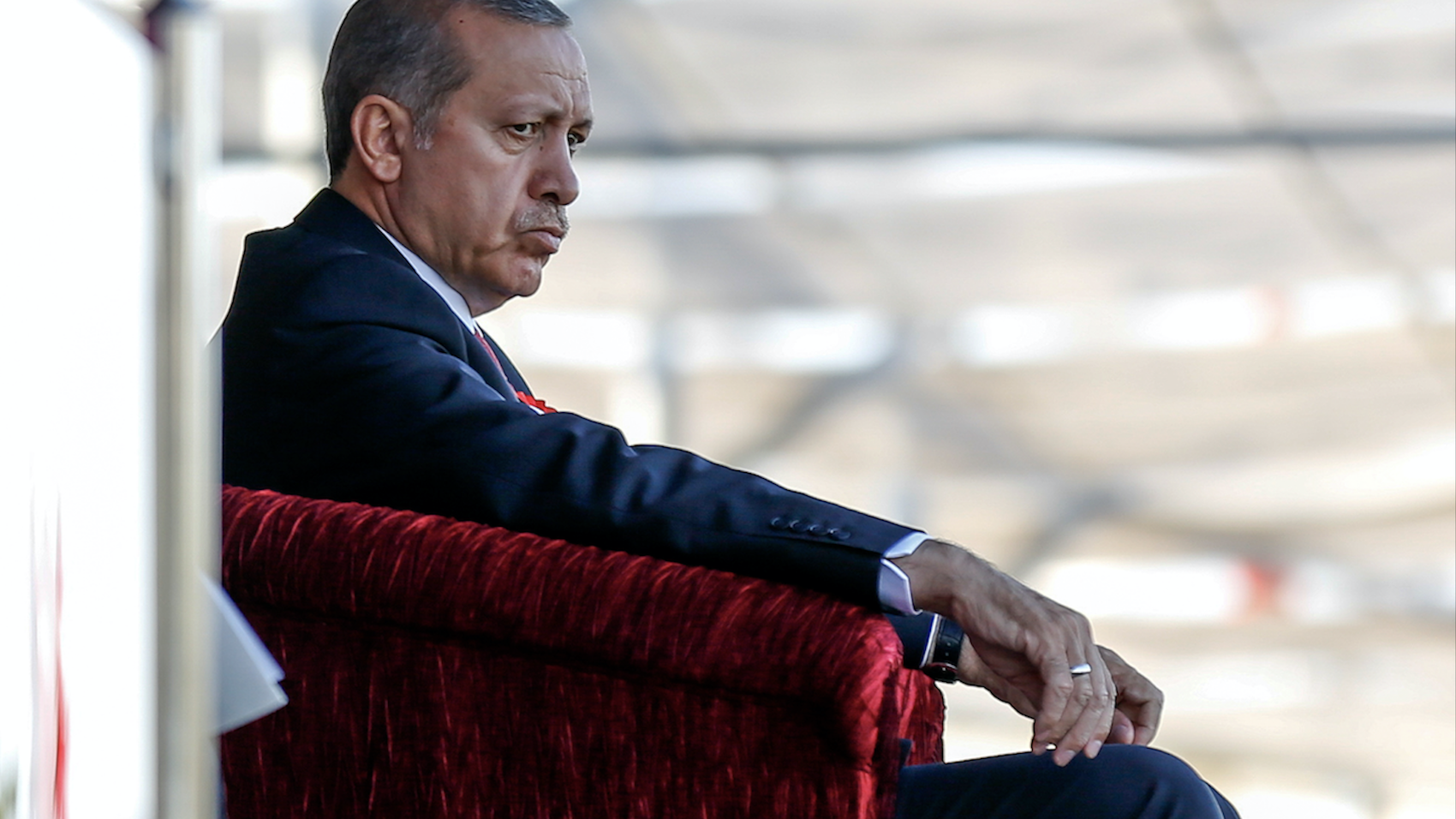
Turkish President Recep Tayyip Erdogan

Turkey, a perfect storm of anti-democratic​ populism?

Right-wing populism beyond the West

This series profiles electorally successful right-wing populists outside the widely studied contexts of Europe and the Americas. I commence with empirical studies of Recep Tayyip Erdogan, Narendra Modi and Benjamin Netanyahu. In a next step, I probe the commonalities and discontinuities of these three populist leaders and reflect on the global phenomenon of right-wing populism and its relationship with processes of democratisation and democratic backsliding. These commentaries are based on research published in Democratization, Volume 27, No. 8 (2020), available at https://doi.org/10.1080/13510347.2020.1795135.

By Julius Maximilian Rogenhofer

Turkey suffered a spectacular fall from grace in the global democratic imagination. Once celebrated as a ‘model for political learning’[1] and the Middle East’s ‘only Muslim Democracy’[2], Turkey has become a ‘U.S.-style executive presidency – minus the Supreme Court and Congress’ (ECFR, April 8, 2017) and ‘the biggest jailer of journalists in the world’ (Amnesty International, 2017). Of course, Turkey is not the only country to have recently experienced democratic backsliding. Yet, the Turkish case differs from the more familiar instances of populism witnessed in Europe and the Americas. The populist playbook employed by Turkish President Recep Tayyip Erdogan offers a partial blueprint for the antidemocratic populist strategies employed by other right-wing populists. This populist strategy combines neoliberal economic policies, religious polarisation and media capture. Let us begin with a glance at the country’s democratic legacy.

Even before Erdogan’s tenure at the helm of Turkish politics, democracy in Turkey was plagued by top-down, autocratic tendencies, manifest in four military coups between 1960 and 2000. Elected in 2002, Erdogan’s centre-right Justice and Development Party (AKP) presented itself as a moderately Islamist alternative to the secular Kemalism of the Republican People’s Party (CHP). Invoking alignment with the European Union (EU) and the prospect of eventual accession, the AKP promised to improve individual freedoms, reduce the military’s role in government and better recognise Kurdish language and culture. These noble ambitions notwithstanding, the AKP repeatedly clashed with secularist political establishment, committed to upholding Mustafa Kemal’s prohibition on virtually all public manifestations of religion. 

Promising to defend democracy against the alleged coup-plotters, Erdogan used the state of emergency to undermine democratic institutions by cleansing them of alleged ‘terrorists’ and ‘traitors’.

Civilians demonstrated near the Ataturk Culture Center (AKM) building during the Gezi Park protests in Istanbul, Turkey on June 08, 2013.

For instance, the AKP’s 2007 appointment of President Abdullah Gul, whose wife publicly wears hijab, triggered a constitutional crisis and an investigation of the AKP for violating the principle of laicism. From 2008, the Ergenekon trials sought to combat the role of the deep state (the military, bureaucracy and secret service) in government affairs. At the same time, lawsuits against bureaucrats, NGOs, civil society and journalists evidenced the AKP’s willingness to rescind civil liberties to reaffirm its own power. Following a series of resonant electoral victories, the AKP increasingly weakened national institutions staffed overwhelmingly by Kemalist rivals. Erdogan’s violent crackdown on peaceful protesters at Istanbul’s Taksim Gezi Park in 2013 showcased this distaste for all political opposition to a global audience.

A Populist Strategy to Monopolise Political Power 

Less than three years after the Gezi protests, the failed coup attempt of July 2016 ushered in a fundamental change for democracy in Turkey[3]. Promising to defend democracy against the alleged coup-plotters, Erdogan used the state of emergency to undermine democratic institutions by cleansing them of alleged ‘terrorists’ and ‘traitors’. The measures enacted after the 2016 coup attempt are part of a multi-pronged populist strategy to monopolise political power in Turkey. Its antidemocratic effect is compounded by harsh repression of elected Kurdish politicians, civil society groups and minority populations. While highly significant, the Kurdish issue is too large and complex to be satisfactorily analysed in this series. 

In the economic realm, Erdogan employs a variant of neoliberal clientelism. Despite promoting a series of business-friendly policies – such as the privatisation of public land,  and the weakening of labour unions – the AKP receives the majority of its votes from economically disadvantaged sections of society[4]. These voters are kept onside using Islamic charity networks who distribute benefits and services in the AKP’s name[5]. At the same time, clientelism reached new levels under Erdogan. Kickbacks from AKP-friendly enterprises constitute a major source of donations for party affiliated organisations[6]. The same enterprises benefited from lucrative public-private partnership construction contracts with AKP controlled municipalities. The catastrophic tenure of Berat Albayrak (Erdogan’s son-in-law) as Minister of Finance and Treasury (July 2018 until November 2020) and the military drone contracts awarded to Selcuk Bayraktar (his other son-in-law) exemplify a political system that places loyalty above competence (Al Monitor, September 11, 2019)

In this economic order, citizen loyalty for democratic institutions is undermined as jobs and benefits cease to be a matter of rights or merit but are tied to membership of an AKP supporting “people”[7]. Thus, after the 2016 coup attempt, Erdogan used the state of emergency to disown the “enemies of the people”. His government appropriated over one thousand schools, companies and hospitals owned by members of the Fethullah Gulen-affiliated Hizmet Movement allegedly behind the attempted coup. It also sold seized businesses, such as the Koza-Ipek Conglomerate, to AKP loyalists. Thus, by combining business friendly liberalisation, clientelism and expropriation the AKP increasingly monopolises the Turkish economy. 

Supporters of Turkish President Erdogan follow his speech during an election campaign rally of Justice and Development Party (AKP) in Istanbul on June 17, 2018.

Diyanet Used to Supress Dissent 

From 2011 onwards, Erdogan increasingly used the Directorate of Religious Affairs, Diyanet, to entrench AKP narratives in mosques, religious and educational institutions[8]. In addition to imposing its own religious interpretations and mobilising religious segments of society in support of Erdogan, the AKP used Diyanet to supress dissent against the regime[9]. This conscious politicization of an avowedly non-partisan state body entrenched distinctions drawn by Erdogan and the AKP between the religious “people” and their secular “enemies”. The exclusive definition of the “people” around Islamic institutions and AKP support allowed Erdogan to privilege conservative values and traditional family structures[10]. Women contemplating abortion, single mothers and other “non-traditional” family units face discrimination and are labelled unpatriotic.

The July 2016 coup attempt inspired a new level of religious polarisation, in which the “enemies of the people” were extended to include Muslims supportive of- or allegedly affiliated with Fethullah Gulen. Ten-thousands of, so called, “Gulenists”, were dismissed from their jobs, arrested and/or detained as alleged ‘terrorists’ and members of a criminal ‘cult’ (The New Yorker, October 10, 2016). Erdogan’s self-characterisation as the leader of the faithful disavows large swathes of Turkish society, who are either secular, non-Muslim or critical of Erdogan’s regime. 

Beyond this highly instrumental approach to religion, the AKP’s relationship with Turkey’s mass media is characterised by its willingness to arrest journalists for allegedly spreading terrorist propaganda[11]. From early into his tenure, then-Prime Minister Erdogan painted mainstream media moguls like Aydin Dogan as the tools of “deep-state”, an elitist faction scheming to undermine the “people’s will”. More recently, Dogan Media Company – once the owner of major newspapers and television channels – was left no option but to sell its media outlets to Demiroren Holding a conglomerate with close ties to the President Erdodan (New York Times, 21 March 2018). Olay TV, another independent news channel, was forced to close due to government pressure (Ahval, December 26, 2020).

Looking back, Erdogan’s attack on democracy amounts to a “perfect storm” – in which clientelism, religious messaging and media capture combine into an antidemocratic populist strategy.

Turkish riot police bloc protesters as they surround the headquarters of a Ipek Media Group linked to a Erdogan regime critic, enforcing a court order to seize the media outlets, in Istanbul October 28, 2015.

Fourth Pillar of Democracy Was Undermined 

In addition to undermining mainstream and critical media outlets, the AKP now controls the messaging of the public broadcaster TRT and the state-run Anadolu news agency, thereby further side-lining critical and opposition voices[12]. Pro-Erdogan businesspeople are encouraged to fund media outlets, publishing houses and creative agencies filled with uncritical government supporters. Invasive laws and media blackouts nurture a culture of overt- and self-censorship among journalists[13]. During the state of emergency declared in 2016, this fourth pillar of democracy was comprehensively undermined. Large-scale media censorship, widespread arrests of journalists and the closure of additional media outlets sparked an exodus of critical journalists out of the country[14]. Independent voices were framed as illegitimate plotters against the “people”. This latest stage of Erdogan’s populist media-capture strategy undermines the principle of accountability of the ruler to the ruled, as to have any practical significance voters need accurate, verifiable information about the government.

Looking back, Erdogan’s attack on democracy amounts to a “perfect storm” – in which clientelism, religious messaging and media capture combine into an antidemocratic populist strategy. Key figures in Turkey’s democratic opposition – including Selahattin Demirtas the Kurdish leader of the progressive pro-minority Peoples’ Democratic Party (HDP) – are imprisoned and defamed as terrorists. 

As the next part of this series will suggest, Turkey’s democratic decay is emblematic of a wider trend affecting democracies across different religions, cultures and geographies. Despite its severe democratic decay, Turkey is still deemed an indispensable partner by many within the EU and a key NATO ally. This picture is complicated by military escalations with its long-term rival Greece (ECFR, March 13, 2020), its meddling in the Libyan civil war, its purchase of Russian S-400 missiles and Erdogan’s continued assault on international institutions – including the European Court of Human Rights (Al Monitor, December 23, 2020; Politico, December 10, 2020)

The collapse of the 2016 EU-Turkey Joint Statement on migration in March 2020 exposes another key vulnerability for Turkey’s democratic partners. Having effectively abandoned Turkey’s prospects for EU accession in 2005, Europeans have surrendered a key means of encouraging Turkey’s democratisation. The failure of democracy in Turkey does not bode well for a world in which democratic values are increasingly questioned. 


References

1) Çavdar, Gamze. “Islamist New Thinking in Turkey: A Model for Political Learning?” Political Science Quaterly. 121, no. 3 (2006): 477-497. Crossref.

[2] Lewis, Bernard. “Why Turkey Is the Only Muslim Democracy.” Middle East Quarterly. March 1, 1994. https://dev.meforum.org/216/why-turkey-is-the-only-muslim-democracy .

[3] Rogenhofer, Julius M. “Antidemocratic Populism in Turkey After the July 2016 Coup Attempt.” Populism. 1, no. 2 (2018): 116–145. Crossref.

[4] Bozkurt, Umut. “Neoliberalism with a Human Face: Making Sense of the Justice and Development Party’s Neoliberal Populism in Turkey.” Science & Society. 77, no. 3 (2013): 372–396. Crossref.

[5] Cosar, Simten and Metin Yegenoglu, “The Neoliberal Restructuring of Turkey’s Social Security System.” Monthly Review. April 1, 2009. https://monthlyreview.org/2009/04/01/the-neoliberal-restructuring-of-turkeys-social-security-system/

[6] Özdemir, Yonca. “Turkey’s Justice and Development Party: An Utmost Case of Neoliberal Populism.” Paper presented at the annual meeting of the European Consortium for Political Research, Montreal, August 26–29, 2015.

[7] Rogenhofer, Julius M. “Antidemocratic Populism in Turkey After the July 2016 Coup Attempt.” Populism. 1, no. 2 (2018): 116–145. Crossref.

[8] Öztürk, Ahmet Erdi. “Turkey’s Diyanet Under AKP Rule: From Protector to Imposer of State Ideology?” Southeast European and Black Sea Studies. 16, no. 4 (2016): 619–635. Crossref.

[9] Ibid. 

[10] Yilmaz, Zafer. “Strengthening the Family Policies in Turkey: Managing the Social Question and Armoring Conservative–Neoliberal Populism.” Turkish Studies. 16, no. 3 (2015): 371–390. Crossref.

[11] Yilmaz, Gözde. “Europeanisation or De-Europeanisation? Media Freedom in Turkey (1999–2015).” South European Society and Politics. 21, no. 1 (2016): 147–161. Crossref.

[12] Esen, Berk , and Sebnem Gumuscu . “Rising Competitive Authoritarianism in Turkey.” Third World Quarterly. 37, no. 9 (2016): 1581–1606. Crossref.

[13] Ibid.

[14] Rogenhofer, Julius M. “Antidemocratic Populism in Turkey After the July 2016 Coup Attempt.” Populism. 1, no. 2 (2018): 116–145. Crossref.

Elementary school kids in a classroom raising their hands.

Challenging far-right in education through culturally relevant pedagogy

Recognizing the political nature of education and teaching is important for teachers. It allows them to understand how their decisions impact the development of their students as democratic citizens. Teachers must themselves hone the tools necessary to become critical pedagogues.

By F. Zehra Colak & Erkan Toguslu 

The idea and practice of neutrality – that is, not expressing views or avoiding political discussions – in the Western education system is seen as self-evident and rarely questioned. However, education has always been shaped by the socio-cultural realities and political ideologies of the day. Political ideas about how a society should be organized have informed school textbooks, educational policies, and teacher trainings, affecting not only what is taught but also what is not taught in schools. 

Following the post 1980’s resurgence of far-right parties and populism in European politics, a right-wing ethnocentric worldview has gained prominence in political and administrative institutions. Perhaps unsurprisingly, such political growth has also led to populist views gaining ground in European educational systems, too. Despite this, there has been little research into the potential effects of the far right’s effect on education in Europe, although recent research has identified how the far right aims to impact educational policy and acts as an educational actor. 

In Italy, this is exemplified by the far-right League Party’s plan to diminish university attendance rates among high-schoolers, limiting their exposure to leftist views at universities. League also demanded an academic book be removedfrom the reading list of a course at the University of Bologna. Similar actions have been observed across Germany, where the far-right Alternative for Germany (AfD) is asking for the re-design of history subjects, simultaneously advocating for teaching students about their German roots while engaging in acts that downplay the history of the Holocaust. In France, educational policy is not one of the main populist strategies of Marine Le Pen’s far-right party National Rally, although the party supports patriotic moral education and teaching national history as a defence against multiculturalism. The populist discourse and practices employed by National Rally impact the strategies and policies of centre-right parties in councils and in the parliament. The councils run by Le Pen’s party ban school canteens from serving pork-free menus, discriminating against Muslim and Jewish students. On French university campuses, Collectif Marianne, Assas Patriote, and Action française étudiante work to advance the cause of far-right ideologies, primarily through university councils. 

The increasing political influence of the European far-right also impacts the discourses and actions of parties in power. In northern Belgium, Flanders, the right-wing New Flemish Alliance (NVA) party has pressed a proposal to establish a Flemish Canon, which will be taught to pupils at schools, as well as newcomers. The canon is described as follows: “In order to promote the sense of identity of the younger generation, we are following the example of the Netherlands in drawing up a Flemish canon, a list of anchor points from our Flemish culture and history, which characterize Flanders as a European nation.” Turkey is another example of how populists in power impact the educational agenda. In Turkey, Darwin’s theory of evolution has been removed from the biology textbooks used in high schools. This decision was based on the argument that the theory is controversial and difficult to comprehend. 

The aforementioned far-right strategies focus on a monolithic understanding of society, showcasing the far right’s refusal to accept multicultural identities and cosmopolitanism. The strategy of imposing a national identity and moral code through the education system is crystalized in the debate over students from immigrant backgrounds. The far right views these students as the main problem in schools. They are emblematic of decadence, illiteracy, and violence. Given the power of education in reaching and influencing large groups and shaping society, it’s not surprising that different political actors and forces, including the contemporary far right, aim to instil their social and political values into educational institutions. At a time when teachers and students are displaying authoritarian tendencies, how best to push against the harmful far-right narratives seeking to shatter the values of democracy in European education? There is undoubtedly more than one answer to this question. We will, however, focus on one pedagogical approach that could be adopted in schools to curb the harmful effects of populist rhetoric. That approach is culturally relevant pedagogy.

Gloria Ladson-Billings is an American pedagogical theorist who, after a decade teaching in American public schools, wondered why Black students were less successful than their white peers. While getting her Ph.D. in curriculum and teacher education, her research revealed how Black students were viewed as deficient and deviant by teachers, administrators, and students and treated as problematic. In order to challenge this “deficiency” narrative, she began to ask questions about teachers and their classrooms, which eventually led to the development of culturally relevant pedagogy in the 1990s.

Based on her research with successful teachers of African American students, Ladson-Billings advocates a focus on students’ academic success, cultural competence, and socio-political or critical consciousness. The first component might seem obvious for educational institutions typically characterized by their commitment to ensuring the academic success of their students. However, Ladson-Billings centralizes student learning and stresses the role of teachers in engaging students to develop tools for critical thinking. As part of this process, teachers must have high expectations for their students. It is only when students are learning that they can have the desired academic outcomes and succeed on examinations. 

The second tenet, cultural competence, refers to the recognition that students show up in school with their own culture, language, norms, and ideas, all of which can impact a student’s learning experiences. Given the increasingly diversifying cultural make-up of many industrialized societies, schools are increasingly populated by more multiracial and multi-ethnic students. However, the far right’s emphasis on the distinctive culture, values, and identity of the national group risks marginalizing students from minority backgrounds while prioritizing the culture and interests of the majority group. Moreover, exclusionary national identities are often reinforced by polarizing narratives that frame immigrants – especially those from Africa and the Middle East – as a threat to the Western way of life. 

In response to these populist discourses, teachers need to work on empowering all students, offering them the tools to examine critically their own position in society. Recognizing and valuing the knowledge and experiences of students of different genders, faiths, cultures, languages, socioeconomic statuses, and abilities is critical to support positive identity development and facilitating access to different cultures. By being mindful of who they are teaching and what the students’ specific needs are, teachers can help all students to cultivate multicultural competencies. In other words, teachers should utilize students’ cultural backgrounds as a critical learning resource that can help them make sense of an increasingly globalized world.  

The third and perhaps most important component of culturally relevant pedagogy is the development of students’ socio-political or critical consciousness in this hyper-polarized political climate. The goal of this tenet is to help students to develop the necessary skills to question social inequities in society and to not just consume knowledge, but to be critical of it. This approach has certain similarities with citizenship education, which stresses helping youth develop the tools to recognize and solve problems in society and promotes the democratic values of freedom and non-discrimination. While this aspect of culturally relevant pedagogy is vital to the development of students’ skills as democratic citizens, it is often ignored in schools due to the “neutrality” narrative that dismisses discussions about political issues in classrooms. 

This aspect of culturally relevant pedagogy is not about teachers pushing their own political agendas in the classroom. If they’re not able to ask complex questions about societal issues, students are denied the space to expose anti-democratic and populist narratives and form their own counter-narratives informed by critical reasoning. Avoiding or suppressing conversations about controversial topics could actually create more room for authoritarian views to gain popularity among students. Alternatively, encouraging students to elaborate on ideas and issues that they find meaningful or that affect their everyday realities could support their understanding and critical awareness of their social context and position within it. 

Recognizing the political nature of education and teaching is important for teachers. It allows them to understand how their decisions impact the development of their students as democratic citizens. Teachers must themselves hone the tools necessary to become critical pedagogues. This can be achieved by the transformation of teacher training programs. In fact, teachers should be taught that “one of the most effective ways to affect democracy is through the classroom.” By teaching their students the tools to think critically, teachers prepare them to understand their role and position in multicultural societies and to assess the implications of the far right’s growing influence on democratic values, such as equity, freedom, and justice.