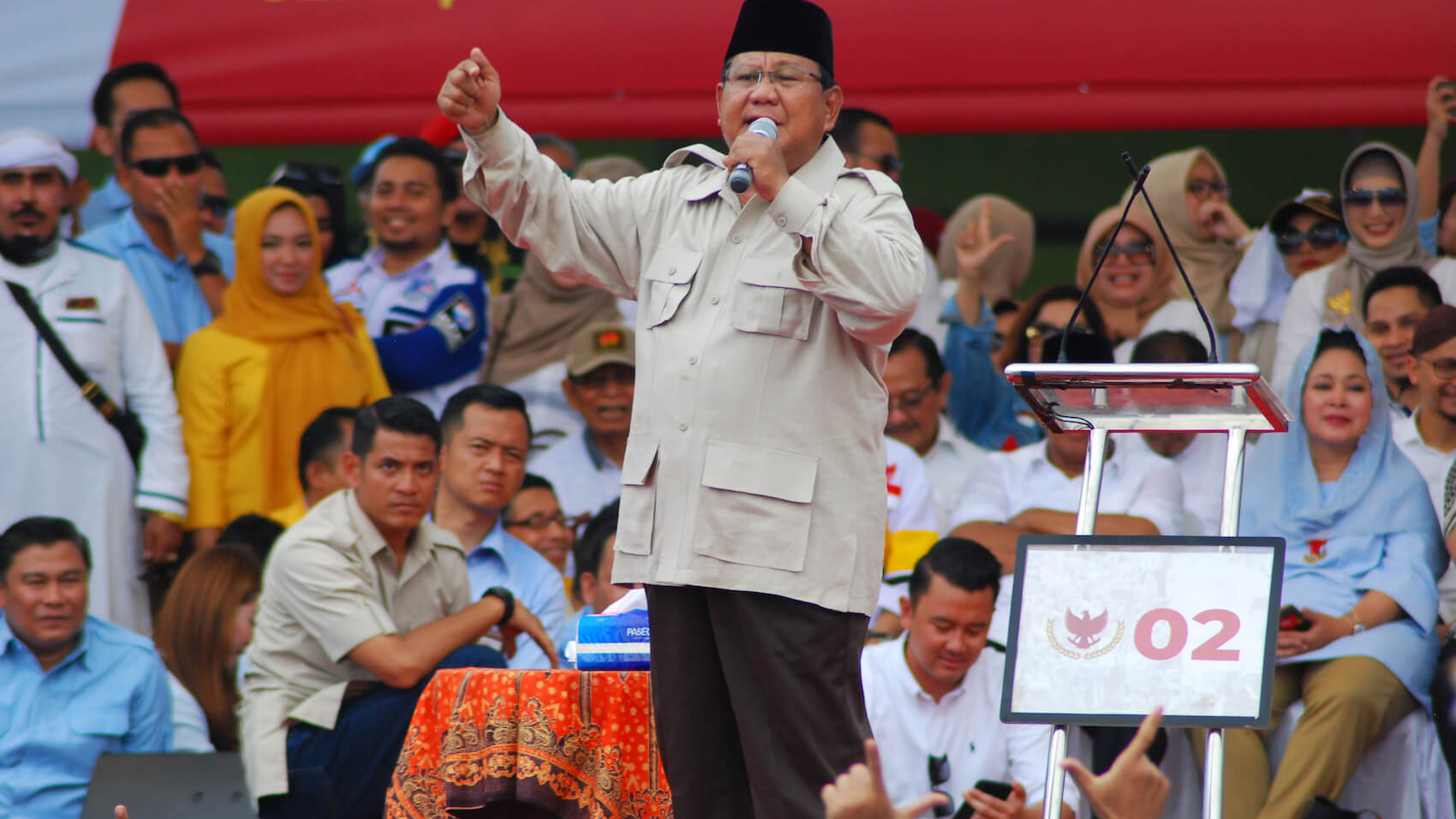
Deakin University, in collaboration with the European Center for Populism Studies (ECPS), Universitas Indonesia, and Universitas Gadjah Mada, is organizing “The International Conference: Populisms, Digital Technologies, and the 2024 Elections in Indonesia.” This event, scheduled shortly after the simultaneous multi-level elections in February, will be hosted by the Alfred Deakin Institute for Citizenship and Globalization (ADI), providing a crucial platform to explore various aspects and dynamics of populism in Indonesia. The conference’s scope extends beyond electoral outcomes to encompass the intricate interplay between populism, digital technologies, artificial intelligence, disinformation, religion, collective emotions, and socio-political factors that shape Indonesia’s democratic discourse.
Over the course of two intense days, the conference will feature comprehensive discussions spanning 31 papers organized into eight thought-provoking panels. These panels will address distinct facets of Indonesia’s populisms, ranging from Gender and Youth to Populist Strategy and Communication, and from the complexities of Sharp Power, Disinformation, and Cancel Culture to the nuances of Authoritarianism and Islamist Populism. The diversity of topics underscores the breadth and depth of issues that this conference endeavors to explore.
In addition to paper presentations, the conference will also host two distinguished keynote speakers: Professor Simon Tormey, a renowned authority on populism theory with over a decade of scholarly contribution, and Professor Vedi Hadiz, a seasoned scholar specializing in Islamic populism within the Indonesian context. Their insights will enrich understanding and stimulate critical dialogue throughout and after the conference.
The timely conference is made possible thanks to the generous funding provided by the Australian Research Council (ARC), the Alfred Deakin Institute for Citizenship and Globalization (ADI), and the European Center for Populism Studies (ECPS).
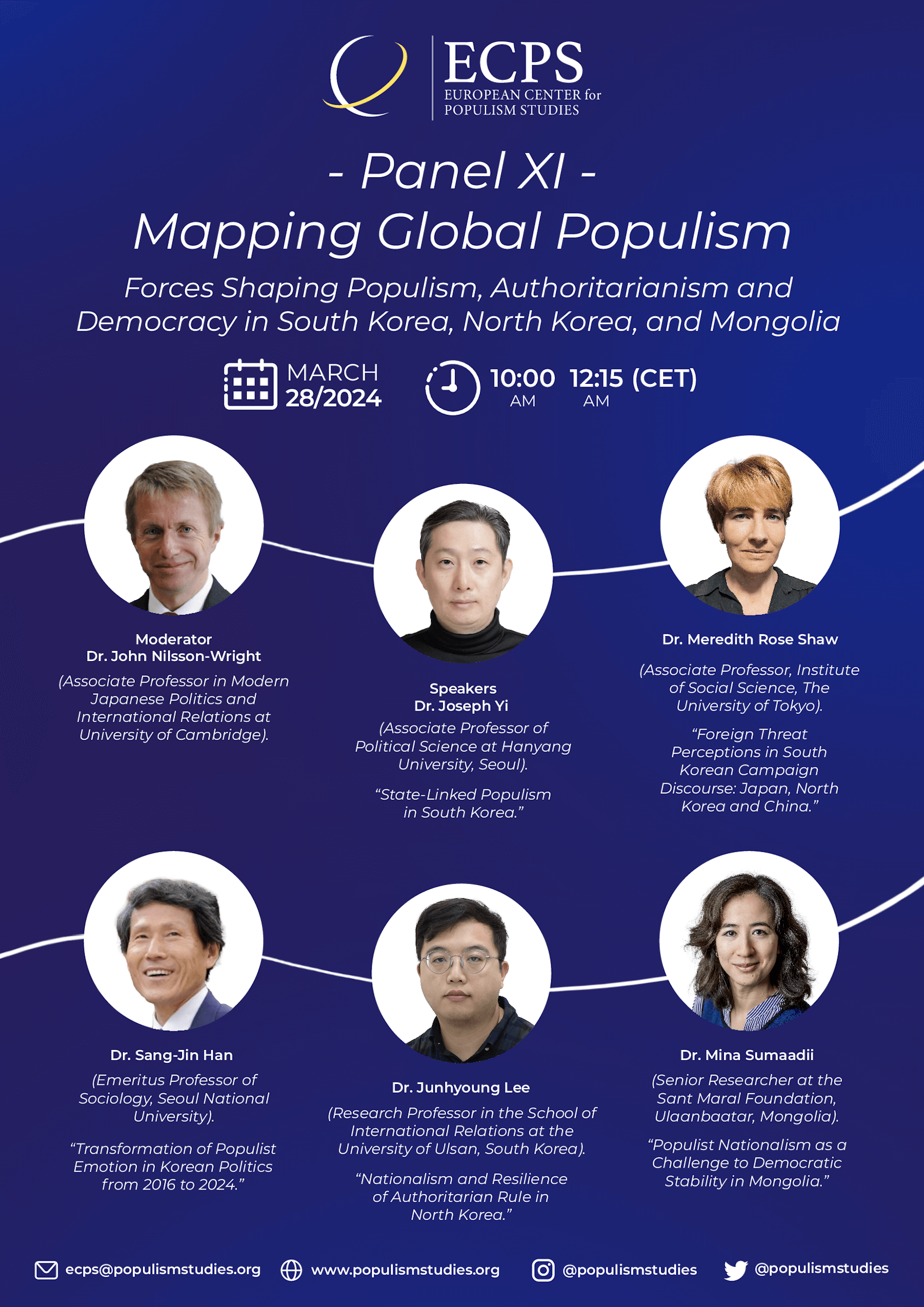
(Associate Professor in Modern Japanese Politics and International Relations at University of Cambridge).
Speakers
“Discourse Regimes and Liberal Vehemence,” byDr. Joseph Yi(Associate Professor of Political Science at Hanyang University, Seoul).
“Foreign Threat Perceptions in South Korean Campaign Discourse: Japan, North Korea and China,” by Dr. Meredith Rose Shaw (Associate Professor, Institute of Social Science, The University of Tokyo).
“Transformation of Populist Emotion in Korean Politics from 2016 to 2024,” byDr. Sang-Jin Han(Emeritus Professor of Sociology, Seoul National University).
“Nationalism and Resilience of Authoritarian Rule in North Korea,” byDr. Junhyoung Lee(Research Professor in the School of International Relations at the University of Ulsan, South Korea).
“Populist Nationalism as a Challenge to Democratic Stability in Mongolia,” by Dr. Mina Sumaadii (Senior Researcher at the Sant Maral Foundation, Ulaanbaatar, Mongolia).
Dr. John Nilsson-Wrightis an Associate Professor in Modern Japanese Politics and International Relations at Faculty of Asian and Middle Eastern Studies, University of Cambridge. In addition to his positions at Cambridge, Dr Nilsson-Wright has also been Senior Research Fellow for Northeast Asia and Korea Foundation Fellow at the Asia Programme at Chatham House which he previously directed as Head of Programme from March 2014 to October 2016. He has been a Monbusho research fellow at Kyoto and Tokyo universities, and a visiting fellow at Tohoku University, Yonsei University, Korea University, and Seoul National University. He has also been a member of the World Economic Forum (WEF) Global Agenda Council (GAC) on Korea, the UK-Korea Forum for the Future, and he is a director of the UK-Japan 21st Century Group. In 2014 he was a recipient of the Nakasone Yasuhiro Prize. Dr. Nilsson-Wright’s recent work has continued to concentrate on the Cold War relationship between the United States and Northeast Asia, with particular reference to the security and political relationships between the United States and Japan and the two Koreas but has expanded to include contemporary regional security issues and political change.
Discourse Regimes and Liberal Vehemence
Dr. Joseph Yi is an Associate Professor of Political Science at Hanyang University in Seoul. He earned his B.A. from U.C. Berkeley and his Ph.D. in political science from the University of Chicago. Dr. Yi’s research focuses on diversity, civil society, and liberal democracy, particularly in North America and East Asia. In 2016, he was selected as one of the top 23 “Excellent Researchers” at Hanyang University, one of only two professors from the Social Sciences.
Abstract: IR theory predicts stable, cooperative relations among liberal-democracies, which respect individual rights, and often vehement relations between liberal and nonliberal states. However, the ruling elites in some established democracies express strong animosity against that of other democracies. To explain, democratic polities increasingly diverge on speech rules and norms (discourse regimes), and such divergence fosters mutual animus (Doyle’s ‘vehemence’). The ruling elites in one discourse regime view that in another as allowing or committing violations of individual rights. They also access different information, as ‘victim-rights’ (VR)-oriented media report selective information that does not offend victimized groups. Information divergence is heightened when one polity follows a VR-hegemonic regime that comprehensively restricts harmful discourse. In Europe and North America, elites from diverging discourse regimes (e.g., California/Florida, Germany/Hungary) frame each other as illiberal. Until recently, animus was particularly severe between South Korea and Japan, with sharply diverging discourse regimes on the colonial past (e.g., comfort women).
Foreign Threat Perceptions in South Korean Campaign Discourse: Japan, North Korea and China
Dr. Meredith Shaw is an Associate Professor in the Institute of Social Science at the University of Tokyo and the managing editor of Social Science Japan Journal. Her work, which has been supported by grants from the Fulbright Foundation and the Korea Foundation, examines cultural politics and state efforts to manipulate culture in East Asia. Her research has been published in Journal of Conflict Resolution, The Pacific Review, and Journal of East Asian Studies, and she has also written for The National Interest, Global Asia and The Diplomat. Dr. Shaw worked for several years as a research assistant and translator at the Korea Institute for National Unification before obtaining a Ph.D. in Political Science and International Relations from University of Southern California. She was a 2019 Korea-US NextGen Scholar and is in the inaugural cohort of the Mansfield-Luce Asia Scholars Network. Since 2017, she has maintained the North Korean Literature in English blog project (http://dprklit.blogspot.com/).
Abstract: Anti-China sentiment is on the rise in South Korea. Several recent polls have shown China for the first-time surpassing both Japan and North Korea as South Koreans’ most disliked neighbor, a trend that appears particularly strong among young people, exacerbated by Covid-19 and a backlash against Chinese migrants. This trend has potential to disrupt the equilibrium partisan divide on foreign policy which had previously been roughly balanced between anti-Japan left and anti-North Korea right.
If China policy becomes a mobilizing issue for South Korean voters, one might expect such sentiments to tip the balance toward right-wing populists, simply expanding on existing threat perceptions of communism and North Korea. But upon closer inspection, South Korean “China threat” rhetoric seems to borrow more from the classic anti-Japan rhetoric of the far left, portraying a great power bully that distorts history and appropriates Korean culture, rather than the anti-communist, human rights-centric imagery used by the far right against North Korea.
Through a discourse analysis of recent anti-China rhetoric in the legislature and on social media, I will examine how the “China threat” discourse is evolving in unique and unanticipated ways within the South Korean context.
Transformation of Populist Emotion in Korean Politics from 2016 to 2024
Dr. Sang-Jin Han is Professor Emeritus at the Department of Sociology at Seoul National University. His research, which often relies on survey data, focuses on the social theory, political sociology, human rights and transitional justice, middle class politics, participatory risk governance, Confucianism and East Asian development. After his retirement, he has been giving lectures as a Distinguished Visiting Professor at Peking University, China. He has lectured as a Visiting Professor at various higher education institutes such as Columbia University in New York, United States, School for Advanced Studies in the Social Sciences in Paris, France, the University of Buenos Aires in Argentina, and Kyoto University in Japan.
Abstract: This presentation is composed of two parts: historical and empirical. The first is a genealogical overview of populist movement in Korea from the last quarter of the 19th century when the Joseon Dynasty (1392-1910) faced systemic crises. This initial stage offers a genuine populist emotion characterized by the high distrust to the ruling elites and the self-awakening perception of the common people as the sovereign actor moving forward to a new world. The second stage is related to the Japanese colonial rule (1910-1945), producing a deep-rooted perception of the Korean people as innocent victim and Japan as evil. The third stage is related to the Korean War (1950-1953) reinforcing the exclusionary drive dictated by the emotion of resentment and hostility. The red regime in the north become fully demonized in the south as the United States in the north. The fourth stage is related to the political democratization led by the college students during the 1980s who, as democratic transformer, criticized the accumulation of wealth by a small number of economic conglomerates and the political oligarchy in the circles of elites. They also sharply blamed the United States’ support for the military regimes in South Korea. The fifth stage deals with digitalized populism culminated in such contrasting forms of candlelight vigil and national flag marches in 2006-2007.
The empirical investigation focuses on the relation between populism and democracy on the basis of the analysis of the survey data collected in 2018. Regression and pathway analysis clearly show that the candlelight vigil is internally associated with the primacy of the people, while the national flag march is associated with distrust of elites, and that the national flag orientation supports for a strong authoritarian leader, whereas the candlelight vigil orientation does not. This means that political distrust, as a definitional component of populism, may pose a threat to democracy via manifestation of such populist emotions as hatred, resentment, and antagonism. In contrast, the primacy of the people tends to promote democracy by advocating the active role of the people as the sovereign actor in democratic politics.
Seen from this perspective, the current situation 2024 is alarming since ahead of the general election on April 10, 2024, both the ruling and opposition parties heavily use the populist emotions of hatred and resentment by demonizing the counterpart. The ruling party accuses the opposition party as North Korean followers jeopardizing the security of South Korea, whereas the opposition party accuses the ruling party as Japanese compradors destroying the pride of sovereign nation.
Nationalism and Resilience of Authoritarian Rule in North Korea
Dr. Junhyoung Lee a research professor in the School of International Relations at the University of Ulsan, specializes in comparative authoritarianism, North Korean politics, and post-communist regimes in East Asia. He earned his Ph.D. from University College Dublin (UCD). X: @leejunhyoung.
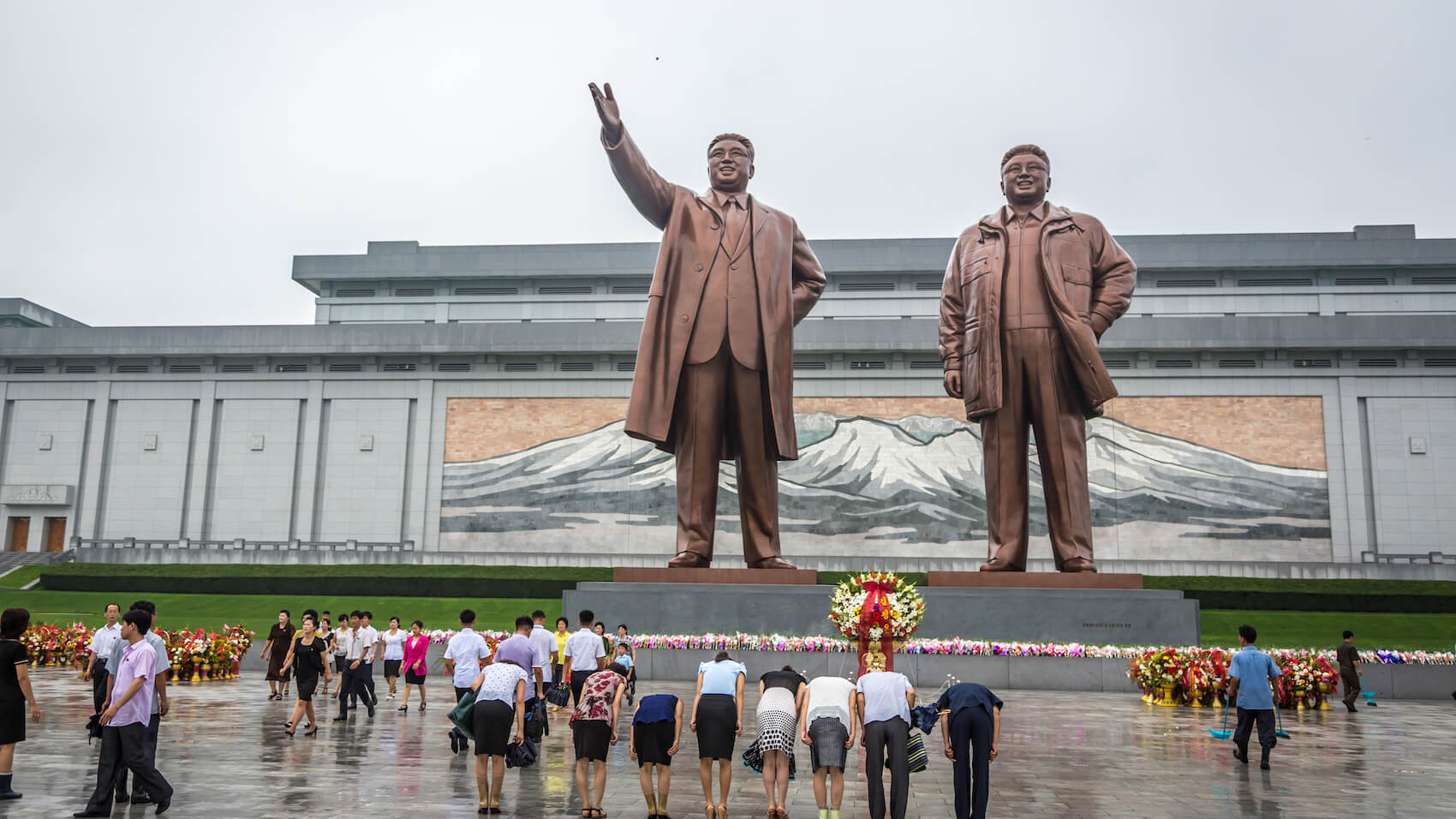
Abtsract: In the context of North Korea, nationalism serves as a pivotal instrument for the regime’s survival, intertwining ideological control with authoritarian resilience. This presentation examines the North Korean regime’s historical construction of nationalism, melding familial lineage with national narratives as a mechanism for consolidating power. It scrutinizes the interplay between nationalism and the durability of authoritarian governance in North Korea, drawing upon unstructured data from the Korean Central News Agency (KCNA) regarding nationalistic rhetoric and the higher rank politburo visit of sites emblematic of nationalism. The accentuation of nationalism has notably intensified in frequency, especially under the Kim Jong Un’s rule in 2011. Nevertheless, from a proportional perspective, this emphasis forms part of a multifaceted strategy of legitimacy, intertwining nationalistic rhetoric with assertions of economic prowess to underscore the regime’s resilience. It is at this critical intersection that the constraints of nationalism become apparent, particularly in bolstering the resilience of authoritarian governance in the absence of economic fulfilment. This presentation offers insights into the complexities of authoritarian resilience and the function of nationalism in contemporary North Korean society.
Populist Nationalism as a Challenge to Democratic Stability in Mongolia
Dr. Mina Sumaadii is a Postdoctoral Fellow at the School of International Studies, Sichuan University. She is also a Senior Researcher at the Sant Maral Foundation (SMF), one of the leading polling institutions in Mongolia. During her time at the foundation, she worked on numerous national and cross-national surveys, including Gallup World Poll and World Justice Project. Her major research interests are in democratization, Chinese and Russian foreign policies, research methods, and international development.
Abstract: After Mongolia started its democratic transition, the transitional recession lasted throughout the 1990s. Then in the 2000s the government started to develop its resources sector and chose mining based economic development. By 2010s this has brought unprecedented wealth with a variety of foreign investors. Nonetheless, as quickly as the wealth appeared, it plummeted. Analysts link it to weak institutions of control and an underdeveloped legal framework. These shortcomings were linked to some of the biggest allegations of corruption and related scandals in the next decade. At the same time some of the politicians resorted to populism as an electoral strategy. This study addresses two types of populism found in Mongolia – populist nationalism and populist resource nationalism.
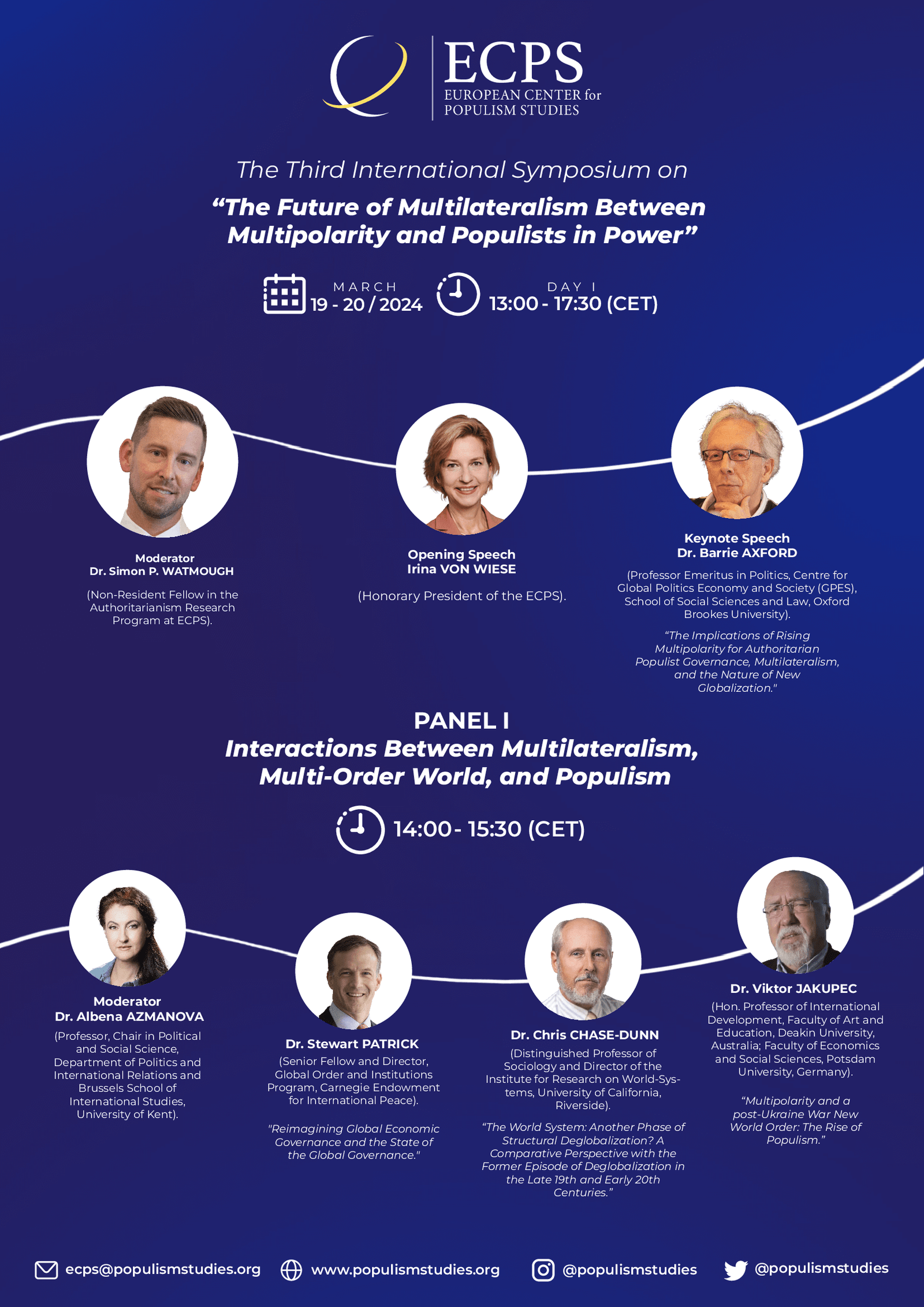
Moderator: Dr. Simon P. WATMOUGH (Non-Resident Fellow in the Authoritarianism Research Program at ECPS).
“The Implications of Rising Multipolarity forAuthoritarian Populist Governance, Multilateralism, and the Nature of New Globalization,” by Dr. Barrie AXFORD(Professor Emeritus in Politics, Centre for Global Politics Economy and Society (GPES), School of Social Sciences and Law, Oxford Brookes University).
Panel -I-
Interactions Between Multilateralism, Multi-Order World, and Populism
14:00-15:30 (Central European Time)
Moderator:Dr. Albena AZMANOVA (Professor, Chair in Political and Social Science, Department of Politics and International Relations and Brussels School of International Studies, University of Kent).
“Reimagining Global Economic Governance and the State of the Global Governance,” by Dr. Stewart PATRICK (Senior Fellow and Director, Global Order and Institutions Program, Carnegie Endowment for International Peace).
“The World System: Another Phase of Structural Deglobalization? A Comparative Perspective with the Former Episode of Deglobalization in the Late 19th and Early 20th Centuries,” by Dr. Chris CHASE-DUNN (Distinguished Professor of Sociology and Director of the Institute for Research on World-Systems, University of California, Riverside).
“Multipolarity and a post-Ukraine War New World Order: The Rise of Populism,” by Dr. Viktor JAKUPEC (Hon. Professor of International Development, Faculty of Art and Education, Deakin University, Australia; Faculty of Economics and Social Sciences, Potsdam University, Germany).
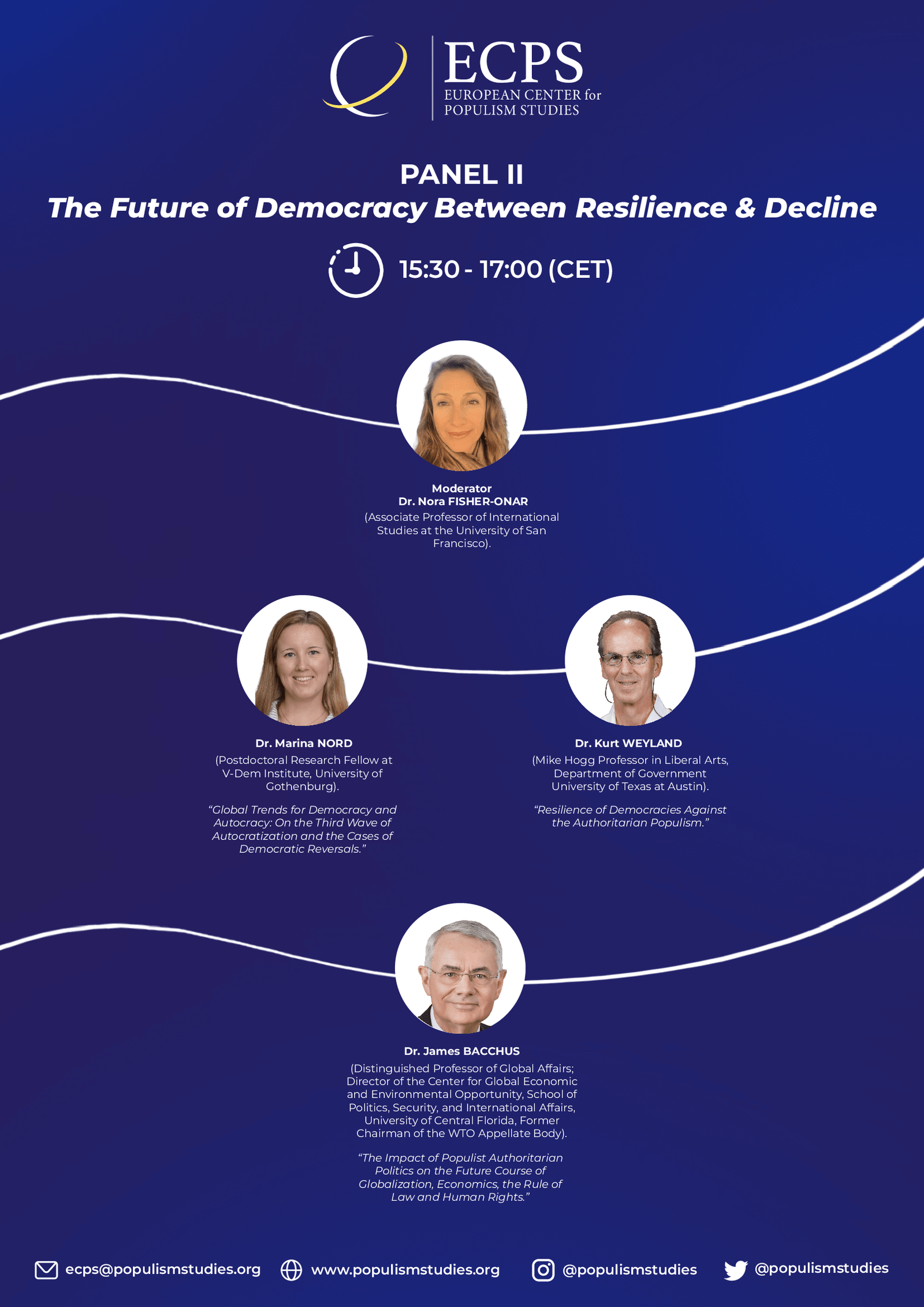
Panel -II-
The Future of Democracy Between Resilience & Decline
15:30-17:00 (Central European Time)
Moderator: Dr. Nora FISHER-ONAR (Associate Professor of International Studies at the University of San Francisco).
“Global Trends for Democracy and Autocracy: On the Third Wave of Autocratization and the Cases of Democratic Reversals,” by Dr. Marina NORD (Postdoctoral Research Fellow at V-Dem Institute, University of Gothenburg).
“Resilience of Democracies Against the Authoritarian Populism,” by Dr. Kurt WEYLAND (Mike Hogg Professor in Liberal Arts, Department of Government University of Texas at Austin).
“The Impact of Populist Authoritarian Politics on the Future Course of Globalization, Economics, the Rule of Law and Human Rights,” by Dr. James BACCHUS (Distinguished Professor of Global Affairs; Director of the Center for Global Economic and Environmental Opportunity, School of Politics, Security, and International Affairs, University of Central Florida, Former Chairman of the WTO Appellate Body).
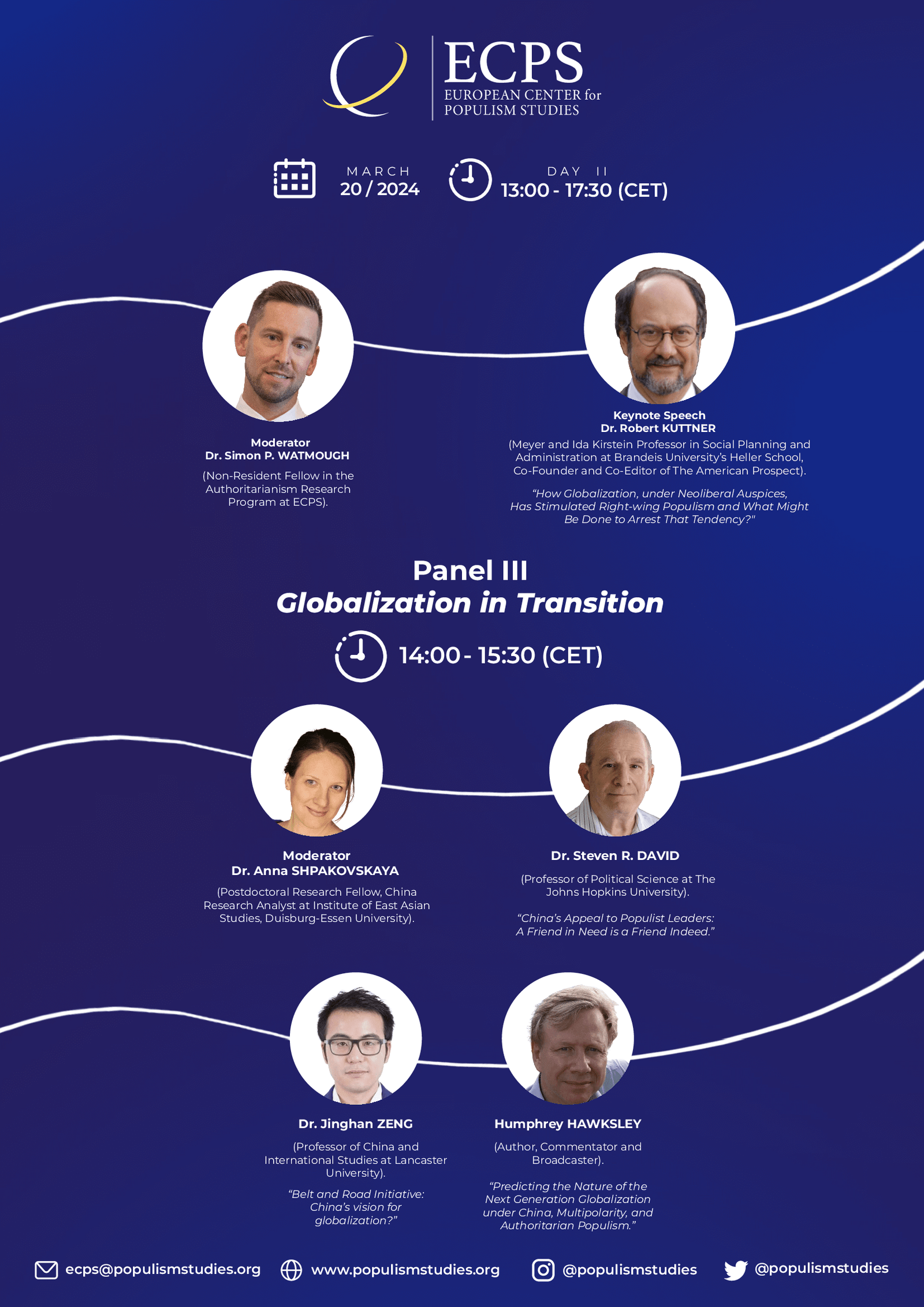
Day II (March 20, 2024)
13:00-17:30 (Central European Time)
Keynote Speech
“How Globalization, under Neoliberal Auspices, Has Stimulated Right-wing Populism and What Might Be Done to Arrest That Tendency?” by Dr. Robert KUTTNER (Meyer and Ida Kirstein Professor in Social Planning and Administration at Brandeis University’s Heller School, Co-Founder and Co-Editor of The American Prospect).
Panel -III-
Globalization in Transition
14:00-15:30 (Central European Time)
Moderator: Dr. Anna SHPAKOVSKAYA (Postdoctoral Research Fellow, China Research Analyst at Institute of East Asian Studies, Duisburg-Essen University).
“China’s Appeal to Populist Leaders: A Friend in Need is a Friend Indeed,” by Dr. Steven R. DAVID (Professor of Political Science at The Johns Hopkins University).
“Belt and Road Initiative: China’s Vision for Globalization?” by Dr. Jinghan ZENG (Professor of China and International Studies at Lancaster University).
“Predicting the Nature of the Next Generation Globalization under China, Multipolarity, and Authoritarian Populism” byHumphrey HAWKSLEY(Author, Commentator and Broadcaster).
Special Commentator Dr. Ho Tze Ern BENJAMIN (Rajaratnam School of International Studies in Singapore, Coordinator at the China Program, and International Relations Program).
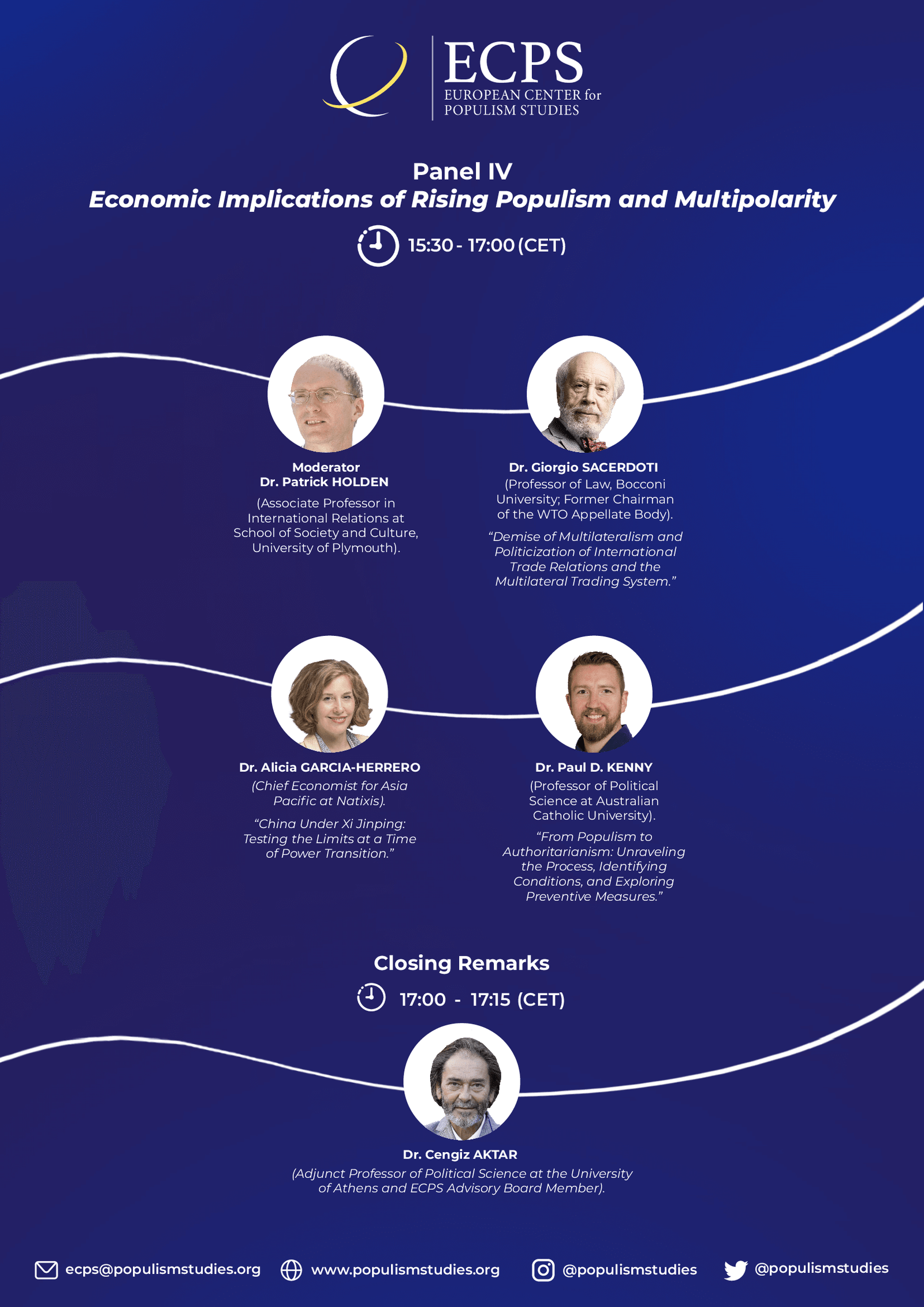
Panel -IV-
Economic Implications of Rising Populism and Multipolarity
15:30-17:00 (Central European Time)
Moderator: Dr. Patrick HOLDEN (Associate Professor in International Relations at School of Society and Culture, University of Plymouth).
“Demise of Multilateralism and Politicization of International Trade Relations and the Multilateral Trading System,” by Dr. Giorgio SACERDOTI (Professor of Law, Bocconi University; Former Chairman of the WTO Appellate Body).
“China Under Xi Jinping: Testing the Limits at a Time of Power Transition,” by Dr. Alicia GARCIA-HERRERO (Chief Economist for Asia Pacific at Natixis).
“From Populism to Authoritarianism: Unraveling the Process, Identifying Conditions, and Exploring Preventive Measures,” by Dr. Paul D. KENNY (Professor of Political Science at Australian Catholic University).
Closing Remarks
17:00-17:15 (Central European Time)
Dr. Cengiz AKTAR (Adjunct Professor of Political Science at the University of Athens and ECPS Advisory Board Member).
Irina von Wiese, Honorary President of ECPS, was born in Germany, the daughter and granddaughter of Polish and Russian refugees. After completing her law studies in Cologne, Geneva and Munich, she obtained a scholarship to study at the Harvard Kennedy School where she gained a Master in Public Administration. Her subsequent legal training took her to Berlin, Brussels and Bangkok, and gave her a first insight into the plight of refugees and civil rights defenders across the globe.
From 1997 to 2019, Irina lived and worked as a lawyer in private and public sector positions in London. During this time, she volunteered for human rights organisations, advising on migration policy and hosting refugees in her home for many years.
In 2019, Irina was elected to represent UK Liberal Democrats in the European Parliament. She served as Vice Chair of the Human Rights Subcommittee and as a member of the cross-party Working Group on Responsible Business Conduct. The Group’s main achievement was the introduction of EU legislation to make human rights due diligence mandatory in global supply chains. During her term, she was also elected to the Executive Committee of the European Endowment for Democracy, whose task is to support grassroots civil society initiatives in fragile democracies.
Having lost her seat in the European Parliament after the UK’s withdrawal from the European Union, Irina returned to the UK, where she was elected to the Council of Southwark, one of London’s most diverse boroughs. Her links to Brussels are maintained through an advisory role at FGS Global, where she works on EU law and ESG issues. In addition, Irina is an Affiliate Professor at European business school, the ESCP, teaching international law and politics (including a course entitled ‘Liberalism and Populism’).
Irina is the proud mother of a teenage daughter.
Keynote Speech
Moderator Simon P. Watmough is a postdoctoral researcher at the University of Leipzig in Germany and a non-resident research fellow in the research program on authoritarianism at ECPS. He was awarded his Ph.D. from the European University Institute in April 2017 with a dissertation titled “Democracy in the Shadow of the Deep State: Guardian Hybrid Regimes in Turkey and Thailand.” Dr. Watmough’s research interests sit at the intersection of global and comparative politics and include varieties of post-authoritarian states, the political sociology of the state, the role of the military in regime change, and the foreign policy of post-authoritarian states in the Middle East and Southeast Asia.
His work has been published in Politics, Religion & Ideology, Urban Studies and Turkish Review. Since 2005, Dr. Watmough has taught international relations, diplomacy, foreign policy, and security studies, as well as Middle Eastern history at universities in Australia and Europe. In 2010–11 he was a research fellow at the Centre for Analysis of Social Exclusion (CASE) at the London School of Economics. He has held Visiting Scholar positions at Boğaziçi University in Istanbul (2012), the University of Queensland (2013), Chulalongkorn University in Bangkok, Thailand (2014) and the University of Graz (2017). In addition to his academic publications, he is also a regular contributor to The Conversation and other media outlets.
The Implications of Rising Multipolarity forAuthoritarian Populist Governance, Multilateralism, and the Nature of New Globalization
Dr. Barrie Axford is professor emeritus in political science at Oxford Brookes University (UK), where he was founding Director of the Centre for Global Politics, Economy and Society (GPES) and Head of the Department of International Relations, Politics and Sociology (IRPOSO). He has been Visiting Professor/Fellow/Academic at the Universities of Genoa, California (Santa Barbara), Warwick and the Middle Eastern Technical University (METU), Ankara. He serves on the International Editorial Boards of the journals Globalizations and Telematics and Informatics and is Senior Research Associate at the consultancy Oxford XX1. He is Honorary President of the Global Studies Association (UK and Europe). His books include The Global System: Economics , Politics and Culture; New Media and Politics (with Richard Huggins); Theories of Globalization; The World-Making Power of New Media: Mere Connection? and Populism vs the New Globalization. His work has been translated into ten languages.
Abstract: What is it about the current phase of globalization that feeds and is fed by the populist zeitgeist? In what follows I will tie the discussion of populism to the changing character of globalization, sometimes called the “new” globalization, though that label does less than justice to the overlapping nature of historical globalizations. The “new” globalization is both a description of the de-centered and multi-polar constitution of globality today and a reflex to safeguard against the roils of an ever more connected and turbulent world. It is a reminder that globalization has always been a multidimensional and contradictory process, moving to no single constitutive logic, and historical variable. The new globalization is the context for the current populist surge and, in turn, that surge is testimony to its emergence as a serious political force, perhaps as an embedded global script. In the same context the much-rehearsed failures of multilateralism are set against a burgeoning multipolarity which are themselves expressions of the changing face of political modernity.
Panel I: Interactions Between Multilateralism, Multi-Order World, and Populism
Moderator Dr. Albena Azmanova is Professor of Political and Social Science at the University of Kent and Honorary Fellow at the Institute for Global Sustainable Development, University of Warwick, and Senior Fellow at OSUN Economic Democracy Initiative, Bard College. In her latest book,Capitalism on Edge (Columbia University Press, 2020) she identifies ubiquitous precarity as the overarching social harm of our times that is at the root of the far-right insurgencies. The book has received numerous awards, among which is the Michael Harrington Award, with which the American Political Science Association “recognizes an outstanding book that demonstrates how scholarship can be used in the struggle for a better world.” Professor Azmanova has held academic positions at the New School for Social Research in New York, Sciences Po. Paris, Harvard University, the University of California Berkeley and the University of Kent’s Brussels School of International Studies. Her writing is animated by her political activism. She participated in the dissident movements that brought down the communist regime in her native Bulgaria in 1987-1990. She has worked as a policy advisor for a number of international organisations, most recently, as a member of the Independent Commission for Sustainable Equality to the European Parliament and as consultant to the European Parliament’s Committee on Civil Liberties, Justice and Home Affairs (see Azmanova, A and B. Howard, Binding the Guardian: On the European Commission’s Failure to Safeguard the Rule of Law [2021]). Professor Azmanova is co-founder and co-Editor in Chief of Emancipations: a Journal of Critical Social Analysis.
Reimagining Global Economic Governance and the State of the Global Governance
Dr. Stewart Patrickis senior fellow and director of the Global Order and Institutions Program at the Carnegie Endowment for International Peace. His primary areas of research focus are the shifting foundations of world order, the future of American internationalism, and the requirements for effective multilateral cooperation on transnational challenges. He is particularly interested in the international governance dilemmas posed by emerging technologies, the planetary ecological crisis, and growing competition in the global commons, including the oceans and outer space.
An expert in the history and practice of multilateralism, Patrick is the author of three books, including The Sovereignty Wars: Reconciling America with the World; Weak Links: Fragile States, Global Threats, and International Security; and The Best Laid Plans: The Origins of American Multilateralism and the Dawn of the Cold War. He has written hundreds of articles, essays, chapters, and reports on problems of world order, U.S. global engagement, the United Nations and other international organizations, and the management of global issues.
A member of the Council on Foreign Relations, Patrick has served on the policy planning staff at the U.S. Department of State. He helped establish the Council of Councils, a global think tank network, and served on the steering committee of the Paris Peace Forum. He appears regularly as an expert commentator in major media, including television, radio, print, an online.
Abstract: Although world leaders and commentators frequently cite the importance and bemoan the decline of the “rules-based international order,” they seldom specify the rules of conduct they are speaking about, much less who should determine their content. In addition, they rarely identify where global attitudes on rules overlap and diverge or clarify the implications for solving practical problems. This is deeply problematic, since normative contestation—including between East and West, and North and South—is a major driving force behind the crises of multilateralism, global economic fragmentation, and surging populism worldwide.
While the crisis of the rules-based order complicates international cooperation in multiple domains, it is particularly noteworthy in the field of global economic governance. Around the world, states and publics are increasingly turning their back on hyper-globalization but have not yet agreed on a post-neoliberal narrative for the world economy. Many are torn by contradictory impulses: a determination to pull back from, and gain some control over globalization to better advance their domestically defined preferences and reassert domestic sovereignty; and a desire to update existing or create entirely new multilateral frameworks to be more globally representative, better address development needs, and address new cross-border challenges from climate change to pandemic disease to financial instability, including through the provision of global public goods.
Constructing a more equitable, inclusive, resilient, and sustainable world economy will require balancing the domestic and global sides of this equation—no small task in a turbulent era racked by populist politics, geopolitical rivalry, stalled development, lackluster growth, yawning inequality, technological disruption, and a planetary-scale ecological emergency.
Multipolarity and a Post-Ukraine War New World Order: The Rise of Populism
Dr. Viktor Jakupec is Hon. Prof. of International Development, Faculty of Arts and Education, Deakin University, Australia and Faculty of Economics and Social Sciences, Potsdam University, Germany. Throughout his academic career, he was affiliated with several universities in Australia, and as a consultant with international development agencies in MENA, Asian, Balkan, and the Asia-Pacific countries. His most recent publications are “Dynamics of the Ukraine War: Diplomatic Challenges and Geopolitical Uncertainties” (Springer 2024) and “Foreign Aid in a World in Crisis: Shifting Geopolitics in the Neoliberal Era” (co-authored with Max Kelly and John McKay, Routledge 2024). He holds a Dr. phil. From FU Hagen and Dr. phil. habil. from Giessen University.
Abstract: This presentation explores the increased shifts away from liberal democratic governance towards multipolar populism. It is argued that people in the Global North are losing faith in liberal and neo-liberal governments and political parties. The voters in the Global North are increasingly turning to national populism and governments in the Global South perceive the geo-political and geo-economic global problems caused by the West.
Turning to the current most prevalent geo-political and geo-economic crisis, namely the Russo-Ukraine war as a catalyst for the shift towards populism, it is argued that much is going wrong for the Western Alliances. This includes the emergence of multipolar alliances in opposition to the USA-led alliances, such as BRICS Plus. Against this background, the discussion turns to the nexus of multipolarity and populism. Concurrently, the surge of populism, driven by diverse socio-political factors, has reshaped both domestic politics and multipolarity. Examining the convergence of these forces unveils the complexities in navigating a post-Ukraine War New World Order, presenting both challenges and opportunities for the global community.
Panel II: The Future of Democracy Between Resilience & Decline
Moderator Nora Fisher-Onaris Associate Professor of International Studies at the University of San Francisco and academic coordintor of Middle East Studies. Her research interests include the theory and practice of international relations, comparative politics (Middle East, Europe, Eurasia), foreign policy analysis, political ideologies, gender and history/memory. She is author of Contesting Pluralism(s): Islamism, Liberalism and Nationalism in Turkey (Cambridge University Press, in-press) and lead editor of Istanbul: Living with Difference in a Global City (Rutgers University Press, 2018 with Susan Pearce and E. Fuat Keyman). She has published extensively in scholarly journals like the Journal of Common Market Studies (JCMS), Conflict and Cooperation, Millennium, Theory and Society, Qualitative and Multi-Method Research, Women’s Studies International Forum, and Middle East Studies. Fisher-Onar also contributes policy commentary to fora like Foreign Affairs, the Guardian, OpenDemocracy, and the Washington Post (Monkey Cage blog), as well as for bodies like Brookings, Carnegie, and the German Marshall Fund (GMF). At the GMF, she has served as a Ronald Asmus Fellow, Transatlantic Academy Fellow, and Non-Residential Fellow.
Global Trends for Democracy and Autocracy: On the Third Wave of Autocratization and the Cases of Democratic Reversals
Dr. Marina Nord is a Postdoctoral Research Fellow at the V-Dem Institute and one of the authors of the Democracy Reports published by the V-Dem Institute. Her research interests cover a broad range of areas pertaining to autocratization / democratic backsliding and democratization processes, with special focus on economic sources of regime (in)stability. She holds a PhD in Political Economy (Hertie School, Berlin), has worked on a number of research projects related to democratic backsliding and economic governance, and is passionate about bridging the gap between academic research and policy domains.
Abstract: This talk will discuss the latest trends for democracy and autocracy in the world and across regions based on the most recent Democracy Report from the V-Dem Institute. Among other things, the speaker will show that 42 countries of the world are now affected by the ongoing wave of autocratization; the level of democracy enjoyed by the average global citizen is down to 1985-levels; less than 30% of people worldwide are now governed democratically; and that autocratization often continues after democratic breakdowns taking countries further into more harsh dictatorships. Rising polarization and disinformation, growing threats on freedom of expression and civil liberties, coupled with shifting balance of economic power make for a worrying picture. At the same time, the speaker will show that historically, almost half of all episodes of autocratization have been eventually turned around. The estimate increases to 70% when focusing on the last 30 years. The vast majority of successful cases of re- democratization eventually lead to restored or even improved levels of democracy. The speaker will also present some important elements uniting the most recent cases of democratic resilience and discuss how they could be critical in stopping and reversing contemporary autocratization.
Resilience of Democracies Against the Authoritarian Populism
Dr. Kurt Weyland is Mike Hogg Professor in Liberal Arts, Department of Government, University of Texas at Austin since September 2014. Professor Weyland’s research interests focus on democratization and authoritarian rule, on social policy and policy diffusion, and on populism in Latin America and Europe. He has drawn on a range of theoretical and methodological approaches, including insights from cognitive psychology, and has done extensive field research in Argentina, Bolivia, Brazil, Chile, Costa Rica, Peru, and Venezuela. After receiving a Staatsexamen from Johannes-Gutenberg Universitat Mainz in 1984, a M.A. from UT in 1986, and a Ph.D. from Stanford University in 1991, he taught for ten years at Vanderbilt University and joined UT in 2001. He has received research support from the SSRC and NEH and was a fellow at the Woodrow Wilson Center in Washington, DC, in 1999/2000 and at the Kellogg Institute, University of Notre Dame, in 2004/05. From 2001 to 2004, he served as Associate Editor of theLatin American Research Review. He is the author of Democracy without Equity: Failures of Reform in Brazil (University of Pittsburgh Press, 1996), The Politics of Market Reform in Fragile Democracies: Argentina, Brazil, Peru, and Venezuela (Princeton University Press, 2002), Bounded Rationality and Policy Diffusion: Social Sector Reform in Latin America (Princeton University Press, 2007), several book chapters, and many articles in journals such as World Politics, Comparative Politics, Comparative Political Studies, Latin American Research Review, International Studies Quarterly, Journal of Democracy, Foreign Affairs, and Political Research Quarterly. He has also (co-edited two volumes, namely Learning from Foreign Models in Latin American Policy Reform (Woodrow Wilson Center Press, 2004) and, together with Wendy Hunter and Raul Madrid, Leftist Governments in Latin America: Successes and Shortcomings(Cambridge University Press, 2010). His latest book, Making Waves: Democratic Contention in Europe and Latin America since the Revolutions of 1848, was published by Cambridge University Press in 2014.
Abstract: After Trump’s election, many observers depicted populism as a grave threat to democracy. Yet my systematic comparative analysis of thirty populist chief executives in Latin America and Europe over the last four decades shows that democracy usually proves resilient. With their power hunger, populist leaders manage to destroy democracy only under special restrictive conditions, when distinct institutional weaknesses and exceptional conjunctural opportunities coincide. Specifically, left-wing populists can suffocate democracy only when benefitting from huge revenue windfalls, whereas right-wing populists must perform the heroic feat of resolving acute, severe crises. Because many populist chief executives do not face these propitious conditions, they fail to suffocate democracy; indeed, their haphazard governance often leads to their own premature eviction or electoral defeat. Given their institutional strength and their immunity to crises and windfalls, the advanced industrialized countries can withstand populism’s threat; even a second Trump administration is exceedingly unlikely to asphyxiate democracy.
The Impact of Populist Authoritarian Politics on the Future Course of Globalization, Economics, the Rule of Law and Human Rights
Dr. James Bacchus is the Distinguished University Professor of Global Affairs and Director of the Center for Global Economic and Environmental Opportunity at the University of Central Florida (GEEO). He was a founding judge and was twice the Chairman – the chief judge – of the highest court of world trade, the Appellate Body of the World Trade Organization.
Professor Bacchus is a former Member of the Congress of the United States, from Florida, and a former international trade negotiator for the United States. He served on the High-Level Advisory Panel to the Conference of Parties of the United Nations Framework Convention on Climate Change during the negotiation of the Paris climate agreement and is on the Leadership Council of the United States chapter of the United Nations Sustainable Development Solutions Network. He has chaired the global Commission on Trade and Investment Policy of the International Chamber of Commerce and the global council on sustainability governance of the World Economic Forum.
Professor Bacchus is a Visiting Fellow at the Lauterpacht Centre for International Law and at Wolfson College and a member of the Advisory Council at Cambridge Governance Labs of the University of Cambridge in the United Kingdom. For more than fourteen years, he chaired the global practice of the largest law firm in the United States and one of the largest in the world, Greenberg Traurig.
Professor Bacchus is the author of five well-received books and is currently writing a new book on the relationship between democracy and sustainable development.
Abstract:Populists, as most commentators acknowledge, come to power on the back of relatively free and fair elections. Yet once in office, populists appear to have a deeply ambiguous, if not hostile, relationship with democracy. Some scholars have argued that populism is inherently illiberal, or even authoritarian. Others have defined populism as a kind of half-way house between democracy and dictatorship. At best, however, this approach simply labels rather than explains the problem. When, why, and how do populists become dictators? In fact, the transition from populist rule to full personalist dictatorship is relatively rare. Drawing from my ongoing research on the long-run implications of populist rule, this talk will examine how populists make the transition to dictatorship, and discuss the conditions that make this more likely.
Keynote Speech
Moderator Simon P. Watmough is a postdoctoral researcher at the University of Leipzig in Germany and a non-resident research fellow in the research program on authoritarianism at ECPS. He was awarded his Ph.D. from the European University Institute in April 2017 with a dissertation titled “Democracy in the Shadow of the Deep State: Guardian Hybrid Regimes in Turkey and Thailand.” Dr. Watmough’s research interests sit at the intersection of global and comparative politics and include varieties of post-authoritarian states, the political sociology of the state, the role of the military in regime change, and the foreign policy of post-authoritarian states in the Middle East and Southeast Asia.
His work has been published in Politics, Religion & Ideology, Urban Studies and Turkish Review. Since 2005, Dr. Watmough has taught international relations, diplomacy, foreign policy, and security studies, as well as Middle Eastern history at universities in Australia and Europe. In 2010–11 he was a research fellow at the Centre for Analysis of Social Exclusion (CASE) at the London School of Economics. He has held Visiting Scholar positions at Boğaziçi University in Istanbul (2012), the University of Queensland (2013), Chulalongkorn University in Bangkok, Thailand (2014) and the University of Graz (2017). In addition to his academic publications, he is also a regular contributor to The Conversation and other media outlets.
How Globalization, under Neoliberal Auspices, Has Stimulated Right-wing Populism and What Might Be Done to Arrest That Tendency?
Robert Kuttner is co-founder and co-editor of The American Prospect magazine and Meyer and Ida Kirstein Professor at Brandeis University’s Heller School. He was a longtime columnist for Business Week, the Boston Globe, and the Washington Postsyndicate. He was a co-founder of the Economic Policy Institute and serves on its board and executive committee.
Kuttner is author of thirteen books, most recently his 2022 book, Going Big: FDR’s Legacy, Biden’s New Deal, and the Struggle to Save Democracy. His other books include Can Democracy Survive Global Capitalism?(2018) and the 2008 New York Times bestseller, Obama’s Challenge: American’s Economic Crisis and the Power of a Transformative Presidency. His best-known earlier book is Everything for Sale: the Virtues and Limits of Markets (1997), which received a page one review in the New York Times Book Review.
His magazine and journal writing, covering the interplay of economics and politics, has appeared in The Atlantic, Harpers, The New Republic, New York Review of Books, The New Yorker, The New York Times Magazine and Book Review, New York Magazine, Mother Jones, Foreign Affairs, New Statesman, Political Science Quarterly, Columbia Journalism Review,Harvard Business Review, and Challenge.
Kuttner has contributed major articles to The New England Journal of Medicine as a national policy correspondent. His previous positions have included national staff writer on The Washington Post, chief investigator of the U.S. Senate Banking Committee, executive director of the National Commission on Neighborhoods, and economics editor of The New Republic.
He is the winner of the Sidney Hillman Journalism Award (twice), the John Hancock Award for Financial Writing, the Jack London Award for Labor Writing, and the Paul Hoffman Award of the United Nations for his lifetime work on economic efficiency and social justice. He has been a Guggenheim Fellow, Woodrow Wilson Fellow, Demos Fellow, Radcliffe Public Policy Fellow, German Marshall Fund Fellow, Wayne Morse Fellow and John F. Kennedy Fellow.
Robert Kuttner was educated at Oberlin College, The London School of Economics, and the University of California at Berkeley. He holds honorary doctorates from Oberlin and Swarthmore. He has also taught at Boston University, the University of Oregon, University of Massachusetts, and Harvard’s Institute of Politics. He lives in Boston with his wife, Northeastern University Professor Joan Fitzgerald.
Abstract: What is Populism? The US origins of the term, in the late 19th century. The original populist movement of the 1880s and 1890s had both a progressive economic dinension, as a farmers’ and workers’ protest against econmic concentration, and a white- racist and anti-immigrant dimension. Both elements were present in the People’s Party, which nearly displaced the Democratic Party in 1896 as one of the two major American political parties. The Democratic Party adopted some of the People’s Party’s program and candidates.
Progressive populism, as a popular revolt against extremes of wealth and poverty and corporate abuses, reached its zenith in the US during President Franklin Roosevelt’s New Deal. At the same time, elements of continuing racism in the US reflected reactionary populism.
In Europe, fascism gained ground in the 1920s and 1930s, to a substantial degree because of the failure of European leaders to pursue a post-WWI recovery program and the infliction of austerity economics not just on defeated Germany but on the continent generally. (See J.M. Keynes, Economic Consequences of the Peace (1919), and Karl Polanyi, The Great Transformation (1944.) The fascist intellectuals of that era, such as Mussolini’s theorist, Giovanni Gentile (The Doctrine of Fascism, 1932), contended that the democracies were doomed because they could solve neither economic nor political problemas, nor the question of national identity. Fascism was built on extreme nationalism as well as authoritarianism.
For the most part the term populism was not used in that era to describe European fascism.
The Postwar Political and Economic Settlement in Western Europe and the US. After the defeat of the Axis powers, both the fascist far-right and the economic libertarian right had been discredited and marginalized. The victorious powers were of the view that mass unemployment in the 1920s and 1930s has been a substantial cause of fascism and war. No influential political parties in Europe in the postwar era were promoting laissez-faire, much less extreme nationalism or authoritarianism.
The postwar European recovery program and the dominant set of policies in the US blended managed capitalism and social democracy. Most leaders of that period in Continental Europe were Christian Democrats. In Scandinavia and Britain, they were social democrats. As a way of preventing a future European war, they promoted full employment, a welfare state, regulation of capital, and steps towards European union as a way both of containing Germany within a larger European whole, and reducing nationalism. In that era, which was one of recovery and increasing shared prosperity, there was virtually no neo-fascism–what some today would call populism.
In my view, it is a conceptual and semantic mistake to conflate neo-fascism with populism. The former has a clear meaning and clear historical antecedents. The latter can refer to far-right authoritarian movements, or to reformist, pro-democratic left movements. The view that something called “populism” is an anti-democratic virus to be resisted confuses more than it clarifies.
Neoliberalism and the End of the Postwar System. The economic crisis of the 1970s brought neoliberals back to power, politically and intellectually. Unemployment increased. So did economic inequality. In most of the West, the neoliberal program included tax cuts, deregulation, privatization, and a weakening of trade unions. After 1989, the rules of the EU gave priority to free movement of capital, goods, services and people. After 1995, the new World Trade Organization enforced rules of liberal trade worldwide.
In these circumstances, the incomes of ordinary working people stagnated or fell, while the income and wealth of economic elites soared. Nominally center-left parties, such as the Democratic Party in the US, the Labour Party in the UK, and the German SPD, embraced much of the neoliberal program. This convergence meant there was no mainstream opposition party; the only opposition to the centrist consensus was on the far-right or far-left.
The economic crisis that began in 2008 raised unemployment rates. The neoliberal leadership governing the EU and the ECB demanded austerity policies, which prolonged the crisis. In this context, immigration, which was now open throughout the EU, increased. With the worldwide economic downturn, extra-European migration, both legal and illegal, also increased. The mainstream parties had no good solutions.
The worsening economic situation of ordinary working people was in drastic contrast to that of the postwar era when there was full employment, broadly shared prosperity, little immigration, and no support for the neo-fascist right because the system enjoyed broad popular legitimacy.
The Rise of the Neo-fascist Right. In the years after 2008, far-right parties became the largest or second largest parties in much of Europe. In some nations, they have been part of coalition governments. In Turkey, Poland, Hungary, and in the United States under Donald Trump, the neo-fascist right has governed.
These parties and leaders have in common an authoritarian undermining of democracy, the use of anti-foreign and ultra-nationalist themes, and personalist leadership. They tend to be disproportionately supported by working-class voters, who have been the disproportionate losers of neo-liberal globalization. Oddly, nominally center-left parties, are increasingly supported by the educated and the affliuent on the basis of social issues, while far-right parties increasingly win the working class vote.
Is there a Cure? If neoliberal globalization has undermined the economic security of ordinary citizens, what is the alternative? There is definitely a far-right version of economic nationalism, but there is also a more benign version that relies on national economic planning and tighter regulation of trans-national capital to restore more balanced economic opportunities. This would take us back to something like the tacit social contract of the postwar era. (For a detailed description, see Dani Rodrik, The Globalization Paradox, 2011.)
There is more than one form of multilateralism. The multilateral system built after World War II laid the foundations for a mixed economy of broad prosperity, which in turn innoculated the body politic against neo-fascist tendencies. The successor system, beginning in the 1970s and 1980s, returned the economy to extreme insecurity and inequality, eventually stimulating a neo-fascist backlash.
In the United States, President Joe Biden has begun moving public policy back towards something more like the postwar social compact, with extensive industrial policies to rebuild domestic supply chains and good jobs. These policies do violate some of the rules of the WTO.
Biden has embraced a salutary economic nationalism, but is a strong defender of democracy and is far from a neo-fascist. Biden has also been an ally of a resurgent trade union movement, which uses frankly “populist” rhetoric against rapacious global corporations; but that brand of “populism” seems to be a necessary antidote the appeals of neo-fascism and has nothing in common with it.
Panel III: Globalization in Transition
Moderator Dr. Anna Shpakovskaya is Associate Researcher at the Institute of East Asian Studies at the University of Duisburg-Essen. Born in St. Petersburg, Russia, she spent ten years in Shanghai and the last 14 years in Duisburg. After receiving her PhD in Political Science with Focus on China in 2017, Anna has worked as China Analyst on several international research projects in Germany. She was an Associate Professor at Goethe University in Frankfurt am Main in 2020-2021. Anna also gives regular lectures at Université Paris-Est Créteil in France.
China’s Appeal to Populist Leaders: A Friend in Need is A Friend Indeed
Dr. Steven R. David is a Professor of Political Science and International Relations at The Johns Hopkins University whose work focuses on security studies, the politics of the developing world, American foreign policy, and turmoil in the Middle East. David’s scholarship emphasizes the impact of internal politics on foreign policy, particularly among developing countries. David introduced the theory of “omnibalancing,” which asserted that to understand the foreign policies of developing countries it was necessary not only to consider external threats to the state, but also internal challenges to regime survival.
Abstract: China is aggressively courting populist leaders throughout the world in an effort to spread its influence and rewrite the rules of the Liberal International Order. The theory of omnibalancing does much to explain the tools China employs in this endeavor and explains why it may succeed. Omnibalancing argues that leaders pursue policies to advance their personal interest (and not the national interest) and their most important interest in remaining in power. This is especially the case for populist leaders whose fall from power my also result in imprisonment or death. As such, these leaders will turn to the outside country who is has the will and capacity to keep them in office. Since most of the threats these leaders face are internal, they will align with the state that can best protect them from the domestic threats (coups, revolutions, insurgencies, mass protests, assassinations) they face. China’s toolkit of digital surveillance technologies, indifference to corruption, and sheer economic power makes it increasingly the partner of choice. At the same time, China has significant weaknesses in attracting clients including resentment over exploitative labor practices, undercutting of local businesses, and racism. In order to wean countries away from China’s embrace, the West should not compromise its principles by backing populist leaders, but instead exploit China’s shortcomings while presenting a more attractive model for the citizenry of states under populist rule. Over time, China’s attraction will wane, populist leaders will lose their appeal, and the West will emerge as the patron of choice.
Belt and Road Initiative: China’s Vision for Globalization
Dr. Jinghan Zengis Professor of China and International Studies at Lancaster University. His current research focuses on China’s AI governance and Belt and Road Initiative. He is the author of several books including Artificial Intelligence with Chinese Characteristics: National Strategy, Security and Authoritarian Governance (2022), Slogan Politics: Understanding Chinese Foreign Policy Concepts (2020) and The Chinese Communist Party’s Capacity to Rule: Ideology, Legitimacy and Party Cohesion (2015). He is also the co-editor of One Belt, One Road, One Story? Towards an EU-China Strategic Narrative (2021).
Professor Zeng has published over thirty refereed articles in leading journals of politics, international relations and area studies including The Pacific Review, International Affairs, JCMS: Journal of Common Market Studies, and Third World Quarterly. He has secured funding from a variety of international sources, including the European Commission, Schmidt Futures (US) and Social Science Foundation of China. Professor Zeng’s research has been covered by the journal Science and major media outlets including Financial Times, The Economist, Forbes and South China Morning Post.
Professor Zeng has testified before the UK Parliament and advised United Nations, Cabinet Office (UK) and Foreign & Commonwealth Office (UK). He regularly appears in TV and radio broadcasts including the BBC, ABC Australia, Al Jazeera, Asharq News, China Global Television Network (CGTN) and Voice of America. He has written op-ed articles for The Diplomat, BBC (Chinese), The Conversation, Nikkei Asia, Policy Forum, Korea on Point among others.
At Lancaster University, Professor Zeng also holds the position of Academic Director of China Engagement and serves as the Director of Lancaster University Confucius Institute. Before embarking on his academic career, he worked for the United Nations’ Department of Economic and Social Affairs in New York City. https://www.lancaster.ac.uk/ppr/people/jinghan-zeng
Abstract: As China’s “Project of the Century,” Belt and Road Initiative represents China’s vision for globalization, Belt and Road Initiative is widely considered as a clearly defined top-down grand strategy of Beijing to build a Sino-centric world order. This presentation will discuss why this view is mistaken. By studying domestic dynamics of Belt and Road Initiative, it will provide an indepth analysis over China’s vision for globalization and the concept of “Belt and Road Initiative.”
Predicting the Nature of the Next Generation Globalization under China, Multipolarity, and Authoritarian Populism
Humphrey Hawksley is an author, commentator and broadcaster, former BBC Beijing Bureau Chief and Asia Correspondent. He is Editorial Director of Asian Affairs and host to the monthly Democracy Forum debates. His latest non-fiction book is ‘Asian Waters: The Struggle over the Indo-Pacific and the Challenge to American Power.’ His current Rake Ozenna thriller series is based in the Arctic which he believes is an unfolding theatre of conflict. His earlier works include the ‘Dragon Strike’ future history series based in the Indo-Pacific, and ‘Democracy Kills: What’s So Good About Having the Vote’ which tied in with his television documentary, ‘Danger: Democracy at Work’ examining wider lessons to be drawn from the Iraq intervention. His television and other documentaries include ‘The Curse of Gold and Bitter Sweet’ examining human rights abuse in global trade; ‘Aid Under Scrutiny’ on the failures of international development. His work has appeared in The Guardian,The Times, The Financial Times, The New York Times and Nikkei Asia, amongst others.
Abstract:Humphrey Hawksley will argue that the Indo-Pacific lies at the cross-roads between what the West categorises as autocracy and democracy. Unlike in North America and Europe, the Indo-Pacific is not united by any one political system or culture. Polarising definitions, therefore are unhelpful. There needs to be change of mindset in the West, an understanding of what drives the vision of a China-influenced Indo-Pacific.
Special Commentator
Dr.Ho Tze Ern Benjaminis Assistant Professor at the China Programme, S. Rajaratnam School of International Studies (RSIS), Singapore. He obtained his PhD from the Department of International Relations at the London School of Economics and Political Science, UK under a RSIS PhD scholarship. He is the author of the book China’s Political Worldview and Chinese Exceptionalism: International Order and Global Leadership (Amsterdam University Press, 2021). He has also published in journals such as China Quarterly, Journal of Contemporary China, East Asia: An International Quarterly,Alternatives: Global, Local, Political, Asia Policy, and the Australian Journal of International Affairs. He was also a Fulbright visiting scholar at the Elliott School of International Affairs, George Washington University between November 2021 and February 2022, and a Taiwan MOFA Fellow between September and December 2022.
Panel IV: Economic Implications of Rising Populism and Multipolarity
Moderator Dr. Patrick Holden is an Associate Professor (Reader) in International Relations at the School of Law, Criminology and Government at Plymouth University. His work explores the link between power, ideas and public policy. His primary research interests focus on the international relations of the European Union, Brexit, International Political Economy and International Development. Recent academic work of his has been published in journals such as The Journal of Common Market Studies, West European Politics, Development Policy Review, Cooperation and Conflict and The Journal of International Relations and Development. His research involves analysing documents and interviewing policy elites and he has done field work in Brussels, Morocco, Egypt and South Africa amongst other places. His current research projects include exploring the future of international development aid and preparing local communities for Brexit. He is on the editorial board of the journal Mediterranean Politics.
Demise of Multilateralism and Politicization of International Trade Relations and the Multilateral Trading System
Dr. Giorgio Sacerdotiis emeritus professor at Bocconi University where he was professor of International Law and European Law (J. Monnet Chair 2004) from 1986 to 2017, focusing on the law of international economic relations, trade and investment, international contracts and arbitration, on which subjects he has published extensively. He was a Member of the WTO Appellate Body from 2001 to 2009 and its chairman in 2006-2007. He is on the ICSID Roster of arbitrators and has served frequently as an arbitrator in commercial and investment disputes under BITS and the ECT.
Abstract: In recent years one of the basic tenets of the multilateral trading system established after WWII by the GATT in 1947, confirmed and reinforced by the WTO in 1995, has been threatened by unilateral actions of several of the main State actors, a sign of mounting geopolitical tensions in a multipolar world. That tenet was the ‘depoliticization’ of trade relations (and, similarly, of investments) in the interest of the development of international trade based on cooperation, non-discrimination, reduction of border barriers, fair competition, and consumers’ benefits, with the ultimate aim to reinforce friendly relations beyond borders.
This liberal approach does not exclude the recognition in the GATT/ WTO system of grounds for unilateral control of trade flows in the interest of economic and non-economic national interests, such as through safeguard measures and recourse to exceptions under Article XX GATT for the protection of non-trade values (morality, human health, environment, exhaustible resources), or in case of international emergencies (Article XXI GATT). Recourse to those actions and countermeasures are, however, in case of abuse subject to impartial rule-based evaluation by the WTO dispute settlement system.
Recently, we have witnessed instead a host of unilateral trade-restrictive measure, both at the micro (enterprise) or at macro (sectoral) levels invoking political commercial and non-commercial (security) reasons, introduction of national industrial policies based on subsidies aiming at protecting national industries well beyond the GATT rules. This has destabilized multi-country supply chains and hampered international economic cooperation. Affected countries have in turn reacted with countermeasures in the form of further restrictions. Basic positive aspects of globalization and multilateralism have been under attack, possibly beyond the intent of the individual actors involved.
An increased attention by States to domestic needs is unavoidable and should not be opposed per se nor labeled protectionism or the poisoned fruit of populism. Attention to protecting employment, ensuring national control of the economy through industrial policies, preserving local manufacturing capability (such as in facing pandemics, a situation that has made this tendency more evident) incapsulates, in any case, the current mood towards deglobalization.
This does not require, however, disregarding existing obligations and commitments, paralyzing global institutions such as the WTO, and brushing away the broader imperative of international cooperation in an interdependent world, lest long-term economic ties, beneficial for all, be seriously disrupted. This is exactly what has happened since 2018 due to policies putting national political objectives first (such as MAGA, workers-centered trade policy, strategic autonomy). This has lead to increased fragmentation of trade relations and supply chains (near- and re-shoring, self-reliance) with dubious benefits to national and global welfare and development.
China Under Xi Jinping: Testing the Limits at a Time of Power Transition
Dr.Alicia García Herrero is the Chief Economist for Asia Pacific at Natixis CIB. She is also an independent Board Member of AGEAS insurance group. Alicia also serves as Senior Fellow at the European think-tank BRUEGEL and as a non-resident Senior Follow at the East Asian Institute (EAI) of the National University Singapore (NUS). Alicia is also Adjunct Professor at the Hong Kong University of Science and Technology (HKUST). Finally, Alicia is and an advisor to the Spanish government on economic affairs, a Member of the Board of the Center for Asia-Pacific Resilience and Innovation (CAPRI), a member of the Advisory Board of the Berlin-based Mercator Institute for China Studies (MERICS), an advisor to the Hong Kong Monetary Authority’s research arm (HKIMR) and a Member of the Council of the Focused Ultrasound Foundation (FUF). Alicia is very active in international media (such as BBC, Bloomberg, CNBC and CNN) as well as social media (LinkedIn and Twitter). As a recognition of her thought leadership, Alicia was included in the TOP Voices in Economy and Finance by LinkedIn in 2017 and #6 Top Social Media leader by Refinitiv in 2020.
Abtsract: For long we have been discussing the increasingly strong strategic competition between the US and China but cracks in both regimes, as well as the rise of India, have pushed the boundaries towards multilateralism. At the same time, growing populism is pushing leaders of middle powers to become more independent instead of relying on the two hegemons. This also means that populism is pushing us away from a cold war towards fragmentation of our economic system. How fragmented trade and investment will become with a multipolar world is still to early to tell.
From Populism to Authoritarianism: Unraveling the Process, Identifying Conditions, and Exploring Preventive Measures
Dr. Paul Kenny is Professor and Director of the Political Science Program at the Institute for Humanities and Social Sciences at Australian Catholic University and a Visiting Fellow at the Australian National University. Dr Kenny is the author of three books, Populism and Patronage: Why Populists Win Elections in India, Asia, and Beyond (Oxford University Press, 2017), which won the American Political Science Association’s 2018 Robert A. Dahl Award, Populism in Southeast Asia (Cambridge University Press, 2019), and most recently, Why Populism? Political Strategy from Ancient Greece to the Present (Cambridge University Press, 2023). He has a PhD in political science from Yale University, and degrees in economics and political economy from the London School of Economics and Trinity College Dublin.
Abstract: Populists, as most commentators acknowledge, come to power on the back of relatively free and fair elections. Yet once in office, populists appear to have a deeply ambiguous, if not hostile, relationship with democracy. Some scholars have argued that populism is inherently illiberal, or even authoritarian. Others have defined populism as a kind of half-way house between democracy and dictatorship. At best, however, this approach simply labels rather than explains the problem. When, why, and how do populists become dictators? In fact, the transition from populist rule to full personalist dictatorship is relatively rare. Drawing from my ongoing research on the long-run implications of populist rule, this talk will examine how populists make the transition to dictatorship, and discuss the conditions that make this more likely.
Closing Remarks
Dr. Cengiz Aktaris an adjunct professor of political science at the University of Athens. He is a former director at the United Nations specializing in asylum policies. He is known to be one of the leading advocates of Turkey’s integration into the EU. He was the Chair of European Studies at Bahçeşehir University-Istanbul.
In 1999, he initiated a civil initiative for Istanbul’s candidacy for the title of European Capital of Culture. Istanbul successfully held the title in 2010. He also headed the initiative called “European Movement 2002” which pressured lawmakers to speed up political reforms necessary to begin the negotiation phase with the EU. In December 2008, he developed the idea of an online apology campaign addressed to Armenians and supported by a number of Turkish intellectuals as well as over 32,000 Turkish citizens.
In addition to EU integration policies, Dr. Aktar’s research focuses on the politics of memory regarding ethnic and religious minorities, the history of political centralism, and international refugee law.
(Adjunct Professor in the Political Science at Valencia College)
Speakers
“Populism and Socio-Political Transformation in Latin America,” byDr. Ronaldo Munck (Professor of Sociology and Director of the Centre for Engaged Research at Dublin City University).
“Varieties of Populism and Democratic Erosion: The Case of Latin America,” by Dr. Julio F. Carrión (Professor of Comparative Politics, University of Delaware).
“Global Power Dynamics and Authoritarian Populism in Venezuela,” byDr. Adriana Boersner-Herrera (Assistant Professor, Department of Political Science, The Citadel, The Military College of South Carolina).
“Libertarian Populism? Making Sense of Javier Milei’s Discourse,”byDr. Reinhard Heinisch (Professor of Comparative Politics at the University of Salzburg and Head of the Department of Political Science) and Dr. Andrés Laguna Tapia (Director of the Center for Research in Communication and Humanities and head of Communication Studies at UPB in Cochabamba).
“The Phenomenon of ‘Bolsonarism’ in Brazil: Specificities and Global Connections,” by Dr. Victor de Oliveira Pinto Coelho (Professor of the Human Sciences at Universidade Federal do Maranhão).
Dr. Maria Isabel Puerta Riera is a political scientist with a Ph.D. in Social Sciences. She serves as an Adjunct Professor of Political Science at Valencia College and holds the position of Research Fellow at GAPAC. She also chairs the LASA Venezuelan Studies Section and is a proud member of Red de Politólogas. Previously, Dr. Puerta Riera was an Associate Professor and Chair of Public Administration at Universidad de Carabobo in Venezuela. Her research interests are democratic backsliding, hybrid regimes, authoritarianism, illiberalism, populism, and immigration in Latin America. Email: mpuertariera@valenciacollege.edu Website: www.maripuerta.com
Populism and Socio-Political Transformation in Latin America
Dr. Ronaldo Munck is Professor of Sociology and Director of the Centre for Engaged Research at Dublin City University and was a member of the Council of Europe Task Force on The Local Democratic Mission of Higher Education. Professor Munck was the first Head of Civic Engagement at DCU and drove the ‘third mission’ alongside teaching and research. As a political sociologist Professor Munck has written widely on the impact of globalisation on development, changing work patterns and migration. Recent works include Migration, Precarity and Global Governance; Rethinking Global Labour: After Neoliberalism and Social Movements in Latin America: Mapping the Mosaic.
Professor Munck has led large-scale social research projects funded by The British Academy, Economic and SocialResearch Council, Human Sciences Research Council, The Horizon Fund (EU), EU Peace and Reconciliation Fund, EUCorporate Social Responsibility Project, EU AGIS framework, EU Science and Society framework, HEA/Irish AidProgramme of Strategic Co-operation, South African Netherlands Partnership for Development, Social Science andHumanities Research Council, Canada.
He is a member of the editorial board of the following international journals: Globalizations, Global Social Policy, Global Discourse, Global Labour Journal, Latin American Perspectives and Review: Journal of the Fernand Braudel Center. He is a lead author of Amartya Sen’s International Panel on Social Progress Report ‘Rethinking Society of the 21st Century.’
Abstract: In both popular and academic parlance, the term “populism” has taken on a more or less uniformly negative connotation. It implies being an enemy of democracy, anti-immigrant and, most obviously, irrationally under the sway of a charismatic leader. Yet in Latin America, populism has been an integral element of the development and democratization process and plays an important role in the contemporary process of social transformation under the left-of-centre governments that have emerged since the turn of the century. Thus, we need to deconstruct the term “populism” and explore its diverse historical manifestations, to rethink its meaning and its prospects moving forward. The term “populism” today spells, for most people in the global North, something akin to racism and with dark memories of fascism lurking in the background. The “populists” who come to mind are Orbán, Le Pen, Farage or Trump, who cultivate a mass base around the needs of the “left behind” or native-born. The political elites are cast as globalizers, not from somewhere in particular, and dangerously complacent about the dangers of being swamped by mass immigration.
In Latin America, the same term has had a very different resonance. It is bound up with democratization, the incorporation of the working classes, and the making of the national developmental state. Its emergence is marked by the crisis of the conservative export-oriented state in the 1930s that burst into the open after the Second World War, with the growth of an organized labour movement and the consolidation of nationalism in the new world order that emerged. This gave way to what can be called a compromise state that replaced the old oligarchic state, and in which the popular masses were both mobilized and controlled by what became known as populist state politics.
There have been many interpretations of populism in Latin America. Early studies tended to place it in terms of the modernization of society and the emergence of disposable masses, waiting to be captured by an ideology that would promote social change while maintaining the stability of the dominant order. This perspective was closely tied to the dominant modernization perspective promoted by the US following the Second World War, as it sought to dominate the postcolonial world. It was also deployed in a different way by the advocates of national development, a conservative modernization from above, led by the state. It was thus often seen as tied to the emergence of national inward-looking development strategies that were an integral component of the postcolonial era. National industrialists would thus support these movements, as would the military in some cases due to their national developmentalist ambitions.
Varieties of Populism and Democratic Erosion: The Case of Latin America
Dr. Julio F. Carrión holds the position of Professor of Comparative Politics, specializing in Latin American Politics and Populism, at the Department of Political Science and International Relations at the University of Delaware. Dr. Carrión’s current research focuses on the relationship between populism, illiberalism, and democracy. He teaches courses in Latin American Politics, Research Methods, and Democratization more broadly, drawing upon his extensive experience in survey data analysis and both quantitative and qualitative methods. Dr. Carrión is the author of numerous books and articles. His most recent book is A Dynamic Theory of Populism in Power: The Andes in Comparative Perspective (New York: Oxford University Press, 2022). His most recent publication is “Illiberalism, Left-Wing Populism, and Popular Sovereignty in Latin America” (a chapter in the Oxford Handbook of Illiberalism, edited by Marlene Laruelle, 2024). He is currently working on a book manuscript tentatively entitled Public Opinion and Democracy in Peru, co-authored with Patricia Zárate and Jorge Aragón.
Abstract: Recent experience in Latin America shows that the erosion of democratic rule emanates from different sources. However, it is still the case that the most severe cases of democratic backsliding in recent years have come from populist chief executives seeking to aggrandize their power. The prominence of these cases has led many to conclude that populism in power, whether of the left or the right, leads inexorably to regime change. I argue that the record does not support this conclusion. The ascension of populism to power generally opens a moment of severe political confrontation that may or may not lead to the end of democratic rule. Thus, the relationship between populism and democracy depends on the variety of populism that crystallizes in power. The variety of populism that eventually develops is the result of the combination of permissive and productive conditions as well as the ability of non-populist actors and judicial institutions to successfully confront its autocratic predispositions. When analyzing populism in power, the most important distinction to make is not the nature of its discourse or the political coalition behind it but whether it can be constrained by non-populist actors. I also argue that those who extol the democratizing effects of populism in power are similarly mistaken. The record shows that in no instance of populism that lasted a decade or more in power resulted in a significant increase in the exercise of popular sovereignty.
Global Power Dynamics and Authoritarian Populism in Venezuela
Dr. Adriana Boersner Herrera is an Assistant Professor of Political Science at The Citadel, The Military College of Charleston. Dr. Boersner Herrera’s main areas of research are Venezuelan foreign policy, the presence of Russia in Latin America, and leadership studies focusing on the personality of dictators. Dr. Boersner Herrera has years of teaching experience both in Venezuela and the United States.
Abstract: Due to changes in global power dynamics and different centers of power having global ambitions and mutual distrust of the West, liberal democracy, neoliberalism, and the liberal international order seem to be facing a challenging test. Populist leaders have exploited this to push for a more authoritarian agenda and populist rhetoric, positioning themselves as strong leaders who will protect national interests against liberalism and what’s perceived as a failed model of liberal democracy. They have used different strategies, including institutional attacks to diminish checks and balances, hegemonic parties, surveillance, repression, and scapegoating. However, these authoritarian strategies have not been implemented separately from changes in the international context. Rather, the changes in global power dynamics in the 21st century have helped populist leaders to openly model other populists in implementing various strategies through economic dependency, geopolitical authoritarian alliances, and regional dynamics. In the case of Venezuela, since Nicolas Maduro took power in 2013, it has been prominent Venezuela’s economic dependence on China and Russia, solid and expanded authoritarian alliances with Cuba, China, Iran, Syria, and Russia, and regional isolation while Maduro’s authoritarian power has been consolidated. The focus here is to trace the rise of authoritarian populism in Venezuela and how it has been viable due to changes in global power dynamics in the 21st century.
Libertarian Populism? Making Sense of Javier Milei’s Discourse
Presenters: Dr. Reinhard Heinisch is Professor of Comparative Austrian Politics at the University of Salzburg and Head of the Department of Political Science. He earned his PhD at Michigan State University, USA. His research focuses on comparative populism and democracy. He is the author of over 40 peer-reviewed research articles and more than 50 other academic publications, including 12 books. His research been funded by numerous grants including a Marie Curie fellowship and Horizon 2020 grant. He is a faculty affiliate of the University Pittsburgh and a regular visiting lecturer at Renmin University of China.
Dr. Andrés Laguna Tapia is director of the Center for Research in Communication and Humanities and head of Communication Studies at UPB in Cochabamba. He holds a PhD from the University of Barcelona. He won several journalism awards and was program director of the International Film Festival of Huesca and jury member in various film and literature competitions. He has contributed texts to journals, books, and media in Bolivia, Brazil, Ecuador, Spain, United States, France, and Mexico. His areas of research focus on film studies, the cultural and entertainment industries, philosophy of technology and aesthetics.
Abstract: Argentina’s Javier Milei is a self-proclaimed political insurgent promising radical political change. Upon assuming the presidency, he vowed to wrest power from la casta, a conceived illegitimate elite that he said had robbed the people of their resources and dignity. Milei, who is also known for his flamboyant style, cultivates the image of an anti-politician and a “madman,” meaning that only a madman, a “loco,” could take on and accomplish this task. Not surprisingly, political observers and the international media have identified Milei as a populist. Upon closer examination, however, it is unclear whether he is indeed a true populist, and even if Milei turns out to be such, it is not immediately apparent what kind of populist he is. While Milei’s anti-elitism is undisputed, his people-centeredness is. Since he is clearly also a libertarian, that means a defender of an extreme form of individualism, whereas populists generally construct some form of collective that they vow to defend. Populism without the construct of “the people” as a central reference category is unusual. Moreover, despite the bombastic rhetoric, Milei’s policy positions cannot simply be dismissed as typically shallow populist appeals to the lowest common denominator, because Milei is a serious economist. He has consistently backed up his calls with more substantive arguments. Furthermore, his proposals are not designed to be “popular,” as they promise painful medium-term cuts for long-term gains, which is also unusual for populist discourses. Lastly, he operates in a country shaped by past populist politics, which Milei blames for Argentina’s misfortunes. All of this raises the question of whether Milei is an anti-populist populist or a populist without an inherently popular agenda. More generally, our two-part research question asks whether Milei is indeed a populist and, if so, what kind of populist he is. Our goal is not merely to classify Milei’s political agenda, but more importantly to determine whether Milei represents a new type of populist, perhaps anticipating a fourth wave of populism that has emerged in Latin America in response to the wave of left-wing populism of before. To this end we undertake a comprehensive text analysis of Milei’s speeches, interviews, and social media presentations.
The Phenomenon of ‘Bolsonarism’ in Brazil: Specificities and Global Connections
Dr. Victor de Oliveira Pinto Coelho is Professor of History at Universidade Federal do Maranhão (UFMA) and a faculty member at the Postgraduate Program in History (PPGHis/UFMA). He holds a leadership role in the CNPq Research Group ‘Powers and Institutions, Worlds of Labor, and Political Ideas’ – POLIMT (UFMA). Additionally, he is a member of CNPq research groups ‘Peripheral Studies Network’ – REP (UFMA) and ‘Myth and Modernity’ – MiMo (UFMG). Dr. Coelho is affiliated with the Schmittian Studies Group, part of the International Network of Schmittian Studies – RIES. Furthermore, he serves as the Vice-coordinator of the Political History Working Group of History National Association – ANPUH Brazil for the biennium 2023-2025. He is also a member of the State Committee to Combat Torture under the State Secretariat for Human Rights and Popular Participation – SEDIHPOP/Government of the State of Maranhão for the biennium 2023-2025.
Abstract: The presentation aims to succinctly outline the primary characteristics of Bolsonarism, a far-right phenomenon in Brazil. While summarizing the features highlighted in local analyses, I seek to delve into its distinct aspects within the Brazilian context and identify the traits that make it a global phenomenon. Lastly, against the backdrop of “new populisms,” I intend to define the distinguishing characteristics that classify Bolsonarism as a conservative or reactionary phenomenon, contrasting it with left-wing movements.
(Emeritus Professor at the Institute of Political Science at National Sun Yat-sen University in Taiwan).
Speakers
“The State of Populism in Japan: A Comparative Perspective,”byDr. Toru Yoshida (Full Professor of Comparative Politics at Doshisha University in Japan).
“The Nature of Populism in Japan: Japan As an Uncharted Territory of Global Populism?” byDr. Airo Hino (Professor, School of Political Science and Economics, Waseda University)
“Populism in Taiwan: Rethinking the Neo-liberalism–Populism Nexus,” by Dr. Szu-Yun Hsu (Assistant Professor, Political Science, McMaster University).
“How Professionalized Are Parties’ Populist Communication Strategies on Facebook? A Case Study of 2024 Taiwan National Election,”byDr. Jiun-Chi Lin (Postdoctoral researcher at the Institute of Marketing Communication, National Sun Yat-sen University).
Dr. Dachi Liao is a Distinguished Professor and leading authority in the field of Comparative Politics, specializing in Comparative Legislatures, Politics, and Information at National Sun Yat-sen University, Taiwan. With an illustrious career, she has served as the Director of the Department of Political Science at Sun Yat-sen University for multiple terms. Her global academic influence extends to prestigious institutions such as the Hoover Institution, Stanford University, and the Department of Political Science, University of Michigan, US, where she has held positions as a Visiting Professor.
In addition to her academic leadership, Professor Liao has played a significant role in shaping Taiwan’s political science landscape. She served as the President of Taiwan Political Science Association and contributed to the development of political education as the Director of the Continuing Education Center at Sun Yat-sen University.
Professor Liao’s comprehensive expertise, spanning research, education, and evaluation, reflects her commitment to advancing political science and shaping the next generation of scholars.
The State of Populism in Japan: A Comparative Perspective
Dr. Toru Yoshida is full professor of comparative politics at Doshisha University in Japan. Specialist on political science, French politics and comparative politics. After served at The Japan External Trade Organization, he owned his master and Ph.D degree at the Tokyo University (social science). He was Visiting Professor at Sciences Po Paris and now associate researcher at Fondation France-Japon (FFJ) EHESS in France. His English publication includes “Populism in Japan: actors or institutions?” in D. B. Subedi et al.(eds.) The Routledge Handbook of Populism in the Asia Pacific, Routledge, 2023; “Parliaments in an age of populism” in C. Benoit & O. Rozenberg, Handbook of Parliamentary Studies, Edward Elgar Publishing, 2020; “Populism Made in Japan: A new species?” in Asian Journal of Comparative Politics, 4(3),2019.
Abstract: While the research on contemporary populism has advanced our understanding for its definition and commonalities, its diversity across countries, regions, and time appears to be insufficiently understood. This may be due in part that Western-centred understandings of populism were on the centre. In this contribution, we take the contemporary Japanese populism as a case study and argue that it arises not only from cultural but also from institutional factors. It concludes that the type of populism can be change through various reasons. We believe that the case study will contribute to research on “the varieties of populism.”
The Nature of Populism in Japan: Japan As an Uncharted Territory of Global Populism?
Dr. Airo Hino is Professor of Political Science at School of Political Science and Economics, Waseda University in Tokyo, Japan. He received his Ph.D from the University of Essex in 2006. After having been a recipient of the Flemish Government Scholarship and worked at the Katholieke Universiteit Leuven and having worked as a FRS postdoc fellow at Université catholique de Louvain, he worked for Tokyo Metropolitan University as Associate Professor and joined Waseda University in 2010. His research on party systems, electoral systems, and voting behaviour has been published in journals such as the Journal of Politics, Comparative Political Studies, International Journal of Public Opinion Research, and Government and Opposition. He is the author of New Challenger Parties in Western Europe: A Comparative Analysis(Routledge, 2012), and a co-author of “How populist attitudes scales fail to capture support for populists in power” (published in Plos One in 2021). He is currently running two JSPS-funded projects on populist attitudinal scales and the database of populist discourse in Japan.
Abstract: The extent to which the phenomenon of populism is found in Japan’s politics is a contested topic on which scholars have asserted positions ranging from claims that it simply does not exist in Japan, to opposing claims that Japan’s most powerful and influential recent prime ministers have been populists. Some of this contestation arises from different definitions of “populism” that were developed in parallel in Japanese and Western literature, both of which also further differ from the vernacular usage of the term in Japanese political and media discourses. With this observation in mind, this talk aims to give a reflection on the notion that “Japan is immune to populism” and to show that Japan has experienced its own populism much earlier than the global trend. The implications that one can draw is that such experiences have prevented the surge of full-fledged populism as seen elsewhere in the world and have made the phenomena subtle.
Populism in Taiwan: Rethinking the Neo-liberalism–Populism Nexus
Dr. Szu-Yun Hsu is Assistant Professor of Political Science at McMaster University, Canada. Her scholarly interests include neoliberalism, international political economy, geopolitics and geoeconomics, with a regional focus on East Asia. Her research tackles issues from trade politics, populism, nationalism, democratization, to developmental state transformation. Dr. Hsu’s latest publication with the Journal of Contemporary Asia, Populism in Taiwan: Rethinking the Populism–neo-liberalism Nexus, employs Gramscian hegemony theory in analyzing the intrinsic dynamics between neoliberalization, social class relations, and populist politics in post-democratization Taiwan.
How Professionalized Are Parties’ Populist Communication Strategies on Facebook? A Case Study of 2024 Taiwan National Election
Dr. Jiun-Chi Lin is postdoctoral researcher at the Institute of Marketing Communication, National Sun Yat-sen University. He received his doctoral double-degree diplomas at the National Sun Yat-sen University (NSYSU, Taiwan) and the Catholic University of Leuven (KU Leuven) in 2022. His research mainly touches upon political communication, internet politics, populism, comparative politics, European politics, and digital methods. Comparing similar and discrepant populist communication patterns in various social contexts, his PhD dissertation examines how political actors in Taiwan and Germany employ populist frameworks on Facebook over campaign periods. His PhD thesis has led to several awards, including the 2022 Best Doctoral Dissertation (Taiwan Political Science Association, TPSA) and the Prize for Excellent Doctoral Dissertation (NSYSU). Dr. Jiun-Chi Lin is also a member of Early Career Researchers Network (ECRN) of the ECPS.
Abstract: On January 13, 2024, Taiwan voters selected their new government in the latest national election (Presidential and Legislative elections). According to the results, William Lai (DPP) wins the majority of votes (5.58 million votes). DPP successfully retains the presidency after President Ing-wen Tsai’s two terms between 2016 and 2024. However, none of the major parties (DPP & KMT) obtain over half of the ballots in the national parliament. TPP (Taiwan People’s Party) is the only small party that maintains its parliamentary seats with eight legislators recommended by the party. It is expected that TPP will exert more political leverage in the future. In contrast, their counterpart NPP (New Power Party), another small party in the current parliament, fails to maintain its political influences in the national parliament. This election gained high international attraction because it is seen as a leading signal that influences the direction of Cross-strait relations. Nevertheless, manipulating China’s threats did not overwhelmingly dominate political debates over the campaign. Instead, political parties had more room to manipulate domestic issues (e.g., housing, corruption). In particular, opposition parties have mainly appealed to anti-elite resentment and voters’ feelings of relative deprivation. It, hence, gives us a chance to scrutinize relationships between party campaign strategies and populist communication. While scholars are concerned about the future of democracy under the grip of authoritarian populism, the recent development of Taiwan’s populism has nothing to do with authoritarianism, rather democratic competition. This presentation aims to guide the audience to understand current Taiwan’s populism from a communication perspective. Following the notion of professionalization of populist communication (Lin, d’Haenens & Liao, 2022), I attempt to outline the populist features of parties’ campaign narratives on Facebook.
In an exclusive interview, Professor Kai Arzhemier assessed the recent exposure of a meeting involving right-wing extremist AfD politicians and neo-Nazis, where discussions about deporting millions of people with a non-German ethnic background, including citizens, took place. Professor Arzheimer characterize this meeting as echoing the ideologies of the 1930s-1940s, reminiscent of the Nazis’ plans to exterminate Jews. Arzheimer underscores that the meeting adds to the concerns about the AfD’s trajectory over the past few years, aligning with right-wing extremism.
In an exclusive interview with the European Center for Populism Studies (ECPS), Dr. Kai Arzhemier, a Professor of Political Science at the University of Mainz, discussed the evolving landscape of populist radical right movements in Europe, with a specific focus on the rise of the Alternative for Germany (AfD). The interview delves into various aspects, including the historical context of Germany’s resistance to right-wing populism, the ideological transformation of the AfD, and its impact on German and European politics.
One of the key highlights is the recent exposure of a meeting involving AfD politicians and neo-Nazis, where discussions about deporting millions of people with a non-German ethnic background, including citizens, took place. Professor Arzheimer framed this meeting as echoing the ideologies of the 1930s-1940s, reminiscent of the Nazis’ plans to exterminate Jews. According to Arzheimer, the meeting adds to the concerns about the AfD’s trajectory over the past few years, aligning with right-wing extremism.
The discussion also touches on the upcoming European Parliament elections and the potential performance of the AfD. Dr. Arzhemier suggests that, based on current polling trends and the historical pattern of European elections with lower turnout, the AfD could replicate the success of Geert Wilders’ party in the Netherlands, securing a robust performance ranging between 20-30 percent of the vote.
There are calls from the Social Democratic Party (SPD) to ban the AfD due to the presence of individuals within the party who openly talk about remigrating people based on ethnic criteria. Dr. Arzhemier discusses the arguments both in favor of and against banning the AfD, emphasizing the high legal hurdles involved and the potential risks of the party exploiting such actions to portray themselves as victims of political suppression.
The interview explores Dr. Arzhemier’s research on the impact of ‘place’ on populist radical right sentiment in Germany. He discusses how regional disparities, especially in the former German Democratic Republic (GDR), still influence political sentiments. Factors such as authoritarian remnants, low immigration rates and a sense of “place resentment” contribute to increased support for the radical right in these regions.
Dr. Arzhemier reflects on his prediction from five years ago, stating that the rise of a right-wing populist party in Germany has made the country less flexible and more inward-looking. While acknowledging Germany’s increased flexibility in response to external factors like the war in Ukraine and Brexit, he suggests that debates about the AfD have absorbed significant political energy that could have been directed elsewhere.
Here is the transcription of the interview with Professor Kai Arzheimer with some edits.
Radical Right’s Influence in Europe Is on the Rise
Your research focuses especially on the populist radical right in Europe. How have you observed the evolution of far-right parties across different European countries in recent years? How do you see the impact of economic factors on the rise of these movements, and to what extent do cultural and identity issues play a role?
Kai Arzheimer: First and foremost, I think the radical right’s influence in Europe is on the rise. Across various countries, we observe an increase in the vote share of these parties, marking a shift from the political margins to the mainstream. This evolution is evident not only in their electoral significance but also in their impact on other parties and in the shaping of public discourse. The discourse, influenced by the radical right, centers around the concept of crisis. Consequently, the transformations in different European countries, both in terms of societal composition and economic structures, are portrayed as crises. The radical right positions itself as the defender of ordinary people against these perceived threats, contributing to its growing prominence.
Regarding the second part of your question, the two aspects of this perceived crisis are closely intertwined. It is not solely about concerns over immigrants potentially taking away jobs or jobs relocating to regions like China or Central Eastern Europe. Additionally, it involves the perception that immigration and other transformative economic processes, such as the decline of traditional industries like mining and the phase-out of internal combustion engines, are altering our way of life in a manner framed as a threat to the native population. Analyzing public opinion data makes it empirically challenging to separate the effects of economic anxieties from cultural threat perceptions. While they are not identical, these factors are intricately linked in the minds of voters.
Germany was considered an exception to the success of populist radical right and far-right parties until the rise of the Alternative for Germany (AfD). What factors contributed to Germany’s resistance to right-wing populism for an extended period, and how did the AfD manage to break this trend? In other words, how do you explain the success of ‘cordon sanitaire’ until very recently and what factors could contribute to its demise?
Kai Arzheimer: You are right. The AfD, established just a decade ago, represents the first successful national radical right party in Germany since at least the 1960s. The establishment and maintenance of a ‘cordon sanitaire’ against the radical right in Germany can be attributed to several factors. Firstly, right-wing and far-right actors in Germany have often adopted extreme approaches. Unlike the most successful radical right parties in Western Europe, such as those in Scandinavia, the PVV in the Netherlands, and even the National Rally (formerly the National Front) in France, which have moderated their stances over time to appeal to a broader electorate, far-right actors in Germany have tended to adhere closely to the roots of German right-wing extremism from the 1930s and 1940s. This historical connection, understandably, has been repugnant to most Germans, limiting the success of such parties.
Another contributing factor has been the historical division within the far-right in Germany. Numerous relatively small parties competed with each other, preventing any single one from surpassing the 5 percent threshold. Additionally, the mainstream right party, the Christian Democrats, has traditionally embraced a broad spectrum of ideologies, ranging from center-left to robust conservatism. Over the decades, they successfully appealed to a wide array of voters, some of whom later shifted to the far-right AfD once it emerged as a viable alternative.
One crucial aspect to consider is how the AfD successfully broke through the ‘cordon sanitaire,’ especially given that they did not initially identify as a radical right party. When they emerged in 2013, their platform primarily centered around soft Euroscepticism. The most notable member and co-founder, a former Christian Democratic Union of Germany (CDU) member, contended that the CDU had left him due to a perceived leftward shift under Merkel’s leadership. This initial positioning made them acceptable to voters who had previously supported mainstream right parties like the Free Democratic Party (FDP), CDU, and Christian Social Union (CSU).
It was only over the first three years of their existence that it became evident that the AfD was transforming into a fully-fledged radical right party. By that point, they had already secured a presence in Parliament, become a significant political force, and garnered considerable media coverage. Through this evolution, they managed to establish themselves despite the long-standing ‘cordon sanitaire.’
Political Landscape Underwent Significant Changes with Influx of Refugees from Syria
Co-chairpersons of the populist right-wing Alternative for Germany (AfD) Alice Weidel and Tino Chrupalla at a meeting in Berlin, Germany on July 4, 2023. Photo: Shutterstock.
Your research discusses the transformation of the AfD from its moderately Eurosceptic beginnings to a more radical right-wing stance. Can you elaborate on the key factors and events that led to this ideological shift within the AfD?
Kai Arzheimer: First and foremost, it’s crucial to acknowledge that right from its inception, the party encompassed various right-wingers with diverse perspectives. While the individuals I mentioned in my earlier response, those with previous ties to the CDU or FDP, were more prominently featured, they represented just a segment of the broader ideological spectrum within the party. These individuals took center stage as front-row politicians for the fledgling party.
As early as 2014, a power struggle emerged within the AfD, pitting the more moderate proponents against the growing influence of radical elements within the party. By 2015, this internal conflict had escalated to the point where one of the co-founders and arguably the party’s most prominent figure decided to leave, taking approximately 10 percent of the membership with him. Notably, this group comprised a disproportionately high number of individuals from the middle management level of the party, contributing significantly to a division between the more moderate faction and the increasingly influential radical forces within the party.
Moreover, the political landscape underwent significant shifts with the arrival of numerous refugees from Syria and the broader Middle East in 2015 and 2016. This influx propelled the issue of immigration to the forefront of public discourse, providing an opportunity for the AfD to strategically capitalize on this altered agenda. Concentrating on immigration and multiculturalism emerged as a key strategy for success. This emphasis not only resonated with a segment of the electorate but also bolstered the influence of more radical voices within the party.
Finally, the party had solidified its position to such an extent that even more radical elements within its ranks, openly connected to traditional right-wing extremism both outside and inside the party, prominently rose to the forefront. This was exemplified by the regional leader in one of the Eastern States, who has become the face of the ultra-radicals within the party. Despite numerous attempts to expel him, none have succeeded, solidifying his status as a significant figure within the party. It is now challenging to envision any significant developments within the party occurring without his approval.
AfD Pushes Other Parties to Adopt a Tougher Stance on Immigration
Apparently, the AfD has emerged as a formidable force in German politics. How has the party altered the political landscape, and what repercussions does its presence carry for German politics? What impact is the AfD likely to have on the political trajectory of the CDU and CSU? Considering the broader context, what implications does the AfD’s prominence hold for the European Union?
Kai Arzheimer: Firstly, the AfD wields significant influence in several State Parliaments in Germany, particularly in the Eastern States, where it currently stands as the predominant party, commanding around 35 percent of the vote. This success has compelled the CDU to engage in unconventional coalitions with the Greens, SPD, and FDP at the state level, forming heterogeneous and oversized coalitions to avoid collaborating with the AfD. This impact is enduring, with three upcoming state elections, and the possibility that the AfD might even contend for State Premiership, potentially becoming the leading force in one of the Eastern States.
Secondly, the AfD has exerted substantial pressure on the CDU, as many politicians within the party feel a loss of both support and a portion of their conservative identity to the AfD. A discourse has emerged within the CDU asserting that Chancellor Angela Merkel’s leadership of the party and the country was detrimental. Some argue that she shifted the party too much towards the center or even the left during her 16-year tenure as chancellor. Despite her prolonged majority control, this is perceived as a problem by a faction within the party, prompting a desire to adopt a tougher stance on immigration and cultural issues, aiming to realign the CDU with positions now advocated by the AfD. On the other hand, opposing voices within the CDU contend that societal changes have been significant, and Merkel’s success lies in her recognition of these shifts, allowing her to strategically reposition the CDU to maintain its political dominance for one and a half decades. This presents a second impact of the AfD’s success.
I believe the third impact is even more significant. In response to the AfD’s successes, there is now a discussion within the SPD and the FDP about the necessity for these parties to reposition themselves. The prevailing sentiment is that they must adopt a tougher stance on immigration and reconnect with their traditional constituencies. For the SPD, this involves appealing more to industrial workers and working-class individuals, while downplaying emphasis on issues such as gender equality or climate protection. This signifies a notable shift in the overall discourse towards a more right-leaning perspective.
The implications for Europe pose a distinct question. Personally, I don’t foresee the AfD entering into any form of coalition at the national level. There remains a broad consensus within the German political landscape that European integration, if not unification, is generally beneficial. While there is a push for fiscal prudence in Germany’s European relationships, it doesn’t undermine the fact that both major German political parties and the population, broadly speaking, are pro-European. Even the AfD, despite their criticisms of the European Union, doesn’t attribute a significant part of their current success to this issue. Strangely enough, the impact on the matter of European integration seems rather minimal at the moment.
A potential consequence could be that successful German governments may lean towards supporting more restrictive European policies on integration. Historically, the German government has maintained a relatively liberal stance within the European Union. However, there is a shift occurring, as a minority of European governments still support this more liberal approach. Domestically, there is pressure on the German government to adjust its position, and to some degree, this adjustment has already taken place.
Anti-Immigration Sentiment: A Fundamental Driver of AfD Support
EU elections campaign of Alternative for Germany (AfD) in Munich, Germany in May 2019. German nationalist, right-wing populist and Eurosceptic AFD is the largest opposition party in Bundestag. Photo: Shutterstock.
Could you explain how the AfD’s current support aligns with the typical image of European radical right voters? What fundamental motivations drive support for the AfD among its voters? How significant is the role of anti-immigration sentiment in the AfD’s ascension?
Kai Arzheimer: It is absolutely essential for the support of the AfD, just as it is for other European radical right parties. Concerns about immigration, particularly from non-European countries, play a pivotal role in driving support for these parties. While not every individual skeptical about immigration aligns with radical right policies, a close examination of the AfD’s electorate in Germany, as well as that of comparable parties like the PVV in the Netherlands and others across Europe, reveals a notable correlation: it is challenging to find a supporter of these parties who views immigration as a positive development.
There are other motives as well. A range of secondary issues, including climate change denial, concerns about gender equality, and opposition to same-sex marriages, among others, align closely with support for the radical right. While Euroscepticism is present, it is essentially a secondary motive. Stripping away these secondary concerns reveals that the primary and most significant factor for the AfD, and many similar parties, is resistance to immigration and the apprehension towards European societies becoming more diverse and multicultural.
One of your studies explores the impact of ‘place’ on populist radical right sentiment in Germany. Regarding the impact of ‘place’ on populist radical right attitudes, how do regional disparities, such as those in the former GDR (German Democratic Republic), still influence political sentiments, and what policy implications does this have?
Kai Arzheimer: That’s a very interesting question. What we observe across Europe is a concentration of support for these parties in specific regions, often in rural areas or smaller, economically challenged towns. In our study, we sought to quantify the impact of objective indicators of deprivation, such as demographic changes, declining public infrastructure, high unemployment, and significant immigration rates, among other factors. Even after accounting for the demographic composition of the local population—for example, recognizing that younger, more educated individuals are less likely to support the radical right, while older men with lower levels of formal education tend to support it disproportionately—we discovered a persistent effect related to places being in the former GDR 30 years after reunification. There seems to be something enduring about this part of Germany that contributes to increased support for the radical right, and there are various possible explanations for this phenomenon.
One possible explanation is the lingering influence of the authoritarian regime in the former GDR, which might have left behind an authoritarian mindset. Additionally, the low levels of immigration into the GDR, even up to the present day, could contribute to the phenomenon. Rural parts of the former GDR, in particular, have relatively few immigrants, leading residents to be less accustomed to exposure to individuals who look different or have a different culture. There’s also the argument that individuals in the former GDR, having been ridiculed, treated as second-class citizens, may harbor a backlash against perceived Western superiority.
While all these potential explanations seem to align in a similar direction, disentangling them from each other proves challenging. However, a noteworthy factor that stands out is what we term “place resentment”—the sentiment that the area, town, or region where one lives lacks sufficient recognition and resources. This sense of being overlooked, especially in terms of recognition, appears to be a significant contributing factor to the peculiar and enduring GDR effect observed to the present day.
Hurdles for Banning AfD are Exceptionally High
Photo: Shutterstock.
Given the growing strength of the AfD, there are calls from the SPD to ban the party. How do you evaluate the arguments and considerations behind these calls for banning the AfD?
Kai Arzheimer: The hurdles for banning a party in Germany are exceptionally high, with only three institutions—the Federal Council, Federal Government, and Federal Parliament—having the authority to initiate such a process. However, they lack the power to enact a ban; they can only request the highest court, the Federal Constitutional Court, to consider it. Convincing the court requires demonstrating that the targeted party poses a threat to the existence of democracy in Germany, and even if this argument is made, a supermajority of the court, two-thirds of the sitting judges is needed for approval. The last successful attempt to ban a party was in 1956 when the Communist Party was prohibited, and even then, it was a controversial decision. There have been two subsequent attempts to ban the National Democratic Party of Germany (NPD), another far-right party, which is now relatively small. Despite being labeled a real neo-Nazi party openly aligned with Nazi ideology, the Federal Constitutional Court concluded that, while they may espouse neo-Nazi views, they are essentially a tiny political sect and not a significant threat to the constitutional order of Germany, preventing their ban.
The potential for failure in this process is substantial, and many politicians are concerned that it could be perceived as restricting political competition. Such an attempt would likely align with the AfD’s narrative of victimization and marginalization in German politics. The party could exploit the situation to portray themselves as suppressed, with the establishment resorting to legal means to limit competition and disenfranchise their supporters. The risk of this narrative gaining traction is significant, and even if the process were initiated, it might turn out to be a protracted endeavor. Furthermore, there’s no guarantee of success, as the Federal Constitutional Court could ultimately decide against banning the party, which would, in essence, be seen as a tacit endorsement. Given these concerns, many German politicians and the government are highly reluctant to pursue this course of action.
The argument in favor of a ban stems from the presence of individuals within the AfD who pose genuine threats to the constitutional order. They quite openly talk about remigrating people, suggesting that individuals with a German passport, those who have legally resided in the country, or even their parents, should be expelled because their skin color is the “wrong tone,” or their surname is of the “wrong kind.” This sparked considerable controversy in German politics last week, although such sentiments are not new. These voices have persisted for an extended period, with concrete evidence such as a book authored by Björn Höcke in 2020 where these individuals actively campaigned for reprehensible ideas. The potential elevation of figures like Björn Höcke to significant positions, such as Minister, President, or State premier of a German State, is particularly concerning. Additionally, if the AfD emerges as the dominant political force in various parts of the German East, it raises legitimate concerns about the threat to liberal democracy.
This is why some politicians, journalists, professors, and others argue that we should, at the very least, contemplate the possibility of banning the AfD before it reaches a point of irreversibility. These are the key arguments both in favor of and against such actions. Despite the substantial political risks and the lengthy process involved, proponents argue that it might be a necessary step due to concerns that some individuals within the AfD are actively attempting to undermine the democratic principles that define Germany.
The last sentence of your article titled “Don’t Mention the War! How Populist Right-Wing Radicalism Became (Almost) Normal in Germany” reads: “Therefore, my prediction is that as in other countries, the rise of a right-wing populist party will make Germany less flexible and more inward-looking than it already is. This does not bode well for German and for European Politics.” It is an article written in 2019. Five years later, do you believe your prediction has been vindicated, or has Germany, in fact, become more flexible and outward-looking?
Kai Arzheimer: In a sense, my perspective has been vindicated, as Germany has indeed devoted significant energy to discussions about the rise of the AfD. The debates on accommodating voters, considering more restrictions, and emphasizing national interests have absorbed the attention of German elites and political energy that could have been directed elsewhere. In a sense, yes, Germany is even more inward-looking than it was five years ago. However, it’s crucial to acknowledge that the geopolitical landscape has undergone radical changes, marked by the war in Ukraine, Brexit, and the need to contemplate European security in light of a possible second Trump presidency. In response to these external factors, Germany has shown increased flexibility in its approach to using military power, providing military support to Ukraine, collaborating with European neighbors, and welcoming Ukrainian refugees. However, Germany was compelled to take these actions due to external factors. While I may not have been entirely accurate in my predictions, there is a sense of vindication in understanding the context behind Germany’s decisions.
AfD Poised to Secure 20-30 Percent of the Vote in EP Elections
How do you assess the recently exposed meeting involving AfD politicians and neo-Nazis, where discussions about deporting millions of people with a non-German ethnic background, including citizens, took place?
Kai Arzheimer: Well, I’ve already touched upon that. It sparked public outcry, and rightly so, given its disturbing resemblance to the ideologies of the 1930s and 1940s, particularly the Nazis’ plan to exterminate Jews. This development is significant, aligning with the trajectory of the AfD over the past 5 to 6 years. Martin Sellner, a prominent figure in right-wing extremism from Austria and former leader of the Identitarian movement, attended the meeting, adding weight to the concerns.
Officially, the AfD asserts an incompatibility between membership in the Identitarian movement and the AfD. However, in reality, numerous members, especially within the youth wing of the AfD, are affiliated with the Identitarian movement. Furthermore, individuals from the Identitarian Movement have been hired as staffers for AfD members of Parliament. During the recent party conference for the upcoming European Parliament election, when the list of candidates was drawn up, many expressing similar ideas were present. The party leadership was in attendance, and no one seemed oblivious to the implications. While not entirely surprising news, it does contribute to a growing public awareness of these concerning tendencies within the AfD.
And lastly, what is your prediction regarding the AfD’s potential performance in the upcoming European Parliament elections? Do you believe the AfD could replicate the success of Geert Wilders’ party in the Netherlands?
Kai Arzheimer: I think that’s quite possible. Currently, the AfD stands at approximately 20-21 percent in national polls. However, European elections typically witness lower turnout, as some individuals may not view them with the same seriousness as national elections. The lower threshold becomes relevant for the AfD in this context. Consequently, people might be more inclined to experiment with their votes and support outsider parties. As a result, I anticipate a robust performance by the AfD in the European election, ranging between 20-30 percent of the vote.
(Associate Professor at the Department of Political Science, Kulliyyah of Islamic Revealed Knowledge and Human Sciences, International Islamic University Malaysia).
Speakers
“Islamic Extremism, Populism and Formation of National Identity in Bangladesh,” by Mr. Bobby Hajjaj (Department of Management, North South University, Bangladesh).
“Masks of Authoritarianism: Hegemony, Power and People in Bangladesh,” by Dr. Mubashar Hasan(Post-Doctoral Fellow at the Department of Culture Studies and Oriental Languages at the University of Oslo, Norway).
“Religious Extremism and Islamist Populism in Contemporary Bangladesh,” by Dr. Maidul Islam (Assistant Professor of Political Science, Centre for Studies in Social Sciences, Calcutta).
“Civilisational Populism and Buddhist Nationalisms in Sri Lanka,” by Dr. Rajni Gamage (Postdoctoral Fellow, Institute of South Asian Studies (ISAS), National University of Singapore).
“Will Rise of Religious Nationalism and Populism in the Maldives Lead to Another Authoritarian Reversal?” by Dr. Mosmi Bhim (Assistant Professor, Fiji National University).
Dr. Syaza Shukriis an Associate Professor at the Department of Political Science, Kulliyyah of Islamic Revealed Knowledge and Human Sciences, International Islamic University Malaysia. Her area of specialization is in comparative politics, specifically in democratization and politics in the Middle East and Southeast Asia. Her current research interests include populism, identity politics, inter-ethnic relations, political Islam, geopolitics, and gender studies, specifically in Muslim-majority contexts. Among Dr. Shukri’s recent works is “Populism and Muslim Democracies,” published in Asian Politics & Policy. She is also currently working on a book chapter on Islamist populism in Malaysia since 2018. Dr. Shukri has degrees from the University of Pittsburgh (where she graduated summa cum laude), the London School of Economics and Political Science, and International Islamic University Malaysia. She can be reached at syazashukri@iium.edu.my.
Islamic Extremism, Populism and Formation of National Identity in Bangladesh
Mr. Bobby Hajjaj is an academic and a noted political activist in Bangladesh. He teaches at the North South University and his research focuses on nationalism, political leadership, and political parties. He has always been a loud and vocal advocate for democracy through free and fair elections.
Abstract: The foundations of any nationalism are based on a set of core myths and traditions, which are malleable over time. Bangladesh’s history provides a rich tapestry of identity markers that have contributed to two diverging sets of nationalist identities that divide large parts of its polity today. One of these, the language-based identity called ‘Bengali nationalism’, was born through populist politics, while the other, based on an Islamic religion-based identity called ‘Bangladeshi nationalism’, was empowered through a geopolitical shift in Cold War politics towards the Middle East and beyond, especially stretching from Iraq to Pakistan, between the 1970s to the 1990s. Since the end of the Cold War, however, these also gave rise to high tides of what has been called Islamist extremism. This talk will shed light on the more significant ways populism and Islamic extremism has affected nationalism in Bangladesh the first two decades of the twenty-first century, and what can be expected in the near future.
Religious Extremism and Islamist Populism in Contemporary Bangladesh
Dr. Maidul Islam is a Political Scientist at the Centre for Studies in Social Sciences, Calcutta. Previously, he has taught Political Science at Presidency University, Kolkata and at the Tata Institute of Social Sciences. He was also a Fellow at the Indian Institute of Advanced Study, Shimla. As a Clarendon-Hector Pilling-Senior Hulme scholar at Brasenose College, he studied political theory for his doctoral studies in the Department of Politics and International Relations, University of Oxford. His doctoral thesis at Oxford University was published as Limits of Islamism: Jamaat-e-Islami in Contemporary India and Bangladesh (Cambridge University Press, 2015). His second book, Indian Muslim(s) after Liberalization (Oxford University Press, 2019; Ebook, 2018), is a companion volume to Limits of Islamism by looking at the socioeconomic conditions and political expressions of the largest religious minorities in the world’s largest electoral democracy. His third book, Political Theory and South Asian Counter-Narratives (Routledge, 2022; Ebook, 2021), evaluates the promise of human progress and secularism in grand political narratives of the nineteenth and twentieth centuries, comparing counter-narratives of South Asia within the context of a fast-changing twenty-first century. Besides being an accomplished scholar in the discipline of Political Science with contributions in the field of political theory and South Asian politics, he has also written on the overlap between socio-political issues and popular cinema. As a public intellectual, he occasionally writes for newspapers and digital platforms in both English and Bengali. As a political analyst, he occasionally appears for Bengali news channels and gives expert opinions on Indian and West Bengal politics to various national and international media houses.
Abstract: Religious extremism and Islamist populism are two different conceptual categories used in this presentation. Religious extremism is some form of violent act that uses religious sentiments in mobilising those who perform such violent activities. Religious extremists could be found among some sections of believers in most organised religions and range from violent attacks on free speech, religious minorities, atheists, and sexual minorities to full-fledged terrorist activities. In contrast, Islamist populism is a peaceful strategy of political mobilisation across various sectors of the Muslim population by using the symbolic language of Islamic religion against secular nationalist governments in the Muslim world. Islamist populists often take part in democratic elections, unlike the former set of religious extremists in the Muslim world. In the case of contemporary Bangladesh, while Harkat-ul-Jihad-al Islami Bangladesh (HUJI-B) and Jamaatul Mujahideen Bangladesh (JMB) are examples of religious extremist organisations, the Jamaat-e-Islami in Bangladesh is a moderate Islamist populist party. However, a clear assessment of the strength of the religious extremists and Islamist populists needs to be made instead of a panic-ridden section of experts who cried the clarion call of Bangladesh becoming the next Taliban-ruled Afghanistan in the context of several terror activities in Bangladesh in the 1990s and early 2000s. However, a detailed analysis of terror activities done by both quantitative and qualitative approaches shows us that the peak period of terrorism in Bangladesh was in the 1990s. Moreover, the dominance of the secular policies of the national populism of the Awami League has hindered the political growth of Islamist populist parties like the Bangladesh Jamaat-e-Islami. Although, a few years back, there were some incidents of violent attacks on atheist bloggers in Bangladesh by Islamist fanatics, particularly between 2013 and 2016 and a massive terror attack in Holey Artisan Bakery on 1st July 2016, the number of violent attacks by religious extremism have steadily gone down when compared to the 1990s. By all counts, both religious extremism and Islamist populism face a crisis at multiple levels: leadership, financial and political.
Civilizational populisms and Buddhist nationalisms in Sri Lanka
Dr. Rajni Gamageis a Postdoctoral Fellow at the Institute of South Asian Studies (ISAS), National University of Singapore (NUS). She holds a PhD in Political Science and International Relations from the University of Queensland, Australia. Her PhD was titled ‘Nation as Village: Historicising the Authoritarian Populist Regime of Mahinda Rajapaksa in Sri Lanka’ and is political economy analysis of the authoritarian populist Mahinda Rajapaksa regime in Sri Lanka. Her current research focus is on the politics of state transformation, elite politics, and development and inequality in Sri Lanka, grounded against related developments in South Asia and globally.
Abstract:The rise of populism in Western ‘advanced democracies’ over the past 10-15 years is interpreted in different ways, one of which is that it is a popular backlash to the economic inequalities and decline in global status of these countries, which are at odds with the growing aspirations of their majority electorate. Civilizational populism as a concept gained usage in the context of social groups (mainly from a Judeo-Christian background) in these countries responding to the influx of Muslim (and ‘Other’) immigrants from the Global South. In the Global South, however, civilizational populism has other connotations – ground in historical experiences of colonialism and their material position in the global political economy.
In Sri Lanka, the dominant paradigm Sinhala Buddhist nationalism continues to borrow from the civilizational-centric discourse of a key Sinhala nationalist during anti-colonial movements in British Ceylon. The rise of Sinhala and Buddhist nationalist political parties and movements since the 2000s have shaped the political space significantly since. There are three key features to Buddhist nationalism and civilizational populism in the present context: First, the close link between the state and Buddhism has continued, despite the recent crises, and the institutional features of a civilizational state are seen in the Constitution and state institutions such as the Executive Presidency. Second, Political Buddhism has proved to be resilient, adapting itself to the times to remain socially and politically relevant. Third, more inclusive Buddhist nationalisms are unlikely to gain any real popular support and will remain at the fringes.
Will Rise of Religious Nationalism and Populism in the Maldives Lead to Another Authoritarian Reversal?
Dr. Mosmi Bhimis an Assistant Professor at the Department of Ethics & Governance, Fiji National University (FNU). Dr. Bhim teaches politics, ethics, values, and social sciences.”
Abstract: The Maldives embarked on a rocky path to democratisation with the atoll nation’s inaugural multi-party elections in 2008, and its fourth multiparty elections in 2023. The first democratic President Nasheed’s tenure in office was truncated in 2012 due to the legacy of authoritarianism, as well as the impacts of Islamic fundamentalism and extremism. The post-independence leaders and political parties in the Maldives have engaged in strategies of populism to harness support and justify their rule. This paper will discuss the different populist strategies of post-independence political leaders in the Maldives and its impact on the outcome of the 2023 Presidential elections. Strategies of populism utilised in the Maldives include nationalism, Islamic nationalism, religious populism and political Islam. The utilisation of religious populism and political Islam have had drastic impacts on religious freedom and civil liberties in the Maldives. The return to transition to democracy in 2018 was perilous as leaders towed the dangerous line of pandering to religious fundamentalism to retain political power. This meant that civil liberties continued to be under threat under the democratic government of President Solih. The current President Muizzu’s political party is aligned to religious fundamentalism. Muizzu’s populist style will be examined to deduce its impact on the party’s 2023 electoral victory and whether it creates greater prospects for democratisation or authoritarian reversal in the Maldives.
(Associate Senior Fellow, Thailand Studies Programme at Yusof Ishak Institute –
ISEAS).
Speakers
“Political Legitimation and Authoritarian Nation Branding in Thailand,” by Dr. Petra Alderman(Post-Doctoral Research Fellow in Leadership for Inclusive and Democratic Politics at the University of Birmingham, and a Research Fellow of CEDAR).
“The Role of Military in Thai Authoritarianism,” by Dr. Napisa Waitoolkiat (Ass. Professor, Director of the College of ASEAN Community Studies).
“Authoritarian Ministry of Truth: A Case of Thailand’s Anti-Fake News Center,” by Itsakul Unahakate (PhD candidate at the University of Sydney and Lecturer at Thammasat University).
“Youth Perspective: Is Populism for the People? An Ecofeminist Movement from Thailand,” by Pattanun Arunpreechawat(NUS Lee Kuan Yew School of Public Policy).
Dr. Michael J. Montesano is an Associate Senior Fellow at the Thailand Studies Programme, Yusof Ishak Institute (ISEAS). Previously, Dr. Montesano served as the Coordinator of the Thailand Studies Programme and Co-coordinator of the Myanmar Studies Programme at ISEAS, where he has been a dedicated member since 2008. With a background that includes six years as the managing editor of the ISEAS journal SOJOURN: Journal of Social Issues in Southeast Asia, Dr. Montesano’s extensive experience in the region began in the 1980s. During that time, he served as a United States Peace Corps volunteer in South Thailand and pursued studies in agriculture at the University of the Philippines at Los Baños. Dr. Montesano’s research interests span the economic and social history of modern Southeast Asia and its legacies, with a focus on Thailand, the Philippines, Myanmar, and Provincial Southeast Asia.
The Legacy of Thaksin and the Role of Pheu Thai and Other Political Parties in Thai Populism
Dr. Ukrist Pathmanandis a distinguished Research Professor of Political Sciences at the Institute of Asian Studies, Chulalongkorn University, Bangkok. With a wealth of expertise, he has been serving in this capacity since 2008, specializing in various fields such as ASEAN Integration, Regionalization of Capital, Energy, and Military in Asia, Thai relations with other countries, and the political economy of Non-traditional Security (NTS).
In addition to his role as Research Professor, Dr. Pathmanand has held key leadership positions within the academic community. Since October 2010, he has been serving as the Director of the Mekong Studies Center of Excellence (MSC) at the Institute of Asian Studies (IAS), Chulalongkorn University. Moreover, he has been the Executive Director of the Institute of Asia Studies since 2007.
Dr. Pathmanand’s contributions extend beyond research and teaching. He has played a pivotal role as the Executive Director of the Publication Project at the Institute of Asia Studies since 1986, showcasing his enduring commitment to advancing knowledge in the academic realm. With a career marked by leadership, scholarship, and dedication, Dr. Ukrist Pathmanand continues to shape the landscape of political science in the Asian context.
Abstract: Since the 2006 military coup that ousted the Thaksin Shinawatra government in Thailand, Thaksin’s political ideology, characterized by populism, has continued to exert influence on the country’s political and economic landscape. Despite spending 17 years in self-imposed exile, Thaksin’s populist policies and political legacy persist. His return to Thailand in mid-August 2023 has sparked a political tsunami, reinvigorated his dynamic political influence and placed Thailand back under the umbrella of Thaksin’s Pheu Thai party, which has become a core part of the current Thai government. Thaksin’s legacy and his political resurgence are not merely academic exercises but reflect a tangible political reality in Southeast Asia. However, there is ongoing debate and curiosity about the nature of Thaksin’s populism. Some refer to it as “Thaksinomics” or the “Thaksinization” of Thailand, suggesting a trend toward authoritarianism. In reality, Thaksin is just a charismatic politician who introduced innovative political mechanisms to gain votes and popularity. This presentation aims to rethink and reinterpret what Thaksin’s populism truly entails.
Political Legitimation and Authoritarian Nation Branding in Thailand
Dr. Petra Alderman is a Post-Doctoral Research Fellow in Leadership for Inclusive and Democratic Politics at the University of Birmingham, and a Research Fellow of the Birmingham’s Centre for Elections, Democracy, Accountability & Representation (CEDAR). Her main areas of research expertise are nation branding, authoritarian politics, elections and electoral management, and the politics of Thailand.
Abstract: Why do authoritarian nations brand themselves? And how do they understand and use this practice? In her new book, Dr Petra Alderman offers a novel approach to the study of nation branding as a strategy for political legitimation in authoritarian regimes using the example of military-ruled Thailand. This talk discusses how Thailand’s military junta, the National Council for Peace and Order (2014-2019), sought to use nation branding to shape the social attitudes and behaviours of Thai citizens during the almost 5 years of direct military rule.
The Role of Military in Thai Authoritarianism
Dr. Napisa Waitoolkiat is Director of the College of ASEAN Community Studies. She completed both an MA and PhD at Northern Illinois University in Political Science, after finishing a BA (also in Political Science) from Thammasat University in Bangkok. Her research is focused heavily on democratization and the political process—electoral politics, political accountability, and civil-military relations—both in Thailand and throughout the states of ASEAN.
Abtsract: Thailand’s military is an institution autonomous from civilian control which has been dominant across Thailand’s political landscape for decades. It has staged 14 successful coups since 1932, legitimized its clout through security laws, and rationalized its existence and dominance by suppressing insurgents and protestors who might threaten the status quo. However, the military has notably committed human rights violations, generally enjoying legal impunity for its acts. Throughout Thai history, governments have either failed to rein in military adventurism or have been led by the military itself. The result has been a tendency toward denying civilian control while perpetrating authoritarianism. In the latest episode of military control, 2014 witnessed Thailand’s latest (14th) military coup. Coup leader General Prayuth Chan-ocha institutionalized authoritarianism across Thailand, first through a series of decrees, then by a 2014 constitution which also amnestied the coup-makers. The junta moreover imposed a 2017 constitution which restructured political institutions (e.g., making the Senate a junta-appointed body) and ensured the appointment of pro-junta judges and Election Commissioners. In the 2019 election, the junta-created Palang Pracharat party won a considerable number of votes/seats due to assistance from the Election Commission. The Prayuth-led 2019-2023 elected government was a façade: despite appearing as civilian control, the military continued to control the levers of power. In spite of the advent of the elected Pheu Thai government in 2023, the military retains independence from civilian oversight. The military currently remains capable of authoritarianism whenever and however it wants. With no chance of effective civilian control, Thai democratic development remains limited, and seems to be eroding.
Authoritarian Ministry of Truth: A Case of Thailand’s Anti-Fake News Center
ItsakulUnahakate is a PhD candidate at the Department of Political Economy, Faculty of Arts and Social Sciences, the University of Sydney. His research interests include the political economy of social media, particularly misinformation and disinformation. His thesis focuses on the state’s responses to ‘fake news’ in Thailand. He is also a lecturer at the Faculty of Economics, Thammasat University, Thailand, where he teaches political economy and institutional economics.
Abstract: This presentation is part of an ongoing study on the state’s response to the so-called ‘fake news’ in Thailand, focusing on fact-checking. In order to control fake news, many governments in authoritarian regimes aim to build their own ‘Ministry of Truth’ by establishing their own fact-checking bodies, which, unfortunately, cannot be guaranteed to be independent and non-partisan. Then, using content analysis, this part of the study compares the patterns of a state-controlled fact-checker’s reports (Thailand’s Anti-Fake News Centre: AFNC) during the COVID-19 pandemic with those of a third-party fact-checker (AFP Thailand). The results demonstrate significant differences between the reports of the two fact-checkers. These suggest that the AFNC is a shortcoming fact-checker, at least by the international standard, and it may have a hidden agenda in addition to its supposed fact-checking duties.
Youth Perspective: Is Populism for the People? An Ecofeminist Movement from Thailand
Pattanun Arunpreechawat is MPP Candidate at NUS Lee Kuan Yew School of Public Policy.
Abstract:In Thailand, political leaders often implement populist policies, mostly framed toward enhancing economic development and income distribution, targeting the rural poor. This includes a wide range of macroeconomic policies, including bilateral trade agreements. While Free Trade Agreements (FTA) aim to promote national growth, create jobs, and increase the country’s GDP, such policies can bring about negative effects on local communities and the environment, especially marginalized groups, and women. Using the ecofeminism framework, I attempt to analyze the connection between the environmental issue and the plight of marginalized people, especially women and the poor, and how certain populist policies entirely disregard the exploitation and oppression of both. I further argue that many Thai “populist” policies are not inclusive. Rather, they only function to benefit a certain group of people in society. This presentation strives to shed light on how populist policies favor the relentless pursuit of economic growth while disregarding the potential adverse impacts on the marginalized and the environment. Ultimately, the ecofeminist framework aims to create more space for the marginalized in the policy-making process to ensure a more inclusive society.
(Lecturer at Erasmus School of History, Culture and Communication, Erasmus University Rotterdam).
Speakers
“Accountability in a High-Performing Authoritarian Regime: The Case of Vietnam,” by Dr. Nguyen Khac Giang (Visiting Fellow at the Vietnam Studies Programme, Yusof Ishak Institute – ISEAS).
“Political Culture, Social Media, and Authoritarian Populism in Cambodia,” by Dr. Sokphea Young (Visiting Research Fellow at Queen Mary, University of London).
“Reflecting on 48 Years of Socialism in the Lao PDR: What Does This Mean, and What Comes Next?” byDr. Phill Wilcox (Research Associate at Bielefeld University).
“Is Myanmar a Totalitarian State?” by Dr. Mon Mon Myat (Instructor at the Peace Studies Department in Payap University, Thailand).
Dr. Nguyễn Yến-Khanh is currently a faculty member at Erasmus University Rotterdam. Her research interests encompass health communication, social media marketing and sustainable consumer behavior, with the ultimate goal to drive positive social change. Her research put an emphasis on public policy, corporate social responsibility, diversity/inclusivity issues as well as society and consumer well-being. With 13 years of experience as a journalist, public relations specialist, marketing manager and marketing director for local and global companies, and 10 years in the academia, Khanh focuses her teaching and research on their relevance and impact as agents of change in real life and real work. She aims to develop graduates who are ready and passionate to go out there and change the world, in small or big ways.
Accountability in a High-Performing Authoritarian Regime: The Case of Vietnam
Dr. Nguyen Khac Giang is a Visiting Fellow at the Vietnam Studies Programme, ISEAS – Yusof Ishak Institute. He was formerly Head of the Political Research Unit of the Hanoi-based Vietnam Institute for Economic and Policy Research (VEPR). His academic work appears in, among others, the Asian Journal of Political Science, Contemporary Southeast Asia, the Constitutional Political Economy, New Zealand Journal of Asian Studies and the Asia & the Pacific Policy Studies. He holds a PhD in Political Science from Victoria University of Wellington in New Zealand and is an oft-quoted expert on Vietnamese affairs, having written extensively for major Vietnamese and English news outlets.
Abstract: Vietnam has consistently been among the top-performing nations economically over the last four decades, evolving from a war-torn, centrally planned system into a vibrant society deeply integrated into international markets. Despite this economic metamorphosis, the political landscape remains unchanged, as Vietnam continues to be a one-party state under the exclusive control of the Communist Party of Vietnam. This situation poses a classic dilemma: how does an autocratic regime deal with a rising middle class increasingly less willing to compromise on civil liberties for material gains? At this juncture, I argue that autocrats have two paths. First, they can concentrate on building administrative strength and increasing control capacity, while avoiding pluralizing the political environment. Conversely, autocrats might choose to be responsive to popular demand, holding back control capacity, and allowing limited space for pluralization and thus maintaining a relatively high level of accountability. The latter’s arrangement, which I call a high-accountability equilibrium, is Vietnam’s resilience strategy. This presentation will describe this strategy, whether it is sustainable, and its implication for Vietnam’s prospect of democratization.
Abstract: Media, social media, in particular, is perceived to have mediated the democratization process in authoritarian countries. Given its ability to spread news and image news faster than traditional media, social media played a vital role in regime change in the Middle East. Such a notion was also believed to be an exemplar of Cambodia in 2013 when the opposition party gained ever-anticipated electoral support from most youth who subscribed to social media. The ruling regime then, on the one hand, suppressed the use of social media and exploited the latter to stimulate its anti-pluralism ideology, adopting an authoritarian populist style of leadership on the other. The success of this populist approach is bestowed by the entrenched culture of believing in the ruler’s spiritual prowess to rule and lead the country. Social media’s availability as a modern communication tool has strengthened the ruler’s cultural and religious propaganda among the population and social media users.
By examining social media as a platform of political participation, surveillance, and political culture, this paper illustrates how social media has transformed into a double-edged sword in the era of surveillance capitalism. While it remains a valuable tool to advocate against the authorities in the early period, it is a useful rhetorical weapon for the authorities to propagate their authoritarian populism. The paper argues that, although social media is the Western notion of democracy, given its ability to democratize information and news, it loses control to authoritarian populists in the age of surveillance capitalism. The authoritarian regime expropriates Western democracy devices to circumvent political pluralism and to fuel the culture of believing in strongmen.
Reflecting on 48 Years of Socialism in the Lao PDR: What Does This Mean, and What Comes Next?
Dr. Phill Wilcox is a Research Associate at Bielefeld University. She completed her Ph.D. in 2018 and has since published a monograph entitled “Heritage and the Making of Political Legitimacy: The Past and Present of the Lao Nation.” Dr. Wilcox is currently writing a second book about how rising levels of Chinese influence in Laos are perceived and negotiated by the Lao population.
Abstract: Laos has been a one-party socialist state since the deposition of its monarchy and the formal establishment of the country as a People’s Democratic Republic in 1975. In contrast to many other countries, one-party socialism did not fall around the time of the dissolution of the USSR and the contemporary state of Laos is soon to celebrate its fiftieth anniversary. This does mean though that the system has not seen significant change throughout the last five decades, including a retrenchment of authoritarianism in recent years. This presentation gives an overview of where Laos is in place, what keeps the authoritarian system in place and how this connects with local notions of political legitimacy, as well as some insights as to the challenges Laos faces in the future.
Is Myanmar a Totalitarian State?
Dr. Mon Mon Myat works as a full-time instructor at the Peace Studies Department in Payap University, Thailand. She has published articles in academic journals and university websites various works arising from her Ph.D. research. And she has contributed book chapters in three books.
Abstract: In the eyes of the world, Myanmar is a nation where a perpetual internal conflict between pro-democracy and pro-military forces has existed for decades. The coup of February 2021 is merely the latest iteration of a generations-long conflict. This is a tragically accurate impression. What is more difficult to grasp is the lack of condemnation and outrage from the international community at this enduring civil war. While the world focuses on the Russian invasion of Ukraine, it turns a blind eye to the terror tactics of the powerful Tatmadaw, Myanmar’s armed forces. Like the Russian Army, the Tatmadaw conducts air strikes against civilians, including school children and women. It drives indigenous peoples from their villages. Its tactics include massacres, murder, torture, and summary arrests, engaging in what holocaust survivor and political philosopher Hannah Arendt defined as the sine qua non of totalitarian states: “dominating and terrorizing human beings from within” (325).[1] This study set out to answer whether Myanmar under the current military regime meets Arendt’s definition of a totalitarian state from her first book, The Origins of Totalitarianism.
[1] Arendt, Hannah. The Origins of Totalitarianism: New Edition With Added Prefaces, New York: Harcourt Brace Jovanovich, 1973. The Origins of Totalitarianism is widely considered Arendt’s magnum opus. It was written in the immediate aftermath of the second world war, and was first published in 1951. It has subsequently been re-issued in many editions with additional prefaces. In this chapter, all page references are exclusively to this 1973 edition.
Decision about abstract acceptance: January 15, 2024.
Submission of draft papers due: April 19, 2024.
Workshop:First Day In Person: May 22, 2024 at Oxford University / Second Day Virtual: May 23, 2024.
Populism & Politics (P&P) is a digital journal dedicated to advancing the study and understanding of populism-related phenomena and populist challenges in historical and contemporary contexts.
Migration, with its multifaceted socio-economic and political implications on voting behavior, stands at the nexus of the factors that have fueled the demand for populism in Europe and beyond. As the 2024 European Parliamentary elections approach, comprehending the trends in voting behavior and the role of immigration-related populism necessitates an interdisciplinary approach. To this end, P&P invites scholars, researchers, policymakers, and civil rights advocates to engage in a workshop looking into the interplay between populism and migration.
The central theme of the workshop revolves around elections and anti-immigration populism in the European context. Suggested topics include but are not limited to:
Impact of Migration on Voter Behavior: Examine the influence of refugee flows and migrant populations in the EU member countries on voting patterns, party preferences, and electoral results. Case studies from both individual EU countries and groups of countries are encouraged.
Integration Policies and Political Effects: Investigate the relationship between different approaches to immigrant integration (e.g., multiculturalism vs. assimilation) and their political consequences, including support for populist radical right (PRR) parties.
The Role of (Social) Media in Shaping Migration Politics: Examine how media coverage and political/populist discourse on migration issues influence public opinion and political decision-making, particularly in the context of populism.
Migrant Political Participation: Explore the political engagement and participation of migrants, including their involvement in local politics, voter turnout, and the emergence of migrant-led political movements, and investigate those movements’ stances vis-à-vis populist politics.
Nationalism and Anti-Migrant Sentiment: Investigate the impact of nationalist ideologies and anti-migrant sentiment on electoral politics in different European countries and regions.
Immigrant Political Mobilization: Study the strategies and effectiveness of immigrant-led advocacy groups and political movements in counteracting anti-immigrant policies, both at national and EU levels.
Migration and Welfare State Politics: Analyze how immigration affects the design and sustainability of welfare state policies, including debates about social benefits, welfare chauvinism, and access to healthcare for migrants, and in this context, explore the impact of populist discourses on welfare state policies.
Asylum Policies and Populist Discourse: Examine the relationship between asylum policies, populist rhetoric, and public opinion, particularly regarding the acceptance or rejection of refugees.
Border Security and Political Agendas: Investigate how populist narratives and debates over border security, border controls, and border crises shape the political agendas of European governments and parties.
Election Campaign Strategies on Migration: Analyze how political parties use migration issues in their election campaigns, including framing policies and campaign rhetoric.
The European Union and Migration Governance: Examine the EU’s role in shaping migration policies across member states and the impact of EU decisions on national politics with regard to populist anti-migrant policies in member states.
Local Politics and Migration: Investigate the role of local governments and municipal policies in addressing populist anti-immigrant discourse.
Populist Discourse and Gendered Othering: Analyze how populist discourse constructs and reinforces gendered “othering” of migrants, refugees, and asylum seekers and its implications for policy and public opinion.
Migrant Women’s Political Mobilization: Study the role of migrant women in political movements and advocacy efforts, addressing gender-specific issues and advocating for gender equality within migration policies in a populist era.
Gender and Populist Party Support: Examine what kind of role gender plays in support of anti-immigrant populist parties, including populist appeals to different gender groups.
Selected papers will undergo expert review and receive constructive feedback before and during the workshop. After the workshop, authors will be asked to revise their papers for publication in Populism and Politics (P&P).
The deadline for submitting the paper abstract (400-600 words) and a bio (max. 400 words) is Friday, December 22, 2023. Draft papers are expected to be submitted by Friday, April 19, 2024. The workshop will be a two-day event, taking place on May 22, 2024, in person at Oxford University, UK, and on May 23, 2024, virtually.