In this commentary, Associate Professor Anders Hellström examines why the Sweden Democrats emerged as one of the main losers of Sweden’s 2026 election after years of sustained growth and political influence. He identifies three factors: SD’s transformation from an anti-establishment challenger into part of the political establishment; growing resistance to increasingly restrictive immigration policies; and a mismatch between SD’s signature issues and voters’ wider priorities, particularly healthcare, education, and the economy. Assoc. Prof. Hellström also places the election within a broader debate about populism as democratic protest and the narrative foundations of representative politics. He argues that SD has successfully shaped dominant stories about integration, immigration, and Swedish identity, but that the 2026 result may indicate an opening for alternative political narratives as “the pendulum has swung back.”
By Anders Hellström*
When populists become the establishment, voters may seek new ways to protest the elite, as Sweden’s recent election suggests. The pendulum has swung back. This article outlines three reasons why the Sweden Democrats (SD) suffered electoral setbacks. It concludes by arguing that research needs to acknowledge the storytelling dimension of representative politics to open up space for progressive stories to be told in the future. What will be the dominant narrative in the years to come? But first, let us return to the election itself.
On 13 September, Sweden held local, regional, and national elections. At the national level, Prime Minister Ulf Kristersson’s Tidö coalition faced an opposition led by the Social Democrats (S). The election resulted in a narrow victory for the center-left bloc. Among the opposition parties, the Social Democrats won 28.3% of the vote, followed by the Left Party (V) (8.4%), the Center Party (C) (7.0%), and the Green Party (MP) (6.1%) (see Table 1).
Three of the four Tidö coalition parties increased their vote share. The Moderate Party (M) rose to 19.9%, remaining the second-largest party, while the Christian Democrats (KD) and Liberals (L) increased to 6.2% and 5.2%, respectively. The main loser was the Sweden Democrats, whose support fell from 20.5% to 17.5% (see Table 1).
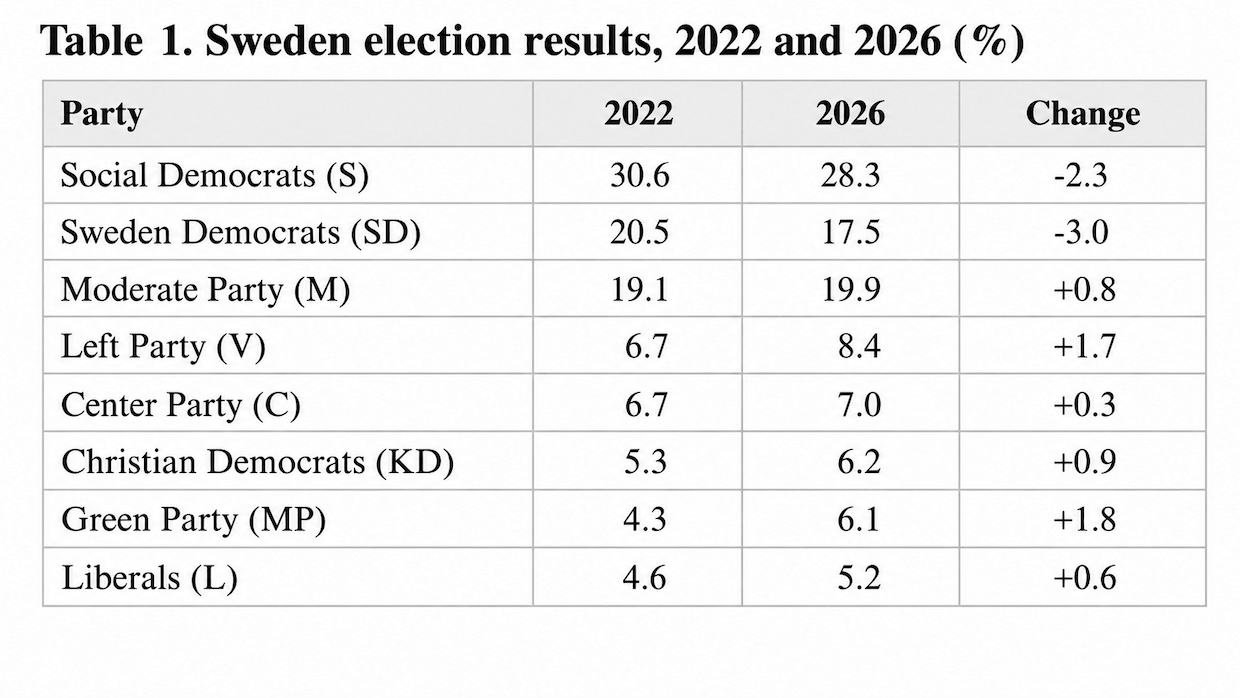 After all votes were counted, S leader Magdalena Andersson’s bloc secured 176 seats to the Tidö coalition’s 173. Over the past four years, the SD-backed government has tightened immigration policy, promoted repatriation, made temporary residence permits the norm, and introduced tougher criminal penalties. The Social Democrats did not consistently oppose these measures and have themselves embraced a more restrictive approach to immigration. Yet, despite this broad political consensus, the opposition won.
Why is it that the Sweden Democrats (SD) emerged as one of the election’s losers? I outline below three possible explanations.
1. From anti-establishment challenger to part of the establishment. After decades of rapid growth, often doubling its vote share from one election to the next, the Sweden Democrats’ momentum slowed in 2022 and turned into decline in 2026.
Initially, in the beginning of its parliamentary journey, the party was often portrayed as a devil in disguise of sorts, who concealed an extremely shady past under a fancy costume. Meanwhile, its elected representatives were sometimes ridiculed as political clowns (Hellström & Nilsson, 2010). They faced immense criticism in mainstream media and from the other mainstream political parties. Both the Moderates under Fredrik Reinfeldt and the Social Democrats under Mona Sahlin united in a show of repugnance against the Sweden Democrats, denying them any political influence and refusing to cooperate with them.
But times change.
As the Sweden Democrats have entered the political mainstream, they have sought to portray themselves as a responsible governing partner. Meanwhile, mainstream parties have moved closer to SD on immigration. M leader Ulf Kristersson has endorsed SD leader Jimmie Åkesson’s concerns about immigration, integration, and crime (Kristersson, 2026), while the Social Democrats also support lower immigration and stricter integration measures (Social Democratic Party, 2025).
As a result, political positions widely regarded as extreme a decade ago have become mainstream today. And when the extreme has become mainstream, young radicals are looking for even more extreme alternatives, as SD has become too moderate according to them.
2. Sweden’s immigration policy, which the SD actively promotes, has become too restrictive. Many voters, both natives and immigrants, now see Sweden’s immigration policy as too restrictive. When well-integrated immigrants face deportation, barriers to family reunification, uncalled-for surveillance of well-behaved immigrant voters, or demanding income requirements (ridiculously high), these policies may generate protest rather than public support. Can these protests be framed in populist terms? For some scholars, the answer is affirmative. In this regard, populism can be understood as a form of democratic protest (Abbott, 2007) rather than merely an anti-democratic force. To shed light on this issue, it helps to revisit Margaret Canovan.
Canovan (1999) identifies two faces of democratic politics: redemption and pragmatism. Democracy, understood as an ideal, embodies a redemptive vision through which citizens can collectively pursue and realize “the good society.” The pragmatic face, by contrast, is concerned with maintaining institutions capable of managing conflict and disagreement peacefully, without allowing political competition to become destructive. In its institutional form, this pragmatic dimension is reflected in arrangements such as free and fair elections, a multiparty system, and the rule of law. Representative politics, however, extends beyond politics-as-usual by also emphasizing redemptive impulses. In this reading, voters who feel that political developments have gone too far reject established politics (pragmatism) and instead support an alternative vision (redemption). Populism is not synonymous with the far right. It can also be understood as a democratic protest against a political system that, in the eyes of its critics, has become overly technocratic.
3. Sweden Democrats’ profile issues were not at the top of the political agenda. There was a clear mismatch between the Sweden Democrats’ priorities and those of the average voter. More broadly, no single issue dominated the election campaign. While some voters focused on climate change, others were concerned about their finances, healthcare, or education. Although society remained polarized, the SD’s agenda did not fully align with voters’ main concerns.
Some voters were protesting against climate change, while others were concerned about their personal finances or health. Even in a polarized political environment, it is fair to say that there was no perfect match between what average voters considered the most important issues and the priorities of the Sweden Democrats. According to the Swedish Television exit poll (SVT Nyheter, 2026), the three most important issues for voters in the 2026 election were healthcare, education, and the Swedish economy (ibid.). According to the same 2026 VALU exit poll, Sweden Democrats’ voters were primarily motivated by concerns about law and order, immigration, and integration (ibid.).
The Sweden Democrats have successfully built a consensus around their narrative of where Sweden is heading and what Swedish national identity is. This lies behind their policies and political rhetoric, at least up to now. I will end this article with two examples of when their narrative has established a consensus and achieved hegemony.
First, consider the failure of integration mantra. While many agree that integration has failed, few agree on what integration actually means. The SD offers a simple explanation: excessive immigration has weakened social cohesion and caused fragmentation. Yet this narrative is often one-sided. Immigrants now constitute more than one-fifth of Sweden’s population, and many have integrated successfully into Swedish society. But as long as the dominant (and only) narrative is that integration has failed, the SD stands to benefit.
A second example is the oft-repeated claim that Sweden must never return to 2015. Yet 2015 created opportunities for both regressive forces and progressive mobilization (Bevelander & Hellström, 2019). While many municipalities worried that immigration was stretching their capacity to the limit, civil society organizations, churches, and private citizens mobilized to help refugees by providing housing, language cafés, and other forms of support. These examples are seldom heard now.
Living with diversity in everyday life gives rise to social tensions in the population and between groups. Sweden has now elected a new parliament. Let us see what the new government will look like. Members of the Tidö government have packed their bags. Which narratives will the new government base its law proposals on? What will be the dominant story? Populism invites us to acknowledge the storytelling dimension of representative politics. It invites us, as researchers of populism, to expand beyond politics as usual. Since the pendulum has swung back, there is reason to hope that the story, Swedish case, will have a happy continuation.
(*) Anders Hellström is Associate Professor in Political Science. He is a senior lecturer in IMER at the Department of Global Political Studies and is connected to the Migration Research Institute MIM at Malmö University. He has published widely in the areas of populism, nationalism, the far right, racism, discourse theory, and the politics of migration and identity. He has published widely in academic journals, such as Government and Opposition, Journal of International Migration and Integration, and Ethnicities. His most recent article is “You Are Not a Racist, Right?”: Racism as a Political Activity, which examines the intersection between discourse and ideology in contemporary struggles over the meaning of racism.
References
Abbott, P. (2007). ‘“Bryan, Bryan, Bryan, Bryan”: Democratic Theory, Populism, and Philip Roth’s ‘American Trilogy’.” Canadian Review of American Studies, vol. 37, no. 3: 431–452.
Canovan, M. (1999). Trust the People! Populism and the Two Faces of Democracy. Political Studies, 47(1), 2-16.
Hellström, A. and Nilsson, T. (2010). “‘We Are the Good Guys’: Ideological Positioning of the Nationalist Party Sverigedemokraterna in Contemporary Swedish Politics’.” Ethnicities, 10(1), pp. 55-76.
Kristersson, U. (2026). Statement by Prime Minister Ulf Kristersson. Stockholm: Government Offices of Sweden.https://www.government.se/ (accessed: 15 September 2026).
Mudde, Cas. (2019). The Far Right Today.
Social Democratic Party. (2025). Social Democrats Adopt New Program with Adjusted Immigration Policy. Available at: Sweden Herald. (accessed: 15 September 2026).
SVT Nyheter. (2026). Väljarnas viktigaste frågor. Publicerad 13 september 2026, uppdaterad 14 september 2026. Available at: https://www.svt.se/nyheter/valjarnas-viktigaste-fragor (accessed: 15 September 2026)

The Pendulum Swings Back: Why the Sweden Democrats Lost Ground in Sweden’s 2026 Election
In this commentary, Associate Professor Anders Hellström examines why the Sweden Democrats emerged as one of the main losers of Sweden’s 2026 election after years of sustained growth and political influence. He identifies three factors: SD’s transformation from an anti-establishment challenger into part of the political establishment; growing resistance to increasingly restrictive immigration policies; and a mismatch between SD’s signature issues and voters’ wider priorities, particularly healthcare, education, and the economy. Assoc. Prof. Hellström also places the election within a broader debate about populism as democratic protest and the narrative foundations of representative politics. He argues that SD has successfully shaped dominant stories about integration, immigration, and Swedish identity, but that the 2026 result may indicate an opening for alternative political narratives as “the pendulum has swung back.”
By Anders Hellström*
When populists become the establishment, voters may seek new ways to protest the elite, as Sweden’s recent election suggests. The pendulum has swung back. This article outlines three reasons why the Sweden Democrats (SD) suffered electoral setbacks. It concludes by arguing that research needs to acknowledge the storytelling dimension of representative politics to open up space for progressive stories to be told in the future. What will be the dominant narrative in the years to come? But first, let us return to the election itself.
On 13 September, Sweden held local, regional, and national elections. At the national level, Prime Minister Ulf Kristersson’s Tidö coalition faced an opposition led by the Social Democrats (S). The election resulted in a narrow victory for the center-left bloc. Among the opposition parties, the Social Democrats won 28.3% of the vote, followed by the Left Party (V) (8.4%), the Center Party (C) (7.0%), and the Green Party (MP) (6.1%) (see Table 1).
Three of the four Tidö coalition parties increased their vote share. The Moderate Party (M) rose to 19.9%, remaining the second-largest party, while the Christian Democrats (KD) and Liberals (L) increased to 6.2% and 5.2%, respectively. The main loser was the Sweden Democrats, whose support fell from 20.5% to 17.5% (see Table 1).
Why is it that the Sweden Democrats (SD) emerged as one of the election’s losers? I outline below three possible explanations.
1. From anti-establishment challenger to part of the establishment. After decades of rapid growth, often doubling its vote share from one election to the next, the Sweden Democrats’ momentum slowed in 2022 and turned into decline in 2026.
Initially, in the beginning of its parliamentary journey, the party was often portrayed as a devil in disguise of sorts, who concealed an extremely shady past under a fancy costume. Meanwhile, its elected representatives were sometimes ridiculed as political clowns (Hellström & Nilsson, 2010). They faced immense criticism in mainstream media and from the other mainstream political parties. Both the Moderates under Fredrik Reinfeldt and the Social Democrats under Mona Sahlin united in a show of repugnance against the Sweden Democrats, denying them any political influence and refusing to cooperate with them.
But times change.
As the Sweden Democrats have entered the political mainstream, they have sought to portray themselves as a responsible governing partner. Meanwhile, mainstream parties have moved closer to SD on immigration. M leader Ulf Kristersson has endorsed SD leader Jimmie Åkesson’s concerns about immigration, integration, and crime (Kristersson, 2026), while the Social Democrats also support lower immigration and stricter integration measures (Social Democratic Party, 2025).
As a result, political positions widely regarded as extreme a decade ago have become mainstream today. And when the extreme has become mainstream, young radicals are looking for even more extreme alternatives, as SD has become too moderate according to them.
2. Sweden’s immigration policy, which the SD actively promotes, has become too restrictive. Many voters, both natives and immigrants, now see Sweden’s immigration policy as too restrictive. When well-integrated immigrants face deportation, barriers to family reunification, uncalled-for surveillance of well-behaved immigrant voters, or demanding income requirements (ridiculously high), these policies may generate protest rather than public support. Can these protests be framed in populist terms? For some scholars, the answer is affirmative. In this regard, populism can be understood as a form of democratic protest (Abbott, 2007) rather than merely an anti-democratic force. To shed light on this issue, it helps to revisit Margaret Canovan.
Canovan (1999) identifies two faces of democratic politics: redemption and pragmatism. Democracy, understood as an ideal, embodies a redemptive vision through which citizens can collectively pursue and realize “the good society.” The pragmatic face, by contrast, is concerned with maintaining institutions capable of managing conflict and disagreement peacefully, without allowing political competition to become destructive. In its institutional form, this pragmatic dimension is reflected in arrangements such as free and fair elections, a multiparty system, and the rule of law. Representative politics, however, extends beyond politics-as-usual by also emphasizing redemptive impulses. In this reading, voters who feel that political developments have gone too far reject established politics (pragmatism) and instead support an alternative vision (redemption). Populism is not synonymous with the far right. It can also be understood as a democratic protest against a political system that, in the eyes of its critics, has become overly technocratic.
3. Sweden Democrats’ profile issues were not at the top of the political agenda. There was a clear mismatch between the Sweden Democrats’ priorities and those of the average voter. More broadly, no single issue dominated the election campaign. While some voters focused on climate change, others were concerned about their finances, healthcare, or education. Although society remained polarized, the SD’s agenda did not fully align with voters’ main concerns.
Some voters were protesting against climate change, while others were concerned about their personal finances or health. Even in a polarized political environment, it is fair to say that there was no perfect match between what average voters considered the most important issues and the priorities of the Sweden Democrats. According to the Swedish Television exit poll (SVT Nyheter, 2026), the three most important issues for voters in the 2026 election were healthcare, education, and the Swedish economy (ibid.). According to the same 2026 VALU exit poll, Sweden Democrats’ voters were primarily motivated by concerns about law and order, immigration, and integration (ibid.).
The Sweden Democrats have successfully built a consensus around their narrative of where Sweden is heading and what Swedish national identity is. This lies behind their policies and political rhetoric, at least up to now. I will end this article with two examples of when their narrative has established a consensus and achieved hegemony.
First, consider the failure of integration mantra. While many agree that integration has failed, few agree on what integration actually means. The SD offers a simple explanation: excessive immigration has weakened social cohesion and caused fragmentation. Yet this narrative is often one-sided. Immigrants now constitute more than one-fifth of Sweden’s population, and many have integrated successfully into Swedish society. But as long as the dominant (and only) narrative is that integration has failed, the SD stands to benefit.
A second example is the oft-repeated claim that Sweden must never return to 2015. Yet 2015 created opportunities for both regressive forces and progressive mobilization (Bevelander & Hellström, 2019). While many municipalities worried that immigration was stretching their capacity to the limit, civil society organizations, churches, and private citizens mobilized to help refugees by providing housing, language cafés, and other forms of support. These examples are seldom heard now.
Living with diversity in everyday life gives rise to social tensions in the population and between groups. Sweden has now elected a new parliament. Let us see what the new government will look like. Members of the Tidö government have packed their bags. Which narratives will the new government base its law proposals on? What will be the dominant story? Populism invites us to acknowledge the storytelling dimension of representative politics. It invites us, as researchers of populism, to expand beyond politics as usual. Since the pendulum has swung back, there is reason to hope that the story, Swedish case, will have a happy continuation.
(*) Anders Hellström is Associate Professor in Political Science. He is a senior lecturer in IMER at the Department of Global Political Studies and is connected to the Migration Research Institute MIM at Malmö University. He has published widely in the areas of populism, nationalism, the far right, racism, discourse theory, and the politics of migration and identity. He has published widely in academic journals, such as Government and Opposition, Journal of International Migration and Integration, and Ethnicities. His most recent article is “You Are Not a Racist, Right?”: Racism as a Political Activity, which examines the intersection between discourse and ideology in contemporary struggles over the meaning of racism.
References
Abbott, P. (2007). ‘“Bryan, Bryan, Bryan, Bryan”: Democratic Theory, Populism, and Philip Roth’s ‘American Trilogy’.” Canadian Review of American Studies, vol. 37, no. 3: 431–452.
Canovan, M. (1999). Trust the People! Populism and the Two Faces of Democracy. Political Studies, 47(1), 2-16.
Hellström, A. and Nilsson, T. (2010). “‘We Are the Good Guys’: Ideological Positioning of the Nationalist Party Sverigedemokraterna in Contemporary Swedish Politics’.” Ethnicities, 10(1), pp. 55-76.
Kristersson, U. (2026). Statement by Prime Minister Ulf Kristersson. Stockholm: Government Offices of Sweden.https://www.government.se/ (accessed: 15 September 2026).
Mudde, Cas. (2019). The Far Right Today.
Social Democratic Party. (2025). Social Democrats Adopt New Program with Adjusted Immigration Policy. Available at: Sweden Herald. (accessed: 15 September 2026).
SVT Nyheter. (2026). Väljarnas viktigaste frågor. Publicerad 13 september 2026, uppdaterad 14 september 2026. Available at: https://www.svt.se/nyheter/valjarnas-viktigaste-fragor (accessed: 15 September 2026)
Latest News
ECPS Panel on US Midterms: Trumpism, Democratic Resilience, and the Rise of Democratic Socialism
Prof. Sátyro: Bolsonarismo Has Already Become Bigger Than Bolsonaro Himself
Prof. Schlozman: American Voters Are Tired of Trumpism
Who Pays to Adapt? Climate Debt and Populist Politics of Climate Justice in Africa
ECPS Joins TRACE, a New EU-Funded Project on Colonial Legacies and Climate Vulnerability
ECPS Panel on US Midterms: Trumpism, Democratic Resilience, and the Rise of Democratic Socialism
Prof. Sátyro: Bolsonarismo Has Already Become Bigger Than Bolsonaro Himself
Prof. Schlozman: American Voters Are Tired of Trumpism
Category
ECPS Panel on US Midterms: Trumpism, Democratic Resilience, and the Rise of Democratic Socialism
Prof. Sátyro: Bolsonarismo Has Already Become Bigger Than Bolsonaro Himself
Prof. Schlozman: American Voters Are Tired of Trumpism
Who Pays to Adapt? Climate Debt and Populist Politics of Climate Justice in Africa
ECPS Joins TRACE, a New EU-Funded Project on Colonial Legacies and Climate Vulnerability
Dr. Hasanović: Ethnically Defined Power Sharing in Bosnia Is the Algorithm That Continually Reproduces the Crisis