
In this ECPS interview, Associate Professor Karl Loxbo of Stockholm University examines Sweden as an increasingly striking case of radical-right mainstreaming. He argues that the Sweden Democrats’ electoral decline should not be confused with diminishing political influence, since the party’s rhetoric and policy positions—especially on immigration—have become widely normalized. Assoc. Prof. Loxbo stresses that Sweden has moved “from one extreme to the other,” with SD incorporated into the right-wing bloc and restrictive migration policies broadly accepted across mainstream politics. He also discusses changing boundaries of political acceptability, elite cues, the “bandwagon effect,” Social Democratic accommodation, and the wider European consequences of legitimizing the radical right. Ultimately, he links these developments to “the declining legitimacy of mainstream politics.”
Interview by Selcuk Gultasli
Giving an interview to the European Center for Populism Studies (ECPS), Associate Professor Karl Loxbo, Senior Lecturer at the Department of Political Science at Stockholm University, argues that Sweden has become an unusually far-reaching case of radical-right mainstreaming. For Assoc. Prof. Loxbo, the Sweden Democrats’ electoral setback in the September 13 election should not be read as evidence that their political influence has receded. On the contrary, he stresses that the party’s ideas, rhetoric, and policy preferences have become deeply embedded in Swedish political competition. “Sweden is a special—or I would even dare to say extreme—case,” he says, pointing to the speed with which the Sweden Democrats have been incorporated into the right-wing bloc and accepted by other parties.
The central paradox of the interview is therefore the growing distance between electoral support and ideological influence. Although SD lost votes, Assoc. Prof. Loxbo argues that the party has helped transform the boundaries of acceptable political debate, particularly on immigration. Sweden, he notes, has moved from a comparatively liberal migration regime to a radically more restrictive one, a transformation that is “largely due to the SD.” More significantly, he observes that there is now “no opposition in principle to this among the mainstream parties.”
This process, in Assoc. Prof. Loxbo’s account, goes beyond policy convergence. Restrictive positions on immigration have become “highly normalized throughout the political debate and in the media,” while SD’s “rhetoric and policy positions have been extensively normalized in Sweden.” The result is not simply that the radical right has entered the mainstream, but that the mainstream itself has shifted.
Assoc. Prof. Loxbo also emphasizes how dramatically the boundaries of political acceptability have changed. “What would not have been considered acceptable 10 years ago certainly is today,” he says, adding that these boundaries have been “completely erased and redrawn.” In his view, this transformation is reinforced when mainstream elites adopt positions previously associated with the radical right, creating what he describes as a “bandwagon effect” in which citizens either shift their views or become more willing to express preferences they already held.
The Swedish experience, Assoc. Prof. Loxbo warns, carries broader European implications. Once mainstream right parties legitimize the radical right, he argues, “the party system can be reshaped beyond recognition.” Sweden’s incorporation of SD into the right-wing bloc has already produced long-term changes that, while perhaps not fully permanent, now appear deeply entrenched.
Ultimately, Assoc. Prof. Loxbo situates radical-right mainstreaming within a wider crisis of representation. The radical right, he argues, is “just a symptom of a broader phenomenon: the declining legitimacy of mainstream politics.” The democratic challenge, therefore, is not merely whether SD loses votes, but whether mainstream parties can once again develop distinctive agendas and reclaim the capacity to shape political conflict on their own terms.
Here is our interview with Associate Professor Karl Loxbo, edited lightly to enhance clarity, readability, and overall flow for publication.
SD’s Decline Reflects a Shift in Voters’ Political Priorities
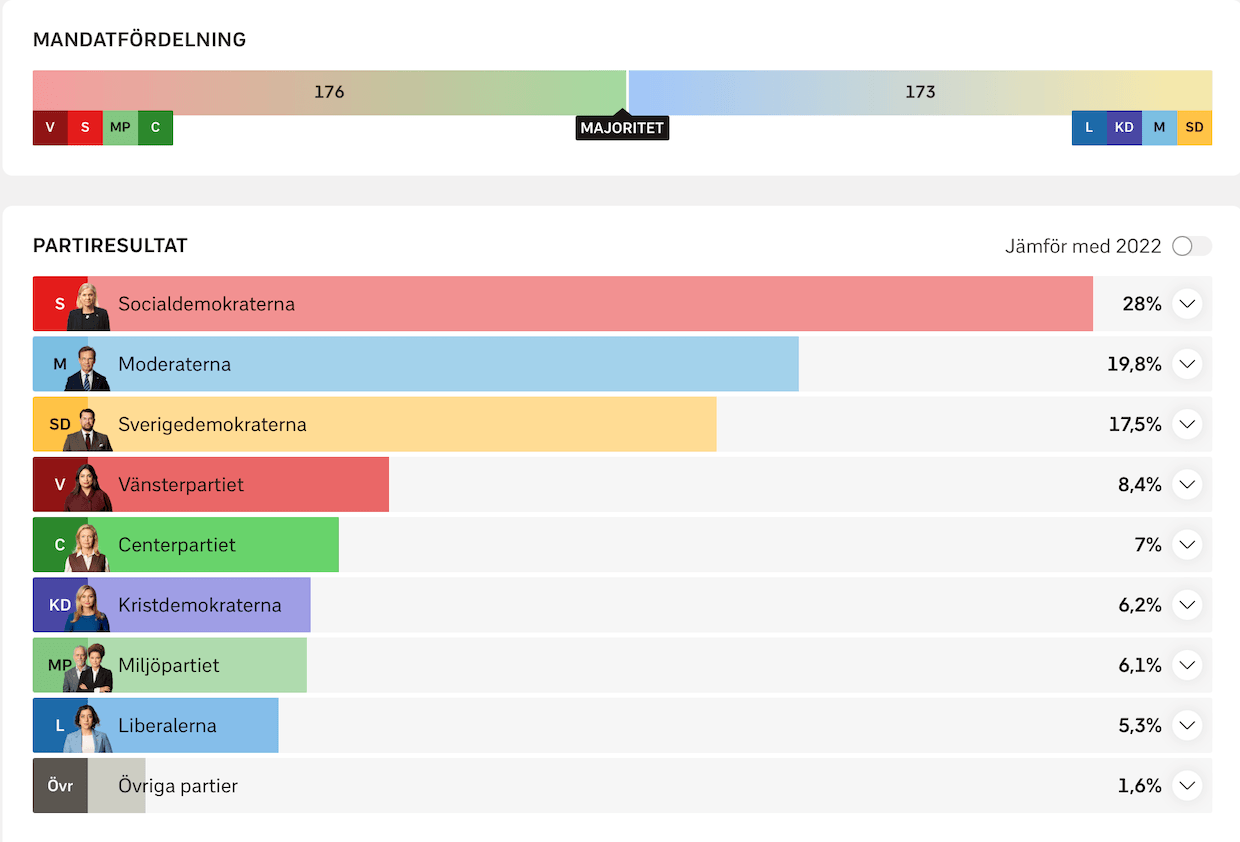
Professor Loxbo, welcome! Let me begin with the recent election result and what it may tell us about the Sweden Democrats’ position. After years of growth, SD fell to around 17.5 percent in the September 13 election, while the centre-left bloc won a very narrow majority. How should we understand this setback? Has SD reached an electoral ceiling, or is this more likely a temporary decline linked to its role in supporting the Tidö government?
Assoc. Prof. Karl Loxbo: It’s difficult to say, but what is clear is that the issues they own, especially the immigration issue have not been that salient among the electorate during this election campaign. In fact, the electorate has turned back to more traditional materialist and redistributive issues during this election. This is one of the reasons why the focus has not been on the urgency of the topics they raised and, as a result, on which they had increased their support in all elections so far since 2010. I guess there is a perception among the electorate that these issues are not as important as they were in the last election.
That result also raises an important question about the difference between electoral support and political influence. SD lost votes, but many of its positions on migration, integration, deportation, crime, and assimilation have become more mainstream. Should we therefore distinguish between electoral loss and ideological success? Can a radical-right party lose support because other parties have adopted parts of its agenda?
Assoc. Prof. Karl Loxbo: Sweden is a special—or I would even dare to say extreme—case, in the sense that, in a very short time, the Sweden Democrats have been incorporated into the right-wing bloc as almost a full member. They are now fully accepted by all of the other parties, including the Liberals, and I am not really aware of a similar situation elsewhere.
Their current position, and what you referred to as the mainstreaming of their issues, has to be understood in light of that. The mainstreaming of their agenda is closely connected to their incorporation as a completely normal part of the right-wing bloc. In a very short period—roughly four years—it is almost like moving from one extreme to the other.
Sweden’s Immigration Policy Has Gone from One Extreme to the Other
This connects directly to your research on how radical-right parties shape political debate. You describe SD as an “issue entrepreneur” that helped make immigration more central to Swedish politics. If immigration is now firmly established on the agendas of mainstream parties, has SD become less necessary to voters? Can a party lose ownership of the issue it helped make dominant?
Assoc. Prof. Karl Loxbo: This again needs to be seen in light of the Sweden Democrats being incorporated into the right-wing bloc as a fully accepted part of it, and that also applies to their position on immigration. At the same time, the leading party on the other side, the Social Democrats, have also adopted this position, so in that sense, maybe the Sweden Democrats can lose ownership of the issue.
But when immigration is highly salient in an election campaign, they are bound to benefit from it. The thing is, it was not really a highly salient issue in this election.
Sweden stands out as a rather special case because immigration policy has gone from one extreme to the other. Before the refugee crisis, Sweden had a highly liberal immigration policy compared with many other European countries. This has changed completely, and it is largely due to the SD. And there is no opposition in principle to this among the mainstream parties. None.
This also raises the question of how mainstream parties react to SD’s success. When established parties adopt stricter positions on immigration to compete with SD, do they weaken the party—or do they instead help normalize SD’s language and way of defining political problems?
Assoc. Prof. Karl Loxbo: Going back to the previous question, you have to distinguish between the issue of immigration and the actor. Whereas the policy position of being strict on immigration is now highly normalized throughout the political debate and in the media, this was not always the case. The view of the actor itself—the radical right as a political actor—is different. The Sweden Democrats have been mainstreamed within the right-wing bloc, but there is still some tension surrounding the party itself. At the same time, it is certainly the case that their rhetoric and policy positions have been extensively normalized in Sweden.
Policy Influence Does Not Automatically Translate into Electoral Reward
There is also a puzzle about the relationship between influence and electoral reward. SD had considerable influence over migration and criminal-justice policy during the last four years, yet it still lost support. Does this suggest that voters distinguish between getting the policies they want and supporting the party that first promoted them?
Assoc. Prof. Karl Loxbo: Again, voting depends very much on issue saliency, and in this election, the issue was not particularly salient. But it could, of course, be that many voters effectively free-rode on the Sweden Democrats: the policies had already been advanced, and the work had, to some extent, been done.
Let me turn to the relationship between SD and Social Democracy. Your research shows that Social Democrats can sometimes reduce losses to the radical right by taking a tougher line on immigration. But does this create a longer-term problem? Can Social Democrats win back working-class voters without also accepting the idea that welfare and solidarity should be more closely tied to nationality?
Assoc. Prof. Karl Loxbo: No. In the short term, it seemed that they could do this in some Scandinavian countries, as we saw in Denmark. The Swedish Social Democrats attempted to do the same, but in this election they won little or nothing back from the Sweden Democrats.
So, this appears to be a losing gamble, as much of the research in this field suggests. Accommodation generally does not work, and it works particularly poorly for social democratic parties. In that sense, voters tend to go with the original.
That creates a very slippery slope for social democracy. In the Swedish case, they seem to have adopted this position in order to neutralize the issue and make it less salient, but it has not won them votes. It is difficult to say whether this contributed to the Social Democrats’ weak election result or whether the more important factor was the general ambiguity of their campaign.
Immigration Has Become a Lasting Feature of Swedish Party Competition
This brings us to the wider structure of political conflict in Sweden. Your research suggests that immigration has become more important in shaping how voters understand left and right, while traditional economic issues have become less central. But cost of living, healthcare, welfare, and household finances were also important in 2026. Are economic issues becoming more important again, or has immigration permanently changed Swedish party competition?
Assoc. Prof. Karl Loxbo: Yes, immigration has become a lasting feature of Swedish party competition—although “permanent” may be too strong a word. Party competition in Sweden has clearly changed, and there is no longer a stable political supply of long-term redistributive platforms.
At the same time, demand for such platforms is highly fragmented and no longer consistently sustained over time. The reason is that the main dimensions of political conflict have become increasingly intertwined. Cultural and economic issues now overlap to a much greater extent, and party competition reflects this development. As a result, Swedish politics has become increasingly centered on cultural issues, particularly immigration.
The election also showed clear geographical differences. SD remained strong in many smaller towns and rural areas but faced more resistance in large and diverse cities. How should we understand this divide? Are different parts of Sweden developing increasingly different political cultures around immigration, identity, and social change?
Assoc. Prof. Karl Loxbo: You see the same divide everywhere between cities and rural areas. The radical right tends to be stronger in rural areas and somewhat less strong in more affluent urban environments. This is not a division that is specific to Sweden. But to answer your question, yes, for sure, there are different political cultures. Sweden, however, does not deviate in any significant sense from other countries in this respect.
Younger Generations Remain More Libertarian and Cosmopolitan
Another interesting result concerns younger voters. SVT’s exit poll suggests that SD lost significant support among 18–21-year-olds. What might explain this? Are younger voters becoming less attracted to radical-right politics, or are they simply moving between parties more easily than older voters?
Assoc. Prof. Karl Loxbo: Younger voters are not generally that attracted to radical right-wing politics. In fact, the general tendency is that younger generations are more libertarian or more cosmopolitan in their mindset. However, in the last election, it was clear that the SD was strong among young men. The decline now probably also reflects the decline in issue saliency. There are other issues on the agenda, and they are not the issues that the SD own. As a result, you see a decreasing gap between young girls and boys, who are becoming less likely to support the radical right.
Let me turn to the question of normalization. In your earlier work, you argued that strong criticism and isolation of SD could sometimes help the party present itself as an outsider and strengthen its internal unity. Today, SD is much more established. How has the line between what is seen as racist, xenophobic, radical-right, or simply legitimate migration policy changed in Sweden?
Assoc. Prof. Karl Loxbo: It has changed dramatically—substantially. As I said before, it is like moving from one extreme to the other. What would not have been considered acceptable 10 years ago certainly is today.
The boundaries around these issues have been completely erased and redrawn. One example is the recent debate about why the right-wing side lost the election. The Sweden Democrats quickly argued that this was because immigrants vote for the left, and the narrative seemed to imply that these votes somehow did not count.
Yet hardly anyone reacted to that, except on the left. Ten years ago, it would have caused a major scandal. Today, it does not, and that illustrates how profoundly the boundaries around this issue have shifted.
Democracies Should Be Wary When Political Arguments Target Particular Groups
That leads to a difficult but important distinction. Democratic states clearly have the right to control migration and set rules on citizenship and integration. At what point does a restrictive migration policy become nativist or exclusionary? What signs should scholars and people look for?
Assoc. Prof. Karl Loxbo: You should look for signs such as the one I just mentioned: when political rhetoric begins to single out specific groups. When particular groups become the focus of political argument—when people are told to be wary of this group or that, or when individuals are treated as if they act collectively—that is, at least from the Swedish case, one warning sign.
Your research with Mike Farjam also shows how people respond to what they think the majority believes. Could this help explain the normalization of radical-right ideas? If restrictive views are increasingly presented as “common sense” or the voice of a “silent majority,” can this make people more willing to accept or express such positions?
Assoc. Prof. Karl Loxbo: Yes, definitely. It’s the same mechanism here, but it is more about people revealing preferences they already hold. They do so in response to elite cues. When elites shift their positions on these issues, people often shift as well.
The key point is that this broader change does not occur simply because the Sweden Democrats move in a certain direction. They tend to reach a more limited electorate, particularly those who already hold strongly anti-immigrant views. The broader shift comes when mainstream parties also change their positions.
In the Swedish case, that can produce a bandwagon effect: people either shift their positions on these issues or become more willing to express views they already held. That is what redraws the boundaries.
Swedish Exceptionalism Was Greatly Exaggerated

This also connects to Sweden’s image as a highly trusting and tolerant society. You have questioned the idea that high social trust automatically means high tolerance toward outsiders. Looking at Sweden’s shift toward a more restrictive migration debate, was the idea of Swedish exceptionalism always somewhat exaggerated?
Assoc. Prof. Karl Loxbo: Yes, somewhat exaggerated, perhaps. But if you compare Sweden with many other countries, it is still more tolerant. Although these issues have been normalized here as well, the idea of Swedish exceptionalism has certainly been greatly exaggerated. The belief that Sweden was immune to radical-right populism was actually widely held around 20 years ago. That turned out to be highly naive and reflected an exaggerated belief in the liberalism of Swedish public opinion.
Let me broaden the discussion to Europe. Your recent research with Brigitte Pircher suggests that European integration has reduced conflict in some economic areas while leaving more room for political conflict over identity and social protection. Could this help explain why migration, borders, and national identity have become so important for radical-right parties?
Assoc. Prof. Karl Loxbo: Yes, and this is a traditional explanation in the literature for the general rise of right-wing populism: the convergence of established parties on economic issues. To some extent, European integration has pushed them toward similar positions on issues that were previously more politicized. As a result, this creates political space that can be exploited by other parties, including the radical right. So yes, I believe that.
Sweden Shows the Risks of Mainstream Conservatives Embracing the Radical Right
The Swedish case also has wider European relevance. Germany faces the AfD, France the National Rally, and Britain Reform UK. What lessons can these countries draw from Sweden about isolating the radical right, adopting parts of its agenda, or giving it influence over government?
Assoc. Prof. Karl Loxbo: As soon as mainstream right parties legitimize the radical right—not only by accommodating its main issues and adopting the same positions, but by actively saying that it was right all along—the party system can be reshaped beyond recognition. I doubt that will happen in Germany with the AfD, but if it does, the consequences would be profound.
That is what happened in the Swedish case. When the right-wing bloc included the Sweden Democrats, it produced long-term shifts that now look almost permanent, although I would hesitate to call them fully permanent.
So, it is a significant risk, as the Swedish conservatives have shown. If the German CDU were to follow the same path, I would be worried.
The Radical Right Is a Symptom of the Declining Legitimacy of Mainstream Politics
Finally, let me end with the broader democratic question. If SD continues to lose votes but much of the political agenda it helped create remains in place, how should we judge democratic resilience? Is it enough for the party itself to weaken, or do mainstream parties also need to regain the ability to shape political debate on their own terms?
Assoc. Prof. Karl Loxbo: Yes, definitely. Otherwise, someone else will come along. I would say that the radical right is just a symptom of a broader phenomenon: the declining legitimacy of mainstream politics.
This does not occur in a vacuum. It is the result of a long-term decline in the legitimacy of mainstream parties, which in turn creates space for the mobilization of new parties. So, if the radical right declines, someone else will come along, as long as we have voting rights.
So yes, of course, mainstream parties need to develop clear agendas and political issues of their own again. The question is: can they?